CN110856441A - Transparent element with diffuse reflection - Google Patents
Transparent element with diffuse reflection Download PDFInfo
- Publication number
- CN110856441A CN110856441A CN201980002630.3A CN201980002630A CN110856441A CN 110856441 A CN110856441 A CN 110856441A CN 201980002630 A CN201980002630 A CN 201980002630A CN 110856441 A CN110856441 A CN 110856441A
- Authority
- CN
- China
- Prior art keywords
- layer
- textured
- dielectric
- layers
- central layer
- Prior art date
- Legal status (The legal status is an assumption and is not a legal conclusion. Google has not performed a legal analysis and makes no representation as to the accuracy of the status listed.)
- Granted
Links
Images


Classifications
-
- G—PHYSICS
- G02—OPTICS
- G02B—OPTICAL ELEMENTS, SYSTEMS OR APPARATUS
- G02B5/00—Optical elements other than lenses
- G02B5/02—Diffusing elements; Afocal elements
- G02B5/0205—Diffusing elements; Afocal elements characterised by the diffusing properties
- G02B5/021—Diffusing elements; Afocal elements characterised by the diffusing properties the diffusion taking place at the element's surface, e.g. by means of surface roughening or microprismatic structures
- G02B5/0221—Diffusing elements; Afocal elements characterised by the diffusing properties the diffusion taking place at the element's surface, e.g. by means of surface roughening or microprismatic structures the surface having an irregular structure
-
- B—PERFORMING OPERATIONS; TRANSPORTING
- B32—LAYERED PRODUCTS
- B32B—LAYERED PRODUCTS, i.e. PRODUCTS BUILT-UP OF STRATA OF FLAT OR NON-FLAT, e.g. CELLULAR OR HONEYCOMB, FORM
- B32B17/00—Layered products essentially comprising sheet glass, or glass, slag, or like fibres
- B32B17/06—Layered products essentially comprising sheet glass, or glass, slag, or like fibres comprising glass as the main or only constituent of a layer, next to another layer of a specific material
- B32B17/10—Layered products essentially comprising sheet glass, or glass, slag, or like fibres comprising glass as the main or only constituent of a layer, next to another layer of a specific material of synthetic resin
- B32B17/10005—Layered products essentially comprising sheet glass, or glass, slag, or like fibres comprising glass as the main or only constituent of a layer, next to another layer of a specific material of synthetic resin laminated safety glass or glazing
- B32B17/10009—Layered products essentially comprising sheet glass, or glass, slag, or like fibres comprising glass as the main or only constituent of a layer, next to another layer of a specific material of synthetic resin laminated safety glass or glazing characterized by the number, the constitution or treatment of glass sheets
- B32B17/10036—Layered products essentially comprising sheet glass, or glass, slag, or like fibres comprising glass as the main or only constituent of a layer, next to another layer of a specific material of synthetic resin laminated safety glass or glazing characterized by the number, the constitution or treatment of glass sheets comprising two outer glass sheets
-
- B—PERFORMING OPERATIONS; TRANSPORTING
- B32—LAYERED PRODUCTS
- B32B—LAYERED PRODUCTS, i.e. PRODUCTS BUILT-UP OF STRATA OF FLAT OR NON-FLAT, e.g. CELLULAR OR HONEYCOMB, FORM
- B32B17/00—Layered products essentially comprising sheet glass, or glass, slag, or like fibres
- B32B17/06—Layered products essentially comprising sheet glass, or glass, slag, or like fibres comprising glass as the main or only constituent of a layer, next to another layer of a specific material
- B32B17/10—Layered products essentially comprising sheet glass, or glass, slag, or like fibres comprising glass as the main or only constituent of a layer, next to another layer of a specific material of synthetic resin
- B32B17/10005—Layered products essentially comprising sheet glass, or glass, slag, or like fibres comprising glass as the main or only constituent of a layer, next to another layer of a specific material of synthetic resin laminated safety glass or glazing
- B32B17/10165—Functional features of the laminated safety glass or glazing
- B32B17/10174—Coatings of a metallic or dielectric material on a constituent layer of glass or polymer
-
- B—PERFORMING OPERATIONS; TRANSPORTING
- B32—LAYERED PRODUCTS
- B32B—LAYERED PRODUCTS, i.e. PRODUCTS BUILT-UP OF STRATA OF FLAT OR NON-FLAT, e.g. CELLULAR OR HONEYCOMB, FORM
- B32B17/00—Layered products essentially comprising sheet glass, or glass, slag, or like fibres
- B32B17/06—Layered products essentially comprising sheet glass, or glass, slag, or like fibres comprising glass as the main or only constituent of a layer, next to another layer of a specific material
- B32B17/10—Layered products essentially comprising sheet glass, or glass, slag, or like fibres comprising glass as the main or only constituent of a layer, next to another layer of a specific material of synthetic resin
- B32B17/10005—Layered products essentially comprising sheet glass, or glass, slag, or like fibres comprising glass as the main or only constituent of a layer, next to another layer of a specific material of synthetic resin laminated safety glass or glazing
- B32B17/1055—Layered products essentially comprising sheet glass, or glass, slag, or like fibres comprising glass as the main or only constituent of a layer, next to another layer of a specific material of synthetic resin laminated safety glass or glazing characterized by the resin layer, i.e. interlayer
- B32B17/10761—Layered products essentially comprising sheet glass, or glass, slag, or like fibres comprising glass as the main or only constituent of a layer, next to another layer of a specific material of synthetic resin laminated safety glass or glazing characterized by the resin layer, i.e. interlayer containing vinyl acetal
-
- G—PHYSICS
- G02—OPTICS
- G02B—OPTICAL ELEMENTS, SYSTEMS OR APPARATUS
- G02B27/00—Optical systems or apparatus not provided for by any of the groups G02B1/00 - G02B26/00, G02B30/00
- G02B27/01—Head-up displays
- G02B27/0101—Head-up displays characterised by optical features
-
- G—PHYSICS
- G02—OPTICS
- G02B—OPTICAL ELEMENTS, SYSTEMS OR APPARATUS
- G02B5/00—Optical elements other than lenses
- G02B5/02—Diffusing elements; Afocal elements
- G02B5/0268—Diffusing elements; Afocal elements characterized by the fabrication or manufacturing method
-
- G—PHYSICS
- G02—OPTICS
- G02B—OPTICAL ELEMENTS, SYSTEMS OR APPARATUS
- G02B5/00—Optical elements other than lenses
- G02B5/02—Diffusing elements; Afocal elements
- G02B5/0273—Diffusing elements; Afocal elements characterized by the use
- G02B5/0284—Diffusing elements; Afocal elements characterized by the use used in reflection
-
- G—PHYSICS
- G03—PHOTOGRAPHY; CINEMATOGRAPHY; ANALOGOUS TECHNIQUES USING WAVES OTHER THAN OPTICAL WAVES; ELECTROGRAPHY; HOLOGRAPHY
- G03B—APPARATUS OR ARRANGEMENTS FOR TAKING PHOTOGRAPHS OR FOR PROJECTING OR VIEWING THEM; APPARATUS OR ARRANGEMENTS EMPLOYING ANALOGOUS TECHNIQUES USING WAVES OTHER THAN OPTICAL WAVES; ACCESSORIES THEREFOR
- G03B21/00—Projectors or projection-type viewers; Accessories therefor
- G03B21/54—Accessories
- G03B21/56—Projection screens
- G03B21/60—Projection screens characterised by the nature of the surface
- G03B21/62—Translucent screens
-
- B—PERFORMING OPERATIONS; TRANSPORTING
- B32—LAYERED PRODUCTS
- B32B—LAYERED PRODUCTS, i.e. PRODUCTS BUILT-UP OF STRATA OF FLAT OR NON-FLAT, e.g. CELLULAR OR HONEYCOMB, FORM
- B32B17/00—Layered products essentially comprising sheet glass, or glass, slag, or like fibres
- B32B17/06—Layered products essentially comprising sheet glass, or glass, slag, or like fibres comprising glass as the main or only constituent of a layer, next to another layer of a specific material
- B32B17/10—Layered products essentially comprising sheet glass, or glass, slag, or like fibres comprising glass as the main or only constituent of a layer, next to another layer of a specific material of synthetic resin
- B32B17/10005—Layered products essentially comprising sheet glass, or glass, slag, or like fibres comprising glass as the main or only constituent of a layer, next to another layer of a specific material of synthetic resin laminated safety glass or glazing
- B32B17/10165—Functional features of the laminated safety glass or glazing
- B32B17/10174—Coatings of a metallic or dielectric material on a constituent layer of glass or polymer
- B32B17/1022—Metallic coatings
- B32B17/10229—Metallic layers sandwiched by dielectric layers
-
- B—PERFORMING OPERATIONS; TRANSPORTING
- B32—LAYERED PRODUCTS
- B32B—LAYERED PRODUCTS, i.e. PRODUCTS BUILT-UP OF STRATA OF FLAT OR NON-FLAT, e.g. CELLULAR OR HONEYCOMB, FORM
- B32B2307/00—Properties of the layers or laminate
- B32B2307/40—Properties of the layers or laminate having particular optical properties
- B32B2307/416—Reflective
Landscapes
- Physics & Mathematics (AREA)
- General Physics & Mathematics (AREA)
- Optics & Photonics (AREA)
- Engineering & Computer Science (AREA)
- Manufacturing & Machinery (AREA)
- Laminated Bodies (AREA)
- Overhead Projectors And Projection Screens (AREA)
Abstract
Description
本发明涉及一种用于制备具有漫反射性质的透明层状元件的方法,涉及这种层状元件本身,还涉及其在多种工业应用中的用途。本发明还涉及使用这种层状元件的投影或后射投影方法。The present invention relates to a method for producing transparent laminar elements with diffusely reflective properties, to such laminar elements themselves, and to their use in various industrial applications. The invention also relates to a projection or backprojection method using such a layered element.
层状元件可以是刚性的或柔性的。它尤其可以是例如由基于玻璃或聚合物材料构成的玻璃板。它还可以是基于聚合物材料的柔性膜,特别地能够被添加到表面上以便为它提供漫反射性质同时保持其透射性质。The laminar elements can be rigid or flexible. It can in particular be a glass plate, for example composed of a glass-based or polymer-based material. It may also be a flexible film based on a polymeric material, in particular capable of being added to a surface in order to provide it with diffuse reflective properties while maintaining its transmissive properties.
已知的玻璃板包括标准透明玻璃板和半透明玻璃板,标准透明玻璃板引起在玻璃板上入射辐射的镜面透射和镜面反射,半透明玻璃板引起在玻璃板上入射辐射的漫透射和漫反射。Known glass sheets include standard clear glass sheets, which cause specular transmission and specular reflection of incident radiation on the glass sheet, and translucent glass sheets, which cause diffuse transmission and diffusion of incident radiation on the glass sheet. reflection.
通常,当以给定入射角入射在玻璃板上的入射辐射被玻璃板在多个方向上反射时,由该玻璃板的反射被称为漫反射。当以给定入射角入射在玻璃板上的入射辐射以等于入射角的反射角被玻璃板反射时,由该玻璃板的反射被称为镜面反射。同样,当以给定入射角入射在玻璃板上的入射辐射以等于入射角的透射角度被玻璃板透射时,穿过该玻璃板的透射被称为镜面透射。Generally, when incident radiation incident on a glass sheet at a given angle of incidence is reflected by the glass sheet in multiple directions, the reflection by the glass sheet is referred to as diffuse reflection. When incident radiation incident on a glass sheet at a given angle of incidence is reflected by the glass sheet at an angle of reflection equal to the angle of incidence, the reflection by the glass sheet is called specular reflection. Likewise, when incident radiation incident on a glass sheet at a given angle of incidence is transmitted by the glass sheet at a transmission angle equal to the angle of incidence, transmission through the glass sheet is referred to as specular transmission.
标准透明玻璃板的一个缺点是它们以反射镜方式反射回清晰的反射图像,这在某些应用中是不希望的。因此,当玻璃板用于建筑物窗户或显示屏时,优选限制反射的存在,反射降低了穿过玻璃板的可见度。玻璃板上的清晰反射也可能产生眩目的风险,从而在安全性方面产生后果,例如当车辆前灯在建筑物的玻璃板正面上被反射时。这个问题特别在机场的玻璃幕墙上产生。实际上,关键的是使飞行员在接近航站楼时感到晃眼的任何风险最小化。One disadvantage of standard clear glass sheets is that they mirror back a clear reflected image, which is undesirable in some applications. Therefore, when the glass sheet is used in a building window or display screen, it is preferable to limit the presence of reflections that reduce visibility through the glass sheet. Clear reflections on glass panes can also create a risk of dazzling, with safety consequences, for example when vehicle headlights are reflected on the glass pane facade of a building. This problem arises especially in the glass curtain wall of the airport. In fact, the key is to minimise any risk of dazzling pilots as they approach the terminal.
此外,半透明玻璃板虽然具有不产生清晰反射的优点,但是不能穿过玻璃板获得清晰的视野。In addition, although translucent glass sheets have the advantage of not producing clear reflections, clear vision cannot be obtained through the glass sheets.
为了克服这些缺点,从包括文献WO2012/104547A1的现有技术中已知,使用具有漫反射的透明层状元件,其包括两个平滑的外主表面,以及:To overcome these drawbacks, it is known from the prior art including document WO 2012/104547 A1 to use a transparent layered element with diffuse reflection comprising two smooth outer main surfaces, and:
-两个外层,即下外层和上外层,它们各自形成层状元件的两个外主表面之一,并且由具有基本相同折射率的介电材料构成,以及- two outer layers, a lower outer layer and an upper outer layer, each forming one of the two outer main surfaces of the laminar element and consisting of a dielectric material having substantially the same refractive index, and
-插入在外层之间的中心层,该中心层由单层(其为具有不同于外层的折射率的折射率的介电层或金属层)形成,或者该中心层由包括至少一个折射率不同于外层的折射率的介电层或金属层的层堆叠体形成,- a central layer interposed between the outer layers, the central layer being formed of a single layer (which is a dielectric or metallic layer having a refractive index different from that of the outer layers), or the central layer being formed of a single layer comprising at least one refractive index A layer stack of dielectric layers or metal layers having a different refractive index than the outer layer is formed,
其中在层状元件的两个相邻层(一个是介电层,另一个是金属层,或者是两个具有不同折射率的介电层)之间的每个接触表面是纹理化的,并且与在两个相邻层(一个是介电层,另一个是金属层,或者是两个具有不同折射率的介电层)之间的其它纹理化接触表面平行。wherein each contact surface between two adjacent layers of the layered element (one is a dielectric layer and the other is a metal layer, or two dielectric layers with different refractive indices) is textured, and Parallel to other textured contact surfaces between two adjacent layers (one is a dielectric layer, the other is a metal layer, or two dielectric layers with different indices of refraction).
透明基材尤其可以由透明聚合物、透明玻璃或透明陶瓷构成。当透明基材由聚合物构成时,其可以是刚性的或柔性的。在柔性薄膜形式时,这种透明基材有利地在其一个主要外表面上设置有粘合层,该粘合层被覆盖有保护条带,该保护条带旨在被移除以用于薄膜的粘合。这时,柔性膜形式的层状元件能够通过粘合剂粘合被添加到存在的表面,例如玻璃板表面上,以便赋予该表面漫反射性质,同时保持镜面透射性质。The transparent substrate can in particular consist of transparent polymers, transparent glass or transparent ceramics. When the transparent substrate is composed of a polymer, it can be rigid or flexible. In the form of a flexible film, this transparent substrate is advantageously provided with an adhesive layer on one of its main outer surfaces, the adhesive layer being covered with a protective strip intended to be removed for the film of bonding. In this case, a layered element in the form of a flexible film can be added by adhesive bonding to an existing surface, such as a glass plate surface, in order to impart diffuse reflective properties to the surface, while maintaining specular transmission properties.
层状元件的每个外层可以由层的堆叠体形成,只要外层的各种组成层由都具有基本相同折射率的介电材料构成。Each outer layer of the layered element may be formed from a stack of layers, so long as the various constituent layers of the outer layer are composed of dielectric materials that all have substantially the same refractive index.
在本发明的意义上,介电材料或介电层被理解为指具有低于100S/m的低电导率的材料或层。In the sense of the present invention, a dielectric material or a dielectric layer is understood to mean a material or layer having a low electrical conductivity below 100 S/m.
术语"折射率"是指在550 nm波长下测量的光学折射率。The term "refractive index" refers to the optical refractive index measured at a wavelength of 550 nm.
在本发明的意义上,当两种介电材料在550 nm的折射率之差的绝对值小于或等于0.15时,这两种介电材料具有基本相同的折射率,或者它们的折射率基本相等。优选地,层状元件的两个外层的构成材料之间在550 nm的折射率差值的绝对值小于0.05,更优选小于0.015。In the sense of the present invention, two dielectric materials have substantially the same refractive index, or their refractive indices are substantially equal, when the absolute value of the difference between their refractive indices at 550 nm is less than or equal to 0.15 . Preferably, the absolute value of the difference in refractive index at 550 nm between the constituent materials of the two outer layers of the layered element is less than 0.05, more preferably less than 0.015.
相反,当在550 nm的折射率之差的绝对值严格大于0.15时,两个介电层具有不同的折射率。Conversely, when the absolute value of the difference in refractive index at 550 nm is strictly greater than 0.15, the two dielectric layers have different refractive indices.
在整个说明书中,关于中心层的组成,在一方面金属层与另一方面介电层之间进行区分,对于金属层,折射率的值不重要,对于介电层,必须考虑折射率相对于外层的折射率的差异。Throughout the specification, with regard to the composition of the central layer, a distinction is made between a metallic layer on the one hand and a dielectric layer on the other hand, for metallic layers the value of the refractive index is not important, for dielectric layers it is necessary to consider the refractive index relative to the Differences in the refractive indices of the outer layers.
在本发明的意义上,两个相邻层之间的接触表面是在两个相邻层之间的界面。In the sense of the present invention, the contact surface between two adjacent layers is the interface between two adjacent layers.
在本发明的上下文中,使用以下定义:In the context of the present invention, the following definitions are used:
-透明元件是指这样的元件:至少在用于该元件的目标应用的波长范围内的辐射镜面透射通过该元件。例如,当该元件用作建筑物或车辆的玻璃板时,它至少在可见光波长范围内是透明的。A transparent element means an element through which radiation at least in the wavelength range for the intended application of the element is specularly transmitted. For example, when the element is used as a glass pane for buildings or vehicles, it is transparent at least in the visible wavelength range.
-光滑表面是这样的表面,对于该表面,表面不规则体的尺寸小于在该表面上的入射辐射的波长,使得辐射不被这些表面不规则体偏转。这时,入射辐射以镜面方式被该表面透射和反射。- A smooth surface is a surface for which surface irregularities are smaller in size than the wavelength of the incident radiation on the surface, so that the radiation is not deflected by these surface irregularities. At this time, incident radiation is transmitted and reflected by the surface in a specular manner.
-纹理化表面是其中表面不规则体以比在表面上的入射辐射的波长更大的尺度变化的表面。这时,入射辐射以漫射方式被该表面透射和反射。- A textured surface is a surface in which surface irregularities vary in dimensions larger than the wavelength of the incident radiation on the surface. In this case, incident radiation is diffusely transmitted and reflected by the surface.
纹理化的接触表面的平行性意味着中心层的组成层或每个组成层(所述组成层是具有与外层的折射率不同的折射率的介电层,或者是金属层)具有垂直于中心层与外层的接触表面的均匀厚度。这种厚度的均匀性可以是在整个纹理范围内的整体,或者是在纹理部分上的局部。特别地,当纹理具有斜度变化时,在两个连续的纹理化接触表面之间的厚度可根据纹理的斜度而逐段改变,然而纹理化接触表面总是保持彼此平行。这种情况尤其发生在通过阴极溅射沉积的层中,其中该层的厚度随着纹理斜率的增加而变得更小。因此,局部地,在具有给定斜率的每个纹理段上,层的厚度保持恒定,但是在具有第一斜率的第一纹理段和具有不同于第一斜率的第二纹理段之间,层的厚度是不同的。The parallelism of the textured contact surfaces means that the or each constituent layer of the central layer (either a dielectric layer with a different index of refraction than that of the outer layer, or a metallic layer) has a perpendicular The uniform thickness of the contact surface of the center layer with the outer layer. This uniformity of thickness can be global over the entire texture range, or localized over textured portions. In particular, when the texture has a slope variation, the thickness between two consecutive textured contact surfaces may vary segment by segment according to the slope of the texture, however the textured contact surfaces always remain parallel to each other. This occurs especially in layers deposited by sputtering, where the thickness of the layer becomes smaller as the texture slope increases. Thus, locally, on each texture segment with a given slope, the thickness of the layer remains constant, but between a first texture segment with a first slope and a second texture segment with a different slope, the layer thickness is different.
图1至3表示在现有技术中已知的一种这样的透明层状元件。为了附图的清楚,没有严格地遵循不同层的相对厚度。此外,在所述图上没有示出中心层的每个组成层的作为纹理的斜率的函数的可能的厚度变化,应当理解,该可能的厚度变化不影响纹理化的接触表面的平行度。实际上,对于纹理的每个给定斜率,纹理化接触表面彼此平行。Figures 1 to 3 show one such transparent laminar element known in the prior art. For the clarity of the drawings, the relative thicknesses of the different layers are not strictly followed. Furthermore, the possible thickness variation as a function of the slope of the texture for each constituent layer of the central layer is not shown on the figure, it being understood that this possible thickness variation does not affect the parallelism of the textured contact surface. In fact, for each given slope of the texture, the textured contact surfaces are parallel to each other.
在整个说明书中,透明层状元件被认为是水平放置的,其第一面向下取向,限定了下外主表面,和其与第一面相反的第二面向上取向,限定了上外主表面;因此,表述"在上方"和"在下方"的含义是相对于该取向进行考虑的。除非另外说明,否则表述"在上方"和"在下方"不必然意味着两个层以彼此接触进行定位。术语"下"和"上"在这里是参考这种定位而使用的。Throughout this specification, the transparent laminar element is considered to be horizontally positioned with its first face oriented downwards, defining the lower outer major surface, and its second face, opposite the first face, oriented upwards, defining the upper outer major surface ; therefore, the meanings of the expressions "above" and "below" are considered relative to this orientation. The expressions "over" and "under" do not necessarily mean that the two layers are positioned in contact with each other, unless stated otherwise. The terms "lower" and "upper" are used herein with reference to this orientation.
注意,表述"…至…之间"包括该范围内的端值。Note that the expression "between" includes the endpoints within that range.
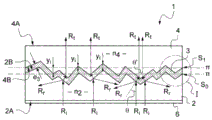
在图1中表示的层状元件1包括两个外层2和4,它们由具有基本相同的折射率n2、n4的透明介电材料构成。每个外层2或4具有指向层状元件外侧的光滑主表面(分别为2A或4A),以及指向层状元件内侧的纹理化主表面(分别为2B或4B)。The
层状元件1的光滑外表面2A和4A允许辐射能够在每个表面2A和4A处镜面透射,也就是说,辐射输入到外层中或辐射从外层输出,而不改变辐射的方向。The smooth
内表面2B和4B的纹理彼此互补。如图1中清楚地看到的,在其纹理严格地彼此平行的构造中,纹理化表面2B和4B彼此面对地进行定位。层状元件1还包括中心层3,其接触插入在纹理化表面2B和4B之间。The textures of the
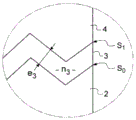
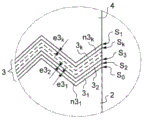
在图2所示的变型中,中心层3是单层,并且由透明材料构成,该透明材料是折射率n3不同于外层2和4的金属层或介电层。在图3所示的变型中,中心层3由多个层31、32、...、3k的透明层堆叠体形成,其中层31至3k中的至少一层是金属层或其折射率不同于外层2和4的折射率的介电层。优选地,位于层堆叠体端部的两个层31和3k中的至少每个层是金属层或具有与外层2和4的折射率不同的折射率n31或n3k的介电层。In the variant shown in FIG. 2 , the
在图1至3中,S0表示在外层2和中心层3之间的接触表面,S1表示在中心层3和外层4之间的接触表面。此外,在图3中,从最靠近表面S0的接触表面开始,连续地标注中心层3的内部接触表面S2至Sk。In FIGS. 1 to 3 , S 0 denotes the contact surface between the
在图2所示的变型中,由于中心层3以接触方式布置在彼此平行的纹理化表面2B和4B之间,所以在外层2和中心层3之间的接触表面S0是纹理化的,并且平行于在中心层3和外层4之间的接触表面S1。换句话说,中心层3是纹理化层,其至少局部具有均匀的与接触表面S0和S1垂直获取的厚度e3。In the variant shown in Figure 2, the contact surface S 0 between the
在图3所示的变型中,中心层3的构成堆叠体的两个相邻层之间的每个接触表面S2、...、Sk都是纹理化的,并且严格与在外层2、4和中心层3之间的接触表面S0和S1平行。因此,元件1的相邻层之间的所有接触表面S0、S1、...、Sk都是纹理化的并且彼此平行,所述相邻层是为不同物质种类,即介电层或金属层,或者是具有不同折射率的介电层。特别地,中心层3的构成堆叠体的每个层31、32、...、3k至少局部地具有均匀的垂直于接触表面S0、S1、...、Sk获取的厚度e31、e32、...、e3k。In the variant shown in FIG. 3, each contact surface S 2 , . The contact surfaces S 0 and S 1 between , 4 and the
如图1所示,层状元件1的每个接触表面S0、S1或S0、S1、...、Sk的纹理由相对于接触表面的总体平面π凹入或凸出的多个图案(motifs)形成。As shown in FIG. 1 , the texture of each contact surface S 0 , S 1 or S 0 , S 1 , . A plurality of motifs are formed.
图1示出了辐射的路径,该辐射入射到在外层2一侧的层状元件1上。入射光线Ri垂直地到达外层2上。如图1所示,当入射光线Ri以给定的入射角θ到达在外层2和中心层3之间的接触表面S0时,入射光线Ri被金属表面反射,或者由于分别在外层2和中心层3之间(在图2的变型中)和在外层2和中心层31之间(在图3的变型中)在该接触表面处的折射率的差异而被反射。由于接触表面S0是纹理化的,反射发生在多个方向Rr上。因此,辐射由层状元件1的反射是漫射的。FIG. 1 shows the path of the radiation which impinges on the
入射辐射的一部分也在中心层3中折射。在图2的变型中,接触表面S0和S1彼此平行,这意味着根据Snell-Descartes定律,n2.sin(θ) = n4.sin(θ'),其中θ是辐射从外层2开始的在中心层3上的入射角,θ'是辐射从中心层3开始的在外层4中的折射角。在图3的变型中,由于接触表面S0、S1、...、Sk都彼此平行,所以从Snell-Descartes定律导出的关系式n2.sin (θ) = n4.sin (θ')仍然得到证实。因此,在两个变型中,由于两个外层的折射率n2和n4基本上彼此相等,所以由层状元件透射的光线Rt以等于它们在层状元件上的入射角θ的透射角θ'进行透射。因此,辐射通过层状元件1的透射是镜面的。A portion of the incident radiation is also refracted in the
以类似的方式,在两个变型中,由于与前述相同的原因,在外层4一侧的层状元件1上的入射辐射被层状元件以漫射方式反射并且以镜面方式透射。In a similar manner, in both variants, the incident radiation on the
已知地,如上所述的层状元件可以通过包括以下步骤的制备方法获得:It is known that a layered element as described above can be obtained by a preparation method comprising the following steps:
a)提供(S1)透明基材,作为下外层2,其一个主表面2B是纹理化的,而另一个主表面2A是光滑的;a) providing (S1) a transparent substrate, as the lower
b)当中心层3由单一层(其是折射率不同于外层2的介电层或金属层)形成时,通过以共形方式在所述纹理化主表面2B上沉积中心层3,或者当中心层3由包含至少一个折射率不同于第一外层2的折射率的介电层或金属层的层(31、32、…、3k)堆叠体形成时,通过以共形方式在所述纹理化主表面2B上连续沉积中心层3的层(31、32、…、3k),在下外层2的纹理化主表面2B上沉积(S2)中心层3;b) by depositing the
c)在与下外层2相反的该中心层3的纹理化主表面上形成(S3)上外层4,其中下外层2和上外层4由具有基本相同折射率的介电材料构成。c) forming (S 3 ) an upper
中心层3的共形沉积,无论它是单层还是由多个层的层堆叠体形成,应该优选在真空下通过磁控管阴极溅射进行。该技术特别地允许在基材2的纹理化表面2B上以共形方式沉积单层,或者以与纹理共形方式连续沉积堆叠体的不同层。换句话说,使用这种技术保证了界定不同层的表面彼此平行。The conformal deposition of the
如在现有技术(包括文献WO2012104547A1)中所规定的,在通过湿法、真空蒸发、化学气相沉积(CVD)工艺和/或溶胶-凝胶工艺沉积中心层3的情况下,获得不同层的这种彼此平行性变得复杂,甚至不可能。In the case of depositing the
然而,在层状元件内的纹理化接触表面的平行性对于获得穿过元件的镜面透射是必要的。However, the parallelism of the textured contact surfaces within the layered element is necessary to obtain specular transmission through the element.
因此,在本发明的特定技术背景中,在现有技术中,一方面,存在强烈动机以通过磁控管阴极溅射沉积中心层3,和另一方面,存在强烈动机以排除已知不允许获得彼此平行的纹理化层的任何其它沉积技术。Therefore, in the specific technical background of the present invention, in the prior art, on the one hand, there is a strong incentive to deposit the
然而,磁控管阴极溅射具有一定数量的缺点,包括其实施的技术复杂性。However, magnetron cathode sputtering has a number of disadvantages, including the technical complexity of its implementation.
所提出的技术使得可以克服这个缺点。更特别地,在至少一个实施方案中,本发明涉及一种用于制备层状元件的方法,包括以下步骤:The proposed technique makes it possible to overcome this disadvantage. More particularly, in at least one embodiment, the present invention relates to a method for producing a layered element, comprising the steps of:
a)提供下外层,该下外层的主表面之一是纹理化的,而另一个主表面是光滑的;a) providing a lower outer layer, one of the major surfaces of which is textured and the other major surface is smooth;
b)当中心层由单一层(其是折射率不同于外层的介电层或金属层)形成时,通过以共形方式在所述纹理化主表面上沉积中心层,或者当中心层由包含至少一个折射率与第一外层的折射率不同的介电层或金属层的层堆叠体形成时,通过以共形方式在所述纹理化主表面上连续沉积中心层的层,在下外层的纹理化主表面上沉积中心层;b) by depositing the central layer conformally on the textured major surface when the central layer is formed from a single layer, which is a dielectric or metal layer with a different refractive index than the outer layers, or when the central layer is formed of A layer stack comprising at least one dielectric or metal layer having an index of refraction that differs from that of the first outer layer is formed by conformally depositing layers of a central layer on the textured major surface in succession, at the lower outer layer. depositing a central layer on the textured major surface of the layer;
c)在该中心层的纹理化主表面(在与下外层相反一侧)上形成上外层,其中下外层和上外层由具有基本相同折射率的介电材料构成,c) forming an upper outer layer on the textured major surface of the central layer (on the side opposite the lower outer layer), wherein the lower outer layer and the upper outer layer are composed of a dielectric material having substantially the same refractive index,
所述制备方法的特征在于沉积中心层的步骤b)通过丝网印刷进行,并且包括:The preparation method is characterized in that the step b) of depositing the central layer is performed by screen printing, and comprises:
b1)与下外层的纹理化主表面面对地设置丝网印刷的网版,b1) A screen printed screen is placed facing the textured major surface of the lower outer layer,
b2)在丝网印刷的网版上沉积介电层或金属层,该介电层的折射率与外层的折射率不同,优选使用刮板。b2) Depositing a dielectric or metal layer on the screen-printed screen, the dielectric layer having a different refractive index than the outer layer, preferably using a squeegee.
本发明基于一种新颖的和创造性的构思,其在于通过丝网印刷利用漫反射沉积透明层状元件的中心层。非常出乎意料地,在该特定技术背景中实施这种制备工艺使得可以在光反射和光透射方面保持与层状元件(其中所述中心层已通过磁控管阴极溅射进行沉积)的光学性质相似的光学性质。此外,从技术的观点来看,通过丝网印刷的沉积具有相对容易实施的优点,特别是与通过磁控管阴极溅射的沉积相比。The present invention is based on a novel and inventive idea, which consists in depositing the central layer of a transparent laminar element by means of screen printing using diffuse reflection. Very unexpectedly, the implementation of this manufacturing process in this particular technical context makes it possible to maintain the same optical properties as layered elements in terms of light reflection and light transmission, in which the central layer has been deposited by magnetron cathode sputtering similar optical properties. Furthermore, from a technical point of view, deposition by screen printing has the advantage of being relatively easy to implement, especially compared to deposition by magnetron sputtering.
如上所述,在现有技术中,存在强烈动机以将丝网印刷排除在用于沉积具有漫反射的透明层状元件的中心层的可能技术之外。实际上,在使用通过丝网印刷的沉积之后,沉积的电介质或金属溶液会"填充"下外层的纹理化主表面的粗糙度。因此,该解决方案在沉积之后和固化之前包括与下外层的粗糙度相符合的纹理化表面以及为平坦的相反表面。因此,在湿态下,这种解决方案确保了下外层的纹理化表面的平坦化,这是对于获得具有漫反射的透明玻璃(对于该透明玻璃,中心层的沉积必须是共形的)的先验不可接受的技术效果。As mentioned above, in the prior art, there is a strong motivation to exclude screen printing as a possible technique for depositing a central layer of a transparent layered element with diffuse reflection. In effect, after deposition by screen printing is used, the deposited dielectric or metal solution "fills in" the roughness of the textured major surface of the lower outer layer. Thus, the solution includes a textured surface that conforms to the roughness of the lower outer layer and an opposing surface that is flat after deposition and before curing. Thus, in the wet state, this solution ensures a flattening of the textured surface of the lower outer layer, which is essential to obtain a transparent glass with diffuse reflection (for which the deposition of the central layer must be conformal) a priori unacceptable technical effect.
然而,令人惊讶地,由本发明人观察到,一方面,在固化过程中,沉积的溶液的体积显著减小,后者的厚度能够例如从湿态下的14微米变化到固态下的50纳米,另一方面,溶液的收缩不是在垂直方向上发生,而是更多地沿着垂直于下外层的纹理化表面的方向发生。Surprisingly, however, it has been observed by the inventors that, on the one hand, during the curing process, the volume of the deposited solution is significantly reduced, the thickness of which can vary, for example, from 14 micrometers in the wet state to 50 nanometers in the solid state , on the other hand, the shrinkage of the solution occurs not in the vertical direction, but more in the direction perpendicular to the textured surface of the lower outer layer.
这两个结合在一起的因素使得可以保持该纹理化表面的总体粗糙度。由发明人进行的以及在本说明书中详细描述的测量使得能够观察到小于30%的该表面的共形性的可忽略的劣化。These two factors combined make it possible to maintain the overall roughness of the textured surface. The measurements carried out by the inventors and described in detail in this specification allow to observe a negligible degradation of the conformality of the surface of less than 30%.
通过比较两个具有漫反射的透明元件(其中心层分别通过磁控管阴极溅射和通过丝网印刷来沉积)的反射性质,发明人还观察到在第一和第二元件之间的相当的投影性能。在整个说明书中,"增益"表示:相对于理想屏幕(或者换句话说,理想Lambertien漫射器)的亮度而言,用作投影屏的层状元件的亮度。By comparing the reflective properties of two transparent elements with diffuse reflection, the central layers of which were deposited by magnetron sputtering and by screen printing, respectively, the inventors also observed comparable equivalence between the first and second elements projection performance. Throughout this specification, "gain" means: the brightness of a layered element used as a projection screen relative to the brightness of an ideal screen (or, in other words, an ideal Lambertien diffuser).
发明人还根据本说明书中详细描述的实验方案进行了透明度的比较测量,并且该比较测量使得可以观察到在两个元件(其中心层分别通过磁控管阴极溅射和丝网印刷来沉积)之间可忽略的透明度差异。The inventors have also carried out comparative measurements of transparency according to the experimental protocol detailed in this specification, and this comparative measurement made it possible to observe that in both elements (the central layers of which were deposited by magnetron sputtering and screen printing, respectively) A negligible difference in transparency between .
总之,由本发明人进行的实验测量已经证明,中心层的表面粗糙度以及元件(其中心层通过丝网印刷进行沉积)的反射和透射的光学性质满足为所设想的各种工业应用所建立的满意标准。跟对其中心层通过磁控管阴极溅射进行沉积的元件所测量的拓扑和光学性质相比,这些拓扑和光学性质仅具有可忽略的劣化。In conclusion, experimental measurements carried out by the inventors have demonstrated that the optical properties of the surface roughness of the central layer and the reflection and transmission of the element whose central layer is deposited by screen printing satisfy the established optical properties for the various industrial applications envisaged Satisfied with the standard. These topological and optical properties have only negligible degradation compared to the topological and optical properties measured for elements whose central layers were deposited by magnetron cathode sputtering.
反过来,从技术角度来看,通过丝网印刷的沉积具有相对容易实现的优点,特别是与通过磁控管阴极溅射的沉积相比。In turn, from a technical point of view, deposition by screen printing has the advantage of being relatively easy to achieve, especially compared to deposition by magnetron cathode sputtering.
根据一个特定实施方案,实施这种制备方法使得可以获得具有以下特征的层状元件:According to a particular embodiment, carrying out this production method makes it possible to obtain a layered element having the following characteristics:
-小于5%,优选小于3%,优选小于2.5%,优选小于2%的根据标准ASTM D 1003测量的透射雾度,- less than 5%, preferably less than 3%, preferably less than 2.5%, preferably less than 2% of transmission haze measured according to standard ASTM D 1003,
-大于95%,优选大于98%的用BYK的Haze-Gard Plus测量的透明度(clarté)。- greater than 95%, preferably greater than 98% clarity measured with BYK's Haze-Gard Plus.
根据一个特定实施方案,中心层仅沉积在下外层的纹理化主表面的一部分上。According to a particular embodiment, the central layer is deposited on only a portion of the textured major surface of the lower outer layer.
丝网印刷的使用允许仅在下外层的一部分上进行中心层的沉积,并因此提供投影屏功能。在外围区域,即未被该中心层覆盖的区域中,光透射比率增加。因此,通常,层状元件具有改善的透明度。The use of screen printing allows the deposition of the central layer on only a portion of the lower outer layer and thus provides projection screen functionality. In the peripheral regions, ie the regions not covered by the central layer, the light transmission ratio increases. Therefore, in general, the layered elements have improved transparency.
应当注意,中心层的这种"部分"沉积是非常复杂的,或者甚至不可能通过其它沉积工艺(包括磁控管阴极溅射)来进行实施。It should be noted that this "partial" deposition of the central layer is very complex, or even impossible to implement by other deposition processes, including magnetron sputtering.
根据一个特定实施方案,中心层通过在下外层的纹理化主表面上沉积初始以适于成形操作的粘性状态存在的层来形成。According to a particular embodiment, the central layer is formed by depositing a layer on the textured major surface of the lower outer layer that is initially present in a viscous state suitable for forming operations.
最初为粘性、液体或糊状状态的沉积层可以是可光交联和/或可光聚合的材料层。优选地,这种可光交联和/或可光聚合材料在环境温度下以液体形式存在,并且当其被照射和光致交联和/或光聚合时,得到不含气泡或任何其它不规则的透明固体。它尤其可以是树脂,例如通常用作粘合剂、胶水或表面涂料的那些。这些树脂通常基于环氧、环氧硅烷、丙烯酸酯、甲基丙烯酸酯、丙烯酸或甲基丙烯酸类型的单体/共聚单体/预聚物。例如,可以提及硫醇-烯(thiol-ene)、聚氨酯、氨基甲酸酯-丙烯酸酯和聚酯-丙烯酸酯树脂。代替树脂,它可以是可光交联的含水凝胶,例如聚丙烯酰胺凝胶。The deposited layer, which is initially in a viscous, liquid or pasty state, may be a layer of photocrosslinkable and/or photopolymerizable material. Preferably, this photocrosslinkable and/or photopolymerizable material is present in liquid form at ambient temperature and, when it is irradiated and photocrosslinked and/or photopolymerized, results in no bubbles or any other irregularities transparent solid. It may especially be a resin, such as those commonly used as adhesives, glues or surface coatings. These resins are typically based on epoxy, epoxysilane, acrylate, methacrylate, acrylic or methacrylic type monomers/comonomers/prepolymers. For example, thiol-ene, polyurethane, urethane-acrylate and polyester-acrylate resins may be mentioned. Instead of a resin, it can be a photocrosslinkable aqueous gel, such as a polyacrylamide gel.
根据一个特定实施方案,通过在下外层的纹理化主表面上沉积溶胶-凝胶溶液,然后通过固化该溶胶-凝胶溶液来形成中心层,所述溶胶-凝胶溶液优选地包含氧化钛前体,优选地为四异丙醇钛。According to a particular embodiment, the central layer is formed by depositing a sol-gel solution on the textured major surface of the lower outer layer, preferably comprising a titanium oxide precursor, followed by curing the sol-gel solution body, preferably titanium tetraisopropoxide.
溶胶-凝胶法在于,首先,制备称为"溶胶-凝胶溶液"的溶液,该溶液含有在水存在下引起聚合反应的前体。当该溶胶-凝胶溶液被沉积在表面上时,由于在溶胶-凝胶溶液中存在水或与环境湿气接触,前体水解并凝固以形成捕获溶剂的网络。这些聚合反应引起形成越来越浓缩的物质,这导致形成溶胶然后形成凝胶的胶体颗粒。在约几百度的温度下,在基于二氧化硅的前体的存在下,这些凝胶的干燥和致密化引起产生对应于玻璃的溶胶-凝胶层,其特征类似于常规玻璃的特征。The sol-gel method consists, first, of preparing a solution called a "sol-gel solution", which contains a precursor that induces a polymerization reaction in the presence of water. When the sol-gel solution is deposited on the surface, due to the presence of water in the sol-gel solution or contact with ambient moisture, the precursors hydrolyze and solidify to form a network that captures the solvent. These polymerization reactions result in the formation of increasingly concentrated species, which lead to the formation of colloidal particles that form a sol and then a gel. Drying and densification of these gels in the presence of silica-based precursors at temperatures of about a few hundred degrees results in the creation of sol-gel layers corresponding to glass, with characteristics similar to those of conventional glass.
由于其粘度,呈胶体溶液或凝胶形式的溶胶-凝胶溶液可以容易地被沉积在该中心层的纹理化主表面(与第一外层相反一侧)上,通过与该表面的纹理共形沉积来进行。Due to its viscosity, a sol-gel solution in the form of a colloidal solution or gel can be easily deposited on the textured major surface of the central layer (opposite the first outer layer) by cooperating with the texture of the surface. shaped deposition.
特定选择溶胶-凝胶层作为层状元件的中心层允许:The specific choice of the sol-gel layer as the central layer of the layered element allows:
-精确地调节中心层的光学指数以调节其反射率,- precisely adjust the optical index of the central layer to adjust its reflectivity,
-添加为溶胶-凝胶层提供有色外观的组分,- adding components that give the sol-gel layer a coloured appearance,
-将中心层施加到各种尺寸的复杂表面上,而不需要昂贵的设备;- Apply center layers to complex surfaces of various sizes without the need for expensive equipment;
-获得在表面、组成和厚度方面均匀的沉积物。- Obtain deposits that are homogeneous in terms of surface, composition and thickness.
特别地,本发明人已经令人惊讶地发现,特定溶胶-凝胶层作为层状元件的中心层的特定使用使得可以容易地制备具有给定光学指数的漫反射的精度为0.015的透明层状元件。本发明的溶胶-凝胶层根据构成它的不同前体化合物的比例具有可调节的折射率。因此,可以精确地调节折射率,以使得调节其反射率。In particular, the present inventors have surprisingly found that the specific use of a specific sol-gel layer as the central layer of a layered element makes it possible to easily prepare transparent layered layers with an accuracy of 0.015 in diffuse reflection for a given optical index element. The sol-gel layer of the present invention has an adjustable refractive index according to the ratio of the different precursor compounds that make it up. Therefore, the refractive index can be precisely adjusted so that the reflectance thereof is adjusted.
本发明的溶胶-凝胶层的在指数方面的灵活配方使得可以获得在光学性能方面具有恒定品质的透明层状元件,而与基材的来源或基材的性质无关。此外,作为下外层,还可以使用具有显著更高折射率的塑料基材。The exponentially flexible formulation of the sol-gel layers of the invention makes it possible to obtain transparent laminar elements of constant quality in terms of optical properties, irrespective of the origin of the substrate or the nature of the substrate. Furthermore, as the lower outer layer, it is also possible to use plastic substrates with a significantly higher refractive index.
为了精确地调节溶胶-凝胶层的折射率,改变来自基体或以颗粒形式分散的金属氧化物的比例。通常,金属氧化物具有比二氧化硅更高的折射率。通过增加金属氧化物的比例,溶胶-凝胶层的折射率增大。In order to precisely adjust the refractive index of the sol-gel layer, the proportion of the metal oxide from the matrix or dispersed in the form of particles is varied. Generally, metal oxides have a higher refractive index than silicon dioxide. By increasing the proportion of metal oxides, the refractive index of the sol-gel layer increases.
因此,理论上作为形成溶胶-凝胶层的主要成分的函数可以确定溶胶-凝胶层的折射率,并因此理论上确定溶胶-凝胶溶液的配方,该配方将允许在固化之后获得具有所需折射率的溶胶-凝胶层。Therefore, the refractive index of the sol-gel layer can theoretically be determined as a function of the main constituents forming the sol-gel layer, and thus the formulation of the sol-gel solution that will allow to obtain after curing the A sol-gel layer of refractive index is required.
根据一个特定实施方案,溶胶-凝胶溶液的干燥温度为0-200℃,优选100-150℃,优选110-130℃。According to a particular embodiment, the drying temperature of the sol-gel solution is 0-200°C, preferably 100-150°C, preferably 110-130°C.
根据一个特定实施方案,沉积的中心层具有大于下外层的纹理化主表面的峰谷值的厚度。According to a particular embodiment, the deposited central layer has a thickness greater than the peak-to-valley value of the textured major surface of the lower outer layer.
在整个说明书中,在最低谷和最高峰或峰顶之间限定的厚度对应于称为峰谷值(Pic to valley)的值。根据本发明,沉积的中心层的厚度从下外层的纹理化主表面的最低谷开始进行定义。Throughout the specification, the thickness defined between the lowest valley and the highest peak or peak corresponds to a value called Pic to valley. According to the invention, the thickness of the deposited central layer is defined starting from the lowest valley of the textured major surface of the lower outer layer.
其厚度大于该峰谷值的中心层的沉积使得可以确保待覆盖的下外层的整个纹理化表面部分被有效涂覆。在固化之后,该中心层因此应该覆盖整个该纹理化表面部分。The deposition of a central layer whose thickness is greater than this peak-to-valley value makes it possible to ensure that the entire textured surface portion of the lower outer layer to be covered is effectively coated. After curing, the central layer should therefore cover the entire portion of the textured surface.
根据一个特定实施方案,使用配备有筛网的丝网印刷印版来沉积中心层,所述筛网的:According to a particular embodiment, the central layer is deposited using a screen printing plate equipped with a screen of:
-每厘米的纱线数量在50至150之间,优选在75至125之间,优选在85至115之间,优选在90至110之间,优选在95至105之间,优选在99至101之间,和- the number of yarns per cm is between 50 and 150, preferably between 75 and 125, preferably between 85 and 115, preferably between 90 and 110, preferably between 95 and 105, preferably between 99 and between 101, and
-以微米为单位的纱线直径在24至72之间,优选在36至60之间,优选在42至54之间,优选在45至51之间,优选在47至49之间。- The yarn diameter in microns is between 24 and 72, preferably between 36 and 60, preferably between 42 and 54, preferably between 45 and 51, preferably between 47 and 49.
如已知的,纱线的数量和它们的直径使得可以限定筛网的网孔尺寸。该网孔尺寸对通过丝网印刷所印刷的图案的厚度具有直接影响。As is known, the number of yarns and their diameter make it possible to define the mesh size of the screen. The mesh size has a direct effect on the thickness of the pattern printed by screen printing.
使用具有上述纱线数量和纱线直径选择的筛网允许沉积中心层,其厚度允许中心层,更通常为层状元件,一旦固化,能够满足在本说明书中所引用的所有技术标准。The use of a screen with the above selection of yarn numbers and yarn diameters allows the deposition of a central layer of a thickness that allows the central layer, more generally a layered element, once cured, to meet all the technical criteria cited in this specification.
根据一个特定实施方案,上外层通过在与下外层相反的一侧上的中心层的纹理化主表面上沉积以下材料而形成:According to a particular embodiment, the upper outer layer is formed by depositing the following materials on the textured major surface of the central layer on the side opposite the lower outer layer:
-具有与下外层基本相同的折射率并且初始以适于成形操作的粘性状态存在的层,或者- a layer having substantially the same refractive index as the lower outer layer and initially existing in a viscous state suitable for forming operations, or
-基于聚合物材料的层,其适于通过压缩/加热而紧靠在中心层的纹理化主表面上而共形。- A layer based on a polymer material adapted to be conformed by compression/heating against the textured major surface of the central layer.
根据一个特定实施方案,该制备方法包括在沉积中心层之后在高于550℃的温度下优选在高于600℃的温度下对该中心层进行退火的步骤。According to a particular embodiment, the preparation method comprises the step of annealing the central layer at a temperature higher than 550°C, preferably at a temperature higher than 600°C, after the deposition of the central layer.
这种最低温度选择允许限制退火时间,并因此改善该退火元件的耐化学性,同时限制在退火步骤期间该退火元件变色的风险。This choice of minimum temperature allows limiting the annealing time, and thus improving the chemical resistance of the annealed element, while limiting the risk of discoloration of the annealed element during the annealing step.
本发明还涉及一种透明层状元件,其包括两个光滑的外主表面,以及:The invention also relates to a transparent laminar element comprising two smooth outer major surfaces, and:
-两个外层,即下外层和上外层,它们各自形成层状元件的两个外主表面之一,并且由具有基本相同折射率的介电材料构成,和- two outer layers, namely a lower outer layer and an upper outer layer, each forming one of the two outer main surfaces of the layered element and consisting of a dielectric material having substantially the same refractive index, and
-插入在外层之间的中心层,该中心层由单一层(其为折射率不同于外层的折射率的介电层)或金属层形成,或者由包含至少一个其折射率不同于外层的折射率的介电层或金属层的层堆叠体形成,- a central layer interposed between the outer layers, formed by a single layer (which is a dielectric layer with a refractive index different from that of the outer layers) or a metallic layer, or by a layer comprising at least one layer whose refractive index is different from that of the outer layers A layer stack of dielectric layers or metal layers of refractive index is formed,
其中在层状元件的两个相邻层(一个是介电层,且另一个是金属层,或者是两个具有不同折射率的介电层)之间的每个接触表面是纹理化的,并且与在两个相邻层(一个是介电层,且另一个是金属层,或者是两个具有不同折射率的介电层)之间的其它纹理化接触表面平行,wherein each contact surface between two adjacent layers of the layered element (one is a dielectric layer and the other is a metal layer, or two dielectric layers with different refractive indices) is textured, and parallel to other textured contact surfaces between two adjacent layers (one is a dielectric layer and the other is a metal layer, or two dielectric layers with different refractive indices),
所述层状元件的特征在于所述中心层通过丝网印刷获得。The layered element is characterized in that the central layer is obtained by screen printing.
多个指标允许鉴定该已通过丝网印刷进行沉积的层,在本情况下为中心层。首先,光栅是不可见的,该层被沉积为"色调均匀的"。此外,如果观察到丝网印刷层的边缘,有时可能在其中检测到浅的Z字形光阴影。这种观察到的缺陷被称为锯齿,并且是在印刷过程中由织物的网孔引起的瑕疵。A number of indicators allow identification of the layer that has been deposited by screen printing, in this case the central layer. First, the grating is invisible, the layer is deposited to be "uniform in tone". Also, if the edges of the screen printed layer are observed, a shallow zig-zag light shadow may sometimes be detected in them. This observed defect is called zigzag and is caused by the mesh of the fabric during the printing process.
根据一个特定实施方案,中心层仅仅被沉积在下外层的纹理化主表面的一部分上。According to a particular embodiment, the central layer is deposited on only a portion of the textured major surface of the lower outer layer.
根据一个特定实施方案,中心层具有在50至100之间的以纳米为单位的厚度。According to a particular embodiment, the central layer has a thickness in nanometers between 50 and 100.
一旦固化,具有这种厚度的中心层,更通常地包括这种中心层的层状元件,都满足在本说明书中所提及的所有技术标准。Once cured, a central layer of this thickness, more generally a layered element comprising such a central layer, satisfies all the technical criteria mentioned in this specification.
根据一个特定实施方案,中心层是通过溶胶-凝胶溶液的固化获得的溶胶-凝胶层,并且优选包含至少一种金属氧化物,优选二氧化钛的颗粒。According to a particular embodiment, the central layer is a sol-gel layer obtained by curing of a sol-gel solution and preferably comprises particles of at least one metal oxide, preferably titanium dioxide.
根据一个特定实施方案,透明层状元件具有:According to a particular embodiment, the transparent laminar element has:
-小于5%,优选小于2.5%,优选小于2%的根据标准ASTM D 1003测量的透射雾度,- less than 5%, preferably less than 2.5%, preferably less than 2% transmission haze measured according to standard ASTM D 1003,
-大于93%,优选大于95%,优选大于98%的用BYK Haze-Gard Plus测量的透明度。- Transparency measured with BYK Haze-Gard Plus greater than 93%, preferably greater than 95%, preferably greater than 98%.
根据一个特定实施方案,根据CIELAB 76 (CIE 1976)空间且以平均日光(D65)作为光源,由以下笛卡尔坐标(L *、a *、b *)来限定透明层状元件的颜色:According to a particular embodiment, the color of the transparent laminar element is defined by the following Cartesian coordinates (L*, a*, b*) according to CIELAB 76 (CIE 1976) space and with mean daylight (D65) as the light source:
-在反射中:- in reflection:
-a*在-5至5之间,-a* is between -5 and 5,
-b*在-8至8之间,-b* is between -8 and 8,
-在透射中:- in transmission:
-a*在-5至5之间,-a* is between -5 and 5,
-b*在-5至5之间。-b* is between -5 and 5.
在本文中,颜色的概念组合了在其视觉外观的建立中涉及的三个心理感觉参数,即亮度、色调和饱和度,这后两个参数被归类在色度的概念中。通过彼此独立地改变这三个参数,可以获得所有可想象的彩色感觉。在这种背景下,用于描述颜色的不同系统,例如CIE1931或CIELAB 76类型的颜色空间或者在它们的每一个中选择的坐标类型,仅仅是定义描述这种颜色的三个参数的不同方式。In this paper, the concept of color combines three psychosensory parameters involved in the establishment of its visual appearance, namely lightness, hue and saturation, these latter two parameters are grouped under the concept of chroma. By varying these three parameters independently of each other, all conceivable color perceptions can be obtained. In this context, different systems for describing colors, such as CIE1931 or CIELAB 76 type color spaces or the type of coordinates chosen in each of them, are just different ways of defining the three parameters that describe such colors.
为了纯粹描述性和非限制性的目的,在整个说明书中,颜色根据CIELAB 76 (CIE1976)空间进行定义,其中使用平均日光(D65)作为光源,并且通过使用笛卡尔坐标(L*,a*,b*),其中L*是心理测量亮度(在0-100之间),a*是在绿-红轴上的色度位置(在-100至100之间),b*是在蓝-黄轴上的色度位置(在-100至100之间)。For purely descriptive and non-limiting purposes, throughout this specification, color is defined according to the CIELAB 76 (CIE1976) space, using mean daylight (D65) as the light source, and by using Cartesian coordinates (L*, a*, b*), where L* is the psychometric luminance (between 0-100), a* is the chromaticity position on the green-red axis (between -100 and 100), and b* is the blue-yellow The chromaticity position on the axis (between -100 and 100).
根据该特定实施方案,该玻璃板保持足够的色度中性,以用于建筑或机动车辆领域中的大多数应用。According to this particular embodiment, the glass sheet remains sufficiently color-neutral for most applications in the construction or motor vehicle field.
根据一个特定实施方案,下外层的厚度优选地在1μm-12 mm之间,并且根据介电材料的选择而变化。According to a particular embodiment, the thickness of the lower outer layer is preferably between 1 μm and 12 mm and varies according to the choice of dielectric material.
根据一个特定实施方案,至少一个外层是在单侧上纹理化的玻璃,并且具有0.4-10 mm,优选0.7-4 mm的厚度。According to a particular embodiment, the at least one outer layer is glass textured on one side and has a thickness of 0.4-10 mm, preferably 0.7-4 mm.
根据一个特定实施方案,至少一个外层由在单侧上纹理化的聚合物(例如塑料膜)制成,并且具有在0.020-2 mm之间,优选地在0.025-0.25 mm之间的厚度。According to a particular embodiment, at least one outer layer is made of a polymer (eg plastic film) textured on one side and has a thickness between 0.020-2 mm, preferably between 0.025-0.25 mm.
根据一个特定实施方案,至少一个外层由热塑性插入体组成,优选聚乙烯醇缩丁醛(PVB)插入体组成,并且具有0.1-1.0 mm的厚度。According to a particular embodiment, at least one outer layer consists of a thermoplastic insert, preferably a polyvinyl butyral (PVB) insert, and has a thickness of 0.1-1.0 mm.
根据一个特定实施方案,至少一个外层由介电材料层组成,并且具有0.2至20μm之间,优选地在0.5至2μm之间的厚度。According to a particular embodiment, at least one outer layer consists of a layer of dielectric material and has a thickness between 0.2 and 20 μm, preferably between 0.5 and 2 μm.
根据一个特定实施方案,至少一个外层包括最初处于粘性、液体或糊状状态的可固化材料,其适于成形操作并且具有0.5至100μm之间、优选0.5至40μm之间、优选0.5至15μm之间的厚度。According to a particular embodiment, the at least one outer layer comprises a curable material initially in a viscous, liquid or pasty state, suitable for forming operations and having a thickness of between 0.5 and 100 μm, preferably between 0.5 and 40 μm, preferably between 0.5 and 15 μm thickness in between.
根据一个特定实施方案,至少一个外层包括其厚度在0.5-20μm之间、优选在0.7-10μm之间的可光交联和/或可光聚合材料。According to a particular embodiment, the at least one outer layer comprises a photocrosslinkable and/or photopolymerizable material whose thickness is between 0.5 and 20 μm, preferably between 0.7 and 10 μm.
根据一个特定实施方案,层状元件的每个外层由子层的堆叠体形成,所述子层全部由具有基本相同的光学指数的材料构成。或者,在这些子层之间的界面可以是光滑的或纹理化的。According to a particular embodiment, each outer layer of the layered element is formed by a stack of sublayers, all of which are composed of materials having substantially the same optical index. Alternatively, the interface between these sublayers can be smooth or textured.
中心层的厚度的选择取决于一定数量的参数。通常,认为中心层的总厚度在5-200nm之间,中心层的一个层的厚度在1-200 nm之间。The choice of the thickness of the central layer depends on a number of parameters. Generally, the total thickness of the central layer is considered to be between 5-200 nm, and the thickness of one layer of the central layer is between 1-200 nm.
根据一个特定实施方案,中心层是金属层,其厚度在5-40 nm之间,优选地在6-30nm之间,并且更优选地在6-20 nm之间。According to a particular embodiment, the central layer is a metal layer, the thickness of which is between 5-40 nm, preferably between 6-30 nm and more preferably between 6-20 nm.
根据一个特定实施方案,中心层是例如TiO2的介电层,并且具有20-100 nm之间的厚度,并且更优选地在45-75 nm之间的厚度和/或在2.2-2.4之间的折射率。According to a particular embodiment, the central layer is a dielectric layer such as TiO 2 and has a thickness between 20-100 nm, and more preferably between 45-75 nm and/or between 2.2-2.4 the index of refraction.
根据一个特定实施方案,所述层通过溶胶-凝胶方法沉积,并且在退火之前/在液态下具有0.5至50μm之间、优选地5至25μm之间、优选地10至15μm之间的厚度。According to a particular embodiment, the layer is deposited by a sol-gel method and has a thickness between 0.5 and 50 μm, preferably between 5 and 25 μm, preferably between 10 and 15 μm, before annealing/in the liquid state.
根据一个特定实施方案,层状元件的平滑外主表面和/或玻璃板的平滑外主表面是平坦的或弯曲的,并且优选地,这些平滑外主表面彼此平行。这有助于限制穿过层状元件的辐射的光散射,并因此该穿过层状元件的视野清晰度。According to a particular embodiment, the smooth outer main surfaces of the laminar element and/or the glass sheets are flat or curved, and preferably these smooth outer main surfaces are parallel to each other. This helps to limit the light scattering of radiation passing through the laminar element, and thus the clarity of the field of view passing through the laminar element.
本发明还涉及这种层状元件作为用于车辆、建筑物、市政家具、室内装饰、显示屏或平视显示系统的玻璃板的全部或部分的用途。The invention also relates to the use of such a layered element as all or part of a glass pane for vehicles, buildings, municipal furniture, interior decoration, display screens or head-up display systems.
根据本发明的玻璃板能够用于玻璃板的所有已知的应用,例如用于车辆、建筑物、市政家具、室内装饰、照明、显示屏等。它还可以是基于聚合物材料的柔性膜,特别地能够被添加到表面上以便为它提供漫反射性质同时保持其透射性质。The glass panes according to the invention can be used for all known applications of glass panes, eg for vehicles, buildings, municipal furniture, interior decoration, lighting, display screens and the like. It may also be a flexible film based on a polymeric material, in particular capable of being added to a surface in order to provide it with diffuse reflective properties while maintaining its transmissive properties.
本发明的具有强漫反射的层状元件可以用于平视显示器(HUD)系统中。The layered elements with strong diffuse reflection of the present invention can be used in head-up display (HUD) systems.
在本文中,HUD系统被理解为表示一种系统,其允许显示被投影到玻璃板(通常是车辆的挡风玻璃)上的信息,该信息被反射向驾驶员或观察者。这种HUD系统特别适用于飞机驾驶室、火车中,也适用于当今私人的机动车辆(汽车、卡车等)中。这些系统允许为车辆的驾驶员提供信息,而不必使车辆的驾驶员的目光远离车辆的前方视野,这使得可以大大增加安全性。In this context, a HUD system is understood to mean a system that allows the display of information projected onto a glass pane (usually the windshield of a vehicle), which information is reflected towards the driver or viewer. This HUD system is particularly suitable for use in aircraft cabs, trains, and also in today's private motor vehicles (cars, trucks, etc.). These systems allow the driver of the vehicle to be provided with information without having to take the driver of the vehicle away from the front view of the vehicle, which makes it possible to greatly increase safety.
在本发明的背景下,在屏幕位置上(而不是在道路位置)形成实像。因此,驾驶员必须将他/她的视线"重新聚焦"在挡风玻璃上以便读取信息。In the context of the present invention, the real image is formed at the screen location (rather than at the road location). Therefore, the driver must "refocus" his/her eyes on the windshield in order to read the information.
注意的是,在现有技术的HUD系统中,通过将信息投影到具有由两个玻璃片材和塑料插入层形成的楔形层压结构的玻璃板(特别是挡风玻璃)上来获得虚像。这些现有系统的一个缺点是驾驶员这时看到双重图像,第一图像由朝向乘客舱内部的玻璃板的表面反射,和第二图像由玻璃板的外表面反射,这两个图像相对于彼此略微偏移。这种偏移可干扰信息的观看。Note that in prior art HUD systems, virtual images are obtained by projecting information onto a glass plate (especially a windshield) having a wedge-shaped laminate structure formed by two glass sheets and a plastic insert. One disadvantage of these existing systems is that the driver now sees a double image, the first image being reflected by the surface of the glass panel facing the interior of the passenger compartment, and the second image being reflected by the outer surface of the glass panel, these two images relative to the slightly offset from each other. This offset can interfere with viewing of the information.
本发明允许克服这个问题。实际上,当层状元件被集成到HUD系统中时,作为玻璃板或作为添加到玻璃板的主表面(其接收来自投影源的辐射)上的柔性膜,在层状元件中的辐射遇到的第一纹理化接触表面上的漫反射可以显著高于在与空气接触的外表面上的反射。因此,通过促进在层状元件的第一纹理化接触表面上的反射来限制双重反射。The present invention allows to overcome this problem. Indeed, when the laminar element is integrated into a HUD system, as a glass sheet or as a flexible film added to the main surface of the glass sheet (which receives radiation from the projection source), the radiation in the laminar element encounters The diffuse reflection on the first textured contact surface can be significantly higher than the reflection on the outer surface in contact with air. Thus, double reflection is limited by promoting reflection on the first textured contact surface of the laminar element.
本发明还涉及一种投影或后射投影方法,根据该方法,提供了包括两个外主表面的玻璃板和投影仪,所述玻璃板用作投影屏幕或后射投影屏幕,所述方法在于利用投影仪将观众能够看到的图像投影到玻璃板的一侧上,其特征在于,所述玻璃板包括透明层状元件,所述透明层状元件包含两个光滑的外主表面,以及:The invention also relates to a projection or rear projection method, according to which a glass plate comprising two outer main surfaces and a projector are provided, said glass plate being used as a projection screen or rear projection screen, said method comprising The viewer-viewable image is projected onto one side of a glass sheet by means of a projector, wherein the glass sheet includes a transparent laminar element comprising two smooth outer major surfaces, and:
- 两个外层,即下外层和上外层,它们各自形成层状元件的两个外主表面之一,并且它们由具有基本相同折射率的介电材料构成,和- two outer layers, namely the lower outer layer and the upper outer layer, which each form one of the two outer main surfaces of the layered element, and which consist of a dielectric material having substantially the same refractive index, and
- 插入在外层之间的中心层,该中心层由单一层(其为折射率不同于外层的折射率的介电层)或金属层形成,或者由包含至少一个其折射率不同于外层的折射率的介电层或金属层的层堆叠体形成,- a central layer interposed between the outer layers, formed by a single layer (which is a dielectric layer having a refractive index different from that of the outer layers) or a metallic layer, or by a layer comprising at least one layer whose refractive index is different from that of the outer layers A layer stack of dielectric layers or metal layers of refractive index is formed,
其中在层状元件的两个相邻层(一个是介电层,且另一个是金属层,或者是两个具有不同折射率的介电层)之间的每个接触表面是纹理化的,并且与在两个相邻层(其一个是介电层,且另一个是金属层,或者是两个具有不同折射率的介电层)之间的其它纹理化接触表面平行,所述中心层通过丝网印刷获得。wherein each contact surface between two adjacent layers of the layered element (one is a dielectric layer and the other is a metal layer, or two dielectric layers with different refractive indices) is textured, and parallel to other textured contact surfaces between two adjacent layers (one of which is a dielectric layer and the other a metal layer, or two dielectric layers with different refractive indices), the center layer Obtained by screen printing.
本发明的其它特征和优点通过阅读以下对特定实施方案的描述将变得明显,所述特定实施方案通过简单的说明性和非限制性示例以及附图给出,其中:Other features and advantages of the present invention will become apparent upon reading the following description of specific embodiments, given by way of simple illustrative and non-limiting examples and the accompanying drawings, wherein:
图1是在现有技术中已知的层状元件的示意性横截面;Figure 1 is a schematic cross-section of a layered element known in the prior art;
图2是用于现有技术中已知的层状元件的第一种变型的图1的细节I的放大视图;FIG. 2 is an enlarged view of detail I of FIG. 1 for a first variant of a layered element known in the prior art;
图3是用于现有技术中已知的层状元件的第二种变型的图1的细节I的放大视图;而且FIG. 3 is an enlarged view of detail I of FIG. 1 for a second variant of the layered element known in the prior art; and
图4是示出用于制备根据本发明的一个特定实施方案的层状元件的方法的不同步骤的流程图;Figure 4 is a flow chart showing different steps of a method for producing a layered element according to a particular embodiment of the present invention;
图5是根据本发明一个特定实施方案的层状元件的示意性横截面;Figure 5 is a schematic cross-section of a layered element according to a particular embodiment of the present invention;
图6是示出两个样品的增益作为视角的函数的变化的曲线图。Figure 6 is a graph showing the change in gain as a function of viewing angle for two samples.
附图所示的不同元件不必须按实际比例示出,重点更放在本发明的一般操作的表示上。The various elements shown in the figures are not necessarily to scale, emphasis instead being placed upon the representation of the general operation of the invention.
在各个附图中,除非另外指出,否则相同的附图标记表示相似或相同的元件。In the various figures, the same reference numbers refer to similar or identical elements unless otherwise indicated.
下文介绍了本发明的几个特定实施方案。应当理解,本发明决不受这些特定实施方案的限制,并且其它实施方案可以完美地进行实施。Several specific embodiments of the present invention are described below. It should be understood that the present invention is in no way limited to these specific embodiments, and that other embodiments may be practiced flawlessly.
根据本发明的一个特定实施方案,如图4所示,用于制备层状元件的方法包括以下步骤:According to a particular embodiment of the present invention, as shown in Figure 4, the method for producing a layered element comprises the following steps:
a) 提供透明基材作为下外层(2),该透明基材的主表面(2B)之一是纹理化的,而另一个主表面(2A)是光滑的;a) providing a transparent substrate as the lower outer layer (2), one of the main surfaces (2B) of which is textured and the other main surface (2A) is smooth;
b) 当中心层(3)由单一层(其是具有与外层(2)的折射率不同的折射率的介电层或金属层)形成时,通过以共形方式将中心层(3)沉积在所述纹理化主表面(2B)上,或者当中心层(3)由层(31、32、…、3k)堆叠体(其包含至少一个具有与第一外层(2)的折射率不同的折射率的介电层或金属层)形成时,通过以共形方式将中心层(3)的层(31、32、…、3k)连续沉积在所述纹理化主表面(2B)上,将中心层(3)沉积在下外层(2)的纹理化主表面(2B)上;b) When the central layer (3) is formed from a single layer, which is a dielectric or metallic layer having a different refractive index than that of the outer layer (2), by conformally forming the central layer (3) is deposited on said textured main surface (2B), or when the central layer ( 3 ) consists of a stack of layers (31, 32 , . . . , 3k ) comprising at least one layer having a The layers ( 31 , 32 , . on the major surface (2B), depositing a central layer (3) on the textured major surface (2B) of the lower outer layer (2);
c)在与下外层(2)相反的一侧的该中心层(3)的纹理化主表面上形成上外层(4),其中下外层(2)和上外层(4)由具有基本相同折射率的介电材料构成。c) forming an upper outer layer (4) on the textured major surface of the central layer (3) on the side opposite the lower outer layer (2), wherein the lower outer layer (2) and the upper outer layer (4) are composed of Constructed of dielectric materials having substantially the same refractive index.
特别地,沉积步骤b)通过丝网印刷进行,并且包括:In particular, the deposition step b) is carried out by screen printing and comprises:
b1)将丝网印刷网版面对下外层(2)的纹理化主表面(2B)进行设置,b1) setting the screen printing screen to the textured main surface (2B) of the lower outer layer (2),
b2)使用刮板在丝网印刷网版上沉积具有与外层的折射率不同的折射率(n3)的介电层或金属层。b2) Using a squeegee to deposit a dielectric or metal layer having a different refractive index (n3) than that of the outer layer on the screen printing screen.
用于透明基材的合适聚合物的实例特别包括聚酯,例如聚对苯二甲酸乙二醇酯(PET)、聚对苯二甲酸丁二醇酯(PBT)、聚萘二甲酸乙二醇酯(PEN);聚丙烯酸酯,例如聚甲基丙烯酸甲酯(PMMA);聚碳酸酯;聚氨酯;聚酰胺;聚酰亚胺;含氟聚合物,例如乙烯四氟乙烯(ETFE)、聚偏二氟乙烯(PVDF)、聚三氟氯乙烯(PCTFE)、乙烯三氟氯乙烯(ECTFE)、氟化乙烯-丙烯共聚物(FEP);可光交联和/或可光聚合的树脂,例如硫醇-烯树脂、聚氨酯树脂、氨基甲酸酯-丙烯酸酯树脂、聚酯-丙烯酸酯树脂。Examples of suitable polymers for transparent substrates include in particular polyesters such as polyethylene terephthalate (PET), polybutylene terephthalate (PBT), polyethylene naphthalate Polyacrylates such as polymethyl methacrylate (PMMA); polycarbonates; polyurethanes; polyamides; polyimides; fluoropolymers such as ethylene tetrafluoroethylene (ETFE), polyvinylidene Vinyl difluoride (PVDF), polychlorotrifluoroethylene (PCTFE), ethylene chlorotrifluoroethylene (ECTFE), fluorinated ethylene-propylene copolymer (FEP); photocrosslinkable and/or photopolymerizable resins such as Thiol-ene resins, polyurethane resins, urethane-acrylate resins, polyester-acrylate resins.
可以直接用作层状元件的外层的玻璃基材的实例包括:Examples of glass substrates that can be used directly as the outer layer of a layered element include:
-由Saint-Gobain Glass公司以SATINOVO®系列销售的玻璃基材,其已经被纹理化,并且在其一个主表面上具有通过喷砂或酸处理获得的纹理;- glass substrates sold under the SATINOVO® range by the company Saint-Gobain Glass, which have been textured and have, on one of their main surfaces, a texture obtained by sandblasting or acid treatment;
-由Saint-Gobain Glass出售的ALBARINO®S、P或G系列或MASTERGLASS®系列的玻璃基材,它们在其一个主表面上具有通过轧制获得的纹理,- glass substrates of the ALBARINO® S, P or G series or the MASTERGLASS® series sold by Saint-Gobain Glass, which have a texture obtained by rolling on one of their main surfaces,
-通过喷砂进行纹理化的高折射率玻璃基材,例如由Schott公司以参考号SF6(N=1.81)、7SF57(N=1.85)、N-SF66(N=1.92)、P-SF68(N=2.00)销售的燧石玻璃。- High refractive index glass substrates textured by sandblasting, e.g. by Schott under the references SF6 (N=1.81), 7SF57 (N=1.85), N-SF66 (N=1.92), P-SF68 (N =2.00) flint glass sold.
可以插入在外层之间的中心层的例子包括薄介电层,其选自一种或多种过渡金属、非金属或碱土金属的氧化物、氮化物或卤化物,特别是Si3N4、SnO2、ZnO、ZrO2、SnZnOx、AlN、NbO、NbN、TiO2、SiO2、Al2O3、MgF2、AlF3的层,或薄金属层,特别是银、金、铜、钛、铌、硅、铝、镍铬(NiCr)合金、不锈钢或这些金属的合金的层。Examples of central layers that may be inserted between the outer layers include thin dielectric layers selected from oxides, nitrides or halides of one or more transition metals, non-metals or alkaline earth metals, especially Si 3 N 4 , Layers of SnO 2 , ZnO, ZrO 2 , SnZnO x , AlN, NbO, NbN, TiO 2 , SiO 2 , Al 2 O 3 , MgF 2 , AlF 3 , or thin metal layers, especially silver, gold, copper, titanium , niobium, silicon, aluminum, nickel-chromium (NiCr) alloys, stainless steel or layers of alloys of these metals.
外层的主表面之一的纹理可通过任何已知的纹理化工艺获得,例如通过对基材表面进行压花,该表面预先加热到使其变形的温度,特别是通过使用在其表面具有与在基材上待形成的纹理互补的纹理的辊进行轧制;通过使用磨粒或研磨表面的研磨,特别是通过喷砂;通过化学处理,特别是在玻璃基材的情况下通过酸处理;通过模塑,特别是在基材由热塑性聚合物制成的情况下通过注塑;通过雕刻。The texture of one of the major surfaces of the outer layer can be obtained by any known texturing process, for example by embossing the surface of the substrate preheated to a temperature at which it deforms, in particular by using Rolling with a textured roller of complementary texture to be formed on the substrate; by grinding using abrasive grains or abrasive surfaces, in particular by sandblasting; by chemical treatment, in particular by acid treatment in the case of glass substrates; By moulding, especially by injection moulding where the substrate is made of thermoplastic polymers; by engraving.
在层状元件的两个相邻层之间的每个接触表面的纹理图案可以随机分布在接触表面上,所述相邻层中的一个是介电层,另一个是金属层,或者是两个具有不同折射率的介电层。作为变型,在层状元件的两个相邻层之间的每个接触表面的纹理图案可以周期性地分布在接触表面上,所述相邻层中的一个是介电层,另一个是金属层,或者是两个具有不同折射率的介电层。这些图案特别地可以是圆锥、棱锥、凹槽、肋条、微波纹。The texture pattern of each contact surface between two adjacent layers of the layered element, one of which is a dielectric layer, the other a metal layer, or both, may be randomly distributed on the contact surface. dielectric layers with different refractive indices. As a variant, the texture pattern of each contact surface between two adjacent layers of the laminar element, one of which is a dielectric layer and the other of which is a metal, may be periodically distributed on the contact surface layer, or two dielectric layers with different refractive indices. These patterns may in particular be cones, pyramids, grooves, ribs, micro-ripples.
根据本发明的一个特定实施方案,如图5所示,中心层(3)仅沉积在下外层(2)的纹理化主表面(2B)的一部分上。According to a particular embodiment of the invention, as shown in Figure 5, the central layer (3) is deposited only on a portion of the textured major surface (2B) of the lower outer layer (2).
因此,投影屏功能仅在下外层的这一部分上被提供。在未被该中心层覆盖的区域中,光透射率提高。因此,通常,层状元件具有改善的透明度。Therefore, the projection screen function is only provided on this part of the lower outer layer. In the regions not covered by the central layer, the light transmittance increases. Therefore, in general, the layered elements have improved transparency.
实施例Example
1.沉积的共形性的分析1. Analysis of Deposition Conformality
为了确定通过在下外层2的纹理化的主层2B上丝网印刷中心层3而产生的沉积的共形性水平,利用包含以下层堆叠体的透明层状元件进行第一系列测试:In order to determine the conformality level of the deposition produced by screen printing the
-下外层2:由至少部分纹理化的透明或超透明玻璃制成的纹理化基材,例如由Saint-Gobain Glass出售的SGG Satinovo型玻璃,厚度为4 mm,在其纹理化表面上具有约等于4.5μm的峰谷高度(Rz),在本情况下等于4.34μm的峰谷高度(Rz),- Lower outer layer 2: textured substrate made of at least partially textured transparent or extra-transparent glass, such as glass of the type SGG Satinovo sold by Saint-Gobain Glass, 4 mm thick, with on its textured surface is approximately equal to a peak-to-valley height (Rz) of 4.5 μm, which in this case is equal to a peak-to-valley height (Rz) of 4.34 μm,
-中心层3:通过固化包含四异丙醇钛的溶胶-凝胶溶液,例如由Ferro出售并在文献WO2005/063645中描述的LustReflex型溶液获得的溶胶-凝胶层,所述固化层具有50 nm的厚度并主要由体积分数(fraction volumique)大于95%,优选大于97%的二氧化钛颗粒构成,- Central layer 3: a sol-gel layer obtained by curing a sol-gel solution comprising titanium tetraisopropoxide, such as a solution of the LustReflex type sold by Ferro and described in document WO 2005/063645, said cured layer having 50 nm in thickness and consisting mainly of titanium dioxide particles with a volume fraction greater than 95%, preferably greater than 97%,
-上外层4:夹层片材,例如由PVB制成,其具有与下外层2基本相同的折射率,并且其与中心层3的纹理化主表面的纹理共形。- Upper outer layer 4 : a sandwich sheet, eg made of PVB, which has essentially the same refractive index as the lower
根据一个特定实施方案,夹层片材4通过其外表面压延到由透明或超透明玻璃(例如由Saint-Gobain销售的SGG Planilux型玻璃)制成的平坦基材上。According to a particular embodiment, the
作为样品的中心层3的沉积方法的函数分析了三个样品。Three samples were analyzed as a function of the deposition method of the
称为"无层"的第一个样品不包含中心层。The first sample, called "layerless", did not contain a central layer.
称为"具有丝网印刷层"的第二个样品包含通过固化由丝网印刷沉积的溶胶-凝胶溶液形成的中心单层3。该第二个样品使得可以确定通过在下外层2的纹理化的主层2B上丝网印刷中心层3而产生的沉积的共形性。The second sample, referred to as "with screen printing layer", contained a
所用的溶胶-凝胶溶液是包含四异丙醇钛的已知溶液,例如由Ferro出售并在文献WO2005063645中描述的LustReflex型溶液,所述溶胶-凝胶溶液在湿态下以12-14μm的厚度进行沉积。这时它覆盖下外层2的整个纹理化表面2B。The sol-gel solutions used are known solutions comprising titanium tetraisopropoxide, for example of the LustReflex type sold by Ferro and described in document WO2005063645, said sol-gel solutions in the wet state at 12-14 μm. thickness is deposited. At this point it covers the entire
固化后,溶胶-凝胶层包含大于95%,优选大于97%的二氧化钛体积分数,和50 nm的厚度。该致密层在谷底部是潜在稍微更厚,在该谷底部处,在湿态下积聚了较大量的产品,尽管这不足以填充固态下的谷的体积。After curing, the sol-gel layer contains more than 95%, preferably more than 97%, by volume of titanium dioxide, and has a thickness of 50 nm. The dense layer is potentially slightly thicker at the bottom of the valley where a greater amount of product accumulates in the wet state, although this is not enough to fill the volume of the valley in the solid state.
称为"具有磁控管层"的第三个样品包含通过磁控管阴极溅射沉积的中心单层3。对该第三个样品的分析允许比较分别通过丝网印刷和磁控管阴极溅射沉积的两个中心层3的共形性程度。The third sample, referred to as "with magnetron layer", contained a
该第三个样品包含厚度为62nm的二氧化钛(TiO2)单层,具有也大于95%,优选大于97%的二氧化钛的体积分数。This third sample comprises a monolayer of titanium dioxide ( TiO2 ) having a thickness of 62 nm, with a volume fraction of titanium dioxide also greater than 95%, preferably greater than 97%.
基于这三个样品中每一个的垂直分布,根据标准ISO 4287测量了以下拓扑性质。Based on the vertical distribution of each of these three samples, the following topological properties were measured according to standard ISO 4287.
更确切地说,测量纹理化玻璃形貌的装置是来自STIL SA公司的Micromesure 2站。该站配备有用于无接触测量的彩色共焦成像传感器(CCS PRIMA)。More precisely, the device for measuring the topography of textured glass is the
测量头由与"放大器" (ref:MG70)连接的彩色透镜(ref:CL3)组成,其特征如下:The measuring head consists of a chromatic lens (ref: CL3) connected to an "amplifier" (ref: MG70) with the following characteristics:
-数值孔径:0.42- Numerical aperture: 0.42
-最大测量角度:25°- Maximum measurement angle: 25°
-Z形分辨率:0.04微米-Z-shape resolution: 0.04 microns
-横向分辨率:4.5微米。- Lateral resolution: 4.5 microns.
测量的表面积是2 mm×2 mm,取样间距是1微米×1微米。The surface area measured was 2 mm x 2 mm and the sampling spacing was 1 micron x 1 micron.
粗糙度参数是使用以下参数提取的:The roughness parameter is extracted using the following parameters:
-数据处理软件:来自Digital Surf的MOUNTAINS MAP V7.2- Data processing software: MOUNTAINS MAP V7.2 from Digital Surf
-具有15微米的截止长度的低通高斯滤波(滤除微波纹)- Low-pass Gaussian filtering with a cutoff length of 15 microns (to filter out micro-ripples)
-具有1 mm的截止长度的高通高斯滤波(滤除波动)。- High-pass Gaussian filtering with a cut-off length of 1 mm (to filter out fluctuations).
根据标准ISO 4287进行的测量结果记录在(下面)表1中,其中:The results of the measurements carried out in accordance with the standard ISO 4287 are reported (below) in Table 1, where:
-Rz:在整个轮廓上在参考长度上平均的最大峰/谷高度,-Rz: Maximum peak/valley height averaged over the reference length over the entire contour,
-Ra:平均高度,在该高度附近峰和谷具有相同面积,也称为"算术高度",-Ra: average height around which peaks and valleys have the same area, also called "arithmetic height",
-Rsm:平均周期,和-Rsm: Average period, and
-Rdq:均方根斜率。-Rdq: root mean square slope.
关于该表1的结果,在通过丝网印刷沉积中心层之后,观察到纹理化表面的轻微平坦化。具体地:Regarding the results of this Table 1, after depositing the center layer by screen printing, a slight planarization of the textured surface was observed. specifically:
-峰/谷高度(Rz)减小,- Peak/valley height (Rz) decreases,
-平均周期Rsm增加,可能是由于消除了彼此接近的不规则性,- the average period Rsm increases, probably due to the elimination of irregularities close to each other,
-均方根斜率(Rdq)减小,表面的平滑导致斜率值的减小。- The root mean square slope (Rdq) is reduced, the smoothing of the surface leads to a reduction in the slope value.
相比之下,通过磁控管进行的沉积产生较低的变化,因此具有更好的共形性。In contrast, deposition by magnetron produces lower variation and therefore better conformality.
然而,均方根斜率(Rdq)的变化并因此表面共形性的变化仍然是可忽略的,因为第一个等于24.9%,并且因此小于30%,并且甚至小于25%。However, the change in root mean square slope (Rdq) and thus the surface conformality is still negligible, since the first is equal to 24.9%, and thus less than 30%, and even less than 25%.
事实上,已经明确确定,小于30%,优选小于25%的均方根斜率(Rdq)的变化允许层状元件能够在透明性和漫反射两方面保持令人满意的性质。In fact, it has been clearly established that a variation of the root mean square slope (Rdq) of less than 30%, preferably less than 25%, allows the layered element to maintain satisfactory properties both in terms of transparency and diffuse reflection.
2. 增益的测定的比较分析2. Comparative Analysis of the Determination of Gain
作为提醒,增益表示用作投影屏幕的层状元件的亮度(相对于理想屏幕的亮度,或者换句话说,相对于完美朗伯漫射器的亮度)。对于包括分别通过丝网印刷或磁控管沉积的中心层的两个样品中的每一个,因此进行亮度测量以便从中推导出相应的增益值。这些增益的测量是使用亮度计(Minolta LS100)和AAXA Technologies P3紧凑型视频投影仪进行的。投影角被设置为0°,其对应于屏幕的法线。事实上,由于基材具有随机和非定向的纹理,增益仅取决于视角,后者被定义为观看方向和视频投影仪在屏幕的外部平坦界面上的镜面反射方向之间的角度。考虑到投影配置和亮度计的倾斜角,在垂直平面中的视角最初为大约3°,并且在与除了视频投影仪之外的任何光源隔离的未照明环境中,从15°到75°(在水平平面中测量)每五度然后每十五度进行亮度测量。在相同条件下测量的Spectralon用于标准化亮度测量并从中提取增益。As a reminder, gain refers to the brightness of a layered element used as a projection screen (relative to the brightness of an ideal screen, or in other words, relative to a perfect Lambertian diffuser). For each of the two samples comprising a central layer deposited by screen printing or magnetron, respectively, luminance measurements were carried out in order to derive corresponding gain values therefrom. These gains were measured using a luminance meter (Minolta LS100) and an AAXA Technologies P3 compact video projector. The projection angle is set to 0°, which corresponds to the normal of the screen. In fact, since the substrate has a random and non-directional texture, the gain depends only on the viewing angle, which is defined as the angle between the viewing direction and the direction of the specular reflection of the video projector on the outer flat interface of the screen. Taking into account the projection configuration and the tilt angle of the luminance meter, the viewing angle in the vertical plane is initially about 3°, and in an unlit environment isolated from any light source other than a video projector, from 15° to 75° (at (measured in a horizontal plane) luminance measurements are taken every five degrees and then every fifteen degrees. Spectralon measured under the same conditions was used to normalize luminance measurements and extract gain from them.
图6是示出了对包含分别通过丝网印刷或磁控管沉积的中心层的两个样品中的每一个的测量的增益变化作为视角的函数的曲线图。相应的值汇编于下表2中。6 is a graph showing the measured gain change as a function of viewing angle for each of two samples containing a center layer deposited by screen printing or magnetron, respectively. The corresponding values are compiled in Table 2 below.
表2。Table 2.
在读取这些结果时,观察到在5°处的增益差异。值的这种差异可能是由于在两个样品之间的厚度、化学计量和/或密度的差异,其对样品的光反射具有直接影响,并因此对屏幕的增益具有直接影响。When reading these results, a gain difference at 5° was observed. This difference in values may be due to differences in thickness, stoichiometry, and/or density between the two samples, which have a direct effect on the light reflection of the sample, and thus the gain of the screen.
此外,观察到曲线的半峰全宽,也称为视角,对于两个样品是相同的。因此,如果排除与光反射有关的变化,则由此推断两个样品在漫反射方面具有相似的性质。因此,分别通过丝网印刷和磁控管沉积的中心层3的纹理化轮廓是相似的。Furthermore, it was observed that the full width at half maximum of the curve, also known as the viewing angle, was the same for both samples. Therefore, if changes related to light reflection are excluded, it is inferred from this that the two samples have similar properties in terms of diffuse reflection. Therefore, the textured profiles of the
因此,根据本发明的层状元件,其中心层3通过丝网印刷进行沉积,不仅满足设定的均方根斜率(Rdq)的变化标准小于30%,而且具有与当中心层3通过磁控管阴极溅射沉积时获得的光学性质相似的光学性质。Therefore, the layered element according to the present invention, the
3.透光率、透射雾度和亮度的测量3. Measurement of transmittance, transmission haze and brightness
基于分别对应于在用于分析沉积的共形性的实验方案中描述的称为"无层"的第一样品、称为"具有丝网印刷层"的第二样品和称为"具有磁控管层"的第三样品的三个样品,测量以下光学性质:Based on a first sample called "no layer", a second sample called "with a screen-printed layer" and a second sample called "with magnetic Three samples of the third sample of the "Control Layer" were measured for the following optical properties:
-根据标准NF EN 410 (光源D65;2°观察器)测量的可见光透射率(TL)的值,以%计,- value of visible light transmittance (TL) measured in % according to standard NF EN 410 (illuminant D65; 2° observer),
-根据标准ASTM D 1003,用雾度仪对在下外层一侧的层状元件上的入射辐射测量的透射雾度值(雾度),以%计,- transmission haze value (haze) measured with a haze meter for incident radiation on the laminar element on the side of the lower outer layer according to standard ASTM D 1003, in %,
-用BYK Haze-Gard雾度仪测量的透明度(清晰度),以%计。- Clarity (sharpness) in % as measured with a BYK Haze-Gard haze meter.
表3。table 3.
观察到,添加中心层3导致层状元件的光透射损失。这通过该中心层3是部分反射性的事实来解释。同样,添加中心层3会引起轻微的混浊。这通过在具有漫反射的透明玻璃板内存在全内反射来解释。透明度本身整体上保持不变。在此背景中,观察到,与通过磁控管沉积的中心层3相比,在丝网印刷的中心层3的情况下,透明性(一种结合了清晰度和透射雾度的概念)的变化更低。通常,观察到层状元件的透明性与其使光反射或透射的能力无关。It was observed that the addition of the
4. 比色分析4. Colorimetric Analysis
为了确定中心层3对层状元件1的颜色的影响,分析两个样品的色度特征,这两个样品分别对应于在沉积的共形性分析的实验方案中描述的称为"无层"的第一样品和称为"具有丝网印刷层"的第二样品。In order to determine the effect of the
测量的比色特征通过CIELAB 76 (CIE 1976)空间的笛卡尔坐标(L *,a *,b *)定义,使用平均日光(D65)作为光源。相应的值汇编在下表4中。The measured colorimetric characteristics were defined by Cartesian coordinates (L*, a*, b*) in CIELAB 76 (CIE 1976) space, using mean daylight (D65) as the light source. The corresponding values are compiled in Table 4 below.
表4。Table 4.
测量值在下列范围内:The measured values are within the following ranges:
-在反射中:- in reflection:
-a*在-5至5之间,-a* is between -5 and 5,
-b*在-8至8之间,-b* is between -8 and 8,
-在透射中:- in transmission:
-a*在-5至5之间,-a* is between -5 and 5,
-b*在-5至5之间。-b* is between -5 and 5.
根据该特定实施方案,因此该玻璃板保持足够的色度中性,以用于建筑或机动车辆领域中的大多数应用。According to this particular embodiment, the glass pane therefore remains sufficiently color-neutral for most applications in the construction or motor vehicle field.
Claims (15)
Applications Claiming Priority (3)
| Application Number | Priority Date | Filing Date | Title |
|---|---|---|---|
| FR1854691 | 2018-05-31 | ||
| FR1854691A FR3081767B1 (en) | 2018-05-31 | 2018-05-31 | TRANSPARENT ELEMENT WITH DIFFUSED REFLECTION |
| PCT/FR2019/051263 WO2019229381A1 (en) | 2018-05-31 | 2019-05-29 | Transparent element with diffuse reflection |
Publications (2)
| Publication Number | Publication Date |
|---|---|
| CN110856441A true CN110856441A (en) | 2020-02-28 |
| CN110856441B CN110856441B (en) | 2023-07-04 |
Family
ID=63963104
Family Applications (1)
| Application Number | Title | Priority Date | Filing Date |
|---|---|---|---|
| CN201980002630.3A Active CN110856441B (en) | 2018-05-31 | 2019-05-29 | Transparent element with diffuse reflection |
Country Status (4)
| Country | Link |
|---|---|
| EP (1) | EP3802120B1 (en) |
| CN (1) | CN110856441B (en) |
| FR (1) | FR3081767B1 (en) |
| WO (1) | WO2019229381A1 (en) |
Families Citing this family (1)
| Publication number | Priority date | Publication date | Assignee | Title |
|---|---|---|---|---|
| WO2021233827A1 (en) | 2020-05-18 | 2021-11-25 | Saint-Gobain Glass France | Vehicle compound glazing unit with projection area |
Citations (8)
| Publication number | Priority date | Publication date | Assignee | Title |
|---|---|---|---|---|
| CN1868606A (en) * | 2006-06-02 | 2006-11-29 | 许浩洪 | Screen printing spraying technology for obtaining multicoloured stereoscopic texture pattern on metal spraying piece |
| TW200902465A (en) * | 2007-07-12 | 2009-01-16 | Glamour Tile Co Ltd | Metal-plated glazed ceramic product |
| CN103338927A (en) * | 2011-01-31 | 2013-10-02 | 法国圣戈班玻璃厂 | Transparent element with diffuse reflection |
| CN103502368A (en) * | 2011-04-12 | 2014-01-08 | 法国圣戈班玻璃厂 | Composition that can be screen printed onto polyvinyl butyral |
| CN104303102A (en) * | 2012-05-25 | 2015-01-21 | 法国圣戈班玻璃厂 | Method for projection or back-projection onto glass comprising a transparent layered element having diffuse reflection properties |
| CN104411651A (en) * | 2012-07-13 | 2015-03-11 | 法国圣戈班玻璃厂 | Translucent glazing comprising at least one pattern that is preferably transparent |
| CN105873760A (en) * | 2013-10-30 | 2016-08-17 | 法国圣戈班玻璃厂 | Element made from transparent layers |
| CN105856946A (en) * | 2015-01-21 | 2016-08-17 | 青岛海尔特种钢板研制开发有限公司 | Method for producing hyperfine texture decorative metal plate and hyperfine texture decorative metal plate |
Family Cites Families (1)
| Publication number | Priority date | Publication date | Assignee | Title |
|---|---|---|---|---|
| DE10359884A1 (en) | 2003-12-19 | 2005-07-21 | Ferro Gmbh | Substrates with a transparent, reflective metal oxide partial coating, their preparation and application |
-
2018
- 2018-05-31 FR FR1854691A patent/FR3081767B1/en not_active Expired - Fee Related
-
2019
- 2019-05-29 WO PCT/FR2019/051263 patent/WO2019229381A1/en not_active Ceased
- 2019-05-29 EP EP19740629.1A patent/EP3802120B1/en active Active
- 2019-05-29 CN CN201980002630.3A patent/CN110856441B/en active Active
Patent Citations (8)
| Publication number | Priority date | Publication date | Assignee | Title |
|---|---|---|---|---|
| CN1868606A (en) * | 2006-06-02 | 2006-11-29 | 许浩洪 | Screen printing spraying technology for obtaining multicoloured stereoscopic texture pattern on metal spraying piece |
| TW200902465A (en) * | 2007-07-12 | 2009-01-16 | Glamour Tile Co Ltd | Metal-plated glazed ceramic product |
| CN103338927A (en) * | 2011-01-31 | 2013-10-02 | 法国圣戈班玻璃厂 | Transparent element with diffuse reflection |
| CN103502368A (en) * | 2011-04-12 | 2014-01-08 | 法国圣戈班玻璃厂 | Composition that can be screen printed onto polyvinyl butyral |
| CN104303102A (en) * | 2012-05-25 | 2015-01-21 | 法国圣戈班玻璃厂 | Method for projection or back-projection onto glass comprising a transparent layered element having diffuse reflection properties |
| CN104411651A (en) * | 2012-07-13 | 2015-03-11 | 法国圣戈班玻璃厂 | Translucent glazing comprising at least one pattern that is preferably transparent |
| CN105873760A (en) * | 2013-10-30 | 2016-08-17 | 法国圣戈班玻璃厂 | Element made from transparent layers |
| CN105856946A (en) * | 2015-01-21 | 2016-08-17 | 青岛海尔特种钢板研制开发有限公司 | Method for producing hyperfine texture decorative metal plate and hyperfine texture decorative metal plate |
Also Published As
| Publication number | Publication date |
|---|---|
| WO2019229381A1 (en) | 2019-12-05 |
| EP3802120A1 (en) | 2021-04-14 |
| FR3081767B1 (en) | 2020-06-26 |
| FR3081767A1 (en) | 2019-12-06 |
| EP3802120B1 (en) | 2023-12-06 |
| CN110856441B (en) | 2023-07-04 |
Similar Documents
| Publication | Publication Date | Title |
|---|---|---|
| CN105873760B (en) | Transparent layered element | |
| CN104619493B (en) | Transparent elements with diffuse reflection including sol-gel layers | |
| CN108521766B (en) | Transparent layered element containing the screen area | |
| RU2721899C1 (en) | Layered element made of transparent layers providing directed diffuse reflection | |
| CN103338927B (en) | There is irreflexive transparent element | |
| US5108479A (en) | Process for manufacturing glass with functional coating | |
| KR102500967B1 (en) | Dark-colored or black projection screen | |
| CN110856441B (en) | Transparent element with diffuse reflection | |
| CN112154062B (en) | Transparent elements with diffuse reflection | |
| US20250269628A1 (en) | Glazing unit with diffuse reflection | |
| KR20220036913A (en) | Composite laminate for transparent elements with diffuse reflection | |
| CN117597252A (en) | vehicle dashboard |
Legal Events
| Date | Code | Title | Description |
|---|---|---|---|
| PB01 | Publication | ||
| PB01 | Publication | ||
| SE01 | Entry into force of request for substantive examination | ||
| SE01 | Entry into force of request for substantive examination | ||
| GR01 | Patent grant | ||
| GR01 | Patent grant |