CN111018043A - Self-adaptive sterilization method - Google Patents
Self-adaptive sterilization method Download PDFInfo
- Publication number
- CN111018043A CN111018043A CN201911279129.XA CN201911279129A CN111018043A CN 111018043 A CN111018043 A CN 111018043A CN 201911279129 A CN201911279129 A CN 201911279129A CN 111018043 A CN111018043 A CN 111018043A
- Authority
- CN
- China
- Prior art keywords
- water
- time
- sterilization
- mode
- data
- Prior art date
- Legal status (The legal status is an assumption and is not a legal conclusion. Google has not performed a legal analysis and makes no representation as to the accuracy of the status listed.)
- Pending
Links
- 230000001954 sterilising effect Effects 0.000 title claims abstract description 192
- 238000004659 sterilization and disinfection Methods 0.000 title claims abstract description 170
- 238000000034 method Methods 0.000 title claims abstract description 90
- XLYOFNOQVPJJNP-UHFFFAOYSA-N water Substances O XLYOFNOQVPJJNP-UHFFFAOYSA-N 0.000 claims abstract description 219
- 230000002147 killing effect Effects 0.000 claims abstract description 21
- 230000008569 process Effects 0.000 claims description 42
- 230000003203 everyday effect Effects 0.000 claims description 14
- 230000003044 adaptive effect Effects 0.000 claims description 11
- 230000005587 bubbling Effects 0.000 claims description 6
- 230000002070 germicidal effect Effects 0.000 claims description 6
- 230000033001 locomotion Effects 0.000 claims description 5
- 230000002354 daily effect Effects 0.000 claims description 4
- 239000003651 drinking water Substances 0.000 abstract description 6
- 235000020188 drinking water Nutrition 0.000 abstract description 6
- 230000035622 drinking Effects 0.000 description 15
- 238000009835 boiling Methods 0.000 description 11
- 230000000694 effects Effects 0.000 description 9
- 230000009471 action Effects 0.000 description 8
- 241000894006 Bacteria Species 0.000 description 5
- 230000003385 bacteriostatic effect Effects 0.000 description 5
- 238000010586 diagram Methods 0.000 description 4
- 230000006870 function Effects 0.000 description 4
- 238000012545 processing Methods 0.000 description 4
- 230000001580 bacterial effect Effects 0.000 description 3
- 238000005516 engineering process Methods 0.000 description 3
- 102000053602 DNA Human genes 0.000 description 2
- 108020004414 DNA Proteins 0.000 description 2
- 238000009825 accumulation Methods 0.000 description 2
- 230000000844 anti-bacterial effect Effects 0.000 description 2
- 238000004891 communication Methods 0.000 description 2
- 230000001276 controlling effect Effects 0.000 description 2
- 229920002477 rna polymer Polymers 0.000 description 2
- 230000001360 synchronised effect Effects 0.000 description 2
- 230000032683 aging Effects 0.000 description 1
- 230000002238 attenuated effect Effects 0.000 description 1
- 230000006399 behavior Effects 0.000 description 1
- 238000012937 correction Methods 0.000 description 1
- 230000001351 cycling effect Effects 0.000 description 1
- 230000003247 decreasing effect Effects 0.000 description 1
- 239000002384 drinking water standard Substances 0.000 description 1
- 238000005286 illumination Methods 0.000 description 1
- 230000002401 inhibitory effect Effects 0.000 description 1
- 230000000670 limiting effect Effects 0.000 description 1
- QSHDDOUJBYECFT-UHFFFAOYSA-N mercury Chemical compound [Hg] QSHDDOUJBYECFT-UHFFFAOYSA-N 0.000 description 1
- 229910052753 mercury Inorganic materials 0.000 description 1
- 238000012986 modification Methods 0.000 description 1
- 230000004048 modification Effects 0.000 description 1
- 230000003287 optical effect Effects 0.000 description 1
- 230000005855 radiation Effects 0.000 description 1
- 230000001105 regulatory effect Effects 0.000 description 1
- 238000005070 sampling Methods 0.000 description 1
- 238000013519 translation Methods 0.000 description 1
- 230000007723 transport mechanism Effects 0.000 description 1
- 230000003442 weekly effect Effects 0.000 description 1
Images


Classifications
-
- C—CHEMISTRY; METALLURGY
- C02—TREATMENT OF WATER, WASTE WATER, SEWAGE, OR SLUDGE
- C02F—TREATMENT OF WATER, WASTE WATER, SEWAGE, OR SLUDGE
- C02F1/00—Treatment of water, waste water, or sewage
- C02F1/30—Treatment of water, waste water, or sewage by irradiation
- C02F1/32—Treatment of water, waste water, or sewage by irradiation with ultraviolet light
-
- C—CHEMISTRY; METALLURGY
- C02—TREATMENT OF WATER, WASTE WATER, SEWAGE, OR SLUDGE
- C02F—TREATMENT OF WATER, WASTE WATER, SEWAGE, OR SLUDGE
- C02F1/00—Treatment of water, waste water, or sewage
- C02F1/30—Treatment of water, waste water, or sewage by irradiation
- C02F1/32—Treatment of water, waste water, or sewage by irradiation with ultraviolet light
- C02F1/325—Irradiation devices or lamp constructions
-
- C—CHEMISTRY; METALLURGY
- C02—TREATMENT OF WATER, WASTE WATER, SEWAGE, OR SLUDGE
- C02F—TREATMENT OF WATER, WASTE WATER, SEWAGE, OR SLUDGE
- C02F2201/00—Apparatus for treatment of water, waste water or sewage
- C02F2201/32—Details relating to UV-irradiation devices
-
- C—CHEMISTRY; METALLURGY
- C02—TREATMENT OF WATER, WASTE WATER, SEWAGE, OR SLUDGE
- C02F—TREATMENT OF WATER, WASTE WATER, SEWAGE, OR SLUDGE
- C02F2201/00—Apparatus for treatment of water, waste water or sewage
- C02F2201/32—Details relating to UV-irradiation devices
- C02F2201/326—Lamp control systems
-
- C—CHEMISTRY; METALLURGY
- C02—TREATMENT OF WATER, WASTE WATER, SEWAGE, OR SLUDGE
- C02F—TREATMENT OF WATER, WASTE WATER, SEWAGE, OR SLUDGE
- C02F2303/00—Specific treatment goals
- C02F2303/04—Disinfection
Landscapes
- Health & Medical Sciences (AREA)
- Toxicology (AREA)
- Life Sciences & Earth Sciences (AREA)
- Hydrology & Water Resources (AREA)
- Engineering & Computer Science (AREA)
- Environmental & Geological Engineering (AREA)
- Water Supply & Treatment (AREA)
- Chemical & Material Sciences (AREA)
- Organic Chemistry (AREA)
- Physical Water Treatments (AREA)
Abstract
The application discloses a self-adaptive sterilization method, which is used for sterilizing based on a preset autonomous learning mode and a sterilization mode; the method comprises the following steps: acquiring the water usage habit of the user through autonomous learning in the autonomous learning mode; matching a corresponding sterilization mode according to the water using habit; the sterilization mode includes: a strong killing mode and a general killing mode. Through the embodiment, the water to be drunk by the user is sterilized according to the water habit of the user, so that the colony number in the water is minimum after the common water period of the user comes, and the purpose of improving the drinking water environment of the user is achieved.
Description
Technical Field
The present invention relates to sterilization technology, and is especially adaptive sterilization method.
Background
Nowadays, more and more manufacturers introduce ultraviolet lamps for disinfection in products, such as household electrical appliances like disinfection cabinets, ovens, dishwashers, etc. Ultraviolet light with specific wavelength can destroy the molecular structure of DNA (deoxyribonucleic acid) and RNA (ribonucleic acid) in cells of a living organism, so that the cells of the living organism are killed, and the disinfection effect is achieved. However, mercury lamps and LEDs (light emitting diodes) generating ultraviolet light will generate light attenuation of different degrees with the lapse of time, and the light attenuation will reach 30% after 1000 + 2000 hours, and the sterilization effect will be worse later.
Due to light attenuation, the LED ultraviolet lamp is controlled in the water purifier in a mode of being turned on for a period of time and being turned off for a period of time. By the mode, the purposes of inhibiting bacteria and prolonging the service life of the ultraviolet lamp are achieved. However, such a method cannot be exactly close to the water usage habit of the user, when the user drinks water when the LED is turned off for a period of time, the number of bacteria in the water is at the highest peak of the whole period, and although the drinking water standard can be met, the user is certainly biased to water with a lower number of bacterial colonies.
Disclosure of Invention
The application provides a self-adaptation sterilization method, can carry out germicidal treatment to the water that the user will drink according to user's water habit for after user's water cycle of using always arrives, the colony number in the aquatic is minimum, thereby reaches the purpose that improves user's drinking water environment.
The application provides a self-adaptive sterilization method, which is used for sterilizing based on a preset autonomous learning mode and a sterilization mode; the method may include:
acquiring the water usage habit of the user through autonomous learning in the autonomous learning mode;
matching a corresponding sterilization mode according to the water using habit; the sterilization mode includes: a strong killing mode and a general killing mode.
In an exemplary embodiment of the present application, the forced killing mode may include: a first sterilization mode; the first sterilization mode includes: the germicidal ultraviolet lamp is directly started for a first time period.
In an exemplary embodiment of the present application, the method may further include: after the machine is powered on every time, the sterilization device is directly controlled to enter the first sterilization mode for strong sterilization.
In an exemplary embodiment of the present application, the forced killing mode may further include: a second sterilization mode; the general killing mode may include: a third sterilization mode;
the second sterilization mode may include: starting the sterilizing ultraviolet lamp for a third time after the sterilizing ultraviolet lamp is turned off for a second time;
the third sterilization mode includes: starting the sterilizing ultraviolet lamp for a fifth time after the sterilizing ultraviolet lamp is turned off for a fourth time;
wherein the first duration is greater than the third duration, which is greater than the fifth duration; the total time length of the second sterilization mode and the third sterilization mode is equal.
In an exemplary embodiment of the present application, the water usage habit may include: minimizing water usage during a first period of time and using water normally during a second period of time other than the first period of time during each day;
the matching of the corresponding sterilization mode according to the water usage habit may include: the second sterilization mode is adopted in the first period of time, and the general sterilization mode is adopted in the second period of time.
In an exemplary embodiment of the present application, the autonomous learning mode may include: acquiring water use habit data and learning;
the acquiring the water usage habit of the user through the autonomous learning in the autonomous learning mode may include: accumulating and collecting water use habit data within a first preset time length in the collection process to serve as water use habit collected data; and determining a first time period with the least water consumption in each day and a second time period except the first time period in each day according to the water consumption habit collected data in the learning process.
In an exemplary embodiment of the present application, the accumulatively collecting the water usage habit data within the first preset time period may include: detecting whether the water faucet moves within the first preset time length, if so, recording the current time period and counting the number of times of movement in the time period; and taking the water consumption times and/or the water consumption frequency in different time periods as the water consumption habit data.
In an exemplary embodiment of the present application, the determining, in the learning process, the first period of time during which the water usage is minimum in each day according to the water usage habit collected data may include:
respectively acquiring water use habit subdata every day from the water use habit acquisition data;
acquiring water use habit data of every n hours from the water use habit subdata of every day by adopting a bubbling method; n is a positive number;
and determining continuous n hours with the least water consumption in one day as the first time period according to the water consumption habit data every n hours.
In an exemplary embodiment of the present application, the obtaining of the water usage habit data every n hours from the daily water usage habit sub-data by using the bubbling method may include:
after first water habit data between a first preset time and an nth preset time in each day are obtained, the first water habit data are gradually pushed back for one hour, second water habit data between a second preset time and an n +1 th preset time and third water habit data between a third preset time and an n +2 th preset time in each day are sequentially obtained, and the 24 th water habit data between the 24 th preset time and the n-1 th preset time are obtained.
In an exemplary embodiment of the present application, the method may further include: when the first preset time is longer than or equal to two days, before n continuous hours with the least water consumption in one day are determined according to the water consumption habit data of every n hours, the water consumption habit data of n hours between the same time every day in the first preset time is calculated, and the water consumption average data of n hours between the same time every day is obtained and is used as the water consumption habit data of n hours between the same time.
Compared with the related art, the method and the device can perform sterilization based on a preset autonomous learning mode and a sterilization mode; the method may include: acquiring the water usage habit of the user through autonomous learning in the autonomous learning mode; matching a corresponding sterilization mode according to the water using habit; the sterilization mode includes: a strong killing mode and a general killing mode. Through the embodiment, the water to be drunk by the user is sterilized according to the water habit of the user, so that the colony number in the water is minimum after the common water period of the user comes, and the purpose of improving the drinking water environment of the user is achieved.
Additional features and advantages of the application will be set forth in the description which follows, and in part will be obvious from the description, or may be learned by the practice of the application. Other advantages of the present application may be realized and attained by the instrumentalities and combinations particularly pointed out in the specification and the drawings.
Drawings
The accompanying drawings are included to provide an understanding of the present disclosure and are incorporated in and constitute a part of this specification, illustrate embodiments of the disclosure and together with the examples serve to explain the principles of the disclosure and not to limit the disclosure.
FIG. 1 is a flow chart of an adaptive sterilization method according to an embodiment of the present application;
fig. 2 is a flowchart of a method for determining the first time period according to the water usage habit collected data in the learning process according to the embodiment of the present application;
FIG. 3 is a schematic diagram illustrating a statistical scheme of tap motion times according to an embodiment of the present application;
FIG. 4 is a schematic diagram of a scheme for obtaining a time period when a user uses least frequently water according to an embodiment of the present application;
FIG. 5 is a schematic diagram of a mode selection scheme for powering up a machine according to an embodiment of the present application;
fig. 6 is a schematic diagram of a mode selection scheme after the machine completes the power-on forced killing mode according to the embodiment of the present application.
Detailed Description
The present application describes embodiments, but the description is illustrative rather than limiting and it will be apparent to those of ordinary skill in the art that many more embodiments and implementations are possible within the scope of the embodiments described herein. Although many possible combinations of features are shown in the drawings and discussed in the detailed description, many other combinations of the disclosed features are possible. Any feature or element of any embodiment may be used in combination with or instead of any other feature or element in any other embodiment, unless expressly limited otherwise.
The present application includes and contemplates combinations of features and elements known to those of ordinary skill in the art. The embodiments, features and elements disclosed in this application may also be combined with any conventional features or elements to form a unique inventive concept as defined by the claims. Any feature or element of any embodiment may also be combined with features or elements from other inventive aspects to form yet another unique inventive aspect, as defined by the claims. Thus, it should be understood that any of the features shown and/or discussed in this application may be implemented alone or in any suitable combination. Accordingly, the embodiments are not limited except as by the appended claims and their equivalents. Furthermore, various modifications and changes may be made within the scope of the appended claims.
Further, in describing representative embodiments, the specification may have presented the method and/or process as a particular sequence of steps. However, to the extent that the method or process does not rely on the particular order of steps set forth herein, the method or process should not be limited to the particular sequence of steps described. Other orders of steps are possible as will be understood by those of ordinary skill in the art. Therefore, the particular order of the steps set forth in the specification should not be construed as limitations on the claims. Further, the claims directed to the method and/or process should not be limited to the performance of their steps in the order written, and one skilled in the art can readily appreciate that the sequences may be varied and still remain within the spirit and scope of the embodiments of the present application.
The application provides a self-adaptive sterilization method, which is used for sterilizing based on a preset autonomous learning mode and a sterilization mode; as shown in fig. 1, the method may include S101-S102:
s101, acquiring water using habits of a user through autonomous learning in the autonomous learning mode;
s102, matching a corresponding sterilization mode according to the water using habit; the sterilization mode includes: a strong killing mode and a general killing mode.
In the exemplary embodiment of the application, after the machine is powered on, the machine can enter a preset autonomous learning mode to judge whether water use habit acquisition data are stored in a memory of the machine; the autonomous learning mode includes: acquiring water use habit data and learning; when the water usage habit acquisition data is not stored in the memory, entering the acquisition process, and accumulatively acquiring the water usage habit data within a first preset time period as the water usage habit acquisition data; when the water usage habit collected data are stored in the memory, the learning process is carried out, and the water usage habit of the user is determined according to the water usage habit collected data (the water usage habit can comprise that the water is used for the least in a first period of time every day and the water is used for the normal water usage in a second period of time except the first period of time), namely, the first period of time with the least water usage every day and the second period of time except the first period of time every day can be determined, so that the corresponding sterilization mode is matched according to the water usage habit of the user.
In an exemplary embodiment of the present application, the machine is initialized when powered on, wherein the initialization may include time initialization and user data initialization; the initialization of the machine power-on is mainly used for resetting various data and processing processes so as to facilitate the user to reposition the water using period after changing the water using habit.
In an exemplary embodiment of the present application, time initialization: firstly, judging whether a machine sets time or not, and if the machine sets time, directly reading time data from a clock chip; and if the time is not set, prompting to set the time. User data initialization: judging whether the memory has complete continuous water consumption data within a first preset time (such as 7 days) or not; if yes, the initialization is completed, data statistics and processing are carried out, and a target interval is found (n continuous hours with the least water consumption times are found, for example, 8 continuous hours); if not, then an autonomous learning mode is entered (e.g., 7 days of continuous water usage data are accumulated), and the user's water usage habits may be re-recorded.
In the exemplary embodiment of the present application, the following two types of schemes can be executed according to whether the user requires initialization or not:
1. if initialization is required, the following operations are performed:
(1) synchronizing a clock chip with the current Beijing time;
(2) initializing the acquisition time length t to be 0;
(3) the initialized sterilization mode is selected as a default mode (i.e., a first sterilization mode);
(4) initializing a collection target;
after the clock chip is synchronized with the current Beijing time of the user, the system time is synchronized with the actual time of the user, and the system can accurately acquire the drinking habits of the user; the initial acquisition time t can be set to be 0, namely the system resets the time for acquiring the drinking habits of the user; the initialization mode is selected as the first sterilization mode because the system resets the drinking habit data of the user, and the system has no drinking habit data of the user and can only adopt the working mode of the first sterilization mode.
2. If initialization is not required, continuing the process before power-off:
if the system is not initialized after being powered on, the system keeps working continuously according to the flow before power failure after being powered on because the system stores the data of last power failure. For example, the water consumption data and learning flag bit of the user in the last seven days of the machine are read.
In an exemplary embodiment of the present application, the autonomous learning mode may include: acquiring water use habit data and learning;
the acquiring the water usage habit of the user through the autonomous learning in the autonomous learning mode may include: accumulating and collecting water use habit data within a first preset time length in the collection process to serve as water use habit collected data; and determining the first time interval and the second time interval according to the water usage habit collected data in the learning process.
In an exemplary embodiment of the present application, the autonomous learning mode may include two phases of an acquisition process and a learning process of data. In the autonomous learning mode, an acquisition process can be executed firstly, whether a user uses water or not is judged, a water using time point of the user is recorded, then a learning process is executed, whether complete water using data of the user for 7 days exist or not is judged in an accumulated mode, and if the complete water using data of the user are obtained, the data are analyzed to find a target interval (continuous 8 hours with the minimum water using times); if not, the learning is continued.
In an exemplary embodiment of the present invention, specific implementation contents of the acquisition process and the learning process are described in detail below.
First, collecting process
In the exemplary embodiment of the present application,
the accumulated collecting of the water usage habit data within the first preset time period may include: detecting whether the water faucet moves within the first preset time length, if so, recording the current time period and counting the number of times of movement in the time period; taking the water consumption times and/or water consumption frequency in different time periods as the water consumption habit data; the different time periods may refer to a first time period or a second time period, and the different time periods may refer to water usage data in each hour time period; or,
and detecting the opening and closing actions of the water tap within the first preset time length, recording the opening time length of the water tap in the current time period, counting the opening time length of the water tap in the current time period, and taking the opening time length of the water tap in different time periods as the water use habit data.
In the exemplary embodiment of the present application, the water consumption frequency of the user in the time period can be judged by the number of times the user opens the faucet, and the more the user opens the faucet in a unit hour, the higher the water consumption frequency of the user in the unit hour is considered by the system. The water consumption habit of the user can be collected according to a time period of one hour, the water consumption frequency data of the user in each hour time period can be collected from 0 point, from 0 point to 1 point, from 1 point to 2 points, from 2 points to 3 points and from 23 points to 24 points in one day, can be stored in an eeprom (electrified erasable programmable read only memory), the collected water consumption data of the user is subjected to power-down storage protection, and the water consumption data can be continuously collected for one week (7 days).
In an exemplary embodiment of the present application, the acquisition time t is started and can be determined as follows:
1. when t is larger than or equal to 168 hours (7 days), the acquisition flag is set to 0, namely the acquisition process is ended, and the learning process is entered.
2. When t is smaller than 168 hours, repeatedly detecting whether the faucet acts, if so, recording an hour frequency band of the clock signal, which can be recorded as h, and counting the action times in the time period.
In an exemplary embodiment of the invention, the above work completes the collection of the user's weekly water usage habits, and the collection process enables the statistics of the number of times the user taps within each hour of the week.
In the exemplary embodiment of the present application, the counting may be performed by reading an hour frequency band in the clock signal as h, counting the number of times the faucet is opened in the h period, and after the h is recorded, recording the number of actions in the h period by using a count array, i.e., count [ h ] + +. For example, the faucet is 7: 59, then the corresponding hour segment h is 7, and the number of times of action count [7] + +, is recorded, so that count [7] is stored in the following table, that is, in 7: 00-7: 59: 59 of the faucet.
In an exemplary embodiment of the present application, the user drinking data collected by the system during the collection process and the data of the system during the learning process may be stored in eeprom, one is 24 groups, and the other is the number of days of learning. The eeprom has the function of power-down storage, in the process that the system collects the drinking habits and the learning of the user, when the system is powered down, the statistical data can be stored, and when the system is powered on again, the data of the last power-down time are read from the eeprom. For example, the number of days for collecting the drinking habits of the user is 3 days when the last power failure is read, the system starts to collect the drinking data of the user on the fourth day at the point 0.
In the exemplary embodiment of the present application, when data is written into eeprom, it is determined whether the written data is correct. After writing data into the eeprom, reading the data which is just written from the eeprom again, comparing the data with the original data, if the data is correct, writing successfully, if the data is incorrect, writing the data into the same sector in the eeprom again, comparing again, and if the data is correct, writing successfully; if multiple errors occur, the same operation as before is performed on the next sector of eeprom, and so on until the writing is successful. When the power is off and the power is on again, data is read from the eeprom, the data is also checked and compared, and after the data is determined to be correct, the data is read out.
Second, the learning process
In an exemplary embodiment of the present application, the learning process starts after the acquisition process ends, for example, when the acquisition flag is 0.
In an exemplary embodiment of the present application, as shown in fig. 2, the determining the first period according to the water usage habit collected data in the learning process may include S201 to S203:
s201, respectively acquiring daily water use habit subdata from the water use habit acquisition data;
s202, acquiring water use habit data of every n hours from the water use habit sub-data of each day by adopting a bubbling method; n is a positive number;
s203, determining continuous n hours with the least water consumption in one day according to the water consumption habit data every n hours as the first time period.
In an exemplary embodiment of the present application, the method may further include: when the first preset time is longer than or equal to two days, before n continuous hours with the least water consumption in one day are determined according to the water consumption habit data of every n hours, the water consumption habit data of n hours between the same time every day in the first preset time is calculated, and the water consumption average data of n hours between the same time every day is obtained and is used as the water consumption habit data of n hours between the same time.
In an exemplary embodiment of the present application, n hours may be 8 hours; the first preset time period may be 7 days.
In an exemplary embodiment of the present application, 0: 00-7: 59: 59 this part of the total number of tap actions in this cycle can be fully summed by traversing the count array, since each count h records the number of tap actions at time h. The execution flow may be as shown in fig. 3.
In an exemplary embodiment of the present application, a variable may be defined first, a temporary time period including a start time start _ temp and an end time end _ temp is defined, a count cnt of the number of times that the faucet is opened in the temporary time period is defined, a start time start and an end time end of a final time period are defined, and then an initial value of the variable is assigned, for example, the start time _ temp is 0, the end time is 7, the cnt is 0, the number of times that the faucet is opened by the user in 8 hours of 0 to 7 is determined by the value i, whether the number of times that the faucet is opened by the user in 8 hours is determined by the value i being less than 8, and if the number of times that the faucet is opened by the user in 8 hours of 0 to 7 is not counted and the number of times that the faucet is not less than 8, the counting of times that the faucet is completed in 8 hours of 0 to 7 is indicated. And assigning the counted cnt value of the tap opening times within 8 hours to min which is the minimum opening time, namely min is cnt, and performing assignment processing of start which is start _ temp and end which is end _ temp, wherein the assignment processing is performed in a time period of 8 hours, namely the time period of 0-7 for clearly determining the tap opening times of the user recorded by the system, and performing assignment of start _ temp + +, end _ temp + +.
In an exemplary embodiment of the present application, the obtaining of the water usage habit data every n hours from the daily water usage habit sub-data by using the bubbling method may include:
after first water habit data between a first preset time and an nth preset time in each day are obtained, the first water habit data are gradually pushed back for one hour, second water habit data between a second preset time and an n +1 th preset time and third water habit data between a third preset time and an n +2 th preset time in each day are sequentially obtained, and the 24 th water habit data between the 24 th preset time and the n-1 th preset time are obtained.
In an exemplary embodiment of the present application, the determining, according to the every n hours of water usage habit data, n consecutive hours with the least water usage data in a day may include: comparing the size of the first water habit data with the size of the second water habit data, and storing the small person as minimum comparison data; comparing the third water habit data with the minimum comparison data, and updating and storing the small person as the minimum comparison data; until finishing comparing the 24 th water habit data with the minimum comparison data, and finally determining the small person as the minimum comparison data;
and acquiring the preset time corresponding to the minimum comparison data, and taking the time period corresponding to the time from the preset time to the time of n hours as a first time period.
In exemplary embodiments of the present application, the time period may be shifted from 0-7 to 1-8. The process completes the statistics of the system on the tap opening times of the user in the time period of 0-7, and the time period of 0-7 is the first statistics, so that only the tap opening times in the time period of 0-7 are counted, and the recorded tap opening times are given to min.
In an exemplary embodiment of the present application, the time period shift continues to count the number of actions of all taps in the time period, such as from 0: 00-7: 59: 59 translation to 1: 00-8: 59: and 59, comparing the times of faucet motions in all time periods, and finding out the minimum value, namely the time period when the user uses the least water. The execution flow may be as shown in fig. 4.
In an exemplary embodiment of the present application, after the water usage habit data of the user is collected, first, a statistical value is obtained, where the statistical value is 0: 00-7: 59: 59, after counting, all faucet actions in the period of 1: 00: 00-8: 59: 59, counting the number of taps in the cycle, and sequentially counting 2: 00: 00-9: 59: 59. 3: 00: 00-10: 59: 59 to 23: 00: 00-6: 59: 59 number of taps active in 24 cycles.
In an exemplary embodiment of the present application, after the above work is completed and the time period becomes 1 ~ 8, since the starting time of the temporary time period is not equal to 0, the counting of the total number of times of boiling water taps within the temporary time period is performed, and after the total number of times of boiling water taps within the time period is counted, the counted total number is compared with the previously counted minimum total number of times of boiling water taps. If the counted sum of the times of boiling water faucet is smaller than the counted sum of the times of boiling water faucet minimum times, assigning the counted sum of the times of boiling water faucet to the sum of the minimum times of boiling water faucet; and if the sum of the times of the water boiling taps is not less than the minimum sum of the times of the water boiling taps, performing statistics on the sum of the times of the water boiling taps in the next time period. And counting the sum of the times of boiling water by the user in 24 time periods of 0-7, 1-8, 2-9, … … and 23-6 in sequence. After counting the time period of 0-7 again, because the starting time of the temporary time period is equal to 0, the starting time and the ending time of the 8-hour time period of the least common water for the user in one day are obtained through comparison of the drinking water data of the user in one week, the rest time can be divided into two periods, the starting time of the two periods is recorded as t1 and t2, and the earliest starting time of the period of the least common water is recorded as t 3.
In an exemplary embodiment of the present application, after finding the 8-hour time period in which the user uses the least frequently used water, the remaining 16 hours may be equally divided into 2 periods, i.e., the user-used period. By this, the learning process ends.
In an exemplary embodiment of the present application, the method may further include: when the water usage habit acquisition data is not stored in the memory and the autonomous learning mode is not finished, controlling a sterilization device to enter a preset default sterilization mode until the autonomous learning mode is finished;
wherein the default sterilization mode includes: starting the sterilizing device for a seventh time after the sterilizing device is closed for a sixth time;
the total duration of the default sterilization mode is 1/q times of the 24 hours, and q is a positive integer; the default sterilization mode is executed in a cycle within the first preset time period.
In the exemplary embodiment of the present application, q may take a value of 2 to 8, and specifically, may take 3. That is, the total time period of the default sterilization mode may be 8 hours.
In an exemplary embodiment of the present application, the forced killing mode may include: a first sterilization mode; the first sterilization mode includes: the germicidal ultraviolet lamp is directly started for a first time period.
In an exemplary embodiment of the present application, as shown in fig. 5, the method may further include: after the machine is powered on every time, the sterilization device is directly controlled to enter the first sterilization mode for strong sterilization.
In an exemplary embodiment of the present application, the forced killing mode may further include: a second sterilization mode; the general killing mode may include: a third sterilization mode; the first sterilization mode is greater than or equal to the sterilization intensity of the second sterilization mode; the third sterilization mode is less than the sterilization intensity of the second sterilization mode; the sterilization intensity can comprise sterilization ultraviolet lamp irradiation power and/or sterilization ultraviolet lamp irradiation duration;
the second sterilization mode may include: starting the sterilizing ultraviolet lamp for a third time after the sterilizing ultraviolet lamp is turned off for a second time;
the third sterilization mode may include: starting the sterilizing ultraviolet lamp for a fifth time after the sterilizing ultraviolet lamp is turned off for a fourth time;
wherein the first duration is greater than the third duration, which is greater than the fifth duration; the total time length of the second sterilization mode and the third sterilization mode is equal.
In an exemplary embodiment of the present invention, the control method may further include a self-calibration process, and the self-calibration process may include:
determining the starting time of a second time length, calculating the calibration time of a third time length which is advanced from the starting time of the second time length, and executing the third time length for starting the sterilizing ultraviolet lamp in a second sterilization mode from the calibration time;
after the third time length is finished, entering a second time length starting moment to finish a self-correcting program; and/or the presence of a gas in the gas,
determining the starting time of a first time length, calculating the calibration time of a fifth time length before the starting time of the first time length, and executing the fifth time length for starting the ultraviolet germicidal lamp in a third sterilization mode from the calibration time;
and after the fifth time length is finished, entering the first time length starting time to finish the self-correcting program.
In the exemplary embodiment of the present application, the sterilization mode (which may be ultraviolet lamp sterilization) adopted in the present application is different from the conventional sterilization mode in that the sterilization mode of the present embodiment includes at least two types, i.e., a normal sterilization mode (i.e., a normal sterilization mode, such as a third sterilization mode) and a forced sterilization mode (i.e., a first sterilization mode and a second sterilization mode), and the first sterilization mode may be performed at each power-on time, so as to achieve an effect of performing sterilization treatment on bacteria in water at each power-on time, and make the number of bacterial colonies in water at the lowest level as possible.
In an exemplary embodiment of the present application, the duration of the first period may satisfy: 6-10 hours, for example, 8 hours may be selected according to the average work and rest habits of people. The duration of the second period of time may accordingly be 14-18 hours, and when the duration of the first period of time is selected to be 8 hours, the duration of the second period of time is 16 hours. In the following embodiments, the description will be made by taking as an example that the duration of the first period is 8 hours and the duration of the second period is 16 hours.
In an exemplary embodiment of the present application, the first duration may satisfy: 3-5 hours; for example, 4 hours may be selected.
In an exemplary embodiment of the present application, the second period of time may satisfy: 3-5 hours; for example, 4 hours may be selected; the third duration may satisfy: 3-5 hours; for example, 4 hours may be selected. Since the second sterilization mode corresponds to the first period, the sum of the second and third periods corresponds to the period of the first period. When the duration of the first period is 8 hours, the second duration may be 4 hours, and the third duration may be 4 hours. In other embodiments, the third time period may also be 3 hours, and the fourth time period may also be 5 hours.
In an exemplary embodiment of the present application, the fourth time may satisfy: 5-7 hours; for example, 6 hours may be selected; the fifth duration may satisfy: 1-3 hours, for example, 2 hours can be selected. Since the third sterilization mode corresponds to the second period, the sum of the fourth and fifth periods corresponds to the period of the second period, or the period of the second period is a multiple of the sum of the fourth and fifth periods, so that the third sterilization mode is performed exactly or cyclically. When the period of the second period is 16 hours, the fourth period may be 6 hours and the fifth period may be 2 hours. In other embodiments, the fourth time period may be 5 hours, and the fifth time period may be 3 hours.
In exemplary embodiments of the present application, examples of the respective sterilization modes are given below:
a first sterilization mode: forced sterilization is carried out for 4 hours; (the second sterilization mode or the third sterilization mode is directly entered after the first sterilization mode, if the autonomous learning is completed and is within 8 consecutive hours of the minimum water use, the third sterilization mode can be directly entered because the strong sterilization is just performed once; and if the autonomous learning is not completed and is within 8 consecutive hours of the minimum water use, the second sterilization mode can be directly entered.)
A second sterilization mode: off 4 hours, on 4 hours, and if not within the target interval (first period, e.g., 8 hours with minimum water), enter a third sterilization mode;
the third sterilization mode: off 6 hours and on 2 hours, cycling until the conditions for entering the second sterilization mode are met (entering the first period).
In the exemplary embodiment of the present application, when the system is powered on, the first sterilization mode is entered (the first sterilization mode has higher priority than the second sterilization mode and the third sterilization mode), and the operation of forcibly turning on the bacteriostatic module for 4 hours and turning off the bacteriostatic module for 4 hours can be performed.
In the exemplary embodiment of this application, strong sterilization (that is, first sterilization mode) has just been carried out when the power-on is started to this application embodiment scheme, mainly because colony count in the water tank can be higher along with the time of stewing is longer, because the time of outage can not be judged to the machine, so the machine can force to open strong sterilization mode (normally open for 4 hours like the ultraviolet lamp) when the power-on at every turn, the purpose is that the colony count can reach straight drinking water national standard in the water tank of assurance machine.
In the exemplary embodiment of the application, the bacteria samples are respectively illuminated by the aged bacteriostatic modules (the light power is attenuated by 30-50% after aging) for 70min, 90min and 110min, and the sterilization rates are respectively found to be 90.8%, 96.4% and 100%, so that the water tank is basically free of bacterial colonies after 110min illumination. To ensure the safety of the user's water usage, the time of the forced killing mode (e.g., the second sterilization mode) in the first period may be set to 4 hours on and 4 hours off, and table 1 is experimental data.
TABLE 1

In the exemplary embodiment of the present application, the following description is made on the basis of the time period setting in the third sterilization mode, and specifically, it may be as shown in table 2, where table 2 is a statistical record table of sterilization experimental data.
In the exemplary embodiment of the present application, table 2 verifies that when 8 hours is used as one sterilization cycle (cycle of the third sterilization mode), the sterilization effect can be very good when the sterilizing uv lamp is turned on for 1 hour and turned off for 7 hours.
In an exemplary embodiment of the present application, the numbers with three underlines in table 2 are initial sample numbers, and the numbers with two underlines are irradiation group sampling values of the deep ultraviolet tube type bacteriostatic module after being turned off for 7 hours and before being turned on for 50 minutes for killing; the number with an underline is the value of the sample of the irradiated group after the deep ultraviolet tubular bacteriostatic module is opened for 50 minutes and killed forcibly.
In the exemplary embodiment of the present application, compared with table 2, since the module sterilization process is performed first every time the machine is powered on, the initial colony count is lower than 106 in table 2, so the sterilization effect is better than that shown by the data in table 2.
TABLE 2
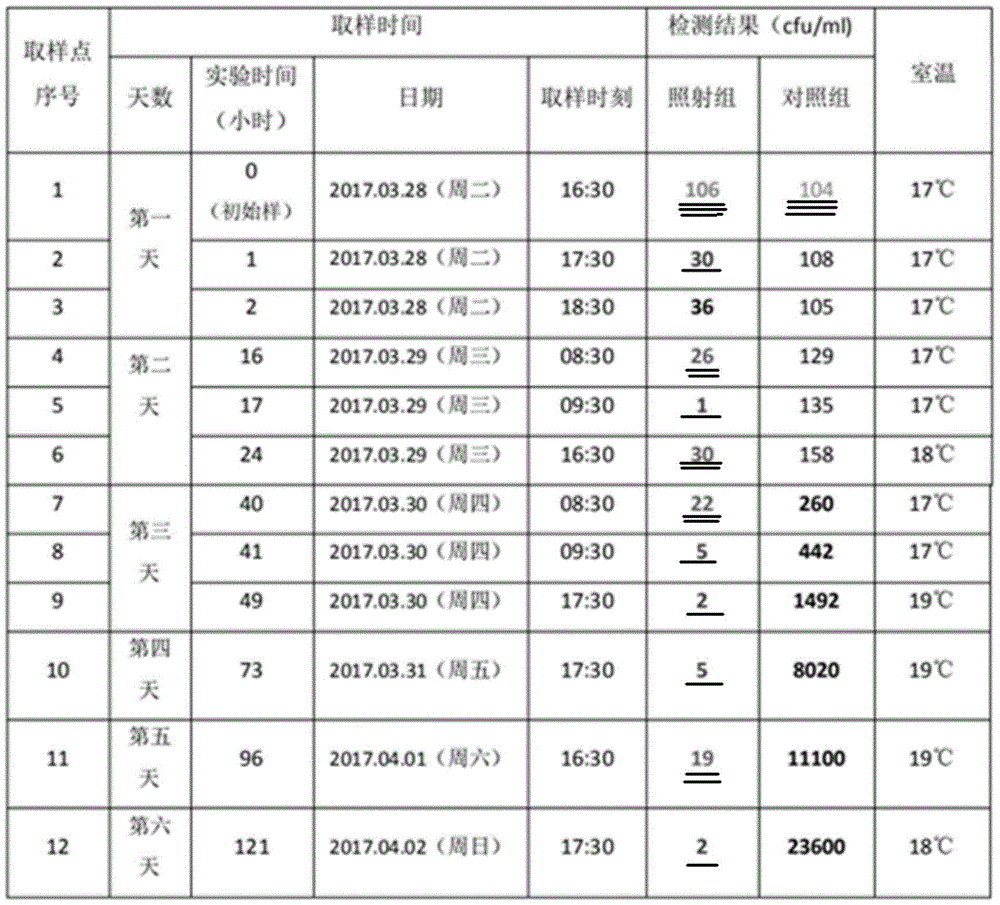
In the exemplary embodiment of the present application, as can be seen from table 2, the number of colonies is below 50 according to the operation of sterilizing for 1 hour and stopping sterilizing for 7 hours, the value of the number of colonies is decreased as the whole with the passage of days, and the number of colonies can be maintained at the single-digit number basically after the module is opened for 1 hour. In practical application, the sterilization can be changed into 2 hours, and the sterilization is stopped for 6 hours, so as to achieve better sterilization effect.
In an exemplary embodiment of the present application, the matching of the corresponding sterilization mode according to the water usage habit may include: the second sterilization mode is adopted in the first period of time, and the general sterilization mode is adopted in the second period of time.
In the exemplary embodiment of the present application, it is possible to find out a period with the lowest frequency of opening the faucet by the user in the 24 periods, and use the period as a period with the lowest frequency of using water by the user in one day, and use the last 4 hours of the period as 4 hours of the ultraviolet lamp killing mode, which serves to kill bacteria in water before the period of using water by the user comes, so that the number of colonies in water drunk by the user is the minimum after the period of using water by the user comes. The other 16 hours can be equally divided into 8 hours to serve as a common water using time period of the user, the ultraviolet lamp is turned on in the last two hours within the 8-hour period, and the ultraviolet lamp is turned off when the period is over, namely, the common sterilization mode (the third sterilization mode) is turned on, so that the water quality safety of the user in the common water using period is guaranteed.
In the exemplary embodiment of the present application, as shown in fig. 6, after the strong sterilization process (i.e., the first sterilization mode) after power-on and power-on is completed, which mode to execute may be determined according to a mode flag (the sterilization mode corresponds to the time period in which the sterilization mode is located, and after the first time period or the second time period is determined, the flag may be set correspondingly), and the execution is performed cyclically.
1) And if the flag is 0, controlling a sterilization module (such as a sterilization ultraviolet lamp) to execute a third sterilization mode, for example, on 2 hours and off 6 hours.
2) If the flag is 1, the acquisition process and the learning process (namely, the autonomous learning mode) are finished, and at this time, the module sterilization operation can be carried out according to the water consumption time characteristics of the user. The method mainly starts sterilization by starting 4 hours in advance before the user normal water period comes, so that the colony number in the time period is less, namely, the strong sterilization mode (namely, the second sterilization mode) is adopted in the first period with the least water for strong sterilization in advance, and the water with less colony number can be used when the user water period comes.
In an exemplary embodiment of the present application, the method may further include: and after the machine uses a second preset time length every time, correcting the starting time and the ending time which are calculated by the timer and correspond to the first time length, wherein the second preset time length is greater than or equal to the first preset time length.
In an exemplary embodiment of the present application, the second preset time period may satisfy: between one and three months, for example, one month may be selected.
In the exemplary embodiment of the application, when the user does not perform the calibration setting of the beijing time based on the clock chip, the system may also set a clock through the timer, and divide one day into twenty-four equal hour nodes, taking this as a reference, to count the water usage habits of the user in this reference system, but because there is a large error, frequent correction is required.
In the exemplary embodiment of the application, three parameters sec, min and hour can be set, a timer in a single chip microcomputer is set, after timing is started, sec starts to be accumulated according to the time of one second, after sec is accumulated to 60, sec is cleared, accumulation is started from the beginning, min is added by 1, after min is accumulated to 60, hour is added by 1, min is cleared by 0, accumulation is started from the beginning, and after hour is accumulated to 24, hour is cleared, so far, the system can divide drinking habits of a user for 24 hours in one day, and the system refers to the time to acquire drinking habits of the user and learn.
In the exemplary embodiment of the present application, since there is a large error according to the clock set by the timer, it is necessary to correct the obtained drinking habit time of the user. For example, according to a clock set by a timer, an error is slower by 2 minutes every day, after collection and learning, the system obtains a common drinking time period of the user from eight to sixteen points, and then the system has an error of one hour after the user uses the system for thirty days, a specific solution may be to subtract 1 from a reference time period obtained by the system, for example, the common drinking time of the user in the system is changed to 7 to 15 points, or the system is initialized once every month, so that the system collects drinking habits of the user again, and obtains a new common drinking time period of the user.
In the exemplary embodiment of the application, compared with the scheme, the scheme of the embodiment does not need a clock chip, a day can be divided into 24 hours by a timer of a chip inside the system, and the water consumption behavior of a user is collected and learned by taking the time as reference, so that the same function as that of the system with the clock chip is achieved.
In an exemplary embodiment of the present application, the sterilizing device may include a sterilizing ultraviolet lamp; the light source of the sterilizing ultraviolet lamp can be a point light source.
In the exemplary embodiment of the present application, the ultraviolet lamp has different light sources and different application scenes, and the conventional ultraviolet lamp is installed in the pipeline of the water channel for sterilization, and can only achieve the sterilization effect when the water flows, and the sterilization effect cannot reach the best state immediately after the start, and the sterilization effect can only reach the best state after the start for a period of time. In this embodiment scheme, the light source of the ultraviolet lamp of adoption can be the point light source type, once starts, just can reach best bactericidal effect to because the point light source radiates the light energy with the form of dispersing, consequently the scope of radiation is wider bigger, makes entire system's bactericidal effect better.
To sum up, the machine can analyze out user's water habit through the data acquisition of a period of time among the scheme of this application embodiment, and automatically regulated sterilization mode starts sterilizing equipment before user's water cycle commonly used arrives, carries out germicidal treatment to the water that the user will drink for after user's water cycle commonly used arrives, the colony number in the aquatic is minimum, in order to reach the purpose that improves user's drinking water environment.
It will be understood by those of ordinary skill in the art that all or some of the steps of the methods, systems, functional modules/units in the devices disclosed above may be implemented as software, firmware, hardware, and suitable combinations thereof. In a hardware implementation, the division between functional modules/units mentioned in the above description does not necessarily correspond to the division of physical components; for example, one physical component may have multiple functions, or one function or step may be performed by several physical components in cooperation. Some or all of the components may be implemented as software executed by a processor, such as a digital signal processor or microprocessor, or as hardware, or as an integrated circuit, such as an application specific integrated circuit. Such software may be distributed on computer readable media, which may include computer storage media (or non-transitory media) and communication media (or transitory media). The term computer storage media includes volatile and nonvolatile, removable and non-removable media implemented in any method or technology for storage of information such as computer readable instructions, data structures, program modules or other data, as is well known to those of ordinary skill in the art. Computer storage media includes, but is not limited to, RAM, ROM, EEPROM, flash memory or other memory technology, CD-ROM, Digital Versatile Disks (DVD) or other optical disk storage, magnetic cassettes, magnetic tape, magnetic disk storage or other magnetic storage devices, or any other medium which can be used to store the desired information and which can accessed by a computer. In addition, communication media typically embodies computer readable instructions, data structures, program modules or other data in a modulated data signal such as a carrier wave or other transport mechanism and includes any information delivery media as known to those skilled in the art.
Claims (10)
1. A self-adaptive sterilization method is characterized in that sterilization is carried out based on a preset autonomous learning mode and a sterilization mode; the method comprises the following steps:
acquiring the water usage habit of the user through autonomous learning in the autonomous learning mode;
matching a corresponding sterilization mode according to the water using habit; the sterilization mode includes: a strong killing mode and a general killing mode.
2. The adaptive sterilization method according to claim 1, wherein the forced kill mode comprises: a first sterilization mode; the first sterilization mode includes: the germicidal ultraviolet lamp is directly started for a first time period.
3. The adaptive sterilization method as recited in claim 2, the method further comprising: after the machine is powered on every time, the sterilization device is directly controlled to enter the first sterilization mode for strong sterilization.
4. The adaptive sterilization method according to claim 1, wherein the forced kill mode comprises: a second sterilization mode; the general killing mode comprises the following steps: a third sterilization mode;
the second sterilization mode includes: starting the sterilizing ultraviolet lamp for a third time after the sterilizing ultraviolet lamp is turned off for a second time;
the third sterilization mode includes: starting the sterilizing ultraviolet lamp for a fifth time after the sterilizing ultraviolet lamp is turned off for a fourth time;
wherein the third duration is greater than the fifth duration; the total time length of the second sterilization mode and the third sterilization mode is equal.
5. The adaptive sterilization method according to claim 4, wherein the water usage habit comprises: minimizing water usage during a first period of time and using water normally during a second period of time other than the first period of time during each day;
the matching of the corresponding sterilization modes according to the water usage habits comprises: the second sterilization mode is adopted in the first period of time, and the general sterilization mode is adopted in the second period of time.
6. The adaptive sterilization method according to claim 1, wherein the autonomous learning mode includes: acquiring water use habit data and learning;
the acquiring of the water usage habit of the user through autonomous learning in the autonomous learning mode comprises: accumulating and collecting water use habit data within a first preset time length in the collection process to serve as water use habit collected data; and determining a first time period with the least water consumption in each day and a second time period except the first time period in each day according to the water consumption habit collected data in the learning process.
7. The adaptive sterilization method according to claim 6, wherein the cumulatively collecting the water usage habit data within the first preset time period comprises: detecting whether the water faucet moves within the first preset time length, if so, recording the current time period and counting the number of times of movement in the time period; and taking the water consumption times and/or the water consumption frequency in different time periods as the water consumption habit data.
8. The adaptive sterilization method according to claim 6, wherein the determining the first period of time with the least water usage per day from the water usage habit collected data during the learning process comprises:
respectively acquiring water use habit subdata every day from the water use habit acquisition data;
acquiring water use habit data of every n hours from the water use habit subdata of every day by adopting a bubbling method; n is a positive number;
and determining continuous n hours with the least water consumption in one day as the first time period according to the water consumption habit data every n hours.
9. The adaptive sterilization method according to claim 8, wherein the obtaining of the water usage habit data every n hours from the daily water usage habit data by using the bubbling method comprises:
after first water habit data between a first preset time and an nth preset time in each day are obtained, the first water habit data are gradually pushed back for one hour, second water habit data between a second preset time and an n +1 th preset time and third water habit data between a third preset time and an n +2 th preset time in each day are sequentially obtained, and the 24 th water habit data between the 24 th preset time and the n-1 th preset time are obtained.
10. The adaptive sterilization method according to claim 8, wherein the method further comprises: when the first preset time is longer than or equal to two days, before n continuous hours with the least water consumption in one day are determined according to the water consumption habit data of every n hours, the water consumption habit data of n hours between the same time every day in the first preset time is calculated, and the water consumption average data of n hours between the same time every day is obtained and is used as the water consumption habit data of n hours between the same time.
Priority Applications (1)
| Application Number | Priority Date | Filing Date | Title |
|---|---|---|---|
| CN201911279129.XA CN111018043A (en) | 2019-12-13 | 2019-12-13 | Self-adaptive sterilization method |
Applications Claiming Priority (1)
| Application Number | Priority Date | Filing Date | Title |
|---|---|---|---|
| CN201911279129.XA CN111018043A (en) | 2019-12-13 | 2019-12-13 | Self-adaptive sterilization method |
Publications (1)
| Publication Number | Publication Date |
|---|---|
| CN111018043A true CN111018043A (en) | 2020-04-17 |
Family
ID=70208481
Family Applications (1)
| Application Number | Title | Priority Date | Filing Date |
|---|---|---|---|
| CN201911279129.XA Pending CN111018043A (en) | 2019-12-13 | 2019-12-13 | Self-adaptive sterilization method |
Country Status (1)
| Country | Link |
|---|---|
| CN (1) | CN111018043A (en) |
Cited By (2)
| Publication number | Priority date | Publication date | Assignee | Title |
|---|---|---|---|---|
| CN115300656A (en) * | 2022-08-04 | 2022-11-08 | 深圳市彩斓光电科技有限公司 | Household intelligent sterilization method and system, intelligent terminal and readable storage medium |
| CN115583689A (en) * | 2022-06-20 | 2023-01-10 | 佛山市美的清湖净水设备有限公司 | Sterilization control method, sterilization control device, water purification equipment and storage medium |
Citations (10)
| Publication number | Priority date | Publication date | Assignee | Title |
|---|---|---|---|---|
| US6135146A (en) * | 1998-07-06 | 2000-10-24 | Take-One Office, Ltd. | Automatic faucet device for cleaning human body with ozone-water |
| CN101244852A (en) * | 2005-03-29 | 2008-08-20 | 株式会社东芝 | UV radiation water treatment system |
| US20140046596A1 (en) * | 2012-08-08 | 2014-02-13 | Taiwan Gomet Technology Co., Ltd | Drinking water reminding system and reminding method thereof |
| CN203605631U (en) * | 2013-07-27 | 2014-05-21 | 海信容声(广东)冰箱有限公司 | Refrigerator with intelligent sterilization control function |
| CN105016405A (en) * | 2015-06-29 | 2015-11-04 | 佛山市美的清湖净水设备有限公司 | Water purifier and control method thereof |
| CN105967252A (en) * | 2016-07-24 | 2016-09-28 | 佛山市云米电器科技有限公司 | Water purifying device capable of controlling water preparation quantity according to historical water usage information |
| CN107244707A (en) * | 2017-07-05 | 2017-10-13 | 珠海格力电器股份有限公司 | Sterilization device and control method thereof, faucet assembly and water purifier |
| WO2018090832A1 (en) * | 2016-11-17 | 2018-05-24 | 佛山市云米电器科技有限公司 | Uv sterilization control method for water purifier with heating and uv sterilization function |
| US20180162761A1 (en) * | 2016-12-12 | 2018-06-14 | A. O. Smith Corporation | Water filtration system with recirculation to reduce total dissolved solids creep effect |
| CN108773920A (en) * | 2018-05-25 | 2018-11-09 | 珠海格力电器股份有限公司 | Water purification system, water purification method and device |
-
2019
- 2019-12-13 CN CN201911279129.XA patent/CN111018043A/en active Pending
Patent Citations (10)
| Publication number | Priority date | Publication date | Assignee | Title |
|---|---|---|---|---|
| US6135146A (en) * | 1998-07-06 | 2000-10-24 | Take-One Office, Ltd. | Automatic faucet device for cleaning human body with ozone-water |
| CN101244852A (en) * | 2005-03-29 | 2008-08-20 | 株式会社东芝 | UV radiation water treatment system |
| US20140046596A1 (en) * | 2012-08-08 | 2014-02-13 | Taiwan Gomet Technology Co., Ltd | Drinking water reminding system and reminding method thereof |
| CN203605631U (en) * | 2013-07-27 | 2014-05-21 | 海信容声(广东)冰箱有限公司 | Refrigerator with intelligent sterilization control function |
| CN105016405A (en) * | 2015-06-29 | 2015-11-04 | 佛山市美的清湖净水设备有限公司 | Water purifier and control method thereof |
| CN105967252A (en) * | 2016-07-24 | 2016-09-28 | 佛山市云米电器科技有限公司 | Water purifying device capable of controlling water preparation quantity according to historical water usage information |
| WO2018090832A1 (en) * | 2016-11-17 | 2018-05-24 | 佛山市云米电器科技有限公司 | Uv sterilization control method for water purifier with heating and uv sterilization function |
| US20180162761A1 (en) * | 2016-12-12 | 2018-06-14 | A. O. Smith Corporation | Water filtration system with recirculation to reduce total dissolved solids creep effect |
| CN107244707A (en) * | 2017-07-05 | 2017-10-13 | 珠海格力电器股份有限公司 | Sterilization device and control method thereof, faucet assembly and water purifier |
| CN108773920A (en) * | 2018-05-25 | 2018-11-09 | 珠海格力电器股份有限公司 | Water purification system, water purification method and device |
Cited By (3)
| Publication number | Priority date | Publication date | Assignee | Title |
|---|---|---|---|---|
| CN115583689A (en) * | 2022-06-20 | 2023-01-10 | 佛山市美的清湖净水设备有限公司 | Sterilization control method, sterilization control device, water purification equipment and storage medium |
| CN115300656A (en) * | 2022-08-04 | 2022-11-08 | 深圳市彩斓光电科技有限公司 | Household intelligent sterilization method and system, intelligent terminal and readable storage medium |
| CN115300656B (en) * | 2022-08-04 | 2024-01-02 | 深圳市彩斓光电科技有限公司 | Household intelligent sterilization method and system, intelligent terminal and readable storage medium |
Similar Documents
| Publication | Publication Date | Title |
|---|---|---|
| CN111099689A (en) | Drinking water sterilization method | |
| CN111099690B (en) | Sterilization method of sterilization device | |
| CN111018043A (en) | Self-adaptive sterilization method | |
| CN111609664B (en) | Refrigerator sterilization control method and device, storage medium, server and refrigerator | |
| CN110388713B (en) | Sterilization control method and device for humidifier, storage medium and humidifier | |
| CN114251816B (en) | Clean ion group sterilization method, air conditioner and computer readable storage medium | |
| CN112770695A (en) | Tooth whitening device | |
| ATE398476T1 (en) | SELECTION OF NEUROSTIMULATOR PARAMETER CONFIGURATIONS USING BAYESIAN NETWORKS | |
| US20110024647A1 (en) | Ultraviolet toothbrush sanitizing-box | |
| CN203815930U (en) | Intelligent controller for ultraviolet sterilization lamp | |
| CN111397156A (en) | Sterilization control method and device and air conditioner | |
| JP6870110B2 (en) | How to carry out itemization of home appliances | |
| CN109947149B (en) | Control method of disinfection lamp and dish washing machine | |
| CN111486545B (en) | Control method and air conditioner for expected turn-on time of sterilization lamp | |
| US20200172412A1 (en) | Water treatment apparatus | |
| CN117006625A (en) | Equipment operation control methods and devices, air treatment equipment and electronic devices | |
| CN106237353B (en) | Sterilization method and device based on planting box | |
| CN205332658U (en) | Automatic purify intelligent refrigerator of smell | |
| CN111067368A (en) | Cooking mode selection method and device, cooking equipment and storage medium | |
| CN111200894A (en) | Intelligent toilet lighting control method and system | |
| US9045357B2 (en) | System for reducing contaminants from a photoelectrocatalytic oxidization apparatus through polarity reversal and method of operation | |
| US20230241267A1 (en) | Systems and methods for an automated sterilization system | |
| CN121898074A (en) | A refrigerator and a method for deodorizing and controlling odors. | |
| CN220824280U (en) | Control system of intelligent tooth socket and intelligent tooth socket box | |
| KR100390354B1 (en) | Sterilizing Device for Water |
Legal Events
| Date | Code | Title | Description |
|---|---|---|---|
| PB01 | Publication | ||
| PB01 | Publication | ||
| SE01 | Entry into force of request for substantive examination | ||
| SE01 | Entry into force of request for substantive examination | ||
| RJ01 | Rejection of invention patent application after publication | ||
| RJ01 | Rejection of invention patent application after publication |
Application publication date: 20200417 |