CN111051237A - Adhesive-Free Adhesion of Dielectric Material Layers Using Nanojet Microstructures - Google Patents
Adhesive-Free Adhesion of Dielectric Material Layers Using Nanojet Microstructures Download PDFInfo
- Publication number
- CN111051237A CN111051237A CN201880056665.0A CN201880056665A CN111051237A CN 111051237 A CN111051237 A CN 111051237A CN 201880056665 A CN201880056665 A CN 201880056665A CN 111051237 A CN111051237 A CN 111051237A
- Authority
- CN
- China
- Prior art keywords
- layer
- layers
- adhesive
- adhesive element
- column
- Prior art date
- Legal status (The legal status is an assumption and is not a legal conclusion. Google has not performed a legal analysis and makes no representation as to the accuracy of the status listed.)
- Granted
Links
Images


Classifications
-
- G—PHYSICS
- G02—OPTICS
- G02B—OPTICAL ELEMENTS, SYSTEMS OR APPARATUS
- G02B27/00—Optical systems or apparatus not provided for by any of the groups G02B1/00 - G02B26/00, G02B30/00
- G02B27/09—Beam shaping, e.g. changing the cross-sectional area, not otherwise provided for
- G02B27/0927—Systems for changing the beam intensity distribution, e.g. Gaussian to top-hat
-
- B—PERFORMING OPERATIONS; TRANSPORTING
- B81—MICROSTRUCTURAL TECHNOLOGY
- B81C—PROCESSES OR APPARATUS SPECIALLY ADAPTED FOR THE MANUFACTURE OR TREATMENT OF MICROSTRUCTURAL DEVICES OR SYSTEMS
- B81C3/00—Assembling of devices or systems from individually processed components
- B81C3/001—Bonding of two components
-
- B—PERFORMING OPERATIONS; TRANSPORTING
- B32—LAYERED PRODUCTS
- B32B—LAYERED PRODUCTS, i.e. PRODUCTS BUILT-UP OF STRATA OF FLAT OR NON-FLAT, e.g. CELLULAR OR HONEYCOMB, FORM
- B32B1/00—Layered products having a non-planar shape
-
- B—PERFORMING OPERATIONS; TRANSPORTING
- B32—LAYERED PRODUCTS
- B32B—LAYERED PRODUCTS, i.e. PRODUCTS BUILT-UP OF STRATA OF FLAT OR NON-FLAT, e.g. CELLULAR OR HONEYCOMB, FORM
- B32B27/00—Layered products comprising a layer of synthetic resin
- B32B27/06—Layered products comprising a layer of synthetic resin as the main or only constituent of a layer, which is next to another layer of the same or of a different material
-
- B—PERFORMING OPERATIONS; TRANSPORTING
- B32—LAYERED PRODUCTS
- B32B—LAYERED PRODUCTS, i.e. PRODUCTS BUILT-UP OF STRATA OF FLAT OR NON-FLAT, e.g. CELLULAR OR HONEYCOMB, FORM
- B32B27/00—Layered products comprising a layer of synthetic resin
- B32B27/06—Layered products comprising a layer of synthetic resin as the main or only constituent of a layer, which is next to another layer of the same or of a different material
- B32B27/08—Layered products comprising a layer of synthetic resin as the main or only constituent of a layer, which is next to another layer of the same or of a different material of synthetic resin
-
- B—PERFORMING OPERATIONS; TRANSPORTING
- B32—LAYERED PRODUCTS
- B32B—LAYERED PRODUCTS, i.e. PRODUCTS BUILT-UP OF STRATA OF FLAT OR NON-FLAT, e.g. CELLULAR OR HONEYCOMB, FORM
- B32B27/00—Layered products comprising a layer of synthetic resin
- B32B27/18—Layered products comprising a layer of synthetic resin characterised by the use of special additives
- B32B27/20—Layered products comprising a layer of synthetic resin characterised by the use of special additives using fillers, pigments, thixotroping agents
-
- B—PERFORMING OPERATIONS; TRANSPORTING
- B32—LAYERED PRODUCTS
- B32B—LAYERED PRODUCTS, i.e. PRODUCTS BUILT-UP OF STRATA OF FLAT OR NON-FLAT, e.g. CELLULAR OR HONEYCOMB, FORM
- B32B27/00—Layered products comprising a layer of synthetic resin
- B32B27/30—Layered products comprising a layer of synthetic resin comprising vinyl (co)polymers; comprising acrylic (co)polymers
- B32B27/308—Layered products comprising a layer of synthetic resin comprising vinyl (co)polymers; comprising acrylic (co)polymers comprising acrylic (co)polymers
-
- B—PERFORMING OPERATIONS; TRANSPORTING
- B32—LAYERED PRODUCTS
- B32B—LAYERED PRODUCTS, i.e. PRODUCTS BUILT-UP OF STRATA OF FLAT OR NON-FLAT, e.g. CELLULAR OR HONEYCOMB, FORM
- B32B27/00—Layered products comprising a layer of synthetic resin
- B32B27/32—Layered products comprising a layer of synthetic resin comprising polyolefins
-
- B—PERFORMING OPERATIONS; TRANSPORTING
- B32—LAYERED PRODUCTS
- B32B—LAYERED PRODUCTS, i.e. PRODUCTS BUILT-UP OF STRATA OF FLAT OR NON-FLAT, e.g. CELLULAR OR HONEYCOMB, FORM
- B32B27/00—Layered products comprising a layer of synthetic resin
- B32B27/32—Layered products comprising a layer of synthetic resin comprising polyolefins
- B32B27/322—Layered products comprising a layer of synthetic resin comprising polyolefins comprising halogenated polyolefins, e.g. PTFE
-
- B—PERFORMING OPERATIONS; TRANSPORTING
- B32—LAYERED PRODUCTS
- B32B—LAYERED PRODUCTS, i.e. PRODUCTS BUILT-UP OF STRATA OF FLAT OR NON-FLAT, e.g. CELLULAR OR HONEYCOMB, FORM
- B32B27/00—Layered products comprising a layer of synthetic resin
- B32B27/32—Layered products comprising a layer of synthetic resin comprising polyolefins
- B32B27/325—Layered products comprising a layer of synthetic resin comprising polyolefins comprising polycycloolefins
-
- B—PERFORMING OPERATIONS; TRANSPORTING
- B32—LAYERED PRODUCTS
- B32B—LAYERED PRODUCTS, i.e. PRODUCTS BUILT-UP OF STRATA OF FLAT OR NON-FLAT, e.g. CELLULAR OR HONEYCOMB, FORM
- B32B27/00—Layered products comprising a layer of synthetic resin
- B32B27/36—Layered products comprising a layer of synthetic resin comprising polyesters
- B32B27/365—Layered products comprising a layer of synthetic resin comprising polyesters comprising polycarbonates
-
- B—PERFORMING OPERATIONS; TRANSPORTING
- B82—NANOTECHNOLOGY
- B82Y—SPECIFIC USES OR APPLICATIONS OF NANOSTRUCTURES; MEASUREMENT OR ANALYSIS OF NANOSTRUCTURES; MANUFACTURE OR TREATMENT OF NANOSTRUCTURES
- B82Y20/00—Nanooptics, e.g. quantum optics or photonic crystals
-
- B—PERFORMING OPERATIONS; TRANSPORTING
- B32—LAYERED PRODUCTS
- B32B—LAYERED PRODUCTS, i.e. PRODUCTS BUILT-UP OF STRATA OF FLAT OR NON-FLAT, e.g. CELLULAR OR HONEYCOMB, FORM
- B32B2250/00—Layers arrangement
- B32B2250/02—2 layers
-
- B—PERFORMING OPERATIONS; TRANSPORTING
- B32—LAYERED PRODUCTS
- B32B—LAYERED PRODUCTS, i.e. PRODUCTS BUILT-UP OF STRATA OF FLAT OR NON-FLAT, e.g. CELLULAR OR HONEYCOMB, FORM
- B32B2250/00—Layers arrangement
- B32B2250/24—All layers being polymeric
-
- B—PERFORMING OPERATIONS; TRANSPORTING
- B32—LAYERED PRODUCTS
- B32B—LAYERED PRODUCTS, i.e. PRODUCTS BUILT-UP OF STRATA OF FLAT OR NON-FLAT, e.g. CELLULAR OR HONEYCOMB, FORM
- B32B2307/00—Properties of the layers or laminate
- B32B2307/20—Properties of the layers or laminate having particular electrical or magnetic properties, e.g. piezoelectric
- B32B2307/204—Di-electric
-
- B—PERFORMING OPERATIONS; TRANSPORTING
- B32—LAYERED PRODUCTS
- B32B—LAYERED PRODUCTS, i.e. PRODUCTS BUILT-UP OF STRATA OF FLAT OR NON-FLAT, e.g. CELLULAR OR HONEYCOMB, FORM
- B32B2307/00—Properties of the layers or laminate
- B32B2307/40—Properties of the layers or laminate having particular optical properties
- B32B2307/402—Coloured
- B32B2307/4026—Coloured within the layer by addition of a colorant, e.g. pigments, dyes
-
- B—PERFORMING OPERATIONS; TRANSPORTING
- B32—LAYERED PRODUCTS
- B32B—LAYERED PRODUCTS, i.e. PRODUCTS BUILT-UP OF STRATA OF FLAT OR NON-FLAT, e.g. CELLULAR OR HONEYCOMB, FORM
- B32B2457/00—Electrical equipment
- B32B2457/20—Displays, e.g. liquid crystal displays, plasma displays
- B32B2457/206—Organic displays, e.g. OLED
-
- B—PERFORMING OPERATIONS; TRANSPORTING
- B32—LAYERED PRODUCTS
- B32B—LAYERED PRODUCTS, i.e. PRODUCTS BUILT-UP OF STRATA OF FLAT OR NON-FLAT, e.g. CELLULAR OR HONEYCOMB, FORM
- B32B2457/00—Electrical equipment
- B32B2457/20—Displays, e.g. liquid crystal displays, plasma displays
- B32B2457/208—Touch screens
-
- B—PERFORMING OPERATIONS; TRANSPORTING
- B81—MICROSTRUCTURAL TECHNOLOGY
- B81C—PROCESSES OR APPARATUS SPECIALLY ADAPTED FOR THE MANUFACTURE OR TREATMENT OF MICROSTRUCTURAL DEVICES OR SYSTEMS
- B81C2203/00—Forming microstructural systems
- B81C2203/03—Bonding two components
- B81C2203/033—Thermal bonding
- B81C2203/037—Thermal bonding techniques not provided for in B81C2203/035 - B81C2203/036
-
- B—PERFORMING OPERATIONS; TRANSPORTING
- B82—NANOTECHNOLOGY
- B82Y—SPECIFIC USES OR APPLICATIONS OF NANOSTRUCTURES; MEASUREMENT OR ANALYSIS OF NANOSTRUCTURES; MANUFACTURE OR TREATMENT OF NANOSTRUCTURES
- B82Y30/00—Nanotechnology for materials or surface science, e.g. nanocomposites
-
- G—PHYSICS
- G02—OPTICS
- G02B—OPTICAL ELEMENTS, SYSTEMS OR APPARATUS
- G02B2207/00—Coding scheme for general features or characteristics of optical elements and systems of subclass G02B, but not including elements and systems which would be classified in G02B6/00 and subgroups
- G02B2207/101—Nanooptics
Landscapes
- Engineering & Computer Science (AREA)
- Physics & Mathematics (AREA)
- Optics & Photonics (AREA)
- Nanotechnology (AREA)
- Chemical & Material Sciences (AREA)
- Life Sciences & Earth Sciences (AREA)
- Biophysics (AREA)
- Crystallography & Structural Chemistry (AREA)
- General Physics & Mathematics (AREA)
- Microelectronics & Electronic Packaging (AREA)
- Mechanical Engineering (AREA)
- Lining Or Joining Of Plastics Or The Like (AREA)
- Laser Beam Processing (AREA)
Abstract
A method of bonding two layers of dielectric material, comprising: -providing (21) a surface of at least one of the layers with micro-scale-sized and/or nano-scale-sized adhesive elements forming contact points of the layer; -bringing (22) the layers into mutual position according to the intended use; -illuminating (23) said layer, the surface of which is provided with adhesive elements, by an incident electromagnetic wave, the propagation direction of which is substantially perpendicular to said layer, and the wavelength of which is selected according to the absorption spectrum of the material forming said layer; -generating a converging light beam within or close to a tip of the adhesive element to be in contact with another layer; -heating and melting (24) the bonding element by a high intensity focal spot formed by the generated light beam; -holding the layers in the mutual position until the layers are bonded.
Description
1. Field of the invention
The present disclosure relates to a method for bonding two material layers together, which method is adhesive-free. This is of particular interest for applications where it is desirable to weld together layers of material having some surface area that must be kept contaminant free, although the present disclosure is not limited to such applications.
2. Background of the invention
This section is intended to introduce the reader to various aspects of art, which may be related to various aspects of the present invention that are described and/or claimed below. This discussion is believed to be helpful in providing the reader with background information to facilitate a better understanding of the various aspects of the present invention. Accordingly, it should be understood that these statements are to be read in this light, and not as admissions of prior art.
The adhesive-free sealing method may be of interest for applications requiring soldering together of layers of a microfluidic chip comprising a network of microfluidic channels engraved in one of the layers for transporting fluids under control of capillary forces. For such applications, it is crucial to provide a hermetic seal of the two layers to prevent fluid leakage, and at the same time to prevent any glue from entering and blocking the microchannels.
More generally, many practical applications require hermetic sealing of layers of similar or dissimilar materials (e.g., plastics, glass, ceramics, semiconductors, metals, etc.). Among them, display manufacturing, OLED (i.e., organic light emitting diode) packaging, touch screen, solar cell packaging, and the like are mainly based on the use of optically transparent plastics and glass.
Established sealing methods using glue (of any type) are not always acceptable for these applications, as the glue may enter into the fine microstructures on the surfaces of the layers to be sealed together and/or alter the optical properties of the sandwich structure. The microscopic dimensions of microfluidic channels (with typical dimensions of about 20 to 100 microns) and the dense spacing between adjacent channels make the sealing problem very challenging.
Therefore, alternative sealing methods have been investigated, including laser, infrared and microwave heat sealing, and high density plasma sealing.
However, at present, there are still technical challenges associated with the mass production of multilayer Microfluidic (MF) chips.
An established method, which is commonly used for microfluidic chip fabrication under laboratory conditions, is based on plasma sealing of molded polymer (e.g., PDMS, polydimethylsiloxane) structures to glass substrates, as described by g.d. kipling et al in "methods of consideration for Lab-on-a-chip fabrication" (chapter 4, Castillo-Leon, w.e. svendand (eds)), Lab-on-chip equipment and micro total analysis systems: the actual guidelines are described in Springer 2015.
This approach produces a very strong hermetic seal of the structure, but is not suitable for mass production due to the complexity and poor durability of organic polymers. In practice, the plasma sealing process is based on ion bombardment of the surface of the molded polymer, which causes structural and chemical changes in the material on the surface and sidewalls of the microchannels. These changes may extend into the bulk material and irreversibly change its properties. Furthermore, the oxidized surfaces should be contacted immediately after the plasma treatment to obtain the strongest adhesion (since time is limited by the recombination time of the broken chemical bonds on the surface layer), which seems difficult to produce on a large scale.
This explains the interest in developing new methods of MF chip fabrication using more practical materials (e.g., plastics).
Other known heat sealing methods, whether based on the use of visible or infrared lasers or microwaves, may be associated with certain difficulties when it is desired to control the heating of very thin layers (of the order of a few microns thick) along the bonding lines inside the material. It is worth noting that the methods of the prior art cannot be directly applied to the manufacture of microfluidic chips, due to their small thickness and the special characteristics of the materials. Indeed, each of these methods is only suitable for certain types of materials and may not be suitable for sealing non-conductive optically transparent dielectric materials, such as plastics, which are widely used in the above applications.
In such a case, it may be of particular interest to develop a method that will fit into an existing manufacturing process that is already used for another application (e.g., DVD manufacturing).
More generally, it would be desirable to provide a method of bonding two layers of dielectric material without adhesive (or with an optional adhesive) that would overcome these disadvantages. Notably, it would be desirable to provide a new adhesive-free heat sealing method that would be able to overcome the difficulties associated with the fabrication of multilayer microfluidic chips as described above.
3. Summary of the invention
References in the specification to "one embodiment," "an example embodiment," indicate that the embodiment described may include a particular feature, structure, or characteristic, but every embodiment may not necessarily include the particular feature, structure, or characteristic. Moreover, such phrases are not necessarily referring to the same embodiment. Further, when a particular feature, structure, or characteristic is described in connection with an embodiment, it is submitted that it is within the knowledge of one skilled in the art to affect such feature, structure, or characteristic in connection with other embodiments whether or not explicitly described.
In one aspect, there is provided a method of bonding two layers of dielectric material, comprising:
-providing a surface of at least one of said layers with micro-scale-sized and/or nano-scale-sized adhesive elements forming contact points of said layer;
-bringing the layers into mutual position according to the intended use;
-irradiating said layer, the surface of which is provided with adhesive elements, by an incident electromagnetic wave, the direction of propagation of which forms an angle comprised between 70 ° and 110 ° with said layer, and the wavelength of which is selected according to the absorption spectrum of the material forming said layer;
-generating a converging light beam within or close to a tip of the adhesive element to be in contact with another layer;
-heating and melting the bonding element and/or the further layer by a high intensity focal spot formed by the generated light beam;
-holding the layers in the mutual position until the layers are bonded.
Thus, the present disclosure presents a new application of the nano-jet condensation phenomenon. In fact, it enables high Electromagnetic (EM) field concentrations to be achieved in thin layers inside a multi-layer dielectric structure, said layers comprising various nanoscale-sized adhesive elements, the size and shape of which are optimized in accordance with incident EM waves (e.g., laser beams). In this way, the adhesive element can be heated and melted, thereby providing an adhesive for sealing the two layers of material.
This method avoids the use of glue and thus prevents the risk of the glue accidentally entering the microscopic channels engraved on the surface of the corresponding portion of the chip when it is applied for the manufacture of microfluidic chips.
The present disclosure relies on the use of adhesive elements on the surfaces of at least one of the materials to be sealed together, rather than some glue. Such an adhesive element can be heated and melted in a controlled manner in such a way as to provide a controlled amount of adhesion directly delivered to the point of contact of the two materials that are to be sealed to each other.
Unlike other heat sealing methods, the present method does not require the addition of any heat-softening glue, resin or other adhesive material. Instead, it relies on controlled high local heating of the surface layer of the bulk material. This provides a strong advantage in scenarios where materials that need to be sealed together already have some micron-scale surface patterns, which must be kept clean from any impurities, such as microfluidic chips.
Depending on the intended use, the two layers of dielectric material must be aligned in order to place the adhesive element at the correct contact location. In bonding, the two layers are placed in direct contact and subjected to slight pressure. A slight pressure is here a pressure that does not cause a deformation of the shape of the layer, so that there is no mechanical stress from inside the sealing structure when the pressure is closed.
When illuminated by an incident EM wave (e.g., a laser beam), each bonding element acts as a focusing device, i.e., a microlens, whose focal length is determined by the bonding element size and the refractive index of the material. For certain sizes and shapes of bonded elements, the phenomenon of nanojet focusing results in the formation of focal spots inside the bonded element (or at the contact point between the bonded element and another material layer), thus enabling a highly localized heating of the bonded element and melting of the bonded element under certain conditions. After cooling, a strong bond is created along the contact line. For other bonded elements, the nano-jet focusing phenomenon causes the focal spot to be formed close to but higher than the tip of the bonded element, preferably in a layer that does not carry the bonded element.
This method can be used to provide good welding of almost all thermoplastic materials.
Typical exemplary dimensions for the adhesive elements are about 1 to 5 microns.
According to embodiments of the present disclosure, a laser source for welding operates in the near infrared range. Especially wavelengths around 2 μm are a good choice, since most plastic materials are translucent at this wavelength.
According to an embodiment of the present disclosure, a pulsed laser is used to provide sufficient power to melt the adhesive element for a period of time that is short enough to prevent heat transfer from the weld area at the interface between the two layers. The pulse duration may vary in the range of 0.01 to a few milliseconds.
According to another embodiment, a Continuous Wave (CW) laser source with a continuous or gated (modulated) output is used.
According to embodiments of the present disclosure, the laser spot size does not exactly match the size of the nano-jetting (NJ) texture. The spot may be larger than the texture, while the parameters of the welding process (power, pulse duration, welding speed, etc.) are selected in such a way as to provide melting conditions only in the NJ texture region. In this way, the weld width is also limited by the size of the NJ texture.
The proposed NJ-assisted laser welding method can be used for laser welding almost all thermoplastic materials, but provided that the absorption coefficient of the material and the thickness of the covering have appropriate values at the laser wavelength.
According to an embodiment of the disclosure, the bonding element forms a patterned microstructure on a surface of the layer.
This patterned microstructure defines the pattern features of the contact points between the two layers and ensures proper adhesion. It allows precise control of the location of the bond (occurring after melting of the bonding element).
According to an embodiment of the present disclosure, the adhesive element has the form of a post and/or a rib.
In particular, the adhesive element may have the following form:
-cylindrical or conical pillars having a circular, oval/elliptical, rectangular, pentagonal, hexagonal, octagonal or the like cross-section,
-a column having a cross-shaped cross-section,
-the above-mentioned column having a hollow core,
-ribs having straight or curved edges and/or symmetrical or asymmetrical cross-sections in a cutting plane perpendicular to the longer sides of the ribs.
The above-mentioned posts and ribs whose side walls have two or more steps.
Thus, each element of the patterned surface may take the form of a column or rib, the size, spacing and shape of which define the focusing power and heat transfer conditions of each bonded element. Features with larger cross-sections can collect more light and generate nanojets with higher peak intensities. This allows faster heating in the vicinity of the nanojet, while the overall heating kinetics in a given volume is determined by the shape and size of the features and the NJ hot spot location. In other words, a larger size column will produce faster heating inside the column, however, the outer surface will remain cooler than the outer surface of a smaller column. Thus, the optimal topology of the bonded element is found as a compromise between its EM focusing power and the heating kinetics in a given volume comprising the bonded element and its surroundings.
The shape of the pillars can be chosen quite arbitrarily. For example, they may have the shape of a cylinder or a prism (which has a circular or rectangular cross-section). Other shapes are possible, including ribbed columns that will serve as two-dimensional (2D) nano-jet microlenses. In one embodiment, the post has a conical shape (e.g., a truncated cone). The tapered shape has the advantage that it can collect more incident light due to the larger base and provide faster melting of the tip due to its smaller volume.
According to an embodiment of the present disclosure, a dimension of the adhesive element in a direction of the incident electromagnetic wave is targeted to be between a half wavelength of the incident electromagnetic wave and several wavelengths of the incident electromagnetic wave in the host medium.
In a preferred embodiment, this dimension is between one and two wavelengths of the incident electromagnetic wave, which provides the optimal dimensions for heating and melting. In particular, for a cylindrical column, the preferred aspect ratio of height to width is in the range of 2: 1 to 5:1, and for a tapered column, slightly lower. For the latter, it may vary from 1:1 to 5:1, depending on the taper base (tilt) angle, which varies in the range of 60 to 90 degrees, respectively. The optical phenomenon will of course occur over a wider range of pillar sizes, so that in terms of laser pulse shape, intensity and duration, melting of larger pillars can also be achieved with appropriate illumination conditions.
According to an embodiment of the present disclosure, the layers are made of the same material. In particular, it can be used to seal two layers of polycarbonate.
The process may also join some different materials, such as different plastics, glass, etc.
According to an embodiment of the present disclosure, the material of the layer, the surface of which is provided with the adhesive element, belongs to the group comprising plastics and thermoplastics.
For example, it may be a polymeric material, such as PC (polycarbonate), COC (cyclic olefin copolymer), PMMA (poly (methyl methacrylate)), PP (polypropylene), PE (polyethylene) or polytetrafluoroethylene (polytetrafluoroethylene PTFE).
According to an embodiment of the present disclosure, the material of the layer whose surface is provided with the adhesive element comprises an absorbing dye or pigment (for example of the photochromic type or carbon black).
The absorptive additive of the bulk material may help further localize the heating process by increasing the efficiency of EM to thermal energy conversion directly in the focal spot of the nano-jet microlens.
According to embodiments of the present disclosure, further comprising providing a surface of at least one of the layers with engraved embossed, cast, ablated, or molded microfluidic channels.
According to an embodiment of the disclosure, bringing the layers into mutual position according to the intended use is performed after heating and melting the adhesive element.
This is of particular interest when both layers are made of lossy (opaque) material. For example, it may be a polycarbonate with a wavelength below 300 nm. In this case, it is interesting to have the first layer irradiated by a laser beam from above directly on the patterned surface until the pillars melt. The second layer is then placed on top of the first layer and pressed down.
According to an embodiment of the present disclosure, the layers are placed in direct contact between two optically transparent plates when they are brought into mutual position according to the intended use. This may help to apply a slight pressure on the layer.
According to an embodiment of the present disclosure, it further comprises a surface of the cooling layer opposite to the surface provided with the adhesive element.
To prevent premature melting of the layer, this may be accomplished by air cooling (i.e., venting) or by contact cooling (i.e., placing the layer in contact with the glass substrate). Of particular interest may be thick layers.
According to an embodiment of the present disclosure, it further comprises preheating at least the surface provided with the adhesive element. This may help to achieve the temperature melting point of some materials forming the adhesive element using a lower power laser source.
According to embodiments of the present disclosure, providing a surface of at least one of the layers with micro-scale sized adhesive elements and/or nano-scale sized adhesive elements is performed by molding or wet embossing the surface, which is a known technique that has been used in mass production.
According to an embodiment of the present disclosure, the adhesive element has a conical shape, their dimensions are chosen such that the converging light beam is generated close to but above the tip of the adhesive element to be in contact with another layer, and the layer whose surface is provided with the adhesive element is made of a material having a lower loss than the material of the other layer. Alternatively or additionally, the layer, the surface of which is provided with the adhesive element, is made of a material having a higher melting temperature than the material of the other layer.
Such an embodiment provides three advantages, namely:
due to its conical shape (no sharp edges and vertical slopes), the manufacturing of the adhesive element is simple;
due to its conical shape, the heating of the adhesive element with a sharp tip is uniform;
the mechanical rigidity of the sealing structure is increased due to the penetration of the adhesive element into the other layer.
4. Description of the drawings
The disclosure may be better understood with reference to the following description and accompanying drawings, which are given by way of example and do not limit the scope of protection, and in which:
figure 1 provides a schematic illustration of a method according to an embodiment of the present disclosure in the specific context of a microfluidic chip;
figure 2 depicts the main steps of the process of adhesion layer according to an embodiment of the present disclosure;
FIG. 3 is a schematic view of the light propagation inside the structure shown in FIGS. 1A-1C;
figure 4 provides a graph showing the critical thickness of a layer to be bonded as a function of the intensity magnification M for different values of the absorption coefficient α of the bulk material forming the layer according to an embodiment of the disclosure;
FIG. 5 presents the reflection factor P and the reflection loss Lr(1-P) × 100% as a function of the refractive index of the bulk material;
fig. 6 presents the absorption coefficient α and the critical thickness T of the dielectric platecAs a function of the bulk material transmission τ;
figure 7 provides a schematic illustration of a laser heating process inside a pillar according to an embodiment of the present disclosure;
figure 8 provides some symbols for a multilayer structure for use in a method according to an embodiment of the present disclosure;
fig. 9A and 9B show CAD models of circular and rectangular columns between two semi-infinite dielectric plates representing unit cells of a periodic structure, according to an embodiment of the disclosure;
FIGS. 10A and 10B report the field strength amplification corresponding to a first field strength maximum within the column, expressed as a function of the column size;
11A and 11B show the position of a first field strength maximum along the z-axis within a column as a function of the column dimensions;
fig. 12A and 12B show the normalized intensity curves along the x-axis for circular and rectangular columns, respectively;
figures 13A and 13B show the normalized field strength patterns inside a structure with circular columns illuminated from below by plane waves in the xz plane (figure 13A) and the xy plane (figure 13B), respectively;
fig. 14A and 14B show the normalized field strength curves inside a structure with rectangular columns illuminated from below by plane waves in the xz plane (fig. 14A) and the xy plane, respectively, z 1000nm (fig. 14B);
15(a) to 15(f) show possible embodiments of multilayer structures for use in a method according to embodiments of the present disclosure;
figure 16 shows the geometry and symbols of a tapered pillar on the surface of a dielectric substrate according to an alternative embodiment of the invention;
figure 17(a) provides a schematic illustration of the EM wave focusing and local heating phenomena in the structure of figure 16 illuminated by EM waves from below; fig. 17(b) shows the power loss density distribution of the same structure illuminated by a plane wave from below; FIG. 17(c) provides a heat map of the interior of a structure at a time;
fig. 18 provides a schematic view of a microfluidic chip comprising two layers sealed to each other according to the alternative embodiment of fig. 16 and 17: (A) a top view of an exemplary microfluidic structure comprising two cavities connected to a narrow microchannel, (B) a vertical cross-sectional view of the structure;
figures 19 to 23 report simulation data describing the effect of column shape and material loss on the focusing power of the column and the temperature pattern inside the structure, according to the alternative embodiment of figures 16 to 18.
Fig. 24 to 33 report simulation data describing the effect of the column shape on the focusing power of the column and the temperature pattern inside the structure, according to the alternative embodiment of fig. 24 and 25.
The components in the figures are not necessarily to scale, emphasis instead being placed upon illustrating the principles of the invention.
5. Detailed description of the preferred embodiments
The general principles of the present disclosure rely on Electromagnetic (EM) heating of dielectric materials, and the so-called nano-jet (NJ) focusing phenomenon, which provides control of the EM field strength distribution inside the material. More specifically, the NJ phenomenon enables highly localized heating and melting of microstructure elements distributed in a controlled manner along a bonding line on the interface of two materials.
Throughout the following, the adhesive elements are described as nanoscale-sized adhesive elements. It must be noted that this also includes micron-sized adhesive elements, bearing in mind that in some embodiments, the typical size of the adhesive elements is about 1 to 5 microns (i.e., 1000 to 5000 nm).
5.1 first embodiment and general features
Fig. 1 provides a schematic illustration of a method according to an embodiment of the present disclosure in the particular context of a microfluidic chip. More precisely, FIG. 1A provides a microfluidic channel 10 and a layer 131Is created on the surface of the plate, and a top view of a microfluidic structure of a plurality of pillars in the form of cylinders 11 and ribs 12. Fig. 1B shows a side view of the structure corresponding to the cross-section highlighted by the dashed line on fig. 1A. Fig. 1C shows a normalized field intensity distribution inside the structure when irradiated by the laser beam 14 from below. As can be observed, the position of the first and second electrodes,the nano-jet focusing phenomenon enables the creation of a hot spot 15 within the pillar 11, which hot spot 15 provides a highly localized heating and melting of the pillar 11.
FIG. 2 depicts the main steps of a process for adhesion layer according to an embodiment of the present disclosure.
First, at step 21, a first layer 13 of material1Are provided with nano-sized adhesive elements which may take the form of ribs 12 or posts 11. In the embodiment of FIG. 1B, layer 131Comprises a plurality of pillars 11 of different sizes and shapes and additional features, such as a network of microfluidic channels 10. The method of making the patterned microstructure may be, for example, molding or wet embossing.
A second layer 13 is also produced2Which may be the same as for layer 131Of a similar (or dissimilar) material.
At step 22, the first layer 13, depending on the intended use1And must adhere to the first layer 131 Second layer 13 of2Are brought into mutual position. For example, layer 131And 132Are placed in direct contact with each other and their outer lines are aligned.
The two material layers are connected under slight pressure, for example between two optically transparent plates (for example made of glass). Then, at step 23, the pillars are exposed from below with the laser beam 14 at a given wavelength, intensity and pulse duration necessary to heat and melt the pillars, as shown in fig. 1C and 3A. The laser wavelength is selected according to the absorption spectrum of the material. The higher the absorption, the better the efficiency of the transfer between the electromagnetic wave and the thermal energy. However, for lossy materials (having low optical transparency), the propagation losses in the bulk material may be too large, resulting in a large portion of the EM energy being dissipated before reaching the microstructures. Thus, the optimum thickness of layer 1 will be a function of: (i) physical (e.g., complex refractive index) and thermal (e.g., thermal conductivity) parameters of the bulk material and (ii) layer 131The upper surface of (a) a micro feature (acting as an NJ microlens).
At step 24, the nanobeam is inside the column 11Or formation at the tip, causes heating and melting of the adhesive elements 11, 12. (it must be noted that in an alternative embodiment described in section 5.2, the formation of a nanoburst beam over the tip of the column 11 causes the second layer 13 at step 242Instead of the heating and melting of the adhesive elements 11, 12).
The structure is then placed under pressure until it cools (step 25).
As will be apparent in a later part of this document, fig. 2 depicts a possible embodiment of the method according to the present disclosure. According to other embodiments, some additional steps may be required, in particular depending on the characteristics of the chosen manufacturing method and material. The order of the steps may also be altered.
Fig. 3 is a schematic illustration of light propagation within the structure shown in fig. 1A-1C. FIG. 3A provides models and symbols to be used throughout the document, while FIG. 3B shows a typical intensity profile of EM waves along the z-axis inside the structure of FIGS. 1A-1C.
5.1.1 Electromagnetic (EM) model
Now, when the heat transfer effect is not considered, we describe an electromagnetic model that maintains the method according to embodiments of the present disclosure.
Let us assume that the intensity of propagation in the positive z direction is I0Is incident on the two material layers 13 from below1And 132As shown in fig. 3A. A typical power density distribution inside such a structure is shown in fig. 3B. The variation of the intensity values along the z-axis is explained by: (i) z-z due to reflection at the air/dielectric boundary1Reflection losses of (i) and (ii) dissipation of EM energy in the bulk material along the propagation path z e (z ∈)1,z2) And (iii) a local increase of the field strength in the column 11, z ∈ (z)2,z3) This occurs due to the NJ focusing effect. The following provides a basic formula describing the attenuation of the beam intensity inside the structure.
When z is equal to z1Intensity of light beam penetrating the inside of the plate:
Ie=I0(1-r) (1)
wherein, I0Is the intensity of the incident beam, r is the reflectivity of the bulk material of the plate, which can be derived from the fresnel equation as a function of the refractive index n of the material:

in layer 131The intensity of the light beam at the upper surface of (z ═ z)2) Is defined as:
Id=Ieexp(-αT) (3)
wherein, T ═ z2-z1Is a layer 131And α is an absorption (or attenuation) coefficient, defined as:

where k is the extinction coefficient, which is the imaginary part of the complex refractive index of the bulk material:
n*=n+ik (5)
the NJ focusing effect shown in figure 1C explains the rapid increase in field strength inside the column 11. For simplicity, the focusing power of the NJ lens can be characterized using an intensity magnification M, defined as the field strength at the bottom of the column 11 (z ═ z-2) Ratio to peak intensity inside the column 11:
Im=M·Id=M·Ieexp(-αT) (6)
where M is the NJ lens intensity magnification.
Note that the beam propagating within the column 11 experiences interaction with the layer 131Is compensated for (and exceeded by) the increase in field strength due to the NJ lens focusing phenomenon (here we assume that the bulk material is linear and therefore its absorption coefficient is independent of field strength). However, if the incident beam intensity and exposure time are sufficient for heating the column to the melting temperature, a portion of the EM energy is dissipated inside the column 11 (mainly near its focal spot area) and converted into thermal energy, from thereResulting in local heating and eventual melting of the pillars 11.
From an electromagnetic perspective, the feasibility condition of a method according to an embodiment of the present disclosure may be expressed as:
Ie<Ic≤Im(7)
wherein, IcIs the critical beam intensity, i.e., the minimum intensity required to melt the bulk material. This condition will be understood as: (i) the incident beam intensity must be below critical to prevent layer 13 from going beyond1Of the bulk material at the bottom surface (z ═ z) of the substrate1Where) and (ii) the NJ lens focusing power must be high enough to enable melting of the material near the focal spot area of the NJ lens.
Referring to equations (1-6), the feasibility condition given by equation (7) can be written as:
M·exp(-αT)>1 (8)
it enables the critical thickness of the layer 1 to be determined:

wherein, TcIs in accordance with condition Ie=Ic=ImCorresponding to the maximum allowable thickness of layer 1 for a fixed α and M value, a thicker layer will result in layer 131Premature melting of the material at the bottom surface. T is shown in FIG. 4c=Tc(M, α) providing a curve showing a profile for the formation 131Different values of the absorption coefficient α of the bulk material of (a), the layer 13 expressed in millimeters log scale1The critical thickness Tc as a function of the intensity magnification M, the value of α being given for each curve in cm-1]And (4) showing. Note that this analysis does not take into account heat transfer effects that may affect EM to thermal energy conversion at the bottom surface and inside the column, thereby altering TcValues (see section 5.3 for more details).
From equation (9), the critical thickness and the NJ lens focusing power of each material will be determined.
The latter is expressed using NJ lens strength magnification M, depending on lens shape and size. Typical values vary between 5 and 50 (see section 5.4 for more details), as explained in patent application PCT/EP17/057130 (unpublished at the time of filing the present application).
The material absorption coefficient α can be determined by (i) analysis using equation (4) assuming that The extinction coefficient (or more generally The complex refractive index) of The bulk material is known, or (ii) The transmission of The bulk material as provided by The manufacturer or measured using a spectrophotometer, as described, for example, by b.
The latter definition is based on the ratio between the light intensity of the light beam incident on the plate and the light intensity of the light beam transmitted through the plate (in this definition, the plate has the form of a planar dielectric layer of a given thickness d):

where τ is the transmittance of a dielectric plate of a given thickness d, I0And ItIs the intensity of the incident transmitted beam, τi=Id/IeIs the internal transmission, which describes the propagation loss inside the panel, and P is the reflection factor, which describes the reflection loss on both the air/dielectric boundary (including possible multiple internal reflections).

Knowing the material refractive index and transmittance of the bulk material (commonly supplied by the manufacturer-see, for example, ref. covestaro Deutschland AG, "Optical properties of mold clones and apecs for non-imaging optics", 2016), the absorption coefficient can be calculated as:

where d is the thickness of the dielectric plate (provided by the manufacturer; typically varying between 1 and 4 mm).
FIG. 5 presents the reflection factor P and the reflection loss L r100% as a function of the refractive index of the bulk material. Note that the refractive index of a material may strongly depend on the wavelength. As reference values, the refractive index of polycarbonate modular clone OD2015 at 550nm is provided-see triangle notation in fig. 5, where the reference index value n is 1.584 and the reflection factor P is 0.93, which corresponds to the reflection loss Lr9.7%. Comparison of the values for typical transmittance of polycarbonate as provided in COVESTRO Deutschland AG, "Optical Properties of Makrolon and Apec for non-imaging optics" 2016, shows that the loss of such optically transparent materials is largely related to the reflectance (i.e., reflectance) ) Associated, and propagation losses typically do not exceed 1%.
Finally, fig. 6 presents the absorption coefficient α (cm) of the dielectric plate-1) And a critical thickness Tc[mm]And by [% ]]The values of the defined bulk material transmittance τ as a function of the material are typically provided in the manufacturer data sheet. Here we assume that the reflection loss is equal to Lr10%, which corresponds to a refractive index n ≈ 1.6 (see fig. 5).
For optically transparent materials, such as polycarbonate in the visible range, the transmission is close to 90%, which means that the losses are mainly due to reflection rather than absorption. Thus, for near 90% transmission, the absorption coefficient tends to zero. In the case where the propagation loss inside the material is very low, even a small intensity amplification (for example, M ═ 5) provided by the pillars 11 makes it possible to satisfy the melting feasibility condition defined in equation (7), even with a thick dielectric plate.
In the case of an almost opaque material with a transmission τ ≦ 5%, the feasibility condition (equation 7) has been reached for a plate with a thickness of about 1 to 2mm, which means that the use of lossy material may lead to problems of overheating of the bottom surface of the plate. This may occur, for example, for polycarbonates illuminated by UV light with a wavelength λ < 300 nm.
Thus, for a transmittance of the bulk material varying between about 20% and 70%, optimal experimental conditions can be achieved. For polycarbonate, the desired transmittance may be achieved in the UV range
 Or IR range
 And (4) the following steps. Some additives may be used to alter the transmission spectrum of the material.
Note that higher propagation losses in the material (observed for lower transmission) result in faster dissipation of incident power and therefore higher heating rates due to more efficient conversion of EM energy to thermal energy. Factors that affect this conversion efficiency are discussed in section 5.4.
5.1.2 Heat transfer analysis
In this section, we present some considerations regarding the process associated with the temperature rise in the structures shown in fig. 3A-3C. It is assumed that the heating effect is due to light absorption in a small volume within the unbounded medium.
According to e.j.g.peterman et al, in "Laser-induced heating in optical traps", Biophysical j., vol.84, pp.1308-1316, 2003, by transmitting a planar light wave of intensity I in the z direction in a medium, the heat per volume Q generated at a time is:

where α is an absorption coefficient, defined as I (z) iexp (- α z).
The heat generated by absorption will be dissipated.Dissipated heat flow Obeying local differential equations

Wherein C is thermal conductivity, and due to position
 The temperature deviation from the ambient temperature caused by the heating of (b). At steady state, the dissipated heat equals the generated heat:

using equations (13) and (14), then:

general equation (16) indicates that the local temperature rise inside the medium is proportional to the intensity of the incident light and the absorption coefficient of the medium, which indicates that the material with the highest possible absorption coefficient is used, which is allowed by the feasibility condition equation (7).
5.1.3 control parameters of methods according to embodiments of the present disclosure
With zero heat transfer (C ═ 0), the steady state condition is never reached (equation 15), which means that the medium can be heated continuously to any temperature (this explains for T → 90%, T in fig. 5)cIs increased). In fact, the maximum temperature T to which the medium can be heatedmDepending on the thermal conductivity and heating rate of the medium, it is related to the intensity of the incident wave and the absorption coefficient of the medium (equation 16). For slow heating (using a low intensity laser), below the melting temperature T of the materialm<TMeltingCan reach a steady state at the temperature of (2). In contrast, the use of a high intensity laser may cause melting of the entire material layer. Thus, the optimal intensity of the laser beam 14 may be defined numerically (e.g., using full-wave EM/thermal simulation software) or empirically in trial-and-error experiments.
There are several parameters that can control the method of bonding layers of materials according to embodiments of the present disclosure, where:
-a material absorption coefficient, related to the material composition and the laser wavelength,
-the thickness of the layer, related to the feasibility condition equation (7) and the heat flux condition,
laser intensity and exposure time, related to melting and steady state temperature,
-heat transfer conditions, related to material thermal conductivity C and heat flux boundary conditions,
NJ lens focusing power, related to the shape and size of the surface pattern features.
5.1.3.1 absorption coefficient
The absorption coefficient depends on the composition of the material and, more specifically, on its atomic and chemical structure. Therefore, the absorption coefficient strongly depends on the wavelength of the incident wave. Matching the known dispersion characteristics of Polycarbonate (PC) (see e.g. covestarodeutschland AG, "Optical properties of mold clones and apecs for non-imaging optics" (Optical properties of Makrolon and Apec for non-imaging optics) ", 2016) with a list of existing lasers (see e.g. Weber, Marvin j., handbook of laser wavelengths, CRC press, 1999), it is possible to select wavelengths that will provide the desired transmittance of the bulk material in the range of less than 5% observed for the DUV range and up to-90% observed for the visible and NIR ranges. The transmittance/absorption spectrum of the PC can also be modified using additives that are commonly used to color the bulk material.
Furthermore, the absorption coefficient may also vary as a function of EM wave intensity (nonlinear effect) and material temperature, α ═ α (I, T).
The former nonlinear effect α - α (I) is inherent to photochromic glass that changes color (i.e., darkens) when illuminated by bright sunlight.
The latter effect α - α (T) is related to the change in physical properties of a material as its temperature approaches the melting point.
Thickness of 5.1.3.2 layers
The thickness of the layer can be chosen quite arbitrarily if the feasibility condition equation (7) is satisfied.
Other considerations for selecting layer thicknesses may include evaluating heat flux inside the structure, including its bottom surface and the upper surface with the patterned microstructure. For thick layers, the layer 13 may be cooled1To prevent premature melting thereof. This can be done by air cooling (i.e. ventilation) or by contact cooling. The latter option may be advantageous from a practical point of view. Table 1 provides typical, non-specific values for the thermal conductivity and refractive index of some materials relevant to the present disclosure. We can see that the thermal conductivity of glass is about seven times higher than that of polycarbonate. Thus, if the structure is placed on a glass substrate, it is contemplated to implement layer 13 of the structure shown in FIGS. 3A-3B1The contact cooling effect of the bottom surface of (a). It should be kept in mind, however, that for very thin layers, the contact cooling effect may cool the entire structure, also affecting layer 131The heating/melting condition at the upper surface of (a). Therefore, a minimum recommended thickness will be defined. This value should be less than the critical thickness defined in equation (9) and also take into account the heat flux inside the material.
Two additional advantages that can be obtained using a glass substrate are the following:
the glass substrate can be used as a support and mechanical tool for pressing the two layers of the structure together at some stage of the heating process (e.g. after melting the top layer),
the lower refractive index of the glass will slightly decrease (-2%) the reflection loss at the air/dielectric boundary (see fig. 6), increasing the EM energy penetration into the interior of the structure. The use of glass with an anti-reflection coating may further reduce reflection losses, which may increase the transmission on the first surface up to 99%.

TABLE 1 typical, unspecified values of C and n for some materials
5.1.3.3 laser intensity and Exposure time
The optimum value of laser intensity depends on many factors, including the physical properties of the bulk material (i.e., refractive index, absorption coefficient, and heat transfer coefficient and their variation as a function of wavelength, incident wave intensity, and temperature) and the focusing power of the NJ microlens, which is defined in this disclosure in terms of intensity magnification M. These parameters define the heating rate and maximum heating temperature corresponding to the steady state. The two extremes are: (i) too low in intensity and for Tm<TMeltingA steady state was observed, and (ii) the intensity was too high, where the entire layer melted. A third disadvantage may occur for thick layers of material, namely in melting the two layers 131And 132Before the melting of the bottom surface in the contact area between the microstructure elements.
After the correct laser intensity has been determined, the optimum exposure time can be found empirically, which ensures the melting condition Tm≥TMelting。
5.1.3.4 Heat transfer conditions
The heat transfer conditions may be controlled by: the composition of the material is changed, thereby changing its thermal conductivity and/or changing the heat flux boundary conditions. The former may be accomplished using some additives, and the latter may be accomplished via the presence of layer 131Is completed by introducing a cooling mechanism at the bottom surface.
5.1.3.5 parameters of microstructure
The spacing between the pillars 11 may change the heat flux boundary conditions of the pillars, thereby affecting the heating rate and the amount of molten (adherent) material available when the pillars melt. The morphology and distance between the columns may be selected in such a way as to provide a reliable seal, strong enough not to rupture under mechanical deformation.
5.1.4 characteristics of the nanosized adhesive element
The basic theory of Nanojet (NJ) microlenses has been reported in PCT patent applications PCT/EP17/057130 and PCT/EP17/057131 (not yet published at the time of filing this patent application). These two documents show:
1. how to generate a field strength pattern in the vicinity of a dielectric particle (in free space) or cavity (in a dielectric bulk medium) by an incident electromagnetic wave,
2. how to generate a focused converging beam as a result of diffraction of the EM wave, a so-called nano-jet (NJ), by a step index discontinuity associated with the edges of said dielectric particles or cavities, and
3. how to generate a high intensity NJ beam by recombination of the basic NJ beams associated with different segments of the base edge line of the dielectric particles or cavity inside the dielectric medium.
The characteristics of the NJ beam associated with the heat sealing method according to embodiments of the present disclosure are reviewed below.
According to patent application PCT/EP17/057130, the hot spot position (i.e. focal length) relative to the base of the column 11 (the base being defined according to the incident wave arrival direction-see fig. 8) is predicted by the following equation:
F≈R/tan(θB) (17)
wherein R is the radius of the cylindrical column 11, and θBIs the nano-jet radiation angle, defined as:

θTIR=sin-1(n3/n1) (19)
here, n is1And n3(n3<n1) Respectively, the refractive indices of the material and the host medium (e.g., air). For simplicity, we assume here that layer 131And 132Both of which are made of the same material (n)1=n2) And (4) preparing. The notation is given in fig. 8.
A reliable solution to the corresponding EM problem was obtained using commercial software CST-v16, based on a 3D-FDTD full wave EM solver. Two models were studied, namely (i) with cylindrical columns and (ii) rectangular columns, shown in fig. 9A and 9B, respectively. In both cases, we consider the structure to be periodic along the x-axis and the y-axis. Thus, fig. 9A and 9B show CAD models of pillars between two semi-infinite dielectric plates representing unit cells of a periodic structure. FIG. 9A considers a circular column of radius R, while FIG. 9B considers a width Wx=Wy2R rectangular columns.
The top and bottom substrates are infinitely thick and made of a homogeneous dielectric material with a refractive index similar to that of polycarbonate, i.e. n1=n2In this analysis we assume that the material is lossless, i.e. the absorption coefficient α is 0, so our analysis is limited to EM wave propagation and focusing phenomena, without considering thermal effects.
The height of the column 11 is chosen to be H-2F in order to create a hot spot in the middle of the column and thus provide uniform heating of the entire column. In the case of polycarbonate (n ═ 1.58), it represents H ≈ 4.5R.
Fig. 10A and 10B report the field strength amplification, defined as the ratio between the incident wave and the wave propagating in the column, M ═ Im/I0Corresponding to a first field strength maximum within the column, it is expressed as a function of the column dimension, i.e. radius R in the case of a circular column (fig. 10A) and half width R-W/2 in the case of a rectangular column (fig. 10B). The parameter of the structure is n1=1.58,Px=Py=5000nm,Wx=Wy2R, H4.5R. The family of three curves corresponds to three different wavelengths of the incident field given in the legend. As can be observed, for all three wavelengths, a maximum of M is reached for a radius of the column that varies between 400 and 600 nm. For rectangular and circular columns, respectively, it varies between 22 and 30.
The z-coordinate of the field strength maxima is reported in fig. 11A-11B, which show the position of the first field strength maxima along the z-axis inside the columns of the circular (fig. 11A) and rectangular (fig. 11B) columns 11, respectively, as a function of the column dimensions. The parameters of the structure are the same as in fig. 10.
Here, the reference solution represented by the gray line corresponds to equation (17). Good agreement between the reference solution and the data extracted from the full-wave simulation was observed for R varying between 300 and 600nm (i.e. about 1 to 2 wavelengths in free space), which corresponds to the range in which the NJ phenomenon prevails. For larger sizes, the contribution from multiple internal reflections becomes strongly significant affecting the field distribution.
Fig. 12A and 12B show normalized intensity curves along the x-axis for a circular column 11 at z 900nm (fig. 12A) and a rectangular column 11 at z 1000nm (fig. 12B), respectively. The parameters of the structure are the same as in fig. 10.
Finally, fig. 13 and 14 show field strength curves in different planes of the structure. More precisely, fig. 13A and 13B show the normalized field intensity pattern inside the structure of the circular column 11 with plane waves illuminated from below in the xz plane (fig. 13A) and the xy plane, respectively, z 900nm (fig. 13B). Fig. 14A and 14B show normalized field intensity curves inside the structure having the rectangular columns 11 irradiated from below by a plane wave in the xz plane (fig. 14A) and the xy plane, respectively, z being 1000nm (fig. 14B). The parameters of the structure are the same as in fig. 10.
As we can see, the NJ phenomenon leads to a strong localization of the field in the focal spot located on the z-axis close to z ═ F. When z to F, maximum adhesion will occur. Typical spot widths are about 200 to 300 nm. This sub-wavelength focusing accounts for the high field strength enhancement in the focal spot.
Fig. 15A to 15F show possible embodiments of multilayer structures for use in methods according to embodiments of the present disclosure.
In one embodiment, layer 131And 132Both may be made of the same dielectric material (e.g., plastic or polymer). For example, it may be an optically clear plastic material, such as polycarbonate, having a melting temperature of about 150 ℃. Polycarbonates are commonly used in CD and DVD manufacture. Polycarbonates can be easily processed via a wet embossing process that allows one to produce layers of polycarbonate material having any surface microstructure (which may include multiple adhesive elements of different sizes and shapes). In particular, such a microstructure may comprise a microfluidic channel 10 and pillars 11 and ribs 12 acting as NJ microlenses, as shown in fig. 15A. The use of ribs 12 is shown in fig. 1A.
In another embodiment, the pillars 11 may be on the second (top) layer 132Is produced on the surface of (1). They may cover the entire surface (fig. 15B) or only the area in direct contact with another layer (fig. 15C). The latter option requires more precise alignment of layer 13 at step 22 shown in fig. 21And 132And both.
In another embodiment, shown by fig. 15D, the layers may be made of different materials (shown by different shades of grey on the picture), for example two different plastics or the same plastic material with different additives. In the embodiment shown in FIG. 15D, the pillars 11 are formed in the bottom layer 131The above step (1); however, they may also be formed on the top layer 13 as in the examples of fig. 15B and 15C2The above.
In yet another embodiment, a thin layer 13 of photopolymer or thermoplastic3Can be deposited on a layer 13 made of an optically transparent dielectric material, for example glass2And is attached to a layer 13 made of another dielectric material1(FIGS. 15E and 15F). In the exemplary embodiment of FIG. 15E, is deposited on layer 132On the surface of (2) a thin layer 133Comprising only the pillars 11, which serve as the layers 13 to be sealed together1And 132The point of contact between the two.
The heat sealing method proposed according to the embodiments of the present disclosure is not limited to the optically transparent material. It can be used at virtually any other wavelength (e.g., THz or microwave) and is used to seal materials that may not be transparent in the optical range.
Thus, when layer 13 is formed1And a layer 132An embodiment also exists when both are made of lossy (opaque) material. For example, it may be a polycarbonate with a wavelength below 300 nm. In this case, the exposure method shown in FIG. 1C or FIG. 3A (in which the laser beam 14 passes through the layer 13 from below)1) Will be due to layer 131Does not work due to high propagation losses inside the medium. Thus, the order of the manufacturing steps set forth at fig. 2 may need to be modified. A possible alternative method foresees the exposure of the layer 13 from above by the laser beam 14 directly on the patterned surface1Until the column 11 is melted. Then, layer 132Will be placed on the layer 131And is depressed. In other words, step 22 must occur after step 24.
As explained in section 5.1.4, the shape of the pillars 11 can be chosen quite arbitrarily. For example, they may have a cylindrical or prismatic shape (with a circular or rectangular cross section). Other shapes are also possible, including ribbed columns that will act as two-dimensional (2D) nano-jet microlenses. In the case of the ribs 12, their cross-section will be defined following the same rules as the 3D cylindrical or pyramidal posts 11 shown below. However, a major advantage of 3D adhesive elements is their better ability to concentrate light, which results in faster heating.
The size of the adhesive element 11 has to be selected depending on the wavelength of the laser beam 14 and the desired position of the focal spot 15. In different embodiments, it may be advantageous to arrange the focal spot 15 inside the column (e.g. at half the height of the column) or at the top tip of the column. The former option allows more uniform heating of the column, while the latter allows simultaneous heating of the bottom layer 131 Upper column 11 and its top layer 132Potentially resulting in better adhesion between the layers.
This will be described in more detail below in connection with alternative embodiments.
5.2 alternative embodiment
This alternative embodiment consists in choosing the specific shape of the microstructured elements (i.e. pillars) and the unique material properties of the two layers sealed to each other. The difference from the first embodiment is that it is proposed to use the light gathering ability of the pillars to heat and locally melt the second layer, rather than the adhesive element itself. The same posts are used as "hot-pins" that penetrate the second layer and thus increase the mechanical rigidity of the seal structure.
Certain aspects will be described with respect to fig. 16-23. However, some of the general features described in relation to the first embodiment also apply to this alternative embodiment and are therefore not described in further detail below.
The specific features of this alternative embodiment may be summarized as follows:
1. the shape of the microstructure elements (i.e., pillars) is selected to be conical, as shown in fig. 16.
2. The size of the cone will be chosen such that the focal spot appears near the tip of the cone, preferably in the layer 13 directly above the tip2As shown in fig. 17.
3. Layer 132Of (2) (a complex refractive index of) Characterization) must have a
 comparison layer 131Of (2) (a complex refractive index of) Characterization) is higherLoss of (i.e. k)2>k1Wherein k is1And k2Respectively,
 layer 131And a layer 132The extinction coefficient of the material of (a).
Fig. 16 shows the geometry and symbols of the tapered pillars on the surface of the dielectric substrate. The adhesive element or column 11 is of base radius R1Top radius R2A height H and a base angle α, is formed in a truncated cone shape having a complex index of refraction Layer
Layer 13 of1On the surface of (a). In fig. 16, the incident electromagnetic wave comes from below and its direction is perpendicular to the layer 131The bottom of (a). The crossed arrows indicate the direction of propagation of the EM wave 71 (i.e. the so-called NJ beam originating from the base edge of the cone 11, forming an angle θ with the direction of the EM incident wave). The NJ beams cross each other at a height F close to but higher than the tip of the cone 11. F corresponds to the focal length of the NJ microlens formed by the taper 11. This is also shown in fig. 17, fig. 17 providing a schematic illustration of the laser heating process over the pillars 11. The arrows illustrate the direction of propagation of the EM wave 71 (i.e. the so-called NJ beam originating from the edge of the column 11) and the direction of heat flux 70 oriented outwards towards the focal spot region 15.
More specifically, FIG. 17(a) provides for inclusion in layer 131A schematic illustration of the focusing and local heating phenomena of the EM waves in the structure of the at least one tapered column 11 illuminated by the EM waves from below on the surface of (a); fig. 17(b) shows the power loss density distribution of the same structure illuminated by a plane wave from below; fig. 17(c) provides a heat map of the interior of the structure at a certain time.
5.2.1 design criteria
The focal spot size of the nano-jet microlens is about half the wavelength in the medium. Thus, the creation has the same radius (i.e., R)2~λ0/n1) May be advantageous. This will ensure that the tip is heated evenly. It is known from the prior art that the intensity of the NJ beam and the length L of the base edge line is 2 rr1And (4) in proportion. Increasing the radius of the conical base may be used to enhance the NJ beamIntensity and thus provides faster heating of the material near the NJ focal spot. Recommended values for the base radius are about one wavelength and several wavelengths in the cone of material. The focal length of a tapered NJ microlens can be estimated as
F≈R1/tan(θ) (20)
Where θ is the NJ declination of the step for base angle α < 90.
According to patent document PCT/EP17/057131, it can be deduced as:
θ≈θB+(90°-α)/3 (21)
wherein,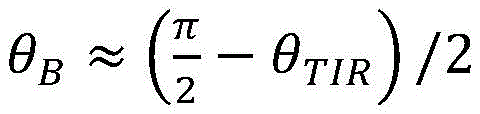
wherein, thetaTIR=sin-1(n3/n1) Is an index of n1And n3(n1>n3) The empirical equation is valid for at least α -90 ° ± 30 ° for the critical angle of diopter, n3 being the refractive index of the host medium.
The recommended height of the tapered pillars 11 is equal to (or slightly less than) the focal length:
H≈F (22)
preferably, it should also be larger than at least half the wavelength in the tapered material. The base angle may be chosen quite arbitrarily (e.g. in the interval 45 to 90 degrees).
5.2.2 materials and methods
To achieve the desired properties, layer 131And the NJ microstructure on its surface should preferably be made of a low loss material (at the wavelength of the incident EM wave), while layer 132Should be higher than layer 131Loss (i.e. k 2)>k1, where ki is the extinction coefficient of the corresponding material).
As in the first embodiment, this alternative embodiment provides an adhesive-free heat sealing method that may be used to join two similar or dissimilar materials under irradiation by non-ionizing Electromagnetic (EM) radiation (e.g., a laser beam).
Unlike other heat sealing methods, this method does not require the addition of any heat-softening glue, resin or other adhesive material. Instead, it relies on controlled high local heating of the surface layer of the bulk material. This provides a strong advantage in scenarios where materials that need to be sealed together already have some micron-scale surface patterns, which must be kept clean from any impurities, such as in the case of microfluidic chips, as shown in fig. 18, which will be described in detail below.
5.2.3 operating principle
FIG. 18A provides a microfluidic device comprising a microfluidic channel 10 and a layer 13 formed thereon1A top view of a microfluidic structure of a plurality of pillars in the form of truncated cones 11 and ribs 12 on the surface of (a). Fig. 18B shows a side view of a structure corresponding to the cross-section highlighted by the dashed lines on fig. 18A.
As shown in fig. 17, layer 13 when illuminated by an incident EM wave (e.g., a laser beam)1Each element of the micropattern on the surface of (a) acts as a microlens, producing a converging beam of light (a so-called nano-jet) at a distance from the base of the pillar. According to the prior art, the focal length of a cylindrical NJ microlens is determined by the shape, size of the pillar and the refractive index of its material. In the case of a tapered column, then the prediction can be made by equation (19). The idea of the proposed method is to design the NJ elements such that the focal spot is on (attached to the layer 13)1Of) pillars are generated directly above the tips of the pillars, but are placed so as to be in contact with the layer 131 Layer 13 in direct contact2Is generated internally.
Under certain conditions, it may involve the appropriate choice of materials for the two layersThe correct design of the NJ focusing elements, and certain exposure conditions, can provide highly localized heating directly above the tips of the pillars 11, resulting in the layer 132Melting (or softening) of (a). A slight pressure may be applied to press the layers against each other so that the layers 131To penetrate into layer 132In the molten (softened) material. After cooling, a strong bond will form along the line of contact.
The proposed method can be used to seal various thermoplastic materials such as ABS, PLA, PMMA, PTFE, polycarbonate, COC, etc.
In one embodiment, chemical additives (e.g., photochromic, carbon black, absorptive dyes or pigments) added to the same bulk material (e.g., polycarbonate, as previously described with respect to the first embodiment) may be used to modify (i.e., add) for layer 132Loss in the material of (a).
Note that some polymeric materials (e.g., PC) do not have a melting point in the true sense of the term. Instead, it has a glass transition temperature at which the material changes from glass to rubber. When this glass transition temperature is reached, the material becomes soft and pliable. For example, in the case of Polycarbonate (PC), the glass transition temperature is about 147 ℃, whereas the temperature at which it can be used for injection molding is about 230 ℃ to 300 ℃. The sealing of the two layers of polycarbonate can be carried out at a temperature between 150 ℃ and 230 ℃. At higher temperatures, it will become liquid and may fill and block the microchannels.
In one embodiment, the main steps of the proposed method may be as follows (note that, as already mentioned, they differ only slightly from the embodiment of fig. 2):
using established microfabrication methods (e.g. injection moulding, wet embossing, nanoimprinting or UV/DUV direct writing) on the layer 131Is formed as a substrate having a micro pattern on the top surface of the layer 131. The pattern may comprise at least one (typically many more) NJ focusing element(s) 11 having a cylindrical or conical shape. In the case where a plurality of sealing points are required, a plurality may be formedUniformly (or non-uniformly) distributed pillars (step 21 of fig. 2).
Forming the layer 13 in the form of a substrate having a smooth surface2。
The two layers are placed in direct contact so that the microstructures appear along the contact surface and are aligned according to the intended use (step 22 of fig. 2)
Placing the structure under slight pressure, e.g. pressed between two plates, e.g. a first plate made of glass or quartz, as layer 131And a second plate made of glass or plastic, placed on the layer 132And as a press.
As shown in fig. 18, the structure is irradiated from below with a laser beam having a certain wavelength and exposure parameters (e.g. intensity and pulse duration) (step 23 of fig. 2).
The structure is placed under pressure until hardening occurs (typically upon cooling) (step 25 of fig. 2).
Please note that
The material of the layer will be chosen such that k2>k1 where k1 and k2 are each layer 131And a layer 132The extinction coefficient of the material of (a).
Preferably, k1 should be as small as possible (e.g., k 1)<10-5) so that most of the power loss occurs at layer 132In (1). In one embodiment, both layers may be made of the same bulk material (e.g., PC), with some additives for layer 132。
The wavelength of the laser light is selected according to the absorption spectrum of the material in order to reach the layer 131And 132The desired value of the extinction coefficient of the material (d).
The shape and size of the NJ focusing element 11 will be defined in terms of the wavelength of the incident EM wave and the refractive index of the material, so that the focal spot appears at the layer 132Interior, above the tip of the post.
Note that the thickness of the layer may be arbitrarily selected, unlike the first embodiment. This is because the losses (and thus heating) will be mainly in the layer 13 near the focal spot generated by the NJ focusing element 112Occurs in the surface layer of (a).
5.2.4 simulation data
Fig. 19-23 report simulation data describing the effect of post shape and material loss on the focusing ability of the post and the temperature pattern inside the structure.
FIGS. 19-21 show the mapping for three different k2Value (i.e., layer 13 is depicted2Extinction coefficient of loss in) the normalized field strength (top), power loss (middle), and temperature (bottom) modes of tapered and cylindrical columns with different radii and base angles. Data are obtained for structures illuminated from below by plane waves, where the features are λ 405nm, H500 nm, n1=n2=1.58,k1=10-5,k2=10-5. More precisely, fig. 19A corresponds to the base radius R1500nm, and a top radius R2250nm and base angle α ≈ 63 deg. of the tapered column 11, fig. 19B corresponds to the base radius R1500nm, and a top radius R2100nm and base angle α ≈ 51 deg. of the tapered column 11, fig. 19C corresponds to a radius R1=R2500nm cylindrical pillars 11, and fig. 19D corresponds to radius R1=R2300nm cylindrical column 11.
FIGS. 20A-20D differ from FIGS. 19A-19D only in that k2=10-4All other features remain unchanged. FIGS. 21A-21D differ from FIGS. 19A-19D only in that k2=10-3All other features remain unchanged.
Fig. 22 provides temperature profiles along the axis of the column for different shaped columns, extracted from the temperature patterns reported in fig. 19-21.
Figure 23 provides temperature profiles for a conical column for three different values of k 2.
According to FIG. 19a, the base radius R1And the change in base angle α allows one to change the position and size of the focal spot in low loss materials (k)1=k210-5), in the layer 131And a layer 132Power loss and thus heating occurs in the vicinity of the pillars in (fig. 19b, fig. 19 c).
In layer 132In the case of materials with higher losses (fig. 20, 21), the layer 13 directly above the tip of the pillar 112Power losses and heating occur, which is a preferred scenario.
Comparing the temperature profiles reported in fig. 22, it was found that using tapered pillars with sharp tips helps achieve a larger temperature gradient at the interface of the layers, which may be advantageous to achieve a highly localized heating and melting layer 132Without overheating the column itself.
As shown in fig. 23, layers 13 may be added2To further extend the temperature gradient.
This alternative embodiment has the advantage over the first embodiment described in section 5.1 that it is less critical for accurate calibration of laser power and exposure conditions. In a first embodiment, the wrong exposure conditions may lead to premature melting of the entire layer (or its bottom surface) instead of the microstructure elements. This drawback is avoided thanks to the alternative embodiment of section 5.2.
This alternative embodiment is simplified in aspects associated with: (a) fabrication of the microstructure of the bonded device and (b) calibration of the exposure conditions. Furthermore, the method is more versatile and more easily adaptable to sealing of different materials. It also improves the mechanical rigidity of the seal.
5.3 comparison of focusing Capacity of cylindrical bonding elements and conical bonding elements
Fig. 24A shows an overall view of the topology of an NJ comprising a plurality of cylindrical pillars. Fig. 24B presents near-field strong patterns calculated for a single pillar in a periodic arrangement illuminated by a plane wave incident from below using the 3D-FDTD method, and fig. 24C presents a symbol of NJ including a plurality of cylindrical pillars. Column and incident wave parameters: the height H is 3000nm, the radius R1R 2R 500nm, the pitch P3000 nm, the polycarbonate material and the laser wavelength 2000 nm.
Fig. 25A, 25B and 25C are the same as fig. 24A, 24B and 24C, respectively, for a tapered column having the following dimensions: height H3000 nm, radius R1 800nm, R2 400nm, and pitch P3000 nm.
Fig. 26 shows the field intensity distribution along the axis of a cylinder (H ═ P ═ 3000nm, R1 ═ R2 ═ 500nm) and a tapered cylinder (H ═ P ═ 3000nm, R1 ═ 800nm, R2 ═ 400nm), normalized by the intensity of a plane wave of 2000nm wavelength propagating in an unbounded medium with the same refractive index along the positive z direction. The parameters of the structure are the same as in fig. 24B and fig. 25B, respectively.
Fig. 27A shows the power density enhancement in the cross-section of a pillar (section z ═ H) calculated from an incident plane wave propagating in the same unbounded medium, and fig. 27B shows the coupling efficiency of the pillar, calculated as the ratio of the power guided through the pillar to the power incident on the surface of the unit cell comprising NJ of the pillar.
The NJ laser welding method is based on local heating of the post and its surroundings. Therefore, it is advantageous to have a maximum Power Density Enhancement (PDE) within the column compared to the power density of EM waves propagating through the cover layer, whose thickness is large enough to be considered an unbounded medium. The increase in power density in the column results in premature heating of the column and a faster temperature rise near the column compared to a homogeneous medium. As can be seen in fig. 27A, the maximum PDE is achieved for column diameters close to half the laser wavelength, which corresponds to a coupling efficiency of about 60%.
FIG. 28 shows the concentration of light by a tapered rod as a function of its tip radius. The four families of curves correspond to different base radii. For tip radii of about 400 to 500nm, the maximum PDE is achieved. In the case of a tapered column, the absolute value of PDE is higher compared to a cylindrical column, which is explained by its larger base providing a larger effective aperture.
FIG. 29 shows the relationship of PDE for cylindrical and tapered columns with the height of the columns. The dimensions are selected according to fig. 28. As can be seen, for the cylindrical column, the PDE monotonically increases with increasing height, while the PDE for the tapered column shows a maximum around H3500 nm. Thus, if the height of the pillars is limited for some practical reason (e.g., H ≦ 1.5 λ), it may be beneficial to use tapered pillars to provide a higher PDE with a smaller height. While the use of a cylindrical column may be beneficial when its height can be increased above H >1.5 λ.
FIG. 30 shows the relationship of PDEs for cylindrical pillars and tapered pillars to the pitch of the periodic array of pillars. A pitch dimension of about 1.5 lambda is optimal for both types of posts with selected heights and radii and given lighting conditions.
Fig. 31A-31D show EM and thermal analysis results of NJ texture at the interface between two layers of a cylindrical column (H-P-3000 nm, R1-R2-500 nm) illuminated by a plane wave (λ -2000 nm) propagating along the positive z-direction. The NJ texture is located at the interface of two 150 μm thick layers of polycarbonate material. Fig. 31A shows the power density and loss distribution in the x-z cross section of the column. FIG. 31B shows temperature rise curves in cross-sections of a column near texture at different time intervals. The color scale corresponds to the temperature increase from the initial temperature, Δ T-T0. At each time interval, the temperature curve is normalized by its maximum value, where the color scale is defined such that the color referenced under numeral 310 corresponds to the maximum temperature rise and the color referenced under numeral 311 corresponds to 80% of the maximum value. Fig. 31C shows the temperature profile along the z-axis at time t-0.1 ms. The temperature rise corresponds to the reference laser power and the focal spot size. FIG. 31D shows temperature profiles along the z-axis for different time instants. The corresponding temperature profile around the NJ texture is shown in fig. 31B.
As can be seen in fig. 31, the temperature profile is very similar to the power and loss profile at an initial time after a period of 1 ms. However, due to the heat transfer, the local heating effect cannot be maintained in time. It may therefore be beneficial to use a pulsed laser having a pulse duration of the order of 1ms or even less and a relatively high peak power sufficient to melt the adhesive element with a single pulse or a sequence of short pulses with at least partially overlapping focal spots.
Fig. 32A-32D illustrate different embodiments of NJ texturing in which post-type and rib-type adhesive elements surround microfluidic channels disposed on the surface of a cover or base layer. These adhesive elements are in the form of the fig. 32A column, the fig. 32B column and ribs aligned with the microfluidic channels, the fig. 32C ribs aligned orthogonally to the channels, and the fig. 32D ribs aligned parallel to the microfluidic channels. And (3) bonding the element.
Fig. 33A-33F illustrate different embodiments of methods in which NJ textures and microfluidic channels are disposed on the same or different portions. In fig. 33A, the texture and microfluidic channels are on the base layer; in fig. 33B, the texture is on the cover layer and the microfluidic channel is on the bottom layer; in fig. 33C, both the texture and the microfluidic channel are on the cover layer; in FIG. 33D, the texture covers the entire surface of the overlay; in FIG. 33E, the texture is on two layers of staggered NJ columns; cost, in FIG. 33F, the texture is on two layers with NJ posts stacked.
Claims (15)
1. A layer (13) for bonding two dielectric materials1,132) The method of (1), comprising:
-providing (21) a surface of at least one of the layers with micro-scale-sized and/or nano-scale-sized adhesive elements (11, 12), said adhesive elements forming contact points of the layers;
-bringing (22) the layers into mutual position according to the intended use;
-illuminating (23) that layer of the surface provided with adhesive elements with an incident electromagnetic wave (14) whose direction of propagation forms an angle comprised between 70 ° and 110 ° with said layer and whose wavelength is selected according to the absorption spectrum of at least one of the materials forming these layers;
-generating a converging light beam within the adhesive element, or in the vicinity of the tip of the adhesive element to be in contact with another layer;
-heating and melting (24) the bonding element and/or the further layer by a high intensity focal spot (15) formed by the generated light beam;
-keeping the layers in said mutual position until the layers (13)1,132) And (6) bonding.
2. The method of claim 1Method, wherein the adhesive element (11, 12) is in that layer (13)1,132) A patterned microstructure is formed on the surface of (a).
3. Method according to claim 1 or 2, wherein the adhesive element has the form of a post (11) and/or a rib (12).
4. The method according to any of the preceding claims, wherein the size of the adhesive element in the direction of the incident electromagnetic wave is set between half the wavelength of the incident electromagnetic wave and several times the wavelength of the incident electromagnetic wave.
5. Method according to any one of the preceding claims, wherein the layers (13)1,132) Are made of the same material.
6. Method according to any one of claims 1 to 4, wherein the layers (13)1,132) Made of different materials.
7. Method according to any one of the preceding claims, wherein the material of the layer of which the surface is provided with adhesive elements belongs to the group comprising plastics and thermoplastics.
8. The method of claim 7, wherein the material of at least one of the two layers comprises an absorbing dye or pigment.
9. The method according to any one of the preceding claims, wherein the method further comprises providing the surface of at least one of the layers with engraved microfluidic channels (10).
10. Method according to any one of the preceding claims, wherein bringing (22) the layers into mutual position according to the intended use is performed after heating and melting (34) the adhesive element.
11. Method according to any of the preceding claims, wherein the layers are placed in direct contact between two optically transparent plates when they are brought (22) into mutual position according to the intended use.
12. The method according to any one of the preceding claims, wherein the method further comprises: cooling the surface of the layer opposite to the surface on which the adhesive element is provided.
13. The method according to any one of the preceding claims, wherein the method further comprises preheating at least the surface on which the adhesive element is provided.
14. The method according to any of the preceding claims, wherein providing the surface of at least one of the layers with micro-scale-sized adhesive elements and/or nano-scale-sized adhesive elements is performed by molding or wet embossing the surface.
15. Method according to any one of the preceding claims, wherein the adhesive element has a conical shape, wherein their dimensions are chosen such that the converging light beam is generated at a position close to but above the tip of the adhesive element that is to be in contact with the further layer, and wherein that layer, the surface of which is provided with an adhesive element, is made of a material having a lower loss and/or a higher melting temperature than the material of the further layer.
Applications Claiming Priority (3)
| Application Number | Priority Date | Filing Date | Title |
|---|---|---|---|
| EP17306135.9A EP3450392A1 (en) | 2017-09-01 | 2017-09-01 | Adhesive-free bonding of layers of dielectric materials, using nanojet microstructures |
| EP17306135.9 | 2017-09-01 | ||
| PCT/EP2018/073540 WO2019043197A1 (en) | 2017-09-01 | 2018-08-31 | Adhesive-free bonding of layers of dielectric materials, using nanojet microstructures |
Publications (2)
| Publication Number | Publication Date |
|---|---|
| CN111051237A true CN111051237A (en) | 2020-04-21 |
| CN111051237B CN111051237B (en) | 2023-04-18 |
Family
ID=59858668
Family Applications (1)
| Application Number | Title | Priority Date | Filing Date |
|---|---|---|---|
| CN201880056665.0A Active CN111051237B (en) | 2017-09-01 | 2018-08-31 | Adhesive-free adhesion to dielectric material layers using nanojet microstructures |
Country Status (4)
| Country | Link |
|---|---|
| US (1) | US11598969B2 (en) |
| EP (2) | EP3450392A1 (en) |
| CN (1) | CN111051237B (en) |
| WO (1) | WO2019043197A1 (en) |
Cited By (2)
| Publication number | Priority date | Publication date | Assignee | Title |
|---|---|---|---|---|
| CN111781184A (en) * | 2020-08-03 | 2020-10-16 | 中国科学院长春光学精密机械与物理研究所 | A photon nanojet, laser array unit and single molecule fluorescent gene sequencer |
| JP2022010970A (en) * | 2020-06-29 | 2022-01-17 | Agc株式会社 | Optical element |
Families Citing this family (1)
| Publication number | Priority date | Publication date | Assignee | Title |
|---|---|---|---|---|
| CN111943133A (en) * | 2020-08-25 | 2020-11-17 | 东北电力大学 | Micro-channel chip-PDMS-nanostructure chip bonding method |
Citations (9)
| Publication number | Priority date | Publication date | Assignee | Title |
|---|---|---|---|---|
| GB1336806A (en) * | 1971-03-08 | 1973-11-14 | United Aircraft Corp | Deep penetration welding using coherent optical radiation |
| US4636609A (en) * | 1984-04-10 | 1987-01-13 | Toyota Jidosha Kabushiki Kaisha | Process for joining different kinds of synthetic resins |
| CA2384964A1 (en) * | 1999-09-23 | 2001-03-29 | Aclara Biosciences, Inc. | Method for linking two plastic work pieces without using foreign matter |
| EP1297944A1 (en) * | 2001-09-29 | 2003-04-02 | Institut für angewandte Biotechnik und Systemanalyse an der Universität Witten/Herdecke GmbH | Process for laser beam welding of plastic parts |
| US20070125489A1 (en) * | 2005-09-08 | 2007-06-07 | Oregon State University | Microfluidic welded devices or components thereof and method for their manufacture |
| JP2008062263A (en) * | 2006-09-06 | 2008-03-21 | Imra America Inc | Transparent material processing with ultrashort pulse laser |
| WO2012081584A1 (en) * | 2010-12-14 | 2012-06-21 | ローム株式会社 | Microchip manufacturing method and microchip |
| US20120266985A1 (en) * | 2011-04-21 | 2012-10-25 | Rohm Co., Ltd. | Microchip and Method of Manufacturing the Same |
| WO2017025277A1 (en) * | 2015-08-11 | 2017-02-16 | Surys | Optical security component with plasmon effect and method for manufacturing such a component |
Family Cites Families (3)
| Publication number | Priority date | Publication date | Assignee | Title |
|---|---|---|---|---|
| JP4542595B2 (en) | 2008-05-12 | 2010-09-15 | パナソニック株式会社 | Method for manufacturing plasma display panel |
| EP3223062A1 (en) | 2016-03-24 | 2017-09-27 | Thomson Licensing | Device for forming at least one focused beam in the near zone, from incident electromagnetic waves |
| EP3223063A1 (en) | 2016-03-24 | 2017-09-27 | Thomson Licensing | Device for forming a field intensity pattern in the near zone, from incident electromagnetic waves |
-
2017
- 2017-09-01 EP EP17306135.9A patent/EP3450392A1/en active Pending
-
2018
- 2018-08-31 US US16/642,396 patent/US11598969B2/en active Active
- 2018-08-31 EP EP18765833.1A patent/EP3676219B1/en active Active
- 2018-08-31 CN CN201880056665.0A patent/CN111051237B/en active Active
- 2018-08-31 WO PCT/EP2018/073540 patent/WO2019043197A1/en not_active Ceased
Patent Citations (10)
| Publication number | Priority date | Publication date | Assignee | Title |
|---|---|---|---|---|
| GB1336806A (en) * | 1971-03-08 | 1973-11-14 | United Aircraft Corp | Deep penetration welding using coherent optical radiation |
| US4636609A (en) * | 1984-04-10 | 1987-01-13 | Toyota Jidosha Kabushiki Kaisha | Process for joining different kinds of synthetic resins |
| CA2384964A1 (en) * | 1999-09-23 | 2001-03-29 | Aclara Biosciences, Inc. | Method for linking two plastic work pieces without using foreign matter |
| JP2003509251A (en) * | 1999-09-23 | 2003-03-11 | アクララ バイオサイエンシーズ, インコーポレイテッド | Method for joining two workpieces made of plastic without using foreign matter |
| EP1297944A1 (en) * | 2001-09-29 | 2003-04-02 | Institut für angewandte Biotechnik und Systemanalyse an der Universität Witten/Herdecke GmbH | Process for laser beam welding of plastic parts |
| US20070125489A1 (en) * | 2005-09-08 | 2007-06-07 | Oregon State University | Microfluidic welded devices or components thereof and method for their manufacture |
| JP2008062263A (en) * | 2006-09-06 | 2008-03-21 | Imra America Inc | Transparent material processing with ultrashort pulse laser |
| WO2012081584A1 (en) * | 2010-12-14 | 2012-06-21 | ローム株式会社 | Microchip manufacturing method and microchip |
| US20120266985A1 (en) * | 2011-04-21 | 2012-10-25 | Rohm Co., Ltd. | Microchip and Method of Manufacturing the Same |
| WO2017025277A1 (en) * | 2015-08-11 | 2017-02-16 | Surys | Optical security component with plasmon effect and method for manufacturing such a component |
Cited By (4)
| Publication number | Priority date | Publication date | Assignee | Title |
|---|---|---|---|---|
| JP2022010970A (en) * | 2020-06-29 | 2022-01-17 | Agc株式会社 | Optical element |
| JP7456309B2 (en) | 2020-06-29 | 2024-03-27 | Agc株式会社 | Lens with base material |
| CN111781184A (en) * | 2020-08-03 | 2020-10-16 | 中国科学院长春光学精密机械与物理研究所 | A photon nanojet, laser array unit and single molecule fluorescent gene sequencer |
| CN111781184B (en) * | 2020-08-03 | 2021-08-20 | 中国科学院长春光学精密机械与物理研究所 | A photon nanojet, laser array unit and single molecule fluorescent gene sequencer |
Also Published As
| Publication number | Publication date |
|---|---|
| EP3676219A1 (en) | 2020-07-08 |
| US11598969B2 (en) | 2023-03-07 |
| WO2019043197A1 (en) | 2019-03-07 |
| EP3450392A1 (en) | 2019-03-06 |
| CN111051237B (en) | 2023-04-18 |
| EP3676219B1 (en) | 2021-06-02 |
| US20200192107A1 (en) | 2020-06-18 |
Similar Documents
| Publication | Publication Date | Title |
|---|---|---|
| US11692685B2 (en) | Laminate structure with embedded cavities and related method of manufacture | |
| CN111051237B (en) | Adhesive-free adhesion to dielectric material layers using nanojet microstructures | |
| Gao et al. | Ultra-low-cost fabrication of polymer-based microfluidic devices with diode laser ablation | |
| Meineke et al. | A microfluidic opto-caloric switch for sorting of particles by using 3D-hydrodynamic focusing based on SLE fabrication capabilities | |
| Wang et al. | Femtosecond laser-induced modification of surface wettability of PMMA for fluid separation in microchannels | |
| Wang et al. | Fabrication of integrated microchip for optical sensing by femtosecond laser direct writing of Foturan glass | |
| Convery et al. | 3D printed tooling for injection molded microfluidics | |
| Chakrabarti et al. | Replication of optical microlens array using photoresist coated molds | |
| Wu et al. | Experimental study of fabricating a four-layers Cantor fractal microfluidic chip by CO2 laser system | |
| JP2007307634A (en) | Microfluidic circuit manufacturing method and microfluidic circuit manufactured by the method | |
| Song et al. | A tuneable micro-optofluidic biconvex lens with mathematically predictable focal length | |
| Singh et al. | Transparent thin thermoplastic biochip by injection-moulding and laser transmission welding | |
| US9079359B2 (en) | Microchip and method of manufacturing the same | |
| Mayboudi | Heat transfer modelling and thermal imaging experiments in laser transmission welding of thermoplastics | |
| Yardi et al. | High efficiency coupling of optical fibres with SU8 micro-droplet using laser welding process | |
| Cui et al. | Fabrication of polymer optical diffusers by buffer-assisted ultrasonic embossing | |
| Riahi | CO2 Laser and Micro-Fluidics | |
| JP2003236929A (en) | Method for forming plastic structure | |
| Behrens et al. | Laser Beam Welding of Thermoplastics | |
| JP5220180B2 (en) | Microfluidic circuit manufacturing method and microfluidic circuit manufactured by the method | |
| Vázquez et al. | Plastic optofluidic chip fabricated by femtosecond laser ablation | |
| JP2008126472A (en) | Precision welding method of microfluidic chip | |
| KR20200125295A (en) | A method of micro patterning using continuous wave laser beam | |
| Amberg et al. | Single-step replication of a highly integrated PDMS optofluidic analysis system |
Legal Events
| Date | Code | Title | Description |
|---|---|---|---|
| PB01 | Publication | ||
| PB01 | Publication | ||
| SE01 | Entry into force of request for substantive examination | ||
| SE01 | Entry into force of request for substantive examination | ||
| GR01 | Patent grant | ||
| GR01 | Patent grant |