CN111315744B - Heteroaryltetrahydropyridine compounds, their preparation method, pharmaceutical composition and application - Google Patents
Heteroaryltetrahydropyridine compounds, their preparation method, pharmaceutical composition and application Download PDFInfo
- Publication number
- CN111315744B CN111315744B CN201880072563.8A CN201880072563A CN111315744B CN 111315744 B CN111315744 B CN 111315744B CN 201880072563 A CN201880072563 A CN 201880072563A CN 111315744 B CN111315744 B CN 111315744B
- Authority
- CN
- China
- Prior art keywords
- compound
- alkyl
- stereoisomer
- pharmaceutically acceptable
- acceptable salt
- Prior art date
- Legal status (The legal status is an assumption and is not a legal conclusion. Google has not performed a legal analysis and makes no representation as to the accuracy of the status listed.)
- Active
Links
Classifications
-
- A—HUMAN NECESSITIES
- A61—MEDICAL OR VETERINARY SCIENCE; HYGIENE
- A61K—PREPARATIONS FOR MEDICAL, DENTAL OR TOILETRY PURPOSES
- A61K31/00—Medicinal preparations containing organic active ingredients
- A61K31/33—Heterocyclic compounds
- A61K31/395—Heterocyclic compounds having nitrogen as a ring hetero atom, e.g. guanethidine or rifamycins
- A61K31/435—Heterocyclic compounds having nitrogen as a ring hetero atom, e.g. guanethidine or rifamycins having six-membered rings with one nitrogen as the only ring hetero atom
- A61K31/4353—Heterocyclic compounds having nitrogen as a ring hetero atom, e.g. guanethidine or rifamycins having six-membered rings with one nitrogen as the only ring hetero atom ortho- or peri-condensed with heterocyclic ring systems
-
- A—HUMAN NECESSITIES
- A61—MEDICAL OR VETERINARY SCIENCE; HYGIENE
- A61K—PREPARATIONS FOR MEDICAL, DENTAL OR TOILETRY PURPOSES
- A61K31/00—Medicinal preparations containing organic active ingredients
- A61K31/33—Heterocyclic compounds
- A61K31/395—Heterocyclic compounds having nitrogen as a ring hetero atom, e.g. guanethidine or rifamycins
- A61K31/435—Heterocyclic compounds having nitrogen as a ring hetero atom, e.g. guanethidine or rifamycins having six-membered rings with one nitrogen as the only ring hetero atom
- A61K31/4353—Heterocyclic compounds having nitrogen as a ring hetero atom, e.g. guanethidine or rifamycins having six-membered rings with one nitrogen as the only ring hetero atom ortho- or peri-condensed with heterocyclic ring systems
- A61K31/4375—Heterocyclic compounds having nitrogen as a ring hetero atom, e.g. guanethidine or rifamycins having six-membered rings with one nitrogen as the only ring hetero atom ortho- or peri-condensed with heterocyclic ring systems the heterocyclic ring system containing a six-membered ring having nitrogen as a ring heteroatom, e.g. quinolizines, naphthyridines, berberine, vincamine
-
- A—HUMAN NECESSITIES
- A61—MEDICAL OR VETERINARY SCIENCE; HYGIENE
- A61K—PREPARATIONS FOR MEDICAL, DENTAL OR TOILETRY PURPOSES
- A61K31/00—Medicinal preparations containing organic active ingredients
- A61K31/33—Heterocyclic compounds
- A61K31/395—Heterocyclic compounds having nitrogen as a ring hetero atom, e.g. guanethidine or rifamycins
- A61K31/495—Heterocyclic compounds having nitrogen as a ring hetero atom, e.g. guanethidine or rifamycins having six-membered rings with two or more nitrogen atoms as the only ring heteroatoms, e.g. piperazine or tetrazines
- A61K31/4985—Pyrazines or piperazines ortho- or peri-condensed with heterocyclic ring systems
-
- C—CHEMISTRY; METALLURGY
- C07—ORGANIC CHEMISTRY
- C07D—HETEROCYCLIC COMPOUNDS
- C07D471/00—Heterocyclic compounds containing nitrogen atoms as the only ring hetero atoms in the condensed system, at least one ring being a six-membered ring with one nitrogen atom, not provided for by groups C07D451/00 - C07D463/00
- C07D471/02—Heterocyclic compounds containing nitrogen atoms as the only ring hetero atoms in the condensed system, at least one ring being a six-membered ring with one nitrogen atom, not provided for by groups C07D451/00 - C07D463/00 in which the condensed system contains two hetero rings
- C07D471/04—Ortho-condensed systems
-
- Y—GENERAL TAGGING OF NEW TECHNOLOGICAL DEVELOPMENTS; GENERAL TAGGING OF CROSS-SECTIONAL TECHNOLOGIES SPANNING OVER SEVERAL SECTIONS OF THE IPC; TECHNICAL SUBJECTS COVERED BY FORMER USPC CROSS-REFERENCE ART COLLECTIONS [XRACs] AND DIGESTS
- Y02—TECHNOLOGIES OR APPLICATIONS FOR MITIGATION OR ADAPTATION AGAINST CLIMATE CHANGE
- Y02P—CLIMATE CHANGE MITIGATION TECHNOLOGIES IN THE PRODUCTION OR PROCESSING OF GOODS
- Y02P20/00—Technologies relating to chemical industry
- Y02P20/50—Improvements relating to the production of bulk chemicals
- Y02P20/55—Design of synthesis routes, e.g. reducing the use of auxiliary or protecting groups
Landscapes
- Health & Medical Sciences (AREA)
- Chemical & Material Sciences (AREA)
- Medicinal Chemistry (AREA)
- Pharmacology & Pharmacy (AREA)
- Epidemiology (AREA)
- Life Sciences & Earth Sciences (AREA)
- Animal Behavior & Ethology (AREA)
- General Health & Medical Sciences (AREA)
- Public Health (AREA)
- Veterinary Medicine (AREA)
- Organic Chemistry (AREA)
- Pharmaceuticals Containing Other Organic And Inorganic Compounds (AREA)
Abstract
本发明公开了作为乙肝表面抗原(HBsAg)分泌抑制剂的式I的杂芳基并四氢吡啶类化合物、其制备方法、药物组合物及应用。 The invention discloses a heteroaryltetrahydropyridine compound of formula I as a hepatitis B surface antigen (HBsAg) secretion inhibitor, a preparation method, a pharmaceutical composition and an application thereof. 
Description
Technical Field
The invention relates to heteroaryl tetrahydropyridine compounds serving as hepatitis B surface antigen HBsAg secretion inhibitors, a pharmaceutical composition containing the heteroaryl tetrahydropyridine compounds, a preparation method and application of the heteroaryl tetrahydropyridine compounds.
Background
Hepatitis B (Hepatitis B) is a common infectious liver disease caused by Hepatitis B virus (Hepatitis B virus, HBV) infection, and can further develop into liver cirrhosis, liver cancer and other diseases. According to the estimated World Health Organization (WHO) 2017, global hepatitis report, 2.57 million patients with chronic hepatitis b virus infection (positive for hepatitis b surface antigen (HBsAg)) worldwide in 2015, death of 88.7 tens of thousands of people is caused, most of them die from hepatitis b complications (including cirrhosis and liver cancer), and the mortality caused by hepatitis has been increasing from 2000 to 2015. Although the incidence of HBV has declined for many years with the advent of prophylactic hepatitis b vaccines, HBsAg positive patients in the western pacific region including china still account for 6.2% of the total population by 2015 (Global hepatitis report 2017, who), and only nearly 9000 tens of thousands of chronic hepatitis b patients in china need antiviral treatment.
Currently, 8 anti-hepatitis B drugs are approved by FDA and can be divided into two main categories: interferon and nucleotide analogs. Interferons include interferon alpha-2 b and pegylated interferon alpha-2 a. Interferon acts on host cell surface receptors to produce antiviral proteins in cells, thereby inhibiting replication of hepatitis b virus, and has disadvantages of low effective response rate and serious side effects and long-term administration by injection. Oral nucleoside (acid) analogs include lamivudine, adefovir dipivoxil, entecavir, telbivudine, tenofovir dipivoxil, and tenofovir alafenamide. Nucleoside (nucleotide) analogs act primarily by inhibiting replication of viral polymerase (reverse transcriptase), which has the disadvantage of susceptibility to viral variation over prolonged periods of time (mia et al future med chem.,2015,7,587-607). And these drugs have little effect on the clearance of HBsAg, one of the markers of functional cure of hepatitis B (Revill et al Nat. Rev. Gastroentry. Hepatol.,2016,13,239-248) (Janssen et al Lancet,2005,365,123-129;Marcellin et al.N.Engl.J.Med, 2004,351,1206-1217;Buster et al.Hepatology,2007,46,388-394). Thus, new drugs which are more effective and safer are urgently needed for patients with hepatitis B.
HBsAg is classified into three subtypes of large (L), medium (M) and small (S), which are important components of the envelope of infectious virus particles (Dane parts) and subviral particles (Subviral particles, SVPs), and plays an important role in entering cells and secreting new virus particles, and the number of SVPs assembled by HBsAg in serum of chronic hepatitis B patients can reach 10 13 Per mL, 10-fold of infectious particles, so that the expression of SVPs in large and sustained amounts is possible to inhibit the body's specific immune response to HBV by neutralizing mechanisms such as antibodies against hepatitis B surface (Cornberg et al J.Hepatol.,2017,66,398-411). Therefore, the HBsAg secretion inhibitor has good application prospect for treating HBV.
Recent clinical data published by Replicor show that The combination of The HBsAg secretion inhibitors Rep-2139 and Rep-2165 (nucleic acid polymers (NAPs)) with interferon and Tenofovir Disoproxil (TDF) significantly reduced serum HBsAg levels and achieved functional control of hepatitis B virus with an increase in surface antibody Anti-HBs (AASLD: the Liver Meeting.Washington, DC, october 20-24,2017.Abstract LB-24.). But will limit patient compliance because of the need for long-term administration by injection.
Other reported inhibitors of HBsAg secretion include the tetrazolopyrimidine small molecule compound HBF-0259 (Dougherty et al, antimicrob. Agents Ch.,2007,51,4427-4437) with in vitro activity at the micromolar level, the better chemically stable derivatives PBHBV-001 and PBHBV-2-15 (Yu et al J. Med. Chem.,2011,54,5660-5670) of the triazolopyrimidine derivatives PBHBV-001 and PBHBV-2-15 (Xu et al, antivir. Res.,2014,107,6-15) with in vitro activity as high as nanomolar levels of compounds of the Roche patent (WO 2016107832).
Disclosure of Invention
The present invention provides novel, highly active inhibitors of HBsAg secretion which can be used alone or in combination with other drugs to treat hepatitis b.
One aspect of the present invention provides a compound of formula I, or a stereoisomer, tautomer, pharmaceutically acceptable salt, polymorph, co-crystal, solvate, metabolite, or prodrug thereof:

wherein:
R 1 selected from C 6 -C 14 Aryl and 5-14 membered heteroaryl, said C 6 -C 14 Aryl and 5-14 membered heteroaryl groups may be optionally substituted with substituents;
R 2 and R is 3 Each independently selected from hydrogen and unsubstituted C 1 -C 6 Alkyl, or R 2 And R is 3 And the carbon atoms to which they are attached form a 3-7 membered cycloalkyl group;
R 4 selected from-C (O) R 5 、-CO 2 R 6 、-C(O)NR 7 SO 2 R 8 、-C(O)NR 9 R 10 A 5 membered heteroaryl group optionally substituted with a substituent, and

wherein: r is R 5 And R is 8 Each independently selected from C 1 -C 6 Alkyl and C 3 -C 7 Cycloalkyl group, the C 1 -C 6 Alkyl and C 3 -C 7 Cycloalkyl groups may be optionally substituted with substituents;
R 6 selected from hydrogen, C 1 -C 6 Alkyl and C 3 -C 7 Cycloalkyl group, the C 1 -C 6 Alkyl and C 3 -C 7 Cycloalkyl groups may be optionally substituted with substituents;
R 7 、R 9 and R is 10 Each independently selected from hydrogen, C 1 -C 6 Alkyl, C 3 -C 7 Cycloalkyl, C 1 -C 6 alkyl-OC 1 -C 6 Alkyl and 4-7 membered heterocyclyl, or R 9 And R is 10 Together with the nitrogen atom to which it is attached, form a 4-7 membered heterocyclic group, said C 1 -C 6 Alkyl, C 3 -C 7 Cycloalkyl, C 1 -C 6 alkyl-OC 1 -C 6 Alkyl and 4-7 membered heterocyclyl groups may be optionally substituted with substituents;
R 11 and R is 16 Each independently selected from hydrogen, C 1 -C 6 Alkyl, C 3 -C 7 Cycloalkyl, C 1 -C 6 alkyl-OC 1 -C 6 Alkyl, C 6 -C 14 Aryl, 5-14 membered heteroaryl and 4-10 membered heterocyclyl, said C 1 -C 6 Alkyl, C 3 -C 7 Cycloalkyl, C 1 -C 6 alkyl-OC 1 -C 6 Alkyl, C 6 -C 14 Aryl, 5-14 membered heteroaryl, and 4-10 membered heterocyclyl may be optionally substituted with substituents;
R 12 、R 13 、R 14 and R is 15 Each independently selected from hydrogen, C 1 -C 6 Alkyl, C 3 -C 7 Cycloalkyl, C 1 -C 6 Alkoxy, C 1 -C 6 alkyl-OC 1 -C 6 Alkyl and 4-7 membered heterocyclyl, said C 1 -C 6 Alkyl, C 3 -C 7 Cycloalkyl, C 1 -C 6 Alkoxy, C 1 -C 6 alkyl-OC 1 -C 6 Alkyl and 4-7 membered heterocyclyl groups may be optionally substituted with substituents;
one of X and Y is N, and the other is selected from CH and N;
by "substituted" is meant optionally substituted with one or more substituents independently selected from the group consisting of: hydroxy, halogen, C 1 -C 6 Alkyl, halogenated C 1 -C 6 Alkyl, C 1 -C 6 Alkoxy, -OC 1 -C 6 alkyl-OH, halogenated C 1 -C 6 Alkoxy, C 3 -C 7 Cycloalkyl, cyano, nitro, -C (O) R 5 、-C(O)OR 6 、-NR 7 SO 2 R 8 、-SO 2 R 8 、-C(O)NR 9 R 10 、-SO 2 NR 9 R 10 、-NR 9 R 10 、-NR 9 C(O)R 10 、-C 1 -C 6 alkyl-OC 1 -C 6 Alkyl, -OC 1 -C 6 alkyl-OC 1 -C 6 Alkyl, hydroxy-substituted-OC 1 -C 6 alkyl-OC 1 -C 6 Alkyl, hydroxyalkyl, C 1 -C 6 alkyl-NR 9 R 10 、C 1 -C 6 alkyl-C (O) NR 9 R 10 、C 1 -C 6 alkyl-NR 9 C(O)R 10 Aryl, heteroaryl, and heterocyclyl;
The conditions are as follows: when R is 4 When being a 5 membered heteroaryl optionally substituted with a substituent, X and Y are not both N.
Another aspect of the invention provides a pharmaceutical composition comprising a compound of the invention, or a stereoisomer, tautomer, pharmaceutically acceptable salt, polymorph, co-crystal, solvate, metabolite, or prodrug thereof, and one or more pharmaceutically acceptable carriers.
In another aspect, the invention provides the use of a compound of the invention, or a stereoisomer, tautomer, pharmaceutically acceptable salt, polymorph, co-crystal, solvate, metabolite or prodrug thereof, in the manufacture of a medicament for the treatment of a disease associated with excessive secretion of HBsAg.
Another aspect of the invention provides a compound of the invention, or a stereoisomer, tautomer, pharmaceutically acceptable salt, polymorph, co-crystal, solvate, metabolite, prodrug thereof, or a pharmaceutical composition of the invention, for use in the treatment of a disease associated with hypersecretion of HBsAg.
Another aspect of the invention provides a method of treating a disease associated with hypersecretion of HBsAg, comprising administering to a subject in need thereof an effective amount of a compound of the invention or a stereoisomer, tautomer, pharmaceutically acceptable salt, polymorph, co-crystal, solvate, metabolite, prodrug, or pharmaceutical composition of the invention, and optionally comprising co-administering other agents for treating a disease or disorder associated with hypersecretion of HBsAg.
In another aspect, the invention provides a process for the preparation of the compounds of the invention.
Compounds and methods of preparation
A first aspect of the invention provides a compound of formula I, or a stereoisomer, tautomer, pharmaceutically acceptable salt, polymorph, co-crystal, solvate, metabolite, or prodrug thereof:

wherein:
R 1 selected from C 6 -C 14 Aryl and 5-14 membered heteroaryl, said C 6 -C 14 Aryl and 5-14 membered heteroaryl groups may be optionally substituted with substituents;
R 2 and R is 3 Each independently selected from hydrogen and unsubstituted C 1 -C 6 Alkyl, or R 2 And R is 3 And the carbon atoms to which they are attached form a 3-7 membered cycloalkyl group;
R 4 selected from-C (O) R 5 、-CO 2 R 6 、-C(O)NR 7 SO 2 R 8 、-C(O)NR 9 R 10 A 5 membered heteroaryl group optionally substituted with a substituent, and

wherein: r is R 5 And R is 8 Each independently selected from C 1 -C 6 Alkyl and C 3 -C 7 Cycloalkyl group, the C 1 -C 6 Alkyl and C 3 -C 7 Cycloalkyl groups may be optionally substituted with substituents;
R 6 selected from hydrogen, C 1 -C 6 Alkyl and C 3 -C 7 Cycloalkyl group, the C 1 -C 6 Alkyl and C 3 -C 7 Cycloalkyl groups may be optionally substituted with substituents;
R 7 、R 9 and R is 10 Each independently selected from hydrogen, C 1 -C 6 Alkyl, C 3 -C 7 Cycloalkyl, C 1 -C 6 alkyl-OC 1 -C 6 Alkyl and 4-7 membered heterocyclyl, or R 9 And R is 10 Together with the nitrogen atom to which it is attached, form a 4-7 membered heterocyclic group, said C 1 -C 6 Alkyl, C 3 -C 7 Cycloalkyl, C 1 -C 6 alkyl-OC 1 -C 6 Alkyl and 4-7 membered heterocyclyl groups may be optionally substituted with substituents;
R 11 And R is 16 Each independently selected from hydrogen, C 1 -C 6 Alkyl, C 3 -C 7 Cycloalkyl, C 1 -C 6 alkyl-OC 1 -C 6 Alkyl, C 6 -C 14 Aryl, 5-14 membered heteroaryl and 4-10 membered heterocyclyl, said C 1 -C 6 Alkyl, C 3 -C 7 Cycloalkyl, C 1 -C 6 alkyl-OC 1 -C 6 Alkyl, C 6 -C 14 Aryl, 5-14 membered heteroaryl, and 4-10 membered heterocyclyl may be optionally substituted with substituents;
R 12 、R 13 、R 14 and R is 15 Each independently selected from hydrogen, C 1 -C 6 Alkyl, C 3 -C 7 Cycloalkyl, C 1 -C 6 Alkoxy, C 1 -C 6 alkyl-OC 1 -C 6 Alkyl and 4-7 membered heterocyclyl, said C 1 -C 6 Alkyl, C 3 -C 7 Cycloalkyl, C 1 -C 6 Alkoxy, C 1 -C 6 alkyl-OC 1 -C 6 Alkyl and 4-7 membered heterocyclyl groups may be optionally substituted with substituents;
one of X and Y is N, and the other is selected from CH and N;
by "substituted" is meant optionally substituted with one or more substituents independently selected from the group consisting of: hydroxy, halogen, C 1 -C 6 Alkyl, halogenated C 1 -C 6 Alkyl, C 1 -C 6 Alkoxy, -OC 1 -C 6 alkyl-OH, halogenated C 1 -C 6 Alkoxy, C 3 -C 7 Cycloalkyl, cyano, nitro, -C (O) R 5 、-C(O)OR 6 、-NR 7 SO 2 R 8 、-SO 2 R 8 、-C(O)NR 9 R 10 、-SO 2 NR 9 R 10 、-NR 9 R 10 、-NR 9 C(O)R 10 、-C 1 -C 6 alkyl-OC 1 -C 6 Alkyl, -OC 1 -C 6 alkyl-OC 1 -C 6 Alkyl, hydroxy-substituted-OC 1 -C 6 alkyl-OC 1 -C 6 Alkyl, hydroxyalkyl, C 1 -C 6 alkyl-NR 9 R 10 、C 1 -C 6 alkyl-C (O) NR 9 R 10 、C 1 -C 6 alkyl-NR 9 C(O)R 10 Aryl, heteroaryl, and heterocyclyl.
In some embodiments, when R 4 When being a 5 membered heteroaryl optionally substituted with a substituent, X and Y are not both N.
In some embodiments, the invention provides a compound of formula I, or a stereoisomer, tautomer, pharmaceutically acceptable salt, polymorph, co-crystal, solvate, metabolite, or prodrug thereof:

wherein:
R 1 selected from C 6 -C 14 Aryl and 5-14 membered heteroaryl, said C 6 -C 14 Aryl and 5-14 membered heteroaryl groups may be usedOptionally substituted with substituents;
R 2 and R is 3 Each independently selected from hydrogen and unsubstituted C 1 -C 6 Alkyl, or R 2 And R is 3 And the carbon atoms to which they are attached form a 3-7 membered cycloalkyl group;
R 4 selected from-C (O) R 5 、-CO 2 R 6 、-C(O)NR 7 SO 2 R 8 、-C(O)NR 9 R 10 Optionally substituted 5 membered heteroaryl, and

wherein: r is R 5 And R is 8 Each independently selected from C 1 -C 6 Alkyl and C 3 -C 7 Cycloalkyl group, the C 1 -C 6 Alkyl and C 3 -C 7 Cycloalkyl groups may be optionally substituted with substituents;
R 6 selected from hydrogen, C 1 -C 6 Alkyl and C 3 -C 7 Cycloalkyl group, the C 1 -C 6 Alkyl and C 3 -C 7 Cycloalkyl groups may be optionally substituted with substituents;
R 7 、R 9 and R is 10 Each independently selected from hydrogen, C 1 -C 6 Alkyl, C 3 -C 7 Cycloalkyl, C 1 -C 6 alkyl-OC 1 -C 6 Alkyl and 4-7 membered heterocyclyl, or R 9 And R is 10 Together with the nitrogen atom to which it is attached, form a 4-7 membered heterocyclic group, said C 1 -C 6 Alkyl, C 3 -C 7 Cycloalkyl, C 1 -C 6 alkyl-OC 1 -C 6 Alkyl and 4-7 membered heterocyclyl groups may be optionally substituted with substituents;
R 11 and R is 16 Each independently selected from hydrogen, C 1 -C 6 Alkyl, C 3 -C 7 Cycloalkyl, C 1 -C 6 alkyl-OC 1 -C 6 Alkyl, C 6 -C 14 Aryl, 5-14 membered heteroaryl and 4-10 membered heterocyclyl, said C 1 -C 6 Alkyl, C 3 -C 7 Cycloalkyl, C 1 -C 6 alkyl-OC 1 -C 6 Alkyl, C 6 -C 14 Aryl, 5-14 membered heteroaryl, and 4-10 membered heterocyclyl may be optionally substituted with substituents;
R 12 、R 13 、R 14 and R is 15 Each independently selected from hydrogen, C 1 -C 6 Alkyl, C 3 -C 7 Cycloalkyl, C 1 -C 6 Alkoxy, C 1 -C 6 alkyl-OC 1 -C 6 Alkyl and 4-7 membered heterocyclyl, said C 1 -C 6 Alkyl, C 3 -C 7 Cycloalkyl, C 1 -C 6 Alkoxy, C 1 -C 6 alkyl-OC 1 -C 6 Alkyl and 4-7 membered heterocyclyl groups may be optionally substituted with substituents;
one of X and Y is N, and the other is selected from CH and N;
by "substituted" is meant optionally substituted with one or more substituents independently selected from the group consisting of: hydroxy, halogen, C 1 -C 6 Alkyl, halogenated C 1 -C 6 Alkyl, C 3 -C 7 Cycloalkyl, cyano, nitro, -C (O) R 5 、-C(O)OR 6 、-NR 7 SO 2 R 8 、-SO 2 R 8 、-C(O)NR 9 R 10 、-SO 2 NR 9 R 10 、-NR 9 R 10 、-NR 9 C(O)R 10 、-OC 1 -C 6 alkyl-OC 1 -C 6 Alkyl, hydroxy-substituted-OC 1 -C 6 alkyl-OC 1 -C 6 Alkyl, hydroxyalkyl, C 1 -C 6 alkyl-NR 9 R 10 、C 1 -C 6 alkyl-C (O) NR 9 R 10 、C 1 -C 6 alkyl-NR 9 C(O)R 10 Aryl, heteroaryl, and heterocyclyl.
In some embodiments, when R 4 Is optionally substituted byIn the case of substituted 5-membered heteroaryl groups, X and Y are not both N.
In some embodiments, the present invention provides a compound of formula I as described above, or a stereoisomer, tautomer, pharmaceutically acceptable salt, polymorph, co-crystal, solvate, metabolite, or prodrug thereof, wherein:
R 1 Selected from C 6 -C 10 Aryl and 5-10 membered heteroaryl, said C 6 -C 10 Aryl and 5-10 membered heteroaryl groups may be optionally substituted with one or more (e.g. 2 or 3) substituents selected from the group consisting of: cyano, halogen, C 1 -C 3 Alkyl, halogenated C 1 -C 3 Alkyl, C 1 -C 3 Alkoxy, halo C 1 -C 3 Alkoxy, -SO 2 R 8 、-C(O)NR 9 R 10 、-OC 1 -C 6 alkyl-OC 1 -C 6 Alkyl, -OC 1 -C 6 alkyl-OH, -NR 9 R 10 And a heterocyclic group;
preferably, R 1 Selected from phenyl and pyridinyl, which may be optionally substituted with one or more (e.g., 2 or 3) substituents independently selected from the group consisting of: cyano, halogen, C 1 -C 3 Alkyl, halogenated C 1 -C 3 Alkyl, C 1 -C 3 Alkoxy, halo C 1 -C 3 Alkoxy, -C (O) NH 2 、-SO 2 CH 3 、-OC 1 -C 3 alkyl-OC 1 -C 3 Alkyl, -OC 1 -C 3 alkyl-OH, -NR 9 R 10 And a heterocyclic group;
preferably, R 1 Selected from phenyl and pyridinyl, which may be optionally substituted with one or more (e.g., 2 or 3) substituents independently selected from the group consisting of: fluorine, chlorine, bromine, methoxy, ethoxy, propoxy, isopropoxy, fluoromethoxy, difluoromethoxy, trifluoromethoxy, methyl, ethyl, propyl, isopropyl, cyano, fluoromethyl, difluoromethyl, trifluoromethyl, hydroxymethyl, 2-hydroxyethoxy, 2-methoxyethoxy, -C (O)NH 2 、-SO 2 CH 3 、-NR 9 R 10 And 5 to 10 membered spiroheterocyclyl;
preferably, R 1 Selected from phenyl and pyridyl optionally substituted with one or more substituents independently selected from the group consisting of:
fluorine, chlorine, bromine, methoxy, ethoxy, isopropoxy, fluoromethoxy, difluoromethoxy, trifluoromethoxy, methyl, cyano, trifluoromethyl, 2-hydroxyethoxy, 2-methoxyethoxy, -C (O) NH 2 and-SO 2 CH 3 ;
-NR 9 R 10 Wherein R is 9 And R is 10 And the nitrogen atom to which they are attached form a 4-6 membered heterocyclic group which may be optionally substituted with a substituent, wherein:
preferably, the 4-6 membered heterocyclyl is selected from the group consisting of optionally substituted with one or more (e.g. 2 or 3) substituents independently selected from the group consisting of Hydroxy, halogen, C 1 -C 6 Alkyl, halogenated C 1 -C 6 Alkyl, C 1 -C 6 Alkoxy, -OC 1 -C 6 alkyl-OH, halogenated C 1 -C 6 Alkoxy, cyano, nitro, -NH 2 、-C 1 -C 6 alkyl-OC 1 -C 6 Alkyl, -OC 1 -C 6 alkyl-OC 1 -C 6 Alkyl, hydroxy-substituted-OC 1 -C 6 alkyl-OC 1 -C 6 Alkyl and hydroxy C 1 -C 10 An alkyl group;
more preferably, the 4-6 membered heterocyclyl is selected from the group consisting of optionally substituted with one or more (e.g. 2 or 3) substituents independently selected from the group consisting of Hydroxy, fluoro, chloro, bromo, C 1 -C 3 Alkyl, C 1 -C 3 Alkoxy, -C 1 -C 3 alkyl-OC 1 -C 3 Alkyl and hydroxy C 1 -C 3 Alkyl-;
more preferably, the 4-6 membered heterocyclyl is selected from the group consisting of optionally substituted with one or more (e.g. 2 or 3) substituents independently selected from the group consisting of Hydroxy, fluoro, chloro, bromo, methyl, ethyl, methoxy, ethoxy, methoxymethyl, methoxyethyl, hydroxymethyl and hydroxyethyl;
more preferably, the 4-6 membered heterocyclic group is selected from

 and
and
9-to 10-membered nitrogen-containing spiroheterocyclyl groups, preferably More preferably->
In some embodiments, the present invention provides a compound of formula I as described above, or a stereoisomer, tautomer, pharmaceutically acceptable salt, polymorph, co-crystal, solvate, metabolite, or prodrug thereof, wherein:
R 1 selected from C 6 -C 10 Aryl and 5-10 membered heteroaryl, said C 6 -C 10 Aryl and 5-10 membered heteroaryl groups may be optionally substituted with one or more of the following groups: cyano, halogen, C 1 -C 3 Alkyl, halogenated C 1 -C 3 Alkyl, C 1 -C 3 Alkoxy, -SO 2 R 8 、-C(O)NR 9 R 10 、-OC 1 -C 6 alkyl-OC 1 -C 6 Alkyl or-OC 1 -C 6 alkyl-OH;
preferably, R 1 Selected from phenyl and pyridinyl, which may be optionally substituted with one or more of the following groups: cyano, halogen, C 1 -C 3 Alkyl, halogenated C 1 -C 3 Alkyl, C 1 -C 3 Alkoxy, -C (O) NH 2 、-SO 2 CH 3 、-OC 1 -C 3 alkyl-OC 1 -C 3 Alkyl or-OC 1 -C 3 alkyl-OH;
preferably, R 1 Selected from phenyl and pyridinyl, which may be optionally substituted with one or more of the following groups: cyano, halogen, C 1 -C 3 Alkyl, halogenated C 1 -C 3 Alkyl, C 1 -C 3 Alkoxy, -C (O) NH 2 、-SO 2 CH 3 、-OC 1 -C 3 alkyl-OC 1 -C 3 Alkyl or-OC 1 -C 3 alkyl-OH;
preferably, R 1 Selected from phenyl and pyridinyl, which may be optionally substituted with one or more of the following groups: fluorine, chlorine, bromine, methoxy, ethoxy, isopropoxy, methyl, cyano, trifluoromethyl, monofluoromethoxy, difluoromethoxy, trifluoromethoxy, 2-hydroxyethoxy, 2-methoxyethoxy, -C (O) NH 2 or-SO 2 CH 3 ;
Preferably, R 1 Selected from phenyl and pyridinyl, which may be optionally substituted with one or more of the following groups: fluoro, methoxy, methyl, cyano, trifluoromethyl, 2-hydroxyethoxy, 2-methoxyethoxy, -C (O) NH 2 or-SO 2 CH 3 。
In some embodiments, the present invention provides a compound of formula I as described above, or a stereoisomer, tautomer, pharmaceutically acceptable salt, polymorph, co-crystal, solvate, metabolite, or prodrug thereof, wherein:
R 2 And R is 3 Each independently selected from hydrogen and C 1 -C 3 Alkyl, or R 2 And R is 3 And the carbon atoms to which they are attached form a 3-7 membered cycloalkyl group;
preferably, R 2 And R is 3 Each independently selected from hydrogen, methyl and ethyl, or R 2 And R is 3 And the carbon atom to which it is attached form a cyclopropyl group;
more preferably, R 2 And R is 3 Each independently selected from hydrogen and methyl, or R 2 And R is 3 And the carbon atom to which it is attached form a cyclopropyl group;
particularly preferably, R 2 And R is 3 Each independently selected from hydrogen and methyl.
In some embodiments, the present invention provides a compound of formula I as described above, or a stereoisomer, tautomer, pharmaceutically acceptable salt, polymorph, co-crystal, solvate, metabolite, or prodrug thereof, wherein:
R 4 selected from-C (O) C 1 -C 6 Alkyl, -C (O) OC 1 -C 6 Alkyl, -C (O) OH, -C (O) NH 2 、-C(O)NH(C 1 -C 6 Alkyl), -C (O) NH-SO 2 -C 1 -C 6 Alkyl, -C (O) N (C) 1 -C 6 Alkyl) -SO 2 -C 1 -C 6 Alkyl, optionally one or more independently selected from C 1 -C 6 5 membered heteroaryl groups substituted with substituents of alkyl groups (e.g., tetrazolyl, thiazolyl, imidazolyl, triazolyl, and oxazolyl), and
in a preferred embodiment, R 4 Selected from-C (O) C 1 -C 3 Alkyl, -C (O) OC 1 -C 3 Alkyl, -C (O) OH, -C (O) NH 2 、-C(O)NH-SO 2 -C 1 -C 3 Alkyl group,

In a preferred embodiment, R 4 Selected from-C (O) OCH 3 、-C(O)OEt、-C(O)OH、-C(O)NH 2 、-C(O)CH 3 、-C(O)Et、-C(O)NH-SO 2 -CH 3 、-C(O)NH-SO 2 -Et、

In a preferred embodiment, R 4 Selected from the group consisting of-C (O) OEt, -C (O) OH, -C (O) NH 2 、-C(O)CH 3 、-C(O)NH-SO 2 -CH 3 、

In a preferred embodiment, R 4 Selected from the group consisting of-C (O) OEt, -C (O) OH, -C (O) NH 2 、-C(O)CH 3 and-C (O) NH-SO 2 -CH 3 。
In a preferred embodiment, R 4 Selected from-C (O) OEt and-C (O) OH, more preferably R 4 is-C (O) OH.
In some embodiments, the present invention provides a compound of formula I as described above, or a stereoisomer, tautomer, pharmaceutically acceptable salt, polymorph, co-crystal, solvate, metabolite, or prodrug thereof, wherein:
R 5 and R is 8 Selected from C 1 -C 3 Alkyl and C 3 -C 5 Cycloalkyl group, the C 1 -C 3 Alkyl and C 3 -C 5 Cycloalkyl groups may be optionally substituted with substituents; preferably, R 5 And R is 8 Is methyl.
In some embodiments, the present invention provides a compound of formula I as described above, or a stereoisomer, tautomer, pharmaceutically acceptable salt, polymorph, co-crystal, solvate, metabolite, or prodrug thereof, wherein:
R 6 selected from hydrogen, C 1 -C 3 Alkyl and C 3 -C 5 Cycloalkyl group, the C 1 -C 3 Alkyl and C 3 -C 5 Cycloalkyl groups may be optionally substituted with substituents;
preferably, R 6 Hydrogen, methyl or ethyl; more preferably, R 6 Hydrogen or ethyl; particularly preferably, R 6 Is hydrogen.
In some embodiments, the present invention provides a compound of formula I as described above, or a stereoisomer, tautomer, pharmaceutically acceptable salt, polymorph, co-crystal, solvate, metabolite, or prodrug thereof, wherein:
R 7 、R 9 and R is 10 Each independently selected from hydrogen, C 1 -C 3 Alkyl, C 3 -C 5 Cycloalkyl, C 1 -C 3 alkyl-OC 1 -C 3 Alkyl and 4-6 membered heterocyclyl, or R 9 And R is 10 Together with the nitrogen atom to which it is attached, form a 4-6 membered heterocyclic group, said C 1 -C 3 Alkyl, C 3 -C 5 Cycloalkyl, C 1 -C 3 alkyl-OC 1 -C 3 Alkyl or 4-6 membered heterocyclyl may be optionally substituted with a substituent;
preferably, R 7 、R 9 And R is 10 Is hydrogen;
preferably, R 9 And R is 10 And the nitrogen atom to which they are attached form a 4-6 membered heterocyclic group which may optionally be substituted with a substituent,
more preferably, the 4-6 membered heterocyclyl is selected from the group consisting of optionally substituted with one or more (e.g. 2 or 3) substituents independently selected from the group consisting of Hydroxy, halogen, C 1 -C 6 Alkyl, halogenated C 1 -C 6 Alkyl, C 1 -C 6 Alkoxy, -OC 1 -C 6 alkyl-OH, halogenated C 1 -C 6 Alkoxy, cyano, nitro, -NH 2 、-C 1 -C 6 alkyl-OC 1 -C 6 Alkyl, -OC 1 -C 6 alkyl-OC 1 -C 6 Alkyl, hydroxy-substituted-OC 1 -C 6 alkyl-OC 1 -C 6 Alkyl and hydroxy C 1 -C 10 An alkyl group;
more preferably, the 4-6 membered heterocyclyl is selected from the group consisting of optionally substituted with one or more (e.g. 2 or 3) substituents independently selected from the group consisting of  Hydroxy, fluoro, chloro, bromo, C 1 -C 3 Alkyl, C 1 -C 3 Alkoxy, -C 1 -C 3 alkyl-OC 1 -C 3 Alkyl and OH-C 1 -C 3 Alkyl-;
more preferably, the 4-6 membered heterocyclyl is selected from the group consisting of optionally substituted with one or more (e.g. 2 or 3) substituents independently selected from the group consisting of Hydroxy, fluoro, chloro, bromo, methyl, ethyl, methoxy, ethoxy, methoxymethyl, methoxyethyl, hydroxymethyl and hydroxyethyl;
more preferably, the 4-6 membered heterocyclic group is selected from

In some embodiments, the present invention provides a compound of formula I as described above or a stereoisomer, tautomer, pharmaceutically acceptable salt, polymorph, co-crystal, solvate, metabolite, prodrug thereof, wherein:
R 1 selected from phenyl and pyridyl, which phenyl and pyridyl may be optionally substituted with substituents selected from the group consisting of:
5-to 10-membered nitrogen-containing spiroheterocyclyl groups, preferably And->
And-> More preferably->
In some embodiments, the present invention provides a compound of formula I as described above, or a stereoisomer, tautomer, pharmaceutically acceptable salt, polymorph, co-crystal, solvate, metabolite, or prodrug thereof, wherein:
R 11 and R is 16 Each independently selected from hydrogen, C 1 -C 3 Alkyl, C 3 -C 5 Cycloalkyl, C 1 -C 3 alkyl-OC 1 -C 3 Alkyl, C 6 -C 14 Aryl, 5-14 membered heteroaryl and 4-6 membered heterocyclyl, said C 1 -C 3 Alkyl, C 3 -C 5 Cycloalkyl, C 1 -C 3 alkyl-OC 1 -C 3 Alkyl, C 6 -C 14 Aryl, 5-14 membered heteroaryl, and 4-6 membered heterocyclyl may be optionally substituted with substituents;
preferably, R 11 And R is 16 Each independently selected from hydrogen, C 1 -C 3 Alkyl, 5-10 membered heteroaryl, and 4-6 membered heterocyclyl;
preferably, R 11 And R is 16 Each independently selected from hydrogen and methyl.
In some embodiments, the present invention provides a compound of formula I as described above, or a stereoisomer, tautomer, pharmaceutically acceptable salt, polymorph, co-crystal, solvate, metabolite, or prodrug thereof, wherein:
R 12 、R 13 、R 14 and R is 15 Each independently selected from hydrogen, C 1 -C 3 Alkyl, C 3 -C 5 Cycloalkyl, C 1 -C 3 Alkoxy, C 1 -C 3 alkyl-OC 1 -C 3 Alkyl and 4-6 membered heterocyclyl, said C 1 -C 3 Alkyl, C 3 -C 5 Cycloalkyl, C 1 -C 3 Alkoxy, C 1 -C 3 alkyl-OC 1 -C 3 Alkyl and 4-6 membered heterocyclyl groups may be optionally substituted with substituents;
preferably, R 12 、R 13 、R 14 And R is 15 Are all hydrogen.
In some embodiments, the present invention provides a compound of formula I as described above, or a stereoisomer, tautomer, pharmaceutically acceptable salt, polymorph, co-crystal, solvate, metabolite, or prodrug thereof, wherein:
X is N, Y is CH; or alternatively
X is CH, Y is N; or alternatively
X is N, Y is N.
In some embodiments, the present invention provides a compound of formula I as described above, or a stereoisomer, tautomer, pharmaceutically acceptable salt, polymorph, co-crystal, solvate, metabolite, or prodrug thereof, wherein:
by "substituted" is meant optionally substituted with one or more substituents independently selected from the group consisting of: hydroxy, halogen, C 1 -C 6 Alkyl, halogenated C 1 -C 6 Alkyl, C 1 -C 6 Alkoxy, -OC 1 -C 6 alkyl-OH, halogenated C 1 -C 6 Alkoxy, C 3 -C 7 Cycloalkyl, cyano, nitro, -C (O) C 1 -C 6 Alkyl, -C (O) OH, -C (O) OC 1 -C 6 Alkyl, -NHSO 2 C 1 -C 6 Alkyl, -N (C) 1 -C 6 Alkyl) SO 2 C 1 -C 6 Alkyl, -SO 2 C 1 -C 6 Alkyl, -C (O) NH 2 、-C(O)NH(C 1 -C 6 Alkyl), -SO 2 NH 2 、-SO 2 NH(C 1 -C 6 Alkyl), -NH 2 、-NH(C 1 -C 6 Alkyl), as described above for R 9 And R is 10 Defined 4-7 membered heterocyclyl, -NHC (O) C formed by both together with the N atom to which they are attached 1 -C 6 Alkyl, -N (C) 1 -C 6 Alkyl) C (O) C 1 -C 6 Alkyl, -C 1 -C 6 alkyl-OC 1 -C 6 Alkyl, -OC 1 -C 6 alkyl-OC 1 -C 6 Alkyl, hydroxy-substituted-OC 1 -C 6 alkyl-OC 1 -C 6 Alkyl, hydroxy C 1 -C 6 Alkyl, C 1 -C 6 alkyl-NH 2 、C 1 -C 6 alkyl-NH (C) 1 -C 6 Alkyl group, C 1 -C 6 alkyl-C (O) NH 2 、C 1 -C 6 alkyl-C (O) NH (C) 1 -C 6 Alkyl group, C 1 -C 6 alkyl-NHC (O) C 1 -C 6 Alkyl, C 1 -C 6 alkyl-N (C) 1 -C 6 Alkyl) C (O) C 1 -C 6 Alkyl, aryl, heteroaryl, and 5-10 membered spiroheterocyclyl;
preferably, the "substituted" means optionally substituted with one or more substituents independently selected from the group consisting of: hydroxy, halogen, C 1 -C 3 Alkyl, halogenated C 1 -C 3 Alkyl, C 1 -C 3 Alkoxy, -OC 1 -C 3 alkyl-OH, halogenated C 1 -C 3 Alkoxy, C 3 -C 6 Cycloalkyl, cyano, nitro, -C (O) C 1 -C 3 Alkyl, -C (O) OH, -C (O) OC 1 -C 3 Alkyl, -NHSO 2 C 1 -C 3 Alkyl, -N (C) 1 -C 3 Alkyl) SO 2 C 1 -C 3 Alkyl, -SO 2 C 1 -C 3 Alkyl, -C (O) NH 2 、-C(O)NH(C 1 -C 3 Alkyl), -SO 2 NH 2 、-SO 2 NH(C 1 -C 3 Alkyl), -NH 2 、-NH(C 1 -C 3 Alkyl), as described above for R 9 And R is 10 Defined 4-6 membered heterocyclyl, -NHC (O) C formed by both together with the N atom to which they are attached 1 -C 3 Alkyl, -N (C) 1 -C 3 Alkyl) C (O) C 1 -C 3 Alkyl, -C 1 -C 3 alkyl-OC 1 -C 3 Alkyl, -OC 1 -C 3 alkyl-OC 1 -C 3 Alkyl, hydroxy-substituted-OC 1 -C 3 alkyl-OC 1 -C 3 Alkyl, hydroxy C 1 -C 3 Alkyl, C 1 -C 3 alkyl-NH 2 、C 1 -C 3 alkyl-NH (C) 1 -C 3 Alkyl group, C 1 -C 3 alkyl-C (O) NH 2 、C 1 -C 3 alkyl-C (O) NH (C) 1 -C 3 Alkyl group, C 1 -C 3 alkyl-NHC (O) C 1 -C 3 Alkyl, C 1 -C 3 alkyl-N (C) 1 -C 3 Alkyl) C (O) C 1 -C 3 Alkyl and 9 to 10 membered nitrogen containing spiroheterocyclyl;
preferably, the "substituted" means optionally substituted with one or more substituents independently selected from the group consisting of: a hydroxyl group; fluorine, chlorine and bromine; methyl, ethyl, isopropyl; fluoromethyl, difluoromethyl, trifluoromethyl; methoxy, ethoxy, isopropoxy; -OCH 2 OH、-OCH 2 CH 3 OH; fluoromethoxy, difluoromethoxy, trifluoromethoxy; cyclopropyl, cyclobutyl, cyclopentyl, cyclohexyl; cyano group; a nitro group; -C (O) CH 3 、-C(O)CH 2 CH 3 ;-C(O)OH、-C(O)OCH 3 、-C(O)OCH 2 CH 3 ;-NHSO 2 CH 3 、-NHSO 2 CH 2 CH 3 、-N(CH 3 )SO 2 CH 3 、-N(CH 3 )SO 2 CH 2 CH 3 ;-SO 2 CH 3 、-SO 2 CH 2 CH 3 ;-C(O)NH 2 、-C(O)NHCH 3 、-C(O)NHCH 2 CH 3 ;-SO 2 NH 2 、-SO 2 NHCH 3 、-SO 2 NHCH 2 CH 3 ;-NH 2 、-NHCH 3 、-NHCH 2 CH 3 The method comprises the steps of carrying out a first treatment on the surface of the As above for R 9 And R is 10 A 4-6 membered heterocyclic group defined as being formed by both together with the N atom to which they are attached; -NHC (O) CH 3 、-NHC(O)CH 2 CH 3 、-N(CH 3 )C(O)CH 3 、-N(CH 3 )C(O)CH 2 CH 3 ;-CH 2 -OCH 3 、-CH 2 CH 2 -OCH 3 、-CH 2 -OCH 2 CH 3 、-CH 2 CH 2 -OCH 2 CH 3 ;-OCH 2 -OCH 3 、-OCH 2 -OCH 2 CH 3 、-OCH 2 CH 2 -OCH 3 The method comprises the steps of carrying out a first treatment on the surface of the hydroxy-substituted-OCH 2 -OCH 3 、-OCH 2 -OCH 2 CH 3 or-OCH 2 CH 2 -OCH 3 ;-CH 2 OH、-CH 2 CH 2 OH;-CH 2 NH 2 、-CH 2 CH 2 NH 2 、-CH 2 -NH(CH 3 )、-CH 2 -NH(CH 2 CH 3 )、-CH 2 CH 2 -NH(CH 3 )、-CH 2 CH 2 -NH(CH 2 CH 3 );-CH 2 C(O)NH 2 、-CH 2 C(O)NH(CH 3 )、-CH 2 C(O)NH(CH 2 CH 3 )、-CH 2 CH 2 C(O)NH(CH 3 )、-CH 2 CH 2 C(O)NH(CH 2 CH 3 );-CH 2 -NHC(O)CH 3 、-CH 2 -N(CH 3 )C(O)CH 3 、-CH 2 -N(CH 3 )C(O)CH 2 CH 3 The method comprises the steps of carrying out a first treatment on the surface of the And 9 to 10 membered nitrogen containing spiroheterocyclyl;
preferably, the "substituted" means optionally substituted with one or more substituents independently selected from the group consisting of: fluorine, chlorine and bromine; methyl, ethyl, isopropyl; fluoromethyl, difluoromethyl, trifluoromethyl; methoxy, ethoxy, isopropoxy; -OCH 2 OH、-OCH 2 CH 3 OH; fluoromethoxy, difluoromethoxy, trifluoromethoxy; cyano group; -SO 2 CH 3 、-SO 2 CH 2 CH 3 ;-C(O)NH 2 、-C(O)NHCH 3 、-C(O)NHCH 2 CH 3 The method comprises the steps of carrying out a first treatment on the surface of the As above for R 9 And R is 10 A 4-6 membered heterocyclic group defined as being formed by both together with the N atom to which they are attached; -CH 2 -OCH 3 、-CH 2 CH 2 -OCH 3 、-CH 2 -OCH 2 CH 3 、-CH 2 CH 2 -OCH 2 CH 3 ;-OCH 2 -OCH 3 、-OCH 2 -OCH 2 CH 3 、-OCH 2 CH 2 -OCH 3 ;-CH 2 OH、-CH 2 CH 2 OH; and
preferably, the "substituted" means optionally substituted with one or more substituents independently selected from the group consisting of: fluorine, chlorine and bromine; a methyl group; trifluoromethyl; methoxy, ethoxy, isopropoxy; -OCH 2 CH 3 OH; fluoromethoxy, difluoromethoxy, trifluoromethoxy; cyano group; -SO 2 CH 3 ;-C(O)NH 2 The method comprises the steps of carrying out a first treatment on the surface of the As above for R 9 And R is 10 A 4-6 membered heterocyclic group defined as being formed by both together with the N atom to which they are attached; -CH 2 -OCH 3 ;-OCH 2 CH 2 -OCH 3 ;-CH 2 OH; and
the present invention encompasses compounds of formula I resulting from any combination of the above preferred groups.
In some embodiments, the present invention provides a compound of formula I as described above, or a stereoisomer, tautomer, pharmaceutically acceptable salt, polymorph, co-crystal, solvate, metabolite, or prodrug thereof, wherein the compound is a compound of formula II:

therein X, Y, R 1 And R is 4 As defined above for formula I.
In some embodiments, the present invention provides a compound of formula I as described above, or a stereoisomer, tautomer, pharmaceutically acceptable salt, polymorph, co-crystal, solvate, metabolite, or prodrug thereof, wherein the compound is a compound of formula III:

wherein R is 1 And R is 4 As defined above for formula I;
the conditions are as follows: r is R 4 Is not a 5 membered heteroaryl optionally substituted with a substituent.
In some embodiments, the present invention provides a compound of formula I as described above, or a stereoisomer, tautomer, pharmaceutically acceptable salt, polymorph, co-crystal, solvate, metabolite, or prodrug thereof, wherein the compound is a compound of formula IV:

Wherein:
R 1 and R is 4 As defined above for formula I;
R 2 is unsubstituted C 1 -C 6 Alkyl, preferably unsubstituted C 1 -C 3 Alkyl, more preferably methyl or ethyl, more preferably methyl; and is also provided with
R 3 Is hydrogen or unsubstituted C 1 -C 6 Alkyl (preferably unsubstituted C 1 -C 3 Alkyl, more preferably methyl or ethyl); preferably H or methyl;
or alternatively
R 2 And R is 3 Together with the carbon atom to which it is attached, form a 3-7 membered cycloalkyl, preferably a 3-6 membered cycloalkyl, such as cyclopropyl;
in particular, the compound is a compound of formula V or VI:

in some embodiments, the present invention provides a compound of formula I as described above, or a stereoisomer, tautomer, pharmaceutically acceptable salt, polymorph, co-crystal, solvate, metabolite, or prodrug thereof, wherein the compound is a compound of formula VII:

wherein:
R 4 as defined above for formula I;
W 1 、W 2 and W is 3 One of them is N and the other two are CR 17 ;
m is 0, 1, 2, 3 or 4;
R 17 each independently selected from the following groups:
(1) Hydrogen, halogen (e.g. fluorine, chlorine and bromine), C 1 -C 6 Alkyl and C 1 -C 6 An alkoxy group;
(2)-NR 9 R 10 wherein R is 9 And R is 10 And the nitrogen atom to which they are attached form, together with the nitrogen atom to which they are attached, a 4-6 membered heterocyclic group optionally substituted with a substituent, as described above for R of formula I 9 And R is 10 Defined as; and
(3) 5-to 10-membered spiroheterocyclyl, preferably 9-to 10-membered nitrogen-containing spiroheterocyclyl, more preferably Particularly preferred +.>
In preferred embodiments of the compounds of formula VII, R 4 Selected from the group consisting of-C (O) OEt, -C (O) OH, -C (O) NH 2 、-C(O)CH 3 and-C (O) NH-SO 2 -CH 3 ;
R 17 Each independently selected from the following groups:
(1) Hydrogen, halogen (e.g. fluorine, chlorine and bromine), C 1 -C 3 Alkyl (e.g., methyl, ethyl, and propyl) and C 1 -C 3 Alkoxy groups (e.g., methoxy and ethoxy);
(2)-NR 9 R 10 wherein R is 9 And R is 10 And the nitrogen atom to which they are attached form, together with the nitrogen atom to which they are attached, a 4-6 membered heterocyclic group optionally substituted with a substituent, as described above for R of formula I 9 And R is 10 Defined as; and
(3) preferably->
In preferred embodiments of the compounds of formula VII, R 4 is-C (O) OH;
R 17 each independently selected from hydrogen, methyl, methoxy, fluoro,


In some embodiments, the present invention provides a compound of formula I as described above, or a stereoisomer, tautomer, pharmaceutically acceptable salt, polymorph, co-crystal, solvate, metabolite, or prodrug thereof, wherein the compound is a compound of formula VIII:

wherein:
R 3 is hydrogen or unsubstituted C 1 -C 6 Alkyl (preferably unsubstituted C 1 -C 3 Alkyl, more preferably methyl or ethyl); preferably H or methyl;
R 4 As defined above for formula I;
R 18 、R 19 、R 20 and R is 21 Each independently selected from H, halogen, cyano, halo C 1 -C 6 Alkyl, C 1 -C 6 Alkyl, -OC 1 -C 6 Alkyl, -OC 1 -C 6 alkyl-OC 1 -C 6 Alkyl, -OC 1 -C 6 alkyl-OH, halogenated C 1 -C 6 Alkoxy, -C (O) R 5 、-C(O)OR 6 、-NR 7 SO 2 R 8 、-SO 2 R 8 、-C(O)NR 9 R 10 、-SO 2 NR 9 R 10 、-NR 9 R 10 and-NR 9 C(O)R 10 The method comprises the steps of carrying out a first treatment on the surface of the And is also provided with
R 5 、R 6 、R 7 、R 8 、R 9 And R is 10 Each as defined above for formula I.
In a preferred embodiment of the compounds of formula VIII, R 4 Selected from the group consisting of-C (O) OEt, -C (O) OH, -C (O) NH 2 、-C(O)CH 3 and-C (O) NH-SO 2 -CH 3 The method comprises the steps of carrying out a first treatment on the surface of the Preferably, R 4 Selected from the group consisting of-C (O) OEt and-C (O) OH.
In a preferred embodiment of the compounds of formula VIII, R 18 、R 19 、R 20 And R is 21 Each independently selected from H, halogen, cyano, halo C 1 -C 3 Alkyl, C 1 -C 3 Alkyl, -OC 1 -C 3 Alkyl, -OC 1 -C 3 Alkyl-)OC 1 -C 3 Alkyl, -OC 1 -C 3 alkyl-OH, halogenated C 1 -C 3 Alkoxy and-S (O) 2 -C 1 -C 3 An alkyl group.
In a preferred embodiment of the compounds of formula VIII, R 18 、R 19 、R 20 And R is 21 Each independently selected from H, fluoro, chloro, bromo, cyano, trifluoromethyl, methyl, methoxy, ethoxy, isopropoxy, -O-CH 2 -CH 2 -OMe、-O-CH 2 CH 2 -OH, trifluoromethoxy, fluoromethoxy, difluoromethoxy and-S (O) 2 CH 3 。
In a preferred embodiment of the compounds of formula VIII, R 4 Selected from the group consisting of-C (O) OEt and-C (O) OH;
R 18 selected from H, fluoro, chloro, methyl, cyano and trifluoromethyl;
R 19 selected from H, fluoro, chloro, methoxy and methyl;
R 20 Selected from H, fluoro, chloro, trifluoromethyl, methyl, cyano and-S (O) 2 CH 3 ;
R 21 Selected from H, fluoro, chloro, bromo, methoxy, ethoxy, -O-CH 2 -CH 2 -OMe, trifluoromethyl, -O-CH 2 -CH 2 -OH, cyano, -C (O) NH 2 Trifluoromethoxy, isopropoxy, difluoromethoxy, fluoromethoxy and methyl.
In some embodiments, the invention provides a compound as described above or a stereoisomer, tautomer, pharmaceutically acceptable salt, polymorph, co-crystal, solvate, metabolite, prodrug thereof, wherein the compound is selected from the group consisting of:


in a second aspect, the invention provides a process for preparing a compound of the invention.
In some embodiments, the present invention provides a method of preparing a compound of formula II:

wherein:
R 4 selected from-C (O) R 5 、-CO 2 R 6 、-C(O)NR 7 SO 2 R 8 and-C (O) NR 9 R 10 ;
X、Y、R 1 、R 5 、R 6 、R 7 、R 8 、R 9 And R is 10 As defined above for formula I;
the method comprises the following steps:

the first step: the compound II-1 is reduced to form a compound II-2, wherein R a Is C 1 -C 4 Alkyl, such as methyl, ethyl or isopropyl, preferably ethyl;
for example, compound II-1 is reduced in the presence of a reducing agent (e.g., hydrogen, sodium or lithium borohydride) and a catalyst (e.g., pd/C, etc.) in a polar protic solvent (e.g., methanol or ethanol, etc.), at room temperature to 90℃to form compound II-2.
And a second step of: compounds II-2 and R 1 Coupling or nucleophilic substitution of L to form the compound II-3, whereinWherein L is a leaving group such as halogen (e.g., F, cl, br or I) or trifluoromethanesulfonyl (OTf) or the like;
for example, compound II-2 is prepared in the presence of a base (e.g., sodium carbonate, potassium carbonate, cesium carbonate, potassium acetate, etc.) and a ligand (e.g., ruPhos, BINAP, SPhos, etc.), in the presence of a palladium catalyst (e.g., pd (PPh) 3 ) 4 、Pd(dppf)Cl 2 、Pd(OAc) 2 Or Pd (or) 2 (dba) 3 ) Under catalysis, under inert gas (e.g. N 2 ) Protection and reaction with R in a nonpolar solvent (e.g. toluene or xylene, etc.) at room temperature to 100deg.C 1 -L is subjected to a coupling reaction to form a compound II-3; alternatively, compound II-2 is reacted with R in the presence of a base such as potassium carbonate, N-Diisopropylethylamine (DIPEA) or potassium tert-butoxide in a high boiling point solvent such as N, N-Dimethylformamide (DMF) or N-methylpyrrolidone (NMP) or the like at a temperature of 100℃to 160 ℃ 1 -L undergoes nucleophilic substitution to form compound II-3.
And a third step of: the compound II-3 is converted to the target compound of formula II by a suitable reaction.
In some embodiments, the present invention provides a method of preparing a compound of formula II:

wherein:
R 4 selected from 5-membered heteroaryl optionally substituted with substituents 
X、Y、R 1 、R 11 、R 12 、R 13 、R 14 、R 15 And R is 16 As defined above for formula I;
the method comprises the following steps:

the first step: the compound II-4 is reduced to form the compound II-5, wherein PG 1 For suitable hydroxy protecting groups (e.g. C 1 -C 3 Alkyl, such as methyl, ethyl or isopropyl, preferably methyl);
for example, compound II-4 is reduced in the presence of a reducing agent (e.g., hydrogen, sodium or lithium borohydride) and a catalyst (e.g., pd/C, etc.) in a polar protic solvent (e.g., methanol or ethanol, etc.), at room temperature to 90℃to form compound II-5.
And a second step of: compounds II-5 and R 1 Coupling or nucleophilic substitution of L to form compound II-6, wherein L is a leaving group, such as halogen (e.g., F, cl, br or I) or OTf;
compound II-5 is prepared in the presence of a base (e.g., sodium carbonate, potassium carbonate, cesium carbonate, potassium acetate, etc.) and a ligand (e.g., ruPhos, BINAP, SPhos, etc.), in the presence of a catalyst (e.g., pd (PPh) 3 ) 4 、Pd(dppf)Cl 2 、Pd(OAc) 2 Or Pd (or) 2 (dba) 3 ) Under catalysis, under inert gas (e.g. N 2 ) Protection and reaction with R in a nonpolar solvent (e.g. toluene or xylene, etc.) at room temperature to 100deg.C 1 -L is subjected to a coupling reaction to form a compound II-6; alternatively, compound II-5 is reacted with R in the presence of a base (e.g., potassium carbonate, DIPEA, or potassium t-butoxide, etc.) in a high boiling point solvent (e.g., DMF or NMP, etc.) at a temperature of 100℃to 160 ℃C 1 -L undergoes nucleophilic substitution to form compound II-6.
And a third step of: the compound II-6 is subjected to deprotection reaction to generate a compound II-7;
for example, compound II-6 is deprotected (e.g., demethylated) in the presence of a protic acid (e.g., hydrochloric acid, hydrobromic acid, etc.) or a Lewis acid (e.g., boro-ethyl bromide solution or aluminum trichloride, etc.) at 0℃to 90℃to yield compound II-7.
Fourth step: converting compound II-7 to compound II-8 wherein PG 2 Is a suitable hydroxy protecting group (e.g., trifluoromethanesulfonyl (Tf));
for example, compound II-7 is reacted with Tf at room temperature 2 O reaction to give compounds wherein PG 2 Compound II-8, tf.
Fifth step: compounds II-8 and R 4 -boric acid or R 4 -the borate ester is subjected to a coupling reaction to form a compound of formula II;
for example, compound II-8 is prepared in the presence of a base (e.g., sodium carbonate, potassium carbonate, cesium carbonate or potassium acetate) in the presence of a palladium catalyst (e.g., pd (PPh) 3 ) 4 、Pd(dppf)Cl 2 Or Pd (or) 2 (dba) 3 Etc.) under the catalysis of an inert gas (e.g., N 2 ) Protection and mixing with R in aprotic solvents (e.g. 1,4 dioxane, toluene or xylene, etc.) at room temperature to 120deg.C 4 -boric acid or R 4 -borate coupling reaction to form the compound of formula II.
In some embodiments, the invention provides a method of preparing a compound of formula V:

Wherein:
R 4 selected from-C (O) R 5 、-CO 2 R 6 、-C(O)NR 7 SO 2 R 8 and-C (O) NR 9 R 10 ;
R 1 、R 5 、R 6 、R 7 、R 8 、R 9 And R is 10 As defined above for formula I;
the method comprises the following steps:

the first step: coupling of the compound V-1 with a suitable organotin compound, such as tributylvinyltin, to give the compound V-2, wherein R a Independently at each occurrence selected from C 1 -C 4 Alkyl, such as methyl, ethyl or isopropyl, preferably ethyl; r is R b Is a leaving group, such as halogen (e.g., cl, br, or I) or OTf;
for example, compound V-1 in the presence of a ligand (e.g. RuPhos, BINAP or SPHos, etc.), in the presence of a palladium catalyst (e.g. Pd (PPh) 3 ) 4 、Pd(dppf)Cl 2 、Pd(OAc) 2 Or Pd (or) 2 (dba) 3 ) Under catalysis, under inert gas (e.g. N 2 ) The compound V-2 is prepared by coupling reaction of tributylvinyltin in a polar aprotic solvent (such as DMF, etc.) under the protection and at room temperature to 100 ℃.
And a second step of: cyclizing the compound V-2 to generate a compound V-3;
for example, the compound V-2 is reacted with ammonium chloride (NH) 4 Cl) in acetic acid under reflux conditions to form compound V-3.
And a third step of: converting compound V-3 to compound V-4 wherein PG 3 Suitable protecting groups for amino groups include benzyl, p-toluenesulfonyl (Ts), benzoyl, benzyloxycarbonyl (Cbz), allyloxycarbonyl (Alloc), methoxycarbonyl, ethoxycarbonyl or t-butoxycarbonyl (Boc) and the like;
For example, NH group in Compound V-3 is protected with protecting group PG 3 (e.g., benzyl, boc, etc.) to give compound V-4.
Fourth step: the compound V-4 is subjected to a Kulinkovich reaction to generate a compound V-5;
for example, the alkoxy peptide catalyst used in the reaction may be Ti (OiPr) 4 The format reagent used may be EtMgBr.
Fifth step: deprotection reaction of the compound V-5 to produce a compound V-6;
sixth step: compounds V-6 and R 1 Coupling or nucleophilic substitution of L to form compound V-7, wherein L is a leaving group, such as halogen (e.g., F, cl, br or I) or OTf, etc.;
for example, compound V-6 is prepared in the presence of a base (e.g., sodium carbonate, potassium carbonate, cesium carbonate, potassium acetate, etc.) and a ligand (e.g., ruPhos, BINAP, SPHos, etc.) over a palladium catalyst (e.g., pd (PPh) 3 ) 4 、Pd(dppf)Cl 2 、Pd(OAc) 2 Or Pd (or) 2 (dba) 3 ) Under catalysis, under an inert gas (e.g. N 2 ) Protection and at room temperature to 100deg.C in a nonpolar solvent (such as toluene or xyleneEtc.), with R 1 -L is subjected to a coupling reaction to form a compound V-7; alternatively, the compound V-6 is reacted with R in the presence of a base (e.g., potassium carbonate, DIPEA, or potassium t-butoxide, etc.) in a high boiling point solvent (e.g., DMF or NMP, etc.) at a temperature of 100℃to 160 ℃C 1 -L undergoes nucleophilic substitution to form compound V-7.
Seventh step: compound V-7 is converted to the target compound of formula V by a suitable reaction.
In some embodiments, the present invention provides a method of preparing a compound of formula VI:

wherein:
R 4 selected from-C (O) R 5 、-CO 2 R 6 、-C(O)NR 7 SO 2 R 8 and-C (O) NR 9 R 10 ;
R 1 、R 5 、R 6 、R 7 、R 8 、R 9 And R is 10 As defined above for formula I;
the method comprises the following steps:

the first step: compounds VI-1 and NC-C (O) OR a Warp [2+2+2 ]]Cycloaddition to give the compound VI-2 in which PG 3 Amino protecting groups such as Ts, benzoyl, cbz, alloc, methoxycarbonyl, ethoxycarbonyl or Boc, in particular Ts; r is R a Is C 1 -C 4 Alkyl, such as methyl, ethyl or isopropyl, preferably methyl or ethyl;
for example, compound VI-1 and ethyl cyanoformate are reacted in the presence of a suitable rhodium catalyst (e.g., rh (COD) 2 BF 4 Etc.) and a ligand (e.g., ruPhos, BINAP, SPHos, etc.), in a suitable solvent (e.g., dichloromethane (DCM), 1, 2-dichloroethane, or a compound of DCM with water, etc.), in the presence ofAt room temperature to 80℃ [2+2+2 ]]Cycloaddition reaction to give compound VI-2.
And a second step of: deprotection reaction of compound VI-2 to form compound VI-3;
for example, compound VI-2 is deprotected in the presence of a suitable acid (e.g., hydrobromic acid) at 80℃to 120℃to form compound VI-3.
And a third step of: compounds VI-3 and R 1 -L undergoes a coupling reaction or nucleophilic substitution reaction to produce compound VI-4, wherein L is a leaving group, such as halogen (e.g. F, cl, br or I) or OTf;
for example, compound VI-3 is prepared in the presence of a suitable base (e.g., sodium carbonate, potassium carbonate, cesium carbonate or potassium acetate, etc.) and a ligand (e.g., ruPhos, BINAP or SPHos, etc.), in the presence of a suitable palladium catalyst (e.g., pd (PPh 3 ) 4 、Pd 2 (dba) 3 、Pd(dppf)Cl 2 Or Pd (OAc) 2 Etc.) under the catalysis of an inert gas (e.g., N 2 ) Protection and mixing with R in a suitable nonpolar solvent (e.g. toluene or xylene, etc.) at room temperature to 100deg.C 1 -L undergoes a coupling reaction to form compound VI-4; alternatively, compound VI-3 is combined with R in the presence of a suitable base (e.g., potassium carbonate, DIPEA, or potassium t-butoxide, etc.), in a suitable high boiling point organic solvent (e.g., DMF or NMP, etc.), at a temperature of 100℃to 160 ℃C 1 -L undergoes nucleophilic substitution to form compound VI-4.
Fourth step: compound VI-4 is converted to the target compound of formula VI by a suitable reaction.
In the third step of the process for preparing the compound of formula II, the seventh step of the process for preparing the compound of formula V and the fourth step of the process for preparing the compound of formula VI described hereinabove, the suitable reaction is selected from:
(1) Is hydrolyzed to form R therein 4 is-CO 2 A target compound of H;
(2) With alcohols R 6 Transesterification of OH to form R therein 4 is-CO 2 R 6 And R is 6 A target compound other than H;
(3) Reacted with HN (OMe) Me to form Weinreb amide, and then the obtained Weinreb amide and grignard reagent R 5 MgBr reaction to form R therein 4 is-C (O) R 5 A target compound of (2);
(4) Hydrolysis to acid, and then the resulting acid is reacted with HNR 7 SO 2 R 8 Condensation reaction occurs to form R therein 4 is-C (O) NR 7 SO 2 R 8 A target compound of (2); and
(5) With HNR 9 R 10 The aminolysis reaction occurs to produce R in the formula 4 is-C (O) NR 9 R 10 Or by hydrolysis to form an acid, and then reacting the resulting acid with an amine HNR 9 R 10 Condensation to form wherein R 4 is-C (O) NR 9 R 10 Is a target compound of (a).
Pharmaceutical composition, preparation method and treatment method
A third aspect of the invention provides a pharmaceutical composition comprising a compound of the invention, or a stereoisomer, tautomer, pharmaceutically acceptable salt, polymorph, co-crystal, solvate, metabolite, or prodrug thereof, and one or more pharmaceutically acceptable carriers.
A fourth aspect of the invention provides a method of preparing a pharmaceutical composition of the invention, the method comprising combining a compound of the invention, or a stereoisomer, tautomer, pharmaceutically acceptable salt, polymorph, co-crystal, solvate, metabolite, or prodrug thereof, and one or more pharmaceutically acceptable carriers.
A fifth aspect of the invention provides a pharmaceutical formulation comprising a compound of the invention or a stereoisomer, tautomer, pharmaceutically acceptable salt, polymorph, co-crystal, solvate, metabolite, prodrug thereof, or a pharmaceutical composition of the invention.
In a sixth aspect the invention provides the use of a compound of the invention, or a stereoisomer, tautomer, pharmaceutically acceptable salt, polymorph, co-crystal, solvate, metabolite, prodrug thereof, a pharmaceutical composition of the invention or a pharmaceutical formulation of the invention, in the manufacture of a medicament for the treatment of a disease associated with hypersecretion of HBsAg. Preferably, the disease is hepatitis b.
A seventh aspect of the invention provides a compound of the invention or a stereoisomer, tautomer, pharmaceutically acceptable salt, polymorph, co-crystal, solvate, metabolite, prodrug thereof, a pharmaceutical composition of the invention or a pharmaceutical formulation of the invention for use in the treatment of a disease associated with hypersecretion of HBsAg. Preferably, the disease is hepatitis b.
An eighth aspect of the invention provides a method of treating a disease associated with hypersecretion of HBsAg, the method comprising administering to a subject in need thereof an effective amount of a compound of the invention or a stereoisomer, tautomer, pharmaceutically acceptable salt, polymorph, co-crystal, solvate, metabolite or prodrug thereof, a pharmaceutical composition of the invention or a pharmaceutical formulation of the invention, and optionally comprising co-administration of other agents associated with the treatment of a disease or disorder associated with hypersecretion of HBsAg. Preferably, the disease is hepatitis b.
Definition of the definition
Unless defined otherwise hereinafter, all technical and scientific terms used herein are intended to be identical to what is commonly understood by one of ordinary skill in the art. References to techniques used herein are intended to refer to techniques commonly understood in the art, including variations of those that are obvious to those skilled in the art or alternatives to equivalent techniques. While the following terms are believed to be well understood by those skilled in the art, the following definitions are set forth to better explain the present invention.
As used herein, the terms "comprising," "including," "having," "containing," or "involving," and other variations thereof herein, are inclusive or open-ended and do not exclude additional unrecited elements or method steps.
As used herein, the term "alkyl" is defined as a straight or branched chain saturated aliphatic hydrocarbon group. In some embodiments, the alkyl groups have 1 to 10 carbon atoms, for example 1 to 8 carbon atoms (C 1 -C 8 Alkyl), 1 to 6Carbon atom (C) 1 -C 6 Alkyl), 1 to 4 carbon atoms (C 1 -C 4 Alkyl), 1 to 3 carbon atoms (C 1 -C 3 Alkyl), 2 to 6 carbon atoms (C 2 -C 6 Alkyl), 2 to 4 carbon atoms (C 2 -C 4 Alkyl) or 3 to 4 carbon atoms (C 3 -C 4 Alkyl). For example, as used herein, the term "C 1 -C 6 Alkyl "refers to a straight or branched chain group having 1 to 6 carbon atoms (e.g., methyl, ethyl, n-propyl, isopropyl, n-butyl, isobutyl, sec-butyl, tert-butyl, n-pentyl, or n-hexyl). In some embodiments, the alkyl is optionally substituted with one or more (such as 1 to 3) suitable substituents, such as halogen (in which case the group is referred to as "haloalkyl", e.g., -CF) 3 、-C 2 F 5 、-CHF 2 、-CH 2 F、-CH 2 CF 3 、-CH 2 Cl or-CH 2 CH 2 CF 3 Etc.).
As used herein, the term "cycloalkyl" refers to a saturated or unsaturated, non-aromatic monocyclic or polycyclic (such as bicyclic) hydrocarbon ring (e.g., monocyclic, such as cyclopropyl, cyclobutyl, cyclopentyl, cyclohexyl, cycloheptyl, cyclooctyl, cyclononyl, or bicyclic, including spiro, fused or bridged systems (such as bicyclic [ 1.1.1:1:]amyl, bicyclo [2.2.1]Heptyl, etc.), optionally substituted with one or more (such as 1 to 3) suitable substituents. The cycloalkyl group has 3 to 15, for example, 3 to 10 carbon atoms, 3 to 7 carbon atoms, 3 to 6 carbon atoms, 3 to 5 carbon atoms, 5 to 7 carbon atoms, 4 to 6 carbon atoms, 5 to 6 carbon atoms, or the like. For example, as used herein, the term "C 3 -C 7 Cycloalkyl "refers to a saturated or unsaturated, non-aromatic, monocyclic or polycyclic (such as bicyclic) hydrocarbon ring having 3 to 7 ring-forming carbon atoms (e.g., cyclopropyl, cyclobutyl, cyclopentyl, cyclohexyl, cycloheptyl), optionally substituted with one or more (such as 1 to 3) suitable substituents, e.g., methyl substituted cyclopropyl. The term "3-7 membered cycloalkyl" refers to a saturated or unsaturated, non-aromatic, monocyclic or polycyclic (such as bicyclic) hydrocarbon ring having 3 to 7 ring members (e.g., cyclopropyl, cyclobutane)A group, cyclopentyl, cyclohexyl, cycloheptyl), optionally substituted with one or more (such as 1 to 3) suitable substituents, for example methyl substituted cyclopropyl.
As used herein, the term "aryl" refers to an all-carbon monocyclic or fused-ring polycyclic aromatic group having a conjugated pi-electron system. For example, as used herein, the term "C 6 -C 14 Aryl "means an aromatic group containing 6 to 14 carbon atoms, the term" C 6 -C 10 Aryl "means an aromatic group containing 6 to 10 carbon atoms such as phenyl or naphthyl. Aryl is optionally substituted with one or more (such as 1 to 3) suitable substituents (e.g., halogen, -OH, -CN, -NO) 2 、C 1 -C 6 Alkyl, etc.) substitution.
As used herein, the term "heteroaryl" refers to a monocyclic, bicyclic or tricyclic aromatic ring system having 5 to 14 ring atoms, particularly having 5, 6, 7, 8, 9, 10, 11, 12, 13 or 14 ring atoms, particularly 1, 2, 3, 4, 5, 6, 7, 8, 9 or 10 carbon atoms, and which contains at least one heteroatom (e.g., oxygen, nitrogen or sulfur) which may be the same or different, and which may additionally be benzofused in each case. For example, as used herein, the term "5-14 membered heteroaryl" means a heteroaryl group containing 5 to 14 ring atoms. Specific examples of heteroaryl groups include, but are not limited to, thienyl, furyl, pyrrolyl, oxazolyl, thiazolyl, imidazolyl, pyrazolyl, isoxazolyl, isothiazolyl, triazolyl, tetrazolyl, oxadiazolyl, thiadiazolyl, and the like, or pyridyl, pyridazinyl, pyrimidinyl, pyrazinyl, triazinyl, and the like, or azaindoles, and their benzo derivatives such as indole, benzimidazole, quinoline, isoquinoline, and the like.
As used herein, the term "halo" or "halogen" group is defined to include F, cl, br or I.
As used herein, the term "alkoxy" means an alkyl group, as defined above, appended to the parent molecular moiety through an oxygen atom. C (C) 1 -C 6 Representative examples of alkoxy groups include, but are not limited to, methoxy, ethoxy, n-propoxy, isopropoxy, n-butylOxy, isobutoxy, t-butoxy, pentyloxy, hexyloxy, and the like.
As used herein, the term "hydroxyalkyl" means that any one or more of the hydrogen atoms in an alkyl group defined above (e.g., a straight or branched alkyl group having 1 to about 10 carbon atoms) is substituted with one or more hydroxyl groups. For example, as used herein, the term "hydroxy C 1 -C 10 Alkyl "means C 1 -C 10 Any one or more hydrogen atoms in the alkyl group are substituted with one or more hydroxyl groups. Examples of such groups include hydroxymethyl, hydroxyethyl, hydroxypropyl, hydroxybutyl and hydroxyhexyl.
As used herein, the term "heterocyclyl" refers to a mono-or polycyclic group having 2, 3, 4, 5, 6, 7, 8, 9 carbon atoms and one or more (e.g., 1, 2, 3, or 4) selected from C (=o), O, S, S (=o), S (=o) in the ring 2 And NR (R represents a hydrogen atom or a substituent such as, but not limited to, an alkyl or cycloalkyl group). In particular, a 3-10 membered heterocyclic group is a group having 3-10 carbon atoms and heteroatoms in the ring, for example, it has 4 to 10, 4 to 7, 4 to 6, 5 to 7, 5 to 9, and 5 to 10 carbon atoms and heteroatoms (referred to as 4 to 10 membered, 4 to 7 membered, 4 to 6 membered, 5 to 7 membered, 5 to 9 membered, and 5 to 10 membered heterocyclic groups, respectively), such as, but not limited to, oxiranyl, aziridinyl, azetidinyl, oxetanyl, tetrahydrofuranyl, pyrrolidinyl, pyrrolidone group, imidazolidinyl, pyrazolidinyl, tetrahydropyranyl, piperidinyl, morpholinyl, dithianyl, thiomorpholinyl, piperazinyl, trithianyl, and the like; and their bicyclic derivatives such as, but not limited to, pyrrolidinyl-cyclopropyl, cyclopentyl-aziridinyl, pyrrolidinyl-cyclobutyl, pyrrolidinyl-pyrrolidinyl, pyrrolidinyl-piperidinyl, pyrrolidinyl-piperazinyl, pyrrolidinyl-morpholinyl, piperidinyl-morpholinyl; or a spiro derivative; or benzo or heteroaryl derivatives, such as but not limited to

The term "substitution" means that one or more (e.g., 1, 2, 3, or 4) hydrogens on the designated atom are replaced with a selection from the indicated group, provided that the designated atom's normal valency is not exceeded, and that the substitution forms a stable compound. Combinations of substituents and/or variables are permissible only if such combinations result in stable compounds.
If a group is described as "optionally substituted" a group may be (1) unsubstituted or (2) substituted with one or more substituents. If a carbon in a group is described as optionally substituted with one or more of the list of substituents, one or more hydrogens on the carbon (to the extent of any hydrogens present) may be replaced with an independently selected optional substituent, alone and/or together. If the nitrogen in a group is described as optionally substituted with one or more of the list of substituents, then one or more hydrogens on the nitrogen (to the extent of any hydrogens present) may be replaced with an independently selected optional substituent.
If substituents are described as "independently selected from" a group, each substituent is selected independently of the other. Thus, each substituent may be the same as or different from another (other) substituent.
If a variable or substituent can be selected from different variations and the variable or substituent occurs more than once, the variations can be the same or different.
The term "one or more" as used herein means 1 or more than 1, such as 2, 3, 4, 5 or 10, under reasonable conditions.
As used herein, unless indicated, the point of attachment of a substituent may be from any suitable position of the substituent.
The invention also includes all pharmaceutically acceptable isotopic compounds which are identical to those of the present invention except that one or more atoms are each having the same atomic number but an atomic mass or mass number different from the atomic mass or mass number which predominates in natureInstead of this. Examples of isotopes suitable for inclusion in the compounds of the invention include, but are not limited to, isotopes of hydrogen (e.g 2 H、 3 H) The method comprises the steps of carrying out a first treatment on the surface of the Isotopes of carbon (e.g 11 C、 13 C, C is a metal alloy 14 C) The method comprises the steps of carrying out a first treatment on the surface of the Isotopes of chlorine (e.g 36 Cl); isotopes of fluorine (e.g 18 F) The method comprises the steps of carrying out a first treatment on the surface of the Isotopes of iodine (e.g 123 I, I 125 I) The method comprises the steps of carrying out a first treatment on the surface of the Isotopes of nitrogen (e.g 13 N is N 15 N); isotopes of oxygen (e.g 15 O、 17 O and O 18 O); isotopes of phosphorus (e.g 32 P) is as follows; isotopes of sulfur (e.g 35 S)。
The term "stereoisomer" refers to an isomer formed as a result of at least one asymmetric center. In compounds having one or more (e.g., 1, 2, 3, or 4) asymmetric centers, they can produce racemic mixtures, single enantiomers, diastereomeric mixtures, and individual diastereomers. Specific individual molecules may also exist as geometric isomers (cis/trans). Similarly, the compounds of the invention may exist as a mixture of two or more structurally distinct forms (commonly referred to as tautomers) in rapid equilibrium. Representative examples of tautomers include keto-enol tautomers, phenol-keto tautomers, nitroso-oxime tautomers, imine-enamine tautomers, and the like. For example, dihydropyrimidine groups, 2 (1H) -pyridone groups, and the like, may exist in solution in equilibrium in the following tautomeric forms. It is to be understood that the scope of the present application encompasses all such isomers in any ratio (e.g., 60%, 65%, 70%, 75%, 80%, 85%, 90%, 95%, 96%, 97%, 98%, 99%) or mixtures thereof.
Unless otherwise indicated, the compounds of the present invention are intended to exist as stereoisomers (which include cis and trans isomers, optical isomers (e.g., R and S enantiomers), diastereomers, geometric isomers, rotamers, conformational isomers, atropisomers, and mixtures thereof). The compounds of the present invention may exhibit more than one type of isomerism and consist of mixtures thereof (e.g., racemic mixtures and diastereomeric pairs).
For example, in the present invention, the presence of a compound of formula I or a salt thereof in stereoisomeric forms (e.g., containing one or more asymmetric carbon atoms), individual stereoisomers (enantiomers and diastereomers) and mixtures thereof are included within the scope of the invention. The invention also includes individual isomers of the compounds or salts represented by formula I, as well as mixtures of isomers with one or more of the chiral centers thereof. The scope of the invention includes: mixtures of stereoisomers, and purified enantiomers or enantiomer/diastereomerically enriched mixtures. The present invention includes mixtures of stereoisomers of all possible different combinations of diastereomers. The present invention includes all combinations and subsets of stereoisomers of all specific groups defined above. The invention also includes geometric isomers of the compounds of formula I or salts thereof, including cis and trans isomers.
The bonds in the structure diagrams represented by wavy lines "-" herein are intended to represent either cis or trans isomers, or a mixture of cis and trans isomers in any ratio.
The present invention encompasses all possible crystalline forms or polymorphs of the compounds of the present invention, which may be single polymorphs or mixtures of any ratio of more than one polymorphs. It will also be appreciated that certain compounds of the invention may exist in free form for use in therapy or, where appropriate, in the form of pharmaceutically acceptable derivatives thereof. In the present invention, pharmaceutically acceptable derivatives include, but are not limited to: pharmaceutically acceptable salts, solvates, metabolites or prodrugs thereof, which, upon administration to a patient in need thereof, are capable of providing the compounds of the invention or metabolites or residues thereof, either directly or indirectly. Thus, when reference is made herein to "a compound of the invention" it is also intended to encompass the various derivative forms of the compounds described above.
Pharmaceutically acceptable salts of the compounds of the present invention include acid addition salts and base addition salts thereof. Such as hexafluorophosphate, meglumine salt, and the like. For a review of suitable salts, see Stahl and Wermuth, "Handbook of Pharmaceutical Salts: properties, selection, and Use" (Wiley-VCH, 2002). Methods for preparing pharmaceutically acceptable salts of the compounds of the invention are known to those skilled in the art.
The compounds of the invention may be present in the form of solvates (preferably hydrates) wherein the compounds of the invention comprise a polar solvent as a structural element of the compound lattice, in particular for example water, methanol or ethanol. The polar solvent, in particular water, may be present in stoichiometric or non-stoichiometric amounts.
Also included within the scope of the invention are metabolites of the compounds of the invention, i.e., substances that form in vivo upon administration of the compounds of the invention. Such products may result from, for example, oxidation, reduction, hydrolysis, amidation, deamidation, esterification, degreasing, enzymatic hydrolysis, etc. of the compound being administered. Accordingly, the present invention includes metabolites of the compounds of the present invention, including compounds made by a process of contacting a compound of the present invention with a mammal for a time sufficient to produce the metabolites thereof.
The invention further includes within its scope prodrugs of the compounds of the invention, which are certain derivatives of the compounds of the invention which may themselves have little or no pharmacological activity, which, when administered into or onto the body, may be converted into the compounds of the invention having the desired activity by, for example, hydrolytic cleavage. Typically such prodrugs will be functional derivatives of the compounds which are readily convertible in vivo into the desired therapeutically active compound. Additional information regarding the use of prodrugs can be found in "Pro-drugs as Novel DeliverySystems", vol.14, ACS Symposium Series (T. Higuchi and V. Stilla) and "Bioreversible Carriers in Drug Design," Pergamon Press,1987 (E. B. Roche eds., american Pharmaceutical Association). Prodrugs of the invention may be prepared, for example, by replacing the appropriate functional groups present in the compounds of the invention with certain moieties known to those skilled in the art as "pro-moieties" (e.g. "Design of Prodrugs", described in h. Bundegaard (Elsevier, 1985) ".
The invention also encompasses compounds of the invention containing a protecting group. During any process for preparing the compounds of the present invention, it may be necessary and/or desirable to protect sensitive or reactive groups on any of the molecules of interest, thereby forming a chemically protected form of the compounds of the present invention. This can be achieved by conventional protecting groups, for example, in Protective Groups in Organic Chemistry, ed.J.F.W.McOmie, plenum Press,1973; and those described in T.W.Greene & P.G.M.Wuts, protective Groups in Organic Synthesis, john Wiley & Sons,1991, which are incorporated herein by reference. The protecting group may be removed at a suitable subsequent stage using methods known in the art.
By "pharmaceutically acceptable carrier" is meant a diluent, adjuvant, excipient or vehicle with which the therapeutic agent is administered, and which is suitable for contacting the tissues of humans and/or other animals within the scope of sound medical judgment without undue toxicity, irritation, allergic response, or other problem or complication commensurate with a reasonable benefit/risk ratio.
Pharmaceutically acceptable carriers that may be used in the pharmaceutical compositions of the present invention include, but are not limited to, sterile liquids, such as water and oils, including those of petroleum, animal, vegetable or synthetic origin, such as peanut oil, soybean oil, mineral oil, sesame oil and the like. When the pharmaceutical composition is administered intravenously, water is an exemplary carrier. Physiological saline and aqueous solutions of glucose and glycerol can also be used as liquid carriers, in particular for injections. Suitable pharmaceutical excipients include starch, glucose, lactose, sucrose, gelatin, maltose, chalk, silica gel, sodium stearate, glycerol monostearate, talc, sodium chloride, dried skim milk, glycerol, propylene glycol, water, ethanol and the like. The composition may also contain minor amounts of wetting agents, emulsifying agents, or pH buffering agents, as desired. Oral formulations may contain standard carriers such as pharmaceutical grades of mannitol, lactose, starch, magnesium stearate, sodium saccharine, cellulose, magnesium carbonate, and the like. Examples of suitable pharmaceutically acceptable carriers are described in Remington's Pharmaceutical Sciences (1990).
The compositions of the present invention may act systematically and/or locally. For this purpose, they may be administered by a suitable route, for example by injection, intravenously, intra-arterially, subcutaneously, intraperitoneally, intramuscularly or transdermally; or by oral, buccal, nasal, transmucosal, topical, in the form of an ophthalmic formulation or by inhalation.
For these routes of administration, the compositions of the present invention may be administered in suitable dosage forms.
Such dosage forms include, but are not limited to, tablets, capsules, lozenges, hard candies, powders, sprays, creams, ointments, suppositories, gels, pastes, lotions, ointments, aqueous suspensions, injectable solutions, elixirs, syrups.
The term "effective amount" as used herein refers to the amount of a compound that, upon administration, will alleviate to some extent one or more symptoms of the disorder being treated.
The dosing regimen may be adjusted to provide the best desired response. For example, a single bolus may be administered, several divided doses may be administered over time, or the doses may be proportionally reduced or increased as indicated by the urgent need for a therapeutic situation. It is noted that the dosage value may vary with the type and severity of the condition to be alleviated, and may include single or multiple doses. It is further understood that for any particular individual, the particular dosage regimen will be adjusted over time according to the individual needs and the professional judgment of the person administering or supervising the administration of the compositions.
The amount of the compound of the invention administered will depend on the severity of the individual, disorder or condition being treated, the rate of administration, the disposition of the compound and the discretion of the prescribing physician. Generally, an effective dose is about 0.0001 to about 50mg, for example about 0.01 to about 10 mg/kg/day per kg body weight per day (single or divided administration). For a 70kg human, this amounts to about 0.007 mg/day to about 3500 mg/day, for example about 0.7 mg/day to about 700 mg/day. In some cases, dosage levels not higher than the lower limit of the aforementioned range may be sufficient, while in other cases larger doses may still be employed without causing any adverse side effects, provided that the larger dose is first divided into several smaller doses for administration throughout the day.
The compounds of the present invention may be present in the pharmaceutical composition in an amount or amount of about 0.01mg to about 1000mg.
As used herein, unless otherwise indicated, the term "treating" means reversing, alleviating, inhibiting the progression of, or preventing such disorder or condition, or one or more symptoms of such disorder or condition to which such term applies.
As used herein, "individual" includes human or non-human animals. Exemplary human individuals include human individuals (referred to as patients) or normal individuals suffering from a disease (e.g., a disease described herein). "non-human animals" in the context of the present invention include all vertebrates, such as non-mammals (e.g., birds, amphibians, reptiles) and mammals, such as non-human primates, domestic animals and/or domesticated animals (e.g., sheep, dogs, cats, cows, pigs, etc.).
Advantageous effects of the invention
The compound has strong inhibition activity on HBsAg secretion, and has excellent physical and chemical properties (such as solubility, physical and/or chemical stability), good pharmacokinetic properties (such as good bioavailability, proper blood concentration and half-life), good safety (lower toxicity (such as lower heart and liver toxicity) and/or fewer side effects, wider treatment window) and the like.
Detailed Description
Examples
The invention is further described below in connection with examples, which are not intended to limit the scope of the invention.
Abbreviations in the present invention have the following meanings:


the structure of the compound of the invention is characterized by nuclear magnetic resonance spectrum 1 H NMR) and/or Mass Spectrometry (MS).
The reaction was monitored by Thin Layer Chromatography (TLC) or LC-MS.
1 H NMR spectrometer Bruker superconducting Nuclear magnetic resonance spectrometer (model AVACE III HD MHz).
LC/MS mass spectrometer: aglient 1260 Infinicity/Aglient 6120 Quadrapol.
Thin layer chromatography using silica gel GF 254 as stationary phase.
The compound can be separated and purified by a preparative silica gel plate, silica gel column chromatography, preparative high performance liquid chromatograph (Prep-HPLC) and Flash column chromatography.
Column chromatography generally uses 200-300 mesh silica gel (Qingdao ocean) as a stationary phase.
Flash column chromatography using a Biotage Flash column chromatograph.
Prep-HPLC was performed using an Agilent 1260 chromatograph.
The microwave reaction was performed using a BiotageInitiator microwave reactor.
The system of the eluent comprises: a: dichloromethane and methanol; b: the volume ratio of petroleum ether to ethyl acetate is adjusted according to the polarity of the compound.
In the following examples, the reaction temperature was room temperature (20℃to 30 ℃) unless otherwise specified.
The reagents used in this application are available from Acros Organics, aldrich Chemical Company or tertbe chemistry, among others.
Example 1:7- (3, 4-difluoro-5-methoxyphenyl) -5,6,7, 8-tetrahydro-2, 7-naphthyridine-3-carboxylic acid ethyl ester (1)

The first step: 5,6,7, 8-tetrahydro-2, 7-naphthyridine-3-carboxylic acid ethyl ester (1 b)
Compound 1a (2.02 g,10mmol, prepared by reference "Heterocyclyl. Commun.,2000,6,25") was dissolved in 40mL ethanol, N 2 100mg of 10% Pd/C and then H are added under protection 2 Substitution N 2 After that, the reaction was carried out at room temperature for 24 hours. After the completion of the reaction, the mixture was filtered through celite, and the filtrate was dried by spin-drying to obtain Compound 1b (0.96 g) by flash column chromatography (eluent system A).
MS(ESI,m/z):207.2[M+H] + .
And a second step of: 7- (3, 4-difluoro-5-methoxyphenyl) -5,6,7, 8-tetrahydro-2, 7-naphthyridine-3-carboxylic acid ethyl ester (1)
Compound 1b (220 mg,1.07 mmol), 5-bromo-1, 2-difluoro-3-methoxybenzene (356 mg,1.60 mmol), pd (OAc) 2 (20 mg,0.085 mmol), BINAP (106 mg,0.17 mmol) and Cs 2 CO 3 (869 mg,2.67 mmol) in 20mL toluene, N 2 The reaction was heated to 90℃overnight under protection. After the completion of the reaction, the mixture was filtered through celite, and the filtrate was dried by spin-drying to obtain Compound 1 (240 mg) by flash column chromatography (eluent system A).
MS(ESI,m/z):349.1[M+H] + .
1 H NMR(CDCl 3 ,400MHz)δ8.53(s,1H),7.94(s,1H),6.36-6.31(m,2H),4.45(q,J=7.2Hz,2H),4.36(s,2H),3.88(s,3H),3.48(t,J=5.6Hz,2H),3.03(t,J=5.6Hz,2H),1.42(t,J=7.2Hz,3H).
Example 2:7- (3, 4-difluoro-5-methoxyphenyl) -5,6,7, 8-tetrahydro-2, 7-naphthyridine-3-carboxylic acid (2)

Compound 1 (35 mg,0.1 mmol) was dissolved in 1mL tetrahydrofuran and 0.5mL water, followed by addition of LiOH H 2 O (21 mg,0.5 mmol) was reacted at room temperature for 1h. After the completion of the reaction, the pH of the system was adjusted to about 3 with 1N HCl, extracted with ethyl acetate, dried over anhydrous sodium sulfate, and then separated by Prep-HPLC to give Compound 2 (20 mg).
Prep-HPLC conditions:
instrument model: agilent 1260, chromatographic column: waters SunFire Prep C 18 OBD (19 mm. Times.150 mm. Times.5.0 μm); chromatographic column temperature: 25 ℃; flow rate: 20.0mL/min; detection wavelength: 214nm; elution gradient: (0 min:10% A,90% B;16.0min:90% A,10% B); mobile phase a:100% acetonitrile; mobile phase B:0.05% formic acid in water.
MS(ESI,m/z):321.2[M+H] + .
1 H NMR(DMSO-d 6 ,400MHz)δ8.54(s,1H),7.91(s,1H),6.64-6.60(m,2H),4.50(s,2H),3.88(s,3H),3.56(t,J=5.6Hz,2H),3.00(t,J=5.6Hz,2H).
Example 3:7- (3, 4-difluoro-5-methoxyphenyl) -5,6,7, 8-tetrahydro-2, 7-naphthyridine-3-carboxamide (3)

Compound 1 (28 mg,0.08 mmol) was dissolved in 5mL of 7N methanolic ammonia, reacted at 50℃overnight and filtered to give compound 3 (10 mg).
MS(ESI,m/z):320.2[M+H] + .
1 H NMR(CDCl 3 ,400MHz)δ8.37(s,1H),8.03(s,1H),7.81(br,1H),6.39-6.34(m,2H),5.57(br,1H),4.38(s,2H),3.92(s,3H),3.50(t,J=5.6Hz,2H),3.06(t,J=5.6Hz,2H).
Example 4:1- (7- (3, 4-difluoro-5-methoxyphenyl) -5,6,7, 8-tetrahydro-2, 7-naphthyridin-3-yl) ethanone (4)

The first step: 7- (3, 4-difluoro-5-methoxyphenyl) -N-methoxy-N-methyl-5, 6,7, 8-tetrahydro-2, 7-naphthyridine-3-carboxamide (4 a)
Compound 2 (161 mg,0.5 mmol), methoxymethylamine hydrochloride (74 mg,0.75 mmol), HATU (229 mg,0.6 mmol) and DIPEA (226 mg,1.75 mmol) were dissolved in 3mL DMF and stirred at room temperature for 2h. After the completion of the reaction, the mixture was extracted with ethyl acetate, dried over anhydrous sodium sulfate, and flash column chromatography (eluent system A) was performed to obtain Compound 4a (160 mg).
MS(ESI,m/z):364.2[M+H] + .
And a second step of: 1- (7- (3, 4-difluoro-5-methoxyphenyl) -5,6,7, 8-tetrahydro-2, 7-naphthyridin-3-yl) ethanone (4)
Compound 4a (81 mg,0.22 mmol) was dissolved in 2mL anhydrous tetrahydrofuran, N 2 3N methyl magnesium bromide in tetrahydrofuran (0.144 mL,0.433 mmol) was added dropwise under ice-bath under protection, and reacted for 2h under ice-bath. After the completion of the reaction, the mixture was extracted with ethyl acetate, dried over anhydrous sodium sulfate, and purified by Prep-HPLC to give compound 4 (37 mg) (Prep-HPLC conditions refer to example 2).
MS(ESI,m/z):319.1[M+H] + .
1 H NMR(CDCl 3 ,400MHz)δ6.49(s,1H),7.87(s,1H),6.39-6.35(m,2H),4.40(s,2H),3.92(s,3H),3.50(t,J=5.6Hz,2H),3.06(t,J=5.6Hz,2H),2.72(s,3H).
Example 5:7- (3, 4-difluoro-5-methoxyphenyl) -N- (methylsulfonyl) -5,6,7, 8-tetrahydro-2, 7-naphthyridine-3-carboxamide (5)

Compound 2 (56 mg,0.174 mmol), methylsulfonamide (34 mg,0.348 mmol), DCC (72 mg,0.348 mmol) and DMAP (5 mg,0.04 mmol) were dissolved in 5mL of dichloromethane and reacted at room temperature for 2h, then suction filtered through celite, and the filtrate was spin-dried and isolated by Prep-HPLC to give compound 5 (3 mg) (Prep-HPLC conditions refer to example 2).
MS(ESI,m/z):398.1[M+H] + .
1 H NMR(CDCl 3 ,400MHz)δ8.39(s,1H),8.02(s,1H),6.38-6.30(m,3H),4.39(s,2H),3.92(s,3H),3.50(t,J=5.2Hz,2H),3.40(s,3H),3.08(t,J=5.2Hz,2H).
Example 6:7- (3, 4-difluoro-5- (2-methoxyethoxy) phenyl) -5,6,7, 8-tetrahydro-2, 7-naphthyridine-3-carboxylic acid (6)

The first step: 7- (3, 4-difluoro-5- (2-methoxyethoxy) phenyl) -5,6,7, 8-tetrahydro-2, 7-naphthyridine-3-carboxylic acid ethyl ester (6 a)
Compound 1b (63 mg,0.305 mmol), 5-bromo-1, 2-difluoro-3- (2-methoxyethoxy) benzene (122 mg,0.458 mmol), pd (OAc) 2 (3 mg,0.015 mmol), BINAP (19 mg,0.03 mmol) and Cs 2 CO 3 (255 mg,0.610 mmol) in 5mL toluene, N 2 The reaction was heated to 90℃overnight under protection. After the completion of the reaction, the mixture was filtered through celite, and the filtrate was dried by spin-drying to obtain Compound 6a (30 mg) by flash column chromatography (eluent system A).
MS(ESI,m/z):393.2[M+H] + .
And a second step of: 7- (3, 4-difluoro-5- (2-methoxyethoxy) phenyl) -5,6,7, 8-tetrahydro-2, 7-naphthyridine-3-carboxylic acid (6)
Compound 6a (30 mg,0.076 mmol) was dissolved in 5mL tetrahydrofuran and 1mL water, followed by addition of LiOH H 2 O (10 mg,0.229 mmol) was reacted at room temperature for 1h. After the completion of the reaction, the pH of the system was adjusted to about 3 with 1N HCl, and Compound 6 (5 mg) was isolated by Prep-HPLC (Prep-HPLC conditions refer to example 2).
MS(ESI,m/z):365.2[M+H] + .
1 H NMR(DMSO-d 6 ,400MHz)δ8.54(s,1H),7.90(s,1H),6.71-6.56(m,2H),4.49(s,2H),4.28-4.18(m,2H),3.71-3.66(m,2H),3.55(t,J=5.7Hz,2H),3.32(s,3H),2.99(t,J=5.5Hz,2H).
Example 7:7- (3-fluoro-4-methylphenyl) -5,6,7, 8-tetrahydro-2, 7-naphthyridine-3-carboxylic acid (7)

The first step: 7- (3-fluoro-4-methylphenyl) -5,6,7, 8-tetrahydro-2, 7-naphthyridine-3-carboxylic acid ethyl ester (7 a)
Compound 1b (50 mg,0.242 mmol), 4-bromo-2-fluoro-1-methylbenzene (69 mg, 0.264 mmol), pd (OAc) 2 (4 mg,0.017 mmol), BINAP (22 mg,0.034 mmol) andCs 2 CO 3 (198mg, 0.606 mmol) in 5mL toluene, N 2 The reaction was heated to 90℃overnight under protection. After the completion of the reaction, the mixture was filtered through celite, and the filtrate was dried by spin-drying to obtain Compound 7a (20 mg) by flash column chromatography (eluent system A).
MS(ESI,m/z):393.2[M+H] + .
And a second step of: 7- (3-fluoro-4-methylphenyl) -5,6,7, 8-tetrahydro-2, 7-naphthyridine-3-carboxylic acid (7)
Compound 7a (20 mg,0.063 mmol) was dissolved in 5mL tetrahydrofuran and 1mL water, followed by addition of LiOH H 2 O (10 mg,0.229 mmol) was reacted at room temperature for 1h. After the completion of the reaction, the pH of the system was adjusted to about 3 with 1N HCl, and Compound 7 (2 mg) was isolated by Prep-HPLC (Prep-HPLC conditions refer to example 2).
MS(ESI,m/z):287.2[M+H] + .
1 H NMR(CD 3 OD,400MHz)δ8.49(s,1H),8.01(s,1H),6.95-6.89(m,3H),4.40(s,2H),3.51(t,J=5.6Hz,2H),3.10(t,J=5.6Hz,2H),2.24(s,3H).
Example 8:7- (6-methylpyridin-3-yl) -5,6,7, 8-tetrahydro-2, 7-naphthyridine-3-carboxylic acid (8)

The first step: 7- (6-methylpyridin-3-yl) -5,6,7, 8-tetrahydro-2, 7-naphthyridine-3-carboxylic acid ethyl ester (8 a)
Compound 1b (50 mg,0.242 mmol), 5-bromo-2-methylpyridine (83 mg, 0.284 mmol), pd (OAc) 2 (4 mg,0.018 mmol), BINAP (23 mg,0.036 mmol) and Cs 2 CO 3 (236 mg,0.726 mmol) in 10mL toluene, N 2 The reaction was heated to 90℃overnight under protection. After the completion of the reaction, the mixture was filtered through celite, and the filtrate was dried by spin-drying to obtain Compound 8a (40 mg) by flash column chromatography (eluent system A).
MS(ESI,m/z):298.2[M+H] + .
And a second step of: 7- (6-methylpyridin-3-yl) -5,6,7, 8-tetrahydro-2, 7-naphthyridine-3-carboxylic acid (8)
Compound 8a (40 mg,0.134 mmol) was dissolvedTo 2mL of tetrahydrofuran and 1mL of water, liOH H was added 2 O (28 mg,0.67 mmol) was reacted at room temperature for 2h. After completion of the reaction, the pH of the system was adjusted to about 3 with 1N HCl, and after separation by Prep-HPLC (conditions by Prep-HPLC are described in example 2), 1N HCl was added to the solution and stirred for 5 minutes, and the hydrochloride (10 mg) of compound 8 was obtained by freeze-drying.
MS(ESI,m/z):270.1[M+H] + .
1 H NMR(D 2 O,400MHz)δ8.53(s,1H),8.15(d,J=2.4Hz,1H),8.01(m,2H),7.62(d,J=9.2Hz,1H),4.69(s,2H),3.88(t,J=5.6Hz,2H),3.20(m,2H),2.58(s,3H).
Example 9:7- (3, 4-difluoro-5- (2-hydroxyethoxy) phenyl) -5,6,7, 8-tetrahydro-2, 7-naphthyridine-3-carboxylic acid (10)

The first step: 7- (3- (2- ((tert-Butyldimethylsilyl) oxy) ethoxy) -4, 5-difluorophenyl) -5,6,7, 8-tetrahydro-2, 7-naphthyridine-3-carboxylic acid ethyl ester (10 a)
Compound 1b (73 mg,0.354 mmol), (2- (5-bromo-2, 3-difluorophenoxy) ethoxy) (tert-butyl) dimethylsilane (195 mg,0.531 mmol), pd (OAc) 2 (4.0 mg,0.018 mmol), BINAP (22 mg,0.035 mmol) and Cs 2 CO 3 (231 mg, 0.706 mmol) in 5mL toluene, N 2 Heating to 90 ℃ under protection for reaction for 4 hours. After the completion of the reaction, the mixture was filtered through celite, and the filtrate was dried by spin-drying to obtain Compound 10a (123 mg) by flash column chromatography (eluent system B).
MS(ESI,m/z):493.3[M+H] + .
And a second step of: 7- (3, 4-difluoro-5- (2-hydroxyethoxy) phenyl) -5,6,7, 8-tetrahydro-2, 7-naphthyridine-3-carboxylic acid (10)
Compound 10a (123 mg,0.250 mmol) was dissolved in 4mL tetrahydrofuran and 1mL water and LiOH H was added 2 O (31 mg,0.750 mmol) was reacted at room temperature for 1h. After the completion of the reaction, the pH of the system was adjusted to about 3 with 1N HCl, and Compound 10 (18 mg) was isolated by Prep-HPLC.
Prep-HPLC conditions:
instrument model: agilent 1260, chromatographic column: waters XBridge Prep C 18 OBD (19 mm. Times.150 mm. Times.5.0 μm); chromatographic column temperature: 25 ℃; flow rate: 24.0mL/min; detection wavelength: 214nm; elution gradient: (0 min:10% A,90% B;16.0min:90% A,10% B); mobile phase a:100% acetonitrile; mobile phase B:0.05% formic acid in water.
MS(ESI,m/z):351.1[M+H] + .
1 H NMR(DMSO-d 6 ,400MHz)δ8.54(s,1H),7.90(s,1H),6.71–6.57(m,2H),4.95(s,1H),4.49(s,2H),4.12(t,J=4.9Hz,2H),3.74(s,2H),3.55(t,J=5.7Hz,2H),2.99(t,J=5.5Hz,2H).
Example 10:7- (3-fluoro-5-methylphenyl) -5,6,7, 8-tetrahydro-2, 7-naphthyridine-3-carboxylic acid (14)

The first step: 7- (3-fluoro-5-methylphenyl) -5,6,7, 8-tetrahydro-2, 7-naphthyridine-3-carboxylic acid ethyl ester (14 a)
Compound 1b (50 mg, 242.43. Mu. Mol), 1-bromo-3-fluoro-5-methylbenzene (68.74 mg, 363.65. Mu. Mol), pd (OAc) 2 (3.81 mg, 16.97. Mu. Mol), BINAP (21.13 mg, 33.94. Mu. Mol) and Cs 2 CO 3 (197.47 mg, 606.07. Mu. Mol) in 5mL toluene, N 2 Heating to 90 ℃ under protection for reaction for 5h. After the completion of the reaction, the mixture was filtered through celite, and the filtrate was dried by spin-drying to obtain Compound 14a (38 mg) by flash column chromatography (eluent system B).
MS(ESI,m/z):315.3[M+H] + .
And a second step of: 7- (3-fluoro-5-methylphenyl) -5,6,7, 8-tetrahydro-2, 7-naphthyridine-3-carboxylic acid (14)
Compound 14a (36 mg, 114.52. Mu. Mol) was dissolved in 3mL of tetrahydrofuran and 1mL of water, followed by addition of LiOH H 2 O (24.05 mg, 572.60. Mu. Mol) was reacted at room temperature for 2 hours. After the completion of the reaction, the pH of the system was adjusted to about 3 with 1N HCl, and Compound 14 (25 mg) was isolated by Prep-HPLC.
Prep-HPLC conditions:
instrument model: agilent 1260, chromatographic column:Waters SunFire Prep C 18 OBD (19 mm. Times.150 mm. Times.5.0 μm); chromatographic column temperature: 25 ℃; flow rate: 20.0mL/min; detection wavelength: 214nm; elution gradient: (0 min:10% A,90% B;16min:90% A,10% B); mobile phase a:100% acetonitrile; mobile phase B:0.05% formic acid in water.
MS(ESI,m/z):287.3[M+H] + .
1 H NMR(DMSO-d 6 ,400MHz)δ8.56(s,1H),7.90(s,1H),6.70(s,1H),6.68–6.63(m,1H),6.39(d,J=9.6Hz,1H),4.52(s,2H),3.58(t,J=6.0Hz,2H),2.99(t,J=5.7Hz,2H),2.27(s,3H).
Example 11:7- (3-fluoro-5-methoxyphenyl) -5,6,7, 8-tetrahydro-2, 7-naphthyridine-3-carboxylic acid (15)

The first step: 7- (3-fluoro-5-methoxyphenyl) -5,6,7, 8-tetrahydro-2, 7-naphthyridine-3-carboxylic acid ethyl ester (15 a)
Compound 1b (50 mg, 242.44. Mu. Mol), 1-bromo-3-fluoro-5-methoxybenzene (75 mg, 363.65. Mu. Mol), pd (OAc) 2 (3.81 mg, 16.97. Mu. Mol), BINAP (21.13 mg, 33.94. Mu. Mol) and Cs 2 CO 3 (197.48 mg, 606.09. Mu. Mol) in 5mL toluene, N 2 Heating to 90 ℃ under protection for reaction for 5h. After the completion of the reaction, the mixture was filtered through celite, and the filtrate was dried by spin-drying to obtain Compound 15a (35 mg) by flash column chromatography (eluent system B).
MS(ESI,m/z):331.3[M+H] + .
And a second step of: 7- (3-fluoro-5-methoxyphenyl) -5,6,7, 8-tetrahydro-2, 7-naphthyridine-3-carboxylic acid (15)
Compound 15a (35 mg, 105.95. Mu. Mol) was dissolved in 3mL of tetrahydrofuran and 1mL of water, followed by addition of LiOH H 2 O (22.25 mg, 529.74. Mu. Mol) was reacted at room temperature for 2h. After the reaction, the pH of the system was adjusted to about 3 with 1N HCl, and Compound 15 (24 mg) was isolated by Prep-HPLC.
Prep-HPLC conditions:
instrument model: agilent 1260, chromatographic column: waters SunFire Prep C 18 OBD(19mm. Times.150 mm. Times.5.0 μm); chromatographic column temperature: 25 ℃; flow rate: 20.0mL/min; detection wavelength: 214nm; elution gradient: (0 min:30% A,70% B;5.0min:70% A,30% B); mobile phase a:100% acetonitrile; mobile phase B:0.05% formic acid in water.
MS(ESI,m/z):303.3[M+H] + .
1 H NMR(DMSO-d 6 ,400MHz)δ8.56(s,1H),7.89(s,1H),6.48(dt,J=12.6,2.0Hz,1H),6.38(s,1H),6.21(dt,J=10.8,2.0Hz,1H),4.52(s,2H),3.74(s,3H),3.58(t,J=5.8Hz,2H),2.98(t,J=5.8Hz,2H).
Example 12:7- (4-fluoro-3-methoxyphenyl) -5,6,7, 8-tetrahydro-2, 7-naphthyridine-3-carboxylic acid (16)

The first step: 7- (4-fluoro-3-methoxyphenyl) -5,6,7, 8-tetrahydro-2, 7-naphthyridine-3-carboxylic acid ethyl ester (16 a)
Compound 1b (50.0 mg,0.242 mmol), 4-bromo-1-fluoro-2-methoxybenzene (89.0 mg, 0.414 mmol), pd (OAc) 2 (1.6 mg, 0.0070 mmol), BINAP (9 mg,0.015 mmol) and Cs 2 CO 3 (95 mg,0.292 mmol) in 5mL toluene, N 2 The reaction was heated to 90℃overnight under protection. After the completion of the reaction, the mixture was filtered through celite, and the filtrate was dried by spin-drying, followed by separation and purification on a preparative silica gel plate (eluent system B) to give 16a (40 mg).
MS(ESI,m/z):331.1[M+H] + .
And a second step of: 7- (4-fluoro-3-methoxyphenyl) -5,6,7, 8-tetrahydro-2, 7-naphthyridine-3-carboxylic acid (16)
Compound 16a (40 mg,0.121 mmol) was dissolved in 5mL tetrahydrofuran and 1mL water, followed by addition of LiOH H 2 O (12.8 mg,0.305 mmol) was reacted at room temperature for 1h. After the completion of the reaction, the pH of the system was adjusted to about 3 with 1N HCl, and Compound 16 (2 mg) was isolated by Prep-HPLC.
Prep-HPLC conditions:
instrument model: agilent 1260, chromatographic column: waters SunFire Prep C 18 OBD (19 mm. Times.150 mm. Times.5.0 μm); chromatographic column temperature:25 ℃; flow rate: 20.0mL/min; detection wavelength: 214nm; elution gradient: (0 min:40% A,60% B;16.0min:90% A,10% B); mobile phase a:100% acetonitrile; mobile phase B:0.05% aqueous trifluoroacetic acid.
MS(ESI,m/z):303.1[M+H] + .
1 H NMR(DMSO-d 6 ,400MHz)δ8.56(s,1H),7.91(s,1H),7.79(dd,J=12.0,8.0Hz,1H),6.83(s,1H),6.54(d,J=8.0Hz,1H),4.46(s,2H),3.85(s,3H),3.53(t,J=4.0Hz,2H),3.02(t,J=4.0Hz,2H).
Example 13:7- (3-cyano-5-fluorophenyl) -5,6,7, 8-tetrahydro-2, 7-naphthyridine-3-carboxylic acid (17)

The first step: 7- (3-cyano-5-fluorophenyl) -5,6,7, 8-tetrahydro-2, 7-naphthyridine-3-carboxylic acid ethyl ester (17 a)
Compound 1b (50 mg,0.24 mmol), 3-bromo-5-fluorobenzonitrile (63.04 mg,0.32 mmol), pd (OAc) 2 (5.43 mg, 24.24. Mu. Mol), BINAP (30.19 mg, 48.49. Mu. Mol) and Cs 2 CO 3 (197.58 mg,0.61 mmol) in 5mL toluene, N 2 Heating to 90 ℃ under protection for reaction for 5h. After the completion of the reaction, the mixture was filtered through celite, and the filtrate was dried by spin-drying to obtain Compound 17a (40 mg) by flash column chromatography (eluent system B).
MS(ESI,m/z):226.1[M+H] + .
And a second step of: 7- (3-cyano-5-fluorophenyl) -5,6,7, 8-tetrahydro-2, 7-naphthyridine-3-carboxylic acid (17)
Compound 17a (40 mg,0.12 mmol) was dissolved in 1mL of methanol and 2mL of water, followed by addition of LiOH H 2 O (25.82 mg,0.61 mmol) was reacted at room temperature for 2h. After the reaction, the pH of the system was adjusted to about 3 with 1N HCl, concentrated to dryness, and isolated by Prep-HPLC to give compound 17 (6 mg).
Prep-HPLC conditions:
instrument model: agilent 1260, chromatographic column: waters SunFire Prep C 18 OBD (19 mm. Times.150 mm. Times.5.0 μm); chromatographic column temperature: 25 ℃; flow rate: 20.0mL/min; detection wavelength: 214nm;elution gradient: (0 min:10% A,90% B;16.0min:90% A,10% B); mobile phase a:100% acetonitrile; mobile phase B:0.05% ammonium bicarbonate aqueous solution.
MS(ESI,m/z):298.1[M+H] + .
1 H NMR(DMSO-d 6 ,400MHz)δ8.55(s,1H),7.91(s,1H),7.33(s,1H),7.24–7.21(m,1H),7.08–7.06(m,1H),4.63s,2H),3.69–3.66(m,2H),3.01–2.99(m,2H).
Example 14:7- (4-cyano-3-fluorophenyl) -5,6,7, 8-tetrahydro-2, 7-naphthyridine-3-carboxylic acid (35)

The first step: 7- (4-cyano-3-fluorophenyl) -5,6,7, 8-tetrahydro-2, 7-naphthyridine-3-carboxylic acid ethyl ester (35 a)
Compound 1b (50 mg, 242.43. Mu. Mol), 4-bromo-2-fluoro-benzonitrile (72.73 mg, 363.65. Mu. Mol), pd (OAc) 2 (3.81 mg, 16.97. Mu. Mol), BINAP (21.13 mg, 33.94. Mu. Mol) and Cs 2 CO 3 (197.47 mg, 606.07. Mu. Mol) in 5mL toluene, N 2 Heating to 90 ℃ under protection for reaction for 5h. After the completion of the reaction, the mixture was filtered through celite, and the filtrate was dried by flash column chromatography (eluent system B) to give compound 35a (38 mg).
MS(ESI,m/z):326.3[M+H] + .
And a second step of: 7- (4-cyano-3-fluorophenyl) -5,6,7, 8-tetrahydro-2, 7-naphthyridine-3-carboxylic acid (35)
Compound 35a (35 mg, 107.58. Mu. Mol) was dissolved in 3mL of tetrahydrofuran and 1mL of water, followed by addition of LiOH H 2 O (22.59 mg, 537.90. Mu. Mol) was reacted at room temperature for 2 hours. After the reaction, the pH of the system was adjusted to about 3 with 1N HCl, and Compound 35 (22 mg) was isolated by Prep-HPLC.
Prep-HPLC conditions:
instrument model: agilent 1260, chromatographic column: waters SunFire Prep C 18 OBD (19 mm. Times.150 mm. Times.5.0 μm); chromatographic column temperature: 25 ℃; flow rate: 20.0mL/min; detection wavelength: 214nm; elution gradient: (0 min:10% A,90% B;16min:90% A,10% B); flow of Mobile phase a:100% acetonitrile; mobile phase B:0.05% formic acid in water.
MS(ESI,m/z):298.2[M+H] + .
1 H NMR(DMSO-d 6 ,400MHz)δ8.56(s,1H),7.94(s,1H),7.66(t,J=8.8Hz,1H),7.05(dd,J=14.0,2.4Hz,1H),6.95(dd,J=8.8,2.4Hz,1H),4.71(s,2H),3.73(t,J=6.0Hz,2H),3.02(t,J=6.0Hz,2H).
Example 15:7- (4-chloro-3-fluorophenyl) -5,6,7, 8-tetrahydro-2, 7-naphthyridine-3-carboxylic acid (36)

The first step: 7- (4-chloro-3-fluorophenyl) -5,6,7, 8-tetrahydro-2, 7-naphthyridine-3-carboxylic acid ethyl ester (36 a)
Compound 1b (40 mg,0.194 mmol), 4-bromo-1-chloro-2-fluorobenzene (61 mg, 0.2911 mmol), pd (OAc) 2 (2.2 mg, 0.010mmol), BINAP (12 mg,0.019 mmol) and Cs 2 CO 3 (126 mg, 0.3838 mmol) in 5mL toluene, N 2 Heating to 90 ℃ under protection for reaction for 4 hours. After the completion of the reaction, the mixture was filtered through celite, and the filtrate was dried by flash column chromatography (eluent system B) to give compound 36a (65 mg).
MS(ESI,m/z):335.1[M+H] + .
And a second step of: 7- (4-chloro-3-fluorophenyl) -5,6,7, 8-tetrahydro-2, 7-naphthyridine-3-carboxylic acid (36)
Compound 36a (65 mg,0.194 mmol) was dissolved in 4mL tetrahydrofuran and 1mL water, followed by addition of LiOH H 2 O (24 mg,0.582 mmol) was reacted at room temperature for 1h. After the reaction, the pH of the system was adjusted to about 3 with 1N HCl, and Compound 36 (15 mg) was isolated by Prep-HPLC.
Prep-HPLC conditions:
instrument model: agilent 1260, chromatographic column: waters XBridge Prep C 18 OBD (19 mm. Times.150 mm. Times.5.0 μm); chromatographic column temperature: 25 ℃; flow rate: 24.0mL/min; detection wavelength: 214nm; elution gradient: (0 min:0% A,100% B;25.0min:90% A,10% B); mobile phase a:100% acetonitrile; mobile phase B:0.05% aqueous trifluoroacetic acid.
MS(ESI,m/z):307.1[M+H] + .
1 H NMR(DMSO-d 6 ,400MHz)δ8.55(s,1H),7.90(s,1H),7.37(t,J=8.9Hz,1H),7.08(dd,J=13.2,2.8Hz,1H),6.89(dd,J=9.0,2.5Hz,1H),4.55(s,2H),3.61(t,J=5.8Hz,2H),2.99(t,J=5.7Hz,2H).
Example 16:7- (3, 5-difluorophenyl) -5,6,7, 8-tetrahydro-2, 7-naphthyridine-3-carboxylic acid (37)

The first step: 7- (3, 5-difluorophenyl) -5,6,7, 8-tetrahydro-2, 7-naphthyridine-3-carboxylic acid ethyl ester (37 a)
Compound 1b (40 mg,0.194 mmol), 1-bromo-3, 5-difluorobenzene (56 mg, 0.2911 mmol), pd (OAc) 2 (2.2 mg, 0.010mmol), BINAP (12 mg,0.019 mmol) and Cs 2 CO 3 (126 mg, 0.3838 mmol) in 5mL toluene, N 2 Heating to 90 ℃ under protection for reaction for 4 hours. After the completion of the reaction, the mixture was filtered through celite, and the filtrate was dried by spin-drying to obtain Compound 37a (62 mg) by flash column chromatography (eluent system B).
MS(ESI,m/z):319.2[M+H] + .
And a second step of: 7- (3, 5-difluorophenyl) -5,6,7, 8-tetrahydro-2, 7-naphthyridine-3-carboxylic acid (37)
Compound 37a (62 mg,0.194 mmol) was dissolved in 4mL tetrahydrofuran and 1mL water and LiOH H was added 2 O (24 mg,0.582 mmol) was reacted at room temperature for 1h. After the completion of the reaction, the pH of the system was adjusted to about 3 with 1N HCl, and Compound 37 (8 mg) was isolated by Prep-HPLC.
Prep-HPLC conditions:
instrument model: agilent 1260, chromatographic column: waters XBridge Prep C 18 OBD (19 mm. Times.150 mm. Times.5.0 μm); chromatographic column temperature: 25 ℃; flow rate: 24.0mL/min; detection wavelength: 214nm; elution gradient: (0 min:10% A,90% B;25.0min:90% A,10% B); mobile phase a:100% acetonitrile; mobile phase B:0.05% aqueous trifluoroacetic acid.
MS(ESI,m/z):291.1[M+H] + .
1 H NMR(DMSO-d 6 ,400MHz)δ8.55(s,1H),7.91(s,1H),6.73(d,J=9.4Hz,2H),6.48(t,J=9.2Hz,1H),4.57(s,2H),3.62(t,J=5.8Hz,2H),2.99(t,J=5.7Hz,2H).
Example 17:7- (3-fluorophenyl) -5,6,7, 8-tetrahydro-2, 7-naphthyridine-3-carboxylic acid (38)

The first step: 7- (3-fluorophenyl) -5,6,7, 8-tetrahydro-2, 7-naphthyridine-3-carboxylic acid ethyl ester (38 a)
Compound 1b (50 mg,0.24 mmol), 1-bromo-3-fluorobenzene (55.68 mg,0.32 mmol), pd (OAc) 2 (5.43 mg, 24.24. Mu. Mol), BINAP (30.19 mg, 48.49. Mu. Mol) and Cs 2 CO 3 (197.58 mg,0.61 mmol) in 5mL toluene, N 2 Heating to 90 ℃ under protection for reaction for 4 hours. After the completion of the reaction, the mixture was filtered through celite, and the filtrate was dried by flash column chromatography (eluent system B) to give compound 38a (40 mg).
MS(ESI,m/z):301.1[M+H] + .
And a second step of: 7- (3-fluorophenyl) -5,6,7, 8-tetrahydro-2, 7-naphthyridine-3-carboxylic acid (38)
Compound 38a (40 mg,0.13 mmol) was dissolved in 1mL of methanol and 2mL of water, followed by addition of LiOH H 2 O (27.98 mg,0.67 mmol) was reacted at room temperature for 2h. After the reaction, the pH of the system was adjusted to about 3 with 1N HCl, and Compound 38 (6 mg) was isolated by Prep-HPLC.
Prep-HPLC conditions:
instrument model: agilent 1260, chromatographic column: waters SunFire Prep C 18 OBD (19 mm. Times.150 mm. Times.5.0 μm); chromatographic column temperature: 25 ℃; flow rate: 20.0mL/min; detection wavelength: 214nm; elution gradient: (0 min:10% A,90% B;16.0min:90% A,10% B); mobile phase a:100% acetonitrile; mobile phase B:0.05% formic acid in water.
MS(ESI,m/z):298.1[M+H] + .
1 H NMR(DMSO-d 6 ,400MHz)δ8.63-8.10(m,1H),7.86-8.45(m,1H),7.22–7.23(m,1H),6.89–6.87(m,2H),6.53–6.51(m,1H)4.51–4.45(m,2H),3.58–3.57(m,2H),2.99–2.98(m,2H).
Example 18:7- (5-chloro-2-cyanophenyl) -5,6,7, 8-tetrahydro-2, 7-naphthyridine-3-carboxylic acid (39)

The first step: 7- (5-chloro-2-cyanophenyl) -5,6,7, 8-tetrahydro-2, 7-naphthyridine-3-carboxylic acid ethyl ester (39 a)
Compound 1b (50.0 mg,0.242 mmol), 2-bromo-4-chlorobenzonitrile (105.0 mg, 0.284 mmol), pd (OAc) 2 (1.6 mg, 0.0070 mmol), BINAP (9 mg,0.015 mmol) and Cs 2 CO 3 (95 mg,0.292 mmol) in 5mL toluene, N 2 The reaction was heated to 90℃overnight under protection. After the completion of the reaction, the mixture was filtered through celite, and the filtrate was dried by spin-drying, followed by separation and purification on a preparative silica gel plate (eluent system B) to give 39a (70 mg).
MS(ESI,m/z):342.1[M+H] + .
And a second step of: 7- (5-chloro-2-cyanophenyl) -5,6,7, 8-tetrahydro-2, 7-naphthyridine-3-carboxylic acid (39)
Compound 39a (70 mg,0.204 mmol) was dissolved in 5mL tetrahydrofuran and 1mL water, followed by addition of LiOH H 2 O (12.8 mg,0.305 mmol) was reacted at room temperature for 1h. After the completion of the reaction, the pH of the system was adjusted to about 3 with 1N HCl, and Compound 39 (9 mg) was isolated by Prep-HPLC.
Prep-HPLC conditions:
instrument model: agilent 1260, chromatographic column: waters SunFire Prep C 18 OBD (19 mm. Times.150 mm. Times.5.0 μm); chromatographic column temperature: 25 ℃; flow rate: 20.0mL/min; detection wavelength: 214nm; elution gradient: (0 min:40% A,60% B;16.0min:90% A,10% B); mobile phase a:100% acetonitrile; mobile phase B:0.05% aqueous trifluoroacetic acid.
MS(ESI,m/z):314.1[M+H] + .
1 H NMR(DMSO-d 6 ,400MHz)δ8.53(s,1H),7.95(s,1H),7.79(d,J=8.0Hz,1H),7.33(s,1H),7.18(d,J=8.0Hz,1H),4.54(s,2H),3.62(t,J=4.0Hz,2H),3.10(t,J=4.0Hz,2H).
Example 19:7- (4-chloro-3-methoxyphenyl) -5,6,7, 8-tetrahydro-2, 7-naphthyridine-3-carboxylic acid (40)

The first step: 7- (4-chloro-3-methoxyphenyl) -5,6,7, 8-tetrahydro-2, 7-naphthyridine-3-carboxylic acid ethyl ester (40 a)
Compound 1b (50 mg, 242.43. Mu. Mol), 4-bromo-1-chloro-2-methoxybenzene (80.54 mg, 363.65. Mu. Mol), pd (OAc) 2 (3.81 mg, 16.97. Mu. Mol), BINAP (21.13 mg, 33.94. Mu. Mol) and Cs 2 CO 3 (197.47 mg, 606.07. Mu. Mol) in 5mL toluene, N 2 Heating to 90 ℃ under protection for reaction for 5h. After the completion of the reaction, the mixture was filtered through celite, and the filtrate was dried by flash column chromatography (eluent system B) to give compound 40a (42 mg).
MS(ESI,m/z):347.8[M+H] + .
And a second step of: 7- (4-chloro-3-methoxyphenyl) -5,6,7, 8-tetrahydro-2, 7-naphthyridine-3-carboxylic acid (40)
Compound 40a (26 mg, 74.97. Mu. Mol) was dissolved in 3mL of tetrahydrofuran and 1mL of water, followed by addition of LiOH H 2 O (15.74 mg, 374.85. Mu. Mol) was reacted at room temperature for 2h. After the reaction, the pH of the system was adjusted to about 3 with 1N HCl, and compound 40 (8 mg) was isolated by Prep-HPLC.
Prep-HPLC conditions:
instrument model: agilent 1260, chromatographic column: waters SunFire Prep C 18 OBD (19 mm. Times.150 mm. Times.5.0 μm); chromatographic column temperature: 25 ℃; flow rate: 20.0mL/min; detection wavelength: 214nm; elution gradient: (0 min:10% A,90% B;16min:90% A,10% B); mobile phase a:100% acetonitrile; mobile phase B:0.05% formic acid in water.
MS(ESI,m/z):319.7[M+H] + .
1 H NMR(DMSO-d 6 ,400MHz)δ8.58(s,1H),7.92(s,1H),7.23(d,J=8.8Hz,1H),6.78(s,1H),6.62(d,J=8.8Hz,1H),4.54(s,2H),3.88(s,3H),3.63–3.58(m,2H),3.03(d,J=5.3Hz,2H).
Example 20:7- (3-chloro-4-fluorophenyl) -5,6,7, 8-tetrahydro-2, 7-naphthyridine-3-carboxylic acid (41)

The first step: 7- (3-chloro-4-fluorophenyl) -5,6,7, 8-tetrahydro-2, 7-naphthyridine-3-carboxylic acid ethyl ester (41 a)
Compound 1b (50 mg, 242.43. Mu. Mol), 4-bromo-2-chloro-1-fluorobenzene (76.16 mg, 363.65. Mu. Mol), pd (OAc) 2 (3.81 mg, 16.97. Mu. Mol), BINAP (21.13 mg, 33.94. Mu. Mol) and Cs 2 CO 3 (197.47 mg, 606.07. Mu. Mol) in 5mL toluene, N 2 Heating to 90 ℃ under protection for reaction for 5h. After the completion of the reaction, the mixture was filtered through celite, and the filtrate was dried by flash column chromatography (eluent system B) to give compound 41a (48 mg).
MS(ESI,m/z):335.7[M+H] + .
And a second step of: 7- (3-chloro-4-fluorophenyl) -5,6,7, 8-tetrahydro-2, 7-naphthyridine-3-carboxylic acid (41)
Compound 41a (36 mg, 107.54. Mu. Mol) was dissolved in 3mL of tetrahydrofuran and 1mL of water, followed by addition of LiOH. H 2 O (22.58 mg, 537.68. Mu. Mol) was reacted at room temperature for 2 hours. After the completion of the reaction, the pH of the system was adjusted to about 3 with 1N HCl, and Compound 41 (23 mg) was isolated by Prep-HPLC.
Prep-HPLC conditions: instrument model: agilent 1260, chromatographic column: waters SunFire Prep C 18 OBD (19 mm. Times.150 mm. Times.5.0 μm); chromatographic column temperature: 25 ℃; flow rate: 20.0mL/min; detection wavelength: 214nm; elution gradient: (0 min:10% A,90% B;16min:90% A,10% B); mobile phase a:100% acetonitrile; mobile phase B:0.05% formic acid in water.
MS(ESI,m/z):307.7[M+H] + .
1 H NMR(DMSO-d 6 ,400MHz)δ8.55(s,1H),7.89(s,1H),7.29(t,J=9.2Hz,1H),7.21(dd,J=6.4,3.0Hz,1H),7.09–7.01(m,1H),4.49(s,2H),3.55(t,J=5.6Hz,2H),2.99(t,J=5.6Hz,2H).
Example 21:7- (3-chloro-5-fluorophenyl) -5,6,7, 8-tetrahydro-2, 7-naphthyridine-3-carboxylic acid (42)

The first step: 7- (3-chloro-5-fluorophenyl) -5,6,7, 8-tetrahydro-2, 7-naphthyridine-3-carboxylic acid ethyl ester (42 a)
Compound 1b (50 mg, 242.43. Mu. Mol), 1-bromo-3-chloro-5-fluorobenzene (76.16 mg, 363.65. Mu. Mol), pd (OAc) 2 (3.81 mg, 16.97. Mu. Mol), BINAP (21.13 mg, 33.94. Mu. Mol) and Cs 2 CO 3 (197.47 mg, 606.07. Mu. Mol) in 5mL toluene, N 2 Heating to 90 ℃ under protection for reaction for 5h. After the completion of the reaction, the mixture was filtered through celite, and the filtrate was dried by flash column chromatography (eluent system B) to give compound 42a (46 mg).
MS(ESI,m/z):335.7[M+H] + .
And a second step of: 7- (3-chloro-5-fluorophenyl) -5,6,7, 8-tetrahydro-2, 7-naphthyridine-3-carboxylic acid (42)
Compound 42a (46 mg, 137.41. Mu. Mol) was dissolved in 3mL of tetrahydrofuran and 1mL of water, followed by addition of LiOH H 2 O (28.86 mg, 687.03. Mu. Mol) was reacted at room temperature for 2 hours. After the completion of the reaction, the pH of the system was adjusted to about 3 with 1N HCl, and Compound 42 (32 mg) was isolated by Prep-HPLC.
Prep-HPLC conditions: instrument model: agilent 1260, chromatographic column: waters SunFire Prep C 18 OBD (19 mm. Times.150 mm. Times.5.0 μm); chromatographic column temperature: 25 ℃; flow rate: 20.0mL/min; detection wavelength: 214nm; elution gradient: (0 min:10% A,90% B;16min:90% A,10% B); mobile phase a:100% acetonitrile; mobile phase B:0.05% formic acid in water.
MS(ESI,m/z):307.7[M+H] + .
1 H NMR(DMSO-d 6 ,400MHz)δ8.56(s,1H),7.90(s,1H),6.92(s,1H),6.87(dd,J=12.8,2.0Hz,1H),6.69(dd,J=8.4,1.6Hz,1H),4.58(s,2H),3.62(t,J=5.8Hz,2H),2.99(t,J=5.7Hz,2H).
Example 22:7- (4-chloro-3, 5-difluorophenyl) -5,6,7, 8-tetrahydro-2, 7-naphthyridine-3-carboxylic acid (43)

The first step: 7- (4-chloro-3, 5-difluorophenyl) -5,6,7, 8-tetrahydro-2, 7-naphthyridine-3-carboxylic acid ethyl ester (43 a)
Compound 1b (50 mg,0.24 mmol), 5-bromo-2-chloro-1, 3-difluorobenzene (71.68 mg,0.32 mmol), pd (OAc) 2 (5.43 mg, 24.24. Mu. Mol), BINAP (30.19 mg, 48.49. Mu. Mol) and Cs 2 CO 3 (197.58 mg,0.61 mmol) in 5mL toluene, N 2 Heating to 90 ℃ under protection for reaction for 6h. After the completion of the reaction, the mixture was filtered through celite, and the filtrate was dried by flash column chromatography (eluent system B) to give compound 43a (40 mg).
MS(ESI,m/z):352.1[M+H] + .
And a second step of: 7- (4-chloro-3, 5-difluorophenyl) -5,6,7, 8-tetrahydro-2, 7-naphthyridine-3-carboxylic acid (43)
Compound 43a (40 mg,0.11 mmol) was dissolved in 1mL of methanol and 2mL of water, followed by addition of LiOH H 2 O (23.81 mg,0.57 mmol) was reacted at room temperature for 2h. After the completion of the reaction, the pH of the system was adjusted to about 3 with 1N HCl, and a yellow solid was precipitated, filtered, and the solid was dried to give Compound 43 (15 mg).
MS(ESI,m/z):325.1[M+H] + .
1 H NMR(DMSO-d 6 ,400MHz)δ8.54(s,1H),7.91(s,1H),6.99–6.96(m,2H),4.59(s,2H),3.65–3.62(m,2H),2.97–2.98(m,2H).
Example 23:7- (3- (trifluoromethoxy) phenyl) -5,6,7, 8-tetrahydro-2, 7-naphthyridine-3-carboxylic acid (44)

The first step: 7- (3- (trifluoromethoxy) phenyl) -5,6,7, 8-tetrahydro-2, 7-naphthyridine-3-carboxylic acid ethyl ester (44 a)
Compound 1b (50 mg,0.242 mmol), 1-bromo-3- (trifluoromethoxy) benzene (88 mg, 0.264 mmol), pd (OAc) 2 (2.7 mg,0.012 mmol), BINAP (15 mg,0.024 mmol) and Cs 2 CO 3 (158 mg, 0.480 mmol) in 5mL toluene, N 2 Heating to 90 ℃ under protection for reaction for 4 hours. After the completion of the reaction, the mixture was filtered through celite, and the filtrate was dried by flash column chromatography (eluent system B) to give compound 44a (73 mg).
MS(ESI,m/z):367.2[M+H] + .
And a second step of: 7- (3- (trifluoromethoxy) phenyl) -5,6,7, 8-tetrahydro-2, 7-naphthyridine-3-carboxylic acid (44)
Compound 44a (73 mg,0.194 mmol) was dissolved in 4mL tetrahydrofuran and 1mL water, followed by addition of LiOH H 2 O (25 mg,0.600 mmol) was reacted at room temperature for 1h. After the completion of the reaction, the pH of the system was adjusted to about 3 with 1N HCl, and Compound 44 (25 mg) was isolated by Prep-HPLC.
Prep-HPLC conditions:
instrument model: agilent 1260, chromatographic column: waters XBridge Prep C 18 OBD (19 mm. Times.150 mm. Times.5.0 μm); chromatographic column temperature: 25 ℃; flow rate: 20.0mL/min; detection wavelength: 214nm; elution gradient: (0 min:30% A,70% B;25.0min:45% A,55% B); mobile phase a:100% acetonitrile; mobile phase B:0.05% formic acid in water.
MS(ESI,m/z):339.2[M+H] + .
1 H NMR(DMSO-d 6 ,400MHz)δ8.58(s,1H),7.90(s,1H),7.34(t,J=8.2Hz,1H),7.06(d,J=8.4Hz,1H),6.97(s,1H),6.71(d,J=7.7Hz,1H),4.56(s,2H),3.62(t,J=5.6Hz,2H),3.01(t,J=5.2Hz,2H).
Example 24:7- (2-fluoro-3-methylphenyl) -5,6,7, 8-tetrahydro-2, 7-naphthyridine-3-carboxylic acid (45)

The first step: 7- (2-fluoro-3-methylphenyl) -5,6,7, 8-tetrahydro-2, 7-naphthyridine-3-carboxylic acid ethyl ester (45 a)
Compound 1b (54 mg,0.262 mmol), 1-bromo-2-fluoro-3-methylbenzene (74 mg,0.393 mmol), pd (OAc) 2 (2.9 mg,0.013 mmol), BINAP (16 mg,0.026 mmol) and Cs 2 CO 3 (171 mg,0.524 mmol) in 5mL toluene, N 2 Heating to 90 ℃ under protection for reaction for 4 hours. Silicon is used after the reaction is finishedThe residue was filtered, and the filtrate was dried by flash column chromatography (eluent system B) to give compound 45a (63 mg).
MS(ESI,m/z):315.2[M+H] + .
And a second step of: 7- (2-fluoro-3-methylphenyl) -5,6,7, 8-tetrahydro-2, 7-naphthyridine-3-carboxylic acid (45)
Compound 45a (63 mg,0.200 mmol) was dissolved in 4mL tetrahydrofuran and 1mL water, followed by addition of LiOH H 2 O (25 mg,0.600 mmol) was reacted at room temperature for 1h. After the completion of the reaction, the pH of the system was adjusted to about 3 with 1N HCl, and Compound 45 (17 mg) was isolated by Prep-HPLC.
Prep-HPLC conditions:
instrument model: agilent 1260, chromatographic column: waters XBridge Prep C 18 OBD (19 mm. Times.150 mm. Times.5.0 μm); chromatographic column temperature: 25 ℃; flow rate: 20.0mL/min; detection wavelength: 214nm; elution gradient: (0 min:20% A,80% B;20.0min:45% A,55% B); mobile phase a:100% acetonitrile; mobile phase B:0.05% formic acid in water.
MS(ESI,m/z):287.2[M+H] + .
1 H NMR(DMSO-d 6 ,400MHz)δ8.52(s,1H),7.89(s,1H),7.06–6.86(m,3H),4.32(s,2H),3.50–3.25(m,2H),3.01(t,J=5.4Hz,2H),2.23(d,J=1.6Hz,3H).
Example 25:7- (3-fluoro-4- (trifluoromethyl) phenyl) -5,6,7, 8-tetrahydro-2, 7-naphthyridine-3-carboxylic acid (46)

The first step: 7- (3-fluoro-4- (trifluoromethyl) phenyl) -5,6,7, 8-tetrahydro-2, 7-naphthyridine-3-carboxylic acid ethyl ester (46 a)
Compound 1b (50 mg, 242.43. Mu. Mol), 4-bromo-2-fluoro-1- (trifluoromethyl) benzene (88.37 mg, 363.65. Mu. Mol), pd (OAc) 2 (3.81 mg, 16.97. Mu. Mol), BINAP (21.13 mg, 33.94. Mu. Mol) and Cs 2 CO 3 (197.47 mg, 606.07. Mu. Mol) in 5mL toluene, N 2 Heating to 90 ℃ under protection for reaction for 5h. Filtering with diatomite after the reaction, spin-drying the filtrate, and subjecting to flash column chromatography (eluent)System B) gave compound 46a (25 mg).
MS(ESI,m/z):369.3[M+H] + .
And a second step of: 7- (3-fluoro-4- (trifluoromethyl) phenyl) -5,6,7, 8-tetrahydro-2, 7-naphthyridine-3-carboxylic acid (46)
Compound 46a (25 mg, 137.41. Mu. Mol) was dissolved in 3mL of tetrahydrofuran and 1mL of water, followed by addition of LiOH H 2 O (14.25 mg, 339.37. Mu. Mol) was reacted at room temperature for 2 hours. After the reaction, the pH of the system was adjusted to about 3 with 1N HCl, and Compound 46 (7 mg) was isolated by Prep-HPLC.
Prep-HPLC conditions:
instrument model: agilent 1260, chromatographic column: waters SunFire Prep C 18 OBD (19 mm. Times.150 mm. Times.5.0 μm); chromatographic column temperature: 25 ℃; flow rate: 20.0mL/min; detection wavelength: 214nm; elution gradient: (0 min:30% A,70% B;16min:90% A,10% B); mobile phase a:100% acetonitrile; mobile phase B:0.05% formic acid in water.
MS(ESI,m/z):341.2[M+H] + .
1 H NMR(DMSO-d 6 ,400MHz)δ8.59(s,1H),7.93(s,1H),7.54(t,J=8.8Hz,1H),7.06(d,J=15.2Hz,1H),6.95(d,J=8.6Hz,1H),4.68(s,2H),3.71(t,J=5.6Hz,2H),3.03(t,J=5.2Hz,2H).
Example 26:7- (3-bromo-5-fluorophenyl) -5,6,7, 8-tetrahydro-2, 7-naphthyridine-3-carboxylic acid (47)

The first step: 7- (3-bromo-5-fluorophenyl) -5,6,7, 8-tetrahydro-2, 7-naphthyridine-3-carboxylic acid ethyl ester (47 a)
Compound 1b (52 mg,0.252 mmol), 1, 3-dibromo-5-fluorobenzene (96 mg,0.378 mmol), pd (OAc) 2 (2.8 mg,0.013 mmol), BINAP (16 mg,0.025 mmol) and Cs 2 CO 3 (164 mg,0.504 mmol) in 5mL toluene, N 2 Heating to 90 ℃ under protection for reaction for 4 hours. After the completion of the reaction, the mixture was filtered through celite, and the filtrate was dried by flash column chromatography (eluent system B) to give compound 47a (57 mg).
MS(ESI,m/z):382.2[M+H] + .
And a second step of: 7- (3-bromo-5-fluorophenyl) -5,6,7, 8-tetrahydro-2, 7-naphthyridine-3-carboxylic acid (47)
Compound 47a (57 mg,0.150 mmol) was dissolved in 4mL tetrahydrofuran and 1mL water and LiOH H was added 2 O (19 mg,0.450 mmol) was reacted at room temperature for 1h. After the completion of the reaction, the pH of the system was adjusted to about 3 with 1N HCl, and Compound 47 (45 mg) was isolated by Prep-HPLC.
Prep-HPLC conditions:
instrument model: agilent 1260, chromatographic column: waters XBridge Prep C 18 OBD (19 mm. Times.150 mm. Times.5.0 μm); chromatographic column temperature: 25 ℃; flow rate: 24.0mL/min; detection wavelength: 214nm; elution gradient: (0 min:30% A,70% B;20.0min:90% A,10% B); mobile phase a:100% acetonitrile; mobile phase B:0.05% formic acid in water.
MS(ESI,m/z):352.0[M+H] + .
1 H NMR(DMSO-d 6 ,400MHz)δ8.56(s,1H),7.91(s,1H),7.04(s,1H),6.90(d,J=12.9Hz,1H),6.81(d,J=8.1Hz,1H),4.57(s,2H),3.62(t,J=5.8Hz,2H),2.99(t,J=5.6Hz,2H).
Example 27:7- (4-chlorophenyl) -5,6,7, 8-tetrahydro-2, 7-naphthyridine-3-carboxylic acid (48)

The first step: 7- (4-chlorophenyl) -5,6,7, 8-tetrahydro-2, 7-naphthyridine-3-carboxylic acid ethyl ester (48 a)
Compound 1b (50 mg, 242.43. Mu. Mol), 1-bromo-4-chlorobenzene (69.62 mg, 363.65. Mu. Mol), pd (OAc) 2 (3.81 mg, 16.97. Mu. Mol), BINAP (21.13 mg, 33.94. Mu. Mol) and Cs 2 CO 3 (197.47 mg, 606.07. Mu. Mol) in 5mL toluene, N 2 Heating to 90 ℃ under protection for reaction for 5h. After the completion of the reaction, the mixture was filtered through celite, and the filtrate was dried by flash column chromatography (eluent system B) to give compound 48a (42 mg).
MS(ESI,m/z):317.7[M+H] + .
And a second step of: 7- (4-chlorophenyl) -5,6,7, 8-tetrahydro-2, 7-naphthyridine-3-carboxylic acid (48)
Compound 48a (39 mg, 123.11. Mu. Mol) was dissolved in 3mL of tetrahydrofuran and 1mL of water, followed by addition of LiOH H 2 O (25.85 mg, 615.57. Mu. Mol) was reacted at room temperature for 2h. After the reaction, the pH of the system was adjusted to about 3 with 1N HCl, and Compound 48 (23 mg) was isolated by Prep-HPLC.
Prep-HPLC conditions:
instrument model: agilent 1260, chromatographic column: waters SunFire Prep C 18 OBD (19 mm. Times.150 mm. Times.5.0 μm); chromatographic column temperature: 25 ℃; flow rate: 20.0mL/min; detection wavelength: 214nm; elution gradient: (0 min:30% A,70% B;5min:30% A,70% B;16min:90% A,10% B); mobile phase a:100% acetonitrile; mobile phase B:0.05% formic acid in water.
MS(ESI,m/z):289.7[M+H] + .
1 H NMR(DMSO-d 6 ,400MHz)δ8.56(s,1H),7.89(s,1H),7.27(d,J=8.8Hz,2H),7.06(d,J=8.8Hz,2H),4.50(s,2H),3.57(t,J=6.0Hz,2H),2.99(t,J=5.6Hz,2H).
Example 28:7- (4-fluoro-2- (trifluoromethyl) phenyl) -5,6,7, 8-tetrahydro-2, 7-naphthyridine-3-carboxylic acid (49)

The first step: 7- (4-fluoro-2- (trifluoromethyl) phenyl) -5,6,7, 8-tetrahydro-2, 7-naphthyridine-3-carboxylic acid ethyl ester (49 a)
Compound 1b (50 mg, 242.43. Mu. Mol), 1-bromo-4-fluoro-2- (trifluoromethyl) benzene (88.37 mg, 363.65. Mu. Mol), pd (OAc) 2 (3.81 mg, 16.97. Mu. Mol), BINAP (21.13 mg, 33.94. Mu. Mol) and Cs 2 CO 3 (197.47 mg, 606.07. Mu. Mol) in 5mL toluene, N 2 Heating to 90 ℃ under protection for reaction for 5h. After the completion of the reaction, the mixture was filtered through celite, and the filtrate was dried by flash column chromatography (eluent system B) to give compound 49a (55 mg).
MS(ESI,m/z):369.3[M+H] + .
And a second step of: 7- (4-fluoro-2- (trifluoromethyl) phenyl) -5,6,7, 8-tetrahydro-2, 7-naphthyridine-3-carboxylic acid (49)
Compound 49a (55 mg, 149.32. Mu. Mol) was dissolved in 3mL tetrahydrofuran and 1mL water, followed by addition of LiOH. H 2 O (31.36 mg, 746.62. Mu. Mol) was reacted at room temperature for 2 hours. After the reaction, the pH of the system was adjusted to about 3 with 1N HCl, and Compound 49 (36 mg) was isolated by Prep-HPLC.
Prep-HPLC conditions:
instrument model: agilent 1260, chromatographic column: waters SunFire Prep C 18 OBD (19 mm. Times.150 mm. Times.5.0 μm); chromatographic column temperature: 25 ℃; flow rate: 20.0mL/min; detection wavelength: 214nm; elution gradient: (0 min:30% A,70% B;16min:90% A,10% B); mobile phase a:100% acetonitrile; mobile phase B:0.05% formic acid in water.
MS(ESI,m/z):341.2[M+H] + .
1 H NMR(DMSO-d 6 ,400MHz)δ8.57(s,1H),7.91(s,1H),7.43–7.36(m,2H),7.29(d,J=6.4Hz,1H),4.54(s,2H),3.60(t,J=5.8Hz,2H),3.02(t,J=5.6Hz,2H).
Example 29:7- (3-chloro-4, 5-difluorophenyl) -5,6,7, 8-tetrahydro-2, 7-naphthyridine-3-carboxylic acid (50)

The first step: 7- (3-chloro-4, 5-difluorophenyl) -5,6,7, 8-tetrahydro-2, 7-naphthyridine-3-carboxylic acid ethyl ester (50 a)
Compound 1b (42 mg,0.202 mmol), 5-bromo-1-chloro-2, 3-difluorobenzene (55 mg,0.242 mmol), pd (OAc) 2 (2.3 mg, 0.010mmol), BINAP (13 mg, 0.020mmol) and Cs 2 CO 3 (131 mg,0.403 mmol) in 5mL toluene, N 2 Heating to 90 ℃ under protection for reaction for 4 hours. After the completion of the reaction, the mixture was filtered through celite, and the filtrate was dried by spin-drying to obtain Compound 50a (25 mg) by flash column chromatography (eluent system B).
MS(ESI,m/z):353.2[M+H] + .
And a second step of: 7- (3-chloro-4, 5-difluorophenyl) -5,6,7, 8-tetrahydro-2, 7-naphthyridine-3-carboxylic acid (50)
Compound 50a (25 mg, 0).071 mmol) was dissolved in 4mL tetrahydrofuran and 1mL water, and LiOH H was added 2 O (9 mg,0.213 mmol) was reacted at room temperature for 1h. After the reaction, the pH of the system was adjusted to about 3 with 1N HCl, and Compound 50 (10 mg) was isolated by Prep-HPLC.
Prep-HPLC conditions:
instrument model: agilent 1260, chromatographic column: waters XBridge Prep C 18 OBD (19 mm. Times.150 mm. Times.5.0 μm); chromatographic column temperature: 25 ℃; flow rate: 24.0mL/min; detection wavelength: 214nm; elution gradient: (0 min:30% A,70% B;20.0min:90% A,10% B); mobile phase a:100% acetonitrile; mobile phase B:0.05% formic acid in water.
MS(ESI,m/z):324.9[M+H] + .
1 H NMR(DMSO-d 6 ,400MHz)δ8.54(s,1H),7.90(s,1H),7.15(ddd,J=14.0,6.3,3.0Hz,1H),7.03(dd,J=5.2,2.2Hz,1H),4.53(s,2H),3.59(t,J=5.9Hz,2H),2.99(t,J=5.7Hz,2H).
Example 30:7- (3, 4, 5-trifluorophenyl) -5,6,7, 8-tetrahydro-2, 7-naphthyridine-3-carboxylic acid (51)

The first step: 7- (3, 4, 5-Trifluorophenyl) -5,6,7, 8-tetrahydro-2, 7-naphthyridine-3-carboxylic acid ethyl ester (51 a)
Compound 1b (50 mg,0.24 mmol), 5-bromo-1, 2, 3-trifluorobenzene (76.72 mg,0.36 mmol), pd (OAc) 2 (5.43 mg, 24.24. Mu. Mol), BINAP (30.19 mg, 48.49. Mu. Mol) and Cs 2 CO 3 (197.58 mg,0.61 mmol) in 5mL toluene, N 2 Heating to 90 ℃ under protection for reaction for 5h. After the completion of the reaction, the mixture was filtered through celite, and the filtrate was dried by flash column chromatography (eluent system B) to give Compound 51a (20 mg).
MS(ESI,m/z):337.1[M+H] + .
And a second step of: 7- (3, 4, 5-trifluorophenyl) -5,6,7, 8-tetrahydro-2, 7-naphthyridine-3-carboxylic acid (51)
Compound 51a (20 mg, 59.47. Mu. Mol) was dissolved in 1mL of methanol and 2mL of water, followed by addition of LiOH. H 2 O(12.6mg,0.30 mmol) and reacted at room temperature for 2h. After the completion of the reaction, the pH of the system was adjusted to about 3 with 1N HCl, and a yellow solid was precipitated, filtered and the solid was dried to give Compound 51 (10 mg).
MS(ESI,m/z):308.2[M+H] + .
1 H NMR(DMSO-d 6 ,400MHz)δ8.53(s,1H),7.90(s,1H),6.98–6.94(m,2H),4.53(s,2H),3.59–3.57(m,2H),3.00–2.97(m,2H).
Example 31:7- (3, 4-difluoro-5-isopropoxyphenyl) -5,6,7, 8-tetrahydro-2, 7-naphthyridine-3-carboxylic acid (52)

The first step: 7- (3, 4-difluoro-5-isopropoxyphenyl) -5,6,7, 8-tetrahydro-2, 7-naphthyridine-3-carboxylic acid ethyl ester (52 a)
Compound 1b (250 mg,1.21 mmol), 5-bromo-1, 2-difluoro-3-isopropoxybenzene (456.51 mg,1.82 mmol), pd (OAc) 2 (19.05 mg, 84.85. Mu. Mol), BINAP (105.67 mg, 169.70. Mu. Mol) and Cs 2 CO 3 (987.38 mg,3.03 mmol) in 30mL toluene, N 2 Heating to 90 ℃ under protection for reaction for 5h. After the completion of the reaction, the mixture was filtered through celite, and the filtrate was dried by flash column chromatography (eluent system B) to give compound 52a (320 mg).
MS(ESI,m/z):377.4[M+H] + .
And a second step of: 7- (3, 4-difluoro-5-isopropoxyphenyl) -5,6,7, 8-tetrahydro-2, 7-naphthyridine-3-carboxylic acid (52)
Compound 52a (320 mg, 850.17. Mu. Mol) was dissolved in 6mL of tetrahydrofuran and 2mL of water, followed by addition of LiOH H 2 O (357.07 mg,78.50 mmol) was reacted at room temperature for 2h. After the reaction, the pH of the system was adjusted to about 3 with 1N HCl, and Compound 52 (55 mg) was isolated by Prep-HPLC.
Prep-HPLC conditions:
instrument model: agilent 1260, chromatographic column: waters SunFire Prep C 18 OBD (19 mm. Times.150 mm. Times.5.0 μm); chromatographic column temperature: 25 ℃; flow rate: 20.0mL/min; detection wavelength: 214nm; elution gradient: (0 min:30% A,70% B;16min:90% a,10% b); mobile phase a:100% acetonitrile; mobile phase B:0.05% formic acid in water. Compound retention time R t =6.2min。
MS(ESI,m/z):349.3[M+H] + .
1 H NMR(DMSO-d 6 ,400MHz)δ8.54(s,1H),7.90(s,1H),6.69–6.59(m,2H),4.77–4.70(m,1H),4.48(s,2H),3.54(t,J=5.8Hz,2H),2.99(t,J=6.0Hz,2H),1.29(d,J=6.0Hz,6H).
Example 32:7- (3, 4-difluorophenyl) -5,6,7, 8-tetrahydro-2, 7-naphthyridine-3-carboxylic acid (53)

The first step: 7- (3, 4-difluorophenyl) -5,6,7, 8-tetrahydro-2, 7-naphthyridine-3-carboxylic acid ethyl ester (53 a)
Compound 1b (50 mg, 242.43. Mu. Mol), 4-bromo-1, 2-difluorobenzene (94 mg, 484.87. Mu. Mol), pd 2 (dba) 3 (22.20 mg, 24.24. Mu. Mol), ru-phos (22.63 mg, 48.49. Mu. Mol) and Cs 2 CO 3 (197.48 mg, 606.09. Mu. Mol) in 5mL toluene, N 2 Heating to 90 ℃ under protection for reaction for 5h. After the completion of the reaction, the mixture was filtered through celite, and the filtrate was dried by flash column chromatography (eluent system B) to give compound 53a (27 mg).
MS(ESI,m/z):319.1[M+H] + .
And a second step of: 7- (3, 4-difluorophenyl) -5,6,7, 8-tetrahydro-2, 7-naphthyridine-3-carboxylic acid (53)
Compound 53a (27 mg, 84.82. Mu. Mol) was dissolved in 5mL THF and 2mL water, followed by addition of LiOH H 2 O (35.62 mg, 848.2. Mu. Mol) was reacted at room temperature for 1h. After the completion of the reaction, the pH of the system was adjusted to about 3 with 1N HCl, and Compound 53 (7 mg) was isolated by Prep-HPLC.
Prep-HPLC conditions:
instrument model: agilent 1260, chromatographic column: waters XBridge Prep C 18 OBD (19 mm. Times.150 mm. Times.5.0 μm); chromatographic column temperature: 25 ℃; flow rate: 20.0mL/min; detection wavelength: 214nm; elution gradient: (0 min:10% A,90% B;16.0min:90% A,10% B); mobile phase a:100% acetonitrile; mobile phase B:0.05% ammonium bicarbonate aqueous solution.
MS(ESI,m/z):291.1[M+H] + .
1 H NMR(DMSO-d 6 ,400MHz)δ8.45(s,1H),7.90(s,1H),7.13(dd,J=19.5,9.2Hz,1H),6.97(m,1H),6.85–6.78(m,1H),4.42(s,2H),3.55(t,J=5.8Hz,2H),3.06(t,J=5.7Hz,2H).
Example 33:7- (3, 4-dichloro-5-fluorophenyl) -5,6,7, 8-tetrahydro-2, 7-naphthyridine-3-carboxylic acid (54)

The first step: 7- (3, 4-dichloro-5-fluorophenyl) -5,6,7, 8-tetrahydro-2, 7-naphthyridine-3-carboxylic acid ethyl ester (54 a)
Compound 1b (0.1 g,0.48 mmol), 5-bromo-1, 2-dichloro-3-fluorobenzene (0.18 g,0.73 mmol), pd (OAc) 2 (10.86 mg, 48.49. Mu. Mol), BINAP (60.38 mg, 96.97. Mu. Mol) and Cs 2 CO 3 (0.39 mg,1.21 mmol) in 5mL toluene, N 2 Heating to 90 ℃ under protection for reaction for 4 hours. After the completion of the reaction, the mixture was filtered through celite, and the filtrate was dried by flash column chromatography (eluent system B) to give compound 54a (40 mg).
MS(ESI,m/z):369.1[M+H] + .
And a second step of: 7- (3, 4-dichloro-5-fluorophenyl) -5,6,7, 8-tetrahydro-2, 7-naphthyridine-3-carboxylic acid (54)
Compound 54a (40 mg,0.11 mmol) was dissolved in 1mL of methanol and 2mL of water, followed by addition of LiOH H 2 O (22.76 mg,0.55 mmol) was reacted at room temperature for 2h. After the completion of the reaction, the pH of the system was adjusted to about 3 with 1N HCl, and a yellow solid was precipitated, filtered and the solid was dried to give Compound 54 (30 mg).
MS(ESI,m/z):340.1[M+H] + .
1 H NMR(DMSO-d 6 ,400MHz)δ8.56(s,1H),7.90(s,1H),6.98–6.94(m,2H),4.53(s,2H),3.59–3.57(m,2H),3.00–2.97(m,2H).
Example 34:7- (3, 5-difluoro-4-methylphenyl) -5,6,7, 8-tetrahydro-2, 7-naphthyridine-3-carboxylic acid (55)

The first step: 7- (3, 5-difluoro-4-methylphenyl) -5,6,7, 8-tetrahydro-2, 7-naphthyridine-3-carboxylic acid ethyl ester (55 a)
Compound 1b (0.1 g,0.48 mmol), 5-bromo-1, 3-difluoro-2-methylbenzene (150.56 mg,0.73 mmol), pd (OAc) 2 (10.86 mg, 48.49. Mu. Mol), BINAP (60.38 mg, 96.97. Mu. Mol) and Cs 2 CO 3 (0.39 mg,1.21 mmol) in 5mL toluene, N 2 Heating to 90 ℃ under protection for reaction for 4 hours. After the completion of the reaction, the mixture was filtered through celite, and the filtrate was dried by flash column chromatography (eluent system B) to give compound 55a (30 mg).
MS(ESI,m/z):333.1[M+H] + .
And a second step of: 7- (3, 5-difluoro-4-methylphenyl) -5,6,7, 8-tetrahydro-2, 7-naphthyridine-3-carboxylic acid (55)
Compound 55a (30 mg, 90.27. Mu. Mol) was dissolved in 1mL of methanol and 2mL of water, followed by addition of LiOH H 2 O (18.9 mg,0.45 mmol) was reacted at room temperature for 2h. After the completion of the reaction, the pH of the system was adjusted to about 3 with 1N HCl, and a yellow solid was precipitated, filtered and the solid was dried to give Compound 55 (18 mg).
MS(ESI,m/z):305.1[M+H] + .
1 H NMR(DMSO-d 6 ,400MHz)δ8.54(s,1H),7.89(s,1H),6.77–6.70(m,2H),4.52(s,2H),3.59–3.56(m,2H),2.97–2.96(m,2H),2.02(s,3H).
Example 35:7- (3- (difluoromethoxy) -4-5-difluorophenyl) -5,6,7, 8-tetrahydro-2, 7-naphthyridine-3-carboxylic acid (56)

The first step: 7- (3- (difluoromethoxy) -4-5-difluorophenyl) -5,6,7, 8-tetrahydro-2, 7-naphthyridine-3-carboxylic acid ethyl ester (56 a)
Compound 1b (60 mg,0.29 mmol), 5-bromo-1- (difluoromethoxy) -2, 3-difluorobenzene (90.42 mg,0.35 mmol), pd (OAc) 2 (6.52 mg, 29.09. Mu. Mol), BINAP (36.23 mg, 58.18. Mu. Mol) and Cs 2 CO 3 (235.65 mg,0.73 mmol) in 5mL toluene, N 2 Heating to 90 ℃ under protection for reaction for 4 hours. After the completion of the reaction, the mixture was filtered through celite, and the filtrate was dried by flash column chromatography (eluent system B) to give compound 56a (10 mg).
MS(ESI,m/z):385.1[M+H] + .
And a second step of: 7- (3- (difluoromethoxy) -4-5-difluorophenyl) -5,6,7, 8-tetrahydro-2, 7-naphthyridine-3-carboxylic acid (56)
Compound 56a (10 mg, 26.02. Mu. Mol) was dissolved in 1mL of methanol and 2mL of water, followed by addition of LiOH H 2 O (5.5 mg,0.13 mmol) was reacted at room temperature for 2h. After the completion of the reaction, the pH of the system was adjusted to about 3 with 1N HCl, and a yellow solid was precipitated, filtered and the solid was dried to give Compound 56 (4 mg).
MS(ESI,m/z):357.1[M+H] + .
1 H NMR(DMSO-d 6 ,400MHz)δ8.54(s,1H),7.90(s,1H),7.31–7.04(m,1H),7.07–7.02(m,1H),6.82–6.83(m,1H),4.52(s,2H),3.59–3.56(m,2H),3.01–2.98(m,2H).
Example 36:7- (3-ethoxy-4, 5-difluorophenyl) -5,6,7, 8-tetrahydro-2, 7-naphthyridine-3-carboxylic acid (57)

The first step: 7- (3-ethoxy-4, 5-difluorophenyl) -5,6,7, 8-tetrahydro-2, 7-naphthyridine-3-carboxylic acid ethyl ester (57 a)
Compound 1b (60 mg, 290.92. Mu. Mol), 5-bromo-1-ethoxy-2, 3-difluorobenzene (124.13 mg, 523.66. Mu. Mol), pd (OAc) 2 (13.03 mg, 58.18. Mu. Mol), BINAP (36.23 mg, 58.18. Mu. Mol) and Cs 2 CO 3 (236.97 mg, 727.31. Mu. Mol) in 5mL toluene, N 2 Heating to 90 ℃ under protection for reaction for 4 hours. After the completion of the reaction, the mixture was filtered through celite, and the filtrate was dried by flash column chromatography (eluent system B) to give compound 57a (45 mg).
MS(ESI,m/z):363.1[M+H] + .
And a second step of: 7- (3-ethoxy-4, 5-difluorophenyl) -5,6,7, 8-tetrahydro-2, 7-naphthyridine-3-carboxylic acid (57)
Compound 57a (45 mg, 124.18. Mu. Mol) was dissolved in 5mL THF and 2mL water, followed by addition of LiOH H 2 O (52.16 mg, 1214.8. Mu. Mol) was reacted at room temperature for 1h. After the completion of the reaction, the pH of the system was adjusted to about 3 with 1N HCl, and Compound 57 (15 mg) was isolated by Prep-HPLC.
Prep-HPLC conditions:
instrument model: agilent 1260, chromatographic column: waters XBridge Prep C 18 OBD (19 mm. Times.150 mm. Times.5.0 μm); chromatographic column temperature: 25 ℃; flow rate: 20.0mL/min; detection wavelength: 214nm; elution gradient: (0 min:10% A,90% B;16.0min:90% A,10% B); mobile phase a:100% acetonitrile; mobile phase B:0.05% ammonium bicarbonate aqueous solution.
MS(ESI,m/z):335.1[M+H] + .
1 H NMR(DMSO-d 6 ,400MHz)δ8.38(s,1H),7.74(s,1H),6.64–6.55(m,2H),4.42(s,2H),4.16(m,2H),3.51(d,J=5.8Hz,2H),2.92(s,2H),1.35(t,J=7.0Hz,3H).
Example 37:7- (3, 4-difluoro-5- (fluoromethoxy) phenyl) -5,6,7, 8-tetrahydro-2, 7-naphthyridine-3-carboxylic acid (58)

The first step: 7- (3, 4-difluoro-5- (fluoromethoxy) phenyl) -5,6,7, 8-tetrahydro-2, 7-naphthyridine-3-carboxylic acid ethyl ester (58 a)
Compound 1b (89 mg,0.432 mmol), 5-bromo-1, 2-difluoro-3- (fluoromethoxy) benzene (125 mg,0.519 mmol), pd (OAc) 2 (4.9 mg,0.022 mmol), BINAP (27 mg,0.043 mmol) and Cs 2 CO 3 (282 mg,0.864 mmol) in 5mL toluene, N 2 Heating to 90 ℃ under protection for reaction for 4 hours. After the completion of the reaction, the mixture was filtered through celite, and the filtrate was dried by flash column chromatography (eluent system B) to give compound 58a (80 mg).
MS(ESI,m/z):367.1[M+H] + .
And a second step of: 7- (3, 4-difluoro-5- (fluoromethoxy) phenyl) -5,6,7, 8-tetrahydro-2, 7-naphthyridine-3-carboxylic acid (58)
Compound 58a (80 mg,0.218 mmol) was dissolved in 4mL tetrahydrofuran and 1mL water and LiOH H was added 2 O (27 mg, 0.65mmol) was reacted at room temperature for 1h. After the reaction, the pH of the system was adjusted to about 3 with 1N HCl, and Compound 58 (20 mg) was isolated by Prep-HPLC.
Prep-HPLC conditions:
instrument model: agilent 1260, chromatographic column: waters XBridge Prep C 18 OBD (19 mm. Times.150 mm. Times.5.0 μm); chromatographic column temperature: 25 ℃; flow rate: 24.0mL/min; detection wavelength: 214nm; elution gradient: (0 min:30% A,70% B;16.0min:50% A,50% B); mobile phase a:100% acetonitrile; mobile phase B:0.05% formic acid in water.
MS(ESI,m/z):339.0[M+H] + .
1 H NMR(DMSO-d 6 ,400MHz)δ8.55(s,1H),7.90(s,1H),6.93–6.82(m,1H),6.81–6.71(m,1H),6.00(d,J=7.6Hz,1H),5.88(s,1H),4.51(s,2H),3.57(t,J=5.8Hz,2H),3.00(t,J=5.5Hz,2H).
Example 38:7- (6-fluoro-4-methoxypyridin-2-yl) -5,6,7, 8-tetrahydro-2, 7-naphthyridine-3-carboxylic acid (59)

The first step: 7- (6-fluoro-4-methoxypyridin-2-yl) -5,6,7, 8-tetrahydro-2, 7-naphthyridine-3-carboxylic acid ethyl ester 59a
Compound 1B (60 mg, 290.92. Mu. Mol), 2, 6-difluoro-4-methoxypyridine (84.43 mmol, 581.84. Mu. Mol), DIPEA (112.80 mg, 872.77. Mu. Mol) were reacted in NMP at 150℃for 2 hours in the presence of microwaves, after the completion of the reaction, extracted with ethyl acetate, and purified by separation on a preparative silica gel plate (eluent system B) after spin-drying to give compound 59a (96.39 mg).
MS(ESI,m/z):332.3[M+H] +
And a second step of: 7- (6-fluoro-4-methoxypyridin-2-yl) -5,6,7, 8-tetrahydro-2, 7-naphthyridine-3-carboxylic acid (59)
Compound 59a (85 mg, 256.53. Mu. Mol) was dissolvedTo 3mL of tetrahydrofuran and 1mL of water, liOH H was added 2 O (107.74 mg,2.57 mmol) was reacted at room temperature for 2h. After the completion of the reaction, the pH of the system was adjusted to about 3 with 1N HCl, and Compound 59 (46 mg) was isolated by Prep-HPLC.
Prep-HPLC conditions:
instrument model: agilent 1260, chromatographic column: waters SunFire Prep C 18 OBD (19 mm. Times.150 mm. Times.5.0 μm); chromatographic column temperature: 25 ℃; flow rate: 20.0mL/min; detection wavelength: 214nm; elution gradient: (0 min:10% A,90% B;16min:90% A,10% B); mobile phase a:100% acetonitrile; mobile phase B:0.05% formic acid in water.
MS(ESI,m/z):304.3[M+H] + .
1 H NMR(DMSO-d 6 ,400MHz)δ8.59(s,1H),7.90(s,1H),6.29(s,1H),6.00(d,J=1.2Hz,1H),4.76(s,2H),3.84(s,3H),3.80(t,J=5.8Hz,2H),2.96(t,J=5.6Hz,2H).
Example 39:7- (2-fluoro-6- (3-methoxypyrrolidin-1-yl) pyridin-4-yl) -5,6,7, 8-tetrahydro-2, 7-naphthyridine-3-carboxylic acid (60)

The first step: 7- (2, 6-Difluoropyridin-4-yl) -5,6,7, 8-tetrahydro-2, 7-naphthyridine-3-carboxylic acid ethyl ester (60 a) and 7- (4, 6-difluoropyridin-2-yl) -5,6,7, 8-tetrahydro-2, 7-naphthyridine-3-carboxylic acid ethyl ester (60 b)
Compound 1B (4.5 g,21.8 mmol) and 2,4, 6-trifluoropyridine (3.48 g,26.18 mmol), DIPEA (8.46 g,65.43 mmol) were dissolved in 30mL NMP and then reacted in a microwave at 150℃for 1h, after the reaction was completed, extracted with ethyl acetate, and the organic phase was flash-dried to give compound 60a (4.5 g) and compound 60B (1.6 g) via flash column chromatography (eluent system B).
MS(ESI,m/z):320.3[M+H] + .
And a second step of: 7- (2-fluoro-6- (3-methoxypyrrolidin-1-yl) pyridin-4-yl) -5,6,7, 8-tetrahydro-2, 7-naphthyridine-3-carboxylic acid ethyl ester (60 c)
Compound 60a (60 mg, 187.91. Mu. Mol), 3-methoxypyrrolidine hydrochloride Salt (77.57 mg, 563.72. Mu. Mol), K 2 CO 3 (77.79 mg, 563.72. Mu. Mol) was dissolved in 1mL of NMP, then heated to 150℃by microwaves for 3 hours, extracted with ethyl acetate after the completion of the reaction, and the organic phase was dried by spin-drying and purified by preparative silica gel plate (eluent system B) to give compound 60c (62 mg).
MS(ESI,m/z):401.4[M+H] + .
And a third step of: 7- (2-fluoro-6- (3-methoxypyrrolidin-1-yl) pyridin-4-yl) -5,6,7, 8-tetrahydro-2, 7-naphthyridine-3-carboxylic acid (60)
Compound 60c (60 mg, 149.83. Mu. Mol) was dissolved in 3mL of tetrahydrofuran and 1mL of water, followed by addition of LiOH H 2 O (62.93 mg,1.5 mmol) was reacted at room temperature for 2h. After the reaction, the pH of the system was adjusted to about 3 with 1N HCl, and Compound 60 (26 mg) was isolated by Prep-HPLC.
Prep-HPLC conditions:
instrument model: agilent 1260, chromatographic column: waters SunFire Prep C 18 OBD (19 mm. Times.150 mm. Times.5.0 μm); chromatographic column temperature: 25 ℃; flow rate: 20.0mL/min; detection wavelength: 214nm; elution gradient: (0 min:10% A,90% B;16min:90% A,10% B); mobile phase a:100% acetonitrile; mobile phase B:0.05% formic acid in water.
MS(ESI,m/z):373.3[M+H] + .
1 H NMR(DMSO-d 6 ,400MHz)δ8.56(s,1H),7.91(s,1H),5.91(s,1H),5.67(s,1H),4.63(s,2H),4.07–4.00(m,1H),3.65(t,J=5.6Hz,2H),3.47–3.39(m,2H),3.38–3.27(m,2H),3.26(s,3H),2.98(t,J=5.6Hz,2H),2.06–1.98(m,2H).
Example 40:7- (6-fluoro-4- (3-methoxypyrrolidin-1-yl) pyridin-2-yl) -5,6,7, 8-tetrahydro-2, 7-naphthyridine-3-carboxylic acid (61)

The first step: 7- (6-fluoro-4- (3-methoxypyrrolidin-1-yl) pyridin-2-yl) -5,6,7, 8-tetrahydro-2, 7-naphthyridine-3-carboxylic acid ethyl ester (61 a) and 7- (4-fluoro-6- (3-methoxypyrrolidin-1-yl) pyridin-2-yl) -5,6,7, 8-tetrahydro-2, 7-naphthyridine-3-carboxylic acid ethyl ester (61 b)
Compound 60b (400 mg,1.25 mmol), 3-methoxypyrrolidine hydrochloride (517.15 mg,3.76 mmol) and DIPEA (809.51 mg,6.26 mmol) were dissolved in 5mL NMP and heated to 150℃with microwaves for 2h. After completion of the reaction, 50mL of water was added to the system, extracted with EA, the organic phase was dried over anhydrous sodium sulfate, and then filtered, and the organic phase was spin-dried and purified by preparative silica gel plate (eluent system B) to give compounds 61a (370 mg) and 61B (150 mg).
MS(ESI,m/z):401.2[M+H] + .
And a second step of: 7- (6-fluoro-4- (3-methoxypyrrolidin-1-yl) pyridin-2-yl) -5,6,7, 8-tetrahydro-2, 7-naphthyridine-3-carboxylic acid (61)
Compound 61a (370 mg, 923.97. Mu. Mol) was dissolved in 10mL THF and 4mL water, and LiOH H was added 2 O (387.70 mg,9.24 mmol) was reacted at room temperature for 1h. After the completion of the reaction, the pH of the system was adjusted to about 3 with 1N HCl, and Compound 61 (105 mg) was isolated by Prep-HPLC.
Prep-HPLC conditions:
instrument model: agilent 1260, chromatographic column: waters XBridge Prep C 18 OBD (19 mm. Times.150 mm. Times.5.0 μm); chromatographic column temperature: 25 ℃; flow rate: 20.0mL/min; detection wavelength: 214nm; elution gradient: (0 min:10% A,90% B;16.0min:90% A,10% B); mobile phase a:100% acetonitrile; mobile phase B:0.05% ammonium bicarbonate aqueous solution.
MS(ESI,m/z):373.2[M+H] + .
1 H NMR(DMSO-d 6 ,400MHz)δ8.58(s,1H),7.89(s,1H),5.72(s,1H),5.55(d,J=1.1Hz,1H),4.71(s,2H),4.07(d,J=2.7Hz,1H),3.77(dd,J=8.7,6.2Hz,2H),3.44(m,2H),3.32(m,2H),3.27(s,3H),2.95(t,J=5.7Hz,2H),2.05(m,2H).
Example 41:7- (4-fluoro-6- (3-methoxypyrrolidin-1-yl) pyridin-2-yl) -5,6,7, 8-tetrahydro-2, 7-naphthyridine-3-carboxylic acid (62)

Compound 61b (150 mg, 374.58. Mu. Mol) was dissolvedIn 10mL THF and 4mL water, liOH H was added 2 O (157.17 mg,3.75 mmol) was reacted at room temperature for 1h. After the reaction, the pH of the system was adjusted to about 3 with 1N HCl, and Compound 62 (50 mg) was isolated by Prep-HPLC.
Prep-HPLC conditions:
instrument model: agilent 1260, chromatographic column: waters XBridge Prep C 18 OBD (19 mm. Times.150 mm. Times.5.0 μm); chromatographic column temperature: 25 ℃; flow rate: 20.0mL/min; detection wavelength: 214nm; elution gradient: (0 min:10% A,90% B;16.0min:90% A,10% B); mobile phase a:100% acetonitrile; mobile phase B:0.05% ammonium bicarbonate aqueous solution.
MS(ESI,m/z):373.2[M+H] + .
1 H NMR(DMSO-d 6 ,400MHz)δ8.43(s,1H),7.77(s,1H),5.94(dd,J=12.5,1.5Hz,1H),5.56(dd,J=11.6,1.5Hz,1H),4.71(s,2H),4.06–4.00(m,1H),3.79(t,J=5.9Hz,2H),3.45(m,2H),3.43(m,1H),3.32(d,J=9.2Hz,1H),3.25(s,3H),2.89(t,J=5.6Hz,2H),2.02(m,2H).
Example 42:7- (2-fluoro-6- (2-methylmorpholino) pyridin-4-yl) -5,6,7, 8-tetrahydro-2, 7-naphthyridine-3-carboxylic acid (63)

The first step: 7- (2-fluoro-6- (2-methylmorpholino) pyridin-4-yl) -5,6,7, 8-tetrahydro-2, 7-naphthyridine-3-carboxylic acid ethyl ester (63 a)
Compound 60a (60 mg, 187.91. Mu. Mol), 2-methylmorpholine (57.02 mg, 563.72. Mu. Mol), K 2 CO 3 (77.79 mg, 563.72. Mu. Mol) was dissolved in 1mL NMP and then heated to 150℃by microwaves for 2 hours. After the reaction, extraction with ethyl acetate, spin-drying and separation and purification by preparative silica gel plate (eluent system B) gave 63a (53 mg).
MS(ESI,m/z):401.4[M+H] + .
And a second step of: 7- (2-fluoro-6- (2-methylmorpholino) pyridin-4-yl) -5,6,7, 8-tetrahydro-2, 7-naphthyridine-3-carboxylic acid (63)
Compound 63a (53 mg, 132.35. Mu. Mol) was dissolved in 3mL of tetrahydrofuranAdding the pyran and 1mL of water, and adding LiOH H 2 O (55.59 mg,1.32 mmol) was reacted at room temperature for 2h. After the completion of the reaction, the pH of the system was adjusted to about 3 with 1N HCl, and Compound 63 (10 mg) was isolated by Prep-HPLC.
Prep-HPLC conditions:
instrument model: agilent 1260, chromatographic column: waters SunFire Prep C 18 OBD (19 mm. Times.150 mm. Times.5.0 μm); chromatographic column temperature: 25 ℃; flow rate: 20.0mL/min; detection wavelength: 214nm; elution gradient: (0 min:10% A,90% B;16min:90% A,10% B); mobile phase a:100% acetonitrile; mobile phase B:0.05% formic acid in water.
MS(ESI,m/z):373.3[M+H] + .
1 H NMR(DMSO-d 6 ,400MHz)δ8.55(s,1H),7.91(s,1H),6.05(s,1H),6.00(s,1H),4.65(s,2H),4.06–3.86(m,3H),3.67(t,J=6.0Hz,2H),3.57–3.48(m,2H),2.98(t,J=5.4Hz,2H),2.77–2.70(m,1H),2.42(t,J=12.4Hz,1H),1.16(d,J=6.4Hz,3H).
Example 43:7- (6-fluoro-4- (2-methylmorpholino) pyridin-2-yl) -5,6,7, 8-tetrahydro-2, 7-naphthyridine-3-carboxylic acid (64)

The first step: 7- (6-fluoro-4- (2-methylmorpholino) pyridin-2-yl) -5,6,7, 8-tetrahydro-2, 7-naphthyridine-3-carboxylic acid ethyl ester (64 a) and 7- (4-fluoro-6- (2-methylmorpholino) pyridin-2-yl) -5,6,7, 8-tetrahydro-2, 7-naphthyridine-3-carboxylic acid ethyl ester (64 b)
Compound 60b (100 mg, 313.18. Mu. Mol), 2-methylmorpholine (95.03 mg, 939.54. Mu. Mol), DIPEA (121.43 mg, 939.54. Mu. Mol) were dissolved in 2mL NMP and then heated to 150℃with microwaves for 2 hours. After the reaction was completed, extraction with ethyl acetate, spin-drying and separation and purification by preparative silica gel plate (eluent system B) gave 64a (66 mg) and 64B (43 mg).
MS(ESI,m/z):401.4[M+H] + .
And a second step of: 7- (6-fluoro-4- (2-methylmorpholino) pyridin-2-yl) -5,6,7, 8-tetrahydro-2, 7-naphthyridine-3-carboxylic acid (64)
Compound 64a (66 mg, 164.82. Mu. Mol) was dissolved in 3mL of tetrahydrofuran and 1mL of water, followed by addition of LiOH H 2 O (69.22 mg,1.65 mmol) was reacted at room temperature for 2h. After the reaction, the pH of the system was adjusted to about 3 with 1N HCl, and compound 64 (50 mg) was isolated by Prep-HPLC.
Prep-HPLC conditions:
instrument model: agilent 1260, chromatographic column: waters SunFire Prep C 18 OBD (19 mm. Times.150 mm. Times.5.0 μm); chromatographic column temperature: 25 ℃; flow rate: 20.0mL/min; detection wavelength: 214nm; elution gradient: (0 min:10% A,90% B;16min:90% A,10% B); mobile phase a:100% acetonitrile; mobile phase B:0.05% formic acid in water.
MS(ESI,m/z):373.3[M+H] + .
1 H NMR(DMSO-d 6 ,400MHz)δ8.57(s,1H),7.89(s,1H),6.09(s,1H),5.92(s,1H),4.72(s,2H),3.91–3.72(m,5H),3.58–3.52(m,2H),2.95(t,J=5.6Hz,2H),2.83–2.73(m,1H),2.46(d,J=12.4Hz,1H),1.16(d,J=6.2Hz,3H).
Example 44:7- (4-fluoro-6- (2-methylmorpholino) pyridin-2-yl) -5,6,7, 8-tetrahydro-2, 7-naphthyridine-3-carboxylic acid (65)

Compound 64b (43 mg, 107.38. Mu. Mol) was dissolved in 3mL of tetrahydrofuran and 1mL of water, followed by addition of LiOH H 2 O (45.10 mg,1.07 mmol) was reacted at room temperature for 2h. After the reaction, the pH of the system was adjusted to about 3 with 1N HCl, and compound 65 (20 mg) was isolated by Prep-HPLC.
Prep-HPLC conditions:
instrument model: agilent 1260, chromatographic column: waters SunFire Prep C 18 OBD (19 mm. Times.150 mm. Times.5.0 μm); chromatographic column temperature: 25 ℃; flow rate: 20.0mL/min; detection wavelength: 214nm; elution gradient: (0 min:10% A,90% B;16min:90% A,10% B); mobile phase a:100% acetonitrile; mobile phase B:0.05% formic acid in water.
MS(ESI,m/z):373.3[M+H] + .
1 H NMR(DMSO-d 6 ,400MHz)8.56(s,1H),7.88(s,1H),6.07(d,J=12.0Hz,1H),5.96(d,J=12.2Hz,1H),4.74(s,2H),4.03(d,J=12.8Hz,2H),3.88(dd,J=11.4,2.4Hz,1H),3.79(t,J=5.6Hz,2H),3.57–3.49(m,2H),2.93(t,J=5.2Hz,2H),2.79–2.72(m,1H),2.45(dd,J=12.6Hz,1H),1.15(d,J=6.2Hz,3H).
Example 45:7- (4- (3, 3-difluoropyrrolidin-1-yl) -6-fluoropyridin-2-yl) -5,6,7, 8-tetrahydro-2, 7-naphthyridine-3-carboxylic acid (66)

The first step: 7- (4- (3, 3-Difluoropyrrolidin-1-yl) -6-fluoropyridin-2-yl) -5,6,7, 8-tetrahydro-2, 7-naphthyridine-3-carboxylic acid ethyl ester (66 a) and 7- (6- (3, 3-difluoropyrrolidin-1-yl) -4-fluoropyridin-2-yl) -5,6,7, 8-tetrahydro-2, 7-naphthyridine-3-carboxylic acid ethyl ester (66 b)
Compound 60b (100 mg,0.313 mmol), 3-difluoropyrrolidine hydrochloride (135 mg,0.940 mmol) and DIPEA (121 mg,0.940 mmol) were dissolved in 2mL NMP, N 2 Heating to 150 ℃ under protection for reaction for 4 hours. After completion of the reaction, the mixture was filtered through celite, and the filtrate was dried by flash column chromatography (eluent system B) to give compounds 66a (70 mg) and 66B (25 mg).
MS(ESI,m/z):407.1[M+H] + .
And a second step of: 7- (4- (3, 3-difluoropyrrolidin-1-yl) -6-fluoropyridin-2-yl) -5,6,7, 8-tetrahydro-2, 7-naphthyridine-3-carboxylic acid (66)
Compound 66a (70 mg,0.172 mmol) was dissolved in 4mL tetrahydrofuran and 1mL water, followed by addition of LiOH H 2 O (22 mg,0.517 mmol) was reacted at room temperature for 1h. After the reaction, the pH of the system was adjusted to about 3 with 1N HCl, and Compound 66 (25 mg) was isolated by Prep-HPLC.
Prep-HPLC conditions:
instrument model: agilent 1260, chromatographic column: waters XBridge Prep C 18 OBD (19 mm. Times.150 mm. Times.5.0 μm); chromatographic column temperature: 25 ℃; flow rate: 28.0mL/min; detection wavelength: 214nm; elution gradient: (0 min:10% A,90% B;16.0min:90% A,10% B); mobile phase a:100% acetonitrileThe method comprises the steps of carrying out a first treatment on the surface of the Mobile phase B:0.05% formic acid in water.
MS(ESI,m/z):379.1[M+H] + .
1 H NMR(DMSO-d 6 ,400MHz)δ8.57(s,1H),7.89(s,1H),5.79(s,1H),5.64(d,J=1.2Hz,1H),4.73(s,2H),3.85–3.74(m,4H),3.55(t,J=7.3Hz,2H),2.95(t,J=5.7Hz,2H),2.62–2.52(m,2H).
Example 46:7- (6- (3, 3-Difluoropyrrolidin-1-yl) -4-fluoropyridin-2-yl) -5,6,7, 8-tetrahydro-2, 7-naphthyridine-3-carboxylic acid (67)

Compound 66b (25 mg,0.062 mmol) was dissolved in 4mL tetrahydrofuran and 1mL water, followed by addition of LiOH H 2 O (8 mg,0.185 mmol) was reacted at room temperature for 1h. After the completion of the reaction, the pH of the system was adjusted to about 3 with 1N HCl, and Compound 67 (12 mg) was isolated by Prep-HPLC.
Prep-HPLC conditions:
instrument model: agilent 1260, chromatographic column: waters XBridge Prep C 18 OBD (19 mm. Times.150 mm. Times.5.0 μm); chromatographic column temperature: 25 ℃; flow rate: 24.0mL/min; detection wavelength: 214nm; elution gradient: (0 min:30% A,70% B;16.0min:90% A,10% B); mobile phase a:100% acetonitrile; mobile phase B:0.05% formic acid in water.
MS(ESI,m/z):379.1[M+H] + .
1 H NMR(DMSO-d 6 ,400MHz)δ8.56(s,1H),7.88(s,1H),6.08(dd,J=12.4,1.3Hz,1H),5.69(dd,J=11.3,1.3Hz,1H),4.78(s,2H),3.89–3.77(m,4H),3.58(t,J=7.3Hz,2H),2.94(t,J=5.7Hz,2H),2.60–2.51(m,2H).
Example 47:7- (2- (3, 3-difluoropyrrolidin-1-yl) -6-fluoropyridin-4-yl) -5,6,7, 8-tetrahydro-2, 7-naphthyridine-3-carboxylic acid (68)

The first step: 7- (2- (3, 3-Difluoropyrrolidin-1-yl) -6-fluoropyridin-4-yl) -5,6,7, 8-tetrahydro-2, 7-naphthyridine-3-carboxylic acid ethyl ester (68 a)
Compound 60a (100 mg,0.313 mmol), 3-difluoropyrrolidine hydrochloride (135 mg,0.940 mmol) and DIPEA (130 mg,0.940 mmol) were dissolved in 2mL NMP, N 2 Heating to 150 ℃ under protection for reaction for 4 hours. After the completion of the reaction, the mixture was filtered through celite, and the filtrate was dried by flash column chromatography (eluent system B) to give compound 68a (60 mg).
MS(ESI,m/z):407.1[M+H] + .
And a second step of: 7- (2- (3, 3-difluoropyrrolidin-1-yl) -6-fluoropyridin-4-yl) -5,6,7, 8-tetrahydro-2, 7-naphthyridine-3-carboxylic acid (68)
Compound 68a (60 mg,0.148 mmol) was dissolved in 4mL tetrahydrofuran and 1mL water, followed by addition of LiOH H 2 O (19 mg, 0.447 mmol) was reacted at room temperature for 1h. After the reaction, the pH of the system was adjusted to about 3 with 1N HCl, and Compound 68 (25 mg) was isolated by Prep-HPLC.
Prep-HPLC conditions:
instrument model: agilent 1260, chromatographic column: waters XBridge Prep C 18 OBD (19 mm. Times.150 mm. Times.5.0 μm); chromatographic column temperature: 25 ℃; flow rate: 24.0mL/min; detection wavelength: 214nm; elution gradient: (0 min:20% A,80% B;6.0min:42.5% A,57.5% B); mobile phase a:100% acetonitrile; mobile phase B:0.05% formic acid in water.
MS(ESI,m/z):379.1[M+H] + .
1 H NMR(DMSO-d 6 ,400MHz)δ8.55(s,1H),7.92(s,1H),6.01(s,1H),5.77(s,1H),4.66(s,2H),3.78(t,J=13.3Hz,2H),3.67(t,J=5.8Hz,2H),3.58(t,J=7.3Hz,2H),2.99(t,J=5.7Hz,2H),2.58–2.45(m,2H).
Example 48:7- (6-fluoro-4- (3-methylpyrrolidin-1-yl) pyridin-2-yl) -5,6,7, 8-tetrahydro-2, 7-naphthyridine-3-carboxylic acid (69)

The first step: 7- (6-fluoro-4- (3-methylpyrrolidin-1-yl) pyridin-2-yl) -5,6,7, 8-tetrahydro-2, 7-naphthyridine-3-carboxylic acid ethyl ester (69 a) and 7- (4-fluoro-6- (3-methylpyrrolidin-1-yl) pyridin-2-yl) -5,6,7, 8-tetrahydro-2, 7-naphthyridine-3-carboxylic acid ethyl ester (69 b)
Compound 60b (97 mg,0.304 mmol), 3-methylpyrrolidine hydrochloride (110 mg,0.911 mmol) and DIPEA (118 mg,0.911 mmol) were dissolved in 2mL NMP, N 2 Heating to 150 ℃ under protection for reaction for 4 hours. After completion of the reaction, the mixture was filtered through celite, and the filtrate was dried by flash column chromatography (eluent system B) to give compounds 69a (60 mg) and 69B (20 mg).
MS(ESI,m/z):385.2[M+H] + .
And a second step of: 7- (6-fluoro-4- (3-methylpyrrolidin-1-yl) pyridin-2-yl) -5,6,7, 8-tetrahydro-2, 7-naphthyridine-3-carboxylic acid (69)
Compound 69a (60 mg,0.156 mmol) was dissolved in 4mL tetrahydrofuran and 1mL water, followed by addition of LiOH H 2 O (20 mg, 0.463 mmol) was reacted at room temperature for 1h. After the completion of the reaction, the pH of the system was adjusted to about 3 with 1N HCl, and Compound 69 (25 mg) was isolated by Prep-HPLC.
Prep-HPLC conditions:
instrument model: agilent 1260, chromatographic column: waters XBridge Prep C 18 OBD (19 mm. Times.150 mm. Times.5.0 μm); chromatographic column temperature: 25 ℃; flow rate: 24.0mL/min; detection wavelength: 214nm; elution gradient: (0 min:30% A,70% B;16.0min:70% A,30% B); mobile phase a:100% acetonitrile; mobile phase B:0.05% formic acid in water.
MS(ESI,m/z):357.2[M+H] + .
1 H NMR(DMSO-d 6 ,400MHz)δ8.58(s,1H),7.89(s,1H),5.68(s,1H),5.51(s,1H),4.70(s,2H),3.76(s,2H),3.56–3.20(m,3H),2.95(s,2H),2.90–2.77(m,1H),2.33(td,J=14.5,7.3Hz,1H),2.08(dt,J=11.6,6.9Hz,1H),1.57(td,J=17.2,8.4Hz,1H),1.07(d,J=6.5Hz,3H).
Example 49:7- (4-fluoro-6- (3-methylpyrrolidin-1-yl) pyridin-2-yl) -5,6,7, 8-tetrahydro-2, 7-naphthyridine-3-carboxylic acid (70)

Compound 69b (20 mg,0.052 mmol) was dissolved in 4mL tetrahydrofuran and 1mL water and LiOH H was added 2 O (7 mg,0.156 mmol) was reacted at room temperature for 1h. After the reaction, the pH of the system was adjusted to about 3 with 1N HCl, and compound 70 (13 mg) was isolated by Prep-HPLC.
Prep-HPLC conditions:
instrument model: agilent 1260, chromatographic column: waters XBridge Prep C 18 OBD (19 mm. Times.150 mm. Times.5.0 μm); chromatographic column temperature: 25 ℃; flow rate: 24.0mL/min; detection wavelength: 214nm; elution gradient: (0 min:30% A,70% B;16.0min:90% A,10% B); mobile phase a:100% acetonitrile; mobile phase B:0.05% formic acid in water.
MS(ESI,m/z):357.2[M+H] + .
1 H NMR(DMSO-d 6 ,400MHz)δ8.55(s,1H),7.87(s,1H),5.94(d,J=12.5Hz,1H),5.53(d,J=11.7Hz,1H),4.75(s,2H),3.81(t,J=5.8Hz,2H),3.56–3.20(m,3H),2.99–2.78(m,3H),2.37–2.23(m,1H),2.05(dd,J=10.9,4.4Hz,1H),1.54(td,J=16.8,8.3Hz,1H),1.07(d,J=6.6Hz,3H).
Example 50:7- (2-fluoro-6- (3-methylpyrrolidin-1-yl) pyridin-4-yl) -5,6,7, 8-tetrahydro-2, 7-naphthyridine-3-carboxylic acid (71)

The first step: 7- (2-fluoro-6- (3-methylpyrrolidin-1-yl) pyridin-4-yl) -5,6,7, 8-tetrahydro-2, 7-naphthyridine-3-carboxylic acid ethyl ester (71 a)
Compound 60a (75 mg,0.235 mmol), 3-methylpyrrolidine hydrochloride (86 mg, 0.704 mmol) and DIPEA (130 mg,0.940 mmol) were dissolved in 2mL NMP, N 2 Heating to 150 ℃ under protection for reaction for 4 hours. After the completion of the reaction, the mixture was filtered through celite, and the filtrate was dried by flash column chromatography (eluent system B) to give compound 71a (70 mg).
MS(ESI,m/z):385.2[M+H] + .
And a second step of: 7- (2-fluoro-6- (3-methylpyrrolidin-1-yl) pyridin-4-yl) -5,6,7, 8-tetrahydro-2, 7-naphthyridine-3-carboxylic acid (71)
Compound 71a (70 mg,0.148 mmol) was dissolved in 4mL tetrahydrofuran and 1mL water, followed by addition of LiOH H 2 O (23 mg,0.546 mmol) was reacted at room temperature for 1h. After the completion of the reaction, the pH of the system was adjusted to about 3 with 1N HCl, and compound 71 (25 mg) was isolated by Prep-HPLC.
Prep-HPLC conditions:
instrument model: agilent 1260, chromatographic column: waters SunFire Prep C 18 OBD (19 mm. Times.150 mm. Times.5.0 μm); chromatographic column temperature: 25 ℃; flow rate: 24.0mL/min; detection wavelength: 214nm; elution gradient: (0 min:30% A,70% B;6.0min:70% A,30% B); mobile phase a:100% acetonitrile; mobile phase B:0.05% formic acid in water.
MS(ESI,m/z):357.2[M+H] + .
1 H NMR(DMSO-d 6 ,400MHz)δ8.57(s,1H),7.91(s,1H),5.88(s,1H),5.64(s,1H),4.63(s,2H),3.64(t,J=5.8Hz,2H),3.57–3.50(m,2H),2.98(t,J=5.7Hz,2H),2.91–2.84(m,1H),2.30(dd,J=14.7,6.7Hz,2H),2.12–1.99(m,1H),1.53(dt,J=20.6,8.3Hz,1H),1.07(d,J=6.6Hz,3H).
Example 51:7- (4- (2, 2-Dimethylmorpholino) -6-fluoropyridin-2-yl) -5,6,7, 8-tetrahydro-2, 7-naphthyridine-3-carboxylic acid (72)

The first step: 7- (4- (2, 2-Dimethylmorpholino) -6-fluoropyridin-2-yl) -5,6,7, 8-tetrahydro-2, 7-naphthyridine-3-carboxylic acid ethyl ester (72 a)
Compound 60b (100 mg,0.31 mmol), 2-dimethylmorpholine (107.53 mg,0.93 mmol) and DIPEA (120.66 mg,0.93 mmol) were dissolved in 5mL NMP and heated to 150℃with microwaves for 2h. After the reaction was completed, ethyl acetate was extracted, and the organic phase was concentrated to dryness and subjected to flash column chromatography (eluent system B) to give compound 72a (30 mg).
MS(ESI,m/z):415.2[M+H] + .
And a second step of: 7- (4- (2, 2-Dimethylmorpholino) -6-fluoropyridin-2-yl) -5,6,7, 8-tetrahydro-2, 7-naphthyridine-3-carboxylic acid (72)
Compound 72a (30 mg, 72.38. Mu. Mol) was dissolved in 1mL of methanol and 2mL of water, followed by addition of LiOH H 2 O (15.2 mg,0.36 mmol) was reacted at room temperature for 2h. After the reaction, the pH of the system was adjusted to about 3 with 1N HCl, and a yellow solid was precipitated, filtered, and the solid was dried to give compound 72 (27 mg).
MS(ESI,m/z):387.2[M+H] + .
1 H NMR(DMSO-d 6 ,400MHz)δ8.63(s,1H),7.95(s,1H),6.06(s,1H),5.91(s,1H),4.74(s,2H),3.80–3.77(m,2H),3.71–3.68(m,2H),3.33-3.30(m,2H),3.21(s,2H),2.98–2.96(m,2H),1.18(s,6H).
Example 52:7- (2, 2-Dimethylmorpholino) -6-fluoropyridin-4-yl) -5,6,7, 8-tetrahydro-2, 7-naphthyridine-3-carboxylic acid (73)

The first step: 7- (2, 2-Dimethylmorpholino) -6-fluoropyridin-4-yl) -5,6,7, 8-tetrahydro-2, 7-naphthyridine-3-carboxylic acid ethyl ester (73 a)
Compound 60a (100 mg,0.31 mmol), 2-dimethylmorpholine (107.53 mg,0.93 mmol) and DIPEA (120.66 mg,0.93 mmol) were dissolved in 2mL NMP and heated to 150℃with microwaves for 2h. After the completion of the reaction, ethyl acetate was extracted, and the organic phase was concentrated to dryness and subjected to flash column chromatography (eluent system B) to give compound 73a (50 mg).
MS(ESI,m/z):415.2[M+H] + .
And a second step of: 7- (2, 2-Dimethylmorpholino) -6-fluoropyridin-4-yl) -5,6,7, 8-tetrahydro-2, 7-naphthyridine-3-carboxylic acid (73)
Compound 73a (50 mg,0.12 mmol) was dissolved in 1mL of methanol and 2mL of water, followed by addition of LiOH H 2 O (25.2 mg,0.60 mmol) was reacted at room temperature for 2h. After the completion of the reaction, the pH of the system was adjusted to about 3 with 1N HCl, and a yellow solid was precipitated, filtered, and the solid was dried to give Compound 73 (27 mg).
MS(ESI,m/z):387.2[M+H] + .
1 H NMR(DMSO-d 6 ,400MHz)δ8.57(s,1H),7.94(s,1H),6.04(s,1H),5.97(s,1H),4.65(s,2H),3.68–3.65(m,4H),3.40–3.39(m,2H),3.28(s,2H),3.00–2.99(m,2H),1.18(s,6H).
Example 53:7- (6-fluoro-4- (3-methoxyazetidin-1-yl) pyridin-2-yl) -5,6,7, 8-tetrahydro-2, 7-naphthyridine-3-carboxylic acid (74)

The first step: 7- (6-fluoro-4- (3-methoxyazetidin-1-yl) pyridin-2-yl) -5,6,7, 8-tetrahydro-2, 7-naphthyridine-3-carboxylic acid ethyl ester (74 a)
Compound 60b (100 mg,0.31 mmol), 3-methoxyazetidine hydrochloride (116.11 mg,0.93 mmol) and DIPEA (120.66 mg,0.93 mmol) were dissolved in 2mL NMP and heated to 150℃with microwaves for 3h. After the reaction was completed, ethyl acetate was extracted, and the organic phase was concentrated to dryness and subjected to flash column chromatography (eluent system B) to give compound 74a (35 mg).
MS(ESI,m/z):387.2[M+H] + .
And a second step of: 7- (6-fluoro-4- (3-methoxyazetidin-1-yl) pyridin-2-yl) -5,6,7, 8-tetrahydro-2, 7-naphthyridine-3-carboxylic acid (74)
Compound 74a (30 mg, 77.64. Mu. Mol) was dissolved in 1mL of methanol and 2mL of water, followed by addition of LiOH H 2 O (16.4 mg,0.39 mmol) was reacted at room temperature for 2h. After the completion of the reaction, the pH of the system was adjusted to about 3 with 1N HCl, and compound 74 (9 mg) was isolated by Prep-HPLC.
Prep-HPLC conditions:
instrument model: agilent 1260, chromatographic column: waters SunFire Prep C 18 OBD (19 mm. Times.150 mm. Times.5.0 μm); chromatographic column temperature: 25 ℃; flow rate: 20.0mL/min; detection wavelength: 214nm; elution gradient: (0 min:10% A,90% B;16.0min:90% A,10% B); mobile phase a:100% acetonitrile; mobile phase B:0.05% ammonium bicarbonate aqueous solution.
MS(ESI,m/z):359.1[M+H] + .
1 H NMR(DMSO-d 6 ,400MHz)δ8.46(s,1H),7.79(s,1H),5.61(s,1H),5.41–5.40(m,1H),4.65(s,2H),4.33–4.30(m,1H),4.13–4.09(m,2H),3.75–3.70(m,4H),3.24(s,3H),2.91–2.88(m,2H).
Example 54:7- (6-fluoro-4- (2- (hydroxymethyl) pyrrolidin-1-yl) pyridin-2-yl) -5,6,7, 8-tetrahydro-2, 7-naphthyridine-3-carboxylic acid (75)

The first step: ethyl 7- (6-fluoro-4- (2- (hydroxymethyl) pyrrolidin-1-yl) pyridin-2-yl) -5,6,7, 8-tetrahydro-2, 7-naphthyridine-3-carboxylate (75 a) and ethyl 7- (4-fluoro-6- (2- (hydroxymethyl) pyrrolidin-1-yl) pyridin-2-yl) -5,6,7, 8-tetrahydro-2, 7-naphthyridine-3-carboxylate (75 b)
Compound 60b (100 mg, 313.18. Mu. Mol), 2- (hydroxymethyl) pyrrolidine hydrochloride (95.03 mg, 939.54. Mu. Mol) and DIPEA (202.38 mg, 1570. Mu. Mol) were dissolved in 2mL NMP and heated to 150℃for 2h. After completion of the reaction, 30ml of water was added to the system, the organic phase was dried over anhydrous sodium sulfate, and then filtered, and the filtrate was concentrated under reduced pressure and subjected to column chromatography (eluent system B) to give compounds 75a (45 mg) and 75B (23 mg).
MS(ESI,m/z):401.2[M+H] + .
And a second step of: 7- (6-fluoro-4- (2- (hydroxymethyl) pyrrolidin-1-yl) pyridin-2-yl) -5,6,7, 8-tetrahydro-2, 7-naphthyridine-3-carboxylic acid (75)
Compound 75a (45 mg, 112.37. Mu. Mol) was dissolved in 5mL THF and 2mL water, and LiOH H was added 2 O (47.15 mg,1.12 mmol) was reacted at room temperature for 1h. After the reaction, the pH of the system was adjusted to about 3 with 1N HCl, and Compound 75 (7 mg) was isolated by Prep-HPLC.
Prep-HPLC conditions:
Instrument model: agilent 1260, chromatographic column: waters XBridge Prep C 18 OBD (19 mm. Times.150 mm. Times.5.0 μm); chromatographic column temperature: 25 ℃; flow rate: 20.0mL/min; detection wavelength: 214nm; elution gradient: (0 min:10% A,90% B;16.0min:90% A,10% B); mobile phase a:100% acetonitrile; mobile phase B:0.05% ammonium bicarbonate aqueous solution.
MS(ESI,m/z):373.2[M+H] + .
1 H NMR(DMSO-d 6 ,400MHz)δ8.47(s,1H),7.92(s,1H),5.77(s,1H),5.62(s,1H),4.69(s,2H),3.81(t,J=5.8Hz,3H),3.62(dd,J=11.2,3.5Hz,1H),3.50–3.39(m,2H),3.22(dd,J=12.4,6.0Hz,1H),3.01(s,2H),2.21–2.06(m,2H),2.05–1.96(m,2H).
Example 55:7- (2-fluoro-6- (2- (hydroxymethyl) pyrrolidin-1-yl) pyridin-4-yl) -5,6,7, 8-tetrahydro-2, 7-naphthyridine-3-carboxylic acid (76)

The first step: 7- (2-fluoro-6- (2- (hydroxymethyl) pyrrolidin-1-yl) pyridin-4-yl) -5,6,7, 8-tetrahydro-2, 7-naphthyridine-3-carboxylic acid ethyl ester (76 a)
Compound 60a (60 mg, 187.91. Mu. Mol), 2- (hydroxymethyl) pyrrolidine hydrochloride (77.57 mg, 563.72. Mu. Mol) and DIPEA (121.43 mg, 939.54. Mu. Mol) were dissolved in 2mL NMP and heated to 150℃with microwaves for 2h. After completion of the reaction, 30mL of water was added to the reaction system, the organic phase was dried by spin-drying after extraction with ethyl acetate, and flash column chromatography (eluent system B) was used to obtain compound 76a (40 mg).
MS(ESI,m/z):401.2[M+H] + .
And a second step of: 7- (2-fluoro-6- (2- (hydroxymethyl) pyrrolidin-1-yl) pyridin-4-yl) -5,6,7, 8-tetrahydro-2, 7-naphthyridine-3-carboxylic acid (76)
Compound 76a (40 mg, 99.89. Mu. Mol) was dissolved in 5mL THF and 2mL water, followed by addition of LiOH H 2 O (41.95 mg, 999.8. Mu. Mol) was reacted at room temperature for 1h. After the reaction, the pH of the system was adjusted to about 3 with 1N HCl, and compound 76 (15 mg) was isolated by Prep-HPLC.
Prep-HPLC conditions:
instrument model: agilent 1260, chromatographic column: waters SunFire Prep C 18 OBD (19 mm. Times.150 mm. Times.5.0 μm); chromatographic column temperature: 25 ℃; flow rate: 20.0mL/min; detection wavelength: 214nm; elution gradient: (0 min:10% A,90% B;16.0min:90% A,10% B); mobile phase a:100% acetonitrile; mobile phase B:0.05% formic acid in water.
MS(ESI,m/z):373.2[M+H] + .
1 H NMR(DMSO-d 6 ,400MHz)δ8.55(s,1H),7.90(s,1H),5.91(s,1H),5.69(s,1H),4.62(s,2H),3.95(dd,J=11.3,7.7Hz,1H),3.64(t,J=5.8Hz,2H),3.59–3.55(m,1H),3.40(s,2H),3.22–3.16(m,2H),2.98(t,J=5.7Hz,2H),2.02–1.94(m,2H),1.91–1.79(m,2H).
Example 56:7- (6-fluoro-4- (3-hydroxypyrrolidin-1-yl) pyridin-2-yl) -5,6,7, 8-tetrahydro-2, 7-naphthyridine-3-carboxylic acid (77)

The first step: 7- (6-fluoro-4- (3-hydroxypyrrolidin-1-yl) pyridin-2-yl) -5,6,7, 8-tetrahydro-2, 7-naphthyridine-3-carboxylic acid ethyl ester (77 a)
Compound 60b (100 mg,0.31 mmol), 3-hydroxypyrrolidine hydrochloride (116.11 mg,0.94 mmol) and DIPEA (120.66 mg,0.93 mmol) were dissolved in 2mL NMP and heated to 150℃with microwaves for 3h. After the completion of the reaction, the organic phase was concentrated to dryness after extraction with ethyl acetate, and flash column chromatography (eluent system B) was performed to obtain compound 77a (30 mg).
MS(ESI,m/z):387.2[M+H] + .
And a second step of: 7- (6-fluoro-4- (3-hydroxypyrrolidin-1-yl) pyridin-2-yl) -5,6,7, 8-tetrahydro-2, 7-naphthyridine-3-carboxylic acid (77)
Compound 77a (30 mg, 77.64. Mu. Mol) was dissolved in 1mL of methanol and 2mL of water, followed by addition of LiOH H 2 O (16.4 mg,0.39 mmol) was reacted at room temperature for 2h. After the completion of the reaction, the pH of the system was adjusted to about 3 with 1N HCl, and the mixture was separated by Prep-HPLC to give compound 77 (20 mg).
Prep-HPLC conditions:
instrument model: agilent 1260, chromatographic column: waters SunFire Prep C 18 OBD (19 mm. Times.150 mm. Times.5.0 μm); chromatographic column temperature: 25 ℃; flow rate: 20.0mL/min; detection wavelength: 214nm; elution gradient: (0 min:10% A,90% B;16.0min:90% A,10% B); mobile phase a:100% acetonitrile; mobile phase B:0.05% formic acid in water.
MS(ESI,m/z):359.1[M+H] + .
1 H NMR(DMSO-d 6 ,400MHz)δ8.58(s,1H),7.88(s,1H),5.69(s,1H),5.23(m,1H),4.70(s,2H),4.38–4.37(m,1H),3.78–3.75(m,2H),3.44-3.35(m,2H),3.17–3.14(m,2H),2.96–2.93(m,2H),2.02–1.96(m,1H),1.91–1.86(m,1H).
Example 57:7- (4-fluoro-6- (2- (hydroxymethyl) morpholino) pyridin-2-yl) -5,6,7, 8-tetrahydro-2, 7-naphthyridine-3-carboxylic acid (78)

The first step: 7- (4-fluoro-6- (2- (hydroxymethyl) morpholino) pyridin-2-yl) -5,6,7, 8-tetrahydro-2, 7-naphthyridine-3-carboxylic acid ethyl ester (78 a)
Compound 60b (100 mg,0.31 mmol), morpholin-2-ylmethanol (110.06 mg,0.94 mmol) and DIPEA (120.66 mg,0.93 mmol) were dissolved in 2mL NMP and heated to 150℃with microwaves for 3h. After the completion of the reaction, the reaction mixture was poured into 20mL of water, extracted with ethyl acetate, and the organic phase was concentrated to dryness, followed by flash column chromatography (eluent system B) to give compound 78a (20 mg).
MS(ESI,m/z):417.2[M+H] + .
And a second step of: 7- (4-fluoro-6- (2- (hydroxymethyl) morpholino) pyridin-2-yl) -5,6,7, 8-tetrahydro-2, 7-naphthyridine-3-carboxylic acid (78)
Compound 78a (20 mg, 48.03. Mu. Mol) was dissolved in 1mL of methanol and 2mL of water, followed by addition of LiOH H 2 O (10.10 mg,0.24 mmol) was reacted at room temperature for 2h. After the reaction, the pH of the system was adjusted to about 3 with 1N HCl, and the yellow solid compound 78 (11 mg) was isolated by Prep-HPLC.
Prep-HPLC conditions:
instrument model: agilent 1260, chromatographic column: waters SunFire Prep C 18 OBD (19 mm. Times.150 mm. Times.5.0 μm); chromatographic column temperature: 25 ℃; flow rate: 20.0mL/min; detection wavelength: 214nm; elution gradient: (0 min:10% A,90% B;16.0min:90% A,10% B); mobile phase a:100% acetonitrile; mobile phase B:0.05% formic acid in water.
MS(ESI,m/z):389.1[M+H] + .
1 H NMR(DMSO-d 6 ,400MHz)δ8.55(s,1H),7.88(s,1H),6.09–6.07(m,1H),5.94–5.92(m,1H),4.70(s,2H),4.11–4.00(m,2H),3.92–3.90(m,1H),3.82–3.79(m,2H),3.54–3.50(m,4H),2.95–2.93(m,2H),2.85–2.77(m,1H),2.58–2.53(m,1H).
Example 58:7- (2- (2-ethylmorpholino) -6-fluoropyridin-4-yl) -5,6,7, 8-tetrahydro-2, 7-naphthyridine-3-carboxylic acid (79)

The first step: 7- (2- (2-ethylmorpholino) -6-fluoropyridin-4-yl) -5,6,7, 8-tetrahydro-2, 7-naphthyridine-3-carboxylic acid ethyl ester (79 a)
Compound 60a (100 mg, 313.18. Mu. Mol), 2-ethylmorpholine (108.21 mg, 939.54. Mu. Mol) and DIPEA (121.43 mg, 939.54. Mu. Mol) were dissolved in 1.5mL NMP, then heated to 150℃with microwaves for 2h, extracted with ethyl acetate after the reaction was completed, and the organic phase was spin-dried and purified by preparative silica gel plate (eluent system B) to give 79a (105 mg).
MS(ESI,m/z):415.4[M+H] + .
And a second step of: 7- (2- (2-ethylmorpholino) -6-fluoropyridin-4-yl) -5,6,7, 8-tetrahydro-2, 7-naphthyridine-3-carboxylic acid (79)
Compound 79a (100 mg, 241.27. Mu. Mol) was dissolved in 8mL tetrahydrofuran and 2mL water, followed by addition of LiOH H 2 O (101.24 mg,2.41 mmol) was reacted at room temperature for 2h. After the reaction, the pH of the system was adjusted to about 3 with 1N HCl, and Compound 79 (80 mg) was isolated by Prep-HPLC.
Prep-HPLC conditions:
instrument model: agilent 1260, chromatographic column: waters SunFire Prep C 18 OBD (19 mm. Times.150 mm. Times.5.0 μm); chromatographic column temperature: 25 ℃; flow rate: 20.0mL/min; detection wavelength: 214nm; elution gradient: (0 min:10% A,90% B;16min:90% A,10% B); mobile phase a:100% acetonitrile; mobile phase B:0.05% formic acid in water.
MS(ESI,m/z):387.2[M+H] + .
1 H NMR(DMSO-d 6 ,400MHz)δ8.68(s,1H),8.05(s,1H),6.17(s,1H),6.12(s,1H),4.77(s,2H),4.16(d,J=12.3Hz,1H),4.12–4.00(m,2H),3.79(t,J=5.8Hz,2H),3.62(d,J=2.7Hz,1H),3.45–3.41(m,1H),3.11(t,J=5.7Hz,2H),2.97–2.82(m,1H),2.56(dd,J=12.6,10.5Hz,1H),1.67–1.54(m,2H),1.06(t,J=7.5Hz,3H).
Example 59:7- (2-fluoro-6- (2-oxa-7-azaspiro [4.4] nonan-7-yl) pyridin-4-yl) -5,6,7, 8-tetrahydro-2, 7-naphthyridine-3-carboxylic acid (80)

The first step: 7- (2-fluoro-6- (2-oxa-7-azaspiro [4.4] nonan-7-yl) pyridin-4-yl) -5,6,7, 8-tetrahydro-2, 7-naphthyridine-3-carboxylic acid ethyl ester (80 a)
Compound 60a (100 mg, 313.18. Mu. Mol), 2-oxa-7-azaspiro [4.4] nonane (119.49 mg, 939.54. Mu. Mol) and DIPEA (121.43 mg, 939.54. Mu. Mol) were dissolved in 1.5mL NMP, then heated to 150℃for 2 hours with microwaves, extracted with ethyl acetate after the reaction was completed, and the organic phase was dried by spinning and purified by preparative silica gel plate (eluent system B) to give 80a (65 mg).
MS(ESI,m/z):427.1[M+H] + .
And a second step of: 7- (2-fluoro-6- (2-oxa-7-azaspiro [4.4] nonan-7-yl) pyridin-4-yl) -5,6,7, 8-tetrahydro-2, 7-naphthyridine-3-carboxylic acid (80)
Compound 80a (60 mg, 140.69. Mu. Mol) was dissolved in 4mL of tetrahydrofuran and 1mL of water, followed by addition of LiOH H 2 O (59.03 mg,1.41 mmol) was reacted at room temperature for 2h. After the completion of the reaction, the pH of the system was adjusted to about 3 with 1N HCl, and Compound 80 (30 mg) was isolated by Prep-HPLC.
Prep-HPLC conditions:
instrument model: agilent 1260, chromatographic column: waters SunFire Prep C 18 OBD (19 mm. Times.150 mm. Times.5.0 μm); chromatographic column temperature: 25 ℃; flow rate: 26.0mL/min; detection wavelength: 254nm; elution gradient: (0 min:10% A,90% B;16min:90% A,10% B); mobile phase a:100% acetonitrile; mobile phase B:0.05% formic acid in water.
MS(ESI,m/z):399.2[M+H] + .
1 H NMR(DMSO-d 6 ,400MHz)δ8.56(s,1H),7.91(s,1H),5.90(s,1H),5.67(s,1H),4.63(s,2H),3.81(t,J=7.0Hz,2H),3.64(t,J=5.8Hz,2H),3.57(s,2H),3.43(s,4H),2.98(t,J=5.7Hz,2H),1.97–1.84(m,4H).
Example 60:7- (2-fluoro-6- (2- (methoxymethyl) pyrrolidin-1-yl) pyridin-4-yl) -5,6,7, 8-tetrahydro-2, 7-naphthyridine-3-carboxylic acid (81)

The first step: 7- (2-fluoro-6- (2- (methoxymethyl) pyrrolidin-1-yl) pyridin-4-yl) -5,6,7, 8-tetrahydro-2, 7-naphthyridine-3-carboxylic acid ethyl ester (81 a)
Compound 60a (100 mg, 313.18. Mu. Mol), 2- (methoxymethyl) pyrrolidine hydrochloride (142.47 mg, 939.54. Mu. Mol) and DIPEA (202.38 mg,1.57 mmol) were dissolved in 2mL NMP and heated to 150℃with microwaves for 2h. After completion of the reaction, 30mL of water was added to the system, extraction was performed with ethyl acetate, and the organic phase was dried over anhydrous sodium sulfate, filtered, and the filtrate was concentrated under reduced pressure to obtain a crude product (130 mg) of compound 81 a.
MS(ESI,m/z):415.2[M+H] + .
And a second step of: 7- (2-fluoro-6- (2- (methoxymethyl) pyrrolidin-1-yl) pyridin-4-yl) -5,6,7, 8-tetrahydro-2, 7-naphthyridine-3-carboxylic acid (81)
The crude compound 81a (130 mg, 324.64. Mu. Mol) was dissolved in 5mL THF and 2mL water, and LiOH H was added 2 O (68.11 mg,1.62 mmol) was reacted at room temperature for 1h. After the completion of the reaction, the pH of the system was adjusted to about 3 with 1N HCl, and after concentration under reduced pressure, compound 81 (25 mg) was isolated by Prep-HPLC.
Prep-HPLC conditions:
instrument model: agilent 1260, chromatographic column: waters SunFire Prep C 18 OBD (19 mm. Times.150 mm. Times.5.0 μm); chromatographic column temperature: 25 ℃; flow rate: 20.0mL/min; detection wavelength: 214nm; elution gradient: (0 min:10% A,90% B;16.0min:90% A,10% B); mobile phase a:100% acetonitrile; mobile phase B:0.05% formic acid in water.
MS(ESI,m/z):387.2[M+H] + .
1 H NMR(DMSO-d 6 ,400MHz)δ8.56(s,1H),7.91(s,1H),5.92(s,1H),5.70(s,1H),4.63(s,2H),4.10(s,1H),3.64(t,J=5.8Hz,2H),3.48–3.45(m,1H),3.40(s,1H),3.26(s,3H),3.24–3.16(m,2H),2.98(t,J=5.7Hz,2H),2.04–1.82(m,4H).
Example 61:7- (4- (3, 3-Dimethylazetidin-1-yl) -6-fluoropyridin-2-yl) -5,6,7, 8-tetrahydro-2, 7-naphthyridine-3-carboxylic acid (82)

The first step: 7- (4- (3, 3-Dimethylazetidin-1-yl) -6-fluoropyridin-2-yl) -5,6,7, 8-tetrahydro-2, 7-naphthyridine-3-carboxylic acid ethyl ester (82 a)
Compound 60b (100 mg, 313.18. Mu. Mol), 3-dimethyl azetidine (76.17 mg, 626.36. Mu. Mol) and DIPEA (161.91 mg,1.25 mmol) were dissolved in 1mL NMP and then reacted under microwaves at 110℃for 3h. After the reaction was completed, the organic phase was dried by spin-drying and then separated and purified by preparative silica gel plate (eluent system B) to obtain 82a (65 mg).
MS(ESI,m/z):385.4[M+H] + .
And a second step of: 7- (4- (3, 3-Dimethylazetidin-1-yl) -6-fluoropyridin-2-yl) -5,6,7, 8-tetrahydro-2, 7-naphthyridine-3-carboxylic acid (82)
Compound 82a (65 mg, 169.07. Mu. Mol) was dissolved in 3mL of tetrahydrofuran and 1mL of water, followed by addition of LiOH H 2 O (71.01 mg,1.65 mmol) was reacted at room temperature for 2h. After the completion of the reaction, the pH of the system was adjusted to about 3 with 1N HCl, and compound 82 (38 mg) was isolated by Prep-HPLC.
Prep-HPLC conditions:
instrument model: agilent 1260, chromatographic column: waters SunFire Prep C 18 OBD (19 mm. Times.150 mm. Times.5.0 μm); chromatographic column temperature: 25 ℃; flow rate: 20.0mL/min; detection wavelength: 214nm; elution gradient: (0 min:30% A,70% B;16min:90% A,10% B); mobile phase a:100% acetonitrile; mobile phase B:0.05% formic acid in water.
MS(ESI,m/z):357.3[M+H] + .
1 H NMR(DMSO-d 6 ,400MHz)δ8.57(s,1H),7.88(s,1H),5.58(s,1H),5.38(d,J=0.9Hz,1H),4.69(s,2H),3.74(t,J=5.8Hz,2H),3.61(s,4H),2.94(t,J=5.7Hz,2H),1.28(s,6H).
Example 62:7- (2- (3, 3-Dimethylazetidin-1-yl) -6-fluoropyridin-4-yl) -5,6,7, 8-tetrahydro-2, 7-naphthyridine-3-carboxylic acid (83)

The first step: 7- (2- (3, 3-Dimethylazetidin-1-yl) -6-fluoropyridin-4-yl) -5,6,7, 8-tetrahydro-2, 7-naphthyridine-3-carboxylic acid ethyl ester (83 a)
Compound 60a (100 mg, 313.18. Mu. Mol), 3-dimethyl azetidine (76.17 mg, 626.36. Mu. Mol) and DIPEA (161.91 mg,1.25 mmol) were dissolved in 1mL NMP and then reacted under microwaves at 110℃for 2h. After the reaction, the organic phase was dried by spin-drying and purified by preparative silica gel plate (eluent system B) to give 83a (70 mg).
MS(ESI,m/z):385.4[M+H] + .
And a second step of: 7- (2- (3, 3-Dimethylazetidin-1-yl) -6-fluoropyridin-4-yl) -5,6,7, 8-tetrahydro-2, 7-naphthyridine-3-carboxylic acid (83)
Compound 83a (65 mg, 169.07. Mu. Mol) was dissolved in 3mL of tetrahydrofuran and 1mL of water, followed by addition of LiOH. H 2 O (71.01 mg,1.65 mmol) was reacted at room temperature for 2h. After the completion of the reaction, the pH of the system was adjusted to about 3 with 1N HCl, and Compound 83 (35 mg) was isolated by Prep-HPLC.
Prep-HPLC conditions:
instrument model: agilent 1260, chromatographic column: waters SunFire Prep C 18 OBD (19 mm. Times.150 mm. Times.5.0 μm); chromatographic column temperature: 25 ℃; flow rate: 20.0mL/min; detection wavelength: 214nm; elution gradient: (0 min:20% A,80% B;16min:80% A,20% B); mobile phase a:100% acetonitrile; mobile phase B:0.05% formic acid in water.
MS(ESI,m/z):357.3[M+H] + .
1 H NMR(DMSO-d 6 ,400MHz)δ8.55(s,1H),7.91(s,1H),5.93(s,1H),5.59(s,1H),4.61(s,2H),3.62(t,J=5.8Hz,2H),3.58(s,4H),2.97(t,J=5.7Hz,2H),1.26(s,6H).
Example 63: (S) -7- (2-fluoro-6- (3-fluoropyrrolidin-1-yl) pyridin-4-yl) -5,6,7, 8-tetrahydro-2, 7-naphthyridine-3-carboxylic acid (84)

The first step: (S) -7- (2-fluoro-6- (3-fluoropyrrolidin-1-yl) pyridin-4-yl) -5,6,7, 8-tetrahydro-2, 7-naphthyridine-3-carboxylic acid ethyl ester (84 a)
Compound 60a (100 mg, 313.18. Mu. Mol), (S) -3-fluoropyrrolidine hydrochloride (78.65 mg, 626.36. Mu. Mol) and DIPEA (121.43 mg, 939.54. Mu. Mol) were dissolved in 1.5mL NMP and then reacted under microwaves at 150℃for 2h. After the reaction, the organic phase was dried by spin-drying and purified by preparative silica gel plate (eluent system B) to give 84a (100 mg).
MS(ESI,m/z):389.2[M+H] + .
And a second step of: (S) -7- (2-fluoro-6- (3-fluoropyrrolidin-1-yl) pyridin-4-yl) -5,6,7, 8-tetrahydro-2, 7-naphthyridine-3-carboxylic acid (84)
Compound 84a (90 mg, 231.71. Mu. Mol) was dissolved in 6mL of tetrahydrofuran and 1.5mL of water, followed by addition of LiOH. H 2 O (97.23 mg,2.32 mmol) was reacted at room temperature for 2h. After the completion of the reaction, the pH of the system was adjusted to about 3 with 1N HCl, and Compound 84 (30 mg) was isolated by Prep-HPLC.
Prep-HPLC conditions:
instrument model: agilent 1260, chromatographic column: waters SunFire Prep C 18 OBD (19 mm. Times.150 mm. Times.5.0 μm); chromatographic column temperature: 25 ℃; flow rate: 28.0mL/min; detection wavelength: 254nm; elution gradient: (0 min:10% A,90% B;16min:90% A,10% B); mobile phase a:100% acetonitrile; mobile phase B:0.05% formic acid in water.
MS(ESI,m/z):361.1[M+H] + .
1 H NMR(DMSO-d 6 ,400MHz)δ8.56(s,1H),7.91(s,1H),5.94(s,1H),5.72(s,1H),5.48–5.35(m,1H),4.65(s,2H),3.68–3.63(m,3H),3.59(dd,J=14.5,5.5Hz,3H),2.99(t,J=5.7Hz,2H),2.27–2.17(m,2H).
Example 64: (R) -7- (2-fluoro-6- (3-fluoropyrrolidin-1-yl) pyridin-4-yl) -5,6,7, 8-tetrahydro-2, 7-naphthyridine-3-carboxylic acid (85)

The first step: (R) -7- (2-fluoro-6- (3-fluoropyrrolidin-1-yl) pyridin-4-yl) -5,6,7, 8-tetrahydro-2, 7-naphthyridine-3-carboxylic acid ethyl ester (85 a)
Compound 60a (100 mg,0.31 mmol), (R) -3-fluoropyrrolidine hydrochloride (47 mg,0.38 mmol) and DIPEA (120.66 mg,0.93 mmol) were dissolved in 2mL NMP and reacted under microwaves at 150℃for 3h. After the completion of the reaction, the reaction mixture was poured into 20mL of water, extracted with ethyl acetate, and the organic phase was concentrated to dryness, followed by flash column chromatography (eluent system B) to give compound 85a (25 mg).
MS(ESI,m/z):388.2[M+H] + .
And a second step of: (R) -7- (2-fluoro-6- (3-fluoropyrrolidin-1-yl) pyridin-4-yl) -5,6,7, 8-tetrahydro-2, 7-naphthyridine-3-carboxylic acid (85)
Compound 85a (25 mg, 64.36. Mu. Mol) was dissolved in 1mL of methanol and 2mL of water, followed by addition of LiOH H 2 O (13.52 mg,0.32 mmol) was reacted at room temperature for 2h. After the reaction, the pH of the system was adjusted to about 3 with 1N HCl, and the mixture was separated by Prep-HPLC to give Compound 85 (14 mg).
Prep-HPLC conditions:
instrument model: agilent 1260, chromatographic column: waters SunFire Prep C 18 OBD (19 mm. Times.150 mm. Times.5.0 μm); chromatographic column temperature: 25 ℃; flow rate: 20.0mL/min; detection wavelength: 214nm; elution gradient: (0 min:10% A,90% B;16.0min:90% A,10% B); mobile phase a:100% acetonitrile; mobile phase B:0.05% ammonium bicarbonate aqueous solution.
MS(ESI,m/z):361.1[M+H] + .
1 H NMR(DMSO-d 6 ,400MHz)δ8.46(s,1H),8.71(s,1H),5.93(s,1H),5.71(s,1H),5.48–5.35(m,1H),4.64–4.56(m,2H),3.67–3.46(m,4H),3.41–3.34(m 2H),2.93–2.95(m,2H),2.24–2.08(m,2H).
Example 65: (R) -7- (6-fluoro-4- (3-fluoropyrrolidin-1-yl) pyridin-2-yl) -5,6,7, 8-tetrahydro-2, 7-naphthyridine-3-carboxylic acid (86)

The first step: (R) -7- (6-fluoro-4- (3-fluoropyrrolidin-1-yl) pyridin-2-yl) -5,6,7, 8-tetrahydro-2, 7-naphthyridine-3-carboxylic acid ethyl ester (86 a)
Compound 60b (100 mg,0.31 mmol), (R) -3-fluoropyrrolidine hydrochloride (47 mg,0.38 mmol) and DIPEA (120.66 mg,0.93 mmol) were dissolved in 2mL NMP and reacted under microwaves at 150℃for 3h. After the completion of the reaction, the reaction mixture was poured into 20mL of water, extracted with ethyl acetate, and the organic phase was concentrated to dryness, followed by flash column chromatography (eluent system B) to give compound 86a (15 mg).
MS(ESI,m/z):388.2[M+H] + .
And a second step of: (R) -7- (6-fluoro-4- (3-fluoropyrrolidin-1-yl) pyridin-2-yl) -5,6,7, 8-tetrahydro-2, 7-naphthyridine-3-carboxylic acid (86)
Compound 86a (15 mg, 38.62. Mu. Mol) was dissolved in 1mL of methanol and 2mL of water, followed by addition of LiOH H 2 O (8.11 mg,0.19 mmol) was reacted at room temperature for 2h. After the reaction, the pH of the system was adjusted to about 3 with 1N HCl, and the mixture was separated by Prep-HPLC to give Compound 1 (9 mg).
Prep-HPLC conditions:
instrument model: agilent 1260, chromatographic column: waters SunFire Prep C 18 OBD (19 mm. Times.150 mm. Times.5.0 μm); chromatographic column temperature: 25 ℃; flow rate: 20.0mL/min; detection wavelength: 214nm; elution gradient: (0 min:10% A,90% B;16.0min:90% A,10% B); mobile phase a:100% acetonitrile; mobile phase B:0.05% ammonium bicarbonate aqueous solution.
MS(ESI,m/z):361.1[M+H] + .
1 H NMR(DMSO-d 6 ,400MHz)δ8.50(s,1H),7.82(s,1H),5.74(s,1H),5.59(s,1H),5.52–5.38(m,1H),4.74–4.64(m,2H),3.78–3.34(m,2H),3.61–3.34(m 4H),2.93–2.92(m,2H),2.26–2.11(m,2H).
Example 66:7- (3, 5-difluorophenyl) -8-methyl-5, 6,7, 8-tetrahydro-2, 7-naphthyridine-3-carboxylic acid (87)

The first step: butyl-3-yn-2-yl (tosyl) carbamic acid tert-butyl ester (87 b)
87a (50 g,184.28 mmol), but-3-yn-2-ol (19.37 g,276.41 mmol) and PPh 3 (72.42 g,276.41 mmol) was dissolved in 500mL THF, DIAD (55.84 g,276.41 mmol) was added dropwise under ice-bath, and the mixture was reacted at 25℃for 3 hours after the addition. After the completion of the reaction, the reaction mixture was poured into 1000mL of water, extracted with ethyl acetate, and the organic phase was concentrated to dryness, followed by flash column chromatography (eluent system B) to give compound 87B (56 g).
MS(ESI,m/z):324.1[M+H] + .
And a second step of: n- (but-3-yn-2-yl) -4-methylbenzenesulfonamide (87 c)
87b (56 g,173.16 mmol) was dissolved in 300mL DCM, 200mL TFA was added in ice bath and reacted at 25℃for 2h. After completion of the reaction, the reaction mixture was concentrated under reduced pressure to remove DCM and most of TFA, and 300mL of EA and 200mL of water were added to the residue after the concentration under reduced pressure, followed by adjusting the pH to about 7-8 with sodium bicarbonate solution. After extraction with ethyl acetate, the organic phase was concentrated to dryness to give compound 87c (40.5 g).
MS(ESI,m/z):224.1[M+H] + .
And a third step of: n- (but-3-yn-1-yl) -N- (but-3-yn-2-yl) -4-methylbenzenesulfonamide (87 d)
87c (40 g,179.14mmol, FR), but-3-yn-1-ol (18.83 g,268.66 mmol) and PPh 3 (70.40 g,268.71 mmol) was dissolved in 400mL THF, DIAD (54.28 g,268.71 mmol) was added dropwise under ice-bath, and the mixture was reacted at 25℃for 3 hours after the addition. After the reaction is finished, the reaction solution is poured into 1000mL of water, the organic phase is concentrated and dried after extraction by ethyl acetate, and the product is obtained by flash column chromatography (eluent system B)To compound 87d (30 g).
MS(ESI,m/z):276.1[M+H] + .
Fourth step: 8-methyl-7-toluenesulfonyl-5, 6,7, 8-tetrahydro-2, 7-naphthyridine-3-carboxylic acid ethyl ester (87 e)
87d (30 g,108.95 mmol), rh (COD) 2 BF 4 (2.21 g,5.45 mmol), BINAP (3.39 g,5.45 mmol) in a mixture of 300mL DCM and 30mL water, N 2 After the displacement, the mixture was stirred at room temperature for 10 minutes, ethyl cyanobenzoate (16.19 g,163.42 mmol) was added dropwise thereto under ice-bath, and the mixture was reacted at 25℃for 16 hours. After the reaction was completed, the reaction mixture was poured into 100mL of water, extracted with DCM, and the organic phase was concentrated to dryness, followed by flash column chromatography (eluent system B) to give compound 87e.
MS(ESI,m/z):375.1[M+H]+.
Fifth step: 8-methyl-5, 6,7, 8-tetrahydro-2, 7-naphthyridine-3-carboxylic acid ethyl ester (87 f)
87e (13 g,34.72 mmol) and phenol (8.17 g,86.79 mmol) were dissolved in 130mL of 33% HBr in AcOH and reacted at 90℃for 2h. After the reaction, the reaction mixture was directly concentrated to dryness, then 100mL EA was added to the system, stirred for 30min, filtered, the solid was washed with EA, then dissolved in 100mL water, extracted 2 times with EA, the pH of the aqueous phase was adjusted to about 7-8 with sodium bicarbonate solution, and extracted 4 times with isopropanol/DCM (1/3) (100 ml×4). The organic phases were combined and concentrated to dryness to give compound 87f (6.65 g).
MS(ESI,m/z):221[M+H] + .
Sixth step: 7- (3, 5-difluorophenyl) -8-methyl-5, 6,7, 8-tetrahydro-2, 7-naphthyridine-3-carboxylic acid ethyl ester (87 g)
87f (3.78 g,17.16 mmol), 1-bromo-3, 5-difluorobenzene (6.62 g,34.32 mmol), pd (OAc) 2 (384.41mg,1.72mmol)、Cs 2 CO 3 (13.98 g,42.90 mmol) and BINAP (2.14 g,3.43 mmol) in 50mL toluene, N 2 Heating to 90 ℃ under protection to react for 16h. After the completion of the reaction, the mixture was filtered through celite, and the filtrate was dried by spin-drying to obtain 87g (5.5 g) of the compound by flash column chromatography (eluent system B).
MS(ESI,m/z):333.1[M+H] + .
Seventh step: 7- (3, 5-difluorophenyl) -8-methyl-5, 6,7, 8-tetrahydro-2, 7-naphthyridine-3-carboxylic acid (87)
87g (2 g,6.02 mmol) of the extract was dissolved in 25mL of tetrahydrofuran and 10mL of water, and LiOH H was added 2 O (1.26 g,30.09 mmol) was reacted at room temperature for 3h. After the completion of the reaction, the pH of the system was adjusted to about 3 with 1N HCl, most of the solvent was removed by rotary evaporation, and then a solid was precipitated, suction filtration was performed, and the cake was washed with a small amount of water and dried under reduced pressure to give Compound 87 (955 mg).
MS(ESI,m/z):305.1[M+H] + .
1 H NMR(DMSO-d 6 ,400MHz)δ8.56(s,1H),7.90(s,1H),6.75–6.63(m,2H),6.42(tt,J=9.2,2.1Hz,1H),5.28(q,J=6.5Hz,1H),3.83(dt,J=13.2,4.6Hz,1H),3.37(dd,J=9.1,4.6Hz,1H),2.98(dd,J=9.4,5.5Hz,2H),1.41(d,J=6.7Hz,3H).
Examples 67 and 68: (S) -7- (3, 5-difluorophenyl) -8-methyl-5, 6,7, 8-tetrahydro-2, 7-naphthyridine-3-carboxylic acid and (R) -7- (3, 5-difluorophenyl) -8-methyl-5, 6,7, 8-tetrahydro-2, 7-naphthyridine-3-carboxylic acid

The first step: chiral separation of 7- (3, 5-difluorophenyl) -8-methyl-5, 6,7, 8-tetrahydro-2, 7-naphthyridine-3-carboxylic acid ethyl ester (87 g)
87g (1.175 g,3.54 mmol) was separated by chiral column to give peak 1-87 g-1 (500 mg,1.5 mmol) and peak 2-87 g-2 (550 mg,1.65 mmol).
Chiral separation method: instrument: YMC-K preparation system, chromatographic column: CHIRALPAK IC 2.5.5 cm I.D.×25cm L×5 μm; chromatographic column temperature: 35 ℃; flow rate: 30.0mL/min; detection wavelength: 214nm; mobile phase: meoh=100%. Peak 1:7.5-8.5min; peak 2:11.0-12.5min.
And a second step of: (S) -7- (3, 5-difluorophenyl) -8-methyl-5, 6,7, 8-tetrahydro-2, 7-naphthyridine-3-carboxylic acid and (R) -7- (3, 5-difluorophenyl) -8-methyl-5, 6,7, 8-tetrahydro-2, 7-naphthyridine-3-carboxylic acid
87g-1 (500 mg,1.5 mmol) was dissolved in 15mL tetrahydrofuran and 3mL water, naOH (180 mg,4.5 mmol) was added, and the mixture was reacted at room temperature for 2 hours. After the reaction, the pH of the system is adjusted to about 5-6 by using 1N HCl. After removing most of the solvent by rotary evaporation, a solid was precipitated, suction-filtered, and the cake was washed with a small amount of water and dried under reduced pressure to give 88 (420 mg).
MS(ESI,m/z):305.1[M+H] + .
1 H NMR(DMSO-d 6 ,400MHz)δ8.56(s,1H),7.89(s,1H),6.70–6.67(m,2H),6.42–6.39(m,1H),5.30–5.26(m,1H),3.85–3.80(m,1H),3.37–3.33(m,1H),2.99–2.96(m,2H),1.41–1.39(m,3H).
87g-2 (550 mg,1.65 mmol) was dissolved in 12mL tetrahydrofuran and 3mL water, followed by addition of LiOH H 2 O (347.20 mg,8.27 mmol) was reacted at room temperature for 2h. After the completion of the reaction, the pH of the system was adjusted to about 3 with 1N HCl, most of the solvent was removed by rotary evaporation, and then a solid was precipitated, suction filtration was performed, and the cake was washed with a small amount of water and dried under reduced pressure to obtain 89 (420 mg).
MS(ESI,m/z):305.1[M+H] + .
1 H NMR(DMSO-d 6 ,400MHz)δ8.56(s,1H),7.90(s,1H),6.69(d,J=10.1Hz,2H),6.42(t,J=9.1Hz,1H),5.29(d,J=6.3Hz,1H),3.83(dd,J=8.8,4.4Hz,1H),3.00–2.95(m,3H),1.41(d,J=6.6Hz,3H).
Example 69:7- (3-chloro-5-fluorophenyl) -8-methyl-5, 6,7, 8-tetrahydro-2, 7-naphthyridine-3-carboxylic acid (90)

The first step: 7- (3-chloro-5-fluorophenyl) -8-methyl-5, 6,7, 8-tetrahydro-2, 7-naphthyridine-3-carboxylic acid ethyl ester (90 a)
Compound 87f (60 mg, 272.40. Mu. Mol), 1-bromo-3-chloro-5-fluorobenzene (85.60 mg, 408.60. Mu. Mol), pd (OAc) 2 (6.11 mg, 27.24. Mu. Mol), BINAP (33.90 mg, 54.48. Mu. Mol) and Cs 2 CO 3 (221.88 mg, 680.99. Mu. Mol) in 5mL toluene, N 2 Heating to 90 ℃ under protection for reaction for 5h. After the completion of the reaction, the mixture was filtered through celite, and the filtrate was dried by spin-drying to obtain Compound 90a (50 mg) by flash column chromatography (eluent system B).
MS(ESI,m/z):349.8[M+H] + .
And a second step of: 7- (3-chloro-5-fluorophenyl) -8-methyl-5, 6,7, 8-tetrahydro-2, 7-naphthyridine-3-carboxylic acid (90)
Compound 90a (40 mg, 114.68. Mu. Mol) was dissolved in 3mL of tetrahydrofuran and 1mL of water, followed by addition of LiOH H 2 O (48.10 mg,1.15 mmol) was reacted at room temperature for 2h. After the reaction, the pH of the system was adjusted to about 3 with 1N HCl, and compound 90 (4 mg) was isolated by Prep-HPLC.
Prep-HPLC conditions:
instrument model: agilent 1260, chromatographic column: waters SunFire Prep C 18 OBD (19 mm. Times.150 mm. Times.5.0 μm); chromatographic column temperature: 25 ℃; flow rate: 28.0mL/min; detection wavelength: 214nm; elution gradient: (0 min:30% A,70% B;16min:70% A,30% B); mobile phase a:100% acetonitrile; mobile phase B:0.05% formic acid in water.
MS(ESI,m/z):321.7[M+H] + .
1 H NMR(DMSO-d 6 ,400MHz)δ8.56(s,1H),7.89(s,1H),6.88(s,1H),6.82(dd,J=13.1,2.1Hz,1H),6.63(dt,J=8.4,1.8Hz,1H),5.30(q,J=6.6Hz,1H),3.84(dt,J=13.3,4.7Hz,1H),3.04–2.91(m,3H),1.40(d,J=6.6Hz,3H).
Examples 70 and 71: (S) -7- (3-chloro-5-fluorophenyl) -8-methyl-5, 6,7, 8-tetrahydro-2, 7-naphthyridine-3-carboxylic acid and (R) -7- (3-chloro-5-fluorophenyl) -8-methyl-5, 6,7, 8-tetrahydro-2, 7-naphthyridine-3-carboxylic acid

The first step: chiral separation of 7- (3-chloro-5-fluorophenyl) -8-methyl-5, 6,7, 8-tetrahydro-2, 7-naphthyridine-3-carboxylic acid ethyl ester (90 a)
90a (1.241 g,3.56 mmol) was isolated by chiral separation to give peak 1-90 a-1 (530 mg,1.52 mmol) and peak 2-90 a-2 (280 mg,0.80 mmol).
Chiral separation method: instrument: YMC-K preparation system, chromatographic column: CHIRALPAK AY 5.0.0 cm I.D.×25cm L×10 μm; chromatographic column temperature: 35 ℃; flow rate: 60.0mL/min; detection wavelength: 254nm; mobile phase: etoh=100%. Peak 1:8.5-10.0min; peak 2:11.2-13.2min.
And a second step of: (S) -7- (3-chloro-5-fluorophenyl) -8-methyl-5, 6,7, 8-tetrahydro-2, 7-naphthyridine-3-carboxylic acid and (R) -7- (3-chloro-5-fluorophenyl) -8-methyl-5, 6,7, 8-tetrahydro-2, 7-naphthyridine-3-carboxylic acid
90a-1 (530 mg,1.52 mmol) was dissolved in 10mL tetrahydrofuran and 3mL water, followed by addition of LiOH H 2 O (318.79 mg,7.60 mmol) was reacted at room temperature for 2h. After the completion of the reaction, the pH of the system was adjusted to about 3 with 1N HCl, most of the solvent was removed by spinning, and then a solid was precipitated, suction-filtered, and the cake was washed with a small amount of water and dried under reduced pressure to give Compound 91 (355 mg).
MS(ESI,m/z):321.7[M+H] + .
1 H NMR(DMSO-d 6 ,400MHz)δ8.60(s,1H),7.96(s,1H),6.88(s,1H),6.83(d,J=13.0Hz,1H),6.63(d,J=8.2Hz,1H),5.34(d,J=6.5Hz,1H),3.90–3.80(m,1H),3.43–3.33(m,1H),3.00–2.95(m,2H),1.41(d,J=6.5Hz,3H).
90a-2 (280 mg,0.80 mmol) was dissolved in 6mL tetrahydrofuran and 2mL water and LiOH H was added 2 O (168.58 mg,4.01 mmol) was reacted at room temperature for 2h. After the reaction, the pH of the system was adjusted to about 3 with 1N HCl, most of the solvent was removed by spin-drying, and then a solid was precipitated, suction-filtered, and the cake was washed with a small amount of water and dried under reduced pressure to give compound 92 (190 mg).
MS(ESI,m/z):321.7[M+H] + .
1 H NMR(DMSO-d 6 ,400MHz)δ8.57(s,1H),7.90(s,1H),6.88(s,1H),6.82(dt,J=13.1,2.1Hz,1H),6.63(dt,J=8.4,1.8Hz,1H),5.31(q,J=6.5Hz,1H),3.84(dt,J=13.2,4.6Hz,1H),3.42–3.35(m,1H),2.97(d,J=4.0Hz,2H),1.40(d,J=6.6Hz,3H).
Example 72:7- (4-chloro-3, 5-difluorophenyl) -8-methyl-5, 6,7, 8-tetrahydro-2, 7-naphthyridine-3-carboxylic acid (93)

The first step: 7- (4-chloro-3, 5-difluorophenyl) -8-methyl-5, 6,7, 8-tetrahydro-2, 7-naphthyridine-3-carboxylic acid ethyl ester (93 a)
Compound 87f (70 mg,317.80 μ)mol), 5-bromo-2-chloro-1, 3-difluorobenzene (108.42 mg,476.69 μmol), pd (OAc) 2 (7.10 mg, 31.78. Mu. Mol), BINAP (39.61 mg, 63.56. Mu. Mol) and Cs 2 CO 3 (258.90 mg, 794.49. Mu. Mol) in 5mL toluene, N 2 Heating to 90 ℃ under protection for reaction for 15h. After the completion of the reaction, the mixture was filtered through celite, and the filtrate was dried by flash column chromatography (eluent system B) to give compound 93a (52 mg).
MS(ESI,m/z):367.1[M+H] + .
And a second step of: 7- (4-chloro-3, 5-difluorophenyl) -8-methyl-5, 6,7, 8-tetrahydro-2, 7-naphthyridine-3-carboxylic acid (93)
Compound 93a (50 mg, 136.32. Mu. Mol) was dissolved in 4mL tetrahydrofuran and 1mL water, followed by addition of LiOH H 2 O (57.20 mg,1.36 mmol) was reacted at room temperature for 2h. After the completion of the reaction, the pH of the system was adjusted to about 3 with 1N HCl, and Compound 93 (35 mg) was isolated by Prep-HPLC.
Prep-HPLC conditions:
instrument model: agilent 1260, chromatographic column: waters SunFire Prep C 18 OBD (19 mm. Times.150 mm. Times.5.0 μm); chromatographic column temperature: 25 ℃; flow rate: 28.0mL/min; detection wavelength: 214nm; elution gradient: (0 min:30% A,70% B;16min:70% A,30% B); mobile phase a:100% acetonitrile; mobile phase B:0.05% formic acid in water.
MS(ESI,m/z):339.1[M+H] + .
1 H NMR(DMSO-d 6 ,400MHz)δ8.56(s,1H),7.91(s,1H),6.95(d,J=11.4Hz,2H),5.31(q,J=6.5Hz,1H),4.04(dd,J=14.2,7.1Hz,1H),3.86(dt,J=13.2,4.6Hz,1H),2.99(dd,J=9.0,5.2Hz,2H),1.42(d,J=6.6Hz,3H).
Examples 73 and 74: (S) -7- (4-chloro-3, 5-difluorophenyl) -8-methyl-5, 6,7, 8-tetrahydro-2, 7-naphthyridine-3-carboxylic acid and (R) -7- (4-chloro-3, 5-difluorophenyl) -8-methyl-5, 6,7, 8-tetrahydro-2, 7-naphthyridine-3-carboxylic acid

The first step: chiral separation of 7- (4-chloro-3, 5-difluorophenyl) -8-methyl-5, 6,7, 8-tetrahydro-2, 7-naphthyridine-3-carboxylic acid ethyl ester (93 a)
93a (0.843 g,2.30 mmol) was isolated by chiral separation to give peak 1-93 a-1 (380 mg,1.04 mmol) and peak 2-93 a-2 (400 mg,1.09 mmol).
Chiral separation method: instrument: YMC-K preparation system, chromatographic column: CHIRALPAK IC 5.0.0 cm I.D.×25cm L×10 μm; chromatographic column temperature: 35 ℃; flow rate: 30.0mL/min; detection wavelength: 214nm; mobile phase: meoh=100%. Peak 1:8.2-9.5min; peak 2:12.3-14.2min.
And a second step of: (S) -7- (4-chloro-3, 5-difluorophenyl) -8-methyl-5, 6,7, 8-tetrahydro-2, 7-naphthyridine-3-carboxylic acid and (R) -7- (4-chloro-3, 5-difluorophenyl) -8-methyl-5, 6,7, 8-tetrahydro-2, 7-naphthyridine-3-carboxylic acid
93a-1 (380 mg,1.04 mmol) was dissolved in 5mL tetrahydrofuran and 2mL water, followed by addition of LiOH H 2 O (217.41 mg,5.18 mmol) was reacted at room temperature for 2h. After the reaction, the pH of the system was adjusted to about 3 with 1N HCl, most of the solvent was removed by spin-drying, and then a solid was precipitated, suction-filtered, and the cake was washed with a small amount of water and dried under reduced pressure to give compound 94 (275 mg).
MS(ESI,m/z):339.1[M+H] + .
1 H NMR(DMSO-d 6 ,400MHz)δ8.55(s,1H),7.90(s,1H),6.95(t,J=8.3Hz,2H),5.30(q,J=6.5Hz,1H),3.85(dt,J=13.2,4.6Hz,1H),3.36(dd,J=8.3,5.3Hz,1H),2.98(dd,J=9.0,5.2Hz,2H),1.41(d,J=6.6Hz,3H).
93a-2 (400 mg,1.09 mmol) was dissolved in 6mL tetrahydrofuran and 2mL water and LiOH H was added 2 O (229.01 mg,5.45 mmol) was reacted at room temperature for 2h. After the reaction, the pH of the system was adjusted to about 3 with 1N HCl, most of the solvent was removed by spin-drying, and then the solid was precipitated, suction-filtered, and the cake was washed with a small amount of water and dried under reduced pressure to give Compound 95 (350 mg).
MS(ESI,m/z):339.1[M+H] + .
1 H NMR(DMSO-d 6 ,400MHz)δ8.58(s,1H),7.97(s,1H),6.96(s,1H),6.93(s,1H),5.33(q,J=6.5Hz,1H),3.87(dt,J=13.2,4.5Hz,1H),3.45–3.33(m,1H),3.00(d,J=5.0Hz,2H),1.42(d,J=6.6Hz,3H)。
Example 75:7- (4-chloro-3-fluorophenyl) -8-methyl-5, 6,7, 8-tetrahydro-2, 7-naphthyridine-3-carboxylic acid (96)

The first step: 7- (4-chloro-3-fluorophenyl) -8-methyl-5, 6,7, 8-tetrahydro-2, 7-naphthyridine-3-carboxylic acid ethyl ester (96 a)
Compound 87f (80 mg, 363.20. Mu. Mol), 4-bromo-1-chloro-2-fluorobenzene (114.10 mg, 544.79. Mu. Mol), pd (OAc) 2 (5.71 mg, 25.42. Mu. Mol), BINAP (31.66 mg, 50.85. Mu. Mol) and Cs 2 CO 3 (259.84 mg, 907.99. Mu. Mol) in 5mL toluene, N 2 Heating to 90 ℃ under protection for reaction for 5h. After the completion of the reaction, the mixture was filtered through celite, and the filtrate was dried by spin-drying to obtain compound 96a (50 mg) by flash column chromatography (eluent system B).
MS(ESI,m/z):349.8[M+H] + .
And a second step of: 7- (4-chloro-3-fluorophenyl) -8-methyl-5, 6,7, 8-tetrahydro-2, 7-naphthyridine-3-carboxylic acid (96)
Compound 96a (50 mg, 143.35. Mu. Mol) was dissolved in 3mL tetrahydrofuran and 1mL water, followed by addition of LiOH H 2 O (60.21 mg,1.43 mmol) was reacted at room temperature for 2h. After the reaction, the pH of the system was adjusted to about 3 with 1N HCl, and compound 96 (25 mg) was isolated by Prep-HPLC.
Prep-HPLC conditions:
instrument model: agilent 1260, chromatographic column: waters SunFire Prep C 18 OBD (19 mm. Times.150 mm. Times.5.0 μm); chromatographic column temperature: 25 ℃; flow rate: 28.0mL/min; detection wavelength: 214nm; elution gradient: (0 min:30% A,70% B;16min:70% A,30% B); mobile phase a:100% acetonitrile; mobile phase B:0.05% formic acid in water.
MS(ESI,m/z):321.7[M+H] + .
1 H NMR(DMSO-d 6 ,400MHz)δ8.57(s,1H),7.88(s,1H),7.35(t,J=9.0Hz,1H),7.04(dd,J=13.5,2.7Hz,1H),6.85(dd,J=9.1,2.5Hz,1H),5.26(q,J=6.5Hz,1H),3.80(dt,J=13.0,4.6Hz,1H),3.40–3.35(m,1H),3.00–2.92(m,2H),1.39(d,J=6.6Hz,3H).
Examples 76 and 77: (S) -7- (4-chloro-3-fluorophenyl) -8-methyl-5, 6,7, 8-tetrahydro-2, 7-naphthyridine-3-carboxylic acid and (R) -7- (4-chloro-3-fluorophenyl) -8-methyl-5, 6,7, 8-tetrahydro-2, 7-naphthyridine-3-carboxylic acid

The first step: chiral separation of 7- (4-chloro-3-fluorophenyl) -8-methyl-5, 6,7, 8-tetrahydro-2, 7-naphthyridine-3-carboxylic acid ethyl ester (96 a)
96a (1.835 g,5.26 mmol) was separated by chiral separation to give peak 1-96 a-1 (79mg, 2.26 mmol) and peak 2-96 a-2 (730 mg,2.09 mmol).
Chiral separation method: instrument: YMC-K preparation system, chromatographic column: CHIRALPAK IC 5.0.0 cm I.D.×25cm L×10 μm; chromatographic column temperature: 35 ℃; flow rate: 30.0mL/min; detection wavelength: 214nm; mobile phase: meoh=100%. Peak 1:8.0-9.1min; peak 2:11.0-13.0min.
And a second step of: (S) -7- (4-chloro-3-fluorophenyl) -8-methyl-5, 6,7, 8-tetrahydro-2, 7-naphthyridine-3-carboxylic acid and (R) -7- (4-chloro-3-fluorophenyl) -8-methyl-5, 6,7, 8-tetrahydro-2, 7-naphthyridine-3-carboxylic acid 96a-1 (79mg, 2.26 mmol) was dissolved in 10mL tetrahydrofuran and 5mL water, and LiOH. H was added 2 O (475.18 mg,11.32 mmol) was reacted at room temperature for 2h. After the reaction, the pH of the system was adjusted to about 3 with 1N HCl, most of the solvent was removed by spin-drying, and then a solid was precipitated, suction-filtered, and the cake was washed with a small amount of water and dried under reduced pressure to give compound 97 (425 mg).
MS(ESI,m/z):321.7[M+H] + .
1 H NMR(DMSO-d 6 ,400MHz)δ8.57(s,1H),7.90(s,1H),7.35(t,J=9.0Hz,1H),7.03(dd,J=13.5,2.8Hz,1H),6.85(dd,J=9.0,2.6Hz,1H),5.27(q,J=6.6Hz,1H),3.81(dt,J=13.1,4.7Hz,1H),3.39–3.32(m,1H),2.97(dd,J=10.3,6.2Hz,2H),1.39(d,J=6.6Hz,3H).
96a-2 (730 mg,2.09 mmol) was dissolved in 6mL tetrahydrofuran and 2mL water and LiOH H was added 2 O (439.51 mg,10.46 mmol) was reacted at room temperature for 2h. After the reaction is finished, the pH value of the system is regulated to be about 3 by using 1N HCl, most of the solvent is removed by screwing,the solid was precipitated, suction-filtered, and the cake was washed with a small amount of water, and dried under reduced pressure to give compound 98 (660 mg).
MS(ESI,m/z):321.7[M+H] + .
1 H NMR(DMSO-d 6 ,400MHz)δ8.64(s,1H),8.02(s,1H),7.37(t,J=8.9Hz,1H),7.04(d,J=13.4Hz,1H),6.85(d,J=8.8Hz,1H),5.33(d,J=6.5Hz,1H),3.84(d,J=13.1Hz,1H),3.43–3.32(m,1H),3.04(s,2H),1.40(d,J=6.5Hz,3H).
Example 78:7- (3-ethoxy-5-fluorophenyl) -8-methyl-5, 6,7, 8-tetrahydro-2, 7-naphthyridine-3-carboxylic acid (99)

The first step: 7- (3-ethoxy-5-fluorophenyl) -8-methyl-5, 6,7, 8-tetrahydro-2, 7-naphthyridine-3-carboxylic acid ethyl ester (99 a)
Compound 87f (1.2 g,5.45 mmol), 1-bromo-3-ethoxy-5-fluorobenzene (2.15 g,9.81 mmol), pd (OAc) 2 (122.03 mg, 544.79. Mu. Mol), BINAP (678.45 mg,1.09 mmol) and Cs 2 CO 3 (4.44 g,13.62 mmol) in 30mL toluene, N 2 Heating to 90 ℃ under protection to react for 16h. After the completion of the reaction, the mixture was filtered through celite, and the filtrate was dried by spin-drying to obtain Compound 99a (820 mg) by flash column chromatography (eluent system B).
MS(ESI,m/z):359.2[M+H] + .
And a second step of: 7- (3-ethoxy-5-fluorophenyl) -8-methyl-5, 6,7, 8-tetrahydro-2, 7-naphthyridine-3-carboxylic acid (99)
Compound 99a (36 mg, 100.44. Mu. Mol) was dissolved in 3mL of tetrahydrofuran and 1mL of water, followed by addition of LiOH H 2 O (21.05 mg, 500. Mu. Mol) was reacted at room temperature for 2 hours. After the reaction, the pH of the system was adjusted to about 3 with 1N HCl, and the compound 99 (25 mg) was isolated by Prep-HPLC.
Prep-HPLC conditions:
instrument model: agilent 1260, chromatographic column: waters SunFire Prep C 18 OBD (19 mm. Times.150 mm. Times.5.0 μm); chromatographic column temperature: 25 ℃; flow rate: 28.0mL/min; detection wavelength: 214nm; elution gradient: (0 min:10% A,90% B;16min:90% a,10% b); mobile phase a:100% acetonitrile; mobile phase B:0.05% formic acid in water.
MS(ESI,m/z):331.1[M+H] + .
1 H NMR(DMSO-d 6 ,400MHz)δ8.56(s,1H),7.88(s,1H),6.41(d,J=12.9Hz,1H),6.32(s,1H),6.14(dd,J=10.9,2.0Hz,1H),5.24(q,J=6.4Hz,1H),4.00(q,J=7.0Hz,2H),3.83–3.72(m,1H),3.00–2.92(m,2H),1.38(d,J=6.6Hz,3H),1.31(t,J=7.0Hz,3H).
Examples 79 and 80: (S) -7- (3-ethoxy-5-fluorophenyl) -8-methyl-5, 6,7, 8-tetrahydro-2, 7-naphthyridine-3-carboxylic acid and (R) -7- (3-ethoxy-5-fluorophenyl) -8-methyl-5, 6,7, 8-tetrahydro-2, 7-naphthyridine-3-carboxylic acid

The first step: chiral separation of 7- (3-ethoxy-5-fluorophenyl) -8-methyl-5, 6,7, 8-tetrahydro-2, 7-naphthyridine-3-carboxylic acid ethyl ester (99 a)
99a (0.862 g,2.41 mmol) was separated by chiral separation to give peak 1-99 a-1 (320 mg,892.9 mmol) and peak 2-99 a-2 (380 mg,1.06 mmol).
Chiral separation method: instrument: YMC-K preparation system, chromatographic column: CHIRALPAK IC 5.0.0 cm I.D.×25cm L×10 μm; chromatographic column temperature: 35 ℃; flow rate: 30.0mL/min; detection wavelength: 254nm; mobile phase: meoh=100%. Peak 1:8.0-9.5min; peak 2:11.0-13.0min.
And a second step of: (S) -7- (3-ethoxy-5-fluorophenyl) -8-methyl-5, 6,7, 8-tetrahydro-2, 7-naphthyridine-3-carboxylic acid and (R) -7- (3-ethoxy-5-fluorophenyl) -8-methyl-5, 6,7, 8-tetrahydro-2, 7-naphthyridine-3-carboxylic acid
99a-1 (320 mg,892.9 mmol) was dissolved in 8mL tetrahydrofuran and 2mL water, followed by addition of LiOH H 2 O (188.8 mg,4.5 mmol) was reacted at room temperature for 2h. After the reaction, the pH of the system was adjusted to about 3 with 1N HCl, most of the solvent was removed by spin-drying, and then a solid was precipitated, suction-filtered, and the cake was washed with a small amount of water and dried under reduced pressure to give Compound 100 (195 mg).
MS(ESI,m/z):331.1[M+H] + .
1 H NMR(DMSO-d 6 ,400MHz)δ8.56(s,1H),7.88(s,1H),6.43–6.39(m,1H),6.32(s,1H),6.16–6.12(m,1H),5.26–5.22(m,1H),4.03–3.98(m,2H),3.80–3.75(m,1H),3.36–3.29(m,1H),2.98–2.93(m,2H),1.84–1.37(m,3H),1.32–1.29(m,3H).
99a-2 (380 mg,1.06 mmol) was dissolved in 8mL tetrahydrofuran and 2mL water, followed by addition of LiOH H 2 O (222.44 mg,5.30 mmol) was reacted at room temperature for 2h. After the reaction, the pH of the system was adjusted to about 3 with 1N HCl, most of the solvent was removed by spin-drying, and then a solid was precipitated, suction-filtered, and the cake was washed with a small amount of water and dried under reduced pressure to give Compound 101 (195 mg).
MS(ESI,m/z):331.1[M+H] + .
1 H NMR(DMSO-d 6 ,400MHz)δ8.56(s,1H),7.88(s,1H),6.42(d,J=12.8Hz,1H),6.32(s,1H),6.14(d,J=10.9Hz,1H),5.24(dd,J=13.2,6.5Hz,1H),4.00(q,J=7.0Hz,2H),3.82–3.73(m,1H),3.02–2.89(m,3H),1.37(d,J=6.6Hz,3H),1.30(t,J=7.0Hz,3H).
Example 81:7- (3-fluoro-5-methylphenyl) -8-methyl-5, 6,7, 8-tetrahydro-2, 7-naphthyridine-3-carboxylic acid (102)

The first step: 7- (3-fluoro-5-methylphenyl) -8-methyl-5, 6,7, 8-tetrahydro-2, 7-naphthyridine-3-carboxylic acid ethyl ester (102 a)
Compound 87f (2 g,9.08 mmol), 1-bromo-3-fluoro-5-methylbenzene (4.3 g,22.7 mmol), pd 2 (dba) 3 (830 mg,0.91 mmol), BINAP (1.1 g,1.8 mmol) and Cs 2 CO 3 (8.8 g,27.2 mmol) was added to 60mL toluene, N 2 Heating to 80 ℃ under protection for reaction for 24 hours. After the completion of the reaction, the mixture was filtered through celite, and the filtrate was dried by spin-drying to obtain compound 102a (1.3 g) by flash column chromatography (eluent system B).
MS(ESI,m/z):329.2[M+H] + .
And a second step of: 7- (3-fluoro-5-methylphenyl) -8-methyl-5, 6,7, 8-tetrahydro-2, 7-naphthyridine-3-carboxylic acid (102)
Compound 102a (15 mg, 45.68. Mu. Mol) was added to 1mL of ethanol and 2mL of water, followed by NaOH (9 mg, 228.4. Mu. Mol) and reacted at room temperature for 1 hour. After the reaction, the pH of the system was adjusted to about 3 with 1N HCl to precipitate a solid, which was filtered and dried to give compound 102 (10 mg).
MS(ESI,m/z):301.1[M+H] + .
1 H NMR(DMSO-d 6 ,400MHz)δ8.64(s,1H),8.00(s,1H),7.33(s,1H),6.66–6.60(m,2H),6.36–6.34(m,1H),5.31–5.29(m,1H),3.39–3.32(m,2H),3.02–3.01(m,2H),2.26(s,3H),1.39–1.38(m,3H).
Examples 82 and 83: (S) -7- (3-fluoro-5-methylphenyl) -8-methyl-5, 6,7, 8-tetrahydro-2, 7-naphthyridine-3-carboxylic acid and (R) -7- (3-fluoro-5-methylphenyl) -8-methyl-5, 6,7, 8-tetrahydro-2, 7-naphthyridine-3-carboxylic acid

The first step: chiral separation of 7- (3-fluoro-5-methylphenyl) -8-methyl-5, 6,7, 8-tetrahydro-2, 7-naphthyridine-3-carboxylic acid ethyl ester (102 a)
102a (1.280 g,3.90 mmol) was separated by chiral separation to give peak 1-102 a-1 (600 mg,1.83 mmol) and peak 2-102 a-2 (620 mg,1.89 mmol).
Chiral separation method: instrument: YMC-K preparation system, chromatographic column: CHIRALPAK AY 5.0.0 cm I.D.×25cm L×10 μm; chromatographic column temperature: 35 ℃; flow rate: 60.0mL/min; detection wavelength: 254nm; mobile phase: etOH/acn=90%/10%. Peak 1:12.5-13.5min; peak 2:16.5-17.5min.
And a second step of: (S) -7- (3-fluoro-5-methylphenyl) -8-methyl-5, 6,7, 8-tetrahydro-2, 7-naphthyridine-3-carboxylic acid and (R) -7- (3-fluoro-5-methylphenyl) -8-methyl-5, 6,7, 8-tetrahydro-2, 7-naphthyridine-3-carboxylic acid
102a-1 (600 mg,1.83 mmol) was dissolved in 20mL tetrahydrofuran and 4mL water, followed by addition of LiOH H 2 O (383.3 mg,9.14 mmol) was reacted at room temperature for 2h. After the reaction is finished, the pH value of the system is regulated to be about 3 by using 1N HCl, most of the solvent is removed by screwing, solid is separated out, the filtration is carried out, and a filter cake is washed by a small amount of waterAfter washing, the mixture was dried under reduced pressure to obtain Compound 103 (450 mg).
MS(ESI,m/z):301.3[M+H] + .
1 H NMR(DMSO-d 6 ,400MHz)δ8.57(s,1H),7.88(s,1H),6.65(s,1H),6.61(d,J=13.1Hz,1H),6.33(d,J=9.4Hz,1H),5.24(q,J=6.1Hz,1H),3.84–3.73(m,1H),3.41–3.28(m,1H),3.04–2.89(m,2H),2.26(s,3H),1.38(d,J=6.6Hz,3H).
102a-2 (620 mg,1.89 mmol) was dissolved in 8mL tetrahydrofuran and 2mL water, followed by addition of LiOH H 2 O (396.4 mg,9.44 mmol) was reacted at room temperature for 2h. After the reaction, the pH of the system was adjusted to about 3 with 1N HCl, most of the solvent was removed by spin-drying to obtain a crude product, which was separated by Prep-HPLC to obtain compound 104 (428 mg).
Prep-HPLC conditions:
instrument model: agilent 1260, chromatographic column: waters SunFire Prep C 18 OBD (19 mm. Times.150 mm. Times.5.0 μm); chromatographic column temperature: 25 ℃; flow rate: 28.0mL/min; detection wavelength: 254nm; retention time: 3.6-5.1min, elution gradient: (0 min:30% A,70% B;16min:90% A,10% B); mobile phase a:100% acetonitrile; mobile phase B:0.05% formic acid in water.
MS(ESI,m/z):301.3[M+H] + .
1 H NMR(DMSO-d 6 ,400MHz)δ8.57(s,1H),7.88(s,1H),6.65(s,1H),6.61(d,J=13.0Hz,1H),6.33(d,J=9.4Hz,1H),5.24(q,J=6.6Hz,1H),3.89–3.73(m,1H),3.37–3.31(m,1H),3.01–2.84(m,2H),2.26(s,3H),1.38(d,J=6.7Hz,3H).
Example 84:7- (3, 4-dichloro-5-fluorophenyl) -8-methyl-5, 6,7, 8-tetrahydro-2, 7-naphthyridine-3-carboxylic acid (105)

The first step: 7- (3, 4-dichloro-5-fluorophenyl) -8-methyl-5, 6,7, 8-tetrahydro-2, 7-naphthyridine-3-carboxylic acid ethyl ester (105 a)
Compound 87f (100 mg, 454. Mu. Mol), 5-bromo-1, 2-dichloro-3-fluorobenzene (221.5 mg, 908. Mu. Mol), pd 2 (dba) 3 (10 mg, 45. Mu. Mol), SPHos (37 mg, 91. Mu. Mol) and Cs 2 CO 3 (370 mg, 101. Mu. Mol) in 5mL of xylene, N 2 Heating to 150 ℃ under protection to react for 6h. After the completion of the reaction, the mixture was filtered through celite, and the filtrate was dried by flash column chromatography (eluent system B) to give compound 105a (20 mg).
MS(ESI,m/z):383.1[M+H] + .
And a second step of: 7- (3, 4-dichloro-5-fluorophenyl) -8-methyl-5, 6,7, 8-tetrahydro-2, 7-naphthyridine-3-carboxylic acid ethyl ester (105)
Compound 105a (20 mg, 52.2. Mu. Mol) was added to 1mL of ethanol and 2mL of water, followed by NaOH (10.5 mg, 261. Mu. Mol) and reacted at room temperature for 1h. After the reaction, the pH of the system was adjusted to about 3 with 1N HCl to precipitate a solid, which was filtered and dried to give compound 105 (6 mg).
MS(ESI,m/z):355.1[M+H] + .
1 H NMR(DMSO-d 6 ,400MHz)δ8.49(s,1H),7.83(s,1H),7.10–7.05(m,2H),5.31–5.27(m,1H),3.86–3.81(m,1H),3.35–3.33(m,1H),2.97–2.95(m,2H),1.41–1.38(m,3H).
Biological evaluation
The invention is further described and illustrated in the following experiments, which are not intended to limit the scope of the invention.
HBsAg secretion inhibition and cytotoxicity assay
The purpose of the experiment is as follows:
the purpose of this test was to test the effect of the compounds of the invention on the secretion of the hepatitis B virus surface antigen HBsAg and on the cytotoxicity.
Experimental principle:
HepG2.2.15 cells are able to secrete mature hepatitis B virus particles, HBsAg and HBeAg into the culture medium. The cellular secretion of HBsAg can be quantified by ELISA and thus the effect of the compound on viral HBsAg secretion can be detected, while detecting the cytotoxicity of the compound.
The experimental method comprises the following steps:
reagent(s)
HepG2.2.15 cell growth Medium: DMEM (Invitrogen 11960-044) +10% FBS (Biosera FB-1280);
HepG2.2.15 detection Medium 2% FBS+DMEM
HBV HBsAg diagnostic ELISA kit (hepatitis B Virus surface antigen detection ELISA kit) (Shanghai Kochia bioengineering Co., ltd., S10910113);
CellTiter-Glo Luminescent Cell Viability Assay kit (luminescence cell viability assay kit) (Promega G7572)
Experimental procedure and results:
96 well cell culture plates were seeded with 15,000 HepG2.2.15 cells per well at 37℃with 5% CO 2 Culturing in a cell culture box for 3 days until cells grow to full holes, changing culture mediums containing medicines with different concentrations, continuously culturing for 7 days, and changing liquid every other day. Supernatant was taken on day 7, the content of HBsAg in the cell supernatant was measured according to the instructions of hepatitis B virus surface antigen detection ELISA kit, and half Inhibitory Concentration (IC) against HBsAg was calculated 50 ) Simultaneously, cytotoxicity (CC) of the compound was measured by CellTiter method using the above cell lines 50 ) The number of measurements was 2. The experimental results are shown in table 1.
TABLE 1 IC for inhibition of HBsAg secretion by the compounds of the invention 50 Or inhibition rate and cytotoxicity CC 50


Note that NA represents no measurement.
The results show that the compound has high inhibitory activity on HBsAg secretion and low cytotoxicity.
2. Security assessment
(1) hERG assay
By predictors TM hERG Fluorescence Polarization Assay Kit (ThermoFisher) test compounds were tested for their inhibition of hERG potassium ion channel according to kit instructionsThe test concentration was 10. Mu.M for the preparation and the test results are shown in Table 2.
TABLE 2 inhibition of hERG by the compounds of the invention
| Compounds of formula (I) | hERG IC 50 (μM) |
| 1 | >10 |
| 2 | >10 |
| 3 | >10 |
| 14 | >10 |
| 15 | >10 |
| 36 | >10 |
| 37 | >10 |
| 57 | >10 |
| 60 | >10 |
| 89 | >10 |
| 92 | >10 |
| 101 | >10 |
| 104 | >10 |
The results show that the compounds of the invention have no hERG inhibition and have little possibility of causing prolongation of cardiac QT interval.
(2) CYP enzyme inhibition assay
CYP450 is the most important enzyme system in drug metabolism, the most predominant of which are CYP1A2, CYP2D6 and CYP3A4. In the inhibition test of CYP450 enzyme, P450-Glo is adopted TM CYP1A2Screening System、 CYP2D6Cyan ScreeningKit and +.>
 The inhibitory activity of the compounds on CYP1A2, CYP2D6 and CYP3A4 was measured separately according to the kit instructions. The test results are shown in Table 3.
TABLE 3 inhibition test results of the compounds of the present invention on CYP enzymes


The results show that the compounds have no obvious inhibition effect on CYP1A2, CYP2D6 and CYP3A4 enzymes.
3. Pharmacokinetic (PK) studies in rats
Medicine and reagent: for Intravenous (IV), the test compound was formulated as a solution with 5% dmso:5% solutol:90% physiological saline; for oral administration (PO), the test compound was formulated as a suspension with 0.5% MC.
Test animals: male SPF-grade SD rats (3 in IV, PO) purchased from Chengdu laboratory animals Inc., all animals fasted 10-14 hours prior to dosing and returned to dosing 4 hours after dosing.
Dosage of administration: IV is 0.5mg/kg or 1mg/kg; PO was 5mg/kg.
Pharmacokinetic testing: the test compounds were administered to rats by IV and PO, respectively, blood samples were collected via the tail vein, each sample was collected at about 0.30mL, EDTA-K 2 Anticoagulation. IV blood collection time points were as follows: 0min before administration, 5min, 0.25h, 0.5h, 1h, 2h, 4h, 6h, 8h, 24h after administration; the PO blood sampling time points are as follows: 0min before administration, 0.25h, 0.5h, 1h, 2h, 4h, 6h, 8h, 24h after administration, and centrifuging (4000 rpm, 10min,4 ℃) for 30min to obtain plasma, storing at-80deg.C before analysis, and performing LC-MS/MS analysis after precipitated protein treatment. The mass spectrum used API 5500 and the liquid chromatography used Waters ACQUITY I CLASS system; the column was used with Agela HILIC column (2.1X105 mm,3.0 μm); mobile phase: phase B is water+0.5% formic acid+5 mM ammonium acetate, and phase A is acetonitrile; the flow rate is 0.5mL/min, and the column temperature is 40 ℃; the ion source is ESI source positive ion mode, and the scanning mode is Multiple Reaction Monitoring (MRM). Pharmacokinetic parameters of the compounds were calculated separately using the pharmacokinetic software winnonlin6.3 non-compartmental model, the results of which are shown in table 4 below:
TABLE 4 pharmacokinetic parameters of the compounds of the invention in rats

* Indicating that IV and PO experiments were performed at different days, the bioavailability was not calculated.
The results show that the compounds of the invention have good PK properties in SD rats.
Pharmacokinetic (PK) studies in beagle dogs
Medicine and reagent: for Intravenous (IV), the test compound was formulated as a solution with 5% dmso:5% solutol:90% physiological saline; for oral administration (PO), the test compound was formulated as a suspension with 0.5% MC.
Test animals: male Beagle dogs (3 IV, PO each) purchased from Beijing Mas Biotechnology Co., ltd, fasted 10-14 hours prior to dosing and returned to feeding 4 hours after dosing.
Dosage of administration: IV is 0.5mg/kg; PO was 2.5mg/kg.
Pharmacokinetic testing: the test compounds were administered to dogs via IV and PO, respectively, blood samples were collected via the four limbs, each sample was collected at about 0.50mL, EDTA-K 2 Anticoagulation. IV blood collection time points were as follows: 0min before administration, 5min, 0.25h, 0.5h, 1h, 2h, 4h, 6h, 8h, 24h after administration; the PO blood sampling time points are as follows: 0min before administration, 0.25h, 0.5h, 1h, 2h, 4h, 6h, 8h, 24h after administration, and centrifuging (4000 rpm, 10min,4 ℃) for 30min to obtain plasma, storing at-80deg.C before analysis, and performing LC-MS/MS analysis after precipitated protein treatment. The mass spectrum used API 5500 and the liquid chromatography used Waters ACQUITY I CLASS system; the column was used with Agela HILIC column (2.1X105 mm,3.0 μm); mobile phase: phase B is water+0.5% formic acid+5 mM ammonium acetate, and phase A is acetonitrile; the flow rate is 0.5mL/min, and the column temperature is 40 ℃; the ion source is ESI source positive ion mode, and the scanning mode is Multiple Reaction Monitoring (MRM). Pharmacokinetic parameters of the compounds were calculated separately using the pharmacokinetic software winnonlin6.3 non-compartmental model, the results of which are shown in table 5 below:
TABLE 5 pharmacokinetic parameters of the compounds of the invention in Beagle dogs

The results indicate that the compounds of the present invention (e.g., compound 92) have excellent PK properties in Beagle dogs.
5. Pharmacokinetic (PK) studies in cynomolgus monkeys
Medicine and reagent: for Intravenous (IV), the test compound was formulated as a solution with 5% dmso:5% solutol:90% physiological saline; for oral administration (PO), the test compound was formulated as a suspension with 0.5% MC.
Test animals: female cynomolgus monkeys (3 in IV, PO each) purchased from the south of the hainan hong Kong biotechnology Co., ltd, fasted 10-14 hours before all animals were dosed, and fed was resumed 4 hours after dosing.
Dosage of administration: IV is 0.5mg/kg; PO was 2.5mg/kg.
Pharmacokinetic testing: the compounds to be tested were administered to monkeys via IV and PO, respectively, and blood samples were collected via the veins of the extremities, each sample was collected at about 0.50mL, EDTA-K 2 Anticoagulation. IV blood collection time points were as follows: 0min before administration, 5min, 0.25h, 0.5h, 1h, 2h, 4h, 6h, 8h, 24h after administration; the PO blood sampling time points are as follows: 0min before administration, 0.25h, 0.5h, 1h, 2h, 4h, 6h, 8h, 24h after administration, and centrifuging (4000 rpm, 10min,4 ℃) for 30min to obtain plasma, storing at-80deg.C before analysis, and performing LC-MS/MS analysis after precipitated protein treatment. The mass spectrum used API 5500 and the liquid chromatography used Waters ACQUITY I CLASS system; the column was used with Agela HILIC column (2.1X105 mm,3.0 μm); mobile phase: phase B is water+0.5% formic acid+5 mM ammonium acetate, and phase A is acetonitrile; the flow rate is 0.5mL/min, and the column temperature is 40 ℃; the ion source is ESI source positive ion mode, and the scanning mode is Multiple Reaction Monitoring (MRM). Pharmacokinetic parameters of the compounds were calculated separately using the pharmacokinetic software winnonlin6.3 non-compartmental model, the results of which are shown in table 6 below:
TABLE 6 pharmacokinetic parameters of the compounds of the invention in cynomolgus monkeys

The results indicate that the compounds of the invention (e.g., compound 92) have excellent PK properties in cynomolgus monkeys.
Various modifications of the invention, in addition to those described herein, are intended to fall within the scope of the appended claims in light of the foregoing description. Each reference cited in this application (including all patents, patent applications, journal articles, books, and any other publications) is incorporated herein by reference in its entirety.
Claims (72)


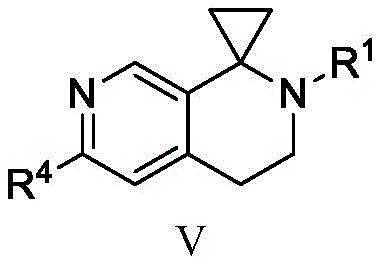


Applications Claiming Priority (5)
| Application Number | Priority Date | Filing Date | Title |
|---|---|---|---|
| CN2018100173507 | 2018-01-09 | ||
| CN201810017350 | 2018-01-09 | ||
| CN2018113292167 | 2018-11-09 | ||
| CN201811329216 | 2018-11-09 | ||
| PCT/CN2018/123415 WO2019137201A1 (en) | 2018-01-09 | 2018-12-25 | Heteroarylo tetrahydropyridine compound and preparation method, pharmaceutical composition, and application thereof |
Publications (2)
| Publication Number | Publication Date |
|---|---|
| CN111315744A CN111315744A (en) | 2020-06-19 |
| CN111315744B true CN111315744B (en) | 2023-07-14 |
Family
ID=67219307
Family Applications (1)
| Application Number | Title | Priority Date | Filing Date |
|---|---|---|---|
| CN201880072563.8A Active CN111315744B (en) | 2018-01-09 | 2018-12-25 | Heteroaryltetrahydropyridine compounds, their preparation method, pharmaceutical composition and application |
Country Status (2)
| Country | Link |
|---|---|
| CN (1) | CN111315744B (en) |
| WO (1) | WO2019137201A1 (en) |
Families Citing this family (8)
| Publication number | Priority date | Publication date | Assignee | Title |
|---|---|---|---|---|
| BR112021000538A2 (en) | 2018-07-13 | 2021-04-06 | F. Hoffmann-La Roche Ag | OLIGONUCLEOTIDS TO MODULATE RTEL1 EXPRESSION |
| CN110857298B (en) * | 2018-08-22 | 2022-05-10 | 四川科伦博泰生物医药股份有限公司 | Heteroaryltetrahydropyridine compounds, pharmaceutical compositions containing the same, preparation methods and uses thereof |
| CN112142730A (en) * | 2019-06-28 | 2020-12-29 | 四川科伦博泰生物医药股份有限公司 | Solid form of heteroaryl and tetrahydropyridine compounds and preparation method thereof |
| PH12022551379A1 (en) | 2019-12-06 | 2023-05-03 | Vertex Pharma | Substituted tetrahydrofurans as modulators of sodium channels |
| EP4081217A1 (en) | 2019-12-24 | 2022-11-02 | F. Hoffmann-La Roche AG | Pharmaceutical combination of antiviral agents targeting hbv and/or an immune modulator for treatment of hbv |
| CN115626922A (en) * | 2021-04-29 | 2023-01-20 | 苏州恩华生物医药科技有限公司 | 5,6,7,8-tetrahydropyrido [4,3-d ] pyrimidin-4-ol derivatives and uses thereof |
| SI4347031T1 (en) | 2021-06-04 | 2026-01-30 | Vertex Pharmaceuticals Incorporated | N-(hydroxyalkyl (hetero)aryl) tetrahydrofuran carboxamides as modulators of sodium channels |
| JP2025513455A (en) | 2022-04-22 | 2025-04-24 | バーテックス ファーマシューティカルズ インコーポレイテッド | Heteroaryl compounds for the treatment of pain - Patents.com |
Citations (3)
| Publication number | Priority date | Publication date | Assignee | Title |
|---|---|---|---|---|
| WO2016177655A1 (en) * | 2015-05-04 | 2016-11-10 | F. Hoffmann-La Roche Ag | Tetrahydropyridopyrimidines and tetrahydropyridopyridines as inhibitors of hbsag (hbv surface antigen) and hbv dna production for the treatment of hepatitis b virus infections |
| CN107108610A (en) * | 2014-12-30 | 2017-08-29 | 豪夫迈·罗氏有限公司 | Novel tetrahydropyridopyrimidines and tetrahydropyridopyridine compounds for the treatment and prevention of hepatitis B virus infection |
| WO2018083081A1 (en) * | 2016-11-03 | 2018-05-11 | F. Hoffmann-La Roche Ag | Novel tetrahydropyridopyrimidines for the treatment and prophylaxis of hepatitis b virus infection |
-
2018
- 2018-12-25 WO PCT/CN2018/123415 patent/WO2019137201A1/en not_active Ceased
- 2018-12-25 CN CN201880072563.8A patent/CN111315744B/en active Active
Patent Citations (3)
| Publication number | Priority date | Publication date | Assignee | Title |
|---|---|---|---|---|
| CN107108610A (en) * | 2014-12-30 | 2017-08-29 | 豪夫迈·罗氏有限公司 | Novel tetrahydropyridopyrimidines and tetrahydropyridopyridine compounds for the treatment and prevention of hepatitis B virus infection |
| WO2016177655A1 (en) * | 2015-05-04 | 2016-11-10 | F. Hoffmann-La Roche Ag | Tetrahydropyridopyrimidines and tetrahydropyridopyridines as inhibitors of hbsag (hbv surface antigen) and hbv dna production for the treatment of hepatitis b virus infections |
| WO2018083081A1 (en) * | 2016-11-03 | 2018-05-11 | F. Hoffmann-La Roche Ag | Novel tetrahydropyridopyrimidines for the treatment and prophylaxis of hepatitis b virus infection |
Also Published As
| Publication number | Publication date |
|---|---|
| CN111315744A (en) | 2020-06-19 |
| WO2019137201A1 (en) | 2019-07-18 |
Similar Documents
| Publication | Publication Date | Title |
|---|---|---|
| JP7536761B2 (en) | Functionalized heterocycles as antiviral agents | |
| JP7491896B2 (en) | Fused tricyclic compounds as dual PDE3/PDE4 inhibitors | |
| JP6285440B2 (en) | Fused bicyclic sulfamoyl derivatives and their use as medicaments for the treatment of hepatitis B | |
| TWI715593B (en) | New hydroxyacid derivatives, a process for their preparation and pharmaceutical compositions containing them | |
| EP3240537B1 (en) | Novel tetrahydropyridopyrimidines and tetrahydropyridopyridines for the treatment and prophylaxis of hepatitis b virus infection | |
| JP2023523640A (en) | Benzothiazolyl biaryl compound, preparation method and use thereof | |
| JP2022550436A (en) | antiviral heterocyclic compound | |
| EP4206197B1 (en) | Preparation method for novel rho-related protein kinase inhibitor and intermediate in preparation method | |
| JP2009507896A (en) | 2-Aminopyrimidine derivatives as modulators of histamine H4 receptor activity | |
| WO2019137201A1 (en) | Heteroarylo tetrahydropyridine compound and preparation method, pharmaceutical composition, and application thereof | |
| KR20210024574A (en) | Cell necrosis inhibitors and their preparation and use | |
| KR102641566B1 (en) | Bicyclic and tricyclic compounds | |
| HK1210159A1 (en) | Mk2 inhibitors | |
| CN111683662A (en) | Substituted pyrimidine compounds and pharmaceutical compositions and treatment methods thereof | |
| KR20260035804A (en) | antiviral heterocyclic compounds | |
| CN116375707A (en) | Menin inhibitors and uses thereof | |
| CN113880865A (en) | Pyrazolo [1,5-a ] pyridine compound and preparation method and application thereof | |
| KR102600391B1 (en) | triple cyclic compound | |
| JP7603320B2 (en) | Intracyclic thiamidinoamide-arylamide compounds and their use for treating hepatitis B - Patents.com | |
| WO2025148870A1 (en) | Ras inhibitor | |
| CN113045569A (en) | Compounds useful as RET kinase inhibitors and uses thereof | |
| CN111377925B (en) | Purine derivatives, their preparation methods and their applications in medicine | |
| US11773121B2 (en) | Antiviral compounds | |
| CN110857298B (en) | Heteroaryltetrahydropyridine compounds, pharmaceutical compositions containing the same, preparation methods and uses thereof | |
| RU2793918C2 (en) | Cell necrosis inhibitor, method for its production and application |
Legal Events
| Date | Code | Title | Description |
|---|---|---|---|
| PB01 | Publication | ||
| PB01 | Publication | ||
| SE01 | Entry into force of request for substantive examination | ||
| SE01 | Entry into force of request for substantive examination | ||
| GR01 | Patent grant | ||
| GR01 | Patent grant |