CN111417620A - Creatine prodrugs, compositions thereof, and methods of use - Google Patents
Creatine prodrugs, compositions thereof, and methods of use Download PDFInfo
- Publication number
- CN111417620A CN111417620A CN201880077165.5A CN201880077165A CN111417620A CN 111417620 A CN111417620 A CN 111417620A CN 201880077165 A CN201880077165 A CN 201880077165A CN 111417620 A CN111417620 A CN 111417620A
- Authority
- CN
- China
- Prior art keywords
- compound
- creatine
- alkyl
- group
- pharmaceutically acceptable
- Prior art date
- Legal status (The legal status is an assumption and is not a legal conclusion. Google has not performed a legal analysis and makes no representation as to the accuracy of the status listed.)
- Granted
Links
Images


Classifications
-
- C—CHEMISTRY; METALLURGY
- C07—ORGANIC CHEMISTRY
- C07C—ACYCLIC OR CARBOCYCLIC COMPOUNDS
- C07C279/00—Derivatives of guanidine, i.e. compounds containing the group, the singly-bound nitrogen atoms not being part of nitro or nitroso groups
- C07C279/20—Derivatives of guanidine, i.e. compounds containing the group, the singly-bound nitrogen atoms not being part of nitro or nitroso groups containing any of the groups, X being a hetero atom, Y being any atom, e.g. acylguanidines
- C07C279/22—Y being a hydrogen or a carbon atom, e.g. benzoylguanidines
-
- A—HUMAN NECESSITIES
- A61—MEDICAL OR VETERINARY SCIENCE; HYGIENE
- A61K—PREPARATIONS FOR MEDICAL, DENTAL OR TOILETRY PURPOSES
- A61K31/00—Medicinal preparations containing organic active ingredients
- A61K31/13—Amines
- A61K31/155—Amidines (), e.g. guanidine (H2N—C(=NH)—NH2), isourea (N=C(OH)—NH2), isothiourea (—N=C(SH)—NH2)
-
- A—HUMAN NECESSITIES
- A61—MEDICAL OR VETERINARY SCIENCE; HYGIENE
- A61K—PREPARATIONS FOR MEDICAL, DENTAL OR TOILETRY PURPOSES
- A61K31/00—Medicinal preparations containing organic active ingredients
- A61K31/16—Amides, e.g. hydroxamic acids
-
- A—HUMAN NECESSITIES
- A61—MEDICAL OR VETERINARY SCIENCE; HYGIENE
- A61K—PREPARATIONS FOR MEDICAL, DENTAL OR TOILETRY PURPOSES
- A61K31/00—Medicinal preparations containing organic active ingredients
- A61K31/33—Heterocyclic compounds
- A61K31/395—Heterocyclic compounds having nitrogen as a ring hetero atom, e.g. guanethidine or rifamycins
-
- A—HUMAN NECESSITIES
- A61—MEDICAL OR VETERINARY SCIENCE; HYGIENE
- A61K—PREPARATIONS FOR MEDICAL, DENTAL OR TOILETRY PURPOSES
- A61K45/00—Medicinal preparations containing active ingredients not provided for in groups A61K31/00 - A61K41/00
- A61K45/06—Mixtures of active ingredients without chemical characterisation, e.g. antiphlogistics and cardiaca
-
- A—HUMAN NECESSITIES
- A61—MEDICAL OR VETERINARY SCIENCE; HYGIENE
- A61P—SPECIFIC THERAPEUTIC ACTIVITY OF CHEMICAL COMPOUNDS OR MEDICINAL PREPARATIONS
- A61P25/00—Drugs for disorders of the nervous system
- A61P25/28—Drugs for disorders of the nervous system for treating neurodegenerative disorders of the central nervous system, e.g. nootropic agents, cognition enhancers, drugs for treating Alzheimer's disease or other forms of dementia
-
- A—HUMAN NECESSITIES
- A61—MEDICAL OR VETERINARY SCIENCE; HYGIENE
- A61P—SPECIFIC THERAPEUTIC ACTIVITY OF CHEMICAL COMPOUNDS OR MEDICINAL PREPARATIONS
- A61P9/00—Drugs for disorders of the cardiovascular system
- A61P9/10—Drugs for disorders of the cardiovascular system for treating ischaemic or atherosclerotic diseases, e.g. antianginal drugs, coronary vasodilators, drugs for myocardial infarction, retinopathy, cerebrovascula insufficiency, renal arteriosclerosis
-
- C—CHEMISTRY; METALLURGY
- C07—ORGANIC CHEMISTRY
- C07B—GENERAL METHODS OF ORGANIC CHEMISTRY; APPARATUS THEREFOR
- C07B59/00—Introduction of isotopes of elements into organic compounds ; Labelled organic compounds per se
- C07B59/001—Acyclic or carbocyclic compounds
-
- C—CHEMISTRY; METALLURGY
- C07—ORGANIC CHEMISTRY
- C07B—GENERAL METHODS OF ORGANIC CHEMISTRY; APPARATUS THEREFOR
- C07B59/00—Introduction of isotopes of elements into organic compounds ; Labelled organic compounds per se
- C07B59/002—Heterocyclic compounds
-
- C—CHEMISTRY; METALLURGY
- C07—ORGANIC CHEMISTRY
- C07D—HETEROCYCLIC COMPOUNDS
- C07D213/00—Heterocyclic compounds containing six-membered rings, not condensed with other rings, with one nitrogen atom as the only ring hetero atom and three or more double bonds between ring members or between ring members and non-ring members
- C07D213/02—Heterocyclic compounds containing six-membered rings, not condensed with other rings, with one nitrogen atom as the only ring hetero atom and three or more double bonds between ring members or between ring members and non-ring members having three double bonds between ring members or between ring members and non-ring members
- C07D213/04—Heterocyclic compounds containing six-membered rings, not condensed with other rings, with one nitrogen atom as the only ring hetero atom and three or more double bonds between ring members or between ring members and non-ring members having three double bonds between ring members or between ring members and non-ring members having no bond between the ring nitrogen atom and a non-ring member or having only hydrogen or carbon atoms directly attached to the ring nitrogen atom
- C07D213/60—Heterocyclic compounds containing six-membered rings, not condensed with other rings, with one nitrogen atom as the only ring hetero atom and three or more double bonds between ring members or between ring members and non-ring members having three double bonds between ring members or between ring members and non-ring members having no bond between the ring nitrogen atom and a non-ring member or having only hydrogen or carbon atoms directly attached to the ring nitrogen atom with hetero atoms or with carbon atoms having three bonds to hetero atoms with at the most one bond to halogen, e.g. ester or nitrile radicals, directly attached to ring carbon atoms
- C07D213/78—Carbon atoms having three bonds to hetero atoms, with at the most one bond to halogen, e.g. ester or nitrile radicals
- C07D213/81—Amides; Imides
- C07D213/82—Amides; Imides in position 3
-
- C—CHEMISTRY; METALLURGY
- C07—ORGANIC CHEMISTRY
- C07D—HETEROCYCLIC COMPOUNDS
- C07D273/00—Heterocyclic compounds containing rings having nitrogen and oxygen atoms as the only ring hetero atoms, not provided for by groups C07D261/00 - C07D271/00
- C07D273/02—Heterocyclic compounds containing rings having nitrogen and oxygen atoms as the only ring hetero atoms, not provided for by groups C07D261/00 - C07D271/00 having two nitrogen atoms and only one oxygen atom
-
- C—CHEMISTRY; METALLURGY
- C07—ORGANIC CHEMISTRY
- C07D—HETEROCYCLIC COMPOUNDS
- C07D317/00—Heterocyclic compounds containing five-membered rings having two oxygen atoms as the only ring hetero atoms
- C07D317/08—Heterocyclic compounds containing five-membered rings having two oxygen atoms as the only ring hetero atoms having the hetero atoms in positions 1 and 3
- C07D317/10—Heterocyclic compounds containing five-membered rings having two oxygen atoms as the only ring hetero atoms having the hetero atoms in positions 1 and 3 not condensed with other rings
- C07D317/32—Heterocyclic compounds containing five-membered rings having two oxygen atoms as the only ring hetero atoms having the hetero atoms in positions 1 and 3 not condensed with other rings with hetero atoms or with carbon atoms having three bonds to hetero atoms with at the most one bond to halogen, e.g. ester or nitrile radicals, directly attached to ring carbon atoms
- C07D317/34—Oxygen atoms
- C07D317/40—Vinylene carbonate; Substituted vinylene carbonates
-
- C—CHEMISTRY; METALLURGY
- C07—ORGANIC CHEMISTRY
- C07D—HETEROCYCLIC COMPOUNDS
- C07D498/00—Heterocyclic compounds containing in the condensed system at least one hetero ring having nitrogen and oxygen atoms as the only ring hetero atoms
- C07D498/02—Heterocyclic compounds containing in the condensed system at least one hetero ring having nitrogen and oxygen atoms as the only ring hetero atoms in which the condensed system contains two hetero rings
- C07D498/10—Spiro-condensed systems
-
- C—CHEMISTRY; METALLURGY
- C07—ORGANIC CHEMISTRY
- C07B—GENERAL METHODS OF ORGANIC CHEMISTRY; APPARATUS THEREFOR
- C07B2200/00—Indexing scheme relating to specific properties of organic compounds
- C07B2200/05—Isotopically modified compounds, e.g. labelled
Landscapes
- Chemical & Material Sciences (AREA)
- Organic Chemistry (AREA)
- Health & Medical Sciences (AREA)
- General Health & Medical Sciences (AREA)
- Veterinary Medicine (AREA)
- Medicinal Chemistry (AREA)
- Life Sciences & Earth Sciences (AREA)
- Animal Behavior & Ethology (AREA)
- Pharmacology & Pharmacy (AREA)
- Public Health (AREA)
- Epidemiology (AREA)
- Engineering & Computer Science (AREA)
- Bioinformatics & Cheminformatics (AREA)
- Nuclear Medicine, Radiotherapy & Molecular Imaging (AREA)
- Neurosurgery (AREA)
- Neurology (AREA)
- Biomedical Technology (AREA)
- Chemical Kinetics & Catalysis (AREA)
- General Chemical & Material Sciences (AREA)
- Heart & Thoracic Surgery (AREA)
- Hospice & Palliative Care (AREA)
- Vascular Medicine (AREA)
- Urology & Nephrology (AREA)
- Psychiatry (AREA)
- Cardiology (AREA)
- Pharmaceuticals Containing Other Organic And Inorganic Compounds (AREA)
- Acyclic And Carbocyclic Compounds In Medicinal Compositions (AREA)
- Medicines That Contain Protein Lipid Enzymes And Other Medicines (AREA)
- Nitrogen And Oxygen Or Sulfur-Condensed Heterocyclic Ring Systems (AREA)
- Organic Low-Molecular-Weight Compounds And Preparation Thereof (AREA)
- Heterocyclic Carbon Compounds Containing A Hetero Ring Having Nitrogen And Oxygen As The Only Ring Hetero Atoms (AREA)
- Medicinal Preparation (AREA)
- Pyridine Compounds (AREA)
Abstract
Description
相关申请的交叉引用CROSS-REFERENCE TO RELATED APPLICATIONS
本申请要求2017年12月1日提交的美国临时申请号62/593,731的优先权,所述临时申请的公开内容出于所有目的以全文引用的方式并入本文中。This application claims priority to US Provisional Application No. 62/593,731, filed December 1, 2017, the disclosure of which is incorporated herein by reference in its entirety for all purposes.
发明领域Field of Invention
本公开描述了膜可渗透性肌酸前药或其药学上可接受的盐、溶剂合物、互变异构体或立体异构体;包含所述肌酸前药的药物组合物;以及治疗疾病的方法,所述疾病包括但不限于局部缺血、心力衰竭、神经退化性病症以及影响肌酸激酶系统的遗传性病症。在一些实施方案中,本公开描述了治疗影响肌酸激酶系统的遗传性疾病,诸如肌酸转运体障碍或肌酸合成障碍,包括施用肌酸前药或其药学上可接受的盐、溶剂合物、互变异构体或立体异构体或其药物组合物。The present disclosure describes membrane-permeable creatine prodrugs, or pharmaceutically acceptable salts, solvates, tautomers, or stereoisomers thereof; pharmaceutical compositions comprising the creatine prodrugs; and treatments Methods of diseases including, but not limited to, ischemia, heart failure, neurodegenerative disorders, and genetic disorders affecting the creatine kinase system. In some embodiments, the present disclosure describes the treatment of genetic disorders affecting the creatine kinase system, such as creatine transporter disorders or creatine synthesis disorders, comprising administering a creatine prodrug or a pharmaceutically acceptable salt, solvate thereof substances, tautomers or stereoisomers or pharmaceutical compositions thereof.
发明背景Background of the Invention
肌酸为一种天然存在的氨基酸衍生物,在细胞能量代谢中起重要作用。肌酸在三磷酸腺苷(ATP)存在下由肌酸激酶磷酸化时形成高能量磷酸肌酸(肌酸磷酸盐)(高能量磷酸肌酸为重要细胞能量储备)和二磷酸腺苷(ADP)。由肌酸激酶磷酸化为可逆的,因此磷酸肌酸通过按需要增加ATP的形成而有助于在体内供应能量给细胞。当ATP大量消耗时这种相互作用将ATP浓度维持在恒定水平。举例来说,在细胞工作期间,尽可能快地补充ATP为极其重要的。人体总肌酸中约>95%定位于骨胳肌和脑中。Creatine is a naturally occurring amino acid derivative that plays an important role in cellular energy metabolism. Creatine is phosphorylated by creatine kinase in the presence of adenosine triphosphate (ATP) to form high energy creatine phosphate (creatine phosphate) (high energy creatine phosphate is an important cellular energy reserve) and adenosine diphosphate (ADP). Phosphorylation by creatine kinase is reversible, so phosphocreatine helps supply energy to cells in the body by increasing ATP formation on demand. This interaction maintains the ATP concentration at a constant level when ATP is heavily depleted. For example, during cellular work, it is extremely important to replenish ATP as quickly as possible. About >95% of total human creatine is localized in skeletal muscle and brain.

肌酸激酶系统在细胞内能量代谢中具有双重作用:在高ATP水解位点充当能量缓冲物以恢复所消耗的ATP水平,以及通过涉及中间能量载体的过程、若干酶反应以及通过各种细胞内结构扩散以磷酸肌酸形式将能量从线粒体转移至细胞的其他部分。The creatine kinase system has a dual role in intracellular energy metabolism: acting as an energy buffer at high ATP hydrolysis sites to restore consumed ATP levels, and through processes involving intermediate energy carriers, several enzymatic reactions, and through various intracellular Structural diffusion transfers energy from mitochondria to other parts of the cell in the form of phosphocreatine.
已知能量代谢功能障碍可引起许多疾病。具体地说,在局部缺血期间细胞ATP因氧和葡萄糖剥夺而损失为组织死亡的原因。磷酸肌酸代表在维持膜电位、代谢产物的活化或细胞收缩活性方面的高能量磷酸盐的储库。它在增加细胞中的能量消耗的同时维持ATP水平,即恢复ADP上的正磷酸盐残基。磷酸肌酸和肌酸也是细胞过程的变构调控因子。肌酸激酶系统为防止哺乳动物细胞中的ATP消耗的主要生物化学机制。细胞中的磷酸肌酸水平为对局部缺血性损害的抗性的重要预测因子,并且剩余的肌酸磷酸盐储存量与组织损伤程度相关。因此,肌酸可用于治疗心脏和脑局部缺血;神经元退化(例如帕金森氏病(Parkinson′s disease)、阿尔茨海默病(Alzheimer′s disease)以及亨廷顿氏病(Huntington′sdisease));与肌酸缺乏症、器官移植活力以及肌肉疲劳相关的发育障碍;以及与肌酸缺乏症有关的其他疾病。目前在肌酸生物合成缺陷的治疗中有显著临床改善,但在肌酸转运缺陷方面没有显著临床改善,这是因为肌酸摄入,尤其脑中的肌酸摄入高度依赖于肌酸转运体。在文献中,认为肌酸转运体发挥多种作用:BBB处的肌酸摄入、脑细胞中的肌酸摄入以及脑细胞间的肌酸转移以及神经元突触处的肌酸摄入和再摄入。归因于胃肠道吸收和脑摄入以及脑细胞摄入中的挑战,生物合成障碍的治疗需要高剂量的肌酸。为有效使用肌酸,目前制备的组合物需要消耗的量为每天高达20g。这种高剂量的肌酸可能对有机体产生负面结果,诸如氮交换紊乱、胃肠道病症、腹泻等。基于使用由诸如L-精氨酸和L-甘氨酸等氨基酸补充的肌酸的一些临床研究在对具有肌酸转运体缺陷的患者的长期跟踪中未显示临床特征的改善。这对氨基酸合成前体的补充还可能会导致可能具神经毒性的中间胍基乙酸的累积。这还可能使得缺乏治疗后临床特征的改善。在肌酸转运体缺乏症中,肌酸和/或磷酸肌酸不能通过BBB到达脑部并且在位于脑中后,不能由脑细胞吸收。因此,仍需要发现成功治疗策略以治疗肌酸转运体缺陷。Dysfunction of energy metabolism is known to cause many diseases. Specifically, loss of cellular ATP due to oxygen and glucose deprivation during ischemia is the cause of tissue death. Phosphocreatine represents a high-energy phosphate reservoir in maintaining membrane potential, activation of metabolites, or cell contractile activity. It maintains ATP levels while increasing energy expenditure in cells, i.e. restores orthophosphate residues on ADP. Phosphocreatine and creatine are also allosteric regulators of cellular processes. The creatine kinase system is the primary biochemical mechanism for preventing ATP depletion in mammalian cells. The level of creatine phosphate in cells is an important predictor of resistance to ischemic damage, and the amount of remaining creatine phosphate stores correlates with the degree of tissue damage. Thus, creatine is useful in the treatment of cardiac and cerebral ischemia; neuronal degeneration (eg, Parkinson's disease, Alzheimer's disease, and Huntington's disease) ); developmental disorders associated with creatine deficiency, organ transplant viability, and muscle fatigue; and other disorders associated with creatine deficiency. There are currently significant clinical improvements in the treatment of creatine biosynthesis defects, but not in creatine transport defects because creatine uptake, especially in the brain, is highly dependent on creatine transporters . In the literature, creatine transporters are thought to play multiple roles: creatine uptake at the BBB, creatine uptake in brain cells, and creatine transfer between brain cells and creatine uptake and at neuronal synapses. re-intake. Treatment of biosynthetic disorders requires high doses of creatine due to challenges in gastrointestinal absorption and brain uptake as well as uptake by brain cells. For effective use of creatine, currently prepared compositions require consumption in amounts of up to 20 g per day. Such high doses of creatine may have negative consequences for the organism, such as nitrogen exchange disturbances, gastrointestinal disorders, diarrhea, and the like. Some clinical studies based on the use of creatine supplemented with amino acids such as L-arginine and L-glycine did not show improvement in clinical characteristics in long-term follow-up of patients with creatine transporter deficiency. This supplementation of amino acid synthesis precursors may also lead to the accumulation of potentially neurotoxic intermediate guanidinoacetic acids. This may also result in a lack of improvement in clinical features after treatment. In creatine transporter deficiency, creatine and/or creatine phosphate cannot pass through the BBB to the brain and, after being located in the brain, cannot be taken up by brain cells. Therefore, there remains a need to discover successful therapeutic strategies to treat creatine transporter defects.
肌酸补充使细胞内肌酸磷酸盐水平增加(Harris等,Clinical Sci 1992,83,367-74)。在健康个体中肌酸容易经由活性肌酸转运体SLC6A8穿过血脑屏障,并且可经由经口施用来增加脑肌酸水平(Dechent等,Am J Physiol 1999,277,R698-704)。延长的肌酸补充可使肌酸磷酸盐的细胞汇集物增多并且使对组织局部缺血和肌肉疲劳的抗性增加。Creatine supplementation increases intracellular creatine phosphate levels (Harris et al, Clinical Sci 1992, 83, 367-74). Creatine readily crosses the blood-brain barrier in healthy individuals via the active creatine transporter SLC6A8, and brain creatine levels can be increased via oral administration (Dechent et al., Am J Physiol 1999, 277, R698-704). Prolonged creatine supplementation increases cellular pools of creatine phosphate and increases resistance to tissue ischemia and muscle fatigue.
可获得肌酸置换对体染色体隐性肌酸合成障碍有效的一些临床证据。利用肌酸或鸟氨酸补充进行治疗的具有精氨酸:甘氨酸脒基转移酶(AGAT)缺乏和胍基乙酸甲基转移酶(GAMT)缺乏的患者在癫痫发作、智力障碍以及发育结果中显示有所改善(参见:Stockler-Ipsiroglu等Mol.Genet.Metab.2014,111,16-25以及Bianchi等2007,两者出于所有目的以全文并入本文中)。Some clinical evidence is available that creatine replacement is effective in chromosomal recessive creatine synthesis disorders. Seizures, intellectual disability, and developmental outcomes in patients with arginine:glycine amidinotransferase (AGAT) deficiency and guanidinoacetic acid methyltransferase (GAMT) deficiency treated with creatine or ornithine supplementation Improved (see: Stockler-Ipsiroglu et al. Mol. Genet. Metab. 2014, 111, 16-25 and Bianchi et al. 2007, both incorporated herein in their entirety for all purposes).
因此,虽然施用肌酸可具有一些治疗适用性,但尤其对于具有肌酸转运体缺陷的患者来说,更稳定并且对屏障组织和细胞膜来说更可渗透并且与肌酸转运体无关的被修饰的肌酸分子将具有增强的治疗价值。Thus, while administration of creatine may have some therapeutic applicability, particularly for patients with creatine transporter deficiencies, modified creatine transporters that are more stable and more permeable to barrier tissues and cell membranes and independent of creatine transporters The creatine molecule will have enhanced therapeutic value.
发明内容SUMMARY OF THE INVENTION
本公开的肌酸前药被设计成通过与肌酸转运体无关的被动扩散或主动运输进入细胞,并且将肌酸释放至细胞质中。此类前药还可穿过重要屏障组织,诸如肠粘膜、血脑屏障以及血液-胎盘屏障。由于能够穿过生物膜,在ATP被消耗的细胞中肌酸前药可经由肌酸激酶系统恢复并且维持能量稳态,并且快速恢复ATP水平以防止组织进一步受局部缺血压力的影响。本公开的肌酸前药还可用于递送持续的全身浓度的肌酸。The creatine prodrugs of the present disclosure are designed to enter cells by passive diffusion or active transport independent of creatine transporters, and release creatine into the cytoplasm. Such prodrugs can also cross important barrier tissues, such as the intestinal mucosa, the blood-brain barrier, and the blood-placental barrier. Due to the ability to cross biological membranes, creatine prodrugs can be restored via the creatine kinase system in ATP-depleted cells and maintain energy homeostasis, and rapidly restore ATP levels to prevent further tissue exposure to ischemic stress. The creatine prodrugs of the present disclosure can also be used to deliver sustained systemic concentrations of creatine.
在一个实施方案中,本公开的化合物具有式(I)的结构:In one embodiment, the compounds of the present disclosure have the structure of formula (I):

或其药学上可接受的盐或溶剂合物;其中:or a pharmaceutically acceptable salt or solvate thereof; wherein:
R为-CH3、-CH2D、-CHD2或-CD3;R is -CH 3 , -CH 2 D, -CHD 2 or -CD 3 ;
R1为直链或分支链烷基、直链或分支链烯基、芳基或杂芳基,其中R1任选用R4取代;R 1 is straight-chain or branched-chain alkyl, straight-chain or branched-chain alkenyl, aryl or heteroaryl, wherein R 1 is optionally substituted with R4;
R2为氢、-C(O)NHR5、-C(O)R1或-C(O)OR5;R 2 is hydrogen, -C(O)NHR 5 , -C(O)R 1 or -C(O)OR 5 ;
R3为-C(O)OR6或-烷基(OH);R 3 is -C(O)OR 6 or -alkyl(OH);
或替代地,R2与R3一起为亚烷基,所述亚烷基与R2和R3各自键合的原子一起形成5元至6元环,其中所述5元至6元环任选用氧代取代;Or alternatively, R 2 together with R 3 is an alkylene group, which together with the atom to which R 2 and R 3 are each bonded, forms a 5- to 6-membered ring, wherein the 5- to 6-membered ring is any Use oxo substitution;
R4为卤素、-OH、-OR5、氧代、-NH2、-NHR5、-N(R5)2、-NO2、-CF3、-C1-C6烷基或-C1-C6卤烷基;R 4 is halogen, -OH, -OR 5 , oxo, -NH 2 , -NHR 5 , -N(R 5 ) 2 , -NO 2 , -CF 3 , -C 1 -C 6 alkyl or -C 1 -C 6 haloalkyl;
R5为直链或分支链烷基;并且R 5 is straight or branched chain alkyl; and
R6为H、直链或分支链烷基、
或替代地,R6与R1一起为亚烷基或亚烯基,所述亚烷基或所述亚烯基与R6和R1各自键合的原子一起形成12元至25元环,其中组成所述亚烷基或所述亚烯基的1、2、3或4个-CH2-单元任选用选自-O-、-S-或-N-的杂原子置换,前提条件为相邻-CH2-未被置换;其中所述亚烷基或所述亚烯基任选用一个或多个R4取代;or alternatively, R6 together with R1 is an alkylene or alkenylene group which together with the atom to which R6 and R1 are each bonded form a 12- to 25 -membered ring, wherein 1, 2, 3 or 4 -CH2- units constituting said alkylene group or said alkenylene group are optionally replaced with heteroatoms selected from -O-, -S- or -N-, with the proviso is adjacent -CH2 - unsubstituted; wherein said alkylene or said alkenylene is optionally substituted with one or more R4;
其中,同一碳或相邻碳上的两个R4可形成3元至6元稠环烷基环或螺环烷基环或者3元至6元稠杂环或螺杂环。Wherein, two R4 on the same carbon or adjacent carbons can form a 3- to 6-membered fused cycloalkyl ring or spirocycloalkyl ring or a 3- to 6-membered fused heterocycle or spiroheterocycle.
在式(I)化合物的一个实施方案中,R为-CH3或-CD3。In one embodiment of the compounds of formula (I), R is -CH3 or -CD3 .
在式(I)化合物的一个实施方案中,R1为-C6-C20烷基或-C6-C20烯基。在一些实施方案中,R1为-C6-C18烷基或-C6-C18烯基。在其他实施方案中,R1为吡啶基。In one embodiment of the compounds of formula (I) R 1 is -C 6 -C 20 alkyl or -C 6 -C 20 alkenyl. In some embodiments, R 1 is -C 6 -C 18 alkyl or -C 6 -C 18 alkenyl. In other embodiments, R1 is pyridyl.
在式(I)化合物的一个实施方案中,R2为氢。在一些实施方案中,R2为-C(O)OR5。In one embodiment of the compounds of formula (I), R2 is hydrogen . In some embodiments, R 2 is -C(O)OR 5 .
在式(I)化合物的一个实施方案中,R5为直链或分支链-C1-C6烷基。In one embodiment of the compounds of formula (I), R 5 is straight or branched chain -C 1 -C 6 alkyl.
在式(I)化合物的一个实施方案中,R3为-C(O)OR6。在式(I)化合物的一个实施方案中,R6为H或者直链或分支链C1-C8烷基。In one embodiment of the compound of formula (I), R3 is -C(O) OR6 . In one embodiment of the compounds of formula (I), R 6 is H or straight or branched C 1 -C 8 alkyl.
在式(I)化合物的一个实施方案中,R6与R1一起为亚烷基或亚烯基,所述亚烷基或所述亚烯基与R6和R1各自键合的原子一起形成12元至25元环,其中组成所述亚烷基或所述亚烯基的1、2、3或4个-CH2-单元任选用选自-O-、-S-或-N-的杂原子置换,前提条件为相邻-CH2-未被置换;其中所述亚烷基或所述亚烯基任选用一个或多个R4取代。在一个实施方案中,R6与R1一起为未取代的亚烷基或未取代的亚烯基,所述未取代的亚烷基或所述未取代的亚烯基与R6和R1各自键合的原子一起形成13元至24元环。In one embodiment of the compounds of formula ( I ), R6 together with R1 is an alkylene or alkenylene group together with the atom to which R6 and R1 are each bonded Forms a 12- to 25-membered ring in which 1, 2, 3 or 4 -CH 2 -units constituting the alkylene group or the alkenylene group are optionally selected from -O-, -S- or -N - with the proviso that the adjacent -CH2- is not replaced; wherein the alkylene group or the alkenylene group is optionally substituted with one or more R4 . In one embodiment, R 6 together with R 1 is an unsubstituted alkylene or unsubstituted alkenylene group that is combined with R 6 and R 1 The atoms to which each is bonded together form a 13- to 24-membered ring.
在式(I)化合物的一个实施方案中,所述化合物为选自以下的药学上可接受的盐:钠盐、钾盐、锂盐、盐酸盐、甲酸盐、三氟乙酸盐、乙酸盐或三氯乙酸/二锂盐。In one embodiment of the compound of formula (I), the compound is a pharmaceutically acceptable salt selected from the group consisting of sodium, potassium, lithium, hydrochloride, formate, trifluoroacetate, Acetate or trichloroacetic acid/dilithium salt.
在式(I)化合物的一个实施方案中,所述化合物具有式(II)的结构:In one embodiment of the compound of formula (I), the compound has the structure of formula (II):

或其药学上可接受的盐或溶剂合物;其中:or a pharmaceutically acceptable salt or solvate thereof; wherein:
R为-CH3、-CH2D、-CHD2或-CD3;R is -CH 3 , -CH 2 D, -CHD 2 or -CD 3 ;
R2为氢、-C(O)NHR5、-C(O)R1或-C(O)OR5;R 2 is hydrogen, -C(O)NHR 5 , -C(O)R 1 or -C(O)OR 5 ;
R1为直链或分支链烷基或者直链或分支链烯基,其中R1任选用R4取代;R 1 is straight-chain or branched-chain alkyl or straight-chain or branched-chain alkenyl, wherein R 1 is optionally substituted with R 4 ;
R4为卤素、-OH、-OR5、氧代、-NH2、-NHR5、-N(R5)2、-NO2、-CF3、-C1-C6烷基或-C1-C6卤烷基;R 4 is halogen, -OH, -OR 5 , oxo, -NH 2 , -NHR 5 , -N(R 5 ) 2 , -NO 2 , -CF 3 , -C 1 -C 6 alkyl or -C 1 -C 6 haloalkyl;
X在每次出现时各自独立地为-C(R5a)2-C(R5a)2-、-CH(R5a)-CH(R5a)-、-C(R5a)=C(R5a)-、-O-C(R5a)2-、-O-CH(R5a)-、-C(R5a)2-O-或-CH(R5a)-O-;X is independently at each occurrence -C(R 5a ) 2 -C(R 5a ) 2 -, -CH(R 5a )-CH(R 5a )-, -C(R 5a )=C(R 5a )-, -OC(R 5a ) 2 -, -O-CH(R 5a )-, -C(R 5a ) 2 -O- or -CH(R 5a )-O-;
Y为-C(R5a)2-、-CH(R5a)-、-C(R5a)2-C(R5a)2-、-CH(R5a)-CH(R5a)-、-C(R5a)=C(R5a)-、-C(R5a)2-O-或-CH(R5a)-O-;Y is -C(R 5a ) 2 -, -CH(R 5a )-, -C(R 5a ) 2 -C(R 5a ) 2 -, -CH(R 5a )-CH(R 5a )-, - C(R 5a )=C(R 5a )-, -C(R 5a ) 2 -O- or -CH(R 5a )-O-;
n为2、3、4、5、6、7或8,其中当n为2时,Y为-C(R5a)2-C(R5a)2-、-CH(R5a)-CH(R5a)-、-C(R5a)=C(R5a)-、-C(R5a)2-O-或-CH(R5a)-O-;n is 2, 3, 4, 5, 6, 7 or 8, wherein when n is 2, Y is -C(R 5a ) 2 -C(R 5a ) 2 -, -CH(R 5a )-CH( R 5a )-, -C(R 5a )=C(R 5a )-, -C(R 5a ) 2 -O- or -CH(R 5a )-O-;
R5为H或者直链或分支链烷基;并且R 5 is H or straight or branched chain alkyl; and
R5a为H、卤素、-OH、-OR5、-NH2、-NHR5、-N(R5)2、-NO2、-CF3、-C1-C6烷基或-C1-C6卤烷基;R 5a is H, halogen, -OH, -OR 5 , -NH 2 , -NHR 5 , -N(R 5 ) 2 , -NO 2 , -CF 3 , -C 1 -C 6 alkyl or -C 1 -C 6 haloalkyl;
其中,同一碳或相邻碳上的两个R5a可形成3元至6元稠环烷基环或螺环烷基环或者3元至6元稠杂环或螺杂环。Wherein, two R 5a on the same carbon or adjacent carbons can form a 3- to 6-membered fused cycloalkyl ring or spirocycloalkyl ring or a 3- to 6-membered fused heterocycle or spiroheterocycle.
在式(II)化合物的一个实施方案中,X中的至少一者为-C(R5a)2-C(R5a)2-、-CH(R5a)-CH(R5a)-或-C(R5a)=C(R5a)-,其中R5a为H或-C1-C6烷基;并且其中,同一碳或相邻碳上的两个R5a可形成3元至6元稠环烷基环或螺环烷基环或者3元至6元稠杂环或螺杂环。在一个实施方案中,X为-CH2CH2-、-CH=CH-、-O-CH2-或-CH2-O-。In one embodiment of the compound of formula (II), at least one of X is -C(R 5a ) 2 -C(R 5a ) 2 -, -CH(R 5a )-CH(R 5a )- or - C(R 5a )=C(R 5a )-, wherein R 5a is H or -C 1 -C 6 alkyl; and wherein two R 5a on the same or adjacent carbons can form a 3- to 6-membered A fused cycloalkyl ring or a spirocycloalkyl ring or a 3- to 6-membered fused heterocycle or spiroheterocycle. In one embodiment, X is -CH2CH2- , -CH= CH- , -O-CH2- or -CH2 - O-.
在式(II)化合物的一个实施方案中,Y为-C(R5a)2-、-CH(R5a)-、-C(R5a)2-C(R5a)2-、-CH(R5a)-CH(R5a)-或-C(R5a)=C(R5a)-,其中R5a为H或-C1-C6烷基;并且其中,同一碳或相邻碳上的两个R5a可形成3元至6元稠环烷基环或螺环烷基环或者3元至6元稠杂环或螺杂环。在一个实施方案中,Y为-C(R5a)2-、-CH(R5a)-;-C(R5a)2-C(R5a)2-、-CH(R5a)-CH(R5a)-、-CH2-、-CH2CH2-、-CH=CH-、

在式(II)化合物的一个实施方案中,R为-CH3或-CD3。In one embodiment of the compound of formula (II), R is -CH3 or -CD3 .
在式(II)化合物的一个实施方案中,R2为氢。In one embodiment of the compound of formula ( II ), R2 is hydrogen.
在式(II)化合物的一个实施方案中,所述化合物为选自以下的药学上可接受的盐:钠盐、钾盐、锂盐、盐酸盐、甲酸盐、三氟乙酸盐、乙酸盐或三氯乙酸/二锂盐。In one embodiment of the compound of formula (II), the compound is a pharmaceutically acceptable salt selected from the group consisting of sodium, potassium, lithium, hydrochloride, formate, trifluoroacetate, Acetate or trichloroacetic acid/dilithium salt.
在式(I)化合物的一个实施方案中,所述化合物具有式(I-A)的结构:In one embodiment of the compound of formula (I), the compound has the structure of formula (I-A):

或其药学上可接受的盐或溶剂合物;其中:or a pharmaceutically acceptable salt or solvate thereof; wherein:
R为-CH3、-CH2D、-CHD2或-CD3;R is -CH 3 , -CH 2 D, -CHD 2 or -CD 3 ;
R2为氢、-C(O)NHR5、-C(O)R1或-C(O)OR5;R 2 is hydrogen, -C(O)NHR 5 , -C(O)R 1 or -C(O)OR 5 ;
R3为-C(O)OR6或-烷基(OH);R 3 is -C(O)OR 6 or -alkyl(OH);
或替代地,R2与R3一起为亚烷基,所述亚烷基与R2和R3各自键合的原子一起形成5元至6元环,其中所述5元至6元环任选用氧代取代;Or alternatively, R 2 together with R 3 is an alkylene group, which together with the atom to which R 2 and R 3 are each bonded, forms a 5- to 6-membered ring, wherein the 5- to 6-membered ring is any Use oxo substitution;
R4为卤素、-OH、-OR5、氧代、-NH2、-NHR5、-N(R5)2、-NO2、-CF3、-C1-C6烷基或-C1-C6卤烷基;R 4 is halogen, -OH, -OR 5 , oxo, -NH 2 , -NHR 5 , -N(R 5 ) 2 , -NO 2 , -CF 3 , -C 1 -C 6 alkyl or -C 1 -C 6 haloalkyl;
R4a、R4b、R4c以及R4d各自独立地为H、卤素、-OH、-OR5、氧代、-NH2、-NHR5、-N(R5)2、-NO2、-CF3、-C1-C6烷基或-C1-C6卤烷基;R 4a , R 4b , R 4c and R 4d are each independently H, halogen, -OH, -OR 5 , oxo, -NH 2 , -NHR 5 , -N(R 5 ) 2 , -NO 2 , - CF 3 , -C 1 -C 6 alkyl or -C 1 -C 6 haloalkyl;
R5为直链或分支链烷基;并且R 5 is straight or branched chain alkyl; and
R6a与R1一起为亚烷基或亚烯基,所述亚烷基或所述亚烯基与R6a和R1各自键合的原子一起形成12元至25元环,其中组成所述亚烷基或所述亚烯基的1、2、3或4个-CH2-单元任选用选自-O-、-S-或-N-的杂原子置换,前提条件为相邻-CH2-未被置换;其中所述亚烷基或所述亚烯基任选用一个或多个R4取代;R 6a together with R 1 is an alkylene group or an alkenylene group, and the alkylene group or the alkenylene group and the atom to which R 6a and R 1 are each bonded together form a 12- to 25-membered ring, wherein the composition of the 1, 2, 3 or 4 -CH2- units of an alkylene group or said alkenylene group are optionally replaced with a heteroatom selected from -O-, -S- or -N-, with the proviso that the adjacent- CH2 - unsubstituted; wherein said alkylene or said alkenylene is optionally substituted with one or more R4;
其中,R4a与R4b或R4c与R4d一起可形成3元至6元螺环烷基环或3元至6元螺杂环;或wherein R 4a and R 4b or R 4c and R 4d together can form a 3- to 6-membered spirocycloalkyl ring or a 3- to 6-membered spiroheterocycle; or
其中R4b与R4c一起可形成3元至6元稠环烷基环或3元至6元稠杂环。wherein R 4b and R 4c together can form a 3- to 6-membered fused cycloalkyl ring or a 3- to 6-membered fused heterocyclic ring.
在式(I-A)化合物的一个实施方案中,R4a为-C1-C6烷基。在式(I-A)化合物的一个实施方案中,R4b为-C1-C6烷基。在式(I-A)化合物的一个实施方案中,R4c为-C1-C6烷基。在式(I-A)化合物的一个实施方案中,R4b、R4c以及R4d为H。在式(I-A)化合物的一个实施方案中,R4b和R4d为H。In one embodiment of the compound of formula (IA), R 4a is -C 1 -C 6 alkyl. In one embodiment of the compound of formula (IA), R 4b is -C 1 -C 6 alkyl. In one embodiment of the compound of formula (IA), R 4c is -C 1 -C 6 alkyl. In one embodiment of the compound of formula (IA), R 4b , R 4c and R 4d are H. In one embodiment of the compound of formula (IA), R 4b and R 4d are H.
在式(I-A)化合物的一个实施方案中,R4a与R4b一起形成3元至6元螺环烷基环或3元至6元螺杂环。在一些实施方案中,R4a与R4b一起形成
在式(I-A)化合物的一个实施方案中,R4b与R4c一起形成3元至6元稠环烷基环或3元至6元稠杂环。在一些实施方案中,R4b与R4c一起形成
在式(I-A)化合物的一个实施方案中,R为-CH3或-CD3。In one embodiment of the compound of formula (IA), R is -CH3 or -CD3 .
在式(I-A)化合物的一个实施方案中,R2为氢。In one embodiment of the compound of formula (IA), R2 is hydrogen .
在式(I-A)化合物的一个实施方案中,所述化合物为选自以下的药学上可接受的盐:钠盐、钾盐、锂盐、盐酸盐、甲酸盐、三氟乙酸盐、乙酸盐或三氯乙酸/二锂盐。In one embodiment of the compound of formula (I-A), the compound is a pharmaceutically acceptable salt selected from the group consisting of sodium, potassium, lithium, hydrochloride, formate, trifluoroacetate, Acetate or trichloroacetic acid/dilithium salt.
在式(I)化合物的一个实施方案中,所述化合物具有式(III)的结构:In one embodiment of the compound of formula (I), the compound has the structure of formula (III):

或其药学上可接受的盐或溶剂合物;其中:or a pharmaceutically acceptable salt or solvate thereof; wherein:
R为CH3、CH2D、CHD2或CD3;R is CH 3 , CH 2 D, CHD 2 or CD 3 ;
R1为直链或分支链烷基或者直链或分支链烯基;R 1 is straight-chain or branched-chain alkyl or straight-chain or branched-chain alkenyl;
R2为氢、-C(O)NHR5、-C(O)R1或-C(O)OR5;R 2 is hydrogen, -C(O)NHR 5 , -C(O)R 1 or -C(O)OR 5 ;
R5为H或者直链或分支链烷基;R 5 is H or straight or branched chain alkyl;
R5a为卤素、-OH、-OR5、氧代、-NH2、-NHR5、-N(R5)2、-NO2、-CF3、-C1-C6烷基或-C1-C6卤烷基;R 5a is halogen, -OH, -OR 5 , oxo, -NH 2 , -NHR 5 , -N(R 5 ) 2 , -NO 2 , -CF 3 , -C 1 -C 6 alkyl or -C 1 -C 6 haloalkyl;
其中,同一碳或相邻碳上的两个R5a可形成3元至6元稠环烷基环或螺环烷基环或者3元至6元稠杂环或螺杂环;Wherein, two R 5a on the same carbon or adjacent carbon can form a 3- to 6-membered fused cycloalkyl ring or spirocycloalkyl ring or a 3- to 6-membered fused heterocycle or spiro heterocycle;
n为0、1、2、3、4、5、6、7、8、9、10或11;并且n is 0, 1, 2, 3, 4, 5, 6, 7, 8, 9, 10, or 11; and
p为0、1、2、3、4、5、6、7或8。p is 0, 1, 2, 3, 4, 5, 6, 7 or 8.
在式(III-A)化合物的一个实施方案中,R为-CH3或-CD3。In one embodiment of the compound of formula (III-A), R is -CH3 or -CD3 .
在式(III-A)化合物的一个实施方案中,R2为H。In one embodiment of the compound of formula (III- A ), R2 is H.
在式(III-A)化合物的一个实施方案中,n为0、1、2、3、4、5、6或7。In one embodiment of the compound of formula (III-A), n is 0, 1, 2, 3, 4, 5, 6 or 7.
在式(III-A)化合物的一个实施方案中,p为0、1或2。In one embodiment of the compound of formula (III-A), p is 0, 1 or 2.
在式(III-A)化合物的一个实施方案中,R5a为-C1-C6烷基。In one embodiment of the compound of formula (III-A), R 5a is -C 1 -C 6 alkyl.
在式(I)化合物的一个实施方案中,化合物选自表A,或其药学上可接受的盐。在式(I)化合物的一个实施方案中,化合物选自表B,或其药学上可接受的盐。在式(I)化合物的一个实施方案中,化合物选自表C,或其药学上可接受的盐。在式(I)、(I-A)、(II)、(III)和/或(III-A)化合物的一个实施方案中,化合物选自表D,或其药学上可接受的盐。在式(I)、(I-A)、(II)、(III)和/或(III-A)化合物的一个实施方案中,化合物选自表E。在式(I)化合物的一个实施方案中,化合物选自表S1。在式(I)化合物的一个实施方案中,化合物选自表S2。In one embodiment of the compound of formula (I), the compound is selected from Table A, or a pharmaceutically acceptable salt thereof. In one embodiment of the compound of formula (I), the compound is selected from Table B, or a pharmaceutically acceptable salt thereof. In one embodiment of the compound of formula (I), the compound is selected from Table C, or a pharmaceutically acceptable salt thereof. In one embodiment of the compound of formula (I), (I-A), (II), (III) and/or (III-A), the compound is selected from Table D, or a pharmaceutically acceptable salt thereof. In one embodiment of the compound of formula (I), (I-A), (II), (III) and/or (III-A), the compound is selected from Table E. In one embodiment of the compound of formula (I), the compound is selected from Table S1. In one embodiment of the compound of formula (I), the compound is selected from Table S2.
在式(I)、(I-A)、(II)、(III)和/或(III-A)化合物的一个实施方案中,化合物选自:In one embodiment of the compound of formula (I), (I-A), (II), (III) and/or (III-A), the compound is selected from:


其中R为-CH3或-CD3并且R2为H。wherein R is -CH3 or -CD3 and R2 is H.
在本公开的一个实施方案中,提供了一种包含本公开的肌酸类似物或肌酸前药的药物组合物。在一个实施方案中,肌酸类似物或肌酸前药为式(I)、(I-A)、(II)、(III)和/或(III-A)化合物或其药学上可接受的盐或溶剂合物以及药学上可接受的载体。In one embodiment of the present disclosure, there is provided a pharmaceutical composition comprising a creatine analog or creatine prodrug of the present disclosure. In one embodiment, the creatine analog or creatine prodrug is a compound of formula (I), (I-A), (II), (III) and/or (III-A) or a pharmaceutically acceptable salt thereof or Solvates and pharmaceutically acceptable carriers.
在本公开的一个实施方案中,提供了一种向有需要的患者递送肌酸或氘化肌酸的方法。在本文所公开的方法中,向有需要的患者施用治疗有效量的式(I)、(I-A)、(II)、(III)和/或(III-A)化合物或其药学上可接受的盐或溶剂合物。In one embodiment of the present disclosure, a method of delivering creatine or deuterated creatine to a patient in need is provided. In the methods disclosed herein, a therapeutically effective amount of a compound of formula (I), (I-A), (II), (III) and/or (III-A), or a pharmaceutically acceptable form thereof, is administered to a patient in need thereof salt or solvate.
在本公开的一个实施方案中,提供了一种治疗有需要的患者的肌酸缺乏症的方法。在本文所公开的方法中,向有需要的患者施用治疗有效量的式(I)、(I-A)、(II)、(III)和/或(III-A)化合物或其药学上可接受的盐或溶剂合物。In one embodiment of the present disclosure, a method of treating creatine deficiency in a patient in need thereof is provided. In the methods disclosed herein, a therapeutically effective amount of a compound of formula (I), (I-A), (II), (III) and/or (III-A), or a pharmaceutically acceptable form thereof, is administered to a patient in need thereof salt or solvate.
在一个实施方案中,所述肌酸缺乏症包括与肌酸转运体功能障碍相关的疾病或疾患。在另一实施方案中,所述肌酸缺乏症包括与肌酸合成障碍相关的疾病或疾患。In one embodiment, the creatine deficiency comprises a disease or disorder associated with creatine transporter dysfunction. In another embodiment, the creatine deficiency comprises a disease or disorder associated with a disorder of creatine synthesis.
在本公开的一个实施方案中,提供了一种治疗有需要的患者的疾病的方法。在本文所公开的方法中,向有需要的患者施用治疗有效量的式(I)、(I-A)、(II)、(III)和/或(III-A)化合物或其药学上可接受的盐或溶剂合物,其中所述疾病为局部缺血、氧化压力、神经退化性疾病、局部缺血性再灌注损伤、心血管疾病、影响肌酸激酶系统的遗传性疾病、多发性硬化、精神性病症或肌肉疲劳。在一个实施方案中,影响肌酸激酶系统的遗传性疾病为肌酸转运体障碍或肌酸合成障碍。In one embodiment of the present disclosure, a method of treating a disease in a patient in need thereof is provided. In the methods disclosed herein, a therapeutically effective amount of a compound of formula (I), (I-A), (II), (III) and/or (III-A), or a pharmaceutically acceptable form thereof, is administered to a patient in need thereof Salt or solvate, wherein the disease is ischemia, oxidative stress, neurodegenerative disease, ischemic reperfusion injury, cardiovascular disease, genetic disease affecting the creatine kinase system, multiple sclerosis, psychiatric STDs or muscle fatigue. In one embodiment, the genetic disorder affecting the creatine kinase system is a creatine transporter disorder or a creatine synthesis disorder.
在本公开的一个实施方案中,一种增强患者的肌肉强度的方法包括向需要此类增强的患者施用治疗有效量的式(I)、(I-A)、(II)、(III)和/或(III-A)化合物或其药学上可接受的盐或溶剂合物。In one embodiment of the present disclosure, a method of enhancing muscle strength in a patient comprises administering to a patient in need of such enhancement a therapeutically effective amount of formula (I), (I-A), (II), (III) and/or (III-A) The compound or a pharmaceutically acceptable salt or solvate thereof.
附图说明Description of drawings
图1为比较用化合物15处理并且历经8h测量的CrT KO小鼠的血浆和脑中的d3-肌酸和d3-肌酐水平的单剂量研究的数据的图形。Cr=d3-肌酸;CRN=d3-肌酐。Figure 1 is a graph of data from a single dose study comparing d3-creatine and d3-creatinine levels in plasma and brain of CrT KO mice treated with Compound 15 and measured over 8 h. Cr=d3-creatine; CRN=d3-creatinine.
图2为比较在每天(每天一次)施用化合物14总共输注7次后测量的非人灵长类动物脑中的d3-肌酸和d3-肌酐水平的多剂量研究的数据的图形。Cr=d3-肌酸;CRN=d3-肌酐。Figure 2 is a graph of data from a multiple dose study comparing d3-creatine and d3-creatinine levels in non-human primate brains measured following daily (once daily) administration of Compound 14 for a total of 7 infusions. Cr=d3-creatine; CRN=d3-creatinine.
图3示出了在对小鼠进行化合物14或化合物15的10mg/kg静脉内给药之后随时间推移脑中的d3-肌酸的浓度。Figure 3 shows the concentration of d3-creatine in the brain over time following intravenous administration of Compound 14 or Compound 15 to mice at 10 mg/kg.
图4示出了在对小鼠进行化合物14或化合物15的10mg/kg静脉内给药之后随时间推移脑中的d3-肌酐的浓度。Figure 4 shows the concentration of d3-creatinine in the brain over time following intravenous administration of Compound 14 or Compound 15 to mice at 10 mg/kg.
具体实施方式Detailed ways
定义definition
术语“一(种/个)(a/an)”不表示对量的限制,而是表示存在所提到的项中的至少一者。术语“或”或“和/或”用作功能词,用于表明两种词或表述一起或个别地来说。术语“包含”、“具有”、“包括”以及“含有”应视为开放性术语(即,意指“包括但不限于”)。关于相同组分或特性的所有范围的终点为包括性的并且可独立组合的。The term "a (a/an)" does not denote a limitation of quantity, but rather denote the presence of at least one of the mentioned items. The terms "or" or "and/or" are used as function words to indicate that two words or expressions are taken together or individually. The terms "comprising," "having," "including," and "containing" are to be considered open-ended terms (ie, meaning "including but not limited to"). The endpoints of all ranges with respect to the same component or property are inclusive and independently combinable.
术语“约”和/或“大约”可结合数值和/或范围使用。术语“约”理解为意指靠近所叙述的值的那些值。举例来说,“约40[单位]”可意指在40的±25%(例如30至50)以内、±20%、±15%、±10%、±9%、±8%、±7%、±6%、±5%、±4%、±3%、±2%、±1%、小于±1%或其中或下面的任何其他值或值范围内。此外,短语“小于约[一个值]”或“大于约[一个值]”应考虑本文所提供的术语“约”的定义来理解。术语“约”和“大约”可互换使用。The terms "about" and/or "approximately" may be used in conjunction with numerical values and/or ranges. The term "about" is understood to mean those values that are close to the recited value. For example, "about 40 [units]" can mean within ±25% of 40 (eg, 30 to 50), ±20%, ±15%, ±10%, ±9%, ±8%, ±7 %, ±6%, ±5%, ±4%, ±3%, ±2%, ±1%, less than ±1% or any other value or range of values therein or below. Furthermore, the phrases "less than about [a value]" or "greater than about [a value]" should be read in light of the definition of the term "about" provided herein. The terms "about" and "approximately" are used interchangeably.
术语一种或多种“本发明化合物”或一种或多种“本公开的化合物”是指由本文所公开的结构式涵盖的化合物并且包括结构公开于本文中的这些结构式内的任何亚类和特定化合物。可通过化学结构和/或化学名称来鉴定化合物。本文所描述的化合物可含有一个或多个手性中心和/或双键并且因此,可以诸如双键异构体(即,几何异构体)、对映异构体或非对映异构体等立体异构体存在。因此,本文展示的化学结构涵盖所说明化合物的所有可能的对映异构体和立体异构体,包括立体异构纯形式(例如几何纯、对映异构纯或非对映异构纯)以及对映异构体和立体异构体混合物。可使用熟练技工熟知的分离技术或手性合成技术将对映异构体和立体异构体混合物拆分为它们的组分对映异构体或立体异构体。所述化合物还可以若干互变异构体形式存在,包括烯醇形式、酮形式以及它们的混合物。因此,本文展示的化学结构涵盖所说明化合物的所有可能的互变异构体形式。所描述的化合物还包括同位素标记的化合物,其中一个或多个原子的原子量不同于常规存在于自然界中的原子量。可合并至本公开化合物中的同位素的实例包括但不限于2H、3H、13C、14C、15N、18O、17O等。化合物可以非溶剂合物形式以及溶剂合物形式(包括水合形式)以及以N-氧化物形式存在。一般来说,化合物可为水合物、溶剂合物或N-氧化物。某些化合物可以多晶或无定形式存在。一般来说,所有物理形式对于由本文所涵盖的用途来说均为等效的并且旨在在本公开范围内。另外,应了解,当说明化合物的部分结构时,括号指示所述部分结构与分子的其余部分的连接点。The terms one or more "compounds of the present invention" or one or more "compounds of the present disclosure" refer to compounds encompassed by the structural formulae disclosed herein and include any subclasses within those structural formulae whose structures are disclosed herein and specific compounds. Compounds can be identified by chemical structure and/or chemical name. The compounds described herein may contain one or more chiral centers and/or double bonds and, thus, may be, for example, double bond isomers (ie, geometric isomers), enantiomers, or diastereomers Stereoisomers exist. Accordingly, the chemical structures presented herein encompass all possible enantiomers and stereoisomers of the illustrated compounds, including stereoisomerically pure forms (eg, geometrically pure, enantiomerically pure, or diastereomerically pure) and mixtures of enantiomers and stereoisomers. Enantiomeric and stereoisomeric mixtures can be resolved into their component enantiomers or stereoisomers using separation techniques or chiral synthesis techniques well known to the skilled artisan. The compounds may also exist in several tautomeric forms, including the enol form, the keto form, and mixtures thereof. Accordingly, the chemical structures presented herein encompass all possible tautomeric forms of the illustrated compounds. The described compounds also include isotopically-labeled compounds in which one or more atoms have an atomic weight that differs from the atomic weight conventionally found in nature. Examples of isotopes that may be incorporated into the compounds of the present disclosure include, but are not limited to, 2 H, 3 H, 13 C, 14 C, 15 N, 18 O, 17 O, and the like. The compounds can exist in unsolvated as well as solvated forms (including hydrated forms) as well as as N-oxides. In general, the compounds can be hydrates, solvates or N-oxides. Certain compounds may exist in polycrystalline or amorphous forms. In general, all physical forms are equivalent for the uses encompassed herein and are intended to be within the scope of this disclosure. In addition, it should be understood that when describing a partial structure of a compound, parentheses indicate the point of attachment of the partial structure to the rest of the molecule.
“立体异构体”是指由相同键键合的相同原子组成但具有不可互换的不同三维结构的化合物。本公开涵盖各种立体异构体以及它们的混合物并且包括“对映异构体”,对映异构体是指分子互为彼此的不可重叠镜像的两个立体异构体。"Stereoisomers" refer to compounds that consist of the same atoms bonded by the same bonds but have different three-dimensional structures that are not interchangeable. The present disclosure encompasses various stereoisomers and mixtures thereof and includes "enantiomers," which refers to two stereoisomers whose molecules are non-superimposable mirror images of each other.
本公开的化合物还可以若干互变异构体形式存在,并且本文对一种互变异构体的描述仅用于方便的目的,并且还应理解为涵盖所示形式的其他互变异构体。如本文所用的术语“互变异构体”是指如下异构体,所述异构体非常容易变成彼此,使得它们可一起以平衡状态存在。因此,本文展示的化学结构涵盖所说明的化合物的所有可能的互变异构体形式。Compounds of the present disclosure may also exist in several tautomeric forms, and the description of one tautomer herein is for convenience only, and is also understood to encompass other tautomers in the form shown . The term "tautomer" as used herein refers to isomers that change into each other so readily that they can exist together in equilibrium. Accordingly, the chemical structures presented herein encompass all possible tautomeric forms of the illustrated compounds.
不介于两个字母或符号之间的短划线(“-”)用于指示部分或取代基的连接点。举例来说,-CONH2通过碳原子连接。A dash ("-") not between two letters or symbols is used to indicate the point of attachment of a moiety or substituent. For example, -CONH 2 is attached through a carbon atom.
单独或作为另一取代基的一部分的“烷基”是指通过从母体链烷的单一碳原子移除一个氢原子而衍生的饱和分支链、直链或环状单价烃基。术语“烷基”包括如本文以下所定义的“环烷基”。典型烷基包括但不限于甲基;乙基;丙基,诸如丙-1-基、丙-2-基(异丙基)、环丙-1-基等;丁基,诸如丁-1-基、丁-2-基(仲丁基)、2-甲基-丙-1-基(异丁基)、2-甲基-丙-2-基(叔丁基)、环丁-1-基等;等等。在一些实施方案中,烷基包含1至20个碳原子(C1-C20烷基)。在其他实施方案中,烷基包含1至10个碳原子(C1-C10烷基)。在其他实施方案中,烷基包含1至6个碳原子(C1-C6烷基)。C1-C6烷基也称为“低碳烷基”。"Alkyl", alone or as part of another substituent, refers to a saturated branched, straight or cyclic monovalent hydrocarbon radical derived by removing one hydrogen atom from a single carbon atom of a parent alkane. The term "alkyl" includes "cycloalkyl" as defined herein below. Typical alkyl groups include, but are not limited to, methyl; ethyl; propyl, such as prop-1-yl, prop-2-yl (isopropyl), cycloprop-1-yl, and the like; butyl, such as butan-1- base, but-2-yl (sec-butyl), 2-methyl-propan-1-yl (isobutyl), 2-methyl-prop-2-yl (tert-butyl), cyclobutan-1- base, etc.; etc. In some embodiments, the alkyl group contains 1 to 20 carbon atoms (C 1 -C 20 alkyl). In other embodiments, the alkyl group contains 1 to 10 carbon atoms (C 1 -C 10 alkyl). In other embodiments, the alkyl group contains 1 to 6 carbon atoms ( C1 - C6 alkyl). C1 - C6 alkyl is also referred to as "lower alkyl".
应注意,当烷基进一步连接至另一原子时,它变为“亚烷基”。换言之,术语“亚烷基”是指二价烷基。举例来说,-CH2CH3为乙基,而-CH2CH2-为亚乙基。换句话说,单独或作为另一取代基的部分的“亚烷基”是指通过从母体链烷、链烯或炔的单一碳原子或两个不同碳原子移除两个氢原子而衍生的饱和或不饱和、分支链、直链或环状二价烃基。术语“亚烷基”包括如本文以下所定义的“亚环烷基”。术语“亚烷基”具体地说旨在包括具有任何饱和程度或水平的基团,即,排他地具有碳-碳单键的基团、具有一个或多个碳-碳双键的基团、具有一个或多个碳-碳三键的基团以及具有碳-碳单键、双键和三键的混合物的基团。在一些实施方案中,亚烷基包含1至20个碳原子(C1-C20亚烷基)。在其他实施方案中,亚烷基包含1至10个碳原子(C1-C10亚烷基)。在其他实施方案中,亚烷基包含1至6个碳原子(C1-C6亚烷基)。It should be noted that when an alkyl group is further attached to another atom, it becomes an "alkylene group". In other words, the term "alkylene" refers to a divalent alkyl group. For example, -CH2CH3 is ethyl, and -CH2CH2- is ethylene . In other words, "alkylene" alone or as part of another substituent refers to a group derived by removing two hydrogen atoms from a single carbon atom or two different carbon atoms of a parent alkane, alkene or alkyne Saturated or unsaturated, branched, linear or cyclic divalent hydrocarbon radicals. The term "alkylene" includes "cycloalkylene" as defined herein below. The term "alkylene" is specifically intended to include groups of any degree or level of saturation, i.e., groups exclusively having carbon-carbon single bonds, groups having one or more carbon-carbon double bonds, Groups with one or more carbon-carbon triple bonds and groups with mixtures of carbon-carbon single, double, and triple bonds. In some embodiments, the alkylene group contains 1 to 20 carbon atoms (C 1 -C 20 alkylene). In other embodiments, the alkylene group contains 1 to 10 carbon atoms (C 1 -C 10 alkylene). In other embodiments, the alkylene group contains 1 to 6 carbon atoms ( C1 - C6 alkylene).
单独或作为另一取代基的一部分的“烯基”是指通过从母体链烯的单一碳原子移除一个氢原子而衍生的具有至少一个碳-碳双键的不饱和分支链、直链或环状单价烃基。术语“烯基”包括如本文以下所定义的“环烯基”。所述基团可围绕一个或多个双键呈顺式或反式构象。典型烯基包括但不限于乙烯基;丙烯基,诸如丙-1-烯-1-基、丙-1-烯-2-基、丙-2-烯-1-基(烯丙基)、丙-2-烯-2-基、环丙-1-烯-1-基;环丙-2-烯-1-基;丁烯基,诸如丁-1-烯-1-基、丁-1-烯-2-基、2-甲基-丙-1-烯-1-基、丁-2-烯-1-基、丁-2-烯-1-基、丁-2-烯-2-基、丁-1,3-二烯-1-基、丁-1,3-二烯-2-基、环丁-1-烯-1-基、环丁-1-烯-3-基、环丁-1,3-二烯-1-基等;等等。"Alkenyl" alone or as part of another substituent refers to an unsaturated branched, straight or Cyclic monovalent hydrocarbon group. The term "alkenyl" includes "cycloalkenyl" as defined herein below. The group may be in a cis or trans conformation about one or more double bonds. Typical alkenyl groups include, but are not limited to, vinyl; propenyl, such as prop-1-en-1-yl, prop-1-en-2-yl, prop-2-en-1-yl (allyl), prop -2-en-2-yl, cycloprop-1-en-1-yl; cycloprop-2-en-1-yl; butenyl, such as but-1-en-1-yl, but-1- En-2-yl, 2-methyl-prop-1-en-1-yl, but-2-en-1-yl, but-2-en-1-yl, but-2-en-2-yl , but-1,3-dien-1-yl, but-1,3-dien-2-yl, cyclobut-1-en-1-yl, cyclobut-1-en-3-yl, cyclobut-1-en-3-yl But-1,3-dien-1-yl, etc.; etc.
单独或作为另一取代基的一部分的“炔基”是指通过从母体炔的单一碳原子移除一个氢原子而衍生的具有至少一个碳-碳三键的不饱和分支链、直链或环状单价烃基。典型炔基包括但不限于乙炔基;丙炔基,诸如丙-1-炔-1-基、丙-2-炔-1-基等;丁炔基,诸如丁-1-炔-1-基、丁-1-炔-3-基、丁-3-炔-1-基等;等等。"Alkynyl" alone or as part of another substituent refers to an unsaturated branched, straight or cyclic chain having at least one carbon-carbon triple bond derived by removal of a hydrogen atom from a single carbon atom of a parent alkyne A monovalent hydrocarbon group. Typical alkynyl groups include, but are not limited to, ethynyl; propynyl, such as prop-1-yn-1-yl, prop-2-yn-1-yl, and the like; butynyl, such as but-1-yn-1-yl , but-1-yn-3-yl, but-3-yn-1-yl, etc.; and the like.
单独或作为另一取代基的一部分的“烷氧基”是指式-O-R199的基团,其中R199为如本文所定义的烷基或取代的烷基。"Alkoxy" alone or as part of another substituent refers to a group of formula -OR 199 , wherein R 199 is alkyl or substituted alkyl as defined herein.
单独或作为另一取代基的一部分的“酰基”是指基团-C(O)R200,其中R200为氢、如本文所定义的烷基、取代的烷基、芳基、取代的芳基、芳基烷基、取代的芳基烷基、杂烷基、取代的杂烷基、杂芳基烷基或取代的杂芳基烷基。代表性实例包括但不限于甲酰基、乙酰基、环己基羰基、环己基甲基羰基、苯甲酰基、苯甲基羰基等等。"Acyl" alone or as part of another substituent refers to the group -C(O)R 200 where R 200 is hydrogen, alkyl as defined herein, substituted alkyl, aryl, substituted aryl alkyl, arylalkyl, substituted arylalkyl, heteroalkyl, substituted heteroalkyl, heteroarylalkyl, or substituted heteroarylalkyl. Representative examples include, but are not limited to, formyl, acetyl, cyclohexylcarbonyl, cyclohexylmethylcarbonyl, benzoyl, benzylcarbonyl, and the like.
单独或作为另一取代基的一部分的“芳基”是指通过从如本文所定义的母体芳族环系统的单一碳原子移除一个氢原子而衍生的单价芳族烃基。典型芳基包括但不限于衍生自以下的基团:醋蒽烯、苊烯、醋菲烯、蒽、薁、苯、
单独或作为另一取代基的一部分的“芳基烷基”是指非环烷基,其中键合至碳原子,典型地键合至未端或sp3碳原子的氢原子中的一者用如本文所定义的芳基置换。换句话说,芳基烷基还可被视为由芳基取代的烷基。典型芳基烷基包括但不限于苯甲基、2-苯乙-1-基、2-苯乙烯-1-基、萘甲基、2-萘乙-1-基、2-萘乙烯-1-基、萘并苯甲基、2-萘并苯乙-1-基等等。在意指特定烷基部分的情况下,使用命名芳基烷基、芳基烯基和/或芳基炔基。在一些实施方案中,芳基烷基为(C6-C30)芳基烷基,例如芳基烷基的烷基、烯基或炔基部分为(C1-C10)烷基并且芳基部分为(C6-C20)芳基。在其他实施方案中,芳基烷基为(C6-C20)芳基烷基,例如芳基烷基的烷基、烯基或炔基部分为(C1-C8)烷基并且芳基部分为(C6-C12)芳基。在其他实施方案中,芳基烷基为(C6-C15)芳基烷基,例如芳基烷基的烷基、烯基或炔基部分为(C1-C5)烷基并且芳基部分为(C6-C10)芳基。"Arylalkyl", alone or as part of another substituent, refers to an acyclic alkyl group in which one of the hydrogen atoms bonded to a carbon atom, typically a terminal or sp carbon atom, is used Aryl substitution as defined herein. In other words, an arylalkyl group can also be considered an alkyl group substituted with an aryl group. Typical arylalkyl groups include, but are not limited to, benzyl, 2-phenethyl-1-yl, 2-styryl-1-yl, naphthylmethyl, 2-naphthylethyl-1-yl, 2-naphthylvinyl-1 -yl, naphthobenzyl, 2-naphthophenethan-1-yl, and the like. Where a specific alkyl moiety is intended, the nomenclature arylalkyl, arylalkenyl and/or arylalkynyl is used. In some embodiments, the arylalkyl is ( C6 - C30 )arylalkyl, eg, the alkyl, alkenyl, or alkynyl portion of the arylalkyl is ( C1 - C10 )alkyl and aryl The radical moiety is (C 6 -C 20 )aryl. In other embodiments, the arylalkyl is ( C6 - C20 )arylalkyl, eg, the alkyl, alkenyl or alkynyl portion of the arylalkyl is ( C1 - C8 )alkyl and aryl The radical moiety is (C 6 -C 12 )aryl. In other embodiments, the arylalkyl is ( C6 - C15 )arylalkyl, eg, the alkyl, alkenyl, or alkynyl portion of the arylalkyl is ( C1 - C5 )alkyl and aryl The radical moiety is (C 6 -C 10 )aryl.
单独或作为另一取代基的一部分的“碳环”或“碳环基”是指饱和或部分饱和但不为芳族的环状单价烃基,包括如本文所定义的环烷基、环烯基以及环炔基。典型碳环基包括但不限于衍生自环丙烷、环丁烷、环戊烷、环己烷等等的基团。在一些实施方案中,环烷基包含3至10个环原子(C3-C10环烷基)。在其他实施方案中,环烷基包含3至7个环原子(C3-C7环烷基)。碳环基可进一步由一个或多个杂原子取代,所述一个或多个杂原子包括但不限于N、P、O、S以及Si,所述一个或多个杂原子经由单价或多价键连接至环烷基的碳原子。"Carbocycle" or "carbocyclyl", alone or as part of another substituent, refers to a saturated or partially saturated, but non-aromatic, cyclic monovalent hydrocarbon group, including cycloalkyl, cycloalkenyl, as defined herein and cycloalkynyl. Typical carbocyclic groups include, but are not limited to, groups derived from cyclopropane, cyclobutane, cyclopentane, cyclohexane, and the like. In some embodiments, a cycloalkyl group contains 3 to 10 ring atoms (C 3 -C 10 cycloalkyl). In other embodiments, the cycloalkyl group contains 3 to 7 ring atoms (C3 - C7cycloalkyl). The carbocyclyl group may be further substituted with one or more heteroatoms, including but not limited to N, P, O, S, and Si, via monovalent or multivalent bonds The carbon atom attached to the cycloalkyl group.
单独或作为其他取代基的一部分的“杂烷基”是指如下烷基,其中碳原子中的一者或多者各自彼此独立地用相同或不同的杂原子或杂原子基团置换。可置换碳原子的典型杂原子或杂原子基团包括但不限于-O-、-S-、-N-、-Si-、-NH-、-S(O)-、-S(O)2-、-S(O)NH-、-S(O)2NH-等等以及它们的组合。杂原子或杂原子基团可放置在烷基的任何内部位置。可包括于这些基团中的典型杂原子基团包括但不限于-O-、-S-、-O-O-、-S-S-、-O-S-、-NR201R202-、=N-N=、-N=N-、-N=N-NR203R204、-PR205-、-P(O)2-、-POR206-、-O-P(O)2-、-SO-、-SO2-、-SnR207R208-等等,其中R201、R202、R203、R204、R205、R206、R207以及R208独立地为氢、烷基、取代的烷基、芳基、取代的芳基、芳基烷基、取代的芳基烷基、环烷基、取代的环烷基、环杂烷基、取代的环杂烷基、杂烷基、取代的杂烷基、杂芳基、取代的杂芳基、杂芳基烷基或取代的杂芳基烷基。"Heteroalkyl", alone or as part of other substituents, refers to an alkyl group in which one or more of the carbon atoms are each, independently of one another, replaced with the same or different heteroatom or heteroatom group. Typical heteroatoms or heteroatom groups that can replace carbon atoms include, but are not limited to, -O-, -S-, -N-, -Si-, -NH-, -S(O)-, -S(O) 2 -, -S(O)NH-, -S(O) 2NH- , and the like, and combinations thereof. A heteroatom or heteroatom group can be placed at any internal position of the alkyl group. Typical heteroatom groups that can be included in these groups include, but are not limited to, -O-, -S-, -OO-, -SS-, -OS-, -NR 201 R 202 -, =NN=, -N =N-, -N=N-NR 203 R 204 , -PR 205 -, -P(O) 2 -, -POR 206 -, -OP(O) 2 -, -SO-, -SO 2 -, - SnR 207 R 208 - etc., wherein R 201 , R 202 , R 203 , R 204 , R 205 , R 206 , R 207 and R 208 are independently hydrogen, alkyl, substituted alkyl, aryl, substituted Aryl, arylalkyl, substituted arylalkyl, cycloalkyl, substituted cycloalkyl, cycloheteroalkyl, substituted cycloheteroalkyl, heteroalkyl, substituted heteroalkyl, heteroaryl , substituted heteroaryl, heteroarylalkyl or substituted heteroarylalkyl.
单独或作为另一取代基的一部分的“杂环”或“杂环基”是指如下碳环基团,其中一个或多个碳原子独立地用相同或不同的杂原子置换。杂环基可进一步由一个或多个杂原子取代,所述一个或多个杂原子包括但不限于N、P、O、S以及Si,所述一个或多个杂原子经由单价或多价键连接至杂环基的碳原子。用于置换一个或多个碳原子的典型杂原子包括但不限于N、P、O、S、Si等。典型杂环基基团包括但不限于衍生自以下的基团:环氧化物、氮杂环丙烯、硫杂环丙烷、咪唑啉啶、吗啉、哌嗪、哌啶、吡唑啶、吡咯烷酮、奎宁环等等。在一些实施方案中,杂环基包含3至10个环原子(3-10元杂环基)。在其他实施方案中,杂环基包含5至7个环原子(5-7元杂环基)。环杂烷基可在杂原子(例如氮原子)处用(C1-C6)烷基取代。作为特定实例,N-甲基-咪唑啶基、N-甲基-吗啉基、N-甲基-哌嗪基、N-甲基-哌啶基、N-甲基-吡唑啶基以及N-甲基-吡咯烷基包括在“杂环基”的定义内。杂环基可经由环碳原子或环杂原子连接至分子的其余部分。如本文所用,杂环基包括葡萄糖残基、核苷残基以及抗坏血酸残基。"Heterocycle" or "heterocyclyl," alone or as part of another substituent, refers to a carbocyclic group in which one or more carbon atoms are independently replaced with the same or different heteroatoms. The heterocyclyl group may be further substituted with one or more heteroatoms, including but not limited to N, P, O, S, and Si, via monovalent or multivalent bonds The carbon atom attached to the heterocyclyl group. Typical heteroatoms used to replace one or more carbon atoms include, but are not limited to, N, P, O, S, Si, and the like. Typical heterocyclyl groups include, but are not limited to, groups derived from epoxides, aziridines, thiiridines, imidazolinidines, morpholines, piperazines, piperidines, pyrazolidines, pyrrolidones, Quinine rings, etc. In some embodiments, the heterocyclyl group contains 3 to 10 ring atoms (3-10 membered heterocyclyl). In other embodiments, the heterocyclyl group contains 5 to 7 ring atoms (5-7 membered heterocyclyl). Cycloheteroalkyl can be substituted with (C 1 -C 6 )alkyl at a heteroatom (eg, a nitrogen atom). As specific examples, N-methyl-imidazolidinyl, N-methyl-morpholinyl, N-methyl-piperazinyl, N-methyl-piperidinyl, N-methyl-pyrazolidinyl, and N-methyl-pyrrolidinyl is included within the definition of "heterocyclyl". A heterocyclyl group can be attached to the remainder of the molecule via a ring carbon atom or a ring heteroatom. As used herein, heterocyclyl includes glucose residues, nucleoside residues, and ascorbic acid residues.
单独或作为另一取代基的一部分的“卤基”是指基团-F、-Cl、-Br或-I。"Halo" alone or as part of another substituent refers to the group -F, -Cl, -Br or -I.
单独或作为另一取代基的一部分的“杂芳基”是指通过从如本文所定义的母体杂原子环系统的单一原子移除一个氢原子而衍生的单价杂芳族基团。典型杂芳基包括但不限于衍生自以下的基团:吖啶、β-咔啉、色满、色烯、噌啉、呋喃、咪唑、吲唑、吲哚、吲哚啉、吲哚嗪、异苯并呋喃、异色烯、异吲哚、异吲哚啉、异喹啉、异噻唑、异噁唑、萘啶、噁二唑、噁唑、呸啶、菲啶、菲咯啉、吩嗪、酞嗪、蝶啶、嘌呤、吡喃、吡嗪、吡唑、哒嗪、吡啶、嘧啶、吡咯、吡咯嗪、喹唑啉、喹啉、喹嗪、喹喔啉、四唑、噻二唑、噻唑、噻吩、三唑、呫吨等等。在一些实施方案中,杂芳基包含5至20个环原子(5-20元杂芳基)。在其他实施方案中,杂芳基包含5至10个环原子(5-10元杂芳基)。示例性杂芳基包括衍生自以下的那些杂芳基:呋喃、噻吩、吡咯、苯并噻吩、苯并呋喃、苯并咪唑、吲哚、吡啶、吡唑、喹啉、咪唑、噁唑、异噁唑以及吡嗪。"Heteroaryl" alone or as part of another substituent refers to a monovalent heteroaromatic group derived by removing one hydrogen atom from a single atom of a parent heteroatom ring system as defined herein. Typical heteroaryl groups include, but are not limited to, groups derived from acridine, beta-carboline, chroman, chromene, cinnoline, furan, imidazole, indazole, indole, indoline, indoleazine, Isobenzofuran, isochromene, isoindole, isoindoline, isoquinoline, isothiazole, isoxazole, naphthyridine, oxadiazole, oxazole, pyridine, phenanthridine, phenanthroline, phenanthrene oxazine, phthalazine, pteridine, purine, pyran, pyrazine, pyrazole, pyridazine, pyridine, pyrimidine, pyrrole, pyrroleazine, quinazoline, quinoline, quinolazine, quinoxaline, tetrazole, thiadiene azoles, thiazoles, thiophenes, triazoles, xanthenes and the like. In some embodiments, a heteroaryl group contains 5 to 20 ring atoms (5-20 membered heteroaryl). In other embodiments, the heteroaryl group contains 5 to 10 ring atoms (5-10 membered heteroaryl). Exemplary heteroaryl groups include those derived from furan, thiophene, pyrrole, benzothiophene, benzofuran, benzimidazole, indole, pyridine, pyrazole, quinoline, imidazole, oxazole, iso oxazole and pyrazine.
单独或作为另一取代基的一部分的“杂芳基烷基”是指如下非环烷基,其中键合至碳原子,典型地键合至未端或sp3碳原子的氢原子中的一者用杂芳基置换。在意指特定烷基部分的情况下,使用命名杂芳基烷基、杂芳基烯基和/或杂芳基炔基。在一些实施方案中,杂芳基烷基为6-21元杂芳基烷基,例如杂芳基烷基的烷基、烯基或炔基部分为(C1-C6)烷基并且杂芳基部分为5-15元杂芳基。在其他实施方案中,杂芳基烷基为6-13元杂芳基烷基,例如烷基、烯基或炔基部分为(C1-C3)烷基并且杂芳基部分为5-10元杂芳基。"Heteroarylalkyl" alone or as part of another substituent refers to an acyclic alkyl group wherein one of the hydrogen atoms bonded to a carbon atom, typically a terminal or sp carbon atom are replaced with heteroaryl groups. Where a specific alkyl moiety is intended, the nomenclature heteroarylalkyl, heteroarylalkenyl and/or heteroarylalkynyl is used. In some embodiments, the heteroarylalkyl group is a 6-21 membered heteroarylalkyl group, eg, the alkyl, alkenyl, or alkynyl portion of the heteroarylalkyl group is (C 1 -C 6 )alkyl and heteroaryl The aryl moiety is a 5-15 membered heteroaryl. In other embodiments, the heteroarylalkyl group is a 6-13 membered heteroarylalkyl group, eg, the alkyl, alkenyl or alkynyl moiety is (C 1 -C 3 )alkyl and the heteroaryl moiety is 5- 10-membered heteroaryl.
“酰胺”是指含有由键联至氮原子的羰基组成的官能团的有机化合物。举例来说,酰氨基可由以下结构式表示:"Amide" refers to an organic compound containing a functional group consisting of a carbonyl group bonded to a nitrogen atom. For example, an amido group can be represented by the following structural formula:

“内酰胺”基团为环状酰胺。换句话说,内酰胺为具有以上结构式的酰胺,其中R和R’或R和R”与它们所连接的碳和氮原子一起形成任选取代的环状基团。A "lactam" group is a cyclic amide. In other words, lactams are amides of the above formula wherein R and R' or R and R" together with the carbon and nitrogen atoms to which they are attached form an optionally substituted cyclic group.
“酯”是指通过使含氧酸与羟基化合物反应/缩合而衍生的有机化合物。举例来说,酰氨基可由以下结构式表示:"Ester" refers to an organic compound derived by reacting/condensing an oxyacid with a hydroxy compound. For example, an amido group can be represented by the following structural formula:

“内酯”基团为环状酯。换句话说,内酯为具有以上结构式的酯,其中R和R′与它们所连接的碳和氧原子一起形成可为饱和、不饱和或芳族的任选取代的环状基团。A "lactone" group is a cyclic ester. In other words, a lactone is an ester of the above formula wherein R and R', together with the carbon and oxygen atoms to which they are attached, form an optionally substituted cyclic group that may be saturated, unsaturated or aromatic.
“脲”或“碳酰胺”是指具有以下结构式的有机化合物:"Urea" or "Carbonamide" refers to an organic compound having the following structural formula:

环状脲为具有以上结构式的脲,其中Ra、Rb、Rc以及Rd中的任何两者与它们所连接的碳和氮原子一起形成可为饱和、不饱和或芳族的任选取代的环状基团。Cyclic ureas are ureas of the above formula wherein any two of R a , R b , R c and R d together with the carbon and nitrogen atoms to which they are attached form an optional that may be saturated, unsaturated or aromatic Substituted cyclic group.
“碳酸酯”是指具有以下结构式的有机化合物:"Carbonate" refers to an organic compound having the following structural formula:

环状碳酸酯为具有以上结构式的碳酸酯,其中R’和R”与它们所连接的碳和氧原子一起形成可为饱和、不饱和或芳族的任选取代的环状基团。Cyclic carbonates are carbonates of the above formula wherein R' and R" together with the carbon and oxygen atoms to which they are attached form an optionally substituted cyclic group that may be saturated, unsaturated or aromatic.
“氨基甲酸酯”是指具有以下结构式的有机化合物:"Carbamate" refers to an organic compound having the following structural formula:

环状氨基甲酸酯为具有以上结构式的氨基甲酸酯,其中Ra和Rb或Ra和Rc中的任何两者与它们所连接的碳和氮/氧原子一起形成可为饱和、不饱和或芳族的任选取代的环状基团。Cyclic carbamates are carbamates of the above formula wherein any two of Ra and R or Ra and R together with the carbon and nitrogen/oxygen atoms to which they are attached may be saturated, Unsaturated or aromatic optionally substituted cyclic group.
“烃”是指由氢和碳组成的有机化合物。烃可为直链、分支链或环状的;并且包括芳烃、链烷、链烯、环烷、炔等。术语“取代的烃”是指碳或氢原子由不为碳或氢的原子置换的烃。取代的烃包括取代的芳烃、取代的链烷、杂链烷、取代的链烯、杂链烯、取代的环烷、杂环烷、取代的炔等。"Hydrocarbon" refers to an organic compound composed of hydrogen and carbon. Hydrocarbons can be straight chain, branched chain or cyclic; and include aromatic hydrocarbons, alkanes, alkenes, cycloalkanes, alkynes, and the like. The term "substituted hydrocarbon" refers to a hydrocarbon in which a carbon or hydrogen atom is replaced by an atom that is not carbon or hydrogen. Substituted hydrocarbons include substituted arenes, substituted alkanes, heteroalkanes, substituted alkenes, heteroalkenes, substituted cycloalkanes, heterocycloalkanes, substituted alkynes, and the like.
“前药”是指在体内将转化为活性剂的治疗活性剂衍生物。换句话说,前药为药物的前体。"Prodrug" refers to a derivative of a therapeutically active agent that will be converted to the active agent in vivo. In other words, a prodrug is a precursor to a drug.
如本文所用,“肌酸类似物”包括“肌酸前药”,肌酸前药为肌酸的前药。As used herein, "creatine analogs" include "creatine prodrugs," which are prodrugs of creatine.
“保护基”是指当连接至分子中的反应性官能团时掩蔽、降低或阻止所述官能团的反应性的一组原子。在Green等,“Protective Groups in Organic Chemistry”,(Wiley,第2版1991)以及Harrison等,“Compendium of Synthetic Organic Methods”,第1-8卷(JohnWiley and Sons,1971-1996)中可找到保护基的实例。代表性氨基保护基包括但不限于甲酰基、乙酰基、三氟乙酰基、苯甲基、苯甲氧基羰基(“CBZ”)、叔丁氧基羰基(“Boc”)、三甲基硅基(“TMS”)、2-三甲基硅基-乙磺酰基(“SES”)、三苯甲基以及取代的三苯甲基、烯丙基氧基羰基、9-芴基甲氧基羰基(“FMOC”)、硝基-藜芦基氧基羰基(“NVOC”)等等。代表性羟基保护基包括但不限于其中羟基被酰基化或烷基化的那些羟基保护基,诸如苯甲基和三苯甲基醚以及烷基醚、四氢吡喃醚、三烷基硅基醚以及烯丙基醚。A "protecting group" refers to a group of atoms that, when attached to a reactive functional group in a molecule, masks, reduces or prevents the reactivity of the functional group. Protection can be found in Green et al., "Protective Groups in Organic Chemistry", (Wiley, 2nd Ed. 1991) and Harrison et al., "Compendium of Synthetic Organic Methods", vols. 1-8 (John Wiley and Sons, 1971-1996) base instance. Representative amino protecting groups include, but are not limited to, formyl, acetyl, trifluoroacetyl, benzyl, benzyloxycarbonyl ("CBZ"), tert-butoxycarbonyl ("Boc"), trimethylsilyl ("TMS"), 2-trimethylsilyl-ethanesulfonyl ("SES"), trityl and substituted trityl, allyloxycarbonyl, 9-fluorenylmethoxy carbonyl ("FMOC"), nitro-veratryloxycarbonyl ("NVOC"), and the like. Representative hydroxyl protecting groups include, but are not limited to, those wherein the hydroxyl group is acylated or alkylated, such as benzyl and trityl ethers and alkyl ethers, tetrahydropyran ethers, trialkylsilyl groups ether and allyl ether.
“盐”是指化合物的具有母体化合物的所需药理学活性的盐。此类盐包括:(1)用诸如以下的无机酸形成的酸加成盐:盐酸、氢溴酸、硫酸、硝酸、磷酸等等;或用诸如以下的有机酸形成的酸加成盐:甲酸、乙酸、三氟乙酸、丙酸、己酸、环戊丙酸、乙醇酸、丙酮酸、乳酸、丙二酸、琥珀酸、苹果酸、马来酸、富马酸、酒石酸、柠檬酸、苯甲酸、3-(4-羟基苯甲酰基)苯甲酸、肉桂酸、苦杏仁酸、甲磺酸、乙磺酸、1,2-乙烷-二磺酸、2-羟基乙磺酸、苯磺酸、4-氯苯磺酸、2-萘磺酸、4-甲苯磺酸、樟脑磺酸、4-甲基双环[2.2.2]-辛-2-烯-1-甲酸、葡萄糖庚酸、3-苯基丙酸、三甲基乙酸、叔丁基乙酸、月桂基硫酸、葡糖酸、谷氨酸、羟基萘酸、水杨酸、硬脂酸、粘康酸等等;或(2)当存在于母体化合物中的酸性质子由金属离子(例如碱金属离子(例如锂、钠、钾)、碱土离子(例如钙、镁)或铝离子)置换时形成的盐;或与诸如以下的有机碱配合时形成的盐:乙醇胺、二乙醇胺、三乙醇胺、N-甲基葡糖胺等等。在一些实施方案中,盐包括Na2PO4H盐。"Salt" refers to a salt of a compound that possesses the desired pharmacological activity of the parent compound. Such salts include: (1) acid addition salts formed with inorganic acids such as hydrochloric acid, hydrobromic acid, sulfuric acid, nitric acid, phosphoric acid, etc.; or acid addition salts formed with organic acids such as formic acid , acetic acid, trifluoroacetic acid, propionic acid, caproic acid, cyclopentanoic acid, glycolic acid, pyruvic acid, lactic acid, malonic acid, succinic acid, malic acid, maleic acid, fumaric acid, tartaric acid, citric acid, benzene Formic acid, 3-(4-hydroxybenzoyl)benzoic acid, cinnamic acid, mandelic acid, methanesulfonic acid, ethanesulfonic acid, 1,2-ethane-disulfonic acid, 2-hydroxyethanesulfonic acid, benzenesulfonic acid acid, 4-chlorobenzenesulfonic acid, 2-naphthalenesulfonic acid, 4-toluenesulfonic acid, camphorsulfonic acid, 4-methylbicyclo[2.2.2]-oct-2-ene-1-carboxylic acid, glucose heptanoic acid, 3-phenylpropionic acid, trimethylacetic acid, tert-butylacetic acid, lauryl sulfate, gluconic acid, glutamic acid, hydroxynaphthoic acid, salicylic acid, stearic acid, muconic acid, etc.; or (2 ) salts formed when acidic protons present in the parent compound are replaced by metal ions such as alkali metal ions (e.g. lithium, sodium, potassium), alkaline earth ions (e.g. calcium, magnesium) or aluminium ions; or with such as Salts formed when organic bases are combined: ethanolamine, diethanolamine, triethanolamine, N-methylglucamine, etc. In some embodiments, the salt includes a Na2PO4H salt.
“溶剂合物”意指通过溶解(溶剂分子与溶质的分子或离子组合)形成的化合物,或由溶质离子或分子(即,本公开的化合物)与一个或多个溶剂分子组成的聚集物。当水为溶剂时,对应溶剂合物为“水合物”。"Solvate" means a compound formed by dissolution (combination of a solvent molecule with a molecule or ion of a solute), or an aggregate consisting of a solute ion or molecule (ie, a compound of the present disclosure) and one or more solvent molecules. When water is the solvent, the corresponding solvate is "hydrate".
“药学上可接受”意指材料在生物学上或以其他方式不为不希望的,即,材料可合并至向患者施用的药物组合物中,而不会引起任何显著的不希望的生物作用或与含有所述材料的组合物的其他组分中的任一者以有害方式相互作用。当术语“药学上可接受”用于指药物载体或赋形剂时,暗示所述载体或赋形剂满足所需毒理学标准和制造测试或它包括于由美国食品和药物管理局(U.S.Food and Drug administration)所制的非活性成分指南(Inactive Ingredient Guide)上。"Pharmaceutically acceptable" means that the material is not biologically or otherwise undesirable, ie, the material can be incorporated into a pharmaceutical composition administered to a patient without causing any significant undesired biological effects or interact in a detrimental manner with any of the other components of the composition containing the material. When the term "pharmaceutically acceptable" is used to refer to a pharmaceutical carrier or excipient, it is implied that the carrier or excipient meets the required toxicological criteria and manufacturing tests or that it is included in the regulations by the U.S. Food and Drug Administration (U.S. Food and Drug Administration). and Drug administration) on the Inactive Ingredient Guide.
“N-氧化物”也称为氧化胺或胺-N-氧化物,意指经由本公开化合物的氨基的氧化而从本公开化合物衍生的化合物。N-氧化物典型地含有官能团R3N+-O-(有时写作R3N=O或R3N→O)。"N-oxides", also known as amine oxides or amine-N-oxides, refer to compounds derived from compounds of the present disclosure via oxidation of the amino group of the compounds of the present disclosure. N-oxides typically contain the functional group R3N + -O- (sometimes written R3N =O or R3N →O).
术语“取代的”具体地说设想并且允许本领域中常见的一个或多个取代。然而,本领域技术人员通常了解,应对取代基加以选择以不会不利地影响化合物的适用特征或不利地妨碍它的功能。适合的取代基可包括例如卤素基团、全氟烷基、全氟烷氧基、烷基、烯基、炔基、羟基、氧代、巯基、烷硫基、烷氧基、芳基或杂芳基、芳氧基或杂芳氧基、芳基烷基或杂芳基烷基、芳基烷氧基或杂芳基烷氧基、氨基、烷基氨基和二烷基氨基、氨甲酰基、烷基羰基、羧基、烷氧基羰基、烷基氨基羰基、二烷基氨基羰基、芳基羰基、芳氧基羰基、烷基磺酰基、芳基磺酰基、环烷基、氰基、C1-C6烷硫基、芳硫基、硝基、酮基、酰基、硼酸酯或硼酰基、磷酸酯或磷酰基、胺磺酰基、磺酰基、亚磺酰基以及它们的组合。在取代的组合(诸如“取代的芳基烷基”)的情况下,所述芳基或所述烷基可被取代,或所述芳基与所述烷基两者可用一个或多个取代基取代。另外,在一些情况下,适合的取代基可组合形成如本领域技术人员已知的一个或多个环。The term "substituted" specifically contemplates and allows for one or more substitutions common in the art. However, it is generally understood by those skilled in the art that substituents should be selected so as not to adversely affect the useful characteristics of the compound or to adversely interfere with its function. Suitable substituents may include, for example, halogen groups, perfluoroalkyl, perfluoroalkoxy, alkyl, alkenyl, alkynyl, hydroxy, oxo, mercapto, alkylthio, alkoxy, aryl or hetero Aryl, aryloxy or heteroaryloxy, arylalkyl or heteroarylalkyl, arylalkoxy or heteroarylalkoxy, amino, alkylamino and dialkylamino, carbamoyl , alkylcarbonyl, carboxyl, alkoxycarbonyl, alkylaminocarbonyl, dialkylaminocarbonyl, arylcarbonyl, aryloxycarbonyl, alkylsulfonyl, arylsulfonyl, cycloalkyl, cyano, C 1 - C6 alkylthio, arylthio, nitro, keto, acyl, boronate or boronyl, phosphate or phosphoryl, sulfamoyl, sulfonyl, sulfinyl, and combinations thereof. In the case of substituted combinations (such as "substituted arylalkyl"), either the aryl group or the alkyl group may be substituted, or both the aryl group and the alkyl group may be substituted with one or more base substitution. Additionally, in some cases, suitable substituents may be combined to form one or more rings as known to those skilled in the art.
术语“任选取代”表示存在或不存在取代基。举例来说,任选取代的烷基包括未取代的烷基与取代的烷基两者。用于取代指定基团的取代基可进一步被取代,典型地用选自上文指定的各种群的相同或不同基团中的一者或多者取代。The term "optionally substituted" means the presence or absence of substituents. For example, optionally substituted alkyl groups include both unsubstituted and substituted alkyl groups. Substituents used to replace a specified group may be further substituted, typically with one or more of the same or different groups selected from the various groups specified above.
可用于取代指定基团(group或radical)中的饱和碳原子的取代基包括但不限于-Ra、卤基、-O-、=O、-ORb、-SRb、-S-、=S、-NRcRc、=NRb、=N-ORb、三卤甲基、-CF3、-CN、-OCN、-SCN、-NO、-NO2、=N2、-N3、-S(O)2Rb、-S(O)2NRb、-S(O)2O-、-S(O)2ORb、-OS(O)2Rb、-OS(O)2O-、-OS(O)2ORb、-P(O)(O-)2、-P(O)(ORb)(O-)、-P(O)(ORb)(ORb)、-C(O)Rb、-C(S)Rb、-C(NRb)Rb、-C(O)O-、-C(O)ORb、-C(S)ORb、-C(O)NRcRc、-C(NRb)NRcRc、-OC(O)Rb、-OC(S)Rb、-OC(O)O-、-OC(O)ORb、-OC(S)ORb、-NRbC(O)Rb、-NRbC(S)Rb、-NRbC(O)O-、-NRbC(O)ORb、-NRbC(S)ORb、-NRbC(O)NRcRc、-NRbC(NRb)Rb以及-NRbC(NRb)NRcRc,其中Ra选自由以下组成的组:烷基、环烷基、杂烷基、环杂烷基、芳基、芳基烷基、杂芳基以及杂芳基烷基;每个Rb独立地为氢或Ra;并且每个Rc独立地为Rb或替代地,两个Rc可与它们所键合的氮原子一起形成4元、5元、6元或7元环杂烷基,所述4元、5元、6元或7元环杂烷基可任选包括1至4个选自由O、N以及S组成的组的相同或不同的额外杂原子。作为特定实例,-NRcRc意在包括-NH2、-NH-烷基、N-吡咯烷基以及N-吗啉基。作为另一特定实例,取代的烷基意在包括-亚烷基-O-烷基、-亚烷基-杂芳基、-亚烷基-环杂烷基、-亚烷基-C(O)ORb、-亚烷基-C(O)NRbRb以及-CH2-CH2-C(O)-CH3。一个或多个取代基与它们键合的原子一起可形成环,包括环烷基和环杂烷基。Substituents that can be used to replace saturated carbon atoms in a specified group (group or radical) include, but are not limited to, -R a , halo, -O - , =O, -OR b , -SR b , -S - , = S, -NRcRc , = NRb , =N- ORb , trihalomethyl, -CF3 , -CN, -OCN, -SCN , -NO, -NO2 , = N2 , -N3 , -S(O) 2 R b , -S(O) 2 NR b , -S(O) 2 O - , -S(O) 2 OR b , -OS(O) 2 R b , -OS(O ) 2 O - , -OS(O) 2 OR b , -P(O)(O - ) 2 , -P(O)(OR b )(O - ), -P(O)(OR b )(OR b ), -C(O)R b , -C(S)R b , -C(NR b )R b , -C(O)O - , -C(O)OR b , -C(S)OR b , -C(O)NR c R c , -C(NR b )NR c R c , -OC(O)R b , -OC(S)R b , -OC(O)O - , -OC( O)OR b , -OC(S)OR b , -NR b C(O)R b , -NR b C(S)R b , -NR b C(O)O - , -NR b C(O) OR b , -NR b C(S)OR b , -NR b C(O)NR c R c , -NR b C(NR b )R b and -NR b C(NR b )NR c R c , where R is selected from the group consisting of alkyl, cycloalkyl, heteroalkyl, cycloheteroalkyl, aryl, arylalkyl, heteroaryl, and heteroarylalkyl; each R is independently hydrogen or R a ; and each R c is independently R b or alternatively, two R c can be taken together with the nitrogen atom to which they are bound to form a 4-, 5-, 6-, or 7-membered cycloheteroalkyl, The 4-, 5-, 6-, or 7-membered cycloheteroalkyl can optionally include 1 to 4 additional heteroatoms selected from the group consisting of O, N, and S, the same or different. As specific examples, -NRcRc is intended to include -NH2 , -NH - alkyl, N-pyrrolidinyl, and N-morpholinyl. As another specific example, substituted alkyl is meant to include -alkylene-O-alkyl, -alkylene-heteroaryl, -alkylene-cycloheteroalkyl, -alkylene-C(O ) OR b , -alkylene-C(O)NR b R b and -CH 2 -CH 2 -C(O)-CH 3 . One or more substituents, taken together with the atoms to which they are bound, can form rings, including cycloalkyl and cycloheteroalkyl.
类似地,可用于取代指定基团中的不饱和碳原子的取代基包括但不限于-Ra、卤基、-O-、-ORb、-SRb、-S-、-NRcRc、三卤甲基、-CF3、-CN、-OCN、-SCN、-NO、-NO2、-N3、-S(O)2Rb、-S(O)2O-、-S(O)2ORb、-OS(O)2Rb、-OS(O)2O-、-OS(O)2ORb、-P(O)(O-)2、-P(O)(ORb)(O-)、-P(O)(ORb)(ORb)、-C(O)Rb、-C(S)Rb、-C(NRb)Rb、-C(O)O-、-C(O)ORb、-C(S)ORb、-C(O)NRcRc、-C(NRb)NRcRc、-OC(O)Rb、-OC(S)Rb、-OC(O)O-、-OC(O)ORb、-OC(S)ORb、-NRbC(O)Rb、-NRbC(S)Rb、-NRbC(O)O-、-NRbC(O)ORb、-NRbC(S)ORb、-NRbC(O)NRcRc、-NRbC(NRb)Rb以及-NRbC(NRb)NRcRc,其中Ra、Rb以及Rc如先前所定义。Similarly, substituents that can be used to replace unsaturated carbon atoms in a given group include, but are not limited to, -R a , halo, -O - , -OR b , -SR b , -S-, -NR c R c , trihalomethyl, -CF 3 , -CN, -OCN, -SCN, -NO, -NO 2 , -N 3 , -S(O) 2 R b , -S(O) 2 O-, -S (O) 2 OR b , -OS(O) 2 R b , -OS(O) 2 O - , -OS(O) 2 OR b , -P(O)(O - ) 2 , -P(O) (OR b )(O - ), -P(O)(OR b )(OR b ), -C(O)R b , -C(S)R b , -C(NR b )R b , -C (O)O - , -C(O)OR b , -C(S)OR b , -C(O)NR c R c , -C(NR b )NR c R c , -OC(O)R b , -OC(S)R b , -OC(O)O - , -OC(O)OR b , -OC(S)OR b , -NR b C(O)R b , -NR b C(S) R b , -NR b C(O)O - , -NR b C(O)OR b , -NR b C(S)OR b , -NR b C(O)NR c R c , -NR b C( NR b ) R b and -NR b C(NR b )NR c R c , where Ra , R b and R c are as previously defined.
可用于取代杂烷基和环杂烷基中的氮原子的取代基包括但不限于-Ra、-O-、-ORb、-SRb、-S-、-NRcRc、三卤甲基、-CF3、-CN、-NO、-NO2、-S(O)2Rb、-S(O)2O-、-S(O)2ORb、-OS(O)2Rb、-OS(O)2O-、-OS(O)2ORb、-P(O)(O-)2、-P(O)(ORb)(O-)、-P(O)(ORb)(ORb)、-C(O)Rb、-C(S)Rb、-C(NRb)Rb、-C(O)ORb、-C(S)ORb、-C(O)NRcRc、-C(NRb)NRcRc、-OC(O)Rb、-OC(S)Rb、-OC(O)ORb、-OC(S)ORb、-NRbC(O)Rb、-NRbC(S)Rb、-NRbC(O)ORb、-NRbC(S)ORb、-NRbC(O)NRcRc、-NRbC(NRb)Rb以及-NRbC(NRb)NRcRc,其中Ra、Rb以及Rc如先前所定义。Substituents that can be used to replace nitrogen atoms in heteroalkyl and cycloheteroalkyl include, but are not limited to, -R a , -O - , -OR b , -SR b , -S - , -NR c R c , trihalo Methyl, -CF 3 , -CN, -NO, -NO 2 , -S(O) 2 R b , -S(O) 2 O - , -S(O) 2 OR b , -OS(O) 2 R b , -OS(O) 2 O - , -OS(O) 2 OR b , -P(O)(O - ) 2 , -P(O)(OR b )(O - ), -P(O )(OR b )(OR b ), -C(O)R b , -C(S)R b , -C(NR b )R b , -C(O)OR b , -C(S)OR b , -C(O) NRcRc ,-C( NRb ) NRcRc ,-OC ( O) Rb ,-OC(S) Rb ,-OC(O) ORb ,-OC(S )OR b , -NR b C(O)R b , -NR b C(S)R b , -NR b C(O)OR b , -NR b C(S)OR b , -NR b C(O ) NR c R c , -NR b C(NR b )R b and -NR b C(NR b )NR c R c , where Ra , R b and R c are as previously defined.
术语“氨基酸”是指含有氨基(NH2)、羧基(COOH)以及各种侧基中的任一者的有机化合物。举例来说,天然合并至多肽中的二十二种氨基酸(也称为天然氨基酸或天然存在的氨基酸)具有结构式NH2CHRCOOH,其中R为包括氢的部分、任选取代的烃部分等。普遍已知某些氨基酸具有指定为L和D氨基酸的两种立体异构体。如本文所提到的氨基酸包括L异构体、D异构体或它们的混合物。此外,L、D或混合氨基酸中的任一者可在其结构中进一步含有一个或多个额外立体异构中心。氨基和羧基可定位于α、β、γ、δ或其他位置。适合于本公开的氨基酸可为天然存在的氨基酸或非天然存在的(例如合成)氨基酸。氨基酸的实例包括但不限于丙氨酸、精氨酸、天冬酰胺、天冬氨酸、半胱氨酸、谷氨酸、谷酰胺、甘氨酸、组氨酸、异亮氨酸、亮氨酸、赖氨酸、甲硫氨酸、苯丙氨酸、脯氨酸、丝氨酸、苏氨酸、色氨酸、酪氨酸、缬氨酸、硒代半胱氨酸、吡咯赖氨酸、焦谷氨酸盐以及它们的任何衍生物。The term "amino acid" refers to an organic compound containing an amino group ( NH2 ), a carboxyl group (COOH), and any of various pendant groups. For example, twenty-two amino acids (also referred to as natural amino acids or naturally-occurring amino acids) naturally incorporated into polypeptides have the structural formula NH2CHRCOOH, where R is a moiety that includes hydrogen, an optionally substituted hydrocarbon moiety, and the like. It is generally known that certain amino acids have two stereoisomers designated L and D amino acids. Amino acids as referred to herein include L isomers, D isomers or mixtures thereof. In addition, any of the L, D or mixed amino acids may further contain one or more additional stereoisomeric centers in its structure. Amino and carboxyl groups can be positioned at alpha, beta, gamma, delta or other positions. Amino acids suitable for the present disclosure can be naturally occurring amino acids or non-naturally occurring (eg, synthetic) amino acids. Examples of amino acids include, but are not limited to, alanine, arginine, asparagine, aspartic acid, cysteine, glutamic acid, glutamine, glycine, histidine, isoleucine, leucine , lysine, methionine, phenylalanine, proline, serine, threonine, tryptophan, tyrosine, valine, selenocysteine, pyrrolysine, pyro Glutamate and any of their derivatives.
如本文所用,术语“肽基”表示通过从一种或多种氨基酸的NH2和/或OH基团移除氢原子而从一种或多种氨基酸衍生的有机部分。当肽基衍生自单一氨基酸时,它为单肽基。当肽基衍生自具有多个氨基酸的分子时,它为多肽基,例如二肽基或三肽基。多肽基中的氨基酸经由一个或多个酰胺键彼此键联。如本文所用,术语“二肽”表示含有通过单一酰胺键连接的两个氨基酸的分子,同时如本文所用,术语“三肽”表示含有通过两个酰胺键连接的三个氨基酸的分子。As used herein, the term "peptidyl" refers to an organic moiety derived from one or more amino acids by removal of hydrogen atoms from the NH2 and/or OH groups of the one or more amino acids. When a peptidyl group is derived from a single amino acid, it is a monopeptidyl group. When a peptidyl group is derived from a molecule with multiple amino acids, it is a polypeptide group, such as a dipeptidyl or tripeptidyl group. Amino acids in a polypeptide group are linked to each other via one or more amide bonds. As used herein, the term "dipeptide" refers to a molecule containing two amino acids linked by a single amide bond, while the term "tripeptide" as used herein refers to a molecule containing three amino acids linked by two amide bonds.
“离去基”是指能够由亲核剂替代的原子或基团并且包括卤素(诸如氯代、溴代、氟代以及碘代)、烷氧基羰基(例如乙酰氧基)、芳氧基羰基、甲磺酰氧基、甲苯磺酰氧基、三氟甲磺酰氧基、芳氧基(例如2,4-二硝基苯氧基)、甲氧基、N,O-二甲基羟基氨基等等。"Leaving group" refers to an atom or group capable of being replaced by a nucleophile and includes halogen (such as chloro, bromo, fluoro, and iodo), alkoxycarbonyl (eg, acetoxy), aryloxy Carbonyl, methanesulfonyloxy, tosyloxy, trifluoromethanesulfonyloxy, aryloxy (
“肌酸激酶系统”包括但不限于肌酸转运体、肌酸、肌酸激酶、肌酸磷酸盐和肌酸、肌酸激酶和/或肌酸磷酸盐的细胞内能量输送。肌酸激酶系统包括线粒体和胞质肌酸激酶系统。影响肌酸激酶系统是指包含肌酸激酶系统的化合物和蛋白质的运输、合成、代谢、转位等等。The "creatine kinase system" includes, but is not limited to, the creatine transporter, creatine, creatine kinase, creatine phosphate, and intracellular energy transport of creatine, creatine kinase, and/or creatine phosphate. The creatine kinase system includes the mitochondrial and cytoplasmic creatine kinase systems. Affecting the creatine kinase system refers to the transport, synthesis, metabolism, translocation, etc. of compounds and proteins comprising the creatine kinase system.
“立即释放”或“即刻释放”意指常规或未改变的释放,其中大于或等于约75%的活性剂在施用两小时内释放,特别是在施用一小时内释放。"Immediate release" or "immediate release" means conventional or unmodified release wherein greater than or equal to about 75% of the active agent is released within two hours of administration, particularly within one hour of administration.
“持续释放”意指剂型中活性剂的释放在一段时间内受控制或被改变。持续可意指例如延长释放、控制释放、延迟释放、定时释放或在特定时间脉冲释放。或者,控制可意指活性剂的释放与它在立即释放剂型中相比延续较长时间,例如至少超过若干小时。"Sustained release" means that the release of the active agent from the dosage form is controlled or altered over a period of time. Sustained can mean, for example, prolonged release, controlled release, delayed release, timed release, or pulsed release at specific times. Alternatively, controlled may mean that the release of the active agent extends over a longer period of time than it would be in an immediate release dosage form, eg, at least over several hours.
“有效量”或“治疗有效量”意指本发明化合物当向患者施用以治疗疾病(诸如与肌酸转运体缺乏有关的疾病)时足够影响此类对疾病的治疗的量。“有效量”或“治疗有效量”将取决于活性剂、疾病和它的严重程度以及所要治疗的患者的年龄、体重和其他状况。"Effective amount" or "therapeutically effective amount" means an amount of a compound of the invention when administered to a patient to treat a disease, such as a disease associated with creatine transporter deficiency, sufficient to effect treatment of such disease. An "effective amount" or "therapeutically effective amount" will depend on the active agent, the disease and its severity, and the age, weight and other conditions of the patient to be treated.
如本文所用,术语“治疗(treating/treatment)”是指获得有益或所需结果(包括临床结果)的方法。出于本公开的目的,有益或所需临床结果包括但不限于以下中的一者或多者:降低由疾病产生的一种或多种症状的严重程度和/或频率;降低疾病的程度;稳定疾病(例如预防或延迟疾病的恶化);延迟或减缓疾病的进展;改善疾病状态;增加肌酸、磷酸肌酸的产生、摄入以及保留(例如增加肌酸的细胞内产生)以及在调控体内,尤其脑、骨胳肌以及心脏中的肌酸/磷酸肌酸水平时恢复肌酸/磷酸肌酸、细胞内ATP以及其他蛋白质的水平;降低治疗疾病所需的一种或多种其他药物的剂量;和/或增加生活质量。用本文所描述的化合物或组合物“治疗”患者包括管理个体以抑制疾病或疾患或者引起疾病或疾患的消退。As used herein, the term "treating/treatment" refers to a method of obtaining beneficial or desired results, including clinical results. For the purposes of this disclosure, beneficial or desired clinical outcomes include, but are not limited to, one or more of the following: reduction in the severity and/or frequency of one or more symptoms produced by the disease; reduction in the extent of the disease; Stabilize disease (eg, prevent or delay progression of disease); delay or slow disease progression; improve disease state; increase creatine, phosphocreatine production, intake, and retention (eg, increase intracellular production of creatine) and regulate Restore levels of creatine/phosphocreatine, intracellular ATP, and other proteins in the body, especially in the brain, skeletal muscle, and heart; reduce one or more other drugs needed to treat disease dose; and/or increase quality of life. "Treatment" of a patient with a compound or composition described herein includes administering the individual to inhibit the disease or disorder or to cause regression of the disease or disorder.
“预防”或“预防性治疗(prophylactic treatment/preventive treatment)”是指预防症状和/或它们的潜在原因的发生,例如预防易于产生疾病或疾患(例如由于遗传易感性、环境因素、易感染疾病或病症等而处于较高风险中)的患者的疾病或疾患。预防包括例如GNE肌病变、精氨酸:甘氨酸脒基转移酶(AGAT)缺乏以及胍基乙酸甲基转移酶(GAMT)缺乏,其中肌肉中的慢性疾病变化为不可逆的并且动物模型数据表明预防方面的治疗益处。"Prevention" or "prophylactic treatment/preventive treatment" refers to preventing the occurrence of symptoms and/or their underlying causes, such as preventing a predisposition to a disease or disorder (eg, due to genetic susceptibility, environmental factors, susceptibility to infectious disease) diseases or disorders of patients at higher risk). Prevention includes, for example, GNE myopathy, arginine:glycine amidinotransferase (AGAT) deficiency, and guanidinoacetate methyltransferase (GAMT) deficiency, where chronic disease changes in muscle are irreversible and animal model data suggest an aspect of prevention therapeutic benefit.
“疾病”是指疾病、病症、疾患、症状或适应症。"Disease" means a disease, disorder, disorder, symptom or indication.
“药物组合物”是指本公开的至少一种化合物以及与本公开的至少一种化合物一起向患者施用、与组织或器官接触或与细胞接触的至少一种药学上可接受的媒介物。“药学上可接受”是指由联邦或州政府的管理机构批准或可由其批准或于美国药典或其他普遍认可的药典中列出用于动物,并且更特别地用于人。"Pharmaceutical composition" refers to at least one compound of the present disclosure and at least one pharmaceutically acceptable vehicle with which the at least one compound of the present disclosure is administered to a patient, in contact with a tissue or organ, or in contact with a cell. "Pharmaceutically acceptable" means approved by or by a regulatory agency of the Federal or a state government or listed in the US Pharmacopeia or other generally recognized pharmacopeia for use in animals, and more particularly in humans.
“药学上可接受的盐”是指化合物的具有母体化合物的所需药理学活性的盐。此类盐包括:(1)用诸如以下的无机酸形成的酸加成盐:盐酸、氢溴酸、硫酸、硝酸、磷酸等等;或用诸如以下的有机酸形成的酸加成盐:乙酸、丙酸、己酸、环戊丙酸、乙醇酸、丙酮酸、乳酸、丙二酸、琥珀酸、苹果酸、马来酸、富马酸、酒石酸、柠檬酸、苯甲酸、3-(4-羟基苯甲酰基)苯甲酸、肉桂酸、苦杏仁酸、甲磺酸、乙磺酸、1,2-乙烷-二磺酸、2-羟基乙磺酸、苯磺酸、4-氯苯磺酸、2-萘磺酸、4-甲苯磺酸、樟脑磺酸、4-甲基双环[2.2.2]-辛-2-烯-1-甲酸、葡萄糖庚酸、3-苯基丙酸、三甲基乙酸、叔丁基乙酸、月桂基硫酸、葡糖酸、谷氨酸、羟基萘酸、水杨酸、硬脂酸、粘康酸等等;以及(2)当存在于母体化合物中的酸性质子由金属离子(例如碱金属离子、碱土离子或铝离子)置换时形成的盐;或与诸如以下的有机碱配合时形成的盐:乙醇胺、二乙醇胺、三乙醇胺、N-甲基葡糖胺等等。在某些实施方案中,药学上可接受的盐为盐酸盐。"Pharmaceutically acceptable salt" refers to a salt of a compound that possesses the desired pharmacological activity of the parent compound. Such salts include: (1) acid addition salts formed with inorganic acids such as: hydrochloric acid, hydrobromic acid, sulfuric acid, nitric acid, phosphoric acid, etc.; or acid addition salts formed with organic acids such as: acetic acid , propionic acid, caproic acid, cyclopentanoic acid, glycolic acid, pyruvic acid, lactic acid, malonic acid, succinic acid, malic acid, maleic acid, fumaric acid, tartaric acid, citric acid, benzoic acid, 3-(4 -Hydroxybenzoyl)benzoic acid, cinnamic acid, mandelic acid, methanesulfonic acid, ethanesulfonic acid, 1,2-ethane-disulfonic acid, 2-hydroxyethanesulfonic acid, benzenesulfonic acid, 4-chlorobenzene Sulfonic acid, 2-naphthalenesulfonic acid, 4-toluenesulfonic acid, camphorsulfonic acid, 4-methylbicyclo[2.2.2]-oct-2-ene-1-carboxylic acid, glucose heptanoic acid, 3-phenylpropionic acid , trimethylacetic acid, tert-butylacetic acid, lauryl sulfate, gluconic acid, glutamic acid, hydroxynaphthoic acid, salicylic acid, stearic acid, muconic acid, etc.; and (2) when present in the parent compound Salts formed when the acidic protons in are replaced by metal ions (such as alkali metal ions, alkaline earth ions or aluminum ions); or salts formed when complexed with organic bases such as: ethanolamine, diethanolamine, triethanolamine, N-methyl glucosamine, etc. In certain embodiments, the pharmaceutically acceptable salt is the hydrochloride salt.
“药学上可接受的媒介物”是指可与本公开的化合物一起向患者施用并且不破坏本公开化合物的药理学活性并且当以足以提供治疗有效量的化合物的剂量施用时无毒的药学上可接受的稀释剂、药学上可接受的佐剂、药学上可接受的赋形剂、药学上可接受的载体或前述各项中的任一者的组合。"Pharmaceutically acceptable vehicle" refers to a pharmaceutically acceptable vehicle that can be administered to a patient with a compound of the present disclosure without destroying the pharmacological activity of the compound of the present disclosure and which is non-toxic when administered in dosages sufficient to provide a therapeutically effective amount of the compound an acceptable diluent, a pharmaceutically acceptable adjuvant, a pharmaceutically acceptable excipient, a pharmaceutically acceptable carrier, or a combination of any of the foregoing.
“载体”是指与化合物一起施用的稀释剂、佐剂、赋形剂或媒介物。"Carrier" refers to a diluent, adjuvant, excipient, or vehicle with which a compound is administered.
术语“患者”是指动物,例如哺乳动物并且包括但不限于人、牛、马、猫、犬、啮齿动物或灵长类动物。优选地,患者为人。The term "patient" refers to an animal such as a mammal and includes, but is not limited to, humans, bovines, horses, cats, dogs, rodents, or primates. Preferably, the patient is a human.
“AUC”为曲线下面积,表示在向患者施用化合物之后在患者的生物流体中化合物或其代谢产物的浓度随时间的变化。在某些实施方案中,化合物可为前药并且代谢产物可为药物。生物流体的实例包括血浆和血液。可如下测定AUC:使用诸如液相色谱串联质谱法(LC-MS/MS)等方法以各种时间间隔测量诸如血浆或血液等生物流体中化合物或其代谢产物的浓度,并且计算血浆浓度相较于时间的曲线下的面积。适合用于由药物浓度相较于时间的曲线计算AUC的方法为本领域中熟知的。关于本公开,可通过在将对应向患者施用本公开化合物之后测量患者的血浆、血液或其他生物流体或组织中随时间推移的药物浓度来测定药物或其代谢产物的AUC。"AUC" is the area under the curve and represents the change in the concentration of a compound or its metabolites in a patient's biological fluid over time following administration of the compound to the patient. In certain embodiments, the compound can be a prodrug and the metabolite can be a drug. Examples of biological fluids include plasma and blood. AUC can be determined by measuring the concentration of a compound or its metabolite in a biological fluid such as plasma or blood at various time intervals using methods such as liquid chromatography tandem mass spectrometry (LC-MS/MS), and calculating the plasma concentration compared to area under the time curve. Suitable methods for calculating AUC from drug concentration versus time curves are well known in the art. With regard to the present disclosure, the AUC of a drug or its metabolites can be determined by measuring the concentration of the drug in the patient's plasma, blood, or other biological fluid or tissue over time after administration of a compound of the present disclosure to the patient.
“生物利用度”是指在向患者施用药物或其前药之后药物到达患者的系统循环的速率和量,并且可通过评估例如药物的血浆或血液浓度相较于时间的型态来测定。可用于表征血浆或血液浓度相较于时间的曲线的参数包括曲线下面积(AUC)、达到最大浓度的时间(T最大)以及最大药物浓度(C最大),其中C最大为在向患者施用一个剂量的药物或药物形式之后患者血浆或血液中药物的最大浓度,并且T最大为在向患者施用一个剂量的药物或药物形式之后在患者血浆或血液中药物达到最大浓度(C最大)的时间。"Bioavailability" refers to the rate and amount of a drug reaching the systemic circulation of a patient after administration of a drug or a prodrug thereof to a patient, and can be determined by assessing, for example, the profile of the drug's plasma or blood concentration versus time. Parameters that can be used to characterize a curve of plasma or blood concentration versus time include the area under the curve (AUC), time to maximum concentration (Tmax), and maximum drug concentration (Cmax), where Cmax is the time when a drug is administered to a patient . The maximum concentration of the drug in the patient's plasma or blood following a dose of the drug or drug form, and Tmax is the time at which the maximum concentration of the drug in the patient's plasma or blood ( Cmax ) is reached after a dose of the drug or drug form is administered to the patient.
“C最大”为在向患者施用一个剂量的药物或前药之后患者血浆或血液中药物的最大浓度。"Cmax" is the maximum concentration of the drug in the patient's plasma or blood following administration of a dose of the drug or prodrug to the patient.
“T最大”为在向患者施用一个剂量的药物或前药之后患者血浆或血液中药物达到最大(峰值)浓度(C最大)的时间。"Tmax" is the time at which the maximum ( peak ) concentration (Cmax) of the drug in the patient's plasma or blood is reached after administration of a dose of the drug or prodrug to the patient.
化合物的实施方案Embodiments of Compounds
肌酸转运体缺陷(CTD)为先天性肌酸代谢障碍,其中肌酸归因于缺陷型肌酸转运体而未适当地转运至脑和肌肉。CTD为由SLC6A8基因的突变引起的X连锁隐性病症。据估计,在发达国家中有50,000名患者患有CTD,其中女性具有轻度至重度表型。典型临床特征包括CNS缺陷,诸如癫痫发作、进行性智力障碍、自闭症、言语/语言发育迟缓、严重动作迟缓以及行为问题。非CNS缺陷包括肌张力过低和萎缩症。Creatine transporter deficiency (CTD) is a congenital disorder of creatine metabolism in which creatine is not properly transported to the brain and muscle due to a defective creatine transporter. CTD is an X-linked recessive disorder caused by mutations in the SLC6A8 gene. An estimated 50,000 patients in developed countries suffer from CTD, with women with mild to severe phenotypes. Typical clinical features include CNS deficits such as seizures, progressive intellectual disability, autism, delayed speech/language development, severe motor retardation, and behavioral problems. Non-CNS deficits include hypotonia and atrophy.
为解决CTD和常常具有严重相关疾患的多血症,已对本公开的肌酸前药进行设计以穿过重要屏障组织,诸如肠粘膜、血脑屏障以及血液-胎盘屏障。由于能够穿过生物膜,在ATP被消耗的细胞中肌酸前药可经由肌酸激酶系统恢复并且维持能量稳态,并且快速恢复ATP水平以防止组织进一步受局部缺血压力的影响。因此,不受任何理论约束,本公开的肌酸前药将具有较高自由能或较低肌酸激酶亲和力,并且将能够在更恶劣的能量消耗条件下再生ATP。本公开的肌酸前药还可用于递送持续的全身浓度的肌酸。因此,本文所公开的前药可有效治疗CTD和由能量代谢功能障碍引起的相关疾患。To address CTD and hyperemia, often with severe associated disorders, the creatine prodrugs of the present disclosure have been designed to cross important barrier tissues, such as the intestinal mucosa, blood-brain barrier, and blood-placental barrier. Due to the ability to cross biological membranes, creatine prodrugs can be restored via the creatine kinase system in ATP-depleted cells and maintain energy homeostasis, and rapidly restore ATP levels to prevent further tissue exposure to ischemic stress. Therefore, without being bound by any theory, the creatine prodrugs of the present disclosure will have higher free energy or lower creatine kinase affinity and will be able to regenerate ATP under more severe energy depletion conditions. The creatine prodrugs of the present disclosure can also be used to deliver sustained systemic concentrations of creatine. Therefore, the prodrugs disclosed herein are effective in the treatment of CTD and related disorders caused by dysfunction of energy metabolism.
在一个方面中,本公开是针对肌酸类似物,肌酸类似物在向患者施用后至少部分转化成肌酸。在一些方面中,本公开是针对氘化肌酸类似物,氘化肌酸类似物将在向患者施用后部分释放为氘化肌酸。本公开涵盖可为氘化或非氘化的肌酸类似物或肌酸前药。在一个实施方案中,氘化肌酸类似物或氘化肌酸前药具有与对应非氘化肌酸类似物或非氘化肌酸前药类似的体内和体外活性。肌酸类似物或肌酸前药的氘化因能够将其效应与内源性非氘化肌酸和肌酐分开而尤其可用于定量和分析所述类似物或所述前药的体内活性和其去向。因此,在一些实施方案中,本公开化合物的氘化是用于增强对化合物效应的检测和定量并且不一定改变和/或增强化合物的功效。In one aspect, the present disclosure is directed to creatine analogs that are at least partially converted to creatine after administration to a patient. In some aspects, the present disclosure is directed to deuterated creatine analogs that will be partially released as deuterated creatine upon administration to a patient. The present disclosure encompasses creatine analogs or creatine prodrugs that may be deuterated or non-deuterated. In one embodiment, the deuterated creatine analog or deuterated creatine prodrug has similar in vivo and in vitro activity as the corresponding non-deuterated creatine analog or non-deuterated creatine prodrug. Deuteration of creatine analogs or creatine prodrugs is particularly useful for quantifying and analyzing the in vivo activity of the analogs or prodrugs and their effects because of their ability to separate their effects from endogenous non-deuterated creatine and creatinine. where to go. Thus, in some embodiments, deuteration of the compounds of the present disclosure is used to enhance the detection and quantification of the effects of the compounds and does not necessarily alter and/or enhance the efficacy of the compounds.
在本公开的一个实施方案中,肌酸类似物包含脂肪酸酰胺链,脂肪酸酰胺链可称为脂肪酸酰胺肌酸或表示为FAA-Cr。In one embodiment of the present disclosure, the creatine analog comprises a fatty acid amide chain, which may be referred to as fatty acid amide creatine or as FAA-Cr.
在一个实施方案中,本公开的化合物在循环中为化学和代谢稳定的。在另一实施方案中,本公开的化合物能够穿过血脑屏障。在一些实施方案中,本公开的化合物可进入脑中的神经元、胶质细胞、星形胶质细胞和/或寡树突细胞并且释放肌酸或氘化肌酸。在一个实施方案中,本公开的化合物在向有需要的患者施用后不会大体上环化为肌酐。在一个实施方案中,当与体外情况相比时,本公开的化合物在体内通过环化产生较少的肌酐。In one embodiment, the compounds of the present disclosure are chemically and metabolically stable in the circulation. In another embodiment, the compounds of the present disclosure are capable of crossing the blood-brain barrier. In some embodiments, compounds of the present disclosure can enter neurons, glial cells, astrocytes, and/or oligodendritic cells in the brain and release creatine or deuterated creatine. In one embodiment, the compounds of the present disclosure do not substantially cyclize to creatinine after administration to a patient in need thereof. In one embodiment, the compounds of the present disclosure produce less creatinine by cyclization in vivo when compared to in vitro conditions.
在一个实施方案中,相较于环化为肌酐,本公开的化合物有助于在脑中释放肌酸。在一些实施方案中,当以相同摩尔当量施用时,当与先前已知的肌酸前药相比时,本公开的化合物在脑中释放较高量的肌酸。在一些实施方案中,当以相同摩尔当量施用时,与先前已知的肌酸前药相比,本公开的化合物当向有需要的受试者施用时提供较小量的环化肌酐副产物。在一个实施方案中,与脑中所释放肌酐的量相比,本公开的化合物在脑中释放更多肌酸。在一个实施方案中,与脑中的肌酐浓度相比,本公开的化合物在脑中提供较高肌酸浓度。在一个实施方案中,与血浆中的肌酐浓度相比,本公开的化合物在血浆中提供较高肌酸浓度。In one embodiment, the compounds of the present disclosure facilitate the release of creatine in the brain as compared to cyclization to creatinine. In some embodiments, the compounds of the present disclosure release higher amounts of creatine in the brain when compared to previously known creatine prodrugs when administered at the same molar equivalents. In some embodiments, when administered in the same molar equivalents, the compounds of the present disclosure provide a smaller amount of cyclic creatinine by-product when administered to a subject in need thereof than previously known creatine prodrugs . In one embodiment, the compounds of the present disclosure release more creatine in the brain than the amount of creatinine released in the brain. In one embodiment, the compounds of the present disclosure provide higher creatine concentrations in the brain compared to creatinine concentrations in the brain. In one embodiment, the compounds of the present disclosure provide higher creatine concentrations in plasma compared to creatinine concentrations in plasma.
不受任何特定理论约束,已发现施用本公开的化合物有助于在经历治疗的受试者的脑中释放肌酸。这种所需路径相较于导致肌酐形成的不希望的环化副反应为高度占优势的。因而,本文所描述的前药化合物被认为有效治疗CTD。Without being bound by any particular theory, it has been found that administration of the compounds of the present disclosure aids in the release of creatine in the brain of a subject undergoing treatment. This desired route is highly dominant over the undesired cyclization side reactions leading to creatinine formation. Thus, the prodrug compounds described herein are believed to be effective in the treatment of CTD.
在一个实施方案中,本公开的化合物具有式(I)的结构:In one embodiment, the compounds of the present disclosure have the structure of formula (I):

或其药学上可接受的盐或溶剂合物;其中:or a pharmaceutically acceptable salt or solvate thereof; wherein:
R为-CH3、-CH2D、-CHD2或-CD3;R is -CH 3 , -CH 2 D, -CHD 2 or -CD 3 ;
R1为直链或分支链烷基、直链或分支链烯基、芳基或杂芳基,其中R1任选用R4取代;R 1 is straight-chain or branched-chain alkyl, straight-chain or branched-chain alkenyl, aryl or heteroaryl, wherein R 1 is optionally substituted with R 4 ;
R2为氢、-C(O)NHR5、-C(O)R1或-C(O)OR5;R 2 is hydrogen, -C(O)NHR 5 , -C(O)R 1 or -C(O)OR 5 ;
R3为-C(O)OR6或-烷基(OH);R 3 is -C(O)OR 6 or -alkyl(OH);
或替代地,R2与R3一起为亚烷基,所述亚烷基与R2和R3各自键合的原子一起形成5元至6元环,其中所述5元至6元环任选用氧代取代;Or alternatively, R 2 together with R 3 is an alkylene group, which together with the atom to which R 2 and R 3 are each bonded, forms a 5- to 6-membered ring, wherein the 5- to 6-membered ring is any Use oxo substitution;
R4为卤素、-OH、-OR5、氧代、-NH2、-NHR5、-N(R5)2、-NO2、-CF3、-C1-C6烷基或-C1-C6卤烷基;R 4 is halogen, -OH, -OR 5 , oxo, -NH 2 , -NHR 5 , -N(R 5 ) 2 , -NO 2 , -CF 3 , -C 1 -C 6 alkyl or -C 1 -C 6 haloalkyl;
R5为直链或分支链烷基;并且R 5 is straight or branched chain alkyl; and
R6为H、直链或分支链烷基、
或替代地,R6与R1一起为亚烷基或亚烯基,所述亚烷基或所述亚烯基与R6和R1各自键合的原子一起形成12元至25元环,其中组成所述亚烷基或所述亚烯基的1、2、3或4个-CH2-单元任选用选自-O-、-S-或-N-的杂原子置换,前提条件为相邻-CH2-未被置换;其中所述亚烷基或所述亚烯基任选用一个或多个R4取代;并且or alternatively, R6 together with R1 is an alkylene or alkenylene group which together with the atom to which R6 and R1 are each bonded form a 12- to 25 -membered ring, wherein 1, 2, 3 or 4 -CH2- units constituting said alkylene group or said alkenylene group are optionally replaced with heteroatoms selected from -O-, -S- or -N-, with the proviso is adjacent -CH2 - unsubstituted; wherein said alkylene or said alkenylene is optionally substituted with one or more R4; and
其中,同一碳或相邻碳上的两个R4可形成3元至6元稠环烷基环或螺环烷基环或者3元至6元稠杂环或螺杂环。Wherein, two R4 on the same carbon or adjacent carbons can form a 3- to 6-membered fused cycloalkyl ring or spirocycloalkyl ring or a 3- to 6-membered fused heterocycle or spiroheterocycle.
在式(I)化合物的一个实施方案中,R为-CH3或-CD3。In one embodiment of the compounds of formula (I), R is -CH3 or -CD3 .
在式(I)化合物的一个实施方案中,R1为C6-C20烷基或C6-C20烯基。在一些实施方案中,R1为C6-C18烷基或C6-C18烯基。在其他实施方案中,R1为吡啶基。In one embodiment of the compounds of formula (I) R 1 is C 6 -C 20 alkyl or C 6 -C 20 alkenyl. In some embodiments, R 1 is C 6 -C 18 alkyl or C 6 -C 18 alkenyl. In other embodiments, R1 is pyridyl.
在式(I)化合物的一个实施方案中,R2为氢。在一些实施方案中,R2为-C(O)OR5。In one embodiment of the compounds of formula (I), R2 is hydrogen . In some embodiments, R 2 is -C(O)OR 5 .
在式(I)化合物的一个实施方案中,R5为直链或分支链C1-C6烷基。In one embodiment of the compounds of formula (I), R 5 is straight or branched chain C 1 -C 6 alkyl.
在式(I)化合物的一个实施方案中,R3为-C(O)OR6。在式(I)化合物的一个实施方案中,R6为H或者直链或分支链C1-C8烷基。In one embodiment of the compound of formula (I), R3 is -C(O) OR6 . In one embodiment of the compounds of formula (I), R 6 is H or straight or branched C 1 -C 8 alkyl.
在式(I)化合物的一个实施方案中,R6与R1一起为亚烷基或亚烯基,所述亚烷基或所述亚烯基与R6和R1各自键合的原子一起形成12元至25元环,其中组成所述亚烷基或所述亚烯基的1、2、3或4个-CH2-单元任选用选自-O-、-S-或-N-的杂原子置换,前提条件为相邻-CH2-未被置换;其中所述亚烷基或所述亚烯基任选用一个或多个R4取代。在一个实施方案中,R6与R1一起为未取代的亚烷基或未取代的亚烯基,所述未取代的亚烷基或所述未取代的亚烯基与R6和R1各自键合的原子一起形成13元至24元环。In one embodiment of the compounds of formula ( I ), R6 together with R1 is an alkylene or alkenylene group together with the atom to which R6 and R1 are each bonded Form a 12- to 25-membered ring in which 1, 2, 3 or 4 -CH2- units making up said alkylene or said alkenylene are optionally selected from -O-, -S- or -N - with the proviso that the adjacent -CH 2 - is not replaced; wherein the alkylene group or the alkenylene group is optionally substituted with one or more R 4 . In one embodiment, R 6 together with R 1 is an unsubstituted alkylene or unsubstituted alkenylene group that is combined with R 6 and R 1 The atoms to which each is bonded together form a 13- to 24-membered ring.
在式(I)化合物的一个实施方案中,R4为卤素、-OH、-O(C1-C6烷基)、氧代、-NH2、-NH(C1-C6烷基)、-N(C1-C6烷基)2、-NO2、-CF3、-C1-C6烷基或-C1-C6卤烷基。在一些实施方案中,R4为卤素、-OH、-C1-C6烷基或-C1-C6卤烷基。在一些实施方案中,R4为直链或分支链-C1-C6烷,基。In one embodiment of the compound of formula (I), R 4 is halogen, -OH, -O(C 1 -C 6 alkyl), oxo, -NH 2 , -NH(C 1 -C 6 alkyl) , -N(C 1 -C 6 alkyl) 2 , -NO 2 , -CF 3 , -C 1 -C 6 alkyl or -C 1 -C 6 haloalkyl. In some embodiments, R 4 is halo, -OH, -C 1 -C 6 alkyl, or -C 1 -C 6 haloalkyl. In some embodiments, R 4 is straight or branched chain -C 1 -C 6 alkyl, radical.
在式(I)化合物的一个实施方案中,同一碳上的两个R4形成3元至6元螺环烷基环或3元至6元螺杂环。In one embodiment of the compounds of formula (I), two R4 on the same carbon form a 3- to 6-membered spirocycloalkyl ring or a 3- to 6-membered spiroheterocycle.
在式(I)化合物的一个实施方案中,相邻碳上的两个R4形成3元至6元稠环烷基环或3元至6元稠杂环。In one embodiment of the compounds of formula (I), two R4 on adjacent carbons form a 3- to 6-membered fused cycloalkyl ring or a 3- to 6-membered fused heterocycle.
在式(I)化合物的一个实施方案中,所述化合物为选自以下的药学上可接受的盐:钠盐、钾盐、锂盐、Na2PO4H盐、盐酸盐、甲酸盐、三氟乙酸盐、乙酸盐或三氯乙酸/二锂盐。在一个实施方案中,式(I)的药学上可接受的盐可为水合物。In one embodiment of the compound of formula (I), the compound is a pharmaceutically acceptable salt selected from the group consisting of sodium, potassium, lithium, Na2PO4H , hydrochloride, formate , trifluoroacetate, acetate or trichloroacetic acid/dilithium salt. In one embodiment, the pharmaceutically acceptable salt of formula (I) may be a hydrate.
在一个实施方案中,R为CH3。在另一实施方案中,R为CD3。In one embodiment, R is CH3 . In another embodiment, R is CD3 .
在一个实施方案中,R1为C1-C20烷基或C2-C20烯基。在一个实施方案中,R1为C6-C20烷基或C6-C20烯基。在一个实施方案中,R1为C6-C20烷基。在一个实施方案中,R1为选自以下的直链或分支链的任选取代的烷基:C6-烷基、C7-烷基、C8-烷基、C9-烷基、C10-烷基、C11-烷基、C12-烷基、C13-烷基、C14-烷基、C15-烷基、C16-烷基、C17-烷基、C18-烷基、C19-烷基或C20-烷基。在一个实施方案中,R1为选自以下的直链烷基:C6-烷基、C7-烷基、C8-烷基、C9-烷基、C10-烷基、C11-烷基、C12-烷基、C13-烷基、C14-烷基、C15-烷基、C16-烷基、C17-烷基、C18-烷基、C19-烷基或C20-烷基。在其他实施方案中,R1为选自以下的未取代的直链烷基:C6-烷基、C7-烷基、C8-烷基、C9-烷基、C10-烷基、C11-烷基、C12-烷基、C13-烷基、C14-烷基、C15-烷基、C16-烷基、C17-烷基、C18-烷基、C19-烷基或C20-烷基。In one embodiment, R 1 is C1-C20 alkyl or C2-C20 alkenyl. In one embodiment, R 1 is C6-C20 alkyl or C6-C20 alkenyl. In one embodiment, R 1 is C6-C20 alkyl. In one embodiment, R 1 is a straight or branched chain optionally substituted alkyl selected from the group consisting of C6-alkyl, C7-alkyl, C8-alkyl, C9-alkyl, C10-alkyl , C11-alkyl, C12-alkyl, C13-alkyl, C14-alkyl, C15-alkyl, C16-alkyl, C17-alkyl, C18-alkyl, C19-alkyl or C20-alkyl . In one embodiment, R 1 is a straight chain alkyl selected from the group consisting of C6-alkyl, C7-alkyl, C8-alkyl, C9-alkyl, C10-alkyl, C11-alkyl, C12- Alkyl, C13-alkyl, C14-alkyl, C15-alkyl, C16-alkyl, C17-alkyl, C18-alkyl, C19-alkyl or C20-alkyl. In other embodiments, R 1 is an unsubstituted straight chain alkyl group selected from the group consisting of C6-alkyl, C7-alkyl, C8-alkyl, C9-alkyl, C10-alkyl, C11-alkyl , C12-alkyl, C13-alkyl, C14-alkyl, C15-alkyl, C16-alkyl, C17-alkyl, C18-alkyl, C19-alkyl or C20-alkyl.
在一个实施方案中,R1为C6-C20烯基。在一个实施方案中,R1为选自以下的直链或分支链的任选取代的烯基:C6-烯基、C7-烯基、C8-烯基、C9-烯基、C10-烯基、C11-烯基、C12-烯基、C13-烯基、C14-烯基、C15-烯基、C16-烯基、C17-烯基、C18-烯基、C19-烯基或C20-烯基。在另一实施方案中,R1为选自以下的直链烯基:C6-烯基、C7-烯基、C8-烯基、C9-烯基、C10-烯基、C11-烯基、C12-烯基、C13-烯基、C14-烯基、C15-烯基、C16-烯基、C17-烯基、C18-烯基、C19-烯基或C20-烯基。在其他实施方案中,R1为选自以下的未取代的直链烯基:C6-烯基、C7-烯基、C8-烯基、C9-烯基、C10-烯基、C11-烯基、C12-烯基、C13-烯基、C14-烯基、C15-烯基、C16-烯基、C17-烯基、C18-烯基、C19-烯基或C20-烯基。In one embodiment, R 1 is C6-C20 alkenyl. In one embodiment, R 1 is a straight or branched chain optionally substituted alkenyl selected from the group consisting of C6-alkenyl, C7-alkenyl, C8-alkenyl, C9-alkenyl, C10-alkenyl , C11-alkenyl, C12-alkenyl, C13-alkenyl, C14-alkenyl, C15-alkenyl, C16-alkenyl, C17-alkenyl, C18-alkenyl, C19-alkenyl or C20-alkenyl . In another embodiment, R 1 is a straight chain alkenyl selected from the group consisting of C6-alkenyl, C7-alkenyl, C8-alkenyl, C9-alkenyl, C10-alkenyl, C11-alkenyl, C12 -alkenyl, C13-alkenyl, C14-alkenyl, C15-alkenyl, C16-alkenyl, C17-alkenyl, C18-alkenyl, C19-alkenyl or C20-alkenyl. In other embodiments, R 1 is an unsubstituted straight chain alkenyl selected from the group consisting of C6-alkenyl, C7-alkenyl, C8-alkenyl, C9-alkenyl, C10-alkenyl, C11-alkenyl , C12-alkenyl, C13-alkenyl, C14-alkenyl, C15-alkenyl, C16-alkenyl, C17-alkenyl, C18-alkenyl, C19-alkenyl or C20-alkenyl.
在一些实施方案中,当R1为烯基时,所述烯基可含有1至10个双键。在一个实施方案中,当R1为烯基时,所述烯基可含有1、2、3或4个双键。在一个实施方案中,当R1为含有多个双键的烯基时可采取E或Z形式或它们的混合物。在一些实施方案中,当R1为含有多个双键的烯基时,所有双键呈Z取向。In some embodiments, when R 1 is an alkenyl group, the alkenyl group can contain 1 to 10 double bonds. In one embodiment, when R1 is an alkenyl group, the alkenyl group may contain 1, 2, 3 or 4 double bonds. In one embodiment, when R1 is an alkenyl group containing multiple double bonds, it can take the E or Z form or mixtures thereof. In some embodiments, when R1 is an alkenyl group containing multiple double bonds, all double bonds are in a Z orientation.
在一个实施方案中,R1为芳基或杂芳基。在一个实施方案中,R1为芳基。在一个实施方案中,R1为任选用R4取代的苯基。In one embodiment, R1 is aryl or heteroaryl. In one embodiment, R1 is aryl. In one embodiment, R1 is phenyl optionally substituted with R4.
在一个实施方案中,R1为杂芳基。在一些实施方案中,R1为含有至少一个氮原子的5元或6元杂芳基。在一个实施方案中,R1为任选用R4取代的吡啶基。在另一实施方案中,R1选自


在一个实施方案中,R2为氢。在另一实施方案中,R2为-C(O)NHR5、-C(O)R1或-C(O)OR5。In one embodiment, R2 is hydrogen . In another embodiment, R 2 is -C(O)NHR 5 , -C(O)R 1 or -C(O)OR 5 .
在一个实施方案中,R2为-C(O)OR5。在另一实施方案中,R2为-C(O)OR5,其中R5为直链或分支链C1-C6烷基。在一些实施方案中,R2为-C(O)OC(CH3)3。In one embodiment, R 2 is -C(O)OR 5 . In another embodiment, R 2 is -C(O)OR 5 , wherein R 5 is straight or branched C 1 -C 6 alkyl. In some embodiments, R 2 is -C(O)OC(CH 3 ) 3 .
在一个实施方案中,R2为-C(O)NHR5。在另一实施方案中,R2为-C(O)NHR5,其中R5为直链或分支链C1-C6烷基。In one embodiment, R 2 is -C(O)NHR 5 . In another embodiment, R 2 is -C(O)NHR 5 , wherein R 5 is straight or branched C 1 -C 6 alkyl.
在一个实施方案中,R2为-C(O)R1。在一个实施方案中,R2为-C(O)R1,其中R1为C6-C20烷基或C6-C20烯基。在一个实施方案中,R2为-C(O)R1,其中R1为C6-C20烷基。在一个实施方案中,R2为-C(O)R1,其中R1为选自以下的直链或分支链的任选取代的烷基:C6-烷基、C7-烷基、C8-烷基、C9-烷基、C10-烷基、C11-烷基、C12-烷基、C13-烷基、C14-烷基、C15-烷基、C16-烷基、C17-烷基、C18-烷基、C19-烷基或C20-烷基。在一个实施方案中,R2为-C(O)R1,其中R1为选自以下的直链烷基:C6-烷基、C7-烷基、C8-烷基、C9-烷基、C10-烷基、C11-烷基、C12-烷基、C13-烷基、C14-烷基、C15-烷基、C16-烷基、C17-烷基、C18-烷基、C19-烷基或C20-烷基。在其他实施方案中,R2为-C(O)R1,其中R1为选自以下的未取代的直链烷基:C6-烷基、C7-烷基、C8-烷基、C9-烷基、C10-烷基、C11-烷基、C12-烷基、C13-烷基、C14-烷基、C15-烷基、C16-烷基、C17-烷基、C18-烷基、C19-烷基或C20-烷基。In one embodiment, R 2 is -C(O)R 1 . In one embodiment, R 2 is -C(O)R 1 , wherein R 1 is C6-C20 alkyl or C6-C20 alkenyl. In one embodiment, R 2 is -C(O)R 1 , wherein R 1 is C6-C20 alkyl. In one embodiment, R 2 is -C(O)R 1 , wherein R 1 is a straight or branched chain optionally substituted alkyl selected from the group consisting of C6-alkyl, C7-alkyl, C8- Alkyl, C9-Alkyl, C10-Alkyl, C11-Alkyl, C12-Alkyl, C13-Alkyl, C14-Alkyl, C15-Alkyl, C16-Alkyl, C17-Alkyl, C18- Alkyl, C19-alkyl or C20-alkyl. In one embodiment, R 2 is -C(O)R 1 , wherein R 1 is a straight chain alkyl selected from the group consisting of C6-alkyl, C7-alkyl, C8-alkyl, C9-alkyl, C10-Alkyl, C11-Alkyl, C12-Alkyl, C13-Alkyl, C14-Alkyl, C15-Alkyl, C16-Alkyl, C17-Alkyl, C18-Alkyl, C19-Alkyl or C20-alkyl. In other embodiments, R 2 is -C(O)R 1 , wherein R 1 is an unsubstituted straight chain alkyl selected from the group consisting of C6-alkyl, C7-alkyl, C8-alkyl, C9- Alkyl, C10-Alkyl, C11-Alkyl, C12-Alkyl, C13-Alkyl, C14-Alkyl, C15-Alkyl, C16-Alkyl, C17-Alkyl, C18-Alkyl, C19- Alkyl or C20-alkyl.
在一个实施方案中,R2为-C(O)R1,其中R1为C6-C20烯基。在一个实施方案中,R2为-C(O)R1,其中R1为选自以下的直链或分支链的任选取代的烯基:C6-烯基、C7-烯基、C8-烯基、C9-烯基、C10-烯基、C11-烯基、C12-烯基、C13-烯基、C14-烯基、C15-烯基、C16-烯基、C17-烯基、C18-烯基、C19-烯基或C20-烯基。在另一实施方案中,R2为-C(O)R1,其中R1为选自以下的直链烯基:C6-烯基、C7-烯基、C8-烯基、C9-烯基、C10-烯基、C11-烯基、C12-烯基、C13-烯基、C14-烯基、C15-烯基、C16-烯基、C17-烯基、C18-烯基、C19-烯基或C20-烯基。在其他实施方案中,R2为-C(O)R1,其中R1为选自以下的未取代的直链烯基:C6-烯基、C7-烯基、C8-烯基、C9-烯基、C10-烯基、C11-烯基、C12-烯基、C13-烯基、C14-烯基、C15-烯基、C16-烯基、C17-烯基、C18-烯基、C19-烯基或C20-烯基。In one embodiment, R 2 is -C(O)R 1 , wherein R 1 is C6-C20 alkenyl. In one embodiment, R 2 is -C(O)R 1 , wherein R 1 is a linear or branched optionally substituted alkenyl group selected from the group consisting of C6-alkenyl, C7-alkenyl, C8- Alkenyl, C9-alkenyl, C10-alkenyl, C11-alkenyl, C12-alkenyl, C13-alkenyl, C14-alkenyl, C15-alkenyl, C16-alkenyl, C17-alkenyl, C18- Alkenyl, C19-alkenyl or C20-alkenyl. In another embodiment, R 2 is -C(O)R 1 , wherein R 1 is a straight chain alkenyl selected from the group consisting of C6-alkenyl, C7-alkenyl, C8-alkenyl, C9-alkenyl , C10-alkenyl, C11-alkenyl, C12-alkenyl, C13-alkenyl, C14-alkenyl, C15-alkenyl, C16-alkenyl, C17-alkenyl, C18-alkenyl, C19-alkenyl or C20-alkenyl. In other embodiments, R 2 is -C(O)R 1 , wherein R 1 is an unsubstituted straight chain alkenyl selected from the group consisting of C6-alkenyl, C7-alkenyl, C8-alkenyl, C9- Alkenyl, C10-alkenyl, C11-alkenyl, C12-alkenyl, C13-alkenyl, C14-alkenyl, C15-alkenyl, C16-alkenyl, C17-alkenyl, C18-alkenyl, C19- Alkenyl or C20-alkenyl.
在一些实施方案中,R2为-C(O)R1,其中R1为烯基并且R1含有1至10个双键。在一个实施方案中,R2为-C(O)R1,其中R1为烯基并且R1可含有1、2、3或4个双键。在一个实施方案中,R2为-C(O)R1,其中R1为含有多个双键的烯基,所述多个双键各自呈E或Z形式或它们的混合物。在一些实施方案中,R2为-C(O)R1,其中R1为含有多个双键的烯基,所有双键呈Z取向。In some embodiments, R 2 is -C(O)R 1 , wherein R 1 is alkenyl and R 1 contains 1 to 10 double bonds. In one embodiment, R 2 is -C(O)R 1 , wherein R 1 is alkenyl and R 1 may contain 1, 2, 3, or 4 double bonds. In one embodiment, R 2 is -C(O)R 1 , wherein R 1 is an alkenyl group containing multiple double bonds, each in the E or Z form or mixtures thereof. In some embodiments, R 2 is -C(O)R 1 , wherein R 1 is an alkenyl group containing multiple double bonds, all of which are in Z orientation.
在一个实施方案中,R3为-C(O)OR6。在另一实施方案中,R3为-C(O)OR6,其中R6为H或者直链或分支链烷基。在一个实施方案中,R3为-C(O)OR6,其中R6为H。在一些实施方案中,R3为-C(O)OR6,其中R6为直链或分支链烷基。在一些实施方案中,R3为-C(O)OR6,其中R6为直链或分支链C1-C10烷基。在一个实施方案中,R3为-C(O)OR6,其中R6为直链或分支链C1-C8烷基。在一些实施方案中,R6为选自以下的直链烷基:C1-烷基、C2-烷基、C3-烷基、C4-烷基、C5-烷基、C6-烷基、C7-烷基、C8-烷基、C9-烷基或C10-烷基。在一个实施方案中,R3为-C(O)OR6,其中R6为选自以下的分支链烷基:C3-烷基、C4-烷基、C5-烷基、C6-烷基、C7-烷基、C8-烷基、C9-烷基或C10-烷基。在一个实施方案中,R3为-C(O)OR6,其中R6为甲基、乙基、丙基、异丙基、正丁基、叔丁基、正戊基、正己基、正庚基或正辛基。In one embodiment, R3 is -C(O) OR6 . In another embodiment, R3 is -C(O) OR6 , wherein R6 is H or straight or branched alkyl. In one embodiment, R3 is -C(O) OR6 , wherein R6 is H. In some embodiments, R 3 is -C(O)OR 6 , wherein R 6 is straight or branched chain alkyl. In some embodiments, R 3 is -C(O)OR 6 , wherein R 6 is straight or branched C1-C10 alkyl. In one embodiment, R3 is -C(O) OR6 , wherein R6 is straight or branched C1 - C8 alkyl. In some embodiments, R 6 is a straight chain alkyl selected from the group consisting of C1-alkyl, C2-alkyl, C3-alkyl, C4-alkyl, C5-alkyl, C6-alkyl, C7- Alkyl, C8-alkyl, C9-alkyl or C10-alkyl. In one embodiment, R 3 is -C(O)OR 6 , wherein R 6 is a branched chain alkyl selected from the group consisting of C3-alkyl, C4-alkyl, C5-alkyl, C6-alkyl, C7-alkyl, C8-alkyl, C9-alkyl or C10-alkyl. In one embodiment, R 3 is -C(O)OR 6 , wherein R 6 is methyl, ethyl, propyl, isopropyl, n-butyl, tert-butyl, n-pentyl, n-hexyl, n-butyl Heptyl or n-octyl.
在一个实施方案中,R3为-C(O)OR6,其中R6为
在一个实施方案中,R3为-C(O)OR6,其中R6为
在另一实施方案中,R3为-亚烷基-(OH)。在一个实施方案中,R3为-(C1-C10亚烷基)-(OH)。在一个实施方案中,R3为-(C1亚烷基)-(OH)、-(C2亚烷基)-(OH)、-(C3亚烷基)-(OH)、-(C4亚烷基)-(OH)、-(C5亚烷基)-(OH)、-(C6亚烷基)-(OH)、-(C7亚烷基)-(OH)、-(C8亚烷基)-(OH)、-(C9亚烷基)-(OH)或-(C10亚烷基)-(OH)。在一个实施方案中,R3为-亚甲基-(OH)。In another embodiment, R3 is -alkylene-(OH). In one embodiment, R3 is -(C1-C10 alkylene)-(OH). In one embodiment, R is -(C1 alkylene)-(OH), -(C2 alkylene)-(OH), -(C3 alkylene)-(OH), -(C4 alkylene) base)-(OH),-(C5alkylene)-(OH),-(C6alkylene)-(OH),-(C7alkylene)-(OH),-(C8alkylene) -(OH), -(C9 alkylene)-(OH) or -(C10 alkylene)-(OH). In one embodiment, R3 is -methylene-(OH).
在一个实施方案中,R2和R3为亚烷基并且一起形成任选用氧代取代的5元至6元环。在一个实施方案中,R2和R3为亚烷基并且一起形成任选用氧代取代的5元环。在另一实施方案中,R2和R3为亚烷基并且一起形成任选用氧代取代的6元环。在一个实施方案中,R2与R3一起形成
在一个实施方案中,式(I)化合物以药学上可接受的盐的形式存在。在一个实施方案中,式(I)化合物为钠盐。在另一实施方案中,式(I)化合物为锂盐。在另一实施方案中,式(I)化合物为盐酸盐。在另一实施方案中,式(I)化合物为三氯乙酸二锂盐(TCA/2Li盐)。In one embodiment, the compound of formula (I) exists in the form of a pharmaceutically acceptable salt. In one embodiment, the compound of formula (I) is the sodium salt. In another embodiment, the compound of formula (I) is a lithium salt. In another embodiment, the compound of formula (I) is the hydrochloride salt. In another embodiment, the compound of formula (I) is dilithium trichloroacetate salt (TCA/2Li salt).
在式(I)化合物的一个实施方案中,所述化合物具有式(II)的结构:In one embodiment of the compound of formula (I), the compound has the structure of formula (II):

或其药学上可接受的盐或溶剂合物;其中:or a pharmaceutically acceptable salt or solvate thereof; wherein:
R为CH3、CH2D、CHD2或CD3;R is CH 3 , CH 2 D, CHD 2 or CD 3 ;
R2为氢、-C(O)NHR5、-C(O)R1或-C(O)OR5;R 2 is hydrogen, -C(O)NHR 5 , -C(O)R 1 or -C(O)OR 5 ;
R1为直链或分支链烷基或者直链或分支链烯基,其中R1任选用R4取代;R 1 is straight-chain or branched-chain alkyl or straight-chain or branched-chain alkenyl, wherein R 1 is optionally substituted with R 4 ;
R4为卤素、-OH、-OR5、氧代、-NH2、-NHR5、-N(R5)2、-NO2、-CF3、-C1-C6烷基或-C1-C6卤烷基;R 4 is halogen, -OH, -OR 5 , oxo, -NH 2 , -NHR 5 , -N(R 5 ) 2 , -NO 2 , -CF 3 , -C 1 -C 6 alkyl or -C 1 -C 6 haloalkyl;
X在每次出现时独立地为-C(R5a)2-C(R5a)2-、-CH(R5a)-CH(R5a)-、-C(R5a)=C(R5a)-、-O-C(R5a)2-、-O-CH(R5a)-、-C(R5a)2-O-或-CH(R5a)-O-;X independently at each occurrence is -C(R 5a ) 2 -C(R 5a ) 2 -, -CH(R 5a )-CH(R 5a )-, -C(R 5a )=C(R 5a ) )-, -OC(R 5a ) 2 -, -O-CH(R 5a )-, -C(R 5a ) 2 -O- or -CH(R 5a )-O-;
Y为-C(R5a)2-;-CH(R5a)-;-C(R5a)2-C(R5a)2-、-CH(R5a)-CH(R5a)-、-C(R5a)=C(R5a)-、-C(R5a)2-O-或-CH(R5a)-O-;Y is -C(R 5a ) 2 -; -CH(R 5a )-; -C(R 5a ) 2 -C(R 5a ) 2 -, -CH(R 5a )-CH(R 5a )-, - C(R 5a )=C(R 5a )-, -C(R 5a ) 2 -O- or -CH(R 5a )-O-;
n为3、4、5或6,其中当n为3时,Y为-CH(R5a)-CH(R5a)-、-C(R5a)=C(R5a)-或-CH(R5a)-O-;n is 3, 4, 5 or 6, wherein when n is 3, Y is -CH(R 5a )-CH(R 5a )-, -C(R 5a )=C(R 5a )- or -CH( R 5a )-O-;
R5为H或者直链或分支链烷基;R 5 is H or straight or branched chain alkyl;
R5a为H、卤素、-OH、-OR5、-NH2、-NHR5、-N(R5)2、-NO2、-CF3、-C1-C6烷基或-C1-C6卤烷基;并且R 5a is H, halogen, -OH, -OR 5 , -NH 2 , -NHR 5 , -N(R 5 ) 2 , -NO 2 , -CF 3 , -C 1 -C 6 alkyl or -C 1 -C 6 haloalkyl; and
其中,同一碳或相邻碳上的两个R5a可形成3元至6元稠环烷基环或螺环烷基环或者3元至6元稠杂环或螺杂环。Wherein, two R 5a on the same carbon or adjacent carbons can form a 3- to 6-membered fused cycloalkyl ring or spirocycloalkyl ring or a 3- to 6-membered fused heterocycle or spiroheterocycle.
在式(II)化合物的一个实施方案中,X中的至少一者为-C(R5a)2-C(R5a)2-、-CH(R5a)-CH(R5a)-或-C(R5a)=C(R5a)-,其中R5a为H或-C1-C6烷基;并且其中,同一碳或相邻碳上的两个R5a可形成3元至6元稠环烷基环或螺环烷基环或者3元至6元稠杂环或螺杂环。在一些实施方案中,X为-CH2CH2-、-CH=CH-、-O-CH2-或-CH2-O-。In one embodiment of the compound of formula (II), at least one of X is -C(R 5a ) 2 -C(R 5a ) 2 -, -CH(R 5a )-CH(R 5a )- or - C(R 5a )=C(R 5a )-, wherein R 5a is H or -C 1 -C 6 alkyl; and wherein two R 5a on the same or adjacent carbons can form a 3- to 6-membered A fused cycloalkyl ring or a spirocycloalkyl ring or a 3- to 6-membered fused heterocycle or spiroheterocycle. In some embodiments, X is -CH2CH2- , -CH= CH- , -O-CH2-, or -CH2 - O-.
在式(II)化合物的一个实施方案中,Y为-C(R5a)2-、-CH(R5a)-;-C(R5a)2-C(R5a)2-、-CH(R5a)-CH(R5a)-或-C(R5a)=C(R5a)-,其中R5a为H或-C1-C6烷基;并且其中,同一碳或相邻碳上的两个R5a可形成3元至6元稠环烷基环或螺环烷基环或者3元至6元稠杂环或螺杂环。在一些实施方案中,Y为-CH2-、-CH2CH2-或-CH=CH-。在其他实施方案中,Y为-C(R5a)2-、-CH(R5a)-;-C(R5a)2-C(R5a)2-、-CH(R5a)-CH(R5a)-、-CH2-、-CH2CH2-、-CH=CH-、

在式(II)化合物的一个实施方案中,R为-CH3或-CD3。In one embodiment of the compound of formula (II), R is -CH3 or -CD3 .
在式(II)化合物的一个实施方案中,R2为氢。In one embodiment of the compound of formula ( II ), R2 is hydrogen.
在式(II)化合物的一个实施方案中,所述化合物为选自以下的药学上可接受的盐:钠盐、钾盐、锂盐、Na2PO4H盐、盐酸盐、甲酸盐、三氟乙酸盐、乙酸盐或三氯乙酸/二锂盐。在一个实施方案中,式(II)的药学上可接受的盐可为水合物。In one embodiment of the compound of formula (II), the compound is a pharmaceutically acceptable salt selected from the group consisting of sodium, potassium, lithium, Na2PO4H , hydrochloride, formate , trifluoroacetate, acetate or trichloroacetic acid/dilithium salt. In one embodiment, the pharmaceutically acceptable salt of formula (II) may be a hydrate.
在式(I)化合物的一个实施方案中,所述化合物具有式(I-A)的结构:In one embodiment of the compound of formula (I), the compound has the structure of formula (I-A):

或其药学上可接受的盐或溶剂合物;其中:or a pharmaceutically acceptable salt or solvate thereof; wherein:
R为-CH3、-CH2D、-CHD2或-CD3;R is -CH 3 , -CH 2 D, -CHD 2 or -CD 3 ;
R2为氢、-C(O)NHR5、-C(O)R1或-C(O)OR5;R 2 is hydrogen, -C(O)NHR 5 , -C(O)R 1 or -C(O)OR 5 ;
R3为-C(O)OR6或-烷基(OH);R 3 is -C(O)OR 6 or -alkyl(OH);
或替代地,R2与R3一起为亚烷基,所述亚烷基与R2和R3各自键合的原子一起形成5元至6元环,其中所述5元至6元环任选用氧代取代;Or alternatively, R 2 together with R 3 is an alkylene group, which together with the atom to which R 2 and R 3 are each bonded, forms a 5- to 6-membered ring, wherein the 5- to 6-membered ring is any Use oxo substitution;
R4为卤素、-OH、-OR5、氧代、-NH2、-NHR5、-N(R5)2、-NO2、-CF3、-C1-C6烷基或-C1-C6卤烷基;R 4 is halogen, -OH, -OR 5 , oxo, -NH 2 , -NHR 5 , -N(R 5 ) 2 , -NO 2 , -CF 3 , -C 1 -C 6 alkyl or -C 1 -C 6 haloalkyl;
R4a、R4b、R4c以及R4d各自独立地为H、卤素、-OH、-OR5、氧代、-NH2、-NHR5、-N(R5)2、-NO2、-CF3、-C1-C6烷基或-C1-C6卤烷基;R 4a , R 4b , R 4c and R 4d are each independently H, halogen, -OH, -OR 5 , oxo, -NH 2 , -NHR 5 , -N(R 5 ) 2 , -NO 2 , - CF 3 , -C 1 -C 6 alkyl or -C 1 -C 6 haloalkyl;
R5为直链或分支链烷基;并且R 5 is straight or branched chain alkyl; and
R6a与R1一起为亚烷基或亚烯基,所述亚烷基或所述亚烯基与R6a和R1各自键合的原子一起形成12元至25元环,其中组成所述亚烷基或所述亚烯基的1、2、3或4个-CH2-单元任选用选自-O-、-S-或-N-的杂原子置换,前提条件为相邻-CH2-未被置换;其中所述亚烷基或所述亚烯基任选用一个或多个R4取代;R 6a together with R 1 is an alkylene group or an alkenylene group, and the alkylene group or the alkenylene group and the atom to which R 6a and R 1 are each bonded together form a 12- to 25-membered ring, wherein the composition of the 1, 2, 3 or 4 -CH2- units of an alkylene group or said alkenylene group are optionally replaced with a heteroatom selected from -O-, -S- or -N-, with the proviso that the adjacent- CH2 - unsubstituted; wherein said alkylene or said alkenylene is optionally substituted with one or more R4;
其中,R4a与R4b或R4c与R4d一起可形成3元至6元螺环烷基环或3元至6元螺杂环;或wherein R 4a and R 4b or R 4c and R 4d together can form a 3- to 6-membered spirocycloalkyl ring or a 3- to 6-membered spiroheterocycle; or
其中R4b与R4c一起可形成3元至6元稠环烷基环或3元至6元稠杂环。wherein R 4b and R 4c together can form a 3- to 6-membered fused cycloalkyl ring or a 3- to 6-membered fused heterocyclic ring.
如本文所描述,关于式(I)描述的实施方案中的任一者可用于式(I-A)的化合物。As described herein, any of the embodiments described with respect to formula (I) can be used for compounds of formula (I-A).
在式(I-A)化合物的一个实施方案中,R4a为-C1-C6烷基。在一些实施方案中,R4a为-C1-C6烷基并且R4b、R4c以及R4d为H。在其他实施方案中,R4a和R4b为-C1-C6烷基并且R4c和R4d为H。在另一实施方案中,R4a和R4c为-C1-C6烷基并且R4b和R4d为H。In one embodiment of the compound of formula (IA), R 4a is -C 1 -C 6 alkyl. In some embodiments, R 4a is -C 1 -C 6 alkyl and R 4b , R 4c and R 4d are H. In other embodiments, R 4a and R 4b are -C 1 -C 6 alkyl and R 4c and R 4d are H. In another embodiment, R 4a and R 4c are -C 1 -C 6 alkyl and R 4b and R 4d are H.
在式(I-A)化合物的一个实施方案中,R4b为-C1-C6烷基。在一些实施方案中,R4b为-C1-C6烷基并且R4a、R4c以及R4d为H。在一个实施方案中,R4a、R4b、R4c以及R4d各自独立地为H。In one embodiment of the compound of formula (IA), R 4b is -C 1 -C 6 alkyl. In some embodiments, R 4b is -C 1 -C 6 alkyl and R 4a , R 4c and R 4d are H. In one embodiment, R 4a , R 4b , R 4c and R 4d are each independently H.
在式(I-A)化合物的一个实施方案中,R4a与R4b一起形成3元至6元螺环烷基环或3元至6元螺杂环。在一些实施方案中,R4a与R4b一起形成
在式(I-A)化合物的一个实施方案中,R4b与R4c一起形成3元至6元稠环烷基环或3元至6元稠杂环。在一些实施方案中,R4b与R4c一起形成
在式(I-A)化合物的一个实施方案中,R为-CH3或-CD3。In one embodiment of the compound of formula (IA), R is -CH3 or -CD3 .
在式(I-A)化合物的一个实施方案中,R2为氢。In one embodiment of the compound of formula (IA), R2 is hydrogen .
在式(I-A)化合物的一个实施方案中,所述化合物为选自以下的药学上可接受的盐:钠盐、钾盐、锂盐、盐酸盐、甲酸盐、三氟乙酸盐、乙酸盐或三氯乙酸/二锂盐。在式(I-A)化合物的一个实施方案中,所述化合物为选自以下的药学上可接受的盐:钠盐、锂盐、盐酸盐、甲酸盐、三氟乙酸盐、乙酸盐或三氯乙酸/二锂盐。In one embodiment of the compound of formula (I-A), the compound is a pharmaceutically acceptable salt selected from the group consisting of sodium, potassium, lithium, hydrochloride, formate, trifluoroacetate, Acetate or trichloroacetic acid/dilithium salt. In one embodiment of the compound of formula (I-A), the compound is a pharmaceutically acceptable salt selected from the group consisting of sodium, lithium, hydrochloride, formate, trifluoroacetate, acetate or trichloroacetic acid/dilithium salt.
在式(I)化合物的一个实施方案中,所述化合物具有式(III)的结构:In one embodiment of the compound of formula (I), the compound has the structure of formula (III):

或其药学上可接受的盐或溶剂合物;其中:or a pharmaceutically acceptable salt or solvate thereof; wherein:
R为CH3、CH2D、CHD2或CD3;R is CH 3 , CH 2 D, CHD 2 or CD 3 ;
R1为直链或分支链烷基或者直链或分支链烯基;R 1 is straight-chain or branched-chain alkyl or straight-chain or branched-chain alkenyl;
R2为氢、-C(O)NHR5、-C(O)R1或-C(O)OR5;R 2 is hydrogen, -C(O)NHR 5 , -C(O)R 1 or -C(O)OR 5 ;
R5为H或者直链或分支链烷基;R 5 is H or straight or branched chain alkyl;
R5a为卤素、-OH、-OR5、氧代、-NH2、-NHR5、-N(R5)2、-NO2、-CF3、-C1-C6烷基或-C1-C6卤烷基;R 5a is halogen, -OH, -OR 5 , oxo, -NH 2 , -NHR 5 , -N(R 5 ) 2 , -NO 2 , -CF 3 , -C 1 -C 6 alkyl or -C 1 -C 6 haloalkyl;
n为0、1、2、3、4或5;并且n is 0, 1, 2, 3, 4, or 5; and
p为0、1、2、3、4、5、6、7或8。p is 0, 1, 2, 3, 4, 5, 6, 7 or 8.
在式(III)化合物的一个实施方案中,R为CH3或CD3。In one embodiment of the compound of formula (III), R is CH3 or CD3 .
在式(III)化合物的一个实施方案中,R2为H。In one embodiment of the compound of formula (III), R2 is H.
在式(III)化合物的一个实施方案中,n为1。在一些实施方案中,n为2。在一个实施方案中,n为3。In one embodiment of the compound of formula (III), n is one. In some embodiments, n is 2. In one embodiment, n is 3.
在式(III)化合物的一个实施方案中,p为0、1或2。In one embodiment of the compound of formula (III), p is 0, 1 or 2.
在式(I)化合物的一个实施方案中,所述化合物具有式(III-A)的结构:In one embodiment of the compound of formula (I), the compound has the structure of formula (III-A):

或其药学上可接受的盐或溶剂合物;其中:or a pharmaceutically acceptable salt or solvate thereof; wherein:
R为-CH3、-CH2D、-CHD2或-CD3;R is -CH 3 , -CH 2 D, -CHD 2 or -CD 3 ;
R1为直链或分支链烷基或者直链或分支链烯基;R 1 is straight-chain or branched-chain alkyl or straight-chain or branched-chain alkenyl;
R2为氢、-C(O)NHR5、-C(O)R1或-C(O)OR5;R 2 is hydrogen, -C(O)NHR 5 , -C(O)R 1 or -C(O)OR 5 ;
R5为H或者直链或分支链烷基;R 5 is H or straight or branched chain alkyl;
R5a为卤素、-OH、-OR5、氧代、-NH2、-NHR5、-N(R5)2、-NO2、-CF3、-C1-C6烷基或-C1-C6卤烷基;R 5a is halogen, -OH, -OR 5 , oxo, -NH 2 , -NHR 5 , -N(R 5 ) 2 , -NO 2 , -CF 3 , -C 1 -C 6 alkyl or -C 1 -C 6 haloalkyl;
其中,同一碳或相邻碳上的两个R5a可形成3元至6元稠环烷基环或螺环烷基环或者3元至6元稠杂环或螺杂环;Wherein, two R 5a on the same carbon or adjacent carbon can form a 3- to 6-membered fused cycloalkyl ring or spirocycloalkyl ring or a 3- to 6-membered fused heterocycle or spiro heterocycle;
n为0、1、2、3、4、5、6、7、8、9、10或11;并且n is 0, 1, 2, 3, 4, 5, 6, 7, 8, 9, 10, or 11; and
p为0、1、2、3、4、5、6、7或8。p is 0, 1, 2, 3, 4, 5, 6, 7 or 8.
在式(III-A)化合物的一个实施方案中,R为-CH3或-CD3。In one embodiment of the compound of formula (III-A), R is -CH3 or -CD3 .
在式(III-A)化合物的一个实施方案中,R2为H。In one embodiment of the compound of formula (III- A ), R2 is H.
在式(III-A)化合物的一个实施方案中,n为0、1、2、3、4、5、6、7、8、9或10。在一些实施方案中,n为0、1、2、3、4、5、6、7、8或9。在其他实施方案中,n为0、1、2、3、4、5、6、7或8。在一个实施方案中,n为0、1、2、3、4、5、6或7。In one embodiment of the compound of formula (III-A), n is 0, 1, 2, 3, 4, 5, 6, 7, 8, 9 or 10. In some embodiments, n is 0, 1, 2, 3, 4, 5, 6, 7, 8, or 9. In other embodiments, n is 0, 1, 2, 3, 4, 5, 6, 7, or 8. In one embodiment, n is 0, 1, 2, 3, 4, 5, 6 or 7.
在式(III-A)化合物的一个实施方案中,p为0、1、2、3或4。在一个实施方案中,p为0、1或2。In one embodiment of the compound of formula (III-A), p is 0, 1, 2, 3 or 4. In one embodiment, p is 0, 1 or 2.
在式(III-A)化合物的一个实施方案中,R5为直链或分支链-C1-C6烷基。In one embodiment of the compound of formula (III-A), R 5 is straight or branched chain -C 1 -C 6 alkyl.
在式(III-A)化合物的一个实施方案中,R5a为卤素、-OH、-O(C1-C6烷基)、氧代、-NH2、-NH(C1-C6烷基)、-N(C1-C6烷基)2、-NO2、-CF3、-C1-C6烷基或-C1-C6卤烷基。在一些实施方案中,R5a为卤素、-OH、-C1-C6烷基或-C1-C6卤烷基。在其他实施方案中,R5a为-C1-C6烷基。在一些实施方案中,R5a为直链或分支链-C1-C6烷基。In one embodiment of the compound of formula (III-A), R 5a is halogen, -OH, -O(C 1 -C 6 alkyl), oxo, -NH 2 , -NH(C 1 -C 6 alkane) group), -N(C 1 -C 6 alkyl) 2 , -NO 2 , -CF 3 , -C 1 -C 6 alkyl or -C 1 -C 6 haloalkyl. In some embodiments, R 5a is halo, -OH, -C 1 -C 6 alkyl, or -C 1 -C 6 haloalkyl. In other embodiments, R 5a is -C 1 -C 6 alkyl. In some embodiments, R 5a is straight or branched chain -C 1 -C 6 alkyl.
在式(I)、(I-A)、(II)、(III)和/或(III-A)化合物的一个实施方案中,化合物选自:In one embodiment of the compound of formula (I), (I-A), (II), (III) and/or (III-A), the compound is selected from:


其中R为-CH3或-CD3并且R2为H。wherein R is -CH3 or -CD3 and R2 is H.
在式(III)或(III-A)化合物的一个实施方案中,所述化合物为选自以下的药学上可接受的盐:钠盐、钾盐、锂盐、Na2PO4H盐、盐酸盐、甲酸盐、三氟乙酸盐、乙酸盐或三氯乙酸/二锂盐。在一个实施方案中,式(III)或(III-A)的药学上可接受的盐可为水合物。In one embodiment of the compound of formula (III) or (III- A ), the compound is a pharmaceutically acceptable salt selected from the group consisting of sodium salt, potassium salt, lithium salt, Na2PO4H salt, salt salt, formate, trifluoroacetate, acetate or trichloroacetic acid/dilithium salt. In one embodiment, the pharmaceutically acceptable salt of formula (III) or (III-A) may be a hydrate.
在式(I)的一个实施方案中,所述化合物选自表A,或其药学上可接受的盐:In one embodiment of formula (I), the compound is selected from Table A, or a pharmaceutically acceptable salt thereof:


在式(I)的一个实施方案中,所述化合物选自表B,或其药学上可接受的盐:In one embodiment of formula (I), the compound is selected from Table B, or a pharmaceutically acceptable salt thereof:

在式(I)的一个实施方案中,所述化合物选自表C,或其药学上可接受的盐:In one embodiment of formula (I), the compound is selected from Table C, or a pharmaceutically acceptable salt thereof:


在式(I)、(I-A)、(II)、(III)和/或(III-A)的一个实施方案中,所述化合物选自表D或其药学上可接受的盐:In one embodiment of formula (I), (I-A), (II), (III) and/or (III-A), the compound is selected from Table D or a pharmaceutically acceptable salt thereof:


在式(I)、(I-A)、(II)、(III)和/或(III-A)的一个实施方案中,所述化合物选自表E:In one embodiment of formula (I), (I-A), (II), (III) and/or (III-A), the compound is selected from Table E:


在式(I)化合物的一个实施方案中,化合物选自表S1。在式(I)化合物的一个实施方案中,化合物选自表S2。在式(I)化合物的一个实施方案中,化合物选自表2A、表2B或表2C。在式(I)化合物的一个实施方案中,化合物选自表2B。在式(I)化合物的一个实施方案中,化合物选自表3A或表3B。在式(I)化合物的一个实施方案中,化合物选自表3B。In one embodiment of the compound of formula (I), the compound is selected from Table S1. In one embodiment of the compound of formula (I), the compound is selected from Table S2. In one embodiment of the compound of formula (I), the compound is selected from Table 2A, Table 2B or Table 2C. In one embodiment of the compound of formula (I), the compound is selected from Table 2B. In one embodiment of the compound of formula (I), the compound is selected from Table 3A or Table 3B. In one embodiment of the compound of formula (I), the compound is selected from Table 3B.
在一个实施方案中,对本公开的化合物进行设计以增加前药裂解期间的肌酸释放。在另一实施方案中,对本公开的化合物进行设计以使环化为肌酐(肌酐为尽头代谢产物)减少至最少。In one embodiment, the compounds of the present disclosure are designed to increase creatine release during prodrug cleavage. In another embodiment, the compounds of the present disclosure are designed to minimize cyclization to creatinine (creatinine is the ultimate metabolite).

在式(I)化合物的一些实施方案中,R3为-C(O)OR6,其中R6为直链或分支链烷基,通过1)在生理pH值下遮挡对应酸(COOH)的负电荷,2)增加化合物的疏水性,和/或3)防止化合物穿过BBB流出和/或从脑中的神经元/胶质细胞流出而增强BBB穿过和/或脑中神经元/胶质细胞摄入。In some embodiments of compounds of formula (I), R 3 is -C(O)OR 6 , wherein R 6 is linear or branched alkyl, by 1) blocking the corresponding acid (COOH) at physiological pH Negative charge, 2) increases the hydrophobicity of the compound, and/or 3) prevents the compound from efflux across the BBB and/or from neurons/glia in the brain while enhancing BBB passage and/or neurons/glia in the brain cytoplasmic uptake.
在一个实施方案中,不受任何理论约束,具有脂肪酸酰胺链的本公开化合物(在式(I)中R1为烷基或烯基)的裂解可由主要表达于脑中的脂肪酸酰胺水解(FAAH)酶(FAAH1/2)介导。在其他实施方案中,本公开化合物的裂解可由其他酶介导。In one embodiment, without being bound by any theory, cleavage of compounds of the present disclosure having a fatty acid amide chain (where R1 is alkyl or alkenyl in formula (I)) can be by fatty acid amide hydrolysis (FAAH), which is predominantly expressed in the brain ) enzyme (FAAH1/2). In other embodiments, cleavage of the disclosed compounds may be mediated by other enzymes.
在一个实施方案中,包含一个或多个氘原子的本公开化合物可用于促进从组织中的内源性肌酸中进行检测和区分。In one embodiment, compounds of the present disclosure comprising one or more deuterium atoms can be used to facilitate detection and differentiation from endogenous creatine in tissues.
组合物和施用途径的实施方案Embodiments of Compositions and Routes of Administration
可将本公开的化合物配制成药物组合物的形式。在一个实施方案中,此类组合物包含本公开的化合物或其药学上可接受的盐或溶剂合物。在一个实施方案中,组合物还包含药学上可接受的载体或药学上可接受的媒介物。在某些实施方案中,药物组合物可包括超过一种本公开化合物。药学上可接受的媒介物包括稀释剂、佐剂、赋形剂以及载体。The compounds of the present disclosure can be formulated in the form of pharmaceutical compositions. In one embodiment, such compositions comprise a compound of the present disclosure, or a pharmaceutically acceptable salt or solvate thereof. In one embodiment, the composition further comprises a pharmaceutically acceptable carrier or pharmaceutically acceptable vehicle. In certain embodiments, a pharmaceutical composition may include more than one compound of the present disclosure. Pharmaceutically acceptable vehicles include diluents, adjuvants, excipients and carriers.
可使用标准程序制备药物组合物(参见例如“Remington′s The Science andPractice of Pharmacy”,第21版,Lippincott,Williams&Wilcox,2005,所述文献以全文引用的方式并入本文中)。可借助于常规混合、溶解、造粒、糖衣丸制备、研磨、乳化、囊封、包埋或冻干过程来制造药物组合物。可使用药学上可使用并且有助于本文所公开的化合物加工成制剂的一种或多种生理学上可接受的载体、稀释剂、赋形剂或助剂以常规方式来配制药物组合物。适当制剂可部分取决于施用途径。Pharmaceutical compositions can be prepared using standard procedures (see, eg, "Remington's The Science and Practice of Pharmacy", 21st Ed., Lippincott, Williams & Wilcox, 2005, which is incorporated herein by reference in its entirety). Pharmaceutical compositions can be manufactured by means of conventional mixing, dissolving, granulating, dragee-making, grinding, emulsifying, encapsulating, entrapping, or lyophilizing processes. Pharmaceutical compositions can be formulated in conventional manner using one or more physiologically acceptable carriers, diluents, excipients, or adjuvants that are pharmaceutically acceptable and that facilitate processing of the compounds disclosed herein into formulations. Appropriate formulations may depend in part on the route of administration.
在一个实施方案中,药物组合物可在施用患者后提供本公开化合物(肌酸前药)、肌酸或氘化肌酸的治疗性血浆浓度。肌酸前药的前体部分(promoiety)可在体内化学裂解和/或酶裂解以释放肌酸。存在于哺乳动物的肠腔、肠道组织、血液、肝脏、脑或任何其他适合的组织中的一种或多种酶可酶裂解所施用前药的前体部分。举例来说,前体部分可在由胃肠道(例如在哺乳动物的肠道组织、血液、肝脏或其他适合的组织中)吸收之后裂解。在某些实施方案中,肌酸在运输穿过肠道粘膜屏障期间保持结合至前体部分以防止发生系统前代谢。在某些实施方案中,肌酸前药基本上不在肠上皮细胞内代谢释放对应肌酸,而是在系统循环内代谢为母体药物。肌酸前药的前体部分在由胃肠道吸收之后裂解可允许前药通过主动运输、被动扩散或通过主动与被动过程两者的组合吸收至系统循环中。In one embodiment, the pharmaceutical composition can provide therapeutic plasma concentrations of a compound of the disclosure (creatine prodrug), creatine or deuterated creatine following administration to a patient. The promoiety of a creatine prodrug can be cleaved chemically and/or enzymatically in vivo to release creatine. One or more enzymes present in the intestinal lumen, intestinal tissue, blood, liver, brain, or any other suitable tissue of the mammal can enzymatically cleave the precursor portion of the administered prodrug. For example, the precursor moiety can be cleaved after absorption by the gastrointestinal tract (eg, in mammalian intestinal tissue, blood, liver, or other suitable tissue). In certain embodiments, creatine remains bound to the precursor moiety during transport across the intestinal mucosal barrier to prevent presystemic metabolism from occurring. In certain embodiments, the creatine prodrug is not substantially metabolized in intestinal epithelial cells to release the corresponding creatine, but is metabolized in the systemic circulation to the parent drug. Cleavage of the precursor moiety of the creatine prodrug after absorption from the gastrointestinal tract may allow the prodrug to be absorbed into the systemic circulation by active transport, passive diffusion, or by a combination of both active and passive processes.
前药穿过生物屏障(诸如血脑屏障)的前肌酸前药可保持完整。在某些实施方案中,在穿过生物屏障之前或在由细胞、组织或器官吸收之前,由本公开提供的前药可部分裂解,例如一个或多个(但并非所有)前体部分可裂解。肌酸前药在系统循环中可保持完整并且被动地或通过主动运输机制由器官的细胞吸收。在某些实施方案中,肌酸前药将为亲脂性的并且可被动转位穿过细胞膜。在细胞摄入之后,肌酸前药可化学裂解和/或酶裂解以释放对应化合物至细胞质中,从而使得化合物的细胞内浓度增加。在某些实施方案中,肌酸前药可为可渗透细胞内膜(诸如线粒体膜)的,并且由此有助于将前药递送以及随后使前体部分和本公开化合物裂解至诸如线粒体等细胞内细胞器中。Pro-creatine prodrugs that cross biological barriers, such as the blood-brain barrier, can remain intact. In certain embodiments, the prodrugs provided by the present disclosure are partially cleavable, eg, one or more, but not all, of the prodrugs may be cleaved prior to crossing a biological barrier or prior to uptake by a cell, tissue, or organ. Creatine prodrugs can remain intact in the systemic circulation and are taken up by cells of an organ passively or through active transport mechanisms. In certain embodiments, the creatine prodrug will be lipophilic and passively translocated across cell membranes. Following cellular uptake, the creatine prodrug can be chemically and/or enzymatically cleaved to release the corresponding compound into the cytoplasm, thereby increasing the intracellular concentration of the compound. In certain embodiments, the creatine prodrug may be permeable to intracellular membranes, such as mitochondrial membranes, and thereby facilitate delivery of the prodrug and subsequent cleavage of the precursor moiety and compounds of the present disclosure to, for example, mitochondria, etc. in intracellular organelles.
在一个实施方案中,本公开的药物组合物可包括一种或多种药学上可接受的媒介物,包括赋形剂、佐剂、载体、稀释剂、粘合剂、润滑剂、崩解剂、着色剂、稳定剂、表面活性剂、填料、缓冲剂、增稠剂、乳化剂、润湿剂等等。可对媒介物加以选择以改变药物组合物的孔隙度与渗透率、改变水合作用和崩解特性、控制水合作用、增强可制造性等。In one embodiment, the pharmaceutical compositions of the present disclosure may include one or more pharmaceutically acceptable vehicles, including excipients, adjuvants, carriers, diluents, binders, lubricants, disintegrants , colorants, stabilizers, surfactants, fillers, buffers, thickeners, emulsifiers, wetting agents, etc. Vehicles can be selected to alter the porosity and permeability of the pharmaceutical composition, alter hydration and disintegration characteristics, control hydration, enhance manufacturability, and the like.
在某些实施方案中,本公开的药物组合物可包括促进本公开化合物通过胃肠道上皮的吸收的佐剂。此类增强剂可例如打开胃肠道中的紧密接合或改变细胞组分(诸如对糖蛋白等等)的作用。适合的增强剂可包括水杨酸的碱金属盐(诸如水杨酸钠)、辛酸或癸酸的碱金属盐(诸如辛酸钠或癸酸钠)等等。增强剂可包括例如胆盐,诸如脱氧胆酸钠。美国专利号5,112,817和美国专利号5,643,909中描述了各种对糖蛋白调节剂。美国专利号5,824,638和美国申请号2006/0046962中描述了各种吸收增强化合物和材料。增强细胞膜渗透率的其他佐剂包括间苯二酚、表面活性剂、聚乙二醇以及胆酸。In certain embodiments, the pharmaceutical compositions of the present disclosure can include adjuvants that promote the absorption of compounds of the present disclosure through the epithelium of the gastrointestinal tract. Such enhancers can, for example, open tight junctions in the gastrointestinal tract or alter the action of cellular components such as on glycoproteins and the like. Suitable enhancers may include alkali metal salts of salicylic acid (such as sodium salicylate), alkali metal salts of caprylic or capric acid (such as sodium caprylate or sodium caprate), and the like. Enhancers may include, for example, bile salts such as sodium deoxycholate. Various anti-glycoprotein modulators are described in US Patent No. 5,112,817 and US Patent No. 5,643,909. Various absorption enhancing compounds and materials are described in US Patent No. 5,824,638 and US Application No. 2006/0046962. Other adjuvants that enhance cell membrane permeability include resorcinol, surfactants, polyethylene glycol, and cholic acid.
在某些实施方案中,本公开的药物组合物可包括减少本公开化合物的酶降解的佐剂。使用类蛋白微球体、脂质体、多糖等进行微囊封也可有效减少所施用化合物的酶降解。In certain embodiments, the pharmaceutical compositions of the present disclosure can include adjuvants that reduce enzymatic degradation of the compounds of the present disclosure. Microencapsulation using protein-like microspheres, liposomes, polysaccharides, etc. can also be effective in reducing enzymatic degradation of the administered compound.
可通过任何适合的途径来施用本公开的药物组合物,所述途径包括但不限于以按需要含有常规无毒药学上可接受的载体、佐剂以及媒介物的剂量单位制剂的形式经口、经肠胃外、经静脉内、经动脉内、经冠状动脉内、经心包内、经血管周、经肌肉内、经皮下、经皮内、经腹膜内、经关节内、经肌肉内、经腹膜内、经鼻内、经硬膜外、经舌下、经鼻内、经大脑内、经阴道内、经皮、经直肠、通过吸入喷雾、经直肠或经表面施用。The pharmaceutical compositions of the present disclosure can be administered by any suitable route including, but not limited to, oral, oral, Parenteral, Intravenous, Intraarterial, Intracoronary, Intrapericardial, Perivascular, Intramuscular, Subcutaneous, Intradermal, Intraperitoneal, Intraarticular, Intramuscular, Transperitoneal Intranasal, epidural, sublingual, intranasal, intracerebral, intravaginal, transdermal, rectal, by inhalation spray, rectal, or topical.
在某些实施方案中,可将本公开的药物组合物配制成用于经口施用。被配制成用于经口施用的药物组合物可提供本公开化合物在整个胃肠道中或在胃肠道的特定区域的摄入。在某些实施方案中,可将药物组合物配制成用于增强本公开化合物由上部胃肠道摄入,并且在某些实施方案中,增强由小肠摄入。此类组合物可以医药技术中已知的方式来制备并且除本公开的化合物外可还包含一种或多种药学上可接受的媒介物、渗透增强剂和/或第二治疗剂。In certain embodiments, the pharmaceutical compositions of the present disclosure can be formulated for oral administration. Pharmaceutical compositions formulated for oral administration can provide for uptake of the disclosed compounds throughout the gastrointestinal tract or in specific regions of the gastrointestinal tract. In certain embodiments, pharmaceutical compositions can be formulated for enhancing uptake of a compound of the present disclosure from the upper gastrointestinal tract, and in certain embodiments, the small intestine. Such compositions may be prepared in a manner known in the pharmaceutical art and may contain, in addition to a compound of the present disclosure, one or more pharmaceutically acceptable vehicles, penetration enhancers, and/or second therapeutic agents.
在某些实施方案中,本公开的药物组合物可还包含用于增强、调节和/或控制释放、生物利用度、治疗功效、治疗性能、稳定性等等的物质。举例来说,为增强治疗功效,可将本公开的化合物与用于使本公开化合物由胃肠道吸收或扩散增加或用于抑制药物在系统循环中降解的一种或多种活性剂共同施用。在某些实施方案中,可将本公开的化合物与具有增强本公开化合物的治疗功效的药理学作用的活性剂共同施用。In certain embodiments, the pharmaceutical compositions of the present disclosure may further comprise substances for enhancing, modulating and/or controlling release, bioavailability, therapeutic efficacy, therapeutic properties, stability, and the like. For example, to enhance therapeutic efficacy, the compounds of the present disclosure can be co-administered with one or more active agents for increasing the absorption or diffusion of the compounds of the present disclosure from the gastrointestinal tract or for inhibiting the degradation of the drug in the systemic circulation . In certain embodiments, the compounds of the present disclosure can be co-administered with an active agent that has a pharmacological effect that enhances the therapeutic efficacy of the compounds of the present disclosure.
本公开的药物组合物可采取以下形式:溶液、悬浮液、乳液、片剂、丸剂、球粒、胶囊、含有液体的胶囊、粉末、持续释放制剂、栓剂、乳液、气溶胶、喷雾、悬浮液或适合使用的任何其他形式。用于经口递送的药物组合物可呈例如以下形式:片剂、糖锭、水性或油性悬浮液、颗粒、粉末、乳液、胶囊、糖浆或酏剂。经口施用的组合物可含有一种或多种任选存在的剂,例如甜味剂,诸如果糖、阿斯巴甜(aspartame)或糖精;调味剂,诸如薄荷、冬青油或樱桃;着色剂;以及防腐剂,以提供药学上可口的制剂。此外,当呈片剂或丸剂形式时,组合物可包覆包衣以延迟在胃肠道中的崩解和吸收,由此在延长的时间段内提供持续作用。口服组合物可包括标准媒介物,诸如甘露糖醇、乳糖、淀粉、硬脂酸镁、糖精钠、纤维素、碳酸镁等。此类媒介物可属于医药级。对于口服液体制剂,诸如悬浮液、酏剂以及溶液,适合的载体、赋形剂或稀释剂包括水、盐水、亚烷基二醇(例如丙二醇)、聚二醇(例如聚乙二醇)油、乙醇、pH 4与pH 6之间的微酸性缓冲剂(例如约5mM至约50mM之间的乙酸盐、柠檬酸盐、抗坏血酸盐)等。另外,可添加调味剂、防腐剂、着色剂、胆盐、酰基肉碱等等。The pharmaceutical compositions of the present disclosure can take the form of solutions, suspensions, emulsions, tablets, pills, pellets, capsules, capsules containing liquids, powders, sustained release formulations, suppositories, emulsions, aerosols, sprays, suspensions or any other form suitable for use. Pharmaceutical compositions for oral delivery may be in the form of, for example, tablets, dragees, aqueous or oily suspensions, granules, powders, emulsions, capsules, syrups or elixirs. Compositions for oral administration may contain one or more optional agents such as sweetening agents such as fructose, aspartame or saccharin; flavoring agents such as peppermint, oil of wintergreen or cherry; coloring agents ; and a preservative to provide a pharmaceutically palatable preparation. Furthermore, when in tablet or pill form, the composition may be coated to delay disintegration and absorption in the gastrointestinal tract, thereby providing sustained action over an extended period of time. Oral compositions can include standard vehicles such as mannitol, lactose, starch, magnesium stearate, sodium saccharin, cellulose, magnesium carbonate, and the like. Such vehicles may be of pharmaceutical grade. For oral liquid preparations, such as suspensions, elixirs, and solutions, suitable carriers, excipients, or diluents include water, saline, alkylene glycols (eg, propylene glycol), polyglycols (eg, polyethylene glycol), oils , ethanol, slightly acidic buffers between
当本公开的化合物为酸性时,它可以游离酸、药学上可接受的盐、溶剂合物或水合物形式包括于上文所描述的制剂中的任一者中。大体上保留游离酸的活性的药学上可接受的盐可通过与碱反应来制备,并且倾向于比对应游离酸形式更可溶于水性和其他质子溶剂。在一些实施方案中,将本公开化合物的钠盐用于上文所描述的制剂中。When a compound of the present disclosure is acidic, it can be included in any of the formulations described above in the free acid, pharmaceutically acceptable salt, solvate or hydrate form. Pharmaceutically acceptable salts that retain substantially the activity of the free acid can be prepared by reaction with bases and tend to be more soluble in aqueous and other protic solvents than the corresponding free acid forms. In some embodiments, the sodium salts of the compounds of the present disclosure are used in the formulations described above.
可将本公开的药物组合物配制成用于肠胃外施用,包括通过注射施用,例如注射至静脉中(静脉内)、动脉中(动脉内)、肌肉中(肌肉内)、表层下(皮下或以贮库制剂形式)、注射至心包、注射至冠状动脉或用作用于递送至组织或器官的溶液,例如用于心肺分流术机器中或用于浸泡移植组织或器官。可注射组合物可为用于任何可注射施用途径的药物组合物,所述可注射施用途径包括但不限于经静脉内、经动脉内、经冠状动脉内、经心包、经血管周、经肌肉内、经皮下、经真皮内、经腹膜内以及经关节内施用。在某些实施方案中,可注射药物组合物可为药学上用于直接向心脏、心包或冠状动脉施用的适当组合物。The pharmaceutical compositions of the present disclosure can be formulated for parenteral administration, including administration by injection, eg, into a vein (intravenous), into an artery (intraarterial), into a muscle (intramuscular), subcutaneously (subcutaneously or in a depot formulation), injected into the pericardium, injected into the coronary arteries, or used as a solution for delivery to tissues or organs, such as in cardiopulmonary bypass machines or for soaking transplanted tissues or organs. The injectable composition can be a pharmaceutical composition for any injectable route of administration including, but not limited to, intravenous, intraarterial, intracoronary, transpericardial, perivascular, transmuscular Intradermal, subcutaneous, intradermal, intraperitoneal, and intraarticular administration. In certain embodiments, the injectable pharmaceutical composition can be a suitable composition pharmaceutically for direct administration to the heart, pericardium, or coronary arteries.
适合于肠胃外施用的本公开的药物组合物可包含一种或多种本公开化合物与一种或多种药学上可接受的无菌等张水性、水可混溶性或非水性媒介物的组合。用于肠胃外用途的药物组合物可包括增加和维持药物溶解度的物质,诸如复合剂和表面活性剂;使溶液等张或接近生理pH值的化合物,诸如氯化钠、右旋糖以及甘油;增强溶液化学稳定性的物质,诸如抗氧化剂、惰性气体、螯合剂以及缓冲剂;增强化学和物理稳定性的物质;使自我聚集或界面诱导聚集减至最少的物质;使蛋白质与界面的相互作用减至最少的物质;防腐剂,包括抗微生物剂、悬浮剂、乳化剂;以及前述各项中的任一者的组合。用于肠胃外施用的药物组合物可被配制成以下形式:溶液、悬浮液、乳液、脂质体、微球、纳米系统以及要复溶为溶液的粉末。“Remington,The Science and Practice of Pharmacy”,第21版,Lippincott,Williams&Wilkins,第41-42章,第802-849页,2005中描述了肠胃外制剂。Pharmaceutical compositions of the present disclosure suitable for parenteral administration may comprise one or more compounds of the present disclosure in combination with one or more pharmaceutically acceptable sterile isotonic aqueous, water-miscible or non-aqueous vehicles . Pharmaceutical compositions for parenteral use may include substances that increase and maintain drug solubility, such as complexing agents and surfactants; compounds that render solutions isotonic or near physiological pH, such as sodium chloride, dextrose, and glycerol; Substances that enhance chemical stability of solutions, such as antioxidants, inert gases, chelating agents, and buffers; substances that enhance chemical and physical stability; substances that minimize self-aggregation or interface-induced aggregation; interactions of proteins with interfaces Minimized substances; preservatives, including antimicrobial agents, suspending agents, emulsifying agents; and combinations of any of the foregoing. Pharmaceutical compositions for parenteral administration can be formulated in the following forms: solutions, suspensions, emulsions, liposomes, microspheres, nanosystems, and powders to be reconstituted into solutions. Parenteral formulations are described in "Remington, The Science and Practice of Pharmacy", 21st Ed., Lippincott, Williams & Wilkins, Chapters 41-42, pp. 802-849, 2005.
在某些实施方案中,可将本公开的药物组合物配制成用于在运送至预期接受者之前、期间或之后浸泡移植组织或器官。可在制备用于移植的组织或器官之前或期间使用此类组合物。在某些实施方案中,药物组合物可为在心脏手术期间施用的心脏停搏溶液。在某些实施方案中,可结合用于将药物组合物提供至心脏的心肺分流术机器来使用药物组合物。可在心脏手术的诱导、维持或再灌注阶段期间使用此类药物组合物(参见例如Chang等,Masui 2003,52(4),356-62;Ibrahim等,Eur.J.Cardiothorac Surg 1999,15(1),75-83;von Oppell等,J Thorac Cardiovasc Surg.1991,102(3),405-12;以及Ji等,J.ExtraCorpor Technol2002,34(2),107-10)。在某些实施方案中,可经由诸如泵或灌注器等机械装置来递送药物组合物(参见例如Hou和March,J Invasive Cardiol 2003,15(1),13-7;Maisch等,Am.J Cardiol 2001,88(11),1323-6;以及Macris和Igo,Clin Cardiol 1999,22(1,增刊1),136-9)。In certain embodiments, the pharmaceutical compositions of the present disclosure can be formulated for soaking the transplanted tissue or organ before, during, or after delivery to the intended recipient. Such compositions can be used before or during preparation of the tissue or organ for transplantation. In certain embodiments, the pharmaceutical composition may be a cardioplegic solution administered during cardiac surgery. In certain embodiments, the pharmaceutical composition may be used in conjunction with a cardiopulmonary bypass machine for delivering the pharmaceutical composition to the heart. Such pharmaceutical compositions can be used during the induction, maintenance or reperfusion phases of cardiac surgery (see, eg, Chang et al, Masui 2003, 52(4), 356-62; Ibrahim et al, Eur. J. Cardiothorac Surg 1999, 15 ( 1), 75-83; von Oppell et al., J Thorac Cardiovasc Surg. 1991, 102(3), 405-12; and Ji et al., J. ExtraCorpor Technol 2002, 34(2), 107-10). In certain embodiments, the pharmaceutical composition can be delivered via a mechanical device such as a pump or syringe (see, eg, Hou and March, J Invasive Cardiol 2003, 15(1), 13-7; Maisch et al, Am. J Cardiol 2001, 88(11), 1323-6; and Macris and Igo, Clin Cardiol 1999, 22(1, Supplement 1), 136-9).
对于延长递送,可以贮库制剂的形式提供本公开的药物组合物,以便通过植入来施用,例如皮下、真皮内或肌肉内注射。因此,在某些实施方案中,可将药物组合物与适合的聚合或疏水性材料一起例如配制成于药学上可接受的油中的乳液、与离子交换树脂一起配制或配制成微溶性衍生物,例如配制成由本公开的化合物形成的微溶性盐。For prolonged delivery, the pharmaceutical compositions of the present disclosure may be provided in a depot formulation for administration by implantation, such as subcutaneous, intradermal, or intramuscular injection. Thus, in certain embodiments, the pharmaceutical compositions can be formulated with suitable polymeric or hydrophobic materials, eg, as an emulsion in a pharmaceutically acceptable oil, with ion exchange resins, or as sparingly soluble derivatives , for example, as sparingly soluble salts formed from the compounds of the present disclosure.
可对本公开的药物组合物进行配制以便在通过采用本领域中已知的程序施用患者之后提供本公开化合物的立即、持续或延迟释放(参见例如Allen等,“Ansel′sPharmaceutical Dosage Forms and Drug Delivery Systems”,第8版,Lippincott,Williams&Wilkins,2004年8月),所述文献以全文引用的方式并入本文中。The pharmaceutical compositions of the present disclosure can be formulated to provide immediate, sustained or delayed release of the compounds of the present disclosure following administration to a patient using procedures known in the art (see, eg, Allen et al., "Ansel's Pharmaceutical Dosage Forms and Drug Delivery Systems"). ", 8th ed., Lippincott, Williams & Wilkins, August 2004), which is hereby incorporated by reference in its entirety.
剂型的实施方案Dosage Form Embodiments
可将本公开的药物组合物配制成单位剂型。单位剂型是指适合作为经历治疗的患者的单位剂量的物理离散单元,其中每个单元含有经过计算产生预期治疗作用的预定量的本公开化合物。单位剂型可用于单一日剂量或多个日剂量中的一者,例如每天2至4次。当使用多个日剂量时,每个剂量的单位剂量可为相同或不同的。一个或多个剂型可包含可在单一时间点或在一定时间间隔内向患者施用的剂量。The pharmaceutical compositions of the present disclosure can be formulated in unit dosage form. Dosage unit form refers to physically discrete units suitable as unitary dosages for patients undergoing treatment, each unit containing a predetermined quantity of a compound of the present disclosure calculated to produce the desired therapeutic effect. The unit dosage form can be used in a single daily dose or one of multiple daily doses, eg, 2 to 4 times per day. When multiple daily doses are used, the unit dose of each dose can be the same or different. One or more dosage forms can contain doses that can be administered to a patient at a single point in time or at intervals of time.
可将本公开的药物组合物用于提供本公开化合物的立即释放和/或持续释放的剂型中。适当类型的剂型可取决于所治疗的疾病、病症或疾患并且取决于施用方法。举例来说,对于诸如心力衰竭或中风等急性局部缺血性疾患的治疗,使用肠胃外施用的立即释放药物组合物或剂型可为适当的。对于慢性神经退化性病症的治疗,经口施用的控制释放药物组合物或剂型可为适当的。The pharmaceutical compositions of the present disclosure can be used in dosage forms that provide immediate and/or sustained release of the compounds of the present disclosure. The appropriate type of dosage form may depend on the disease, disorder or condition being treated and on the method of administration. For example, for the treatment of acute ischemic disorders such as heart failure or stroke, it may be appropriate to use parenterally administered immediate release pharmaceutical compositions or dosage forms. For the treatment of chronic neurodegenerative disorders, orally administered controlled release pharmaceutical compositions or dosage forms may be appropriate.
在某些实施方案中,剂型可适合于每天一次、两次、三次或更频繁地向患者施用。给药可单独或与其他药物组合提供并且可持续,只要是有效治疗疾病、病症或疾患所需要的。In certain embodiments, the dosage form may be suitable for administration to a patient once, twice, three times a day, or more frequently. Administration can be provided alone or in combination with other drugs and can be sustained as long as is required to effectively treat the disease, disorder or disorder.
可将包含本公开的肌酸前药的本公开的药物组合物配制成用于立即释放,以用于肠胃外施用、经口施用或通过任何其他适当的施用途径。The pharmaceutical compositions of the present disclosure comprising the creatine prodrugs of the present disclosure can be formulated for immediate release for parenteral administration, oral administration, or by any other suitable route of administration.
可将控制药物递送系统设计成按以下方式递送药物,所述方式使得药物水平在治疗窗内得以维持并且在系统以特定速率持续递送药物的时间段内维持有效并且安全的血液水平。与在立即释放剂型情况下观测到的波动相比,受控制的药物递送可产生大体上恒定的药物血液水平。对于一些药物,在治疗过程中维持恒定血流和组织浓度为最理想的治疗模式。这些药物的立即释放可使得血液水平达到超过引发所需反应所需的水平的峰值,这浪费药物并且可能会引起或加重毒性副作用。受控制的药物递送可产生最佳治疗,并且不仅可降低给药频率,还可降低副作用的严重程度。控制释放剂型的实例包括溶解控制系统、扩散控制系统、离子交换树脂、渗透控制系统、可蚀解基质系统、非pH值依赖性制剂、胃内滞留系统等等。Controlled drug delivery systems can be designed to deliver drug in such a way that drug levels are maintained within a therapeutic window and effective and safe blood levels are maintained for a period of time during which the system continues to deliver drug at a specific rate. Controlled drug delivery results in substantially constant blood levels of drug compared to fluctuations observed with immediate release dosage forms. For some drugs, maintaining constant blood flow and tissue concentrations during treatment is the most ideal mode of treatment. The immediate release of these drugs can cause blood levels to peak above levels needed to elicit the desired response, wasting the drug and potentially causing or exacerbating toxic side effects. Controlled drug delivery results in optimal treatment and reduces not only the frequency of dosing, but also the severity of side effects. Examples of controlled release dosage forms include dissolution controlled systems, diffusion controlled systems, ion exchange resins, osmotic controlled systems, erodible matrix systems, pH independent formulations, gastric retention systems, and the like.
在某些实施方案中,本公开的口服剂型可为控制释放剂型。控制递送技术可改善胃肠道特定区域中的药物吸收。用于特定本公开药物组合物的适当口服剂型可至少部分取决于本公开化合物的胃肠道吸收特性、本公开化合物在胃肠道中的稳定性、本公开化合物的药代动力学和预期治疗型态。可针对特定本公开化合物来选择适当的控制释放口服剂型。举例来说,胃内滞留口服剂型可适合于主要由上部胃肠道吸收的化合物,并且持续释放口服剂型可适合于主要由下部胃肠道吸收的化合物。In certain embodiments, the oral dosage forms of the present disclosure may be controlled release dosage forms. Controlled delivery techniques can improve drug absorption in specific regions of the gastrointestinal tract. The appropriate oral dosage form for a particular disclosed pharmaceutical composition may depend, at least in part, on the gastrointestinal absorption characteristics of the disclosed compound, the stability of the disclosed compound in the gastrointestinal tract, the pharmacokinetics of the disclosed compound, and the intended therapeutic profile state. Appropriate controlled release oral dosage forms can be selected for a particular compound of the present disclosure. For example, a gastric-retentive oral dosage form can be suitable for compounds that are absorbed primarily from the upper gastrointestinal tract, and a sustained-release oral dosage form can be suitable for compounds that are absorbed primarily from the lower gastrointestinal tract.
某些化合物主要由小肠吸收。一般来说,化合物在约3至5小时后穿过小肠的长度。对于不易由小肠吸收或不容易溶解的化合物,小肠中的活性剂吸收窗口可能太短而不能提供所需治疗作用。胃内滞留剂型(即,被设计成在胃中保留延长的时间段的剂型)可增加极易由上部胃肠道吸收的药物的生物利用度。常规剂型在胃中的滞留时间为1至3小时。在运送至胃之后,在剂型到达结肠之前存在约3至5小时的生物利用窗口。然而,如果剂型保留在胃中,那么药物可在它到达小肠之前释放并且将以溶液形式以使它可更容易吸收的状态进入肠道。胃内滞留剂型的另一用途为改善对肠道的碱性条件不稳定的药物的生物利用度(参见例如Hwang等,Critical Reviews in Therapeutic Drug Carrier Systems,1998,15,243-284)。为使药物由上部胃肠道吸收增强,已研发若干胃内滞留剂型。实例包括水凝胶(参见例如美国申请号2003/0008007)、浮力基质(参见例如美国申请号2006/0013876)、聚合物薄片(参见例如美国申请号2005/0249798)、微孔泡沫(参见例如美国申请号2005/0202090)以及可膨胀剂型(参见例如美国申请号2005/0019409;美国专利号6,797,283;美国申请号2006/0045865;美国申请号2004/0219186;美国专利号6,723,340;美国专利号6,476,006;美国专利号6,120,803;美国专利号6,548,083;美国专利号6,635,280;美国专利号5,780,057)。生物粘附聚合物还可提供用于将药物控制递送至除胃粘膜外的许多粘膜表面的媒介物(参见例如美国专利号6,235,313;美国专利号6,207,197;美国申请号2006/0045865以及美国申请号2005/0064027)。已证实离子交换树脂延长胃内滞留,这可能是通过附着而实现。Certain compounds are primarily absorbed from the small intestine. In general, compounds pass the length of the small intestine after about 3 to 5 hours. For compounds that are not readily absorbed or readily soluble from the small intestine, the active agent absorption window in the small intestine may be too short to provide the desired therapeutic effect. Gastroretentive dosage forms (ie, dosage forms designed to remain in the stomach for extended periods of time) can increase the bioavailability of drugs that are readily absorbed from the upper gastrointestinal tract. The residence time of conventional dosage forms in the stomach is 1 to 3 hours. After delivery to the stomach, there is a bioavailability window of about 3 to 5 hours before the dosage form reaches the colon. However, if the dosage form remains in the stomach, the drug can be released before it reaches the small intestine and will enter the intestine as a solution in a state that makes it more easily absorbed. Another use of gastric-retentive dosage forms is to improve the bioavailability of drugs that are labile to the alkaline conditions of the gut (see, eg, Hwang et al., Critical Reviews in Therapeutic Drug Carrier Systems, 1998, 15, 243-284). To enhance drug absorption from the upper gastrointestinal tract, several gastric retention dosage forms have been developed. Examples include hydrogels (see, eg, US Application No. 2003/0008007), buoyancy matrices (see, eg, US Application No. 2006/0013876), polymer sheets (see, eg, US Application No. 2005/0249798), microcellular foams (see, eg, US Application No. 2005/0249798) Application No. 2005/0202090) and expandable dosage forms (see, eg, US Application No. 2005/0019409; US Patent No. 6,797,283; US Application No. 2006/0045865; US Application No. 2004/0219186; US Patent No. 6,723,340; Patent No. 6,120,803; US Patent No. 6,548,083; US Patent No. 6,635,280; US Patent No. 5,780,057). Bioadhesive polymers can also provide vehicles for the controlled delivery of drugs to many mucosal surfaces other than the gastric mucosa (see, eg, US Pat. No. 6,235,313; US Pat. No. 6,207,197; US Application No. 2006/0045865 and US Application No. 2005 /0064027). Ion exchange resins have been shown to prolong gastric retention, possibly through attachment.
在膨胀和扩展系统中,相对于周围胃部内容物发生膨胀并且改变密度的剂型可在胃中保留比常规剂型更长的时间。剂型可在释放药物之前维持完整性的同时吸收水并且膨胀以形成凝胶状外表面并且浮于胃部内容物表面的表面上。当单独的水合作用和膨胀不够时,可添加脂肪材料以阻碍润湿并且增强浮力。还可合并释放气体的材料以降低胃内滞留剂型的密度。膨胀还可显著增加剂型的尺寸并且由此阻碍未崩解的膨胀固体剂型通过幽门排至小肠中。可通过囊封含有药物和膨胀剂的核心或通过将药物、膨胀剂以及一种或多种可蚀解聚合物组合来形成可膨胀剂型。In inflation and expansion systems, dosage forms that expand and change density relative to the surrounding stomach contents may remain in the stomach for longer periods of time than conventional dosage forms. The dosage form can absorb water and swell to form a gel-like outer surface and float on the surface of the stomach contents while maintaining its integrity before releasing the drug. When hydration and swelling alone are insufficient, fatty materials can be added to retard wetting and enhance buoyancy. Gas-releasing materials may also be incorporated to reduce the density of the gastric retention dosage form. Swelling can also significantly increase the size of the dosage form and thereby hinder the expulsion of the undisintegrated swelled solid dosage form through the pylorus into the small intestine. Swellable dosage forms can be formed by encapsulating a core containing the drug and swelling agent or by combining the drug, swelling agent, and one or more erodible polymers.
胃内滞留剂型还可呈含有药物和水不溶性可扩散聚合物的折叠薄片的形式,所述折叠薄片在胃中打开至它的原始大小和形状,所述原始大小和形状足够大以防止或抑制扩展剂量穿过幽门括约肌。The gastric-retentive dosage form may also be in the form of a folded sheet containing the drug and a water-insoluble diffusible polymer that opens in the stomach to its original size and shape that is large enough to prevent or inhibit Extend the dose across the pyloric sphincter.
可将浮性和浮力胃内滞留剂型设计成用于将气体捕获于密封的囊封核心内,所述核心可浮于胃部内容物上,并且由此在胃中保留较长时间,例如9至12小时。归因于浮力作用,这些系统可提供防止胃部内容物回流至食管区的保护层并且还可用于控制释放装置。浮性系统可例如含有中空核心,所述中空核心含有包覆有保护膜的药物。核心中捕获的空气使剂量从胃部内容物上浮起,直到可溶性组份释放并且系统崩溃。在其他浮性系统中,核心含有药物和当活化时能够产生气体的化学物质。举例来说,含有碳酸盐和/或碳酸氢盐的包覆包衣的核心在与胃中的盐酸或与系统中合并的有机酸反应时可产生二氧化碳。通过反应产生的气体被保留以使剂型浮起。膨胀的剂型随后崩溃并且当所产生的气体缓慢渗透穿过保护性包衣时从胃部清除。Buoyant and buoyant gastro-retentive dosage forms can be designed to trap gas within a sealed encapsulated core that can float on the stomach contents and thus remain in the stomach for extended periods of time, e.g. 9 to 12 hours. Due to buoyancy, these systems can provide a protective layer to prevent backflow of gastric contents into the esophageal region and can also be used for controlled release devices. The buoyancy system may, for example, contain a hollow core containing the drug coated with a protective membrane. Air trapped in the core floats the dose from the stomach contents until the soluble components are released and the system collapses. In other buoyant systems, the core contains drugs and chemicals capable of producing gas when activated. For example, carbonate and/or bicarbonate-containing coated cores can generate carbon dioxide when reacted with hydrochloric acid in the stomach or with organic acids incorporated in the system. The gases produced by the reaction are retained to float the dosage form. The swollen dosage form then collapses and is cleared from the stomach as the generated gas slowly permeates through the protective coating.
生物粘附聚合物还可提供用于将药物控制递送至除胃粘膜外的许多粘膜表面的媒介物(参见例如美国专利号6,235,313;以及美国专利号6,207,197)。可通过将药物和其他赋形剂合并至生物粘附聚合物内来设计生物粘附系统。在摄入后,聚合物发生水合作用并且附着于胃肠道的粘膜上。可选择附着于所需胃肠道区域的生物粘附聚合物。可对生物粘附聚合物加以选择以优化到达包括胃和小肠的目标胃肠道区域的递送。附着机制被认为是通过在聚合物-粘液边界形成静电和氢键合。美国申请号2006/0045865和2005/0064027公开了可用于将药物递送至上部与下部胃肠道的生物粘附递送系统。Bioadhesive polymers can also provide vehicles for the controlled delivery of drugs to many mucosal surfaces other than the gastric mucosa (see, eg, US Pat. No. 6,235,313; and US Pat. No. 6,207,197). Bioadhesive systems can be designed by incorporating drugs and other excipients into bioadhesive polymers. After ingestion, the polymer hydrates and adheres to the mucosa of the gastrointestinal tract. The bioadhesive polymer can be selected for attachment to the desired region of the gastrointestinal tract. The bioadhesive polymer can be selected to optimize delivery to targeted regions of the gastrointestinal tract including the stomach and small intestine. The attachment mechanism is thought to be through the formation of electrostatic and hydrogen bonding at the polymer-mucus boundary. US Application Nos. 2006/0045865 and 2005/0064027 disclose bioadhesive delivery systems that can be used to deliver drugs to the upper and lower gastrointestinal tract.
已证实离子交换树脂延长胃内滞留,这可能是通过附着而实现。Ion exchange resins have been shown to prolong gastric retention, possibly through attachment.
胃内滞留口服剂型可适当地用于递送主要由上部胃肠道吸收的药物。举例来说,本公开的某些化合物可展现有限结肠吸收,并且主要由上部胃肠道吸收。因此,在上部胃肠道中释放本公开化合物和/或阻滞剂型通过上部胃肠道运送的剂型将倾向于增强本公开化合物的口服生物利用度。其他形式的本文所公开的肌酸前药可适当地在胃内滞留剂型情况下使用。Gastric-retentive oral dosage forms may suitably be used to deliver drugs that are absorbed primarily by the upper gastrointestinal tract. For example, certain compounds of the present disclosure may exhibit limited colonic absorption and are primarily absorbed from the upper gastrointestinal tract. Accordingly, dosage forms that release the compounds of the present disclosure in the upper gastrointestinal tract and/or block dosage forms for delivery through the upper gastrointestinal tract will tend to enhance the oral bioavailability of the compounds of the present disclosure. Other forms of the creatine prodrugs disclosed herein may suitably be used in the context of gastric retention dosage forms.
聚合物基质还已用于实现药物历经延长的时间段的控制释放。可通过限制周围胃液可扩散穿过基质并且到达药物,溶解药物并且与溶解的药物一起再次扩散出来的速率或通过使用缓慢蚀解的基质从而连续地使新鲜药物暴露于周围流体来实现此类持续或控制释放。在例如Skinner,美国专利号6,210,710和6,217,903;美国专利号5,451,409;美国专利号5,945,125;PCT国际公布WO 96/26718;美国专利号4,915,952;美国专利号5,328,942;美国专利号5,783,212;美国专利号6,120,803;以及美国专利号6,090,411中可找到通过这些方法发挥作用的聚合物基质的公开内容。Polymer matrices have also been used to achieve controlled release of drugs over extended periods of time. Such persistence can be achieved by limiting the rate at which surrounding gastric fluid can diffuse through the matrix and reach the drug, dissolve the drug and diffuse out again with the dissolved drug, or by using a slowly eroding matrix to continuously expose fresh drug to the surrounding fluid. or controlled release. In, eg, Skinner, US Patent Nos. 6,210,710 and 6,217,903; US Patent No. 5,451,409; US Patent No. 5,945,125; A disclosure of polymer matrices that function by these methods can be found in US Patent No. 6,090,411.
在胃中保留延长的时间段的其他药物递送装置包括例如含有粒子的水凝胶储集器(美国专利号4,871,548);可膨胀羟丙基甲基纤维素聚合物(美国专利号4,871,548);平面可生物蚀解聚合物(美国专利号4,767,627);多个可压缩保持臂(美国专利号5,443,843);亲水性水可膨胀交联聚合物粒子(美国专利号5,007,790);以及白蛋白交联的聚乙烯吡咯烷酮水凝胶(Park等,J.Controlled Release 1992,19,131-134)。Other drug delivery devices that remain in the stomach for extended periods of time include, for example, hydrogel reservoirs containing particles (US Pat. No. 4,871,548); expandable hydroxypropyl methylcellulose polymers (US Pat. No. 4,871,548); planar Bioerodible polymers (US Pat. No. 4,767,627); multiple compressible retention arms (US Pat. No. 5,443,843); hydrophilic water-swellable cross-linked polymer particles (US Pat. No. 5,007,790); and albumin cross-linked Polyvinylpyrrolidone hydrogel (Park et al., J. Controlled Release 1992, 19, 131-134).
在某些实施方案中,本公开的药物组合物可以许多不同剂型来实践,所述不同剂型可适合于在经口施用后提供本公开化合物的持续释放。持续释放口服剂型可用于历经延长的时间段释放药物并且当需要将药物或药物形式递送至下部胃肠道时为可用的。持续释放口服剂型包括扩散控制系统(诸如储集器装置和基质装置)、溶解控制系统、渗透系统以及蚀解控制系统。持续释放口服剂型和其制备方法为本领域中熟知的(参见例如,“Remington′s Pharmaceutical Sciences”,Lippincott,Williams&Wilkins,第21版,2005,第46和47章;Langer,Science 1990,249,1527-1533;以及Rosoff,“ControlledRelease of Drugs”,1989,第2章)。In certain embodiments, the pharmaceutical compositions of the present disclosure can be practiced in a number of different dosage forms that can be adapted to provide sustained release of the compounds of the present disclosure following oral administration. Sustained release oral dosage forms can be used to release a drug over an extended period of time and are useful when delivery of a drug or drug form to the lower gastrointestinal tract is desired. Sustained release oral dosage forms include diffusion control systems (such as reservoir devices and matrix devices), dissolution control systems, osmotic systems, and erosion control systems. Sustained release oral dosage forms and methods for their preparation are well known in the art (see, eg, "Remington's Pharmaceutical Sciences", Lippincott, Williams & Wilkins, 21st Ed., 2005, Chapters 46 and 47; Langer, Science 1990, 249, 1527 -1533; and Rosoff, "Controlled Release of Drugs", 1989, Chapter 2).
持续释放口服剂型包括维持药物在生物流体中(诸如血浆、血液、脑脊髓液)或组织或器官中的治疗浓度持续延长的时间段的任何口服剂型。持续释放口服剂型包括扩散控制系统(诸如储集器装置和基质装置)、溶解控制系统、渗透系统以及蚀解控制系统。持续释放口服剂型和其制备方法为本领域中熟知的(参见例如,“Remington′s:The Science andPractice of Pharmacy”,Lippincott,Williams&Wilkins,第21版,2005,第46和47章;Langer,Science 1990,249,1527-1533;以及Rosoff,“Controlled Release of Drugs”,1989,第2章)。Sustained release oral dosage forms include any oral dosage form that maintains therapeutic concentrations of the drug in biological fluids (such as plasma, blood, cerebrospinal fluid) or in tissues or organs for an extended period of time. Sustained release oral dosage forms include diffusion control systems (such as reservoir devices and matrix devices), dissolution control systems, osmotic systems, and erosion control systems. Sustained release oral dosage forms and methods for their preparation are well known in the art (see, eg, "Remington's: The Science and Practice of Pharmacy", Lippincott, Williams & Wilkins, 21st Ed., 2005, Chapters 46 and 47; Langer, Science 1990 , 249, 1527-1533; and Rosoff, "Controlled Release of Drugs", 1989, Chapter 2).
在扩散控制系统中,水不溶性聚合物控制流体的流动和所溶解药物从剂型的后续释放。药物从剂型释放涉及扩散与溶解过程两者。在储集器装置中,包含药物的核心包覆有聚合物,而在基质系统中,药物分散在整个基质中。可将诸如乙基纤维素或乙酸纤维素等纤维素聚合物用于储集器装置中。可用于基质系统的材料的实例包括甲基丙烯酸酯、丙烯酸酯、聚乙烯、丙烯酸共聚物、聚氯乙烯、高分子量聚乙烯醇、纤维素衍生物以及脂肪族化合物,诸如脂肪酸、甘油酯以及巴西棕榈蜡。In a diffusion-controlled system, the water-insoluble polymer controls the flow of fluid and subsequent release of the dissolved drug from the dosage form. Drug release from a dosage form involves both diffusion and dissolution processes. In a reservoir device, the drug-containing core is coated with a polymer, while in a matrix system, the drug is dispersed throughout the matrix. Cellulosic polymers such as ethyl cellulose or cellulose acetate can be used in the reservoir device. Examples of materials that can be used in the matrix system include methacrylates, acrylates, polyethylene, acrylic copolymers, polyvinyl chloride, high molecular weight polyvinyl alcohol, cellulose derivatives, and aliphatic compounds such as fatty acids, glycerides, and Brazil Palm Wax.
在溶解控制系统中,药物的溶解速率是通过缓慢可溶性聚合物或通过微囊封来控制。在包衣溶解后,药物变得可发生溶解。通过改变包衣的厚度和/或组成,可控制药物释放的速率。在一些溶解控制系统中,总剂量的一部分可包含立即释放组分。溶解控制系统包括囊封/储集器溶解系统和基质溶解系统。可通过用不同厚度的缓慢可溶性聚合物包覆药物粒子或颗粒或通过微囊封来制备囊封溶解系统。可用于溶解控制系统的包衣材料的实例包括明胶、卡诺巴蜡(carnauba wax)、虫胶、乙酸邻苯二甲酸纤维素以及乙酸丁酸纤维素。可例如通过将药物与缓慢可溶性聚合物载体压制成片剂形式来制备基质溶解装置。In dissolution-controlled systems, the dissolution rate of the drug is controlled by slowly soluble polymers or by microencapsulation. After the coating dissolves, the drug becomes soluble. By varying the thickness and/or composition of the coating, the rate of drug release can be controlled. In some dissolution control systems, a portion of the total dose may contain immediate release components. Dissolution control systems include encapsulation/reservoir dissolution systems and matrix dissolution systems. Encapsulated dissolution systems can be prepared by coating drug particles or granules with slowly soluble polymers of varying thickness or by microencapsulation. Examples of coating materials that can be used in the dissolution control system include gelatin, carnauba wax, shellac, cellulose acetate phthalate, and cellulose acetate butyrate. Matrix dissolution devices can be prepared, for example, by compressing the drug with a slowly dissolving polymeric carrier into tablet form.
通过使流体穿过半透薄膜流入含有渗透剂的储集器中来测定药物从渗透泵系统释放的速率。药物与药剂混合或定位于储集器中。剂型含有一个或多个小孔口,溶解的药物以由水因渗透压进入的速率决定的速率由所述一个或多个小孔口泵出。随着剂型内的渗透压增加,药物通过一个或多个孔口释放。释放速率为恒定的并且可为严格控制的,从而产生药物的相对恒定的血浆和/或血液浓度。渗透泵系统可提供药物的恒定释放,这与胃肠道的环境无关。药物释放的速率可通过改变渗透剂和一个或多个孔口的尺寸加以修改。The rate of drug release from an osmotic pump system is measured by passing fluid through a semipermeable membrane into a reservoir containing the osmotic agent. The drug is mixed with the medicament or positioned in the reservoir. The dosage form contains one or more small orifices from which the dissolved drug is pumped out at a rate determined by the rate of entry of water due to osmotic pressure. As the osmotic pressure within the dosage form increases, the drug is released through one or more orifices. The release rate is constant and can be tightly controlled, resulting in a relatively constant plasma and/or blood concentration of the drug. Osmotic pump systems provide constant release of the drug regardless of the environment of the gastrointestinal tract. The rate of drug release can be modified by changing the size of the osmotic agent and one or more orifices.
药物从蚀解控制系统释放由载体基质的蚀解速率决定。药物分散在整个聚合物中并且药物释放的速率取决于聚合物的蚀解速率。含有药物的聚合物可从主体和/或从剂型表面降解。Drug release from the erosion control system is determined by the erosion rate of the carrier matrix. The drug is dispersed throughout the polymer and the rate of drug release depends on the erosion rate of the polymer. The drug-containing polymer can degrade from the body and/or from the surface of the dosage form.
持续释放口服剂型可呈用于经口施用的任何适当形式,诸如呈片剂、丸剂或颗粒形式。可将颗粒填充至胶囊中,压缩成片剂或包括于液体悬浮液中。持续释放口服剂型可另外包括外部包衣以提供例如酸防护、吞咽容易性、风味、鉴定等等。Sustained release oral dosage forms can be in any suitable form for oral administration, such as in the form of tablets, pills, or granules. Granules can be filled into capsules, compressed into tablets or included in liquid suspensions. Sustained release oral dosage forms may additionally include an outer coating to provide, for example, acid protection, ease of swallowing, flavor, identification, and the like.
在某些实施方案中,持续释放口服剂型可包含治疗有效量的本公开的化合物和药学上可接受的媒介物。在某些实施方案中,持续释放口服剂型可包含小于治疗有效量的本公开的化合物和药学上有效的媒介物。可在单一时间或历经一定时间段施用多种持续释放口服剂型,每种剂型包含小于治疗有效量的本公开化合物,以提供用于治疗患者的诸如以下的与能量代谢功能障碍相关的疾病的治疗有效剂量或方案:局部缺血、氧化压力、神经退化性疾病(包括肌萎缩性侧索硬化(ALS)、亨廷顿氏病、帕金森氏病或阿尔茨海默病)、局部缺血性再灌注损伤、心血管疾病、多发性硬化(MS)、精神性病症、影响肌酸激酶系统的遗传性疾病或肌肉疲劳。In certain embodiments, sustained release oral dosage forms can comprise a therapeutically effective amount of a compound of the present disclosure and a pharmaceutically acceptable vehicle. In certain embodiments, sustained release oral dosage forms may comprise less than a therapeutically effective amount of a compound of the present disclosure and a pharmaceutically effective vehicle. Multiple sustained release oral dosage forms, each dosage form comprising less than a therapeutically effective amount of a compound of the present disclosure, can be administered at a single time or over a period of time to provide a treatment for the treatment of a disease associated with energy metabolism dysfunction, such as the following Effective dose or regimen: ischemia, oxidative stress, neurodegenerative diseases (including amyotrophic lateral sclerosis (ALS), Huntington's disease, Parkinson's disease, or Alzheimer's disease), ischemia-reperfusion Injury, cardiovascular disease, multiple sclerosis (MS), psychiatric disorders, genetic disorders affecting the creatine kinase system, or muscle fatigue.
本公开的持续释放口服剂型可使本公开的化合物从用于促使本公开化合物能够由适当胃肠道区域(例如在小肠中或结肠中)吸收的剂型释放。在某些实施方案中,持续释放口服剂型可使本公开的化合物历经至少约4小时、至少约8小时、至少约12小时、至少约16小时、至少约20小时以及在某些实施方案中的至少约24小时的时间从剂型释放。在某些实施方案中,持续释放口服剂型可使本公开的化合物以约0至约4小时内约0wt%至约20wt%、约0至约8小时内约20wt%至约50wt%、约0至约14小时内约55wt%至约85wt%以及约0至约24小时内约80wt%至约100wt%的递送模式从剂型释放。在某些实施方案中,持续释放口服剂型可使式(I)和/或式(II)化合物以约0至约4小时内约0wt%至约20wt%、约0至约8小时内约20wt%至约50wt%、约0至约14小时内约55wt%至约85wt%以及约0至约20小时内约80wt%至约100wt%的递送模式从剂型释放。在某些实施方案中,持续释放口服剂型可使本公开的化合物以约0至约2小时内约0wt%至约20wt%、约0至约4小时内约20wt%至约50wt%、约0至约7小时内约55wt%至约85wt%以及约0至约8小时内约80wt%至约100wt%的递送模式从剂型释放。Sustained release oral dosage forms of the present disclosure may allow the compounds of the present disclosure to be released from dosage forms intended to facilitate absorption of the compounds of the present disclosure from the appropriate regions of the gastrointestinal tract (eg, in the small intestine or colon). In certain embodiments, sustained release oral dosage forms can provide compounds of the present disclosure for at least about 4 hours, at least about 8 hours, at least about 12 hours, at least about 16 hours, at least about 20 hours, and in certain embodiments, Release from the dosage form over a period of at least about 24 hours. In certain embodiments, sustained release oral dosage forms can provide compounds of the present disclosure at about 0 to about 20 wt % in about 0 to about 4 hours, about 20 to about 50 wt % in about 0 to about 8 hours, about 0 A delivery mode of about 55 wt % to about 85 wt % in about 14 hours and about 80 wt % to about 100 wt % in about 0 to about 24 hours is released from the dosage form. In certain embodiments, sustained release oral dosage forms may provide compounds of formula (I) and/or formula (II) at about 0 to about 20 wt % in about 0 to about 4 hours, about 20 wt % in about 0 to about 8 hours % to about 50 wt %, about 55 wt % to about 85 wt % in about 0 to about 14 hours, and about 80 wt % to about 100 wt % in about 0 to about 20 hours are released from the dosage form. In certain embodiments, sustained release oral dosage forms can provide a compound of the present disclosure at about 0 to about 20 wt % in about 0 to about 2 hours, about 20 to about 50 wt % in about 0 to about 4 hours, about 0 A delivery mode of about 55 wt % to about 85 wt % in about 7 hours and about 80 wt % to about 100 wt % in about 0 to about 8 hours is released from the dosage form.
包含本公开化合物的持续释放口服剂型可在经口施用患者之后随时间推移在患者的血浆、血液或组织中提供一定浓度的对应本公开化合物。本公开化合物的浓度型态可展现与对应本公开化合物的剂量成正比的AUC。Sustained release oral dosage forms comprising a compound of the present disclosure can provide a concentration of the corresponding compound of the present disclosure in the patient's plasma, blood, or tissues over time following oral administration to the patient. The concentration profile of the compounds of the present disclosure can exhibit an AUC that is proportional to the dose of the corresponding compounds of the present disclosure.
不管所用控制释放口服剂型的特定形式为何,本公开的化合物均可历经足够的时间段从经口施用剂型释放以在患者的血浆和/或血液中提供延长的治疗浓度的本公开化合物。在经口施用之后,包含本公开化合物的剂型可在患者的血浆和/或血液中提供治疗有效浓度的对应本公开化合物持续至少约4小时、至少约8小时、持续至少约12小时、持续至少约16小时的连续时间段,并且在某些实施方案中,在将剂型向患者经口施用之后持续至少约20小时。维持治疗有效浓度的本公开化合物的连续时间段可为相同或不同的。维持治疗有效血浆浓度的本公开化合物的连续时间段可在经口施用之后不久或在一定时间间隔之后开始。Regardless of the particular form of controlled release oral dosage form used, the compounds of the present disclosure can be released from the orally administered dosage form over a sufficient period of time to provide prolonged therapeutic concentrations of the compounds of the present disclosure in the plasma and/or blood of the patient. Following oral administration, a dosage form comprising a compound of the present disclosure can provide a therapeutically effective concentration of the corresponding compound of the present disclosure in the plasma and/or blood of a patient for at least about 4 hours, for at least about 8 hours, for at least about 12 hours, for at least about 12 hours Continuous periods of about 16 hours, and in certain embodiments, for at least about 20 hours after oral administration of the dosage form to the patient. Consecutive periods of time to maintain a therapeutically effective concentration of a compound of the present disclosure may be the same or different. Continued periods of time to maintain therapeutically effective plasma concentrations of a compound of the present disclosure may begin shortly after oral administration or after a certain time interval.
在某些实施方案中,用于治疗患者的疾病、病症或疾患的口服剂量可包含本公开的化合物,其中在向患者单次施用口服剂型之后,口服剂型适合于在患者的血浆中提供治疗有效浓度的对应本公开化合物持续选自至少约4小时、至少约8小时、至少约12小时和至少约16小时以及至少约20小时的第一连续时间段。In certain embodiments, an oral dosage for treating a disease, disorder or condition in a patient may comprise a compound of the present disclosure, wherein the oral dosage form is adapted to provide a therapeutically effective dose in the patient's plasma following a single administration of the oral dosage form to the patient The concentration of the corresponding compound of the disclosure is continued for a first continuous period of time selected from at least about 4 hours, at least about 8 hours, at least about 12 hours, and at least about 16 hours, and at least about 20 hours.
本发明化合物(肌酸前药)的功效的实施方案Embodiments of the Efficacy of Compounds of the Invention (Creatine Prodrugs)
肌酸激酶(肌酸-肌酸磷酸盐)系统在维持细胞内能量稳态中发挥许多功能(参见例如Walsh等,J Physiol,2001,537,971-978)。磷酸肌酸在细胞内高能量转位位点充当暂时能量缓冲物,所述能量缓冲物在ATP使用速率大于通过线粒体呼吸制备ATP的速率时起作用。线粒体肌酸激酶允许新合成的ATP的高能量磷酸键转移至肌酸,由此产生磷酸肌酸,磷酸肌酸比ATP稳定得多。磷酸肌酸可在整个细胞中扩散并且其高能量磷酸键可用于在其他肌酸激酶战略上所定位的繁重能量利用位点从ADP再生ATP。这些位点包括参与离子转运的膜、沿微管往返于突触前末端转运材料所涉及的轴突区域以及因神经传递而需要能量的突触前末端。神经元合成肌酸而且极其依赖于肌酸经由肌酸转运体转运至神经元中,然而,在损伤期间肌酸的量可严重消耗。就骨胳肌和心肌而言,神经元肌酸储存量可在某种程度上因经口补充肌酸而有所增加。肌酸激酶系统还充当细胞内空间能量输送机制。在这种作为能量载体的作用中,在线粒体内由ATP-ADP系统产生的能量与胞质液中的肌酸-肌酸磷酸盐系统相结合,胞质液中的肌酸-肌酸磷酸盐系统又在高细胞内能量转导位点与线粒体外ATP-ADP系统相结合。还认为肌酸-肌酸磷酸盐系统充当低阈值ADP感测器,从而在亚细胞位置中维持ATP-ADP浓度比,其中肌酸激酶在功能上与ATP消耗和ATP产生路径相结合。举例来说,已证实肌酸可与在由线粒体肌酸激酶催化的反应中从线粒体呼吸衍生的ATP反应并且在功能上与腺嘌呤核苷酸转位酶相结合,由此使得局部ADP浓度增加并且刺激线粒体呼吸。因此,肌酸激酶系统在具有高能量消耗需求的细胞、组织以及器官(诸如神经元和肌肉)中在维持包括ATP稳态的能量稳态中尤其重要。The creatine kinase (creatine-creatine phosphate) system performs many functions in maintaining energy homeostasis in cells (see eg, Walsh et al., J Physiol, 2001, 537, 971-978). Phosphocreatine acts as a temporary energy buffer at intracellular high energy translocation sites, which acts when the rate of ATP use is greater than the rate at which ATP is produced by mitochondrial respiration. Mitochondrial creatine kinase allows the transfer of the high-energy phosphate bond of newly synthesized ATP to creatine, thereby producing phosphocreatine, which is much more stable than ATP. Phosphocreatine can diffuse throughout the cell and its high-energy phosphate bonds can be used to regenerate ATP from ADP at heavy energy utilization sites strategically positioned by other creatine kinases. These sites include membranes involved in ion transport, axonal regions involved in transporting material to and from presynaptic terminals along microtubules, and presynaptic terminals that require energy for neurotransmission. Neurons synthesize creatine and are extremely dependent on creatine transport into neurons via creatine transporters, however, the amount of creatine can be severely depleted during injury. In the case of skeletal and cardiac muscle, neuronal creatine stores may be increased to some extent by oral creatine supplementation. The creatine kinase system also acts as an intracellular space energy transport mechanism. In this role as an energy carrier, the energy generated within the mitochondria by the ATP-ADP system is combined with the creatine-creatine phosphate system in the cytosol, the creatine-creatine phosphate system in the cytosol The system in turn combines with the extramitochondrial ATP-ADP system at high intracellular energy transduction sites. The creatine-creatine phosphate system is also believed to act as a low-threshold ADP sensor, maintaining the ATP-ADP concentration ratio in subcellular locations, where creatine kinase is functionally coupled to ATP consumption and ATP production pathways. For example, it has been demonstrated that creatine can react with ATP derived from mitochondrial respiration in a reaction catalyzed by mitochondrial creatine kinase and functionally bind adenine nucleotide translocase, thereby increasing local ADP concentrations and stimulates mitochondrial respiration. Thus, the creatine kinase system is particularly important in maintaining energy homeostasis, including ATP homeostasis, in cells, tissues, and organs with high energy expenditure demands, such as neurons and muscles.
在一个实施方案中,将本公开的化合物设计成与肌酸转运体分开运输穿过血脑屏障(BBB)并且通过被动扩散或主动运输机制进入脑部的神经元和神经胶质。在一些实施方案中,本公开的化合物在摄入细胞中后将释放肌酸或氘化肌酸(若前药为氘化的)。在一个实施方案中,本公开的化合物可用于将肌酸递送至肌酸转运体缺陷型(CTD)患者的脑部,所述患者经过表征具有肌酸和磷酸肌酸总体缺乏。In one embodiment, the compounds of the present disclosure are designed to be transported separately from the creatine transporter across the blood-brain barrier (BBB) and into neurons and glia in the brain by passive diffusion or active transport mechanisms. In some embodiments, the compounds of the present disclosure will release creatine or deuterated creatine (if the prodrug is deuterated) upon uptake into cells. In one embodiment, the compounds of the present disclosure can be used to deliver creatine to the brain of a creatine transporter deficient (CTD) patient characterized as having a global deficiency of creatine and phosphocreatine.
在一个实施方案中,本公开的化合物可将较高浓度的肌酸(或氘化肌酸)递送至所靶向的组织,因为当向有需要的受试者施用时,当与施用先前已知的肌酸类似物或未保护的肌酸相比时,本公开的化合物具有改善的摄入和吸收。在一些实施方案中,改善的摄入和吸收可用于治疗或改善肌酸转运体表达或活性下调的疾患或疾病。在一个实施方案中,当向患者施用时本公开的化合物可通过向有需要的受试者提供肌酸来对抗或补偿下调的肌酸转运体活性的影响,这因本公开化合物的改善的摄入和吸收特性而更容易。非功能性或下调的肌酸转运体可使肌酸递送至脑部低效或无效。In one embodiment, the compounds of the present disclosure can deliver higher concentrations of creatine (or deuterated creatine) to targeted tissues because when administered to a subject in need, it is The compounds of the present disclosure have improved uptake and absorption when compared to known creatine analogs or unprotected creatine. In some embodiments, the improved intake and absorption can be used to treat or ameliorate a condition or disease in which the expression or activity of a creatine transporter is downregulated. In one embodiment, the compounds of the present disclosure, when administered to a patient, can counteract or compensate for the effects of down-regulated creatine transporter activity by providing creatine to a subject in need thereof due to the improved uptake of the compounds of the present disclosure. easier to absorb and absorb. A nonfunctional or downregulated creatine transporter can make creatine delivery to the brain inefficient or ineffective.
CTD患者缺乏肌酸转运物并且因此不能从外源性来源输入肌酸或使肌酸从合成位置交换至脑内的消耗位置。肌酸转化成磷酸肌酸作为ATP的能量储备。在增加的能量需求期间,经由可逆反应从磷酸肌酸再合成ATP。因此,肌酸或磷酸肌酸的递送将恢复或改善患者中的能量储备装置。CTD patients lack creatine transporters and are therefore unable to import creatine from exogenous sources or to exchange creatine from synthetic sites to depleted sites in the brain. Creatine is converted to phosphocreatine as an energy reserve for ATP. During periods of increased energy demand, ATP is resynthesized from phosphocreatine via a reversible reaction. Thus, the delivery of creatine or phosphocreatine will restore or improve the energy reserve device in the patient.
在一个实施方案中,本公开的化合物能够首先运输并且吸收至神经元和/或胶质细胞等中,随后,本公开的化合物可将肌酸(或氘化肌酸)直接释放至脑中或必需肌酸递送的所靶向的细胞中。In one embodiment, the compounds of the present disclosure can first be transported and taken up into neurons and/or glial cells, etc., and then the compounds of the present disclosure can release creatine (or deuterated creatine) directly into the brain or Essential for creatine delivery to targeted cells.
在一个实施方案中,如本文所描述的本公开化合物和药物组合物可用于治疗患者的与能量代谢功能障碍相关的疾病、病症或疾患。在某些实施方案中,能量代谢功能障碍包含细胞内ATP浓度耗尽、细胞内肌酸和肌酸磷酸盐浓度降低、细胞内肌酸磷酸盐与ATP浓度比降低和/或受疾病影响的组织或器官中的肌酸激酶系统功能障碍。在某些实施方案中,能量代谢功能障碍包含受疾病影响的组织或器官中的细胞内ATP浓度降低。在某些实施方案中,能量代谢功能障碍包含受疾病影响的组织或器官中的细胞内肌酸和肌酸磷酸盐浓度降低。在某些实施方案中,能量代谢功能障碍包含受疾病影响的组织或器官中的肌酸激酶系统和/或其他细胞内能量途径功能障碍。在某些实施方案中,与能量代谢功能障碍相关的疾病选自局部缺血、氧化压力、神经退化性疾病、局部缺血性再灌注损伤、心血管疾病、多发性硬化、精神性疾病以及肌肉疲劳。在某些实施方案中,治疗疾病包括影响受疾病影响的组织或器官中的能量稳态。In one embodiment, the disclosed compounds and pharmaceutical compositions as described herein can be used to treat a disease, disorder or condition associated with a dysfunction of energy metabolism in a patient. In certain embodiments, the energy metabolism dysfunction comprises depletion of intracellular ATP concentration, decreased intracellular creatine and creatine phosphate concentrations, decreased intracellular creatine phosphate to ATP concentration ratio and/or tissue affected by disease or dysfunction of the creatine kinase system in the organ. In certain embodiments, the energy metabolism dysfunction comprises decreased intracellular ATP concentration in the tissue or organ affected by the disease. In certain embodiments, the energy metabolism dysfunction comprises decreased intracellular creatine and creatine phosphate concentrations in the tissue or organ affected by the disease. In certain embodiments, the energy metabolism dysfunction comprises dysfunction of the creatine kinase system and/or other intracellular energy pathways in the tissue or organ affected by the disease. In certain embodiments, the disease associated with dysfunction of energy metabolism is selected from the group consisting of ischemia, oxidative stress, neurodegenerative disease, ischemia-reperfusion injury, cardiovascular disease, multiple sclerosis, psychiatric disease, and muscle fatigue. In certain embodiments, treating a disease includes affecting energy homeostasis in a tissue or organ affected by the disease.
可使用本发明的化合物和其药物组合物来治疗患者的与氧化压力相关的疾病,这是通过向需要此类治疗的患者施用治疗有效量的本发明化合物或其药物组合物来实现。在某些实施方案中,氧化压力与局部缺血或神经退化性病症相关。本发明的方法包括通过使氧化压力组织或器官与本发明的化合物或其药物组合物接触来治疗所述组织或器官。The compounds of the present invention and pharmaceutical compositions thereof can be used to treat diseases associated with oxidative stress in patients by administering to a patient in need of such treatment a therapeutically effective amount of the compounds of the present invention or pharmaceutical compositions thereof. In certain embodiments, oxidative stress is associated with an ischemic or neurodegenerative disorder. The methods of the present invention comprise treating an oxidatively stressed tissue or organ by contacting said tissue or organ with a compound of the present invention or a pharmaceutical composition thereof.
本发明的化合物和药物组合物可用于治疗其中细胞内肌酸水平快速增加具有治疗作用的疾病、病症或疾患。The compounds and pharmaceutical compositions of the present invention are useful in the treatment of diseases, disorders or conditions in which a rapid increase in intracellular creatine levels has a therapeutic effect.
在本公开的一个实施方案中,本文所描述的化合物可用于治疗肌酸缺乏症,这是通过向需要此类治疗的患者施用有效量的本公开化合物或其药学上可接受的盐或溶剂合物来实现。在另一实施方案中,所述方法包括向需要此类治疗的患者施用本公开的化合物或其药学上可接受的盐或溶剂合物;其中在施用后,所述化合物或其药学上可接受的盐或溶剂合物连续提供治疗有效量的肌酸持续超过约4小时。在一些实施方案中,与肌酸缺乏症相关的疾病、病症或疾患为局部缺血、局部缺血性再灌注损伤、移植灌注、神经退化性疾病、帕金森氏病、阿尔茨海默病、亨廷顿氏病、肌萎缩性侧索硬化、肌萎缩性侧索硬化(ALS)、脑肌酸缺乏综合征(CCDS)(包括肌酸转运体功能障碍和肌酸生物合成障碍)、多发性硬化、精神性病症、精神分裂症、双极性病症、焦虑、癫痫症(包括肌肉阵挛性癫痫)和癫痫发作(包括在肌肉中具有临床表现的癫痫发作)、肌肉萎缩症、与线粒体疾病相关的肌病变(诸如线粒体肌病变)、影响肌酸激酶系统的遗传性疾病、肌肉疲劳、肌肉强度、器官和细胞活力或与葡萄糖水平调控有关的疾病。如本文所用,“肌肉萎缩症”是指典型地以进行性骨胳肌虚弱、肌肉蛋白质的缺陷以及肌细胞和组织死亡为特征的肌肉疾病。肌肉萎缩症常常使肌骨胳系统变弱并且妨碍移动。肌肉萎缩症的实例包括但不限于贝克尔肌肉萎缩症(Becker musculardystrophy)、先天性肌肉萎缩症、杜兴氏肌肉萎缩症(Duchenne muscular dystrophy)、远端肌肉萎缩症、埃默里-德赖富斯肌肉萎缩症(Emery-Dreifuss muscular dystrophy)、面肩胛肱肌萎缩症、肢带型肌肉萎缩症、强直性肌肉萎缩症、眼咽型肌肉萎缩症或它们的任何组合。内容以引用的方式并入本文中的专利公布US 8202852中可找到更多细节。In one embodiment of the present disclosure, the compounds described herein may be used to treat creatine deficiency by administering to a patient in need of such treatment an effective amount of a compound of the present disclosure, or a pharmaceutically acceptable salt or solvate thereof thing to realize. In another embodiment, the method comprises administering a compound of the present disclosure, or a pharmaceutically acceptable salt or solvate thereof, to a patient in need of such treatment; wherein upon administration, the compound or pharmaceutically acceptable The salt or solvate provides a therapeutically effective amount of creatine continuously for more than about 4 hours. In some embodiments, the disease, disorder or condition associated with creatine deficiency is ischemia, ischemia-reperfusion injury, graft perfusion, neurodegenerative disease, Parkinson's disease, Alzheimer's disease, Huntington's disease, amyotrophic lateral sclerosis, amyotrophic lateral sclerosis (ALS), brain creatine deficiency syndrome (CCDS) (including creatine transporter dysfunction and creatine biosynthesis disorders), multiple sclerosis, Psychotic disorders, schizophrenia, bipolar disorders, anxiety, epilepsy (including myoclonic epilepsy) and seizures (including seizures with clinical manifestations in muscles), muscular dystrophy, mitochondrial disorders Myopathy (such as mitochondrial myopathy), genetic disorders affecting the creatine kinase system, muscle fatigue, muscle strength, organ and cell viability or disorders related to the regulation of glucose levels. As used herein, "muscular dystrophy" refers to muscle diseases typically characterized by progressive skeletal muscle weakness, defects in muscle proteins, and muscle cell and tissue death. Muscular dystrophy often weakens the musculoskeletal system and prevents movement. Examples of muscular dystrophy include, but are not limited to, Becker muscular dystrophy, congenital muscular dystrophy, Duchenne muscular dystrophy, distal muscular dystrophy, Emory-Dreyfus Emery-Dreifuss muscular dystrophy, facial scapulohumeral muscular dystrophy, limb-girdle muscular dystrophy, myotonic dystrophy, oculopharyngeal muscular dystrophy, or any combination thereof. Further details can be found in patent publication US 8202852, the contents of which are incorporated herein by reference.
术语“脑肌酸缺乏综合征”包括以先天性肌酸合成障碍或以先天性肌酸转运障碍为特征的病症。在一个实施方案中,脑肌酸缺乏综合征包括肌酸生物合成障碍(AGAT和GAMT缺乏)和肌酸转运体障碍。脑中的肌酸转运功能异常可导致受试者在受试者的脑中因肌酸转运体功能障碍而具有低浓度的肌酸。在此病症中,认为能量代谢受损与学习功能障碍、认知功能受损以及神经综合征(诸如发育迟缓、轻度癫痫症以及重度表述性语言损伤)相关。举例来说,肌酸转运体功能障碍可导致脑肌酸缺乏综合征(CCDS),脑肌酸缺乏综合征包括一组先天性肌酸生物合成和通过细胞膜转运障碍。这些疾病与以下严重神经特征相关:智力迟钝、表述性言语和语言发育迟缓、广泛性发育障碍、自闭症、自闭症谱系障碍、孤独症样行为、亚斯伯格氏综合征(Asperger′s syndrome)、注意力不足过动症(ADHD)、癫痫症(包括肌肉阵挛性癫痫)以及癫痫发作(包括在肌肉中具有临床表现的癫痫发作)。它们的特征为脑中缺乏肌酸和神经系统代谢障碍,因为细胞磷酸肌酸能量系统中涉及肌酸。治疗患者的唯一途径为通过在脑中并且更特别地在所靶向的细胞中产生肌酸来恢复脑肌酸汇集物。在血脑屏障(BBB)处不存在功能性肌酸转运体可阻止肌酸进入脑中,因此影响认知功能。举例来说,肌酸氨基酸和磷酸肌酸-Mg络合物在脑中风、局部缺血或缺氧的体内动物模型中显示神经保护活性。此外,在肌酸转运体SLC6A8敲除小鼠中以使用环肌酸的9-周治疗作为治疗使得环肌酸和磷酸环肌酸31P-MRS信号增加并且使得行为测试结果规范化。The term "brain creatine deficiency syndrome" includes disorders characterized by congenital disorders of creatine synthesis or congenital disorders of creatine transport. In one embodiment, the brain creatine deficiency syndrome includes disorders of creatine biosynthesis (AGAT and GAMT deficiencies) and disorders of the creatine transporter. Dysfunction of creatine transport in the brain may result in a subject having low concentrations of creatine in the subject's brain due to dysfunction of the creatine transporter. In this disorder, impaired energy metabolism is thought to be associated with learning dysfunction, impaired cognitive function, and neurological syndromes such as developmental delay, mild epilepsy, and severe expressive language impairment. For example, creatine transporter dysfunction can lead to brain creatine deficiency syndrome (CCDS), a group of congenital disorders of creatine biosynthesis and transport across cell membranes. These disorders are associated with the following severe neurological features: mental retardation, expressive speech and language developmental delay, pervasive developmental disorder, autism, autism spectrum disorder, autism-like behavior, Asperger's syndrome s syndrome), attention deficit hyperactivity disorder (ADHD), epilepsy (including myoclonic epilepsy), and seizures (including seizures with clinical manifestations in muscles). They are characterized by a lack of creatine in the brain and a metabolic disorder of the nervous system due to the involvement of creatine in the cellular phosphocreatine energy system. The only way to treat a patient is to restore the brain creatine pool by producing creatine in the brain and more specifically in the targeted cells. The absence of a functional creatine transporter at the blood-brain barrier (BBB) prevents creatine from entering the brain, thus affecting cognitive function. For example, creatine amino acids and phosphocreatine-Mg complexes show neuroprotective activity in in vivo animal models of stroke, ischemia or hypoxia. Furthermore, 9-week treatment with cyclic creatine as treatment increased cyclic creatine and phosphocyclic creatine 31 P-MRS signals and normalized behavioral test results in creatine transporter SLC6A8 knockout mice.
因为脑细胞为肌酸递送的最终目标,所以必要的是它必须穿过血脑屏障(BBB),行进至间质空间中并且穿透至目标脑细胞中。肌酸本身不会容易地扩散穿过生物膜,而是经由由肌酸转运体SLC6A8介导的主动运输过程高效地穿过BBB。在一些实施方案中,本公开的化合物可穿过BBB和/或在所靶向的细胞内部作为游离肌酸释放。Because brain cells are the ultimate target for creatine delivery, it is essential that it must cross the blood brain barrier (BBB), travel into the interstitial space and penetrate into the target brain cells. Creatine itself does not diffuse readily across biological membranes, but rather efficiently crosses the BBB via an active transport process mediated by the creatine transporter SLC6A8. In some embodiments, the compounds of the present disclosure can cross the BBB and/or be released as free creatine inside the targeted cells.
在一些实施方案中,本发明化合物在生物流体中为稳定的,从而通过被动扩散或主动运输进入细胞,并且将对应肌酸或肌酸类似物释放至细胞质中。此类前药类似物还可穿过重要屏障组织,诸如肠粘膜、血脑屏障以及血液-胎盘屏障。由于能够穿过生物膜,这些前药可在ATP消耗的细胞中经由肌酸激酶系统恢复并且维持能量稳态,并且恢复用于正常能量稳态的ATP水平并且防止组织进一步受到局部缺血性压力的影响。In some embodiments, the compounds of the present invention are stable in biological fluids, entering cells by passive diffusion or active transport, and release the corresponding creatine or creatine analog into the cytoplasm. Such prodrug analogs can also cross important barrier tissues, such as the intestinal mucosa, the blood-brain barrier, and the blood-placental barrier. Being able to cross biological membranes, these prodrugs can restore and maintain energy homeostasis via the creatine kinase system in ATP-depleting cells, and restore ATP levels for normal energy homeostasis and protect tissues from further ischemic stress Impact.
在其他实施方案中,所述方法可连续提供治疗有效量的肌酸持续约1小时至约2、约3、约4、约5、约6、约7、约8、约9、约10、约11、约12、约13、约14、约15、约16、约17、约18、约19、约20、约21、约22、约23或约24小时的时间。In other embodiments, the method may continuously provide a therapeutically effective amount of creatine for about 1 hour to about 2, about 3, about 4, about 5, about 6, about 7, about 8, about 9, about 10, About 11, about 12, about 13, about 14, about 15, about 16, about 17, about 18, about 19, about 20, about 21, about 22, about 23, or about 24 hours.
在一些实施方案中,如本文所公开的方法可相较于剂量数在脑中提供相同倍数比率的肌酸或d3-肌酸累积,例如7个日剂量将使得脑中的肌酸或d3-肌酸增加7倍。In some embodiments, the methods as disclosed herein can provide the same fold ratio of creatine or d3-creatine accumulation in the brain compared to the number of doses, eg, 7 daily doses will result in creatine or d3-creatine accumulation in the brain Creatine increased 7 times.
在一个实施方案中,治疗有效量是指向患者施用的量。在另一实施方案中,治疗有效量是指递送至个体的肌肉组织的量。本公开的化合物在施用后在体内转化为肌酸。换句话说,本发明化合物在施用后代谢为肌酸路径中的一种或多种化合物或它们的衍生物(包括肌酸本身)。In one embodiment, a therapeutically effective amount is the amount administered to a patient. In another embodiment, a therapeutically effective amount refers to the amount delivered to the muscle tissue of an individual. The compounds of the present disclosure are converted to creatine in vivo after administration. In other words, the compounds of the present invention are metabolized to one or more compounds in the creatine pathway or their derivatives (including creatine itself) after administration.
本公开的化合物和本发明组合物可用于治疗患者的与能量代谢功能障碍相关的疾病、病症或疾患。在某些实施方案中,与能量代谢功能障碍相关的疾病选自局部缺血、氧化压力、神经退化性疾病、局部缺血性再灌注损伤、心血管疾病、多发性硬化、精神性疾病以及肌肉疲劳。在某些实施方案中,治疗疾病包括影响受疾病影响的组织或器官中的能量稳态。The compounds of the present disclosure and compositions of the present invention can be used to treat a disease, disorder or condition associated with a dysfunction of energy metabolism in a patient. In certain embodiments, the disease associated with dysfunction of energy metabolism is selected from the group consisting of ischemia, oxidative stress, neurodegenerative disease, ischemia-reperfusion injury, cardiovascular disease, multiple sclerosis, psychiatric disease, and muscle fatigue. In certain embodiments, treating a disease includes affecting energy homeostasis in a tissue or organ affected by the disease.
局部缺血ischemia
可使用本发明的化合物和药物组合物来治疗急性或慢性局部缺血性疾病、病症或疾患。局部缺血为细胞、组织或器官中氧供应和需求不平衡。局部缺血的特征为缺氧(包括缺氧症)、用于正常细胞生物能学的代谢底物不足以及代谢废弃物累积。组织或器官的局部缺血可能由以下因素引起:血管不足,诸如动脉硬化、血栓形成、栓塞、扭曲或挤压;低血压,诸如休克或出血;组织块增加(肥厚);工作负荷增加(心动过速、运动);和/或组织压力降低,诸如心脏扩张。局部缺血还可由外伤或手术程序引起。根据损伤的严重程度和持续时间,局部缺血可导致细胞功能的可逆损失或导致不可逆细胞死亡。不同细胞类型具有不同局部缺血性损伤阈值,这至少部分取决于受影响的一个或多个组织或一个或多个器官的细胞能量需求。诸如神经元(3-4分钟)、心肌、肝细胞、肾小管细胞、胃肠道上皮细胞(20-80分钟)和纤维母细胞、表皮细胞以及骨胳肌(数小时)等实质细胞比基质细胞更易受局部缺血性损伤影响。许多研究表明了肌酸激酶系统的功能容量与给定组织的局部缺血耐受性之间的相关性,并且表明针对改善肌酸激酶系统的功能容量的策略可有效改善组织的局部缺血耐受性(参见例如Wyss和Kaddurah-Daouk,Physiological Reviews,2000,80(3),1107-1213,所述文献以全文引用的方式并入本文中)。举例来说,经口肌酸补充抑制线粒体细胞色素C释放和下游半胱天冬酶-3活化,从而产生局部缺血性神经保护。与细胞色素C释放和半胱天冬酶-3活化的抑制并且与神经保护相关,肌酸施用抑制局部缺血介导的ATP消耗。The compounds and pharmaceutical compositions of the present invention can be used to treat acute or chronic ischemic diseases, disorders or conditions. Ischemia is an imbalance in the supply and demand of oxygen in cells, tissues or organs. Ischemia is characterized by hypoxia (including hypoxia), insufficient metabolic substrates for normal cellular bioenergetics, and accumulation of metabolic waste products. Ischemia of a tissue or organ may be caused by: vascular insufficiency, such as arteriosclerosis, thrombosis, embolism, torsion, or compression; hypotension, such as shock or hemorrhage; increased tissue mass (hypertrophy); increased workload (cardiac tachycardia, exercise); and/or reduced tissue pressure, such as cardiac dilation. Ischemia can also be caused by trauma or surgical procedures. Depending on the severity and duration of injury, ischemia can lead to reversible loss of cellular function or to irreversible cell death. Different cell types have different ischemic injury thresholds that depend, at least in part, on the cellular energy requirements of the affected tissue or organs or organs. Parenchymal cells such as neurons (3-4 minutes), myocardium, hepatocytes, renal tubular cells, gastrointestinal epithelial cells (20-80 minutes) and fibroblasts, epidermal cells, and skeletal muscle (hours) are better than the matrix. Cells are more susceptible to ischemic injury. Numerous studies have demonstrated a correlation between the functional capacity of the creatine kinase system and ischemic tolerance in a given tissue, and have shown that strategies aimed at improving the functional capacity of the creatine kinase system are effective in improving tissue ischemia tolerance Receptivity (see, eg, Wyss and Kaddurah-Daouk, Physiological Reviews, 2000, 80(3), 1107-1213, which is incorporated herein by reference in its entirety). For example, oral creatine supplementation inhibits mitochondrial cytochrome C release and downstream caspase-3 activation, resulting in ischemic neuroprotection. In association with inhibition of cytochrome C release and caspase-3 activation and associated with neuroprotection, creatine administration inhibits ischemia-mediated ATP depletion.
可使用本发明的化合物和药物组合物来治疗急性或慢性局部缺血。在某些实施方案中,化合物或组合物可特别可用于以高能量需求为特征的组织或器官(诸如脑、神经元、心脏、肺脏、肾脏或肠道)中的局部缺血的急性或紧急治疗。The compounds and pharmaceutical compositions of the present invention can be used to treat acute or chronic ischemia. In certain embodiments, the compounds or compositions may be particularly useful for acute or acute ischemia in tissues or organs characterized by high energy demands, such as the brain, neurons, heart, lungs, kidneys, or gut treat.
与低能量储量相比的高能量需求使得脑部尤其易受缺氧性疾患影响。虽然脑仅构成总体重的一小部分(约2%),但它引起不成比例的大百分比的O2消耗(约20%)。在生理条件下,对O2的需求增强因脑血流量增加而得到快速并且适当地补偿。缺氧/局部缺血的持续时间越长,受到影响的脑部区域越大并且扩散越多。容易受局部缺血性损害影响的区域为脑干、海马以及大脑皮质。如果氧合作用不恢复,那么损伤发生进展并且最终变得不可逆。急性细胞死亡主要通过坏死发生,但缺氧还引起延迟的凋亡。此外,谷氨酸盐从突触前神经元释放可进一步增强Ca2+流入并且引起突触后细胞的灾难性崩溃。如果局部缺血不太严重,那么细胞可抑制称作半影区的过程中的一些功能,即,蛋白质合成和自发性电活性,假如O2供应恢复这可得到逆转。然而,恢复局部缺血压力组织的氧水平的方法(例如再灌注)也还可诱导不可逆细胞死亡,这主要是通过产生反应性氧物质和炎性细胞浸润来实现。The high energy demands compared to the low energy stores make the brain particularly vulnerable to hypoxic disorders. Although the brain constitutes only a small fraction of total body weight (about 2%), it causes a disproportionately large percentage of O2 consumption (about 20%). Under physiological conditions, the increased demand for O is quickly and appropriately compensated by increased cerebral blood flow. The longer the duration of hypoxia/ischemia, the larger and more diffuse the brain area affected. Areas susceptible to ischemic damage are the brainstem, hippocampus, and cerebral cortex. If oxygenation is not restored, the damage progresses and eventually becomes irreversible. Acute cell death occurs primarily through necrosis, but hypoxia also causes delayed apoptosis. Furthermore, glutamate release from presynaptic neurons can further enhance Ca influx and cause catastrophic collapse of postsynaptic cells. If the ischemia is not too severe, the cells can inhibit some functions in a process called the penumbra, ie, protein synthesis and spontaneous electrical activity, which can be reversed if the O2 supply is restored. However, methods to restore oxygen levels in ischemic stressed tissues (eg, reperfusion) can also induce irreversible cell death, primarily through the production of reactive oxygen species and inflammatory cell infiltration.
神经元受它产生能量的底物的可获得性限制,从而限于主要使用葡萄糖、酮体或乳酸盐。在不存在底物的情况下,神经元不制备或储存葡萄糖或酮体并且不能存活任何显著时间段,底物直接或间接从血流被吸收并且被使用。因此,血液中必须一直不断地以足以为整个脑部和身体其余部分供应产生能量的底物的量供应产生能量的底物。脑细胞需要约5mM葡萄糖(或它的等效物)的浓度以维持它用于产生ATP的最佳氧化磷酸化速率。营养物通过穿过细胞膜进入细胞。营养物递送经常依赖于细胞膜外部的机制,诸如口服摄入、吸收、循环运输以及间质通量。在定位于细胞附近后,膜特异性过程在营养物运输中起作用,依序穿过血脑屏障,然后进入细胞内部且进入各种亚细胞器。营养物运输可能是通过由ATP酶分解ATP来完成。细胞可使用Na+/K+ATP酶形成的Na+梯度将营养物分子运输穿过细胞膜。A neuron is limited by the availability of its energy-generating substrates and is thus limited to primarily using glucose, ketone bodies, or lactate. In the absence of substrates, where neurons do not make or store glucose or ketone bodies and do not survive for any significant period of time, substrates are absorbed directly or indirectly from the bloodstream and used. Therefore, the energy-producing substrate must be continuously supplied in the blood in an amount sufficient to supply the entire brain and the rest of the body with the energy-producing substrate. Brain cells require a concentration of about 5 mM glucose (or its equivalent) to maintain its optimal rate of oxidative phosphorylation for ATP production. Nutrients enter cells by crossing the cell membrane. Nutrient delivery often relies on mechanisms outside the cell membrane, such as oral intake, absorption, circulatory transport, and interstitial flux. After localization in the vicinity of a cell, membrane-specific processes play a role in nutrient transport, sequentially across the blood-brain barrier, then inside the cell and into various subcellular organelles. Nutrient transport may be accomplished through the breakdown of ATP by ATPases. Cells can transport nutrient molecules across cell membranes using the Na + gradient formed by Na + /K + ATPases.
缺乏氧或葡萄糖阻止或限制神经元合成ATP的能力。细胞内肌酸/磷酸肌酸系统可在某种程度上补偿氧或葡萄糖的缺乏。肌酸激酶催化正常脑组织中从肌酸合成磷酸肌酸。在ATP消耗的条件下,磷酸肌酸可将它的磷酸酯基贡献给ADP以再合成ATP。然而,在完全缺氧或局部缺血之后神经元磷酸肌酸含量有限,或者磷酸肌酸也快速消耗。ATP消耗被认为阻断Na+/K+ATP酶,从而使神经元去极化并且损失膜电位。Lack of oxygen or glucose prevents or limits the ability of neurons to synthesize ATP. The intracellular creatine/phosphocreatine system compensates to some extent for the lack of oxygen or glucose. Creatine kinase catalyzes the synthesis of phosphocreatine from creatine in normal brain tissue. Under conditions of ATP depletion, creatine phosphate can donate its phosphate group to ADP for resynthesis of ATP. However, after complete hypoxia or ischemia, neuronal phosphocreatine content is limited, or phosphocreatine is also rapidly depleted. ATP depletion is thought to block Na + /K + ATPases, thereby depolarizing neurons and losing membrane potential.
消耗的氧水平对细胞生物能学和功能具有可最终导致细胞死亡的若干其他影响。举例来说,功能障碍生物能学还涉及受损的钙稳态。钙的调控在神经元适当发挥功能和存活中起关键作用。定位于细胞膜上的钙泵使用ATP将钙离子转运出神经元。钙泵的适当活性在维持神经元、线粒体以及内质网稳态中为必需的。钙泵功能的改变调节细胞内的酶活性并且还在触发线粒体渗透率转变中发挥关键作用,线粒体渗透率转变可能导致细胞死亡。举例来说,认为在阿尔茨海默病中细胞内Ca2+代谢促使细胞死亡。举例来说,在氧化压力的条件下,无氧基团的产生超过内源性自由基保护性机制。这通过对包括膜脂质、核酸以及功能蛋白的重要细胞生物分子的直接自由基损害;以及通过调节关键信号转导路径而使神经元代谢和功能受损。神经功能取决于细胞之间电脉冲的传输。此活性依赖于各自悬浮于磷脂双层中的多种膜蛋白的精确作用。此动态膜微环境的最佳活性取决于脂质组分的确切状态和化学组成。缺乏适当磷脂环境,细胞通道蛋白、酶以及受体不能实现持续水平的最佳功能。此外,氧化压力和/或异常甲基代谢可降低膜脂质双层的流动性,并且随后对包埋的功能蛋白具有有害作用。功能障碍生物能学还会不利地影响高能量电子沿呼吸链的传送。Consumed oxygen levels have several other effects on cellular bioenergetics and function that can ultimately lead to cell death. For example, dysfunctional bioenergetics also involves impaired calcium homeostasis. Regulation of calcium plays a critical role in the proper functioning and survival of neurons. Calcium pumps, localized on the cell membrane, use ATP to transport calcium ions out of neurons. Proper activity of calcium pumps is essential in maintaining neuronal, mitochondrial and endoplasmic reticulum homeostasis. Alterations in calcium pump function regulate enzymatic activity within cells and also play a key role in triggering mitochondrial permeability transitions that can lead to cell death. For example, intracellular Ca2 + metabolism is thought to contribute to cell death in Alzheimer's disease. For example, under conditions of oxidative stress, the generation of anaerobic groups overwhelms the endogenous free radical protective mechanism. This impairs neuronal metabolism and function through direct free radical damage to important cellular biomolecules including membrane lipids, nucleic acids, and functional proteins; and through modulation of key signaling pathways. Nerve function depends on the transmission of electrical impulses between cells. This activity relies on the precise action of various membrane proteins, each suspended in a phospholipid bilayer. The optimal activity of this dynamic membrane microenvironment depends on the exact state and chemical composition of the lipid components. Without an appropriate phospholipid environment, cellular channel proteins, enzymes, and receptors cannot function optimally at sustained levels. Furthermore, oxidative stress and/or abnormal methyl metabolism can reduce the fluidity of membrane lipid bilayers and subsequently have deleterious effects on entrapped functional proteins. Dysfunctional bioenergetics can also adversely affect the transport of high-energy electrons along the respiratory chain.
凋亡是指需要能量的程序化细胞死亡过程,基于此过程个别神经细胞在适当情况下起始导致细胞死亡的过程。上文所论述的机制中的某些可起始凋亡路径,包括氧化压力、钙过载、细胞能量缺乏、营养因子退出以及异常淀粉样前驱蛋白加工。在局部缺血中,受缺氧性损伤影响最严重的脑组织区域中的神经元通过坏死而快速死亡,而暴露于较低程度的缺氧的神经元死于凋亡。从坏死性细胞死亡到凋亡性细胞死亡的转变与细胞内ATP水平增加相关。已证实肌酸补充可产生更大的缓冲ATP水平和减少细胞死亡的能力并且由此防止缺氧和局部缺血性损害(Balestrino等,Amino Acids,2002,23,221-229;以及Zhu等,JNeurosci 2004,24(26),5909-5912,所述文献中的每一者以全文引用的方式并入本文中)。Apoptosis refers to the energy-requiring programmed cell death process upon which individual neural cells initiate processes leading to cell death under appropriate circumstances. Some of the mechanisms discussed above can initiate apoptotic pathways, including oxidative stress, calcium overload, cellular energy deficit, trophic factor withdrawal, and abnormal amyloid precursor protein processing. In ischemia, neurons in the brain tissue regions most affected by hypoxic injury die rapidly by necrosis, whereas neurons exposed to lesser degrees of hypoxia die by apoptosis. The transition from necrotic to apoptotic cell death is associated with increased intracellular ATP levels. Creatine supplementation has been shown to result in a greater ability to buffer ATP levels and reduce cell death and thereby prevent hypoxia and ischemic damage (Balestrino et al., Amino Acids, 2002, 23, 221-229; and Zhu et al., JNeurosci 2004, 24(26), 5909-5912, each of which is incorporated herein by reference in its entirety).
在某些实施方案中,可使用本发明的化合物和药物组合物来治疗心血管疾病,包括脑局部缺血(中风)和心肌局部缺血(心脏梗塞)。局部缺血性心脏病作为许多例急性心肌梗塞、充血性心力衰竭、心律不齐以及心脏性猝死的潜在原因为所有工业化国家中发病和死亡的主要原因。在美国,局部缺血性心脏病引起所有死亡中近20%的死亡(每年约600,000例死亡),其中许多死亡发生在患者到达医院之前。每年估计110万美国人将具有新的或复发性急性心肌梗塞,并且许多幸存者将经历持续发病,并且进展为心力衰竭和死亡。随着群体渐渐变老并且诸如肥胖症和糖尿病的共病变得更普遍,由局部缺血性心脏病引起的公众健康负担可能增加。In certain embodiments, the compounds and pharmaceutical compositions of the present invention may be used to treat cardiovascular disease, including cerebral ischemia (stroke) and myocardial ischemia (cardiac infarction). Ischemic heart disease is the leading cause of morbidity and mortality in all industrialized countries as the underlying cause of many cases of acute myocardial infarction, congestive heart failure, arrhythmia, and sudden cardiac death. In the United States, ischaemic heart disease is responsible for nearly 20% of all deaths (approximately 600,000 deaths per year), many of which occur before the patient reaches the hospital. An estimated 1.1 million Americans will have a new or recurrent acute myocardial infarction each year, and many survivors will experience persistent morbidity, progression to heart failure and death. As the population ages and co-morbidities such as obesity and diabetes become more common, the public health burden from ischemic heart disease may increase.
最佳细胞生物能学依赖于:(1)充足的氧和底物递送至线粒体;(2)线粒体的氧化能力;(3)充足量的高能量磷酸盐和肌酸磷酸盐/ATP比率;(4)从线粒体到能量利用位点的高效能量传递;(5)ATP酶附近ATP/ADP比率的充足局部调节;以及(6)从利用位点的高效反馈信号传导以维持细胞中的能量稳态。已在诸如以下的心血管疾病中发现这些心脏能量路径的缺陷:各种来源的扩张和肥厚型心肌病、心脏传导缺陷以及局部缺血性心脏病(Saks等,J Physiol 2006,571.2,253-273;Ventura-Clapier等,J Physiol2003,555.1,1-13;以及Ingwall和Weiss,Circ Res2004,95,135-145,所述文献中的每一者以全文引用的方式并入本文中)。在衰竭的人心脏和实验心力衰竭中一致地报导肌酸磷酸盐/ATP比率降低,甚至在中等工作负荷下也如此。肌酸、肌酸转运体、肌酸磷酸盐以及ATP显著减少并且肌酸磷酸盐/ATP比率降低为先天性心力衰竭中的死亡预测因子。另外,在心脏病实验动物模型以及衰竭的人心肌中已显示肌酸转运蛋自表达下调,表明在衰竭的心脏中测量到的肌酸磷酸盐和肌酸水平总体上降低与肌酸转运体容量下调有关。Optimal cellular bioenergetics relies on: (1) adequate oxygen and substrate delivery to mitochondria; (2) mitochondrial oxidative capacity; (3) adequate amounts of high-energy phosphate and creatine phosphate/ATP ratios; ( 4) Efficient energy transfer from mitochondria to energy utilization sites; (5) Sufficient local regulation of ATP/ADP ratios near ATPases; and (6) Efficient feedback signaling from utilization sites to maintain energy homeostasis in cells . Defects in these cardiac energy pathways have been found in cardiovascular diseases such as: dilated and hypertrophic cardiomyopathy of various origins, cardiac conduction defects, and ischemic heart disease (Saks et al, J Physiol 2006, 571.2, 253- 273; Ventura-Clapier et al, J Physiol 2003, 555.1, 1-13; and Ingwall and Weiss, Circ Res 2004, 95, 135-145, each of which is hereby incorporated by reference in its entirety). Decreased creatine phosphate/ATP ratios have been consistently reported in failing human hearts and experimental heart failure, even at moderate workloads. Significant reductions in creatine, creatine transporters, creatine phosphate and ATP and reduced creatine phosphate/ATP ratio are predictors of death in congenital heart failure. In addition, down-regulation of creatine transporter self-expression has been shown in experimental animal models of heart disease as well as in failing human myocardium, suggesting that the overall reduction in creatine phosphate and creatine levels measured in failing hearts correlates with creatine transporter capacity downgrade.
心血管疾病包括高血压、心力衰竭(诸如充血性心力衰竭或心肌梗塞后的心力衰竭)、心律不齐、舒张性功能障碍(诸如左心室舒张性功能障碍、舒张性心力衰竭或舒张期充盈受损)、收缩功能障碍、局部缺血(诸如心肌局部缺血)、心肌病(诸如肥厚型心肌病和扩张型心肌病)、心脏性猝死、心肌纤维化、血管纤维化、动脉顺应性受损、心肌坏死性病变、心脏中的血管损坏、心脏中的血管炎症、心肌梗塞(包括急性后心肌梗塞与慢性后心肌梗塞疾患两者)、冠状动脉血管成形术、左心室肥厚、射血分数降低、冠状动脉血栓形成、心脏病变、心脏中的血管壁肥厚、内皮变厚、心肌炎以及冠状动脉疾病,诸如纤维素样坏死或冠状动脉。归因于全身性高血压与冠状动脉局部缺血性心脏病的结合的心室肥厚被认为是突然死亡、梗塞后心力衰竭以及心脏破裂的主要危险因素。具有严重左心室肥厚的患者尤其易受缺氧或局部缺血影响。Cardiovascular diseases include hypertension, heart failure (such as congestive heart failure or heart failure following myocardial infarction), arrhythmias, diastolic dysfunction (such as left ventricular diastolic dysfunction, diastolic heart failure, or diastolic filling dysfunction) damage), systolic dysfunction, ischemia (such as myocardial ischemia), cardiomyopathy (such as hypertrophic and dilated cardiomyopathy), sudden cardiac death, myocardial fibrosis, vascular fibrosis, impaired arterial compliance , Myocardial necrotizing lesions, Vascular damage in the heart, Vascular inflammation in the heart, Myocardial infarction (both post-acute myocardial infarction and post-chronic myocardial infarction disorders), Coronary angioplasty, Left ventricular hypertrophy, Reduced ejection fraction , coronary thrombosis, cardiac disease, vessel wall hypertrophy in the heart, endothelial thickening, myocarditis, and coronary artery disease such as fibrinoid necrosis or coronary arteries. Ventricular hypertrophy due to the combination of systemic hypertension and coronary ischemic heart disease is considered a major risk factor for sudden death, post-infarct heart failure, and cardiac rupture. Patients with severe left ventricular hypertrophy are particularly susceptible to hypoxia or ischemia.
本发明化合物的神经保护作用可使用脑局部缺血动物模型来确定,所述脑局部缺血动物模型为诸如在Cimino等,Neurotoxicol 2005,26(5),9929-33;Konstas等,Neurocrit Care 2006,4(2),168-78;Wasterlain等,Neurology 1993,43(11),2303-10;以及Zhu等,J Neuroscience 2004,24(26),5909-5912中所描述的那些动物模型。The neuroprotective effect of the compounds of the invention can be determined using animal models of cerebral ischemia such as in Cimino et al., Neurotoxicol 2005, 26(5), 9929-33; Konstas et al., Neurocrit Care 2006 , 4(2), 168-78; Waserlain et al, Neurology 1993, 43(11), 2303-10; and those animal models described in Zhu et al, J Neuroscience 2004, 24(26), 5909-5912.
局部缺血性再灌注损伤ischemic reperfusion injury
再灌注损伤为在一段时间局部缺血之后当血液供应回组织时对组织的损害。在组织或器官中不存在来自血液的氧和营养物形成循环恢复引起炎症和来自氧的氧化损害而非正常功能的恢复的情况。局部缺血性再灌注损伤之损害系部分归因于所损害组织之发炎反应。再灌注促成脑中的中风的脑外伤中所涉及的局部缺血性级联反应。重复多次局部缺血和再灌注也被认为是导致诸如压疮和糖尿病性足溃疡的慢性伤口形成并且不能愈合的因素(Mustoe,Am J Surgery 2004,187(5),S65-S70,所述文献以全文引用的方式并入本文中)。在某些实施方案中,本公开的方法和组合物可防止肌肉以及诸如心脏、肝脏、肾脏、脑、肺脏、脾脏以及类固醇生成器官(例如甲状腺、肾上腺以及生殖腺)等器官因局部缺血再灌注损伤而受损。Reperfusion injury is damage to tissue when blood is supplied back to the tissue after a period of ischemia. There is no situation in which the restoration of circulation of oxygen and nutrients from the blood causes inflammation and oxidative damage from oxygen rather than restoration of normal function in a tissue or organ. The damage of ischemia-reperfusion injury is due in part to an inflammatory response to the damaged tissue. Reperfusion contributes to the ischemic cascade involved in traumatic brain injury of stroke in the brain. Repeated ischemia and reperfusion are also considered factors that lead to the formation and non-healing of chronic wounds such as pressure ulcers and diabetic foot ulcers (Mustoe, Am J Surgery 2004, 187(5), S65-S70, citing The documents are incorporated herein by reference in their entirety). In certain embodiments, the methods and compositions of the present disclosure prevent ischemia-reperfusion in muscle and organs such as heart, liver, kidney, brain, lung, spleen, and steroid-producing organs (eg, thyroid, adrenal, and gonads) due to ischemia damaged by damage.
缺血局部缺血随后再灌注为哺乳动物中骨胳肌和心肌损害的主要原因。局部缺血由供应至组织或器官中的氧因血流减少而减少引起并且可导致器官功能障碍。血液供应减少可由归因于脉管血栓形成(诸如心肌梗塞、狭窄、意外脉管损伤或手术程序)的堵塞或血液转向引起。充足氧合血液供应至组织或器官的后续重建可使得损害增加,此过程称为局部缺血再灌注损伤或堵塞再灌注损伤。由局部缺血再灌注损伤产生的并发症包括中风、致命性或非致命性心肌梗塞、心肌重塑、动脉瘤、外周血管疾病、组织坏死、肾衰竭以及手术后肌张力损失。Ischemia Ischemia followed by reperfusion is a major cause of skeletal and myocardial damage in mammals. Ischemia is caused by reduced oxygen supply to tissues or organs due to reduced blood flow and can lead to organ dysfunction. Reduced blood supply can be caused by blockage or diversion of blood due to vascular thrombosis, such as myocardial infarction, stenosis, accidental vascular injury, or surgical procedures. Subsequent reconstruction of an adequately oxygenated blood supply to a tissue or organ can result in increased damage, a process known as ischemia-reperfusion injury or occlusion-reperfusion injury. Complications resulting from ischemia-reperfusion injury include stroke, fatal or non-fatal myocardial infarction, myocardial remodeling, aneurysm, peripheral vascular disease, tissue necrosis, renal failure, and loss of muscle tone after surgery.
虽然为肌细胞存活和恢复有氧代谢所必需的,但短暂局部缺血之后冠状动脉血流恢复(再灌注)带来可加重细胞损伤的不同系列的压力。在再灌注期间产生的反应性氧物质损害心肌细胞内的蛋白质和薄膜结构并且可活化导致凋亡的信号转导路径。白细胞附着于局部缺血后内皮细胞可阻塞毛细管并且释放炎性介体。在再灌注后,活化的补充物儿茶酚胺以及含于血浆中或详细描述局部地位于心肌壁内的其他信号传导分子的流入还可影响心肌细胞内的事件过程。就局部缺血的直接后果来说,再灌注损伤为急性冠状动脉综合征的重要特征。此类损伤因冠状动脉血栓形成的纤维蛋白溶解而自发发生,并且由于现常用于打开堵塞脉管的急性血管成形术治疗的纤维蛋白溶解药物而发生。Although necessary for myocyte survival and restoration of aerobic metabolism, restoration of coronary blood flow (reperfusion) following transient ischemia brings a different series of stresses that can exacerbate cellular damage. Reactive oxygen species produced during reperfusion damage protein and membrane structures within cardiomyocytes and can activate signaling pathways leading to apoptosis. After leukocyte attachment to ischemia, endothelial cells can block capillaries and release inflammatory mediators. The influx of activated supplemental catecholamines and other signaling molecules contained in the plasma or described in detail locally within the myocardial wall can also affect the course of events within the cardiomyocytes following reperfusion. As a direct consequence of ischemia, reperfusion injury is an important feature of acute coronary syndromes. Such damage occurs spontaneously due to fibrinolysis of coronary thrombosis and due to fibrinolytic drugs now commonly used in acute angioplasty treatments to open blocked vessels.
在某些实施方案中,可使用本发明的化合物和其组合物来治疗与局部缺血性再灌注损伤相关的疾患或减轻局部缺血性再灌注损伤。局部缺血性再灌注损伤可与氧剥夺、嗜中性粒细胞活化和/或髓过氧化物酶产生相关。局部缺血性再灌注损伤可为许多疾病状态的结果或可医源性地例如由血液凝块、狭窄或手术诱发。In certain embodiments, the compounds of the present invention and compositions thereof can be used to treat disorders associated with or to reduce ischemia-reperfusion injury. Ischemia-reperfusion injury can be associated with oxygen deprivation, neutrophil activation, and/or myeloperoxidase production. Ischemia-reperfusion injury can be the result of many disease states or can be induced iatrogenic, eg, by blood clots, strictures, or surgery.
在某些实施方案中,可使用本发明的化合物和其组合物来治疗中风、致命性或非致命性心肌梗塞、外周血管疾病、组织坏死和肾衰竭以及由局部缺血性再灌注损伤引起的手术后肌张力损失。在某些实施方案中,本发明的方法和组合物降低或缓和局部缺血性再灌注损伤的程度。In certain embodiments, the compounds of the present invention and compositions thereof may be used to treat stroke, fatal or non-fatal myocardial infarction, peripheral vascular disease, tissue necrosis and renal failure, and diseases caused by ischemia-reperfusion injury Loss of muscle tone after surgery. In certain embodiments, the methods and compositions of the present invention reduce or moderate the degree of ischemia-reperfusion injury.
在某些实施方案中,可使用本发明的化合物和其组合物来治疗、减轻或预防与归因于脉管狭窄、血栓形成、意外脉管损伤或手术程序的堵塞或血液转向相关的局部缺血性再灌注损伤。In certain embodiments, the compounds of the present invention and compositions thereof may be used to treat, reduce or prevent local defects associated with occlusion or diversion of blood due to vascular stenosis, thrombosis, accidental vascular injury or surgical procedures blood reperfusion injury.
在某些实施方案中,还可使用本发明的化合物和其组合物来治疗与局部缺血性再灌注相关的任何其他疾患,诸如心肌梗塞、中风、间歇性跛行、外周动脉疾病、急性冠状动脉综合征、心血管疾病以及因血管堵塞引起的肌肉损害。In certain embodiments, the compounds of the present invention and compositions thereof can also be used to treat any other conditions associated with ischemia-reperfusion, such as myocardial infarction, stroke, intermittent claudication, peripheral arterial disease, acute coronary Syndrome, cardiovascular disease, and muscle damage from blocked blood vessels.
在某些实施方案中,可使用本发明的化合物和其组合物来治疗与以下相关的再灌注损伤:心肌梗塞、狭窄、至少一个血液凝块、中风、间歇性跛行、外周动脉疾病、急性冠状动脉综合征、心血管疾病或因血管堵塞引起的肌肉损害。In certain embodiments, the compounds of the present invention and compositions thereof may be used to treat reperfusion injury associated with myocardial infarction, stenosis, at least one blood clot, stroke, intermittent claudication, peripheral arterial disease, acute coronary Arterial syndrome, cardiovascular disease, or muscle damage from blocked blood vessels.
在某些实施方案中,可将本发明的化合物和其组合物与心脏手术结合使用,例如用于心脏停搏溶液中或与心脏停搏溶液一起用于预防心肌的局部缺血或再灌注损伤或使其程度降至最低。在某些实施方案中,可将所述方法和组合物在心脏手术期间与心肺分流术机器一起用于预防或减轻心肌的局部缺血性再灌注损伤。In certain embodiments, the compounds of the present invention and compositions thereof may be used in conjunction with cardiac surgery, eg, in or with cardioplegic solutions to prevent ischemia or reperfusion injury of the myocardium or minimize it. In certain embodiments, the methods and compositions can be used with a cardiopulmonary bypass machine during cardiac surgery to prevent or reduce ischemic reperfusion injury of the myocardium.
在某些实施方案中,本发明的方法和组合物可防止肌肉以及诸如心脏、肝脏、肾脏、脑、肺脏、脾脏以及类固醇生成器官(例如甲状腺、肾上腺以及生殖腺)等器官因局部缺血再灌注损伤而受损。In certain embodiments, the methods and compositions of the present invention prevent ischemia-reperfusion in muscle and organs such as heart, liver, kidney, brain, lung, spleen, and steroid-producing organs (eg, thyroid, adrenal, and gonads) due to ischemia damaged by damage.
可使用本发明的化合物和药物组合物通过使组织或器官与有效量的所述化合物或所述药物组合物接触来治疗所述组织或器官的局部缺血性再灌注损伤。组织或器官可位于患者内或患者外,即,体外。组织或器官可为移植组织或器官,并且可在移除之前、在运输期间、在移植期间和/或在组织或器官移植于接受者中之后使化合物或药物组合物与移植组织或器官接触。Ischemic reperfusion injury to a tissue or organ can be treated using the compounds and pharmaceutical compositions of the present invention by contacting the tissue or organ with an effective amount of the compound or the pharmaceutical composition. The tissue or organ can be located in the patient or outside the patient, ie, outside the body. The tissue or organ can be a transplanted tissue or organ, and the compound or pharmaceutical composition can be contacted with the transplanted tissue or organ prior to removal, during transport, during transplantation, and/or after the tissue or organ is transplanted in the recipient.
在某些实施方案中,可使用本发明的化合物或药物组合物来治疗由手术(诸如心脏手术)引起的局部缺血性灌注损伤。可在手术之前、期间和/或之后施用化合物或药物组合物。在某些实施方案中,可使用本发明的化合物或药物组合物来治疗包括心肌、骨胳肌或平滑肌的肌肉的局部缺血性再灌注损伤,并且在某些实施方案中,用于治疗诸如心脏、肺脏、肾脏、脾脏、肝脏、神经元或脑部等器官的局部缺血性再灌注损伤。可在手术之前、期间和/或之后施用本发明的化合物或其药物组合物。In certain embodiments, the compounds or pharmaceutical compositions of the present invention can be used to treat ischemic perfusion injury caused by surgery, such as cardiac surgery. The compound or pharmaceutical composition can be administered before, during, and/or after surgery. In certain embodiments, the compounds or pharmaceutical compositions of the present invention may be used to treat ischemia-reperfusion injury in muscles including cardiac muscle, skeletal muscle, or smooth muscle, and in certain embodiments, for treatment such as Ischemia-reperfusion injury in organs such as the heart, lungs, kidneys, spleen, liver, neurons or brain. The compounds of the present invention or pharmaceutical compositions thereof can be administered before, during and/or after surgery.
在某些实施方案中,可使用本发明的化合物或本发明的药物组合物来治疗包括心肌、骨胳肌以及平滑肌的肌肉的局部缺血性灌注损伤。In certain embodiments, a compound of the present invention or a pharmaceutical composition of the present invention may be used to treat ischemic perfusion injury in muscles including cardiac muscle, skeletal muscle, and smooth muscle.
本发明的化合物用于治疗局部缺血性再灌注损伤的功效可使用动物模型以及在临床试验中加以评估。例如Prass等,J Cereb Blood Flow Metab 2007,27(3),452-459;Arya等,Life Sci 2006,79(1),38-44;Lee等,Eur.J.Pharmacol 2005,523(1-3),101-108;以及美国申请号2004/0038891中公开了可用于评估治疗局部缺血性再灌注损伤的功效的方法的实例。例如Ross等,Am J.Physiol-Lung Cellular Mol.Physiol.2000,279(3),L528-536中描述了可用于评估移植灌注/再灌注的方法。The efficacy of the compounds of the present invention for the treatment of ischemia-reperfusion injury can be assessed using animal models as well as in clinical trials. For example Prass et al, J Cereb Blood Flow Metab 2007, 27(3), 452-459; Arya et al, Life Sci 2006, 79(1), 38-44; Lee et al, Eur. J. Pharmacol 2005, 523 (1- 3), 101-108; and US Application No. 2004/0038891 disclose examples of methods that can be used to assess the efficacy of treating ischemia-reperfusion injury. Methods that can be used to assess graft perfusion/reperfusion are described, for example, in Ross et al., Am J. Physiol-Lung Cellular Mol. Physiol. 2000, 279(3), L528-536.
移植灌注Transplant perfusion
在某些实施方案中,可使用本发明的化合物或其药物组合物通过用本发明的化合物或其药物组合物灌注器官来增加器官移植物的活力。增加的肌酸磷酸盐水平预期防止器官的局部缺血性损害或使其程度降至最低。在器官移除期间、供体器官移除之后、植入期间和/或器官移植之后用肌酸前药灌注可增强器官(尤其代谢活性器官,诸如心脏或胰腺)的活力,并且由此降低排斥率,和/或增加器官移植的时间窗口。In certain embodiments, a compound of the present invention or a pharmaceutical composition thereof can be used to increase the viability of an organ graft by perfusing an organ with a compound of the present invention or a pharmaceutical composition thereof. Increased creatine phosphate levels are expected to prevent or minimize ischemic damage to organs. Perfusion with creatine prodrugs during organ removal, after donor organ removal, during implantation and/or after organ transplantation can enhance organ viability, especially metabolically active organs such as the heart or pancreas, and thereby reduce rejection rate, and/or increase the time window for organ transplantation.
在某些实施方案中,可使用本发明的化合物和其组合物来治疗、预防或减轻体外组织或器官中的局部缺血再灌注损伤。体外组织或器官为不在个体内(也称为离体)(诸如在移植过程中)的组织或器官。对于组织和器官移植,移除的供体组织和器官在移除期间、在运输中时、在植入期间以及在移植至接受者中之后也易受再灌注损伤影响。可使用所述方法和组合物通过补充例如用于维持或保存可移植组织或器官的溶液来增加可移植组织或器官的活力。举例来说,可使用所述方法和组合物在运输期间浸泡可移植组织或器官或可在移植之前、期间或之后与可移植组织或器官接触放置。In certain embodiments, the compounds of the present invention and compositions thereof can be used to treat, prevent or reduce ischemia-reperfusion injury in tissues or organs in vitro. An in vitro tissue or organ is a tissue or organ that is not in an individual (also known as ex vivo), such as during transplantation. For tissue and organ transplantation, removed donor tissue and organs are also susceptible to reperfusion injury during removal, during transport, during implantation, and after transplantation into the recipient. The methods and compositions can be used to increase the viability of a transplantable tissue or organ by supplementing, for example, a solution used to maintain or preserve the transplantable tissue or organ. For example, the methods and compositions can be used to soak the transplantable tissue or organ during transport or can be placed in contact with the transplantable tissue or organ before, during, or after transplantation.
神经退化性疾病neurodegenerative disease
以细胞死亡为特征的神经退化性疾病可分类为急性,例如中风、外伤性脑损伤、脊髓损伤;以及慢性,例如肌萎缩性侧索硬化、亨廷顿氏病、帕金森氏病以及阿尔茨海默病。虽然这些疾病具有不同的原因并且影响不同的神经元群体,但它们共同拥有类似的细胞内能量代谢受损。举例来说,ATP的细胞内浓度降低,导致Ca2+的胞内累积并且刺激氧物质轻易形成。Ca2+和反应性氧物质又可触发凋亡性细胞死亡。对于这些病症,如总肌酸浓度、肌酸磷酸盐浓度、肌酸激酶活性和/或肌酸转运体含量降低所反映,脑肌酸代谢受损也是明显的(参见例如Wyss和Kaddurah-Daouk,Physiol Rev 2000,80,1107-1213;Tarnopolsky和Beal,Ann Neurol 2001,49,561-574;以及Butterfield和Kanski,Mech Ageing Dev 2001,122,945-962,所述文献中的每一者以全文引用的方式并入本文中)。Neurodegenerative diseases characterized by cell death can be classified as acute, such as stroke, traumatic brain injury, spinal cord injury; and chronic, such as amyotrophic lateral sclerosis, Huntington's disease, Parkinson's disease, and Alzheimer's sick. Although these diseases have different causes and affect different neuronal populations, they share similar impairments in intracellular energy metabolism. For example, the intracellular concentration of ATP decreases, leading to the intracellular accumulation of Ca and stimulating the facile formation of oxygen species. Ca 2+ and reactive oxygen species in turn trigger apoptotic cell death. Impaired brain creatine metabolism is also evident for these conditions, as reflected by decreased total creatine concentration, creatine phosphate concentration, creatine kinase activity, and/or creatine transporter content (see, e.g., Wyss and Kaddurah-Daouk, Physiol Rev 2000, 80, 1107-1213; Tarnopolsky and Beal, Ann Neurol 2001, 49, 561-574; and Butterfield and Kanski, Mech Ageing Dev 2001, 122, 945-962, each of which is in its entirety incorporated herein by reference).
急性和慢性神经退化性疾病为与高发病率和死亡率相关的病痛并且可用于它们的治疗的选项很少。包括中风、脑外伤、脊髓损伤、肌萎缩性侧索硬化、亨廷顿氏病、阿尔茨海默病以及帕金森氏病的许多神经退化性疾病的特征为神经元细胞死亡。细胞死亡因坏死或凋亡而发生。中枢神经系统中的坏死性细胞死亡跟在脑或脊髓的急性局部缺血或创伤性损伤之后。它发生在受突然生物化学崩溃影响最严重的区域,突然生物化学崩溃导致产生自由基和兴奋毒素。线粒体和核膨胀、细胞器溶解以及核周围染色质凝聚随后为核和细胞质膜破裂以及由随机酶切割引起的DNA降解。凋亡性细胞死亡可为急性与慢性神经疾病的特征。凋亡发生在受损伤影响不严重的区域中。举例来说,在局部缺血之后,在缺氧最严重的病变核心中存在坏死性细胞死亡,而凋亡发生在侧支血流使缺氧程度降低的半影区中。凋亡性细胞死亡还是在脑或脊髓损伤之后出现的病变的组成部分。在慢性神经退化性疾病中,凋亡为主导形式的细胞死亡。在凋亡中,生物化学级联反应将破坏细胞存活所需的分子的蛋白酶以及介导细胞死亡程序的其他分子活化。半胱天冬酶直接和间接促进细胞在凋亡期间的形态变化(Friedlander,N Engl J Med2003,348(14),1365-75)。已证实经口肌酸补充抑制线粒体细胞色素C释放和下游半胱天冬酶-3活化以及在脑局部缺血中半胱天冬酶介导的细胞死亡级联反应的ATP消耗抑制(Zhu等,J Neurosci2004,24(26),5909-5912),表明操纵肌酸激酶系统可有效控制慢性神经退化性疾病中的凋亡性细胞死亡。Acute and chronic neurodegenerative diseases are ailments associated with high morbidity and mortality and few options are available for their treatment. Many neurodegenerative diseases, including stroke, traumatic brain injury, spinal cord injury, amyotrophic lateral sclerosis, Huntington's disease, Alzheimer's disease, and Parkinson's disease, are characterized by neuronal cell death. Cell death occurs due to necrosis or apoptosis. Necrotic cell death in the central nervous system follows acute ischemic or traumatic injury to the brain or spinal cord. It occurs in the areas most affected by a sudden biochemical collapse that leads to the production of free radicals and excitotoxins. Mitochondrial and nuclear swelling, organelle lysis, and chromatin condensation around the nucleus are followed by nuclear and cytoplasmic membrane rupture and DNA degradation by random enzymatic cleavage. Apoptotic cell death can be a feature of both acute and chronic neurological diseases. Apoptosis occurs in areas not severely affected by injury. For example, after ischemia, there is necrotic cell death in the most hypoxic lesion core, whereas apoptosis occurs in the penumbra where collateral flow reduces the degree of hypoxia. Apoptotic cell death is also a component of lesions that develop following brain or spinal cord injury. In chronic neurodegenerative diseases, apoptosis is the dominant form of cell death. In apoptosis, a biochemical cascade activates proteases that destroy molecules required for cell survival, as well as other molecules that mediate cell death programs. Caspases directly and indirectly contribute to the morphological changes of cells during apoptosis (Friedlander, N Engl J Med 2003, 348(14), 1365-75). Oral creatine supplementation has been shown to inhibit mitochondrial cytochrome C release and downstream caspase-3 activation as well as ATP depletion inhibition of caspase-mediated cell death cascades in cerebral ischemia (Zhu et al. , J Neurosci 2004, 24(26), 5909-5912), indicating that manipulation of the creatine kinase system can effectively control apoptotic cell death in chronic neurodegenerative diseases.
肌酸施用具体地说在帕金森氏病、亨廷顿氏病以及ALS的动物模型中显示神经保护作用(Wyss和Schulze,Neuroscience2002,112(2),243-260,所述文献以全文引用的方式并入本文中),并且认识到氧化压力水平可为多种神经退化性疾病中代谢测定的决定因素。当前关于肌酸介导的神经保护的机制的假设包括增强能量储存,以及通过肌酸激酶的八聚体(octomeric)构象对线粒体通透性转变孔的稳定化。因此认为较高水平的细胞内肌酸改善细胞的总生物能量学状态,从而使细胞对损伤更具抗性。Creatine administration has shown neuroprotective effects specifically in animal models of Parkinson's disease, Huntington's disease and ALS (Wyss and Schulze, Neuroscience 2002, 112(2), 243-260, incorporated by reference in its entirety. incorporated herein), and it is recognized that levels of oxidative stress can be a determinant of metabolic assays in a variety of neurodegenerative diseases. Current hypotheses regarding the mechanism of creatine-mediated neuroprotection include enhanced energy storage, and stabilization of the mitochondrial permeability transition pore through the octomeric conformation of creatine kinase. It is therefore believed that higher levels of intracellular creatine improve the overall bioenergetics state of the cells, thereby making the cells more resistant to injury.
帕金森氏病Parkinson's disease
帕金森氏病为神经系统的以肌肉休息时的震颤(静止性震颤)、自主运动缓慢以及肌张力增加(僵硬)为特征的缓慢进行性退行性病症。在帕金森氏病中,基底神经节(例如黑质)中的神经细胞发生退化并且由此使多巴胺的产生以及基底神经节中神经细胞之间的连接数目减少。因此,基底神经节不能使肌肉运动平稳以及使姿势改变协调,从而导致震颤、不协调和缓慢、运动减少(动作迟缓)(Blandini等,Mol.Neurobiol.1996,12,73-94)。Parkinson's disease is a slowly progressive degenerative disorder of the nervous system characterized by muscle tremors at rest (resting tremor), slow voluntary movements, and increased muscle tone (stiffness). In Parkinson's disease, nerve cells in the basal ganglia (eg, the substantia nigra) degenerate and thereby reduce dopamine production and the number of connections between nerve cells in the basal ganglia. Consequently, the basal ganglia are unable to smooth muscle movements and coordinate postural changes, leading to tremors, incoordination and slowness, decreased movement (bradykinesia) (Blandini et al., Mol. Neurobiol. 1996, 12, 73-94).
认为氧化压力可为在帕金森氏病组织中可观察到的代谢退化的一个因素(Ebadi等,Prog Neurobiol 1996,48,1-19;Jenner和Olanow,Ann Neurol1998,44增刊1,S72-S84;以及Sun和Chen,J Biomed Sci1998,5,401-414,所述文献中的每一者以全文引用的方式并入本文中),并且已证实肌酸补充展现神经保护作用(Matthews等,Exp Neurol,1999,157,142-149,所述文献以全文引用的方式并入本文中)。Oxidative stress is thought to be a factor in the metabolic degradation observable in Parkinson's disease tissues (Ebadi et al, Prog Neurobiol 1996, 48, 1-19; Jenner and Olanow, Ann Neurol 1998, 44
可使用帕金森氏病的动物和人模型以及临床研究来评估施用本发明的化合物来治疗帕金森氏病的功效。帕金森氏病的动物和人模型为已知的(参见例如O′Neil等,CNSDrug Rev.2005,11(1),77-96;Faulkner等,Ann.Pharmacother.2003,37(2),282-6;Olson等,Am.J.Med.1997,102(1),60-6;Van Blercom等,Clin Neuropharmacol.2004,27(3),124-8;Cho等,Biochem.Biophys.Res.Commun.2006,341,6-12;Emborg,J.Neuro.Meth.2004,139,121-143;Tolwani等,Lab Anim Sci 1999,49(4),363-71;Hirsch等,J Neural Transm Suppl 2003,65,89-100;Orth和Tabrizi,Mov Disord 2003,18(7),729-37;Betarbet等,Bioessays 2002,24(4),308-18;以及McGeer和McGeer,NeurobiolAging 2007,28(5),639-647)。Animal and human models of Parkinson's disease, as well as clinical studies, can be used to assess the efficacy of administering the compounds of the invention for the treatment of Parkinson's disease. Animal and human models of Parkinson's disease are known (see eg O'Neil et al, CNSDrug Rev. 2005, 11(1), 77-96; Faulkner et al, Ann. Pharmacother. 2003, 37(2), 282 -6; Olson et al., Am. J. Med. 1997, 102(1), 60-6; Van Blercom et al., Clin Neuropharmacol. 2004, 27(3), 124-8; Cho et al., Biochem. Biophys. Res. Commun. 2006, 341, 6-12; Emborg, J. Neuro. Meth. 2004, 139, 121-143; Tolwani et al., Lab Anim Sci 1999, 49(4), 363-71; Hirsch et al., J Neural Transm Suppl 2003, 65, 89-100; Orth and Tabrizi, Mov Disord 2003, 18(7), 729-37; Betarbet et al, Bioessays 2002, 24(4), 308-18; and McGeer and McGeer, NeurobiolAging 2007, 28 ( 5), 639-647).
阿尔茨海默病Alzheimer's disease
阿尔茨海默病为以脑组织退化为特征的进行性心智功能损失,包括神经细胞损失和产生老年斑以及神经纤维缠结。在阿尔茨海默病中,部分脑退化,从而破坏神经细胞并且降低维持神经元对神经递质的反应性。脑组织中的异常由老年斑或神经炎性斑组成,例如含有称为淀粉样蛋白的异常不溶性蛋白的死亡神经细胞结块和神经纤维缠结、神经细胞中不溶性蛋白的股扭曲。Alzheimer's disease is a progressive loss of mental function characterized by degeneration of brain tissue, including nerve cell loss and the production of senile plaques and neurofibrillary tangles. In Alzheimer's disease, parts of the brain degenerate, destroying nerve cells and reducing the responsiveness of maintenance neurons to neurotransmitters. Abnormalities in brain tissue consist of senile plaques or neuritic plaques, such as clumps of dead nerve cells and neurofibrillary tangles containing an abnormally insoluble protein called amyloid, strands of twisted insoluble protein in nerve cells.
认为氧化压力可为在具有作为氧化损害目标之一的肌酸激酶的阿尔茨海默病组织中可观察到的代谢退化中的一个因素(Pratico等,FASEB J 1998,12,1777-1783;Smith等,J Neurochem 1998,70,2212-2215;以及Yatin等,Neurochem Res 1999,24,427-435,所述文献中的每一者以全文引用的方式并入本文中),并且研究已显示细胞内肌酸磷酸盐水平与痴呆的进展之间的相关性(Pettegrew等,Neurobiol Aging 1994,15,117-132,所述文献以全文引用的方式并入本文中)。Oxidative stress is thought to be a factor in the metabolic degeneration observable in Alzheimer's disease tissues with creatine kinase as one of the targets of oxidative damage (Pratico et al., FASEB J 1998, 12, 1777-1783; Smith et al, J Neurochem 1998, 70, 2212-2215; and Yatin et al, Neurochem Res 1999, 24, 427-435, each of which is hereby incorporated by reference in its entirety), and studies have shown that cells Correlation between internal creatine phosphate levels and progression of dementia (Pettegrew et al., Neurobiol Aging 1994, 15, 117-132, which is hereby incorporated by reference in its entirety).
可使用阿尔茨海默病的动物和人模型以及临床研究来评估施用本发明的化合物来治疗阿尔茨海默病的功效。例如Van Dam和De Dyn,Nature Revs Drug Disc 2006,5,956-970;Simpkins等,Ann NY Acad Sci,2005,1052,233-242;Higgins和Jacobsen,BehavPharmacol2003,14(5-6),419-38;Janus和Westaway,Physiol Behav 2001,73(5),873-86;以及Conn编,“Handbook of Models in Human Aging”,2006,Elsevier Science&Technology中公开了可用于评估化合物用于治疗阿尔茨海默病的功效的动物模型。Animal and human models of Alzheimer's disease, as well as clinical studies, can be used to evaluate the efficacy of administering the compounds of the invention for the treatment of Alzheimer's disease. For example Van Dam and De Dyn, Nature Revs Drug Disc 2006, 5, 956-970; Simpkins et al, Ann NY Acad Sci, 2005, 1052, 233-242; Higgins and Jacobsen, Behav Pharmacol 2003, 14(5-6), 419- 38; Janus and Westaway, Physiol Behav 2001, 73(5), 873-86; and Conn, ed., "Handbook of Models in Human Aging", 2006, Elsevier Science & Technology discloses compounds useful for evaluating the use in the treatment of Alzheimer's An animal model of the efficacy of the disease.
亨廷顿氏病Huntington's disease
亨廷顿氏病为体染色体显性神经退化性病症,其中特定细胞死亡发生在新纹体和皮质中(Martin,N Engl J Med 1999,340,1970-80,所述文献以全文引用的方式并入本文中)。发作通常发生在生命的第四或第五个十年期间,发病年龄后平均存活为14至20年。亨廷顿氏病为致命的,并且没有有效治疗。症状包括特征运动障碍(亨廷顿氏舞蹈病)、认知功能障碍以及精神病学症状。所述疾病由编码在蛋白质亨廷顿蛋白(huntingtin)中CAG编码的聚谷酰氨酸重复的反常扩增的突变引起。许多研究表明存在进行性能量代谢受损,这可能起因于由因自由基产生所导致的氧化压力引起的线粒体损害。在亨廷顿氏病动物模型中的临床前研究已记录施用肌酸的神经保护作用。举例来说,由肌酸引起的神经保护与脑中的肌酸磷酸盐和肌酸水平较高和乳酸盐水平降低相关,这与改善的能量产生一致(参见Ryu等,Pharmacology&Therapeutics2005,108(2),193-207,所述文献以全文引用的方式并入本文中)。Huntington's disease is a somatic dominant neurodegenerative disorder in which specific cell death occurs in the neostriatum and cortex (Martin, N Engl J Med 1999, 340, 1970-80, which is incorporated by reference in its entirety) in this article). Onset usually occurs during the fourth or fifth decade of life, with an average survival of 14 to 20 years after the age of onset. Huntington's disease is fatal and there is no effective treatment. Symptoms include characteristic movement disorders (Huntington's disease), cognitive impairment, and psychiatric symptoms. The disease is caused by mutations that encode an abnormal expansion of the CAG-encoded polyglutamic acid repeat in the protein huntingtin. Numerous studies have shown progressive impairment of energy metabolism, which may result from mitochondrial damage caused by oxidative stress due to free radical production. Neuroprotective effects of creatine administration have been documented in preclinical studies in animal models of Huntington's disease. For example, neuroprotection by creatine is associated with higher levels of creatine phosphate and creatine and lower levels of lactate in the brain, consistent with improved energy production (see Ryu et al., Pharmacology & Therapeutics 2005, 108 (2). ), 193-207, which is incorporated herein by reference in its entirety).
可使用亨廷顿氏病的动物和人模型以及临床研究来评估施用本发明的化合物来治疗亨廷顿氏病的功效。例如Riess和Hoersten,美国申请号2007/0044162;Rubinsztein,Trends in Genetics,2002,18(4),202-209;Matthews等,J.Neuroscience 1998,18(1),156-63;Tadros等,Pharmacol Biochem Behav 2005,82(3),574-82中以及美国专利号6,706,764以及美国申请号2002/0161049、2004/0106680和2007/0044162中公开了亨廷顿氏病的动物模型。Verbessem等,Neurology 2003,61,925-230中公开了评估肌酸补充治疗亨廷顿氏病的功效的安慰剂对照临床试验。Animal and human models of Huntington's disease, as well as clinical studies, can be used to evaluate the efficacy of administering the compounds of the invention for the treatment of Huntington's disease. For example, Riess and Hoersten, US Application No. 2007/0044162; Rubinsztein, Trends in Genetics, 2002, 18(4), 202-209; Matthews et al, J. Neuroscience 1998, 18(1), 156-63; Tadros et al, Pharmacol Animal models of Huntington's disease are disclosed in Biochem Behav 2005, 82(3), 574-82 and in US Patent No. 6,706,764 and US Application Nos. 2002/0161049, 2004/0106680 and 2007/0044162. A placebo-controlled clinical trial evaluating the efficacy of creatine supplementation in the treatment of Huntington's disease is disclosed in Verbessem et al., Neurology 2003, 61, 925-230.
肌萎缩性侧索硬化(ALS)Amyotrophic Lateral Sclerosis (ALS)
肌萎缩性侧索硬化(ALS)为以脑、脑干和脊髓中的运动神经元的进行性以及特定损失为特征的进行性神经退化性病症(Rowland和Schneider,N Engl J Med 2001,344,1688-1700,所述文献以全文引用的方式并入本文中)。ALS以虚弱开始,常常为手部虚弱并且较不常见为脚部虚弱,通常向上进展至手臂或腿部。随时间推移,虚弱增加并且产生痉挛状态,特征为肌肉颤搐和绷紧,随后为肌肉痉挛和可能的震颤。平均发作年龄为55岁,并且临床发作后的平均寿命预期值为4年。对于ALS仅有的认可的治疗为利鲁唑(riluzole),利鲁唑仅可使存活延长约三个月。在ALS的转基因动物模型中已显示口服肌酸提供神经保护作用(Klivenyi等,Nat Med 1999,5,347-50,所述文献以全文引用的方式并入本文中)。Amyotrophic lateral sclerosis (ALS) is a progressive neurodegenerative disorder characterized by progressive and specific loss of motor neurons in the brain, brainstem and spinal cord (Rowland and Schneider, N Engl J Med 2001, 344, 1688-1700, which are incorporated herein by reference in their entirety). ALS begins with weakness, often in the hands and less commonly in the feet, often progressing up the arms or legs. Over time, weakness increases and produces spasticity, characterized by muscle twitching and tightening, followed by muscle spasms and possibly tremors. The mean age at onset was 55 years, and the mean life expectancy after clinical onset was 4 years. The only approved treatment for ALS is riluzole, which only prolongs survival by about three months. Oral creatine has been shown to provide neuroprotective effects in transgenic animal models of ALS (Klivenyi et al., Nat Med 1999, 5, 347-50, which is incorporated herein by reference in its entirety).
可使用ALS的动物和人模型以及临床研究来评估施用本发明的化合物来治疗ALS的功效。ALS的天然疾病模型包括小鼠模型(运动神经元退化、进行性运动神经病变以及摇摆(wobbler))以及犬遗传性脊髓性肌萎缩犬模型(Pioro和Mitsumoto,Clin Neurosci,19954996,3(6),375-85)。实验制备和基因工程改造的ALS动物模型也可用于评估治疗功效(参见例如Doble和Kennelu,Amyotroph Lateral Scler Other Motor NeuronDisord.2000,1(5),301-12;Grieb,Folia Neuropathol.2004,42(4),239-48;Price等,RevNeurol(Paris),1997,153(8-9),484-95;以及Klivenyi等,Nat Med 1999,5,347-50)。具体地说,SOD1-G93A小鼠模型为认可用于ALS的模型。例如Mitsumoto,Amyotroph LateralScler Other Motor Neuron Disord.2001,2增刊1,S10-S14;Meininger,NeurodegenerDis 2005,2,208-14;以及Ludolph和Sperfeld,Neurodegener Dis.2005,2(3-4),215-9中描述了可用于评估ALS的治疗的临床试验方案的实例。Animal and human models of ALS, as well as clinical studies, can be used to evaluate the efficacy of administering the compounds of the present invention to treat ALS. Natural disease models of ALS include mouse models (motor neuron degeneration, progressive motor neuropathy, and wobbler) and canine hereditary spinal muscular atrophy models (Pioro and Mitsumoto, Clin Neurosci, 19954996, 3(6) , 375-85). Experimentally prepared and genetically engineered animal models of ALS can also be used to assess therapeutic efficacy (see, eg, Doble and Kennelu, Amyotroph Lateral Scler Other Motor Neuron Disord. 2000, 1(5), 301-12; Grieb, Folia Neuropathol. 2004, 42 ( 4), 239-48; Price et al., RevNeurol (Paris), 1997, 153(8-9), 484-95; and Klivenyi et al., Nat Med 1999, 5, 347-50). Specifically, the SOD1-G93A mouse model is an approved model for ALS. For example Mitsumoto, Amyotroph LateralScler Other Motor Neuron Disord. 2001, 2
多发性硬化multiple sclerosis
多发性硬化(MS)为由针对中枢神经系统的分离轴突髓鞘的自体免疫发作引起的中枢神经系统多方面炎性自体免疫疾病。脱髓鞘导致传导性的瓦解并且在存在局部轴突的破坏和不可逆神经元细胞死亡的情况下导致严重疾病。MS的症状随展现特定模式的运动、感知以及感觉紊乱的各个个别患者而高度变化。MS在病理上体现为脑和脊髓内的多个炎性病灶、脱髓鞘斑、神经胶瘤病以及轴突病变,所有这些表现均促进神经失能的临床表现(参见例如Wingerchuk,Lab Invest2001,81,263-281;以及Virley,NeruoRx 2005,2(4),638-649)。虽然未充分了解促成疾病的原因事件,但大多数证据暗示与环境因素一起的自体免疫病原学以及特定遗传易感性。功能损伤、失能以及残疾表现为麻痹、感觉和认知紊乱(octintive disturbance)、痉挛状态、震颤、协调性缺乏以及视觉受损,这些影响个体的生活质量。MS的临床过程可在个体间有所不同,但不变的是,所述疾病可分类为三种形式:复发-缓解、继发进行型以及原发进行型。若干研究暗示在疾病的病原学和症状情况下的肌酸磷酸盐代谢功能障碍(Minderhoud等,Arch Neurol 1992,49(2),161-5;He等,Radiology2005,234(1),211-7;Tartaglia等,Arch Neurology 2004,61(2),201-207;Duong等,JNeurol2007年4月20日;以及Ju等,Magnetic Res Imaging 2004,22,427-429),不过单独肌酸摄入似乎并不会有效改善患有MS的个体的运动能力(Lambert等,Arch Phys Med Rehab2003,84(8),1206-1210)。Multiple sclerosis (MS) is a multifaceted inflammatory autoimmune disease of the central nervous system caused by an autoimmune attack against the myelin sheaths of isolated axons of the central nervous system. Demyelination results in the breakdown of conductivity and in the presence of localized axonal destruction and irreversible neuronal cell death leading to severe disease. The symptoms of MS are highly variable with each individual patient exhibiting specific patterns of motor, sensory, and sensory disturbances. MS is pathologically manifested by multiple inflammatory foci within the brain and spinal cord, demyelinating plaques, gliomatosis, and axonopathy, all of which contribute to the clinical manifestations of neurological disability (see, eg, Wingerchuk, Lab Invest 2001, pp. 81, 263-281; and Virley, NeruoRx 2005, 2(4), 638-649). Although the causal events contributing to disease are not well understood, most evidence implicates autoimmune etiology along with environmental factors as well as specific genetic susceptibility. Functional impairment, disability and disability manifest as paralysis, sensory and octintive disturbances, spasticity, tremors, lack of coordination and visual impairment, which affect the quality of life of an individual. The clinical course of MS can vary from individual to individual, but invariably the disease can be classified into three forms: relapsing-remitting, secondary progressive, and primary progressive. Several studies implicate creatine phosphate metabolism dysfunction in the context of the etiology and symptoms of disease (Minderhoud et al., Arch Neurol 1992, 49(2), 161-5; He et al., Radiology 2005, 234(1), 211-7 ; Tartaglia et al, Arch Neurology 2004, 61(2), 201-207; Duong et al,
在临床试验中可使用诸如扩展型失能状态量表(Kurtzke,Neurology 1983,33,1444-1452)和MS功能复合材料(Fischer等,Mult Scler,1999,5,244-250)等工具以及磁共振成像病变负荷、生物标记物以及自我报导的生活质量(参见例如Kapoor,Cur OpinionNeurol2006,19,255-259)来实现MS治疗功效的评估。证实可用于鉴定和验证潜在治疗剂的MS动物模型包括模拟MS的临床和病理表现的实验自体免疫/过敏性脑脊髓炎(EAE)啮齿动物模型(Werkerle和Kurschus,Drug Discovery Today:Disease Models,Nervous SystemDisorders,2006,3(4),359-367;Gijbels等,Neurosci Res Commun2000,26,193-206;以及Hofstetter等,J Immunol2002,169,117-125)以及非人灵长类动物EAE模型(′t Hart等,Immunol Today2000,21,290-297)。Tools such as the Extended Disability Status Scale (Kurtzke, Neurology 1983, 33, 1444-1452) and MS functional composites (Fischer et al., Mult Scler, 1999, 5, 244-250) and magnetic Resonance imaging of lesion burden, biomarkers, and self-reported quality of life (see eg, Kapoor, Cur Opinion Neurol 2006, 19, 255-259) enables assessment of MS treatment efficacy. Validated animal models of MS for identifying and validating potential therapeutic agents include experimental autoimmune/allergic encephalomyelitis (EAE) rodent models that mimic the clinical and pathological manifestations of MS (Werkerle and Kurschus, Drug Discovery Today: Disease Models, Nervous System Disorders, 2006, 3(4), 359-367; Gijbels et al, Neurosci Res Commun 2000, 26, 193-206; and Hofstetter et al, J Immunol 2002, 169, 117-125) and non-human primate EAE models (' t Hart et al., Immunol Today 2000, 21, 290-297).
精神性病症mental illness
在某些实施方案中,本发明的化合物或其药物组合物可用于治疗精神性病症,诸如精神分裂症、双极性病症以及焦虑。In certain embodiments, the compounds of the present invention, or pharmaceutical compositions thereof, are useful in the treatment of psychiatric disorders, such as schizophrenia, bipolar disorders, and anxiety.
精神分裂症schizophrenia
精神分裂症为慢性、重度并且致残的脑部病症,所述脑部病症影响全世界约1%的人,包括320万美国人。精神分裂症涵盖一组以思维过程功能障碍为特征的神经精神性病症,诸如妄想、幻觉以及患者对他人严重失去兴趣。精神分裂症包括以下亚型:妄想型精神分裂症,以专注于妄想或幻听为特征;青春期痴呆性或错乱型精神分裂症,以言语错乱、行为错乱以及情绪无变化或不恰当为特征;紧张型精神分裂症,以诸如不动、过量运动活动或采取奇异姿势的身体症状为主;未分型精神分裂症,以其他亚型的特征症状的组合为特征;以及其余精神分裂症,其中一个人当前未罹患阳性症状,但表达出精神分裂症的阴性和/或认知症状(参见DSM-IV-TR分类295.30(妄想型)、295.10(错乱型)、295.20(僵直型)、295.90(未分化型)以及295.60(其余类型);Diagnostic and Statistical Manual of MentalDisorders,第4版,American Psychiatric Association,297-319,2005)。精神分裂症包括这些和其他紧密相关的精神性病症,诸如类精神分裂症、情感分裂性病症、妄想性病症、短时精神性病症、共有型精神性病症、归因于一般医学疾患的精神性病症、物质诱发的精神性病症以及未指定的精神性病症(DSM-IV-TR,第4版,第297-344页,American PsychiatricAssociation,2005)。Schizophrenia is a chronic, severe and disabling brain disorder that affects approximately 1% of people worldwide, including 3.2 million Americans. Schizophrenia encompasses a group of neuropsychiatric disorders characterized by dysfunction in thought processes, such as delusions, hallucinations, and a severe loss of interest in others. Schizophrenia includes the following subtypes: delusional schizophrenia, characterized by preoccupation with delusions or auditory hallucinations; adolescent demented or delusional schizophrenia, characterized by disorganized speech, disorganized behavior, and no change or inappropriate mood; Catatonic schizophrenia, characterized by physical symptoms such as immobility, excessive motor activity, or adopting bizarre postures; unclassified schizophrenia, characterized by a combination of characteristic symptoms of other subtypes; and other schizophrenias, in which A person is not currently suffering from positive symptoms, but expresses negative and/or cognitive symptoms of schizophrenia (see DSM-IV-TR categories 295.30 (delusional), 295.10 (confusion), 295.20 (rigid), 295.90 ( Undifferentiated) and 295.60 (the remaining types); Diagnostic and Statistical Manual of Mental Disorders, 4th edition, American Psychiatric Association, 297-319, 2005). Schizophrenia includes these and other closely related psychotic disorders such as schizophrenia-like, schizoaffective disorders, delusional disorders, transient psychotic disorders, shared psychotic disorders, psychotic disorders attributed to general medical disorders Disorders, Substance-Induced Psychiatric Disorders, and Unspecified Psychotic Disorders (DSM-IV-TR, 4th Edition, pp. 297-344, American Psychiatric Association, 2005).
精神分裂症症状可归类为阳性、阴性或认知症状。精神分裂症的阳性症状包括妄想和幻觉,所述阳性症状可使用例如阳性和阴性综合征量表(PANSS)(Kay等,Schizophrenia Bulletin1987,13,261-276)来测量。精神分裂症的阴性症状包括情感迟钝、无反应性、失语症以及社交退缩,所述阴性症状可例如使用阴性症状评估量表(SANS)(Andreasen,1983,Scales for the Assessment of Negative Symptoms(SANS),IowaCity,Iowa)来测量。精神分裂症的认知症状包括获得组织性和使用智力知识受损,所述认知症状可使用阳性和阴性综合征量表-认知子量表(PANSS-认知子量表)(Lindenmayer等,JNerv Ment Dis1994,182,631-638)或通过诸如使用威斯康星卡片分类测试(WisconsinCard Sorting Test)评估执行认知任务的能力(参见例如Green等,Am J Psychiatry1992,149,162-67;以及Koren等,Schizophr Bull 2006,32(2),310-26)来测量。Schizophrenia symptoms can be classified as positive, negative, or cognitive symptoms. Positive symptoms of schizophrenia include delusions and hallucinations, which can be measured using, for example, the Positive and Negative Syndrome Scale (PANSS) (Kay et al., Schizophrenia Bulletin 1987, 13, 261-276). Negative symptoms of schizophrenia, including emotional retardation, unresponsiveness, aphasia, and social withdrawal, can be measured, for example, using the Negative Symptoms Assessment Scale (SANS) (Andreasen, 1983, Scales for the Assessment of Negative Symptoms (SANS) , IowaCity, Iowa) to measure. Cognitive symptoms of schizophrenia include impaired acquisition of organization and use of intellectual knowledge, which can be measured using the Positive and Negative Syndrome Scale-Cognitive Subscale (PANSS-Cognitive Subscale) (Lindenmayer et al. , J Nerv Ment Dis 1994, 182, 631-638) or by assessing the ability to perform cognitive tasks such as using the Wisconsin Card Sorting Test (see, eg, Green et al., Am J Psychiatry 1992, 149, 162-67; and Koren et al. , Schizophr Bull 2006, 32(2), 310-26) to measure.
许多研究支持精神分裂症与脑部高能量磷酸盐代谢功能障碍的相关性(Fukuzako,World J Biol Psychiatry2001,2(2),70-82;以及Gangadhar等,Prog Neuro-Psychopharmacology&Biological Psychiatry2006,30,910-913。罹患精神分裂症的患者在脑左侧和右侧额区中展现较低磷酸肌酸水平,这与敌对猜疑和焦虑抑郁评估子量表高度相关(Deicken等,Biol Psychiatry 1994,36(8),503-510;Volz等,Biol Psychiatry1998,44,399-404;以及Volz等,Biol Psychiatry 2000,47,954-961)。因此,已建议将肌酸补充用于治疗精神分裂症(参见例如Lyoo等,Psychiatry Res:Neuroimaging 2003,123,87-100)。Numerous studies support the association of schizophrenia with dysfunction of high-energy phosphate metabolism in the brain (Fukuzako, World J Biol Psychiatry 2001, 2(2), 70-82; and Gangadhar et al., Prog Neuro-Psychopharmacology & Biological Psychiatry 2006, 30, 910- 913. Patients with schizophrenia exhibit lower phosphocreatine levels in the left and right frontal regions of the brain, which are highly correlated with the hostile suspicion and anxiety-depression assessment subscales (Deicken et al., Biol Psychiatry 1994, 36 (8 ), 503-510; Volz et al, Biol Psychiatry 1998, 44, 399-404; and Volz et al, Biol Psychiatry 2000, 47, 954-961). Accordingly, creatine supplementation has been suggested for the treatment of schizophrenia (see e.g. Lyoo et al, Psychiatry Res: Neuroimaging 2003, 123, 87-100).
可通过本领域技术人员已知的方法来测定肌酸前药和其药物组合物用于治疗精神分裂症的功效。举例来说,精神分裂症的阴性、阳性和/或一种或多种认知症状可在治疗患者之前和之后测量。一种或多种此类症状减轻表明患者的疾患已改善。可使用例如阴性症状评估量表(SANS)、阳性和阴性症状量表(PANSS)(参见例如Andreasen,1983,Scalesfor the Assessment of Negative Symptoms(SANS),Iowa City,Iowa;以及Kay等,Schizophrenia Bulletin 1987,13,261-276)以及使用诸如威斯康星卡片分类测试(WCST)的认知缺陷测试以及认知功能的其他量度(参见例如Keshavan等,Schizophr Res 2004,70(2-3),187-194;Rush,Handbook of Psychiatric Measures,American PsychiatricPublishing 2000;Sajatovic和Ramirez,Rating Scales in Mental Health,第2版,Lexi-Comp,2003,Keefe等,Schizophr Res.2004,68(2-3),283-97;以及Keefe等,Neuropsychopharmacology,2006年4月19日来评估精神分裂症症状的改善。The efficacy of creatine prodrugs and pharmaceutical compositions thereof for the treatment of schizophrenia can be determined by methods known to those skilled in the art. For example, negative, positive and/or one or more cognitive symptoms of schizophrenia can be measured before and after treatment of the patient. Reduction in one or more of these symptoms indicates that the patient's condition has improved. Scales for the Assessment of Negative Symptoms (SANS), Iowa City, Iowa; and Kay et al, Schizophrenia Bulletin 1987 , 13, 261-276) as well as using tests of cognitive deficits such as the Wisconsin Card Sorting Test (WCST) and other measures of cognitive function (see, eg, Keshavan et al, Schizophr Res 2004, 70(2-3), 187-194; Rush, Handbook of Psychiatric Measures, American Psychiatric Publishing 2000; Sajatovic and Ramirez, Rating Scales in Mental Health, 2nd ed., Lexi-Comp, 2003, Keefe et al., Schizophr Res. 2004, 68(2-3), 283-97; and Keefe et al, Neuropsychopharmacology, April 19, 2006 to assess improvement in schizophrenia symptoms.
可使用精神分裂症的动物模型(参见例如Geyer和Moghaddam,“Neuropsychopharmacology”,Davis等编,第50章,689-701,American College ofNeuropsychopharmacology,2002)来评估肌酸前药和其药物组合物的功效。举例来说,大鼠中的条件性回避反应行为(CAR)和僵直测试分别被证实可用于预测抗精神病药活性和EPS效应倾向(Wadenberg等,Neuropsychopharmacology,2001,25,633-641)。Animal models of schizophrenia (see, eg, Geyer and Moghaddam, "Neuropsychopharmacology", Davis et al., eds., Chapter 50, 689-701, American College of Neuropsychopharmacology, 2002) can be used to assess the efficacy of creatine prodrugs and pharmaceutical compositions thereof . For example, the Conditioned Avoidance Response Behavior (CAR) and Freeze Tests in rats have been shown to predict antipsychotic activity and propensity for EPS effects, respectively (Wadenberg et al., Neuropsychopharmacology, 2001, 25, 633-641).
双极性病症bipolar disorder
双极性病症为以多个极端情绪时期为特征的精神病学疾患。所述情绪可发生在从抑郁(例如持久的忧愁、焦虑、内疚、愤怒、孤立和/或绝望感;睡眠和食欲紊乱;对通常喜欢的活动疲劳和丧失兴趣;难以集中注意力;孤独;自我嫌恶;冷漠或冷淡;人格解体;对性活动丧失兴趣;害羞或社交焦虑;易怒;慢性疼痛;缺乏动力;以及病态/自杀性想法)到躁狂症(例如情感高涨、欣快、激怒和/或猜疑)的范围内。Diagnostic and Statistical Manualof Mental Disorders,第4版,文本修订(DSM-IV-TR),American Psychiatric Assoc.,200,第382-401页中对双极性病症进行了定义和分类。双极性病症包括I型双极性病症、II型双极性病症、循环性精神病以及未另外规定的双极性病症。Bipolar disorders are psychiatric disorders characterized by multiple periods of extreme emotionality. Such emotions can occur from depression (eg, persistent sadness, anxiety, guilt, anger, isolation, and/or feelings of hopelessness; sleep and appetite disturbances; fatigue and loss of interest in commonly enjoyed activities; difficulty concentrating; loneliness; ego aversion; apathy or apathy; depersonalization; loss of interest in sexual activity; shyness or social anxiety; irritability; chronic pain; lack of motivation; and/or suspicion). Bipolar disorders are defined and classified in Diagnostic and Statistical Manual of Mental Disorders, 4th Edition, Text Revised (DSM-IV-TR), American Psychiatric Assoc., 200, pp. 382-401. Bipolar disorders include bipolar disorder type I, bipolar disorder type II, cyclothymia, and bipolar disorders not otherwise specified.
患有双极性抑郁的患者被证实具有以磷酸肌酸和肌酸激酶水平降低为特征的受损的脑部高能量磷酸盐代谢(Kato等,J Affect Disord1994,31(2),125-33;以及Segal等,Eur Neuropsychopharmacology 2007,17,194-198),可能涉及线粒体能量代谢(Stork和Renshaw,Molecular Psychiatry 2005,10,900-919)。Patients with bipolar depression have been shown to have impaired cerebral high-energy phosphate metabolism characterized by reduced levels of phosphocreatine and creatine kinase (Kato et al, J Affect Disord 1994, 31(2), 125-33 and Segal et al., Eur Neuropsychopharmacology 2007, 17, 194-198), possibly involved in mitochondrial energy metabolism (Stork and Renshaw,
可在临床试验中使用诸如以下的评定量表对双极性病症的治疗进行评估:蒙哥马利郡-阿斯伯格抑郁评定量表(Montgomery-Asberg Depression Rating Scale)、汉密尔顿抑郁量表(Hamilton Depression Scale)、拉斯金抑郁量表(Raskin Depression Scale)、非格纳准则(Feighner criteria)和/或临床总体印象量表得分(Gijsman等,Am JPsychiatry 2004,161,1537-1547)。Treatment of bipolar disorder can be assessed in clinical trials using rating scales such as: Montgomery-Asberg Depression Rating Scale, Hamilton Depression Scale ), Raskin Depression Scale, Feighner criteria and/or Clinical Global Impression Scale scores (Gijsman et al, Am JPsychiatry 2004, 161, 1537-1547).
焦虑anxiety
Diagnostic and Statistical Manual of Mental Disorders,第4版,文本修订(DSM-IV-TR),American Psychiatric Assoc.,200,第429-484页中对焦虑进行了定义和分类。焦虑障碍包括恐慌发作、广场恐惧症、没有广场恐惧症的恐慌症、没有恐慌症史的广场恐惧症、特定恐惧症、社交恐惧症、强迫症、创伤后应激障碍、急性压力障碍、广泛性焦虑障碍、归因于一般医学疾患的焦虑障碍、物质诱发的焦虑障碍以及未另外规定的焦虑障碍。当前工作已记录半卵心(脑白质的典型区域)中的肌酸/磷酸肌酸水平降低与焦虑严重程度的相关性(Coplan等,Neuroimaging,2006,147,27-39)。Anxiety is defined and classified in Diagnostic and Statistical Manual of Mental Disorders, 4th Edition, Text Revision (DSM-IV-TR), American Psychiatric Assoc., 200, pp. 429-484. Anxiety disorders include panic attacks, agoraphobia, panic disorder without agoraphobia, agoraphobia without a history of panic disorder, specific phobias, social phobia, obsessive-compulsive disorder, post-traumatic stress disorder, acute stress disorder, generalized Anxiety disorders, anxiety disorders attributable to general medical conditions, substance-induced anxiety disorders, and anxiety disorders not otherwise specified. Current work has documented the association of reduced creatine/phosphocreatine levels in the hemi-egg core (a typical region of the brain's white matter) with anxiety severity (Coplan et al., Neuroimaging, 2006, 147, 27-39).
可用于对焦虑的治疗进行评估的动物模型包括恐惧强化的惊恐(Brown等,JExperimental Psychol,1951,41,317-327)、高架十字迷宫(Pellow等,JNeurosci.Methods 1985,14,149-167;以及Hogg,Pharmacol Biochem Behavior 1996,54(1),21-20)以及高架十字迷宫中恐惧强化的行为(Korte和De Boer,Eur J Pharmacol2003,463,163-175)。焦虑的基因动物模型为已知的(Toh,Eur J Pharmacol 2003,463,177-184),正如对抗焦虑剂敏感的其他动物模型一般(Martin,Acta Psychiatr ScandSuppl 1998,393,74-80)。Animal models that can be used to assess the treatment of anxiety include fear-reinforced panic (Brown et al, J Experimental Psychol, 1951, 41, 317-327), the elevated plus maze (Pellow et al, J Neurosci. Methods 1985, 14, 149-167; and Hogg, Pharmacol Biochem Behavior 1996, 54(1), 21-20) and fear-reinforced behavior in the elevated plus maze (Korte and De Boer, Eur J Pharmacol 2003, 463, 163-175). Genetic animal models of anxiety are known (Toh, Eur J Pharmacol 2003, 463, 177-184), as are other animal models sensitive to anxiolytics (Martin, Acta Psychiatr Scand Suppl 1998, 393, 74-80).
在临床试验中,可使用用于诱导可用于健康志愿者和患有焦虑障碍的患者的实验性焦虑的心理学程序(参见例如Graeff等,Brazilian J Medical Biological Res 2003,36,421-32)或通过基于如由First等,Structured Clinical Interview for DSM-IV AxisI Disorders,Patient Edition(SCIDIP),第2版.Biometrics Research,New York StatePsychiatric Institute,New York,1995描述的DSM-IV轴I型病症的结构性临床会诊选择患者来评估功效。可使用许多量表中的任一者来评估焦虑和治疗功效,包括例如宾州担忧问卷(Penn State Worry Questionnaire)(Behar等,J Behav Ther Exp Psychiatr 2003,34,25-43)、汉密尔顿焦虑和抑郁量表(Hamilton Anxiety and Depression Scales)、斯皮尔伯格状态特质焦虑量表(Spielberger State-Trait Anxiety Inventory)以及利博维茨社会焦虑量表(Liebowitz Social Anxiety Scale)(Hamilton,J Clin Psychiatry 1980,41,21-24;Spielberger和Vagg,J Personality Assess 1984,48,95-97;以及Liebowitz,JClin Psychiatry1993,51,31-35(增刊))。In clinical trials, psychological procedures for inducing experimental anxiety that can be used in healthy volunteers and patients with anxiety disorders can be used (see eg Graeff et al., Brazilian J Medical Biological Res 2003, 36, 421-32) or By structure based on DSM-IV Axis I Disorders as described by First et al., Structured Clinical Interview for DSM-IV Axis I Disorders, Patient Edition (SCIDIP), 2nd Edition. Biometrics Research, New York State Psychiatric Institute, New York, 1995 Sexual clinical consultation selects patients to assess efficacy. Anxiety and treatment efficacy can be assessed using any of a number of scales, including, for example, the Penn State Worry Questionnaire (Behar et al, J Behav Ther Exp Psychiatr 2003, 34, 25-43), Hamilton Anxiety and Hamilton Anxiety and Depression Scales, Spielberger State-Trait Anxiety Inventory, and Liebowitz Social Anxiety Scale (Hamilton, J Clin Psychiatry 1980, 41, 21-24; Spielberger and Vagg, J Personality Assess 1984, 48, 95-97; and Liebowitz, J Clin Psychiatry 1993, 51, 31-35 (Suppl.).
影响肌酸合成和运输系统的遗传性疾病Genetic disorders affecting creatine synthesis and transport systems
细胞内肌酸汇集物通过从膳食摄入肌酸和通过内源性肌酸合成来维持。许多组织(尤其脑、肝脏以及胰腺)含有Na+-Cl-依赖性肌酸转运物(SLC6A8),Na+-Cl-依赖性肌酸转运物负责通过质膜进行的主动肌酸运输。肌酸生物合成涉及两种酶的作用:L-精氨酸:甘氨酸脒基转移酶(AGAT)和胍基乙酸转移酶(GAMT)。AGAT催化精氨酸的脒基转移至甘氨酸以产生鸟氨酸和胍基乙酸盐。胍基乙酸盐在脒基处由GAMT甲基化,得到肌酸(参见例如Wyss和Kaddurah-Daouk,Phys Rev 2000,80,1107-213)。Intracellular creatine pools are maintained by dietary creatine intake and by endogenous creatine synthesis. Many tissues, especially the brain, liver and pancreas, contain the Na + -Cl -dependent creatine transporter ( SLC6A8 ) , which is responsible for active creatine transport through the plasma membrane. Creatine biosynthesis involves the action of two enzymes: L-arginine:glycine amidinotransferase (AGAT) and guanidinoacetate transferase (GAMT). AGAT catalyzes the transfer of the amidino group of arginine to glycine to produce ornithine and guanidinoacetate. Guanidinoacetate is methylated at the amidino group by GAMT to give creatine (see eg Wyss and Kaddurah-Daouk, Phys Rev 2000, 80, 1107-213).
在人中,肌酸生物合成中的两个基因错误和肌酸转运体中的一个基因错误为已知的并且涉及AGAT、GAMT以及肌酸转运体缺乏(Schulze,Cell Biochem,2003,244(1-2),143-50;Sykut-Cegielska等,Acta Biochimica Polonica 2004,51(4),875-882)。具有肌酸合成障碍的患者具有肌酸和肌酸磷酸盐的全身性消耗。受AGAT缺乏影响的患者可显示精神和运动迟钝、言语发育严重迟缓以及发热性癫痫发作(Item等,Am J Hum Genet.2001,69,1127-1133)。受GAMT缺乏影响的患者可显示发育迟缓并且不主动说话、自闭症伴自我伤害、额外锥体症状以及癫痫症(Stromberger等,J Inherit Metab Dis 2003,26,299-308)。患有肌酸转运体缺乏的患者展现细胞内肌酸和肌酸磷酸盐消耗。编码肌酸转运体的基因定位于X染色体上,并且受影响的男性患者显示轻度至重度智力迟钝,受影响的女性具有较轻的表现(Salomons等,J.Inherit Metab Dis 2003,26,309-18;Rosenberg等,Am J HumGenet.2004,75,97-105;deGrauw等,Neuropediatrics 2002,33(5),232-238;Clark等,HumGenet,2006年4月)。In humans, two genetic errors in creatine biosynthesis and one in the creatine transporter are known and implicated in AGAT, GAMT, and creatine transporter deficiency (Schulze, Cell Biochem, 2003, 244 (1 -2), 143-50; Sykut-Cegielska et al., Acta Biochimica Polonica 2004, 51(4), 875-882). Patients with creatine synthesis disorders have systemic depletion of creatine and creatine phosphate. Patients affected by AGAT deficiency can exhibit mental and motor retardation, severe delay in speech development, and febrile seizures (Item et al., Am J Hum Genet. 2001, 69, 1127-1133). Patients affected by GAMT deficiency may exhibit developmental delay and involuntary speech, autism with self-harm, additional pyramidal symptoms, and epilepsy (Stromberger et al, J Inherit Metab Dis 2003, 26, 299-308). Patients with creatine transporter deficiency exhibit intracellular creatine and creatine phosphate depletion. The gene encoding the creatine transporter is located on the X chromosome, and affected male patients show mild to severe mental retardation and affected females have milder manifestations (Salomons et al, J. Inherit Metab Dis 2003, 26, 309 -18; Rosenberg et al, Am J HumGenet. 2004, 75, 97-105; deGruw et al, Neuropediatrics 2002, 33(5), 232-238; Clark et al, HumGenet, April 2006).
已证实以每天每千克体重约350mg至2g的剂量补充肌酸有效消退AGAT或GAMT缺乏的临床症状(参见例如Schulze,Cell Biochem,2003,244(1-2),143-50)。然而,不同于在患有GAMT和AGAT缺乏的患者中,在患有肌酸转运体缺乏的患者中口服补充肌酸不引起脑肌酸水平增加(参见Stockler-Ipsiroglu等,Physician′s Guide to the Treatment andFollow up of Metabolic Diseases,Blau等编,Springer Verlag,2004)。Supplementation with creatine at doses of about 350 mg to 2 g per kilogram of body weight per day has been shown to be effective in regressing clinical symptoms of AGAT or GAMT deficiency (see eg Schulze, Cell Biochem, 2003, 244(1-2), 143-50). However, unlike in patients with GAMT and AGAT deficiency, oral creatine supplementation in patients with creatine transporter deficiency did not cause an increase in brain creatine levels (see Stockler-Ipsiroglu et al., Physician's Guide to the Treatment and Follow up of Metabolic Diseases, edited by Blau et al. Springer Verlag, 2004).
肌肉疲劳muscle fatigue
在高强度运动期间,ATP水解最初经由肌酸激酶反应由肌酸磷酸盐缓冲(Kongas和van Beek,2001年第2届国际系统生物学会议(2nd Int.Conf.Systems Biol 2001),LosAngeles Calif.,Omnipress,Madison,Wis.,198-207;以及Walsh等,J Physiol 2001,537.3,971-78,所述文献中的每一者以全文引用的方式并入本文中)。在运动期间,尽管肌酸磷酸盐立即可用于ATP再生,但延迟几秒即诱发糖解作用,并且线粒体氧化磷酸化的刺激延迟得甚至更久。因为肌肉中的肌酸磷酸盐储存量有限,所以在高强度运动期间,肌酸磷酸盐在约10秒内就被消耗。已提出可通过增加肌肉肌酸磷酸盐储存量来增强肌肉性能并且由此延迟肌酸磷酸盐消耗。虽然在间断性超强运动中肌酸和/或肌酸磷酸盐补充可改善肌肉性能,但未表明补充会增强忍耐性能。另一方面,在延长的次最强运动期间静脉内注射肌酸磷酸盐似乎会改善运动耐受性(Clark,J Athletic Train,1997,32,45-51,所述文献以全文引用的方式并入本文中)。During high-intensity exercise, ATP hydrolysis is initially buffered by creatine phosphate via a creatine kinase reaction (Kongas and van Beek, 2nd Int. Conf. Systems Biol 2001), Los Angeles Calif ., Omnipress, Madison, Wis., 198-207; and Walsh et al., J Physiol 2001, 537.3, 971-78, each of which is incorporated herein by reference in its entirety). During exercise, although creatine phosphate is immediately available for ATP regeneration, glycolysis is induced with a delay of a few seconds, and stimulation of mitochondrial oxidative phosphorylation is delayed even longer. Because creatine phosphate stores are limited in muscles, creatine phosphate is depleted in about 10 seconds during high-intensity exercise. It has been proposed that muscle performance can be enhanced by increasing muscle creatine phosphate stores and thereby delaying creatine phosphate depletion. Although creatine and/or creatine phosphate supplementation improves muscle performance during intermittent super-exercise, supplementation has not been shown to enhance endurance performance. On the other hand, intravenous injection of creatine phosphate during prolonged sub-maximal exercise appears to improve exercise tolerance (Clark, J Athletic Train, 1997, 32, 45-51, incorporated by reference in its entirety). included in this article).
肌肉强度muscle strength
在正常健康个体中膳食肌酸补充对肌肉功能具有有益副作用,并且因而它被业余爱好者和专业竞技人员使用已有所增加。有证据表明肌酸补充可如下增强总体肌肉性能:通过增加肌肉肌酸磷酸盐储存量,肌肉肌酸磷酸盐储存量为在强烈运动的最初几秒中用于立即再生ATP的最重要能量来源;通过在恢复期期间加速肌酸磷酸盐汇集物的恢复;以及通过减少腺苷核苷酸的降解并且可能还减少运动期间的乳酸盐累积(参见例如Wyss和Kaddurah-Daouk,Physiol Rev 2000,80(3),1107-1213)。Dietary creatine supplementation has beneficial side effects on muscle function in normal healthy individuals, and thus its use by amateurs and professional athletes has increased. There is evidence that creatine supplementation can enhance overall muscle performance by increasing muscle creatine phosphate stores, the most important source of energy for immediate regeneration of ATP during the first few seconds of intense exercise; By accelerating the recovery of the creatine phosphate pool during the recovery period; and by reducing the degradation of adenosine nucleotides and possibly also lactate accumulation during exercise (see, eg, Wyss and Kaddurah-Daouk, Physiol Rev 2000, 80 (3), 1107-1213).
然而,在正常健康个体中,连续和长期使用肌酸未能在肌肉中维持升高的肌酸和肌酸磷酸盐(参见例如Juhn等,Clin J Sport Med 1998,8,286-297;Terjung等,Med SciSports Exerc 2000,32,706-717;以及Vandenberghe等,J Appl Physiol 1997,83,2055-2063,所述文献中的每一者以全文引用的方式并入本文中),这可能是因为肌酸转运体活性和转运蛋白含量下调(Snow和Murphy,Mol Cell Biochem 2001,224(1-2),169-181,所述文献以全文引用的方式并入本文中)。因此,与肌酸转运体无关的本发明肌酸前药可用于维持、恢复和/或增强哺乳动物并且特别是人的肌肉强度。However, continuous and chronic use of creatine fails to maintain elevated creatine and creatine phosphate in muscle in normal healthy individuals (see eg Juhn et al, Clin
可使用动物和人模型以及临床研究来评估施用本发明的化合物来维持、恢复和/或增强肌肉强度的功效。例如Wirth等,J Applied Physiol 2003,95,402-412以及Timson,J.Appl Physiol 1990,69(6),1935-1945中公开了可用于评估肌肉强度的动物模型。在人中可使用例如Oster,美国申请号2007/0032750、美国申请号2007/0012105中所公开的方法和/或使用本领域技术人员已知的其他方法来评估肌肉强度。Animal and human models and clinical studies can be used to evaluate the efficacy of administering the compounds of the invention to maintain, restore and/or enhance muscle strength. Animal models useful for assessing muscle strength are disclosed, for example, in Wirth et al., J Applied Physiol 2003, 95, 402-412 and Timson, J. Appl Physiol 1990, 69(6), 1935-1945. Muscle strength can be assessed in humans using, for example, the methods disclosed in Oster, US Application No. 2007/0032750, US Application No. 2007/0012105, and/or using other methods known to those skilled in the art.
器官和细胞活力Organ and Cell Viability
在某些实施方案中,用于研究或细胞移植的有活力的脑、肌肉、胰腺或其他细胞类型的分离可因灌注细胞和/或使细胞与含有肌酸或肌酸磷酸盐类似物前药的分离或生长培养基接触而增强。在某些实施方案中,可通过使组织器官或细胞与有效量的本发明化合物或其药物组合物接触来改善组织器官或细胞的活力。In certain embodiments, isolation of viable brain, muscle, pancreas or other cell types for research or cell transplantation can be accomplished by perfusing the cells and/or subjecting the cells to creatine or creatine phosphate analog containing prodrugs enhanced by exposure to isolation or growth media. In certain embodiments, the viability of a tissue organ or cell can be improved by contacting the tissue organ or cell with an effective amount of a compound of the present invention or a pharmaceutical composition thereof.
与葡萄糖水平调控有关的疾病Diseases Associated with Regulation of Glucose Levels
肌酸磷酸盐的施用使血浆葡萄糖水平降低,并且因此可用于治疗与葡萄糖水平调控有关的疾病,诸如高血糖症、胰岛素依赖性或非胰岛素依赖性糖尿病以及继发于糖尿病的相关疾病(美国申请号2005/0256134)。Administration of creatine phosphate reduces plasma glucose levels and is therefore useful in the treatment of diseases associated with the regulation of glucose levels, such as hyperglycemia, insulin-dependent or non-insulin-dependent diabetes mellitus, and related diseases secondary to diabetes (US Application No. 2005/0256134).
可使用动物和人模型以及临床研究评估施用本发明的化合物来治疗与葡萄糖水平调控有关的疾病的功效。可向诸如大鼠、兔或猴等动物施用化合物,并且在各个时间测定血浆葡萄糖浓度(参见例如美国申请号2003/0232793)。可使用诸如例如Shafrir,“AnimalModels of Diabetes”,2007年编,CRC Press;Mordes等,“Animal Models ofDiabetes”,2001,Harwood Academic Press;Mathe,Diabete Metab 1995,21(2),106-111;以及Rees和Alcolado,Diabetic Med.2005,22,359-370中所公开的糖尿病动物模型来评估化合物用于治疗胰岛素依赖性或非胰岛素依赖性糖尿病以及继发于糖尿病的相关疾病的功效。Animal and human models and clinical studies can be used to evaluate the efficacy of administering the compounds of the present invention to treat diseases associated with the regulation of glucose levels. Compounds can be administered to animals such as rats, rabbits or monkeys, and plasma glucose concentrations determined at various times (see, eg, US Application No. 2003/0232793). Use such as, for example, Shafrir, "Animal Models of Diabetes", ed. 2007, CRC Press; Mordes et al., "Animal Models of Diabetes", 2001, Harwood Academic Press; Mathe, Diabete Metab 1995, 21(2), 106-111; and Animal models of diabetes disclosed in Rees and Alcolado, Diabetic Med. 2005, 22, 359-370 to evaluate the efficacy of compounds for the treatment of insulin-dependent or non-insulin-dependent diabetes mellitus and related diseases secondary to diabetes.
本发明化合物的给予和施用的实施方案Embodiments of Administration and Administration of Compounds of the Invention
可施用本公开的化合物或药学上可接受的盐或前述物质中的任一者的药学上可接受的溶剂合物以治疗如本文所描述的疾病或病症。A compound of the present disclosure or a pharmaceutically acceptable salt or a pharmaceutically acceptable solvate of any of the foregoing can be administered to treat a disease or disorder as described herein.
本发明的化合物将有效治疗本文所公开的特定疾病、病症或疾患的量将取决于疾病、病症或疾患的性质,并且可通过本领域中已知的标准临床技术来确定。此外,可任选采用体外或体内分析来帮助确定最佳剂量范围。施用化合物的量除其他因素外可取决于所治疗的患者、患者的体重、患者的健康、所治疗的疾病、痛苦严重程度、施用途径、化合物性能以及处方医师的判断。The amount of a compound of the present invention that will be effective in treating a particular disease, disorder or condition disclosed herein will depend on the nature of the disease, disorder or condition and can be determined by standard clinical techniques known in the art. In addition, in vitro or in vivo assays can optionally be employed to help determine optimal dosage ranges. The amount of compound administered may depend, among other factors, on the patient being treated, the weight of the patient, the health of the patient, the disease being treated, the severity of the affliction, the route of administration, the properties of the compound, and the judgment of the prescribing physician.
对于全身性施用,治疗有效剂量最初可通过体外分析来估计。举例来说,可在动物模型中配制剂量以实现有益的循环组合物浓度范围。还可使用本领域中已知的技术由体内数据(例如动物模型)估计初始剂量。此类信息可用于更精确地确定人中的可用剂量。本领域技术人员可基于动物数据优化对人的施用。For systemic administration, the therapeutically effective dose can be estimated initially by in vitro assays. For example, dosages can be formulated in animal models to achieve a beneficial range of circulating compositions concentrations. Initial doses can also be estimated from in vivo data (eg, animal models) using techniques known in the art. Such information can be used to more accurately determine useful doses in humans. One of skill in the art can optimize administration to humans based on animal data.
肌酸天然地存在于人体中并且部分由肾脏、胰腺以及肝脏合成(每天约1-2克),并且部分随食物一起摄入(每天约1-5克)。细胞经由肌酸转运体主动吸收肌酸。在细胞内,肌酸激酶将肌酸磷酸化以形成肌酸磷酸盐的汇集物,肌酸磷酸盐的汇集物可充当时间和空间能量缓冲物。Creatine occurs naturally in the human body and is partially synthesized by the kidneys, pancreas, and liver (about 1-2 grams per day), and partially taken with food (about 1-5 grams per day). Cells actively take up creatine via creatine transporters. In the cell, creatine kinase phosphorylates creatine to form pools of creatine phosphates that act as temporal and spatial energy buffers.
在不存在有害副作用的情况下,可以高剂量施用肌酸、肌酸磷酸盐以及其类似物。举例来说,在不存在有害副作用的情况下,已以在每天2-3gm范围内的量向运动员和健身者施用肌酸单水合物,并且已通过静脉内注射每天多达8gm向患有心脏疾病的患者施用肌酸磷酸盐。被饲喂含有高达1%环肌酸的膳食的动物也未展现有害作用(参见例如Griffiths和Walker,J.Biol.Chem.1976,251(7),2049-2054;Annesley等,J Biol Chem 1978,253(22),8120-25;Lillie等,Cancer Res1993,53,3172-78;以及Griffiths,J Biol Chem1976,251(7),2049-54)。In the absence of deleterious side effects, creatine, creatine phosphate, and analogs thereof can be administered in high doses. For example, in the absence of deleterious side effects, creatine monohydrate has been administered to athletes and bodybuilders in amounts ranging from 2-3 gm per day, and has been administered to patients with heart disease by intravenous injection up to 8 gm per day. Patients with the disease are administered creatine phosphate. Animals fed diets containing up to 1% cyclic creatine also exhibited no deleterious effects (see eg Griffiths and Walker, J. Biol. Chem. 1976, 251(7), 2049-2054; Annesley et al., J Biol Chem 1978 , 253(22), 8120-25; Lillie et al., Cancer Res 1993, 53, 3172-78; and Griffiths, J Biol Chem 1976, 251(7), 2049-54).
在某些实施方案中,治疗有效剂量的本发明化合物可包含每天约1mg当量至约20,000mg当量的肌酸磷酸盐类似物、每天约100mg当量至约12,000mg当量的肌酸磷酸盐类似物、每天约1,000mg当量至约10,000mg当量的肌酸磷酸盐类似物,并且在某些实施方案中,为每天约4,000mg当量至约8,000mg当量的肌酸磷酸盐类似物。In certain embodiments, a therapeutically effective dose of a compound of the present invention may comprise from about 1 mg equivalent to about 20,000 mg equivalents of a creatine phosphate analog per day, from about 100 mg equivalents to about 12,000 mg equivalents of a creatine phosphate analog per day, From about 1,000 mg equivalents to about 10,000 mg equivalents of the creatine phosphate analog per day, and in certain embodiments, from about 4,000 mg equivalents to about 8,000 mg equivalents of the creatine phosphate analog per day.
可以单一剂型或以多个剂型施用剂量。当使用多个剂型时,每个剂型内所含化合物的量可为相同或不同的。剂量中所含的本发明化合物的量可取决于施用途径以及通过急性、慢性或急性与慢性施用的组合是否有效治疗患者的疾病、病症或疾患。The dose can be administered in a single dosage form or in multiple dosage forms. When multiple dosage forms are used, the amount of compound contained within each dosage form may be the same or different. The amount of a compound of the present invention contained in a dosage may depend on the route of administration and whether the disease, disorder or condition in a patient is effectively treated by acute, chronic or a combination of acute and chronic administration.
在某些实施方案中,所施用的剂量小于毒性剂量。可在细胞培养物或实验动物中通过标准医药程序,例如通过测定LD50(群体50%致死的剂量)或LD100(群体100%致死的剂量)来确定本文所描述的组合物的毒性。毒性作用与治疗作用之间的剂量比率为治疗指数。在某些实施方案中,药物组合物可展现高治疗指数。可使用从这些细胞培养物分析和动物研究获得的数据来制定用于人时不具毒性的剂量范围。本发明的药物组合物的剂量可在例如血液、血浆或中枢神经系统中的循环浓度范围内,所述剂量包括有效剂量并且几乎不展现毒性。根据所采用的剂型和所利用的施用途径,剂量可在此范围内变化。In certain embodiments, the administered dose is less than the toxic dose. Toxicity of the compositions described herein can be determined in cell cultures or experimental animals by standard pharmaceutical procedures, eg, by determining the LD50 (dose lethal to 50% of the population) or LD100 (dose lethal to 100 % of the population). The dose ratio between toxic and therapeutic effects is the therapeutic index. In certain embodiments, the pharmaceutical composition can exhibit a high therapeutic index. The data obtained from these cell culture assays and animal studies can be used to formulate a range of doses that is not toxic for use in humans. The dosage of the pharmaceutical compositions of the present invention can lie within a range of circulating concentrations, eg, in blood, plasma, or the central nervous system, which include effective doses and exhibit little toxicity. The dosage may vary within this range depending upon the dosage form employed and the route of administration utilized.
在治疗期间,剂量和给药时间表可提供足以治疗疾病或稳态水平的有效量的肌酸和肌酸磷酸盐。在某些实施方案中,可施用递增剂量。During treatment, the dosage and dosing schedule can provide effective amounts of creatine and creatine phosphate at levels sufficient to treat the disease or steady state. In certain embodiments, escalating doses may be administered.
在一个实施方案中,本公开提供了一种包含本公开的化合物或其药学上可接受的盐或溶剂合物的持续释放药物组合物,其中本公开的化合物肌酸或氘化肌酸的释放历经约4小时或更久的时间。在其他实施方案中,化合物的释放历经约5、约6、约7、约8、约9、约10、约11、约12、约13、约14、约15、约16、约17、约18、约19、约20、约21、约22、约23或约24小时的时间。In one embodiment, the present disclosure provides a sustained release pharmaceutical composition comprising a compound of the present disclosure, or a pharmaceutically acceptable salt or solvate thereof, wherein the compound of the present disclosure creatine or deuterated creatine is released for about 4 hours or more. In other embodiments, the compound is released over about 5, about 6, about 7, about 8, about 9, about 10, about 11, about 12, about 13, about 14, about 15, about 16, about 17, about 18, about 19, about 20, about 21, about 22, about 23, or about 24 hours.
在另一实施方案中,本公开提供了一种包含本公开的化合物或其药学上可接受的盐或溶剂合物的持续释放药物组合物,其中本公开的化合物肌酸或氘化肌酸的药理学作用在施用组合物后持续约4小时或更久。在其他实施方案中,化合物的药理学作用持续约5、约6、约7、约8、约9、约10、约11、约12、约13、约14、约15、约16、约17、约18、约19、约20、约21、约22、约23或约24小时。In another embodiment, the present disclosure provides a sustained release pharmaceutical composition comprising a compound of the present disclosure, or a pharmaceutically acceptable salt or solvate thereof, wherein the compound of the present disclosure is creatine or deuterated creatine The pharmacological effect persists for about 4 hours or more after administration of the composition. In other embodiments, the pharmacological effect of the compound lasts about 5, about 6, about 7, about 8, about 9, about 10, about 11, about 12, about 13, about 14, about 15, about 16, about 17 , about 18, about 19, about 20, about 21, about 22, about 23, or about 24 hours.
在另一实施方案中,本公开提供了一种包含本公开的化合物或其药学上可接受的盐或溶剂合物的持续释放药物组合物;其中所述组合物在施用后提供治疗有效量的所述化合物持续约4小时或更久。在其他实施方案中,所述组合物提供治疗有效量的所述化合物持续约5、约6、约7、约8、约9、约10、约11、约12、约13、约14、约15、约16、约17、约18、约19、约20、约21、约22、约23或约24小时。In another embodiment, the present disclosure provides a sustained release pharmaceutical composition comprising a compound of the present disclosure, or a pharmaceutically acceptable salt or solvate thereof; wherein the composition provides, upon administration, a therapeutically effective amount of The compound persists for about 4 hours or more. In other embodiments, the composition provides a therapeutically effective amount of the compound for about 5, about 6, about 7, about 8, about 9, about 10, about 11, about 12, about 13, about 14, about 15, about 16, about 17, about 18, about 19, about 20, about 21, about 22, about 23, or about 24 hours.
在某些实施方案中,本公开的化合物或其药物组合物可作为单一、一次剂量施用或慢性施用。慢性意指针对给定个体不止一次实践本公开的方法和组合物。举例来说,慢性施用可为如本领域技术人员将显而易知,每天、每天两次或更频繁或更不频繁地向动物(包括个体)施用多个剂量的药物组合物。在另一实施方案中,急性地实践所述方法和组合物。急性意指在接近于局部缺血或阻塞事件或与局部缺血或阻塞事件同时的时间段内实践本公开的方法和组合物。举例来说,急性施用可为在局部缺血或阻塞事件(诸如急性心肌梗塞)发作时;在局部缺血或阻塞事件(诸如中风)的早期表现后;或在手术程序之前、期间或之后施用单一剂量或多个剂量的药物组合物。接近于局部缺血或阻塞事件或与局部缺血或阻塞事件同时的时间段将根据局部缺血事件有所变化,但可为例如在经历心肌梗塞、中风或间歇性跛行的症状的约30分钟内。在某些实施方案中,急性施用为在局部缺血事件的约一小时内施用。在某些实施方案中,急性施用为在局部缺血事件之后约2小时、约6小时、约10小时、约12小时、约15小时或约24小时内施用。In certain embodiments, a compound of the present disclosure, or a pharmaceutical composition thereof, may be administered as a single, single dose, or chronically. Chronic means that the methods and compositions of the present disclosure are practiced more than once for a given individual. For example, chronic administration can be multiple doses of the pharmaceutical composition administered to an animal, including an individual, daily, twice daily, or more frequently or less frequently, as will be apparent to those skilled in the art. In another embodiment, the methods and compositions are practiced acutely. Acute means that the methods and compositions of the present disclosure are practiced for a period of time close to or concurrent with the ischemic or occlusive event. For example, acute administration can be at the onset of an ischemic or obstructive event (such as acute myocardial infarction); after early manifestations of an ischemic or obstructive event (such as stroke); or before, during, or after a surgical procedure Single-dose or multiple-dose pharmaceutical compositions. The time period close to or concurrent with the ischemic or obstructive event will vary depending on the ischemic event, but can be, for example, about 30 minutes after experiencing symptoms of myocardial infarction, stroke, or intermittent claudication Inside. In certain embodiments, acute administration is administration within about one hour of the ischemic event. In certain embodiments, acute administration is administration within about 2 hours, about 6 hours, about 10 hours, about 12 hours, about 15 hours, or about 24 hours after the ischemic event.
在某些实施方案中,本公开的化合物或其药物组合物可为慢性施用。在某些实施方案中,慢性施用可包括在单一天内周期性施用若干静脉内注射。在某些实施方案中,慢性施用可包括每天、约每隔一天、约每3至15天、约每5至10天并且在某些实施方案中为约每10天以快速注射形式或以连续输注形式进行静脉内注射施用。In certain embodiments, the compounds of the present disclosure or pharmaceutical compositions thereof may be administered chronically. In certain embodiments, chronic administration may include periodic administration of several intravenous injections within a single day. In certain embodiments, chronic administration may include daily, about every other day, about every 3 to 15 days, about every 5 to 10 days, and in certain embodiments about every 10 days as a bolus injection or as a continuous Infusion form is administered by intravenous injection.
在某些实施方案中,可将本公开的化合物、其药学上可接受的盐或前述物质中的任一者的药学上可接受的溶剂合物用于与至少一种其他治疗剂的组合疗法中。本公开的化合物和一种或多种其他治疗剂可相加地或且在某些实施方案中协同地起作用。在一些实施方案中,本公开的化合物可与施用另一治疗剂同时施用,所述另一治疗剂为诸如用于治疗与能量代谢功能障碍相关的疾病;治疗肌肉疲劳;增强肌肉强度和耐力;增加器官移植物活力;以及改善所分离的细胞的活力的化合物。在一些实施方案中,可在施用另一治疗剂之前或之后施用本公开的化合物、药学上可接受的盐或前述物质中的任一者的药学上可接受的溶剂合物,所述另一治疗剂为诸如用于治疗与能量代谢功能障碍相关的疾病(诸如CCDS/CTD、局部缺血、心室肥厚、神经退化性疾病(诸如ALS、亨廷顿氏病、帕金森氏病或阿尔茨海默病)、手术相关局部缺血性组织损伤以及再灌注组织损伤);治疗多发性硬化(MS)、治疗精神性病症(诸如精神分裂症、双极性病症或焦虑);治疗肌肉疲劳;增强肌肉强度和耐力;增加器官移植物的活力;以及改善所分离的细胞的活力的化合物。In certain embodiments, a compound of the present disclosure, a pharmaceutically acceptable salt thereof, or a pharmaceutically acceptable solvate of any of the foregoing may be used in combination therapy with at least one other therapeutic agent middle. The compounds of the present disclosure and one or more other therapeutic agents may act additively or, in certain embodiments, synergistically. In some embodiments, the compounds of the present disclosure may be administered concurrently with the administration of another therapeutic agent, such as for the treatment of disorders associated with energy metabolism dysfunction; the treatment of muscle fatigue; the enhancement of muscle strength and endurance; Compounds that increase the viability of organ grafts; and improve the viability of isolated cells. In some embodiments, a compound of the present disclosure, a pharmaceutically acceptable salt, or a pharmaceutically acceptable solvate of any of the foregoing may be administered before or after administration of another therapeutic agent, the other Therapeutic agents are, for example, for the treatment of diseases associated with energy metabolism dysfunction (such as CCDS/CTD, ischemia, ventricular hypertrophy, neurodegenerative diseases such as ALS, Huntington's disease, Parkinson's disease or Alzheimer's disease) ), surgery-related ischemic tissue injury, and reperfusion tissue injury); treatment of multiple sclerosis (MS), treatment of psychiatric disorders (such as schizophrenia, bipolar disorder, or anxiety); treatment of muscle fatigue; enhancement of muscle strength and endurance; compounds that increase the viability of organ grafts; and improve the viability of isolated cells.
组合使用的实施方案Embodiments used in combination
在某些实施方案中,可将本发明的化合物、其药学上可接受的盐、溶剂合物、互变异构体或立体异构体或前述物质中的任一者的药学上可接受的溶剂合物用于与至少一种其他治疗剂的组合疗法中。本发明的化合物和一种或多种其他治疗剂可相加地或且在某些实施方案中协同地起作用。在一些实施方案中,本发明的化合物可与施用另一治疗剂同时施用,所述另一治疗剂为诸如用于治疗与能量代谢功能障碍相关的疾病;治疗肌肉疲劳;增强肌肉强度和耐力;增加器官移植物活力;以及改善所分离的细胞的活力的化合物。在一些实施方案中,可在施用另一治疗剂之前或之后施用本发明的化合物、药学上可接受的盐或前述物质中的任一者的药学上可接受的溶剂合物,所述另一治疗剂为诸如用于治疗与能量代谢功能障碍相关的疾病(诸如CCDS/CTD、局部缺血、心室肥厚、神经退化性疾病(诸如ALS、亨廷顿氏病、帕金森氏病或阿尔茨海默病)、手术相关局部缺血性组织损伤以及再灌注组织损伤);治疗多发性硬化(MS)、治疗精神性病症(诸如精神分裂症、双极性病症或焦虑);治疗肌肉疲劳;增强肌肉强度和耐力;增加器官移植物的活力;以及改善所分离的细胞的活力的化合物。In certain embodiments, a compound of the present invention, a pharmaceutically acceptable salt, solvate, tautomer or stereoisomer thereof, or a pharmaceutically acceptable Solvates are used in combination therapy with at least one other therapeutic agent. The compounds of the present invention and one or more other therapeutic agents may act additively or, in certain embodiments, synergistically. In some embodiments, the compounds of the present invention may be administered concurrently with the administration of another therapeutic agent, such as for the treatment of diseases associated with energy metabolism dysfunction; the treatment of muscle fatigue; the enhancement of muscle strength and endurance; Compounds that increase the viability of organ grafts; and improve the viability of isolated cells. In some embodiments, a compound of the invention, a pharmaceutically acceptable salt, or a pharmaceutically acceptable solvate of any of the foregoing may be administered before or after administration of another therapeutic agent, the other Therapeutic agents are, for example, for the treatment of diseases associated with energy metabolism dysfunction (such as CCDS/CTD, ischemia, ventricular hypertrophy, neurodegenerative diseases such as ALS, Huntington's disease, Parkinson's disease or Alzheimer's disease) ), surgery-related ischemic tissue injury, and reperfusion tissue injury); treatment of multiple sclerosis (MS), treatment of psychiatric disorders (such as schizophrenia, bipolar disorder, or anxiety); treatment of muscle fatigue; enhancement of muscle strength and endurance; compounds that increase the viability of organ grafts; and improve the viability of isolated cells.
除一种或多种本发明化合物之外,本发明的药物组合物还可包括一种或多种有效治疗相同或不同疾病、病症或疾患的治疗剂。In addition to one or more compounds of the present invention, the pharmaceutical compositions of the present invention may also include one or more therapeutic agents effective to treat the same or a different disease, disorder or condition.
本发明的方法包括施用一种或多种本发明化合物或药物组合物以及一种或多种其他治疗剂,前提条件为组合施用不抑制所述一种或多种本发明化合物的治疗功效和/或不产生有害组合影响。The methods of the present invention comprise administering one or more compounds or pharmaceutical compositions of the present invention and one or more other therapeutic agents, provided that the combined administration does not inhibit the therapeutic efficacy of the one or more compounds of the present invention and/or or have no deleterious combined effects.
在某些实施方案中,本发明的组合物可与施用另一治疗剂同时施用,另一治疗剂可为与含有本发明化合物的药物组合物或剂型相同的药物组合物或剂型的一部分或在不同组合物或剂型中。在某些实施方案中,可在施用另一治疗剂之前或之后施用本发明的化合物。在组合疗法的某些实施方案中,组合疗法包含在施用本发明的组合物与包含另一治疗剂的组合物之间交替进行,例如以使与特定药物相关的有害副作用最小化。当本发明的化合物与潜在地可产生包括但不限于毒性的有害副作用的另一治疗剂同时施用时,可有利地以降至引发有害副作用的阈值以下的剂量施用所述治疗剂。In certain embodiments, a composition of the present invention may be administered concurrently with the administration of another therapeutic agent, which may be part of the same pharmaceutical composition or dosage form as or in the same pharmaceutical composition or dosage form containing the compound of the present invention in different compositions or dosage forms. In certain embodiments, a compound of the present invention can be administered before or after another therapeutic agent is administered. In certain embodiments of combination therapy, combination therapy comprises alternating between administration of a composition of the present invention with a composition comprising another therapeutic agent, eg, to minimize unwanted side effects associated with a particular drug. When a compound of the invention is administered concomitantly with another therapeutic agent that has the potential to produce adverse side effects including, but not limited to, toxicity, the therapeutic agent may advantageously be administered at a dose that falls below the threshold for inducing deleterious side effects.
在某些实施方案中,本发明的化合物或药物组合物包括诸如以下的用于治疗帕金森氏病的另一化合物或可与所述另一化合物一起向患者施用:阿曼他汀(amantadine)、苯托品(benztropine)、溴隐亭(bromocriptine)、左旋多巴(levodopa)、培高利特(pergolide)、普拉克索(pramipexole)、罗匹尼罗(ropinirole)、司来吉兰(selegiline)、三己芬迪(trihexyphenidyl)或前述各项中的任一者的组合。In certain embodiments, a compound or pharmaceutical composition of the present invention includes or can be administered to a patient with another compound for the treatment of Parkinson's disease, such as: amantadine, benzene benztropine, bromocriptine, levodopa, pergolide, pramipexole, ropinirole, selegiline, trihexyphenidyl or a combination of any of the foregoing.
在某些实施方案中,本发明的化合物或药物组合物包括诸如以下的用于治疗阿尔茨海默病的另一化合物或可与所述另一化合物一起向患者施用:多奈哌齐(donepezil)、加兰他敏(galantamine)、美金刚(memantine)、利斯的明(rivastigmine)、他克林(tacrine)或前述各项中的任一者的组合。In certain embodiments, a compound or pharmaceutical composition of the invention includes or can be administered to a patient with another compound for the treatment of Alzheimer's disease, such as: donepezil, plus Galantamine, memantine, rivastigmine, tacrine, or a combination of any of the foregoing.
在某些实施方案中,本发明的化合物或药物组合物包括诸如利鲁唑等用于治疗ALS的另一化合物或可与所述另一化合物一起向患者施用。In certain embodiments, a compound or pharmaceutical composition of the present invention includes or can be administered to a patient with another compound, such as riluzole, for the treatment of ALS.
在某些实施方案中,本发明的化合物或药物组合物包括诸如以下的用于治疗局部缺血性中风的另一化合物或可与所述另一化合物一起向患者施用:阿司匹林(aspirin)、尼莫地平(nimodipine)、氯吡格雷(clopidogrel)、普伐他汀(pravastatin)、未分馏肝素、依替巴肽(eptifibatide)、β-阻断剂、血管紧张素转化酶(ACE)抑制剂、依诺肝素(enoxaparin)或前述各项中的任一者的组合。In certain embodiments, a compound or pharmaceutical composition of the present invention includes or can be administered to a patient with another compound for the treatment of ischemic stroke, such as aspirin, Nimodipine, clopidogrel, pravastatin, unfractionated heparin, eptifibatide, beta-blockers, angiotensin-converting enzyme (ACE) inhibitors, Enoxaparin or a combination of any of the foregoing.
在某些实施方案中,本发明的化合物或药物组合物包括诸如以下的用于治疗局部缺血性心肌病或局部缺血性心脏病的另一化合物或可与所述另一化合物一起向患者施用:ACE抑制剂,诸如雷米普利(ramipril)、卡托普利(captopril)和赖诺普利(lisinopril);n-阻断剂,诸如醋丁洛尔(acebutolol)、阿替洛尔(atenolol)、倍他洛尔(betaxolol)、比索洛尔(bisoprolol)、卡替洛尔(carteolol)、纳多洛尔(nadolol)、喷布洛尔(penbutolol)、普萘洛尔(propranolol)、噻吗洛尔(timolol)、美托洛尔(metoprolol)、卡维洛尔(carvedilol)以及醛固酮;利尿剂;毛地黄毒苷或前述各项中的任一者的组合。In certain embodiments, a compound or pharmaceutical composition of the present invention includes or can be administered to a patient with another compound such as the following for the treatment of ischemic cardiomyopathy or ischemic heart disease Administration: ACE inhibitors such as ramipril, captopril and lisinopril; n-blockers such as acebutolol, atenolol (atenolol), betaxolol, bisoprolol, carteolol, nadolol, penbutolol, propranolol , timolol, metoprolol, carvedilol, and aldosterone; diuretics; digitoxin, or a combination of any of the foregoing.
在某些实施方案中,本发明的化合物或药物组合物包括诸如以下的用于治疗心血管疾病的另一化合物或可与所述另一化合物一起向患者施用:血液稀释剂、降胆固醇剂、抗血小板剂、血管扩张剂、β-阻断剂、血管紧张素阻断剂、洋地黄以及前述各项中的任一者的衍生物或组合。In certain embodiments, a compound or pharmaceutical composition of the present invention includes or can be administered to a patient with another compound for the treatment of cardiovascular disease, such as a blood thinner, a cholesterol-lowering agent, Antiplatelet agents, vasodilators, beta-blockers, angiotensin blockers, digitalis, and derivatives or combinations of any of the foregoing.
在某些实施方案中,本发明的化合物或药物组合物包括用于治疗MS的另一化合物或可与所述另一化合物一起向患者施用。可用于治疗MS的药物的实例包括皮质类固醇,诸如甲基泼尼松龙(methylprednisolone);IFN-β,诸如IFN-β1a和IFN-β1b;乙酸格列默(glatiramer acetate)

在某些实施方案中,本发明的化合物或药物组合物包括用于治疗精神分裂症的另一化合物或可与所述另一化合物一起向患者施用。可用于治疗精神分裂症的抗精神病剂的实例包括但不限于醋奋乃静(acetophenazine)、阿舍西隆(alseroxylon)、阿米替林(amitriptyline)、阿立哌唑(aripiprazole)、阿司咪唑(astemizole)、苯喹胺(benzquinamide)、丙烯奋乃静(carphenazine)、氯美乍酮(chlormezanone)、氯丙嗪(chlorpromazine)、氯普噻吨(chlorprothixene)、氯氮平(clozapine)、地昔帕明(desipramine)、达哌啶醇(droperidol)、氟哌利多(aloperidol)、氟非那嗪(fluphenazine)、氟哌噻吨(flupenthixol)、甘氨酸、洛沙平(oxapine)、美索哒嗪(mesoridazine)、莫林酮(molindone)、奥氮平(olanzapine)、昂丹司琼(ondansetron)、奋乃静(perphenazine)、匹莫齐特(pimozide)、丙氯拉嗪(prochlorperazine)、普环啶(procyclidine)、普马嗪(promazine)、丙酰马嗪(propiomazine)、喹硫平(quetiapine)、瑞莫必利(remoxipride)、利血平(reserpine)、利培酮(risperidone)、舍吲哚(sertindole)、舒必利(sulpiride)、特非那定(terfenadine)、硫乙拉嗪(thiethylperzaine)、硫利达嗪(thioridazine)、替沃噻吨(thiothixene)、三氟拉嗪(trifluoperazine)、三氟丙嗪(triflupromazine)、三甲泼拉嗪(trimeprazine)以及齐拉西酮(ziprasidone)。可用于治疗精神分裂症症状的其他抗精神病剂包括阿米舒必利(amisulpride)、巴拉皮利酮(balaperidone)、布南色林(blonanserin)、丁酰拉嗪(butaperazine)、丙烯奋乃静、依利色林(eplavanserin)、伊潘立酮(iloperidone)、拉米克妥(lamictal)、奥沙奈坦(onsanetant)、帕利哌酮(paliperidone)、哌罗匹隆(perospirone)、哌西他嗪(piperacetazine)、雷氯必利(raclopride)、瑞莫必利(remoxipride)、沙立佐坦(sarizotan)、索奈哌唑(sonepiprazole)、舒必利、齐拉西酮以及佐替平(zotepine);血清素以及多巴胺(5HT/D2)激动剂,诸如阿塞那平(asenapine)和联苯芦诺(bifeprunox);神经激肽3拮抗剂,诸如他尔奈坦(talnetant)和奥沙奈坦(osanetant);安帕金(AMPAkine),诸如CX-516、加兰他敏、美金刚、莫达非尼、奥卡哌酮(ocaperidone)以及托卡朋(tolcapone);以及α-氨基酸,诸如D-丝氨酸、D-丙氨酸、D-环丝氨酸以及N-甲基甘氨酸。In certain embodiments, a compound or pharmaceutical composition of the present invention includes or can be administered to a patient with another compound for the treatment of schizophrenia. Examples of antipsychotics that can be used to treat schizophrenia include, but are not limited to, acetophenazine, alseroxylon, amitriptyline, aripiprazole, aspirin Imidazole (astemizole), benzquinamide (benzquinamide), acrylphenazine (carphenazine), chlormezanone (chlormezanone), chlorpromazine (chlorpromazine), chlorprothixene (chlorprothixene), clozapine (clozapine), desipramine, droperidol, aloperidol, fluphenazine, flupenthixol, glycine, oxapine, meth Mesoridazine, molindone, olanzapine, ondansetron, perphenazine, pimozide, prochlorperazine , procyclidine, promazine, propiomazine, quetiapine, remoxipride, reserpine, risperidone ), sertindole, sulpiride, terfenadine, thiethylperzaine, thioridazine, thiothixene, trifluoperazine (trifluoperazine), triflupromazine (triflupromazine), trimeprazine (trimeprazine) and ziprasidone (ziprasidone). Other antipsychotics that can be used to treat symptoms of schizophrenia include amisulpride, balaperidone, blonanserin, butaperazine, acrylphenazine, eplavanserin, iloperidone, lamictal, onsanetant, paliperidone, perospirone, pexitazine (piperacetazine), raclopride, remoxipride, sarizotan, sonepiprazole, sulpiride, ziprasidone, and zotepine; Serotonin and dopamine (5HT/D2) agonists, such as asenapine and bifeprenox; neurokinin 3 antagonists, such as talnetant and osanetant ); AMPAkine, such as CX-516, galantamine, memantine, modafinil, ocaperidone, and tolcapone; and alpha-amino acids, such as D- Serine, D-alanine, D-cycloserine and N-methylglycine.
在某些实施方案中,本发明的化合物或药物组合物包括诸如以下的用于治疗双极性病症的另一化合物或可与所述另一化合物一起向患者施用:阿立哌唑、卡马西平(carbamazepine)、氯硝西泮(clonazepam)、可乐定(clonidine)、拉莫三嗪(lamotrigine)、喹硫平、维拉帕米(verapamil)以及齐拉西酮。In certain embodiments, a compound or pharmaceutical composition of the present invention includes or can be administered to a patient with another compound for the treatment of bipolar disorders, such as: aripiprazole, kama Carbamazepine, clonazepam, clonidine, lamotrigine, quetiapine, verapamil, and ziprasidone.
在某些实施方案中,本发明的化合物或药物组合物包括诸如以下的用于治疗焦虑的另一化合物或可与所述另一化合物一起向患者施用:阿普唑仑、阿替洛尔、丁螺环酮(busipirone)、氯二氮平(chlordiazepoxide)、可乐定、氯氮平酸盐、地西泮(diazepam)、多虑平(doxepin)、艾司西酞普兰(escitalopram)、哈拉西泮(halazepam)、羟嗪、劳拉西泮(lorazepam)、丙氯拉嗪(prochlorperazine)、纳多洛尔、奥沙西泮(oxazepam)、帕罗西汀(paroxetine)、丙氯拉嗪、三氟拉嗪以及文拉法辛(venlafaxine)。In certain embodiments, a compound or pharmaceutical composition of the present invention includes or can be administered to a patient with another compound for the treatment of anxiety, such as: alprazolam, atenolol, Buspirone, chlordiazepoxide, clonidine, clozapine salt, diazepam, doxepin, escitalopram, halal halazepam, hydroxyzine, lorazepam, prochlorperazine, nadolol, oxazepam, paroxetine, prochlorperazine, three Fluoperazine and venlafaxine.
实施例Example
以下实施例详细描述了用于表征本发明化合物的分析以及本发明化合物的用途。本领域技术人员将清楚的是可在不背离本公开的范围的情况下实践对材料与方法两者的许多修改。The following examples describe in detail the assays used to characterize the compounds of the invention and the use of the compounds of the invention. It will be apparent to those skilled in the art that many modifications to both the materials and methods can be practiced without departing from the scope of the present disclosure.
一般实验General experiment
在25℃下在400MHz(1H)下获得化合物的NMR谱。除非另外指明,否则使用0.3Hz谱线增宽来处理1H NMR谱。对于LC-MS分析,在45℃的温度下并且在1.8mL/min的流速下使用Waters XBridge C18 4.6x 50mm,3.5mm,注射10mL,流动相:A=含0.05%NH4HCO3的水,B=乙腈;滞留时间以分钟给出。方法细节:(I)在具有UV/Vis二极管阵列检测器G1315D的二元泵G1312ATM以及处于阳离子和阴离子电喷雾模式的Agilent 6110TM质谱仪上操作,在214和254nm下进行UV检测,使用以1.3min线性梯度从5%B到95%B的梯度,(II)在95%B下保持1.4min,(III)以0.1min线性梯度从95%B降到5%B,(IV)在5%B下保持0.3min。在硅胶涂层玻璃板上通过薄层色谱法监测反应进展,使用UV光和/或用碘处理以进行目视观察。在Biotage上以5-100mL/min的可变流速进行正相快速色谱纯化。通过可变波长UV吸收(200-360nm)检测峰。使用配备有使用MassLynx 4.1软件操作的Waters 2545二元泵的Waters2767液体处理机来实现制备型逆相色谱。使用Waters 2489 UV-Vis和Waters 3100质谱来实现检测。(I)梯度为以5min线性梯度从5%B到95%B,(II)在95%B下保持4min,(III)以0.2min线性梯度从95%B降到5%B,(IV)在5%B下保持3min。对于制备型HPLC,在25℃的温度下并且在30mL/min的流速下使用Agela Durasher Prep C18 10μm 21.5×250mm,注射1000mL,流动相:A=含0.05%NH4HCO3的水,流动相B=乙腈。The NMR spectrum of the compound was obtained at 400 MHz (1H) at 25°C. Unless otherwise specified, 1H NMR spectra were processed using 0.3 Hz line broadening. For LC-MS analysis, using a Waters XBridge C18 4.6 x 50mm, 3.5mm, inject 10mL at a temperature of 45°C and a flow rate of 1.8mL/min, mobile phase: A = water with 0.05% NH4HCO3 , B = acetonitrile; residence times are given in minutes. Method details: (I) Operated on a binary pump G1312A ™ with UV/Vis diode array detector G1315D and an Agilent 6110 ™ mass spectrometer in cation and anion electrospray mode, UV detection at 214 and 254 nm, using a 1.3min linear gradient from 5%B to 95%B gradient, (II) 1.4min at 95%B, (III) 0.1min linear gradient from 95%B to 5%B, (IV) at 5 %B for 0.3 min. The progress of the reaction was monitored by thin layer chromatography on silica-coated glass plates using UV light and/or treatment with iodine for visual observation. Normal phase flash chromatography purification was performed on a Biotage at variable flow rates of 5-100 mL/min. Peaks were detected by variable wavelength UV absorption (200-360 nm). Preparative reverse phase chromatography was performed using a Waters 2767 liquid handler equipped with a Waters 2545 binary pump operated with MassLynx 4.1 software. Detection was achieved using Waters 2489 UV-Vis and Waters 3100 mass spectrometers. (I) Gradient from 5%B to 95%B in 5min linear gradient, (II) 4min at 95%B, (III) 0.2min linear gradient from 95%B to 5%B, (IV) Hold at 5%B for 3 min. For preparative HPLC, use Agela
表S1.合成的化合物(实施例1-7)的结构信息Table S1. Structural Information of Synthesized Compounds (Examples 1-7)


*R1碳计数包括与R1连接的羰基碳。 * R1 carbon count includes the carbonyl carbon attached to R1.
实施例1:N-(甲基-d3)-N-(N-油酰基甲脒基)甘氨酸钠(化合物1)的合成Example 1: Synthesis of N-(methyl-d3)-N-(N-oleoylformamidino) sodium glycinate (compound 1)

B-1的合成Synthesis of B-1

步骤1:2-[(4-硝基苯基)磺酰基氨基]乙酸甲酯的合成.向配备有搅拌棒和氮气入口的圆底烧瓶中装入甘氨酸甲酯盐酸盐(10.5g,84mmol)和吡啶(80mL)。将混合物冷却至0℃并且添加逐份4-硝基苯磺酰氯(18.6g,84mmol),将混合物保持在10℃以下。然后允许反应物升温至室温,同时搅拌过夜。在18h之后,将反应混合物倾入水(500mL)中。形成沉淀,将沉淀过滤并且在真空下干燥。将材料按原样用于下一步骤中。获得的量:16.6g,61mmol,72%产率。1H NMR(氯仿-d)δ:8.33-8.41(m,J=8.9Hz,2H),8.03-8.11(m,J=8.9Hz,2H),5.21(br.s.,1H),3.89(s,2H),3.68(s,3H)。 Step 1: Synthesis of methyl 2-[(4-nitrophenyl)sulfonylamino]acetate. A round bottom flask equipped with a stir bar and nitrogen inlet was charged with glycine methyl ester hydrochloride (10.5 g, 84 mmol ) and pyridine (80 mL). The mixture was cooled to 0°C and 4-nitrobenzenesulfonyl chloride (18.6 g, 84 mmol) was added in portions keeping the mixture below 10°C. The reaction was then allowed to warm to room temperature while stirring overnight. After 18 h, the reaction mixture was poured into water (500 mL). A precipitate formed which was filtered and dried under vacuum. The material was used as is in the next step. Amount obtained: 16.6 g, 61 mmol, 72% yield. 1 H NMR (chloroform-d) δ: 8.33-8.41 (m, J=8.9Hz, 2H), 8.03-8.11 (m, J=8.9Hz, 2H), 5.21 (br.s., 1H), 3.89 ( s, 2H), 3.68 (s, 3H).
步骤2:2-[(4-硝基苯基)磺酰基-(三氘甲基)氨基]乙酸甲酯的合成.向配备有搅拌棒和氮气入口的圆底烧瓶中装入2-[(4-硝基苯基)磺酰基氨基]乙酸甲酯(16.4g,60mmol)、DMF(240mL)以及CD3I(3.7mL,60mmol)。在室温下,向此混合物中添加Cs2CO3(19.5g,60mmol)并且允许反应45min。LCMS显示起始物质消耗。将反应混合物倾入水(1000mL)中,用EtOAc(3×500mL)萃取,将合并的有机相用LiCl(500mL)洗涤,干燥(Na2SO4)并且在减压下蒸发溶剂。将材料按原样用于下一步骤中。获得的量:18.0g,60mmol,约100%产率。1H NMR(氯仿-d)δ:8.38(d,J=9.0Hz,2H),8.02(d,J=9.0Hz,2H),4.11(s,2H),3.67(s,3H)。(NMR显示一些DMF)。 Step 2: Synthesis of methyl 2-[(4-nitrophenyl)sulfonyl-(trideuteromethyl)amino]acetate. A round bottom flask equipped with a stir bar and nitrogen inlet was charged with 2-[( 4-Nitrophenyl)sulfonylamino]acetate methyl ester (16.4 g, 60 mmol), DMF (240 mL) and CD3I ( 3.7 mL, 60 mmol). To this mixture was added Cs2CO3 ( 19.5 g, 60 mmol) at room temperature and allowed to react for 45 min. LCMS showed consumption of starting material. The reaction mixture was poured into water (1000 mL), extracted with EtOAc (3 x 500 mL), the combined organic phases were washed with LiCl (500 mL), dried ( Na2SO4 ) and the solvent evaporated under reduced pressure. The material was used as is in the next step. Amount obtained: 18.0 g, 60 mmol, about 100% yield. 1 H NMR (chloroform-d) δ: 8.38 (d, J=9.0 Hz, 2H), 8.02 (d, J=9.0 Hz, 2H), 4.11 (s, 2H), 3.67 (s, 3H). (NMR showed some DMF).
步骤3:2-[叔丁氧基羰基(三氘甲基)氨基]乙酸甲酯的合成.向配备有搅拌棒和氮气入口的圆底烧瓶中装入2-[(4-硝基苯基)磺酰基-(三氘甲基)氨基]乙酸甲酯(17.5g,60mmol)、Cs2CO3(39.0g,120mmol)乙腈(100mL)以及THF(10mL)。向此溶液中添加苯硫酚(25mL,240mmol)并且将反应物在45℃下加热90min。LCMS和TLC显示起始物质消耗。将反应混合物用MTBE(500mL)稀释并且用水(5×100mL)萃取。然后将合并的水萃取物用MTBE(500mL)洗涤。然后,依次向水混合物中添加DCM(500mL)和BOC2O(26.2g,120mmol)。将二相反应混合物剧烈搅拌过夜。将各相分离,将水性相用DCM(250mL×5)萃取,将合并的有机相干燥(Na2SO4)并且在减压下蒸发溶剂。将材料通过色谱使用120g二氧化硅柱纯化,用庚烷-EtOAc洗脱,梯度为0至30%EtOAc。获得的量:10g,48.5mmol,81%产率。1H NMR(氯仿-d)δ:3.99(s,1H),3.91(s,1H),3.75(d,J=2.9Hz,3H),1.44(s,4H),1.48(s,5H)。Step 3: Synthesis of methyl 2-[tert-butoxycarbonyl(trideuteromethyl)amino]acetate. A round bottom flask equipped with a stir bar and nitrogen inlet was charged with 2-[(4-nitrophenyl ) sulfonyl-( trideuteromethyl )amino]acetate methyl ester (17.5 g, 60 mmol), Cs2CO3 (39.0 g, 120 mmol) acetonitrile (100 mL) and THF (10 mL). To this solution was added thiophenol (25 mL, 240 mmol) and the reaction was heated at 45 °C for 90 min. LCMS and TLC showed consumption of starting material. The reaction mixture was diluted with MTBE (500 mL) and extracted with water (5 x 100 mL). The combined aqueous extracts were then washed with MTBE (500 mL). Then, to the water mixture was added DCM (500 mL) followed by BOC 2 O (26.2 g, 120 mmol). The biphasic reaction mixture was vigorously stirred overnight. The phases were separated, the aqueous phase was extracted with DCM (250 mL x 5), the combined organic phases were dried ( Na2SO4 ) and the solvent was evaporated under reduced pressure. The material was purified by chromatography using a 120 g silica column eluting with heptane-EtOAc with a gradient of 0 to 30% EtOAc. Amount obtained: 10 g, 48.5 mmol, 81% yield. 1 H NMR (chloroform-d) δ: 3.99 (s, 1H), 3.91 (s, 1H), 3.75 (d, J=2.9 Hz, 3H), 1.44 (s, 4H), 1.48 (s, 5H).
步骤4:2-(三氘甲基氨基)乙酸甲酯盐酸盐(B-11)的合成.向配备有搅拌棒的圆底烧瓶中装入2-[叔丁氧基羰基(三氘甲基)氨基]乙酸甲酯(10.3g,50mmol)和无水DCM(50mL)。向此混合物中添加50mL的HCl(4.0M二噁烷溶液)。在1h之后,TLC显示SM消耗。将混合物倾入MTBE(500mL)中并且将所得沉淀过滤并且在真空下干燥。将材料按原样用于下一步骤中。获得的量:5.4g,38mmol,76%产率。1H NMR(甲醇-d4)δ:3.97(s,2H),3.85(s,3H)。 Step 4: Synthesis of methyl 2-(trideuteromethylamino)acetate hydrochloride (B-11). A round bottom flask equipped with a stir bar was charged with 2-[tert-butoxycarbonyl(trideuteromethyl) (10.3 g, 50 mmol) and anhydrous DCM (50 mL). To this mixture was added 50 mL of HCl (4.0 M in dioxane). After 1 h, TLC showed SM consumption. The mixture was poured into MTBE (500 mL) and the resulting precipitate was filtered and dried under vacuum. The material was used as is in the next step. Amount obtained: 5.4 g, 38 mmol, 76% yield. 1 H NMR (methanol-d 4 ) δ: 3.97 (s, 2H), 3.85 (s, 3H).
步骤A:C-2的合成Step A: Synthesis of C-2

向配备有搅拌棒和氮气入口的圆底烧瓶中添加含C-1(1.1g,5.5mmol)、油酰氯(1.5g,5mmol)以及DIPEA(1.3g,10mmol)的二氯甲烷(30mL)。将混合物在室温下搅拌2h。然后将混合物用盐水(80mL)洗涤,干燥(Na2SO4)并且在减压下蒸发溶剂。将材料通过色谱使用20g二氧化硅柱纯化,用PE-EA洗脱,梯度为0%至15%乙酸乙酯。得到呈无色油状的C-2:2.1g,4.6mmol,90%产率。ES LC-MS m/z=455.7(M+H+)。To a round bottom flask equipped with a stir bar and nitrogen inlet was added C-1 (1.1 g, 5.5 mmol), oleoyl chloride (1.5 g, 5 mmol) and DIPEA (1.3 g, 10 mmol) in dichloromethane (30 mL). The mixture was stirred at room temperature for 2 h. The mixture was then washed with brine (80 mL), dried ( Na2SO4 ) and the solvent evaporated under reduced pressure. The material was purified by chromatography using a 20 g silica column eluting with PE-EA with a gradient of 0% to 15% ethyl acetate. C-2 was obtained as a colorless oil: 2.1 g, 4.6 mmol, 90% yield. ES LC-MS m/z = 455.7 (M+H + ).
步骤B:C-3的合成Step B: Synthesis of C-3

向配备有搅拌棒和氮气入口的圆底烧瓶中添加含C-2(2.1g,4.6mmol)、B-1(723mg,5.1mmol)、HgCl2(1.4g,5.1mmol)以及Et3N(1.4g,13.8mmol)的DMF(15mL)。将混合物在室温下搅拌2h。在添加50ml EA之后,将混合物用盐水(80ml x3)洗涤,干燥(Na2SO4)并且在减压下蒸发溶剂。将材料通过色谱使用20g二氧化硅柱纯化,用PE-EA洗脱,梯度为0%至15%乙酸乙酯,得到呈黄色油状的C-3:2g,3.90mmol,85%产率。ES LC-MS m/z=513.7(M+H+)。To a round bottom flask equipped with a stir bar and nitrogen inlet was added C-2 (2.1 g, 4.6 mmol), B-1 (723 mg, 5.1 mmol), HgCl 2 (1.4 g, 5.1 mmol) and Et 3 N ( 1.4 g, 13.8 mmol) in DMF (15 mL). The mixture was stirred at room temperature for 2 h. After addition of 50ml EA, the mixture was washed with brine (80ml x 3 ), dried ( Na2SO4 ) and the solvent was evaporated under reduced pressure. The material was purified by chromatography using a 20 g silica column eluting with PE-EA with a gradient of 0% to 15% ethyl acetate to afford C-3 as a yellow oil: 2 g, 3.90 mmol, 85% yield. ES LC-MS m/z = 513.7 (M+H + ).
步骤C:C-4的合成Step C: Synthesis of C-4

向配备有搅拌棒和氮气入口的圆底烧瓶中装入含C-3(2.0g,3.9mmol)和LiOH·H2O(195mg,4.4mmol)的20ml(THF∶H2O=6∶1)。将混合物在室温下搅拌1h,然后在减压下浓缩。在添加20ml水之后,向混合物中添加HCl(1N),直到pH=5。然后添加50ml EA并且将混合物用盐水(50mL)洗涤,干燥(Na2SO4)并且在减压下蒸发溶剂。将材料通过色谱使用20g二氧化硅柱纯化,用PE-EA洗脱,梯度为0%至30%乙酸乙酯。此举得到呈黄色油状的C-4:1.7g,3.4mmol,75%产率。ES LC-MSm/z=499.6(M+H+)。A round bottom flask equipped with a stir bar and nitrogen inlet was charged with C-3 (2.0 g, 3.9 mmol) and LiOH·H 2 O (195 mg, 4.4 mmol) in 20 ml (THF:H 2 O = 6:1 ). The mixture was stirred at room temperature for 1 h, then concentrated under reduced pressure. After adding 20 ml of water, HCl (IN) was added to the mixture until pH=5. Then 50 ml of EA was added and the mixture was washed with brine (50 mL), dried ( Na2SO4 ) and the solvent was evaporated under reduced pressure. The material was purified by chromatography using a 20 g silica column eluting with PE-EA with a gradient of 0% to 30% ethyl acetate. This gave C-4 as a yellow oil: 1.7 g, 3.4 mmol, 75% yield. ES LC-MS m/z = 499.6 (M+H + ).
步骤D:C-5的合成Step D: Synthesis of C-5

向配备有搅拌棒的小瓶中添加含C-4(700mg,1.4mmol)的15mlHCl的1,4-二噁烷溶液(4N)。将混合物在室温下搅拌3h并且在减压下浓缩。然后向残余物中添加5ml THF并且通过HPLC纯化,得到呈白色固体状的化合物C-5:150mg,0.37mmol,33%产率。ES LC-MSm/z=399.7(M+H+)。To a vial equipped with a stir bar was added C-4 (700 mg, 1.4 mmol) in 15 ml of HCl in 1,4-dioxane (4N). The mixture was stirred at room temperature for 3 h and concentrated under reduced pressure. Then 5 ml of THF was added to the residue and purified by HPLC to give compound C-5 as a white solid: 150 mg, 0.37 mmol, 33% yield. ES LC-MS m/z = 399.7 (M+H + ).
步骤E:N-(甲基-d3)-N-(N-油酰基甲脒基)甘氨酸钠(化合物1)的合成Step E: Synthesis of Sodium N-(methyl-d3)-N-(N-oleoylformamidino)glycinate (Compound 1)

向配备有搅拌棒的小瓶中添加含C-5(150mg,0.37mmol)和NaOH(20mg,0.41mmol)的15ml水。将混合物在室温下搅拌0.5h。在冷冻干燥器上移除溶剂,得到呈白色固体状的N-(甲基-d3)-N-(N-油酰基甲脒基)甘氨酸钠(化合物1):70mg,0.16mmol,50%产率。ES LC-MSm/z=399.7(M+H+)。NMR(400MHz,d6-DMSO):5.27-5.35(2H,m),3.70-4.00(1H,br),3.42-3.58(1H,br),2.02-2.14(2H,m),1.90-2.02(4H,m),1.40-1.55(2H,m),1.15-1.35(20H,m),0.85(3H,t,J=6.2Hz)。To a vial equipped with a stir bar was added C-5 (150 mg, 0.37 mmol) and NaOH (20 mg, 0.41 mmol) in 15 ml of water. The mixture was stirred at room temperature for 0.5 h. The solvent was removed on a freeze dryer to give sodium N-(methyl-d3)-N-(N-oleoylcarboxamidino)glycinate (Compound 1) as a white solid: 70 mg, 0.16 mmol, 50% yield Rate. ES LC-MS m/z = 399.7 (M+H + ). NMR (400MHz, d6-DMSO): 5.27-5.35 (2H, m), 3.70-4.00 (1H, br), 3.42-3.58 (1H, br), 2.02-2.14 (2H, m), 1.90-2.02 (4H) , m), 1.40-1.55 (2H, m), 1.15-1.35 (20H, m), 0.85 (3H, t, J=6.2 Hz).
实施例2:(Z)-2-(1-三氘甲基-3-油酰基胍基)乙酸庚酯盐酸盐(化合物2)的合成Example 2: Synthesis of (Z)-2-(1-trideuteromethyl-3-oleoylguanidino) heptyl acetate hydrochloride (compound 2)

步骤1:D-2的合成Step 1: Synthesis of D-2

向配备有搅拌棒和氮气入口的圆底烧瓶中添加含D-1(846mg,2.82mmol)、(Z)-氨基(甲硫基)亚甲基氨基甲酸叔丁酯(447mg,2.35mmol,C-1)以及DIPEA(909mg,7.05mmol)的二氯甲烷(20mL)。将混合物在室温下搅拌2h。然后将混合物用盐水(80mL)洗涤,干燥(Na2SO4)并且在减压下蒸发溶剂。将粗物质通过色谱使用20g二氧化硅柱纯化,用PE-EA洗脱,梯度为0%至15%乙酸乙酯,得到呈无色油状的D-2:846mg,1.86mmol,79%产率。ES LC-MS m/z=455.4(M+H+)。To a round bottom flask equipped with a stir bar and nitrogen inlet was added D-1 (846 mg, 2.82 mmol), (Z)-amino(methylthio)methylenecarbamate (447 mg, 2.35 mmol, C -1) and DIPEA (909 mg, 7.05 mmol) in dichloromethane (20 mL). The mixture was stirred at room temperature for 2 h. The mixture was then washed with brine (80 mL), dried ( Na2SO4 ) and the solvent evaporated under reduced pressure. The crude material was purified by chromatography using a 20 g silica column eluting with PE-EA with a gradient of 0% to 15% ethyl acetate to afford D-2 as a colorless oil: 846 mg, 1.86 mmol, 79% yield . ES LC-MS m/z = 455.4 (M+H + ).
步骤2:D-3的合成Step 2: Synthesis of D-3

向配备有搅拌棒和氮气入口的圆底烧瓶中添加含D-2(846mg,1.86mmol)、2-(三氘甲基氨基)乙酸甲酯盐酸盐(265mg,1.86mmol)、HgCl2(505mg,1.86mmol)以及DIPEA(720mg,5.58mmol)的DMF(15mL)。将混合物在室温下搅拌2h,此时添加50ml H2O并且将混合物用乙酸乙酯(30ml x3)萃取,用盐水(80ml x3)洗涤,干燥(Na2SO4)并且在减压下蒸发溶剂。将粗物质通过色谱使用20g二氧化硅柱纯化,用PE-EA洗脱,梯度为0%至15%乙酸乙酯,得到呈无色油状的D-3:850mg,1.66mmol,89%产率。ES LC-MS m/z=513.4(M+H+)。To a round bottom flask equipped with a stir bar and nitrogen inlet was added D-2 (846 mg, 1.86 mmol), methyl 2-(trideuteromethylamino)acetate hydrochloride (265 mg, 1.86 mmol), HgCl2 ( 505 mg, 1.86 mmol) and DIPEA (720 mg, 5.58 mmol) in DMF (15 mL). The mixture was stirred at room temperature for 2h, at which time 50ml H2O was added and the mixture was extracted with ethyl acetate (30mlx3), washed with brine (80mlx3), dried ( Na2SO4 ) and the solvent was evaporated under reduced pressure . The crude material was purified by chromatography using a 20 g silica column eluting with PE-EA with a gradient of 0% to 15% ethyl acetate to afford D-3 as a colorless oil: 850 mg, 1.66 mmol, 89% yield . ES LC-MS m/z = 513.4 (M+H + ).
步骤3:D-4的合成Step 3: Synthesis of D-4

向配备有搅拌棒和氮气入口的圆底烧瓶中添加含D-3(850mg,1.66mmol)和LiOH·H2O(350mg,8.30mmol)的20ml(THF∶H2O=6∶1)。将混合物在室温下搅拌1h,然后在减压下浓缩。在添加20ml水之后,将混合物用HCl(1N)酸化,直到pH=5,并且用乙酸乙酯萃取,用盐水(50mL)洗涤,干燥(Na2SO4)并且在减压下蒸发溶剂,得到呈黄色油状的粗D-4:800mg。ES LC-MS m/z=499.4(M+H+)。To a round bottom flask equipped with a stir bar and nitrogen inlet was added D-3 (850 mg, 1.66 mmol) and LiOH.H2O (350 mg, 8.30 mmol) in 20 ml (THF : H2O =6:1). The mixture was stirred at room temperature for 1 h, then concentrated under reduced pressure. After adding 20 ml of water, the mixture was acidified with HCl (1 N) until pH=5 and extracted with ethyl acetate, washed with brine (50 mL), dried (Na 2 SO 4 ) and the solvent was evaporated under reduced pressure to give Crude D-4 as yellow oil: 800 mg. ES LC-MS m/z = 499.4 (M+H + ).
步骤4:D-5的合成Step 4: Synthesis of D-5

向配备有搅拌棒并且含有含D-4(来自步骤3的800mg粗物质)的DMF(15ml)的圆底烧瓶中添加1-1-碘庚烷(375mg,1.66mmol)和K2CO3(343mg,2.49mmol)。将混合物在50℃下搅拌3小时。将所得混合物倾入水(60ml)中并且用EA(3x30ml)萃取。将合并的有机萃取物用盐水(2x20ml)洗涤,经MgSO4干燥并且浓缩。将粗残余物通过快速色谱(PE∶EA,1∶0至1∶1)纯化,得到呈无色油状的D-5:620mg,1.04mmol,63%产率。ES LC-MS m/z=597.4(M+H)+。To a round bottom flask equipped with a stir bar and containing D-4 (800 mg crude material from step 3) in DMF (15 ml) was added 1-1-iodoheptane (375 mg, 1.66 mmol) and K 2 CO 3 ( 343 mg, 2.49 mmol). The mixture was stirred at 50°C for 3 hours. The resulting mixture was poured into water (60ml) and extracted with EA (3x30ml). The combined organic extracts were washed with brine (2x20ml), dried over MgSO4 and concentrated. The crude residue was purified by flash chromatography (PE:EA, 1:0 to 1:1) to give D-5 as a colorless oil: 620 mg, 1.04 mmol, 63% yield. ES LC-MS m/z = 597.4 (M+H) + .
步骤5:D-5的合成Step 5: Synthesis of D-5

向配备有搅拌棒的圆底烧瓶中添加D-5(500mg,0.84mmol)、6ml DCM以及TFA(3ml)。将混合物在室温下搅拌2h。在反应完成之后,将溶剂和额外的TFA移除并且将粗残余物使用标准TFA添加条件通过制备型HPLC纯化。将通过制备型-HPLC获得的级分组合并且添加HCl(水溶液1M,6ml)。将溶液在室温下搅拌30分钟并且冷冻干燥,得到呈白色固体状的(Z)-2-(1-三氘甲基-3-油酰基胍基)乙酸庚酯盐酸盐(化合物2):105mg,0.20mmol,23%产率。ES LC-MS m/z=497.4(M-HCl+H)+。NMR(400MHz,d6-DMSO):11.08-11.02(1H,m),9.33-9.19(2H,s),5.37-5.32(2H,m),4.62-4.41(2H,m),4.11-4.09(2H,t,J=6.2Hz),1.98(4H,m),1.59-1.57(4H,m),1.26-1.24(30H,m),0.86-0.84(3H,t,J=4.6Hz)。To a round bottom flask equipped with a stir bar was added D-5 (500 mg, 0.84 mmol), 6 ml of DCM and TFA (3 ml). The mixture was stirred at room temperature for 2 h. After the reaction was complete, the solvent and additional TFA were removed and the crude residue was purified by preparative HPLC using standard TFA addition conditions. The fractions obtained by preparative-HPLC were combined and HCl (aq. 1M, 6ml) was added. The solution was stirred at room temperature for 30 minutes and lyophilized to give (Z)-2-(1-trideuteromethyl-3-oleoylguanidino)acetic acid heptyl ester hydrochloride (Compound 2) as a white solid: 105 mg, 0.20 mmol, 23% yield. ES LC-MS m/z = 497.4 (M-HCl+H) + . NMR (400MHz, d6-DMSO): 11.08-11.02(1H,m), 9.33-9.19(2H,s), 5.37-5.32(2H,m), 4.62-4.41(2H,m), 4.11-4.09(2H) , t, J=6.2Hz), 1.98 (4H, m), 1.59-1.57 (4H, m), 1.26-1.24 (30H, m), 0.86-0.84 (3H, t, J=4.6Hz).
实施例3:N-(三氘甲基)-N-(N-十一酰基甲脒基)甘氨酸(化合物3)和2-(1-三氘甲基)-3-十一酰基胍基)乙酸钠(化合物4)的合成Example 3: N-(trideuteromethyl)-N-(N-undecroylcarboxamidinyl)glycine (compound 3) and 2-(1-trideuteromethyl)-3-undecroylguanidino) Synthesis of Sodium Acetate (Compound 4)

步骤1:E-1的合成Step 1: Synthesis of E-1

向配备有搅拌棒的圆底烧瓶中添加含(Z)-氨基(甲硫基)亚甲基氨基甲酸叔丁酯(2.5g,13.15mmol)和N,N-二异丙基乙胺(4.24g,32.89mmol)的二氯甲烷(100mL)。然后在室温下向混合物中逐滴添加含十一酰氯(4.03g,19.73mmol)的DCM(2mL)并且放置过夜。在反应完成后,添加DCM(200mL)并且用水(60mL x 3)、盐水(60mL)洗涤,干燥并且蒸发。将粗物质通过SGC(PE∶EA/20∶1)纯化,得到呈白色固体状的(Z)-甲硫基(十一烷酰氨基)亚甲基氨基甲酸叔丁酯(E-1)(4.56g,12.74mmol,96%产率)。ES LC-MS m/z=359.2(M+H+)。To a round bottom flask equipped with a stir bar was added tert-butyl (Z)-amino(methylthio)methylenecarbamate (2.5 g, 13.15 mmol) and N,N-diisopropylethylamine (4.24 g). g, 32.89 mmol) in dichloromethane (100 mL). Undecanoyl chloride (4.03 g, 19.73 mmol) in DCM (2 mL) was then added dropwise to the mixture at room temperature and left overnight. After the reaction was complete, DCM (200 mL) was added and washed with water (60 mL x 3), brine (60 mL), dried and evaporated. The crude material was purified by SGC (PE:EA/20:1) to give tert-butyl (Z)-methylthio(undecanoamido)methylenecarbamate (E-1) as a white solid ( 4.56 g, 12.74 mmol, 96% yield). ES LC-MS m/z = 359.2 (M+H + ).
步骤2:E-2的合成Step 2: Synthesis of E-2

向配备有搅拌棒的圆底烧瓶中添加含(Z)-甲硫基(十一烷酰氨基)亚甲基氨基甲酸叔丁酯(1.7g,4.75mmol)、2-[叔丁氧基羰基(三氘甲基)氨基]乙酸甲酯盐酸盐(B-1,参见实施例1)(810mg,5.70mmol)以及三乙胺(1.44g,14.25mmol)的DMF(50mL)。然后向反应物中添加氯化汞(II)(1.41g,5.22mmol)。将混合物在室温下搅拌过夜,此时添加乙酸乙酯(200mL),用水(3x60mL)、盐水(60mL)洗涤,干燥并且蒸发,得到呈淡浅黄色固体状的(Z)-2-(2-(叔丁氧基羰基)-1-三氘甲基-3-十一酰基胍基)乙酸甲酯(E-2)(1.9g,4.56mmol,101%产率),所述物质未进一步纯化直接用于下一步骤。ES LC-MS m/z=417.0(M+H+)。To a round bottom flask equipped with a stir bar was added tert-butyl (Z)-methylthio(undecanoamido)methylenecarbamate (1.7 g, 4.75 mmol), 2-[tert-butoxycarbonyl (Trideuteromethyl)amino]acetate methyl ester hydrochloride (B-1, see Example 1) (810 mg, 5.70 mmol) and triethylamine (1.44 g, 14.25 mmol) in DMF (50 mL). Mercury(II) chloride (1.41 g, 5.22 mmol) was then added to the reaction. The mixture was stirred at room temperature overnight, at which point ethyl acetate (200 mL) was added, washed with water (3 x 60 mL), brine (60 mL), dried and evaporated to give (Z)-2-(2- as a pale yellow solid Methyl (tert-butoxycarbonyl)-1-trideuteromethyl-3-undecanoylguanidino)acetate (E-2) (1.9 g, 4.56 mmol, 101% yield) without further purification used directly in the next step. ES LC-MS m/z=417.0 (M+H + ).
步骤3:E-3的合成Step 3: Synthesis of E-3

向配备有搅拌棒的圆底烧瓶中添加含(Z)-2-(2-(叔丁氧基羰基)-1-三氘甲基-3-十一酰基胍基)乙酸甲酯(1.9g,4.56mmol)和氢氧化锂水合物(798mg,19mmol)的THF∶MeOH∶H2O(1∶1∶1,209mL)并且在室温下搅拌2h。然后将混合物蒸发,添加水(20mL),用二氯甲烷(2x10mL)萃取,用1N的HCl调节至pH=6,用乙酸乙酯(3x50mL)萃取,干燥并且蒸发,得到呈无色油状的(Z)-2-(2-(叔丁氧基羰基)-1-三氘甲基-3-十一酰基胍基)乙酸(E-3)(1.12g,2.78mmol,58%产率),所述物质未进一步纯化直接用于下一步骤。ES LC-MS m/z=403.3(M+H+)。To a round bottom flask equipped with a stir bar was added methyl (Z)-2-(2-(tert-butoxycarbonyl)-1-trideuteromethyl-3-undecanoylguanidino)acetate (1.9 g , 4.56 mmol) and lithium hydroxide hydrate (798 mg, 19 mmol) in THF:MeOH:H2O (1:1:1, 209 mL) and stirred at room temperature for 2 h. The mixture was then evaporated, water (20 mL) was added, extracted with dichloromethane (2 x 10 mL), adjusted to pH=6 with 1 N HCl, extracted with ethyl acetate (3 x 50 mL), dried and evaporated to give ( Z)-2-(2-(tert-butoxycarbonyl)-1-trideuteromethyl-3-undecanoylguanidino)acetic acid (E-3) (1.12 g, 2.78 mmol, 58% yield), The material was used in the next step without further purification. ES LC-MS m/z = 403.3 (M+H + ).
步骤4:N-(三氘甲基)-N-(N-十一酰基甲脒基)甘氨酸(化合物3)的合成Step 4: Synthesis of N-(trideuteromethyl)-N-(N-undecanoylcarboxamidinyl)glycine (compound 3)

向配备有搅拌棒并且装有含(Z)-甲基2-(2-(叔丁氧基羰基)-1-三氘甲基-3-十一酰基胍基)乙酸(880mg,2.18mmol)的二氯甲烷(5mL)的圆底烧瓶中添加三氟乙酸(3mL)。将混合物在室温下搅拌2h。然后将反应物蒸发,溶解于AcCN(8mL)中,用K2CO3的水溶液调节至pH=7,添加DMF(10mL),过滤并且通过快速色谱(SNAP C18,40G)纯化,用水-AcCN(梯度为0%至69%AcCN)洗脱,得到呈白色固体状的2-(1-三氘甲基-3-十一酰基胍基)乙酸(化合物3)(286mg,0.94mmol,43%产率)。To a mixture equipped with a stir bar and charged with (Z)-methyl 2-(2-(tert-butoxycarbonyl)-1-trideuteromethyl-3-undecanoylguanidino)acetic acid (880 mg, 2.18 mmol) Trifluoroacetic acid (3 mL) was added to a round bottom flask of dichloromethane (5 mL). The mixture was stirred at room temperature for 2 h. The reaction was then evaporated, dissolved in AcCN (8 mL), adjusted to pH= 7 with aq . K2CO3, added DMF (10 mL), filtered and purified by flash chromatography (SNAP C18, 40G) with water-AcCN ( Gradient from 0% to 69% AcCN) to give 2-(1-trideuteromethyl-3-undecaoylguanidino)acetic acid (compound 3) (286 mg, 0.94 mmol, 43% yield) as a white solid Rate).
步骤5:2-(1-三氘甲基)-3-十一酰基胍基)乙酸钠盐(化合物4)的合成Step 5: Synthesis of 2-(1-trideuteromethyl)-3-undecanoylguanidino)acetic acid sodium salt (compound 4)

向配备有搅拌棒并且装有含2-(1-三氘甲基-3-十一酰基胍基)乙酸(130mg,0.43mmol)的AcCN(10mL)的圆底烧瓶中逐滴添加0.43mL的1M NaOH。混合物在5分钟之后形成悬浮液并且将反应物在室温下搅拌30分钟。然后向反应物中添加水(30mL)并且冻干,得到呈白色固体状的2-(1-三氘甲基-3-十一酰基胍基)乙酸钠盐(化合物4)(133.8mg,0.41mmol,91%产率)。ES LC-MS m/z=303.2(M+H+)。1H NMR(二甲亚砜-d)δ:3.85(s,1H),3.47(s,1H),2.06(s,2H),1.48(s,2H),1.23(s,14H),0.87(t,J=13.6Hz,3H)。To a round bottom flask equipped with a stir bar and charged with 2-(1-trideuteromethyl-3-undecanoylguanidino)acetic acid (130 mg, 0.43 mmol) in AcCN (10 mL) was added dropwise 0.43 mL of 1M NaOH. The mixture formed a suspension after 5 minutes and the reaction was stirred at room temperature for 30 minutes. Water (30 mL) was then added to the reaction and lyophilized to give 2-(1-trideuteromethyl-3-undecanoylguanidino)acetic acid sodium salt (compound 4) (133.8 mg, 0.41 ) as a white solid mmol, 91% yield). ES LC-MS m/z = 303.2 (M+H + ). 1 H NMR (dimethyl sulfoxide-d)δ: 3.85(s, 1H), 3.47(s, 1H), 2.06(s, 2H), 1.48(s, 2H), 1.23(s, 14H), 0.87( t, J=13.6 Hz, 3H).
实施例4:N-(甲基-d3)-N-(N-十一酰基甲脒基)甘氨酸庚酯盐酸盐(化合物5)的合成Example 4: Synthesis of N-(methyl-d3)-N-(N-undecanoylformamidino) glycine heptyl ester hydrochloride (compound 5)

向配备有搅拌棒的小瓶中添加含根据实施例2合成的F-1(425mg,0.85mmol)的25ml HCl的1,4-二噁烷溶液(4N)。将混合物在室温下搅拌3h并且在减压下浓缩。向残余物中添加5ml THF并且通过HPLC纯化。向顶部纯化级分中添加0.1ml HCl(1N)并且冷冻干燥,得到呈白色固体状的标题化合物(化合物5):150mg,0.38mmol,44%产率。ES LC-MS m/z=401.7(M+H+)。NMR(400MHz,d6-DMSO):10.8-11.4(1H,br),9.10-9.40(2H,m),4.30-4.75(2H,m),4.10(2H,t,J=6.2Hz),1.42-1.66(4H,m),1.10-1.40(24H,m),0.82-0.92(6H,m)。To a vial equipped with a stir bar was added F-1 (425 mg, 0.85 mmol) synthesized according to Example 2 in 25 ml of HCl in 1,4-dioxane (4N). The mixture was stirred at room temperature for 3 h and concentrated under reduced pressure. To the residue was added 5 ml of THF and purified by HPLC. To the top purified fraction was added 0.1 ml of HCl (1 N) and lyophilized to give the title compound (Compound 5) as a white solid: 150 mg, 0.38 mmol, 44% yield. ES LC-MS m/z=401.7 (M+H + ). NMR (400MHz, d6-DMSO): 10.8-11.4 (1H, br), 9.10-9.40 (2H, m), 4.30-4.75 (2H, m), 4.10 (2H, t, J=6.2Hz), 1.42- 1.66 (4H, m), 1.10-1.40 (24H, m), 0.82-0.92 (6H, m).
实施例5:N-(三氘甲基)-N-(N-十四酰基甲脒基)甘氨酸(化合物6)和2-(1-三氘甲基-3-十四酰基胍基)乙酸锂(化合物7)的合成Example 5: N-(trideuteromethyl)-N-(N-tetradecanoylcarboxamidino)glycine (compound 6) and 2-(1-trideuteromethyl-3-tetradecanoylguanidino)acetic acid Synthesis of Lithium (Compound 7)

步骤1:N-(三氘甲基)-N-(N-十四酰基甲脒基)甘氨酸(化合物6)的合成Step 1: Synthesis of N-(trideuteromethyl)-N-(N-tetradecanoylcarboxamidinyl)glycine (Compound 6)

向配备有搅拌棒并且装有含根据实施例3合成的(Z)-2-(2-(叔丁氧基羰基)-1-三氘甲基-3-十四酰基胍基)乙酸甲酯(1.0g,2.2mmol,G-1)的四氢呋喃(20ml)的圆底烧瓶中添加LiOH·H2O(275mg,6.6mmol)于H2O(10ml)中的溶液。将混合物在室温下搅拌1.0h。在反应之后,真空移除溶剂并且在0℃下将残余水溶液用1N HCl溶液酸化至pH=4,然后用乙酸乙酯(3x30ml)萃取。将合并的有机萃取物用盐水洗涤,经MgSO4干燥并且浓缩。将残余物通过快速色谱(石油醚:乙酸乙酯,50至100%)纯化,提供呈无色油状的(Z)-2-(2-(叔丁氧基羰基)-1-三氘甲基-3-十四酰基胍基)乙酸(460mg,1.04mmol,化合物6,47%产率)。ES LC-MS m/z=445.3(M+H+)。To a mixture equipped with a stir bar and containing methyl (Z)-2-(2-(tert-butoxycarbonyl)-1-trideuteromethyl-3-tetradecanoylguanidino)acetate synthesized according to Example 3 (1.0 g, 2.2 mmol, G-1) in tetrahydrofuran (20 ml) in a round bottom flask was added a solution of LiOH·H 2 O (275 mg, 6.6 mmol) in H 2 O (10 ml). The mixture was stirred at room temperature for 1.0 h. After the reaction, the solvent was removed in vacuo and the residual aqueous solution was acidified to pH=4 with 1N HCl solution at 0°C, then extracted with ethyl acetate (3×30 ml). The combined organic extracts were washed with brine, dried over MgSO4 and concentrated. The residue was purified by flash chromatography (petroleum ether:ethyl acetate, 50 to 100%) to provide (Z)-2-(2-(tert-butoxycarbonyl)-1-trideuteromethyl as a colorless oil -3-tetradecanoylguanidino)acetic acid (460 mg, 1.04 mmol,
步骤2:2-(1-三氘甲基-3-十四酰基胍基)乙酸锂(化合物7)的合成Step 2: Synthesis of lithium 2-(1-trideuteromethyl-3-tetradecanoylguanidino)acetate (compound 7)

向配备有搅拌棒的圆底烧瓶中装入2-(1-三氘甲基-3-十四酰基胍基)乙酸(80.0mg,0.23mmol;化合物6)和H2O(20ml)。向此溶液中添加LiOH·H2O(8.4mg,0.20mmol)。将混合物在室温下搅拌30分钟,然后用二氯甲烷(10ml x2)萃取。将水相分离并且冻干,得到呈白色固体状的2-(1-三氘甲基-3-十四酰基胍基)乙酸锂(52mg,0.148mmol,化合物7,64.3%产率)。ES LC-MS m/z=345.3(M-Li+2H)+。1H NMR(400MHz,d6-DMSO):δ:3.80-4.10(br,1H),3.45-3.60(br,1H),2.07(t,J=7.3Hz,2H),1.42-1.53(m,2H),1.15-1.30(m,20H),0.85(t,J=6.8Hz,3H)。A round bottom flask equipped with a stir bar was charged with 2-(1-trideuteromethyl-3-tetradecanoylguanidino)acetic acid (80.0 mg, 0.23 mmol; compound 6) and H2O (20 ml). To this solution was added LiOH.H2O (8.4 mg, 0.20 mmol). The mixture was stirred at room temperature for 30 minutes, then extracted with dichloromethane (10 ml x 2). The aqueous phase was separated and lyophilized to give lithium 2-(1-trideuteromethyl-3-tetradecanoylguanidino)acetate (52 mg, 0.148 mmol, compound 7, 64.3% yield) as a white solid. ES LC-MS m/z = 345.3 (M-Li+2H) + . 1 H NMR (400 MHz, d 6 -DMSO): δ: 3.80-4.10 (br, 1H), 3.45-3.60 (br, 1H), 2.07 (t, J=7.3 Hz, 2H), 1.42-1.53 (m, 2H), 1.15-1.30 (m, 20H), 0.85 (t, J=6.8Hz, 3H).
实施例6:2-(1-三氘甲基)-3-十一酰基胍基)乙酸乙酯氢氯酸盐(化合物8)的合成Example 6: Synthesis of ethyl 2-(1-trideuteromethyl)-3-undecanoylguanidino)acetate hydrochloride (compound 8)

步骤1:H-1的合成Step 1: Synthesis of H-1

向配备有搅拌棒的圆底烧瓶中装入含2-(1-三氘甲基-3-十一酰基胍基)乙酸(400mg,0.995mmol)、根据实施例3合成的化合物E-3以及碳酸钾(275mg,1.99mmol)的N,N-二甲基甲酰胺(4mL),逐滴添加碘乙烷(233mg,1.493mmol)。将反应物在室温下搅拌1.5h。向反应物中添加乙酸乙酯(60mL),用水(20mL x 3)和盐水(20mL)洗涤,干燥并且蒸发,通过制备型-TLC(PE∶EA/4∶1)纯化,得到呈白色固体状的(Z)-2-(2-(叔丁氧基羰基)-1-三氘甲基-3-十一酰基胍基)乙酸乙酯(270mg,0.628mmol,62%产率)。ES LC-MS m/z=431.0(M+H+)。A round bottom flask equipped with a stir bar was charged with 2-(1-trideuteromethyl-3-undecanoylguanidino)acetic acid (400 mg, 0.995 mmol), compound E-3 synthesized according to Example 3 and Potassium carbonate (275 mg, 1.99 mmol) in N,N-dimethylformamide (4 mL), iodoethane (233 mg, 1.493 mmol) was added dropwise. The reaction was stirred at room temperature for 1.5 h. Ethyl acetate (60 mL) was added to the reaction, washed with water (20 mL x 3) and brine (20 mL), dried and evaporated, purified by prep-TLC (PE:EA/4:1) to give a white solid (Z)-ethyl 2-(2-(tert-butoxycarbonyl)-1-trideuteromethyl-3-undecanoylguanidino)acetate (270 mg, 0.628 mmol, 62% yield). ES LC-MS m/z=431.0 (M+H + ).
步骤2:2-(1-三氘甲基)-3-十一酰基胍基)乙酸乙酯氢氯酸盐(化合物8)的合成Step 2: Synthesis of ethyl 2-(1-trideuteromethyl)-3-undecanoylguanidino)acetate hydrochloride (compound 8)

向配备有搅拌棒的圆底烧瓶中添加含(Z)-2-(2-(叔丁氧基羰基)-1-三氘甲基-3-十一酰基胍基)乙酸乙酯(270mg,0.628mmol;化合物H-1)的HCl/二噁烷(5mL)。将反应物在35℃下搅拌1h。然后将反应物蒸发,溶解于乙腈(1mL)和水(2.5mL)中,通过制备型-HPLC(甲酸)纯化,添加氯化氢的水溶液(2mL,1N)并且冻干,获得呈白色固体状的2-(1-三氘甲基)-3-十一酰基胍基)乙酸乙酯氢氯酸盐(62.8mg,0.171mmol,化合物8,30%产率)。ES LC-MSm/z=331.3(M+H+)。1H NMR(二甲亚砜-d)δ:11.20-11.12(m,1H),9.21(br s,2H),4.59-4.37(m,2H),4.18-4.13(m,2H),2.50(m,2H),1.53(m,2H),1.24-1.20(m,17H),0.87-0.84(m,3H)。To a round bottom flask equipped with a stir bar was added ethyl (Z)-2-(2-(tert-butoxycarbonyl)-1-trideuteromethyl-3-undecanoylguanidino)acetate (270 mg, 0.628 mmol; compound H-1) in HCl/dioxane (5 mL). The reaction was stirred at 35 °C for 1 h. The reaction was then evaporated, dissolved in acetonitrile (1 mL) and water (2.5 mL), purified by prep-HPLC (formic acid), added with aqueous hydrogen chloride (2 mL, 1 N) and lyophilized to give 2 as a white solid -(1-Trideuteromethyl)-3-undecanoylguanidino)ethyl acetate hydrochloride (62.8 mg, 0.171 mmol,
实施例7:(N-(N-(2-羟乙基)-N-三氘甲基甲脒基)十一烷酰胺(化合物9)的合成Example 7: Synthesis of (N-(N-(2-hydroxyethyl)-N-trideuteromethylformamidino)undecanamide (Compound 9)
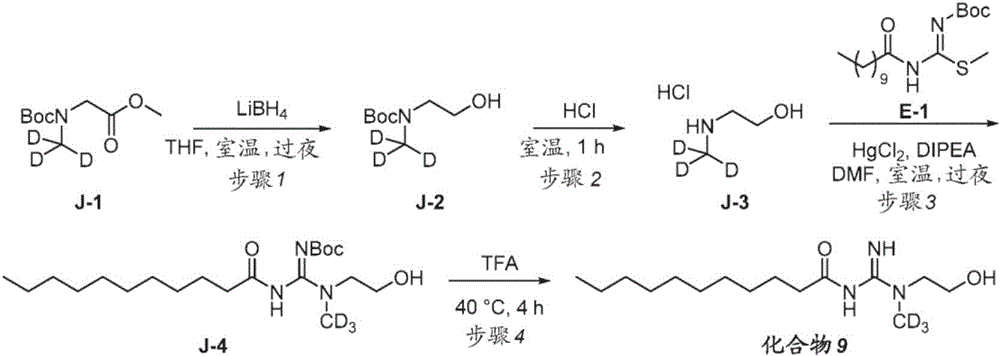
步骤1:J-2的合成Step 1: Synthesis of J-2

在0℃下向2-(叔丁氧基羰基(三氘甲基)氨基)乙酸甲酯(5.0g,24.3mmol,参见实施例1,B-1的合成作为参考)于30mL THF中的溶液中添加LiBH4(18mL,1M THF溶液)并且将混合物在室温下搅拌过夜。将反应混合物用HCOOH中止反应至pH=6。移除溶剂并且将残余水溶液用EtOAc(3x30ml)萃取。然后,将合并的有机相经Na2SO4干燥并且浓缩,提供呈无色油状的2-羟乙基(三氘甲基)氨基甲酸叔丁酯(3.76g,87%产率;化合物J-2)。ES LC-MS m/z=201(M+Na+)。To a solution of methyl 2-(tert-butoxycarbonyl(trideuteromethyl)amino)acetate (5.0 g, 24.3 mmol, see Example 1, synthesis of B-1 for reference) in 30 mL of THF at 0 °C LiBH4 (18 mL, 1M in THF) was added and the mixture was stirred at room temperature overnight. The reaction mixture was quenched with HCOOH to pH=6. The solvent was removed and the residual aqueous solution was extracted with EtOAc (3x30ml). The combined organic phases were then dried over Na 2 SO 4 and concentrated to provide tert-butyl 2-hydroxyethyl(trideuteromethyl)carbamate (3.76 g, 87% yield; Compound J- 2). ES LC-MS m/z=201 (M+Na + ).
步骤2:J-3的合成Step 2: Synthesis of J-3

将2-羟乙基(三氘甲基)氨基甲酸叔丁酯(3.76g,21.1mmol)于HCl(10ml,4M二噁烷溶液)中的混合物在室温下搅拌1h。将所得混合物浓缩为呈无色油状的2-(三氘甲基氨基)乙醇(2.45g,100%产率;化合物J-3),所述物质直接用于下一步骤。A mixture of tert-butyl 2-hydroxyethyl(trideuteromethyl)carbamate (3.76 g, 21.1 mmol) in HCl (10 ml, 4M in dioxane) was stirred at room temperature for 1 h. The resulting mixture was concentrated to 2-(trideuteromethylamino)ethanol (2.45 g, 100% yield; compound J-3) as a colorless oil, which was used directly in the next step.
步骤3:J-4的合成Step 3: Synthesis of J-4

向甲硫基(十一烷酰氨基)亚甲基氨基甲酸叔丁酯(700mg,1.96mmol)、根据实施例3合成的化合物E-1以及2-(三氘甲基氨基)乙醇(313mg,2.74mmol;化合物J-3)于15mL DMF中的溶液中添加HgCl2(533mg,1.96mmol)和DIPEA(759mg,5.88mmol)并且将混合物在25℃下搅拌3小时。添加50mL的EA并且将混合物用水(3x50ml)洗涤。然后,将有机相经Na2SO4干燥并且浓缩,得到呈固体状的((2-羟乙基)(三氘甲基)氨基)(十一烷酰氨基)亚甲基氨基甲酸叔丁酯(758mg,粗物质,溶解于2mL EA中)(化合物J-4)。ES LC-MSm/z=389(M+H)+。To tert-butyl methylthio(undecanoamido)methylenecarbamate (700 mg, 1.96 mmol), compound E-1 synthesized according to Example 3, and 2-(trideuteromethylamino)ethanol (313 mg, To a solution of 2.74 mmol; compound J-3) in 15 mL of DMF was added HgCl 2 (533 mg, 1.96 mmol) and DIPEA (759 mg, 5.88 mmol) and the mixture was stirred at 25° C. for 3 hours. 50 mL of EA was added and the mixture was washed with water (3 x 50 ml). The organic phase was then dried over Na 2 SO 4 and concentrated to give tert-butyl ((2-hydroxyethyl)(trideuteromethyl)amino)(undecanoamido)methylenecarbamate as a solid (758 mg, crude material, dissolved in 2 mL EA) (compound J-4). ES LC-MS m/z=389 (M+H) + .
步骤4:(N-(N-(2-羟乙基)-N-三氘甲基甲脒基)十一烷酰胺(化合物9)的合成Step 4: Synthesis of (N-(N-(2-hydroxyethyl)-N-trideuteromethylformamidino)undecanamide (Compound 9)

将((2-羟乙基)(三氘甲基)氨基)(十一烷酰氨基)亚甲基氨基甲酸叔丁酯(758mg,粗物质,溶解于2mL EA中;化合物J-4)于TFA(15ml)中的混合物在40℃下搅拌4h。将所得混合物浓缩并且将残余物通过制备型-HPLC(TFA条件)纯化。通过添加1N HCl将产物转化为盐酸盐,得到呈白色固体状的盐酸盐(N-(N-(2-羟乙基)-N-三氘甲基甲脒基)十一烷酰胺)(39.5mg,7%产率,化合物9)。ES LC-MS m/z=289(M+H)+。1H NMR(MeOD)δ:1H NMR(400MHz,MeOD):δ3.82-.384(m,2H),3.68(brs,2H),2.53(brs,2H),1.69(d,J=7.2Hz,2H),1.32-1.36(m,14H),0.92(t,J=6.4Hz,3H)。tert-Butyl ((2-hydroxyethyl)(trideuteromethyl)amino)(undecanoamido)methylenecarbamate (758 mg, crude, dissolved in 2 mL EA; compound J-4) was placed in The mixture in TFA (15 ml) was stirred at 40 °C for 4 h. The resulting mixture was concentrated and the residue was purified by prep-HPLC (TFA conditions). The product was converted to the hydrochloride salt by addition of 1N HCl to give the hydrochloride salt (N-(N-(2-hydroxyethyl)-N-trideuteromethylformamidino)undecanamide) as a white solid (39.5 mg, 7% yield, compound 9). ES LC-MS m/z = 289 (M+H) + . 1 H NMR (MeOD) δ: 1 H NMR (400 MHz, MeOD): δ 3.82-.384 (m, 2H), 3.68 (brs, 2H), 2.53 (brs, 2H), 1.69 (d, J=7.2 Hz, 2H), 1.32-1.36 (m, 14H), 0.92 (t, J=6.4Hz, 3H).
用于大环化合物的一般程序General procedure for macrocycles
可使用标准化学技术于适当溶剂中制备示例性PDT(流程1)。举例来说,可通过首先使用标准条件形成1的酸氯化物,随后添加中间物2来制备中间物3。使用碳酸铯加上二苯硫醚移除4-硝基苯磺酰基给出中间物4。使用诸如HATU等标准偶联试剂与诸如DIPEA等胺碱使受适当保护的SM-1(Boc或Cbz)与SM-2偶联给出5,然后可使用氯化汞和诸如TEA等胺碱使5与4偶联,得到中间物6。使用诸如格拉布斯(Grubb)II钌催化剂等适当催化剂和中间物6在稀释条件下进行环合置换反应给出中间物7。当使用Cbz基团时,在氢气氛围下用诸如Pd/C或PtO2等适当催化剂对中间物7进行处理给出示例性PDT或当使用Boc保护基时给出中间物7。可通过用TFA或1N HCl之二噁烷溶液处理将含有Boc保护基的中间物7轻易转化为示例性PDT。Exemplary PDTs can be prepared in appropriate solvents using standard chemical techniques (Scheme 1). For example, intermediate 3 can be prepared by first forming the acid chloride of 1 using standard conditions, followed by addition of intermediate 2. Removal of the 4-nitrobenzenesulfonyl group using cesium carbonate plus diphenyl sulfide gave
流程1.一般合成

用于中间物2的一般程序(流程1)General procedure for intermediate 2 (scheme 1)
可根据X使用若干标准化学技术来制备(若不可商购获得)中间物2。以下为合成各种中间物2的实施例。Intermediate 2 can be prepared (if not commercially available) according to X using several standard chemical techniques. The following are examples of the synthesis of
用于中间物2-1的一般程序General procedure for Intermediate 2-1

可使用标准化学技术于适当的溶剂中制备中间物2-1。举例来说,可通过在高温下用金属镁处理将SM-3转化为对应格任亚试剂(Grignard reagent),对应格任亚试剂然后可与适当的酮或醛反应得到2-1。Intermediate 2-1 can be prepared in an appropriate solvent using standard chemical techniques. For example, SM-3 can be converted to the corresponding Grignard reagent by treatment with metallic magnesium at elevated temperature, which can then be reacted with the appropriate ketone or aldehyde to give 2-1.
用于中间物2-2的一般程序General procedure for intermediates 2-2

可使用标准化学技术于适当的溶剂中制备中间物2-2。举例来说,可通过在高温下用金属镁和碘处理将SM-3转化为格任亚试剂,格任亚试剂然后可在适当温度下在存在碘化铜的情况下与任一适当的环氧化物反应得到2-2。Intermediate 2-2 can be prepared in an appropriate solvent using standard chemical techniques. For example, SM-3 can be converted to a Grignard reagent by treatment with metallic magnesium and iodine at elevated temperature, which can then be combined with any suitable ring at an appropriate temperature in the presence of copper iodide. The oxide reacts to give 2-2.
用于中间物2-3的一般程序General procedure for intermediates 2-3

可使用标准化学技术于适当的溶剂中制备中间物2-3。举例来说,可使用库林科维奇反应(Kulinkovich reaction)通过在低温下在存在钛(IV)的情况下使SM-6与乙基格任亚(SM-7)反应来制备中间物2-3。Intermediates 2-3 can be prepared in an appropriate solvent using standard chemical techniques. For example, intermediate 2 can be prepared by reacting SM-6 with ethyl Grignard (SM-7) at low temperature in the presence of titanium(IV) using the Kulinkovich reaction -3.
实施例7:5-亚氨基-4-三氘甲基胍基-17-二甲基-1-氧杂-4,6-二氮杂环十七烷-2,7-二酮二盐酸盐(化合物K)的合成Example 7: 5-imino-4-trideuteromethylguanidino-17-dimethyl-1-oxa-4,6-diazacycloheptadecan-2,7-dione dihydrochloride Synthesis of Salt (Compound K)

步骤a:化合物K-a的合成.Step a: Synthesis of compound K-a.

根据实施例10,步骤3,以(Z)-氨基(甲硫基)亚甲基氨基甲酸叔丁酯和癸-9-烯酸为起始物质合成化合物K-a。还参见实施例29,步骤1,以(Z)-(氨基(甲硫基)亚甲基)氨基甲酸叔丁酯替代(Z)-(氨基(甲硫基)亚甲基)氨基甲酸苯甲酯为起始物质。According to Example 10, step 3, compound K-a was synthesized using tert-butyl (Z)-amino(methylthio)methylenecarbamate and dec-9-enoic acid as starting materials. See also Example 29,
步骤b:化合物K-b的合成Step b: Synthesis of Compound K-b

将2-(N-三氘甲基胍基-4-硝基苯磺酰氨基)乙酸(3.78g,13.6mmoL)于亚硫酰氯(20mL)和二氯甲烷(20mL)中的混合物在60℃下搅拌1h。将合并的有机物浓缩。然后,将所得化合物溶解于二氯甲烷(40mL)中并且添加丁-3-烯-2-醇(980mg,13.6mmoL)、三乙胺(4.12g,40.8mmoL),并且将所得混合物在室温下搅拌1h。添加水(50mL)并且将合并的有机相用盐水洗涤,经硫酸钠干燥并且浓缩。将残余物通过快速色谱(石油醚∶乙酸乙酯/5∶1)纯化,提供呈白色固体状的2-(N-三氘甲基胍基-4-硝基苯磺酰氨基)乙酸丁-3-烯-2-基酯(3.6g,80%产率)。ES LC-MS m/z=332.1(M+H+)。A mixture of 2-(N-trideuteromethylguanidino-4-nitrobenzenesulfonylamino)acetic acid (3.78 g, 13.6 mmol) in thionyl chloride (20 mL) and dichloromethane (20 mL) at 60 °C under stirring for 1 h. The combined organics were concentrated. Then, the resulting compound was dissolved in dichloromethane (40 mL) and but-3-en-2-ol (980 mg, 13.6 mmol), triethylamine (4.12 g, 40.8 mmol) were added, and the resulting mixture was allowed to cool at room temperature Stir for 1 h. Water (50 mL) was added and the combined organic phases were washed with brine, dried over sodium sulfate and concentrated. The residue was purified by flash chromatography (petroleum ether:ethyl acetate/5:1) to afford 2-(N-trideuteromethylguanidino-4-nitrobenzenesulfonamido)acetate butyl- as a white solid. 3-en-2-yl ester (3.6 g, 80% yield). ES LC-MS m/z=332.1 (M+H + ).
将2-(N-三氘甲基胍基-4-硝基苯磺酰氨基)乙酸丁-3-烯-2-基酯(3.6g,10.87mmoL)、对甲苯硫酚(1.61g,13mmoL)、碳酸铯(5.31g,16.3mmoL)于乙腈(50mL)和四氢呋喃(5mL)中的混合物在45℃下搅拌1.5h。将反应混合物过滤,将滤液浓缩,将残余物通过色谱(甲醇:二氯甲烷/5∶1)纯化,提供呈黄色液体状的2-(三氘甲基胍基)乙酸丁-3-烯-2-基酯(K-b,1g,63%产率)。1H NMR(DMSO-d)δ:5.91-5.83(m,1H),5.32-5.10(m,2H),3.25(s,2H),1.26-1.25(m,3H)。2-(N-Trideuteromethylguanidino-4-nitrobenzenesulfonylamino)acetate but-3-en-2-yl ester (3.6 g, 10.87 mmol), p-toluenethiol (1.61 g, 13 mmol) ), cesium carbonate (5.31 g, 16.3 mmol) in acetonitrile (50 mL) and tetrahydrofuran (5 mL) was stirred at 45 °C for 1.5 h. The reaction mixture was filtered, the filtrate was concentrated, and the residue was purified by chromatography (methanol:dichloromethane/5:1) to afford 2-(trideuteromethylguanidino)acetate but-3-ene- as a yellow liquid 2-yl ester (Kb, 1 g, 63% yield). 1 H NMR (DMSO-d) δ: 5.91-5.83 (m, 1H), 5.32-5.10 (m, 2H), 3.25 (s, 2H), 1.26-1.25 (m, 3H).
步骤1:化合物K-1的合成.在室温下搅拌(Z)-癸-9-烯酰氨基(甲硫基)亚甲基氨基甲酸叔丁酯(2.3g,6.7mmoL)、化合物K-b(982mg,6.7mmoL)以及三乙胺(2.03g,20.1mmoL)于N,N-二甲基甲酰胺(35mL)中的溶液的混合物。添加二氯化汞(2.18g,8.04mmoL)的混合物,将混合物在室温下搅拌过夜。添加水(40mL)并且将混合物用乙酸乙酯(40mL x3)萃取,将合并的有机相用盐水洗涤,经硫酸钠干燥并且浓缩。将残余物通过快速色谱(石油醚∶乙酸乙酯5∶1)纯化,提供呈白色固体状的(Z)-2-(2-(叔丁氧基羰基)-3-癸-9-烯酰基-1-三氘甲基胍基)乙酸丁-3-烯-2-基酯(化合物K-1;2.7g,91%产率)。ES LC-MS m/z=441.3(M+H+)。Step 1: Synthesis of compound K-1. Stir at room temperature tert-butyl (Z)-dec-9-enoamido(methylthio)methylenecarbamate (2.3 g, 6.7 mmol), compound Kb (982 mg) , 6.7 mmol) and a mixture of triethylamine (2.03 g, 20.1 mmol) in N,N-dimethylformamide (35 mL). A mixture of mercuric dichloride (2.18 g, 8.04 mmol) was added and the mixture was stirred at room temperature overnight. Water (40 mL) was added and the mixture was extracted with ethyl acetate (40 mL x 3), the combined organic phases were washed with brine, dried over sodium sulfate and concentrated. The residue was purified by flash chromatography (petroleum ether:ethyl acetate 5:1) to provide (Z)-2-(2-(tert-butoxycarbonyl)-3-dec-9-enoyl as a white solid -1-Trideuteromethylguanidino)acetate but-3-en-2-yl ester (compound K-1; 2.7 g, 91% yield). ES LC-MS m/z = 441.3 (M+H + ).
步骤2:化合物K-2的合成.将化合物K-1(953mg,2.17mmoL)和格拉布斯(II)(183mg,0.217mmoL)于二氯甲烷(950mL)中的混合物在50℃下搅拌2h。将合并的有机物浓缩。将残余物通过快速色谱(石油醚∶乙酸乙酯5∶1)纯化,提供呈淡黄色油状的(Z)-((E)-4-三氘甲基胍基-17-甲基-2,7-二氧代-1-氧杂-4,6-二氮杂环十七-15-烯-5-亚基)氨基甲酸叔丁酯(化合物K-2;693mg,77%产率)。ES LC-MS m/z=413.2(M+H+)。Step 2: Synthesis of compound K-2. A mixture of compound K-1 (953 mg, 2.17 mmol) and Grubbs (II) (183 mg, 0.217 mmol) in dichloromethane (950 mL) was stirred at 50 °C for 2 h . The combined organics were concentrated. The residue was purified by flash chromatography (petroleum ether:ethyl acetate 5:1) to provide (Z)-((E)-4-trideuteromethylguanidino-17-methyl-2 as a pale yellow oil, tert-Butyl 7-dioxo-1-oxa-4,6-diazacycloheptadeca-15-en-5-ylidene)carbamate (compound K-2; 693 mg, 77% yield). ES LC-MS m/z = 413.2 (M+H + ).
步骤3:化合物K-3的合成.将化合物K-2(310mg,0.75mmoL)和氧化铂(IV)(31mg,10%)于乙酸乙酯(10mL)中的混合物在H2球囊下搅拌2h。将反应混合物过滤并且将滤液浓缩。将残余物通过快速色谱(石油醚∶乙酸乙酯3∶1)纯化,提供呈黄色油状的(Z)-4-三氘甲基胍基-17-甲基-2,7-二氧代-1-氧杂-4,6-二氮杂环十七烷-5-亚基氨基甲酸叔丁酯(化合物K-3;93mg,30%产率)。ES LC-MS m/z=415.2(M+H+)。Step 3: Synthesis of compound K-3. A mixture of compound K-2 (310 mg, 0.75 mmol) and platinum(IV) oxide (31 mg, 10%) in ethyl acetate ( 10 mL) was stirred under a balloon of H 2h. The reaction mixture was filtered and the filtrate was concentrated. The residue was purified by flash chromatography (petroleum ether:ethyl acetate 3:1) to provide (Z)-4-trideuteromethylguanidino-17-methyl-2,7-dioxo- as a yellow oil tert-Butyl 1-oxa-4,6-diazacycloheptadecan-5-ylidenecarbamate (compound K-3; 93 mg, 30% yield). ES LC-MS m/z = 415.2 (M+H + ).
步骤4:化合物K-4的合成.将化合物K-3(100mg,0.24mmoL)于二氯甲烷(4mL)和三氟乙酸(1mL)中的混合物在室温下搅拌1h。将合并的有机物浓缩。将残余物用甲醇溶解,通过制备型HPLC(FA)纯化,提供呈白色油状的5-亚氨基-4-三氘甲基胍基-17-二甲基-1-氧杂-4,6-二氮杂环十七烷-2,7-二酮(化合物K-4;48mg,63%产率)。ES LC-MS m/z=314.2(M+H+)。Step 4: Synthesis of compound K-4. A mixture of compound K-3 (100 mg, 0.24 mmol) in dichloromethane (4 mL) and trifluoroacetic acid (1 mL) was stirred at room temperature for 1 h. The combined organics were concentrated. The residue was dissolved in methanol and purified by preparative HPLC (FA) to afford 5-imino-4-trideuteromethylguanidino-17-dimethyl-1-oxa-4,6- as a white oil Diazacycloheptadecan-2,7-dione (compound K-4; 48 mg, 63% yield). ES LC-MS m/z = 314.2 (M+H + ).
步骤5:化合物K的合成Step 5: Synthesis of Compound K

化合物K-4(120mg,0.38mmoL)于水(50mL)和乙腈(4mL)中的混合物。用盐酸(1N)将溶液的pH值调节至4-5。将溶液真空冷冻干燥,提供呈白色油状的5-亚氨基-4-三氘甲基胍基-17-二甲基-1-氧杂-4,6-二氮杂环十七烷-2,7-二酮二盐酸盐(化合物K;90mg,75%产率)。ES LC-MS m/z=314.2(M+H+)。1H NMR(DMSO-d)δ:11.46(s,1H),9.38(s,1H),9.25(s,1H),5.27(1H,AB,J=18.1Hz),4.90-5.03(m,1H),4.35(1H,AB,J=19.0Hz),2.66-2.81(m,1H),2.25-2.40(m,1H),1.43-1.45(m,4H),1.21(3H,d,J=6.3Hz),1.20-1.35(m,12H)。A mixture of compound K-4 (120 mg, 0.38 mmol) in water (50 mL) and acetonitrile (4 mL). The pH of the solution was adjusted to 4-5 with hydrochloric acid (1N). The solution was lyophilized in vacuo to provide 5-imino-4-trideuteromethylguanidino-17-dimethyl-1-oxa-4,6-diazacycloheptadecan-2 as a white oil, 7-diketone dihydrochloride (compound K; 90 mg, 75% yield). ES LC-MS m/z = 314.2 (M+H + ). 1 H NMR (DMSO-d) δ: 11.46 (s, 1H), 9.38 (s, 1H), 9.25 (s, 1H), 5.27 (1H, AB, J=18.1 Hz), 4.90-5.03 (m, 1H) ), 4.35 (1H, AB, J=19.0Hz), 2.66-2.81 (m, 1H), 2.25-2.40 (m, 1H), 1.43-1.45 (m, 4H), 1.21 (3H, d, J=6.3 Hz), 1.20-1.35 (m, 12H).
实施例8:17-乙基-5-亚氨基-4-三氘甲基-1-氧杂-4,6-二氮杂环十七烷-2,7-二酮盐酸盐(化合物L)的合成Example 8: 17-ethyl-5-imino-4-trideuteromethyl-1-oxa-4,6-diazacycloheptadecane-2,7-dione hydrochloride (Compound L )Synthesis

化合物1的合成.Synthesis of

步骤a-1:在0℃下搅拌2-氨基乙酸乙酯(64g,288mmoL)于吡啶(140mL)中的混合物,逐滴添加4-硝基苯-1-磺酰氯(40g,288mmoL)于吡啶(60mL)中的混合物,将所得混合物在0℃下搅拌1h。将残余物通过再结晶进行纯化,提供呈黄色固体状的2-(4-硝基苯磺酰氨基)乙酸乙酯(70g,63%产率)。ES LC-MS m/z=289.2(M+H+)。Step a-1: A mixture of ethyl 2-aminoacetate (64 g, 288 mmol) in pyridine (140 mL) was stirred at 0°C, 4-nitrobenzene-1-sulfonyl chloride (40 g, 288 mmol) in pyridine was added dropwise (60 mL) and the resulting mixture was stirred at 0 °C for 1 h. The residue was purified by recrystallization to provide ethyl 2-(4-nitrobenzenesulfonamido)acetate (70 g, 63% yield) as a yellow solid. ES LC-MS m/z = 289.2 (M+H + ).
步骤a-2:将2-(4-硝基苯磺酰氨基)乙酸乙酯(30g,104.1mmoL)、碳酸铯(51g,156.2mmoL)以及碘甲烷-d3(16.6g,114.6mmoL)于N,N-二甲基甲酰胺(75mL)中的溶液的混合物在室温下搅拌1h。将反应溶液倾至冰水(500mL)中并且过滤,提供2-(N-三氘甲基胍基-4-硝基苯磺酰氨基)乙酸乙酯(30g,94%产率)。ES LC-MS m/z=328.3(M+Na+)。Step a-2: Combine ethyl 2-(4-nitrobenzenesulfonylamino)acetate (30 g, 104.1 mmoL), cesium carbonate (51 g, 156.2 mmoL) and iodomethane-d3 (16.6 g, 114.6 mmoL) in N , a mixture of solutions in N-dimethylformamide (75 mL) was stirred at room temperature for 1 h. The reaction solution was poured into ice water (500 mL) and filtered to provide ethyl 2-(N-trideuteromethylguanidino-4-nitrobenzenesulfonylamino)acetate (30 g, 94% yield). ES LC-MS m/z=328.3 (M+Na + ).
步骤a-3:在室温下搅拌2-(N-三氘甲基胍基-4-硝基苯磺酰氨基)乙酸乙酯(40g,131.1mmoL)于四氢呋喃(80mL)中的混合物,添加单水合氢氧化锂(10.5g,262.2mmoL)于水(40mL)中的溶液,将所得混合物在室温下搅拌1h。将合并的有机物浓缩,用盐酸(1N)将溶液的pH值调节至4-5。将混合物用二氯甲烷(150mLx3)萃取,将合并的有机物经无水硫酸钠干燥并且浓缩,提供2-(N-三氘甲基胍基-4-硝基苯磺酰氨基)乙酸(33g,91%产率,1)。1H NMR(DMSO-d)δ:12.9(s,1H),8.38-8.42(m,2H),8.04-8.08(m,2H),3.99(s,1H)。Step a-3: Stir a mixture of ethyl 2-(N-trideuteromethylguanidino-4-nitrobenzenesulfonylamino)acetate (40 g, 131.1 mmol) in tetrahydrofuran (80 mL) at room temperature, add mono A solution of hydrated lithium hydroxide (10.5 g, 262.2 mmol) in water (40 mL), the resulting mixture was stirred at room temperature for 1 h. The combined organics were concentrated and the pH of the solution was adjusted to 4-5 with hydrochloric acid (1 N). The mixture was extracted with dichloromethane (150 mL x 3), the combined organics were dried over anhydrous sodium sulfate and concentrated to provide 2-(N-trideuteromethylguanidino-4-nitrobenzenesulfonamido)acetic acid (33 g, 91% yield, 1). 1 H NMR (DMSO-d) δ: 12.9 (s, 1H), 8.38-8.42 (m, 2H), 8.04-8.08 (m, 2H), 3.99 (s, 1H).
步骤1:化合物L-1的合成.向配备有搅拌棒的圆底烧瓶中装入含2-[(4-硝基苯基)磺酰基-(三氘甲基)氨基]乙酸(2g,7.22mmol)的DCM(18mL),在冰浴下添加SOCl2(18mL),并且在60℃下回流1小时。将反应物蒸发,溶解于DCM(30mL)中。在冰浴下逐滴添加戊-1-烯-3-醇(652mg,7.58mmol)和三乙胺(2.19g,21.66mmol)于DCM(15mL)中的溶液中,然后在室温下搅拌1小时。向反应物中添加DCM(100mL),用水(40mL x 3)和盐水(40mL)洗涤,干燥并且蒸发,通过快速色谱(40G)纯化,用(PE∶EA/0%-18%)洗脱,获得呈淡黄色固体状的2-(N-三氘甲基-4-硝基苯磺酰氨基)乙酸戊-1-烯-3-基酯(化合物L-1;2.78g,7.55mmol,108%产率)。ES LC-MS m/z=368.0(M+Na+)。1H NMR(DMSO-d6)δ:8.36-8.33(m,2H),8.01-7.98(m,2H),5.31-5.30(m,1H),5.21-5.17(m,2H),5.09-5.07(m,1H),4.10(s,2H),1.42-1.34(m,2H),0.89-0.84(m,3H)。Step 1: Synthesis of compound L-1. A round bottom flask equipped with a stir bar was charged with 2-[(4-nitrophenyl)sulfonyl-(trideuteromethyl)amino]acetic acid (2 g, 7.22 g mmol) in DCM (18 mL), SOCl2 (18 mL) was added under an ice bath, and refluxed at 60 °C for 1 hour. The reaction was evaporated and dissolved in DCM (30 mL). A solution of pent-1-en-3-ol (652 mg, 7.58 mmol) and triethylamine (2.19 g, 21.66 mmol) in DCM (15 mL) was added dropwise under ice bath, then stirred at room temperature for 1 hour . To the reaction was added DCM (100 mL), washed with water (40 mL x 3) and brine (40 mL), dried and evaporated, purified by flash chromatography (40G) eluting with (PE:EA/0%-18%), 2-(N-Trideuteromethyl-4-nitrobenzenesulfonylamino)acetate pent-1-en-3-yl ester (compound L-1; 2.78 g, 7.55 mmol, 108 g) was obtained as a pale yellow solid %Yield). ES LC-MS m/z=368.0 (M+Na + ). 1 H NMR (DMSO-d 6 ) δ: 8.36-8.33 (m, 2H), 8.01-7.98 (m, 2H), 5.31-5.30 (m, 1H), 5.21-5.17 (m, 2H), 5.09-5.07 (m, 1H), 4.10 (s, 2H), 1.42-1.34 (m, 2H), 0.89-0.84 (m, 3H).
步骤2:化合物L-2的合成.向配备有搅拌棒的圆底烧瓶中装入含化合物L-1(2.78g,7.55mmol)和Cs2CO3(5.2g,16.12mmol)的ACN∶THF(10∶1,80mL),在室温下添加4-甲基苯硫酚(2g,16.12mmol)。将反应物在45℃下搅拌1.5h。将混合物过滤,蒸发,通过SGC(PE∶EA/10∶1至DCM∶MeOH/10∶1)纯化,得到呈淡黄色油状的2-(三氘甲基氨基)乙酸戊-1-烯-3-基酯(化合物L-2;910mg,5.68mmol,71%产率)。所述粗物质未进一步纯化直接用于下一步骤。Step 2: Synthesis of compound L-2. A round bottom flask equipped with a stir bar was charged with compound L-1 (2.78 g, 7.55 mmol) and Cs2CO3 ( 5.2 g, 16.12 mmol) in ACN:THF (10:1, 80 mL), 4-methylthiophenol (2 g, 16.12 mmol) was added at room temperature. The reaction was stirred at 45 °C for 1.5 h. The mixture was filtered, evaporated and purified by SGC (PE:EA/10:1 to DCM:MeOH/10:1) to give 2-(trideuteromethylamino)acetate pent-1-ene-3 as a pale yellow oil -yl ester (compound L-2; 910 mg, 5.68 mmol, 71% yield). The crude material was used in the next step without further purification.
步骤3:化合物L-3的合成.向配备有搅拌棒的圆底烧瓶中装入含(Z)-癸-9-烯酰氨基(甲硫基)亚甲基氨基甲酸叔丁酯(1.69g,4.74mmol,K-a,参见实施例7)、化合物L-2(910mg,5.68mmol)以及TEA(958mg,9.48mmol)的DMF(35mL),在室温下添加HgCl2(1420mg,5.21mmol)。将反应物在室温下搅拌2小时。向反应物中添加EA(100mL),用水(30mL x 3)和盐水(30mL)洗涤,干燥并且蒸发,通过快速色谱(40G)纯化,用(PE:EA/0%-20%)洗脱,得到呈无色油状的(Z)-2-(2-(叔丁氧基羰基)-3-癸-9-烯酰基-1-三氘甲基胍基)乙酸戊-1-烯-3-基酯(化合物L-3;1.54g,3.38mmol,71%产率)。ES LC-MS m/z=455.1(M+H+)。1H NMR(DMSO-d6)δ:9.95(br s,1H),5.8-5.7(m,2H),5.27-5.13(m,2H),5.01-4.91(m,2H),4.16(s,2H),2.21(br s,2H),2.02-1.97(m,2H),1.63-1.52(m,2H),1.49(s,2H),1.33(s,10H),1.25(s,8H),0.87-0.83(t,J=7.2Hz,3H)。Step 3: Synthesis of compound L-3. A round bottom flask equipped with a stir bar was charged with tert-butyl (Z)-dec-9-enoamido(methylthio)methylenecarbamate (1.69 g) , 4.74 mmol, Ka, see Example 7), compound L-2 (910 mg, 5.68 mmol) and TEA (958 mg, 9.48 mmol) in DMF (35 mL), HgCl 2 (1420 mg, 5.21 mmol) was added at room temperature. The reaction was stirred at room temperature for 2 hours. EA (100 mL) was added to the reaction, washed with water (30 mL x 3) and brine (30 mL), dried and evaporated, purified by flash chromatography (40G) eluting with (PE:EA/0%-20%), (Z)-2-(2-(tert-butoxycarbonyl)-3-dec-9-enoyl-1-trideuteromethylguanidino)acetate pent-1-ene-3- was obtained as a colorless oil base ester (compound L-3; 1.54 g, 3.38 mmol, 71% yield). ES LC-MS m/z=455.1 (M+H + ). 1 H NMR (DMSO-d 6 ) δ: 9.95 (br s, 1H), 5.8-5.7 (m, 2H), 5.27-5.13 (m, 2H), 5.01-4.91 (m, 2H), 4.16 (s, 2H), 2.21(br s, 2H), 2.02-1.97(m, 2H), 1.63-1.52(m, 2H), 1.49(s, 2H), 1.33(s, 10H), 1.25(s, 8H), 0.87-0.83 (t, J=7.2 Hz, 3H).
步骤4:化合物L-4的合成.向配备有搅拌棒的圆底烧瓶中装入含化合物L-3(1.54g,3.38mmol)的DCM(1200mL),在室温下添加格拉布斯(II)(575mg,0.67mmol)。在存在氩气的情况下将反应物在50℃下搅拌2小时。将反应物冷却至室温,用乙氧乙烯(10mL)中止反应,蒸发,通过快速色谱(20G)纯化,用(PE∶EA/0%-25%)洗脱,得到呈淡棕色油状的(Z)-((E)-17-乙基-4-三氘甲基-2,7-二氧代-1-氧杂-4,6-二氮杂环十七-15-烯-5-亚基)氨基甲酸叔丁酯(化合物L-4;1220mg,2.86mmol,86%产率)。ES LC-MS m/z=427.2(M+H+)。Step 4: Synthesis of compound L-4. A round bottom flask equipped with a stir bar was charged with compound L-3 (1.54 g, 3.38 mmol) in DCM (1200 mL) and Grubbs (II) was added at room temperature (575 mg, 0.67 mmol). The reaction was stirred at 50°C for 2 hours in the presence of argon. The reaction was cooled to room temperature, quenched with ethoxyethylene (10 mL), evaporated and purified by flash chromatography (20G) eluting with (PE:EA/0%-25%) to give (Z as a light brown oil). )-((E)-17-ethyl-4-trideuteromethyl-2,7-dioxo-1-oxa-4,6-diazacycloheptadeca-15-ene-5-idene yl) tert-butyl carbamate (compound L-4; 1220 mg, 2.86 mmol, 86% yield). ES LC-MS m/z=427.2 (M+H + ).
步骤5:化合物L-5的合成.向配备有搅拌棒的圆底烧瓶中装入含化合物L-4(500mg,1.17mmol)的乙酸乙酯(10mL),在室温下添加氧化铂(51mg)。在氢气存在下将反应物在室温下搅拌3h。将反应物过滤,蒸发,通过制备型HPLC(FA)纯化,得到呈淡白色固体状的(Z)-((E)-14-丁基-4-三氘甲基-2,7-二氧代-1-氧杂-4,6-二氮杂环十四-11-烯-5-亚基)氨基甲酸苯甲酯(化合物L-5;400mg,0.93mmol,36%产率)。ES LC-MS m/z=429.2(M+H+)。1H NMR(DMSO-d6)δ:9.87(s,1H),4.82-4.81(d,J=4.8Hz,1H),4.20-4.02(m,2H),2.24-2.13(m,2H),1.54-1.49(m,5H),1.40-1.35(m,9H),1.23(s,2H),0.85-0.81(t,J=7.2Hz,3H)。Step 5: Synthesis of compound L-5. A round bottom flask equipped with a stir bar was charged with compound L-4 (500 mg, 1.17 mmol) in ethyl acetate (10 mL) and platinum oxide (51 mg) was added at room temperature . The reaction was stirred at room temperature for 3 h in the presence of hydrogen. The reaction was filtered, evaporated and purified by preparative HPLC (FA) to give (Z)-((E)-14-butyl-4-trideuteromethyl-2,7-dioxo as an off-white solid Benzyl methyl substituted-1-oxa-4,6-diazacyclotetradec-11-en-5-ylidene)carbamate (Compound L-5; 400 mg, 0.93 mmol, 36% yield). ES LC-MS m/z = 429.2 (M+H + ). 1 H NMR (DMSO-d 6 ) δ: 9.87 (s, 1H), 4.82-4.81 (d, J=4.8 Hz, 1H), 4.20-4.02 (m, 2H), 2.24-2.13 (m, 2H), 1.54-1.49 (m, 5H), 1.40-1.35 (m, 9H), 1.23 (s, 2H), 0.85-0.81 (t, J=7.2Hz, 3H).
步骤6:化合物L-6的合成.向配备有搅拌棒的圆底烧瓶中装入含化合物L-5(250mg,0.58mmol)的DCM(6mL),添加三氟乙酸(2mL),在室温下搅拌1小时。将反应物蒸发,溶解于ACN(3mL)中,通过制备型HPLC(FA)纯化,冻干,得到呈白色固体状的18-乙基-5-亚氨基-4-三氘甲基-1-氧杂-4,6-二氮杂环十八烷-2,7-二酮(化合物L-6;90mg,0.27mmol,47%产率)。ES LC-MS m/z=329.2(M+H+)。1H NMR(DMSO-d6)δ:10.75(br s,1H),9.43-9.21(brs,1H),4.82(s,2H),4.39(br s,1H),2.41(s,1H),1.57-1.51(m,6H),1.25(s,12H),0.86-0.82(t,J=7.6Hz,3H)。Step 6: Synthesis of compound L-6. A round bottom flask equipped with a stir bar was charged with compound L-5 (250 mg, 0.58 mmol) in DCM (6 mL), trifluoroacetic acid (2 mL) was added, at room temperature Stir for 1 hour. The reaction was evaporated, dissolved in ACN (3 mL), purified by preparative HPLC (FA), and lyophilized to give 18-ethyl-5-imino-4-trideuteromethyl-1- as a white solid Oxa-4,6-diazacyclooctadecane-2,7-dione (compound L-6; 90 mg, 0.27 mmol, 47% yield). ES LC-MS m/z = 329.2 (M+H + ). 1 H NMR (DMSO-d 6 )δ: 10.75 (br s, 1H), 9.43-9.21 (brs, 1H), 4.82 (s, 2H), 4.39 (br s, 1H), 2.41 (s, 1H), 1.57-1.51 (m, 6H), 1.25 (s, 12H), 0.86-0.82 (t, J=7.6Hz, 3H).
步骤7:化合物L的合成Step 7: Synthesis of Compound L

向配备有搅拌棒的圆底烧瓶中装入含化合物L-6(90mg,0.27mmol)的ACN(5mL)和水(5mL),添加1N的HCl(0.5mL),在室温下搅拌0.5小时。将反应物冻干,获得呈白色固体状的17-乙基-5-亚氨基-4-三氘甲基-1-氧杂-4,6-二氮杂环十七烷-2,7-二酮盐酸盐(化合物L;84.5mg,0.25mmol,97%)。ES LC-MS m/z=329.2(M+H+)。1H NMR(DMSO-d6)δ:11.30(s,1H),9.40-9.23(m,2H),5.24-5.20(m,1H),4.85-4.84(m,1H),4.43-4.38(m,1H),2.69(m,1H),2.31(s,1H),1.58-1.51(m,6H),1.26(s,12H),0.87-0.83(t,J=7.2Hz,3H)。A round bottom flask equipped with a stirring bar was charged with compound L-6 (90 mg, 0.27 mmol) in ACN (5 mL) and water (5 mL), 1 N HCl (0.5 mL) was added, and the mixture was stirred at room temperature for 0.5 hr. The reaction was lyophilized to give 17-ethyl-5-imino-4-trideuteromethyl-1-oxa-4,6-diazacycloheptadecan-2,7- as a white solid Diketone hydrochloride (Compound L; 84.5 mg, 0.25 mmol, 97%). ES LC-MS m/z = 329.2 (M+H + ). 1 H NMR (DMSO-d 6 ) δ: 11.30 (s, 1H), 9.40-9.23 (m, 2H), 5.24-5.20 (m, 1H), 4.85-4.84 (m, 1H), 4.43-4.38 (m) , 1H), 2.69 (m, 1H), 2.31 (s, 1H), 1.58-1.51 (m, 6H), 1.26 (s, 12H), 0.87-0.83 (t, J=7.2Hz, 3H).
实施例9:5-亚氨基-4-三氘甲基胍基-18-甲基-1-氧杂-4,6-二氮杂环十八烷-2,7-二酮(化合物M)的合成Example 9: 5-imino-4-trideuteromethylguanidino-18-methyl-1-oxa-4,6-diazacyclooctadecane-2,7-dione (Compound M) Synthesis

M-a的合成Synthesis of M-a

步骤a:2-(N-三氘甲基-4-硝基苯磺酰氨基)乙酸戊-4-烯-2-基酯.将2-(N-三氘甲基-4-硝基苯磺酰氨基)乙酸(2.2g,7.94mmol)和二氯化亚硫(sulfurous dichloride)(20ml)于二氯甲烷(20ml)中的混合物加热至60℃并且搅拌2h。将混合物浓缩,将残余物用二氯甲烷(20ml)溶解,在冰水下将其添加至戊-4-烯-2-醇(750mg,8.72mmol)和三乙胺(2g,19.85mmol)于二氯甲烷(20ml)中的混合物中,然后在室温下搅拌1h。添加水(40ml)并且将混合物用二氯甲烷(40ml x3)萃取,将合并的有机相用盐水洗涤,经硫酸钠干燥并且浓缩。将残余物通过色谱(石油醚∶乙酸乙酯=5∶1)纯化,提供呈白色固体状的2-(N-三氘甲基-4-硝基苯磺酰氨基)乙酸戊-4-烯-2-基酯(1.983g,72%)。ES LC-MS m/z=368.1(M+Na+)。Step a: Pent-4-en-2-yl 2-(N-trideuteromethyl-4-nitrobenzenesulfonylamino)acetate. 2-(N-Trideuteromethyl-4-nitrobenzene A mixture of sulfonamido)acetic acid (2.2 g, 7.94 mmol) and sulfurous dichloride (20 ml) in dichloromethane (20 ml) was heated to 60 °C and stirred for 2 h. The mixture was concentrated and the residue was dissolved in dichloromethane (20 ml), which was added to pent-4-en-2-ol (750 mg, 8.72 mmol) and triethylamine (2 g, 19.85 mmol) under ice water The mixture in dichloromethane (20 ml) was then stirred at room temperature for 1 h. Water (40 ml) was added and the mixture was extracted with dichloromethane (40 ml x 3), the combined organic phases were washed with brine, dried over sodium sulfate and concentrated. The residue was purified by chromatography (petroleum ether:ethyl acetate=5:1) to afford 2-(N-trideuteromethyl-4-nitrobenzenesulfonamido)acetate pent-4-ene as a white solid -2-ylester (1.983 g, 72%). ES LC-MS m/z=368.1 (M+Na + ).
步骤b:M-a的合成.将2-(N-三氘甲基-4-硝基苯磺酰氨基)乙酸戊-4-烯-2-基酯(1.983g,5.75mmol)、4-甲基苯硫酚(1.43g,11.5mmol)以及碳酸铯(3.75g,11.5mmol)于乙腈(30ml)和四氢呋喃(3ml)中的混合物在45℃下搅拌2h。将反应混合物过滤并且将滤液浓缩。将残余物通过色谱(二氯甲烷∶甲醇=10∶1加上0.1%氢氧化铵)纯化,提供呈黄色液体状的2-(三氘甲基氨基)乙酸戊-4-烯-2-基酯(713mg,78%)。ES LC-MS m/z=161.3(M+H+)。Step b: Synthesis of Ma. 2-(N-Trideuteromethyl-4-nitrobenzenesulfonylamino)acetate pent-4-en-2-yl ester (1.983 g, 5.75 mmol), 4-methyl A mixture of thiophenol (1.43 g, 11.5 mmol) and cesium carbonate (3.75 g, 11.5 mmol) in acetonitrile (30 ml) and tetrahydrofuran (3 ml) was stirred at 45 °C for 2 h. The reaction mixture was filtered and the filtrate was concentrated. The residue was purified by chromatography (dichloromethane:methanol = 10:1 plus 0.1% ammonium hydroxide) to afford 2-(trideuteromethylamino)acetate pent-4-en-2-yl as a yellow liquid ester (713 mg, 78%). ES LC-MS m/z=161.3 (M+H + ).
M的合成:根据实施例7,步骤1和2,以(Z)-癸-9-烯酰氨基(甲硫基)亚甲基氨基甲酸叔丁酯(K-a,参见实施例7)和戊-4-烯-2-基-2-(三氘甲基胍基)(M-a)为起始物质合成化合物M-1。获得呈淡黄色油状的化合物M-1(743mg,53%产率)。ES LC-MS m/z=427.2(M+H+)。Synthesis of M: According to Example 7,
步骤1:化合物M-2的合成.将化合物M-1(500mg,1.17mmoL)和钯10%/碳(80mg,20%)于乙醇(5mL)中的混合物在H2球囊下搅拌2h。将反应混合物过滤并且将滤液浓缩,提供呈白色固体状的(Z)-4-三氘甲基胍基-18-甲基-2,7-二氧代-1-氧杂-4,6-二氮杂环十八-5-亚基氨基甲酸叔丁酯(化合物M-2;454mg,90%产率)。ES LC-MS m/z=429.3(M+H+)。Step 1: Synthesis of compound M-2. A mixture of compound M-1 (500 mg, 1.17 mmol) and
步骤2:化合物M的合成Step 2: Synthesis of Compound M

将所提供化合物M-2(716mg,1.67mmoL)于HCl/二噁烷(15mL)中的混合物在室温下搅拌过夜。将合并的有机物浓缩。将残余物用甲醇溶解,通过制备型HPLC(FA)纯化,提供呈白色固体状的5-亚氨基-4-三氘甲基胍基-18-甲基-1-氧杂-4,6-二氮杂环十八烷-2,7-二酮(化合物M;280mg,51%产率)。ES LC-MS m/z=329.2(M+H+)。1H NMR(DMSO-d)δ:9.4-10.2(br,1H),7.0-7.8(br,1H),4.80-4.92(m,2H),3.85(1H,AB,J=17.5Hz),1.95-2.15(m,2H),1.40-1.60(m,4H),1.18(3H,dr,J=6.3Hz),1.15-1.35(m,14H)。A mixture of provided compound M-2 (716 mg, 1.67 mmol) in HCl/dioxane (15 mL) was stirred at room temperature overnight. The combined organics were concentrated. The residue was dissolved in methanol and purified by preparative HPLC (FA) to provide 5-imino-4-trideuteromethylguanidino-18-methyl-1-oxa-4,6- as a white solid Diazacyclooctadecane-2,7-dione (Compound M; 280 mg, 51% yield). ES LC-MS m/z = 329.2 (M+H + ). 1 H NMR (DMSO-d) δ: 9.4-10.2 (br, 1H), 7.0-7.8 (br, 1H), 4.80-4.92 (m, 2H), 3.85 (1H, AB, J=17.5Hz), 1.95 -2.15 (m, 2H), 1.40-1.60 (m, 4H), 1.18 (3H, dr, J=6.3Hz), 1.15-1.35 (m, 14H).
实施例10:18-乙基-5-亚氨基-4-三氘甲基-1-氧杂-4,6-二氮杂环十八烷-2,7-二酮(化合物N)的合成Example 10: Synthesis of 18-ethyl-5-imino-4-trideuteromethyl-1-oxa-4,6-diazacyclooctadecane-2,7-dione (Compound N)

步骤1.化合物N-1的合成.向配备有搅拌棒和氮气入口的圆底烧瓶中装入含5-溴戊-1-烯(10g,67.11mmol)、镁(2.42g,100.67mmol)以及碘(5粒)的四氢呋喃(无水,100mL)。将混合物在60℃下搅拌两小时。将反应物冷却至室温(“B溶液”)。在-30℃下向丙醛(3.89g,67.11mmol)于THF(无水,50mL)中的溶液中逐滴添加B溶液。然后,将反应物在-30℃下搅拌30分钟。使反应物升温至室温持续2小时,并且用饱和氯化铵水溶液(60mL)中止反应,用乙酸乙酯(80mL x 3)萃取,用水(60mL x 1)和盐水(60mL)洗涤,干燥并且蒸发,在124℃(油浴器)下真空蒸馏,得到呈无色油状的辛-7-烯-3-醇(化合物N-1;1.77g,14.04mmol,26%产率)。1H NMR(DMSO-d6)δ:5.83-5.76(m,1H),5.02-4.91(m,2H),4.26(d,J=5.2Hz,1H),3.31-3.28(m,1H),2.06-1.97(m,2H),1.47-1.22(m,6H),0.88-0.81(m,3H)。
步骤2.化合物N-2的合成.根据实施例8,步骤1和2,以2-[(4-硝基苯基)磺酰基-(三氘甲基)氨基]乙酸和化合物N-1为起始物质合成化合物N-2。获得呈淡棕色油状的化合物N-2(2-(三氘甲基氨基)乙酸辛-7-烯-3-基酯)(1.7g,8.42mmol,51%产率)。1H NMR(DMSO-d6)δ:5.80-5.74(m,1H),5.02-4.92(m,2H),4.79-4.76(m,1H),3.26(br s,2H),2.04-1.97(m,3H),1.57-1.44(m,4H),1.38-1.29(m,2H),0.85-0.80(m,3H)。
步骤3.化合物N-3的合成.向配备有搅拌棒的圆底烧瓶中装入含辛-7-烯酸(1g,7.04mmol)和HUTU(4.01g,10.56mmol)的二氯甲烷(15mL),在室温下逐滴添加含(Z)-氨基(甲硫基)亚甲基氨基甲酸苯甲酯(1.40g,7.39mmol)和DIPEA(1.82g,14.08mmol)的DCM(10mL)。将混合物在室温下搅拌1h。向反应物中添加DCM(100mL),用水(30mL x 3)和盐水(40mL)洗涤,干燥并且蒸发,通过快速色谱(40G)纯化,用(PE∶EA/0%-18%)洗脱,得到呈白色固体状的(Z)-甲硫基(辛-7-烯酰氨基)亚甲基氨基甲酸叔丁酯(化合物N-3;1.72g,8.04mmol,77%产率)。ES LC-MS m/z=215.1(M-99+)。1H NMR(DMSO-d6)δ:11.15(s,1H),5.79-5.75(m,1H),5.02-4.92(m,2H),2.34-2.31(t,J=7.2Hz,2H),2.27(s,3H),2.01-1.97(m,2H),1.52-1.49(m,2H),1.42(S,9H),1.36-1.26(m,4H)。Step 3. Synthesis of Compound N-3. A round bottom flask equipped with a stir bar was charged with oct-7-enoic acid (1 g, 7.04 mmol) and HUTU (4.01 g, 10.56 mmol) in dichloromethane (15 mL). ), benzyl (Z)-amino(methylthio)methylenecarbamate (1.40 g, 7.39 mmol) and DIPEA (1.82 g, 14.08 mmol) in DCM (10 mL) was added dropwise at room temperature. The mixture was stirred at room temperature for 1 h. To the reaction was added DCM (100 mL), washed with water (30 mL x 3) and brine (40 mL), dried and evaporated, purified by flash chromatography (40G) eluting with (PE:EA/0%-18%), tert-butyl (Z)-methylthio(oct-7-enoamido)methylenecarbamate (compound N-3; 1.72 g, 8.04 mmol, 77% yield) was obtained as a white solid. ES LC-MS m/z = 215.1 (M-99 + ). 1 H NMR (DMSO-d 6 ) δ: 11.15 (s, 1H), 5.79-5.75 (m, 1H), 5.02-4.92 (m, 2H), 2.34-2.31 (t, J=7.2Hz, 2H), 2.27 (s, 3H), 2.01-1.97 (m, 2H), 1.52-1.49 (m, 2H), 1.42 (S, 9H), 1.36-1.26 (m, 4H).
步骤4.化合物N-4的合成.根据实施例8,步骤3和4,以化合物N-2和化合物N-3为起始物质合成化合物N-4。呈无色油状的(Z)-((E)-14-丁基-4-三氘甲基-2,7-二氧代-1-氧杂-4,6-二氮杂环十四-11-烯-5-亚基)氨基甲酸苯甲酯(化合物N-4;900mg,2.45mmol,78%产率)。ES LC-MS m/z=441.4(M+H+)。1H NMR(DMSO-d6)δ:9.85(br s,1H),5.29-5.27(m,2H),4.73(br s,1H),4.19-4.09(m,2H),2.18(s,2H),2.00-1.96(m,4H),1.48-1.15(m,21H),0.85-0.81(t,J=7.6Hz,3H)。
步骤5.化合物N-5的合成.根据实施例9,步骤1,由化合物N-4合成化合物N-5。呈无色油状的(Z)-((E)-14-丁基-4-三氘甲基-2,7-二氧代-1-氧杂-4,6-二氮杂环十四-11-烯-5-亚基)氨基甲酸苯甲酯(280mg,0.63mmol,69%产率)。ES LC-MS m/z=443.4(M+H+)。1HNMR(DMSO-d6)δ:9.93-9.92(d,J=6Hz,1H),4.77-4.75(t,J=5.6Hz,1H),4.24-4.00(m,2H),2.24-2.17(m,2H),1.57-1.10(m,29H),0.85-0.81(t,J=7.6Hz,3H)。Step 5. Synthesis of compound N-5. According to Example 9,
步骤6.化合物N的合成

根据实施例9,步骤2,以化合物N-5为起始物质合成化合物N。呈白色固体状的18-乙基-5-亚氨基-4-三氘甲基-1-氧杂-4,6-二氮杂环十八烷-2,7-二酮(化合物N;140.2mg,0.408mmol,59%产率)。ES LC-MS m/z=343.2(M+H+)。1H NMR(DMSO-d6)δ:9.80(br s,1H),7.39(br s,1H),4.90-4.86(d,J=18Hz,1H),4.77-4.74(t,J=6Hz,1H),3.94-3.90(d,J=17.2Hz,1H),2.10-2.05(q,J=6.4Hz,2H),1.58-1.50(m,6H),1.25(s,14H),0.86-0.81(t,J=7.6Hz,3H)。According to Example 9,
实施例11:16-乙基-5-亚氨基-4-三氘甲基-1-氧杂-4,6-二氮杂环十六烷-2,7-二酮(化合物O)的合成Example 11: Synthesis of 16-ethyl-5-imino-4-trideuteromethyl-1-oxa-4,6-diazacyclohexadecane-2,7-dione (Compound O)

步骤1.化合物O-1的合成.根据实施例10,步骤1和2,以4-溴丁-1-烯为起始物质合成化合物O-1。获得呈淡黄色油状的2-(三氘甲基氨基)乙酸庚-6-烯-3-基酯(化合物O-1;0.9g,4.79mmol,85%产率)。
步骤2.化合物O-2的合成.根据实施例10,步骤3,以(Z)-氨基(甲硫基)亚甲基氨基甲酸叔丁酯和庚-6-烯酸为起始物质合成化合物O-2。获得呈白色固体状的(Z)-庚-6-烯酰氨基(甲硫基)亚甲基氨基甲酸叔丁酯(化合物O-2;4.4g,94%产率)。ES LC-MS m/z=201.1(M-Boc+H+)。
步骤3.化合物O-3的合成.根据实施例8,步骤3和4,以化合物O-1和化合物O-2为起始物质合成化合物O-3。获得呈黄色油状的(Z)-((E)-16-乙基-4-三氘甲基-2,7-二氧代-1-氧杂-4,6-二氮杂环十六-12-烯-5-亚基)氨基甲酸叔丁酯(化合物O-3;380mg,81%产率)。ES LC-MS m/z=413(M+1)。Step 3. Synthesis of compound O-3. According to Example 8,
步骤4.化合物O-4的合成.根据实施例9,步骤1,由化合物O-3合成化合物O-4。获得呈棕色油状的(Z)-16-乙基-4-三氘甲基-2,7-二氧代-1-氧杂-4,6-二氮杂环十六烷-5-亚基氨基甲酸叔丁基酯(化合物O-4;320mg,98%产率)。ES LC-MS m/z=415(M+1)。
步骤5.化合物O的合成Step 5. Synthesis of Compound O

根据实施例9,步骤2,以化合物O-4为起始物质合成化合物O。获得呈白色固体状的16-乙基-5-亚氨基-4-三氘甲基-1-氧杂-4,6-二氮杂环十六烷-2,7-二酮(化合物O;80mg,33%产率)。ES LC-MS m/z=315(M+1)。According to Example 9,
实施例12:5-亚氨基-4-三氘甲基,16-甲基-1-氧杂-4,6-二氮杂环十六烷-2,7-二酮(化合物P)的合成Example 12: Synthesis of 5-imino-4-trideuteromethyl, 16-methyl-1-oxa-4,6-diazacyclohexadecane-2,7-dione (Compound P)

步骤1.P-1的合成.将2-甲基环氧乙烷(3.5g,60mmol)逐滴添加至烯丙基溴化镁(1M的Et2O溶液,90mL,90mmol)中,随后在-78℃下添加CuI(1.14g,6mmol)并且在此温度下搅拌2.5h。使反应混合物升温至室温并且添加饱和NH4Cl水溶液(100mL)并且分离有机相。将有机物合并,干燥(MgSO4)并且真空浓缩,提供呈油状的己-5-烯-2-醇(化合物P-1):3.5g,58%产率,ES LCMS m/z=115.3(M+H+)。1H NMR(400MHz,DMSO)δ5.93-5.69(m,1H),5.11-4.84(m,2H),4.37(t,J=4.2Hz,1H),3.58(dt,J=11.6,5.7Hz,1H),2.18-1.86(m,2H),1.48-1.24(m,2H),1.18-1.10(m,2H),1.03(dd,J=8.7,6.2Hz,3H)。
步骤2.P-2的合成.根据实施例8,步骤1和2,以2-[(4-硝基苯基)磺酰基-(三氘甲基)氨基]乙酸和化合物P-1为起始物质合成化合物P-2。获得呈黄色油状的粗2-(甲基甲氨基)乙酸己-5-烯-2-基酯(化合物P-2;1.0g,100%产率)。ES LC-MS m/z=175.1(M+H+)。
步骤3.P-3的合成.根据实施例8,步骤3和4,以化合物P-2和化合物O-2为起始物质合成化合物P-3。获得呈黄色油状的(Z)-((E)-4-三氘甲基,16-甲基-2,7-二氧代-1-氧杂-4,6-二氮杂环十六-12-烯-5-亚基)氨基甲酸叔丁酯(化合物P-3;400mg,36%产率)。ES LC-MS m/z=399.2(M+H+)。Step 3. Synthesis of P-3. According to Example 8,
步骤4.P-4的合成.根据实施例9,步骤1,使用Pd/C(20%)由化合物P-3合成化合物P-4。获得呈黄色固体状的(Z)-4-三氘甲基,16-甲基-2,7-二氧代-1-氧杂-4,6-二氮杂环十六烷-5-亚基氨基甲酸叔丁酯(化合物P-4;300mg,75%产率)。ES LC-MS m/z=401.3(M+H+)。
步骤5.化合物P的合成Step 5. Synthesis of Compound P

根据实施例9,步骤2,以化合物P-4为起始物质合成化合物P。获得呈白色固体状的5-亚氨基-4-三氘甲基,16-甲基-1-氧杂-4,6-二氮杂环十六烷-2,7-二酮(化合物P;100mg,44%产率)。ES LC-MS m/z=301.2(M+H+)。1H NMR(400MHz,DMSO)δ9.82(s,1H),7.38(s,1H),5.17-4.89(m,1H),4.68(d,J=17.3Hz,1H),4.03(d,J=17.2Hz,1H),2.24-1.91(m,2H),1.50(d,J=36.5Hz,4H),1.28-0.99(m,13H)。According to Example 9,
实施例13:(R)-5-亚氨基-4,17-二甲基-1-氧杂-4,6-二氮杂环十七烷-2,7-二酮盐酸盐(化合物Q)的合成Example 13: (R)-5-imino-4,17-dimethyl-1-oxa-4,6-diazacycloheptadecan-2,7-dione hydrochloride (compound Q )Synthesis

一般来说,根据实施例12,以(S)-2-甲基环氧乙烷替代2-甲基环氧乙烷和4-溴丁-1-烯替代烯丙基溴化镁为起始物质合成化合物Q。获得呈黄色油状的化合物Q-1,(Z)-((R,E)-4-三氘甲基,17-甲基-2,7-二氧代-1-氧杂-4,6-二氮杂环十七-12-烯-5-亚基)氨基甲酸叔丁酯(800mg,88%产率)。ES LC-MS m/z=413.2(M+H+)。In general, starting with (S)-2-methyloxirane in place of 2-methyloxirane and 4-bromobut-1-ene in place of allylmagnesium bromide according to Example 12 Substance Synthesis Compound Q. Compound Q-1 was obtained as yellow oil, (Z)-((R,E)-4-trideuteromethyl, 17-methyl-2,7-dioxo-1-oxa-4,6- tert-butyldiazacycloheptadeca-12-en-5-ylidene)carbamate (800 mg, 88% yield). ES LC-MS m/z = 413.2 (M+H + ).
步骤1.化合物Q-2的合成.根据实施例9,步骤1,使用Pd/C(20%)由化合物Q-1合成化合物Q-2。获得呈黄色固体状的(R,Z)-4-三氘甲基,17-甲基-2,7-二氧代-1-氧杂-4,6-二氮杂环十七烷-5-亚基氨基甲酸叔丁酯(化合物Q-2;750mg,94%产率)。ES LC-MS m/z=415.3(M+H+)。
步骤2.化合物Q的合成.

根据实施例9,步骤2,以化合物Q-2为起始物质合成化合物Q。获得呈白色固体状的(R)-5-亚氨基-4,17-二甲基-1-氧杂-4,6-二氮杂环十七烷-2,7-二酮盐酸盐(化合物Q;340mg,60%产率)。ES LC-MS m/z=315.2(M+H+)。1H NMR(400MHz,DMSO)δ11.43(s,1H),9.31(d,J=55.0Hz,2H),5.25(d,J=19.1Hz,1H),4.96(s,1H),4.35(d,J=18.8Hz,1H),2.72(s,1H),2.33(s,1H),1.51(s,4H),1.37-1.04(m,15H)。According to Example 9,
实施例14:5-亚氨基-4-甲基-1-氧杂-4,6-二氮杂环十七烷-2,7-二酮甲酸盐(化合物R)的合成Example 14: Synthesis of 5-imino-4-methyl-1-oxa-4,6-diazacycloheptadecan-2,7-dione formate (compound R)

一般来说,根据实施例8,以N-甲基-N-((4-硝基苯基)磺酰基)甘氨酸替代2-[(4-硝基苯基)磺酰基-(三氘甲基)氨基]乙酸为起始物质并且己-5-烯-1-醇替代戊-1-烯-3-醇,然后O-2替代步骤3中的(Z)-癸-9-烯酰氨基(甲硫基)亚甲基氨基甲酸叔丁酯合成化合物R。获得呈黑色油状的化合物R-1,(Z)-((E)-4-甲基-2,7-二氧代-1-氧杂-4,6-二氮杂环十七-12-烯-5-亚基)氨基甲酸叔丁酯(878mg,81%)。ES LC-MS m/z=396.3(M+H+)。Generally, according to Example 8, N-methyl-N-((4-nitrophenyl)sulfonyl)glycine was substituted for 2-[(4-nitrophenyl)sulfonyl-(trideuteromethyl) ) amino]acetic acid as starting material and hex-5-en-1-ol was substituted for pent-1-en-3-ol, then O-2 was substituted for (Z)-dec-9-enoamido in step 3 ( Compound R was synthesized from tert-butyl methylthio)methylenecarbamate. Compound R-1, (Z)-((E)-4-methyl-2,7-dioxo-1-oxa-4,6-diazacycloheptadeca-12- was obtained as black oil tert-Butyl en-5-ylidene)carbamate (878 mg, 81%). ES LC-MS m/z=396.3 (M+H + ).
步骤1.化合物R-2的合成.根据实施例9,步骤1,使用Pd/C(20%)由化合物R-1合成化合物R-2。获得呈黄色固体状的(Z)-4-甲基-2,7-二氧代-1-氧杂-4,6-二氮杂环十七烷-5-亚基氨基甲酸叔丁酯(化合物R-2;660mg,75%)。ES LC-MS m/z=398.3(M+H+)。
步骤2.化合物R的合成.
根据实施例9,步骤2,以化合物R-2为起始物质合成化合物R。呈白色固体状的5-亚氨基-4-甲基-1-氧杂-4,6-二氮杂环十七烷-2,7-二酮甲酸盐(化合物R;102mg,45%)。ESLC-MS m/z=298.2(M+H+)。1H NMR(DMSO-d)δ:8.16(s,0.4H),4.32(s,2H),4.15-4.12(t,2H),2.92(s,3H),2.04-2.00(t,2H),1.55-1.51(t,4H),1.30-1.24(m,12H)。According to Example 9,
实施例15:5-亚氨基-4-三氘甲基-15-甲基-1-氧杂-4,6-二氮杂环十五烷-2,7-二酮(化合物S)的合成Example 15: Synthesis of 5-imino-4-trideuteromethyl-15-methyl-1-oxa-4,6-diazacyclopentadecan-2,7-dione (Compound S)

一般来说,根据实施例8,使用戊-4-烯-2-醇替代步骤1中的戊-1-烯-3-醇并且O-2替代步骤3中的(Z)-癸-9-烯酰氨基(甲硫基)亚甲基氨基甲酸叔丁酯合成化合物S。获得呈黄色固体状的化合物S-1,(Z)-((E)-4-三氘甲基-15-甲基-2,7-二氧代-1-氧杂-4,6-二氮杂环十五-12-烯-5-亚基)氨基甲酸叔丁酯(1.112g,75%)。ES LC-MS m/z=385.3(M+H+)。In general, according to Example 8, pent-4-en-2-ol was used in place of pent-1-en-3-ol in
步骤1.化合物S-2的合成.根据实施例9,步骤1,使用Pd/C(20%)由化合物S-1合成化合物S-2。获得呈黄色固体状的(Z)-4-三氘甲基-15-甲基-2,7-二氧代-1-氧杂-4,6-二氮杂环十五烷-5-亚基氨基甲酸叔丁酯(化合物S-2;1.047g,94%)。ES LC-MS m/z=387.3(M+H+)。
步骤2.化合物S的合成

根据实施例9,步骤2,以化合物S-2为起始物质合成化合物S。获得呈白色固体状的5-亚氨基-4-三氘甲基-15-甲基-1-氧杂-4,6-二氮杂环十五烷-2,7-二酮(化合物S;148mg,59%)。ES LC-MS m/z=287.2(M+H+)。1H NMR(DMSO-d)δ:5.00-4.95(t,1H),4.54-4.50(m,1H),3.95-3.91(m,1H),2.06-1.94(t,2H),1.58-1.47(t,4H),1.30-1.16(t,11H)。According to Example 9,
实施例16:5-亚氨基-4-三氘甲基胍基-1-氧杂-4,6-二氮杂环十九烷-2,7-二酮甲酸盐(化合物T)的合成Example 16: Synthesis of 5-imino-4-trideuteromethylguanidino-1-oxa-4,6-diazacyclononadecane-2,7-dione formate (Compound T)

T-a的合成Synthesis of T-a

在室温下搅拌(Z)-癸-9-烯酰氨基(甲硫基)亚甲基氨基甲酸叔丁酯(1.96g,5.37mmoL;K-a)、2-(三氘甲基胍基)乙酸戊-4-烯酯(1.1g,6.87mmoL)以及三乙胺(1.74g,17.2mmoL)于N,N-二甲基甲酰胺(30mL)中的溶液的混合物。添加二氯化汞(1.7g,6.3mmoL)的混合物,将混合物在室温下搅拌过夜。添加水(40mL)并且将混合物用乙酸乙酯(40mL x3)萃取,将合并的有机相用盐水洗涤,经硫酸钠干燥并且浓缩。将残余物通过快速色谱(石油醚∶乙酸乙酯/5∶1)纯化,提供呈白色固体状的(E)-2-(2-(叔丁氧基羰基)-3-癸-9-烯酰基-1-三氘甲基胍基)乙酸戊-4-烯酯(2.39g,92%产率,T-a)。ES LC-MS m/z=455.3(M+H+)。(Z)-tert-butyl (Z)-dec-9-enoamido(methylthio)methylenecarbamate (1.96 g, 5.37 mmol; Ka), pentyl 2-(trideuteromethylguanidino)acetate were stirred at room temperature A mixture of -4-enyl ester (1.1 g, 6.87 mmol) and a solution of triethylamine (1.74 g, 17.2 mmol) in N,N-dimethylformamide (30 mL). A mixture of mercuric dichloride (1.7 g, 6.3 mmol) was added and the mixture was stirred at room temperature overnight. Water (40 mL) was added and the mixture was extracted with ethyl acetate (40 mL x 3), the combined organic phases were washed with brine, dried over sodium sulfate and concentrated. The residue was purified by flash chromatography (petroleum ether:ethyl acetate/5:1) to provide (E)-2-(2-(tert-butoxycarbonyl)-3-dec-9-ene as a white solid Acyl-1-trideuteromethylguanidino) pent-4-enyl acetate (2.39 g, 92% yield, Ta). ES LC-MS m/z=455.3 (M+H + ).
T的合成Synthesis of T
一般来说,根据如实施例8中所描述的程序合成化合物T。根据实施例8,步骤4,由化合物T-a合成并且以淡黄色油状形式获得化合物T-1,(E)-((E)-4-三氘甲基胍基-2,7-二氧代-1-氧杂-4,6-二氮杂环十九-15-烯-5-亚基)氨基甲酸叔丁酯(892mg,40%产率)。ESLC-MS m/z=426.3(M+H+)。In general, Compound T was synthesized according to the procedure as described in Example 8. According to Example 8,
步骤1.化合物T-2的合成.根据实施例9,步骤1,使用Pd/C(20%)由化合物T-1合成化合物T-2。获得呈白色固体状的(E)-4-三氘甲基胍基-2,7-二氧代-1-氧杂-4,6-二氮杂环十九烷-5-亚基氨基甲酸叔丁酯(化合物T-2;300mg,34%产率)。ES LC-MS m/z=428.3(M+H+)。
步骤2.化合物T的合成

根据实施例9,步骤2,以化合物T-2为起始物质合成化合物T。获得呈白色固体状的5-亚氨基-4-三氘甲基胍基-1-氧杂-4,6-二氮杂环十九烷-2,7-二酮甲酸盐(化合物T;65mg,28%产率)。ES LC-MS m/z=329.2(M+H+)。1H NMR(DMSO-d)δ:9.3-10.0(br,1H),7.1-7.7(br,1H),4.25(s,2H),4.08(2H,t,J=6.3Hz),2.06(2H,t,J=7.7Hz),1.53-1.62(m,2H),1.44-1.53(m,2H),1.20-1-36(m,16H)。According to Example 9,
实施例17:5-亚氨基-4-三氘甲基-17,17-二甲基-1-氧杂-4,6-二氮杂环十七烷-2,7-二酮(化合物U)的合成Example 17: 5-imino-4-trideuteromethyl-17,17-dimethyl-1-oxa-4,6-diazacycloheptadecane-2,7-dione (compound U )Synthesis

一般来说,根据实施例8,使用2-甲基庚-6-烯-2-醇替代戊-1-烯-3-醇并且使用(Z)-庚-6-烯酰氨基(甲硫基)亚甲基氨基甲酸苯甲酯替代(Z)-癸-9-烯酰氨基(甲硫基)亚甲基氨基甲酸叔丁酯合成化合物U-1。In general, according to Example 8, 2-methylhept-6-en-2-ol was used instead of pent-1-en-3-ol and (Z)-hept-6-enamido (methylthio ) benzyl methylenecarbamate instead of (Z)-dec-9-enoamido(methylthio)methylenecarbamate tert-butyl ester to synthesize compound U-1.
2-甲基庚-6-烯-2-醇:将5-溴戊-1-烯(10.0g,67.5mmol)、镁(3.24g,135mmol)以及痕量碘于无水四氢呋喃(200ml)中的混合物在氮气下在60度下搅拌2h。冷却至室温,添加丙酮(7.83g,135mmol)并且将混合物在室温下搅拌过夜。将饱和氯化铵溶液和混合物用乙酸乙酯(200ml*3)萃取,并且将合并的有机相用盐水洗涤,经硫酸钠干燥并且浓缩。将残余物通过减压蒸馏纯化,提供呈无色油状的2-甲基庚-6-烯-2-醇(4.0g,46%)。1H NMR(DMSO-d6)δ:5.75-5.83(m,1H),4.92-5.03(m,2H),1.97-2.0(m,2H),1.35-1.41(m,4H),1.19(s,6H)。2-Methylhept-6-en-2-ol: 5-Bromopent-1-ene (10.0 g, 67.5 mmol), magnesium (3.24 g, 135 mmol) and traces of iodine in dry tetrahydrofuran (200 ml) The mixture was stirred at 60 °C for 2 h under nitrogen. Cooled to room temperature, acetone (7.83 g, 135 mmol) was added and the mixture was stirred at room temperature overnight. The saturated ammonium chloride solution and mixture were extracted with ethyl acetate (200 ml*3) and the combined organic phases were washed with brine, dried over sodium sulfate and concentrated. The residue was purified by distillation under reduced pressure to provide 2-methylhept-6-en-2-ol (4.0 g, 46%) as a colorless oil. 1 H NMR (DMSO-d 6 ) δ: 5.75-5.83 (m, 1H), 4.92-5.03 (m, 2H), 1.97-2.0 (m, 2H), 1.35-1.41 (m, 4H), 1.19 (s) , 6H).
可根据实施例29使用类似于用于化合物GG-1的程序通过用庚-6-烯酸替代癸-9-烯酸来制备(Z)-庚-6-烯酰氨基(甲硫基)亚甲基氨基甲酸苯甲酯。(Z)-hept-6-enoamido(methylthio)idene can be prepared according to Example 29 using a procedure similar to that used for compound GG-1 by substituting hept-6-enoic acid for dec-9-enoic acid benzyl methylcarbamate.
获得呈黄色油状的化合物U-1,(Z)-((E)-4-三氘甲基-17,17-二甲基-2,7-二氧代-1-氧杂-4,6-二氮杂环十七-12-烯-5-亚基)氨基甲酸苯甲酯(600mg,79%)。ES LC-MSm/z=461.3(M+H+)。Compound U-1,(Z)-((E)-4-trideuteromethyl-17,17-dimethyl-2,7-dioxo-1-oxa-4,6 was obtained as yellow oil - Benzyl diazcycloheptadeca-12-en-5-ylidene)carbamate (600 mg, 79%). ES LC-MS m/z = 461.3 (M+H + ).
根据实施例9,步骤1,使用Pd/C(20%)以化合物U-1为起始物质合成化合物U。获得呈白色固体状的5-亚氨基-4-三氘甲基-17,17-二甲基-1-氧杂-4,6-二氮杂环十七烷-2,7-二酮(化合物U;75mg,35%)。ES LC-MS m/z=329.3(M+H+)。1H NMR(DMSO-d6)δ:9.89(ds,1H),7.45(ds,1H),4.27(s,2H),2.05-2.08(m,2H),1.75-1.80(m,2H),1.50-1.55(m,2H),1.47(s,6H),1.25-1.38(m,12H)。According to Example 9,
实施例18:15-乙基-5-亚氨基-4-(甲基-d3)-1-氧杂-4,6-二氮杂环十五烷-2,7-二酮(化合物V)的合成Example 18: 15-ethyl-5-imino-4-(methyl- d3 )-1-oxa-4,6-diazacyclopentadecan-2,7-dione (Compound V )Synthesis

一般来说,根据实施例11,使用己-5-烯酸替代步骤2中的庚-6-烯酸合成化合物V。获得呈棕色油状的化合物V-1(0.9g,2.26mmol,产率:74.0%)。ES LC-MS m/z=399.3(M+H)+。In general, compound V was synthesized according to Example 11 using hex-5-enoic acid in place of hept-6-enoic acid in
步骤1.化合物V-2的合成.根据实施例9,步骤1,由化合物V-1合成化合物V-2。获得呈淡黄色油状的化合物V-2(0.82g,2.05mmol,产率:96.1%)。ES LC-MS m/z=401.3(M+H)+。
步骤2.化合物V的合成

根据实施例9,步骤2,以化合物V-2为起始物质合成化合物V(375mg,1.25mmol,产率:62.5%)。ES LC-MS m/z=301.2(M+H)+。According to Example 9,
实施例19:5-亚氨基-4-三氘甲基-15-丙基-1-氧杂-4,6-二氮杂环十五烷-2,7-二酮(化合物W)的合成Example 19: Synthesis of 5-imino-4-trideuteromethyl-15-propyl-1-oxa-4,6-diazacyclopentadecan-2,7-dione (compound W)

一般来说,根据实施例8,使用庚-1-烯-4-醇替代戊-1-烯-3-醇并且使用(Z)-(庚-6-烯酰氨基(甲硫基)亚甲基)氨基甲酸苯甲酯(参见实施例17)替代(Z)-癸-9-烯酰氨基(甲硫基)亚甲基氨基甲酸叔丁酯合成化合物W-1。获得呈黄色油状的化合物W-1,(Z)-((E)-4-三氘甲基-2,7-二氧代-15-丙基-1-氧杂-4,6-二氮杂环十五-12-烯-5-亚基)氨基甲酸苯甲酯(880mg,93%)。ES LC-MS m/z=447.3(M+H+)。In general, according to Example 8, hept-1-en-4-ol was used instead of pent-1-en-3-ol and (Z)-(hept-6-enamido(methylthio)methylene was used compound W-1 was synthesized by substituting (Z)-dec-9-enoamido(methylthio)methylenecarbamate tert-butyl ester (see Example 17). Compound W-1,(Z)-((E)-4-trideuteromethyl-2,7-dioxo-15-propyl-1-oxa-4,6-diaza was obtained as yellow oil Benzyl heterocyclopenta-12-en-5-ylidene)carbamate (880 mg, 93%). ES LC-MS m/z = 447.3 (M+H + ).
根据实施例9,步骤1,使用Pd/C(20%)以化合物W-1为起始物质合成化合物W。获得呈白色固体状的5-亚氨基-4-三氘甲基-15-丙基-1-氧杂-4,6-二氮杂环十五烷-2,7-二酮(化合物W;130mg,46%)。ES LC-MS m/z=315.3(M+H+)。1H NMR(DMSO-d6)δ:9.77(ds,1H),7.39(ds,1H),4.92(s,1H),4.57-4.60(m,1H),3.95-3.99(m,1H),1.98-2.06(m,2H),1.44-1.57(m,6H),1.19-1.30(m,10H),0.87(t,J=7.2Hz,3H)。According to Example 9,
实施例20:5-亚氨基-15,15-二甲基-4-(甲基-d3)-1-氧杂-4,6-二氮杂环十五烷-2,7-二酮(化合物X)的合成Example 20: 5-imino-15,15-dimethyl-4-(methyl- d3 )-1-oxa-4,6-diazacyclopentadecan-2,7-dione Synthesis of (Compound X)

一般来说,根据实施例8,使用2-甲基庚-6-烯-2-醇(参见实施例17)替代戊-1-烯-3-醇并且使用(Z)-((甲硫基)(戊-4-烯酰氨基)亚甲基)氨基甲酸苯甲酯替代(Z)-癸-9-烯酰氨基(甲硫基)亚甲基氨基甲酸叔丁酯合成化合物X-1。获得呈黄色油状的化合物X-1(2.2g,50%)。ES LC-MS m/z=433[M+H+]。In general, according to Example 8, 2-methylhept-6-en-2-ol (see Example 17) was used in place of pent-1-en-3-ol and (Z)-((methylthio )(pent-4-enoamido)methylene)carbamate substituted benzyl (Z)-dec-9-enoamido(methylthio)methylenecarbamate tert-butyl ester to synthesize compound X-1. Compound X-1 (2.2 g, 50%) was obtained as a yellow oil. ES LC-MS m/z=433 [M+H + ].
(Z)-((甲硫基)(戊-4-烯酰氨基)亚甲基)氨基甲酸苯甲酯:将(Z)-(氨基(甲硫基)亚甲基)氨基甲酸苯甲酯(3.5g,15.6mmol)、戊-4-烯酸(1.6g,15.6mmol)、HATU(7.11g,18.72mmol)以及N,N-二异丙基-乙胺(4.0g,31.2mmol)于二氯甲烷(60ml)中的混合物在室温下搅拌过夜。添加水(50ml)并且将混合物用二氯甲烷(60ml*3)萃取,将合并的有机相用盐水洗涤,经硫酸钠干燥并且浓缩。将残余物通过色谱(石油醚∶乙酸乙酯=20∶1)纯化,提供呈白色固体状的(Z)-((甲硫基)(戊-4-烯酰氨基)亚甲基)氨基甲酸苯甲酯(4.6g,94%)。ES LC-MS m/z=307[M+H+]。(Z)-((Methylthio)(pent-4-enoylamino)methylene)carbamate: Benzyl (Z)-(amino(methylthio)methylene)carbamate (3.5 g, 15.6 mmol), pent-4-enoic acid (1.6 g, 15.6 mmol), HATU (7.11 g, 18.72 mmol) and N,N-diisopropyl-ethylamine (4.0 g, 31.2 mmol) in The mixture in dichloromethane (60 ml) was stirred at room temperature overnight. Water (50ml) was added and the mixture was extracted with dichloromethane (60ml*3), the combined organic phases were washed with brine, dried over sodium sulfate and concentrated. The residue was purified by chromatography (petroleum ether:ethyl acetate=20:1) to provide (Z)-((methylthio)(pent-4-enoamido)methylene)carbamic acid as a white solid Benzyl (4.6 g, 94%). ES LC-MS m/z=307 [M+H + ].
根据实施例9,步骤1,使用Pd/C(20%)以化合物X-1为起始物质合成化合物X。获得呈黄色固体状的化合物X(0.2g,13%)。ES LC-MS m/z=301.3[M+H+]。1HNMR(DMSO-d6,400MHz)δ:9.84(brs,1H),7.34(bs,1H),4.24(m,2H),2.50(m,2H),2.02(m,2H),1.78(br s,2H)1.47(s,6H)1.34(br s,1H)1.29-1.22(m,8H)。Compound X was synthesized according to Example 9,
实施例21:5-亚氨基-4-三氘甲基-1-氧杂-4,6-二氮杂环二十烷-2,7-二酮甲酸盐(化合物Y)的合成Example 21: Synthesis of 5-imino-4-trideuteromethyl-1-oxa-4,6-diazacycloeicosane-2,7-dionecarboxylate (Compound Y)

一般来说,根据实施例8,使用2-(三氘甲基氨基)乙酸己-5-烯酯替代L-2并且使用(Z)-癸-9-烯酰氨基(甲硫基)亚甲基氨基甲酸叔丁酯(参见实施例7)替代(Z)-癸-9-烯酰氨基(甲硫基)亚甲基氨基甲酸叔丁酯合成化合物Y。获得呈黄色油状的化合物Y-1,(Z)-((Z)-4-三氘甲基-2,7-二氧代-1-氧杂-4,6-二氮杂环二十-15-烯-5-亚基)氨基甲酸叔丁酯(1.29g,90%)。ES LC-MS m/z=441.3(M+H+)。Generally, according to Example 8, 2-(trideuteromethylamino)acetate hex-5-enyl acetate was used in place of L-2 and (Z)-dec-9-enamido(methylthio)methylene was used Compound Y was synthesized by replacing tert-butyl (Z)-dec-9-enoamido(methylthio)methylenecarbamate (see Example 7) with tert-butyl carbamate (see Example 7). Compound Y-1, (Z)-((Z)-4-trideuteromethyl-2,7-dioxo-1-oxa-4,6-diazacycloeicos- tert-Butyl 15-en-5-ylidene)carbamate (1.29 g, 90%). ES LC-MS m/z = 441.3 (M+H + ).
2-(三氘甲基氨基)乙酸己-5-烯酯:将2-(N-三氘甲基-4-硝基苯磺酰氨基)乙酸己-5-烯酯(2.4g,6.69mmol)、4-甲基苯硫酚(1.66g,13.38mmol)以及碳酸铯(4.36g,13.38mmol)于乙腈(30ml)和四氢呋喃(3ml)中的混合物在45℃下搅拌2h。将反应混合物过滤并且将滤液浓缩。将残余物通过色谱(二氯甲烷∶甲醇=10∶1加上0.1%氢氧化铵)纯化,提供呈黄色油状的2-(三氘甲基氨基)乙酸己-5-烯酯(900mg,77%)。ES LC-MS m/z=175.2(M+H+)。1H NMR(DMSO-d6)δ:5.75-5.85(m,1H),4.94-5.95(m,2H),4.06(t,J=6.4Hz,2H),2.01-2.07(m,2H),1.55-1.62(m,2H),1.36-1.49(m,2H)。Hex-5-enyl 2-(trideuteromethylamino)acetate: Hex-5-enyl 2-(N-trideuteromethyl-4-nitrobenzenesulfonylamino)acetate (2.4 g, 6.69 mmol) ), 4-methylthiophenol (1.66 g, 13.38 mmol) and a mixture of cesium carbonate (4.36 g, 13.38 mmol) in acetonitrile (30 ml) and tetrahydrofuran (3 ml) was stirred at 45 °C for 2 h. The reaction mixture was filtered and the filtrate was concentrated. The residue was purified by chromatography (dichloromethane:methanol = 10:1 plus 0.1% ammonium hydroxide) to afford hex-5-enyl 2-(trideuteromethylamino)acetate (900 mg, 77 g) as a yellow oil %). ES LC-MS m/z = 175.2 (M+H + ). 1 H NMR (DMSO-d 6 ) δ: 5.75-5.85 (m, 1H), 4.94-5.95 (m, 2H), 4.06 (t, J=6.4Hz, 2H), 2.01-2.07 (m, 2H), 1.55-1.62 (m, 2H), 1.36-1.49 (m, 2H).
步骤1.化合物Y-2的合成.根据实施例9,步骤1,使用Pd/C(20%)由化合物Y-1合成化合物Y-2。获得呈黄色油状的(Z)-4-4-三氘甲基-2,7-二氧代-1-氧杂-4,6-二氮杂环二十烷-5-亚基氨基甲酸叔丁酯(化合物Y-2;1.1g,85%)。ES LC-MS m/z=443.4(M+H+)。
步骤2.化合物Y的合成

根据实施例9,步骤2,以化合物Y-2为起始物质合成化合物Y。获得呈白色固体状的5-亚氨基-4-三氘甲基-1-氧杂-4,6-二氮杂环二十烷-2,7-二酮甲酸盐(化合物Y;100mg,30%)。ES LC-MS m/z=343.3(M+H+)。1H NMR(DMSO-d6)δ:9.5(bs,1H),8.15(bs,1H),4.28(s,2H),4.06(t,J=6.0Hz,2H),2.04-2.08(m,2H),1.55-1.59(m,2H),1.47-1.51(m,2H),1.26-1.35(m,18H)。According to Example 9,
实施例22:(S)-5-亚氨基-4-三氘甲基-18-甲基-1-氧杂-4,6-二氮杂环十八烷-2,7-二酮(化合物Za)和(R)-5-亚氨基-4-三氘甲基-18-甲基-1-氧杂-4,6-二氮杂环十八烷-2,7-二酮(化合物Zb)的合成Example 22: (S)-5-imino-4-trideuteromethyl-18-methyl-1-oxa-4,6-diazacyclooctadecane-2,7-dione (compound Za) and (R)-5-imino-4-trideuteromethyl-18-methyl-1-oxa-4,6-diazacyclooctadecane-2,7-dione (compound Zb )Synthesis

一般来说,根据实施例8,分别使用(S)-辛-7-烯-2-醇或(R)-辛-7-烯-2-醇替代戊-1-烯-3-醇并且使用(Z)-庚-6-烯酰氨基(甲硫基)亚甲基氨基甲酸苯甲酯(参见实施例17)替代(Z)-癸-9-烯酰氨基(甲硫基)亚甲基氨基甲酸叔丁酯合成化合物Z-1和Z-2。获得呈黄色固体状的化合物Z-1,(Z)-((S,E)-4-三氘甲基-18-甲基-2,7-二氧代-1-氧杂-4,6-二氮杂环十八-12-烯-5-亚基)氨基甲酸苯甲酯(490mg,65%)。ES LC-MS m/z=461.5(M+H+)。获得呈淡棕色固体状的化合物Z-2,(Z)-((R,E)-4-三氘甲基-18-甲基-2,7-二氧代-1-氧杂-4,6-二氮杂环十八-12-烯-5-亚基)氨基甲酸苯甲酯(830mg,1.8mmol,94%产率)。ESLC-MS m/z=461.2(M+H+)。In general, according to Example 8, (S)-oct-7-en-2-ol or (R)-oct-7-en-2-ol was used instead of pent-1-en-3-ol, respectively and the Benzyl (Z)-hept-6-enoamido(methylthio)methylenecarbamate (see Example 17) instead of (Z)-dec-9-enoamido(methylthio)methylene Compounds Z-1 and Z-2 were synthesized from tert-butyl carbamate. Compound Z-1, (Z)-((S,E)-4-trideuteromethyl-18-methyl-2,7-dioxo-1-oxa-4,6 was obtained as a yellow solid - Benzyl diazacyclooctadec-12-en-5-ylidene)carbamate (490 mg, 65%). ES LC-MS m/z = 461.5 (M+H + ). Compound Z-2 was obtained as a light brown solid, (Z)-((R,E)-4-trideuteromethyl-18-methyl-2,7-dioxo-1-oxa-4, Benzyl 6-diazacyclooctadec-12-en-5-ylidene)carbamate (830 mg, 1.8 mmol, 94% yield). ESLC-MS m/z = 461.2 (M+H + ).
(S)-辛-7-烯-2-醇:将5-溴戊-1-烯(14.9g,100mmol)、镁(4.8g,200mmol)以及20滴于无水四氢呋喃(300ml)中的混合物在60度下搅拌2h。冷却至-30℃,添加碘化铜(950mg,5mmol)并且逐滴添加(S)-2-甲基环氧乙烷(5.8g,100mmol),然后将混合物搅拌2h。添加饱和氯化铵溶液(500ml)并且将混合物用乙酸乙酯(300ml*3)萃取,将合并的有机相用盐水洗涤,经硫酸钠干燥并且浓缩,提供用于下一步骤的呈黄色油状的(S)-辛-7-烯-2-醇(10g,78%)。1H NMR(DMSO-d)δ:5.79-5.9(m,1H),4.92-5.07(m,2H),3.56-3.60(m,1H),2.00-2.03(m,2H),1.15-1.35(m,6H),1.03(d,J=6.4Hz,3H)。(S)-Oct-7-en-2-ol: A mixture of 5-bromopent-1-ene (14.9 g, 100 mmol), magnesium (4.8 g, 200 mmol) and 20 drops in dry tetrahydrofuran (300 ml) Stir at 60 degrees for 2h. Cooled to -30°C, copper iodide (950 mg, 5 mmol) was added and (S)-2-methyloxirane (5.8 g, 100 mmol) was added dropwise, then the mixture was stirred for 2 h. Saturated ammonium chloride solution (500ml) was added and the mixture was extracted with ethyl acetate (300ml*3), the combined organic phases were washed with brine, dried over sodium sulfate and concentrated to provide a yellow oil for the next step (S)-Oct-7-en-2-ol (10 g, 78%). 1 H NMR (DMSO-d) δ: 5.79-5.9 (m, 1H), 4.92-5.07 (m, 2H), 3.56-3.60 (m, 1H), 2.00-2.03 (m, 2H), 1.15-1.35 ( m, 6H), 1.03 (d, J=6.4Hz, 3H).
(R)-辛-7-烯-2-醇:向配备有搅拌棒和氮气入口的圆底烧瓶中装入含5-溴戊-1-烯(15g,100.67mmol)、镁(3.62g,151.01mmol)以及碘(5粒)的四氢呋喃(无水,100mL)。将混合物在60℃下搅拌两小时。将反应物冷却至室温并且获得B溶液。在-30℃下向(S)-2-甲基环氧乙烷(5.84g,100.67mmol)和碘化铜(3.22g,50.34mmol)于THF(无水,50mL)中的溶液中逐滴添加B溶液。然后,将反应物在-30℃下搅拌30分钟。使反应物升温至室温持续2小时,并且用饱和氯化铵水溶液(60mL)中止反应,用乙酸乙酯(80mL x 3)萃取,用水(60mL x 1)和盐水(60mL)洗涤,干燥并且蒸发,在124℃(油浴)下真空蒸馏,得到呈淡浅黄色油状的(R)-辛-7-烯-2-醇(9g,70%产率)。1H NMR(DMSO-d6)δ:5.85-5.74(m,1H),5.09-4.92(m,2H),4.32(d,J=4.8Hz,2H),3.57-3.53(m,1H),2.04-1.99(m,2H),1.37-1.24(m,6H),1.24(s,3H)。(R)-Oct-7-en-2-ol: A round bottom flask equipped with a stir bar and nitrogen inlet was charged with 5-bromopent-1-ene (15 g, 100.67 mmol), magnesium (3.62 g, 151.01 mmol) and iodine (5 pellets) in tetrahydrofuran (anhydrous, 100 mL). The mixture was stirred at 60°C for two hours. The reaction was cooled to room temperature and solution B was obtained. To a solution of (S)-2-methyloxirane (5.84 g, 100.67 mmol) and copper iodide (3.22 g, 50.34 mmol) in THF (anhydrous, 50 mL) dropwise at -30 °C Add solution B. The reaction was then stirred at -30°C for 30 minutes. The reaction was allowed to warm to room temperature for 2 hours and quenched with saturated aqueous ammonium chloride (60 mL), extracted with ethyl acetate (80 mL x 3), washed with water (60 mL x 1) and brine (60 mL), dried and evaporated , vacuum distilled at 124°C (oil bath) to give (R)-oct-7-en-2-ol (9 g, 70% yield) as a pale yellow oil. 1 H NMR (DMSO-d6) δ: 5.85-5.74 (m, 1H), 5.09-4.92 (m, 2H), 4.32 (d, J=4.8Hz, 2H), 3.57-3.53 (m, 1H), 2.04 -1.99 (m, 2H), 1.37-1.24 (m, 6H), 1.24 (s, 3H).
根据实施例9,步骤1,使用Pd/C(20%)以化合物Z-1为起始物质合成化合物Za。获得呈白色固体状的(S)-5-亚氨基-4-三氘甲基-18-甲基-1-氧杂-4,6-二氮杂环十八烷-2,7-二酮(化合物Za;137mg,40%)。ES LC-MS m/z=329.5(M+H)+。1H NMR(DMSO-d)δ:4.85-4.91(m,2H),3.83-3.84(d,J=17.6Hz,1H),2.00-2.14(m,2H),1.50-1.58(m,2H),1.22-1.34(m,14H),1.19(d,J=6.4Hz,3H)。According to Example 9,
根据实施例9,步骤1,以化合物Z-2为起始物质合成化合物Zb。呈白色固体状的(R)-5-亚氨基-4-三氘甲基-18-甲基-1-氧杂-4,6-二氮杂环十八烷-2,7-二酮(化合物Zb;261.9mg,0.796mmol,44%产率)。ES LC-MS m/z=329.2(M+H+)。1H NMR(DMSO-d)δ:9.80(brs,1H),7.38(br s,1H),4.85(t,J=7.6Hz,2H)3.85(d,J=17.6Hz,1H),2.10-2.01(m,2H),1.54-1.48(m,4H),1.27-1.16(m,17H)。According to Example 9,
实施例23:8-亚氨基-7-三氘甲基-4-氧杂-7,9-二氮杂螺[2.16]十九烷-5,10-二酮甲酸盐(化合物AA)的合成Example 23: 8-imino-7-trideuteromethyl-4-oxa-7,9-diazaspiro[2.16]nonadecane-5,10-dionecarboxylate (Compound AA) synthesis

一般来说,根据实施例8,使用1-(戊-4-烯基)环丙醇替代戊-1-烯-3-醇并且使用(Z)-庚-6-烯酰氨基(甲硫基)亚甲基氨基甲酸苯甲酯(参见实施例17)替代(Z)-癸-9-烯酰氨基(甲硫基)亚甲基氨基甲酸叔丁酯合成化合物AA-1。获得呈黄色固体状的化合物AA-1,(Z)-((E)-7-三氘甲基-5,10-二氧代-4-氧杂-7,9-二氮杂螺[2.16]十九-15-烯-8-亚基)氨基甲酸苯甲酯(800mg,90%)。ES LC-MS m/z=459.3(M+H+)。In general, according to Example 8, 1-(pent-4-enyl)cyclopropanol was used in place of pent-1-en-3-ol and (Z)-hept-6-enamido (methylthio) ) benzyl methylenecarbamate (see Example 17) instead of tert-butyl (Z)-dec-9-enoamido(methylthio)methylenecarbamate to synthesize compound AA-1. Compound AA-1, (Z)-((E)-7-trideuteromethyl-5,10-dioxo-4-oxa-7,9-diazaspiro[2.16 ] Benzyl nonadec-15-en-8-ylidene)carbamate (800 mg, 90%). ES LC-MS m/z = 459.3 (M+H + ).
1-(戊-4-烯基)环丙醇:在0度下搅拌己-5-烯酸甲酯(2.56g,20mmol)和异丙醇钛(IV)(7.95g,28mmol)于无水四氢呋喃(60ml)中的混合物,历经30min逐滴添加乙基溴化镁的溶液(56ml,56mmol,1.0M的四氢呋喃溶液)。在添加之后,将混合物在室温下搅拌过夜。添加1N盐酸并且将混合物用乙酸乙酯(50ml*3)萃取,将合并的有机相用盐水洗涤,经硫酸钠干燥并且浓缩,提供呈黄色油状的1-(戊-4-烯基)环丙醇(2.3g,91%)。1H NMR(DMSO-d)δ:5.76-5.84(m,1H),4.92-5.03(m,2H),2.02-2.07(m,2H),1.49-1.57(m,2H),1.41-1.45(m,2H),0.50-0.53(m,2H),0.28-031(m,2H)。1-(Pent-4-enyl)cyclopropanol: Stir methyl hex-5-enoate (2.56 g, 20 mmol) and titanium(IV) isopropoxide (7.95 g, 28 mmol) in anhydrous at 0 degrees To the mixture in tetrahydrofuran (60 ml), a solution of ethylmagnesium bromide (56 ml, 56 mmol, 1.0 M in tetrahydrofuran) was added dropwise over 30 min. After the addition, the mixture was stirred at room temperature overnight. 1N hydrochloric acid was added and the mixture was extracted with ethyl acetate (50ml*3), the combined organic phases were washed with brine, dried over sodium sulfate and concentrated to afford 1-(pent-4-enyl)cyclopropane as a yellow oil Alcohol (2.3 g, 91%). 1 H NMR (DMSO-d) δ: 5.76-5.84 (m, 1H), 4.92-5.03 (m, 2H), 2.02-2.07 (m, 2H), 1.49-1.57 (m, 2H), 1.41-1.45 ( m, 2H), 0.50-0.53 (m, 2H), 0.28-031 (m, 2H).
根据实施例9,步骤1,使用Pd/C(20%)以化合物AA-1为起始物质合成化合物AA。获得呈白色固体状的8-亚氨基-7-三氘甲基-4-氧杂-7,9-二氮杂螺[2.16]十九烷-5,10-二酮甲酸盐(化合物AA;200mg,35%)。ES LC-MS m/z=327.3(M+H)+。1H NMR(DMSO-d)δ:4.28(s,2H),2.03-2.07(m,2H),1.63-1.67(m,2H),1.51-1.56(m,2H),1.39-1.44(m,2H),1.20-1.35(m,10H),0.80-0.84(m,2H),0.63-0.66(m,2H)。According to Example 9,
实施例24:5-亚氨基-4-三氘甲基胍基-1-氧杂-4,6-二氮杂环十四烷-2,7-二酮甲酸盐(化合物BB)的合成Example 24: Synthesis of 5-imino-4-trideuteromethylguanidino-1-oxa-4,6-diazacyclotetradecane-2,7-dionecarboxylate (Compound BB)

一般来说,根据实施例8,使用2-(三氘甲基胍基)乙酸丁-3-烯酯(参见实施例26)替代L-2并且使用(Z)-己-5-烯酰氨基(甲硫基)亚甲基氨基甲酸叔丁酯替代(Z)-癸-9-烯酰氨基(甲硫基)亚甲基氨基甲酸叔丁酯合成化合物BB。获得呈淡黄色油状的化合物BB-1,(Z)-((E)-4-三氘甲基胍基-2,7-二氧代-1-氧杂-4,6-二氮杂环十四-11-烯-5-亚基)氨基甲酸叔丁酯(604mg,97%产率)。ES LC-MS m/z=356.2(M+H+)。In general, according to Example 8, but-3-enyl 2-(trideuteromethylguanidino)acetate (see Example 26) was used in place of L-2 and (Z)-hex-5-enamido was used Compound BB was synthesized by substituting tert-butyl (methylthio)methylenecarbamate for (Z)-dec-9-enoamido(methylthio)methylenecarbamate. Compound BB-1 was obtained as pale yellow oil, (Z)-((E)-4-trideuteromethylguanidino-2,7-dioxo-1-oxa-4,6-diazacycle tert-butyl tetradec-11-en-5-ylidene)carbamate (604 mg, 97% yield). ES LC-MS m/z=356.2 (M+H + ).
(Z)-癸-9-烯酰氨基(甲硫基)亚甲基氨基甲酸叔丁酯:将(Z)-氨基(甲硫基)亚甲基氨基甲酸苯甲酯(1.8g,9.65mmoL)、1-[双(二甲氨基)亚甲基]-1H-1,2,3-三唑并[4,5-b]吡啶鎓3-氧化六氟磷酸盐(4g,10.5mmoL)以及己-5-烯酸(1g,8.77mmol)、N,N-二异丙基乙胺(2.25g,17.54mmoL)于二氯甲烷(50mL)中的溶液的混合物在室温下搅拌2h。添加水(50mL)并且将混合物用二氯甲烷(50mL*3)萃取,将合并的有机相用盐水洗涤,经硫酸钠干燥并且浓缩。将残余物通过快速色谱(石油醚:乙酸乙酯/10:1)纯化,提供呈白色固体状的(Z)-己-5-烯酰氨基(甲硫基)亚甲基氨基甲酸叔丁酯(1.54g,61%产率)。ES LC-MS m/z=287.1(M+H+)。tert-Butyl (Z)-dec-9-enoamido(methylthio)methylenecarbamate: Benzyl (Z)-amino(methylthio)methylenecarbamate (1.8 g, 9.65 mmol) ), 1-[bis(dimethylamino)methylene]-1H-1,2,3-triazolo[4,5-b]pyridinium 3-oxyhexafluorophosphate (4g, 10.5mmol) and A mixture of hex-5-enoic acid (1 g, 8.77 mmol), N,N-diisopropylethylamine (2.25 g, 17.54 mmol) in dichloromethane (50 mL) was stirred at room temperature for 2 h. Water (50 mL) was added and the mixture was extracted with dichloromethane (50 mL*3), the combined organic phases were washed with brine, dried over sodium sulfate and concentrated. The residue was purified by flash chromatography (petroleum ether:ethyl acetate/10:1) to provide tert-butyl (Z)-hex-5-enoamido(methylthio)methylenecarbamate as a white solid (1.54 g, 61% yield). ES LC-MS m/z=287.1 (M+H + ).
步骤1.化合物BB-2的合成.根据实施例9,步骤1,使用Pd/C(20%)由化合物BB-1合成化合物BB-2。获得呈白色油状的4-三氘甲基胍基-2,7-二氧代-1-氧杂-4,6-二氮杂环十四烷-5-亚基氨基甲酸叔丁酯(化合物BB-2;260mg,47%产率)。ES LC-MS m/z=359.2(M+H+)。
步骤2.化合物BB的合成

根据实施例9,步骤2,以化合物BB-2为起始物质合成化合物BB。获得呈白色油状的5-亚氨基-4-三氘甲基胍基-1-氧杂-4,6-二氮杂环十四烷-2,7-二酮甲酸盐(化合物BB;90mg,50%产率)。ES LC-MSm/z=259.1(M+H+)。1H NMR(DMSO-d)δ:9.5-10.2(br,1H),7.2-7.8(br,1H),4.22(s,2H),4.15(2H,t,J=4.7Hz),2.06(2H,t,J=5.9Hz),1.28-1.62(m,8H),1.10-1.20(m,2H)。According to Example 9,
实施例25:14-丁基-5-亚氨基-4-三氘甲基-1-氧杂-4,6-二氮杂环十四烷-2,7-二酮(化合物CC)的合成Example 25: Synthesis of 14-butyl-5-imino-4-trideuteromethyl-1-oxa-4,6-diazacyclotetradecane-2,7-dione (compound CC)

一般来说,根据实施例8,使用辛-1-烯-4-醇替代戊-1-烯-3-醇并且使用(Z)-己-5-烯酰氨基(甲硫基)亚甲基氨基甲酸苯甲酯替代(Z)-癸-9-烯酰氨基(甲硫基)亚甲基氨基甲酸叔丁酯合成化合物CC-1。获得呈无色油状的化合物CC-1,(Z)-((E)-14-丁基-4-三氘甲基-2,7-二氧代-1-氧杂-4,6-二氮杂环十四-11-烯-5-亚基)氨基甲酸苯甲酯(930mg,2.09mmol,79%产率)。ES LC-MS m/z=447.1(M+H+)。1H NMR(二甲亚砜-d6)δ:9.81(s,1H),7.39-7.30(m,5H),5.21-5.20(m,2H),4.95-4.85(m,3H),4.44(br s,1H),4.18(br s,1H),4.05-4.00(m,2H),2.36(br s,1H),2.16-1.98(m,8H),1.69-1.51(m,4H),1.29-1.15(m,8H),0.87-0.84(m,3H)。In general, according to Example 8, oct-1-en-4-ol was used instead of pent-1-en-3-ol and (Z)-hex-5-enamido(methylthio)methylene was used Benzyl carbamate was substituted for tert-butyl (Z)-dec-9-enoamido(methylthio)methylenecarbamate to synthesize compound CC-1. Compound CC-1 was obtained as a colorless oil, (Z)-((E)-14-butyl-4-trideuteromethyl-2,7-dioxo-1-oxa-4,6-di Benzyl azacyclotetradec-11-en-5-ylidene)carbamate (930 mg, 2.09 mmol, 79% yield). ES LC-MS m/z = 447.1 (M+H + ). 1 H NMR (dimethyl sulfoxide-d6) δ: 9.81 (s, 1H), 7.39-7.30 (m, 5H), 5.21-5.20 (m, 2H), 4.95-4.85 (m, 3H), 4.44 (br s, 1H), 4.18 (br s, 1H), 4.05-4.00 (m, 2H), 2.36 (br s, 1H), 2.16-1.98 (m, 8H), 1.69-1.51 (m, 4H), 1.29- 1.15 (m, 8H), 0.87-0.84 (m, 3H).
辛-1-烯-4-醇:向配备有搅拌棒和氮气入口的圆底烧瓶中装入含戊醛(10g,116.28mmol)的四氢呋喃(无水,100mL)。在-30℃下向混合物中逐滴添加含烯丙基溴化镁(116.28mmol)的四氢呋喃(120mL)。使反应物升温至室温持续2小时,并且用饱和氯化铵水溶液(60mL)中止反应,用乙酸乙酯(80mL x 3)萃取,用水(60mL x1)和盐水(60mL)洗涤,干燥并且蒸发,在124℃(油浴)下真空蒸馏,得到呈无色油状的辛-1-烯-4-醇(5.1g,34%产率)。1H NMR(DMSO-d6)δ:5.85-5.78(m,1H),5.04-4.96(m,2H),4.40-4.39(m,1H),3.44-3.43(m,1H),2.11-2.07(m,2H),1.37-1.20(m,6H),0.88-0.81(m,3H)。Oct-1-en-4-ol: A round bottom flask equipped with a stir bar and nitrogen inlet was charged with valeraldehyde (10 g, 116.28 mmol) in tetrahydrofuran (anhydrous, 100 mL). To the mixture was added allylmagnesium bromide (116.28 mmol) in tetrahydrofuran (120 mL) dropwise at -30°C. The reaction was allowed to warm to room temperature for 2 hours and quenched with saturated aqueous ammonium chloride (60 mL), extracted with ethyl acetate (80 mL x 3), washed with water (60 mL x 1) and brine (60 mL), dried and evaporated, Vacuum distillation at 124°C (oil bath) gave oct-1-en-4-ol (5.1 g, 34% yield) as a colorless oil. 1 H NMR (DMSO-d6) δ: 5.85-5.78 (m, 1H), 5.04-4.96 (m, 2H), 4.40-4.39 (m, 1H), 3.44-3.43 (m, 1H), 2.11-2.07 ( m, 2H), 1.37-1.20 (m, 6H), 0.88-0.81 (m, 3H).
(Z)-己-5-烯酰氨基(甲硫基)亚甲基氨基甲酸苯甲酯:向配备有搅拌棒的圆底烧瓶中装入含己-5-烯酸(800mg,7.02mmol)和HUTU(4g,10.53mmol)的二氯甲烷(15mL),在室温下逐滴添加含(Z)-氨基(甲硫基)亚甲基氨基甲酸苯甲酯(1.65g,7.37mmol)和DIPEA(1.81g,14.04mmol)的DCM(5mL)。将混合物在室温下搅拌1h。向反应物中添加DCM(100mL),用水(30mL x 3)和盐水(40mL)洗涤,干燥并且蒸发,通过快速色谱(40G)纯化,用(PE:EA/0%-18%)洗脱,得到呈白色固体状的(Z)-己-5-烯酰氨基(甲硫基)亚甲基氨基甲酸苯甲酯(1.8g,5.63mmol,80%产率)。ES LC-MS m/z=321.0(M+H+)。1H NMR(二甲亚砜-d6)δ:11.20(s,1H),7.40-7.32(m,5H),5.80-5.74(m,1H),5.08-4.96(m,4H),2.36-2.33(t,J=14.8Hz,2H),2.27(s,3H),2.04-1.98(m,2H),1.62-1.55(m,2H)。Benzyl (Z)-hex-5-enoamido(methylthio)methylenecarbamate: A round bottom flask equipped with a stir bar was charged with hex-5-enoic acid (800 mg, 7.02 mmol) and HUTU (4 g, 10.53 mmol) in dichloromethane (15 mL), benzyl (Z)-amino(methylthio)methylenecarbamate (1.65 g, 7.37 mmol) and DIPEA were added dropwise at room temperature (1.81 g, 14.04 mmol) in DCM (5 mL). The mixture was stirred at room temperature for 1 h. To the reaction was added DCM (100 mL), washed with water (30 mL x 3) and brine (40 mL), dried and evaporated, purified by flash chromatography (40G) eluting with (PE:EA/0%-18%), Benzyl (Z)-hex-5-enoamido(methylthio)methylenecarbamate (1.8 g, 5.63 mmol, 80% yield) was obtained as a white solid. ES LC-MS m/z=321.0 (M+H + ). 1 H NMR (dimethyl sulfoxide-d6) δ: 11.20 (s, 1H), 7.40-7.32 (m, 5H), 5.80-5.74 (m, 1H), 5.08-4.96 (m, 4H), 2.36-2.33 (t, J=14.8 Hz, 2H), 2.27 (s, 3H), 2.04-1.98 (m, 2H), 1.62-1.55 (m, 2H).
根据实施例9,步骤1,以化合物CC-1为起始物质合成化合物CC。获得呈白色固体状的14-丁基-5-亚氨基-4-三氘甲基-1-氧杂-4,6-二氮杂环十四烷-2,7-二酮(化合物CC;319.1mg,1.02mmol,46%产率)。ES LC-MS m/z=315.1(M+H+)。1H NMR(DMSO-d6)δ:9.74(brs,1H),7.39(br s,1H),4.80-4.78(t,J=5.6Hz,1H),4.53-4.90(m,1H),3.93-3.89(m,1H),2.18-2.13(m,1H),1.96-1.90(m,1H),1.70-1.64(m,2H),1.54-1.44(m,2H),1.33-1.05(m,12H),0.87-0.84(t,J=13.6Hz,3H)。According to Example 9,
实施例26:5-亚氨基-4-三氘甲基-1-氧杂-4,6-二氮杂环十五烷-2,7-二酮(化合物DD)的合成Example 26: Synthesis of 5-imino-4-trideuteromethyl-1-oxa-4,6-diazacyclopentadecan-2,7-dione (Compound DD)

一般来说,根据实施例8,使用2-(三氘甲基氨基)乙酸丁-3-烯酯替代L-2并且使用(Z)-庚-6-烯酰氨基(甲硫基)亚甲基氨基甲酸叔丁酯(参见实施例17)替代(Z)-癸-9-烯酰氨基(甲硫基)亚甲基氨基甲酸叔丁酯合成化合物DD。获得呈淡黄色油状的化合物DD-1,(Z)-((E)-4-三氘甲基-2,7-二氧代-1-氧杂-4,6-二氮杂环十五-12-烯-5-亚基)氨基甲酸叔丁酯(600mg,1.62mmol),75%产率)。ES LC-MS m/z=371.1(M+H+)。1H NMR(DMSO-d)δ:9.78(br s,1H),5.36-5.34(m,2H),4.17-4.03(m,4H),2.29-2.28(m,2H),2.26-2.09(m,2H),1.98-1.95(m,2H),1.50-1.32(m,13H)。Generally, according to Example 8, but-3-enyl 2-(trideuteromethylamino)acetate was used in place of L-2 and (Z)-hept-6-enamido(methylthio)methylene was used Compound DD was synthesized using tert-butyl carbamate (see Example 17) in place of tert-butyl (Z)-dec-9-enoamido(methylthio)methylenecarbamate. Compound DD-1, (Z)-((E)-4-trideuteromethyl-2,7-dioxo-1-oxa-4,6-diazacyclopentadecane was obtained as pale yellow oil - tert-butyl 12-en-5-ylidene)carbamate (600 mg, 1.62 mmol), 75% yield). ES LC-MS m/z=371.1 (M+H + ). 1 H NMR (DMSO-d) δ: 9.78 (br s, 1H), 5.36-5.34 (m, 2H), 4.17-4.03 (m, 4H), 2.29-2.28 (m, 2H), 2.26-2.09 (m) , 2H), 1.98-1.95 (m, 2H), 1.50-1.32 (m, 13H).
根据关于化合物M-a的合成所描述的实施例9,使用丁-3-烯-1-醇替代戊-4-烯-2-醇以提供2-(N-三氘甲基-4-硝基苯磺酰氨基)乙酸丁-3-烯酯(它转化为2-(三氘甲基氨基)乙酸丁-3-烯酯)来合成2-(三氘甲基氨基)乙酸丁-3-烯酯。获得呈淡浅黄色固体状的2-(N-三氘甲基-4-硝基苯磺酰氨基)乙酸丁-3-烯酯(1.6g,4.83mmol,67%产率)。ES LC-MS m/z=332.0(M+H+),349.0(M+H2O+)。1H NMR(DMSO-d6)δ:8.43-8.40(m,2H),8.09-8.06(m,2H),5.76-5.69(m,1H),5.11-5.03(m,2H),4.12(s,2H),4.06-4.03(t,J=6.4Hz,2H),2.29-2.24(q,J=6.8Hz2H)。向配备有搅拌棒的圆底烧瓶中装入含2-(N-三氘甲基-4-硝基苯磺酰氨基)乙酸丁-3-烯酯(2.1g,6.34mmol)和Cs2CO3(4.12g,12.69mmol)的ACN∶THF(10∶1,80mL),在室温下添加4-甲基苯硫酚(1.57g,12.69mmol)。将反应物在45℃下搅拌1.5h。将混合物过滤,蒸发,通过SGC(PE∶EA/10∶1→DCM∶MeOH/10∶1)纯化,得到呈淡浅黄色油状的2-(三氘甲基氨基)乙酸丁-3-烯酯(930mg,6.37mmol)46%产率)。1H NMR(DMSO-d6)δ:5.83-5.73(m,1H),5.13-5.03(m,2H),4.11-4.06(m,2H),3.02(s,2H),2.36-2.31(m,2H),1.92(s,1H)。Substituting but-3-en-1-ol for pent-4-en-2-ol according to Example 9 described for the synthesis of compound Ma provides 2-(N-trideuteromethyl-4-nitrobenzene Sulfonamido)but-3-enyl acetate (which is converted to 2-(trideuteromethylamino)acetate but-3-enyl) to synthesize 2-(trideuteromethylamino)acetate but-3-enyl . But-3-enyl 2-(N-trideuteromethyl-4-nitrobenzenesulfonamido)acetate (1.6 g, 4.83 mmol, 67% yield) was obtained as a pale yellow solid. ES LC-MS m/z=332.0 (M+H + ), 349.0 (M+H2O + ). 1 H NMR (DMSO-d6) δ: 8.43-8.40 (m, 2H), 8.09-8.06 (m, 2H), 5.76-5.69 (m, 1H), 5.11-5.03 (m, 2H), 4.12 (s, 2H), 4.06-4.03 (t, J=6.4 Hz, 2H), 2.29-2.24 (q, J=6.8 Hz 2H). A round bottom flask equipped with a stir bar was charged with but-3-enyl 2-(N-trideuteromethyl-4-nitrobenzenesulfonamido)acetate (2.1 g, 6.34 mmol) and Cs2CO3 (4.12 mmol) g, 12.69 mmol) in ACN:THF (10:1, 80 mL), 4-methylthiophenol (1.57 g, 12.69 mmol) was added at room temperature. The reaction was stirred at 45 °C for 1.5 h. The mixture was filtered, evaporated and purified by SGC (PE:EA/10:1→DCM:MeOH/10:1) to give but-3-enyl 2-(trideuteromethylamino)acetate as a pale yellow oil (930 mg, 6.37 mmol) 46% yield). 1 H NMR (DMSO-d6) δ: 5.83-5.73 (m, 1H), 5.13-5.03 (m, 2H), 4.11-4.06 (m, 2H), 3.02 (s, 2H), 2.36-2.31 (m, 2H), 1.92 (s, 1H).
步骤1.化合物DD-2的合成.根据实施例9,步骤1,由化合物DD-1合成化合物DD-2。获得呈无色油状的(Z)-4-三氘甲基-2,7-二氧代-1-氧杂-4,6-二氮杂环十五烷-5-亚基氨基甲酸叔丁酯(化合物DD-2;210mg,0.78mmol,34%产率)。ES LC-MS m/z=373.2(M+H+)。1HNMR(DMSO-d)δ:9.88(s,1H),4.19(s,4H),2.19-2.17(m,2H),1.52-1.50(m,4H),1.36-1.31(m,17H)。
步骤2.化合物DD的合成

根据实施例9,步骤2,以化合物DD-2为起始物质合成化合物DD。呈白色固体状的5-亚氨基-4-三氘甲基-1-氧杂-4,6-二氮杂环十五烷-2,7-二酮(化合物DD;80.2mg,0.29mmol,37%产率)。ES LC-MS m/z=273.1(M+H+)。1H NMR(DMSO-d)δ:9.67(br s,1H),7.37(br s,1H),4.23-4.14(m,4H),2.01-1.98(t,J=6.4Hz 2H),1.59(s,2H),1.50-1.46(m,2H),1.29-1.25(m,8H)。According to Example 9,
实施例27:5-亚氨基-4-三氘甲基-1-氧杂-4,6-二氮杂环十三烷-2,7-二酮(化合物EE)的合成Example 27: Synthesis of 5-imino-4-trideuteromethyl-1-oxa-4,6-diazacyclotridecane-2,7-dione (compound EE)

一般来说,根据实施例8,使用丁-3-烯-1-醇替代戊-1-烯-3-醇并且使用(Z)-甲硫基(戊-4-烯酰氨基)亚甲基氨基甲酸苯甲酯(参见实施例20)替代(Z)-癸-9-烯酰氨基(甲硫基)亚甲基氨基甲酸叔丁酯合成化合物EE-1。获得呈无色油状的化合物EE-1,(Z)-((E)-14-丁基-4-三氘甲基-2,7-二氧代-1-氧杂-4,6-二氮杂环十四-11-烯-5-亚基)氨基甲酸苯甲酯(270mg,0.72mmol,53%产率)。ES LC-MS m/z=377.1(M+H+)。1H NMR(DMSO-d6)δ:9.89(s,1H),7.39-7.29(m,5H),5.32-5.16(m,2H),4.92(s,2H),4.26(br s,4H),2.23-2.15(m,6H)。Generally, according to Example 8, but-3-en-1-ol was used instead of pent-1-en-3-ol and (Z)-methylthio(pent-4-enamido)methylene was used Benzyl carbamate (see Example 20) was substituted for tert-butyl (Z)-dec-9-enoamido(methylthio)methylenecarbamate to synthesize compound EE-1. Compound EE-1, (Z)-((E)-14-butyl-4-trideuteromethyl-2,7-dioxo-1-oxa-4,6-di, was obtained as colorless oil Benzyl azacyclotetradec-11-en-5-ylidene)carbamate (270 mg, 0.72 mmol, 53% yield). ES LC-MS m/z=377.1 (M+H + ). 1 H NMR (DMSO-d6) δ: 9.89 (s, 1H), 7.39-7.29 (m, 5H), 5.32-5.16 (m, 2H), 4.92 (s, 2H), 4.26 (br s, 4H), 2.23-2.15 (m, 6H).
根据实施例9,步骤1,以化合物EE-1为起始物质合成化合物EE。获得呈白色固体状的5-亚氨基-4-三氘甲基-1-氧杂-4,6-二氮杂环十三烷-2,7-二酮(化合物EE;69.7mg,0.28mmol,41%产率)。ES LC-MS m/z=245.1(M+H+)。1H NMR(DMSO-d6)δ:9.64(br s,1H),7.40(br s,1H),4.22-4.05(m,2H),4.05(s,2H),2.07-2.04(m,2H),1.70-1.64(m,2H),1.53-1.40(m,4H),1.25-1.20(m,2H)。According to Example 9,
实施例28:5-亚氨基-4-三氘甲基-1-氧杂-4,6-二氮杂环十三烷-2,7-二酮(化合物FF)的合成Example 28: Synthesis of 5-imino-4-trideuteromethyl-1-oxa-4,6-diazacyclotridecane-2,7-dione (compound FF)

一般来说,根据实施例8,使用壬-1-烯-4-醇替代戊-1-烯-3-醇并且使用(Z)-甲硫基(戊-4-烯酰氨基)亚甲基氨基甲酸苯甲酯(参见实施例20)替代(Z)-癸-9-烯酰氨基(甲硫基)亚甲基氨基甲酸叔丁酯合成化合物FF-1。获得呈淡黄色固体状的化合物FF-1,(Z)-((E)-4-三氘甲基-2,7-二氧代-13-戊基-1-氧杂-4,6-二氮杂环十三-10-烯-5-亚基)氨基甲酸苯甲酯(600mg,1.34mmol,67%产率)。ES LC-MS m/z=447.1(M+H+)。1H NMR(DMSO-d6)δ:9.90(s,1H),7.36-7.29(m,5H),5.28-5.21(m,2H),4.97-4.86(m,3H),4.45-4.06(m,2H),2.29-1.96(m,6H),1.48-1.47(d,J=4.4Hz,2H),1.23(s,7H),0.86-0.83(t,J=6.8Hz,3H)。In general, according to Example 8, non-1-en-4-ol was used instead of pent-1-en-3-ol and (Z)-methylthio(pent-4-enamido)methylene was used Benzyl carbamate (see Example 20) was substituted for tert-butyl (Z)-dec-9-enoamido(methylthio)methylenecarbamate to synthesize compound FF-1. Compound FF-1 was obtained as a pale yellow solid, (Z)-((E)-4-trideuteromethyl-2,7-dioxo-13-pentyl-1-oxa-4,6- Benzyl diazacyclotridec-10-en-5-ylidene)carbamate (600 mg, 1.34 mmol, 67% yield). ES LC-MS m/z = 447.1 (M+H + ). 1 H NMR (DMSO-d6) δ: 9.90 (s, 1H), 7.36-7.29 (m, 5H), 5.28-5.21 (m, 2H), 4.97-4.86 (m, 3H), 4.45-4.06 (m, 2H), 2.29-1.96 (m, 6H), 1.48-1.47 (d, J=4.4Hz, 2H), 1.23 (s, 7H), 0.86-0.83 (t, J=6.8Hz, 3H).
壬-1-烯-4-醇:向配备有搅拌棒的圆底烧瓶中装入含己醛(10g,100mmol)的四氢呋喃(100mL),在-20℃下逐滴添加烯丙基溴化镁(100mL,100mmol)。然后,使混合物升温至室温持续2小时。用氯化铵水溶液(60mL)中止反应,用乙酸乙酯(100mLx3)萃取,用水(60mLx 3)和盐水(60mL)洗涤,干燥并且蒸发为粗物质。将粗物质用油浴(110至120℃)蒸馏,获得呈无色油状的壬-1-烯-4-醇(5g,35.21mmol,35%产率)。1H NMR(CDCl3)δ:5.85-5.79(m,1H),5.02-4.96(m,2H),4.42-4.40(m,1H),3.46-3.42(m,1H),2.11--2.08(q,J=6Hz,2H),1.40-1.25(m,8H),0.87-0.80(m,3H)。Non-1-en-4-ol: A round bottom flask equipped with a stir bar was charged with hexanal (10 g, 100 mmol) in tetrahydrofuran (100 mL) and allylmagnesium bromide was added dropwise at -20°C (100 mL, 100 mmol). Then, the mixture was allowed to warm to room temperature for 2 hours. The reaction was quenched with aqueous ammonium chloride (60 mL), extracted with ethyl acetate (100 mL x 3), washed with water (60 mL x 3) and brine (60 mL), dried and evaporated to crude material. The crude material was distilled with an oil bath (110 to 120°C) to give non-1-en-4-ol (5 g, 35.21 mmol, 35% yield) as a colorless oil. 1 H NMR(CDCl3)δ: 5.85-5.79(m, 1H), 5.02-4.96(m, 2H), 4.42-4.40(m, 1H), 3.46-3.42(m, 1H), 2.11--2.08(q , J=6Hz, 2H), 1.40-1.25 (m, 8H), 0.87-0.80 (m, 3H).
根据实施例9,步骤1,以化合物FF-1为起始物质合成化合物FF。获得呈白色固体状的5-亚氨基-4-三氘甲基-13-戊基-1-氧杂-4,6-二氮杂环十三烷-2,7-二酮(化合物FF;239.7mg,0.763mmol,56%产率)。ES LC-MS m/z=315.2(M+H+)。1H NMR(DMSO-d6)δ:9.61(brs,1H),7.40(br s,1H),4.94-4.90(m,1H),4.37(d,J=16.4Hz,1H),3.78(m,J=16.8Hz1H),2.49-2.18(m,1H),1.91-1.85(m,1H),1.71-1.04(m,16H),0.86-0.83(t,J=13.6Hz,3H)。According to Example 9,
实施例29:5-亚氨基-4-三氘甲基胍基-18-二甲基-1-氧杂-4,6-二氮杂环十八烷-2,7-二酮(化合物GG)的合成Example 29: 5-imino-4-trideuteromethylguanidino-18-dimethyl-1-oxa-4,6-diazacyclooctadecane-2,7-dione (Compound GG )Synthesis

步骤1.将(Z)-氨基(甲硫基)亚甲基氨基甲酸苯甲酯(1g,5.88mmoL)、1-[双(二甲氨基)亚甲基]-1H-1,2,3-三唑并[4,5-b]吡啶鎓3-氧化六氟磷酸盐(2.68g,7.05mmoL)以及癸-9-烯酸(1.45g,6.47mmol)、N,N-二异丙基乙胺(1.52g,11.76mmoL)于二氯甲烷(35mL)中的溶液的混合物在室温下搅拌2h。添加水(40mL)并且将混合物用二氯甲烷(40mL*3)萃取,将合并的有机相用盐水洗涤,经硫酸钠干燥并且浓缩。将残余物通过快速色谱(石油醚∶乙酸乙酯/10∶1)纯化,提供呈白色固体状的(Z)-癸-9-烯酰氨基(甲硫基)亚甲基氨基甲酸苯甲酯(GG-1,1.88g,86%产率)。ES LC-MS m/z=377.1(M+H+)。
步骤2.在室温下搅拌化合物GG-1(1.88g,5mmoL)、2-(三氘甲基胍基)乙酸2-甲基戊-4-烯-2-基酯(820mg,4.7mmoL)以及三乙胺(1.42g,14.1mmoL)于N,N-二甲基甲酰胺(40mL)中的溶液的混合物。添加二氯化汞(1.4g,5.2mmoL)的混合物,将混合物在室温下搅拌过夜。添加水(40mL)并且将混合物用乙酸乙酯(40mL x 3)萃取,将合并的有机相用盐水洗涤,经硫酸钠干燥并且浓缩。将残余物通过快速色谱(石油醚∶乙酸乙酯/5∶1)纯化,提供呈白色固体状的(Z)-2-(2-(苯甲氧基羰基)-3-癸-9-烯酰基-1-三氘甲基胍基)乙酸2-甲基戊-4-烯-2-基酯(GG-2,1.8g,72%产率)。ES LC-MS m/z=503.3(M+H+)。
步骤3.将化合物GG-2(1g,2mmoL)和格拉布斯(II)(170mg,0.2mmoL)于二氯甲烷(1L)中的混合物在50℃下搅拌2h。将合并的有机物浓缩。将残余物通过快速色谱(石油醚∶乙酸乙酯/5∶1)纯化,提供呈淡黄色油状的(Z)-((E)-4-三氘甲基胍基-18-二甲基-2,7-二氧代-1-氧杂-4,6-二氮杂环十八-14-烯-5-亚基)氨基甲酸苯甲酯(750mg,79%产率)。ESLC-MS m/z=475.2(M+H+)。Step 3. A mixture of compound GG-2 (1 g, 2 mmol) and Grubbs (II) (170 mg, 0.2 mmol) in dichloromethane (1 L) was stirred at 50 °C for 2 h. The combined organics were concentrated. The residue was purified by flash chromatography (petroleum ether:ethyl acetate/5:1) to provide (Z)-((E)-4-trideuteromethylguanidino-18-dimethyl- as a pale
步骤4.化合物GG的合成

根据实施例9,步骤1,以化合物GG-1为起始物质合成化合物GG。获得呈白色固体状的5-亚氨基-4-三氘甲基胍基-18-二甲基-1-氧杂-4,6-二氮杂环十八烷-2,7-二酮(化合物GG;40mg,25%产率)。ES LC-MS m/z=343.2(M+H+)。1H NMR(DMSO-d)δ:9.4-10.1(br,1H),7.0-7.7(br,1H),4.28(s,2H),2.06(2H,t,J=7.0Hz),1.70-1.82(m,2H),1.46-1.55(m,2H),1.38(s,6H),1.20-1.35(m,16H)。According to Example 9,
实施例30:5-亚氨基-4-三氘甲基-16,16-二甲基-1-氧杂-4,6-二氮杂环十六烷-2,7-二酮(化合物HH)的合成Example 30: 5-imino-4-trideuteromethyl-16,16-dimethyl-1-oxa-4,6-diazacyclohexadecane-2,7-dione (compound HH )Synthesis

一般来说,根据实施例8,使用2-甲基庚-6-烯-2-醇(参见实施例17)替代戊-1-烯-3-醇并且使用(Z)-己-5-烯酰氨基(甲硫基)亚甲基氨基甲酸苯甲酯(参见实施例25)替代(Z)-癸-9-烯酰氨基(甲硫基)亚甲基氨基甲酸叔丁酯合成化合物HH-1。获得呈黄色油状的化合物HH-1,(Z)-((E)-4-三氘甲基-16,16-二甲基-2,7-二氧代-1-氧杂-4,6-二氮杂环十六-11-烯-5-亚基)氨基甲酸苯甲酯(600mg,71%产率)。ES LC-MS m/z =447(M+1)。In general, according to Example 8, 2-methylhept-6-en-2-ol (see Example 17) was used instead of pent-1-en-3-ol and (Z)-hex-5-ene was used Benzyl amido(methylthio)methylenecarbamate (see Example 25) instead of tert-butyl (Z)-dec-9-enoamido(methylthio)methylenecarbamate to synthesize compound HH- 1. Compound HH-1, (Z)-((E)-4-trideuteromethyl-16,16-dimethyl-2,7-dioxo-1-oxa-4,6 was obtained as yellow oil - Benzyl diazcyclohexadec-11-en-5-ylidene)carbamate (600 mg, 71% yield). ES LC-MS m/z = 447 (M+1).
根据实施例9,步骤1,以化合物HH-1为起始物质合成化合物HH。获得呈白色固体状的5-亚氨基-4-三氘甲基-16,16-二甲基-1-氧杂-4,6-二氮杂环十六烷-2,7-二酮(155mg,37%产率)。ES LC-MS m/z=315(M+1)。1H NMR(400MHz,DMSO)δ9.94(s,1H),7.38(s,1H),4.30(s,2H),2.15-2.03(m,2H),1.81(s,2H),1.53(d,J=5.8Hz,2H),1.36(s,6H),1.20(t,J=24.5Hz,10H)。According to Example 9,
实施例31:5-亚氨基-4-三氘甲基胍基-17-甲基-1-氧杂-4,6-二氮杂环十七烷-2,7-二酮甲酸盐(化合物JJ)的合成Example 31: 5-imino-4-trideuteromethylguanidino-17-methyl-1-oxa-4,6-diazacycloheptadecan-2,7-dionecarboxylate ( Synthesis of compound JJ)

一般来说,根据实施例8,使用2-(三氘甲基胍基)乙酸庚-6-烯-2-基酯替代化合物L-2并且使用(Z)-庚-6-烯酰氨基-(甲硫基)-亚甲基氨基甲酸苯甲酯(参见实施例17)替代(Z)-癸-9-烯酰氨基(甲硫基)亚甲基氨基甲酸叔丁酯合成化合物JJ-1。获得呈淡黄色油状的化合物JJ-1,(Z)-((E)-4-三氘甲基胍基-17-甲基-2,7-二氧代-1-氧杂-4,6-二氮杂环十七-12-烯-5-亚基)氨基甲酸苯甲基酯(500mg,53%产率)。ES LC-MS m/z=447.2(M+H+)。Generally, according to Example 8, 2-(trideuteromethylguanidino)acetate hept-6-en-2-yl ester was used in place of compound L-2 and (Z)-hept-6-enamido- (Methylthio)-methylenecarbamate (see Example 17) instead of (Z)-dec-9-enoamido(methylthio)methylenecarbamate tert-butyl ester to synthesize compound JJ-1 . Compound JJ-1, (Z)-((E)-4-trideuteromethylguanidino-17-methyl-2,7-dioxo-1-oxa-4,6 was obtained as pale yellow oil - Benzyl diazcycloheptadeca-12-en-5-ylidene)carbamate (500 mg, 53% yield). ES LC-MS m/z=447.2 (M+H + ).
2-(三氘甲基胍基)乙酸庚-6-烯-2-基酯:将2-(N-三氘甲基胍基-4-硝基苯磺酰氨基)乙酸庚-6-烯-2-基酯(2.04g,5.47mmoL)、对甲苯硫酚(814mg,6.56mmoL)、碳酸铯(2.67g,8.2mmoL)于乙腈(20mL)和四氢呋喃(2mL)中的混合物在45℃下搅拌1.5h。将反应混合物过滤,将滤液浓缩,将残余物通过色谱(甲醇∶二氯甲烷/5∶1)纯化,提供呈黄色液体状的2-(三氘甲基胍基)乙酸庚-6-烯-2-基酯(1g,97%产率)。1H NMR(DMSO-d)δ:5.79-5.74(m,1H),5.02-4.84(m,2H),3.21(s,2H),2.38(s,1H),2.03-1.98(m,2H),1.52-1.33(m,4H),1.15(s,3H)。2-(Trideuteromethylguanidino)acetate hept-6-en-2-yl ester: 2-(N-trideuteromethylguanidino-4-nitrobenzenesulfonylamino)acetate hept-6-ene A mixture of -2-yl ester (2.04 g, 5.47 mmol), p-toluenethiophenol (814 mg, 6.56 mmol), cesium carbonate (2.67 g, 8.2 mmol) in acetonitrile (20 mL) and tetrahydrofuran (2 mL) at 45 °C Stir for 1.5h. The reaction mixture was filtered, the filtrate was concentrated, and the residue was purified by chromatography (methanol:dichloromethane/5:1) to provide 2-(trideuteromethylguanidino)acetate hept-6-ene- as a yellow liquid 2-yl ester (1 g, 97% yield). 1 H NMR (DMSO-d) δ: 5.79-5.74 (m, 1H), 5.02-4.84 (m, 2H), 3.21 (s, 2H), 2.38 (s, 1H), 2.03-1.98 (m, 2H) , 1.52-1.33 (m, 4H), 1.15 (s, 3H).
根据实施例9,步骤1,使用Pd/C(20%)以化合物JJ-1为起始物质合成化合物JJ。呈白色固体状的5-亚氨基-4-三氘甲基胍基-17-甲基-1-氧杂-4,6-二氮杂环十七烷-2,7-二酮甲酸盐(化合物JJ;310mg,44%产率)。ES LC-MS m/z=315.2(M+H+)。1H NMR(DMSO-d)δ:9.3-10.2(br,1H),7.0-7.8(br,1H),4.92-5.00(m,1H),4.88(1H,AB,J=17.6Hz),3.26(1H,AB,J=17.7Hz),1.92-2.12(m,2H),1.40-1.58(m,4H),1.20-1.35(m,12H),1.17(3H,d,J=6.4Hz)。Compound JJ was synthesized according to Example 9,
实施例32:5-亚氨基-4-三氘甲基胍基-17-甲基-1-氧杂-4,6-二氮杂环十七烷-2,7-二酮甲酸盐(化合物KK)的合成Example 32: 5-imino-4-trideuteriomethylguanidino-17-methyl-1-oxa-4,6-diazacycloheptadecan-2,7-dionecarboxylate ( Synthesis of compound KK)

一般来说,根据实施例8,使用2-(三氘甲基胍基)乙酸庚-6-烯-2-基酯(参见实施例31)替代化合物L-2并且使用(Z)-甲硫基(非8-烯酰氨基)亚甲基氨基甲酸苯甲酯替代(Z)-癸-9-烯酰氨基(甲硫基)亚甲基氨基甲酸叔丁酯合成化合物KK-1。获得呈淡黄色液体状的化合物KK-1,(E)-((E)-4-三氘甲基胍基-19-甲基-2,7-二氧代-1-氧杂-4,6-二氮杂环十九-14-烯-5-亚基)氨基甲酸苯甲酯(557mg,59%产率)。ES LC-MS m/z=475.3(M+H+)。Generally, according to Example 8, hept-6-en-2-yl 2-(trideuteromethylguanidino)acetate (see Example 31) was used in place of compound L-2 and (Z)-methylthio Compound KK-1 was synthesized by replacing tert-butyl (Z)-dec-9-enoamido(methylthio)methylenecarbamate with benzyl (non-8-enoamido)methylenecarbamate. Compound KK-1, (E)-((E)-4-trideuteromethylguanidino-19-methyl-2,7-dioxo-1-oxa-4, was obtained as pale yellow liquid, Benzyl 6-diazacyclononadec-14-en-5-ylidene)carbamate (557 mg, 59% yield). ES LC-MS m/z=475.3 (M+H + ).
(Z)-甲硫基(壬-8-烯酰氨基)亚甲基氨基甲酸苯甲酯的合成:将(Z)-氨基(甲硫基)亚甲基氨基甲酸苯甲酯(1.44g,6.4mmoL)、1-[双(二甲氨基)亚甲基]-1H-1,2,3-三唑并[4,5-b]吡啶鎓3-氧化六氟磷酸盐(1.65g,7.68mmoL)以及壬-8-烯酸(1g,6.4mmol)、N,N-二异丙基乙胺(2.92g,7.68mmoL)于二氯甲烷(30mL)中的溶液的混合物在室温下搅拌2h。添加水(60mL)并且将混合物用二氯甲烷(60mL*3)萃取,将合并的有机相用盐水洗涤,经硫酸钠干燥并且浓缩。将残余物通过快速色谱(石油醚∶乙酸乙酯/10∶1)纯化,提供呈白色固体状的(Z)-甲硫基(壬-8-烯酰氨基)亚甲基氨基甲酸苯甲酯(1.82g,78%产率)。ES LC-MS m/z=385.1(M+Na+)。Synthesis of (Z)-methylthio(non-8-enoylamino)methylene benzylcarbamate: (Z)-amino(methylthio)methylenecarbamate (1.44g, 6.4mmol), 1-[bis(dimethylamino)methylene]-1H-1,2,3-triazolo[4,5-b]pyridinium 3-oxohexafluorophosphate (1.65g, 7.68 g mmol) and a mixture of non-8-enoic acid (1 g, 6.4 mmol), N,N-diisopropylethylamine (2.92 g, 7.68 mmol) in dichloromethane (30 mL) was stirred at room temperature for 2 h . Water (60 mL) was added and the mixture was extracted with dichloromethane (60 mL*3), the combined organic phases were washed with brine, dried over sodium sulfate and concentrated. The residue was purified by flash chromatography (petroleum ether:ethyl acetate/10:1) to provide benzyl (Z)-methylthio(non-8-enoamido)methylenecarbamate as a white solid (1.82 g, 78% yield). ES LC-MS m/z=385.1 (M+Na + ).
根据实施例9,步骤1,使用Pd/C(20%)以化合物KK-1为起始物质合成化合物KK。获得呈白色固体状的5-亚氨基-4-三氘甲基胍基-19-二甲基-1-氧杂-4,6-二氮杂环十九烷-2,7-二酮甲酸盐(化合物KK;180mg,57%产率)。ES LC-MS m/z=343.2(M+H+)。1H NMR(DMSO-d)δ:9.3-10.1(br,1H),7.1-7.8(br,1H),4.81-4.91(m,1H),4.75(1H,AB,J=17.1Hz),3.78(1H,AB,J=17.4Hz),1.98-2.15(m,2H),1.40-1.60(m,4H),1.17(3H,d,J=6.3Hz),1.19-1.35(m,16H)。Compound KK was synthesized according to Example 9,
实施例33:(16S,17S)-5-亚氨基-4-三氘甲基-16,17-二甲基-2,7-二酮甲酸盐(化合物LL)的合成Example 33: Synthesis of (16S,17S)-5-imino-4-trideuteromethyl-16,17-dimethyl-2,7-dione formate (Compound LL)

一般来说,根据实施例8,使用(2R,3S)-2-(三氘甲基胍基)乙酸2,3-二甲基庚-6-烯酯替代化合物L-2并且使用(Z)-己-5-烯酰氨基(甲硫基)亚甲基氨基甲酸苯甲酯(参见实施例25)替代(Z)-癸-9-烯酰氨基(甲硫基)亚甲基氨基甲酸叔丁酯合成化合物LL-1。获得呈无色液体状的化合物LL-1,(Z)-((16S,17S,Z)-4-三氘甲基-16,17-二甲基-2,7-二氧代-1-氧杂-4,6-二氮杂环十七-11-烯-5-亚基)氨基甲酸苯甲酯(1.16g,99%产率)。ES LC-MS m/z=461.2(M+H+)。In general, according to Example 8, (2R,3S)-2-(trideuteromethylguanidino)
(2R,3S)-2-(三氘甲基胍基)乙酸2,3-二甲基庚-6-烯酯的合成:Synthesis of (2R,3S)-2-(trideuteromethylguanidino)

步骤a.向Mg屑(1.94g,81.1mmoL)于四氢呋喃(200mL)中之经过搅拌的悬浮液中,添加5-溴戊-1-烯(10g,67.57mmoL)、碘(少许),并且通过用加热枪偶尔加热来起始反应,之后在此温度下搅拌10min。逐滴添加(2R,3S)-2,3-二甲基环氧乙烷(4.86g,67.57mmoL)于四氢呋喃(50mL)中的溶液。将所得混合物在-30℃下搅拌2h。添加饱和氯化铵并且将混合物用乙酸乙酯(200mL x 3)。将合并的有机物用盐水洗涤,经无水硫酸钠干燥,浓缩并且蒸馏,提供呈黄色液体状的(2S,3S)-3-甲基辛-7-烯-2-醇(LL-a,4.15g,43%产率)。1H NMR(DMSO-d)δ:5.80-5.78(m,1H),5.01-4.91(m,2H),4.25(s,1H),3.5(s,1H),2.01-1.98(m,2H),1.41-1.29(m,4H),0.99-0.98(m,3H),0.80-0.78(m,3H)。Step a. To a stirred suspension of Mg turnings (1.94 g, 81.1 mmol) in tetrahydrofuran (200 mL), add 5-bromopent-1-ene (10 g, 67.57 mmol), iodine (a little) and pass through The reaction was initiated with occasional heating with a heat gun, followed by stirring at this temperature for 10 min. A solution of (2R,3S)-2,3-dimethyloxirane (4.86 g, 67.57 mmol) in tetrahydrofuran (50 mL) was added dropwise. The resulting mixture was stirred at -30 °C for 2 h. Saturated ammonium chloride was added and the mixture was taken up with ethyl acetate (200 mL x 3). The combined organics were washed with brine, dried over anhydrous sodium sulfate, concentrated and distilled to provide (2S,3S)-3-methyloct-7-en-2-ol (LL-a, 4.15) as a yellow liquid g, 43% yield). 1 H NMR (DMSO-d) δ: 5.80-5.78 (m, 1H), 5.01-4.91 (m, 2H), 4.25 (s, 1H), 3.5 (s, 1H), 2.01-1.98 (m, 2H) , 1.41-1.29 (m, 4H), 0.99-0.98 (m, 3H), 0.80-0.78 (m, 3H).
步骤b.将2-(N-三氘甲基胍基-4-硝基苯磺酰氨基)乙酸(3g,10.8mmoL)于亚硫酰氯(25mL)和二氯甲烷(25mL)中的混合物在60℃下搅拌1h。将合并的有机物浓缩。然后,将所得化合物溶解于二氯甲烷(50mL)中并且添加(2S,3S)-3-甲基辛-7-烯-2-醇(1.85g,13mmoL)、三乙胺(3.28g,32.5mmoL),并且将所得混合物在室温下搅拌1h。添加水(50mL)并且将合并的有机相用盐水洗涤,经硫酸钠干燥并且浓缩。将残余物通过快速色谱(石油醚∶乙酸乙酯/5∶1)纯化,提供呈白色固体状的(2R,3S)-2-(N-三氘甲基胍基-4-硝基苯磺酰氨基)乙酸3-甲基辛-7-烯-2-基酯(LL-b,2.89g,66%产率)。ES LC-MS m/z=424.1(M+Na+)。Step b. A mixture of 2-(N-trideuteromethylguanidino-4-nitrobenzenesulfonamido)acetic acid (3 g, 10.8 mmol) in thionyl chloride (25 mL) and dichloromethane (25 mL) was added Stir at 60°C for 1 h. The combined organics were concentrated. Then, the resulting compound was dissolved in dichloromethane (50 mL) and (2S,3S)-3-methyloct-7-en-2-ol (1.85 g, 13 mmol), triethylamine (3.28 g, 32.5 mmol) were added mmoL), and the resulting mixture was stirred at room temperature for 1 h. Water (50 mL) was added and the combined organic phases were washed with brine, dried over sodium sulfate and concentrated. The residue was purified by flash chromatography (petroleum ether:ethyl acetate/5:1) to provide (2R,3S)-2-(N-trideuteromethylguanidino-4-nitrobenzenesulfonate as a white solid amido)acetate 3-methyloct-7-en-2-yl ester (LL-b, 2.89 g, 66% yield). ES LC-MS m/z=424.1 (M+Na + ).
步骤c.将(2R,3S)-2-(N-三氘甲基胍基-4-硝基苯磺酰氨基)乙酸3-甲基辛-7-烯-2-基酯(2.89g,7.2mmoL)、对甲苯硫酚(1.07mg,8.65mmoL)、碳酸铯(3.52g,10.8mmoL)于乙腈(40mL)和四氢呋喃(4mL)中的混合物在45℃下搅拌1.5h。将反应混合物过滤,将滤液浓缩,将残余物通过色谱(甲醇∶二氯甲烷/5∶1)纯化,提供呈黄色液体状的(2S,3R)-2-(三氘甲基胍基)乙酸2,3-二甲基庚-6-烯基酯(LL-c,1.2g,80%产率)。1H NMR(DMSO-d)δ:5.79-5.75(m,1H),5.02-4.92(m,2H),4.81-3.21(m,1H),2.00-1.99(m,2H),1.98(s,1H),1.72-1.50(m,1H),1.37-1.31(m,3H),1.31-1.30(m,3H),0.86-0.84(m,3H)。Step c. (2R,3S)-2-(N-trideuteromethylguanidino-4-nitrobenzenesulfonylamino)acetic acid 3-methyloct-7-en-2-yl ester (2.89g, A mixture of 7.2 mmoL), p-toluenethiophenol (1.07 mg, 8.65 mmoL), cesium carbonate (3.52 g, 10.8 mmoL) in acetonitrile (40 mL) and tetrahydrofuran (4 mL) was stirred at 45 °C for 1.5 h. The reaction mixture was filtered, the filtrate was concentrated, and the residue was purified by chromatography (methanol:dichloromethane/5:1) to provide (2S,3R)-2-(trideuteromethylguanidino)acetic acid as a
化合物LL的合成.根据实施例9,步骤1,以化合物LL-1(混合物)为起始物质合成化合物LL。获得呈白色固体状的(16S,17S)-5-亚氨基-4-三氘甲基-16,17-二甲基-2,7-二酮甲酸盐(化合物LL混合物;188mg,46%产率)。ES LC-MS m/z=329.2(M+H+)。1H NMR(DMSO-d)δ:9.4-10.1(br,1H),7.1-7.7(br,1H),4.92-5.01(m,1H),4.80(1H,AB,J=17.5Hz),3.86(1H,AB,J=17.6Hz),1.94-2.12(m,2H),1.12(3H,d,J=6.6Hz),0.86(3H,d,J=6.9Hz),1.04-1.64(m,5H)。Synthesis of compound LL. According to Example 9,
实施例34:8-亚氨基-7-三氘甲基-4-氧杂-7,9-二氮杂螺[2.17]二十烷-5,10-二酮(化合物MM)的合成Example 34: Synthesis of 8-imino-7-trideuteromethyl-4-oxa-7,9-diazaspiro[2.17]eicosane-5,10-dione (compound MM)

一般来说,根据实施例8,使用2-(三氘甲基氨基)乙酸1-(戊-4-烯基)环丙酯(参见实施例23)替代化合物L-2并且使用(Z)-甲硫基(辛-7-烯酰氨基)亚甲基氨基甲酸苯甲酯替代(Z)-癸-9-烯酰氨基(甲硫基)亚甲基氨基甲酸叔丁酯合成化合物MM-1。获得呈黄色油状的化合物MM-1,(Z)-((E)-7-三氘甲基-5,10-二氧代-4-氧杂-7,9-二氮杂螺[2.17]二十-16-烯-8-亚基)氨基甲酸苯甲酯(900mg,81%产率)。ES LC-MS m/z=473(M+1)。In general, according to Example 8, 1-(pent-4-enyl)cyclopropyl 2-(trideuteromethylamino)acetate (see Example 23) was used in place of compound L-2 and (Z)- Benzyl methylthio(oct-7-enoamido)methylenecarbamate instead of tert-butyl (Z)-dec-9-enoamido(methylthio)methylenecarbamate to synthesize compound MM-1 . Compound MM-1 was obtained as yellow oil, (Z)-((E)-7-trideuteromethyl-5,10-dioxo-4-oxa-7,9-diazaspiro[2.17] Benzyl eicos-16-en-8-ylidene)carbamate (900 mg, 81% yield). ES LC-MS m/z=473 (M+1).
(Z)-甲硫基(辛-7-烯酰氨基)亚甲基氨基甲酸苯甲酯:将(Z)-氨基(甲硫基)亚甲基氨基甲酸苯甲酯(1.7g,7.74mmol)、辛-7-烯酸(1.0g,7.04mmol)、HATU(3.2g,8.45mmol)以及TEA(2.9ml,21.12mmol)于二氯甲烷(20ml)中的混合物在室温下搅拌过夜。添加水(50ml)并且将混合物用二氯甲烷(50ml x 3)萃取,将合并的有机相用盐水洗涤,经硫酸钠干燥并且浓缩。将残余物通过色谱(石油醚∶乙酸乙酯=10∶1)纯化,提供呈白色固体状的(Z)-甲硫基(辛-7-烯酰氨基)亚甲基氨基甲酸苯甲酯(1.9g,77%产率)。ES LC-MS m/z=349(M+1)。(Z)-Benzylmethylthio(oct-7-enoylamino)methylenecarbamate: Benzyl (Z)-amino(methylthio)methylenecarbamate (1.7 g, 7.74 mmol) ), oct-7-enoic acid (1.0 g, 7.04 mmol), HATU (3.2 g, 8.45 mmol) and TEA (2.9 ml, 21.12 mmol) in dichloromethane (20 ml) was stirred at room temperature overnight. Water (50ml) was added and the mixture was extracted with dichloromethane (50ml x 3), the combined organic phases were washed with brine, dried over sodium sulfate and concentrated. The residue was purified by chromatography (petroleum ether:ethyl acetate=10:1) to provide benzyl (Z)-methylthio(oct-7-enoamido)methylenecarbamate ( 1.9 g, 77% yield). ES LC-MS m/z=349 (M+1).
根据实施例9,步骤1,使用Pd/C(20%)以化合物MM-1为起始物质合成化合物MM。获得呈白色固体状的8-亚氨基-7-三氘甲基-4-氧杂-7,9-二氮杂螺[2.17]二十烷-5,10-二酮(化合物MM;101.7mg,31%产率)。ES LC-MS m/z=341(M+1)。1H NMR(400MHz,DMSO)δ9.79(s,1H),7.74-6.95(m,1H),4.33(s,2H),2.14-1.95(m,2H),1.74-1.61(m,2H),1.57-1.47(m,2H),1.30(t,J=19.8Hz,14H),0.80(t,J=6.3Hz,2H),0.64(q,J=5.9Hz,2H)。Compound MM was synthesized according to Example 9,
实施例35:5-亚氨基-4-三氘甲基-16-环丙基-1-氧杂-4,6-二氮杂环十六烷-2,7-二酮(化合物NN)的合成Example 35: 5-imino-4-trideuteromethyl-16-cyclopropyl-1-oxa-4,6-diazacyclohexadecane-2,7-dione (Compound NN) synthesis

一般来说,根据实施例8,使用2-(三氘甲基氨基)乙酸1-(戊-4-烯基)环丙酯(参见实施例23)替代化合物L-2并且使用(Z)-己-5-烯酰氨基-(甲硫基)-亚甲基氨基甲酸苯甲酯(参见实施例25)替代(Z)-癸-9-烯酰氨基(甲硫基)亚甲基氨基甲酸叔丁酯合成化合物NN-1。获得呈无色油状的化合物NN-1,(Z)-((E)-4-三氘甲基-16-环丙基-2,7-二氧代-1-氧杂-4,6-二氮杂环十六-11-烯-5-亚基)氨基甲酸苯甲酯(370mg,0.83mmol,91%产率)。ES LC-MS m/z=445.3(M+H+)。In general, according to Example 8, 1-(pent-4-enyl)cyclopropyl 2-(trideuteromethylamino)acetate (see Example 23) was used in place of compound L-2 and (Z)- Benzyl hex-5-enoamido-(methylthio)-methylenecarbamate (see Example 25) instead of (Z)-dec-9-enoamido(methylthio)methylenecarbamate Compound NN-1 was synthesized from tert-butyl ester. Compound NN-1, (Z)-((E)-4-trideuteromethyl-16-cyclopropyl-2,7-dioxo-1-oxa-4,6- was obtained as a colorless oil Benzyl diazide-11-en-5-ylidene)carbamate (370 mg, 0.83 mmol, 91% yield). ES LC-MS m/z = 445.3 (M+H + ).
根据实施例9,步骤1,以化合物NN-1为起始物质合成化合物NN。获得呈白色固体状的5-亚氨基-4-三氘甲基-16-环丙基-1-氧杂-4,6-二氮杂环十六烷-2,7-二酮(化合物NN;145mg,0.46mmol,57%产率)。ES LC-MS m/z=313.2(M+H+)。1H NMR(DMSO-d6)δ:9.83(brs,1H),7.40(br s,1H),4.25(br s,1H),2.12-2.09(t,J=6.0Hz,2H),1.70-1.62(m,4H),1.43-1.41(m,2H),1.26(s,6H),1.18-1.17(m,2H),0.80-0.78(d,J=6.4Hz,3H),0.64-0.60(t,J=6.0Hz,2H)。According to Example 9,
实施例36:5-亚氨基-4-三氘甲基-16-环丙基-1-氧杂-4,6-二氮杂环十六烷-2,7-二酮(化合物OO)的合成Example 36: 5-imino-4-trideuteromethyl-16-cyclopropyl-1-oxa-4,6-diazacyclohexadecane-2,7-dione (compound OO) synthesis

一般来说,根据实施例8,使用2-(三氘甲基氨基)乙酸1-(戊-4-烯基)环丙酯(参见实施例23)替代化合物L-2并且使用(Z)-甲硫基(戊-4-烯酰氨基)亚甲基氨基甲酸苯甲酯(参见实施例20)替代(Z)-癸-9-烯酰氨基(甲硫基)亚甲基氨基甲酸叔丁酯合成化合物OO-1。获得呈无色油状的化合物OO-1,(Z)-((E)-4-三氘甲基-15-环丙基-2,7-二氧代-1-氧杂-4,6-二氮杂环十五-10-烯-5-亚基)氨基甲酸苯甲酯(644mg,1.49mmol,80%产率)。ES LC-MS m/z=431(M+H+)。1H NMR(二甲亚砜-d6)δ:9.99(s,1H),7.38-7.31(m,5H),5.37-5.36(m,2H),4.95(m,2H),4.16(s,2H),2.22(m,4H),2.00-1.98(s,2H),1.49(s,2H),1.23(s,2H),0.81(m,2H),0.66(m,2H)。In general, according to Example 8, 1-(pent-4-enyl)cyclopropyl 2-(trideuteromethylamino)acetate (see Example 23) was used in place of compound L-2 and (Z)- Benzyl methylthio(pent-4-enoamido)methylenecarbamate (see Example 20) instead of tert-butyl (Z)-dec-9-enoamido(methylthio)methylenecarbamate Ester synthesis compound OO-1. Compound OO-1, (Z)-((E)-4-trideuteromethyl-15-cyclopropyl-2,7-dioxo-1-oxa-4,6- was obtained as a colorless oil Benzyl diazcyclopenta-10-en-5-ylidene)carbamate (644 mg, 1.49 mmol, 80% yield). ES LC-MS m/z=431 (M+H + ). 1 H NMR (dimethyl sulfoxide-d6) δ: 9.99 (s, 1H), 7.38-7.31 (m, 5H), 5.37-5.36 (m, 2H), 4.95 (m, 2H), 4.16 (s, 2H) ), 2.22 (m, 4H), 2.00-1.98 (s, 2H), 1.49 (s, 2H), 1.23 (s, 2H), 0.81 (m, 2H), 0.66 (m, 2H).
根据实施例9,步骤1,以化合物OO-1为起始物质合成化合物OO。呈白色固体状的5-亚氨基-4-三氘甲基-15-环丙基-1-氧杂-4,6-二氮杂环十五烷-2,7-二酮甲酸盐(268mg,0.90mmol,60%产率)。ES LC-MS m/z=299.2(M+H+)。1H NMR(DMSO-d6)δ:4.20(s,2H),2.07-2.04(m,2H),1.67-1.63(m,2H),1.51-1.48(m,2H),1.41-1.40(m,2H),1.29-1.24(m,6H),0.81-0.78(m,2H),0.64-0.60(m,2H)。According to Example 9,
实施例37:(S)-5-亚氨基-17-甲基-4-(甲基-d3)-1-氧杂-4,6-二氮杂环十七烷-2,7-二酮盐酸盐(化合物PP)的合成Example 37: (S)-5-imino-17-methyl-4-(methyl-d3)-1-oxa-4,6-diazacycloheptadecan-2,7-dione Synthesis of hydrochloride (compound PP)

步骤1.PP-1的合成.在氩气氛围下将(S)-2-甲基环氧乙烷(2.1mL,30mmol)溶解于70mL无水THF中。向溶液中添加CuBr(214mg,1.5mmol)并且将它冷却至0℃。历经15分钟将3-丁烯基溴化镁(0.5M的THF溶液,70mL,35mmol)逐滴添加至正在搅拌的反应混合物中。在添加完成之后,历经30min允许反应混合物升温至室温。在通过LCMS判断反应完成后,添加饱和NH4Cl水溶液(100mL)并且分离有机相。将有机物合并,干燥(MgSO4)并且在真空下浓缩,提供粗(S)-庚-6-烯-2-醇。将粗产物通过硅胶快速色谱纯化,梯度为5%至40%乙酸乙酯/己烷,得到呈无色油状的纯(S)-庚-6-烯-2-醇(化合物PP-1):2.42g,70%产率,ES LCMS m/z=115.3(M+H+)。1H NMR(400MHz,氯仿-d)δppm 5.82(ddt,J=17.03,10.26,6.68,6.68Hz,1H)5.02(dq,J=17.16,1.73Hz,1H)4.96(ddt,J=10.20,2.16,1.10,1.10Hz,1H)3.76-3.87(m,1H)2.02-2.16(m,2H)1.36-1.57(m,6H)1.20(d,J=6.02Hz,3H)。
步骤2.PP-2的合成.根据实施例8,步骤1和2,以2-[(4-硝基苯基)磺酰基-(三氘甲基)氨基]乙酸和化合物PP-1为起始物质合成化合物PP-2。获得呈油状的(S)-(甲基-d3)甘氨酸庚-6-烯-2-基酯(化合物PP-2;0.87g,42%产率)。ES LC-MS m/z=189.1(M+H+)。
步骤3.PP-3的合成.根据实施例8,步骤3和4,以化合物PP-2和化合物O-2为起始物质合成化合物PP-3。获得呈油状的((S,5Z,12E)-17-甲基-4-(甲基-d3)-2,7-二氧代-1-氧杂-4,6-二氮杂环十七-12-烯-5-亚基)氨基甲酸叔丁酯(化合物PP-3;675mg,64%产率)。ESLC-MS m/z=413.3(M+H+)。Step 3. Synthesis of PP-3. According to Example 8,
步骤4.化合物PP的合成.

根据实施例13,步骤1和步骤2,在步骤1中使用Pd/C(10%)由化合物PP-3合成化合物PP。获得呈白色固体状的(S)-5-亚氨基-17-甲基-4-(甲基-d3)-1-氧杂-4,6-二氮杂环十七烷-2,7-二酮盐酸盐(化合物PP;193mg,88%产率)。ES LC-MS m/z=315.2(M+H+)。1H NMR(400MHz,DMSO)δ11.43(s,1H),9.31(d,J=55.0Hz,2H),5.25(d,J=19.1Hz,1H),4.96(s,1H),4.35(d,J=18.8Hz,1H),2.72(s,1H),2.33(s,1H),1.51(s,4H),1.37-1.04(m,15H)。Compound PP was synthesized from compound PP-3 in
实施例38:5-亚氨基-4-三氘甲基-1-氧杂-4,6-二氮杂环十八烷-2,7-二酮(化合物QQ)的合成Example 38: Synthesis of 5-imino-4-trideuteromethyl-1-oxa-4,6-diazacyclooctadecane-2,7-dione (compound QQ)

一般来说,根据实施例8,使用2-(三氘甲基氨基)乙酸丁-3-烯酯(参见实施例26)替代L-2并且使用(Z)-(癸-9-烯酰氨基(甲硫基)亚甲基)氨基甲酸叔丁酯(参见实施例7)替代(Z)-癸-9-烯酰氨基(甲硫基)亚甲基氨基甲酸叔丁酯合成化合物QQ-1。获得呈黑色油状的化合物QQ-1,(Z)-((E)-4-三氘甲基-2,7-二氧代-1-氧杂-4,6-二氮杂环十八-15-烯-5-亚基)氨基甲酸叔丁酯(2.165g,80%)。ES LC-MS m/z=413.4(M+H+)。In general, according to Example 8, but-3-enyl 2-(trideuteromethylamino)acetate (see Example 26) was used in place of L-2 and (Z)-(dec-9-enoamido was used (Methylthio)methylene)carbamate tert-butyl ester (see Example 7) instead of (Z)-dec-9-enoamido(methylthio)methylenecarbamate tert-butyl ester to synthesize compound QQ-1 . Compound QQ-1 was obtained as black oil, (Z)-((E)-4-trideuteromethyl-2,7-dioxo-1-oxa-4,6-diazacyclooctadeca- tert-Butyl 15-en-5-ylidene)carbamate (2.165 g, 80%). ES LC-MS m/z = 413.4 (M+H+).
步骤1.化合物QQ-2的合成.根据实施例9,步骤1,使用Pd/C(20%)由化合物QQ-1合成化合物QQ-2。获得呈黄色油状的(Z)-4-三氘甲基-2,7-二氧代-1-氧杂-4,6-二氮杂环十八-5-亚基氨基甲酸叔丁酯(化合物QQ-2;1.3g,60%)。ES LC-MS m/z=415.4(M+H+)。
步骤2.化合物QQ的合成

根据实施例9,步骤2,以化合物QQ-2为起始物质合成化合物QQ。获得呈白色固体状的5-亚氨基-4-三氘甲基-1-氧杂-4,6-二氮杂环十八烷-2,7-二酮(化合物QQ;510mg,52%)。ES LC-MS m/z=315.4(M+H+)。1H NMR(DMSO-d)δ:4.35(s,2H),4.10-4.07(t,2H),2.07-2.03(t,2H),1.60-1.59(m,2H),1.52-1.49(t,2H),1.30-1.26(t,14H)。According to Example 9,
实施例39:5-亚氨基-4-三氘甲基-1-氧杂-4,6-二氮杂环十六烷-2,7-二酮(化合物RR)和5-亚氨基-4-三氘甲基-1-氧杂-4,6-二氮杂环十六烷-2,7-二酮甲酸盐(化合物SS)的合成Example 39: 5-imino-4-trideuteromethyl-1-oxa-4,6-diazacyclohexadecane-2,7-dione (compound RR) and 5-imino-4 - Synthesis of trideuteromethyl-1-oxa-4,6-diazacyclohexadecane-2,7-dione formate (compound SS)

一般来说,根据实施例8,使用2-(三氘甲基氨基)乙酸戊-4-烯酯替代L-2并且使用(Z)-庚-6-烯酰氨基(甲硫基)亚甲基氨基甲酸叔丁酯(参见实施例10)替代(Z)-癸-9-烯酰氨基(甲硫基)亚甲基氨基甲酸叔丁酯合成化合物RR-1。获得呈无色油状的化合物RR-1,(Z)-((E)-4-三氘甲基-2,7-二氧代-1-氧杂-4,6-二氮杂环十六-12-烯-5-亚基)氨基甲酸叔丁酯(290mg,0.75mmol,59%产率)。ES LC-MS m/z=385.3(M+H+)。Generally, according to Example 8, pent-4-enyl 2-(trideuteromethylamino)acetate was used in place of L-2 and (Z)-hept-6-enoamido(methylthio)methylene was used Compound RR-1 was synthesized using tert-butyl carbamate (see Example 10) in place of tert-butyl (Z)-dec-9-enoamido(methylthio)methylenecarbamate. Compound RR-1,(Z)-((E)-4-trideuteromethyl-2,7-dioxo-1-oxa-4,6-diazacyclohexadecanoic acid was obtained as colorless oil - tert-Butyl 12-en-5-ylidene)carbamate (290 mg, 0.75 mmol, 59% yield). ES LC-MS m/z=385.3 (M+H + ).
2-(三氘甲基氨基)乙酸戊-4-烯酯的合成Synthesis of 2-(trideuteromethylamino) pent-4-enyl acetate

步骤a.向配备有搅拌棒和氮气入口的圆底烧瓶中装入含CDI(4.4g,27.14mmol)的TBME(15mL),加热至约40℃。制备2-(叔丁氧基羰基氨基)乙酸(5g,28.57mmol)于TBME(20mL)中的溶液并且添加至浆料中。在0.5小时之后,经历20分钟逐滴添加戊-4-烯-1-醇(2.33g,27.14mmol)。将反应物在40℃下搅拌2小时。将反应物冷却至室温,添加1N HCl溶液(12mL),分离并且将有机层用1N HCl溶液(12mL x 1)和水(12mL x1)洗涤,干燥并且蒸发,得到呈无色油状的2-(叔丁氧基羰基氨基)乙酸戊-4-烯酯(4.3g,17.7mmol,60%)。ES LC-MS m/z=144.2(M-99+)。1H NMR(DMSO-d6)δ:5.8505.74(m,1H),5.05-4.99(m,3H),4.16-4.12(t,J=6.8Hz,2H),3.88(s,2H),2.13-2.08(m,2H),1.76-1.71(q,J=6.8Hz,2H),1.43(s,9H)。Step a. A round bottom flask equipped with a stir bar and nitrogen inlet was charged with CDI (4.4 g, 27.14 mmol) in TBME (15 mL) and heated to about 40°C. A solution of 2-(tert-butoxycarbonylamino)acetic acid (5 g, 28.57 mmol) in TBME (20 mL) was prepared and added to the slurry. After 0.5 hours, pent-4-en-1-ol (2.33 g, 27.14 mmol) was added dropwise over 20 minutes. The reaction was stirred at 40°C for 2 hours. The reaction was cooled to room temperature, 1N HCl solution (12 mL) was added, the organic layer was separated and the organic layer was washed with 1N HCl solution (12 mL x 1) and water (12 mL x 1), dried and evaporated to give 2-( as a colorless oil tert-Butoxycarbonylamino)pent-4-enyl acetate (4.3 g, 17.7 mmol, 60%). ES LC-MS m/z = 144.2 (M-99 + ). 1 H NMR (DMSO-d6) δ: 5.8505.74 (m, 1H), 5.05-4.99 (m, 3H), 4.16-4.12 (t, J=6.8Hz, 2H), 3.88 (s, 2H), 2.13 -2.08 (m, 2H), 1.76-1.71 (q, J=6.8Hz, 2H), 1.43 (s, 9H).
步骤b.向配备有搅拌棒的圆底烧瓶中装入含氢钠(1.5g,39.51mmol)的THF∶DMF(10∶1,45mL),在冰浴下搅拌20分钟。然后,在冰浴下向反应物中逐滴添加含2-(叔丁氧基羰基氨基)乙酸戊-4-烯酯(4.8g,19.75mmol)的THF∶DMF(10∶1,2mL)持续15分钟。然后,在冰浴下逐滴添加碘化氘(8.6g,59.26mmol)。使反应物升温至室温,并且搅拌2小时。在冰浴下向反应物中逐滴添加水(20mL)并且添加乙酸乙酯(150mL),分离并且用水(30mL x 2)和盐水(30mL)洗涤,干燥并且蒸发,通过SGC(PE∶EA/90∶1)纯化,得到呈淡浅黄色油状的2-(叔丁氧基羰基(三氘甲基)氨基)乙酸戊-4-烯酯(1.6g,6.15mmol,31%)。1H NMR(DMSO-d6)δ:5.84-5.77(m,1H),5.05-4.97(m,2H),4.10-4.04(m,2H),3.95-3.92(t,J=4.8Hz,2H),2.10-2.05(m,2H),1.69-1.64(m,2H),1.39-1.33(m,9H)。Step b. A round bottom flask equipped with a stir bar was charged with sodium hydride (1.5 g, 39.51 mmol) in THF:DMF (10:1, 45 mL) and stirred under an ice bath for 20 minutes. Then, pent-4-enyl 2-(tert-butoxycarbonylamino)acetate (4.8 g, 19.75 mmol) in THF:DMF (10:1, 2 mL) was added dropwise to the reaction under ice bath over a period of time. 15 minutes. Then, deuterium iodide (8.6 g, 59.26 mmol) was added dropwise under an ice bath. The reaction was allowed to warm to room temperature and stirred for 2 hours. Water (20 mL) was added dropwise to the reaction under ice bath and ethyl acetate (150 mL) was added, separated and washed with water (30 mL x 2) and brine (30 mL), dried and evaporated by SGC (PE:EA/ 90:1) to give pent-4-enyl 2-(tert-butoxycarbonyl(trideuteromethyl)amino)acetate (1.6 g, 6.15 mmol, 31%) as a pale yellow oil. 1 H NMR (DMSO-d6) δ: 5.84-5.77 (m, 1H), 5.05-4.97 (m, 2H), 4.10-4.04 (m, 2H), 3.95-3.92 (t, J=4.8Hz, 2H) , 2.10-2.05 (m, 2H), 1.69-1.64 (m, 2H), 1.39-1.33 (m, 9H).
步骤c.向配备有搅拌棒的圆底烧瓶中装入含2-(叔丁氧基羰基(三氘甲基)氨基)乙酸戊-4-烯酯(1.6g,6.15mmol)的HCl/二噁烷(20mL),在室温下搅拌2h。将混合物蒸发,得到呈白色固体状的2-(三氘甲基氨基)乙酸戊-4-烯酯(1.5g,7.65mmol,125%产率)。1H NMR(DMSO-d6)δ:9.57(br s,2H),5.85-5.75(m,1H),5.07-4.96(m,2H),4.18-4.13(t,J=7.2Hz,2H),3.92(s,2H),2.12-2.07(q,J=6.8Hz,2H),1.72-1.65(m,3H)。Step c. A round bottom flask equipped with a stir bar was charged with 2-(tert-butoxycarbonyl(trideuteromethyl)amino)pent-4-enyl acetate (1.6 g, 6.15 mmol) in HCl/di oxane (20 mL), stirred at room temperature for 2 h. The mixture was evaporated to give pent-4-enyl 2-(trideuteromethylamino)acetate (1.5 g, 7.65 mmol, 125% yield) as a white solid. 1 H NMR (DMSO-d6) δ: 9.57 (br s, 2H), 5.85-5.75 (m, 1H), 5.07-4.96 (m, 2H), 4.18-4.13 (t, J=7.2Hz, 2H), 3.92 (s, 2H), 2.12-2.07 (q, J=6.8 Hz, 2H), 1.72-1.65 (m, 3H).
步骤1.化合物RR-2的合成.根据实施例9,步骤1,由化合物RR-1合成化合物RR-2。获得呈白色固体状的(Z)-4-三氘甲基-2,7-二氧代-1-氧杂-4,6-二氮杂环十六烷-5-亚基氨基甲酸叔丁酯(化合物RR-2;380mg,0.75mmol,131%产率)。所述粗物质未进一步纯化直接用于下一步骤。ES LC-MS m/z=387.3(M+H+)。
步骤2.化合物RR和化合物SS的合成

向配备有搅拌棒的圆底烧瓶中装入含化合物RR-2(380mg,0.75mmol)的DCM(4mL),添加三氟乙酸(1mL),在室温下搅拌1小时。将反应物蒸发,溶解于THF(3mL)中,通过制备型HPLC(FA)纯化,冻干,得到呈白色固体状的5-亚氨基-4-三氘甲基-1-氧杂-4,6-二氮杂环十六烷-2,7-二酮甲酸盐(化合物SS;151.6mg,0.53mmol,51%产率);ES LC-MS m/z=287.3(M+H+)。1H NMR(DMSO-d6)δ:10.58(br s,1H),9.42-9.24(m,2H),4.54(s,2H),4.19(s,2H),1.59(s,4H),1.25-1.19(m,12H)以及呈白色固体状的5-亚氨基-4-三氘甲基-1-氧杂-4,6-二氮杂环十六烷-2,7-二酮(游离碱)(化合物RR;55.4mg,0.19mmol,18%产率)。ES LC-MSm/z=287.3(M+H+)。1H NMR(DMSO-d6)δ:9.82(br s,1H),7.41(br s,1H),4.35(s,2H),4.16-4.13(t,J=4.8Hz,2H),2.10-2.07(t,J=6.0Hz,2H),1.56-1.51(q,J=6.0Hz,4H),1.26-1.18(m,10H)。A round bottom flask equipped with a stir bar was charged with compound RR-2 (380 mg, 0.75 mmol) in DCM (4 mL), trifluoroacetic acid (1 mL) was added, and the mixture was stirred at room temperature for 1 hour. The reaction was evaporated, dissolved in THF (3 mL), purified by preparative HPLC (FA), and lyophilized to give 5-imino-4-trideuteromethyl-1-oxa-4 as a white solid, 6-diazacyclohexadecane-2,7-dionecarboxylate (compound SS; 151.6 mg, 0.53 mmol, 51% yield); ES LC-MS m/z=287.3 (M+H + ) . 1 H NMR(DMSO-d6)δ: 10.58(br s, 1H), 9.42-9.24(m, 2H), 4.54(s, 2H), 4.19(s, 2H), 1.59(s, 4H), 1.25- 1.19(m, 12H) and 5-imino-4-trideuteromethyl-1-oxa-4,6-diazacyclohexadecane-2,7-dione (free base) as a white solid ) (Compound RR; 55.4 mg, 0.19 mmol, 18% yield). ES LC-MS m/z = 287.3 (M+H + ). 1 H NMR (DMSO-d6) δ: 9.82 (br s, 1H), 7.41 (br s, 1H), 4.35 (s, 2H), 4.16-4.13 (t, J=4.8Hz, 2H), 2.10-2.07 (t, J=6.0 Hz, 2H), 1.56-1.51 (q, J=6.0 Hz, 4H), 1.26-1.18 (m, 10H).
实施例40:5-亚氨基-4-三氘甲基-17-环丁烷-1-氧杂-4,6-二氮杂环十七烷-2,7-二酮甲酸盐(化合物TT)的合成Example 40: 5-imino-4-trideuteromethyl-17-cyclobutane-1-oxa-4,6-diazacycloheptadecane-2,7-dionecarboxylate (compound TT) synthesis

步骤1.将2-(N-三氘甲基-4-硝基苯磺酰氨基)乙酸(2.8g,10mmol)和二氯化亚硫(50ml)于二氯甲烷(50ml)中的混合物加热至60度并且搅拌2h。将混合物浓缩,将残余物用二氯甲烷(50ml)溶解,将其在冰水下添加至1-(丁-3-烯基)环丁醇(1.27g,10mmol)和三乙胺(2.02g,20mmol)于二氯甲烷(50ml)中的混合物中,然后在室温下搅拌1h。添加水(50ml)并且将混合物用二氯甲烷(50ml x 3)萃取,将合并的有机相用盐水洗涤,经硫酸钠干燥并且浓缩。将残余物通过色谱(石油醚∶乙酸乙酯=10∶1)纯化,提供呈黄色油状的2-(N-三氘甲基-4-硝基苯磺酰氨基)乙酸1-(丁-3-烯基)环丁酯(TT-1;2.43g,63%)。ES LC-MS m/z=407.7(M+Na+)。
步骤2.将化合物TT-1(2.43g,6.3mmol)、4-甲基苯硫酚(1.56g,12.6mmol)以及碳酸铯(4.11g,12.6mmol)于乙腈(30ml)和四氢呋喃(3ml)中的混合物在45度下搅拌2h。将反应混合物过滤并且将滤液浓缩。将残余物通过色谱(二氯甲烷∶甲醇=10∶1加上0.1%氢氧化铵)纯化,提供呈黄色油状的2-(三氘甲基氨基)乙酸1-(丁-3-烯基)环丁酯(TT-2;1.06g,84%)。1H NMR(DMSO-d)δ:5.03-4.93(m,2H),3.37(s,2H),2.32-2.29(m,2H),2.27-2.22(m,2H),2.21-2.17(m,4H),2.038-2.031(m,1H),1.83(m,1H),1.65(m,1H)。
步骤3.将(Z)-氨基(甲硫基)亚甲基氨基甲酸苯甲酯(3.15g,14.1mmol)、辛-7-烯酸(2g,14.1mmol)、O-(7-氮杂苯并三唑-1-基)-N,N,N′,N′-四甲基脲六氟磷酸盐(6.43g,16.9mmol)以及N,N-二异丙基-乙胺(3.64g,28.2mmol)于二氯甲烷(50ml)中的混合物在室温下搅拌过夜。添加水(50ml)并且将混合物用二氯甲烷(60ml*3)萃取,将合并的有机相用盐水洗涤,经硫酸钠干燥并且浓缩。将残余物通过色谱(石油醚∶乙酸乙酯=10∶1)纯化,提供呈白色固体状的(Z)-甲硫基(辛-7-烯酰氨基)亚甲基氨基甲酸苯甲酯(TT-3;4.43g,90%)。ES LC-MS m/z=370.8(M+Na+)。Step 3. Combine (Z)-amino(methylthio)methylenecarbamate (3.15 g, 14.1 mmol), oct-7-enoic acid (2 g, 14.1 mmol), O-(7-aza) Benzotriazol-1-yl)-N,N,N',N'-tetramethylurea hexafluorophosphate (6.43g, 16.9mmol) and N,N-diisopropyl-ethylamine (3.64g) , 28.2 mmol) in dichloromethane (50 ml) was stirred at room temperature overnight. Water (50ml) was added and the mixture was extracted with dichloromethane (60ml*3), the combined organic phases were washed with brine, dried over sodium sulfate and concentrated. The residue was purified by chromatography (petroleum ether:ethyl acetate=10:1) to provide benzyl (Z)-methylthio(oct-7-enoamido)methylenecarbamate ( TT-3; 4.43 g, 90%). ES LC-MS m/z=370.8 (M+Na + ).
步骤4.在室温下搅拌化合物TT-3(1.4g,4mmol)、化合物TT-2(805mg,4mmol)以及三乙胺(808mg,8mmol)于N,N-二甲基甲酰胺(20ml)中的混合物,添加氯化汞(II)(1.08g,4mmol)并且将混合物搅拌过夜。添加水(100ml)并且将混合物用乙酸乙酯(50ml x 3)萃取,将合并的有机相用盐水洗涤,经硫酸钠干燥并且浓缩。将残余物通过色谱(石油醚∶乙酸乙酯=5∶1)纯化,提供呈无色油状的(Z)-2-(2-(苯甲氧基羰基)-1-三氘甲基胍基-3-辛-7-烯酰基胍基)乙酸1-(戊-4-烯基)环丁酯(TT-4;1.5g,75%)。ES LC-MS m/z=522.8(M+Na+)。
步骤5.将化合物TT-4(1.7g,3.6mmol)和格拉布斯II(305mg,0.36mmol)于二氯甲烷(1500ml)中的混合物在N2下在50度下搅拌2h,冷却至室温,添加乙氧乙烯(5ml)并且将混合物搅拌30min。将混合物浓缩并且将残余物通过色谱(石油醚∶乙酸乙酯=5∶1)纯化,提供呈黄色油状的(Z)-((E)-4-三氘甲基-17-环丁烷-2,7-二氧代-1-氧杂-4,6-二氮杂环十七-12-烯-5-亚基)氨基甲酸苯甲酯(TT-5;533mg,33%)。ES LC-MS m/z=473.7(M+H+)。Step 5. A mixture of compound TT-4 (1.7 g, 3.6 mmol) and Grubbs II (305 mg, 0.36 mmol) in dichloromethane (1500 ml) was stirred under N2 at 50 degrees for 2 h, cooled to room temperature, Ethoxyethylene (5 ml) was added and the mixture was stirred for 30 min. The mixture was concentrated and the residue was purified by chromatography (petroleum ether:ethyl acetate=5:1) to provide (Z)-((E)-4-trideuteromethyl-17-cyclobutane- as a
步骤6.化合物TT的合成

将所提供的化合物TT-5(533mg,1.13mmol)和Pd/C(106mg,20%)于乙醇(10ml)中的混合物在H2球囊下在室温下搅拌过夜。将反应混合物过滤并且将滤液浓缩。将残余物通过制备型HPLC(40%乙腈的水溶液加上0.2%甲酸)纯化,提供呈白色固体状的5-亚氨基-4-三氘甲基-17-环丁烷-1-氧杂-4,6-二氮杂环十七烷-2,7-二酮甲酸盐(54mg,11%)。ES LC-MS m/z=341.4(M+H)+。1H NMR(DMSO-d)δ:4.31(s,2H),2.22-2.17(m,2H),2.13-2.08(m,2H),2.05-2.02(m,2H),1.87-1.83(m,2H),1.78-1.75(m,1H),1.64-1.61(m,1H),1.53-1.49(m,2H),1.28-1.22(m,12H)。A mixture of the provided compound TT-5 (533 mg, 1.13 mmol) and Pd/C (106 mg, 20%) in ethanol (10 ml) was stirred under a H2 balloon at room temperature overnight. The reaction mixture was filtered and the filtrate was concentrated. The residue was purified by preparative HPLC (40% acetonitrile in water plus 0.2% formic acid) to provide 5-imino-4-trideuteromethyl-17-cyclobutane-1-oxa- as a white solid 4,6-diazacycloheptadecane-2,7-dionecarboxylate (54 mg, 11%). ES LC-MS m/z = 341.4 (M+H) + . 1 H NMR (DMSO-d) δ: 4.31 (s, 2H), 2.22-2.17 (m, 2H), 2.13-2.08 (m, 2H), 2.05-2.02 (m, 2H), 1.87-1.83 (m, 2H), 1.78-1.75 (m, 1H), 1.64-1.61 (m, 1H), 1.53-1.49 (m, 2H), 1.28-1.22 (m, 12H).
实施例41:10-亚氨基-9-三氘甲基-2,6-二氧杂-9,11-二氮杂螺[4.16]二十一烷-7,12-二酮(化合物UU)的合成Example 41: 10-imino-9-trideuteromethyl-2,6-dioxa-9,11-diazaspiro[4.16]hecosane-7,12-dione (compound UU) Synthesis

步骤1.向镁(6.1g,251mmol)于四氢呋喃(30ml)中的经过搅拌的悬浮液中添加4-溴丁-1-烯(3.0g,22.2mmol)并且通过用加热枪偶尔加热来起始反应。在回流温度下逐滴添加剩余的4-溴丁-1-烯(30.0g,222mmol),之后在此温度下搅拌1h。冷却至0度,逐滴添加二氢呋喃-3(2H)-酮(17.2g,200mmol)于四氢呋喃(140ml)中的溶液。在加热至回流持续1h之后,将混合物倾入饱和氯化铵水溶液/冰1∶1中。将混合物用乙酸乙酯(300ml*3)萃取,将合并的有机相用盐水洗涤,经硫酸钠干燥并且浓缩。将残余物通过短维格罗柱(vigreuxcolumn)纯化,提供呈黄色油状的3-(丁-3-烯基)四氢呋喃-3-醇(UU-1;9.4g,33%)。1H NMR(DMSO-d6)δ:5.81-5.87(m,1H),4.92-5.04(m,2H),4.61(ds,1H),3.71-3.84(m,2H),3.42-3.52(m,2H),2.09-2.16(m,2H),1.72-1.79(m,2H),1.58-1.62(m,2H)。
步骤2.将2-(N-三氘甲基-4-硝基苯磺酰氨基)乙酸(2.77g,10mmol)和二氯化亚硫(15ml)于二氯甲烷(15ml)中的混合物加热至60度并且搅拌2h。将混合物浓缩,将残余物用二氯甲烷(50ml)溶解,在冰-水下将其添加至化合物UU-1(1.7g,12mmol)和三乙胺(3.03g,30mmol)于二氯甲烷(20ml)中的混合物中,然后在室温下搅拌1h。添加水(50ml)并且将混合物用二氯甲烷(50ml*3)萃取,将合并的有机相用盐水洗涤,经硫酸钠干燥并且浓缩。将残余物通过色谱(石油醚∶乙酸乙酯=5∶1)纯化,提供呈无色油状的2-(N-三氘甲基-4-硝基苯磺酰氨基)乙酸3-(丁-3-烯基)四氢呋喃-3-基酯(UU-2;3.2g,80%)。ES LC-MS m/z=423.7(M+Na+)。
步骤3.将化合物UU-2(3.12g,7.78mmol)、4-甲基苯硫酚(1.93g,15.56mmol)以及碳酸铯(5.07g,5.56mmol)于乙腈(40ml)和四氢呋喃(4ml)中的混合物在45度下搅拌2h。将反应混合物过滤并且将滤液浓缩。将残余物通过色谱(二氯甲烷∶甲醇=10∶1加上0.1%氢氧化铵)纯化,提供呈红色油状的2-(三氘甲基氨基)乙酸3-(丁-3-烯基)四氢呋喃-3-基酯(UU-3;1.3g,77%)。1H NMR(DMSO-d6)δ:5.81-5.87(m,1H),4.92-5.04(m,2H),4.61(s,1H),3.72-3.84(m,2H),3.42-3.52(m,2H),2.09-2.16(m,2H),1.72-1.79(m,2H),1.60(t,J=8.0Hz,2H)。Step 3. Compound UU-2 (3.12 g, 7.78 mmol), 4-methylthiophenol (1.93 g, 15.56 mmol) and cesium carbonate (5.07 g, 5.56 mmol) in acetonitrile (40 ml) and tetrahydrofuran (4 ml) The mixture was stirred at 45°C for 2h. The reaction mixture was filtered and the filtrate was concentrated. The residue was purified by chromatography (dichloromethane:methanol = 10:1 plus 0.1% ammonium hydroxide) to afford 2-(trideuteromethylamino)acetic acid 3-(but-3-enyl) as a red oil Tetrahydrofuran-3-yl ester (UU-3; 1.3 g, 77%). 1 H NMR (DMSO-d 6 ) δ: 5.81-5.87 (m, 1H), 4.92-5.04 (m, 2H), 4.61 (s, 1H), 3.72-3.84 (m, 2H), 3.42-3.52 (m , 2H), 2.09-2.16 (m, 2H), 1.72-1.79 (m, 2H), 1.60 (t, J=8.0 Hz, 2H).
步骤4.在室温下搅拌(Z)-甲硫基(辛-7-烯酰氨基)亚甲基氨基甲酸苯甲酯(2.09g,6.0mmol)、化合物UU-3(1.3g,6.0mmol)以及三乙胺(1.21g,12mmol)于N,N-二甲基甲酰胺(30ml)中的混合物,添加氯化汞(II)(1.82g,6.6mmol)并且将混合物搅拌2h。添加水(150ml)并且将混合物用乙酸乙酯(50ml*3)萃取,将合并的有机相用盐水洗涤,经硫酸钠干燥并且浓缩。将残余物通过色谱(石油醚∶乙酸乙酯=5∶1)纯化,提供呈黄色油状的(Z)-2-(2-(苯甲氧基羰基)-1-三氘甲基-3-辛-7-烯酰基胍基)乙酸3-(丁-3-烯基)四氢呋喃-3-基酯(UU-4;2.7g,90%)。ES LC-MS m/z=516.8(M+H+)。
步骤5.将化合物UU-4(2.0g,3.9mmol)和格拉布斯II(330mg,0.39mmol)于二氯甲烷(2L)中的混合物在N2下在50度下搅拌2h,冷却至室温,添加乙氧乙烯(5ml)并且将混合物搅拌0.5h。将混合物浓缩并且将残余物通过制备型TLC(石油醚∶乙酸乙酯=1∶1)纯化,提供呈黄色油状的(Z)-((E)-9-三氘甲基-7,12-二氧代-2,6-二氧杂-9,11-二氮杂螺[4.16]二十一-18-烯-10-亚基)氨基甲酸苯甲酯(UU-5;1.5g,78%)。ES LC-MS m/z=488.8(M+H+)。Step 5. A mixture of compound UU-4 (2.0 g, 3.9 mmol) and Grubbs II (330 mg, 0.39 mmol) in dichloromethane (2 L) was stirred at 50 °C for 2 h under N, cooled to room temperature , ethoxyethylene (5ml) was added and the mixture was stirred for 0.5h. The mixture was concentrated and the residue was purified by prep-TLC (petroleum ether:ethyl acetate=1:1) to provide (Z)-((E)-9-trideuteromethyl-7,12- as a yellow oil Benzyl dioxo-2,6-dioxa-9,11-diazaspiro[4.16]hecos-18-en-10-ylidene)carbamate (UU-5; 1.5g, 78 %). ES LC-MS m/z=488.8 (M+H + ).
步骤6.化合物UU的合成

将所提供的(Z)-((E)-9-三氘甲基-7,12-二氧代-2,6-二氧杂-9,11-二氮杂螺[4.16]二十一-18-烯-10-亚基)氨基甲酸苯甲酯(740mg,1.51mmol)和Pd/C(150mg,20%)于乙醇(10ml)中的混合物在H2球囊下在室温下搅拌过夜。将反应混合物过滤并且将滤液浓缩。将残余物通过制备型HPLC(20-50%乙腈的水溶液加上0.2%甲酸)纯化,提供呈白色固体状的10-亚氨基-9-三氘甲基-2,6-二氧杂-9,11-二氮杂螺[4.16]二十一烷-7,12-二酮(化合物UU;350mg,65%)。ES LC-MS m/z=356.9(M+H)+。1H NMR(DMSO-d)δ:4.44(d,J=17.6Hz,1H),4.30(d,J=17.6Hz,1H),3.97(d,J=10.0Hz,2H),3.76-3.79(m,2H),3.62(d,J=10.0Hz,1H),2.23-2.30(m,1H),1.85-2.09(m,5H),1.50-1.55(m,2H),1.23-127(m,12H)。The provided (Z)-((E)-9-trideuteromethyl-7,12-dioxo-2,6-dioxa-9,11-diazaspiro[4.16]21 A mixture of benzyl-18-en-10-ylidene)carbamate (740 mg, 1.51 mmol) and Pd/C (150 mg, 20%) in ethanol (10 ml ) was stirred overnight at room temperature under a H balloon at room temperature . The reaction mixture was filtered and the filtrate was concentrated. The residue was purified by preparative HPLC (20-50% acetonitrile in water plus 0.2% formic acid) to provide 10-imino-9-trideuteromethyl-2,6-dioxa-9 as a white solid , 11-diazaspiro[4.16]hecosane-7,12-dione (compound UU; 350 mg, 65%). ES LC-MS m/z = 356.9 (M+H) + . 1 H NMR (DMSO-d) δ: 4.44 (d, J=17.6 Hz, 1H), 4.30 (d, J=17.6 Hz, 1H), 3.97 (d, J=10.0 Hz, 2H), 3.76-3.79 ( m, 2H), 3.62 (d, J=10.0Hz, 1H), 2.23-2.30 (m, 1H), 1.85-2.09 (m, 5H), 1.50-1.55 (m, 2H), 1.23-127 (m, 12H).
实施例41:5-亚氨基-4-三氘甲基-1-氧杂-4,6-二氮杂环二十四烷-2,7-二酮甲酸盐(化合物VV)的合成Example 41: Synthesis of 5-imino-4-trideuteromethyl-1-oxa-4,6-diazacyclotetracosane-2,7-dionecarboxylate (compound VV)

步骤1.在0℃下搅拌癸-9-烯酸(1.7g,10mmol)于四氢呋喃(40ml)中的混合物,缓慢添加氢化铝锂(760mg,20mmol)。将混合物在室温下搅拌过夜。添加水并且将混合物过滤,将滤液用乙酸乙酯(50ml x 3)萃取,将合并的有机相用盐水洗涤,经硫酸钠干燥并且浓缩,提供呈无色油状的癸-9-烯-1-醇(VV-1;1.0g,64%)。1H NMR(CDCl3)δ:5.77-5.86(s,1H),4.93-5.03(m,2H),3.65(t,J=6.4Hz,2H),2.03-2.08(m,2H),1.54-1.64(m 2H),1.26-1.45(m,10H)。
步骤2.将2-(N-三氘甲基-4-硝基苯磺酰氨基)乙酸(1.77g,6.4mmol)和二氯化亚硫(20ml)于二氯甲烷(20ml)中的混合物加热至60度并且搅拌2h。将混合物浓缩,将残余物用二氯甲烷(20ml)溶解,在冰-水下将其添加至癸-9-烯-1-醇(1g,6.4mmol)和三乙胺(1.29g,12.8mmol)于二氯甲烷(30ml)中的混合物中,然后在室温下搅拌1h。添加水(50ml)并且将混合物用二氯甲烷(50ml*3)萃取,将合并的有机相用盐水洗涤,经硫酸钠干燥并且浓缩。将残余物通过色谱(石油醚∶乙酸乙酯=10∶1)纯化,提供呈黄色油状的2-(N-三氘甲基-4-硝基苯磺酰氨基)乙酸癸-9-烯酯(VV-2;1.4g,53%)。ES LC-MS m/z=438.1(M+Na+)。
步骤3.将化合物VV-2(1.4g,3.37mmol)、4-甲基苯硫酚(837mg,6.75mmol)以及碳酸铯(2.19g,6.75mmol)于乙腈(20ml)和四氢呋喃(2ml)中的混合物在45度下搅拌2h。将反应混合物过滤并且将滤液浓缩。将残余物通过色谱(二氯甲烷∶甲醇=10∶1加上0.1%氢氧化铵)纯化,提供呈黄色油状的2-(三氘甲基氨基)乙酸癸-9-烯酯(VV-3;660mg,85%)。1HNMR(DMSO-d)δ:4.92-5.01(m,2H),4.01-4.05(m,2H),1.99-2.01(m,2H),1.54-1.56(m,2H),1.26-1.33(m,11H)。Step 3. Compound VV-2 (1.4 g, 3.37 mmol), 4-methylthiophenol (837 mg, 6.75 mmol) and cesium carbonate (2.19 g, 6.75 mmol) in acetonitrile (20 ml) and tetrahydrofuran (2 ml) The mixture was stirred at 45°C for 2h. The reaction mixture was filtered and the filtrate was concentrated. The residue was purified by chromatography (dichloromethane:methanol = 10:1 plus 0.1% ammonium hydroxide) to provide 2-(trideuteromethylamino)acetate dec-9-enyl ester (VV-3) as a yellow oil ; 660 mg, 85%). 1 HNMR(DMSO-d)δ: 4.92-5.01(m, 2H), 4.01-4.05(m, 2H), 1.99-2.01(m, 2H), 1.54-1.56(m, 2H), 1.26-1.33(m , 11H).
步骤4.在室温下搅拌化合物GG-1(1.08g,2.87mmol,参见实施例29)、化合物VV-3(660mg,2.87mmol)以及三乙胺(580mg,5.74mmol)于N,N-二甲基甲酰胺(15ml)中的混合物,添加氯化汞(II)(932mg,3.4mmol)并且将混合物搅拌过夜。添加水(100ml)并且将混合物用乙酸乙酯(50ml*3)萃取,将合并的有机相用盐水洗涤,经硫酸钠干燥并且浓缩。将残余物通过色谱(石油醚∶乙酸乙酯=8∶1)纯化,提供呈无色油状的(Z)-2-(2-(苯甲氧基羰基)-3-癸-9-烯酰基-1-三氘甲基胍基)乙酸癸-9-烯酯(VV-4;1.35g,84%)。ES LC-MS m/z=559.4(M+H+)。
步骤5.将化合物VV-4(1.35g,2.42mmol)和格拉布斯II(205mg,0.242mmol)于二氯甲烷(1350ml)中的混合物在N2下在50度下搅拌2h,冷却至室温,添加乙氧乙烯(5ml)并且将混合物搅拌30min。将混合物浓缩并且将残余物通过色谱(石油醚∶乙酸乙酯=5∶1)纯化,提供呈黄色固体状的(Z)-((E)-4-三氘甲基-2,7-二氧代-1-氧杂-4,6-二氮杂环二十四-15-烯-5-亚基)氨基甲酸苯甲酯(VV-5;1.0g,78%)。ES LC-MS m/z=531.4(M+H+)。Step 5. A mixture of compound VV-4 (1.35 g, 2.42 mmol) and Grubbs II (205 mg, 0.242 mmol) in dichloromethane (1350 ml) was stirred at 50°C for 2 h under N, cooled to room temperature, Ethoxyethylene (5 ml) was added and the mixture was stirred for 30 min. The mixture was concentrated and the residue was purified by chromatography (petroleum ether:ethyl acetate=5:1) to provide (Z)-((E)-4-trideuteromethyl-2,7-di as a yellow solid Benzyl oxo-1-oxa-4,6-diazacyclotetracos-15-en-5-ylidene)carbamate (VV-5; 1.0 g, 78%). ES LC-MS m/z = 531.4 (M+H+).
步骤6.化合物VV的合成

将所提供的化合物VV-5(500mg,0.94mmol)和Pd/C(100mg,20%)于乙醇(10ml)中的混合物在H2球囊下在室温下搅拌过夜。将反应混合物过滤并且将滤液浓缩。将残余物通过制备型HPLC(40%乙腈的水溶液加上0.2%甲酸)纯化,提供呈白色固体状的5-亚氨基-4-三氘甲基-1-氧杂-4,6-二氮杂环二十四烷-2,7-二酮甲酸盐(130mg,35%)。ES LC-MS m/z=399.4(M+H)+。1H NMR(DMSO-d)δ:4.19(s,2H),4.02-4.05(m,2H),1.99-2.06(m,2H),1.53-1.57(m,2H),1.45-1.48(m,2H),1.18-1.27(m,26H)。A mixture of the provided compound VV-5 (500 mg, 0.94 mmol) and Pd/C (100 mg, 20%) in ethanol (10 ml) was stirred overnight at room temperature under a H2 balloon. The reaction mixture was filtered and the filtrate was concentrated. The residue was purified by preparative HPLC (40% acetonitrile in water plus 0.2% formic acid) to provide 5-imino-4-trideuteromethyl-1-oxa-4,6-diaza as a white solid Heterocyclotetracosane-2,7-dionecarboxylate (130 mg, 35%). ES LC-MS m/z = 399.4 (M+H) + . 1 H NMR (DMSO-d) δ: 4.19 (s, 2H), 4.02-4.05 (m, 2H), 1.99-2.06 (m, 2H), 1.53-1.57 (m, 2H), 1.45-1.48 (m, 2H), 1.18-1.27 (m, 26H).
实施例42:10-亚氨基-9-三氘甲基胍基-6-氧杂-9,11-二氮杂螺[4.16]二十一烷-7,12-二酮甲酸盐(化合物WW)的合成Example 42: 10-imino-9-trideuteromethylguanidino-6-oxa-9,11-diazaspiro[4.16]hecosane-7,12-dione formate (compound WW) synthesis

步骤1.向Mg屑(7.14g,297.6mmoL)于四氢呋喃(20mL)中的经过搅拌的悬浮液中添加4-溴丁-1-烯(3g,22.5mmoL)并且通过用加热枪偶尔加热来起始反应。在回流温度下逐滴添加剩余的4-溴丁-1-烯(30g,225.5mmoL),之后在此温度下搅拌10min。逐滴添加环戊酮(20.8g,248mmoL)于四氢呋喃(140mL)中的溶液。之后加热至回流持续1h。添加饱和氯化铵并且将混合物用乙酸乙酯(200Ml x 3)。将合并的有机物用盐水洗涤,经无水硫酸钠干燥并且浓缩,提供呈黄色液体状的1-(丁-3-烯基)环戊醇(WW-1;4.7g,13%产率)。1H NMR(DMSO-d)δ:5.87-5.80(m,1H),5.01-4.88(m,2H),4.00(s,1H),2.14-2.08(m,2H),1.69-1.66(m,2H),1.54-1.46(m,6H),1.43-1.38(m,2H)。
步骤2.将2-(N-三氘甲基胍基-4-硝基苯磺酰氨基)乙酸(2.77g,10mmoL)于亚硫酰氯(15mL)和二氯甲烷(15mL)中的混合物在60℃下搅拌1h。将合并的有机物浓缩。然后,将所得化合物溶解于二氯甲烷(30mL)中并且添加化合物WW-1(1.54g,11mmoL)、三乙胺(3.03g,30mmoL),并且将所得混合物在室温下搅拌1h。添加水(50mL)并且将合并的有机相用盐水洗涤,经硫酸钠干燥并且浓缩。将残余物通过快速色谱(石油醚∶乙酸乙酯/5∶1)纯化,提供呈白色固体状的2-(N-三氘甲基胍基-4-硝基苯磺酰氨基)乙酸1-(丁-3-烯基)环戊酯(WW-2;2.83g,71%产率)。ES LC-MS m/z=422.4(M+Na+)。
步骤3.将化合物WW-2(5.7g,14.32mmoL),对甲苯硫酚(2.1g,17.18mmoL)、碳酸铯(7g,21.5mmoL)于乙腈(70mL)和四氢呋喃(7mL)中的混合物在45℃下搅拌1.5h。将反应混合物过滤,将滤液浓缩,将残余物通过色谱(甲醇∶二氯甲烷/5∶1)纯化,提供呈黄色液体状的2-(三氘甲基胍基)乙酸1-(丁-3-烯基)环戊酯(WW-3;2.6g,87%产率)。1H NMR(DMSO-d)δ:5.82-5.75(m,1H),5.02-4.91(m,2H),3.15(s,2H),2.05-1.99(m,6H),1.67-1.54(m,6H)。Step 3. A mixture of compound WW-2 (5.7 g, 14.32 mmol), p-toluenethiophenol (2.1 g, 17.18 mmol), cesium carbonate (7 g, 21.5 mmol) in acetonitrile (70 mL) and tetrahydrofuran (7 mL) was added in Stir at 45°C for 1.5h. The reaction mixture was filtered, the filtrate was concentrated, and the residue was purified by chromatography (methanol:dichloromethane/5:1) to provide 2-(trideuteromethylguanidino)acetic acid 1-(butan-3 as a yellow liquid) -Alkenyl)cyclopentyl ester (WW-3; 2.6 g, 87% yield). 1 H NMR (DMSO-d) δ: 5.82-5.75 (m, 1H), 5.02-4.91 (m, 2H), 3.15 (s, 2H), 2.05-1.99 (m, 6H), 1.67-1.54 (m, 6H).
步骤4.在室温下搅拌(Z)-甲硫基(辛-7-烯酰氨基)亚甲基氨基甲酸苯甲酯(3g,8.62mmoL)、化合物WW-3(1.84g,8.62mmoL)以及三乙胺(1.74g,17.24mmoL)于N,N-二甲基甲酰胺(40mL)中的溶液的混合物。添加二氯化汞(2.8g,10.34mmoL)的混合物,将混合物在室温下搅拌2h。添加水(200mL)并且将混合物用乙酸乙酯(200mL x 3)萃取,将合并的有机相用盐水洗涤,经硫酸钠干燥并且浓缩。将残余物通过色谱(石油醚∶乙酸乙酯/5∶1)纯化,提供呈白色液体状的(Z)-2-(2-(苯甲氧基羰基)-1-三氘甲基胍基-3-辛-7-烯酰基胍基)乙酸1-(丁-3-烯基)环戊酯(WW-4;4.14g,93%产率)。ES LC-MS m/z=515.6(M+H+)。
步骤5.将化合物WW-4(1g,1.95mmoL)和格拉布斯(II)(165mg,0.195mmoL)于二氯甲烷(1L)中的混合物在50℃下搅拌2h。将合并的有机物浓缩。将残余物通过快速色谱(石油醚∶乙酸乙酯/10∶1)纯化,提供呈黄色油状的(Z)-((E)-9-三氘甲基胍基-7,12-二氧代-6-氧杂-9,11-二氮杂螺[4.16]二十一-18-烯-10-亚基)氨基甲酸苯甲酯(WW-5;800g,84%产率)。ES LC-MS m/z=487.2(M+H+)。Step 5. A mixture of compound WW-4 (1 g, 1.95 mmol) and Grubbs (II) (165 mg, 0.195 mmol) in dichloromethane (1 L) was stirred at 50 °C for 2 h. The combined organics were concentrated. The residue was purified by flash chromatography (petroleum ether:ethyl acetate/10:1) to provide (Z)-((E)-9-trideuteromethylguanidino-7,12-dioxo as a yellow oil - Benzyl 6-oxa-9,11-diazaspiro[4.16]hecosa-18-en-10-ylidene)carbamate (WW-5; 800 g, 84% yield). ES LC-MS m/z = 487.2 (M+H + ).
步骤.6.化合物WW的合成Step.6. Synthesis of compound WW

将化合物WW-5(745mg,1.5mmoL)和钯10%/碳(150mg,20%)于乙醇(10mL)中的混合物在H2球囊下搅拌2h。将反应混合物过滤并且将滤液浓缩。将残余物通过制备型HPLC(FA)纯化,提供呈白色固体状的10-亚氨基-9-三氘甲基胍基-6-氧杂-9,11-二氮杂螺[4.16]二十一烷-7,12-二酮甲酸盐(化合物WW;210mg,40%产率)。ES LC-MS m/z=355.2(M+H+)。1H NMR(DMSO-d)δ:10.0-9.5(s,1H),7.75-7.25(s,1H),4.30(s,1H),2.08-2.04(m,4H),1.86(s,1H),1.65-1.49(m,8H),1.24-1.22(m,12H)。A mixture of compound WW-5 (745 mg, 1.5 mmol) and
实施例43:5-亚氨基-4-三氘甲基-1-氧杂-4,6-二氮杂环十七烷-2,7-二酮盐酸盐(化合物15)的合成Example 43: Synthesis of 5-imino-4-trideuteromethyl-1-oxa-4,6-diazacycloheptadecane-2,7-dione hydrochloride (compound 15)

一般来说,根据实施例8,使用2-(三氘甲基氨基)乙酸己-5-烯酯(参见实施例21)替代L-2并且使用(Z)-(庚-6-烯酰氨基(甲硫基)亚甲基)氨基甲酸叔丁酯(参见实施例11)替代(Z)-癸-9-烯酰氨基(甲硫基)亚甲基氨基甲酸叔丁酯合成化合物15。获得呈黄色油状的化合物15-1,(Z)-((E)-4-三氘甲基-2,7-二氧代-1-氧杂-4,6-二氮杂环十七-12-烯-5-亚基)氨基甲酸叔丁酯(5.2g,93%)。ES LC-MS m/z=399.3(M+H+)。1H NMR(CD3Cl-d4)δ:5.32-5.36(m,2H),4.19-4.23(m,2H),4.11-4.15(m,2H),2.28(s,2H),2.0-2.05(m,4H),1.59-1.68(m,4H),1.50(s,9H),1.29-1.47(m,4H)。In general, according to Example 8, hex-5-enyl 2-(trideuteromethylamino)acetate (see Example 21) was used in place of L-2 and (Z)-(hept-6-enoamido was used Compound 15 was synthesized with tert-butyl (methylthio)methylene)carbamate (see Example 11) in place of tert-butyl (Z)-dec-9-enoamido(methylthio)methylenecarbamate. Compound 15-1, (Z)-((E)-4-trideuteromethyl-2,7-dioxo-1-oxa-4,6-diazacycloheptadeca- tert-Butyl 12-en-5-ylidene)carbamate (5.2 g, 93%). ES LC-MS m/z = 399.3 (M+H + ). 1 H NMR (CD3Cl-d 4 ) δ: 5.32-5.36 (m, 2H), 4.19-4.23 (m, 2H), 4.11-4.15 (m, 2H), 2.28 (s, 2H), 2.0-2.05 (m) , 4H), 1.59-1.68 (m, 4H), 1.50 (s, 9H), 1.29-1.47 (m, 4H).
步骤1.化合物15-2的合成.根据实施例9,步骤1,使用Pd/C(20%)由化合物15-1合成化合物15-2。获得呈黄色油状的(Z)-4-三氘甲基-2,7-二氧代-1-氧杂-4,6-二氮杂环十七烷-5-亚基氨基甲酸叔丁酯(化合物15-2;4.0g,76%)。ES LC-MS m/z=401.3(M+H+)。1HNMR(CD3Cl-d4)δ:4.13-4.24(m,4H),2.32-2.36(m,2H),1.55-1.75(m,4H),1.50(s,9H),1.26-1.47(m,12H)。
步骤2.化合物15的合成

根据实施例9,步骤2,以化合物15-2为起始物质合成化合物15。获得呈白色固体状的5-亚氨基-4-三氘甲基-1-氧杂-4,6-二氮杂环十七烷-2,7-二酮盐酸盐(化合物15;60mg,42%)。ES LC-MS m/z=301.1(M+H+)。1H NMR(DMSO-d6)δ:11.57(ds,1H),9.37(ds,1H),9.29(ds,1H),4.82(s,2H),4.14-4.18(m,2H),1.52-1.58(m,4H),1.26-1.40(m,14H)。According to Example 9,
标准程序和化学转化以及相关方法为本领域技术人员熟知的,并且此类方法和程序在例如标准参考文献中已有描述,所述标准参考文献为诸如Fiesers′Reagents forOrganic Synthesis,John Wiley and Sons,New York,NY,2002;Organic Reactions,第1-83卷,John Wiley and Sons,New York,NY,2006;March J.和Smith M.,Advanced OrganicChemistry,第6版,John Wiley and Sons,New York,NY;以及Larock R.C.,ComprehensiveOrganic Transformations,Wiley-VCH Publishers,New York,1999。本文引用的所有文本和参考文献以全文引用的方式并入本文中。Standard procedures and chemical transformations and related methods are well known to those skilled in the art, and such methods and procedures are described, for example, in standard references such as Fiesers' Reagents for Organic Synthesis, John Wiley and Sons, New York, NY, 2002; Organic Reactions, Vols. 1-83, John Wiley and Sons, New York, NY, 2006; March J. and Smith M., Advanced Organic Chemistry, 6th Edition, John Wiley and Sons, New York , NY; and Larock R.C., ComprehensiveOrganic Transformations, Wiley-VCH Publishers, New York, 1999. All texts and references cited herein are incorporated by reference in their entirety.
使用具有官能团的化合物的反应可能是基于具有可被保护的官能团的化合物来进行。举例来说,胍官能团在某些条件下可能不稳定并且由此需要保护。“被保护”的化合物或衍生物意指化合物中一个或多个反应性位点或官能团用保护基阻断的衍生物。被保护的衍生物可用于制备本公开的化合物或以本身使用;被保护的衍生物可为生物活性剂。在T.W.Greene,Protecting Groups in Organic Synthesis,第3版,John Wiley&Sons,Inc.1999中可找到列举适合的保护基的综合文本的实例。Reactions using compounds with functional groups may be carried out based on compounds with functional groups that can be protected. For example, guanidine functional groups may be unstable under certain conditions and thus require protection. A "protected" compound or derivative means a derivative in which one or more reactive sites or functional groups in the compound are blocked with a protecting group. Protected derivatives can be used in the preparation of the compounds of the present disclosure or used as such; protected derivatives can be biologically active agents. An example of a comprehensive text listing suitable protecting groups can be found in T.W. Greene, Protecting Groups in Organic Synthesis, 3rd Edition, John Wiley & Sons, Inc. 1999.
可通过选择适当的起始物质使用上文所描述的程序来合成其他肌酸前药。Other creatine prodrugs can be synthesized using the procedures described above by selecting appropriate starting materials.
实施例44:体外前药酶裂解的测定Example 44: Assay for in vitro prodrug enzymatic cleavage
对于肌酸前药,通常需要前药在系统循环中时保持完整(即,未裂解)并且在靶组织中裂解(即,释放母体药物)。可用稳定性水平可至少部分由前药的机制和药代动力学决定。可用不稳定性水平也可至少部分由前药和母体药物(例如肌酸)在系统循环中和/或在胃肠道中(若经口施用)的药代动力学决定。一般来说,在胃肠道中较稳定(如可通过在模拟胃液、模拟肠液、肠道S9部分、胰酶或结肠洗涤分析中的稳定性所评估)并且在小鼠血浆;大鼠血浆;人血浆;小鼠、大鼠和/或人肝脏S9;肝微粒体;和/或肝细胞制剂中较不稳定的前药可适合作为经口施用的前药。一般来说,在小鼠血浆;大鼠血浆;人血浆;小鼠、大鼠和/或人肝脏S9;肝微粒体;和/或肝细胞制剂中较稳定并且在靶组织细胞匀浆或靶组织细胞分离制剂(诸如脑、肌肉以及S9部分)中较不稳定的前药可适合作为全身施用的前药和/或可更有效地将前药递送至靶组织。一般来说,在不同pH值生理缓冲液中较稳定的前药可更适合作为前药。一般来说,在靶组织细胞匀浆和/或靶组织细胞分离制剂(诸如脑、肌肉以及S9部分)中较不稳定的前药可在细胞内裂解以将母体药物释放至靶组织。可使用诸如此实施例中所描述的用于测定前药在体外的酶裂解或化学裂解的那些测试的结果来选择用于体内测试的前药。For creatine prodrugs, it is generally desirable that the prodrug remain intact (ie, uncleaved) in the systemic circulation and cleaved (ie, release the parent drug) in the target tissue. The level of stability available can be determined, at least in part, by the mechanism and pharmacokinetics of the prodrug. The level of available instability may also be determined, at least in part, by the pharmacokinetics of the prodrug and parent drug (eg, creatine) in the systemic circulation and/or in the gastrointestinal tract (if administered orally). Generally stable in the gastrointestinal tract (as can be assessed by stability in simulated gastric fluid, simulated intestinal fluid, intestinal S9 fraction, pancreatic enzymes, or colon wash assays) and in mouse plasma; rat plasma; human Plasma; mouse, rat and/or human liver S9; liver microsomes; and/or less stable prodrugs in hepatocyte preparations may be suitable as prodrugs for oral administration. In general, stable in mouse plasma; rat plasma; human plasma; mouse, rat and/or human liver S9; liver microsomes; and/or hepatocyte preparations and in target tissue cell homogenates or target Less stable prodrugs in tissue cell isolation preparations (such as brain, muscle, and S9 fractions) may be suitable as prodrugs for systemic administration and/or may more efficiently deliver prodrugs to target tissues. In general, prodrugs that are more stable in physiological buffers at different pH values may be more suitable as prodrugs. In general, less stable prodrugs in target tissue cell homogenates and/or target tissue cell isolation preparations (such as brain, muscle, and S9 fractions) can be cleaved intracellularly to release the parent drug to the target tissue. Prodrugs for in vivo testing can be selected using the results of tests such as those described in this example for determining enzymatic or chemical cleavage of prodrugs in vitro.
可遵循本领域中已知的方法使用多种制剂在一种或多种体外系统中对肌酸前药的稳定性进行评估。表1中描述了可用于体外研究的实验条件。一式三份地将前药添加至每种制剂中。The stability of creatine prodrugs can be assessed in one or more in vitro systems using various formulations following methods known in the art. Experimental conditions that can be used for in vitro studies are described in Table 1. Prodrugs were added to each formulation in triplicate.
表1:用于前药体外稳定性和代谢研究的标准a条件Table 1: Standard a conditions for in vitro stability and metabolism studies of prodrugs
a提供典型测试范围,根据前药的预期临床用途可超出范围;b产生NADPH的系统,例如1.3mM NADP+、3.3mM葡萄糖-6-磷酸、0.4U/mL葡萄糖-6-磷酸脱氢酶、3.3mM氯化镁以及0.95mg/mL磷酸钾,pH 7.4;c实例:脑组织匀浆、肌肉组织匀浆;d可在添加和不添加氟磷酸二异丙酯(DIFP,丝氨酸蛋白酶抑制剂)的情况下进行分析,以确定降解是否由丝氨酸蛋白酶(例如羧基酯酶(CES))介导 a Typical test range provided, which may be exceeded depending on the intended clinical use of the prodrug; b NADPH-producing systems such as 1.3 mM NADP+, 3.3 mM glucose-6-phosphate, 0.4 U/mL glucose-6-phosphate dehydrogenase, 3.3 mM magnesium chloride and 0.95 mg/mL potassium phosphate, pH 7.4; c Examples: brain tissue homogenate, muscle tissue homogenate; d Available with and without addition of diisopropyl fluorophosphate (DIFP, a serine protease inhibitor) Perform assays to determine if degradation is mediated by serine proteases such as carboxylesterase (CES)
适当时通过LC-UV、LC-CAD、LC-UV-CAD或LC-MS/MS测定肌酸前药在磷酸盐缓冲盐水(PBS)、不含胰酶的模拟肠液(SIF)、不含胃蛋白酶的模拟胃液(SGF)中的化学稳定性。根据所描述的方案将本公开的肌酸前药(50μM)在37℃下孵育并且根据峰面积比率比较t=0、t=15、t=60以及t=120min之间的前药水平以测定t=120min(2h)时剩余的百分比。在包括大鼠、狗以及食蟹猴的不同物种(显示人和小鼠)的标准血浆和肝微粒体分析中对前药的代谢稳定性加以分析。参见表2A至表2C。Determination of creatine prodrugs by LC-UV, LC-CAD, LC-UV-CAD or LC-MS/MS as appropriate in phosphate buffered saline (PBS), trypsin-free simulated intestinal fluid (SIF), without gastric Chemical stability of proteases in simulated gastric fluid (SGF). Creatine prodrugs (50 μM) of the present disclosure were incubated at 37° C. according to the described protocol and the prodrug levels between t=0, t=15, t=60 and t=120 min were compared according to peak area ratios to determine Percentage remaining at t=120min (2h). The metabolic stability of the prodrugs was analyzed in standard plasma and liver microsomal assays in different species including rat, dog, and cynomolgus monkeys (human and mouse shown). See Tables 2A to 2C.
所测试的大多数肌酸前药显示良好化学和代谢稳定性(表2A至表2C)。在血浆和微粒体稳定性、PBS以及SIF分析中,在COOH处具有酯键的肌酸前药显示与具有游离COOH的肌酸前药相比较不稳定的倾向。Most of the creatine prodrugs tested showed good chemical and metabolic stability (Table 2A to Table 2C). In plasma and microsomal stability, PBS and SIF assays, creatine prodrugs with ester linkages at COOH showed a tendency to be unstable compared to creatine prodrugs with free COOH.
用于筛选的针对PBS、SIF以及SGF稳定性的方案:Protocols for PBS, SIF, and SGF Stability for Screening:
将前药(50μM)在37℃下在PBS、FaSSIF(Biorelevant)或FaSSGF(Biorelevant)中孵育。在所选时间点(例如0、15、60以及120min),将样品转移至小瓶中并且立即使用LC-UV-CAD对前药峰面积进行分析。Prodrugs (50 μM) were incubated at 37°C in PBS, FaSSIF (Biorelevant) or FaSSGF (Biorelevant). At selected time points (
用于早期筛选大环的针对血浆稳定性的方案(方法A):Protocol for Plasma Stability for Early Screening of Macrocycles (Method A):
通过快速放置在37℃下并且在3,000rpm下离心8分钟以移除结块来将冷冻的血浆解冻。然后,移取上清液并且汇集作为要用于实验中的血浆。将血浆放置于冰上直到使用。将测试化合物和参考化合物掺加溶液制备成2.5mM测试化合物掺加溶液A:将20μL的10mM测试化合物储备溶液添加至60μL DMSO中。制备0.1mM掺加溶液B:将40μL的掺加溶液A与0.5%BSA一起添加至960μL的0.05mM磷酸钠缓冲液中。然后,将10μL的预升温掺加溶液B添加至指定用于所有时间点(0、5、15、30、60、120min)的孔中。对于0-mib,将400μL的含有IS的ACN添加至0-min板的孔中,然后添加90μL的血浆。将90μL的预升温血浆添加至指定用于所述时间点(0、5、15、30、60、120min)的孔中并且开始计时。在5、15、30、60、120min时,分别将400μL的含有IS的ACN添加至对应板的孔中,以停止反应。在中止反应之后,使用振动器(IKA,MTS 2/4)将板振荡10min(600rpm/min),然后在5594g下离心15min(Thermo Multifuge×3R)。将50μL的上清液从每个孔转移至含有120μL的超纯水(Millipore,ZMQS50F01)的96-孔样品板中并且通过LC/MS进行分析。Frozen plasma was thawed by placing quickly at 37°C and centrifuging at 3,000 rpm for 8 minutes to remove lumps. Then, the supernatant was removed and pooled as plasma to be used in the experiment. Plasma was kept on ice until use. Test compound and reference compound spiking solutions were prepared as 2.5 mM test compound spiking solution A: 20 [mu]L of 10 mM test compound stock solution was added to 60 [mu]L DMSO. Prepare 0.1 mM spiking solution B: Add 40 μL of spiking solution A to 960 μL of 0.05 mM sodium phosphate buffer along with 0.5% BSA. Then, 10 μL of pre-warmed spiking solution B was added to wells designated for all time points (0, 5, 15, 30, 60, 120 min). For 0-mib, 400 μL of IS-containing ACN was added to the wells of the 0-min plate, followed by 90 μL of plasma. 90 μL of pre-warmed plasma was added to wells designated for the time points (0, 5, 15, 30, 60, 120 min) and timing was started. At 5, 15, 30, 60, and 120 min, 400 μL of ACN containing IS was added to the wells of the corresponding plates to stop the reaction. After stopping the reaction, the plate was shaken for 10 min (600 rpm/min) using a shaker (IKA,
针对血浆稳定性的方案(方法B):Protocol for Plasma Stability (Method B):
将冷冻的血浆在37℃水浴中解冻,然后,如果需要,那么调节至pH=7.4,然后在37℃孵育器中预加热。将测试物品溶解于10%DMSO/水中并且以1μM的最终浓度掺加至预涂至96孔板中的血浆中。在37℃下进行离散孵育并且包括5个时间点:t=0、2、5、15以及30min。然后用4倍体积的冰冷的20%水/80%乙腈使样品破碎并且在4000g下离心10min。将上清液干燥并且用水复溶并且通过LC-MS/MS进行分析。计算半衰期(分钟)。Frozen plasma was thawed in a 37°C water bath, then, if necessary, adjusted to pH=7.4, then preheated in a 37°C incubator. Test articles were dissolved in 10% DMSO/water and spiked into plasma pre-coated into 96-well plates at a final concentration of 1 μM. Discrete incubations were performed at 37°C and included 5 time points: t=0, 2, 5, 15 and 30 min. The samples were then disrupted with 4 volumes of ice-cold 20% water/80% acetonitrile and centrifuged at 4000 g for 10 min. The supernatant was dried and reconstituted with water and analyzed by LC-MS/MS. Calculate half-life (minutes).
针对微粒体稳定性的方案:Protocols for microsomal stability:
对于参考化合物,制备500μM掺加溶液:将10μL的10mM DMSO储备溶液添加至190μLACN中。制备于微粒体(0.75mg/mL)中的1.5μM掺加溶液:在冰上将1.5μL的500μM掺加溶液和18.75μL的20mg/mL肝微粒体添加至479.75μL的缓冲液0.1M磷酸钾缓冲液,1.0mM EDTA,pH7.4中。对于测试化合物,制备5mM掺加溶液:将10μL的10mM DMSO储备溶液添加至10μL ACN中。然后制备于微粒体(0.75mg/mL)中的15μM掺加溶液:在冰上将1.5μL的5mM掺加溶液和18.75μL的20mg/mL肝微粒体添加至479.75μL的缓冲液0.1M磷酸钾缓冲液,1.0mM EDTA,pH7.4中。通过将NADPH溶解至缓冲液0.1M磷酸钾缓冲液,1.0mM EDTA,pH 7.4中来制备NADPH储备溶液(6mM)。在冰上将含有0.75mg/mL微粒体溶液的30μL1.5μM掺加溶液分配至指定用于不同时间点(0-min、5-min、10-min、20-min、30-min、60-min、60-min不含NADPH)的分析板。对于0-min,将135μL的含有IS的ACN添加至0-min板的孔中,然后添加15μL的NADPH储备溶液(6mM)。将15μL的NADPH储备溶液(6mM)添加至指定为0-min、5-min、10-min、20-min、30-min、60-min的样品中;将15μL的缓冲液0.1M磷酸钾缓冲液,1.0mM EDTA,pH 7.4添加至指定为60-min不含NADPH的样品中。在5-min、10-min、20-min以及30-min、60-min时,分别将135μL的含有IS的ACN添加至对应板的孔中,以停止反应。在中止反应之后,使用振动器(IKA,MTS2/4)将板振荡10min(600rpm/min),然后在5594g下离心15min(Thermo Multifuge×3R)。将50μL的上清液从每个孔转移至含有50μL的超纯水(Millipore,ZMQS50F01)的96-孔样品板中并且通过LC/MS进行分析。For reference compounds, prepare a 500 μM spiking solution: add 10 μL of a 10 mM DMSO stock solution to 190 μL ACN. Prepare 1.5 μM spiking solution in microsomes (0.75 mg/mL): Add 1.5 μL of 500 μM spiking solution and 18.75 μL of 20 mg/mL liver microsomes to 479.75 μL of buffer 0.1 M potassium phosphate on ice buffer, 1.0 mM EDTA, pH 7.4. For test compounds, prepare a 5 mM spiking solution: add 10 μL of a 10 mM DMSO stock solution to 10 μL ACN. 15 μM spiking solution in microsomes (0.75 mg/mL) was then prepared: 1.5 μL of 5 mM spiking solution and 18.75 μL of 20 mg/mL liver microsomes were added to 479.75 μL of buffer 0.1 M potassium phosphate on ice buffer, 1.0 mM EDTA, pH 7.4. A NADPH stock solution (6 mM) was prepared by dissolving NADPH in buffer 0.1 M potassium phosphate buffer, 1.0 mM EDTA, pH 7.4. Dispense 30 μL of 1.5 μM spiking solution containing 0.75 mg/mL microsomal solution on ice to the designated for different time points (0-min, 5-min, 10-min, 20-min, 30-min, 60-min min, 60-min assay plate without NADPH). For 0-min, 135 μL of ACN containing IS was added to the wells of the 0-min plate, followed by 15 μL of NADPH stock solution (6 mM). Add 15 μL of NADPH stock solution (6 mM) to samples designated as 0-min, 5-min, 10-min, 20-min, 30-min, 60-min; 15 μL of buffer 0.1 M potassium phosphate buffer solution, 1.0 mM EDTA, pH 7.4 was added to samples designated as 60-min free of NADPH. At 5-min, 10-min, 20-min and 30-min, 60-min, 135 μL of IS-containing ACN was added to the wells of the corresponding plate to stop the reaction. After stopping the reaction, the plate was shaken for 10 min (600 rpm/min) using a shaker (IKA, MTS2/4) and then centrifuged at 5594 g for 15 min (Thermo Multifuge x 3R). 50 μL of the supernatant from each well was transferred into a 96-well sample plate containing 50 μL of ultrapure water (Millipore, ZMQS50F01) and analyzed by LC/MS.
表S2.结构Table S2. Structure


实施例45:肌酸从前药的释放(d3-肌酸释放)的体外测定Example 45: In vitro determination of creatine release from prodrugs ( d3 -creatine release)
对于前药释放肌酸和与不希望的环化为肌酐相比优先释放肌酸的能力的评估,将d3-标记(氘标记甲基)的前药与专门制备成保留FAAH活性的脑匀浆(例如小鼠、人)一起或与用于直接裂解研究的rFAAH一起孵育。为将前药衍生的肌酸(d3-肌酸)与高浓度的内源性(未标记)肌酸区别开,使用d3-标记的前药为必需的。对于BH,在10mM Tris,pH 7.4、0.25M蔗糖、1mM EDTA以及1mM DTT中进行孵育(37℃);对于rFAAH直接裂解,使用125mM Tris,pH9.0、1mM EDTA以优化FAAH活性。在20μM和200μM的最终浓度下对前药进行测试。每个反应使用约3-4mg的匀浆。以1mM的最终浓度包括辅因子(NADPH)。通过荧光分析通过将7-氨基-4-甲基香豆素-花生四烯酸酰胺转化为7-氨基-4-甲基香豆素来确认FAAH活性。阴性对照包括在不存在脑匀浆/rFAAH(但存在NADPH)的情况下孵育或使用65℃加热去活化的脑匀浆/rFAAH以评估在分析条件下的非酶前药裂解以及使用浓度为1μM的FAAH抑制剂PF044578845。通过将8μL的前药储备溶液(500或5000μM的DMSO或DMSO/甲醇溶液)添加至分析缓冲液中,随后添加脑匀浆/rFAAH来制备前药孵育物。在所选时间点(例如0、30、60以及180min),移去45μL等分试样并且通过添加180μL冰冷的乙腈(80%ACN/20%水)停止溶液来终止反应。将样品在4℃下在15890x g下离心10分钟,随后转移上清液以储存在-20℃下,待进行LC-MS/MS分析。通过LC-MS/MS分析样品上清液以测定d3-前药、d3-肌酸以及d3-肌酐水平。For evaluation of the ability of prodrugs to release creatine and to release creatine preferentially over undesired cyclization to creatinine, d3 -labeled (deuterium-labeled methyl) prodrugs were mixed with brain homogenates specially formulated to retain FAAH activity. plasma (eg mouse, human) or with rFAAH for direct lysis studies. The use of d3-labeled prodrugs is necessary to distinguish prodrug-derived creatine (d3-creatine) from high concentrations of endogenous (unlabeled) creatine. For BH, incubations (37°C) were performed in 10 mM Tris, pH 7.4, 0.25 M sucrose, 1 mM EDTA, and 1 mM DTT; for rFAAH direct lysis, 125 mM Tris, pH 9.0, 1 mM EDTA was used to optimize FAAH activity. Prodrugs were tested at final concentrations of 20 μM and 200 μM. Approximately 3-4 mg of homogenate was used per reaction. Cofactor (NADPH) was included at a final concentration of 1 mM. FAAH activity was confirmed by the conversion of 7-amino-4-methylcoumarin-arachidonic acid amide to 7-amino-4-methylcoumarin by fluorescence analysis. Negative controls included incubation in the absence of brain homogenate/rFAAH (but in the presence of NADPH) or use of heat-deactivated brain homogenate/rFAAH at 65°C to assess non-enzymatic prodrug cleavage under assay conditions and using a concentration of 1 μM The FAAH inhibitor PF044578845. Prodrug incubations were prepared by adding 8 μL of a prodrug stock solution (500 or 5000 μM in DMSO or DMSO/methanol) to assay buffer followed by brain homogenate/rFAAH. At selected time points (eg, 0, 30, 60, and 180 min), 45 μL aliquots were removed and the reaction was stopped by adding 180 μL ice-cold acetonitrile (80% ACN/20% water) to stop the solution. The samples were centrifuged at 15890 x g for 10 min at 4°C and the supernatant was then transferred for storage at -20°C pending LC-MS/MS analysis. Sample supernatants were analyzed by LC-MS/MS to determine d3-prodrug, d3-creatine, and d3-creatinine levels.
在3种不同体外分析中测试氘化肌酸前药以对d3-肌酸(d3-Cr)释放和环化形成d3-肌酐(d3-Crn)进行评估。这些分析为1)用重组人FAAH酶(rFAAH)直接裂解,2)在小鼠脑匀浆(MBH)中裂解,以及3)在人脑匀浆(HBH)中裂解。Deuterated creatine prodrugs were tested in 3 different in vitro assays to evaluate d3 -creatine ( d3 -Cr) release and cyclization to d3 -creatinine ( d3 -Crn). These assays were 1) direct lysis with recombinant human FAAH enzyme (rFAAH), 2) lysis in mouse brain homogenate (MBH), and 3) lysis in human brain homogenate (HBH).
通过在3h时净d3-Cr释放(μM)(从无脑匀浆/rFAAH或去活化脑匀浆/rFAAH的阴性对照扣除阳性反应)相较于200μM前药的标称输入浓度的百分比来测定肌酸前药裂解效率。通过在3h时阳性反应中产生的d3-Crn(μM)相较于200μM前药的标称输入浓度的百分比来测定肌酐环化的倾向。参见表3A至表3B。By net d3 -Cr release (μM) at 3h (positive reactions subtracted from negative controls without brain homogenate/rFAAH or deactivated brain homogenate/rFAAH) as a percentage of the nominal input concentration of 200 μM prodrug Determination of creatine prodrug cleavage efficiency. The propensity for creatinine cyclization was determined by the percentage of d3 -Crn (μM) produced in positive reactions at 3 h compared to the nominal input concentration of 200 μM prodrug. See Tables 3A-3B.
基于体外结果,可将本公开的肌酸前药分类为2个组。第一组含有具有C11至C18之间的脂肪酸酰胺链(在式(I)中的R1位置)并且具有未修饰的游离COOH(在式(I)中的R3位置)的肌酸前药,通常释放大量的d3-Cr(>23%)并且极少发生d3-Cm环化。第二组含有具有C20或小于C9的脂肪酸酰胺链或吡啶基并且具有键联至脂族酯的COOH的肌酸前药,通常释放少量d3-Cr(化合物8、10-HCl以及12-HCl,表3A)并且主要环化为肌酐。这些数据与表2A至表2C中的代谢和化学稳定性数据一致。Based on the in vitro results, the creatine prodrugs of the present disclosure can be classified into 2 groups. The first group contains creatine prodrugs with a fatty acid amide chain between C11 to C18 (in the R 1 position in formula (I)) and with unmodified free COOH (in the R 3 position in formula (I)) , typically release substantial amounts of d3 -Cr (>23%) and rarely cyclize d3 -Cm. The second group contains creatine prodrugs with fatty acid amide chains or pyridyl groups with C20 or less than C9 and with COOH linked to aliphatic esters, usually releasing small amounts of d3 -Cr (compounds 8, 10-HCl and 12-HCl). , Table 3A) and is mainly cyclized to creatinine. These data are consistent with the metabolic and chemical stability data in Tables 2A-2C.
直链肌酸前药(其中R1与R6一起不形成环)(诸如表3A至表3B中所示的那些直链肌酸前药)的体外研究在评估有效大环肌酸前药(其中R1与R6一起形成环)的研发方面具指导意义。不受任何理论约束,直链肌酸前药显示高d3-Cr释放并且使d3-Cm环化减至最少可表明对应大环肌酸前药将为高体内肌酸释放的良好候选物(参见表3B)。对应于直链肌酸前药的大环肌酸前药为大环前药,所述大环前药在酯处裂解时将提供所述直链肌酸前药或所述直链肌酸前药的紧密相关类似物(例如羟基化类似物)。 In vitro studies of linear-chain creatine prodrugs (wherein R1 and R6 together do not form a ring), such as those shown in Tables 3A-3B, are useful in evaluating potent macrocyclic creatine prodrugs ( The research and development of wherein R 1 and R 6 together form a ring) are instructive. Without being bound by any theory, linear creatine prodrugs exhibiting high d3 -Cr release and minimizing d3 -Cm cyclization may suggest that the corresponding macrocyclic creatine prodrugs would be good candidates for high in vivo creatine release (See Table 3B). A macrocyclic creatine prodrug corresponding to a linear creatine prodrug is a macrocyclic prodrug that, when cleaved at the ester, will provide the linear creatine prodrug or the linear creatine prodrug. Closely related analogs of the drug (eg, hydroxylated analogs).
在体外rFAAH研究条件下,直链肌酸前药通常比对应大环肌酸前药更稳定。因此,本发明人可使用从直链肌酸前药获得的肌酸释放数据来指导大环肌酸前药的研发。Linear creatine prodrugs are generally more stable than their macrocyclic creatine counterparts under in vitro rFAAH study conditions. Thus, the inventors can use the creatine release data obtained from linear-chain creatine prodrugs to guide the development of macrocyclic creatine prodrugs.


表3B.体外d3-肌酸(d3-Cr)释放Table 3B. In vitro d3 -creatine ( d3 -Cr) release


实施例46:细胞培养物中的体外肌酸前药摄入和d3-肌酸释放.Example 46: In vitro creatine prodrug uptake and d3-creatine release in cell culture.
用于ARPE-19细胞的程序(表4A)Procedure for ARPE-19 cells (Table 4A)
从ATCC获得ARPE-19细胞(#CRL-2302)并且在摄入实验前一天以350,000个细胞/孔接种于6孔板中。将肌酸前药以5-10mM的储备浓度溶解于适当溶剂(即DMSO)中并且在37℃/5%CO2下在每孔2.4mL不含血清的培养基(DMEM:F12(ATCC:30-2006)中以10μM和50μM的最终浓度孵育1h和6h。指示细胞活力的形态变化将通过显微镜来评估。此外,将在相同条件下在单独的不含血清的培养基中(无细胞)孵育前药以测定化学稳定性。ARPE-19 cells (#CRL-2302) were obtained from ATCC and seeded in 6-well plates at 350,000 cells/well the day before uptake experiments. Creatine prodrugs were dissolved in appropriate solvent (ie DMSO) at stock concentrations of 5-10 mM and in 2.4 mL per well of serum-free medium (DMEM: F12 (ATCC: 30- 2006) at final concentrations of 10 μM and 50 μM for 1 h and 6 h. Morphological changes indicative of cell viability will be assessed by microscopy. In addition, the same conditions will be performed in separate serum-free medium (cell free) prior to incubation drug to determine chemical stability.
在孵育结束时,将从每个孔收集上清液以对前药回收率进行评估。然后用PBS将细胞洗涤3次。将板、上清液中的前药、不含血清的培养基中的前药储存在-80℃下,直到收获(5天内)。在提取当天,将含有无EDTA蛋白酶抑制剂的130uL溶解缓冲液(10mM Tris pH7.4)添加至每个孔中并且使用细胞刮刀去除细胞。使用手持杵棒将溶解产物进一步均质化,然后在16,000g,40℃下离心10分钟以收集胞质液级分。将球粒储存在-80℃下直到进一步分析。将4倍体积的停止溶液(80%ACN/20%水)添加至胞质液级分、上清液以及培养基中。将样品在4℃下在15,890g(13,000rpm)下离心10min。在LC-MS/MS分析之前,将在5天内收集上清液并且储存在-80℃下。将分析每种前药的给药溶液(10μM)以验证浓度。单独细胞加上媒介物将充当对照以评估LC-MS/MS的背景信号。将进行实验的两次独立操作。At the end of the incubation, supernatants will be collected from each well to evaluate prodrug recovery. Cells were then washed 3 times with PBS. Plates, prodrugs in supernatant, prodrugs in serum-free medium were stored at -80°C until harvest (within 5 days). On the day of extraction, 130 uL of lysis buffer (10 mM Tris pH 7.4) containing no EDTA protease inhibitor was added to each well and cells were removed using a cell scraper. The lysate was further homogenized using a hand-held pestle and then centrifuged at 16,000 g, 40°C for 10 minutes to collect the cytosolic fraction. The pellets were stored at -80°C until further analysis. Four volumes of stop solution (80% ACN/20% water) were added to the cytosolic fraction, supernatant and medium. The samples were centrifuged at 15,890 g (13,000 rpm) for 10 min at 4°C. Supernatants will be collected over 5 days and stored at -80°C prior to LC-MS/MS analysis. Dosing solutions (10 μM) of each prodrug will be analyzed to verify concentrations. Cells alone plus vehicle will serve as controls to assess background signal for LC-MS/MS. Two independent runs of the experiment will be performed.
在人ARPE-19细胞中测试九种脂肪酸酰胺肌酸前药以对细胞内部的前药摄入和d3-Cr释放进行评估。将50μM的前药与细胞一起在培养基中孵育并且在6h时收获细胞。将胞质液级分中前药、d3-Cr(d3-肌酸)以及d3-Crn(d3-肌酐)的定量针对总蛋白浓度加以校正。参见表4A。Nine fatty acid amide creatine prodrugs were tested in human ARPE-19 cells to assess intracellular prodrug uptake and d3-Cr release. 50 μM of prodrug was incubated with cells in medium and cells were harvested at 6 h. Quantification of prodrugs, d3 -Cr (d3-creatine) and d3 -Crn ( d3 -creatinine) in the cytosolic fraction was corrected for total protein concentration. See Table 4A.
具有游离COOH的脂肪酸酰胺肌酸前药在ARPE-19细胞中显示摄入和d3-Cr释放,而吡啶基-Cr前药和具有键联至COOH基团的脂族酯的脂肪酸酰胺前药释放少量的d3-Cr,这与此子类的前药的体外裂解数据一致。Fatty acid amide creatine prodrugs with free COOH show uptake and d3-Cr release in ARPE-19 cells, whereas pyridyl-Cr prodrugs and fatty acid amide prodrugs with aliphatic esters linked to COOH groups are released A small amount of d3-Cr, which is consistent with in vitro cleavage data for prodrugs of this subclass.
表4A.体外肌酸前药摄入和d3-肌酸释放Table 4A. In vitro creatine prodrug uptake and d3-creatine release

用于细胞培养物中的体外肌酸前药摄入和d3-肌酸释放的程序:Phenocell CrT缺陷型神经元(表4B)Procedure for in vitro creatine prodrug uptake and d3-creatine release in cell culture: Phenocell CrT-deficient neurons (Table 4B)
通过使iPSC衍生的神经干细胞分化14天来获得人神经元。从PhenocellCorporation获得iPSC。培养神经元并且使其分化至第10天,然后在液氮中冷冻。将神经元解冻并且在每孔2ml培养基中以每孔1x 10⁶个活细胞再涂铺于包被聚鸟氨酸/层粘连蛋白的板上。在含有2ng/ml FGF2的完全Neurol培养基中再进行4天分化,并且在第12天更换完全培养基(90%的培养基)。在第11天和第13天将活化素A(20ng/ml最终浓度)掺加至培养物中。在实验当天(第14天),将前药(50μM)与神经元一起在37℃/5%CO2下在含有2ng/mlFGF2的完全Neurol培养基中孵育2小时。平行地,在单独培养基中孵育化合物以对母体前药和代谢产物的化学稳定性进行评估。在2小时孵育结束时,收集上清液并且在-80C下冷冻。将6孔板中的神经元用HBSS轻轻洗涤3次并且在-80℃下冷冻。通过添加含有完全微型蛋白酶抑制剂的每孔130μl 10mM Tris pH 7.4以及刮孔来获得细胞溶解产物。在加工期间使板保持在冰上。将溶解产物简单地用绿色杵棒在1.5ml离心管中人工均质化,然后高速涡旋5秒。将溶解产物在13,000g下离心10分钟(4C),并且将上清液(胞质液级分)转移至新的管子中。将由80%乙腈和20%水加上布西丁(bucetin)(d5-Cr,内部标准)构成的破碎溶液以4∶1体积/体积添加至50ul的所有样品中以获得250μL的总体积。然后,将板在4000rpm下离心10分钟(40℃)。将样品转移至新板并且在-80℃下冷冻,然后通过LC-MS/MS分析(表4B)。Human neurons were obtained by differentiating iPSC-derived neural stem cells for 14 days. iPSCs were obtained from Phenocell Corporation. Neurons were cultured and differentiated to
表4B.体外肌酸前药摄入和d3-肌酸释放Table 4B. In vitro creatine prodrug uptake and d3-creatine release


BLOQ=低于定量限制BLOQ = below limit of quantification
实施例45和46展示如下证据,一系列脂肪酸酰胺肌酸前药在体外可裂解并且释放d3-Cr并且运输至人细胞中。Examples 45 and 46 demonstrate evidence that a series of fatty acid amide creatine prodrugs can be cleaved in vitro and release d3 -Cr and transported into human cells.
实施例47:体内动物研究Example 47: In vivo animal studies
以静脉内快速注射的形式以每千克体重的适当肌酸前药剂量当量向每组三至六个成年雄性CD1小鼠的每个组施用肌酸前药。动物在实验时为有意识的。在静脉内给药之后历经8小时每隔一段时间经由颈静脉插管获得血液样品(0.3mL)。将血液加工成血浆,然后立即将血浆在-80℃下冷冻直到通过LC-MS/MS进行分析。还可从CSF或其他适当的生物流体取得样品。收集脑并且立即快速冷冻于液氮中。在制备LC-MS/MS分析所需的样品的同一天,将脑在含有抗蛋白酶混合物的100mM KPI缓冲液中均质化。The creatine prodrug was administered to each group of three to six adult male CD1 mice in the form of an intravenous bolus injection at the appropriate creatine prodrug dose equivalent per kilogram of body weight. Animals were conscious during the experiment. Blood samples (0.3 mL) were obtained via jugular vein cannula at intervals over 8 hours after intravenous dosing. The blood was processed into plasma, which was then immediately frozen at -80°C until analysis by LC-MS/MS. Samples can also be obtained from CSF or other suitable biological fluids. Brains were collected and immediately snap frozen in liquid nitrogen. Brains were homogenized in 100 mM KPI buffer containing an anti-protease mix on the same day as samples required for LC-MS/MS analysis were prepared.
在动物研究中选择具有游离COOH基团和酯键以及大环的若干前药用于静脉内给药以对体内脑中的PK和d3-Cr释放进行评估。在动物研究中在CrT KO小鼠中以10、15或25mg/kg静脉内给予前药。由给药后从由小鼠收集的脑制备小鼠脑匀浆(MBH)。对脑中前药、d3-Cr和d3-Crn的水平进行定量并且以脑浓度(对于大环前药)或随时间推移的AUC(对于直链前药)表示。在MBH中检测到非常少的前药。令人惊讶地,在CrT KO小鼠的脑中,FAA-Cr酯(化合物5、8FB、10-12以及14CP4)给药产生大量的d3-Cr与d3-Crn两者,而对应酯的FAA-Cr游离酸前药(化合物4和13)似乎不穿过BBB并且因此在脑中未检测到d3-Cr/d3-Cm。Several prodrugs with free COOH groups and ester linkages and macrocycles were selected for intravenous administration in animal studies to evaluate PK and d3-Cr release in the brain in vivo. Prodrugs were administered intravenously at 10, 15 or 25 mg/kg in CrT KO mice in animal studies. Mouse brain homogenates (MBH) were prepared from brains collected from mice after dosing. Levels of prodrugs, d3-Cr and d3-Crn in the brain were quantified and expressed as brain concentrations (for macrocyclic prodrugs) or AUC over time (for linear prodrugs). Very few prodrugs were detected in MBH. Surprisingly, in the brains of CrT KO mice, administration of FAA-Cr esters (compounds 5, 8FB, 10-12, and 14CP4) produced substantial amounts of both d3-Cr and d3-Crn, while the corresponding esters of FAA -Cr free acid prodrugs (
与单独给予化合物8相比,化合物8(盐酸盐)和肌酸转运体阻断剂β-胍基丙酸酸(GPA)的共同施用不改变WT大鼠脑中的d3-Cr水平,表明化合物8的摄入不取决于肌酸转运体。Co-administration of Compound 8 (HCl) and the creatine transporter blocker β-guanidinopropionic acid (GPA) did not alter d3-Cr levels in WT rat brain compared to
总起来说,体内数据证实FAA-Cr酯能够提供有利的d3-Cr/d3-Cm释放比,尽管事实是这些化合物在体外主要环化为d3-Crn。有趣地,具有C13或C14的总组合FAA链和脂族酯链长度的FAA-Cr酯(化合物8、12以及14)与其他FAA-Cr酯相比产生更高水平的d3-Cr释放。Taken together, the in vivo data demonstrate that FAA-Cr esters can provide favorable d3-Cr/d3-Cm release ratios despite the fact that these compounds cyclize predominantly to d3-Crn in vitro. Interestingly, FAA-Cr esters with total combined FAA chain and aliphatic ester chain lengths of C13 or C14 (compounds 8, 12 and 14) produced higher levels of d3-Cr release compared to other FAA-Cr esters.
表5.脑中的体内d3-肌酸摄入Table 5. In vivo d3-creatine uptake in the brain

*BQL(低于定量限制);前药=41.2ng/mL;d3-Cr=13.7ng/mL;d3-Crn=1.5ng/mL*BQL (below limit of quantitation); prodrug = 41.2 ng/mL; d 3 -Cr = 13.7 ng/mL; d 3 -Crn = 1.5 ng/mL
实施例41还提供了用于支持在CrT KO小鼠的脑中本公开的脂肪酸酰胺肌酸前药(诸如化合物5、8-FB、10、11、12、14)可释放d3-Cr的数据。鉴于实施例9中的体外研究表明酯化合物(化合物8、10-HCl以及12-HCl,表3)主要引起肌酐环化,但在体内似乎引起有利的d3-Cr/d3-Cm比率,这是令人惊讶的。不受任何理论约束,设计成与肌酸转运体无关具有增强的细胞膜渗透率的本公开的肌酸前药可在最有需要的脑细胞中更高效并且有效地递送并且释放肌酸。Example 41 also provides support for the release of d3 -Cr by fatty acid amide creatine prodrugs of the present disclosure, such as compounds 5, 8-FB, 10, 11, 12, 14, in the brain of CrT KO mice. data. Given that in vitro studies in Example 9 indicated that the ester compounds (
实施例48:在用化合物15处理后将肌酸递送至CrT KO小鼠脑部Example 48: Delivery of Creatine to the Brain of CrT KO Mice Following Treatment with Compound 15

在用化合物15处理后在CrT KO小鼠中测量肌酸和肌酐的血浆和脑浓度(图1)。如图1所示,脑肌酸(Cr)浓度高于血浆中的浓度。[肌酸]脑∶[肌酸]血浆的比率可为可用于成功临床研发用于治疗CTD和相关疾患的肌酸前药的参数。重要地,在用化合物15处理的小鼠中,肌酸水平高于肌酐(CRN)水平。Plasma and brain concentrations of creatine and creatinine were measured in CrT KO mice following compound 15 treatment (Figure 1). As shown in Figure 1, brain creatine (Cr) concentrations were higher than those in plasma. The ratio of [creatine] brain :[creatine] plasma can be a parameter that can be used for successful clinical development of creatine prodrugs for the treatment of CTD and related disorders. Importantly, in mice treated with Compound 15, creatine levels were higher than creatinine (CRN) levels.
实施例49.d3-肌酸递送至小鼠脑部Example 49. d3-creatine delivery to mouse brain
在10mg/kg单一剂量静脉内快速注射给予化合物14和15之后,在CrT KO小鼠中测量d3-肌酸和d3-肌酐的脑浓度(图3和图4)。如图3所示,与化合物14相比,在施用化合物15之后脑d3-肌酸浓度较高。特定而言,在给药之后8h时,与化合物14(812+289ng/mL)相比,化合物15的脑中d3-肌酸浓度大4倍(3729±523ng/mL)(图3)。然而,在化合物14与化合物15之间,d3-肌酐的脑浓度并不显著地不同(图4),这表明与化合物14相比,在化合物15情况下d3-肌酸与d3-肌酐的比率较高。不受任何理论约束,当与直链化合物14前药相比时,大环化合物15前药使d3-肌酸环化为d3-肌酐减少。Brain concentrations of d3-creatine and d3-creatinine were measured in CrT KO mice following single-dose intravenous bolus administration of compounds 14 and 15 at 10 mg/kg (Figures 3 and 4). As shown in Figure 3, brain d3-creatine concentrations were higher after administration of Compound 15 compared to Compound 14. Specifically, d3-creatine concentrations in the brain of Compound 15 were 4-fold greater (3729±523 ng/mL) compared to Compound 14 (812+289 ng/mL) at 8 h after dosing (Figure 3). However, the brain concentrations of d3-creatinine did not differ significantly between compound 14 and compound 15 (Figure 4), indicating that the ratio of d3-creatine to d3-creatinine in the case of compound 15 compared to compound 14 higher. Without being bound by any theory, the macrocyclic compound 15 prodrug reduces the cyclization of d3-creatine to d3-creatinine when compared to the linear compound 14 prodrug.
还针对本申请中所公开的如表6中所示的其他化合物对CrT KO小鼠脑中的d3-肌酸浓度进行了测量。通过LC-MS/MS测量d3-肌酸、d3-肌酐以及肌酸前药的浓度。用4倍(重量比体积)的含有抗蛋白酶和抗磷酸酶(若需要)的KPI100mM缓冲液将脑样品均质化。然后使用4倍体积/体积的含有80%乙腈和20%水与布西丁(d5-Cr,内部标准)的溶液将50μl的脑匀浆去蛋白化。然后将板在4000rpm下离心10分钟(4℃)并且将样品转移至用于生物分析的新板。使用权威标准针对匹配生物基质中的曲线对每个样品中的每种分析物进行定量。Concentrations of d3-creatine in the brains of CrT KO mice were also measured for other compounds disclosed in this application as shown in Table 6. The concentrations of d3-creatine, d3-creatinine and creatine prodrugs were measured by LC-MS/MS. Brain samples were homogenized with 4 times (weight to volume)
表6.CrT KO小鼠脑中的d3-肌酸浓度Table 6. d3-creatine concentration in the brain of CrT KO mice


NT=未测得NT = not measured
所测试的大环前药显示在8h时脑中有低量的d3-肌酐或没有d3-肌酐。不受任何理论约束,这些结果表明这些前药的设计支持相较于环化更有利于d3-肌酸(或使得环化减少)的裂解。The macrocyclic prodrugs tested showed low or no d3-creatinine in the brain at 8h. Without being bound by any theory, these results suggest that the design of these prodrugs favors cleavage of d3-creatine (or reduces cyclization) over cyclization.
实施例50:非人灵长类动物脑中的肌酸水平的重复给药研究Example 50: Repeated Dosing Study of Creatine Levels in Non-Human Primate Brain
历经七天时间(每天提供静脉内输注)为非人灵长类动物(NHP)脑部给予化合物8(120mg/kg)和化合物14(18mg/kg))。图2表明在所测试的所有脑部区域中,重复施用以线性方式并且均匀地显著增加d3-肌酸(d3-Cr)水平。此外,平面d3-肌酸反应表明化合物14未因在处理期内环化为d3-肌酐而显著损失,并且未从脑中显著流出。因此,不受任何理论约束,基于提高d3-肌酸水平同时最少地形成不想要的d3-肌酐(d3-CRN),化合物14可适合作为用于克服CTD的选项。表7示出了在1个日剂量的化合物8和14输注之后以及在7个日剂量的输注之后的d3-Cr水平。Compound 8 (120 mg/kg) and Compound 14 (18 mg/kg) were administered to the brain of non-human primates (NHPs) over a seven-day period (providing daily intravenous infusions). Figure 2 shows that repeated administration significantly increased d3-creatine (d3-Cr) levels in a linear fashion and uniformly across all brain regions tested. In addition, the planar d3-creatine response indicated that compound 14 was not significantly lost due to cyclization to d3-creatinine during the treatment period and was not significantly effluxed from the brain. Therefore, without being bound by any theory, compound 14 may be suitable as an option for overcoming CTD based on increasing d3-creatine levels while minimizing the formation of unwanted d3-creatinine (d3-CRN). Table 7 shows d3-Cr levels after 1 daily dose of
表7.NHP脑中的d3-肌酸浓度Table 7. d3-creatine concentration in NHP brain

除非另外定义,否则本文所用的所有技术和科学术语具有与一般熟习本公开所属技术者通常所理解相同的含义。虽然类似或等效于本文所描述的方法和材料的任何方法和材料均可用于实践或测试本公开,但本文描述了非限制性示例性方法和材料。Unless otherwise defined, all technical and scientific terms used herein have the same meaning as commonly understood by one of ordinary skill in the art to which this disclosure belongs. Although any methods and materials similar or equivalent to those described herein can be used in the practice or testing of the present disclosure, non-limiting exemplary methods and materials are described herein.
本说明书中提到的所有出版物和专利申请指示熟习本公开所属技术者的水平。所有出版物和专利申请出于所有目的以引用的方式并入本文中,所达到的程度如同指示每个个别出版物或专利申请特定地并且个别地以引用的方式并入一般。不应将本文中的任何内容理解为承认本公开由于先前公开内容而无权先于此类出版物。All publications and patent applications mentioned in this specification are indicative of the level of skill to which the present disclosure pertains. All publications and patent applications are incorporated herein by reference for all purposes to the same extent as if each individual publication or patent application was specifically and individually incorporated by reference. Nothing herein should be construed as an admission that the present disclosure is not entitled to antedate such publication by virtue of prior disclosure.
得益于存在于前述描述和相关图式中的教示,熟习这些公开内容所属技术者将会想到本文阐述的公开内容的许多修改型式和其他实施方案。因此,应了解,所述公开内容不应限于所公开的特定实施方案并且修改型式和其他实施方案旨在包括在随附权利要求书的范围内。虽然本文中采用了专用术语,但它们仅以通用和描述性意义使用并且不用于限制的目的。Many modifications and other embodiments of the disclosures set forth herein will come to mind to one skilled in the art to which these disclosures pertain having the benefit of the teachings presented in the foregoing descriptions and the associated drawings. Therefore, it is to be understood that the disclosure is not to be limited to the specific embodiments disclosed and that modifications and other embodiments are intended to be included within the scope of the appended claims. Although specific terms are employed herein, they are used in a generic and descriptive sense only and not for purposes of limitation.
虽然已结合本公开的特定实施方案描述了本公开,但应了解它能够进一步修改,并且本申请旨在涵盖本公开的任何变化、用途或改进,所述变化、用途或改进总体上遵循本公开的原理并且包括对本公开的偏离,所述偏离在本公开所属技术内的已知或惯用作法的范围内并且可用于上文所阐述的基本特征并且属于随附权利要求书的范围内。Although this disclosure has been described in connection with specific embodiments thereof, it is to be understood that it is capable of further modification, and this application is intended to cover any variations, uses, or improvements of this disclosure that are generally consistent with this disclosure principles and includes departures from the present disclosure that come within known or customary practice in the art to which this disclosure pertains and which are applicable to the essential features set forth above and which fall within the scope of the appended claims.
Claims (56)


Applications Claiming Priority (3)
| Application Number | Priority Date | Filing Date | Title |
|---|---|---|---|
| US201762593731P | 2017-12-01 | 2017-12-01 | |
| US62/593,731 | 2017-12-01 | ||
| PCT/US2018/063580 WO2019109067A2 (en) | 2017-12-01 | 2018-12-03 | Creatine prodrugs, compositions and methods of use thereof |
Publications (2)
| Publication Number | Publication Date |
|---|---|
| CN111417620A true CN111417620A (en) | 2020-07-14 |
| CN111417620B CN111417620B (en) | 2023-08-25 |
Family
ID=66665277
Family Applications (1)
| Application Number | Title | Priority Date | Filing Date |
|---|---|---|---|
| CN201880077165.5A Active CN111417620B (en) | 2017-12-01 | 2018-12-03 | Creatine prodrugs, compositions thereof, and methods of use |
Country Status (14)
| Country | Link |
|---|---|
| US (3) | US11332438B2 (en) |
| EP (1) | EP3717453A4 (en) |
| JP (2) | JP7433226B2 (en) |
| KR (1) | KR102678696B1 (en) |
| CN (1) | CN111417620B (en) |
| AR (1) | AR118403A1 (en) |
| AU (1) | AU2018375199B2 (en) |
| BR (1) | BR112020010805B1 (en) |
| CO (1) | CO2020006542A2 (en) |
| IL (1) | IL274701B2 (en) |
| MX (1) | MX2020005707A (en) |
| SG (1) | SG11202004336VA (en) |
| TW (1) | TWI815832B (en) |
| WO (1) | WO2019109067A2 (en) |
Families Citing this family (4)
| Publication number | Priority date | Publication date | Assignee | Title |
|---|---|---|---|---|
| US11332438B2 (en) | 2017-12-01 | 2022-05-17 | Ultragenyx Pharmaceutical Inc. | Creatine prodrugs, compositions and methods of use thereof |
| US11485228B1 (en) | 2021-08-13 | 2022-11-01 | Oshkosh Defense, Llc | Electrified military vehicle |
| WO2024136952A1 (en) * | 2022-12-20 | 2024-06-27 | Florida Atlantic University Board Of Trustees | Phosphagen system modulators and uses thereof |
| WO2025010414A2 (en) * | 2023-07-06 | 2025-01-09 | Vireo Systems, Inc. | Formulations and methods for increasing creatinine levels in plasma, extracellular fluid and/or intracellular compartments |
Citations (5)
| Publication number | Priority date | Publication date | Assignee | Title |
|---|---|---|---|---|
| US7319157B1 (en) * | 2007-02-20 | 2008-01-15 | Multi Formulations Ltd. | Creatine-fatty acids |
| JP2013028562A (en) * | 2011-07-28 | 2013-02-07 | Mitsubishi Paper Mills Ltd | Nanofiber forming compound, method for forming nanofiber, and method for forming nanofiber assembly |
| WO2015031712A1 (en) * | 2013-08-30 | 2015-03-05 | Momentive Performance Materials Inc. | Moisture curable compound with amino acids |
| WO2016110822A1 (en) * | 2015-01-09 | 2016-07-14 | Universita' Degli Studi Di Genova | Carboxylic biacyl creatine derivative, uses and method of synthesis thereof |
| US20160289175A1 (en) * | 2013-11-05 | 2016-10-06 | Ultragenyx Pharmaceutical Inc. | Creatine analogs and the use thereof |
Family Cites Families (71)
| Publication number | Priority date | Publication date | Assignee | Title |
|---|---|---|---|---|
| JPH0718000B2 (en) | 1985-05-15 | 1995-03-01 | 日本真空技術株式会社 | Method for forming synthetic resin film |
| US4767627A (en) | 1985-05-29 | 1988-08-30 | Merck & Co., Inc. | Drug delivery device which can be retained in the stomach for a controlled period of time |
| US4915952A (en) | 1987-02-27 | 1990-04-10 | Alza Corporation | Composition comprising drug, HPC, HPMC and PEO |
| US4786503A (en) | 1987-04-06 | 1988-11-22 | Alza Corporation | Dosage form comprising parallel lamine |
| US5002772A (en) | 1988-05-31 | 1991-03-26 | Pfizer Inc. | Gastric retention system for controlled drug release |
| CA1340821C (en) | 1988-10-06 | 1999-11-16 | Nobuyuki Fukazawa | Heterocyclic compounds and anticancer-drug reinforcing agents containing them as effective components |
| US5007790A (en) | 1989-04-11 | 1991-04-16 | Depomed Systems, Inc. | Sustained-release oral drug dosage form |
| CA2113643C (en) | 1991-07-19 | 2003-04-22 | Ikbal A. Akhtar | Seed film compositions |
| US6235313B1 (en) | 1992-04-24 | 2001-05-22 | Brown University Research Foundation | Bioadhesive microspheres and their use as drug delivery and imaging systems |
| US5643909A (en) | 1993-04-19 | 1997-07-01 | Syntex (U.S.A.) Inc. | 10,11-Methanodibenzosuberane derivatives |
| JPH0718000A (en) * | 1993-06-18 | 1995-01-20 | Takeda Chem Ind Ltd | Novel peptide |
| US5451409A (en) | 1993-11-22 | 1995-09-19 | Rencher; William F. | Sustained release matrix system using hydroxyethyl cellulose and hydroxypropyl cellulose polymer blends |
| ATE332127T1 (en) | 1994-11-08 | 2006-07-15 | Avicena Group Inc | USE OF CREATINE OR CREATINENOLOGIST TO TREAT HUNTINGTON CHOREA, PARKINSON'S DISEASE AND AMYOTROPHIC LATERAL SCLERosis |
| MY113429A (en) | 1995-02-28 | 2002-02-28 | Univ Temple | Controlled release tablet containing swellable polyethylene oxide |
| US5945125A (en) | 1995-02-28 | 1999-08-31 | Temple University | Controlled release tablet |
| US5824638A (en) | 1995-05-22 | 1998-10-20 | Shire Laboratories, Inc. | Oral insulin delivery |
| EP0854712B1 (en) | 1995-10-11 | 2003-05-07 | Avicena Group, Inc. | Use of creatine analogues for the treatment of disorders of glucose metabolism |
| US5783212A (en) | 1996-02-02 | 1998-07-21 | Temple University--of the Commonwealth System of Higher Education | Controlled release drug delivery system |
| IT1282650B1 (en) | 1996-02-19 | 1998-03-31 | Jagotec Ag | PHARMACEUTICAL TABLET, CHARACTERIZED BY A HIGH INCREASE IN VOLUME IN CONTACT WITH BIOLOGICAL LIQUIDS |
| US6008252A (en) | 1996-07-26 | 1999-12-28 | Beale; Paxton K. | Method for increasing muscle mass in a mammal |
| US6210710B1 (en) | 1997-04-28 | 2001-04-03 | Hercules Incorporated | Sustained release polymer blend for pharmaceutical applications |
| GB9710699D0 (en) | 1997-05-24 | 1997-07-16 | Danbiosyst Uk | Gastro-retentive controlled release system |
| US6635280B2 (en) | 1997-06-06 | 2003-10-21 | Depomed, Inc. | Extending the duration of drug release within the stomach during the fed mode |
| JP2001527023A (en) | 1997-08-11 | 2001-12-25 | アルザ・コーポレーション | Extended release active dosage form adapted for gastric retention |
| US6090411A (en) | 1998-03-09 | 2000-07-18 | Temple University | Monolithic tablet for controlled drug release |
| US6797283B1 (en) | 1998-12-23 | 2004-09-28 | Alza Corporation | Gastric retention dosage form having multiple layers |
| US6476006B2 (en) | 2000-06-23 | 2002-11-05 | Teva Pharmaceutical Industries, Ltd. | Composition and dosage form for delayed gastric release of alendronate and/or other bis-phosphonates |
| US20030008007A1 (en) | 2001-04-23 | 2003-01-09 | Jose Gutierrez-Rocca | Release pharmaceutical construct for gastric retention |
| US20030013767A1 (en) | 2001-07-13 | 2003-01-16 | Samuel Bessman | Method of treating weight loss using creatine |
| US20040219186A1 (en) | 2001-08-16 | 2004-11-04 | Ayres James W. | Expandable gastric retention device |
| US7125568B2 (en) | 2001-08-23 | 2006-10-24 | Sung Michael T | Lipophilic drug compositions |
| US6723340B2 (en) | 2001-10-25 | 2004-04-20 | Depomed, Inc. | Optimal polymer mixtures for gastric retentive tablets |
| WO2003051304A2 (en) | 2001-12-15 | 2003-06-26 | Spherics, Inc. | Bioadhesive drug delivery system with enhanced gastric retention |
| US20050202090A1 (en) | 2002-01-03 | 2005-09-15 | Clarke Allan J. | Novel pharmaceutical dosage forms and method for producing same |
| DE10221344A1 (en) | 2002-05-14 | 2003-12-04 | Hannover Med Hochschule | Transgenic rats and their use in animal models for human Huntington's disease as well as nucleic acid constructs, vectors and cells for their generation |
| IL165218A0 (en) * | 2002-05-16 | 2005-12-18 | Bayer Cropscience Gmbh | Pyridine carboxamide derivatives and their use as pesticides |
| BR0310100A (en) | 2002-05-17 | 2007-04-27 | Esperion Therapeutics Inc | methods to treat, prevent or reduce ischemic reperfusion injury in a tissue or organ, and to prevent or treat a condition associated with oxygen deprivation, followed by increased oxygen supply to a tissue or organ in need of it |
| US20040102525A1 (en) | 2002-05-22 | 2004-05-27 | Kozachuk Walter E. | Compositions and methods of treating neurological disease and providing neuroprotection |
| EP1567180A4 (en) | 2002-06-04 | 2010-03-10 | Avicena Group Inc | METHODS OF TREATING COGNITIVE DYSFUNCTIONS BY MODULATING BRAIN ENERGY METABOLISM |
| GB0214013D0 (en) | 2002-06-18 | 2002-07-31 | Euro Celtique Sa | Pharmaceutical product |
| WO2004002445A2 (en) | 2002-06-26 | 2004-01-08 | Cadila Healthcare Limited | Novel floating dosage form |
| US20040120983A1 (en) | 2002-12-23 | 2004-06-24 | Philip Connolly | Nutritional supplement |
| JPWO2005108370A1 (en) | 2004-04-16 | 2008-03-21 | 味の素株式会社 | Benzene compounds |
| EP1773317A4 (en) | 2004-07-02 | 2012-10-03 | Baylor Res Inst | METHOD FOR TREATING GLYCOGEN OR POLYSACCHARID STORAGE DISEASE |
| US20060046962A1 (en) | 2004-08-25 | 2006-03-02 | Aegis Therapeutics Llc | Absorption enhancers for drug administration |
| US20060045865A1 (en) | 2004-08-27 | 2006-03-02 | Spherics, Inc. | Controlled regional oral delivery |
| US20080103202A1 (en) | 2004-11-08 | 2008-05-01 | Chris Ferguson | Method of preparing creatine ester salts and uses thereof. |
| US20070012105A1 (en) | 2005-07-13 | 2007-01-18 | Barnes-Jewish Hospital | Method and apparatus for resistive characteristic assessment |
| US20070032750A1 (en) | 2005-07-15 | 2007-02-08 | Jeffrey Oster | Muscle strength assessment system |
| WO2007146085A2 (en) | 2006-06-06 | 2007-12-21 | Xenoport, Inc. | Creatine phosphate prodrugs, compositions and uses thereof |
| US7683043B2 (en) | 2006-06-06 | 2010-03-23 | Xenoport, Inc. | Creatine phosphate analog prodrugs, compositions and uses thereof |
| US20070281995A1 (en) * | 2006-06-06 | 2007-12-06 | Xenoport, Inc. | Creatine analog prodrugs, compositions and uses thereof |
| US20080206170A1 (en) | 2006-12-07 | 2008-08-28 | Belinda Tsao Nivaggioli | Creatine compositions for skin treatment |
| WO2008101309A1 (en) | 2007-02-20 | 2008-08-28 | Multi Formulations Ltd. | Creatine-fatty acids |
| WO2008101310A1 (en) | 2007-02-20 | 2008-08-28 | Multi Formulations Ltd. | Creatine-fatty acids |
| US8426395B2 (en) | 2008-05-30 | 2013-04-23 | Northern Northern Innovations Holding Corp | Preparations containing creatine and imino sugars |
| WO2010005692A2 (en) | 2008-06-16 | 2010-01-14 | E. I. Du Pont De Nemours And Company | Insecticidal cyclic carbonyl amidines |
| WO2010074591A1 (en) | 2008-12-24 | 2010-07-01 | Закрытое Акционерное Общество "Beptekc" | Creatine amides, a method for the production thereof and an agent exhibiting a neuroprotective action |
| KR20120129898A (en) | 2009-12-30 | 2012-11-28 | 베일러 리서치 인스티튜트 | Anaplerotic therapy for alzheimer's disease and the aging brain |
| JP2013528648A (en) | 2010-06-14 | 2013-07-11 | ベイラー リサーチ インスティテュート | Triheptanoin diet for treating adult polyglucosan body disease (APBD) |
| WO2013043580A2 (en) | 2011-09-19 | 2013-03-28 | Gencia Corporation | Modified creatine compounds |
| US9233099B2 (en) | 2012-01-11 | 2016-01-12 | University Of Cincinnati | Methods of treating cognitive dysfunction by modulating brain energy metabolism |
| AR091857A1 (en) | 2012-07-25 | 2015-03-04 | Sova Pharmaceuticals Inc | CISTATIONIN-g-LIASA INHIBITORS (CSE) |
| ES2590708T3 (en) | 2012-07-30 | 2016-11-23 | Commissariat à l'énergie atomique et aux énergies alternatives | Method for preparing creatine fatty esters, creatine fatty esters prepared in this way and uses thereof |
| ITTO20121098A1 (en) | 2012-12-18 | 2014-06-19 | Univ Degli Studi Genova | PROCEDURE FOR SYNTHESIZING CREATINE DERIVATIVES |
| ITTO20131070A1 (en) | 2013-12-24 | 2015-06-25 | Univ Degli Studi Genova | THERAPEUTIC APPLICATION OF A CREATINE DERIVATIVE |
| US9642825B2 (en) * | 2014-02-27 | 2017-05-09 | 4141 Holdings, Llc | Bio-available N-acetyl creatine species and compositions thereof |
| WO2016036699A1 (en) | 2014-09-03 | 2016-03-10 | Lumos Pharma, Inc. | Synthesis of cyclocreatine and analogs thereof |
| US9617230B2 (en) | 2014-12-22 | 2017-04-11 | Farmington Pharma Development | Creatine prodrugs, compositions and methods of use thereof |
| TWI741979B (en) | 2015-03-30 | 2021-10-11 | 美商法明頓製藥發展公司 | Creatine phosphate analog prodrugs, compositions and uses thereof |
| US11332438B2 (en) | 2017-12-01 | 2022-05-17 | Ultragenyx Pharmaceutical Inc. | Creatine prodrugs, compositions and methods of use thereof |
-
2018
- 2018-12-03 US US16/764,969 patent/US11332438B2/en active Active
- 2018-12-03 KR KR1020207018932A patent/KR102678696B1/en active Active
- 2018-12-03 BR BR112020010805-7A patent/BR112020010805B1/en active IP Right Grant
- 2018-12-03 EP EP18883842.9A patent/EP3717453A4/en active Pending
- 2018-12-03 JP JP2020527818A patent/JP7433226B2/en active Active
- 2018-12-03 SG SG11202004336VA patent/SG11202004336VA/en unknown
- 2018-12-03 WO PCT/US2018/063580 patent/WO2019109067A2/en not_active Ceased
- 2018-12-03 CN CN201880077165.5A patent/CN111417620B/en active Active
- 2018-12-03 IL IL274701A patent/IL274701B2/en unknown
- 2018-12-03 TW TW107143208A patent/TWI815832B/en active
- 2018-12-03 MX MX2020005707A patent/MX2020005707A/en unknown
- 2018-12-03 AU AU2018375199A patent/AU2018375199B2/en active Active
- 2018-12-03 AR ARP180103527A patent/AR118403A1/en unknown
-
2020
- 2020-05-28 CO CONC2020/0006542A patent/CO2020006542A2/en unknown
-
2022
- 2022-03-28 US US17/706,283 patent/US11753369B2/en active Active
-
2023
- 2023-07-14 US US18/352,959 patent/US20240092731A1/en active Pending
- 2023-09-20 JP JP2023152930A patent/JP7542705B2/en active Active
Patent Citations (5)
| Publication number | Priority date | Publication date | Assignee | Title |
|---|---|---|---|---|
| US7319157B1 (en) * | 2007-02-20 | 2008-01-15 | Multi Formulations Ltd. | Creatine-fatty acids |
| JP2013028562A (en) * | 2011-07-28 | 2013-02-07 | Mitsubishi Paper Mills Ltd | Nanofiber forming compound, method for forming nanofiber, and method for forming nanofiber assembly |
| WO2015031712A1 (en) * | 2013-08-30 | 2015-03-05 | Momentive Performance Materials Inc. | Moisture curable compound with amino acids |
| US20160289175A1 (en) * | 2013-11-05 | 2016-10-06 | Ultragenyx Pharmaceutical Inc. | Creatine analogs and the use thereof |
| WO2016110822A1 (en) * | 2015-01-09 | 2016-07-14 | Universita' Degli Studi Di Genova | Carboxylic biacyl creatine derivative, uses and method of synthesis thereof |
Non-Patent Citations (1)
| Title |
|---|
| DANIEL SAMAIN ET AL.: ""Structure of Scopafungin,a Potent Nonpolyene Antifungal Antibiotic"", 《J.AM.CHEM.SOC》 * |
Also Published As
| Publication number | Publication date |
|---|---|
| IL274701A (en) | 2020-06-30 |
| BR112020010805A2 (en) | 2020-11-10 |
| TW201927368A (en) | 2019-07-16 |
| US20240092731A1 (en) | 2024-03-21 |
| CN111417620B (en) | 2023-08-25 |
| JP7433226B2 (en) | 2024-02-19 |
| EP3717453A2 (en) | 2020-10-07 |
| BR112020010805B1 (en) | 2024-01-30 |
| US20220227703A1 (en) | 2022-07-21 |
| MX2020005707A (en) | 2020-08-20 |
| JP2024009811A (en) | 2024-01-23 |
| CA3082184A1 (en) | 2019-06-06 |
| TWI815832B (en) | 2023-09-21 |
| US11753369B2 (en) | 2023-09-12 |
| SG11202004336VA (en) | 2020-06-29 |
| US20210002211A1 (en) | 2021-01-07 |
| JP7542705B2 (en) | 2024-08-30 |
| JP2021505537A (en) | 2021-02-18 |
| AU2018375199B2 (en) | 2023-03-30 |
| KR20200105833A (en) | 2020-09-09 |
| AR118403A1 (en) | 2021-10-06 |
| KR102678696B1 (en) | 2024-06-27 |
| CO2020006542A2 (en) | 2020-06-09 |
| EP3717453A4 (en) | 2021-07-28 |
| IL274701B2 (en) | 2024-07-01 |
| US11332438B2 (en) | 2022-05-17 |
| WO2019109067A3 (en) | 2020-03-26 |
| AU2018375199A1 (en) | 2020-05-28 |
| WO2019109067A2 (en) | 2019-06-06 |
| IL274701B1 (en) | 2024-03-01 |
Similar Documents
| Publication | Publication Date | Title |
|---|---|---|
| JP7542705B2 (en) | Creatine prodrugs, compositions and methods of use thereof | |
| US8202852B2 (en) | Creatine phosphate analog prodrugs, compositions and uses thereof | |
| US20070281996A1 (en) | Creatine prodrugs, compositions and uses thereof | |
| JP7676338B2 (en) | Creatine prodrugs, compositions thereof, and methods of use thereof | |
| JP2016536372A (en) | Creatine analogs and uses thereof | |
| TWI741979B (en) | Creatine phosphate analog prodrugs, compositions and uses thereof | |
| US20070281910A1 (en) | Salicyl alcohol creatine phosphate prodrugs, compositions and uses thereof | |
| US20070281983A1 (en) | Creatine analog prodrugs, compositions and uses thereof | |
| CA3082184C (en) | Creatine prodrugs, compositions and methods of use thereof |
Legal Events
| Date | Code | Title | Description |
|---|---|---|---|
| PB01 | Publication | ||
| PB01 | Publication | ||
| SE01 | Entry into force of request for substantive examination | ||
| SE01 | Entry into force of request for substantive examination | ||
| GR01 | Patent grant | ||
| GR01 | Patent grant |