CN111423402A - Aggregation-induced emission type near-infrared fluorescent material and synthesis method thereof - Google Patents
Aggregation-induced emission type near-infrared fluorescent material and synthesis method thereof Download PDFInfo
- Publication number
- CN111423402A CN111423402A CN201811567891.3A CN201811567891A CN111423402A CN 111423402 A CN111423402 A CN 111423402A CN 201811567891 A CN201811567891 A CN 201811567891A CN 111423402 A CN111423402 A CN 111423402A
- Authority
- CN
- China
- Prior art keywords
- fluorescent material
- formula
- aggregation
- compound shown
- infrared fluorescent
- Prior art date
- Legal status (The legal status is an assumption and is not a legal conclusion. Google has not performed a legal analysis and makes no representation as to the accuracy of the status listed.)
- Granted
Links
Images


Classifications
-
- C—CHEMISTRY; METALLURGY
- C07—ORGANIC CHEMISTRY
- C07D—HETEROCYCLIC COMPOUNDS
- C07D311/00—Heterocyclic compounds containing six-membered rings having one oxygen atom as the only hetero atom, condensed with other rings
- C07D311/02—Heterocyclic compounds containing six-membered rings having one oxygen atom as the only hetero atom, condensed with other rings ortho- or peri-condensed with carbocyclic rings or ring systems
- C07D311/04—Benzo[b]pyrans, not hydrogenated in the carbocyclic ring
- C07D311/06—Benzo[b]pyrans, not hydrogenated in the carbocyclic ring with oxygen or sulfur atoms directly attached in position 2
- C07D311/08—Benzo[b]pyrans, not hydrogenated in the carbocyclic ring with oxygen or sulfur atoms directly attached in position 2 not hydrogenated in the hetero ring
- C07D311/16—Benzo[b]pyrans, not hydrogenated in the carbocyclic ring with oxygen or sulfur atoms directly attached in position 2 not hydrogenated in the hetero ring substituted in position 7
-
- A—HUMAN NECESSITIES
- A61—MEDICAL OR VETERINARY SCIENCE; HYGIENE
- A61K—PREPARATIONS FOR MEDICAL, DENTAL OR TOILETRY PURPOSES
- A61K41/00—Medicinal preparations obtained by treating materials with wave energy or particle radiation ; Therapies using these preparations
- A61K41/0057—Photodynamic therapy with a photosensitizer, i.e. agent able to produce reactive oxygen species upon exposure to light or radiation, e.g. UV or visible light; photocleavage of nucleic acids with an agent
-
- A—HUMAN NECESSITIES
- A61—MEDICAL OR VETERINARY SCIENCE; HYGIENE
- A61P—SPECIFIC THERAPEUTIC ACTIVITY OF CHEMICAL COMPOUNDS OR MEDICINAL PREPARATIONS
- A61P31/00—Antiinfectives, i.e. antibiotics, antiseptics, chemotherapeutics
- A61P31/04—Antibacterial agents
-
- C—CHEMISTRY; METALLURGY
- C07—ORGANIC CHEMISTRY
- C07D—HETEROCYCLIC COMPOUNDS
- C07D405/00—Heterocyclic compounds containing both one or more hetero rings having oxygen atoms as the only ring hetero atoms, and one or more rings having nitrogen as the only ring hetero atom
- C07D405/02—Heterocyclic compounds containing both one or more hetero rings having oxygen atoms as the only ring hetero atoms, and one or more rings having nitrogen as the only ring hetero atom containing two hetero rings
- C07D405/06—Heterocyclic compounds containing both one or more hetero rings having oxygen atoms as the only ring hetero atoms, and one or more rings having nitrogen as the only ring hetero atom containing two hetero rings linked by a carbon chain containing only aliphatic carbon atoms
-
- C—CHEMISTRY; METALLURGY
- C07—ORGANIC CHEMISTRY
- C07D—HETEROCYCLIC COMPOUNDS
- C07D407/00—Heterocyclic compounds containing two or more hetero rings, at least one ring having oxygen atoms as the only ring hetero atoms, not provided for by group C07D405/00
- C07D407/02—Heterocyclic compounds containing two or more hetero rings, at least one ring having oxygen atoms as the only ring hetero atoms, not provided for by group C07D405/00 containing two hetero rings
- C07D407/06—Heterocyclic compounds containing two or more hetero rings, at least one ring having oxygen atoms as the only ring hetero atoms, not provided for by group C07D405/00 containing two hetero rings linked by a carbon chain containing only aliphatic carbon atoms
-
- C—CHEMISTRY; METALLURGY
- C09—DYES; PAINTS; POLISHES; NATURAL RESINS; ADHESIVES; COMPOSITIONS NOT OTHERWISE PROVIDED FOR; APPLICATIONS OF MATERIALS NOT OTHERWISE PROVIDED FOR
- C09K—MATERIALS FOR MISCELLANEOUS APPLICATIONS, NOT PROVIDED FOR ELSEWHERE
- C09K11/00—Luminescent materials, e.g. electroluminescent or chemiluminescent
- C09K11/06—Luminescent materials, e.g. electroluminescent or chemiluminescent containing organic luminescent materials
-
- G—PHYSICS
- G01—MEASURING; TESTING
- G01N—INVESTIGATING OR ANALYSING MATERIALS BY DETERMINING THEIR CHEMICAL OR PHYSICAL PROPERTIES
- G01N21/00—Investigating or analysing materials by the use of optical means, i.e. using sub-millimetre waves, infrared, visible or ultraviolet light
- G01N21/62—Systems in which the material investigated is excited whereby it emits light or causes a change in wavelength of the incident light
- G01N21/63—Systems in which the material investigated is excited whereby it emits light or causes a change in wavelength of the incident light optically excited
- G01N21/64—Fluorescence; Phosphorescence
- G01N21/6428—Measuring fluorescence of fluorescent products of reactions or of fluorochrome labelled reactive substances, e.g. measuring quenching effects, using measuring "optrodes"
-
- C—CHEMISTRY; METALLURGY
- C09—DYES; PAINTS; POLISHES; NATURAL RESINS; ADHESIVES; COMPOSITIONS NOT OTHERWISE PROVIDED FOR; APPLICATIONS OF MATERIALS NOT OTHERWISE PROVIDED FOR
- C09K—MATERIALS FOR MISCELLANEOUS APPLICATIONS, NOT PROVIDED FOR ELSEWHERE
- C09K2211/00—Chemical nature of organic luminescent or tenebrescent compounds
- C09K2211/10—Non-macromolecular compounds
- C09K2211/1018—Heterocyclic compounds
- C09K2211/1025—Heterocyclic compounds characterised by ligands
- C09K2211/1029—Heterocyclic compounds characterised by ligands containing one nitrogen atom as the heteroatom
-
- C—CHEMISTRY; METALLURGY
- C09—DYES; PAINTS; POLISHES; NATURAL RESINS; ADHESIVES; COMPOSITIONS NOT OTHERWISE PROVIDED FOR; APPLICATIONS OF MATERIALS NOT OTHERWISE PROVIDED FOR
- C09K—MATERIALS FOR MISCELLANEOUS APPLICATIONS, NOT PROVIDED FOR ELSEWHERE
- C09K2211/00—Chemical nature of organic luminescent or tenebrescent compounds
- C09K2211/10—Non-macromolecular compounds
- C09K2211/1018—Heterocyclic compounds
- C09K2211/1025—Heterocyclic compounds characterised by ligands
- C09K2211/1088—Heterocyclic compounds characterised by ligands containing oxygen as the only heteroatom
Landscapes
- Chemical & Material Sciences (AREA)
- Organic Chemistry (AREA)
- Health & Medical Sciences (AREA)
- Life Sciences & Earth Sciences (AREA)
- General Health & Medical Sciences (AREA)
- Pharmacology & Pharmacy (AREA)
- Medicinal Chemistry (AREA)
- Veterinary Medicine (AREA)
- Public Health (AREA)
- Biochemistry (AREA)
- Immunology (AREA)
- Nuclear Medicine, Radiotherapy & Molecular Imaging (AREA)
- Animal Behavior & Ethology (AREA)
- Chemical Kinetics & Catalysis (AREA)
- Physics & Mathematics (AREA)
- General Physics & Mathematics (AREA)
- General Chemical & Material Sciences (AREA)
- Oncology (AREA)
- Communicable Diseases (AREA)
- Pathology (AREA)
- Analytical Chemistry (AREA)
- Optics & Photonics (AREA)
- Engineering & Computer Science (AREA)
- Materials Engineering (AREA)
- Molecular Biology (AREA)
- Epidemiology (AREA)
- Nitrogen Condensed Heterocyclic Rings (AREA)
Abstract
本发明公开了一类聚集诱导发光型近红外荧光材料及其合成方法,该荧光材料的结构式为


The invention discloses a kind of aggregation-induced emission type near-infrared fluorescent material and a synthesis method thereof. The structural formula of the fluorescent material is as follows:
Description
技术领域technical field
本发明属于近红外聚集诱导荧光材料技术领域,具体涉及一类具有聚集诱导发光性质、近红外发光性质,同时具有产生单线态氧性质的荧光材料,以及该材料的制备方法。The invention belongs to the technical field of near-infrared aggregation-induced fluorescent materials, and particularly relates to a type of fluorescent materials with aggregation-induced luminescence properties, near-infrared luminescence properties, and singlet oxygen generation properties, and a preparation method of the material.
背景技术Background technique
荧光生物成像技术以其反应速度快、时间分辨率高、灵敏度高、现场可操作性好、操作简单、重现性好等优点,已成为一种功能强大、无创的生物可视化分析工具。小分子有机荧光团作为荧光材料的主要分支,目前正处于爆炸式发展阶段,尤其是近红外发射(>700nm)的荧光团,具有穿透深度高、生物自荧光干扰小、对生物结构光损伤小、光散射小等显著优点。传统的近红外荧光染料通常具有较大的刚性平面结构,在高浓度或聚集态下易发生π-π堆积而导致荧光淬灭(Aggregation-caused quenching,ACQ),而有机分子由于其高疏水性在生物介质中自然聚集,因此这种现象成为生物成像和治疗领域实际应用中的主要障碍。Fluorescence bioimaging technology has become a powerful and non-invasive biological visualization analysis tool due to its advantages of fast reaction speed, high time resolution, high sensitivity, good on-site operability, simple operation, and good reproducibility. As the main branch of fluorescent materials, small-molecule organic fluorophores are currently in an explosive development stage, especially fluorophores with near-infrared emission (>700 nm), which have high penetration depth, little biological autofluorescence interference, and light damage to biological structures. Significant advantages such as small size and low light scattering. Traditional near-infrared fluorescent dyes usually have a large rigid planar structure, which is prone to π-π stacking at high concentrations or aggregated state, resulting in fluorescence quenching (Aggregation-caused quenching, ACQ), while organic molecules are due to their high hydrophobicity. Naturally aggregated in biological media, this phenomenon has thus become a major obstacle to practical applications in the fields of bioimaging and therapy.
而具有聚集诱导发射(AIE)特性的新型近红外荧光团的出现可以完美地解决ACQ问题。分子溶解在溶剂中时,AIE发光团(AIEgens)是不发荧光的,但在聚集态时,表现出强烈的荧光。The emergence of novel near-infrared fluorophores with aggregation-induced emission (AIE) properties can perfectly solve the ACQ problem. AIE luminophores (AIEgens) do not fluoresce when the molecule is dissolved in a solvent, but exhibit strong fluorescence when aggregated.
光动力治疗(photodynamic therapy,PDT)是一种温和的癌症治疗方法,对正常组织的创伤性极小且可精确控制,现已被批准用于临床。PDT是光敏剂(PS)吸收光能,然后将氧转化为单线态氧或自由基,导致细胞程序性死亡的过程。PDT的治疗效果是通过激光照射后单线态氧和自由基的形成来实现的;因此,它具有与其他治疗药物不同的特性。PDT的优点是它是一种非侵入性治疗和生成的活性氧(ROS)生命周期很短,扩散范围0.1μm;因此,在确定范围内进行治疗是可能的。Photodynamic therapy (PDT), a mild cancer treatment that is minimally invasive and precisely controlled to normal tissue, has been approved for clinical use. PDT is a process in which a photosensitizer (PS) absorbs light energy and then converts oxygen into singlet oxygen or free radicals, resulting in programmed cell death. The therapeutic effect of PDT is achieved by the formation of singlet oxygen and free radicals after laser irradiation; therefore, it has different properties from other therapeutic drugs. The advantages of PDT are that it is a non-invasive treatment and the generated reactive oxygen species (ROS) have a short life cycle with a diffusion range of 0.1 μm; therefore, treatment within a defined range is possible.
因此,这种具有AIE特性的近红外荧光团可很好地应用于生物体系中的成像和诊断治疗中。Therefore, this near-infrared fluorophore with AIE properties can be well used in imaging and diagnostic therapy in biological systems.
发明内容SUMMARY OF THE INVENTION
本发明所要解决的技术问题在于提供一类具有聚集诱导发光性质、近红外发光性质、产生单线态氧性质的荧光材料,并为该材料提供一种制备方法。The technical problem to be solved by the present invention is to provide a class of fluorescent materials with aggregation-induced luminescence properties, near-infrared luminescence properties, and singlet oxygen generation properties, and to provide a preparation method for the material.
解决上述技术问题所采用的荧光材料的结构式如下所示:The structural formula of the fluorescent material used to solve the above technical problems is as follows:

式中R代表


上述的荧光材料由下述方法制备得到:The above-mentioned fluorescent material is prepared by the following method:
1、以甲苯为溶剂,将间氨基苯甲醚、4-甲基碘苯、叔丁醇钾、邻菲罗啉、碘化亚铜在120~130℃下搅拌反应16~24小时,分离纯化产物,得到式I化合物。1. Using toluene as a solvent, m-aminoanisole, 4-methyl iodobenzene, potassium tert-butoxide, o-phenanthroline, and cuprous iodide are stirred and reacted at 120 to 130 ° C for 16 to 24 hours, and then separated and purified. product, the compound of formula I is obtained.

2、以二氯甲烷为溶剂,将式I化合物、三溴化硼在室温下反应12~14小时,分离纯化产物,得到式II化合物。2. Using dichloromethane as a solvent, react the compound of formula I and boron tribromide at room temperature for 12-14 hours, and separate and purify the product to obtain the compound of formula II.

3、将三氯氧磷与N,N-二甲基甲酰胺按摩尔比为1:1.1~1.3室温反应后,加入式II化合物的N,N-二甲基甲酰胺溶液,在50~70℃下反应22~24小时,分离纯化产物,得到式III化合物。3. After reacting phosphorus oxychloride and N,N-dimethylformamide in a molar ratio of 1:1.1 to 1.3 at room temperature, add the N,N-dimethylformamide solution of the compound of formula II, and at 50 to 70 The reaction is carried out at °C for 22-24 hours, and the product is isolated and purified to obtain the compound of formula III.

4、以二甲基亚砜为溶剂,将式III化合物、溴化乙酸甲酯基季鏻盐、1,8-二氮杂二环十一碳-7-烯在170~190℃下反应3~4小时,分离纯化产物,得到式IV化合物。4. Using dimethyl sulfoxide as a solvent, react the compound of formula III, brominated methyl acetate quaternary phosphonium salt, and 1,8-diazabicycloundec-7-ene at 170 to 190° C. 3 ~4 hours, the product was isolated and purified to give the compound of formula IV.

5、将三氯氧磷与N,N-二甲基甲酰胺按摩尔比为1:1.1~1.3室温反应后,加入式IV化合物的N,N-二甲基甲酰胺溶液,在50~70℃下反应22~24小时,分离纯化产物,得到式V化合物。5. After reacting phosphorus oxychloride and N,N-dimethylformamide in a molar ratio of 1:1.1 to 1.3 at room temperature, add the N,N-dimethylformamide solution of the compound of formula IV, and at 50 to 70 The reaction is carried out at °C for 22-24 hours, and the product is isolated and purified to obtain the compound of formula V.

6、以乙醇为溶剂,将式V化合物、亲核试剂、氢氧化钠在室温下反应10~12小时,分离纯化产物,得到目标化合物,其中所述的亲核试剂为

上述步骤1中,优选所述间氨基苯甲醚与4-甲基碘苯、叔丁醇钾、邻菲罗啉、碘化亚铜的摩尔比为1:2.5~3.5:4~6:0.15~0.3:0.15~0.3。In the
上述步骤2中,优选所述式I化合物与三溴化硼的摩尔比为1:1.3~2。In the above step 2, preferably, the molar ratio of the compound of formula I to boron tribromide is 1:1.3-2.
上述步骤3中,优选所述式II化合物与三氯氧磷的摩尔比为1:8~9。In the above step 3, preferably the molar ratio of the compound of formula II to phosphorus oxychloride is 1:8-9.
上述步骤4中,优选所述式III化合物与溴化乙酸甲酯基季鏻盐、1,8-二氮杂二环十一碳-7-烯的摩尔比为1:1.1~1.5:3.5~4.5。In the above-mentioned
上述步骤5中,优选所述式IV化合物与三氯氧磷的摩尔比为1:8~9。In the
上述步骤6中,优选所述式V化合物与亲核试剂、氢氧化钠的摩尔比为1:2~3:0.04~0.08。In the above step 6, preferably, the molar ratio of the compound of formula V to the nucleophile and sodium hydroxide is 1:2-3:0.04-0.08.
本发明的有益效果如下:The beneficial effects of the present invention are as follows:
1、本发明利用7-(二甲苯基氨基)香豆素作为简单骨架,通过Vilsmeier反应在3位引入醛基,通过一步亲核反应接入吸电基团,二甲苯基胺作为供电基团,得到具有推拉电子效应的D-π-A结构体系。通过引入具有不同吸电能力的基团,可得到不同发射波长的荧光材料,这些荧光材料的最大发射波长均处于近红外发射区域(>700nm)。1. The present invention utilizes 7-(xylylamino) coumarin as a simple skeleton, introduces an aldehyde group at the 3-position through Vilsmeier reaction, inserts an electricity-absorbing group through a one-step nucleophilic reaction, and uses xylylamine as a power supply group, The D-π-A structure system with push-pull electron effect was obtained. By introducing groups with different electricity-absorbing capabilities, fluorescent materials with different emission wavelengths can be obtained, and the maximum emission wavelengths of these fluorescent materials are all in the near-infrared emission region (>700 nm).
2、本发明荧光材料具有显著的聚集诱导发光特性,在近红外荧光成像领域具有潜在应用前景。2. The fluorescent material of the present invention has remarkable aggregation-induced luminescence properties, and has potential application prospects in the field of near-infrared fluorescence imaging.
3、本发明荧光材料具有产生单线态氧特性,在聚集状态下可有效产生单线态氧,从而应用于光动力治疗。利用这种特性,还可进行抑菌杀菌。3. The fluorescent material of the present invention has the characteristic of generating singlet oxygen, and can effectively generate singlet oxygen in the aggregated state, thereby being applied to photodynamic therapy. Taking advantage of this characteristic, it can also be used for bacteriostasis and sterilization.
附图说明Description of drawings
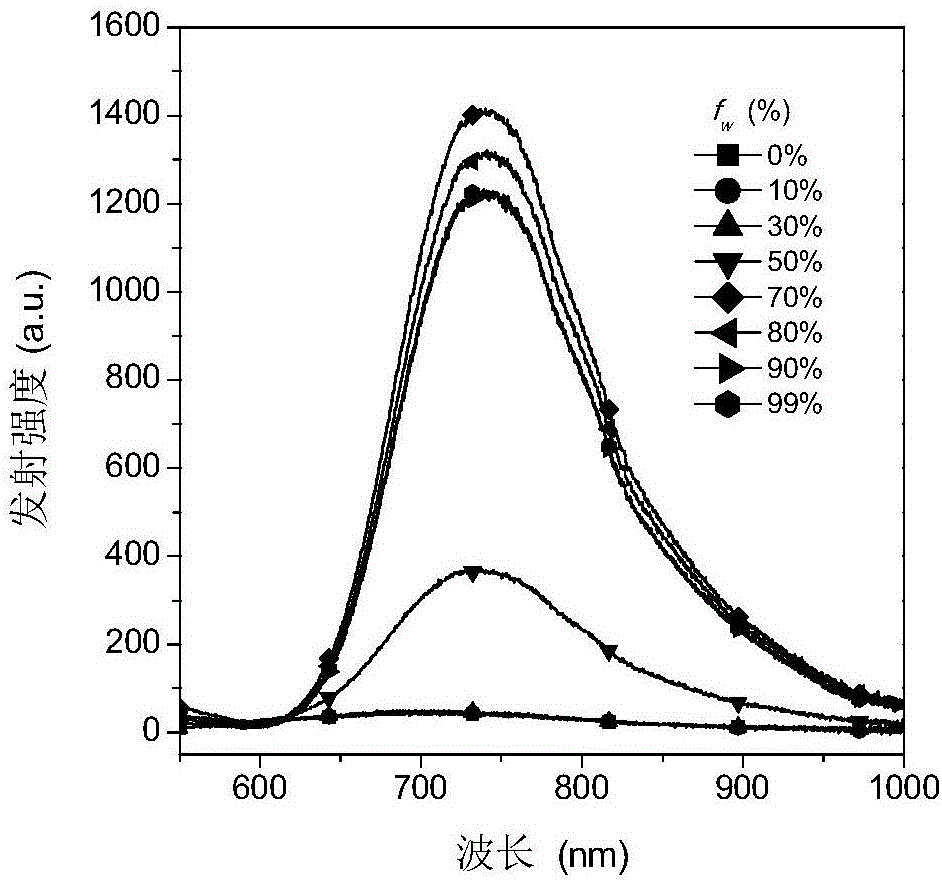
图1是实施例1制备的荧光材料在二甲基亚砜与去离子水中的荧光发射光谱图。FIG. 1 is the fluorescence emission spectrum of the fluorescent material prepared in Example 1 in dimethyl sulfoxide and deionized water.
图2是实施例1制备的荧光材料在二甲基亚砜与去离子水中的相对荧光强度图。FIG. 2 is a graph of the relative fluorescence intensity of the fluorescent material prepared in Example 1 in dimethyl sulfoxide and deionized water.
图3是实施例2制备的荧光材料在二甲基亚砜与去离子水混合体系中的荧光发射光谱图。3 is a fluorescence emission spectrum diagram of the fluorescent material prepared in Example 2 in a mixed system of dimethyl sulfoxide and deionized water.
图4是实施例2制备的荧光材料在二甲基亚砜与去离子水混合体系中的相对荧光强度图。4 is a graph of the relative fluorescence intensity of the fluorescent material prepared in Example 2 in a mixed system of dimethyl sulfoxide and deionized water.
图5是实施例1制备的荧光材料在去离子水中白光照射过程中的紫外可见吸收光谱图。FIG. 5 is an ultraviolet-visible absorption spectrum diagram of the fluorescent material prepared in Example 1 in the process of white light irradiation in deionized water.
图6是实施例1制备的荧光材料和无荧光材料存在时在去离子水中白光照射过程中的378nm处吸收的相对强度图。6 is a graph of the relative intensities of absorption at 378 nm during white light irradiation in deionized water for the fluorescent material prepared in Example 1 and in the absence of fluorescent material.
图7是实施例2制备的荧光材料在去离子水中白光照射过程中的紫外可见吸收光谱图。FIG. 7 is an ultraviolet-visible absorption spectrum diagram of the fluorescent material prepared in Example 2 in the process of white light irradiation in deionized water.
图8是实施例2制备的荧光材料和无荧光材料存在时在去离子水中白光照射过程中的378nm处吸收的相对强度图。8 is a graph of the relative intensities of the absorption at 378 nm during white light irradiation in deionized water for the fluorescent material prepared in Example 2 and in the absence of the fluorescent material.
图9是实施例4制备的荧光材料在去离子水中白光照射过程中的紫外可见吸收光谱图。FIG. 9 is an ultraviolet-visible absorption spectrum diagram of the fluorescent material prepared in Example 4 in the process of white light irradiation in deionized water.
图10是实施例4制备的荧光材料和无荧光材料存在时在去离子水中白光照射过程中的378nm处吸收的相对强度图。10 is a graph of the relative intensity of absorption at 378 nm during white light irradiation in deionized water for the fluorescent material prepared in Example 4 and in the absence of fluorescent material.
图11是实施例4制备的荧光材料在不同条件下对大肠杆菌的杀菌效果图。Figure 11 is a graph showing the bactericidal effect of the fluorescent material prepared in Example 4 on Escherichia coli under different conditions.
图12是实施例4制备的荧光材料在不同条件下对金黄葡萄杆菌的杀菌效果图。Figure 12 is a graph showing the bactericidal effect of the fluorescent material prepared in Example 4 on Staphylococcus aureus under different conditions.
具体实施方式Detailed ways
下面结合附图和实施例对本发明进一步详细说明,但本发明的保护范围不仅限于这些实施例。The present invention is further described in detail below with reference to the accompanying drawings and embodiments, but the protection scope of the present invention is not limited to these embodiments.
实施例1Example 1
1、将1.5mL(13.4mmol)间氨基苯甲醚、8.76g(40.2mmol)4-甲基碘苯、7.5g(67mmol)叔丁醇钾、483mg(2.68mmol)邻菲罗啉、510mg(2.68mmol)碘化亚铜加入20mL甲苯中,在125℃下搅拌反应20小时,过滤后旋干滤液,干法柱层析(以石油醚与乙酸乙酯体积比为100:1的混合液为洗脱剂),得到式I化合物。1. Mix 1.5mL (13.4mmol) m-aminoanisole, 8.76g (40.2mmol) 4-methyl iodobenzene, 7.5g (67mmol) potassium tert-butoxide, 483mg (2.68mmol) o-phenanthroline, 510mg ( 2.68mmol) cuprous iodide was added in 20mL of toluene, and the reaction was stirred at 125° C. for 20 hours. After filtration, the filtrate was spin-dried. eluent) to give compounds of formula I.

2、将1.74mL(18.4mmol)三溴化硼溶于18mL二氯甲烷中,并加入3.72g(12.26mmol)式I化合物的二氯甲烷溶液,在室温下搅拌反应12小时,反应完成后将反应液倒入冰水中,用去离子水和二氯甲烷萃取,以石油醚与乙酸乙酯体积比为30:1的混合液为洗脱剂),得到式II化合物。2. 1.74 mL (18.4 mmol) of boron tribromide was dissolved in 18 mL of dichloromethane, and 3.72 g (12.26 mmol) of the dichloromethane solution of the compound of formula I was added, and the reaction was stirred at room temperature for 12 hours. The reaction solution was poured into ice water, extracted with deionized water and dichloromethane, and the mixture of petroleum ether and ethyl acetate with a volume ratio of 30:1 was used as the eluent) to obtain the compound of formula II.

3、将6.8mL(88.5mmol)N,N-二甲基甲酰胺加入7mL(75.2mmol)三氯氧磷中,室温搅拌30min后加入10mL含2.56g(8.85mmol)式II化合物的N,N-二甲基甲酰胺溶液,在60℃下搅拌反应24小时,反应完成后将反应液倒入冰水中,用乙酸乙酯和饱和食盐水萃取反应液,合并有机相,干法柱层析(以石油醚与乙酸乙酯体积比为60:1的混合液为洗脱剂),得到式III化合物。3. Add 6.8 mL (88.5 mmol) of N,N-dimethylformamide into 7 mL (75.2 mmol) of phosphorus oxychloride, stir at room temperature for 30 min, and add 10 mL of N,N containing 2.56 g (8.85 mmol) of the compound of formula II. -Dimethylformamide solution, the reaction was stirred at 60 ° C for 24 hours, after the reaction was completed, the reaction solution was poured into ice water, the reaction solution was extracted with ethyl acetate and saturated brine, the organic phases were combined, and dry column chromatography ( A mixture of petroleum ether and ethyl acetate with a volume ratio of 60:1 is used as the eluent) to obtain the compound of formula III.

4、将500mg(1.58mmol)式III化合物、785mg(1.89mmol)溴化乙酸甲酯基季鏻盐、943μL(6.3mmol)1,8-二氮杂二环十一碳-7-烯溶于7mL二甲基亚砜中,180℃下回流反应3小时。反应完成后将反应液倒入冰水中,用乙酸乙酯和饱和食盐水萃取反应液,合并有机相,干法柱层析(以石油醚与乙酸乙酯体积比60:1的混合液为洗脱剂),得到式IV化合物。4. Dissolve 500 mg (1.58 mmol) of the compound of formula III, 785 mg (1.89 mmol) of bromoacetate methyl quaternary phosphonium salt, and 943 μL (6.3 mmol) of 1,8-diazabicycloundec-7-ene in In 7 mL of dimethyl sulfoxide, the reaction was refluxed at 180°C for 3 hours. After the completion of the reaction, the reaction solution was poured into ice water, the reaction solution was extracted with ethyl acetate and saturated brine, the organic phases were combined, and the dry column chromatography (using the mixture of petroleum ether and ethyl acetate volume ratio of 60:1 was used as the wash solution) stripping agent) to obtain the compound of formula IV.

5、将1.2mL(15.6mmol)N,N-二甲基甲酰胺加入1.23mL(13.25mmol)三氯氧磷中,室温搅拌30min后加入5mL含532mg(1.56mmol)式IV化合物的N,N-二甲基甲酰胺溶液,在60℃下搅拌反应24小时,反应完成后将反应液倒入冰水中,用乙酸乙酯和饱和食盐水萃取反应液,合并有机相,干法柱层析(以石油醚与乙酸乙酯体积比为30:1的混合液为洗脱剂),得到式V化合物。5. Add 1.2 mL (15.6 mmol) of N,N-dimethylformamide to 1.23 mL (13.25 mmol) of phosphorus oxychloride, stir at room temperature for 30 min and add 5 mL of N,N containing 532 mg (1.56 mmol) of the compound of formula IV. -Dimethylformamide solution, the reaction was stirred at 60 ° C for 24 hours, after the reaction was completed, the reaction solution was poured into ice water, the reaction solution was extracted with ethyl acetate and saturated brine, the organic phases were combined, and dry column chromatography ( A mixture of petroleum ether and ethyl acetate in a volume ratio of 30:1 is used as an eluent) to obtain the compound of formula V.

6、将25mg(0.068mmol)式V化合物、11.2mg(0.169mmol)丙二腈溶于1.5mL乙醇中,加入34μL 0.1mol/L氢氧化钠水溶液,80℃回流反应12小时。将反应液旋干后干法柱层析(以石油醚与乙酸乙酯体积比为10:1的混合液为洗脱剂),得到V-1所示的荧光染料,其产率为72%。6. Dissolve 25 mg (0.068 mmol) of the compound of formula V and 11.2 mg (0.169 mmol) of malononitrile in 1.5 mL of ethanol, add 34 μL of 0.1 mol/L sodium hydroxide aqueous solution, and react under reflux at 80° C. for 12 hours. The reaction solution was spin-dried and then subjected to dry column chromatography (using a mixture of petroleum ether and ethyl acetate with a volume ratio of 10:1 as the eluent) to obtain the fluorescent dye shown in V-1 with a yield of 72%. .

所得产物的结构表征数据为:1H NMR(300MHz,CDCl3)δ8.75(s,1H),8.08(s,1H),7.33(d,J=8.9Hz,1H),7.22(d,J=8.1Hz,4H),7.11(d,J=8.3Hz,4H),6.79(dd,J=8.9,2.2Hz,1H),6.62(d,J=2.0Hz,1H),2.38(s,6H).The structural characterization data of the obtained product are: 1 H NMR (300MHz, CDCl 3 )δ8.75(s, 1H), 8.08(s, 1H), 7.33(d, J=8.9Hz, 1H), 7.22(d, J =8.1Hz,4H),7.11(d,J=8.3Hz,4H),6.79(dd,J=8.9,2.2Hz,1H),6.62(d,J=2.0Hz,1H),2.38(s,6H) ).
实施例2Example 2
本实施例中,用等摩尔量的式VI化合物替换实施例1中的丙二腈,其他步骤与实施例1相同,得到V-2所示的荧光染料,其产率为75%。In this example, the malononitrile in Example 1 was replaced with an equimolar amount of the compound of formula VI, and other steps were the same as those in Example 1, to obtain the fluorescent dye shown in V-2, and the yield was 75%.

所得产物的结构表征数据为:1H NMR(300MHz,CDCl3)δ8.65(s,1H),7.71-7.55(m,5H),7.38(d,J=8.8Hz,1H),7.15(dd,J=27.4,8.2Hz,8H),6.93(s,1H),6.82(dd,J=8.8,2.2Hz,1H),6.66(d,J=2.1Hz,1H),2.37(s,6H).The structural characterization data of the obtained product are: 1 H NMR (300MHz, CDCl 3 )δ8.65(s, 1H), 7.71-7.55(m, 5H), 7.38(d, J=8.8Hz, 1H), 7.15(dd , J=27.4, 8.2Hz, 8H), 6.93(s, 1H), 6.82(dd, J=8.8, 2.2Hz, 1H), 6.66(d, J=2.1Hz, 1H), 2.37(s, 6H) .
本实施例中所用的式VI化合物根据下述方法制备得到:The compound of formula VI used in this example was prepared according to the following method:
将1g(5mmol)α-溴代苯乙酮、427mg(5mmol)氰基乙酸、201mg(5mmol)氢氧化钠、3.9mL去离子水加入18mL乙醇中,回流反应1小时,冷却固体析出,过滤得式VI化合物。1g (5mmol) α-bromoacetophenone, 427mg (5mmol) cyanoacetic acid, 201mg (5mmol) sodium hydroxide, 3.9mL deionized water were added to 18mL ethanol, the reaction was refluxed for 1 hour, the cooling solid was precipitated, and filtered to obtain Compounds of formula VI.

实施例3Example 3
本实施例中,用等摩尔量的式VII化合物替换实施例1中的丙二腈,其他步骤与实施例1相同,得到V-3所示的荧光染料,其产率为67%。In this example, the malononitrile in Example 1 was replaced with an equimolar amount of the compound of formula VII, and other steps were the same as those in Example 1, to obtain the fluorescent dye shown in V-3 with a yield of 67%.

所得产物的结构表征数据为:1H NMR(300MHz,CDCl3)δ7.97-7.82(m,2H),7.43(d,J=16.1Hz,1H),7.32(d,J=8.9Hz,1H),7.16(dd,J=29.3,8.3Hz,8H),6.82(dd,J=8.8,2.2Hz,1H),6.67(d,J=2.0Hz,1H),2.38(s,6H),1.72(s,6H).The structural characterization data of the obtained product are: 1 H NMR (300 MHz, CDCl 3 ) δ 7.97-7.82 (m, 2H), 7.43 (d, J=16.1 Hz, 1H), 7.32 (d, J=8.9 Hz, 1H) ),7.16(dd,J=29.3,8.3Hz,8H),6.82(dd,J=8.8,2.2Hz,1H),6.67(d,J=2.0Hz,1H),2.38(s,6H),1.72 (s,6H).
本实施例中所用的式VII化合物根据下述方法制备得到:The compound of formula VII used in this example is prepared according to the following method:
将3.2mL(30mmol)3-羟基-3-甲基-2-丁酮、5.9g(90mmol)丙二腈、3.8g(34mmol)乙醇镁加入30mL乙醇中,60℃下反应8小时。将反应液旋干后干法柱层析(以石油醚与乙酸乙酯体积比为20:1的混合液为洗脱剂),得到式VII化合物。3.2 mL (30 mmol) of 3-hydroxy-3-methyl-2-butanone, 5.9 g (90 mmol) of malononitrile, and 3.8 g (34 mmol) of magnesium ethoxide were added to 30 mL of ethanol, and the reaction was carried out at 60° C. for 8 hours. The reaction solution is spin-dried and then subjected to dry column chromatography (using a mixture of petroleum ether and ethyl acetate with a volume ratio of 20:1 as the eluent) to obtain the compound of formula VII.

实施例4Example 4
本实施例中,用等摩尔量的式VIII化合物替换实施例1中的丙二腈,其他步骤与实施例1相同,得到V-4所示的荧光染料,其产率为77%。In this example, the malononitrile in Example 1 was replaced with an equimolar amount of the compound of formula VIII, and the other steps were the same as those in Example 1, to obtain the fluorescent dye represented by V-4 with a yield of 77%.

所得产物的结构表征数据为:1NMR(400MHz,CDCl3)δ8.56(d,J=5.5Hz,2H),7.71(s,1H),7.50(d,J=16.2Hz,1H),7.35(d,J=5.9Hz,2H),7.24(dd,J=2.6,2.0Hz,1H),7.20(t,J=1.6Hz,1H),7.18–7.13(m,4H),7.10–7.05(m,4H),6.82(dd,J=8.7,2.3Hz,1H),6.74(d,J=2.3Hz,1H),4.54(s,3H),2.35(s,6H).The structural characterization data of the obtained product are: 1 NMR (400MHz, CDCl 3 )δ8.56(d, J=5.5Hz, 2H), 7.71(s, 1H), 7.50(d, J=16.2Hz, 1H), 7.35 (d, J=5.9Hz, 2H), 7.24 (dd, J=2.6, 2.0Hz, 1H), 7.20 (t, J=1.6Hz, 1H), 7.18–7.13 (m, 4H), 7.10–7.05( m, 4H), 6.82(dd, J=8.7, 2.3Hz, 1H), 6.74(d, J=2.3Hz, 1H), 4.54(s, 3H), 2.35(s, 6H).
本实施例中所用的式VIII化合物根据下述方法制备得到:The compound of formula VIII used in this example was prepared according to the following method:
将0.5mL(5.14mmol)4-甲基吡啶、3.2mL(51.4mmol)碘甲烷加入4mL N,N-二甲基甲酰胺中,80℃下反应8小时。用乙酸乙酯和饱和食盐水萃取反应液,合并有机相,旋干后后干法柱层析(以二氯甲烷与甲醇体积比为30:1的混合液为洗脱剂),将得到的产物溶于乙腈中,加入1.9g(10.3mmol)六氟磷酸钾,室温下搅拌反应10小时,反应完成后过滤得到式VIII化合物。0.5 mL (5.14 mmol) of 4-picoline and 3.2 mL (51.4 mmol) of methyl iodide were added to 4 mL of N,N-dimethylformamide, and the mixture was reacted at 80° C. for 8 hours. The reaction solution was extracted with ethyl acetate and saturated brine, and the organic phases were combined, spin-dried, and then dry column chromatography (using a mixed solution with a volume ratio of dichloromethane and methanol of 30:1 as the eluent), the obtained The product was dissolved in acetonitrile, 1.9 g (10.3 mmol) of potassium hexafluorophosphate was added, and the reaction was stirred at room temperature for 10 hours. After the reaction was completed, the compound of formula VIII was obtained by filtration.

发明人对上述实施例1~4制备的荧光材料进行了性能测试,具体测试如下:The inventors conducted performance tests on the fluorescent materials prepared in the above-mentioned Examples 1 to 4, and the specific tests are as follows:
1、聚集诱导发光性能测试1. Aggregation-induced luminescence performance test
分别以含水量为0%、10%、30%、50%、70%、80%、90%、99%的二甲基亚砜水溶液为溶剂,配制浓度为2×10⁻⁵mol/L的荧光材料溶液,采用日立F-7000荧光分光光度计测试荧光材料的聚集诱导发光性质,结果见图1~4。由图可见,本发明实施例1、2得到的荧光材料均具有聚集诱导发光性质。Using dimethyl sulfoxide aqueous solution with water content of 0%, 10%, 30%, 50%, 70%, 80%, 90%, and 99% as the solvent, the concentration of 2×10 -5 mol/L was prepared. The fluorescent material solution was tested by Hitachi F-7000 fluorescence spectrophotometer to test the aggregation-induced luminescence properties of the fluorescent material. The results are shown in Figures 1-4. It can be seen from the figure that the fluorescent materials obtained in Examples 1 and 2 of the present invention all have aggregation-induced luminescence properties.
2、单线态氧产生性能测试2. Singlet oxygen generation performance test
将15μL 2×10⁻⁵mol/L荧光材料的二甲基亚砜溶液(含水量为0)、15μL 2×10- 2mol/L 9,10-蒽基-双(亚甲基)二丙二酸(ABDA)的二甲基亚砜溶液加入2970μL去离子水中,实施例1,2在光照0min、1min、5min、10min、20min时进行紫外吸收光谱扫描,实施例4每光照10秒测定一次紫外吸收光谱。空白组取15μL二甲基亚砜、15μL2×10-2mol/L ABDA的二甲基亚砜溶液加入2970μL去离子水中,在光照0min、1min、5min、10min、20min进行紫外吸收光谱扫描(实施例4对应的空白组则为每光照10s测定一次)。结果见图5~10。由图可见,本发明实施例1、2、4得到的荧光材料与空白组对比,随着光照时间的增加,ABDA在378nm处的紫外吸收峰明显降低,说明实施例1、2、4得到的荧光材料在光照条件下均可产生单线态氧,从而使得ABDA的紫外吸收峰降低,其中实施例4得到的荧光材料产生单线态氧的速度最快。Mix 15μL of 2×10 -5 mol/L fluorescent material in dimethyl sulfoxide (water content is 0), 15μL of 2×10 -2 mol /L 9,10-anthracenyl-bis(methylene)dipropylene The dimethyl sulfoxide solution of diacid (ABDA) was added into 2970 μL of deionized water. In Example 1 and 2, UV absorption spectrum scanning was performed at 0min, 1min, 5min, 10min, and 20min of illumination. In Example 4, the measurement was performed once every 10 seconds of illumination. UV absorption spectrum. In the blank group, 15 μL of dimethyl sulfoxide and 15 μL of 2×10 -2 mol/L ABDA solution in dimethyl sulfoxide were added to 2970 μL of deionized water, and subjected to UV absorption spectrum scanning under illumination for 0 min, 1 min, 5 min, 10 min, and 20 min (implementation The blank group corresponding to Example 4 is measured once every 10s of illumination). The results are shown in Figures 5-10. As can be seen from the figure, the fluorescent materials obtained in Examples 1, 2, and 4 of the present invention are compared with the blank group. With the increase of illumination time, the ultraviolet absorption peak of ABDA at 378 nm is significantly reduced, indicating that the results obtained in Examples 1, 2, and 4 The fluorescent material can generate singlet oxygen under illumination conditions, thereby reducing the ultraviolet absorption peak of ABDA, and the fluorescent material obtained in Example 4 can generate singlet oxygen the fastest.
3、抑菌杀菌性能测试3. Antibacterial and bactericidal performance test
将实施例4的荧光材料溶于二甲基亚砜中,配制成1×10⁻²mol/L的荧光材料溶液。The fluorescent material of Example 4 was dissolved in dimethyl sulfoxide to prepare a fluorescent material solution of 1×10 -2 mol/L.
空白组:取1μL二甲基亚砜溶液于1mL含1×10⁴个大肠杆菌或金黄葡萄球菌的0.9%NaCl水溶液中,震荡摇匀后孵化30分钟,无白光照射。Blank group: take 1 μL of dimethyl sulfoxide solution in 1 mL of 0.9% NaCl aqueous solution containing 1×10 4 Escherichia coli or Staphylococcus aureus, shake and incubate for 30 minutes without white light irradiation.
空白光照组:取1μL二甲基亚砜溶液于1mL含1×10⁴个大肠杆菌或金黄葡萄球菌的0.9%NaCl水溶液中,震荡摇匀后孵化30分钟,25mW/cm2白光照射30分钟。Blank light group: Take 1 μL of dimethyl sulfoxide solution in 1 mL of 0.9% NaCl aqueous solution containing 1×10 4 Escherichia coli or Staphylococcus aureus, shake well, incubate for 30 minutes, and irradiate with 25mW/cm 2 white light for 30 minutes.
实验组:取1μL 1×10⁻²mol/L的荧光材料溶液于1mL含1×104个大肠杆菌或金黄葡萄球菌的0.9%NaCl水溶液中,震荡摇匀后孵化30分钟,无白光照射。Experimental group: Take 1 μL of 1×10 -2 mol/L fluorescent material solution in 1 mL of 0.9% NaCl aqueous solution containing 1×10 4 Escherichia coli or Staphylococcus aureus, shake well and incubate for 30 minutes without white light irradiation.
光照实验组:取1μL 1×10⁻²mol/L的荧光材料溶液于1mL含1×104个大肠杆菌或金黄葡萄球菌的0.9%NaCl水溶液中,震荡摇匀后孵化30分钟,25mW/cm2白光照射30分钟。Illumination experiment group: Take 1 μL of 1×10 -2 mol/L fluorescent material solution in 1 mL of 0.9% NaCl aqueous solution containing 1×10 4 Escherichia coli or Staphylococcus aureus, shake well and incubate for 30 minutes at 25mW/cm 2 White light for 30 minutes.
随后从四组细菌溶液中各取50μL分别加入2mL固体培养基上,用涂布器均匀涂抹。将培养皿放置于37℃恒温培养箱中,14小时后取出培养皿,结果见图11~12。图11是该荧光材料对大肠杆菌的杀菌效果图,其中A~D图分别为空白组、空白光照组、实验组、光照组对应的培养结果。图12是该荧光材料对金黄葡萄球菌的杀菌效果图,其中A~D图分别为空白组、空白光照组、实验组、光照组对应的培养结果。由图可见,无论是大肠杆菌还是金黄葡萄球菌,经实施例4荧光材料孵育且光照后,培养皿中均无菌落产生;经实施例4荧光材料孵育而无光照,培养皿中仍存在大量菌落;而无实施例4荧光材料孵育无论是光照或是不光照,培养皿中仍存在过量的菌落。由此说明实施例4的荧光材料可作为很好的光敏材料在光照条件下应用于杀菌抑菌方面。Then, 50 μL of each of the four groups of bacterial solutions was added to 2 mL of solid medium, and spread evenly with a spreader. The petri dish was placed in a constant temperature incubator at 37°C, and the petri dish was taken out after 14 hours. The results are shown in Figures 11-12. Fig. 11 is a graph showing the bactericidal effect of the fluorescent material on Escherichia coli, wherein graphs A to D are the culture results corresponding to the blank group, the blank illumination group, the experimental group, and the illumination group, respectively. Fig. 12 is a graph showing the bactericidal effect of the fluorescent material on Staphylococcus aureus, wherein the graphs A to D are the culture results corresponding to the blank group, the blank illumination group, the experimental group, and the illumination group, respectively. As can be seen from the figure, no matter whether it is Escherichia coli or Staphylococcus aureus, no colonies are produced in the petri dish after incubation with the fluorescent material of Example 4 and light; ; And without the fluorescent material in Example 4, whether it is illuminated or not illuminated, there are still excess colonies in the petri dish. This shows that the fluorescent material of Example 4 can be used as a good photosensitive material for sterilization and bacteriostasis under light conditions.
Claims (9)


Priority Applications (1)
| Application Number | Priority Date | Filing Date | Title |
|---|---|---|---|
| CN201811567891.3A CN111423402B (en) | 2018-12-21 | 2018-12-21 | Aggregation-induced emission type near-infrared fluorescent material and synthesis method thereof |
Applications Claiming Priority (1)
| Application Number | Priority Date | Filing Date | Title |
|---|---|---|---|
| CN201811567891.3A CN111423402B (en) | 2018-12-21 | 2018-12-21 | Aggregation-induced emission type near-infrared fluorescent material and synthesis method thereof |
Publications (2)
| Publication Number | Publication Date |
|---|---|
| CN111423402A true CN111423402A (en) | 2020-07-17 |
| CN111423402B CN111423402B (en) | 2023-02-03 |
Family
ID=71545543
Family Applications (1)
| Application Number | Title | Priority Date | Filing Date |
|---|---|---|---|
| CN201811567891.3A Expired - Fee Related CN111423402B (en) | 2018-12-21 | 2018-12-21 | Aggregation-induced emission type near-infrared fluorescent material and synthesis method thereof |
Country Status (1)
| Country | Link |
|---|---|
| CN (1) | CN111423402B (en) |
Citations (8)
| Publication number | Priority date | Publication date | Assignee | Title |
|---|---|---|---|---|
| EP0456148A1 (en) * | 1990-05-07 | 1991-11-13 | Eastman Kodak Company | Filter dyes for photographic elements |
| JPH1017604A (en) * | 1996-07-02 | 1998-01-20 | Mitsui Petrochem Ind Ltd | Visible light photosensitive resin composition and use thereof |
| EP1052261A1 (en) * | 1998-02-03 | 2000-11-15 | Kabushiki Kaisha Hayashibara Seibutsu Kagaku Kenkyujo | Pyran derivatives and use thereof |
| JP2001081090A (en) * | 1999-03-09 | 2001-03-27 | Hayashibara Biochem Lab Inc | Pyran derivative |
| US20020127428A1 (en) * | 2001-03-06 | 2002-09-12 | International Business Machines Corporation | Organic light emitting displays and new fluorescent compounds |
| JP2008528965A (en) * | 2005-01-26 | 2008-07-31 | バイオ−ラッド ラボラトリーズ,インコーポレイティド | Coumarin-based cyanine dyes for nonspecific protein binding |
| CN101759815A (en) * | 2008-12-25 | 2010-06-30 | 中国科学院理化技术研究所 | Application of Coumarin and/or Benzylidene Cycloalkanone Dye in the Preparation of Two-Photon Polymerization Resin |
| CN107098915A (en) * | 2017-05-16 | 2017-08-29 | 中国科学院理化技术研究所 | Reaction type fluorescent probe for distinguishing sulfhydryl compounds and synthetic method and application thereof |
-
2018
- 2018-12-21 CN CN201811567891.3A patent/CN111423402B/en not_active Expired - Fee Related
Patent Citations (8)
| Publication number | Priority date | Publication date | Assignee | Title |
|---|---|---|---|---|
| EP0456148A1 (en) * | 1990-05-07 | 1991-11-13 | Eastman Kodak Company | Filter dyes for photographic elements |
| JPH1017604A (en) * | 1996-07-02 | 1998-01-20 | Mitsui Petrochem Ind Ltd | Visible light photosensitive resin composition and use thereof |
| EP1052261A1 (en) * | 1998-02-03 | 2000-11-15 | Kabushiki Kaisha Hayashibara Seibutsu Kagaku Kenkyujo | Pyran derivatives and use thereof |
| JP2001081090A (en) * | 1999-03-09 | 2001-03-27 | Hayashibara Biochem Lab Inc | Pyran derivative |
| US20020127428A1 (en) * | 2001-03-06 | 2002-09-12 | International Business Machines Corporation | Organic light emitting displays and new fluorescent compounds |
| JP2008528965A (en) * | 2005-01-26 | 2008-07-31 | バイオ−ラッド ラボラトリーズ,インコーポレイティド | Coumarin-based cyanine dyes for nonspecific protein binding |
| CN101759815A (en) * | 2008-12-25 | 2010-06-30 | 中国科学院理化技术研究所 | Application of Coumarin and/or Benzylidene Cycloalkanone Dye in the Preparation of Two-Photon Polymerization Resin |
| CN107098915A (en) * | 2017-05-16 | 2017-08-29 | 中国科学院理化技术研究所 | Reaction type fluorescent probe for distinguishing sulfhydryl compounds and synthetic method and application thereof |
Non-Patent Citations (1)
| Title |
|---|
| YUE LI ET AL.: ""High-Performance Near-Infrared Aggregation-Induced Emission Luminogen with Mitophagy Regulating Capability for Multimodal Cancer Theranostics"", 《ACS NANO》 * |
Also Published As
| Publication number | Publication date |
|---|---|
| CN111423402B (en) | 2023-02-03 |
Similar Documents
| Publication | Publication Date | Title |
|---|---|---|
| CN111263751A (en) | Water-soluble compounds with aggregation-induced luminescence properties | |
| CN111303139B (en) | Compounds with aggregation-induced luminescence properties and preparation methods and applications thereof | |
| Wang et al. | Rational design of novel near-infrared fluorescent DCM derivatives and their application in bioimaging | |
| CN109054428B (en) | Preparation method of near-infrared cyanine dye | |
| CN108503658A (en) | A kind of near-infrared chlorination azepine fluorine borine dyestuff and its preparation method and application | |
| WO2013131235A1 (en) | Two-photon fluorescent probe using naphthalene as matrix and preparation method and use thereof | |
| Yu et al. | Efficiently emissive, strongly solvatochromic and lipid droplet-specific, fluorescent probes for mapping polarity in vitro | |
| CN107253965B (en) | A class of FRET molecules based on fluoroboropyrrole and coumarin and their synthesis methods | |
| CN115160345A (en) | A class of azaindole-heptamethine cyanine dyes, their synthesis methods and applications | |
| CN110684370A (en) | Near-infrared fluorescent dye based on coumarin skeleton and synthetic method thereof | |
| CN114773875B (en) | Azaindole-squaraine dye, and synthetic method and application thereof | |
| CN113004313A (en) | Double-thiophene-double-coumarin-based BODIPY near-infrared fluorescent dye and preparation method thereof | |
| CN116836565B (en) | A type of water-soluble squarylium cyanine dye and its synthesis method and application | |
| CN102286213A (en) | Near-infrared aza-BODIPY dye as well as preparation method and application thereof | |
| CN116789676B (en) | Synthesis method and application of a new photosensitizer | |
| CN111793371B (en) | A kind of 3,5-position asymmetric modified BODIPY near-infrared fluorescent dye and preparation method thereof | |
| CN108864058A (en) | A kind of xanthone fluorochrome and application | |
| CN118307969B (en) | A heptamethine cyanine dye substituted with a terroirone, its synthesis method and application | |
| CN112010807B (en) | Photosensitizer and application and preparation method thereof | |
| CN114685348A (en) | Near-infrared cyanine photosensitizer with AIE (aluminum-doped zinc oxide) property and preparation method and application thereof | |
| CN118027702B (en) | A dye with upconversion properties, its synthesis method and application. | |
| WO2023065501A1 (en) | Aggregation-induced emission mg-rho fluorescent dye, and preparation method therefor and use thereof | |
| Yan et al. | A red fluorogen: AIEE characteristic, photoluminescence mechanism and its application as chemosensor for ClO− | |
| CN111423402B (en) | Aggregation-induced emission type near-infrared fluorescent material and synthesis method thereof | |
| CN111334080B (en) | Carbonic anhydrase fluorescent probe with high brightness and high light stability |
Legal Events
| Date | Code | Title | Description |
|---|---|---|---|
| PB01 | Publication | ||
| PB01 | Publication | ||
| SE01 | Entry into force of request for substantive examination | ||
| SE01 | Entry into force of request for substantive examination | ||
| GR01 | Patent grant | ||
| GR01 | Patent grant | ||
| CF01 | Termination of patent right due to non-payment of annual fee | ||
| CF01 | Termination of patent right due to non-payment of annual fee |
Granted publication date: 20230203 |