CN111429005A - A teaching evaluation method based on feedback from a small number of students - Google Patents
A teaching evaluation method based on feedback from a small number of students Download PDFInfo
- Publication number
- CN111429005A CN111429005A CN202010213449.1A CN202010213449A CN111429005A CN 111429005 A CN111429005 A CN 111429005A CN 202010213449 A CN202010213449 A CN 202010213449A CN 111429005 A CN111429005 A CN 111429005A
- Authority
- CN
- China
- Prior art keywords
- teaching
- evaluation
- matrix
- sample
- students
- Prior art date
- Legal status (The legal status is an assumption and is not a legal conclusion. Google has not performed a legal analysis and makes no representation as to the accuracy of the status listed.)
- Granted
Links
Images

Classifications
-
- G—PHYSICS
- G06—COMPUTING OR CALCULATING; COUNTING
- G06Q—INFORMATION AND COMMUNICATION TECHNOLOGY [ICT] SPECIALLY ADAPTED FOR ADMINISTRATIVE, COMMERCIAL, FINANCIAL, MANAGERIAL OR SUPERVISORY PURPOSES; SYSTEMS OR METHODS SPECIALLY ADAPTED FOR ADMINISTRATIVE, COMMERCIAL, FINANCIAL, MANAGERIAL OR SUPERVISORY PURPOSES, NOT OTHERWISE PROVIDED FOR
- G06Q10/00—Administration; Management
- G06Q10/06—Resources, workflows, human or project management; Enterprise or organisation planning; Enterprise or organisation modelling
- G06Q10/063—Operations research, analysis or management
- G06Q10/0639—Performance analysis of employees; Performance analysis of enterprise or organisation operations
- G06Q10/06393—Score-carding, benchmarking or key performance indicator [KPI] analysis
-
- G—PHYSICS
- G06—COMPUTING OR CALCULATING; COUNTING
- G06Q—INFORMATION AND COMMUNICATION TECHNOLOGY [ICT] SPECIALLY ADAPTED FOR ADMINISTRATIVE, COMMERCIAL, FINANCIAL, MANAGERIAL OR SUPERVISORY PURPOSES; SYSTEMS OR METHODS SPECIALLY ADAPTED FOR ADMINISTRATIVE, COMMERCIAL, FINANCIAL, MANAGERIAL OR SUPERVISORY PURPOSES, NOT OTHERWISE PROVIDED FOR
- G06Q10/00—Administration; Management
- G06Q10/06—Resources, workflows, human or project management; Enterprise or organisation planning; Enterprise or organisation modelling
- G06Q10/067—Enterprise or organisation modelling
-
- G—PHYSICS
- G06—COMPUTING OR CALCULATING; COUNTING
- G06Q—INFORMATION AND COMMUNICATION TECHNOLOGY [ICT] SPECIALLY ADAPTED FOR ADMINISTRATIVE, COMMERCIAL, FINANCIAL, MANAGERIAL OR SUPERVISORY PURPOSES; SYSTEMS OR METHODS SPECIALLY ADAPTED FOR ADMINISTRATIVE, COMMERCIAL, FINANCIAL, MANAGERIAL OR SUPERVISORY PURPOSES, NOT OTHERWISE PROVIDED FOR
- G06Q50/00—Information and communication technology [ICT] specially adapted for implementation of business processes of specific business sectors, e.g. utilities or tourism
- G06Q50/10—Services
- G06Q50/20—Education
- G06Q50/205—Education administration or guidance
-
- Y—GENERAL TAGGING OF NEW TECHNOLOGICAL DEVELOPMENTS; GENERAL TAGGING OF CROSS-SECTIONAL TECHNOLOGIES SPANNING OVER SEVERAL SECTIONS OF THE IPC; TECHNICAL SUBJECTS COVERED BY FORMER USPC CROSS-REFERENCE ART COLLECTIONS [XRACs] AND DIGESTS
- Y02—TECHNOLOGIES OR APPLICATIONS FOR MITIGATION OR ADAPTATION AGAINST CLIMATE CHANGE
- Y02P—CLIMATE CHANGE MITIGATION TECHNOLOGIES IN THE PRODUCTION OR PROCESSING OF GOODS
- Y02P90/00—Enabling technologies with a potential contribution to greenhouse gas [GHG] emissions mitigation
- Y02P90/30—Computing systems specially adapted for manufacturing
Landscapes
- Business, Economics & Management (AREA)
- Human Resources & Organizations (AREA)
- Engineering & Computer Science (AREA)
- Strategic Management (AREA)
- Economics (AREA)
- Educational Administration (AREA)
- Tourism & Hospitality (AREA)
- Entrepreneurship & Innovation (AREA)
- General Physics & Mathematics (AREA)
- General Business, Economics & Management (AREA)
- Theoretical Computer Science (AREA)
- Development Economics (AREA)
- Marketing (AREA)
- Physics & Mathematics (AREA)
- Game Theory and Decision Science (AREA)
- Quality & Reliability (AREA)
- Operations Research (AREA)
- Educational Technology (AREA)
- Health & Medical Sciences (AREA)
- General Health & Medical Sciences (AREA)
- Primary Health Care (AREA)
- Image Analysis (AREA)
Abstract
本发明公开了一种基于少量学生反馈的教学评估方法,属于教学技术领域,包括构造训练样本集、构造图拉普拉斯矩阵、模型超参数设定、神经网络模型训练、进行教学评估五个主要步骤。传统的教学评估方法主要是对几种输入进行线性加权平均得出,而非考虑学生的真实反馈。与这类传统的方法相比,本发明充分考虑了学生的真实反馈,用学生的评价作为已完成教学课程的最终评价,并从已有的数据中挖掘出适合做教学课程评估的数学模型。由于大部分学生不愿意在课后给教学打分,而且打分缺乏可信度,导致训练数据标签过少与不完整等问题,本发明提供的方法能够应对这类数据集存在缺陷的情况,从而训练出具有较高准确度的评估预测模型。

The invention discloses a teaching evaluation method based on feedback from a small number of students, belonging to the field of teaching technology, comprising five steps: constructing a training sample set, constructing a graph Laplacian matrix, setting model hyperparameters, training a neural network model, and conducting teaching evaluation. The main steps. The traditional teaching evaluation method is mainly based on the linear weighted average of several inputs, rather than considering the real feedback of students. Compared with such traditional methods, the present invention fully considers the real feedback of the students, uses the students' evaluation as the final evaluation of the completed teaching course, and excavates a mathematical model suitable for teaching course evaluation from the existing data. Since most students are reluctant to rate teaching after class, and the scoring lacks credibility, resulting in problems such as too few and incomplete training data labels, the method provided by the present invention can deal with the situation that such data sets have defects, so that training A prediction model with high accuracy can be developed.
Description
技术领域technical field
本发明属于教学技术领域,特别是涉及一种基于少量学生反馈的教学评估方法。The invention belongs to the technical field of teaching, and in particular relates to a teaching evaluation method based on feedback from a small number of students.
背景技术Background technique
教学评估是教学过程中非常重要的一个环节,其评估的准确程度直接影响了教学内容、方式等方面的指定。传统的教学评估方法主要是对几种输入进行线性加权平均得出,而非考虑学生的真实反馈。这些工作相对较多。例如:CN201310113207.5旨在提供一种面向全过程的在线教育服务质量评估方法,以实际系统为依据提供全方位的评价指标和评估方法,实现了评估目标多元化、评价内容多态化、评价方式多样化,更加贴近用户需求。再例如,CN201610564845.2提供一种教学评估方法及系统,通过视频获取包含用户人脸表情的人脸图像,分析人脸表情中是否出现闭眼、点头、和打哈欠的动作,统计闭眼、点头、和打哈欠的动作出现频率,从而根据听课者的状态客观公正的评估教学效果。Teaching evaluation is a very important link in the teaching process, and the accuracy of its evaluation directly affects the designation of teaching content and methods. The traditional teaching evaluation method is mainly based on the linear weighted average of several inputs, rather than considering the real feedback of students. These jobs are relatively large. For example: CN201310113207.5 aims to provide a whole-process-oriented online education service quality evaluation method, providing a full range of evaluation indicators and evaluation methods based on the actual system, realizing the diversification of evaluation objectives, polymorphism of evaluation content, and evaluation of The methods are diversified and are closer to the needs of users. For another example, CN201610564845.2 provides a teaching evaluation method and system, obtains a face image including a user's facial expression through video, analyzes whether there are actions such as closing eyes, nodding, and yawning in the facial expressions, and counts closed eyes, The frequency of nodding and yawning movements can be used to objectively and fairly evaluate the teaching effect according to the state of the listeners.
然而,一个现实问题是大部分学生不愿意在课后给教学打分,而且打分缺乏可信度。往往评价为高分的课程,其结果是真实的;而评价为低分的课程,其结果可能包含大量的主观情绪,因此可信度较低。本专利旨在解决该问题。However, a real problem is that most students are reluctant to grade teaching after class, and the grades lack credibility. Courses rated high tend to have results that are genuine, while courses rated low may contain a lot of subjective sentiment and therefore be less credible. This patent aims to solve this problem.
发明内容SUMMARY OF THE INVENTION
本发明的目的在于克服现有技术存在的缺陷,以提高教学评估的准确性。The purpose of the present invention is to overcome the defects existing in the prior art, so as to improve the accuracy of teaching evaluation.
为实现以上目的,本发明提供一种基于少量学生反馈的教学评估方法,包括如下步骤:To achieve the above purpose, the present invention provides a teaching evaluation method based on a small amount of student feedback, comprising the following steps:
步骤S1、构造训练样本集:Step S1, construct a training sample set:
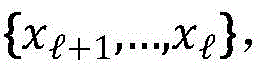
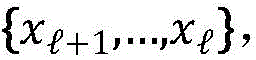
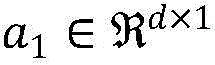
从每个阶段的教学课程中抽取出一个样本



步骤S2、构造图拉普拉斯矩阵:Step S2, construct the graph Laplacian matrix:
构造图拉普拉斯矩阵L=D-A,A为相似性矩阵,其第i行第j列元素Aij为:Construct the graph Laplacian matrix L=DA, A is the similarity matrix, and the element A ij of the i-th row and the j-th column is:

其中,xi与xj为样本,i,j∈{1,...,n},σ>0为高斯核宽,D为A的度矩阵,D为对角阵,D的第i个对角元素Dii=∑jAij;Among them, x i and x j are the samples, i, j∈{1,...,n}, σ>0 is the Gaussian kernel width, D is the degree matrix of A, D is the diagonal matrix, and the ith of D Diagonal element D ii =∑ j A ij ;
步骤S3、模型超参数设定:Step S3, model hyperparameter setting:
根据实际情况设定模型的超参数:φ,λ1,λ2>0,判定比γ∈(0,1),特征优化中间层节点数N1与分类判定中间层节点数N2,其中N1和N2均为正整数;Set the hyperparameters of the model according to the actual situation: φ, λ 1 , λ 2 >0, the decision ratio γ∈(0, 1), the number of nodes in the middle layer of feature optimization N 1 and the number of nodes in the middle layer of classification judgment N 2 , where N 1 and N 2 are both positive integers;
步骤S4、神经网络模型训练:Step S4, neural network model training:
步骤S401、构造特征优化网络模块,具体如下:Step S401, constructing a feature optimization network module, the details are as follows:
首先,随机产生N1个特征优化输入权重


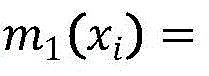


步骤S402、构造分类判定网络模块,具体如下:Step S402, constructing a classification and determination network module, the details are as follows:
首先,随机产生N2个分类判定输入权重


步骤S403、计算判定阈值,具体如下:Step S403, calculating the determination threshold, as follows:
计算样本距离μ(xi)=|m2(xiδ1)δ2-1|,将μ(x1),...,μ(xn)进行从大到小排列得到μ1≥μ2≥...≥μn,令判定阈值
步骤S5、进行教学评估:Step S5, carry out teaching evaluation:
当一个新的教学课程结束后,抽取出一个新的样本x,求取μ(x),如果μ(x)≤Γ,则评价为“好”,否则评价为“不好”或不作评价。When a new teaching course ends, a new sample x is drawn, and μ(x) is calculated. If μ(x)≤Γ, the evaluation is "good", otherwise the evaluation is "bad" or no evaluation.
其中,所涉及的激活函数τ(a,b,x)为:
与已有的技术方案相比,本发明充分考虑了学生的真实反馈,用学生的评价作为已完成教学课程的最终评价,并从已有的数据中挖掘出适合做教学课程评估的数学模型。同时,本发明提供的方法能够应对数据集存在缺陷的情况,从而训练出具有较高准确度的评估预测模型。Compared with the existing technical solutions, the present invention fully considers the real feedback of the students, uses the students' evaluation as the final evaluation of the completed teaching course, and excavates a mathematical model suitable for teaching course evaluation from the existing data. At the same time, the method provided by the present invention can deal with the situation that the data set has defects, so as to train an evaluation prediction model with higher accuracy.
附图说明Description of drawings
下面结合附图,对本发明的具体实施方式进行详细描述:Below in conjunction with the accompanying drawings, the specific embodiments of the present invention are described in detail:
图1为本发明方法流程示意图;Fig. 1 is the schematic flow chart of the method of the present invention;
具体实施方式Detailed ways
为了更进一步说明本发明的特征,请参阅以下有关本发明的详细说明与附图。所附图仅供参考与说明之用,并非用来对本发明的保护范围加以限制。To further illustrate the features of the present invention, please refer to the following detailed description and accompanying drawings of the present invention. The attached drawings are for reference and description only, and are not intended to limit the protection scope of the present invention.
如图1所示,本实施例公开了一种基于少量学生反馈的教学评估方法,包括如下步骤S1至S5:As shown in FIG. 1 , this embodiment discloses a teaching evaluation method based on feedback from a small number of students, including the following steps S1 to S5:
步骤S1、构造训练样本集:Step S1, construct a training sample set:
从每个阶段的教学课程中抽取出一个样本


步骤S2、构造图拉普拉斯矩阵:Step S2, construct the graph Laplacian matrix:
构造图拉普拉斯矩阵L=D-A,A为相似性矩阵,其第i行第j列元素Aij为:Construct the graph Laplacian matrix L=DA, A is the similarity matrix, and the element A ij of the i-th row and the j-th column is:

其中,xi与xj为样本,i,j∈{1,…,n},σ>0为高斯核宽,D为A的度矩阵,D为对角阵,D的第i个对角元素Dii=∑jAij;Among them, x i and x j are the samples, i, j∈{1,...,n}, σ>0 is the Gaussian kernel width, D is the degree matrix of A, D is the diagonal matrix, and the ith diagonal of D element D ii =∑ j A ij ;
步骤S3、模型超参数设定:Step S3, model hyperparameter setting:
根据实际情况设定模型的超参数:φ,λ1,λ2>0,判定比γ∈(0,1),特征优化中间层节点数N1与分类判定中间层节点数N2,其中N1和N2均为正整数;Set the hyperparameters of the model according to the actual situation: φ, λ 1 , λ 2 >0, the decision ratio γ∈(0, 1), the number of nodes in the middle layer of feature optimization N 1 and the number of nodes in the middle layer of classification judgment N 2 , where N 1 and N 2 are both positive integers;
步骤S4、神经网络模型训练:Step S4, neural network model training:
步骤S401、构造特征优化网络模块,具体如下:Step S401, constructing a feature optimization network module, the details are as follows:
首先,随机产生N1个特征优化输入权重


步骤S402、构造分类判定网络模块,具体如下:Step S402, constructing a network module for classification and determination, the details are as follows:
首先,随机产生N2个分类判定输入权重





步骤S403、计算判定阈值,具体如下:Step S403, calculating the determination threshold, as follows:
计算样本距离μ(xi)=|m2(xiδ1)δ2-1|,将μ(x1),…,μ(xn)进行从大到小排列得到μ1≥μ2≥…≥μn,令判定阈值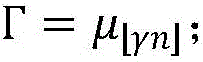
步骤S5、进行教学评估:Step S5, carry out teaching evaluation:
当一个新的教学课程结束后,抽取出一个新的样本x,求取μ(x),如果μ(x)≤Γ,则评价为“好”,否则评价为“不好”或不作评价。When a new teaching course ends, a new sample x is drawn, and μ(x) is calculated. If μ(x)≤Γ, the evaluation is "good", otherwise the evaluation is "bad" or no evaluation.
优选地,所涉及的激活函数τ(a,b,x)为:
具体实施中,样本特征可以包括教学科目、深入程度、是否板书、是否有多媒体、教学考核方式、教师性别、教师年纪、教师学历、作业平均用时、应到人数、互动程度、缺勤率、平均分、上课语言等作为特征。In the specific implementation, the sample features may include teaching subjects, depth, whether there is blackboard writing, whether there is multimedia, teaching assessment method, teacher gender, teacher age, teacher education, average homework time, number of people due, degree of interaction, absenteeism rate, average score , class language, etc. as features.
以上所述仅为本发明的较佳实施例,并不用以限制本发明,凡在本发明的精神和原则之内,所作的任何修改、等同替换、改进等,均应包含在本发明的保护范围之内。The above are only preferred embodiments of the present invention and are not intended to limit the present invention. Any modifications, equivalent replacements, improvements, etc. made within the spirit and principles of the present invention shall be included in the protection of the present invention. within the range.
Claims (2)






Priority Applications (1)
| Application Number | Priority Date | Filing Date | Title |
|---|---|---|---|
| CN202010213449.1A CN111429005B (en) | 2020-03-24 | 2020-03-24 | Teaching evaluation method based on small amount of student feedback |
Applications Claiming Priority (1)
| Application Number | Priority Date | Filing Date | Title |
|---|---|---|---|
| CN202010213449.1A CN111429005B (en) | 2020-03-24 | 2020-03-24 | Teaching evaluation method based on small amount of student feedback |
Publications (2)
| Publication Number | Publication Date |
|---|---|
| CN111429005A true CN111429005A (en) | 2020-07-17 |
| CN111429005B CN111429005B (en) | 2023-06-02 |
Family
ID=71549729
Family Applications (1)
| Application Number | Title | Priority Date | Filing Date |
|---|---|---|---|
| CN202010213449.1A Active CN111429005B (en) | 2020-03-24 | 2020-03-24 | Teaching evaluation method based on small amount of student feedback |
Country Status (1)
| Country | Link |
|---|---|
| CN (1) | CN111429005B (en) |
Citations (8)
| Publication number | Priority date | Publication date | Assignee | Title |
|---|---|---|---|---|
| JPH0313186A (en) * | 1989-06-12 | 1991-01-22 | Sanyo Electric Co Ltd | Encoder |
| US20100161275A1 (en) * | 2008-12-18 | 2010-06-24 | Abb Research Ltd. | Trend Analysis Methods and System for Incipient Fault Prediction |
| CN103226796A (en) * | 2013-04-02 | 2013-07-31 | 浙江大学 | Method for evaluating quality of whole process of on-line education service |
| CN106384364A (en) * | 2016-08-31 | 2017-02-08 | 天津大学 | LPP-ELM based objective stereoscopic image quality evaluation method |
| CN107067388A (en) * | 2016-08-31 | 2017-08-18 | 天津大学 | A kind of objective evaluation method for quality of stereo images based on GA ELM |
| WO2018010434A1 (en) * | 2016-07-13 | 2018-01-18 | 华为技术有限公司 | Image classification method and device |
| US20190325313A1 (en) * | 2018-04-20 | 2019-10-24 | Google Llc | Systems and Methods for Regularizing Neural Networks |
| CN110675382A (en) * | 2019-09-24 | 2020-01-10 | 中南大学 | Identification method of superheat degree of aluminum electrolysis based on CNN-LapsELM |
-
2020
- 2020-03-24 CN CN202010213449.1A patent/CN111429005B/en active Active
Patent Citations (8)
| Publication number | Priority date | Publication date | Assignee | Title |
|---|---|---|---|---|
| JPH0313186A (en) * | 1989-06-12 | 1991-01-22 | Sanyo Electric Co Ltd | Encoder |
| US20100161275A1 (en) * | 2008-12-18 | 2010-06-24 | Abb Research Ltd. | Trend Analysis Methods and System for Incipient Fault Prediction |
| CN103226796A (en) * | 2013-04-02 | 2013-07-31 | 浙江大学 | Method for evaluating quality of whole process of on-line education service |
| WO2018010434A1 (en) * | 2016-07-13 | 2018-01-18 | 华为技术有限公司 | Image classification method and device |
| CN106384364A (en) * | 2016-08-31 | 2017-02-08 | 天津大学 | LPP-ELM based objective stereoscopic image quality evaluation method |
| CN107067388A (en) * | 2016-08-31 | 2017-08-18 | 天津大学 | A kind of objective evaluation method for quality of stereo images based on GA ELM |
| US20190325313A1 (en) * | 2018-04-20 | 2019-10-24 | Google Llc | Systems and Methods for Regularizing Neural Networks |
| CN110675382A (en) * | 2019-09-24 | 2020-01-10 | 中南大学 | Identification method of superheat degree of aluminum electrolysis based on CNN-LapsELM |
Non-Patent Citations (7)
| Title |
|---|
| FAXIAN CAO等: "Sparse Representation-Based Augmented Multinomial Logistic Extreme Learning Machine With Weighted Composite Features for Spectral–Spatial Classification of Hyperspectral Images", 《IEEE TRANSACTIONS ON GEOSCIENCE AND REMOTE SENSING》 * |
| LIYANAARACHCHI LEKAMALAGE CHAMARA KASUN等: "Dimension reduction with extreme learning machine", 《IEEE TRANSACTIONS ON IMAGE PROCESSING》 * |
| MEIYI LI等: "Data Distribution Based Weighted Extreme Learning Machine", 《ICMLT 2019: PROCEEDINGS OF THE 2019 4TH INTERNATIONAL CONFERENCE ON MACHINE LEARNING TECHNOLOGIES》 * |
| 丁世飞等: "拉普拉斯多层极速学习机", 《软件学报》 * |
| 张钰等: "多任务学习", 《计算机学报》 * |
| 戴鹏: "高校体育在新教学理念下的教学评价分析", 《赤峰学院学报(自然科学版)》 * |
| 袁非牛等: "自编码神经网络理论及应用综述", 《计算机学报》 * |
Also Published As
| Publication number | Publication date |
|---|---|
| CN111429005B (en) | 2023-06-02 |
Similar Documents
| Publication | Publication Date | Title |
|---|---|---|
| CN112508334B (en) | Personalized examination paper method and system integrating cognitive characteristics and test question text information | |
| CN114972839B (en) | Generalized continuous classification method based on online comparison distillation network | |
| CN109902912B (en) | Personalized image aesthetic evaluation method based on character features | |
| CN109582785A (en) | Emergency event public sentiment evolution analysis method based on text vector and machine learning | |
| CN109255028A (en) | Quality of instruction integrated evaluating method based on teaching evaluation data reliability | |
| CN106528656A (en) | Student history and real-time learning state parameter-based course recommendation realization method and system | |
| CN111611375B (en) | Text emotion classification method based on deep learning and turning relation | |
| CN118505457A (en) | A learning early warning method based on improved random forest algorithm | |
| Ma | [Retracted] Study on College English Online Teaching Model in Mixed Context Based on Genetic Algorithm and Neural Network Algorithm | |
| Guo et al. | [Retracted] Music Online Education Reform and Wireless Network Optimization Using Artificial Intelligence Piano Teaching | |
| CN117668360A (en) | A personalized exercise recommendation method based on learners’ online learning behavior analysis | |
| CN119338642A (en) | A personalized teaching and training auxiliary method, system, terminal device and medium | |
| CN118673161A (en) | Knowledge graph-based online course quality evaluation big data analysis method | |
| Yan et al. | Sentiment analysis on massive open online course evaluation | |
| CN115358287B (en) | News establishment judging method and system based on heterogeneous graph neural network | |
| CN116451171A (en) | College student portrait generation method based on self-adaptive feature intersection | |
| CN110826315A (en) | Method for identifying timeliness of short text by using neural network system | |
| CN115599839A (en) | Method and system for improving teaching based on data mining algorithm | |
| CN117407527B (en) | A classification method for public opinion big data in the field of education | |
| CN111429005A (en) | A teaching evaluation method based on feedback from a small number of students | |
| CN118172703A (en) | Teaching content optimization method and system based on classroom behavior analysis | |
| CN110992229B (en) | A scientific teaching effect evaluation method based on knowledge transfer | |
| CN110046667A (en) | A kind of Method of Teaching Appraisal based on deep neural network study score data pair | |
| CN110472247A (en) | A method for predicting post answer time by multi-semantic information fusion network | |
| CN109508380A (en) | A kind of method that combination user structure similarity carries out microblog emotional analysis |
Legal Events
| Date | Code | Title | Description |
|---|---|---|---|
| PB01 | Publication | ||
| PB01 | Publication | ||
| SE01 | Entry into force of request for substantive examination | ||
| SE01 | Entry into force of request for substantive examination | ||
| CB03 | Change of inventor or designer information | ||
| CB03 | Change of inventor or designer information |
Inventor after: Wang Gang Inventor after: Tan Song Inventor before: Tan Song Inventor before: Wang Gang |
|
| GR01 | Patent grant | ||
| GR01 | Patent grant | ||
| TR01 | Transfer of patent right | ||
| TR01 | Transfer of patent right |
Effective date of registration: 20240426 Address after: Room 611-354, R&D Center Building, 3333 Xiyou Road, High tech Zone, Hefei City, Anhui Province, 230000 Patentee after: Anhui Bikaqiu Software Technology Co.,Ltd. Country or region after: China Address before: 232001 cave West Road, Huainan, Anhui Patentee before: HUAINAN NORMAL University Country or region before: China |