Disclosure of Invention
The embodiment of the invention provides a data transmission method, a device and a system carrying indication information, which are used for solving the problem of high cost of a method for reporting available bandwidth in the prior art.
A first aspect of an embodiment of the present invention provides a data transmission method with indication information, including:
a sending end node generates an indication frame;
the transmitting end node transmits the indication frame to a receiving end node;
wherein the indication frame comprises: available channel indication information, or free bandwidth information.
With reference to the first aspect, in a first possible implementation manner of the first aspect, the generating, by the sender node, an indication frame includes:
and the sending end node sets the value of a first bit of the indication frame, wherein the value of the first bit is used for identifying the available channel indication information or the idle bandwidth information.
With reference to the first possible implementation manner of the first aspect, in a second possible implementation manner of the first aspect, a value of the first bit is used to identify the available channel indication information, and the method includes:
when the value of the first bit is a first value, identifying that a main channel of the sending end node is idle and all secondary channels are busy;
and when the value of the first bit is a second value, identifying that the main channel of the sender node is idle and at least one secondary channel is idle.
With reference to the second possible implementation manner of the first aspect, in a third possible implementation manner of the first aspect, before the sending, by the sender node, the indication frame to a receiver node, the method further includes:
the sending end node scrambles the indication frame by adopting a scrambler;
when the value of the first bit is the first value, all initial state bits of the scrambler are random values;
and when the value of the first bit is the second value, at least one bit in the initial state bits of the scrambler is used for identifying whether a corresponding secondary channel is idle or not.
With reference to the first possible implementation manner of the first aspect, in a fourth possible implementation manner of the first aspect, a value of the first bit is used to identify idle bandwidth information, and the method includes:
when the value of the first bit is a first value, identifying that the indication frame does not carry idle bandwidth information;
and when the value of the first bit is a second value, identifying that the indication frame carries idle bandwidth information.
With reference to the fourth possible implementation manner of the first aspect, in a fifth possible implementation manner of the first aspect, before the sending, by the sender node, the indication frame to a receiver node, the method further includes:
the sending end node scrambles the indication frame by adopting a scrambler;
when the value of the first bit is the first value, all initial state bits of the scrambler are random values;
and when the value of the first bit is the second value, at least one bit in the initial state bits of the scrambler is used for identifying a corresponding idle bandwidth type.
With reference to any one of the first to fifth possible implementation manners of the first aspect, in a sixth possible implementation manner of the first aspect, the indication frame is a clear to send CTS frame, and accordingly, the first bit is one bit in a received address field in the CTS frame, or the first bit is at least one bit in a frame control field in the CTS frame; or,
the indication frame is a media access control layer MAC frame, and correspondingly, the first bit is a bit in the MAC frame.
With reference to the first aspect, in a seventh possible implementation manner of the first aspect, the indication frame includes: an indication field comprising a plurality of bits;
the sending end node generates an indication frame, including:
the sender node sets the values of the plurality of bits, identifies different available channel indication information by the values of the plurality of bits, or identifies different spare bandwidth information by the values of the plurality of bits.
With reference to the seventh possible implementation manner of the first aspect, in an eighth possible implementation manner of the first aspect, before the sending, by the sender node, the indication frame to a receiver node, the method further includes:
and the transmitting end node scrambles the indication frame by adopting a scrambler.
A second aspect of the embodiments of the present invention provides a data transmission method carrying indication information, including:
a receiving end node receives indication frames sent by a plurality of sending end nodes;
the receiving end node acquires indication information according to the indication frame;
wherein the indication information includes: available channel indication information, or free bandwidth information.
With reference to the second aspect, in a first possible implementation manner of the second aspect, the acquiring, by the receiver node, indication information according to the indication frame includes:
and the receiving end node acquires a value of a first bit in the indication frame according to the indication frame, wherein the value of the first bit is used for identifying the available channel indication information or the idle bandwidth information.
With reference to the first possible implementation manner of the second aspect, in a second possible implementation manner of the second aspect, a value of the first bit is used to identify the available channel indication information, and the method includes:
when the value of the first bit is a first value, identifying that a main channel of the sending end node is idle and all secondary channels are busy; and when the value of the first bit is a second value, identifying that the main channel of the sender node is idle and at least one secondary channel is idle.
With reference to the second possible implementation manner of the second aspect, in a third possible implementation manner of the second aspect, the acquiring, by the receiver node, indication information according to the indication frame includes:
the receiving end node acquires an initial state bit of a scrambler according to the scrambling code of the indication frame, and descrambles the indication frame by adopting a descrambler according to the initial state bit of the scrambler to acquire the indication information;
when the value of the first bit is the first value, all initial state bits of the scrambler are random values;
and when the value of the first bit is the second value, at least one bit in the initial state bits of the scrambler is used for identifying whether a corresponding secondary channel is idle or not.
With reference to the first possible implementation manner of the second aspect, in a fourth possible implementation manner of the second aspect, a value of the first bit is used to identify idle bandwidth information, and the method includes:
when the value of the first bit is a first value, identifying that the indication frame does not carry idle bandwidth information;
and when the value of the first bit is a second value, identifying that the indication frame carries idle bandwidth information.
With reference to the fourth possible implementation manner of the second aspect, in a fifth possible implementation manner of the second aspect, the acquiring, by the receiver node, indication information according to the indication frame includes:
the receiving end node acquires an initial state bit of a scrambler according to the scrambling code of the indication frame, and descrambles the indication frame by adopting a descrambler according to the initial state bit of the scrambler to acquire the indication information;
when the value of the first bit is the first value, all initial state bits of the scrambler are random values;
and when the value of the first bit is the second value, at least one bit in the initial state bits of the scrambler is used for identifying a corresponding idle bandwidth type.
With reference to any one of the first to fifth possible implementation manners of the second aspect, in a sixth possible implementation manner of the second aspect, the indication frame is a clear to send CTS frame, and accordingly, the first bit is one bit in a received address field in the CTS frame, or the first bit is at least one bit in a frame control field in the CTS frame; or,
the indication frame is a media access control layer MAC frame, and correspondingly, the first bit is a bit in the MAC frame.
With reference to the second aspect, in a seventh possible implementation manner of the second aspect, the indication frame includes: an indication field comprising a plurality of bits;
the values of the multiple bits identify different available channel indication information or the values of the multiple bits identify different idle bandwidth information.
With reference to the seventh possible implementation manner of the second aspect, in an eighth possible implementation manner of the second aspect, the acquiring, by the receiver node, indication information according to the indication frame includes:
and the receiving end node acquires the initial state bit of the scrambler according to the scrambling code of the indication frame, and descrambles the indication frame by adopting a descrambler according to the initial state bit of the scrambler to acquire the indication information.
A third aspect of the present invention provides a sending end node, including:
a generating module for generating an indication frame;
a sending module, configured to send the indication frame to a receiving end node;
wherein the indication frame comprises: available channel indication information, or free bandwidth information.
With reference to the third aspect, in a first possible implementation manner of the third aspect, the generating module is specifically configured to set a value of a first bit of the indication frame, where the value of the first bit is used to identify the available channel indication information or the spare bandwidth information.
With reference to the first possible implementation manner of the third aspect, in a second possible implementation manner of the third aspect, a value of the first bit is used to identify the available channel indication information, and the method includes:
when the value of the first bit is a first value, identifying that a main channel of the sending end node is idle and all secondary channels are busy;
and when the value of the first bit is a second value, identifying that the main channel of the sender node is idle and at least one secondary channel is idle.
With reference to the second possible implementation manner of the third aspect, in a third possible implementation manner of the third aspect, the sender node further includes: a scrambling module;
the scrambling module is used for scrambling the indication frame by adopting a scrambler;
when the value of the first bit is the first value, all initial state bits of the scrambler are random values;
and when the value of the first bit is the second value, at least one bit in the initial state bits of the scrambler is used for identifying whether a corresponding secondary channel is idle or not.
With reference to the first possible implementation manner of the third aspect, in a fourth possible implementation manner of the third aspect, the identifying idle bandwidth information by using a value of the first bit includes:
when the value of the first bit is a first value, identifying that the indication frame does not carry idle bandwidth information;
and when the value of the first bit is a second value, identifying that the indication frame carries idle bandwidth information.
With reference to the fourth possible implementation manner of the third aspect, in a fifth possible implementation manner of the third aspect, the sender node further includes: a scrambling module;
the scrambling module is used for scrambling the indication frame by adopting a scrambler;
when the value of the first bit is the first value, all initial state bits of the scrambler are random values;
and when the value of the first bit is the second value, at least one bit in the initial state bits of the scrambler is used for identifying a corresponding idle bandwidth type.
With reference to any one of the first to fourth possible implementation manners of the third aspect, in a sixth possible implementation manner of the third aspect, the indication frame is a clear to send CTS frame, and accordingly, the first bit is one bit in a received address field in the CTS frame, or the first bit is at least one bit in a frame control field in the CTS frame; or,
the indication frame is a media access control layer MAC frame, and correspondingly, the first bit is a bit in the MAC frame.
With reference to the third aspect, in a seventh possible implementation manner of the third aspect, the indication frame includes: an indication field comprising a plurality of bits; accordingly, the number of the first and second electrodes,
the generating module is specifically configured to set values of the multiple bits, and identify different available channel indication information through the values of the multiple bits, or identify different idle bandwidth information through the values of the multiple bits.
With reference to the seventh possible implementation manner of the third aspect, in an eighth possible implementation manner of the third aspect, the sender node further includes: a scrambling module;
and the scrambling module is used for scrambling the indication frame by adopting a scrambler.
A fourth aspect of the present invention provides a receiving end node, including:
the receiving module is used for receiving the indication frames sent by the plurality of sending end nodes by the receiving end node;
the acquisition module is used for the receiving end node to acquire the indication information according to the indication frame;
wherein the indication information includes: available channel indication information, or free bandwidth information.
With reference to the fourth aspect, in a first possible implementation manner of the fourth aspect, the obtaining module is specifically configured to obtain, according to the indication frame, a value of a first bit in the indication frame, where the value of the first bit is used to identify the available channel indication information or the idle bandwidth information.
With reference to the first possible implementation manner of the fourth aspect, in a second possible implementation manner of the fourth aspect, a value of the first bit is used to identify the available channel indication information, and the method includes:
when the value of the first bit is a first value, identifying that a main channel of the sending end node is idle and all secondary channels are busy; and when the value of the first bit is a second value, identifying that the main channel of the sender node is idle and at least one secondary channel is idle.
With reference to the second possible implementation manner of the fourth aspect, in a third possible implementation manner of the fourth aspect, the obtaining module is specifically configured to obtain an initial state bit of a scrambler according to a scrambling code of the indication frame, and descramble the indication frame by using a descrambler according to the initial state bit of the scrambler to obtain the indication information;
when the value of the first bit is the first value, all initial state bits of the scrambler are random values;
and when the value of the first bit is the second value, at least one bit in the initial state bits of the scrambler is used for identifying whether a corresponding secondary channel is idle or not.
With reference to the first possible implementation manner of the fourth aspect, in a fourth possible implementation manner of the fourth aspect, the identifying idle bandwidth information includes:
when the value of the first bit is a first value, identifying that the indication frame does not carry idle bandwidth information;
and when the value of the first bit is a second value, identifying that the indication frame carries idle bandwidth information.
With reference to the fourth possible implementation manner of the fourth aspect, in a fifth possible implementation manner of the fourth aspect, the obtaining module is specifically configured to obtain an initial state bit of a scrambler according to a scrambling code of the indication frame, and descramble the indication frame by using a descrambler according to the initial state bit of the scrambler to obtain the indication information;
when the value of the first bit is the first value, all initial state bits of the scrambler are random values;
and when the value of the first bit is the second value, at least one bit in the initial state bits of the scrambler is used for identifying a corresponding idle bandwidth type.
With reference to any one of the first to fifth possible implementation manners of the fourth aspect, in a sixth possible implementation manner of the fourth aspect, the indication frame is a CTS frame, and accordingly, the first bit is one bit in a received address field in the CTS frame, or the first bit is at least one bit in a frame control field in the CTS frame; or,
the indication frame is a media access control layer MAC frame, and correspondingly, the first bit is a bit in the MAC frame.
With reference to the fourth aspect, in a seventh possible implementation manner of the fourth aspect, the indication frame includes: an indication field comprising a plurality of bits;
the values of the multiple bits identify different available channel indication information or the values of the multiple bits identify different idle bandwidth information.
With reference to the seventh possible implementation manner of the fourth aspect, in an eighth possible implementation manner of the fourth aspect, the obtaining module is specifically configured to obtain an initial state bit of a scrambler according to the scrambling code of the indication frame, and descramble the indication frame by using a descrambler according to the initial state bit of the scrambler to obtain the indication information.
A fifth aspect of the embodiments of the present invention provides a data transmission system carrying indication information, including a plurality of sending end nodes provided in the third aspect, and a receiving end node provided in the fourth aspect;
and the receiving end node receives a plurality of indication frames sent by the sending end node.
In the data transmission method, device and system with indication information provided by the embodiment of the invention, the receiving end node can directly receive the indication frames sent by the plurality of sending end nodes, the step-by-step receiving of the indication information sent by the plurality of sending end nodes is not needed, and the receiving end node can acquire the indication information of the available channel or the idle bandwidth information according to the indication frames, thereby greatly reducing the transmission overhead.
A sixth aspect of the present invention provides a data transmission method carrying indication information, including:
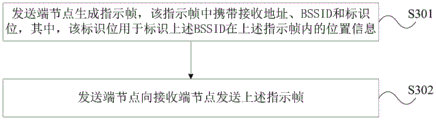
a sending end node generates an indication frame, wherein the indication frame carries a receiving address, a Basic Service Set Identification (BSSID) and an identification bit, and the identification bit is used for identifying the position information of the BSSID in the indication frame;
and the transmitting end node transmits the indication frame to a receiving end node.
With reference to the sixth aspect, in a first possible implementation manner of the sixth aspect, the generating, by the sender node, an indication frame includes:
if the receiving address in the original indication frame is the BSSID, the sending end node sets the value of the identification bit in the original indication frame as a first value to generate the indication frame; or,
if the receiving address in the original indication frame is not the BSSID, the sending end node sets the value of the identification bit in the original indication frame to be a second value, and adds the BSSID in the original indication frame to generate the indication frame.
With reference to the first possible implementation manner of the sixth aspect, in a second possible implementation manner of the sixth aspect, the indication frame is a CTS frame, and accordingly, the identification bit is one bit in a received address field in the CTS frame, or the identification bit is at least one bit in a frame control field in the CTS frame.
A seventh aspect of the present invention provides a data transmission method carrying indication information, including:
a receiving end node receives an indication frame sent by a sending end node, wherein the indication frame carries a receiving address, a Basic Service Set Identification (BSSID) and an identification bit, and the identification bit is used for identifying the position information of the BSSID in the indication frame;
and the receiving end node judges whether the receiving address of the indication frame is the same as the address of the receiving end node or not according to the receiving address, and if not, determines whether the receiving end node stops data transmission within a preset time period indicated by the indication frame or not according to the BSSID.
With reference to the seventh aspect, in a first possible implementation manner of the seventh aspect, the determining, by the receiving end node, whether the receiving end node stops data transmission within a preset time period indicated by the indication frame according to the BSSID includes:
and the receiving end node determines whether the receiving end node and the sending end node belong to the same BSS or not according to the BSSID, if so, the receiving end node stops data transmission within a preset time period indicated by the indication frame, and if not, the receiving end node can continue to transmit data.
With reference to the first possible implementation manner of the seventh aspect, in a second possible implementation manner of the seventh aspect, the identifying bit is used to identify location information of the BSSID within the indication frame, and the identifying bit includes:
when the identification bit is a first value, identifying a receiving address in the indication frame as the BSSID;
and when the identification bit is a second value, identifying that the receiving address in the indication frame is not the BSSID.
With reference to the second possible implementation manner of the seventh aspect, in a third possible implementation manner of the seventh aspect, when the identification bit is a second value, identifying that the indication frame includes a BSSID field, where the BSSID field includes the BSSID.
With reference to the second or third possible implementation manner of the seventh aspect, in a fourth possible implementation manner of the seventh aspect, the identification bit is a first bit in a received address field in the indication frame;
the receiving end node judges whether the receiving address of the indication frame is the same as the address of the receiving end node according to the receiving address field of the indication frame, including:
if the value of the first bit is a first value, the receiving end node converts the value of the first bit in the receiving address of the indication frame into a second value, and judges whether the converted receiving address is the same as the address of the receiving end node;
and if the value of the first bit is a second value, the receiving end node judges whether the receiving address of the indication frame is the same as the address of the receiving end node.
With reference to the third possible implementation manner of the seventh aspect, in a fifth possible implementation manner of the seventh aspect, the identification bit is at least one bit in a frame control field in the indication frame;
the receiving end node judges whether the receiving address of the indication frame is the same as the address of the receiving end node according to the receiving address field of the indication frame, including:
and the receiving end node judges whether the receiving address of the indication frame is the same as the address of the receiving end node.
With reference to any one of the seventh to fifth possible implementation manners of the seventh aspect, in a sixth possible implementation manner of the seventh aspect, the indication frame is a CTS frame.
An eighth aspect of the present invention provides a sending end node, including:
a generating module, configured to generate an indication frame, where the indication frame carries a receiving address, a basic service set identifier BSSID, and an identifier bit, and the identifier bit is used to identify location information of the BSSID in the indication frame;
and the sending module is used for sending the indication frame to a receiving end node.
With reference to the eighth aspect, in a first possible implementation manner of the eighth aspect, the generating module is specifically configured to set a value of an identification bit in an original indication frame to a first value to generate the indication frame if a receiving address in the original indication frame is the BSSID; or,
if the receiving address in the original indication frame is not the BSSID, setting the value of the identification bit in the original indication frame to be a second value, and adding the BSSID in the original indication frame to generate the indication frame.
With reference to the first possible implementation manner of the eighth aspect, in a second possible implementation manner of the eighth aspect, the indication frame is a CTS frame, and accordingly, the identification bit is one bit in a received address field in the CTS frame, or the identification bit is at least one bit in a frame control field in the CTS frame.
A ninth aspect of the present invention provides a receiving end node, including:
a receiving module, configured to receive an indication frame sent by a sending end node, where the indication frame carries a receiving address, a basic service set identifier BSSID, and an identifier bit, and the identifier bit is used to identify position information of the BSSID in the indication frame;
and the judging module is used for judging whether the receiving address of the indication frame is the same as the address of the receiving end node or not according to the receiving address, and if not, determining whether the receiving end node stops data transmission within a preset time period indicated by the indication frame or not according to the BSSID.
With reference to the ninth aspect, in a first possible implementation manner of the ninth aspect, the determining module is specifically configured to determine whether the receiving end node and the sending end node belong to the same BSS according to the BSSID, determine that the receiving end node stops data transmission within a preset time period indicated by the indication frame if the BSSID is the same BSS, and determine that the receiving end node can continue to transmit data if the BSSID is not the same BSS.
With reference to the first possible implementation manner of the ninth aspect, in a second possible implementation manner of the ninth aspect, the identifying bit is used to identify location information of the BSSID within the indication frame, and the identifying bit includes:
when the identification bit is a first value, identifying a receiving address in the indication frame as the BSSID;
and when the identification bit is a second value, identifying that the receiving address in the indication frame is not the BSSID.
With reference to the second possible implementation manner of the ninth aspect, in a third possible implementation manner of the ninth aspect, when the identification bit is a second value, it is identified that the indication frame includes a BSSID field, and the BSSID is included in the BSSID field.
With reference to the second or third possible implementation manner of the ninth aspect, in a fourth possible implementation manner of the ninth aspect, the identification bit is a first bit in a received address field in the indication frame;
the determining module is specifically configured to, if the value of the first bit is a first value, convert the value of the first bit in the receiving address of the indication frame into the second value, and determine whether the converted receiving address is the same as the address of the receiving-end node; and if the value of the first bit is a second value, judging whether the receiving address of the indication frame is the same as the address of the receiving end node.
With reference to the second possible implementation manner of the ninth aspect, in a fifth possible implementation manner of the ninth aspect, the identification bit is at least one bit in the indication intra frame control field;
the determining module is specifically configured to determine whether a receiving address of the indication frame is the same as an address of the receiving end node.
With reference to any one of the fifth possible implementation manner of the ninth aspect to the ninth aspect, in a sixth possible implementation manner of the ninth aspect, the indication frame is a CTS frame.
In the data transmission method and apparatus carrying indication information provided in the embodiments of the present invention, the indication frame generated by the sending end node is enabled to carry the receiving address, the BSSID, and the identification bit, so that it is ensured that the indication frame always includes the BSSID, and after receiving the indication frame, other receiving end nodes except the receiving end node corresponding to the receiving address in the indication frame can obtain the BSSID according to the indication frame to determine whether the indication frame is from the BSS to which the receiving end node belongs, and further determine whether to stop sending data within a certain time. That is, all receiving end nodes except the receiving end node corresponding to the receiving address in the indication frame do not necessarily stop sending data after correctly receiving the indication frame, and part of the receiving end nodes can judge to realize continuous data sending according to a further combination of the CCA detection result.
Detailed Description
In order to make the objects, technical solutions and advantages of the embodiments of the present invention clearer, the technical solutions in the embodiments of the present invention will be clearly and completely described below with reference to the drawings in the embodiments of the present invention, and it is obvious that the described embodiments are some, but not all, embodiments of the present invention. All other embodiments, which can be derived by a person skilled in the art from the embodiments given herein without making any creative effort, shall fall within the protection scope of the present invention.
The embodiment of the invention can be applied to W L AN, wherein the standard adopted by W L AN is Institute of Electrical and Electronics Engineers (IEEE) 802.11 series, W L AN can comprise a plurality of Basic Service Sets (BSS), and network nodes in the BSS are STAs, as shown in FIG. 1, one BBS can comprise 1 AP and 3 STAs, namely STA1, STA2 and STA 3.
The AP is a bridge connected with a network and a Wireless network, and is mainly used for connecting various Wireless network clients together and then connecting the Wireless network to the Ethernet.
Optionally, the STA may support 802.11ax standard, and further optionally, the STA supports multiple W L AN standards such as 802.11ac, 802.11n, 802.11g, 802.11b, and 802.11 a.
In the W L AN system 802.11ax introduced with the OFDMA technology, the AP may perform uplink and downlink transmission on different time-frequency resources for different STAs.
The embodiment of the invention is mainly used for reducing the overhead of the whole network. The nodes in all the following embodiments may include: an AP, or a STA.
Fig. 4 is a schematic flowchart of a first embodiment of a data transmission method with indication information according to the present invention, as shown in fig. 4, the method includes:
s101, the sending end node generates an indication frame.
S102, the sending end node sends the indication frame to the receiving end node.
Wherein, the indication frame comprises: available channel indication information, or free bandwidth information.
After receiving the indication frame, the receiving node can acquire the available channel indication information carried in the indication frame, or the idle bandwidth information.
The available channel indication information may indicate which channels are idle and the bandwidth of the channels in the idle state. The idle bandwidth information may indicate a bandwidth in an idle state. The available channel information cannot be indicated in the prior art.
The present embodiment is primarily directed to how the sending end node responds after receiving the bandwidth indication. That is, a receiving node may first send an indication frame (e.g., RTS) indicating bandwidth indication information, and the sending node responds to the indication frame (e.g., CTS) sent by the receiving node.
Specifically, a plurality of transmitting end nodes may simultaneously transmit the indication frame to a receiving end node through uplink OFDMA or Multi-User Multiple-Input Multiple-Output (MU-MIMO), so that it is not necessary to transmit idle bandwidth information to the receiving end node one by one.
In this embodiment, the sending end node generates the indication frame and directly sends the indication frame to the receiving end node, where a plurality of sending end nodes may send the indication frame to the receiving end node at the same time, and do not need to send idle bandwidth information to the receiving end node one by one, and the receiving end node may obtain available channel indication information or idle bandwidth information according to the indication frame, thereby greatly reducing transmission overhead.
Further, the above-mentioned sending end node generates the indication frame, specifically, the sending end node sets a value of a first bit of the above-mentioned indication frame, where the value of the first bit is used to identify available channel indication information or idle bandwidth information. I.e., different values of the first bit may identify different available channel indication information, or alternatively, free bandwidth information.
More specifically, the value of the first bit is used to identify the available channel indication information, and may be: when the value of the first bit is a first value, marking the main channel of the sending end node as idle and all secondary channels as busy; and when the value of the first bit is a second value, identifying that the main channel of the transmitting end node is idle and at least one secondary channel is idle.
It should be noted that, both the sender node and the receiver node may detect whether the channel is in a clear state through a Clear Channel Assessment (CCA) mechanism, and detect the channel bandwidth in the clear state and the channel bandwidth in the busy state.
Fig. 5 is a schematic structural diagram of a scrambler in the data transmission method with indication information provided in the present invention. Specifically, before the sending end node sends the indication frame to the receiving end node, the sending end node may further scramble the indication frame by using a scrambler.
As shown in fig. 5, the scrambler has 7 bits X1~X7For example, the initial state bit of the scrambler whose generator polynomial is G (X) or X7+X4+1, in the specific scrambling process, the scrambler repeatedly generates a 127-bit sequence, and performs exclusive or with the data to be scrambled to realize scrambling of the data to be scrambled. As shown in fig. 5, the indication frame is xored with the output sequence to obtain the scrambled indication frame. Specifically, the number of bits of the sequence exclusive-ored with the indication frame is the same as the number of bits of the indication frame, for example, if the number of bits of the indication frame is less than 127, the sequence equal to the number of bits of the indication frame is exclusive-ored with the indication frame from the 127-bit sequence generated by the scrambler, and if the number of bits of the indication frame is greater than 127, the 127-bit sequence is repeatedly generated twice, and the sequence equal to the number of bits of the indication frame is exclusive-ored with the indication frame from the sequence.
In the above embodiment, when the value of the first bit is a first value, that is, the primary channel of the sender node is identified as idle and all secondary channels are identified as busy, all initial status bits of the scrambler used in scrambling are random values. Specifically, taking the scrambler of fig. 5 as an example, the selection switch and 2 are directly closed, so that all initial state bits of the scrambler are randomly generated, and the scrambler continuously generates a 127-bit sequence cyclically, wherein the last 7 bits of the 127-bit sequence are the same as the initial state bits.
And when the value of the first bit is a second value, namely the main channel of the transmitting end node is identified to be idle and at least one secondary channel is identified to be idle, at least one bit in the initial state bit of the scrambler adopted during scrambling is used for identifying whether the corresponding secondary channel is idle or not.
Specifically, taking the scrambler of fig. 5 as an example, in this case, the selection switch and 1 are first closed, and a preset initial state is input, for example, a value of an initial state of 7 bits is input, at least one bit in the preset initial state is used to identify whether a corresponding secondary channel is idle, and other bits may be randomly generated. After the input is finished, the selection switch and the selection switch 2 are closed, and the scrambler continuously generates the 127-bit sequence in a circulating mode, wherein the head 7 of the 127-bit sequence is located in the same preset initial state.
For example, if the sending end node learns that the free bandwidth is less than or equal to 80MHz and greater than 20MHz from an RTS indication frame (different from the indication frame generated by the sending end node) sent by a certain receiving end node, 3 bits of a 7-bit initial state of the scrambler are used to indicate whether 3 secondary 20MHz channels at the 80MHz are available, wherein at least one secondary channel is available, and the other 4-bit initial state may be a random value.
If the transmitting end node learns that the free bandwidth is equal to 160MHz from an RTS indication frame sent by a certain receiving end node, all 7 bits in the 7-bit initial state of the scrambler are used for indicating whether 7 secondary 20MHz channels under the 160MHz are available, wherein at least one secondary channel is available. Alternatively, 5 bits in the 7-bit initial state of the scrambler are used to identify whether the better 4 20MHz channels are available, where 4 bits are used to respectively indicate whether the corresponding 4 20MHz channels are available, 1 bit identifies which 80MHz channel under the 160MHz bandwidth, and the remaining 2 bits are random values.
It should be noted that, if the sending end node learns that the free bandwidth is 20MHz from an RTS indication frame sent by a certain receiving end node, and if the sending end node is also free in the 20MHz channel, the sending end node generates and sends the indication frame, at this time, the value of the first bit is a first value, that is, a random value that is not all 0 in the initial state of a scrambler that scrambles the indication frame, and if the sending end node is busy in the 20MHz channel, the indication frame is not generated, that is, the indication frame is not sent.
In another embodiment, the value of the first bit is used to identify idle bandwidth information, and specifically may be: and when the value of the first bit is the first value, the identifier indicates that the idle bandwidth information is not carried in the frame. And when the value of the first bit is a second value, the identification indication frame carries idle bandwidth information.
Further, if carrying idle bandwidth information, it may also specifically indicate the idle bandwidth type.
Before the sending end node sends the indication frame to the receiving end node, the sending end node can also adopt a scrambler to scramble the indication frame. The scrambler can be seen in particular in fig. 5.
When the value of the first bit is the first value, that is, the indication frame does not carry idle bandwidth information, all the initial state bits of the scrambler may be random values. Namely, the selection switch and the 2 switch are directly closed, so that all initial state bits of the scrambler are randomly generated.
When the value of the first bit is the second value, at least one bit in the initial state bits of the scrambler is used to identify a corresponding idle bandwidth type, and it is required to ensure that the values of the initial state are not all 0 in specific implementation, the idle bandwidth types in the W L AN system 802.11ax may include 20MHz, 40MHz, 80MHz, and 160MHz, and 2 bits in the 7-bit initial state may be used to identify the idle bandwidth type, for example, "00" identifies 20MHz, "01" identifies 40MHz, and so on.
In this case, the selection switch is first closed with 1, a preset initial state is input, for example, a value of an initial state of 7 bits is input, at least one bit in the preset initial state is used to identify a corresponding idle bandwidth type, and after the input is completed, the selection switch is closed with 2. One embodiment is that 2 bits in the preset initial state of 7 bits identify the idle bandwidth type, and the remaining 5 bits may be a random value.
On the basis of the above embodiment, the above indication frame may be a CTS frame.
Fig. 6 is a schematic structural diagram of a CTS frame in the data transmission method with indication information provided by the present invention, and fig. 7 is a schematic structural diagram of another CTS frame in the data transmission method with indication information provided by the present invention.
As shown in fig. 6, the CTS frame includes: a "frame control" field, a "Duration" field, a "Receive Address (RA) field, and a" Frame Check Sequence (FCS) field. The data above the frame structure in fig. 6 indicates the number of bytes corresponding to each field. For example, the "frame control" field comprises 2 bytes, i.e. 16 bits.
Specifically, fig. 7 shows the internal structure of the "frame control" field, and the data above indicates the number of bits corresponding to each subfield. Wherein the subfield identified with "(0)" indicates that this subfield is meaningless and can be utilized additionally, for example, as the first bit as described above.
Accordingly, the first bit may be a bit in the "receive address" field in the CTS frame. The first bit of the MAC address indicates multicast/unicast, but since the receiving address of the CTS must be a unicast address, the transmitting end can carry information by setting the first bit of the receiving address in the CTS frame to be transmitted as a first value or a second value. The "receive address" field comprises a total of 6 bytes, of which the first bit can be used as the first bit.
Alternatively, the first bit may be at least one bit in a "frame control" field in the CTS frame. Specifically, one or more of the to DS, from DS, more slices, retries, protected frames, and the ordering subfield within the "frame control" field may be selected as the first bit as described above. For example, the to DS bit may be used as the first bit and identify specific available channel indication information, or spare bandwidth information, by the scrambler initial state. For another example, a combination of bits to DS, from DS, more slices, retries, protected frames, and ordering subfields may be used as the first bit and identify specific available channel indication information by scrambler initial state, or spare bandwidth information, for example, to DS, from DS, more slices, and retries combination value "0000" represents the first value, to DS, from DS, more slices, and retries combination value "0001" represents the second value, and others, such as "0010" is reserved bit, may be used to indicate others.
Fig. 8 is a schematic structural diagram of a MAC frame in the data transmission method with indication information according to the present invention.
The indication frame in the above embodiment may be a Medium Access Control (MAC) frame, where the MAC frame includes: data frames, management frames, or other control frames, such as trigger frames. Accordingly, the first bit may be a bit in the MAC frame. Specifically, the first bit may be one bit in a "Transmit Address (TA)" field in the MAC frame, and preferably, the first bit in the "TA" field in the MAC frame may be selected as the first bit.
Fig. 8 shows a Directional Multi-Gigabit (DMG) CTS frame in 802.11ad, which is a control frame in a MAC frame and includes a "TA" field, so that the first bit may be located in the DMG CTS frame, specifically, at least one bit in the "TA" field, and preferably, the first bit in the "TA" field in the MAC frame may be selected as the first bit.
In another embodiment, the indication frame may include: an indication field comprising a plurality of bits. Accordingly, the generating of the indication frame by the sender node specifically includes: the transmitting end node sets the values of the plurality of bits by which different available channel indication information is identified or by which different spare bandwidth information is identified.
Fig. 9 is a schematic structural diagram of another CTS frame in the data transmission method with indication information provided in the present invention. The indication frame may be a CTS frame as shown in fig. 9, where the indication field carries the available channel indication information, or idle bandwidth information.
For example, the indication field may be an 8-bit field, and the available channel indication information or the idle bandwidth information may be identified by setting a different value. Assume that for a 160MHz bandwidth, it can be identified by "11000000" that the first and second 20MHz channels are available and that the other channels are not available.
Similarly, before the sending end node sends the indication frame to the receiving end node, a scrambler is also used to scramble the indication frame. In this embodiment, there is no particular requirement on the initial state of the scrambler, and all scrambler initial states may be random, but not limited thereto.
Fig. 10 is a schematic flowchart of a second embodiment of a data transmission method with indication information according to the present invention, and as shown in fig. 10, the method includes:
s201, the receiving end node receives the indication frames sent by the plurality of sending end nodes.
Specifically, the receiving end node may receive an indication frame transmitted simultaneously by multiple transmitting end nodes through uplink OFDMA or MU-MIMO.
S202, the receiving end node acquires the indication information according to the indication frame. Wherein the indication information includes: available channel indication information, or free bandwidth information.
Specifically, the indication frame carries available channel indication information or idle bandwidth information, and the receiving end node may obtain the available channel indication information or idle bandwidth information carried in the indication frame after receiving the indication frame.
In this embodiment, the receiving end node may directly receive the indication frames sent by the multiple sending end nodes, and does not need to gradually receive the indication information sent by the multiple sending end nodes, and the receiving end node may obtain the indication information of the available channel or the idle bandwidth information according to the indication frames, thereby greatly reducing the transmission overhead.
Further, the acquiring, by the receiver node, the indication information according to the indication frame specifically includes: and the receiving end node acquires the value of a first bit in the indication frame according to the indication frame, wherein the value of the first bit is used for identifying available channel indication information or idle bandwidth information.
More specifically, the value of the first bit is used to identify the available channel indication information, and may be: when the value of the first bit is a first value, marking the main channel of the sending end node as idle and all secondary channels as busy; and when the value of the first bit is a second value, identifying that the main channel of the transmitting end node is idle and at least one secondary channel is idle.
For example, when the value of the first bit is "0", it is identified that the primary channel of the above-mentioned transmitting end node is idle and all secondary channels are busy; and when the value of the first bit is 1, the main channel of the transmitting end node is identified to be idle, and at least one secondary channel is identified to be idle.
The indication frame sent by the sending end node may be a scrambled indication frame, and accordingly, the receiving end node acquires the indication information according to the indication frame, specifically, the receiving end node acquires an initial state bit of a scrambler according to a scrambling code of the indication frame, and descrambles the indication frame by using a descrambler according to the initial state bit of the scrambler, thereby acquiring the indication information.
Fig. 11 is a schematic diagram of a service field structure in the data transmission method with indication information according to the present invention. Fig. 12 is a schematic diagram of a service field and a preamble structure in a data transmission method carrying indication information according to the present invention.
In the embodiment of the invention, the transmitting end node and the receiving end node use the same scrambler generating a polynomial by default. And the scrambler of the sending end node and the descrambler of the receiving end node are synchronized, and specifically, an indication frame of interaction between the sending end node and the receiving end node comprises a Service Field (Service Field), a data bit, a Tail bit (Tail) and filling bits which are only available when needed.
In 802.11n, referring to fig. 11, the first 7 bits of the service field are Scrambler Initialization bits (Scrambler Initialization) used to synchronize with the descrambling curer, and these bits are set to 0 to estimate the initial state of the receiver Scrambler. The remaining 9 Bits are Reserved Service Bits (Reserved Service Bits), which are also set to 0. The transmission Order (Transmit Order) starts from low bit 0 to high bit 15.
In 802.11ac, as shown in fig. 12, after 9 reserved bits in the 802.11n service field, 8 bits are set to 8-bit Cyclic Redundancy Check (CRC), calibration error detection is performed on the very high throughput field B (VHT-SIG-B) in the preamble, while the scrambler initialization bit remains 7 bits, and all of the 7 bits are set to 0.
After receiving the scrambled indication frame, the receiving end node obtains the head 7 bits of a 127-bit sequence generated by the scrambler according to the received head 7-bit data after scrambling and the head 7-bit data in the service field of the indication frame, and further reversely deduces the value of the initial state of the scrambler according to the head 7 bits of the 127-bit sequence and a generating polynomial. After the receiving end node acquires the initial state bit of the scrambler, the 127-bit sequence can be repeatedly generated, and the generated 127-bit sequence and the scrambled indication frame are subjected to exclusive or to recover the indication frame before scrambling.
It should be noted that, since the first 7 bits of data of the indication frame need to be used in the descrambling process, the sending end node sets the first 7 bits of data to a known sequence when sending the indication frame, and may set all the first 7 bits of data to 0 and place them in the service field. In the descrambling process, the receiving end node can acquire the initial state value of the scrambler.
In the above embodiment, when the first bit is a first value, all the initial state bits of the scrambler are random values. And when the value of the first bit is a second value, at least one bit in the initial state bits of the scrambler is used for identifying whether the corresponding secondary channel is idle or not. Reference may be made specifically to the foregoing embodiments, which are not described in detail herein.
In another embodiment, the value of the first bit is used to identify idle bandwidth information, and specifically includes: and when the value of the first bit is the first value, identifying that the indication frame does not carry idle bandwidth information, and when the value of the first bit is the first value, identifying that the indication frame carries idle bandwidth information. For example, when the first bit is "0", it is identified that the indication frame does not carry idle bandwidth information; and when the first bit is 1, identifying that the indication frame carries idle bandwidth information. Reference may be made specifically to the foregoing embodiments, which are not described in detail herein.
Further, the indication frame sent by the sending end node may be a scrambled indication frame, and accordingly, the receiving end node acquires the indication information according to the indication frame, specifically, the receiving end node acquires the initial state bit of the scrambler and descrambles the indication frame by using a descrambler according to the initial state bit of the scrambler, thereby acquiring the indication information. Specifically, the descrambling process may refer to the above embodiment, which is not described herein again.
It should be noted that, when the value of the first bit is the first value, all the initial state bits of the scrambler are random values. And when the value of the first bit is the second value, at least one bit in the initial state bits of the scrambler is used for identifying the corresponding idle bandwidth type. In general, when the first bit is "0", all the initial state bits of the scrambler are random values. When the first bit is "1", at least one bit of the initial status bits of the scrambler is used to identify the corresponding idle bandwidth type.
In a specific implementation process, the indication frame is a CTS frame, and accordingly, the first bit is a bit in a "receive address" field in the CTS frame, or the first bit is at least one bit in a "frame control" field in the CTS frame. In particular, reference may be made to fig. 6, 7.
The indication frame may also be a MAC frame, and accordingly the first bit may be one bit within the MAC frame. Fig. 8 shows a DMG CTS frame in 802.11ad, which is a control frame in a MAC frame, and includes a "TA" field, so that the first bit may be located in the DMG CTS frame, specifically, at least one bit in the "TA" field, and preferably, the first bit in the "TA" field in the MAC frame may be selected as the first bit.
In another embodiment, referring to fig. 9, the indication frame may include an indication field including a plurality of bits.
The values of the plurality of bits may identify different available channel indication information or the values of the plurality of bits may identify different bandwidth information.
As in the foregoing embodiment, the acquiring, by the receiver node, the indication information according to the indication frame specifically includes: and the receiving end node descrambles the indication frame by adopting a descrambler according to the initial state bit of the scrambler and the initial state bit of the scrambler to obtain the indication information. Specifically, the descrambling process may refer to the foregoing embodiments, which are not described herein again.
On the other hand, the embodiment of the invention aims at the problem that after the CTS is received by the STA in the prior art, if the CTS is not sent to the STA, the STA can directly stop transmitting data within a period of time by setting the NAV, so that the system throughput rate is low.
Fig. 13 is a schematic structural diagram of an RTS frame in the data transmission method with indication information according to the present invention. Fig. 14 is a flowchart illustrating a third embodiment of a data transmission method with indication information according to the present invention.
As shown in fig. 13, the RTS frame includes: a "frame control" field, a "duration" field, an "RA" field, a "TA" field, and an "FCS" field. The data above the frame structure in fig. 13 indicates the number of bytes corresponding to each field. For example, the "frame control" field comprises 2 bytes, i.e. 16 bits.
It can be seen that, in the RST/CST mechanism, the RST frame includes both the "RA" field and the "TA" field, so that the RST frame carries the MAC address of the AP no matter the AP sends the RST frame to the STA or the STA sends the RST frame to the AP. However, as shown in fig. 6, there is only "RA" field in the CST frame, that is, if the STA sends the CST frame to the AP according to the prior art, the CST frame carries the MAC address of the AP, and when the AP sends the CST frame to the STA, the STA does not have the MAC address of the AP. In the BSS, the MAC address of the AP is used as a BSS identifier (BSSID), so that when receiving the CST frame sent by the AP, the STA cannot determine whether the CST frame is from the BSS to which the STA belongs.
As shown in fig. 14, the method provided by this embodiment includes:
s301, the sending end node generates an indication frame, and the indication frame carries a receiving address, a BSSID and an identification bit, wherein the identification bit is used for identifying the position information of the BSSID in the indication frame.
Specifically, the identification bit identifies whether the indication frame itself has the BSSID or the BSSID is additionally added. The BSSID is a received address in the indication frame if the BSSID itself has the BSSID, and the BSSID is additionally carried in the indication frame to indicate that the BSSID is to be additionally added in the indication frame.
S302, the sending end node sends the indication frame to the receiving end node.
In this embodiment, the indication frame generated by the sending end node is enabled to carry the receiving address, the BSSID, and the identification bit, so that it is ensured that the indication frame certainly contains the BSSID, and after receiving the indication frame, other receiving end nodes except the receiving end node corresponding to the receiving address in the indication frame can obtain the BSSID according to the indication frame to determine whether the indication frame is from the BSS to which the receiving end node belongs, and further determine whether to stop sending data within a certain time. That is, all receiving end nodes except the receiving end node corresponding to the receiving address in the indication frame do not necessarily stop sending data after correctly receiving the indication frame, and part of the receiving end nodes can judge to realize continuous data sending according to a further combination of the CCA detection result.
Specifically, the sending end node generates an indication frame, specifically: if the receiving address in the original indication frame is BSSID, the sending end node sets the value of the identification bit in the original indication frame as a first value to generate the indication frame. If the receiving address in the original indication frame is not BSSID, the sending end node sets the value of the identification bit in the original indication frame to be a second value, and BSSID is added in the original indication frame to generate the indication frame.
Specifically, the indication frame may be a CTS frame.
Accordingly, the identification bit may be the first bit in the "received address" field within the CTS frame, or the identification bit may be at least one bit in the "frame control" field within the CTS frame. For example, the identification bit "1" indicates that the "reception address" field of the CTS frame is the BSSID, and the identification bit "0" indicates that the "reception address" field of the CTS frame is not the BSSID but the BSSID is additionally added.
Fig. 15 is a schematic structural diagram of another CTS frame in the data transmission method carrying indication information provided by the present invention, and as shown in fig. 15, a "BSSID" field is additionally added to the CTS frame, and is specifically used for carrying BSSID. The location structure of this field is not limited thereto.
Fig. 16 is a schematic flowchart of a fourth embodiment of a data transmission method with indication information according to the present invention, as shown in fig. 16, the method includes:
s401, the receiving end node receives an indication frame sent by the sending end node, wherein the indication frame carries a receiving address, a BSSID and an identification bit, and the identification bit is used for identifying the position information of the BSSID in the indication frame.
Specifically, the identification bit identifies whether the indication frame itself has the BSSID or the BSSID is additionally added. The BSSID is a received address in the indication frame if the BSSID itself has the BSSID, and if the BSSID is carried in the indication frame, the BSSID is added additionally.
S402, the receiving end node judges whether the receiving address of the indication frame is the same as the address of the receiving end according to the receiving address, if not, the receiving end node determines whether to stop data transmission within the preset time period indicated by the indication frame according to the BSSID.
The preset time period may be indicated by a "duration" field in the indication frame.
Specifically, if the receiving address of the indication frame is different from the address of the receiving end, further determining whether the sending end node and the receiving end node belong to the same BSS according to the BSSID, and if so, the receiving end node stops transmitting data within a preset time period by setting a NAV; if not, the receiving end node may determine to stop transmitting data or continue to transmit data within a preset time period according to the CCA detection result. That is, if the receiving end node and the transmitting end node do not belong to the same BSS, the data transmission does not have to be stopped, so as to improve the system throughput.
The receiving address of the indication frame is the same as the address of the receiving end, which indicates that the indication frame is sent to the receiving end node, and if the indication frame is different from the receiving end node, the indication frame is sent to other nodes.
As described in the foregoing embodiments, both the sender node and the receiver node may determine the idle or busy status of the channel through CCA detection, and the receiver node may determine whether the receiver node stops data transmission within a preset time period according to BSSID in combination with the CCA detection result. In this embodiment, in order to improve the possibility that nodes not in the same BSS transmit data at the same time, the spectrum utilization rate is improved. When the node correctly receives the indication frame not from the BSS, the threshold for detecting that the CCA channel is idle may be raised, that is, the condition for determining that the channel is idle is relaxed, for example, when the station detects any valid data packet on the 20MHz channel previously, and the CCA detects that the signal-to-noise ratio with the probability of exceeding 90% in 4 milliseconds is greater than or equal to-82 dBm, the node determines that the channel is busy, in this embodiment, the threshold for detecting the CCA may be raised, for example, to-72 dBm, that is, the CCA detects that the signal-to-noise ratio with the probability of exceeding 90% in 4 milliseconds is greater than or equal to-72 dBm, and the node determines that the channel is busy. That is, if the node correctly receives the indication frame and the BSSID of the indication frame indicates that the indication frame is from a different BSS, the node may continue to backoff and transmit data regardless of the CTS if the CCA detected value of the node is less than-72 dBm. If the node correctly receives the indication frame and the BSSID of the indication frame indicates that the indication frame is from the same BSS, the node sets a NAV according to the preset time of the 'duration' field of the indication frame and stops transmitting data.
In this embodiment, the indication frame received by the receiving end node includes a receiving address and a BSSID, and the receiving end node may determine whether the indication frame is addressed to itself according to the receiving address therein, and if not, may determine whether to stop transmitting data within a certain time period according to the BSSID, so that it is achieved that the data transmission may not be stopped when the receiving address in the indication frame is different from the address of the receiving end node, and system throughput is improved.
Specifically, when the identification bit is a first value, the received address in the indication frame is identified as the BSSID, and when the identification bit is a second value, the received address in the indication frame is identified as not the BSSID.
More specifically, when the identification bit is the second value, as shown in fig. 15, the indication frame includes a BSSID field, and the BSSID field includes a BSSID.
The first value may be "1" and the second value may be "0".
In another embodiment, the flag bit is a first bit in the field indicating the intra-frame received address, and accordingly:
the receiving end node determines whether the receiving address of the indication frame is the same as the address of the receiving end according to the receiving address, specifically: if the value of the first bit is the first value, the receiving end node converts the value of the first bit in the receiving address of the indication frame into the second value, and then judges whether the converted receiving address is the same as the address of the receiving end node. If the value of the first bit is a second value, the receiving end point directly judges whether the receiving address of the indication frame is the same as the address of the receiving end node.
It is understood that the first value may be "1" and the second value may be "0". The above receiving process can be analogized, i.e. reversed.
In another embodiment, the identification bit may be at least one bit in a "frame control" field in the indication frame. In this case, the receiving end node determines whether the receiving address of the indication frame is the same as the address of the receiving end based on the receiving address, and does not need to convert the address, that is, the receiving end node directly determines whether the receiving address of the indication frame is the same as the address of the receiving end node. As shown in fig. 7, one or more of the to DS, from DS, more slices, retries, protected frames, and ordering subfields within the "frame control" field may be selected as the identification bits. For example, the combination of the to DS, from DS, more slice and retry bit is used as the identification bit, wherein the value "0000" of the to DS, from DS, more slice and retry combination indicates the first value, but not limited thereto.
In the above embodiments, the indication frame may be a CTS frame, but is not limited thereto, and may also be another MAC frame, for example.
In another embodiment, the indication frame may be an RTS frame, and when the receiving end node receives the RTS frame sent by the 802.11ax device, it is determined according to the BSSID in the RTS frame that the sending end node sending the RTS frame and the receiving end node belong to the same BSS, if yes, transmission of data is stopped within a preset time period by setting a NAV, and if no, it is further determined whether to continue transmission according to a CCA detection result. When the receiving end node receives an RTS frame sent by a previous device of 802.11ax, the NAV is set directly according to the duration field in the RTS frame to stop transmitting data within the preset time period.
To distinguish between an RTS sent by an 802.11ax device and an RTS frame sent by an 802.11ax previous device, one or more of the to DS, from DS, more fragmentation, retry, protected frame, and ordering subfield in the "frame control" field of the RTS frame may be used as the identification bit. For example, a to DS bit is used to indicate whether the RTS was sent by an 802.11ax device, a to DS bit of 1 indicates that the RTS was sent by an 802.11ax device, and a to DS bit of 0 indicates that the RTS was of an 802.11ax previous device.
The foregoing 802.11ax devices refer to devices corresponding to standards before the 802.11ax standard, such as 802.11ac devices, and the like, which is not limited herein.
Those of ordinary skill in the art will understand that: all or part of the steps for implementing the method embodiments may be implemented by hardware related to program instructions, and the program may be stored in a computer readable storage medium, and when executed, the program performs the steps including the method embodiments; and the aforementioned storage medium includes: various media that can store program codes, such as ROM, RAM, magnetic or optical disks.
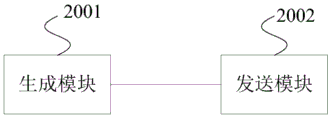
Fig. 17 is a schematic structural diagram of a first embodiment of a sender node provided in the present invention, and as shown in fig. 17, the sender node includes: a generating module 701 and a sending module 702.
A generating module 701, configured to generate an indication frame.
A sending module 702, configured to send the indication frame to the receiving end node.
Wherein the indication frame comprises: available channel indication information, or free bandwidth information.
The sender node is configured to execute the method embodiment corresponding to fig. 4, and the implementation principle and the technical effect are similar, which are not described herein again.
In another embodiment, the generating module 701 is specifically configured to set a value of a first bit of the indication frame, where the value of the first bit is used to identify the available channel indication information or the idle bandwidth information.
Specifically, the value of the first bit is used to identify the available channel indication information, and specifically includes: when the value of the first bit is a first value, identifying that a main channel of the sending end node is idle and all secondary channels are busy; and when the value of the first bit is a second value, identifying that the main channel of the sender node is idle and at least one secondary channel is idle.
Fig. 18 is a schematic structural diagram of a second embodiment of a sender node according to the present invention, and as shown in fig. 18, the sender node may further include, on the basis of fig. 17: a scrambling module 703.
A scrambling module 703, configured to scramble the indication frame by using a scrambler.
When the value of the first bit is the first value, all initial state bits of the scrambler are random values;
and when the value of the first bit is the second value, at least one bit in the initial state bits of the scrambler is used for identifying whether a corresponding secondary channel is idle or not.
In another embodiment, the value of the first bit is used to identify idle bandwidth information, including:
when the value of the first bit is a first value, identifying that the indication frame does not carry idle bandwidth information; and when the value of the first bit is a second value, identifying that the indication frame carries idle bandwidth information. Referring to fig. 18, in this embodiment, the indication frame is also scrambled, and the sender node includes a scrambling module 703 configured to scramble the indication frame by using a scrambler. When the value of the first bit is the first value, all initial state bits of the scrambler are random values; and when the value of the first bit is the second value, at least one bit in the initial state bits of the scrambler is used for identifying a corresponding idle bandwidth type.
On the basis of the above embodiment, the indication frame is a CTS frame, and accordingly, the first bit is a bit in a received address field in the CTS frame, or the first bit is at least one bit in a frame control field in the CTS frame; or, the indication frame is a MAC frame of a media access control layer, and correspondingly, the first bit is a bit in the MAC frame.
In another embodiment, the indication frame includes: an indication field comprising a plurality of bits; accordingly, the generating module 701 is specifically configured to set values of the multiple bits, and identify different available channel indication information through the values of the multiple bits, or identify different idle bandwidth information through the values of the multiple bits.
Similarly, in this embodiment, the indication frame is also scrambled, and referring to fig. 18, the sender node includes a scrambling module 703 configured to scramble the indication frame by using a scrambler.
Fig. 19 is a schematic structural diagram of a first embodiment of a receiving end node provided in the present invention, and as shown in fig. 19, the receiving end node includes: a receiving module 901 and an obtaining module 902.
A receiving module 901, configured to receive indication frames sent by multiple sender nodes by a receiver node.
And an obtaining module 902, configured to the receiving end node, obtain the indication information according to the indication frame.
Wherein the indication information includes: available channel indication information, or free bandwidth information.
The receiving end node is configured to execute the method embodiment corresponding to fig. 10, and the implementation principle and the technical effect are similar, which are not described herein again.
In another embodiment, the obtaining module 902 is specifically configured to obtain, according to the indication frame, a value of a first bit in the indication frame, where the value of the first bit is used to identify the available channel indication information or the idle bandwidth information.
Further, the value of the first bit is used for identifying the available channel indication information, and includes: when the value of the first bit is a first value, identifying that a main channel of the sending end node is idle and all secondary channels are busy; and when the value of the first bit is a second value, identifying that the main channel of the sender node is idle and at least one secondary channel is idle.
Correspondingly, the obtaining module 902 is specifically configured to obtain an initial state bit of a scrambler according to the scrambling code of the indication frame, and descramble the indication frame by using a descrambler according to the initial state bit of the scrambler to obtain the indication information. When the value of the first bit is the first value, all initial state bits of the scrambler are random values; and when the value of the first bit is the second value, at least one bit in the initial state bits of the scrambler is used for identifying whether a corresponding secondary channel is idle or not.
In another embodiment, the value of the first bit is used to identify idle bandwidth information, including: when the value of the first bit is a first value, identifying that the indication frame does not carry idle bandwidth information; and when the value of the first bit is a second value, identifying that the indication frame carries idle bandwidth information.
Correspondingly, the obtaining module 902 is specifically configured to obtain an initial state bit of a scrambler according to the scrambling code of the indication frame, and descramble the indication frame by using a descrambler according to the initial state bit of the scrambler to obtain the indication information. When the value of the first bit is the first value, all initial state bits of the scrambler are random values; and when the value of the first bit is the second value, at least one bit in the initial state bits of the scrambler is used for identifying a corresponding idle bandwidth type.
The indication frame is a Clear To Send (CTS) frame, and correspondingly, the first bit is a bit in a receiving address field in the CTS frame, or the first bit is at least one bit in a frame control field in the CTS frame; or, the indication frame is a MAC frame of a media access control layer, and correspondingly, the first bit is a bit in the MAC frame.
In another embodiment, the indication frame includes: an indication field comprising a plurality of bits; wherein the values of the plurality of bits identify different available channel indication information, or the values of the plurality of bits identify different idle bandwidth information. Correspondingly, the obtaining module 902 is specifically configured to obtain an initial state bit of a scrambler according to the scrambling code of the indication frame, and descramble the indication frame by using a descrambler according to the initial state bit of the scrambler to obtain the indication information.
An embodiment of the present invention further provides a data transmission system carrying indication information, including: a plurality of the aforementioned sender nodes and one of the aforementioned receiver nodes.
The receiving end node may receive the indication frames sent by the plurality of sending end nodes. Specifically, the receiving end node may receive the indication frame simultaneously transmitted by the multiple transmitting end nodes.
Fig. 20 is a schematic structural diagram of a third embodiment of a sending end node provided in the present invention, and as shown in fig. 20, the sending end node includes: a generating module 2001 and a sending module 2002. Wherein,
a generating module 2001, configured to generate an indication frame, where the indication frame carries a receiving address, a BSSID and an identification bit, and the identification bit is used to identify location information of the BSSID in the indication frame.
A sending module 2002, configured to send the indication frame to the receiving end node.
The sending end node is configured to execute the method embodiment corresponding to fig. 14, and the implementation principle and the technical effect are similar, which are not described herein again.
In another embodiment, the generating module 2001 is specifically configured to set a value of an identification bit in an original indication frame to a first value to generate the indication frame if a receiving address in the original indication frame is the BSSID; or if the receiving address in the original indication frame is not the BSSID, setting the value of the identification bit in the original indication frame to be a second value, and adding the BSSID in the original indication frame to generate the indication frame.
On the basis of the above embodiment, the indication frame is a CTS frame allowed to be sent, and accordingly, the identification bit is one bit in a received address field in the CTS frame, or the identification bit is at least one bit in a frame control field in the CTS frame.
Fig. 21 is a schematic structural diagram of a second embodiment of a receiving end node provided in the present invention, and as shown in fig. 21, the receiving end node includes: a receiving module 2101 and a determining module 2102. Wherein,
a receiving module 2101 is configured to receive an indication frame sent by a sending end node, where the indication frame carries a receiving address, a BSSID, and an identification bit, and the identification bit is used to identify location information of the BSSID in the indication frame.
A determining module 2102, configured to determine, according to the receiving address, whether the receiving address of the indication frame is the same as the address of the receiving end node, and if not, determine, according to the BSSID, whether the receiving end node stops data transmission within a preset time period indicated by the indication frame.
The receiving end node is configured to execute the method embodiment corresponding to fig. 16, and the implementation principle and the technical effect are similar, which are not described herein again.
In another embodiment, the determining module 2102 is specifically configured to determine whether the receiving end node and the sending end node belong to the same BSS according to the BSSID, if so, determine that the receiving end node stops data transmission within a preset time period indicated by the indication frame, and if not, determine that the receiving end node can continue to transmit data.
The identification bit is used for identifying the position information of the BSSID in the indication frame, and comprises the following steps: when the identification bit is a first value, identifying a receiving address in the indication frame as the BSSID; and when the identification bit is a second value, identifying that the receiving address in the indication frame is not the BSSID.
And when the identification bit is a second value, identifying that the indication frame contains a BSSID field, wherein the BSSID field contains the BSSID.
In another embodiment, the identification bit is a first bit in a received address field within the indication frame. Correspondingly, the determining module 2102 is specifically configured to, if the value of the first bit is a first value, convert the value of the first bit in the receiving address of the indication frame into the second value, and determine whether the converted receiving address is the same as the address of the receiving end node; and if the value of the first bit is a second value, judging whether the receiving address of the indication frame is the same as the address of the receiving end node.
In another embodiment, the identification bit is at least one bit in a frame control field in the indication frame; the determining module 2102 is specifically configured to determine whether a receiving address of the indication frame is the same as an address of the receiving end node.
On the basis of the above embodiment, the above indication frame may be a CTS frame.
Fig. 22 is a schematic structural diagram of a fourth sending end node according to the present invention, and as shown in fig. 22, the sending end node includes: a processor 2201 and a transmitter 2202, wherein,
and a processor 2201 for generating the indication frame.
A transmitter 2202 configured to transmit the indication frame to a receiving end node.
Wherein the indication frame comprises: available channel indication information, or free bandwidth information.
The sender node is configured to execute the method embodiment corresponding to fig. 4, and the implementation principle and the technical effect are similar, which are not described herein again.
In another embodiment, the processor 2201 is specifically configured to set a value of a first bit of the indication frame, where the value of the first bit is used to identify the available channel indication information or the idle bandwidth information.
Specifically, the value of the first bit is used to identify the available channel indication information, and specifically includes: when the value of the first bit is a first value, identifying that a main channel of the sending end node is idle and all secondary channels are busy; and when the value of the first bit is a second value, identifying that the main channel of the sender node is idle and at least one secondary channel is idle.
In another embodiment, the processor 2201 is configured to scramble the indication frame by a scrambler.
When the value of the first bit is the first value, all initial state bits of the scrambler are random values; and when the value of the first bit is the second value, at least one bit in the initial state bits of the scrambler is used for identifying whether a corresponding secondary channel is idle or not.
In another embodiment, the value of the first bit is used to identify idle bandwidth information, including:
when the value of the first bit is a first value, identifying that the indication frame does not carry idle bandwidth information; and when the value of the first bit is a second value, identifying that the indication frame carries idle bandwidth information. Also, the processor 2201 is further configured to scramble the indication frame with a scrambler. When the value of the first bit is the first value, all initial state bits of the scrambler are random values; and when the value of the first bit is the second value, at least one bit in the initial state bits of the scrambler is used for identifying a corresponding idle bandwidth type.
On the basis of the above embodiment, the indication frame is a CTS frame, and accordingly, the first bit is a bit in a received address field in the CTS frame, or the first bit is at least one bit in a frame control field in the CTS frame; or, the indication frame is a MAC frame of a media access control layer, and correspondingly, the first bit is a bit in the MAC frame.
In another embodiment, the indication frame includes: an indication field comprising a plurality of bits; accordingly, the processor 2201 is specifically configured to set values of the multiple bits, identify different available channel indication information through the values of the multiple bits, or identify different idle bandwidth information through the values of the multiple bits. Also, in this embodiment, the processor 2201 scrambles the indication frame.
Fig. 23 is a schematic structural diagram of a third receiving end node according to the embodiment of the present invention, and as shown in fig. 23, the receiving end node includes: a receiver 2301 and a processor 2302. Wherein,
a receiver 2301 for receiving indication frames sent by multiple sender nodes by a receiver node.
And the processor 2302 is used for the receiving end node to acquire the indication information according to the indication frame.
Wherein the indication information includes: available channel indication information, or free bandwidth information.
The receiving end node is configured to execute the method embodiment corresponding to fig. 10, and the implementation principle and the technical effect are similar, which are not described herein again.
In another embodiment, the processor 2302 is specifically configured to obtain a value of a first bit in the indication frame according to the indication frame, where the value of the first bit is used to identify the available channel indication information or the idle bandwidth information.
Further, the value of the first bit is used for identifying the available channel indication information, and includes: when the value of the first bit is a first value, identifying that a main channel of the sending end node is idle and all secondary channels are busy; and when the value of the first bit is a second value, identifying that the main channel of the sender node is idle and at least one secondary channel is idle.
Correspondingly, the processor 2302 is specifically configured to obtain an initial state bit of a scrambler according to the scrambling code of the indication frame, and descramble the indication frame by using a descrambler according to the initial state bit of the scrambler, so as to obtain the indication information. When the value of the first bit is the first value, all initial state bits of the scrambler are random values; and when the value of the first bit is the second value, at least one bit in the initial state bits of the scrambler is used for identifying whether a corresponding secondary channel is idle or not.
In another embodiment, the value of the first bit is used to identify idle bandwidth information, including: when the value of the first bit is a first value, identifying that the indication frame does not carry idle bandwidth information; and when the value of the first bit is a second value, identifying that the indication frame carries idle bandwidth information.
Correspondingly, the processor 2302 is specifically configured to obtain an initial state bit of a scrambler according to the scrambling code of the indication frame, and descramble the indication frame by using a descrambler according to the initial state bit of the scrambler, so as to obtain the indication information. When the value of the first bit is the first value, all initial state bits of the scrambler are random values; and when the value of the first bit is the second value, at least one bit in the initial state bits of the scrambler is used for identifying a corresponding idle bandwidth type.
The indication frame is a Clear To Send (CTS) frame, and correspondingly, the first bit is a bit in a receiving address field in the CTS frame, or the first bit is at least one bit in a frame control field in the CTS frame; or, the indication frame is a MAC frame of a media access control layer, and correspondingly, the first bit is a bit in the MAC frame.
In another embodiment, the indication frame includes: an indication field comprising a plurality of bits; wherein the values of the plurality of bits identify different available channel indication information, or the values of the plurality of bits identify different idle bandwidth information. Correspondingly, the processor 2302 is specifically configured to obtain an initial state bit of a scrambler according to the scrambling code of the indication frame, and descramble the indication frame by using a descrambler according to the initial state bit of the scrambler, so as to obtain the indication information.
An embodiment of the present invention further provides a data transmission system carrying indication information, including: a plurality of the sender nodes shown in fig. 22 and one receiver node shown in fig. 23.
The receiving end node may receive the indication frames sent by the plurality of sending end nodes. Specifically, the receiving end node may receive the indication frame simultaneously transmitted by the multiple transmitting end nodes.
Fig. 24 is a schematic structural diagram of a fifth embodiment of a sending end node provided in the present invention, and as shown in fig. 24, the receiving end node includes: a processor 2401 and a transmitter 2402.
A processor 2401, configured to generate an indication frame, where the indication frame carries a receiving address, a basic service set identifier BSSID, and an identification bit, and the identification bit is used to identify location information of the BSSID in the indication frame.
A transmitter 2402, configured to send the indication frame to a receiving end node.
The sending end node is configured to execute the method embodiment corresponding to fig. 14, and the implementation principle and the technical effect are similar, which are not described herein again.
In another embodiment, the processor 2401 is specifically configured to set a value of an identification bit in an original indication frame to a first value to generate the indication frame if a receiving address in the original indication frame is the BSSID; or if the receiving address in the original indication frame is not the BSSID, setting the value of the identification bit in the original indication frame to be a second value, and adding the BSSID in the original indication frame to generate the indication frame.
On the basis of the above embodiment, the indication frame is a CTS frame allowed to be sent, and accordingly, the identification bit is one bit in a received address field in the CTS frame, or the identification bit is at least one bit in a frame control field in the CTS frame.
Fig. 25 is a schematic structural diagram of a fourth receiving end node according to the present invention, and as shown in fig. 25, the receiving end node includes: a receiver 2501 and a processor 2502. Wherein,
a receiver 2501, configured to receive an indication frame sent by a sending end node, where the indication frame carries a receiving address, a BSSID, and an identification bit, and the identification bit is used to identify position information of the BSSID in the indication frame.
A processor 2502, configured to determine, according to the receiving address, whether the receiving address of the indication frame is the same as the address of the receiving end node, and if not, determine, according to the BSSID, whether the receiving end node stops data transmission within a preset time period indicated by the indication frame.
The receiving end node is configured to execute the method embodiment corresponding to fig. 16, and the implementation principle and the technical effect are similar, which are not described herein again.
In another embodiment, the processor 2502 is specifically configured to determine whether the receiving end node and the sending end node belong to the same BSS according to the BSSID, determine that the receiving end node stops data transmission within a preset time period indicated by the indication frame if the receiving end node and the sending end node belong to the same BSS, and determine that the receiving end node can continue to transmit data if the receiving end node and the sending end node do not belong to the same BSS.
The identification bit is used for identifying the position information of the BSSID in the indication frame, and comprises the following steps: when the identification bit is a first value, identifying a receiving address in the indication frame as the BSSID; and when the identification bit is a second value, identifying that the receiving address in the indication frame is not the BSSID.
And when the identification bit is a second value, identifying that the indication frame contains a BSSID field, wherein the BSSID field contains the BSSID.
In another embodiment, the identification bit is a first bit in a received address field within the indication frame. Correspondingly, the processor 2502 is specifically configured to, if the value of the first bit is a first value, convert the value of the first bit in the receiving address of the indication frame into the second value, and determine whether the converted receiving address is the same as the address of the receiving end node; and if the value of the first bit is a second value, judging whether the receiving address of the indication frame is the same as the address of the receiving end node.
In another embodiment, the identification bit is at least one bit in a frame control field in the indication frame; accordingly, the processor 2502 is specifically configured to determine whether a receiving address of the indication frame is the same as an address of the receiving end node.
On the basis of the above embodiment, the above indication frame may be a CTS frame.
Finally, it should be noted that: the above embodiments are only used to illustrate the technical solution of the present invention, and not to limit the same; while the invention has been described in detail and with reference to the foregoing embodiments, it will be understood by those skilled in the art that: the technical solutions described in the foregoing embodiments may still be modified, or some or all of the technical features may be equivalently replaced; and the modifications or the substitutions do not make the essence of the corresponding technical solutions depart from the scope of the technical solutions of the embodiments of the present invention.