CN111499372A - A low-temperature energy-saving method for preparing LiMgPO4 microwave ceramic materials - Google Patents
A low-temperature energy-saving method for preparing LiMgPO4 microwave ceramic materials Download PDFInfo
- Publication number
- CN111499372A CN111499372A CN202010262068.2A CN202010262068A CN111499372A CN 111499372 A CN111499372 A CN 111499372A CN 202010262068 A CN202010262068 A CN 202010262068A CN 111499372 A CN111499372 A CN 111499372A
- Authority
- CN
- China
- Prior art keywords
- limgpo
- product prepared
- temperature
- mold
- microwave
- Prior art date
- Legal status (The legal status is an assumption and is not a legal conclusion. Google has not performed a legal analysis and makes no representation as to the accuracy of the status listed.)
- Pending
Links
Images


Classifications
-
- C—CHEMISTRY; METALLURGY
- C04—CEMENTS; CONCRETE; ARTIFICIAL STONE; CERAMICS; REFRACTORIES
- C04B—LIME, MAGNESIA; SLAG; CEMENTS; COMPOSITIONS THEREOF, e.g. MORTARS, CONCRETE OR LIKE BUILDING MATERIALS; ARTIFICIAL STONE; CERAMICS; REFRACTORIES; TREATMENT OF NATURAL STONE
- C04B35/00—Shaped ceramic products characterised by their composition; Ceramics compositions; Processing powders of inorganic compounds preparatory to the manufacturing of ceramic products
- C04B35/01—Shaped ceramic products characterised by their composition; Ceramics compositions; Processing powders of inorganic compounds preparatory to the manufacturing of ceramic products based on oxide ceramics
- C04B35/447—Shaped ceramic products characterised by their composition; Ceramics compositions; Processing powders of inorganic compounds preparatory to the manufacturing of ceramic products based on oxide ceramics based on phosphates, e.g. hydroxyapatite
-
- C—CHEMISTRY; METALLURGY
- C04—CEMENTS; CONCRETE; ARTIFICIAL STONE; CERAMICS; REFRACTORIES
- C04B—LIME, MAGNESIA; SLAG; CEMENTS; COMPOSITIONS THEREOF, e.g. MORTARS, CONCRETE OR LIKE BUILDING MATERIALS; ARTIFICIAL STONE; CERAMICS; REFRACTORIES; TREATMENT OF NATURAL STONE
- C04B35/00—Shaped ceramic products characterised by their composition; Ceramics compositions; Processing powders of inorganic compounds preparatory to the manufacturing of ceramic products
- C04B35/622—Forming processes; Processing powders of inorganic compounds preparatory to the manufacturing of ceramic products
- C04B35/64—Burning or sintering processes
- C04B35/645—Pressure sintering
-
- C—CHEMISTRY; METALLURGY
- C04—CEMENTS; CONCRETE; ARTIFICIAL STONE; CERAMICS; REFRACTORIES
- C04B—LIME, MAGNESIA; SLAG; CEMENTS; COMPOSITIONS THEREOF, e.g. MORTARS, CONCRETE OR LIKE BUILDING MATERIALS; ARTIFICIAL STONE; CERAMICS; REFRACTORIES; TREATMENT OF NATURAL STONE
- C04B2235/00—Aspects relating to ceramic starting mixtures or sintered ceramic products
- C04B2235/02—Composition of constituents of the starting material or of secondary phases of the final product
- C04B2235/30—Constituents and secondary phases not being of a fibrous nature
- C04B2235/32—Metal oxides, mixed metal oxides, or oxide-forming salts thereof, e.g. carbonates, nitrates, (oxy)hydroxides, chlorides
- C04B2235/3205—Alkaline earth oxides or oxide forming salts thereof, e.g. beryllium oxide
- C04B2235/3206—Magnesium oxides or oxide-forming salts thereof
-
- C—CHEMISTRY; METALLURGY
- C04—CEMENTS; CONCRETE; ARTIFICIAL STONE; CERAMICS; REFRACTORIES
- C04B—LIME, MAGNESIA; SLAG; CEMENTS; COMPOSITIONS THEREOF, e.g. MORTARS, CONCRETE OR LIKE BUILDING MATERIALS; ARTIFICIAL STONE; CERAMICS; REFRACTORIES; TREATMENT OF NATURAL STONE
- C04B2235/00—Aspects relating to ceramic starting mixtures or sintered ceramic products
- C04B2235/02—Composition of constituents of the starting material or of secondary phases of the final product
- C04B2235/30—Constituents and secondary phases not being of a fibrous nature
- C04B2235/44—Metal salt constituents or additives chosen for the nature of the anions, e.g. hydrides or acetylacetonate
- C04B2235/442—Carbonates
-
- C—CHEMISTRY; METALLURGY
- C04—CEMENTS; CONCRETE; ARTIFICIAL STONE; CERAMICS; REFRACTORIES
- C04B—LIME, MAGNESIA; SLAG; CEMENTS; COMPOSITIONS THEREOF, e.g. MORTARS, CONCRETE OR LIKE BUILDING MATERIALS; ARTIFICIAL STONE; CERAMICS; REFRACTORIES; TREATMENT OF NATURAL STONE
- C04B2235/00—Aspects relating to ceramic starting mixtures or sintered ceramic products
- C04B2235/70—Aspects relating to sintered or melt-casted ceramic products
- C04B2235/74—Physical characteristics
- C04B2235/77—Density
-
- C—CHEMISTRY; METALLURGY
- C04—CEMENTS; CONCRETE; ARTIFICIAL STONE; CERAMICS; REFRACTORIES
- C04B—LIME, MAGNESIA; SLAG; CEMENTS; COMPOSITIONS THEREOF, e.g. MORTARS, CONCRETE OR LIKE BUILDING MATERIALS; ARTIFICIAL STONE; CERAMICS; REFRACTORIES; TREATMENT OF NATURAL STONE
- C04B2235/00—Aspects relating to ceramic starting mixtures or sintered ceramic products
- C04B2235/70—Aspects relating to sintered or melt-casted ceramic products
- C04B2235/96—Properties of ceramic products, e.g. mechanical properties such as strength, toughness, wear resistance
Landscapes
- Engineering & Computer Science (AREA)
- Chemical & Material Sciences (AREA)
- Ceramic Engineering (AREA)
- Manufacturing & Machinery (AREA)
- Materials Engineering (AREA)
- Structural Engineering (AREA)
- Organic Chemistry (AREA)
- Inorganic Chemistry (AREA)
- Compositions Of Oxide Ceramics (AREA)
- Inorganic Insulating Materials (AREA)
Abstract
本发明公开一种低温节能制备LiMgPO4微波陶瓷材料的方法,LiMgPO4与不高于20wt%的水或者醋酸混合,形成固液混合物,再采用热压方法,通过调节烧结温度(ST)、保温时间(T)和施加压力(P)实现其致密化成陶瓷,其中:ST为150℃,200℃,250℃或300℃;T=30min,60min或90min;P=350MPa或600MPa;通过该方法获得的LiMgPO4陶瓷,其介电常数(εr)范围为5.1~6.5,品质因数Q×f的范围为3,600GHz~16,000GHz,谐振频率温度系数(TCF)的范围为‑46.1ppm/℃~‑59.5ppm/℃。该方法制备的LiMgPO4微波陶瓷材料在微波射频系统(例如5G/6G通讯系统)等中可以作为基片、谐振天线等电子元器件材料使用。相比于常规陶瓷烧结(HTCC与LTCC)技术,该方法不仅可以在较低的温度范围内实现致密化,还可以减少其制备加工过程中碳排放和能源消耗。
The invention discloses a method for preparing LiMgPO 4 microwave ceramic material with low temperature and energy saving. LiMgPO 4 is mixed with water or acetic acid not higher than 20 wt % to form a solid-liquid mixture, and then a hot pressing method is used to adjust the sintering temperature (ST), heat preservation Time (T) and applied pressure (P) to achieve its densification into ceramics, wherein: ST is 150°C, 200°C, 250°C or 300°C; T=30min, 60min or 90min; P=350MPa or 600MPa; obtained by this method The range of the dielectric constant (ε r ) is 5.1~6.5, the range of quality factor Q×f is 3,600GHz~ 16,000GHz , and the range of temperature coefficient of resonant frequency (TCF) is ‑46.1ppm/℃~‑ 59.5ppm/°C. The LiMgPO 4 microwave ceramic material prepared by the method can be used as a material for electronic components such as a substrate and a resonant antenna in a microwave radio frequency system (for example, a 5G/6G communication system). Compared with conventional ceramic sintering (HTCC and LTCC) technologies, this method can not only achieve densification in a lower temperature range, but also reduce carbon emissions and energy consumption during its preparation and processing.
Description
技术领域technical field
本发明涉及通讯电子电路元器件材料与低碳节能生产技术领域,具体涉及一种成分为LiMgPO4微波陶瓷材料的低碳节能制造方法。The invention relates to the technical field of communication electronic circuit component materials and low-carbon energy-saving production, in particular to a low-carbon energy-saving manufacturing method comprising LiMgPO 4 microwave ceramic material.
背景技术Background technique
微波介质陶瓷是一种以微波通讯应用为背景的的多功能介质陶瓷材料,它通常在射频电子电路通讯系统中作为介质天线、介质谐振器、介质滤波器、介质基板和微带线介质等电子元器件材料使用。随着5G/6G移动通讯技术的发展,为了进一步给5G/6G通信技术以提供更快、更可靠的宽带访问,更大的容量和更短的响应延时,迫切需要开发工作在5G/6G频段下的高品质集成陶瓷组件。根据电磁传播理论,在毫米波频率下,信号传输的延时取决于介质材料的介电常数。电磁信号通过介质材料的介电常数越低,信号传输与响应的延时越小。在5G/6G通讯网络中,通讯基站与终端介质材料的介电常数大小对整体系统信号延时起到关键性作用。另外,器件在工作环境温度下的温度稳定性与介电损耗也是保证器件工作可靠性的重要参数。因此,这些5G/6G器件使用的微波介质陶瓷材料应具有低介电常数,高品质因数,近零谐振频率温度系数,以及可集成到5G系统中的功能。现阶段,大多数微波介质陶瓷均使用常规高温固相烧结(HTCC)和低温共烧(LTCC)技术制造,不能直接集成到聚合物电路板中。为了克服上述问题以及降低生产能耗,本发明使用低温热压烧结技术将所需的集成陶瓷组件在低于聚合物熔点(通常<300℃)的温度下进行致密化以及与银电极共烧,以得到能够满足5G器件应用的微波陶瓷材料。Microwave dielectric ceramic is a kind of multi-functional dielectric ceramic material with microwave communication application as the background. It is usually used as dielectric antenna, dielectric resonator, dielectric filter, dielectric substrate and microstrip line medium in radio frequency electronic circuit communication system. Component materials used. With the development of 5G/6G mobile communication technology, in order to further provide 5G/6G communication technology with faster and more reliable broadband access, larger capacity and shorter response delay, it is urgent to develop work on 5G/6G High-quality integrated ceramic components in frequency bands. According to the electromagnetic propagation theory, at millimeter-wave frequencies, the delay of signal transmission depends on the dielectric constant of the dielectric material. The lower the dielectric constant of the electromagnetic signal passing through the dielectric material, the smaller the delay of signal transmission and response. In the 5G/6G communication network, the dielectric constant of the communication base station and the terminal dielectric material plays a key role in the overall system signal delay. In addition, the temperature stability and dielectric loss of the device under the working environment temperature are also important parameters to ensure the reliability of the device. Therefore, the microwave dielectric ceramic materials used in these 5G/6G devices should have low dielectric constant, high quality factor, near-zero resonant frequency temperature coefficient, and functions that can be integrated into 5G systems. At this stage, most microwave dielectric ceramics are fabricated using conventional high temperature solid phase sintering (HTCC) and low temperature co-firing (LTCC) techniques and cannot be directly integrated into polymer circuit boards. In order to overcome the above problems and reduce production energy consumption, the present invention uses low temperature hot pressing sintering technology to densify the desired integrated ceramic components at a temperature below the melting point of the polymer (usually <300°C) and co-fire with silver electrodes, In order to obtain microwave ceramic materials that can meet the application of 5G devices.
发明内容SUMMARY OF THE INVENTION
本发明的目的在于提供一种成分为LiMgPO4微波陶瓷材料的低温节能制备方法,实现在≤300℃条件下制备出晶粒细小均匀且相对密度≥82%的致密化陶瓷。该方法得到LiMgPO4微波陶瓷材料的介电常数(εr)范围为5.4~6.5,品质因数Q×f数值的范围为3,600GHz~16,000GHz,谐振频率温度系数(TCF)的范围为-46.1ppm/℃~-59.5ppm/℃。相比传统的高温固相烧结(HTCC)和低温共烧(LTCC)技术,该方法具有烧结温度低、烧结时间短、能耗低的特点。同时因为其低温烧结的特性,在过程中不易产生杂相。The purpose of the present invention is to provide a low-temperature energy-saving preparation method of LiMgPO 4 microwave ceramic material, which realizes the preparation of densified ceramics with fine and uniform crystal grains and a relative density of ≥82% under the condition of ≤300°C. The dielectric constant (ε r ) of the LiMgPO 4 microwave ceramic material obtained by this method ranges from 5.4 to 6.5, the quality factor Q×f value ranges from 3,600GHz to 16,000GHz, and the temperature coefficient of resonance frequency (TCF) ranges from -46.1ppm. /℃~-59.5ppm/℃. Compared with the traditional high temperature solid phase sintering (HTCC) and low temperature co-firing (LTCC) technologies, this method has the characteristics of low sintering temperature, short sintering time and low energy consumption. At the same time, due to its low-temperature sintering characteristics, impurity phases are not easily generated during the process.
为实现上述目的,本发明采用的技术方案如下:For achieving the above object, the technical scheme adopted in the present invention is as follows:
一种低温节能制备LiMgPO4微波陶瓷材料的方法,LiMgPO4与不高于20wt%的水或者醋酸混合,形成固液混合物,再采用热压方法,通过调节烧结温度(ST)、保温时间(T)和施加压力(P)实现其致密化成陶瓷,其中:ST为150℃,200℃,250℃或300℃;T=30min,60min或90min;P=350MPa或600MPa;通过该方法获得的LiMgPO4陶瓷,其介电常数(εr)范围为5.1~6.5,品质因数Q×f的范围为3,600GHz~16,000GHz,谐振频率温度系数(TCF)的范围为-46.1ppm/℃~-59.5ppm/℃。A method for preparing LiMgPO 4 microwave ceramic material with low temperature and energy saving. LiMgPO 4 is mixed with water or acetic acid not higher than 20wt% to form a solid-liquid mixture, and then a hot pressing method is used to adjust the sintering temperature (ST), holding time (T ) and applying pressure (P) to achieve its densification into a ceramic, wherein: ST is 150°C, 200°C, 250°C or 300°C; T=30min, 60min or 90min; P=350MPa or 600MPa; LiMgPO4 obtained by this method Ceramics, the dielectric constant (ε r ) ranges from 5.1 to 6.5, the quality factor Q×f ranges from 3,600GHz to 16,000GHz, and the temperature coefficient of resonance frequency (TCF) ranges from -46.1ppm/°C to -59.5ppm/ °C.
上述技术方案涉及四个工艺参数:烧结温度、保温时间、压力与溶剂种类。本方法主要按以下参数顺序叙述:1)烧结温度,低于300℃;2)烧结时间,低于1.5小时;3)压力,低于600MPa,发;4)溶剂,水和醋酸。该方法制备的LiMgPO4微波陶瓷材料的介电常数(εr)范围为5.1~6.5,品质因数Q×f数值的范围为3,600GHz~16,000GHz,谐振频率温度(TCF)的范围为-46.1ppm/℃~-59.5ppm/℃该材料在微波射频系统(例如5G/6G通讯系统)等中可以作为基片、谐振天线等电子元器件材料使用。The above technical solution involves four process parameters: sintering temperature, holding time, pressure and solvent type. The method is mainly described in the following order of parameters: 1) sintering temperature, lower than 300 °C; 2) sintering time, lower than 1.5 hours; 3) pressure, lower than 600 MPa, and 4) solvent, water and acetic acid. The dielectric constant (ε r ) of the LiMgPO 4 microwave ceramic material prepared by this method ranges from 5.1 to 6.5, the quality factor Q×f value ranges from 3,600GHz to 16,000GHz, and the resonant frequency temperature (TCF) ranges from -46.1ppm. /°C~-59.5ppm/°C The material can be used as a substrate, resonant antenna and other electronic component materials in microwave radio frequency systems (such as 5G/6G communication systems).
该陶瓷的制备原料为碱式碳酸镁((MgCO3)4˙Mg(OH)2˙5H2O)、碳酸锂(Li2CO3)、磷酸二氢铵(NH4H2PO4)。其低碳节能制备方法为:首先将原料(碱式碳酸镁、碳酸锂和磷酸二氢铵)以一定的化学计量比称量,球磨均匀,干燥,预烧合成LiMgPO4化合物粉末;然后加入15wt%的水混合均匀;将半干半湿的混合物在置入模具,在热压机中加热到某一温度、施压600MPa,热压60分钟,冷却取出样品在120℃下干燥24小时,得到致密的LiMgPO4陶瓷材料。该低温节能制备方法在烧结温度低于300℃的低温条件下就可制备出晶粒细小均匀且相对密度大于82%的陶瓷。相比于常规陶瓷烧结(HTCC与LTCC)技术,该方法不仅可以在较低的温度范围内实现致密化,还可以减少其制备加工过程中碳排放和能源消耗。The preparation raw materials of the ceramics are basic magnesium carbonate ((MgCO 3 ) 4˙Mg (OH) 2˙5H 2 O), lithium carbonate (Li 2 CO 3 ), and ammonium dihydrogen phosphate (NH 4 H 2 PO 4 ). The low-carbon and energy-saving preparation method is as follows: firstly, the raw materials (basic magnesium carbonate, lithium carbonate and ammonium dihydrogen phosphate) are weighed in a certain stoichiometric ratio, ball-milled uniformly, dried, and pre-sintered to synthesize LiMgPO compound powder; then add 15 wt. % water is mixed evenly; the semi-dry and semi-wet mixture is placed in a mold, heated to a certain temperature in a hot press, pressurized at 600 MPa, hot-pressed for 60 minutes, cooled, taken out and dried at 120 ° C for 24 hours to obtain Dense LiMgPO 4 ceramic material. The low-temperature energy-saving preparation method can prepare ceramics with fine and uniform crystal grains and a relative density greater than 82% under the low temperature condition of sintering temperature lower than 300 DEG C. Compared with conventional ceramic sintering (HTCC and LTCC) technologies, this method can not only achieve densification in a lower temperature range, but also reduce carbon emissions and energy consumption during its preparation and processing.
作为进一步的改进方案,进一步包括以下步骤:As a further improvement scheme, the following steps are further included:
(1)配料:首先按化学式LiMgPO4中的Li、Mg、P元素的化学计量比,称取各原料:Li2CO3(纯度99.99%)、(MgCO3)4˙Mg(OH)2˙5H2O(纯度99.99%)、NH4H2PO4(纯度99.99%);(1) Ingredients: First, according to the stoichiometric ratio of Li, Mg, and P elements in the chemical formula LiMgPO 4 , weigh each raw material: Li 2 CO 3 (purity 99.99%), (MgCO 3 ) 4 ˙Mg(OH) 2 ˙ 5H 2 O (purity 99.99%), NH 4 H 2 PO 4 (purity 99.99%);
(2)混料:将各原料倒入球磨罐中,异丙醇做球磨介质,球磨混合4小时,得到泥浆状原料;(2) Mixing: pour each raw material into a ball mill tank, use isopropyl alcohol as a ball milling medium, and mix the ball mill for 4 hours to obtain a mud-like raw material;
(3)烘干:将球磨后的浆料倒出,置入烘箱中在80℃下干燥,得到混合料干粉;(3) Drying: pour out the ball-milled slurry, put it in an oven and dry at 80°C to obtain a dry powder of the mixture;
(4)煅烧:将上一步得到混合料干粉,置入高温炉中预烧4h,预烧温度为500℃,并将所得粉末,在800℃下在此煅烧4h,得到最终的LiMgPO4块体,研磨并过300目尼龙筛。(4) Calcination: The dry powder of the mixture obtained in the previous step was placed in a high-temperature furnace for pre-calcination for 4 hours, and the pre-calcination temperature was 500 °C. The obtained powder was calcined at 800 °C for 4 hours to obtain the final LiMgPO 4 block , ground and passed through a 300-mesh nylon sieve.
(5)混料:在上述混合物中加入15wt%的去离子水或醋酸溶液(1M),混合均匀成面团状含水混合物;(5) Mixing: add 15wt% deionized water or acetic acid solution (1M) to the above mixture, and mix to form a dough-like aqueous mixture;
(6)低温烧结:将上一步得到的含水混合物浆料置入形状模具中,移模具在热压机中,加热到不同烧结温度点,施压600MPa下,热压30分钟、60分钟、90分钟,得到致密化陶瓷;(6) Low-temperature sintering: put the water-containing mixture slurry obtained in the previous step into a shape mold, move the mold to a hot press, heat to different sintering temperature points, press 600 MPa, and hot press for 30 minutes, 60 minutes, 90 minutes minutes to obtain densified ceramics;
(7)干燥:将上一步得到的致密化陶瓷样品,在120℃的烘干箱中进一步干燥24小时以除去残留的水分,得到LiMgPO4陶瓷成品。(7) Drying: The densified ceramic sample obtained in the previous step was further dried in a drying oven at 120° C. for 24 hours to remove residual moisture to obtain a LiMgPO 4 ceramic product.
上述技术方案中,本发明获得的LiMgPO4陶瓷材料都具有低介电常数,高品质因数。低介电常数可以缩短电磁等信号的传播延迟时间并使导体之间的交叉耦合最小化,高品质因数可以减少电信号的能量损失,提高谐振滤波器的选频精度。本发明在低于300℃的温度下,低于1.5小时内,实现LiMgPO4陶瓷致密化,低能耗,低污染。In the above technical solutions, the LiMgPO 4 ceramic materials obtained by the present invention all have low dielectric constant and high quality factor. Low dielectric constant can shorten the propagation delay time of electromagnetic and other signals and minimize the cross-coupling between conductors, and high quality factor can reduce the energy loss of electrical signals and improve the frequency selection accuracy of resonant filters. The invention realizes the densification of LiMgPO4 ceramics, low energy consumption and low pollution within 1.5 hours at a temperature lower than 300 DEG C.
本发明的有益效果为:The beneficial effects of the present invention are:
(1)本发明采用低温节能技术烧结致密化LiMgPO4陶瓷材料,相比于传统陶瓷高温和低温固相烧结,其制备工艺简单,烧结温度更低,时间短,节约能耗,减少污染,特别是Li+挥发污染。(1) The present invention adopts low-temperature energy-saving technology to sinter the densified LiMgPO ceramic material. Compared with traditional ceramic high-temperature and low-temperature solid-phase sintering, the present invention has simple preparation process, lower sintering temperature, short time, energy saving and pollution reduction, especially It is Li + volatilization pollution.
(2)本发明无需PVA粘结剂,以去离子水作为触媒,将粉体和水混合置入模具中,在低于300℃和600MPa的压力下烧结,即可制备出晶粒细小均匀且相对密度≥82%的LiMgPO4陶瓷。(2) The present invention does not require a PVA binder, uses deionized water as a catalyst, mixes powder and water into a mold, and sinters at a pressure lower than 300 ° C and 600 MPa to prepare fine and uniform crystal grains. LiMgPO 4 ceramics with relative density ≥ 82%.
附图说明Description of drawings
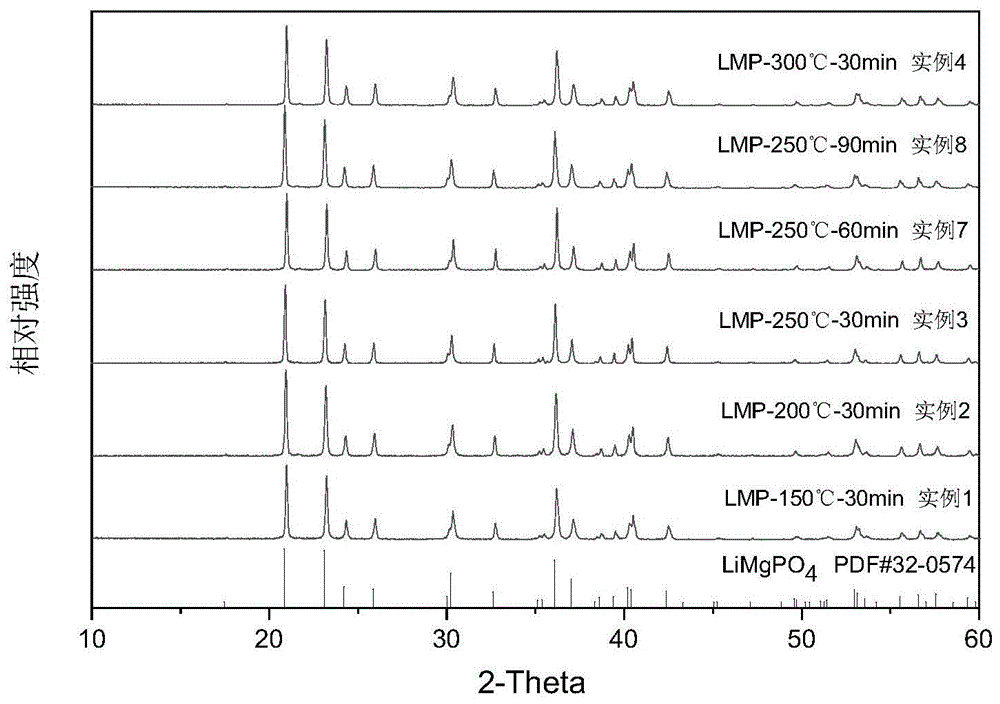
图1为本发明实例1~4,7,8,制备得到的LiMgPO4(缩写LMP)微波陶瓷材料XRD图谱;Fig. 1 is the XRD pattern of the prepared LiMgPO 4 (abbreviated LMP) microwave ceramic material of Examples 1 to 4, 7, and 8 of the present invention;
图2为本发明实例1~6制备得到的LiMgPO4微波陶瓷材料相对密度附图;Fig. 2 is the accompanying drawing of the relative density of the LiMgPO 4 microwave ceramic material prepared in Examples 1-6 of the present invention;
图3为本发明实例3,7,8制备得到的LiMgPO4微波陶瓷材料相对密度附图;Fig. 3 is the accompanying drawing of relative density of LiMgPO microwave ceramic material prepared in Examples 3, 7, and 8 of the present invention;
图4为本发明实例2,7,8,9~11制备得到的LiMgPO4微波陶瓷材料相对密度附图;Fig. 4 is a drawing showing the relative density of the LiMgPO 4 microwave ceramic materials prepared in Examples 2, 7, 8, 9-11 of the present invention;
图5为本发明实例1~6制备得到的LiMgPO4微波陶瓷材料介电常数(εr)附图;FIG. 5 is a drawing of the dielectric constant (ε r ) of the LiMgPO 4 microwave ceramic material prepared in Examples 1 to 6 of the present invention;
图6为本发明实例3,7,8制备得到的LiMgPO4微波陶瓷材料介电常数(εr)附图;FIG. 6 is a drawing of the dielectric constant (ε r ) of the LiMgPO 4 microwave ceramic material prepared in Examples 3, 7, and 8 of the present invention;
图7为本发明实例2,7,8,9~11制备得到的LiMgPO4微波陶瓷材料介电常数(εr)附图;Fig. 7 is a drawing of the dielectric constant (ε r ) of the LiMgPO 4 microwave ceramic material prepared in Examples 2, 7, 8, 9-11 of the present invention;
图8为本发明实例1~6制备得到的LiMgPO4微波陶瓷材料品质因数(Q×f)附图;Fig. 8 is the figure of merit (Q×f) of the LiMgPO 4 microwave ceramic material prepared in Examples 1-6 of the present invention;
图9为本发明实例3,7,8制备得到的LiMgPO4微波陶瓷材料品质因数(Q×f)附图;Fig. 9 is the figure of merit (Q×f) of the LiMgPO microwave ceramic material prepared in Examples 3, 7, and 8 of the present invention;
图10为本发明实例2,7,8,9~11制备得到的LiMgPO4微波陶瓷材料品质因数(Q×f)附图;10 is the figure of merit (Q×f) of the LiMgPO 4 microwave ceramic material prepared in Examples 2, 7, 8, 9-11 of the present invention;
图11为本发明实例1~6制备得到的LiMgPO4微波陶瓷材料谐振频率温度系数(TCF)附图;Figure 11 is the accompanying drawing of the temperature coefficient of resonance frequency (TCF) of the LiMgPO microwave ceramic material prepared in Examples 1 to 6 of the present invention;
图12为本发明实例3,7,8制备得到的LiMgPO4微波陶瓷材料谐振频率温度系数(TCF)附图;Figure 12 is the accompanying drawing of the temperature coefficient of resonance frequency (TCF) of the LiMgPO microwave ceramic material prepared in Examples 3, 7, and 8 of the present invention;
图13为本发明实例2,7,8,9~11制备得到的LiMgPO4微波陶瓷材料谐振频率温度系数(TCF)附图;Figure 13 is the accompanying drawing of the temperature coefficient of resonance frequency (TCF) of the LiMgPO microwave ceramic material prepared in Examples 2 , 7, 8, 9-11 of the present invention;
如下具体实施例将结合上述附图进一步说明本发明。The following specific embodiments will further illustrate the present invention in conjunction with the above drawings.
具体实施方式Detailed ways
以下将结合附图对本发明提供的技术方案作进一步说明。The technical solutions provided by the present invention will be further described below with reference to the accompanying drawings.
本发明提供一种成分为LiMgPO4微波陶瓷材料及其低碳节能制备方法,具体参见以下实施例。The present invention provides a microwave ceramic material composed of LiMgPO 4 and a low-carbon and energy-saving preparation method thereof. For details, refer to the following examples.
实例1:制备150℃-600MPa-30min的LiMgPO4微波陶瓷材料Example 1: Preparation of LiMgPO 4 microwave ceramic material at 150℃-600MPa-30min
称重LiMgPO4粉末1.40g(称取步骤1、2、3、4制备成功的LiMgPO4粉末),量取去离子水(LiMgPO4粉体质量的15%,即0.21ml),滴加入LiMgPO4粉体中并研磨均匀,形成含水混合料。选用内孔直径为12mm的钢质模具,模具使用前先用脱脂棉花蘸上无水乙醇分别将模具内壁、顶杆、垫块擦拭干净,待模具干燥后,把含水混合料放入模具中,使用单轴压力机施加600MPa的压力,并按10℃/min的升温速率将模具加热至150℃,保温30min,冷却、退模,取出样品。所获样品在120℃的烘干箱中干燥24小时进一步以除去残留的水分,得到LiMgPO4陶瓷材料。对实例1制备得到的产物进行XRD分析,如附图1所示,实例1制备得到的产物的XRD图仅含有纯相,可以很好地与LiMgPO4的晶体结构数据库的标准PDF卡(PDF#32-0574)匹配,这说明实例1成功制备LiMgPO4微波陶瓷材料。对实例1制备得到的产物进行相对密度计算,如附图2所示,实例1制备得到的产物的相对密度为82%。对实例1制备的产物进行介电常数(εr)测试,如附图5所示,实例1制备得到的产物的εr为5.4。对实例1制备的产物进行品质因数(Q×f)测试,如附图8所示,实例1制备得到的产物的Q×f为6,900GHz。对实例1制备的产物进行谐振频率温度系数(TCF)测试,如附图11所示,实例1制备得到的产物的TCF为-46.1ppm/℃。如附图结果可知,实例1制备得到的产物的相对密度高,微波介电性能好。Weigh 1.40g of LiMgPO 4 powder (weigh the successfully prepared LiMgPO 4 powder in
实例2:制备200℃-350MPa-30min的LiMgPO4微波陶瓷样品Example 2: Preparation of LiMgPO 4 microwave ceramic samples at 200℃-350MPa-30min
称量LiMgPO4粉末1.40g,再取粉体质量的15%(即0.21ml)的去离子水滴加入粉体中并研磨均匀,形成浆料。选用内孔直径为12mm的钢质模具,模具使用前先用脱脂棉花蘸上无水乙醇分别将模具内壁、顶杆、垫块擦拭干净,待模具干燥后,再称取适量的浆料放入模具中,使用单轴压力机施加350MPa的压力,并按10℃/min的升温速率将模具加热至200℃,保温30min,冷却、退模,取出样品。所获样品在120℃的烘干箱中干燥24小时进一步除去残留的水分,得到LiMgPO4陶瓷材料。对实例2制备得到的产物进行XRD分析,如附图1所示,实例2制备得到的产物的XRD图显示是纯相,可以很好地与晶体结构数据库的标准PDF卡PDF#32-0574(LiMgPO4)匹配,说明实例2成功制备了LiMgPO4微波陶瓷材料。对实例2制备得到的产物进行相对密度计算,如附图2所示,实例2制备得到的产物的相对密度为85%。对实例2制备的产物进行介电常数(εr)测试,如附图5所示,实例2制备得到的产物的εr为5.6。对实例2制备的产物进行品质因数(Q×f)测试,如附图8所示,实例2制备得到的产物的Q×f为14,000GHz。对实例2制备的产物进行谐振频率温度系数(TCF)测试,如附图11所示,实例2制备得到的产物的TCF为-52.6ppm/℃。如附图结果可知,实例2制备得到的产物的相对密度高,微波介电性能好。Weigh 1.40 g of LiMgPO 4 powder, and then add 15% (ie 0.21 ml) of the mass of the powder with deionized water dropwise and add it to the powder and grind it uniformly to form a slurry. Use a steel mold with an inner hole diameter of 12mm. Before using the mold, use absorbent cotton dipped in anhydrous ethanol to wipe the mold inner wall, ejector and pad respectively. After the mold is dry, weigh an appropriate amount of slurry into the mold. In the mold, a uniaxial press was used to apply a pressure of 350 MPa, and the mold was heated to 200 °C at a heating rate of 10 °C/min, kept for 30 min, cooled, demolded, and the sample was taken out. The obtained samples were dried in a drying oven at 120 °C for 24 hours to further remove residual moisture to obtain LiMgPO 4 ceramic materials. The product prepared in Example 2 is subjected to XRD analysis, as shown in accompanying drawing 1, the XRD pattern of the product prepared in Example 2 shows that it is a pure phase, which can be well matched with the standard PDF card PDF#32-0574 ( LiMgPO 4 ) match, indicating that Example 2 successfully prepared the LiMgPO 4 microwave ceramic material. The relative density of the product prepared in Example 2 was calculated. As shown in Figure 2, the relative density of the product prepared in Example 2 was 85%. The dielectric constant (ε r ) of the product prepared in Example 2 was tested. As shown in FIG. 5 , the ε r of the product prepared in Example 2 was 5.6. The quality factor (Q×f) test was performed on the product prepared in Example 2. As shown in FIG. 8 , the Q×f of the product prepared in Example 2 was 14,000 GHz. The temperature coefficient of resonance frequency (TCF) test was performed on the product prepared in Example 2. As shown in Figure 11, the TCF of the product prepared in Example 2 was -52.6 ppm/°C. As can be seen from the results of the attached drawings, the product prepared in Example 2 has high relative density and good microwave dielectric properties.
实例3:制备250℃-600MPa-30min的LiMgPO4微波陶瓷样品Example 3: Preparation of LiMgPO 4 microwave ceramic samples at 250℃-600MPa-30min
称量LiMgPO4粉末1.40g,再取粉体质量的15%(即0.21ml)的去离子水滴加入粉体中并研磨均匀,形成浆料。选用内孔直径为12mm的钢质模具,模具使用前先用脱脂棉花蘸上无水乙醇分别将模具内壁、顶杆、垫块擦拭干净,待模具干燥后,再称取适量的浆料放入模具中,使用单轴压力机施加600MPa的压力,并按10℃/min的升温速率将模具加热至250℃,保温30min,冷却、退模,取出样品。所获样品在120℃的烘干箱中干燥24小时进一步除去残留的水分,得到LiMgPO4陶瓷材料。对实例3制备得到的产物进行XRD分析,如附图1所示,实例3制备得到的产物的XRD图仅含纯相,可以很好地与晶体结构数据库的标准PDF卡PDF#32-0574(LiMgPO4)匹配,说明实例3成功制备了LiMgPO4微波陶瓷材料。对实例3制备得到的产物进行相对密度计算,如附图2所示,实例3制备得到的产物的相对密度为90%。对实例3制备的产物进行介电常数(εr)测试,如附图5所示,实例2制备得到的产物的εr为6.1。对实例3制备的产物进行品质因数(Q×f)测试,如附图8所示,实例3制备得到的产物的Q×f为12,000GHz。对实例3制备的产物进行谐振频率温度系数(TCF)测试,如附图11所示,实例3制备得到的产物的TCF为-56.0ppm/℃。如附图结果可知,实例3制备得到的产物的相对密度高,微波介电性能好。Weigh 1.40 g of LiMgPO 4 powder, and then add 15% (ie 0.21 ml) of the mass of the powder with deionized water dropwise and add it to the powder and grind it uniformly to form a slurry. Use a steel mold with an inner hole diameter of 12mm. Before using the mold, use absorbent cotton dipped in anhydrous ethanol to wipe the mold inner wall, ejector and pad respectively. After the mold is dry, weigh an appropriate amount of slurry into the mold. In the mold, a uniaxial press was used to apply a pressure of 600 MPa, and the mold was heated to 250 °C at a heating rate of 10 °C/min, kept for 30 min, cooled, demolded, and the sample was taken out. The obtained samples were dried in a drying oven at 120 °C for 24 hours to further remove residual moisture to obtain LiMgPO 4 ceramic materials. The product prepared in Example 3 is subjected to XRD analysis, as shown in accompanying drawing 1, the XRD pattern of the product prepared in Example 3 contains only pure phase, which can be well matched with the standard PDF card PDF#32-0574 ( LiMgPO 4 ) match, indicating that Example 3 successfully prepared the LiMgPO 4 microwave ceramic material. The relative density of the product prepared in Example 3 was calculated. As shown in Figure 2, the relative density of the product prepared in Example 3 was 90%. The dielectric constant (ε r ) of the product prepared in Example 3 was tested. As shown in FIG. 5 , the ε r of the product prepared in Example 2 was 6.1. The quality factor (Q×f) test was performed on the product prepared in Example 3. As shown in FIG. 8 , the Q×f of the product prepared in Example 3 was 12,000 GHz. The temperature coefficient of resonance frequency (TCF) test was carried out on the product prepared in Example 3. As shown in FIG. 11 , the TCF of the product prepared in Example 3 was -56.0 ppm/°C. As can be seen from the results of the accompanying drawings, the product prepared in Example 3 has high relative density and good microwave dielectric properties.
实例4:制备300℃-600MPa-30min的LiMgPO4微波陶瓷样品Example 4: Preparation of LiMgPO 4 microwave ceramic samples at 300℃-600MPa-30min
称量LiMgPO4粉末1.40g,再取粉体质量的15%(即0.21ml)的去离子水滴加入粉体中并研磨均匀,形成浆料。选用内孔直径为12mm的钢质模具,模具使用前先用脱脂棉花蘸上无水乙醇分别将模具内壁、顶杆、垫块擦拭干净,待模具干燥后,再称取适量的浆料放入模具中,使用单轴压力机施加600MPa的压力,并按10℃/min的升温速率将模具加热至300℃,保温30min,冷却、退模,取出样品。所获样品在120℃的烘干箱中干燥24小时进一步除去残留的水分,得到LiMgPO4陶瓷材料。对实例4制备得到的产物进行XRD分析,如附图1所示,实例4制备得到的产物的XRD图仅含纯相,可以很好地与晶体结构数据库的标准PDF卡PDF#32-0574(LiMgPO4)匹配,说明实例4成功制备了LiMgPO4微波陶瓷材料。对实例4制备得到的产物进行相对密度计算,如附图2所示,实例4制备得到的产物的相对密度为87%。对实例4制备的产物进行介电常数(εr)测试,如附图5所示,实例4制备得到的产物的εr为6.0。对实例4制备的产物进行品质因数(Q×f)测试,如附图8所示,实例4制备得到的产物的Q×f为11,000GHz。对实例4制备的产物进行谐振频率温度系数(TCF)测试,如附图11所示,实例4制备得到的产物的TCF为-53.6ppm/℃。如附图结果可知,实例4制备得到的产物的相对密度高,微波介电性能好。Weigh 1.40 g of LiMgPO 4 powder, and then add 15% (ie 0.21 ml) of the mass of the powder with deionized water dropwise and add it to the powder and grind it uniformly to form a slurry. Use a steel mold with an inner hole diameter of 12mm. Before using the mold, use absorbent cotton dipped in anhydrous ethanol to wipe the mold inner wall, ejector and pad respectively. After the mold is dry, weigh an appropriate amount of slurry into the mold. In the mold, a uniaxial press was used to apply a pressure of 600 MPa, and the mold was heated to 300 °C at a heating rate of 10 °C/min, kept for 30 min, cooled, demolded, and the sample was taken out. The obtained samples were dried in a drying oven at 120 °C for 24 hours to further remove residual moisture to obtain LiMgPO 4 ceramic materials. The product prepared in Example 4 is subjected to XRD analysis, as shown in accompanying drawing 1, the XRD pattern of the product prepared in Example 4 contains only pure phase, which can be well matched with the standard PDF card PDF#32-0574 ( LiMgPO 4 ) matching, indicating that Example 4 successfully prepared the LiMgPO 4 microwave ceramic material. The relative density of the product prepared in Example 4 was calculated. As shown in Figure 2, the relative density of the product prepared in Example 4 was 87%. The dielectric constant (ε r ) of the product prepared in Example 4 was tested. As shown in FIG. 5 , the ε r of the product prepared in Example 4 was 6.0. The quality factor (Q×f) test was performed on the product prepared in Example 4. As shown in FIG. 8 , the Q×f of the product prepared in Example 4 was 11,000 GHz. The temperature coefficient of resonance frequency (TCF) test was carried out on the product prepared in Example 4. As shown in FIG. 11 , the TCF of the product prepared in Example 4 was -53.6 ppm/°C. As can be seen from the results of the attached drawings, the product prepared in Example 4 has high relative density and good microwave dielectric properties.
实例5:制备200℃-350MPa-30min的LiMgPO4微波陶瓷样品Example 5: Preparation of LiMgPO 4 microwave ceramic samples at 200℃-350MPa-30min
称量LiMgPO4粉末1.40g,再取粉体质量的15%(即0.21ml)的去离子水滴加入粉体中并研磨均匀,形成浆料。选用内孔直径为12mm的钢质模具,模具使用前先用脱脂棉花蘸上无水乙醇分别将模具内壁、顶杆、垫块擦拭干净,待模具干燥后,再称取适量的浆料放入模具中,使用单轴压力机施加350MPa的压力,并按10℃/min的升温速率将模具加热至200℃,保温30min,冷却、退模,取出样品。所获样品在120℃的烘干箱中干燥24小时进一步除去残留的水分,得到LiMgPO4陶瓷材料。对实例5制备得到的产物进行XRD分析,制备得到的产物的XRD图仅含纯相,参考附图1中的实例2,可以很好地与标准晶体结构数据库PDF卡PDF#32-0574(LiMgPO4)匹配,说明实例5成功制备了LiMgPO4微波陶瓷材料。对实例5制备得到的产物进行相对密度计算,如附图2所示,实例5制备得到的产物的相对密度为85%。对实例5制备的产物进行介电常数(εr)测试,如附图5所示,实例5制备得到的产物的εr为5.6。对实例5制备的产物进行品质因数(Q×f)测试,如附图8所示,实例5制备得到的产物的Q×f为14,000GHz。对实例5制备的产物进行谐振频率温度系数(TCF)测试,如附图11所示,实例5制备得到的产物的TCF为-50.3ppm/℃。如附图结果可知,实例5制备得到的产物的相对密度高,微波介电性能好。Weigh 1.40 g of LiMgPO 4 powder, and then add 15% (ie 0.21 ml) of the mass of the powder with deionized water dropwise and add it to the powder and grind it uniformly to form a slurry. Use a steel mold with an inner hole diameter of 12mm. Before using the mold, use absorbent cotton dipped in anhydrous ethanol to wipe the mold inner wall, ejector and pad respectively. After the mold is dry, weigh an appropriate amount of slurry into the mold. In the mold, a uniaxial press was used to apply a pressure of 350 MPa, and the mold was heated to 200 °C at a heating rate of 10 °C/min, kept for 30 min, cooled, demolded, and the sample was taken out. The obtained samples were dried in a drying oven at 120 °C for 24 hours to further remove residual moisture to obtain LiMgPO 4 ceramic materials. The product prepared in Example 5 is subjected to XRD analysis, and the XRD pattern of the prepared product contains only pure phases. Referring to Example 2 in Figure 1, it can be well matched with the standard crystal structure database PDF card PDF#32-0574 (LiMgPO 4 ) Matching, indicating that Example 5 successfully prepared the LiMgPO 4 microwave ceramic material. The relative density of the product prepared in Example 5 was calculated. As shown in Figure 2, the relative density of the product prepared in Example 5 was 85%. The dielectric constant (ε r ) of the product prepared in Example 5 was tested. As shown in FIG. 5 , the ε r of the product prepared in Example 5 was 5.6. The quality factor (Q×f) test was performed on the product prepared in Example 5. As shown in FIG. 8 , the Q×f of the product prepared in Example 5 was 14,000 GHz. The temperature coefficient of resonance frequency (TCF) test was carried out on the product prepared in Example 5. As shown in FIG. 11 , the TCF of the product prepared in Example 5 was -50.3 ppm/°C. As can be seen from the results of the attached drawings, the product prepared in Example 5 has high relative density and good microwave dielectric properties.
实例6:制备200℃-600MPa-60min的LiMgPO4微波陶瓷样品Example 6: Preparation of LiMgPO 4 microwave ceramic samples at 200℃-600MPa-60min
称量LiMgPO4粉末1.40g,再取粉体质量的15%(即0.21ml)的去离子水滴加入粉体中并研磨均匀,形成浆料。选用内孔直径为12mm的钢质模具,模具使用前先用脱脂棉花蘸上无水乙醇分别将模具内壁、顶杆、垫块擦拭干净,待模具干燥后,再称取适量的浆料放入模具中,使用单轴压力机施加600MPa的压力,并按10℃/min的升温速率将模具加热至200℃,保温60min,冷却、退模,取出样品。所获样品在120℃的烘干箱中干燥24小时进一步除去残留的水分,得到LiMgPO4陶瓷材料。对实例7制备得到的产物进行XRD分析,实例6制备得到的产物的XRD图仅含纯相,参考附图1中的实例2,可以很好地与晶体结构数据库标准PDF卡PDF#32-0574(LiMgPO4)匹配,说明实例7成功制备了LiMgPO4微波陶瓷材料。对实例7制备得到的产物进行相对密度计算,如附图2所示,实例6制备得到的产物的相对密度为90%。对实例6制备的产物进行介电常数(εr)测试,如附图5所示,实例6制备得到的产物的εr为6.1。对实例6制备的产物进行品质因数(Q×f)测试,如附图8所示,实例6制备得到的产物的Q×f为10,000GHz。对实例4制备的产物进行谐振频率温度系数(TCF)测试,如附图11所示,实例4制备得到的产物的TCF为-55.8ppm/℃。如附图结果可知,实例6制备得到的产物的相对密度高,微波介电性能好,与银电极兼容,在器件上具有应用前景。Weigh 1.40 g of LiMgPO 4 powder, and then add 15% (ie 0.21 ml) of the mass of the powder with deionized water dropwise and add it to the powder and grind it uniformly to form a slurry. Use a steel mold with an inner hole diameter of 12mm. Before using the mold, use absorbent cotton dipped in anhydrous ethanol to wipe the mold inner wall, ejector and pad respectively. After the mold is dry, weigh an appropriate amount of slurry into the mold. In the mold, a uniaxial press was used to apply a pressure of 600 MPa, and the mold was heated to 200 °C at a heating rate of 10 °C/min, kept for 60 min, cooled and demolded, and the sample was taken out. The obtained samples were dried in a drying oven at 120 °C for 24 hours to further remove residual moisture to obtain LiMgPO 4 ceramic materials. The product prepared in Example 7 is subjected to XRD analysis. The XRD pattern of the product prepared in Example 6 contains only pure phase. Referring to Example 2 in Figure 1, it can be well matched with the crystal structure database standard PDF card PDF#32-0574. (LiMgPO 4 ) matches, indicating that the LiMgPO 4 microwave ceramic material was successfully prepared in Example 7. The relative density of the product prepared in Example 7 was calculated. As shown in Figure 2, the relative density of the product prepared in Example 6 was 90%. The dielectric constant (ε r ) of the product prepared in Example 6 was tested. As shown in FIG. 5 , the ε r of the product prepared in Example 6 was 6.1. The quality factor (Q×f) test was performed on the product prepared in Example 6. As shown in FIG. 8 , the Q×f of the product prepared in Example 6 was 10,000 GHz. The temperature coefficient of resonance frequency (TCF) test was performed on the product prepared in Example 4. As shown in FIG. 11 , the TCF of the product prepared in Example 4 was -55.8 ppm/°C. As can be seen from the results of the attached drawings, the product prepared in Example 6 has high relative density, good microwave dielectric properties, is compatible with silver electrodes, and has application prospects in devices.
实例7:制备250℃-600MPa-60min的LiMgPO4微波陶瓷样品Example 7: Preparation of LiMgPO 4 microwave ceramic samples at 250℃-600MPa-60min
称量LiMgPO4粉末1.40g,再取粉体质量的15%(即0.21ml)的去离子水滴加入粉体中并研磨均匀,形成浆料。选用内孔直径为12mm的钢质模具,模具使用前先用脱脂棉花蘸上无水乙醇分别将模具内壁、顶杆、垫块擦拭干净,待模具干燥后,再称取适量的浆料放入模具中,使用单轴压力机施加600MPa的压力,并按10℃/min的升温速率将模具加热至250℃,保温60min,冷却、退模,取出样品。所获样品在120℃的烘干箱中干燥24小时进一步除去残留的水分,得到LiMgPO4陶瓷材料。对实例7制备得到的产物进行XRD分析,如附图1所示,实例8制备得到的产物的XRD图仅含纯相,可以很好地与晶体结构数据库标准PDF卡PDF#32-0574(LiMgPO4)匹配,说明实例成功制备了LiMgPO4微波陶瓷材料。对实例7制备得到的产物进行相对密度计算,如附图3所示,实例8制备得到的产物的相对密度为93.%。对实例8制备的产物进行介电常数(εr)测试,如附图6所示,实例7制备得到的产物的εr为6.5。对实例8制备的产物进行品质因数(Q×f)测试,如附图9所示,实例7制备得到的产物的Q×f为16,000GHz。对实例7制备的产物进行谐振频率温度系数(TCF)测试,如附图12所示,实例7制备得到的产物的TCF为-58.0ppm/℃。如附图结果可知,实例7制备得到的产物的相对密度高,微波介电性能好。Weigh 1.40 g of LiMgPO 4 powder, and then add 15% (ie 0.21 ml) of the mass of the powder with deionized water dropwise and add it to the powder and grind it uniformly to form a slurry. Use a steel mold with an inner hole diameter of 12mm. Before using the mold, use absorbent cotton dipped in anhydrous ethanol to wipe the mold inner wall, ejector and pad respectively. After the mold is dry, weigh an appropriate amount of slurry into the mold. In the mold, a uniaxial press was used to apply a pressure of 600 MPa, and the mold was heated to 250 °C at a heating rate of 10 °C/min, kept for 60 min, cooled, demolded, and the sample was taken out. The obtained samples were dried in a drying oven at 120 °C for 24 hours to further remove residual moisture to obtain LiMgPO 4 ceramic materials. The product prepared in Example 7 was subjected to XRD analysis. As shown in Figure 1, the XRD pattern of the product prepared in Example 8 contained only pure phase, which could be well matched with the crystal structure database standard PDF card PDF#32-0574 (LiMgPO 4 ) match, indicating that the example successfully prepared LiMgPO 4 microwave ceramic material. The relative density of the product prepared in Example 7 was calculated. As shown in Figure 3, the relative density of the product prepared in Example 8 was 93.%. The dielectric constant (ε r ) of the product prepared in Example 8 was tested. As shown in FIG. 6 , the ε r of the product prepared in Example 7 was 6.5. The quality factor (Q×f) test was performed on the product prepared in Example 8. As shown in FIG. 9 , the Q×f of the product prepared in Example 7 was 16,000 GHz. The temperature coefficient of resonance frequency (TCF) test was performed on the product prepared in Example 7. As shown in Figure 12, the TCF of the product prepared in Example 7 was -58.0 ppm/°C. As can be seen from the results of the attached drawings, the product prepared in Example 7 has high relative density and good microwave dielectric properties.
实例8:制备250℃-600MPa-90min的LiMgPO4微波陶瓷样品Example 8: Preparation of LiMgPO 4 microwave ceramic samples at 250℃-600MPa-90min
称量LiMgPO4粉末1.40g,再取粉体质量的15%(即0.21ml)的去离子水滴加入粉体中并研磨均匀,形成浆料。选用内孔直径为12mm的钢质模具,模具使用前先用脱脂棉花蘸上无水乙醇分别将模具内壁、顶杆、垫块擦拭干净,待模具干燥后,再称取适量的浆料放入模具中,使用单轴压力机施加600MPa的压力,并按10℃/min的升温速率将模具加热至250℃,保温90min,冷却、退模,取出样品。所获样品在120℃的烘干箱中干燥24小时进一步除去残留的水分,得到LiMgPO4陶瓷材料。对实例10制备得到的产物进行XRD分析,如附图1所示,实例8制备得到的产物的XRD图仅含纯相,可以很好地与晶体结构数据库标准PDF卡PDF#32-0574(LiMgPO4)匹配,说明实例8成功制备了LiMgPO4微波陶瓷材料。对实例9制备得到的产物进行相对密度计算,如附图3所示,实例8制备得到的产物的相对密度为89%。对实例9制备的产物进行介电常数(εr)测试,如附图6所示,实例8制备得到的产物的εr为6.2。对实例8制备的产物进行品质因数(Q×f)测试,如附图9所示,实例8制备得到的产物的Q×f为3,600GHz。对实例8制备的产物进行谐振频率温度系数(TCF)测试,如附图12所示,实例8制备得到的产物的TCF为-47.0ppm/℃。如附图结果可知,实例8制备得到的产物的相对密度高,微波介电性能好。Weigh 1.40 g of LiMgPO 4 powder, and then add 15% (ie 0.21 ml) of the mass of the powder with deionized water dropwise and add it to the powder and grind it uniformly to form a slurry. Use a steel mold with an inner hole diameter of 12mm. Before using the mold, use absorbent cotton dipped in anhydrous ethanol to wipe the mold inner wall, ejector and pad respectively. After the mold is dry, weigh an appropriate amount of slurry into the mold. In the mold, a uniaxial press was used to apply a pressure of 600 MPa, and the mold was heated to 250 °C at a heating rate of 10 °C/min, kept for 90 min, cooled, demolded, and the sample was taken out. The obtained samples were dried in a drying oven at 120 °C for 24 hours to further remove residual moisture to obtain LiMgPO 4 ceramic materials. The product prepared in Example 10 was subjected to XRD analysis. As shown in Figure 1, the XRD pattern of the product prepared in Example 8 contained only pure phases, which could be well matched with the crystal structure database standard PDF card PDF#32-0574 (LiMgPO 4 ) Matching, indicating that Example 8 successfully prepared the LiMgPO 4 microwave ceramic material. The relative density of the product prepared in Example 9 was calculated. As shown in Figure 3, the relative density of the product prepared in Example 8 was 89%. The dielectric constant (ε r ) of the product prepared in Example 9 was tested. As shown in FIG. 6 , the ε r of the product prepared in Example 8 was 6.2. The quality factor (Q×f) test was performed on the product prepared in Example 8. As shown in FIG. 9 , the Q×f of the product prepared in Example 8 was 3,600 GHz. The temperature coefficient of resonance frequency (TCF) test was performed on the product prepared in Example 8. As shown in FIG. 12 , the TCF of the product prepared in Example 8 was -47.0 ppm/°C. As can be seen from the results of the attached drawings, the product prepared in Example 8 has high relative density and good microwave dielectric properties.
实例9:制备200℃-600MPa-30min-acetic acid的LiMgPO4微波陶瓷样品Example 9: Preparation of LiMgPO 4 microwave ceramic sample of 200℃-600MPa-30min-acetic acid
称量LiMgPO4粉末1.40g,再取粉体质量的15%(即0.21ml)的醋酸加入粉体中并研磨均匀,形成浆料。选用内孔直径为12mm的钢质模具,模具使用前先用脱脂棉花蘸上无水乙醇分别将模具内壁、顶杆、垫块擦拭干净,待模具干燥后,再称取适量的浆料放入模具中,使用单轴压力机施加600MPa的压力,并按10℃/min的升温速率将模具加热至200℃,保温30min,冷却、退模,取出样品。所获样品在120℃的烘干箱中干燥24小时进一步除去残留的水分,得到LiMgPO4陶瓷材料。对实例6制备得到的产物进行XRD分析,实例9制备得到的产物的XRD图仅含纯相,参考附图1中的实例3,可以很好地与标准晶体结构数据库PDF卡PDF#32-0574(LiMgPO4)匹配,说明实例6成功制备了LiMgPO4微波陶瓷材料。对实例6制备得到的产物进行相对密度计算,如附图4所示,实例9制备得到的产物的相对密度为89%。对实例9制备的产物进行介电常数(εr)测试,如附图7所示,实例6制备得到的产物的εr为6.1。对实例9制备的产物进行品质因数(Q×f)测试,如附图10所示,实例9制备得到的产物的Q×f为11,000GHz。对实例9制备的产物进行谐振频率温度系数(TCF)测试,如附图13所示,实例9制备得到的产物的TCF为-54.9ppm/℃。如附图结果可知,实例9制备得到的产物的相对密度高,微波介电性能好。Weigh 1.40 g of LiMgPO 4 powder, and add 15% (ie 0.21 ml) of acetic acid of the mass of the powder into the powder and grind it uniformly to form a slurry. Use a steel mold with an inner hole diameter of 12mm. Before using the mold, use absorbent cotton dipped in anhydrous ethanol to wipe the mold inner wall, ejector and pad respectively. After the mold is dry, weigh an appropriate amount of slurry into the mold. In the mold, a uniaxial press was used to apply a pressure of 600 MPa, and the mold was heated to 200 °C at a heating rate of 10 °C/min, kept for 30 min, cooled, demolded, and the sample was taken out. The obtained samples were dried in a drying oven at 120 °C for 24 hours to further remove residual moisture to obtain LiMgPO 4 ceramic materials. The product prepared in Example 6 is subjected to XRD analysis. The XRD pattern of the product prepared in Example 9 contains only pure phase. Referring to Example 3 in Figure 1, it can be well matched with the standard crystal structure database PDF card PDF#32-0574. (LiMgPO 4 ) match, indicating that Example 6 successfully prepared LiMgPO 4 microwave ceramic material. The relative density of the product prepared in Example 6 was calculated. As shown in Figure 4, the relative density of the product prepared in Example 9 was 89%. The dielectric constant (ε r ) of the product prepared in Example 9 was tested. As shown in FIG. 7 , the ε r of the product prepared in Example 6 was 6.1. The quality factor (Q×f) test was performed on the product prepared in Example 9. As shown in FIG. 10 , the Q×f of the product prepared in Example 9 was 11,000 GHz. The temperature coefficient of resonance frequency (TCF) test was performed on the product prepared in Example 9. As shown in FIG. 13 , the TCF of the product prepared in Example 9 was -54.9 ppm/°C. As can be seen from the results of the accompanying drawings, the product prepared in Example 9 has high relative density and good microwave dielectric properties.
实例10:制备250℃-600MPa-60min-acetic acid的LiMgPO4微波陶瓷样品Example 10: Preparation of LiMgPO 4 microwave ceramic sample of 250℃-600MPa-60min-acetic acid
称量LiMgPO4粉末1.40g,再取粉体质量的15%(即0.21ml)的醋酸溶剂滴加入粉体中并研磨均匀,形成浆料。选用内孔直径为12mm的钢质模具,模具使用前先用脱脂棉花蘸上无水乙醇分别将模具内壁、顶杆、垫块擦拭干净,待模具干燥后,再称取适量的浆料放入模具中,使用单轴压力机施加600MPa的压力,并按10℃/min的升温速率将模具加热至250℃,保温60min,冷却、退模,取出样品。所获样品在120℃的烘干箱中干燥24小时进一步除去残留的水分,得到LiMgPO4微波陶瓷材料。对实例10制备得到的产物进行XRD分析,实例10制备得到的产物的XRD图仅含纯相,参考附图1中的实例7,可以很好地与晶体结构数据库标准PDF卡PDF#32-0574(LiMgPO4)匹配,说明实例9成功制备了LiMgPO4微波陶瓷材料。对实例10制备得到的产物进行相对密度计算,如附图4所示,实例10制备得到的产物的相对密度为93%。对实例9制备的产物进行介电常数(εr)测试,如附图7所示,实例10制备得到的产物的εr为6.5。对实例10制备的产物进行品质因数(Q×f)测试,如附图10所示,实例10制备得到的产物的Q×ff为15,000GHz。对实例10制备的产物进行谐振频率温度系数(TCF)测试,如附图13所示,实例10制备得到的产物的TCF为-59.5ppm/℃。如附图结果可知,实例10制备得到的产物的相对密度高,微波介电性能好。Weigh 1.40 g of LiMgPO 4 powder, and then take 15% of the mass of the powder (ie, 0.21 ml) of acetic acid solvent dropwise into the powder and grind it uniformly to form a slurry. Use a steel mold with an inner hole diameter of 12mm. Before using the mold, use absorbent cotton dipped in anhydrous ethanol to wipe the mold inner wall, ejector and pad respectively. After the mold is dry, weigh an appropriate amount of slurry into the mold. In the mold, a uniaxial press was used to apply a pressure of 600 MPa, and the mold was heated to 250 °C at a heating rate of 10 °C/min, kept for 60 min, cooled, demolded, and the sample was taken out. The obtained samples were dried in a drying oven at 120 °C for 24 hours to further remove residual moisture to obtain LiMgPO 4 microwave ceramic materials. The product prepared in Example 10 is subjected to XRD analysis. The XRD pattern of the product prepared in Example 10 contains only pure phases. Referring to Example 7 in Figure 1, it can be well matched with the crystal structure database standard PDF card PDF#32-0574. (LiMgPO 4 ) matches, indicating that the LiMgPO 4 microwave ceramic material was successfully prepared in Example 9. The relative density of the product prepared in Example 10 was calculated. As shown in FIG. 4 , the relative density of the product prepared in Example 10 was 93%. The dielectric constant (ε r ) of the product prepared in Example 9 was tested. As shown in FIG. 7 , the ε r of the product prepared in Example 10 was 6.5. The quality factor (Q×f) test was performed on the product prepared in Example 10. As shown in FIG. 10 , the Q×ff of the product prepared in Example 10 was 15,000 GHz. The temperature coefficient of resonance frequency (TCF) test was performed on the product prepared in Example 10. As shown in Figure 13, the TCF of the product prepared in Example 10 was -59.5 ppm/°C. As can be seen from the results of the accompanying drawings, the product prepared in Example 10 has high relative density and good microwave dielectric properties.
实例11:制备250℃-600MPa-90min-acetic acid的LiMgPO4微波陶瓷样品Example 11: Preparation of LiMgPO 4 microwave ceramic samples of 250℃-600MPa-90min-acetic acid
称量LiMgPO4粉末1.40g,再取粉体质量的15%(即0.21ml)的醋酸溶剂滴加入粉体中并研磨均匀,形成浆料。选用内孔直径为12mm的钢质模具,模具使用前先用脱脂棉花蘸上无水乙醇分别将模具内壁、顶杆、垫块擦拭干净,待模具干燥后,再称取适量的浆料放入模具中,使用单轴压力机施加600MPa的压力,并按10℃/min的升温速率将模具加热至250℃,保温90min,冷却、退模,取出样品。所获样品在120℃的烘干箱中干燥24小时进一步除去残留的水分,得到LiMgPO4陶瓷材料。对实例11制备得到的产物进行XRD分析,实例11制备得到的产物的XRD图仅含纯相,参考附图1中的实例8,可以很好地与晶体结构数据库标准PDF卡PDF#32-0574(LiMgPO4)匹配,说明实例11成功制备了LiMgPO4微波陶瓷材料。对实例11制备得到的产物进行相对密度计算,如附图4所示,实例11制备得到的产物的相对密度为80%。对实例9制备的产物进行介电常数(εr)测试,如附图7所示,实例11制备得到的产物的εr为5.1。对实例11制备的产物进行品质因数(Q×f)测试,如附图10所示,实例11制备得到的产物的Q×f为10,000GHz。对实例11制备的产物进行谐振频率温度系数(TCF)测试,如附图13所示,实例11制备得到的产物的TCF为-49.0ppm/℃。如附图结果可知,实例11制备得到的产物的相对密度高,微波介电性能好。Weigh 1.40 g of LiMgPO 4 powder, and then take 15% of the mass of the powder (ie, 0.21 ml) of acetic acid solvent dropwise into the powder and grind it uniformly to form a slurry. Use a steel mold with an inner hole diameter of 12mm. Before using the mold, use absorbent cotton dipped in anhydrous ethanol to wipe the mold inner wall, ejector and pad respectively. After the mold is dry, weigh an appropriate amount of slurry into the mold. In the mold, a uniaxial press was used to apply a pressure of 600 MPa, and the mold was heated to 250 °C at a heating rate of 10 °C/min, kept for 90 min, cooled, demolded, and the sample was taken out. The obtained samples were dried in a drying oven at 120 °C for 24 hours to further remove residual moisture to obtain LiMgPO 4 ceramic materials. XRD analysis was carried out on the product prepared in Example 11. The XRD pattern of the product prepared in Example 11 contained only pure phase. Referring to Example 8 in Figure 1, it can be well matched with the crystal structure database standard PDF card PDF#32-0574. (LiMgPO 4 ) matches, indicating that Example 11 successfully prepared LiMgPO 4 microwave ceramic materials. The relative density of the product prepared in Example 11 was calculated. As shown in FIG. 4 , the relative density of the product prepared in Example 11 was 80%. The dielectric constant (ε r ) of the product prepared in Example 9 was tested. As shown in FIG. 7 , the ε r of the product prepared in Example 11 was 5.1. The quality factor (Q×f) test was performed on the product prepared in Example 11. As shown in FIG. 10 , the Q×f of the product prepared in Example 11 was 10,000 GHz. The temperature coefficient of resonance frequency (TCF) test was performed on the product prepared in Example 11. As shown in Figure 13, the TCF of the product prepared in Example 11 was -49.0 ppm/°C. As can be seen from the results of the accompanying drawings, the product prepared in Example 11 has high relative density and good microwave dielectric properties.
以上实施例的说明只是用于帮助理解本发明的方法及其核心思想。应当指出,对于本技术领域的普通技术人员来说,在不脱离本发明原理的前提下,还可以对本发明进行若干改进和修饰,这些改进和修饰也落入本发明权利要求的保护范围内。The descriptions of the above embodiments are only used to help understand the method and the core idea of the present invention. It should be pointed out that for those skilled in the art, without departing from the principle of the present invention, several improvements and modifications can also be made to the present invention, and these improvements and modifications also fall within the protection scope of the claims of the present invention.
对所公开的实施例的上述说明,使本领域专业技术人员能够实现或使用本发明。对这些实施例的多种修改对本领域的专业技术人员来说将是显而易见的,本文中所定义的一般原理可以在不脱离本发明的精神或范围的情况下,在其它实施例中实现。因此,本发明将不会被限制于本文所示的这些实施例,而是要符合与本文所公开的原理和新颖特点相一致的最宽的范围。The above description of the disclosed embodiments enables any person skilled in the art to make or use the present invention. Various modifications to these embodiments will be readily apparent to those skilled in the art, and the generic principles defined herein may be implemented in other embodiments without departing from the spirit or scope of the invention. Thus, the present invention is not intended to be limited to the embodiments shown herein, but is to be accorded the widest scope consistent with the principles and novel features disclosed herein.
Claims (2)
Priority Applications (1)
| Application Number | Priority Date | Filing Date | Title |
|---|---|---|---|
| CN202010262068.2A CN111499372A (en) | 2020-04-06 | 2020-04-06 | A low-temperature energy-saving method for preparing LiMgPO4 microwave ceramic materials |
Applications Claiming Priority (1)
| Application Number | Priority Date | Filing Date | Title |
|---|---|---|---|
| CN202010262068.2A CN111499372A (en) | 2020-04-06 | 2020-04-06 | A low-temperature energy-saving method for preparing LiMgPO4 microwave ceramic materials |
Publications (1)
| Publication Number | Publication Date |
|---|---|
| CN111499372A true CN111499372A (en) | 2020-08-07 |
Family
ID=71870793
Family Applications (1)
| Application Number | Title | Priority Date | Filing Date |
|---|---|---|---|
| CN202010262068.2A Pending CN111499372A (en) | 2020-04-06 | 2020-04-06 | A low-temperature energy-saving method for preparing LiMgPO4 microwave ceramic materials |
Country Status (1)
| Country | Link |
|---|---|
| CN (1) | CN111499372A (en) |
Cited By (5)
| Publication number | Priority date | Publication date | Assignee | Title |
|---|---|---|---|---|
| CN111995390A (en) * | 2020-09-08 | 2020-11-27 | 中物院成都科学技术发展中心 | Novel ultralow-temperature sintered microwave dielectric ceramic material and preparation method thereof |
| CN113213911A (en) * | 2021-06-16 | 2021-08-06 | 杭州电子科技大学 | Microwave dielectric ceramic material and preparation method thereof |
| CN114163241A (en) * | 2021-10-21 | 2022-03-11 | 杭州电子科技大学 | High-performance low-dielectric microwave dielectric ceramic prepared by low-temperature hot pressing and method thereof |
| CN115947596A (en) * | 2023-01-16 | 2023-04-11 | 西安交通大学 | A microwave dielectric ceramic material based on microwave cold sintering and a low-carbon preparation method |
| WO2026012359A1 (en) * | 2024-07-08 | 2026-01-15 | 上海石趣医药科技有限公司 | Double salt, preparation method therefor, pharmaceutical composition containing same, and use thereof |
Citations (3)
| Publication number | Priority date | Publication date | Assignee | Title |
|---|---|---|---|---|
| WO2012144177A1 (en) * | 2011-04-21 | 2012-10-26 | 株式会社豊田自動織機 | Negative electrode for lithium ion secondary batteries and lithium ion secondary battery using negative electrode |
| CN104973857A (en) * | 2015-07-31 | 2015-10-14 | 华南理工大学 | Low-dielectric-constant polyanion type microwave dielectric ceramic and preparation method thereof |
| CN110183227A (en) * | 2019-04-29 | 2019-08-30 | 杭州电子科技大学 | A kind of Li2MoO4-Mg2SiO4Base composite ceramic microwave material and preparation method thereof |
-
2020
- 2020-04-06 CN CN202010262068.2A patent/CN111499372A/en active Pending
Patent Citations (3)
| Publication number | Priority date | Publication date | Assignee | Title |
|---|---|---|---|---|
| WO2012144177A1 (en) * | 2011-04-21 | 2012-10-26 | 株式会社豊田自動織機 | Negative electrode for lithium ion secondary batteries and lithium ion secondary battery using negative electrode |
| CN104973857A (en) * | 2015-07-31 | 2015-10-14 | 华南理工大学 | Low-dielectric-constant polyanion type microwave dielectric ceramic and preparation method thereof |
| CN110183227A (en) * | 2019-04-29 | 2019-08-30 | 杭州电子科技大学 | A kind of Li2MoO4-Mg2SiO4Base composite ceramic microwave material and preparation method thereof |
Non-Patent Citations (2)
| Title |
|---|
| SETH S. BERBANO ET AL.: "Cold sintering process of Li1.5Al0.5Ge1.5(PO4)3 solid electrolyte", 《JOURNAL OF THE AMERICAN CERAMIC SOCIETY》 * |
| 陈康: "非化学计量比LiMgPO4基微波介质陶瓷介电性能的研究", 《中国优秀博硕士学位论文全文数据库(硕士)工程科技I辑》 * |
Cited By (9)
| Publication number | Priority date | Publication date | Assignee | Title |
|---|---|---|---|---|
| CN111995390A (en) * | 2020-09-08 | 2020-11-27 | 中物院成都科学技术发展中心 | Novel ultralow-temperature sintered microwave dielectric ceramic material and preparation method thereof |
| CN111995390B (en) * | 2020-09-08 | 2022-02-22 | 中物院成都科学技术发展中心 | Novel ultralow-temperature sintered microwave dielectric ceramic material and preparation method thereof |
| CN113213911A (en) * | 2021-06-16 | 2021-08-06 | 杭州电子科技大学 | Microwave dielectric ceramic material and preparation method thereof |
| CN113213911B (en) * | 2021-06-16 | 2022-07-01 | 杭州电子科技大学 | Microwave dielectric ceramic material and preparation method thereof |
| CN114163241A (en) * | 2021-10-21 | 2022-03-11 | 杭州电子科技大学 | High-performance low-dielectric microwave dielectric ceramic prepared by low-temperature hot pressing and method thereof |
| CN114163241B (en) * | 2021-10-21 | 2022-09-02 | 杭州电子科技大学 | High-performance low-dielectric microwave dielectric ceramic prepared by low-temperature hot pressing and method thereof |
| CN115947596A (en) * | 2023-01-16 | 2023-04-11 | 西安交通大学 | A microwave dielectric ceramic material based on microwave cold sintering and a low-carbon preparation method |
| CN115947596B (en) * | 2023-01-16 | 2023-12-05 | 西安交通大学 | Microwave dielectric ceramic material based on microwave cold sintering and low-carbon preparation method |
| WO2026012359A1 (en) * | 2024-07-08 | 2026-01-15 | 上海石趣医药科技有限公司 | Double salt, preparation method therefor, pharmaceutical composition containing same, and use thereof |
Similar Documents
| Publication | Publication Date | Title |
|---|---|---|
| CN111499372A (en) | A low-temperature energy-saving method for preparing LiMgPO4 microwave ceramic materials | |
| CN110183227B (en) | Li2MoO4-Mg2SiO4Base composite ceramic microwave material and preparation method thereof | |
| CN111517789B (en) | Low-dielectric microwave dielectric ceramic material and preparation method thereof | |
| CN111943671B (en) | A low-loss microwave dielectric ceramic with a wide sintering temperature zone and a preparation method thereof | |
| CN110981439A (en) | Microwave ceramic powder, preparation method thereof and application thereof in dielectric filter | |
| CN103864420B (en) | A kind of preparation method of microwave dielectric ceramic materials | |
| CN109415265B (en) | Dielectric ceramic material and preparation method thereof | |
| CN113956033A (en) | Medium high-Q-value microwave dielectric ceramic and preparation method thereof | |
| CN111943670B (en) | LiWVO 6 -K 2 MoO 4 Base composite ceramic microwave material and preparation method thereof | |
| CN109928753A (en) | A kind of low-k silicon substrate microwave dielectric ceramic materials and preparation method thereof | |
| CN111517771A (en) | Microwave dielectric ceramic material and preparation method thereof | |
| CN108585809A (en) | A kind of low-temperature sintering SiO2Base microwave medium ceramic material and preparation method thereof | |
| CN105693220B (en) | Positive temperature coefficient silicate microwave dielectric ceramic material and preparation method thereof | |
| CN110845226A (en) | A kind of microwave dielectric ceramic material SrGa2O4 and preparation method thereof | |
| CN102295457B (en) | Low-loss Sm2O3-TiO2Microwave dielectric ceramic and preparation method thereof | |
| CN108975913A (en) | A kind of ZnO-TiO2-Nb2O5Base LTCC material and preparation method thereof | |
| CN111499375B (en) | A high quality factor microwave dielectric ceramic material and its preparation method | |
| CN110818419B (en) | Microwave dielectric ceramic LiF and preparation method thereof | |
| CN112979297A (en) | Low-dielectric-constant microwave dielectric ceramic material and ceramic component | |
| CN111187062A (en) | CaSnSiO5-K2MoO4Base composite ceramic microwave material and preparation method thereof | |
| CN115872740B (en) | Ultralow-temperature sintered low-dielectric microwave dielectric ceramic and preparation method thereof | |
| CN105174956A (en) | High-quality-factor microwave dielectric ceramic used in X-band and preparation method thereof | |
| CN112079631B (en) | Low-dielectric LTCC material with near-zero temperature coefficient and preparation method thereof | |
| CN113387695A (en) | Low-dielectric high-quality microwave dielectric ceramic for 5G communication and preparation method thereof | |
| CN112811890A (en) | Low-temperature sintered low-dielectric constant microwave ceramic material and preparation method thereof |
Legal Events
| Date | Code | Title | Description |
|---|---|---|---|
| PB01 | Publication | ||
| PB01 | Publication | ||
| SE01 | Entry into force of request for substantive examination | ||
| SE01 | Entry into force of request for substantive examination | ||
| RJ01 | Rejection of invention patent application after publication |
Application publication date: 20200807 |
|
| RJ01 | Rejection of invention patent application after publication |