CN111574419B - Method for recovering and refining caprolactam monomer - Google Patents
Method for recovering and refining caprolactam monomer Download PDFInfo
- Publication number
- CN111574419B CN111574419B CN202010548123.4A CN202010548123A CN111574419B CN 111574419 B CN111574419 B CN 111574419B CN 202010548123 A CN202010548123 A CN 202010548123A CN 111574419 B CN111574419 B CN 111574419B
- Authority
- CN
- China
- Prior art keywords
- caprolactam
- reverse osmosis
- water
- solution
- resin
- Prior art date
- Legal status (The legal status is an assumption and is not a legal conclusion. Google has not performed a legal analysis and makes no representation as to the accuracy of the status listed.)
- Active
Links
- JBKVHLHDHHXQEQ-UHFFFAOYSA-N epsilon-caprolactam Chemical group O=C1CCCCCN1 JBKVHLHDHHXQEQ-UHFFFAOYSA-N 0.000 title claims abstract description 302
- 238000000034 method Methods 0.000 title claims abstract description 28
- 238000007670 refining Methods 0.000 title claims abstract description 14
- XLYOFNOQVPJJNP-UHFFFAOYSA-N water Substances O XLYOFNOQVPJJNP-UHFFFAOYSA-N 0.000 claims abstract description 80
- 239000000706 filtrate Substances 0.000 claims abstract description 38
- 229920002292 Nylon 6 Polymers 0.000 claims abstract description 36
- 239000000047 product Substances 0.000 claims abstract description 35
- 238000000605 extraction Methods 0.000 claims abstract description 25
- 229920000642 polymer Polymers 0.000 claims abstract description 17
- 238000005406 washing Methods 0.000 claims abstract description 9
- 239000002994 raw material Substances 0.000 claims abstract description 5
- 239000000243 solution Substances 0.000 claims description 59
- 239000011347 resin Substances 0.000 claims description 54
- 229920005989 resin Polymers 0.000 claims description 54
- 238000001223 reverse osmosis Methods 0.000 claims description 38
- 238000001704 evaporation Methods 0.000 claims description 34
- 230000008020 evaporation Effects 0.000 claims description 32
- 238000001179 sorption measurement Methods 0.000 claims description 32
- 238000003795 desorption Methods 0.000 claims description 26
- 239000007788 liquid Substances 0.000 claims description 26
- 230000018044 dehydration Effects 0.000 claims description 23
- 238000006297 dehydration reaction Methods 0.000 claims description 23
- 238000005336 cracking Methods 0.000 claims description 20
- 239000012452 mother liquor Substances 0.000 claims description 14
- 238000001914 filtration Methods 0.000 claims description 13
- NBIIXXVUZAFLBC-UHFFFAOYSA-N Phosphoric acid Chemical compound OP(O)(O)=O NBIIXXVUZAFLBC-UHFFFAOYSA-N 0.000 claims description 12
- 239000003729 cation exchange resin Substances 0.000 claims description 12
- 238000004821 distillation Methods 0.000 claims description 12
- 239000007787 solid Substances 0.000 claims description 12
- 238000011084 recovery Methods 0.000 claims description 11
- 238000006243 chemical reaction Methods 0.000 claims description 9
- 239000000539 dimer Substances 0.000 claims description 9
- 239000012535 impurity Substances 0.000 claims description 9
- 239000013638 trimer Substances 0.000 claims description 9
- NWUYHJFMYQTDRP-UHFFFAOYSA-N 1,2-bis(ethenyl)benzene;1-ethenyl-2-ethylbenzene;styrene Chemical compound C=CC1=CC=CC=C1.CCC1=CC=CC=C1C=C.C=CC1=CC=CC=C1C=C NWUYHJFMYQTDRP-UHFFFAOYSA-N 0.000 claims description 8
- 239000003957 anion exchange resin Substances 0.000 claims description 8
- 150000001450 anions Chemical class 0.000 claims description 8
- 238000001816 cooling Methods 0.000 claims description 8
- 239000013078 crystal Substances 0.000 claims description 8
- 238000000926 separation method Methods 0.000 claims description 8
- 239000002351 wastewater Substances 0.000 claims description 8
- 230000000694 effects Effects 0.000 claims description 7
- 238000011045 prefiltration Methods 0.000 claims description 7
- OKKJLVBELUTLKV-UHFFFAOYSA-N Methanol Chemical compound OC OKKJLVBELUTLKV-UHFFFAOYSA-N 0.000 claims description 6
- 229910000147 aluminium phosphate Inorganic materials 0.000 claims description 6
- 150000001768 cations Chemical class 0.000 claims description 6
- 239000000178 monomer Substances 0.000 claims description 5
- LFQSCWFLJHTTHZ-UHFFFAOYSA-N Ethanol Chemical compound CCO LFQSCWFLJHTTHZ-UHFFFAOYSA-N 0.000 claims description 4
- 238000001035 drying Methods 0.000 claims description 4
- 239000011259 mixed solution Substances 0.000 claims description 2
- 239000000203 mixture Substances 0.000 claims description 2
- 238000004064 recycling Methods 0.000 claims 4
- 238000006116 polymerization reaction Methods 0.000 abstract description 10
- 238000004519 manufacturing process Methods 0.000 abstract description 9
- 238000005265 energy consumption Methods 0.000 description 9
- 238000002360 preparation method Methods 0.000 description 6
- 238000010586 diagram Methods 0.000 description 5
- 238000005516 engineering process Methods 0.000 description 5
- 239000000835 fiber Substances 0.000 description 5
- 125000004122 cyclic group Chemical group 0.000 description 4
- 239000012632 extractable Substances 0.000 description 4
- 238000000746 purification Methods 0.000 description 4
- 238000002425 crystallisation Methods 0.000 description 3
- 230000008025 crystallization Effects 0.000 description 3
- 239000002131 composite material Substances 0.000 description 2
- 238000002844 melting Methods 0.000 description 2
- 230000008018 melting Effects 0.000 description 2
- 229920001778 nylon Polymers 0.000 description 2
- 238000009987 spinning Methods 0.000 description 2
- 239000004677 Nylon Substances 0.000 description 1
- 239000004952 Polyamide Substances 0.000 description 1
- 238000010521 absorption reaction Methods 0.000 description 1
- 238000009825 accumulation Methods 0.000 description 1
- 238000012644 addition polymerization Methods 0.000 description 1
- 239000003513 alkali Substances 0.000 description 1
- 230000009286 beneficial effect Effects 0.000 description 1
- 229920006233 biaxially oriented polyamide Polymers 0.000 description 1
- 239000003153 chemical reaction reagent Substances 0.000 description 1
- 239000011248 coating agent Substances 0.000 description 1
- 238000000576 coating method Methods 0.000 description 1
- 238000007796 conventional method Methods 0.000 description 1
- 238000005260 corrosion Methods 0.000 description 1
- 230000007797 corrosion Effects 0.000 description 1
- 229920006351 engineering plastic Polymers 0.000 description 1
- 230000007613 environmental effect Effects 0.000 description 1
- 239000004615 ingredient Substances 0.000 description 1
- 230000010354 integration Effects 0.000 description 1
- 239000012528 membrane Substances 0.000 description 1
- 238000000465 moulding Methods 0.000 description 1
- 239000005022 packaging material Substances 0.000 description 1
- 229920002647 polyamide Polymers 0.000 description 1
- 238000006068 polycondensation reaction Methods 0.000 description 1
- 238000007142 ring opening reaction Methods 0.000 description 1
- 230000035939 shock Effects 0.000 description 1
- 239000000126 substance Substances 0.000 description 1
- 229920002994 synthetic fiber Polymers 0.000 description 1
- 239000012209 synthetic fiber Substances 0.000 description 1
- 239000004753 textile Substances 0.000 description 1
Images


Classifications
-
- C—CHEMISTRY; METALLURGY
- C07—ORGANIC CHEMISTRY
- C07D—HETEROCYCLIC COMPOUNDS
- C07D201/00—Preparation, separation, purification or stabilisation of unsubstituted lactams
- C07D201/16—Separation or purification
-
- C—CHEMISTRY; METALLURGY
- C07—ORGANIC CHEMISTRY
- C07D—HETEROCYCLIC COMPOUNDS
- C07D223/00—Heterocyclic compounds containing seven-membered rings having one nitrogen atom as the only ring hetero atom
- C07D223/02—Heterocyclic compounds containing seven-membered rings having one nitrogen atom as the only ring hetero atom not condensed with other rings
- C07D223/06—Heterocyclic compounds containing seven-membered rings having one nitrogen atom as the only ring hetero atom not condensed with other rings with hetero atoms or with carbon atoms having three bonds to hetero atoms with at the most one bond to halogen, e.g. ester or nitrile radicals, directly attached to ring carbon atoms
- C07D223/08—Oxygen atoms
- C07D223/10—Oxygen atoms attached in position 2
Landscapes
- Chemical & Material Sciences (AREA)
- Organic Chemistry (AREA)
- Polyamides (AREA)
Abstract
The invention provides a method for recovering and refining caprolactam monomer, which is characterized in that extraction water generated in polymer washing is pre-filtered to obtain filtrate and insoluble oligomer, soluble oligomer in the filtrate is separated from caprolactam monomer, and then the oligomer is cracked and refined with the caprolactam monomer recovered before to finally obtain caprolactam product with higher quality, which can be directly used as raw material for polyamide 6 slice polymerization production.
Description
Technical Field
The invention relates to the technical field of polymer production in organic chemistry, in particular to a method for recovering and refining caprolactam monomer.
Background
Polyamide 6, nylon 6, is a translucent or opaque, opalescent crystalline polymer. The nylon 6 slice has the characteristics of good toughness, strong wear resistance, oil resistance, shock resistance and the like, and has higher mechanical strength and heat resistance, better impact strength, higher melting point, good molding processability and high water absorption. The composite fiber has excellent electrical insulating performance, good alkali resistance and corrosion resistance, and is the fiber with the best wear resistance in synthetic fibers.
The nylon 6 slice has wide application, and can be classified into fiber grade, engineering plastic grade, film drawing grade slices and nylon composite materials according to the application, and various products are respectively prepared. The nylon 6 slice is mainly used for producing various civil and industrial fibers, and can also be applied to the fields of automobiles, electronics, electrics, railways, packaging materials and the like. Nylon 6 chip fiber is also known as nylon 6. The nylon-6 filament is the most main variety of nylon fiber and is mainly used for manufacturing textile clothing products such as underwear, shirts, silk stockings and the like; with the benefit of the increasing rapid development downstream of nylon 6 chips, the demand for nylon 6 chips will increase in the future.
The polymerization process of polyamide 6, including three processes of ring opening, addition polymerization and polycondensation of caprolactam, has a polymerization rate of about 90%, i.e. 10% of caprolactam monomer (about 8%) and oligomer (about 2%) remained in the equilibrium polymer, which are collectively called extractables. Extractables in polyamide 6 chips, in particular cyclic dimers, have a relatively large influence on the working-up. Downstream product spinning production generally requires that the extractable mass fraction in polyamide 6 chips is less than 0.6%, and polyamide 6 chips for high-speed spinning, BOPA biaxially oriented films and the like require that the extractable mass fraction is less than 0.5%.
In order to remove low molecular substances in polyamide 6 chips, hot water countercurrent extraction and extraction water evaporation concentration recovery technology are commonly adopted in industry. About 10% of the extract water containing caprolactam monomer and oligomers is produced during the extraction of polyamide 6 chips. Carrying out triple effect evaporation dehydration on the extraction water to obtain 80% concentrated solution, then cracking the concentrated solution, condensing the obtained gas phase to obtain caprolactam monomer, wherein the obtained caprolactam monomer has low quality due to high impurity content in the extraction water and can not be directly used for producing downstream products; the energy consumption is higher in the triple-effect evaporation dehydration process; and during the concentration and dehydration of the extraction water, the oligomers in the concentrated caprolactam are mainly cyclic dimer and trimer. Due to the cyclic dimer, the melting point is high (347-348 ℃), other oligomers and caprolactam are easily adsorbed to form a coating, and crystallization is easier to separate out along with the reduction of the water content. Therefore, pipelines, valves and equipment in the extraction liquid concentration process are easy to block, and normal operation is affected, so that the concentration of the concentrated liquid cannot be too high and can only be lower than 80%. In order to reduce the unit consumption of caprolactam, some enterprises return the extraction concentrated solution to the polymerization process again to be used as the ingredient of fresh caprolactam, and because polymers are not removed, the produced polyamide 6 slices have poor quality and narrow application range, and the accumulation problem of a cyclic dimer system in the production process is difficult to solve; therefore, the caprolactam monomer is recovered by adopting an evaporation concentration and cracking method for extraction water in the preparation process of the polyamide 6 slice, and the problems of high energy consumption, low monomer recovery quality, easy blockage of pipelines, valves and equipment in the recovery process and the like exist.
In order to solve the problems of high energy consumption, low caprolactam monomer quality, easy equipment blockage and the like in the recovery process of extracting caprolactam monomer in the polymerization preparation process of polyamide 6 chips, the recovery and refining method of caprolactam monomer in the extraction water needs to be improved.
Disclosure of Invention
The invention aims to provide a method for recovering and refining caprolactam monomer, which solves the problems of high energy consumption, low quality of recovered caprolactam monomer, easy blockage of equipment and the like in the prior art.
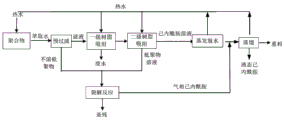
The technical scheme adopted by the invention is as follows: a method for recovering and refining caprolactam monomers comprises the following steps:
a. pre-filtering:
prefiltering extraction water generated during polymer washing to obtain filtrate and insoluble oligomers; wherein the filtering precision of the prefilter is 1.0-3.0 mu m, and the filtrate contains caprolactam monomer, soluble oligomer and impurities;
b. separation of soluble oligomers from caprolactam monomer:
b, performing resin adsorption on the filtrate obtained in the step a, performing resin adsorption on the filtrate to obtain a caprolactam solution, and desorbing the caprolactam solution by using resin to obtain wastewater and an oligomer solution;
c. refining caprolactam:
c-1, evaporation dehydration: evaporating and dehydrating the caprolactam solution obtained in the step b to obtain a caprolactam solution with the concentration of 70-90 wt% and water;
c-2, cooling and crystallizing: c, cooling and crystallizing 70-90 wt% of caprolactam solution obtained in the step c-1, performing centrifugal separation to obtain centrifugal mother liquor and crystals, and drying the crystals to obtain a solid caprolactam product; returning 70-80% of the centrifugal mother liquor to the step c-1 of evaporation and dehydration, distilling the residual mother liquor to obtain water, gaseous caprolactam and a heavy phase, condensing the gaseous caprolactam to obtain a liquid caprolactam product, wherein the solid caprolactam product and the liquid caprolactam product can be directly used as raw materials for producing polyamide 6 slices;
or distilling 70-90 wt% of caprolactam solution obtained in the step c-1 to obtain water, gaseous caprolactam and a heavy phase, condensing the gaseous caprolactam to obtain a liquid caprolactam product, wherein the liquid caprolactam product can be directly used as a raw material for producing polyamide 6 slices;
d. oligomer cracking:
and c, combining the insoluble oligomer obtained in the step a and the oligomer solution obtained in the step b for a cracking reaction to obtain gas-phase caprolactam and kettle residues, condensing the gas-phase caprolactam, combining the condensed gas-phase caprolactam with 70-90 wt% of caprolactam solution obtained in the step c-1, and feeding the mixture into the step c-2 for distillation.
In the step a, the extraction water is a mixed solution containing a dimer, a trimer, a caprolactam monomer and impurities; wherein the total content of the dimer, the trimer and the caprolactam monomer is 7-15 wt%, and the filtration precision of the prefilter is 1.0-3.0 μm.
And c, performing resin adsorption in the step b by two-stage resin adsorption, wherein the first-stage resin is anion and cation exchange resin and is used for adsorbing anions and cations in the filtrate, and the second-stage resin is macroporous adsorption resin and is used for adsorbing soluble oligomers in the filtrate.
In the step b, the cation exchange resin is one of 001X7, D001 and D113; the anion exchange resin is one of 201X7, D301 and D201, hot water with the temperature of 40-60 ℃ is adopted for desorption during desorption, and wastewater obtained after desorption is sent to an environment-friendly unit for treatment; the macroporous adsorption resin is one of D001, D301, XAD4 and XAD1600N, hot water with the temperature of 40-80 ℃ or one of methanol and ethanol with the temperature of 20-50 ℃ is adopted during desorption, and an oligomer solution is obtained after desorption.
In the step c, before evaporation dehydration, the caprolactam solution obtained in the step b can be concentrated and dehydrated by a reverse osmosis system to obtain water and a caprolactam solution with the concentration of 30-40 wt%, and then the evaporation dehydration of the step c-1 is carried out on the caprolactam solution with the concentration of 30-40 wt%.
In the step c, the working pressure of the reverse osmosis system is 1.5-14 MPa; the reverse osmosis system is low-pressure reverse osmosis or is combined use of low-pressure reverse osmosis and high-pressure reverse osmosis; when the reverse osmosis system is low-pressure reverse osmosis, the working pressure is 1.5-3.5 MPa; when the reverse osmosis system is used by combining low-pressure reverse osmosis and high-pressure reverse osmosis, the working pressure of the low-pressure reverse osmosis is 1.5-3.5MPa, and the working pressure of the high-pressure reverse osmosis is 8-14 MPa; the working temperature of the reverse osmosis system is 20-45 ℃.
The evaporation dehydration mode of the step c-1 can be triple effect evaporation or MVR.
In the step d, 15 percent of phosphoric acid is added during cracking, and high-pressure steam of 1.3MPa is introduced.
The water obtained in each step is recovered and used as water for washing the polymer.
And d, carrying out subsequent incineration treatment on the heavy phase obtained in the step c-2 and the kettle residue obtained in the step d.
The invention has the beneficial effects that:
(1) the invention separates the oligomer in the extraction water, after the oligomer is cracked, the caprolactam obtained and the separated caprolactam are refined to obtain the caprolactam product, the quality of the caprolactam product is higher, the polyamide chip 6 can be directly produced, and the yield of the caprolactam monomer is higher.
(2) The invention separates the oligomer in the extraction water, and the subsequent evaporation can be smoothly carried out, thereby thoroughly solving the problem that the dimer blocks pipelines, equipment and valves, and realizing the industrialization of the monomer recovery process of the extraction water.
(3) The membrane integration technology is adopted to partially replace triple effect evaporation in the prior art, and the energy consumption can be reduced by more than 40%.
(4) By adopting the technology of the invention, the residue amount of the kettle is small, and the environmental protection cost is reduced.
Drawings
FIG. 1 is a schematic process flow diagram of the present invention.
FIG. 2 is a schematic process flow diagram of the recovery and purification of caprolactam monomer of example 1.
FIG. 3 is a schematic process flow diagram of the recovery and purification of caprolactam monomer of example 2.
FIG. 4 is a schematic process flow diagram of the recovery and purification of caprolactam monomer of example 3.
FIG. 5 is a schematic process flow diagram of the recovery and purification of caprolactam monomer of example 4.
Detailed Description
The invention is further illustrated by the following examples, which are given by way of illustration only and are not intended to limit the scope of the invention in any way.
Procedures and methods not described in detail in the following examples are conventional methods well known in the art, and reagents used in the examples are commercially available or prepared by methods well known to those of ordinary skill in the art unless otherwise specified. The following examples all achieve the objects of the present invention.
Example 1: see FIG. 2
(1) Prefiltering
Pre-filtering extraction water generated when a polymer is washed by water in the preparation process of polyamide 6 chip polymerization to obtain filtrate and insoluble oligomer; the filtration precision of the prefilter is 1.0 mu m; the total content of dimer, trimer and caprolactam monomer in the extraction water is about 8 percent, and the filtrate contains caprolactam monomer, soluble oligomer and impurities;
(2) two-stage resin adsorption
Performing two-stage resin adsorption on the filtrate obtained in the step (1), and performing resin adsorption on the filtrate to obtain a caprolactam solution; wherein the first-stage resin is anion-cation exchange resin, the cation exchange resin is 001X7, the anion exchange resin is 201X7, and is used for adsorbing anions and cations in the filtrate, hot water at 50 ℃ is used for desorption, and wastewater obtained after desorption is sent to an environment-friendly unit for treatment; the second-stage resin is macroporous adsorption resin, the macroporous adsorption resin is XAD4 and is used for adsorbing soluble oligomers in the filtrate, the second-stage resin is desorbed by hot water at 60 ℃, and an oligomer solution is obtained after desorption;
(3) concentration and dehydration of reverse osmosis system
Concentrating and dehydrating the caprolactam solution obtained in the step (2) by adopting low-pressure reverse osmosis, controlling the working pressure of the low-pressure reverse osmosis to be 1.5-3.5MPa and the temperature to be 20-45 ℃ to obtain water and 31% caprolactam solution;
(4) evaporation dehydration
Carrying out triple effect evaporation dehydration on the 31% caprolactam solution obtained in the step (3) to obtain water and 82% caprolactam solution;
(5) cooling crystallization and centrifugal separation
Cooling and crystallizing 82% of caprolactam solution obtained in the step (4), and performing centrifugal separation to obtain mother liquor and crystals, wherein 75% of mother liquor returns to the step (4), the rest mother liquor is distilled to obtain water, gaseous caprolactam and a heavy phase, and the gaseous caprolactam is condensed to obtain a liquid caprolactam product; drying the crystal to obtain solid caprolactam; the solid caprolactam product and the liquid caprolactam product can be returned to the original production process to produce polyamide 6 slices;
(6) cracking of oligomers
Combining the insoluble oligomer obtained in the step (1) and the oligomer solution obtained in the step (2) to carry out cracking reaction to obtain gas-phase caprolactam and kettle residues, condensing the gas-phase caprolactam, feeding the condensed gas-phase caprolactam into the step (5), distilling the condensed gas-phase caprolactam and the residual mother liquor before distillation, wherein 15% of phosphoric acid is required to be added during cracking, and introducing 1.3MPa of high-pressure steam;
the water removed by the reverse osmosis system concentration, the water removed by evaporation and the water removed by distillation are recovered and used for washing the water used for desorption of the polymer and the resin;
and (4) carrying out subsequent incineration treatment on the heavy phase obtained in the step (4) and the kettle residue obtained in the step (6).
The yield of the solid caprolactam and the liquid caprolactam finally obtained in the embodiment is 99.1 percent, the quality of the solid caprolactam and the liquid caprolactam both reach the standard of superior products in the national standard GB/T13254-2017, the polyamide 6 slice can be directly polymerized, and the energy consumption of the film technology used for water concentration is reduced by about 41 percent compared with the energy consumption of the existing triple-effect evaporation process.
Example 2: see FIG. 3
(1) Prefiltering
Pre-filtering extraction water generated when a polymer is washed by water in the preparation process of polyamide 6 chip polymerization to obtain filtrate and insoluble oligomer; the filtration precision of the prefilter is 1.0 mu m; the total content of dimer, trimer and caprolactam monomer in the extraction water is about 10 percent, and the filtrate contains caprolactam monomer, soluble oligomer and impurities;
(2) two-stage resin adsorption
Performing two-stage resin adsorption on the filtrate obtained in the step (1), and performing resin adsorption on the filtrate to obtain a caprolactam solution; wherein, the first-stage resin is anion-cation exchange resin, the cation exchange resin is D001, the anion exchange resin is D301, and is used for adsorbing anions and cations in the filtrate, hot water with the temperature of 50 ℃ is adopted for desorption, and the wastewater obtained after desorption is sent to an environment-friendly unit for treatment; the second-stage resin is macroporous adsorption resin, the macroporous adsorption resin is XAD1600N and is used for adsorbing soluble oligomers in the filtrate, the second-stage resin is desorbed by hot water at 60 ℃, and an oligomer solution is obtained after desorption;
(3) concentration and dehydration of reverse osmosis system
Concentrating and dehydrating the caprolactam solution obtained in the step (2) by adopting a low-pressure reverse osmosis and high-pressure reverse osmosis combined process, wherein the working pressure of the low-pressure reverse osmosis is controlled to be 1.5-3.5MPa, and the working pressure of the high-pressure reverse osmosis is controlled to be 8-14 MPa; controlling the temperature to be 20-45 ℃ to obtain water and a caprolactam solution with the concentration of 37%;
(4) evaporation dehydration
Carrying out triple effect evaporation dehydration on the caprolactam solution of 37% obtained in the step (3) to obtain water and a caprolactam solution of 79%;
(5) distillation
Distilling the 79wt% of caprolactam solution obtained in the step (4) to obtain water, gaseous caprolactam and a heavy phase, condensing the gaseous caprolactam to obtain a liquid caprolactam product, and returning the liquid caprolactam product to the original production process to produce polyamide 6 chips;
(6) cracking reaction
And (3) combining the insoluble oligomer obtained in the step (1) and the oligomer solution obtained in the step (2) for cracking reaction to obtain gas-phase caprolactam and kettle residues, condensing the gas-phase caprolactam, and distilling the condensed gas-phase caprolactam and 79% of caprolactam solution before the gas-phase caprolactam is fed into the step (5) for distillation. Wherein, 15 percent of phosphoric acid is required to be added during cracking, and 1.3MPa of high-pressure steam is introduced; carrying out subsequent incineration treatment on the heavy phase obtained in the step (5) and the kettle residue obtained in the step (6);
the water removed by the reverse osmosis system concentration, the water removed by evaporation and the water removed by distillation are recovered and used for washing the polymer and the water used for desorption of the resin.
The liquid caprolactam finally obtained in the embodiment is 99.31 percent, the quality of the liquid caprolactam reaches the standard of superior products in the national standard GB/T13254-2017, the polyamide 6 slice polymerization can be directly carried out, and the film technology is used for water concentration, so that the energy consumption is reduced by about 43.2 percent compared with the energy consumption of the existing triple-effect evaporation process.
Example 3: see FIG. 4
(1) Prefiltering
Pre-filtering extraction water generated when a polymer is washed by water in the preparation process of polyamide 6 chip polymerization to obtain filtrate and insoluble oligomer; the filtration precision of the prefilter is 1.0 mu m; the total content of dimer, trimer and caprolactam monomer in the extraction water is about 13 percent, and the filtrate contains caprolactam monomer, soluble oligomer and impurities;
(2) two-stage resin adsorption
Performing two-stage resin adsorption on the filtrate obtained in the step (1), and performing resin adsorption on the filtrate to obtain a caprolactam solution; wherein, the first-stage resin is anion-cation exchange resin, the cation exchange resin is D113, the anion exchange resin is D301, and is used for adsorbing anions and cations in the filtrate, hot water with the temperature of 52 ℃ is adopted for desorption, and the wastewater obtained after desorption is sent to an environment-friendly unit for treatment; the second-stage resin is macroporous adsorption resin, the macroporous adsorption resin is XAD1600N and is used for adsorbing soluble oligomers in the filtrate, the second-stage resin is desorbed by hot water at 64 ℃, and an oligomer solution is obtained after desorption;
(3) evaporation dehydration
Carrying out MVR evaporation dehydration on the caprolactam solution obtained in the step (2) to obtain water and 85% caprolactam solution;
(4) cooling crystallization and centrifugal separation
Cooling and crystallizing 85% of caprolactam solution obtained in the step (3), and performing centrifugal separation to obtain mother liquor and crystals, wherein 80% of mother liquor returns to the step (3), the rest mother liquor is distilled to obtain water, gaseous caprolactam and a heavy phase, and the gaseous caprolactam is condensed to obtain a liquid caprolactam product; drying the crystal to obtain solid caprolactam; the solid caprolactam product and the liquid caprolactam product can be returned to the original production process to produce polyamide 6 slices;
(5) cracking reaction
Combining the insoluble oligomer obtained in the step (1) and the oligomer solution obtained in the step (2) to carry out cracking reaction to obtain gas-phase caprolactam and kettle residues, condensing the gas-phase caprolactam, feeding the condensed gas-phase caprolactam into the step (5), distilling the condensed gas-phase caprolactam and the residual mother liquor before distillation, wherein 15% of phosphoric acid is required to be added during cracking, and introducing 1.3MPa of high-pressure steam;
and (4) carrying out subsequent incineration treatment on the heavy phase obtained in the step (4) and the kettle residue obtained in the step (5).
The water removed by evaporation and the water removed by distillation are recovered and used for washing the polymer and the water used for desorption of the resin.
The yield of the solid caprolactam and the liquid caprolactam finally obtained in the embodiment is 99.35 percent, the quality of the solid caprolactam and the liquid caprolactam both reach the standard of superior products in the national standard GB/T13254-2017, the polyamide 6 slices can be directly polymerized, the operation of the embodiment can solve the problem of equipment pipeline blockage in the prior art, and caprolactam products with higher quality can be obtained.
Example 4: see FIG. 5
(1) Prefiltering
Pre-filtering extraction water generated when a polymer is washed by water in the preparation process of polyamide 6 chip polymerization to obtain filtrate and insoluble oligomer; the filtration precision of the prefilter is 1.0 mu m; the total amount of dimer, trimer and caprolactam monomers in the extract water was about 11%. The filtrate contains caprolactam monomer, soluble oligomer and impurities;
(2) two-stage resin adsorption
Performing two-stage resin adsorption on the filtrate obtained in the step (1), and performing resin adsorption on the filtrate to obtain a caprolactam solution; wherein the first-stage resin is anion-cation exchange resin, the cation exchange resin is 001X7, the anion exchange resin is D201, and is used for adsorbing anions and cations in the filtrate, hot water at 55 ℃ is used for desorption, and wastewater obtained after desorption is sent to an environment-friendly unit for treatment; the second-stage resin is macroporous adsorption resin, the macroporous adsorption resin is XAD4 and is used for adsorbing soluble oligomers in the filtrate, the second-stage resin is desorbed by hot water at 68 ℃ to obtain oligomer solution after desorption;
(3) evaporation dehydration
Carrying out triple effect evaporation dehydration on the caprolactam solution obtained in the step (2) to obtain water and 88% of caprolactam solution;
(4) distillation
Distilling the 88wt% caprolactam solution obtained in the step (4) to obtain water, gaseous caprolactam and a heavy phase, condensing the gaseous caprolactam to obtain a liquid caprolactam product, and returning the liquid caprolactam product to the original production process to produce polyamide 6 chips;
(5) cracking reaction
And (3) combining the insoluble oligomer obtained in the step (1) and the oligomer solution obtained in the step (2) for cracking reaction to obtain gas-phase caprolactam and kettle residues, condensing the gas-phase caprolactam, and distilling the condensed gas-phase caprolactam and 88% of caprolactam solution before the gas-phase caprolactam is fed into the step (4) for distillation. Wherein, 15 percent of phosphoric acid is required to be added during cracking, and 1.3MPa of high-pressure steam is introduced; carrying out subsequent incineration treatment on the heavy phase obtained in the step (4) and the kettle residue obtained in the step (5);
water removed by evaporation and water removed by distillation are recovered and used for washing the polymer and water used for desorption of the resin;
the yield of the liquid caprolactam finally obtained in the embodiment is 99.35%, the quality of the liquid caprolactam reaches the standard of superior products in the national standard GB/T13254-2017, the polyamide 6 slice can be directly polymerized, the operation of the embodiment can solve the problem of pipeline blockage of equipment in the prior art, and caprolactam products with higher quality can be obtained.
Claims (7)
1. A method for recovering and refining caprolactam monomers is characterized by comprising the following steps:
a. pre-filtering:
prefiltering extraction water generated during polymer washing to obtain filtrate and insoluble oligomers; wherein the filtrate contains caprolactam monomer, soluble oligomer and impurities; the extraction water is a mixed solution containing a dimer, a trimer, a caprolactam monomer and impurities; wherein the total content of the dimer, the trimer and the caprolactam monomer is 7-15 wt%, and the filtering precision of the prefilter is 1.0-3.0 μm;
b. separation of soluble oligomers from caprolactam monomer:
b, performing resin adsorption on the filtrate obtained in the step a, performing resin adsorption on the filtrate to obtain a caprolactam solution, and desorbing the caprolactam solution by using resin to obtain wastewater and an oligomer solution; the resin adsorption is two-stage resin adsorption, wherein the first-stage resin is anion and cation exchange resin and is used for adsorbing anions and cations in the filtrate, and the second-stage resin is macroporous adsorption resin and is used for adsorbing soluble oligomers in the filtrate; the cation exchange resin is one of 001X7, D001 and D113; the anion exchange resin is one of 201X7, D301 and D201, hot water with the temperature of 40-60 ℃ is adopted for desorption during desorption, and wastewater obtained after desorption is sent to an environment-friendly unit for treatment; the macroporous adsorption resin is one of D001, D301, XAD4 and XAD1600N, hot water with the temperature of 40-80 ℃ or one of methanol and ethanol with the temperature of 20-50 ℃ is adopted during desorption, and oligomer solution is obtained after desorption;
c. refining caprolactam:
c-1, evaporation dehydration: evaporating and dehydrating the caprolactam solution obtained in the step b to obtain a caprolactam solution with the concentration of 70-90 wt% and water;
c-2, cooling, crystallizing and centrifugally separating: c, cooling and crystallizing 70-90 wt% of caprolactam solution obtained in the step c-1, performing centrifugal separation to obtain centrifugal mother liquor and crystals, and drying the crystals to obtain a solid caprolactam product; returning 70-80% of the centrifugal mother liquor to the step c-1 of evaporation and dehydration, distilling the residual mother liquor to obtain water, gaseous caprolactam and a heavy phase, condensing the gaseous caprolactam to obtain a liquid caprolactam product, and directly using the solid caprolactam product and the liquid caprolactam product as raw materials for producing polyamide 6 slices; or
Distilling 70-90 wt% of caprolactam solution obtained in the step c-1 to obtain water, gaseous caprolactam and a heavy phase, condensing the gaseous caprolactam to obtain a liquid caprolactam product, and directly using the liquid caprolactam product as a raw material for producing polyamide 6 slices;
d. oligomer cracking:
and c, combining the insoluble oligomer obtained in the step a and the oligomer solution obtained in the step b for a cracking reaction to obtain gas-phase caprolactam and kettle residues, condensing the gas-phase caprolactam, combining the condensed gas-phase caprolactam with 70-90 wt% of caprolactam solution obtained in the step c-1, and feeding the mixture into the step c-2 for distillation.
2. The recycling and refining method of claim 1, wherein in step c, before the evaporation dehydration, the caprolactam solution obtained in step b is concentrated and dehydrated by a reverse osmosis system to obtain water and a caprolactam solution with a concentration of 30 to 40wt%, and then the caprolactam solution with a concentration of 30 to 40wt% is subjected to the evaporation dehydration of step c-1.
3. The recycling and refining method as set forth in claim 2, wherein in the step c, the reverse osmosis system is operated at a pressure of 1.5 to 14 MPa; the reverse osmosis system is low-pressure reverse osmosis or is combined use of low-pressure reverse osmosis and high-pressure reverse osmosis; when the reverse osmosis system is low-pressure reverse osmosis, the working pressure is 1.5-3.5 MPa; when the reverse osmosis system is used by combining low-pressure reverse osmosis and high-pressure reverse osmosis, the working pressure of the low-pressure reverse osmosis is 1.5-3.5MPa, and the working pressure of the high-pressure reverse osmosis is 8-14 MPa; the working temperature of the reverse osmosis system is 20-45 ℃.
4. The recycling and refining method according to claim 2, wherein in the step c-1, the evaporation dehydration is triple effect evaporation or MVR.
5. The recycling and refining method according to claim 1, wherein in the step d, 15% phosphoric acid is added during the cracking, and high pressure steam of 1.3MPa is introduced.
6. The method according to any one of claims 1 to 5, wherein the water obtained in each step is used as water for washing the polymer after recovery.
7. The method according to any one of claims 1 to 5, wherein the heavy phase obtained in step c-2 and the residue obtained in step d are subjected to a subsequent incineration treatment.
Priority Applications (1)
| Application Number | Priority Date | Filing Date | Title |
|---|---|---|---|
| CN202010548123.4A CN111574419B (en) | 2020-06-16 | 2020-06-16 | Method for recovering and refining caprolactam monomer |
Applications Claiming Priority (1)
| Application Number | Priority Date | Filing Date | Title |
|---|---|---|---|
| CN202010548123.4A CN111574419B (en) | 2020-06-16 | 2020-06-16 | Method for recovering and refining caprolactam monomer |
Publications (2)
| Publication Number | Publication Date |
|---|---|
| CN111574419A CN111574419A (en) | 2020-08-25 |
| CN111574419B true CN111574419B (en) | 2021-08-27 |
Family
ID=72118365
Family Applications (1)
| Application Number | Title | Priority Date | Filing Date |
|---|---|---|---|
| CN202010548123.4A Active CN111574419B (en) | 2020-06-16 | 2020-06-16 | Method for recovering and refining caprolactam monomer |
Country Status (1)
| Country | Link |
|---|---|
| CN (1) | CN111574419B (en) |
Families Citing this family (3)
| Publication number | Priority date | Publication date | Assignee | Title |
|---|---|---|---|---|
| CN114452924B (en) * | 2022-01-19 | 2024-06-04 | 福建省力恒锦纶实业有限公司 | System and method for improving quality of recovered caprolactam and recovery process |
| CN118955378A (en) * | 2024-07-29 | 2024-11-15 | 福建永荣锦江股份有限公司 | A production process for improving the quality of recovered caprolactam |
| CN119750713B (en) * | 2025-02-19 | 2026-07-31 | 杭州逸宸化纤有限公司 | Purifying treatment device and method |
Citations (8)
| Publication number | Priority date | Publication date | Assignee | Title |
|---|---|---|---|---|
| CN1312798A (en) * | 1998-06-15 | 2001-09-12 | 联合碳化化学品及塑料技术公司 | Separation of epsilon caprolactam from isomers |
| CN1094124C (en) * | 1996-08-02 | 2002-11-13 | 罗狄亚纤维与树脂中间体公司 | Method for purifying lactams |
| CN1423636A (en) * | 1999-12-30 | 2003-06-11 | 罗狄亚聚酰胺中间体公司 | Method for purifying lactames |
| CN104817422A (en) * | 2015-05-08 | 2015-08-05 | 河北美邦工程科技股份有限公司 | Treatment method of crude benzene residual liquid in back-extraction step in production process of caprolactam |
| CN105646352A (en) * | 2016-02-23 | 2016-06-08 | 江苏弘盛新材料股份有限公司 | Method for continuously recovering caprolactam in polymerization production process of nylon 6 in zero emission manner |
| CN105683161A (en) * | 2013-07-09 | 2016-06-15 | 德希尼布吉玛股份有限公司 | Process for the recovery of epsilon-caprolactam from extract water |
| CN108409658A (en) * | 2018-04-24 | 2018-08-17 | 河北美邦工程科技股份有限公司 | A kind of effectively refining method of caprolactam |
| CN108530358A (en) * | 2018-04-24 | 2018-09-14 | 河北美邦工程科技股份有限公司 | A kind of method of caprolactam crystallization purifying |
-
2020
- 2020-06-16 CN CN202010548123.4A patent/CN111574419B/en active Active
Patent Citations (8)
| Publication number | Priority date | Publication date | Assignee | Title |
|---|---|---|---|---|
| CN1094124C (en) * | 1996-08-02 | 2002-11-13 | 罗狄亚纤维与树脂中间体公司 | Method for purifying lactams |
| CN1312798A (en) * | 1998-06-15 | 2001-09-12 | 联合碳化化学品及塑料技术公司 | Separation of epsilon caprolactam from isomers |
| CN1423636A (en) * | 1999-12-30 | 2003-06-11 | 罗狄亚聚酰胺中间体公司 | Method for purifying lactames |
| CN105683161A (en) * | 2013-07-09 | 2016-06-15 | 德希尼布吉玛股份有限公司 | Process for the recovery of epsilon-caprolactam from extract water |
| CN104817422A (en) * | 2015-05-08 | 2015-08-05 | 河北美邦工程科技股份有限公司 | Treatment method of crude benzene residual liquid in back-extraction step in production process of caprolactam |
| CN105646352A (en) * | 2016-02-23 | 2016-06-08 | 江苏弘盛新材料股份有限公司 | Method for continuously recovering caprolactam in polymerization production process of nylon 6 in zero emission manner |
| CN108409658A (en) * | 2018-04-24 | 2018-08-17 | 河北美邦工程科技股份有限公司 | A kind of effectively refining method of caprolactam |
| CN108530358A (en) * | 2018-04-24 | 2018-09-14 | 河北美邦工程科技股份有限公司 | A kind of method of caprolactam crystallization purifying |
Also Published As
| Publication number | Publication date |
|---|---|
| CN111574419A (en) | 2020-08-25 |
Similar Documents
| Publication | Publication Date | Title |
|---|---|---|
| EP3778744B1 (en) | Processes for recycling polyethylene terephthalate | |
| CN111574419A (en) | Method for recovering and refining caprolactam monomer | |
| US8231765B2 (en) | Process for the purification of lactams | |
| CN114015112B (en) | PET waste recycling and regenerating method and polyester material prepared by same | |
| CN112225650B (en) | Refining method for obtaining high-purity methylal by purifying industrial-grade methylal | |
| CN106542975B (en) | The method of continuous production high-purity triethylene glycol | |
| CN121378080A (en) | Process for recovery of epsilon-caprolactam from a multi-component nylon 6 containing material | |
| US3317519A (en) | Simultaneous depolymerization of polycaproamide and polyester with recovery of caprolactam | |
| CN102634011A (en) | Poly-p-phenylene terephthamide (PPTA) polymer washing and solvent recovery method | |
| CN120040752A (en) | Process method for chemically regenerating PA6 product by using waste nylon textile | |
| CN100384818C (en) | Process for refining high purifity hexanpropylamide | |
| CN101457414A (en) | Method for recovering solvent NMP in para-aramid production process | |
| US3792045A (en) | Process for the purification of lactams | |
| CN110372496A (en) | A kind of method of electrodialysis purification neopentyl glycol sodium formate mixed liquor | |
| KR100497833B1 (en) | Method for purifying lactames | |
| JPS6140278A (en) | Production of tetrahydrofuran | |
| CA2969273C (en) | Process for manufacturing succinic acid from a fermentation broth using nano filtration to purify recycled mother liquor | |
| CN110066249B (en) | Novel caprolactam refining and purifying method | |
| CN103483179A (en) | Method for purifying crude sodium formate byproduct from neopentyl glycol production | |
| CN103087348A (en) | Device and method for recovering para-aramid resin washing filtrate | |
| CN108530358B (en) | Method for crystallizing and purifying caprolactam | |
| CN111377793A (en) | Method for decoloring solvent oil and extracting durene | |
| CN109180614A (en) | The purifying technique of tetrahydrofuran in a kind of hexane, tetrahydrofuran and aqueous mixtures | |
| WO2024013197A1 (en) | Process for the recovery of epsilon-caprolactam and polyether polyurethane from nylon 6 and polyether polyurethane comprising materials | |
| CN111732118B (en) | Method for treating galaxolide musk waste aluminum salt water |
Legal Events
| Date | Code | Title | Description |
|---|---|---|---|
| PB01 | Publication | ||
| PB01 | Publication | ||
| SE01 | Entry into force of request for substantive examination | ||
| SE01 | Entry into force of request for substantive examination | ||
| GR01 | Patent grant | ||
| GR01 | Patent grant |