CN111709570B - Optimization method for network drop-and-drop transport scheduling - Google Patents
Optimization method for network drop-and-drop transport scheduling Download PDFInfo
- Publication number
- CN111709570B CN111709570B CN202010528232.XA CN202010528232A CN111709570B CN 111709570 B CN111709570 B CN 111709570B CN 202010528232 A CN202010528232 A CN 202010528232A CN 111709570 B CN111709570 B CN 111709570B
- Authority
- CN
- China
- Prior art keywords
- drop
- hanging
- highway
- network
- port
- Prior art date
- Legal status (The legal status is an assumption and is not a legal conclusion. Google has not performed a legal analysis and makes no representation as to the accuracy of the status listed.)
- Active
Links
Images


Classifications
-
- G—PHYSICS
- G06—COMPUTING OR CALCULATING; COUNTING
- G06Q—INFORMATION AND COMMUNICATION TECHNOLOGY [ICT] SPECIALLY ADAPTED FOR ADMINISTRATIVE, COMMERCIAL, FINANCIAL, MANAGERIAL OR SUPERVISORY PURPOSES; SYSTEMS OR METHODS SPECIALLY ADAPTED FOR ADMINISTRATIVE, COMMERCIAL, FINANCIAL, MANAGERIAL OR SUPERVISORY PURPOSES, NOT OTHERWISE PROVIDED FOR
- G06Q10/00—Administration; Management
- G06Q10/04—Forecasting or optimisation specially adapted for administrative or management purposes, e.g. linear programming or "cutting stock problem"
-
- G—PHYSICS
- G06—COMPUTING OR CALCULATING; COUNTING
- G06Q—INFORMATION AND COMMUNICATION TECHNOLOGY [ICT] SPECIALLY ADAPTED FOR ADMINISTRATIVE, COMMERCIAL, FINANCIAL, MANAGERIAL OR SUPERVISORY PURPOSES; SYSTEMS OR METHODS SPECIALLY ADAPTED FOR ADMINISTRATIVE, COMMERCIAL, FINANCIAL, MANAGERIAL OR SUPERVISORY PURPOSES, NOT OTHERWISE PROVIDED FOR
- G06Q10/00—Administration; Management
- G06Q10/06—Resources, workflows, human or project management; Enterprise or organisation planning; Enterprise or organisation modelling
- G06Q10/063—Operations research, analysis or management
- G06Q10/0631—Resource planning, allocation, distributing or scheduling for enterprises or organisations
- G06Q10/06315—Needs-based resource requirements planning or analysis
-
- G—PHYSICS
- G06—COMPUTING OR CALCULATING; COUNTING
- G06Q—INFORMATION AND COMMUNICATION TECHNOLOGY [ICT] SPECIALLY ADAPTED FOR ADMINISTRATIVE, COMMERCIAL, FINANCIAL, MANAGERIAL OR SUPERVISORY PURPOSES; SYSTEMS OR METHODS SPECIALLY ADAPTED FOR ADMINISTRATIVE, COMMERCIAL, FINANCIAL, MANAGERIAL OR SUPERVISORY PURPOSES, NOT OTHERWISE PROVIDED FOR
- G06Q10/00—Administration; Management
- G06Q10/08—Logistics, e.g. warehousing, loading or distribution; Inventory or stock management
- G06Q10/083—Shipping
-
- Y—GENERAL TAGGING OF NEW TECHNOLOGICAL DEVELOPMENTS; GENERAL TAGGING OF CROSS-SECTIONAL TECHNOLOGIES SPANNING OVER SEVERAL SECTIONS OF THE IPC; TECHNICAL SUBJECTS COVERED BY FORMER USPC CROSS-REFERENCE ART COLLECTIONS [XRACs] AND DIGESTS
- Y02—TECHNOLOGIES OR APPLICATIONS FOR MITIGATION OR ADAPTATION AGAINST CLIMATE CHANGE
- Y02T—CLIMATE CHANGE MITIGATION TECHNOLOGIES RELATED TO TRANSPORTATION
- Y02T10/00—Road transport of goods or passengers
- Y02T10/10—Internal combustion engine [ICE] based vehicles
- Y02T10/40—Engine management systems
Landscapes
- Business, Economics & Management (AREA)
- Engineering & Computer Science (AREA)
- Human Resources & Organizations (AREA)
- Economics (AREA)
- Strategic Management (AREA)
- Entrepreneurship & Innovation (AREA)
- Quality & Reliability (AREA)
- Operations Research (AREA)
- Marketing (AREA)
- Development Economics (AREA)
- Tourism & Hospitality (AREA)
- Physics & Mathematics (AREA)
- General Business, Economics & Management (AREA)
- General Physics & Mathematics (AREA)
- Theoretical Computer Science (AREA)
- Game Theory and Decision Science (AREA)
- Educational Administration (AREA)
- Management, Administration, Business Operations System, And Electronic Commerce (AREA)
Abstract
本发明公开了一种网络甩挂运输调度的优化方法,属于甩挂运输技术领域。所述网络甩挂运输调度的优化方法针对甩挂运输中存在作业两端需求不均衡且可能存在多个甩挂需求的情形,以网络总运输成本最低、牵引车数量最少为目标,建立了全网络甩挂调度优化模型,设计了启发式算法对模型进行求解,并用实例验证了模型的有效性。本发明充分考虑实际甩挂运输中两端需求不平衡且需求可能为多个的情况,提出在公路港网络中进行全网络范围的车辆调度优化,能够贴近实际应用场景,将有利于甩挂运输企业提升经济效益。
The invention discloses an optimization method for network drop and pull transportation scheduling, and belongs to the technical field of drop and pull transportation. The optimization method of network drop and pull transportation scheduling is aimed at the situation that the demand at both ends of the operation is unbalanced and there may be multiple drop and pull requirements in drop and pull transportation. For the optimization model of network drop and hang scheduling, a heuristic algorithm is designed to solve the model, and the validity of the model is verified by an example. The present invention fully considers the situation that the demand at both ends is unbalanced and there may be multiple demands in the actual drop and pull transportation, and proposes to carry out network-wide vehicle scheduling optimization in the highway port network, which can be close to the actual application scene and will be beneficial to the drop and pull transportation. Enterprises improve economic efficiency.
Description
【技术领域】【Technical field】
本发明涉及甩挂运输技术领域,具体涉及一种网络甩挂运输调度的优化方法。The invention relates to the technical field of drop and pull transportation, in particular to an optimization method for network drop and pull transportation scheduling.
【背景技术】【Background technique】
甩挂运输作为一种兼具经济效益和社会效益的货物运输组织方式,得到了政府和企业的高度重视。通过项目的试点发现甩挂运输能够显著的提高实载率,提升经济效益,降低平均油耗和碳排放。Drop-and-pull transportation, as a way of organizing cargo transportation with both economic and social benefits, has been highly valued by the government and enterprises. Through the pilot project of the project, it is found that drop and pull transportation can significantly increase the actual load rate, improve economic benefits, and reduce average fuel consumption and carbon emissions.
甩挂运输的开展需要依托货运场站(depot),货运场站是甩挂运输车辆出发的起点和返回的终点。在中国,公路港已经成为了最为常见的货运场站。公路港是城市的一个综合型物流中心,一般占地面积较大,包含了甩挂干线运输、城市配送、临时仓储等业务。在中国,天地汇公路港已经在50多个城市进行了布局,拥有近100个公路港,已经形成了较为完善的甩挂运输网络。因此,如何在全网络中集中优化甩挂车辆调度成为了一个迫切需要解决的现实问题。The development of drop and pull transportation needs to rely on the freight depot, which is the starting point and the end point of the return of the drop and pull transportation vehicle. In China, road ports have become the most common freight terminals. The highway port is a comprehensive logistics center in the city. It generally covers a large area and includes services such as drop-and-hang trunk transportation, urban distribution, and temporary storage. In China, Tiandihui highway ports have been deployed in more than 50 cities, with nearly 100 highway ports, and a relatively complete drop and pull transportation network has been formed. Therefore, how to optimize the dispatching of drop and pull vehicles in the whole network has become a practical problem that needs to be solved urgently.
在实际应用中,甩挂运输应用于多个场景,包括杂货店货物配送的问题、垃圾的收集和运输问题、仓库配送货物到多个商店的问题等。一般假设客户存在特定量的需求,即甩挂车辆只需要访问客户一次即可满足货物配送或垃圾收集的要求。然而在公路港甩挂运输干线网络中,甩挂运输作业在公路港之间进行,公路港既是甩挂作业场所,同时也是客户需求点。与一般甩挂运输实际应用中的需求不同,公路港甩挂需求以挂车为单位,需求数量可能为多个挂车且甩挂两端需求可能不相等,即两个公路港之间存在多次甩挂运输且甩挂两端需求不均衡的情形,增加了甩挂运输调度优化的复杂性。In practical applications, drop and pull transportation is used in many scenarios, including the problem of grocery delivery, garbage collection and transportation, and warehouse delivery of goods to multiple stores. It is generally assumed that the customer has a specific volume of demand, that is, the drop and pull vehicle only needs to visit the customer once to meet the requirements of cargo distribution or garbage collection. However, in the trunk line network of highway port drop and pull transportation, the drop and pull transportation operation is carried out between highway ports, and the highway port is not only the drop and pull operation place, but also the customer demand point. Different from the requirements in the practical application of general drop and pull transportation, the demand for drop and pull at highway ports is based on trailers, and the number of demand may be multiple trailers and the requirements at both ends of the drop and pull may not be equal, that is, there are multiple drop and pull between the two road ports. The situation of unbalanced demand at both ends of drop-and-hang transportation increases the complexity of the optimization of drop-and-hang transportation scheduling.
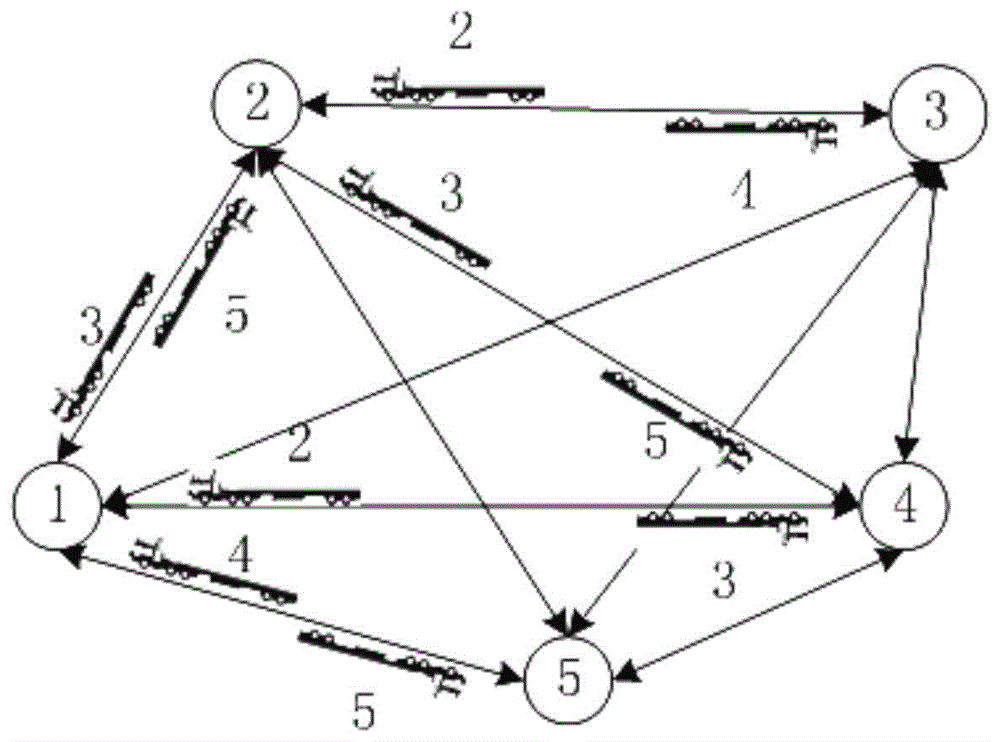
而公路港要充分发挥其优势,需要连成线形成网。某企业依托租用或自建的公路港场地,在多个大中型城市的多个公路港之间开展甩挂运输,此时,公路港不仅是牵引车和挂车的车场,同时也是甩挂运输的需求点。如图1所示,每两个公路港之间都有通道相连,多个公路港之间的甩挂运输业务已经形成了网络,但由于甩挂需求的不均衡,且需求存在大于1的情况,图1中挂车旁数字表示某方向甩挂运输需求,导致甩挂运输并不是简单的一线两点两端或一线多点甩挂调度模式,而是在全网络范围内根据需求进行调度。In order to give full play to its advantages, highway ports need to be connected into lines to form a network. An enterprise relies on the leased or self-built road port site to carry out drop and pull transportation between multiple road ports in many large and medium-sized cities. At this time, the road port is not only a yard for tractors and trailers, but also a drop and pull transportation. demand point. As shown in Figure 1, every two road ports are connected by a channel, and the drop and pull transportation business between multiple road ports has formed a network, but due to the unbalanced demand for drop and pull, and the demand is greater than 1 , the number next to the trailer in Figure 1 indicates the demand for drop and pull transportation in a certain direction. As a result, drop and pull transportation is not a simple one-line two-point two-end or one-line multi-point drop-and-hang scheduling mode, but is dispatched according to demand within the entire network.
一般来说,为了保证某运输线路上的稳定性,甩挂运输企业通常会安排某些车辆专门从事两点之间的甩挂运输,而安排另外一些车辆完成其它甩挂任务,即可将网络甩挂运输过程划分为两个阶段。Generally speaking, in order to ensure the stability of a certain transportation line, drop-and-hook transportation companies usually arrange some vehicles to specialize in drop-and-hook transportation between two points, and arrange other vehicles to complete other drop-and-hook tasks, so that the network can be transferred to the network. The drop and pull transportation process is divided into two stages.
阶段1:一线两点两端甩挂,如图2所示。由于一线两点两端甩挂模式组织相对比较简单,且司乘人员长期在该两点间行驶,有利于熟悉路况减少事故发生,因此可以将全网络中每两个点看成是独立的。由于两点之间往往存在甩挂需求不均衡现象,取其两个方向中需求较小的量作为一线两点两端甩挂的作业量,此时一定存在某个方向的需求已经满足。若另一个方向的需求未满足,那么将其转入下一阶段。例如图1中挂车旁边的数字表示甩挂需求,即点1至点2需要甩挂5个挂车,点2至点1需要甩挂3个挂车,此时点1和点2之间的需求不均衡,取两点之间需求较小量3为一线两点两端甩挂的作业量,则点2至点1的甩挂需求得到满足,余下点1至点2的需求还有2个挂车未被满足,需要在全网络进行调度,转入下一阶段。Stage 1: The two ends of the line are dropped and hung, as shown in Figure 2. Since the organization of the drop-and-hook mode at two points on the line is relatively simple, and the drivers and passengers travel between the two points for a long time, it is beneficial to familiarize themselves with the road conditions and reduce accidents. Therefore, every two points in the whole network can be regarded as independent. Since there is often an unbalanced demand for drop and hang between two points, the smaller demand in the two directions is taken as the amount of work for the drop and hang at both ends of the line and two points. At this time, there must be a demand in a certain direction that has been satisfied. If the need in the other direction is not met, it is moved to the next stage. For example, the numbers next to the trailers in Figure 1 indicate the drop and pull demand, that is, 5 trailers need to be dropped and pulled from
阶段2:全网络循环甩挂,如图3所示。经过阶段1的甩挂调度后,两点之间还存在单方向需求未被满足现象,需要在全网络进行调度安排。如图3所示,点1至点2、点1至点4、点1至点5、点2至点3、点2至点4之间分别有2、1、1、2、2个挂车需要运输。由于牵引车每天作业时间有限,此阶段需要做出使得网络调度成本最低、且牵引车购置最少的调度方案。Stage 2: The whole network loops and hangs, as shown in Figure 3. After the drop and hang scheduling in
因此,本发明针对公路港网络甩挂运输的特征,考虑实际甩挂运输中客户存在多次甩挂需求且甩挂两端需求不均衡的复杂情况,建立了全网络甩挂调度优化模型,能够为实际公路港网络甩挂优化(效率提升)提供参考。Therefore, in view of the characteristics of drop-and-haul transportation in the highway port network, the present invention establishes a drop-and-hang scheduling optimization model for the entire network, considering the complex situation that customers have multiple drop-and-hang requirements and the unbalanced demand at both ends of the drop-and-hang in actual drop-and-haul transportation. Provide a reference for the actual highway port network drop and pull optimization (efficiency improvement).
【发明内容】[Content of the invention]
本发明针对上述问题,提供一种网络甩挂运输调度的优化方法,该优化方法充分考虑实际甩挂运输中两端需求不平衡且需求可能为多个的情况,提出在公路港网络中进行全网络范围的车辆调度优化,能够贴近实际应用场景,将有利于甩挂运输企业提升经济效益。In view of the above problems, the present invention provides an optimization method for network drop and pull transportation scheduling. The optimization method fully considers the situation that the demand at both ends is unbalanced and the demand may be multiple in actual drop and pull transportation. The network-wide vehicle scheduling optimization can be close to the actual application scenario, which will help drop and pull transportation enterprises to improve economic benefits.
为实现上述目的,本发明采用的技术方案如下:For achieving the above object, the technical scheme adopted in the present invention is as follows:
一种网络甩挂运输调度的优化方法,应用于由牵引车、挂车和公路港组成的公路港网络甩挂运输中,包括如下步骤:An optimization method for network drop and pull transport scheduling, which is applied to a road port network drop and pull transport composed of tractors, trailers and road ports, and includes the following steps:
(1)建立网络甩挂调度目标优化模型;(1) Establish an optimization model for network drop-and-hang scheduling objectives;
(2)利用两阶段启发式算法对步骤(1)所述的目标优化模型进行求解:(2) Use a two-stage heuristic algorithm to solve the objective optimization model described in step (1):
首先将任意两个公路港之间的甩挂需求qij分成两个部分q'ij和q”ij;如果qij≥qji,那么q'ij=qji=q'ji,q”ij=qij-qji,q”ji=0;如果qij<qji,那么q'ij=qij=q'ji,q”ij=0,q”ji=qji-qij,q’ij构成的矩阵是对称矩阵;其中,qij:表示公路港i至j的甩挂运输需求,用甩挂运输趟次来表示;qji:表示公路港j至i的甩挂运输需求,用甩挂运输趟次来表示;由于需求不一定平衡,qij不一定等于qji;First, the drop and pull demand q ij between any two highway ports is divided into two parts q' ij and q"ij; if q ij ≥ q ji , then q' ij =q ji =q' ji , q" ij = q ij -q ji , q" ji =0; if q ij <q ji , then q' ij =q ij =q' ji , q" ij =0, q" ji =q ji -q ij , q' ij The formed matrix is a symmetric matrix; among them, q ij : represents the drop and pull transport demand of road ports i to j, expressed by the number of times of drop and pull transport; q ji : represents the drop and pull transport demand of road ports j to i, expressed by the drop and pull transport times It is represented by the number of transport trips; since the demand is not necessarily balanced, q ij is not necessarily equal to q ji ;
阶段1:对需求q'ij甩挂需求进行调度:采用一线两点两端甩挂车辆调度,即在网络中任意选取一个公路港,开始进行牵引车甩挂任务指派,牵引车在两公路港之间重载来回甩挂;Stage 1: Scheduling the demand q' ij drop and pull demand: adopt the scheduling of drop and pull vehicles at both ends of the line, that is, select a highway port in the network arbitrarily, and start the task assignment of tractor drop and pull, and the tractor is in the two highway ports Flip back and forth between heavy loads;
阶段2:对于第1阶段调度后的q”ij甩挂需求进行调度:采用全网络循环甩挂车辆调度,即选取第1阶段调度后剩余甩挂需求中最少的一条线路首先进行本阶段的甩挂,并且以单数需求起点作为牵引车出发点。Stage 2: Scheduling the q” ij drop and pull demand after the first stage scheduling: adopt the whole network loop drop and pull vehicle scheduling, that is, select the line with the least remaining drop and pull demand after the first stage of scheduling to first perform the drop and pull of this stage. Hang up, and take the singular demand starting point as the starting point of the tractor.
本发明还提供另一种网络甩挂运输调度的优化方法,应用于由牵引车、挂车和公路港组成的公路港网络甩挂运输中,包括如下步骤:The present invention also provides another optimization method for network drop and pull transport scheduling, which is applied to the drop and pull transport of the road port network composed of tractors, trailers and road ports, and includes the following steps:
(1)建立网络甩挂调度目标优化模型;(1) Establish an optimization model for network drop-and-hang scheduling objectives;
(2)利用启发式算法对步骤(1)所述的目标优化模型进行求解:采用纯网络循环甩挂对任意两个公路港之间的甩挂需求qij进行车辆调度。(2) Use the heuristic algorithm to solve the objective optimization model described in step (1): use the pure network loop drop and pull to perform vehicle scheduling on the drop and pull demand q ij between any two highway ports.
优选地,上述两个方法的步骤(1)所述的网络甩挂调度目标优化模型均为:Preferably, the network drop-and-hang scheduling objective optimization models described in step (1) of the above two methods are:
目标函数:Objective function:
设网络运营成本由重挂行驶成本、空驶成本及固定成本构成,重挂行驶成本

则目标为网络运营成本最小表示为:Then the goal is to minimize the network operation cost, which is expressed as:

约束条件为:The constraints are:
甩挂需求得到满足:
牵引车连续工作时间限制:

式中,i,j,l:表示公路港的编号,i,j,l∈N;In the formula, i, j, l: represents the number of the road port, i, j, l∈N;
K:表示牵引车的集合,K={1,2,…,k},同时K也表示路网需要的牵引车总数;K: Represents the set of tractors, K={1,2,...,k}, and K also represents the total number of tractors required by the road network;
k:表示牵引车的编号,k∈K;k: indicates the number of the tractor, k∈K;
dij:表示公路港i,j之间的距离,单位:km;d ij : represents the distance between highway ports i and j, unit: km;
qij:表示公路港i至j的甩挂运输需求,用甩挂运输趟次来表示;q ij : Indicates the drop and pull transport demand from road ports i to j, expressed by the number of drop and pull transport trips;
Cij,cij:分别表示牵引车牵引重挂及空驶的成本,单位:元/km;C ij , c ij : respectively represent the cost of tractor towing heavy-hook and empty driving, unit: yuan/km;
c:表示单位时间内牵引车使用的固定成本,包括车辆折旧、员工工资,单位:元;c: Indicates the fixed cost of the tractor used per unit time, including vehicle depreciation and employee wages, unit: yuan;
T:表示牵引车连续工作的时间,规定所有牵引车每天连续工作的时间都相等;T: Indicates the continuous working time of the tractor, which stipulates that all tractors work continuously for the same time every day;
v1,v2:分别表示牵引车牵引重挂及空驶的速度,单位:km/h;v 1 , v 2 : respectively indicate the speed of the tractor towing the heavy-hook and empty driving, unit: km/h;
k1,k2:分别表示牵引车牵引重挂及空驶的状态,k∈K;k 1 , k 2 : respectively represent the state of the tractor towing heavy suspension and empty driving, k∈K;


优选地,步骤(2)所述的阶段1按如下步骤进行:Preferably, the
第一步:初始参数设置,令i=1,K=0,Z重=0,Z空=0,Z固=0;The first step: initial parameter setting, let i=1, K=0, Z weight =0, Z empty =0, Z solid =0;
第二步:选取q'ij>0,且max(dij)对应的公路港i,j为第一辆车服务的甩挂起终点;如果q'ij>0且dij≥v1T,那么K=K+2q'ij,q'ij=0=q'ji,Z重=Z重+2q'ijdijCij,Z固=Kc;如果q'ij>0且dij<v1T,且如果


第三步:对所有i∈N,i=i+1,若q'ij>0,则转回第二步计算;若所有q'ij=0,则停止计算,Z1'=Z重+Z固。Step 3: For all i∈N, i=i+1, if q' ij > 0, go back to the second step to calculate; if all q' ij = 0, stop the calculation, Z 1 '=Z re + Z solid .
优选地,步骤(2)两阶段启发式算法中所述的阶段2按如下步骤进行:Preferably,
第一步:任选i∈N;The first step: choose i∈N;
第二步:选q”ij>0的公路港i,j为甩挂调度需求点;若dij≥v1T,那么K=K+q”ij,q”ij=0,Z重=Z重+q”ijdijCij,Z固=Kc;若dij<v1T,此时有两种策略:The second step: select the highway port i with q” ij > 0, j is the demand point for drop and pull dispatch; if d ij ≥ v 1 T, then K=K+q” ij , q” ij =0, Z weight = Z Re +q” ij d ij C ij , Z = Kc ; if d ij <v 1 T, there are two strategies:
策略1是车辆k往返于公路港i,j之间,此时只有单程装载货物,公路港j至i空驶;如果车辆k能在时间T内完成q”ij甩挂量,则K=K+1,q”ij=0,Z重=Z重+q”ijdijCij,Z空=Z空+(q”ij-1)djicji,Z固=Kc,若还有工作时间剩余,可以选取公路港j出发q”jl>0的l港作为下一个甩挂点;如果车辆k不能在时间T内完成q”ij甩挂量,则还需要派其它车辆来进行甩挂,完成公路港i,j之间的甩挂任务需要车辆数为

策略2是车辆k在公路港网络中完成甩挂任务,此时整个网络中存在重载也存在空载,车辆k完成公路港i至j的一趟甩挂运输,q”ij=q”ij-1,再选取公路港j出发q”jl>0的l港作为下一个甩挂点,q”jl=q”jl-1,直到工作时间没有剩余为止,K=K+1,Z重=Z重+dijCij+djlCjl+···;若从公路港j出发所有q”jl=0,那么要空驶至l港,再选取从l港出发的有甩挂任务的公路港进行甩挂,直到工作时间没有剩余为止,K=K+1,Z重=Z重+dijCij+···,Z空=Z空+djlcjl+···,Z固=Kc;
第三步:对所有i∈N,i=i+1,若q”ij>0,则转回第二步计算;若所有q”ij=0,则停止计算,Z1”=Z重+Z空+Z固;Step 3: For all i∈N, i=i+1, if q” ij > 0, go back to the second step to calculate; if all q” ij = 0, stop the calculation, Z 1 ”=Z re + Z empty + Z solid ;
因此,网络甩挂调度总成本为:Z1=Z'1+Z1”。Therefore, the total cost of network drop and hang scheduling is: Z 1 =Z' 1 +Z 1 ”.
优选地,步骤(2)所述采用纯网络循环甩挂对任意两个公路港之间的甩挂需求qij进行车辆调度按如下步骤进行:Preferably, in step (2), the pure network loop drop and pull is used to perform vehicle scheduling on the drop and pull demand q ij between any two highway ports according to the following steps:
第一步:任选i∈N;The first step: choose i∈N;
第二步:选qij>0的公路港i,j为甩挂调度需求点;若dij≥v1T,那么K=K+qij,qij=0,Z重=Z重+qijdijCij,Z固=Kc;若dij<v1T,车辆k在公路港网络中完成甩挂任务,此时整个网络中存在重载也存在空载,车辆k完成公路港i至j的一趟甩挂运输,qij=qij-1,再选取公路港j出发qjl>0的l港作为下一个甩挂点,qjl=qjl-1,直到工作时间没有剩余为止,K=K+1,Z重=Z重+dijCij+djlCjl+···;若从公路港j出发所有qjl=0,那么要空驶至l港,再选取从l港出发的有甩挂任务的公路港进行甩挂,直到工作时间没有剩余为止,K=K+1,Z重=Z重+dijCij+···,Z空=Z空+djlcjl+···,Z固=Kc;The second step: select the highway port i and j with q ij >0 as the demand point for drop and pull dispatch; if d ij ≥ v 1 T, then K=K+q ij , q ij =0, Z weight =Z weight + q ij d ij C ij , Z = Kc ; if d ij <v 1 T, vehicle k completes the drop-and-hang task in the highway port network, at this time there is heavy load and no load in the whole network, vehicle k completes highway port i One drop and pull transport to j, q ij = q ij -1, and then select port l where q jl > 0 from road port j as the next drop and pull point, q jl = q jl -1, until there is no remaining working time So far, K=K+1, Z weight =Z weight +d ij C ij +d jl C jl +...; if all q jl = 0 starting from road port j, then you have to empty to port l, and then choose from The highway port with the drop-and-hang task departing from the l port will be dropped and hung until there is no remaining working time, K=K+1, Z weight =Z weight +d ij C ij +..., Z empty = Z empty + d jl c jl +..., Z solid = Kc;
第三步:对所有i∈N,i=i+1,若qij>0,则转回第二步计算;若所有qij=0,则停止计算,Z1=Z重+Z空+Z固。Step 3: For all i∈N, i=i+1, if q ij >0, go back to the second step for calculation; if all q ij =0, stop the calculation, Z 1 =Z heavy +Z empty + Z solid .
因此,纯网络甩挂调度总成本为:Z1=Z重+Z空+Z固。Therefore, the total cost of pure network drop and hang scheduling is: Z 1 = Z heavy + Z empty + Z solid .
通过采用上述技术方案,本发明的有益效果为:By adopting the above-mentioned technical scheme, the beneficial effects of the present invention are:
本发明通过建立全网络甩挂调度优化模型,设计启发式算法对模型进行求解,并用实例验证了模型的有效性,使得在网络中进行甩挂运输优化可以减少牵引车辆使用数量,并降低整体运输成本。且在网络甩挂运输中,在纯网络范围内进行调度优化,可以更有效减少牵引车辆使用数量及降低运输成本。本发明充分考虑实际甩挂运输中两端需求不平衡且需求可能为多个的情况,提出在公路港网络中进行全网络范围的车辆调度优化,能够贴近实际应用场景,将有利于甩挂运输企业提升经济效益。The present invention establishes a whole network drop and pull scheduling optimization model, designs a heuristic algorithm to solve the model, and verifies the validity of the model with an example, so that the drop and pull transportation optimization in the network can reduce the number of traction vehicles used and reduce the overall transportation. cost. And in the network drop and pull transportation, scheduling optimization within the pure network range can more effectively reduce the number of traction vehicles used and reduce transportation costs. The present invention fully considers the situation that the demand at both ends is unbalanced and there may be multiple demands in the actual drop and pull transportation, and proposes to carry out network-wide vehicle scheduling optimization in the highway port network, which can be close to the actual application scene and will be beneficial to the drop and pull transportation. Enterprises improve economic efficiency.
【附图说明】【Description of drawings】
图1为现有技术中的公路港网络甩挂运输示意图;Fig. 1 is the schematic diagram of drop and pull transportation of highway port network in the prior art;
图2为现有技术中阶段1的一线两点两端甩挂示意图;Fig. 2 is a schematic diagram of the two-point drop-and-hang on both ends of a line in
图3为现有技术中阶段2的全网络循环甩挂示意图;Fig. 3 is the schematic diagram of the whole network cycle drop and hang of
【具体实施方式】【Detailed ways】
下面将结合本发明实施例中的附图,对本发明实施例中的技术方案进行清楚、完整地描述,显然,所描述的实施例仅仅是本发明一部分实施例,而不是全部的实施例。基于本发明中的实施例,本领域普通技术人员在没有做出创造性劳动前提下所获得的所有其他实施例,都属于本发明保护的范围。The technical solutions in the embodiments of the present invention will be clearly and completely described below with reference to the accompanying drawings in the embodiments of the present invention. Obviously, the described embodiments are only a part of the embodiments of the present invention, but not all of the embodiments. Based on the embodiments of the present invention, all other embodiments obtained by those of ordinary skill in the art without creative efforts shall fall within the protection scope of the present invention.
本发明主要包括模型假设、建立模型、利用两阶段启发式算法对模型进行求解等步骤。The invention mainly includes the steps of assuming a model, establishing a model, and using a two-stage heuristic algorithm to solve the model.
首先,模型假设:First, the model assumptions:
根据公路港网络甩挂运输特点,有如下假设:According to the characteristics of drop and pull transport in the highway port network, the following assumptions are made:
(1)网络中所有牵引车、挂车都属于标准型号,且型号一致;(1) All tractors and trailers in the network are standard models, and the models are the same;
(2)网络中各公路港有足够多的挂车,此假设可以由公路港甩挂运输企业整合社会资源达到;(2) There are enough trailers in each road port in the network, this assumption can be achieved by the integration of social resources of the road port drop and pull transportation enterprise;
(3)不考虑牵引车甩挂挂车作业时间,且挂车数量足够,无需牵引车等待挂车装卸作业;(3) The operation time of the tractor's drop-trailer trailer is not considered, and the number of trailers is sufficient, and there is no need for the tractor to wait for the trailer loading and unloading operations;
(4)两个公路港间往返行驶的距离及时间相同;(4) The distance and time for round-trip travel between the two highway ports are the same;
(5)网络中每天都产生甩挂需求,且每天的需求还存在波动,企业可以根据每天实际需求安排调度。由于某些节点之间距离较远,甩挂运输不一定能够一天内完成,因此假设前一天未完成的甩挂任务不影响后续的调度。(5) The demand for drop and hang is generated every day in the network, and the demand still fluctuates every day. The enterprise can arrange scheduling according to the actual demand every day. Due to the long distance between some nodes, the drop-and-hang transportation may not be completed within one day, so it is assumed that the drop-and-hang task that was not completed the previous day will not affect the subsequent scheduling.
其次,建立模型:Second, build the model:
根据公路港网络运营实际,甩挂运输企业追求全网络运营成本最小,满足需求的同时投入牵引车数量最少为目标建立模型。According to the actual operation of the highway port network, the drop-and-trail transportation enterprise pursues the minimum operating cost of the entire network, and establishes a model with the goal of meeting the demand while investing the minimum number of tractors.
(1)目标1:网络运营成本由重挂行驶成本、空驶成本及固定成本构成,重挂行驶成本为


(2)目标2:投入牵引车数量最少,表示为:(2) Goal 2: The minimum number of tractors put into use is expressed as:
min Z2=Kmin Z 2 =K
(3)约束条件:(3) Constraints:
甩挂需求得到满足:
牵引车连续工作时间限制:
需求不均衡的网络甩挂调度问题是一个双目标问题。目标1追求网络运营成本最小,由于甩挂需求都要被满足,因此在该目标下,主要权衡牵引车空驶成本及固定成本之间的大小。牵引车的固定成本Kc与牵引车投入数量K有成正比关系,如果牵引车空驶成本大于固定成本,那么会增加牵引车投入而减少整体运营成本,与目标2矛盾;如果牵引车空驶成本小于固定成本,那么会安排牵引车空驶而不增加牵引车投入数量,与目标2一致。此时,只能求出满足目标1和目标2的非劣解,全网络的甩挂需求为

由上,需求不均衡的网络甩挂调度模型最终变化为:From the above, the final change of the network drop and hang scheduling model with unbalanced demand is:

约束条件S.T.:


其中,符号说明为:Among them, the symbol description is:
i,j,l:表示公路港的编号,i,j,l∈N;i, j, l: indicates the number of the road port, i, j, l∈N;
K:表示牵引车的集合,K={1,2,…,k},同时K也表示路网需要的牵引车总数;K: Represents the set of tractors, K={1,2,...,k}, and K also represents the total number of tractors required by the road network;
k:表示牵引车的编号,k∈K;k: indicates the number of the tractor, k∈K;
dij:表示公路港i,j之间的距离,单位:km;d ij : represents the distance between highway ports i and j, unit: km;
qij:表示公路港i至j的甩挂运输需求,用甩挂运输趟次来表示;q ij : Indicates the drop and pull transport demand from road ports i to j, expressed by the number of drop and pull transport trips;
Cij,cij:分别表示公路港i至j的牵引车牵引重挂及空驶的成本,单位:元/km;C ij , c ij : respectively represent the cost of towing heavy-hook and empty driving of tractors in highway ports i to j, unit: yuan/km;
c:表示单位时间内牵引车使用的固定成本,包括车辆折旧、员工工资,单位:元;c: Indicates the fixed cost of the tractor used per unit time, including vehicle depreciation and employee wages, unit: yuan;
T:表示牵引车连续工作的时间,规定所有牵引车每天连续工作的时间都相等;T: Indicates the continuous working time of the tractor, which stipulates that all tractors work continuously for the same time every day;
v1,v2:分别表示牵引车牵引重挂及空驶的速度,单位:km/h;v 1 , v 2 : respectively indicate the speed of the tractor towing the heavy-hook and empty driving, unit: km/h;
k1,k2:分别表示牵引车牵引重挂及空驶的状态,k∈K;k 1 , k 2 : respectively represent the state of the tractor towing heavy suspension and empty driving, k∈K;


最后,利用两阶段启发式算法对模型进行求解,包括算法思路和算法具体步骤。Finally, a two-stage heuristic algorithm is used to solve the model, including algorithm ideas and specific steps of the algorithm.
算法思路:Algorithm idea:
需求不均衡的公路港网络甩挂调度问题本质上属于多车场的车辆调度问题,但由于每个公路港既可以是车场又可以看作是客户,因此也是一类车场和需求点重合的特殊调度问题。由于车辆无法确定始发点和终到点,从任意一个公路港出发,都有多种路径可以选择,也增加了求解的难度。可以在全网络范围内进行调度,也可以根据常规做法,将任意两个公路港之间的甩挂需求qij分成两个部分q'ij和q”ij(纯网络甩挂中不考虑分开)。如果qij≥qji,那么q'ij=qji=q'ji,q”ij=qij-qji,q”ji=0;如果qij<qji,那么q'ij=qij=q'ji,q”ij=0,q”ji=qji-qij,q'ij构成的矩阵是对称矩阵。针对需求q'ij和q”ij,相应的设计一个两阶段的启发式算法针进行求解。The drop-and-pull scheduling problem of the highway port network with unbalanced demand is essentially a vehicle scheduling problem with multiple depots. However, since each highway port can be regarded as both a depot and a customer, it is also a special dispatch in which the depot and the demand point overlap. question. Since the vehicle cannot determine the starting point and the ending point, starting from any highway port, there are multiple paths to choose from, which also increases the difficulty of solving. Scheduling can be carried out in the whole network, or according to the conventional practice, the drop and drop demand q ij between any two highway ports can be divided into two parts q' ij and q" ij (separation is not considered in pure network drop and drop) .If q ij ≥q ji , then q' ij =q ji =q' ji ,q" ij =q ij -q ji ,q" ji =0; if q ij <q ji , then q' ij =q ij =q' ji , q" ij =0, q" ji =q ji -q ij , the matrix formed by q' ij is a symmetric matrix. For the requirements q' ij and q" ij , a two-stage heuristic is correspondingly designed Algorithm needle to solve.
阶段1:一线两点两端甩挂车辆调度。本阶段仅需要对q'ij进行调度。在网络中任意选取一个公路港,开始进行牵引车甩挂任务指派,牵引车在两公路港之间重载来回甩挂,动力能够得到充分利用。若公路港i和j之间的距离dij较大,牵引车在一天的工作时间T内只能完成1个趟次的运输(根据假设,即使未完成1个趟次也按照1个趟次计算),则公路港i和j之间需要2q'ij辆牵引车进行牵引;若公路港i和j之间的距离dij较小,第k辆牵引车在一天的工作时间T内可以完成多个趟次的运输,那么就充分利用工作时间,T时间内能完成的牵引趟次为


阶段2:全网络循环甩挂车辆调度(如果不将甩挂需求qij分成两个部分q'ij和q”ij,即直接考虑需求qij的甩挂,可以按照本阶段的思路设计纯网络甩挂车辆调度算法)。本阶段对q”ij进行调度,此时可能存在牵引车空驶的情况。由于在牵引车调度中,理想状态是牵引车完成一条线路重载甩挂后,继续可以进行下一条线路的重载甩挂,因此选取剩余甩挂需求中最少的一条线路首先进行本阶段的甩挂,并且以单数需求起点i作为牵引车出发点。若公路港i和j之间的距离dij较大,牵引车在一天的工作时间T内只能完成1个趟次的运输,则公路港i至j需要q”ij辆牵引车进行牵引;若公路港i和j之间的距离dij较小,Tk时间内能完成的多个牵引趟次,由于此阶段中i和j之间只存在i至j的甩挂需求q”ij,而q”ji=0,因此牵引车k完成i至j的1次甩挂后,没有回程甩挂需求,而需要寻找下一条甩挂路径,从公路港j开始选择j至其它的有甩挂需求且距离最大的点l,若

算法具体步骤:The specific steps of the algorithm:
将甩挂需求qij分成两个部分q'ij和q”ij。The drop-and-hang requirement q ij is divided into two parts q' ij and q" ij .
阶段1:对需求q'ij甩挂需求进行调度。Stage 1: Scheduling the demand q' ij drop and hang demand.
第一步:初始参数设置,令i=1,K=0,Z重=0,Z空=0,Z固=0。The first step: initial parameter setting, let i=1, K=0, Z weight =0, Z empty =0, Z solid =0.
第二步:选取q'ij>0,且max(dij)对应的公路港i,j为第一辆车服务的甩挂起终点。如果q'ij>0且dij≥v1T,那么K=K+2q'ij,q'ij=0=q'ji,Z重=Z重+2q'ijdijCij,Z固=Kc。如果q'ij>0且dij<v1T,且如果


第三步:对所有i∈N,i=i+1,若q'ij>0,则转回第二步计算;若所有q'ij=0,则停止计算,Z1'=Z重+Z固。Step 3: For all i∈N, i=i+1, if q' ij > 0, go back to the second step to calculate; if all q' ij = 0, stop the calculation, Z 1 '=Z re + Z solid .
阶段2:对于第1阶段调度后的q”ij甩挂需求进行调度。Stage 2: Scheduling the q" ij drop-and-hang requirements after the first stage scheduling.
第一步:任选i∈N;The first step: choose i∈N;
第二步:选q”ij>0的公路港i,j为甩挂调度需求点。若dij≥v1T,那么K=K+q”ij,q”ij=0,Z重=Z重+q”ijdijCij,Z固=Kc。若dij<v1T,此时有两种策略。策略1是车辆k往返于公路港i,j之间,此时只有单程装载货物,公路港j至i空驶。如果车辆k能在时间T内完成q”ij甩挂量,则K=K+1,q”ij=0Z重=Z重+q”ijdijCij,Z空=Z空+(q”ij-1)djicji,Z固=Kc,若还有工作时间剩余,可以选取公路港j出发q”jl>0的l港作为下一个甩挂点。如果车辆k不能在时间T内完成q”ij甩挂量,则还需要派其它车辆来进行甩挂,完成公路港i,j之间的甩挂任务需要车辆数为

第三步:对所有i∈N,i=i+1,若q”ij>0,则转回第二步计算;若所有q”ij=0,则停止计算,Z1”=Z重+Z空+Z固。Step 3: For all i∈N, i=i+1, if q” ij > 0, go back to the second step to calculate; if all q” ij = 0, stop the calculation, Z 1 ”=Z re + Z empty + Z solid .
因此,网络甩挂调度总成本为:Z1=Z'1+Z1”。Therefore, the total cost of network drop and hang scheduling is: Z 1 =Z' 1 +Z 1 ”.
采用纯网络循环甩挂对任意两个公路港之间的甩挂需求qij进行车辆调度按如下步骤进行:The pure network loop drop and pull is used to dispatch vehicles to the drop and pull demand q ij between any two highway ports as follows:
第一步:任选i∈N;The first step: choose i∈N;
第二步:选qij>0的公路港i,j为甩挂调度需求点;若dij≥v1T,那么K=K+qij,qij=0,Z重=Z重+qijdijCij,Z固=Kc;若dij<v1T,车辆k在公路港网络中完成甩挂任务,此时整个网络中存在重载也存在空载,车辆k完成公路港i至j的一趟甩挂运输,qij=qij-1,再选取公路港j出发qjl>0的l港作为下一个甩挂点,qjl=qjl-1,直到工作时间没有剩余为止,K=K+1,Z重=Z重+dijCij+djlCjl+···;若从公路港j出发所有qjl=0,那么要空驶至l港,再选取从l港出发的有甩挂任务的公路港进行甩挂,直到工作时间没有剩余为止,K=K+1,Z重=Z重+dijCij+···,Z空=Z空+djlcjl+···,Z固=Kc;The second step: select the highway port i and j with q ij >0 as the demand point for drop and pull dispatch; if d ij ≥ v 1 T, then K=K+q ij , q ij =0, Z weight =Z weight + q ij d ij C ij , Z = Kc ; if d ij <v 1 T, vehicle k completes the drop-and-hang task in the highway port network, at this time there is heavy load and no load in the whole network, vehicle k completes highway port i One drop and pull transport to j, q ij = q ij -1, and then select port l where q jl > 0 from road port j as the next drop and pull point, q jl = q jl -1, until there is no remaining working time So far, K=K+1, Z weight =Z weight +d ij C ij +d jl C jl +...; if all q jl = 0 starting from road port j, then you have to empty to port l, and then choose from The highway port with the drop-and-hang task departing from the l port will be dropped and hung until there is no remaining working time, K=K+1, Z weight =Z weight +d ij C ij +..., Z empty = Z empty + d jl c jl +..., Z solid = Kc;
第三步:对所有i∈N,i=i+1,若qij>0,则转回第二步计算;若所有qij=0,则停止计算,Z1=Z重+Z空+Z固。Step 3: For all i∈N, i=i+1, if q ij >0, go back to the second step for calculation; if all q ij =0, stop the calculation, Z 1 =Z heavy +Z empty + Z solid .
因此,纯网络甩挂调度总成本为:Z1=Z重+Z空+Z固。Therefore, the total cost of pure network drop and hang scheduling is: Z 1 = Z heavy + Z empty + Z solid .
本申请中,下标为jl的参数均表示从公路港j至公路港l的参数,如(djl)表示公路港j至公路港l的距离,qjl表示公路港j至公路港l的甩挂需求。Cjl和cjl分别表示公路港j至公路港l的牵引车牵引重挂及空驶的成本。由于相当字母(参数)所表示的含义相同,下标的不同仅表示不同的公路港,此为本领域的公知常识,因此在此不再一一复述。下标为il的参数同理。In this application, the parameters with the subscript jl represent the parameters from road port j to road port l, for example (d jl ) represents the distance from road port j to road port l, and q jl represents the distance from road port j to road port l drop-off demand. C jl and c jl respectively represent the cost of tractor towing heavy hitch and empty driving from road port j to road port l. Since the equivalent letters (parameters) have the same meaning, and the different subscripts only represent different highway ports, this is a common knowledge in the field, so it will not be repeated here. The same is true for parameters with subscripts il.
实施例Example
物流企业L依托天地汇公路港,在10个城市都具有甩挂运输点,如何在甩挂网络中安排车辆调度,使得整个网络成本最低是企业管理者希望解决的技术问题。Relying on Tiandihui Highway Port, logistics enterprise L has drop and pull transportation points in 10 cities. How to arrange vehicle scheduling in the drop and pull network to minimize the cost of the entire network is a technical problem that enterprise managers hope to solve.
假设牵引车重挂及空载行驶成本为Cij=0.8元/km,,cij=0.4元/km,牵引车重挂及空驶的速度为v1=50km/h,v2=70km/h,每天固定成本c=500元,每天连续工作时间T=16小时,dij值根据Google地图查得,如表1所示。qij值使用Matlab 2010a软件中的randint函数,在[0,10]内生成10个客户点之间的甩挂运输任务,所有甩挂运输任务均为整数,如表2所示。Assuming that the cost of heavy-hung and no-load running of the tractor is C ij = 0.8 yuan/km, , c ij = 0.4 yuan/km, the speed of the tractor's heavy-hook and no-load driving is v 1 = 50km/h, v 2 = 70km/h , the fixed cost per day is c=500 yuan, the continuous working time per day is T=16 hours, and the value of d ij is obtained according to the Google map, as shown in Table 1. The q ij value uses the randint function in the Matlab 2010a software to generate drop-and-hang transportation tasks between 10 customer points in [0,10]. All drop-and-hang transportation tasks are integers, as shown in Table 2.
根据上述两阶段启发式算法,应用MATLAB 2010a进行编程计算,得到结果如表3所示。其中传统方式指每个运输任务派一辆卡车去运输(一般不会采用,此处是为了比对);纯网络运输是指不划分两个阶段,在全网络中进行指派运输任务,当某辆车只要有剩余运输时间就可以进行下一个任务的运输,可以根据启发式算法中的阶段2中的策略2的思路进行求解。According to the above two-stage heuristic algorithm, MATLAB 2010a is used for programming calculation, and the results are shown in Table 3. Among them, the traditional method refers to sending a truck for each transportation task (generally not used, here is for comparison); pure network transportation refers to assigning transportation tasks in the entire network without dividing into two stages. As long as the vehicle has the remaining transportation time, it can carry out the transportation of the next task, which can be solved according to the idea of
表1公路港之间距离表(单位,km)Table 1 Distance table between highway ports (unit, km)
表2公路港之间甩挂需求表(单位:车)Table 2 Drop and drop demand table between highway and port (unit: vehicle)
表3计算结果比对Table 3 Comparison of calculation results

从表3中可以看出,两阶段网络甩挂和纯网络甩挂方式均比传统方式使用的牵引车数量更少,成本更低。两阶段网络甩挂策略1、策略2、纯网络甩挂分别比传统甩挂牵引车数量减少7%、10.4%、27.1%,成本节约0.8%和0.7%、8.6%。相比传统方式,在两阶段网络甩挂和纯网络甩挂中,允许牵引车在可能情况下牵引多个挂车任务,因此使用的牵引车数量必然减少。且当牵引车空驶增加的成本小于因为牵引车数量减少而节约的固定成本时,两种网络甩挂运输成本均呈现了下降趋势。It can be seen from Table 3 that both the two-stage network drop-and-hook and pure network drop-and-hook methods use fewer tractors and lower costs than the traditional method. The two-stage network drop and pull
纯网络甩挂运输比两阶段网络甩挂在牵引车数量及成本上均具有更好的表现。相比两阶段网络甩挂的策略1、策略2,纯网络甩挂牵引车数量减少21.6%、18.6%,成本节约7.8%、7.9%。说明在全网络中进行调度优化,可以有效地减少牵引车车辆的购置以及总体成本的降低。即甩挂企业经营者应该改变原有按两个阶段进行网络甩挂的模式,而采用全网络调度优化会有更好的运营表现,从而降低成本,提高利润。Compared with the two-stage network drop and pull, the pure network drop and pull transportation has better performance in terms of the number of tractors and the cost. Compared with
对比两阶段网络甩挂的两种策略,由于策略2的阶段2是在全网络中进行调度优化,而策略1的阶段2是在两端点之间优化后再转向网络优化,也验证了全网络车辆调度能够减少牵引车数量。虽然策略2牵引车数量比策略1略少,但由于策略2空载成本比策略1增加了44%,因此在成本表现上策略1稍优于策略2。Comparing the two strategies of two-stage network drop and hang, because the
综上,相比传统运输方式,在网络中进行甩挂运输优化可以减少牵引车辆使用数量,并降低整体运输成本。且在网络甩挂运输中,在全网络范围内进行调度优化,可以更有效减少牵引车辆使用数量及降低运输成本。本发明充分考虑实际甩挂运输中两端需求不平衡且需求可能为多个的情况,提出在公路港网络中进行全网络范围的车辆调度优化,能够贴近实际应用场景,将有利于甩挂运输企业提升经济效益。To sum up, compared with traditional transportation methods, optimizing drop and pull transportation in the network can reduce the number of traction vehicles used and reduce the overall transportation cost. And in the network drop and pull transportation, scheduling optimization in the entire network can more effectively reduce the number of traction vehicles used and reduce transportation costs. The present invention fully considers the situation that the demand at both ends is unbalanced and there may be multiple demands in the actual drop and pull transportation, and proposes to carry out network-wide vehicle scheduling optimization in the highway port network, which can be close to the actual application scene and will be beneficial to the drop and pull transportation. Enterprises improve economic efficiency.
上述说明是针对本发明较佳可行实施例的详细说明,但实施例并非用以限定本发明的专利申请范围,凡本发明所提示的技术精神下所完成的同等变化或修饰变更,均应属于本发明所涵盖专利范围。The above description is a detailed description of the preferred feasible embodiments of the present invention, but the embodiments are not intended to limit the scope of the patent application of the present invention. All equivalent changes or modifications completed under the technical spirit suggested by the present invention shall belong to This invention covers the scope of the patent.
Claims (5)


Priority Applications (1)
| Application Number | Priority Date | Filing Date | Title |
|---|---|---|---|
| CN202010528232.XA CN111709570B (en) | 2020-06-11 | 2020-06-11 | Optimization method for network drop-and-drop transport scheduling |
Applications Claiming Priority (1)
| Application Number | Priority Date | Filing Date | Title |
|---|---|---|---|
| CN202010528232.XA CN111709570B (en) | 2020-06-11 | 2020-06-11 | Optimization method for network drop-and-drop transport scheduling |
Publications (2)
| Publication Number | Publication Date |
|---|---|
| CN111709570A CN111709570A (en) | 2020-09-25 |
| CN111709570B true CN111709570B (en) | 2022-09-27 |
Family
ID=72539985
Family Applications (1)
| Application Number | Title | Priority Date | Filing Date |
|---|---|---|---|
| CN202010528232.XA Active CN111709570B (en) | 2020-06-11 | 2020-06-11 | Optimization method for network drop-and-drop transport scheduling |
Country Status (1)
| Country | Link |
|---|---|
| CN (1) | CN111709570B (en) |
Families Citing this family (2)
| Publication number | Priority date | Publication date | Assignee | Title |
|---|---|---|---|---|
| CN113988424B (en) * | 2021-10-29 | 2024-08-23 | 浙江百世技术有限公司 | Circulating drop and pull transportation scheduling method |
| CN115526492A (en) * | 2022-09-28 | 2022-12-27 | 广西科技大学 | Optimization method for multi-vehicle type network drop-and-drop transport scheduling |
Citations (5)
| Publication number | Priority date | Publication date | Assignee | Title |
|---|---|---|---|---|
| CN102422313A (en) * | 2009-05-05 | 2012-04-18 | 埃克森美孚研究工程公司 | Method for optimizing a transportation scheme |
| CN105825303A (en) * | 2016-03-17 | 2016-08-03 | 合肥工业大学 | Drop and pull transport task allocation method |
| CN105956681A (en) * | 2016-04-15 | 2016-09-21 | 合肥工业大学 | Drop-and-pull transport dynamic path planning method based on receding horizon optimization |
| CN109559062A (en) * | 2019-01-07 | 2019-04-02 | 大连理工大学 | A kind of task distribution of cooperative logistical problem and paths planning method |
| CN110276488A (en) * | 2019-06-18 | 2019-09-24 | 浙江财经大学 | A vehicle routing optimization method based on block matrix and fuzzy transit time |
Family Cites Families (1)
| Publication number | Priority date | Publication date | Assignee | Title |
|---|---|---|---|---|
| WO2016132344A2 (en) * | 2015-02-16 | 2016-08-25 | Optibus Ltd | System and method for transportation scheduling and planning |
-
2020
- 2020-06-11 CN CN202010528232.XA patent/CN111709570B/en active Active
Patent Citations (5)
| Publication number | Priority date | Publication date | Assignee | Title |
|---|---|---|---|---|
| CN102422313A (en) * | 2009-05-05 | 2012-04-18 | 埃克森美孚研究工程公司 | Method for optimizing a transportation scheme |
| CN105825303A (en) * | 2016-03-17 | 2016-08-03 | 合肥工业大学 | Drop and pull transport task allocation method |
| CN105956681A (en) * | 2016-04-15 | 2016-09-21 | 合肥工业大学 | Drop-and-pull transport dynamic path planning method based on receding horizon optimization |
| CN109559062A (en) * | 2019-01-07 | 2019-04-02 | 大连理工大学 | A kind of task distribution of cooperative logistical problem and paths planning method |
| CN110276488A (en) * | 2019-06-18 | 2019-09-24 | 浙江财经大学 | A vehicle routing optimization method based on block matrix and fuzzy transit time |
Non-Patent Citations (2)
| Title |
|---|
| Scheduling for inland container truck and train transportation;Wen Fei Wang等;《International Journal of Production Economics》;20130630;第143卷(第2期);第349-356页 * |
| 基于禁忌搜索算法的多点循环甩挂调度模型及方法;王玲玲 等;《交通信息与安全》;20131220;第31卷(第6期);第33-37,46页 * |
Also Published As
| Publication number | Publication date |
|---|---|
| CN111709570A (en) | 2020-09-25 |
Similar Documents
| Publication | Publication Date | Title |
|---|---|---|
| CN111898909B (en) | Unmanned bus dispatching method based on real-time requirements | |
| CN113361804A (en) | Buffer yard operation and inter-dock truck transportation cooperative scheduling system and method thereof | |
| CN118350738B (en) | Freight electric vehicle distribution path planning method, equipment, medium and program product | |
| CN111709570B (en) | Optimization method for network drop-and-drop transport scheduling | |
| CN109299810A (en) | A method of loading a freight vehicle | |
| CN104021667A (en) | Co-hiring scheduling system and scheduling method integrating reservation service and real-time taxi-hiring | |
| CN109934532B (en) | Route planning method and related device for bidirectional transportation | |
| CN109670709B (en) | Goods transportation method and system based on crowdsourcing public transportation system | |
| CN108416559B (en) | Intelligent carpooling matching method for maximizing vehicle owner income of freight platform | |
| CN113988424B (en) | Circulating drop and pull transportation scheduling method | |
| CN117436777B (en) | Multi-type intermodal method and system for intelligent logistics freight transportation | |
| CN119990940B (en) | A shared car passenger and cargo transportation method based on vehicle-mounted cargo drone technology | |
| CN104890523A (en) | System and method for controlling energy usage | |
| CN102799733A (en) | Container tractor resource integration simulation system and method | |
| CN112749864A (en) | Subway freight scheduling method, storage medium, computing device and system | |
| CN115526492A (en) | Optimization method for multi-vehicle type network drop-and-drop transport scheduling | |
| CN114444923B (en) | A customized public transportation system and dispatching method between urban areas | |
| CN108197879B (en) | A method and system for multi-mode passenger and cargo co-transportation | |
| Chen et al. | Optimal method for allocation of tractors and trailers in daily dispatches of road drops and pull transport | |
| CN105741074A (en) | Freight information processing method and system based on Prim algorithm | |
| Martins-Turner et al. | Agent-based solving of the 2-echelon Vehicle Routing Problem | |
| Zhao et al. | Two-way vehicle scheduling approach in public transit based on Tabu search and dynamic programming algorithm | |
| Guo et al. | Scheduling Optimization Model for Highway Port Network Tractor and Semitrailer Dispatching Considering Time Window under Unbalanced Demand | |
| CN111639892A (en) | Logistics distribution method based on big data and Internet of things technology | |
| CN119670994B (en) | Demand Response Public Transport Route Optimization Method and System Based on Passenger-Freight Combined Transport Mode |
Legal Events
| Date | Code | Title | Description |
|---|---|---|---|
| PB01 | Publication | ||
| PB01 | Publication | ||
| SE01 | Entry into force of request for substantive examination | ||
| SE01 | Entry into force of request for substantive examination | ||
| GR01 | Patent grant | ||
| GR01 | Patent grant |