CN111753632A - driving aids - Google Patents

driving aids Download PDF

Info

Publication number
CN111753632A
CN111753632A CN202010231919.7A CN202010231919A CN111753632A CN 111753632 A CN111753632 A CN 111753632A CN 202010231919 A CN202010231919 A CN 202010231919A CN 111753632 A CN111753632 A CN 111753632A
Authority
CN
China
Prior art keywords
human body
distance
virtual
information
unit
Prior art date
Legal status (The legal status is an assumption and is not a legal conclusion. Google has not performed a legal analysis and makes no representation as to the accuracy of the status listed.)
Granted
Application number
CN202010231919.7A
Other languages
Chinese (zh)
Other versions
CN111753632B (en
Inventor
若山凉至
小原和马
Current Assignee (The listed assignees may be inaccurate. Google has not performed a legal analysis and makes no representation or warranty as to the accuracy of the list.)
Honda Motor Co Ltd
Original Assignee
Honda Motor Co Ltd
Priority date (The priority date is an assumption and is not a legal conclusion. Google has not performed a legal analysis and makes no representation as to the accuracy of the date listed.)
Filing date
Publication date
Application filed by Honda Motor Co Ltd filed Critical Honda Motor Co Ltd
Publication of CN111753632A publication Critical patent/CN111753632A/en
Application granted granted Critical
Publication of CN111753632B publication Critical patent/CN111753632B/en
Active legal-status Critical Current
Anticipated expiration legal-status Critical

Links

Images

Classifications

    • G—PHYSICS
    • G06—COMPUTING OR CALCULATING; COUNTING
    • G06T—IMAGE DATA PROCESSING OR GENERATION, IN GENERAL
    • G06T7/00—Image analysis
    • G06T7/10—Segmentation; Edge detection
    • G06T7/11—Region-based segmentation
    • G—PHYSICS
    • G06—COMPUTING OR CALCULATING; COUNTING
    • G06V—IMAGE OR VIDEO RECOGNITION OR UNDERSTANDING
    • G06V40/00—Recognition of biometric, human-related or animal-related patterns in image or video data
    • G06V40/10—Human or animal bodies, e.g. vehicle occupants or pedestrians; Body parts, e.g. hands
    • B—PERFORMING OPERATIONS; TRANSPORTING
    • B60—VEHICLES IN GENERAL
    • B60W—CONJOINT CONTROL OF VEHICLE SUB-UNITS OF DIFFERENT TYPE OR DIFFERENT FUNCTION; CONTROL SYSTEMS SPECIALLY ADAPTED FOR HYBRID VEHICLES; ROAD VEHICLE DRIVE CONTROL SYSTEMS FOR PURPOSES NOT RELATED TO THE CONTROL OF A PARTICULAR SUB-UNIT
    • B60W30/00—Purposes of road vehicle drive control systems not related to the control of a particular sub-unit, e.g. of systems using conjoint control of vehicle sub-units
    • B60W30/08—Active safety systems predicting or avoiding probable or impending collision or attempting to minimise its consequences
    • B60W30/095—Predicting travel path or likelihood of collision
    • B60W30/0956—Predicting travel path or likelihood of collision the prediction being responsive to traffic or environmental parameters
    • G—PHYSICS
    • G01—MEASURING; TESTING
    • G01S—RADIO DIRECTION-FINDING; RADIO NAVIGATION; DETERMINING DISTANCE OR VELOCITY BY USE OF RADIO WAVES; LOCATING OR PRESENCE-DETECTING BY USE OF THE REFLECTION OR RERADIATION OF RADIO WAVES; ANALOGOUS ARRANGEMENTS USING OTHER WAVES
    • G01S13/00—Systems using the reflection or reradiation of radio waves, e.g. radar systems; Analogous systems using reflection or reradiation of waves whose nature or wavelength is irrelevant or unspecified
    • G01S13/02—Systems using reflection of radio waves, e.g. primary radar systems; Analogous systems
    • G01S13/06—Systems determining position data of a target
    • G01S13/08—Systems for measuring distance only
    • G—PHYSICS
    • G01—MEASURING; TESTING
    • G01S—RADIO DIRECTION-FINDING; RADIO NAVIGATION; DETERMINING DISTANCE OR VELOCITY BY USE OF RADIO WAVES; LOCATING OR PRESENCE-DETECTING BY USE OF THE REFLECTION OR RERADIATION OF RADIO WAVES; ANALOGOUS ARRANGEMENTS USING OTHER WAVES
    • G01S17/00—Systems using the reflection or reradiation of electromagnetic waves other than radio waves, e.g. lidar systems
    • G01S17/02—Systems using the reflection of electromagnetic waves other than radio waves
    • G01S17/06—Systems determining position data of a target
    • G01S17/08—Systems determining position data of a target for measuring distance only
    • G—PHYSICS
    • G01—MEASURING; TESTING
    • G01S—RADIO DIRECTION-FINDING; RADIO NAVIGATION; DETERMINING DISTANCE OR VELOCITY BY USE OF RADIO WAVES; LOCATING OR PRESENCE-DETECTING BY USE OF THE REFLECTION OR RERADIATION OF RADIO WAVES; ANALOGOUS ARRANGEMENTS USING OTHER WAVES
    • G01S17/00—Systems using the reflection or reradiation of electromagnetic waves other than radio waves, e.g. lidar systems
    • G01S17/88—Lidar systems specially adapted for specific applications
    • G01S17/89—Lidar systems specially adapted for specific applications for mapping or imaging
    • G01S17/894—Three-dimensional [3D] imaging with simultaneous measurement of time-of-flight at a two-dimensional [2D] array of receiver pixels, e.g. time-of-flight cameras or flash lidar
    • G—PHYSICS
    • G06—COMPUTING OR CALCULATING; COUNTING
    • G06T—IMAGE DATA PROCESSING OR GENERATION, IN GENERAL
    • G06T7/00—Image analysis
    • G06T7/20—Analysis of motion
    • G—PHYSICS
    • G06—COMPUTING OR CALCULATING; COUNTING
    • G06T—IMAGE DATA PROCESSING OR GENERATION, IN GENERAL
    • G06T7/00—Image analysis
    • G06T7/70—Determining position or orientation of objects or cameras
    • G—PHYSICS
    • G06—COMPUTING OR CALCULATING; COUNTING
    • G06V—IMAGE OR VIDEO RECOGNITION OR UNDERSTANDING
    • G06V20/00—Scenes; Scene-specific elements
    • G06V20/50—Context or environment of the image
    • G06V20/56—Context or environment of the image exterior to a vehicle by using sensors mounted on the vehicle
    • G06V20/58—Recognition of moving objects or obstacles, e.g. vehicles or pedestrians; Recognition of traffic objects, e.g. traffic signs, traffic lights or roads
    • G—PHYSICS
    • G06—COMPUTING OR CALCULATING; COUNTING
    • G06V—IMAGE OR VIDEO RECOGNITION OR UNDERSTANDING
    • G06V40/00—Recognition of biometric, human-related or animal-related patterns in image or video data
    • G06V40/10—Human or animal bodies, e.g. vehicle occupants or pedestrians; Body parts, e.g. hands
    • G06V40/103—Static body considered as a whole, e.g. static pedestrian or occupant recognition
    • G—PHYSICS
    • G01—MEASURING; TESTING
    • G01S—RADIO DIRECTION-FINDING; RADIO NAVIGATION; DETERMINING DISTANCE OR VELOCITY BY USE OF RADIO WAVES; LOCATING OR PRESENCE-DETECTING BY USE OF THE REFLECTION OR RERADIATION OF RADIO WAVES; ANALOGOUS ARRANGEMENTS USING OTHER WAVES
    • G01S13/00—Systems using the reflection or reradiation of radio waves, e.g. radar systems; Analogous systems using reflection or reradiation of waves whose nature or wavelength is irrelevant or unspecified
    • G01S13/86—Combinations of radar systems with non-radar systems, e.g. sonar, direction finder
    • G01S13/867—Combination of radar systems with cameras
    • G—PHYSICS
    • G01—MEASURING; TESTING
    • G01S—RADIO DIRECTION-FINDING; RADIO NAVIGATION; DETERMINING DISTANCE OR VELOCITY BY USE OF RADIO WAVES; LOCATING OR PRESENCE-DETECTING BY USE OF THE REFLECTION OR RERADIATION OF RADIO WAVES; ANALOGOUS ARRANGEMENTS USING OTHER WAVES
    • G01S13/00—Systems using the reflection or reradiation of radio waves, e.g. radar systems; Analogous systems using reflection or reradiation of waves whose nature or wavelength is irrelevant or unspecified
    • G01S13/88—Radar or analogous systems specially adapted for specific applications
    • G01S13/93—Radar or analogous systems specially adapted for specific applications for anti-collision purposes
    • G01S13/931—Radar or analogous systems specially adapted for specific applications for anti-collision purposes of land vehicles
    • G—PHYSICS
    • G01—MEASURING; TESTING
    • G01S—RADIO DIRECTION-FINDING; RADIO NAVIGATION; DETERMINING DISTANCE OR VELOCITY BY USE OF RADIO WAVES; LOCATING OR PRESENCE-DETECTING BY USE OF THE REFLECTION OR RERADIATION OF RADIO WAVES; ANALOGOUS ARRANGEMENTS USING OTHER WAVES
    • G01S17/00—Systems using the reflection or reradiation of electromagnetic waves other than radio waves, e.g. lidar systems
    • G01S17/86—Combinations of lidar systems with systems other than lidar, radar or sonar, e.g. with direction finders
    • G—PHYSICS
    • G01—MEASURING; TESTING
    • G01S—RADIO DIRECTION-FINDING; RADIO NAVIGATION; DETERMINING DISTANCE OR VELOCITY BY USE OF RADIO WAVES; LOCATING OR PRESENCE-DETECTING BY USE OF THE REFLECTION OR RERADIATION OF RADIO WAVES; ANALOGOUS ARRANGEMENTS USING OTHER WAVES
    • G01S17/00—Systems using the reflection or reradiation of electromagnetic waves other than radio waves, e.g. lidar systems
    • G01S17/88—Lidar systems specially adapted for specific applications
    • G01S17/93—Lidar systems specially adapted for specific applications for anti-collision purposes
    • G01S17/931—Lidar systems specially adapted for specific applications for anti-collision purposes of land vehicles
    • G—PHYSICS
    • G06—COMPUTING OR CALCULATING; COUNTING
    • G06T—IMAGE DATA PROCESSING OR GENERATION, IN GENERAL
    • G06T2207/00—Indexing scheme for image analysis or image enhancement
    • G06T2207/30—Subject of image; Context of image processing
    • G06T2207/30196—Human being; Person
    • G—PHYSICS
    • G06—COMPUTING OR CALCULATING; COUNTING
    • G06T—IMAGE DATA PROCESSING OR GENERATION, IN GENERAL
    • G06T2207/00—Indexing scheme for image analysis or image enhancement
    • G06T2207/30—Subject of image; Context of image processing
    • G06T2207/30236—Traffic on road, railway or crossing
    • G—PHYSICS
    • G06—COMPUTING OR CALCULATING; COUNTING
    • G06T—IMAGE DATA PROCESSING OR GENERATION, IN GENERAL
    • G06T2207/00—Indexing scheme for image analysis or image enhancement
    • G06T2207/30—Subject of image; Context of image processing
    • G06T2207/30248—Vehicle exterior or interior
    • G06T2207/30252—Vehicle exterior; Vicinity of vehicle
    • G06T2207/30261—Obstacle
    • G—PHYSICS
    • G08—SIGNALLING
    • G08G—TRAFFIC CONTROL SYSTEMS
    • G08G1/00—Traffic control systems for road vehicles
    • G08G1/16—Anti-collision systems
    • G08G1/166—Anti-collision systems for active traffic, e.g. moving vehicles, pedestrians, bikes

Landscapes

  • Engineering & Computer Science (AREA)
  • Physics & Mathematics (AREA)
  • General Physics & Mathematics (AREA)
  • Theoretical Computer Science (AREA)
  • Multimedia (AREA)
  • Radar, Positioning & Navigation (AREA)
  • Remote Sensing (AREA)
  • Computer Vision & Pattern Recognition (AREA)
  • Human Computer Interaction (AREA)
  • Electromagnetism (AREA)
  • Computer Networks & Wireless Communication (AREA)
  • Automation & Control Theory (AREA)
  • Transportation (AREA)
  • Mechanical Engineering (AREA)
  • Traffic Control Systems (AREA)
  • Image Analysis (AREA)
  • Control Of Driving Devices And Active Controlling Of Vehicle (AREA)

Abstract

本发明涉及一种驾驶辅助装置。在驾驶辅助装置(10)中,人体确定部(66b)获取摄像头(44)获取到的图像数据中的、位于本车辆(12)的周围的人体(70)的图像来作为人体信息。虚拟骨骼推定部(66c)根据人体信息来推定人体(70)的虚拟骨骼(82)。雷达(46)或者LiDAR(48)测定距人体(70)的与虚拟骨骼(82)对应的部分的距离。据此,能够减轻人体识别处理的处理负荷。
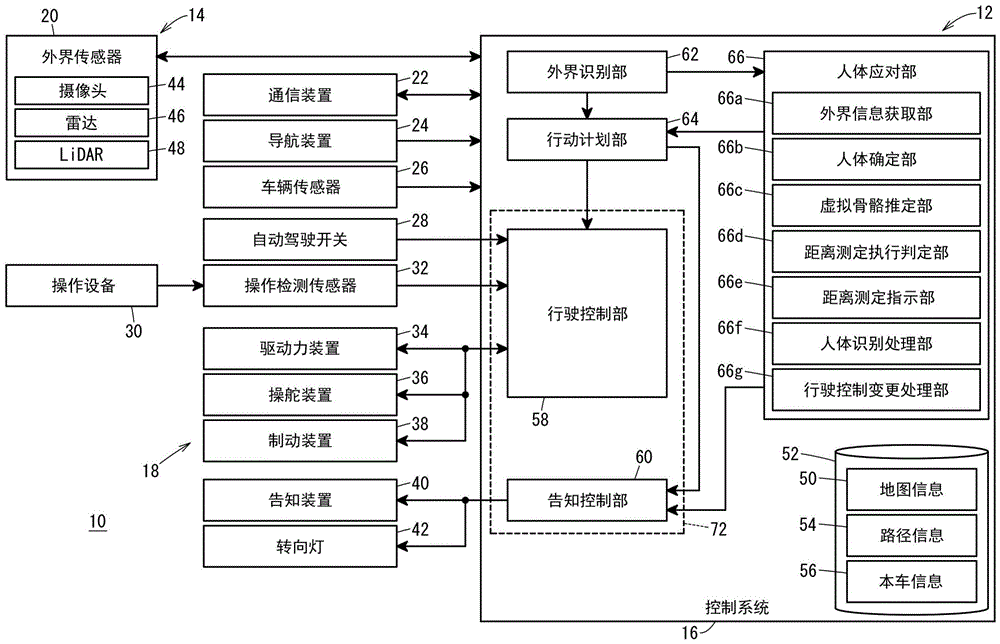
Figure 202010231919

The present invention relates to a driving assistance device. In the driving assistance device (10), a human body identification unit (66b) acquires, as human body information, an image of a human body (70) located around the host vehicle (12) among the image data acquired by the camera (44). A virtual skeleton estimation unit (66c) estimates a virtual skeleton (82) of a human body (70) based on the human body information. Radar (46) or LiDAR (48) measures the distance to the part of the human body (70) corresponding to the virtual skeleton (82). Accordingly, the processing load of the human body recognition processing can be reduced.

Figure 202010231919

Description

驾驶辅助装置driving aids

技术领域technical field

本发明涉及一种对移动体的驾驶进行辅助的驾驶辅助装置。The present invention relates to a driving assistance device for assisting driving of a mobile body.

背景技术Background technique

例如,在国际公开第2018/207351号中公开了,根据摄像头拍摄到的人体的图像,用骨架线连接该人体的关节位置,据此生成人体的骨骼信息。For example, International Publication No. 2018/207351 discloses that, based on an image of a human body captured by a camera, joint positions of the human body are connected with skeleton lines, and skeletal information of the human body is generated based on this.

发明内容SUMMARY OF THE INVENTION

另外,在辅助本车辆(移动体)的驾驶的驾驶辅助装置中,在识别位于本车辆的前方的人体的情况下,首先用摄像头(视觉传感器)来拍摄人体的图像。接着,规定包括所拍摄到的图像中拍到的人体的框(范围)。接着,设定以测距传感器为顶点(基准位置)的与该框对应的虚拟的棱锥(设想存在人体的区域),使用该测距传感器来测定与棱锥内之间的距离。接着,使用测距传感器测定到的各距离和人体的图像来识别人体。In addition, in a driving assistance device for assisting driving of a host vehicle (moving body), when recognizing a human body located in front of the host vehicle, a camera (visual sensor) first captures an image of the human body. Next, a frame (range) including the human body captured in the captured image is specified. Next, a virtual pyramid (region where a human body is assumed to exist) corresponding to the frame is set with the distance measuring sensor as a vertex (reference position), and the distance to the inside of the pyramid is measured using the distance measuring sensor. Next, the human body is recognized using each distance measured by the distance measuring sensor and the image of the human body.

然而,在该方法中,对棱锥内的所有部分进行距离测定,因此还要测定与棱锥内的除人体以外的部分(位置)的距离。据此,当使用测定到的各距离来进行人体的识别处理时,与人体以外的部分的距离会导致噪声,因此难以高精度地进行该人体的识别,并且识别处理的处理负荷增大。However, in this method, since the distance measurement is performed for all the parts in the pyramid, the distance to the part (position) other than the human body in the pyramid is also measured. Accordingly, when the human body recognition process is performed using each of the measured distances, the distance to the part other than the human body causes noise, making it difficult to accurately recognize the human body, and the processing load of the recognition process increases.

另一方面,在国际公开第2018/207351号的技术中,能够生成人体的骨骼信息。然而,关于如何将这种技术适用于驾驶辅助装置中的人体识别处理,在国际公开第2018/207351号中没有任何提示。On the other hand, in the technique of International Publication No. 2018/207351, skeleton information of the human body can be generated. However, there is no suggestion in International Publication No. 2018/207351 on how to apply this technology to human body recognition processing in driving assistance devices.

本发明是考虑这样的技术问题而完成的,其目的在于,提供一种能够高精度地识别人体,并且能够减轻识别处理的处理负荷的驾驶辅助装置。The present invention has been made in consideration of such a technical problem, and an object of the present invention is to provide a driving assistance device capable of recognizing a human body with high accuracy and reducing the processing load of the recognition processing.

本发明的方式是对移动体的驾驶进行辅助的驾驶辅助装置,该驾驶辅助装置具有视觉传感器、测距传感器、人体信息获取部和虚拟骨骼推定部,其中,所述视觉传感器获取所述移动体的周围的图像;所述测距传感器测定距所述移动体的周围的物体的距离;所述人体信息获取部获取所述视觉传感器获取到的所述图像中的、位于所述移动体的周围的人体的图像来作为人体信息;所述虚拟骨骼推定部根据所述人体信息来推定所述人体的虚拟骨骼。在该情况下,所述测距传感器测定距所述人体的与所述虚拟骨骼对应的部分的距离。An aspect of the present invention is a driving assistance device for assisting driving of a moving body, the driving assistance device including a visual sensor, a distance measuring sensor, a human body information acquisition unit, and a virtual skeleton estimation unit, wherein the visual sensor acquires the moving body The distance measurement sensor measures the distance to the surrounding object of the moving body; the human body information acquisition unit acquires the image obtained by the vision sensor, which is located around the moving body The image of the human body is taken as human body information; the virtual skeleton estimation unit estimates the virtual skeleton of the human body according to the human body information. In this case, the distance measuring sensor measures the distance from the portion of the human body corresponding to the virtual skeleton.

根据本发明,根据人体的图像(人体信息)来推定该人体的虚拟骨骼,由测距传感器仅测定距与推定出的虚拟骨骼对应的人体的部分的距离。据此,测距传感器的测定范围仅被缩小到人体的部分,能够抑制对距人体以外的部分(位置)的距离进行测定。其结果,能够高精度地识别人体。According to the present invention, the virtual skeleton of the human body is estimated from the image of the human body (human body information), and the distance measuring sensor measures only the distance to the part of the human body corresponding to the estimated virtual skeleton. Thereby, the measurement range of the distance measuring sensor is narrowed down only to the part of the human body, and the measurement of the distance to the part (position) other than the human body can be suppressed. As a result, the human body can be recognized with high accuracy.

另外,通过缩小测距传感器的测定范围,能够减少测距传感器的测定结果的信息量。据此,能够减轻人体识别处理的处理负荷。In addition, by narrowing the measurement range of the distance measuring sensor, the amount of information of the measurement result of the distance measuring sensor can be reduced. Accordingly, the processing load of the human body recognition processing can be reduced.

根据参照附图对以下实施方式进行的说明,上述的目的、特征和优点应易于被理解。The above-described objects, features, and advantages should be easily understood from the description of the following embodiments with reference to the accompanying drawings.

附图说明Description of drawings

图1是搭载有本实施方式所涉及的驾驶辅助装置的本车辆的结构图。FIG. 1 is a configuration diagram of a host vehicle on which the driving assistance device according to the present embodiment is mounted.

图2是示意性表示人体横穿本车辆的前方的情况的说明图。FIG. 2 is an explanatory diagram schematically showing a situation in which a human body traverses the front of the host vehicle.

图3是现有技术的方法的说明图。FIG. 3 is an explanatory diagram of a method of the related art.

图4是本实施方式的方法的说明图。FIG. 4 is an explanatory diagram of the method of the present embodiment.

图5是表示图1的驾驶辅助装置的动作的流程图。FIG. 5 is a flowchart showing the operation of the driving assistance device of FIG. 1 .

图6是表示图5的步骤S3的详细处理的流程图。FIG. 6 is a flowchart showing the detailed processing of step S3 in FIG. 5 .

图7是表示图5的步骤S7的详细处理的流程图。FIG. 7 is a flowchart showing the detailed processing of step S7 in FIG. 5 .

具体实施方式Detailed ways

下面,列举优选的实施方式且边参照附图边对本发明所涉及的驾驶辅助装置进行说明。Hereinafter, the driving assistance device according to the present invention will be described with reference to the accompanying drawings while citing preferred embodiments.

[1.本实施方式的结构][1. Configuration of the present embodiment]

<1.1驾驶辅助装置10的整体结构><1.1 Overall Structure of Driving Assistance Device 10 >

图1是表示本发明一实施方式所涉及的驾驶辅助装置10的结构的框图。驾驶辅助装置10被组装于车辆12(以下还称为本车辆12。),且自动或者手动进行本车辆12(移动体)的行驶控制。另外,所谓“行驶控制”是指至少包括本车辆12的加减速控制的与本车辆12的行驶有关的控制。在“行驶控制”通过“自动驾驶”来进行的情况下,“自动驾驶”是除了包括全自动地进行本车辆12的行驶控制(驾驶辅助)的“全自动驾驶”之外,还包括半自动地进行行驶控制(驾驶辅助)的“半自动驾驶”的概念。FIG. 1 is a block diagram showing the configuration of a driving assistance device 10 according to an embodiment of the present invention. The driving assistance device 10 is incorporated in a vehicle 12 (hereinafter also referred to as the own vehicle 12 ), and performs driving control of the own vehicle 12 (moving body) automatically or manually. In addition, the “travel control” refers to control related to the running of the host vehicle 12 including at least the acceleration/deceleration control of the host vehicle 12 . When “driving control” is performed by “autonomous driving”, “autonomous driving” includes semi-automatic driving of the vehicle 12 in addition to “full automatic driving” which performs driving control (driving assistance) of the host vehicle 12 fully automatically. The concept of "semi-autonomous driving" that performs driving control (driving assistance).

如图1所示,驾驶辅助装置10基本上由输入系统装置组14、控制系统16和输出系统装置组18构成。构成输入系统装置组14和输出系统装置组18的各个装置通过通信线连接于控制系统16。As shown in FIG. 1 , the driving assistance device 10 is basically composed of an input system device group 14 , a control system 16 , and an output system device group 18 . The respective devices constituting the input system device group 14 and the output system device group 18 are connected to the control system 16 through communication lines.

输入系统装置组14具有外界传感器20、通信装置22、导航装置24、车辆传感器26、自动驾驶开关28和连接于操作设备30的操作检测传感器32。The input system device group 14 has an external sensor 20 , a communication device 22 , a navigation device 24 , a vehicle sensor 26 , an automatic driving switch 28 , and an operation detection sensor 32 connected to the operation device 30 .

输出系统装置组18具有:驱动力装置34,其驱动未图示的车轮;操舵装置36,其对该车轮进行操舵;制动装置38,其对该车轮进行制动;告知装置40,其通过视觉和听觉向驾驶员进行告知;和转向灯42,其向外部告知本车辆12进行左右转弯的方向。The output system device group 18 includes: a driving force device 34 that drives a wheel (not shown); a steering device 36 that steers the wheel; a braking device 38 that brakes the wheel; Visual and auditory notification to the driver; and a turn signal 42 which informs the outside of the direction in which the host vehicle 12 makes a left-right turn.

<1.2输入系统装置组14的具体结构><1.2 Specific structure of the input system device group 14>

外界传感器20获取表示本车辆12的外界状态的信息(以下称为外界信息。),且将该外界信息输出给控制系统16。具体而言,外界传感器20构成为,包括摄像头44(视觉传感器)、雷达46(测距传感器)、LiDAR(Light Detection and Ranging:光探测和测距,LaserImaging Detection and Ranging:激光成像探测与测距)48(测距传感器)。The external sensor 20 acquires information (hereinafter referred to as external information) indicating the external state of the host vehicle 12 , and outputs the external information to the control system 16 . Specifically, the external sensor 20 is configured to include a camera 44 (visual sensor), a radar 46 (ranging sensor), LiDAR (Light Detection and Ranging: light detection and ranging, Laser Imaging Detection and Ranging: laser imaging detection and ranging). ) 48 (ranging sensor).

通信装置22构成为能够与路侧机、其他车辆、和包括服务器的外部装置进行通信,例如收发与交通设备有关的信息、与其他车辆有关的信息、探测信息或者最新的地图信息50。该地图信息50被存储在设置于控制系统16的存储装置52的规定存储器区域内或者被存储于导航装置24。The communication device 22 is configured to be able to communicate with roadside devices, other vehicles, and external devices including servers, for example, to transmit and receive information about traffic equipment, information about other vehicles, probe information, or the latest map information 50 . The map information 50 is stored in a predetermined memory area of the storage device 52 provided in the control system 16 or in the navigation device 24 .

导航装置24构成为包括能检测本车辆12的当前位置的卫星定位装置和用户接口(例如,触摸屏式的显示器、扬声器和麦克风)。另外,导航装置24根据本车辆12的当前位置或者用户指定的指定位置,来计算至指定的目的地的路径,且将该路径输出给控制系统16。由导航装置24计算出的路径被作为路径信息54而存储在存储装置52的规定存储器区域内。The navigation device 24 is configured to include a satellite positioning device capable of detecting the current position of the host vehicle 12 and a user interface (eg, a touch screen display, a speaker, and a microphone). In addition, the navigation device 24 calculates a route to the specified destination based on the current position of the host vehicle 12 or the specified position specified by the user, and outputs the route to the control system 16 . The route calculated by the navigation device 24 is stored as route information 54 in a predetermined memory area of the storage device 52 .

车辆传感器26包括:速度传感器,其检测本车辆12的行驶速度(车速);加速度传感器,其检测加速度;横向加速度(横G)传感器,其检测横向加速度;偏航角速率传感器,其检测绕垂直轴的角速度;方位传感器,其检测方向和方位;倾斜度传感器,其检测倾斜度,车辆传感器26将来自各传感器的检测信号输出给控制系统16。这些检测信号作为本车辆信息56被存储在存储装置52的规定存储器区域内。The vehicle sensors 26 include: a speed sensor that detects the traveling speed (vehicle speed) of the host vehicle 12 ; an acceleration sensor that detects acceleration; a lateral acceleration (lateral G) sensor that detects lateral acceleration; The angular velocity of the shaft; the bearing sensor, which detects the direction and bearing; the inclination sensor, which detects the inclination, and the vehicle sensor 26 outputs the detection signal from each sensor to the control system 16 . These detection signals are stored in a predetermined memory area of the storage device 52 as the own vehicle information 56 .

自动驾驶开关28例如由按钮式的硬件开关、或者使用导航装置24的软件开关来构成。自动驾驶开关28构成为,能够通过包括驾驶员的用户的手动操作来切换多种驾驶模式。The automatic driving switch 28 is constituted by, for example, a push-button hardware switch or a software switch using the navigation device 24 . The automatic driving switch 28 is configured to be able to switch between various driving modes by manual operation by a user including the driver.

操作设备30构成为包括加速踏板、方向盘、制动踏板、变速杆和转向灯操作杆。在操作设备30上安装有操作检测传感器32,该操作检测传感器32检测有无驾驶员的操作和操作量、操作位置。The operating device 30 is configured to include an accelerator pedal, a steering wheel, a brake pedal, a shift lever, and a turn signal lever. An operation detection sensor 32 is attached to the operation device 30, and the operation detection sensor 32 detects the presence or absence of the driver's operation, the amount of operation, and the operation position.

操作检测传感器32将作为检测结果的加速踏板踩踏量(油门开度)、方向盘操作量(操舵量)、制动踏板踩踏量、挡位、左右转弯方向等输出给构成控制系统16的后述的行驶控制部58。The operation detection sensor 32 outputs an accelerator pedal depression amount (accelerator opening degree), a steering wheel operation amount (steering amount), a brake pedal depression amount, a gear position, a left-right turning direction, and the like as a detection result to the control system 16 , which will be described later. Travel control unit 58 .

<1.3输出系统装置组18的具体结构><1.3 Specific structure of output system device group 18>

驱动力装置34由驱动力ECU(Electronic Control Unit)、包括发动机和驱动马达的驱动源构成。驱动力装置34按照从行驶控制部58输入的行驶控制值生成本车辆12的行驶驱动力(扭矩),且将该行驶驱动力经由变速器、或者直接传递给车轮。The driving force device 34 is constituted by a driving force ECU (Electronic Control Unit), and a driving source including an engine and a driving motor. The driving force device 34 generates a driving driving force (torque) of the host vehicle 12 according to the driving control value input from the driving control unit 58 , and transmits the driving driving force to the wheels via the transmission or directly.

操舵装置36由EPS(电动助力转向系统)ECU和EPS装置构成。操舵装置36按照从行驶控制部58输入的行驶控制值来改变车轮(转向轮)的方向。The steering device 36 is constituted by an EPS (electric power steering) ECU and an EPS device. The steering device 36 changes the direction of the wheels (steered wheels) in accordance with the travel control value input from the travel control unit 58 .

制动装置38例如是并用液压式制动器的电动伺服制动器,由制动ECU和制动执行机构构成。制动装置38按照从行驶控制部58输入的行驶控制值来对车轮进行制动。The brake device 38 is, for example, an electric servo brake that uses a hydraulic brake in combination, and is composed of a brake ECU and a brake actuator. The braking device 38 brakes the wheels according to the travel control value input from the travel control unit 58 .

告知装置40由告知ECU、显示装置和音响装置构成。告知装置40按照从构成控制系统16的后述的告知控制部60输出的告知指令,来进行与自动驾驶或者手动驾驶有关的告知动作。转向灯42按照从告知控制部60输出的告知指令来进行与本车辆12的左右转弯有关的告知动作。The notification device 40 is composed of a notification ECU, a display device, and an audio device. The notification device 40 performs a notification operation related to automatic driving or manual driving in accordance with a notification command output from a notification control unit 60 , which will be described later, constituting the control system 16 . The turn signal 42 performs a notification operation regarding the right and left turning of the host vehicle 12 in accordance with the notification command output from the notification control unit 60 .

<1.4控制系统16的结构><1.4 Configuration of Control System 16 >

控制系统16由1个或者多个ECU构成,除了上述的存储装置52、行驶控制部58和告知控制部60之外,还具有各种功能实现部。在该实施方式中,功能实现部是通过由1个或者多个CPU(Central Processing Unit)执行存储在非暂时性存储装置52中的程序来实现功能的软件功能部。作为替代,功能实现部也可以是由FPGA(Field-Programmable Gate Array:现场可编程门阵列)等集成电路构成的硬件功能部。The control system 16 is composed of one or a plurality of ECUs, and has various function realization units in addition to the above-described storage device 52 , the travel control unit 58 , and the notification control unit 60 . In this embodiment, the function realization unit is a software function unit that realizes a function by executing a program stored in the non-transitory storage device 52 by one or more CPUs (Central Processing Units). Alternatively, the function realization unit may be a hardware function unit constituted by an integrated circuit such as an FPGA (Field-Programmable Gate Array).

控制系统16构成为,除了包括存储装置52、行驶控制部58和告知控制部60之外,还包括外界识别部62、行动计划部64和人体应对部66。The control system 16 includes, in addition to the storage device 52 , the travel control unit 58 , and the notification control unit 60 , an outside world recognition unit 62 , an action planning unit 64 , and a human body response unit 66 .

外界识别部62使用由输入系统装置组14输入的各种信息(例如,来自外界传感器20的外界信息),来识别位于本车辆12的两侧的车道标识线(白线),生成包括停止线和交通信号灯的位置信息、或者可行驶区域的“静态”的外界识别信息。另外,外界识别部62使用输入的各种信息,生成包括泊车车辆和停车车辆等障碍物、人和其他车辆等交通参与者、或者交通信号灯的灯色(亮灯颜色)的“动态”的外界识别信息。The outside world recognition unit 62 recognizes the lane marking lines (white lines) located on both sides of the host vehicle 12 using various information input from the input system device group 14 (for example, the outside world information from the outside world sensor 20 ), and generates stop lines including stop lines. And the location information of traffic lights, or the "static" outside identification information of the drivable area. In addition, the outside world recognition unit 62 uses the input various information to generate “dynamic” data including obstacles such as parked vehicles and parked vehicles, traffic participants such as people and other vehicles, or the color (lighting color) of traffic lights. external identification information.

行动计划部64根据外界识别部62的识别结果制成每个行驶路段的行动计划(事件的时序),且根据需要更新行动计划。作为事件的种类,例如如图2所示,当在本车辆12的前方有人体70时,是使该本车辆12顺利行驶的事件。另外,在本实施方式中,人体70包括:(1)行人;(2)包括二轮车和四轮车的移动体的操纵者;(3)包括在交叉路口等协调交通流的警察和施工人员的交通协调员。在以下的说明中,对人体70为行人的情况进行说明。The action planning unit 64 creates an action plan (sequence of events) for each travel section based on the recognition result of the outside world recognition unit 62 , and updates the action plan as necessary. As a type of event, for example, as shown in FIG. 2 , when there is a human body 70 in front of the host vehicle 12 , the host vehicle 12 is caused to travel smoothly. In addition, in the present embodiment, the human body 70 includes: (1) pedestrians; (2) operators of moving objects including two-wheeled vehicles and four-wheeled vehicles; (3) including police officers and construction workers who coordinate traffic flow at intersections and the like Personnel Traffic Coordinator. In the following description, the case where the human body 70 is a pedestrian will be described.

另外,行动计划部64使用从存储装置52读出的地图信息50、路径信息54和本车辆信息56,生成按照所制成的行动计划的行驶轨迹(目标行为的时序)。具体而言,该行驶轨迹是以位置、姿势角、速度、加速度、曲率、偏航角速率、操舵角为数据单位的时序数据集。In addition, the action planning unit 64 uses the map information 50 , the route information 54 , and the host vehicle information 56 read from the storage device 52 to generate a travel trajectory (sequence of target behavior) according to the created action plan. Specifically, the travel trajectory is a time-series dataset whose data units are position, attitude angle, velocity, acceleration, curvature, yaw rate, and steering angle.

人体应对部66使用来自外界识别部62的各种信息,识别存在于本车辆12的周围的人体70,且进行用于应对识别到的人体70的处理。另外,人体应对部66将与应对识别到的人体70的应对结果有关的信息输出给行动计划部64。The human body response unit 66 recognizes the human body 70 existing around the host vehicle 12 using various kinds of information from the external recognition unit 62 , and performs processing for responding to the recognized human body 70 . In addition, the human body response unit 66 outputs information on the response result of responding to the recognized human body 70 to the action planning unit 64 .

在该情况下,人体应对部66作为外界信息获取部66a、人体确定部66b(人体信息获取部)、虚拟骨骼推定部66c、距离测定执行判定部66d、距离测定指示部66e、人体识别处理部66f和行驶控制变更处理部66g来发挥作用。在后面对人体应对部66的这些结构要素的功能进行叙述。In this case, the human body response unit 66 functions as an outside world information acquisition unit 66a, a human body identification unit 66b (human body information acquisition unit), a virtual skeleton estimation unit 66c, a distance measurement execution determination unit 66d, a distance measurement instruction unit 66e, and a human body recognition processing unit 66f and the running control change processing unit 66g function. The functions of these components of the human body countermeasure unit 66 will be described later.

行驶控制部58按照由行动计划部64生成的行驶轨迹(目标行为的时序),来确定至少包括本车辆12的加减速控制的、用于对本车辆12进行行驶控制的各个行驶控制值。然后,行驶控制部58将所得到的各个行驶控制值输出给驱动力装置34、操舵装置36和制动装置38。告知控制部60按照由行动计划部64生成的行驶轨迹来对告知装置40或者转向灯42进行驱动控制。下面,有时将行驶控制部58和告知控制部60总称为“驾驶控制部72”。The travel control unit 58 determines each travel control value for the travel control of the host vehicle 12 including at least the acceleration/deceleration control of the host vehicle 12 according to the travel trajectory (sequence of target behavior) generated by the action planning unit 64 . Then, the travel control unit 58 outputs each of the obtained travel control values to the driving force device 34 , the steering device 36 , and the braking device 38 . The notification control unit 60 controls the driving of the notification device 40 or the turn signal lamp 42 according to the travel trajectory generated by the action planning unit 64 . Hereinafter, the travel control unit 58 and the notification control unit 60 may be collectively referred to as the "driving control unit 72".

[2.驾驶辅助装置10的动作][2. Operation of the driving assistance device 10 ]

本实施方式中的驾驶辅助装置10如以上那样构成。接着,参照图2~图7,说明搭载有驾驶辅助装置10的本车辆12通过自动驾驶在道路74上行驶的情况下的驾驶辅助装置10的动作。The driving assistance device 10 in the present embodiment is configured as described above. Next, with reference to FIGS. 2 to 7 , the operation of the driving assistance device 10 when the host vehicle 12 on which the driving assistance device 10 is mounted is traveling on the road 74 by automatic driving will be described.

<2.1人体70和道路74的说明><2.1 Explanation of the human body 70 and the road 74>

图2是表示本车辆12在道路74上行驶的状态的图。本车辆12想要沿未图示的预定行驶路径在道路74上行驶。FIG. 2 is a diagram showing a state in which the host vehicle 12 is traveling on the road 74 . The host vehicle 12 intends to travel on the road 74 along an unillustrated predetermined travel route.

在本车辆12行驶的道路74的前方有人行横道76。人体70想要通过横穿人行横道76在本车辆12的前方穿过。在该情况下,驾驶辅助装置10(参照图1)根据摄像头44拍摄到的本车辆12周围的图像数据、雷达46和LiDAR48的检测结果来识别人体70。A pedestrian crossing 76 is ahead of the road 74 on which the host vehicle 12 is traveling. The human body 70 intends to pass in front of the host vehicle 12 by crossing the crosswalk 76 . In this case, the driving assistance device 10 (see FIG. 1 ) recognizes the human body 70 based on image data around the host vehicle 12 captured by the camera 44 and detection results by the radar 46 and the LiDAR 48 .

<2.2人体70的识别处理的概要><2.2 Outline of Recognition Processing of Human Body 70 >

接着,一边参照图3和图4一边对驾驶辅助装置10进行的对人体70的识别处理的概要进行说明。图3是现有技术的方法,图4是本实施方式中的方法。Next, the outline of the recognition processing of the human body 70 performed by the driving assistance device 10 will be described with reference to FIGS. 3 and 4 . FIG. 3 is a method in the prior art, and FIG. 4 is a method in this embodiment.

在图3的现有技术的方法中,首先,由摄像头44来拍摄包括人体70(参照图2)的本车辆12(参照图1)前方的规定区域。接着,根据摄像头44拍摄到的图像数据,来设定以摄像头44的位置为顶点(基准位置)的虚拟的棱锥78。棱锥78具有包括图像数据拍到的人体70的、还被称为“BBOX”的2维矩形形状的框80。接着,通过雷达46或者LiDAR48来进行相对于棱锥78内(的位置)的距离测定。接着,使用雷达46或者LiDAR48测定到的与棱锥78内的部分(位置)之间的各距离和人体70的图像来识别人体70。In the conventional method of FIG. 3 , first, a predetermined area in front of the host vehicle 12 (see FIG. 1 ) including the human body 70 (see FIG. 2 ) is captured by the camera 44 . Next, a virtual pyramid 78 having the position of the camera 44 as a vertex (reference position) is set based on the image data captured by the camera 44 . The pyramid 78 has a box 80 in the shape of a 2-dimensional rectangle, also referred to as a "BBOX", that includes the human body 70 captured by the image data. Next, the distance measurement with respect to the inside (position) of the pyramid 78 is performed by the radar 46 or the LiDAR 48 . Next, the human body 70 is identified using the respective distances to the portion (position) within the pyramid 78 measured by the radar 46 or the LiDAR 48 and the image of the human body 70 .

然而,在图3的现有技术的方法中,对棱锥78内整体进行距离的测定。因此,还测定与位于棱锥78内的人体70以外的部分(位置)之间的距离。其结果,在使用测定到的各距离来进行人体70的识别处理的情况下,与人体70以外的部分的距离导致噪声。因此,难以高精度地进行人体70的识别,并且识别处理的处理负荷变大。However, in the prior art method of FIG. 3 , the distance measurement is performed for the entire interior of the pyramid 78 . Therefore, the distance to the part (position) other than the human body 70 in the pyramid 78 is also measured. As a result, when the recognition process of the human body 70 is performed using each of the measured distances, the distances to the parts other than the human body 70 cause noise. Therefore, it is difficult to perform recognition of the human body 70 with high accuracy, and the processing load of the recognition processing increases.

与此相对,在图4所示的本实施方式的方法中,在由摄像头44对包括人体70(参照图2)的本车辆12(参照图1)前方的规定区域进行拍摄之后,根据摄像头44拍摄到的图像数据来确定人体70的图像。接着,使用人体70的图像来推定对该人体70的骨骼进行仿真的虚拟骨骼82。接着,通过雷达46或者LiDAR48对人体70的与虚拟骨骼82对应的部分(人体70的覆盖骨头周围的肌肉等的体表)进行距离测定。接着,使用雷达46或者LiDAR48测定到的各距离和人体70的图像来识别人体70。On the other hand, in the method of the present embodiment shown in FIG. 4 , after the camera 44 captures an image of a predetermined area in front of the host vehicle 12 (see FIG. 1 ) including the human body 70 (see FIG. 2 ), the camera 44 The captured image data is used to determine the image of the human body 70 . Next, the virtual skeleton 82 that simulates the skeleton of the human body 70 is estimated using the image of the human body 70 . Next, the radar 46 or the LiDAR 48 measures the distance of the portion of the human body 70 corresponding to the virtual skeleton 82 (the body surface of the human body 70 covering muscles and the like around the bones). Next, the human body 70 is identified using each distance measured by the radar 46 or the LiDAR 48 and the image of the human body 70 .

因此,在本实施方式的方法中,将测定范围缩小在与虚拟骨骼82对应的人体70的部分来进行距离测定。即,在棱锥78内,在与虚拟骨骼82对应的位置存在人体70的可能性高。因此,通过缩小测定范围来进行距离测定,能够抑制(减少)对与人体70以外的部分之间的距离进行测定,使噪声减少,因此能够高精度地识别人体70。Therefore, in the method of the present embodiment, the distance measurement is performed by narrowing the measurement range to the portion of the human body 70 corresponding to the virtual skeleton 82 . That is, within the pyramid 78 , there is a high possibility that the human body 70 exists at the position corresponding to the virtual bone 82 . Therefore, by narrowing the measurement range and performing the distance measurement, the measurement of the distance to parts other than the human body 70 can be suppressed (reduced), and noise can be reduced, so that the human body 70 can be recognized with high accuracy.

<2.3驾驶辅助装置10的动作><2.3 Operation of the driving assistance device 10 >

接着,一边参照图5~图7的流程图一边对具体地执行上述的本实施方式的方法的驾驶辅助装置10的动作进行说明。另外,图5~图7的动作主体是人体应对部66。Next, the operation of the driving assistance device 10 that specifically executes the method of the present embodiment described above will be described with reference to the flowcharts of FIGS. 5 to 7 . In addition, the main body of operation in FIGS. 5 to 7 is the human body corresponding portion 66 .

首先,在图5的步骤S1中,人体应对部66的外界信息获取部66a(参照图1)获取摄像头44拍摄到的图像数据等外界信息。First, in step S1 of FIG. 5 , the external information acquisition unit 66 a (see FIG. 1 ) of the human body response unit 66 acquires external information such as image data captured by the camera 44 .

在步骤S2中,人体确定部66b提取(获取)图像数据中、位于本车辆12周围(前方)的人体70(参照图2)的图像作为人体信息。In step S2, the human body identification unit 66b extracts (obtains) an image of the human body 70 (refer to FIG. 2) located around (in front of) the host vehicle 12 in the image data as human body information.

在步骤S3中,虚拟骨骼推定部66c根据提取出的人体信息来推定人体70的虚拟骨骼82。图6是表示步骤S3的处理的细节的流程图。In step S3, the virtual skeleton estimating unit 66c estimates the virtual skeleton 82 of the human body 70 based on the extracted human body information. FIG. 6 is a flowchart showing details of the processing of step S3.

如图4所示,虚拟骨骼82由多个人体特征部82a、多个虚拟关节部82b和作为直线部分的轴部82c构成,其中,多个所述人体特征部82a是人体70(参照图2的)的手或头等、表征该人体70的人体部分;多个所述虚拟关节部82b相当于人体70的关节;所述作为直线部分的轴部82c相当于按照人体骨骼构造来连接多个人体特征部82a和多个虚拟关节部82b的骨头。As shown in FIG. 4 , the virtual skeleton 82 is composed of a plurality of human body feature parts 82a, a plurality of which are the human body 70 (see FIG. 2 ), a plurality of virtual joint parts 82b, and a shaft part 82c as a straight line part. A plurality of the virtual joint parts 82b are equivalent to the joints of the human body 70; the shaft part 82c as a straight line part is equivalent to connecting a plurality of human bodies according to the structure of the human body skeleton Bones of the feature portion 82a and the plurality of virtual joint portions 82b.

因此,在图6的步骤S31中,虚拟骨骼推定部66c首先根据人体信息,判定是否能检测到人体特征部82a和虚拟关节部82b。Therefore, in step S31 of FIG. 6 , the virtual skeleton estimating unit 66c first determines whether or not the human body feature part 82a and the virtual joint part 82b can be detected based on the human body information.

在能检测到人体特征部82a和虚拟关节部82b的情况下(步骤S31:是),在接着的步骤S32中,虚拟骨骼推定部66c通过使用公知的深度学习(Deep learning)的推定方法,例如“OpenPose”,来推定多个人体特征部82a和多个虚拟关节部82b的位置。When the human body feature portion 82a and the virtual joint portion 82b can be detected (step S31: YES), in the next step S32, the virtual skeleton estimation unit 66c uses a known deep learning estimation method, such as "OpenPose" to estimate the positions of the plurality of human body feature parts 82a and the plurality of virtual joint parts 82b.

在步骤S33中,虚拟骨骼推定部66c根据推定出的多个人体特征部82a和多个虚拟关节部82b的位置,来推定相当于人体70的骨头周围的肌肉等(被体表覆盖的部分)的带肉部分84。In step S33, the virtual skeleton estimating unit 66c estimates the muscles and the like around the bones corresponding to the human body 70 (the part covered by the body surface) based on the estimated positions of the plurality of human body feature parts 82a and the plurality of virtual joint parts 82b. The meaty part 84.

在步骤S34中,虚拟骨骼推定部66c以通过带肉部分84的内部(中心)的方式用直线连结多个人体特征部82a和多个虚拟关节部82b,且将连结的直线推定为轴部82c。In step S34 , the virtual skeleton estimating unit 66c connects the plurality of human body feature portions 82a and the plurality of virtual joint portions 82b with straight lines so as to pass through the inside (center) of the fleshed portion 84, and estimates the connected straight line as the shaft portion 82c .

另外,当在步骤S31无法根据人体信息进行虚拟骨骼82的推定的情况下(步骤S31:否),虚拟骨骼推定部66c中止虚拟骨骼82的推定处理,跳过步骤S32~S34的处理。In addition, when the virtual skeleton 82 cannot be estimated from the human body information in step S31 (step S31: NO), the virtual skeleton estimating unit 66c stops the estimation processing of the virtual skeleton 82 and skips the processing of steps S32 to S34.

返回图5,在步骤S4中,距离测定执行判定部66d推定与人体70的距离。当在步骤S3中推定出虚拟骨骼82的情况下,距离测定执行判定部66d判定为能够根据虚拟骨骼82来测定与人体70的距离(步骤S4:是)。Returning to FIG. 5 , in step S4 , the distance measurement execution determination unit 66 d estimates the distance to the human body 70 . When the virtual skeleton 82 is estimated in step S3, the distance measurement execution determination unit 66d determines that the distance to the human body 70 can be measured from the virtual skeleton 82 (step S4: YES).

在步骤S5中,距离测定指示部66e接受步骤S4中的肯定的判定结果,控制雷达46或者LiDAR48使其测定距人体70的与虚拟骨骼82对应的体表的距离。据此,雷达46或者LiDAR48根据来自距离测定指示部66e的指示,测定距人体70的与虚拟骨骼82对应的体表的距离。其结果,在步骤S6中,外界信息获取部66a能够获取来自雷达46或者LiDAR48的距人体70的与虚拟骨骼82对应的体表的距离的测定结果。In step S5 , the distance measurement instructing unit 66 e receives the affirmative determination result in step S4 , and controls the radar 46 or the LiDAR 48 to measure the distance to the body surface corresponding to the virtual skeleton 82 of the human body 70 . Accordingly, the radar 46 or the LiDAR 48 measures the distance to the body surface corresponding to the virtual skeleton 82 of the human body 70 according to the instruction from the distance measurement instruction unit 66e. As a result, in step S6, the outside world information acquisition unit 66a can acquire the measurement result of the distance to the body surface corresponding to the virtual skeleton 82 of the human body 70 from the radar 46 or the LiDAR 48.

或者,在步骤S5中,距离测定指示部66e也可以指示外界信息获取部66a仅获取雷达46或者LiDAR48对距离的测定结果中、距与虚拟骨骼82对应的人体70的体表的距离的测定结果。据此,在步骤S6中,外界信息获取部66a仅获取距与虚拟骨骼82对应的人体70的体表的距离的测定结果。Alternatively, in step S5, the distance measurement instructing unit 66e may instruct the outside world information acquiring unit 66a to acquire only the measurement result of the distance from the body surface of the human body 70 corresponding to the virtual skeleton 82 among the measurement results of the distance by the radar 46 or the LiDAR 48 . Accordingly, in step S6 , the outside world information acquisition unit 66 a acquires only the measurement result of the distance from the body surface of the human body 70 corresponding to the virtual skeleton 82 .

在步骤S7中,人体识别处理部66f根据在步骤S6中获取到的距离和在步骤S2中确定的人体信息来进行人体70的识别处理。图7是表示步骤S7的处理的细节的流程图。In step S7, the human body recognition processing unit 66f performs recognition processing of the human body 70 based on the distance acquired in step S6 and the human body information determined in step S2. FIG. 7 is a flowchart showing the details of the processing of step S7.

在图7的步骤S71中,人体识别处理部66f首先判定各距离的测定结果(距离信息)中、与轴部82c对应的人体70的体表的距离信息、和与人体特征部82a或虚拟关节部82b对应的人体70的体表的距离信息是否是相反的结果。In step S71 of FIG. 7 , the human body recognition processing unit 66f first determines the distance information on the body surface of the human body 70 corresponding to the shaft portion 82c, and the human body feature portion 82a or the virtual joint among the measurement results (distance information) of each distance. Whether the distance information of the body surface of the human body 70 corresponding to the part 82b is the opposite result.

如前述那样,轴部82c是虚拟骨骼82中的直线部分。另一方面,人体特征部82a或者虚拟关节部82b是虚拟骨骼82中的点部分或者具有一定体积的部分。因此,可以说与轴部82c对应的距离信息的精度相对高于与人体特征部82a或者虚拟关节部82b对应的距离信息的精度。As described above, the shaft portion 82c is a straight portion in the virtual bone 82 . On the other hand, the human body feature portion 82 a or the virtual joint portion 82 b is a point portion or a portion having a certain volume in the virtual bone 82 . Therefore, it can be said that the accuracy of the distance information corresponding to the shaft portion 82c is relatively higher than the accuracy of the distance information corresponding to the human body feature portion 82a or the virtual joint portion 82b.

因此,在结果为二者的距离信息相反的情况下(步骤S71:是),人体识别处理部66f在步骤S72中优先采用精度高的与轴部82c对应的距离信息。另一方面,在结果为二者的距离信息大致一致的情况下(步骤S71:否),人体识别处理部66f在步骤S73中优先采用与人体特征部82a或者虚拟关节部82b对应的距离信息。Therefore, when the result is that the distance information of the two is opposite (step S71: YES), the human body recognition processing unit 66f preferentially uses the distance information corresponding to the shaft portion 82c in step S72. On the other hand, when the result is that the distance information of the two substantially matches (step S71: NO), the human body recognition processing unit 66f preferentially uses the distance information corresponding to the human body feature part 82a or the virtual joint part 82b in step S73.

在接着的步骤S74中,人体识别处理部66f使用在步骤S72或S73中采用的距离信息和在步骤S2中确定的人体信息来识别人体70。具体而言,根据作为人体70的图像的人体信息来确定该人体70的形状,并且根据所采用的距离信息来确定人体70相对于本车辆12的位置。In the following step S74, the human body recognition processing unit 66f recognizes the human body 70 using the distance information adopted in step S72 or S73 and the human body information determined in step S2. Specifically, the shape of the human body 70 is determined from the human body information that is an image of the human body 70, and the position of the human body 70 relative to the host vehicle 12 is determined from the employed distance information.

返回图5,在步骤S8中,行驶控制变更处理部66g判定是否需要变更本车辆12的行驶控制。具体而言,当在本车辆12行驶过程中识别到人体70正横穿前方的人行横道76时,行驶控制变更处理部66g判定为需要改变本车辆12的行驶控制,以生成使本车辆12的车速减速或者使本车辆12在人行横道76的近前暂时停车的行驶轨迹(步骤S8:是)。Returning to FIG. 5 , in step S8 , the travel control change processing unit 66 g determines whether or not the travel control of the host vehicle 12 needs to be changed. Specifically, when it is recognized that the human body 70 is crossing the front crosswalk 76 while the host vehicle 12 is traveling, the travel control change processing unit 66g determines that the travel control of the host vehicle 12 needs to be changed so as to generate a vehicle speed that causes the host vehicle 12 to change. A travel trajectory in which the host vehicle 12 is decelerated or temporarily stopped in front of the pedestrian crossing 76 (step S8 : YES).

然后,行驶控制变更处理部66g在接着的步骤S9中,根据步骤S8中的肯定的判定结果,将用于变更本车辆12的行驶控制的指示内容输出给行动计划部64。据此,行动计划部64受理行驶控制变更处理部66g的判定结果来更新行动计划。其结果,行驶控制部58根据更新后的行动计划(行驶轨迹),控制构成输出系统装置组18的各个装置,据此使本车辆12的车速降低或者使本车辆12在人行横道76的近前暂时停车。Then, in the next step S9, the travel control change processing unit 66g outputs the instruction content for changing the travel control of the host vehicle 12 to the action planning unit 64 based on the affirmative determination result in step S8. Accordingly, the action plan unit 64 receives the determination result of the travel control change processing unit 66g and updates the action plan. As a result, the travel control unit 58 controls each device constituting the output system device group 18 based on the updated action plan (travel trajectory), and accordingly reduces the vehicle speed of the host vehicle 12 or temporarily stops the host vehicle 12 in front of the pedestrian crossing 76 . .

在此之后,进入步骤S10,在继续由人体应对部66进行的处理的情况下(步骤S10:是),返回步骤S1,反复执行步骤S1~S10的处理。After that, the process proceeds to step S10, and when the process by the human body response unit 66 is continued (step S10: YES), the process returns to step S1, and the processes of steps S1 to S10 are repeatedly executed.

另一方面,当在步骤S2中无法确定人体信息或者在步骤S3中无法进行虚拟骨骼82的推定处理的情况下(步骤S31:否),在步骤S4中,距离测定执行判定部66d判定为无法由雷达46或者LiDAR48进行距离测定(步骤S4:否),跳过步骤S5~S9的处理,进入步骤S10。On the other hand, when the human body information cannot be identified in step S2 or the estimation process of the virtual skeleton 82 cannot be performed in step S3 (step S31: NO), in step S4, the distance measurement execution determination unit 66d determines that it is impossible The distance measurement is performed by the radar 46 or the LiDAR 48 (step S4: NO), the processing of steps S5 to S9 is skipped, and the process proceeds to step S10.

并且,在步骤S10中,在停止自动驾驶下的行驶的情况下(步骤S10:否),图5~图7的一系列处理结束。Then, in step S10 , when the traveling in automatic driving is stopped (step S10 : NO), the series of processing in FIGS. 5 to 7 ends.

<2.4变形例><2.4 Modifications>

在图5~图7中,说明雷达46或者LiDAR48根据虚拟骨骼82来测定与人体70的距离的情况。另外,也可以为:即使在无法推定虚拟骨骼82的情况下(图6的步骤S31:否),在步骤S4中,距离测定执行判定部66d也允许由雷达46或者LiDAR48执行距离测定。在该情况下,雷达46或者LiDAR48在步骤S5中,按照图3所示的现有技术的方法来推定与人体70的距离。因此,在步骤S7中,根据与棱锥78内的部分的各距离来进行人体70的识别处理。5 to 7 illustrate a case where the radar 46 or the LiDAR 48 measures the distance to the human body 70 from the virtual skeleton 82 . In addition, even when the virtual skeleton 82 cannot be estimated (step S31 in FIG. 6 : NO), the distance measurement execution determination unit 66d may allow the radar 46 or the LiDAR 48 to execute the distance measurement in step S4. In this case, the radar 46 or the LiDAR 48 estimates the distance to the human body 70 in accordance with the conventional method shown in FIG. 3 in step S5. Therefore, in step S7, the recognition process of the human body 70 is performed based on each distance from the part in the pyramid 78.

[3.本实施方式的效果][3. Effects of the present embodiment]

如以上说明的那样,本实施方式所涉及的驾驶辅助装置10是辅助本车辆12(移动体)的驾驶的装置,具有摄像头44(视觉传感器)、雷达46或者LiDAR48(测距传感器)、人体确定部66b(人体信息获取部)和虚拟骨骼推定部66c,其中,所述摄像头44(视觉传感器)获取本车辆12的周围的图像;所述雷达46或者所述LiDAR48(测距传感器)测定与本车辆12的周围的物体的距离;所述人体确定部66b(人体信息获取部)获取摄像头44获取到的图像数据中、位于本车辆12周围的人体70的图像作为人体信息;所述虚拟骨骼推定部66c根据人体信息来推定人体70的虚拟骨骼82。在该情况下,雷达46或者LiDAR48测定距人体70的与虚拟骨骼82对应的部分(覆盖带肉部分84的体表)的距离。As described above, the driving assistance device 10 according to the present embodiment is a device for assisting the driving of the host vehicle 12 (moving body), and includes the camera 44 (vision sensor), the radar 46 or LiDAR 48 (distance measuring sensor), the human body identification The camera 44 (visual sensor) acquires an image of the surroundings of the host vehicle 12; the radar 46 or the LiDAR 48 (distance measuring sensor) The distance of objects around the vehicle 12; the human body determination unit 66b (human body information acquisition unit) acquires the image of the human body 70 located around the own vehicle 12 in the image data acquired by the camera 44 as human body information; the virtual skeleton estimation The unit 66c estimates the virtual skeleton 82 of the human body 70 based on the human body information. In this case, the radar 46 or the LiDAR 48 measures the distance to the portion of the human body 70 corresponding to the virtual skeleton 82 (the body surface covering the fleshy portion 84 ).

根据该结构,根据人体70的图像(人体信息)来推定该人体70的虚拟骨骼82,由雷达46或者LiDAR48仅测定距与推定出的虚拟骨骼82对应的人体70的部分的距离。据此,雷达46或者LiDAR48的测定范围仅缩小在人体70的部分,由此能够抑制测定与人体70以外的部分的距离。其结果,能够高精度地识别人体70。With this configuration, the virtual skeleton 82 of the human body 70 is estimated from the image (human body information) of the human body 70 , and the radar 46 or the LiDAR 48 measures only the distance to the portion of the human body 70 corresponding to the estimated virtual skeleton 82 . According to this, the measurement range of the radar 46 or the LiDAR 48 is narrowed down only to the portion of the human body 70 , whereby the measurement of the distance to the portion other than the human body 70 can be suppressed. As a result, the human body 70 can be recognized with high accuracy.

当进一步进行说明时,通过在图5的步骤S3中的图像识别处理阶段推定虚拟骨骼82,能够大幅减少在步骤S5中的距离测定中雷达46或者LiDAR48在三维空间(棱锥78)内搜索的点组的数量。据此,能够一边改善步骤S7中的人体70的识别处理的处理速度,一边高精度地进行包括人体70的三维位置的推定处理在内的该人体70的识别处理。Further explanation, by estimating the virtual skeleton 82 in the image recognition processing stage in step S3 of FIG. 5 , the points that the radar 46 or LiDAR 48 searches in the three-dimensional space (pyramid 78 ) in the distance measurement in step S5 can be greatly reduced the number of groups. Thereby, the recognition processing of the human body 70 including the estimation processing of the three-dimensional position of the human body 70 can be performed with high precision while improving the processing speed of the recognition processing of the human body 70 in step S7 .

在此,虚拟骨骼82具有人体特征部82a和虚拟关节部82b,其中所述人体特征部82a至少包括人体70的手或者头部。雷达46或者LiDAR48测定距人体70的与人体特征部82a或者虚拟关节部82b对应的部分(覆盖带肉部分84的体表)的距离。据此,能够有效抑制与人体70以外的部分的距离的测定,更高精度地识别人体70。Here, the virtual skeleton 82 has a human body feature part 82a and a virtual joint part 82b, wherein the human body feature part 82a includes at least the hand or the head of the human body 70 . The radar 46 or the LiDAR 48 measures the distance from the portion of the human body 70 corresponding to the human body feature portion 82 a or the virtual joint portion 82 b (the body surface covering the fleshy portion 84 ). Thereby, the measurement of the distance to the part other than the human body 70 can be suppressed effectively, and the human body 70 can be recognized more accurately.

另外,驾驶辅助装置10还具有人体识别处理部66f,该人体识别处理部66f根据雷达46或者LiDAR48测定到的与人体70的距离和人体信息来识别人体70。虚拟骨骼82具有人体特征部82a、多个虚拟关节部82b和轴部82c,其中所述轴部82c按照人体骨骼结构来连接人体特征部82a和多个虚拟关节部82b。雷达46或者LiDAR48还测定距人体70的与轴部82c对应的部分(覆盖带肉部分84的体表)的距离。The driving assistance device 10 further includes a human body recognition processing unit 66f that recognizes the human body 70 based on the distance to the human body 70 measured by the radar 46 or the LiDAR 48 and human body information. The virtual skeleton 82 has a human body feature portion 82a, a plurality of virtual joint portions 82b, and a shaft portion 82c, wherein the shaft portion 82c connects the human body feature portion 82a and the plurality of virtual joint portions 82b according to the human skeleton structure. The radar 46 or the LiDAR 48 also measures the distance to the portion of the human body 70 corresponding to the shaft portion 82c (the body surface covering the fleshy portion 84).

并且,在与轴部82c对应的距人体70的距离、和与人体特征部82a或者虚拟关节部82b对应的距人体70的距离不同的情况下,人体识别处理部66f通过优先使用距与轴部82c对应的人体70的距离来识别人体70。Furthermore, when the distance from the human body 70 corresponding to the shaft portion 82c and the distance from the human body 70 corresponding to the human body feature portion 82a or the virtual joint portion 82b are different, the human body recognition processing unit 66f preferentially uses the distance from the shaft portion The distance of the human body 70 corresponding to 82c is used to identify the human body 70 .

轴部82c是虚拟骨骼82中的直线部分。因此,与人体特征部82a或者虚拟关节部82b相比较,测定到的距离的精度相对较高。因此,通过优先采用与轴部82c对应的距人体70的距离,能够高精度地识别人体70。The shaft portion 82c is a straight portion in the virtual bone 82 . Therefore, the accuracy of the measured distance is relatively high compared with that of the human body feature portion 82a or the virtual joint portion 82b. Therefore, by giving priority to the distance from the human body 70 corresponding to the shaft portion 82c, the human body 70 can be recognized with high accuracy.

另外,在尽管人体确定部66b能够获取到人体信息但虚拟骨骼推定部66c难以根据人体信息推定虚拟骨骼82的情况下,雷达46或者LiDAR48也可以测定距与框80对应的本车辆12的周边部分(棱锥78内)的距离,其中所述框80包围人体70(人体信息)。据此,能够避免在本车辆12自动驾驶过程中人体70的识别处理中断。In addition, when the virtual skeleton estimating unit 66c has difficulty estimating the virtual skeleton 82 based on the human body information although the human body identifying unit 66b can acquire the human body information, the radar 46 or the LiDAR 48 may measure the distance from the surrounding part of the host vehicle 12 corresponding to the frame 80 . The distance (within the pyramid 78) where the frame 80 encloses the body 70 (body information). Accordingly, it is possible to avoid interruption of the recognition process of the human body 70 during the automatic driving of the host vehicle 12 .

雷达46或者LiDAR48测定距人体70的以下部分的距离:人体70中的与距虚拟骨骼82的距离为规定距离的区域对应的部分(覆盖带肉部分84的体表)。据此,能够可靠地测定与人体70的距离。The radar 46 or the LiDAR 48 measures the distance to the following part of the human body 70 : the part of the human body 70 corresponding to the region whose distance from the virtual skeleton 82 is a predetermined distance (the body surface covering the fleshy part 84 ). Thereby, the distance to the human body 70 can be measured reliably.

另外,人体70包括行人、其他移动体的操纵者、或者协调交通流的交通协调员,其中所述其他移动体包括二轮车或者四轮车,摄像头44在与本车辆12行驶的道路74(车道)相邻的范围内获取人体70的图像。通过根据虚拟骨骼82来识别这些属性的人体70,能够识别各人体特征部82a的位置和动作。其结果,能够识别该人体70的手势等。In addition, the human body 70 includes pedestrians, operators of other moving objects, or traffic coordinators coordinating the flow of traffic, wherein the other moving objects include two- or four-wheeled vehicles, and the camera 44 is on the road 74 ( The image of the human body 70 is acquired within the adjacent range. By recognizing the human body 70 of these attributes from the virtual skeleton 82, the position and motion of each human body characteristic part 82a can be recognized. As a result, gestures and the like of the human body 70 can be recognized.

在该情况下,根据人体特征部82a或者摄像头44获取到的图像中能与人体70重叠识别到的目标等,赋予人体70属性,并且推定该人体70的手势的意图。例如,根据图像中与本车辆12前方的二轮车重叠的人体70的规定动作,能够识别为“能超过二轮车”。另外,也可以通过在图像中捕捉到操纵者(驾驶员)将手从本车辆12前方的四轮车的车窗伸出的动作,来识别为该动作的意图为使本车辆12停止。In this case, attributes of the human body 70 are assigned based on the human body feature unit 82a or a target recognizable by overlapping with the human body 70 in the image acquired by the camera 44, and the intention of the gesture of the human body 70 is estimated. For example, it can be recognized as "can pass the two-wheeled vehicle" based on the predetermined movement of the human body 70 that overlaps with the two-wheeled vehicle in front of the host vehicle 12 in the image. In addition, by capturing the action of the operator (driver) extending his hand from the window of the four-wheeled vehicle in front of the host vehicle 12 in the image, it may be recognized that the intention of the action is to stop the host vehicle 12 .

另外,推定这种人体70的意图的处理是对行人、操纵者、或者交通协调员等交通参与者进行的处理,因此在与道路74相邻的规定范围内获取人体70的图像,且使用该图像来检测人体70即可。In addition, since the process of estimating the intention of the human body 70 is a process performed on a traffic participant such as a pedestrian, a driver, or a traffic coordinator, an image of the human body 70 is acquired within a predetermined range adjacent to the road 74, and the image of the human body 70 is used. It is sufficient to detect the human body 70 using an image.

另外,本发明并不限定于上述实施方式,当然能够根据本说明书的记载内容来采用各种结构。In addition, this invention is not limited to the above-mentioned embodiment, Of course, various structures can be employ|adopted based on the description of this specification.

Claims (6)

1.一种驾驶辅助装置(10),该驾驶辅助装置(10)对移动体(12)的驾驶进行辅助,其特征在于,1. A driving assistance device (10) for assisting driving of a mobile body (12), characterized in that, 具有视觉传感器(44)、测距传感器(46、48)、人体信息获取部(66b)和虚拟骨骼推定部(66c),其中,It has a vision sensor (44), ranging sensors (46, 48), a human body information acquisition unit (66b), and a virtual skeleton estimation unit (66c), wherein, 所述视觉传感器(44)获取所述移动体的周围的图像;The vision sensor (44) acquires images of the surroundings of the moving body; 所述测距传感器(46、48)测定距所述移动体的周围的物体的距离;The distance measuring sensor (46, 48) measures the distance to the surrounding objects of the moving body; 所述人体信息获取部(66b)获取所述视觉传感器获取到的所述图像中的、位于所述移动体的周围的人体(70)的图像来作为人体信息;The human body information acquiring unit (66b) acquires an image of a human body (70) located around the moving body among the images acquired by the vision sensor, as human body information; 所述虚拟骨骼推定部(66c)根据所述人体信息来推定所述人体的虚拟骨骼(82),The virtual skeleton estimation unit (66c) estimates the virtual skeleton (82) of the human body based on the human body information, 所述测距传感器测定距所述人体的与所述虚拟骨骼对应的部分的距离。The distance measuring sensor measures a distance from a portion of the human body corresponding to the virtual skeleton. 2.根据权利要求1所述的驾驶辅助装置,其特征在于,2. The driving assistance device according to claim 1, characterized in that, 所述虚拟骨骼具有人体特征部(82a)和虚拟关节部(82b),其中所述人体特征部(82a)至少包括所述人体的手或者头部,The virtual skeleton has a human body feature part (82a) and a virtual joint part (82b), wherein the human body feature part (82a) at least includes a hand or a head of the human body, 所述测距传感器测定距所述人体的与所述人体特征部或者所述虚拟关节部对应的部分的距离。The distance measuring sensor measures a distance from a portion of the human body corresponding to the human body feature portion or the virtual joint portion. 3.根据权利要求2所述的驾驶辅助装置,其特征在于,3. The driving assistance device according to claim 2, wherein 还具有人体识别处理部(66f),该人体识别处理部(66f)根据所述测距传感器测定到的距所述人体的距离和所述人体信息来识别所述人体,also has a human body recognition processing unit (66f) that recognizes the human body based on the distance from the human body measured by the ranging sensor and the human body information, 所述虚拟骨骼具有所述人体特征部、多个所述虚拟关节部和轴部(82c),其中所述轴部(82c)按照人体骨骼结构来连接所述人体特征部和多个所述虚拟关节部,The virtual skeleton has the human body feature part, a plurality of the virtual joint parts, and a shaft part (82c), wherein the shaft part (82c) connects the human body feature part and the plurality of the virtual joint parts according to the human skeleton structure joints, 所述测距传感器还测定距所述人体的与所述轴部对应的部分的距离,The distance measuring sensor also measures the distance from the portion of the human body corresponding to the shaft portion, 在与所述轴部对应的距所述人体的距离、和与所述人体特征部或者所述虚拟关节部对应的距所述人体的距离不同的情况下,所述人体识别处理部通过优先使用与所述轴部对应的距所述人体的距离来识别所述人体。When the distance from the human body corresponding to the shaft portion and the distance from the human body corresponding to the human body feature portion or the virtual joint portion are different, the human body recognition processing unit preferentially uses The human body is identified by the distance from the human body corresponding to the shaft portion. 4.根据权利要求1~3中任一项所述的驾驶辅助装置,其特征在于,4 . The driving assistance device according to claim 1 , wherein: 4 . 在即使所述人体信息获取部能获取到所述人体信息然而所述虚拟骨骼推定部根据所述人体信息难以推定所述虚拟骨骼的情况下,所述测距传感器测定距与框(80)对应的所述移动体的周边部分(78)的距离,其中所述框(80)包围所述人体信息。When the virtual skeleton estimating unit has difficulty estimating the virtual skeleton based on the human body information even though the human body information acquiring unit can acquire the human body information, the distance measurement sensor measurement distance corresponds to frame ( 80 ). The distance of the peripheral portion (78) of the moving body, wherein the frame (80) surrounds the human body information. 5.根据权利要求1~3中任一项所述的驾驶辅助装置,其特征在于,5 . The driving assistance device according to claim 1 , wherein: 5 . 所述测距传感器测定距与规定距离的区域对应的所述人体的部分的距离,其中所述规定距离的区域是指距所述疑似骨骼的距离为规定距离的区域。The distance measuring sensor measures the distance from the part of the human body corresponding to a predetermined distance area, wherein the predetermined distance area refers to a predetermined distance from the suspected bone. 6.根据权利要求1~3中任一项所述的驾驶辅助装置,其特征在于,6 . The driving assistance device according to claim 1 , wherein: 6 . 所述人体包括行人、其他移动体的操纵者或者协调交通流的交通协调员,其中所述其他移动体包括二轮车或者四轮车,The human body includes pedestrians, operators of other moving objects, or traffic coordinators who coordinate traffic flow, wherein the other moving objects include two-wheeled vehicles or four-wheeled vehicles, 所述视觉传感器在与所述移动体行驶的车道(74)相邻的范围内获取所述人体的图像。The visual sensor acquires the image of the human body in a range adjacent to the lane (74) in which the moving body travels.
CN202010231919.7A 2019-03-29 2020-03-27 Driving assistance device Active CN111753632B (en)

Applications Claiming Priority (2)

Application Number Priority Date Filing Date Title
JP2019-065417 2019-03-29
JP2019065417A JP2020166485A (en) 2019-03-29 2019-03-29 Driving support device

Publications (2)

Publication Number Publication Date
CN111753632A true CN111753632A (en) 2020-10-09
CN111753632B CN111753632B (en) 2024-03-26

Family

ID=72605857

Family Applications (1)

Application Number Title Priority Date Filing Date
CN202010231919.7A Active CN111753632B (en) 2019-03-29 2020-03-27 Driving assistance device

Country Status (3)

Country Link
US (1) US11380120B2 (en)
JP (1) JP2020166485A (en)
CN (1) CN111753632B (en)

Families Citing this family (3)

* Cited by examiner, † Cited by third party
Publication number Priority date Publication date Assignee Title
JP7287874B2 (en) * 2019-10-04 2023-06-06 エヌ・ティ・ティ・コミュニケーションズ株式会社 Estimation device, estimation method, estimation program
WO2024202033A1 (en) * 2023-03-31 2024-10-03 本田技研工業株式会社 Driving assistance device, driving assistance method, storage medium, and program
JP7889497B2 (en) * 2023-12-20 2026-07-14 トヨタ自動車株式会社 Systems, methods, and programs

Citations (4)

* Cited by examiner, † Cited by third party
Publication number Priority date Publication date Assignee Title
CN106530824A (en) * 2015-09-15 2017-03-22 丰田自动车株式会社 Driving support device
US20180024562A1 (en) * 2016-07-21 2018-01-25 Mobileye Vision Technologies Ltd. Localizing vehicle navigation using lane measurements
WO2018207351A1 (en) * 2017-05-12 2018-11-15 富士通株式会社 Distance image processing device, distance image processing system, distance image processing method, and distance image processing program
CN109074745A (en) * 2016-04-21 2018-12-21 株式会社电装 Drive assistance device

Family Cites Families (3)

* Cited by examiner, † Cited by third party
Publication number Priority date Publication date Assignee Title
JP5103955B2 (en) * 2007-03-09 2012-12-19 富士通株式会社 Image search method, apparatus and program
JP6792160B2 (en) * 2017-01-31 2020-11-25 富士通株式会社 Movement support system, movement support device, movement support terminal, movement support method, map creation system, map creation device, and information acquisition terminal
JP7311295B2 (en) * 2019-03-29 2023-07-19 本田技研工業株式会社 Control device, control method and program

Patent Citations (4)

* Cited by examiner, † Cited by third party
Publication number Priority date Publication date Assignee Title
CN106530824A (en) * 2015-09-15 2017-03-22 丰田自动车株式会社 Driving support device
CN109074745A (en) * 2016-04-21 2018-12-21 株式会社电装 Drive assistance device
US20180024562A1 (en) * 2016-07-21 2018-01-25 Mobileye Vision Technologies Ltd. Localizing vehicle navigation using lane measurements
WO2018207351A1 (en) * 2017-05-12 2018-11-15 富士通株式会社 Distance image processing device, distance image processing system, distance image processing method, and distance image processing program

Also Published As

Publication number Publication date
CN111753632B (en) 2024-03-26
JP2020166485A (en) 2020-10-08
US20200311400A1 (en) 2020-10-01
US11380120B2 (en) 2022-07-05

Similar Documents

Publication Publication Date Title
US20210365750A1 (en) Systems and methods for estimating future paths
CN106030609B (en) System and method for imitating a preceding vehicle
CN109760674B (en) vehicle control equipment
JP6757442B2 (en) Lane post-processing in self-driving cars
US12054144B2 (en) Road information generation apparatus
CN110831819A (en) Parking assist method and parking assist device
US20200369204A1 (en) Parking Assistance Method and Parking Assistance Device
JP7583649B2 (en) Map generation device and vehicle position recognition device
CN111753632B (en) Driving assistance device
JP2018172052A (en) Vehicle control device
WO2016194168A1 (en) Travel control device and method
CN118043236A (en) Parking assistance device and parking assistance method
US12033510B2 (en) Division line recognition apparatus
US12260581B2 (en) Distance calculation apparatus and vehicle position estimation apparatus
US20220307861A1 (en) Map generation apparatus
CN114987493A (en) vehicle location recognition device
JP7780376B2 (en) Map Generator
US11867526B2 (en) Map generation apparatus
JP2015067030A (en) Driving assistance device
US20220258737A1 (en) Map generation apparatus and vehicle control apparatus
JP7141478B2 (en) map generator
JP2022104120A (en) Vehicle control system and road shoulder entry determination method
JP7141479B2 (en) map generator
US20220258733A1 (en) Division line recognition apparatus
CN114954510A (en) Dividing line recognition device

Legal Events

Date Code Title Description
PB01 Publication
PB01 Publication
SE01 Entry into force of request for substantive examination
GR01 Patent grant
GR01 Patent grant