CN111762811B - A method for preparing specific proportion of black titanium oxide supported conductive TiO by disproportionation and decomposition of titanium oxide - Google Patents
A method for preparing specific proportion of black titanium oxide supported conductive TiO by disproportionation and decomposition of titanium oxide Download PDFInfo
- Publication number
- CN111762811B CN111762811B CN201910260797.1A CN201910260797A CN111762811B CN 111762811 B CN111762811 B CN 111762811B CN 201910260797 A CN201910260797 A CN 201910260797A CN 111762811 B CN111762811 B CN 111762811B
- Authority
- CN
- China
- Prior art keywords
- titanium
- tio
- titanium oxide
- suboxide
- black
- Prior art date
- Legal status (The legal status is an assumption and is not a legal conclusion. Google has not performed a legal analysis and makes no representation as to the accuracy of the status listed.)
- Active
Links
Images





Classifications
-
- C—CHEMISTRY; METALLURGY
- C01—INORGANIC CHEMISTRY
- C01G—COMPOUNDS CONTAINING METALS NOT COVERED BY SUBCLASSES C01D OR C01F
- C01G23/00—Compounds of titanium
- C01G23/04—Oxides; Hydroxides
- C01G23/043—Titanium sub-oxides
-
- B—PERFORMING OPERATIONS; TRANSPORTING
- B01—PHYSICAL OR CHEMICAL PROCESSES OR APPARATUS IN GENERAL
- B01J—CHEMICAL OR PHYSICAL PROCESSES, e.g. CATALYSIS OR COLLOID CHEMISTRY; THEIR RELEVANT APPARATUS
- B01J21/00—Catalysts comprising the elements, oxides, or hydroxides of magnesium, boron, aluminium, carbon, silicon, titanium, zirconium, or hafnium
- B01J21/06—Silicon, titanium, zirconium or hafnium; Oxides or hydroxides thereof
- B01J21/063—Titanium; Oxides or hydroxides thereof
-
- B—PERFORMING OPERATIONS; TRANSPORTING
- B01—PHYSICAL OR CHEMICAL PROCESSES OR APPARATUS IN GENERAL
- B01J—CHEMICAL OR PHYSICAL PROCESSES, e.g. CATALYSIS OR COLLOID CHEMISTRY; THEIR RELEVANT APPARATUS
- B01J35/00—Catalysts, in general, characterised by their form or physical properties
- B01J35/30—Catalysts, in general, characterised by their form or physical properties characterised by their physical properties
- B01J35/33—Electric or magnetic properties
-
- B—PERFORMING OPERATIONS; TRANSPORTING
- B01—PHYSICAL OR CHEMICAL PROCESSES OR APPARATUS IN GENERAL
- B01J—CHEMICAL OR PHYSICAL PROCESSES, e.g. CATALYSIS OR COLLOID CHEMISTRY; THEIR RELEVANT APPARATUS
- B01J35/00—Catalysts, in general, characterised by their form or physical properties
- B01J35/30—Catalysts, in general, characterised by their form or physical properties characterised by their physical properties
- B01J35/39—Photocatalytic properties
Landscapes
- Chemical & Material Sciences (AREA)
- Organic Chemistry (AREA)
- Engineering & Computer Science (AREA)
- Materials Engineering (AREA)
- Chemical Kinetics & Catalysis (AREA)
- Life Sciences & Earth Sciences (AREA)
- Environmental & Geological Engineering (AREA)
- General Life Sciences & Earth Sciences (AREA)
- Geology (AREA)
- Inorganic Chemistry (AREA)
- Inorganic Compounds Of Heavy Metals (AREA)
Abstract
本发明涉及一种亚氧化钛歧化分解制备特定比例黑色氧化钛负载导电TiO的方法,将亚氧化钛和卤化铵混合后,在500~700℃下进行热处理,使亚氧化钛发生歧化分解,得到所述黑色氧化钛负载导电TiO;所述亚氧化钛的化学式为Ti n O2n‑1,n≥2。
The invention relates to a method for preparing a specific proportion of black titanium oxide supported conductive TiO by disproportionation and decomposition of titanium oxide. After mixing titanium oxide and ammonium halide, heat treatment is carried out at 500-700 DEG C to disproportionate and decompose titanium oxide to obtain The black titanium oxide supports conductive TiO; the chemical formula of the titanium oxide is Ti n O 2 n -1 , and n ≥2.
Description
Technical Field
The invention relates to a method for improving the conductivity of black titanium oxide by loading conductive TiO with a specific proportion through a one-step method, in particular to a method for preparing black titanium oxide loaded conductive TiO with a specific proportion through disproportionation and decomposition of titanium suboxide, and belongs to the field of synthesis and preparation. Moreover, the black titanium oxide loaded with conductive TiO breaks through the semiconductor conductivity limitation of the black titanium oxide, and can be applied to the fields of electrocatalysis, photocatalysis and the like.
Background
In 1972, Fujishima and Honda (Nature, 1972, 238:37-38) first proposed TiO2Application in photolysis of water. TiO 22The energy band gap of the solar cell is wide, the rutile phase is 3.0eV, the anatase phase is 3.2eV, the solar cell is a wide band gap semiconductor material, only sunlight with the wavelength of 380nm can be absorbed and utilized, and the energy of the part only accounts for 5% of the total sunlight.
In order to improve the light absorption efficiency of the material and enhance the absorption of visible light and near infrared light with higher energy, researchers have conducted a series of studies. At present, there are two main typesOne trend is to form a core-shell structure, and the absorption spectrum has a shoulder height in visible light and infrared regions; the other is bulk doping, which shifts the absorption spectrum as a whole toward the visible region. At present, people can obtain titanium dioxide with different colors by defect regulation and control, and can ensure that TiO is2The light absorption is expanded to the visible light area, so that the catalytic activity is obviously improved, and the color is changed from white to yellow, gray, red, blue to black.
When the optical absorption edge is close to 1000nm, the forbidden band width is reduced from 3.0eV to 1.3eV, and TiO2And becomes black. 2011 Chen wavelet et al (Science 2011, 331:746-2(20.0bar) treatment of TiO2Keeping the temperature at 200 ℃ for 5 days to prepare black TiO2The absorption at 400-800nm has a shoulder-shaped absorption, the band tail extends to 1100nm, and the forbidden band width reaches 1.5 eV. In 2013, a yellow and rich researcher and Wanaeus (Advanced Functional Materials, 2013, 23: 5444-2-xHxHRTEM test shows that the crystal is a core crystal and shell amorphous structure, the absorption of solar spectrum energy is up to 83%, and the absorption of visible light region and infrared region is up to 77%. Under the same conditions, P25 utilizes 5% of energy only and high pressure H2The treatment also utilized only 30%. In addition to the use of reducing gases, Huangfuqiang researchers, Wanaeus (RSC Energy)&Environmental Science, 2013, 6, 3007) to obtain inspiration from Al-Ti alloy, and a dual-temperature zone tube furnace is designed to make TiO2The method for changing into black color comprises adopting 800 deg.C molten aluminum to obtain low oxygen partial pressure at one end, and maintaining the temperature at 300-500 deg.C at the other end to promote TiO2More oxygen vacancies are formed. Huangfuqiang researcher, forest universe et al (RSC Energy)&Environmental Science, 2014, 7, 967) realizes the replacement of oxygen sites by heavy doping of anions, and researches the effect of different ions on the utilization efficiency of sunlight after replacement are as follows: h<I<S<N, has a wide application prospect in the photocatalysis direction. Besides non-contact Al reduction, TiO can be reduced by using active metal such as Al, Mg, Zn and the like in a contact way2So as to achieve the purpose of reduction and doping. These research hairExhibits ion implantation and high voltage H2The reduction, active metal double temperature zone method and gradient doping and other techniques provide a new scheme for enhancing the light absorption of titanium oxide.
Titanium dioxide is an active electrode material with very good blackness, can protect two poles of a battery, and can also be used as a bipolar battery material and an LED black matrix material. Common titanium suboxides are TiO and Ti2O3、Ti3O5And with Ti4O7Representative phases of magneli. Unlike the black titanium oxide in the defect state, the titanium suboxides have respective crystal structures due to the redistribution of Ti-O elements and can exist stably under a certain chemical ratio. Therefore, the Ti-O ratio can be designed to obtain corresponding pure substances. It is noted that the chemical formula of these low-valence titanium oxides corresponds to the general formula TinO2n-1Can be regarded as TiO and TiO2Combinations of (a) and (b). But from its XRD spectrum, no lines of the two phases are revealed. Thus, structurally, titanium suboxide is independent.
The conductivity of black titanium oxide is improved relative to rutile and anatase phases, but it still falls within the semiconductor category. In the aspects of electrocatalysis and photoelectrochemistry, the black titanium oxide with the property of a semiconductor is not beneficial to the transfer of electrons. Generally, to improve the conductivity of such materials, it is necessary to add carbon materials such as carbon black or acetylene black to assist the electron transfer.
Disclosure of Invention
The method comprises the steps of mixing titanium monoxide and ammonium halide, and then carrying out heat treatment at 500-700 ℃ to cause the titanium monoxide to be subjected to disproportionation decomposition, so as to obtain black titanium oxide loaded conductive TiO; the titanium suboxide has a chemical formula of TinO2n-1And n is more than or equal to 2. The ratios described below are all calculated as molar ratios based on the amounts of the substances.
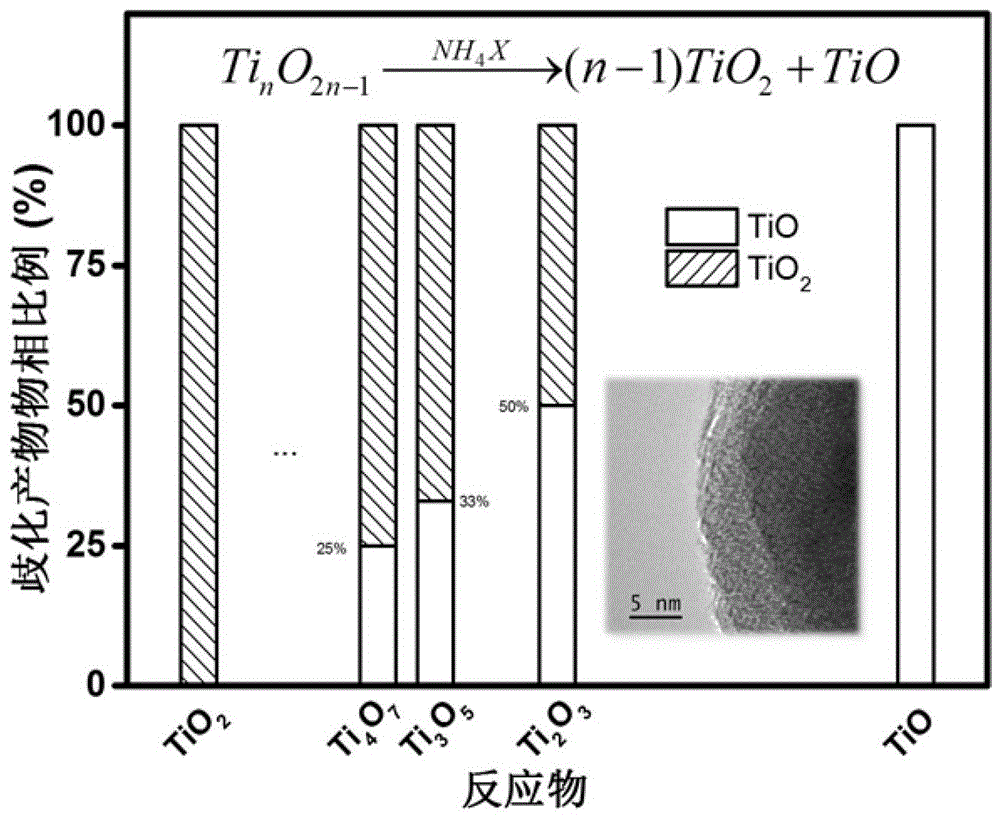
In the present disclosure, titanium suboxide, which is stable at room temperature, is placed in an ammonium halide atmosphere to cause disproportionation reaction to produce TiO and TiO2Double phase combinationConstruct (see fig. 8). From the XRD pattern, the product can be calibrated to be cubic TiO and rutile TiO2(see, e.g., FIG. 3). The ammonium halide can assist the titanium monoxide to carry out disproportionation decomposition reaction, and the middle valence state is dispersed towards two sides. This is due to the fact that the atmosphere created by the ammonium halide suppresses the neutralization reaction while forming a specific core-shell structure. Further, the titanium suboxide TiO has good conductivity, close to metal, and can be used to improve the conductivity of black titanium oxide without introducing other impurity elements.
Preferably, the titanium suboxide is selected from Ti2O3、Ti3O5And Ti4O7At least one of them. Different titanium (Ti) oxidesnO2n-1The prepared TiO-supported black titanium oxide product is used as a starting material, and meets the following requirements that the molar ratio is TiO: TiO 221: (n-1). That is, when the titanium suboxide selected in the method of the present invention is Ti2O3In the preparation method, the prepared black titanium oxide loaded conductive TiO is TiO in a molar ratio of: TiO 221:1, a disproportionation product; when the titanium suboxide selected by the method of the invention is Ti3O5In the preparation method, the prepared black titanium oxide loaded conductive TiO is TiO in a molar ratio of: TiO 221:2, a disproportionation product; when the titanium suboxide selected by the method of the invention is Ti4O7In the preparation method, the prepared black titanium oxide loaded conductive TiO is TiO in a molar ratio of: TiO 221:3, disproportionation product.
As for the titanium suboxide, titanium oxide may be reduced using a reducing agent to produce. According to the chemical formula of the titanium suboxide to be prepared, a reducing agent and titanium dioxide in slight excess in molar ratio are mixed, placed in a vacuum container, and then kept at 800-1100 ℃ for 4-10 hours to obtain the titanium suboxide. The purity of the product can be ensured by appropriately increasing the proportion of the reducing agent. A moderate excess of 2 to 10 mol% is preferred. Alternatively, a slightly more moderate molar ratio (reducing agent: titanium dioxide) of more than 1:1, pure titanium oxide can be synthesized. Weighing a mixture with a slightly moderate molar ratio (reducing agent: titanium dioxide) of more than 1:3, pure titanium sesquioxide can be synthesized. Weighing a mixture with a slightly moderate molar ratio (reducing agent: titanium dioxide) of more than 1:5, pure titanium pentoxide can be synthesized. Weighing a mixture with a slightly moderate molar ratio (reducing agent: titanium dioxide) of more than 1:1, pure titanium tetroxide can be synthesized. Alternatively, pure Ti is synthesized2O3、Ti3O5Is at 800-850 ℃; synthesis of pure Ti4O7The temperature of the synthesized pure TiO is 820-880 ℃, and the temperature of the synthesized pure TiO is 1000-1100 ℃. The synthesis temperature can be appropriately lowered and the incubation time can be increased accordingly.
In the preparation of the titanium suboxide, the reducing agent is preferably titanium powder, magnesium powder, iron powder, aluminum powder, C, H2At least one of; the titanium suboxide produced is a pure phase and is itself dry. Preferably, titanium powder is selected, so that the subsequent washing process, drying process and heat treatment process are omitted.
In the method for preparing the black titanium oxide supported conductive TiO of the present invention, preferably, the ammonium halide is at least one selected from ammonium fluoride, ammonium chloride, ammonium bromide and ammonium iodide.
Preferably, the ammonium halide NH4The molar ratio of X (wherein X is F ion, chloride ion, iodide ion, bromide ion and the like) to the titanium trioxide is (0.1-1): 1, more preferably (0.5 to 1):1 (the percentage of the ratio is 50-100 mol%). When the molar ratio of the ammonium halide to the titanium suboxide is less than 0.5, the titanium suboxide may partially remain.
Preferably, the atmosphere of the heat treatment is a vacuum atmosphere or an inert atmosphere; the inert atmosphere is argon atmosphere.
Preferably, the heat treatment time is 0.5 to 8 hours.
On the other hand, the invention also provides black titanium oxide loaded conductive TiO prepared by the method, wherein the TiO loaded black titanium oxide has a core-shell structure, the core is black titanium oxide, and the shell is conductive TiO. The obtained black titanium oxide loaded TiO and black TiO in the conductive TiO2In a molar ratio of 1: (n-1).
Has the advantages that:
the invention firstly discovers the disproportionation reaction of titanium suboxide, and the products are cubic phase TiO and rutile phase TiO with specific proportion2Both of these phases are high temperature stable phases. Furthermore, ammonium halides (e.g. NH)4Cl) the high temperature decomposition of the halogen acid plays a major role in this disproportionation reaction, etching the oxide to titanium chloride, combining with the intermediate product water to produce the corresponding oxide. The invention further tested the resulting product for conductivity, close to metal, and a black-colored titanium oxide as the bulk.
Drawings
FIG. 1 is an XRD pattern of pure phases of titanium suboxide prepared in examples 1-4, respectively;
FIG. 2 is an XRD pattern of the titanium suboxide and ammonium chloride starting materials before reaction in examples 2-4;
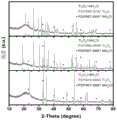
FIG. 3 is an XRD spectrum (NH) of the product obtained in examples 2-4 after the reaction for different titanium oxides4Cl:TinO2n-1=0.5:1);
FIG. 4 is a standard curve of TiO vs. Rutile (Rutile phase) content;
FIG. 5 is a graph plotting the content of different disproportionation products of titanium suboxide;
FIG. 6 shows Ti in example 22O3TEM characterization of the disproportionation product;
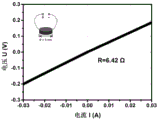
FIG. 7 shows Ti in example 33O5I-V test patterns of the disproportionation products after tabletting;
FIG. 8 is a schematic diagram showing the composition of the product obtained by the disproportionation reaction in this patent;
FIG. 9 shows the XRD test results of the supplemented control sample (with Ti)4O7For example);
FIG. 10 shows the XRD experimental results of the supplementary reaction time (with Ti)4O7For example).
Detailed Description
The present invention is further illustrated by the following examples, which are to be understood as merely illustrative and not restrictive.
In the method, the specific proportion of black titanium oxide loaded conductive TiO is prepared by the disproportionation decomposition of titanium suboxide for the first time, and the synthesis of TiO and TiO with specific molar proportion by a one-step method is realized2The purpose of (1). Furthermore, the existence of conductive TiO can improve black TiO2Is used for the electrical conductivity of (1).
The following is an exemplary description of the method for preparing black titanium oxide supported conductive TiO with a specific ratio by disproportionation decomposition of titanium suboxide provided by the present invention.
And (3) preparing titanium dioxide. By mixing a reducing agent (e.g., metallic titanium powder, etc.) with white rutile phase TiO in a specific ratio2In a closed vacuum container, carrying out high-temperature reaction at 800-1100 ℃ to obtain compounds with chemical formulas of TiO and Ti2O3、Ti3O5、Ti4O7Titanium oxide of (2) as a raw material. Specifically, according to the calculated proportioning, metal titanium powder and titanium dioxide powder with corresponding amount are weighed, evenly mixed in an agate smoke mortar and placed in a glass tube. And (3) adopting a vacuum tube sealing method to manufacture a closed container. Then preserving the temperature for 4-10h at 800-. It should be noted that there are many choices of the reducing agent, such as magnesium powder, iron powder, aluminum powder, C, or a reducing gas (hydrogen gas or the like). In order to reduce the presence of impurities and to avoid washing processes, it is therefore preferred to select commercially available titanium powder and titanium dioxide as raw materials for the synthesis of the raw materials. If by other metals or C, H2Obtained by reaction, and further needs to be washed and dried subsequently to remove water; and the product is pure or not, and the subsequent reaction with ammonium halide crystals is not influenced. According to the calculated ratio of the titanium powder to the titanium dioxide, the ratio of the titanium powder is properly increased (the ratio of the reducing agent to the titanium dioxide is required to be according to a chemical reaction formula, and the proper excess of the reducing agent is 2-10mol percent), and the corresponding pure-phase titanium suboxide can be prepared in a closed container. As an example, the disclosed method synthesizes pure Ti2O3And Ti3O5Is synthesized pure Ti at 800 DEG C4O7Is at 850 ℃ and the pure TiO is at 1100 ℃. The temperature can be properly reduced, and the heat preservation time is correspondingly increased. In addition, in order to shorten the reaction time, improve the purity of the product and control the size of the product, it is necessary to ensure that the reactants are dry and the selected raw materials are micron-nanometer sized.
In an alternative embodiment, a vacuum glass tube is used as the closed container, the vacuum being below 0.1 Pa. A certain amount of titanium powder and titanium dioxide are weighed according to the molar ratio, and in order to ensure the purity of the product, the proportion of the reducing agent titanium powder is properly increased, and the proper excess is 2-10 mol%. Optionally, 1 part of titanium powder and 1 part of titanium dioxide are weighed, and pure titanium oxide can be synthesized; weighing 1 part of titanium powder and 3 parts of titanium dioxide, and synthesizing pure titanium sesquioxide; weighing 1 part of titanium powder and 5 parts of titanium dioxide, and synthesizing pure titanium pentoxide; 1 part of titanium powder and 7 parts of titanium dioxide are weighed to synthesize pure titanium tetroxide.
Mixing titanium oxide and ammonium halide, and carrying out heat treatment at 500-700 ℃ for a certain time to obtain black titanium oxide-loaded conductive TiO. Wherein the ammonium halide is at least one selected from ammonium fluoride, ammonium chloride and ammonium iodide. The mol ratio of ammonium halide to titanium suboxide is NH4X:TinO2n-1(0.1-1): 1, preferably NH4X:TinO2n-1And (0.5-1) 1. The atmosphere for the heat treatment may be a vacuum atmosphere, or an inert atmosphere; the inert atmosphere is argon atmosphere. The heat treatment time may be 0.5 to 8 hours (see fig. 10). The disproportionation product prepared by the invention has a residual content within the XRD detection limit even if the disproportionation product is not washed. Finally, the product can be washed with deionized water to remove residual ammonium halide from the sample. As a detailed example, titanium (Ti) oxide was ground in an agate mortar in a molar ratio of 2:12O3、Ti3O5、Ti4O7) And ammonium chloride mixture, and treating for a period of time at a high temperature of 500-700 ℃ in a closed vacuum tube to obtain metastable TiO and TiO2The molar ratio of the products is 1:1, 1:2 and 1:3 respectively. It should be noted that the selected vacuum container (e.g., vacuum tube, etc.) can withstand a temperature range of 400-1100 ℃; the vacuum degree as low as possible is selected, so that the proportion of the reducing agent which is required to be remained by pure titanium oxide can be calculated and obtained conveniently.
Further preferably, the present invention is carried out by selecting ammonium chloride from ammonium halides. Firstly, hydrofluoric acid generated by ammonium fluoride can seriously corrode the pipe wall at high temperature, and the vacuum degree of the sealed container can be damaged; secondly, because of ammonium bromide and ammonium iodide, the byproducts can have dark elemental bromine and iodine, which causes the indispensable washing step; thirdly, decomposition products of the ammonium chloride are colorless substances, condensed ammonium chloride powder is light and can be effectively removed in a fan mode, and a washing step can be omitted. Ammonium chloride is used as a catalyst for the disproportionation reaction of titanium suboxide, and the ammonium chloride and the titanium suboxide in different proportions are mixed to obtain products with different disproportionation degrees; when the proportion of ammonium chloride is high, the disproportionation reaction can be ensured to be complete. It should be noted that the amount of ammonium chloride needs to be controlled so that the decomposed gas does not burst the closed vessel.
It should be noted that the rate of temperature increase and the rate of temperature decrease used for the heat treatment do not affect the formation of the disproportionation product. Wherein, the cooling process can adopt quenching, air cooling or furnace cooling, etc.
In addition, the present invention supplements the effect of the heating system on the disproportionation process to promote the practical application of the reaction. The result shows that the reaction is not influenced by the speed of the temperature rise; the cooling process, whether quenching, air cooling or furnace cooling, also did not affect the disproportionation reactions (fig. 10, i.e. the fast release product, experimental results at different times). Such as Ti4O7The disproportionation reaction is completed when the reaction temperature is 600 ℃ and the reaction time is 30 minutes (figure 10).
The present invention will be described in detail by way of examples. It is also to be understood that the following examples are illustrative of the present invention and are not to be construed as limiting the scope of the invention, and that certain insubstantial modifications and adaptations of the invention by those skilled in the art may be made in light of the above teachings. The specific process parameters and the like of the following examples are also only one example of suitable ranges, i.e., those skilled in the art can select the appropriate ranges through the description herein, and are not limited to the specific values exemplified below.
Example 1: synthesizing pure phase TiO, establishing standard curve
1g of titanium dioxide and 0.6g of titanium powder are weighed, uniformly ground in a mortar and placed in a glass tube. After vacuum tube sealing, placing in a muffle furnace, heating to 1100 ℃ for 120min, and preserving heat for 6 h. XRD tests show that the furnace cooling sample is monoclinic phase TiO, and the quenching sample is cubic phase TiO. Respectively weighingSetting cubic phase TiO and Rutile raw materials in mass ratio, mixing uniformly, testing XRD, reading TiO2(110) And the diffraction peak area ratio of TiO (200) and establishing the relationship between the quantity ratios of the substances. The samples were each numbered S1(0.09g TiO)2+0.01g TiO),S2(0.08g TiO2+0.02g TiO),S3(0.07g TiO2+0.03g TiO),S4(0.06g TiO2+0.04g TiO) and S5(0.05g TiO)2+0.05g TiO). The standard curve was established as shown in fig. 4.
Example 2: synthesis of pure phase Ti2O3And carrying out a disproportionation reaction
1g of titanium dioxide and 0.21-0.3g of titanium powder are weighed, uniformly ground in a mortar and placed in a glass tube. After vacuum tube sealing, placing in a muffle furnace, heating to 800 ℃ for 120min, preserving heat for 6h, cooling with the furnace, and taking out. The starting material was pure phase Ti2O3 as measured by XRD. Separately weighing the pure phase Ti2O30.1g and 0.0372g (100 mol%), 0.0277g (75 mol%), 0.0186g (50 mol%), 0.0093g (25 mol%), 0.0037g (10 mol%) of ammonium chloride, ground uniformly in a mortar, and placed in a glass tube. After vacuum tube sealing, placing in a muffle furnace, heating to 600 ℃ for 120min, preserving heat for 6h, cooling with the furnace, and taking out. The products are subjected to XRD test and standard curve calibration, and the content of each product is determined. In this example, when the molar ratio of ammonium chloride to pure TiO is 50 mol% or more, only TiO and TiO are detected2Coexistence situation, as in fig. 3.
Example 3: synthesis of pure phase Ti3O5And carrying out a disproportionation reaction
Weighing 1g of titanium dioxide and 0.12-0.15g of titanium powder, grinding the titanium dioxide and the titanium powder in a mortar uniformly, and placing the mixture in a glass tube. After vacuum tube sealing, placing in a muffle furnace, heating to 800 ℃ for 120min, preserving heat for 6h, cooling with the furnace, and taking out. XRD tests show that the raw material is pure-phase Ti3O5. Separately weighing the pure phase Ti3O50.1g and 0.0238g (100 mol%), 0.0179g (75 mol%), 0.0119g (50 mol%), 0.0060g (25 mol%), 0.0024g (10 mol%) of ammonium chloride, which are ground uniformly in a mortar and placed in a glass tube. After vacuum sealing, placing in a muffle furnace, heating to 600 deg.C for 120min, keeping the temperature for 6h, cooling with the furnace, and taking out. The products are subjected to XRD test and standard curve calibration, and the content of each product is determined. In this example, when the molar ratio of ammonium chloride to pure TiO is 50 mol% or more, only TiO and TiO are detected2Coexistence situation, as in fig. 3.
Example 4: synthesis of pure phase Ti4O7And carrying out a disproportionation reaction
1g of titanium dioxide and 0.085-0.095g of titanium powder are weighed, ground uniformly in a mortar and placed in a glass tube. After vacuum tube sealing, placing in a muffle furnace, heating to 850 ℃ for 120min, preserving heat for 6h, cooling with the furnace, and taking out. XRD tests show that the raw material is pure-phase Ti4O7. Separately weighing the pure phase Ti4O70.2g and ammonium chloride 0.0352g (100 mol%), 0.0264g (75 mol%), 0.0176g (50 mol%), 0.0088g (25 mol%), 0.0035g (10 mol%), ground uniformly in a mortar, and placed in a glass tube. After vacuum tube sealing, placing in a muffle furnace, heating to 600 ℃ for 120min, preserving heat for 6h, cooling with the furnace, and taking out. The products are subjected to XRD test and standard curve calibration, and the content of each product is determined. In this example, when the molar ratio of ammonium chloride to pure TiO is 50 mol% or more, only TiO and TiO are detected2Coexistence situation, as shown in fig. 3.
Comparative example
a) 0.1g of raw material Ti4O7Placing in a glass tube, adding MgCl2·6H2O (molar ratio MgCl)2·6H2O:Ti4O7As 50 mol% MgCl 0.5:12·6H2O); after vacuum tube sealing, placing in a muffle furnace, heating to 600 ℃ for 120min, preserving heat for 6h, cooling with the furnace, and taking out;
b) 0.1g of raw material Ti4O7Placing in a glass tube, adding Fe (OH)3(molar ratio Fe (OH))3:Ti4O70.5:1, 50 mol% Fe (OH)3) (ii) a After vacuum tube sealing, placing in a muffle furnace, heating to 600 ℃ for 120min, preserving heat for 6h, cooling with the furnace, and taking out;
c) 1g of raw material Ti4O7Placing in a tube furnace, heating to 6 in large flow ammonia gas atmosphere for 120minPreserving heat for 6h at 00 ℃, and taking out after furnace cooling;
d) 0.1g of raw material Ti4O7Placing in a glass tube, adding NaCl (molar ratio NaCl: Ti)4O71:1, written as 100 mol% NaCl); after vacuum tube sealing, placing in a muffle furnace, heating to 800 ℃ for 120min, preserving heat for 6h, cooling with the furnace, and taking out;
e) 0.1g of raw material Ti4O7Placing in a glass tube, adding KCl (molar ratio KCl: Ti)4O71:1, written as 100 mol% KCl); after vacuum tube sealing, placing in a muffle furnace, heating to 800 ℃ for 120min, preserving heat for 6h, cooling with the furnace, and taking out;
f) from the XRD results (FIG. 9), it can be seen that comparative samples a and b, which decompose the generated moisture, oxidize all of the titanium suboxide into Rutile phase TiO2No TiO is generated; in comparison with c, the main phase of titanium suboxide is still Ti in high-concentration NH3 gas4O7Raw material, partially converted to Ruitle phase TiO2And no TiO formation is detected; in comparative examples d and e, no reaction occurred even when the reaction temperature was increased to 800 ℃.
To clarify the mechanism of the reaction, possible substances of the reaction process were analyzed. a) Considering that ammonium chloride is decomposed into ammonia gas and hydrogen chloride at high temperature, it is suspected whether the ammonia gas is reduced. In the tube furnace, a large flow of ammonia gas was fed, and as a result, no TiO peak was observed. b) Considering that hydrogen chloride gas can etch titanium sub-oxide and generate water vapor, the water reaction is supplemented, and XRD shows that all the titanium sub-oxide is converted into a Rutile phase. c) Considering TiCl4Being gaseous at 600 c, it is likely that chloride ions tend to bind titanium. Experiment supplements KCl, NaCl and Ti4O7Since the reaction of (3) is in a molten state and is not yet reacted, the effect of chlorine ions is eliminated and the focus is on hydrogen chloride. d) To demonstrate that hydrochloric acid etches titanium dioxide and promotes the disproportionation process, other ammonium halides and Ti are selected4O7The present invention is further embodied. The same experiment was carried out using ammonium fluoride and ammonium iodide, and the results were the same. From the above experiments, it can be seen that Ti4O7Can generate cubic phase TiO and rutile phase TiO under the action of ammonium halide2. Likewise, Ti2O3、Ti3O5Can generate cubic phase TiO and rutile phase TiO under the action of ammonium halide2。
FIG. 3 is the XRD patterns of the products of different titanium oxides after the reaction in examples 2-4, from which it can be seen that the products are made of TiO and TiO2Two phases are formed. Analyzing peak areas of two phases in the product, and observing that the content of the product corresponding to different reactants is different;
FIG. 4 is a standard curve of the relationship between the TiO and Rutile (Rutile phase) phase content and the XRD peak area ratio, and it can be known that the ratio of the diffraction peak area ratio of a specific crystal plane according to XRD is linearly related to the ratio of the amount of a substance, and r is 0.99. Wherein specific crystal faces are respectively selected from TiO (200) and TiO2(110) A crystal face;
FIG. 5 is a graph plotting the amounts of different disproportionation products of titanium suboxide, from which it can be seen that the theoretical calibration values are consistent with the experimentally determined values. Using the calibration curve of FIG. 4, Ti was calibrated4O7The ratio of the generated products is TiO to TiO21: 3. This result is also at Ti2O3And Ti3O5Is shown in (a). For example, Ti2O3The ratio of the generated products is TiO to TiO2=1:1,Ti3O5The ratio of the generated products is TiO to TiO2=1:2;
FIG. 6 shows Ti in example 22O3Disproportionation product (pure phase Ti)2O30.1g and 0.0186g (50 mol%) ammonium chloride) of the complex, and the product is shown as a core-shell structure; as can be seen from the SAED graph, the inner core is Rutile phase, and the outer shell is composed of Rutile and TiO (the shell size is smaller than the light spot size, so that the shell is two-phase);
FIG. 7 shows Ti in example 33O5Disproportionation product (pure phase Ti)3O50.1g and 0.0119g (50 mol%) of ammonium chloride, and a resistance of 6.42. omega. is known as a conductor, which is distinguished from a black titanium oxide of a semiconductor;
FIG. 8 shows the manifold of this patentThe composition of the product obtained is schematically shown, and it can be seen from the figure that ammonium halide (NH)4X) titanium (Ti) oxidenO2n-1) Finally decomposing into TiO and TiO with specific proportion2And the product has a core-shell structure;
FIG. 9 is an XRD pattern of comparative samples, which show that none of these comparative samples contain Ti4O7Conversion to TiO and TiO2Two phases, i.e. no disproportionation occurs. Wherein 50 mol% MgCl2·6H2O and 50 mol% Fe (OH)3Water is generated in the heating process, and the possibility that the water is used as disproportionation reaction is eliminated; NH (NH)3The sample treated with the atmosphere is not disproportionated, and NH generated by decomposition of ammonium halide is removed3The possibility of gas as a main cause of reaction; 100 mol% NaCl and 100 mol% KCl, without Ti4O7Reaction takes place, chlorine ions (Cl) are eliminated-) The function of (1). Thus, is an ammonium halide (NH)4X) decomposing the HX produced, causing a disproportionation reaction to occur.
Claims (8)
1. The method for preparing black titanium oxide loaded conductive TiO with a specific proportion by disproportionating and decomposing titanium suboxide is characterized in that the black titanium oxide loaded conductive TiO is obtained by mixing the titanium suboxide and ammonium halide and then carrying out heat treatment at 500-700 ℃ to disproportionate and decompose the titanium suboxide; the titanium suboxide has a chemical formula of Ti n O n2-1,n Not less than 2; the heat treatment atmosphere is a vacuum atmosphere or an inert atmosphere; the ammonium halide NH4X and titanium (Ti) suboxide n O n2-1Molar ratio of NH4X:Ti n O n2-1=(0.5~1):1。
2. The method of claim 1, wherein the titanium suboxide is selected from Ti2O3、Ti3O5And Ti4O7At least one of them.
3. The method according to claim 1, characterized in that titanium dioxide is reduced with a reducing agent to produce the titanium suboxide; according to the chemical formula of the titanium suboxide to be prepared, a reducing agent and titanium dioxide which are excessive in molar ratio are mixed, the mixture is placed in a vacuum container, and then the temperature is kept at 800-1100 ℃ for 4-10 hours, so that the titanium suboxide is obtained.
4. The method of claim 3, wherein the reducing agent is titanium powder, magnesium powder, iron powder, aluminum powder, C, H2At least one of; the prepared titanium protoxide is pure phase.
5. The method of any one of claims 1-4, wherein the ammonium halide is selected from at least one of ammonium fluoride, ammonium chloride, ammonium bromide, and ammonium iodide.
6. The method according to any one of claims 1 to 4, wherein the inert atmosphere is an argon atmosphere.
7. The method according to any one of claims 1 to 4, wherein the heat treatment time is 0.5 to 8 hours.
8. The black titanium oxide-supported conductive TiO prepared by the method according to any one of claims 1 to 7, wherein the black titanium oxide-supported conductive TiO has a core-shell structure in which a core is black titanium oxide and a shell is conductive TiO.
Priority Applications (1)
| Application Number | Priority Date | Filing Date | Title |
|---|---|---|---|
| CN201910260797.1A CN111762811B (en) | 2019-04-02 | 2019-04-02 | A method for preparing specific proportion of black titanium oxide supported conductive TiO by disproportionation and decomposition of titanium oxide |
Applications Claiming Priority (1)
| Application Number | Priority Date | Filing Date | Title |
|---|---|---|---|
| CN201910260797.1A CN111762811B (en) | 2019-04-02 | 2019-04-02 | A method for preparing specific proportion of black titanium oxide supported conductive TiO by disproportionation and decomposition of titanium oxide |
Publications (2)
| Publication Number | Publication Date |
|---|---|
| CN111762811A CN111762811A (en) | 2020-10-13 |
| CN111762811B true CN111762811B (en) | 2021-06-15 |
Family
ID=72718588
Family Applications (1)
| Application Number | Title | Priority Date | Filing Date |
|---|---|---|---|
| CN201910260797.1A Active CN111762811B (en) | 2019-04-02 | 2019-04-02 | A method for preparing specific proportion of black titanium oxide supported conductive TiO by disproportionation and decomposition of titanium oxide |
Country Status (1)
| Country | Link |
|---|---|
| CN (1) | CN111762811B (en) |
Citations (6)
| Publication number | Priority date | Publication date | Assignee | Title |
|---|---|---|---|---|
| JP2012148920A (en) * | 2011-01-19 | 2012-08-09 | Sumitomo Chemical Co Ltd | Low valence titanium oxide composition, and method for producing the same |
| CN104941614A (en) * | 2014-03-24 | 2015-09-30 | 中国科学院上海硅酸盐研究所 | Method for preparing black titanium dioxide by contact type reduction method |
| CN105600820A (en) * | 2015-12-30 | 2016-05-25 | 中国科学院上海硅酸盐研究所 | Green TiO2 and preparing method, modifying method and application thereof |
| CN106958033A (en) * | 2017-03-17 | 2017-07-18 | 南开大学 | Magn é li phases TinO2n‑1The preparation method of nanotube electrode |
| CN106976905A (en) * | 2017-03-07 | 2017-07-25 | 中国科学院上海硅酸盐研究所 | Titanium oxide with core-shell structure and its controllable preparation method |
| CN107416896A (en) * | 2017-05-02 | 2017-12-01 | 中国科学院上海硅酸盐研究所 | A kind of method of controllable preparation titanyl compound powder |
-
2019
- 2019-04-02 CN CN201910260797.1A patent/CN111762811B/en active Active
Patent Citations (6)
| Publication number | Priority date | Publication date | Assignee | Title |
|---|---|---|---|---|
| JP2012148920A (en) * | 2011-01-19 | 2012-08-09 | Sumitomo Chemical Co Ltd | Low valence titanium oxide composition, and method for producing the same |
| CN104941614A (en) * | 2014-03-24 | 2015-09-30 | 中国科学院上海硅酸盐研究所 | Method for preparing black titanium dioxide by contact type reduction method |
| CN105600820A (en) * | 2015-12-30 | 2016-05-25 | 中国科学院上海硅酸盐研究所 | Green TiO2 and preparing method, modifying method and application thereof |
| CN106976905A (en) * | 2017-03-07 | 2017-07-25 | 中国科学院上海硅酸盐研究所 | Titanium oxide with core-shell structure and its controllable preparation method |
| CN106958033A (en) * | 2017-03-17 | 2017-07-18 | 南开大学 | Magn é li phases TinO2n‑1The preparation method of nanotube electrode |
| CN107416896A (en) * | 2017-05-02 | 2017-12-01 | 中国科学院上海硅酸盐研究所 | A kind of method of controllable preparation titanyl compound powder |
Non-Patent Citations (1)
| Title |
|---|
| Enhanced Photovoltaic Performance of Nanowire Dye-Sensitized Solar Cells Based on Coaxial TiO2@TiO Heterostructures with a Cobalt(II/III) Redox Electrolyte;Jiandong Fan et al.;《ACS Applied Materials & Interfaces》;20130911;第5卷;9872-9877 * |
Also Published As
| Publication number | Publication date |
|---|---|
| CN111762811A (en) | 2020-10-13 |
Similar Documents
| Publication | Publication Date | Title |
|---|---|---|
| Ding et al. | Bi2O2Se as a novel co-catalyst for photocatalytic hydrogen evolution reaction | |
| Liu et al. | Achieving ultrahigh electrocatalytic NH3 yield rate on Fe-doped Bi2WO6 electrocatalyst | |
| Lin et al. | Water splitting reaction on NiO/InVO4 under visible light irradiation | |
| Nakada et al. | Two-step synthesis of Sillén–Aurivillius type oxychlorides to enhance their photocatalytic activity for visible-light-induced water splitting | |
| Xu et al. | Enhancing visible-light-induced photocatalytic activity by coupling with wide-band-gap semiconductor: A case study on Bi2WO6/TiO2 | |
| Zheng et al. | Electrostatic interaction assisted synthesis of a CdS/BCN heterostructure with enhanced photocatalytic effects | |
| Chen et al. | Nitrogen-doped layered oxide Sr 5 Ta 4 O 15− x N x for water reduction and oxidation under visible light irradiation | |
| Zhang et al. | Novel AgI-decorated β-Bi 2 O 3 nanosheet heterostructured Z-scheme photocatalysts for efficient degradation of organic pollutants with enhanced performance | |
| Liang et al. | Germanium and iron double-substituted ZnGa2O4 solid-solution photocatalysts with modulated band structure for boosting photocatalytic CO2 reduction with H2O | |
| Pournemati et al. | Outstanding photocatalytic nitrogen fixation performance of TiO2 QDs modified by Bi2O3/NaBiS2 nanostructures upon simulated sunlight | |
| Xu et al. | Insight into facet-dependent photocatalytic H 2 O 2 production on BiOCl nanosheets | |
| Kok et al. | Bismuth-rich Bi12O17Cl2 nanorods engineered with oxygen vacancy defects for enhanced photocatalytic nitrogen fixation | |
| Miyoshi et al. | Nitrogen/fluorine-codoped rutile titania as a stable oxygen-evolution photocatalyst for solar-driven Z-scheme water splitting | |
| CN113398945B (en) | Spherical C/FeMo nano composite photocatalyst and preparation method thereof | |
| Cai et al. | A single atom photocatalyst co-doped with potassium and gallium for enhancing photocatalytic hydrogen peroxide synthesis | |
| CN101559371A (en) | Molybdenum-containing semi-conductor photocatalysis material responding to visible light, preparation method and application thereof | |
| Wang et al. | Facet engineering of LaNbON 2 transformed from LaKNaNbO 5 for enhanced photocatalytic O 2 evolution | |
| Hua et al. | Double perovskite compounds A 2 CuWO 6 (A= Sr and Ba) with p-type semiconductivity for photocatalytic water oxidation under visible light illumination | |
| Li et al. | 2D/2D Z-scheme WO 3/gC 3 N 4 heterojunctions for photocatalytic organic pollutant degradation and nitrogen fixation | |
| CN112156770A (en) | Bismuth tungstate composite photocatalyst with bismuth and oxygen double vacancies as well as preparation method and application thereof | |
| Xu et al. | Precursor-directed synthesis of well-faceted brookite TiO 2 single crystals for efficient photocatalytic performances | |
| Lei et al. | Enhanced bifunctional visible-light-driven photocatalytic production of H2 and H2O2 enabled by Ag-ZnIn2S4/C-In2O3 S-scheme heterojunction | |
| Luo et al. | Enhanced photocatalytic oxygen evolution over Mo-doped Ca 2 NiWO 6 perovskite photocatalyst under visible light irradiation | |
| CN111762811B (en) | A method for preparing specific proportion of black titanium oxide supported conductive TiO by disproportionation and decomposition of titanium oxide | |
| Fu et al. | Electrocatalytic conversion of nitrate to ammonia on the oxygen vacancy engineering of zinc oxide for nitrogen recovery from nitrate-polluted surface water |
Legal Events
| Date | Code | Title | Description |
|---|---|---|---|
| PB01 | Publication | ||
| PB01 | Publication | ||
| SE01 | Entry into force of request for substantive examination | ||
| SE01 | Entry into force of request for substantive examination | ||
| GR01 | Patent grant | ||
| GR01 | Patent grant |