Soldering flux cleaning agent for chip packaging process
Technical Field
The invention relates to the technical field of materials in the electronic industry, in particular to a soldering flux cleaning agent for a chip packaging process.
Background
In the processing technology of electronic information products, a large amount of cleaning agent is consumed for cleaning SMT (surface mount technology) printing screens, wave crest furnaces, reflow furnaces and PCBA (printed circuit board assembly) every year. In the process of assembly welding of a common PCB, in order to ensure the reliability of welding, soldering fluxes with high activity are required to be used, the soldering fluxes are remained on the PCBA to corrode a circuit board and components, and simultaneously, the surface insulation resistance of the PCBA is reduced, and particularly, serious corrosion and electric leakage can occur under the environment of high temperature and high humidity to influence the reliability of the whole machine. At present, the soldering flux is developed and applied in a cleaning-free mode gradually, but the soldering flux used in most electronic industries is still in a traditional mode, the components of the soldering flux comprise organic acid, organic amine, rosin/glue substances and the like, and the residues of the soldering flux need to be cleaned to ensure the reliability of electronic components.
At present, industrial cleaning agents at home and abroad are generally divided into three types: solvent type, semi-water type, water-based type. The solvent cleaning agent mainly comprises halogenated hydrocarbons (chlorohydrocarbon, bromohydrocarbon and fluorohydrocarbon), petroleum, alcohols, ethers, glycol esters, siloxane and the like, and the cleaning agent is mature in technology at home and abroad and has a good cleaning effect mostly. Among them, ODS (ozone depleting substances) containing freon (CFC-113) etc. are prohibited from destroying the ozone layer and harming the ecological environment. The semi-water base detergent is developed for improving the use performance of solvent detergent in practical application and consists of mainly organic solvent, such as alcohol, terpene glycol ether, hydrocarbon, etc, activator and water in 5-20%. The semi-water-based cleaning agent has high dissolvability and high cleaning cleanliness, and the contained organic solvent has better cleaning capacity on organic matters, so that the volatility and flammability of the original flammable solvent are reduced. However, the semi-aqueous cleaning technology has the following disadvantages: the process flow is long, the operation cost is high, and the wastewater treatment capacity is large; when the metal is rinsed by pure water, the metal is easy to corrode and discolor; still contains volatile organic compounds and the like. The main components of the water-based cleaning agent comprise a surfactant, a washing assistant, a corrosion inhibitor and the like, and the water-based cleaning agent is a cleaning agent which is widely applied in recent years. The cleaning agent has good compatibility, low price, safe operation, no combustion and explosion, and large freedom degree of cleaning and formulation, and can adjust the formulation aiming at pollutants with different properties. However, the water-based cleaning agent in China has the following defects: i, cleaning effects on a plurality of viscous waxy dirt such as rosin and glue, blind holes and gaps on workpieces and hydrophobic parts are poor, and the phenomenon that the surface of a board is whitened is generally easy to occur after the PCBA is cleaned by the conventional water-based cleaning agent; II, residues after being cleaned by some water-based cleaning agents are difficult to wash away, especially residues in blind holes and gaps, and the residues can influence subsequent processes or application; III, the low-temperature cleaning effect is poor, the oil removal speed is slow, and the oil removal speed cannot be compared with that of a solvent type; IV, if the metal parts are not dried in time, corrosion is easy to occur, such as the pin parts of a steel mesh, a welding disc on the PCBA and components; v, lack of special multi-effect surfactants suitable for industrial cleaning, and the like.
In order to overcome the defects, research and development breakthroughs are made on the key technology, and a novel efficient soldering flux cleaning agent for a chip packaging process is prepared.
Disclosure of Invention
Aiming at the defects in the technology, the invention provides the soldering flux cleaning agent for the chip packaging process, which has good wettability and strong capability of removing organic matters, and can efficiently remove residual soldering flux and other oil stains on blind holes, gaps and general surfaces of workpieces; meanwhile, the metal corrosion inhibitor and volatile ethanol are added, so that the drying speed is high, and the corrosion of components caused by untimely drying and the like is avoided.
In order to achieve the purpose, the invention provides a soldering flux cleaning agent for a chip packaging process, which comprises the following components in percentage by weight:
fluoro-organic compounds: 2 to 8 percent of
Glycerol ether: 20 to 40 percent of
N, N-dimethylacetamide: 5 to 15 percent of
Mercaptobenzothiazole: 1 to 5 percent
Ethanol: 20 to 30 percent
The balance of water;
preparing a clean glass reaction kettle, and placing the glass reaction kettle in an ice bath;
adding the glycerol ether and the ethanol in percentage by weight into the reaction kettle, starting stirring, and uniformly mixing by regulating the rotation speed to 150 plus 180 rpm;
sequentially adding N, N-dimethylacetamide, a fluoro organic substance and 2-mercaptobenzothiazole under the stirring state, and finally adding water;
and after uniform dispersion, standing, sealing and keeping in shade for storage to obtain the soldering flux cleaning agent for the chip packaging process.
Wherein the fluorinated organic substance is perfluorotripropylamine or perfluorobutyl methyl ether, and the preferred concentration is 3-5%; fluorine has strong electron withdrawing ability, excellent thermal stability, unique low surface free energy and low viscosity, and good wettability, and can be used as surfactant of cleaning agent.
Wherein, the preferable concentration of the glycerol ether is 25-35%; the soldering flux is a good wetting agent, and can effectively remove organic acid and organic amine in the residual soldering flux.
Wherein, the preferable concentration of the N, N-dimethylacetamide is 8-12%; can effectively dissolve the rosin and glue substances in the residual soldering flux and efficiently remove organic matters.
Wherein, the preferable concentration of the 2-mercaptobenzothiazole is 2-3%; it contains-N-S-bond, can be effectively adsorbed on the metal surface, and can form an insoluble complex deposition film with metal ions at the interface, so that the corrosion inhibition effect is achieved.
Wherein, the preferable concentration of the ethanol is 25 to 30 percent; the cleaning agent has the characteristic of easy volatilization, provides the quick-drying characteristic after the cleaning agent is used, and avoids corrosion of a bonding pad and a pin part of an electronic component caused by untimely drying.
The invention has the beneficial effects that: compared with the prior art, the soldering flux cleaning agent for the chip packaging process has the following advantages: the cleaning agent is added with a fluoro organic substance with strong electron withdrawing capability, has excellent wetting effect, and can effectively act on surfaces which are difficult to wet, such as blind holes, gaps and the like; the alcohol ether and the acetamide have good dissolving and removing capacities on organic acid, organic amine, rosin and glue substances respectively, and have good low-temperature cleaning effect and high oil removal speed; 2-mercaptobenzothiazole serving as a metal corrosion inhibitor reduces the corrosion effect of the cleaning agent on metal; the ethanol improves the quick-drying characteristic of the cleaning agent, and avoids corrosion of a bonding pad or a pin and the like caused by untimely drying. Is a novel and efficient soldering flux cleaning agent for a chip packaging process. The cleaning agent has good wettability and strong capability of removing organic matters, and can efficiently remove residual soldering flux and other oil stains on blind holes, gaps and general surfaces of workpieces; meanwhile, the metal corrosion inhibitor and volatile ethanol are added, so that the drying speed is high, and the corrosion of components caused by untimely drying and the like is avoided.
Drawings
FIG. 1 is a view of a solder sample plate before cleaning;
FIG. 2 is a drawing showing a solder sample plate cleaned by the cleaning agent of the present invention.
Detailed Description
In order to more clearly describe the present invention, the present invention will be further described with reference to the accompanying drawings.
The invention provides a soldering flux cleaning agent for a chip packaging process, which comprises the following components in percentage by weight:
fluoro-organic compounds: 2 to 8 percent of
Glycerol ether: 20 to 40 percent of
N, N-dimethylacetamide: 5 to 15 percent of
Mercaptobenzothiazole: 1 to 5 percent
Ethanol: 20 to 30 percent
The balance of water; approximately 15-25%;
preparing a clean glass reaction kettle, and placing the glass reaction kettle in an ice bath;
adding the glycerol ether and the ethanol in percentage by weight into the reaction kettle, starting stirring, and uniformly mixing by regulating the rotation speed to 150 plus 180 rpm;
sequentially adding N, N-dimethylacetamide, a fluoro organic substance and 2-mercaptobenzothiazole under the stirring state, and finally adding water;
and after uniform dispersion, standing, sealing and keeping in shade for storage to obtain the soldering flux cleaning agent for the chip packaging process.
In this embodiment, the fluorinated organic substance is perfluorotripropylamine or perfluorobutyl methyl ether, preferably at a concentration of 3 to 5%; fluorine has strong electron withdrawing ability, excellent thermal stability, unique low surface free energy and low viscosity, and good wettability, and can be used as surfactant of cleaning agent.
In this embodiment, the preferred concentration of the glycerol ether is 25-35%; the soldering flux is a good wetting agent, and can effectively remove organic acid and organic amine in the residual soldering flux.
In this embodiment, the concentration of the N, N-dimethylacetamide is preferably 8-12%; can effectively dissolve the rosin and glue substances in the residual soldering flux and efficiently remove organic matters.
In this embodiment, the 2-mercaptobenzothiazole is preferably present at a concentration of 2 to 3%; it contains-N-S-bond, can be effectively adsorbed on the metal surface, and can form an insoluble complex deposition film with metal ions at the interface, so that the corrosion inhibition effect is achieved.
In the embodiment, the concentration of the ethanol is preferably 25-30%; the cleaning agent has the characteristic of easy volatilization, provides the quick-drying characteristic after the cleaning agent is used, and avoids corrosion of a bonding pad and a pin part of an electronic component caused by untimely drying.
The following are specific examples of the present invention:
the first embodiment is as follows:
the soldering flux cleaning agent for the chip packaging process comprises the following components in parts by weight: 3 parts of perfluorobutyl methyl ether, 30 parts of glycerol ether, 10 parts of N, N-dimethylacetamide, 2 parts of 2-mercaptobenzothiazole, 30 parts of ethanol and 25 parts of water.
The preparation method comprises the following steps:
1. preparing a clean glass reaction kettle, and placing the glass reaction kettle in an ice bath;
2. adding the glycerol ether and the ethanol in parts by weight into the reaction kettle, starting stirring, and adjusting the rotation speed to 150 plus 180rpm to uniformly mix. Sequentially adding N, N-dimethylacetamide, perfluorobutyl methyl ether and 2-mercaptobenzothiazole under the stirring state, and finally supplementing and adding ultrapure water.
3. And after uniform dispersion, standing, sealing and keeping in shade for storage to obtain the soldering flux cleaning agent for the chip packaging process.
Example two:
the soldering flux cleaning agent for the chip packaging process comprises the following components in parts by weight: 5 parts of perfluorotripropylamine, 35 parts of glycerol ether, 8 parts of N, N-dimethylacetamide, 3 parts of 2-mercaptobenzothiazole, 28 parts of ethanol and 21 parts of water.
The preparation method comprises the following steps:
1. preparing a clean glass reaction kettle, and placing the glass reaction kettle in an ice bath;
2. adding the glycerol ether and the ethanol in parts by weight into the reaction kettle, starting stirring, and adjusting the rotation speed to 150 plus 180rpm to uniformly mix. And sequentially adding N, N-dimethylacetamide, perfluorotripropylamine and 2-mercaptobenzothiazole under the stirring state, and finally supplementing and adding ultrapure water.
3. And after uniform dispersion, standing, sealing and keeping in shade for storage to obtain the soldering flux cleaning agent for the chip packaging process.
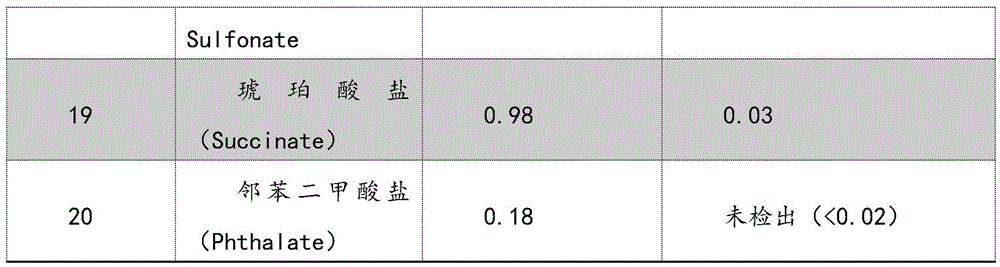
As shown in fig. 1 and 2, after soldering with the flux, the surface of the PCB sample board remains much flux and dirt (fig. 1); after cleaning with the flux cleaner of the example, the surface was smooth and the metal surface was intact (fig. 2). According to IPC-TM-6502.3.28&2.3.25 standard, an ion chromatographic analyzer and a cleanliness tester are used for carrying out tests such as ion pollution on two sample plates, the results are listed in Table 1, and Table 1 is a graph of the detection results of the residues of the soldering tin sample plates before and after cleaning; it can be seen that most of the ions and organic acids after cleaning are significantly reduced to reach the cleaning standard, and the next process or procedure can be smoothly performed. Table 1 is as follows:
the above disclosure is only an example of the present invention, but the present invention is not limited thereto, and any variations that can be made by those skilled in the art should fall within the scope of the present invention.