CN111983473A - A method and device for evaluating the safety of lithium-ion power battery based on support vector machine - Google Patents
A method and device for evaluating the safety of lithium-ion power battery based on support vector machine Download PDFInfo
- Publication number
- CN111983473A CN111983473A CN202010858397.3A CN202010858397A CN111983473A CN 111983473 A CN111983473 A CN 111983473A CN 202010858397 A CN202010858397 A CN 202010858397A CN 111983473 A CN111983473 A CN 111983473A
- Authority
- CN
- China
- Prior art keywords
- battery
- safety
- lithium
- support vector
- vector machine
- Prior art date
- Legal status (The legal status is an assumption and is not a legal conclusion. Google has not performed a legal analysis and makes no representation as to the accuracy of the status listed.)
- Granted
Links
- HBBGRARXTFLTSG-UHFFFAOYSA-N Lithium ion Chemical compound [Li+] HBBGRARXTFLTSG-UHFFFAOYSA-N 0.000 title claims abstract description 34
- 229910001416 lithium ion Inorganic materials 0.000 title claims abstract description 34
- 238000012706 support-vector machine Methods 0.000 title claims abstract description 33
- 238000000034 method Methods 0.000 title claims description 23
- 238000011156 evaluation Methods 0.000 claims abstract description 21
- WHXSMMKQMYFTQS-UHFFFAOYSA-N Lithium Chemical compound [Li] WHXSMMKQMYFTQS-UHFFFAOYSA-N 0.000 claims description 30
- 229910052744 lithium Inorganic materials 0.000 claims description 30
- 238000012549 training Methods 0.000 claims description 9
- 238000012360 testing method Methods 0.000 claims description 5
- 229910000625 lithium cobalt oxide Inorganic materials 0.000 claims description 3
- GELKBWJHTRAYNV-UHFFFAOYSA-K lithium iron phosphate Chemical compound [Li+].[Fe+2].[O-]P([O-])([O-])=O GELKBWJHTRAYNV-UHFFFAOYSA-K 0.000 claims description 3
- BFZPBUKRYWOWDV-UHFFFAOYSA-N lithium;oxido(oxo)cobalt Chemical compound [Li+].[O-][Co]=O BFZPBUKRYWOWDV-UHFFFAOYSA-N 0.000 claims description 3
- 239000000463 material Substances 0.000 claims description 3
- 238000012843 least square support vector machine Methods 0.000 claims 1
- 230000006870 function Effects 0.000 description 19
- 238000004364 calculation method Methods 0.000 description 4
- 238000002485 combustion reaction Methods 0.000 description 4
- 238000011161 development Methods 0.000 description 4
- 230000018109 developmental process Effects 0.000 description 4
- 238000004880 explosion Methods 0.000 description 4
- 238000005457 optimization Methods 0.000 description 4
- 230000002269 spontaneous effect Effects 0.000 description 4
- 238000007599 discharging Methods 0.000 description 3
- 238000012986 modification Methods 0.000 description 3
- 230000004048 modification Effects 0.000 description 3
- 238000001467 acupuncture Methods 0.000 description 2
- 230000032683 aging Effects 0.000 description 2
- 238000000354 decomposition reaction Methods 0.000 description 2
- 230000002159 abnormal effect Effects 0.000 description 1
- 230000009286 beneficial effect Effects 0.000 description 1
- 238000013480 data collection Methods 0.000 description 1
- 230000003247 decreasing effect Effects 0.000 description 1
- 238000013461 design Methods 0.000 description 1
- 230000000694 effects Effects 0.000 description 1
- 238000005516 engineering process Methods 0.000 description 1
- 239000007789 gas Substances 0.000 description 1
- 230000003287 optical effect Effects 0.000 description 1
- 239000002245 particle Substances 0.000 description 1
- 238000012827 research and development Methods 0.000 description 1
- 231100000331 toxic Toxicity 0.000 description 1
- 230000002588 toxic effect Effects 0.000 description 1
- 238000012546 transfer Methods 0.000 description 1
- 238000005303 weighing Methods 0.000 description 1
Images

Classifications
-
- G—PHYSICS
- G01—MEASURING; TESTING
- G01R—MEASURING ELECTRIC VARIABLES; MEASURING MAGNETIC VARIABLES
- G01R31/00—Arrangements for testing electric properties; Arrangements for locating electric faults; Arrangements for electrical testing characterised by what is being tested not provided for elsewhere
- G01R31/36—Arrangements for testing, measuring or monitoring the electrical condition of accumulators or electric batteries, e.g. capacity or state of charge [SoC]
- G01R31/367—Software therefor, e.g. for battery testing using modelling or look-up tables
-
- G—PHYSICS
- G01—MEASURING; TESTING
- G01R—MEASURING ELECTRIC VARIABLES; MEASURING MAGNETIC VARIABLES
- G01R31/00—Arrangements for testing electric properties; Arrangements for locating electric faults; Arrangements for electrical testing characterised by what is being tested not provided for elsewhere
- G01R31/36—Arrangements for testing, measuring or monitoring the electrical condition of accumulators or electric batteries, e.g. capacity or state of charge [SoC]
- G01R31/392—Determining battery ageing or deterioration, e.g. state of health
-
- Y—GENERAL TAGGING OF NEW TECHNOLOGICAL DEVELOPMENTS; GENERAL TAGGING OF CROSS-SECTIONAL TECHNOLOGIES SPANNING OVER SEVERAL SECTIONS OF THE IPC; TECHNICAL SUBJECTS COVERED BY FORMER USPC CROSS-REFERENCE ART COLLECTIONS [XRACs] AND DIGESTS
- Y02—TECHNOLOGIES OR APPLICATIONS FOR MITIGATION OR ADAPTATION AGAINST CLIMATE CHANGE
- Y02E—REDUCTION OF GREENHOUSE GAS [GHG] EMISSIONS, RELATED TO ENERGY GENERATION, TRANSMISSION OR DISTRIBUTION
- Y02E60/00—Enabling technologies; Technologies with a potential or indirect contribution to GHG emissions mitigation
- Y02E60/10—Energy storage using batteries
Landscapes
- Physics & Mathematics (AREA)
- General Physics & Mathematics (AREA)
- Secondary Cells (AREA)
- Charge And Discharge Circuits For Batteries Or The Like (AREA)
Abstract
本发明公开了一种基于支持向量机的锂离子动力电池安全度评估方法及装置,动力电池安全度评估技术领域。本发明为了解决现有技术无法对动力电池的安全性进行量化表示和评估的问题。本发明设定输出电压和输出电流为特征参数,电池温度为输出量,构建最小二乘支持向量机模型,经过训练的模型输出实时温度,得到当前电池的安全度数值。本发明通过历史数据,结合最小二乘支持向量机算法及安全隶属度模型,近似的计算出动力电池的安全度数值SOS,并且不断修正。
The invention discloses a lithium-ion power battery safety evaluation method and device based on a support vector machine, and belongs to the technical field of power battery safety evaluation. The present invention solves the problem that the safety of the power battery cannot be quantitatively expressed and evaluated in the prior art. The invention sets the output voltage and output current as characteristic parameters, and the battery temperature as the output quantity, constructs a least squares support vector machine model, and outputs the real-time temperature from the trained model to obtain the current safety value of the battery. The present invention approximately calculates the safety value SOS of the power battery through historical data, combined with the least squares support vector machine algorithm and the safety membership model, and continuously corrects it.
Description
技术领域technical field
本发明涉及电池安全度评估领域,特别是涉及一种基于支持向量机的锂离子动力电池安全度评估方法。The invention relates to the field of battery safety evaluation, in particular to a support vector machine-based lithium ion power battery safety evaluation method.
背景技术Background technique
随着全球市场电动汽车商品化步伐的日益加快,对高功率和高能量动力电池需求迅速增加,而电池的安全性也越来越受到人们的关注。尤其是近几年,锂电池自燃、爆炸等事故频繁发生,锂电池的安全性愈发受到重视。目前,我国锂电池在技术研发层面尚处于初始阶段,在安全性方面依旧存在诸多问题。With the accelerating pace of commercialization of electric vehicles in the global market, the demand for high-power and high-energy power batteries has increased rapidly, and the safety of batteries has also attracted more and more attention. Especially in recent years, accidents such as spontaneous combustion and explosion of lithium batteries have occurred frequently, and the safety of lithium batteries has been paid more and more attention. At present, my country's lithium battery is still in its initial stage in terms of technology research and development, and there are still many problems in terms of safety.
目前电动汽车在中国正处于高速发展阶段,电动汽车的飞速发展带动了动力电池产业的发展。然而,近几年电池自燃、爆炸等事故频发,人们越来越关注新能源汽车电池系统的安全性。一旦电池达到了某种临界条件,例如过电压,过温度,低寿命,如不及时采取相应的安全防范措施,电池热失控势必导致安全性事故。At present, electric vehicles are in a stage of rapid development in China, and the rapid development of electric vehicles has driven the development of the power battery industry. However, in recent years, accidents such as spontaneous combustion and explosion of batteries have occurred frequently, and people are paying more and more attention to the safety of battery systems of new energy vehicles. Once the battery reaches certain critical conditions, such as over-voltage, over-temperature, and short life, if the corresponding safety precautions are not taken in time, the thermal runaway of the battery will inevitably lead to safety accidents.
由此可见,电池的安全性问题成为了新能源行业必须面对的问题。安全性事故来自热失控,而导致热失控的诱因主要有两种,一是机械电气诱因(如针刺、碰撞等事故导致),二是电化学诱因(如过充、快充、自发性短路等),电池单体热失控之后传递给相邻单体,随后大面积蔓延,最终导致安全事故的发生。而热失控的发展也存在一定的阶段性,据相关的资料显示,SEI膜分解的初始温度大概是100-130℃,也把这个温度视为一连串热失控温度的起点,而温度达到300℃时,电池的温度将会出现剧烈的提升,如果不采取相应的安全措施,毫无疑问,电池在达到温度顶峰时,会对使用者造成不可挽回的损失。我们需要做的也就是,能否综合各方面的因素,尽可能的量化出一个锂离子动力电池的安全度,这对于预防电池事故发生、保障使用者生命安全具有重要作用。It can be seen that the safety of batteries has become a problem that the new energy industry must face. Safety accidents come from thermal runaway, and there are two main reasons for thermal runaway, one is mechanical and electrical incentives (such as acupuncture, collision and other accidents), and the other is electrochemical incentives (such as overcharge, fast charging, spontaneous short circuit) etc.), the thermal runaway of the battery cell is transmitted to the adjacent cells, and then spreads in a large area, which eventually leads to the occurrence of safety accidents. The development of thermal runaway also has certain stages. According to relevant data, the initial temperature of SEI film decomposition is about 100-130 °C, which is also regarded as the starting point of a series of thermal runaway temperatures, and when the temperature reaches 300 °C , the temperature of the battery will increase dramatically. If the corresponding safety measures are not taken, there is no doubt that when the battery reaches the peak temperature, it will cause irreparable losses to the user. What we need to do is to quantify the safety of a lithium-ion power battery as much as possible by integrating various factors, which plays an important role in preventing battery accidents and ensuring the safety of users' lives.
国内外对电池安全度的定义还是很模糊,锂离子动力电池安全故障原因也有很多,其中各种故障原因存在着相互联系。很难建立一个十分精确的模型对锂离子动力电池的安全度进行描述。The definition of battery safety at home and abroad is still very vague, and there are many reasons for the safety failure of lithium-ion power batteries, among which various failure causes are interrelated. It is difficult to establish a very accurate model to describe the safety of lithium-ion power batteries.
发明内容SUMMARY OF THE INVENTION
为了解决现有技术中存在的问题,本申请提供了一种基于支持向量机的锂离子动力电池安全度评估方法及装置,实现了锂离子动力电池的实时量化计算和输出。In order to solve the problems existing in the prior art, the present application provides a method and device for evaluating the safety of a lithium-ion power battery based on a support vector machine, which realizes the real-time quantitative calculation and output of the lithium-ion power battery.
一种基于支持向量机的锂离子动力电池安全度评估方法,包括以下步骤:A method for evaluating the safety of lithium-ion power batteries based on support vector machines, comprising the following steps:
采集电池的实时输出电压和输出电流作为特征参数,采集锂离子动力电池在所述特征参数时的电池温度;Collect the real-time output voltage and output current of the battery as characteristic parameters, and collect the battery temperature of the lithium-ion power battery at the characteristic parameters;
将所述输出电压、输出电流和对应情况下的电池温度作为样本,并将其分为训练集和测试集;Taking the output voltage, output current and battery temperature under corresponding conditions as samples, and dividing them into training sets and test sets;
以电池的实时输出电压和输出电流作为所述预测模型的输入,以锂电池工作时的预测温度值fi作为输出,构建预测模型:Using the real-time output voltage and output current of the battery as the input of the prediction model, and using the predicted temperature value f i when the lithium battery is working as the output, the prediction model is constructed:

将训练样本输入所述预测模型中对所述预测模型进行训练,得到训练好的预测模型;Input the training sample into the prediction model to train the prediction model to obtain a trained prediction model;
将待测数据输入训练好的预测模型中,得到预测温度fi,根据下式计算电池的安全度SOS数值:Input the data to be tested into the trained prediction model to obtain the predicted temperature f i , and calculate the safety SOS value of the battery according to the following formula:

其中,fi为锂电池工作时的预测温度值,F为锂电池温度出现剧烈提升的临界值。Among them, f i is the predicted temperature value of the lithium battery when it is working, and F is the critical value at which the temperature of the lithium battery increases dramatically.
进一步的,所述预测模型的获取方法包括如下步骤:Further, the method for obtaining the prediction model includes the following steps:
构造最优决策函数:y(x)=ω·ψ(x)+b;Construct the optimal decision function: y(x)=ω·ψ(x)+b;
构建最小二乘支持向量机模型:Build a least squares support vector machine model:

其中,ξi为变量误差;|ω|2为控制模型负责度;C称为惩罚因子,为常数;b为偏差;Among them, ξ i is the variable error; |ω| 2 is the responsibility of the control model; C is the penalty factor, which is a constant; b is the deviation;
将所述最小二乘支持向量机模型进行转化为下式:The least squares support vector machine model is transformed into the following formula:

其中,α=(α1,α2,...,αl)T,y=(y1,y2,...,yl)T;Wherein, α=(α 1 , α 2 ,..., α l ) T , y=(y 1 , y 2 ,..., y l ) T ;
根据所述最小二乘法得到参数b和αi,进而得到LS-SVM决策函数f(x)为:The parameters b and α i are obtained according to the least squares method, and then the LS-SVM decision function f(x) is obtained as:

将多项式核函数和RBF核函数构成的混合核函数代入所述决策函数f(x)中,得到所述预测模型。The prediction model is obtained by substituting a mixed kernel function composed of a polynomial kernel function and an RBF kernel function into the decision function f(x).
进一步的,所述多项式核函数为:Further, the polynomial kernel function is:
Kp(xi,yi)=(axiyi+c)d;K p (x i , y i )=(ax i y i +c) d ;
所述RBF核函数为:The RBF kernel function is:

所述混合核函数为:The mixed kernel function is:

进一步的,所述锂电池为是三元材料锂离子电池、磷酸铁锂电池或钴酸锂电池。Further, the lithium battery is a ternary material lithium ion battery, a lithium iron phosphate battery or a lithium cobalt oxide battery.
进一步的,基于支持向量机的锂离子动力电池安全度评估方法包括建立安全度对照表,所述安全度对照表由若干安全区间构成,安全区间对应当前时刻的电池安全状态;将步骤S6得到的安全度SOS数值与所述安全区间匹配,得到当前时刻的电池安全情况。Further, the lithium-ion power battery safety evaluation method based on the support vector machine includes establishing a safety comparison table, the safety comparison table is composed of several safety intervals, and the safety interval corresponds to the battery safety state at the current moment; The SOS value of the safety degree matches the safety interval to obtain the battery safety situation at the current moment.
本发明另一方面提供的一种基于支持向量机的锂离子动力电池安全度评估装置,包括:Another aspect of the present invention provides a support vector machine-based lithium-ion power battery safety evaluation device, comprising:
估算模块,用以根据本发明第一方面所述的电池安全度估算方法估算电池当前状态的安全度;an estimation module for estimating the safety of the current state of the battery according to the battery safety estimation method described in the first aspect of the present invention;
显示模块,用以显示电池当前状态下的安全度信息。The display module is used to display the safety information in the current state of the battery.
进一步的,所述一种基于支持向量机的锂离子动力电池安全度评估装置包括区间匹配模块,用以建立安全度对照表,所述安全度对照表由若干安全区间构成,安全区间对应当前时刻的电池安全状态;将得到的安全度SOS数值与所述安全区间匹配,得到当前时刻的电池安全情况。Further, the support vector machine-based lithium-ion power battery safety evaluation device includes an interval matching module to establish a safety comparison table, the safety comparison table is composed of several safety intervals, and the safety interval corresponds to the current moment. The safety state of the battery is obtained; the obtained safety SOS value is matched with the safety interval to obtain the battery safety situation at the current moment.
本申请与现有技术相比,具有如下有益效果:Compared with the prior art, the present application has the following beneficial effects:
1、本申请采用支持向量机(SVM)基础上,使用最小二乘支持向量机更是大大的提高了计算速度,通过构建预测模型,得到电池工作时的内部温度。通过公式:
2、本申请所述最小二乘法支持向量机,是基于标准支持向量机提出的优化算法。通过采用最小二乘线性系统作为损失函数,代替传统支持向量采用的二次规划方法,大大简化计算的复杂性。2. The least squares support vector machine described in this application is an optimization algorithm proposed based on a standard support vector machine. By adopting the least squares linear system as the loss function, instead of the quadratic programming method adopted by the traditional support vector, the computational complexity is greatly simplified.
附图说明Description of drawings
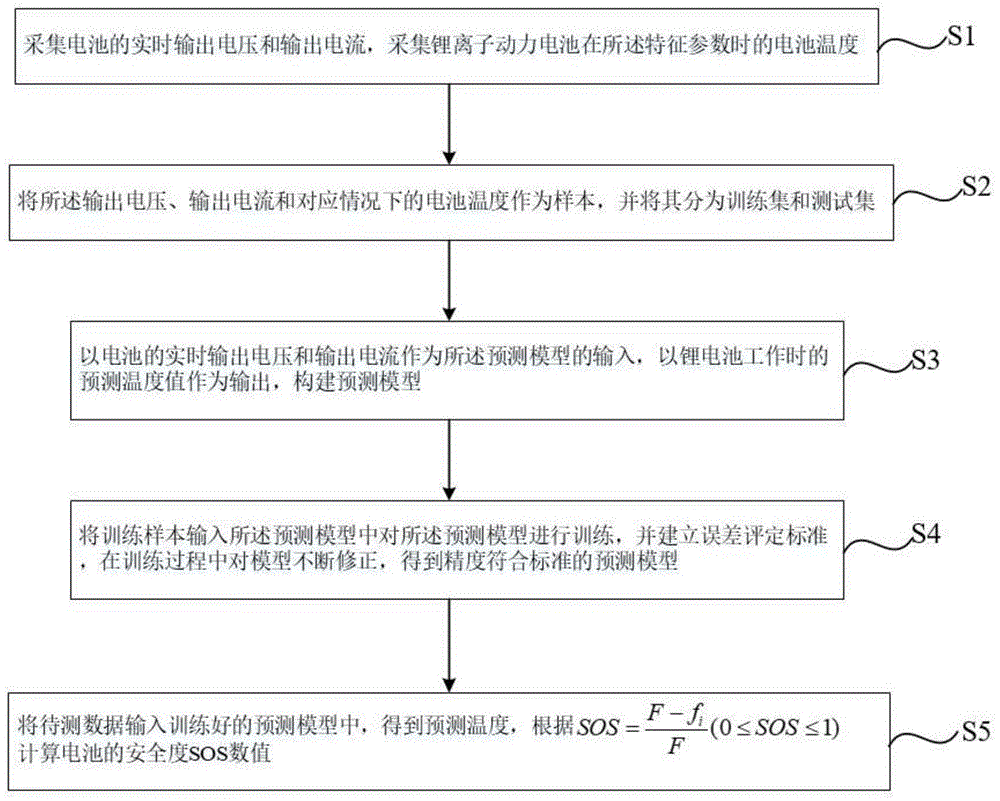
图1为本发明具体实施例的锂离子动力电池安全度评估流程图。FIG. 1 is a flow chart of the safety evaluation of a lithium-ion power battery according to a specific embodiment of the present invention.
具体实施方式Detailed ways
电池的安全性指电池在使用过程中不燃烧、不爆炸、不产生有毒有害气体、不会对使用者造成伤害,定量地描述其在使用过程中的安全程度称为电池安全度,简称SOS。如何做到实时准确的安全估算,一直是锂离子动力电池组设计过程中存在的一个瓶颈性难题。本发明根据锂离子动力电池在使用过程中,影响锂电池内部温度的主要因素,采用支持向量机算法评估电池的安全度。The safety of the battery refers to the fact that the battery does not burn, explode, produce no toxic and harmful gases, or cause harm to users during use. Quantitatively describing its safety during use is called battery safety, or SOS for short. How to achieve real-time and accurate safety estimation has always been a bottleneck problem in the design of lithium-ion power battery packs. According to the main factors affecting the internal temperature of the lithium battery during the use of the lithium ion power battery, the invention adopts the support vector machine algorithm to evaluate the safety of the battery.
本实施例提供一种基于支持向量机的锂离子动力电池安全度评估方法,所述锂离子动力电池可以为三元材料锂离子电池、磷酸铁锂电池、钴酸锂电池,锂离子动力电池的形状可以是方形的、圆柱形、软包方形、塑壳方形。This embodiment provides a method for evaluating the safety of a lithium-ion power battery based on a support vector machine. The lithium-ion power battery may be a ternary material lithium-ion battery, a lithium iron phosphate battery, a lithium cobalt oxide battery, or a The shape can be square, cylindrical, soft bag square, plastic case square.
所述参数选择锂电池输出电压和输出电流,由历史数据可知,锂电池发生事故的主要形式是热失控,而导致热失控的诱因主要有两种,一是机械电气诱因(如针刺、碰撞等事故导致),二是电化学诱因(如过充、快充、自发性短路等),电池单体热失控之后传递给相邻单体,随后大面积蔓延,最终导致安全事故的发生。因此本专利通过最小二乘支持向量机来预测锂电池工作时的内部温度来判断电池的安全性能。将温度量化为判断电池安全的安全系数。当这个安全系数(即安全度)小于其安全临界点时,系统就可提醒用户注意电池的安全状况,从而采取相应的措施,避免安全事故的发生。如果电池内部温度长期处于高温状态,这时就需要提醒用户电池存在爆炸、燃烧的可能性,请及时排除故障或更换电池。The parameters select the output voltage and output current of the lithium battery. According to historical data, the main form of lithium battery accidents is thermal runaway, and there are two main reasons for thermal runaway. One is mechanical and electrical inducements (such as acupuncture, collision, etc.). and other accidents), the second is the electrochemical inducement (such as overcharge, fast charge, spontaneous short circuit, etc.), the thermal runaway of the battery cell is transmitted to the adjacent cells, and then spreads in a large area, which eventually leads to the occurrence of safety accidents. Therefore, this patent uses the least squares support vector machine to predict the internal temperature of the lithium battery during operation to judge the safety performance of the battery. Quantify temperature as a safety factor for judging battery safety. When this safety factor (ie safety degree) is less than its safety critical point, the system can remind the user to pay attention to the safety status of the battery, so as to take corresponding measures to avoid the occurrence of safety accidents. If the internal temperature of the battery is at a high temperature for a long time, it is necessary to remind the user that the battery may explode or burn. Please troubleshoot or replace the battery in time.
影响锂电池内部温度的因数有很多,其中锂电池的输出电压、电流和内阻是最主要的影响因素。考虑到数据采集的难易程度。经过权衡选取最直观的输出电压和电流作为输入特征参数,预测锂电池在工作时的内部温度。获得锂电池内部温度后,我们将该数据与锂电池温度出现剧烈提升的临界值:F=300℃进行作差,并把差值与F进行比值,获得的值应在0-1之间,我们将该值定义为电池安全度。且不同规格电池温度出现剧烈提升的临界值是有一定差异的,当电池改变时,我们需要做相应的数据修改。具体流程如下:There are many factors that affect the internal temperature of the lithium battery, among which the output voltage, current and internal resistance of the lithium battery are the most important factors. Consider the ease of data collection. After weighing, the most intuitive output voltage and current are selected as the input characteristic parameters to predict the internal temperature of the lithium battery during operation. After obtaining the internal temperature of the lithium battery, we make a difference between the data and the critical value of the lithium battery temperature: F=300 ℃, and compare the difference with F, the obtained value should be between 0-1, We define this value as battery safety. In addition, the critical value of the sharp increase in battery temperature of different specifications is different. When the battery changes, we need to make corresponding data modification. The specific process is as follows:
S1、采集电池的实时输出电压和输出电流,采集锂离子动力电池在所述特征参数时的电池温度;S1, collect the real-time output voltage and output current of the battery, and collect the battery temperature of the lithium-ion power battery when the characteristic parameters are described;
S2、将所述输出电压、输出电流和对应情况下的电池温度作为样本,并将其分为训练集和测试集;S2, taking the output voltage, output current and battery temperature under corresponding conditions as samples, and dividing them into a training set and a test set;
S3、以电池的实时输出电压和输出电流作为所述预测模型的输入,以锂电池工作时的预测温度值fi作为输出,构建预测模型:S3, using the real-time output voltage and output current of the battery as the input of the prediction model, and using the predicted temperature value f i during operation of the lithium battery as the output, construct the prediction model:

具体包括如下步骤:Specifically include the following steps:
S31、训练样本集为:(xi,yi),i=1,2……,l;x∈Rd,y∈R,用非线性ψ(·)将样本输入空间Rd映射到特征空间ψ(·)=(ψ(x1),ψ(x2)...,ψ(xl));在这个高维特征空间中构造最优决策函数y(x)=ω·ψ(x)+b;最后,以结构风险最下化为原则确定模型参数ω、b。S31. The training sample set is: (xi,yi), i=1,2...,l; x∈Rd,y∈R, use nonlinear ψ( ) to map the sample input space R d to the feature space ψ( ·)=(ψ(x1),ψ(x2)...,ψ(xl)); construct the optimal decision function y(x)=ω·ψ(x)+b in this high-dimensional feature space; finally , and determine the model parameters ω and b based on the principle of minimizing the structural risk.
最优决策函数为:The optimal decision function is:
y(x)=ω·ψ(x)+b (1)y(x)=ω·ψ(x)+b (1)
结构风险最小化原则,得到最小二乘支持向量机模型:According to the principle of structural risk minimization, the least squares support vector machine model is obtained:

其中,ξi为变量误差;|ω|2为控制模型负责度;C称为惩罚因子,为常数;b为偏差。上式对应的Lagrange函数为:Among them, ξ i is the variable error; |ω| 2 is the responsibility of the control model; C is the penalty factor, which is a constant; b is the deviation. The Lagrange function corresponding to the above formula is:

其中,αi(i=1,2,...,l)为拉格朗日乘子。Among them, αi (i=1,2,...,l) is the Lagrange multiplier.
根据优化条件,即对式(3)分别对4个变量求偏导,并令偏导为零,可得:According to the optimization conditions, that is, to calculate the partial derivatives of the four variables in equation (3), and set the partial derivatives to zero, we can get:

令ψ(xi)×ψ(xj)=K(xi,xj),则优化问题转化为求解如下线性方程:Let ψ(x i )×ψ(x j )=K(x i ,x j ), then the optimization problem is transformed into solving the following linear equation:

其中,α=(α1,α2,...,αl)T,y=(y1,y2,...,yl)T;由最小二乘法计算b和αi;Wherein, α=(α 1 , α 2 ,..., α l ) T , y=(y 1 , y 2 ,..., y l ) T ; calculate b and α i by the least square method;
得到LS-SVM决策函数为:The LS-SVM decision function is obtained as:

S32、确定核函数:S32, determine the kernel function:
构建多项式核函数:Build a polynomial kernel function:
Kp(xi,yi)=(axiyi+c)d; (8)K p (x i ,y i )=(ax i y i +c) d ; (8)
构建RBF核函数:Build the RBF kernel function:

结合式(8)和(9)得到混合核函数:Combining equations (8) and (9) to get the mixed kernel function:

则得到决策函数为:Then the decision function is obtained as:

其中,θ为权重系数,xi为电压,yi为老化系数,所述老化系数可由历史数据查得到,a,b,c,d,g为待优化变量,αi是电流,所述权重系数和所述待优化变量通过粒子群优化算法等现有算法进行优化求解。Among them, θ is the weight coefficient, x i is the voltage, y i is the aging coefficient, the aging coefficient can be obtained from historical data, a, b, c, d, g are the variables to be optimized, α i is the current, and the weight The coefficients and the variables to be optimized are optimized and solved by existing algorithms such as particle swarm optimization algorithm.
S4、将训练样本输入所述预测模型中对所述预测模型进行训练,并建立误差评定标准,通过下式确定相对误差:S4, input the training sample into the prediction model to train the prediction model, and establish an error evaluation standard, and determine the relative error by the following formula:

式中,Qs是实际的测量值,fs是预测值,使训练模型中输出的预测值的相对误差符合预设误差,在训练过程中对模型不断修正,得到精度符合标准的预测模型;In the formula, Q s is the actual measured value, and f s is the predicted value, so that the relative error of the predicted value output in the training model conforms to the preset error, and the model is continuously revised during the training process to obtain a prediction model whose accuracy meets the standard;
S5、将待测数据输入训练好的预测模型中,得到预测温度fi,根据下式计算电池的安全度SOS数值:S5. Input the data to be tested into the trained prediction model to obtain the predicted temperature f i , and calculate the safety SOS value of the battery according to the following formula:

其中,fi为锂电池工作时的预测温度值,F为锂电池温度出现剧烈提升的临界值。Among them, f i is the predicted temperature value of the lithium battery when it is working, and F is the critical value at which the temperature of the lithium battery increases dramatically.
根据以往专家数据,SEI膜分解的初始温度大概是100-130℃,也把这个温度视为一连串热失控温度的起点,而温度达到300摄氏度时,电池的温度将会出现剧烈的提升,如果不采取相应的安全措施,当电池在达到温度顶峰时,会对使用者造成不可挽回的损失,所以,本实施例中所述的锂电池温度出现剧烈提升的临界值为300℃。当电池温度处于120℃时,电池就会存在潜在危险,当电池温度处于180℃以上时,就需要使用者多注意电池的安全状态,及时做好电池的维护或更换操作。According to previous expert data, the initial temperature of SEI film decomposition is about 100-130℃, which is also regarded as the starting point of a series of thermal runaway temperatures. When the temperature reaches 300℃, the temperature of the battery will increase dramatically. Taking corresponding safety measures, when the battery reaches the peak temperature, it will cause irreparable losses to the user. Therefore, the critical value for the lithium battery temperature to drastically increase in this embodiment is 300°C. When the battery temperature is 120°C, the battery is potentially dangerous. When the battery temperature is above 180°C, the user needs to pay more attention to the safety state of the battery, and timely maintain or replace the battery.
为了进一步说明本申请实施例,本实施例的样本测试数据如下表1所示:In order to further illustrate the embodiments of the present application, the sample test data of the present embodiment are shown in Table 1 below:
表1样本测试数据Table 1 Sample test data

数据样本中1-13组数据是锂电池正常工作的内部温度。而14-16组数据为锂电池处于不同短路时间下的内部温度,可以看出随着短路时间的增加,电池内部温度不断升高,安全度不断减小,电池发生燃烧、爆炸的可能性增大。1-13 groups of data in the data sample are the internal temperature of the lithium battery in normal operation. The 14-16 sets of data are the internal temperature of the lithium battery under different short-circuit times. It can be seen that with the increase of the short-circuit time, the internal temperature of the battery continues to rise, the safety level continues to decrease, and the possibility of the battery burning and exploding increases. big.
表2电池安全度对应表Table 2 Battery Safety Correspondence Table


表2为电池安全度对应表,将电池状态分为5个状态,结合表1和表2的数据,电池在正常工作温度范围内,我们不能说随着温度的升高,电池的安全度就降低。只要电池工作在安全温度范围内,均可说明电池处于安全状态下。而当温度高于电池热失控临界值时,我们可以认为:随着温度的升高,电池的安全度在减小,电池安全性在不断下降。本实施例中的电池安全度以0~1为计算范围,安全度越接近于1表示该动力电池越安全。当电池的安全度数值位于[0.8,1]范围内时,表明此时电池的状体良好,可以继续使用,当电池的安全度数值位于[0.6,0.8)范围内时,表明此时电池状态一般,需要使用者稍加留意,当电池的安全度数值位于[0.4,0.6)范围内时,表明此时电池存在潜在危险,在使用过程中需要使用者多加注意,当电池的安全度数值位于[0.2,0.4)范围内时,此时电池已经达到危险程度,此时应停止使用并将更换电池,当电池的安全度数值位于[0,0.2)范围内时,表面电池达到严重危险程度,表明已经出现燃烧爆炸情况或极易引起燃烧和爆炸,此时应根据实际需要采取紧急处理方式将电池拆卸并妥善转移。Table 2 is the corresponding table of battery safety. The battery status is divided into 5 states. Combined with the data in Table 1 and Table 2, the battery is within the normal operating temperature range. We cannot say that with the increase of temperature, the safety of the battery will increase. reduce. As long as the battery operates within a safe temperature range, the battery is in a safe state. When the temperature is higher than the critical value of thermal runaway of the battery, we can think that: with the increase of temperature, the safety of the battery is decreasing, and the safety of the battery is constantly declining. The battery safety degree in this embodiment takes 0 to 1 as the calculation range, and the closer the safety degree is to 1, the safer the power battery is. When the safety value of the battery is in the range of [0.8, 1], it indicates that the battery is in good condition and can be used continuously. When the safety value of the battery is in the range of [0.6, 0.8), it indicates that the battery is in good condition at this time. Generally, users need to pay attention. When the safety value of the battery is in the range of [0.4, 0.6), it indicates that the battery is potentially dangerous at this time, and the user needs to pay more attention during use. [0.2, 0.4) range, the battery has reached a dangerous level at this time, stop using and replace the battery at this time, when the safety value of the battery is within the range of [0, 0.2), the surface battery has reached a serious dangerous level, It indicates that a combustion and explosion has occurred or it is very likely to cause combustion and explosion. At this time, emergency measures should be taken to disassemble and properly transfer the battery according to actual needs.
本实施例提供了一种基于支持向量机的锂离子动力电池安全度评估装置,包括:This embodiment provides a support vector machine-based lithium-ion power battery safety evaluation device, including:
估算模块,用以根据本发明第一方面所述的电池安全度估算方法估算电池当前状态的安全度;an estimation module for estimating the safety of the current state of the battery according to the battery safety estimation method described in the first aspect of the present invention;
显示模块,用以显示电池当前状态下的安全度信息。The display module is used to display the safety information in the current state of the battery.
进一步的,所述一种基于支持向量机的锂离子动力电池安全度评估装置包括区间匹配模块,用以建立安全度对照表,所述安全度对照表由若干安全区间构成,安全区间对应当前时刻的电池安全状态;将得到的安全度SOS数值与所述安全区间匹配,得到当前时刻的电池安全情况。Further, the support vector machine-based lithium-ion power battery safety evaluation device includes an interval matching module to establish a safety comparison table, the safety comparison table is composed of several safety intervals, and the safety interval corresponds to the current moment. The safety state of the battery is obtained; the obtained safety SOS value is matched with the safety interval to obtain the battery safety situation at the current moment.
所述估算模块和区间匹配模块可以集成在一种电子设备中,具体包括处理器和存储器,存储器中存储实施例中的电池安全度估算方法和区间匹配指令,处理器用以调用所述指令用以执行本发明实施例所述的电池安全度估算方法和区间匹配指令;所述估算模块和区间匹配模块可以分别为两种电子设备,两种电子设备分别包括处理器和存储器,估算模块的电子设备中的存储器中存储实施例中的电池安全度估算方法指令,处理器用以调用所述指令用以执行本发明实施例所述的电池安全度估算方法指令,区间匹配模块的电子设备中的存储器中存储实施例中的安全度区间匹配指令,处理器用以调用所述指令用以执行本发明实施例所述的安全度区间匹配指令。The estimation module and the interval matching module can be integrated in an electronic device, and specifically include a processor and a memory, and the memory stores the battery safety estimation method and the interval matching instruction in the embodiment, and the processor is used to call the instruction to Execute the battery safety estimation method and the interval matching instruction according to the embodiment of the present invention; the estimation module and the interval matching module may be two kinds of electronic devices respectively, and the two kinds of electronic devices respectively include a processor and a memory, and the electronic device of the estimation module The battery safety estimation method instruction in the embodiment is stored in the memory in the . The processor is used to call the instruction to execute the battery safety estimation method instruction according to the embodiment of the present invention. The safety degree interval matching instruction in the embodiment is stored, and the processor is used to call the instruction to execute the safety degree interval matching instruction in the embodiment of the present invention.
上述的存储器中的指令可以通过软件功能单元的形式实现并作为独立的产品销售或使用时,可以存储在一个计算机可读取存储介质中,即本发明的技术方案本质上或者说对现有技术做出贡献的部分或者该技术方案的部分可以以软件产品的形式体现出来,该计算机软件产品存储在一个存储介质中,包括若干指令用以使得一台计算机设备(可以是个人计算机,服务器,或者网络设备等)执行本发明各个实施例所述方法的全部或部分步骤。而前述的存储介质包括:U盘、移动硬盘、只读存储器、随机存取存储器、磁碟或者光盘等各种可以存储程序代码的介质。The instructions in the above-mentioned memory can be implemented in the form of software functional units and can be stored in a computer-readable storage medium when sold or used as an independent product, that is, the technical solution of the present invention is essentially or in other words related to the prior art. The contributing part or part of the technical solution may be embodied in the form of a software product, the computer software product is stored in a storage medium and includes several instructions for making a computer device (which may be a personal computer, a server, or network equipment, etc.) to execute all or part of the steps of the methods described in the various embodiments of the present invention. The aforementioned storage medium includes: a U disk, a removable hard disk, a read-only memory, a random access memory, a magnetic disk or an optical disk and other media that can store program codes.
在实际应用中,所述处理器可以是MSP430单片机、51单片机、DSP、TMS单片机、STM32单片机、PIC单片机、AVR单片机、STC单片机、Freescale系列单片机等控制电池充放电源的充放电,所述单片机可以通过串口或总线的方式与充放电源连接。In practical applications, the processor can be MSP430 single-chip microcomputer, 51 single-chip microcomputer, DSP, TMS single-chip microcomputer, STM32 single-chip microcomputer, PIC single-chip microcomputer, AVR single-chip microcomputer, STC single-chip microcomputer, Freescale series single-chip microcomputer, etc. to control the charging and discharging of the battery charging and discharging power source. It can be connected to the charging and discharging power supply through serial port or bus.
上述实例只是对本发明做局部的一些说明,并不代表本发明仅可以对上述两个因素做出相应的预测,说明书的主要目的在于简单介绍清楚发明的应用涵义。其次定义的电池安全度计算方法并不唯一,具体问题具体讨论,切不可混淆。The above examples are only partial descriptions of the present invention, which do not mean that the present invention can only make corresponding predictions for the above two factors. The main purpose of the description is to briefly introduce the application meaning of the invention. Secondly, the battery safety calculation method defined is not unique, and specific issues should be discussed in detail, and must not be confused.
上述实施例仅例示性说明本发明的原理及其功效,而非用于限制本发明。任何熟悉此技术的人士皆可在不违背本发明的精神及范畴下,对上述实施例进行修饰或改变。因此,举凡所属技术领域中具有通常知识者在未脱离本发明所揭示的精神与技术思想下所完成的一切等效修饰或改变,仍应由本发明的权利要求所涵盖。The above-mentioned embodiments merely illustrate the principles and effects of the present invention, but are not intended to limit the present invention. Anyone skilled in the art can make modifications or changes to the above embodiments without departing from the spirit and scope of the present invention. Therefore, all equivalent modifications or changes made by those with ordinary knowledge in the technical field without departing from the spirit and technical idea disclosed in the present invention should still be covered by the claims of the present invention.
Claims (7)


Priority Applications (1)
| Application Number | Priority Date | Filing Date | Title |
|---|---|---|---|
| CN202010858397.3A CN111983473B (en) | 2020-08-24 | 2020-08-24 | Lithium ion power battery safety degree evaluation method and device based on support vector machine |
Applications Claiming Priority (1)
| Application Number | Priority Date | Filing Date | Title |
|---|---|---|---|
| CN202010858397.3A CN111983473B (en) | 2020-08-24 | 2020-08-24 | Lithium ion power battery safety degree evaluation method and device based on support vector machine |
Publications (2)
| Publication Number | Publication Date |
|---|---|
| CN111983473A true CN111983473A (en) | 2020-11-24 |
| CN111983473B CN111983473B (en) | 2023-03-10 |
Family
ID=73444040
Family Applications (1)
| Application Number | Title | Priority Date | Filing Date |
|---|---|---|---|
| CN202010858397.3A Active CN111983473B (en) | 2020-08-24 | 2020-08-24 | Lithium ion power battery safety degree evaluation method and device based on support vector machine |
Country Status (1)
| Country | Link |
|---|---|
| CN (1) | CN111983473B (en) |
Cited By (3)
| Publication number | Priority date | Publication date | Assignee | Title |
|---|---|---|---|---|
| CN113406500A (en) * | 2021-06-29 | 2021-09-17 | 同济大学 | Method for estimating residual electric quantity of power lithium battery |
| CN114583301A (en) * | 2022-04-29 | 2022-06-03 | 国网浙江省电力有限公司电力科学研究院 | Power station thermal runaway early warning method and system based on safety characteristic parameter representation system |
| CN118566758A (en) * | 2024-08-02 | 2024-08-30 | 四川工程职业技术大学 | A method, system and device for estimating discharge power peak value of a battery pack |
Citations (7)
| Publication number | Priority date | Publication date | Assignee | Title |
|---|---|---|---|---|
| US20170126027A1 (en) * | 2015-11-02 | 2017-05-04 | Samsung Electronics Co., Ltd. | Battery management method and apparatus |
| CN106772065A (en) * | 2016-11-25 | 2017-05-31 | 国电南瑞科技股份有限公司 | Micro-capacitance sensor energy storage SOC estimation method and system based on least square method supporting vector machine |
| CN109165687A (en) * | 2018-08-28 | 2019-01-08 | 哈尔滨理工大学 | Vehicle lithium battery method for diagnosing faults based on multi-category support vector machines algorithm |
| CN109598449A (en) * | 2018-12-14 | 2019-04-09 | 北京匠芯电池科技有限公司 | Lithium ion battery packet performance estimating method based on charge data |
| CN109799463A (en) * | 2019-01-18 | 2019-05-24 | 上海卡鲁自动化科技有限公司 | The estimation and prediction technique of power battery SOC/SOH/SOP under actual operating mode based on big data method |
| CN110133508A (en) * | 2019-04-24 | 2019-08-16 | 上海博强微电子有限公司 | The safe early warning method of electric automobile power battery |
| CN110224160A (en) * | 2019-06-12 | 2019-09-10 | 北京亿华通科技股份有限公司 | A kind of fuel cell system method for diagnosing faults |
-
2020
- 2020-08-24 CN CN202010858397.3A patent/CN111983473B/en active Active
Patent Citations (8)
| Publication number | Priority date | Publication date | Assignee | Title |
|---|---|---|---|---|
| US20170126027A1 (en) * | 2015-11-02 | 2017-05-04 | Samsung Electronics Co., Ltd. | Battery management method and apparatus |
| CN106654405A (en) * | 2015-11-02 | 2017-05-10 | 三星电子株式会社 | Battery management method and apparatus |
| CN106772065A (en) * | 2016-11-25 | 2017-05-31 | 国电南瑞科技股份有限公司 | Micro-capacitance sensor energy storage SOC estimation method and system based on least square method supporting vector machine |
| CN109165687A (en) * | 2018-08-28 | 2019-01-08 | 哈尔滨理工大学 | Vehicle lithium battery method for diagnosing faults based on multi-category support vector machines algorithm |
| CN109598449A (en) * | 2018-12-14 | 2019-04-09 | 北京匠芯电池科技有限公司 | Lithium ion battery packet performance estimating method based on charge data |
| CN109799463A (en) * | 2019-01-18 | 2019-05-24 | 上海卡鲁自动化科技有限公司 | The estimation and prediction technique of power battery SOC/SOH/SOP under actual operating mode based on big data method |
| CN110133508A (en) * | 2019-04-24 | 2019-08-16 | 上海博强微电子有限公司 | The safe early warning method of electric automobile power battery |
| CN110224160A (en) * | 2019-06-12 | 2019-09-10 | 北京亿华通科技股份有限公司 | A kind of fuel cell system method for diagnosing faults |
Non-Patent Citations (4)
| Title |
|---|
| FAWAD ALI SHAH 等: "Battery Health Monitoring for Commercialized Electric Vehicle Batteries: Lithium-Ion", 《2019 INTERNATIONAL CONFERENCE ON POWER GENERATION SYSTEMS AND RENEWABLE ENERGY TECHNOLOGIES 》 * |
| 姚杰 等: "基于LS-SVM和FCM的锌银动力电池分选方法研究", 《黑龙江大学自然科学学报》 * |
| 张旭: "基于系统复杂性分析的锂电池组状态估计与安全管理", 《中国优秀博硕士学位论文全文数据库(博士)工程科技Ⅱ辑》 * |
| 熊瑞 等: "基于数据模型融合的电动车辆动力电池组状态估计研究", 《中国优秀博硕士学位论文全文数据库(博士)工程科技Ⅱ辑》 * |
Cited By (4)
| Publication number | Priority date | Publication date | Assignee | Title |
|---|---|---|---|---|
| CN113406500A (en) * | 2021-06-29 | 2021-09-17 | 同济大学 | Method for estimating residual electric quantity of power lithium battery |
| CN114583301A (en) * | 2022-04-29 | 2022-06-03 | 国网浙江省电力有限公司电力科学研究院 | Power station thermal runaway early warning method and system based on safety characteristic parameter representation system |
| CN114583301B (en) * | 2022-04-29 | 2022-08-23 | 国网浙江省电力有限公司电力科学研究院 | Power station thermal runaway early warning method and system based on safety characteristic parameter representation system |
| CN118566758A (en) * | 2024-08-02 | 2024-08-30 | 四川工程职业技术大学 | A method, system and device for estimating discharge power peak value of a battery pack |
Also Published As
| Publication number | Publication date |
|---|---|
| CN111983473B (en) | 2023-03-10 |
Similar Documents
| Publication | Publication Date | Title |
|---|---|---|
| Shen et al. | A review on battery management system from the modeling efforts to its multiapplication and integration | |
| Xia et al. | A reliability design method for a lithium-ion battery pack considering the thermal disequilibrium in electric vehicles | |
| Li et al. | 3D simulation on the internal distributed properties of lithium-ion battery with planar tabbed configuration | |
| CN110380144B (en) | A hybrid coordinated control method and system for decommissioned lithium iron phosphate and ternary lithium batteries | |
| CN106130112B (en) | Lithium battery charge and discharge management system and method | |
| CN106291372A (en) | Novel method for predicting residual life of lithium ion power battery | |
| CN111983475B (en) | Lithium ion power battery safety degree evaluation method and device based on hidden Markov | |
| CN111983473B (en) | Lithium ion power battery safety degree evaluation method and device based on support vector machine | |
| CN114091404B (en) | Electric-thermal model of lithium ion battery | |
| Lyu et al. | Surrogate model of liquid cooling system for lithium-ion battery using extreme gradient boosting | |
| CN111967191B (en) | Lithium ion power battery safety evaluation method and device based on fuzzy Bayesian network | |
| CN118095032A (en) | Modeling and simulation analysis method for lithium iron phosphate battery based on digital twin | |
| CN115632181A (en) | Lithium battery temperature early warning method and system, storage medium and terminal | |
| Yan et al. | Study on performance effects for battery energy storage rack in thermal management system | |
| CN111983470B (en) | Lithium ion power battery safety degree evaluation method and device based on correlation dimension | |
| Zhu et al. | Analysis of the structure arrangement on the thermal characteristics of Li‐ion battery pack in thermoelectric generator | |
| CN115792623B (en) | Technical method for evaluating safety state of battery | |
| Dhamangaonkar et al. | Evolving battery management systems for ev | |
| CN118734747A (en) | A modeling method for thermal runaway of lithium batteries induced by micro-overcharge cycles | |
| CN118572225A (en) | A thermal runaway early warning method and device | |
| CN111983467A (en) | Battery safety degree estimation method and estimation device based on second-order RC equivalent circuit model | |
| CN115663315B (en) | Lithium-ion battery module with multi-characteristic parameter charging warning and charging warning method | |
| Liu et al. | Battery thermal modeling: Models and prospects | |
| CN115774196A (en) | A method for estimating the safety margin of lithium battery pack | |
| He et al. | The prediction of SOC of lithium batteries and varied pulse charge |
Legal Events
| Date | Code | Title | Description |
|---|---|---|---|
| PB01 | Publication | ||
| PB01 | Publication | ||
| SE01 | Entry into force of request for substantive examination | ||
| SE01 | Entry into force of request for substantive examination | ||
| GR01 | Patent grant | ||
| GR01 | Patent grant |