CN112200032B - An Attention Mechanism-Based On-Line Monitoring Method for the Mechanical Status of High-Voltage Circuit Breakers - Google Patents
An Attention Mechanism-Based On-Line Monitoring Method for the Mechanical Status of High-Voltage Circuit Breakers Download PDFInfo
- Publication number
- CN112200032B CN112200032B CN202011041562.2A CN202011041562A CN112200032B CN 112200032 B CN112200032 B CN 112200032B CN 202011041562 A CN202011041562 A CN 202011041562A CN 112200032 B CN112200032 B CN 112200032B
- Authority
- CN
- China
- Prior art keywords
- circuit breaker
- voltage circuit
- state
- layer
- attention mechanism
- Prior art date
- Legal status (The legal status is an assumption and is not a legal conclusion. Google has not performed a legal analysis and makes no representation as to the accuracy of the status listed.)
- Active
Links
Images


Classifications
-
- G—PHYSICS
- G05—CONTROLLING; REGULATING
- G05B—CONTROL OR REGULATING SYSTEMS IN GENERAL; FUNCTIONAL ELEMENTS OF SUCH SYSTEMS; MONITORING OR TESTING ARRANGEMENTS FOR SUCH SYSTEMS OR ELEMENTS
- G05B23/00—Testing or monitoring of control systems or parts thereof
- G05B23/02—Electric testing or monitoring
- G05B23/0205—Electric testing or monitoring by means of a monitoring system capable of detecting and responding to faults
- G05B23/0218—Electric testing or monitoring by means of a monitoring system capable of detecting and responding to faults characterised by the fault detection method dealing with either existing or incipient faults
- G05B23/0224—Process history based detection method, e.g. whereby history implies the availability of large amounts of data
- G05B23/024—Quantitative history assessment, e.g. mathematical relationships between available data; Functions therefor; Principal component analysis [PCA]; Partial least square [PLS]; Statistical classifiers, e.g. Bayesian networks, linear regression or correlation analysis; Neural networks
-
- G—PHYSICS
- G06—COMPUTING OR CALCULATING; COUNTING
- G06F—ELECTRIC DIGITAL DATA PROCESSING
- G06F2218/00—Aspects of pattern recognition specially adapted for signal processing
- G06F2218/08—Feature extraction
-
- G—PHYSICS
- G01—MEASURING; TESTING
- G01H—MEASUREMENT OF MECHANICAL VIBRATIONS OR ULTRASONIC, SONIC OR INFRASONIC WAVES
- G01H17/00—Measuring mechanical vibrations or ultrasonic, sonic or infrasonic waves, not provided for in the other groups of this subclass
-
- G—PHYSICS
- G01—MEASURING; TESTING
- G01M—TESTING STATIC OR DYNAMIC BALANCE OF MACHINES OR STRUCTURES; TESTING OF STRUCTURES OR APPARATUS, NOT OTHERWISE PROVIDED FOR
- G01M13/00—Testing of machine parts
-
- G—PHYSICS
- G01—MEASURING; TESTING
- G01R—MEASURING ELECTRIC VARIABLES; MEASURING MAGNETIC VARIABLES
- G01R31/00—Arrangements for testing electric properties; Arrangements for locating electric faults; Arrangements for electrical testing characterised by what is being tested not provided for elsewhere
- G01R31/327—Testing of circuit interrupters, switches or circuit-breakers
- G01R31/3271—Testing of circuit interrupters, switches or circuit-breakers of high voltage or medium voltage devices
- G01R31/3275—Fault detection or status indication
-
- G—PHYSICS
- G05—CONTROLLING; REGULATING
- G05B—CONTROL OR REGULATING SYSTEMS IN GENERAL; FUNCTIONAL ELEMENTS OF SUCH SYSTEMS; MONITORING OR TESTING ARRANGEMENTS FOR SUCH SYSTEMS OR ELEMENTS
- G05B23/00—Testing or monitoring of control systems or parts thereof
- G05B23/02—Electric testing or monitoring
- G05B23/0205—Electric testing or monitoring by means of a monitoring system capable of detecting and responding to faults
- G05B23/0259—Electric testing or monitoring by means of a monitoring system capable of detecting and responding to faults characterized by the response to fault detection
- G05B23/0275—Fault isolation and identification, e.g. classify fault; estimate cause or root of failure
- G05B23/0281—Quantitative, e.g. mathematical distance; Clustering; Neural networks; Statistical analysis
-
- G—PHYSICS
- G06—COMPUTING OR CALCULATING; COUNTING
- G06N—COMPUTING ARRANGEMENTS BASED ON SPECIFIC COMPUTATIONAL MODELS
- G06N3/00—Computing arrangements based on biological models
- G06N3/02—Neural networks
- G06N3/04—Architecture, e.g. interconnection topology
- G06N3/045—Combinations of networks
-
- G—PHYSICS
- G06—COMPUTING OR CALCULATING; COUNTING
- G06N—COMPUTING ARRANGEMENTS BASED ON SPECIFIC COMPUTATIONAL MODELS
- G06N3/00—Computing arrangements based on biological models
- G06N3/02—Neural networks
- G06N3/04—Architecture, e.g. interconnection topology
- G06N3/049—Temporal neural networks, e.g. delay elements, oscillating neurons or pulsed inputs
-
- G—PHYSICS
- G06—COMPUTING OR CALCULATING; COUNTING
- G06F—ELECTRIC DIGITAL DATA PROCESSING
- G06F2218/00—Aspects of pattern recognition specially adapted for signal processing
- G06F2218/12—Classification; Matching
-
- Y—GENERAL TAGGING OF NEW TECHNOLOGICAL DEVELOPMENTS; GENERAL TAGGING OF CROSS-SECTIONAL TECHNOLOGIES SPANNING OVER SEVERAL SECTIONS OF THE IPC; TECHNICAL SUBJECTS COVERED BY FORMER USPC CROSS-REFERENCE ART COLLECTIONS [XRACs] AND DIGESTS
- Y04—INFORMATION OR COMMUNICATION TECHNOLOGIES HAVING AN IMPACT ON OTHER TECHNOLOGY AREAS
- Y04S—SYSTEMS INTEGRATING TECHNOLOGIES RELATED TO POWER NETWORK OPERATION, COMMUNICATION OR INFORMATION TECHNOLOGIES FOR IMPROVING THE ELECTRICAL POWER GENERATION, TRANSMISSION, DISTRIBUTION, MANAGEMENT OR USAGE, i.e. SMART GRIDS
- Y04S10/00—Systems supporting electrical power generation, transmission or distribution
- Y04S10/50—Systems or methods supporting the power network operation or management, involving a certain degree of interaction with the load-side end user applications
- Y04S10/52—Outage or fault management, e.g. fault detection or location
Landscapes
- Engineering & Computer Science (AREA)
- Physics & Mathematics (AREA)
- General Physics & Mathematics (AREA)
- Theoretical Computer Science (AREA)
- Artificial Intelligence (AREA)
- Evolutionary Computation (AREA)
- Mathematical Physics (AREA)
- General Engineering & Computer Science (AREA)
- Biophysics (AREA)
- Health & Medical Sciences (AREA)
- Computational Linguistics (AREA)
- General Health & Medical Sciences (AREA)
- Molecular Biology (AREA)
- Computing Systems (AREA)
- Biomedical Technology (AREA)
- Life Sciences & Earth Sciences (AREA)
- Software Systems (AREA)
- Data Mining & Analysis (AREA)
- Computer Vision & Pattern Recognition (AREA)
- Automation & Control Theory (AREA)
- Algebra (AREA)
- Mathematical Analysis (AREA)
- Mathematical Optimization (AREA)
- Probability & Statistics with Applications (AREA)
- Pure & Applied Mathematics (AREA)
- Signal Processing (AREA)
- Testing Electric Properties And Detecting Electric Faults (AREA)
- Keying Circuit Devices (AREA)
Abstract
Description
技术领域Technical Field
本发明涉及高压断路器的机械故障状态诊断技术领域,特别是一种基于注意力机制的高压断路器机械状态在线监测方法。The present invention relates to the technical field of mechanical fault state diagnosis of high-voltage circuit breakers, and in particular to an online monitoring method for the mechanical state of a high-voltage circuit breaker based on an attention mechanism.
背景技术Background Art
高压断路器是电力系统中重要的控制和保护设备,也是应用状态检修技术的主要设备之一。根据国内外统计分析表明,高压断路器所发生60%-70%的故障是由其机械性能差所引起的,主要包括:弹簧老化、机构卡涩、油脂凝固、连杆传动轴断裂等。这些与断路器机械特性相关的故障大部分都可以反映到执行机构所产生的振动信号上。High-voltage circuit breakers are important control and protection equipment in power systems, and are also one of the main equipment for applying condition-based maintenance technology. According to domestic and foreign statistical analysis, 60%-70% of the failures of high-voltage circuit breakers are caused by poor mechanical properties, mainly including: spring aging, mechanism jamming, grease solidification, connecting rod transmission shaft fracture, etc. Most of these failures related to the mechanical characteristics of the circuit breaker can be reflected in the vibration signal generated by the actuator.
随着机械振动信号处理方法和人工智能故障诊断方法的日益精进,高压断路器正常运行的标准也随之提高。通过传感器对高压断路器的机械振动信号进行提取,进而提取故障信号中的特征向量,通过类比分析对高压断路器的工作状态进行及时诊断。利用高压断路器机械状态的诊断方法能大大提高电力系统的可靠性,也避免了断路器停电检修所带来的额外经济损失。国外所研发的断路器机械状态研究系统虽然具有成熟的操作体系及完善的软硬件设施,但型号与我国电力系统不匹配,并且引进这样的系统需要花费大量的财力,因此,对高压断路器操作机构的机械状态诊断进行研究具有重大的实际意义。With the increasing advancement of mechanical vibration signal processing methods and artificial intelligence fault diagnosis methods, the standard for normal operation of high-voltage circuit breakers has also been improved. The mechanical vibration signal of the high-voltage circuit breaker is extracted by the sensor, and then the characteristic vector in the fault signal is extracted, and the working state of the high-voltage circuit breaker is diagnosed in time through analogy analysis. The diagnosis method of the mechanical state of the high-voltage circuit breaker can greatly improve the reliability of the power system and avoid the additional economic losses caused by the power outage and maintenance of the circuit breaker. Although the mechanical state research system of the circuit breaker developed abroad has a mature operating system and perfect hardware and software facilities, the model does not match the power system of my country, and the introduction of such a system requires a lot of financial resources. Therefore, it is of great practical significance to study the mechanical state diagnosis of the operating mechanism of the high-voltage circuit breaker.
高压断路器的机械故障状态需要用到分类器进行诊断。通过将采集到的振动信号特征向量与已有故障的特征向量进行对比,从而确认断路器是否发生故障及故障类型。目前常用的断路器机械状态诊断方法是神经网络。传统神经网络法存在着参数依赖性过高的问题,参数的选定会降低断路器特征信号提取的准确性、无法提取局部特征、收敛速度慢等问题。深度神经网络可以有效的避免参数、样本数量对诊断结果的影响。深度神经网络通过控制隐藏层的数目达到对输入的样本信息进行递进抽取的目的,可以更加快速、精确找到发生故障时的特征向量。基于深度学习的故障诊断与之前描述的故障诊断流程不同,特定的参数无需诊断前人为设定,基于深度模型的机械状态诊断方式将信号提取模型与故障诊断模型合二为一,避免信号在传输过程中受损、丢失的现象发生。这种端到端的模型在工业实践运行时中更有优势。The mechanical fault state of high-voltage circuit breakers requires a classifier for diagnosis. By comparing the collected vibration signal feature vector with the feature vector of the existing fault, it is possible to confirm whether the circuit breaker has a fault and the type of fault. The commonly used method for diagnosing the mechanical state of circuit breakers is neural network. The traditional neural network method has the problem of high parameter dependence. The selection of parameters will reduce the accuracy of circuit breaker feature signal extraction, fail to extract local features, and have slow convergence. Deep neural networks can effectively avoid the influence of parameters and sample quantity on the diagnosis results. Deep neural networks achieve the purpose of progressive extraction of input sample information by controlling the number of hidden layers, and can find the feature vector when the fault occurs more quickly and accurately. Fault diagnosis based on deep learning is different from the fault diagnosis process described previously. Specific parameters do not need to be set manually before diagnosis. The mechanical state diagnosis method based on the deep model combines the signal extraction model and the fault diagnosis model into one to avoid signal damage and loss during transmission. This end-to-end model has more advantages in industrial practice operation.
发明内容Summary of the invention
本发明的目的是要解决现有技术中存在的不足,提供一种基于注意力机制的高压断路器机械状态在线监测方法。The purpose of the present invention is to solve the deficiencies in the prior art and to provide an online monitoring method for the mechanical state of a high-voltage circuit breaker based on an attention mechanism.
为达到上述目的,本发明是按照以下技术方案实施的:To achieve the above object, the present invention is implemented according to the following technical solutions:
一种基于注意力机制的高压断路器机械状态在线监测方法,包括以下步骤:A method for online monitoring of mechanical state of a high-voltage circuit breaker based on an attention mechanism comprises the following steps:
S1、通过加速度传感器获取高压断路器的振动信号;S1. Obtaining a vibration signal of a high-voltage circuit breaker through an acceleration sensor;
S2、然后利用CNN网络根据振动信号数据按时序窗口创造连续的特征向量,采用注意力机制对局部特征向量进行加权,保留信号局部信息与断路器状态的相关性,从而提取有效的特征向量,然后将提取有效的特征向量输入LSTM网络;S2. Then, the CNN network is used to create continuous feature vectors according to the time series window based on the vibration signal data, and the attention mechanism is used to weight the local feature vectors, retaining the correlation between the local information of the signal and the circuit breaker state, so as to extract the effective feature vectors, and then the extracted effective feature vectors are input into the LSTM network;
S3、利用LSTM网络实现高压断路器故障类型的分类识别。S3. Use LSTM network to realize classification and identification of high-voltage circuit breaker fault types.
进一步地,所述S2的具体步骤为:Furthermore, the specific steps of S2 are:
S21、采集到的实时高压断路器的振动信号数据表达为一种有序实值时间序列:
S22、假设CNN网络中卷积层的数量为L,使用1D滤波来捕捉振动数据中故障敏感的空间特征,并将卷积层l∈{1,…,L}上的滤波器表示为一种张量形式

其中,

S23、为了在一个长周期时间上有效地计算激活值,CNN需要利用池化层对卷积层的输出进行下采样,池化操作,是对滤波器在步长处进行max运算,即:S23. In order to effectively calculate the activation value over a long period of time, CNN needs to use the pooling layer to downsample the output of the convolution layer. The pooling operation is to perform the max operation on the filter at the step size, that is:

对池化后的激活向量进行规范化:Normalize the pooled activation vector:

其中,ε为任意小数;Among them, ε is an arbitrary decimal;
S24、为了进一步捕捉特征序列中的时间相关性,将池化层中提取到的空间特征向量输入到序列层sequential layer中,并为序列层引入双向RNN模型来进行向量合成,在双向RNN模型上放置了门控迭代单元GRU,利用门控器对遗忘门和输入门进行控制:S24. In order to further capture the temporal correlation in the feature sequence, the spatial feature vector extracted from the pooling layer is input into the sequential layer, and a bidirectional RNN model is introduced into the sequential layer for vector synthesis. A gated iteration unit GRU is placed on the bidirectional RNN model, and the gate controller is used to control the forget gate and input gate:


其中,

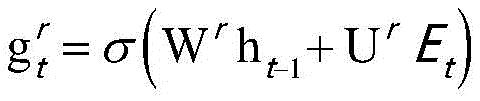
S25、在门控迭代单元GRU的解码器部分引入了一种注意力机制,该机制能够在所有时刻上自适应地确定GRU编码器对应隐含状态的相关性,第t时刻隐含状态的注意力计算为:S25. An attention mechanism is introduced in the decoder part of the gated iterative unit GRU, which can adaptively determine the relevance of the corresponding implicit state of the GRU encoder at all times. The attention calculation of the implicit state at the tth time is:


其中Vk,Wk和Uk是窗体中第k个样本所对应的参数;
具体地,所述S3具体步骤为:Specifically, the specific steps of S3 are:
S31、利用上位机中存储的振动信号及状态标签作为数据的训练样本,其中高压断路器运行状态包括:正常状态、脱扣闭合电磁铁堵塞、主轴堵塞故障、半轴堵塞;S31, using the vibration signal and state label stored in the host computer as training samples of data, wherein the operating state of the high-voltage circuit breaker includes: normal state, tripping and closing electromagnet blockage, main shaft blockage fault, and half shaft blockage;
S32、对训练样本进行预处理,主要包括:缺失信号填补、移除离群值及z-score标准化;S32, preprocessing the training samples, mainly including: missing signal filling, outlier removal and z-score standardization;
S33、按时间步长对振动信号进行划分,构建出一种张量形式,即传感器数量×样本量×时间步长;S33, dividing the vibration signal according to the time step, and constructing a tensor form, that is, the number of sensors × the number of samples × the time step;
S34、利用网络中的CNN层对这种张量数据进行空间相关性特征提取,并输出为网络的序贯层;S34, using the CNN layer in the network to extract spatial correlation features from the tensor data, and outputting them as sequential layers of the network;
S35、在序贯层之后,设计双向GRU层来处理数据中的时间相关特征;S35. After the sequential layer, a bidirectional GRU layer is designed to process the time-related features in the data;
S36、根据GRU解码器部分的注意力值对双向GRU隐含状态的时间相关性进行加权;S36, weighting the temporal correlation of the bidirectional GRU hidden state according to the attention value of the GRU decoder part;
S37、根据网络输出对高压断路器机构卡涩状态进行评价。S37. Evaluate the jamming status of the high-voltage circuit breaker mechanism according to the network output.
作为本发明的优选方案,所述加速度传感器固定在高压断路器的壳体上。As a preferred solution of the present invention, the acceleration sensor is fixed on the housing of the high-voltage circuit breaker.
作为本发明的优选方案,所述加速度传感器的信号输出端连接有A/D转换模块,A/D转换模块的信号输出端连接到内置有注意力机制的卷积神经网络和长短时记忆网络相结合的混合模型CNN-LSTM的处理器。As a preferred solution of the present invention, the signal output end of the acceleration sensor is connected to an A/D conversion module, and the signal output end of the A/D conversion module is connected to a processor of a hybrid model CNN-LSTM that combines a convolutional neural network with an attention mechanism and a long short-term memory network.
作为本发明的优选方案,所述加速度传感器的底座用螺钉安装在高压断路器的壳体上,将螺钉旋入加速度传感器的底座安装孔的一半长度,在加速度传感器的底座和高压断路器的壳体接合面上涂一层油脂,加速度传感器的底座安装孔的垂直度小于0.10mm。As a preferred embodiment of the present invention, the base of the acceleration sensor is mounted on the housing of the high-voltage circuit breaker with screws, the screws are screwed into half the length of the mounting hole of the base of the acceleration sensor, a layer of grease is applied to the joint surface between the base of the acceleration sensor and the housing of the high-voltage circuit breaker, and the verticality of the mounting hole of the base of the acceleration sensor is less than 0.10 mm.
与现有技术相比,本发明通过采用加速度传感器获取高压断路器的振动信号数据,经A/D转换模块转换成数字信号输入到处理器中,在处理器内由注意力机制的卷积神经网络和长短时记忆网络相结合的混合模型CNN-LSTM诊断出高压断路器可能出现的如:机构卡涩、油脂固化凝结、分合闸线圈烧毁、辅助接点失效故障,还能判断高压断路器需重点检修的部位,有效指导检修策略。Compared with the prior art, the present invention obtains vibration signal data of the high-voltage circuit breaker by using an acceleration sensor, converts it into a digital signal through an A/D conversion module and inputs it into a processor. In the processor, a hybrid model CNN-LSTM combining a convolutional neural network with an attention mechanism and a long short-term memory network can diagnose possible faults of the high-voltage circuit breaker, such as: mechanism jamming, grease solidification and condensation, opening and closing coil burning, and auxiliary contact failure. It can also determine the parts of the high-voltage circuit breaker that need to be focused on for maintenance, and effectively guide the maintenance strategy.
本发明可以快速而又准确地诊断出高压断路器运行过程中的故障状态,减少定期盲目停机的检修人力、拆卸过程中设备磨损和维修花费,具有容易实现、结构简单、连接方便等优点。据粗略估计可避免50%以上的断路器“无病也修”现象,节省50%以上检修成本(人工、耗材、工具等);节约80%的检修时间,应用于高电压等级断路器效益更加明显。The present invention can quickly and accurately diagnose the fault status of high-voltage circuit breakers during operation, reduce the maintenance manpower of regular blind shutdowns, equipment wear and maintenance costs during disassembly, and has the advantages of easy implementation, simple structure, and convenient connection. According to a rough estimate, it can avoid the phenomenon of "repairing even when there is no problem" for more than 50% of circuit breakers, save more than 50% of maintenance costs (labor, consumables, tools, etc.); save 80% of maintenance time, and the benefits are more obvious when applied to high-voltage circuit breakers.
附图说明BRIEF DESCRIPTION OF THE DRAWINGS
图1为本发明的流程图。FIG. 1 is a flow chart of the present invention.
图2为A/D转换模块的AD7606芯片引脚图。Figure 2 is the pin diagram of the AD7606 chip of the A/D conversion module.
图3为A/D转换模块的模拟信号输入电路。FIG3 is an analog signal input circuit of the A/D conversion module.
图4为A/D转换模块的稳压芯片电路。FIG4 is a circuit diagram of a voltage regulator chip for an A/D conversion module.
图5为A/D转换模块的总电路。Figure 5 shows the overall circuit of the A/D conversion module.
图6为基于注意力机制的高压断路器机械状态评估图。Figure 6 is a diagram of the mechanical state assessment of a high-voltage circuit breaker based on the attention mechanism.
图7为加速度传感器实时采集的四种机械状态振动信号:(a)正常状态;(b)脱扣闭合电磁铁堵塞;(c)主轴堵塞;(d)半轴堵塞。Figure 7 shows the vibration signals of four mechanical states collected in real time by the acceleration sensor: (a) normal state; (b) tripping closing electromagnet blockage; (c) main shaft blockage; (d) half shaft blockage.
图8为脱扣闭合电磁铁堵塞状态下注意力机制的高压断路器机械状态在线监测方法和常规SVM所对应的ROC曲线:(a)注意力机制的高压断路器机械状态在线监测方法;(b)常规SVM。FIG8 shows the ROC curves corresponding to the online monitoring method of the mechanical state of a high-voltage circuit breaker with an attention mechanism and the conventional SVM under the blocked state of the tripping closing electromagnet: (a) the online monitoring method of the mechanical state of a high-voltage circuit breaker with an attention mechanism; (b) the conventional SVM.
图9为脱扣闭合电磁铁堵塞状态下注意力机制的高压断路器机械状态在线监测方法和常规SVM所对应的PRC曲线:(a)注意力机制的高压断路器机械状态在线监测方法;(b)常规SVM。FIG9 shows the PRC curves corresponding to the online monitoring method of the mechanical state of a high-voltage circuit breaker with an attention mechanism and the conventional SVM under the blocked state of the tripping closing electromagnet: (a) the online monitoring method of the mechanical state of a high-voltage circuit breaker with an attention mechanism; (b) the conventional SVM.
图10为主轴堵塞状态下注意力机制的高压断路器机械状态在线监测方法和常规SVM所对应的ROC曲线:(a)注意力机制的高压断路器机械状态在线监测方法;(b)常规SVM。FIG10 is the ROC curve corresponding to the online monitoring method of the mechanical state of a high-voltage circuit breaker with an attention mechanism and the conventional SVM under the main shaft blocking state: (a) the online monitoring method of the mechanical state of a high-voltage circuit breaker with an attention mechanism; (b) the conventional SVM.
图11为主轴堵塞状态下注意力机制的高压断路器机械状态在线监测方法和常规SVM所对应的PRC曲线:(a)注意力机制的高压断路器机械状态在线监测方法;(b)常规SVM。FIG11 is a PRC curve corresponding to the online monitoring method of the mechanical state of a high-voltage circuit breaker with an attention mechanism and the conventional SVM under the main shaft blocking state: (a) the online monitoring method of the mechanical state of a high-voltage circuit breaker with an attention mechanism; (b) the conventional SVM.
图12为半轴堵塞状态下注意力机制的高压断路器机械状态在线监测方法和常规SVM所对应的ROC曲线:(a)注意力机制的高压断路器机械状态在线监测方法;(b)常规SVM。FIG12 shows the ROC curves corresponding to the online monitoring method of the mechanical state of a high-voltage circuit breaker with an attention mechanism and the conventional SVM under the half-axis blocked state: (a) the online monitoring method of the mechanical state of a high-voltage circuit breaker with an attention mechanism; (b) the conventional SVM.
图13为半轴堵塞状态下注意力机制的高压断路器机械状态在线监测方法和常规SVM所对应的PRC曲线:(a)注意力机制的高压断路器机械状态在线监测方法;(b)常规SVM。FIG13 shows the PRC curves corresponding to the online monitoring method of the mechanical state of a high-voltage circuit breaker with an attention mechanism and the conventional SVM under the half-axis blocked state: (a) the online monitoring method of the mechanical state of a high-voltage circuit breaker with an attention mechanism; (b) the conventional SVM.
具体实施方式DETAILED DESCRIPTION
为使本发明的目的、技术方案及优点更加清楚明白,以下结合实施例,对本发明进行进一步的详细说明。此处所描述的具体实施例仅用于解释本发明,并不用于限定发明。In order to make the purpose, technical solution and advantages of the present invention more clearly understood, the present invention is further described in detail below in conjunction with embodiments. The specific embodiments described herein are only used to explain the present invention and are not used to limit the invention.
如图1所示,本发明提供了一种基于注意力机制的高压断路器机械状态在线监测方法,包括以下步骤:As shown in FIG1 , the present invention provides an online monitoring method for the mechanical state of a high-voltage circuit breaker based on an attention mechanism, comprising the following steps:
S1、将加速度传感器的底座用螺钉安装在高压断路器的壳体上,本实施例中选取的是D0005型加速度传感器,将螺钉旋入加速度传感器的底座安装孔的一半长度,在加速度传感器的底座和高压断路器的壳体接合面上涂一层油脂,能够保证整个加速度传感器的底座能很好地与被测试物的钢性接触;加速度传感器的底座安装孔的垂直度小于0.10mm,,这样加速度传感器在使用过程中频率响应才能与原标定的频率响应相同;通过加速度传感器获取高压断路器的振动信号;加速度传感器的信号输出端连接有A/D转换模块,A/D转换模块的信号输出端连接到内置有注意力机制的卷积神经网络和长短时记忆网络相结合的混合模型CNN-LSTM的处理器;S1. The base of the acceleration sensor is mounted on the housing of the high-voltage circuit breaker with screws. In this embodiment, a D0005 acceleration sensor is selected. The screws are screwed into half the length of the base mounting hole of the acceleration sensor. A layer of grease is applied to the joint surface between the base of the acceleration sensor and the housing of the high-voltage circuit breaker to ensure that the base of the entire acceleration sensor can be well in contact with the rigidity of the object under test; the verticality of the base mounting hole of the acceleration sensor is less than 0.10 mm, so that the frequency response of the acceleration sensor during use can be the same as the original calibrated frequency response; the vibration signal of the high-voltage circuit breaker is obtained through the acceleration sensor; the signal output end of the acceleration sensor is connected to an A/D conversion module, and the signal output end of the A/D conversion module is connected to a processor of a hybrid model CNN-LSTM combining a convolutional neural network with an attention mechanism and a long short-term memory network;
由于传感器采集的信息为模拟信号,多不能直接传输给CPU,因此需要将传感器输出的模拟信息通过A/D转换模块转换成数字信息。本专利采用AD7606芯片实现A/D转换,AD7606的优点是应用广、性能十分优异、价格低廉。拥有着8/6/4路的同步采样输入,它的双极性的模拟输入范围在±10V和±5V,可用5V的模拟单电源供电,2.3V至+5V VDRIVE,完全集成的数据采集就解决了方案模拟输入的嵌位保护,1MΩ的模拟输入阻抗的输入缓冲器,二阶抗混叠的模拟滤波器,片内精密的基准电压及基准电压缓冲器,精度高达16位、200KSPS ADC,通过数字滤波器提供过采样功能。Since the information collected by the sensor is an analog signal, it cannot be directly transmitted to the CPU. Therefore, the analog information output by the sensor needs to be converted into digital information through the A/D conversion module. This patent uses the AD7606 chip to realize A/D conversion. The advantages of AD7606 are wide application, excellent performance and low price. It has 8/6/4 synchronous sampling inputs, its bipolar analog input range is ±10V and ±5V, and can be powered by a 5V analog single power supply, 2.3V to +5V VDRIVE, and fully integrated data acquisition to solve the analog input embedded protection, 1MΩ analog input impedance input buffer, second-order anti-aliasing analog filter, on-chip precision reference voltage and reference voltage buffer, up to 16-bit, 200KSPS ADC, and oversampling function is provided through digital filters.
A/D转换公式如下:The A/D conversion formula is as follows:

其中,Uo为传感器经信号放大电路后输出电压;U为采样电压量程,这里取U=10V;Data为A/D转换结果。Among them, Uo is the output voltage of the sensor after the signal amplification circuit; U is the sampling voltage range, here U=10V; Data is the A/D conversion result.
A/D转换电路输入的模拟信号是传感器发出的信号经放大电路调整后接入的,所有的芯片上模拟信号输入GND引脚均要接入VGND中即模拟地。未被使用的模拟信号输入引脚也要接入VGND,为了减少干扰信号的产生。A/D转换电路输入的模拟信号是传感器发出的信号经放大电路调整后接入的,所有的芯片上模拟信号输入GND引脚均要接入VGND中即模拟地。未被使用的模拟信号输入引脚也要接入VGND,为了减少干扰信号的产生。The analog signal input to the A/D conversion circuit is the signal sent by the sensor and adjusted by the amplifier circuit. All analog signal input GND pins on the chip must be connected to VGND, that is, the analog ground. Unused analog signal input pins must also be connected to VGND to reduce the generation of interference signals. The analog signal input to the A/D conversion circuit is the signal sent by the sensor and adjusted by the amplifier circuit. All analog signal input GND pins on the chip must be connected to VGND, that is, the analog ground. Unused analog signal input pins must also be connected to VGND to reduce the generation of interference signals.
为了提高A/D转换芯片工作的稳定与精准性,这里设计了稳压电路,芯片稳压电路如图4所示。图4中Vin引脚接入的是VDD5V0。详细的A/D转换模块电路如图5所示。In order to improve the stability and accuracy of the A/D conversion chip, a voltage stabilization circuit is designed here. The chip voltage stabilization circuit is shown in Figure 4. The Vin pin in Figure 4 is connected to VDD5V0. The detailed A/D conversion module circuit is shown in Figure 5.
S2、然后利用CNN网络根据振动信号数据按时序窗口创造连续的特征向量,采用注意力机制对局部特征向量进行加权,保留信号局部信息与断路器状态的相关性,从而提取有效的特征向量,然后将提取有效的特征向量输入LSTM网络;所述S2具体步骤为:S2. Then, a CNN network is used to create continuous feature vectors according to the vibration signal data in a time series window, and an attention mechanism is used to weight the local feature vectors, so as to retain the correlation between the local information of the signal and the state of the circuit breaker, thereby extracting effective feature vectors, and then inputting the extracted effective feature vectors into the LSTM network; the specific steps of S2 are:
S21、采集到的实时高压断路器的振动信号数据表达为一种有序实值时间序列:
S22、假设CNN网络中卷积层的数量为L,使用1D滤波来捕捉振动数据中故障敏感的空间特征,并将卷积层l∈{1,…,L}上的滤波器表示为一种张量形式

其中,

S23、为了在一个长周期时间上有效地计算激活值,CNN需要利用池化层对卷积层的输出进行下采样,池化操作,是对滤波器在步长处进行max运算,即:S23. In order to effectively calculate the activation value over a long period of time, CNN needs to use the pooling layer to downsample the output of the convolution layer. The pooling operation is to perform the max operation on the filter at the step size, that is:

对池化后的激活向量进行规范化:Normalize the pooled activation vector:

其中,ε为任意小数;Among them, ε is an arbitrary decimal;
S24、为了进一步捕捉特征序列中的时间相关性,将池化层中提取到的空间特征向量输入到序列层sequential layer中,并为序列层引入双向RNN模型来进行向量合成,在双向RNN模型上放置了门控迭代单元GRU,利用门控器对遗忘门和输入门进行控制:S24. In order to further capture the temporal correlation in the feature sequence, the spatial feature vector extracted from the pooling layer is input into the sequential layer, and a bidirectional RNN model is introduced into the sequential layer for vector synthesis. A gated iteration unit GRU is placed on the bidirectional RNN model, and the gate controller is used to control the forget gate and input gate:


其中,

S25、在门控迭代单元GRU的解码器部分引入了一种注意力机制,该机制能够在所有时刻上自适应地确定GRU编码器对应隐含状态的相关性,第t时刻隐含状态的注意力计算为:S25. An attention mechanism is introduced in the decoder part of the gated iterative unit GRU, which can adaptively determine the relevance of the corresponding implicit state of the GRU encoder at all times. The attention calculation of the implicit state at the tth time is:


其中Vk,Wk和Uk是窗体中第k个样本所对应的参数;
S3、利用LSTM网络实现高压断路器故障类型的分类识别:S3. Use LSTM network to classify and identify high-voltage circuit breaker fault types:
具体地,所述S3具体步骤为:Specifically, the specific steps of S3 are:
S31、利用上位机中存储的振动信号及状态标签作为数据的训练样本,其中高压断路器运行状态包括:正常状态、脱扣闭合电磁铁堵塞、主轴堵塞故障、半轴堵塞;S31, using the vibration signal and state label stored in the host computer as training samples of data, wherein the operating state of the high-voltage circuit breaker includes: normal state, tripping and closing electromagnet blockage, main shaft blockage fault, and half shaft blockage;
S32、对训练样本进行预处理,主要包括:缺失信号填补、移除离群值及z-score标准化;S32, preprocessing the training samples, mainly including: missing signal filling, outlier removal and z-score standardization;
S33、按时间步长对振动信号进行划分,构建出一种张量形式,即传感器数量×样本量×时间步长;S33, dividing the vibration signal according to the time step, and constructing a tensor form, that is, the number of sensors × the number of samples × the time step;
S34、利用网络中的CNN层对这种张量数据进行空间相关性特征提取,并输出为网络的序贯层;S34, using the CNN layer in the network to extract spatial correlation features from the tensor data, and outputting them as sequential layers of the network;
S35、在序贯层之后,设计双向GRU层来处理数据中的时间相关特征;S35. After the sequential layer, a bidirectional GRU layer is designed to process the time-related features in the data;
S36、根据GRU解码器部分的注意力值对双向GRU隐含状态的时间相关性进行加权;S36, weighting the temporal correlation of the bidirectional GRU hidden state according to the attention value of the GRU decoder part;
S37、根据网络输出对高压断路器机构卡涩状态进行评价。S37. Evaluate the jamming status of the high-voltage circuit breaker mechanism according to the network output.
为了验证本发明的诊断效果,采用现有技术支持向量机模型作为对比方法来确定本发明方法对高压断路器故障诊断效果,具体试验如下:In order to verify the diagnostic effect of the present invention, the prior art support vector machine model is used as a comparison method to determine the diagnostic effect of the method of the present invention on high-voltage circuit breaker faults. The specific experiment is as follows:
1、数据的采集1. Data Collection
以一台ZW32-12FG/630-20型真空断路器的机械性能测试系统,并基于yd-39型加速度传感器测量开/关过程中的振动加速度参数,得到相应的电压。采用NI9234数据采集卡对电压进行数字化处理。传感器的测量范围为0-5000m/s2,数据采集卡采样频率为10kHZ。加速度传感器的位置在真空断路器的壳体上,在壳体上采集垂直振动信号,比较各种监测方法。A mechanical performance test system for a ZW32-12FG/630-20 vacuum circuit breaker is used to measure the vibration acceleration parameters during the opening/closing process based on a yd-39 acceleration sensor to obtain the corresponding voltage. The voltage is digitized using a NI9234 data acquisition card. The sensor has a measurement range of 0-5000m/ s2 and a data acquisition card sampling frequency of 10kHZ. The acceleration sensor is located on the housing of the vacuum circuit breaker, and vertical vibration signals are collected on the housing to compare various monitoring methods.
实验模拟了四种实验类型:正常状态;脱扣闭合电磁铁堵塞;主轴堵塞;半轴堵塞。在每种情况下进行了7次实验,真空断路器正常和故障状态的典型信号如图7。在这7个数据集中,选择其中3个作为训练数据集,选择其余的作为每个状态的测试数据集。The experiment simulated four types of experiments: normal state; tripping closing electromagnet blocked; main shaft blocked; half shaft blocked. Seven experiments were conducted in each case, and the typical signals of the normal and fault states of the vacuum circuit breaker are shown in Figure 7. Among these seven data sets, three of them were selected as training data sets, and the rest were selected as test data sets for each state.
2、参数设置2. Parameter settings
注意力深度网络模型中,设计的CNN有1个卷积层和1个池化层,卷积滤波器的个数为64。将卷积核大小设为1,步长为1。在池化层中MaxPooling1D的大小为1。CNN网络中的激活函数采用Relu函数。通过卷积操作和池化操作来减小振动信号的输出维度,然后经过扁平操作对样本进行处理,作为全整个网络的特征提取。LSTM模型采用的网络层节点数目为100,激活函数采用sigmoid函数。本实验采用SVM模型与CNN-LSTM模型对比的方法。输入相同的机械振动信号的样本进行故障诊断,两种模型在ROC和PRC曲线中的诊断结果进行评估,表1为故障类型及其标签。In the attention deep network model, the designed CNN has 1 convolution layer and 1 pooling layer, and the number of convolution filters is 64. The convolution kernel size is set to 1, and the step size is 1. The size of MaxPooling1D in the pooling layer is 1. The activation function in the CNN network uses the Relu function. The output dimension of the vibration signal is reduced by convolution and pooling operations, and then the samples are processed by flattening operations as feature extraction for the entire network. The number of network layer nodes used in the LSTM model is 100, and the activation function uses the sigmoid function. This experiment uses the method of comparing the SVM model with the CNN-LSTM model. The samples of the same mechanical vibration signal are input for fault diagnosis, and the diagnosis results of the two models in the ROC and PRC curves are evaluated. Table 1 shows the fault types and their labels.
表1Table 1

3、实验结果对比3. Comparison of experimental results
实验1脱扣闭合电磁铁堵塞情况下振动信号的诊断比较Experiment 1: Diagnostic comparison of vibration signals when the tripping closing electromagnet is blocked
首先,图8(a)采用注意力机制深度网络模型的脱扣闭合电磁铁堵塞的ROC曲线完全将正常状态的ROC曲线包络住,从而可以将故障信号与正常信号进行准确分类。其次,图8(a)中的正常状态和脱扣闭合电磁铁堵塞故障状态的曲线随着阈值变化保持平稳变化,而图8(b)中采用SVM的正常状态曲线在此期间出现大幅度波动变化。最后,由图8(a)和(b)可知,采用注意力机制深度网络模型的正常状态和脱扣闭合电磁铁堵塞故障AUC的值均为0.99,而采用SVM模型相对应的AUC的值为0.52和0.52。采用注意力机制深度网络模型的AUC值远远大于采用SVM模型的AUC值,AUC的数值越大,诊断效果越好。综上,从ROC曲线中可以看出,采用注意力机制深度网络模型对高压断路器的脱扣闭合电磁铁堵塞振动信号与正常状态的振动信号排序更精确,对断路器机械振动信号状态诊断效果更好。First, the ROC curve of the tripping and closing electromagnet blockage using the attention mechanism deep network model in Figure 8(a) completely envelops the ROC curve of the normal state, so that the fault signal and the normal signal can be accurately classified. Secondly, the curves of the normal state and the tripping and closing electromagnet blockage fault state in Figure 8(a) remain stable as the threshold changes, while the normal state curve using SVM in Figure 8(b) fluctuates greatly during this period. Finally, it can be seen from Figures 8(a) and (b) that the AUC values of the normal state and the tripping and closing electromagnet blockage fault using the attention mechanism deep network model are both 0.99, while the corresponding AUC values of the SVM model are 0.52 and 0.52. The AUC value of the attention mechanism deep network model is much larger than the AUC value of the SVM model. The larger the AUC value, the better the diagnostic effect. In summary, it can be seen from the ROC curve that the attention mechanism deep network model is more accurate in sorting the vibration signal of the tripping and closing electromagnet blockage and the vibration signal of the normal state of the high-voltage circuit breaker, and has a better diagnostic effect on the mechanical vibration signal state of the circuit breaker.
若正常状态信号样本与故障状态信号样本比例悬殊时可以采用查准率-查全率曲线(Precision-recall curve,PRC)进一步来判定模型分类性能。首先,如图9(a)所示,采用注意力机制深度网络模型的PRC曲线相对于图9(b)所示的基于SVM的PRC曲线更接近坐标轴的右上角,在PRC曲线中越接近右上角诊断效果越好。其次,图9(a)中的正常状态和发生脱扣闭合电磁铁堵塞故障状态曲线在诊断过程中随着阈值的变化始终保持平滑,在查全率不断提高的过程中,查准率依旧保持平稳变化。最后,由图9(a)可知采用注意力机制深度网络模型的正常状态曲线和断路器发生脱扣闭合电磁铁堵塞故障曲线的AUC的值分别为0.996和0.977,而采用SVM模型所对应的AUC的值为0.575和0.629,AUC的值越大诊断越精确。综上可以得出在PRC曲线中,采用注意力机制深度网络模型对断路器正常工作时和发生脱扣闭合电磁铁堵塞时的状态诊断均有更高的灵敏性和准确性。If the ratio of normal state signal samples to fault state signal samples is very different, the precision-recall curve (PRC) can be used to further determine the model classification performance. First, as shown in Figure 9(a), the PRC curve of the deep network model using the attention mechanism is closer to the upper right corner of the coordinate axis than the PRC curve based on SVM shown in Figure 9(b). The closer to the upper right corner in the PRC curve, the better the diagnostic effect. Secondly, the normal state and tripping and closing electromagnet blocking fault state curves in Figure 9(a) remain smooth as the threshold changes during the diagnosis process. As the recall rate continues to increase, the precision rate remains stable. Finally, it can be seen from Figure 9(a) that the AUC values of the normal state curve and the circuit breaker tripping and closing electromagnet blocking fault curve using the deep network model using the attention mechanism are 0.996 and 0.977, respectively, while the AUC values corresponding to the SVM model are 0.575 and 0.629. The larger the AUC value, the more accurate the diagnosis. In summary, it can be concluded that in the PRC curve, the deep network model using the attention mechanism has higher sensitivity and accuracy in the state diagnosis of the circuit breaker when it is working normally and when the tripping closing electromagnet is blocked.
实验2发生主轴堵塞故障情况下振动信号的诊断对比Experiment 2: Diagnostic comparison of vibration signals when a spindle blockage occurs
如图10(a)所示,采用注意力机制深度网络的正常状态和发生主轴堵塞的故障状态的曲线随着阈值变化保持平稳变化,而图10(b)采用SVM模型的正常状态曲线及主轴堵塞故障曲线在整个诊断期间出现大幅度波动变化,不利于振动信号的机械诊断。采用注意力机制深度网络模型的ROC曲线接近左上角,ROC曲线越接近左上角,诊断精度越高。由图10可知,采用注意力机制深度网络模型的正常状态和发生主轴堵塞时AUC的值均为0.99,而采用SVM模型的相对应的AUC的值为0.54,AUC的值越大诊断效果越好。在ROC曲线中可以得出,采用注意力机制深度网络模型对断路器发生主轴堵塞与正常状态的信号的实时监测效果更好。As shown in Figure 10(a), the curves of the normal state and the fault state of the spindle jam of the deep network using the attention mechanism remain stable as the threshold changes, while the normal state curve and the spindle jam fault curve of the SVM model in Figure 10(b) fluctuate greatly during the entire diagnosis period, which is not conducive to the mechanical diagnosis of vibration signals. The ROC curve of the deep network model using the attention mechanism is close to the upper left corner. The closer the ROC curve is to the upper left corner, the higher the diagnostic accuracy. As can be seen from Figure 10, the AUC values of the normal state and the spindle jam of the deep network model using the attention mechanism are both 0.99, while the corresponding AUC value of the SVM model is 0.54. The larger the AUC value, the better the diagnostic effect. It can be concluded from the ROC curve that the real-time monitoring effect of the signals of the spindle jam and normal state of the circuit breaker using the deep network model with the attention mechanism is better.
如图11(a)所示,采用注意力机制深度网络模型的正常状态和发生主轴堵塞时的故障状态曲线在诊断过程中随着阈值的变化始终保持平滑,在查全率不断提高的过程中,查准率依旧保持平稳变化,而采用SVM模型的PRC曲线随着查全率的增加查准率出现剧烈的变化,如图11(b)。最后,由图11(a)可知,采用注意力机制深度网络模型的正常状态曲线和发生主轴堵塞故障曲线的AUC的值分别为0.996和0.96,而采用SVM模型相对应的AUC的值为0.585和0.647,如图11(b)所示。在PRC曲线中,采用注意力机制深度网络模型的AUC值更高一些。在对主轴堵塞故障和正常状态进行监测时,采用注意力机制深度网络高压断路器机械状态监测的模型对发生主轴堵塞故障和正常状态的分类效果都要强于SVM模型,因此更有利于对高压断路器的机械状态进行监测。As shown in Figure 11(a), the normal state curve and the fault state curve when the spindle is blocked by the deep network model using the attention mechanism remain smooth as the threshold changes during the diagnosis process. As the recall rate continues to increase, the precision rate remains stable, while the PRC curve using the SVM model changes dramatically with the increase in recall rate, as shown in Figure 11(b). Finally, as shown in Figure 11(a), the AUC values of the normal state curve and the spindle blockage fault curve using the deep network model using the attention mechanism are 0.996 and 0.96 respectively, while the corresponding AUC values of the SVM model are 0.585 and 0.647, as shown in Figure 11(b). In the PRC curve, the AUC value of the deep network model using the attention mechanism is higher. When monitoring the spindle blockage fault and normal state, the model of the mechanical state monitoring of the high-voltage circuit breaker using the deep network of the attention mechanism has a stronger classification effect on the spindle blockage fault and normal state than the SVM model, so it is more conducive to monitoring the mechanical state of the high-voltage circuit breaker.
实验3半轴堵塞情况下振动信号的诊断对比Experiment 3: Diagnostic comparison of vibration signals in the case of half-axle blockage
首先由图12(a)可以明显的看出,采用注意力机制深度网络的模型的正常状态和发生半轴堵塞故障时的ROC曲线更接近坐标的左上角。其次,采用注意力机制深度网络模型在断路器发生半轴堵塞时,TPR值随着阈值的增加稳定的接近于1,而图12(b)中采用SVM模型对于故障诊断的TPR值随着阈值的增加,维持在0.4-0.6之间。根据两种模型对同一种故障的TPR值进行对比,采用注意力机制深度网络对于发生半轴堵塞故障的诊断具有更高的准确性及更精准的趋势诊断。最后,由图12可知,注意力机制深度网络模型在正常状态和发生半轴堵塞故障的AUC值分别为1.00和1.00,而采用SVM模型相对应的AUC值为0.53和0.53,采用注意力机制深度网络模型的AUC值远远大于SVM模型对应的值。综上,在ROC曲线中无论是对断路器正常状态诊断或者发生半轴堵塞的故障状态诊断,采用注意力机制深度网络模型相较于采用SVM模型都具有更高的准确性。First, it can be clearly seen from Figure 12(a) that the ROC curves of the model using the attention mechanism deep network in the normal state and when the semi-axle blockage fault occurs are closer to the upper left corner of the coordinate. Secondly, when the circuit breaker is semi-axle blocked, the TPR value of the attention mechanism deep network model is stable and close to 1 as the threshold increases, while the TPR value of the fault diagnosis using the SVM model in Figure 12(b) is maintained between 0.4-0.6 as the threshold increases. According to the comparison of the TPR values of the same fault of the two models, the diagnosis of the semi-axle blockage fault using the attention mechanism deep network has higher accuracy and more accurate trend diagnosis. Finally, it can be seen from Figure 12 that the AUC values of the attention mechanism deep network model in the normal state and when the semi-axle blockage fault occurs are 1.00 and 1.00 respectively, while the corresponding AUC values of the SVM model are 0.53 and 0.53. The AUC value of the attention mechanism deep network model is much larger than the corresponding value of the SVM model. In summary, in the ROC curve, whether it is the diagnosis of the normal state of the circuit breaker or the fault state diagnosis of the half-axis blockage, the deep network model using the attention mechanism has higher accuracy than the SVM model.
首先图13(a)中采用注意力机制深度网络模型的PRC曲线相对于图13(b)中采用SVM的PRC曲线更接近坐标轴的右上角,在PRC曲线中,曲线越接近右上角,诊断效果越好。其次,图13(a)中的正常状态和发生半轴堵塞的曲线保持平滑,在查全率不断提高的过程中,查准率依旧保持平稳变化。采用注意力机制深度网络模型的正常状态和发生半轴堵塞故障的AUC值分别为0.996和0.994,而采用SVM的相对应的AUC值为0.583和0.642,AUC的数值越高诊断精度越高。无论是对正常状态还是半轴堵塞状态进行诊断,采用注意力机制深度网络模型都比传统采用SVM模型都有更高的精度。First, the PRC curve of the deep network model using the attention mechanism in Figure 13 (a) is closer to the upper right corner of the coordinate axis than the PRC curve using the SVM in Figure 13 (b). In the PRC curve, the closer the curve is to the upper right corner, the better the diagnostic effect. Secondly, the curves of the normal state and the semi-axle blockage in Figure 13 (a) remain smooth. As the recall rate continues to increase, the precision rate remains stable. The AUC values of the normal state and the semi-axle blockage fault using the deep network model using the attention mechanism are 0.996 and 0.994, respectively, while the corresponding AUC values using the SVM are 0.583 and 0.642. The higher the AUC value, the higher the diagnostic accuracy. Whether it is for the diagnosis of the normal state or the semi-axle blockage state, the deep network model using the attention mechanism has higher accuracy than the traditional SVM model.
通过三组实验的对比结果表明,注意力机制深度网络模型对比SVM模型能更快速、准确的提取有效特征向量。更加精确地对特征向量进行诊断。所以,采用注意力机制深度网络模型相较于现有技术支持向量机模型能更加准确的对高压断路器的机械故障进行诊断。The comparison results of three groups of experiments show that the attention mechanism deep network model can extract effective feature vectors more quickly and accurately than the SVM model. It can diagnose feature vectors more accurately. Therefore, the attention mechanism deep network model can diagnose mechanical faults of high-voltage circuit breakers more accurately than the existing support vector machine model.
本发明的技术方案不限于上述具体实施例的限制,凡是根据本发明的技术方案做出的技术变形,均落入本发明的保护范围之内。The technical solution of the present invention is not limited to the above-mentioned specific embodiments. All technical variations made according to the technical solution of the present invention fall within the protection scope of the present invention.
Claims (5)




Priority Applications (1)
| Application Number | Priority Date | Filing Date | Title |
|---|---|---|---|
| CN202011041562.2A CN112200032B (en) | 2020-09-28 | 2020-09-28 | An Attention Mechanism-Based On-Line Monitoring Method for the Mechanical Status of High-Voltage Circuit Breakers |
Applications Claiming Priority (1)
| Application Number | Priority Date | Filing Date | Title |
|---|---|---|---|
| CN202011041562.2A CN112200032B (en) | 2020-09-28 | 2020-09-28 | An Attention Mechanism-Based On-Line Monitoring Method for the Mechanical Status of High-Voltage Circuit Breakers |
Publications (2)
| Publication Number | Publication Date |
|---|---|
| CN112200032A CN112200032A (en) | 2021-01-08 |
| CN112200032B true CN112200032B (en) | 2023-05-30 |
Family
ID=74007701
Family Applications (1)
| Application Number | Title | Priority Date | Filing Date |
|---|---|---|---|
| CN202011041562.2A Active CN112200032B (en) | 2020-09-28 | 2020-09-28 | An Attention Mechanism-Based On-Line Monitoring Method for the Mechanical Status of High-Voltage Circuit Breakers |
Country Status (1)
| Country | Link |
|---|---|
| CN (1) | CN112200032B (en) |
Families Citing this family (14)
| Publication number | Priority date | Publication date | Assignee | Title |
|---|---|---|---|---|
| CN112910004B (en) * | 2021-03-15 | 2024-02-02 | 大唐淮南洛河发电厂 | A method for synthesizing manual shutdown signals and accident shutdown signals of 600MW thermal power generating units |
| EP4071572A1 (en) * | 2021-04-09 | 2022-10-12 | Hitachi Energy Switzerland AG | Asset protection, monitoring, or control device and method, and electric power system |
| CN113240098B (en) * | 2021-06-16 | 2022-05-17 | 湖北工业大学 | Fault prediction method and device based on hybrid gated neural network and storage medium |
| CN113567904A (en) * | 2021-07-02 | 2021-10-29 | 中国电力科学研究院有限公司 | Method and system suitable for metering error of capacitive mutual inductor |
| CN113469281B (en) * | 2021-07-22 | 2023-11-24 | 西北工业大学 | A multi-source information fusion fault diagnosis method for industrial gearboxes |
| CN113625144B (en) * | 2021-08-11 | 2024-06-25 | 北京信息科技大学 | IGBT fault prediction method and system |
| CN113566953B (en) * | 2021-09-23 | 2021-11-30 | 中国空气动力研究与发展中心设备设计与测试技术研究所 | Online monitoring method for flexible-wall spray pipe |
| CN114298087B (en) * | 2021-12-03 | 2024-07-12 | 中铁第一勘察设计院集团有限公司 | A hybrid CNN-LSTM hanging string anomaly detection method based on attention mechanism |
| CN114355184B (en) * | 2022-01-05 | 2023-09-26 | 国网江苏省电力有限公司宿迁供电分公司 | A high-voltage circuit breaker status monitoring and early warning method based on online learning |
| CN114689698B (en) * | 2022-03-24 | 2025-05-06 | 南京航空航天大学 | A two-level consistency control method for piezoelectric sandwich performance |
| CN115184787A (en) * | 2022-06-29 | 2022-10-14 | 云南电网有限责任公司电力科学研究院 | Online measuring method, device and equipment for ablation degree of circuit breaker |
| CN116008733A (en) * | 2023-03-21 | 2023-04-25 | 成都信息工程大学 | A single-phase-to-ground fault diagnosis method based on integrated deep neural network |
| CN116756606B (en) * | 2023-05-12 | 2025-10-24 | 潍柴动力股份有限公司 | Internal combustion engine fault diagnosis method, device and equipment |
| CN116930741A (en) * | 2023-07-19 | 2023-10-24 | 中国电子产品可靠性与环境试验研究所((工业和信息化部电子第五研究所)(中国赛宝实验室)) | Switching device fault degree diagnosis method and device and computer equipment |
Citations (8)
| Publication number | Priority date | Publication date | Assignee | Title |
|---|---|---|---|---|
| CN103323770A (en) * | 2013-05-23 | 2013-09-25 | 国家电网公司 | Device for detection of mechanical characteristics and diagnosis of faults of high-voltage circuit breaker |
| CN103487749A (en) * | 2013-09-18 | 2014-01-01 | 国家电网公司 | On-line monitoring and diagnosing system and method for mechanical state of high-voltage circuit breaker |
| CN107766816A (en) * | 2017-10-18 | 2018-03-06 | 河海大学 | A kind of Mechanical Failure of HV Circuit Breaker recognition methods based on LVQ neutral nets |
| CN109272123A (en) * | 2018-08-03 | 2019-01-25 | 常州大学 | It is a kind of based on convolution-Recognition with Recurrent Neural Network sucker rod pump operating condition method for early warning |
| CN110084148A (en) * | 2019-04-09 | 2019-08-02 | 东南大学 | A kind of Mechanical Failure of HV Circuit Breaker diagnostic method |
| CN110398348A (en) * | 2019-06-18 | 2019-11-01 | 清华大学 | Memory, Mechanical Failure of HV Circuit Breaker diagnostic method and device |
| CN111325112A (en) * | 2020-01-31 | 2020-06-23 | 贵州大学 | Cutter wear state monitoring method based on depth gate control circulation unit neural network |
| CN111680454A (en) * | 2020-06-16 | 2020-09-18 | 北京工业大学 | Prediction method of wind turbine blade icing fault based on dual attention mechanism |
Family Cites Families (1)
| Publication number | Priority date | Publication date | Assignee | Title |
|---|---|---|---|---|
| US10754334B2 (en) * | 2016-05-09 | 2020-08-25 | Strong Force Iot Portfolio 2016, Llc | Methods and systems for industrial internet of things data collection for process adjustment in an upstream oil and gas environment |
-
2020
- 2020-09-28 CN CN202011041562.2A patent/CN112200032B/en active Active
Patent Citations (8)
| Publication number | Priority date | Publication date | Assignee | Title |
|---|---|---|---|---|
| CN103323770A (en) * | 2013-05-23 | 2013-09-25 | 国家电网公司 | Device for detection of mechanical characteristics and diagnosis of faults of high-voltage circuit breaker |
| CN103487749A (en) * | 2013-09-18 | 2014-01-01 | 国家电网公司 | On-line monitoring and diagnosing system and method for mechanical state of high-voltage circuit breaker |
| CN107766816A (en) * | 2017-10-18 | 2018-03-06 | 河海大学 | A kind of Mechanical Failure of HV Circuit Breaker recognition methods based on LVQ neutral nets |
| CN109272123A (en) * | 2018-08-03 | 2019-01-25 | 常州大学 | It is a kind of based on convolution-Recognition with Recurrent Neural Network sucker rod pump operating condition method for early warning |
| CN110084148A (en) * | 2019-04-09 | 2019-08-02 | 东南大学 | A kind of Mechanical Failure of HV Circuit Breaker diagnostic method |
| CN110398348A (en) * | 2019-06-18 | 2019-11-01 | 清华大学 | Memory, Mechanical Failure of HV Circuit Breaker diagnostic method and device |
| CN111325112A (en) * | 2020-01-31 | 2020-06-23 | 贵州大学 | Cutter wear state monitoring method based on depth gate control circulation unit neural network |
| CN111680454A (en) * | 2020-06-16 | 2020-09-18 | 北京工业大学 | Prediction method of wind turbine blade icing fault based on dual attention mechanism |
Non-Patent Citations (2)
| Title |
|---|
| "基于 CNN -LSTM 的 QAR 数据特征提取与预测";张鹏等;《计算机应用研究》;第第36卷卷(第第10期期);第2958-2961页 * |
| "基于卷积深度网络的高压真空断路器机械故障诊断方法";曹宇鹏等;《电力系统保护与控制》;第第49卷卷(第第3期期);第39-47页 * |
Also Published As
| Publication number | Publication date |
|---|---|
| CN112200032A (en) | 2021-01-08 |
Similar Documents
| Publication | Publication Date | Title |
|---|---|---|
| CN112200032B (en) | An Attention Mechanism-Based On-Line Monitoring Method for the Mechanical Status of High-Voltage Circuit Breakers | |
| CN110059357B (en) | A method and system for fault classification detection of intelligent electric energy meter based on auto-encoding network | |
| CN111504676A (en) | Equipment fault diagnosis method, device and system based on multi-source monitoring data fusion | |
| CN111914883A (en) | A method and device for evaluating the state of a spindle bearing based on a deep fusion network | |
| CN113934982B (en) | Method for predicting mechanical life of breaker operating mechanism based on vibration-electric signal fusion | |
| CN112461537B (en) | Wind power gear box state monitoring method based on long-time and short-time neural network and automatic coding machine | |
| CN109917205B (en) | A device and method for fault diagnosis of solenoid valve based on feature extraction and multi-layer perceptron | |
| CN112352165B (en) | Method for monitoring circuit breaker, device using method and Internet of things | |
| CN111796233B (en) | Evaluation method for secondary errors of multiple voltage transformers under double busbar connection | |
| CN110221200A (en) | A kind of omnipotent breaker attachment method for diagnosing faults based on deep learning | |
| CN112231975B (en) | Data modeling method and system based on reliability analysis of railway power supply equipment | |
| CN116956197B (en) | Deep learning-based energy facility fault prediction method and device and electronic equipment | |
| CN108761377A (en) | A kind of electric energy metering device method for detecting abnormality based on long memory models in short-term | |
| CN117056814B (en) | A method for diagnosis of transformer voiceprint vibration fault | |
| CN114118174A (en) | A kind of rolling bearing fault diagnosis method and system | |
| CN119848698A (en) | Fault diagnosis method for oil immersed transformer fused with digital twin model | |
| CN114046816B (en) | Sensor signal fault diagnosis method based on lightweight gradient lifting decision tree | |
| CN121092859A (en) | Distribution line broadband waveform sampling method | |
| CN115935293A (en) | State evaluation method, device, terminal and storage medium of intelligent high-voltage switch | |
| CN120910571B (en) | Method and system for processing output data of wiring calibrator based on artificial intelligence | |
| CN114492636B (en) | Transformer winding state signal acquisition system | |
| CN113611568A (en) | A vacuum circuit breaker based on genetic convolution deep network | |
| CN106054859A (en) | Double-layer integrated type industrial process fault detection method based on modified independent component analysis (MICA) | |
| CN109557434A (en) | Local discharge signal recognition methods under strong background noise based on the classification of compound dictionary rarefaction representation | |
| CN120029242A (en) | An industrial fault detection method based on structured augmented dictionary learning |
Legal Events
| Date | Code | Title | Description |
|---|---|---|---|
| PB01 | Publication | ||
| PB01 | Publication | ||
| SE01 | Entry into force of request for substantive examination | ||
| SE01 | Entry into force of request for substantive examination | ||
| GR01 | Patent grant | ||
| GR01 | Patent grant |