CN1122109C - α-1,4-glucan lyase and its application in the preparation of 1,5-anhydrofructose - Google Patents
α-1,4-glucan lyase and its application in the preparation of 1,5-anhydrofructose Download PDFInfo
- Publication number
- CN1122109C CN1122109C CN95196803A CN95196803A CN1122109C CN 1122109 C CN1122109 C CN 1122109C CN 95196803 A CN95196803 A CN 95196803A CN 95196803 A CN95196803 A CN 95196803A CN 1122109 C CN1122109 C CN 1122109C
- Authority
- CN
- China
- Prior art keywords
- enzyme
- lyase
- gly
- asn
- asp
- Prior art date
- Legal status (The legal status is an assumption and is not a legal conclusion. Google has not performed a legal analysis and makes no representation as to the accuracy of the status listed.)
- Expired - Fee Related
Links
Images


Classifications
-
- C—CHEMISTRY; METALLURGY
- C12—BIOCHEMISTRY; BEER; SPIRITS; WINE; VINEGAR; MICROBIOLOGY; ENZYMOLOGY; MUTATION OR GENETIC ENGINEERING
- C12N—MICROORGANISMS OR ENZYMES; COMPOSITIONS THEREOF; PROPAGATING, PRESERVING, OR MAINTAINING MICROORGANISMS; MUTATION OR GENETIC ENGINEERING; CULTURE MEDIA
- C12N9/00—Enzymes; Proenzymes; Compositions thereof; Processes for preparing, activating, inhibiting, separating or purifying enzymes
- C12N9/88—Lyases (4.)
Landscapes
- Life Sciences & Earth Sciences (AREA)
- Chemical & Material Sciences (AREA)
- Health & Medical Sciences (AREA)
- Genetics & Genomics (AREA)
- Organic Chemistry (AREA)
- Engineering & Computer Science (AREA)
- Bioinformatics & Cheminformatics (AREA)
- Zoology (AREA)
- Wood Science & Technology (AREA)
- Molecular Biology (AREA)
- Microbiology (AREA)
- Biotechnology (AREA)
- Biomedical Technology (AREA)
- Biochemistry (AREA)
- General Engineering & Computer Science (AREA)
- General Health & Medical Sciences (AREA)
- Medicinal Chemistry (AREA)
- Enzymes And Modification Thereof (AREA)
- Preparation Of Compounds By Using Micro-Organisms (AREA)
Abstract
Description
本发明涉及一种α-1,4-葡聚糖裂合酶(“GL”),特别是它用来从基于α-1,4-葡聚糖的底物制备1,5-D-脱水果糖(“AF”)。The present invention relates to an alpha-1,4-glucan lyase ("GL"), in particular its use in the preparation of 1,5-D-dehydrated Fructose ("AF").
本发明也涉及糖的应用,特别是用本发明的方法制备的1,5-D-脱水果糖(“AF”)做为抗氧化剂,尤其是做为食品和饮料的抗氧化剂使用。本发明涉及1,5-D-脱水果糖(“AF”)的应用,特别是用本发明的方法制备的AF做为甜味剂,尤其是做为食品和饮料,优选人的食品和饮料的甜味剂使用。The present invention also relates to the use of sugars, particularly 1,5-D-anhydrofructose ("AF") prepared by the method of the present invention, as antioxidants, especially as antioxidants for food and beverages. The present invention relates to the use of 1,5-D-anhydrofructose ("AF"), in particular AF prepared by the process of the present invention, as a sweetener, especially as a food and beverage, preferably human food and beverage Sweeteners used.
FR-A-2617502和Baute等在Phytochemistry[1988]vol.27 No.11pp3401-3403上报道了用一种明显的酶反应制备在普通单肚菌中的AF。AF的产率相当低。尽管是一种可能的酶反应的参考文献,但这两份文献都未给出对任何酶的任何氨基酸序列的数据,更不用说任何核苷酸序列信息。这些文献说AF可以是制备抗生素吡喃酮羟基羟甲基吡喃酮的前体。FR-A-2617502 and Baute et al. reported in Phytochemistry [1988] vol.27 No. 11pp3401-3403 that AF was prepared in Common Monogamum by a distinct enzymatic reaction. The yield of AF was rather low. Although a reference to a possible enzymatic reaction, neither of these documents gives any amino acid sequence data for any enzyme, let alone any nucleotide sequence information. These documents state that AF may be a precursor for the preparation of the antibiotic pyrone hydroxymethylpyrone.
Yu等在Biochimica et Biophysica Acta[1993]vol1156 pp313-320上报道了从红色海藻制备GL,以及它用于降解α-1,4-葡聚糖来生产AF。AF的产率相当低。尽管是一份酶GL的参考文献,它未给出此酶的任何氨基酸序列数据,更不用说编码该酶的任何核苷酸序列的信息。In Biochimica et Biophysica Acta [1993] vol1156 pp313-320, Yu et al. reported the preparation of GL from red seaweed and its use in the degradation of α-1,4-glucan to produce AF. The yield of AF was rather low. Although a reference for the enzyme GL, it does not give any amino acid sequence data for this enzyme, let alone any nucleotide sequence information encoding the enzyme.
典型的α-1,4-葡聚糖基本底物是淀粉。今天,发现淀粉在工业上有广泛用途,主要原因为它们是价廉的原料。A typical basic substrate for α-1,4-glucan is starch. Today, starches find widespread use in industry, mainly because they are inexpensive raw materials.
淀粉降解酶可以归为几类。淀粉水解酶产生葡萄糖或葡萄糖寡聚物。第二类淀粉降解酶是磷酸化酶,它在无机磷存在下从淀粉中产生葡萄糖-1-磷酸。Starch degrading enzymes can be classified into several classes. Amylolytic enzymes produce glucose or glucose oligomers. The second class of starch-degrading enzymes is phosphorylase, which produces glucose-1-phosphate from starch in the presence of inorganic phosphorus.
AF也已化学合成-见Tetrahedron Letters vol.21 pp1429-1432中Lichtenthaler的工作。然而,此化学合成涉及许多步骤,而且产生不了大量的AF。AF has also been chemically synthesized - see the work of Lichtenthaler in Tetrahedron Letters vol.21 pp1429-1432. However, this chemical synthesis involves many steps and does not produce large amounts of AF.
所以生产AF的化学合成路线非常贵。So the chemical synthesis route to produce AF is very expensive.
因此需要一种制法,它能以便宜和容易的方式,而且以能够得到大量AF的方式来制备AF。There is therefore a need for a process which can prepare AF in a cheap and easy manner and in such a way that large quantities of AF can be obtained.
此外,抗氧化剂典型地用于防止对物质如食品有危害作用的氧。两种通常使用的抗氧化剂是GRINDOX142和GRINDOX1029。这些抗氧化剂含有多种成分,而且制造起来相当贵。Furthermore, antioxidants are typically used to protect against oxygen which has a harmful effect on substances such as food. Two commonly used antioxidants are GRINDOX142 and GRINDOX1029. These antioxidants contain a variety of ingredients and are quite expensive to manufacture.
所以需要有一种简单和便宜形式的抗氧化剂。此外,甜味剂常被用于制造食品和饮料,而许多甜味剂制造起来价贵且复杂。So there is a need for a simple and inexpensive form of antioxidant. Additionally, sweeteners are often used in the manufacture of food and beverages, and many are expensive and complicated to manufacture.
所以需要有一种简单和便宜形式的甜味剂。There is therefore a need for a simple and inexpensive form of sweetener.
根据本发明的第一个方面,提供了一种酶,它包含至少任一个SEQ.ID.No.s 3-4所示的氨基酸序列或其任意变体。According to a first aspect of the present invention, an enzyme is provided, which comprises at least one amino acid sequence shown in SEQ.ID.No.s 3-4 or any variant thereof.
根据本发明的第二个方面,提供了编码本发明第一方面酶的核苷酸序列,优选的核苷酸序列是DNA序列。According to the second aspect of the present invention, there is provided a nucleotide sequence encoding the enzyme of the first aspect of the present invention, preferably the nucleotide sequence is a DNA sequence.
根据本发明的第三个方面,提供了核苷酸序列,包括的序列与SEQ.ID.No.1或SEQ.ID.No.2的任一个相同,或互补,或具有基本的同源性,或含有任何合适的密码子替代。According to a third aspect of the present invention, a nucleotide sequence is provided, including a sequence identical to, complementary to, or substantially homologous to any of SEQ.ID.No.1 or SEQ.ID.No.2 , or contain any suitable codon substitutions.
根据本发明的第四个方面,提供了制备1,5-D-脱水果糖的方法,包括用α-1,4-葡聚糖裂合酶处理α-1,4-葡聚糖,其特征在于酶以基本纯的形式使用,并且该酶只从海藻中分离。According to a fourth aspect of the present invention, there is provided a method for preparing 1,5-D-anhydrofructose, comprising treating α-1,4-glucan with α-1,4-glucan lyase, characterized in The advantage is that the enzyme is used in substantially pure form, and that the enzyme is only isolated from seaweed.
根据本发明的第五个方面,提供了制备1,5-D-脱水果糖的方法,包括用α-1,4-葡聚糖裂合酶处理α-1,4-葡聚糖,其特征在于酶至少含有SEQ.ID.No.3-4或其任何变体所示的氨基酸序列的任一个。According to a fifth aspect of the present invention, there is provided a method for preparing 1,5-D-anhydrofructose, comprising treating α-1,4-glucan with α-1,4-glucan lyase, characterized in In that the enzyme at least contains any one of the amino acid sequences shown in SEQ.ID.No.3-4 or any variant thereof.
根据本发明的第六个方面,当用本发明的方法制备时提供了1,5-D-脱水果糖。According to a sixth aspect of the invention there is provided 1,5-D-anhydrofructose when prepared by the method of the invention.
根据本发明的第七个方面,提供了一种试剂的使用,该试剂能够增加反应介质的疏水性以增加GL酶的稳定性和活性。According to the seventh aspect of the present invention, there is provided the use of a reagent capable of increasing the hydrophobicity of the reaction medium to increase the stability and activity of the GL enzyme.
根据本发明的第八个方面,提供了由本发明的方法制备的AF用做一种抗氧化剂。According to an eighth aspect of the present invention, there is provided AF prepared by the method of the present invention for use as an antioxidant.
根据本发明的第九个方面,提供了由本发明的方法制备的AF用做一种甜味剂。According to a ninth aspect of the present invention, there is provided AF prepared by the method of the present invention for use as a sweetener.
该酶优选地从海藻中获得,并优选从gracilariopsis lemanneiformis获得。The enzyme is preferably obtained from seaweed, and preferably from gracilariopsis lemanneiformis.
该酶优选地包含至少任一个SEQ.ID.No.s 3-4所示的氨基酸序列或其任一变体。The enzyme preferably comprises at least one amino acid sequence shown in SEQ.ID.No.s 3-4 or any variant thereof.
该酶优选地从编码该酶的核苷酸序列的表达获得。The enzyme is preferably obtained from the expression of a nucleotide sequence encoding the enzyme.
该核苷酸序列优选地是DNA序列。The nucleotide sequence is preferably a DNA sequence.
该DNA序列优选地包括与SEQ.ID.No.1或SEQ.ID.No.2的任一个相同,或互补,或具有基本的同源性,或含有任何合适的密码子替代的序列。The DNA sequence preferably includes a sequence identical to, complementary to, or substantially homologous to, or containing any suitable codon substitutions with, either of SEQ.ID.No.1 or SEQ.ID.No.2.
优选地如果葡聚糖含有不是或除α-1,4-键之外的键,α-1,4-葡聚糖裂合酶与能够断裂其它连接的合适试剂联合使用。Preferably if the glucan contains linkages other than or in addition to alpha-1,4-linkages, alpha-1,4-glucan lyase is used in combination with a suitable reagent capable of cleaving other linkages.
葡聚糖优选地是淀粉。Dextran is preferably starch.
葡聚糖水解酶优选地与α-1,4-葡聚糖裂合酶联合使用。Glucanohydrolases are preferably used in combination with alpha-1,4-glucan lyases.
淀粉优选地与以高浓度使用-如直到25%溶液。Starches are preferably used in high concentrations - eg up to 25% solution.
水解酶优选地至少是支链淀粉酶或异淀粉酶之一。The hydrolase is preferably at least one of pullulanase or isoamylase.
α-1,4-葡聚糖裂合酶优选地被结合在载体上,或更优选地是处于溶解形式。The alpha-1,4-glucan lyase is preferably bound to a carrier, or more preferably in dissolved form.
该酶优选地只从海藻中使用不被酶降解的凝胶分离和/或进一步纯化。The enzyme is preferably isolated and/or further purified from seaweed only using a gel that is not degraded by the enzyme.
该凝胶优选地基于糊精或其衍生物,优选地是环糊精-更优选地是β-环糊精。The gel is preferably based on dextrin or a derivative thereof, preferably cyclodextrin - more preferably beta-cyclodextrin.
底物优选地在缓冲液存在下用酶处理。The substrate is treated with an enzyme, preferably in the presence of a buffer.
或者,底物优选地在至少基本纯的水存在下用酶处理。Alternatively, the substrate is treated with an enzyme, preferably in the presence of at least substantially pure water.
底物优选地在无辅助因子下用酶处理。The substrate is treated with the enzyme, preferably without cofactors.
该酶优选地与支链淀粉或糊精联合使用。The enzyme is preferably used in combination with pullulan or dextrin.
根据本发明假如生成的序列具有编码或做为一种酶的相应能力,术语“变体”或“同系物”包括对相应序列取代、变动、修饰、替换、消除或添加一个(或多个)核酸或的氨基酸。假如生成的核苷酸序列具有启动子能力,具体地术语“同系物”包括相应于结构和/或功能的同源性。就序列同源性而言,优选大于80%的同源性,更优选至少85%的同源性,更优选至少90%的同源性,甚至更优选95%的同源性,更优选98%的同源性。因此,措词“基本的同源性”包括相应于结构和/或核苷酸成分和/或生物活性的同源性。According to the present invention, if the generated sequence has the corresponding ability to encode or act as an enzyme, the term "variant" or "homologue" includes substitution, alteration, modification, replacement, elimination or addition of one (or more) nucleic acid or amino acid. The term "homologue" in particular includes homology corresponding to structure and/or function, provided that the resulting nucleotide sequence has promoter capability. In terms of sequence homology, preferably greater than 80% homology, more preferably at least 85% homology, more preferably at least 90% homology, even more preferably 95% homology, more preferably 98% % homology. Thus, the phrase "substantial homology" includes homology corresponding to structure and/or nucleotide composition and/or biological activity.
措词“含有任何合适的密码子取代”覆盖用别的编码同一氨基酸的密码子替换或假如生成的酶具有裂合酶活性,任何密码子取代,或其增加或除去。The phrase "comprising any suitable codon substitution" covers substitution with another codon encoding the same amino acid or, provided the resulting enzyme has lyase activity, any codon substitution, or addition or removal thereof.
在其它词语中,本发明也包括修饰的DNA序列,其中至少一个核苷酸已被消除,取代或修饰,或其中至少一个添加的核苷酸已被插入,使得编码具有葡聚糖裂合酶活性的多肽,优选地具有增加的裂合酶活性。Among other words, the present invention also includes modified DNA sequences, wherein at least one nucleotide has been eliminated, substituted or modified, or wherein at least one added nucleotide has been inserted such that the coding sequence has a glucan lyase An active polypeptide preferably has increased lyase activity.
用本方法制备的AF通过13C NMR证实和检定。The AF prepared by this method was confirmed and verified by 13 C NMR.
本方法的主要优点之一是1,5-D-脱水果糖可以比以前更大量的制备并且采用比已知过程相对简单和便宜的方法。例如,与先前技术方法相比,当时仅生产或能生产很少量-如毫克量,现在糖能以大于100g-如500g的量制备。One of the main advantages of the present method is that 1,5-D-anhydrofructose can be prepared in larger quantities than before and in a relatively simple and inexpensive way compared to known processes. For example, sugar can now be prepared in quantities of greater than 100 g, such as 500 g, compared to prior art processes when only small amounts - such as milligram quantities - were produced or could be produced.
能被GL催化的典型的反应概括如下:Typical reactions that can be catalyzed by GL are summarized as follows:
1).支链淀粉- - - - - - - - - - →AF+限量糊精1). Pullulan- - - - - - - - - - - - →AF+limited dextrin
2).直链淀粉- - - - - - - - - - →AF+限量糊精2). Amylose - - - - - - - - - - - →AF+Limited Dextrin
3).糊精- - - - - - - - - - - - →AF+葡萄糖3). Dextrin- - - - - - - - - - - - - - → AF+glucose
在反应1)中,两个产物的比例依赖于支链淀粉的结构或在支链淀粉分子中α-1,6-葡萄糖甙连接的分布。In reaction 1), the ratio of the two products depends on the structure of the amylopectin or the distribution of the α-1,6-glucosidic linkages in the amylopectin molecule.
在反应2)和3)中,产物的比例依赖于底物的聚合度(DP)数。在反应3)中AF和葡萄糖的比例依赖于DP。例如,如果糊精含有10个葡萄糖单元,AF∶葡萄糖比例是9∶1。In reactions 2) and 3), the ratio of products depends on the degree of polymerization (DP) number of the substrate. The ratio of AF and glucose in reaction 3) is dependent on DP. For example, if the dextrin contains 10 glucose units, the AF:glucose ratio is 9:1.
本发明的另一个优点是含有不同于α-1,4-键的葡聚糖基本上能被降解-而以前仅获得部分降解。1,5-D-脱水果糖前体的基本降解是导致1,5-D-脱水果糖增加产率的因素之一。Another advantage of the present invention is that glucans containing linkages other than α-1,4-linkages can be substantially degraded - whereas previously only partial degradation was obtained. Substantial degradation of 1,5-D-anhydrofructose precursor is one of the factors leading to increased yield of 1,5-D-anhydrofructose.
另一个优点是AF是天然产生的底物,所以它具有用于人的潜力。例如,它可以用AF脱水酶转变成抗菌的羟基羟甲基吡喃酮。已知抗菌素用于食品的生物防腐,它是食品技术中的一个重要领域。然而,至今,AF和羟基羟甲基吡喃酮的制备有许多不利之处。例如,仅能生产少量。而且过程昂贵。Another advantage is that AF is a naturally occurring substrate, so it has potential for use in humans. For example, it can be converted to the antibacterial hydroxymethylpyrone using AF dehydratase. Antimicrobials are known to be used in the biological preservation of food, which is an important field in food technology. However, to date, the preparation of AF and hydroxymethylpyrone has many disadvantages. For example, only small quantities can be produced. And the process is expensive.
通过提供更大产量和更便宜的AF产品,以及其它产品如羟基羟甲基吡喃酮,本发明克服了这些问题。在这点上,能够制备克到千克量的AF。The present invention overcomes these problems by providing a greater yield and cheaper AF product, as well as other products such as hydroxymethylpyrone. In this regard, gram to kilogram quantities of AF can be prepared.
进一步地优点是裂合酶在4℃稳定至少一年,并能不失活地冷冻干燥。A further advantage is that the lyase is stable for at least one year at 4°C and can be freeze-dried without inactivation.
另一优点是裂合酶直接从淀粉生产AF,并且不需要任何辅因子的存在。Another advantage is that the lyase produces AF directly from starch and does not require the presence of any cofactors.
另一优点是酶可在纯水中使用。此结果是非常令人吃惊的。Another advantage is that the enzymes can be used in pure water. This result is very surprising.
基于本裂合酶的简单性质,可以期望AF的产品价格能与葡萄糖的价格相比。这特别有利,因为本裂合酶不必需要一般非常昂贵的辅因子的存在。Based on the simple nature of the present lyase, it can be expected that the product price of AF will be comparable to the price of glucose. This is particularly advantageous since the present lyases do not necessarily require the presence of generally very expensive cofactors.
一般地,α-1,4-葡聚糖可被用做该酶的底物。Generally, α-1,4-glucan can be used as a substrate for this enzyme.
做为优选的底物,使用淀粉。As a preferred substrate, starch is used.
在优选的过程中,使用溶解的或胶化的淀粉或淀粉水解物。淀粉水解物可以化学或酶制备。In a preferred process, dissolved or gelatinized starch or starch hydrolyzate is used. Starch hydrolyzates can be prepared chemically or enzymatically.
如果一种酶用于部分淀粉降解,该酶可以在裂合酶或任何其它可以随机加入的淀粉降解试剂(如葡聚糖水解酶)加入前加入。If an enzyme is used for partial starch degradation, the enzyme can be added before the addition of lyase or any other starch degrading reagent (such as glucan hydrolase) which can be added randomly.
裂合酶把葡聚糖转变为AF。该酶从非还原端进攻底物并只留下未转变的还原糖。残留葡萄糖可用已知的在此描述了的一些方法除去。Lyase converts dextran to AF. The enzyme attacks the substrate from the non-reducing end and leaves only the reducing sugar unconverted. Residual glucose can be removed by known methods described herein.
用在此描述的反应,能制备纯的AF,并且是大量。Using the reactions described here, pure AF can be prepared, and in large quantities.
所以,在一个实施方案中,α-1,4-葡聚糖裂合酶从海藻-如Gracilariopsis lemanneiformis-中用β-环糊精琼脂糖凝胶亲和层析,Mono Q HR 5/5离子交换层析和Superosel2柱凝胶过滤纯化。纯化的酶从α-1,4-葡聚糖生产1,5-脱水-D-果糖。Therefore, in one embodiment, α-1,4-glucan lyase from seaweed - such as Gracilariopsis lemanneiformis - is purified by β-cyclodextrin sepharose affinity chromatography,
本发明的酶把直链淀粉和支链淀粉转变成1,5-脱水果糖。The enzymes of the invention convert amylose and amylopectin into 1,5-anhydrofructose.
在麦芽糖类测试中,我们发现裂合酶对麦芽糖显示低活性,以及对麦芽三糖和麦芽七糖更低的活性,对麦芽四糖和麦芽五糖有最高的活性。在这些麦芽糖类中,直到10mg ml-1,酶显示无底物抑制作用。In the maltose test, we found that the lyase showed low activity on maltose, lower activity on maltotriose and maltoheptaose, and highest activity on maltotetraose and maltopentaose. In these maltoses, the enzyme showed no substrate inhibition up to 10 mg ml -1 .
从优选的来源得到的酶已被测序,其氨基酸序列稍后示出。Enzymes from preferred sources have been sequenced and their amino acid sequences are shown later.
稍后还示出的是编码该酶的DNA序列。Also shown later is the DNA sequence encoding the enzyme.
因此本发明描述了一种新的淀粉降解酶-即一种新的α-1,4-葡聚糖裂合酶。这是一种首次纯化并检定的酶。The present invention thus describes a new starch degrading enzyme - a new alpha-1,4-glucan lyase. This is an enzyme purified and characterized for the first time.
如上所述,本发明也涉及AF的一些特殊用途。特别地,本发明涉及1,5-D-脱水果糖(“AF”)做为抗氧化剂,特别地做为食品和饮料的抗氧化剂的用途。As mentioned above, the present invention also relates to some specific uses of AF. In particular, the present invention relates to the use of 1,5-D-anhydrofructose ("AF") as an antioxidant, especially as an antioxidant in food and beverages.
所以根据本发明,提供了1,5-D-脱水果糖(AF)做为抗氧化剂的用途。Therefore according to the present invention there is provided the use of 1,5-D-anhydrofructose (AF) as an antioxidant.
AF优选地是或被用于食用物质。AF is preferably or is used for edible substances.
AF优选地被用于或作为食品或饮料。AF is preferably used in or as a food or drink.
优选地,AF与其它抗氧化剂联合使用。Preferably, AF is used in combination with other antioxidants.
优选地,AF由根据本发明所说的方法制备。Preferably, AF is prepared by the method according to the present invention.
使用AF作为抗氧化剂的主要优点在于它是天然产物,它很可能至少对人是非代谢的,容易生产,水溶,并且一般是无毒的。The main advantage of using AF as an antioxidant is that it is a natural product, it is likely to be non-metabolized, at least in humans, easy to produce, water-soluble, and generally non-toxic.
所以本发明的优选的实施方案涉及纯AF的酶促制备,该AF可以被用做食品和非食品目的的一种有吸引力的水溶抗氧化剂。下面给出在食品制造中做为抗氧化剂的AF使用的实施例。A preferred embodiment of the present invention therefore relates to the enzymatic preparation of pure AF which can be used as an attractive water-soluble antioxidant for food and non-food purposes. Examples of the use of AF as an antioxidant in food manufacturing are given below.
实验显示AF与已知的高质量商业可得的食品抗氧化剂是可比的。Experiments show that AF is comparable to known high quality commercially available food antioxidants.
非食品实施例包括在聚合物化学聚合物的合成过程中做为氧清除剂的使用。Non-foodstuff examples include use as oxygen scavengers during polymer synthesis in polymer chemistry.
AF也可以用于生物降解塑料的合成。AF can also be used in the synthesis of biodegradable plastics.
实验显示,AF可以是一个有效的还原剂(抗氧化剂),因为它能容易地还原3,5-二硝基水杨酸至3-氨基-5-硝基水杨酸。Experiments have shown that AF can be an effective reducing agent (antioxidant) because it can easily reduce 3,5-dinitrosalicylic acid to 3-amino-5-nitrosalicylic acid.
AF是天然产生的物质,因此它具有极大的潜力用作一种可接受的抗氧化剂。AF也能由AF脱水酶转变成抗菌的microthecin。抗生素因其在食品生物保藏(食品生物技术中一重要领域)中的使用而众所周知。AF is a naturally occurring substance, so it has great potential for use as an acceptable antioxidant. AF can also be converted into antibacterial microthecin by AF dehydratase. Antibiotics are well known for their use in food biopreservation, an important field in food biotechnology.
另一方面,本发明也涉及1,5-D-脱水果糖做为甜味剂的使用,特别做为食品和饮料的甜味剂,优选地做为人的食品和饮料的甜味剂。In another aspect, the present invention also relates to the use of 1,5-D-anhydrofructose as a sweetener, in particular as a sweetener for food and beverages, preferably for human food and beverages.
所以根据本发明的这一方面,提供了1,5-D-脱水果糖做为甜味剂的使用。Thus according to this aspect of the invention there is provided the use of 1,5-D-anhydrofructose as a sweetening agent.
AF优选地用做或用在人的食品或饮料。AF is preferably used as or in human food or drink.
AF可以任何期望的量如5%溶液或100mg/kg到500mg/kg使用。AF can be used in any desired amount such as a 5% solution or 100 mg/kg to 500 mg/kg.
使用AF作为抗氧化剂的主要优点在于它是天然产物,一般是无毒的,水溶的,很可能至少对人是非代谢的,并且容易生产。The main advantages of using AF as an antioxidant are that it is a natural product, generally non-toxic, water-soluble, likely non-metabolizable at least for humans, and easy to produce.
所以本发明也涉及AF做为甜味剂的新应用。So the present invention also relates to the new application of AF as a sweetener.
AF优选地由根据本发明所说的方法制备。AF is preferably prepared by the method according to the invention.
本发明深一层的方面包括:Further aspects of the present invention include:
制备α-1,4-葡聚糖裂合酶(GL),包含仅从海藻分离该酶的方法;Preparation of α-1,4-glucan lyase (GL), comprising a method of isolating the enzyme only from seaweed;
编码α-1,4-葡聚糖裂合酶的核苷酸序列,其中优选地该序列不处在其天然的环境中(即它不形成能表达该酶的细胞生物体天然基因组的部分),其中优选地该核苷酸序列是DNA序列;A nucleotide sequence encoding an alpha-1,4-glucan lyase, wherein preferably the sequence is not in its natural environment (i.e. it does not form part of the native genome of the cellular organism capable of expressing the enzyme) , wherein preferably the nucleotide sequence is a DNA sequence;
β-环糊精纯化酶,优选GL的应用。Application of β-cyclodextrin to purify enzymes, preferably GL.
本发明其它优选的实施方案包括以下任一个:做为导入在此描述的DNA序列的结果,具有产生AF能力的转化的细胞,组织,器官或宿主生物体;这种为微生物的转化的宿主生物体-其中优选地该宿主生物体选自细菌,霉菌,真菌和酵母;细胞,组织,器官或宿主生物体优选地得自或为酵母菌属,克鲁维酵母菌属,曲霉菌属,Hansenula木霉菌,毕赤氏酵母属,芽胞杆菌属,链霉菌属,埃希氏菌属如米曲霉,啤酒酵母菌,枯草杆菌,amyloliquefascien杆菌,大肠杆菌;制备1,5-D-脱水果糖的方法,包括表达编码α-1,4-葡聚糖裂合酶的核苷酸序列的转化的宿主生物体的应用,其中优选地DNA序列是在此前描述的序列之一;掺入如此前描述的核苷酸序列的载体,其中优选地此载体是复制载体,其中优选地此载体含有启动子序列下游的核苷酸序列,此载体优选地包括一个标记(如抗性标记);用这样载体转化的细胞生物体,或细胞株;生产α-1,4-葡聚糖裂合酶产品或编码该酶的任何核苷酸序列或其部分的方法,它包括培养这种用这样的载体转染的生物体(或来自一种细胞株的细胞)以及回收该产品。Other preferred embodiments of the present invention include any of the following: transformed cells, tissues, organs or host organisms having the ability to produce AF as a result of the introduction of the DNA sequences described herein; such transformed host organisms being microorganisms Body - wherein preferably the host organism is selected from bacteria, mould, fungi and yeast; the cell, tissue, organ or host organism is preferably obtained from or is Saccharomyces, Kluyveromyces, Aspergillus, Hansenula Trichoderma, Pichia, Bacillus, Streptomyces, Escherichia such as Aspergillus oryzae, Saccharomyces cerevisiae, Bacillus subtilis, amyloliquefascien, Escherichia coli; process for preparing 1,5-D-anhydrofructose , comprising the use of a transformed host organism expressing a nucleotide sequence encoding α-1,4-glucan lyase, wherein preferably the DNA sequence is one of the sequences previously described; incorporating as previously described The vector of nucleotide sequence, wherein preferably this vector is a replication vector, wherein preferably this vector contains the nucleotide sequence downstream of the promoter sequence, this vector preferably includes a marker (such as resistance marker); transform with such vector A cellular organism, or cell strain; a method for producing an α-1,4-glucan lyase product or any nucleotide sequence encoding the enzyme or a portion thereof, which comprises culturing such transfected with such a vector organism (or cells from a cell line) and recovering the product.
特别是,在表达系统中,该酶应优选被分泌出来以易于纯化。为此目的编码成熟酶的DNA被融合到被选宿主的信号序列,启动子和终止子中。In particular, in expression systems, the enzyme should preferably be secreted for ease of purification. For this purpose the DNA encoding the mature enzyme is fused to the signal sequence, promoter and terminator of the chosen host.
对于在黑曲霉中表达,gpdA(来自构巢曲霉的甘油醛-3-磷酸脱氢酶基因)启动子和信号序列被融合到编码该成熟裂合酶的DNA 5’端。来自黑曲霉trpC基因的终止子序列置于该基因的3’端(Punt,P.J.等,1991-(1991):J.Biotech.17,19-34)。该结构物被插入到含有大肠杆菌复制起点和选择起点,以及黑曲菌选择标记的载体中。黑曲菌选择标记的例子为amdS基因,argB基因,pyrG基因,hygB基因,BmlR基因,它们都已被用于转化子的选择。该质粒可被转化入黑曲菌,成熟的裂合酶可从转化株的培养基中回收。最后该结构可以转化入蛋白酶缺陷株以减少培养基中裂合酶的蛋白水解降解(Archer D.B.等,1992-Biotechnol.Lett.14,357-362)。For expression in A. niger, the gpdA (glyceraldehyde-3-phosphate dehydrogenase gene from A. nidulans) promoter and signal sequence were fused to the 5' end of the DNA encoding the mature lyase. A terminator sequence from the A. niger trpC gene was placed at the 3' end of the gene (Punt, P.J. et al., 1991-(1991): J. Biotech. 17, 19-34). This construct was inserted into a vector containing an E. coli origin of replication and selection, and an Aspergillus niger selection marker. Examples of selection markers for Aspergillus niger are amdS gene, argB gene, pyrG gene, hygB gene, BmlR gene, all of which have been used for the selection of transformants. This plasmid can be transformed into Aspergillus niger and the mature lyase can be recovered from the culture medium of the transformant. Finally this construct can be transformed into a protease deficient strain to reduce the proteolytic degradation of the lyase in the medium (Archer D.B. et al., 1992 - Biotechnol. Lett. 14, 357-362).
代替黑曲菌做为宿主,其它工业上重要的已知具有较好表达系统的微生物也可使用,如:米曲霉,曲霉菌,木霉菌,啤酒酵母菌,克鲁维酵母菌,汉逊氏酵母菌,毕赤氏酵母菌,枯草杆菌,amyloliquefascien杆菌,芽胞杆菌,链霉菌或大肠杆菌。而且可以使用其它的海藻形式。Instead of Aspergillus niger as the host, other industrially important microorganisms known to have good expression systems can also be used, such as: Aspergillus oryzae, Aspergillus, Trichoderma, Saccharomyces cerevisiae, Kluyveromyces, Hansenella Saccharomyces, Pichia, Bacillus subtilis, amyloliquefascien, Bacillus, Streptomyces or Escherichia coli. Also other forms of seaweed can be used.
下列样品根据布达佩斯协议于1994年10月11日,在承认的保藏机构英国PA34 4AD,英格兰,Argyll,Oban,PO BOX 3,Dunstaffnage海洋实验室藻类和原生动物保藏中心(CCAP)保藏:The following samples were deposited on 11 October 1994 at the Collection of Algae and Protozoa (CCAP), Dunstaffnage Marine Laboratory, Dunstaffnage Marine Laboratory, Argyll, Oban,
Gracilariopsis lemanneiformis(CCAP 1373/2)-[ref.GLSC-1(California)].Gracilariopsis lemanneiformis (CCAP 1373/2)-[ref. GLSC-1 (California)].
所以本发明非常优选的实施方案包括GL酶或编码从保藏在CCAP1373/2的海藻中可得到的相同酶的核苷酸序列。A very preferred embodiment of the present invention therefore comprises the GL enzyme or the nucleotide sequence encoding the same enzyme obtainable from the seaweed deposited in CCAP1373/2.
本发明现在将只用实施例的方式描述,其中可参照附图,它显示对藻的α-1,4-葡聚糖裂合酶一些电泳研究结果,以及图2显示在具有pH3到pH9的pH梯度的凝胶上对α-1,4-葡聚糖裂合酶一些等电聚焦的结果。图1和图2稍后更详细描述。The invention will now be described by way of example only, with reference to the accompanying drawings, which show the results of some electrophoretic studies on algae α-1,4-glucan lyase, and FIG. Results of some isoelectric focusing of alpha-1,4-glucan lyase on a pH gradient gel. Figures 1 and 2 are described in more detail later.
α-1,4-葡聚糖裂合酶的制备Preparation of α-1,4-glucan lyase
与本发明对应的α-1,4-葡聚糖裂合酶(例如用于制备AF)可以只从海藻分离,优选地gracilariopsis lemanneiformis,更优选地来自Santa Cruz(California)的gracilariopsis lemanneiformis。The α-1,4-glucan lyase corresponding to the present invention (for example for the preparation of AF) can be isolated only from seaweed, preferably gracilariopsis lemanneiformis, more preferably gracilariopsis lemanneiformis from Santa Cruz (California).
最初的酶纯化可以用Yu等(同上)描述的方法完成。然而,优选地,最初的酶纯化包括尽可能完善的步骤,其中使用在纯化步骤下不分解的固体支承物。此凝胶支承物更具有与标准的实验室蛋白纯化设备一致的优点。此尽可能完善的纯化策略的细节稍后给出。纯化用已知的蛋白纯化标准技术终止。用互补电泳技术能容易地确定酶的纯度。Initial enzyme purification can be accomplished as described by Yu et al., supra. Preferably, however, the initial enzyme purification includes steps that are as sophisticated as possible, using solid supports that do not decompose under the purification steps. This gel support has the additional advantage of being compatible with standard laboratory protein purification equipment. Details of this as complete a purification strategy as possible are given later. Purification is terminated using known standard techniques for protein purification. Enzyme purity can be readily determined using complementary electrophoresis techniques.
酶的检定Enzyme assay
氨基酸序列分析Amino Acid Sequence Analysis
来自gracilariopsis lemanneiformis的α-1,4-葡聚糖裂合酶用来自溶组织梭菌的内切蛋白酶Arg-C或来自lysobacter enzymogenes的内切蛋白酶Lys-C消化,两种蛋白酶都是购自德国Boehringer Mannheim的测序级试剂。对于用内切蛋白酶Arg-C,冻干的裂合酶(0.1mg)溶于pH7.6的50μl 10M尿素,50mM甲胺,0.1M Tris-HCl。用N2覆盖并加入10μl50mMDTT和5mM EDTA后,蛋白被变性并在50℃,N2下分解10分钟。随后加入溶于10μl 50mM Tris-HCl,pH8.0的1μl内切蛋白酶Arg-C,充入N2并且在37℃消化6小时。为了随后的半胱氨酸衍生化,加入12.5μl 100mM碘乙酰胺,溶液在暗处N2气下于室温温育15分钟。α-1,4-glucan lyase from gracilariopsis lemanneiformis was digested with endoprotease Arg-C from Clostridium histolyticum or endoprotease Lys-C from lysobacter enzymogenes, both proteases were purchased from Germany Sequencing-grade reagents from Boehringer Mannheim. For endoprotease Arg-C, lyophilized lyase (0.1 mg) was dissolved in 50 μl of 10 M urea, pH 7.6, 50 mM methylamine, 0.1 M Tris-HCl. After covering with N2 and adding 10 μl of 50 mM MDTT and 5 mM EDTA, the protein was denatured and decomposed at 50 °C under N2 for 10 min. Then 1 μl endoprotease Arg-C dissolved in 10 μl 50 mM Tris-HCl, pH 8.0 was added, N 2 flooded and digested at 37° C. for 6 hours. For the subsequent cysteine derivatization, 12.5 μl of 100 mM iodoacetamide was added and the solution was incubated in the dark under N2 gas for 15 min at room temperature.
对于用内切蛋白酶Lys-C,冻干的裂合酶(0.1mg)溶于pH8.4的50μl 8M尿素和0.4M NH4HCO3。用充入N2并加入5μl 45mM DTT,蛋白被变性并在50℃,N2下分解15分钟。冷至室温后,加入5μl 100mM碘乙酰胺使半胱氨酸在暗处N2气下于室温衍生化15分钟。For the use of the endoprotease Lys-C, lyophilized lyase (0.1 mg) was dissolved in 50 μl of 8M urea and 0.4M NH 4 HCO 3 pH 8.4. Proteins were denatured and dissociated at 50 °C under N for 15 min by flushing with N2 and adding 5 μl of 45 mM DTT. After cooling to room temperature, 5 μl of 100 mM iodoacetamide was added to derivatize cysteine in the dark under N 2 gas for 15 minutes at room temperature.
随后,加入90μl水和溶于50μl 50mM麦黄酮(tricine)和10mMEDTA,pH8.0的5μg内切蛋白酶Lys-C,并在N2气下于37℃消化24小时。Subsequently, 90 μl of water and 5 μg of endoprotease Lys-C dissolved in 50 μl of 50 mM tricine and 10 mM EDTA, pH 8.0 were added, and digested at 37° C. under N 2 gas for 24 hours.
生成的肽在VYDAC C18柱(0.46×15cm;10μm;The SeparationsGroup;California)上通过反向HPLC分离,使用溶剂A:0.1%TFA水溶液和溶剂B:0.1%TFA乙腈溶液。在Applied Biosystems 476A测序仪上用脉冲液相快循环测序前,选择的肽在Develosil C18柱(0.46×10cm;3μm;Dr.Ole Schou,Novo Nordisk,Denmark)上用相同的溶剂系统再次层析。The resulting peptides were separated by reverse phase HPLC on a VYDAC C18 column (0.46 x 15 cm; 10 μm; The Separations Group; California) using solvent A: 0.1% TFA in water and solvent B: 0.1% TFA in acetonitrile. Selected peptides were rechromatographed on a Develosil C18 column (0.46 × 10 cm; 3 μm; Dr. Ole Schou, Novo Nordisk, Denmark) using the same solvent system before sequencing with pulsed liquid fast cycle on an Applied Biosystems 476A sequencer.
从来自gracilariopsis lemanneiformis的酶的氨基酸信息如下所示(相应于SEQ.ID.No.3),其中测序的肽被划有下线。MFPTLTFIAP SALAASTFVG ADIRSGIRIQ SALPAVRNAV RRSKHYNVSM TALSDK QTAI SIGPDNPDGI NYQNYDYIPV AGFTPLSNTN WYAAGSSTPG GITDWTATMN VKFDRIDNPSYSNNHPVQIQ VTSYNNNSFR IRFNPDGPIR DVSRGPILK Q QLTWIRNQEL AQGCNPNMSF SPEGFLSFET KDLNVIIYGN CKMRVTKKDG YLVMENDECN SQSDGNKCRG LMYVDRLYGNAIASVQTNFH KDTSRNEKFY GAGEVNCRYE EQGKA PTYVL ERSGLAMTNY NYDNLNYNQP DVVPPGYPDH PNYYIPMYYA APWLVVQGCA GTSKQYSYGW FMDNVSQSYM NTGDTAWNCGQENLAYMGAQ YGPFDQHFVY GDGDGLEDVV KAFSFLQGKE FEDKKLNKRS VMPPKYVFGFFQGVFGALSL LKQNLPAGEN NISVQEIVEG YQDNDYPFEG LAVDVDMQDD LRVFTTKPEYWSANMVGEGG DPNNRSVFEW AHDRGLVCQT NVTCFLRNDN SGKPYEVNQT LREKQLYTKNDSLNNTDFGT TSDGPGDAYI GHLDYGGGVE CDAIFPDWGR PDVAQWWGEN YK KLFSIGLD FVWQDMTVPA MMPHRLGDAV NKNSGSSAPG WPNENDPSNG RYNWK SYHPQ VLVTDMRYGA EYGREPMVSQ RNIHAYTLCE STRREGIVGN ADSLTKFRRS YIISRGGYIG NQHFGGMWVG DNSATESYLQ MMLANIINMN MSCLPLVGSD IGGFTQYNDV GDPTPEDLMV RFVQAGCLLPWFRNHYDRWI ESKKHGKKYQ ELYMYPGQKD TLKKFVEFRY RWQEVLYTAM YQNATTGEPIIKAAPMYNND VNVYKS QNDH FLLGGHDGYR ILCAPVVREN ATSREVYLPV YSKWFKFGPD FDTKPLENEI QGGQTLYNYA APLNDSPIFV REGTILPTRY TLDGVNKSIN TYTDNDPLVFAmino acid information from the enzyme from gracilariopsis lemanneiformis is shown below (corresponding to SEQ.ID.No. 3), where the sequenced peptide is underlined. MFPTLTFIAP SALAASTFVG ADIRSGIRIQ SALPAVRNAV RRSKHYNVSM TALSDK QTAI SIGPDNPDGI NYQNYDYIPV AGFTPLSNTN WYAAGSSTPG GITDWTATMN VKFDRIDNPSYSNNHPVQIQ VTSYNNNSFR IRFNPDGPIR DVSRGPILK Q QLTWIRNQEL AQGCNPNMSF SPEGFLSFET K DLNVIIYGN CKMRVTKKDG YLVMENDECN SQSDGNKCRG LMYVDRLYGNAIASVQTNFH KDTSRNEKFY GAGEVNCRYE EQGKA PTYVL ERSGLAMTNY NYDNLNYNQP DVVPPGYPDH PNYYIPMYYA APWLVVQG CA GTSKQYSYGW FMDNVSQSYM NTGDTAWNCGQENLAYMGAQ YGPFDQHFVY GDGDGLEDVV KAFSFLQGKE FEDKKLNKRS VMPPKYVFGFFQGVFGALSL LKQNLPAGEN NISVQEIVEG YQDNDYPFEG LAVDVDMQDD LRVFTTKPEYWSANMVGEGG DPNNRSVFEW AHDRGLVCQT NVTCFLRNDN SGKPYEVNQT LREKQLYTKN DSLNNTDFGT TSDGPGDAYI GHLDYGGGVE CDAIFPDWGR PDVAQ WWGEN YK KLFSIGLD FVWQDMTVPA MMPHRLGDAV NK NSGSSAPG WPNENDPSNG RYNWK SYHPQ VLVTDMRYGA EYGREPMVSQ RNIHAYTLCE STRREGIVGN ADSLTKFRRS YIISRGGYIG NQHFGGMWVG DNSATESYLQ MMLANIINM N MSCLPLVGSD IGGFTQYNDV GDPTPEDLMV RFVQAGCLLPWFRNHYDRWI ESKKHGKKYQ ELYMYPGQKD TLKKFVEFRY RWQEVLYTAM YQNATTGEPIIKAAPMYNND VNVYKS QNDH FLLGGHDGYR ILCAPVVREN ATSREVYLPV YSKWFKFGPD FDTKPLENEI QGGQTLYNYA APLNDSPIFV RE GTILPTRY TLDGVNKSIN TYTDNDPLVF
ELFPLENNQA HGLFYHDDGG VTTNAEDFGK YSVISVKAAQ EGSQMSVKFD NEVYEHQWGAELFPLENNQA HGLFYHDDGG VTTNAEDFGK YSVISVKAAQ EGSQMSVKFD NEVYEHQWGA
SFYVRVRNMG APSNINVSSQ IGQQDMQQSS VSSRAQMFTS ANDGEYWVDQ STNSLWLKLPSFYVRVRNMG APSNINVSSQ IGQQDMQQSS VSSRAQMFTS ANDGEYWVDQ STNSLWLKLP
GAVIQDAAIT VRGAVIQDAAIT VR
另外,为了检定来自在加里弗尼亚Santa Cruz收集的、没有明显被真菌感染的红色海藻gracilariopsis lemanneiformis的α-1,4-葡聚糖裂合酶,发现下列裂合酶的氨基酸组成:Additionally, for the assay of α-1,4-glucan lyase from a red seaweed gracilariopsis lemanneiformis collected in Santa Cruz, California, without apparent fungal infection, the following amino acid composition of the lyase was found:
氨基酸残基 每个残基的摩尔百分数Amino acid residues Mole percent of each residue
Asx 15.42Asx 15.42
苏氨酸 5.24Threonine 5.24
丝氨酸 6.85Serine 6.85
Glx 9.46Glx 9.46
脯氨酸 5.46Proline 5.46
甘氨酸 9.08Glycine 9.08
丙氨酸 5.38Alanine 5.38
半胱氨酸 1.57Cysteine 1.57
缬氨酸 6.60Valine 6.60
蛋氨酸 2.90Methionine 2.90
异亮氨酸 3.66Isoleucine 3.66
亮氨酸 6.00Leucine 6.00
酪氨酸 6.00Tyrosine 6.00
苯丙氨酸 4.37Phenylalanine 4.37
组氨酸 1.65Histidine 1.65
赖氨酸 4.44Lysine 4.44
精氨酸 4.17Arginine 4.17
色氨酸 1.75Tryptophan 1.75
总数: 100.00Total: 100.00
比较来自加里弗尼亚藻类的肽序列和来自中国被真菌感染的藻类的氨基酸序列(在共同未决的PCT专利申请No.PCT/EP/0339中描述),显示蛋白序列之间的高度同源性(产自PCR片段的SEQ.ID.No.3和SEQ.ID.No.4中的氨基酸序列和由自中国海藻获得的GL中的相应序列之间有72-79%同一性)。Comparison of peptide sequences from California algae and amino acid sequences from fungal-infected algae in China (described in co-pending PCT Patent Application No. PCT/EP/0339) revealed a high degree of homology between the protein sequences (72-79% identity between the amino acid sequences in SEQ.ID.No.3 and SEQ.ID.No.4 from the PCR fragments and the corresponding sequences in GL obtained from Chinese seaweed).
蛋白序列的排序显示SEQ.ID.No.3的序列位置1到50代表信号序列,序列位置51到1092代表成熟蛋白。SEQ.ID.No.3有下列特征:残基数目:1092分子量(MW):123169氨基酸组成(包括信号序列):The sequencing of the protein sequence showed that sequence positions 1 to 50 of SEQ.ID.No.3 represent the signal sequence, and sequence positions 51 to 1092 represent the mature protein. SEQ.ID.No.3 has the following characteristics: number of residues: 1092 molecular weight (MW): 123169 amino acid composition (including signal sequence):
64 Ala 14 Cys 18 His 33 Met64 Ala 14 Cys 18 His 33 Met
56 Thr 48 Arg 55 Gln 45 Ile56 Thr 48 Arg 55 Gln 45 Ile
49 Phe 22 Trp 89 Asn 49 Glu49 Phe 22 Trp 89 Asn 49 Glu
65 Leu 59 Pro 67 Tyr 73 Asp65 Leu 59
94 Gly 46 Lys 73 Ser 73 Val94 Gly 46 Lys 73 Ser 73 Val
SEQ.ID.No.4是相应于SEQ.ID.No.3中氨基酸287到861的部分序列。两个序列之间的同一性为81%。SEQ.ID.No.4 is a partial sequence corresponding to amino acids 287 to 861 of SEQ.ID.No.3. The identity between the two sequences is 81%.
DNA序列分析DNA sequence analysis
如Saunders(1993)所述分离来自gracilariopsis lemanneiformis的DNA,并做以下修改:通过ELUTIP-d(Schleicher & Schuell)纯化代替凝胶纯化,从DNA中除去多糖。(参考文献:Saunders,G.W.(1993)。红色藻类基因组DNA的凝胶纯化:一种用于PCR-friendly DNA分离的廉价且快速的方法。Journal of Phycology 29(2):251-254和Schleicher &Schuell:用于DNA纯化和浓缩的快速方法。)DNA from gracilariopsis lemanneiformis was isolated as described by Saunders (1993) with the following modification: instead of gel purification, polysaccharides were removed from the DNA by ELUTIP-d (Schleicher & Schuell) purification. (References: Saunders, G.W. (1993). Gel purification of genomic DNA from red algae: an inexpensive and rapid method for PCR-friendly DNA isolation. Journal of Phycology 29(2):251-254 and Schleicher & Schuell : Fast method for DNA purification and concentration.)
对于PCR,通过使用基因AmpDNA扩增试剂盒(Perkin Elmer Cetus,USA)并按照制造商的指导,除稍后加入Taq聚合酶之外(见PCR循环),制备适当的DNA分子,并且温度循环改变如下:PCR循环:循环数 ℃ 时间(分钟)For PCR, appropriate DNA molecules were prepared by using the Gene Amp DNA Amplification Kit (Perkin Elmer Cetus, USA) and following the manufacturer's directions, except that Taq polymerase was added later (see PCR cycling), and the temperature cycle varied As follows: PCR cycle: number of cycles ℃ ℃ Time (minutes)
1 98 51 98 5
60 560 5
加入Taq聚合酶和油Add Taq polymerase and oil
35 94 135 94 1
47 247 2
72 372 3
1 72 201 72 20
根据商家的指导,PCR片段克隆到pT7Blue(来自Novagen)或ScriptTMSK(+)中。PCR fragments were cloned into pT7Blue (from Novagen) or Script ™ SK(+) according to the manufacturer's instructions.
使用自动读取测序试剂盒(Pharmacia)和Pharmacia LKBA.L.F.DNA测序仪,基本上根据Sanger等的双脱氧方法(1979)测序双链DNA。(参考文献:Sanger,F.,Nicklen,S.和Coulson,A.R.(1979)。用链-测定抑制剂进行DNA测序。Proc.Natl.Acad.Sci.USA 74:5463-5467.)。序列示作SEQ.ID.No.s1-2。Double-stranded DNA was sequenced essentially according to the dideoxy method of Sanger et al. (1979) using an automated read sequencing kit (Pharmacia) and a Pharmacia LKBA.L.F. DNA sequencer. (References: Sanger, F., Nicklen, S. and Coulson, A.R. (1979). DNA Sequencing with Strand-Assay Inhibitors. Proc. Natl. Acad. Sci. USA 74:5463-5467.). The sequences are shown as SEQ.ID.No.s1-2.
对于最初的PCR,以下三个寡核苷酸序列产自来自加里弗尼亚海藻的两个肽序列,以产生约970bp的PCR片段。For the initial PCR, the following three oligonucleotide sequences were generated from two peptide sequences from California seaweed to generate a PCR fragment of approximately 970 bp.
引物1:ATGAC(GATC)AA(CT)TA(CT)AA(CT)TA(CT)GA(CT)AAPrimer 1: ATGAC(GATC)AA(CT)TA(CT)AA(CT)TA(CT)GA(CT)AA
引物2:(AG)TG(GATC)GGCATCAT(GATC)GC(GATC)GG(GATC)ACPrimer 2: (AG)TG(GATC)GGCATCAT(GATC)GC(GATC)GG(GATC)AC
引物3:GTCAT(GA)TC(CT)TGCCA(GATC)AC(GA)AA(GA)TCPrimer 3: GTCAT(GA)TC(CT)TGCCA(GATC)AC(GA)AA(GA)TC
引物1相当于SEQ.ID.No.3中氨基酸287-293的密码子。
引物2和引物3分别相当于SEQ.ID.No.3的氨基酸608-614和599-609的(互补链的)密码子。
在首次PCR扩增中,引物1被用做上游引物,引物2被用做下游引物。在第二次PCR扩增中,引物1被用做上游引物,引物3被用做下游引物。生成期望大小的PCR片段并克隆到来自Novagen的pT7blue载体上。含有PCR片段的两个独立的质粒被测序并发现那两个克隆的PCR片段含有源自两个不同蛋白的肽序列的密码子。这表明至少有两个不同基因,编码加里弗尼亚藻类中含有如SEQ.ID.No.s1-2所示序列的α-1,4-葡聚糖裂合酶-它们推定的氨基酸序列如SEQ.ID.No.s3-4所示。In the first PCR amplification,
根据生产商的指导,使用与Taq聚合酶相同的温度循环,用来自Stratagene的Pfu聚合酶进一步PCR。PCR片段克隆到来自Novagen的pT7Blue或来自Stratagene的pCR-ScriptTMSK(+)中。Further PCR was performed with Pfu polymerase from Stratagene using the same temperature cycling as Taq polymerase according to the manufacturer's instructions. The PCR fragment was cloned into pT7Blue from Novagen or pCR-Script ™ SK(+) from Stratagene.
用下列引物完成了四个增加的PCR扩增。Four incremental PCR amplifications were performed with the following primers.
对于首次PCR,对应于SEQ.ID.No.3氨基酸65-72的密码子,引物For the first PCR, codons corresponding to amino acids 65-72 of SEQ.ID.No.3, primers
GA(CT) AA(CT) CC(GATC) GA(CT) GG(GATC) AT(ATC)(GA)A(CT)TAGA(CT) AA(CT) CC(GATC) GA(CT) GG(GATC) AT(ATC)(GA)A(CT)TA
被用做上游引物和产自最初PCR的对应于SEQ.ID.No.3氨基酸340-346的(互补链的)密码子的引物Primers used as upstream primers and codons (of the complementary strand) corresponding to amino acids 340-346 of SEQ.ID.No.3 from the original PCR
(GA)GA (TG)AC ATT(GA)TC CA(AT) AAA CCA(GA)GA (TG)AC ATT(GA)TC CA(AT) AAA CCA
被用做下游引物。Used as a downstream primer.
在第二次PCR中,产自最初PCR的对应于SEQ.ID.No.3氨基酸463-470的密码子的引物In the second PCR, the primers corresponding to the codons of amino acids 463-470 of SEQ.ID.No.3 produced from the initial PCR
GT(GA) GAT GT(GT) GAT ATG CAA(GC)A(AT) GAGT(GA) GAT GT(GT) GAT ATG CAA(GC)A(AT) GA
被用做上游引物和对应于SEQ.ID.No.3氨基酸711-718的(互补链的)密码子的引物Primers used as upstream primers and codons (of the complementary strand) corresponding to amino acids 711-718 of SEQ.ID.No.3
CCA CAT(GATC)CC (GATC)CC (GA)AA (GA)TG (CT)TG (GA)TTCCA CAT(GATC)CC (GATC)CC (GA)AA (GA)TG (CT)TG (GA)TT
被用做下游引物。Used as a downstream primer.
在第三次PCR中,产自最初PCR的对应于SEQ.ID.No.4氨基酸389-395的密码子的引物In the third PCR, the primer corresponding to the codon of SEQ.ID.No.4 amino acids 389-395 from the original PCR
GTG AGT CTA CTA GGA GGG AAGTG AGT CTA CTA GGA GGG AA
被用做上游引物和对应于SEQ.ID.No.4氨基酸566-571的(互补链的)密码子的引物Primers used as upstream primers and codons (of the complementary strand) corresponding to amino acids 566-571 of SEQ.ID.No.4
A(GA)(GA)AA(GA)TG(GA)TC(GA)TT(CT)TGA(GA)(GA)AA(GA)TG(GA)TC(GA)TT(CT)TG
被用做下游引物。Used as a downstream primer.
在第四次PCR中,产自最初PCR的对应于SEQ.ID.No.3氨基酸575-581的密码子的引物In the fourth PCR, the primer corresponding to the codon of SEQ.ID.No.3 amino acids 575-581 from the original PCR
TTC CCA GA(CT)TGG GGT CGA CCTTC CCA GA(CT)TGG GGT CGA CC
被用做上游引物和对应于SEQ.ID.No.3氨基酸897-902的(互补链的)密码子的引物Primers used as upstream primers and codons (of the complementary strand) corresponding to amino acids 897-902 of SEQ.ID.No.3
GT(GA) AA(GA) TC(GATC) GG(GATC) CC(GA) AAGT(GA) AA(GA) TC(GATC) GG(GATC) CC(GA) AA
被用做下游引物。Used as a downstream primer.
第一次PCR扩增产生对应于SEQ.ID.No.1中核苷酸193-1038的DNA序列。The first PCR amplification yielded a DNA sequence corresponding to nucleotides 193-1038 of SEQ.ID.No.1.
第二次PCR扩增产生对应于SEQ.ID.No.1中核苷酸1387-2154和SEQ.ID.No.2中核苷酸526-1284的DNA序列。The second PCR amplification yielded DNA sequences corresponding to nucleotides 1387-2154 in SEQ.ID.No.1 and nucleotides 526-1284 in SEQ.ID.No.2.
第三次PCR扩增产生对应于SEQ.ID.No.2中核苷酸1165-1712的DNA序列。A third PCR amplification yielded a DNA sequence corresponding to nucleotides 1165-1712 in SEQ.ID.No.2.
第四次PCR扩增产生对应于SEQ.ID.No.1中核苷酸1723-2706的DNA序列。The fourth PCR amplification yielded a DNA sequence corresponding to nucleotides 1723-2706 in SEQ.ID.No.1.
为获得SEQ.ID.No.3的5’和3’端,用来自Gibco BRL对5’Race的5’Race系统进行RACE(cDNA末端快速扩增)步骤(Michael,A.F.,Michael,K.D.&Martin,G.R.(1988).Proc.Natl.Acad.Sci.USA 85:8998-9002)。根据Collinge等(Collinge,D.B.,Milligan,D.E,Dow,J.M.,Scofield,G.&Daniels,M.J.(1987).Plant Mol Biol 8:405-414)的方法分离总RNA。根据生产商的备忘录,用1μg总RNA和在第一条链合成中做为引物的序列To obtain the 5' and 3' ends of SEQ.ID.No.3, a RACE (rapid amplification of cDNA ends) step (Michael, A.F., Michael, K.D. & Martin, G. R. (1988). Proc. Natl. Acad. Sci. USA 85:8998-9002). Total RNA was isolated according to the method of Collinge et al. (Collinge, D.B., Milligan, D.E, Dow, J.M., Scofield, G. & Daniels, M.J. (1987). Plant Mol Biol 8:405-414). Use 1 µg of total RNA and sequences used as primers in first-strand synthesis according to the manufacturer's memo
GGT AGC GGT CCA GTC GGT GAT GCCGGT AGC GGT CCA GTC GGT GAT GCC
(与SEQ.ID.No.1中核苷酸301-324的互补链相同)完成5’Race。与SEQ.ID.No.1中核苷酸260-288的互补链相同的序列(Identical to the complementary strand of nucleotides 301-324 in SEQ.ID.No.1) Complete 5'Race. The same sequence as the complementary strand of nucleotides 260-288 in SEQ.ID.No.1
AGA GCC GGC AGC ATA CCA GTT GGT GTT GGAGA GCC GGC AGC ATA CCA GTT GGT GTT GG
被用于PCR扩增。used for PCR amplification.
在3’Race中,下列引物In 3'Race, the following primers
GAA GGA TCC GTC GAC ATC GAT AAT ACG ACT GAA TTC GGG ATT TTTGAA GGA TCC GTC GAC ATC GAT AAT ACG ACT GAA TTC GGG ATT TTT
TTT TTT TTT TTTTTT TTT TTT TTT
被用于第一条链合成。Used for first-strand synthesis.
与SEQ.ID.No.1中核苷酸2599-2619相同的基因特定引物Gene-specific primers identical to nucleotides 2599-2619 in SEQ.ID.No.1
GAC GGC TAT CGT ATT CTC TGCGAC GGC TAT CGT ATT CTC TGC
被用于第一次PCR扩增,而与核苷酸2659-2679相同的引物was used for the first PCR amplification, and the same primers as nucleotides 2659-2679
TAC CTG CCT GTG TAT AGC AAGTAC CTG CCT GTG TAT AGC AAG
被用做第二次PCR扩增中基因特定引物。Used as gene-specific primers in the second PCR amplification.
在两个PCR扩增中引物Primers in both PCR amplifications
AAG GAT CCG TCG ACA TCG ATA ATAAG GAT CCG TCG ACA TCG ATA AT
被用做下游引物。Used as a downstream primer.
来自Perkin Elmer的GeneAmp RNA试剂盒用于3’Race。The GeneAmp RNA kit from Perkin Elmer was used for 3'Race.
5’和3’Race后,在克隆到pCR-ScriptTMSK(+)质粒前,用来自Stratagene的Pfu补齐试剂盒平头PCR片段末端。生化表征 After the 5' and 3' Race, the ends of the blunt PCR fragment were filled with the Pfu kit from Stratagene before cloning into the pCR-Script ™ SK(+) plasmid. biochemical characterization
从由加里弗尼亚Santa Cruz收集的红色海藻gracilariopsislemanneiformis纯化的α-1,4-葡聚糖裂合酶的电泳性质,与由青岛(中国)和Sucre pennisula(Venezuella)收集的裂合酶以及从真菌costata羊肚菌,vulgaris羊肚菌分离的裂合酶比较。Electrophoretic properties of α-1,4-glucan lyase purified from the red seaweed gracilariopsis lemanneiformis collected from Santa Cruz, California, compared with lyases collected from Qingdao (China) and Sucre pennisula (Venezuella) and from fungi Comparison of lyases isolated from morel costata, vulgaris morel.
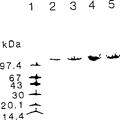
用从收集自中国青岛的红色海藻纯化裂合酶发展的步骤,由从加里弗尼亚Santa Cruz(美国)收集的红色海藻gracilariopsis lemanneiformis纯化了两个裂合酶(GLsc1-裂合酶和GLsc2-裂合酶)。这两种类型被纯化至电泳均一性(图1A和图1B)。从纯化的GLsc1-裂合酶得到部分氨基酸序列并被用于产生PCR引物。用SDS-PAGE方法(图1A),估计GLsc1-裂合酶和GLsc2-裂合酶两者的分子量为116 kDa。Using the procedure developed for the purification of lyases from red seaweed collected from Qingdao, China, two lyases (GLsc1-lyase and GLsc2- lyase). Both types were purified to electrophoretic homogeneity (Figure 1A and Figure 1B). A partial amino acid sequence was obtained from purified GLscl-lyase and used to generate PCR primers. Using the SDS-PAGE method (Fig. 1A), the molecular weight of both GLsc1-lyase and GLsc2-lyase was estimated to be 116 kDa.
在非变性PAGE(图1B)上,GLsc1-裂合酶和GLsc2-裂合酶比GL1-裂合酶迁移要慢。在等电聚焦凝胶上,GLsc1-裂合酶显示pI为4.1(图2)。On native PAGE (FIG. 1B), GLsc1-lyase and GLsc2-lyase migrated more slowly than GL1-lyase. On an isoelectric focusing gel, GLsc1-lyase showed a pi of 4.1 (Figure 2).
所研究的不同裂合酶的相对迁移速率和pI值的对照列于下列表中。Relative migration rates and comparisons of pi values for the different lyases studied are listed in the table below.
酶名称 来源 迁移 pIEnzyme Name Source Source Migration pI
GLl-裂合酶 QC ++++ 3.8GL1-lyase QC ++++ 3.8
Glsc1-聚合酶SCC +++ 4.1Glsc1-polymerase SCC +++ 4.1
Glsc2-聚合酶SCC +++ 4.1Glsc2-polymerase SCC +++ 4.1
Glv-聚合酶 SpV +++ 4.1Glv-polymerase SpV +++ 4.1
MV-聚合酶 MvA ++ 4.4MV-polymerase MvA ++ 4.4
MC-聚合酶 McA + 4.5MC-Polymerase McA + + 4.5
代码:code:
QC=青岛,中国QC = Qingdao, China
SCC=Santa Cruz,加里弗尼亚SCC = Santa Cruz, California
SpV=Sucre pennisula,VenezuelaSpV=Sucre pennisula, Venezuela
MvA=普通羊肚菌,ATCCMvA = common morel, ATCC
McA=Morchella costata,ATCCMcA = Morchella costata, ATCC
相对迁移速率从8-25%梯度凝胶上非变性PAGE估算;通过在pH3-9梯度凝胶上等电聚焦估算pI值。从表中可见GLq1-聚合酶在非变性PAGE上显出最快的迁移速率和最低的pI值3.8,而MC-裂合酶显示最慢的迁移速率和最高的pI值。4.5。Relative migration rates were estimated from native PAGE on 8-25% gradient gels; pi values were estimated by isoelectric focusing on pH 3-9 gradient gels. It can be seen from the table that GLq1-polymerase showed the fastest migration rate and the lowest pI value of 3.8 on non-denaturing PAGE, while MC-lyase showed the slowest migration rate and the highest pI value. 4.5.
现在更详细地讨论图。Graphs are now discussed in more detail.
图1.藻α-1,4-葡聚糖裂合酶的电泳Figure 1. Electrophoresis of algal α-1,4-glucan lyase
A.在8-25%梯度凝胶上SDS-PAGE。凝胶用快速凝胶蓝R染色。A. SDS-PAGE on 8-25% gradient gel. Gels were stained with Rapid Gel Blue R.
泳道1:磷酸酶b(97.4kDa),牛血清清蛋白(67kDa),卵白蛋白(43kDa),碳酸酐酶(30kDa),大豆胰蛋白酶抑制剂(20.1kDa),和β-乳清蛋白(14.4kDa)的分子标志。Lane 1: Phosphatase b (97.4kDa), bovine serum albumin (67kDa), ovalbumin (43kDa), carbonic anhydrase (30kDa), soybean trypsin inhibitor (20.1kDa), and β-lactalbumin (14.4 kDa) molecular marker.
泳道2:从收集自青岛(中国)的红色海藻gracilariopsis1emanneiformis纯化的GLq1-裂合酶。Lane 2: GLq1 -lyase purified from the
泳道3:从收集自加里弗尼亚Santa Cruz(美国)的红色海藻gracilariopsis lemanneiformis纯化的GLsc1-裂合酶。Lane 3: GLsc1-lyase purified from the red seaweed gracilariopsis lemanneiformis collected from Santa Cruz, California (USA).
泳道4:从收集自加里弗尼亚Santa Cruz(美国)的红色海藻gracilariopsis lemanneiformis纯化的GLsc2-裂合酶。Lane 4: GLsc2-lyase purified from the red seaweed gracilariopsis lemanneiformis collected from Santa Cruz, California (USA).
B.在8-25%梯度凝胶上非变性-PAGE。凝胶用快速凝胶蓝R染色。B. Native-PAGE on 8-25% gradient gel. Gels were stained with Rapid Gel Blue R.
泳道1和4:从收集自青岛(中国)的红色海藻gracilariopsislemanneiformis纯化的GLq1-裂合酶。
泳道2:从收集自加里弗尼亚Santa Cruz(美国)的红色海藻gracilariopsis lemanneiformis纯化的GLsc2-裂合酶。Lane 2: GLsc2-lyase purified from the red seaweed gracilariopsis lemanneiformis collected from Santa Cruz, California (USA).
泳道3:从收集自加里弗尼亚Santa Cruz(美国)的红色海藻gracilariopsis lemanneiformis纯化的GLsc1-裂合酶。Lane 3: GLsc1-lyase purified from the red seaweed gracilariopsis lemanneiformis collected from Santa Cruz, California (USA).
泳道5:蛋白标志:甲状腺球蛋白(669kDa),铁蛋白(440kDa),过氧化氢酶(232kDa),乳酸脱氢酶(140kDa)和白蛋白(67kDa)。Lane 5: Protein markers: thyroglobulin (669 kDa), ferritin (440 kDa), catalase (232 kDa), lactate dehydrogenase (140 kDa) and albumin (67 kDa).
图2. α-1,4-葡聚糖裂合酶在pH3-pH9梯度凝胶上的等电聚焦。凝胶用快速凝胶蓝R染色。Figure 2. Isoelectric focusing of α-1,4-glucan lyase on a pH3-pH9 gradient gel. Gels were stained with Rapid Gel Blue R.
泳道1:从由加里弗尼亚Santa Cruz收集的gracilariopsislemanneiformis纯化的GLsc1-裂合酶,显示pI为4.1。Lane 1: GLsc1-lyase purified from gracilariopsis lemanneiformis collected from Santa Cruz, California, showing a pi of 4.1.
泳道2:从由青岛(中国)收集的gracilariopsis lemanneiformis纯化的GLq1-裂合酶,显示pI为3.8。Lane 2: GLq1-lyase purified from gracilariopsis lemanneiformis collected from Qingdao (China), showing a pi of 3.8.
泳道3:pI标志:1支链葡萄糖甙酶(3.50),2大豆胰蛋白酶抑制剂(4.55),3β-乳球蛋白A(5.20),4牛碳酸酐酶B(5.85),5人碳酸酐酶B(6.55),6马肌红蛋白(酸性,6.85),7马肌红蛋白(碱性,7.35),8兵豆磷酰胆碱(酸性,8.15),9兵豆磷酰胆碱(中性,8.45),10兵豆磷酰胆碱(碱性,8.65)。Lane 3: pI markers: 1 branched-chain glucosidase (3.50), 2 soybean trypsin inhibitor (4.55), 3β-lactoglobulin A (5.20), 4 bovine carbonic anhydrase B (5.85), 5 human carbonic anhydride Enzyme B (6.55), 6 horse myoglobin (acidic, 6.85), 7 horse myoglobin (basic, 7.35), 8 lentil phosphorylcholine (acidic, 8.15), 9 lentil phosphorylcholine ( Neutral, 8.45), 10 lentil phosphorylcholine (alkaline, 8.65).
进一步研究显示,Km对支链淀粉为3.76mg/ml和对糖原为3.37mg/ml。Further studies showed that the Km was 3.76 mg/ml for amylopectin and 3.37 mg/ml for glycogen.
降解研究Degradation study
裂合酶对各种底物的降解速率如下给出。The degradation rates of various substrates by lyases are given below.
底物 释放的AF(nmol)Substrate Released AF (nmol)
麦芽糖 657Maltose 657
麦芽三糖 654Maltotriose 654
麦芽四糖 670Maltotetraose 670
麦芽五糖 674Maltopentasaccharide 674
麦芽六糖 826Maltohexaose 826
麦芽七糖 865Maltoheptapose 865
糊精20 775Dextrin 20 775
糊精15 775Dextrin 15 775
糊精10 844
支链淀粉 732Amylopectin 732
糖原 592Glycogen 592
反应条件:反应混合物含有10mM的HOAc-NaOAc(pH3.8)。底物浓度为10mg/ml。加入裂合酶和水后终体积为100μl。反应时间在45℃是40分钟。Reaction conditions: The reaction mixture contained 10 mM HOAc-NaOAc (pH 3.8). The substrate concentration was 10 mg/ml. The final volume was 100 μl after addition of lyase and water. The reaction time was 40 minutes at 45°C.
裂合酶不能降解支链淀粉,黑曲霉四糖,海藻糖酶,异麦芽糖,葡萄糖,α-,β-,γ-环糊精。尽管速率低,但裂合酶降解6-α-葡糖基麦芽糖和黑曲霉糖。Lyase cannot degrade pullulan, niger tetraose, trehalase, isomaltose, glucose, α-, β-, γ-cyclodextrin. The lyases degrade 6-α-glucosylmaltose and A. niger sugar, albeit at low rates.
支链淀粉用做底物时裂合酶最适宜温度是48℃和糖原用做底物时是50℃。在50℃,糖原的反应性类似支链淀粉;低于50℃,支链淀粉比糖原是更好的底物。The optimum temperature for lyase was 48°C when amylopectin was used as substrate and 50°C when glycogen was used as substrate. At 50°C, the reactivity of glycogen is similar to that of amylopectin; below 50°C, amylopectin is a better substrate than glycogen.
裂合酶pH最适宜范围是pH3.5到pH7.0;最适宜的pH是3.8。用于pH测试的缓冲液是甘氨酸-HCl(pH2.2-3.6);NaOAc-HOAc(pH3.5-5.5);Mes-NaOH(pH5.5-6.7);Mosp-NaOH(pH6.0-8.0)和N-二羟乙基甘氨酸-NaOH(pH7.6-9.0)。所有使用的缓冲液是40mM。The optimum pH range for lyase is pH 3.5 to pH 7.0; the optimum pH is 3.8. The buffers used for pH testing are Glycine-HCl (pH2.2-3.6); NaOAc-HOAc (pH3.5-5.5); Mes-NaOH (pH5.5-6.7); Mosp-NaOH (pH6.0-8.0 ) and N-bishydroxyethylglycine-NaOH (pH7.6-9.0). All buffers used were 40 mM.
在2mM的终浓度,对-氯汞苯甲酸(PCMB)抑制裂合酶活性96%,暗示-SH基对酶活性是必需的。At a final concentration of 2 mM, p-chloromercuric benzoic acid (PCMB) inhibited lyase activity by 96%, suggesting that the -SH group is essential for the enzyme activity.
用Westerm印迹进行的裂合酶的免疫测试中,结果显示藻类裂合酶抗体在无细胞提取物和在纯化形式都能识别真菌的裂合酶(我们的早期PCT专利申请PCT/EP94/03397),如Weatern印迹所解释的。对从由中国收集的藻类纯化的藻类裂合酶(我们的早期PCT专利申请PCT/EP94/03397)的抗体也识别来自由加里弗尼亚Santa Cruz收集的藻类的裂合酶。In an immunoassay for lyase by Western blot, it was shown that algal lyase antibodies recognized fungal lyase both in cell-free extracts and in purified form (our earlier PCT patent application PCT/EP94/03397) , as explained by Weatern blot. Antibodies to algal lyase purified from algae collected from China (our earlier PCT patent application PCT/EP94/03397) also recognized lyase from algae collected from Santa Cruz, California.
现将描述收集本发明酶的进一步情况和实验。Further circumstances and experiments for collecting the enzymes of the invention will now be described.
可溶的酶系统soluble enzyme system
1.pH在从gracilariopsis lemanneiformis分离的裂合酶的稳定性和活性上的作用。1. The effect of pH on the stability and activity of lyases isolated from gracilariopsis lemanneiformis.
在37℃测定两个缓冲系统,即在5mM浓度的HOAc和NaOAc及柠檬酸钠-柠檬酸。测试的pH范围从pH3到pH5.2。在3.6到4.2的pH范围裂合酶显示最大的活性。在pH3,酶的稳定性和活性降低约90%。在pH5.2,活性降低约64%。然而,在酶这个pH比在pH3更稳定的多,由于在pH5.2获得的AF产率是在pH3.8获得的AF产率的75%。在HOAc和NaOAc缓冲液比在柠檬酸缓冲液获得稍微更高的AF产率。这不是由于在AF测试方法中两种缓冲液(在AF测试混合物中终浓度是125μM)的任何不同作用。Two buffer systems, HOAc and NaOAc and sodium citrate-citric acid at a concentration of 5 mM, were assayed at 37°C. The pH range tested was from pH3 to pH5.2. The lyase showed maximum activity in the pH range of 3.6 to 4.2. At
2.温度在裂合酶活性和稳定性上的作用。2. Effect of temperature on lyase activity and stability.
此实验在最适宜pH范围进行。在25℃ AF的产量至少9天线性上升。这暗示在9天内无裂合酶活性及稳定性的丧失。随增加温度,酶的稳定性下降。This experiment was carried out in the optimum pH range. At 25°C, the yield of AF increased linearly for at least 9 days. This suggested no lyase activity and loss of stability within 9 days. The stability of the enzyme decreases with increasing temperature.
在下列温度酶活性的半衰期是:The half-life of enzyme activity at the following temperatures is:
30℃ 5天
37℃ 2.5天 2.5 days
40℃ 少于1天 less than 1 day
50℃ 少于1天 less than 1 day
3.底物浓度在裂合酶和AF产量上的作用。3. Effect of substrate concentration on lyase and AF production.
观察到支链淀粉和糊精对裂合酶具有稳定化作用,而最小的底物麦芽糖没有。这对溶解酶系统和固定酶系统都得到验证。Amylopectin and dextrin were observed to have a stabilizing effect on lyase, whereas the minimal substrate maltose did not. This was verified for both lytic and immobilized enzyme systems.
AF产率随支链淀粉浓度增加而增加至25%。在糊精的情形,当浓度超过30%(测试了30%,40%和50%)时AF产率下降。AF yield increased up to 25% with increasing amylopectin concentration. In the case of dextrin, the AF yield decreased when the concentration exceeded 30% (30%, 40% and 50% were tested).
4.裂合酶的活化和失活4. Activation and inactivation of lyase
未发现金属离子对活性是必需的并且酶催化的反应在纯水中能惊人地进行。在反应混合物中加入EDTA至20mM对活性有很少作用的事实证明,金属离子对根据本发明的裂合酶的活性不是必需的。No metal ions were found to be necessary for the activity and the enzyme-catalyzed reaction surprisingly proceeded in pure water. The fact that the addition of EDTA to 20 mM in the reaction mixture has little effect on the activity proves that metal ions are not essential for the activity of the lyases according to the invention.
这意味着,如果水被用做反应介质,在AF纯化步骤中,从反应体系中除去盐的离子交换层析步骤可以省去。然而,在反应混合物中含有浓度0.85%(0.145M)的NaCl能提高AF产量最多1倍。This means that, if water is used as the reaction medium, the ion-exchange chromatography step for removing salts from the reaction system can be omitted in the AF purification step. However, the inclusion of NaCl at a concentration of 0.85% (0.145M) in the reaction mixture increased AF production by up to 1-fold.
5.底物专一性5. Substrate specificity
当淀粉浓度变高时,冷却后可溶淀粉趋向形成刚性凝胶。所以使用部分降解的淀粉做为1,4-葡聚糖裂合酶的底物是有利的。When the starch concentration becomes high, the soluble starch tends to form a rigid gel after cooling. It is therefore advantageous to use partially degraded starch as a substrate for 1,4-glucan lyase.
测试了α-1,4-葡聚糖裂合酶对不同寡糖的专一性。寡糖是麦芽糖(G2),麦芽三糖(G3),麦芽四糖(G4),麦芽五糖(G5),麦芽六糖(G6)和麦芽七糖(G7)。寡糖以8mg/ml的浓度溶于水中。酶试验含有150μl底物G2/G3/G4/G5/G6/G7,120μl 0.1M MES pH6.3和30μl闯红灯酶。反应混合物在30℃温育60分钟。以后反应煮沸3分钟停止并加入9000μl无水乙醇以形成沉淀。在4℃ 20,000×g离心5分钟后,上清液转移到一新的Eppendorf管并冷冻干燥。The specificity of the alpha-1,4-glucan lyase to different oligosaccharides was tested. The oligosaccharides are maltose (G2), maltotriose (G3), maltotetraose (G4), maltopentaose (G5), maltohexaose (G6) and maltoheptaose (G7). Oligosaccharides were dissolved in water at a concentration of 8 mg/ml. The enzyme assay contained 150 μl substrate G2/G3/G4/G5/G6/G7, 120 μl 0.1M MES pH 6.3 and 30 μl red light enzyme. The reaction mixture was incubated at 30°C for 60 minutes. Afterwards the reaction was stopped by boiling for 3 minutes and 9000 μl absolute ethanol was added to form a precipitate. After centrifugation at 20,000×g for 5 minutes at 4°C, the supernatant was transferred to a new Eppendorf tube and freeze-dried.
冻干的样品溶于1000μl H2O中,20μl样品载到Dionex HPLC上之前,先通过0.22μm Millipore滤器过滤。Lyophilized samples were dissolved in 1000 μl H 2 O and 20 μl samples were filtered through 0.22 μm Millipore filters before loading onto the Dionex HPLC.
6.HPLC6.HPLC
在含有GMP-2泵和以脉冲电流计的检测模式使用的PED检测器的Dionex 4500i层析系统上进行分析。离子交换柱是来自Dionex的CarboPac PA-100(4×250mm)和一个CarboPac PA-100保护柱(3×25mm)。洗脱剂为200mM的氢氧化钠(A),500mM的醋酸钠(B)和18欧姆去离子水(C)。泵以两种不同方式,方法1和方法2编程:The analysis was performed on a Dionex 4500i chromatography system with a GMP-2 pump and a PED detector used in pulsed amperometric detection mode. The ion exchange column was CarboPac PA-100 (4 x 250mm) from Dionex and a CarboPac PA-100 guard column (3 x 25mm). The eluent was 200 mM sodium hydroxide (A), 500 mM sodium acetate (B) and 18 ohm deionized water (C). The pump is programmed in two different ways,
方法1:
方法2:
标准:standard:
葡萄糖,麦芽糖,麦芽三糖,麦芽四糖,麦芽五糖,麦芽六糖和麦芽七糖(都来自Sigma)和1,5-脱水果糖用做标准。所有的化合物溶于18欧姆的去离子水,用前通过0.22μm Millipore滤器过滤。Glucose, maltose, maltotriose, maltotetraose, maltopentaose, maltohexaose and maltoheptaose (all from Sigma) and 1,5-anhydrofructose were used as standards. All compounds were dissolved in 18 ohm deionized water and filtered through a 0.22 μm Millipore filter before use.
7.结果7. Results
分析显示纯化的酶能够使用麦芽寡糖做为底物1以形成1,5-脱水果糖。麦芽糖用做底物时,几乎没有1,5-脱水果糖形成,但当使用其它麦芽寡糖(G3-G7)时,产生了大量此化合物。当更长的麦芽寡糖用做底物时,获得大量的1,5-脱水果糖是清楚的。这一观察与裂合酶从底物的非还原端形成1,5-脱水果糖,仅留下未改变的端基葡萄糖分子的理论完好地一致。Analysis showed that the purified enzyme was able to use maltooligosaccharides as
8.AF的形成8. Formation of AF
根据本发明的α-1,4-葡聚糖裂合酶水解淀粉到终产物1,5-脱水果糖。此终产物由HPLC,方法2显示。酶试验含有500μl支链淀粉(20mg/ml,溶于H2O),400μl 0.1M MES pH6.3和100μl纯化的酶。反应混合物在30℃温育,30和120分钟温育后用煮沸停止反应。通过加入3体积的无水乙醇沉淀高分子寡糖,样品如上所述离心和冷冻干燥。样品溶解在125μl H2O,25μl用在HPLC柱上。The alpha-1,4-glucan lyase according to the invention hydrolyzes starch to the
HPLC洗脱图谱清楚地显示α-1,4-葡聚糖裂合酶通过淀粉水解生成1,5-脱水果糖。30和120分钟温育后发现等量的1,5-脱水果糖,这表明酶活性不被终产物1,5-水果糖抑制。The HPLC elution profile clearly shows that α-1,4-glucan lyase generates 1,5-anhydrofructose by hydrolysis of starch. Equal amounts of 1,5-anhydrofructose were found after 30 and 120 minutes of incubation, indicating that the enzyme activity was not inhibited by the
用此方式制备的AF的13C NMR谱显示其采用一种主要的形式产生下列信号:δ93.5(quart,C-2),81.5(CH,C-5),77.7(CH,C-3),72.6(CH2,C-1),69.8(CH,C-4),62.0(CH2,C-6)。基于H-H C-H和C-H二维相关谱归属。The 13 C NMR spectrum of AF prepared in this way shows that it adopts one dominant form giving the following signals: δ 93.5 (quart, C-2), 81.5 (CH, C-5), 77.7 (CH, C-3 ), 72.6 (CH 2 , C-1), 69.8 (CH, C-4), 62.0 (CH 2 , C-6). Assignment based on HH CH and CH two-dimensional correlation spectra.
9.裂合酶与支链淀粉酶和异淀粉酶的协同作用。9. Synergy of lyase with pullulanase and isoamylase.
如从下表可见,在反应混合物中含有支链淀粉酶将明显地增加AF产量约15-23%,依赖于是可溶淀粉还是支链淀粉用做底物。As can be seen from the table below, the inclusion of pullulanase in the reaction mixture significantly increased AF production by about 15-23%, depending on whether soluble starch or pullulan was used as substrate.
支链淀粉酶和裂合酶在AF生产中的协同作用底物 裂合酶 支链淀粉酶 AF产率(%) 葡萄糖产率(%)Solubl.可溶淀粉 + - 51 0Synergistic Substrate of Pullulanase and Lyase in AF Production Lyase Pullulanase AF Yield (%) Glucose Yield (%) Solubl.
- + 0 0.37- - + + 0 0.37
+ + 66.0 3.9支链淀粉 + - 48.0 0+ + + + 66.0 3.9 Amylopectin + - - 48.0 0
- + 0 0.33- - + + 0 0 0.33
+ + 71.3 3.7+ + + + 71.3 3.7
+,加入酶,-省略酶+, add enzyme, - omit enzyme
反应混合物含有0.3ml 2%的马铃薯支链淀粉(Sigma)水溶液或0.3ml 2%可溶淀粉(Merck),2μl裂合酶和如指示的0.36单位支链淀粉酶(BM)。The reaction mixture contained 0.3 ml of 2% potato pullulan (Sigma) in water or 0.3 ml of 2% soluble starch (Merck), 2 μl of lyase and 0.36 units of pullulanase (BM) as indicated.
反应在30℃进行一天。在反应末尾,取出样品进行AF和GLc分析。The reaction was carried out at 30°C for one day. At the end of the reaction, samples were taken for AF and GLc analysis.
在异淀粉酶的情况,优点是裂合酶的最适pH与假单孢菌异淀粉酶的最适pH(pH3.0-4.5)一致。然而问题是异淀粉酶会产生过量的长链的直链淀粉,它从溶液中沉淀出来,所以不再适合做为裂合酶的底物。如果直链淀粉的链不是太长,可以预测裂合酶与异淀粉酶的协同作用会是有效的。In the case of isoamylases, the advantage is that the pH optimum of the lyase coincides with that of the Pseudomonas isoamylase (pH 3.0-4.5). The problem, however, is that isoamylases produce excess long-chain amylose, which precipitates out of solution and is therefore no longer suitable as a substrate for lyase. If the amylose chains are not too long, it is predicted that the synergistic action of the lyase and isoamylase will be effective.
固定化酶系统immobilized enzyme system
通过使用琥珀酰亚胺活化的琼脂糖凝胶(亲合胶15凝胶,Bio-Rad)和戊二醛活化的硅胶(BM)得到裂合酶的固定化。在亲合胶15凝胶上固定化后裂合酶活性的回收是40%到50%之间。固定化后可能有一些裂合酶仍有活性,但由于立体障碍,尤其是淀粉这样的大分子,是难以接近底物的。用于工业的固定化的酶通常具有大约50%的活性回收。Immobilization of lyase was obtained by using succinimide-activated agarose gel (Affinity gel 15 gel, Bio-Rad) and glutaraldehyde-activated silica gel (BM). The recovery of lyase activity after immobilization on the affinity gel 15 gel was between 40% and 50%. Some lyases may still be active after immobilization, but due to steric barriers, especially macromolecules such as starch, it is difficult to access the substrate. Immobilized enzymes used in industry usually have about 50% activity recovery.
亲合胶15凝胶固定化裂合酶的最有意义的事是它在pH5.5的稳定性大大提高。当柱子在此pH操作时,稳定性至少16天长。考虑到支链淀粉酶的最适pH约为pH5.5,在稳定性上pH位移是很重要的。这对裂合酶和支链淀粉酶在同样反应器中与同样的物理-化学环境有效地配合是先决条件。可溶裂合酶具有3.6到4.2之间的最适pH,并且在此pH范围支链淀粉酶显示很少或没有活性。The most interesting thing about the gel-immobilized lyase in Affinity Gel 15 is that its stability at pH 5.5 is greatly improved. Stability is at least 16 days long when the column is operated at this pH. Considering that the pH optimum of pullulanase is about pH 5.5, the pH shift is important in terms of stability. This is a prerequisite for the efficient cooperation of lyase and pullulanase in the same reactor with the same physico-chemical environment. Soluble lyase has a pH optimum between 3.6 and 4.2, and pullulanase shows little or no activity in this pH range.
用硅胶固定化酶,活性恢复非常高,在80-100%之间。然而,当柱子既不在pH3.8也不在pH5.5操作时,硅胶固定化酶不稳定。有可能是一些裂合酶吸附在硅胶珠的表面并且每次洗柱后从硅胶上慢慢地释放出来。所以这可能是吸附的裂合酶对高恢复率和柱子活性降低的贡献。Using silica gel to immobilize the enzyme, the activity recovery is very high, between 80-100%. However, the silica gel-immobilized enzyme was not stable when the column was operated at neither pH 3.8 nor pH 5.5. It is possible that some lyase was adsorbed on the surface of the silica beads and was slowly released from the silica after each column wash. So this may be the contribution of the adsorbed lyase to the high recovery rate and the reduced activity of the column.
Af的纯化Purification of Af
1.裂合酶-支链淀粉/可溶淀粉体系1. Lyase-Amylopectin/Soluble Starch System
在这个体系中,反应体系含有AF,限量糊精,裂合酶,以及反应末尾的缓冲盐。用乙醇(终浓度50%)沉淀从大分子(限定糊精和裂合酶)中分离出AF。不沉淀的低分子量支链淀粉用Amicon YM3膜(切除掉3,000)超离心分离。乙醇在旋转蒸发器上于40℃除去。用混合离子交换剂从AF除去缓冲盐。由冷冻干燥获得纯化的固体AF。In this system, the reaction system contains AF, limited dextrin, lyase, and buffer salt at the end of the reaction. AF was separated from macromolecules (defining dextrins and lyases) by ethanol (50% final concentration) precipitation. Low molecular weight amylopectin that did not precipitate was separated by ultracentrifugation using an Amicon YM3 membrane (3,000 cut off). Ethanol was removed on a rotary evaporator at 40°C. Buffer salts were removed from AF with mixed ion exchangers. Purified solid AF was obtained by lyophilization.
2.裂合酶-支链淀粉酶/支链淀粉/可溶淀粉体系2. Lyase-pullulanase/pullulan/soluble starch system
在此体系,终产物是AF和葡萄糖。如果要分离一种基本上纯的AF样品,副产物葡萄糖必需除去。这可以用酶的方法达到。首先葡萄糖被葡萄糖氧化酶转变成葡糖酸和过氧化氢。In this system, the end products are AF and glucose. If a substantially pure AF sample is to be isolated, the by-product glucose must be removed. This can be achieved enzymatically. First glucose is converted to gluconic acid and hydrogen peroxide by glucose oxidase.
需要过氧化氢酶来消除形成的H2O2。H2O2会把AF氧化成两种目前未知结构的新化合物。在AF制备中另一杂质是AF的氧化产物。观察到AF能慢慢地被空气量的氧氧化,特别是在高温度,高AF浓度和长时间暴露时。用离子交换层析,葡糖酸与缓冲盐一起被除去。Catalase is required to eliminate the H2O2 formed. H 2 O 2 oxidizes AF to two new compounds with currently unknown structures. Another impurity in the preparation of AF is the oxidation product of AF. It was observed that AF can be slowly oxidized by oxygen in air, especially at high temperature, high AF concentration and prolonged exposure. Using ion exchange chromatography, gluconic acid is removed along with buffer salts.
在此体系中,代替使用超速离心,低分子量的支链淀粉分子或者可以被淀粉葡糖苷酶水解。In this system, instead of using ultracentrifugation, low molecular weight amylopectin molecules can either be hydrolyzed by amyloglucosidase.
3.AF的纯度检查3. AF purity check
AF制备的纯度用TLC,Dionex和NMR确定。The purity of the AF preparation was confirmed by TLC, Dionex and NMR.
4.脱水果糖抗氧化活性的分析4. Analysis of antioxidant activity of defructose
电化学的氧消耗量:Electrochemical oxygen consumption:
如Jorgensen和Skibsted(Z.Lebensm.Unters.Forsch.(1993)196:423-429)所述,在甲基亚油酸乳液中研究AF的活性,并做稍微修改:向5.00ml溶在5.0mM pH=5.8的磷酸盐缓冲液和0.2w/w%吐温20为乳化液的1.33mM的甲基亚油酸乳液中,按下列浓度加入AF:0,15,146和680μM。加入50μl 0.26M的偏肌红蛋白(MMb),其终浓度0.26mM,开始体系中的氧化作用。开始反应后样品立即注射入一个恒温(25.0±0.1℃)的70μl密闭室中,有效地排除氧扩散进体系中。氧的消耗用Clark电极测量,它与个人计算机数据收集程序连接。每30秒自动记下相对氧浓度(%)。The activity of AF was studied in methyl linoleic acid emulsion as described by Jorgensen and Skibsted (Z. Lebensm. Unters. Forsch. (1993) 196: 423-429), with a slight modification: 5.0 mM To the 1.33 mM methyl linoleic acid emulsion of pH=5.8 phosphate buffer and 0.2 w/w% Tween 20 as the emulsion, AF was added at the following concentrations: 0, 15, 146 and 680 μM. Add 50 μl of 0.26M metamyoglobin (MMb) at a final concentration of 0.26mM to start the oxidation in the system. Immediately after starting the reaction, the sample was injected into a 70 μl airtight chamber at a constant temperature (25.0±0.1° C.) to effectively exclude oxygen from diffusing into the system. Oxygen consumption was measured with a Clark electrode connected to a personal computer data collection program. The relative oxygen concentration (%) is automatically recorded every 30 seconds.
实验结果产生的曲线对应于氧的消耗。例如不加入AF氧浓度上的相对降低在注射入样品后立即可见。对于含有AF的样品,在曲线突然改向和氧浓度减少前观察到延滞期。与未加入AF的样品比较观察到延滞期后氧消耗速度仅小量下降。观察到具有最高量的AF具有最长的延滞期的趋势。而且,氧消耗的速度对这些样品较低,与参比(0μM)相比曲线斜率较小。The curves generated from the experimental results correspond to the consumption of oxygen. For example a relative decrease in oxygen concentration without the addition of AF is visible immediately after injection into the sample. For samples containing AF, a lag period was observed before the curve reversed abruptly and the oxygen concentration decreased. Only a small decrease in the oxygen consumption rate after the lag period was observed compared to the sample without AF added. A trend was observed for AF with the highest amount to have the longest lag period. Also, the rate of oxygen consumption is lower for these samples and the slope of the curve is smaller compared to the reference (0 μΜ).
ESR分析:ESR analysis:
用H2O2(0.17mM)和FeSO4(4.8μM)通过Fenton反应产生羟基自由基。产生的自由基被5,5-二甲基-1-吡咯啉N-氧化物(DMPO,9.7mM)捕获。AF以1.3mM和6.3mM的浓度加入。分析迷迭香(Rosemarinus officinalis L.)在0.25mg/ml浓度(以克计等于1.26mM的AF)的水溶提取物。120秒后在室温(20±1℃)进行测定并对同样的反应混合物300秒后用下列分光计装置重复测定:中央场3475.60G;扫描宽度55G;微波能量20mW;调制频率100kHz;调制振幅1.01G;接受增益1.00·105;转化时间81.92毫秒;时间常数163.84毫秒以及扫描时间83.89秒。Hydroxyl radicals were generated by the Fenton reaction with H 2 O 2 (0.17 mM) and FeSO 4 (4.8 μM). The generated radicals were trapped by 5,5-dimethyl-1-pyrroline N-oxide (DMPO, 9.7 mM). AF was added at concentrations of 1.3 mM and 6.3 mM. Aqueous extracts of rosemary (Rosemarinus officinalis L.) were analyzed at a concentration of 0.25 mg/ml (equal to 1.26 mM AF in grams). Measure at room temperature (20±1°C) after 120 seconds and repeat the measurement with the following spectrometer device after 300 seconds for the same reaction mixture: central field 3475.60G; sweep width 55G; microwave energy 20mW; modulation frequency 100kHz; modulation amplitude 1.01 G; acceptance gain 1.00·10 5 ; transition time 81.92 milliseconds; time constant 163.84 milliseconds and scan time 83.89 seconds.
结果显示产生的羟基自由基被DMPO捕获。自旋加合产生特性曲线的1∶2∶2∶1ESR谱。谱的峰高度与产生的自旋加合的定量数成正比。DMPO和AF两者的加入会在自旋捕获和AF之间建立竞争。峰高度的降低意味着AF好的清除活性。The results showed that the generated hydroxyl radicals were captured by DMPO. The spin addition produces a 1:2:2:1 ESR spectrum of the characteristic curve. The peak height of the spectrum is directly proportional to the quantitative number of spin additions produced. The addition of both DMPO and AF creates a competition between spin trapping and AF. A decrease in peak height implies a good scavenging activity of AF.
表:ESR谱的峰高度。H2O2=0.17mM,Fe2+=4.8μM。
在1.3mM的浓度可见AF无捕获羟基自由基的活性,在6.3mM AF峰高降低,意味着部分产生的羟基自由基被AF捕获。At the concentration of 1.3mM, it can be seen that AF has no activity of capturing hydroxyl radicals, and the peak height of AF decreases at 6.3mM, which means that some of the generated hydroxyl radicals are captured by AF.
AF用做抗氧化剂AF is used as an antioxidant
1.在50%蛋黄酱中AF用做抗氧化剂。1. AF is used as antioxidant in 50% mayonnaise.
在供应伙食和零售生意中,50%蛋黄酱用于沙拉,疏松的三明治等。50%蛋黄酱的低油含量使其适合做低热量应用。In catering and retail businesses, 50% mayonnaise is used in salads, loose sandwiches, etc. The low oil content of 50% mayonnaise makes it suitable for low-calorie applications.
典型的蛋黄酱组成如下:A typical mayonnaise consists of the following:
大豆油 50.0%Soybean Oil 50.0%
龙蒿醋 4.0%Tarragon vinegar 4.0%
蛋黄 3.5%Egg yolk 3.5%
糖 3.0%Sugar 3.0%
盐 1.0%Salt 1.0%
山梨酸钾 0.1%Potassium sorbate 0.1%
水 35.2%Water 35.2%
MAYODAN 602 3.0%MAYODAN 602 3.0%
柠檬香味剂10251 0.2% Lemon Fragrance 10251 0.2%
MAYODAN 602确保优良而稳定的油分散和所需的粘性,因此提供具有长保存期的50%蛋黄酱。MAYODAN 602 ensures excellent and stable oil dispersion and the required viscosity, thus providing 50% mayonnaise with a long shelf life.
香味剂10251是天然的柠檬香味剂,它提供具有柠檬新鲜味道的蛋黄酱。Fragrance 10251 is a natural lemon flavor that provides mayonnaise with a lemony fresh taste.
蛋黄酱典型地用下列方法制备:Mayonnaise is typically prepared in the following ways:
1)干燥混合MAYODAN 602,糖和盐。以1份粉末比两份油的比例在油中分散。1) Dry mix MAYODAN 602, sugar and salt. Disperse in oil at a ratio of 1 part powder to 2 parts oil.
2)向水中加入香味剂和山梨酸钾并倒入Koruma混合器。加入1)。2) Add fragrance and potassium sorbate to water and pour into Koruma mixer. Join 1).
3)加入蛋黄。3) Add egg yolk.
4)真空下连续加入油。5)已加入(缓慢)2/3油后,将龙蒿醋与剩余的1/3油混合并加入。4) Add oil continuously under vacuum. 5) After 2/3 of the oil has been added (slowly), mix the tarragon vinegar with the remaining 1/3 of the oil and add.
下列数据显示当AF做为一种抗氧化剂加到蛋黄酱中时,结果与已知的食品抗氧化剂GRINDOX 142和GRINDOX 1029是可比的。GRINDOX 142:The following data show that when AF is added as an antioxidant to mayonnaise, the results are comparable to the known food antioxidants GRINDOX 142 and GRINDOX 1029. GRINDOX 142:
Ascorbyl palmitate 10%
propyl gallate 20%
柠檬酸 10%
食用乳化剂 60%
于25℃形成糊状Form a paste at 25°C
颜色 灰或浅棕 ,
密度 1.1g/ml(所有百分比是重量百分比)GRINDOX 1029:Density 1.1g/ml (all percentages are by weight) GRINDOX 1029:
Ascorbyl palmitate 20%Ascorbyl palmitate 20%
天然生育酚 20%
食用乳化剂 60%
于25℃形成糊状Form a paste at 25°C
颜色 light brownColor light brown
25℃时密度 1.0g/ml(所有百分比是重量百分比)Density at 25°C 1.0g/ml (all percentages are by weight)
在实验过程中,抗氧化剂加入到蛋黄酱中以使抗氧化剂的浓度在约500ppm的级别。然后蛋黄酱放入温度80℃含有纯氧的弹式量热计中。然后测量至产物的基本氧化作用发生的诱发间隔。结果如下:样品: IP(小时)1. 空白 28.02. +500ppm GRINDOX 142 35.03. +500ppm GRINDOX 1029 33.34. +550ppm GRINDOX 1029 34.35. +500ppm 1,5-脱水-D-果糖 32.0(IP小时=诱发间隔)这些结果显示AF是一个优良的食品抗氧化剂并与已知的食品抗氧化剂GRINDOX 142和GRINDOX 1029是可比的。During the experiment, antioxidants were added to mayonnaise so that the concentration of antioxidants was on the order of about 500 ppm. The mayonnaise is then placed in a bomb calorimeter at 80°C containing pure oxygen. The induction interval until substantial oxidation of the product occurs is then measured. The results are as follows: sample: IP (hour) 1. blank 28.02.+500PPM GRINDOX 142 35.03.+500PPM GRINDOX 1029 33.34.+550ppm GRINDOX 1029 34.35.+
2.在拌沙拉的调味剂中用AF做抗氧化剂有50%油的酸乳酪拌沙拉调味剂有50%油的酸乳酪拌沙拉调味剂用于沙拉、马铃薯、原蔬菜沙拉、肉、鱼和熟蔬菜。2. Use AF as an antioxidant in salad dressing Yogurt salad dressing with 50% oil Yogurt salad dressing with 50% oil is used for salads, potatoes, raw vegetable salads, meat, fish and cooked vegetables.
组成composition
豆油 50.0%Soybean Oil 50.0%
酚乳酪(淡) 39.0%Phenolic Cheese (Light) 39.0%
醋(10%) 3.5%Vinegar (10%) 3.5%
糖 3.0%Sugar 3.0%
蛋黄 2.0%Egg Yolk 2.0%
盐 1.0%Salt 1.0%
山梨酸钾 0.1%Potassium Sorbate 0.1%
MAYODAN 525 1.4%MAYODAN 525 1.4%
掩盖酸的香味剂2072 0.02%MAYODAN 525提供独特的乳胶稳定性,阻止胶体脱水收缩作用,确保均匀的油分散和粘性,提高对生产过程的耐受性和确保长保存期。香味剂2072是一种完全天然,酸掩饰香味剂以减少调味品的酸味而不影响其pH值。方法1. 干燥混合MAYODAN 525,糖和盐。以1份粉末比两份油的比例 在油中分散。2. 向Koruma混合器中加入香味剂和山梨酸钾和酸乳酪。加入Acid-masking fragrance agent 2072 0.02% MAYODAN 525 provides unique latex stability, prevents colloidal syneresis, ensures uniform oil dispersion and viscosity, improves tolerance to the production process and ensures long shelf life. Flavor 2072 is a completely natural, acid-masking flavor to reduce the sourness of a seasoning without affecting its pH.
1)。3. 加入蛋黄。4. 真空下连续加入油。5. 已加入(缓慢)2/3油后,将醋与剩余的1/3油混合并加入。6. 如需要,加入调味品。 1). 3. Add egg yolk. 4. Continuously add oil under vacuum. 5. After 2/3 of the oil has been added (slowly), mix the vinegar with the remaining 1/3 of the oil and add. 6. Add seasoning if desired.
测试结果: Test result :
样品: IP小时 PE Sample: IP Hour PE
1.空白 37.2 1.001. Blank 37.2 1.00
2.500ppm脱水果糖 39.5 1.062.500ppm defructose 39.5 1.06
3.800ppmGRINDOX 1032 43.3 1.073.800ppmGRINDOX 1032 43.3 1.07
(IP-诱发间隔);(PF-保护间隔)(IP-Induction Interval); (PF-Guard Interval)
保护因子(PF):Protection Factor (PF):
对每一温度定义为For each temperature defined as
PF=加入抗氧化剂油的IP/未加入抗氧化剂相同油的IPPF = IP of oil with antioxidant/IP of same oil without antioxidant
时间延长程度(LE)%:Time extension (LE)%:
LE=(PF-1.0)×100LE=(PF-1.0)×100
进一步的研究further research
1.醇在增加由海藻纯化的裂合酶活性和稳定性上的影响按下列浓度(0%,1%,5%和10%)测试了1-丙醇,2-丙醇和1-丁醇。1-丙醇的最适浓度是5%,温育6天后它增加AF产率34%;2-丙醇的最适浓度是1%,温育10天后它增加AF产率20%;1-丁醇的最适浓度是5%,温育3天后它增加AF产率52%。1. The effect of alcohol on increasing the activity and stability of lyase purified from seaweed 1-propanol, 2-propanol and 1-butanol were tested at the following concentrations (0%, 1%, 5% and 10%) . The optimal concentration of 1-propanol is 5%, and it increases the AF yield by 34% after 6 days of incubation; the optimal concentration of 2-propanol is 1%, and it increases the AF yield by 20% after 10 days of incubation; 1- The optimal concentration of butanol was 5%, which increased AF yield by 52% after 3 days of incubation.
按下列浓度(0,1,3,5,7,9,11,13,15%)测试了乙醇。7天温育的最适浓度是5%,它增加AF产率12%。10天温育的最适浓度是3%,它增加AF产率16%。Ethanol was tested at the following concentrations (0, 1, 3, 5, 7, 9, 11, 13, 15%). The optimum concentration for 7 days incubation was 5%, which increased AF yield by 12%. The optimum concentration for 10 days incubation was 3%, which increased AF yield by 16%.
1-丙醇的影响:Effects of 1-propanol:
1-丙醇浓度(v/v) 反应时间(天)1-propanol concentration (v/v) Reaction time (days)
0 1 3 6 10...
AF产量(μmol)AF yield (μmol)
0% 0 84 261 451 6890% 0% 84 261 451 689
1% 0 80 280 530 8031% 0 80 280 530 803
5% 0 115 367 605 8535% 0 115 367 605 853
10% 0 107 307 456 58310% 0 107 307 456 583
2.不同反应介质对用从海藻纯化的裂合酶生产AF的影响2. Effect of different reaction media on the production of AF with lyase purified from seaweed
结果(见下表)意味着最佳反应介质是5mM的HOAc-NaOAc(pH3.9)(缩写为BACE)和含有mM浓度的Na2-EDTA。用纯水或0.85%NaCl做反应介质降低AF生产的产量。在BACE中含有0.85%NaCl也降低AF产量。The results (see table below) imply that the optimal reaction medium is 5 mM HOAc-NaOAc (pH 3.9) (abbreviated as BACE) and contains Na2 - EDTA at mM concentration. Using pure water or 0.85% NaCl as the reaction medium reduces the yield of AF production. Inclusion of 0.85% NaCl in BACE also reduced AF production.
反应介质 反应时间(天)Reaction medium Reaction time (days)
0 1 3 80 1 3 8
AF产量(μmol)AF yield (μmol)
BACE 0 229 498 575BACE 0 229 498 575
水 0 46 128 217Water 0 46 128 217
NaCl(0.85%) 0 123 239 249NaCl(0.85%) 0 123 239 249
BACE+NaCl(0.85%) 0 153 281 303BACE+NaCl(0.85%) 0 153 281 303
下列缓冲液是裂合酶的适反应介质:The following buffers are suitable reaction media for lyase:
Mes-NaOH,Mops-NaOH,Hepes-NaOH,和Bicine-NaOH。Mes-NaOH, Mops-NaOH, Hepes-NaOH, and Bicine-NaOH.
3.内淀粉酶和支链淀粉酶对AF生产的影响3. Effect of endoamylase and pullulanase on AF production
内淀粉酶Endoamylase
用于AF生产的淀粉可以先通过内淀粉酶或酸水解被液化。Starch for AF production can first be liquefied by endoamylase or acid hydrolysis.
与天然淀粉相比,内淀粉酶降解的淀粉更适合做为裂合酶的底物。淀粉在裂合酶纯化反应的温度有限定的溶解性。用内淀粉酶处理淀粉导致增加的葡萄糖产量。关于AF产量,发现降解量约10%到15%(在干重基础上)为裂合酶最合适的底物,进一步用内淀粉酶处理至降解量为19%对裂合酶就不再合适。Compared with native starch, the starch degraded by endoamylase is more suitable as the substrate of lyase. Starch has limited solubility at the temperature of the lyase purification reaction. Treatment of starch with endoamylase results in increased glucose production. Regarding AF yield, it was found that about 10% to 15% degradation (on a dry weight basis) was the most suitable substrate for the lyase, further treatment with endoamylase to a degradation level of 19% was no longer suitable for the lyase .
支链淀粉酶和异淀粉酶Pullulanase and Isoamylase
从下列结果可见异淀粉酶和支链淀粉酶在pH4.5和pH5.0均增加AF产量达50%。反应体系由来自海藻的裂合酶组成,加入或不加入异淀粉酶或支链淀粉酶(MegaZyme Ltd.)。支链淀粉用做底物。在只有裂合酶存在下,生成的AF表示为100%。From the following results it can be seen that both isoamylase and pullulanase increased AF production by 50% at pH 4.5 and pH 5.0. The reaction system consisted of lyase from seaweed with or without addition of isoamylase or pullulanase (MegaZyme Ltd.). Amylopectin was used as a substrate. In the presence of lyase alone, AF produced is expressed as 100%.
反应介质的pH值 pH value of the reaction medium
加入酶 3.5 4.5 5.0Add enzyme 3.5 4.5 5.0
裂合酶 100 100 100Lyase 100 100 100
裂合酶+异淀粉酶 136 152 150Lyase + Isoamylase 136 152 150
裂合酶+支链淀粉酶 132 158 155Lyase + pullulanase 132 158 155
4.裂合酶的可逆和不可逆抑制剂4. Reversible and irreversible inhibitors of lyases
可逆抑制剂,葡萄糖和麦芽糖Reversible Inhibitors, Glucose and Maltose
当支链淀粉做为底物时,浓度为10mg/ml情况下并存在0.1M葡萄糖,裂合酶的活性减少19.3%;当糖原用做底物时,其活性不受影响。在0.1M的麦芽糖存在下,其活性对糖原和支链淀粉分别减少48.8%和73.4%。When amylopectin was used as a substrate, the activity of lyase was reduced by 19.3% at a concentration of 10 mg/ml and in the presence of 0.1 M glucose; when glycogen was used as a substrate, its activity was not affected. In the presence of 0.1M maltose, its activity on glycogen and amylopectin was reduced by 48.8% and 73.4%, respectively.
底物 抑制物Substrates Inhibitors
浓度 葡萄糖 麦芽糖Concentration Glucose Maltose
支链淀粉1%(2%) 19.3%(7%) 73.4%(67.2%)
糖原1%(2%) 0.000(-) 48.8%(49.7%)似乎0.1M葡萄糖的抑制作用是竞争性的,因为底物增加1%到2%抑制作用从19.3%减至7%,而0.1M麦芽糖的抑制作用是非竞争性的,因为底物的增加对抑制程度无明显的影响。Glycogen 1% (2%) 0.000(-) 48.8% (49.7%) It seems that the inhibitory effect of 0.1M glucose is competitive, as substrate increases from 1% to 2% inhibited from 19.3% to 7%, while The inhibition by 0.1M maltose was non-competitive, since the increase of the substrate had no significant effect on the degree of inhibition.
底物 葡萄糖 麦芽糖Substrates Glucose Maltose
支链淀粉(1%) 28% 80%Amylopectin (1%) 28% 80%
糖原(1%) 5% 57%Glycogen (1%) 5% 57%
可逆抑制剂deoxyjirimycinReversible inhibitor deoxyjirimycin
在终底物浓度2%,在25μM deoxyjirimycin存在下用支链淀粉做为底物,海藻裂合酶的活性减少到10.4%。在100μM,裂合酶活性完全丧失。At a final substrate concentration of 2%, the activity of algae lyase was reduced to 10.4% in the presence of 25 μM deoxyjirimycin with amylopectin as substrate. At 100 μM, lyase activity was completely lost.
不可逆抑制剂:PCMAIrreversible inhibitors: PCMA
在同样的试验条件和2mM PCMA存在下,裂合酶活性降低60%。Under the same test conditions and in the presence of 2mM PCMA, the lyase activity was reduced by 60%.
AF的规模化生产Large-scale production of AF
1.用糊精做底物的AF生产1. AF Production Using Dextrin as Substrate
反应器含有1000g糊精(通过用Termamyl处理淀粉获得最终分解量为10%)终体积4.6升(HOAc-NaOAc,pH3.9,含5mM Na2-EDTA)。加入3mg纯化的裂合酶来起始反应。反应在室温下完成。在第19天,加入另一份裂合酶(4mg)。The reactor contained 1000 g of dextrin (10% final decomposition obtained by treating starch with Termamyl) in a final volume of 4.6 liters (HOAc-NaOAc, pH 3.9, containing 5 mM Na2 - EDTA). 3 mg of purified lyase was added to initiate the reaction. The reaction is complete at room temperature. On day 19, another portion of lyase (4 mg) was added.
反应时间(天)Response time (days)
0 1 7 13 19 24 310 1 7 13 19 24 31
生成的AF(克)Generated AF (grams)
0 18 116 195 264 500 6680 18 116 195 264 500 668
2.用14C-淀粉生产14C-AF2. Production of 14 C-AF from 14 C-starch
均匀标记的14C-淀粉(340μCi,由Sigma获得)真空干燥除去其含有的乙醇,然后溶解在2ml水中。加入20μl纯化的裂合酶和20μl支链淀粉酶起始反应(MegaZyme Ltd.)。反应在30℃过夜完成。在反应末尾,反应混合物用能清除分子量10,000的滤器过滤以除去酶和未反应的淀粉分子。Uniformly labeled 14 C-starch (340 μCi, obtained from Sigma) was vacuum-dried to remove the ethanol it contained, and then dissolved in 2 ml of water. 20 μl of purified lyase and 20 μl of pullulanase were added to initiate the reaction (MegaZyme Ltd.). The reaction was completed overnight at 30°C. At the end of the reaction, the reaction mixture was filtered with a molecular weight removal filter of 10,000 to remove enzymes and unreacted starch molecules.
滤液用于Waters HPLC上的Ca2碳水化合物柱上。水做为洗脱剂。流速是0.5ml/min。AF有效地与葡萄糖和麦芽多糖分开。收集的AF组分冷冻干燥并获得总共140μCi14C-AF。The filtrate was used on a Ca2 carbohydrate column on Waters HPLC. Water was used as the eluent. The flow rate is 0.5ml/min. AF is efficiently separated from glucose and maltopolysaccharide. The pooled AF fraction was lyophilized and a total of 140 μCi 14 C-AF was obtained.
这些发现涉及本发明的一个更进一步的方面,即使用能增加反应介质疏水性质的试剂(优选乙醇)一增加根据本发明的裂合酶的稳定性和活性。这增加的稳定性导致增加的AF产量。These findings relate to a further aspect of the present invention, that of increasing the stability and activity of the lyases according to the present invention using agents (preferably ethanol) that increase the hydrophobicity of the reaction medium. This increased stability leads to increased AF yield.
本发明的其它修改对本领域技术人员是显而易见的,而不违反发明的范围。
序列表(1)总说明申请人名:DANISCO A/S公司地址:Langebrogade 1Other modifications of the invention will be apparent to those skilled in the art without departing from the scope of the invention. Sequence Listing (1) General Description Applicant Name: DANISCO A/S Company Address:
DK-1001 Copenhagen KDK-1001 Copenhagen K
Denkark发明标题:酶SEQ.ID.No.1序列类型:核酸分子类型:DNA(基因组的)来源:藻类序列长度:3279 BP链型:双链序列: Denkark Invention Title: Enzyme SEQ.ID.No.1 Sequence Type: Nucleic Acid Molecule Type: DNA (Genome) Source: Algae Sequence Length: 3279 BP Chain Type: Double-stranded Sequence:
10 20 30 40 50 6010 20 30 40 50 60
1 ATGTTTCCTA CCCTGACCTT CATAGCGCCC AGCGCGCTGG CCGCCAGCAC CTTTGTGGGC61 GCGGATATCC GATCGGGCAT TCGCATTCAA TCCGCTCTTC CGGCCGTGCG CAACGCTGTG121 CGCAGGAGCA AACATTACAA TGTATCCATG ACCGCATTGT CTGACAAGCA AACCGCTATC181 AGTATTGGCC CTGACAATCC GGACGGTATC AACTACCAAA ACTACGATTA CATCCCTGTA241 GCGGGCTTTA CGCCCCTCTC CAACACCAAC TGGTATGCTG CCGGCTCTTC CACTCCGGGC301 GGCATCACCG ACTGGACCGC TACCATGAAT GTCAAATTCG ACCGCATTGA CAATCCGTCG361 TACTCCAATA ACCATCCTGT TCAGATTCAG GTCACGTCGT ACAACAACAA CAGCTTCAGG421 ATTCGCTTCA ACCCTGATGG CCCCATTCGT GACGTCTCTC GAGGACCTAT CCTGAAACAG481 CAACTCACTT GGATTCGAAA CCAGGAGCTG GCGCAGGGAT GTAATCCGAA CATGAGCTTC541 TCTCCTGAAG GTTTTTTGTC TTTTGAAACC AAAGACCTAA ACGTTATAAT CTACGGCAAC601 TGCAAGATGA GAGTCACGAA GAAGGATGGC TACCTCGTCA TGGAGAATGA CGAGTGCAAC661 TCGCAATCAG ATGGCAATAA GTGTAGAGGA TTGATGTACG TTGACCGGCT ATACGGTAAT721 GCTATTGCTT CCGTACAAAC GAATTTTCAC AAAGACACTT CTCGGAACGA GAAATTCTAT781 GGTGCAGGTG AAGTCAACTG TCGCTATGAG GAGCAGGGTA AGGCGCCGAC TTATGTTCTA841 GAACGCTCTG GACTCGCCAT GACCAATTAC AATTACGACA ACTTGAACTA CAACCAACCA901 GACGTCGTTC CTCCAGGTTA TCCCGACCAT CCCAACTACT ACATTCCAAT GTACTACGCA961 GCACCGTGGT TGGTCGTTCA GGGATGCGCG GGGACATCGA AGCAATACTC GTACGGTTGG1021 TTTATGGACA ATGTCTCTCA GTCGTACATG AACACTGGAG ATACGGCGTG GAACTGCGGA1081 CAGGAAAACC TGGCATACAT GGGCGCGCAA TACGGGCCAT TTGATCAGCA CTTTGTGTAT1141 GGTGATGGAG ATGGCCTTGA AGATGTCGTC AAAGCGTTCT CCTTTCTTCA AGGAAAGGAG1201 TTCGAAGACA AAAAACTCAA CAAGCGTTCT GTAATGCCTC CGAAGTACGT GTTTGGTTTC1261 TTCCAGGGTG TTTTCGGTGC ACTTTCACTG TTGAAGCAGA ATCTGCCTGC CGGAGAGAAC1321 AACATCTCAG TGCAAGAGAT TGTGGAGGGT TACCAGGATA ACGACTACCC CTTTGAAGGG1381 CTCGCGGTAG ATGTTGATAT GCAAGATGAT CTGCGAGTGT TTACTACCAA ACCAGAATAT1441 TGGTCGGCAA ACATGGTAGG CGAAGGCGGT GATCCTAATA ACAGATCAGT CTTTGAATGG1501 GCACATGACA GGGGCCTTGT CTGTCAGACG AACGTAACTT GCTTCTTGAG GAACGATAAC1561 AGTGGGAAAC CATACGAAGT GAATCAGACA TTGAGGGAGA AACAGTTGTA TACGAAGAAT1621 GATTCCTTGA ACAACACCGA TTTTGGAACT ACCTCGGATG GGCCTGGCGA TGCGTACATT1681 GGACATTTGG ACTATGGTGG TGGAGTGGAG TGTGATGCAA TCTTCCCAGA CTGGGGTCGA1741 CCAGACGTGG CTCAATGGTG GGGAGAAAAC TACAAGAAGC TGTTCAGCAT TGGTCTCGAT1801 TTCGTGTGGC AGGATATGAC GGTACCTGCG ATGATGCCGC ACCGACTCGG TGATGCTGTC1861 AACAAAAATT CCGGTAGTTC GGCGCCGGGC TGGCCGAATG AGAACGATCC ATCCAACGGA1921 CGATACAACT GGAAATCTTA TCATCCGCAA GTGCTCGTGA CCGACATGCG CTATGGTGCA1981 GAGTATGGAA GGGAACCGAT GGTGTCTCAA CGCAACATTC ACGCCTACAC TCTTTGTGAA2041 TCTACCAGAC GGGAGGGAAT TGTGGGAAAC GCAGACAGTT TGACCAAGTT CCGCCGCAGT2101 TACATCATCA GTCGAGGAGG TTACATCGGT AACCAGCATT TCGGAGGGAT GTGGGTTGGG2161 GACAACAGTG CCACAGAATC CTACCTCCAA ATGATGTTGG CGAACATTAT CAACATGAAT2221 ATGTCGTGCC TCCCGCTAGT TGGCTCTGAT ATTGGCGGGT TCACCCAGTA CAATGATGCG2281 GGCGACCCAA CCCCCGAGGA TTTGATGGTA AGATTCGTGC AGGCTGGCTG TCTGCTACCG2341 TGGTTCAGAA ACCACTATGA CAGGTGGATT GAGTCCAAGA AGCACGGGAA GAAATACCAG2401 GAGTTATACA TGTACCCGGG GCAAAAGGAT ACGTTGAAGA AGTTCGTTGA ATTCCGCTAC2461 CGCTGGCAGG AGGTTTTGTA CACAGCCATG TACCAAAATG CTACCACTGG AGAGCCGATC2521 ATCAAGGCGG CGCCCATGTA CAACAACGAC GTCAACGTGT ATAAATCGCA GAATGATCAT2581 TTCCTTCTCG GTGGACATGA CGGCTATCGT ATTCTCTGCG CACCTGTTGT GCGCGAAAAT2641 GCGACAAGTC GCGAAGTGTA CCTGCCTGTG TATAGCAAGT GGTTCAAATT CGGACCGGAC2701 TTTGACACTA AGCCCTTGGA AAATGAGATT CAAGGAGGTC AGACGCTTTA TAATTACGCT2761 GCACCGCTGA ACGATTCGCC GATATTTGTG AGGGAAGGGA CTATTCTTCC GACACGGTAC2821 ACGCTGGACG GTGTGAACAA ATCTATCAAC ACGTACACAG ACAATGATCC GCTTGTATTT2881 GAGCTGTTCC CTCTCGAAAA CAACCAGGCG CATGGCTTGT TCTATCATGA TGATGGCGGT2941 GTCACCACCA ACGCTGAAGA CTTTGGCAAG TATTCTGTGA TCAGTGTGAA GGCCGCGCAG3001 GAAGGTTCTC AAATGAGTGT CAAGTTTGAC AATGAAGTTT ATGAACACCA ATGGGGAGCA3061 TCGTTCTATG TTCGTGTTCG TAATATGGGT GCTCCGTCTA ACATCAACGT ATCTTCTCAG3121 ATTGGTCAAC AGGACATGCA ACAGAGCTCC GTGAGTTCCA GGGCGCAAAT GTTCACTAGT3181 GCTAACGATG GCGAGTACTG GGTTGACCAG AGCACGAACT CGTTGTGGCT CAAGTTGCCT3241 GGTGCAGTTA TCCAAGACGC TGCGATCACT GTTCGTTGASEQ.ID.No.2序列类型:核酸分子类型:DNA(基因组的)来源:藻类序列长度:1712 BP链型:双链序列: 1 ATGTTTCCTA CCCTGACCTT CATAGCGCCC AGCGCGCTGG CCGCCAGCAC CTTTGTGGGC61 GCGGATATCC GATCGGGCAT TCGCATTCAA TCCGCTCTTC CGGCCGTGCG CAACGCTGTG121 CGCAGGAGCA AACATTACAA TGTATCCATG ACCGCATTGT CTGACAAGCA AACCGCTATC181 AGTATTGGCC CTGACAATCC GGACGGTATC AACTACCAAA ACTACGATTA CATCCCTGTA241 GCGGGCTTTA CGCCCCTCTC CAACACCAAC TGGTATGCTG CCGGCTCTTC CACTCCGGGC301 GGCATCACCG ACTGGACCGC TACCATGAAT GTCAAATTCG ACCGCATTGA CAATCCGTCG361 TACTCCAATA ACCATCCTGT TCAGATTCAG GTCACGTCGT ACAACAACAA CAGCTTCAGG421 ATTCGCTTCA ACCCTGATGG CCCCATTCGT GACGTCTCTC GAGGACCTAT CCTGAAACAG481 CAACTCACTT GGATTCGAAA CCAGGAGCTG GCGCAGGGAT GTAATCCGAA CATGAGCTTC541 TCTCCTGAAG GTTTTTTGTC TTTTGAAACC AAAGACCTAA ACGTTATAAT CTACGGCAAC601 TGCAAGATGA GAGTCACGAA GAAGGATGGC TACCTCGTCA TGGAGAATGA CGAGTGCAAC661 TCGCAATCAG ATGGCAATAA GTGTAGAGGA TTGATGTACG TTGACCGGCT ATACGGTAAT721 GCTATTGCTT CCGTACAAAC GAATTTTCAC AAAGACACTT CTCGGAACGA GAAATTCTAT781 GGTGCAGGTG AAGTCAACTG TCGCTATGAG GAGCAGGGTA AGGCGCCGAC TTATGTTCTA841 GAACGCTCTG GACTCGCCAT GACCAATTAC AATTACGACA ACTTGAACTA CAACCAACCA901 GACGTCGTTC CTCCAGGTTA TCCCGACCAT CCCAACTACT ACATTCCAAT GTACTACGCA961 GCACCGTGGT TGGTCGTTCA GGGATGCGCG GGGACATCGA AGCAATACTC GTACGGTTGG1021 TTTATGGACA ATGTCTCTCA GTCGTACATG AACACTGGAG ATACGGCGTG GAACTGCGGA1081 CAGGAAAACC TGGCATACAT GGGCGCGCAA TACGGGCCAT TTGATCAGCA CTTTGTGTAT1141 GGTGATGGAG ATGGCCTTGA AGATGTCGTC AAAGCGTTCT CCTTTCTTCA AGGAAAGGAG1201 TTCGAAGACA AAAAACTCAA CAAGCGTTCT GTAATGCCTC CGAAGTACGT GTTTGGTTTC1261 TTCCAGGGTG TTTTCGGTGC ACTTTCACTG TTGAAGCAGA ATCTGCCTGC CGGAGAGAAC1321 AACATCTCAG TGCAAGAGAT TGTGGAGGGT TACCAGGATA ACGACTACCC CTTTGAAGGG1381 CTCGCGGTAG ATGTTGATAT GCAAGATGAT CTGCGAGTGT TTACTACCAA ACCAGAATAT1441 TGGTCGGCAA ACATGGTAGG CGAAGGCGGT GATCCTAATA ACAGATCAGT CTTTGAATGG1501 GCACATGACA GGGGCCTTGT CTGTCAGACG AACGTAACTT GCTTCTTGAG GAACGATAAC1561 AGTGGGAAAC CATACGAAGT GAATCAGACA TTGAGGGAGA AACAGTTGTA TACGAAGAAT1621 GATTCCTTGA ACAACACCGA TTTTGGAACT ACCTCGGATG GGCCTGGCGA TGCGTACATT1681 GGACATTTGG ACTATGGTGG TGGAGTGGAG TGTGATGCAA TCTTCCCAGA CTGGGGTCGA1741 CCAGACGTGG CTCAATGGTG GGGAGAAAAC TACAAGAAGC TGTTCAGCAT TGGTCTCGAT1801 TTCGTGTGGC AGGATATGAC GGTACCTGCG ATGATGCCGC ACCGACTCGG TGATGCTGTC1861 AACAAAAATT CCGGTAGTTC GGCGCCGGGC TGGCCGAATG AGAACGATCC ATCCAACGGA1921 CGATACAACT GGAAATCTTA TCATCCGCAA GTGCTCGTGA CCGACATGCG CTATGGTGCA1981 GAGTATGGAA GGGAACCGAT GGTGTCTCAA CGCAACATTC ACGCCTACAC TCTTTGTGAA2041 TCTACCAGAC GGGAGGGAAT TGTGGGAAAC GCAGACAGTT TGACCAAGTT CCGCCGCAGT2101 TACATCATCA GTCGAGGAGG TTACATCGGT AACCAGCATT TCGGAGGGAT GTGGGTTGGG2161 GACAACAGTG CCACAGAATC CTACCTCCAA ATGATGTTGG CGAACATTAT CAACATGAAT2221 ATGTCGTGCC TCCCGCTAGT TGGCTCTGAT ATTGGCGGGT TCACCCAGTA CAATGATGCG2281 GGCGACCCAA CCCCCGAGGA TTTGATGGTA AGATTCGTGC AGGCTGGCTG TCTGCTACCG2341 TGGTTCAGAA ACCACTATGA CAGGTGGATT GAGTCCAAGA AGCACGGGAA GAAATACCAG2401 GAGTTATACA TGTACCCGGG GCAAAAGGAT ACGTTGAAGA AGTTCGTTGA ATTCCGCTAC2461 CGCTGGCAGG AGGTTTTGTA CACAGCCATG TACCAAAATG CTACCACTGG AGAGCCGATC2521 ATCAAGGCGG CGCCCATGTA CAACAACGAC GTCAACGTGT ATAAATCGCA GAATGATCAT2581 TTCCTTCTCG GTGGACATGA CGGCTATCGT ATTCTCTGCG CACCTGTTGT GCGCGAAAAT2641 GCGACAAGTC GCGAAGTGTA CCTGCCTGTG TATAGCAAGT GGTTCAAATT CGGACCGGAC2701 TTTGACACTA AGCCCTTGGA AAATGAGATT CAAGGAGGTC AGACGCTTTA TAATTACGCT2761 GCACCGCTGA ACGATTCGCC GATATTTGTG AGGGAAGGGA CTATTCTTCC GACACGGTAC2821 ACGCTGGACG GTGTGAACAA ATCTATCAAC ACGTACACAG ACAATGATCC GCTTGTATTT2881 GAGCTGTTCC CTCTCGAAAA CAACCAGGCG CATGGCTTGT TCTATCATGA TGATGGCGGT2941 GTCACCACCA ACGCTGAAGA CTTTGGCAAG TATTCTGTGA TCAGTGTGAA GGCCGCGCAG3001 GAAGGTTCTC AAATGAGTGT CAAGTTTGAC AATGAAGTTT ATGAACACCA ATGGGGAGCA3061 TCGTTCTATG TTCGTGTTCG TAATATGGGT GCTCCGTCTA ACATCAACGT ATCTTCTCAG3121 ATTGGTCAAC AGGACATGCA ACAGAGCTCC GTGAGTTCCA GGGCGCAAAT GTTCACTAGT3181 GCTAACGATG GCGAGTACTG GGTTGACCAG AGCACGAACT CGTTGTGGCT CAAGTTGCCT3241 GGTGCAGTTA TCCAAGACGC TGCGATCACT GTTCGTTGASEQ.ID.No.2序列类型:核酸分子类型:DNA( Genome) source: algae sequence length: 1712 BP chain type: double-stranded sequence:
10 20 30 40 50 6010 20 30 40 50 60
1 ATGACAAACT ATAATTATGA CAATTTGAAC TACAATCAAC CGGACCTCAT CCCACCTGGC61 CATGATTCAG ATCCTGACTA CTATATTCCG ATGTACTTTG CGGCACCATG GGTGATCGCA121 CATGGATATC GTGGCACCAG CGACCAGTAC TCTTATGGAT GGTTTTTGGA CAATGTATCC181 CAGTCCTACA CAAACACTGG CGATGATGCA TGGGCTGGTC AGAAGGATTT GGCGTACATG241 GGGGCACAAT GTGGGCCTTT CGATCAACAT TTTGTGTATG AGGCTGGAGA TGGACTTGAA301 GACGTTGTGA CCGCATTCTC TTATTTGCAA GGCAAGGAAT ATGAGAACCA GGGACTGAAT361 ATACGTTCTG CAATGCCTCC GAAGTACGTT TTCGGATTTT TCCAAGGCGT ATTCGGAGCC421 ACATCGCTGC TAAGGGACAA CTTACCTGCC GGCGAGAACA ACGTCTCTTT GGAAGAAATT481 GTTGAAGGAT ATCAAAATCA GAACGTGCCA TTTGAAGGTC TTGCTGTGGA TGTTGATATG541 CAAGATGACT TGAGAGTGTT CACTACGAGA CCAGCGTTTT GGACGGCAAA CAAGGTGGGG601 GAAGGCGGTG ATCCAAACAA CAAGTCAGTG TTTGAGTGGG CACATGACAG GGGCCTTGTC661 TGCCAGACGA ATGTAACTTG CTTCTTGAAG AACGAGAAAA ATCCTTACGA AGTGAATCAG 721 TCATTGAGGG AGAAGCAGTT GTATACGAAG AGTGATTCCT TGGACAACAT TGATTTTGGA781 ACTACTCCAG ATGGGCCTAG CGATGCGTAC ATTGGACACT TAGACTACGG TGGTGGTGTG841 GAGTGTGATG CACTATTCCC AGACTGGGGT CGACCAGACG TGGCTCAATG GTGGGGCGAT901 AACTACAAGA AACTATTCAG CATTGGTCTC GATTTCGTCT GGCAAGATAT GACGGTACCT961 GCGATGATGC CGCACCGACT CGGTGACCCT GTCGGCACAA ATTCCGGTGA GACGGCGCCG1021 GGCTGGCCGA ATGATAAGGA TCCATCCAAC GGACGATACA ATTGGAAGTC TTACCATCCG1081 CAAGTGCTCG TGACTGACAT GAGGTATGAC GATTACGGAA GAGATCCCAT TGTTACGCAA1141 CGCAATCTCC ATGCCTACAC TCTTTGTGAG TCTACTAGGA GGGAAGGCAT TGTTGGAAAC1201 GCAGATAGTC TGACGAAGTT CCGCCGCAGC TATATTATCA GTCGTGGAGG CTACATCGGT1261 AATCAGCACT TTGGTGGGAT GTGGGTAGGA GACAACTCTT CTACGGAAGA CTACCTCGCA1321 ATGATGGTTA TCAACGTTAT CAACATGAAC ATGTCCGGTG TCCCGCTCGT TGGTTCCGAT1381 ATTGGAGGTT TCACGGAGCA TGACAAGAGA AACCCTTGCA CACCGGACTT GATGATGAGA1441 TTTGTGCAGG CTGGATGCTT GCTACCGTGG TTCAGGAACC ACTACGATAG GTGGATCGAG1501 AGCAAGAAAC ACGGAAAGAA CTACCAAGAG TTGTACATGT ACCGCGACCA CTTGGACGCC1561 TTGAGAAGTT TTGTGGAACT CCGCTATCGC TGGCAGGAAG TGTTATACAC AGCCATGTAT1621 CAGAATGCTT TGAACGGGAA GCCGATCATC AAAACGGTCT CCATGTACAA CAACGATATG1681 AACGTCAAAG ATGCTCAGAA TGACCACTTC CTSEQ.ID.No.3序列类型:酶分子类型:氨基酸来源:藻类序列长度:1092个氨基酸序列: 1 ATGACAAACT ATAATTATGA CAATTTGAAC TACAATCAAC CGGACCTCAT CCCACCTGGC61 CATGATTCAG ATCCTGACTA CTATATTCCG ATGTACTTTG CGGCACCATG GGTGATCGCA121 CATGGATATC GTGGCACCAG CGACCAGTAC TCTTATGGAT GGTTTTTGGA CAATGTATCC181 CAGTCCTACA CAAACACTGG CGATGATGCA TGGGCTGGTC AGAAGGATTT GGCGTACATG241 GGGGCACAAT GTGGGCCTTT CGATCAACAT TTTGTGTATG AGGCTGGAGA TGGACTTGAA301 GACGTTGTGA CCGCATTCTC TTATTTGCAA GGCAAGGAAT ATGAGAACCA GGGACTGAAT361 ATACGTTCTG CAATGCCTCC GAAGTACGTT TTCGGATTTT TCCAAGGCGT ATTCGGAGCC421 ACATCGCTGC TAAGGGACAA CTTACCTGCC GGCGAGAACA ACGTCTCTTT GGAAGAAATT481 GTTGAAGGAT ATCAAAATCA GAACGTGCCA TTTGAAGGTC TTGCTGTGGA TGTTGATATG541 CAAGATGACT TGAGAGTGTT CACTACGAGA CCAGCGTTTT GGACGGCAAA CAAGGTGGGG601 GAAGGCGGTG ATCCAAACAA CAAGTCAGTG TTTGAGTGGG CACATGACAG GGGCCTTGTC661 TGCCAGACGA ATGTAACTTG CTTCTTGAAG AACGAGAAAA ATCCTTACGA AGTGAATCAG 721 TCATTGAGGG AGAAGCAGTT GTATACGAAG AGTGATTCCT TGGACAACAT TGATTTTGGA781 ACTACTCCAG ATGGGCCTAG CGATGCGTAC ATTGGACACT TAGACTACGG TGGTGGTGTG841 GAGTGTGATG CACTATTCCC AGACTGGGGT CGACCAGACG TGGCTCAATG GTGGGGCGAT901 AACTACAAGA AACTATTCAG CATTGGTCTC GATTTCGTCT GGCAAGATAT GACGGTACCT961 GCGATGATGC CGCACCGACT CGGTGACCCT GTCGGCACAA ATTCCGGTGA GACGGCGCCG1021 GGCTGGCCGA ATGATAAGGA TCCATCCAAC GGACGATACA ATTGGAAGTC TTACCATCCG1081 CAAGTGCTCG TGACTGACAT GAGGTATGAC GATTACGGAA GAGATCCCAT TGTTACGCAA1141 CGCAATCTCC ATGCCTACAC TCTTTGTGAG TCTACTAGGA GGGAAGGCAT TGTTGGAAAC1201 GCAGATAGTC TGACGAAGTT CCGCCGCAGC TATATTATCA GTCGTGGAGG CTACATCGGT1261 AATCAGCACT TTGGTGGGAT GTGGGTAGGA GACAACTCTT CTACGGAAGA CTACCTCGCA1321 ATGATGGTTA TCAACGTTAT CAACATGAAC ATGTCCGGTG TCCCGCTCGT TGGTTCCGAT1381 ATTGGAGGTT TCACGGAGCA TGACAAGAGA AACCCTTGCA CACCGGACTT GATGATGAGA1441 TTTGTGCAGG CTGGATGCTT GCTACCGTGG TTCAGGAACC ACTACGATAG GTGGATCGAG1501 AGCAAGAAAC ACGGAAAGAA CTACCAAGAG TTGTACATGT ACCGCGACCA CTTGGACGCC1561 TTGAGAAGTT TTGTGGAACT CCGCTATCGC TGGCAGGAAG TGTTATACAC AGCCATGTAT1621 CAGAATGCTT TGAACGGGAA GCCGATCATC AAAACGGTCT CCATGTACAA CAACGATATG1681 AACGTCAAAG ATGCTCAGAA TGACCACTTC CTSEQ.ID.No.3序列类型:酶分子类型:氨基酸来源:藻类序列长度: 1092 amino acid sequences:
5 10 155 10 15
1 Met Phe Pro Thr Leu Thr Phe Ile Ala Pro Ser Ala Leu Ala Ala16 Ser Thr Phe Val Gly Ala Asp Ile Arg Ser Gly Ile Arg Ile Gln31 Ser Ala Leu Pro Ala Val Arg Asn Ala Val Arg Arg Ser Lys His46 Tyr Asn Val Ser Met Ihr Ala Leu Ser Asp Lys Gln Thr Ala Ile61 Ser Ile Gly Pro Asp Asn Pro Asp Gly Ile Asn Tyr Gln Asn Tyr76 Asp Tyr Ile Pro Val Ala Gly Phe Thr Pro Leu Ser Asn Thr Asn 91 Trp Tyr Ala Ala Gly Ser Ser Thr Pro Gly Gly Ile Thr Asp Trp106 Thr Ala Thr Met Asn Val Lys Phe Asp Arg Ile Asp Asn Pro Ser121 Tyr Ser Asn Asn His Pro Val Gln Ile Gln Val Thr Ser Tyr Asn136 Asn Asn Ser Phe Arg Ile Arg Phe Asn Pro Asp Gly Pro Ile Arg151 Asp Val Ser Arg Gly Pro Ile Leu Lys Gln Gln Leu Thr Trp Ile166 Arg Asn Gln Glu Leu Ala Gln Gly Cys Asn Pro Asn Met Ser Phe181 Ser Pro Glu Gly Phe Leu Ser Phe Glu Thr Lys Asp Leu Asn Val196 Ile Ile Tyr Gly Asn Cys Lys Met Arg Val Thr Lys Lys Asp Gly211 Tyr Leu Val Met Glu Asn Asp Glu Cys Asn Ser Gln Ser Asp Gly226 Asn Lys Cys Arg Gly Leu Met Tyr Val Asp Arg Leu Tyr Gly Asn241 Ala Ile Ala Ser Val Gln Thr Asn Phe His Lys Asp Thr Ser Arg256 Asn Glu Lys Phe Tyr Gly Ala Gly Glu Val Asn Cys Arg Tyr Glu271 Glu Gln Gly Lys Ala Pro Thr Tyr Val Leu Glu Arg Ser Gly Leu286 Ala Met Thr Asn Tyr Asn Tyr Asp Asn Leu Asn Tyr Asn Gln Pro301 Asp Val Val Pro Pro Gly Tyr Pro Asp His Pro Asn Tyr Tyr Ile316 Pro Met Tyr Tyr Ala Ala Pro Trp Leu Val Val Gln Gly Cys Ala331 Gly Thr Ser Lys Gln Tyr Ser Tyr Gly Trp Phe Met Asp Asn Val346 Ser Gln Ser Tyr Met Asn Thr Gly Asp Thr Ala Trp Asn Cys Gly361 Gln Glu Asn Leu Ala Tyr Met Gly Ala Gln Tyr Gly Pro Phe Asp376 Gln His Phe Val Tyr Gly Asp Gly Asp Gly Leu Glu Asp Val Val391 Lys Ala Phe Ser Phe Leu Gln Gly Lys Glu Phe Glu Asp Lys Lys406 Leu Asn Lys Arg Ser Val Met Pro Pro Lys Tyr Val Phe Gly Phe421 Phe Gln Gly Val Phe Gly Ala Leu Ser Leu Leu Lys Gln Asn Leu436 Pro Ala Gly Glu Asn Asn Ile Ser Val Gln Glu Ile Val Glu Gly451 Tyr Gln Asp Asn Asp Tyr Pro Phe Glu Gly Leu Ala Val Asp Val466 Asp Met Gln Asp Asp Leu Arg Val Phe Thr Thr Lys Pro Glu Tyr481 Trp Ser Ala Asn Met Val Gly Glu Gly Gly Asp Pro Asn Asn Arg496 Ser Val Phe Glu Trp Ala His Asp Arg Gly Leu Val Cys Gln Thr511 Asn Val Thr Cys Phe Leu Arg Asn Asp Asn Ser Gly Lys Pro Tyr526 Glu Val Asn Gln Thr Leu Arg Glu Lys Gln Leu Tyr Thr Lys Asn541 Asp Ser Leu Asn Asn Thr Asp Phe Gly Thr Thr Ser Asp Gly Pro556 Gly Asp Ala Tyr Ile Gly His Leu Asp Tyr Gly Gly Gly Val Glu571 Cys Asp Ala Ile Phe Pro Asp Trp Gly Arg Pro Asp Val Ala Gln586 Trp Trp Gly Glu Asn Tyr Lys Lys Leu Phe Ser Ile Gly Leu Asp601 Phe Val Trp Gln Asp Met Thr Val Pro Ala Met Met Pro His Arg616 Leu Gly Asp Ala Val Asn Lys Asn Ser Gly Ser Ser Ala Pro Gly631 Trp Pro Asn Glu Asn Asp Pro Ser Asn Gly Arg Tyr Asn Trp Lys646 Ser Tyr His Pro Gln Val Leu Val Thr Asp Met Arg Tyr Gly Ala661 Glu Tyr Gly Arg Glu Pro Met Val Ser Gln Arg Asn Ile His Ala676 Tyr Thr Leu Cys Glu Ser Thr Arg Arg Glu Gly Ile Val Gly Asn69l Ala Asp Ser Leu Thr Lys Phe Arg Arg Ser Tyr Ile Ile Ser Arg706 Gly Gly Tyr Ile Gly Asn Gln His Phe Gly Gly Met Trp Val Gly721 Asp Asn Ser Ala Thr Glu Ser Tyr Leu Gln Met Met Leu Ala Asn736 Ile Ile Asn Met Asn Met Ser Cys Leu Pro Leu Val Gly Ser Asp751 Ile Gly Gly Phe Thr Gln Tyr Asn Asp Ala Gly Asp Pro Thr Pro766 Glu Asp Leu Met Val Arg Phe Val Gln Ala Gly Cys Leu Leu Pro781 Trp Phe Arg Asn His Tyr Asp Arg Trp Ile Glu Ser Lys Lys His796 Gly Lys Lys Tyr Gln Glu Leu Tyr Met Tyr Pro Gly Gln Lys Asp811 Ihr Leu Lys Lys Phe Val Glu Phe Arg Tyr Arg Trp Gln Glu Val826 Leu Tyr Thr Ala Met Tyr Gln Asn Ala Ihr Thr Gly Glu Pro Ile841 Ile Lys Ala Ala Pro Met Tyr Asn Asn Asp Val Asn Val Tyr Lys856 Ser Gln Asn Asp His Phe Leu Leu Gly Gly His Asp Gly Tyr Arg871 Ile Leu Cys Ala Pro Val Val Arg Glu Asn Ala Thr Ser Arg Glu886 Val Tyr Leu Pro Val Tyr Ser Lys Trp Phe Lys Phe Gly Pro Asp901 Phe Asp Thr Lys Pro Leu Glu Asn Glu Ile Gln Gly Gly Gln Thr916 Leu Tyr Asn Tyr Ala Ala Pro Leu Asn Asp Ser Pro Ile Phe Val 931 Arg Glu Gly Thr Ile Leu Pro Thr Arg Tyr Thr Leu Asp Gly Val946 Asn Lys Ser Ile Asn Thr Tyr Thr Asp Asn Asp Pro Leu Val Phe961 Glu Leu Phe Pro Leu Glu Asn Asn Gln Ala His Gly Leu Phe Tyr976 His Asp Asp Gly Gly Val Thr Thr Asn Ala Glu Asp Phe Gly Lys991 Tyr Ser Val Ile Ser Val Lys Ala Ala Gln Glu Gly Ser Gln Met1006 Ser Val Lys Phe Asp Asn Glu Val Tyr Glu His Gln Trp Gly Ala1021 Ser Phe Tyr Val Arg Val Arg Asn Met Gly Ala Pro Ser Asn Ile1036 Asn Val Ser Ser Gln Ile Gly Gln Gln Asp Met Gln Gln Ser Ser1051 Val Ser Ser Arg Ala Gln Met Phe Thr Ser Ala Asn Asp Gly Glu1066 Tyr Trp Val Asp Gln Ser Thr Asn Ser Leu Trp Leu Lys Leu Pro1081 Gly Ala Val Ile Gln Asp Ala Ala Ile Thr Val ArgNumber of amino acid residues:1092Amino acid composition(including the signal sequense):E 1 Met PHE PRO THR Leu Thr Phe Ile Ala Pro Seru Ala Ala Ala Ala PHR PHR GLE VAL ALA ARG Serg Ile Gln31 Serite Asn Val Ser Met IHLA Leu Ser ASP LYS GLN Thr Ala iLe61 Serle Gly Pro ASN Pro ASN Tyr Gln Tyr 76 Ala Val Pro Leu Sery ASN THR ASN 91 TRAL ASN TRP TRAL ASN 91 Trp Trp Trp Sering Gly Gly Gly Gly Gly Ile Thr ASP106 Thr Ala Thr Met Asn Val Lys PHE ARG Ile ASN PRO Ser121 Tyr Sern His Pro Val Prn Val Tyr Asr Asp Gly Pro Ile Arg151 Asp Val Ser Arg Gly Pro Ile Leu Lys Gln Gln Leu Thr Trp Ile166 Arg Asn Gln Glu Leu Ala Gln Gly Cys Asn Pro Asn Met Ser Phe181 Ser Pro Glu Gly Phe Leu Ser Phe Glu Thr Lys Asp Leu Asn Val196 Ile Ile Tyr Gly Asn Cys Lys Met Arg Val Thr Lys Lys Asp Gly211 Tyr Leu Val Met Glu Asn Asp Glu Cys Asn Ser Gln Ser Asp Gly226 Asn Lys Cys Arg Gly Leu Met Tyr Val Asp Arg Leu Tyr Gly Asn241 Ala Ile Ala Ser Val Gln Thr Asn Phe His Lys Asp Thr Ser Arg256 Asn Glu Lys Phe Tyr Gly Ala Gly Glu Val Asn Cys Arg Tyr Glu271 Glu Gln Gly Lys Ala Pro Thr Tyr Val Leu Glu Arg Ser Gly Leu286 Ala Met Thr Asn Tyr Asn Tyr Asp Asn Leu Asn Tyr Asn Gln Pro301 Asp Val Val Pro Pro Gly Tyr Pro Asp His Pro Asn Tyr Tyr Ile316 Pro Met Tyr Tyr Ala Ala Pro Trp Leu Val Val Gln Gly Cys Ala331 Gly Thr Ser Lys Gln Tyr Ser Tyr Gly Trp Phe Met Asp Asn Val346 Ser Gln Ser Tyr Met Asn Thr Gly Asp Thr Ala Trp Asn Cys Gly361 Gln Glu Asn Leu Ala Tyr Met Gly Ala Gln Tyr Gly Pro Phe Asp376 Gln His Phe Val Tyr Gly Asp Gly Asp Gly Leu Glu Asp Val Val391 Lys Ala Phe Ser Phe Leu Gln Gly Lys Glu Phe Glu Asp Lys Lys406 Leu Asn Lys Arg Ser Val Met Pro Pro Lys Tyr Val Phe Gly Phe421 Phe Gln Gly Val Phe Gly Ala Leu Ser Leu Leu Lys Gln Asn Leu436 Pro Ala Gly Glu Asn Asn Ile Ser Val Gln Glu Ile Val Glu Gly451 Tyr Gln Asp Asn Asp Tyr Pro Phe Glu Gly Leu Ala Val Asp Val466 Asp Met Gln Asp Asp Leu Arg Val Phe Thr Thr Lys Pro Glu Tyr481 Trp Ser Ala Asn Met Val Gly Glu Gly Gly Asp Pro Asn Asn Arg496 Ser Val Phe Glu Trp Ala His Asp Arg Gly Leu Val Cys Gln Thr511 Asn Val Thr Cys Phe Leu Arg Asn Asp Asn Ser Gly Lys Pro Tyr526 Glu Val Asn Gln Thr Leu Arg Glu Lys Gln Leu Tyr Thr Lys Asn541 Asp Ser Leu Asn Asn Thr Asp Phe Gly Thr Thr Ser Asp Gly Pro556 Gly Asp Ala Tyr Ile Gly His Leu Asp Tyr Gly Gly Gly Val Glu571 Cys Asp Ala Ile Phe Pro Asp Trp Gly Arg Pro Asp Val Ala Gln586 Trp Trp Gly Glu Asn Tyr Lys Lys Leu Phe Ser Ile Gly Leu Asp601 Phe Val Trp Gln Asp Met Thr Val Pro Ala Met Met Pro His Arg616 Leu Gly Asp Ala Val Asn Lys Asn Ser Gly Ser Ser Ala Pro Gly631 Trp Pro Asn Glu Asn Asp Pro Ser Asn Gly Arg Tyr Asn Trp Lys646 Ser Tyr His Pro Gln Val Leu Val Thr Asp Met Arg Tyr Gly Ala661 Glu Tyr Gly Arg Glu Pro Met Val Ser Gln Arg Asn Ile His Ala676 Tyr Thr Leu Cys Glu Ser Thr Arg Arg Glu Gly Ile Val Gly Asn69l Ala Asp Ser Leu Thr LYS PHE ARG Serg Ser Tyr Ile Ile Serg706 Gly Gly Tyr Ile Gln His PHE GLY GLY GLY MET TRP Val Gly721 ASN Ser Ala Thr Gln Met Met Met Met Met Met ASN MET ASN MET ASN MET ASN MET As Leu Val Gly Ser Asp751 Ile Gly Gly Phe Thr Gln Tyr Asn Asp Ala Gly Asp Pro Thr Pro766 Glu Asp Leu Met Val Arg Phe Val Gln Ala Gly Cys Leu Leu Pro781 Trp Phe Arg Asn His Tyr Asp Arg Trp Ile Glu Ser Lys Lys His796 Gly Lys Lys Tyr Gln Glu Leu Tyr Met Tyr Pro Gly Gln Lys Asp811 Ihr Leu Lys Lys Phe Val Glu Phe Arg Tyr Arg Trp Gln Glu Val826 Leu Tyr Thr Ala Met Tyr Gln Asn Ala Ihr Thr Gly Glu Pro Ile841 Ile Lys Ala Ala Pro Met Tyr Asn Asn Asp Val Asn Val Tyr Lys856 Ser Gln Asn Asp His Phe Leu Leu Gly Gly His Asp Gly Tyr Arg871 Ile Leu Cys Ala Pro Val Val Arg Glu Asn Ala Thr Ser Arg Glu886 Val Tyr Leu Pro Val Tyr Ser Lys Trp Phe Lys Phe Gly Pro Asp901 Phe Asp Thr Lys Pro Leu Glu Asn Glu Ile Gln Gly Gly Gln Thr916 Leu Tyr Asn Tyr Ala Ala Pro Leu Asn Asp Ser Pro Ile Phe Val 931 Arg Glu Gly Thr Ile Leu Pro Thr Arg Tyr Thr Leu Asp Gly Val946 Asn Lys Ser Ile Asn Thr Tyr Thr Asp Asn Asp Pro Leu Val Phe961 Glu Leu Phe Pro Leu Glu Asn Asn Gln Ala His Gly Leu Phe Tyr976 His Asp Asp Gly Gly Val Thr Thr Asn Ala Glu Asp Phe Gly Lys991 Tyr Ser Val Ile Ser Val Lys Ala Ala Gln Glu Gly Ser Gln Met1006 Ser Val Lys Phe Asp Asn Glu Val Tyr Glu His Gln Trp Gly Ala1021 Ser Phe Tyr Val Arg Val Arg Asn Met Gly Ala Pro Ser Asn Ile1036 Asn Val Ser Ser Gln Ile Gly Gln Gln Asp Met Gln Gln Ser Ser1051 Val Ser Ser Arg Ala Gln Met Phe Thr Ser Ala Asn Asp Gly Glu1066 Tyr Trp Val Asp Gln Ser Thr Asn Ser Leu Trp Leu Lys Leu Pro1081 Gly Ala Val Ile Gln Asp Ala Ala Ile Thr Val ArgNumber of amino acid residues: 1092Amino acid composition (including the signal sequence):
64 Ala 14 Cys 18 His 33 Met 56 Thr64 Ala 14 Cys 18 His 33 Met 56 Thr
48 Arg 55 Gln 45 Ile 49 Phe 22 Trp48 Arg 55 Gln 45 Ile 49 Phe 22 Trp
89 Asn 49 Glu 65 Leu 59 Pro 67 Tyr89 Asn 49 Glu 65 Leu 59
73 Asp 94 Gly 46 Lys 73 Ser 73 ValSEQ.ID.No.4序列类型:酶分子类型:氨基酸初始源:海藻序列长度:570个氨基酸序列: 5 10 1573 Asp 94 Gly 46 Lys 73 Ser 73 ValSEQ.ID.No.4 Sequence Type: Enzyme Molecular Type: Amino Acid Initial Source: Seaweed Sequence Length: 570 Amino Acid Sequence:
1 Met Thr Asn Tyr Asn Tyr Asp Asn Leu Asn Tyr Asn Gln Pro Asp16 Leu Ile Pro Pro Gly His Asp Ser Asp Pro Asp Tyr Tyr Ile Pro31 Met Tyr Phe Ala Ala Pro Trp Val Ile Ala His Gly Tyr Arg Gly46 Thr Ser Asp Gln Tyr Ser Tyr Gly Trp Phe Leu Asp Asn Val Ser61 Gln Ser Tyr Thr Asn Thr Gly Asp Asp Ala Trp Ala Gly Gln Lys76 Asp Leu Ala Tyr Met Gly Ala Gln Cys Gly Pro Phe Asp Gln His91 Phe Val Tyr Glu Ala Gly Asp Gly Leu Glu Asp Val Val Thr Ala 106 Phe Ser Tyr Leu Gln Gly Lys Glu Tyr Glu Asn Gln Gly Leu Asn121 Ile Arg Ser Ala Met Pro Pro Lys Tyr Val Phe Gly Phe Phe Gln136 Gly Val Phe Gly Ala Thr Ser Leu Leu Arg Asp Asn Leu Pro Ala151 Gly Glu Asn Asn Val Ser Leu Glu Glu Ile Val Glu Gly Tyr Gln166 Asn Gln Asn Val Pro Phe Glu Gly Leu Ala Val Asp Val Asp Met181 Gln Asp Asp Leu Arg Val Phe Thr Thr Arg Pro Ala Phe Trp Thr196 Ala Asn Lys Val Gly Glu Gly Gly Asp Pro Asn Asn Lys Ser Val211 Phe Glu Trp Ala His Asp Arg Gly Leu Val Cys Gln Thr Asn Val226 Thr Cys Phe Leu Lys Asn Glu Lys Asn Pro Tyr Glu Val Asn Gln241 Ser Leu Arg Glu Lys Gln Leu Tyr Thr Lys Ser Asp Ser Leu Asp256 Asn Ile Asp Phe Gly Thr Thr Pro Asp Gly Pro Ser Asp Ala Tyr271 Ile Gly His Leu Asp Tyr Gly Gly Gly Val Glu Cys Asp Ala Leu286 Phe Pro Asp Trp Gly Arg Pro Asp Val Ala Gln Trp Trp Gly Asp301 Asn Tyr Lys Lys Leu Phe Ser Ile Gly Leu Asp Phe Val Trp Gln316 Asp Met Thr Val Pro Ala Met Met Pro His Arg Leu Gly Asp Pro331 Val Gly Thr Asn Ser Gly Glu Thr Ala Pro Gly Trp Pro Asn Asp346 Lys Asp Pro Ser Asn Gly Arg Tyr Asn Trp Lys Ser Tyr His Pro361 Gln Val Leu Val Thr Asp Met Arg Tyr Asp Asp Tyr Gly Arg Asp376 Pro Ile Val Thr Gln Arg Asn Leu His Ala Tyr Thr Leu Cys Glu391 Ser Thr Arg Arg Glu Gly Ile Val Gly Asn Ala Asp Ser Leu Thr406 Lys Phe Arg Arg Ser Tyr Ile Ile Ser Arg Gly Gly Tyr Ile Gly421 Asn Gln His Phe Gly Gly Met Trp Val Gly Asp Asn Ser Ser Ihr436 Glu Asp Tyr Leu Ala Met Met Val Ile Asn Val Ile Asn Met Asn451 Met Ser Gly Val Pro Leu Val Gly Ser Asp Ile Gly Gly Phe Thr466 Glu His Asp Lys Arg Asn Pro Cys Thr Pro Asp Leu Met Met Arg481 Phe Val Gln Ala Gly Cys Leu Leu Pro Trp Phe Arg Asn His Tyr496 Asp Arg Trp Ile Glu Ser Lys Lys His Gly Lys Asn Tyr Gln Glu511 Leu Tyr Met Tyr Arg Asp His Leu Asp Ala Leu Arg Ser Phe Val 526 Glu Leu Arg Tyr Arg Trp Gln Glu Val Leu Tyr Thr Ala Met Tyr541 Gln Asn Ala Leu Asn Gly Lys Pro Ile Ile Lys Thr Val Ser Met556 Tyr Asn Asn Asp Met Asn Val Lys Asp Ala Gln Asn Asp His PheE Met Thr ASN Tyr ASN Tyr ASn Tyr, Ileu Ilep, Ile's ASPs Ser Asp Gln Tyr Ser Tyr Gly Trp Phe Leu Asp Asn Val Ser61 Gln Ser Tyr Thr Asn Thr Gly Asp Asp Ala Trp Ala Gly Gln Lys76 Asp Leu Ala Tyr Met Gly Ala Gln Cys Gly Pro Phe Asp Gln His91 Phe Val Tyr Glu Ala Gly Asp Gly Leu Glu Asp Val Val Thr Ala 106 Phe Ser Tyr Leu Gln Gly Lys Glu Tyr Glu Asn Gln Gly Leu Asn121 Ile Arg Ser Ala Met Pro Pro Lys Tyr Val Phe Gly Phe Phe Gln136 Gly Val Phe Gly Ala Thr Ser Leu Leu Arg Asp Asn Leu Pro Ala151 Gly Glu Asn Asn Val Ser Leu Glu Glu Ile Val Glu Gly Tyr Gln166 Asn Gln Asn Val Pro Phe Glu Gly Leu Ala Val Asp Val Asp Met181 Gln Asp Asp Leu Arg Val Phe Thr Thr Arg Pro Ala Phe Trp Thr196 Ala Asn Lys Val Gly Glu Gly Gly Asp Pro Asn Asn Lys Ser Val211 Phe Glu Trp Ala His Asp Arg Gly Leu Val Cys Gln Thr Asn Val226 Thr Cys Phe Leu Lys Asn Glu Lys Asn Pro Tyr Glu Val Asn Gln241 Ser Leu Arg Glu Lys Gln Leu Tyr Thr Lys Ser Asp Ser Leu Asp256 Asn Ile Asp Phe Gly Thr Thr Pro Asp Gly Pro Ser Asp Ala Tyr271 Ile Gly His Leu Asp Tyr Gly Gly Gly Val Glu Cys Asp Ala Leu286 Phe Pro Asp Trp Gly Arg Pro Asp Val Ala Gln Trp Trp Gly Asp301 Asn Tyr Lys Lys Leu Phe Ser Ile Gly Leu Asp Phe Val Trp Gln316 Asp Met Thr Val Pro Ala Met Met Pro His Arg Leu Gly Asp Pro331 Val Gly Thr Asn Ser Gly Glu Thr Ala Pro Gly Trp Pro Asn Asp346 Lys Asp Pro Ser Asn Gly Arg Tyr Asn Trp Lys Ser Tyr His Pro361 Gln Val Leu Val Thr Asp Met Arg Tyr Asp Asp Tyr Gly Arg Asp376 Pro Ile Val Thr Gln Arg Asn Leu His Ala Tyr Thr Leu Cys Glu391 Ser Thr Arg Arg Glu Gly Ile Val Gly Asn Ala aser Leu ThR406 LYS PHE ARG Serg Serg Serite Ile Serg Gly Gly Tyr Ile Gln His PHE GLY GLY MET TRN Ser, Ihr 436 GLU ASL Leu Al Val Ile Asn Met Asn451 Met Ser Gly Val Pro Leu Val Gly Ser Asp Ile Gly Gly Phe Thr466 Glu His Asp Lys Arg Asn Pro Cys Thr Pro Asp Leu Met Met Arg481 Phe Val Gln Ala Gly Cys Leu Leu Pro Trp Phe Arg Asn His Tyr496 Asp Arg Trp Ile Glu Ser Lys Lys His Gly Lys Asn Tyr Gln Glu511 Leu Tyr Met Tyr Arg Asp His Leu Asp Ala Leu Arg Ser Phe Val 526 Glu Leu Arg Tyr Arg Trp Gln Glu Val Leu Tyr Thr Ala Met Tyr541 Gln Asn Ala Leu Asn Gly Lys Pro Ile Ile Lys Thr Val Ser Met556 Tyr Asn Asn Asp Met Asn Val Lys Asp Ala Gln Asn Asp His Phe
Claims (24)
Applications Claiming Priority (6)
| Application Number | Priority Date | Filing Date | Title |
|---|---|---|---|
| WOPCT/EP94/03397 | 1994-10-15 | ||
| PCT/EP1994/003397 WO1995010616A2 (en) | 1993-10-15 | 1994-10-15 | USE OF α-1,4-GLUCAN LYASE FOR PREPARATION OF 1,5-D-ANHYDROFRUCTOSE |
| GB9422157A GB9422157D0 (en) | 1994-10-15 | 1994-11-03 | Enzyme |
| GB9422157.9 | 1994-11-03 | ||
| GBGB9507523.0A GB9507523D0 (en) | 1994-10-15 | 1995-04-11 | Enzyme |
| GB9507523.0 | 1995-04-11 |
Publications (2)
| Publication Number | Publication Date |
|---|---|
| CN1170437A CN1170437A (en) | 1998-01-14 |
| CN1122109C true CN1122109C (en) | 2003-09-24 |
Family
ID=26305915
Family Applications (1)
| Application Number | Title | Priority Date | Filing Date |
|---|---|---|---|
| CN95196803A Expired - Fee Related CN1122109C (en) | 1994-10-15 | 1995-06-06 | α-1,4-glucan lyase and its application in the preparation of 1,5-anhydrofructose |
Country Status (9)
| Country | Link |
|---|---|
| US (1) | US6541237B1 (en) |
| EP (1) | EP0786008A1 (en) |
| CN (1) | CN1122109C (en) |
| AU (1) | AU693903B2 (en) |
| CA (1) | CA2202374A1 (en) |
| GB (3) | GB9422157D0 (en) |
| MX (1) | MX9702737A (en) |
| NZ (1) | NZ288232A (en) |
| WO (1) | WO1996012026A1 (en) |
Families Citing this family (3)
| Publication number | Priority date | Publication date | Assignee | Title |
|---|---|---|---|---|
| GB9709161D0 (en) * | 1997-05-06 | 1997-06-25 | Danisco | A process of preparing an anti-oxidant |
| GB2348423B (en) * | 1999-03-19 | 2003-10-22 | Danisco | Novel anhydrofructose antioxidant |
| CN1466422A (en) * | 2000-09-27 | 2004-01-07 | antimicrobial agent |
Citations (1)
| Publication number | Priority date | Publication date | Assignee | Title |
|---|---|---|---|---|
| WO1994009122A1 (en) * | 1992-10-21 | 1994-04-28 | Algatech Ab | A new glucan lyase producing 1,5-anhydrofructose |
Family Cites Families (5)
| Publication number | Priority date | Publication date | Assignee | Title |
|---|---|---|---|---|
| BE900679A (en) | 1984-09-26 | 1985-01-16 | Wallone Region | PROCESS FOR THE ENZYMATIC HYDROLYSIS OF AQUEOUS INULIN SOLUTIONS. |
| FR2617502B1 (en) * | 1987-06-30 | 1990-03-09 | Elf Aquitaine | ENZYMATIC PREPARATION OF 1,5 D ANHYDRO FRUCTOSE |
| JPH02100684A (en) * | 1988-10-05 | 1990-04-12 | Tama Seikagaku Kk | Alpha-1,6-glucanase gene |
| GB9321301D0 (en) * | 1993-10-15 | 1993-12-08 | Danisco | Enzyme |
| AU695355B2 (en) * | 1993-10-15 | 1998-08-13 | Dupont Nutrition Biosciences Aps | Use of alpha-1,4-glucan lyase for preparation of 1,5-d-anhydrofructose |
-
1994
- 1994-11-03 GB GB9422157A patent/GB9422157D0/en active Pending
-
1995
- 1995-04-11 GB GBGB9507523.0A patent/GB9507523D0/en active Pending
- 1995-06-06 NZ NZ288232A patent/NZ288232A/en not_active IP Right Cessation
- 1995-06-06 MX MX9702737A patent/MX9702737A/en not_active IP Right Cessation
- 1995-06-06 WO PCT/EP1995/002172 patent/WO1996012026A1/en not_active Ceased
- 1995-06-06 EP EP95922520A patent/EP0786008A1/en not_active Withdrawn
- 1995-06-06 CN CN95196803A patent/CN1122109C/en not_active Expired - Fee Related
- 1995-06-06 AU AU27384/95A patent/AU693903B2/en not_active Ceased
- 1995-06-06 CA CA002202374A patent/CA2202374A1/en not_active Abandoned
- 1995-10-16 GB GB9521167A patent/GB2294048B/en not_active Expired - Fee Related
-
1999
- 1999-03-24 US US09/275,608 patent/US6541237B1/en not_active Expired - Fee Related
Patent Citations (1)
| Publication number | Priority date | Publication date | Assignee | Title |
|---|---|---|---|---|
| WO1994009122A1 (en) * | 1992-10-21 | 1994-04-28 | Algatech Ab | A new glucan lyase producing 1,5-anhydrofructose |
Also Published As
| Publication number | Publication date |
|---|---|
| GB9422157D0 (en) | 1994-12-21 |
| AU2738495A (en) | 1996-05-06 |
| GB2294048B (en) | 1997-04-23 |
| EP0786008A1 (en) | 1997-07-30 |
| GB2294048A (en) | 1996-04-17 |
| WO1996012026A1 (en) | 1996-04-25 |
| GB9521167D0 (en) | 1995-12-20 |
| US6541237B1 (en) | 2003-04-01 |
| CA2202374A1 (en) | 1996-04-25 |
| GB9507523D0 (en) | 1995-05-31 |
| NZ288232A (en) | 1999-09-29 |
| MX9702737A (en) | 1997-09-30 |
| AU693903B2 (en) | 1998-07-09 |
| CN1170437A (en) | 1998-01-14 |
Similar Documents
| Publication | Publication Date | Title |
|---|---|---|
| CN1061089C (en) | Pullulanase, microorganisms which produce it, processes for the preparation of this pullulanase and the uses thereof | |
| CN1510106A (en) | Application of α-1,4-glucan lyase in the preparation of 1,5-D-anhydrofructose | |
| CN1261567C (en) | Thermostable glucoamylase | |
| CN1266275C (en) | Recombinant hexose oxidase, a method of producing same and use of such enzyme | |
| CN1202255C (en) | Nucleic and molecules which encode proteins having fructosyl transterase activity and methods for producing long-chain inulin | |
| CN1218039C (en) | Amylase | |
| CN1247777C (en) | Polypeptides having aminopepyidase activity and nucleic acids encoding same | |
| CN1726280A (en) | Thermostable alpha-amylases | |
| CN1845990A (en) | Method for thermostable sucrose phosphorylase (SP) | |
| CN1531595A (en) | Agarase and its gene | |
| CN1558947A (en) | Gene of peptide-producing enzyme, and process for producing dipeptide | |
| CN1271203C (en) | Non-reducing saccharide-forming enzyme, trehalose-releasing enzyme, and process for producing saccharides using the same enzymes | |
| CN1816627A (en) | Method for producing glucoamylases and their uses | |
| CN1759178A (en) | Variants of enzymes of the alpha-amylase family | |
| CN1238009A (en) | Protein engineering method of glucoamylase to increase pH optimum, substrate specificity and thermostability | |
| CN1175104C (en) | endo-β-N-acetylglucosaminidase gene | |
| CN1795270A (en) | DNA coding for protein having d-lactic acid dehydrogenase activity and use thereof | |
| CN1650006A (en) | Glucose dehydrogenase β subunit and its coding DNA | |
| CN1162544C (en) | Gene | |
| CN1809636A (en) | Method for thermostable α-glucan phosphorylase (GP) | |
| CN1122109C (en) | α-1,4-glucan lyase and its application in the preparation of 1,5-anhydrofructose | |
| CN1183248C (en) | Cyclic depsipeptide synthetase, gene thereof, and large-scale production system for cyclic depsipeptide | |
| CN1610739A (en) | Nucleic acid molecules encoding starch degrading enzymes | |
| CN1484701A (en) | Polypeptides having alpha-isomaltosylglucosaccharide synthase activity | |
| CN1768136A (en) | Agar-digesting enzyme and utilization thereof |
Legal Events
| Date | Code | Title | Description |
|---|---|---|---|
| C06 | Publication | ||
| PB01 | Publication | ||
| C14 | Grant of patent or utility model | ||
| GR01 | Patent grant | ||
| C56 | Change in the name or address of the patentee |
Owner name: DUPONT NUTRITION BIOSCIENCES APS Free format text: FORMER NAME: DANISCO A/S |
|
| CP01 | Change in the name or title of a patent holder |
Address after: Copenhagen Patentee after: Danisco Address before: Copenhagen Patentee before: Danisco A/S |
|
| C17 | Cessation of patent right | ||
| CF01 | Termination of patent right due to non-payment of annual fee |
Granted publication date: 20030924 Termination date: 20130606 |