CN1122176A - Adaptive spread spectrum receiver - Google Patents
Adaptive spread spectrum receiver Download PDFInfo
- Publication number
- CN1122176A CN1122176A CN95190001A CN95190001A CN1122176A CN 1122176 A CN1122176 A CN 1122176A CN 95190001 A CN95190001 A CN 95190001A CN 95190001 A CN95190001 A CN 95190001A CN 1122176 A CN1122176 A CN 1122176A
- Authority
- CN
- China
- Prior art keywords
- signal
- signals
- despreading
- spread spectrum
- despread
- Prior art date
- Legal status (The legal status is an assumption and is not a legal conclusion. Google has not performed a legal analysis and makes no representation as to the accuracy of the status listed.)
- Granted
Links
Images









Classifications
-
- H—ELECTRICITY
- H04—ELECTRIC COMMUNICATION TECHNIQUE
- H04B—TRANSMISSION
- H04B1/00—Details of transmission systems, not covered by a single one of groups H04B3/00 - H04B13/00; Details of transmission systems not characterised by the medium used for transmission
- H04B1/69—Spread spectrum techniques
- H04B1/707—Spread spectrum techniques using direct sequence modulation
-
- H—ELECTRICITY
- H04—ELECTRIC COMMUNICATION TECHNIQUE
- H04B—TRANSMISSION
- H04B1/00—Details of transmission systems, not covered by a single one of groups H04B3/00 - H04B13/00; Details of transmission systems not characterised by the medium used for transmission
- H04B1/69—Spread spectrum techniques
- H04B1/707—Spread spectrum techniques using direct sequence modulation
- H04B1/709—Correlator structure
- H04B1/7093—Matched filter type
-
- H—ELECTRICITY
- H04—ELECTRIC COMMUNICATION TECHNIQUE
- H04B—TRANSMISSION
- H04B1/00—Details of transmission systems, not covered by a single one of groups H04B3/00 - H04B13/00; Details of transmission systems not characterised by the medium used for transmission
- H04B1/69—Spread spectrum techniques
- H04B1/707—Spread spectrum techniques using direct sequence modulation
- H04B1/7097—Interference-related aspects
- H04B1/711—Interference-related aspects the interference being multi-path interference
- H04B1/7115—Constructive combining of multi-path signals, i.e. RAKE receivers
Landscapes
- Engineering & Computer Science (AREA)
- Computer Networks & Wireless Communication (AREA)
- Signal Processing (AREA)
- Radio Transmission System (AREA)
- Noise Elimination (AREA)
- Transmission Systems Not Characterized By The Medium Used For Transmission (AREA)
Abstract
一种自适应扩频接收机,将扩频接收信号的取样信号送到多个区配滤波器将它们去扩展;所需信号的扩展码用作匹配滤波器之一的去扩展码,而与所需信号的扩展码正交并相互正交的多个扩展码用在多个匹配滤波器中去扩展。这些滤波器的输出信号号分别乘以加权系数;把该相乘的输出信号线性合成为合成信号。乘以加权系数的信号和合成信号被送到系数控制器,并用在限定加权系数下使合成信号的平均功率最小的算法来决定加权系数。
An adaptive spread spectrum receiver sends a sampled spread spectrum signal to multiple zoned filters for despreading. The spreading code of the desired signal is used as the despreading code in one of the matched filters, while multiple spreading codes orthogonal to and mutually orthogonal to the spreading code of the desired signal are used in multiple matched filters for despreading. The output signals of these filters are multiplied by weighting coefficients, and the multiplied output signals are linearly synthesized into a synthesized signal. The signals multiplied by weighting coefficients and the synthesized signal are sent to a coefficient controller, and the weighting coefficients are determined using an algorithm that minimizes the average power of the synthesized signal under defined weighting coefficients.
Description
本发明涉及一种用于扩频通信中的直接序列码分多址通信的能自适应地消除干扰信号的接收机。The invention relates to a receiver capable of adaptively eliminating interference signals for direct sequence code division multiple access communication in spread spectrum communication.
为了有效地利用频率,近几年已经研究出各种各样的扩频系统(M.K.Simon,J.K.Omura,R.A.Scholtz and B.K.Levitt,“扩频通信”Computer Science Press,1985)。特别是为投入实际应用正在目前研究一种采用DS(直接序列)的CDMA(码分多址)系统,因为它的结构相对较简单。In order to utilize frequency efficiently, various spread spectrum systems have been researched in recent years (M.K.Simon, J.K.Omura, R.A.Scholtz and B.K.Levitt, "Spread Spectrum Communication" Computer Science Press, 1985). Especially for putting into practical application, a kind of CDMA (Code Division Multiple Access) system adopting DS (Direct Sequence) is being studied at present, because its structure is relatively simple.
用普通的DS-CDMA接收机,是先用放大器把天线收到的电波放大,然后输入到一个准相干检波器电路。该准相干检波器电路用本机载波信号作为基准信号对收到的信号进行正交检波并输出该收到的信号的同相和正交分量的幅值I(t)和Q(t),本机载波信号与收到的信号相位不同步但频率同步。下面把分量I(t)和Q(t)统称为收到的信号,通常用实部I(t)和虚部jQ(t)(j是虚数单位)来表示所收到的信号,因此有关的各种运算都是复数运算。在DS系统中,所收到的信号要经受去扩展处理,以从中提取要求的信号的去扩展信号。有两种方法适用于这种去扩展处理,一种方法是采用具有扩展码的匹配滤波器,该滤波器的输出信号被用作去扩展信号;另一种方法是用扩展码与形成器的定时同步地相乘收到的信号,然后借助于低通滤波器提取收到的信号的直流分量,该直流分量被用作去扩展信号。虽然以下将描述采用匹配滤波器的方法,然而用别的方法同样也能产生用这种方法所得到的同样的结果,去扩展的信号在基带域被解调,用该信号来提取一个被发送的码元序列。With a common DS-CDMA receiver, an amplifier is used to amplify the radio wave received by the antenna, and then input to a quasi-coherent detector circuit. The quasi-coherent detector circuit uses the local carrier signal as a reference signal to perform quadrature detection on the received signal and outputs the amplitudes I(t) and Q(t) of the in-phase and quadrature components of the received signal. The aircraft carrier signal is not phase synchronized but frequency synchronized with the received signal. The components I(t) and Q(t) are collectively referred to as the received signal below, and the real part I(t) and the imaginary part jQ(t) (j is the imaginary unit) are usually used to represent the received signal, so the relevant All operations are complex operations. In a DS system, a received signal is subjected to a despreading process to extract therefrom a despread signal of a desired signal. There are two methods suitable for this despreading process, one is to use a matched filter with a spreading code, the output signal of this filter is used as the despreading signal; the other is to use a spreading code with the former The received signal is multiplied synchronously with timing and then the DC component of the received signal is extracted by means of a low-pass filter, which is used as a despread signal. Although the method using a matched filter will be described below, the same results obtained with this method can be produced by other methods. The despread signal is demodulated in the baseband domain and used to extract a transmitted code element sequence.
在这种DS-CDMA系统中,多个用户同时采用相同的载波频率。这些用户使用不同的扩展码,但是这些扩展码有某些互相关。因此,即使每个用户用特殊要求的信号的扩展码把收到的信号进行去扩展。别的用户信号的成分也会混入去扩展信号。这样,当别的用户数量大时,混入到每个用户的去扩展信号成分的电平就增大,从而导致传输性能的显著下降。当别的用户收到的信号的电平超过每个用户要求的信号的接收电平时,这种下降格外严重。解决这个问题的一个可能的方法是控制发送到每个用户的功率使之在每个用户的接收点保持恒定的功率电平,但是完全实现这种发送功率控制是很困难的。通过辅助设置具有干扰消除功能的接收机可以避免由于扩展码之间的互相关而引起的传输性能的下降。以下将描述普通的解决方法及其缺点。In this DS-CDMA system, multiple users use the same carrier frequency at the same time. These users use different spreading codes, but these spreading codes have some cross-correlation. Therefore, even if each user despreads the received signal with the spreading code of the signal specifically desired. Components of other user signals are also mixed into the despread signal. Thus, when the number of other users is large, the level of the despread signal component mixed into each user increases, resulting in a significant drop in transmission performance. This degradation is particularly severe when the signal levels received by other users exceed the received level of the signal requested by each user. A possible solution to this problem is to control the power transmitted to each user to maintain a constant power level at each user's reception point, but it is difficult to fully realize this transmission power control. The degradation of transmission performance due to cross-correlation between spreading codes can be avoided by assisting in setting a receiver with an interference cancellation function. Common solutions and their disadvantages will be described below.
现有技术例1Prior Art Example 1
图1中,表示的是一种现有技术方案,按照这种方案,多分支的接收天线收到的信号的每一个用所要求信号的扩展码进行去扩展并把所得到的去扩展信号线性组合以便消除干扰(Winters,J.H.,)“在采用自适应天线的四相位通信系统中的扩展频谱”IEEE Trans.onComm.,Vol.COM-30,NO.5,PP.929-936,May 1982),这个例子采用四分支结构。In Fig. 1, what represents is a kind of prior art scheme, according to this scheme, each of the signals received by the multi-branch receiving antenna is despread with the spreading code of the required signal and the obtained despread signal is linearly Combining for Interference Cancellation (Winters, J.H.,) "Spread Spectrum in a Four-Phase Communication System Using Adaptive Antennas" IEEE Trans.onComm., Vol.COM-30, NO.5, PP.929-936, May 1982 ), this example uses a four-branch structure.
按规定的时间间隔对各个天线收到的信号取样,把取样信号馈送到输入端111至114。分别连接到输入端111至114的是结构相同的匹配滤波器(MF)121至124。每个匹配滤波器121至124检测要求信号的扩展码和送来的取样信号之间的相关性,每个匹配滤波器121至124的输出都包含有由于与所要求的信号之外的别的用户的扩展码的相干性而引起的干扰信号。匹配滤波器121至124的输出分别在乘法器131至134乘以加权系数W1至W4,然后用加法器15把乘法器的输出合并成为一个复合信号。该复合信号被送到用来进行硬判定的判定电路16,所得到的判定信号在输出端17输出。减法器18计算该复合信号和判定信号之间的差,并把它作为评估误差E输出;系数控制器19采用使评估误差E的平方最小化的自适应算法使用该评估误差E和乘法器131和134的输入信号MS来控制加权系数W1至W4。也就是说,控制加权系数来使干扰信号分量和加法器15中所包含的噪声信号的平均功率成为最小。The signals received by the respective antennas are sampled at prescribed time intervals, and the sampled signals are fed to the
这种方法需要多个用来分集接收的天线,也就是说需要大量的硬件组合,因此这种方法很难用在移动无线接收机中。另外,不存在干扰信号时,各分支中收到的信号被合成起来使它们相互同相位,而存在干扰信号时,把它们合成起来,以去掉干扰信号。为了执行这种方法,就对加权系数W1至W4的相位和幅度进行自适应控制;这种控制在移动无线通信中快速衰落的环境下是很难实现的。This method requires multiple antennas for diversity reception, that is to say a large number of hardware combinations, and is therefore difficult to use in mobile radio receivers. In addition, when there is no interference signal, the signals received in the branches are combined so that they are in phase with each other, and when there is an interference signal, they are combined to remove the interference signal. In order to implement this method, the phase and amplitude of the weighting coefficients W1 to W4 are adaptively controlled; such control is difficult to realize in the fast fading environment in mobile radio communication.
现有技术例2Prior art example 2
图2中表示了另一种现有技术的方案,这种方法对于用单个天线接收的多通道信号具有分集效应并执行干扰消除功能(Abdulrah-man,M.,D.D.Falconer and A.U.H.Sheikh,“扩频多址系统中干扰消除的均衡”Proc.42nd Vehicular Technology Conference,PP.71-74,May 1992)。在图2中,构成图1中合成电路的乘法器131至134和加法器15由等效它们的组合的横向滤波器21替代。由单个天线输出的收到的信号按规定的时间间隔取样,并作为取样信号SPS馈送到输入端11。该取样信号SPS被送到匹配滤波器12,计算它与所要求的信号的扩展码的相关性以得到去扩展信号,该去扩展信号反映多通路信道的脉冲响应并包含不同延迟时间的多路延迟信号分量。包含有多路延迟信号分量的去扩展信号被输入到横向滤波器21,并产生该滤波器21的各个分支输出,再乘以分支系数之后作为分支系数矢量W送到横向滤波器21的各分支一块加起来,由此而得到去扩展信号和分支系数之间的卷积。其结果就提供了没有干扰的复合信号。复合信号被送到判定电路16,用硬判定做出信号判决并把判定信号送到输出端17。减法器18输出复合信号和判定信号之间的差值作为估算误差E,该估算误差E和匹配滤波器12的被送到横向滤波器21的输出信号序列MS输入到系数控制器19,系数控制器19控制横向滤波器21的分支系数W以使估算误差E的平方为最小。Another prior art scheme is shown in Fig. 2, which has a diversity effect and performs interference cancellation for multi-channel signals received by a single antenna (Abdulrah-man, M., DDFalconer and AUH Sheikh, "Spread Spectrum Multiple Equalization of Interference Cancellation in Address Systems" Proc.42nd Vehicular Technology Conference, PP.71-74, May 1992). In FIG. 2, the multipliers 131 to 134 and the
图2中,匹配滤波器12和横向滤波器21都执行线性处理,还有一种用单个横向滤波器执行线性处理的方法,然而,在这种例子中,最初必须用训练信号把分支系数矢量W收敛,以便使横向滤波器的特性与所要求的信号的去扩展信号相匹配,为了满足这种要求,要把开关电路22从输出端17切换到端子23,以便把训练信号TR作为基准信号馈送到减法器18。在分支系数矢量W收敛之后,开关电路22连接到输出端17一侧,以便在减法器18中使用判定信号作为基准信号。In Fig. 2, both the matched filter 12 and the
采用这种方案有可能消除多路延迟分量中的干扰信号,而无需采用分集天线,然而,如果是上述现有技术例子的情况,当用于系数控制的自适应算法的跟踪能力不充分时,会作出不精确的估算,相应地,就降低了接收机的性能。With this scheme it is possible to eliminate interfering signals in the multi-path delay components without employing diversity antennas, however, if it is the case of the prior art example above, when the tracking ability of the adaptive algorithm for coefficient control is not sufficient, Inaccurate estimates are made and, accordingly, receiver performance is degraded.
现有技术例3Prior Art Example 3
图3中所表示的是一种去相关器的方案,为克服自适应算法跟踪能力的缺陷,这种方案无需使用自适应算法来消除由于别的用户的扩展信号引起的干扰信号(Lupas R.,and S.Verdu,)“用于同步码分多址信道的线性多用户检波器”IEEE Trans.Inform Theory.,Vol.IT-35,NO.1,PP.123-136,Jan.1989)。What is shown in Fig. 3 is a decorrelator scheme. In order to overcome the defect of adaptive algorithm tracking ability, this scheme does not need to use adaptive algorithm to eliminate the interference signal caused by the extended signal of other users (Lupas R. , and S.Verdu,) "Linear Multiuser Detectors for Synchronous Code Division Multiple Access Channels" IEEE Trans.Inform Theory., Vol.IT-35, NO.1, PP.123-136, Jan.1989) .
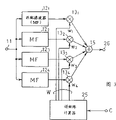
图3中,经输入端11的输入取样信号被送到匹配滤波器121至124,在其中计算它与各个用户的扩展码的相关性。匹配滤波器121使用所要求的信号的扩展码,而其他匹配滤波器122至124使用别的用户的扩展码。匹配滤波器121的输出包含有干扰信号以及所要求的信号,因为可以把干扰信号表示为匹配滤波器122至124的输出信号的线性组合,所以,通过调节或控制匹配滤波器121至124在乘法器131至134中分别所乘的加权系数W1至W4的方法就有可能完全防止包含在加法器15的输出的复合信号内的干扰信号。这在数学上等效于把正交于干扰信号的量提取出来作为所要求信号的去扩展信号。在按照这种运行的去相关器中,反向矩阵计算器25根据有关用户的扩展码和接收定时的信息来计算扩展码的相关矩阵的反向矩阵,输出反向矩阵的特殊阵元作为加权系数W1至W4。In Fig. 3, the input sampled signal via
因为这样产生的复合信号的相位和幅度随所要求的信号的信道脉冲响应的变化而波动,所以对馈送到输出端26的复合信号进行检波的检波器必须跟踪其相位和幅度的波动。Because the phase and amplitude of the composite signal thus produced fluctuate with changes in the channel impulse response of the desired signal, a detector that detects the composite signal fed to output 26 must track its phase and amplitude fluctuations.
有关所有用户的扩展码和接收定时的信息对于去相关器的运行是必不可少的,然而在移动无线通信的DS-CDMA系统中,在移动台是得不到有关别的用户的扩展码信息的,这就产生了在移动台不能运行去相关器的缺点。Information about the spreading codes and receiving timing of all users is essential for the operation of the decorrelator. However, in the DS-CDMA system of mobile wireless communication, the information about the spreading codes of other users is not available at the mobile station. , which creates the disadvantage of not being able to run the decorrelator at the mobile station.
现有技术例4Prior Art Example 4
图4中表示的是普通DS-CDMA自适应干扰消除器的构成,它采用上述的正交化方式,其目的是解决去相关器的问题(Shousei Yosh-ida,Akihisa Ushirokawa,Shuhzo Yanagi and Yukitsuna Furu-ya,“在移动无线环境中的DS/CDMA自适应干扰消除器”TechnicalReport of IEICE,RCS 93-76,Nov.1993)。Figure 4 shows the composition of a common DS-CDMA adaptive interference canceller, which adopts the above-mentioned orthogonalization method, and its purpose is to solve the problem of the decorrelator (Shousei Yosh-ida, Akihisa Ushirokawa, Shuhzo Yanagi and Yukitsuna Furu -ya, "DS/CDMA Adaptive Interference Canceller in Mobile Wireless Environment" Technical Report of IEICE, RCS 93-76, Nov.1993).
如上结合图2的描述,匹配滤波器12的去扩展和用横向滤波器21进行的线性合成都是线性操作;而图4的例子仅用单个横向滤波器21来执行这些操作。即:在图4中,经输入端11的输入取样信号SPS被送到横向滤波器21,在那里信号经受前述按照图2的去扩展和干扰消除,并由横向滤波器21输出该复合信号CS。复数共轭幅度归一化电路27把由延时器件28延时一个调制符周期T的复合信号的幅度归一化,并把它的共轭复数作为基准信号RS输出。乘法器29把复合信号CS乘以基准信号RS,判定电路16使乘得的输出经受硬判定,其判定信号被送到输出端17。在这个过程中,由于基准信号RS是由延时而产生的,所以乘法器29的乘得的输出响应于差动检波信号。减法器18输出输出端17的判定信号和乘法器29的乘得的输出之间的差值作为估算误差E。As described above in conjunction with FIG. 2 , the despreading by the matched filter 12 and the linear synthesis by the
系数控制器19使用基准信号RS、在横向滤波器21中设定的输入取样信号SPS以及估算误差E按照自适应算法来控制横向滤波器21的分支系数W,从而使估算误差E的平方成为最小。信道脉冲响应的变化不会使差动检波下降很多,也不会使基于差动检波信号的估算误差E劣化太多。因此,这种估算误差E的使用就防止了自适应算法引起的分支系数W的估算精度的下降,而且在某种程度上抑制了由于信道脉冲响应引起的接收机性能的下降。顺便而言,在分支系数的估算未充分收敛时的初始收敛过程中,减法器18在带有判定差错的判定信号处用训练信号存储器30的预置训练信号TR使分支系数的估算快速收敛。The
这种方案不要求有关别的用户的扩展码和接收定时的信息,因此可以用于移动台。因为自适应算法是在信号判定的基础上进行的,所以在信号判定中发生许多差错时,传输特性就会变坏。因此,(i)在出现很多干扰及信号电平低的传输条件下,必须用长序列训练信号,而且传输效率降低;(ii)在信道变化快得以突发方式引入信号判定差错时,分支系数W的估算精度就降低,而且不能充分执行干扰消除功能。This scheme does not require information about other users' spreading codes and reception timing, and thus can be used for mobile stations. Since the adaptive algorithm is performed on the basis of signal judgment, when many errors occur in signal judgment, the transmission characteristic will deteriorate. Therefore, (i) under the condition of a lot of interference and low signal level transmission, it is necessary to use long sequence training signal, and the transmission efficiency is reduced; (ii) when the channel changes quickly and the signal judgment error is introduced in a burst mode, the branch coefficient The estimation accuracy of W is lowered, and the interference canceling function cannot be sufficiently performed.
现有技术例5Prior Art Example 5
除图3中的去相关器以外,上述的方法都是通过使用自适应算法来控制相乘使用的系数W。通常所采用的自适应算法是LMS(最小均方)算法,这是一种性能极好运算复杂性小的算法,还有各种别的算法也都是公知的(Haykin,s.,“自适应滤波器理论”2nd Ed.,Prentice-Hall,1992)。在上述的例子中,虽然判定信号被用来计算控制系数W的估算误差E,但在其他技术领域中还有一些公知的算法不需要信号判定,比如采用信号统计特性的盲目算法和对系数施以限定并控制它使平均输出功率成为最小的一种算法。前者需要长的收敛时间周期,而后者是由Frost发明的,它类似于LMS算法(Frost,O.L.,“用于线性限定自适应矩阵处理的算法”Proc.IEEE,Vol.60,No.8,PP.926-935.August 1972)。这种算法以MMSE(最小均方误差)为基础,并用于例如为避开干扰波而把矩阵天线适时对准要求波来向的适时矩阵。Except for the decorrelator in FIG. 3 , the above-mentioned methods all control the coefficient W used for multiplication by using an adaptive algorithm. The adaptive algorithm usually adopted is the LMS (least mean square) algorithm, which is an algorithm with excellent performance and little computational complexity, and various other algorithms are also known (Haykin, s., "Self- Adaptive Filter Theory" 2nd Ed., Prentice-Hall, 1992). In the above example, although the judgment signal is used to calculate the estimation error E of the control coefficient W, there are some known algorithms in other technical fields that do not require signal judgment, such as the blind algorithm using the statistical characteristics of the signal and applying the coefficient to the coefficient To limit and control it to make the average output power a minimum algorithm. The former requires a long convergence time period, while the latter was invented by Frost, which is similar to the LMS algorithm (Frost, O.L., "Algorithm for linearly bounded adaptive matrix processing" Proc. IEEE, Vol.60, No.8, PP. 926-935. August 1972). This algorithm is based on MMSE (Minimum Mean Square Error) and is used, for example, to align the matrix antennas in time to the desired wave direction in order to avoid interfering waves.
然而,为了实施受限的最小值输出功率算法就必须预知要输入到自适应矩阵的每个天线的要求波的幅度的组成比,并且必须能从该组成比得到引导矢量。有一种在引导矢量位置上采用单位矢量的功率逆变方式(Compton R.T.,JR.,“自适应天线--概念和特性---,“Prentice-Hall,Engllwood Cliffs.1988)。然而,这种方式要求预先知道所要求的波主要入射的天线元件,而且还要求条件维持不变。目前没有将这些方式适用于DS-CDMA干扰消除器的方法,甚至还没有提出过这种建议。However, in order to implement the restricted minimum output power algorithm, the composition ratio of the amplitude of the desired wave to be input to each antenna of the adaptive matrix must be known in advance, and the steering vector must be able to be obtained from the composition ratio. There is a method of power inversion using a unit vector at the position of the steering vector (Compton R.T., JR., "Adaptive Antennas—Concepts and Properties—," Prentice-Hall, Engllwood Cliffs. 1988). However, this approach requires prior knowledge of the antenna elements on which desired waves are mainly incident, and also requires that the conditions remain constant. There is currently no way to adapt these approaches to DS-CDMA interference cancellers, nor has it even been proposed.
本发明的目的是提供一种自适应扩频接收机,这种接收机采用不需要有关别的用户的扩展码和接收定时的信息、训练信号和由正交化消除干扰时的信号判定结果的算法以及在移动无线通信中改善信道质量或传输性能所必不可少的分集接收机。It is an object of the present invention to provide an adaptive spread spectrum receiver that uses information that does not require information on spreading codes and reception timings of other users, training signals, and signal judgment results when interference is eliminated by orthogonalization. Algorithms and diversity receivers necessary to improve channel quality or transmission performance in mobile wireless communications.
按照本发明的自适应扩频接收机包括:(1)按规定的时间间隔对收到的信号取样并输出取样信号的取样电路;(2)被施以取样信号,对取样信号进行去扩展、线性合成,并输出合成信号的信号提取器;(3)解调合成信号并输出判定信号的解调器;和(4)控制每个部分的运行时序的定时控制器。在本发明中,信号提取器包括:(5)用加权系数对输入取样信号进行去扩展及线性合成并输出该合成信号,同时输出要乘以加权系数的信号的去扩展/合成器;和(6)被施加要乘以加权系数的信号和合成信号,然后在加权系数的限定下用使合成信号的功率最小的算法计算加权系数并输出该加权系数的系数控制器。Adaptive spread spectrum receiver according to the present invention comprises: (1) according to the sampling circuit that the received signal is sampled and output sampling signal by the specified time interval; (3) a demodulator which demodulates the synthesized signal and outputs a decision signal; and (4) a timing controller which controls the operation timing of each part. In the present invention, the signal extractor includes: (5) despread and linearly synthesize the input sampled signal with the weighting coefficient and output the synthesized signal, and simultaneously output a despreading/synthesizer of a signal to be multiplied by the weighting coefficient; and ( 6) A coefficient controller that is applied with the signal to be multiplied by the weighting coefficient and the composite signal, and then calculates the weighting coefficient with an algorithm that minimizes the power of the composite signal under the constraints of the weighting coefficient and outputs the weighting coefficient.
可以展开这种基本结构的各个部分,描述如下:The various parts of this basic structure can be expanded and described as follows:
有两种结构可以用于信号提取器的去扩展/合成器,第1种结构是去扩展器和线性合成器级联的结构,其中去扩展器用多个去扩展码把输入的取样信号去扩展为去扩展信号并把它们用作要被乘的信号,线性合成器把多个去扩展信号乘以加权系数来产生合成信号。另外,也可以采用所要求信号的去扩展码和一个或多个与其正交的扩展码作为去扩展码,如果使用两个或多个正交于所要求信号的扩展码的扩展码,它们最好是相互正交的。去扩展/合成器的第2种结构是用一个横向滤波器对输入取样信号和分支系数进行卷积以便得到合成信号,并把输入取样信号作为要被乘的信号输出。There are two structures that can be used in the despreading/synthesizer of the signal extractor. The first structure is a cascaded structure of a despreader and a linear synthesizer, in which the despreader uses multiple despreading codes to despread the input sampled signal To despread signals and use them as signals to be multiplied, a linear synthesizer multiplies a plurality of despread signals by weighting coefficients to generate a composite signal. In addition, it is also possible to use the despreading code of the desired signal and one or more spreading codes orthogonal to it as the despreading code. Well are mutually orthogonal. The second structure of the despreading/synthesizer is to convolve the input samples with tap coefficients with a transversal filter to obtain a composite signal, and output the input samples as the signal to be multiplied.
对于分集接收来说,(i)取样电路被设计来以规定的时间间隔对一个或多个收到的信号取样,并且输出一个或多个取样信号;(ii)信号提取器被设计作为一个分集信号提取器,它用去扩展/线性合成器进行去扩展和线性合成并输出多个分支合成信号;以及(iii)解调器被设计成一个分集解调器,它把多个分支合成信号进行分支合并和解调。For diversity reception, (i) the sampling circuit is designed to sample one or more received signals at specified time intervals and output one or more sampled signals; (ii) the signal extractor is designed as a diversity a signal extractor, which uses a despreading/linear combiner for despreading and linear combining and outputs a plurality of branch composite signals; Branch merging and demodulation.
这种分集接收有如下的天线分集结构和通道分集结构,(i)在天线分集的情况下,取样电路对由多个天线收到的波产生的多个收到的信号进行取样并输出多个取样信号,而分集信号提取器接收多个经取样的信号并输出多个分支合成信号,它由多个分支信号提取器构成,每个分支信号提取器有去扩展/合成器和系数控制器。(ii)在通道分集的情况下,取样电路对由单个天线收到的波产生的单个收到的信号进行取样并输出单个取样信号,而分集信号提取器在去扩展/合成器和系数控制器中按照由定时控制器产生的多个不同的定时处理取样信号并且输出多个分支合成信号。This diversity reception has the following antenna diversity structure and channel diversity structure, (i) in the case of antenna diversity, the sampling circuit samples a plurality of received signals generated by waves received by a plurality of antennas and outputs a plurality of The signal is sampled, and the diversity signal extractor receives a plurality of sampled signals and outputs a plurality of branch composite signals, which is composed of a plurality of branch signal extractors, and each branch signal extractor has a despread/synthesizer and a coefficient controller. (ii) In the case of channel diversity, the sampling circuit samples a single received signal generated by a wave received by a single antenna and outputs a single sampled signal, and the diversity signal extractor in the despreading/synthesizer and coefficient controller The sample signal is processed according to a plurality of different timings generated by the timing controller and a plurality of branch composite signals are output.
在上述的每种接收机中,取样电路也可以被设计得用比扩展码的时隙周期短的取样周期进行取样。In each of the above receivers, the sampling circuit may also be designed to perform sampling with a sampling period shorter than the slot period of the spreading code.
本发明的基本运行描述如下:(1)取样电路按规定的时间间隔对收到的信号取样并输出取样信号;(2)信号提取器对取样信号进行去扩展和线性合成,并输出合成信号;(3)解调器解调合成信号并输出判定信号;(4)定时控制器控制每个部分的运行时序。另外,信号提取器中的去扩展/合成器和系数控制器执行下述的运行:(5)去扩展/合成器用加权系数对取样信号进行去扩展及线性合成并输出经变换的合成信号和要乘以加权系数的信号;(6)系数控制器接收要乘以加权系数的信号和合成信号并且输出在加权系数的限定下用使合成信号的功率最小的算法计算的加权系数。The basic operation of the present invention is described as follows: (1) the sampling circuit samples the received signal and outputs the sampling signal according to the specified time interval; (2) the signal extractor despreads and linearly synthesizes the sampling signal, and outputs the composite signal; (3) The demodulator demodulates the synthesized signal and outputs a judgment signal; (4) The timing controller controls the operation sequence of each part. In addition, the despread/synthesizer and the coefficient controller in the signal extractor perform the following operations: (5) The despread/synthesizer despreads and linearly synthesizes the sampled signal with weighting coefficients and outputs the transformed synthesized signal and the desired The signal multiplied by the weighting coefficient; (6) The coefficient controller receives the signal to be multiplied by the weighting coefficient and the composite signal and outputs the weighting coefficient calculated with an algorithm that minimizes the power of the composite signal under the limitation of the weighting coefficient.
按照信号提取器的第1种去扩展/合成器,(1)去扩展器用多个去扩展码对取样信号进行去扩展以便得到多个去扩展的信号并把它们输出为要乘以加权系数的信号;和(ii)线性合成器把多个去扩展的信号乘以加权系数再把它们合成为合成信号,然后输出这些合成的信号。在采用如上述的扩展码,所要求信号的扩展码和一个或多个与之正交的扩展码的情况下,同样执行这些运作。第2种去扩展/合成器把由横向滤波器得到的取样信号和分支系数的卷积结果作为合成信号输出,并把取样信号作为要乘以加权系数的信号输出。According to the first kind of despreading/synthesizer of the signal extractor, (1) the despreader despreads the sampled signal with a plurality of despreading codes so as to obtain a plurality of despread signals and outputs them as signals to be multiplied by weighting coefficients signals; and (ii) a linear synthesizer that multiplies a plurality of despread signals by weighting coefficients and synthesizes them into synthesized signals, and then outputs these synthesized signals. These operations are also performed in the case of using a spreading code as described above, the spreading code of the desired signal and one or more spreading codes orthogonal thereto. The second type of despreading/synthesizer outputs the convolution result of the sampling signal obtained by the transversal filter and the branch coefficient as a composite signal, and outputs the sampling signal as a signal to be multiplied by a weighting coefficient.
按照分集接收的补充方案,无需改变每一部分的基本运作而用多个分支中正在处理的信号来得到多个分支合成信号。在天线分集的情况下,用处理来自多个天线的信号的方法来获得多个分支合成信号,另一方面,在通道分集的情况下,通过在不同的定时时刻处理来自单个接收天线的信号的方法来获得多个分支合成信号。分集解调器解调多个分支合成信号并得到判定信号。按照任何一种分集方案,系数控制器收到要被乘的信号和合成信号并输出在限定加权系数的情况下用使每个分支的平均功率最小的算法得到的加权系数。According to the supplementary scheme of diversity reception, the signals being processed in the multiple branches are used to obtain the multi-branch composite signal without changing the basic operation of each part. In the case of antenna diversity, multiple branch composite signals are obtained by processing signals from multiple antennas. On the other hand, in the case of channel diversity, by processing signals from a single receiving antenna at different timing method to obtain multiple branch composite signals. The diversity demodulator demodulates the composite signal of multiple branches and obtains the decision signal. According to any diversity scheme, the coefficient controller receives the signal to be multiplied and the synthesized signal and outputs weighting coefficients obtained by using an algorithm that minimizes the average power of each branch under the condition that the weighting coefficients are defined.
在上述的每一种接收机中,即使取样定时与收到的信号的时隙定时不同步,取样电路也依比扩展码的时隙周期短的取样周期进行取样,这就防止了产生收到的信号的频谱成分的混淆。在扩频调制系统的传输处理器中,为了充分发挥出这种自适应扩频接收机的能力,要被发送的信号承受像多电平调制、限带调制、跳频控制和定时控制。In each of the above-mentioned receivers, even if the sampling timing is not synchronized with the time slot timing of the received signal, the sampling circuit performs sampling according to a sampling period shorter than the time slot period of the spreading code, which prevents the occurrence of received signals. aliasing of the spectral components of the signal. In the transmission processor of the spread spectrum modulation system, in order to give full play to the ability of this adaptive spread spectrum receiver, the signal to be transmitted is subjected to multi-level modulation, band-limited modulation, frequency hopping control and timing control.
本发明与现有技术之不同逐点列举如下:The differences between the present invention and the prior art are enumerated point by point as follows:
(1)去扩展信号乘以加权系数以产生合成信号,而该去扩展信号和合成信号同时被用来在限定加权系数的情况下用使合成信号的平均功率最小化的算法控制加权系数。(1) The despread signal is multiplied by a weighting coefficient to generate a composite signal, and the despreading signal and the composite signal are simultaneously used to control the weighting coefficient with an algorithm that minimizes the average power of the composite signal under the condition that the weighting coefficient is limited.
(2)在采用所要求信号的扩展码和多个与之正交的扩展码的方案中,所要求信号只出现在用所要求信号的扩展码产生的去扩展信号中,并且干扰信号只出现在由多个与所要求信号的扩展码相正交的扩展码产生的去扩展信号中。(2) In the scheme using the spreading code of the desired signal and multiple spreading codes orthogonal thereto, the desired signal appears only in the despread signal generated by the spreading code of the desired signal, and the interfering signal appears only In a despread signal produced by a plurality of spreading codes that are orthogonal to the spreading code of the desired signal.
(3)在采用横向滤波器的方案中,取样信号序列和加权系数被卷积,以产生合成信号,而该取样信号序列和合成信号同时被用来在限定加权系数的情况下用使合成信号的平均功率最小化的算法控制加权系数。(3) In the scheme using the transversal filter, the sampled signal sequence and the weighting coefficient are convolved to generate a composite signal, and the sampled signal sequence and the composite signal are simultaneously used to use the composite signal under the condition of limiting the weighting coefficient The average power minimization algorithm controls the weighting coefficients.
(4)在分集结构的情况下,产生每个分支合成信号时,在限定加权系数的情况下用使合成信号的平均功率最小化的算法控制加权系数。(4) In the case of a diversity structure, when each branch composite signal is generated, the weight coefficient is controlled with an algorithm that minimizes the average power of the composite signal while limiting the weight coefficient.
如上所述,本发明把系数限定的输出功率最小化算法用于DS-CDMA解调处理,而不用于矩阵天线,并且通过使用在限定加权系数的情况下用使合成信号的平均功率最小化的算法来运行;因此,本发明不需要像现有技术中使用判定信号和合成信号产生误差的结构。As described above, the present invention uses the coefficient-limited output power minimization algorithm for the DS-CDMA demodulation process instead of the matrix antenna, and minimizes the average power of the composite signal by using the Therefore, the present invention does not need a structure that uses a decision signal and a composite signal to generate an error as in the prior art.
在扩频调制系统的传输处理器中,为了充分发挥出这种自适应扩频接收机的能力,要被发送的信号承受像多电平调制、限带调制、跳频控制和定时控制是有效的。In the transmission processor of the spread spectrum modulation system, in order to give full play to the ability of this adaptive spread spectrum receiver, it is effective for the signal to be transmitted to be subjected to multi-level modulation, band-limited modulation, frequency hopping control and timing control. of.
附图简要说明Brief description of the drawings
图1是采用匹配滤波器和线性合成器的具有干扰消除功能的普通DS-CDMA接收机的方框图。Fig. 1 is a block diagram of a common DS-CDMA receiver with interference cancellation function using a matched filter and a linear synthesizer.
图2是采用横向滤波器的具有干扰消除功能的普通DS-CDMA接收机的方框图。Fig. 2 is a block diagram of a general DS-CDMA receiver with interference cancellation function using a transversal filter.
图3是具有干扰消除功能的普通DS-CDMA接收机的方框图。Fig. 3 is a block diagram of a general DS-CDMA receiver with an interference cancellation function.
图4是采用横向滤波器的具有干扰消除功能的另一种普通DS-CDMA接收机的方框图。Fig. 4 is a block diagram of another conventional DS-CDMA receiver with an interference canceling function using a transversal filter.
图5是说明本发明基本结构的方框图。Fig. 5 is a block diagram illustrating the basic structure of the present invention.
图6是表示图5中的信号提取器33的一个运行特例的方框图。FIG. 6 is a block diagram showing a specific example of the operation of the
图7是表示图6中的去扩展器38的结构的一个例子。FIG. 7 shows an example of the structure of despreader 38 in FIG. 6 .
图8是一个实施例的方框图,其中图5中的去扩展/合成器36是由横向滤波器构成的。FIG. 8 is a block diagram of an embodiment in which the despreading/combining unit 36 of FIG. 5 is formed by transversal filters.
图9是表示用作解调器38的预测同步检波器的方框图。FIG. 9 is a block diagram showing a predictive synchronous detector used as the demodulator 38. As shown in FIG.
图10是表示计算机模拟结果的曲线。Fig. 10 is a graph showing computer simulation results.
图11是说明本发明用于分集接收的一个实施例的方框图。Figure 11 is a block diagram illustrating an embodiment of the present invention for diversity reception.
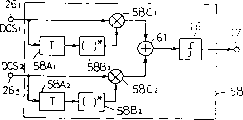
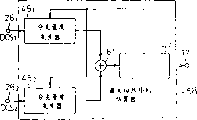
图12是说明分集解调器58的结构的例子。FIG. 12 is a diagram illustrating an example of the structure of the
图13是说明本发明用于天线分集接收的另一个实施例的方框图。Fig. 13 is a block diagram illustrating another embodiment of the present invention for antenna diversity reception.
图14是说明所要求的信号的直接通道和延迟通道的接收定时图。Fig. 14 is a timing diagram illustrating the reception timing of the direct path and the delayed path of the desired signal.
图15是说明本发明的用于通道分集接收的基本结构的方框图。Fig. 15 is a block diagram illustrating the basic structure of the present invention for channel diversity reception.
图16是说明本发明的用于通道分集接收的实施例的方框图。Figure 16 is a block diagram illustrating an embodiment of the present invention for channel diversity reception.
图17是说明本发明的用于通道分集接收的另一实施例的方框图。Fig. 17 is a block diagram illustrating another embodiment of the present invention for channel diversity reception.
图18是说明本发明的用于通道分集接收的另一实施例的方框图。Fig. 18 is a block diagram illustrating another embodiment of the present invention for channel diversity reception.
图19是说明使用横向滤波器对取样信号进行去扩展和线性合成的通道分集接收机的实施例的方框图。Figure 19 is a block diagram illustrating an embodiment of a channel diversity receiver using transversal filters to despread and linearly combine sampled signals.
图20是表示用于本发明的取样电路的实施例的方框图。Fig. 20 is a block diagram showing an embodiment of a sampling circuit used in the present invention.
图21是说明由于取样引起收到的信号频谱的混淆的图。Fig. 21 is a diagram illustrating aliasing of a received signal spectrum due to sampling.
图22是说明发射机结构的方框图。Fig. 22 is a block diagram illustrating the structure of a transmitter.
图23A是在I-Q平面上表示BPSK信号的信号点的图。Fig. 23A is a diagram showing signal points of a BPSK signal on the I-Q plane.
图23B是表示BPSK信号的例子的图。Fig. 23B is a diagram showing an example of a BPSK signal.
图23C是在I-Q平面上表示QPSK信号的信号点的图。Fig. 23C is a diagram showing signal points of a QPSK signal on the I-Q plane.
图23D是表示QPSK信号的例子的图。Fig. 23D is a diagram showing an example of a QPSK signal.
图24是所要求的信号和干扰信号同步时的每个信号的时序图。Fig. 24 is a timing chart of each signal when the desired signal and the interference signal are synchronized.
图25是所要求的信号和干扰信号不同步时的每个信号的时序图。Fig. 25 is a timing chart of each signal when the desired signal and the interfering signal are not synchronized.
图26是说明执行限带调制的传输处理器结构的方框图。Fig. 26 is a block diagram illustrating the structure of a transmission processor performing band-limited modulation.
图27是为传输而经受限带调制的信号的脉冲响应图。Figure 27 is a graph of the impulse response of a signal subjected to band-limited modulation for transmission.
图28是经限带调制的信号的眼图。Figure 28 is an eye diagram of a bandlimited modulated signal.
图29A是直接通道和延迟通道的要被接收的已调信号之间的时序关系图。FIG. 29A is a timing relationship diagram between the received modulated signals of the direct path and the delayed path.
图29B是表示用RZ信号产生的已调信号和由多路传播的延迟所产生的已调信号之间的关系的时序图。Fig. 29B is a timing chart showing the relationship between the modulated signal generated by the RZ signal and the modulated signal generated by the multipath delay.
图30是通过合成训练信号来产生帧信号的传输处理器的结构方框图。Fig. 30 is a block diagram showing the structure of a transmission processor that generates frame signals by synthesizing training signals.
图31是构成帧的信号的传输时序图。Fig. 31 is a timing chart of transmission of signals constituting a frame.
图32是执行载波跳频的发射机的结构方框图。Fig. 32 is a block diagram showing the structure of a transmitter performing carrier frequency hopping.
图33是说明跳频的时序图。Fig. 33 is a sequence diagram illustrating frequency hopping.
图34是说明接收所发射的信号也执行跳频的接收机的结构方框图。Fig. 34 is a block diagram illustrating the structure of a receiver which receives transmitted signals and also performs frequency hopping.
图35是在传输开始时载波功率控制的一个例子。Figure 35 is an example of carrier power control at the start of transmission.
图36是控制载波功率的发射机的结构方框图。Fig. 36 is a block diagram showing the structure of a transmitter for controlling carrier power.
图37是延迟传输时序的传输处理器的结构方框图。Fig. 37 is a block diagram showing the structure of a transfer processor that delays transfer timing.
图5表示本发明的基本结构,由被接收信号的同相分量和90度相移分量构成的收到的信号IQ经输入端31送到取样电路32,在那里按照规定的时间间隔取样,并且把得到的取样信号SPS送到端子11。信号提取器33输入送来的取样信号SPS,并把它们去扩展和线性合成,然后把得到的合成信号DCS输出到端26。解调器34解调合成信号DCS并把判定信号送到端子17。时序控制器35控制信号提取器33和解调器35的运行时序。Fig. 5 shows the basic structure of the present invention, and the received signal IQ that is formed by the in-phase component of the received signal and the 90 degree phase-shifted component is sent to
按照本发明,信号提取器33由一个去扩展/合成器36和一个系数控制器37构成,它们按如下方式运行。去扩展/合成器36用加权系数W对输入的取样信号进行去扩展和线性合成,以便得到合成的信号DCS,并把它输出,同时它还输出要乘以加权系数W的信号MPS。然后,系数控制器37输入送来的信号MPS和合成信号DCS,并且在限定加权系数W的条件下用使合成信号DCS的平均功率最小的算法得到加权系数W;这样得到的加权系数被送到去扩展/合成器36。According to the present invention, the
通常,去扩展是在一个码元周期内进行,但是考虑到时序抖动的出现和不同步定时情况的发生,有时在比一个码元周期长一点的期间内进行这种处理对于干扰信号的消除是有用的,一方面是因为这样可以充分获得需要信号和干扰信号的信号能量,另一方面是因为取样数的增加引起消除干扰的自由度的增加。但是在这个例子中,相邻码元的影响表现为码元间干扰,因此,必须把它们作为干扰信号除掉。Usually, despreading is performed within one symbol period, but considering the occurrence of timing jitter and the occurrence of out-of-synchronization timing, sometimes it is necessary to perform this process for a period longer than one symbol period for the elimination of interfering signals. It is useful, on the one hand, because it can fully obtain the signal energy of the desired signal and the interference signal, and on the other hand, because the increase in the number of samples leads to an increase in the degree of freedom to eliminate interference. But in this example, the influence of adjacent symbols appears as intersymbol interference, so they must be removed as interference signals.
可以使用各种算法在限定加权系数W的情况下使合成信号的平均功率最小;一种公知的简单方法是前述的由Frost提出的有限的LMS算法。用这种算法,因为加权系数W是由不要求判定结果的算法来控制,所以有可能避免判定误差的影响。Various algorithms can be used to minimize the average power of the composite signal subject to a defined weighting factor W; one known simple method is the aforementioned finite LMS algorithm proposed by Frost. With this algorithm, since the weighting coefficient W is controlled by an algorithm that does not require a decision result, it is possible to avoid the influence of a decision error.
下面将参照实施例更详细地描述本发明,实施例1到3给出的说明针对信号提取器,实施例4针对解调器的特殊运行的例子,实施例5到10针对分集接收,而实施例11针对为充分发挥自适应扩频接收机的功能而对扩频调制方式的参数的设定。The present invention will be described in more detail below with reference to the embodiments, the explanation given by
实施例1Example 1
图6中所描述的是去扩展/合成器36的构成,其中去扩展器38和线性合成器39相级联,去扩展器38输出对带有多个去扩展码的输入取样信号SPS进行去扩展所产生的多个去扩展信号。同时,把这多个去扩展信号作为要被倍增的信号MPS输出,线性合成器39把由去扩展器38输出的去扩展信号倍增各个加权系数W倍,然后合成经倍增的信号并输出合成信号DCS。为简化起见,图6中假定处理增益Gp(扩展码频率除以码元频率)是4,并假定指定相同频率的用户数是4。Described in Fig. 6 is the formation of despreading/synthesizer 36, wherein despreader 38 and linear synthesizer 39 are cascaded, and despreader 38 outputs the input sampling signal SPS that has a plurality of despreading codes. The resulting multiple despread signals are spread. Simultaneously, the plurality of despread signals are output as the signal MPS to be multiplied, and the linear synthesizer 39 multiplies the despread signals output by the despreader 38 by W times for each weighting factor, then synthesizes the multiplied signals and outputs the synthesized signal DCS. For simplicity, it is assumed in FIG. 6 that the processing gain Gp (spreading code frequency divided by the symbol frequency) is 4, and that the number of users assigning the same frequency is 4.
首先,经输入端11输入的取样信号SPS被送到由去扩展器38构成的四个匹配滤波器121到124,每个匹配滤波器121到124计算取样信号和扩展码之间的相关性;得到的去扩展信号X1(i)到X4(i)在不连续时刻i被作为要倍增的信号MPS输出。在这种情况下,匹配滤波器121使用所需信号的扩展码,而其它匹配滤波器122到124的每一个使用与判定信号不同的预先确定的扩展码。不像图3的现有技术的例子那样,在匹配滤波器122到124中使用的扩展码不必和其它用户的那些扩展码相同。另外,在任何一个匹配滤波器121到124中所用的扩展码不必始终是所需信号的扩展码;用于任何一个匹配滤波器的扩展码和所需信号的扩展码之间的互相关性仅仅需要足以高于其它匹配滤波器的扩展码和所需信号的扩展码之间的互相关性。First, the sampled signal SPS input through the
线性合成器39由倍增器131到134和加法器15构成,去扩展器38的去扩展信号X1(i)到X4(i)分别被倍增加权系数W1到W4倍并用加法器15把倍增后的输出加在一起,以便得到被送到输出端26的合成信号DCS,去扩展信号X1(i)到X4(i)和合成信号DCS被送到系数控制器37,并用在加权系数限定下使合成信号DCS的平均功率最小的算法来计算加权系数W1到W4。匹配滤波器121到124可以用相关器来代替,这适用于下述的匹配滤波器。The linear combiner 39 is made up of multipliers 131 to 134 and an
在这个实施例中,用Wo=[Wo*1,Wo*2,Wo*3,Wo*4]T表示四维加权系数矢量W=[W1 *,W2 *,W3 *,W4 *]T的最佳值,这是从前述的Frost的文献引证来的,例如:在加权系数限定下的最佳值Wo由下式给出。其中符号*表示共轭复数,T表示置换。In this embodiment, use Wo=[Wo * 1, Wo * 2, Wo * 3, Wo * 4] T to represent four-dimensional weighting coefficient vector W=[W 1 * , W 2 * , W 3 * , W 4 * ] The optimal value of T , which is quoted from the aforementioned Frost literature, for example: the optimal value Wo under the weighting coefficient limit is given by the following formula. Where the symbol * represents a conjugate complex number, and T represents a permutation.
Wo=αR-1S……(1)Wo=αR -1 S...(1)
其中*是定标值,R是去扩展信号的4×4相关矩阵,S是四维引导矢量。使用一个去扩展信号矢量X(i)=[X1(i),X2(i),X3(i),X4(i)],那么,相关矩阵R就由下式给出:Where * is the scaling value, R is the 4×4 correlation matrix of the despread signal, and S is the four-dimensional steering vector. Using a despread signal vector X(i)=[X1(i), X2(i), X3(i), X4(i)], then the correlation matrix R is given by:
R=<X(i)XH(i)>……(2)R=<X(i)X H (i)>...(2)
其中i是用码元持续期T作为单位的不连续时刻,Woj是加权系数Wj的最佳值,Xj(i)是在时刻i第j匹配滤波器12j(J=1,2,3,4)的去扩展信号,H表示共轭复数移项,<>表示系综平均。R可以被近似如下:Wherein i is the discontinuous moment with the symbol duration T as the unit, Woj is the optimal value of the weighting coefficient Wj, and Xj (i) is the jth matched filter 12j (J=1,2,3,4 at the moment i) ), H represents the conjugate complex transposition, and <> represents the ensemble average. R can be approximated as follows:
R=[X(1)XH(1)+X(2)XH(2)+……+X(Nt)XH(Nt)]/Nt……(3)R=[X(1) XH (1)+X(2) XH (2)+...+X(Nt) XH (Nt)]/Nt...(3)
其中Nt是一个大的自然数,Nt越大近似精度就越高;虽然取决于系数,但是最好把自然数Nt设定为在周期Nt期间不会发生通信条件的变化这样一个值,如其它用户的通信初始化。Wherein Nt is a large natural number, the larger the Nt is, the higher the approximation accuracy is; although it depends on the coefficient, it is better to set the natural number Nt as a value that does not change the communication conditions during the period Nt, such as other users' Communication initialization.
在这种情况下,引导矢量S的元素是所需信号的扩展码j(j=1)和匹配滤波器12中所使用的扩展码K之间的互相关量Pjk,它由下式给出:In this case, the element of the steering vector S is the cross-correlation amount Pjk between the spreading code j (j=1) of the desired signal and the spreading code K used in the matched filter 12, which is given by :
S=[ρ11,ρ12,ρ13,ρ14]T (4)S=[ρ11, ρ12, ρ13, ρ14] T (4)
把所需信号限定在倍增器131的输出内的速率是Wo1ρ11,类似地,把所需信号限定在倍增器132到134的输出内的速率分别是Wo1ρ12,Wo3ρ13和Wo4ρ14。因为合成信号DCS是倍增器131到134的输出信号的和,所以把所需信号限定在合成信号DCS内的速率是对应于WHS的(WO1ρ11+WO2ρ12+WO3ρ13+WO4ρ14)。当控制加权系数以便合成信号中限定的所需信号的信号电平保持为常数时,对加权系数的限定表示如下:The rate at which the desired signal is confined to the output of multiplier 131 is Wo1ρ11, and similarly the rates at which the desired signal is confined to the outputs of multipliers 132 to 134 are Wo1ρ12, Wo3ρ13 and Wo4ρ14, respectively. Since the resultant signal DCS is the sum of the output signals of the multipliers 131 to 134 , the rate at which the desired signal is confined within the resultant signal DCS corresponds to WHS (WO1p11+WO2p12+WO3p13+WO4p14). When the weighting coefficients are controlled so that the signal level of the desired signal defined in the synthesized signal remains constant, the weighting coefficients are defined as follows:
WHS=1……(5)W H S = 1...(5)
在这种限定下使合成信号的平均功率最小等效于保持所需信号的信号电平不变时使合成信号的平均功率最小。对加权系数的这种控制能使合成信号中所包含的干扰分量的电平最小。顺便要说的是,式(1)中的α要设定得使Wo满足式(5)给出的限定量。Under this limitation, minimizing the average power of the composite signal is equivalent to minimizing the average power of the composite signal while keeping the signal level of the desired signal constant. Such control of the weighting coefficients can minimize the level of interference components contained in the composite signal. Incidentally, α in formula (1) is set so that Wo satisfies the limit given by formula (5).
作为需要最佳值Wo的算法,有直接用式(1),(3)和(4)计算它的方法以及按递归方式计算它的方法。考虑到对加权系数W的限定,递归方式可以使用利用关于R·Nt的逆矩阵的辅助定理的理论来导出。这样推出的算法如下:As an algorithm that requires the optimum value Wo, there are methods of calculating it directly using equations (1), (3) and (4) and methods of calculating it recursively. Considering the constraints on the weighting coefficients W, the recursive manner can be derived using theory using an auxiliary theorem on the inverse matrix of R·Nt. The algorithm thus derived is as follows:
Y(i)=WH(i-1)X(i) (6)Y(i)=W H (i-1)X(i) (6)
K(i)=[P(i-1)X(i)]/[1+XH(i)P(i-1)X(i)] (7)K(i)=[P(i-1)X(i)]/[1+X H (i)P(i-1)X(i)] (7)
W(i)=βiW(i-1)-βiK(i)Y*(i) (8)W(i)=β i W(i-1)-β i K(i)Y * (i) (8)
P(i)=p(i-1)-K(i)XH(i)P(i-1) (9)其中Y(i)是合成信号,P(i)是时刻i时的R·Nt的逆矩阵,K(i)是Kalman增益矢量,βi=i/(i-1),其中i≥2。在稳定状态下,W(i)收敛于α-1Wo,它是用(1)式表示的Wo的不变的倍数,不管它收敛于α-1Wo或Wo,所需信号和包含在合成信号中的干扰信号的信号功率之间的比都是保持不变的,而且,传输性能也相应保持不变。因此,将要给出的是运算并不复杂的α-1Wo的计算。在这种递归方式中,引导矢量被限定在初始条件下,即:{W(1)=P(1)S}。P(i)=p(i-1)-K(i)X H (i)P(i-1) (9) where Y(i) is the composite signal, and P(i) is R at time i The inverse matrix of Nt, K(i) is the Kalman gain vector, βi=i/(i-1), where i≥2. In the steady state, W(i) converges to α -1 Wo, which is an invariant multiple of Wo expressed by formula (1), regardless of whether it converges to α -1 Wo or Wo, the desired signal sum is contained in the synthesized The ratio between the signal power of the interfering signal in the signal is kept constant, and the transmission performance is correspondingly kept constant. Therefore, what will be given is the calculation of α -1 Wo whose operation is not complicated. In this recursive manner, the steering vector is constrained to the initial condition, namely: {W(1)=P(1)S}.
上述的方法精度高但是要求的处理量大,一种不需要复杂运算的算法是Frost提出的有限最陡跌落法;这种算法表示如下:
当相关矩阵R成为100×100那么大的矩阵时,按照直接计算方法,所包括的处理量就相当大,但是,按照有限最陡跌落法的处理量相对较小。本发明并不特别限定于这些方法,也可以采用各种有限平均输出最小化的算法。When the correlation matrix R becomes a matrix as large as 100×100, the amount of processing involved is quite large according to the direct calculation method, but the amount of processing involved according to the finite steepest drop method is relatively small. The present invention is not particularly limited to these methods, and various finite average output minimization algorithms can also be used.
实施例2Example 2
图7中所说明的是使用所需信号的扩展码和多个与其正交的扩展码作为如实施例1中的去扩展码的情况下所采用的去扩展器的构成。Illustrated in FIG. 7 is the configuration of a despreader employed in the case of using a spreading code of a desired signal and a plurality of spreading codes orthogonal thereto as despreading codes as in
去扩展器38由匹配滤波器121和正交码滤波器(OCF)411-413构成;匹配滤波器121被指定所需信号的扩展码,正交码滤波器411-413被指定正交于所需信号的扩展码且又彼此正交的扩展码。正交码滤波器构成一个正交化器42,在正交化器42中所使用的扩展码不必和其它用户的扩展码相同。Despreader 38 is made up of matched filter 121 and orthogonal code filter (OCF) 411-413 ; Matched filter 121 is assigned the spreading code of desired signal, and orthogonal code filter 411-413 Spreading codes that are assigned to be orthogonal to the spreading code of the desired signal and to be orthogonal to each other. The orthogonal code filters form an orthogonalizer 42 in which the spreading codes used are not necessarily the same as those of other users.
通常,在用处理增益Gp扩展时,已调信号形成一个Gp维空间,然后在大多数情况下,可以根据所需信号的扩展码产生Gp维的Gp归一化基本矢量。更具体地说,首先产生其元素与所需信号的扩展码的整个时隙相同的一个Gp维矢量,然后借助Gram-Schmidt正交化等方法用它来计算(Gp-1)Gp-维归一化基本矢量。具有这样计算出来的Gp维的Gp-1归一化基本矢量元素(按照它们的时隙)的代码被用作正交化器42中的去扩展码。Usually, when spread with processing gain Gp, the modulated signal forms a Gp-dimensional space, and then in most cases, Gp-dimensional Gp-normalized basis vectors can be generated according to the spreading code of the desired signal. More specifically, a Gp-dimensional vector whose elements are the same as the entire slot of the spreading code of the desired signal is first generated, and then used to calculate (Gp-1)Gp-dimensional regression Uniform basis vectors. The codes of Gp-1 normalized basic vector elements (in terms of their slots) having thus calculated Gp dimension are used as despreading codes in the orthogonalizer 42 .
即使把所需信号的扩展码用作匹配滤波器121的去扩展码,所需信号的信号成分和干扰波的信号成分都包含在去扩展信号成分中。然而在这个例子中,正交化器42的输出信号内不包含所需信号的信号成分,只含有干扰信号的信号成分。把用于匹配滤波器12的输出信号的加权系数固定为常数并控制该加权系数使合成信号的功率最小,就有可能保持合成信号中包含的所需信号的信号分量的功率不变,而使合成信号中的干扰信号的信号分量的功率最小。这种情况下的四维加权系数矢量的最佳值Wo按照与前述实施例相同的方法来计算。但是,在这个例子中,正交化器42中的去扩展码和所需信号的扩展码之间不存在相关性,所以引导矢量S就如下所示:Even if the spreading code of the desired signal is used as the despreading code of the matched filter 121 , both the signal component of the desired signal and the signal component of the interference wave are included in the despreading signal component. In this example, however, the output signal of the normalizer 42 does not contain the signal component of the desired signal, but only the signal component of the interference signal. By fixing the weighting coefficients for the output signal of the matched filter 12 to a constant and controlling the weighting coefficients to minimize the power of the composite signal, it is possible to keep the power of the signal component of the desired signal contained in the composite signal constant, while making The signal component of the interfering signal in the composite signal has the smallest power. The optimal value Wo of the four-dimensional weighting coefficient vector in this case is calculated in the same way as in the previous embodiment. However, in this example, there is no correlation between the despreading code in the orthogonalizer 42 and the spreading code of the desired signal, so the steering vector S is as follows:
S=[1,0,0,0]T……(11)S = [1, 0, 0, 0] T ... (11)
当把引导矢量S设定得如用(11)式给出的值时,系数限定就相当于设定Wo1=1。参照前面实施例1的同样的算法,可以被用来计算这个最佳值Wo。When the steering vector S is set to the value given by (11), the coefficient limitation is equivalent to setting Wo1=1. The same algorithm as in the
如上所述,正交化器42使用与需要信号的扩展码相正交的代码;因此,不管其它用户的扩展码有多大变化,都能精确地把其它用户的干扰分量置于正交空间中,从而能相当地适应其它用户使用扩展码的变化。As noted above, the orthogonalizer 42 uses codes that are orthogonal to the spreading codes of the desired signal; therefore, the interfering components of other users can be accurately placed in the orthogonal space regardless of how much the spreading codes of other users vary , so that it can quite adapt to the changes of other users using the spreading code.
实施例3Example 3
图8中要说明的是使用横向滤波器来实施去扩展/合成器36的构成,按照这种构成,取样信号SPS和横向滤波器43的分支系数W的卷积的结果被作为合成信号输出,并且,输入的取样信号被作为要被倍增的信号MPS输出。设置在横向滤波器43中的取样信号序列对应于要被倍增的信号MPS,而分支系数对应于加权系数W。What will be explained in FIG. 8 is the configuration of implementing the despreading/combiner 36 using a transversal filter. According to this configuration, the convolution result of the sampling signal SPS and the tap coefficient W of the
收到的信号经输入端31被送到取样电路32,把它取样并输出取样信号SPS。信号提取器33接收取样信号SPS,进行去扩展和线性合成并输出合成信号。解调器34解调合成信号并把判定信号送到输出端17。信号提取器33由横向滤波器43和系数控制器37构成,横向滤波器43包括:多个相级联的延迟器件43D1、43D2和43D3、倍增器43Mo-43M3以及加法器43A1-43A3。每个延迟器件都有等于一个时隙持续期Tc的延迟时间;倍增器把第1延迟级43D1的输入和各个延迟器件的输出倍增分支系数W(W1,W2,W3,W4)倍;加法器则把经倍增的输出加起来。横向滤波器43等效于图6中的去扩展器38和线性合成器39的组合;它对取样信号SPS和分支系数W进行卷积并输出合成信号DCS。设置在横向滤波器43中的取样信号MPS和合成信号DCS被输入到系数控制器37,并在那里用限定分支系数下使合成信号DCS的平均功率最小的算法来计算分支系数W。The received signal is sent to a
按照使用横向滤波器43的方式,由于这个滤波器具备包含图6中的正交化器42的去扩展器38的功能,所以引导矢量S就变成使用需要信号的扩展码作为其元素的矢量C1和单位矩阵I的乘积;用下式来表示:By using the
S=IC1=C1 (12)横向滤波器43的输出中的所需信号分量的比例可以用WHC1来表示;可以认为用C1取代表示对加权系数限定的式(5)WHS=1中的S就能把这个分量保持不变。可以用来计算最佳值Wo的算法与参照前述的实施例1的那些方法相同。S=IC1=C1 (12) The ratio of the desired signal component in the output of the
如上所述,图8的构成使用横向滤波器来同时执行去扩展和合成操作,因此,可以减少所需的处理量。As described above, the configuration of FIG. 8 uses a transversal filter to simultaneously perform despreading and synthesizing operations, and therefore, the required amount of processing can be reduced.
实施例4Example 4
本发明中的解调器可以采用差分检波和相干检波技术。图9所说明的是执行相干检波的方式,它采用预估算法和最大似然序列估算法(Kazuhiko Fukawa和Hiroshi Suzuki,”具有预估信道估算的相干检波“Technical Report of IEICJ,Vol.RCS-92,No,93,pp.53-58,Nov,1992)。The demodulator in the present invention can adopt differential detection and coherent detection technology. Figure 9 illustrates the way coherent detection is performed using predictive estimation and maximum likelihood sequence estimation (Kazuhiko Fukawa and Hiroshi Suzuki, "Coherent Detection with Predictive Channel Estimation" Technical Report of IEICJ, Vol. RCS- 92, No, 93, pp.53-58, Nov, 1992).
合成信号DCS经输入端26输入到分支量度发生器(branchmetric generator)45。当前时刻KT的合成信号和分别设置在延迟时间为一个码元持续期T的四个延迟电路461-464的时刻(K-1)T至(K-4)T的合成信号用由最大似然序列估算器47送来的码元序列选择量{am(K)]进行反调制,由此而产生反调制信号。顺便要说的是,本例中的调制方式是按PSK调制的幅度|a(K)|为常数的调制方式,而且反调制处理可以在倍增器481-484中通过把合成信号DCS乘以码元序列选择量的共轭复数{am *(K)}来进行。接下来,倍增器491-494和加法器51使用时刻(K-1)T至(K-4)T的反调制信号来估算时刻KT的反调制信号,并输出反调制信号估算值。假定信道变化很慢,倍增器491-494的系数只需设定为其平均值,本例中是1/4。当码元序列选择量{am(K)}与所发送的码元序列的实际值一致时,反调制信号与载波信号接近一致;因吡,由加法器51送来的上述的平均值就成为接收信号的载波分量。The resultant signal DCS is input to a branch metric generator 45 via an
减法器52检测并且输出KT时刻的反调制信号、倍增器480的输出信号和反调制信号估算值(来自加法器51的输出信号)之间的差ε,倍增器480用KT时刻的复数码元选择量的共轭复数am *(K)乘以输入取样信号SPS。该输出ε用平方器53平方,再用它把经平方的输出作为似然信息信号送到最大似然序列估算器47。最大似然序列估算器47使用似然信息信号来计算对数似然函数,然后用Viterbi算法选择使对数似然函数最大的码元序列选择量,并作为判定信号把它输出到输出端17。这个实施例已经描述了采用四个延迟电路的例子,然而,并不特别把延迟电路的数目限定为四个,也可以延扩为:L(L≥1)。The
上面已经给出了采用预估算法和最大似然序列估算法的方式,但是当信道变化很快时,有时使用差分检波技术可以提供极好的特性。因此,也可以采用根据信道特性在相干检波和差分检波之间进行切换的方法。The approach of using predictive and maximum-likelihood sequence estimation methods has been given above, but sometimes using differential detection techniques can provide excellent performance when the channel changes rapidly. Therefore, a method of switching between coherent detection and differential detection according to channel characteristics may also be employed.
图10中用曲线10a和10b表示平均比特差错率特性的结果,这是为展示本发明的效果而用计算机模拟所得到的。横坐标表示由于接收机的移动引起的收到信号的最大多普勒频移f,Eb/No表示每比特接受信号功率对噪声功率的比。在计算机模拟中,正交化是用实施例2(图7)的构成和被用作解调器34和图9中所示的预估相干检波器来进行的。为了比较起见,采用图4所示的DS-CDMA自适应干扰消除器所得到的平均比特差错率的结果用曲线10c和10d表示。所用的处理增益是16,用户数是16,并且假定每个用户的接收时序是相互同步的。所用的调制方式是10Kb/s BPSK调制,所用的扩展码是那些互相关性低于0.25的扩展码。信道模型是Rayleigh衰落型。从图9可知,本发明优于普通的DS-CDMA自适应干扰消除器。The results of average bit error rate characteristics are shown by
实施例5Example 5
在移动无线通信中,为了抑制由于跌落引起传播通道的变化使传输特性严重下降而采用分集接收方式。图11说明了适用于分集接收的本发明的实施例。取样电路32按规定的时间间隔对一个或多个收到的信号取样,并输出一个或多个取样信号。在天线分集的情况下,处理多个收到的信号,而在通道分集的情况下,处理单个接收信号。所说明的例子是2-支路天线分集方式,分集信号提取器55由去扩展/合成器56和系数控制器57构成,取样信号SPS1和SPS2被输入到去扩展/合成器进行去扩展及线性合成;分集信号提取器输出多个支路合成信号DCS。去扩展/合成器56和系数控制器57类似于图6中的去扩展/合成器56和系数控制器57,但是这个分集信号提取器不同于图6中的信号提取器,它的形成器输出多个支路合成信号DCS1和DCS2。分集解调器(DIV-DEM)58合并并解调多个支路合成信号DCS1-DCS2,并且输出一个判定信号。时序控制器对每部分进行时序控制。In mobile wireless communication, in order to suppress the change of the propagation channel due to the drop, the transmission characteristic is seriously degraded, and the diversity reception method is adopted. Figure 11 illustrates an embodiment of the present invention adapted for diversity reception. The
图12A,12B和12C说明的是2-支路分集接收方式的分集解调器58的构成的例子,这些例子通常是公知的。图12A中表示的是一个附加的差分检波结构,经各分集支路的输入端261和262输入的合成信号DCS1和DCS2以及在延迟器件58A1和58A2中把合成信号延迟一个码元持续期T并在复数共轭计算器58B1和58B2中进行复数共轭计算所得到的信号分别由倍增器58C1和58C2相乘;这样,接收信号就被差分检波了。加法器61把倍增过的输出信号加在一起,并把加得的输出信号送到判定电路16,判定电路16用硬判定进行信号判定并把判定信号提供给输出端17。12A, 12B and 12C illustrate examples of the configuration of the
图12B表示附加于分集接收方式的相干检波。经各分集支路的输入端261和262输入的合成信号DCS1和DCS2被送到倍增器58D1和58D2,把它们分别与来自控制器62的估算载波同步信号SY1和SY2相乘,并输出载波相位同步信号。加法器61把相乘过的输出信号加在一起,并把加得的输出信号送到判定电路16,判定电路16用硬判定进行信号判定并把判定信号提供给输出端17。减法器18把判定电路16的输入和输出信号差作为估算误差信号输出。由减法器18输出的估算误差信号和经输入端261及262送来的合成信号DCS1和DCS2被送到控制电路62,并估算上述的估算载波同步信号SY1和SY2以便使估算误差的绝对值的平方成为最小。Fig. 12B shows coherent detection added to the diversity reception scheme. The synthesized signals DCS1 and DCS2 input through the input terminals 261 and 262 of the respective diversity branches are sent to the multipliers 58D1 and 58D2 , and they are respectively multiplied with the estimated carrier synchronization signals SY1 and SY2 from the controller 62, And output the carrier phase synchronization signal. The
图12C说明的是附加于分集接收方式的图9的预测相干检波。结构上与图9的分支量度发生器相一致的分支量度发生器451和452的每一个设置在每条分集支路上;分别把合成信号DCS1和DCS2送到这些分支量度发生器,并把最大似然序列估算器47输出的码元序列选择量公共送到这些发生器,然后输出似然信息信号。最大似然序列估算器47根据似然信息信号计算对数似然函数,并把它作为判定信号送到输出端17。FIG. 12C illustrates the predictive coherent detection of FIG. 9 added to the diversity reception scheme. Each of the branch metric generators 451 and 452 structurally consistent with the branch metric generators of FIG. The symbol sequence selection quantities output by the maximum
用这样的分集方案有可能为移动无线通信提供抗衰落接收机。With such a diversity scheme it is possible to provide fading resistant receivers for mobile radio communications.
实施例6Example 6
图13是天线分集方式的实施例。按照天线分集方式,取样电路32把由多个(本例中是2个)天线收到的电波所产生的信号作为接收信号接收,并且输出在取样器(SMP)321和322中取样的多个取样信号SPS1和SPS2。在分集信号提取器55中,对应于取样信号分别设置支路信号提取器331和332,每个支路信号提取器包括图5、6和7中所示的去扩展/合成器36和系数控制器37;分集信号提取器输出多个支路合成信号DCS1和DCS2。顺便说明,分支信号提取器331和332的每一个可以由带有图8中所示横向滤波器43的信号提取器33来构成。Fig. 13 is an example of an antenna diversity method. According to the antenna diversity method, the
图13所示的是一个2支路天线分集方式的例子。第1和第2分集支路的接收信号经输入端311和312被输入到取样电路。各个支路的接收信号由取样电路321和322取样并把取样信号送到支路信号提取器331和332,用它们产生合成信号DCS1和DCS2。分集解调器58把各分集支路的合成信号DCS1和DCS2合并起来并解调合成信号,然后把判定信号输出到输出端17。这个实施例描述的是2分支分集接收的情况,但是扩展到3分支或多分支的情况也是可以实施的。Figure 13 shows an example of 2-branch antenna diversity. The reception signals of the first and second diversity branches are input to the sampling circuit via input terminals 311 and 312 . The reception signals of the respective branches are sampled by sampling
按照这种增大天线数的分集方式,所接收的所需信号的信号能量随分支数的增大而增加,并且全部收到的信号能量的变化较小,这实际上改善了传输特性。According to the diversity method of increasing the number of antennas, the signal energy of the received desired signal increases with the increase of the number of branches, and the change of the overall received signal energy is small, which actually improves the transmission characteristics.
实施例7Example 7
当发送波沿多径信道的两条不同路径传播时,脉冲响应可以用如图14所示的两个脉冲641和642来表示,在路径1上传播的波延迟t1时间到达接收端,而在路径2上传播的波延迟t2时间到达接收端。When the transmitted wave propagates along two different paths of the multipath channel, the impulse response can be represented by two impulses 64 1 and 64 2 as shown in Figure 14, and the wave propagating on
图15说明路径分集结构的一个例子。按照路径分集方式,取样电路(SMP)32对单个天线收到的电波所产生的单个接收信号进行取样,并且输出单个取样信号SPS。在分集信号提取器55中的去扩展/合成处理和系数控制处理是在取样信号SPS的多个不同定时时刻t1和t2进行的,并且输出多个支路合成信号DCS1和DCS2。时序控制器35产生处理用的定时信号。分集解调器(DIV-DEM)58合成并解调支路合成信号DCS1和DCS2。Fig. 15 illustrates an example of the path diversity structure. According to the path diversity method, the sampling circuit (SMP) 32 samples a single received signal generated by a radio wave received by a single antenna, and outputs a single sampled signal SPS. The despreading/synthesis processing and the coefficient control processing in the diversity signal extractor 55 are performed at a plurality of different timing times t1 and t2 of the sampling signal SPS, and a plurality of branch synthesis signals DCS1 and DCS2 are output. The
按照这种构成,各路径能被隔离,而且如果它们的传输路径特性相互独立变化的话,由于合成并解调支路合成信号,所以也能达到分集效果。According to this configuration, the respective paths can be isolated, and if their transmission path characteristics are changed independently of each other, diversity effects can also be achieved by synthesizing and demodulating branch composite signals.
顺便要提及的是,这个实施例的构成能够与天线分集结构组合,可以按几种方法相组合。一种方法是,对天线分集方式的每条支路产生对应多径信号的合成信号,并且分集合成对应于天线分支数与传播路径数的乘积数目的合成信号。如图12A、12B或12C所示的那种构成的分集解调器58被用来进行合成和解调运行。第2种组合方法是,通过对每个天线支路进行路径分集处理来消除由于多径传播所产生的延迟干扰并再次合成所提取的信号。在这种情况下,提取器利用图12B中的加法器61的输出信号。Incidentally, the constitution of this embodiment can be combined with the antenna diversity structure, which can be combined in several ways. One method is to generate synthesized signals corresponding to multipath signals for each branch in the antenna diversity method, and diversity synthesize synthesized signals corresponding to the number of products of the number of antenna branches and the number of propagation paths. A
实施例8Example 8
图16表示的是用去扩展器产生路径分集方式的支路合成信号的实施例。分集信号提取器55由一个去扩展器38,多个取样-保持器(SH)651和652以及多个合成控制器831和832构成,每个合成控制器都由图6中所示的线性合成器39和系数控制器37构成。和图6中的情况相同,去扩展器38用多个去扩展码对单个取样信号SPS进行去扩展,并输出多个去扩展信号。这些去扩展信号被送到取样保持器651和652,在那里分别在定时时刻t1和t2对它们进行取样。经这样取样的去扩展信号被送到合成控制器831和832,把它们与各自的加权系数相乘并把它们合成,然后,输出支路合成信号DCS1和DCS2。在这种情况下,加权系数被自适应地控制,以便使在系数限定下的合成输出成为最小。顺便提及的是,和图14中所示的情况相同,传播路径是2路径模型。FIG. 16 shows an embodiment of using a despreader to generate a branch composite signal in path diversity mode. The diversity signal extractor 55 is composed of a despreader 38, a plurality of sample-holds (SH) 651 and 652 , and a plurality of synthesis controllers 831 and 832 , each of which is composed of A linear synthesizer 39 and a
经输入端11输入的取样信号SPS在去扩展器38中用多个去扩展码进行去扩展,由此而提供多个去扩展信号。这些去扩展信号分别在定时时刻t1由取样-保持器651和定时时刻t2由取样保持器652取样并保持,合成控制器831合成由取样保持器651输出的多个去扩展信号,而合成控制器832合成由取样-保持器652输出的多个去扩展信号。去扩展器38,取样-保持器651和652以及合成控制器831和832对应于作为整体的分集信号提取器。分集解调器58合成并解调合成控制器831和832输出的合成信号,并把判定信号送到输出端17。The sampled signal SPS input via the
用这种方案,经两个不同路径的信号被认为是独立的信号,因此,可以适宜于路径分集效果,这个实施例已经描述了2路径模型传播路径的情况,但是很容易扩展到具有3路径或多路径的路径分集方式。With this scheme, the signals via two different paths are considered as independent signals, therefore, it can be suitable for path diversity effect, this embodiment has described the case of 2-path model propagation path, but it can be easily extended to have 3-path Or multi-path path diversity.
实施例9Example 9
图17所示的是由使用正交化器的去扩展器38产生路径分集方式支路合成信号的情况的实施例。传播路径是2路径模型。在去扩展器38中,如前面参照图7所述,匹配滤波器121中使用所需信号的扩展码,而在正交化器42中则使用与所需信号的扩展码正交并彼此正交的多个扩展码,对正交化器42的输出信号取样的时刻t3与图16实施例中的时刻t1相同步,但是在特定情况下,它们可以不同步(t3≠t1),如图所示。FIG. 17 shows an example of the case where the path diversity method branch composite signal is generated by the despreader 38 using the orthogonalizer. The propagation path is a 2-path model. In despreader 38, the spreading code of the desired signal is used in matched filter 121 as previously described with reference to FIG. A plurality of orthogonal spreading codes, the time t3 of sampling the output signal of the orthogonalizer 42 is synchronized with the time t1 in the embodiment of Fig. 16, but in certain cases, they may not be synchronized ( t3 ≠t 1 ), as shown in the figure.
经输入端11输入的取样信号SPS被送到去扩展器38,去扩展器38和图7中所描述的去扩展器是相同的,例如它包括使用所需信号的扩展码的匹配滤波器121和使用正交于所需信号扩展码的多个扩展码的正交化器42。匹配滤波器121的输出信号,即用所需信号的扩展码对取样信号进行去扩展所产生的去扩展信号被输入到取样-保持器651和652,取样-保持器651在定时时刻t1对上述去扩展信号取样,并把它保持一个码元持续期T,类似地,取样-保持器652在定时时刻t2对去扩展信号取样,并把它保持一个码元持续期T。正交化器42的三个输出信号,即用三个与所需信号的扩展码正交的去扩展码对取样信号进行去扩展所产生的三个去扩展信号被分别送到三个取样-保持器653-655。取样-保持器653-655在不总是与时刻t1和t2同步的时刻t3对三个去扩展信号取样,并把它们保持一个码元持续期T。合成控制器831线性合成取样-保持器651和653-655的输出信号,并输出合成信号DCS1。类似地,合成控制器832线性合成取样-保持器652和653-655的输出信号,并输出合成信号DCS2。分集解调器58合成并解调合成控制器831和833的合成信号,并把判定信号输出到输出端17。The sampled signal SPS input via the
因为对应于取样定时t1和t2在不同路径上通过的所需信号被认为是独立的信号,因此,这种方案可以增强路径分集效果。然而,关于干扰信号分量,它必须满足的条件是:它们在两个取样时刻经受密切相关的变化,而且与时刻t1和t2的干扰信号密切相关的干扰信号分量在不同于t1和t2的时刻t3还要被取样。这个实施例已经就传播路径的2路径模型作了描述,但该实施例的方案很容易扩展到具有3路径或多路径的路径分集方式。通过如上所述把正交化器42的多个去扩展信号只在一个定时时刻t3取样,这就能相应地减少所用的取样-保持器的数量。Since the desired signals passing through different paths corresponding to the sampling timings t1 and t2 are considered as independent signals, this scheme can enhance the path diversity effect. However, with regard to the interfering signal components, it must satisfy the condition that they undergo closely related changes at the two sampling instants, and that the interfering signal components closely related to the interfering signals at instants t1 and t2 are different from those at t1 and t2 Time t 3 of 2 is still to be sampled. This embodiment has been described with respect to the 2-path model of the propagation path, but the scheme of this embodiment is easily extended to a path diversity approach with 3-path or multiple paths. By sampling the plurality of despread signals of the orthogonalizer 42 at only one timing instant t3 as described above, this can correspondingly reduce the number of sample-and-holds used.
实施例10Example 10
图18说明的是由使用正交化器的去扩展器产生路径分集方式的支路合成信号的另一个实施例。Fig. 18 illustrates another embodiment in which branch composite signals in a path diversity mode are generated by a despreader using an orthogonalizer.
去扩展器38由同于图17中的匹配滤波器121和数目与所考虑的路径数相同的正交化器组成,在这个例子中,传播路径是2路径模型,并且设置有两个正交化器421和422。令t1表示在两个路径上传播下所接收的所需信号的直接路径的定时,而令t2表示延迟路径的定时。另外,令Cd表示所需信号的扩展码,Cd(+δ)表示沿正向把所需信号的去扩展码Cd的时隙移位两个路径间的定时差t2-t1=δ而得到的扩展码,Cd(-δ)表示把扩展码的时隙沿负方向移位δ所得到的扩展码。匹配滤波器121使用所需信号的扩展码Cd,正交化器421使用与所需信号的扩展码Cd及移位码Cd(+δ)都正交的多个去扩展码,而正交化器422使用与所需信号的扩展码Cd及移位码Cd(-δ)都正交的多个去扩展码。正交化器421以直接路径的定时t1为基础工作,正交化器422以延迟路径的定时t2为基础工作,并且它的输出信号在取样-保持器655和656按延迟路径的定时t2被取样。顺便要说的是,由每个正交化器421和422输出的输出信号数是2,比路径数小1,不同于图7中的正交化器中的情况。The despreader 38 consists of the same matched filter 121 in FIG. 17 and the same number of orthogonalizers as the number of paths considered. In this example, the propagation path is a 2-path model, and two orthogonalizers are set. Converters 42 1 and 42 2 . Let t1 denote the timing of the direct path of the received desired signal propagating down the two paths, and let t2 denote the timing of the delayed path. In addition, let C d represent the spreading code of the desired signal, and C d (+δ) represent the time slot shift of the despreading code C d of the desired signal along the forward direction by the timing difference t 2 -t 1 between the two paths =δ, and C d (-δ) represents a spreading code obtained by shifting the time slot of the spreading code in the negative direction by δ. The matched filter 12 1 uses the spreading code C d of the desired signal, and the orthogonalizer 42 1 uses a plurality of despreading codes that are orthogonal to both the spreading code C d and the shift code C d (+δ) of the desired signal , while the orthogonalizer 42 2 uses a plurality of despreading codes that are orthogonal to both the spreading code C d and the shifting code C d (-δ) of the desired signal. Orthogonalizer 421 operates on the basis of timing t1 of the direct path, and orthogonalizer 422 operates on the basis of timing t2 of the delayed path, and its output signal is passed through sample-holds 655 and 656 according to The timing t2 of the delay path is sampled. Incidentally, the number of output signals output by each of the orthogonalizers 42 1 and 42 2 is 2, which is 1 smaller than the number of paths, unlike the case in the orthogonalizer in FIG. 7 .
取样信号经输入端11被输入到去扩展器,在匹配滤波器121中用所需信号的扩展码对取样信号SPS进行去扩展,去扩展信号被送到取样保持器651和652。取样-保持器651按定时t1对去扩展信号进行取样,并把它保持一个码元持续期T;取样保持器652按定时t2对去扩展信号进行取样,并把它保持一个码元持续期T。正交化器421和422的每一个都输出使用与所需信号的扩展码及按照传播路径间的定时差移位得到的扩展码都正交的码对取样信号去扩展而产生的多个去扩展信号。这些去扩展信号被送到取样保持器653、654和655、656。取样保持器653和654对正交化器421的多个去扩展信号按定时t1进行取样,并把它们保持一个码元持续期T,另一方面,取样-保持器655和656对正交化器422的多个去扩展信号按定时t2进行取样,并把它们保持一个码元持续期T。The sampled signal is input to the despreader through the
合成控制器831合成取样保持器651、653和654的输出信号,并输出合成信号DCS1。其结果是包含在定时t1所得到的去扩展信号中的其他用户的扩展信号分量被清除掉。类似地,合成控制器832合成取样保持器652、655和656的输出信号,并输出合成信号DCS2,其结果是包含在定时t1所得到的去扩展信号中的其他用户的扩展信号分量被清除掉。分集解调器58分集解调在定时t1和t2得到的合成控制器831和832的合成信号DCS1和DCS2,并如图15、16、17所示,把判定信号输出到输出端17。The synthesis controller 83 1 synthesizes the output signals of the sample holders 65 1 , 65 3 and 65 4 and outputs a synthesized signal DCS1. As a result, the spread signal components of other users contained in the despread signal obtained at timing t1 are eliminated. Similarly, the synthesis controller 832 synthesizes the output signals of the sample holders 652 , 655 and 656 and outputs a synthesized signal DCS2, the result of which is the spread of other users contained in the despread signal obtained at timing t1 Signal components are removed. The
按照这种方案,因为通过2个不同路径的信号被认为是独立的信号,所以有可能获得路径分集效果,这个实施例已经描述了使用2路径模型作为传播路径的情况,但是该实施例的构成很容易扩大到具有三路径或多路径的路径分集方式。According to this scheme, since the signals passing through 2 different paths are regarded as independent signals, it is possible to obtain the path diversity effect, this embodiment has described the case of using the 2-path model as the propagation path, but the constitution of this embodiment It is easy to expand to a path diversity mode with three paths or multiple paths.
实施例11Example 11
图19说明的是用使用横向滤波器的去扩展/合成器来产生路径分集方式的支路合成信号的实施例。传播路径是2路径模型,取样信号SPS和横向滤波器43的分支系数W的卷积的结果按照对应于传播路径的不同定时t1和t2被取样,并把取样信号作为多个支路合成信号DCS1和DCS2输出。另外,把取样信号SPS的序列作为要被倍增的信号MPS输出。系数控制器371和372利用信号MPS和支路合成信号DCS1和DCS2来分别输出对应于定时t1和t2的分支系数W1和W2。Fig. 19 illustrates an embodiment of generating branch composite signals in a path diversity manner by a despreading/combiner using a transversal filter. The propagation path is a 2-path model, and the result of convolution of the sampling signal SPS and the branch coefficient W of the
经输入端11送来的取样信号SPS被输入到结构上与图8所示结构相一致的横向滤波器43,该滤波器执行去扩展和线性合成操作,并输出合成信号DCS。合成信号DCS被送到取样-保持器651和652,取样保持器651对合成信号按定时t1取样,并把它保持一个码元持续期T,取样保持器652对合成信号按定时t2取样,并把它保持一个码元持续期T。设置在横向滤波器43内的取样信号序列MPS(见图8)被送到取样保持器653和654,在那里按定时t1和t2取样,并保持一个码元持续期T。The sampled signal SPS sent via the
取样保持器651输出的合成信号DCS1和由设置在横向滤波器43中的取样保持器653输出的取样信号序列SPS被送到系数控制器371,而取样保持器652输出的合成信号DCS2和由设置在横向滤波器43中的取样保持器654输出的取样信号序列MPS被送到系数控制器372。这些系数控制器计算并输出在限定分支系数W1和W2的情况下使合成信号的平均功率最小的分支系数W1和W2。开关电路67有选择地把系数控制器371和372输出的分支系数W1和W2设置在横向滤波器43中,以使横向滤波器43能输出所需的合成信号。时序控制器35控制取样-保持器651~654和开关电路67的每一个的运行时序。分集解调器58合成并解调由取样-保持器651和652输出的合成信号DCS1和DCS2,并把判定信号送到输出端17。The composite signal DCS1 output by the sample holder 65 1 and the sample signal sequence SPS output by the sample holder 65 3 provided in the
这种构成仅需要一个横向滤波器43。虽然本实施例已经描述了2路径模型作为传播路径的情况,但是这个实施例的构成很容易扩展到三路径或多路径的方式。This configuration requires only one
实施例12Example 12
参照图20和21要说明的是图5所示的本发明的接收机的取样电路32中的取样周期比扩展码的时隙周期短的情况。20 and 21, the case where the sampling cycle in the
经输入端31输入检波信号IQ。令Tc表示扩展码的时隙周期,用取样周期Tc/2的取样时钟CKS取样检波信号IQ,并作为取样信号SPS输出到输出端11。在这种情况下,虽然使用取样周期Tc/2的取样时钟CKS,但在取样电路32中的取样周期也可以根据检波信号IQ的带宽来设定得高于Tc/2且低于Tc。The detection signal IQ is input through the
参照图21所作的描述是说明取样周期设定得要低于Tc的原因,即为什么取样频率要高于1/Tc。假定检波信号IQ的带宽高于1/2Tc,取样检波信号IQ的频谱是其原始频谱21c与由此位移该取样频率整数倍的频谱的重叠。当把取样频率设定到1/Tc时,原始频谱21c和从原始频谱移位取样频率1/Tc的频谱的折迭频谱波形21a就重叠起来,结果由取样所得到的信号就有不同于原始频谱的畸变频谱波形。这种畸变被称之为混淆;这种畸变使它不可能再由取样信号构成原始检波信号,从而妨碍数字信号处理。另一方面,当取样频率设定为2/Tc时,从原始频谱移位取样频率2/Tc的频谱的折迭频谱波形21b不重叠在原始频谱上;因此,不出现混淆。随取样频率的增加,就有可能防止混淆的产生。The description made with reference to Fig. 21 is to explain why the sampling period is set lower than Tc, that is, why the sampling frequency is higher than 1/Tc. Assuming that the bandwidth of the detected signal IQ is higher than 1/2Tc, the spectrum of the sampled detected signal IQ is the superimposition of its original spectrum 21c and the spectrum thus shifted by an integer multiple of the sampling frequency. When the sampling frequency is set to 1/Tc, the original spectrum 21c and the folded spectrum waveform 21a of the spectrum shifted by the
用这种取样,由于独立取样数目2倍于处理增益,所以能被去掉的信号数也加倍。另一方面,当其他用户不同步时,所需信号每个码元的独立调制信号数2倍于其他用户数;由于这并不超出能被去掉的信号数的范围,所以不同步的其他用户的干扰信号能被全部删除。With this sampling, since the number of independent samples doubles the processing gain, the number of signals that can be removed is also doubled. On the other hand, when other users are not synchronized, the number of independently modulated signals per symbol of the desired signal is twice the number of other users; since this does not exceed the range of the number of signals that can be removed, the other users who are not synchronized Interference signals can be completely removed.
如上所述,按高出时隙速率2倍的速率进行取样,就可以处理时序不同步的问题,从信号处理的观点来看,这种取样等效于处理的维数Gp翻了一倍;因此,在使用图6中所示的去扩展器38或图7所示的这种正交化器42的情况下,必须设置2Gp去扩展电路来执行包括所需信号在内的2-Gp-维正交化处理。在用图8所示例子的横向滤波器43在一个时间进行去扩展和合成的情况下,滤波器的分支间隔必须减半。在这种情况下,式(12)的引导矢量就由插入扩展码所得到的一个矢量来替代。As mentioned above, sampling at a rate twice as high as the slot rate can deal with the problem of timing asynchrony. From the point of view of signal processing, this sampling is equivalent to doubling the processing dimension Gp; Therefore, in the case of using the despreader 38 shown in FIG. 6 or such an orthogonalizer 42 shown in FIG. 7, a 2Gp despreading circuit must be provided to perform 2-Gp- Orthogonal processing. In the case of performing despreading and combining at one time with the
下面要说明的是适宜充分发挥按照本发明的扩频接收机的功效的发射方的构成实例。Next, an example of the configuration of the transmitting side suitable for fully exerting the effects of the spread spectrum receiver according to the present invention will be described.
发射机实施例1Transmitter Example 1
参照图22来说明用发送处理器70产生发送信号的发射机,发送处理器70由多电平调制器69和扩展器21级联形成。经输入端68送入二进制数字信号DS。现在令T表示数字信号的时钟周期,多电平调制器69使用数字信号DS产生多电平调制信号,由扩展器71构成的扩展调制器用时隙周期Tc的扩展码Cs与调制信号相乘,并把相乘的输出信号送到输出端72,在倍增器78中用振荡器77L输出的载波信号乘以扩频发送信号,然后用放大器AMP放大并从天线ANT发射出去。Referring to FIG. 22 , a transmitter that uses a
图23A表示在图22中的调制器69内产生BPSK调制的情况下的2个信号点Sp1和Sp2;已调信号的同相分量I(t)每周期T随数字信号DS变化,如图23B所示。顺便要说的是,该已调信号的90°相移分量Q(t)保持为零。图23c表示在调制器69中产生QPSK调制情况下的4个信号点SP1~Sp4;如图23D所示,已调信号的同相分量I(t)和正交(90°相移)分量Q(t)每周期2T随数字信号变化。Fig. 23A shows 2 signal points Sp1 and Sp2 under the situation that BPSK modulation is produced in the
上述的情况中采用多电平调制信号的原因是为了用多电平调制增大自由度,以及由此而增大消除干扰信号的自由度。在所需信号的接收时序和干扰信号的接收时序不同步的异步系统中,要除去的干扰信号的量大约是要求所需信号和干扰信号接收时序相互同步的同步系统中干扰信号量的2倍。这种情况表示在图24和25上。图24表示了同步系统中的情况,其中需要信号的已调信号24a的码元时序和其他用户的已调信号24b的码元时序是一致的。图25表示的是异步系统的情况,其中在所需信号的已调信号25a的一个码元S1的持续期内另一个用户K1的已调信号25b的码元从S2变到S3,结果所述另一用户所产生的主要干扰信号分量数是2,这也适用于另外的用户K2引起的已调信号25c的码元从S4变到S5的情况。因为处理的维数加倍,所以用刚刚描述的上述实施例中的加倍取样的方法可以把这些干扰分量消除;但是,由多电平调制的自由度的增加就能使干扰消除更加可靠。The reason why the multi-level modulation signal is used in the above-mentioned case is to increase the degree of freedom with the multi-level modulation, and thereby increase the degree of freedom in canceling the interference signal. In an asynchronous system where the receiving timing of the desired signal and the receiving timing of the interfering signal are not synchronized, the amount of interfering signal to be removed is about twice the amount of interfering signal in a synchronous system where the receiving timing of the desired signal and interfering signal are required to be synchronized with each other . This situation is shown in Figures 24 and 25. Fig. 24 shows the situation in a synchronous system, where the symbol timing of the modulated
另外,多电平调制使频带变窄,因此,能增大处理增益Gp。相应地,能增大多路复用性,即增大信道容量。按照普通正交化方式,由于得不到充分的正交化,就不能用多路复用提供Ej/No比的宽裕量,从而导致多路复用性的进一步降低。由于采用多电平调制增大了正交化的精度,所以能通过使频带变窄而确保多路复用性增加,并确保在异步系统中的运行。In addition, multi-level modulation narrows the frequency band, so the processing gain Gp can be increased. Accordingly, multiplexing, that is, channel capacity can be increased. According to the ordinary orthogonalization method, since sufficient orthogonalization cannot be obtained, it is not possible to provide a margin for the Ej/No ratio by multiplexing, resulting in a further reduction in multiplexing performance. Since the accuracy of orthogonalization is increased by employing multilevel modulation, it is possible to ensure an increase in multiplexing by narrowing a frequency band and ensure operation in an asynchronous system.
发射机实施例2Transmitter Example 2
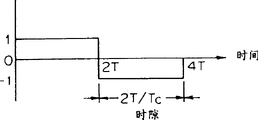
现在转到图26,所要描述的是用发送处理器70产生发送信号的发射机构成,发送处理器70由包括有限带滤波器的调制器(MED-F)73和扩展器(SPR)71级联而形成。经输入端68送来二进制数字信号DS。现在令数字信号DS的时钟周期用T来表示。由调制器73形成的调制器75使用数字信号DS产生限带信号,已调输出的限带信号波形如图27所示,主瓣跨越2T,因此,已调信号的眼图就如图28所示的那样。扩展调制器即扩展器71把已调信号与时隙周期Tc的扩展码Cs相乘,并把相乘后的信号送到输出端72。这个已调信号在自适应扩频接收机中被去扩展成为图27中所示的基本横跨+2T的波形的信号,这样,由匹配滤波器、相关器、横向滤波器等等所构成的去扩展器对多码元进行去扩展处理,而在采用限带技术时,则仅对一个码元进行处理。例如:横向滤波器的长度被设定为覆盖几个码元。当在几个码元上进行去扩展处理时,码元的每一侧都会出现码元间干扰,因此,为了消除这种码元间干扰,同样也要进行消除干扰操作。在这个操作过程中,和多电平调制的情况一样,每个码元的取样数增加,因此,能被清除的信号数就增加。这样,直到传输特性不再由于码元间干扰而严重劣化为止,可被消除掉的信号数可以一直增大。Turning now to FIG. 26 , what will be described is a transmitter that generates a transmit signal with a transmit
发射机实施例3Transmitter Example 3
假定把RZ信号加到图22中的发送处理器70来产生发送信号,假定信道脉冲响应是如图14所示的2路径模型的脉冲响应,如图29A所示,直接(超前)路径29a和延迟路径29b被组合起来,其中△T=t2-t1。当用RZ信号产生如图29B所示的码元波形的已调信号时,在一个码元周期T期间内可以抑制其他码元的信号泄漏,即码元间干扰,因此,能抑制多径传播的劣化。该例的实际应用中,图29B中的△T只需设定得近似等于传播路径的延迟扩展。Assume that the RZ signal is added to the transmit
发射机实施例4Transmitter Example 4
图30中所说明的发送处理器70被设计得把同长度的训练信号插入在帧格式的传输信号的各帧中同样位置上。在帧发生器75中,形成帧数据信号的数字信号DS用训练信号发生器76输出的训练信号TR按每个固定的长度被合成为一帧。由帧发生器75输出的输出信号在调制器(MOD)69中被调制并在扩展器(SPR)71中用扩展码Cs扩展频谱,此后被作为发送信号送到端子72。现在考虑向每个用户发送的定时都同步的同步系统,首先,如图31所示,训练信号TR被周期性地插入到各用户A和B的帧中,假定各用户的训练信号序列相互具有低的相关性,这种方式在接收机中估算加权系数W的时间强化了对去扩展信号的平均。换句话说,就是可以缩短启动自适应扩频接收机的时间。The
发射机实施例5Transmitter Example 5
图32和34说明的是用于自适应扩频方式和跳频方式相组合情况下的发射机和接收机。与图21的实施例一样,发射机的发送处理器70在调制器69中调制数字信号DS,在扩展调制器71中用扩展码Cs对调制信号进行扩展频谱,然后把信号送到端子72。在图32中,跳频合成器77按规定的时间间隔以与所有其他用户的载波信号同步的方式使载波频率产生跳频,然后在倍增器78中把端子72输出的输出信号与跳频载波相乘,并把相乘后的输出发送出去。通过跳频方法,如图33所示的那样,对全部用户#1至#K发送的载波频率都按规定的时间间隔TB产生频率f1和f2之间的频跳,其中TB是已调信号的码元持续期T的整数倍。Figures 32 and 34 illustrate the transmitter and receiver for the combination of the adaptive spreading scheme and the frequency hopping scheme. Like the embodiment of FIG. 21 , the transmitting
在接收机中,如图34所示,收到的信号被送到准相干检波器电路81,在那里用由跳频合成器79产生的跳频载频信号进行正交检波,并产生如图33所示的频跳;产生检波信号的同相分量I(t)和正交分量Q(t)。取样电路32对检波信号IQ取样,并输出取样信号SPS。如前面图5所示的信号提取器33对取样信号SPS进行去扩展和线性合成,并输出合成信号。解调器34解调合成信号,并把判定信号送到输出端17。自适应扩频方式和跳频方式的组合使用产生了频率分集效果,因此改善了传输特性。In the receiver, as shown in FIG. 34, the received signal is sent to the quasi-coherent detector circuit 81, where the frequency-hopping carrier frequency signal generated by the frequency-hopping synthesizer 79 is used for quadrature detection, and the resulting Frequency hopping shown in 33; generate in-phase component I(t) and quadrature component Q(t) of the detection signal. The
发射机实施例6Transmitter Example 6
顺便要提及的是自适应扩频接收机的自适应算法的收敛要求由该算法的时间常数限定的瞬态响应时间,因此,如果一个用户突然输出发送功率,在瞬态响应时间Tt期间就不能除掉干扰分量,而导致传输性能变坏。新的发送开始时,如果考虑如图35所示的那种瞬态响应时间Tt使功率缓慢增加,那么对其它用户的影响就可以减弱。图36中说明的发射机被设计得在大约与自适应算法的时间常数相同的时间周期内逐渐增大载波电平,由与图22所示的结构相同的发送处理器70输出的发射信号在乘法器78乘以由振荡器77L输出的载波,然后把它的已调载波送到放大器AMP。增益控制器84控制放大器AMP的增益,以便在发送开始之后增益逐渐增大,并在经过图35所示的时间Tt之后保持在预定值。Incidentally, it is to be mentioned that the convergence of the adaptive algorithm of the adaptive spread spectrum receiver requires a transient response time limited by the time constant of the algorithm, therefore, if a user suddenly outputs transmit power, during the transient response time Tt The interference component cannot be removed, resulting in poor transmission performance. When a new transmission starts, if the power is slowly increased considering the transient response time Tt shown in Figure 35, the impact on other users can be weakened. The transmitter illustrated in FIG. 36 is designed to gradually increase the carrier level within approximately the same time period as the time constant of the adaptive algorithm, and the transmit signal output by the transmit
瞬态响应时间最好尽可能短,对于使用这种方式来说,要求这样做,这是因为在与一种方式组合时,如果误差很小,为了缩短瞬态响应时间,要临时减小自适应算法的时间常数。The transient response time is best to be as short as possible. For this method, it is required to do so. This is because when combined with a method, if the error is small, in order to shorten the transient response time, it is necessary to temporarily reduce the auto The time constant of the adaptation algorithm.
发射机实施例7Transmitter Example 7
例如:使用按频响滚降率1.0波形成型的脉冲串的扩展码Cs进行扩展时,将得到类似于图27所示的波形;用Tc来表示时隙周期,在取样定时为:For example: when using the spreading code Cs of the pulse train shaped by the frequency response roll-off rate of 1.0 for spreading, a waveform similar to that shown in Figure 27 will be obtained; Tc is used to represent the time slot cycle, and the sampling timing is:
±(2m+1)Tc/2,m=1、2、……处,脉冲波形为零,所述取样定时除±Tc/2之外,是Tc/2的奇数倍(在图27的情况下,在取样定时为±Tc/2处,脉冲波形也为零)。因此,相同滚降率的扩展码之间的互相关性在相互移位Tc/2的奇数倍之后就包含有许多带有零点的倍加量,相关值变小。例如:图37表示为了利用上述现象来减小相关值的发送处理器70的构成,对于由基站发射的用许多用户的扩展码扩展了的已调信号的一半来说,延迟电路82连接到扩展器71的输出端,以便把调制并扩展过的发射信号的定时移位+3Tc/2或-3Tc/2,由此,使信号之间的互相关值中增加带多个零值的倍加量,从而减小了相关值。互相关量越低,干扰消除性能就越高;因此,这种时序移位明显地改善了传输特性。一旦用户数量增加,所需要的扩展码的数量也增加,另一方面,在不同步状态下具有高的相互正交性的扩展码的数量是有限的,但是用位移不同用户组中的各个发射信号的时序来减小扩展码之间的相关性,就有可能把各个扩展码共用于不同组的用户。±(2m+1)Tc/2, where m=1, 2, ..., the pulse waveform is zero, and the sampling timing is an odd multiple of Tc/2 except ±Tc/2 (in the case of Fig. 27 , at the sampling timing of ±Tc/2, the pulse waveform is also zero). Therefore, the cross-correlation between spreading codes with the same roll-off rate includes many multiplications with zero points after being shifted by an odd multiple of Tc/2, and the correlation value becomes smaller. For example: Fig. 37 shows the composition of the transmitting
如上所述,本发明用正交化方法能有效地消除干扰,并提供一种自适应扩频接收机,它不需要有关其它用户的扩展码和接收定时的信息、训练信号和判定结果,另外,可以采用适合于使用这种接收机的系统的扩频调制方式来实施极好的通信系统。由于能够有效地消除干扰分量,所以通信系统的信道容量可以急剧地增加。As described above, the present invention can effectively eliminate interference by using the orthogonalization method, and provides an adaptive spread spectrum receiver that does not require information about other users' spreading codes and reception timing, training signals, and decision results, and in addition , an excellent communication system can be implemented using a spread spectrum modulation method suitable for a system using such a receiver. Since the interference component can be effectively eliminated, the channel capacity of the communication system can be drastically increased.
当把本发明用于许多用户共用同样载波频率的无线通信中时,它是极为实用的,因为移动无线通信中用户的呼叫是按时序变化的,所以在自动从收到的信号中提取这种信息并自适应于变化的那种类型的接收机中,本发明是特别有效的。When the present invention is used in the wireless communication that many users share the same carrier frequency, it is extremely practical, because the call of the user changes in time sequence in the mobile wireless communication, so extracting this kind of signal automatically from the received signal The invention is particularly effective in receivers of the type in which the information is not adaptive to changes.
Claims (24)
Applications Claiming Priority (3)
| Application Number | Priority Date | Filing Date | Title |
|---|---|---|---|
| JP16836/94 | 1994-02-10 | ||
| JP1683694 | 1994-02-10 | ||
| JP16836/1994 | 1994-02-10 |
Publications (2)
| Publication Number | Publication Date |
|---|---|
| CN1122176A true CN1122176A (en) | 1996-05-08 |
| CN1059530C CN1059530C (en) | 2000-12-13 |
Family
ID=11927294
Family Applications (1)
| Application Number | Title | Priority Date | Filing Date |
|---|---|---|---|
| CN95190001A Expired - Fee Related CN1059530C (en) | 1994-02-10 | 1995-02-09 | Adaptive spread spectrum receiver |
Country Status (8)
| Country | Link |
|---|---|
| US (1) | US5757845A (en) |
| EP (1) | EP0701344B1 (en) |
| JP (1) | JP2807568B2 (en) |
| KR (1) | KR0158092B1 (en) |
| CN (1) | CN1059530C (en) |
| CA (1) | CA2151284C (en) |
| DE (1) | DE69521852T2 (en) |
| WO (1) | WO1995022214A1 (en) |
Cited By (2)
| Publication number | Priority date | Publication date | Assignee | Title |
|---|---|---|---|---|
| CN108809873A (en) * | 2018-06-14 | 2018-11-13 | 中国科学院声学研究所 | A kind of signal synthesis method and system |
| CN109581049A (en) * | 2017-09-29 | 2019-04-05 | 罗德施瓦兹两合股份有限公司 | The measuring device and method that phase coherence for Frequency Hopping Signal is analyzed |
Families Citing this family (79)
| Publication number | Priority date | Publication date | Assignee | Title |
|---|---|---|---|---|
| US5812542A (en) * | 1996-03-18 | 1998-09-22 | Motorola, Inc. | Method for determining weighting coefficients in a CDMA radio receiver |
| US5345472A (en) | 1993-08-02 | 1994-09-06 | Motorola, Inc. | Method and apparatus for receiving and decoding communication signals in a CDMA receiver |
| US5414699A (en) | 1993-09-27 | 1995-05-09 | Motorola, Inc. | Method and apparatus for receiving and decoding communication signals in a CDMA receiver using partial de-correlation |
| US5844951A (en) * | 1994-06-10 | 1998-12-01 | Northeastern University | Method and apparatus for simultaneous beamforming and equalization |
| FI96651C (en) * | 1994-08-25 | 1996-07-25 | Nokia Telecommunications Oy | Reception procedure and recipients |
| JP3598609B2 (en) * | 1995-09-20 | 2004-12-08 | 双葉電子工業株式会社 | Receiver for spread spectrum communication system |
| JP2888784B2 (en) * | 1995-10-23 | 1999-05-10 | 株式会社鷹山 | Matched filter circuit |
| JP2944492B2 (en) * | 1995-11-10 | 1999-09-06 | 国際電気株式会社 | Matched filter device |
| CN1092431C (en) * | 1995-11-29 | 2002-10-09 | Ntt移动通信网株式会社 | Diversity receiver and control method therefor |
| JP2911105B2 (en) | 1995-12-06 | 1999-06-23 | エヌ・ティ・ティ移動通信網株式会社 | Adaptive spread spectrum receiver |
| EP0792051A3 (en) * | 1996-02-23 | 1999-07-07 | Ascom Tech Ag | Method for the coherent demodulation of a received signal |
| JP2820918B2 (en) * | 1996-03-08 | 1998-11-05 | 株式会社ワイ・アール・ピー移動通信基盤技術研究所 | Spread spectrum communication equipment |
| US5809020A (en) * | 1996-03-18 | 1998-09-15 | Motorola, Inc. | Method for adaptively adjusting weighting coefficients in a cDMA radio receiver |
| DE19623667C2 (en) * | 1996-06-13 | 2003-02-13 | Siemens Ag | Method and device for the detection of information transmitted according to the DS-CDMA principle in a receiving device |
| FR2757330B1 (en) * | 1996-12-18 | 1999-01-15 | Commissariat Energie Atomique | METHOD FOR TRANSMITTING INFORMATION BY PULSE RESPONSE AND CORRESPONDING RECEIVER |
| JP3377389B2 (en) * | 1997-01-10 | 2003-02-17 | 株式会社鷹山 | Signal receiving method and apparatus in spread spectrum wireless communication system |
| JP3300252B2 (en) * | 1997-04-02 | 2002-07-08 | 松下電器産業株式会社 | Adaptive transmission diversity apparatus and adaptive transmission diversity method |
| US5956369A (en) * | 1997-02-24 | 1999-09-21 | Golden Bridge Technology, Inc. | Spread spectrum multipath combining subsystem and method |
| IL120898A (en) * | 1997-05-22 | 2000-02-17 | D S P C Israel Ltd | Bi-directional channel analysis |
| JP2853741B2 (en) | 1997-06-03 | 1999-02-03 | 日本電気株式会社 | CDMA receiver |
| FI104020B1 (en) * | 1997-06-23 | 1999-10-29 | Nokia Telecommunications Oy | Reception procedure and recipients |
| JPH1188118A (en) * | 1997-09-03 | 1999-03-30 | Matsushita Electric Ind Co Ltd | Matched filter and timing detection method |
| US6185258B1 (en) | 1997-09-16 | 2001-02-06 | At&T Wireless Services Inc. | Transmitter diversity technique for wireless communications |
| WO1999023766A2 (en) | 1997-10-31 | 1999-05-14 | At & T Wireless Services, Inc. | Maximum likelihood detection of concatenated space-time codes for wireless applications with transmitter diversity |
| US6188736B1 (en) | 1997-12-23 | 2001-02-13 | At&T Wireless Svcs. Inc. | Near-optimal low-complexity decoding of space-time codes for fixed wireless applications |
| JP3305639B2 (en) | 1997-12-24 | 2002-07-24 | 株式会社エヌ・ティ・ティ・ドコモ | RAKE receiver in direct spread CDMA transmission system |
| US7076168B1 (en) * | 1998-02-12 | 2006-07-11 | Aquity, Llc | Method and apparatus for using multicarrier interferometry to enhance optical fiber communications |
| US6167024A (en) * | 1998-03-17 | 2000-12-26 | Trw Inc. | Multiple channel control using orthogonally modulated coded drive signals |
| JP3406831B2 (en) * | 1998-03-19 | 2003-05-19 | 富士通株式会社 | Array antenna system for wireless base station |
| US6385185B1 (en) * | 1998-06-25 | 2002-05-07 | Lucent Technologies Inc. | Methods and apparatus for coherent detection of signals with orthogonal data modulation |
| JP2000082982A (en) * | 1998-09-03 | 2000-03-21 | Nec Corp | Array antenna reception device |
| US6459740B1 (en) | 1998-09-17 | 2002-10-01 | At&T Wireless Services, Inc. | Maximum ratio transmission |
| US6577686B1 (en) * | 1998-10-13 | 2003-06-10 | Matsushita Electric Industrial Co., Ltd. | Receiver |
| JP3338662B2 (en) | 1999-03-31 | 2002-10-28 | 松下電器産業株式会社 | Receiver and decoding method |
| US6426973B1 (en) * | 1999-04-29 | 2002-07-30 | The Board Of Trustees Of The University Of Illinois | Differential minimum mean squared error communication signal compensation method |
| GB0005591D0 (en) * | 2000-03-09 | 2000-05-03 | Koninkl Philips Electronics Nv | Method of and receiver for detecting the presence of a data |
| US20030206577A1 (en) | 2000-03-21 | 2003-11-06 | Liberti Joseph Charles | Combined adaptive spatio-temporal processing and multi-user detection for CDMA wireless systems |
| JP3397744B2 (en) * | 2000-03-28 | 2003-04-21 | 松下電器産業株式会社 | Communication device and CDMA communication method |
| AU2001280129A1 (en) * | 2000-09-04 | 2002-03-22 | Sanyo Electric Co., Ltd. | Radio base system, sampling error reducing method, and sampling error reducing program |
| US6404803B1 (en) * | 2000-10-24 | 2002-06-11 | Neoreach, Inc. | PN code acquisition with adaptive antenna array and adaptive threshold for CDMA wireless communications |
| KR100394850B1 (en) * | 2000-11-02 | 2003-08-19 | 주식회사 하이닉스반도체 | Orthogonal walsh reverse spreader using cma |
| US6574269B1 (en) * | 2000-11-21 | 2003-06-03 | Bbnt Solutions Llc | Asymmetric orthogonal codes for wireless system receivers with multiplication-free correlators |
| US6574268B1 (en) * | 2000-11-21 | 2003-06-03 | Bbnt Solutions Llc | Asymmetric orthogonal codes for optical communications |
| US6771611B1 (en) * | 2000-12-01 | 2004-08-03 | Advanced Micro Devices, Inc. | Frame generation circuit and method |
| US7110349B2 (en) * | 2001-03-06 | 2006-09-19 | Brn Phoenix, Inc. | Adaptive communications methods for multiple user packet radio wireless networks |
| US6912241B2 (en) * | 2001-03-08 | 2005-06-28 | Regents Of University Of Minnesota | Chip-interleaved, block-spread multi-user communication |
| US6748024B2 (en) * | 2001-03-28 | 2004-06-08 | Nokia Corporation | Non-zero complex weighted space-time code for multiple antenna transmission |
| JP2002374179A (en) * | 2001-06-12 | 2002-12-26 | Hitachi Kokusai Electric Inc | Interference signal canceller |
| US7161974B2 (en) * | 2001-09-10 | 2007-01-09 | Sasken Communication Technologies Ltd. | Method for 2D antenna rake combining in a code division multiplication access system |
| DE10201429A1 (en) * | 2002-01-16 | 2003-07-31 | Rohde & Schwarz | Method for determining scalar products e.g. with CDMA signals, requires forming complete part-scalar products between part signal sections of input signal |
| US7403509B2 (en) * | 2003-05-09 | 2008-07-22 | Regents Of The University Of Minnesota | Receiver for chip-interleaved block-spread multi-user communication systems |
| US7418040B2 (en) * | 2003-05-30 | 2008-08-26 | Motorola, Inc. | Method and apparatus for determining a timing offset for processing a multi-carrier signal |
| US7437135B2 (en) | 2003-10-30 | 2008-10-14 | Interdigital Technology Corporation | Joint channel equalizer interference canceller advanced receiver |
| CN1625066A (en) * | 2003-12-05 | 2005-06-08 | 皇家飞利浦电子股份有限公司 | Two-dimensional Rick receiver for radio communication system |
| US7302009B2 (en) * | 2003-12-17 | 2007-11-27 | Qualcomm Incorporated | Broadcast transmission with spatial spreading in a multi-antenna communication system |
| US8204149B2 (en) | 2003-12-17 | 2012-06-19 | Qualcomm Incorporated | Spatial spreading in a multi-antenna communication system |
| TWI394396B (en) * | 2003-12-17 | 2013-04-21 | Qualcomm Inc | Spatial expansion in a multi-antenna communication system |
| US7336746B2 (en) * | 2004-12-09 | 2008-02-26 | Qualcomm Incorporated | Data transmission with spatial spreading in a MIMO communication system |
| US7400692B2 (en) | 2004-01-14 | 2008-07-15 | Interdigital Technology Corporation | Telescoping window based equalization |
| US8169889B2 (en) | 2004-02-18 | 2012-05-01 | Qualcomm Incorporated | Transmit diversity and spatial spreading for an OFDM-based multi-antenna communication system |
| US20050238111A1 (en) * | 2004-04-09 | 2005-10-27 | Wallace Mark S | Spatial processing with steering matrices for pseudo-random transmit steering in a multi-antenna communication system |
| US8923785B2 (en) * | 2004-05-07 | 2014-12-30 | Qualcomm Incorporated | Continuous beamforming for a MIMO-OFDM system |
| US8285226B2 (en) * | 2004-05-07 | 2012-10-09 | Qualcomm Incorporated | Steering diversity for an OFDM-based multi-antenna communication system |
| US7110463B2 (en) * | 2004-06-30 | 2006-09-19 | Qualcomm, Incorporated | Efficient computation of spatial filter matrices for steering transmit diversity in a MIMO communication system |
| US7978649B2 (en) * | 2004-07-15 | 2011-07-12 | Qualcomm, Incorporated | Unified MIMO transmission and reception |
| US7894548B2 (en) * | 2004-09-03 | 2011-02-22 | Qualcomm Incorporated | Spatial spreading with space-time and space-frequency transmit diversity schemes for a wireless communication system |
| US7978778B2 (en) * | 2004-09-03 | 2011-07-12 | Qualcomm, Incorporated | Receiver structures for spatial spreading with space-time or space-frequency transmit diversity |
| US7483479B2 (en) | 2004-09-16 | 2009-01-27 | Keyeye Communications | Scaled signal processing elements for reduced filter tap noise |
| WO2007078282A2 (en) * | 2004-12-23 | 2007-07-12 | Radix Technologies | Wideband interference cancellation using dsp algorithms |
| JP4693462B2 (en) * | 2005-03-31 | 2011-06-01 | 富士通テン株式会社 | Diversity receiving apparatus and method |
| US7415082B2 (en) * | 2005-05-31 | 2008-08-19 | Harris Corporation | Receiver including synch pulse detection and associated method |
| US8543070B2 (en) | 2006-04-24 | 2013-09-24 | Qualcomm Incorporated | Reduced complexity beam-steered MIMO OFDM system |
| US8290089B2 (en) * | 2006-05-22 | 2012-10-16 | Qualcomm Incorporated | Derivation and feedback of transmit steering matrix |
| US7499515B1 (en) * | 2007-08-27 | 2009-03-03 | Harris Corporation | System and method for automated link quality measurement for adaptive modulation systems using noise level estimates |
| US7555064B2 (en) * | 2007-08-27 | 2009-06-30 | Harris Corporation | System and method for estimating noise power level in a multi-signal communications channel |
| JP4778982B2 (en) * | 2008-05-22 | 2011-09-21 | 日本電信電話株式会社 | Reception apparatus and interference suppression method |
| US8385387B2 (en) * | 2010-05-20 | 2013-02-26 | Harris Corporation | Time dependent equalization of frequency domain spread orthogonal frequency division multiplexing using decision feedback equalization |
| US10139473B2 (en) * | 2015-02-02 | 2018-11-27 | Panasonic Intellectual Property Management Co., Ltd. | Radar apparatus including transmitting antenna and receiving antenna |
| CN106685473B (en) * | 2016-12-22 | 2018-03-02 | 惠科股份有限公司 | Spread spectrum decoding method of transmission signal, terminal and display device |
Family Cites Families (12)
| Publication number | Priority date | Publication date | Assignee | Title |
|---|---|---|---|---|
| US4422175A (en) * | 1981-06-11 | 1983-12-20 | Racal-Vadic, Inc. | Constrained adaptive equalizer |
| US4550414A (en) * | 1983-04-12 | 1985-10-29 | Charles Stark Draper Laboratory, Inc. | Spread spectrum adaptive code tracker |
| US4528674A (en) * | 1983-08-22 | 1985-07-09 | E-Systems, Inc. | Method and apparatus for baseband generation of a spread spectrum reference signal for use in an LMS adaptive array processor |
| DE4241882A1 (en) * | 1991-12-13 | 1993-06-17 | Clarion Co Ltd | |
| US5268927A (en) * | 1992-10-06 | 1993-12-07 | Mayflower Communications Company, Inc. | Digital adaptive transversal filter for spread spectrum receivers |
| US5590160A (en) * | 1992-12-30 | 1996-12-31 | Nokia Mobile Phones Ltd. | Symbol and frame synchronization in both a TDMA system and a CDMA |
| US5359624A (en) * | 1993-06-07 | 1994-10-25 | Motorola, Inc. | System and method for chip timing synchronization in an adaptive direct sequence CDMA communication system |
| US5414699A (en) * | 1993-09-27 | 1995-05-09 | Motorola, Inc. | Method and apparatus for receiving and decoding communication signals in a CDMA receiver using partial de-correlation |
| WO1995010891A1 (en) * | 1993-10-13 | 1995-04-20 | Ntt Mobile Communications Network Inc. | Receiver for spread spectrum communication |
| JP2636712B2 (en) * | 1993-12-08 | 1997-07-30 | 日本電気株式会社 | Mobile communication device |
| JPH07170210A (en) * | 1993-12-16 | 1995-07-04 | Nec Corp | Spread spectrum modulation / demodulation method and modulator / demodulator using the same |
| US5592506A (en) * | 1994-10-17 | 1997-01-07 | Cylink Corporation | MSK spread-spectrum receiver which allows CDMA operations |
-
1995
- 1995-02-09 US US08/446,717 patent/US5757845A/en not_active Expired - Lifetime
- 1995-02-09 KR KR1019950702481A patent/KR0158092B1/en not_active Expired - Fee Related
- 1995-02-09 CN CN95190001A patent/CN1059530C/en not_active Expired - Fee Related
- 1995-02-09 CA CA 2151284 patent/CA2151284C/en not_active Expired - Fee Related
- 1995-02-09 DE DE69521852T patent/DE69521852T2/en not_active Expired - Lifetime
- 1995-02-09 WO PCT/JP1995/000179 patent/WO1995022214A1/en not_active Ceased
- 1995-02-09 EP EP19950907863 patent/EP0701344B1/en not_active Expired - Lifetime
- 1995-02-09 JP JP51372395A patent/JP2807568B2/en not_active Expired - Fee Related
Cited By (3)
| Publication number | Priority date | Publication date | Assignee | Title |
|---|---|---|---|---|
| CN109581049A (en) * | 2017-09-29 | 2019-04-05 | 罗德施瓦兹两合股份有限公司 | The measuring device and method that phase coherence for Frequency Hopping Signal is analyzed |
| CN109581049B (en) * | 2017-09-29 | 2022-05-31 | 罗德施瓦兹两合股份有限公司 | Measuring device and method for phase-coherent analysis of frequency-hopping signals |
| CN108809873A (en) * | 2018-06-14 | 2018-11-13 | 中国科学院声学研究所 | A kind of signal synthesis method and system |
Also Published As
| Publication number | Publication date |
|---|---|
| CA2151284A1 (en) | 1995-08-11 |
| KR0158092B1 (en) | 1998-12-01 |
| CN1059530C (en) | 2000-12-13 |
| WO1995022214A1 (en) | 1995-08-17 |
| DE69521852T2 (en) | 2002-04-04 |
| EP0701344B1 (en) | 2001-07-25 |
| EP0701344A1 (en) | 1996-03-13 |
| EP0701344A4 (en) | 1998-09-30 |
| US5757845A (en) | 1998-05-26 |
| CA2151284C (en) | 2000-04-25 |
| KR950704877A (en) | 1995-11-20 |
| JP2807568B2 (en) | 1998-10-08 |
| DE69521852D1 (en) | 2001-08-30 |
Similar Documents
| Publication | Publication Date | Title |
|---|---|---|
| CN1059530C (en) | Adaptive spread spectrum receiver | |
| JPWO1995022214A1 (en) | Adaptive spread spectrum receiver | |
| US7822395B2 (en) | Iterative multi-stage detection technique for a diversity receiver having multiple antenna elements | |
| US8619920B2 (en) | Two-dimensional code spreading for interleaved FDMA system | |
| JP4365446B2 (en) | Channel gain estimation in a rake receiver. | |
| CN101150324A (en) | RF receiver and its operation method | |
| CN1449603A (en) | Method and apparatus for processing a modulated signal using an equalizer and a rake receiver | |
| EP2052461A2 (en) | Digital radio systems | |
| US8565287B2 (en) | Method and system for per-cell interference estimation for interference suppression | |
| CN102007703A (en) | Method and apparatus for successive interference subtraction with covariance root processing | |
| JP2006512830A (en) | Multi-antenna solution for mobile handsets | |
| CN1300477A (en) | A method and device for despreading an offset signal | |
| WO2001054306A1 (en) | Radio base station device and radio communication method | |
| US7463609B2 (en) | Interference cancellation within wireless transceivers | |
| JP2005323384A (en) | Linear filter equalizer | |
| US7257152B2 (en) | Method and apparatus for reducing the processing rate of a chip-level equalization receiver | |
| JP2005175775A (en) | Equalizer and initial value setting method thereof | |
| US20060072449A1 (en) | Method and system for channel equalization | |
| JP2655116B2 (en) | CDMA transceiver | |
| JP3718403B2 (en) | Rake receiver | |
| KR20070086949A (en) | Diversity receiver with improved NLM chip level equalization | |
| KR100351732B1 (en) | Blind/adaptive interference canceller and method, blind/adaptive interference cancellation apparatus, system and method used that | |
| WO2013172808A1 (en) | Decision-directed nlms equalizer by despreading with a parent code of a group of active codes. | |
| KR100665704B1 (en) | Parallel Detection Feedforward Interference Cancellation Method Using Chip Equalizer and Its Apparatus | |
| KR20000047073A (en) | Receiving circuit using adaptive antenna array of ds-cdma terminal and base station system |
Legal Events
| Date | Code | Title | Description |
|---|---|---|---|
| C06 | Publication | ||
| PB01 | Publication | ||
| C10 | Entry into substantive examination | ||
| SE01 | Entry into force of request for substantive examination | ||
| C14 | Grant of patent or utility model | ||
| GR01 | Patent grant | ||
| C17 | Cessation of patent right | ||
| CF01 | Termination of patent right due to non-payment of annual fee |
Granted publication date: 20001213 Termination date: 20140209 |