Background
The fuel cell takes hydrogen as fuel, does not need to pass through a combustion process, directly converts chemical energy in the fuel and an oxidant into electric energy in an electrochemical reaction mode, does not need to pass through a heat engine process, is not limited by Carnot cycle, and has the actual energy conversion efficiency as high as 50 to 80 percent, so the fuel cell is a high-efficiency conversion power generation device. Proton exchange membrane fuel cells, which are the fifth generation fuel cells, were developed after alkaline fuel cells, phosphoric acid type fuel cells, molten carbonate fuel cells, and solid oxide fuel cells, have several advantages, including lower operating temperature, short start-up time, high power density, fast load response, no electrolyte loss, etc.
Bipolar plates are important components of fuel cells. Conventional bipolar plate flow channels include, for example, parallel flow channels, serpentine flow channels, pin flow channels, interdigitated flow channels, and the like. These types of flow channels have respective advantages and disadvantages. For example, the pressure drop of the parallel flow channels is small, but the residence time of the reaction gas in the channels is short, so that the utilization rate of the reaction gas is low; the serpentine flow channel has stronger drainage performance, but when the flow channel is too long, the pressure drop of reaction gas is easy to be overlarge; the structure of the needle-shaped flow channel is simpler, but the short circuit of reaction gas is easy to occur; the interdigital flow channel strengthens convection mass transfer, is beneficial to improving the limit current density of the battery, but is easy to cause the retention of liquid water at the initial end of the flow channel.
In the traditional bipolar plate flow field, the reaction concentration of fluid on the membrane electrode corresponding to the bulge is very small, so that the contribution of the whole performance of the cell area is very small, and the effective improvement of the cell performance is influenced. The main reasons for this disadvantage are for example: the steps of the flow field protrusions of the bipolar plate are airtight, reaction gas flows in the flow field grooves and is transferred to the surfaces of the corresponding membrane electrodes, and the membrane electrodes passing through the flow field protrusions deform under the action of the fastening force of the galvanic pile, so that the reaction gas at the positions is low in concentration and even blocked by liquid water, and the bipolar plate is free of the reaction gas.
In summary, the bipolar plates in current pem fuel cell stacks, for example, suffer from one or more of the following disadvantages:
1) in the cell stack, the flow channel of the bipolar plate flow field causes the defects of insufficient reaction, low current density, difficult elimination of generated water and the like;
2) the area utilization rate of the reaction area of the flow channel of the bipolar plate flow field is low, and the area of the supporting surface is too large, so that the reaction efficiency of the fuel cell is limited;
3) the fuel cell flow channel in the current market has a single form, and the advantages of various flow channels are not reasonably utilized;
4) the membrane electrode at the bulge of the flow field deforms under the action of the fastening force of the electric pile, so that the concentration of the reaction gas at the bulge is very low, even the reaction gas is blocked by liquid water and is not generated, and the reaction capability of the fuel cell is limited.
The statements in this background section merely represent techniques known to the public and are not, of course, representative of the prior art.
Disclosure of Invention
The invention provides a corresponding solution for the above mentioned disadvantages, and aims to develop a novel flow channel, which can solve the disadvantages of insufficient reaction of gas, difficult discharge of generated water and blockage of a pipeline, low utilization rate of a reaction area and the like of the existing flow channel.
In view of at least one of the drawbacks of the prior art, the present disclosure proposes a bipolar plate structure usable for a fuel cell, comprising:
a substrate having an open flow field thereon for a fluid, the open flow field comprising a plurality of flow regions for the fluid; and
a plurality of projections disposed on the substrate and forming at least one of the plurality of flow regions, the plurality of projections having different flow resistances in a first direction and a second direction, wherein the first direction is perpendicular to the second direction.
According to one aspect of the present disclosure, wherein the plurality of flow regions includes an inlet region, a transition region, and a reaction region, the plurality of projections forming the inlet region, the transition region, and the reaction region.
According to one aspect of the present disclosure, wherein the plurality of protrusions includes a first set of protrusions and a second set of protrusions, wherein a height of the first set of protrusions is greater than a height of the second set of protrusions.
According to one aspect of the present disclosure, wherein the plurality of protrusions have one or more of a diamond shape, a rectangular shape, and an oval shape.
According to an aspect of the present disclosure, wherein the first direction is a length direction of the protrusion, the second direction is a width direction of the protrusion, and in the flow region, a flow resistance in the length direction is smaller than a flow resistance in the width direction.
According to one aspect of the present disclosure, wherein the protrusion has a length direction dimension of 1mm to 4mm, a width direction dimension of 0.5mm to 2mm, and an aspect ratio of preferably 1.5 to 6.
According to one aspect of the present disclosure, wherein the length directions of the projections in the inlet zone and the reaction zone are parallel to each other; the length direction of the projections in the transition zone is perpendicular to the length direction of the projections in the inlet zone and the reaction zone.
According to an aspect of the present disclosure, wherein in the transition zone, the number of projections gradually decreases in a direction away from the inlet zone.
According to an aspect of the present disclosure, wherein the substrate has recesses corresponding to the plurality of protrusions on a side thereof opposite to the plurality of protrusions, the side of the substrate having the plurality of protrusions serves as a fuel flow field and an air flow field, and the side of the substrate having the recesses serves as a coolant flow field.
The present disclosure also relates to a fuel cell comprising a bipolar plate structure as described above.
The present disclosure also relates to a fuel cell vehicle including the fuel cell system as described above.
The present disclosure also relates to a method of making a bipolar plate structure useful in a fuel cell, comprising:
providing or preparing a substrate having an open flow field thereon for a fluid, the open flow field comprising a plurality of flow regions for the fluid;
disposing a plurality of projections on the substrate to form at least one of the plurality of flow regions, the plurality of projections having different flow resistances in a first direction and a second direction, wherein the first direction is perpendicular to the second direction.
According to one aspect of the present disclosure, wherein the plurality of flow regions includes an inlet region, a transition region, and a reaction region, the plurality of projections forming the inlet region, the transition region, and the reaction region, the plurality of projections including a first set of projections and a second set of projections, wherein a height of the first set of projections is greater than a height of the second set of projections.
Through the embodiment of the disclosure, the bulge is arranged on the substrate and has different flow resistances along different directions, so that the fluid can be effectively guided to flow towards a proper direction, the reaction efficiency and the reaction uniformity of the fuel cell are effectively improved, and the power density of the electric pile is improved.
Detailed Description
In the following, only certain exemplary embodiments are briefly described. As those skilled in the art can appreciate, the described embodiments can be modified in various different ways, without departing from the spirit or scope of the present disclosure. Accordingly, the drawings and description are to be regarded as illustrative in nature, and not as restrictive.
In the description of the present disclosure, it is to be understood that the terms "center", "longitudinal", "lateral", "length", "width", "thickness", "upper", "lower", "front", "rear", "left", "right", "straight", "horizontal", "top", "bottom", "inner", "outer", "clockwise", "counterclockwise", and the like, indicate orientations or positional relationships based on those shown in the drawings, and are only for convenience of description and simplicity of description, but do not indicate or imply that the device or element being referred to must have a particular orientation, be constructed in a particular orientation, and be operated, and therefore should not be considered as limiting the present disclosure. Furthermore, the terms "first", "second" and "first" are used for descriptive purposes only and are not to be construed as indicating or implying relative importance or implicitly indicating the number of technical features indicated. Thus, features defined as "first", "second", may explicitly or implicitly include one or more of the described features. In the description of the present disclosure, "a plurality" means two or more unless specifically limited otherwise.
The following disclosure provides many different embodiments or examples for implementing different features of the disclosure. To simplify the disclosure of the present disclosure, specific example components and arrangements are described below. Of course, they are merely examples and are not intended to limit the present disclosure. Moreover, the present disclosure may repeat reference numerals and/or reference letters in the various examples, which have been repeated for purposes of simplicity and clarity and do not in themselves dictate a relationship between the various embodiments and/or arrangements discussed. In addition, the present disclosure provides examples of various specific processes and materials, but one of ordinary skill in the art may recognize applications of other processes and/or use of other materials.
The preferred embodiments of the present disclosure will be described below with reference to the accompanying drawings, and it should be understood that the preferred embodiments described herein are merely for purposes of illustrating and explaining the present disclosure and are not intended to limit the present disclosure.
First embodiment
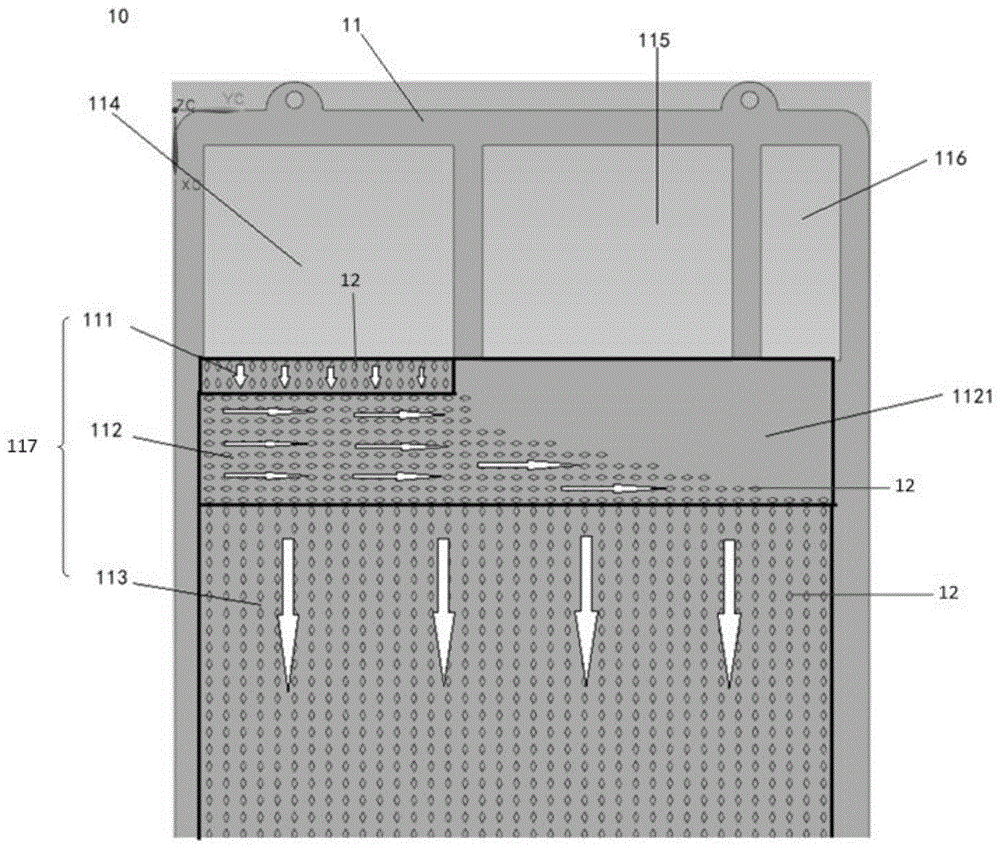
Fig. 1 illustrates a front view of a bipolar plate structure 10 that may be used in a fuel cell according to one embodiment of the present disclosure, and fig. 2 illustrates a perspective view of the bipolar plate structure 10. As shown in fig. 1, a bipolar plate structure 10 includes a substrate 11 (the substrate 11 is partially shown in fig. 1). Wherein the substrate 11 has an open flow field 117 thereon for fluid, the open flow field 117 comprising a plurality of flow regions for fluid (described in detail below). The bipolar plate structure 10 further includes a plurality of protrusions 12 disposed on the substrate 11 and forming at least one of the plurality of flow regions, the plurality of protrusions 12 having different flow resistances in a first direction and a second direction, wherein the first direction is perpendicular to the second direction. As described in detail below.
It will be understood by those skilled in the art that "open flow field" in the present disclosure is a type of flow field as opposed to a flow channel type flow field, and means that there are no closed flow channels in the flow field region where the fluid flows, the fluid flow is not limited by the direction of the flow channels, and is driven only by pressure, for example, there are no specially configured closed flow channels (such as flow channels in the form of parallel flow channels, serpentine flow channels, needle flow channels, interdigitated flow channels, etc.) in the flow field. Unlike the prior art, the embodiment of the present disclosure does not have a closed flow channel, but on an open-type flow field, by providing regular or irregular protrusions 12 on the bipolar plate, the fluid is guided along the direction of smaller flow resistance by using the difference of the flow resistance of the protrusions 12 in two directions.
The base 11 of the bipolar plate structure 10 is, for example, a metal substrate. The metal substrate has significant advantages in weight, performance, processability, cost, and is a preferred material for the bipolar plate substrate of a fuel cell. In addition, the substrate 11 can be a flat metal plate with a thickness of about 0.1mm, for example, which greatly reduces the weight of the bipolar plate. When the material of the substrate 11 is selected, a metal having stable properties and high conductivity in a highly corrosive environment is preferably selected. Preferably, a titanium plate can be adopted, and the titanium has stable property, high specific strength, good toughness and fatigue resistance. In addition, in order to increase conductivity, a material having good conductivity such as ruthenium or gold may be plated on the surface. The air inlet hole, the liquid inlet hole, the positioning hole and the like on the substrate 11 can be processed by adopting a laser cutting or linear cutting method.
As shown in fig. 1 and 2, a plurality of flow regions 117 of the substrate 11 are used for the flow of fuel cell gases and/or liquids thereover. In connection with FIG. 1, the flow region 117 is formed with a plurality of flow regions for fluids, including, for example and without limitation, the inlet zone 111, the transition zone 112, and the reaction zone 113. Wherein the inlet zone 111 is for example for receiving a fluid into the flow zone 117 and the transition zone 112 is for enabling a uniform, distributed entry of the fluid into the reaction zone 113, i.e. the activation zone of the flow zone. The fluid participates in the cell reaction at the reaction zone 113 and is then discharged.
In addition, according to a preferred embodiment of the present disclosure, the substrate 11 further has a fuel storage region 114, an air storage region 115, and a cooling liquid storage region 116, which will not be described in detail herein.
As described above, the projections 12 have different flow resistances in the first and second directions perpendicular to each other, and thus the projections 12 can guide the fluid in a direction in which the flow resistance is small when the fluid passes through the regions of the projections 12, as indicated by arrows in fig. 1.
FIG. 3 shows a schematic view of a flow region 117 according to a preferred embodiment of the present disclosure. As shown in fig. 3, a plurality of diamond-shaped protrusions 12 are distributed on the flow region 117, wherein the first direction is a length direction L of the protrusions 12, and the second direction is a width direction W of the protrusions. The dimension of the protrusion 12 in the length direction L is larger than the dimension W in the width direction, so that in the flow region 117, the resistance of the flow of the fluid in the length direction L (arrow FL) is smaller than the resistance of the flow in the width direction (arrow FW), and thus the flow guide effect in the length direction is provided. Instead of a diamond shape, the protrusions 12 may have other shapes, such as rectangular, oval, etc., and in addition, various combinations of protrusions 12 may be disposed on the flow region 117, such as a diamond shape for a portion of the protrusions 12 and an oval shape for a portion of the protrusions 12, which are within the scope of the present disclosure. It will be appreciated by those skilled in the art that for diamond shaped protrusions, the diagonals of the diamond shape cannot be equal in order to create different flow resistances in different directions. In addition, for a rectangular projection, the rectangle cannot be square.
By utilizing the difference of the flow resistance of the projections 12 in the length and width directions, the same arrangement direction as that of the reaction region 113 is used in the inlet region 111, namely, the length directions of the projections 12 in the inlet region 111 and the reaction region 113 are the same or parallel, and the fluid flow direction is parallel to the length direction of the projections 12; in the transition region 112, the arrangement direction of the protrusions 12 in the transition region is perpendicular to the arrangement direction of the protrusions 12 in the reaction region 113 by using the characteristic of large flow resistance in the width direction, so that after gas or liquid enters, the time for the gas or liquid to enter the reaction region 113 is increased by using the characteristics of large resistance in the width direction and small resistance in the length direction of the transition region, the time for the gas or liquid to be distributed in the width direction of the bipolar plate is reduced, and the gas or liquid uniformly enters the reaction region 113. In contrast, the reaction region 113 has a small flow resistance and a small pressure drop in the lengthwise direction, and thus guides flow in the direction of the arrow in fig. 1.
According to a preferred embodiment of the present disclosure, the protrusion 12 has a length dimension of 1mm to 4mm, a width dimension of 0.5mm to 2mm, and an aspect ratio of about 1.5 to 6.
According to a preferred embodiment of the present disclosure, as shown in fig. 1, the length directions of the protrusions 12 in the inlet zone 111 and the reaction zone 113 are parallel to each other; the length direction of the protrusions in the transition zone 112 is perpendicular to the length direction of the protrusions in the inlet zone 111 and the reaction zone 113.
According to a preferred embodiment of the present disclosure, as shown in fig. 1, wherein in the transition zone 112, the number of protrusions 12 gradually decreases in a direction away from the inlet zone 111. For example, in the transition region 112 in fig. 1, a region 1121 without the projection 12 is formed as gradually departing from the entrance region 111. By such an arrangement, the uniformity of the distribution of the reaction fluid and the uniformity of the reaction can be improved.
Fig. 4 shows a preferred embodiment according to the present disclosure. As shown in FIG. 4, the plurality of protrusions 12 includes a first set of protrusions 121 and a second set of protrusions 122, wherein the height of the first set of protrusions 121 is greater than the height of the second set of protrusions 122. Through setting up two sets of archs 121 and 122 of difference in height, the low arch makes when gas or liquid flow through, and the striking forms the torrent, and gas or liquid that originally flow towards the export direction realizes the air current that flows to fuel cell membrane electrode assembly direction at the arch, not only makes the gas reach the increase of fuel cell membrane electrode assembly reaction zone's volume like this, has also increased the velocity of flow and the activity of gas or liquid molecule, accelerates the reaction progress. In addition, because of the high first set of protrusions 121, the low second set of protrusions 122 leave gaps with the fuel cell membrane electrode assembly, allowing gas or liquid to flow through, increasing the reaction area of the fuel cell membrane electrode assembly. The first set of protrusions 121 not only has the same turbulence increasing effect as the second set of protrusions 122, but also can support the fuel cell membrane electrode assembly, conduct electrons of the fuel cell membrane electrode assembly, and prevent the fuel cell membrane electrode assembly from collapsing in the plane direction, thereby affecting the uniformity of gas flow and reaction. The two groups of bulges can adopt the shapes of regular rhombuses, rectangles or ellipses with different lengths and widths. The shape has anisotropy, the convex length direction is matched with the concave part to have small resistance, the flow guiding effect is realized, and the width direction resistance is large, so the flow blocking effect is realized. Because the gaps between every two bulges are not connected, the fluid can flow in the width direction of the gaps, and the reaction area is increased. The length of the protrusions is preferably in the range of 1mm to 4mm, the width is preferably in the range of 0.5 to 2mm, and the aspect ratio is preferably about 1.5 to 6. The interval between every two bulges is 0.5mm-4mm in the length direction, 0.5-4mm in the width direction and the interval ratio in the length direction and the width direction is 0.5-3. The height of the low second set of protrusions 122 is preferably 0.5mm to 1mm, the height of the high first set of protrusions 121 is preferably 1mm to 2mm, and the ratio of the heights of the first set and the second set of protrusions is controlled to be in the range of 1.2 to 4. In the length and width directions of the flow field, in order to increase the reaction area, one first set of bulges can be arranged between every 1-10 second sets of bulges. Of course, other irregular arrangements of the first and second sets of projections may be used.
In the above embodiments, the inlet region 111, the transition region 112 and the reaction region 113 of the substrate 11 are all provided with the protrusions 12, or the inlet region 111, the transition region 112 and the reaction region 113 are all formed by the protrusions 12. One skilled in the art will appreciate that the present disclosure is not so limited and one or more of the inlet zone 111, transition zone 112, and reaction zone 113 may also be configured to be formed by the projections 12. For example, the transition region 112 can be formed by the projections 12, while the inlet region 111, the reaction region 113 can be formed in another or conventional manner. Thus, the time for gas or liquid to enter the reaction region 113 is increased by the non-uniformity of the flow resistance in the length and width directions of the protrusions 12, the time for gas or liquid to be distributed in the width direction of the bipolar plate is decreased, and the gas or liquid is uniformly introduced into the reaction region 113. All of which are within the scope of the present disclosure.
According to one embodiment of the present disclosure, a stamping forming process may be employed in forming the protrusions 12, such that the opposite sides of the protrusions 12 are corresponding depressions. The side of the substrate having the depressions may serve as the coolant flow fields and the opposite side having the projections 12 may serve as the air flow fields and the fuel flow fields. Figure 5 shows a side view of a fuel cell stack. As shown in fig. 5, the bipolar plate, on the side having the projections, serves as an air flow field and a fuel flow field, and on the opposite side having the depressions, serves as a coolant flow field.
The embodiment of the disclosure solves the defects of insufficient reaction, low current density, difficult removal of generated water and the like which are difficult to overcome in the bipolar plate flow field flow channel of the proton exchange membrane fuel cell stack in the current market, improves the area utilization rate of the bipolar plate flow field flow channel reaction area, reduces the area of the supporting surface and improves the reaction efficiency.
The flow field designed by the embodiment of the disclosure does not have a closed flow channel, but adopts projections regularly or irregularly arranged on the bipolar plate. Two groups of bulges with different heights are also preferably arranged, and the low bulges enable the gas or the liquid to collide to form turbulent flow when flowing through, so that the gas reaches the reaction area of the membrane electrode assembly of the fuel cell in an increased amount, the flow speed and the activity of gas or liquid molecules are also increased, and the reaction progress is accelerated. The high protrusions leave gaps between the low protrusions and the fuel cell membrane electrode assembly, and gas or liquid can be allowed to flow through, so that the reaction area of the fuel cell membrane electrode assembly is increased. The high bulges not only have the function of increasing turbulence like the low bulges, but also can support the membrane electrode assembly of the fuel cell, conduct electrons of the membrane electrode assembly of the fuel cell and prevent the membrane electrode assembly of the fuel cell from collapsing in the plane direction to influence the uniformity of gas circulation and reaction.
Utilize the flow resistance difference of this protruding structure in length and width direction, use the same direction of arranging with reaction zone 13 in entrance area 11, utilize the characteristics of its length direction's big flow resistance in transition zone 12, adopt and arrange the perpendicular arrangement mode of direction with the reaction zone arch, it is big to make gas or liquid get into the back and can utilize transition zone width direction resistance, length direction resistance is little, increase the time that gas or liquid got into the reaction zone, reduce the time that gas or liquid distribute in bipolar plate width direction, with the even entering reaction zone of gas or liquid. In order to improve the uniformity, the arrangement density of the bulges is gradually reduced in a transition area far away from the air inlet until no bulge is needed. And conversely, the flow resistance of the reaction zone in the length direction is small, and the pressure drop is small.
Second embodiment
A second embodiment of the present disclosure is directed to a method 200 of making a bipolar plate structure useful in a fuel cell, described below with reference to fig. 6.
As shown in fig. 6, the method 200 includes:
in step S201, a substrate is provided or prepared. A substrate such as substrate 11 described above in the first embodiment section has an open flow field for fluid thereon comprising a plurality of flow regions for fluid.
In step S202, a plurality of protrusions having different flow resistances in a first direction and a second direction are provided on the substrate to form at least one of the plurality of flow regions, wherein the first direction is perpendicular to the second direction.
According to an embodiment of the present disclosure, wherein the plurality of flow regions includes an inlet region, a transition region, and a reaction region, the step S202 includes: the inlet zone, transition zone, and reaction zone are formed using the plurality of projections.
According to an embodiment of the present disclosure, the plurality of protrusions includes a first set of protrusions and a second set of protrusions, wherein the height of the first set of protrusions is greater than the height of the second set of protrusions, and the plurality of protrusions have one or more shapes of diamond, rectangle, and ellipse. The ratio of the height of the first set of projections to the height of the second set of projections is 1.2 to 4.
According to an embodiment of the present disclosure, wherein the first direction is a length direction of the protrusion and the second direction is a width direction of the protrusion, a flow resistance in the length direction is smaller than a flow resistance in the width direction in the flow region.
According to one embodiment of the present disclosure, the length direction of the protrusion is 1mm to 4mm, the width direction of the protrusion is 0.5mm to 2mm, and the aspect ratio is preferably about 1.5 to 6.
According to one embodiment of the present disclosure, wherein the length directions of the projections in the inlet zone and the reaction zone are parallel to each other; the length direction of the projections in the transition zone is perpendicular to the length direction of the projections in the inlet zone and the reaction zone.
According to an embodiment of the present disclosure, wherein in the transition zone, the number of protrusions gradually decreases in a direction away from the inlet zone.
According to an embodiment of the present disclosure, the substrate has recesses corresponding to the plurality of protrusions on a side thereof opposite to the plurality of protrusions, the side of the substrate having the plurality of protrusions serves as a fuel flow field and an air flow field, and the side of the substrate having the recesses serves as a coolant flow field.
Third embodiment
A third embodiment of the present disclosure is also directed to a fuel cell including the bipolar plate structure 10 as described above.
A third embodiment of the present disclosure is also directed to a fuel cell vehicle including the fuel cell system as described above.
The above description is only exemplary of the present disclosure and should not be taken as limiting the disclosure, as any modification, equivalent replacement, or improvement made within the spirit and principle of the present disclosure should be included in the scope of protection of the present disclosure.
Finally, it should be noted that: although the present disclosure has been described in detail with reference to the foregoing embodiments, it will be apparent to those skilled in the art that changes may be made in the embodiments and/or equivalents thereof without departing from the spirit and scope of the disclosure. Any modification, equivalent replacement, improvement and the like made within the spirit and principle of the present disclosure should be included in the protection scope of the present disclosure.