Detailed Description
A flow rate variable valve mechanism according to an aspect of the present disclosure includes: a valve including a valve body and a valve shaft protruding from the valve body and having an axis; a stopper member fixed to the valve shaft at a position separated from the valve body in the axial direction; a mounting member disposed between the valve body and the stopper member, and holding the valve together with the stopper member; and a spring washer disposed between the stopper member and the mounting member or between the mounting member and the valve body, and contacting a first member as the stopper member or the valve body and a second member as the mounting member to apply an elastic force to the mounting member, wherein the spring washer includes an outer peripheral portion contacting either the first member or the second member, and an inner surface facing radially inward and facing the outer peripheral portion of the spring washer is formed on either the first member or the second member.
According to this variable flow rate valve mechanism, the spring washer is in contact with the first member as the stopper member or the valve body and the second member as the mounting member, and applies an elastic force to the mounting member. The spring washer can reduce abrasion of a contact portion between the stopper member, the mounting member, and the valve body or vibration of the valve or the like. When the distance between the first member and the second member is shortened, the spring washer is deformed by the force in the axial direction. When the spring washer is to extend in the radial direction, the inner surface formed on either the first member or the second member is in contact with the outer peripheral portion of the spring washer. Therefore, the spring washer is restrained from deforming radially outward. As a result, deterioration in the elasticity of the spring washer can be suppressed.
In some aspects, either one of the first member and the second member includes a protrusion protruding toward a gap formed between the first member and the second member, and an inner surface facing an outer peripheral portion of the spring washer is formed on the protrusion. The spring washer includes the convex portion of the inner surface facing (or contacting) the outer peripheral portion of the spring washer, and deformation of the spring washer outward in the radial direction can be reliably suppressed.
In several forms, any other of the first member and the second member includes: a seat surface for the spring washer to contact all the time; and a recessed portion that is formed at a position facing the convex portion in the axial direction, is recessed from the seat surface, and can receive the convex portion. In this case, when the spring washer is deformed by reducing the distance between the first member and the second member, the convex portion is received by the concave portion. Thus, the relative movement distance in the axial direction of the first member and the second member is ensured. The convex portion including the inner surface suppresses deformation of the spring washer, and the axial stroke is ensured to sufficiently exert the elastic force of the spring washer.
In some aspects, any other of the first member and the second member includes: a seat surface for the spring washer to contact all the time; and a flat portion formed at a position facing the convex portion in the axial direction and coplanar with the seating surface. In this case, when the spring washer is deformed by reducing the distance between the first member and the second member, the convex portion comes into contact with the flat portion. Since the flat portion is flush with the seating surface, the distance of relative movement in the axial direction between the first member and the second member is reduced. This prevents the spring washer from deforming into a region of plastic deformation.
In some aspects, either the first member or the second member includes a groove portion that receives an outer peripheral portion of the spring washer, and an inner surface facing the outer peripheral portion of the spring washer is formed in the groove portion. Since the outer peripheral portion of the spring washer is received in the groove portion and the inner surface facing (or contacting) the outer peripheral portion of the spring washer is formed in the groove portion, the deformation of the spring washer outward in the radial direction can be reliably suppressed.
In several ways, the spring washer includes: an outer peripheral portion that is in constant contact with either the first member or the second member; an inner peripheral portion that is located closer to the valve shaft than the outer peripheral portion and that is in constant contact with either the first member or the second member; and an intermediate portion formed between the outer peripheral portion and the inner peripheral portion and constantly in contact with the other of the first member and the second member. In this case, in the spring washer, the outer peripheral portion and the inner peripheral portion (two positions in the radial direction) contact one of the members, and the intermediate portion between the outer peripheral portion and the inner peripheral portion contacts the other of the members. Such an arched contact configuration is suitable for reducing wear or vibration. In addition, the spring washer is easy to manufacture.
A flow rate variable valve mechanism according to another aspect of the present disclosure includes: a valve including a valve body and a valve shaft protruding from the valve body and having an axis; a stopper member fixed to the valve shaft at a position apart from the valve body in the axial direction; a mounting member disposed between the valve body and the stopper member, and holding the valve together with the stopper member; and a spring washer disposed between the stopper member and the mounting member or between the mounting member and the valve body, and contacting a first member as the stopper member or the valve body and a second member as the mounting member to apply an elastic force to the mounting member, wherein the spring washer includes an outer peripheral portion contacting either the first member or the second member, and either the first member or the second member includes a regulating means for regulating a movement of the outer peripheral portion to the radially outer side by contacting the outer peripheral portion of the spring washer.
The flow rate variable valve mechanism also achieves the same operation and effect as described above. That is, the regulating means regulates the movement of the outer peripheral portion outward in the radial direction by contacting the outer peripheral portion of the spring washer, and thus suppresses the deformation of the spring washer outward in the radial direction. As a result, the elasticity of the spring washer can be suppressed.
As another aspect of the present disclosure, there is provided a supercharger including any one of the flow rate variable valve mechanisms described above, the supercharger including: a turbine; and a compressor driven by a rotational driving force based on the turbine, wherein the valve body of the flow rate variable valve mechanism is configured to open and close an opening of a bypass passage formed in the turbine. In this case, in the variable flow rate valve mechanism, the deterioration of the elasticity of the spring washer can be suppressed, and therefore, the reliability of the turbine is improved.
Hereinafter, embodiments of the present disclosure will be described with reference to the drawings. In the description of the drawings, the same elements are denoted by the same reference numerals, and redundant description is omitted. In the present specification, "circumferential direction" and "radial direction" refer to directions with respect to the axis X.
The supercharger 1 shown in fig. 1 to 3 is, for example, a supercharger for a vehicle, and compresses air supplied to an engine by exhaust gas discharged from the engine, not shown. As shown in fig. 1, a supercharger 1 includes a turbine 2 and a compressor 3. The turbine 2 includes a turbine housing 4 and a turbine wheel 6 accommodated in the turbine housing 4. The compressor 3 includes a compressor housing 5 and a compressor impeller 7 housed in the compressor housing 5.
The turbine wheel 6 is provided at a first end of the rotary shaft 14, and the compressor wheel 7 is provided at a second end of the rotary shaft 14. A bearing housing 13 is provided between the turbine housing 4 and the compressor housing 5. The rotary shaft 14 is rotatably supported by the bearing housing 13 via a bearing 15. The supercharger 1 includes a turbine rotor shaft 16. The turbine rotor shaft 16 includes a rotating shaft 14 and a turbine wheel 6. The turbine rotor shaft 16 and the compressor impeller 7 rotate as an integral rotary body.
The turbine housing 4 is provided with an exhaust gas inlet 8 and an exhaust gas outlet 10. The exhaust gas discharged from the engine flows into the turbine scroll passage 4a through the exhaust gas inlet 8, rotates the turbine impeller 6, and then flows out of the turbine housing 4 through the exhaust gas outlet 10.
The compressor housing 5 is provided with a suction port 9 and a discharge port 11. As described above, when the turbine wheel 6 rotates, the turbine rotor shaft 16 and the compressor wheel 7 rotate. The rotating compressor impeller 7 compresses air sucked from the suction port 9. The compressed air passes through the compressor scroll flow path 5a and is discharged from the discharge port 11. The compressed air discharged from the discharge port 11 is supplied to the engine. In this way, the compressor 3 is driven by the rotational driving force of the turbine 2.
A bypass passage (see fig. 3)17 for causing a part of the exhaust gas introduced from the exhaust gas inlet 8 to bypass the turbine wheel 6 and to be led out to the exhaust gas outlet 10 side is formed inside the turbine housing 4. The bypass passage 17 is a gas flow rate variable passage for varying the flow rate of the exhaust gas supplied to the turbine wheel 6 side.
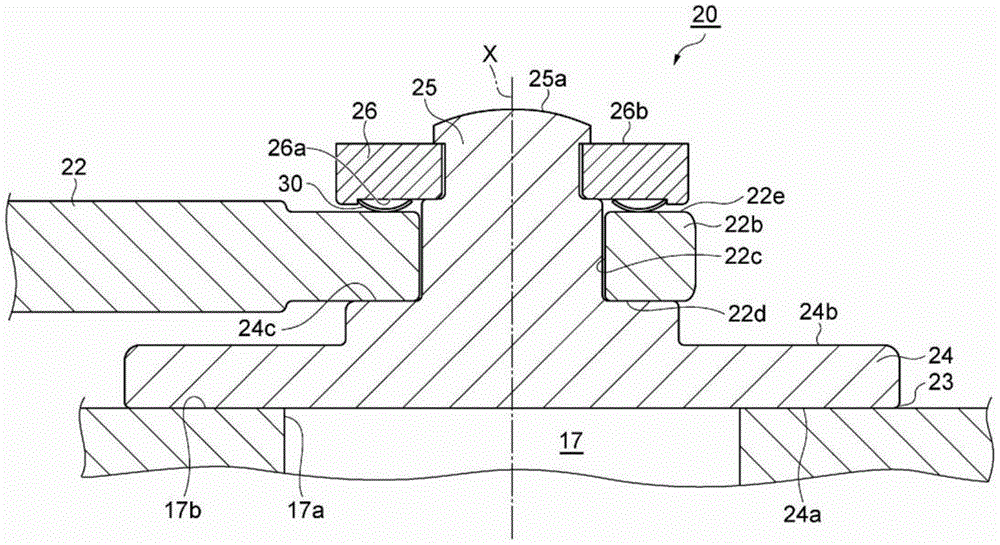
As shown in fig. 2 and 3, the supercharger 1 includes a waste gate valve 20 (an example of a flow rate variable valve mechanism) provided inside the turbine housing 4. The waste gate valve 20 is configured to open and close an opening of the bypass passage 17. The waste gate valve 20 includes: a valve stem 21 supported rotatably with respect to an outer wall of the turbine housing 4; a valve mounting member 22 projecting from the first end 21a of the valve stem 21 in the radial direction of the valve stem 21; a valve 23 held at the front end 22b of the valve mounting member 22; a stopper (stopper member) 26 fixed to one end of the valve 23 and holding the valve 23 together with the valve mounting member 22; and a spring washer 30 (see fig. 4) disposed between the valve mounting member 22 and the stopper 26.
A support hole (through hole) 4b penetrating in the thickness direction of the outer wall is formed in the outer wall of the turbine housing 4. A cylindrical bearing 41 is inserted into the support hole 4 b. The bearing 41 is fixed relative to the outer wall of the turbine housing 4. The bearing 41 may also have a certain diameter from the first end side to the second end side in the axial direction. The first end surface 41a of the bearing 41 located in the turbine housing 4 is formed flat. The second end face 41b of the bearing 41 located outside the turbine housing 4 is formed flat. The shape of the bearing 41 is not particularly limited, and may be any shape. The bearing 41 may have: a small diameter portion formed on a first end side inside the turbine housing 4, and a large diameter portion formed on a second end side outside the turbine housing 4. The bearing 41 may have an inclined portion whose diameter increases from the first end side toward the second end side.
The valve stem 21 is inserted through the bearing 41 and is rotatably supported with respect to the outer wall of the turbine housing 4. A first end 21a of the valve stem 21 disposed in the turbine housing 4 is inserted into a cylindrical portion formed at a base end portion 22a of the valve mounting member 22. The base end portion 22a of the valve mounting member 22 is joined to the first end 21a of the valve stem 21 by welding or the like. An end surface on the bearing 41 side of the cylindrical portion formed at the base end portion 22a of the valve mounting member 22 is parallel to the first end surface 41a of the bearing 41 and faces the first end surface 41 a. The valve stem 21 is rotated about the axis of the valve stem 21 to swing the valve mounting member 22. The plate-like distal end portion 22b of the valve mounting member 22 is provided with a through hole 22c (see fig. 4) for mounting the valve 23.
A plate-shaped link member 42 protruding in the radial direction of the valve stem 21 is fixed to a second end 21b of the valve stem 21 disposed outside the turbine housing 4. The second end 21b of the stem 21 penetrates a through hole formed in the link member 42. The back surface 42a of the link member 42 is parallel to the second end surface 41b of the bearing 41 and faces the second end surface 41 b.
A through hole is formed in the tip end of the link member 42, and a coupling pin 43 is inserted through the through hole. The coupling pin 43 is inserted through a through hole formed in the distal end portion 51a of the operating rod 51 of the actuator 50. The first end of the connecting pin 43 is fixed to the operating lever 51 by caulking. A jig 44 is attached to the second end of the connecting pin 43 to prevent the connecting pin 43 from falling out of the through hole. The distal end portion 51a of the operating lever 51 and the coupling pin 43 are rotatable with respect to the link member 42. The distal end portion of the link member 42 swings about the axis of the valve stem 21 in accordance with the movement of the operating rod 51. In other words, the valve rod 21 is coupled to the operating rod 51 of the actuator 50 via the link member 42 and the coupling pin 43.
The actuator 50 is fixed to a bracket 18 protruding laterally from the compressor housing 5. The actuator 50 includes, for example, an operating rod 51, a diaphragm that drives the operating rod 51, a low-pressure chamber 59 and a high-pressure chamber 58 that are adjacent to each other with the diaphragm interposed therebetween in the axial direction of the operating rod 51, and a return spring that is disposed in the low-pressure chamber 59 and biases the diaphragm. In the actuator 50, when the pressure on the outlet side of the compressor 3 reaches the set pressure, the operating rod 51 is moved to the tip side, and when the pressure on the outlet side of the compressor 3 is smaller than the set pressure, the operating rod 51 is moved to the base end side.
Next, the waste gate valve 20 will be described in detail. As shown in fig. 3 and 4, the valve 23 can be brought into contact with and separated from the peripheral edge 17b of the opening 17a of the bypass passage 17. The valve 23 has a valve body 24 and a valve shaft 25 protruding from the valve body 24. The valve body 24 is formed in a disk shape, for example. The valve body 24 includes: a sealing surface 24a facing the peripheral edge portion 17b, a back surface 24b opposite to the sealing surface 24a, and a support surface 24c protruding from the back surface 24 b. The valve body 24 is configured to open and close an opening 17a formed in the bypass passage 17 of the turbine 2. The valve shaft 25 protrudes to the opposite side of the valve body 24 from the bypass passage 17. The valve shaft 25 protrudes from the support surface 24c of the valve body 24. The valve shaft 25 has an axis X and is formed, for example, in a cylindrical shape. The valve shaft 25 is formed integrally with the valve body 24, for example.
The valve shaft 25 is inserted through the through hole 22c of the distal end portion 22b of the valve mounting member 22. The front end portion 22b of the valve mounting member 22 is disposed between the valve body 24 and the stopper 26. The front end portion 22b of the valve mounting member 22 includes a first surface 22d facing the valve body 24 and a second surface 22e opposite to the first surface 22 d. The first surface 22d and the second surface 22e are, for example, parallel. That is, the front end portion 22b of the valve mounting member 22 has a certain thickness. The first surface 22d of the valve mounting member 22 abuts against the support surface 24c of the valve body 24.
A plate-like stopper 26 is fixed to an end 25a of the valve shaft 25 opposite to the valve body 24. The stopper 26 is fixed to the valve shaft 25 at a position separated from the valve body 24 in the axis X direction, for example, by caulking or the like. The stopper 26 is fixed to the valve shaft 25 such that the valve mounting member 22 is disposed between the valve body 24 and the stopper 26. The stopper 26 includes a first stopper surface 26a facing the valve mounting member 22, and a second stopper surface 26b opposite to the first stopper surface 26 a. The first and second stop surfaces 26a, 26b are, for example, parallel.
The outer diameter of the valve shaft 25 is smaller than the inner diameter of the through hole 22 c. The first stop surface 26a of the stopper 26 is spaced from the support surface 24c of the valve body 24 by a distance greater than the thickness of the valve mounting member 22. That is, a gap S is formed between the first stop surface 26a of the stopper 26 and the second surface 22e of the valve mounting member 22. Thus, the valve mounting member 22 is disposed between the valve body 24 and the stopper 26, is mounted to the valve shaft 25, and holds the valve 23 together with the stopper 26.
The spring washer 30 is disposed between the valve mounting member 22 and the stopper 26, and applies an elastic force to the valve mounting member 22 and the valve 23. The spring washer 30 is formed in a ring shape around the axis X (see fig. 4) of the valve shaft 25. In the present embodiment, the spring washer 30 is disposed between the first member as the stopper 26 and the second member as the valve mounting member 22. The spring washer 30 is in constant contact with the first stop surface 26a of the stop member 26 and with the second surface 22e of the valve mounting member 22.
As shown in fig. 5, the spring washer 30 is made of a material having elasticity, and has an arched cross section. The spring washer 30 includes an annular outer peripheral portion 31 that is in constant contact with the first stop surface 26a of the stop 26, an annular inner peripheral portion 32 that is located closer to the valve shaft 25 than the outer peripheral portion 31 and is in constant contact with the first stop surface 26a of the stop 26, and an intermediate portion 33 that is formed between the outer peripheral portion 31 and the inner peripheral portion 32 and is in constant contact with the second surface 22e of the valve mounting member 22. The outer peripheral portion 31 is located radially outward of the inner peripheral portion 32. In other words, the diameter of the outer peripheral portion 31 is larger than the diameter of the inner peripheral portion 32. The intermediate portion 33 is formed at, for example, a substantially central position of the outer peripheral portion 31 and the inner peripheral portion 32. The intermediate portion 33 imparts spring characteristics to the spring washer 30. The cross-sectional shape of the spring washer 30 cut by a plane including the axis X is formed symmetrically on the outer peripheral side and the inner peripheral side, for example. The center lines of the outer and inner peripheral sides of the symmetrical shape pass through the intermediate portion 33, for example.
Here, the stopper 26 includes a convex portion 26c protruding toward the gap S at its outer peripheral portion. The convex portion 26c may be continuous in the circumferential direction. The one projection 26c may be formed in a ring shape continuous over the entire circumference. Alternatively, the plurality of projections 26c may be formed separately in the circumferential direction. That is, the convex portion 26c may be formed only in a part or a plurality of parts in the circumferential direction. In the present embodiment, a case where one continuous annular convex portion 26c is formed will be described. An annular inner surface 26d formed radially inward is formed on the convex portion 26c of the stopper 26. The inner surface 26d is formed in a cylindrical shape, for example, in parallel with the axis X. The inner surface 26d faces the outer peripheral portion 31 of the spring washer 30, for example, contacts the outer peripheral portion 31. The outer peripheral portion 31 is locked to the inner surface 26d of the projection 26 c. The outer peripheral portion 31 is not engaged and fixed with the inner surface 26d of the convex portion 26c only by the elasticity of the spring washer 30. The outer peripheral portion 31 and the inner peripheral portion 32 of the spring washer 30 are both free ends. The inner peripheral portion 32 is separated from the valve shaft 25 and does not contact the valve shaft 25. The outer peripheral portion 31 is not fixed to the free end of the inner surface 26d, but may be an engagement end that is engaged with the inner surface 26d while always being in contact therewith.
On the other hand, the front end portion 22b of the valve mounting member 22 includes a second surface 22e as a seat surface that is always in contact with the intermediate portion 33 of the spring washer 30, and a flat surface (flat portion) 22f that is formed at a position facing the convex portion 26c in the axis X direction and is coplanar with the second surface 22 e. That is, the surface facing the stopper 26 of the distal end portion 22b is not formed with the irregularities. The flat surface 22f faces the end surface 26e of the projection 26 c. The flat surface 22f is substantially parallel to the end surface 26e, and an annular gap smaller than the gap S is formed therebetween.
The inner surface 26d formed on the stopper 26 contacts the outer peripheral portion 31 of the spring washer 30 to regulate the movement of the outer peripheral portion 31 outward in the radial direction. In other words, the convex portion 26c including the inner surface 26d is a regulating means for regulating the movement of the outer peripheral portion 31 outward in the radial direction by contacting the outer peripheral portion 31 of the spring washer 30. The convex portion 26c suppresses the spring washer 30 from extending outward in the radial direction, and suppresses the spring washer 30 from being deteriorated in elasticity (so-called "deformed"). The restriction unit includes the following two configurations: a configuration that is always in contact with the outer peripheral portion 31 of the spring washer 30, and a configuration that is normally separated from the outer peripheral portion 31 of the spring washer 30, but is finally in contact when the spring washer 30 is deformed (i.e., is only temporarily in contact when the spring washer 30 is deformed).
The gap between the flat surface 22f and the end surface 26e is set to a size to which the spring washer 30 is not plastically deformed when the flat surface 22f and the end surface 26e are in contact. That is, the distance that the stopper 26 can move relatively in the axis X direction with respect to the valve mounting member 22 is within the range of elastic deformation of the spring washer 30 (less than the elastic limit). The clearance between the convex portion 26c and the valve mounting member 22 is set so that the spring washer 30 does not lose elasticity even when the spring washer 30 is deformed and the convex portion 26c contacts the second surface 22 e.
According to the waste gate valve 20 of the present embodiment, the spring washer 30 is in contact with the first member as the stopper 26 and the second member as the valve mounting member 22, and applies an elastic force to the valve mounting member 22. The spring washer 30 can reduce the wear of the contact portion between the stopper 26, the valve mounting member 22, and the valve body 24 or the vibration of the valve 23 and the like. When the distance between the first member and the second member is shortened, the spring washer 30 is deformed by the axial force. When the spring washer 30 is to extend in the radial direction, the inner surface 26d of the projection 26c formed on the stopper 26 contacts the outer peripheral portion 31 of the spring washer 30. Therefore, the spring washer 30 can be suppressed from being deformed outward in the radial direction. As a result, the deterioration of the elasticity of the spring washer 30 can be suppressed. When the spring washer 30 is deformed, the inner peripheral portion 32 slides radially inward on the first stopper surface 26a to approach the valve shaft 25. When the spring washer 30 is deformed, the inner peripheral portion 32 may contact the valve shaft 25.
The convex portion 26c including the inner surface 26d facing (or contacting) the outer peripheral portion 31 of the spring washer 30 can reliably suppress deformation of the spring washer 30 outward in the radial direction.
When the spring washer 30 is deformed due to the reduction in the distance between the first member and the second member, the convex portion 26c contacts the flat surface 22 f. Since the flat surface 22f is coplanar with the second surface 22e serving as a seat surface of the spring washer 30, the distance of relative movement between the first member and the second member in the direction of the axis X is reduced. This can prevent the spring washer 30 from being deformed into a region of plastic deformation. This is effective in view of protecting the spring washer 30.
In the spring washer 30, the outer peripheral portion 31 and the inner peripheral portion 32 (two positions in the radial direction) contact the stopper 26, and the intermediate portion 33 between the outer peripheral portion 31 and the inner peripheral portion 32 contacts the valve mounting member 22. Such an arched contact configuration is suitable for reducing wear or vibrations. In addition, the spring washer 30 is easy to manufacture.
The convex portion 26c as the regulating means regulates the movement of the outer peripheral portion 31 to the outer radial side by contacting the outer peripheral portion 31 of the spring washer 30, and thus suppresses the deformation of the spring washer 30 to the outer radial side. As a result, the deterioration of the elasticity of the spring washer 30 can be suppressed.
In the turbocharger 1, since the elastic deterioration of the spring washer 30 can be suppressed in the wastegate valve 20, the reliability of the turbine 2 is improved.
The waste gate valve of the present disclosure is not limited to the above embodiment, and various modifications can be adopted. The matters described in the above embodiment are also applicable to the following modifications (description of the structure, etc.), and are not described below.
As shown in fig. 6, the front end portion 22b of the valve mounting member 22 may also include a recessed portion 22g that is formed at a position facing the convex portion 26c in the axis X direction and is recessed from a second surface 22e that is a seating surface. The recessed portion 22g is formed in a shape and size capable of receiving the protruding portion 26 c. That is, if the convex portion 26c is annular, the concave portion 22g is the same size as the convex portion 26c or is annular larger than the convex portion 26 c. A plurality of recesses 22g may be formed so as to correspond to the plurality of projections 26 c.
The depth of the recessed portion 22g (i.e., the length from the second surface 22e to the bottom surface of the recessed portion 22 g) may be larger or smaller than the protruding length of the convex portion 26c (i.e., the length from the first stop surface 26a to the end surface 26 e). These may also be equal. Further, the spring washer 30A may be used in which the outer peripheral portion 31 and the inner peripheral portion 32 are formed in a ring shape perpendicular to the axis X so that the outer peripheral portion 31 and the inner peripheral portion 32 are in planar contact with the first stopper surface 26 a. The convex portion 26c including the inner surface 26d is a restricting means for restricting the movement of the outer peripheral portion 31 outward in the radial direction by contacting the outer peripheral portion 31 of the spring washer 30A. In addition, in the waste gate valve 20A, a spring washer 30 similar to the waste gate valve 20 may be used.
The above-described waste gate valve 20A can also provide the same operational effects as those of the waste gate valve 20. However, in the wastegate valve 20A in which the recessed portion 22g is formed, when the distance between the first member and the second member is reduced and the spring washer 30A is deformed, the raised portion 26c is received in the recessed portion 22 g. Therefore, the distance of relative movement in the axis X direction of the first member and the second member can be ensured. The convex portion 26c including the inner surface 26d suppresses deformation of the spring washer 30A and ensures the stroke in the axis X direction, thereby sufficiently exerting the elastic force of the spring washer 30A.
As shown in fig. 7, a waste gate valve 20B may be adopted, in which the waste gate valve 20B includes a spring washer 30B having an inclined surface with a constant inclination from the outer peripheral portion 31 to the inner peripheral portion 32, instead of the spring washer 30A of the waste gate valve 20A. In this case, the convex portion 26c including the inner surface 26d is a regulating means for regulating the movement of the outer peripheral portion 31 outward in the radial direction by contacting the outer peripheral portion 31 of the spring washer 30B. The above-described waste gate valve 20B can also provide the same operational effects as the waste gate valve 20A.
As shown in fig. 8, a spring washer 30C having an outer peripheral portion 31 and an inner peripheral portion 32 in a ring shape perpendicular to the axis X may be used such that the outer peripheral portion 31 is in planar contact with the first stopper surface 26a and the inner peripheral portion 32 is in planar contact with the second surface 22 e. In the spring washer 30C, the intermediate portion 33 is formed by an inclined surface having a certain inclination. In this case, the convex portion 26C including the inner surface 26d is a regulating means for regulating the movement of the outer peripheral portion 31 outward in the radial direction by contacting the outer peripheral portion 31 of the spring washer 30C. The above-described waste gate valve 20C can also provide the same operational effects as the waste gate valve 20A.
As shown in fig. 9, an arcuate spring washer 30D having the same configuration as the spring washer 30 may be used, and an annular groove portion 26g that receives the outer peripheral portion 31 of the spring washer 30D and an annular groove portion 26h that receives the inner peripheral portion 32 of the spring washer 30D may be formed in the stopper 26. The outer peripheral portion 31 of the spring washer 30D is received in the groove portion 26g, and faces the inner surface 26D of the groove portion 26 g. The groove 26h receives the inner peripheral portion 32 of the spring washer 30D and faces the outer surface 26j of the groove 26h facing radially outward. The outer peripheral portion 31 and the inner peripheral portion 32 are separated from the inner surface 26d and the outer surface 26j, respectively, in the radial direction. At least one of the outer peripheral portion 31 and the inner peripheral portion 32 may be in contact with at least one of the inner surface 26d and the outer surface 26 j. In this case, the groove portion 26g including the inner surface 26D is a regulating means for regulating the movement of the outer peripheral portion 31 outward in the radial direction by contacting the outer peripheral portion 31 of the spring washer 30D. The above-described waste gate valve 20D can also provide the same operational effects as the waste gate valve 20A. As the spring washer 30D deforms, the outer peripheral portion 31 moves radially outward within the groove portion 26g so as to approach the inner surface 26D (and then contact the inner surface 26D), and/or the inner peripheral portion 32 moves radially inward within the groove portion 26h so as to approach the outer surface 26j (and then contact the outer surface 26 j). Since the groove portion 26g receives the outer peripheral portion 31 of the spring washer 30D and the inner surface 26D facing (or contacting) the outer peripheral portion 31 of the spring washer 30D is formed in the groove portion 26g, the spring washer 30D can be reliably prevented from being deformed outward in the radial direction.
As shown in fig. 10, a spring washer 30E having the same configuration as the spring washer 30B may be used, and an annular groove portion 26g that receives the outer peripheral portion 31 of the spring washer 30E may be formed in the stopper 26. The outer peripheral portion 31 of the groove 26g receiving the spring washer 30E faces the inner surface 26d of the groove 26 g. The inner peripheral portion 32 of the spring washer 30E is in contact with the second surface 22E. The outer peripheral portion 31 contacts the inner surface 26 d. Further, the outer peripheral portion 31 may be separated from the inner surface 26d in the radial direction. In this case, the groove portion 26g including the inner surface 26d is a regulating means for regulating the movement of the outer peripheral portion 31 outward in the radial direction by contacting the outer peripheral portion 31 of the spring washer 30E. The above-described waste gate valve 20E can also provide the same operational effects as the waste gate valve 20A.
As shown in fig. 11, a waste gate valve 20F may be employed, in which a spring washer 30F having the same structure as the spring washer 30 is used for the waste gate valve 20F, and the spring washer 30F is disposed between the distal end portion 22b of the valve mounting member 22 and the valve body 24. In this embodiment, the spring washer 30F is disposed between the first member as the valve body 24 and the second member as the valve mounting member 22. The spring washer 30F is always in contact with the support surface 24c of the valve body 24 and with the first surface 22d of the valve mounting member 22. The valve body 24 includes a projection 24e projecting toward the gap S. An inner surface 24d (facing) that contacts the outer peripheral portion 31 of the spring washer 30F is formed on the convex portion 24 e. The valve mounting member 22 may be formed with a flat surface (flat portion) 22h coplanar with the first surface 22d, or may be formed with a recessed portion recessed from the first surface 22d and receiving the projection 24 e. In this case, the convex portion 24e including the inner surface 24d is a regulating means for regulating the movement of the outer peripheral portion 31 outward in the radial direction by contacting the outer peripheral portion 31 of the spring washer 30F. The above-described waste gate valve 20F can also provide the same operational effects as those of the waste gate valve 20.
The embodiments of the present disclosure have been described above, but the present invention is not limited to the above embodiments. For example, the outer shape of the spring washer is not limited to the case of a ring. The spring washer may have a convex-concave shape with an outer peripheral edge of the gear. The shape and type of the spring washer are not particularly limited.
In the various embodiments shown in fig. 5 to 10, a structure may be adopted in which the convex portion, the groove portion, or the concave portion is formed in a member opposite to the above-described embodiment, and the spring washer is inverted. As shown in fig. 11, the various embodiments and modifications described above may be adopted in the case where the spring washer is disposed between the mounting member and the valve body. In any of the aspects and modifications, the outer peripheral portion may be separated from the inner surface in the radial direction. When the spring washer is deformed, the outer peripheral portion of the spring washer may be in contact with the inner surface. The present invention may include any form in which an outer peripheral portion of a spring washer disposed between a stopper member and a mounting member or between a mounting member and a valve body includes an inner surface that can be contacted from the outside in the radial direction.
Industrial applicability of the invention
According to some aspects of the present disclosure, regarding the spring washer for reducing wear or vibration, deterioration of elasticity of the spring washer can be suppressed.
Description of the reference numerals
1 … supercharger; 2 … turbine; 17 … bypass path; 17a … opening part; 20 … waste gate valve (flow variable valve mechanism); 22 … valve mounting member (mounting member); 22d … first surface (seat surface); 22e … second surface (seat surface); 22f … flat face (flat portion); 22g … recess; 22h … flat face (flat portion); a 23 … valve; 24 … a valve body; 24d … inner surface; 24e … protrusions; 25 …, a valve shaft; 26 … stop (stop member); 26c … convex parts; 26d … inner surface; 26g … groove; 30. 30A, 30B, 30C, 30D, 30E, 30F … spring washers; 31 … outer periphery; 32 … inner peripheral portion; 33 … an intermediate portion; s … a gap; the X … axis.