CN112321602A - Preparation method of Ruogeli drug intermediate - Google Patents
Preparation method of Ruogeli drug intermediate Download PDFInfo
- Publication number
- CN112321602A CN112321602A CN201910715633.3A CN201910715633A CN112321602A CN 112321602 A CN112321602 A CN 112321602A CN 201910715633 A CN201910715633 A CN 201910715633A CN 112321602 A CN112321602 A CN 112321602A
- Authority
- CN
- China
- Prior art keywords
- compound
- group
- aryl
- alkyl
- formula
- Prior art date
- Legal status (The legal status is an assumption and is not a legal conclusion. Google has not performed a legal analysis and makes no representation as to the accuracy of the status listed.)
- Pending
Links
Classifications
-
- C—CHEMISTRY; METALLURGY
- C07—ORGANIC CHEMISTRY
- C07D—HETEROCYCLIC COMPOUNDS
- C07D495/00—Heterocyclic compounds containing in the condensed system at least one hetero ring having sulfur atoms as the only ring hetero atoms
- C07D495/02—Heterocyclic compounds containing in the condensed system at least one hetero ring having sulfur atoms as the only ring hetero atoms in which the condensed system contains two hetero rings
- C07D495/04—Ortho-condensed systems
-
- C—CHEMISTRY; METALLURGY
- C07—ORGANIC CHEMISTRY
- C07D—HETEROCYCLIC COMPOUNDS
- C07D333/00—Heterocyclic compounds containing five-membered rings having one sulfur atom as the only ring hetero atom
- C07D333/02—Heterocyclic compounds containing five-membered rings having one sulfur atom as the only ring hetero atom not condensed with other rings
- C07D333/04—Heterocyclic compounds containing five-membered rings having one sulfur atom as the only ring hetero atom not condensed with other rings not substituted on the ring sulphur atom
- C07D333/26—Heterocyclic compounds containing five-membered rings having one sulfur atom as the only ring hetero atom not condensed with other rings not substituted on the ring sulphur atom with hetero atoms or with carbon atoms having three bonds to hetero atoms with at the most one bond to halogen, e.g. ester or nitrile radicals, directly attached to ring carbon atoms
- C07D333/38—Carbon atoms having three bonds to hetero atoms with at the most one bond to halogen, e.g. ester or nitrile radicals
-
- C—CHEMISTRY; METALLURGY
- C07—ORGANIC CHEMISTRY
- C07D—HETEROCYCLIC COMPOUNDS
- C07D409/00—Heterocyclic compounds containing two or more hetero rings, at least one ring having sulfur atoms as the only ring hetero atoms
- C07D409/02—Heterocyclic compounds containing two or more hetero rings, at least one ring having sulfur atoms as the only ring hetero atoms containing two hetero rings
- C07D409/12—Heterocyclic compounds containing two or more hetero rings, at least one ring having sulfur atoms as the only ring hetero atoms containing two hetero rings linked by a chain containing hetero atoms as chain links
Landscapes
- Chemical & Material Sciences (AREA)
- Organic Chemistry (AREA)
- Pharmaceuticals Containing Other Organic And Inorganic Compounds (AREA)
- Organic Low-Molecular-Weight Compounds And Preparation Thereof (AREA)
Abstract
The application provides a Ruugeli midbody and Ruugeli's synthetic scheme, and the synthetic scheme that this application adopted has effectively avoided the use of high toxicity material methyl chloroformate or ethyl chloroformate, has adopted the low toxicity and other kinds of chloroformates that facilitate the use, can reduce the use risk in the bulk drug production process, and is easy and simple to handle, and technology is safer, is favorable to the industrial production.
Description
Technical Field
The application relates to the field of drug synthesis, in particular to a preparation method of thieno [2,3-d ] pyrimidine compounds showing gonadotropin releasing hormone (GnRH) antagonistic activity and intermediates thereof.
Background
Endometriosis, which is caused by the growth of the endometrium in any location outside the uterine cavity, is a common estrogen-dependent gynecological disease, which often occurs during the reproductive years of women, and the mechanism of action is not yet clear. The complex symptoms of difficult diagnosis and unclear etiology of endometriosis seriously obstruct the discovery of effective treatment methods. Currently, endometriosis is mainly diagnosed by laparoscopic surgery and controlled by surgically treating it or by reducing the estrogen levels in the body by administering contraceptives, GnRH receptor agonists or progestogens. The first oral GnRH antagonist, namely, elogolide sodium, in the field worldwide in 2018 and 7 months, was approved by the FDA for marketing.
Relugolix is a small molecule gonadotropin releasing hormone (GnRH) receptor antagonist developed and developed by Nippon martian drug corporation and is capable of rapidly lowering female estrogen and progestin. Relugolix was approved for marketing in japan in 2019, month 1, and was approved for the treatment and symptom relief of uterine fibroids. New drug applications are expected to be submitted by the FDA in the third quarter of 2019.
So far, relatively few reports are reported about the synthetic process of Relugolix at home and abroad, and the original research company, Wutian drug company, first discloses a synthetic route (WO 2004067535A 1). The specific synthetic route is as follows:
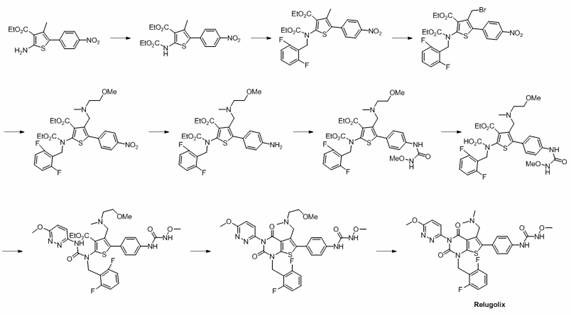
another synthetic route for Relugolix disclosed in WO2014051164A2 is as follows:
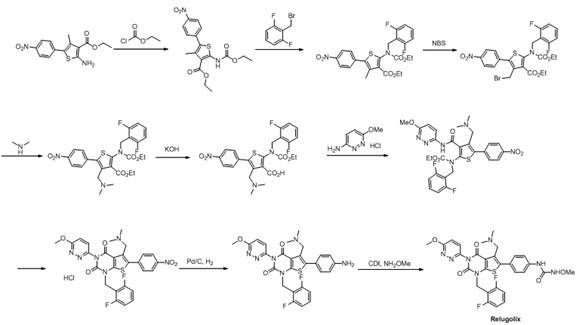
in the two disclosed synthetic routes, ethyl chloroformate which is a highly toxic substance is used in the synthetic process, and the synthetic routes have low flash point, are highly flammable and have high requirements on production environment.
Disclosure of Invention
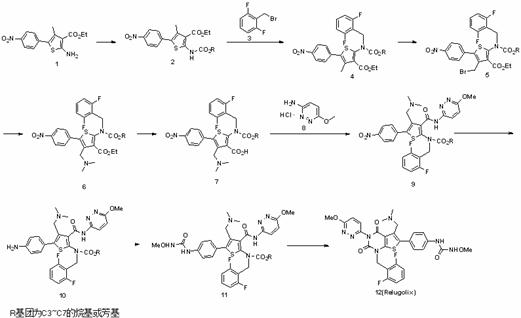
The application provides a new Ruugeli synthesis scheme, and the synthesis route is as follows:
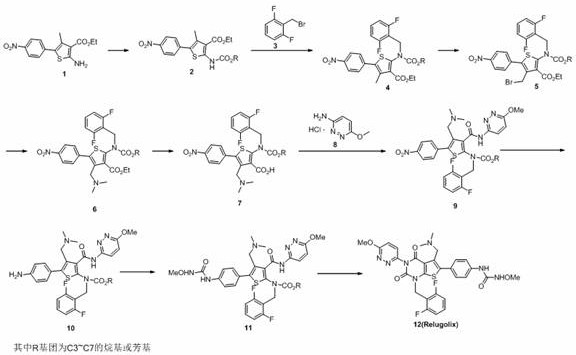
first, compound 1 is reacted with a chloroformate to give compound 2. Nucleophilic substitution reaction is carried out on the compound 2 and the compound 3 to obtain a compound 4. And carrying out bromination reaction on the compound 4 to obtain a compound 5. And carrying out substitution reaction on the compound 5 and dimethylamine hydrochloride to generate a compound 6. Hydrolysis of compound 6 under basic conditions affords compound 7. The compound 7 and the compound 8 are subjected to condensation reaction to generate a compound 9. The compound 9 undergoes reduction reaction to obtain a compound 10. The compound 10 and methoxylamine hydrochloride are subjected to condensation reaction to generate a compound 11. Intramolecular ring closure of compound 11 gave compound 12 (Relugolix).
Compared with the prior art, the method for synthesizing the Ruugeli intermediate has the following benefits:
(1) the use of ethyl chloroformate and methyl chloroformate which are high in toxicity, low in flash point and highly flammable substances is avoided;
(2) the risk of storing and using the ethyl chloroformate and the methyl chloroformate can be effectively avoided.
(3) Compared with the route of WO2014051164A2, the Pd/C catalytic hydrogenation step is moved forward, so that the risk of pollution of heavy metals to final products is avoided, and the production of bulk drugs under the cGMP condition is facilitated.
(4) Compared with the route of WO2004067535A1, the method is simpler and more efficient, avoids the substitution reaction of methoxyethyl methylamine, and is safer and more environment-friendly.
Detailed Description
Embodiments of the present application are described below by way of examples, and it should be appreciated by those skilled in the art that these specific examples merely illustrate selected embodiments for achieving the purposes of the present application and are not intended to limit the technical solutions. Modifications of the technical solutions of the present application in combination with the prior art are obvious from the teachings of the present application and fall within the protection scope of the present application.
The implementation conditions used in the examples can be further adjusted according to specific requirements, and the implementation conditions not indicated are generally the conditions in routine experiments. Among them, the chemical agents used in the following examples are all commercially available chemical agents.
Example 1
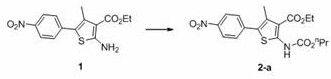
Toluene (450 mL) and compound 1 (150 g) were added to a 2L reaction flask in this order, stirring was turned on, propyl chloroformate (120 g) was added dropwise, and the reaction was heated under reflux for 2 h. Cooling to 50-60 ℃, and dropwise adding ethanol (1350 mL) at 50-60 ℃ in the reactor. And after the dropwise addition is finished, slowly cooling to the internal temperature of 0-10 ℃, stirring for 1 h, filtering, and leaching a filter cake with ethanol (300 mL). Vacuum drying at 45 ℃ gave a yellow solid in 84.4% yield with 98% purity.
Nuclear magnetic data for compound 2-a is as follows:
1H NMR (400 MHz, CDCl3) δ 10.67 (s, 1H), 8.31-8.22 (m, 2H), 7.59-7.52 (m, 2H), 4.39 (q, J = 7.1 Hz, 2H), 4.21 (t, J = 6.7 Hz, 2H), 2.42 (s, 3H), 1.80-1.67 (m, 2H), 1.42 (t, J = 7.1 Hz, 3H), 1.00 (t, J = 7.4 Hz, 3H)。
example 2
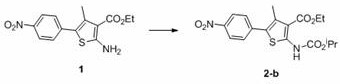
Toluene (1.5 mL) and compound 1 (0.5 g) were sequentially added to a 10 mL reaction flask, and isopropyl chloride (0.4 g) was added dropwise with stirring and heated under reflux for 2 hours. Cooling to 20-30 ℃, adding purified water (4 mL) and dichloromethane (4 mL), separating layers, extracting the water phase with dichloromethane (4 mL), combining organic phases, concentrating under reduced pressure to obtain a crude compound 2-b, and purifying by column chromatography (ethyl acetate: n-heptane =1: 10) to obtain 0.58 g of bright yellow solid, wherein the yield is 90% and the purity is 98%.
The nuclear magnetic data for compound 2-b is as follows:
1H NMR (400 MHz, DMSO-d6) δ 10.45 (s, 1H), 8.29 – 8.23 (m, 2H), 7.69 – 7.63 (m, 2H), 5.02 – 4.91 (m, 1H), 4.32 (m, J = 7.1 Hz, 2H), 2.34 (s, 3H), 1.33 (t, J = 7.1 Hz, 3H), 1.29 (d, J = 6.3 Hz, 6H)。
example 3
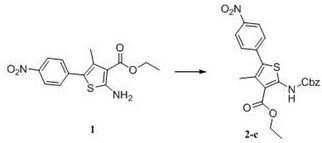
Toluene (1.5 mL) and Compound 1 (0.10 g) were added to a 10 mL reaction flask in this order, followed by addition of K2CO3(90 mg), with stirring, benzyl chloroformate (0.136 g) was added dropwise, and the reaction was heated under reflux for 4 hours. Cooling to 20-30 ℃, adding purified water (4 mL) and toluene (4 mL), extracting the aqueous phase with toluene (4 mL) after layering and separating, combining organic phases, concentrating under reduced pressure to obtain a crude compound 2-C, and purifying by column chromatography (ethyl acetate: n-heptane =1: 6) to obtain a bright yellow solid 0.103 mg, the yield is 71.5%, and the purity is 98%.
Nuclear magnetic data for compound 2-c are as follows:
1H NMR (400 MHz, CDCl3) δ 10.75 (s, 1H), 8.37-8.16 (m, 2H), 7.62-7.50 (m, 2H), 7.49-7.32 (m, 5H), 5.27 (s, 2H), 4.37 (q, J = 7.1 Hz, 2H), 2.41 (s, 3H), 1.40 (t, J = 7.1 Hz, 3H)。
example 4
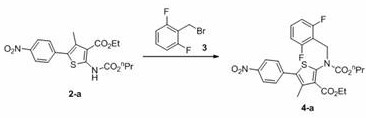
N, N-dimethylacetamide (480 mL) and a compound 2-a (160 g) were sequentially added to a 2L reaction flask, stirred, potassium carbonate (62.0 g) was added, a 35% acetonitrile solution of 2, 6-difluorobenzyl bromide (265.3 g) was added, and the mixture was heated to an internal temperature of 80 to 90 ℃ and stirred for reaction for 2 hours. Cooling to 50-60 ℃, adding ethyl acetate (1280 mL), adding water (900 mL), stirring, standing for liquid separation, collecting an organic phase, extracting a water phase once with ethyl acetate (48 mL), combining the organic phases, washing the organic phase twice with 10% saline solution (900 mL), and washing once with water (900 mL); the organic phase was concentrated under reduced pressure until no liquid was distilled off to give crude compound 4-a as an oil, which was used directly in the next reaction with an HPLC purity of 98%. Part of the column-passing purification was used for nuclear magnetic data characterization.
Nuclear magnetic data for compound 4-a is as follows:
1H NMR (400 MHz, CDCl3) δ 8.26 (d, J = 8.4 Hz, 2H), 7.52 (d, J = 8.4 Hz, 2H), 7.36-7.20 (m, 1H), 6.86 (t, J = 7.8 Hz, 2H), 4.98 (s, 2H), 4.26 (q, J = 7.1 Hz, 2H), 4.22-4.00 (m, 2H), 2.40 (s, 3H), 1.83-1.49 (m, 2H), 1.33 (t, J = 7.1 Hz, 3H), 1.07-0.71 (m, 3H)。
example 5
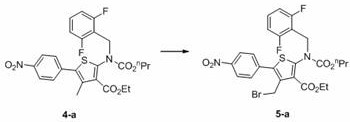
Ethyl acetate (1.64L) and trifluoromethylbenzene (1.64L) are sequentially added into a 5L reaction bottle, stirring is started, the compound 4-a (211 g) is added, N-bromosuccinimide (90.7 g) is added, 2-azobis (2, 4-dimethylvaleronitrile) (10.1 g) is added, and the mixture is stirred and heated at the external temperature of 65-75 ℃ for reaction for 1 hour. After the reaction is finished, the temperature is reduced to room temperature, ethyl acetate (633 mL) is added, the mixture is washed twice with water (844 mL), the organic phase is collected, the pressure is reduced and the concentration is carried out until the organic phase is 750-800 mL, and ethanol (2 x 576 mL) is added for double steaming. Adding n-heptane (1.6 vol) into the system, stirring the mixture at 20-30 ℃ for 30 min, adding n-heptane (1.2 vol) again, cooling to 0-10 ℃, stirring for 1 h, filtering, and washing a filter cake with a mixed solution (1: 2, 337 mL) of ethanol and n-heptane. The filter cake was dried in vacuo at 45 ℃ to give a pale yellow solid in 73% yield with 98.7% HPLC purity.
Nuclear magnetic data for compound 5-a is as follows:
1H NMR (400 MHz, CDCl3) δ 8.43-8.27 (m, 2H), 7.81-7.65 (m, 2H), 7.36-7.18 (m, 1H), 6.87 (t, J = 7.8 Hz, 2H), 4.99 (s, 2H), 4.71 (s, 2H), 4.32 (q, J = 6.9 Hz, 2H), 4.08 (br, 2H), 1.61 (br, 3H), 1.37 (t, J = 7.2 Hz, 3H), 1.10-0.71 (m, 3H)。
example 6
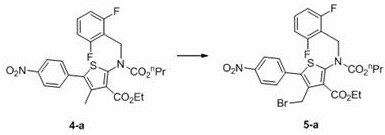
Ethyl acetate (4 mL) and trifluoromethylbenzene (4 mL) are sequentially added into a 100 mL reaction bottle, stirring is started, the compound 4-a (0.5 g) is added, liquid bromine (0.193 g) is added, 2-azobis (2, 4-dimethylvaleronitrile) (0.024 g) is added, stirring and heating are carried out at the external temperature of 65-75 ℃ for 22 hours, and the peak area of a reaction solution product is 34.7%.
Example 7
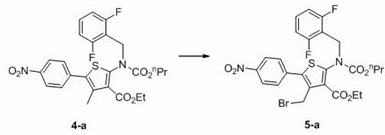
Adding ethyl acetate (4 mL) and trifluoromethylbenzene (4 mL) into a 100L reaction bottle in sequence, starting stirring, adding a compound 4-a (0.5 g), adding dibromohydantoin (0.172 g), adding 2, 2-azobis (2, 4-dimethylvaleronitrile) (0.024 g), stirring and heating at an external temperature of 65-75 ℃ for reaction for 1 h, wherein the peak area of a reaction solution product is 91%.
Example 8
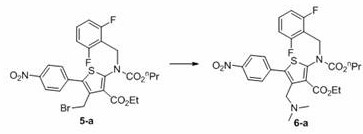
N, N-dimethylformamide (962 mL), dimethylamine hydrochloride (35.8 g), and triethylamine (77.1 g) were added to a 3L reaction flask in this order, and the mixture was stirred at 20-30 ℃ for 0.5 h with stirring. When the internal temperature is reduced to 0-10 ℃, the compound 5-a (175 g) and N, N-dimethylformamide (87.5 mL) are added, and the mixture is stirred for 1 hour at 10-20 ℃. After the reaction, ethyl acetate (875 mL) and water (875 mL) were added, stirred, separated, and the organic phase was collected. The aqueous phase was extracted once with ethyl acetate (525 mL) and the organic phases were combined. The organic phase was washed with 10% brine (3X 875 mL), once with water (875 mL), and the organic phase was concentrated under reduced pressure until no liquid evaporated to give crude compound 6-a in 92% HPLC purity which was used directly in the next reaction. Part of the column-passing purification was used for nuclear magnetic data characterization.
Nuclear magnetic data for compound 6-a is as follows:
1H NMR (400 MHz, CDCl3) δ 8.31-8.18 (m, 2H), 7.70-7.61 (m, 2H), 7.32-7.19 (m, 1H), 6.92-6.78 (m, 2H), 5.02 (s, 2H), 4.23 (q, J = 7.2 Hz, 3H), 4.19-4.05 (m, 2H), 3.52 (s, 2H), 2.06 (s, 6H), 1.77-1.50 (m, 3H), 1.32 (t, J = 7.1 Hz, 3H), 0.88 (t, J = 6.8 Hz, 3H)。
example 9
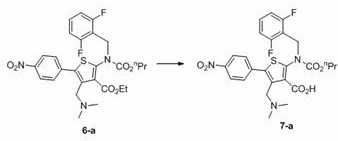
Ethanol (1.5L), water (450 mL) and compound 6-a (173 g) were added sequentially to a 5L reaction flask, followed by addition of 48% aqueous potassium hydroxide (54 g), heating to 55-65 ℃ and reaction for 5 h. Cooling to 20-30 ℃, adjusting the pH to 6.0-7.0 by using 6 mol/L hydrochloric acid, concentrating the mixed solution under reduced pressure until the volume is less than 605 mL, adding dichloromethane (865 mL), and then adding water (865 mL); stir, separate, collect the lower organic phase, extract the aqueous phase with dichloromethane (2 × 519 mL), and combine the organic phases. The organic phase was washed once with 10% brine (865 mL), once with water (865 mL), and concentrated to about 175 mL under reduced pressure. Ethyl acetate (2X 692 mL) was distilled over to 175 mL and 346mL of ethyl acetate was added. Stirring for 3 h at 20-30 ℃, filtering, leaching a filter cake with cold ethyl acetate (346 mL), and drying the filter cake at 40-50 ℃ to obtain a yellow solid with the yield of 86% and the HPLC purity of 94.3%.
Nuclear magnetic data for compound 7-a is as follows:
1H NMR (400 MHz, CDCl3) δ 8.29 (d, J = 8.5 Hz, 2H), 7.44 (d, J = 8.6 Hz, 2H), 7.33-7.15 (m, 1H), 6.94-6.74 (m, 2H), 5.08 (s, 2H), 4.26-3.98 (m, 2H), 3.79 (s, 2H), 2.41 (s, 6H), 1.83-1.49 (m, 2H), 1.11-0.66 (m, 3H)。
example 10
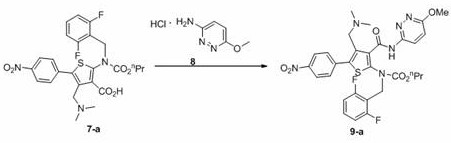
A2L reaction flask was charged with N, N-dimethylacetamide (550 mL), compound 7-a (110 g), and compound 8 (39.98 g), N2Protection, control of temperature inN, N-diisopropylethylamine (66.6 g) is added dropwise at 10-40 ℃, and the temperature is raised to 50-60 ℃ for reaction for 0.5 h. 50 percent of T3P ethyl acetate solution (157.4 g) is dripped at the temperature of not higher than 60 ℃, and the mixture is stirred and reacted for 1 hour at the temperature of 50-60 ℃ after the addition. Cooling, controlling the internal temperature to be 20-30 ℃, and dripping water (825 g). Adjusting the pH value to 7.5-8.5 by using 8 mol/L sodium hydroxide aqueous solution at the internal temperature of 20-30 ℃, stirring for 0.5 h, filtering, adding a filter cake into methanol (440 mL), stirring for more than 2 h at 20-30 ℃, filtering, and leaching the filter cake by using methanol (220 mL). The material is dried in vacuum at 45 ℃ to obtain yellow solid, the yield is 78.1 percent, and the purity is 99.3 percent.
Nuclear magnetic data for compound 9-a is as follows:
1H NMR (400 MHz, CDCl3) δ 13.87 (s, 1H), 8.55 (d, J = 9.5 Hz, 1H), 8.29 (d, J = 8.6 Hz, 2H), 7.567.45 (m, 2H), 7.207.07 (m, 1H), 7.00 (d, J = 9.6 Hz, 1H), 6.75 (t, J = 7.7 Hz, 2H), 5.04 (s, 2H), 4.37-3.99 (m, 5H), 3.51 (s, 2H), 2.20 (s, 6H), 1.85-1.49 (m, 2H), 1.09-0.85 (m, 3H).
mass spectral data for compound 9-a: [ M + H ]]+=641.3。
Example 11
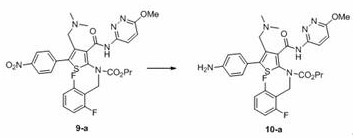
Methanol (16 mL), a compound 9-a (2 g), concentrated hydrochloric acid (0.27 g) and hydrogen pressure of 0.1-0.3 Mpa are sequentially added into a 50 mL reaction bottle, and the temperature is controlled to be 20-30 ℃ for reaction for 15 hours. After the reaction, the reaction mixture was filtered through celite, the filter cake was rinsed with methanol (4 mL), the mother liquor was concentrated under reduced pressure until no fraction was distilled off, dichloromethane (20 mL) and saturated sodium bicarbonate solution (10 mL) were added, the aqueous phase was extracted with dichloromethane (20 mL) after separation of the layers, the organic phases were combined and concentrated under reduced pressure to give crude compound 10-a, which was purified by column chromatography (ethyl acetate: n-heptane =3: 2) to give 1.62 g of a bright yellow solid with a yield of 85% and a purity of 97%.
Nuclear magnetic data for compound 10-a are as follows:
1H NMR (400 MHz, DMSO-d 6) δ 14.05 (s, 1H), 8.38 (d, J = 9.5 Hz, 1H), 7.38-7.23 (m, 2H), 7.04-6.89 (m, 4H), 6.67-6.57 (m, 2H), 5.41 (s, 2H), 4.89 (s, 2H), 4.00 (s, 5H), 3.54 (s, J = 21.9 Hz, 2H), 2.10 (s, 6H), 1.71-1.37 (d, 2H), 0.73 (d, 3H).
mass spectral data for compound 10-a: [ M + H ]]+=611.2。
Example 12
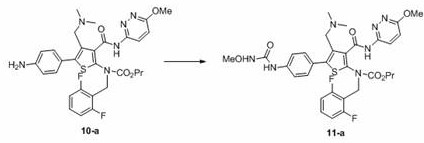
Acetonitrile (2 mL), triethylamine (28.1 mg), N, N-carbonyldiimidazole (102 mg) are sequentially added into a 10 mL reaction bottle, nitrogen is replaced for three times, methoxylamine hydrochloride (53 mg) is added into the system under ice-water bath, nitrogen is replaced for three times, a compound 10-a (198 mg) is added, nitrogen is replaced for three times, the system is reacted at 45-55 ℃ for 2 hours, triethylamine (42 mg) and N, N-carbonyldiimidazole (102 mg) are added for further reaction for 15 hours, after the reaction is finished, dichloromethane (2 mL) and purified water (2 mL) are added, the water phase is extracted by dichloromethane (2 mL) after layering and liquid separation, the organic phase is combined, concentrated and subjected to column purification (ethyl acetate: N-heptane =2: 1) to obtain an off-white solid of 118 mg, the yield is 52%, and the purity is.
Nuclear magnetic data for compound 11-a are as follows:
1H NMR (400 MHz, DMSO-d 6) δ 14.00 (s, 1H), 9.62 (s, 1H), 9.07 (s, 1H), 8.38 (d, J = 9.5 Hz, 1H), 7.83-7.62 (m, 2H), 7.43-7.11 (m, 4H), 6.98 (t, J = 7.9 Hz, 2H), 4.91 (s, 2H), 4.00 (s, 5H), 3.64 (s, 3H), 3.54 (d, J = 3.1 Hz, 3H), 2.10 (s, 6H), 1.43 (d, J = 18.2 Hz, 2H), 0.79 (d, J = 42.4 Hz, 3H).
mass spectral data for compound 11-a: [ M + H ]]+=684.1。
Example 13
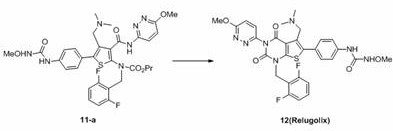
The compound 11-a (100 mg), methanol (2.5 mL), tetrahydrofuran (0.2 mL) and sodium methoxide (4 mg) are sequentially added into a 10 mL reaction bottle, the system is replaced by nitrogen for three times, the temperature is controlled to be 60-65 ℃, the reaction is finished, dichloromethane (2 mL) and purified water (2 mL) are added, after the reaction is finished, the aqueous phase is extracted by dichloromethane (2 mL) after the separation of layers, the organic phases are combined, the reduced pressure concentration is carried out, and the column chromatography purification (ethyl acetate: methanol =40: 1) is carried out, so that 19.7 mg of white-like solid is obtained, the yield is 21.6%, and the purity is 95%.
Compound 12 nuclear magnetic data are as follows:
1H NMR (400 MHz, DMSO-d 6) δ 9.66 (s, 1H), 9.10 (s, 1H), 7.75 (dd, J = 12.4, 8.9 Hz, 3H), 7.50 (dd, J = 27.9, 8.8 Hz, 4H), 7.15 (t, J = 8.1 Hz, 2H), 5.31 (dd, J = 63.3 Hz, 2H), 4.10 (s, 3H), 3.65 (s, 5H), 2.05 (s, 6H).
mass spectral data for compound 12: [ M + H ]]+=624.1。
This application is intended to cover any variations, equivalents, and alternatives falling within the spirit and scope of the invention as defined by the appended claims.
Claims (12)
1. A synthetic method for preparing a rilogeli drug comprising one or more of the following steps:
heating and refluxing the compound 1 and chloroformate in an aprotic solvent to react to generate a compound 2;
carrying out substitution reaction on the compound 2 and the compound 3 to generate a compound 4;
reacting compound 4 with a brominating agent to produce compound 5;
a step of reacting compound 5 with dimethylamine or a salt thereof to produce compound 6;
a step of subjecting the compound 6 to hydrolysis reaction under an alkaline condition to produce a compound 7;
a step of reacting compound 7 with compound 8 or a salt thereof to give compound 9;
a step of generating a compound 10 by the reduction reaction of the nitro functional group of the compound 9;
a step of reacting the compound 10 with methoxyamine or a salt thereof in the presence of an activating reagent to produce a compound 11;
a step of subjecting the compound 11 to a ring-closing reaction under a heating condition to produce a compound Ruugeli 12 (Relugolix);
2. the process for preparing Ruugeli pharmaceutical intermediate 2 according to claim 1, wherein the aprotic solvent is one or more selected from toluene, tetrahydrofuran, dioxane, acetonitrile, acetone, N, N-dimethylformamide and the like,

wherein the R group is alkyl or aryl of C3-C7.
3. The method for preparing Ruogeli drug intermediate 5 according to claim 1, comprising the step of subjecting Compound 4 to bromination reaction to produce Compound 5, wherein the bromination reagent is N-bromosuccinimide, dibromohydantoin, liquid bromine,
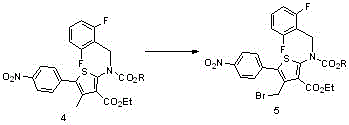
wherein the R group is alkyl or aryl of C3-C7.
4. A Ruugeli drug intermediate compound having the structure of formula 2:
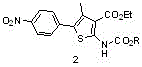
wherein the R group is alkyl or aryl of C3-C7.
5. A Ruugeli drug intermediate compound having the structure of formula 4:
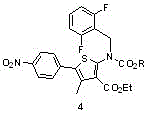
wherein the R group is alkyl or aryl of C3-C7.
6. A Ruugeli drug intermediate compound having the structure of formula 5:

wherein the R group is alkyl or aryl of C3-C7.
7. A rilogeli drug intermediate compound having the structure of formula 6:
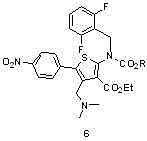
wherein the R group is alkyl or aryl of C3-C7.
8. A rilogeli drug intermediate compound having the structure of formula 7:

wherein the R group is alkyl or aryl of C3-C7.
9. A rilogeli drug intermediate compound having the structure of formula 9:
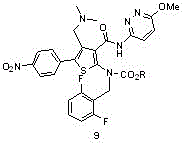
wherein the R group is alkyl or aryl of C3-C7.
10. A rilogeli drug intermediate compound having the structure of formula 10:
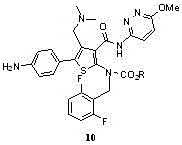
wherein the R group is alkyl or aryl of C3-C7.
11. A rilogeli drug intermediate compound having the structure of formula 11:

wherein the R group is alkyl or aryl of C3-C7.
12. A method of preparing compound 12 (Relugolix) from compound 10, comprising:
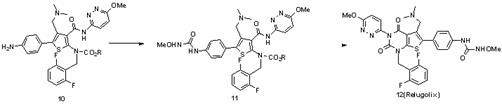
wherein the R group is C3-C7 alkyl or aryl,
a step of reacting compound 10 with methoxylamine or a salt thereof to produce compound 11:
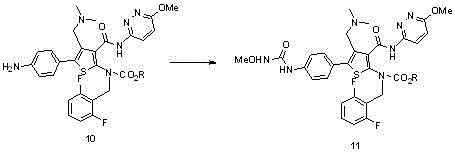
wherein the R group is C3-C7 alkyl or aryl,
a step of carrying out a ring-closing reaction on the compound 11 under a heating condition to generate a compound Ruugeli 12 (Relugolix):
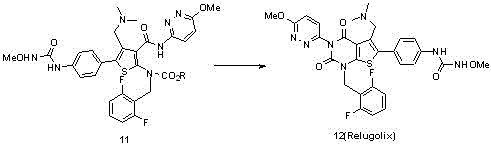
wherein the R group is alkyl or aryl of C3-C7.
Priority Applications (2)
| Application Number | Priority Date | Filing Date | Title |
|---|---|---|---|
| CN201910715633.3A CN112321602A (en) | 2019-08-05 | 2019-08-05 | Preparation method of Ruogeli drug intermediate |
| PCT/CN2020/106499 WO2021023143A1 (en) | 2019-08-05 | 2020-08-03 | Method for preparing pharmaceutical intermediate of relugolix |
Applications Claiming Priority (1)
| Application Number | Priority Date | Filing Date | Title |
|---|---|---|---|
| CN201910715633.3A CN112321602A (en) | 2019-08-05 | 2019-08-05 | Preparation method of Ruogeli drug intermediate |
Publications (1)
| Publication Number | Publication Date |
|---|---|
| CN112321602A true CN112321602A (en) | 2021-02-05 |
Family
ID=74319247
Family Applications (1)
| Application Number | Title | Priority Date | Filing Date |
|---|---|---|---|
| CN201910715633.3A Pending CN112321602A (en) | 2019-08-05 | 2019-08-05 | Preparation method of Ruogeli drug intermediate |
Country Status (2)
| Country | Link |
|---|---|
| CN (1) | CN112321602A (en) |
| WO (1) | WO2021023143A1 (en) |
Cited By (12)
| Publication number | Priority date | Publication date | Assignee | Title |
|---|---|---|---|---|
| CN111333633A (en) * | 2020-04-01 | 2020-06-26 | 江西青峰药业有限公司 | Rugosril intermediate compound and preparation method and application thereof |
| CN112745304A (en) * | 2019-10-29 | 2021-05-04 | 上海度德医药科技有限公司 | Preparation method of Relugolix and intermediate compound |
| CN114031626A (en) * | 2021-12-09 | 2022-02-11 | 成都科圣原医药科技有限公司 | Synthetic method of Ruogeli |
| CN114230576A (en) * | 2021-12-21 | 2022-03-25 | 伊诺药物研究(南京)有限公司 | A kind of preparation method of Relugoli |
| CN114989134A (en) * | 2022-07-14 | 2022-09-02 | 江西同和药业股份有限公司 | Thiophene compound and preparation method and application thereof |
| CN115073491A (en) * | 2021-03-12 | 2022-09-20 | 上海医药工业研究院 | Rugosril intermediate, preparation method and application thereof |
| CN115073490A (en) * | 2021-03-12 | 2022-09-20 | 上海医药工业研究院 | A kind of preparation method of relugoli and intermediate thereof |
| CN115650950A (en) * | 2022-11-03 | 2023-01-31 | 江西同和药业股份有限公司 | Rui Lu Geli intermediate and preparation method thereof, and amide condensation method |
| WO2023214935A1 (en) * | 2022-05-05 | 2023-11-09 | Scinopharm Taiwan, Ltd. | Process for preparing relugolix and intermediates thereof |
| CN117327091A (en) * | 2023-09-28 | 2024-01-02 | 浙江天宇药业股份有限公司 | Synthesis method of Rayleigh Lu Geli |
| CN117736221A (en) * | 2023-12-19 | 2024-03-22 | 杭州善礼生物医药科技有限公司 | Preparation method of Rayleigh Lu Geli intermediate compound and Rayleigh Lu Geli |
| WO2024126674A1 (en) | 2022-12-15 | 2024-06-20 | Medichem, S.A. | Process for the preparation of relugolix |
Families Citing this family (3)
| Publication number | Priority date | Publication date | Assignee | Title |
|---|---|---|---|---|
| CN117186120A (en) * | 2022-06-01 | 2023-12-08 | 南京方生和医药科技有限公司 | Production method of Rui Lu Geli impurity |
| CN117209537A (en) * | 2022-06-01 | 2023-12-12 | 南京方生和医药科技有限公司 | Rayleigh Lu Geli intermediate impurity, rayleigh Lu Geli impurity and preparation method thereof |
| CN119859135B (en) * | 2023-10-19 | 2025-12-02 | 浙江工业大学 | A relugoli intermediate and its preparation method |
Family Cites Families (5)
| Publication number | Priority date | Publication date | Assignee | Title |
|---|---|---|---|---|
| PT1591446E (en) * | 2003-01-29 | 2013-06-12 | Takeda Pharmaceutical | Thienopyrimidine compounds and use thereof |
| PT3415517T (en) * | 2012-09-28 | 2022-05-13 | Takeda Pharmaceuticals Co | Crystalline form of 1-(4-1-(2,6-difluorobenzyl)-5-dimethylaminomethyl-3-(6-methoxypyridazin-3-yl)-2,4-dioxo-1,2,3,4-tetrahydrothieno(2,3-d)-pyrimidin-6yl)phenyl)-3-methoxyurea |
| CN111423452B (en) * | 2020-03-26 | 2023-08-22 | 江西青峰药业有限公司 | Intermediates of Relugoli and their preparation methods and applications |
| CN111333633B (en) * | 2020-04-01 | 2023-10-20 | 江西科睿药业有限公司 | An intermediate compound of relugoli and its preparation method and use |
| CN111574534B (en) * | 2020-05-25 | 2021-06-04 | 东莞市东阳光新药研发有限公司 | Phenyl-substituted thieno [2,3-d ] pyrimidine-2, 4(1H,3H) -diones and their use |
-
2019
- 2019-08-05 CN CN201910715633.3A patent/CN112321602A/en active Pending
-
2020
- 2020-08-03 WO PCT/CN2020/106499 patent/WO2021023143A1/en not_active Ceased
Cited By (14)
| Publication number | Priority date | Publication date | Assignee | Title |
|---|---|---|---|---|
| CN112745304A (en) * | 2019-10-29 | 2021-05-04 | 上海度德医药科技有限公司 | Preparation method of Relugolix and intermediate compound |
| CN111333633A (en) * | 2020-04-01 | 2020-06-26 | 江西青峰药业有限公司 | Rugosril intermediate compound and preparation method and application thereof |
| CN111333633B (en) * | 2020-04-01 | 2023-10-20 | 江西科睿药业有限公司 | An intermediate compound of relugoli and its preparation method and use |
| CN115073490A (en) * | 2021-03-12 | 2022-09-20 | 上海医药工业研究院 | A kind of preparation method of relugoli and intermediate thereof |
| CN115073491A (en) * | 2021-03-12 | 2022-09-20 | 上海医药工业研究院 | Rugosril intermediate, preparation method and application thereof |
| CN114031626A (en) * | 2021-12-09 | 2022-02-11 | 成都科圣原医药科技有限公司 | Synthetic method of Ruogeli |
| CN114230576A (en) * | 2021-12-21 | 2022-03-25 | 伊诺药物研究(南京)有限公司 | A kind of preparation method of Relugoli |
| WO2023214935A1 (en) * | 2022-05-05 | 2023-11-09 | Scinopharm Taiwan, Ltd. | Process for preparing relugolix and intermediates thereof |
| CN114989134A (en) * | 2022-07-14 | 2022-09-02 | 江西同和药业股份有限公司 | Thiophene compound and preparation method and application thereof |
| CN114989134B (en) * | 2022-07-14 | 2023-11-14 | 江西同和药业股份有限公司 | Thiophene compound and preparation method and application thereof |
| CN115650950A (en) * | 2022-11-03 | 2023-01-31 | 江西同和药业股份有限公司 | Rui Lu Geli intermediate and preparation method thereof, and amide condensation method |
| WO2024126674A1 (en) | 2022-12-15 | 2024-06-20 | Medichem, S.A. | Process for the preparation of relugolix |
| CN117327091A (en) * | 2023-09-28 | 2024-01-02 | 浙江天宇药业股份有限公司 | Synthesis method of Rayleigh Lu Geli |
| CN117736221A (en) * | 2023-12-19 | 2024-03-22 | 杭州善礼生物医药科技有限公司 | Preparation method of Rayleigh Lu Geli intermediate compound and Rayleigh Lu Geli |
Also Published As
| Publication number | Publication date |
|---|---|
| WO2021023143A1 (en) | 2021-02-11 |
Similar Documents
| Publication | Publication Date | Title |
|---|---|---|
| WO2021023143A1 (en) | Method for preparing pharmaceutical intermediate of relugolix | |
| CN111511722B (en) | Method for preparing oxa-goril intermediate and composition thereof | |
| CN110194776A (en) | A kind of synthetic method of Rui Lugeli | |
| EP3828170A1 (en) | Method for safely preparing pimavanserin and tartrate salt thereof using triphosgene | |
| CN108794351B (en) | Preparation method of pimavanserin key intermediate | |
| CN113336761B (en) | Preparation method of JAK inhibitor key intermediate | |
| CN103319414A (en) | Improved telmisartan preparation process | |
| CN114230576A (en) | A kind of preparation method of Relugoli | |
| AU2018366342A1 (en) | Method for preparing Baricitinib | |
| CN102351778A (en) | Preparation method of arbidol hydrochloride | |
| CN103509025A (en) | Preparation method of epinastine hydrochloride and intermediate thereof | |
| EP3122748A1 (en) | Process of preparing 3-(3-(4-(1-aminocyclobutyl)phenyl)-5-phenyl-3h-imidazo[4,5-b]pyridin-2-yl)pyridin-2-amine | |
| CN103936638B (en) | The synthetic method of florfenicol | |
| JP2023078126A (en) | Resolution of optically active diazaspiro[4.5]decane derivatives | |
| CN119613413B (en) | A method for preparing fezonil | |
| CN110938037A (en) | A kind of preparation method of elagolix sodium salt pharmaceutical intermediate | |
| CN107118211A (en) | The preparation method of the western croak of Leo | |
| CN108424389A (en) | A kind of preparation method of Ivabradine impurity | |
| CN108623602B (en) | A method of preparing and purifying ibrutinib | |
| WO2012070066A1 (en) | Process for the preparation of taurolidine and its intermediates thereof | |
| CN104804008B (en) | A kind of method of suitability for industrialized production methylsulfonic acid Telatinib | |
| CN109053585B (en) | Synthetic method of triclabendazole | |
| CN110963928B (en) | Preparation method of aprepitant intermediate impurity | |
| CN106866560B (en) | Lesinurad synthesis method | |
| CN114787163A (en) | Process for preparing (9S) -2-bromo-9- (2,3, 4-trifluorophenyl) -6,7,8, 9-tetrahydro-5H- [1,2,4] triazolo [1,5-a ] azepine |
Legal Events
| Date | Code | Title | Description |
|---|---|---|---|
| PB01 | Publication | ||
| PB01 | Publication | ||
| WD01 | Invention patent application deemed withdrawn after publication |
Application publication date: 20210205 |
|
| WD01 | Invention patent application deemed withdrawn after publication |