Disclosure of Invention
The invention aims to solve the technical problems that the temperature in a furnace is higher in the traditional fluidized bed acid regeneration method, so that a large amount of NO is generated, the waste gas treatment cost is increased, the nitric acid recovery rate is reduced, and the energy consumption is higher. The device and the method for regenerating the waste mixed acid (waste nitric acid and waste hydrofluoric acid) by two-stage roasting can greatly reduce the generation amount of NO, improve the recovery rate of nitric acid and greatly reduce the energy consumption of a system.
The invention adopts the following technical scheme for solving the technical problems:
the utility model provides a useless miscarriage two-stage calcination regenerating unit, includes prefilter, venturi preconcentrator, one-level reacting furnace, one-level cyclone, second grade reacting furnace, second grade cyclone, metal oxidation material storehouse, absorption tower, scrubbing tower, cooling tower, oxidation tower, alkali wash tower, wherein:
the feed inlet of the pre-filter can flow into waste mixed acid to be treated, and the discharge outlet is connected with the feed inlet of the Venturi pre-concentrator through a pipeline; the pre-filter can filter the inflowing waste mixed acid to be treated so as to remove solid particles and insoluble residues in the waste mixed acid to be treated; the filtered waste mixed acid to be treated flows into the Venturi preconcentrator through the discharge hole of the prefilter and the feed inlet of the Venturi preconcentrator in sequence;
in the Venturi preconcentrator, a waste gas outlet is sequentially connected with an absorption tower, a washing tower, a cooling tower, an oxidation tower and an alkaline washing tower through pipelines, and a discharge hole is connected with a feed inlet of a primary reaction furnace through a pipeline; the Venturi preconcentrator can concentrate the waste mixed acid to be treated after being filtered by the prefilter; the waste mixed acid to be treated after the concentration treatment flows into the first-stage reaction furnace through a discharge hole of the Venturi preconcentrator and a feed hole of the first-stage reaction furnace in sequence;
the first-stage reaction furnace can only roast and decompose the nitrate in the concentrated waste mixed acid to be treated, and the nitrate in the waste mixed acid to be treated flowing into the first-stage reaction furnace can be decomposed into NO2, O2 and metal oxide by controlling the temperature in the first-stage reaction furnace; a waste gas discharge port of the first-stage reaction furnace is connected with a feed port of the first-stage cyclone separator through a pipeline, and a return outlet and a slag discharge port are respectively connected with the second-stage reaction furnace through pipelines; in the roasting process of the first-stage reaction furnace, the residue in the first-stage reaction furnace needs to be sampled and detected at regular time, and when the detection result shows that the mass percentage of the fluoride salt in the sample exceeds 95%, the residue in the first-stage reaction furnace is discharged into the second-stage reaction furnace through a slag discharge port of the first-stage reaction furnace;
the primary cyclone separator can perform gas-solid separation on waste gas discharged from a waste gas outlet of the primary reaction furnace; the solid material outlet of the primary cyclone separator is connected with the secondary reaction furnace through a pipeline, and the gas outlet is connected with the Venturi preconcentrator through a pipeline;
the secondary reaction furnace can roast and decompose materials in the furnace, and promote fluoride salt in the materials in the furnace to roast and decompose into HF gas and metal oxide by controlling the temperature in the secondary reaction furnace, and nitrate is roasted and decomposed into metal oxide, NO and O2; a slag discharge port of the secondary reaction furnace is connected with a metal oxide bin through a pipeline, and a waste gas discharge port is connected with the secondary cyclone separator through a pipeline;
the secondary cyclone separator can perform solid-gas separation on waste gas discharged from a waste gas outlet of the secondary reaction furnace; the feed opening of the secondary cyclone separator is connected with the secondary reaction furnace through a pipeline, and the gas outlet is connected with the Venturi preconcentrator through a pipeline; the solid part separated by the secondary cyclone separator returns to the secondary reaction furnace through a feed opening arranged on the secondary cyclone separator, and the gas part separated by the secondary cyclone separator is output to the Venturi preconcentrator through a gas outlet arranged on the secondary cyclone separator.
Further, the furnace temperature of the primary reaction furnace is controlled to be 150 degrees; the temperature in the secondary reaction furnace is controlled at 750 degrees.
Further, the operation temperature of the absorption tower is controlled between 80 DEG and 85 DEG, and the absorption tower absorbs HF gas in the waste gas discharged from the waste gas outlet of the Venturi preconcentrator by internally filling an absorption ring, so that the mass ratio of the HF gas in the waste gas flowing out of the absorption tower is not more than 10%.
Further, the scrubbing tower is internally filled with an absorption ring to absorb HF gas in the waste gas discharged from the absorption tower, so that the mass ratio of the HF gas in the waste gas flowing out of the scrubbing tower is promoted to be not more than 3%.
Further, the cooling tower output gas temperature is not higher than 50 °.
Further, the oxidation tower can oxidize NO contained in the exhaust gas treated by the cooling tower to generate NO 2; the oxidation column is also capable of absorbing NO2 to produce nitric acid.
The invention also aims to provide a waste mixed acid two-stage roasting regeneration method, which is realized based on the waste mixed acid two-stage roasting regeneration device and comprises the following steps:
the method comprises the following steps: pre-filtering the waste mixed acid through a pre-filter to separate solid particles and insoluble residues;
step two: the filtered waste mixed acid enters a Venturi preconcentrator to be preheated to 90 degrees, so that free acid and moisture in the waste mixed acid are evaporated;
step three: the waste mixed acid treated by the Venturi preconcentrator is sent into a primary reaction furnace to be roasted and decomposed, and the temperature in the primary reaction furnace is controlled to ensure that nitrate in the waste mixed acid is heated and decomposed in the furnace to generate NO2、O2And metal oxide, in the process, the waste gas discharged from the first-stage reaction furnace enters a first-stage cyclone separator for gas-solid separation treatment, the solid part separated by the first-stage cyclone separator and the solid material and the return material discharged from the first-stage reaction furnace are introduced into a second-stage reaction furnace for further roasting and decomposition, and the furnace temperature of the second-stage reaction furnace is controlled at 750 ℃;
step four: in the second-stage reaction furnace, fluoride salt contained in the waste mixed acid is roasted and decomposed to generate HF gas and metal oxide, meanwhile, nitrate which is not roasted and decomposed in the first-stage reaction furnace is roasted and decomposed in the second-stage reaction furnace to generate NO gas and O2And a metal oxide; waste slag discharged from a slag discharge port of the secondary reaction furnace is directly introduced into the metal oxidation material bin; the waste gas discharged from the secondary reaction furnace enters a secondary cyclone separator for gas-solid separation, and the separated solid particles return to the secondary reaction furnace;
step five: the waste gas treated by the secondary cyclone separator and the waste gas treated by the primary cyclone separator enter a Venturi preconcentrator and exchange heat with acid liquor to evaporate free acid and moisture in the waste mixed acid;
step six: the waste gas enters an absorption tower from a Venturi preconcentrator, acid liquid is sprayed from the top, gas enters from the bottom, and an absorption ring is filled in the absorption tower, wherein more than 90 percent of HF gas is absorbed, the temperature of the waste gas is cooled to be between 80 and 85 degrees, and the generated regenerated acid is supplied to an acid pickling line for recycling;
step seven: waste gas enters a washing tower from an absorption tower, acid liquor is sprayed from the top, gas enters from the bottom, an absorption ring is filled in the washing tower, the residual 10% of HF gas is absorbed, more than 97% of HF gas is completely absorbed, and absorbed regenerated acid enters the absorption tower to absorb the HF gas;
step eight: the waste gas enters a cooling tower from a washing tower for cooling, industrial fresh water is sprayed from the top, and gas enters from the bottom to absorb residual water vapor and NO in the waste gas2And simultaneously, the absorbed regenerated acid enters a washing tower to absorb HF gas.
Step nine: the waste gas enters the oxidation tower from the cooling tower, industrial fresh water is sprayed from the top, hydrogen peroxide is added, the gas enters from the bottom, and high-density filling material is arranged in the oxidation tower to oxidize a small amount of NO contained in the gas into NO2Simultaneously to NO2Absorbing and recovering HNO3And the absorbed regenerated acid solution enters a washing tower to absorb HF gas.
Step ten: and the waste gas enters an alkaline washing tower from the oxidation tower, and the residual acid gas in the waste gas is removed.
Compared with the prior art, the invention adopting the technical scheme has the following technical effects:
compared with the existing one-stage high-temperature roasting regeneration device, the two-stage roasting regeneration device and method for waste mixed acid (waste nitric acid and waste hydrofluoric acid) provided by the invention have the advantages that waste acid is roasted twice, the temperature in the one-stage reaction furnace is about 150 ℃, and almost all nitrates can be decomposed into NO2、O2And metal oxides, and prevention of NO2Further decomposing into NO, greatly improving the recovery rate of nitric acid, decomposing nitrate almost in the first-stage reaction furnace and decomposing water in the waste mixed acid in the first-stage reaction furnace, greatly reducing the energy consumption of the system, and solving the problems that in the prior art, the furnace is high, the pyrolysis product of nitrate almost contains NO and metal oxide, the recovery rate of nitric acid is low, and the energy consumption of the system is high. The invention improves the recovery rate of nitric acid, reduces the reaction energy consumption and simultaneously reduces NOXThe emission is more environment-friendly, and the method has a wide industrial application prospect.
Detailed Description
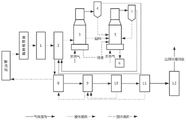
The technical scheme of the invention is further explained in detail by combining the attached drawings:
the invention relates to a waste mixed acid two-stage roasting regeneration device, which comprises a step 1 and a step 1, wherein the step 1 and the step are connected in sequence; 2. a venturi preconcentrator; 3. a first-stage reaction furnace; 4. a primary vortex separator; 5. a secondary reaction furnace; 6. a metal oxidation material bin; 7. a secondary cyclone separator; 8. an absorption tower; 9. a washing tower; 10. a cooling tower; 11. an oxidation tower; 12. and (4) an alkaline washing tower. Wherein the waste mixed acid is acid liquor prepared from waste nitric acid and hydrofluoric acid according to a certain mass ratio.
Wherein the pre-filtering 1 is used for filtering the waste mixed acid to separate solid particles and undissolved residues.
The venturi preconcentrator 2 is used for evaporating partial water and free acid in the waste mixed acid.
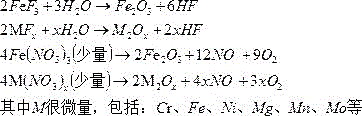
The first-stage reaction furnace 3 is used for roasting the waste acid treated by the Venturi preconcentrator 2, takes natural gas as fuel, controls the temperature at about 150 ℃, and mainly carries out roasting decomposition on nitrate in waste mixed acid to decompose the nitrate into NO2、O2And metal oxides. The main reaction is as follows:
the primary cyclone separator 4 performs gas-solid separation on the waste gas discharged from the primary reaction furnace 3 to separate metal oxide powder, salt and other solid impurities.
The secondary reaction furnace 5 is used for further roasting and decomposing the solid materials (containing fluoride salt, metal oxide, partial undecomposed nitrate and other solid impurities) discharged from the primary reaction furnace 3 and the solid materials separated by the primary cyclone separator 4. The secondary reaction furnace 5 takes natural gas as fuel and appropriately supplements water according to the situation, the temperature in the furnace is controlled at about 750 ℃, the roasting decomposition of fluoride salt and part of undecomposed nitrate is realized, and the main reaction is as follows:
and solid materials such as metal oxides and the like generated by roasting the secondary reaction furnace 5 are discharged from the bottom of the reaction furnace, enter a metal oxide bin 6 and are recycled.
The secondary cyclone separator 7 performs gas-solid separation on the waste gas discharged from the secondary reaction furnace 5, and the separated solid material returns to the secondary reaction furnace 5.
The venturi preconcentrator 2 evaporates free acid and part of water in the waste mixed acid by using high-temperature flue gas which is discharged from the secondary reaction furnace 5 and subjected to gas-solid separation by the secondary cyclone separator 7 and flue gas which is discharged from the primary reaction furnace 3 and subjected to gas-solid separation by the primary cyclone separator 4.
The absorption tower 8 absorbs the waste gas generated after the treatment of the Venturi preconcentrator 2, acid liquid in the tower is sprayed from the top, gas enters from the bottom, an absorption ring is filled in the tower, the operation temperature is controlled between 80 degrees and 85 degrees, and more than 90 percent of HF gas in the waste gas is absorbed.
The washing tower 9 washes the waste gas treated by the absorption tower 8, acid liquid in the tower is sprayed from the top, gas enters from the bottom, and an absorption ring is filled in the tower, so that more than 97% of HF gas is completely absorbed.
The cooling tower 10 cools the exhaust gas treated by the scrubber 9 to reduce the temperature to about 50 ° and absorbs the water vapor remaining in the exhaust gas.
The oxidation tower 11 oxidizes part of NO contained in the exhaust gas treated by the cooling tower 10 to generate NO2Then, a large amount of NO originally present in the composition2And small amount of NO formed by oxidation2Absorbing to recover nitric acid.
The caustic washing tower 12 removes acid gases contained in the exhaust gas absorbed by the oxidation tower 11.
Example 1;
the two-stage roasting regeneration method of waste mixed acid described in this embodiment is realized based on the above two-stage roasting regeneration device of waste mixed acid, and includes the following steps:
the method comprises the following steps: mixing the prepared waste mixed acid (F)-28.4% by mass of NO3 -56.5% by mass and other H+And a mass fraction of metal ions of 15.1%) was subjected to prefiltration 1 at a rate of 1kg per hour to separate solid particles and undissolved residues therefrom.
Step two: the filtered waste mixed acid enters the Venturi preconcentrator 2 to be preheated to about 90 ℃, and part of free acid and water are evaporated.
Step three: the waste mixed acid treated by the Venturi preconcentrator 2 is sent into a first-stage reaction furnace 3 for roasting and decomposition, the temperature of the first-stage reaction furnace 3 is controlled at 130 ℃, and most of nitrate is heated and decomposed in the furnace to generate NO2、O2And metal oxides, and the waste gas enters the primary cyclone separator 4 for treatment. And the treated gas is sampled and detected, and the detection result shows that NO in the waste gas2Volume content of NO and NO2The total volume content of HF is 80.1%, the volume content of NO is 2.0%, and the volume content of HF is 17.9% (HF is mainly free hydrofluoric acid in waste acid evaporated), metal oxide powder, salt and other solid impurities separated by the primary cyclone 4 and solid materials and return materials discharged from the primary reaction furnace 3 enter the secondary reaction furnace 5 for further roasting decomposition, and the detection result shows that the content of fluoride salt accounts for 81.3% of the total content of fluoride salt and nitrate (a part of nitrate is still not decomposed).
Step four: the temperature in the secondary reaction furnace 5 is controlled at about 750 ℃, the main decomposition reaction in the furnace is fluoride salt and partial nitrate, a large amount of HF gas and a small amount of HF gas are generatedMeasuring NO gas, O2And metal oxide, it is found through the detection that in the secondary reaction furnace 5, the decomposition speed of fluoride salt is obviously accelerated, probably because most of water in the waste acid is evaporated and most of nitrate is decomposed in the primary reaction furnace 3, so that fluoride salt can reach the problem required by the reaction more quickly, and fluoride salt exists in a crystal form and contains crystal water, and the reaction can also be carried out more quickly when the reaction temperature is reached. Wherein the metal oxide is discharged into a metal oxide bin 6 through a slag discharge port, the waste gas enters a secondary cyclone separator 7 for gas-solid separation, the separated solid particles return to a secondary reaction furnace 5, the waste gas treated by the secondary cyclone separator is detected, and the detection result shows that the volume content of HF accounts for 82.4% of the total volume content of HF and NO.
Step five: the waste gas treated by the secondary cyclone separator 7 and the waste gas treated by the primary cyclone separator 4 enter the Venturi preconcentrator 2 and exchange heat with the acid liquor to evaporate free acid and part of water in the waste mixed acid.
Step six: the waste gas enters the absorption tower 8 from the Venturi preconcentrator 2, the acid liquid is sprayed from the top, the gas enters from the bottom, and an absorption ring is filled in the absorption tower, wherein more than 90 percent of HF gas is absorbed, the temperature of the waste gas is cooled to be between 80 and 85 degrees, and the generated regenerated acid is supplied to the pickling line for recycling.
Step seven: the waste gas enters the washing tower 9 from the absorption tower 8, the acid liquid is sprayed from the top, the gas enters from the bottom, and an absorption ring is filled in the absorption tower, wherein the residual 10 percent of HF gas is absorbed, so that more than 97 percent of HF gas is completely absorbed, and the absorbed regenerated acid enters the absorption tower 8 to absorb the HF gas.
Step eight: the waste gas enters a cooling tower 10 from a washing tower 9 for cooling, industrial fresh water is sprayed from the top, gas enters from the bottom to absorb water vapor remained in the waste gas, and the absorbed regenerated acid enters the washing tower 9 to absorb HF gas.
Step nine: the waste gas enters the oxidation tower 11 from the cooling tower 10, the industrial fresh water is sprayed from the top, the hydrogen peroxide is added, the gas enters from the bottom, and the high-density filling material is arranged in the gasContaining a small amount of NO oxidized to NO2Simultaneously to NO2Absorbing and recovering HNO3And the absorbed regenerated acid solution enters a washing tower 9 to absorb HF gas.
Step ten: the waste gas enters an alkaline washing tower 12 from an oxidation tower 11, and the residual acid in the waste gas is removed
And (4) a sex gas.
Example 2;
the two-stage roasting regeneration method of waste mixed acid described in this embodiment is realized based on the above two-stage roasting regeneration device of waste mixed acid, and includes the following steps:
the method comprises the following steps: mixing the prepared waste mixed acid (F)-28.4% by mass of NO3 -56.5% by mass and other H+And a mass fraction of metal ions of 15.1%) was subjected to prefiltration 1 at a rate of 1kg per hour to separate solid particles and undissolved residues therefrom.
Step two: the filtered waste mixed acid enters the Venturi preconcentrator 2 to be preheated to about 90 ℃, and part of free acid and water are evaporated.
Step three: the waste mixed acid treated by the Venturi preconcentrator 2 is sent into a first-stage reaction furnace 3 for roasting and decomposition, the temperature in the first-stage reaction furnace 3 is controlled at 150 ℃, and most of nitrate is heated and decomposed in the furnace to generate NO2、O2And metal oxides, and the waste gas enters the primary cyclone separator 4 for treatment. And the treated gas is sampled and detected, and the detection result shows that NO in the waste gas2Volume content of NO and NO2The total volume content of HF is 92.4%, the volume content of NO is 5.1%, the volume content of HF is 2.5%, wherein the total gas content is higher than that of the gas when the temperature in the first-stage reaction furnace 3 is set to 130 ℃, metal oxide powder, salt and other solid impurities separated by the first-stage cyclone separator 4 and the discharged solid material and returned material of the first-stage reaction furnace 3 enter the second-stage reaction furnace 5 for further roasting and decomposition, the solid material discharged from the first-stage reaction furnace is detected, and the detection result shows that the fluoride salt content accounts for 94.0% of the total fluoride salt and nitrate content.
Step four: temperature control in secondary reaction furnace 5The temperature is about 750 ℃, fluoride salt mainly takes place in the furnace for decomposition reaction, the nitrate content is little, and a large amount of HF gas, partial NO gas and O are generated2And metal oxides, and the detection shows that the decomposition speed of the fluoride salt is obviously shortened, which effectively reduces the energy consumption of the secondary reaction furnace 5. Wherein the metal oxide is discharged into a metal oxide bin 6 through a slag discharge port, the waste gas enters a secondary cyclone separator 7 for gas-solid separation, the separated solid particles return to a secondary reaction furnace 5, the waste gas treated by the secondary cyclone separator is detected, and the detection result shows that the volume content of HF accounts for 94.7% of the total volume content of HF and NO.
Step five: the waste gas treated by the secondary cyclone separator 7 and the waste gas treated by the primary cyclone separator 4 enter the Venturi preconcentrator 2 and exchange heat with the acid liquor to evaporate free acid and part of water in the waste mixed acid.
Step six: the waste gas enters the absorption tower 8 from the Venturi preconcentrator 2, the acid liquid is sprayed from the top, the gas enters from the bottom, and an absorption ring is filled in the absorption tower, wherein more than 90 percent of HF gas is absorbed, the temperature of the waste gas is cooled to be between 80 and 85 degrees, and the generated regenerated acid is supplied to the pickling line for recycling.
Step seven: the waste gas enters the washing tower 9 from the absorption tower 8, the acid liquid is sprayed from the top, the gas enters from the bottom, and an absorption ring is filled in the absorption tower, wherein the residual 10 percent of HF gas is absorbed, so that more than 97 percent of HF gas is completely absorbed, and the absorbed regenerated acid enters the absorption tower 8 to absorb the HF gas.
Step eight: the waste gas enters a cooling tower 10 from a washing tower 9 for cooling, industrial fresh water is sprayed from the top, gas enters from the bottom to absorb water vapor remained in the waste gas, and the absorbed regenerated acid enters the washing tower 9 to absorb HF gas.
Step nine: the waste gas enters the oxidation tower 11 from the cooling tower 10, the industrial fresh water is sprayed from the top, the hydrogen peroxide is added, the gas enters from the bottom, and the high-density filling material is arranged in the oxidation tower to oxidize a small amount of NO contained in the gas into NO2Simultaneously to NO2Absorbing and recovering HNO3The absorbed regenerated acid solution enters a washing tower 9Absorbing the HF gas.
Step ten: the waste gas enters an alkaline washing tower 12 from an oxidation tower 11, and the residual acid in the waste gas is removed
And (4) a sex gas.
Example 3;
the two-stage roasting regeneration method of waste mixed acid described in this embodiment is realized based on the above two-stage roasting regeneration device of waste mixed acid, and includes the following steps:
the method comprises the following steps: mixing the prepared waste mixed acid (F)-28.4% by mass of NO3 -56.5% by mass and other H+And a mass fraction of metal ions of 15.1%) was subjected to prefiltration 1 at a rate of 1kg per hour to separate solid particles and undissolved residues therefrom.
Step two: the filtered waste mixed acid enters the Venturi preconcentrator 2 to be preheated to about 90 ℃, and part of free acid and water are evaporated.
Step three: the waste mixed acid treated by the Venturi preconcentrator 2 is sent into a first-stage reaction furnace 3 for roasting and decomposition, the temperature in the first-stage reaction furnace 3 is controlled at 170 ℃, and most of nitrate is heated and decomposed in the furnace to generate NO2、NO、O2And metal oxides, and the waste gas enters the primary cyclone separator 4 for treatment. And the treated gas is sampled and detected, and the detection result shows that NO in the waste gas2Volume content of NO and NO2The total volume content of HF is 75.0%, the volume content of NO is 23.4%, the volume content of HF is 1.6%, wherein the total gas content is higher than that of the gas when the temperature in the first-stage reaction furnace 3 is set to be 150 ℃, metal oxide powder, salt and other solid impurities separated by the first-stage cyclone separator 4, solid materials and return materials discharged from the first-stage reaction furnace 3 enter the second-stage reaction furnace 5 for further roasting and decomposition, the solid materials discharged from the first-stage reaction furnace are detected, and the detection result shows that the fluoride salt content accounts for 96.1% of the total fluoride salt and nitrate content.
Step four: the temperature in the secondary reaction furnace 5 is controlled at about 750 ℃, the decomposition reaction in the furnace mainly takes place of fluoride salt, the content of nitrate is little, and a large amount of HF gas, partial NO gas and O gas are generated2And metal oxide, the decomposition speed of fluoride salt in the secondary reaction furnace 5 is obviously shortened through detection, which can effectively reduce the energy consumption of the secondary reaction furnace 5. Wherein the metal oxide is discharged into a metal oxide bin 6 through a slag discharge port, the waste gas enters a secondary cyclone separator 7 for gas-solid separation, the separated solid particles return to a secondary reaction furnace 5, the waste gas treated by the secondary cyclone separator is detected, and the detection result shows that the volume content of HF accounts for 96.5% of the total volume content of HF and NO.
Step five: the waste gas treated by the secondary cyclone separator 7 and the waste gas treated by the primary cyclone separator 4 enter the Venturi preconcentrator 2 and exchange heat with the acid liquor to evaporate free acid and part of water in the waste mixed acid.
Step six: the waste gas enters the absorption tower 8 from the Venturi preconcentrator 2, the acid liquid is sprayed from the top, the gas enters from the bottom, and an absorption ring is filled in the absorption tower, wherein more than 90 percent of HF gas is absorbed, the temperature of the waste gas is cooled to be between 80 and 85 degrees, and the generated regenerated acid is supplied to the pickling line for recycling.
Step seven: the waste gas enters the washing tower 9 from the absorption tower 8, the acid liquid is sprayed from the top, the gas enters from the bottom, and an absorption ring is filled in the absorption tower, wherein the residual 10 percent of HF gas is absorbed, so that more than 97 percent of HF gas is completely absorbed, and the absorbed regenerated acid enters the absorption tower 8 to absorb the HF gas.
Step eight: the waste gas enters a cooling tower 10 from a washing tower 9 for cooling, industrial fresh water is sprayed from the top, gas enters from the bottom to absorb water vapor remained in the waste gas, and the absorbed regenerated acid enters the washing tower 9 to absorb HF gas.
Step nine: the waste gas enters the oxidation tower 11 from the cooling tower 10, the industrial fresh water is sprayed from the top, the hydrogen peroxide is added, the gas enters from the bottom, and the high-density filling material is arranged in the oxidation tower to oxidize a small amount of NO contained in the gas into NO2Simultaneously to NO2Absorbing and recovering HNO3And the absorbed regenerated acid solution enters a washing tower 9 to absorb HF gas.
Step ten: the waste gas enters an alkaline washing tower 12 from an oxidation tower 11, and the residual acid in the waste gas is removed
And (4) a sex gas.
It will be understood by those skilled in the art that, unless otherwise defined, all terms (including technical and scientific terms) used herein have the same meaning as commonly understood by one of ordinary skill in the art to which this invention belongs. It will be further understood that terms, such as those defined in commonly used dictionaries, should be interpreted as having a meaning that is consistent with their meaning in the context of the prior art and will not be interpreted in an idealized or overly formal sense unless expressly so defined herein.
The above embodiments are only for illustrating the technical idea of the present invention, and the protection scope of the present invention is not limited thereby, and any modifications made on the basis of the technical scheme according to the technical idea of the present invention fall within the protection scope of the present invention. While the embodiments of the present invention have been described in detail, the present invention is not limited to the above embodiments, and various changes can be made without departing from the spirit of the present invention within the knowledge of those skilled in the art.