CN112368043A - Guidewire and method of manufacturing a guidewire - Google Patents
Guidewire and method of manufacturing a guidewire Download PDFInfo
- Publication number
- CN112368043A CN112368043A CN201880095113.0A CN201880095113A CN112368043A CN 112368043 A CN112368043 A CN 112368043A CN 201880095113 A CN201880095113 A CN 201880095113A CN 112368043 A CN112368043 A CN 112368043A
- Authority
- CN
- China
- Prior art keywords
- diameter portion
- small
- covering member
- mandrel
- small diameter
- Prior art date
- Legal status (The legal status is an assumption and is not a legal conclusion. Google has not performed a legal analysis and makes no representation as to the accuracy of the status listed.)
- Granted
Links
- 238000004519 manufacturing process Methods 0.000 title claims description 22
- 239000000463 material Substances 0.000 claims description 46
- 239000000853 adhesive Substances 0.000 claims description 40
- 230000001070 adhesive effect Effects 0.000 claims description 39
- 239000007767 bonding agent Substances 0.000 claims description 24
- 238000000576 coating method Methods 0.000 claims description 22
- 239000011248 coating agent Substances 0.000 claims description 21
- 238000005452 bending Methods 0.000 claims description 15
- 238000005304 joining Methods 0.000 claims description 13
- 238000003780 insertion Methods 0.000 claims description 8
- 230000037431 insertion Effects 0.000 claims description 8
- 238000002360 preparation method Methods 0.000 claims description 6
- 238000005253 cladding Methods 0.000 abstract description 13
- 239000013256 coordination polymer Substances 0.000 description 22
- 229910045601 alloy Inorganic materials 0.000 description 14
- 239000000956 alloy Substances 0.000 description 14
- 238000000034 method Methods 0.000 description 14
- 230000000694 effects Effects 0.000 description 13
- 229910052751 metal Inorganic materials 0.000 description 10
- 239000002184 metal Substances 0.000 description 10
- 238000012986 modification Methods 0.000 description 10
- 230000004048 modification Effects 0.000 description 10
- 229910001000 nickel titanium Inorganic materials 0.000 description 10
- 229920005989 resin Polymers 0.000 description 7
- 239000011347 resin Substances 0.000 description 7
- 229910000679 solder Inorganic materials 0.000 description 7
- 238000004804 winding Methods 0.000 description 7
- 239000010931 gold Substances 0.000 description 5
- 238000010586 diagram Methods 0.000 description 4
- 210000004204 blood vessel Anatomy 0.000 description 3
- PCHJSUWPFVWCPO-UHFFFAOYSA-N gold Chemical compound [Au] PCHJSUWPFVWCPO-UHFFFAOYSA-N 0.000 description 3
- 229910052737 gold Inorganic materials 0.000 description 3
- 238000003754 machining Methods 0.000 description 3
- 150000002739 metals Chemical class 0.000 description 3
- 239000000203 mixture Substances 0.000 description 3
- 229910001316 Ag alloy Inorganic materials 0.000 description 2
- 229910001128 Sn alloy Inorganic materials 0.000 description 2
- HCHKCACWOHOZIP-UHFFFAOYSA-N Zinc Chemical compound [Zn] HCHKCACWOHOZIP-UHFFFAOYSA-N 0.000 description 2
- 210000003445 biliary tract Anatomy 0.000 description 2
- 239000003795 chemical substances by application Substances 0.000 description 2
- 239000000788 chromium alloy Substances 0.000 description 2
- 210000002249 digestive system Anatomy 0.000 description 2
- 239000013013 elastic material Substances 0.000 description 2
- 239000003822 epoxy resin Substances 0.000 description 2
- 210000004392 genitalia Anatomy 0.000 description 2
- 210000004907 gland Anatomy 0.000 description 2
- 210000004324 lymphatic system Anatomy 0.000 description 2
- 210000000056 organ Anatomy 0.000 description 2
- 230000002093 peripheral effect Effects 0.000 description 2
- BASFCYQUMIYNBI-UHFFFAOYSA-N platinum Chemical compound [Pt] BASFCYQUMIYNBI-UHFFFAOYSA-N 0.000 description 2
- 229920000647 polyepoxide Polymers 0.000 description 2
- 210000002345 respiratory system Anatomy 0.000 description 2
- 230000003248 secreting effect Effects 0.000 description 2
- 229910001256 stainless steel alloy Inorganic materials 0.000 description 2
- 230000002485 urinary effect Effects 0.000 description 2
- 229910052725 zinc Inorganic materials 0.000 description 2
- 239000011701 zinc Substances 0.000 description 2
- 229910000531 Co alloy Inorganic materials 0.000 description 1
- 229910000990 Ni alloy Inorganic materials 0.000 description 1
- HZEWFHLRYVTOIW-UHFFFAOYSA-N [Ti].[Ni] Chemical compound [Ti].[Ni] HZEWFHLRYVTOIW-UHFFFAOYSA-N 0.000 description 1
- 230000005540 biological transmission Effects 0.000 description 1
- 230000003247 decreasing effect Effects 0.000 description 1
- 238000012217 deletion Methods 0.000 description 1
- 230000037430 deletion Effects 0.000 description 1
- 239000006185 dispersion Substances 0.000 description 1
- 238000010438 heat treatment Methods 0.000 description 1
- 230000002209 hydrophobic effect Effects 0.000 description 1
- 238000009434 installation Methods 0.000 description 1
- 230000000116 mitigating effect Effects 0.000 description 1
- PCLURTMBFDTLSK-UHFFFAOYSA-N nickel platinum Chemical compound [Ni].[Pt] PCLURTMBFDTLSK-UHFFFAOYSA-N 0.000 description 1
- 229910000623 nickel–chromium alloy Inorganic materials 0.000 description 1
- -1 piano wire Substances 0.000 description 1
- 229910052697 platinum Inorganic materials 0.000 description 1
- 238000012545 processing Methods 0.000 description 1
- WFKWXMTUELFFGS-UHFFFAOYSA-N tungsten Chemical compound [W] WFKWXMTUELFFGS-UHFFFAOYSA-N 0.000 description 1
- 229910052721 tungsten Inorganic materials 0.000 description 1
- 239000010937 tungsten Substances 0.000 description 1
- 230000002792 vascular Effects 0.000 description 1
- 239000011800 void material Substances 0.000 description 1
- 238000003466 welding Methods 0.000 description 1
Images




Classifications
-
- A—HUMAN NECESSITIES
- A61—MEDICAL OR VETERINARY SCIENCE; HYGIENE
- A61M—DEVICES FOR INTRODUCING MEDIA INTO, OR ONTO, THE BODY; DEVICES FOR TRANSDUCING BODY MEDIA OR FOR TAKING MEDIA FROM THE BODY; DEVICES FOR PRODUCING OR ENDING SLEEP OR STUPOR
- A61M25/00—Catheters; Hollow probes
- A61M25/01—Introducing, guiding, advancing, emplacing or holding catheters
- A61M25/09—Guide wires
-
- A—HUMAN NECESSITIES
- A61—MEDICAL OR VETERINARY SCIENCE; HYGIENE
- A61M—DEVICES FOR INTRODUCING MEDIA INTO, OR ONTO, THE BODY; DEVICES FOR TRANSDUCING BODY MEDIA OR FOR TAKING MEDIA FROM THE BODY; DEVICES FOR PRODUCING OR ENDING SLEEP OR STUPOR
- A61M25/00—Catheters; Hollow probes
- A61M25/01—Introducing, guiding, advancing, emplacing or holding catheters
- A61M25/09—Guide wires
- A61M2025/09058—Basic structures of guide wires
- A61M2025/09083—Basic structures of guide wires having a coil around a core
-
- A—HUMAN NECESSITIES
- A61—MEDICAL OR VETERINARY SCIENCE; HYGIENE
- A61M—DEVICES FOR INTRODUCING MEDIA INTO, OR ONTO, THE BODY; DEVICES FOR TRANSDUCING BODY MEDIA OR FOR TAKING MEDIA FROM THE BODY; DEVICES FOR PRODUCING OR ENDING SLEEP OR STUPOR
- A61M25/00—Catheters; Hollow probes
- A61M25/01—Introducing, guiding, advancing, emplacing or holding catheters
- A61M25/09—Guide wires
- A61M2025/09108—Methods for making a guide wire
-
- A—HUMAN NECESSITIES
- A61—MEDICAL OR VETERINARY SCIENCE; HYGIENE
- A61M—DEVICES FOR INTRODUCING MEDIA INTO, OR ONTO, THE BODY; DEVICES FOR TRANSDUCING BODY MEDIA OR FOR TAKING MEDIA FROM THE BODY; DEVICES FOR PRODUCING OR ENDING SLEEP OR STUPOR
- A61M25/00—Catheters; Hollow probes
- A61M25/01—Introducing, guiding, advancing, emplacing or holding catheters
- A61M25/09—Guide wires
- A61M2025/09133—Guide wires having specific material compositions or coatings; Materials with specific mechanical behaviours, e.g. stiffness, strength to transmit torque
-
- A—HUMAN NECESSITIES
- A61—MEDICAL OR VETERINARY SCIENCE; HYGIENE
- A61M—DEVICES FOR INTRODUCING MEDIA INTO, OR ONTO, THE BODY; DEVICES FOR TRANSDUCING BODY MEDIA OR FOR TAKING MEDIA FROM THE BODY; DEVICES FOR PRODUCING OR ENDING SLEEP OR STUPOR
- A61M25/00—Catheters; Hollow probes
- A61M25/01—Introducing, guiding, advancing, emplacing or holding catheters
- A61M25/09—Guide wires
- A61M2025/09191—Guide wires made of twisted wires
-
- A—HUMAN NECESSITIES
- A61—MEDICAL OR VETERINARY SCIENCE; HYGIENE
- A61M—DEVICES FOR INTRODUCING MEDIA INTO, OR ONTO, THE BODY; DEVICES FOR TRANSDUCING BODY MEDIA OR FOR TAKING MEDIA FROM THE BODY; DEVICES FOR PRODUCING OR ENDING SLEEP OR STUPOR
- A61M2205/00—General characteristics of the apparatus
- A61M2205/02—General characteristics of the apparatus characterised by a particular materials
- A61M2205/0266—Shape memory materials
Landscapes
- Health & Medical Sciences (AREA)
- Life Sciences & Earth Sciences (AREA)
- Biophysics (AREA)
- Pulmonology (AREA)
- Engineering & Computer Science (AREA)
- Anesthesiology (AREA)
- Biomedical Technology (AREA)
- Heart & Thoracic Surgery (AREA)
- Hematology (AREA)
- Animal Behavior & Ethology (AREA)
- General Health & Medical Sciences (AREA)
- Public Health (AREA)
- Veterinary Medicine (AREA)
- Media Introduction/Drainage Providing Device (AREA)
Abstract
The guidewire includes a first mandrel, a second mandrel, a cladding member, and a bonding layer. The first mandrel has a first large diameter portion and a first small diameter portion, and the second mandrel has a second large diameter portion and a second small diameter portion. The covering member covers a joint portion where the first small-diameter portion and the second small-diameter portion are arranged to face each other, and at least a part of each of the first small-diameter portion and the second small-diameter portion adjacent to the joint portion. The joining layer joins the covering member, the first small diameter portion, and the second small diameter portion on the inner side of the covering member. The length of the covering member in the axial direction is smaller than the sum of the lengths of the first and second small diameter portions in the axial direction and larger than the shorter one of the first and second small diameter portions in the axial direction.
Description
Technical Field
The present invention relates to a guidewire and a method of making a guidewire.
Background
A guidewire used for inserting a catheter or the like into a blood vessel is well known. Such a guide wire is required to have: flexibility and restorability against bending, torque transmission and pushability to transmit the operation of the proximal portion to the guide wire to the distal end side, and strong kink resistance which is strong against deformation due to bending, twisting, and crushing. In addition, the torque transmissibility and the pushability are collectively referred to as "operability". For example, in the guide wires disclosed in patent documents 1 to 3, flexibility and operability are improved by providing a first mandrel (first wire) disposed on the distal end side, a second mandrel (second wire) disposed on the proximal end side of the first mandrel and joined to the first mandrel, and a covering member (tubular member) covering the joined portion of the first and second mandrels.
Documents of the prior art
Patent document
Patent document 1: japanese laid-open patent publication No. 2004-16359
Patent document 2: japanese patent application laid-open No. 2017-513604
Patent document 3: specification of U.S. Pat. No. 6602208
Disclosure of Invention
Problems to be solved by the invention
However, in the guide wires described in patent documents 1 and 2, the fixing material (solder, adhesive) is filled in the gap between the outer peripheral surfaces of the first and second mandrels and the inner peripheral surface of the covering member, thereby fixing the covering member to the first and second mandrels. Therefore, the pressure inside the covering member is increased by the excess of the fixing material, and the covering member may be damaged. On the other hand, in the guide wire described in patent document 3, since the hole is provided in the covering member, the possibility of pressure rise inside the covering member is low. However, in the guide wire described in patent document 3, stress concentration occurs in the vicinity of the hole of the covering member when the guide wire is bent or the like, and thus there is a possibility that the covering member may be broken. Such problems are common to guide wires inserted into various organs in the human body, including not only the vascular system but also the lymphatic system, biliary system, urinary system, respiratory system, digestive system, secretory gland, and genital organ.
The present invention has been made to solve the above-described problem, and an object thereof is to suppress damage to a covering member in a guide wire including first and second mandrels covered with the covering member.
Means for solving the problems
The present invention has been made to solve at least part of the above problems, and can be implemented as follows.
(1) According to one aspect of the present invention, a guidewire is provided. The guide wire comprises: a first mandrel having a first large diameter portion and a first small diameter portion having a smaller diameter than the first large diameter portion, and disposed on a tip end side; a second mandrel having a second large diameter portion and a second small diameter portion having a smaller diameter than the second large diameter portion, and disposed on a proximal end side; a covering member that covers a joint portion where the first small-diameter portion and the second small-diameter portion are arranged to face each other, and at least a part of each of the first small-diameter portion and the second small-diameter portion adjacent to the joint portion; and a joining layer that joins the covering member, the first small-diameter portion, and the second small-diameter portion on the inner side of the covering member, wherein the length of the covering member in the axial direction is smaller than the sum of the lengths of the first small-diameter portion and the second small-diameter portion in the axial direction, and is larger than the shorter length of the first small-diameter portion and the second small-diameter portion in the axial direction.
According to this structure, the length of the covering member in the axial direction is smaller than the sum of the lengths of the first and second small diameter portions in the axial direction and larger than the shorter one of the lengths of the first and second small diameter portions in the axial direction. Therefore, according to this configuration, in manufacturing the guide wire, the first and second small diameter portions are arranged to face each other with the covering member inserted into the other of the first and second small diameter portions having a longer length in the central axis direction, and after the adhesive is applied to the surfaces of the first and second small diameter portions, the covering member can be moved (slid) to a desired position on the surfaces of the first and second small diameter portions. As a result, the covering member can easily cover the joint portion of the first and second small diameter portions by sliding the covering member to the end portion of the larger diameter portion that is the shorter of the first and second small diameter portions.
Further, according to this configuration, by moving the covering member on the surfaces of the first and second small diameter portions in a state where the adhesive is applied, the excess adhesive applied to the surfaces is pushed out and discharged by the end portion of the covering member. Therefore, if the guide wire is manufactured in this way, it is not necessary to provide a hole that causes stress concentration in the covering member, and it is possible to suppress an increase in the internal pressure of the covering member due to the filling of an excess amount of the bonding agent (fixing material) into the inside of the covering member. As a result, according to the present configuration, in the guide wire including the first and second mandrels covered with the covering member, the breakage of the covering member can be suppressed. Further, according to the present configuration, since the step of forming the hole in the covering member is not required, the number of manufacturing steps of the guide wire can be reduced.
(2) In the guide wire according to the above aspect, the first small diameter portion may be a portion having a shorter length in the axial direction, and the bending rigidity of the material forming the first mandrel may be smaller than the bending rigidity of the material forming the second mandrel. According to this configuration, the shorter of the first and second small diameter portions is disposed on the distal end side of the guide wire, and the material of the first mandrel on the distal end side is less rigid to bending than the material of the second mandrel on the proximal end side. Therefore, the flexibility of the distal end side of the guide wire can be improved.
(3) In the guide wire of the above manner, the first core shaft may be made of a superelastic material. According to this configuration, the first core shaft located on the distal end side of the guide wire is made of a superelastic alloy such as a NiTi alloy or the like, so that the distal end side of the guide wire is less likely to be plastically deformed, and as a result, breakage of the distal end side of the guide wire can be suppressed.
(4) In the guide wire of the above aspect, the covering member may be disposed such that one end of the covering member is located in the vicinity of a boundary between the first large diameter portion and the first small diameter portion, and the joining layer may join at least the joining portion, the first small diameter portion, and the second small diameter portion inside the covering member. According to this configuration, since the joining layer is formed on the inner joining portion of the covering member, the first mandrel (first diameter-reduced portion), and the second mandrel (second diameter-reduced portion), the operation of the proximal portion on the guide wire can be transmitted to the distal end side, and the torque transmissibility and the pushing-in ability (operability) can be improved. Even when the first and second mandrels have different rigidities from each other, the difference in rigidity can be alleviated by the covering member, and therefore deformation (bending, twisting, crushing) of the first and second mandrels in the vicinity of the joint portion can be suppressed, and kink resistance can be improved.
(5) In the guide wire according to the above aspect, the covering member may be disposed so as to be located in the vicinity of the center of the first small-diameter portion and the second small-diameter portion that are joined, and the joining layer may join at least both end portions of the covering member, the first small-diameter portion, and the second small-diameter portion, respectively, inside the covering member. According to this configuration, since the joining layer joins both end portions of the covering member, the first mandrel (first small diameter portion), and the second mandrel (second small diameter portion) inside the covering member, the operation of the guide wire in the proximal portion can be transmitted to the distal end side, and the torque transmissibility and the pushing-in property (operability) can be improved. Even when the first and second mandrels have different rigidities from each other, the difference in rigidity can be alleviated by the covering member, and therefore deformation of the first and second mandrels in the vicinity of the joint portion can be suppressed, and kink resistance can be improved.
(6) In the above aspect of the guide wire, the first small diameter portion includes: a first end-side reduced diameter portion provided on an end side of the first mandrel; and a first intermediate small diameter portion which is provided between the first end portion side small diameter portion and the first large diameter portion and which is larger in diameter than the first end portion side small diameter portion, the second small diameter portion including: a second end portion side small diameter portion provided on an end portion side of the second mandrel; and a second intermediate small diameter portion that is provided between the second end portion side small diameter portion and the second large diameter portion and that is larger in diameter than the second end portion side small diameter portion, wherein an inner covering member that covers the joint portion, the first end portion side small diameter portion adjacent to the joint portion, and the second end portion side small diameter portion is further disposed inside the covering member. According to this configuration, the inner covering member covering the joint portion and the first and second end portion side small diameter portions adjacent to the joint portion is disposed inside the covering member. Therefore, even when the rigidity of the first and second mandrels is different from each other, the difference in rigidity between the first and second mandrels can be alleviated by the inner cover member. Further, even when the first mandrel, the second mandrel, and the covering member have different rigidities, the difference in rigidity can be alleviated by the inner covering member. Therefore, the deformation of the first and second mandrels in the vicinity of the joint portion or the deformation of the first and second mandrels in the vicinity of the inner cover member can be suppressed, and the kink resistance can be further improved.
(7) In the guide wire of the above aspect, the outer diameter of the covering member may be substantially the same as the diameter of the first large diameter portion. According to this configuration, since the outer diameter of the covering member is substantially the same as the diameter of the first large diameter portion, the surface shape of the connecting portion between the first mandrel and the covering member can be formed into a flat shape without irregularities, and therefore, the medical device such as a balloon catheter can be prevented from being caught when the medical device is pushed through the guide wire, and as a result, the medical device can be prevented from being damaged.
(8) In the guide wire in the above manner, the covering member may be a tubular member in a tubular shape made of a superelastic material. According to this structure, by designing the covering member in the shape of a tube of a superelastic material, the effect of mitigating the difference in rigidity can be further enhanced, and kink resistance can be further improved.
(9) According to one aspect of the present invention, a method of manufacturing a guidewire is provided. The method comprises the following steps: a preparation step of preparing a first mandrel having a first large diameter portion and a first small diameter portion having a diameter smaller than the first large diameter portion, a second mandrel having a second large diameter portion and a second small diameter portion having a diameter smaller than the second large diameter portion, and a covering member having a length in an axial direction smaller than a sum of lengths of the first small diameter portion and the second small diameter portion in the axial direction and larger than a shorter length of the first small diameter portion and the second small diameter portion in the axial direction; an insertion step of inserting the covering member from one side of the second reduced diameter portion of the second mandrel; a disposing step of disposing the first diameter portion of the first mandrel and the second diameter portion of the second mandrel in an opposed manner; a coating step of coating an adhesive on a surface of a joint portion where the first small-diameter portion and the second small-diameter portion are arranged in opposition to each other, and on surfaces of the first small-diameter portion and the second small-diameter portion adjacent to the joint portion and exposed from the covering member; and a moving step of moving the covering member to a position where the bonding agent is applied. According to this method, a guide wire including the first and second mandrels covered with the covering member and capable of suppressing breakage of the covering member can be manufactured, and a step of forming a hole in the covering member is not required, so that the number of manufacturing steps of the guide wire can be reduced.
(10) According to one aspect of the present invention, a method of manufacturing a guidewire is provided. The method comprises the following steps: a preparation step of preparing a first mandrel having a first large diameter portion and a first small diameter portion having a diameter smaller than the first large diameter portion, a second mandrel having a second large diameter portion and a second small diameter portion having a diameter smaller than the second large diameter portion, and a covering member having a length in an axial direction larger than a sum of lengths of the first small diameter portion and the second small diameter portion in the axial direction and larger than a shorter length of the first small diameter portion and the second small diameter portion in the axial direction; an insertion step of inserting the covering member from one side of the second reduced diameter portion of the second mandrel; a disposing step of disposing the first diameter portion of the first mandrel and the second diameter portion of the second mandrel in an opposed manner; a first coating step of coating an adhesive on a surface of the first small diameter portion exposed from the covering member; a first moving step of moving the covering member to a position where the bonding agent is applied; a second coating step of coating an adhesive on a surface of the second small diameter portion exposed from the covering member; and a second moving step of moving the covering member to a vicinity of a center of the first and second small diameter portions. According to this method, a guide wire including the first and second mandrels covered with the covering member and capable of suppressing breakage of the covering member can be manufactured, and a step of forming a hole in the covering member is not required, so that the number of manufacturing steps of the guide wire can be reduced.
The present invention can be realized in various forms, for example, a mandrel product including a plurality of mandrels for a guide wire, a method for manufacturing the mandrel product, and the like.
Drawings
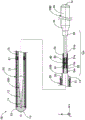
Fig. 1 is a partial sectional view showing the overall structure of the guide wire of the first embodiment.
FIG. 2 is a partial sectional view of the periphery of the joint portion (FIG. 1).
Fig. 3 is a diagram illustrating a method of manufacturing a guidewire.
Fig. 4 is a partial sectional view showing the overall structure of the guide wire of the second embodiment.
FIG. 5 is a partial sectional view of the periphery of the joint portion (FIG. 4) of the second embodiment.
Fig. 6 is a diagram illustrating a method of manufacturing the guide wire according to the second embodiment.
Fig. 7 is a partial sectional view showing the entire structure of the guide wire of the third embodiment.
FIG. 8 is a partial sectional view of the periphery of the joint portion (FIG. 7) of the third embodiment.
Fig. 9 is a partial sectional view of the periphery of a joint portion of a guide wire according to the fourth embodiment.
Fig. 10 is a perspective view showing a schematic structure of the inner cladding member.
Fig. 11 is a partial sectional view of the periphery of a joint portion of a guide wire according to a fifth embodiment.
Fig. 12 is a partial sectional view of the periphery of a joint portion of a guide wire according to a sixth embodiment.
Fig. 13 is a partial sectional view of the periphery of a joint portion of a guide wire according to the seventh embodiment.
Fig. 14 is a partial sectional view of the periphery of a joint portion of a guide wire according to the eighth embodiment.
Fig. 15 is a partial sectional view of the periphery of a joint portion of a guide wire according to the ninth embodiment.
Fig. 16 is a partial sectional view of the periphery of a joint portion of a guide wire according to the tenth embodiment.
Fig. 17 is an enlarged view of the vicinity of the covering member of the guidewire of the eleventh embodiment.
Detailed Description
< first embodiment >
Fig. 1 is a partial sectional view showing the overall structure of a guide wire 1 of the first embodiment. The guidewire 1 is a medical instrument used, for example, when a catheter is inserted into a blood vessel, and includes a first mandrel 10, a coil body 20, a second mandrel 30, a distal-side fixing portion 51, a proximal-side fixing portion 52, and a covering member 70. In fig. 1, an axis passing through the center of the guide wire 1 is indicated by an axis O (one-dot chain line). In the following examples, the axes passing through the centers of the respective members of the first core shaft 10, the coil body 20, the second core shaft 30, and the covering member 70 all coincide with the axis O. However, the shafts passing through the centers of the members may be different from the axis O.
Further, in fig. 1, XYZ axes orthogonal to each other are shown. The X axis corresponds to the axial direction of the guide wire 1, the Y axis corresponds to the height direction of the guide wire 1, and the Z axis corresponds to the width direction of the guide wire 1. The left side of fig. 1 (-X axis direction) is referred to as the "leading end side" of the guide wire 1 and each structural member, and the right side of fig. 1 (+ X axis direction) is referred to as the "base end side" of the guide wire 1 and each structural member. In addition, with respect to the guide wire 1 and each structural member, the end portion located on the distal end side is referred to as a "distal end portion" or simply a "distal end", and the end portion located on the proximal end side is referred to as a "proximal end portion" or simply a "proximal end". In the present embodiment, the distal end corresponds to the "distal side", and the proximal end corresponds to the "proximal side". These points also apply to the figures following fig. 1, which show the overall structure.
The first mandrel 10 is an elongated member having a large diameter at the center and a small diameter at both ends (tip end side and base end side). The first mandrel 10 is made of a superelastic material such as NiTi (nickel titanium) alloy, or NiTi alloy with other metals. The first mandrel 10 includes, in order from the distal end side toward the proximal end side, a distal end small diameter portion 11, a distal end small diameter portion 12, a first large diameter portion 13, and a first small diameter portion 15. The outer diameter and length of each portion can be set arbitrarily.
The distal end small diameter portion 11 is disposed at the distal end of the first spindle 10. The leading end small diameter portion 11 is a portion of the first mandrel 10 where the outer diameter is smallest, and has a substantially cylindrical shape with a constant outer diameter. The tip reduced diameter portion 12 is disposed between the tip reduced diameter portion 11 and the first large diameter portion 13. The distal end reduced diameter portion 12 has a substantially truncated cone shape with an outer diameter reduced from the proximal end side toward the distal end side. The first large diameter portion 13 is disposed between the distal end reduced diameter portion 12 and the first small diameter portion 15. The first large diameter portion 13 is a portion where the outer diameter of the first mandrel 10 is the largest, and is substantially cylindrical in shape with a constant outer diameter. The first diameter-reduced portion 15 is disposed at the base end portion of the first spindle 10. The first small diameter portion 15 has a substantially cylindrical shape having a constant outer diameter smaller than the first large diameter portion 13 and larger than the distal end small diameter portion 11.
The second mandrel 30 is an elongated member having a tapered tip, the base end side of which has a large diameter and the tip end side of which has a small diameter. The second mandrel 30 is made of a material having higher rigidity than the first mandrel 10, for example, stainless steel alloy such as SUS304, SUS316, or the like. The second mandrel 30 includes, in order from the distal end side toward the proximal end side, a second small diameter portion 31, a second large diameter portion 33, a proximal end reduced diameter portion 34, and a proximal end large diameter portion 35. The outer diameter and length of each portion can be set arbitrarily.
The second diameter portion 31 is disposed at the distal end of the second mandrel 30. The second small diameter portion 31 is a portion where the outer diameter of the second mandrel 30 is smallest, and is a substantially cylindrical shape having substantially the same constant outer diameter as the first small diameter portion 15 of the first mandrel 10. The second large diameter portion 33 is disposed between the second small diameter portion 31 and the base end reduced diameter portion 34. The second large diameter portion 33 has a substantially cylindrical shape having a constant outer diameter smaller than the base end large diameter portion 35 and larger than the second small diameter portion 31. And a base end reduced diameter portion 34 disposed between the second large diameter portion 33 and the base end large diameter portion 35. The base end reduced diameter portion 34 has a substantially truncated cone shape with an outer diameter reduced from the base end side toward the tip end side. The base end large diameter portion 35 is disposed at the base end portion of the second spindle 30. The base end large diameter portion 35 is a portion where the outer diameter of the second mandrel 30 is the largest, and is substantially cylindrical in shape with a constant outer diameter.
In the first core 10, the tip end sides of the tip end small diameter portion 11, the tip end small diameter portion 12, and the first large diameter portion 13 are covered with a coil body 20 described later. On the other hand, the base end side of the first large diameter portion 13 of the first bobbin 10, and each portion of the first small diameter portion 15 and the second bobbin 30 are not covered with the coil body 20, but are exposed from the coil body 20. The proximal end large diameter portion 35 of the second mandrel 30 is used when the operator grips the guide wire 1.
The coil body 20 is formed in a substantially cylindrical shape by spirally winding a wire 21 around the first core 10. The wire 21 forming the coil body 20 may be a single wire formed of one wire or a stranded wire formed by twisting a plurality of wires. When the wire 21 is a single wire, the coil body 20 is configured as a single coil, and when the wire 21 is a stranded wire, the coil body 20 is configured as a hollow stranded wire coil. The coil body 20 may be formed by combining a single coil with a hollow stranded wire coil. The wire diameter of the wire 21 and the coil average diameter of the coil body 20 (average diameter of the outer diameter and the inner diameter of the coil body 20) can be arbitrarily set.
The wire 21 may be made of, for example, stainless steel alloys such as SUS304 and SUS316, super-elastic alloys such as NiTi alloys, piano wire, nickel-chromium alloys, cobalt alloys, and other radiation-permeable alloys; gold, platinum, tungsten, or an alloy including these elements (for example, platinum-nickel alloy). In addition, the wire 21 may be made of a known material other than the above.
The distal end side fixing portion 51 is disposed at the distal end portion of the guide wire 1, and integrally holds the distal end portion of the distal end small diameter portion 11 of the first core shaft 10 and the distal end portion of the coil body 20. The distal fixing portion 51 may be made of any bonding agent, for example, a metal solder such as silver solder, gold solder, zinc, Sn — Ag alloy, Au — Sn alloy, or the like, or an adhesive such as an epoxy resin-based adhesive. The base end side fixing portion 52 is disposed at a portion of the first large diameter portion 13 of the first core 10 near the base end side, and integrally holds the first core 10 and the base end portion of the coil body 20. The base-side fixing portion 52 may be made of any adhesive, as in the tip-side fixing portion 51. The proximal fixing portion 52 and the distal fixing portion 51 may be formed of the same adhesive or different adhesives.
The intermediate fixing portion 61 integrally holds the coil body 20 and the first core shaft 10 in the vicinity of the intermediate portion of the coil body 20 in the axis O direction. The intermediate fixing portion 61 may be made of any adhesive, as in the distal fixing portion 51. The intermediate fixing portion 61 and the distal fixing portion 51 may be made of the same adhesive or different adhesives. In fig. 1, 1 intermediate fixing portion 61 is illustrated, but a plurality of intermediate fixing portions 61 may be provided on the guidewire 1.
FIG. 2 is a partial sectional view of the joint portion periphery 1pa (FIG. 1). In fig. 2, the upper part shows a partial sectional view of the periphery of the joint portion of the first and second mandrels 10, 30, and the lower part shows an enlarged view of the vicinity of the covering member 70. The X, Y, Z axes shown in FIG. 2 correspond to the X, Y, Z axes of FIG. 1, respectively. This is the same for the drawings labeled with the X, Y, Z axis in fig. 2 and later.
The first and second mandrels 10, 30 are disposed in an opposing manner (disposed in an opposing manner) with the central axis of the first mandrel 10 and the central axis of the second mandrel 30 aligned with each other. In the illustrated example, the respective central axes of the first and second mandrels 10, 30 coincide with the axis O. However, the first and second mandrels 10, 30 may have their central axes aligned with each other at positions on the YZ plane different from the axis O. Further, the central axes of the first and second mandrels 10, 30 may be different from each other. Hereinafter, a portion where the first and second mandrels 10, 30 face each other is referred to as a "joint portion CP". In the illustrated example, the joint portion CP is a portion adjacent to a base end portion of the first small-diameter portion 15 of the first mandrel 10 and a tip end portion of the second small-diameter portion 31 of the second mandrel 30.
In the present embodiment, the first and second mandrels 10, 30 are joined at the joint portion CP. The joining may be performed by, for example, filling and fixing a gap between the first small-diameter portion 15 of the first mandrel 10 and the second small-diameter portion 31 of the second mandrel 30, which are adjacently disposed at the joint portion CP, with the joining agent 81. In this case, the adhesive 81 may be disposed in the entire gap between the first small diameter portion 15 and the second small diameter portion 31 (in other words, the entire surfaces of the end surface on the base end side of the first small diameter portion 15 and the end surface on the tip end side of the second small diameter portion 31), or the adhesive 81 may be disposed only in a part of the gap, and the other part may be a void. The bonding agent 81 may be, for example, a metal solder such as silver solder, gold solder, zinc, Sn — Ag alloy, or Au — Sn alloy, or an adhesive such as an epoxy resin adhesive. The joining at the joint portion CP may be performed by welding the first and second mandrels 10 and 30.
The first and second mandrels 10, 30 may not be joined at the joint portion CP. In this case, at the joint portion CP, the end surface on the base end side of the first small diameter portion 15 and the end surface on the tip end side of the second small diameter portion 31 may be in contact with each other, and the end surface on the base end side of the first small diameter portion 15 and the end surface on the tip end side of the second small diameter portion 31 may be adjacent to each other with a gap therebetween.
The covering member 70 is a metal tubular member formed in a tubular shape (substantially cylindrical shape) having a constant outer diameter. The covering member 70 is preferably formed in a structure having lower bending rigidity than the second core shaft 30 and having the same degree of elastic modulus as the first core shaft 10. The clad member 70, like the first core shaft 10, may be made of a super elastic material, such as an NiTi alloy or an alloy of NiTi with other metals. The cladding member 70 may be made of the same material as the first mandrel 10 or may be made of a different material.
The cover member 70 is disposed such that one end (a tip end portion in the illustrated example) of the cover member 70 is located in the vicinity 10b of the boundary between the first large diameter portion 13 and the first small diameter portion 15 of the first core shaft 10. The covering member 70 covers the joint portion CP of the first and second mandrels 10 and 30, a portion of the first mandrel 10 adjacent to the joint portion CP (in the illustrated example, closer to the distal end side than the proximal end portion of the first small diameter portion 15), and a portion of the second mandrel 30 (in the illustrated example, closer to the proximal end side than the distal end portion of the second small diameter portion 31). In other words, the first and second mandrels 10, 30 joined at the joint portion CP extend in the axis O direction so as to penetrate the lumen of the covering member 70.
The bonding layer 90 is disposed inside the covering member 70, and integrally bonds and holds the covering member 70 to the first and second mandrels 10 and 30 (the first small-diameter portion 15 and the second small-diameter portion 31). In the illustrated example, the joining layer 90 is formed in the entire gap between the covering member 70 and the first and second mandrels 10, 30 covered with the covering member 70, and joins the joining portion CP of the first and second small- diameter portions 15, 31, the first small-diameter portion 15 of the first mandrel 10 adjacent to the joining portion CP, and the second small-diameter portion 31 of the second mandrel 30 adjacent to the joining portion CP. In addition, the bonding layer 90 may not be formed on the entire gap between the covering member 70 and the first and second mandrels 10, 30, but may be formed only on a portion thereof. When formed on a portion, a gap may be left between the covering member 70 and the first and second mandrels 10, 30. The bonding layer 90 may be made of any bonding agent, as in the distal end side fixing portion 51. The bonding layer 90 and the distal end side fixing portion 51 may be formed of the same bonding agent or different bonding agents.
As shown in the upper part of fig. 2, in the present embodiment, the length L11 of the first small-diameter portion 15 of the first spindle 10 in the axis O direction is smaller than the length L12 of the second small-diameter portion 31 of the second spindle 30 in the axis O direction (L11< L12). Further, the length L13 of the sheathing member 70 in the axis O direction is smaller than the sum of the length L11 of the first small-diameter portion 15 in the axis O direction and the length L12 of the second small-diameter portion 31 in the axis O direction (L13< L11+ L12). Further, the length L13 of the sheathing member 70 in the axis O direction is larger than the shorter of the first and second small diameter portions 15, 31 in the axis O direction (i.e., the length L11 of the first small diameter portion 15) (L13> L11). The lengths L11, 12, and 13 may be set arbitrarily as long as they satisfy the above-described relationship.
As shown in the lower part of fig. 2, in the present embodiment, the inner diameter D71 of the cladding member 70 is larger than the diameter D11 of the first small-diameter portion 15 of the first spindle 10 (D71> D11). The outer diameter D72 of the sheathing member 70 is substantially the same as the diameter D12 of the first large diameter portion 13 of the first mandrel 10 (D72 is D12). The inner diameter D71, the outer diameter D72, and the diameters D11 and 12 may be arbitrarily set as long as they satisfy the above-described relationship.
Fig. 3 is a diagram illustrating a method of manufacturing the guide wire 1. Fig. 3(a) illustrates an insertion process. Similarly, fig. 3(B) illustrates the arrangement process, fig. 3(C) illustrates the coating process, and fig. 3(D) illustrates the movement process. First, in the preparation step, the first mandrel 10 having the first large diameter portion 13 and the first small diameter portion 15, the second mandrel 30 having the second large diameter portion 33 and the second small diameter portion 31, and the tubular covering member 70 having the length L13 are prepared in advance.
Next, as shown by the open arrow in fig. 3 a, the covering member 70 is inserted from the second small-diameter portion 31 side of the second mandrel 30 (insertion step). In the example of fig. 3(B), the covering member 70 is moved (slid) until the base end portion of the covering member 70 is located in the vicinity of the boundary 30B of the second small-diameter portion 31 and the second large-diameter portion 33 of the second mandrel 30. Next, as shown in fig. 3B, the first small-diameter portion 15 of the first mandrel 10 is disposed in an opposed state with respect to the second small-diameter portion 31 of the second mandrel 30 in the state where the covering member 70 is inserted (disposing step). Then, the first and second mandrels 10, 30 are joined by disposing the joining agent 81 on the facing portion (joint portion CP) of the first small diameter portion 15 and the second small diameter portion 31.
Next, as shown in fig. 3C, an adhesive for forming the bonding layer 90 is applied to the surface of the joint portion CP and the surfaces of the first and second small diameter portions 15 and 31 adjacent to the joint portion CP and exposed from the covering member 70 (in the illustrated example, the surface of the first small diameter portion 15 and the surface of the tip end side of the second small diameter portion 31) (coating step). In the illustrated example, the adhesive is applied to the entire surfaces of the first and second small diameter portions 15 and 31 exposed from the covering member 70, but the adhesive may be applied only to a part of the surfaces of the first and second small diameter portions 15 and 31. Next, as shown by the blank arrow in fig. 3D, the covering member 70 is moved (slid) to a position where the bonding agent forming the bonding layer 90 is applied (moving step). In the illustrated example, the cover member 70 is moved to a position where the leading end portion is located near the boundary 10b between the first large diameter portion 13 and the first small diameter portion 15 of the first core 10.
As described above, according to the guidewire 1 of the present embodiment, the length L13 of the covering member 70 in the axis O direction is smaller than the sum of the lengths L11 and L12 of the first and second diameter portions 15 and 31 in the axis O direction, and is larger than the shorter length of the first and second diameter portions 15 and 31 in the axis O direction (in the above example, the length L11 of the first diameter portion 15) and smaller than the longer length of the second diameter portion 31 in the axis O direction (in the above example, the length L12 of the second diameter portion 31) (upper part in fig. 2). Therefore, as described with reference to fig. 3, in manufacturing the guide wire 1 of the present embodiment, in a state where the other of the first and second small diameter portions 15 and 31, which is long in the axis O direction (in the above example, the second small diameter portion 31), is inserted into the covering member 70 (fig. 3 a), the first and second small diameter portions 15 and 31 are arranged to face each other (fig. 3B), and after applying the adhesive agent to the surfaces of the first and second small diameter portions 15 and 31 (fig. 3C), the covering member 70 can be moved to a desired position on the surfaces of the first and second small diameter portions 15 and 31 (fig. 3D). As a result, by sliding the covering member 70 to the end portion (in other words, the end portion on the opposite side of the joint portion CP) of the large diameter portion that is the shorter one of the first and second small diameter portions 15, 31 (in the above example, the first small diameter portion 15), the covering member 70 can easily cover the joint portion CP of the first and second small diameter portions 15, 31.
As shown in fig. 3D, by moving the covering member 70 on the surfaces of the first and second small diameter portions 15 and 31 in the state in which the adhesive is applied, the excess adhesive applied to the surfaces of the first and second small diameter portions 15 and 31 is pushed out by the end portions (end faces) of the covering member 70 and discharged. Therefore, when the guide wire 1 is manufactured as shown in fig. 3, it is not necessary to provide the covering member 70 with a hole that causes stress concentration, and it is possible to suppress an increase in the internal pressure of the covering member 70 due to filling of an excess amount of the bonding agent (fixing material) into the inside of the covering member 70. As a result, according to the present embodiment, in the guide wire 1 including the first and second mandrels 10, 30 covered with the covering member 70, the breakage of the covering member 70 can be suppressed. Further, according to the present embodiment, since the step of forming the hole in the covering member 70 is not required, the number of manufacturing steps of the guide wire 1 can be reduced.
Further, according to the guide wire 1 of the present embodiment, the shorter one of the first and second small diameter portions 15, 31 (in the above example, the first small diameter portion 15) is disposed on the distal end side of the guide wire 1, and the material constituting the first mandrel 10 on the distal end side is a material having a smaller bending rigidity than the material constituting the second mandrel 30 on the proximal end side. Therefore, the flexibility of the distal end side of the guide wire 1 can be improved. Further, since the first core shaft 10 positioned on the distal end side of the guide wire 1 is made of a superelastic alloy such as NiTi alloy, the distal end side of the guide wire 1 is less likely to be plastically deformed, and as a result, breakage of the distal end side of the guide wire 1 can be suppressed.
Further, according to the guidewire 1 of the present embodiment, the length L13 of the covering member 70 in the axis O direction is larger than the length L11 of the first small diameter portion 15 in the axis O direction (upper portion in fig. 2). Therefore, in manufacturing the guide wire 1, after applying the adhesive to the surfaces of the first and second small diameter portions 15 and 31, as shown in fig. 3(D), the covering member 70 is moved to the end portion (i.e., the distal end portion) of the first small diameter portion 15 opposite to the joint portion CP, whereby the joint portion CP and the vicinity thereof can be easily covered with the covering member 70.
In the guide wire 1 according to the present embodiment, the junction layer 90 joins the junction portion CP, the first mandrel 10 (first diameter portion 15), and the second mandrel 30 (second diameter portion 31) inside the covering member 70 (upper portion in fig. 2). Therefore, the operation such as the rotation operation or the pushing operation of the guide wire 1 at the proximal portion (fig. 1: the base end large diameter portion 35) can be transmitted to the distal end side of the guide wire 1, and the torque transmissibility or the pushing ability (operability) of the guide wire 1 can be improved. Further, as in the above-described embodiment, even when the rigidity of the first and second mandrels 10, 30 differs due to a difference in the material of the first and second mandrels 10, 30, or the like, the difference in the rigidity of the first and second mandrels 10, 30 can be alleviated by the covering member 70. Therefore, deformation (bending, twisting, crushing) of the first and second mandrels 10, 30 near the joint CP can be suppressed, and the kink resistance of the guide wire 1 can be improved.
Further, according to the guide wire 1 of the present embodiment, by forming the covering member 70 in the shape of a tube of a superelastic material, the effect of alleviating the difference in rigidity by the covering member 70 can be further enhanced, and the kink resistance of the guide wire 1 can be further improved. Further, by making the first mandrel 10 of a superelastic material, flexibility and restorability to bending can be improved, and by making the second mandrel 30 of a material having higher rigidity than the first mandrel 10, torque transmissibility and pushability (operability) of the guide wire 1 can be improved.
Further, according to the guide wire 1 of the present embodiment, the outer diameter D72 of the covering member 70 is substantially the same as the diameter D12 of the first large diameter portion 13 of the first mandrel 10 (in the lower portion of fig. 2). Therefore, the surface shape of the connecting portion between the first core shaft 10 and the covering member 70 can be set to a flat shape without unevenness, and therefore, when a medical device such as a balloon catheter is pushed through the guide wire 1, the medical device can be prevented from being caught, and as a result, the medical device can be prevented from being damaged.
< second embodiment >
Fig. 4 is a partial sectional view showing the entire structure of the guide wire 1A of the second embodiment. Fig. 5 is a partial sectional view of the joint portion periphery 1pa (fig. 4) of the second embodiment. The upper and lower portions in fig. 5 are the same as those in fig. 2. The guide wire 1A of the second embodiment differs from the first embodiment mainly in the arrangement of the covering member 70A in the axis O direction.
The cover member 70A is disposed near the center of the first small-diameter portion 15A of the first spindle 10A and the second small-diameter portion 31A of the second spindle 30A engaged at the engagement portion CPA. In other words, the tip end portion of the covering member 70A is disposed at a distance in the axis O direction from the vicinity of the boundary between the first large diameter portion 13 and the first small diameter portion 15A of the first core 10A. The proximal end portion of the covering member 70A is disposed at a distance in the axis O direction from the vicinity of the boundary between the second large diameter portion 33 and the second small diameter portion 31A of the second mandrel 30A. The cover member 70A covers the contact portion CPA of the first and second mandrels 10A, 30A, a portion of the first mandrel 10A adjacent to the contact portion CPA (in the illustrated example, a portion closer to the distal end side than the proximal end portion of the first small-diameter portion 15A), and a portion of the second mandrel 30A (in the illustrated example, a portion closer to the proximal end side than the distal end portion of the second small-diameter portion 31A), respectively, as in the first embodiment.
In addition, the guide wire 1A is provided with two junction layers 91 and 92 instead of the junction layer 90 of the first embodiment. The bonding layer 91 bonds a part of the distal end side of the covering member 70A to the first core shaft 10A (first small diameter portion 15A) inside the covering member 70A. The joining layer 92 joins a part of the base end side of the covering member 70A to the second mandrel 30A (second small diameter portion 31A) inside the covering member 70A. In the illustrated example, the bonding layers 91 and 92 are formed only on both end portions of the covering member 70A in the axis O direction, and are not formed near the central portion of the covering member 70A. That is, in the vicinity of the central portion of the covering member 70A, a gap exists between the inner side surface of the covering member 70A and the outer side surfaces of the first and second small diameter portions 15A, 31A adjacent to the contact portion CPA. The bonding layer 91 and the bonding layer 92 may be made of any bonding agent, as in the distal-side fixing portion 51. The bonding layer 91, the bonding layer 92, and the distal-side fixing portion 51 may be the same bonding agent or different bonding agents.
As shown in the upper part of fig. 5, the second embodiment is also the same as the first embodiment in that the length L21 of the first small-diameter portion 15A of the first spindle 10A in the axis O direction is smaller than the length L22 of the second small-diameter portion 31A of the second spindle 30A in the axis O direction (L21< L22). Further, the length L23 of the sheathing member 70A in the axis O direction is smaller than the sum of the length L21 of the first small-diameter portion 15A in the axis O direction and the length L22 of the second small-diameter portion 31A in the axis O direction (L23< L21+ L22). Further, the length L23 of the covering member 70A in the axis O direction is larger than the shorter of the first and second small diameter portions 15A, 31A (the length L21 of the first small diameter portion 15A) (L23> L21). The lengths L21, 22, and 23 may be arbitrarily set as long as they satisfy the above-described relationship. The dimensional relationships between the inner diameter D71 and the outer diameter D72 of the sheathing member 70A, the diameter D11 of the first small-diameter portion 15A, and the diameter D12 of the first large-diameter portion 13 are also the same as in the first embodiment.
Fig. 6 is a diagram illustrating a method of manufacturing the guide wire 1A according to the second embodiment. Fig. 6(a) illustrates the insertion process. Similarly, fig. 6(B) shows the arrangement step, fig. 6(C) shows the first coating step, fig. 6(D) shows the first movement step and the second coating step, and fig. 6(E) shows the second movement step. The preparation process, the insertion process, and the arrangement process are the same as those of the first embodiment described in fig. 3.
After the disposing step is completed, as shown in fig. 6C, an adhesive for forming the bonding layer 91 is applied to the surface of the first small diameter portion 15A exposed from the covering member 70A (first applying step). In the illustrated example, the adhesive is applied to the entire surface of the first small-diameter portion 15A exposed from the covering member 70A, but the adhesive may be applied only to a part of the surface of the first small-diameter portion 15A. Next, as shown by the blank arrow in fig. 6D, the covering member 70A is moved (slid) to a position where the bonding agent for forming the bonding layer 91 is applied (first moving step). In the illustrated example, the covering member 70A is moved until the leading end portion thereof is located in the vicinity of the boundary 10b between the first large diameter portion 13 and the first small diameter portion 15A.
Next, as shown in fig. 6D, an adhesive for forming the bonding layer 92 is applied to the surface of the second small diameter portion 31A exposed from the moved covering member 70A (second application step). In the illustrated example, the adhesive is applied to the entire surface of the second small diameter portion 31A exposed from the covering member 70A, but the adhesive may be applied only to a part of the surface of the second small diameter portion 31A. Finally, as shown by the blank arrows in fig. 6E, the covering member 70A is moved to the vicinity of the center of the first and second small diameter portions 15A and 31A (second moving step).
In this way, the covering member 70A may be disposed at a distance in the axis O direction from the vicinity of the boundary between the large diameter portion and the small diameter portion of the first and second mandrels 10A, 30A, and the disposition of the covering member 70A does not necessarily need to be the vicinity of the center of the first and second small diameter portions 15A, 31A. The covering member 70A may be joined to the outer surfaces (surfaces) of the first and second mandrels 10A, 30A with a gap provided therebetween.
Even in the guide wire 1A of the second embodiment, the same effects as those of the first embodiment can be obtained. That is, the guide wire 1A including the first and second mandrels 10A, 30A covered with the covering member 70A can suppress breakage of the covering member 70A, and can reduce the number of manufacturing steps of the guide wire 1A because a step of forming a hole in the covering member 70A is not necessary. Further, according to the guide wire 1A of the second embodiment, since the both end portions of the covering member 70A, the first and second small diameter portions 15A, 31A are joined to the two joining layers 91 and 92 inside the covering member 70A, the operation of the proximal portion on the guide wire 1A can be transmitted to the distal end side, and the torque transmissibility and the pushability (operability) of the guide wire 1A can be improved. Even when the first and second mandrels 10A, 30A have different rigidities from each other, the difference in rigidity can be alleviated by the covering member 70A, so that deformation of the first and second mandrels 10A, 30A in the vicinity of the joint portion CPA can be suppressed, and the kink resistance of the wire 1A can be improved.
< third embodiment >
Fig. 7 is a partial sectional view showing the entire structure of the guide wire 1B of the third embodiment. Fig. 8 is a partial sectional view of the joint portion periphery 1pa (fig. 7) of the third embodiment. The upper and lower portions in fig. 8 are the same as those in fig. 2. In the guide wire 1B of the third embodiment, the configuration of the first and second mandrels 10B, 30B around the joint portion 1pa is different from that of the first embodiment, and an inner covering member 40 is further provided inside the covering member 70.
The first small diameter portion 15 of the first spindle 10B includes a first end side small diameter portion 15e and a first intermediate small diameter portion 15 m. The first end side small diameter portion 15e is provided on the base end portion side of the first mandrel 10B, and has a substantially cylindrical shape having a constant outer diameter smaller than the first intermediate small diameter portion 15 m. The first intermediate small diameter portion 15m is provided between the first end side small diameter portion 15e and the first large diameter portion 13, and has a substantially cylindrical shape having a constant outer diameter larger than the first end side small diameter portion 15e and smaller than the first large diameter portion 13. The second diameter portion 31 of the second spindle 30B includes a second end portion side diameter portion 31e and a second intermediate diameter portion 31 m. The second end portion side small diameter portion 31e is provided on the distal end portion side of the second mandrel 30B, and has a substantially cylindrical shape having a constant outer diameter smaller than the second intermediate small diameter portion 31 m. The second intermediate small diameter portion 31m is provided between the second end side small diameter portion 31e and the second large diameter portion 33, and has a substantially cylindrical shape having a constant outer diameter larger than the second end side small diameter portion 31e and smaller than the second large diameter portion 33.
As shown in the lower part of fig. 8, at the joint portion CPB, the end surface on the base end side of the first end side small diameter portion 15e of the first mandrel 10B is disposed adjacent to the end surface on the tip end side of the second end side small diameter portion 31e of the second mandrel 30B. At the joint portion CPB, the first and second mandrels 10B, 30B are joined. This joining may be omitted, except that various manners can be adopted as in the first embodiment.
The inner cover member 40 is a metal tubular member formed in a tubular shape (substantially cylindrical shape) having a constant outer diameter. The inner coating member 40 of the present embodiment has a lower flexural rigidity than the second mandrel 30B and has an elastic modulus of the same degree as that of the first mandrel 10B. Inner cladding member 40, like cladding member 70, can be made of a superelastic material such as an alloy of NiTi or an alloy of NiTi with other metals. Medial cover member 40 may be made of the same material as cover member 70 or a different material.
The inner cover member 40 is disposed inside the cover member 70 so as to cover the joint portion CPB, a part of the first mandrel 10B adjacent to the joint portion CPB (in the illustrated example, the first end-side reduced-diameter portion 15e), and a part of the second mandrel 30B adjacent to the joint portion CPB (in the illustrated example, the second end-side reduced-diameter portion 31e), respectively. In the present embodiment, the length of the inner cladding member 40B in the axis O direction is substantially equal to the sum of the length of the first end portion side small diameter portion 15e in the axis O direction and the length of the second end portion small diameter portion 31e in the axis O direction. The length of the inner cover member 40D can be set arbitrarily.
The inner cover member 40 is joined to the first and second mandrels 10B, 30B (the first end side reduced diameter portion 15e and the second end side reduced diameter portion 31e) by a joining layer 93 disposed inside the inner cover member 40. In the illustrated example, the joining layer 93 is formed substantially entirely except for the tip end portion of the first end side small diameter portion 15e and the base end portion of the second end side small diameter portion 31e in the gap between the inner covering member 40 and the first and second end side small diameter portions 15e, 31e covered with the inner covering member 40. The joining layer 93 joins the joining portion CPB of the first and second end portion side small diameter portions 15e and 31e and the first and second end portion side small diameter portions 15e and 31e adjacent to the joining portion CPB. The bonding layer 93 may be formed of any bonding agent, as in the distal end side fixing portion 51. The bonding layer 93 and the distal end side fixing portion 51 may be formed of the same bonding agent or different bonding agents.
As shown in the upper part of fig. 8, in the third embodiment, as in the first embodiment, the length L31 in the axis O direction of the first small-diameter portion 15 (i.e., the first end side small-diameter portion 15e and the first intermediate small-diameter portion 15m) of the first mandrel 10B is smaller than the length L32 in the axis O direction of the second small-diameter portion 31 (i.e., the second end side small-diameter portion 31e and the second intermediate small-diameter portion 31m) of the second mandrel 30B (L31< L32). The relationship between the length L33 and the lengths L31 and 32 of the sheathing member 70 in the axis O direction is also the same as in the first embodiment (L33< L31+ L32, L33> L31). The lengths L31, 32, and 33 may be arbitrarily set as long as they satisfy the above-described relationship.
Thus, an inner cover member 40 may be further provided on the inner side of the cover member 70. The first diameter portion 15 of the first mandrel 10B and the second diameter portion 31 of the second mandrel 30B may be formed of two or more diameter portions. The guide wire 1B of the third embodiment can be manufactured by the same method as that of the first embodiment described in fig. 3.
Even in the guide wire 1B of the third embodiment, the same effects as those of the first embodiment can be obtained. Further, according to the guide wire 1B of the third embodiment, the inner covering member 40 covering the joint portion CPB and the first and second end portion side small diameter portions 15e and 31e adjacent to the joint portion CPB is disposed inside the covering member 70. Therefore, even when the first and second mandrels 10B, 30B have different rigidities, the difference in rigidity between the first and second mandrels 10B, 30B can be alleviated by the inner cover member 40. Even when the first core shaft 10B, the second core shaft 30B, and the covering member 70 have different rigidities, the difference in rigidity can be alleviated by the inner covering member 40. Therefore, the distortion of the first and second mandrels 10B, 30B in the vicinity of the joint portion CPB or the distortion of the first and second mandrels 10B, 30B in the vicinity of the inner covering member 40 can be suppressed, and the kink resistance of the guide wire 1B can be further improved.
Further, when the elongated wire 1B is rotated about the axis O on the proximal end side, if the central axes of the joined covering member 70 and the first and second mandrels 10B, 30B are displaced from the axis O due to a machining error, the rotation of the first mandrel 10B is disturbed when the second mandrel 30B gripping the wire 1B is rotated about the axis O. Although it is desirable to minimize such rotational disturbances by assembly, assembly takes time.
In the guide wire according to the third embodiment, the machining accuracy of the first end side small diameter portion 15e of the first mandrel 10B and the second end side small diameter portion 31e of the second mandrel 30B can be suppressed from being affected by rotational disturbances by matching the outer diameter of the inner covering member 40 with the outer diameter of each of the first and second mandrels 10B, 30B. Further, the configuration in which the outer diameter of the inner covering member 40 is integrated with the first and second mandrels 10B, 30B can suppress the influence of rotational disturbance on the inner surface processing accuracy of the covering member 70. Therefore, even when a machining error occurs in the inner surface of the covering member 70 and the outer surfaces of the first end portion side and second end portion side small diameter portions 15e and 31e of the first and second mandrels 10B and 30B, rotational disturbance of the first mandrel 10B of the guide wire 1B can be suppressed.
< fourth embodiment >
Fig. 9 is a partial sectional view of the periphery of the joint portion of the guide wire 1C according to the fourth embodiment. The upper and lower portions in fig. 9 are the same as those in fig. 2. The guide wire 1C according to the fourth embodiment is provided with an inner covering member 40C having a structure different from that of the third embodiment in addition to the structure of the third embodiment.
Fig. 10 is a perspective view showing a schematic structure of the inner cover member 40C. The inner coating member 40C is a multi-strand coil formed by winding a plurality of strands of 8 wire rods 41, and has a substantially cylindrical shape with a constant outer diameter. The inner cover member 40C is preferably of a structure having a bending rigidity lower than that of the second core shaft 30B. The inner cover member 40C can be formed by, for example, tightly twisting 8 wires 41 on a core rod so as to be in contact with each other, and removing residual stress by a known heat treatment method to remove the core rod. The inner cladding member 40C formed in this manner is a multi-strand coil having an inner lumen 40h (FIG. 10: dotted line), as shown in FIG. 10. The material of the wire 41 may be the same as or different from that of the wire 21. In addition, the inner covering member 40C may take any form, and for example, the number of wires constituting the inner covering member 40C is not limited to 8, and may be set arbitrarily. The inner coating member 40C is not limited to a multi-strand coil, and may be a single-strand coil formed using one wire rod, or may be coated with a resin material having hydrophobicity, a resin material having hydrophilicity, or a mixture thereof.
As such, the inner cladding member 40C may take various configurations. The same effects as those of the first and third embodiments can be obtained with the guide wire 1C of the fourth embodiment. In the guide wire 1C according to the fourth embodiment, the bonding agent disposed to form the bonding layer 90 can enter the gaps between the wires of the inner covering member 40C or the inside of the inner covering member 40C inside the covering member 70, and the inner covering member 40C can be bonded to the first and second mandrels 10B and 30B.
In the case where a multi-strand coil is used as the inner coating member 40C, the inner coating member is more flexible to bending than a tubular inner coating member, and therefore even when a bending stress is applied to the installation portion CPB, the stress can be more easily dispersed to the first and second mandrels 10B, 30B.
< fifth embodiment >
Fig. 11 is a partial sectional view of the periphery of the junction of the guide wire 1D of the fifth embodiment. The upper and lower portions in fig. 11 are the same as those in fig. 2. In addition to the structure of the fourth embodiment, the guide wire 1D according to the fifth embodiment is provided with an inner fixing portion 95 for fixing the inner covering member 40C to the first and second mandrels 10B, 30B. The inner fixing portion 95 is disposed so as to cover the inner covering member 40C, and integrally fixes the first end portion side reduced diameter portion 15e of the first core shaft 10B, the second end portion side reduced diameter portion 31e of the second core shaft 30B, and the inner covering member 40C. The inner fixing portion 95 may be formed of any adhesive, as in the distal fixing portion 51. The inner fixing portion 95 and the distal fixing portion 51 may be formed of the same adhesive or different adhesives.
In this way, the inner cover member 40C and the cover member 70 may be fixed to the first and second mandrels 10B and 30B separately. The same effects as those of the first and third embodiments can be obtained with the guide wire 1D of the fifth embodiment. And the same effects as those of the fourth embodiment regarding the stress dispersion can be obtained. In addition, according to the guide wire 1D of the fifth embodiment, in the production of the guide wire 1D, the step of fixing the inner covering member 40C to the first and second mandrels 10B, 30B (forming the inner fixing portion 95) and the step of fixing the covering member 70C to the first and second mandrels 10B, 30B (forming the junction layer 90) may be performed independently.
< sixth embodiment >
Fig. 12 is a partial sectional view of the periphery of the joint portion of the guide wire 1E according to the sixth embodiment. In the guidewire 1E of the sixth embodiment, the length L61 of the first small-diameter portion 15E of the first mandrel 10E in the direction of the axis O is set to a length equal to the length L62 of the second small-diameter portion 31E of the second mandrel 30E in the direction of the axis O (L61 — L62). Here, the substantially same length including the error range is also included in the "equal length". Further, even in the sixth embodiment, as in the first embodiment, the length L63 of the cover member 70 in the axis O direction is smaller than the sum of the length L61 of the first small-diameter portion 15E in the axis O direction and the length L62 of the second small-diameter portion 31E in the axis O direction (L63< L61+ L62). Further, the length L63 of the sheathing member 70 in the axis O direction is greater than the length L61 of the first small-diameter portion 15E in the axis O direction (L63> L61), and greater than the length L62 of the second small-diameter portion 31E in the axis O direction (L63> L62). The lengths L61, 62, and 63 may be set arbitrarily as long as they satisfy the above-described relationship.
In this way, the lengths of the first and second small diameter portions 15E, 31E of the first and second mandrels 10E, 30E in the axis O direction can be substantially the same. Even in this sixth embodiment, the same effects as those of the first embodiment can be obtained. Further, according to the guide wire 1E of the sixth embodiment, since the lengths of the first and second small diameter portions 15E, 31E in the axis O direction are equal, the first and second mandrels 10E, 30E can be manufactured more easily.
< seventh embodiment >
Fig. 13 is a partial sectional view of the periphery of the joint portion of the guide wire 1F according to the seventh embodiment. In the guide wire 1F of the seventh embodiment, the relationship between the lengths of the first and second small diameter portions 15F, 31F of the first and second mandrels 10F, 30F in the axis O direction is reversed from that of the first embodiment. That is, the length L71 of the first small-diameter portion 15F of the first mandrel 10F in the axis O direction is greater than the length L72 of the second small-diameter portion 31F of the second mandrel 30F in the axis O direction (L71> L72). The length L73 of the sheathing member 70 in the axis O direction is smaller than the sum of the lengths L71 and L72 (L73< L71+ L72) and larger than the shorter of the first and second small- diameter portions 15F, 31F in the axis O direction (i.e., the length L72 of the second small-diameter portion 31F) (L73> L72). The lengths L71, 72, and 73 may be set arbitrarily as long as they satisfy the above-described relationship.
Further, in the seventh embodiment, the cover member 70 is disposed such that one end (a base end portion in the illustrated example) of the cover member 70 is located in the vicinity of the boundary 30b between the second small diameter portion 31F and the second large diameter portion 33 of the second mandrel 30F. The covering member 70 covers the joint portion CPF of the first and second mandrels 10F, 30F and a part of each of the first and second mandrels 10F, 30F adjacent to the joint portion CPF, as in the first embodiment. In the guide wire 1F according to the seventh embodiment, in the manufacturing method described with reference to fig. 3, the "first small-diameter portion 15 of the first mandrel 10" may be replaced with the "second small-diameter portion 31F of the second mandrel 30F", and the "second small-diameter portion 31 of the second mandrel 30" may be replaced with the "first small-diameter portion 15F of the first mandrel 10F".
In this way, the lengths of the first and second small diameter portions 15F, 31F of the first and second mandrels 10F, 30F in the axis O direction can be arbitrarily set, and the second mandrel 30F side located on the proximal end side of the guide wire 1F can be shortened. Even in such a seventh embodiment, the same effects as those of the first embodiment can be obtained.
< eighth embodiment >
Fig. 14 is a partial sectional view of the periphery of the joint portion of the guide wire 1G according to the eighth embodiment. In the guide wire 1G of the eighth embodiment, the first and second mandrels 10G, 30G are provided with the first and second intermediate portions 14, 32, respectively. The first intermediate portion 14 is formed between the first large diameter portion 13 and the first small diameter portion 15 in the first mandrel 10G. The first intermediate portion 14 has a substantially truncated cone shape whose outer diameter increases from the base end side toward the tip end side. The second intermediate portion 32 is formed between the second large diameter portion 33 and the second small diameter portion 31 in the second mandrel 30G. The second intermediate portion 32 has a substantially truncated cone shape with an outer diameter decreasing from the base end side toward the tip end side.
In the configuration in which the first and second intermediate portions 14, 32 are provided, the "vicinity of the boundary 10b, 30 b" described in the first embodiment includes the first and second intermediate portions 14, 32. The cover member 70 may be configured such that the leading end portion of the cover member 70 is generally located at the base end portion of the first intermediate portion 14 as shown. The covering member 70 may be disposed so that the distal end portion of the covering member 70 is positioned at a substantially central portion in the axis O direction of the first intermediate portion 14, or may be disposed so as to be positioned at the distal end portion of the first intermediate portion 14. In this manner, the structure of the first and second mandrels 10G, 30G can be changed arbitrarily. Even in the guide wire 1G of the eighth embodiment, the same effects as those of the first embodiment can be obtained.
< ninth embodiment >
Fig. 15 is a partial sectional view of the periphery of the joint portion of the guide wire 1H according to the ninth embodiment. The guide wire 1H according to the ninth embodiment has the structure of the first embodiment, and a junction layer 90H is provided instead of the junction layer 90. The bonding layer 90H is formed in a part of the gap between the covering member 70 and the first and second mandrels 10 and 30 covered with the covering member 70. Specifically, the bonding layer 90H is formed in the substantially central portion of the gap in the axis O direction of the covering member 70, not in both end portions (the leading end portion and the base end portion). In other words, a gap in which the bonding layer 90H is not formed is left inside both end portions of the covering member 70. Thus, the range of forming the bonding layer 90H can be arbitrarily changed. Even in the guide wire 1H of the ninth embodiment, the same effects as those of the first embodiment can be obtained.
< tenth embodiment >
Fig. 16 is a partial sectional view of the periphery of the junction of the guide wire 1J of the tenth embodiment. The guide wire 1J according to the tenth embodiment is provided with a covering member 70J having a structure different from that of the covering member 70 in addition to the structure of the first embodiment. The covering member 70J is a substantially cylindrical coil body formed by spirally winding a wire material. The covering member 70J may be a single coil made of one wire rod, or may be a hollow stranded coil made of a stranded wire using a plurality of wire rods. The covering member 70J may be a multi-strand coil as described in fig. 10. The material of the wire rod constituting the covering member 70J may be the same as or different from the material of the wire rod 21 of the coil body 20. Thus, the shape of the sheathing member 70J is not limited to the tube shape and may be arbitrarily changed. The same effects as those of the first and fourth embodiments can be obtained with the guide wire 1J of the tenth embodiment.
< eleventh embodiment >
Fig. 17 is an enlarged view of the vicinity of the covering member 70 of the guide wire 1K according to the eleventh embodiment. The guide wire 1K according to the eleventh embodiment is provided with an inner covering member 40K having a structure different from that of the inner covering member 40 in addition to the structure of the third embodiment. The inner cover member 40K is a metal tubular member formed in a tubular shape (substantially cylindrical shape) having a constant outer diameter, as in the cover member 70. Medial cover member 40K may be made of the same material as cover member 70 or a different material. The distal end side of the inner cover member 40K is fixed to the first end side diameter portion 15e of the first core shaft 10B by caulking the distal end portion 40 d. The base end side of the inner cover member 40K is fixed to the second end side diameter portion 31e of the second spindle 30B by caulking the base end portion 40 p. In the illustrated example, the inner side of the inner cover member 40K is a space where no bonding agent is disposed. In this manner, the inner cover member 40K may be fixed to the first and second mandrels 10B, 30B by a method other than adhesive. Even in the guide wire 1K of the eleventh embodiment, the same effects as those of the first and third embodiments can be obtained.
< modification of the present embodiment >
The present invention is not limited to the above-described embodiments, and can be variously implemented without departing from the gist thereof, and for example, the following modifications are possible.
[ modification 1]
In the first to eleventh embodiments, the configurations of the guide wires 1, 1A to 1K are exemplified. However, the structure of the guide wire may be variously changed. For example, the guide wire according to each of the above embodiments has been described as a medical device used when a catheter is inserted into a blood vessel, but may be configured as a guide wire to be inserted into various organs in the human body including the lymphatic system, the biliary tract system, the urinary system, the respiratory tract system, the digestive system, the secretory gland, and the genital organ. For example, the guide wire may be configured such that the entire first and second mandrels (in other words, the entire portion from the distal end portion of the first mandrel to the proximal end portion of the second mandrel) are covered with the coil body. For example, the guide wire may be manufactured in a state where the distal end side is bent in advance.
[ modification 2]
In the first to eleventh embodiments, the first and second mandrels 10, 10A, 10B, 10E to 10G, 30A, 30B, and 30E to 30G are exemplified. However, the structure of the first mandrel and the second mandrel may be variously changed. For example, the first mandrel may not be provided with the distal end reduced diameter portion or the distal end reduced diameter portion, and the second mandrel may not be provided with the base end reduced diameter portion or the base end large diameter portion. For example, the first core shaft may be made of various materials other than a super elastic material, and the second core shaft may be made of a material that is less plastically deformable than the first core shaft. The first and second mandrels may also be made of the same material. For example, the cross-sectional shape of each of the first and second mandrels may be different from a substantially circular shape, and various shapes (for example, a substantially rectangular shape, a substantially elliptical shape, or the like) may be adopted.
[ modification 3]
In the first to eleventh embodiments described above, one example of the structure of the coil body 20 is shown. However, the structure of the coil body may be variously changed. For example, the coil body may be formed by close winding without a gap between adjacent wires, may be formed by loose winding with a gap between adjacent wires, or may be formed by a mixture of close winding and loose winding. Further, the coil body may further include a resin layer coated with, for example, a resin material having a hydrophobic property, a resin material having a hydrophilic property, or a mixture thereof. For example, the cross-sectional shape of the wire of the coil body may also be other than substantially circular.
[ modification 4]
In the first to eleventh embodiments, examples of the structure of the inner covering members 40, 40B, 40C, 40D, and 40K are shown. However, the structure of the inner cladding member may be variously changed. For example, the inner cover member may be made of a material other than metal (e.g., resin). For example, the inner cover member may be provided with a base layer to facilitate adhesion of the adhesive. For example, in the case where the inner cladding member is in the shape of a tube, the cross-sectional shape may be an elliptic cylinder. For example, in the case where the inner covering member is a coil body, the cross-sectional shape of the wire rod may be a substantially elliptical shape, a substantially rectangular shape, or the like, instead of a substantially circular shape.
[ modification 5]
In the first to eleventh embodiments described above, one example of the structure of the covering members 70, 70A, 70C, 70J is shown. However, the structure of the sheathing member may be variously changed. For example, the covering member may be made of a material other than metal (e.g., resin). For example, the cladding member may be of a structure having substantially the same or higher flexural rigidity as compared to the second core shaft, or may be of a structure having a different modulus of elasticity than the first core shaft.
[ modification 6]
The configurations of the guide wires 1 and 1A to 1K according to the first to eleventh embodiments and the guide wires according to the modifications 1 to 5 may be appropriately combined. For example, in the guide wires 1B to 1D according to the third to fifth embodiments (the configuration in which the first end side small diameter portion and the first intermediate small diameter portion are provided), the length of the first and second small diameter portions described in the sixth embodiment (L61 is L62) or the length of the first and second small diameter portions described in the seventh embodiment (L71> L72) may be used. For example, in the guide wires 1B to 1D (having the first end portion side diameter portion and the first intermediate diameter portion) of the third to fifth embodiments, the first and second intermediate portions described in the eighth embodiment may be provided, or the junction layer described in the ninth embodiment may be used.
The present invention has been described above based on the embodiments and the modified examples, but the embodiments of the above-described forms are examples for facilitating understanding of the present invention and are not intended to limit the present invention. All changes, modifications and equivalents coming within the spirit and terms of the invention as claimed are intended to be included within the scope of the invention. In addition, if technical features thereof are not described as indispensable in the present specification, appropriate deletion may be performed.
Description of the reference numerals
1. 1A-1K … guide wire
10. 10A, 10B, 10E-10G … first mandrel
11 … front end small diameter part
12 … front end reducing part
13 … first large diameter part
14 … first intermediate section
15. 15A, 15E, 15F … first diameter section
15e … first end part side diameter reducing part
15m … first intermediate diameter part
20 … coil body
21 … wire rod
30. 30A, 30B, 30E-30G … second mandrel
31. 31A, 31E, 31F … second diameter section
31e … second end part side diameter part
31m … second intermediate diameter part
32 … second intermediate section
33 … second large diameter part
34 … base end reducing part
35 … base end wide diameter part
40. 40B, 40C, 40D, 40K … inner covering member
41 … wire rod
51 … front end fixing part
52 … proximal end fixing part
61 … intermediate fixing part
70. 70A, 70C, 70J … cladding Member
81 … bonding agent
90. 90H … bonding agent
91. 92, 93 … bonding agent
95 … inner fixing part
Claims (10)
1. A guidewire, comprising:
a first mandrel having a first large diameter portion and a first small diameter portion having a smaller diameter than the first large diameter portion, and disposed on a tip end side;
a second mandrel having a second large diameter portion and a second small diameter portion having a smaller diameter than the second large diameter portion, and disposed on a proximal end side;
a covering member that covers a joint portion where the first small-diameter portion and the second small-diameter portion are arranged to face each other, and at least a part of each of the first small-diameter portion and the second small-diameter portion adjacent to the joint portion; and
a joining layer that joins the covering member, the first small-diameter portion, and the second small-diameter portion on an inner side of the covering member,
the length of the sheathing member in the axial direction,
is smaller than the sum of the lengths of the first and second small diameter parts in the axial direction, and
the length of the first small diameter portion is larger than the length of the second small diameter portion in the axial direction.
2. The guidewire of claim 1,
the first small diameter portion is formed of a material having a smaller length in the axial direction, and the bending rigidity of the material forming the first mandrel is smaller than the bending rigidity of the material forming the second mandrel.
3. The guidewire of claim 2,
the first mandrel is made of a superelastic material.
4. The guidewire of any one of claims 1-3,
the covering member is arranged such that one end of the covering member is located in the vicinity of a boundary between the first large diameter portion and the first small diameter portion,
the joining layer is provided inside the covering member and joins at least the joining portion, the first reduced diameter portion, and the second reduced diameter portion.
5. The guidewire of any one of claims 1-3,
the covering member is disposed near the center of the joined first and second small diameter portions,
the joining layer is provided inside the covering member and joins at least both end portions of the covering member, the first small diameter portion, and the second small diameter portion, respectively.
6. The guidewire of any one of claims 1-5,
the first small diameter portion has: a first end-side reduced diameter portion provided on an end side of the first mandrel; and a first intermediate small diameter portion which is provided between the first end side small diameter portion and the first large diameter portion and which is larger in diameter than the first end side small diameter portion,
the second small diameter portion has: a second end portion side small diameter portion provided on an end portion side of the second mandrel; and a second intermediate small diameter portion which is provided between the second end portion side small diameter portion and the second large diameter portion and which is larger in diameter than the second end portion side small diameter portion,
an inner covering member that covers the joint portion, the first end portion side reduced diameter portion adjacent to the joint portion, and the second end portion side reduced diameter portion is further disposed inside the covering member.
7. The guidewire of any one of claims 1-6,
the outer diameter of the covering member is substantially the same as the diameter of the first large diameter portion.
8. The guidewire of any one of claims 1-7,
the sheathing member is a tubular member in a tube shape made of a superelastic material.
9. A method of manufacturing a guidewire, comprising:
a preparation step of preparing a first mandrel having a first large diameter portion and a first small diameter portion having a diameter smaller than that of the first large diameter portion, a second mandrel having a second large diameter portion and a second small diameter portion having a diameter smaller than that of the second large diameter portion, and a covering member having a length in an axial direction smaller than a sum of lengths in the axial direction of the first small diameter portion and the second small diameter portion and larger than a shorter length in the axial direction of the first small diameter portion and the second small diameter portion;
an insertion step of inserting the covering member from one side of the second reduced diameter portion of the second mandrel;
a disposing step of disposing the first diameter portion of the first mandrel and the second diameter portion of the second mandrel in an opposed manner;
a coating step of coating an adhesive on a surface of a joint portion where the first small-diameter portion and the second small-diameter portion are arranged to face each other, and surfaces of the first small-diameter portion and the second small-diameter portion adjacent to the joint portion and exposed from the covering member; and
a moving step of moving the covering member to a position where the bonding agent is applied.
10. A method of manufacturing a guidewire, comprising:
a preparation step of preparing a first mandrel having a first large diameter portion and a first small diameter portion having a diameter smaller than that of the first large diameter portion, a second mandrel having a second large diameter portion and a second small diameter portion having a diameter smaller than that of the second large diameter portion, and a covering member having a length in an axial direction smaller than a sum of lengths in the axial direction of the first small diameter portion and the second small diameter portion and larger than a shorter length in the axial direction of the first small diameter portion and the second small diameter portion;
an insertion step of inserting the covering member from one side of the second reduced diameter portion of the second mandrel;
a disposing step of disposing the first diameter portion of the first mandrel and the second diameter portion of the second mandrel in an opposed manner;
a first coating step of coating an adhesive on a surface of the first small diameter portion exposed from the covering member;
a first moving step of moving the covering member to a position where the bonding agent is applied;
a second coating step of coating an adhesive on a surface of the second small diameter portion exposed from the covering member; and
a second moving step of moving the covering member to a vicinity of a center of the first small diameter portion and the second small diameter portion.
Applications Claiming Priority (1)
| Application Number | Priority Date | Filing Date | Title |
|---|---|---|---|
| PCT/JP2018/027068 WO2020016986A1 (en) | 2018-07-19 | 2018-07-19 | Guide wire and guide wire manufacturing method |
Publications (2)
| Publication Number | Publication Date |
|---|---|
| CN112368043A true CN112368043A (en) | 2021-02-12 |
| CN112368043B CN112368043B (en) | 2023-05-02 |
Family
ID=69164848
Family Applications (1)
| Application Number | Title | Priority Date | Filing Date |
|---|---|---|---|
| CN201880095113.0A Active CN112368043B (en) | 2018-07-19 | 2018-07-19 | Guide wire and method of manufacturing guide wire |
Country Status (5)
| Country | Link |
|---|---|
| US (1) | US20210128887A1 (en) |
| EP (1) | EP3824938A4 (en) |
| JP (1) | JP7175311B2 (en) |
| CN (1) | CN112368043B (en) |
| WO (1) | WO2020016986A1 (en) |
Cited By (2)
| Publication number | Priority date | Publication date | Assignee | Title |
|---|---|---|---|---|
| CN115055771A (en) * | 2021-10-22 | 2022-09-16 | 美度可医疗科技(上海)有限公司 | Guide wire with high safety performance and high operation performance and welding method |
| CN119679546A (en) * | 2025-02-25 | 2025-03-25 | 北京华脉泰科医疗器械股份有限公司 | Aortic stent graft in situ fenestration system |
Families Citing this family (2)
| Publication number | Priority date | Publication date | Assignee | Title |
|---|---|---|---|---|
| JP2022190427A (en) * | 2021-06-14 | 2022-12-26 | 朝日インテック株式会社 | guide wire |
| WO2025100048A1 (en) * | 2023-11-09 | 2025-05-15 | 朝日インテック株式会社 | Guide wire |
Citations (10)
| Publication number | Priority date | Publication date | Assignee | Title |
|---|---|---|---|---|
| JPH1157014A (en) * | 1997-08-11 | 1999-03-02 | Terumo Corp | Guide wire |
| US6001068A (en) * | 1996-10-22 | 1999-12-14 | Terumo Kabushiki Kaisha | Guide wire having tubular connector with helical slits |
| WO2003030982A2 (en) * | 2001-10-05 | 2003-04-17 | Boston Scientific Limited | Composite guidewire |
| US20040102720A1 (en) * | 2002-11-25 | 2004-05-27 | Brad Kellerman | Enhanced method for joining two core wires |
| US20040167442A1 (en) * | 2003-02-26 | 2004-08-26 | Shireman Brice L. | Elongated intracorporal medical device |
| US20070282225A1 (en) * | 2006-06-02 | 2007-12-06 | Fmd Co., Ltd. | Medical guide wire |
| JP2008161589A (en) * | 2006-12-28 | 2008-07-17 | Terumo Corp | Guide wire |
| CN103830830A (en) * | 2012-11-20 | 2014-06-04 | 朝日英达科株式会社 | Guidewire |
| US20150094690A1 (en) * | 2013-09-30 | 2015-04-02 | Abbott Cardiovasular Systems Inc. | Guidewire with varying properties |
| CN107666936A (en) * | 2015-04-14 | 2018-02-06 | 艾博特心血管系统公司 | For improving the mechanism across the stiffness transition at different-metal material welding junction surface |
Family Cites Families (8)
| Publication number | Priority date | Publication date | Assignee | Title |
|---|---|---|---|---|
| US5109867A (en) * | 1991-04-19 | 1992-05-05 | Target Therapeutics | Extendable guidewire assembly |
| US5980471A (en) | 1997-10-10 | 1999-11-09 | Advanced Cardiovascular System, Inc. | Guidewire with tubular connector |
| JP2004016359A (en) | 2002-06-13 | 2004-01-22 | Terumo Corp | Guide wire |
| US20040167441A1 (en) * | 2003-02-26 | 2004-08-26 | Reynolds Brian R. | Composite medical device |
| JP2006122311A (en) * | 2004-10-28 | 2006-05-18 | Tokusen Kogyo Co Ltd | Guide wire |
| US8206837B2 (en) * | 2007-01-12 | 2012-06-26 | Terumo Kabushiki Kaisha | Interventional medical device |
| WO2015164250A1 (en) | 2014-04-21 | 2015-10-29 | Koninklijke Philips N.V. | Intravascular devices, systems, and methods having separate sections with engaged core components |
| JP6399460B2 (en) * | 2016-09-30 | 2018-10-03 | 株式会社エフエムディ | Medical guidewire |
-
2018
- 2018-07-19 EP EP18927045.7A patent/EP3824938A4/en active Pending
- 2018-07-19 CN CN201880095113.0A patent/CN112368043B/en active Active
- 2018-07-19 JP JP2020530805A patent/JP7175311B2/en active Active
- 2018-07-19 WO PCT/JP2018/027068 patent/WO2020016986A1/en not_active Ceased
-
2021
- 2021-01-15 US US17/150,019 patent/US20210128887A1/en active Pending
Patent Citations (11)
| Publication number | Priority date | Publication date | Assignee | Title |
|---|---|---|---|---|
| US6001068A (en) * | 1996-10-22 | 1999-12-14 | Terumo Kabushiki Kaisha | Guide wire having tubular connector with helical slits |
| JPH1157014A (en) * | 1997-08-11 | 1999-03-02 | Terumo Corp | Guide wire |
| WO2003030982A2 (en) * | 2001-10-05 | 2003-04-17 | Boston Scientific Limited | Composite guidewire |
| US20070135734A1 (en) * | 2001-10-05 | 2007-06-14 | Boston Scientific Scimed, Inc. | Composite guidewire |
| US20040102720A1 (en) * | 2002-11-25 | 2004-05-27 | Brad Kellerman | Enhanced method for joining two core wires |
| US20040167442A1 (en) * | 2003-02-26 | 2004-08-26 | Shireman Brice L. | Elongated intracorporal medical device |
| US20070282225A1 (en) * | 2006-06-02 | 2007-12-06 | Fmd Co., Ltd. | Medical guide wire |
| JP2008161589A (en) * | 2006-12-28 | 2008-07-17 | Terumo Corp | Guide wire |
| CN103830830A (en) * | 2012-11-20 | 2014-06-04 | 朝日英达科株式会社 | Guidewire |
| US20150094690A1 (en) * | 2013-09-30 | 2015-04-02 | Abbott Cardiovasular Systems Inc. | Guidewire with varying properties |
| CN107666936A (en) * | 2015-04-14 | 2018-02-06 | 艾博特心血管系统公司 | For improving the mechanism across the stiffness transition at different-metal material welding junction surface |
Cited By (3)
| Publication number | Priority date | Publication date | Assignee | Title |
|---|---|---|---|---|
| CN115055771A (en) * | 2021-10-22 | 2022-09-16 | 美度可医疗科技(上海)有限公司 | Guide wire with high safety performance and high operation performance and welding method |
| CN115055771B (en) * | 2021-10-22 | 2024-03-01 | 美度可医疗科技(上海)有限公司 | Guide wire with high safety performance and high operability and welding method |
| CN119679546A (en) * | 2025-02-25 | 2025-03-25 | 北京华脉泰科医疗器械股份有限公司 | Aortic stent graft in situ fenestration system |
Also Published As
| Publication number | Publication date |
|---|---|
| EP3824938A1 (en) | 2021-05-26 |
| US20210128887A1 (en) | 2021-05-06 |
| CN112368043B (en) | 2023-05-02 |
| JP7175311B2 (en) | 2022-11-18 |
| WO2020016986A1 (en) | 2020-01-23 |
| JPWO2020016986A1 (en) | 2021-06-24 |
| EP3824938A4 (en) | 2022-03-30 |
Similar Documents
| Publication | Publication Date | Title |
|---|---|---|
| CN112368043A (en) | Guidewire and method of manufacturing a guidewire | |
| CN112351808B (en) | guide wire | |
| CN112312954B (en) | Guide wire | |
| WO2021038845A1 (en) | Guide wire and method for manufacturing guide wire | |
| JP7389123B2 (en) | guide wire | |
| JP7546454B2 (en) | Guidewires | |
| JP7261879B2 (en) | guide wire | |
| JP7021350B2 (en) | Guide wire | |
| JP7184890B2 (en) | guide wire | |
| JP7765278B2 (en) | Guidewire and method for manufacturing the guidewire | |
| JP7366598B2 (en) | guide wire | |
| CN116472083B (en) | Guide wire | |
| JP7256582B2 (en) | guide wire | |
| JP2022166396A (en) | guide wire | |
| CN114502230A (en) | guide wire |
Legal Events
| Date | Code | Title | Description |
|---|---|---|---|
| PB01 | Publication | ||
| PB01 | Publication | ||
| SE01 | Entry into force of request for substantive examination | ||
| SE01 | Entry into force of request for substantive examination | ||
| GR01 | Patent grant | ||
| GR01 | Patent grant |