CN112441802A - Anti-efflorescence cementing material and concrete - Google Patents

Anti-efflorescence cementing material and concrete Download PDF

Info

Publication number
CN112441802A
CN112441802A CN201910809528.6A CN201910809528A CN112441802A CN 112441802 A CN112441802 A CN 112441802A CN 201910809528 A CN201910809528 A CN 201910809528A CN 112441802 A CN112441802 A CN 112441802A
Authority
CN
China
Prior art keywords
parts
gypsum
raw materials
concrete
efflorescence
Prior art date
Legal status (The legal status is an assumption and is not a legal conclusion. Google has not performed a legal analysis and makes no representation as to the accuracy of the status listed.)
Granted
Application number
CN201910809528.6A
Other languages
Chinese (zh)
Other versions
CN112441802B (en
Inventor
赵凯
窦明岳
黄文海
Current Assignee (The listed assignees may be inaccurate. Google has not performed a legal analysis and makes no representation or warranty as to the accuracy of the list.)
Guangdong Tsingda Tongke Environmental Protection Technology Co ltd
Original Assignee
Guangdong Qingda Tongke Environmental Protection Technology Co ltd
Priority date (The priority date is an assumption and is not a legal conclusion. Google has not performed a legal analysis and makes no representation as to the accuracy of the date listed.)
Filing date
Publication date
Application filed by Guangdong Qingda Tongke Environmental Protection Technology Co ltd filed Critical Guangdong Qingda Tongke Environmental Protection Technology Co ltd
Priority to CN201910809528.6A priority Critical patent/CN112441802B/en
Publication of CN112441802A publication Critical patent/CN112441802A/en
Application granted granted Critical
Publication of CN112441802B publication Critical patent/CN112441802B/en
Active legal-status Critical Current
Anticipated expiration legal-status Critical

Links

Images

Classifications

    • CCHEMISTRY; METALLURGY
    • C04CEMENTS; CONCRETE; ARTIFICIAL STONE; CERAMICS; REFRACTORIES
    • C04BLIME, MAGNESIA; SLAG; CEMENTS; COMPOSITIONS THEREOF, e.g. MORTARS, CONCRETE OR LIKE BUILDING MATERIALS; ARTIFICIAL STONE; CERAMICS; REFRACTORIES; TREATMENT OF NATURAL STONE
    • C04B11/00Calcium sulfate cements
    • C04B11/28Mixtures thereof with other inorganic cementitious materials
    • CCHEMISTRY; METALLURGY
    • C04CEMENTS; CONCRETE; ARTIFICIAL STONE; CERAMICS; REFRACTORIES
    • C04BLIME, MAGNESIA; SLAG; CEMENTS; COMPOSITIONS THEREOF, e.g. MORTARS, CONCRETE OR LIKE BUILDING MATERIALS; ARTIFICIAL STONE; CERAMICS; REFRACTORIES; TREATMENT OF NATURAL STONE
    • C04B12/00Cements not provided for in groups C04B7/00 - C04B11/00
    • C04B12/005Geopolymer cements, e.g. reaction products of aluminosilicates with alkali metal hydroxides or silicates
    • CCHEMISTRY; METALLURGY
    • C04CEMENTS; CONCRETE; ARTIFICIAL STONE; CERAMICS; REFRACTORIES
    • C04BLIME, MAGNESIA; SLAG; CEMENTS; COMPOSITIONS THEREOF, e.g. MORTARS, CONCRETE OR LIKE BUILDING MATERIALS; ARTIFICIAL STONE; CERAMICS; REFRACTORIES; TREATMENT OF NATURAL STONE
    • C04B28/00Compositions of mortars, concrete or artificial stone, containing inorganic binders or the reaction product of an inorganic and an organic binder, e.g. polycarboxylate cements
    • C04B28/14Compositions of mortars, concrete or artificial stone, containing inorganic binders or the reaction product of an inorganic and an organic binder, e.g. polycarboxylate cements containing calcium sulfate cements
    • CCHEMISTRY; METALLURGY
    • C04CEMENTS; CONCRETE; ARTIFICIAL STONE; CERAMICS; REFRACTORIES
    • C04BLIME, MAGNESIA; SLAG; CEMENTS; COMPOSITIONS THEREOF, e.g. MORTARS, CONCRETE OR LIKE BUILDING MATERIALS; ARTIFICIAL STONE; CERAMICS; REFRACTORIES; TREATMENT OF NATURAL STONE
    • C04B7/00Hydraulic cements
    • C04B7/14Cements containing slag
    • C04B7/147Metallurgical slag
    • C04B7/153Mixtures thereof with other inorganic cementitious materials or other activators
    • C04B7/21Mixtures thereof with other inorganic cementitious materials or other activators with calcium sulfate containing activators
    • CCHEMISTRY; METALLURGY
    • C04CEMENTS; CONCRETE; ARTIFICIAL STONE; CERAMICS; REFRACTORIES
    • C04BLIME, MAGNESIA; SLAG; CEMENTS; COMPOSITIONS THEREOF, e.g. MORTARS, CONCRETE OR LIKE BUILDING MATERIALS; ARTIFICIAL STONE; CERAMICS; REFRACTORIES; TREATMENT OF NATURAL STONE
    • C04B7/00Hydraulic cements
    • C04B7/24Cements from oil shales, residues or waste other than slag
    • C04B7/243Mixtures thereof with activators or composition-correcting additives, e.g. mixtures of fly ash and alkali activators
    • CCHEMISTRY; METALLURGY
    • C04CEMENTS; CONCRETE; ARTIFICIAL STONE; CERAMICS; REFRACTORIES
    • C04BLIME, MAGNESIA; SLAG; CEMENTS; COMPOSITIONS THEREOF, e.g. MORTARS, CONCRETE OR LIKE BUILDING MATERIALS; ARTIFICIAL STONE; CERAMICS; REFRACTORIES; TREATMENT OF NATURAL STONE
    • C04B2111/00Mortars, concrete or artificial stone or mixtures to prepare them, characterised by specific function, property or use
    • C04B2111/00017Aspects relating to the protection of the environment
    • CCHEMISTRY; METALLURGY
    • C04CEMENTS; CONCRETE; ARTIFICIAL STONE; CERAMICS; REFRACTORIES
    • C04BLIME, MAGNESIA; SLAG; CEMENTS; COMPOSITIONS THEREOF, e.g. MORTARS, CONCRETE OR LIKE BUILDING MATERIALS; ARTIFICIAL STONE; CERAMICS; REFRACTORIES; TREATMENT OF NATURAL STONE
    • C04B2111/00Mortars, concrete or artificial stone or mixtures to prepare them, characterised by specific function, property or use
    • C04B2111/20Resistance against chemical, physical or biological attack
    • YGENERAL TAGGING OF NEW TECHNOLOGICAL DEVELOPMENTS; GENERAL TAGGING OF CROSS-SECTIONAL TECHNOLOGIES SPANNING OVER SEVERAL SECTIONS OF THE IPC; TECHNICAL SUBJECTS COVERED BY FORMER USPC CROSS-REFERENCE ART COLLECTIONS [XRACs] AND DIGESTS
    • Y02TECHNOLOGIES OR APPLICATIONS FOR MITIGATION OR ADAPTATION AGAINST CLIMATE CHANGE
    • Y02PCLIMATE CHANGE MITIGATION TECHNOLOGIES IN THE PRODUCTION OR PROCESSING OF GOODS
    • Y02P40/00Technologies relating to the processing of minerals
    • Y02P40/10Production of cement, e.g. improving or optimising the production methods; Cement grinding

Landscapes

  • Chemical & Material Sciences (AREA)
  • Engineering & Computer Science (AREA)
  • Ceramic Engineering (AREA)
  • Materials Engineering (AREA)
  • Structural Engineering (AREA)
  • Organic Chemistry (AREA)
  • Chemical Kinetics & Catalysis (AREA)
  • Inorganic Chemistry (AREA)
  • Life Sciences & Earth Sciences (AREA)
  • General Life Sciences & Earth Sciences (AREA)
  • Curing Cements, Concrete, And Artificial Stone (AREA)

Abstract

The invention relates to the field of building materials, in particular to a saltpetering-resistant cementing material and concrete. The anti-efflorescence cementing material is prepared from the following raw materials in parts by weight: 100 parts of gypsum, 50-80 parts of active material, 5-10 parts of alkali-activated material and 0.1-3 parts of early strength agent, wherein the alkali-activated material is one or more of Portland cement, quicklime, hydrated lime and water glass. Through reasonable proportioning of the raw materials, gypsum is in an excessive state in the whole reaction, so that alkali in the system can be completely reacted, the final gelling system is weakly alkaline, and the gypsum-containing aqueous solution is suitable for being used as a reservoir. In addition, the preparation process of the cementing material provided by the invention consumes various solid wastes such as desulfurized gypsum, phosphogypsum, nickel-iron slag, fly ash and the like, and provides an effective utilization way for the solid wastes; the cement material can be used for preparing C30, C40 and C50 concrete, and the strength of the cement material meets the requirement of building a water storage tank.

Description

Anti-efflorescence cementing material and concrete
Technical Field
The invention relates to the field of building materials, in particular to a saltpetering-resistant cementing material and concrete.
Background
With the development of society, fresh water resources which can be utilized by people are less and less, and are threatened by pollution, and the demand of agriculture, industry and city water supply is continuously increased, so that the limited fresh water resources are more tense. In order to avoid the water crisis, human beings invent a reservoir, can collect and store redundant water, and purify and utilize the water when the water is needed to be utilized, the common reservoir is made of concrete, bricks, building blocks and other building materials, a cementing material cannot be used in the construction process, the common cementing material is cement, the pH value of the water stored in the reservoir is extremely high due to the high alkalinity of the cement, and the subsequent water treatment and reutilization become complicated, so that the development of the anti-whiskering cementing material is necessary.
The invention patent with publication number CN106242446A discloses a low alkalinity cementing material and a preparation method thereof, wherein the pH value of the cementing material prepared by taking sulphoaluminate cement with higher alkalinity as a main raw material is lower than 11, the alkalinity is higher, and the cementing material still can not completely meet the use requirements of a reservoir.
Disclosure of Invention
Aiming at the problems existing in the existing water reservoir, the invention aims to prepare an anti-whiskering cementing material, solves the problem that the existing cementing material of the water reservoir has high alkalinity, which causes high alkalinity of stored water and is difficult to use, and provides the anti-whiskering cementing material and concrete, and the specific technical scheme is as follows:
the anti-efflorescence cementing material is prepared from the following raw materials in parts by weight: 100 parts of gypsum, 50-80 parts of active material, 5-10 parts of alkali-activated material and 0.1-3 parts of early strength agent.
Further, the alkali-activated material is one or more of portland cement, quicklime, hydrated lime and water glass.
Further, the gypsum is one or more of dihydrate natural gypsum, dihydrate desulfurized gypsum and dihydrate phosphogypsum.
Further, the active material is one or more of fly ash, slag, steel slag, white slag and nickel-iron slag.
Further, the early strength agent is one or more of calcium chloride, calcium formate, aluminate cement and sulphoaluminate cement.
Further, the preparation method comprises the steps of weighing the raw materials, mixing and ball-milling the raw materials until the particle size is smaller than 325 meshes, wherein a product diagram of the whiskering-resistant cementing material is shown in figure 1.
The anti-saltpetering concrete is prepared from the following raw materials in parts by weight: 200 parts of stones, 50-70 parts of sand, 50-80 parts of cementing materials, 0.1-1 part of water reducing agent and 10-20 parts of water.
Further, the water reducing agent is one or more of a naphthalene-based high-efficiency water reducing agent, an aliphatic high-efficiency water reducing agent, an amino high-efficiency water reducing agent, a polycarboxylic acid high-efficiency water reducing agent and the like.
Further, the preparation method comprises the steps of weighing the raw materials in parts by weight, uniformly mixing, performing vibration and compression molding, and curing at normal temperature, wherein the product of the whiskering-resistant cementing material is shown in figures 2 and 3.
The cementing material of the invention takes dihydrate gypsum as a main raw material, and the dihydrate gypsum reacts with active substances under the action of alkali-activated materials and early strength agents to generate ettringite and hydrated calcium silicate to be gelled, and the ettringite and the hydrated calcium silicate are gelled to form a whole with certain strength. Through reasonable proportioning of the raw materials, gypsum is in an excessive state in the whole reaction, so that alkali in the system can be completely reacted, the final gelling system is weakly alkaline, and the gypsum-containing aqueous solution is suitable for being used as a reservoir. In addition, the preparation process of the cementing material provided by the invention consumes various solid wastes such as desulfurized gypsum, phosphogypsum, nickel-iron slag, fly ash and the like, and provides an effective utilization way for the solid wastes; the cement material can be used for preparing C30, C40 and C50 concrete, and the strength of the cement material meets the requirement of building a water storage tank.
Drawings
In order to more clearly illustrate the embodiments of the present invention or the technical solutions in the prior art, the drawings used in the description of the embodiments or the prior art will be briefly described below, it is obvious that the drawings in the following description are only some embodiments of the present invention, and for those skilled in the art, other drawings can be obtained according to the drawings without creative efforts.
FIG. 1 is a product diagram of a saltpetering resistant cementitious material in accordance with the present invention;
FIG. 2 is a first diagram of a product of the saltpetering resistant concrete of the present invention;
FIG. 3 is a second diagram of the production of the saltpetering resistant concrete of the present invention.
Detailed Description
The technical solutions of the present invention will be described clearly and completely with reference to specific embodiments, and it should be understood that the described embodiments are only a part of the embodiments of the present invention, and not all of the embodiments. All other embodiments, which can be derived by a person skilled in the art from the embodiments given herein without making any creative effort, shall fall within the protection scope of the present invention.
Example 1
(1) Efflorescence resistant cementitious materials
The anti-efflorescence cementing material is prepared from the following raw materials in parts by weight: 100kg of dihydrate natural gypsum, 80kg of active material, 10kg of alkali-activated material and 0.1kg of calcium chloride. The silicon-alkali excitation material comprises 5kg of Portland cement, 2kg of quick lime, 2kg of hydrated lime and 1kg of water glass, and the active material comprises 40kg of fly ash, 20kg of slag and 20kg of steel slag. The raw materials are weighed, mixed and ball-milled until the particle size is less than 325 meshes, and the whiskering-resistant cementing material is obtained.
(2) Anti-efflorescence concrete
The preparation method of the anti-efflorescence concrete comprises the following steps: weighing 50kg of the cementing material prepared in the step (1), adding 200kg of stones, 50kg of sand and 1kg of naphthalene-based superplasticizer, pouring 15kg of water, uniformly mixing, performing vibration and compression molding and maintaining at normal temperature to obtain the anti-whiskering concrete.
Example 2
(1) Efflorescence resistant cementitious materials
The anti-efflorescence cementing material is prepared from the following raw materials in parts by weight: 100kg of dihydrate desulfurized gypsum, 80kg of active material, 10kg of alkali-activated material and 0.1kg of calcium formate. The alkali-activated material comprises 3kg of Portland cement, 3kg of quick lime, 2kg of hydrated lime and 2kg of water glass, and the active material comprises 15kg of fly ash, 25kg of slag and 40kg of steel slag. The raw materials are weighed, mixed and ball-milled until the particle size is less than 325 meshes, and the whiskering-resistant cementing material is obtained.
(2) Anti-efflorescence concrete
The preparation method of the anti-efflorescence concrete comprises the following steps: weighing 60kg of the cementing material prepared in the step (1), adding 200kg of stones, 50kg of sand and 1kg of naphthalene-based superplasticizer, pouring 15kg of water, uniformly mixing, performing vibration and compression molding and maintaining at normal temperature to obtain the anti-whiskering concrete.
Example 3
(1) Efflorescence resistant cementitious materials
The anti-efflorescence cementing material is prepared from the following raw materials in parts by weight: 100kg of dihydrate phosphogypsum, 60kg of active materials, 8kg of alkali-activated materials and 3kg of calcium chloride. The silicon-alkali excitation material comprises 1kg of Portland cement, 3kg of quick lime, 2kg of hydrated lime and 2kg of water glass, and the active material comprises 20kg of fly ash, 20kg of slag and 20kg of steel slag. The raw materials are weighed, mixed and ball-milled until the particle size is less than 325 meshes, and the whiskering-resistant cementing material is obtained.
(2) Anti-efflorescence concrete
The preparation method of the anti-efflorescence concrete comprises the following steps: weighing 50kg of the cementing material prepared in the step (1), adding 200kg of stones, 70kg of sand and 1kg of naphthalene-based superplasticizer, pouring 20kg of water, uniformly mixing, performing vibration and compression molding and maintaining at normal temperature to obtain the anti-whiskering concrete.
Example 4
(1) Efflorescence resistant cementitious materials
The anti-efflorescence cementing material is prepared from the following raw materials in parts by weight: 100kg of dihydrate natural gypsum, 70kg of active material, 6kg of alkali-activated material, 1kg of calcium chloride and 1kg of calcium formate, wherein the alkali-activated material comprises 2kg of Portland cement, 2kg of quicklime, 1kg of hydrated lime and 1kg of water glass, and the active material comprises 30kg of fly ash, 20kg of slag and 20kg of steel slag. The raw materials are weighed, mixed and ball-milled until the particle size is less than 325 meshes, and the whiskering-resistant cementing material is obtained.
(2) Anti-efflorescence concrete
The preparation method of the anti-efflorescence concrete comprises the following steps: weighing 80kg of the cementing material prepared in the step (1), adding 200kg of stones, 50kg of sand and 1kg of naphthalene-based superplasticizer, pouring 15kg of water, uniformly mixing, performing vibration and compression molding, and curing at normal temperature to obtain the anti-whiskering concrete.
Comparative example 1
This comparative example is the preparation of a saltpetering resistant concrete
The present example differs from example 1 only in that the cementitious material is portland cement. The method comprises the following specific steps:
the preparation method of the anti-efflorescence concrete comprises the following steps: weighing 50kg of ordinary cement, adding 200kg of stones, 50kg of sand and 1kg of naphthalene-based superplasticizer, pouring 15kg of water, uniformly mixing, performing vibration and compression molding, and curing at normal temperature to obtain the anti-whiskering concrete.
Comparative example 2
Compared with example 1, the difference of this example is that no alkali activator is added to the anti-whiskering cement, specifically as follows:
(1) efflorescence resistant cementitious materials
The anti-efflorescence cementing material is prepared from the following raw materials in parts by weight: 100kg of dihydrate natural gypsum, 80kg of active material and 0.1kg of calcium chloride, wherein the active material comprises 40kg of fly ash, 20kg of slag and 20kg of steel slag. The raw materials are weighed, mixed and ball-milled until the particle size is less than 325 meshes, and the whiskering-resistant cementing material is obtained.
(2) The preparation method of the anti-efflorescence concrete is the same as that of the example 1.
Comparative example 3
Compared with example 1, the difference of this example is that the alkali-activator added to the anti-whiskering cement is portland cement, which is specifically as follows:
(1) efflorescence resistant cementitious materials
The anti-efflorescence cementing material is prepared from the following raw materials in parts by weight: 100kg of dihydrate natural gypsum, 80kg of active material, 10kg of Portland cement and 0.1kg of calcium chloride, wherein the active material comprises 40kg of fly ash, 20kg of slag and 20kg of steel slag. The raw materials are weighed, mixed and ball-milled until the particle size is less than 325 meshes, and the whiskering-resistant cementing material is obtained.
(2) The preparation of the anti-efflorescence concrete is the same as in example 1.
Comparative example 4
Compared with example 1, the difference of this example is only that 60g of gypsum is added to the anti-whiskering cement, as follows:
(1) efflorescence resistant cementitious materials
The anti-efflorescence cementing material is prepared from the following raw materials in parts by weight: 60kg of dihydrate natural gypsum, 80kg of active material, 10kg of alkali-activated material and 0.1kg of calcium chloride. The silicon-alkali excitation material comprises 5kg of Portland cement, 2kg of quick lime, 2kg of hydrated lime and 1kg of water glass, and the active material comprises 40kg of fly ash, 20kg of slag and 20kg of steel slag. The raw materials are weighed, mixed and ball-milled until the particle size is less than 325 meshes, and the whiskering-resistant cementing material is obtained.
(2) The preparation of the anti-efflorescence concrete is the same as in example 1.
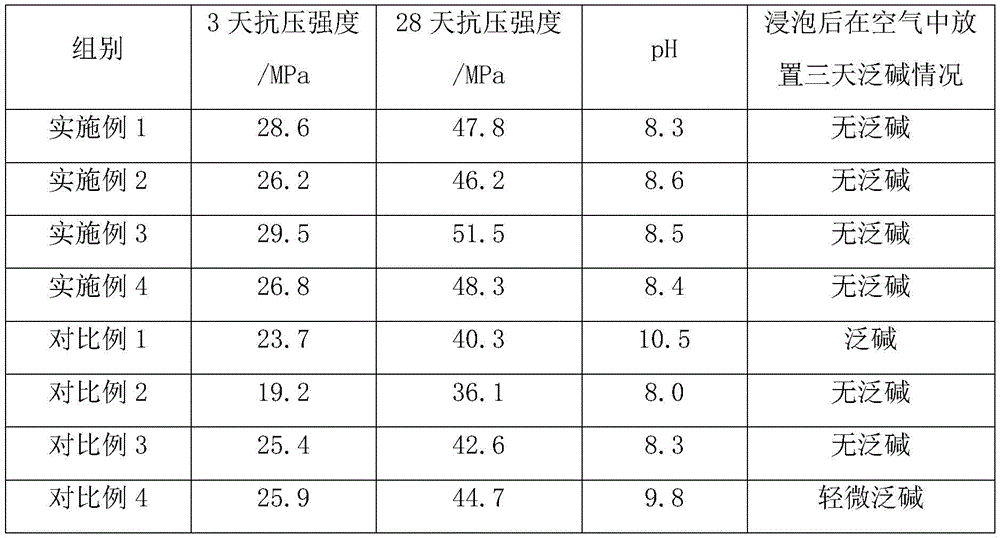
The compressive strengths of the saltpetering-resistant concretes obtained in the above examples and comparative examples are shown in Table 1. In addition, the concrete was immersed in 5-fold volume of water for 3 days, and the pH of the immersion liquid was also shown in table 1.
TABLE 1
Figure BDA0002184645000000071
As can be seen from the test data in examples 1-4 in the table, the concrete prepared by the cementing material of the invention has higher compressive strength, the 28-day compressive strength is higher than 46MPa, and the alkalinity is lower, and the pH value of 5 times of volume of soaking solution is lower than 8.6. Because the alkalinity of the cementing material is low, the efflorescence phenomenon can not occur.
From comparative example 1, it can be seen that the concrete prepared from the anti-whiskering cementitious material of the present invention has a lower alkalinity than ordinary cement and can be better applied to water reservoirs. In addition, the anti-efflorescence cementing material prepared by adopting various solid wastes such as gypsum, nickel-iron slag, fly ash and the like can fully replace common cement, and effectively reduces the preparation cost of the cementing material. As can be seen from comparative examples 2 and 3, the addition of the alkali-activator effectively improves the compressive strength of the anti-whiskering concrete, and the compound alkali-activator has more obvious excitation effect on gypsum. As can be seen from comparative example 4, the addition of sufficient gypsum can sufficiently neutralize the alkali-activator and prevent the cement from being too alkaline. In conclusion, the invention adds a small amount of alkali activator into the excessive gypsum through reasonable proportioning, reduces the alkalinity under the condition of ensuring the compressive strength of the product and avoids the occurrence of whiskering.

Claims (9)

1. The anti-efflorescence cementing material is characterized by being prepared from the following raw materials in parts by weight: 100 parts of gypsum, 50-80 parts of active material, 5-10 parts of alkali-activated material and 0.1-3 parts of early strength agent.
2. The cementitious material of claim 1, wherein the alkali-activated material is one or more of portland cement, quicklime, hydrated lime, and water glass.
3. The cementitious material of claim 1, wherein the gypsum is one or more of natural dihydrate gypsum, desulfurized dihydrate gypsum, and phosphogypsum dihydrate.
4. The cementitious material of claim 1, wherein the reactive material is one or more of fly ash, slag, steel slag, white slag, and ferronickel slag.
5. The cement according to claim 1, wherein the early strength agent is one or more of calcium chloride, calcium formate, aluminate cement, and sulphoaluminate cement.
6. The cementitious material of claim 1, wherein the cementitious material is prepared by weighing the raw materials and ball milling the weighed raw materials to a particle size of less than 325 mesh.
7. The anti-efflorescence concrete is characterized by being prepared from the following raw materials in parts by weight: 200 parts of stones, 50-70 parts of sand, 50-80 parts of the cementing material of any one of claims 1-6, 0.1-1 part of water reducing agent and 10-20 parts of water.
8. The concrete according to claim 7, wherein the water reducing agent is one or more of a naphthalene-based superplasticizer, an aliphatic superplasticizer, an amino superplasticizer, a polycarboxylic acid superplasticizer and the like.
9. The concrete according to claim 7, wherein the preparation method comprises the steps of weighing the raw materials in parts by weight, uniformly mixing, performing vibration and compression molding, and performing normal-temperature curing.
CN201910809528.6A 2019-08-29 2019-08-29 Anti-efflorescence cementing material and concrete Active CN112441802B (en)

Priority Applications (1)

Application Number Priority Date Filing Date Title
CN201910809528.6A CN112441802B (en) 2019-08-29 2019-08-29 Anti-efflorescence cementing material and concrete

Applications Claiming Priority (1)

Application Number Priority Date Filing Date Title
CN201910809528.6A CN112441802B (en) 2019-08-29 2019-08-29 Anti-efflorescence cementing material and concrete

Publications (2)

Publication Number Publication Date
CN112441802A true CN112441802A (en) 2021-03-05
CN112441802B CN112441802B (en) 2022-07-01

Family

ID=74741542

Family Applications (1)

Application Number Title Priority Date Filing Date
CN201910809528.6A Active CN112441802B (en) 2019-08-29 2019-08-29 Anti-efflorescence cementing material and concrete

Country Status (1)

Country Link
CN (1) CN112441802B (en)

Cited By (1)

* Cited by examiner, † Cited by third party
Publication number Priority date Publication date Assignee Title
CN115925355A (en) * 2022-11-24 2023-04-07 上海中冶环境工程科技有限公司 Efflorescence-resistant steel slag pervious concrete and application thereof

Citations (2)

* Cited by examiner, † Cited by third party
Publication number Priority date Publication date Assignee Title
WO2006094528A1 (en) * 2005-03-10 2006-09-14 Wacker Polymer Systems Gmbh & Co. Kg Non-efflorescing cementitious mortar compositions
CN108863265A (en) * 2018-07-13 2018-11-23 南京航空航天大学 A kind of light cellular partition board gypsum based composite

Patent Citations (2)

* Cited by examiner, † Cited by third party
Publication number Priority date Publication date Assignee Title
WO2006094528A1 (en) * 2005-03-10 2006-09-14 Wacker Polymer Systems Gmbh & Co. Kg Non-efflorescing cementitious mortar compositions
CN108863265A (en) * 2018-07-13 2018-11-23 南京航空航天大学 A kind of light cellular partition board gypsum based composite

Cited By (1)

* Cited by examiner, † Cited by third party
Publication number Priority date Publication date Assignee Title
CN115925355A (en) * 2022-11-24 2023-04-07 上海中冶环境工程科技有限公司 Efflorescence-resistant steel slag pervious concrete and application thereof

Also Published As

Publication number Publication date
CN112441802B (en) 2022-07-01

Similar Documents

Publication Publication Date Title
CN104310918B (en) For the cement-base composite material and its production and use of 3D printing technique
Qian et al. Activation of blended cements containing fly ash
Irassar et al. Sulphate resistance of type V cements with limestone filler and natural pozzolana
CN105384416B (en) 3D printing bi-component cement-base composite material and its production and use
EP3052453B1 (en) Construction castable material with controllable flow or slump
US8075687B2 (en) Hydraulic binder comprising a ternary acceleration system and mortars and concretes comprising one such binder
WO2013048351A1 (en) Gypsum-based composition for construction material and system
US4404031A (en) Process for producing hydraulic cements
US9994484B2 (en) Fast setting portland cement compositions with alkali metal citrates and phosphates with high early-age compressive strength and reduced shrinkage
CN102515673A (en) Circulating fluidized bed boiler ash cement-based self-leveling material
CN114656222B (en) Low-pH value cementing material and preparation method thereof
CN111662049B (en) High-strength cement-based radioactive waste curing and fixing material
CN108218264A (en) It is a kind of using lime-sodium carbonate as the one-component alkali-activated carbonatite cementitious material of exciting agent
CN111377626A (en) Gypsum system excited composite cementing material and preparation method thereof
CN113880535A (en) Sleeve grouting material for connecting low-temperature cement-based steel bars
US4011092A (en) Stannous sulfate and gypsum mixture as a retarder in grinding portland cement and blended hydraulic cement for improving the quality of the cement, mortar and concrete
CN102584070A (en) Concrete expanding agent
JP3871594B2 (en) Curing accelerator and cement composition
EP4563544A1 (en) Hardening accelerator for hydraulic materials, cement composition and hardened body
CN112441802B (en) Anti-efflorescence cementing material and concrete
Nuruddin et al. Effects of geopolymer concrete fly ash based on alkali silica reaction (ASR)
KR100225343B1 (en) High Durability Cement Composition
CN112358265A (en) Foam concrete with waste aerated concrete as raw material and preparation method thereof
CN115536291A (en) Alkali-activated slow-setting cementing material suitable for road engineering and preparation method thereof
CN119241196B (en) An early-strength low-carbon slag cement-based material and its preparation method and application

Legal Events

Date Code Title Description
PB01 Publication
PB01 Publication
SE01 Entry into force of request for substantive examination
GR01 Patent grant
GR01 Patent grant
TR01 Transfer of patent right

Effective date of registration: 20230919

Address after: Room 701-27, Pingtian Standard Factory Enterprise Service Center, Intersection of Linyi Avenue and Pingtian Road, Bailutang Town, Suxian District, Chenzhou City, Hunan Province, 423000

Patentee after: Hunan Qingda Zhongqi Environmental Protection Technology Co.,Ltd.

Address before: Room 311, 3 / F, building g-1, University Innovation City, Songshanhu high tech Industrial Development Zone, Dongguan City, Guangdong Province, 523000

Patentee before: GUANGDONG TSINGDA TONGKE ENVIRONMENTAL PROTECTION TECHNOLOGY Co.,Ltd.

TR01 Transfer of patent right

Effective date of registration: 20240329

Address after: Room 311, 3 / F, building g-1, University Innovation City, Songshanhu high tech Industrial Development Zone, Dongguan City, Guangdong Province, 523000

Patentee after: GUANGDONG TSINGDA TONGKE ENVIRONMENTAL PROTECTION TECHNOLOGY Co.,Ltd.

Country or region after: China

Address before: Room 701-27, Pingtian Standard Factory Enterprise Service Center, Intersection of Linyi Avenue and Pingtian Road, Bailutang Town, Suxian District, Chenzhou City, Hunan Province, 423000

Patentee before: Hunan Qingda Zhongqi Environmental Protection Technology Co.,Ltd.

Country or region before: China