CN112509727A - Inner electrode copper paste for low-temperature co-fired ceramic and preparation method and application thereof - Google Patents

Inner electrode copper paste for low-temperature co-fired ceramic and preparation method and application thereof Download PDF

Info

Publication number
CN112509727A
CN112509727A CN202011248607.3A CN202011248607A CN112509727A CN 112509727 A CN112509727 A CN 112509727A CN 202011248607 A CN202011248607 A CN 202011248607A CN 112509727 A CN112509727 A CN 112509727A
Authority
CN
China
Prior art keywords
temperature
powder
mixing
low
copper paste
Prior art date
Legal status (The legal status is an assumption and is not a legal conclusion. Google has not performed a legal analysis and makes no representation as to the accuracy of the status listed.)
Granted
Application number
CN202011248607.3A
Other languages
Chinese (zh)
Other versions
CN112509727B (en
Inventor
鲁圣国
陈先义
焦志伟
姚英邦
陶涛
梁波
Current Assignee (The listed assignees may be inaccurate. Google has not performed a legal analysis and makes no representation or warranty as to the accuracy of the list.)
Guangdong University of Technology
Original Assignee
Guangdong University of Technology
Priority date (The priority date is an assumption and is not a legal conclusion. Google has not performed a legal analysis and makes no representation as to the accuracy of the date listed.)
Filing date
Publication date
Application filed by Guangdong University of Technology filed Critical Guangdong University of Technology
Priority to CN202011248607.3A priority Critical patent/CN112509727B/en
Publication of CN112509727A publication Critical patent/CN112509727A/en
Application granted granted Critical
Publication of CN112509727B publication Critical patent/CN112509727B/en
Expired - Fee Related legal-status Critical Current
Anticipated expiration legal-status Critical

Links

Images

Classifications

    • HELECTRICITY
    • H01ELECTRIC ELEMENTS
    • H01BCABLES; CONDUCTORS; INSULATORS; SELECTION OF MATERIALS FOR THEIR CONDUCTIVE, INSULATING OR DIELECTRIC PROPERTIES
    • H01B1/00Conductors or conductive bodies characterised by the conductive materials; Selection of materials as conductors
    • H01B1/14Conductive material dispersed in non-conductive inorganic material
    • H01B1/16Conductive material dispersed in non-conductive inorganic material the conductive material comprising metals or alloys
    • HELECTRICITY
    • H01ELECTRIC ELEMENTS
    • H01BCABLES; CONDUCTORS; INSULATORS; SELECTION OF MATERIALS FOR THEIR CONDUCTIVE, INSULATING OR DIELECTRIC PROPERTIES
    • H01B1/00Conductors or conductive bodies characterised by the conductive materials; Selection of materials as conductors
    • H01B1/20Conductive material dispersed in non-conductive organic material
    • H01B1/22Conductive material dispersed in non-conductive organic material the conductive material comprising metals or alloys
    • HELECTRICITY
    • H01ELECTRIC ELEMENTS
    • H01BCABLES; CONDUCTORS; INSULATORS; SELECTION OF MATERIALS FOR THEIR CONDUCTIVE, INSULATING OR DIELECTRIC PROPERTIES
    • H01B13/00Apparatus or processes specially adapted for manufacturing conductors or cables
    • YGENERAL TAGGING OF NEW TECHNOLOGICAL DEVELOPMENTS; GENERAL TAGGING OF CROSS-SECTIONAL TECHNOLOGIES SPANNING OVER SEVERAL SECTIONS OF THE IPC; TECHNICAL SUBJECTS COVERED BY FORMER USPC CROSS-REFERENCE ART COLLECTIONS [XRACs] AND DIGESTS
    • Y02TECHNOLOGIES OR APPLICATIONS FOR MITIGATION OR ADAPTATION AGAINST CLIMATE CHANGE
    • Y02EREDUCTION OF GREENHOUSE GAS [GHG] EMISSIONS, RELATED TO ENERGY GENERATION, TRANSMISSION OR DISTRIBUTION
    • Y02E60/00Enabling technologies; Technologies with a potential or indirect contribution to GHG emissions mitigation
    • Y02E60/10Energy storage using batteries

Landscapes

  • Chemical & Material Sciences (AREA)
  • Dispersion Chemistry (AREA)
  • Engineering & Computer Science (AREA)
  • Manufacturing & Machinery (AREA)
  • Physics & Mathematics (AREA)
  • Spectroscopy & Molecular Physics (AREA)
  • Inorganic Chemistry (AREA)
  • Conductive Materials (AREA)

Abstract

本发明属于精细化学制备技术领域,提供了一种用于低温共烧陶瓷的内电极铜浆及其制备方法和应用,该电极铜浆包括60~75wt%预处理的铜粉,1~10wt%玻璃粉,1~3wt%陶瓷颗粒和10~30wt%有机粘合剂,有机粘合剂包括40~70%溶剂、5~20%增塑剂、5~20%黏结剂、1~10%分散剂和5~20%添加剂;预处理的铜粉是先将铜粉、柠檬酸、抗坏血酸、聚乙烯吡咯烷酮混合后加入乙醇水溶液中,在50~80℃水浴搅拌,粉碎制得;玻璃粉是将SiO2,HfO2,Al2O3和CuO混匀后,在1300~1400℃下熔融后水中淬火得到。该电极铜浆的性能指标符合LTCC的要求,可应用于制备无源元件领域中。

Figure 202011248607

The invention belongs to the technical field of fine chemical preparation, and provides an internal electrode copper paste for low-temperature co-fired ceramics and a preparation method and application thereof. The electrode copper paste comprises 60-75wt% of pretreated copper powder, 1-10wt% Glass powder, 1-3wt% ceramic particles and 10-30wt% organic binder, the organic binder comprises 40-70% solvent, 5-20% plasticizer, 5-20% binder, 1-10% dispersion The pretreated copper powder is prepared by mixing copper powder, citric acid, ascorbic acid, and polyvinylpyrrolidone, adding it to the ethanol aqueous solution, stirring in a water bath at 50-80 °C, and pulverizing it; glass powder is prepared by mixing SiO 2 , HfO 2 , Al 2 O 3 and CuO are mixed uniformly, melted at 1300-1400 ℃ and then quenched in water. The performance index of the electrode copper paste meets the requirements of LTCC, and can be used in the field of preparing passive components.

Figure 202011248607

Description

Inner electrode copper paste for low-temperature co-fired ceramic and preparation method and application thereof
Technical Field
The invention belongs to the technical field of fine chemical preparation, and particularly relates to an inner electrode copper paste for low temperature co-fired ceramic (LTCC) and a preparation method and application thereof.
Background
With the rapid development of modern microelectronic information technology, the demands of electronic components on portability, miniaturization, digitization, multifunction, high performance and high reliability are increasing, so that the requirements of electronic components on miniaturization, modularization and integration are more and more urgent. Low temperature co-fired ceramic (LTCC) is a multi-disciplinary cross integrated component technology which has been developed in recent decades, and has become a research hotspot, and due to good thermodynamics, electronics and corresponding mechanical properties, LTCC has become a preferred development direction in the fields of electronic component components, integrated devices and microwave devices, and has a good application prospect.
However, in the application of LTCC technology, thick film conductor paste is mostly printed on the ceramic substrate by screen printing. Most of the conductive paste does not bond well to the LTCC substrate material in the co-firing matching, screen printing and conductivity.
Disclosure of Invention
In order to solve the defects and shortcomings in the prior art, the invention mainly aims to provide the inner electrode conductive copper paste for the low-temperature co-fired ceramic, and the electrode conductive copper paste has the characteristics of good co-firing matching property, excellent co-firing matching property, good printing property, excellent conductivity and the like with an LTCC substrate.
The invention also aims to provide a preparation method of the internal electrode copper paste.
The invention also aims to provide application of the internal electrode copper paste.
The purpose of the invention is realized by the following technical scheme:
an inner electrode copper paste for low-temperature co-fired ceramic comprises 60-75 wt% of pretreated copper powder, 1-10 wt% of glass powder, 1-5 wt% of ceramic particles and 10-30 wt% of organic binder; the organic adhesive comprises 40-70% of solvent, 5-20% of plasticizer, 5-20% of adhesive, 1-10% of dispersant and 5-20% of additive; the pretreated copper powder is prepared by mixing copper powder, citric acid, ascorbic acid and polyvinylpyrrolidone, adding the mixed powder into an ethanol aqueous solution, stirring in a water bath at 50-80 ℃, and then placing in a cell crusher for crushing; the glass powder is prepared by mixing SiO2,HfO2,Al2O3And mixing with CuO, melting at 1300-1400 ℃, quenching in water after heat preservation, drying, grinding and sieving to obtain the CuO alloy.
Preferably, the mass ratio of the copper powder to the citric acid to the ascorbic acid to the polyvinylpyrrolidone is (3-6) to (1-4) to (0.5-2); the mass ratio of the deionized water to the absolute ethyl alcohol in the ethyl alcohol water solution is (8-12) to (1-5); the volume ratio of the total volume of the copper powder, the citric acid, the ascorbic acid and the polyvinylpyrrolidone to the volume of the ethanol water solution is (2-6) to (0.5-2).
Preferably, the mass percentage ratio of the solvent to the plasticizer to the adhesive to the dispersant to the additive is 10:3:3:1: 3.
Preferably, the SiO2、HfO2、Al2O3The mass ratio of CuO to CuO is (30-45): (2-10): 5-20): 20-50.
More preferably, the SiO2、HfO2、Al2O3And CuO in a mass ratio of 38:6:8: 38.
Preferably, the ceramic particles are PZT, and the particle size of the ceramic particles is 5-20 μm; the particle size of the glass powder is 5-20 mu m.
Preferably, the water bath stirring time is 8-10 h; the crushing time is 4-12 h; the melting time is 0.5-1.5 h.
Preferably, the solvent is more than one of terpineol, triethanolamine, butyl carbitol or ethylene glycol ethyl ether acetate; the dispersant is span 85 or/and polymethacrylic acid amine; the plasticizer is butylbenzyl phthalate or/and diisononyl phthalate KH 550; the adhesive is ethyl cellulose or/and hexadecanol; the additive is acetone or/and butanone.
The preparation method of the internal electrode copper paste for the low-temperature co-fired ceramic comprises the following specific steps:
s1, mixing the copper powder with citric acid, ascorbic acid and polyvinylpyrrolidone, adding the mixture into an ethanol water solution, stirring in a water bath at 50-80 ℃, and then placing the mixture into a cell crusher for crushing to obtain pretreated copper powder;
s2, mixing SiO2,HfO2,Al2O3Mixing with CuO, melting at 1300-1400 ℃, quenching in water after heat preservation, drying, grinding and sieving to obtain glass powder;
s3, mixing 40-70% of solvent, 5-20% of plasticizer, 5-20% of adhesive, 1-10% of dispersant and 5-20% of additive, and dissolving at 50-60 ℃ to prepare the organic binder;
and S4, mixing the pretreated copper powder, glass powder, organic binder and ceramic particles, uniformly mixing and stirring by using a stirrer, then ball-milling the slurry, and grinding and leveling by using a three-roll grinder after ball-milling to obtain the copper conductive slurry.
The inner electrode copper paste for low-temperature co-fired ceramic is applied to the field of preparing passive elements.
Compared with the prior art, the invention has the following beneficial effects:
1. the copper paste has the advantages of good co-firing matching property with an LTCC ceramic thick film, good printing property, excellent conductivity and the like.
2. According to the invention, ceramic particles are added during preparation of the slurry, so that warping of the slurry sintered thick film and the alumina substrate can be reduced.
3. The glass phase of the invention is soft melted at 850 ℃, and is suitable for being used as an LTCC inner electrode;
4. the copper slurry of the invention is base metal slurry, and has low price and simple process.
Drawings
FIG. 1 is a surface and cross-sectional electro-scope photograph of a conductive copper film obtained after sintering the conductive copper paste for internal electrodes of example 1.
FIG. 2 is a surface and cross-sectional electro-scope photograph of a conductive copper film obtained after sintering the conductive copper paste for internal electrodes of example 2.
FIG. 3 is a surface and sintered surface of a conductive copper film obtained after sintering using the conductive copper paste for internal electrodes of example 3 and a cross-sectional electron micrograph.
FIG. 4 is a surface and a sintered surface of a conductive copper film obtained after sintering using the conductive copper paste for internal electrodes of example 4 and a sectional electron micrograph.
Detailed Description
The following examples are presented to further illustrate the present invention but should not be construed as limiting the invention. Unless otherwise specified, the technical means used in the examples are conventional means well known to those skilled in the art. Reagents, methods and apparatus used in the present invention are conventional in the art unless otherwise indicated.
Example 1
1. Preparing deionized water: mixing copper powder, citric acid, ascorbic acid and polyvinylpyrrolidone in a mass ratio of 4:2:2:1, and mixing the mixed solution with powder (copper powder, citric acid, ascorbic acid and polyvinylpyrrolidone) in a volume ratio of 3:1, mixing, placing on a magnetic stirrer, stirring in a water bath at 50-80 ℃ for 10 hours, and then placing in a cell crusher for crushing for 6 hours to obtain the pretreated copper powder.
2. Mixing 38 wt% SiO2,16wt%HfO2,8wt%Al2O338 wt% of CuO is put into a corundum crucible, fully and uniformly stirred by a glass rod, put into a high-temperature sintering furnace, and preheated for 10 minutes at 400 ℃; after the heat preservation, heating to 1400 ℃ at a speed of 10 ℃/min, and preserving the heat for 30 minutes; filling a 1.4L stainless steel container with deionized water, and placing the container close to a high-temperature sintering furnace; taking out the molten glass powder by a sampling clamp, quickly pouring the molten glass powder into a stainless steel container filled with deionized water for water quenching, and then carrying out vacuum quenching on the molten glass powderPlacing the crucible into a furnace, and closing the furnace door; and putting the cooled glass powder into a ball milling tank, adding 8mm, 5mm and 3mm zirconium balls in a ball-to-material ratio of 3:1 into the ball milling tank, adding absolute ethyl alcohol as a ball milling medium in a solid-to-liquid ratio of 3:1, performing ball milling for 30-50 h, drying, grinding and sieving to obtain the glass powder.
3. 50 wt% of terpineol, 15 wt% of butylbenzyl phthalate, 15 wt% of ethyl cellulose, 5 wt% of span 85 and 15 wt% of acetone are mixed in a glass beaker, put into a 40-60 ℃ constant-temperature oil bath magnetic stirrer and stirred uniformly until insoluble substances such as ethyl cellulose and the like are completely dissolved, and the mixture is stored in a room-temperature environment to prepare the organic adhesive.
4. Accurately weighing 20g of the total amount of 70 wt% of pretreated copper powder, 3 wt% of glass powder, 1 wt% of lead zirconate titanate ceramic particles (PZT, the size is 5-20 mu m) and 26 wt% of organic binder, pre-stirring for 5-10 h by using a magnetic stirrer, then carrying out ball milling at the speed of 300-500 rpm for 15-30 h, and grinding and leveling by using a three-roll grinder after ball milling to obtain the inner electrode conductive copper slurry.
Example 2
1. Preparing deionized water by mass ratio: mixing copper powder with citric acid, ascorbic acid and polyvinylpyrrolidone in a mass ratio of 4:2:2:1 and a mixed solution of 5-10: 1-4 ethanol, mixing the solution and powder in a volume ratio of 3:1, putting the mixture on a magnetic stirrer, stirring the mixture in a water bath at 50-80 ℃ for 5-10 hours, and then putting the mixture in an ultrasonic crusher to crush the mixture for 3-10 hours to obtain the pretreated copper powder.
2. Mixing 38 wt% SiO2,16wt%HfO2,8wt%Al2O338 wt% of CuO is put into a corundum crucible and is fully and uniformly stirred by a glass rod; putting the prepared glass oxide into a high-temperature sintering furnace, and preheating the glass oxide by keeping the temperature at 400 ℃ for 10 minutes; after the heat preservation, heating to 1400 ℃ at a speed of 10 ℃/min, and preserving the heat for 30 minutes; filling a 1.4L stainless steel container with deionized water, and placing the container close to a high-temperature sintering furnace; taking out the glass powder in a molten state by using a sampling clamp, then quickly pouring the glass powder into an aluminum alloy lunch box filled with deionized water for water quenching, then putting a crucible into a furnace, and closing a furnace door; placing the cooled glass powderPutting the mixture into a ball milling tank, adding 8cm, 5cm and 3cm zirconium balls in a ball-material ratio of 5:3:2, adding ethanol serving as a ball milling medium in a solid-liquid ratio of 3:2, carrying out ball milling for 30 hours, drying, grinding and sieving to obtain the glass powder.
3. 50 wt% of terpineol, 15 wt% of diisononyl phthalate, 15 wt% of ethyl cellulose, 5 wt% of span 85 and 15 wt% of acetone are mixed in a glass beaker, put into a 60 ℃ constant-temperature oil bath magnetic stirrer and stirred uniformly until insoluble substances such as ethyl cellulose are completely dissolved, and the mixture is stored at room temperature and ambient temperature to prepare the organic adhesive.
4. Accurately weighing 20g of the total amount of 70 wt% of pretreated copper powder, 3 wt% of glass powder, 1 wt% of lead zirconate titanate ceramic particles (PZT, the size is 5-20 mu m) and 26 wt% of organic binder, pre-stirring for 5-10 h by using a magnetic stirrer, then carrying out ball milling at the speed of 300-500 rpm for 15-30 h, and grinding and leveling by using a three-roll grinder after ball milling to obtain the inner electrode conductive copper slurry.
Example 3
1. Copper powder pretreatment: preparing deionized water by mass ratio: ethanol ═ 10:3, mixing the copper powder with citric acid, ascorbic acid and polyvinylpyrrolidone in a mass ratio of 4:2:2:1, mixing the solution with the powder in a volume ratio of 3:1, placing the mixture on a magnetic stirrer, stirring the mixture in a water bath at 50-80 ℃ for 3-10 hours, and then placing the mixture in an ultrasonic crusher to crush the mixture for 3-10 hours to obtain the pretreated copper powder.
2. Mixing 38 wt% SiO2,16wt%HfO2,8wt%Al2O338 wt% of CuO is put into a corundum crucible, fully and uniformly stirred by a glass rod and put into a high-temperature sintering furnace, and the temperature is kept at 400 ℃ for 10 minutes for preheating; after heat preservation, heating to 1400 ℃ at a speed of 10 ℃/min, and preserving heat for 30 minutes; filling a 1.4L stainless steel container with deionized water, and placing the container close to a high-temperature sintering furnace; taking out the glass powder in a molten state by using a sampling clamp, then quickly pouring the glass powder into a stainless steel container filled with deionized water for water quenching, then putting a crucible into a furnace, and closing a furnace door; putting the cooled glass powder into a ball milling tank, adding 8mm, 5mm and 3mm zirconium balls according to the ball-to-material ratio of 3:1 and 4:2:1, and then adding the mixture into the ball milling tank according to the solid-to-liquid ratioAdding ethanol as a ball milling medium at a ratio of 3:2, ball milling for 30 hours, and then drying, grinding and sieving to obtain the glass powder.
3. 50 wt% of terpineol, 15 wt% of diisononyl phthalate, 15 wt% of hexadecanol, 5 wt% of span 85 and 15 wt% of acetone are mixed in a glass beaker, put into a 60 ℃ constant-temperature oil bath magnetic stirrer and stirred uniformly until the terpineol, the diisononyl phthalate, the hexadecanol, the span 85 and the acetone are completely dissolved, and the mixture is stored at room temperature and ambient temperature to prepare the organic adhesive.
4. Accurately weighing 20g of the total amount of 70 wt% of pretreated copper powder, 3 wt% of glass powder, 1 wt% of lead zirconate titanate ceramic particles (PZT, the size is 5-20 mu m) and 26 wt% of organic binder, pre-stirring for 5-10 h by using a magnetic stirrer, then carrying out ball milling at the speed of 300-500 rpm for 15-30 h, and grinding and leveling by using a three-roll grinder after ball milling to obtain the inner electrode conductive copper slurry.
Example 4
1. Preparing deionized water by mass ratio: mixing copper powder with citric acid, ascorbic acid and polyvinylpyrrolidone in a mass ratio of 4:2:2:1 and a mixed solution of ethanol and 10:3, mixing the mixed solution with powder in a volume ratio of 3:1, putting the mixed solution on a magnetic stirrer, stirring the mixed solution in a water bath at 50-80 ℃ for 3 hours, and then putting the stirred solution in an ultrasonic crusher to crush the mixed solution for 3 hours to obtain the pretreated copper powder.
2. Mixing 38 wt% SiO2,16wt%HfO2,8wt%Al2O338 wt% of CuO is put into a corundum crucible, fully and uniformly stirred by a glass rod and put into a high-temperature sintering furnace, and the temperature is kept at 400 ℃ for 10 minutes for preheating; after the heat preservation, heating to 1400 ℃ at a speed of 10 ℃/min, and preserving the heat for 30 minutes; filling a 1.4L stainless steel container with deionized water, and placing the container close to a high-temperature sintering furnace; taking out the glass powder in a molten state by using a sampling clamp, then quickly pouring the glass powder into a stainless steel container filled with deionized water for water quenching, then putting a crucible into a furnace, and closing a furnace door; putting the cooled glass powder into a ball milling tank, adding 8mm, 5mm and 3mm zirconium balls according to a ball-to-material ratio of 3:1 and a ratio of 4:2:1, adding ethanol as a ball milling medium according to a solid-to-liquid ratio of 3:1, performing ball milling for 30-50 h, drying, grinding and sieving to obtain glass powder;
3. mixing 50 wt% of terpineol, 15 wt% of butylbenzyl phthalate, 15 wt% of hexadecanol, 5 wt% of polymethacrylic acid amine and 15 wt% of acetone in a glass beaker, putting the mixture into a 60 ℃ constant-temperature oil bath magnetic stirrer, uniformly stirring until the mixture is completely dissolved, and storing the mixture at room temperature and ambient temperature to prepare an organic adhesive;
4. accurately weighing 20g of the total amount of 70 wt% of pretreated copper powder, 3 wt% of glass powder, 1 wt% of lead zirconate titanate ceramic particles (PZT, the size is 5-20 mu m) and 26 wt% of organic binder, pre-stirring for 5-10 h by using a magnetic stirrer, then carrying out ball milling at the speed of 300-500 rpm for 15-30 h, and grinding and leveling by using a three-roll grinder after ball milling to obtain the inner electrode conductive copper slurry.
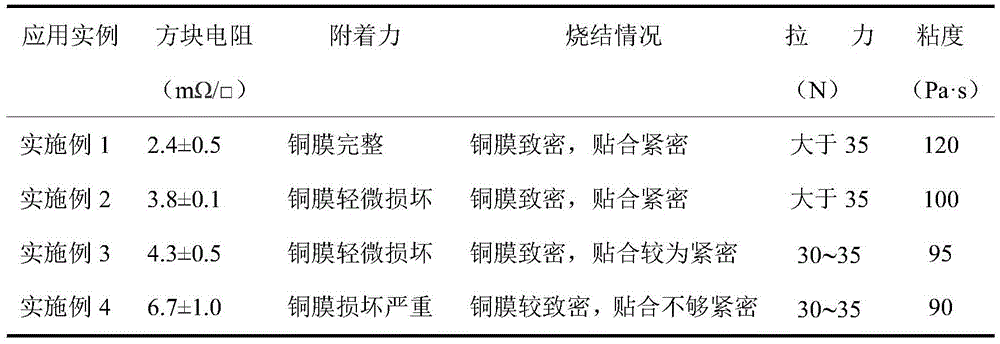
And printing the copper paste obtained in the embodiment 1-4 on the PZT thick film by a screen printing mode, drying the film for 10-50 minutes at the temperature of 60-80 ℃, and sintering the film for 10-30 minutes at the temperature of 790-960 ℃ to obtain the copper conductive film. The sheet resistance, adhesion, tensile force and viscosity of the copper film were measured using a four-probe sheet resistance tester, a dicing cutter, a tensile machine and a viscosity tester, respectively, and the results are shown in table 1. Table 1 properties of conductive copper films prepared using the copper pastes of examples 1-4. As can be seen from Table 1, the conductive copper film obtained from the copper paste of example 1 has the smallest square resistance, the best adhesion, and the copper film is dense, indicating that this composition is most suitable for use in a PZT-based LTCC co-fired inner electrode.
TABLE 1 Properties of conductive copper films produced from the copper pastes of examples 1-4
Figure BDA0002770856480000061
FIG. 1 is a surface and cross-sectional electro-scope photograph of a conductive copper film obtained after sintering the conductive copper paste for internal electrodes of example 1. As can be seen from fig. 1, the obtained copper film was dense and was closely attached. FIG. 2 is a surface and sectional electron micrograph of a conductive copper film obtained after sintering using the conductive copper paste for internal electrodes of example 2. As can be seen from FIG. 2, the obtained copper film was dense and tightly adhered. FIG. 3 is a surface and sintered surface of a conductive copper film obtained after sintering using the conductive copper paste for internal electrodes of example 3 and a cross-sectional electron micrograph. As can be seen from fig. 3, the obtained copper film was dense and was tightly adhered. FIG. 4 is a surface and a sintered surface of a conductive copper film obtained after sintering using the conductive copper paste for internal electrodes of example 4 and a sectional electron micrograph. As can be seen from fig. 4, the obtained copper film was dense and was not sufficiently close. The use effect of the adhesive ethyl cellulose is better, and the compactness and the adhesive force of the copper film after the copper slurry is sintered are improved.
In the embodiment, the electrode copper paste comprises 60-75 wt% of pretreated copper powder, 1-10 wt% of glass powder, 1-5 wt% of ceramic particles and 10-30 wt% of organic binder according to requirements; the organic binder comprises 40-70% of solvent, 5-20% of plasticizer, 5-20% of adhesive, 1-10% of dispersant and 5-20% of additive, and the combination is changed. The copper paste has good co-firing matching property and printing property with the LTCC ceramic thick film and excellent conductivity.
The above embodiments are preferred embodiments of the present invention, but the present invention is not limited to the above embodiments, and any other changes, modifications, substitutions, combinations and simplifications which do not depart from the spirit and principle of the present invention should be construed as equivalents thereof, and all such changes, modifications, substitutions, combinations and simplifications are intended to be included in the scope of the present invention.

Claims (10)

1. The inner electrode copper paste for the low-temperature co-fired ceramic is characterized by comprising 60-75 wt% of pretreated copper powder, 1-10 wt% of glass powder, 1-5 wt% of ceramic particles and 10-30 wt% of organic binder; the organic adhesive comprises 40-70% of solvent, 5-20% of plasticizer, 5-20% of adhesive, 1-10% of dispersant and 5-20% of additive; the pretreated copper powder is prepared by mixing copper powder, citric acid, ascorbic acid and polyvinylpyrrolidone, adding the mixed powder into an ethanol aqueous solution, stirring in a water bath at 50-80 ℃, and then placing in a cell crusher for crushing; the glass powder is prepared by mixing SiO2,HfO2,Al2O3And mixing with CuO, melting at 1300-1400 ℃, quenching in water after heat preservation, drying, grinding and sieving to obtain the CuO alloy.
2. The copper paste for an inner electrode of a low-temperature co-fired ceramic as claimed in claim 1, wherein the mass ratio of copper powder, citric acid, ascorbic acid and polyvinylpyrrolidone is (3-6): 1-4: (0.5-2); the mass ratio of the deionized water to the absolute ethyl alcohol in the ethyl alcohol water solution is (8-12) to (1-5); the volume ratio of the total volume of the copper powder, the citric acid, the ascorbic acid and the polyvinylpyrrolidone to the volume of the ethanol water solution is (2-6) to (0.5-2).
3. The internal electrode copper paste for low-temperature co-fired ceramic as claimed in claim 1, wherein the mass percentage ratio of the solvent, the plasticizer, the binder, the dispersant and the additive is 10:3:3:1: 3.
4. The inner electrode copper paste for low-temperature co-fired ceramic according to claim 1, wherein the SiO is2、HfO2、Al2O3The mass ratio of CuO to CuO is (30-45): (2-10): 5-20): 20-50.
5. The inner electrode copper paste for low-temperature co-fired ceramic according to claim 4, wherein the SiO is2、HfO2、Al2O3And CuO in a mass ratio of 38:6:8: 38.
6. The inner electrode copper paste for low-temperature co-fired ceramic as claimed in claim 1, wherein the ceramic particles are PZT, and the particle size of the ceramic particles is 5-20 μm; the particle size of the glass powder is 5-20 mu m.
7. The internal electrode copper paste for the low-temperature co-fired ceramic as claimed in claim 1, wherein the water bath stirring time is 8-10 h; the crushing time is 4-12 h; the melting time is 0.5-1.5 h.
8. The internal electrode copper paste for low-temperature co-fired ceramic according to claim 1, wherein the solvent is one or more of terpineol, triethanolamine, butyl carbitol or ethylene glycol ethyl ether acetate; the dispersant is span 85 or/and polymethacrylic acid amine; the plasticizer is butylbenzyl phthalate or/and diisononyl phthalate KH 550; the adhesive is ethyl cellulose or/and hexadecanol; the additive is acetone or/and butanone.
9. The preparation method of the internal electrode copper paste for the low-temperature co-fired ceramic according to any one of claims 1 to 8, characterized by comprising the following specific steps:
s1, mixing the copper powder with citric acid, ascorbic acid and polyvinylpyrrolidone, adding the mixture into an ethanol water solution, stirring in a water bath at 50-80 ℃, and then placing the mixture into a cell crusher for crushing to obtain pretreated copper powder;
s2, mixing SiO2,HfO2,Al2O3Mixing with CuO, melting at 1300-1400 ℃, quenching in water after heat preservation, drying, grinding and sieving to obtain glass powder;
s3, mixing 40-70% of solvent, 5-20% of plasticizer, 5-20% of adhesive, 1-10% of dispersant and 5-20% of additive, and dissolving at 50-60 ℃ to prepare the organic binder;
and S4, mixing the pretreated copper powder, glass powder, organic binder and ceramic particles, uniformly mixing and stirring by using a stirrer, then ball-milling the slurry, and grinding and leveling by using a three-roll grinder after ball-milling to obtain the copper conductive slurry.
10. Use of the copper paste for inner electrodes of low-temperature co-fired ceramics according to any one of claims 1 to 8 in the field of producing passive components.
CN202011248607.3A 2020-11-10 2020-11-10 A kind of inner electrode copper paste for low temperature co-fired ceramics and its preparation method and application Expired - Fee Related CN112509727B (en)

Priority Applications (1)

Application Number Priority Date Filing Date Title
CN202011248607.3A CN112509727B (en) 2020-11-10 2020-11-10 A kind of inner electrode copper paste for low temperature co-fired ceramics and its preparation method and application

Applications Claiming Priority (1)

Application Number Priority Date Filing Date Title
CN202011248607.3A CN112509727B (en) 2020-11-10 2020-11-10 A kind of inner electrode copper paste for low temperature co-fired ceramics and its preparation method and application

Publications (2)

Publication Number Publication Date
CN112509727A true CN112509727A (en) 2021-03-16
CN112509727B CN112509727B (en) 2022-08-12

Family

ID=74957601

Family Applications (1)

Application Number Title Priority Date Filing Date
CN202011248607.3A Expired - Fee Related CN112509727B (en) 2020-11-10 2020-11-10 A kind of inner electrode copper paste for low temperature co-fired ceramics and its preparation method and application

Country Status (1)

Country Link
CN (1) CN112509727B (en)

Cited By (3)

* Cited by examiner, † Cited by third party
Publication number Priority date Publication date Assignee Title
CN113402285A (en) * 2021-05-26 2021-09-17 济南大学 Low-temperature co-fired sintering agent for piezoelectric ceramics and preparation method thereof
CN114230186A (en) * 2021-12-20 2022-03-25 广东工业大学 A kind of low temperature co-fired internal electrode copper paste of glass powder and multi-layer ceramics and preparation method thereof
CN114334221A (en) * 2022-01-10 2022-04-12 珠海方正科技多层电路板有限公司 Hole plugging copper paste, preparation method thereof and printed circuit board

Citations (7)

* Cited by examiner, † Cited by third party
Publication number Priority date Publication date Assignee Title
CN1476287A (en) * 2002-07-17 2004-02-18 �ձ�������ҵ��ʽ���� Copper paste and wiring board using the copper paste
CN102097153A (en) * 2009-11-11 2011-06-15 三星电子株式会社 Conductive paste and solar cell
CN104575681A (en) * 2015-01-08 2015-04-29 安徽凤阳德诚科技有限公司 Conducting silver paste with cobalt powder
CN105472791A (en) * 2015-12-23 2016-04-06 东莞珂洛赫慕电子材料科技有限公司 Rare earth-doped semiconductor infrared radiation thick-film electronic paste and preparation method therefor
CN107210325A (en) * 2015-01-07 2017-09-26 株式会社则武 Conductive composition, semiconductor element and solar cell element
US20180248055A1 (en) * 2016-05-16 2018-08-30 Nantong T-Sun New Energy Co.,Ltd. Aging resistant backside silver paste for crystalline silicon solar cells and preparation method thereof
CN108684152A (en) * 2018-07-19 2018-10-19 佛山腾鲤新能源科技有限公司 Alloy ceramic printed circuit board

Patent Citations (7)

* Cited by examiner, † Cited by third party
Publication number Priority date Publication date Assignee Title
CN1476287A (en) * 2002-07-17 2004-02-18 �ձ�������ҵ��ʽ���� Copper paste and wiring board using the copper paste
CN102097153A (en) * 2009-11-11 2011-06-15 三星电子株式会社 Conductive paste and solar cell
CN107210325A (en) * 2015-01-07 2017-09-26 株式会社则武 Conductive composition, semiconductor element and solar cell element
CN104575681A (en) * 2015-01-08 2015-04-29 安徽凤阳德诚科技有限公司 Conducting silver paste with cobalt powder
CN105472791A (en) * 2015-12-23 2016-04-06 东莞珂洛赫慕电子材料科技有限公司 Rare earth-doped semiconductor infrared radiation thick-film electronic paste and preparation method therefor
US20180248055A1 (en) * 2016-05-16 2018-08-30 Nantong T-Sun New Energy Co.,Ltd. Aging resistant backside silver paste for crystalline silicon solar cells and preparation method thereof
CN108684152A (en) * 2018-07-19 2018-10-19 佛山腾鲤新能源科技有限公司 Alloy ceramic printed circuit board

Cited By (4)

* Cited by examiner, † Cited by third party
Publication number Priority date Publication date Assignee Title
CN113402285A (en) * 2021-05-26 2021-09-17 济南大学 Low-temperature co-fired sintering agent for piezoelectric ceramics and preparation method thereof
CN114230186A (en) * 2021-12-20 2022-03-25 广东工业大学 A kind of low temperature co-fired internal electrode copper paste of glass powder and multi-layer ceramics and preparation method thereof
CN114334221A (en) * 2022-01-10 2022-04-12 珠海方正科技多层电路板有限公司 Hole plugging copper paste, preparation method thereof and printed circuit board
CN114334221B (en) * 2022-01-10 2024-02-09 珠海方正科技多层电路板有限公司 Plug hole copper paste, preparation method thereof and printed circuit board

Also Published As

Publication number Publication date
CN112509727B (en) 2022-08-12

Similar Documents

Publication Publication Date Title
CN112509727B (en) A kind of inner electrode copper paste for low temperature co-fired ceramics and its preparation method and application
CN112614608B (en) Low-temperature co-fired ceramic inner conductive silver paste and preparation method thereof
CN102664055A (en) Conductive silver paste, method for preparing same and surface metallization method for microwave dielectric ceramics
CN114005576A (en) Conductive silver paste for LTCC hole electrode and preparation method thereof
CN113683404B (en) A low-temperature co-fired ceramic powder material, its preparation method and application
Liu et al. Microstructure and dielectric properties of glass/Al2O3 composites with various low softening point borosilicate glasses
CN116535097A (en) Glass powder, conductive copper paste and multilayer ceramic capacitor for MLCC and preparation method
Chen et al. Low temperature sintering and dielectric properties of La2O3–B2O3–Al2O3 glass–ceramic/Al2O3 composites for LTCC applications
CN110217998A (en) A kind of unleaded low temperature sintering conductive silver paste and the preparation method and application thereof
CN102515755B (en) Lead-zirconate-based antiferroelectric thick film with high energy storage density, and preparation method thereof
CN108962422B (en) Conductive silver paste for LTCC ceramic substrate and preparation method thereof
CN108735343A (en) A kind of conductive silver paste and preparation method thereof for low-temperature co-fired ceramic substrate
CN107473774A (en) The preparation method of copper ceramic substrate
CN105541367B (en) A kind of ceramic discharge tube low temperature nickel metallization method for sealing
CN106601392A (en) Dielectric paste matched with aluminum silicon carbide base material and preparation method for dielectric paste
CN113782250B (en) High-thixotropy low-temperature co-fired ceramic inner electrode silver paste and preparation method and application thereof
CN106952674A (en) It is a kind of can low-temperature sintering wiring thick film conductor paste and its application
CN114751645A (en) Ultralow temperature sintered glass ceramics and preparation method and application thereof
CN115286431A (en) Solvent-free active molybdenum-manganese slurry for ceramic metallization packaging and preparation method thereof
CN102276152B (en) Composition for metallization of alumina ceramic surface
CN103449820B (en) A method for reducing the sintering temperature of calcium zirconate microwave dielectric ceramics
CN103524127A (en) High-frequency grain boundary layer ceramic capacitor medium and preparation method
CN117912743A (en) Preparation method of MAX phase electronic paste and electronic ceramic with MAX phase thick film conducting layer
Yue et al. Preparation of B2O3-ZnO-SiO2 glass and sintering densification of copper terminal electrode applied in multilayer ceramic capacitors
CN118073004A (en) Copper conductive glass slurry for surface layer electrodes of multilayer ceramic capacitors, copper electrode and preparation method thereof

Legal Events

Date Code Title Description
PB01 Publication
PB01 Publication
SE01 Entry into force of request for substantive examination
GR01 Patent grant
GR01 Patent grant
CF01 Termination of patent right due to non-payment of annual fee

Granted publication date: 20220812

CF01 Termination of patent right due to non-payment of annual fee