This application claims the benefit of U.S. patent application No. 16/049,608 (pending) filed 2018, 7, month 30, the entire contents of which are incorporated herein by reference.
This application is related to U.S. patent application No. 15/430,254 entitled Drilling Machine, filed 2017, 2, month 10, which is assigned to the same assignee as the present application and is incorporated herein by reference in its entirety. The present application further relates to: also filed is U.S. patent application entitled "Ball bearing Assembly with super hard Elements" having a Roller Ball Assembly; also filed is U.S. patent application entitled "Cam Follower with Polycrystalline Diamond engaging Element (article) having Polycrystalline Diamond engaging Element"; and concurrently filed U.S. patent application entitled "Polycrystalline Diamond Thrust Bearing and elements Thereof (original: Polycrystalline Diamond Thrust Bearing and Element Thereof"), each of which is assigned to the same assignee as the present application and is incorporated herein by reference in its entirety.
None.
Detailed Description
Certain aspects of the present disclosure include radial bearings and radial bearing assemblies, as well as devices and systems including the same, and methods of use thereof. For convenience, the following description presents the outer stator assembly and the inner rotor assembly. However, it will be appreciated by those skilled in the art that in various exemplary embodiments of the present disclosure, the inner assembly may remain stationary while the outer assembly may rotate. Additionally, those skilled in the art will appreciate that while the present disclosure is described with respect to rotor and stator configurations, the techniques disclosed herein are not limited to such applications and may be applied in a variety of other applications including discrete bearings with inner and outer rings, where both the outer and inner rings rotate, or one or the other of the outer and inner rings remains stationary.
Diamond reactive material
Herein, a "diamond reactive material" is a material that contains more than a trace amount of a diamond catalyst or a diamond solvent. Herein, the diamond reactive material containing "trace amount" or more of the diamond catalyst or the diamond solvent contains at least 2 weight percent (wt%) of the diamond reactive material. In some aspects, the diamond reactive material of the present disclosure contains 2 to 100 wt%, or 5 to 95 wt%, or 10 to 90 wt%, or 15 to 85 wt%, or 20 to 80 wt%, or 25 to 75 wt%, or 25 to 70 wt%, or 30 to 65 wt%, or 35 to 60 wt%, or 40 to 55 wt%, or 45 to 50 wt% of a diamond catalyst or a diamond solvent. Herein, a "diamond catalyst" is a chemical element, compound or material capable of catalyzing the graphitization of polycrystalline diamond, for example, under load and at temperatures that reach or exceed the graphitization temperature of diamond (i.e., about 700 ℃). Herein, a "diamond solvent" is a chemical element, compound or material capable of solubilizing polycrystalline diamond, for example, under load and at a temperature that reaches or exceeds the graphitization temperature of diamond. Diamond reactive materials, therefore, include materials that, under load and at temperatures that reach or exceed the graphitization temperature of diamond, can cause wear, sometimes rapid wear, and failure of components formed from or including polycrystalline diamond (e.g., diamond tipped tools).
Diamond reactive materials include, but are not limited to, metals, metal alloys, and composites containing more than trace amounts of diamond catalyst or solvent elements. In some aspects, the diamond reactive material is in the form of a hardfacing, coating, or plating. For example, but not limiting of, the diamond reactive material may be iron, cobalt, nickel, ruthenium, rhodium, palladium, chromium, manganese, copper, titanium, tantalum, or alloys thereof. In some aspects, the diamond reactive material is a superalloy, including, but not limited to, iron-based, cobalt-based, and nickel-based superalloys. In certain aspects, the diamond reactive material is not and/or does not include (i.e., expressly excludes) a so-called "superhard material". As will be understood by those skilled in the art, an "ultra-hard material" is a class of materials defined by the hardness of the material, which may be determined on the brinell, rockwell, knoop and/or vickers scales. For example, superhard materials include materials having hardness values in excess of 40 gigapascals (GPa) when measured by the vickers hardness test. Herein, superhard materials include materials that are at least as hard as tungsten carbide bricks and/or tungsten carbide cement, for example, as determined on one of these hardness scales (e.g., the brinell scale). Those skilled in the art will appreciate that the Brinell hardness test may be performed, for example, in accordance with ASTM E10-14; vickers hardness testing can be performed, for example, according to ASTM E384; rockwell hardness testing can be performed, for example, according to ASTM E18; and knoop hardness testing can be performed, for example, according to ASTM E384. "superhard materials" of the present disclosure include, but are not limited to: tungsten carbide (e.g., brick or cement), infiltrated tungsten carbide matrix, silicon carbide, silicon nitride, cubic boron nitride, and polycrystalline diamond. Thus, in some aspects, a "diamond reactive material" is partially or completely composed of a material (e.g., metal alloy, composite) that is softer (not harder) than the superhard material, e.g., not harder as compared to tungsten carbide (e.g., brick or cement), e.g., as determined according to one of these hardness tests (e.g., the brinell scale).
Butting polycrystalline diamond with diamond reactive material
In some aspects, the present disclosure provides for forming a bond by interfacing a polycrystalline diamond element in contact with a diamond reactive material between a rotor and a stator. For example, the polycrystalline diamond element may be positioned and disposed on the stator so as to be in sliding contact with a rotor, wherein the rotor is formed from or includes at least some of the diamond reactive material. Alternatively, the polycrystalline diamond element may be positioned and disposed on the rotor so as to be in sliding contact with a stator, wherein the stator is formed from or includes at least some of the diamond reactive material. The polycrystalline diamond element may have a bonding surface for bonding with an opposing bonding surface of a diamond reactive material. Herein, "joint surface" refers to a surface of a material (e.g., polycrystalline diamond or a diamond reactive material) positioned and disposed in a bearing assembly such that, in operation of the bearing assembly, the joint surface interfaces to form contact between the two components (e.g., between a stator and a rotor). "engaging surface" may also be referred to herein as a "bearing surface".
In some aspects, the opposing bonding surfaces comprise or consist of at least 2 wt% diamond reactive material, or from 2 to 100 wt%, or from 5 to 95 wt%, or from 10 to 90 wt%, or from 15 to 85 wt%, or from 20 to 80 wt%, or from 25 to 75 wt%, or from 25 to 70 wt%, or from 30 to 65 wt%, or from 35 to 60 wt%, or from 40 to 55 wt%, or from 45 to 50 wt% diamond reactive material.
In certain applications, the polycrystalline diamond element (or at least the bonding surface thereof) is ground or polished, optionally highly ground or highly polished. While highly polished polycrystalline diamond elements are preferred in at least some applications, the scope of the present disclosure is not limited to highly polished polycrystalline diamond elements and includes highly polished or polished polycrystalline diamond elements. Herein, a surface is defined as "highly polished" if the surface has a surface finish of 20 μ in or about 20 μ in (e.g., a surface finish of about 18 to about 22 μ in). As used herein, a surface is defined as "polished" if it has a surface finish of less than about 10 μ in, or between about 2 and about 10 μ in. Herein, a surface is defined as "highly polished" if the surface finish of the surface is less than about 2 μ in, or between about 0.5 μ in and less than about 2 μ in. In some aspects, the surface finish of the engagement surface 101 is between 0.5 μ in and 40 μ in, or between 2 μ in and 30 μ in, or between 5 μ in and 20 μ in, or between 8 μ in and 15 μ in, or less than 20 μ in, or less than 10 μ in, or less than 2 μ in, or any range therebetween. Polycrystalline diamond polished to a surface finish of 0.5 μ in has a coefficient of friction that is about half that of standard ground polycrystalline diamond having a surface finish of 20-40 μ in. U.S. Pat. Nos. 5,447,208 and 5,653,300 to Lund et al, which are incorporated herein by reference in their entirety, provide disclosures related to the polishing of polycrystalline diamond. It will be appreciated by those skilled in the art that the surface finish can be measured by profilometry or by atomic force microscopy.
Table 1 below summarizes the coefficients of friction of various materials (including polished polycrystalline diamond) in a dry, at-rest state and in a lubricated, at-rest state, where the "first material" is a material that is moved relative to the "second material" to determine the CoF of the first material.
TABLE 1
| First material
|
A second material
|
Dry state
|
Lubrication state
|
| Hard steel
|
Hard steel
|
0.78
|
0.05-0.11
|
| Tungsten carbide
|
Tungsten carbide
|
0.2-0.25
|
0.12
|
| Diamond
|
Metal
|
0.1-0.15
|
0.1
|
| Diamond
|
Diamond
|
0.1
|
0.05-0.1
|
| Polished PDC
|
Polished PDC
|
Estimate 0.08-1
|
Estimated 0.05-0.08
|
| Polished PDC
|
Hard steel
|
Estimated at 0.08-0.12
|
Estimated at 0.08-0.1 |
References include machine Handbook (Chinese: Machinery's Handbook); sexton TN, Cooley CH; polycrystalline diamond thrust bearings for downhole oil and gas drilling tools; wear 2009; 267: 1041-5.
Evaluation criteria
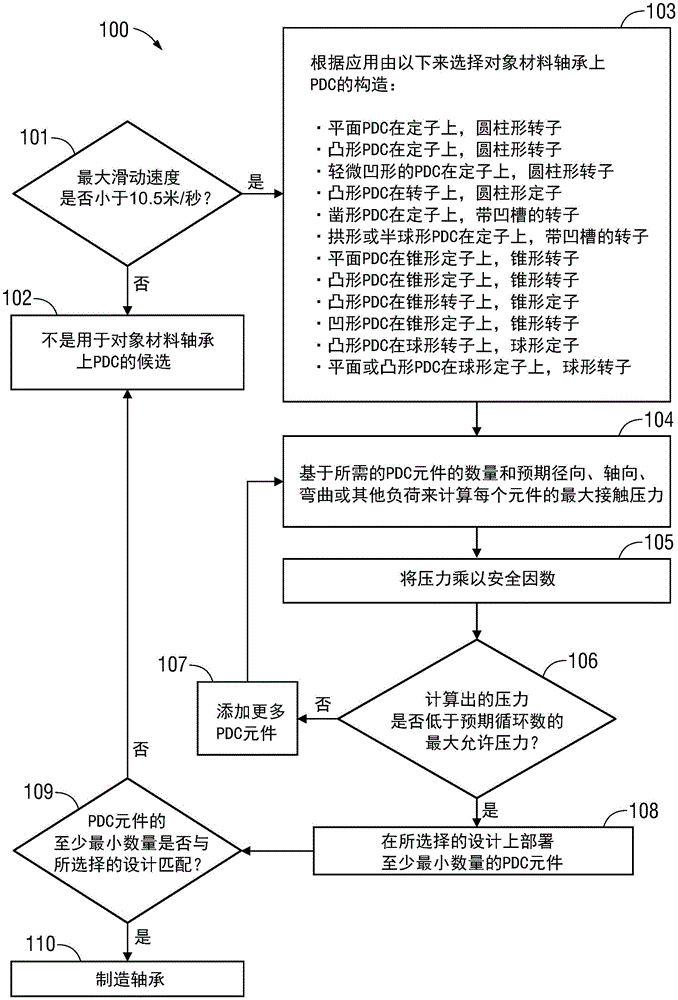
FIG. 1 depicts a flow chart 100 of a representative general set of evaluation criteria for use with the present technology in a dry, non-lubricated environment. First, it is evaluated whether the maximum sliding speed in the application is less than 10.5m/s, as indicated in block 101. Herein, "sliding speed," also referred to as "sliding interface speed," refers to the speed at which two components in contact move relative to each other (e.g., the speed at which a rotor in contact with a stator moves relative to the stator).
If it is determined that the maximum slip velocity is not less than 10.5m/s, then the application evaluated is determined not to be a candidate application for use as a polycrystalline diamond element in sliding engagement with a diamond reactive material because the slip velocity is too high, as shown in block 102. Those skilled in the art will appreciate that sliding interface speeds may be significantly higher in a lubricated or wet environment than in a dry, non-lubricated environment (as evaluated herein).
If it is determined that the maximum slip velocity is less than 10.5m/s, the configuration (e.g., shape, size, and arrangement) of the polycrystalline diamond element is selected according to the particular application at hand, as shown in block 103. Block 103 lists various non-limiting polycrystalline diamond element configurations for sliding engagement with a diamond reactive material in various bearing configurations. For example, a planar polycrystalline diamond element may be selected for use on a stator engaged with a cylindrical rotor formed of or including at least some diamond reactive material; the convex polycrystalline diamond element may be selected for use on a stator engaged with a cylindrical rotor formed of or including at least some diamond reactive material; polycrystalline diamond elements having a concave, or at least slightly concave, surface may be selected for use on a stator engaged with a cylindrical rotor formed of or including at least some diamond reactive material; polycrystalline diamond elements having a convex, or at least slightly convex, surface may be selected for use on a rotor engaged with a cylindrical stator formed of or including at least some diamond reactive material; the chisel polycrystalline diamond element may alternatively be used on a stator engaged with a grooved rotor formed of or including at least some diamond reactive material; alternatively, arcuate or hemispherical polycrystalline diamond elements may be used on a stator engaged with a grooved rotor formed of or including at least some diamond reactive material; the planar polycrystalline diamond element may be selected for use on a conical stator engaged with a conical rotor formed from or including at least some diamond reactive material; polycrystalline diamond elements having convex, or at least slightly convex, surfaces may be selected for use on a conical stator engaged with a conical rotor formed of or including at least some diamond reactive material; polycrystalline diamond elements having convex, or at least slightly convex, surfaces may be selected for use on a conical rotor engaged with a conical stator formed of or including at least some diamond reactive material; polycrystalline diamond elements having concave, or at least slightly concave, surfaces may be selected for use on a conical stator engaged with a conical rotor formed of or including at least some diamond reactive material; polycrystalline diamond elements having a convex, or at least slightly convex, surface may be selected for use on a spherical rotor engaged with a spherical stator formed of or including at least some diamond reactive material; alternatively, polycrystalline diamond elements having a planar, convex, or at least slightly convex surface may be selected for use on a spherical stator engaged with a spherical rotor formed of or including at least some diamond reactive material. Those skilled in the art will appreciate that the present disclosure is not limited to these specifically selected shapes and profiles, and that the shapes (including surface profiles) of rotors, stators, polycrystalline diamond elements, and other application specific components may vary depending on the particular application.
After the configuration is selected, the maximum contact pressure for each polycrystalline diamond element is calculated, as set forth in block 103. As set forth in block 104, the maximum contact pressure for each polycrystalline diamond element is calculated based on the number of polycrystalline diamond elements and the expected load (including radial, axial, bending, or other loads). The maximum contact pressure can be determined by methods known to those skilled in the art.
After the maximum contact pressure for each polycrystalline diamond element is calculated, the calculated maximum pressure for each polycrystalline diamond element is divided by a safety factor, as set forth in block 105. Application of the safety factor above the maximum pressure determined in block 104 may be set and applied as appropriate by the designer, for example. Thus, if a safety factor is applied, it provides a reduced pressure of each polycrystalline diamond element relative to the maximum contact pressure of each polycrystalline diamond element.
In block 106, it is determined whether the calculated maximum pressure is below the maximum allowable pressure for the expected number of cycles of the device. Those skilled in the art will appreciate that fatigue on diamond reactive materials is a limiting factor. The load is present at the diamond/diamond reactive material (e.g. metal) interface. The more PDC elements in the assembly, the lower the instantaneous load on the metal. The S-N curve (contact stress versus cycle number) may be used to assist in the determination in block 106.
If it is determined by block 106 that the calculated pressure is not below the maximum allowable pressure, then additional polycrystalline diamond elements are deployed in the design configuration selected in block 103, as shown in block 107. After deployment of these additional polycrystalline diamond elements, the design configuration so modified is evaluated as per blocks 104 and 105 before it is again evaluated as per the criteria of block 106.
If it is determined by block 106 that the calculated pressure is below the maximum allowable pressure, then the target design configuration is established by deploying at least the minimum number of polycrystalline diamond elements required by block 101-106 above (e.g., attaching the minimum number of polycrystalline diamond elements to the stator or rotor) on the assembly of the design configuration selected at block 103, as shown at block 108.
A determination is made at block 109 whether the minimum number of polycrystalline diamond elements of block 108 matches the configuration selected at block 103. If the minimum number of polycrystalline diamond elements is determined to match the configuration selected at block 103, then bearing assemblies in the rotor and stator are made, as shown at block 110. If it is determined that the minimum number of polycrystalline diamond elements does not match the configuration selected at block 103, then, via block 102, it is determined that the configuration selected at block 103 is not a candidate configuration for use as a polycrystalline diamond element in sliding engagement with a diamond reactive material.
When the minimum number of polycrystalline diamond elements required does not match the originally selected design configuration, the designer of the bearing configuration also has the option of selecting an alternative bearing configuration (not shown) by block 103. Alternatively, the safety factor may be reduced to reduce the minimum number of polycrystalline diamond elements required. It will be understood by those skilled in the art that the criteria listed in fig. 1 are merely exemplary, that other criteria may be evaluated according to a particular application, and that for at least some applications, some of the criteria listed in fig. 1 may be omitted without departing from the scope of the present disclosure.
Various exemplary rotor and stator radial bearing assemblies are now described with reference to FIGS. 2A-13B. In fig. 2A-13B, like reference numerals refer to like elements. For example, an exemplary component is denoted by reference numeral "200" in fig. 2A and 2B, and an exemplary component is denoted by reference numeral "300" in fig. 3A and 3B.
Stator with planar polycrystalline diamond elements
Fig. 2A shows a partial side view of the rotor and stator radial bearing assembly, and fig. 2B shows a cross-sectional view of the rotor and stator radial bearing assembly of fig. 2A along line a-a. A rotor and stator radial bearing assembly 200 is described with reference to fig. 2A and 2B.
Rotor and stator radial bearing assembly 200 includes a stator 202 engaged with a rotor 203. Four planar polycrystalline diamond elements 201 are configured in the stator 202 to provide a sliding engagement between the stator 202 and the rotor 203, wherein the rotor 203 is formed of or includes at least some diamond reactive material. The polycrystalline diamond element 201 is deployed (e.g., mechanically configured) in a load site 204 in the stator 202, which is a site formed and/or located in the stator body 211. For example, and without limitation, each polycrystalline diamond element 201 may be press-fit, glued, brazed, threaded, or otherwise mounted to the stator 202 (or to the rotor in other applications) by methods known to those skilled in the art. It will be appreciated by those skilled in the art that the present disclosure is not limited to the use of these particular attachment methods or sites within the stator body, and that the polycrystalline diamond element may be attached to the stator or rotor by any of a variety of methods. Further, while shown as including planar polycrystalline diamond elements at the same pitch, those skilled in the art will appreciate that the number, pitch, equipment, shape, and size of polycrystalline diamond elements may vary according to any number of various design criteria, including, but not limited to, the criteria listed in fig. 1. In some aspects, the polycrystalline diamond element is composed of thermally stable polycrystalline diamond (with or without a tungsten carbide support) or a polycrystalline diamond composite.
Each polycrystalline diamond element 201 includes a bonding surface 213 (shown here as a planar surface), and the rotor 203 includes an opposing bonding surface 215. The polycrystalline diamond element 201 is positioned on the stator 202 in firm contact with the rotor 203, thereby restricting lateral movement of the rotor 203 during operation and allowing free sliding rotation of the rotor 203. The polycrystalline diamond element 201 is positioned and arranged such that the bonding surface 213 is in contact (e.g., sliding contact) with the opposing bonding surface 215. Thus, the engaging surface 213 and the opposing engaging surface 215 are butted to form a sliding contact between the rotor 203 and the stator 202.
Fig. 2A and 2B depict a rotor and stator such as may be used in a downhole pump or motor. However, it will be understood by those skilled in the art that radial bearings for other applications as well as discrete radial bearings may be designed and manufactured by the same or similar methods according to the present disclosure. Non-limiting proximal and distal dimensions of such discrete bearings are shown in dashed lines 205 in fig. 2A. As shown in fig. 2B, optionally, a through hole 207 is provided in the rotor 203, which may be applied in a discrete bearing, for example. As shown in fig. 2B, the polycrystalline diamond element 201 is disposed in the stator 202 to radially support the rotor 203 and provide a sliding engagement with the rotor 203.
While fig. 2A and 2B depict an assembly comprising four polycrystalline diamond elements 201, those skilled in the art will appreciate that less than four polycrystalline diamond elements (e.g., three polycrystalline diamond elements) or more than four polycrystalline diamond elements may be used depending on the particular application and configuration (e.g., space available for such polycrystalline diamond elements on a stator or rotor). Furthermore, while fig. 2A and 2B show a single circumferential arrangement of polycrystalline diamond elements 201, those skilled in the art will appreciate that one or more additional circumferential arrangements of polycrystalline diamond elements may be disposed in the stator (or rotor) to increase the lateral support and lateral load capacity of the bearing assembly.
Stator with convex polycrystalline diamond elements
Fig. 3A and 3B depict a rotor and stator radial bearing assembly 300 that is substantially similar to that shown in fig. 2A and 2B, except that the polycrystalline diamond elements 301 have convex bonding surfaces 313 instead of the flat planar bonding surfaces of fig. 2A and 2B.
Referring to fig. 3A and 3B, a rotor and stator radial bearing 300 includes a convex polycrystalline diamond element 301 configured in a stator body 311 of a stator 302 to provide a sliding engagement with a rotor 303 formed of or including at least some diamond reactive material. The polycrystalline diamond element 301 is deployed in the stator 302 through a load site 304 and may be press-fit, glued, brazed, threaded, or otherwise mounted by methods known to those skilled in the art. The polycrystalline diamond element 301 is placed in firm contact with the rotor 303, thereby restricting lateral movement of the rotor 303 during operation and allowing free sliding rotation of the rotor 303. As shown in fig. 3B, the polycrystalline diamond element 301 is disposed in the stator 302 to radially support the rotor 303 and provide sliding engagement with the rotor 303. Fig. 3B also shows an optional through hole 307 that may be used, for example, in a discrete bearing.
While fig. 3A and 3B depict a rotor and stator such as may be used in a downhole pump or motor, other components, including discrete radial bearing assemblies, may be designed and manufactured in the same or substantially the same manner. Non-limiting proximal and distal dimensions of such discrete bearings are shown in dashed lines 305. Further, while fig. 3A and 3B show four polycrystalline diamond elements 301, those skilled in the art will appreciate that fewer (e.g., three) or more polycrystalline diamond elements may be disposed in the stator 302. Additionally, while fig. 3A and 3B show a single circumferential arrangement of polycrystalline diamond elements 301, one skilled in the art will appreciate that one or more additional circumferential arrangements of polycrystalline diamond elements may be disposed in the stator to increase the lateral support and lateral load capacity of the bearing assembly.
As with assembly 200, in operation, engagement surface 313 interfaces with opposing engagement surface 315 to bear loads between rotor 303 and stator 302.
Stator with concave polycrystalline diamond elements
Fig. 4A and 4B depict a rotor and stator radial bearing assembly 400 that is substantially similar to that shown in fig. 2A-3B, except that the polycrystalline diamond element 401 has a concave, or at least slightly concave, bonding surface 413 instead of the flat, planar bonding surface of fig. 2A and 2B or the convex bonding surface of fig. 3A and 3B.
A slightly concave polycrystalline diamond element 401 is arranged in the stator body 411 of the stator 402 to provide a sliding engagement with the rotor 403. The polycrystalline diamond element 401 is disposed in the stator 402 by a load site 404. The polycrystalline diamond element 401 may be press fit, glued, soldered, threaded, or otherwise mounted by methods known to those skilled in the art. The polycrystalline diamond element 401 is placed in firm contact with the rotor 403 to limit lateral movement of the rotor 403 during operation and to allow free sliding rotation of the rotor 403.
As with the assembly 300, in operation, the engagement surface 413 interfaces with the opposing engagement surface 415 to bear loads between the rotor 403 and the stator 402. At least a slight concavity of each polycrystalline diamond element 401 is oriented with the axis of the concavity in rotational alignment with the circumference of the rotor 403; thereby ensuring that there is no edge contact between the polycrystalline diamond element 401 and the rotor 403 and providing linear area contact between the polycrystalline diamond element 401 and the rotor 403 (typically with the deepest portion of the cavity). That is, the bond between the polycrystalline diamond element 401 and the rotor 403 is formed entirely by the abutment of the bonding surface 413 and the opposing bonding surface 415, such that the edge or point 417 of the polycrystalline diamond element 401 does not contact the rotor 403. Thus, only linear area contact, and no edge or point contact, occurs between the polycrystalline diamond element 401 and the rotor 403. As shown in fig. 4B, the polycrystalline diamond element 401 is deployed in the stator 402 to radially support the rotor 403 and provide sliding engagement with the rotor 403. Fig. 4B also shows an optional through hole 407, such as may be used in a discrete bearing.
While fig. 4A and 4B depict a rotor and stator such as may be used in a downhole pump or motor, an assembly including a discrete radial bearing assembly may be designed and manufactured in the same or substantially the same manner. Non-limiting proximal and distal dimensions of such discrete bearings are shown by dashed line 405. Further, while fig. 4A and 4B show four polycrystalline diamond elements 401, those skilled in the art will appreciate that fewer (e.g., three) or more polycrystalline diamond elements may be disposed in the stator 402. Additionally, while fig. 4A and 4B show a single circumferential arrangement of polycrystalline diamond elements 401, one skilled in the art will appreciate that one or more additional circumferential arrangements of polycrystalline diamond elements may be disposed in the stator to increase the lateral support and lateral load capacity of the bearing assembly.
Rotor with convex polycrystalline diamond element
Fig. 5A and 5B depict a rotor and stator radial bearing assembly 500 that is substantially similar to that shown in fig. 3A and 3B, except that the polycrystalline diamond element 501, having a convex, arcuate bonding surface 513, is mounted on the rotor 503 instead of on the stator.
The convex polycrystalline diamond element 501 is disposed in the rotor body 523 of the rotor 503 to provide a sliding engagement with the stator 502 formed of or including at least some of the diamond reactive material. The polycrystalline diamond element 501 is disposed in the rotor 503 in a sleeve 504 formed and/or positioned in the rotor body 523. The polycrystalline diamond element 501 may be press fit, glued, brazed, threaded, or otherwise mounted by methods known to those skilled in the art. The polycrystalline diamond element 501 is placed in firm contact with the stator 502, thereby restricting lateral movement of the rotor 503 during operation and allowing free sliding rotation of the rotor 503. As shown in fig. 5B, the polycrystalline diamond element 501 is disposed in a rotor 503 to radially support the stator 502 and provide a sliding engagement with the stator 502. Fig. 5B also shows optional through holes 507 that may be used, for example, in discrete bearings.
While fig. 5A and 5B depict a rotor and stator such as may be used in a downhole pump or motor, other components, including discrete radial bearing assemblies, may be designed and manufactured in the same or similar manner. Non-limiting proximal and distal dimensions of such discrete bearings are shown by dashed line 505. Further, while fig. 5A and 5B show four polycrystalline diamond elements 501, those skilled in the art will appreciate that fewer (e.g., three) or more polycrystalline diamond elements may be disposed in the rotor 503. Additionally, while fig. 5A and 5B show a single circumferential arrangement of polycrystalline diamond elements 501, one skilled in the art will appreciate that one or more additional circumferential arrangements of polycrystalline diamond elements may be disposed in the rotor to increase the lateral support and lateral load capacity of the bearing assembly.
Thus, in contrast to the embodiment shown in fig. 2A-4B, in the embodiment shown in fig. 5A and 5B, the engagement surface 513 is on the rotor 503 and the opposing engagement surface 515 is on the stator 502.
Stator with chisel shaped polycrystalline diamond element
Fig. 6A and 6B depict a rotor and stator radial bearing assembly 600 having chisel-shaped polycrystalline diamond elements 601 disposed in a stator body 611 of a stator 602 to provide a sliding engagement with a rotor 603 formed of or including at least some diamond reactive material. The polycrystalline diamond element 601 is deployed in the stator 602 by a load site 604 formed and/or located in the stator body 611. The polycrystalline diamond element 601 may be press-fit, glued, brazed, threaded, or otherwise mounted by methods known to those skilled in the art.
The polycrystalline diamond element 601 is placed in firm contact with the centripetal/thrust surface grooves 606 of the rotor 603, thereby restricting lateral and axial movement of the rotor 603 during operation and allowing free sliding rotation of the rotor 603. The chisel polycrystalline diamond element 601 is positioned, arranged, shaped, sized and oriented so as to slidingly engage a mating centripetal/thrust surface groove 606 of a rotor 603. The chisel shaped polycrystalline diamond element 601 includes a bonding surface (defined by the chisel shaped polycrystalline diamond element 601) that interfaces into contact with an opposing bonding surface (here the surface of the centripetal/thrust surface groove 606). As shown in fig. 6B, a chisel shaped polycrystalline diamond element 601 is disposed in the stator 602 to radially and axially support the rotor 603 and provide sliding engagement with the rotor 603. Fig. 6B also shows an optional through hole 607 that may be used, for example, in a discrete bearing. The embodiment shown in fig. 6A and 6B may further function as a rotor catch.
While fig. 6A and 6B depict a rotor and stator such as may be used in a downhole pump or motor, other components, including discrete radial bearing assemblies, may be designed and manufactured in the same or similar manner. Non-limiting proximal and distal dimensions of such discrete bearings are shown in dashed lines 605. Further, while fig. 6A and 6B show four polycrystalline diamond elements 601, those skilled in the art will appreciate that fewer (e.g., three) or more polycrystalline diamond elements 601 may be disposed in the stator 602. In addition, while fig. 6A and 6B show a single circumferential arrangement of polycrystalline diamond elements 601, those skilled in the art will appreciate that one or more additional circumferential arrangements of polycrystalline diamond elements may be disposed in the stator to increase the lateral and axial support and lateral and axial load capacity of the bearing assembly.
Stator with arched or hemispherical polycrystalline diamond elements
Fig. 7A and 7B depict a rotor and stator radial bearing assembly 700 that is substantially similar to that shown in fig. 6A and 6B, except that the polycrystalline diamond elements 701 have arcuate or hemispherical engagement surfaces 713 instead of chisel-shaped polycrystalline diamond elements.
An arcuate or hemispherical polycrystalline diamond element 701 is disposed in a stator housing 711 of the stator 702 to provide a sliding engagement with the rotor 703. The polycrystalline diamond element 701 is deployed in the stator 702 by a load site 704 formed and/or located in the stator body 711. The polycrystalline diamond element 701 may be press fit, glued, brazed, threaded, or otherwise mounted by methods known to those skilled in the art. The polycrystalline diamond element 701 is placed in firm contact with the centripetal/thrust surface grooves 706 of the rotor 703, thereby restricting lateral and axial movement of the rotor 703 during operation and allowing free sliding rotation of the rotor 703. The arcuate or hemispherical polycrystalline diamond element 701 is in sliding engagement with a mating centripetal/thrust surface groove 706 of the rotor 703. The arcuate or hemispherical polycrystalline diamond element 701 defines a bonding surface that interfaces into contact with an opposing bonding surface, here the surface of the centripetal/thrust surface groove 706. As shown in fig. 7B, an arcuate or hemispherical polycrystalline diamond element 701 is disposed in the stator 702 to radially and axially support the rotor 703 and provide sliding engagement with the rotor 703. Fig. 7B also shows an optional through-hole 707 that may be used, for example, in a discrete bearing. The embodiment shown in fig. 7A and 7B may further function as a rotor catch.
While fig. 7A and 7B depict a rotor and stator such as may be used in a downhole pump or motor, other components, including discrete radial bearing assemblies, may be designed and manufactured in the same or similar manner. Non-limiting proximal and distal dimensions of such discrete bearings are shown as dashed lines 705. Further, while fig. 7A and 7B show four polycrystalline diamond elements 701, one skilled in the art will appreciate that fewer (e.g., three) or more polycrystalline diamond elements may be disposed in the stator 702. Additionally, while fig. 7A and 7B show a single circumferential arrangement of polycrystalline diamond elements, those skilled in the art will appreciate that one or more additional circumferential arrangements of polycrystalline diamond elements may be disposed in the stator to increase the lateral and axial support and lateral and axial load capacity of the bearing assembly.
Stator with planar polycrystalline diamond elements
Fig. 8A and 8B depict a rotor and stator radial bearing assembly 800 that includes a planar polycrystalline diamond element 801 configured in a stator body 811 of a stator 802 to provide a sliding engagement with a rotor 803 formed of or including at least some diamond reactive material. The polycrystalline diamond element 801 is deployed in the stator 802 by a load site 804 formed and/or located in the stator body 811. The polycrystalline diamond element 801 may be press fit, glued, brazed, threaded, or otherwise mounted by methods known to those skilled in the art.
The polycrystalline diamond element 801 is placed in firm contact with the centripetal/thrust tapered surface 806 of the rotor 803, thereby restricting lateral and upward axial movement of the rotor 803 during operation and allowing free sliding rotation of the rotor 803.
The planar polycrystalline diamond element 801 is slidingly engaged with a centripetal/thrust tapered surface of a mating rotor 803 such that the engagement surface 813 contacts and abuts the opposing engagement surface 806. As shown in fig. 8B, polycrystalline diamond element 801 is deployed in stator 802 to radially and axially support rotor 803 and provide sliding engagement with rotor 803.
Although fig. 8A and 8B show four polycrystalline diamond elements 801, those skilled in the art will appreciate that fewer (e.g., three) or more polycrystalline diamond elements may be disposed in the stator 802. Further, while fig. 8A and 8B show a single circumferential arrangement of polycrystalline diamond elements 801, it should be understood that one or more additional circumferential arrangements of polycrystalline diamond elements may be disposed in the stator to increase the lateral and axial support and lateral and axial load capacity of the bearing assembly.
Stator with convex polycrystalline diamond elements
Fig. 9A and 9B depict a rotor and stator radial bearing assembly 900 that is substantially similar to that shown in fig. 8A and 8B, except that the polycrystalline diamond element 901 has a convex bonding surface 913 instead of a planar bonding surface.
The convex polycrystalline diamond element 901 is disposed in the stator body 911 of the stator 902 to provide a sliding engagement with the rotor 903. The polycrystalline diamond element 901 is deployed in the stator 902 through a load site 904 formed and/or positioned in the stator body 911. The polycrystalline diamond element 901 may be press fit, glued, brazed, threaded, or otherwise mounted by methods known to those skilled in the art.
The convex polycrystalline diamond element 901 is placed in firm contact with the centripetal/thrust tapered surface 906 of the rotor 903, thereby restricting lateral and upward axial movement of the rotor 903 during operation and allowing free sliding rotation of the rotor 903. The polycrystalline diamond element 901 is slidingly engaged with a centripetal/thrust tapered surface of a mating rotor 903 such that the engagement surface 913 is in contact with and abuts the opposing engagement surface 906.
As shown in fig. 9B, a convex polycrystalline diamond element 901 is disposed in the stator 902 to radially and axially support the rotor 903 and provide sliding engagement with the rotor 903.
Although fig. 9A and 9B show four polycrystalline diamond elements 901, those skilled in the art will appreciate that fewer (e.g., three) or more polycrystalline diamond elements may be disposed in the stator 902. Further, while fig. 9A and 9B show a single circumferential arrangement of polycrystalline diamond elements 901, those skilled in the art will appreciate that one or more additional circumferential arrangements of polycrystalline diamond elements may be disposed in the stator to increase the lateral and axial support and lateral and axial load capacity of the bearing assembly.
Rotor with convex polycrystalline diamond element
Fig. 10A and 10B depict a rotor and stator centripetal and thrust bearing assembly 1000 comprising convex polycrystalline diamond elements 1001 configured in a rotor body 1023 of a rotor 1003 to provide a sliding engagement with a stator 1002 formed of or including at least some diamond reactive material. The polycrystalline diamond element 1001 is disposed in a rotor 1003, in a sleeve 1004 formed and/or positioned in a rotor body 1023. The polycrystalline diamond element 1001 may be press-fit, glued, brazed, threaded, or otherwise mounted by methods known to those skilled in the art.
The convex polycrystalline diamond element 1001 is placed in firm contact with the centripetal/thrust tapered surface 1006 of the stator 1002, thereby restricting lateral and upward axial movement of the rotor 1003 during operation and allowing free sliding rotation of the rotor 1003. The convex polycrystalline diamond element 1001 is in sliding engagement with a centripetal/thrust tapered surface of a mating stator 1002 such that the engagement surface 1013 contacts and abuts the opposing engagement surface 1006. As shown in fig. 10B, the convex polycrystalline diamond element 1001 is deployed in a rotor 1003 to radially and axially support a body material stator 1002 and provide sliding engagement with the stator 1002.
Although fig. 10A and 10B show four polycrystalline diamond elements 1001, those skilled in the art will appreciate that fewer (e.g., three) or more polycrystalline diamond elements may be disposed in the rotor 1003. Further, while fig. 10A and 10B show a single circumferential arrangement of polycrystalline diamond elements 1001, those skilled in the art will appreciate that one or more additional circumferential arrangements of polycrystalline diamond elements may be disposed in the rotor to increase the lateral and axial support and lateral and axial load capacity of the bearing assembly.
Stator with planar polycrystalline diamond elements
Fig. 11A and 11B depict a rotor and stator centripetal and thrust bearing assembly 1100 comprising a concave, or at least slightly concave, polycrystalline diamond element 1101 configured in a stator body 1111 of a stator 1102 to provide a sliding engagement with a rotor 1103 formed of or including at least some diamond reactive material. The polycrystalline diamond element 1101 is disposed in the stator 1102 by a load site 1104 formed and/or positioned therein. The polycrystalline diamond element 1101 may be press fit, glued, brazed, threaded, or otherwise mounted by methods known to those skilled in the art.
The polycrystalline diamond element 1101 is placed in firm contact with the centripetal/thrust tapered surface 1106 of the rotor 1103, thereby restricting lateral and upward axial movement of the rotor 1103 during operation and allowing free sliding rotation of the rotor 1103. The polycrystalline diamond element 1101 is oriented with the axis of the cavity coincident with the circumferential rotation of the rotor 1103 to ensure that there is no edge or point contact and thus ensure that there is only linear area contact (typically with the deepest part of the cavity). The slightly concave polycrystalline diamond element 1101 is in sliding engagement with a centripetal/thrust tapered surface of the rotor 1103 such that the engagement surface 1113 contacts and abuts the opposing engagement surface 1106.
As shown in fig. 11B, a slightly concave polycrystalline diamond element 1101 is disposed in the stator 1102 to radially and axially support the rotor 1103 and provide sliding engagement with the rotor 1103.
Although fig. 11A and 11B show four polycrystalline diamond elements 1101, one skilled in the art will appreciate that fewer (e.g., three) or more polycrystalline diamond elements may be disposed in the stator 1102. Further, while fig. 11A and 11B show a single circumferential arrangement of polycrystalline diamond elements 1101, one skilled in the art will appreciate that one or more additional circumferential arrangements of polycrystalline diamond elements may be disposed in the stator to increase the lateral and axial support and lateral and axial load capacity of the bearing assembly.
Rotor with convex polycrystalline diamond element
Fig. 12A and 12B depict a rotor and stator centripetal and thrust bearing assembly 1200 comprising a convex polycrystalline diamond element 1201 configured in a rotor body 1223 of a rotor 1203 to provide sliding engagement with a stator 1202. The polycrystalline diamond element 1201 is disposed in the rotor 1203, in a sleeve 1204 formed and/or positioned in a rotor body 1223. The polycrystalline diamond element 1201 may be press fit, glued, soldered, threaded, or otherwise mounted by methods known to those skilled in the art.
The convex polycrystalline diamond element 1201 is placed in firm contact with the centripetal/thrust concave curved surface 1206 of the stator 1202, thereby restricting lateral and upward axial movement of the rotor 1203 in operation and allowing free sliding rotation of the rotor 1203. The convex polycrystalline diamond element 1201 is in sliding engagement with the centripetal/thrust concave curved surface of the mating stator 1202 such that the engagement surface 1213 engages the centripetal/thrust concave curved surface 1206. In the embodiment shown in fig. 12A and 121B, the centripetal/thrust concave curved surface 1206 is or forms an opposing engagement surface. In the assembly 1200, the contact area with the convex polycrystalline diamond element 1201 is generally circular. However, those skilled in the art will appreciate that polycrystalline diamond elements are not limited to having such contact regions.
As shown in fig. 12B, a convex polycrystalline diamond element 1201 is deployed in the rotor 1203 to radially and axially support the stator 1202 and provide sliding engagement with the stator 1202.
While fig. 12A and 12B show four polycrystalline diamond elements 1201, those skilled in the art will appreciate that fewer (e.g., three) or more polycrystalline diamond elements may be disposed in the rotor 1203. Further, while fig. 12A and 12B show a single circumferential arrangement of polycrystalline diamond elements 1201, one skilled in the art will appreciate that one or more additional circumferential arrangements of polycrystalline diamond elements may be disposed in the rotor to increase the lateral and axial support and lateral and axial load capacity of the bearing assembly.
Stator with planar polycrystalline diamond elements
Fig. 13A and 13B show partial side views of a rotor and stator centripetal and thrust bearing assembly 1300 comprising a planar (or arcuate, not shown) polycrystalline diamond element 1301 configured in a stator body 1311 of a stator 1302 to provide sliding engagement with a rotor 1303 formed from or including at least some diamond reactive material. The polycrystalline diamond element 1301 is deployed in the stator 1302 through a load site 1304 formed and/or positioned in the stator body 1311. The polycrystalline diamond element 1301 may be press fit, glued, brazed, threaded, or otherwise mounted by methods known to those skilled in the art.
Polycrystalline diamond element 1301 is placed in firm contact with centripetal/thrust convex curved surface 1306 of rotor 1303, thereby limiting lateral and upward axial movement of rotor 1303 during operation and allowing free sliding rotation of rotor 1303. The centripetal/thrust convex curved surface 1306 is or forms an opposing engagement surface. Polycrystalline diamond element 1301 is in sliding engagement with centripetal/thrust convexly curved surface 1306 of rotor 1403, such that engagement surface 1313 engages the opposite engagement surface (i.e., centripetal/thrust convexly curved surface 1306). In assembly 1300, the contact area with the planar or arcuate polycrystalline diamond element is generally circular. However, those skilled in the art will appreciate that the polycrystalline diamond elements may have different contact areas.
As shown in fig. 13B, a planar polycrystalline diamond element 1301 is disposed in the stator 1302 to radially and axially support the rotor 1303 and provide sliding engagement with the rotor 1303.
Although fig. 13A and 13B show four polycrystalline diamond elements 1301, those skilled in the art will appreciate that fewer (e.g., three) or more polycrystalline diamond elements may be disposed in the stator 1302. Further, while fig. 13A and 13B show a single circumferential arrangement of polycrystalline diamond elements 1301, those skilled in the art will appreciate that one or more additional circumferential arrangements of polycrystalline diamond elements may be disposed in the stator to increase the lateral and axial support and lateral and axial load capacity of the bearing assembly.
As shown in fig. 2A-13B, some aspects of the present disclosure include a high performance radial bearing incorporating polycrystalline diamond elements in sliding engagement with a curved or cylindrical surface formed of or including at least some diamond reactive material. Some of these aspects include high performance radial bearings in which a rotor containing diamond reactive material is in sliding contact with preferably three or more polycrystalline diamond elements mounted on a stator. The polycrystalline diamond elements of the stator are preferably planar, but may be slightly concave, convex or any combination of the three. The surface profile of the polycrystalline diamond element of the stator need not (and preferably does not) conform to the circumferential curve of the stator. While three or more polycrystalline diamond elements are preferred, the techniques of the present application may also be practiced with one or two polycrystalline diamond elements, for example, where the polycrystalline diamond elements are used to reduce wear and friction on the lower topographical side of the stator in a horizontally oriented positive displacement pump or the scribe side relative to the directional drilling assembly.
In certain applications, the bearing assembly of the present disclosure is configured to resist thrust loads. At least some embodiments of the bearing assembly of the present disclosure are assemblies capable of handling both centripetal and thrust loads.
At least some embodiments of the bearing assembly of the present disclosure are economically feasible and have relatively large diameters.
Edge radian treatment
In some aspects, the polycrystalline diamond element is subjected to an edge curvature treatment. Edge rounding processes for polycrystalline diamond elements are known in the art. In some embodiments of the technology of the present application that employ planar or convex polycrystalline diamond elements, edge rounding of such polycrystalline diamond elements is preferably performed. One purpose of implementing the edge curving treatment is to reduce or avoid the possibility of the outer edge cutting or scoring at the outer edge of the linear bonding region of a given polycrystalline diamond element to an opposing bonding surface (e.g., a curved surface).
Polycrystalline diamond element
In certain applications, polycrystalline diamond elements of the present disclosure have a transition layer of increased cobalt content between the outer polycrystalline diamond surface and the supporting tungsten carbide mass, as is known in the art.
The polycrystalline diamond element may be supported by tungsten carbide, or may be unsupported, and is a "free-standing" polycrystalline diamond element mounted directly to the bearing assembly.
The polycrystalline diamond element may be treated by non-leaching, leaching and backfilling, thermally stabilizing, coating by Chemical Vapor Deposition (CVD), or various means known in the art.
Polycrystalline diamond element-shape, size and arrangement
The diameter of the polycrystalline diamond element may be as small as 3mm (about 1/8 ") or as large as 75mm (about 3"), depending on the application, configuration, and diameter of the bearing. Typically, the polycrystalline diamond element has a diameter between 8mm (about 5/16 ") and 25mm (about 1").
While polycrystalline diamond elements are most commonly cylindrical, it should be understood that the techniques of the present application may be implemented with a square, rectangular, oval, any shape described herein with reference to the drawings, or any other suitable shape known in the art. In some applications, a radial bearing has one or more convex, contoured polycrystalline diamond elements mounted on and in sliding contact with a rotor (stator).
In some applications, polycrystalline diamond elements are disposed in rings along a bearing assembly. As one non-limiting example, five rings of planar polycrystalline diamond elements are disposed at the distal end of the stator, while five other rings of planar polycrystalline diamond elements are disposed at the proximal end of the stator. Thus, a high performance polycrystalline diamond element bearing assembly may be deployed to ensure stable operation along the length of the stator/rotor interface, while requiring less total polycrystalline diamond elements than used in the prior assemblies described above.
The polycrystalline diamond elements may be arranged in any pattern, layout, spacing, or staggering within a bearing assembly to provide the desired support without concern for requiring overlapping contact with the polycrystalline diamond element engagement surface on the opposing bearing assembly.
Contact area of polycrystalline diamond element-bonding surface
The polycrystalline diamond elements of the present disclosure may not be shaped to precisely conform to the opposing bonding surfaces in some embodiments. In certain embodiments, the sliding abutting contact area of the joining surfaces of the polycrystalline diamond element is less than 80%, or less than 75%, or less than 70%, or less than 60% of the total surface area of the polycrystalline diamond element. Herein, the "contact area" of the joining surface refers to the surface area of the joining surface that is in contact with the opposite joining surface.
One key performance criterion is that the polycrystalline diamond element be configured and positioned in such a way as to avoid contact or point contact with any edge of the opposing bonding surface or component. For planar polycrystalline diamond elements placed on a stator, the contact of such polycrystalline diamond elements with the rotor is generally less than the entire face. That is, the bonding surface contact area is less than the entire face when the rotor is rotated relative to the polycrystalline diamond element. For at least slightly arcuate or convex polycrystalline diamond elements mounted on a rotor or stator, such polycrystalline diamond elements exhibit a small, generally circular, bonding surface contact area. If the convex polycrystalline diamond element mounted on the rotor or stator is saddle shaped, the polycrystalline diamond element exhibits a small linear area bonding surface contact area. For slightly concave polycrystalline diamond elements disposed on a stator, a narrower linear bonding surface contact area is exhibited on each polycrystalline diamond element.
Polycrystalline diamond element mounting
As described above, the polycrystalline diamond element may be mounted directly on the bearing element (e.g., stator or rotor) by methods known in the art, including but not limited to brazing, gluing, press fitting, shrink fitting, or threading. Additionally, the polycrystalline diamond elements may be mounted in a single ring or rings. The ring or rings may be deployed on the bearing element (rotor or stator) by methods known in the art including, but not limited to, gluing, press fitting, thread locking, or brazing.
A planar or arcuate polycrystalline diamond element may be mounted in such a way that it rotates about its own axis. Reference is made to U.S. patent No. 8,881,849 to Shen et al, which, as a non-limiting example, allows a polycrystalline diamond element to rotate about its own axis while in face contact with a target material.
Treatment of opposing joining surfaces
In some aspects, the opposing bonding surfaces of the diamond reactive material are pre-saturated with carbon (e.g., prior to bonding with the bonding surfaces). Such pre-saturation reduces the ability of the diamond reactive material to attract carbon by graphitizing the surface of the polycrystalline diamond. Pre-saturation of the diamond reactive material surface contact area may be achieved by methods known in the art.
Solid lubricant source
In certain applications, an energized or non-energized solid lubricant source (e.g., graphite or hexagonal boron nitride rods or inclusions) is in contact with opposing faying surfaces formed of or including at least some of the diamond reactive material.
Applications of
The bearing assembly of the present disclosure may form part of a machine or other device or system. In some such aspects, the proximal end of the stator may be connected to other components (e.g., a drill string or a motor housing) by a threaded connection, welding, or other connection known in the art. In some aspects, if the bearing assembly is used in a downhole application, the distal end of the rotor may be reinforced by a thrust bearing and may be provided with a threaded connection for attaching a drill bit, or the distal end of the rotor may be a drill bit formed and/or positioned directly on the mandrel end of the rotor. The assembly connection is not limited to downhole applications and may be applied in other applications, such as wind generators or marine applications.
Further, the discrete form of the bearing assembly described herein may be used in a variety of other applications including, but not limited to, heavy equipment, automobiles, turbines, transmissions, railcars, computer hard drives, centrifuges, medical equipment, pumps, and motors.
In certain aspects, the bearing assemblies of the present disclosure are suitable for deployment and application in harsh environments (e.g., downhole). In some such aspects, the bearing assembly is less prone to cracking than a bearing assembly in which a polycrystalline diamond bonding surface is bonded to another polycrystalline diamond bonding surface. In certain aspects, such radial bearings suitable for harsh environments provide a higher service value than bearing assemblies that include a polycrystalline diamond bonding surface bonded to another polycrystalline diamond bonding surface. Further, the bearing assemblies of the present disclosure may be capable of being spaced at a greater pitch than is required when using a bearing assembly that includes a polycrystalline diamond bonding surface bonded to another polycrystalline diamond bonding surface.
In certain applications, the bearing assembly of the present disclosure may function as a rotor catch, such as in downhole applications.
In a lubricated environment, bearing assemblies may benefit from the hydrodynamic action of the lubricant, creating a gap between the moving and stationary elements of the bearing assembly.
Exemplary testing
In order to develop a robust cam follower interface for use with the "drill" of applicant's previously referenced U.S. patent application No. 15/430,254 ("application No. 254"), the applicant designed and built an advanced test rig. The test bed adopts a 200RPM gear motor, and a hard-surface iron rotor mandrel is driven in a hard-surface iron stator shell. The mandrel is fitted with a non-hardfaced offset cam cylinder midway along its length. The circulating fluid is delivered to the rotor/stator assembly by using a positive displacement pump. The candidate cam follower interface mechanism is in sealing contact with the cam cylinder of the rotor spindle and is loaded. And testing the tolerance capability and the abrasion of the candidate interface mechanism by using a test bench in clean water or sand-containing drilling fluid under the load of 500-3000 lbf.
Applicants have tested iron cam cylinders in sliding contact with a polished polycrystalline diamond surface without deleterious effects or significant chemical interactions. Ferrous materials are attractive for bearing applications because of their ready availability, ease of forming and machining, higher resilience, and lower cost compared to so-called superhard materials.
Test procedures conducted by the applicant have determined that the load interface between polycrystalline diamond and diamond reactive material can be successfully employed in bearing applications even at relatively high loads and high RPM speeds.
A key discovery is that the polycrystalline diamond element may be brought into sliding contact with the diamond reactive material at bearing loads and speeds typical of those required in many applications, as long as it is not brought into edge or point contact with the diamond reactive material, which is believed to result in mechanical and chemical interactions. Applicants' unexpected and surprising success has enabled the development of new high performance radial bearings.
The test procedure included testing of a curved ferrous surface in the linear region of a highly loaded surface in contact with planar polycrystalline diamond under rotational conditions. This test produced a slightly discolored hertzian contact area on the surface of the PDC along the entire 1/2 "broadside of the polycrystalline diamond of approximately 0.250" width. The width of the contact area can be explained by cam deflection, vibration in the system and slight deformation of the ferrous metal under load. It is estimated that at any given point in time, the total contact area on the surface of the polycrystalline diamond element at 1/2 "is about 7% or less of the total area of the surface of the polycrystalline diamond element. The configuration used in the tests showed that even a small surface area on the surface of the polycrystalline diamond element can withstand significant loads.
Additional testing of a spherical ferrous ball under load and rotated relative to a planar polycrystalline diamond surface produced a smaller zone of discolored Hertz contact at the center of the polycrystalline diamond element of about 0.030 a diameter. As described in the explanation of the above contact, it is believed, without being bound by theory, that the discolored diameter is a result of slight vibration in the test equipment and slight deformation of the ferrous metal under load.
Table 2 below lists data summarizing applicants' testing of various configurations of sliding interfaces.
Tests 1 and 2 summarize the failed tests of a single steel ball rolling in a steel cup under load. Test 3 summarizes the more successful test results of supporting a steel ball from a single polished PDC element in a steel cup. Test 4 summarizes the very successful testing of a single steel ball supported by an array of three polished polycrystalline diamond elements in a steel cup. Tests 5 to 9 summarize increasingly stringent tests, each test being a single polished polycrystalline diamond element in sliding contact with a rotating ferrous metal cam surface. Test 10 summarizes comparative testing of a single polished polycrystalline diamond element versus a single unpolished polycrystalline diamond element, each element in sliding contact with a rotating ferrous metal cam surface. Final testing showed that the coefficient of friction increased significantly when using unpolished polycrystalline diamond elements. The conditions and results listed in table 2 are indicative of the potential use of polycrystalline diamond in diamond reactive materials and should not be considered as limiting or fully encompassing the technology of the present application.
Summary of the tests
It has been found that the use of polycrystalline diamond elements in radial bearings can take much less than the entire surface of the element and still be subjected to significant loads. This discovery means that an effective radial bearing containing polycrystalline diamond elements can be designed and manufactured without the need to bring the polycrystalline diamond elements into full surface contact with the opposing surface. With this finding in the technology of the present application it is possible to manufacture radial bearings with much less machining of the polycrystalline diamond elements used and with a much reduced risk of edge collisions or mechanical interaction with the opposite surface of the diamond reactive material.
Without being bound by theory, in operation, operating the cam and cam follower in a liquid-cooled, lubricated environment, higher speeds and loads can be achieved without thermo-chemical reactions. Furthermore, polycrystalline diamond surfaces that have been polished provide, among other things, a lower thermochemical response.
From the description and drawings provided above, it can be readily appreciated that the bearing assembly techniques of the present application can be used in a wide variety of applications, including those in downhole environments. The techniques provided herein are additionally broadly applicable to other industrial applications.
Further, although shown and described with respect to bonding between surfaces in a radial bearing assembly, it should be understood by those skilled in the art that the present disclosure is not limited to this particular application, and that the concepts disclosed herein may be applied to bonding between any diamond reactive material surface bonded with a surface of diamond material.
Although the embodiments and advantages of the present invention have been described in detail, it should be understood that various changes, substitutions, and alterations can be made herein without departing from the spirit and scope of the disclosure. Moreover, the scope of the present application is not intended to be limited to the particular embodiments of the process, machine, manufacture, composition of matter, means, methods and steps described in the specification. As one of ordinary skill in the art will readily appreciate from the disclosure, processes, machines, manufacture, compositions of matter, means, methods, or steps, presently existing or later to be developed that perform substantially the same function or achieve substantially the same result as the corresponding embodiments described herein may be utilized according to the present disclosure. Accordingly, the appended claims are intended to include within their scope such processes, machines, manufacture, compositions of matter, means, methods, or steps.