CN112521992A - Biodiesel antioxidant composition and preparation method and application thereof - Google Patents
Biodiesel antioxidant composition and preparation method and application thereof Download PDFInfo
- Publication number
- CN112521992A CN112521992A CN201910878368.0A CN201910878368A CN112521992A CN 112521992 A CN112521992 A CN 112521992A CN 201910878368 A CN201910878368 A CN 201910878368A CN 112521992 A CN112521992 A CN 112521992A
- Authority
- CN
- China
- Prior art keywords
- biodiesel
- antioxidant
- component
- oil
- fatty acid
- Prior art date
- Legal status (The legal status is an assumption and is not a legal conclusion. Google has not performed a legal analysis and makes no representation as to the accuracy of the status listed.)
- Granted
Links
Images

Classifications
-
- C—CHEMISTRY; METALLURGY
- C10—PETROLEUM, GAS OR COKE INDUSTRIES; TECHNICAL GASES CONTAINING CARBON MONOXIDE; FUELS; LUBRICANTS; PEAT
- C10L—FUELS NOT OTHERWISE PROVIDED FOR; NATURAL GAS; SYNTHETIC NATURAL GAS OBTAINED BY PROCESSES NOT COVERED BY SUBCLASSES C10G OR C10K; LIQUIFIED PETROLEUM GAS; USE OF ADDITIVES TO FUELS OR FIRES; FIRE-LIGHTERS
- C10L1/00—Liquid carbonaceous fuels
- C10L1/10—Liquid carbonaceous fuels containing additives
- C10L1/14—Organic compounds
- C10L1/22—Organic compounds containing nitrogen
- C10L1/222—Organic compounds containing nitrogen containing at least one carbon-to-nitrogen single bond
-
- C—CHEMISTRY; METALLURGY
- C10—PETROLEUM, GAS OR COKE INDUSTRIES; TECHNICAL GASES CONTAINING CARBON MONOXIDE; FUELS; LUBRICANTS; PEAT
- C10L—FUELS NOT OTHERWISE PROVIDED FOR; NATURAL GAS; SYNTHETIC NATURAL GAS OBTAINED BY PROCESSES NOT COVERED BY SUBCLASSES C10G OR C10K; LIQUIFIED PETROLEUM GAS; USE OF ADDITIVES TO FUELS OR FIRES; FIRE-LIGHTERS
- C10L1/00—Liquid carbonaceous fuels
- C10L1/02—Liquid carbonaceous fuels essentially based on components consisting of carbon, hydrogen, and oxygen only
-
- C—CHEMISTRY; METALLURGY
- C10—PETROLEUM, GAS OR COKE INDUSTRIES; TECHNICAL GASES CONTAINING CARBON MONOXIDE; FUELS; LUBRICANTS; PEAT
- C10L—FUELS NOT OTHERWISE PROVIDED FOR; NATURAL GAS; SYNTHETIC NATURAL GAS OBTAINED BY PROCESSES NOT COVERED BY SUBCLASSES C10G OR C10K; LIQUIFIED PETROLEUM GAS; USE OF ADDITIVES TO FUELS OR FIRES; FIRE-LIGHTERS
- C10L1/00—Liquid carbonaceous fuels
- C10L1/04—Liquid carbonaceous fuels essentially based on blends of hydrocarbons
-
- C—CHEMISTRY; METALLURGY
- C10—PETROLEUM, GAS OR COKE INDUSTRIES; TECHNICAL GASES CONTAINING CARBON MONOXIDE; FUELS; LUBRICANTS; PEAT
- C10L—FUELS NOT OTHERWISE PROVIDED FOR; NATURAL GAS; SYNTHETIC NATURAL GAS OBTAINED BY PROCESSES NOT COVERED BY SUBCLASSES C10G OR C10K; LIQUIFIED PETROLEUM GAS; USE OF ADDITIVES TO FUELS OR FIRES; FIRE-LIGHTERS
- C10L1/00—Liquid carbonaceous fuels
- C10L1/10—Liquid carbonaceous fuels containing additives
- C10L1/14—Organic compounds
- C10L1/22—Organic compounds containing nitrogen
- C10L1/222—Organic compounds containing nitrogen containing at least one carbon-to-nitrogen single bond
- C10L1/223—Organic compounds containing nitrogen containing at least one carbon-to-nitrogen single bond having at least one amino group bound to an aromatic carbon atom
-
- C—CHEMISTRY; METALLURGY
- C10—PETROLEUM, GAS OR COKE INDUSTRIES; TECHNICAL GASES CONTAINING CARBON MONOXIDE; FUELS; LUBRICANTS; PEAT
- C10L—FUELS NOT OTHERWISE PROVIDED FOR; NATURAL GAS; SYNTHETIC NATURAL GAS OBTAINED BY PROCESSES NOT COVERED BY SUBCLASSES C10G OR C10K; LIQUIFIED PETROLEUM GAS; USE OF ADDITIVES TO FUELS OR FIRES; FIRE-LIGHTERS
- C10L1/00—Liquid carbonaceous fuels
- C10L1/10—Liquid carbonaceous fuels containing additives
- C10L1/14—Organic compounds
- C10L1/22—Organic compounds containing nitrogen
- C10L1/222—Organic compounds containing nitrogen containing at least one carbon-to-nitrogen single bond
- C10L1/224—Amides; Imides carboxylic acid amides, imides
-
- Y—GENERAL TAGGING OF NEW TECHNOLOGICAL DEVELOPMENTS; GENERAL TAGGING OF CROSS-SECTIONAL TECHNOLOGIES SPANNING OVER SEVERAL SECTIONS OF THE IPC; TECHNICAL SUBJECTS COVERED BY FORMER USPC CROSS-REFERENCE ART COLLECTIONS [XRACs] AND DIGESTS
- Y02—TECHNOLOGIES OR APPLICATIONS FOR MITIGATION OR ADAPTATION AGAINST CLIMATE CHANGE
- Y02E—REDUCTION OF GREENHOUSE GAS [GHG] EMISSIONS, RELATED TO ENERGY GENERATION, TRANSMISSION OR DISTRIBUTION
- Y02E50/00—Technologies for the production of fuel of non-fossil origin
- Y02E50/10—Biofuels, e.g. bio-diesel
Landscapes
- Chemical & Material Sciences (AREA)
- Oil, Petroleum & Natural Gas (AREA)
- Engineering & Computer Science (AREA)
- Chemical Kinetics & Catalysis (AREA)
- General Chemical & Material Sciences (AREA)
- Organic Chemistry (AREA)
- Lubricants (AREA)
Abstract
本发明提供一种生物柴油抗氧剂组合物和生物柴油组合物。所述抗氧剂组合物含有组分a和组分b,所述组分a为烃基取代的对苯二胺型抗氧剂;所述组分b是烯酯基琥珀酰亚胺或/和烯酯基琥珀酰胺。本发明抗氧剂组合物能够显著提高生物柴油氧化安定性。

The present invention provides a biodiesel antioxidant composition and a biodiesel composition. The antioxidant composition contains a component a and a component b, the component a is a hydrocarbyl-substituted p-phenylenediamine antioxidant; the component b is an alkenyl succinimide or/and Alkenyl succinamide. The antioxidant composition of the present invention can significantly improve the oxidation stability of biodiesel.
Description
Technical Field
The invention relates to a fuel oil additive, in particular to a biodiesel antioxidant composition and a preparation method and application thereof.
Background
With the acceleration of the trend of vehicle diesel oil production in the world, the demand of diesel oil is getting bigger and bigger, and the increasing exhaustion of petroleum resources and the improvement of environmental awareness of people greatly promote the pace of accelerating the development of diesel oil substituted fuels in all countries in the world, and the biodiesel receives attention from all countries due to the excellent environmental protection performance and reproducibility thereof.
Biodiesel (BD100), also known as Fatty Acid Methyl Ester (Fatty Acid Methyl Ester), is prepared from oil crops such as soybean and rapeseed, oil tree fruits such as oil palm and pistacia chinensis, oil of oil plants such as engineering microalgae, aquatic plants such as animal oil and fat, waste cooking oil, and the like, and alcohols (methanol and ethanol) by transesterification reaction. The biodiesel has the advantages of reproducibility, cleanness and safety, and has great strategic significance for agricultural structure adjustment, energy safety and ecological environment comprehensive treatment in China.
However, some biodiesel has poor oxidation stability due to raw materials and processing techniques, and thus, it is difficult to use and store the biodiesel. Biodiesel with poor oxidation stability is prone to generate the following aging products: 1) insoluble polymers (gums and sludge), which can cause engine screen plugging and jet pump coking, and lead to increased smoke emissions, difficult start-up; 2) soluble polymers, which can form resinous species in the engine, can lead to misfire and start-up difficulties; 3) aging the acid, which can cause corrosion of engine metal parts; 4) peroxides, which can cause aging of rubber parts to become brittle, resulting in fuel leakage, etc.
European biodiesel Standard EN 14214, ASTM International organization biodiesel Standard ASTM D6751 and national Standard GB 25199 of "B5 Diesel" in China all have strict requirements on the oxidation stability of biodiesel.
CN1742072A discloses a method for improving the storage stability of biodiesel, which comprises adding a liquid stock solution containing 15-60 wt% of 2, 4-di-tert-butylhydroxytoluene dissolved in biodiesel based on the stock solution into the biodiesel to be stabilized until the concentration of 2, 4-di-tert-butylhydroxytoluene reaches 0.005-2 wt% based on the total solution of biodiesel.
CN1847368A discloses a method for improving the oxidation stability of biodiesel, which comprises adding bisphenol type antioxidants such as 4,4 '-methylenebis [2, 6-di-tert-butylphenol ], 2' -methylenebis [ 6-tert-butyl-4-methylphenol ] in an amount of 10 to 20000ppm (w/w) to the biodiesel to be stabilized.
CN1847369A discloses a method for improving the oxidation stability of biodiesel, which comprises adding a primary antioxidant having a melting point of 40 ℃ or less to the biodiesel to be stabilized in an amount of 10-20000ppm (w/w), wherein the primary antioxidant contains alkylphenol.
US2007/113467a1 discloses a fuel composition with improved oxidation stability comprising biodiesel and at least one antioxidant selected from one of propyl gallate, 1,2, 3-trihydroxybenzene, 2, 6-di-tert-butyl-p-methylphenol, butylated hydroxyanisole, lauryl thiodipropionate, tocopherol, quinoline derivatives.
Although the conventional method for improving the oxidation stability of biodiesel by using the antioxidant has a certain effect, most of the conventional methods are solid antioxidants which are difficult to dissolve in the biodiesel, and the improvement effect on the oxidation stability of the biodiesel produced by using waste oil as a raw material is limited.
CN 101144040A discloses a method for improving oxidation stability of biodiesel by using arylamine antioxidants, especially phenylenediamine antioxidants, the effect of the arylamine antioxidants, especially the phenylenediamine antioxidants, on improving the oxidation stability of biodiesel is better than that of phenol antioxidants, but the compounds generally have certain toxicity, corrosivity and dyeing property, and the dosage when good effect is obtained can deepen the color of biodiesel and influence the appearance of biodiesel products.
CN101928614A discloses that phenolic antioxidants are compounded with polyamine compounds to be used as biodiesel antioxidants, and CN101993743A discloses that phenolic antioxidants are compounded with amination products of alkyl dicarboxylic acid, anhydride or half ester compounds to be used as biodiesel antioxidants. The polyamine compound has strong polarity and strong alkalinity, and can easily generate fatty acid ammonium salt with fatty acid and be separated out in the biodiesel. The aminated product of the hydrocarbyl dicarboxylic acid, anhydride or half-ester compound has poor solubility in biodiesel, and the biodiesel is easily turbid.
CN04371775A discloses that arylamine type antioxidant is used in combination with amination product of amino polybasic acid as antioxidant for biodiesel, wherein unreacted amino polybasic acid or polyamine compound is remained in amination reaction of amino polybasic acid, and unreacted amino polybasic acid is difficult to treat, and solubility in biodiesel is not good.
Disclosure of Invention
The invention aims to overcome the defect of poor solubility of the antioxidant in the biodiesel in the prior art, and provides an antioxidant composition capable of improving the oxidation stability of the biodiesel.
The invention also provides a biodiesel composition containing the antioxidant composition.
The invention also provides a diesel oil composition containing the antioxidant composition.
In a first aspect, the invention provides a biodiesel antioxidant composition, which comprises a component a and a component b, wherein the component a is a hydrocarbyl-substituted p-phenylenediamine antioxidant; the component b is alkenyl ester-based succinimide shown in a structural formula b1 or/and alkenyl ester-based succinamide shown in a structural formula b 2:
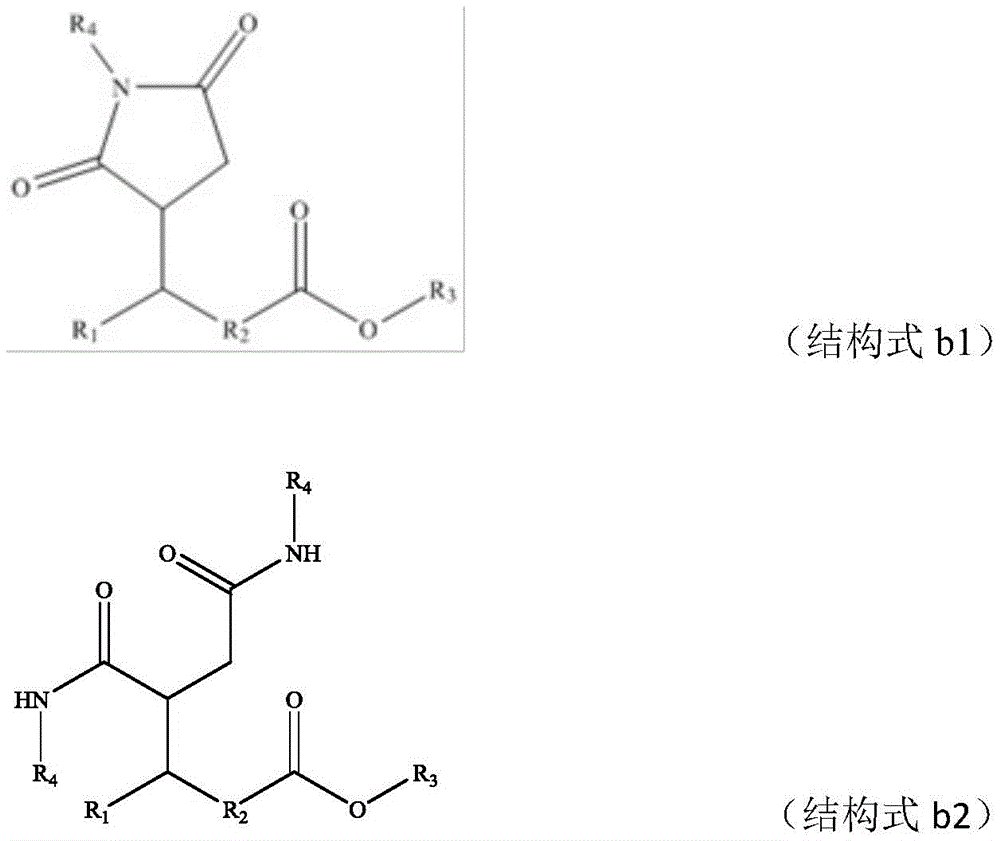
wherein R is1、R2Is a hydrocarbon radical with or without double bonds, R1And R2The total carbon number of (a) is 8 to 24, preferably 12 to 22, more preferably 16 to 20, the total degree of unsaturation (total number of double bonds) is 0, 1 or 2, R3Is a C1-C4 hydrocarbon group, preferably methyl or ethyl; r4A group containing at least one nitrogen atom which is C2-C30, preferably C2-C20.
The mass ratio of the component a to the component b in the antioxidant composition is 1: 0.02-50, preferably 1: 0.1-10.
Component a
The component a is a hydrocarbyl-substituted p-phenylenediamine antioxidant, the hydrocarbyl is C4-C20 hydrocarbyl, preferably C4-C10 hydrocarbyl, and comprises but is not limited to one or more of the following substances:
N-phenyl-N' -cyclohexyl-p-phenylenediamine (anti-aging agent 4010);
n, N- (1, 3-dimethylbutyl) -N' -phenyl-p-phenylenediamine (anti-aging agent 4020);
n, N' -bis- (1, 4-dimethylpentyl) p-phenylenediamine (antioxidant 4030);
N-p-tolyl-N' - (1, 3-dimethylbutyl) p-phenylenediamine (anti-aging agent 4040);
n, N' -diheptyl-p-phenylenediamine (antioxidant 788);
N-isopropyl-N' -phenyl-p-phenylenediamine (anti-aging agent 4010 NA);
N-isopropyl-N' -p-methylphenyl-p-phenylenediamine (antioxidant methyl 4010 NA);
n, N' -xylyl p-phenylenediamine (antioxidant PPD-a);
n, N' -diphenyl-p-phenylenediamine (antioxidant H);
n, N' -di- (β -naphthyl) p-phenylenediamine (antioxidant DNP);
n, N' -di-sec-butyl-p-phenylenediamine (antioxidant U-5, antioxidant 44 PD);
n, N' -dioctyl-p-phenylenediamine (antioxidant 88);
n, N' -bis- (1-methylheptyl) p-phenylenediamine (anti-aging agent 288);
n, N' -bis- (1-ethyl-3-methylpentyl) p-phenylenediamine (anti-aging agent 8L);
n, N' -bis- (1, 4-dimethylbutyl) p-phenylenediamine (anti-aging agent 66);
N-octyl-N' -phenyl-p-phenylenediamine (antioxidant 688);
N-isobutyl-N' -phenyl-p-phenylenediamine (anti-aging agent 5L);
n, N '-dimethyl-N, N' -bis- (1-methylpropyl) p-phenylenediamine (anti-aging agent 32);
n- (p-tolylsulfonyl) -N' -phenyl-p-phenylenediamine (antioxidant TPPD);
n- (3-methacryloyloxy-2-hydroxypropyl) -N' -phenyl-p-phenylenediamine (anti-aging agent G-1);
n- (3-anilinophenyl) methacrylamide;
N-hexyl-N' -phenyl-p-phenylenediamine;
the hydrocarbyl-substituted p-phenylenediamine antioxidant is preferably a dialkyl-p-phenylenediamine, and particularly preferably a dialkyl-p-phenylenediamine having an alkyl group with a carbon number of 4 to 10, such as: n, N' -diheptyl-p-phenylenediamine; n, N' -di-sec-butyl-p-phenylenediamine; n, N' -dioctyl-p-phenylenediamine; one or more of N, N' -bis- (1-methylheptyl) p-phenylenediamine.
Component b
The component b is alkenyl ester-based succinimide shown in a structural formula b1 or/and alkenyl ester-based succinamide shown in a structural formula b 2:
wherein, the compounds shown in the structural formulas b1 and b2 can be in any proportion.
Wherein R is1、R2Is a hydrocarbon radical with or without double bonds, R1And R2Has a total carbon number of 8 to 24, preferably 12 to 22, more preferably 16 to 20, and a total degree of unsaturation (total number of double bonds) of 0, 1 or 2, for example R1And R2May be alkyl, alkenyl, hydroxyalkyl, hydroxyalkenyl, dienyl, and the like; r3Is a C1-C4 hydrocarbon group, preferably methyl or ethyl; r4The group having at least one nitrogen atom which is C2-C30, preferably C2-C20, may contain a functional group such as a carbonyl group, a hydroxyl group, a carboxyl group, an ester group, an acyl group, an alkoxy group, an amine group or an amino group.
In a second aspect, the present invention provides a method for preparing the biodiesel antioxidant composition, comprising: mixing the component a and the component b, wherein the preparation method of the component b comprises the following steps:
1) performing addition reaction on a raw material containing C8-C24 unsaturated fatty acid alkyl ester and maleic anhydride to obtain alkenyl succinic anhydride;
2) and carrying out amination reaction on the alkenyl succinic anhydride and a polyamine compound to obtain alkenyl succinimide or/and alkenyl succinamide.
In the step 1), the reaction molar ratio of the unsaturated fatty acid alkyl ester with C8-C24 to the maleic anhydride is 1: 0.5-5, preferably 1: 1-2. The reaction can be carried out at the temperature of 150 ℃ to 280 ℃, and the reaction temperature of 180 ℃ to 240 ℃ is preferred. The reaction time is generally 1 to 20 hours, preferably 6 to 12 hours. The reaction can be catalyzed by acids such as sulfuric acid, p-toluenesulfonic acid, aluminum chloride, and the like; it is also possible, and preferably not, to use a catalyst.
In step 2), the amination reaction can be carried out at a temperature of 40 to 280 ℃, preferably at a temperature of 60 to 180 ℃. The reaction time is generally 0.5 to 10 hours, preferably 1 to 8 hours. The reaction can be carried out by using an acid catalyst, such as one or more of aluminum chloride, sulfuric acid, hydrochloric acid, boron trifluoride, solid super acid, cation exchange resin, heteropoly acid and the like; basic catalysts such as sodium hydroxide, potassium hydroxide, sodium methoxide, etc.; it is also possible, and preferably not, to use a catalyst.
The molar ratio of the alkenyl succinic anhydride to the polyamine compound may be 1:0.5 to 5, preferably 1:1 to 4, more preferably 1:1 to 2. The reaction product of the alkenyl succinic anhydride and the polyamine compound is related to the reaction temperature and the molar ratio of the reactants, and specifically, the following cases are included:
1) at a relatively low reaction temperature (e.g., about 100 ℃) and without an excess of polyamine, the reaction produces a product based on a monoamide represented by the structural formula b 3. Monoamides are less preferred in the present invention because of their higher acidity. If the polyamine is in excess, the carboxyl groups in formula b3 may react further to form a product based on the bisamide compound of formula b 2. Therefore, when the reaction temperature is low, the polyamine is preferably in a proper excess amount, for example, the molar ratio of the alkenyl succinic anhydride to the polyamine compound can be 1: 2-4, so as to facilitate the formation of the bisamide compound.
2) When the reaction temperature is relatively high (for example, about 150 ℃) and the molar ratio of the alkenyl succinic anhydride to the polyamine compound is close to 1:1, the reaction produces an imide-based product represented by the structural formula b 1. If the alkenyl succinic anhydride is in excess, two or more succinic acids and/or succinic anhydrides will react with the same polyamine to form so-called "di-pendant" or "poly-pendant" reaction products. Therefore, when the reaction temperature is higher, the polyamine is preferably in a proper excess amount, for example, the molar ratio of the alkenyl succinic anhydride to the polyamine compound can be 1: 1-2, and a reaction product mainly comprising 'single-hanging' shown in the structural formula 1 is generated.
3) Regardless of the reaction temperature, if the polyamine is in large excess, the excess polyamine can be subjected to further ammonolysis of the compound of formula b1 and b2 to react R3By removal in the form of an alcohol to give an imide-amide compound orA tri-imide compound.

According to the process of the present invention, in step 1) and step 2), a reaction solvent such as toluene, xylene, ethylbenzene, a heavy aromatic solvent, etc., may be further added as necessary.
In the raw material containing the C8-C24 unsaturated fatty acid alkyl ester, the unsaturated fatty acid can be C8-C24 long-chain olefine acid containing one, two or three double bonds and containing or not containing hydroxyl, and the alkyl ester can be C1-C4 alkyl ester. The unsaturated fatty acid alkyl esters are preferably C12-C22 unsaturated fatty acid methyl and ethyl esters, more preferably C16-C20 unsaturated fatty acid methyl esters, such as methyl palmitoleate (C16 enoate), methyl oleate (C18 enoate), methyl ricinoleate (hydroxyl-containing C18 enoate), methyl linoleate (C18 dienoate), methyl linolenate (C18 trienoate), methyl arachidonate (C20 enoate), methyl erucate (C22 enoate), and the like, with the most preferred examples being methyl oleate, methyl linoleate, and methyl ricinoleate and mixtures thereof.
The raw material containing the C8-C24 unsaturated fatty acid alkyl ester is also preferably biodiesel, the chemical composition of the biodiesel is fatty acid monoalkyl ester, mainly C8-C24 fatty acid methyl ester, and the biodiesel contains unsaturated fatty acid methyl ester, and the invention preferably selects the biodiesel with high content of unsaturated fatty acid methyl ester, such as the biodiesel with content of unsaturated fatty acid methyl ester more than 60%, preferably more than 80%. The biodiesel with high content of unsaturated fatty acid methyl ester can be biodiesel produced by using oil raw materials with high content of unsaturated fatty acid, and can also be biodiesel with high content of unsaturated fatty acid methyl ester obtained by removing saturated fatty acid methyl ester in the biodiesel through reduced pressure distillation and/or low-temperature freezing crystallization.
The polyamine compound is a hydrocarbyl amine containing two or more nitrogen atoms in the molecule, wherein at least one hydrogen atom is bonded to a nitrogen atom.
The polyamine may be a hydrocarbyl diamine, such as the structureFormula is H2N-R5-NHR6Wherein R is5May be a hydrocarbon group having 2 to 30 carbon atoms, preferably 4 to 22 carbon atoms, such as an alkylene group, an alkenyl group, a cycloalkyl group, an aryl group, a polyether group or the like; r6May be hydrogen, a hydrocarbon group having a carbon number of 1 to 30, preferably 4 to 22, such as ethylenediamine, propylenediamine, butylenediamine, pentylenediamine, hexylenediamine, heptylenediamine, octylenediamine, decylenediamine, coco-1, 3-propylenediamine, oleyl-1, 3-propylenediamine, tallow-1, 3-propylenediamine, and the like.
The polyamine compound can also be a polyene polyamine with the structural formula of H2N[(CH2)x2NH]y1R7Wherein x2 can be an integer of 2-4, preferably 2 or 3, y1 can be an integer of 1-8, R7May be hydrogen or a hydrocarbon group having 1 to 30 carbon atoms. For example, when R is7When the polyenylpolyamine is H, the polyenylpolyamine can be one or more of ethylenediamine, diethylenetriamine, triethylenetetramine, tetraethylenepentamine, pentaethylenehexamine, hexaethyleneheptamine, heptaethyleneoctamine, propylenediamine, dipropylenetriamine, triacrylate-tetramine, tetrapropylenepentamine, pentapropylenehexamine, hexapropyleneptamelamine, and heptapropylenoctamine. When R is7In the case of a hydrocarbon group having 1 to 30 carbon atoms, a hydrocarbon group having 4 to 22 carbon atoms is preferable. The hydrocarbon group may be a saturated alkyl group, an alkenyl group having a double bond, or an aryl group having a benzene ring. The alkyl group can be a straight-chain normal alkyl group or an isomeric alkyl group with a side chain, and the alkyl group can be n-butyl, n-pentyl, n-hexyl, n-heptyl, n-octyl, n-nonyl, n-decyl, n-undecyl, n-dodecyl, n-tetradecyl, n-hexadecyl, n-octadecyl, n-eicosyl or n-docosyl; isobutyl, tert-butyl, isopentyl, neopentyl, isohexyl, isoheptyl, isooctyl (2-ethylhexyl), isononyl, isodecyl, isododecyl, isomyristyl, isohexadecyl, isooctadecyl and isoeicosyl. Examples of the alkenyl group include 9-octadecenyl. The aryl group with benzene ring can be one or more of benzyl, phenethyl and phenylpropyl. Wherein R is7More preferably hydrogen or C6-C20 alkyl.
The polyamine compound may also be an amine containing a nitrogen heterocycle, including but not limited to one or more of an imidazoline type, a piperazine type, and a piperidine type amine.
The imidazoline type polyamine is represented by structural formula 4:

wherein y2 is an integer from 0 to 5, R7The structure is the same as above.
The piperazine polyamine is represented by structural formula 5:

wherein R is8Is H or C1-C24 hydrocarbyl, and x3 is an integer of 0-5. A preferred typical piperazine-type polyamine is N- (2-aminoethyl) piperazine.
Polyamines of the piperidine type such as 4-amino-2, 2,6, 6-tetramethylpiperidine, 4-amino-1, 2,2,6, 6-pentamethylpiperidine and the like.
The polyamine can also be polyamine containing tertiary amine as shown in structural formula 6 and structural formula 7.

Wherein R is9、R10Is a C1-C10, preferably C1-C4 hydrocarbon group, and x4 is an integer of 0-10, preferably 1-8. Such as one or more of N, N-dimethyl-1, 3-propanediamine, N-diethyl-1, 3-propanediamine, N-dimethyl-1, 4-butanediamine, N-diethyl-1, 4-butanediamine, N-dimethyl-1, 6-hexanediamine.

Wherein x5 is an integer from 1 to 10, preferably an integer from 2 to 6, for example tris (2-aminoethyl) amine.
The polyamine may also be of the formula H2N[(CH2)x2NH]y1R6The condensate of the polyene polyamine with ethylene oxide and propylene oxide. Wherein x2 can be an integer of 2-4, preferably 2 or 3, y1 can be an integer of 1-8, R6May be hydrogen or a hydrocarbon group having 1 to 30 carbon atoms, preferably 4 to 22 carbon atoms.
The polyamine is preferably one or more of the above-mentioned polyene polyamine, imidazoline type, piperazine type and piperidine type amine, and particularly preferably one or more of polyene polyamine and piperazine type polyamine.
Preferably, the antioxidant provided by the invention can also contain various metal deactivators capable of reacting with the metal surface and/or metal chelating agents capable of reacting with or binding with metals or metal ions. The weight ratio of the antioxidant to the sum of the metal deactivator and the chelating agent may be 1: 0.01-0.5.
Specifically, the metal deactivator or metal chelator may be one or more of benzotriazole and its derivatives, thiadiazole and its derivatives, 8-hydroxyquinoline, ethylenediaminetetraacetic acid, hydrazide, β -diketone, β -ketoester, Schiff bases (Schiff bases), organic polycarboxylic acid and its derivatives. Since benzotriazole itself is not very excellent in solubility in biodiesel, in order to increase its solubility in biodiesel, benzotriazole is generally modified mainly by introducing an oil-soluble group such as a long-chain hydrocarbon group into benzotriazole. Therefore, the benzotriazole derivative can be various derivatives having better solubility in biodiesel than benzotriazole itself. Specifically, the benzotriazole derivative can be one or more of ammonium salt formed by benzotriazole and fatty amine and a product obtained by Mannich reaction of benzotriazole, formaldehyde and fatty amine. The ethylenediaminetetraacetic acid may be ethylenediaminetetraacetic acid (EDTA) and the hydrazide may be N-salicylidene-N '-salicyloyl dihydrazide and/or N, N' -diacetyladipoyl dihydrazide. Such as acetylacetone, and beta-ketoesters such as octyl acetoacetate. The Schiff base can be one or more of N, N ' -bis (salicylidene) -1, 2-ethylenediamine, N ' -bis (salicylidene) -1, 2-propanediamine, N ' -bis (salicylidene) -1, 2-cyclohexanediamine and N, N ' -bis (salicylidene) -N ' -methyldipropylenetriamine. The organic polycarboxylic acid and its derivatives can be one or more of citric acid, tartaric acid, malic acid, succinic acid (succinic acid), maleic acid, phytic acid, etc. and their derivatives.
In a third aspect, the invention also provides a biodiesel composition, which comprises biodiesel and the antioxidant composition.
According to the biodiesel composition provided by the invention, the content of the antioxidant composition can be selected in a wide range, for example, relative to the mass of the biodiesel, the content can be 50-5000mg/kg, preferably 80-4000mg/kg, and further preferably 100-3000ppm mg/kg.
In a fourth aspect, the present invention also provides a diesel oil composition, which comprises biodiesel oil, petroleum diesel oil and the antioxidant composition of the present invention.
In the diesel oil composition provided by the invention, the content of the antioxidant composition can be selected in a wide range, for example, relative to the mass of the biodiesel, the content can be 50-5000mg/kg, preferably 80-4000mg/kg, and further preferably 100-3000 mg/kg.
According to the use requirement, the diesel oil composition provided by the invention can also contain one or more other additives, such as a flow improver, a cetane number improver, an antistatic agent, a preservative, an antirust agent, a demulsifier and the like.
In the diesel oil composition provided by the invention, the mass ratio of the biodiesel to the petrochemical diesel oil can be 1: 0.01-100, preferably 1: 0.1-99, and usually 1: 2-99.
The petrochemical diesel oil can be distillate with the distillation range of between 160 ℃ and 380 ℃ after crude oil (petroleum) is processed by various refining processes of an oil refinery, such as atmospheric and vacuum distillation, catalytic cracking, catalytic reforming, coking, hydrofining, hydrocracking and the like, and the blended fuel for the compression ignition engine meets the national standard GB/T19147 of the automotive diesel oil.
The biodiesel refers to grease and lower alcohol (such as C)1-C5Fatty alcohol) is subjected to transesterification (alcoholysis) to generate fatty acid lower alcohol ester, generally fatty acid methyl ester,i.e. transesterification products of fats and oils with methanol. The transesterification reaction process may be any known or unknown process for obtaining biodiesel through transesterification of fats and oils with lower alcohols, such as acid catalysis, base catalysis, enzyme catalysis, supercritical method, etc. Reference may be made in particular to documents CN1473907A, DE3444893, CN1472280A, CN1142993C, CN1111591C, CN1594504A and the like. The oil and fat have a general meaning well known in the art, and are a generic term for oils and fats, and the main component is fatty acid triglyceride. Generally, oil is a liquid at normal temperature, and fat (fat for short) is a solid or semisolid at normal temperature. The grease comprises vegetable oil and animal oil, and in addition, oil from microorganisms, algae and other substances, and even waste grease, such as used grease or deteriorated grease, for example, waste cooking oil production, swill oil, acidified oil of grease factories and the like. The vegetable Oil may be herbal or woody vegetable Oil, such as peanut Oil, corn Oil, cotton seed Oil, rapeseed Oil, soybean Oil, palm Oil, safflower Oil, linseed Oil, coconut Oil, oak Oil, almond Oil, walnut Oil, castor Oil, sesame Oil, olive Oil, Tall Oil (Tall Oil), sunflower Oil, jatropha Oil, tung Oil, shinyleaf yellowhorn Oil, pistacia chinensis Oil, Oil of saline soil plants such as Kosteletzkya virginica, Cyperus esculenta, etc. The animal oil can be lard, chicken oil, duck oil, goose oil, mutton fat, horse oil, beef tallow, whale oil, shark oil, etc.
The antioxidant composition provided by the invention has a better antioxidant effect. After the component a and the component b are matched, the oxidation stability of the biodiesel is much better than the sum of the effects of the component a and the component b which are used independently, so that the obvious synergistic effect is surprisingly shown between the components a and b, and the total addition amount of the biodiesel antioxidant can be reduced, and the consumption of the substituted p-phenylenediamine antioxidant can be greatly reduced.
Drawings
FIG. 1 is a mass spectrum of an alkenyl succinic anhydride product obtained by addition reaction of methyl oleate and maleic anhydride in preparation example 1. Wherein the peak at m/z of 417.494 is the sodium ion mass spectrum addition peak of the product alkenyl succinic anhydride, the peak at m/z of 319.073 is the sodium ion mass spectrum addition peak of the reaction raw material methyl oleate, and the peak at m/z of 449.288 is the sodium ion mass spectrum addition peak (trace) of the monoester formed by methanol as a solvent and the product ester succinic anhydride in the test process.
The key step of the invention for preparing the alkenyl succinimide or/and the alkenyl succinamide is the preparation of the alkenyl succinic anhydride, and as can be seen from figure 1, preparation example 1 obtains the methyl oleate succinic anhydride compound.
Detailed Description
The following examples further illustrate the invention.
In the present invention, since biodiesel is generally mixed fatty acid methyl ester mainly containing octadecanoic acid, the molecular weight thereof can be regarded as the same as that of methyl oleate (molecular weight 296) for the purpose of calculating the charge ratio.
Preparation examples 1 to 3 are intended to illustrate the synthesis of an alkenyl succinic anhydride.
Preparation example 1
242g of methyl oleate (98 percent, 0.8mol) and 98g of maleic anhydride (1.0mol) are added into a 500ml reactor provided with an electric stirrer, a thermometer, a reflux cold energy tube and a nitrogen inlet tube, nitrogen is introduced for 5-10 minutes, the nitrogen protection is kept in the reaction process, the temperature is raised to 210 ℃ by heating and stirring, reflux reaction is carried out for 7 hours, excess maleic anhydride is removed by reduced pressure distillation, the reaction intermediate alkenyl ester succinic anhydride containing the examples of the structural formula b8 and (or) the structural formula b9 is obtained, and the content is about 66 percent according to mass spectrometry.

Preparation example 2
240g of biodiesel produced by waste cooking oil (produced by Zhejiang Ningbo Jensen bioenergy Co., Ltd., wherein the fatty acid components are methyl palmitate 19.2%, methyl palmitoleate 0.9%, methyl stearate 6.7%, methyl oleate 43.9%, methyl linoleate 23.8%, methyl linolenate 2.9%) and 98.0g of maleic anhydride (1.0mol) are added into a 500ml reactor equipped with an electric stirrer, a thermometer, a reflux cold energy tube and a nitrogen inlet tube, nitrogen is introduced for 5-10 minutes, the reaction is kept under nitrogen protection, the temperature is raised to 200 ℃ by heating and stirring, the reflux reaction is carried out for 9 hours, excess maleic anhydride is removed by reduced pressure distillation, and the reaction intermediate alkenyl succinic anhydride is obtained, and mass spectrometry shows that the content of the alkenyl succinic anhydride is about 48.6%.
Preparation example 3
Adding 240g of biodiesel produced by distilled and low-temperature frozen waste cooking oil (produced by Zhejiang Ningbo Jersen bioenergy Co., Ltd., wherein the fatty acid components are methyl palmitate 0.5%, methyl palmitoleate 1.2%, methyl stearate 1.3%, methyl oleate 60.5%, methyl linoleate 29.2%, methyl linolenate 3.9%) and 98.0g of maleic anhydride (1.0mol) into a 500ml reactor equipped with an electric stirrer, a thermometer, a reflux cold energy tube and a nitrogen inlet tube, introducing nitrogen for 5-10 minutes while maintaining nitrogen protection in the reaction process, heating and stirring to 200 ℃, carrying out reflux reaction for 9 hours, and removing excessive maleic anhydride by reduced pressure distillation to obtain a reaction intermediate alkenyl succinic anhydride. Mass spectroscopy showed an alkenyl succinic anhydride content of about 56.3%.
Preparation examples 4 to 8 were used to illustrate the synthesis of alkenyl succinimides or amides represented by structural formulae b1 or b 2.
Preparation example 4
100g of the product of production example 1, 64g of tetraethylenepentamine (having an alkenyl succinic anhydride to polyamine molar ratio of about 1: 2) and 130g of toluene were charged into a 250ml three-necked flask, heated, stirred, refluxed, dehydrated and reacted for 6 hours, and the toluene was distilled off under reduced pressure to obtain 158g of an amination product mainly comprising an alkenyl succinamide.
Preparation example 5
100g of the product of production example 1 and 25g of triethylene tetramine (the molar ratio of alkenyl ester succinic anhydride to polyamine is about 1: 1) were charged into a 250ml three-necked flask, and the mixture was heated and stirred at 155 ℃ for 7 hours to react, thereby obtaining 122g of an amination product mainly comprising alkenyl ester succinimide.
Preparation example 6
100g of the product of production example 2 and 48g of tetraethylenepentamine were charged in a 250ml three-necked flask, and the mixture was heated and stirred at 95 ℃ to effect a water-splitting reaction for 8 hours, whereby 144g of an amination product mainly comprising an alkenylsuccinamide was obtained.
Preparation example 7
100g of the product of production example 3 and 48g of tetraethylenepentamine were charged in a 250ml three-necked flask, and the mixture was heated and stirred at 95 ℃ to effect a reaction for water-separation for 8 hours, whereby 145g of an amination reaction product mainly comprising an alkenylsuccinamide was obtained.
Preparation example 8
100g of the product of production example 3 and 25g of N- (2-aminoethyl) piperazine were charged in a 250ml three-necked flask, and the mixture was heated and stirred at 150 ℃ to conduct a reaction of water-separation for 10 hours, whereby 114g of an amination reaction product mainly comprising an alkenylsuccinimidyl was obtained.
Examples
Examples 1-5 serve to illustrate the preparation of additive compositions according to the invention. Component a and component b were mixed in the weight ratio shown in table 1.
TABLE 1
| Examples | Component a | Component b | a:b |
| Example 1 | 44PD | Preparation example 4 | 2:1 |
| Example 2 | Anti-aging agent 288 | Preparation example 5 | 1:1 |
| Example 3 | Anti-aging agent 88 | Preparation example 6 | 1:3 |
| Example 4 | 44PD | Preparation example 7 | 1:4 |
| Example 5 | 44PD | Preparation example 8 | 1:2 |
In table 1: 44PD is N, N' -di-sec-butyl-p-phenylenediamine;
anti-aging agent 288 chemical name; n, N' -bis- (1-methylheptyl) p-phenylenediamine;
the chemical name of the anti-aging agent 88 is N, N' -dioctyl-p-phenylenediamine.
Comparative example 1
According to the method disclosed in CN101993743A, dodecenyl succinic anhydride and tetraethylenepentamine are firstly reacted for 7 hours at 155 ℃ according to the molar ratio of 1:1 to prepare dodecenyl succinic imide, and then the dodecenyl succinic anhydride is compounded with the anti-aging agent 288 for use, wherein the compounding weight ratio is 1: 1.
Comparative example 2
The arylamine antioxidant T531 (phenyl-alpha-naphthylamine) is compounded with the preparation example 8 in a weight ratio of 1: 2.
Example 6 Oxidation resistance test
In the following tests, biodiesel produced from palmitic acid oil was provided by Fujianlong New energy Co., Ltd, and biodiesel produced from waste cooking oil was produced by NingboJensen bioenergy Co., Ltd, Zhejiang.
The oxidation stability of the biodiesel is evaluated by measuring the induction period at 110 ℃ by an EN 14112 method (Racimat method), and the used instrument is a 743 type grease oxidation stability tester of Wantong company, Switzerland, wherein the longer the induction period is, the better the oxidation stability of the biodiesel is, and the shorter the induction period is, the worse the oxidation stability of the biodiesel is. The oxidation stability induction period of the biodiesel specified by national standards of China is not less than 6 h. The results of the tests on the palmitic acid oil biodiesel are shown in table 2 and the results of the tests on the biodiesel produced from waste cooking oil are shown in table 3.
TABLE 2

As can be seen from the data in Table 2, the component a is an alkyl substituted p-phenylenediamine antioxidant which has a certain improvement effect on the oxidation stability of the biodiesel, but the arylamine antioxidant is expensive, has certain toxicity and corrosivity, has a coloring effect on the biodiesel and cannot be used in a large amount. Component b alone also has some antioxidant effect, however, a large amount is required. The antioxidant composition provided by the invention has a better antioxidant effect. After the component a and the component b are matched, the oxidation stability of the biodiesel is much better than the sum of the effects of the component a and the component b which are used independently, so that the obvious synergistic effect is surprisingly shown between the components a and b, and the total addition amount of the biodiesel antioxidant can be reduced, and the consumption of the substituted p-phenylenediamine antioxidant can be greatly reduced.
The effects of the present invention will be described by taking example 1 as an example. It can be seen that when 200mg/kg and 300mg/kg of antioxidant 44PD were added, the oxidation stability of the palmitic acid oil biodiesel was increased to 6.6hr and 8.9hr, respectively, and when 100mg/kg and 300mg/kg of alkenyl succinamide, corresponding to preparation example 4, of the component b of the present invention, the oxidation stability of the palmitic acid oil biodiesel was increased to 4.4hr and 4.9hr, respectively, and when 300mg/kg of the mixture was added (i.e., 200mg/kg of antioxidant 44PD and 100mg/kg of alkenyl succinamide) after compounding the two at a weight ratio of 2:1, the oxidation stability of the palmitic acid oil biodiesel was increased to 19.2 hr. When the addition amount is 600mg/kg (namely 400mg/kg of antioxidant 44PD and 200mg/kg of alkenyl succinamide), the oxidation stability of the palmitic acid oil biodiesel can be improved to 31.8 hr. The two additives have synergistic effect after being compounded and used, and the effect is greatly enhanced compared with that when the two additives are singly used. Other examples also show that the compositions of the present invention have significant synergistic results.
As can be seen from example 2, the antioxidant 288 and the alkenyl succinimide ester in a weight ratio of 1:1 can improve the oxidation stability of the palmitic acid oil biodiesel to 18.5hr when the addition amount is 400 mg/kg. Comparative example 1 the antioxidant 288 and alkenyl succinimide were compounded at a weight ratio of 1:1 according to the method disclosed in CN101993743A, and the oxidation stability of the palmitic acid oil biodiesel was increased to 14.2hr at the same dosage.
Comparative example 2, in which other types of aromatic amine antioxidants were compounded with component b of the present invention, it can be seen that the two did not exhibit significant synergistic effects.
TABLE 3

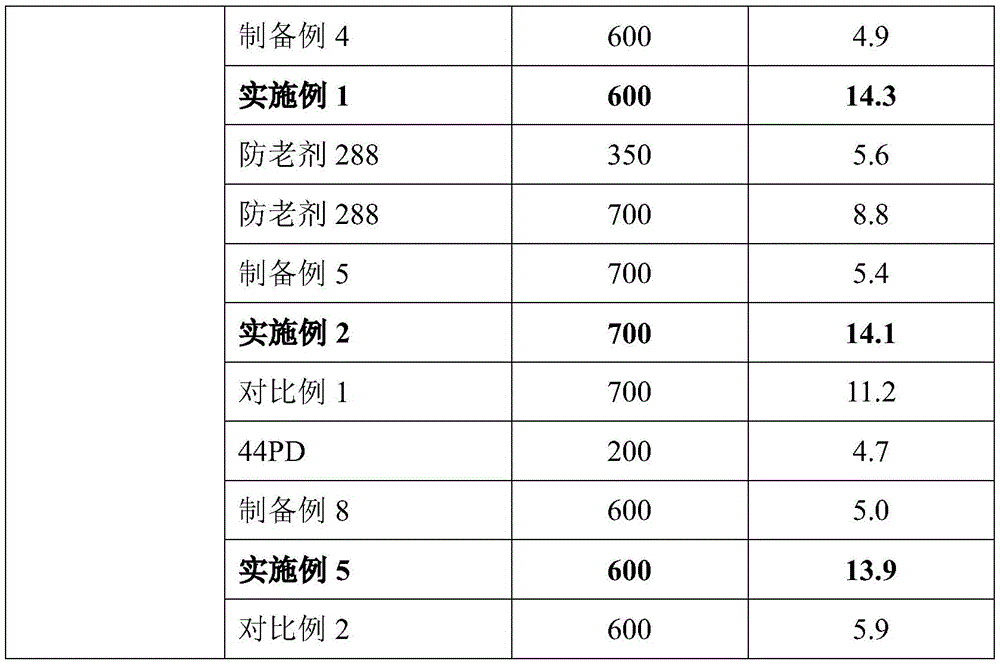
As can be seen from the data in Table 3, after the component a and the component b are combined, the biodiesel produced from the waste cooking oil has a very obvious synergistic effect on improving the oxidation stability, and the addition amount is slightly larger because the oxidation stability of the biodiesel produced from the waste cooking oil is lower than that of the palmitic acid oil biodiesel.
As can be seen from the effect of example 1 in biodiesel produced from waste cooking oil, when 600mg/kg of 44PD was added, the oxidation stability of biodiesel was increased to 8.7hr, and when 600mg/kg of alkenylsuccinamide of component b of the present invention, which corresponds to preparation example 4, was added, the oxidation stability of biodiesel was increased to 4.9hr, and the oxidation stability of biodiesel was increased to 14.3hr at the same dosage after compounding the two. The two additives have synergistic effect after being compounded and used, and the effect is greatly enhanced compared with that when the two additives are singly used. Other examples also show that the compositions of the present invention have significant synergistic results.
As can be seen from example 3, the antioxidant 288 and the alkenyl succinimide ester in a weight ratio of 1:1 can improve the oxidation stability of biodiesel produced from waste cooking oil to 14.1hr when added in an amount of 700 mg/kg. Comparative example 1 according to the method disclosed in CN101993743A, the oxidation stability of biodiesel produced from waste cooking oil was increased to 11.2hr at the same dosage after compounding antioxidant 288 and alkenyl succinimide in a weight ratio of 1: 1. The antioxidant composition disclosed by the invention has more excellent antioxidant effect than the antioxidant composition disclosed in CN 101993743A.
Comparative example 2, in which other types of aromatic amine antioxidants were compounded with component b of the present invention, it can be seen that the two did not exhibit significant synergistic effects.
Claims (18)
1. The antioxidant composition for the biodiesel comprises a component a and a component b, wherein the component a is a hydrocarbyl-substituted p-phenylenediamine antioxidant; the component b is alkenyl ester-based succinimide shown in a structural formula b1 or/and alkenyl ester-based succinamide shown in a structural formula b 2:

wherein R is1、R2Is a hydrocarbon radical with or without double bonds, R1And R2The total carbon number of (2) is 8-24, the total double bond number is 0, 1 or 2, R3Is a C1-C4 hydrocarbon group, R4A group containing at least one nitrogen atom which is C2-C30.
2. The antioxidant composition as claimed in claim 1, wherein R is1And R2The total carbon number of (2) is 12-22, the total double bond number is 0, 1 or 2, R3Is methyl or ethyl; r4A group containing at least one nitrogen atom which is C2-C20.
3. The antioxidant composition as claimed in claim 1, wherein the mass ratio of the component a to the component b is 1:0.02 to 50, preferably 1:0.1 to 10.
4. The antioxidant composition as claimed in claim 1, wherein the hydrocarbon group in the hydrocarbon group-substituted p-phenylenediamine-type antioxidant is a C4-C20 hydrocarbon group, preferably a C4-C10 hydrocarbon group.
5. The antioxidant composition of claim 1, wherein the hydrocarbyl-substituted p-phenylenediamine-type antioxidant is selected from the group consisting of dialkyl p-phenylenediamines having an alkyl group with a carbon number of between 4 and 10.
6. The method for preparing the antioxidant composition for biodiesel according to any one of claims 1 to 5, comprising: mixing the component a and the component b, wherein the preparation method of the component b comprises the following steps:
1) performing addition reaction on a raw material containing C8-C24 unsaturated fatty acid alkyl ester and maleic anhydride to obtain alkenyl succinic anhydride;
2) and carrying out amination reaction on the alkenyl succinic anhydride and a polyamine compound to obtain alkenyl succinimide or/and alkenyl succinamide.
7. The method according to claim 6, wherein the reaction molar ratio of the C8-C24 unsaturated fatty acid alkyl ester to the maleic anhydride in the step 1) is 1: 0.5-5, preferably 1: 1-2.
8. The process according to claim 6, wherein, in the step 1), the reaction temperature is 150-280 ℃, preferably 180-240 ℃.
9. The process according to claim 6, wherein in step 2), the amination is carried out at a temperature of 40 to 280 ℃, preferably at a temperature of 60 to 180 ℃.
10. The process according to claim 6, wherein the molar ratio of the alkenyl succinic anhydride to the polyamine compound in the step 2) is 1:0.5 to 5, preferably 1:1 to 4.
11. The process according to claim 6, wherein the raw material containing C8-C24 unsaturated fatty acid alkyl ester is C8-C24 long-chain olefine acid containing one, two or three double bonds and containing or not containing hydroxyl, and the alkyl ester is C1-C4 alkyl ester.
12. The method according to claim 6, wherein the unsaturated fatty acid alkyl esters are preferably C12-C22 unsaturated fatty acid methyl and ethyl esters, more preferably C16-C20 unsaturated fatty acid methyl esters, most preferably methyl oleate, methyl linoleate and methyl ricinoleate and mixtures thereof.
13. The process according to claim 6, wherein the raw material containing the C8-C24 unsaturated fatty acid alkyl ester is biodiesel, particularly preferably biodiesel having an unsaturated fatty acid methyl ester content of more than 60%.
14. The process according to claim 6, wherein the polyamine compound is a hydrocarbyl amine having two or more nitrogen atoms in the molecule, at least one hydrogen atom being bonded to a nitrogen atom.
15. The process according to claim 6, wherein the polyamine is a hydrocarbyl diamine, a polyene polyamine, an amine containing a nitrogen heterocycle, or a condensate of a polyene polyamine with ethylene oxide or propylene oxide.
16. A biodiesel composition, which comprises biodiesel and the antioxidant composition of any one of claims 1 to 5, wherein the mass of the antioxidant composition is 50-5000mg/kg, preferably 80-4000mg/kg, and more preferably 100-3000mg/kg, relative to the mass of the biodiesel.
17. A diesel oil composition, which comprises biodiesel oil, petrochemical diesel oil and the antioxidant composition as claimed in any one of claims 1 to 5, wherein the mass of the antioxidant composition is 50-5000mg/kg, preferably 80-4000mg/kg, and more preferably 100-3000mg/kg, relative to the mass of the biodiesel oil.
18. The diesel oil composition according to claim 1, wherein the mass ratio of the biodiesel to the petroleum diesel oil is 1:0.01 to 100, preferably 1:0.1 to 99.
Priority Applications (1)
| Application Number | Priority Date | Filing Date | Title |
|---|---|---|---|
| CN201910878368.0A CN112521992B (en) | 2019-09-18 | 2019-09-18 | Biodiesel antioxidant composition and preparation method and application thereof |
Applications Claiming Priority (1)
| Application Number | Priority Date | Filing Date | Title |
|---|---|---|---|
| CN201910878368.0A CN112521992B (en) | 2019-09-18 | 2019-09-18 | Biodiesel antioxidant composition and preparation method and application thereof |
Publications (2)
| Publication Number | Publication Date |
|---|---|
| CN112521992A true CN112521992A (en) | 2021-03-19 |
| CN112521992B CN112521992B (en) | 2022-10-21 |
Family
ID=74974877
Family Applications (1)
| Application Number | Title | Priority Date | Filing Date |
|---|---|---|---|
| CN201910878368.0A Active CN112521992B (en) | 2019-09-18 | 2019-09-18 | Biodiesel antioxidant composition and preparation method and application thereof |
Country Status (1)
| Country | Link |
|---|---|
| CN (1) | CN112521992B (en) |
Cited By (1)
| Publication number | Priority date | Publication date | Assignee | Title |
|---|---|---|---|---|
| CN119613264A (en) * | 2023-09-13 | 2025-03-14 | 中国石油化工股份有限公司 | Methyl oleate succinic acid alcohol ether ester, preparation method and application thereof |
Citations (4)
| Publication number | Priority date | Publication date | Assignee | Title |
|---|---|---|---|---|
| US20050056241A1 (en) * | 2003-08-08 | 2005-03-17 | Nissan Motor Co., Ltd. | Valve train for internal combustion engine |
| CN101899331A (en) * | 2009-05-27 | 2010-12-01 | 中国石油化工股份有限公司 | A kind of diesel oil composition and the method for improving biodiesel oxidation stability |
| CN101993743A (en) * | 2009-08-19 | 2011-03-30 | 中国石油化工股份有限公司 | Additive composition, diesel composition and method for improving oxidation stability of biodiesel |
| CN103748198A (en) * | 2011-03-24 | 2014-04-23 | 艾勒旺斯可再生科学公司 | Malienated derivatives |
-
2019
- 2019-09-18 CN CN201910878368.0A patent/CN112521992B/en active Active
Patent Citations (4)
| Publication number | Priority date | Publication date | Assignee | Title |
|---|---|---|---|---|
| US20050056241A1 (en) * | 2003-08-08 | 2005-03-17 | Nissan Motor Co., Ltd. | Valve train for internal combustion engine |
| CN101899331A (en) * | 2009-05-27 | 2010-12-01 | 中国石油化工股份有限公司 | A kind of diesel oil composition and the method for improving biodiesel oxidation stability |
| CN101993743A (en) * | 2009-08-19 | 2011-03-30 | 中国石油化工股份有限公司 | Additive composition, diesel composition and method for improving oxidation stability of biodiesel |
| CN103748198A (en) * | 2011-03-24 | 2014-04-23 | 艾勒旺斯可再生科学公司 | Malienated derivatives |
Cited By (1)
| Publication number | Priority date | Publication date | Assignee | Title |
|---|---|---|---|---|
| CN119613264A (en) * | 2023-09-13 | 2025-03-14 | 中国石油化工股份有限公司 | Methyl oleate succinic acid alcohol ether ester, preparation method and application thereof |
Also Published As
| Publication number | Publication date |
|---|---|
| CN112521992B (en) | 2022-10-21 |
Similar Documents
| Publication | Publication Date | Title |
|---|---|---|
| AU2008281580B2 (en) | Fuel oil compositions and additives therefor | |
| EP2631283B1 (en) | Fuel additive for improved performance in fuel injected engines | |
| US9464252B2 (en) | Quaternary ammonium detergent fuel additives | |
| CN102051239A (en) | Additive composition, diesel oil composition and method for improving biodiesel oxidation stability | |
| CN101899330A (en) | A kind of diesel oil composition and the method for improving biodiesel oxidation stability | |
| US20100064576A1 (en) | Oligo- or polyamines as oxidation stabilizers for biofuel oils | |
| US20070249846A1 (en) | Biofuel | |
| CN101899331B (en) | Diesel composition and method for improving oxidation stability of biodiesel | |
| CN101987980B (en) | Additive composition and diesel fuel composition as well as method for improving oxidation stability of biodiesel | |
| CN101899332B (en) | A kind of method of Dresel fuel compositions and raising oxidation stability of biodiesel | |
| CN112521992A (en) | Biodiesel antioxidant composition and preparation method and application thereof | |
| CN102051240B (en) | Additive composite, diesel oil composite and method for increasing oxidation stability of biodiesel | |
| CN112442398B (en) | Biodiesel antioxidant and preparation method and application thereof | |
| CN112521988B (en) | Biodiesel antioxidant composition, preparation method and application thereof | |
| CN101993743A (en) | Additive composition, diesel composition and method for improving oxidation stability of biodiesel | |
| CN103215091B (en) | Biodiesel composition and method for increasing oxidation stability of biodiesel-containing fuel | |
| CN102936521A (en) | Diesel oil composition and method for improving biodiesel oxidation stability | |
| CN101993744B (en) | The method of biodiesel composition and raising oxidation stability of biodiesel | |
| US20130276362A1 (en) | Use of additives with detergent action for further increasing the cetane number of fuel oils | |
| CN101928614B (en) | A kind of diesel oil composition and the method for improving biodiesel oxidation stability | |
| US20090139135A1 (en) | Stabilization of Fatty Oils and Esters with Alkyl Phenol Amine Aldehyde Condensates | |
| CN103254950B (en) | Additive composition, diesel oil composition, and method for increasing oxidation stability of biodiesel | |
| CN104371775B (en) | A kind of method of compositions of additives and Dresel fuel compositions and raising oxidation stability of biodiesel | |
| CN102443447A (en) | Diesel composition and method for improving oxidation stability of biodiesel | |
| WO2012117004A2 (en) | Medium chain alkanols in additive concentrates for improving the reduction of foam in fuel oils |
Legal Events
| Date | Code | Title | Description |
|---|---|---|---|
| PB01 | Publication | ||
| PB01 | Publication | ||
| SE01 | Entry into force of request for substantive examination | ||
| SE01 | Entry into force of request for substantive examination | ||
| GR01 | Patent grant | ||
| GR01 | Patent grant |