CN112593233B - Treatment method of printed circuit board etching waste liquid - Google Patents
Treatment method of printed circuit board etching waste liquid Download PDFInfo
- Publication number
- CN112593233B CN112593233B CN202011351833.4A CN202011351833A CN112593233B CN 112593233 B CN112593233 B CN 112593233B CN 202011351833 A CN202011351833 A CN 202011351833A CN 112593233 B CN112593233 B CN 112593233B
- Authority
- CN
- China
- Prior art keywords
- copper
- printed circuit
- waste
- solution
- circuit board
- Prior art date
- Legal status (The legal status is an assumption and is not a legal conclusion. Google has not performed a legal analysis and makes no representation as to the accuracy of the status listed.)
- Active
Links
Classifications
-
- C—CHEMISTRY; METALLURGY
- C23—COATING METALLIC MATERIAL; COATING MATERIAL WITH METALLIC MATERIAL; CHEMICAL SURFACE TREATMENT; DIFFUSION TREATMENT OF METALLIC MATERIAL; COATING BY VACUUM EVAPORATION, BY SPUTTERING, BY ION IMPLANTATION OR BY CHEMICAL VAPOUR DEPOSITION, IN GENERAL; INHIBITING CORROSION OF METALLIC MATERIAL OR INCRUSTATION IN GENERAL
- C23F—NON-MECHANICAL REMOVAL OF METALLIC MATERIAL FROM SURFACE; INHIBITING CORROSION OF METALLIC MATERIAL OR INCRUSTATION IN GENERAL; MULTI-STEP PROCESSES FOR SURFACE TREATMENT OF METALLIC MATERIAL INVOLVING AT LEAST ONE PROCESS PROVIDED FOR IN CLASS C23 AND AT LEAST ONE PROCESS COVERED BY SUBCLASS C21D OR C22F OR CLASS C25
- C23F1/00—Etching metallic material by chemical means
- C23F1/46—Regeneration of etching compositions
-
- B—PERFORMING OPERATIONS; TRANSPORTING
- B82—NANOTECHNOLOGY
- B82Y—SPECIFIC USES OR APPLICATIONS OF NANOSTRUCTURES; MEASUREMENT OR ANALYSIS OF NANOSTRUCTURES; MANUFACTURE OR TREATMENT OF NANOSTRUCTURES
- B82Y30/00—Nanotechnology for materials or surface science, e.g. nanocomposites
-
- B—PERFORMING OPERATIONS; TRANSPORTING
- B82—NANOTECHNOLOGY
- B82Y—SPECIFIC USES OR APPLICATIONS OF NANOSTRUCTURES; MEASUREMENT OR ANALYSIS OF NANOSTRUCTURES; MANUFACTURE OR TREATMENT OF NANOSTRUCTURES
- B82Y40/00—Manufacture or treatment of nanostructures
-
- C—CHEMISTRY; METALLURGY
- C22—METALLURGY; FERROUS OR NON-FERROUS ALLOYS; TREATMENT OF ALLOYS OR NON-FERROUS METALS
- C22B—PRODUCTION AND REFINING OF METALS; PRETREATMENT OF RAW MATERIALS
- C22B15/00—Obtaining copper
- C22B15/0063—Hydrometallurgy
- C22B15/0084—Treating solutions
- C22B15/0089—Treating solutions by chemical methods
-
- C—CHEMISTRY; METALLURGY
- C22—METALLURGY; FERROUS OR NON-FERROUS ALLOYS; TREATMENT OF ALLOYS OR NON-FERROUS METALS
- C22B—PRODUCTION AND REFINING OF METALS; PRETREATMENT OF RAW MATERIALS
- C22B26/00—Obtaining alkali, alkaline earth metals or magnesium
- C22B26/20—Obtaining alkaline earth metals or magnesium
- C22B26/22—Obtaining magnesium
-
- C—CHEMISTRY; METALLURGY
- C22—METALLURGY; FERROUS OR NON-FERROUS ALLOYS; TREATMENT OF ALLOYS OR NON-FERROUS METALS
- C22B—PRODUCTION AND REFINING OF METALS; PRETREATMENT OF RAW MATERIALS
- C22B7/00—Working up raw materials other than ores, e.g. scrap, to produce non-ferrous metals and compounds thereof; Methods of a general interest or applied to the winning of more than two metals
- C22B7/006—Wet processes
-
- Y—GENERAL TAGGING OF NEW TECHNOLOGICAL DEVELOPMENTS; GENERAL TAGGING OF CROSS-SECTIONAL TECHNOLOGIES SPANNING OVER SEVERAL SECTIONS OF THE IPC; TECHNICAL SUBJECTS COVERED BY FORMER USPC CROSS-REFERENCE ART COLLECTIONS [XRACs] AND DIGESTS
- Y02—TECHNOLOGIES OR APPLICATIONS FOR MITIGATION OR ADAPTATION AGAINST CLIMATE CHANGE
- Y02P—CLIMATE CHANGE MITIGATION TECHNOLOGIES IN THE PRODUCTION OR PROCESSING OF GOODS
- Y02P10/00—Technologies related to metal processing
- Y02P10/20—Recycling
Landscapes
- Chemical & Material Sciences (AREA)
- Engineering & Computer Science (AREA)
- Materials Engineering (AREA)
- Organic Chemistry (AREA)
- Nanotechnology (AREA)
- Manufacturing & Machinery (AREA)
- Mechanical Engineering (AREA)
- Metallurgy (AREA)
- Environmental & Geological Engineering (AREA)
- Life Sciences & Earth Sciences (AREA)
- General Chemical & Material Sciences (AREA)
- General Life Sciences & Earth Sciences (AREA)
- Geology (AREA)
- Physics & Mathematics (AREA)
- Condensed Matter Physics & Semiconductors (AREA)
- General Physics & Mathematics (AREA)
- Crystallography & Structural Chemistry (AREA)
- Chemical Kinetics & Catalysis (AREA)
- Composite Materials (AREA)
- Removal Of Specific Substances (AREA)
Abstract
The invention provides a method for treating waste etching liquid of a printed circuit board, which comprises the steps of mixing the basic waste etching liquid and the acidic waste etching liquid for neutralization reaction to obtain basic copper chloride, and adding the basic copper chloride into concentrated sulfuric acid to prepare copper sulfate; reducing copper ions to prepare nano copper by taking magnesium hypophosphite as a reducing agent in the filtrate after the neutralization reaction, and adjusting the pH value of the solution to ensure that a large amount of NH in the solution4 +And converted into magnesium ammonium phosphate precipitate. According to the method, a large amount of acid and alkali substances are not required to be added through the neutralization reaction, so that the cost is saved, the neutralization reaction and the reduction reaction are utilized to carry out twice recovery treatment on copper in the waste liquid, and the copper ion removal rate is high; and by Mg in the reducing agent2+PO formed by reduction reaction4 3‑And NH in the waste liquid4 +And the ammonia nitrogen in the etching waste liquid is better recovered and treated by combining the generated precipitate of magnesium ammonium phosphate. The method has the advantages of simple operation, less added reagent and better removal rate of copper ions and ammonia nitrogen in the etching waste liquid.
Description
Technical Field
The invention relates to the technical field of wastewater treatment, in particular to a method for treating waste etching solution of a printed circuit board.
Background
In recent years, with the rapid development of the electronic information industry, printed circuit boards in China are rapidly developed, but the problems of various environmental pollutions brought by the printed circuit boards are more and more serious. In the manufacture of printed circuit boards, etching is one of indispensable processes, which is to use etching solution to corrode redundant copper foil on the circuit board, and the commonly used etching solution at present comprises acidic copper chloride etching solution and alkaline copper chloride etching solution, and both of the acidic copper chloride etching solution and the alkaline copper chloride etching solution have great application in the etching process of the printed circuit boards. The waste liquid generated by the two is acid copper chloride etching waste liquid and alkaline copper chloride etching waste liquid. The acidic waste etching solution contains Cu2+、H+、CuCl4 2-、Cl-Etc., wherein the copper is mostly CuCl4 2-Exists in the form of (1); cu contained in alkaline etching waste liquid2+、NH4 +、Cu(NH3)4 2+、NH3Etc., wherein the copper is predominantly Cu (NH)3)4 2+The form exists.
Copper ions are heavy metal ions and have certain toxicity, and copper poisoning can be caused after excessive copper is inhaled by a human body. Copper has high toxicity to lower organisms and crops, and 0.1-0.2ml/L can kill the fish; copper-containing wastewater is used for irrigating farmlands, and the growth and nutrient absorption of crops are influenced. However, the copper element has a very wide application range, and compounds including the copper element, such as copper sulfate, copper oxide and the like, are common chemical raw materials. If the etching waste liquid can be effectively recycled, the problem of current related copper supply shortage can be relieved, and environmental hazards brought by the copper supply shortage can be reduced.
At present, electrolytic methods, extraction methods, precipitation methods and the like are mostly adopted for treating the etching waste liquid. The electrolysis method is suitable for treating high-concentration electroplating wastewater, generates less sludge, does not introduce foreign impurities, is environment-friendly, but easily generates side reaction in the treatment process to cause over-high energy consumption and is difficult to separate copper ions; the recovery rate of the copper by the extraction method is high, and the defects are that the problems of two-phase entrainment, difficult back extraction and the like easily occur after multiple circulation. The precipitation method needs to add a large amount of acid-base substances, has high cost, and has the problems of residue in filtrate after reaction and the like. The patent with publication number CN108862365A provides a 'process for recovering and treating acid-base etching waste liquid of a circuit board', the invention adopts the process for producing copper sulfate by neutralizing and precipitating the acid-base etching waste liquid and the alkaline etching waste liquid, has simple operation and low cost, and can treat the etching waste liquid in large batch. But the filtrate after neutralization and separation still contains a large amount of ammonium chloride and a small amount of divalent copper ions, and the method only uses S2-Removing Cu from waste liquid2+However, the ammonium chloride in the filtrate is not treated, but is prepared into etching solution by adding other substances and reused. However, the etching waste liquid contains other organic matters, metal ions and the like besides copper ions and ammonia nitrogen, so that the method provided by the invention cannot be circulated for a long time.
At present, the treatment of the waste water of the etching liquid of the printed circuit board in China is limited by the recovery cost and the treatment technology, and a plurality of factories only recover copper with higher value in the waste water, but neglect the treatment and the recycling of pollution components such as ammonia nitrogen and the like. And the direct discharge of wastewater containing higher ammonia and nitrogen can cause eutrophication of water bodies, resulting in environmental problems such as red tide and the like. Therefore, it is necessary to research an effective method for recycling copper ions and ammonia nitrogen in the etching waste liquid.
Disclosure of Invention
The invention aims to provide a method for treating waste etching solution of a printed circuit board, which can effectively recycle copper ions and ammonia nitrogen in the waste etching solution so as to reduce the environmental pollution of the waste etching solution and improve the economy of the waste etching solution.
In order to achieve the purpose, the invention provides a method for treating waste etching solution of a printed circuit board, which comprises the following steps:
s1 preparation of copper sulfate by neutralization method
Adding the alkaline waste etching solution into a beaker, adding the acidic waste etching solution under the action of magnetic stirring to perform neutralization reaction, and controlling the pH value of the reaction at a preset value to generate basic copper chloride precipitate; after the reaction is completed, filtering and washing, adding a proper amount of hydration slurry into the filtered basic copper chloride, then adding concentrated sulfuric acid, dissolving the basic copper chloride solid to obtain a dark green copper sulfate solution, cooling the solution to generate copper sulfate crystals after the reaction is completed, and centrifugally filtering by using a centrifugal machine to obtain a copper sulfate product; the crystallization mother liquor can be returned to the neutralization reaction for reuse;
s2 reduction of magnesium hypophosphite to prepare copper
Preparation of reducing liquid: under the condition of stirring, adding sodium hexametaphosphate and magnesium hypophosphite into a beaker according to a preset molar ratio, adding polyvinylpyrrolidone as a protective agent, and adding phosphoric acid to adjust the pH value to a preset value;
in step S1, the filtrate after the neutralization reaction is filtered is centrifuged, and then the centrifuged supernatant is transferred to a beaker; dripping the reducing liquid into a beaker in a water bath under the condition of stirring to perform a reduction reaction, stirring at constant temperature after finishing dripping to obtain a red brown copper gel, standing, centrifuging and filtering to obtain nano metal copper, and collecting filtrate in the beaker;
s3 preparation of magnesium ammonium phosphate
And (3) under the condition of stirring the filtrate collected in the beaker after the reduction reaction, adding magnesium-containing soluble salt as a precipitator, adding NaOH solution to adjust the pH value to a preset value, generating white precipitate, standing, washing and filtering to obtain magnesium ammonium phosphate solid.
As a further improvement of the invention, in step S1, the preset value of the pH value is pH 5-6.
As a further improvement of the present invention, in step S2, the preset value of pH is pH 1-3.
As a further improvement of the invention, in step S3, the preset value of pH is pH 9-10.
As a further improvement of the present invention, in step S2, the preset molar ratio of sodium hexametaphosphate to magnesium hypophosphite is 100: (1-0.5).
As a further improvement of the present invention, in step S2, the protective agent may be any one of polyvinylpyrrolidone, polyvinyl alcohol, hydroxyethyl cellulose, tannic acid, sodium citrate, sodium dodecyl sulfate, and polyacrylamide.
As a further improvement of the invention, in step S3, the precipitant is MgCl2。
In a further improvement of the present invention, in step S2, the dropping rate of the reducing solution is 12 drops/min.
As a further improvement of the invention, in step S2, the water bath temperature is 65-70 ℃.
As a further improvement of the present invention, in step S1, the concentration of concentrated sulfuric acid is 95%.
The invention has the beneficial effects that:
according to the treatment method of the printed circuit board etching waste liquid, provided by the invention, the copper ions are recycled for multiple times through a neutralization precipitation method and a reduction method, the removal rate of the copper ions in the waste liquid is high, and a copper product generated after two times of treatment can be reused as other resources.
According to the method for treating the waste etching liquid of the printed circuit board, magnesium hypophosphite is used as a reducing agent to reduce copper ions, the magnesium hypophosphite is non-toxic, harmless, cheap and easily available, and can be well applied to practice, and the nano copper obtained by reduction has high economic benefit.
The invention provides a method for treating waste etching solution of printed circuit board, which is characterized in that the pH value of the solution is adjusted to ensure that Mg in magnesium hypophosphite2+With PO formed by reduction4 3-And NH in the waste liquid4 +The precipitate of magnesium ammonium phosphate is formed, the operation is simple, and a large amount of NH in the solution can be treated without adding other reagents4 +And (4) carrying out recovery treatment. And a magnesium-containing soluble salt is added as a precipitator, so that the precipitation effect on magnesium ammonium phosphate is enhanced. The obtained magnesium ammonium phosphate can be used as feed additive and fertilizer additive, also has medical application, also can be used for preparing coating, carbamate and soft foam flame retardant, etc., and has wide application.
According to the method for treating the waste etching solution of the printed circuit board, provided by the invention, the acidic waste etching solution and the alkaline waste etching solution are mixed and then treated, so that the problem that a large amount of acid and alkaline substances are additionally added when the acidic waste solution or the alkaline waste solution is treated by a precipitation method is avoided, the addition of external reagents is reduced, and the cost is reduced.
Detailed Description
In order to make the objects, technical solutions and advantages of the present invention more apparent, the present invention is described in detail below with reference to specific embodiments.
In addition, it is also to be noted that the terms "comprises," "comprising," or any other variation thereof, are intended to cover a non-exclusive inclusion, such that a process, method, article, or apparatus that comprises a list of elements does not include only those elements but may include other elements not expressly listed or inherent to such process, method, article, or apparatus.
The invention provides a method for treating waste etching liquid of a printed circuit board, which comprises the following steps:
s1 preparation of copper sulfate by neutralization method
Taking a certain amount of alkaline waste etching solution in a beaker, adding acidic waste etching solution under the action of magnetic stirring to perform neutralization reaction, and controlling the pH value of the reaction to be about 5-6 to generate basic copper chloride (Cu (OH) Cl) precipitate. The specific reaction equation is as follows:
Cu(NH3)4 2+ +3H+ +Cl- +H2O→Cu(OH)Cl↓+4NH4 +
CuCl4 2- + NH3·H2O → Cu(OH)Cl↓+NH4 + +3C1-
after the reaction is completed, filtering and washing, adding a proper amount of hydration slurry into the filtered solid (basic copper chloride), then adding 95% concentrated sulfuric acid, dissolving the solid to form a dark green copper sulfate solution, and carrying out the following reaction:
Cu(OH)Cl+H2SO4 →CuSO4 +H2O+HCl
after the reaction is completed, the solution is cooled to generate copper sulfate crystals, and the copper sulfate crystals are centrifugally filtered by a centrifugal machine to obtain a copper sulfate product. The crystallization mother liquor can be returned to the neutralization reaction for reuse.
S2 reduction of magnesium hypophosphite to prepare copper
Preparation of reducing liquid: under stirring, mixing sodium hexametaphosphate and magnesium hypophosphite according to a molar ratio of 100: (1-0.5) adding a beaker, adding polyvinylpyrrolidone serving as a protective agent, and adding phosphoric acid to adjust the pH value to about 3;
and in the step S1, the filtrate obtained after the neutralization reaction is filtered is firstly centrifuged to remove basic copper chloride solid carried by the filtrate, and then the centrifuged supernatant is transferred to a beaker. Dripping the reducing solution into a beaker at the speed of 12 drops/min under the condition of stirring in a water bath kettle at the temperature of 65-70 ℃, carrying out reduction reaction, stirring at constant temperature for 30min after finishing dripping to obtain red brown copper gel, standing, centrifuging, filtering to obtain nano metal copper, and collecting the filtrate in the beaker. The redox reaction equation for reduction of copper by magnesium hypophosphite under acidic conditions is:
Cu2+ + H3PO2 + H2O → Cu↓ + H3PO4 +H+
s3 preparation of magnesium ammonium phosphate
Collecting the reduction reaction product in a beakerWhile stirring, MgCl was added to the filtrate2Adding NaOH solution to adjust pH to 9-10, stirring for 0.5-2 hr to obtain white precipitate, standing, washing, and filtering to obtain magnesium ammonium phosphate solid. The equation for the formation of a white struvite precipitate is:
H3PO4+ NH4 + + Mg2+ +OH-→ MgNH4PO4·6H2O↓
the method for treating the waste etching solution for printed circuit boards according to the present invention will be described below with reference to examples 1 to 18 and comparative examples.
Example 1
The embodiment of the invention provides a method for treating waste etching liquid of a printed circuit board, which comprises the following specific steps:
s1 preparation of copper sulfate by neutralization method
And (2) putting the alkaline etching waste liquid into a beaker, adding the acidic etching waste liquid under the action of magnetic stirring to perform neutralization reaction, and controlling the pH value of the reaction to be about 6 to generate basic copper chloride (Cu (OH) Cl) precipitate. And after the reaction is completed, filtering and washing, adding a proper amount of hydration slurry into the filtered solid (basic copper chloride), then adding 95% concentrated sulfuric acid, dissolving the solid to form a dark green copper sulfate solution, cooling the solution to generate copper sulfate crystals after the reaction is completed, and centrifugally filtering by using a centrifugal machine to obtain the copper sulfate product. The crystallization mother liquor can be returned to the neutralization reaction for reuse.
S2 reduction of magnesium hypophosphite to prepare copper
Preparation of reducing liquid: under stirring, mixing sodium hexametaphosphate and magnesium hypophosphite according to a molar ratio of 100: 0.5 adding a beaker, adding polyvinylpyrrolidone serving as a protective agent, and adding phosphoric acid to adjust the pH value to 3;
and in the step S1, the filtrate obtained after the neutralization reaction is filtered is firstly centrifuged to remove basic copper chloride solid carried by the filtrate, and then the centrifuged supernatant is transferred to a beaker. Dropwise adding the reducing solution into a beaker at the speed of 12 drops/min under the condition of stirring in a 65 ℃ water bath, carrying out reduction reaction, stirring at constant temperature for 30min after dropwise adding is finished, obtaining red brown copper colloid, standing, centrifuging and filtering to obtain nano metal copper, and collecting filtrate in the beaker.
S3 preparation of magnesium ammonium phosphate
Adding MgCl into the filtrate collected in the beaker after the reduction reaction under the condition of stirring2Adding NaOH solution to adjust pH to 10, stirring for 30min to obtain white precipitate, standing, washing, and filtering to obtain magnesium ammonium phosphate solid.
The waste liquid treated by the method is detected, compared with the original etching waste liquid, and the removal rate of copper ions and ammonia nitrogen is calculated to obtain the following results:
table 1 example 1 removal of copper ions and ammonia nitrogen from treated waste liquid
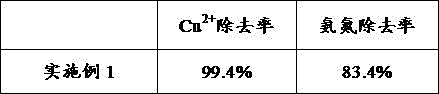
As can be seen from table 1: the etching waste liquid Cu treated by the method of the invention2+And the removal rate of ammonia nitrogen is better, and the removed Cu is2+And ammonia nitrogen are recycled, so that the method has a good application prospect.
Examples 2 to 8
Examples 2 to 8 each provide a method for treating an etching waste liquid of a printed wiring board, which is different from example 1 in that: the pH values of the reduction reactions in step S2 were changed, and in the preparation of the reducing solutions in step S2 of examples 2 to 7, the pH values were adjusted to 1, 3, 5, 7, 9, 11, and 13 with phosphoric acid solution and NaOH solution, respectively; the other operation steps are not changed.
The waste liquid treated in the examples 2 to 8 is detected, compared with the original etching waste liquid, and the removal rate of copper ions and ammonia nitrogen is calculated, so that the following results are obtained:
table 2 removal of copper ions and ammonia nitrogen from waste liquid after treatment in examples 2-8
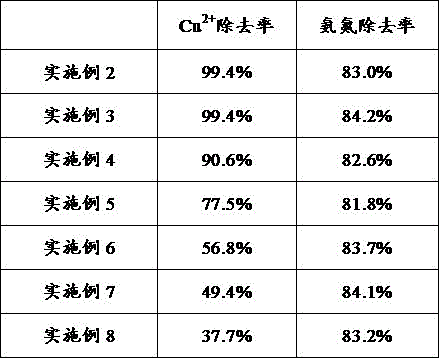
As can be seen from table 2: reduction reactionpH value of (1) to Cu2+The removal rate is greatly influenced, and Cu is in the pH value of 1-32+The removal rate is high, and the pH of the reduction reaction is preferably 3 in order to save the reagent. The hypophosphite was more reducing under alkaline conditions according to the standard electrode potential, but in the experiments, the white precipitate of struvite obtained at the end of the reduction reaction at alkaline pH (examples 6-8) was mixed with a blue precipitate. Copper hydroxide precipitate may be formed when the pH value is higher in the reduction reaction, so that the reaction speed of the reduction reaction is reduced; and no precipitate is generated under the acidic condition, so that the reduction reaction can be smoothly carried out.
Examples 9 to 14
Examples 9 to 14 each provide a method for treating an etching waste liquid of a printed wiring board, which is different from example 1 in that: the pH of the struvite formation reaction in step S2 was changed, and the other steps were not changed. In the magnesium ammonium phosphate formation reaction of step S2 in examples 9-14, the solutions were adjusted to pH 8, 9, 10, 11, 12, and 13 with NaOH solutions, respectively.
The waste liquid treated in examples 9 to 14 was examined, and compared with the original etching waste liquid, the removal rates of copper ions and ammonia nitrogen were calculated, and the residual amount of phosphorus in the treated waste liquid was calculated, and the following results were obtained:
table 3 removal of copper ions and ammonia nitrogen from waste liquid after treatment in examples 9-14
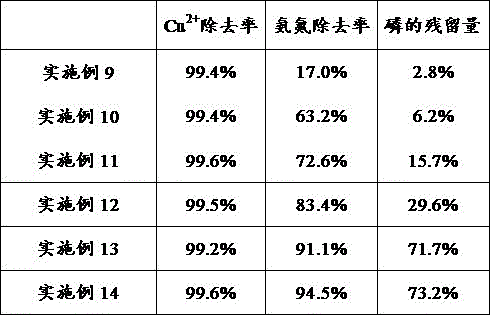
As can be seen from table 3: in the reaction of generating magnesium ammonium phosphate in step S2, the pH value has a greater influence on the ammonia nitrogen removal rate, the ammonia nitrogen removal rate is higher with the increase of the pH value, but the residual amount of phosphorus is larger, both of which are mutated when the pH value is from 10 to 11, and when the pH value is less than 9, the ammonia nitrogen removal rate is poor, so the preferred pH value is 9-10.
Examples 15 to 18
Examples 15 to 18 each provide a method for treating an etching waste liquid of a printed wiring board, which is different from example 1 in that: will be in step S3Precipitating agent MgCl2Other magnesium-containing compounds (the amount of magnesium species is unchanged) were used, and the rest of the operations were unchanged. The precipitating agents in step S3 for examples 15-18 are shown in the following table:
TABLE 4 precipitant in examples 15-18, step S3

The waste liquid treated in the examples 15 to 18 is detected, compared with the original etching waste liquid, and the removal rate of copper ions and ammonia nitrogen is calculated, so that the following results are obtained:
TABLE 5 removal of copper ions and Ammonia Nitrogen from the treated waste streams of examples 15-18
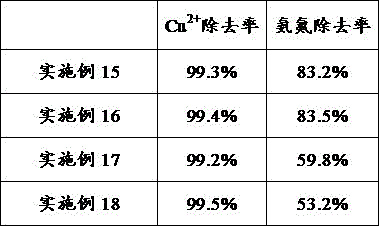
As can be seen from table 5: the precipitant is MgSO4And Mg (NO)3)2To Cu2+And the removal rate of ammonia nitrogen is not greatly influenced, so that the precipitating agent can be any soluble salt containing magnesium, but in order to avoid introducing other impurity ions, the precipitating agent is preferably MgCl2(ii) a When the precipitant is MgO and Mg (OH)2The ammonia nitrogen removal rate is lower, probably because of MgO and Mg (OH)2Not easy to dissociate to form Mg2+And PO4 3-And NH4 +Magnesium ammonium phosphate precipitate is generated, so the ammonia nitrogen removal rate is poor.
Comparative example 1
Comparative example 1 provides a method for treating an etching waste liquid of a printed circuit board, which is different from example 1 in that: in the step S2, the reducing agent magnesium hypophosphite is changed into hydrazine hydrate, and other operations are not changed. And (3) detecting the waste liquid treated in the comparative example 1, comparing the detected waste liquid with the original etching waste liquid, and calculating the removal rate of copper ions and ammonia nitrogen to obtain the following results:
TABLE 6 removal rate of copper ions and ammonia nitrogen in the waste liquid after treatment of comparative example 1
| Cu2+Removal rate | Removal rate of ammonia nitrogen | |
| Comparative example 1 | 99.5% | 56.0% |
As can be seen from table 6: hydrazine hydrate has better removal effect on copper ions in the etching waste liquid as well as the reducing property of hydrazine hydrate is better, the hydrazine hydrate can reduce the copper ions to prepare a copper simple substance, but the hydrazine hydrate is toxic and has certain danger when in use, and the magnesium hypophosphite used by the invention is nontoxic and harmless, has low price and better reducing property; magnesium ammonium phosphate is mainly generated for removing ammonia nitrogen in the etching waste liquid, and hydrazine hydrate does not contain phosphorus element and magnesium element, so the removal rate of ammonia nitrogen is poor, but a small amount of phosphoric acid and magnesium source are added in the steps S2 and S3, so the removal rate of ammonia nitrogen still reaches more than 50%, if the removal rate of ammonia nitrogen is improved, a magnesium source and a phosphorus source are additionally added, the cost is increased, the problem of phosphorus residue needs to be considered, and if other methods or equipment are added to remove a large amount of ammonia nitrogen in the waste liquid, the flow is too complex, and the cost is high and difficult to be used for practical problems and the like.
In step S2, the protective agent may be any one of polyvinylpyrrolidone (PVP), PVA (polyvinyl alcohol), HEC (hydroxyethyl cellulose), tannic acid, sodium citrate, sodium dodecyl sulfate, PAM (polyacrylamide), and the like.
In summary, the present invention providesMixing basic etching waste liquid and acidic etching waste liquid to perform a neutralization reaction to obtain basic copper chloride, adding the obtained basic copper chloride into concentrated sulfuric acid to prepare copper sulfate, and performing primary recovery treatment on copper ions in the waste liquid; reducing the filtrate after the neutralization reaction by magnesium hypophosphite to prepare nano copper, and carrying out secondary recovery treatment on copper ions in the waste liquid; adjusting the pH value of the solution to remove a large amount of NH in the waste liquid4 +Converting into magnesium ammonium phosphate precipitate to remove NH in the waste liquid4 +And (4) carrying out recovery treatment. According to the method, a large amount of acid and alkaline substances are not required to be added through the neutralization reaction, the cost is saved, the waste liquid is recycled twice through the neutralization reaction and the reduction reaction, the copper ion removal rate is high, and Mg in magnesium hypophosphite is utilized directly by adjusting the pH value2+PO formed by reduction reaction4 3-And NH in the waste liquid4 +And the precipitate of magnesium ammonium phosphate is generated, so that ammonia nitrogen in the etching waste liquid is better recovered and treated, and no reagent or equipment is required to be added for removing the ammonia nitrogen in the etching waste liquid. The method has the advantages of simple operation, less added reagent and better removal rate of copper ions and ammonia nitrogen in the etching waste liquid.
Although the present invention has been described in detail with reference to the preferred embodiments, it will be understood by those skilled in the art that various changes may be made and equivalents may be substituted for elements thereof without departing from the spirit and scope of the present invention.
Claims (9)
1. A method for treating waste etching liquid of printed circuit boards is characterized by comprising the following steps: the treatment method of the printed circuit board etching waste liquid comprises the following steps:
s1 preparation of copper sulfate by neutralization method
Adding the alkaline waste etching solution into a beaker, adding the acidic waste etching solution under the action of magnetic stirring to perform neutralization reaction, and controlling the pH value of the reaction at a preset value to generate basic copper chloride precipitate; after the reaction is completed, filtering and washing, adding a proper amount of hydration slurry into the filtered basic copper chloride, then adding concentrated sulfuric acid, dissolving the basic copper chloride solid to obtain a dark green copper sulfate solution, cooling the solution to generate copper sulfate crystals after the reaction is completed, and centrifugally filtering by using a centrifugal machine to obtain a copper sulfate product; the crystallization mother liquor returns to the neutralization reaction for reuse;
s2 reduction of magnesium hypophosphite to prepare copper
Preparation of reducing liquid: under the condition of stirring, adding sodium hexametaphosphate and magnesium hypophosphite into a beaker according to a preset molar ratio, adding polyvinylpyrrolidone serving as a protective agent, and adding phosphoric acid to adjust the pH value to 1-3;
in step S1, the filtrate after the neutralization reaction is filtered is centrifuged, and then the centrifuged supernatant is transferred to a beaker; dripping the reducing liquid into a beaker in a water bath under the condition of stirring to perform a reduction reaction, stirring at constant temperature after finishing dripping to obtain a red brown copper gel, standing, centrifuging and filtering to obtain nano metal copper, and collecting filtrate in the beaker;
s3 preparation of magnesium ammonium phosphate
And (3) under the condition of stirring the filtrate collected in the beaker after the reduction reaction, adding magnesium-containing soluble salt as a precipitator, adding NaOH solution to adjust the pH value to a preset value, generating white precipitate, standing, washing and filtering to obtain magnesium ammonium phosphate solid.
2. The method for treating a waste solution of printed circuit board etching according to claim 1, characterized in that: in step S1, the preset value of pH is pH 5 to 6.
3. The method for treating a waste solution of printed circuit board etching according to claim 1, characterized in that: in step S3, the preset value of pH is pH 9-10.
4. The method for treating a waste solution of printed circuit board etching according to claim 1, characterized in that: in step S2, the preset molar ratio of sodium hexametaphosphate to magnesium hypophosphite is 100: (1-0.5).
5. The method for treating a waste solution of printed circuit board etching according to claim 1, characterized in that: in step S2, the protective agent is any one of polyvinylpyrrolidone, polyvinyl alcohol, hydroxyethyl cellulose, tannic acid, sodium citrate, sodium dodecyl sulfate, and polyacrylamide.
6. The method for treating a waste solution of printed circuit board etching according to claim 1, characterized in that: in step S3, the precipitant is MgCl2。
7. The method for treating a waste solution of printed circuit board etching according to claim 1, characterized in that: in step S2, the dropping rate of the reducing solution is 12 drops/min.
8. The method for treating a waste solution of printed circuit board etching according to claim 1, characterized in that: in step S2, the water bath temperature is 65-70 ℃.
9. The method for treating a waste solution of printed circuit board etching according to claim 1, characterized in that: in step S1, the concentrated sulfuric acid has a concentration of 95%.
Priority Applications (1)
| Application Number | Priority Date | Filing Date | Title |
|---|---|---|---|
| CN202011351833.4A CN112593233B (en) | 2020-11-26 | 2020-11-26 | Treatment method of printed circuit board etching waste liquid |
Applications Claiming Priority (1)
| Application Number | Priority Date | Filing Date | Title |
|---|---|---|---|
| CN202011351833.4A CN112593233B (en) | 2020-11-26 | 2020-11-26 | Treatment method of printed circuit board etching waste liquid |
Publications (2)
| Publication Number | Publication Date |
|---|---|
| CN112593233A CN112593233A (en) | 2021-04-02 |
| CN112593233B true CN112593233B (en) | 2021-08-31 |
Family
ID=75184462
Family Applications (1)
| Application Number | Title | Priority Date | Filing Date |
|---|---|---|---|
| CN202011351833.4A Active CN112593233B (en) | 2020-11-26 | 2020-11-26 | Treatment method of printed circuit board etching waste liquid |
Country Status (1)
| Country | Link |
|---|---|
| CN (1) | CN112593233B (en) |
Families Citing this family (1)
| Publication number | Priority date | Publication date | Assignee | Title |
|---|---|---|---|---|
| CN114772628B (en) * | 2022-04-22 | 2024-02-06 | 盛隆资源再生(无锡)有限公司 | Recovery method of waste etching liquid |
Family Cites Families (7)
| Publication number | Priority date | Publication date | Assignee | Title |
|---|---|---|---|---|
| CN102019430B (en) * | 2009-09-18 | 2012-09-05 | 福建师范大学福清分校 | Method for recovering copper from alkaline etching waste liquid and recycling alkaline etching liquid |
| CN102560500A (en) * | 2012-02-03 | 2012-07-11 | 昆山市洁驰环保科技发展有限公司 | Method for producing nanometer copper powder by use of waste alkaline etching solution which can be regenerated and apparatus thereof |
| CN102732887B (en) * | 2012-05-29 | 2014-11-05 | 金悦通电子(翁源)有限公司 | Method and system for cyclic utilization and copper extraction of waste alkaline etching liquid |
| CN104419934A (en) * | 2013-09-04 | 2015-03-18 | 龚伶 | Method for recycling copper from alkaline etching waste liquid |
| CN104556467B (en) * | 2013-10-18 | 2017-02-08 | 北大方正集团有限公司 | Method for treating spent etching solution |
| CN108249472A (en) * | 2018-02-07 | 2018-07-06 | 韶关鹏瑞环保科技有限公司 | A kind of Comprehensive recycle technology of copper-containing etching waste solution |
| CN110790427A (en) * | 2019-11-13 | 2020-02-14 | 江苏方时远略科技咨询有限公司 | Treatment and recovery process of alkaline etching wastewater |
-
2020
- 2020-11-26 CN CN202011351833.4A patent/CN112593233B/en active Active
Also Published As
| Publication number | Publication date |
|---|---|
| CN112593233A (en) | 2021-04-02 |
Similar Documents
| Publication | Publication Date | Title |
|---|---|---|
| CN101391800B (en) | Method for producing basic copper chloride, cupric sulfate pentahydrate from copper-containing etching waste liquid | |
| CN102107978B (en) | Method for resource utilization and innocent treatment of etching waste liquid containing copper in circuit board industry | |
| CN102730742B (en) | Technique for producing soluble copper oxide from acidic etching waste liquor | |
| CN102071319B (en) | Method for preparing high-purity silver from silver-containing waste liquid | |
| CN109319823B (en) | Method for treating copper-containing etching waste liquid | |
| CN102775197A (en) | Method for preparing fertilizer-grade ammonium nitrate concentrated solution by use of mother liquid after immersion tin of tin-stripping waste liquid of circuit board | |
| CN110564977A (en) | Method for recovering nickel resource from chemical nickel waste liquid | |
| CN114262089A (en) | Method for recycling and treating aluminum anodic oxidation wastewater containing phosphoric acid and sulfuric acid | |
| CN114195190A (en) | Preparation method of chromium hydroxide easily soluble in acid | |
| CN101428933A (en) | Biological agent cooperated hydrolyzation-blowing off treatment process for nickel-ammonia wastewater | |
| CN103466770B (en) | Copper ammonia complexation wastewater treatment method | |
| CN102070436A (en) | Method for recovering oxalate and acid liquor from acidic etching waste liquor | |
| CN112593233A (en) | Treatment method of printed circuit board etching waste liquid | |
| CN109095642A (en) | A kind of alkalinity erosion copper waste liquid environmental protection recovery process of zero-emission | |
| CN112626561A (en) | Method for recovering copper ions in alkaline etching solution | |
| CN112960829B (en) | Process for treating copper-containing wastewater generated in production of printed circuit boards | |
| KR101214187B1 (en) | Treatment of wastewater from electroless nickel plating process | |
| CN115557635B (en) | Treatment method of nitric acid type tin stripping wastewater | |
| CN114516655B (en) | Method for producing copper hydroxide from circuit board waste | |
| CN102602979A (en) | Preparation method for copper chloride hydroxide | |
| CN105293774A (en) | Method for increasing recovery rate of precious metals in waste liquid | |
| TWI486312B (en) | Process for recovering copper from copper-containing waste liquid | |
| CN114180778A (en) | Environment-friendly treatment method for high-ammonia-nitrogen copper sulfate wastewater | |
| CN110790427A (en) | Treatment and recovery process of alkaline etching wastewater | |
| CN102730744B (en) | Process of removing calcium and magnesium from high-purity plating-stage copper sulfate |
Legal Events
| Date | Code | Title | Description |
|---|---|---|---|
| PB01 | Publication | ||
| PB01 | Publication | ||
| SE01 | Entry into force of request for substantive examination | ||
| SE01 | Entry into force of request for substantive examination | ||
| GR01 | Patent grant | ||
| GR01 | Patent grant | ||
| TR01 | Transfer of patent right | ||
| TR01 | Transfer of patent right |
Effective date of registration: 20220517 Address after: 310000 No. 980, Jinxi South Road, Linglong street, Lin'an District, Hangzhou City, Zhejiang Province Patentee after: Hangzhou Lin'an chenfan renewable resources Co.,Ltd. Address before: 430072 No. 8, Guang eight road, Wuchang, Hubei, Wuhan Patentee before: Chi Rong |