Disclosure of Invention
Two vibration exciters driven by different frequencies on a single mass are taken as research objects, firstly, a dynamic model is established, and a Lagrange equation is applied to solve a motion differential equation of the system. And (3) discussing the phase relation of the two vibration exciters in a steady state by using an asymptotic method, and deducing theoretical conditions for realizing synchronous operation with the rotation speed ratio of 1:2 and 1:3 respectively. And (3) providing a stability condition, wherein the result accords with a Route-Hurwith criterion, obtaining the phase relation of the two vibration exciters in a steady state, and defining a stability capability index. The stability capability of the system in a synchronous state is discussed numerically, and the correctness of numerical analysis and theoretical methods is proved through simulation and experiment. The invention is realized by the following technical scheme:
the double-machine double-frequency self-synchronous driving double-circular motion track vibrating screen parameter determination method is characterized in that the vibrating screen comprises the following steps: two vibration exciters, a mass and a spring; the springs are symmetrically distributed and connected with the foundation and the main body; the exciters 1 and 2 are symmetrically distributed on the mass about the y axis, each exciter is provided with an eccentric rotor, the eccentric rotors are driven by induction motors and respectively rotate around the centers of respective rotation axes, and the rotation directions of the two exciters are the same; the parameter determination method of the vibrating screen comprises the following steps:
step 1, establishing a dynamic model and a system motion differential equation
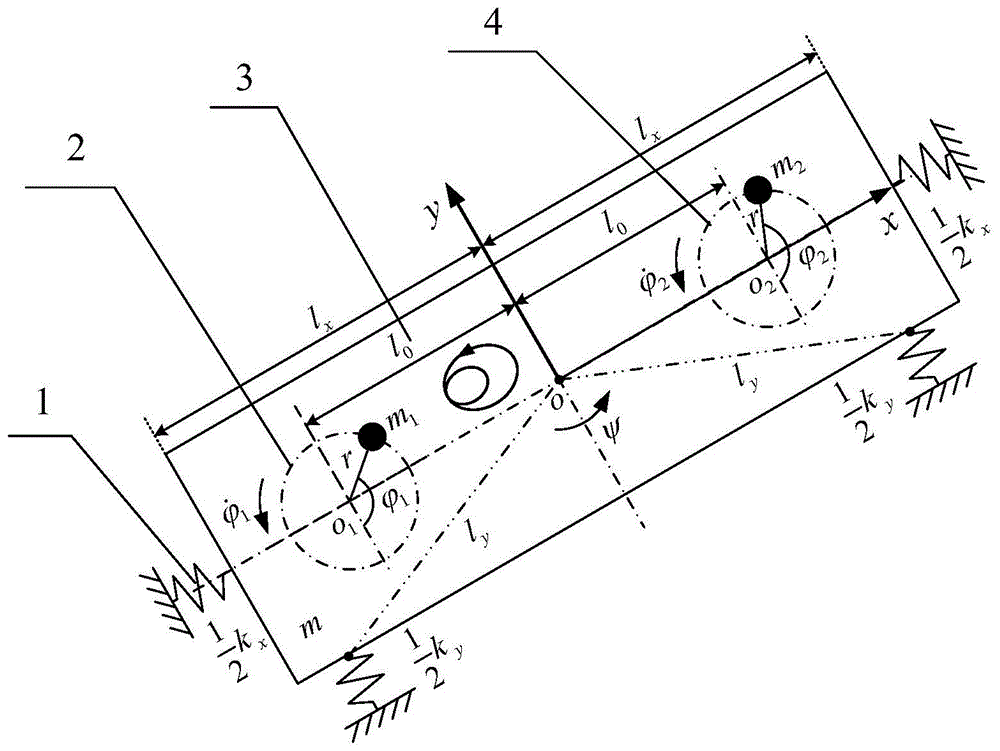
As shown in FIG. 1, let Oxy be fixed coordinates, and the rotation centers of the two exciters are o
1And o
2The corresponding phases thereof are respectively represented as
And
the whole system has three degrees of freedom, namely vibration in the x and y directions and swinging psi around the mass center.
Selecting the x, y, psi,
for generalized coordinates, based on Lagrange's equation, the differential equation of motion for the system is derived as follows:
wherein
In the formula
M is the total mass of the system;
m is the mass of the plastid;
mithe mass of the eccentric mass of the vibration exciter i, i being 1, 2;
j-the moment of inertia of the entire system;
Jmthe moment of inertia of mass m;
Jithe moment of inertia of exciter i, i ═ 1, 2;
l0-rotary axle o of vibration exciter iiDistance to the plastid center O, i ═ 1, 2;
le-system equivalent radius of gyration;
r is the eccentricity of the vibration exciter i, i is 1, 2;
g-gravitational acceleration;
fithe shaft damping coefficient of the induction machine i, i ═ 1, 2;
Tei-the electromagnetic output torque of the induction machine i, i ═ 1, 2;
kx,ky,kψ-the spring rate of the system in the x, y and psi directions;
fx,fy,fψ-damping coefficients of the system in x, y and psi directions;
step 2, frequency multiplication synchronization theory analysis
Because the patent only studies the motion characteristics of each vibration exciter in a vibration system with small damping under the condition of far super resonance (the operating frequency of the vibration exciter is far higher than the natural frequency of the system), the second term and the third term on the left side of the first three expressions in the formula (1) in equal sign can be omitted, and then the second term and the third term are obtained
And
and the results are substituted in the last three expressions of the formula (1) to obtain the angular acceleration of each vibration exciter
Approximate expression of (c):
wherein
Where ε is the ratio of the eccentric mass of the exciter 1 to the total mass M of the system
The rotational phase of the exciter is set as follows
Where τ is ω t, n 11, define ΔiRelative phase, delta, compared to the phase change of the exciteriIs a slowly varying function of the system during steady state operation.
Substituting the formula (3) into the formula (2) to obtain:
wherein
ψ11 +=-2ωt-2Δ1,ψ12 +=ψ21 +=-(1+n2)ωt-Δ1-Δ2+π
ψ22 +=-2n2ωt-2Δ2,ψ12 -=-ψ21 -=(n2-1)ωt-Δ1+Δ2+π
Based on the asymptotic method, the formula (4) needs to be rewritten into a standard form of Bogoliubov, and the setting is made
To the formula (5)
And
is derived by
And
then, formula (4) can be derived as a first-order joint differential equation, which is expressed as follows:
in the formula (6) with respect to v
iIn the expression of (1), because
And small parameters
In proportion, so v
iIs a function that changes slowly over time. Based on the averaging method, v can be adjusted
iTerm Ω regarded as a slow change
iSuperposition with small vibration terms. Improvements relating to v
iTo obtain a first approximation of:
the second approximate solution is refined in the same way:
because small vibration terms do not match v
iCan be influenced by a smoothly varying quantity omega based on averaging
iIs used to represent v
iThereby omitting the minute fluctuations. Substituting formula (8) for formula (6) on the right side of the same sign, and the value of tau is 0-2 piAfter integration, take the average value, omega in the whole integration process
iAnd Δ
iIs always taken as a fixed value and finally is sorted to obtain
The average differential equation of (a) is:
wherein
ni-2nj=0,ul=1,γij=-Δi+2Δj;ni-2nj≠0,ul=0.
ni-2nj-nν=0,ud=1,ηijν=-Δi+2Δj+Δν;ni-2nj-nν≠0,ud=0.
By passing
A stable solution can be found. From the formula (9), n
1=1,n
2In the case of 2, the first and second groups,
there is a synchronous phase relation expression between exciters with a rotation speed ratio of 1:2 in the correlation terms of (n)
1=1,n
2If the rotation speed ratio is 3, a synchronous phase expression between exciters with a rotation speed ratio of 1:3 can be derived.
Step 3, deducing the synchronization and stability conditions
(a) Double frequency synchronization and stabilization conditions
When n is
1=1,n
2When the rotation speed is 2, the stable rotation speed of the
vibration exciter 2 is twice that of the
vibration exciter 1, and the system can realize thatDouble frequency synchronization, with respect to equation (9)
The following relationship can be obtained:
when the system is in the synchronous state, the following expression is given:
the synchronization formula of the system under the condition of double frequency can be obtained as follows:
to obtain a stable phase angle deltaioAssuming that the small disturbance amount at steady state is δiAnd xii:
Δi=Δi0+δi,Ωi=Ωi0+ξi,i=1,2 (13)
Substituting equation (13) into equation (9) yields the perturbation equation for the system as follows:
the arrangement (14) gives information about deltaiThe equation for (i ═ 1,2) is as follows:
taking the eigenvalue as λ, the eigenequation of equation (15) is obtained as:
the system is stable when the Routh-Hurwitz criterion is applied, i.e. the solution λ of the equation has a negative real part. Therefore, the method comprises the following steps:
2εα1 (1)>0,4εα2 (1)>0,H2 cos(2Δ10-Δ20)>0 (17)
wherein
Equation (17) is the stability condition of the system in the double frequency synchronization state. H2Is defined as the double frequency synchronization stability index of the system.
In the formula (17) ∈, α1 (1),α2 (1),a21,k1Both are greater than 0, and therefore are discussed in two cases:
(I) if A-1 > 0, then:
for the analysis, a dimensionless parameter r is introduced
l=l
0/l
eThus there are
When H is present
2> 0, where cos (2. delta. is required
10-Δ
20) The stability criterion can be satisfied when the phase is more than 0, and the stable phase relation is 2 delta
10-Δ
20∈(-π/2,π/2)。
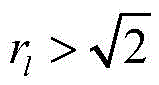
(II) if A-1 < 0, i.e.
When H is present
2< 0, the condition cos (2. delta.) needs to be satisfied
10-Δ
20) < 0, at which the stable phase relation is 2 Delta
10-Δ
20∈(-3π/2,-π/2)。
(b) Triple frequency synchronization and stability conditions
When n is
1=1,n
2When the rotation speed is 3, the stable rotation speed of the
vibration exciter 2 is three times that of the
vibration exciter 1, and the system can realize triple frequency synchronization. Is related to the formula (9)
The following relationships can be obtained:
in equation (18), when the system is in a steady state, the equation of the system frequency tripling synchronization condition can be obtained as follows:
to seek a stable phase angle deltai0The same as the double frequency synchronous analysis method, the small disturbance quantity in the steady state is deltaiAnd xiiThe perturbation equation of the system is further obtained as follows:
introducing the characteristic value lambda to obtain a characteristic equation of the formula (20) as follows:
the triple frequency synchronous stability condition obtained by applying the Router-Hurwitz criterion is as follows: :
2εα1 (1)>0,6εα2 (1)>0,H3cos(3Δ10-Δ20)>0 (28)
wherein
H3=ε2a21A(A-1)
In the formula, H3Defined as the triple frequency synchronous stability index.
Introducing dimensionless parameter rlSince A > 0, it can be discussed in two cases as well:
(I)
when there is A-1 > 0, i.e. H
3Cos (3. delta.) is required at > 0
10-Δ
20) If the condition is satisfied, the
stable phase relation 3 delta is obtained
10-Δ
20∈(-π/2,π/2)。
(II)
When A-1 is < 0, i.e. H
3< 0, cos (3. delta. is required
10-Δ
20) < 0 at which the
phase relation 3 Delta is stabilized
10-Δ
20∈(-3π/2,-π/2)。
The invention has the beneficial effects that:
(1) in engineering, double-machine same-direction double-frequency self-synchronous driving is adopted, and when two vibration exciters are installed at a large distance, double-frequency double-circular-track motion of a machine body is realized;
(2) the double-frequency double-circular-track motion of the screening machine can effectively improve the treatment capacity and the screening efficiency of the screening machine and can screen sticky and wet materials with high moisture;
(3) the conventional screening machine is driven by single frequency, while the invention realizes double-frequency double-circumference track driving, and the conveying capacity of the screening machine on a screen and the screening efficiency under the screen can be obviously improved.
Drawings
FIG. 1 is a diagram of a model of system dynamics.
In the figure: 1. a spring; 2. a vibration exciter 1; 3. a plastid; 4. and a vibration exciter 2.
The meaning of each parameter in the figure is as follows:
o-center of the entire System
O1-the centre of rotation of the exciter 1;
O2-the centre of rotation of the exciter 2;
-the rotation phase angle of
exciter 1;
-the rotation phase angle of
exciter 2;
m1-the mass of the exciter 1;
m2-the mass of the exciter 2;
r-eccentricity of vibration exciter i (i is 1, 2);
kx-spring rate in x direction;
ky-spring rate in the y-direction;
l0-distance of the rotation center of the vibration exciter from the center of the system;
FIG. 2 is a drawing showinglAnd rmRelation curve
FIG. 3 is a graph of stability index vslThe variation curve of (d);
(a)η=0.5;
(b)η=1.0。
FIG. 4 is a drawing showinglSimulation result of frequency doubling synchronization under condition of 0.8A drawing;
(a) the rotating speed of the motor;
(b) phase difference between exciters 1 and 2
(c) Displacement in the x direction;
(d) displacement in the y direction;
(e) an oscillation angle;
(f) the motion trajectory of the mass.
FIG. 5 is a drawing showinglUnder the condition of 1.9, a simulation result graph of double frequency synchronization;
(a) the rotating speed of the motor;
(b) phase difference between exciters 1 and 2
(c) Displacement in the x direction;
(d) displacement in the y direction;
(e) an oscillation angle;
(f) the motion trajectory of the mass.
FIG. 6 is a drawing showinglUnder the condition of 0.8, a simulation result graph of frequency tripling synchronization;
(a) the rotating speed of the motor;
(b) phase difference between exciters 1 and 2
(c) Displacement in the x direction;
(d) displacement in the y direction;
(e) an oscillation angle;
(f) the motion trajectory of the mass.
FIG. 7 is a drawing showinglUnder the condition of 1.9, a simulation result graph of frequency tripling synchronization;
(a) the rotating speed of the motor;
(b) phase difference between exciters 1 and 2
(c) Displacement in the x direction;
(d) displacement in the y direction;
(e) an oscillation angle;
(f) the motion trajectory of the mass.
FIG. 8 is a drawing showingl0.92, vibration test bench diagram;
FIG. 9 is rlUnder the condition of 0.92, a test result graph of double frequency synchronization;
(a) the rotating speed of the motor;
(b) phase difference between exciters 1 and 2
(c) Displacement in the x direction;
(d) displacement in the y direction;
(e) an oscillation angle;
(f) the motion trajectory of the mass.
FIG. 10 is a drawing showingl1.87, vibration test bench diagram;
FIG. 11 shows a graph oflThe test result graph of double frequency synchronization under the condition of 1.87;
(a) the rotating speed of the motor;
(b) phase difference between exciters 1 and 2
(c) Displacement in the x direction;
(d) displacement in the y direction;
(e) an oscillation angle;
(f) the motion trajectory of the mass.
Detailed description of the preferred embodiments
Example 1:
to further analyze the system characteristics, it was subjected to numerical analysis.
Assuming parameters of the vibration system, the system parameters are set as follows: m is 1500kg, m1=15kg,m2=ηm1,J=1060kg·m2,kx=ky=180kN/m,kψ=120kN/rad,fx=fy=3.27kN·s/m,fψ3.20kN · s/rad, r is 0.15 m. According to the parameters, the system natural frequency can be obtained as follows: omegax=ωy=10.85rad/s,ωψ10.63 rad/s. The motor type is three-phase squirrel-cage type, 50Hz,380V,6-pole,0.75kW and the rated rotating speed of 980 r/min.
Considering that the steady phase difference of the vibration exciters is related to the distance between the vibration exciters according to a dimensionless parameter rlAnd a mass parameter rmAnd η:
in order to better analyze the synchronous stability capability of the system, the related parameters are substituted into the double-frequency synchronous stability of the formula (17) and the formula (28)Number H
2And triple frequency synchronous stability index H
3In the method, a stability index is obtained according to a dimensionless parameter r
lThe variation curve of (2) is shown in fig. 3. It can be seen that the double frequency synchronization stability index H
2And triple frequency synchronous stability index H
3Are all accompanied by r
lIs increased, and H
3Is more increasing than H
2Faster, but in
When H
2And H
3Are all equal to 0. From the enlarged view of FIG. 3, it is apparent that
I.e. in region I, stability index H
2And H
3Both are less than 0, and the value ranges of the stable phase difference of the second frequency multiplication and the third frequency multiplication are-3 pi/2 to-pi/2;
(region II), the stability indexes are all greater than 0, and the stable phase difference value ranges from-pi/2 to pi/2. The following simulations and experiments will therefore be discussed in terms of both close and remote installations.
Example 2:
in order to better describe the dynamic characteristics of the two vibration exciters under the condition of frequency doubling synchronization, a Runge-Kutta program can be applied to simulate a system motion differential equation. Vibration system parameters and motor parameters are given in the previous subsection. According to the result of numerical analysis, it is necessary to divide
And
two cases are discussed.
(a)rlSimulation result graph of double frequency synchronization under 0.8 condition
FIG. 4 is a simulation knot under the condition that the installation distance between two exciters rotating in the same direction is smallIf the eccentric rotors of the two exciters have the same mass, the two exciters are selected. As shown in fig. 4(a), the models of the
motors 1 and 2 are the same, and the operating frequency of the
motor 2 is twice that of the
motor 1, so that the rotating speed of the
motor 2 is twice that of the
motor 1 in the steady state, and the obtained phase difference is shown in fig. 4(b), and the steady phase difference of the
exciters 1 and 2 can be known
And meanwhile, when t is 20s, a pi/3 phase interference is added to the
vibration exciter 2, and the phase difference value between the two vibration exciters quickly returns to the original stable state shortly after the interference, which indicates that the motion state of the system is stable. Fig. 4(c) (d) (e) show displacement curves of the mass in x, y and ψ directions, respectively, and it can be seen that the vibration state of the system is stabilized after about 3 s. The motion forms of the mass in the x, y and psi directions in the steady state can be clearly seen according to the enlarged view, and the x direction has obvious shock waves, which shows that the frequency doubling synchronization can increase the displacement of the mass, which is needed in the engineering and can be better applied to the design of a novel vibrating screen. The diagram of the motion locus in the steady state is shown in fig. 4(f), and the locus shape can be approximately regarded as an inner 8 shape.
(b)rlSimulation result graph of double frequency synchronization under 1.9 condition
The distance between the two vibration exciters is changed to obtain a simulation result of the two vibration exciters under the condition of larger installation distance, as shown in fig. 5. The rotating speeds of the two motors are not changed, and the phase difference value is
Likewise, at 20s, the
motor 2 is subjected to pi/3 phase interference, and the phase difference rapidly returns to the original stable state after a small fluctuation, which indicates that the interference does not affect the stability of the system. The displacement curves of the mass in x, y and psi directions are shown in fig. 5(c) (d) (e), respectively, and it can be seen that the amplitude is stabilized after about 3s, and the motion process can be obtained by enlarging the displacement. Comparing the displacement diagram in the steady state in fig. 4, it can be seen that the shape of the motion trail is inner 8-shaped, which indicates that the distance between the exciters does not change the overall shape of the motion trail, but the motion trail in the x, y and psi directionsThe form may vary. And the stable phase difference values obtained by different distances among the vibration exciters are different, which shows that the position of the mass vibration is influenced by the phase difference.
(c)rlSimulation result graph of frequency tripling synchronization under the condition of 0.8
Two exciters with the same eccentric mass are selected, the working frequencies of the two exciters are changed to be 16Hz and 48Hz respectively, the obtained motor rotating speed graph is shown in fig. 6(a), it can be seen that the rotating speed of the
motor 1 is about 320r/min and the rotating speed of the
motor 2 is about 960r/min during stable operation, and the system realizes triple frequency synchronization. FIG. 6 shows the simulation result of the case where the mounting distance between the two exciters rotating in the same direction is small, and the obtained phase relationship is as shown in FIG. 6(b), which shows that the stable phase relationship between the
exciters 1 and 2
And meanwhile, when t is 20s, a pi/3 interference is added to the
vibration exciter 2, and the phase difference value between the two vibration exciters quickly returns to the original stable state soon after the interference, which indicates that the motion state of the system is stable. Fig. 6(c) (d) (e) show the displacement curves of the mass in x, y and ψ directions, respectively, and it can be seen that the system vibration is stabilized after about 3 s. The movement forms of the mass in the x, y and psi directions in the steady state can be clearly seen from the enlarged view, and the movement locus in the steady state is shown in fig. 6(f), and the shape of the plane movement locus can be clearly seen.
(d)rlSimulation result graph of frequency tripling synchronization under the condition of 1.9
The distance between the two vibration exciters is changed to obtain a simulation result of the two vibration exciters under the condition of larger installation distance, as shown in fig. 7. The rotating speeds of the two motors are unchanged, and the phase difference value is stabilized at about 0 ℃. Similarly, at 20s, the motor 2 is disturbed by pi/3 phase, and the phase difference rapidly returns to the original stable state after a small fluctuation, which indicates that the disturbance does not affect the stability of the system. The displacement plots of the mass in the x, y and ψ directions are shown in fig. 7(c) (d) (e), respectively, and it can be seen that the amplitude is stabilized after about 3s, and the course of movement can be obtained by enlarging the displacement. Comparing the steady state displacement diagram in fig. 6, it can be seen that the distance between the exciters does not change the overall shape of the motion trajectory, but the specific motion pattern in the x, y and ψ directions changes. And the distances among the vibration exciters are different, so that the obtained stable phase difference values are different, and the fact that the motion position of the mass is influenced by the phase difference is shown.
Example 3:
in order to further verify the effectiveness of the theoretical derivation result and the numerical analysis result, a corresponding test is designed for comparative study.
(a)rlTest results of double frequency synchronization under the condition of 0.92
FIG. 8 is a drawing showinglBefore the test is started, the power supply frequency of each motor can be controlled by a frequency converter to obtain different frequency ratios, the working frequency of the induction motor is respectively set to be 25Hz and 50Hz, and the system is operated under the condition of double frequency. The test system parameters were as follows: m is 330kg0=6kg,J=44.5kg·m2,kx=ky=102.3kN/m,kψ=20.65kN/m,fx=fy=0.27kN·s/m,fψ=0.22kN·s/m,f1=f2=0.002,r=0.05m,ωx=ωyThe two vibration motors selected in the test were identical in type to 17.2rad/s, and the specific motor parameters were the same as in example 1.
FIG. 9 is rlThe result of the test of double frequency synchronization under the condition of 0.92 shows that the moment of inertia of the two exciters is almost the same in a few seconds after the motor starts to start, so that the rotating speeds of the two exciters are close to the same. The subsequent passage of the operating frequency through the resonance region causes a resonant response, in which the amplitude is at a maximum. After a period of time, the motors can generate coupling torque, and the load torque of each motor is synchronized by adjusting the phase difference, so that the rotating speed of the motors is quickly stabilized, and the two vibration exciters are synchronized and stably run. After about 40s, the phase difference between the two motors reaches a steady state, which is about-183, and is substantially the same as fig. 4 (b). Fig. 9(c), (d) and (e) show the displacement graphs of the system in the x, y and psi directions, respectively, and the motion of the mass in the steady state is known from the enlarged view, which is substantially similar to the displacement response graph of fig. 4. FIG. 9(f) isThe planar motion trajectory at steady state, compared to fig. 4(f), is slightly in error, which may be that the phase difference measured by experiment is slightly different from the phase difference simulated, so that the trajectory of experiment is slightly different from simulation.
(b)rlTest results of double frequency synchronization under the condition of 1.87
The test bed with larger vibration exciter spacing is shown in fig. 10, two vibration motors rotate in the same direction and have the same model, and the system parameters are as follows: m is 391kg
0=6kg,l
0=0.76m,k
x=k
y=254.01kN/m,f
x=f
y=0.25,r=0.05m,f
1=f
20.002, at this time
The natural frequency of the system can be found as follows: omega
x=ω
y25.11 rad/s. Similar to the two-machine short-distance installation test, the
motor 1 and the
motor 2 are also controlled by the frequency converter to work under the conditions of 25Hz and 50Hz respectively, and the obtained test result is shown in fig. 11. Fig. 11(a) is a motor rotation speed diagram, because the excitation force of the motor is relatively large, the motor is started slowly, and the rotation speed of the
motor 2 is about twice that of the
motor 1 when the motor is stable. After about 30s, the system reaches a steady state, in which the phase relationship between
exciters 1 and 2 is such that
Substantially similar to the stable phase relationship of fig. 5 (b). The displacement response curves of the mass in the x and y directions are shown in fig. 11(c) (d), respectively, and comparing the simulation results with fig. 5(c) (d), it can be seen that the specific motion patterns in the x and y directions are similar, but the values are slightly different due to the difference between the simulation parameters and the experimental parameters. In addition, the test bed cannot measure the swing, and the swing angle of the system is very small and can be ignored according to the simulation result, so that a swing displacement diagram is not given. The planar motion trajectory of the mass in the steady state is shown in fig. 11(e), and compared with the simulated motion trajectory of fig. 5, the shape is similar, but the position is slightly deviated, which is mainly caused by the deviation of the experimentally measured phase.
In summary, when the device is installed at a large distance, the phase difference of the 2-time doubling synchronization is 0, and the centroid trajectory at this time is an inner 8-word trajectory, that is: the track is a double-circle track and can be applied to engineering practice.
Example 4:
the following are example data parameters using one of the vibrating shale-dewatering screens of the present invention. The present invention is not limited to this design parameter.
Mass m of mass 1500kg, mass m of eccentric block of vibration exciter110kg, the rotary radius r of the vibration exciter is 0.15m, and the spring stiffness k between the mass and the foundationx=ky=180kN/m,kψ120kN/m, the rotating speed of the motor 1 is 498r/min, the rotating speed of the motor 2 is 996r/min, the system realizes double-frequency synchronous operation, and works under the condition of far super resonance at the moment, the stability requirement is met, the stable phase difference between the vibration exciters 1 and 2 is 0, the motion trail of the vibration exciters is inner 8-shaped double-circular motion, and the processing capacity and the screening efficiency of the screening machine can be effectively improved. Three motors with the same model are selected, and the three-phase squirrel-cage type motors (model VB-1082-W, 380V, 50Hz, 6-pole, delta-connection, 0.75kw, and the rotating speed of 980r/min) are selected.