Disclosure of Invention
In view of the above-mentioned shortcomings in the prior art, the present invention aims to provide a negative electrode material, a preparation method thereof and a lithium ion battery. The preparation method provided by the invention uses the nucleation conversion agent to ensure that lithium silicate in the prepared product is only Li2Si2O5And no other lithium silicate phase exists, so that the processing problem of the pre-lithium material is fundamentally solved.
In order to achieve the purpose, the invention adopts the following technical scheme:
in a first aspect, the present invention provides an anode material comprising SiOx and Li2Si2O5Wherein x is not less than 0 and not more than 1.2, said SiOx is dispersed in Li2Si2O5In (1).
In the anode material provided by the invention, x is more than or equal to 0 and less than or equal to 1.2, for example, x is 0, 0.5, 1, 1.2, and the like. That is, SiOx may be an oxide of silicon or may be silicon. SiOx has a relatively complex composition, and is understood to be a nano-silicon uniformly dispersed in SiO2Is formed. The negative electrode material provided by the invention only contains Li2Si2O5This lithium silicate phase.
The cathode material provided by the invention has the advantages of stable processing performance, high first-time efficiency and long cycle life, and can ensure the interaction between the lithium-containing silicon-oxygen cathode and the binder and prolong the cycle life of the battery.
Preferably, the surface of the negative electrode material is coated with a carbon layer.
Preferably, the carbon layer has a thickness of 10 to 2000nm, such as 10nm, 50nm, 100nm, 500nm, 1000nm, 1500nm, 2000nm, and the like, but is not limited to the recited values, and other values not recited within the range of values are equally applicable.
Preferably, when the surface of the negative electrode material is coated with a carbon layer, the carbon content of the negative electrode material is 4 to 6%, for example, 4%, 4.5%, 5%, 5.5%, or 6%, but is not limited to the recited values, and other values not recited in the range of the values are also applicable. The carbon content is mass content.
Preferably, in the anode material, SiOx and Li2Si2O5The mass ratio of (A) to (B) is 0.74 to 6.6, for example 0.74, 01, 2, 3, 4, 5, 6 or 6.6, etc., but is not limited to the recited values, and other values not recited in the numerical range are also applicable.
Preferably, in the anode material, part of Li2Si2O5From Li2SiO3Is converted into.
In a second aspect, the present invention provides a method for preparing the anode material according to the first aspect, the method comprising the steps of:
and mixing silicon oxide, a reducing lithium-containing compound and a nucleation conversion agent or a heat absorbing agent, and roasting to obtain the negative electrode material.
The preparation method provided by the invention can realize the generation of only Li after the reaction (namely the pre-lithiation) of the silicon oxide and the reductive lithium-containing compound is carried out by using the nucleation conversion agent or the heat absorbing agent2Si2O5This lithium silicate phase because of Li2Si2O5The lithium pre-electrode material is insoluble in water, so that the processing stability problems of the lithium pre-electrode material, such as slurry gas generation, low viscosity, tailing during coating, pinholes, air holes and the like after the electrode plate is dried, can be fundamentally solved.
In addition, the preparation method provided by the invention directly adds Li by adding a nucleation conversion agent2SiO3Conversion to Li2Si2O5The problems of capacity reduction, first effect reduction and the like caused by surface treatment can be avoided.
The following is a preferred technical solution of the present invention, but not a limitation to the technical solution provided by the present invention, and the technical objects and advantageous effects of the present invention can be better achieved and achieved by the following preferred technical solution.
In a preferred embodiment of the present invention, the silicon oxide is SiOy, wherein 0 < y < 2, for example x is 0.2, 0.4, 0.6, 0.8, 1, 1.1, 1.2, 1.3, 1.4, 1.6 or 1.8.
Preferably, the silicon oxide is silicon monoxide. When silicon monoxide is used as the silicon oxide, the problem that the first-effect post-processing performance of the silicon monoxide doped with lithium is unstable can be effectively solved.
Preferably, the oxide of silicon has a D10 > 1.0 μm and a Dmax < 50 μm. For example, D10 is 1.0. mu.m, 1.5. mu.m, 2.0. mu.m, 2.5. mu.m, 3.0. mu.m, 4.0. mu.m, or 5.0. mu.m, etc., and Dmax is 49. mu.m, 45. mu.m, 30. mu.m, 35. mu.m, or 20. mu.m, etc. Here, Dmax means the maximum particle diameter of the particles.
Preferably, the reduced lithium-containing compound includes any one of lithium hydride, alkyl lithium, metallic lithium, lithium aluminum hydride, lithium amide, or lithium borohydride, or a combination of at least two thereof.
Preferably, the nucleation converter comprises an oxide and/or phosphate of phosphorus.
Preferably, the phosphorus oxide comprises phosphorus pentoxide and/or phosphorus trioxide.
Preferably, the phosphate comprises any one of lithium phosphate, magnesium phosphate or sodium phosphate or a combination of at least two thereof.
Preferably, the nucleation conversion agent is phosphorus pentoxide. In the present invention, it is particularly preferable to use phosphorus pentoxide as the nucleation conversion agent, and the use of phosphorus pentoxide has the advantages that: so that Li2SiO3Conversion to Li2Si2O5The effect of (2) is more obvious, and the dosage of the nucleation transforming agent can be reduced, thereby realizing the reduction of the production cost on the one hand and the reduction of the production difficulty on the other hand.
Preferably, the endothermic agent has a melting point of less than 700 ℃;
preferably, the endothermic agent comprises LiCl, NaCl, NaNO3、KNO3、KOH、BOne or the combination of at least two of aCl, KCl and LiF.
Preferably, the endothermic agent is KNO3. In the present invention, KNO is particularly preferable3As endothermic agents, there are advantages: first, KNO3Has a low use temperature and is free from Li production2Si2O5The promotion effect is more obvious; second, KNO3Low cost, easily available raw materials, no toxicity, no harm and environmental protection.
Preferably, the mass ratio of the silicon oxide to the lithium-reducing compound is 10:0.08 to 10:1.2, for example 10:0.08, 10:0.2, 10:0.5, 10:0.8 or 10:1.2, but is not limited to the recited values, and other values not recited within this range are also applicable.
Preferably, the mass ratio of the silicon oxide to the nucleation converter is from 100:2 to 100:10, such as 100:2, 100:2.5 or 100:3, 100:5, 100:7, 100:10, etc., but is not limited to the recited values, and other values not recited within this range of values are equally applicable. In the present invention, if the amount of the nucleation conversion agent is too large, Li is caused2Si2O5The crystal grains are too large, so that the cycle performance is influenced; if the amount of the nucleation conversion agent is too small, residual Li may be caused2SiO3The processing stability of the aqueous slurry of the material is affected.
Preferably, the mass ratio of the silicon oxide to the heat absorbing agent is 100:8 to 100:30, such as 100:8, 100:10, 100:15, 100:20, 100:25, or 100:30, but not limited to the recited values, and other values not recited within this range of values are equally applicable.
Preferably, the method of mixing silicon oxide, a reducing lithium-containing compound, and a nucleation conversion agent comprises: after mixing the silicon oxide and the nucleation conversion agent, the reductive lithium-containing compound is added.
In a preferred embodiment of the present invention, the temperature of the calcination is 300-1000 deg.C, such as 300 deg.C, 400 deg.C, 500 deg.C, 600 deg.C, 700 deg.C, 800 deg.C, 900 deg.C or 1000 deg.C, but is not limited to the values listed, and other values not listed in the numerical range are also applicable, preferably 450-800 deg.C. In the invention, the roasting temperature is less than 300 ℃, so that the reaction is difficult to carry out; above 1000 c leads to disproportionation of silicon monoxide and deterioration of performance. The adoption of 450-800 ℃ can obtain more excellent effect.
Preferably, the calcination time is 1.5-2.5h, such as 1.5h, 1.7h, 2h, 2.3h, 2.5h, etc., but not limited to the recited values, and other values not recited in the range of values are also applicable.
Preferably, the firing is performed under a non-oxidizing atmosphere.
Preferably, the non-oxidizing atmosphere includes any one of a hydrogen atmosphere, a nitrogen atmosphere, a helium atmosphere, a neon atmosphere, an argon atmosphere, a krypton atmosphere, or a xenon atmosphere, or a combination of at least two thereof.
As a preferable technical solution of the present invention, the preparation method further includes carbon-coating the silicon oxide before mixing.
Preferably, the carbon coating comprises gas-phase carbon coating and/or solid-phase carbon coating.
As a preferable technical scheme of the invention, the gas-phase carbon coating method comprises the following steps: heating the silicon oxide to 600-1000 ℃ under a protective atmosphere, such as 600 ℃, 700 ℃, 800 ℃, 900 ℃ or 1000 ℃, introducing an organic carbon source gas, preserving heat for 0.5-10h, and then cooling, such as preserving heat for 0.5h, 1h, 2h, 5h, 8h or 10 h. In the present invention, the protective atmosphere can be selected according to the prior art, such as a nitrogen atmosphere and/or an argon atmosphere.
Preferably, the organic carbon source gas is a hydrocarbon.
Preferably, the hydrocarbon comprises any one of methane, ethylene, acetylene or benzene or a combination of at least two thereof.
Preferably, the method for solid phase coating carbon comprises the following steps: fusing the silicon oxide and a carbon source for more than 0.5h, carbonizing the obtained carbon mixture at the temperature of 600-1000 ℃ for 2-6h, and cooling. The fusion time is more than 0.5h, such as 0.5h, 0.6h, 0.7h or 0.8h, etc., the carbonization temperature is 600-1000 ℃, such as 600 ℃, 700 ℃, 800 ℃, 900 ℃ or 1000 ℃, etc., and the carbonization time is 2-6h, such as 2h, 3h, 4h, 5h or 6h, etc.
Preferably, the fusion is performed in a fusion machine with a speed of 500-3000r/min, such as 500r/min, 1000r/min, 1500r/min, 2000r/min, 2500r/min, 3000r/min, etc. The width of the cutter gap of the fusion machine can be selected according to the prior art, for example 0.5 cm.
Preferably, the carbon source comprises any one of a polymer, a saccharide, an organic acid, or pitch, or a combination of at least two thereof.
As a preferred embodiment of the present invention, the method for preparing silicon oxide comprises:
the raw materials for preparing the silicon oxide are heated, gasified and condensed to obtain the silicon oxide.
As a preferred technical scheme of the invention, the raw materials for preparing the silicon oxide comprise silicon and silicon dioxide.
Preferably, the silicon to silicon dioxide mass ratio is 1:1.8 to 1:2.2, such as 1:1.8, 1:1.9, 1:2.0, 1:2.1 or 1:2.2, but not limited to the recited values, and other unrecited values within this range are equally applicable.
Preferably, the temperature of the thermal gasification is 1200-1400 ℃, such as 1200 ℃, 1250 ℃, 1300 ℃, 1350 ℃ or 1400 ℃, but not limited to the recited values, and other values not recited in the range of values are also applicable.
Preferably, the time for heating and vaporizing is 16-20h, such as 16h, 17h, 18h, 19h or 20h, but not limited to the recited values, and other values not recited in the range of values are also applicable.
Preferably, the condensation temperature is 930-.
Preferably, the thermal gasification is carried out in a protective atmosphere or vacuum. In the present invention, the protective atmosphere can be selected according to the prior art, such as a nitrogen atmosphere and/or an argon atmosphere. The degree of vacuum of the vacuum can be chosen according to the prior art, for example 5 Pa.
Preferably, the preparation method of the silicon oxide further comprises: the resulting silicon oxide is shaped.
Preferably, the shaping comprises any one or a combination of at least two of crushing, ball milling or classifying.
As a further preferable technical scheme of the preparation method, the method comprises the following steps:
(1) heating and gasifying silicon and silicon dioxide with the mass ratio of 1:1.8-1:2.2 at the temperature of 1200-1400 ℃ in vacuum for 16-20h, condensing at the temperature of 930-970 ℃, and shaping to obtain silicon monoxide;
(2) carbon coating the silicon monoxide obtained in the step (1) to obtain carbon-coated silicon monoxide;
(3) mixing the carbon-coated silicon monoxide in the step (2) with a nucleation conversion agent or a heat absorbing agent, adding a reducing lithium-containing compound for mixing, and roasting at the temperature of 450-800 ℃ for 1.5-2.5h in a non-oxidizing atmosphere to obtain the cathode material;
wherein the nucleation conversion agent is phosphorus pentoxide, the mass ratio of the carbon-coated silicon monoxide to the nucleation conversion agent is 100:2-100:10, the mass ratio of the carbon-coated silicon monoxide to the heat absorbing agent is 100:8-100:30, and the mass ratio of the carbon-coated silicon monoxide to the reducing lithium-containing compound is 10:0.8-10: 1.2.
In a third aspect, the present invention provides a lithium ion battery comprising the negative electrode material according to the first aspect.
Compared with the prior art, the invention has the following beneficial effects:
(1) the preparation method provided by the invention can realize that the final pre-lithium product only contains Li by adding the conversion agent or the endothermic agent2Si2O5Without Li2SiO3The processing problem of the pre-lithium material is fundamentally solved, the preparation process of the pre-lithium material is simplified, namely, the pre-lithium material is not required to be additionally subjected to surface treatment, and the problems of gas generation and the like are prevented. Furthermore, Li is directly converted into Li by adding nucleation conversion agent or endothermic agent2SiO3Conversion to Li2Si2O5The problems of capacity reduction, first effect reduction and the like of the cathode material caused by surface treatment can be avoided. At the same time, the addition of a nucleation and conversion agent or an endothermic agent brings about the same technical effect, i.e. the final product contains only Li2Si2O5。
(2) The cathode material provided by the invention has the advantages of stable processing performance, high primary efficiency and long cycle life, the primary efficiency can reach 86.5%, and the capacity retention rate after 50-week cycle can reach 91.8%.
Detailed Description
In order to better illustrate the present invention and facilitate the understanding of the technical solutions of the present invention, the present invention is further described in detail below. The following examples are merely illustrative of the present invention and do not represent or limit the scope of the claims, which are defined by the claims.
The following are typical but non-limiting examples of the invention:
example 1
This example prepares a negative electrode material as follows:
(1) taking 1kg of Si powder and 2kg of SiO2Putting the powder into a VC mixer to be mixed for 30min to obtain SiO2And Si; putting the mixture into a vacuum furnace; heating to 1300 ℃ under the negative pressure condition that the vacuum degree is 5Pa, preserving the heat for 18h, generating SiO steam in the furnace, and generating a SiOy block body after rapid condensation (the condensation temperature is 950 ℃); passing the SiOy mass throughThe median particle size is controlled to be about 6 mu m (D10 is 1.2 mu m, Dmax is 28 mu m) by the processes of crushing, ball milling, grading and the like, and the SiOy powder material is obtained; measured, y is 1.0.
(2) Taking 1kg of SiOy and 20g of phosphorus pentoxide, putting into a VC mixer, mixing for 40min, taking out to obtain a mixture of SiOy and phosphorus pentoxide, then putting the mixture into a ball milling tank, adding 100g of lithium hydride, and ball milling for 20min, taking out to obtain a pre-lithium precursor; and (3) placing the precursor in an atmosphere protection furnace for heat treatment, wherein the heat treatment temperature is 800 ℃ under the protection of nitrogen, the heat treatment time is 2h, naturally cooling to room temperature, taking out the material, and obtaining the pre-lithium silicon oxide through screening and demagnetizing.
The anode material prepared in the embodiment comprises SiOx and Li2Si2O5The SiOx (x is 0.8) is uniformly dispersed in Li2Si2O5In (1). In the negative electrode material, SiOx and Li2Si2O5The mass ratio of (2) to (6) was 2.6.
The results of conventional performance tests and electrochemical performance tests of the negative electrode material prepared in this example are shown in table 1 and table 2, respectively.
Example 2
This example prepares a negative electrode material as follows:
(1) taking 1kg of Si powder and 2kg of SiO2Putting the powder into a VC mixer to be mixed for 30min to obtain SiO2And Si; putting the mixture into a vacuum furnace; heating to 1300 ℃ under the negative pressure condition that the vacuum degree is 5Pa, preserving the heat for 18h, generating SiO steam in the furnace, and generating a SiOy block body after rapid condensation (the condensation temperature is 950 ℃); the SiOy block is subjected to processes such as crushing, ball milling, grading and the like to control the median particle size to be about 6 mu m (D10 is 1.3 mu m, and Dmax is 25 mu m), so as to obtain an SiOy powder material; measured y is 1.0.
(2) And (3) putting 1.5kg of SiOy in a CVD rotary furnace, introducing acetylene as a carbon source, introducing nitrogen as a protective gas, depositing for 70min at 800 ℃, cooling and discharging to obtain the SiOy/C material.
(3) Taking SiOy/C1 kg and phosphorus pentoxide 20g, putting into a VC mixer, mixing for 40min, taking out to obtain a mixture of SiOy and phosphorus pentoxide, putting the mixture into a ball milling tank, adding 100g of lithium hydride, and ball milling for 20min, taking out to obtain a pre-lithium precursor; and (3) placing the precursor in an atmosphere protection furnace for heat treatment, wherein the heat treatment temperature is 800 ℃ under the protection of nitrogen, the heat treatment time is 2h, naturally cooling to room temperature, taking out the material, and obtaining the pre-lithium silicon oxide through screening and demagnetizing.
In the anode material prepared in this example, SiOx and Li were included2Si2O5The SiOx (x is 0.8) is uniformly dispersed in Li2Si2O5In (1). In the negative electrode material, SiOx and Li2Si2O5The mass ratio of (2) to (2.1). The surface of the negative electrode material is coated with a carbon layer, and the thickness of the carbon layer is 205 nm.
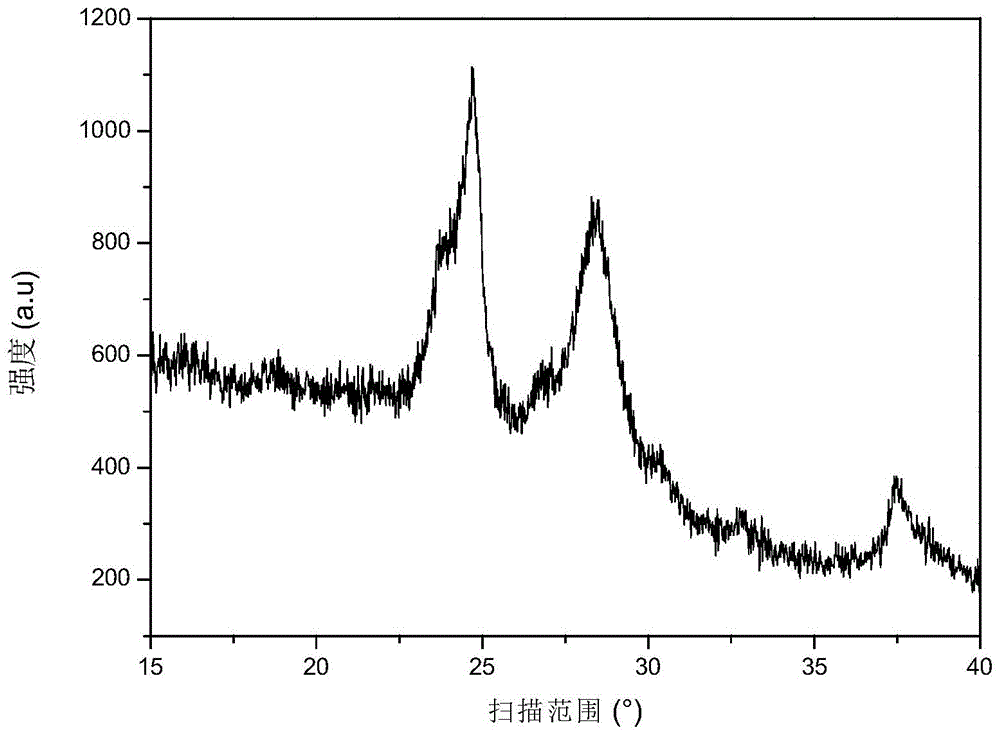
FIG. 1 is an XRD pattern of the negative electrode material prepared in this example, from which it can be seen that only the substance Li is present2Si2O5And characteristic peaks of silicon.
Fig. 2a is a photo of a gas generation test of the negative electrode material prepared in this example, and it can be seen from the photo that the aluminum plastic film bag has no bulge or protrusion and has a flat surface, which indicates that the material does not generate a gas generation phenomenon.
Fig. 2b is a photograph of a coating test of the negative electrode material prepared in this example, and it can be seen from the photograph that the pole piece is smooth and flat.
The results of conventional performance tests and electrochemical performance tests of the negative electrode material prepared in this example are shown in table 1 and table 2, respectively.
Example 3
The operation and materials were the same as those in example 2 except that the amount of phosphorus pentoxide added in step (3) was 30g and the amount of lithium hydride added was 120 g.
The anode material prepared in the embodiment comprises SiOx and Li2Si2O5The SiOx (x is 0.5) is uniformly dispersed in Li2Si2O5In (1). In the negative electrode material, SiOx and Li2Si2O5The mass ratio of (A) to (B) is 1.4. The surface of the negative electrode material is coated with a carbon layer, and the thickness of the carbon layer is 200 nm.
The results of conventional performance tests and electrochemical performance tests of the negative electrode material prepared in this example are shown in table 1 and table 2, respectively.
Example 4
This example prepares a negative electrode material as follows:
(1) taking 1kg of Si powder and 2kg of SiO2Putting the powder into a VC mixer to be mixed for 30min to obtain SiO2And Si; putting the mixture into a vacuum furnace; heating to 1300 ℃ under the negative pressure condition that the vacuum degree is 5Pa, preserving the heat for 18h, generating SiO steam in the furnace, and generating a SiOy block body after rapid condensation (the condensation temperature is 950 ℃); (2) the SiOy block is subjected to processes such as crushing, ball milling, grading and the like to control the median particle size to be about 6 mu m (D10 is 1.5 mu m, Dmax is 29 mu m), so as to obtain an SiOy powder material; measured y is 1.0.
(2) Taking 1.5kg of SiOy and 113g of asphalt, placing the SiOy and the asphalt in a VC machine, mixing for 30min, rotating at 800rpm, discharging, placing in a high-temperature box furnace, firing for 3h at 900 ℃, and introducing nitrogen into the box furnace for protection. Naturally cooling to room temperature and discharging to obtain the SiOy/C material.
(3) Taking SiOy/C1 kg and phosphorus pentoxide 20g, putting into a VC mixer, mixing for 40min, taking out to obtain a mixture of SiOy and phosphorus pentoxide, putting the mixture into a ball milling tank, adding 100g of lithium hydride, and ball milling for 20min, taking out to obtain a pre-lithium precursor; and (3) placing the precursor in an atmosphere protection furnace for heat treatment, wherein the heat treatment temperature is 800 ℃ under the protection of nitrogen, the heat treatment time is 2h, naturally cooling to room temperature, taking out the material, and obtaining the pre-lithium silicon oxide through screening and demagnetizing.
The anode material prepared in the embodiment comprises SiOx and Li2Si2O5The SiOx (x is 0.86) is uniformly dispersed in Li2Si2O5In (1). In the negative electrode material, SiOx and Li2Si2O5The mass ratio of (2) is 2.2. The surface of the negative electrode material is coated with a carbon layer, and the thickness of the carbon layer is 220 nm.
The results of conventional performance tests and electrochemical performance tests of the negative electrode material prepared in this example are shown in table 1 and table 2, respectively.
Example 5
This example prepares a negative electrode material as follows:
(1) 1kg of Si powder, 1.8kgSiO2Putting the powder into a VC mixer to be mixed for 30min to obtain SiO2And Si; putting the mixture into a vacuum furnace; heating to 1200 ℃ under the negative pressure condition that the vacuum degree is 5Pa, preserving the heat for 20h, generating SiO steam in the furnace, and generating a SiOy block through rapid condensation (the condensation temperature is 930 ℃); the SiOy block is subjected to processes such as crushing, ball milling, grading and the like to ensure that D10 is 1.5 mu m and Dmax is 26 mu m, so as to obtain an SiOy powder material; and y is measured to be 0.92.
(2) And putting 1.5kg of SiOy in a CVD rotary furnace, introducing methane as a carbon source, introducing nitrogen as a protective gas, depositing for 10h at 600 ℃, cooling and discharging to obtain the SiOy/C material.
(3) Taking SiOy/C1 kg and 70g of phosphorus pentoxide, putting into a VC mixer, mixing for 40min, taking out to obtain a mixture of SiOy and phosphorus pentoxide, putting the mixture into a ball milling tank, adding 100g of lithium hydride, and ball milling for 20min, taking out to obtain a pre-lithium precursor; and (3) placing the precursor in an atmosphere protection furnace for heat treatment, wherein the heat treatment temperature is 600 ℃ under the protection of nitrogen, the heat treatment time is 2h, naturally cooling to room temperature, taking out the material, and obtaining the pre-lithium silicon oxide through screening and demagnetizing.
The anode material prepared in the embodiment comprises SiOx and Li2Si2O5The SiOx (x is 0.7) is uniformly dispersed in Li2Si2O5In (1). In the negative electrode material, SiOx and Li2Si2O5The mass ratio of (2) to (2.0). The surface of the negative electrode material is coated with a carbon layer, and the thickness of the carbon layer is 199 nm.
The results of conventional performance tests and electrochemical performance tests of the negative electrode material prepared in this example are shown in table 1 and table 2, respectively.
Example 6
This example prepares a negative electrode material as follows:
(1) 1kg of Si powder, 2.2kg of SiO2Putting the powder into a VC mixer to be mixed for 30min to obtain SiO2And Si; putting the mixture into a vacuum furnace; heating to 1400 ℃ under the negative pressure condition of the vacuum degree of 5Pa, preserving heat for 16h, generating SiO steam in the furnace, and generating SiOy block after rapid condensation (the condensation temperature is 970 ℃); SiOy blockThe SiOy powder material is obtained by the processes of crushing, ball milling, grading and the like, wherein D10 is 1.6 mu m, and Dmax is 25 mu m; measured y 1.3.
(2) And (3) putting 1.5kg of SiOy in a CVD rotary furnace, introducing ethylene as a carbon source, introducing nitrogen as a protective gas, depositing for 30min at 1000 ℃, cooling and discharging to obtain the SiOy/C material.
(3) Taking SiOy/C1 kg and 100g of phosphorus pentoxide, putting into a VC mixer, mixing for 40min, taking out to obtain a mixture of SiOy and phosphorus pentoxide, putting the mixture into a ball milling tank, adding 100g of lithium hydride, and ball milling for 20min, taking out to obtain a pre-lithium precursor; and (3) placing the precursor in an atmosphere protection furnace for heat treatment, wherein the heat treatment temperature is 450 ℃ under the protection of nitrogen, the heat treatment time is 2h, naturally cooling to room temperature, taking out the material, and obtaining the pre-lithium silicon oxide through screening and demagnetizing.
The anode material prepared in the embodiment comprises SiOx and Li2Si2O5The SiOx (x is 1.2) is uniformly dispersed in Li2Si2O5In (1). In the negative electrode material, SiOx and Li2Si2O5The mass ratio of (2) to (2.1). The surface of the negative electrode material is coated with a carbon layer, and the thickness of the carbon layer is 204 nm.
The results of conventional performance tests and electrochemical performance tests of the negative electrode material prepared in this example are shown in table 1 and table 2, respectively.
Example 7
This example prepares a negative electrode material as follows:
(1) taking 1kg of Si powder and 2kg of SiO2Putting the powder into a VC mixer to be mixed for 30min to obtain SiO2And Si; putting the mixture into a vacuum furnace; heating to 1300 ℃ under the negative pressure condition that the vacuum degree is 5Pa, preserving the heat for 18h, generating SiO steam in the furnace, and generating a SiOy block body after rapid condensation (the condensation temperature is 950 ℃); (2) the SiOy block is subjected to processes such as crushing, ball milling, grading and the like to ensure that D10 is 1.1 mu m and Dmax is 27 mu m, so as to obtain an SiOy powder material; measured y is 1.0.
(2) Taking 1.5kg of SiOy and 113g of asphalt, placing the SiOy and the asphalt in a VC machine, mixing for 40min, rotating at the speed of 500rpm, discharging, placing in a high-temperature box-type furnace, firing for 6h at the temperature of 600 ℃, and introducing nitrogen into the box-type furnace for protection. Naturally cooling to room temperature and discharging to obtain the SiOy/C material.
(3) Taking SiOy/C1 kg and phosphorus pentoxide 20g, putting into a VC mixer, mixing for 40min, taking out to obtain a mixture of SiOy and phosphorus pentoxide, putting the mixture into a ball milling tank, adding 120g of lithium borohydride, ball milling for 20min, and taking out to obtain a pre-lithium precursor; and (3) placing the precursor in an atmosphere protection furnace for heat treatment, wherein the heat treatment temperature is 300 ℃ under the protection of argon, the heat treatment time is 2.5h, naturally cooling to room temperature, taking out the material, and obtaining the pre-lithium silicon oxide through screening and demagnetizing.
The anode material prepared in the embodiment comprises SiOx and Li2Si2O5The SiOx (x is 0.6) is uniformly dispersed in Li2Si2O5In (1). In the negative electrode material, SiOx and Li2Si2O5The mass ratio of (A) to (B) is 3.0. The surface of the negative electrode material is coated with a carbon layer, and the thickness of the carbon layer is 210 nm.
The results of conventional performance tests and electrochemical performance tests of the negative electrode material prepared in this example are shown in table 1 and table 2, respectively.
Example 8
This example prepares a negative electrode material as follows:
(1) taking 1kg of Si powder and 2kg of SiO2Putting the powder into a VC mixer to be mixed for 30min to obtain SiO2And Si; putting the mixture into a vacuum furnace; heating to 1300 ℃ under the negative pressure condition that the vacuum degree is 5Pa, preserving the heat for 18h, generating SiO steam in the furnace, and generating a SiOy block body after rapid condensation (the condensation temperature is 950 ℃); (2) the SiOy block is subjected to processes such as crushing, ball milling, grading and the like to ensure that D10 is 1.5 mu m and Dmax is 26 mu m, so as to obtain an SiOy powder material; measured y is 1.0.
(2) Taking 1.5kg of SiOy and 113g of asphalt, placing the SiOy and the asphalt in a VC machine, mixing for 50min at the rotating speed of 3000rpm, discharging, placing in a high-temperature box furnace, firing for 2h at 1000 ℃, and introducing nitrogen into the box furnace for protection. Naturally cooling to room temperature and discharging to obtain the SiOy/C material.
(3) Taking SiOy/C1 kg and 20g of phosphorus pentoxide, putting into a VC mixer, mixing for 40min, taking out to obtain a mixture of SiOy and phosphorus pentoxide, putting the mixture into a ball milling tank, adding 150g of metal lithium, and ball milling for 20min, taking out to obtain a pre-lithium precursor; and (3) placing the precursor in an atmosphere protection furnace for heat treatment, wherein the heat treatment temperature is 1000 ℃ under the protection of nitrogen, the heat treatment time is 1.5h, naturally cooling to room temperature, taking out the material, and obtaining the pre-lithium silicon oxide through screening and demagnetizing.
The anode material prepared in the embodiment comprises SiOx and Li2Si2O5The SiOx (x is 0.2) is uniformly dispersed in Li2Si2O5In (1). In the negative electrode material, SiOx and Li2Si2O5The mass ratio of (A) to (B) is 1.6. The surface of the negative electrode material is coated with a carbon layer, and the thickness of the carbon layer is 198 nm.
The results of conventional performance tests and electrochemical performance tests of the negative electrode material prepared in this example are shown in table 1 and table 2, respectively.
Example 9
This example was carried out in the same manner as example 4 except that the phosphorus pentoxide in step (3) was replaced with phosphorus trioxide.
The anode material prepared in the embodiment comprises SiOx and Li2Si2O5The SiOx (x is 0.9) is uniformly dispersed in Li2Si2O5In (1). In the negative electrode material, SiOx and Li2Si2O5The mass ratio of (2) to (3) is 2.3. The surface of the negative electrode material is coated with a carbon layer, and the thickness of the carbon layer is 207 nm.
The results of conventional performance tests and electrochemical performance tests of the negative electrode material prepared in this example are shown in table 1 and table 2, respectively.
Example 10
This example was carried out in the same manner as example 4 except that the phosphorus pentoxide in step (3) was replaced with lithium phosphate.
The anode material prepared in the embodiment comprises SiOx and Li2Si2O5The SiOx (x is 0.92) is uniformly dispersed in Li2Si2O5In (1). In the negative electrode material, SiOx and Li2Si2O5The mass ratio of (2) to (3) is 2.9. The negative electrode materialIs coated with a carbon layer, the thickness of the carbon layer is 250 nm.
Example 11
The operation and materials were the same as in example 2 except that the phosphorus pentoxide in step (3) was replaced with NaCl and the amount of NaCl added was 8 g.
The anode material prepared in the embodiment comprises SiOx and Li2Si2O5The SiOx (x is 0.9) is uniformly dispersed in Li2Si2O5In (1). In the negative electrode material, SiOx and Li2Si2O5The mass ratio of (3) to (5) is 3.5. The surface of the negative electrode material is coated with a carbon layer, and the thickness of the carbon layer is 180 nm.
The results of conventional performance tests and electrochemical performance tests of the negative electrode material prepared in this example are shown in table 1 and table 2, respectively.
Example 12
The operation and materials were the same as in example 11 except that the NaCl addition amount in step (3) was changed to 30 g.
The anode material prepared in the embodiment comprises SiOx and Li2Si2O5The SiOx (x is 0.3) is uniformly dispersed in Li2Si2O5In (1). In the negative electrode material, SiOx and Li2Si2O5The mass ratio of (A) to (B) is 0.2. The surface of the negative electrode material is coated with a carbon layer, and the thickness of the carbon layer is 800 nm.
The results of conventional performance tests and electrochemical performance tests of the negative electrode material prepared in this example are shown in table 1 and table 2, respectively.
The results of conventional performance tests and electrochemical performance tests of the negative electrode material prepared in this example are shown in table 1 and table 2, respectively.
Comparative example 1
This comparative example was the same as example 1 except that the operation of adding phosphorus pentoxide to SiOx and mixing in a VC mixer for 40min in step (2) was not performed.
The results of conventional performance tests and electrochemical performance tests of the negative electrode material prepared in the comparative example are shown in table 1 and table 2.
Comparative example 2
This comparative example was the same as example 4 except that the operation of adding phosphorus pentoxide to SiOx/C in step (3) and mixing in a VC mixer for 40min was not performed.
FIG. 3 is an XRD pattern of the anode material prepared in this comparative example, from which it can be seen that characteristic peaks of Si and Li are excluded2Si2O5In addition to the characteristic peaks, there are Li2SiO3The characteristic peak of (2) is present.
Fig. 4a is a photograph showing a gassing test of the negative electrode material prepared in the present comparative example, from which it can be seen that the sealed aluminum plastic film pouch is bulged, illustrating the occurrence of gassing inside.
Fig. 4b is a photograph of a coating test of the negative electrode material prepared in the present comparative example, from which it can be seen that the pole piece is covered with pinholes.
The results of conventional performance tests and electrochemical performance tests of the negative electrode material prepared in the comparative example are shown in table 1 and table 2.
Comparative example 3
This comparative example was conducted in the same manner as example 2 except that the amount of phosphorus pentoxide added in step (3) was 5 g.
The negative electrode material prepared in this comparative example included SiOx and Li2Si2O5The SiOx (x is 0.95) is uniformly dispersed in Li2Si2O5In (1). In the negative electrode material, SiOx and Li2Si2O5The mass ratio of (2) is 6.1. The surface of the negative electrode material is coated with a carbon layer, and the thickness of the carbon layer is 200 nm.
The results of conventional performance tests and electrochemical performance tests of the negative electrode material prepared in the comparative example are shown in table 1 and table 2.
Comparative example 4
This comparative example was conducted in the same manner as example 2 except that the amount of phosphorus pentoxide added in step (3) was 10 g.
The negative electrode material prepared in this comparative example included SiOx and Li2Si2O5Said SiOx (x is 0.88) is uniformDispersed in Li2Si2O5In (1). In the negative electrode material, SiOx and Li2Si2O5The mass ratio of (2) is 5.0. The surface of the negative electrode material is coated with a carbon layer, and the thickness of the carbon layer is 190 nm.
The results of conventional performance tests and electrochemical performance tests of the negative electrode material prepared in the comparative example are shown in table 1 and table 2.
Test method
1. XRD test:
10 wt% of magnesium oxide was added as a standard substance, uniformly mixed into the anode materials to be tested prepared in each example and comparative example, and subjected to a test by flaking. Angle range: 10-90 DEG, scanning mode: step scanning, selecting the width of the slit to be 1.0, and setting the voltage to be 40kW and the current to be 40 mA. The measured data are used for calculating the relative content of each component through Jade 6.5.
2. Test of processability
(1) And (4) gas production testing. The negative electrode materials prepared in each example and comparative example were used as active materials, SBR + CMC was used as a binder, and conductive carbon black was added in the following ratio by active material: conductive agent: and (3) uniformly stirring and mixing the binder at a ratio of 95:2:3 at a high speed to obtain slurry, filling the slurry into an aluminum-plastic film bag, sealing, standing, monitoring the shape change of the aluminum-plastic film bag, and monitoring for 1 month.
(2) And (5) coating and testing. And uniformly coating the prepared slurry in the gas production test on the copper foil, and observing whether pinholes, air holes and pits exist on the surface of the pole piece after drying.
3. Electricity withholding test
Respectively taking the negative electrode materials prepared in the examples and the comparative examples as active substances, taking SBR and CMC as binders, adding conductive carbon black, stirring, pulping, coating on a copper foil, and finally drying and rolling to prepare a negative electrode sheet, wherein the active substances are: conductive agent: binder 85:15: 10. Metal lithium sheet as counter electrode, PP/PE as diaphragm, LiPF6The electrolyte solution was EC + DEC + DMC (EC, DEC and DMC in a volume ratio of 1:1:1), and the simulated cell was assembled in an argon-filled glove box. The electrochemical performance and the charging voltage of the button cell are tested by adopting a blue 5V/10mA type cell testerIt is 1.5V, discharged to 0.01V, and the charge-discharge rate is 0.1C.
4. Cycle testing
The anode materials prepared in the examples and the comparative examples and graphite are mixed according to the mass ratio of 1: 9 as active material after being mixed evenly, taking a metal lithium sheet as a counter electrode, taking PP/PE as a diaphragm and LiPF6The button cell is assembled in an argon-filled glove box by taking/EC + DEC + DMC (the volume ratio of EC, DEC and DMC is 1:1:1) as an electrolyte, and a blue 5V/10mA type battery tester is adopted to test the electrochemical performance of the battery for 50 weeks, wherein the charging voltage is 1.5V, the discharge voltage is 0.01V, and the charge-discharge rate is 0.1C.
The results of the above tests are shown in tables 1 and 2.
TABLE 1
TABLE 2
| Experiment of
|
Discharge capacity mAh/g
|
First effect%
|
Capacity retention at 50 weeks%
|
| Example 1
|
1308
|
86.5
|
88.8
|
| Example 2
|
1417
|
88.9
|
89.1
|
| Example 3
|
1420
|
89.5
|
90.5
|
| Example 4
|
1411
|
88.6
|
90.0
|
| Example 5
|
1400
|
88.3
|
89.1
|
| Example 6
|
1404
|
86.5
|
89.4
|
| Example 7
|
1415
|
88.4
|
90.2
|
| Example 8
|
1407
|
90.5
|
90.1
|
| Example 9
|
1388
|
87.0
|
88.8
|
| Example 10
|
1380
|
87.2
|
88.9
|
| Example 11
|
1394
|
88.8
|
90.0
|
| Example 12
|
1405
|
89.7
|
91.8
|
| Comparative example 1
|
1720
|
76.8
|
75.8
|
| Comparative example 2
|
1720
|
76.8
|
75.8
|
| Comparative example 3
|
1401
|
86.7
|
82.2
|
| Comparative example 4
|
1421
|
86.5
|
84.6 |
From example 2, example 3, comparativeAs can be seen from examples 3 and 4, as P increases2O5Increased addition amount of Li2SiO3The content gradually decreases, and when the addition amount reaches 2%, no Li is already available2SiO3The processing property of the material is improved. As can be seen from examples 1, 2 and 4, the carbon coating is followed by the prelithiation reaction, and the addition of the nucleation conversion agent can obtain better conversion effect, and the carbon source species is Li2SiO3The conversion effect of (2) has no influence.
In general, after addition of the nucleation conversion agent, it follows Li2Si2O5The quantity is increased, and the cycle performance of the material is obviously improved; when Li is present2SiO3All conversion to Li2Si2O5After that, the cycle retention rate of the material is stabilized at 88% or more.
Examples 9-10 No use of nucleation conversion agent P2O5Whereas other kinds of nucleation converters are used. In comparison with example 4, the materials prepared in examples 9 and 10 were added with P in a capacity and cycle average ratio2O5May be caused by different kinds of converting agents. Because of P2O5For Li2SiO3Conversion to Li2Si2O5The effect of (A) is more remarkable, and P is added2O5Li in the rear Material2Si2O5The content is more, and the swelling inhibition effect on the circulation process is stronger.
The addition of the endothermic agent in examples 11 to 12 also makes it possible to obtain a final product containing only Li2Si2O5And exhibits good first coulombic efficiency and cycle performance.
Comparative example 1 No nucleation conversion agent was added on the basis of example 1, resulting in Li2SiO3Higher content, worse processing property, more gas generation, obvious pinholes after coating, and obviously inferior first effect and cycle performance to those of the example 1. The situation of comparative example 2 is the same as that of comparative example 1, and no nucleation transforming agent is added, so that the processing performance of the product is deteriorated, the gas generation is more, obvious pinholes appear after coating, and the first effect and the cycle performance are inferior to those of example 4.
The applicant states that the present invention is illustrated in detail by the above examples, but the present invention is not limited to the above detailed methods, i.e. it is not meant that the present invention must rely on the above detailed methods for its implementation. It should be understood by those skilled in the art that any modification of the present invention, equivalent substitutions of the raw materials of the product of the present invention, addition of auxiliary components, selection of specific modes, etc., are within the scope and disclosure of the present invention.