Disclosure of Invention
Aiming at the defects of the prior art, the invention aims to provide a modified polymer, a polymer electrolyte, a preparation method and an application thereof.
In order to achieve the purpose, the invention adopts the following technical scheme:
in a first aspect, the present invention provides a modified polymer obtained by reacting methoxypolyethylene glycol monomethacrylate and a modifying monomer; the modified monomer is a compound containing vinyl and sulfonic acid groups.
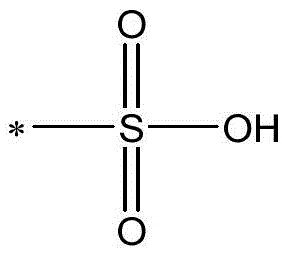
In the present invention, the sulfonic acid group is
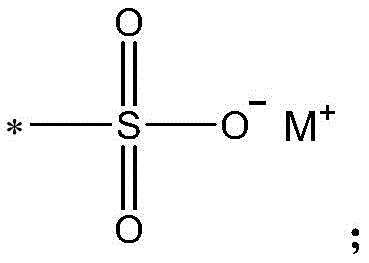
And/or
Wherein represents the attachment site of the group; m
+Represents a positive ion, illustratively including but not limited to: potassium ion, sodium ion, lithium ion, ammonium ion, or the like. The same description is hereinafter referred to with the same meaning.
The modified polymer provided by the invention is obtained by the reaction of methoxypolyethylene glycol monomethacrylate (PEGMA) and a modified monomer, the modified monomer containing sulfonic acid groups is connected with PEGMA through chemical bonds, the chain segment regularity of PEGMA is damaged, the modified polymer contains a flexible branched chain structure, the glass transition temperature is reduced, and when the modified polymer is applied to a polymer electrolyte, a more stable three-dimensional polymerization network can be formed, so that liquid leakage and short circuit are prevented, and the mechanical property is improved; meanwhile, sulfonic acid groups are introduced into the side chains of the modified polymer, which is beneficial to further dissociation of lithium salts and improvement of the ionic conductivity of the polymer electrolyte.
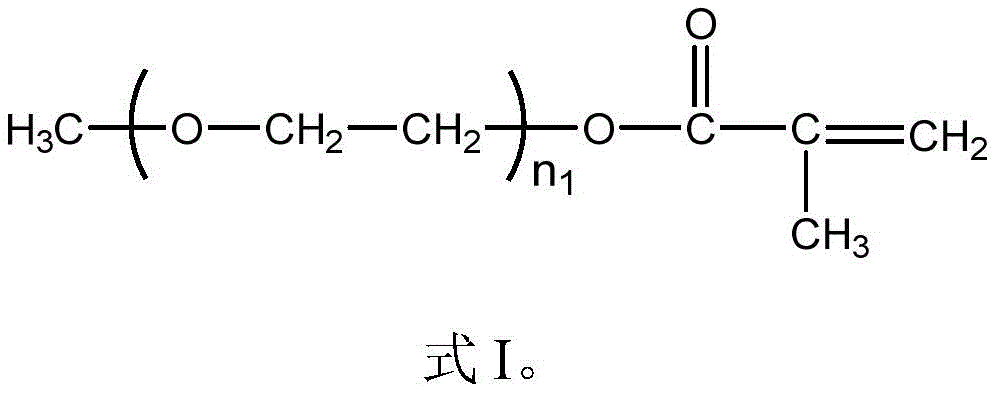
In the invention, the methoxypolyethylene glycol monomethacrylate (PEGMA) has a structure shown in a formula I:
in the formula I, n1The number of repeating units is an integer selected from 1 to 50, and may be, for example, 2, 5, 8, 10, 12, 15, 18, 20, 22, 25, 28, 30, 32, 35, 38, 40, 42, 45 or 48, and the specific values therebetween are not exhaustive for the sake of brevity and clarity.
Preferably, the number average molecular weight of the methoxypolyethylene glycol monomethacrylate is 300-1000 g/mol, and may be, for example, 320g/mol, 350g/mol, 380g/mol, 400g/mol, 420g/mol, 450g/mol, 470g/mol, 500g/mol, 550g/mol, 600g/mol, 630g/mol, 650g/mol, 680g/mol, 700g/mol, 750g/mol, 800g/mol, 850g/mol, 900g/mol, 950g/mol or 980g/mol, and specific values therebetween, which are limited in space and for the sake of brevity, and the present invention is not exhaustive of the specific values included in the ranges.
Preferably, the modifying monomer comprises any one of 2-acrylamide-2-methylpropanesulfonic acid, vinylsulfonic acid, vinylsulfonate, allylsulfonate, vinylbenzenesulfonic acid or p-styrenesulfonate or a combination of at least two of the two.
Preferably, the vinyl sulfonate comprises sodium and/or potassium vinyl sulfonate; the allyl sulfonate comprises sodium allyl sulfonate and/or potassium allyl sulfonate; the vinyl benzene sulfonate comprises sodium vinyl benzene sulfonate and/or potassium vinyl benzene sulfonate; the p-styrene sulfonate comprises sodium p-styrene sulfonate and/or potassium p-styrene sulfonate.
The molar ratio of the methoxypolyethylene glycol monomethacrylate to the modifying monomer is preferably (0.5 to 2: 1), and may be, for example, 0.6:1, 0.8:1, 1:1, 1.1:1, 1.2:1, 1.3:1, 1.4:1, 1.5:1, 1.6:1, 1.7:1, 1.8:1, or 1.9: 1.
According to the preferable technical scheme, the molar ratio of the methoxypolyethylene glycol monomethacrylate to the modified monomer is (0.5-2): 1, so that the modified polymer has a proper flexible branched chain structure, the dissociation degree of lithium salt is improved, and the polymer electrolyte containing the modified polymer has better comprehensive performance. If the molar weight of the modified monomer is too low, the modification effect is not obvious; if the molar amount of the modifying monomer is too high, the resulting modified polymer has poor solubility and is not suitable for later use.
Preferably, the number average molecular weight of the modified polymer is 500 to 1500g/mol, for example 550g/mol, 600g/mol, 650g/mol, 700g/mol, 750g/mol, 800g/mol, 850g/mol, 900g/mol, 950g/mol, 1000g/mol, 1100g/mol, 1200g/mol, 1300g/mol, 1400g/mol or 1450g/mol, and the specific values therebetween are limited to space and for the sake of brevity, and the invention is not exhaustive.
Preferably, the reaction is carried out under initiation of an initiator.
Preferably, the initiator is a thermal initiator.
Preferably, the thermal initiator includes any one of organic peroxide, azo compound (such as azobisisobutyronitrile, etc.), persulfate (such as ammonium persulfate), hydrogen peroxide, ferric chloride or ferrous chloride, or a combination of at least two of them.
Preferably, the organic peroxide comprises any one of benzoyl peroxide, tert-butyl hydroperoxide or tert-butyl peroxybenzoate or a combination of at least two of them.
In a second aspect, the present invention provides a process for preparing a modified polymer as described in the first aspect, the process comprising the steps of:
(1) carrying out polymerization reaction on methoxy polyethylene glycol monomethacrylate in the presence of an initiator to obtain a prepolymer;
(2) and (2) mixing a modified monomer with the prepolymer obtained in the step (1) and then reacting to obtain the modified polymer.
In the preparation process of the modified polymer, PEGMA is firstly subjected to a certain degree of self-polymerization reaction, and the obtained prepolymer is further reacted with a modified monomer to obtain a target product. The preparation method can combine the modified monomer with PEGMA through covalent bond to form a modified polymer with a proper branched chain structure and molecular weight; if PEGMA and the modified monomer are directly reacted in the presence of an initiator, the reaction process is difficult to control, and implosion is easy to occur.
Preferably, the initiator of step (1) is a thermal initiator.
Preferably, the thermal initiator comprises any one of organic peroxide, azo compound, persulfate, hydrogen peroxide, ferric chloride or ferrous chloride or a combination of at least two of the organic peroxide, the azo compound, the persulfate, the hydrogen peroxide, the ferric chloride or the ferrous chloride.
Preferably, the organic peroxide comprises any one of benzoyl peroxide, tert-butyl hydroperoxide or tert-butyl peroxybenzoate or a combination of at least two of them.
Preferably, the initiator has a mass of 0.01 to 1%, for example, 0.02%, 0.05%, 0.08%, 0.1%, 0.2%, 0.3%, 0.4%, 0.5%, 0.6%, 0.7%, 0.8%, or 0.9%, based on 100% of the total mass of the methoxypolyethylene glycol monomethacrylate and the modifying monomer, and specific points therebetween are not intended to be exhaustive, and for brevity and clarity, the invention is not intended to be limited to the specific points included in the ranges.
Preferably, the polymerization reaction of step (1) is carried out in the presence of a solvent.
Preferably, the solvent comprises any one of N, N-Dimethylformamide (DMF), N-Dimethylacetamide (DMAC) or Dimethylsulfoxide (DMSO), or a combination of at least two thereof.
Preferably, the polymerization temperature in step (1) is 40-100 ℃, for example, 45 ℃, 50 ℃, 55 ℃, 60 ℃, 65 ℃, 70 ℃, 75 ℃, 80 ℃, 85 ℃, 90 ℃ or 95 ℃, and the specific values therebetween are limited by space and for the sake of brevity, and the invention is not exhaustive.
Preferably, the polymerization reaction time in the step (1) is 20-60 min, for example, 22min, 25min, 28min, 30min, 32min, 35min, 38min, 40min, 42min, 45min, 48min, 50min, 52min, 55min or 58min, and the specific values therebetween are limited by space and for brevity, the invention is not exhaustive.
Preferably, the polymerization reaction of step (1) is carried out in a protective atmosphere, preferably nitrogen.
Preferably, the modifying monomer of step (2) is mixed with the prepolymer by dropping.
Preferably, the reaction temperature in the step (2) is 40-100 ℃, for example, 45 ℃, 50 ℃, 55 ℃, 60 ℃, 65 ℃, 70 ℃, 75 ℃, 80 ℃, 85 ℃, 90 ℃ or 95 ℃, and the specific values therebetween are limited by space and for the sake of brevity, and the invention is not exhaustive.
Preferably, the reaction time in step (2) is 4 to 7 hours, for example, 4.2 hours, 4.5 hours, 4.8 hours, 5 hours, 5.2 hours, 5.5 hours, 5.8 hours, 6 hours, 6.2 hours, 6.5 hours or 6.8 hours, and the specific values therebetween are not exhaustive, and for brevity and clarity, the invention is not intended to be limited to the specific values included in the range.
Preferably, the reaction of step (2) is carried out in a protective atmosphere.
Preferably, the protective atmosphere is nitrogen.
Preferably, the reaction in step (2) further comprises a post-treatment step after the reaction is completed.
Preferably, the method of post-processing comprises: and mixing the reaction product with a precipitator, precipitating, and concentrating and drying a lower-layer substance to obtain the modified polymer.
Preferably, the precipitant is a mixture of toluene and n-hexane.
The volume ratio of toluene to n-hexane is preferably 1 (1.1 to 1.7), and may be, for example, 1:1.15, 1:1.2, 1:1.25, 1:1.3, 1:1.35, 1:1.4, 1:1.45, 1:1.5, 1:1.55, 1:1.6, or 1: 1.65.
Preferably, the precipitation time is 12-36 h, for example, 13h, 15h, 16h, 18h, 20h, 22h, 24h, 26h, 28h, 30h, 32h or 34h, and the specific values therebetween are limited by space and for the sake of brevity, and the invention is not exhaustive.
Preferably, the preparation method specifically comprises the following steps:
(1) mixing methoxy polyethylene glycol monomethacrylate and a solvent to obtain a mixed solution; adding an initiator into the mixed solution, and reacting for 20-60 min at 40-100 ℃ in a protective atmosphere to obtain a prepolymer;
(2) dropwise adding a solution of a modified monomer into the prepolymer obtained in the step (1) in a protective atmosphere, and reacting for 4-7 h at 40-100 ℃ after dropwise adding; after the reaction is finished, mixing the product with a precipitator, precipitating for 12-36 h, and concentrating and drying the lower-layer substances to obtain the modified polymer; the precipitator is a mixture of toluene and n-hexane in a volume ratio of 1 (1.1-1.7).
In a third aspect, the present invention provides a polymer electrolyte obtained by a precursor solution polymerization reaction; the precursor solution comprises a combination of a cross-linking agent, the modified polymer according to the first aspect, a lithium salt electrolyte solution, and a photoinitiator.
The polymer electrolyte provided by the invention is a quasi-solid (gel) polymer electrolyte, and is obtained by a polymerization reaction of a precursor solution, wherein the precursor solution comprises a cross-linking agent, the modified polymer provided by the invention, a lithium salt electrolyte solution and a photoinitiator; wherein the modified polymer contains polyethylene glycol (PEO, -O-CH)2-CH2-) repeating units, capable of dissolving a large amount of lithium salt,the side chain of the modified polymer contains sulfonic acid groups, so that more lithium salts can be dissociated, and the polymer electrolyte is endowed with higher ionic conductivity; meanwhile, the modified polymer and the cross-linking agent contain curable structural units, and can generate polymerization reaction under ultraviolet irradiation in the presence of a photoinitiator to form a compact and stable cross-linking network in a polymer electrolyte, so that a lithium salt electrolyte solution is limited in a polymer structure, the problems of liquid leakage and short circuit are prevented, and the mechanical properties and stability such as flexibility, strength and the like are improved.
Preferably, the mass of the modified polymer is 5 to 25% based on 100% of the total mass of the crosslinking agent and the lithium salt electrolyte solution, and may be, for example, 6%, 8%, 10%, 11%, 13%, 15%, 17%, 19%, 20%, 21%, 23% or 24%, and specific values therebetween are limited to space and for the sake of brevity, and the present invention does not exhaustive list the specific values included in the range.
According to the preferable technical scheme, the mass of the modified polymer is 5-25% based on 100% of the total mass of the cross-linking agent and the lithium salt electrolyte solution, and the polymer electrolyte has excellent ionic conductivity, flexibility and mechanical strength due to the specific content of the modified polymer. If the dosage of the modified polymer is too small, the flexibility, the strength and the ionic conductivity of the polymer electrolyte are reduced, and the service performance is reduced; if the amount of the modified polymer is too much, the modified polymer is yellow, which results in darker color of the polymer electrolyte, and further influences the color and optical performance of the electrochromic device.
Preferably, the cross-linking agent is a polyethylene glycol compound containing acrylate groups.
Preferably, the cross-linking agent comprises methoxypolyethylene glycol monomethacrylate (PEGMA) and/or polyethylene glycol diacrylate (PEGDA).
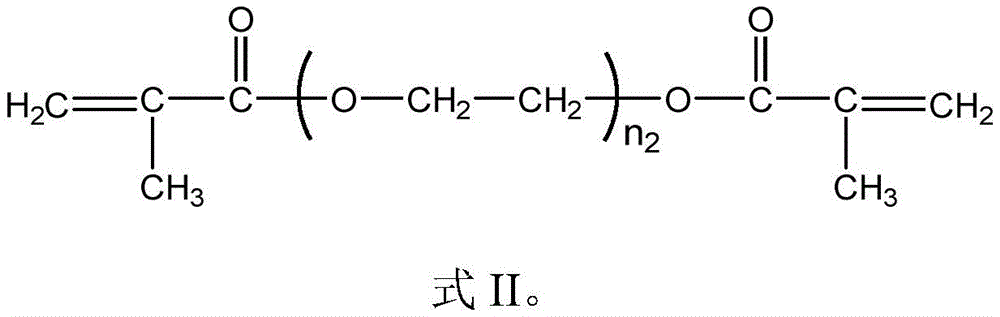
In the invention, the methoxypolyethylene glycol monomethacrylate (PEGMA) has a structure shown in a formula I, and is not repeated herein; the polyethylene glycol diacrylate (PEGDA) has a structure as shown in formula II:
in the formula II, n2The number of repeating units is an integer selected from 1 to 50, and may be, for example, 2, 5, 8, 10, 12, 15, 18, 20, 22, 25, 28, 30, 32, 35, 38, 40, 42, 45 or 48, and the specific values therebetween are not exhaustive for the sake of brevity and clarity.
Preferably, the cross-linking agent is a combination of methoxypolyethylene glycol monomethacrylate and polyethylene glycol diacrylate.
Preferably, the mass ratio of the methoxypolyethylene glycol monomethacrylate to the polyethylene glycol diacrylate is (1-5): 1, and may be, for example, 1.2:1, 1.5:1, 1.8:1, 2:1, 2.2:1, 2.5:1, 2.8:1, 3:1, 3.2:1, 3.5:1, 3.8:1, 4:1, 4.2:1, 4.5:1, or 4.8: 1; the two are compounded according to a specific mass ratio and are mutually cooperated with the modified polymer, so that the polymer electrolyte can achieve better balance in the aspects of flexibility, mechanical property, cycling stability and ionic conductivity.
Preferably, the number average molecular weight of the methoxypolyethylene glycol monomethacrylate is 300-1000 g/mol, and may be, for example, 320g/mol, 350g/mol, 380g/mol, 400g/mol, 420g/mol, 450g/mol, 470g/mol, 500g/mol, 550g/mol, 600g/mol, 630g/mol, 650g/mol, 680g/mol, 700g/mol, 750g/mol, 800g/mol, 850g/mol, 900g/mol, 950g/mol or 980g/mol, and specific values therebetween, which are limited in space and for the sake of brevity, and the present invention is not exhaustive of the specific values included in the ranges.
Preferably, the number average molecular weight of the polyethylene glycol diacrylate is 200-2000 g/mol, such as 250g/mol, 300g/mol, 350g/mol, 400g/mol, 450g/mol, 500g/mol, 550g/mol, 600g/mol, 620g/mol, 650g/mol, 680g/mol, 700g/mol, 720g/mol, 750g/mol, 780g/mol, 800g/mol, 850g/mol, 900g/mol, 950g/mol, 1000g/mol, 1100g/mol, 1200g/mol, 1300g/mol, 1400g/mol, 1500g/mol, 1600g/mol, 1700g/mol, 1800g/mol or 1900g/mol, and specific values therebetween, limited in breadth and for simplicity, the invention is not intended to be exhaustive of the specific point values included in the ranges.
Preferably, the lithium salt electrolyte solution includes a lithium salt and an organic solvent.
Preferably, the lithium salt includes any one of lithium hexafluorophosphate, lithium hexafluoroarsenate, lithium perchlorate, lithium tetrafluoroborate, lithium bis (oxalato) borate, lithium trifluoromethanesulfonate, lithium bis (trifluoromethanesulfonate) imide or lithium tris (trifluoromethanesulfonyl) methide or a combination of at least two thereof.
Preferably, the organic solvent includes a chain carbonate and/or a cyclic carbonate.
Preferably, the organic solvent comprises any one or a combination of at least two of ethylene carbonate, propylene carbonate, dimethyl carbonate, diethyl carbonate or ethyl methyl carbonate; the manner of the combination illustratively includes, but is not limited to: a combination of ethylene carbonate and diethyl carbonate, a combination of ethylene carbonate and dimethyl carbonate, a combination of propylene carbonate and diethyl carbonate, a combination of ethylene carbonate and ethyl methyl carbonate, and the like.
Preferably, the lithium salt electrolyte solution contains 25 to 35% by mass of lithium salt, for example, 25.5%, 26%, 26.5%, 27%, 27.5%, 28%, 28.5%, 29%, 29.5%, 30%, 30.5%, 31%, 31.5%, 32%, 32.5%, 33%, 33.5%, 34% or 34.5%, and specific values therebetween are not limited to space and for brevity, and the invention is not exhaustive.
The mass ratio of the lithium salt electrolyte solution to the crosslinking agent is preferably 1 (0.2 to 0.5), and may be, for example, 1:0.22, 1:0.25, 1:0.28, 1:0.3, 1:0.32, 1:0.35, 1:0.38, 1:0.4, 1:0.42, 1:0.45, or 1: 0.48.
Preferably, the photoinitiator comprises 2-hydroxy-2-methyl-1-phenyl-1-propanone (photoinitiator 1173) and/or phenyl- (2,4, 6-trimethylbenzoyl) oxyphosphorus (TPO).
Preferably, the photoinitiator has a mass of 0.05 to 0.5%, for example, 0.06%, 0.08%, 0.1%, 0.12%, 0.15%, 0.18%, 0.2%, 0.22%, 0.25%, 0.28%, 0.3%, 0.32%, 0.35%, 0.38%, 0.4%, 0.42%, 0.45%, or 0.48% based on 100% of the total mass of the crosslinking agent, the modifying polymer, and the lithium salt electrolyte solution, and specific points between the above points, including space and simplicity, are not exhaustive.
As a preferred embodiment of the present invention, the precursor solution further includes any one or a combination of at least two of graphene, other functional polymers, or other inorganic nanofillers, so as to realize functionalization of the polymer electrolyte.
In a fourth aspect, the present invention provides a method for producing the polymer electrolyte according to the third aspect, the method comprising the steps of:
(A) mixing a cross-linking agent, a modified polymer and a lithium salt electrolyte solution to obtain a mixed solution;
(B) mixing a photoinitiator with the mixed solution obtained in the step (A) to obtain a precursor solution;
(C) and (C) carrying out polymerization reaction on the precursor solution obtained in the step (B) to obtain the polymer electrolyte.
Preferably, the mixing of step (a) is carried out under stirring conditions.
Preferably, the mixing time in step (a) is 0.5-2 h, for example, 0.6h, 0.8h, 1h, 1.1h, 1.3h, 1.5h, 1.7h or 1.9h, and the specific values therebetween are not exhaustive, and for brevity and clarity.
Preferably, the mixing of step (B) is carried out under exclusion of light.
Preferably, the mixing time in step (B) is 0.5-2 h, for example, 0.6h, 0.8h, 1h, 1.1h, 1.3h, 1.5h, 1.7h or 1.9h, and the specific values therebetween are not exhaustive, and for brevity and clarity.
Preferably, the step (B) further comprises a defoaming step after the mixing.
Preferably, the polymerization reaction of step (C) is carried out under uv irradiation.
Preferably, the wavelength of the ultraviolet light is 300-400 nm, for example, 310nm, 320nm, 330nm, 340nm, 350nm, 360nm, 365nm, 370nm, 380nm or 390nm, and specific values therebetween, which are limited by space and for brevity, the present invention is not exhaustive of the specific values included in the range; the wavelength of the ultraviolet light can be adaptively adjusted according to the type of the photoinitiator.
Preferably, the polymerization time in step (C) is 5 to 60s, for example, 6s, 8s, 10s, 12s, 15s, 18s, 20s, 22s, 25s, 28s, 30s, 32s, 35s, 38s, 40s, 42s, 45s, 48s, 50s, 52s, 55s, or 58s, and the specific values therebetween are limited by the space and for the sake of brevity, and the invention is not exhaustive.
Preferably, the polymerization is carried out in a curing oven (2.3 kW).
The polymer electrolyte provided by the invention can be applied to electrochromic devices, lithium ion batteries, sensors, supercapacitors or electroluminescent devices and the like.
In a fifth aspect, the present invention provides an electrochromic device, including a first flexible electrode layer, an electrochromic layer, an electrolyte layer, an ion storage layer, and a second flexible electrode layer, which are sequentially disposed; the material of the electrolyte layer comprises the polymer electrolyte according to the third aspect.
Preferably, the material of the first flexible electrode layer and the second flexible electrode layer is a PET-ITO conductive film.
Preferably, the material of the electrochromic layer comprises an inorganic electrochromic material and/or an organic electrochromic material.
Preferably, the inorganic electrochromic material comprises WO3NiO or Ta2O5Any one or a combination of at least two of them.
Preferably, the organic electrochromic material comprises any one of or a combination of at least two of viologens, polypyrroles, polyanilines or polythiophenes.
Preferably, the material of the ion storage layer comprises a combination of poly (3, 4-ethylenedioxythiophene) (PEDOT) and polystyrene sulfonate (PSS).
Compared with the prior art, the invention has the following beneficial effects:
(1) in the modified polymer provided by the invention, PEGMA is modified by a modified monomer containing a sulfonic group, the chain segment regularity of PEGMA is damaged, the modified polymer contains a flexible branched chain structure, and when the modified polymer is applied to a polymer electrolyte, a more stable three-dimensional polymerization network can be formed, so that liquid leakage and short circuit are prevented, and the mechanical property and the cycling stability are improved; meanwhile, sulfonic acid groups are introduced into the side chains of the modified polymer, which is beneficial to further dissociation of lithium salts and improvement of the ionic conductivity of the polymer electrolyte.
(2) The polymer electrolyte provided by the invention is obtained by a polymerization reaction of a precursor solution, wherein the precursor solution comprises a modified polymer, a cross-linking agent, a lithium salt electrolyte solution and a photoinitiator; the modified polymer can dissolve a large amount of lithium salt and promote the dissociation of the lithium salt, so that the polymer electrolyte has higher ionic conductivity which can reach 2.274 multiplied by 10-3~2.468×10⁻³·S·cm-1(ii) a In addition, the modified polymer and the cross-linking agent are subjected to polymerization reaction to form a compact and stable three-dimensional cross-linked network in the polymer electrolyte, so that the lithium salt electrolyte solution is limited in the polymer structure, the problems of liquid leakage and short circuit are solved, and the lithium salt electrolyte has excellent flexibility, mechanical strength and cycling stability.
(3) The electrochromic device containing the modified polymer and the polymer electrolyte has good comprehensive performance, the optical modulation rate is 38.05-39.01%, the optical modulation rate after circulation for 400 times is 32.22-34.42%, the change rate is as low as 11.69-15.32%, the circulation stability is excellent, and the application requirements of the high-performance electrochromic device can be fully met.
Detailed Description
The technical solution of the present invention is further explained by the following embodiments. It should be understood by those skilled in the art that the examples are only for the understanding of the present invention and should not be construed as the specific limitations of the present invention.
Example 1
A modified polymer A1 is prepared by reacting methoxypolyethylene glycol monomethacrylate (PEGMA, number average molecular weight 630g/mol) with 2-acrylamide-2-methylpropanesulfonic Acid (AMPS); the molar ratio of PEGMA to AMPS is 2: 1; the reaction formula is as follows:
the preparation method comprises the following steps:
(1) dissolving 6.09g of PEGMA in N, N-Dimethylformamide (DMF) in a three-necked flask under nitrogen atmosphere, and mixing and stirring for 1.5h to obtain a uniform mixed solution; then 0.036g of dissolved Azobisisobutyronitrile (AIBN) is injected into a three-necked bottle through a needle tube, and the mixture reacts for 30min at 60 ℃ in a nitrogen atmosphere to obtain a prepolymer;
(2) dissolving 1g of AMPS in DMF, dropwise adding the solution into the prepolymer obtained in the step (1) through a dropping funnel, reacting for 4 hours at 60 ℃ after dropwise adding, turning off heating, and cooling the product;
(3) preparing a precipitating agent according to the ratio of toluene to n-hexane being 1:1.5 (volume ratio), slowly pouring the product obtained in the step (2) into 1000mL of precipitation liquid, stirring and precipitating for 24h, and taking down the oily substance in the lower layer; the lower layer oil was rotary evaporated at 60 ℃ and then dried in a vacuum oven at 80 ℃ for 48h to give a pale yellow modified polymer A1.
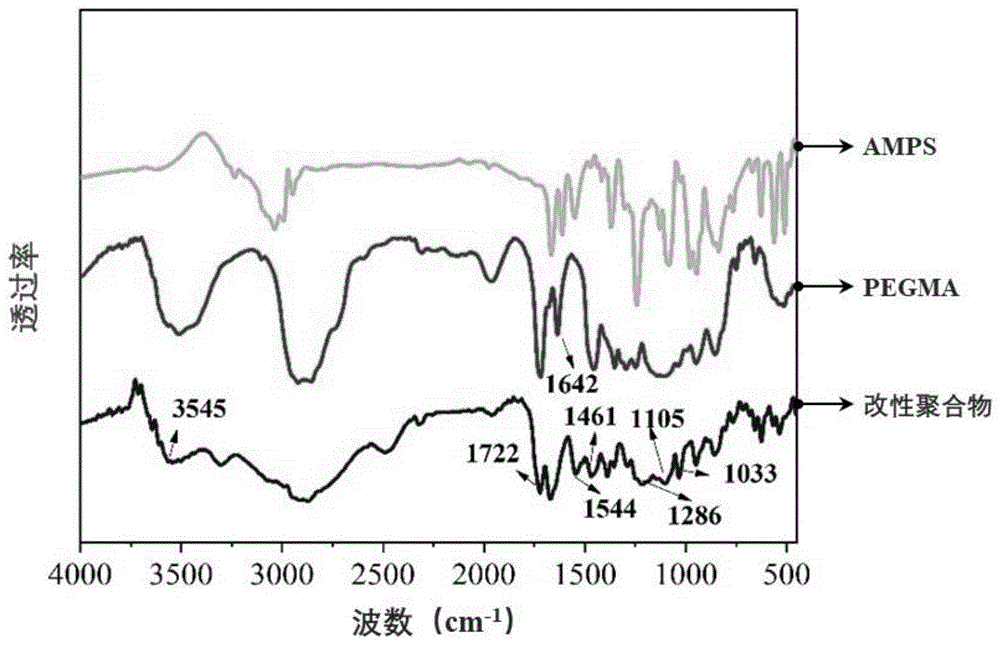
The modified polymer A1 provided in this example was characterized by Fourier transform Infrared Spectroscopy (Nicolet 380) with a resolution capability of 0.09cm-1The scanning range is 4000-400 cm-1The obtained infrared spectrum is shown in fig. 1, and it is understood from fig. 1 that the C ═ C bond (1642 cm) related to the acrylate group in PEGMA is comparable to those of the raw materials PEGMA and AMPS-1) The characteristic peak of (a) is decreased, indicating the occurrence of polymerization. The modified polymer A1 is respectively at 3545cm-1(N-H)、1722cm-1(C ═ O) shows a clear absorption peak, and 1644cm-1And 1461cm-1A characteristic absorption peak of 1286cm appears at the position of O ═ C-N-1A characteristic absorption peak of C-O appears at 1105cm-1And 1033cm-1Characteristic absorption peaks corresponding to O ═ S ═ O also appear. The appearance of these absorption bands confirms the formation of AMPS-PEGMA polymer.
Example 2
A modified polymer A2, obtained by reacting PEGMA (number average molecular weight 630g/mol) with AMPS; the molar ratio of PEGMA to AMPS is 1: 1; the preparation method comprises the following steps:
(1) dissolving 6.09g of PEGMA in DMF in a three-necked flask under nitrogen atmosphere, and mixing and stirring for 1.5h to obtain a uniform mixed solution; then injecting 0.04g of dissolved AIBN into a three-mouth bottle through a needle tube, and reacting for 30min at 60 ℃ in a nitrogen atmosphere to obtain a prepolymer;
(2) dissolving 2g of AMPS in DMF, dropwise adding the solution into the prepolymer obtained in the step (1) through a dropping funnel, reacting for 4 hours at 60 ℃ after dropwise adding, turning off heating, and cooling the product;
(3) preparing a precipitating agent according to the ratio of toluene to n-hexane being 1:1.5 (volume ratio), slowly pouring the product obtained in the step (2) into 1000mL of precipitation liquid, stirring and precipitating for 24h, and taking down the oily substance in the lower layer; the lower layer oil was rotary evaporated at 60 ℃ and then dried in a vacuum oven at 80 ℃ for 48h to give a pale yellow modified polymer A2.
Example 3
A modified polymer A3 obtained by reacting PEGMA (number average molecular weight of 630g/mol) and AMPS at a molar ratio of PEGMA to AMPS of 1: 2; the preparation method comprises the following steps:
(1) dissolving 6.09g of PEGMA in DMF in a three-necked flask under nitrogen atmosphere, and mixing and stirring for 1.5h to obtain a uniform mixed solution; then injecting 0.06g of dissolved AIBN into a three-mouth bottle through a needle tube, and reacting for 30min at 60 ℃ in a nitrogen atmosphere to obtain a prepolymer;
(2) dissolving 4g of AMPS in DMF, dropwise adding the solution into the prepolymer obtained in the step (1) through a dropping funnel, reacting for 5 hours at 60 ℃ after dropwise adding, turning off heating, and cooling the product;
(3) preparing a precipitating agent according to the ratio of toluene to n-hexane being 1:1.5 (volume ratio), slowly pouring the product obtained in the step (2) into 1000mL of precipitation liquid, stirring and precipitating for 24h, and taking down the oily substance in the lower layer; the lower layer oil was rotary evaporated at 60 ℃ and then dried in a vacuum oven at 80 ℃ for 48h to give a pale yellow modified polymer A3.
Example 4
A modified polymer A4, obtained by reacting PEGMA (number average molecular weight 630g/mol) and AMPS, the molar ratio of PEGMA to AMPS being 3: 1. The preparation method differs from example 1 only in that the amount of AMPS used in step (2) is 0.67 g; other raw materials, amounts and process steps were the same as in example 1.
Example 5
A modified polymer A5, obtained by reacting PEGMA (number average molecular weight 630g/mol) and AMPS, with the molar ratio of PEGMA to AMPS being 1: 3. The preparation method differs from example 1 only in that the amount of AMPS used in step (2) is 6 g; other raw materials, amounts and process steps were the same as in example 1.
Example 6
A modified polymer A6, obtained by reacting PEGMA (number average molecular weight 630g/mol) and vinylsulfonic acid in a molar ratio of PEGMA to vinylsulfonic acid of 2: 1. The preparation method comprises the following steps:
(1) dissolving 6.30g of PEGMA in DMF in a three-necked bottle under nitrogen atmosphere, and mixing and stirring for 1.5h to obtain a uniform mixed solution; then injecting 0.037g of dissolved AIBN into a three-mouth bottle through a needle tube, and reacting for 40min at 60 ℃ in a nitrogen atmosphere to obtain a prepolymer;
(2) dissolving 1.08g of vinyl sulfonic acid in DMF, dropwise adding the solution into the prepolymer obtained in the step (1) through a dropping funnel, reacting for 5 hours at 60 ℃ after the dropwise addition is finished, closing heating, and cooling the product;
(3) preparing a precipitating agent according to the ratio of toluene to n-hexane being 1:1.2 (volume ratio), slowly pouring the product obtained in the step (2) into 1000mL of precipitation liquid, stirring and precipitating for 36h, and taking down the oily substance in the lower layer; the lower layer oil was rotary evaporated at 60 ℃ and then dried in a vacuum oven at 80 ℃ for 48h to give a pale yellow modified polymer A6.
Application example 1
A polymer electrolyte is obtained by the polymerization reaction of a precursor solution; the precursor solution comprises a composition of 0.4g of modified polymer A1 (example 1), 1.5g of PEGMA (number average molecular weight 630g/mol), 0.5g of polyethylene glycol diacrylate (PEGDA, number average molecular weight 750g/mol), 6g of lithium hexafluorophosphate electrolyte solution (the mass percentage of lithium hexafluorophosphate is 30%, and the solvent is a mixture of ethylene carbonate and diethyl carbonate in a volume ratio of 1: 1) and 0.01g of photoinitiator 1173 (2-hydroxy-2-methyl-1-phenyl-1-propanone); the preparation method comprises the following steps:
(1) mixing the modified polymer A1, PEGMA, PEGDA and lithium hexafluorophosphate electrolyte solution at room temperature, and magnetically stirring for 2h to obtain a uniform mixed solution;
(2) adding a photoinitiator 1173 into the mixed solution obtained in the step (1) in a light-proof state, continuously stirring for 0.5h, and defoaming in a vacuum oven at room temperature to obtain a precursor solution;
(3) and (3) placing the precursor solution obtained in the step (2) into a fixed container, and carrying out polymerization reaction for 30s in a curing box (2.3kW) with a main UV peak of 365nm to obtain the quasi-solid (gel state) polymer electrolyte.
An electrochromic device comprises a first flexible electrode layer of 0.175mm, an electrochromic layer of 0.010mm, an electrolyte layer of 5mm, an ion storage layer of 0.010mm and a second flexible electrode layer of 0.175mm which are sequentially arranged; the material of the electrolyte layer is the polymer electrolyte provided by the application example.
The specific preparation method of the electrochromic device comprises the following steps:
(A) putting the PET-ITO conductive film into absolute ethyl alcohol and deionized water in sequence, ultrasonically cleaning for 10min, drying in a drying oven at 60 ℃, and placing in a clean workbench for sealed storage;
(B) preparing a PVB (polyvinyl butyral) -chloroform solution (the concentration of PVB is 10mg/mL), slowly adding the PVB into chloroform while stirring, and preventing PVB agglomeration from being difficult to dissolve uniformly; dissolving an electrochromic material of an acrylic dioxythiophene-phenylene alternating copolymer (which can be obtained by referring to the prior art, namely, "propylenedioxy thiopene (prodot) -phenylene copolymers all a yellow-to-transmissive electrochromic", red m.a. and the like, Polymer Chemistry, 2011, pages 2, 812 and 814) in a PVB-chloroform solution, and performing ultrasonic treatment to form uniform yellow ink (the concentration of the electrochromic material is 10 mg/mL); coating yellow ink on the PET-ITO film by a 10-micrometer wire bar to form a film, drying at room temperature, and cutting into a size of 5cm multiplied by 4 cm;
(C) coating poly (3, 4-ethylenedioxythiophene) (polystyrene sulfonate ink (PEDOT: PSS)) as an ion storage layer on another cleaned PET-ITO conductive film by a 10-micrometer wire bar, and cutting the conductive film into a size of 5cm multiplied by 4 cm;
(D) wiping regular 3cm multiplied by 2cm areas on the color-changing membrane obtained in the step (B) and the ion storage membrane obtained in the step (C) by using alcohol and deionized water respectively; cutting a 3M double-sided adhesive tape with the thickness of 5mm into a sample of 4cm multiplied by 3cm, and adhering the sample to the edge of the ion storage layer; the color-changing film and the ion storage layer are oppositely arranged and adhered together, and the edges are sealed by epoxy resin glue; and injecting the precursor solution provided by the application example in vacuum, sealing by adopting UV (ultraviolet) glue, and placing in a curing box for curing for 30s to obtain the electrochromic device.
An optical diagram of the electrochromic device provided by the application example is shown in fig. 3, and the electrochromic device is bright yellow in a fading state and gray blue in a coloring state.
Application example 2
A polymer electrolyte is obtained by the polymerization reaction of a precursor solution; the precursor solution comprises a composition of 0.8g of modified polymer A1 (example 1), 1.5g of PEGMA (number average molecular weight of 630g/mol), 0.5g of PEGDA (number average molecular weight of 750g/mol), 6g of lithium hexafluorophosphate electrolyte solution (the mass percentage of lithium hexafluorophosphate is 30%, and the solvent is a mixture of ethylene carbonate and diethyl carbonate in a volume ratio of 1: 1) and 0.01g of photoinitiator 1173; the preparation method of the polymer electrolyte was the same as in example 1.
An electrochromic device is different from the electrochromic device in application example 1 only in that the material of the electrolyte layer is the polymer electrolyte provided in the application example.
Application example 3
A polymer electrolyte is obtained by the polymerization reaction of a precursor solution; the precursor solution comprises a composition of 0.4g of modified polymer A2 (example 2), 1.5g of PEGMA (number average molecular weight of 630g/mol), 0.5g of PEGDA (number average molecular weight of 750g/mol), 6g of lithium hexafluorophosphate electrolyte solution (the mass percentage of lithium hexafluorophosphate is 30%, and the solvent is a mixture of ethylene carbonate and diethyl carbonate in a volume ratio of 1: 1) and 0.01g of photoinitiator 1173; the preparation method of the polymer electrolyte was the same as in example 1.
An electrochromic device comprises a first flexible electrode layer of 0.175mm, an electrochromic layer of 0.010mm, an electrolyte layer of 5mm, an ion storage layer of 0.010mm and a second flexible electrode layer of 0.175mm which are sequentially arranged; the material of the electrolyte layer is the polymer electrolyte provided by the application example.
The specific preparation method of the electrochromic device comprises the following steps:
(A) putting the PET-ITO conductive film into absolute ethyl alcohol and deionized water in sequence, ultrasonically cleaning for 10min, drying in a drying oven at 60 ℃, and placing in a clean workbench for sealed storage;
(B) preparing PVB-chloroform solution (the concentration of PVB is 10mg/mL), dissolving red electrochromic material polythiophene compounds (obtained by referring to the prior art, and the like, ACS Applied Materials & Interfaces, 2011, pages 3, 6, 1787 and 1795) in the PVB-chloroform solution, and forming uniform red ink after ultrasonic treatment (the concentration of the electrochromic material is 10 mg/mL); coating red ink on the PET-ITO film by a 10-micrometer wire bar to form a film, drying at room temperature, and cutting into a size of 5cm multiplied by 4 cm;
(C) coating poly (3, 4-ethylenedioxythiophene) (polystyrene sulfonate ink (PEDOT: PSS)) as an ion storage layer on another cleaned PET-ITO conductive film by a 10-micrometer wire bar, and cutting the conductive film into a size of 5cm multiplied by 4 cm;
(D) wiping regular 3cm multiplied by 2cm areas on the color-changing membrane obtained in the step (B) and the ion storage membrane obtained in the step (C) by using alcohol and deionized water respectively; cutting a 3M double-sided adhesive tape with the thickness of 5mm into a sample of 4cm multiplied by 3cm, and adhering the sample to the edge of the ion storage layer; the color-changing film and the ion storage layer are oppositely arranged and adhered together, and the edges are sealed by epoxy resin glue; and injecting the precursor solution provided by the application example in vacuum, sealing by adopting UV (ultraviolet) glue, and placing in a curing box for curing for 30s to obtain the electrochromic device.
Application example 4
A polymer electrolyte differing from application example 1 only in that the modified polymer a1 in the precursor solution was replaced with an equal mass of modified polymer A3 (example 3); the types, the proportions and the preparation methods of other materials are the same as those of the application example 1.
An electrochromic device is different from the electrochromic device in application example 1 only in that the material of the electrolyte layer is the polymer electrolyte provided in the application example.
Application example 5
A polymer electrolyte differing from application example 1 only in that the modified polymer a1 in the precursor solution was replaced with an equal mass of modified polymer a4 (example 4); the types, the proportions and the preparation methods of other materials are the same as those of the application example 1.
An electrochromic device is different from the electrochromic device in application example 1 only in that the material of the electrolyte layer is the polymer electrolyte provided in the application example.
Application example 6
A polymer electrolyte differing from application example 1 only in that the modified polymer a1 in the precursor solution was replaced with an equal mass of modified polymer a5 (example 5); the types, the proportions and the preparation methods of other materials are the same as those of the application example 1.
An electrochromic device is different from the electrochromic device in application example 1 only in that the material of the electrolyte layer is the polymer electrolyte provided in the application example.
Application example 7
A polymer electrolyte differing from application example 1 only in that the modified polymer a1 in the precursor solution was replaced with an equal mass of modified polymer a6 (example 6); the types, the proportions and the preparation methods of other materials are the same as those of the application example 1.
An electrochromic device is different from the electrochromic device in application example 1 only in that the material of the electrolyte layer is the polymer electrolyte provided in the application example.
Application example 8
A polymer electrolyte differing from application example 1 only in that the modified polymer a1 in the precursor solution had a mass of 2 g; the types, the proportions and the preparation methods of other materials are the same as those of the application example 1.
An electrochromic device is different from the electrochromic device in application example 1 only in that the material of the electrolyte layer is the polymer electrolyte provided in the application example.
Application example 9
A polymer electrolyte differing from application example 1 only in that the modified polymer a1 in the precursor solution had a mass of 0.3 g; the types, the proportions and the preparation methods of other materials are the same as those of the application example 1.
An electrochromic device is different from the electrochromic device in application example 1 only in that the material of the electrolyte layer is the polymer electrolyte provided in the application example.
Application example 10
A polymer electrolyte differing from application example 1 only in that the modified polymer a1 in the precursor solution had a mass of 2.5 g; the types, the proportions and the preparation methods of other materials are the same as those of the application example 1.
An electrochromic device is different from the electrochromic device in application example 1 only in that the material of the electrolyte layer is the polymer electrolyte provided in the application example.
Comparative example 1
A polymer electrolyte differing from application example 1 only in that the modified polymer a1 in the precursor solution was replaced with PEGMA of equal mass (number average molecular weight 630 g/mol); the types, the proportions and the preparation methods of other materials are the same as those of the application example 1.
An electrochromic device was distinguished from the electrochromic device in application example 1 only in that the material of the electrolyte layer was the polymer electrolyte provided in this comparative example.
And (3) performance testing:
(1) ionic conductivity
And (4) utilizing the alternating current impedance spectrogram of the polymer electrolyte provided by the electrochemical workstation test application example to calculate the ionic conductivity of the polymer electrolyte. The specific method comprises the following steps:
the polymer electrolyte to be tested is assembled into a blocking battery, the working electrode and the counter electrode both use stainless steel, namely, the battery of 'stainless steel II' electrolyte II 'stainless steel' is assembled, the alternating current impedance test is carried out on the blocking battery by utilizing an electrochemical workstation, and the frequency range of the test is 1-106Hz, disturbance voltage is 5mV, and an alternating current impedance spectrogram is obtained.
The ac impedance spectrum of the polymer electrolyte provided in application example 1 is shown in fig. 2, with the abscissa Z' being the real part impedance (Ω) and the ordinate-Z "being the imaginary part impedance (Ω).
Ion conductivity σ (unit is S cm)
-1) The calculation is performed according to the following formula:
wherein d represents a thickness (cm) of a battery electrolyte; r
bRepresents the bulk resistance (Ω) of the electrolyte; s represents the area (cm) of the stainless steel electrode
2)。
(2) Mechanical Properties
The extrusion strength of the polymer electrolyte was measured using a 500g weight by the following specific method:
cutting the polymer electrolyte to be tested into a round shape (the diameter of the round shape is consistent with that of a weight) with the diameter of 380mm, pressing the electrolyte by using a weight of 500g, and observing whether the electrolyte has obvious deformation;
the flexibility of the polymer electrolyte was characterized by observing the fracture of the electrolyte after bending it at 45 °.
(3) Transmittance and optical modulation rate
By taking a matrix as a contrast, testing the maximum transmittance and the minimum transmittance of the electrochromic device at a wavelength of 480-700 nm through an ultraviolet visible spectrophotometer, namely corresponding to the fading state transmittance and the coloring state transmittance of the electrochromic device; the optical modulation ratio is the difference between the fade state transmittance and the stain state transmittance at a specific wavelength.
(4) Stability of circulation
The stability of the device is characterized by a method of measuring by an electrochemical workstation and an ultraviolet-visible spectrophotometer. During the test, the wavelength was fixed at 640nm, and the optical stability of the device was measured by observing the change in maximum transmittance between the colored and bleached states by applying 2.5V and-2.5V to the electrochromic device using chronoamperometry and maintaining for 5s, respectively. After the electrochromic device is cycled for 400 times, testing the optical modulation rate after cycling according to the test method of the transmittance and the optical modulation rate; fig. 4 shows a cycle performance test chart of the electrochromic device provided in application example 3, in which the horizontal axis represents test time for 400 cycles, which is 4000s in total, and the vertical axis represents transmittance (%).
The cycling stability of the polymer electrolyte and the electrochromic device is characterized by the change rate of the optical modulation rate before and after cycling, and the specific calculation method comprises the following steps: stability (%) × (optical modulation ratio after cycle-initial optical modulation ratio)/initial optical modulation ratio; the smaller the value obtained, the better the cycle stability.
Specific test results are shown in table 1.
TABLE 1
From the data in table 1, the modified polymer provided by the present invention is applied to a polymer electrolyte, and the modified polymer, the cross-linking agent and the lithium salt electrolyte cooperate with each other to obtain a quasi-solid (gel) polymer electrolyte having good mechanical strength, flexibility and stable cycle performance. The modified polymer is obtained by reacting PEGMA with a specific molar ratio with a modified monomer containing sulfonic acid groups, the introduction of the sulfonic acid groups is helpful to dissociate more lithium salts, the ionic conductivity of the polymer electrolyte is improved, and the ionic conductivity reaches 2.274 multiplied by 10-3~2.468×10⁻³·S·cm-1(ii) a If the proportion of modified monomer AMPS in the modified polymer is too small (application example 5), the modification effect is not obvious, the ionic conductivity of the polymer electrolyte is low, and the cycling stability of the device is poor; if the proportion of the modified monomer AMPS is too high (application example 6), the solubility of the modified polymer becomes poor, resulting in a decrease in ionic conductivity, which in turn affects device cycle performance.
The modified polymer is light yellow, influences the color of a polymer electrolyte and the transmittance of an electrochromic device to a certain extent, but the electrochromic device has good comprehensive performance, the optical modulation rate is 38.05-39.01%, the optical modulation rate after 400 times of circulation is 32.22-34.42%, the change rate is as low as 11.69-15.32%, and the circulation stability is excellent. Meanwhile, the addition amount of the modified polymer and the proportion of the modified polymer to the cross-linking agent and the lithium salt electrolyte solution are adjusted, so that the controllability of the polymer electrolyte on the aspects of flexibility, formability and ion conductivity can be realized; if the dosage of the modified polymer is too low (application example 9), the performance improvement on the polymer electrolyte and the electrochromic device is not obvious, the conductivity is low, and the cycling stability is poor; the excessive addition of the modified polymer (application example 10) results in too many amorphous structures in the system to be molded, and the limited solubility of the modified polymer also affects the cycle performance of the device. Comparative example 1 is a polymer electrolyte and an electrochromic device without a modified polymer, and both of the ionic conductivity and the cycle property were poor due to lack of a branched structure and dissociation of sulfonic acid groups.
The applicant states that the present invention is illustrated by the above examples to a modified polymer, polymer electrolyte and preparation method and application thereof, but the present invention is not limited to the above process steps, i.e. it does not mean that the present invention must rely on the above process steps to be carried out. It will be apparent to those skilled in the art that any modification of the present invention, equivalent substitutions of selected materials and additions of auxiliary components, selection of specific modes and the like, which are within the scope and disclosure of the present invention, are contemplated by the present invention.