Detailed Description
In order to explain technical contents, objects and effects of the present invention in detail, the following detailed description is given with reference to the accompanying drawings in conjunction with the embodiments.
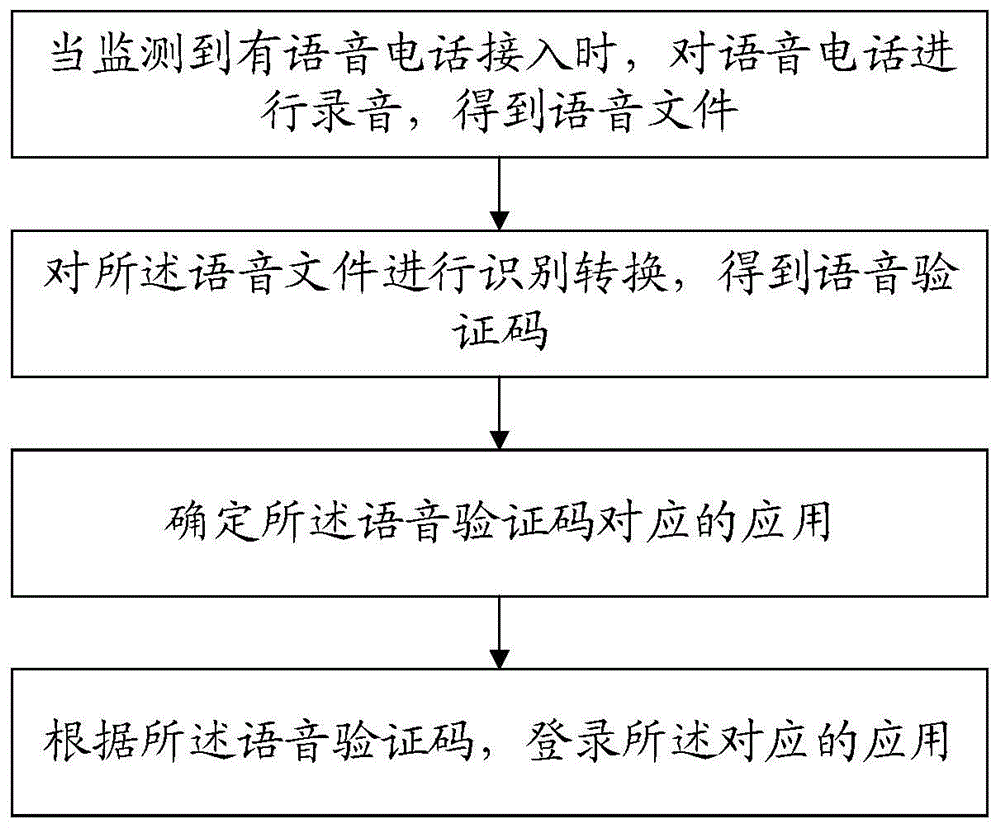
Referring to fig. 1, an application automatic login method based on voice recognition includes:
when the voice call access is monitored, recording the voice call to obtain a voice file;
carrying out recognition conversion on the voice file to obtain a voice verification code;
determining an application corresponding to the voice verification code;
and logging in the corresponding application according to the voice verification code.
From the above description, the beneficial effects of the present invention are: the automatic login of the application can be realized, and the problem of complicated login mode of the voice verification code is effectively solved.
Further, when it is monitored that a voice call is accessed, recording the voice call to obtain a voice file, further comprising:
storing the voice file into a preset directory;
and monitoring a preset directory in real time, and executing the step of identifying and converting the voice file to obtain a voice verification code when a new voice file is monitored to exist in the directory.
According to the description, the voice file of the voice telephone can be identified and converted in time, and the efficiency of automatic login is improved.
Further, the identifying and converting the voice file to obtain the voice verification code specifically comprises:
carrying out recognition conversion on the voice file through a voice recognition algorithm, and judging whether the conversion is successful or not;
if the conversion is successful, obtaining a voice verification code;
if the conversion fails, adding one to the conversion failure times, and judging whether the conversion failure times reach a preset time threshold value or not, wherein the initial value of the conversion failure times is zero;
if not, returning to execute the step of performing recognition conversion on the voice file through the voice recognition algorithm and judging whether the conversion is successful or not;
if so, prompting a voice conversion failure message.
According to the description, when the conversion failure times are too many, the user is prompted to fail voice conversion, and at the moment, the user manually inputs the verification code for inputting, so that the user time is prevented from being delayed, and the user experience is prevented from being reduced.
Further, the determining of the application corresponding to the voice verification code specifically includes:
acquiring an association relation between an application and a corresponding incoming call number;
and acquiring the application corresponding to the incoming call number of the voice telephone according to the association relation, and acquiring the application corresponding to the voice verification code.
Further, the logging in the corresponding application according to the voice verification code specifically includes:
identifying the corresponding application interface, and positioning to obtain the login window position of the application;
filling the voice verification code to a verification code position in the login window position, and simulating clicking a login button;
judging whether the login is successful;
if the login is successful, prompting that the login is successful;
if the login fails, the login is prompted to fail.
According to the description, the voice verification code is automatically filled into the verification code position in the application interface, and click login is simulated through click operation, so that the automatic login function is realized.
The invention also proposes a computer-readable storage medium, on which a computer program is stored which, when being executed by a processor, carries out the steps of the method as described above.
Example one
Referring to fig. 2, a first embodiment of the present invention is: an application automatic login method based on voice recognition can be applied to automatic login of applications in a mainstream mobile phone operating system (Android/iOS), as shown in fig. 2, and includes the following steps:
s1: and monitoring the preset application through the voice telephone monitoring thread, judging whether a voice telephone is accessed, if so, executing the step S2, and if not, continuing to monitor.
Specifically, the user may set applications to be monitored in advance by recording names (or unique identifiers) of the applications, and then start a voice call monitoring thread to perform voice call monitoring on the applications.
S2: and recording the voice telephone to obtain a voice file. Further, the voice file is stored in a preset directory. The system will monitor the directory in real time and execute step S3 when it is found that a new voice file is generated in the directory.
S3: and identifying and converting the voice file, judging whether the conversion is successful, if so, executing step S4, and if not, executing step S5. The voice file is identified and converted through a voice identification algorithm, wherein the voice identification algorithm comprises an algorithm based on dynamic time warping, a hidden Markov model algorithm based on a parameter model, a vector quantization algorithm based on a non-parameter model and the like.
S4: and obtaining the voice verification code. Then, step S7 is executed.
S5: and judging whether the conversion failure times reach a preset time threshold, if so, executing the step S6, otherwise, re-identifying and converting the voice file, namely, returning to execute the step S3.
Specifically, each time the conversion fails, the number of conversion failures is incremented by one, and the initial value of the number of conversion failures is 0, and then the number of conversion failures is determined. Preferably, the number threshold is 5.
S6: and prompting a voice conversion failure message. Namely, the user is prompted that the voice conversion fails, and at this time, the user needs to manually input the verification code to log in.
S7: and determining the application corresponding to the voice verification code.
Specifically, before step S1, the association relationship between the application and the corresponding incoming call number is pre-stored. When the voice call is monitored to be accessed, the incoming call number of the voice call is recorded. And the step of matching or fuzzy matching is carried out in the association relation according to the incoming call number of the voice telephone, so that the application corresponding to the incoming call number of the voice telephone is obtained and is used as the application corresponding to the voice verification code.
S8: and logging in the corresponding application according to the voice verification code.
Specifically, the corresponding interface of the application is identified, and the position of a login window of the application is obtained through positioning; then filling the voice verification code to a verification code position in the login window position, and simulating to click a login button; after the click login is simulated, the login result is judged according to the application interface skip logic, and the login result is informed to the user, namely if the login is successful, the login success is prompted, and if the login fails, the login failure is prompted.
The embodiment can effectively solve the problems that the voice verification code is complex to operate, the time consumption of the multiple login request voice verification code is long and the like, and the user is troubled, and the personal account safety of the user is guaranteed, and meanwhile, the work efficiency and the life efficiency are improved.
Example two
Referring to fig. 3 to 4, the present embodiment is a specific implementation scenario of the first embodiment.
The embodiment is an APP automatic login system based on voice verification code recognition, which is suitable for an often-used mobile phone system (iOS/Android), and includes a process monitoring module, a voice storage file monitoring module, a voice conversion module, a voice correspondence allocation module, an application window filling module, a login result detection module, and a basic encapsulation module. The system architecture is shown in fig. 3. The service functions of the modules are described as follows:
a process monitoring module: the system is used for monitoring the process, and the user selects the application process to be monitored, so that the system can monitor the corresponding application, and monitor whether the application process exists and whether the application process is in a login state;
the voice storage module: the mobile phone voice call monitoring module is used for monitoring a mobile phone voice call module, when a voice call exists, the module stores a voice file and stores the voice file in a specified directory of a mobile phone system;
voice storage file monitoring module: the voice conversion module is used for monitoring a designated voice storage path set in the system, and transmitting corresponding messages to the voice conversion module for analysis in time when a new voice file is generated under the storage path;
a voice conversion module: the method is used for carrying out conversion processing on the voice file through the mainstream voice recognition algorithm in the industry at present, and processing the file into a format required by a service layer, so that the voice corresponding relation distribution module can accurately distribute the voice conveniently. Common speech recognition algorithm models are: an algorithm based on dynamic time warping, an HMM algorithm based on a parametric model, a VQ algorithm based on a nonparametric model and the like;
a voice correspondence allocation module: determining which application the voice verification code belongs to according to the result of the recognition performed by the voice conversion module and the detection result of the progress monitoring module, so as to assist the application window filling module in filling the voice verification code;
an application window filling module: identifying the difference of the login interfaces of the applications, and performing automatic filling work of the login windows of the corresponding applications by feeding back results through the voice corresponding relation distribution module, so as to ensure that the corresponding applications can normally log in, and informing the login results to the login result prompt module;
a login result prompting module: receiving each application login result of the application window filling module, and prompting a final login result of a user through various prompts (floating window, popup window and the like);
basic packaging module: and the basic function and common interface packaging module is used for assisting other service modules to work.
Fig. 4 shows a specific implementation business flowchart of this embodiment. The business process logic is as follows:
1) after the system is started, a voice telephone monitoring thread and a voice storage monitoring thread are started, and monitoring and storage detection related work of the set application voice telephone is carried out;
2) the user can add the process needing monitoring application in the system, and the system records the name of the application process and starts detection through adding the application name;
3) when a voice call is accessed to the mobile phone, the voice storage module starts a voice call recording function and stores a corresponding recording file in a specified mobile phone directory (which can be set in the system);
4) the voice storage monitoring module can detect the set recording file storage path in real time, and when a new voice file is generated under the path, the voice conversion module is informed;
5) the voice conversion module uses a voice recognition algorithm to perform conversion recognition on the voice file, and when the conversion is successful, the corresponding information is notified to the voice corresponding relation distribution module. When the voice file conversion fails, the voice file conversion identification is carried out for multiple times, if the preset maximum conversion times (default 5 times) are reached, a user is prompted to correspondingly apply the voice conversion failure, and an identifying code needs to be manually input for logging in;
6) the voice corresponding relation distribution module performs corresponding association of application and verification codes according to a result returned by the voice conversion module, records an incoming call account number in the incoming call process, and performs matching or fuzzy matching with the recorded incoming call number in the system, so as to determine which application the voice verification code is applied;
7) after the corresponding relation between the voice verification code and the application is determined, finding the corresponding application, positioning the corresponding application to the login window position of the application, filling the voice verification code information to the verification code position, and simulating the application to click to login;
8) after the click login is simulated, the login result is judged according to the application interface skip logic, and the user is informed.
The system effectively solves the problem of complicated login of a voice verification code login mode. With more and more mobile applications adopting a safer voice verification code login technology, the system can be used more and more, and the operation process of a user is reduced. In addition, the method is similar to the realization process of a mainstream mobile phone operating system (Android/iOS), and has high applicability. The more similar applications on a mobile phone, the more important the necessity of using the system.
EXAMPLE III
The present embodiment is a computer-readable storage medium corresponding to the above-mentioned embodiments, on which a computer program is stored, which when executed by a processor implements the steps of:
when the voice call access is monitored, recording the voice call to obtain a voice file;
carrying out recognition conversion on the voice file to obtain a voice verification code;
determining an application corresponding to the voice verification code;
and logging in the corresponding application according to the voice verification code.
Further, when it is monitored that a voice call is accessed, recording the voice call to obtain a voice file, further comprising:
storing the voice file into a preset directory;
and monitoring a preset directory in real time, and executing the step of identifying and converting the voice file to obtain a voice verification code when a new voice file is monitored to exist in the directory.
Further, the identifying and converting the voice file to obtain the voice verification code specifically comprises:
carrying out recognition conversion on the voice file through a voice recognition algorithm, and judging whether the conversion is successful or not;
if the conversion is successful, obtaining a voice verification code;
if the conversion fails, adding one to the conversion failure times, and judging whether the conversion failure times reach a preset time threshold value or not, wherein the initial value of the conversion failure times is zero;
if not, returning to execute the step of performing recognition conversion on the voice file through the voice recognition algorithm and judging whether the conversion is successful or not;
if so, prompting a voice conversion failure message.
Further, the determining of the application corresponding to the voice verification code specifically includes:
acquiring an association relation between an application and a corresponding incoming call number;
and acquiring the application corresponding to the incoming call number of the voice telephone according to the association relation, and acquiring the application corresponding to the voice verification code.
Further, the logging in the corresponding application according to the voice verification code specifically includes:
identifying the corresponding application interface, and positioning to obtain the login window position of the application;
filling the voice verification code to a verification code position in the login window position, and simulating clicking a login button;
judging whether the login is successful;
if the login is successful, prompting that the login is successful;
if the login fails, the login is prompted to fail.
In summary, the method for automatically logging in an application based on voice recognition and the computer-readable storage medium provided by the present invention monitor the voice phone, record the voice phone when it is monitored that the voice phone is accessed, so as to automatically obtain the voice verification code in the audio format, then perform recognition and conversion on the voice file, convert the voice verification code in the audio format into the voice verification code in the format required by the application service layer, and finally log in the corresponding application according to the voice verification code, thereby implementing automatic login of the application. The invention can effectively solve the problems of complicated operation of the voice verification code, time consumption of multiple login request of the voice verification code and the like, which cause troubles to users, and can improve the working and living efficiency while ensuring the personal account safety of the users.
The above description is only an embodiment of the present invention, and not intended to limit the scope of the present invention, and all equivalent changes made by using the contents of the present specification and the drawings, or applied directly or indirectly to the related technical fields, are included in the scope of the present invention.