CN113123783A - Method for finely evaluating volume content of stratum - Google Patents
Method for finely evaluating volume content of stratum Download PDFInfo
- Publication number
- CN113123783A CN113123783A CN201911412325.XA CN201911412325A CN113123783A CN 113123783 A CN113123783 A CN 113123783A CN 201911412325 A CN201911412325 A CN 201911412325A CN 113123783 A CN113123783 A CN 113123783A
- Authority
- CN
- China
- Prior art keywords
- mineral
- fluid
- logging
- log
- volume content
- Prior art date
- Legal status (The legal status is an assumption and is not a legal conclusion. Google has not performed a legal analysis and makes no representation as to the accuracy of the status listed.)
- Granted
Links
- 238000000034 method Methods 0.000 title claims abstract description 70
- 229910052500 inorganic mineral Inorganic materials 0.000 claims abstract description 91
- 239000011707 mineral Substances 0.000 claims abstract description 91
- 230000004044 response Effects 0.000 claims abstract description 14
- 239000012530 fluid Substances 0.000 claims description 74
- 230000015572 biosynthetic process Effects 0.000 claims description 48
- 238000004364 calculation method Methods 0.000 claims description 26
- 229910052770 Uranium Inorganic materials 0.000 claims description 16
- 229910052700 potassium Inorganic materials 0.000 claims description 16
- ZSLUVFAKFWKJRC-IGMARMGPSA-N 232Th Chemical compound [232Th] ZSLUVFAKFWKJRC-IGMARMGPSA-N 0.000 claims description 15
- ZLMJMSJWJFRBEC-UHFFFAOYSA-N Potassium Chemical compound [K] ZLMJMSJWJFRBEC-UHFFFAOYSA-N 0.000 claims description 15
- 229910052776 Thorium Inorganic materials 0.000 claims description 15
- 238000010521 absorption reaction Methods 0.000 claims description 15
- 239000011591 potassium Substances 0.000 claims description 15
- JFALSRSLKYAFGM-UHFFFAOYSA-N uranium(0) Chemical compound [U] JFALSRSLKYAFGM-UHFFFAOYSA-N 0.000 claims description 15
- 239000002002 slurry Substances 0.000 claims description 6
- 238000012360 testing method Methods 0.000 claims description 5
- 239000011541 reaction mixture Substances 0.000 claims description 4
- 238000011156 evaluation Methods 0.000 claims description 3
- 238000001514 detection method Methods 0.000 claims description 2
- 230000009467 reduction Effects 0.000 claims description 2
- 239000000523 sample Substances 0.000 claims 1
- 238000005553 drilling Methods 0.000 abstract description 6
- 238000004422 calculation algorithm Methods 0.000 abstract description 5
- 238000011161 development Methods 0.000 abstract description 4
- 230000008569 process Effects 0.000 abstract description 4
- 238000002474 experimental method Methods 0.000 abstract description 3
- 238000005755 formation reaction Methods 0.000 description 44
- 238000005457 optimization Methods 0.000 description 14
- 235000019738 Limestone Nutrition 0.000 description 13
- 239000006028 limestone Substances 0.000 description 13
- 239000011159 matrix material Substances 0.000 description 8
- 239000013598 vector Substances 0.000 description 6
- 238000013178 mathematical model Methods 0.000 description 5
- 239000011148 porous material Substances 0.000 description 3
- 238000004458 analytical method Methods 0.000 description 2
- 230000009286 beneficial effect Effects 0.000 description 2
- 238000010276 construction Methods 0.000 description 2
- 238000005259 measurement Methods 0.000 description 2
- 239000011028 pyrite Substances 0.000 description 2
- 229910052683 pyrite Inorganic materials 0.000 description 2
- XLYOFNOQVPJJNP-UHFFFAOYSA-N water Substances O XLYOFNOQVPJJNP-UHFFFAOYSA-N 0.000 description 2
- 229910021532 Calcite Inorganic materials 0.000 description 1
- 238000013459 approach Methods 0.000 description 1
- 230000003190 augmentative effect Effects 0.000 description 1
- 238000000205 computational method Methods 0.000 description 1
- 239000010459 dolomite Substances 0.000 description 1
- 229910000514 dolomite Inorganic materials 0.000 description 1
- 230000000694 effects Effects 0.000 description 1
- 230000002349 favourable effect Effects 0.000 description 1
- 239000010433 feldspar Substances 0.000 description 1
- 238000011835 investigation Methods 0.000 description 1
- 230000001788 irregular Effects 0.000 description 1
- 238000012886 linear function Methods 0.000 description 1
- 238000007726 management method Methods 0.000 description 1
- 239000000463 material Substances 0.000 description 1
- 238000012067 mathematical method Methods 0.000 description 1
- 239000005416 organic matter Substances 0.000 description 1
- 230000035699 permeability Effects 0.000 description 1
- 239000003208 petroleum Substances 0.000 description 1
- NIFIFKQPDTWWGU-UHFFFAOYSA-N pyrite Chemical compound [Fe+2].[S-][S-] NIFIFKQPDTWWGU-UHFFFAOYSA-N 0.000 description 1
- 239000010453 quartz Substances 0.000 description 1
- 238000011160 research Methods 0.000 description 1
- 239000011435 rock Substances 0.000 description 1
- 239000004576 sand Substances 0.000 description 1
- VYPSYNLAJGMNEJ-UHFFFAOYSA-N silicon dioxide Inorganic materials O=[Si]=O VYPSYNLAJGMNEJ-UHFFFAOYSA-N 0.000 description 1
- 238000002945 steepest descent method Methods 0.000 description 1
- 230000001131 transforming effect Effects 0.000 description 1
- 230000007704 transition Effects 0.000 description 1
Images








Classifications
-
- E—FIXED CONSTRUCTIONS
- E21—EARTH OR ROCK DRILLING; MINING
- E21B—EARTH OR ROCK DRILLING; OBTAINING OIL, GAS, WATER, SOLUBLE OR MELTABLE MATERIALS OR A SLURRY OF MINERALS FROM WELLS
- E21B49/00—Testing the nature of borehole walls; Formation testing; Methods or apparatus for obtaining samples of soil or well fluids, specially adapted to earth drilling or wells
Landscapes
- Life Sciences & Earth Sciences (AREA)
- Engineering & Computer Science (AREA)
- Geology (AREA)
- Mining & Mineral Resources (AREA)
- Physics & Mathematics (AREA)
- Environmental & Geological Engineering (AREA)
- Fluid Mechanics (AREA)
- General Life Sciences & Earth Sciences (AREA)
- Geochemistry & Mineralogy (AREA)
- Geophysics And Detection Of Objects (AREA)
Abstract
The invention provides a method for precisely evaluating the volume content of a stratum. And calculating the volume content of the shale stratum by using conventional logging information and a linear programming and nonlinear combination method through constructing a conventional response equation under a stratum volume model. By constructing a proper objective function, utilizing inequality constraints of a logging response equation and applying a simplex and variable-scale algorithm, the uncertain influence of drilling mud under the condition of expanding the diameter is eliminated, the volume content of the stratum is quickly and accurately inverted, expensive logging projects such as element logging are reduced, the process of determining the type and the content of shale minerals by a core experiment is reduced, the cost and the time are saved, and the method plays a positive role in accelerating the exploration and development of the shale stratum in China.
Description
Technical Field
The invention relates to the field of petroleum exploration and development, in particular to a method for finely evaluating the volume content of a stratum.
Background
The mineral volume content is the volume ratio of each mineral in the stratum, and a volume content model is generally used in a well logging interpretation model. Interpretation methods of mineral volume content there are computational methods for inversion of mineral volume content available from Schlumberger, Halliburton and Western-Atlas companies. Quirein et al (2010) directly establish the calculation of shale formation elements to mineral volume content by using an optimization method; graceful and (1995) applied optimization algorithms to enable the calculation of formation mineral volume content using conventional well log data. The inversion is usually used for evaluating the mineral content of a permeable stratum, but for an impermeable stratum such as shale or a stratum with extremely low permeability, the inversion effect is poor, and the errors of the inverted mineral type and the volume content are large, so that a new method needs to be found for accurately inverting the mineral volume content of the stratum.
Linear Programming (LP) is one of the important branches of operational research, and is widely applied in practice, and the method is mature, and is a mathematical method for assisting people in scientific management. Solving a problem by using a linear programming method, wherein an objective function is a linear function of a plurality of decision variables, and solving the maximum value or the minimum value of the objective function; the constraint to solve the problem is a set of linear inequalities or equations for a number of decision variables. These problems are consistent with those encountered during logging, and the use of linear programming provides a new approach to solving the volume content of the formation minerals.
Establishing a mathematical model is a key step of linear programming. The Mathematical Model of Linear Programming (Mathematical Model of Linear Programming) is composed of three elements, namely Decision variables (decisions), Objective functions (Objective functions) and Constraints (Constraints). The general assumption is that there are m constraints and n decision variables x in the linear programming mathematical modeljJ is 1,2, …, n, and the variable coefficient of the objective function is cjIs represented by cjReferred to as the figure of merit. Variable coefficient of constraint condition is aijIs shown as aijReferred to as the process coefficient. For constants at right end of constraintbiIs represented by biReferred to as resource coefficients. The general expression for the linear programming mathematical model can be written as:
max(min) Z=c1x1+c2x2+...+cnxn

the condition can be written as:


xj≥0(j=1,2,…,n) (3)
c=(c1,c2,...,cnand) is a value variable,
x=(x1,x2,...,xnand) are decision variables.
Since the linear programming problem contains equality constraints, inequality constraints and an objective function, these three functions are combined into an augmented matrix. Any non-singular sub-square matrix B (i.e., | B | ≠ 0) of m × m orders of its coefficient matrix a, called a base matrix or base of the LP problem:

the other part of the coefficient matrix a is called non-basis matrix:

wherein, Pi(i ═ 1,2, …, m) is the basis vector; xi(i ═ 1,2, …, m) as the base variable; pj(j ═ m +1, …, n) is a non-basis vector; xj(j ═ m +1, …, n) is a non-base variable.
The maximum value of the objective function is adopted, the variable is added, and the inequality is converted into an equation, so that the linear programming problem becomes a standard form:


xj≥0(i=1,2,…,n)
wherein Z is(0)=cBB-1b
σj=cj-cBB-1N
σ′ij=B-1N
bi′=B-1bi
Simplex Method (Simplex Method), proposed by g.b. dantzig in 1947, is one of the most efficient algorithms to solve the linear programming problem and has become the basis for some algorithms of integer programming and non-linear programming. When the linear programming problem is solved by a pure method, the linear programming needs to be modeled into a uniform standard form for the convenience of problem discussion.
The computation steps for solving the linear programming problem by the simplex method are as follows:
step 1: converting the general form into a standard form;
step 2: and (4) solving the feasible solution of the initial base from the standard form, and establishing an initial simple form table. For standard forms of LP, there will always be an identity matrix in the coefficient matrix of the variables of the constraint equation:

and step 3: examining each non-base variable XjOf (a) a test number σjIf all σ sjAnd (j) is less than or equal to 0(j is 1,2, …, n), an optimal solution is obtained, and the calculation is stopped. Otherwise, the next step is carried out;
and 4, step 4: at all σj>In 0, if there is a certain σk>0, x corresponding tokCoefficient column vector p'kIs less than or equal to 0 (i.e. a'ik0, i is 1,2, …, m), the problem is solved without limit, and the calculation is stopped. Otherwise, the next step is carried out;
and 5: when more than one check number is greater than 0, according to sigmak=max{σj|ajJ is more than 0 and more than or equal to 1 and less than or equal to n, and the corresponding variable xkThe non-base variable to be swapped in is referred to as a swap-in base variable. And calculating according to a minimum ratio rule: determining xrIs a swapped out base variable, element arkThe transition from one base feasible solution to the adjacent base feasible solution is determined, called the (named) primary element. Transferring to the next step;
step 6: with arkPerforming a base transform on the principal elements, transforming X by elementary line transformkThe corresponding column vector is converted into a unit column vector, namely, the kth element in the check number row is also converted into zero at the same time, so that a new simple form table can be obtained by converting from one base feasible solution to an adjacent base feasible solution with a larger objective function value. And returning to the step 2.
Simple solutions usually yield better results when fewer unknowns are required, but linear programming problems often result in no solution if more unknowns are required. The conventional logging information is used for evaluating the content of the formation minerals, the formation minerals are unknown, the mud properties, the borehole environment and the like are also included, the unknown number is large (more than 10), and certain challenges are brought to a linear planning method.
The solutions for non-linear programming are commonly used as gradient method (also called steepest descent method), newton method, parabolic interpolation method and variable-scale method.
Disclosure of Invention
In view of the above-mentioned problems of the prior art, it is an object of the present invention to provide a method for fine evaluation of the volume content of a formation, in particular of the mineral volume content and/or the fluid volume content of the formation. The method comprises the steps of utilizing conventional logging information, considering that a conventional response inequality equation under a stratum volume model is constructed under the condition of an irregular borehole, setting decision variables, constraint conditions and value coefficients in linear programming by constructing a proper objective function, firstly utilizing a simple method in a linear programming method to calculate the shale stratum volume content, taking a calculation result as an initial value of nonlinear programming inversion, and finally utilizing a nonlinear programming method to carry out unconstrained extremum solution. The combination of linear programming and nonlinear programming is beneficial to eliminating uncertain influence of drilling mud under the condition of expanding diameter, and the volume content of the stratum can be quickly and accurately inverted.
The invention provides a method for finely evaluating the volume content of a stratum, which comprises the following steps:
(1) obtaining conventional well logging data including actual well logging curves and/or test data;
(2) determining decision variables based on minerals and/or fluids actually contained and/or likely to be contained in the formation;
(3) when the borehole environment is not considered, the conventional logging information and the decision variable response are used as inequality equations, and the inequality equations are used as constraint conditions;
(4) when the borehole environment is considered, the conventional logging data and the decision variable response are used as an equation, and the equation is used as a constraint condition;
(5) constructing a linear objective function by utilizing the accumulated sum of the differences between the actual logging curve and the theoretical calculation curve;
(6) converting the constraint conditions in the step (3) or the step (4) and the linear objective function in the step (5) into a linear programming standard form;
(7) solving the linear programming standard form so as to preliminarily obtain the mineral volume content and/or fluid volume content in the stratum, preferably solving the linear programming standard form by using a simplex method;
(8) judging whether the mineral volume content and/or the fluid volume content in the stratum obtained in the step (7) is an optimal solution result;
(9) when the mineral volume content and/or the fluid volume content in the stratum obtained in the step (7) are not the optimal solution result, modifying the decision variables, and repeating the steps (3) to (8);
(10) when the mineral volume content and/or the fluid volume content in the stratum obtained in the step (7) is the optimal solution result, outputting a calculation result of the linear programming;
(11) increasing the actual mineral and/or fluid type, and taking the calculation result of the linear plan output in the step (10) as the initial value of the non-linear plan;
(12) constructing a nonlinear objective function by utilizing the accumulated sum of squares of the difference between the actual logging curve and the theoretical calculation curve;
(13) converting the constraints in the step (3) or the step (4) and the nonlinear objective function in the step (12) into a nonlinear programming standard form;
(14) and solving the nonlinear programming standard form to obtain the mineral volume content and/or fluid volume content in the stratum, preferably solving the nonlinear programming standard form by using a variable-scale method.
The inventor of the application finds that the type and the content of the formation minerals are complex and are usually accurately determined by element logging information. However, after the formation is drilled, the formation is expanded or reduced in diameter, and particularly, when the formation is expanded, a logging curve detected by a logging instrument is influenced by drilling mud, and meanwhile, the properties of the formation are changed after the drilling mud invades the formation, and at the moment, the logging curve cannot truly reflect formation information. It is common practice to correct these curves for the borehole environment, which is difficult to accurately perform because the properties of the mud are difficult to determine. Under the condition, the optimization inversion is carried out by utilizing the conventional logging data, and actually, the non-linear programming inversion is carried out under the unconstrained condition, so that the obtained stratum volume content has larger errors, and even wrong conclusion is obtained.
The technical scheme of the invention utilizes conventional logging information, and a conventional response equation under a stratum volume model is constructed, so that the shale stratum volume content is calculated by a simple method in a linear programming method, the calculation result is used as an initial value of nonlinear programming inversion, and finally, the nonlinear programming method is utilized to carry out unconstrained extreme value solution. By constructing a proper objective function, utilizing inequality constraints of a logging response equation and applying a simple algorithm, the uncertain influence of drilling mud under the condition of expanding diameter can be eliminated, the initial value of the volume content of the formation minerals can be quickly and accurately provided, and in order to obtain a large number of mineral quantity and fluid properties, the nonlinear programming method is utilized to further solve the problem. The method reduces expensive logging projects such as element logging and the like, reduces the process of determining the shale mineral type and content in a core experiment, saves cost and time, and plays a positive role in accelerating the exploration and development of the shale stratum in China.
In some preferred embodiments of the invention, the test data comprises a depth of investigation and a caliper; the actual logging curve comprises at least one of a natural gamma logging curve, a natural potential logging curve, a compensation sound wave logging curve, a compensation neutron logging curve, a compensation density logging curve, a photoelectric absorption cross-section index logging curve, a uranium logging curve, a thorium logging curve and a potassium logging curve.
In some preferred embodiments of the present invention, the inequality equation is as shown in equation (1):

in the formula (1), the reaction mixture is, for theoretical calculation of curves, LOGjRepresents the j-th well-logging curve, ViDenotes the volume of the i-th mineral or fluid, MCijRepresents the j logging theoretical value corresponding to the i mineral or fluid, wherein, 1 is more than or equal to Vi≥0,
In some preferred embodiments of the present invention,
the inequality equation is selected from at least one of the following equations (2) to (8):





where DEN represents the offset density log and AC represents the complementAcoustic compensated logging, CNL, PE, U, TH, K, and V, where CNL represents the logging curve of compensated neutrons, PE represents the logging curve of photoelectric absorption cross-section, U represents the logging curve of uranium, TH represents the logging curve of thorium, K represents the logging curve of potassium, and V represents the logging curve of uraniumiRepresenting the volume, p, of the i-th mineral or fluidiDenotes the compensated density, Δ T, corresponding to the i-th mineral or fluidiIndicating the compensating sound wave, CNL, corresponding to the i-th mineral or fluidiRepresenting compensating neutrons, PE, corresponding to the i-th mineral or fluidiShowing the photoelectric absorption cross-section wave, U, corresponding to the i-th mineral or fluidiIndicating the uranium value, TH, corresponding to the i-TH mineral or fluidiDenotes the value of thorium, K, corresponding to the i-th mineral or fluidiRepresents the corresponding potassium value of the ith mineral or fluid and satisfies Vi≥0。
Vi≥0。
In some preferred embodiments of the present invention,
the equation is shown in equation (9):

in the formula (9), the reaction mixture is, for theoretical calculation of curves, LOGjRepresents the j-th well-logging curve, ViDenotes the volume of the i-th mineral or fluid, MCijRepresents the j logging theory value, MC, corresponding to the i mineral or fluidmfThe response value of the logging curve corresponding to the mud is shown, the DeltaV represents the proportion of the volume formed by expanding or reducing the borehole to the detection volume of the logging curve, wherein,
 1≥Vi,ΔV≥0。
in some preferred embodiments of the present invention,
the equation of the equation is selected from at least one of the following equations (10) to (16):


where DEN represents a compensated density log, AC represents a compensated sonic log, CNL represents a compensated neutron log, PE represents a photoelectric absorption cross-section log, U represents a uranium log, TH represents a thorium log, K represents a potassium log, and V representsiRepresenting the volume of the i-th mineral or fluid, Δ V representing the proportion of the volume formed by borehole enlargement or reduction to the volume detected by the log, ρiDenotes the compensated density, Δ T, corresponding to the i-th mineral or fluidiIndicating the compensating sound wave, CNL, corresponding to the i-th mineral or fluidiRepresenting compensating neutrons, PE, corresponding to the i-th mineral or fluidiIndicates the ith speciesPhotoelectric absorption cross-section wave, U, corresponding to mineral or fluidiIndicating the uranium value, TH, corresponding to the i-TH mineral or fluidiDenotes the value of thorium, K, corresponding to the i-th mineral or fluidiIndicates the corresponding potassium value, rho, of the ith mineral or fluidmfIndicating the corresponding compensated density, Δ T, of the mudmfIndicating the corresponding compensated acoustic wave of the mud, CNLmfIndicating compensating neutrons, PE, to the mudmfIndicating the photoelectric absorption cross-section wave, U, corresponding to the slurrymfIndicating the corresponding uranium value, TH, of the slurrymfIndicates the corresponding thorium value, K, of the mudmfIndicates the corresponding potassium value of the slurry and meets the requirement Vi≥0。
Vi≥0。
In some preferred embodiments of the present invention, the linear objective function is represented by equation (17):

in some preferred embodiments of the present invention, the non-linear objective function is represented by equation (18):

in some preferred embodiments of the present invention, the above method further comprises:
determining a cost coefficient in the linear objective function, and applying the cost coefficient in the linear objective function to the linear programming standard form; and/or
Determining cost coefficients in the non-linear objective function and applying the cost coefficients in the non-linear objective function to the non-linear programming standard form, wherein,
the value coefficient in the linear objective function is shown as formula (19); and/or the figure of merit in the nonlinear objective function is as shown in equation (20):


according to the invention, the linear programming standard form has two modes,
the method comprises the following steps:


1≥Vi≥0

optionally, the step of (a) is carried out,
the second is as follows:


1≥Vi,ΔV≥0
optionally, the step of (a) is carried out, according to the invention, the linear programming standard form can also be expressed in two ways, one of which is:


1≥Vi≥0

optionally, the step of (a) is carried out,
the second is as follows:


1≥Vi,ΔV≥0
optionally, the step of (a) is carried out,
according to the invention, the standard form of the non-linear programming has two modes,
the method comprises the following steps:


1≥Vi≥0

optionally, the step of (a) is carried out,
the second is as follows:


1≥Vi,ΔV≥0
optionally, the step of (a) is carried out,
according to the invention, the non-linear programming standard form can also be expressed in two ways,
the method comprises the following steps:


1≥Vi≥0

optionally, the step of (a) is carried out,
the second is as follows:


1≥Vi,ΔV≥0
optionally, the step of (a) is carried out,
in some preferred embodiments of the present invention, in step (8), if the obtained mineral volume content and/or fluid volume content in the formation is greater than or equal to 0, the obtained mineral volume content and/or fluid volume content in the formation is determined as an optimal solution.
The invention has the beneficial effects that:
the shale formation mineral volume content interpretation method mainly depends on foreign software at present, and no logging interpretation software with independent intellectual property rights exists. The method utilizes conventional logging information, constructs a proper objective function, utilizes inequality constraints of a logging response equation, combines linear programming and nonlinear programming, is favorable for eliminating uncertain influences of drilling mud under the condition of expanding diameter, quickly and accurately inverts the volume content of the stratum, reduces expensive logging projects such as element logging and the like, reduces the process of determining the type and the content of shale minerals by a rock core experiment, saves cost and time, and plays a positive role in accelerating domestic shale stratum exploration and development.
Drawings
FIG. 1 is a flow chart of the method of example 1 for evaluating the mineral volume content of a subterranean formation.
FIG. 2 is a conventional log of a sandstone formation as in example 1.
FIG. 3 is a graphical representation of the results of the inversion of the volume content of the sandstone formation in example 1.
Figure 4 is a graphical representation of the results of the inversion of volume content for sandstone formations using foreign software in example 1.
FIG. 5 is a conventional log of the shale formation of example 1.
FIG. 6 is a graphical representation of the results of inversion of volume content of shale formations in example 1.
FIG. 7 is a graphical representation of the results of inverting the volume content of a shale formation using foreign software.
FIG. 8 is a conventional log of a limestone formation in example 1.
FIG. 9 is a graphical representation of the results of the inversion of volume content of the limestone formation in example 1.
FIG. 10 is a graphical representation of the results of inverting the volume content of a limestone formation using foreign software.
In the drawings, the abbreviations and their representatives referred to in the lithology volume analysis column have the following meanings:
PORT-Total porosity; VDOL-dolomite; VCLC-calcite; VSML-others; VPYR-pyrite; VPRD-feldspar; VQVA-quartz; VSH-argillaceous.
Detailed Description
The present invention will be described in detail below with reference to examples, but the scope of the present invention is not limited to the following description.
In the following embodiments, the abbreviations referred to, such as DEN, AC, CNL, etc., have the same meaning as above, and are not described herein again.
Example 1
(1) Obtaining conventional well logs including depth (first trace in figures 2, 5 and 8), formation analysis (second trace in figures 2, 5 and 8, which is not used in the present embodiment of the calculation), natural gamma log (third trace in figures 2, 5 and 8), compensated sonic log (fourth trace in figures 2, 5 and 8), compensated neutron log (fifth trace in figures 2, 5 and 8), compensated density log (sixth trace in figures 2, 5 and 8), photoelectric absorption cross-section index log (seventh trace in figures 2, 5 and 8), uranium log (eighth trace in figures 2, 5 and 8), thorium log (ninth trace in figures 2, 5 and 8), potassium log (tenth trace in figures 2, 5 and 8) and resistivity log (tenth trace in figures 2, 5 and 8), this embodiment does not use this data in the calculation).
(2) It is assumed that a certain stratum contains decision variables such as mudstone, sandstone, limestone, organic matter, pyrite, porosity and the like, that is, there are 6 unknowns for the basis solution variable in the linear programming, that is, there are 6 decision variables, specifically, V1、V2、V3、V4、V5And V6。
(3) When the borehole environment is not considered, the conventional logging data and the decision variable response are used as inequality equations, and the inequality equations are used as constraint conditions, specifically:


1≥Vi≥0


(5) constructing a linear objective function by utilizing the accumulated sum of the differences between the actual logging curve and the theoretical calculation curve: wherein, MCijThe values are shown in Table 1.
(6) Determining in said linear objective functionA value coefficient of
(7) Converting the logging linear programming problem into a linear programming standard form:


1≥Vi≥0


(8) the linear programming standard form is solved using a simplex method to preliminarily derive the mineral volume content and/or fluid volume content of the formation, as shown in the first pass in fig. 3, 6 and 8.
(9) Increasing the actual mineral/and or fluid type, and taking the calculation result of the linear programming output in the step (8) as the initial value of the non-linear programming;
(10) constructing a nonlinear objective function by utilizing the accumulated square sum of the difference between the actual logging curve and the theoretical calculation curve:

(11) determining cost coefficients in a non-linear objective function
(12) Converting the logging nonlinear programming problem into a nonlinear programming standard form:


1≥Vi≥0


(13) the linear programming standard form is solved using the variable-scale method to obtain the mineral volume content and/or fluid volume content of the formation, as shown in the second trace of fig. 3, 6 and 8.
TABLE 1 formation mineral and fluid content logging curve response skeleton values

The formations included sandstone, shale and limestone formations, the following are the respective treatment results.
The calculation results show that the curved paths of the sandstone formation, the shale formation and the limestone formation are consistent. Fig. 4, 7 and 10 are results of foreign software using a combination of elemental and conventional well log data. The eleventh in fig. 2, 5 and 8 is the objective function for optimizing the inversion. In fig. 3, 6 and 9, the first pass is a calculation result of linear programming, and the second pass is an evaluation result obtained by using a nonlinear programming optimization interpretation method with the linear programming result as a constraint condition. The detailed description is as follows:
1.1 sandstone formation inversion volume content results
FIG. 3 is a linear programming method for solving initial mineral and fluid conditions for a sand-shale formation, wherein the first linear programming method mainly calculates sandstone, mudstone and pore fluid, takes the linear programming result as a constraint condition, and applies an optimization interpretation method to obtain mineral components and fluid properties shown in the second path; compared with the linear programming optimization interpretation result, the nonlinear programming optimization interpretation result increases the volume content of bound water and a small amount of limestone minerals, the porosity is relatively reduced, the volume content of sandstone is relatively increased, and the consistency with the result of joint interpretation of software outside China in FIG. 4 by utilizing element logging information and conventional logging information is better.
1.2 shale formation inversion volume content results
FIG. 6 is a linear programming method for solving initial mineral and fluid conditions of a shale formation, wherein a first linear programming method is used for calculating mineral components and fluid properties shown in a second path by taking sandstone and mudstone as main components and also including organic matters, limestone and pore fluid as constraint conditions and applying an optimal interpretation method; compared with the nonlinear programming optimization interpretation result, the nonlinear programming optimization interpretation result increases the bound water volume content and the porosity is relatively reduced, the sandstone volume content is relatively increased, the actual measurement numerical values of the acoustic time difference, the compensation neutrons, the density, the photoelectric absorption cross section index, the uranium, the thorium and the potassium logging curve are well matched with the construction curve numerical value, and the optimization result is better in consistency with the result of joint interpretation of the element logging data and the conventional logging data of the software outside China in the figure 7.
1.3 limestone formation inversion volume content results
FIG. 9 is a linear programming method for solving initial mineral and fluid conditions of a limestone formation, and it is seen from the figure that a thirteenth linear programming method calculates that limestone is the main component and also contains a small amount of sandstone, mudstone and pore fluid, and a nonlinear programming optimization interpretation method is applied to obtain fourteen mineral components and fluid properties shown in the description by taking a linear programming result as a constraint condition; compared with the nonlinear programming optimization interpretation result, the linear programming calculation result has the advantages that the volume content of sandstone is relatively increased, the content of limestone and the porosity are relatively reduced, and the actual measurement values of the acoustic time difference, the compensated neutrons, the density, the photoelectric absorption cross section index and the uranium, thorium and potassium well logging curves are well matched with the construction curve values. The stability of the section of stratum well wall is poor, a certain hole expansion phenomenon exists, the actual logging curve is influenced by the well hole environment, the main limestone content of the stratum and the sand and mudstone content are calculated by using a linear programming method, an accurate initial explanation value is provided for nonlinear programming optimization explanation, and the accurate optimization of the stratum mineral content and the fluid property is facilitated.
It should be noted that the above-mentioned embodiments are only for explaining the present invention, and do not constitute any limitation to the present invention. The present invention has been described with reference to exemplary embodiments, but the words which have been used herein are words of description and illustration, rather than words of limitation. The invention can be modified, as prescribed, within the scope of the claims and without departing from the scope and spirit of the invention. Although the invention has been described herein with reference to particular means, materials and embodiments, the invention is not intended to be limited to the particulars disclosed herein, but rather extends to all other methods and applications having the same functionality.
Claims (10)
1. A method for fine evaluation of volume content of a subterranean formation comprising:
(1) obtaining conventional well logging data including actual well logging curves and/or test data;
(2) determining decision variables based on minerals and/or fluids actually contained and/or likely to be contained in the formation;
(3) when the borehole environment is not considered, the conventional logging information and the decision variable response are used as inequality equations, and the inequality equations are used as constraint conditions;
(4) when the borehole environment is considered, the conventional logging data and the decision variable response are used as an equation, and the equation is used as a constraint condition;
(5) constructing a linear objective function by utilizing the accumulated sum of the differences between the actual logging curve and the theoretical calculation curve;
(6) converting the constraint conditions in the step (3) or the step (4) and the linear objective function in the step (5) into a linear programming standard form;
(7) solving the linear programming standard form so as to preliminarily obtain the mineral volume content and/or fluid volume content in the stratum, preferably solving the linear programming standard form by using a simplex method;
(8) judging whether the mineral volume content and/or the fluid volume content in the stratum obtained in the step (7) is an optimal solution result;
(9) when the mineral volume content and/or the fluid volume content in the stratum obtained in the step (7) are not the optimal solution result, modifying the decision variables, and repeating the steps (3) to (8);
(10) when the mineral volume content and/or the fluid volume content in the stratum obtained in the step (7) is the optimal solution result, outputting a calculation result of the linear programming;
(11) increasing the actual mineral and/or fluid type, and taking the calculation result of the linear plan output in the step (10) as the initial value of the non-linear plan;
(12) constructing a nonlinear objective function by utilizing the accumulated sum of squares of the difference between the actual logging curve and the theoretical calculation curve;
(13) converting the constraints in the step (3) or the step (4) and the nonlinear objective function in the step (12) into a nonlinear programming standard form;
(14) and solving the nonlinear programming standard form to obtain the mineral volume content and/or fluid volume content in the stratum, preferably solving the nonlinear programming standard form by using a variable-scale method.
2. The method of claim 1, wherein the test data comprises at least one of a probe depth and a well diameter; the actual logging curve comprises at least one of a natural gamma logging curve, a natural potential logging curve, a compensation sound wave logging curve, a compensation neutron logging curve, a compensation density logging curve, a photoelectric absorption cross-section index logging curve, a uranium logging curve, a thorium logging curve and a potassium logging curve.
3. The method of claim 1 or 2, wherein the inequality equation is as shown in equation (1):

in the formula (1), the reaction mixture is, for theoretical calculation of curves, LOGjRepresents the j-th well-logging curve, ViDenotes the volume of the i-th mineral or fluid, MCijRepresents the j logging theoretical value corresponding to the i mineral or fluid, wherein, 1 is more than or equal to Vi≥0,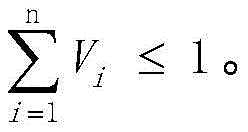
4. The method according to any one of claims 1-3, wherein the inequality equation is selected from at least one of equations (2) through (8):







where DEN represents a compensated density log, AC represents a compensated sonic log, CNL represents a compensated neutron log, PE represents a photoelectric absorption cross-section log, U represents a uranium log, TH represents a thorium log, K represents a potassium log, and V representsiRepresenting the volume, p, of the i-th mineral or fluidiDenotes the compensated density, Δ T, corresponding to the i-th mineral or fluidiIndicating the compensating sound wave, CNL, corresponding to the i-th mineral or fluidiRepresenting compensating neutrons, PE, corresponding to the i-th mineral or fluidiShowing the photoelectric absorption cross-section wave, U, corresponding to the i-th mineral or fluidiIndicating the uranium value, TH, corresponding to the i-TH mineral or fluidiDenotes the value of thorium, K, corresponding to the i-th mineral or fluidiRepresents the potassium value corresponding to the ith mineral or fluid and satisfies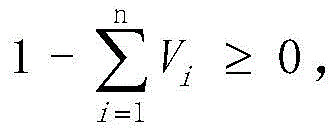 Vi≥0。
Vi≥0。
5. The method of any one of claims 1-4, wherein the equation is given by equation (9):

in the formula (9), the reaction mixture is,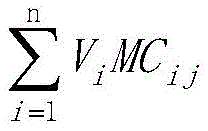 for theoretical calculation of curves, LOGjRepresents the j-th well-logging curve, ViDenotes the volume of the i-th mineral or fluid, MCijRepresents the j logging theory value, MC, corresponding to the i mineral or fluidmfThe response value of the logging curve corresponding to the mud is shown, the DeltaV represents the proportion of the volume formed by expanding or reducing the borehole to the detection volume of the logging curve, wherein,
 1≥Vi,ΔV≥0。
6. the method of any one of claims 1-5, wherein the equation of the equation is selected from at least one of equations (10) through (16):






where DEN represents a compensated density log, AC represents a compensated sonic log, CNL represents a compensated neutron log, PE represents a photoelectric absorption cross-section log, U represents a uranium log, TH represents a thorium log, K represents a potassium log, and V representsiRepresenting the volume of the i-th mineral or fluid, Δ V representing the proportion of the volume formed by borehole enlargement or reduction to the volume detected by the log, ρiDenotes the compensated density, Δ T, corresponding to the i-th mineral or fluidiIndicating the compensating sound wave, CNL, corresponding to the i-th mineral or fluidiRepresenting compensating neutrons, PE, corresponding to the i-th mineral or fluidiShowing the photoelectric absorption cross-section wave, U, corresponding to the i-th mineral or fluidiIndicating the uranium value, TH, corresponding to the i-TH mineral or fluidiDenotes the value of thorium, K, corresponding to the i-th mineral or fluidiIndicates the corresponding potassium value, rho, of the ith mineral or fluidmfIndicating the corresponding compensated density, Δ T, of the mudmfIndicating the corresponding compensated acoustic wave of the mud, CNLmfIndicating compensating neutrons, PE, to the mudmfIndicating the photoelectric absorption cross-section wave, U, corresponding to the slurrymfIndicating the corresponding uranium value, TH, of the slurrymfIndicates the corresponding thorium value, K, of the mudmfIndicates the corresponding potassium value of the slurry and meets the requirement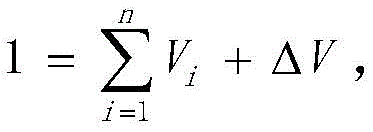 Vi≥0。
Vi≥0。
7. The method according to any of claims 1-6, wherein the linear objective function is as shown in equation (17):

8. the method according to any of claims 1-7, wherein the non-linear objective function is as shown in equation (18):

9. the method according to any one of claims 1-8, further comprising:
determining a cost coefficient in the linear objective function, and applying the cost coefficient in the linear objective function to the linear programming standard form; and/or
Determining cost coefficients in the non-linear objective function and applying the cost coefficients in the non-linear objective function to the non-linear programming standard form, wherein,
the value coefficient in the linear objective function is shown as formula (19); and/or the figure of merit in the nonlinear objective function is as shown in equation (20):


10. the method according to any one of claims 1 to 9, wherein in step (8), if the obtained volume content of minerals and/or fluid in the formation is greater than or equal to 0, the obtained volume content of minerals and/or fluid in the formation is judged as an optimal solution.
Priority Applications (1)
| Application Number | Priority Date | Filing Date | Title |
|---|---|---|---|
| CN201911412325.XA CN113123783B (en) | 2019-12-31 | 2019-12-31 | Method for finely evaluating volume content of stratum |
Applications Claiming Priority (1)
| Application Number | Priority Date | Filing Date | Title |
|---|---|---|---|
| CN201911412325.XA CN113123783B (en) | 2019-12-31 | 2019-12-31 | Method for finely evaluating volume content of stratum |
Publications (2)
| Publication Number | Publication Date |
|---|---|
| CN113123783A true CN113123783A (en) | 2021-07-16 |
| CN113123783B CN113123783B (en) | 2023-10-13 |
Family
ID=76770247
Family Applications (1)
| Application Number | Title | Priority Date | Filing Date |
|---|---|---|---|
| CN201911412325.XA Active CN113123783B (en) | 2019-12-31 | 2019-12-31 | Method for finely evaluating volume content of stratum |
Country Status (1)
| Country | Link |
|---|---|
| CN (1) | CN113123783B (en) |
Cited By (3)
| Publication number | Priority date | Publication date | Assignee | Title |
|---|---|---|---|---|
| CN113123782A (en) * | 2019-12-31 | 2021-07-16 | 中国石油化工股份有限公司 | Method for evaluating stratum components by utilizing linear programming |
| CN116927754A (en) * | 2022-04-01 | 2023-10-24 | 中国石油化工股份有限公司 | Reservoir fluid property identification method and device, electronic equipment and medium |
| CN118015219A (en) * | 2024-04-09 | 2024-05-10 | 中国地质大学(武汉) | Method, device and equipment for generating geological model based on qualitative Kriging interpolation |
Citations (3)
| Publication number | Priority date | Publication date | Assignee | Title |
|---|---|---|---|---|
| CN105221142A (en) * | 2014-07-04 | 2016-01-06 | 中国石油化工股份有限公司 | A kind of method identifying shale subterranean minerals mass content |
| CN105298476A (en) * | 2014-07-04 | 2016-02-03 | 中国石油化工股份有限公司 | Method for recognizing volume content of minerals of shale formation |
| WO2017024530A1 (en) * | 2015-08-11 | 2017-02-16 | 深圳朝伟达科技有限公司 | Method for calculating content of organic carbon in hydrocarbon source rock |
-
2019
- 2019-12-31 CN CN201911412325.XA patent/CN113123783B/en active Active
Patent Citations (3)
| Publication number | Priority date | Publication date | Assignee | Title |
|---|---|---|---|---|
| CN105221142A (en) * | 2014-07-04 | 2016-01-06 | 中国石油化工股份有限公司 | A kind of method identifying shale subterranean minerals mass content |
| CN105298476A (en) * | 2014-07-04 | 2016-02-03 | 中国石油化工股份有限公司 | Method for recognizing volume content of minerals of shale formation |
| WO2017024530A1 (en) * | 2015-08-11 | 2017-02-16 | 深圳朝伟达科技有限公司 | Method for calculating content of organic carbon in hydrocarbon source rock |
Non-Patent Citations (1)
| Title |
|---|
| 袁超;马萌;周灿灿;冯周;施宇峰;: "结合地层元素测井和密度测井提高孔隙度评价精度", 测井技术, no. 02 * |
Cited By (4)
| Publication number | Priority date | Publication date | Assignee | Title |
|---|---|---|---|---|
| CN113123782A (en) * | 2019-12-31 | 2021-07-16 | 中国石油化工股份有限公司 | Method for evaluating stratum components by utilizing linear programming |
| CN113123782B (en) * | 2019-12-31 | 2024-05-14 | 中国石油化工股份有限公司 | Method for evaluating stratum components by utilizing linear programming |
| CN116927754A (en) * | 2022-04-01 | 2023-10-24 | 中国石油化工股份有限公司 | Reservoir fluid property identification method and device, electronic equipment and medium |
| CN118015219A (en) * | 2024-04-09 | 2024-05-10 | 中国地质大学(武汉) | Method, device and equipment for generating geological model based on qualitative Kriging interpolation |
Also Published As
| Publication number | Publication date |
|---|---|
| CN113123783B (en) | 2023-10-13 |
Similar Documents
| Publication | Publication Date | Title |
|---|---|---|
| US6662109B2 (en) | Method of constraining by dynamic production data a fine model representative of the distribution in the reservoir of a physical quantity characteristic of the subsoil structure | |
| Heidari et al. | Improved estimation of mineral and fluid volumetric concentrations from well logs in thinly bedded and invaded formations | |
| US12105242B2 (en) | Evaluating anisotropic effective permeability in rock formations having natural fracture networks | |
| CN114066084B (en) | Method and system for predicting phase permeation curve based on machine learning | |
| Mascarenhas et al. | Coarse scale simulation of horizontal wells in heterogeneous reservoirs | |
| CN113123783A (en) | Method for finely evaluating volume content of stratum | |
| CN106443770A (en) | Shale gas geological sweet spot prediction method | |
| CN107526117B (en) | Based on autocoding and transfinites and learn the acoustic speed prediction technique of joint network | |
| Al Rassas et al. | Application of 3d reservoir geological model on es1 formation, block nv32, shenvsi oilfield, China | |
| Newsham et al. | Tutorial: Organic-Mudstone Petrophysics: Workflow to Estimate Storage Capacity | |
| Fan et al. | Prediction of multiple origin overpressure in deep fold-thrust belt: A case study of Kuqa subbasin, Tarim Basin, northwestern China | |
| EP3221556A1 (en) | A combination model for predicting stiffness coefficients absent stoneley wave velocity data | |
| Fahool et al. | Poroelastic analysis employing the finite element method to assess the effect of changes in the biot coefficient on oil well wall stability | |
| CN116930023A (en) | Fine interpretation method and device for dense sandstone phase-control classified porosity logging | |
| Oyerinde et al. | Experiences with streamline-based three-phase history matching | |
| CN113123782B (en) | Method for evaluating stratum components by utilizing linear programming | |
| Hadibeik et al. | Petrophysical properties of unconventional low-mobility reservoirs (shale gas and heavy oil) by using newly developed adaptive testing approach | |
| CN115017834B (en) | Formation pressure prediction method and device | |
| Cunha | Integrating static and dynamic data for oil and gas reservoir modelling | |
| Abdideh et al. | Application of quantitative risk assessment in wellbore stability analysis of directional wells | |
| Johns et al. | Estimating subsurface horizontal stress magnitudes in a three-dimensional geocellular model: Application to Permian Basin unconventional resources | |
| Wang et al. | 4D Geomechanical Research in Hydraulic Fracturing of Unconventional Resources-A Case Study From Junggar Basin, China | |
| Zhai et al. | The fundamental work to the pre-frac evaluation of deep shale reservoir: evaluating reservoir heterogeneity based on principal components analysis and artificial neural network | |
| US20190113653A1 (en) | Evaluating hydrocarbon reserves using tool response models | |
| Fahool et al. | A Case Study for Evaluating Effective Geomechanical Parameters and the Influence of the Biot Coefficient on the Stability of a Wellbore Wall in the Asmari Formation using Machine Learning |
Legal Events
| Date | Code | Title | Description |
|---|---|---|---|
| PB01 | Publication | ||
| PB01 | Publication | ||
| SE01 | Entry into force of request for substantive examination | ||
| SE01 | Entry into force of request for substantive examination | ||
| GR01 | Patent grant | ||
| GR01 | Patent grant |