CN113337112B - Resin composition with high over-surface thermal conductivity and preparation method and application thereof - Google Patents
Resin composition with high over-surface thermal conductivity and preparation method and application thereof Download PDFInfo
- Publication number
- CN113337112B CN113337112B CN202110624139.3A CN202110624139A CN113337112B CN 113337112 B CN113337112 B CN 113337112B CN 202110624139 A CN202110624139 A CN 202110624139A CN 113337112 B CN113337112 B CN 113337112B
- Authority
- CN
- China
- Prior art keywords
- thermal conductivity
- heat
- resin composition
- parts
- fiber
- Prior art date
- Legal status (The legal status is an assumption and is not a legal conclusion. Google has not performed a legal analysis and makes no representation as to the accuracy of the status listed.)
- Active
Links
- 239000011342 resin composition Substances 0.000 title claims abstract description 33
- 238000002360 preparation method Methods 0.000 title abstract description 12
- 239000000945 filler Substances 0.000 claims abstract description 40
- 239000000835 fiber Substances 0.000 claims abstract description 25
- 239000000463 material Substances 0.000 claims abstract description 22
- 238000002156 mixing Methods 0.000 claims abstract description 15
- 230000002195 synergetic effect Effects 0.000 claims abstract description 15
- 239000003963 antioxidant agent Substances 0.000 claims abstract description 9
- 230000003078 antioxidant effect Effects 0.000 claims abstract description 9
- 239000012783 reinforcing fiber Substances 0.000 claims abstract description 9
- 229920005992 thermoplastic resin Polymers 0.000 claims abstract description 9
- 239000002994 raw material Substances 0.000 claims abstract description 8
- 239000000314 lubricant Substances 0.000 claims abstract description 7
- 238000001816 cooling Methods 0.000 claims abstract description 6
- 238000009413 insulation Methods 0.000 claims abstract description 4
- 238000002844 melting Methods 0.000 claims abstract description 4
- 230000008018 melting Effects 0.000 claims abstract description 4
- 238000003756 stirring Methods 0.000 claims abstract description 4
- 238000001035 drying Methods 0.000 claims abstract description 3
- 238000010008 shearing Methods 0.000 claims abstract description 3
- XLOMVQKBTHCTTD-UHFFFAOYSA-N Zinc monoxide Chemical compound [Zn]=O XLOMVQKBTHCTTD-UHFFFAOYSA-N 0.000 claims description 24
- 230000017525 heat dissipation Effects 0.000 claims description 20
- 229910052582 BN Inorganic materials 0.000 claims description 17
- PZNSFCLAULLKQX-UHFFFAOYSA-N Boron nitride Chemical compound N#B PZNSFCLAULLKQX-UHFFFAOYSA-N 0.000 claims description 17
- 239000011787 zinc oxide Substances 0.000 claims description 11
- CPLXHLVBOLITMK-UHFFFAOYSA-N magnesium oxide Inorganic materials [Mg]=O CPLXHLVBOLITMK-UHFFFAOYSA-N 0.000 claims description 8
- 239000000395 magnesium oxide Substances 0.000 claims description 7
- -1 polybutylene terephthalate Polymers 0.000 claims description 7
- 239000002131 composite material Substances 0.000 claims description 6
- 239000003365 glass fiber Substances 0.000 claims description 6
- AXZKOIWUVFPNLO-UHFFFAOYSA-N magnesium;oxygen(2-) Chemical compound [O-2].[Mg+2] AXZKOIWUVFPNLO-UHFFFAOYSA-N 0.000 claims description 6
- 239000004734 Polyphenylene sulfide Substances 0.000 claims description 5
- PMHQVHHXPFUNSP-UHFFFAOYSA-M copper(1+);methylsulfanylmethane;bromide Chemical compound Br[Cu].CSC PMHQVHHXPFUNSP-UHFFFAOYSA-M 0.000 claims description 5
- VNWKTOKETHGBQD-UHFFFAOYSA-N methane Chemical compound C VNWKTOKETHGBQD-UHFFFAOYSA-N 0.000 claims description 5
- 229920000069 polyphenylene sulfide Polymers 0.000 claims description 5
- 229920000049 Carbon (fiber) Polymers 0.000 claims description 4
- 229920002302 Nylon 6,6 Polymers 0.000 claims description 4
- 239000004698 Polyethylene Substances 0.000 claims description 4
- VYPSYNLAJGMNEJ-UHFFFAOYSA-N Silicium dioxide Chemical compound O=[Si]=O VYPSYNLAJGMNEJ-UHFFFAOYSA-N 0.000 claims description 4
- BRPQOXSCLDDYGP-UHFFFAOYSA-N calcium oxide Chemical compound [O-2].[Ca+2] BRPQOXSCLDDYGP-UHFFFAOYSA-N 0.000 claims description 4
- 239000000292 calcium oxide Substances 0.000 claims description 4
- ODINCKMPIJJUCX-UHFFFAOYSA-N calcium oxide Inorganic materials [Ca]=O ODINCKMPIJJUCX-UHFFFAOYSA-N 0.000 claims description 4
- 239000004917 carbon fiber Substances 0.000 claims description 4
- HQKMJHAJHXVSDF-UHFFFAOYSA-L magnesium stearate Chemical compound [Mg+2].CCCCCCCCCCCCCCCCCC([O-])=O.CCCCCCCCCCCCCCCCCC([O-])=O HQKMJHAJHXVSDF-UHFFFAOYSA-L 0.000 claims description 4
- 238000000034 method Methods 0.000 claims description 4
- 229920001707 polybutylene terephthalate Polymers 0.000 claims description 4
- 229920000573 polyethylene Polymers 0.000 claims description 4
- 229920002748 Basalt fiber Polymers 0.000 claims description 3
- 229920002292 Nylon 6 Polymers 0.000 claims description 3
- 239000004696 Poly ether ether ketone Substances 0.000 claims description 3
- 239000004642 Polyimide Substances 0.000 claims description 3
- 239000004721 Polyphenylene oxide Substances 0.000 claims description 3
- BGYHLZZASRKEJE-UHFFFAOYSA-N [3-[3-(3,5-ditert-butyl-4-hydroxyphenyl)propanoyloxy]-2,2-bis[3-(3,5-ditert-butyl-4-hydroxyphenyl)propanoyloxymethyl]propyl] 3-(3,5-ditert-butyl-4-hydroxyphenyl)propanoate Chemical compound CC(C)(C)C1=C(O)C(C(C)(C)C)=CC(CCC(=O)OCC(COC(=O)CCC=2C=C(C(O)=C(C=2)C(C)(C)C)C(C)(C)C)(COC(=O)CCC=2C=C(C(O)=C(C=2)C(C)(C)C)C(C)(C)C)COC(=O)CCC=2C=C(C(O)=C(C=2)C(C)(C)C)C(C)(C)C)=C1 BGYHLZZASRKEJE-UHFFFAOYSA-N 0.000 claims description 3
- SSDSCDGVMJFTEQ-UHFFFAOYSA-N octadecyl 3-(3,5-ditert-butyl-4-hydroxyphenyl)propanoate Chemical compound CCCCCCCCCCCCCCCCCCOC(=O)CCC1=CC(C(C)(C)C)=C(O)C(C(C)(C)C)=C1 SSDSCDGVMJFTEQ-UHFFFAOYSA-N 0.000 claims description 3
- TWNQGVIAIRXVLR-UHFFFAOYSA-N oxo(oxoalumanyloxy)alumane Chemical compound O=[Al]O[Al]=O TWNQGVIAIRXVLR-UHFFFAOYSA-N 0.000 claims description 3
- 229920002530 polyetherether ketone Polymers 0.000 claims description 3
- 229920001721 polyimide Polymers 0.000 claims description 3
- 229920006380 polyphenylene oxide Polymers 0.000 claims description 3
- FRWYFWZENXDZMU-UHFFFAOYSA-N 2-iodoquinoline Chemical compound C1=CC=CC2=NC(I)=CC=C21 FRWYFWZENXDZMU-UHFFFAOYSA-N 0.000 claims description 2
- OKOBUGCCXMIKDM-UHFFFAOYSA-N Irganox 1098 Chemical compound CC(C)(C)C1=C(O)C(C(C)(C)C)=CC(CCC(=O)NCCCCCCNC(=O)CCC=2C=C(C(O)=C(C=2)C(C)(C)C)C(C)(C)C)=C1 OKOBUGCCXMIKDM-UHFFFAOYSA-N 0.000 claims description 2
- JKIJEFPNVSHHEI-UHFFFAOYSA-N Phenol, 2,4-bis(1,1-dimethylethyl)-, phosphite (3:1) Chemical compound CC(C)(C)C1=CC(C(C)(C)C)=CC=C1OP(OC=1C(=CC(=CC=1)C(C)(C)C)C(C)(C)C)OC1=CC=C(C(C)(C)C)C=C1C(C)(C)C JKIJEFPNVSHHEI-UHFFFAOYSA-N 0.000 claims description 2
- 229920000122 acrylonitrile butadiene styrene Polymers 0.000 claims description 2
- PNEYBMLMFCGWSK-UHFFFAOYSA-N aluminium oxide Inorganic materials [O-2].[O-2].[O-2].[Al+3].[Al+3] PNEYBMLMFCGWSK-UHFFFAOYSA-N 0.000 claims description 2
- 229910000323 aluminium silicate Inorganic materials 0.000 claims description 2
- AGXUVMPSUKZYDT-UHFFFAOYSA-L barium(2+);octadecanoate Chemical compound [Ba+2].CCCCCCCCCCCCCCCCCC([O-])=O.CCCCCCCCCCCCCCCCCC([O-])=O AGXUVMPSUKZYDT-UHFFFAOYSA-L 0.000 claims description 2
- LTPBRCUWZOMYOC-UHFFFAOYSA-N beryllium oxide Inorganic materials O=[Be] LTPBRCUWZOMYOC-UHFFFAOYSA-N 0.000 claims description 2
- 235000014113 dietary fatty acids Nutrition 0.000 claims description 2
- HNPSIPDUKPIQMN-UHFFFAOYSA-N dioxosilane;oxo(oxoalumanyloxy)alumane Chemical compound O=[Si]=O.O=[Al]O[Al]=O HNPSIPDUKPIQMN-UHFFFAOYSA-N 0.000 claims description 2
- 229920006242 ethylene acrylic acid copolymer Polymers 0.000 claims description 2
- 239000005038 ethylene vinyl acetate Substances 0.000 claims description 2
- 239000000194 fatty acid Substances 0.000 claims description 2
- 229930195729 fatty acid Natural products 0.000 claims description 2
- 150000004665 fatty acids Chemical class 0.000 claims description 2
- 235000019359 magnesium stearate Nutrition 0.000 claims description 2
- 229910044991 metal oxide Inorganic materials 0.000 claims description 2
- 150000004706 metal oxides Chemical group 0.000 claims description 2
- 239000002480 mineral oil Substances 0.000 claims description 2
- 235000010446 mineral oil Nutrition 0.000 claims description 2
- RKISUIUJZGSLEV-UHFFFAOYSA-N n-[2-(octadecanoylamino)ethyl]octadecanamide Chemical compound CCCCCCCCCCCCCCCCCC(=O)NCCNC(=O)CCCCCCCCCCCCCCCCC RKISUIUJZGSLEV-UHFFFAOYSA-N 0.000 claims description 2
- 229910000480 nickel oxide Inorganic materials 0.000 claims description 2
- GNRSAWUEBMWBQH-UHFFFAOYSA-N oxonickel Chemical compound [Ni]=O GNRSAWUEBMWBQH-UHFFFAOYSA-N 0.000 claims description 2
- 239000012188 paraffin wax Substances 0.000 claims description 2
- 229920001200 poly(ethylene-vinyl acetate) Polymers 0.000 claims description 2
- 229920002492 poly(sulfone) Polymers 0.000 claims description 2
- 229920001230 polyarylate Polymers 0.000 claims description 2
- 239000004417 polycarbonate Substances 0.000 claims description 2
- 229920000515 polycarbonate Polymers 0.000 claims description 2
- 239000000377 silicon dioxide Substances 0.000 claims description 2
- 235000012239 silicon dioxide Nutrition 0.000 claims description 2
- 229920002545 silicone oil Polymers 0.000 claims description 2
- 239000001993 wax Substances 0.000 claims description 2
- 239000002202 Polyethylene glycol Substances 0.000 claims 1
- 238000005286 illumination Methods 0.000 claims 1
- 229920001223 polyethylene glycol Polymers 0.000 claims 1
- KKEYFWRCBNTPAC-UHFFFAOYSA-L terephthalate(2-) Chemical compound [O-]C(=O)C1=CC=C(C([O-])=O)C=C1 KKEYFWRCBNTPAC-UHFFFAOYSA-L 0.000 claims 1
- 229920003023 plastic Polymers 0.000 description 18
- 239000004033 plastic Substances 0.000 description 18
- 229920005989 resin Polymers 0.000 description 16
- 239000011347 resin Substances 0.000 description 16
- 230000000052 comparative effect Effects 0.000 description 8
- OKTJSMMVPCPJKN-UHFFFAOYSA-N Carbon Chemical compound [C] OKTJSMMVPCPJKN-UHFFFAOYSA-N 0.000 description 6
- 239000000203 mixture Substances 0.000 description 6
- 238000012360 testing method Methods 0.000 description 6
- 238000013461 design Methods 0.000 description 5
- 238000012986 modification Methods 0.000 description 5
- 230000004048 modification Effects 0.000 description 5
- 239000012747 synergistic agent Substances 0.000 description 5
- 208000016261 weight loss Diseases 0.000 description 5
- 230000004580 weight loss Effects 0.000 description 5
- 238000007792 addition Methods 0.000 description 4
- 239000011231 conductive filler Substances 0.000 description 4
- 230000000694 effects Effects 0.000 description 4
- 239000006229 carbon black Substances 0.000 description 3
- 230000001965 increasing effect Effects 0.000 description 3
- 229910052751 metal Inorganic materials 0.000 description 3
- 239000002184 metal Substances 0.000 description 3
- 238000000465 moulding Methods 0.000 description 3
- 239000002245 particle Substances 0.000 description 3
- 229920000139 polyethylene terephthalate Polymers 0.000 description 3
- 239000005020 polyethylene terephthalate Substances 0.000 description 3
- PXHVJJICTQNCMI-UHFFFAOYSA-N Nickel Chemical compound [Ni] PXHVJJICTQNCMI-UHFFFAOYSA-N 0.000 description 2
- 230000009286 beneficial effect Effects 0.000 description 2
- 229910052799 carbon Inorganic materials 0.000 description 2
- 239000004020 conductor Substances 0.000 description 2
- 230000007797 corrosion Effects 0.000 description 2
- 238000005260 corrosion Methods 0.000 description 2
- 238000010292 electrical insulation Methods 0.000 description 2
- 229910002804 graphite Inorganic materials 0.000 description 2
- 239000010439 graphite Substances 0.000 description 2
- 230000014759 maintenance of location Effects 0.000 description 2
- 239000007769 metal material Substances 0.000 description 2
- 239000005022 packaging material Substances 0.000 description 2
- 238000011056 performance test Methods 0.000 description 2
- 229910052580 B4C Inorganic materials 0.000 description 1
- RYGMFSIKBFXOCR-UHFFFAOYSA-N Copper Chemical compound [Cu] RYGMFSIKBFXOCR-UHFFFAOYSA-N 0.000 description 1
- 241001596784 Pegasus Species 0.000 description 1
- 239000004952 Polyamide Substances 0.000 description 1
- BQCADISMDOOEFD-UHFFFAOYSA-N Silver Chemical compound [Ag] BQCADISMDOOEFD-UHFFFAOYSA-N 0.000 description 1
- 230000002411 adverse Effects 0.000 description 1
- 229910052782 aluminium Inorganic materials 0.000 description 1
- XAGFODPZIPBFFR-UHFFFAOYSA-N aluminium Chemical compound [Al] XAGFODPZIPBFFR-UHFFFAOYSA-N 0.000 description 1
- INAHAJYZKVIDIZ-UHFFFAOYSA-N boron carbide Chemical compound B12B3B4C32B41 INAHAJYZKVIDIZ-UHFFFAOYSA-N 0.000 description 1
- 239000002134 carbon nanofiber Substances 0.000 description 1
- 239000002041 carbon nanotube Substances 0.000 description 1
- 229910021393 carbon nanotube Inorganic materials 0.000 description 1
- 230000015556 catabolic process Effects 0.000 description 1
- 239000000919 ceramic Substances 0.000 description 1
- 239000003795 chemical substances by application Substances 0.000 description 1
- 239000000805 composite resin Substances 0.000 description 1
- 229910052802 copper Inorganic materials 0.000 description 1
- 239000010949 copper Substances 0.000 description 1
- 230000007547 defect Effects 0.000 description 1
- 230000002708 enhancing effect Effects 0.000 description 1
- 238000001125 extrusion Methods 0.000 description 1
- 230000002349 favourable effect Effects 0.000 description 1
- 239000013022 formulation composition Substances 0.000 description 1
- 229910021389 graphene Inorganic materials 0.000 description 1
- 230000005484 gravity Effects 0.000 description 1
- 239000004615 ingredient Substances 0.000 description 1
- 238000001746 injection moulding Methods 0.000 description 1
- 230000009916 joint effect Effects 0.000 description 1
- 229920002521 macromolecule Polymers 0.000 description 1
- 150000002739 metals Chemical class 0.000 description 1
- 229910052759 nickel Inorganic materials 0.000 description 1
- 229920002647 polyamide Polymers 0.000 description 1
- 230000002035 prolonged effect Effects 0.000 description 1
- HBMJWWWQQXIZIP-UHFFFAOYSA-N silicon carbide Chemical compound [Si+]#[C-] HBMJWWWQQXIZIP-UHFFFAOYSA-N 0.000 description 1
- 229910010271 silicon carbide Inorganic materials 0.000 description 1
- 229910052709 silver Inorganic materials 0.000 description 1
- 239000004332 silver Substances 0.000 description 1
- 239000007921 spray Substances 0.000 description 1
- 239000000126 substance Substances 0.000 description 1
- XLYOFNOQVPJJNP-UHFFFAOYSA-N water Substances O XLYOFNOQVPJJNP-UHFFFAOYSA-N 0.000 description 1
Classifications
-
- C—CHEMISTRY; METALLURGY
- C08—ORGANIC MACROMOLECULAR COMPOUNDS; THEIR PREPARATION OR CHEMICAL WORKING-UP; COMPOSITIONS BASED THEREON
- C08J—WORKING-UP; GENERAL PROCESSES OF COMPOUNDING; AFTER-TREATMENT NOT COVERED BY SUBCLASSES C08B, C08C, C08F, C08G or C08H
- C08J5/00—Manufacture of articles or shaped materials containing macromolecular substances
- C08J5/04—Reinforcing macromolecular compounds with loose or coherent fibrous material
- C08J5/0405—Reinforcing macromolecular compounds with loose or coherent fibrous material with inorganic fibres
- C08J5/043—Reinforcing macromolecular compounds with loose or coherent fibrous material with inorganic fibres with glass fibres
-
- C—CHEMISTRY; METALLURGY
- C08—ORGANIC MACROMOLECULAR COMPOUNDS; THEIR PREPARATION OR CHEMICAL WORKING-UP; COMPOSITIONS BASED THEREON
- C08J—WORKING-UP; GENERAL PROCESSES OF COMPOUNDING; AFTER-TREATMENT NOT COVERED BY SUBCLASSES C08B, C08C, C08F, C08G or C08H
- C08J5/00—Manufacture of articles or shaped materials containing macromolecular substances
- C08J5/04—Reinforcing macromolecular compounds with loose or coherent fibrous material
- C08J5/0405—Reinforcing macromolecular compounds with loose or coherent fibrous material with inorganic fibres
- C08J5/042—Reinforcing macromolecular compounds with loose or coherent fibrous material with inorganic fibres with carbon fibres
-
- C—CHEMISTRY; METALLURGY
- C08—ORGANIC MACROMOLECULAR COMPOUNDS; THEIR PREPARATION OR CHEMICAL WORKING-UP; COMPOSITIONS BASED THEREON
- C08J—WORKING-UP; GENERAL PROCESSES OF COMPOUNDING; AFTER-TREATMENT NOT COVERED BY SUBCLASSES C08B, C08C, C08F, C08G or C08H
- C08J5/00—Manufacture of articles or shaped materials containing macromolecular substances
- C08J5/04—Reinforcing macromolecular compounds with loose or coherent fibrous material
- C08J5/047—Reinforcing macromolecular compounds with loose or coherent fibrous material with mixed fibrous material
-
- C—CHEMISTRY; METALLURGY
- C08—ORGANIC MACROMOLECULAR COMPOUNDS; THEIR PREPARATION OR CHEMICAL WORKING-UP; COMPOSITIONS BASED THEREON
- C08J—WORKING-UP; GENERAL PROCESSES OF COMPOUNDING; AFTER-TREATMENT NOT COVERED BY SUBCLASSES C08B, C08C, C08F, C08G or C08H
- C08J2361/00—Characterised by the use of condensation polymers of aldehydes or ketones; Derivatives of such polymers
- C08J2361/04—Condensation polymers of aldehydes or ketones with phenols only
- C08J2361/16—Condensation polymers of aldehydes or ketones with phenols only of ketones with phenols
-
- C—CHEMISTRY; METALLURGY
- C08—ORGANIC MACROMOLECULAR COMPOUNDS; THEIR PREPARATION OR CHEMICAL WORKING-UP; COMPOSITIONS BASED THEREON
- C08J—WORKING-UP; GENERAL PROCESSES OF COMPOUNDING; AFTER-TREATMENT NOT COVERED BY SUBCLASSES C08B, C08C, C08F, C08G or C08H
- C08J2367/00—Characterised by the use of polyesters obtained by reactions forming a carboxylic ester link in the main chain; Derivatives of such polymers
- C08J2367/02—Polyesters derived from dicarboxylic acids and dihydroxy compounds
-
- C—CHEMISTRY; METALLURGY
- C08—ORGANIC MACROMOLECULAR COMPOUNDS; THEIR PREPARATION OR CHEMICAL WORKING-UP; COMPOSITIONS BASED THEREON
- C08J—WORKING-UP; GENERAL PROCESSES OF COMPOUNDING; AFTER-TREATMENT NOT COVERED BY SUBCLASSES C08B, C08C, C08F, C08G or C08H
- C08J2377/00—Characterised by the use of polyamides obtained by reactions forming a carboxylic amide link in the main chain; Derivatives of such polymers
- C08J2377/06—Polyamides derived from polyamines and polycarboxylic acids
-
- C—CHEMISTRY; METALLURGY
- C08—ORGANIC MACROMOLECULAR COMPOUNDS; THEIR PREPARATION OR CHEMICAL WORKING-UP; COMPOSITIONS BASED THEREON
- C08J—WORKING-UP; GENERAL PROCESSES OF COMPOUNDING; AFTER-TREATMENT NOT COVERED BY SUBCLASSES C08B, C08C, C08F, C08G or C08H
- C08J2381/00—Characterised by the use of macromolecular compounds obtained by reactions forming in the main chain of the macromolecule a linkage containing sulfur with or without nitrogen, oxygen, or carbon only; Polysulfones; Derivatives of such polymers
- C08J2381/02—Polythioethers; Polythioether-ethers
-
- C—CHEMISTRY; METALLURGY
- C08—ORGANIC MACROMOLECULAR COMPOUNDS; THEIR PREPARATION OR CHEMICAL WORKING-UP; COMPOSITIONS BASED THEREON
- C08K—Use of inorganic or non-macromolecular organic substances as compounding ingredients
- C08K3/00—Use of inorganic substances as compounding ingredients
- C08K3/18—Oxygen-containing compounds, e.g. metal carbonyls
- C08K3/20—Oxides; Hydroxides
- C08K3/22—Oxides; Hydroxides of metals
- C08K2003/2217—Oxides; Hydroxides of metals of magnesium
- C08K2003/222—Magnesia, i.e. magnesium oxide
-
- C—CHEMISTRY; METALLURGY
- C08—ORGANIC MACROMOLECULAR COMPOUNDS; THEIR PREPARATION OR CHEMICAL WORKING-UP; COMPOSITIONS BASED THEREON
- C08K—Use of inorganic or non-macromolecular organic substances as compounding ingredients
- C08K3/00—Use of inorganic substances as compounding ingredients
- C08K3/18—Oxygen-containing compounds, e.g. metal carbonyls
- C08K3/20—Oxides; Hydroxides
- C08K3/22—Oxides; Hydroxides of metals
- C08K2003/2296—Oxides; Hydroxides of metals of zinc
-
- C—CHEMISTRY; METALLURGY
- C08—ORGANIC MACROMOLECULAR COMPOUNDS; THEIR PREPARATION OR CHEMICAL WORKING-UP; COMPOSITIONS BASED THEREON
- C08K—Use of inorganic or non-macromolecular organic substances as compounding ingredients
- C08K7/00—Use of ingredients characterised by shape
-
- C—CHEMISTRY; METALLURGY
- C08—ORGANIC MACROMOLECULAR COMPOUNDS; THEIR PREPARATION OR CHEMICAL WORKING-UP; COMPOSITIONS BASED THEREON
- C08K—Use of inorganic or non-macromolecular organic substances as compounding ingredients
- C08K7/00—Use of ingredients characterised by shape
- C08K7/02—Fibres or whiskers
- C08K7/04—Fibres or whiskers inorganic
- C08K7/06—Elements
-
- C—CHEMISTRY; METALLURGY
- C08—ORGANIC MACROMOLECULAR COMPOUNDS; THEIR PREPARATION OR CHEMICAL WORKING-UP; COMPOSITIONS BASED THEREON
- C08K—Use of inorganic or non-macromolecular organic substances as compounding ingredients
- C08K7/00—Use of ingredients characterised by shape
- C08K7/02—Fibres or whiskers
- C08K7/04—Fibres or whiskers inorganic
- C08K7/08—Oxygen-containing compounds
-
- C—CHEMISTRY; METALLURGY
- C08—ORGANIC MACROMOLECULAR COMPOUNDS; THEIR PREPARATION OR CHEMICAL WORKING-UP; COMPOSITIONS BASED THEREON
- C08K—Use of inorganic or non-macromolecular organic substances as compounding ingredients
- C08K7/00—Use of ingredients characterised by shape
- C08K7/02—Fibres or whiskers
- C08K7/04—Fibres or whiskers inorganic
- C08K7/10—Silicon-containing compounds
-
- C—CHEMISTRY; METALLURGY
- C08—ORGANIC MACROMOLECULAR COMPOUNDS; THEIR PREPARATION OR CHEMICAL WORKING-UP; COMPOSITIONS BASED THEREON
- C08K—Use of inorganic or non-macromolecular organic substances as compounding ingredients
- C08K7/00—Use of ingredients characterised by shape
- C08K7/02—Fibres or whiskers
- C08K7/04—Fibres or whiskers inorganic
- C08K7/14—Glass
Landscapes
- Chemical & Material Sciences (AREA)
- Engineering & Computer Science (AREA)
- Manufacturing & Machinery (AREA)
- Materials Engineering (AREA)
- Health & Medical Sciences (AREA)
- Chemical Kinetics & Catalysis (AREA)
- Medicinal Chemistry (AREA)
- Polymers & Plastics (AREA)
- Organic Chemistry (AREA)
- Inorganic Chemistry (AREA)
- Compositions Of Macromolecular Compounds (AREA)
Abstract
The invention relates to a resin composition with high over-surface thermal conductivity and a preparation method thereof, wherein the resin composition comprises the following components in parts by weight: 30-70 parts of thermoplastic resin, 20-50 parts of sheet or needle-shaped electric insulation heat conduction filler, 5-20 parts of heat conduction synergistic filler, 5-15 parts of reinforcing fiber, 0.1-1 part of antioxidant and 0.5-2 parts of lubricant. Mixing and stirring the other raw materials except the reinforced fiber according to a formula, feeding the raw materials into a main feeding port of a double-screw extruder after uniform mixing, feeding the reinforced fiber into a side feeding port of the double-screw extruder according to a proportion, controlling the temperature of the double-screw extruder to be 230-300 ℃, melting and fully mixing the materials under the conveying, shearing and mixing of a screw, and then extruding, drawing, cooling, drying and granulating the materials through a port die to obtain the resin composition with ultrahigh thermal conductivity. Compared with the prior art, the resin composition can effectively improve the over-surface thermal conductivity and reduce the cost.
Description
Technical Field
The invention relates to the technical field of macromolecules, in particular to a resin composition with high over-surface thermal conductivity, and a preparation method and application thereof.
Background
In the automobile industry, the consumer electronics industry and the electronic and electrical industry, electronic components and logic circuits in the automobile industry and the consumer electronics industry tend to be integrated and miniaturized more and more, and the power density of the components is higher and higher. In the working process of the components, a part of energy is converted into heat, and the heat is accumulated to not only adversely affect the working efficiency of the components, but also greatly reduce the service life of the components. Therefore, how to select the heat dissipation material and how to design the heat dissipation structure to quickly dissipate the heat become key issues. Common devices requiring heat dissipation include lighting LED lamps, automotive chips, smart wearable device chips, heat exchangers, circuit breaker bases, and the like.
Generally, a metal material is a good conductor of heat, and its thermal conductivity is usually in the range of 200-1000W/(m × K), which is one of the most commonly used packaging materials for heat conduction of electronic components. However, metal materials have the disadvantages of high specific gravity, easy corrosion, difficult molding of complex structures, and the like, so that thermoplastic resin composite materials with heat conduction characteristics are increasingly widely used. Compared with metals, the heat-conducting resin is used for shell and cover type packaging materials of components, and can provide balanced heat conductivity, design freedom degree of easy molding, more excellent corrosion resistance and cost economy.
The thermal conductivity modification of the resin material is generally processed by melt blending a filler having a high thermal conductivity with a thermoplastic resin base material. The heat-conducting resin can be classified into insulating heat-conducting plastic and electric heat-conducting plastic according to whether the heat-conducting resin has electric conductivity. The insulating and heat-conducting plastic is generally prepared by adding ceramic fillers with high heat conductivity, and commonly comprises aluminum oxide, magnesium oxide, zinc oxide, boron nitride, aluminum nitride, silicon carbide and the like; the electrically and thermally conductive resin material is usually obtained by adding a metal or carbon filler, the common metal filler includes aluminum, copper, nickel, silver, etc., and the carbon filler includes carbon black, graphite, graphene, carbon nanofibers, carbon nanotubes, etc.
For heat dissipation applications in the field of electronics, the selection of the heat conducting material cannot be achieved at the cost of sacrificing electrical insulation and electrical breakdown strength, otherwise, the heat dissipation part will cause potential safety hazards, and therefore, the insulating heat conducting plastic is generally used as the material for such applications.
The heat dissipation performance of the heat dissipation material of the component device is closely related to the heat conductivity coefficient of the material, and is also related to factors such as the thickness of the heat dissipation material, the type of convection medium, the distance of a heat source, the structural design of the heat sink and the like. Generally, the larger the heat conductivity coefficient of the heat dissipation material is, the thinner the part thickness is, the higher the specific heat capacity of the convection medium is, and the closer the heat source is, the better the heat dissipation effect is achieved. However, the structural design of the heat dissipation part is usually designed into a "fin-shaped" structure, which, in addition to increasing the heat exchange area, more importantly, makes full use of the anisotropy of the thermal conductivity of the thermal conductive plastic. Since the thermally conductive fillers in thermally conductive plastics are usually dimensionally anisotropic (plate-like, needle-like) and tend to orient along the flow direction during molding, the perpendicular flow direction results in greater interfacial thermal resistance than the parallel flow direction, so-called "over-plane thermal conductivity" and "in-plane thermal conductivity". In-plane thermal conductivity typically varies from a few to a dozen times the over-plane thermal conductivity, with the "fin-shaped" heat-dissipating structures using higher in-plane thermal conductivity of the thermally conductive plastic to dissipate heat while circumventing lower over-plane thermal conductivity. However, for a highly integrated chip or a bottom case of a circuit breaker, the heat dissipation parts of the bottom case are usually not enough to have enough space for such a structural design, and the low over-surface thermal conductivity of the heat conductive plastic becomes a great obstacle to the heat dissipation performance, so that how to solve the problem of the low over-surface thermal conductivity of the heat conductive plastic becomes a great technical problem.
The invention patent with the patent number of CN108701555A discloses a heat-conducting plastic for a molded case circuit breaker base, the technical scheme is that boron nitride and carbon black are adopted as heat-conducting fillers, the in-plane heat conductivity of a composition material is 2.1W/(m) K, the through-plane heat conductivity is 0.9W/(m) K, and the through-plane heat conductivity is only 42.9% of the in-plane heat conductivity. Because boron nitride is a flaky structure with large anisotropy, the composite carbon black can reduce the anisotropy of thermal conductivity to a certain extent, but the over-plane thermal conductivity and the in-plane thermal conductivity still have large difference. The invention patent with the patent number of CN103965616A discloses a heat-conducting resin composition and a preparation method thereof, and the technical scheme is to prepare the resin composition with high heat conductivity by adopting boron carbide particle composite boron nitride fibers as heat-conducting fillers. It is obvious that the addition of boron nitride fibers having a two-dimensional structure necessarily increases the anisotropy of thermal conductivity. The invention patent No. CN101568599A discloses a heat-conducting resin composition, which adopts graphite with high length-height ratio as a heat-conducting filler, and compared with a spherical heat-conducting filler, the high length-height ratio has larger specific surface area, but the anisotropy of heat conductivity is inevitably increased. The invention patent with the patent number of CN109790025A discloses a preparation method of spherical boron nitride particles, and the spherical boron nitride can effectively reduce the anisotropy of thermal conductivity, but can cause the great increase of material cost.
Disclosure of Invention
The present invention aims to overcome the defects of the prior art and provide a resin composition with high over-surface thermal conductivity, a preparation method and an application thereof.
The purpose of the invention can be realized by the following technical scheme: a resin composition with high over-surface thermal conductivity and a preparation method thereof are disclosed, and the resin composition comprises the following components in parts by weight: 30-70 parts of thermoplastic resin, 20-50 parts of flake or needle-shaped electric insulation heat conduction filler, 5-20 parts of heat conduction synergistic filler, 5-15 parts of reinforcing fiber, 0.1-1 part of antioxidant and 0.5-2 parts of lubricant.
Further, the resin composition with high over-surface thermal conductivity of the invention comprises the following components in parts by weight: 50-60 parts of thermoplastic resin, 25-40 parts of flake or needle-shaped electric insulation heat-conducting filler, 5-10 parts of heat-conducting synergistic filler, 5-10 parts of reinforcing fiber, 0.1-1 part of antioxidant and 0.5-2 parts of lubricant.
Further, the thermoplastic resin is one or more of nylon 6, nylon 66, polyphenylene sulfide (PPS), ABS resin, polycarbonate (PC), polyethylene terephthalate (PET), polybutylene terephthalate (PBT), polyethylene, polyphenylene oxide, polyether ether ketone, polyimide, polyarylate, and polysulfone, but not limited thereto. More preferred thermoplastic resins are nylon 6, nylon 66, polyphenylene sulfide, PBT, PET, polyphenylene oxide, polyetheretherketone and polyimide.
Further, the sheet or needle-shaped electrically insulating and thermally conductive filler comprises more than one of boron nitride, aluminum nitride, aluminosilicate, alumina, zinc oxide, magnesium oxide, beryllium oxide, silicon dioxide, nickel oxide and calcium oxide, and the ratio of the diameter to the thickness is greater than 5:1, and more preferably greater than 10.
Further, the heat-conducting synergistic filler is a metal oxide with a three-dimensional needle structure, and comprises one or more of zinc oxide, aluminum oxide, magnesium oxide and calcium oxide. The first characteristic of the heat conductive synergistic filler is a three-dimensional needle structure.
Further, the reinforcing fiber is chopped fiber, including but not limited to glass fiber, basalt fiber, carbon fiber and composite fiber thereof, and the diameter of the reinforcing fiber is preferably 8-25 μm, and more preferably 10-15 μm. The retention length of the reinforced fiber in the resin after blending modification is preferably distributed in the range of 50-500 μm.
Further, the antioxidant comprises one or more of antioxidant 1010, antioxidant 1076, antioxidant 1098, antioxidant B900 or antioxidant 168.
Further, the lubricant is selected from one or more of silicone oil, white mineral oil, fatty acid amide, barium stearate, magnesium stearate, PETS, paraffin, polyethylene wax, ethylene bis-stearamide, ethylene-vinyl acetate copolymer or ethylene-acrylic acid copolymer.
The invention also provides a resin composition with high over-surface thermal conductivity and a preparation method thereof, and the method specifically comprises the following steps:
(1) Preparing the following components in parts by weight:

(2) And (2) putting the other raw materials except the reinforced fiber in the step (1) into a low-speed or high-speed mixer according to a formula, stirring, uniformly mixing, feeding the mixture into a main feeding port of a double-screw extruder through a weight-loss metering device, feeding the reinforced fiber into a side feeding port of the extruder according to a proportion by adopting the weight-loss metering device, controlling the temperature of the double-screw extruder to be 230-300 ℃, melting and fully mixing the materials under the conveying, shearing and mixing of screws, and then carrying out steps of extrusion through an oral die, stretching, cooling, drying, granulating and the like to obtain the resin composition with ultrahigh thermal conductivity.
Further, the length-diameter ratio of the double-screw extruder in the step (2) is 36-48, and a side feeding port is preferably positioned in the 5 th to 8 th barrels.
Furthermore, in the step (2), the reinforced fiber must be fed in a side feeding mode, and the rest raw materials are fed into the extruder in a main feeding mode.
Further, in the step (2), the screw rotation speed of the twin-screw extruder is controlled at 200 to 600RPM, preferably 200 to 400RPM.
Further, the drawing strip and the cooling device in the step (2) can be water tank cooling drawing strips, and a conveyor belt drawing strip device with a spray cooling system is preferably adopted.
The invention also provides application of the resin composition with high over-surface thermal conductivity, and the resin composition is used as a heat dissipation material to prepare heat dissipation components, such as lighting LED lamps, automobile chips, intelligent wearable equipment chips, heat exchangers, breaker bases and the like.
Compared with the prior art, the invention has the following beneficial effects:
(1) The invention provides a resin composition with high over-surface thermal conductivity and a preparation method thereof. The high thermal conductive filler with electrical insulation property is usually boron nitride and aluminum nitride, which are common fillers for insulating thermal conductive resin with high thermal conductivity requirement, however, most of the thermal conductive filler structures are lamellar structures, which have large anisotropy, and although high in-plane thermal conductivity can be obtained, it is difficult to obtain resin materials with high comprehensive thermal conductivity. The heat-conducting synergist with the three-dimensional needle structure is innovatively introduced to serve as the auxiliary filler, so that on one hand, the three-dimensional needle structure can be utilized to form a lap joint effect between layers of the lamellar heat-conducting filler, and the over-surface heat conduction resistance is reduced, so that the over-surface heat conductivity is efficiently improved, on the other hand, the cost of the heat-conducting filler such as boron nitride and aluminum nitride can be effectively reduced, and the material is more beneficial to being widely used in downstream parts. For example, with boron nitride as a filler, the through-plane thermal conductivity of the thermally conductive plastic is only 15% -20% of the in-plane thermal conductivity; when the heat-conducting fiber or spherical heat-conducting particles with one-dimensional structures are used as a boron nitride synergist, the over-surface heat conductivity of the prepared heat-conducting plastic can reach 30% -50% of the in-plane heat conductivity; when the heat-conducting filler with the three-dimensional needle structure is used as the synergist of the boron nitride, the through-plane thermal conductivity of the obtained resin composition can reach 50-60% of the in-plane thermal conductivity.
(2) The invention adopts the reinforced fiber as the ingredient for enhancing the performance of the resin, the reinforced fiber is the chopped fiber, including but not limited to the glass fiber, the basalt fiber, the carbon fiber and the composite fiber thereof, the fiber diameter is preferably 8-25 μm, and more preferably 10-15 μm. The retention length of the fiber in the resin after blending modification is preferably distributed in the range of 50-500 μm.
(3) The resin composition with high over-surface thermal conductivity provided by the invention can keep the mechanical strength not to be obviously reduced besides high over-surface thermal conductivity.
(4) The preparation of the resin composition adopts a weight-loss metering device, so that the heat conduction and the mechanical property of the composition are more stable; the reinforcing fiber adopts a side feeding mode and a lower screw rotating speed, so that the length-diameter ratio of the reinforcing fiber in the composition can be maximally reserved, and more excellent mechanical properties can be obtained.
Detailed Description
The present invention will be described in detail with reference to specific examples.
The raw materials selected for the present invention are all commercially available products unless otherwise specified.
Examples 1 to 8 and comparative examples 1 to 3:
a resin composition with high over-surface thermal conductivity and a preparation method thereof comprise the following steps:
metering the components except the glass fiber in the table 1 according to the formula proportion, placing the components in a high-speed mixer for stirring, feeding the components into a main feeding port of a double-screw extruder through a weight-loss metering device after uniform mixing, feeding the reinforced fiber into a side feeding port of the extruder according to the proportion by adopting the weight-loss metering device, wherein the length-diameter ratio of the double-screw extruder is 40.
Wherein, the material composition of table 1 is as follows:
resin PA66, ERP24 of Pegasus amabilis, intrinsic viscosity 2.45;
resin PPS, new 1150C, melt index 450g/10min (316 ℃ C. 5 Kg);
the heat-conducting filler BN is CFP012 produced by 3M, and the D50 is 8-14 mu M;
the heat conducting filler AlN is TA-1 produced by hundred figures, and the D50 is 1.7 mu m;
the heat-conducting synergistic filler ZnO (1) is commercially available three-dimensional needle-shaped zinc oxide, has a plurality of needle-shaped branch structures, and has a D50 of 4-6 mu m;
the heat-conducting synergistic filler MgO is commercially available three-dimensional needle-shaped magnesium oxide, has a plurality of needle-shaped branch structures, and has a D50 of 4-6 mu m;
the heat-conducting synergistic filler ZnO (2) is commercially available spherical zinc oxide, and the D50 is 4-5 mu m;
glass fiber, which is chopped glass fiber 568H of boulder, the diameter of the fiber is 11-13 μm, and the length is 4.5mm;
the carbon fiber is TR06NL of Mitsubishi chemical, the diameter of the fiber is 5-7 μm, the length of the fiber is 6mm, and polyamide is used as a bundling agent.
An antioxidant, ciba refined Irganox 1076; irganox 168 and Irganox 1010
The lubricant is PETS which is commercially available, and the melting point Tm is 60-65 ℃.
The length-diameter ratio of the double-screw extruder can be 36-48, the side feeding port can be positioned at any section of the 5 th to 8 th sections of the cylinder, and the composition produced under the condition can achieve the effect of the invention.
TABLE 1 formulation composition of each example and comparative example


Table 2 shows the performance test results, and the specific items are as follows:
tensile strength and tensile modulus: testing according to ISO 527 standard, wherein the tensile strength testing condition is 5mm/min, and the tensile modulus testing condition is 1mm/min;
charpy notched impact strength: the pendulum energy is 4.0KJ according to the test of ISO 179-1 standard;
and (3) testing thermal conductivity: the heat conductive resins prepared in each example and comparative example were injection-molded into a wafer having a diameter of 50mm and a thickness of 6mm by an injection molding machine for thermal performance test, and the test equipment was HOT DISK.
TABLE 2 comparison of the Properties of the examples and comparative examples

The three-dimensional needle-shaped heat conduction synergistic agents adopted in the embodiments 1-2 are different in types, and both the three-dimensional needle-shaped heat conduction synergistic agents have good mechanical properties and heat conduction properties; comparing example 1 with comparative example 3, the difference is that the thermal conductivity synergist adopted in comparative example 3 is spherical zinc oxide, the mechanical properties of the two are not much different, but the thermal conductivity of the product obtained in example 1 is far better than that of comparative example 3, which proves that: the three-dimensional needle-shaped heat conduction synergistic filler has the function of improving the over-surface heat conductivity of the heat conduction plastic;
compared with the embodiments 1 to 2, the embodiments 3 to 4 reduce the amount of the heat-conducting filler and increase the amount of the heat-conducting synergistic filler, and it can be seen that: the addition amount of the three-dimensional needle-shaped heat conduction synergist is increased, so that the over-surface heat conductivity/in-plane heat conductivity is improved;
examples 5 to 6, which have a different resin system from examples 1 to 2, show that: three-dimensional acicular thermally conductive synergists remain effective in other resin systems.
Examples 7 to 8 show that the through-plane thermal conductivity/in-plane thermal conductivity of the products obtained from the compositions of the present invention is still improved as compared with the comparative examples, when the amounts of the respective raw materials are limited.
From table 2, the following conclusions can be drawn:
a. when only the boron nitride with the lamellar structure is taken as the heat-conducting filler, the heat-conducting coefficient of the heat-conducting plastic has very large anisotropy, and the over-plane heat conductivity is only 10-12% of the in-plane heat conductivity;
b. the isotropic heat-conducting synergistic filler is added to be used as the synergistic agent, so that the anisotropy of the heat-conducting plastic can be effectively reduced, and if the spherical zinc oxide is used as the synergistic agent, the through-plane thermal conductivity of the prepared heat-conducting plastic is remarkably improved and can reach 30-35% of the in-plane thermal conductivity;
c. if the heat-conducting synergistic filler with the three-dimensional needle-like structure is used as a synergist, the over-surface thermal conductivity of the prepared heat-conducting plastic is greatly improved to 50-55% of the in-plane thermal conductivity of the heat-conducting plastic, because the three-dimensional needle-like structure is more favorable for the lap joint of the structures among the boron nitride layers and the over-surface interface thermal resistance is reduced;
d. the heat-conducting synergistic filler with the three-dimensional needle structure is used as a synergistic agent of the layered boron nitride, and can show remarkable effects in various different resin base materials, so that the through-plane heat conductivity is greatly improved.
The resin composition obtained in examples 1 to 8 is used as a heat dissipation material to prepare heat dissipation components, such as lighting LED lamps, automobile chips, intelligent wearable device chips, heat exchangers, circuit breaker bases and the like, so that the heat dissipation effect is good, and the service life of the heat dissipation components can be prolonged.
The above description is only a preferred embodiment of the present invention, and it should be noted that, for those skilled in the art, several modifications and additions can be made without departing from the method of the present invention, and these modifications and additions should also be regarded as the protection scope of the present invention.
Claims (8)
1. The resin composition with high over-surface thermal conductivity is characterized by comprising the following components in parts by weight: 30-70 parts of thermoplastic resin, 20-50 parts of flake or needle-shaped electric insulation heat-conducting filler, 5-20 parts of heat-conducting synergistic filler, 5-15 parts of reinforcing fiber, 0.1-1 part of antioxidant and 0.5-2 parts of lubricant;
the flaky or acicular electrically-insulating heat-conducting filler comprises more than one of boron nitride, aluminum nitride, aluminosilicate, alumina, zinc oxide, magnesium oxide, beryllium oxide, silicon dioxide, nickel oxide and calcium oxide, and the diameter-thickness ratio of the flaky or acicular electrically-insulating heat-conducting filler is greater than 5:1;
the heat-conducting synergistic filler is a metal oxide with a three-dimensional needle structure, and comprises one or more of zinc oxide, aluminum oxide, magnesium oxide and calcium oxide.
2. The resin composition with high over-surface thermal conductivity as claimed in claim 1, wherein the thermoplastic resin is one or more of nylon 6, nylon 66, polyphenylene sulfide, ABS resin, polycarbonate, polyethylene glycol terephthalate, polybutylene terephthalate, polyethylene, polyphenylene oxide, polyether ether ketone, polyimide, polyarylate and polysulfone.
3. The resin composition with high over-plane thermal conductivity according to claim 1, wherein the reinforcing fiber is a chopped fiber comprising a glass fiber, a basalt fiber, a carbon fiber or a composite fiber thereof.
4. The resin composition with high over-surface thermal conductivity according to claim 1, wherein the antioxidant comprises one or more of antioxidant 1010, antioxidant 1076, antioxidant 1098, antioxidant B900 and antioxidant 168.
5. The resin composition with high over-surface thermal conductivity as claimed in claim 1, wherein the lubricant is one or more selected from silicone oil, white mineral oil, fatty acid amide, barium stearate, magnesium stearate, PETS, paraffin wax, polyethylene wax, ethylene bis-stearamide, ethylene-vinyl acetate copolymer or ethylene-acrylic acid copolymer.
6. A method for preparing a resin composition with high over-plane thermal conductivity according to any one of claims 1 to 5, comprising the steps of:
(1) Preparing the following components in parts by weight:
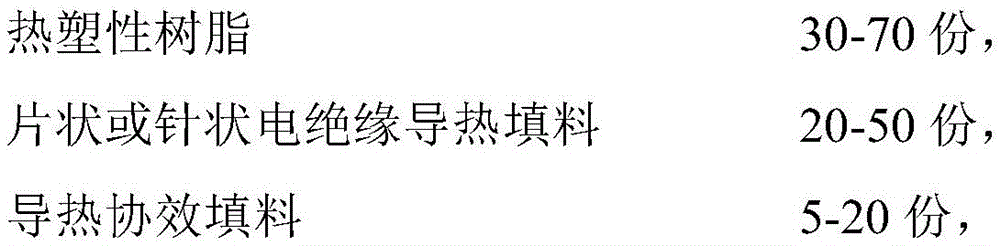

(2) Mixing and stirring the other raw materials except the reinforced fiber in the step (1) according to a formula, feeding the raw materials into a main feeding port of a double-screw extruder after uniform mixing, feeding the reinforced fiber into a side feeding port of the double-screw extruder according to a proportion, controlling the temperature of the double-screw extruder to be 230-300 ℃, melting and fully mixing the materials under the conveying, shearing and mixing of screws, and then extruding, drawing, cooling, drying and granulating through a mouth die to obtain the resin composition with ultrahigh thermal conductivity.
7. Use of the resin composition having high over-plane thermal conductivity according to any one of claims 1 to 5 as a heat dissipating material to form a heat dissipating component.
8. The use of the resin composition with high over-plane thermal conductivity according to claim 7, wherein the heat dissipation component comprises an illumination LED lamp, an automobile chip, a smart wearable device chip, a heat exchanger or a circuit breaker base.
Priority Applications (1)
| Application Number | Priority Date | Filing Date | Title |
|---|---|---|---|
| CN202110624139.3A CN113337112B (en) | 2021-06-04 | 2021-06-04 | Resin composition with high over-surface thermal conductivity and preparation method and application thereof |
Applications Claiming Priority (1)
| Application Number | Priority Date | Filing Date | Title |
|---|---|---|---|
| CN202110624139.3A CN113337112B (en) | 2021-06-04 | 2021-06-04 | Resin composition with high over-surface thermal conductivity and preparation method and application thereof |
Publications (2)
| Publication Number | Publication Date |
|---|---|
| CN113337112A CN113337112A (en) | 2021-09-03 |
| CN113337112B true CN113337112B (en) | 2023-04-07 |
Family
ID=77473890
Family Applications (1)
| Application Number | Title | Priority Date | Filing Date |
|---|---|---|---|
| CN202110624139.3A Active CN113337112B (en) | 2021-06-04 | 2021-06-04 | Resin composition with high over-surface thermal conductivity and preparation method and application thereof |
Country Status (1)
| Country | Link |
|---|---|
| CN (1) | CN113337112B (en) |
Families Citing this family (1)
| Publication number | Priority date | Publication date | Assignee | Title |
|---|---|---|---|---|
| CN117700874A (en) * | 2023-11-18 | 2024-03-15 | 青岛国恩科技股份有限公司 | A thermally conductive polypropylene material special for new energy vehicles and its preparation method |
Family Cites Families (4)
| Publication number | Priority date | Publication date | Assignee | Title |
|---|---|---|---|---|
| JP2013028661A (en) * | 2011-07-27 | 2013-02-07 | Unitika Ltd | Resin composition, and molding formed thereof |
| CN102719099B (en) * | 2012-06-08 | 2014-08-20 | 金发科技股份有限公司 | Thermal conductive molding compound and preparation method thereof |
| CN104151825A (en) * | 2014-08-06 | 2014-11-19 | 西南科技大学 | Thermally-conductive insulating polysulfone composite material and preparation method thereof |
| JP7333914B2 (en) * | 2019-05-31 | 2023-08-28 | 国立研究開発法人産業技術総合研究所 | Thermally conductive resin molding and its manufacturing method |
-
2021
- 2021-06-04 CN CN202110624139.3A patent/CN113337112B/en active Active
Also Published As
| Publication number | Publication date |
|---|---|
| CN113337112A (en) | 2021-09-03 |
Similar Documents
| Publication | Publication Date | Title |
|---|---|---|
| US10385250B2 (en) | Thermally conductive composites and method of preparing same | |
| CN101717579B (en) | Filling-type thermal-conducting electric-insulating polyphenyl thioether and polyamide blended alloy and preparation method thereof | |
| CN101899209B (en) | Heat conductive insulation material and preparation method thereof | |
| KR101139412B1 (en) | Thermally Conductive Insulating Resin Composition and Plastic Article | |
| KR101457016B1 (en) | Thermal conductive thermoplastic resin composition having excellent water-resistance and article using the same | |
| CN113025039A (en) | Polyphenylene sulfide composite material and preparation method thereof | |
| CN106519659B (en) | A kind of high-performance Heat conduction nylon composite material and its preparation method and application | |
| CN102079864A (en) | Insulating heat-conducting resin composition and plastic product thereof | |
| CN105462246B (en) | Powder compound modified super-high heat-conductive nylon of a kind of graphene/metal and preparation method thereof | |
| CN102617927A (en) | New material for reducing LED junction temperature and preparation method thereof | |
| CN101775213A (en) | High thermal conducting composite material and preparation method thereof | |
| JPH03126765A (en) | High heat resistant composite material | |
| CN106675008B (en) | High-thermal-conductivity nylon 6 composite material and preparation method thereof | |
| CN103665850A (en) | Thermally conductive and insulating resin composition | |
| CN102977603A (en) | High temperature resistance high heat conduction PPS/PPO alloy and preparation method thereof | |
| KR101257693B1 (en) | Electrically insulated high thermal conductive polymer composition | |
| CN113337112B (en) | Resin composition with high over-surface thermal conductivity and preparation method and application thereof | |
| CN104610737A (en) | Heat-conduction and insulation plastic material with high-impact resistant and flame retardation | |
| CN101608059B (en) | Conductive engineering plastics and preparation method thereof | |
| KR100885653B1 (en) | High heat dissipation hybrid filler type composite resin composition | |
| KR101581499B1 (en) | Heat radiating macromolecular resin material, heat radiating resin composition, plastic heat radiating material, and method for preparing thereof | |
| CN104262965B (en) | A kind of polyphenyl thioether composite material and preparation method thereof | |
| CN111019337A (en) | Resin composition with ultrahigh thermal conductivity and preparation method thereof | |
| CN106916443A (en) | A kind of heat conduction nylon plastic(s) and the method for preparing heat conduction nylon plastic(s) | |
| CN105062072A (en) | A kind of polyphenylene sulfide composite material and preparation method thereof |
Legal Events
| Date | Code | Title | Description |
|---|---|---|---|
| PB01 | Publication | ||
| PB01 | Publication | ||
| SE01 | Entry into force of request for substantive examination | ||
| SE01 | Entry into force of request for substantive examination | ||
| GR01 | Patent grant | ||
| GR01 | Patent grant |