CN1133468C - Method and machine for sterilizing or disinfecting waste - Google Patents
Method and machine for sterilizing or disinfecting waste Download PDFInfo
- Publication number
- CN1133468C CN1133468C CNB941932710A CN94193271A CN1133468C CN 1133468 C CN1133468 C CN 1133468C CN B941932710 A CNB941932710 A CN B941932710A CN 94193271 A CN94193271 A CN 94193271A CN 1133468 C CN1133468 C CN 1133468C
- Authority
- CN
- China
- Prior art keywords
- temperature
- sterilization
- waste
- heat
- garbage
- Prior art date
- Legal status (The legal status is an assumption and is not a legal conclusion. Google has not performed a legal analysis and makes no representation as to the accuracy of the status listed.)
- Expired - Fee Related
Links
Classifications
-
- B—PERFORMING OPERATIONS; TRANSPORTING
- B02—CRUSHING, PULVERISING, OR DISINTEGRATING; PREPARATORY TREATMENT OF GRAIN FOR MILLING
- B02C—CRUSHING, PULVERISING, OR DISINTEGRATING IN GENERAL; MILLING GRAIN
- B02C19/00—Other disintegrating devices or methods
- B02C19/0056—Other disintegrating devices or methods specially adapted for specific materials not otherwise provided for
- B02C19/0075—Other disintegrating devices or methods specially adapted for specific materials not otherwise provided for specially adapted for disintegrating medical waste
-
- A—HUMAN NECESSITIES
- A61—MEDICAL OR VETERINARY SCIENCE; HYGIENE
- A61L—METHODS OR APPARATUS FOR STERILISING MATERIALS OR OBJECTS IN GENERAL; DISINFECTION, STERILISATION OR DEODORISATION OF AIR; CHEMICAL ASPECTS OF BANDAGES, DRESSINGS, ABSORBENT PADS OR SURGICAL ARTICLES; MATERIALS FOR BANDAGES, DRESSINGS, ABSORBENT PADS OR SURGICAL ARTICLES
- A61L11/00—Methods specially adapted for refuse
-
- A—HUMAN NECESSITIES
- A61—MEDICAL OR VETERINARY SCIENCE; HYGIENE
- A61L—METHODS OR APPARATUS FOR STERILISING MATERIALS OR OBJECTS IN GENERAL; DISINFECTION, STERILISATION OR DEODORISATION OF AIR; CHEMICAL ASPECTS OF BANDAGES, DRESSINGS, ABSORBENT PADS OR SURGICAL ARTICLES; MATERIALS FOR BANDAGES, DRESSINGS, ABSORBENT PADS OR SURGICAL ARTICLES
- A61L2/00—Disinfection or sterilisation of materials or objects, in general; Accessories therefor
- A61L2/02—Disinfection or sterilisation of materials or objects, in general; Accessories therefor using physical processes
-
- A—HUMAN NECESSITIES
- A61—MEDICAL OR VETERINARY SCIENCE; HYGIENE
- A61L—METHODS OR APPARATUS FOR STERILISING MATERIALS OR OBJECTS IN GENERAL; DISINFECTION, STERILISATION OR DEODORISATION OF AIR; CHEMICAL ASPECTS OF BANDAGES, DRESSINGS, ABSORBENT PADS OR SURGICAL ARTICLES; MATERIALS FOR BANDAGES, DRESSINGS, ABSORBENT PADS OR SURGICAL ARTICLES
- A61L2/00—Disinfection or sterilisation of materials or objects, in general; Accessories therefor
- A61L2/02—Disinfection or sterilisation of materials or objects, in general; Accessories therefor using physical processes
- A61L2/04—Heat
-
- A—HUMAN NECESSITIES
- A61—MEDICAL OR VETERINARY SCIENCE; HYGIENE
- A61L—METHODS OR APPARATUS FOR STERILISING MATERIALS OR OBJECTS IN GENERAL; DISINFECTION, STERILISATION OR DEODORISATION OF AIR; CHEMICAL ASPECTS OF BANDAGES, DRESSINGS, ABSORBENT PADS OR SURGICAL ARTICLES; MATERIALS FOR BANDAGES, DRESSINGS, ABSORBENT PADS OR SURGICAL ARTICLES
- A61L2/00—Disinfection or sterilisation of materials or objects, in general; Accessories therefor
- A61L2/02—Disinfection or sterilisation of materials or objects, in general; Accessories therefor using physical processes
- A61L2/04—Heat
- A61L2/06—Hot gas
-
- B—PERFORMING OPERATIONS; TRANSPORTING
- B09—DISPOSAL OF SOLID WASTE; RECLAMATION OF CONTAMINATED SOIL
- B09B—DISPOSAL OF SOLID WASTE NOT OTHERWISE PROVIDED FOR
- B09B3/00—Destroying solid waste or transforming solid waste into something useful or harmless
- B09B3/30—Destroying solid waste or transforming solid waste into something useful or harmless involving mechanical treatment
- B09B3/35—Shredding, crushing or cutting
-
- B—PERFORMING OPERATIONS; TRANSPORTING
- B09—DISPOSAL OF SOLID WASTE; RECLAMATION OF CONTAMINATED SOIL
- B09B—DISPOSAL OF SOLID WASTE NOT OTHERWISE PROVIDED FOR
- B09B3/00—Destroying solid waste or transforming solid waste into something useful or harmless
- B09B3/40—Destroying solid waste or transforming solid waste into something useful or harmless involving thermal treatment, e.g. evaporation
-
- B—PERFORMING OPERATIONS; TRANSPORTING
- B09—DISPOSAL OF SOLID WASTE; RECLAMATION OF CONTAMINATED SOIL
- B09B—DISPOSAL OF SOLID WASTE NOT OTHERWISE PROVIDED FOR
- B09B3/00—Destroying solid waste or transforming solid waste into something useful or harmless
- B09B3/70—Chemical treatment, e.g. pH adjustment or oxidation
-
- B—PERFORMING OPERATIONS; TRANSPORTING
- B09—DISPOSAL OF SOLID WASTE; RECLAMATION OF CONTAMINATED SOIL
- B09B—DISPOSAL OF SOLID WASTE NOT OTHERWISE PROVIDED FOR
- B09B2101/00—Type of solid waste
- B09B2101/65—Medical waste
-
- Y—GENERAL TAGGING OF NEW TECHNOLOGICAL DEVELOPMENTS; GENERAL TAGGING OF CROSS-SECTIONAL TECHNOLOGIES SPANNING OVER SEVERAL SECTIONS OF THE IPC; TECHNICAL SUBJECTS COVERED BY FORMER USPC CROSS-REFERENCE ART COLLECTIONS [XRACs] AND DIGESTS
- Y10—TECHNICAL SUBJECTS COVERED BY FORMER USPC
- Y10S—TECHNICAL SUBJECTS COVERED BY FORMER USPC CROSS-REFERENCE ART COLLECTIONS [XRACs] AND DIGESTS
- Y10S241/00—Solid material comminution or disintegration
- Y10S241/38—Solid waste disposal
-
- Y—GENERAL TAGGING OF NEW TECHNOLOGICAL DEVELOPMENTS; GENERAL TAGGING OF CROSS-SECTIONAL TECHNOLOGIES SPANNING OVER SEVERAL SECTIONS OF THE IPC; TECHNICAL SUBJECTS COVERED BY FORMER USPC CROSS-REFERENCE ART COLLECTIONS [XRACs] AND DIGESTS
- Y10—TECHNICAL SUBJECTS COVERED BY FORMER USPC
- Y10S—TECHNICAL SUBJECTS COVERED BY FORMER USPC CROSS-REFERENCE ART COLLECTIONS [XRACs] AND DIGESTS
- Y10S241/00—Solid material comminution or disintegration
- Y10S241/606—Medical/surgical waste comminution
Landscapes
- Health & Medical Sciences (AREA)
- General Health & Medical Sciences (AREA)
- Engineering & Computer Science (AREA)
- Environmental & Geological Engineering (AREA)
- Epidemiology (AREA)
- Veterinary Medicine (AREA)
- Public Health (AREA)
- Animal Behavior & Ethology (AREA)
- Life Sciences & Earth Sciences (AREA)
- Chemical & Material Sciences (AREA)
- Toxicology (AREA)
- General Chemical & Material Sciences (AREA)
- Chemical Kinetics & Catalysis (AREA)
- Physics & Mathematics (AREA)
- Thermal Sciences (AREA)
- Food Science & Technology (AREA)
- Apparatus For Disinfection Or Sterilisation (AREA)
- Processing Of Solid Wastes (AREA)
- Heat Treatment Of Water, Waste Water Or Sewage (AREA)
- Crushing And Pulverization Processes (AREA)
- Preparation Of Compounds By Using Micro-Organisms (AREA)
- Accommodation For Nursing Or Treatment Tables (AREA)
Abstract
这是一种对废弃物,特别是感染细菌的医院废弃物进行热杀菌或消毒的方法,它包括用剪切力研磨和/或粉碎废弃物的工序,该工序延续一段时间,以使摩擦产生出的热量足以在废弃物堆中达到并保持杀菌或消毒的温度。为实现这一方法的设备也得到了描述。
A method of thermally sterilizing or disinfecting waste, especially bacterially-infected hospital waste, involving the process of grinding and/or comminuting the waste with shear forces over a period of time to allow friction The heat generated is sufficient to achieve and maintain sterilization or disinfection temperatures in the waste pile. Apparatus for carrying out this method is also described.
Description
本发明涉及对废弃物,特别是对感染细菌的医院废弃物进行杀菌或消毒的方法和机器,它的根据是对构成活细胞的蛋白质进行热分解的众所周知的方法。The present invention relates to a method and a machine for sterilizing or disinfecting waste, in particular bacteria-infected hospital waste, based on the well-known method of thermally decomposing the proteins that make up living cells.
在已知的热杀菌或消毒的方法中,其困难在于对被处理的材料进行加热需用很长的时间周期,原因是从废弃物的外层向内层传递热量的传热系数太低。这些方法是把热量向废物堆(ready-groundwaste)传送,或者当使用蒸压器系统时是吹入约0.5帕压力的饱和蒸气,或者在用干式系统时吹入温度约180℃的热空气或过热蒸气,或者甚至通过器壁来加热。In the known methods of thermal sterilization or disinfection, it is difficult to heat the material to be treated for a long period of time because the heat transfer coefficient for transferring heat from the outer to the inner layer of the waste is too low. These methods are to transfer heat to the ready-ground waste, or to blow saturated steam at a pressure of about 0.5 Pa when using an autoclave system, or to blow hot air at a temperature of about 180°C when using a dry system or superheated steam, or even heat through the walls.
虽然现在还有利用微波辐射将热量透入废弃物内部的系统,但运用这一原理的设备只能很难获得杀菌所必需的温度,这是因为需要用水来把微波转换成热能,这就妨碍了把水的温度提高到沸点以上。Although there is still a system that uses microwave radiation to penetrate heat into the waste, it is difficult for equipment using this principle to obtain the temperature necessary for sterilization. This is because water is needed to convert microwaves into heat energy, which hinders sterilization. To raise the temperature of the water above the boiling point.
本发明的目的是要提供一种改进的方法和设备,它能使被消毒的废弃物没有污染的危险,并在处理后成为可方便地自由处置的已灭菌材料。It is an object of the present invention to provide an improved method and apparatus which enable the waste to be sterilized without risk of contamination and after treatment to be sterilized material which can be conveniently disposed of freely.
本发明进一步的目的是要提供一种适合在医院范围内对被感染废弃物进行处理的方法和设备,规模即使小一些,但却是较经济的,而且是适于自动化的。It is a further object of the present invention to provide a method and apparatus suitable for the treatment of infected waste within a hospital setting which is economical, even on a smaller scale, and which is amenable to automation.
为了达到这些目的,所用的方法也是本发明的主题,其特征在于它包括:在剪应力下对废弃物进行研磨和/或粉碎工序,并延续一段时间,以便在废弃物整体中因摩擦而产生出足够的热量而达到并保持杀菌消毒的温度。In order to achieve these aims, the method used is also the subject of the present invention, characterized in that it comprises: a grinding and/or comminuting process of the waste under shear stress and for a period of time so as to generate friction in the waste as a whole Provide enough heat to reach and maintain the sterilization temperature.
本发明的方法的特殊性在于,为达到和保持所述温度所必需的热能,除分子内部和外部的摩擦外,是借助于撞击而产生的;这种撞击和摩擦所需的动能是来源于机器外壳内高速旋转的带叶片的轴,在外壳内侧最好还装有固定的撞击板片。这一系统,使得设定的温度能达到得特别快,而且随后可优选地借助配给一定剂量的水以及水的蒸发来对温度进行校正。本方法除进行杀菌(或消毒)处理以外,还能使废弃物被粉碎,废弃物中原有的或适量加入的塑料材料被熔化,同时被处理材料最终成为颗粒状。The particularity of the method of the invention is that the thermal energy necessary to reach and maintain said temperature is produced by means of impact, in addition to internal and external friction of the molecules; the kinetic energy required for this impact and friction is derived from The bladed shaft rotating at high speed in the machine housing is preferably equipped with a fixed impact plate inside the housing. This system enables the set temperature to be reached particularly quickly and the temperature can then be corrected, preferably by means of dosing and evaporation of water. In addition to the sterilizing (or disinfection) treatment, the method can also crush the waste, melt the original or added plastic material in the waste, and at the same time, the processed material finally becomes granular.
作为本发明的主题的器械,其特征在于:它包括一个适于装入废弃物的外壳腔;一个装在外壳腔内的上有轮叶或叶片适于研磨和/或粉碎废弃物的转子;一块连结在腔壁上的多个轮叶或叶片状的固定撞击板;以及一套驱动装置,它能把转子转动到一定的速度,以使摩擦产生的热足以使温度升到杀菌或消毒所需要的程度,并在外壳腔内保持这个温度;还有一个进水装置安装在外壳腔内。The apparatus which is the subject of the present invention is characterized in that it comprises a housing cavity adapted to contain waste; a rotor housed in the housing cavity with vanes or blades adapted to grind and/or crush the waste; A plurality of vanes or blade-shaped fixed impingement plates attached to the chamber wall; and a set of driving devices that can rotate the rotor to a certain speed so that the heat generated by friction is sufficient to raise the temperature to the required temperature for sterilization or disinfection. The required degree, and maintain this temperature in the shell cavity; there is also a water inlet device installed in the shell cavity.
所述设备还包括:装在腔壁上的通风放气装置,用以抽出杀菌和/或消毒处理过程中产生的烟雾;用以接收释放的烟雾并把烟雾加热到灭菌温度的灭菌装置;与灭菌装置相通的吸收装置,用以接收并吸收这些烟雾。其中靠摩擦热得到的杀菌和/或消毒的温度最少为150℃。The equipment also includes: a ventilating device installed on the wall of the cavity to extract the smoke generated during the sterilization and/or disinfection process; a sterilizing device for receiving the released smoke and heating the smoke to the sterilization temperature ; The absorbing device communicated with the sterilizing device to receive and absorb the smoke. The sterilization and/or disinfection temperature obtained by frictional heat is at least 150°C.
外壳腔内废弃物堆中所需达到的温度值可根据处理的意图来确定,要看是单纯的消毒呢还是彻底的灭菌。单纯的消毒只是要单纯地杀死病原微生物,彻底灭菌则要全部清除芽孢、孢子和生活细胞。The temperature value to be reached in the waste pile in the housing cavity can be determined according to the purpose of the treatment, whether it is simple disinfection or complete sterilization. Simple disinfection is simply to kill pathogenic microorganisms, while complete sterilization must remove all spores, spores and living cells.
在几分钟内达到了设定的能使原有的或加入的塑料软化的温度后(加入塑料的问题下文将要谈到),就保持这个温度约半小时,然后就用注水的办法来消散由于强力搅动所产生的热。配给一定剂量的水是用温度调节器来控制的;注水还能使局部保持高湿,正如文献中所说的那样,高湿能促使蛋白质分解。After reaching the set temperature that can soften the original or added plastic within a few minutes (the problem of adding plastic will be discussed later), keep this temperature for about half an hour, and then use water injection to dissipate it. Vigorously stir to generate heat. The dosing of water was controlled by a thermostat; the injection also kept the area high in humidity, which, as the literature suggests, promotes protein breakdown.
该系统泄放出来的烟雾先被通入一个高温的(约800℃)电热灭菌装置,然后溶入水吸收器中。The smoke released from the system is first passed into a high-temperature (about 800°C) electric heat sterilization device, and then dissolved into the water absorber.
被处理的废弃物中加进热塑性塑料就能增大摩擦系数,例如聚乙烯、聚丙烯等就属于热塑性塑料,最好是带色的塑料,以便使被处理的废料带有某种颜色。Adding thermoplastics to the processed waste can increase the coefficient of friction, such as polyethylene, polypropylene, etc., which belong to thermoplastics, preferably colored plastics, so that the processed waste can have a certain color.
在废弃物原来正常含有的塑料材料以外再加入更多的热塑性塑料可使摩擦产生的最高温度显著增高——可达250℃以上——这就使在废弃物中保持温度的时间可以缩短。其中利用摩擦热所得到的温度,应高到足以使上述塑料材料软化和/或熔化。Adding more thermoplastics to the plastic material normally contained in the waste can significantly increase the maximum temperature generated by friction - up to more than 250 ° C - which allows the waste to be held at temperature for a shorter time. The temperature obtained by using the frictional heat should be high enough to soften and/or melt the above-mentioned plastic material.
塑料材料的熔化及此后的由于冷却和配水而产生的固化,使得最后得到的被处理材料在颜色上和组成上都是完全均匀的。The melting of the plastic material and its subsequent solidification by cooling and water distribution results in a finished material which is completely homogeneous in color and composition.
在保持温度的阶段结束时,就借助增加配水量和适当降低转子转速,以及在机器的夹套中循环流通空气或水,或者把机器置于轻度真空之下等办法来冷却被处理的材料。At the end of the temperature-maintaining period, the material being processed is cooled by increasing the water distribution and appropriately reducing the rotor speed, as well as circulating air or water in the jacket of the machine, or placing the machine under a slight vacuum. .
处理周期结束时,已消毒或杀菌的废弃物是粒状的、冷却的,出料时也不带烟雾、蒸气或气味。At the end of the treatment cycle, the sterilized or sterilized waste is granular, cooled and discharged without smoke, vapor or odour.
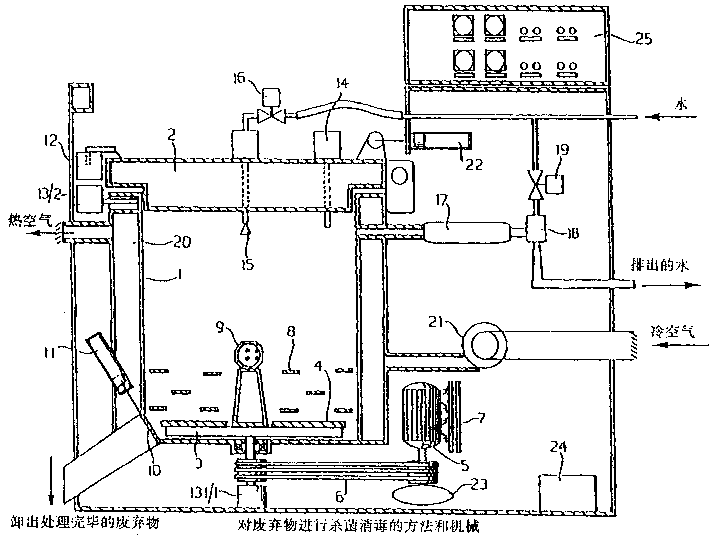
本发明的方法和设备的其它优点和特征将在下面结合附图的详细描述中交代清楚,附图是实现本方法的简图,单纯地用一个非限定的实例来表示。Other advantages and features of the method and device of the present invention will be made clear in the following detailed description in conjunction with the accompanying drawings, which are schematic diagrams of the implementation of the method and are simply represented by a non-limiting example.
废弃物被装入外壳腔(1)中,该腔是用强力的金属板做成,两侧用耐磨的防护屏保护,保护屏的优选材料为锰钢。腔上用腔盖(2)盖住,或是人工开关,或是用气缸(22)和液压机构(24)用液力来开关。在壳腔内,有一个装有十分坚固耐用而可拆换的钢叶片(4)的转子(3)在高速转动,转速为例如1500转/分。转子是用一只大功率的电动机(5)来带动,使用皮带和皮带轮系统(6),并用紧带轮(7)绷紧。在大型机器上可以装一个液力联轴器(23)以降低起动时的吸收作用,并且可在出事故或过载时用以抵销应力。The waste is put into the shell cavity (1), which is made of strong metal plate, protected by wear-resistant protective screens on both sides, and the preferred material of the protective screen is manganese steel. Cover with chamber cover (2) on the chamber, or manual switch, or switch with cylinder (22) and hydraulic mechanism (24) with hydraulic power. Inside the housing, a rotor (3) with very durable and removable steel blades (4) rotates at high speed, for example 1500 rpm. The rotor is driven by a high-power electric motor (5), using a belt and pulley system (6), and tightened with a tension pulley (7). A hydraulic coupling (23) can be installed on a large machine to reduce the absorption when starting, and can be used to counteract the stress in the event of an accident or overload.
也可用水力发动机和油动力机构来开动机器以取代电力系统。Also can use hydraulic engine and oil power mechanism to start machine to replace electric system.
最好把坚固的、固定的、钢的撞击板安装在壳腔的较低部分,安装撞击板的目的是撞击、破碎和遏制废弃材料,以使动能转换成热能。A strong, fixed, steel striker plate is preferably mounted in the lower portion of the shell cavity, the purpose of which is to strike, break up and contain waste material so that kinetic energy is converted to heat.
优选的方案是,在旋转轴的中心处安装一个适于插入试管的带孔支架(9),支架可以开启并装入特定的孢子或细菌样品(例如脂肪性嗜热杆菌或枯草杆菌)(Bacillus stearothermophilus orBacillus subtilis),以便在适当的试验周期中能够对杀菌消毒机器的正确运作进行检验。Preferably, a perforated support (9) suitable for inserting a test tube is installed at the center of the axis of rotation, the support can be opened and filled with a specific spore or bacterial sample (such as Bacillus stearophilus or Bacillus subtilis) (Bacillus stearothermophilus or Bacillus subtilis), so that the correct operation of the sterilization and disinfection machine can be checked during the appropriate test cycle.
在处理周期结束后,可用液力系统(11)或另外的机械装置打开闸板(10)卸出处理过的材料。After the processing cycle is finished, the hydraulic system (11) or another mechanical device can be used to open the gate (10) to discharge the processed material.
机器上还装有防止事故的安全装置,有在未盖好盖子时防止转子开动的微动开关装置,还有在转子转动时防止盖子打开的液压装置,其中包括一个自动泵(13/1)和一个活塞(13/2)。The machine is also equipped with safety devices to prevent accidents, there is a micro switch device to prevent the rotor from starting when the cover is not closed, and a hydraulic device to prevent the cover from opening when the rotor is turned, which includes an automatic pump (13/1) and a piston (13/2).
腔内的温度由指示调节器(14)来测量和控制,它的感温包可以安装在盖子上,但最好是安装在一个固定的轮叶内,感温包控制一个电磁阀(16)的开启,并从一个喷嘴(15)向内注水,这在工艺程序的一定阶段进行。在处理周期中释放出来的散发物被通入一个小说加热炉(17),炉内用电阻丝加热到高温(约800℃),以使散发物被杀菌。The temperature in the cavity is measured and controlled by an indicating regulator (14), and its temperature sensing bulb can be installed on the cover, but it is preferably installed in a fixed vane, and the temperature sensing bulb controls a solenoid valve (16) It is opened and water is injected from a nozzle (15), which is carried out at a certain stage of the process sequence. Emissions released during the treatment cycle are passed into a novel heating furnace (17) which is heated to a high temperature (approximately 800° C.) with resistance wires in order to sterilize the emissions.
散发物在通过加热炉以后就被水吸收器所吸收,水吸收器上有喷嘴(18),它由电磁阀(19)来操作。After passing through the furnace, the emissions are absorbed by the water absorber, which has a nozzle (18) operated by a solenoid valve (19).
在保持温度的阶段结束时,就用降低转子转速、配水、把腔内造成轻度真空、增大喷嘴(18)的水量,用风机(21)使空气在壳腔周围的空间(20)内循环,或用机械操作的阀使水在这个空间内循环等等方法来把被处理的材料冷却下来。At the end of the stage of maintaining the temperature, reduce the rotor speed, distribute water, cause a slight vacuum in the cavity, increase the water volume of the nozzle (18), and use the fan (21) to make the air flow in the space (20) around the shell cavity. Circulation, or the use of mechanically operated valves to circulate water in this space, etc., to cool down the material being processed.
这套设备还配备有一套液压机构(24),用以推动操作用的活塞和阀,此外还配有一块电气控制盘(25)。The apparatus is also equipped with a hydraulic unit (24) for driving the operating pistons and valves, and an electrical control panel (25).
实施例1Example 1
机器的腔直径为600mm,高800mm,腔内装有带叶片的同轴转子,转速为750-1500转/分,它由两块装有叶片的轮叶构成,它与50KW的电动机相连结。The cavity diameter of the machine is 600mm, and the height is 800mm. The coaxial rotor with blades is installed in the cavity, and the rotating speed is 750-1500 rpm. It is composed of two vanes with blades, and it is connected with a 50KW motor.
腔的较低部分周围布置有耐磨防护板和六块固定的叶片。Abrasion protection plates and six fixed vanes are arranged around the lower part of the cavity.
把30kg感染细菌的医院废弃物和7kg带色的聚乙烯塑料放入腔内并盖好盖子。机器按照设定程序的周期开动,规定温度应达到160℃并保持这一温度。该温度在5分钟内即达到,此后调节和注入水的系统动作,保持这一温度水平约30分钟。保持阶段结束时,转子速度自动减为750转/分,由于配水使温度在2分钟内降至80℃。此时冷却阶段开始,把空气吹入夹套10分钟;此后,材料的温度为60C,由于闸板开启,自动在1分钟内卸出粒状的灭过菌的材料。此后,即停机并准备完成新的周期。30 kg of bacterially infected hospital waste and 7 kg of colored polyethylene plastic were placed into the cavity and the lid closed. The machine is started according to the cycle of the set program, and the specified temperature should reach 160°C and maintain this temperature. This temperature is reached within 5 minutes, after which the system of conditioning and water injection operates to maintain this temperature level for about 30 minutes. At the end of the hold period, the rotor speed was automatically reduced to 750 rpm and the temperature dropped to 80°C within 2 minutes due to water distribution. At this point the cooling phase begins, with air being blown into the jacket for 10 minutes; thereafter, the temperature of the material is 60°C, and the granulated sterilized material is automatically discharged within 1 minute due to the opening of the ram. Thereafter, it is down and ready to complete a new cycle.
实施例2Example 2
机器的腔直径为1200mm,高800mm,腔内装有带叶片的转子,转速为0-1500转/分,它由两块装有叶片的轮叶构成,它与250KW的水力发动机相连结。The cavity diameter of the machine is 1200mm, and the height is 800mm. There is a rotor with blades in the cavity, and the speed is 0-1500 rpm. It is composed of two vanes with blades, and it is connected with a 250KW hydraulic motor.
腔的较低部分周围布置有耐磨防护板和25块固定的叶片。Abrasion protection plates and 25 fixed vanes are arranged around the lower part of the cavity.
把120kg感染细菌的医院废弃物和30kg带色的聚丙烯塑料放入腔内并盖好盖子。120 kg of bacterially infected hospital waste and 30 kg of colored polypropylene plastic were placed into the cavity and the lid closed.
机器按照设定程序的周期开动,第一阶段是要达到150℃的温度。这一温度在10分钟内达到,于是调节和注入水的系统动作,并把温度保持在这一水平20分钟。这一阶段结束时,配水自动中止,因为程序设定周期第二阶段的材料温度要进一步加热到180℃,这一温度在1分钟内达到了。然后,转子速度自动降到500转/分,水的注入使温度在1分钟内降到80℃。在真空下开始了冷却阶段,并往架套中吹空气10分钟,此后材料温度变为50℃。由于闸板开启,自动地在约2分钟内卸出粒状的灭过菌的材料。此后即停机并准备完成新的周期。The machine is started according to the cycle of the set program, the first stage is to reach the temperature of 150 ℃. This temperature was reached within 10 minutes, whereupon the system of regulating and injecting water operated and maintained the temperature at this level for 20 minutes. At the end of this phase, dispensing is automatically aborted because the material temperature in the second phase of the programmed cycle is further heated to 180°C, which is reached within 1 minute. Then, the rotor speed was automatically reduced to 500 rpm, and the injection of water brought the temperature down to 80 °C within 1 minute. The cooling phase was started under vacuum and air was blown into the housing for 10 minutes, after which the material temperature became 50°C. Due to the opening of the shutters, the granular sterilized material is automatically discharged within about 2 minutes. Thereafter it is shut down and ready to complete a new cycle.
在本发明的另一个实施方案中,在废弃物灭菌周期中是往机器壳腔内的废弃物堆中注入浓的次氯酸钠水溶液。从而,在处理周期中被喷射和配量的水中含有次氯酸钠是有利的,最好是新生态氯的重量浓度为12-15%。In another embodiment of the present invention, during the waste sterilization cycle, a concentrated aqueous solution of sodium hypochlorite is injected into the waste pile within the machine housing cavity. Thus, the water sprayed and dosed during the treatment cycle advantageously contains sodium hypochlorite, preferably in a concentration of 12-15% by weight of nascent chlorine.
已经发现,浓的次氯酸钠溶液在高温下进入壳腔内,会与二氧化碳反应而生成未离解的次氯酸,它随后会游离出气态的次氯酸根(Cl2O),而这是一种很有效的氯化剂和生物杀菌剂。It has been found that concentrated sodium hypochlorite solution, introduced into the shell cavity at high temperature, reacts with carbon dioxide to form undissociated hypochlorous acid, which then liberates gaseous hypochlorite (Cl 2 O), which is a very Effective chlorinating agent and biocide.
在这一实施方案中,当被粉碎的废弃物材料加温到高于150℃时即往腔中喷入浓的NaClO溶液,并把包含二氧化碳的空气导入腔内。空气内固有的CO2含量已足以引起氧化氯挥发出来,在强力搅动的条件下,氧化氯渗入废弃物堆中然后流过机器,因此可改善灭菌效果。In this embodiment, the chamber is sprayed with a concentrated NaClO solution and air containing carbon dioxide is introduced into the chamber while the comminuted waste material is warmed to above 150°C. The inherent CO2 content of the air is sufficient to cause the chlorine oxide to volatilize, and under conditions of vigorous agitation, the chlorine oxide seeps into the waste heap and flows through the machine, thus improving the sterilization effect.
在处理结束后如仍有一些残留的氧化氯就会在水吸收器处被水吸收而形成次氯酸水溶液。After the treatment, if there is still some residual chlorine oxide, it will be absorbed by water at the water absorber to form a hypochlorous acid aqueous solution.
这样,不但废弃物,而且在处理过程中释放的散发物和机器的内部表面都得到了进一步的灭菌处理。在这一实施方案来说,散发物已不必送入加热炉(17)而可直接送入水吸收器。In this way, not only the waste, but also the emissions released during processing and the internal surfaces of the machine are further sterilized. In this embodiment, the emission does not have to be sent to the furnace (17) but can be sent directly to the water absorber.
不用说,本发明的原理仍是相同的,而实施的方式和描述的细节,则可围绕上面已对单纯按无任何限定的实例进行的描述和解释而千变万化。Needless to say, the principle of the present invention is still the same, but the implementation manner and details of the description can be varied around the above descriptions and explanations based on purely non-limiting examples.
Claims (10)
Applications Claiming Priority (2)
| Application Number | Priority Date | Filing Date | Title |
|---|---|---|---|
| ITTO930547A IT1260938B (en) | 1993-07-21 | 1993-07-21 | PROCEDURE AND MACHINE FOR STERILIZING OR DISINFECTING WASTE. |
| ITT0093A000547 | 1993-07-21 |
Publications (2)
| Publication Number | Publication Date |
|---|---|
| CN1130355A CN1130355A (en) | 1996-09-04 |
| CN1133468C true CN1133468C (en) | 2004-01-07 |
Family
ID=11411640
Family Applications (1)
| Application Number | Title | Priority Date | Filing Date |
|---|---|---|---|
| CNB941932710A Expired - Fee Related CN1133468C (en) | 1993-07-21 | 1994-07-18 | Method and machine for sterilizing or disinfecting waste |
Country Status (20)
| Country | Link |
|---|---|
| US (1) | US5800776A (en) |
| EP (1) | EP0710125B1 (en) |
| JP (2) | JP4097284B2 (en) |
| KR (1) | KR100337727B1 (en) |
| CN (1) | CN1133468C (en) |
| AT (1) | ATE193211T1 (en) |
| AU (1) | AU689794B2 (en) |
| BR (1) | BR9407331A (en) |
| CA (1) | CA2167415C (en) |
| DE (1) | DE69424671T2 (en) |
| DK (1) | DK0710125T3 (en) |
| ES (1) | ES2148339T3 (en) |
| GR (1) | GR3034148T3 (en) |
| IT (1) | IT1260938B (en) |
| PL (1) | PL175956B1 (en) |
| PT (1) | PT710125E (en) |
| RU (1) | RU2128522C1 (en) |
| SI (1) | SI0710125T1 (en) |
| UA (1) | UA29483C2 (en) |
| WO (1) | WO1995003072A1 (en) |
Families Citing this family (30)
| Publication number | Priority date | Publication date | Assignee | Title |
|---|---|---|---|---|
| NO304969B1 (en) * | 1997-08-04 | 1999-03-15 | Gmm Avfallssystemer As | Device for hazardous waste disposal |
| CH694115A5 (en) * | 1999-07-05 | 2004-07-30 | Luna Two Sa | Procedure and plant for the sterilization and elimination of potentially infectious waste. |
| US6876991B1 (en) | 1999-11-08 | 2005-04-05 | Collaborative Decision Platforms, Llc. | System, method and computer program product for a collaborative decision platform |
| NL1013839C2 (en) * | 1999-12-14 | 2001-06-15 | Robert Marcel Fliers | Device and method for sterilizing or disinfecting waste. |
| US6494391B2 (en) * | 2001-02-05 | 2002-12-17 | M.C.M. Environmental Technologies Ltd. | Apparatus for treating waste, particularly medical waste, to facilitate its disposition |
| ITTO20020677A1 (en) * | 2002-07-29 | 2004-01-29 | So T I Srl | PROCEDURE AND EQUIPMENT FOR THE COOKING AND STABILIZATION OF BIOORGANIC MATERIALS |
| JP3682705B2 (en) * | 2003-03-27 | 2005-08-10 | キングラン株式会社 | Floor sterilization method |
| US7119689B2 (en) | 2003-09-19 | 2006-10-10 | Vesta Medical, Llc | System and method for sorting medical waste for disposal |
| US7318529B2 (en) | 2003-09-19 | 2008-01-15 | Vest Medical, Llc | Method for sorting discarded and spent pharmaceutical items |
| US7562025B2 (en) | 2003-09-19 | 2009-07-14 | Vesta Medical, Llc | Waste sorting system with query function, and method thereof |
| US7275645B2 (en) | 2003-09-19 | 2007-10-02 | Vesta Medical, Llc | Handheld medical waste sorting device |
| US7311207B2 (en) | 2003-09-19 | 2007-12-25 | Vesta Medical, Llc | System for sorting discarded and spent pharmaceutical items |
| US7303081B2 (en) | 2003-09-19 | 2007-12-04 | Vesta Medical, Llc | Handheld medical waste sorting method |
| RU2295978C2 (en) * | 2004-08-23 | 2007-03-27 | Дмитрий Исаакович Кофман | Method for carrying out thermal sterilization of infected waste materials |
| RU2339404C2 (en) * | 2006-06-13 | 2008-11-27 | Открытое Акционерное Общество "НПК "Механобр-техника" | Method and device for sterilisation of infected waste |
| NL2001580C2 (en) * | 2008-05-15 | 2009-11-17 | Lt Invest B V | Medical waste disinfecting method, involves removing liquid components from waste, heating resulting mixture, and subjecting mixture to treatment with UV radiation for disinfecting mixture |
| US20100278688A1 (en) * | 2008-11-24 | 2010-11-04 | Damien Tanaka | Containerized Medical Waste Treatment System and Related Method |
| EP2640522B1 (en) | 2010-11-16 | 2026-05-06 | CELITRON Medical Technologies KFT. | System and methods for conversion of biohazard to municipal waste |
| CN102727923A (en) * | 2011-04-09 | 2012-10-17 | 许兵 | Composition for treating sputum and preparation method thereof |
| CN102940901A (en) * | 2012-12-07 | 2013-02-27 | 栖霞中泰环保设备有限公司 | Integrated medical waste treatment equipment and treatment method |
| ITTO20130127A1 (en) * | 2013-02-15 | 2014-08-16 | Fotorecuperi S R L | PROCEDURE AND EQUIPMENT FOR WASTE TREATMENT |
| US9676012B2 (en) * | 2014-08-21 | 2017-06-13 | Spectrum Medical Lending, Llc | Devices for treating medical waste and methods of their use |
| EP3288693B1 (en) * | 2015-04-29 | 2020-01-15 | Agatos Green Power Lemuria S.r.l. | Process and plant for treating solid waste containing an organic fraction |
| CN104971936B (en) * | 2015-07-14 | 2017-08-01 | 慈溪市佳叶电器厂 | A kind for the treatment of of!medical waste device |
| ITUB20153654A1 (en) * | 2015-09-16 | 2017-03-16 | Rosso Mecc S A S Di Rosso Alberto & C | METHOD FOR THE TREATMENT AND STERILIZATION OF HOSPITAL WASTE AT INFECTIOUS RISK |
| CN107138255A (en) * | 2017-06-14 | 2017-09-08 | 郑州永泰澳新商贸有限公司 | A kind of medical waste refuse treatment plant with sterilizing function |
| CN108114292A (en) * | 2017-12-30 | 2018-06-05 | 广东众达成节能环保科技有限公司 | hot wind circulation sterilizing cabinet |
| WO2021059292A1 (en) * | 2019-09-24 | 2021-04-01 | Amardeep Sharma | Smart machine for processing multiple types of garbage to yield commercially useful products |
| CN112107719B (en) * | 2020-09-28 | 2025-05-09 | 浙江微盾环保科技股份有限公司 | Device and process for disinfection and sterilization of medical waste based on friction heat |
| CN114618866A (en) * | 2022-03-02 | 2022-06-14 | 江西鹏琨环保科技有限公司 | Medical waste high-temperature friction sterilization device |
Citations (2)
| Publication number | Priority date | Publication date | Assignee | Title |
|---|---|---|---|---|
| EP0383553A1 (en) * | 1989-02-15 | 1990-08-22 | Nojima Keikinzoku Co., Ltd. | Apparatus for disposing of medical waste by crushing |
| WO1992012738A1 (en) * | 1991-01-25 | 1992-08-06 | Lersner Wolf A | Process and device for the disposal of medical waste |
Family Cites Families (7)
| Publication number | Priority date | Publication date | Assignee | Title |
|---|---|---|---|---|
| US3885057A (en) * | 1970-11-27 | 1975-05-20 | Atad | Process for sterilizing a product |
| US4331070A (en) * | 1980-05-15 | 1982-05-25 | Viktor Denk | Apparatus for heating liquids, in particular foodstuffs and luxury foodstuffs, for the purpose of pasteurization, sterilization and the like |
| ATE17638T1 (en) * | 1981-03-21 | 1986-02-15 | Luwa Ag | METHOD AND EQUIPMENT FOR STERILIZATION OF CRUSHED, OIL FRUIT KERNELS SUCH AS COCOA MASS, PEANUT, NUT OR SOYA PASTE AND SUCH. |
| US4552720A (en) * | 1983-01-24 | 1985-11-12 | American Sterilizer Company | Debris compressing autoclave |
| JPH0448983A (en) * | 1990-06-18 | 1992-02-18 | Masa Kaneko | Apparatus for preparing aggregate for building material from infectious medical waste |
| DE9208697U1 (en) * | 1992-06-29 | 1992-09-03 | Roland, Rolf Emil, 6688 Illingen | Plant for sterilizing and detoxifying hospital waste and processing it into a secondary raw material |
| US5254265A (en) * | 1992-07-31 | 1993-10-19 | Yung Rung Chung | Garbage disposal system |
-
1993
- 1993-07-21 IT ITTO930547A patent/IT1260938B/en active IP Right Grant
-
1994
- 1994-07-18 WO PCT/EP1994/002357 patent/WO1995003072A1/en not_active Ceased
- 1994-07-18 EP EP94924781A patent/EP0710125B1/en not_active Expired - Lifetime
- 1994-07-18 SI SI9430335T patent/SI0710125T1/en unknown
- 1994-07-18 CN CNB941932710A patent/CN1133468C/en not_active Expired - Fee Related
- 1994-07-18 ES ES94924781T patent/ES2148339T3/en not_active Expired - Lifetime
- 1994-07-18 RU RU96103379/13A patent/RU2128522C1/en not_active IP Right Cessation
- 1994-07-18 JP JP50492795A patent/JP4097284B2/en not_active Expired - Fee Related
- 1994-07-18 PL PL94312660A patent/PL175956B1/en not_active IP Right Cessation
- 1994-07-18 UA UA96020620A patent/UA29483C2/en unknown
- 1994-07-18 CA CA002167415A patent/CA2167415C/en not_active Expired - Fee Related
- 1994-07-18 DK DK94924781T patent/DK0710125T3/en active
- 1994-07-18 KR KR1019960700318A patent/KR100337727B1/en not_active Expired - Fee Related
- 1994-07-18 AT AT94924781T patent/ATE193211T1/en active
- 1994-07-18 DE DE69424671T patent/DE69424671T2/en not_active Expired - Lifetime
- 1994-07-18 PT PT94924781T patent/PT710125E/en unknown
- 1994-07-18 US US08/583,058 patent/US5800776A/en not_active Expired - Lifetime
- 1994-07-18 AU AU74946/94A patent/AU689794B2/en not_active Ceased
- 1994-07-18 BR BR9407331A patent/BR9407331A/en not_active IP Right Cessation
-
2000
- 2000-08-08 GR GR20000401843T patent/GR3034148T3/en unknown
-
2004
- 2004-06-30 JP JP2004193872A patent/JP2004337622A/en active Pending
Patent Citations (2)
| Publication number | Priority date | Publication date | Assignee | Title |
|---|---|---|---|---|
| EP0383553A1 (en) * | 1989-02-15 | 1990-08-22 | Nojima Keikinzoku Co., Ltd. | Apparatus for disposing of medical waste by crushing |
| WO1992012738A1 (en) * | 1991-01-25 | 1992-08-06 | Lersner Wolf A | Process and device for the disposal of medical waste |
Also Published As
| Publication number | Publication date |
|---|---|
| AU689794B2 (en) | 1998-04-09 |
| CA2167415A1 (en) | 1995-02-02 |
| JP2004337622A (en) | 2004-12-02 |
| RU2128522C1 (en) | 1999-04-10 |
| SI0710125T1 (en) | 2001-04-30 |
| KR960703627A (en) | 1996-08-31 |
| ITTO930547A1 (en) | 1995-01-21 |
| PT710125E (en) | 2000-11-30 |
| JPH09500554A (en) | 1997-01-21 |
| ATE193211T1 (en) | 2000-06-15 |
| PL312660A1 (en) | 1996-04-29 |
| KR100337727B1 (en) | 2002-11-22 |
| EP0710125A1 (en) | 1996-05-08 |
| PL175956B1 (en) | 1999-03-31 |
| US5800776A (en) | 1998-09-01 |
| ITTO930547A0 (en) | 1993-07-21 |
| DE69424671T2 (en) | 2001-02-01 |
| UA29483C2 (en) | 2000-11-15 |
| DK0710125T3 (en) | 2000-10-02 |
| CA2167415C (en) | 2004-06-29 |
| GR3034148T3 (en) | 2000-11-30 |
| EP0710125B1 (en) | 2000-05-24 |
| DE69424671D1 (en) | 2000-06-29 |
| IT1260938B (en) | 1996-04-29 |
| WO1995003072A1 (en) | 1995-02-02 |
| BR9407331A (en) | 1996-06-18 |
| JP4097284B2 (en) | 2008-06-11 |
| CN1130355A (en) | 1996-09-04 |
| AU7494694A (en) | 1995-02-20 |
| ES2148339T3 (en) | 2000-10-16 |
Similar Documents
| Publication | Publication Date | Title |
|---|---|---|
| CN1133468C (en) | Method and machine for sterilizing or disinfecting waste | |
| AU2002340663B2 (en) | Method and apparatus for ozone sterilization | |
| DE69225275T2 (en) | METHOD FOR DISPOSAL OF MEDICAL WASTE MATERIALS | |
| CN105214125B (en) | A kind of method and apparatus for handling clinical waste | |
| JPH04500765A (en) | Apparatus and method for processing hazardous medical waste | |
| US9586244B2 (en) | System and method for processing waste material | |
| RU96103379A (en) | METHOD AND DEVICE FOR STERILIZING OR DISINFECTING WASTE | |
| WO2010001476A1 (en) | Medical waste disposal apparatus | |
| CN115889421B (en) | Device for rapid harmless treatment of risk flexible material | |
| JP2014512909A (en) | Autoclave for medical waste sterilization and operation method thereof | |
| JPH05154188A (en) | Medical treatment waste sterilizing device | |
| CN115645591A (en) | Medical waste on-site volume reduction sterilization treatment method and system | |
| US5635122A (en) | Process for disposing of refuse which includes pathogenic components | |
| KR102085144B1 (en) | Apparatus and method for treatment eco animal carcass using grinding and sterilization | |
| CN113617808A (en) | An automatic treatment device for medical waste | |
| RU44509U1 (en) | DEVICE FOR THERMAL STERILIZATION OF INFECTED WASTE | |
| CN216262657U (en) | Automatic treatment device for medical waste | |
| EP0707858B1 (en) | A process for disposing of refuse which includes pathogenic components | |
| JP2787423B2 (en) | Melt sterilizer for infectious medical waste | |
| EP4728133A1 (en) | Machine for wool sterilization | |
| WO2024256846A1 (en) | Machine for wool sterilization | |
| KR101447503B1 (en) | Device for recycling of dead animals and plant and management method of the same | |
| CA2134321C (en) | A process for disposing of refuse which includes pathogenic components | |
| RU2295978C2 (en) | Method for carrying out thermal sterilization of infected waste materials | |
| KR19990069031A (en) | Medical Waste Sterilizer |
Legal Events
| Date | Code | Title | Description |
|---|---|---|---|
| C06 | Publication | ||
| PB01 | Publication | ||
| C10 | Entry into substantive examination | ||
| SE01 | Entry into force of request for substantive examination | ||
| C14 | Grant of patent or utility model | ||
| GR01 | Patent grant | ||
| ASS | Succession or assignment of patent right |
Owner name: SO.T.I. CO., LTD. Free format text: FORMER OWNER: S.T.R.A.P., R. PELLEGRIN Effective date: 20070921 Owner name: PINIZA OFFICE APPARATUS CO., LTD. Free format text: FORMER OWNER: SO.T.I. CO., LTD. Effective date: 20070921 |
|
| C41 | Transfer of patent application or patent right or utility model | ||
| TR01 | Transfer of patent right |
Effective date of registration: 20070921 Address after: Torino Patentee after: OFFICINE MECCANICHE PEJRANI S.R.L. Address before: Torino Patentee before: SO.T.I. Ltd. Effective date of registration: 20070921 Address after: Torino Patentee after: SO.T.I. Ltd. Address before: Torino Patentee before: SRP. S.R.L. |
|
| C17 | Cessation of patent right | ||
| CF01 | Termination of patent right due to non-payment of annual fee |
Granted publication date: 20040107 Termination date: 20130718 |