CN1133763C - Polyltrimethylene terephthalate fiber - Google Patents
Polyltrimethylene terephthalate fiber Download PDFInfo
- Publication number
- CN1133763C CN1133763C CNB008049181A CN00804918A CN1133763C CN 1133763 C CN1133763 C CN 1133763C CN B008049181 A CNB008049181 A CN B008049181A CN 00804918 A CN00804918 A CN 00804918A CN 1133763 C CN1133763 C CN 1133763C
- Authority
- CN
- China
- Prior art keywords
- fiber
- undrawn
- meters
- periodic
- stretching
- Prior art date
- Legal status (The legal status is an assumption and is not a legal conclusion. Google has not performed a legal analysis and makes no representation as to the accuracy of the status listed.)
- Expired - Fee Related
Links
Images




Classifications
-
- D—TEXTILES; PAPER
- D01—NATURAL OR MAN-MADE THREADS OR FIBRES; SPINNING
- D01F—CHEMICAL FEATURES IN THE MANUFACTURE OF ARTIFICIAL FILAMENTS, THREADS, FIBRES, BRISTLES OR RIBBONS; APPARATUS SPECIALLY ADAPTED FOR THE MANUFACTURE OF CARBON FILAMENTS
- D01F6/00—Monocomponent artificial filaments or the like of synthetic polymers; Manufacture thereof
- D01F6/58—Monocomponent artificial filaments or the like of synthetic polymers; Manufacture thereof from homopolycondensation products
- D01F6/62—Monocomponent artificial filaments or the like of synthetic polymers; Manufacture thereof from homopolycondensation products from polyesters
-
- Y—GENERAL TAGGING OF NEW TECHNOLOGICAL DEVELOPMENTS; GENERAL TAGGING OF CROSS-SECTIONAL TECHNOLOGIES SPANNING OVER SEVERAL SECTIONS OF THE IPC; TECHNICAL SUBJECTS COVERED BY FORMER USPC CROSS-REFERENCE ART COLLECTIONS [XRACs] AND DIGESTS
- Y10—TECHNICAL SUBJECTS COVERED BY FORMER USPC
- Y10T—TECHNICAL SUBJECTS COVERED BY FORMER US CLASSIFICATION
- Y10T428/00—Stock material or miscellaneous articles
- Y10T428/29—Coated or structually defined flake, particle, cell, strand, strand portion, rod, filament, macroscopic fiber or mass thereof
- Y10T428/2913—Rod, strand, filament or fiber
-
- Y—GENERAL TAGGING OF NEW TECHNOLOGICAL DEVELOPMENTS; GENERAL TAGGING OF CROSS-SECTIONAL TECHNOLOGIES SPANNING OVER SEVERAL SECTIONS OF THE IPC; TECHNICAL SUBJECTS COVERED BY FORMER USPC CROSS-REFERENCE ART COLLECTIONS [XRACs] AND DIGESTS
- Y10—TECHNICAL SUBJECTS COVERED BY FORMER USPC
- Y10T—TECHNICAL SUBJECTS COVERED BY FORMER US CLASSIFICATION
- Y10T428/00—Stock material or miscellaneous articles
- Y10T428/29—Coated or structually defined flake, particle, cell, strand, strand portion, rod, filament, macroscopic fiber or mass thereof
- Y10T428/2913—Rod, strand, filament or fiber
- Y10T428/2933—Coated or with bond, impregnation or core
- Y10T428/2964—Artificial fiber or filament
- Y10T428/2967—Synthetic resin or polymer
- Y10T428/2969—Polyamide, polyimide or polyester
Landscapes
- Chemical Kinetics & Catalysis (AREA)
- General Chemical & Material Sciences (AREA)
- Engineering & Computer Science (AREA)
- Textile Engineering (AREA)
- Chemical & Material Sciences (AREA)
- Artificial Filaments (AREA)
- Yarns And Mechanical Finishing Of Yarns Or Ropes (AREA)
- Polyesters Or Polycarbonates (AREA)
- Treatments For Attaching Organic Compounds To Fibrous Goods (AREA)
- Multicomponent Fibers (AREA)
- Spinning Methods And Devices For Manufacturing Artificial Fibers (AREA)
- Immobilizing And Processing Of Enzymes And Microorganisms (AREA)
- Preparation Of Compounds By Using Micro-Organisms (AREA)
Abstract
Description
发明领域field of invention
本发明涉及聚酯纤维即聚对苯二甲酸亚丙基酯纤维(以下称PTT纤维)及其制备方法。更详细地说是涉及将聚对苯二甲酸亚丙基酯(以下称PTT)熔融纺丝,制成未拉伸的纤维,卷取后,再将其拉伸制备纤维的所谓二步制备法及由其制得的均一性高的衣料用PTT纤维。另外还涉及该制备方法中保存该未拉伸纤维的环境条件及保存时间。The present invention relates to polyester fiber, namely polytrimethylene terephthalate fiber (hereinafter referred to as PTT fiber) and a preparation method thereof. In more detail, it involves melt-spinning polytrimethylene terephthalate (hereinafter referred to as PTT) to make unstretched fibers, and after coiling, it is stretched to prepare fibers. The so-called two-step preparation method And the PTT fiber for clothing with high uniformity prepared therefrom. In addition, it also relates to the environmental conditions and storage time for storing the undrawn fiber in the preparation method.
发明背景Background of the invention
以聚对苯二甲酸乙二酯为主要成分的聚酯纤维,作为最适合制衣料的合成纤维,在世界上已被大量生产,聚酯纤维已作为一大产业发展着。Polyester fiber, whose main component is polyethylene terephthalate, has been mass-produced in the world as the most suitable synthetic fiber for clothing, and polyester fiber has been developed as a major industry.
而PTT纤维,虽很早以来曾进行过研究,但是,由于过去作为其原料之一的1,3-丙二醇价格高,所以,尚未达到真正的工业化。然而,近年来因发明了廉价的1,3-丙二醇的制备方法,所以其工业化出现了可能性。And PTT fiber has been researched for a long time, but because the price of 1,3-propylene glycol as one of its raw materials in the past is high, so it has not yet reached real industrialization. However, since an inexpensive method for producing 1,3-propanediol has been invented in recent years, it has become possible to industrialize it.
PTT纤维兼具聚酯纤维和尼龙纤维的优点,期盼着它是一种划时代的纤维,为充分发挥其特点,研究了它在衣料及地毯等方面的应用。PTT fiber has both the advantages of polyester fiber and nylon fiber, and it is expected to be an epoch-making fiber. In order to give full play to its characteristics, its application in clothing and carpets has been studied.
由特开昭52-5320号公报(A)、特开昭52-8123号公报(B)、特开昭52-8124号公报(C)、特开昭58-104216号公报(D)、J.PolymerScience:Polymer Phisics Edition Vol.,14,263~274(1976)(E)及Chemical Fibers International Vol.,45,4月(1995)110~111(F)等文献,早就知晓了PTT的早期技术。By JP-A No. 52-5320 (A), JP-52-8123 (B), JP-52-8124 (C), JP-58-104216 (D), J .PolymerScience: Polymer Phisics Edition Vol., 14, 263-274 (1976) (E) and Chemical Fibers International Vol., 45, April (1995) 110-111 (F) and other documents, have long known the early stage of PTT technology.
在这些早期的技术中,PTT纤维是用所谓的二步法制备的。其中,技术上与本发明近似的(D)中,有如下的记载。In these early techniques, PTT fibers were prepared using the so-called two-step process. Among them, (D) which is technically similar to the present invention has the following description.
“由通常的方法制得的PTT未拉伸纤维,即以不足2000米/分的纺丝速度纺得的未拉伸纤维,由于取向度及结晶度极低且玻璃化转变温度也低,为35℃,所以,经时变化极快,拉伸时常产生绒毛或碎丝,要制备具有良好性能的PTT纤维很困难。”"The PTT undrawn fiber produced by the usual method, that is, the undrawn fiber spun at a spinning speed of less than 2000 m/min, has an extremely low degree of orientation and crystallinity and a low glass transition temperature. 35°C, so the time changes extremely fast, fluff or broken filaments are often produced when stretching, and it is very difficult to prepare PTT fibers with good properties."
于是,在(D)中,为了回避这个问题,提出了如下方法,即将纺丝速度控制在2000米/分以上,最好控制在2500米/分以上,提高取向度和结晶度,保持拉伸温度在35~80℃。另外,在(D)中还报导了以3500米/分的纺丝速度制得未拉伸纤维,再在温度为20℃、湿度为60%的条件下放置24小时后,进行拉伸的例子。Therefore, in (D), in order to avoid this problem, the following method is proposed, that is, to control the spinning speed above 2000 m/min, preferably above 2500 m/min, to increase the degree of orientation and crystallinity, and to maintain the tensile strength. The temperature is between 35 and 80°C. In addition, in (D), it is also reported that an undrawn fiber was prepared at a spinning speed of 3500 m/min, and then stretched after standing for 24 hours at a temperature of 20°C and a humidity of 60%. .
但是,在(D)中记载了如下的情况,即以不足2000米/分的纺丝速度纺得的未拉伸纤维的结构和物性,在室温附近随时间的变化即所谓的经时变化显著,它直接对拉伸过程带来不良影响,而纺丝速度在小于2000米/分的范围内,回避经时变化带来的不良影响的办法也没有报道。况且,将经时变化控制到最小限度,在良好的拉伸条件下制得优质纤维的具体手段也尚未提示。However, it is described in (D) that the structure and physical properties of the undrawn fiber spun at a spinning speed of less than 2000 m/min have a significant change over time around room temperature, that is, a so-called time-dependent change. , it directly brings adverse effects on the drawing process, and the spinning speed is within the range of less than 2000 m/min, and there is no report on the way to avoid the adverse effects caused by time-dependent changes. Furthermore, specific means for producing high-quality fibers under good stretching conditions while minimizing changes over time have not yet been suggested.
另外,从(D)的实施例的记载中可知道,用(D)的方法制得的PTT纤维,其韧度在18(cN/dtex)%1/2以下,力学性质也不好。In addition, it can be known from the description of the embodiment of (D) that the toughness of the PTT fiber obtained by the method (D) is below 18 (cN/dtex)% 1/2 , and the mechanical properties are not good.
作为(D)的比较例,虽然记载了以1200米/分的纺丝速度进行纺丝,再将来拉伸纤维在20℃、相对湿度为60%的环境条件下放置后进行拉伸制备纤维,但是只能制得韧度为18(cN/dtex)%1/2的低值纤维,而纤度的变动值(U%)和周期性的变动情况却没有记载。As a comparative example of (D), although it is described that spinning is carried out at a spinning speed of 1200 m/min, and then the drawn fiber is placed under the environmental conditions of 20° C. and a relative humidity of 60%, and then stretched to prepare the fiber, But can only make tenacity and be the low-value fiber of 18 (cN/dtex)% 1/2 , and the variation value (U%) of fineness (U%) and the situation of periodic variation are not recorded.
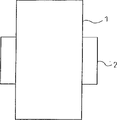
本发明的研究者们研究的结果表明,在采用以1900米/分以下的纺丝速度纺丝的两步法制备PTT纤维的时候,制得的未拉伸纤维,如图1及图2所示,由于环境温度和存放时间的影响,收缩率会发生变化。而且,未拉伸纤维的经时收缩大时,由于未拉伸纤维卷装(package)的收缩,所以随着时间的变化,则会由图3A所示的正常形状变为图3B所示的歪斜形状。而且,会因未拉伸纤维相互间部分的胶粘作用,妨碍了未拉伸纤维顺利解松,其结果表明,解松张力变动大,常常发生断丝及单丝断裂、拉伸状态不好的现象。图3A、图3B中,1表示未拉伸纤维,2表示未拉伸纤维卷取的筒子。The results of the researchers' research of the present invention show that when adopting the two-step method of spinning at a spinning speed below 1900 m/min to prepare PTT fibers, the undrawn fibers obtained are as shown in Figure 1 and Figure 2 Shrinkage will vary due to ambient temperature and storage time. Moreover, when the time-dependent shrinkage of the undrawn fiber is large, due to the shrinkage of the undrawn fiber package (package), it will change from the normal shape shown in FIG. 3A to the shape shown in FIG. 3B as time goes by. skewed shape. Moreover, due to the partial adhesion between the unstretched fibers, the unstretched fibers are hindered from unwinding smoothly. The results show that the unstretched tension varies greatly, and broken filaments and monofilaments often occur, and the stretched state is not good. The phenomenon. In Fig. 3A and Fig. 3B, 1 denotes an undrawn fiber, and 2 denotes a bobbin on which the undrawn fiber is taken up.
由于这种经时的收缩作用的影响,由变形的卷装卷取的未拉伸纤维制得的拉伸纤维一般来说,纤度变动值即U%大,而且会产生相当于未拉伸纤维卷取机的横向宽度(拉伸纤维,2~5m的间隔)或其倍数的周期性的纤度变动(参照图4A及图5A)。像这种U%大,而且具有周期性纤度变动的拉伸纤维编成织物后,染色时,一般来说染色均匀性差,且会呈现周期性的染斑和光泽斑,因此不适宜用作要求均匀性的衣料。Due to the effect of this time-dependent shrinkage, drawn fibers made from undrawn fibers taken up from deformed packages generally have a large change in fineness, that is, U%, and produce a value equivalent to that of undrawn fibers. Periodic fineness variation of the lateral width of the coiler (drawn fiber, interval of 2 to 5 m) or a multiple thereof (see FIG. 4A and FIG. 5A ). After weaving such a stretched fiber with a large U% and periodic fineness changes into a fabric, the dyeing uniformity is generally poor when dyed, and periodic dyeing spots and glossy spots will appear, so it is not suitable for use as a fabric. Clothing of uniformity.
通常,在用二步法制备合成纤维的工业生产中,将未拉伸纤维卷取后,到拉伸结束为止不可避免地需3、4天时间,故实际上不可避免地受到经时收缩作用的影响。因此,在这种经时收缩作用显著的状态下,就谈不上工业上能生产适合衣料用的PTT纤维了。Usually, in the industrial production of synthetic fibers prepared by the two-step method, after the unstretched fibers are taken up, it will inevitably take 3 or 4 days until the end of stretching, so it is actually unavoidable to suffer from the shrinkage effect over time. Impact. Therefore, in such a state where the shrinkage effect over time is significant, it is impossible to industrially produce PTT fibers suitable for clothing.
发明详述Detailed description of the invention
本发明的目的是提供PTT纤维及这种PTT纤维工业上的制备方法,在二步法制备PTT纤维的过程中,可获得稳定的拉伸状态(拉伸收率),而且可制得韧度大、纤度变动特别是周期性的纤度变动小、适合衣料用的高质量的PTT纤维。本发明的课题是将未拉伸纤维的经时收缩控制到最小限度,将未拉伸纤维的解松张力的变动也控制得较小,并消除对拉伸状态及拉伸纤维质量带来的不良影响。The purpose of this invention is to provide PTT fiber and the preparation method on this PTT fiber industry, in the process that two-step method prepares PTT fiber, can obtain stable drawing state (drawing yield), and can make toughness It is a high-quality PTT fiber suitable for clothing with large denier fluctuations, especially periodic denier fluctuations. The object of the present invention is to minimize the time-dependent shrinkage of undrawn fibers, to control the fluctuation of unwinding tension of undrawn fibers to be small, and to eliminate the influence on the stretched state and the quality of drawn fibers. adverse effects.
本发明人研究的结果,发现了PTT未拉伸纤维所处的环境条件(温度、相对湿度)与未拉伸纤维的经时收缩性及与拉伸状态和拉伸纤维质量的关系,在此基础上完成了本发明。As a result of the inventor's research, the relationship between the environmental conditions (temperature, relative humidity) of the PTT undrawn fiber and the time-dependent shrinkage of the undrawn fiber and the stretched state and the quality of the drawn fiber has been found. The present invention has been accomplished on the basis of this.
即,本发明中的第1项发明是均匀性高的PTT纤维,它是由95摩尔%以上的对苯二甲酸亚丙基酯的重复单元和不足5摩尔%的其它酯的重复单元所组成的特性粘度为0.7~1.3的有捻或无捻的PTT纤维,其韧度为19(cN/dtex)%1/2以上,在由イヴ

(1)在イヴ ネス测试仪的记录纸上存在所产生的间隔在10m以下的低纤度侧周期性的变动,该变动的大小为平均纤度的2%以下。(1) in イヴOn the recording paper of the Ness tester, there are periodic fluctuations on the low fineness side with intervals of 10 m or less, and the size of the fluctuations is 2% or less of the average fineness.
(2)虽然在イヴ

(3)在イヴ ネス测试仪的记录纸上不能判断所产生间隔在10m以下的低纤度侧的周期性变动,而且,在纤度变动的周期性检测图上也不存在间隔为10m以下的周期性的变动。(3) in イヴPeriodic fluctuations at intervals of less than 10m on the low-denier side cannot be judged on the recording paper of the Ness tester, and there are no periodic fluctuations at intervals of less than 10m on the periodic detection chart of denier fluctuations.
(这里,韧度=断裂强度×断裂伸长率1/2(cN/dtex)%1/2,イヴ

本发明中的第2项发明是PTT纤维的制备方法,它是制备由95摩尔%以上的对苯二甲酸亚丙基酯的重复单元和不足5摩尔%的其它酯类的重复单元所组成的特性粘度为0.7~1.3的PTT形成的纤维的方法,用在纺丝工序中以1900米/分以下的卷取速度将未拉伸纤维卷成卷装,接着在拉伸工序中将该未拉伸纤维进行拉伸的二步法制造时,未拉伸纤维的卷取张力设为0.04~0.12cN/dtex,在未拉伸纤维的卷取、保管及拉伸的各工序中,将该未拉伸纤维保持在温度为10~25℃、相对湿度为75~100%的环境条件下,而且,该未拉伸纤维的拉伸要在卷取后的100小时以内完成。The second invention in the present invention is a method for preparing PTT fibers, which is composed of repeating units of more than 95 mol% of propylene terephthalate and less than 5 mol% of repeating units of other esters The method for fibers formed by PTT with an intrinsic viscosity of 0.7 to 1.3 is to wind the undrawn fiber into a package at a take-up speed of 1900 m/min or less in the spinning process, and then use the undrawn fiber in the drawing process. In the two-step method of stretching and drawing the undrawn fiber, the coiling tension of the undrawn fiber is set at 0.04 to 0.12cN/dtex, and in each process of coiling, storing and drawing the undrawn fiber, the The stretched fiber is maintained at an ambient condition with a temperature of 10-25°C and a relative humidity of 75-100%, and the stretching of the undrawn fiber should be completed within 100 hours after coiling.
下面,就本发明进行详细叙述。Next, the present invention will be described in detail.
在本发明中,用由95摩尔%以上的对苯二甲酸亚丙基酯的重复单元和不足5摩尔%的其它酯的重复单元组成的特性粘度为0.7~1.3的PTT,研究在纺丝工序中以1900米/分以下的卷取速度,将未拉伸纤维卷成卷装,接着,在拉伸工序中拉伸未拉伸纤维的二步法制备方法,并且研究用这种方法制得的有捻或无捻PTT长纤维。In the present invention, PTT with an intrinsic viscosity of 0.7 to 1.3 consisting of repeating units of 95 mol% or more of propylene terephthalate and less than 5 mol% of repeating units of other esters is used to study the process of spinning in the spinning process. At a coiling speed of 1900 m/min or less, the undrawn fiber is rolled into a package, and then the two-step method of drawing the undrawn fiber in the drawing process is used, and the preparation method is studied by this method. Twisted or untwisted PTT long fibers.
一般来说,二步法中的拉伸是利用图7中所示的叫做拉伸加捻机或图8中所示的叫做拉伸卷取机的设备进行的,拉伸纤维在前者中被卷取成称作小型锭子(如图9所示)的形状、在后者中被卷取成称作筒子(如图10所示)的形状。纤维一般来说,在小型锭子上是有捻的、在筒子上的是无捻卷取的。图7、图8中,15是未拉伸的纤维卷装,16是供纤辊,17是电热板,18是拉伸辊,19是小型锭子,20是筒子。另外,图9中,21是小型锭子,22是拉伸纤维,图10中,23是纸管,24是拉伸纤维。In general, drawing in the two-step process is carried out using a device called a draw-twister as shown in Figure 7 or a device called a draw-coiler as shown in Figure 8, in which the drawn fiber is drawn It is wound into a shape called a mini-spindle (as shown in FIG. 9 ), and in the latter into a shape called a bobbin (as shown in FIG. 10 ). Generally speaking, fibers are twisted on small spindles and untwisted on bobbins. Among Fig. 7, Fig. 8, 15 is unstretched fiber package, and 16 is for fiber roller, and 17 is electric heating plate, and 18 is stretching roller, and 19 is small-sized spindle, and 20 is bobbin. In addition, in Fig. 9, 21 is a small spindle, 22 is a drawn fiber, in Fig. 10, 23 is a paper tube, and 24 is a drawn fiber.
在本发明的第1项发明中,韧度为19(cN/dtex)%1/2以上。如果韧度不足19(cN/dtex)%1/2,则将PTT纤维进行加工制得的编织品的扯裂强度等力学性质就不好,就不足以用作衣料用的纤维。优选的韧度的范围为21(cN/dtex)%1/2以上。顺便说一下,一般衣料用的聚对苯二甲酸乙二酯纤维的韧度约为24(cN/dtex)%1/2。In the first invention of the present invention, the toughness is 19 (cN/dtex)% 1/2 or more. If the toughness is less than 19 (cN/dtex)% 1/2 , the mechanical properties such as tear strength of the knitted fabric obtained by processing the PTT fiber are not good, and it is not good enough to be used as a fiber for clothing. A preferable range of toughness is 21 (cN/dtex)% 1/2 or more. By the way, the tenacity of polyethylene terephthalate fibers for general clothing is about 24 (cN/dtex)% 1/2 .
在本发明的第1项发明中,在由イヴ ネス测试仪进行的连续纤度变动测定中,纤度变动值(U%)为1.5%以下。如果U%超过1.5%的话,则物性的均一性和染色的均匀性就不好,其结果,加工成编织品时,织物整体来说,染色斑和染色条很明显,不能得到优质的织物。U%的理想范围为1.2%以下,更理想的范围为1.0%以下。In the first invention of the present invention, by イヴIn the continuous fineness fluctuation measurement by the Ness tester, the fineness fluctuation value (U%) is 1.5% or less. If the U% exceeds 1.5%, the uniformity of physical properties and the uniformity of dyeing will be poor. As a result, when processed into a woven fabric, dyeing spots and stripes are conspicuous on the fabric as a whole, and a high-quality fabric cannot be obtained. The ideal range of U% is 1.2% or less, and the more desirable range is 1.0% or less.
未拉伸的纤维卷装在因经时收缩的影响发生显著形变的条件下制得的未拉伸纤维,由于经时收缩的作用,导致未拉伸纤维的纤度变动增大,U%恶化。The undrawn fiber package produced under the condition that the undrawn fiber package is significantly deformed due to the influence of time shrinkage increases the fineness fluctuation of the undrawn fiber due to the effect of time shrinkage, and U% deteriorates.
在本发明的第1项发明中,在由イヴ

在纤度变动中确认是否存在周期性,可通过直读连续的纤度测定记录(Diagram Mass),或由后述的纤度变动的周期性检测来判断。用后者的方法,周期长度(表示在检测图的横轴上)在1~10m的范围内,如果存在纤度变动的分散CV值(表示在检测图的纵轴上)超过约0.2%的峰的话,则可以说纤度变动中存在周期性。To confirm whether there is periodicity in the change of denier, it can be judged by direct reading continuous denier measurement record (Diagram Mass), or by the periodic detection of denier change described later. With the latter method, the period length (indicated on the horizontal axis of the detection chart) is in the range of 1 to 10m, if there is a peak with a dispersion CV value (indicated on the vertical axis of the detection chart) of the fineness change exceeding about 0.2%. If , it can be said that there is periodicity in the change of denier.
所谓低纤度侧周期性的变动是指在由イヴ

所产生的周期性的纤度变动的间隔,实际上相当于未拉伸纤维卷装的两个端部间的1个行程部分或2个行程部分的未拉伸纤维的长度与实际拉伸比的乘积。两个端部或一侧端部存有的未拉伸纤维,由于解松阻力的作用,所以在被拉伸的低纤度侧形成了周期性的纤度变动。在二步法中,产生周期性的纤度变动的间隔,由未拉伸纤维的卷取机的行程的长度、络筒交叉的角度及拉伸比来决定,一般为10m以下。The interval of the periodic denier change is actually equivalent to the ratio of the length of the undrawn fiber to the actual draw ratio of one stroke or two strokes between the two ends of the undrawn fiber package. product. The unstretched fiber existing at both ends or one end forms periodic fineness fluctuations on the stretched low-fiber side due to the effect of unwinding resistance. In the two-step method, the interval at which periodic denier changes occur is determined by the stroke length of the undrawn fiber coiler, the angle at which the bobbins cross, and the draw ratio, and is generally 10 m or less.
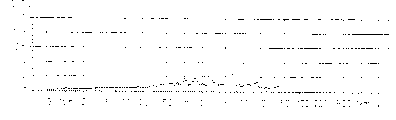
如果低纤度侧周期性的纤度变动变小的话,则在连续的纤度测定的记录纸上,如图4B那样的向下的等间隔的信号就不能判断。但是,在与图4B对应的周期性检测图(图5B)上能显示出表征存在周期性变动的信号。如上所述,在记录纸上信号不明显,但是在周期性检测图上信号显示出来了,是前述(2)的必要条件。在图5B上,10m以内出现了四个信号即出现了山状突起的信号。这种山状突出信号能看到一个或几个的状态是表示在显示(2)的必要条件的周期性检测图上存在周期性的纤度变动的状态。顺便说一下,在周期性检测中,信号是在低纤度侧还是在高纤度侧是未知的。满足该(2)的必要条件的范围是本发明的理想的范围。If the periodic fineness variation on the low fineness side becomes smaller, the downward equally spaced signals as shown in FIG. 4B cannot be judged on the recording paper for continuous fineness measurement. However, a signal representing the presence of periodic fluctuations can be shown on the periodicity detection diagram (FIG. 5B) corresponding to FIG. 4B. As mentioned above, the signal is not obvious on the recording paper, but the signal is displayed on the periodic detection chart, which is the necessary condition for (2) above. In Figure 5B, four signals appeared within 10m, that is, signals with mountain-like protrusions appeared. The fact that one or more of these mountain-shaped protruding signals can be seen indicates that there are periodic fineness fluctuations on the periodic detection chart showing the necessary condition of (2). By the way, in periodic detection, it is not known whether the signal is on the low-denier side or the high-denier side. The range satisfying the requirement of (2) is the ideal range of the present invention.
如果周期性的纤度变动更小的话,则即使在周期性的检测图中也不会存在山状突出的信号。这种状态是前述(3)的必要条件所表示的状态。即,满足(3)的必要条件的范围是本发明的更理想的范围。If the periodic titer fluctuations are smaller, there will be no mountain-shaped signals even in the periodic detection diagram. This state is the state represented by the necessary condition of (3) above. That is, the range satisfying the requirement (3) is a more desirable range of the present invention.
在本发明的第2项发明中,纺丝工序中的未拉伸纤维的卷取张力为0.04~0.12cN/dtex。如果卷取张力在这个范围的话,即使假设未拉伸纤维多少发生了经时收缩,但是也与卷取束的大的变形无关。在本发明的范围内将未拉伸纤维保存的环境温度设在比较高的温度时,则要将卷取张力设在比较低的张力侧,环境温度比较低时,则将卷取张力设在比较高的张力侧。In the second invention of the present invention, the winding tension of the undrawn fiber in the spinning step is 0.04 to 0.12 cN/dtex. If the take-up tension is within this range, even if the undrawn fiber shrinks with time to some extent, it does not cause a large deformation of the take-up bundle. When the ambient temperature for undrawn fiber preservation is set at a relatively high temperature within the scope of the present invention, the coiling tension should be set at a relatively low tension side, and when the ambient temperature is relatively low, the coiling tension should be set at Higher tension side.
如果将卷取张力设定为不足0.04cN/dtex的话,则卷装(package)运行不稳,连续地卷取未拉伸纤维很困难。另一方面,如果卷取张力超过0.12cN/dtex的话,则即使环境温度在10~25℃之间,但是由于经时收缩的影响,未拉伸纤维也回避不了卷装的变形。If the take-up tension is set to be less than 0.04 cN/dtex, the package (package) will run unstable and it will be difficult to take up undrawn fibers continuously. On the other hand, if the take-up tension exceeds 0.12cN/dtex, even if the ambient temperature is between 10°C and 25°C, the undrawn fiber cannot avoid package deformation due to the influence of time-lapse shrinkage.
在本发明的第2项发明中,该未拉伸纤维的卷取、保存及拉伸的各工序中,保持在10~25℃的温度、75~100%的相对湿度的环境条件下。In the second invention of the present invention, the undrawn fiber is kept under environmental conditions of a temperature of 10 to 25°C and a relative humidity of 75 to 100% in each step of winding, storage and drawing of the undrawn fiber.
如果将环境温度降到10℃以下的话,虽然未拉伸纤维的经时收缩变得极小,但是,不仅调温成本增大,而且由于寒冷,工作效率会下降。另一方面,如果环境温度超过25℃的话,则未拉伸纤维的经时收缩变大,即使将卷取张力降到0.04cN/dtex,也很难避免卷装发生大的形变。If the ambient temperature is lowered to 10°C or lower, the time-dependent shrinkage of the undrawn fiber becomes extremely small, but not only does the temperature adjustment cost increase, but also the working efficiency decreases due to the cold. On the other hand, if the ambient temperature exceeds 25°C, the time-dependent shrinkage of the undrawn fiber increases, and even if the winding tension is lowered to 0.04cN/dtex, it is difficult to avoid large deformation of the package.
理想的环境温度的范围,如果考虑未拉伸纤维卷装的变形、调温成本及工作效率的话,应为15~22℃。The ideal ambient temperature range should be 15-22°C if the deformation of the unstretched fiber package, temperature adjustment costs and work efficiency are considered.
在本发明的第2项发明中,在各工序中,保存未拉伸纤维的环境的相对湿度应为75~100%。如果相对湿度不足75%的话,则由于与整理剂一块赋于未拉伸纤维卷装上的水分,仅仅是在卷装两端面上很快蒸发,该部分的未拉伸纤维的附水率下降,所以在拉伸纤维上常产生绒毛,与此同时,拉伸后的纤维的U%超过1.5%,引起显著的染色条和染色斑。理想的相对湿度的范围为80~95%。In the second invention of the present invention, in each step, the relative humidity of the environment in which the undrawn fiber is stored should be 75 to 100%. If the relative humidity is less than 75%, the water attached to the undrawn fiber package together with the finishing agent will only evaporate quickly on the two ends of the package, and the water attachment rate of the undrawn fiber in this part will decrease. , Therefore, fluff is often produced on the stretched fiber, and at the same time, the U% of the stretched fiber exceeds 1.5%, causing significant dyeing streaks and staining spots. The ideal relative humidity range is 80-95%.
在本发明的第2项发明中,卷取的未拉伸纤维的拉伸必须在卷取后的100小时以内完成。该未拉伸纤维从被卷取开始到被拉伸为止的时间,即从未拉伸纤维开始卷取起到被卷至未拉伸纤维卷装的最内层的未拉伸纤维被拉伸为止的时间,通常称作延迟时间,在本发明中,延迟时间必须在100小时以内。In the second invention of the present invention, drawing of the coiled undrawn fiber must be completed within 100 hours after coiling. The time from when the undrawn fiber is taken up to when it is drawn, that is, the time from when the undrawn fiber starts to be taken up until when the undrawn fiber rolled into the innermost layer of the undrawn fiber package is drawn Until the time, usually called the delay time, in the present invention, the delay time must be within 100 hours.
如果延迟时间超过100小时的话,即使未拉伸纤维的经时收缩小,卷装形变小,但是,由于与未拉伸纤维的整理剂一块赋于的水分的蒸发,卷装各部分的附水率不均匀,拉伸纤维的U%超过1.5%的范围,则有产生染斑(染级不合格)的趋势。理想的延迟时间的范围为75小时以内,更理想的范围为50小时以内。If the delay time exceeds 100 hours, even if the time-dependent shrinkage of the undrawn fiber is small and the package shape becomes small, due to the evaporation of the moisture imparted together with the finishing agent of the undrawn fiber, the moisture attached to each part of the package will be reduced. If the U% of the stretched fiber exceeds 1.5%, there is a tendency to cause dyeing spots (unqualified dyeing level). The ideal delay time range is within 75 hours, and the more ideal range is within 50 hours.
下面详述本发明中的PTT聚合物。The PTT polymer in the present invention will be described in detail below.
本发明中的PTT是由95摩尔%以上的对苯二甲酸亚丙基酯的重复单元和不足5摩尔%的其它酯的重复单元所组成的。The PTT in the present invention is composed of more than 95 mol% of repeating units of propylene terephthalate and less than 5 mol% of repeating units of other esters.
即,本发明中所说的PTT是PTT的均聚物及包含不足5摩尔%的其它酯单元的共聚的PTT。共聚组分的典型例子如下所述。That is, the PTT mentioned in the present invention refers to a homopolymer of PTT and a copolymerized PTT containing less than 5 mol % of other ester units. Typical examples of copolymerization components are as follows.
作为酸组分可列举以间苯二甲酸-5-磺酸钠为代表的含磺酸基的二羧酸及其金属盐、以间苯二甲酸为代表的芳香族二羧酸、以己二酸为代表的脂肪族二羧酸等等,作为二元醇组分,可列举乙二醇、丁二醇、聚乙二醇等等。含有几个共聚组分的聚合物也无妨。As the acid component, sulfonic acid group-containing dicarboxylic acids represented by isophthalic acid-5-sodium sulfonate and their metal salts, aromatic dicarboxylic acids represented by isophthalic acid, adipic dicarboxylic acids represented by Acids are representative aliphatic dicarboxylic acids and the like, and examples of the diol component include ethylene glycol, butylene glycol, polyethylene glycol and the like. Polymers containing several copolymerized components are also harmless.
本发明中的PTT的特性粘度为0.7~1.3。作为衣料用的,理想的范围为0.8~1.1。The intrinsic viscosity of PTT in this invention is 0.7-1.3. For clothing, the ideal range is 0.8 to 1.1.
本发明中的PTT还可以含有残留的金属类触媒、热稳定剂、抗氧化剂、消光剂、防静电剂、色相调节剂、阻燃剂、紫外线吸收剂等添加剂,也可含有共聚的组分。The PTT in the present invention may also contain additives such as residual metal catalysts, thermal stabilizers, antioxidants, matting agents, antistatic agents, hue regulators, flame retardants, and ultraviolet absorbers, as well as copolymerized components.
作为本发明中PTT的制备方法,可用众所周知的方法,如:熔融聚合后,再用固相聚合进一步提高特性粘度的方法是通用的方法。As the preparation method of PTT in the present invention, well-known methods can be used, for example, the method of further increasing the intrinsic viscosity by solid-state polymerization after melt polymerization is a common method.
在本发明的PTT纤维的制备中,可列举如图6及图7所示的方法。In the production of the PTT fiber of the present invention, the methods shown in Fig. 6 and Fig. 7 can be cited.
在图6中,首先将用干燥机3干燥到含水率为30ppm以下的PTT切片供给温度设定在255~265℃的挤出机4中进行熔融。熔融了的PTT经其后的弯管5送到温度设定在250~265℃的旋转头6中,用齿轮泵计量。然后,再经过装在旋转组件7中的具有多个纺丝孔的纺丝模具8制成复丝9从纺丝腔中挤出。In FIG. 6 , first, the PTT chips dried to a moisture content of 30 ppm or less by the dryer 3 are supplied to the extruder 4 whose temperature is set at 255 to 265° C. and melted. The melted PTT is sent to the rotary head 6 whose temperature is set at 250-265°C through the
挤出机及旋转头的温度,根据PTT切片的特性粘度及形状不同,从上述范围中选择最宜的温度。The temperature of the extruder and the rotary head is selected from the above range according to the intrinsic viscosity and shape of the PTT chips.
由纺丝腔内挤出的PTT复丝一面由冷风10将其冷却到室温,一面以规定的速度旋转牵伸,经导辊12、13被细化、固化,得到规定纤度的未拉伸纤维。未拉伸纤维由接在牵伸导辊12前面的提供整理剂的装置11提供整理剂。未拉伸纤维离开牵伸导辊13以后,由卷取机14卷取,得到未拉伸纤维卷装。未拉伸纤维的卷取速度理想的为1000~1900米/分。The PTT multifilament extruded from the spinning chamber is cooled to room temperature by the
这时,牵伸导辊12、13及卷取机周围的环境条件,温度保持在10~25℃、相对湿度保持在75~100%。另外,将形成的未拉伸的纤维卷装在送入拉伸工序前暂时保存时,也存放在上述的环境条件下。At this time, the environmental conditions around the draft guide rollers 12, 13 and the coiler are maintained at 10-25° C. and 75-100% relative humidity. In addition, when the formed unstretched fiber package is temporarily stored before being sent to the stretching process, it is also stored under the above-mentioned environmental conditions.
未拉伸纤维的卷取张力通过改变卷取速度即卷取中未拉伸纤维卷装的线速度和牵伸导辊13的线速度的比来设定。The coiling tension of the undrawn fiber is set by changing the coiling speed, that is, the ratio of the linear speed of the undrawn fiber package during coiling to the linear speed of the draft guide roller 13 .
整理剂使用安全方面或对车间环境方面没有影响的水乳液型。此时,整理剂的浓度以10~30wt%为佳。施行水乳液型整理剂时,卷取后的未拉伸纤维含有与整理剂浓度及整理剂附着率相应的含水率的水分。该含水率通常为3~5wt%。The finishing agent is a water-emulsion type that has no impact on safety or workshop environment. At this time, the concentration of the finishing agent is preferably 10-30 wt%. When the aqueous emulsion type finishing agent is applied, the unstretched fiber after coiling contains water with a moisture content corresponding to the concentration of the finishing agent and the attachment rate of the finishing agent. The moisture content is usually 3 to 5 wt%.
未拉伸的纤维卷装接着被送进拉伸工序,用如图7所示的拉伸机进行拉伸。在拉伸机上,未拉伸的纤维卷装15,在被拉伸的过程中,保持在10~25℃的温度、75~100%的相对湿度的环境条件下。在拉伸机上,首先,未拉伸纤维15在温度设定为45~65℃的供料辊16上被加热,然后,利用拉伸辊18和供料辊16的线速度比,将其拉伸到规定的纤度。纤维在拉伸中或拉伸后,一边与温度设为100~150℃的热板17接触,一边运行,进行拉伸热处理。离开拉伸辊的纤维,一边由锭子加捻,一边卷取成小型锭子19。The undrawn fiber package is then sent to the drawing process, which is drawn using a drawing machine as shown in FIG. 7 . On the stretching machine, the
这时,拉伸辊18和供料辊16的线速度比即拉伸比及热板温度的设定以使拉伸张力为0.35cN/dtex左右为好。At this time, the linear speed ratio between the stretching
附图简述Brief description of the drawings
图1表示环境条件(温度条件)与PTT未拉伸纤维的收缩率随时间变化的关系图(相对湿度90%时)。Figure 1 shows the relationship between environmental conditions (temperature conditions) and the shrinkage of PTT undrawn fibers over time (at a relative humidity of 90%).
图2表示环境温度与PTT未拉伸纤维收缩率的关系图(相对湿度90%、经过时间24小时)。Fig. 2 is a graph showing the relationship between the ambient temperature and the shrinkage rate of PTT undrawn fibers (relative humidity 90%, elapsed
图3A是正常状态的未拉伸纤维卷装的示意图。Figure 3A is a schematic illustration of an undrawn fiber package in its normal state.
图3B是未拉伸纤维由于经时收缩的作用,发生形变了的未拉伸纤维卷装的示意图。Fig. 3B is a schematic view of an undrawn fiber package in which the undrawn fiber is deformed due to shrinkage over time.
图4A是低纤度侧周期性变动显著的由イヴ ネス测试仪测得的U%的记录图。Figure 4A shows the significant periodic changes on the low denier side by イヴThe record chart of U% measured by Nes tester.
图4B是低纤度侧周期性变动不显著的由イヴ ネス测试仪测得的U%的记录图。Fig. 4B shows that the periodical variation of the low denier side is not significant by イヴThe record chart of U% measured by Nes tester.
图5A是与图4A对应的纤度变动的周期性检测图。Fig. 5A is a periodic detection diagram of fineness variation corresponding to Fig. 4A.
图5B是与图4B对应的纤度变动的周期性检测图。Fig. 5B is a periodic detection diagram of fineness variation corresponding to Fig. 4B.
图6是纺丝机的示意图。Fig. 6 is a schematic diagram of a spinning machine.
图7是拉伸加捻机的示意图。Fig. 7 is a schematic diagram of a draw-twisting machine.
图8是拉绕机的示意图。Fig. 8 is a schematic diagram of a drawing and winding machine.
图9是小型锭子的示意图。Fig. 9 is a schematic diagram of a small spindle.
图10是筒子的示意图。Figure 10 is a schematic view of the bobbin.
发明的优选实施方案Preferred Embodiments of the Invention
下面通过实施例进一步说明本发明。The present invention is further illustrated below by way of examples.
物性的测定方法及测定条件如下述所示。(a)特性粘度特性粘度[η]是以下式的定义为基础求得的值。
式中,ηr是将PTT聚合物溶解在纯度为98%以上的邻氯苯酚中的稀溶液在35℃下的粘度用同一温度下测定的上述溶剂的粘度相除的值,定义为相对粘度。C是用g/100ml表示的聚合物的浓度。(b)未拉伸纤维的经时收缩率(%)In the formula, ηr is the value obtained by dividing the viscosity of the dilute solution of the PTT polymer dissolved in o-chlorophenol with a purity of 98% or more at 35° C. by the viscosity of the above-mentioned solvent measured at the same temperature, and is defined as the relative viscosity. C is the concentration of polymer expressed in g/100ml. (b) Time-lapse shrinkage rate (%) of unstretched fiber
将刚卷取后的未拉伸纤维制成用纱框式测长器测得周长为1.125m的20圈卷线轴线(轮状的卷装),再将其在规定的温湿度环境条件下,以无荷重的状态放置规定的时间。The unstretched fiber just after coiling is made into 20 turns of winding axis (wheel-shaped package) with a circumference of 1.125m measured by a yarn frame length measuring device, and then placed in a specified temperature and humidity environment. Under the condition of no load, leave it for a specified time.
测定刚做成的卷线轴线及经过规定时间后(相当于卷取后经过的时间)的卷线轴线的长度,按下式计算未拉伸纤维的经时收缩率。测定卷线轴线长度时的荷重为22.5mg/dtex。Measure the length of the winding axis just after it is made and the length of the winding axis after a predetermined time (corresponding to the elapsed time after winding), and calculate the time-dependent shrinkage of the undrawn fiber according to the following formula. The load when measuring the axial length of the winding wire was 22.5 mg/dtex.
未拉伸纤维经时收缩率=[(L1-L2)/L1]×100Shrinkage rate of unstretched fiber over time = [(L1-L2)/L1]×100
式中,L1为初期的卷线轴线长(cm),L2为经过规定放置时间后卷线轴线长(cm)。(c)断裂强度、断裂伸长率及韧度In the formula, L1 is the initial winding axis length (cm), and L2 is the winding axis length (cm) after the specified storage time. (c) Breaking strength, elongation at break and toughness
用通用的拉伸机,夹持长50cm的纤维,以50厘米/分的拉伸速度,画5次样品的伸长-荷重曲线,求5次平均的断裂强度(cN/dtex)及断裂伸长率(%)。用该值按下式计算韧度。Use a general-purpose stretching machine to clamp a fiber with a length of 50 cm, draw the elongation-load curve of the
韧度=断裂强度×断裂伸长率1/2(cN/dtex)%1/2(d)连续纤度变动的测定(记录曲线)及纤度变动值(U%)Toughness = breaking strength × elongation at break 1/2 (cN/dtex)% 1/2 (d) Measurement of continuous denier variation (recording curve) and denier variation value (U%)
如果用以下方法测定连续纤度变动记录曲线的话,则同时测定U%。If the continuous fineness variation record curve is measured by the following method, U% is measured at the same time.
测试仪:イヴ

测试条件:Test Conditions:
·丝速 100米/分·Wire speed 100 m/min
·捻数 10000转/分·Number of twists 10000 rpm
·测试纤维长度 250m·Test fiber length 250m
·刻度 根据纤维的纤度变动来设定·The scale is set according to the change of fiber size
如图4A所示,周期性的纤度变动在记录曲线上能清楚观察到时,则周期性的纤度变动的间隔和变动的大小对平均纤度的比率可从记录曲线上读取。As shown in Figure 4A, when the periodic fineness fluctuations can be clearly observed on the recording curve, the interval of the periodic fineness fluctuations and the ratio of the magnitude of the fluctuation to the average fineness can be read from the recording curve.
如图4B所示,周期性的纤度变动在记录曲线上不能清楚观察到时,可利用イヴ

用以下基准,由熟练者判断。5级:最优级(合格)4级:优级(合格)3级:良好(勉强合格)2级:差(不合格)1级:非常差(不合格)[实施例1~4、比较例1及2]Using the following criteria, judge by a skilled person. 5 grades: the best grade (qualified) 4 grades: excellent grade (qualified) 3 grades: good (barely qualified) 2 grades: poor (unqualified) 1 grade: very poor (failed) [
本例中,研究保存的环境温度对未拉伸纤维经时收缩的影响。In this example, the effect of the ambient temperature of storage on the shrinkage of undrawn fibers over time is investigated.
将含0.4wt%的氧化钛、特性粘度为0.91的PTT切片,用如图6及图7所示的纺丝机及拉伸机,制备56dtex/24长丝的PTT纤维。在该纺丝机中,纺丝模具可同时装16个,因此,本例中可同时制得16根未拉伸纤维。在其后的拉伸中,可将同时制得的16根未拉伸纤维同时开始拉伸。PTT slices containing 0.4wt% titanium oxide and an intrinsic viscosity of 0.91 were used to prepare 56dtex/24 filament PTT fibers with the spinning machine and drawing machine shown in Figure 6 and Figure 7 . In this spinning machine, 16 spinning dies can be installed at the same time, therefore, 16 undrawn fibers can be produced simultaneously in this example. In the subsequent drawing, drawing of the 16 undrawn fibers produced at the same time can be started at the same time.
改变环境条件制备这16根未拉伸纤维并将它们拉伸。未拉伸纤维卷取后(形成6kg卷的卷装后)放置24小时,开始拉伸,由6kg卷的未拉伸纤维一分为4,即制得4根1.5kg卷的拉伸纤维。这时,各卷之间有1小时的间隔。The 16 undrawn fibers were prepared and drawn under varying environmental conditions. After the undrawn fiber was taken up (after forming a 6kg roll package), it was placed for 24 hours, and the drawing was started. The undrawn fiber of the 6kg roll was divided into 4, that is, four drawn fibers of 1.5kg roll were obtained. At this time, there is an interval of 1 hour between volumes.
未拉伸纤维在卷取、保存及拉伸中被维持在规定的环境条件下。作为环境条件,相对湿度保持在90%,使温度在28~15℃(表1所示)之间变化,制备4次未拉伸纤维。Undrawn fibers are maintained under prescribed environmental conditions during coiling, storage and drawing. As environmental conditions, the relative humidity was maintained at 90%, the temperature was varied between 28°C and 15°C (shown in Table 1), and undrawn fibers were produced 4 times.
纺丝条件及拉伸条件如下所述。纺丝条件:The spinning conditions and stretching conditions are as follows. Spinning conditions:
切片干燥温度及达到的含水率 130℃、25ppmSlice drying temperature and achieved moisture content 130°C, 25ppm
挤出机温度 260℃Extruder temperature 260℃
旋转头温度 265℃Rotary head temperature 265℃
纺丝模具孔径 0.24mmAperture diameter of spinning die 0.24mm
聚合物挤出量 19g/分/ENDPolymer extrusion capacity 19g/min/END
冷风条件 温度22℃、相对湿度90%Cold wind conditions Temperature 22°C, relative humidity 90%
速度0.5m/secSpeed 0.5m/SEC
整理剂条件 10%水乳液Finishing
整理剂附着率0.8wt%Finishing agent attachment rate 0.8wt%
牵引速度 1500米/分Traction speed 1500 m/min
(牵引导辊线速度)(Linear speed of pulling pulley)
卷取速度 调节卷取速度使卷取张力为Take-up speed Adjust the take-up speed so that the take-up tension is
0.07cN/dtex 0.07cN/dtex
整理剂浓度及附着量 10%的水乳液、0.8wt%Finishing agent concentration and
未拉伸纤维含水率 4.0wt%Unstretched fiber moisture content 4.0wt%
未拉伸纤维卷的重量 6kg/l线轴Weight of unstretched fiber roll 6kg/l spool
与上述对应的卷取时间 5.3小时拉伸条件:Coiling time corresponding to the above 5.3 hours Stretching conditions:
拉伸机供辊温度 55℃Stretching machine supply roll temperature 55℃
同机的热板温度 130℃The hot plate temperature of the same machine is 130℃
同机的拉伸辊温度 不加热(室温)Stretching roller temperature of the same machine Unheated (room temperature)
拉伸比 设定得使制得的拉伸纤维的断裂伸长The draw ratio is set such that the elongation at break of the drawn fiber produced
率约为40%The rate is about 40%
卷取速度 800米/分Coiling speed 800 m/min
每卷重量 1.5kgWeight per roll 1.5kg
与上述对应的卷取时间 5.8小时The coiling time corresponding to the above is 5.8 hours
在本例中,于表1中所示的各环境条件下,将每16根未拉伸纤维取样6次(化纤条),分别对化纤条进行1.5kg卷×4次的拉伸试验。如表1中所示,评价了由于未拉伸纤维卷装的形变程度不同及解松不良引起的断丝根数,如表2中所示,评价了拉伸纤维的物性及质量。In this example, under the environmental conditions shown in Table 1, each 16 unstretched fibers were sampled 6 times (chemical fiber sliver), and the chemical fiber sliver was subjected to a tensile test of 1.5 kg volume × 4 times. As shown in Table 1, the number of broken filaments due to the degree of deformation of the undrawn fiber package and poor unwinding were evaluated, and as shown in Table 2, the physical properties and quality of the drawn fiber were evaluated.
由表1可清楚地知道,在环境温度为本发明规定之外的比较例1、2中,未拉伸纤维卷取的卷装形变大,其结果,常发生由解松不良引起的拉伸时的断丝,另一方面,在环境温度为本发明规定之内的实施例1~4中,未拉伸纤维卷取的卷装形变小,其结果,由解松不良引起的断丝现象少。It is clear from Table 1 that in Comparative Examples 1 and 2 where the ambient temperature is outside the specification of the present invention, the package shape of the unstretched fibers becomes large, and as a result, stretching caused by poor unwinding often occurs. On the other hand, in Examples 1 to 4 where the ambient temperature was within the specification of the present invention, the package shape of the undrawn fiber wound up became small, and as a result, the yarn breakage caused by poor unwinding few.
由表2可清楚地知道,环境条件为本发明规定之外的比较例1及2的拉伸纤维,纤度变动值(U%)及纤维周期性的变动大,染级为不合格的1~2级。但是,环境条件为本发明的规定之内的实施例1~4的纤维,U%值良好,纤度周期性的变动也小,染级为3~5级,是均匀性好的纤维。It can be clearly seen from Table 2 that the drawn fibers of Comparative Examples 1 and 2 whose environmental conditions are outside the provisions of the present invention have large denier variation (U%) and fiber periodicity, and the dyeing level is unqualified from 1 to 2.
表1注1 ◎:非常好 ○:良好 ×:形变大 ××:形变非常大注2 由解松不良引起的断丝的根数:16根未拉伸纤维卷装中,在拉伸工序中,因解松不良引起的断丝根数。注3 表中记号*表示在各段中,被拉伸的未拉伸纤维从卷取状态开始,到被拉伸之问经过的最长时间(作为未拉伸纤维存在的时间)表2
表中记号*表示纤度周期性变动的检测结果,(2)表示在イヴ


本例中研究环境的相对湿度对未拉伸纤维经时的收缩及拉伸纤维质量的影响。In this example, the influence of the relative humidity of the environment on the shrinkage of the undrawn fiber over time and the quality of the drawn fiber is studied.
使相对湿度发生如表3所示的变化,除此以外的方法及条件与实施例2一样。The relative humidity was changed as shown in Table 3, and the method and conditions other than that were the same as in Example 2.
制得的未拉伸纤维卷装的形变状态及断丝根数示于表3中,拉伸纤维的平均物性及均匀性等示于表4中。Table 3 shows the deformation state and the number of broken filaments of the obtained undrawn fiber package, and Table 4 shows the average physical properties and uniformity of the drawn fiber.
由表4可清楚地知道,如果相对湿度不足75%的话,拉伸纤维的U%就不好,同时,染色的均匀性(染级)也不好。It can be clearly seen from Table 4 that if the relative humidity is less than 75%, the U% of the drawn fiber is not good, and at the same time, the uniformity of dyeing (dyeing level) is also not good.
另外,实施例5~7的拉伸纤维中,毛绒产生极少,但比较例3及4中制得的拉伸纤维常产生毛绒。In addition, in the stretched fibers of Examples 5 to 7, generation of fuzz was extremely small, but the stretched fibers obtained in Comparative Examples 3 and 4 often generated fuzz.
表3
表中记号*表示在化纤条中,被拉伸的未拉伸纤维从卷取开始到被拉伸为止经过的最长时间(作为未拉伸纤维存在的时间)表4
表中记号*表示纤度周期性变动的检测结果,(2)表示在イヴ ネス测试仪的记录纸上不能判断所产生的间隔为10米以下的低纤度侧周期性的变动,但是,在纤度变动的周期性检测图上存在间隔为10米以下的周期性的变动。[实施例8~10、比较例5及6]The mark * in the table indicates the detection result of the periodic change of fineness, and (2) indicates that in イヴPeriodic fluctuations at intervals of less than 10 meters on the low-denier side cannot be judged on the recording paper of the Ness tester, but there are periodic fluctuations at intervals of less than 10 meters on the periodic detection chart of denier fluctuations. [Examples 8-10, Comparative Examples 5 and 6]
本例中研究卷取张力对未拉伸纤维的经时收缩及拉伸纤维质量的影响。In this example, the effect of coiling tension on the time-dependent shrinkage of undrawn fibers and the quality of drawn fibers is studied.
使卷取张力如表5所示发生变化,除此以外的方法及条件与实施例2相同。The method and conditions were the same as in Example 2 except that the winding tension was changed as shown in Table 5.
制得的未拉伸纤维卷装的形变状态及断丝的根数示于表5中,拉伸纤维的平均物性及均匀性等示于表6中。Table 5 shows the deformation state and the number of broken filaments of the obtained undrawn fiber package, and Table 6 shows the average physical properties and uniformity of the drawn fiber.
由表5及表6可知,如果卷取张力超过0.12cN/dtex的话,即使环境条件在本发明规定的范围之内,未拉伸纤维卷装的形变仍很显著,其结果,拉伸状况不好,且可观察到拉伸纤维在低纤度侧的周期性的纤度变动。It can be seen from Table 5 and Table 6 that if the winding tension exceeds 0.12cN/dtex, even if the environmental conditions are within the range specified by the present invention, the deformation of the undrawn fiber package is still significant, and as a result, the stretching state is not good. Good, and periodic fineness fluctuations in the low fineness side of the drawn fiber were observed.
另外,将卷取张力不足0.04cN/dtex进行了试验,未拉伸纤维不能卷绕,不可能实施。In addition, when the winding tension was less than 0.04cN/dtex, the undrawn fiber could not be wound, and it was impossible to carry out the test.
表5 table 5
表中记号*表示在各段中被拉伸的未拉伸纤维从卷取到拉伸为止经过的最长时间(未拉伸纤维存在的时间)The mark * in the table indicates the longest time elapsed from winding up to stretching of undrawn fibers drawn in each stage (the time during which undrawn fibers exist)
表6
表中记号*表示纤度周期性变动的检测结果,(2)表示在彳ゥ ネス测试仪的记录纸上不能判断所产生的间隔为10米以下的低纤度侧周期性的变动,但是,在纤度变动的周期性检测图上存在间隔为10米以下的周期性的变动。[实施例11]The mark * in the table indicates the detection result of the periodic change of fineness, and (2) indicates that in 彳ゥPeriodic fluctuations at intervals of less than 10 meters on the low-denier side cannot be judged on the recording paper of the Ness tester, but there are periodic fluctuations at intervals of less than 10 meters on the periodic detection chart of denier fluctuations. [Example 11]
用含0.05WT%的氧化钛、特性粘度[η]为0.90的PTT聚合物,除此以外的制备条件同实施例2,进行PTT的纺丝、拉伸。其结果如下所示。纺丝、拉伸结果:Using a PTT polymer containing 0.05 wt% of titanium oxide and having an intrinsic viscosity [η] of 0.90, the preparation conditions were the same as in Example 2 except that, and spinning and stretching of PTT were carried out. The result is shown below. Spinning and drawing results:
卷取24小时后未拉伸纤维卷装的形状;○(良好)Shape of undrawn fiber package after 24 hours of coiling; ○ (good)
由解松不良引起的断丝根数(4段合计);5次The number of broken wires caused by poor loosening (total of 4 stages); 5 times
原丝物性及原丝的均匀性(5根拉伸丝的平均值):The physical properties of the raw silk and the uniformity of the raw silk (the average value of 5 drawn yarns):
纤度 54.8dtexDenier 54.8dtex
断裂强度 4.0cN/dtexBreaking strength 4.0cN/dtex
断裂伸长率 40.2%Elongation at break 40.2%
韧度 25(cN/dtex)%1/2 Tenacity 25(cN/dtex)% 1/2
沸水收缩率 13.1%Boiling water shrinkage 13.1%
热应力极值 0.30cN/dtexThermal stress extreme value 0.30cN/dtex
U% 0.8%U% 0.8%
纤度周期性的变动(2) (相当于权利要求第1项中(2)的条Periodic changes in fineness (2) (equivalent to item (2) in
件)pieces)
染级 4Dyeing level 4
产业上利用的可能性Possibility of industrial use
本发明的PTT纤维由于比以往的PTT纤维韧度高,纤度变动即U%小,且纤度的周期性变动也小,所以不仅可制得高强度的布帛,而且编织时,完全可制得染色均匀性高的布帛。Because the PTT fiber of the present invention has higher toughness than the conventional PTT fiber, the change in fineness that is U% is small, and the periodic change in fineness is also small, so not only can high-strength fabrics be produced, but also dyed fabrics can be completely obtained during weaving. Fabric with high uniformity.
另外,本发明的PTT纤维的制备方法是二步法,即由纺丝-未拉伸纤维的卷取及其后的拉伸组成的制备法,由于能将因未拉伸纤维的经时收缩所引起的未拉伸纤维卷装的形变及由其引起的拉伸状况差和拉伸纤维的纤度变动控制到最小限度,所以可以高收率制得均匀性高的PTT纤维。In addition, the preparation method of the PTT fiber of the present invention is a two-step method, that is, a preparation method consisting of spinning-undrawn fiber coiling and subsequent drawing. The resulting deformation of the unstretched fiber package and the resulting poor stretching condition and the change in the fineness of the stretched fiber are kept to a minimum, so PTT fibers with high uniformity can be produced at a high yield.
Claims (3)

Applications Claiming Priority (3)
| Application Number | Priority Date | Filing Date | Title |
|---|---|---|---|
| JP6867299 | 1999-03-15 | ||
| JP68672/1999 | 1999-03-15 | ||
| JP68672/99 | 1999-03-15 |
Publications (2)
| Publication Number | Publication Date |
|---|---|
| CN1343268A CN1343268A (en) | 2002-04-03 |
| CN1133763C true CN1133763C (en) | 2004-01-07 |
Family
ID=13380449
Family Applications (1)
| Application Number | Title | Priority Date | Filing Date |
|---|---|---|---|
| CNB008049181A Expired - Fee Related CN1133763C (en) | 1999-03-15 | 2000-03-14 | Polyltrimethylene terephthalate fiber |
Country Status (16)
| Country | Link |
|---|---|
| US (1) | US6495254B1 (en) |
| EP (1) | EP1172467B1 (en) |
| JP (1) | JP3241359B2 (en) |
| KR (1) | KR100419764B1 (en) |
| CN (1) | CN1133763C (en) |
| AT (1) | ATE417950T1 (en) |
| AU (1) | AU2944800A (en) |
| BR (1) | BR0008986A (en) |
| DE (1) | DE60041127D1 (en) |
| ES (1) | ES2315225T3 (en) |
| HK (1) | HK1044807B (en) |
| ID (1) | ID29788A (en) |
| MX (1) | MXPA01008684A (en) |
| TR (1) | TR200102726T2 (en) |
| TW (1) | TW472091B (en) |
| WO (1) | WO2000055403A1 (en) |
Families Citing this family (13)
| Publication number | Priority date | Publication date | Assignee | Title |
|---|---|---|---|---|
| JP3753658B2 (en) * | 1999-09-30 | 2006-03-08 | 旭化成せんい株式会社 | Polytrimethylene terephthalate multifilament yarn |
| BR0109215A (en) * | 2000-03-17 | 2003-06-03 | Asahi Chemical Ind | Strung Spool and Process to Produce the Same |
| ES2272451T3 (en) * | 2000-03-30 | 2007-05-01 | Asahi Kasei Kabushiki Kaisha | MONOFILAMENT THREAD AND PROCEDURE FOR ITS PRODUCTION. |
| DE60121760T2 (en) * | 2000-05-12 | 2007-07-26 | Asahi Kasei Kabushiki Kaisha | PRE-ORIENTED BARRIER |
| US6752945B2 (en) | 2000-09-12 | 2004-06-22 | E. I. Du Pont De Nemours And Company | Process for making poly(trimethylene terephthalate) staple fibers |
| DE60218207T2 (en) * | 2001-10-24 | 2007-11-22 | Teijin Ltd. | METHOD FOR PRODUCING SHORT FIBERS FROM POLYTRIMETHYLENEPEPHTHALATE |
| US6782923B2 (en) * | 2001-11-13 | 2004-08-31 | Invista North America, S.A.R.L. | Weft-stretch woven fabric with high recovery |
| US20030111171A1 (en) * | 2002-09-09 | 2003-06-19 | Casey Paul Karol | Poly(trimethylene) terephthalate texile staple production |
| US7005093B2 (en) * | 2003-02-05 | 2006-02-28 | E. I. Du Pont De Nemours And Company | Spin annealed poly(trimethylene terephthalate) yarn |
| CN1304654C (en) * | 2003-12-30 | 2007-03-14 | 中国石化上海石油化工股份有限公司 | Method for manufacturing polypropylene terephthalate full drafted yarn |
| US20050147784A1 (en) * | 2004-01-06 | 2005-07-07 | Chang Jing C. | Process for preparing poly(trimethylene terephthalate) fiber |
| US20090036613A1 (en) | 2006-11-28 | 2009-02-05 | Kulkarni Sanjay Tammaji | Polyester staple fiber (PSF) /filament yarn (POY and PFY) for textile applications |
| JP5662932B2 (en) * | 2009-06-08 | 2015-02-04 | 株式会社クレハ | Method for producing polyglycolic acid fiber |
Family Cites Families (9)
| Publication number | Priority date | Publication date | Assignee | Title |
|---|---|---|---|---|
| JPS525320A (en) | 1975-07-02 | 1977-01-17 | Teijin Ltd | Process for producing polyester filament yarns |
| JPS528123A (en) | 1975-07-03 | 1977-01-21 | Teijin Ltd | Process for producing polyester filament yarns |
| JPS528124A (en) * | 1975-07-04 | 1977-01-21 | Teijin Ltd | Process for producing polyester filament yarns |
| JPS5816092B2 (en) | 1977-01-19 | 1983-03-29 | 松下電器産業株式会社 | Heat supply circulation device |
| JPS58104216A (en) * | 1981-12-14 | 1983-06-21 | Teijin Ltd | Preparation of polytrimethylene terephthalate fiber |
| EP0745711B1 (en) * | 1995-05-08 | 2001-11-28 | Shell Internationale Researchmaatschappij B.V. | Process for preparing poly (trimethylene terephthalate) yarns |
| WO1999029041A1 (en) | 1997-12-01 | 1999-06-10 | Seiko Epson Corporation | State machine, semiconductor device and electronic apparatus |
| CN1107129C (en) * | 1998-10-15 | 2003-04-30 | 旭化成株式会社 | Polytrimethylene terephthalate fiber |
| JP3782902B2 (en) * | 1999-06-24 | 2006-06-07 | 帝人ファイバー株式会社 | Method for producing high-strength monofilament with improved surface properties |
-
2000
- 2000-03-14 WO PCT/JP2000/001553 patent/WO2000055403A1/en not_active Ceased
- 2000-03-14 KR KR10-2001-7011306A patent/KR100419764B1/en not_active Expired - Fee Related
- 2000-03-14 DE DE60041127T patent/DE60041127D1/en not_active Expired - Fee Related
- 2000-03-14 BR BR0008986-9A patent/BR0008986A/en active Search and Examination
- 2000-03-14 CN CNB008049181A patent/CN1133763C/en not_active Expired - Fee Related
- 2000-03-14 EP EP00908073A patent/EP1172467B1/en not_active Expired - Lifetime
- 2000-03-14 ID IDW00200101927A patent/ID29788A/en unknown
- 2000-03-14 MX MXPA01008684A patent/MXPA01008684A/en not_active Application Discontinuation
- 2000-03-14 ES ES00908073T patent/ES2315225T3/en not_active Expired - Lifetime
- 2000-03-14 AU AU29448/00A patent/AU2944800A/en not_active Abandoned
- 2000-03-14 HK HK02106373.2A patent/HK1044807B/en not_active IP Right Cessation
- 2000-03-14 US US09/913,645 patent/US6495254B1/en not_active Expired - Fee Related
- 2000-03-14 TR TR2001/02726T patent/TR200102726T2/en unknown
- 2000-03-14 JP JP2000605815A patent/JP3241359B2/en not_active Expired - Fee Related
- 2000-03-14 AT AT00908073T patent/ATE417950T1/en not_active IP Right Cessation
- 2000-03-15 TW TW089104742A patent/TW472091B/en not_active IP Right Cessation
Also Published As
| Publication number | Publication date |
|---|---|
| KR20010102510A (en) | 2001-11-15 |
| AU2944800A (en) | 2000-10-04 |
| US6495254B1 (en) | 2002-12-17 |
| BR0008986A (en) | 2002-01-22 |
| EP1172467B1 (en) | 2008-12-17 |
| MXPA01008684A (en) | 2003-06-24 |
| TR200102726T2 (en) | 2002-04-22 |
| WO2000055403A1 (en) | 2000-09-21 |
| DE60041127D1 (en) | 2009-01-29 |
| TW472091B (en) | 2002-01-11 |
| CN1343268A (en) | 2002-04-03 |
| EP1172467A1 (en) | 2002-01-16 |
| ATE417950T1 (en) | 2009-01-15 |
| ES2315225T3 (en) | 2009-04-01 |
| HK1044807A1 (en) | 2002-11-01 |
| HK1044807B (en) | 2004-05-21 |
| EP1172467A4 (en) | 2004-05-12 |
| ID29788A (en) | 2001-10-11 |
| JP3241359B2 (en) | 2001-12-25 |
| KR100419764B1 (en) | 2004-02-21 |
Similar Documents
| Publication | Publication Date | Title |
|---|---|---|
| CN1107129C (en) | Polytrimethylene terephthalate fiber | |
| CN1245541C (en) | Partially oriented poly (trimethylene terephthalate) yarn | |
| CN1401019A (en) | Process for making poly (trimethylene terephthalate) staple fibers, and poly ltrimethylene terephthalats staple fibers yarns and fabrics | |
| CN1343268A (en) | Polypropylene terephthalate fiber | |
| CN1195910C (en) | Poly (trimethylene terephthalate) modified cross-section yarn | |
| CN1340024A (en) | Package for taking up faulse twist yarns | |
| JPWO2000055403A1 (en) | Polytrimethylene terephthalate fiber | |
| CN1771357B (en) | Polytrimethylene terephthalate yarn with spinning heat treatment and preparation method thereof | |
| CN1178833C (en) | Pre-oriented yarn package, method for producing the same, and false twist processing method | |
| CN1192961C (en) | Drawing yarn weft bobbin and manufacturing method thereof | |
| CN1214137C (en) | Polypropylene terephthalate 1,3-trimethylene glycol multifilament | |
| CN1210449C (en) | Method for spinning and winding of polyester filaments using spinning additives, polyester filaments obtained by spinning method, draw texturing of polyester filaments and bulked polyester filaments | |
| JPWO2001023650A1 (en) | Polytrimethylene terephthalate multifilament yarn | |
| JP4298675B2 (en) | Polytrimethylene terephthalate multifilament yarn | |
| JP4725200B2 (en) | Split type composite fiber excellent in uniform dyeability and method for producing the same | |
| JP3611499B2 (en) | Undrawn fiber, drawn fiber and method for producing the same | |
| JPH09228138A (en) | Production of thermoplastic fiber and apparatus therefor | |
| JP2009057648A (en) | Core-sheath type composite long fiber and method for producing the same | |
| HK1043166B (en) | Polytrimethylene terephthalate fiber | |
| HK1043165A (en) | Poly(trimethylene terephthalate) fiber |
Legal Events
| Date | Code | Title | Description |
|---|---|---|---|
| C10 | Entry into substantive examination | ||
| SE01 | Entry into force of request for substantive examination | ||
| C06 | Publication | ||
| PB01 | Publication | ||
| C14 | Grant of patent or utility model | ||
| GR01 | Patent grant | ||
| C17 | Cessation of patent right | ||
| CF01 | Termination of patent right due to non-payment of annual fee |
Granted publication date: 20040107 Termination date: 20130314 |