Disclosure of Invention
The following is a summary of the subject matter described in detail herein. This summary is not intended to limit the scope of the claims.
The embodiment of the application provides an ear temperature detection module, a wireless earphone, a temperature measurement method, a device and a storage medium, which can measure the front and back temperature difference of an ear canal, thereby being beneficial to improving the accuracy and the measurement speed of the temperature measurement of the ear canal.
In a first aspect, an embodiment of the present application provides an ear temperature detection module, including:
the temperature measuring part is used for entering the auditory canal to measure the temperature, and comprises a first temperature sensor and a second temperature sensor which are arranged in front and at back, so that when the temperature measuring part enters the auditory canal, the first temperature sensor is closer to the inside of the auditory canal than the second temperature sensor;
and the processing unit is respectively connected with the first temperature sensor and the second temperature sensor and is used for acquiring a first temperature value and a second temperature value which are correspondingly measured by the first temperature sensor and the second temperature sensor.
As an optional implementation, the processing unit includes a signal input interface, the first temperature sensor includes a first data output interface and a first address setting interface, and the second temperature sensor includes a second data output interface and a second address setting interface; the signal input interface is respectively connected with the first data output interface and the second data output interface, the first address setting interface is connected with a first address setting signal, and the second address setting interface is connected with a second address setting signal.
As an alternative embodiment, the distance between the first temperature sensor and the second temperature sensor is in a range of 2.5mm to 5 mm.
As an optional implementation manner, the ear temperature detection module further includes:
and the processing unit is respectively connected with the first temperature sensor and the second temperature sensor through the signal processing circuit and is used for processing signals, and the signal processing comprises at least one of analog-to-digital conversion processing and signal amplification processing.
As an optional implementation manner, the ear temperature detection module further includes:
the heart rate detection circuit is connected with the processing unit through the signal processing circuit and used for monitoring the heart rate.
As an optional implementation, the heart rate detection circuit includes:
the first infrared transmitting tube is connected with the signal processing circuit and is used for generating a first infrared signal;
the second infrared transmitting tube is connected with the signal processing circuit and is used for generating a second infrared signal;
the first infrared receiving tube is connected with the processing unit through the signal processing circuit and used for receiving the first infrared signal or the second infrared signal reflected by the human body;
and the second infrared receiving tube is connected with the processing unit through the signal processing circuit and is used for receiving the first infrared signal or the second infrared signal reflected by the human body.
As an alternative embodiment, the signal processing circuit includes a biosensing signal processing chip.
In a second aspect, an embodiment of the present application further provides a wireless headset, including:
an ear temperature detection module as described in the first aspect;
and the wireless communication module is connected with the ear temperature detection module.
In a third aspect, an embodiment of the present application further provides an ear canal temperature measurement method, including:
obtaining a first temperature value from a first temperature sensor and a second temperature value from a second temperature sensor; the first temperature sensor and the second temperature sensor are two temperature sensors arranged in front of and behind the auditory canal;
calculating to obtain a front-back temperature difference according to the first temperature value and the second temperature value;
determining a temperature compensation coefficient according to the front and rear temperature differences;
and correcting the first temperature value or the second temperature value according to the temperature compensation coefficient to obtain a measured temperature value.
In a fourth aspect, an embodiment of the present application further provides an electronic device, including: memory, processor and computer program stored on the memory and executable on the processor, characterized in that the processor implements the ear canal thermometry method according to the third aspect when executing the computer program.
In a fifth aspect, embodiments of the present application further provide a computer-readable storage medium storing computer-executable instructions for implementing the ear canal thermometry method according to the third aspect when executed by a processor.
The ear temperature detection module that first aspect of the embodiment of this application provided includes: the temperature measuring part is used for entering the auditory canal to measure the temperature, and comprises a first temperature sensor and a second temperature sensor which are arranged in front and at back, so that when the temperature measuring part enters the auditory canal, the first temperature sensor is closer to the inside of the auditory canal than the second temperature sensor; and the processing unit is respectively connected with the first temperature sensor and the second temperature sensor and is used for acquiring a first temperature value and a second temperature value which are correspondingly measured by the first temperature sensor and the second temperature sensor. Compared with the prior art, the ear temperature measuring device has the advantages that the front temperature difference and the rear temperature difference of the ear canal are measured by the front temperature sensor and the rear temperature sensor which are arranged in the ear temperature detecting module, so that the accuracy and the measuring speed of the ear canal temperature measurement are improved.
It is to be understood that the advantageous effects of the second aspect to the ninth aspect compared to the related art are the same as the advantageous effects of the first aspect compared to the related art, and reference may be made to the description of the first aspect, which is not repeated herein.
Detailed Description
In the following description, for purposes of explanation and not limitation, specific details are set forth, such as particular system structures, techniques, etc. in order to provide a thorough understanding of the embodiments of the present application. It will be apparent, however, to one skilled in the art that the embodiments of the present application may be practiced in other embodiments that depart from these specific details. In other instances, detailed descriptions of well-known systems, devices, circuits, and methods are omitted so as not to obscure the description of the embodiments of the present application with unnecessary detail.
It should be noted that, although a logical order is illustrated in the flowcharts, in some cases, the steps illustrated or described may be performed in an order different from that in the flowcharts. The terms first, second and the like in the description and in the claims, and the drawings described above, are used for distinguishing between similar elements and not necessarily for describing a particular sequential or chronological order.
It should also be appreciated that reference throughout the specification to "one embodiment" or "some embodiments," or the like, means that a particular feature, structure, or characteristic described in connection with the embodiment is included in one or more embodiments of the present application. Thus, appearances of the phrases "in one embodiment," "in some embodiments," "in other embodiments," or the like, in various places throughout this specification are not necessarily all referring to the same embodiment, but rather "one or more but not all embodiments" unless specifically stated otherwise. The terms "comprising," "including," "having," and variations thereof mean "including, but not limited to," unless expressly specified otherwise.
With the improvement of living standard, people have stronger health consciousness, and body temperature detection becomes a function which is often needed in daily life of most people. Various convenient body temperature measuring devices are also in the field. For example, in the related art bluetooth headset having a temperature measuring function, the ear canal temperature may be measured by a temperature sensor provided in the bluetooth headset. However, the ear canal thermometry apparatus in the related art has poor accuracy and long measurement time, resulting in poor user experience.
Based on this, the embodiment of the application provides an ear temperature detection module, a wireless earphone, a temperature measurement method, a device and a storage medium. Wherein, ear temperature detection module includes: the temperature measuring part is used for entering the auditory canal to measure the temperature, and comprises a first temperature sensor and a second temperature sensor which are arranged in front and at back, so that when the temperature measuring part enters the auditory canal, the first temperature sensor is closer to the inside of the auditory canal than the second temperature sensor; and the processing unit is respectively connected with the first temperature sensor and the second temperature sensor and is used for acquiring a first temperature value and a second temperature value which are correspondingly measured by the first temperature sensor and the second temperature sensor. Compared with the prior art, the ear temperature measuring device has the advantages that the front temperature difference and the rear temperature difference of the ear canal are measured by the front temperature sensor and the rear temperature sensor which are arranged in the ear temperature detecting module, and the ear canal temperature measuring accuracy and the measuring speed are improved.
The embodiments of the present application will be further explained with reference to the drawings.
The embodiment of the application provides an ear temperature detection module. It should be noted that the ear temperature detection module may be disposed in the wireless headset, and may also be disposed in other temperature measurement devices, which is not limited in this application. For example, the ear temperature detection module may be disposed in a bluetooth headset, i.e., the ear canal temperature measurement function is integrated in the bluetooth headset.
As shown in fig. 1 and 2, the ear temperature detecting module includes:
a temperature measuring part 120 for entering the ear canal to measure a temperature, the temperature measuring part 120 including a first temperature sensor 121 and a second temperature sensor 122, the first temperature sensor 121 and the second temperature sensor 122 being disposed in front of and behind each other such that the first temperature sensor 121 is closer to the inside of the ear canal than the second temperature sensor 122 when the temperature measuring part 120 enters the ear canal;
the processing unit 110, the processing unit 110 is respectively connected to the first temperature sensor 121 and the second temperature sensor 122, and is configured to obtain a first temperature value and a second temperature value that are correspondingly measured by the first temperature sensor 121 and the second temperature sensor 122.
The inventors have found in practice that ear canal temperature detection is affected by the ambient temperature and the duration of the detection. On the one hand, the air temperature in the ear canal is unlikely to be the same as the actual temperature of the body. In general, the air in the ear canal is generally warmer than the ambient temperature, but colder than the actual body temperature. For example, the body may be at 37 ℃, but the temperature detected by the temperature sensor in the ear canal may be only 33 ℃. On the other hand, the temperature detected by the temperature sensor may be low at the beginning of the temperature sensor entering the ear canal, and the detected ear canal temperature may approach to be stable after a long time (e.g. 10 minutes) is required for detection.
In some embodiments, the two temperature sensors are arranged in a front-back manner, and after the temperature measuring part 120 enters the ear canal to measure the temperature, the temperature of the first temperature sensor 121 rises faster due to entering a position located deeper in the ear canal (closer to the inside of the ear canal than the second temperature sensor 122); the second temperature sensor 122 will increase in temperature more slowly due to entering a location that is shallower in the ear canal (closer to the outside of the ear canal than the first temperature sensor 121). First temperature sensor 121 corresponds and measures first temperature value, and second temperature sensor 122 corresponds and measures the second temperature value, and the difference between first temperature value and the second temperature value has corresponding relation with the body temperature, consequently through obtaining first temperature value and second temperature value, can predict the body temperature that obtains to realize more accurate body temperature measurement. In addition, the body temperature is measured and predicted by utilizing the corresponding relation between the temperature difference value before and after the body temperature measurement and the body temperature, so that the body temperature can be predicted without waiting for the stable temperature measurement, and compared with the detection in the related technology which needs a long time (such as 10 minutes), the detected ear canal temperature approaches to be stable, and the temperature measurement is quicker.
As shown in fig. 2, in some embodiments, the temperature measuring part 120 is an ear rod structure, and the first temperature sensor 121 and the second temperature sensor 122 are disposed in the ear rod structure, which may be a cylindrical or conical or prism structure.
Compared with the prior art, the ear temperature measuring device has the advantages that the front and back temperature difference of the ear canal is measured by the front and back temperature sensors 122 arranged in the ear temperature detecting module, so that the accuracy and the measuring speed of the ear canal temperature measurement are improved.
As an alternative embodiment, the distance between the first temperature sensor 121 and the second temperature sensor 122 is 2.5mm to 5 mm. Preferably, the distance between the first temperature sensor 121 and the second temperature sensor 122 is 3 mm. On one hand, the corresponding relationship between the temperature difference and the body temperature before and after the selection of the proper distance (the distance between the first temperature sensor 121 and the second temperature sensor 122) can be matched; on the other hand, a smaller front-rear distance is more favorable for the miniaturization design of the ear temperature detection module.
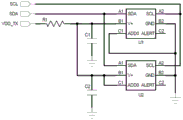
As an alternative embodiment, the processing unit comprises a signal input interface, the first temperature sensor comprises a first data output interface and a first address setting interface, and the second temperature sensor comprises a second data output interface and a second address setting interface; the signal input interface is respectively connected with the first data output interface and the second data output interface, the first address setting interface is connected with the first address setting signal, and the second address setting interface is connected with the second address setting signal.
In some embodiments, in order to make the circuit design more compact while saving I/O port (input/output interface) resources of the processing unit, the first data output interface and the second data output interface may be connected to the signal input interface of the processing unit at the same time.
For example, as shown in fig. 3, the first temperature sensor U1 and the second temperature sensor U2 each employ a digital temperature sensor of the type TMP117, and the TMP117 digital temperature sensor includes a data output terminal SDA and an address setting terminal ADD 0. The first data output interface (data output SDA of the first temperature sensor U1) and the second data output interface (data output SDA of the second temperature sensor U2) are simultaneously connected to the signal input interface of the processing unit. In some embodiments, the first address setting signal is a high-level signal, the first address setting interface (address setting terminal ADD0 of first temperature sensor U1) can be connected to power supply terminal VDD _ TX, and address setting terminal ADD0 is connected to the high-level rear address of 1001001x according to the characteristics of the TMP117 digital temperature sensor; the second address setting signal is a low level signal, the second address setting interface (address setting terminal ADD0 of the second temperature sensor U2) may be grounded, and the address setting terminal ADD0 is connected to the high level rear address of 1001000x according to the characteristics of the TMP117 digital temperature sensor. Therefore, the processing unit can distinguish the temperature values sent by the first temperature sensor U1 and the second temperature sensor U2 according to the addresses, and the circuit design is simpler, and the I/O port resources of the processing unit are saved. In fig. 3, the device further includes a first resistor R1, a first capacitor C1, and a second capacitor C2.
As an optional implementation manner, the ear temperature detection module further includes:
and the processing unit is respectively connected with the first temperature sensor and the second temperature sensor through the signal processing circuit and is used for processing signals, and the signal processing comprises at least one of analog-to-digital conversion processing and signal amplification processing.
In some embodiments, the temperature value signal acquired by the temperature sensor is an analog signal, and needs to be subjected to analog-to-digital conversion and then output to the processing unit; in some embodiments, the temperature value signal acquired by the temperature sensor is weak and needs to be output to the processing unit through signal amplification processing, and the signal processing circuit can be used for realizing analog-to-digital conversion processing and signal amplification processing functions. The signal processing circuit may be an integrated circuit or a signal processing circuit composed of discrete components.
As an optional implementation manner, the ear temperature detection module further includes:
the heart rate detection circuit is connected with the processing unit through the signal processing circuit and is used for monitoring the heart rate.
In some embodiments, a heart rate detection circuit may be integrated in the ear temperature detection module to achieve heart rate detection.
Referring to fig. 4, as an alternative embodiment, the heart rate detection circuit includes:
the first infrared transmitting tube D2 is connected with the signal processing circuit and is used for generating a first infrared signal;
the second infrared transmitting tube D4 is connected with the signal processing circuit and is used for generating a second infrared signal;
the first infrared receiving tube D1 is connected with the processing unit through the signal processing circuit and is used for receiving the first infrared signal or the second infrared signal reflected by the human body;
and the second infrared receiving tube D3 is connected with the processing unit through a signal processing circuit and is used for receiving the first infrared signal or the second infrared signal reflected by the human body.
In some embodiments, the first infrared emitting tube D2 is configured to generate a first infrared signal based on a first driving signal from a signal processing circuit. The second infrared transmitting tube D4 is used for generating a second infrared signal according to a second driving signal from the signal processing circuit. The first infrared receiving tube D1 is used to capture the infrared reflection light generated by the reflection of the first infrared signal or the second infrared signal by the human body (ear canal wall). The second infrared receiving tube D3 is used to capture the infrared reflected light generated by the reflection of the second infrared signal by the human body (ear canal wall). Because the infrared reflected light reflects the pulsation of blood vessels of a human body, the corresponding heart rate can be calculated according to the infrared reflected light. And the heart rate detection accuracy can be improved by selecting and combining and judging according to the received multiple groups of infrared reflected light.
As an alternative embodiment, the signal processing circuit includes a biosensing signal processing chip.
Referring to fig. 5, the signal processing circuit includes a first biosensing signal processing chip and a second biosensing signal processing chip U2. The first biosensing signal processing chip and the second biosensing signal processing chip can both adopt integrated circuits of the type AFE 4404.
The first biological sensing signal processing chip U1 and the second biological sensing signal processing chip U2 respectively output a first driving signal and a second driving signal to the first infrared transmitting tube D2 and the second infrared transmitting tube D4, and the first biological sensing signal processing chip is connected with the first infrared receiving tube D1 and is used for receiving and processing signals collected by the first infrared receiving tube D1; the first biosensing signal processing chip is connected with the second infrared receiving tube D3 and is used for receiving and processing the signals collected by the first infrared receiving tube D1. And the signal receiving interface of the second biological sensing signal processing chip is respectively in communication connection with the first temperature sensor and the second temperature sensor through an I2C bus and is used for receiving and processing signals collected by the first temperature sensor and the second temperature sensor. The first biological sensing signal processing chip and the second biological sensing signal processing chip are in communication connection with the processing unit through an I2C bus.
The biosensing signal processing chip can be matched with an infrared tube to test to obtain a heart rate signal and transmit the heart rate signal to the processing unit, can also receive a first temperature value and a second temperature value from the first temperature sensor and the second temperature sensor, and transmits the first temperature value and the second temperature value to the processing unit after signal processing.
AFE4404 is the integrated analog front end of subminiature, can carry out analog-to-digital conversion, also can sense the ultra-small signal level and amplify, satisfies the required circuit function of this application embodiment, can greatly save components and parts volume to be favorable to the miniaturized design of ear temperature detection module.
In some embodiments, the first infrared transmitting tube D2, the second infrared transmitting tube D4, the first infrared receiving tube D1, and the second infrared receiving tube D3 are all disposed in an ear stem structure.
In some embodiments, the ear temperature detection module further comprises a gravity sensor, the gravity sensor being connected to the processing unit. The gravity sensor can be used for sensing gravity signals, so that the processing module judges the posture of the ear temperature detection module according to the gravity signals and carries out corresponding processing.
Compared with the prior art, the ear temperature measuring device has the advantages that the front temperature difference and the rear temperature difference of the ear canal are measured by the front temperature sensor and the rear temperature sensor which are arranged in the ear temperature detecting module, so that the accuracy and the measuring speed of the ear canal temperature measurement are improved.
In addition, this application embodiment still provides a wireless headset, includes:
the ear temperature detection module;
and the wireless communication module is connected with the ear temperature detection module.
In some embodiments, the wireless headset is a common device in modern life, and the ear temperature detection module is integrated in the wireless headset, so that temperature measurement can be conveniently realized, and a temperature measurement signal can be transmitted to the user terminal through the wireless communication module. The user terminal may be a mobile terminal (e.g., a mobile phone) or a non-mobile terminal, and the application is not limited thereto.
In some embodiments, the wireless headset may be a bluetooth headset and, correspondingly, the wireless communication module is a bluetooth communication module. Obviously, the wireless headset may also adopt other wireless communication modules, such as a WIFI wireless communication module, a 5G wireless communication module, and the like, which is not limited in the present application.
For the description of the ear temperature detecting module, please refer to the foregoing description, which is not repeated herein.
In some embodiments, the present application adds a sensor for body temperature detection and heart rate detection on the basis of a bluetooth headset, and arranges two infrared transmitting tubes, namely a first infrared transmitting tube D2 and a second infrared transmitting tube D4, two infrared receiving tubes, namely a first infrared receiving tube D1 and a second infrared receiving tube D3, and two temperature sensors, namely a first temperature sensor U1 and a second temperature sensor U2, on an FPC (Flexible Printed Circuit) arranged in an ear post structure. First temperature sensor U1 and second temperature sensor U2 all connect to processing unit MCU through I2C interface, and processing unit MCU rethread serial ports UART meets the bluetooth chip, and the bluetooth chip is with the data transmission of BLE with the heart rate and temperature to cell-phone APP on to realize the detection of heart rate and temperature. Meanwhile, due to the fact that the double temperature sensors are arranged, the temperature change trend is judged in advance through the temperature difference, and the rapidity and the effectiveness of temperature detection are improved.
Compared with the prior art, the temperature difference between the front and the back of the auditory canal is measured by arranging the front and the back temperature sensors in the wireless earphone, so that the accuracy and the measuring speed of auditory canal temperature measurement are improved.
In addition, referring to fig. 6, an ear canal thermometry method is further provided in the embodiments of the present application. The method comprises the following steps:
step S1100, acquiring a first temperature value from a first temperature sensor and a second temperature value from a second temperature sensor; the first temperature sensor and the second temperature sensor are two temperature sensors arranged in front of and behind the auditory canal;
step S1200, calculating to obtain a front-back temperature difference according to the first temperature value and the second temperature value;
step S1300, determining a temperature compensation coefficient according to the front-back temperature difference;
step S1400, the first temperature value or the second temperature value is corrected according to the temperature compensation coefficient to obtain a measured temperature value.
In some embodiments, the ear canal thermometry method may be applied to the ear temperature detection module or the wireless headset of the above embodiments. Fig. 1 is a schematic diagram of a system architecture for performing an ear canal thermometry method according to an embodiment of the present application, as shown in fig. 1. The system architecture and the application scenario described in the embodiment of the present application are for more clearly illustrating the technical solution of the embodiment of the present application, and do not form a limitation on the technical solution provided in the embodiment of the present application, and it is known by those skilled in the art that the technical solution provided in the embodiment of the present application is also applicable to similar technical problems with the evolution of the system architecture and the appearance of new application scenarios.
Those skilled in the art will appreciate that the system architecture shown in FIG. 1 is not intended to be limiting of embodiments of the present application and may include more or fewer components than those shown, or some components may be combined, or a different arrangement of components.
In the system architecture shown in fig. 1, the processing unit may call the ear canal temperature measurement program stored therein to perform the ear canal temperature measurement method.
The inventors have found in practice that ear canal temperature detection is affected by the ambient temperature and the duration of the detection. When the distance between the first temperature sensor and the second temperature sensor is determined, the front-back temperature difference and the actual body temperature have a fixed corresponding relation. Namely, the difference between the first temperature sensor and the second temperature sensor can be used for predicting the temperature change condition of the first temperature sensor and the second temperature sensor in the future, and the compensation coefficient can be set by measuring the corresponding relation to compensate the first temperature value or the second temperature value.
For example, a relation table between the front-rear temperature difference and the compensation coefficient may be pre-stored in the memory, after the front-rear temperature difference is obtained in step S1300, the corresponding temperature compensation coefficient may be obtained through the lookup table, and the first temperature value or the second temperature value is compensated by using the compensation coefficient. For example, if the first temperature value measured at a certain time is 30.6 ℃, the second temperature value is 33.5 ℃, the temperature difference between before and after calculation is 2.9 ℃, and the corresponding compensation coefficient obtained by the lookup table is 3.1, the current body temperature is predicted to be 33.5 ℃ +3.1 ═ 36.6 ℃. Obviously, the first temperature value may also be optionally compensated, and the calculation manner is similar, which is not described herein again.
Experiments prove that the temperature value obtained by the ear canal temperature testing method is compared with the actual core temperature value of the human body, and the temperature value obtained by the ear canal temperature testing method is highly matched with the actual core temperature value of the human body in a plurality of scenes including a normal state, a bathing state, a walking state, a running state and a recovery state, and the matching degree R2 reaches 0.88 (higher than 0.7 is considered as high matching degree).
In addition, an embodiment of the present application further provides an electronic device, including: a memory, a processor and a computer program stored on the memory and executable on the processor, the processor implementing the method for ear canal thermometry as described above when the computer program is executed by the processor.
The processor and memory may be connected by a bus or other means.
The memory, which is a non-transitory computer readable storage medium, may be used to store non-transitory software programs as well as non-transitory computer executable programs. Further, the memory may include high speed random access memory, and may also include non-transitory memory, such as at least one disk storage device, flash memory device, or other non-transitory solid state storage device. In some embodiments, the memory optionally includes memory located remotely from the processor, and these remote memories may be connected to the processor through a network. Examples of such networks include, but are not limited to, the internet, intranets, local area networks, mobile communication networks, and combinations thereof.
It should be noted that the electronic device in this embodiment may be applied to the ear temperature detection module in the system architecture of the embodiment shown in fig. 1, and the electronic device in this embodiment and the ear temperature detection module 120 in the system architecture of the embodiment shown in fig. 1 have the same inventive concept, so that these embodiments have the same implementation principle and technical effect, and are not described in detail herein.
The non-transitory software programs and instructions required to implement the ear canal thermometry method of the above-described embodiment are stored in the memory, and when executed by the processor, perform the ear canal thermometry method of the above-described embodiment, for example, perform the above-described method steps S1100 to S1400 in fig. 6.
In addition, a computer-readable storage medium is provided, which stores computer-executable instructions, which are executed by a processor or a controller, for example, by a processor in the above-mentioned ear temperature detection module embodiment, and can make the processor execute the ear canal temperature measurement method in the above-mentioned embodiment, for example, execute the above-mentioned method steps S1100 to S1400 in fig. 6.
One of ordinary skill in the art will appreciate that all or some of the steps, systems, and methods disclosed above may be implemented as software, firmware, hardware, and suitable combinations thereof. Some or all of the physical components may be implemented as software executed by a processor, such as a central processing unit, digital signal processor, or microprocessor, or as hardware, or as an integrated circuit, such as an application specific integrated circuit. Such software may be distributed on computer readable media, which may include computer storage media (or non-transitory media) and communication media (or transitory media). The term computer storage media includes volatile and nonvolatile, removable and non-removable media implemented in any method or technology for storage of information such as computer readable instructions, data structures, program modules or other data, as is well known to those of ordinary skill in the art. Computer storage media includes, but is not limited to, RAM, ROM, EEPROM, flash memory or other memory technology, CD-ROM, Digital Versatile Disks (DVD) or other optical disk storage, magnetic cassettes, magnetic tape, magnetic disk storage or other magnetic storage devices, or any other medium which can be used to store the desired information and which can accessed by a computer. In addition, communication media typically embodies computer readable instructions, data structures, program modules or other data in a modulated data signal such as a carrier wave or other transport mechanism and includes any information delivery media as known to those skilled in the art.
While the preferred embodiments of the present invention have been described in detail, it will be understood, however, that the invention is not limited to those precise embodiments, and that various other modifications and substitutions may be affected therein by one skilled in the art without departing from the scope of the invention.