Detailed Description
In order to make the objects, technical solutions and advantages of the present application more apparent, some embodiments of the present application will be described in detail by way of example with reference to the accompanying drawings. However, it will be appreciated by those of ordinary skill in the art that in the examples, numerous technical details are set forth in order to provide a better understanding of the present application. However, the technical solution claimed in the present application can be implemented without these technical details and various changes and modifications based on the following embodiments.
Before introducing the scheme, a brief introduction is first made to the current NB-IOT system. The NB-IoT uplink Channel includes two Physical channels, one of which is a Narrowband Physical Random Access Channel (NPRACH), and the NPRACH is an Access Channel when the NB-IoT starts to initiate a call. For different coverage enhancement levels, NPRACH will set different information repetition times to achieve coverage enhancement. The higher the coverage enhancement level is, the larger the information repetition number correspondingly set by the NPRACH is. In addition, the base station configures the maximum number of attempted accesses through Narrowband System message Block 2 (SIB 2-NB), and the SIB2-NB may also be referred to as SIB 2. Based on the above rules, in a scenario where a certain ECL is i (i is an integer and is greater than or equal to 0 and less than or equal to 1), the access attempt process of the NB-IOT terminal for requesting access to the base station is as follows: through NPRACH, the NB-IOT terminal tries to access the base station by taking the ECL as the information repetition times corresponding to the i each time, when the number of times that the NB-IOT terminal tries to access the base station is equal to the maximum number of times that the base station tries to access, if the NB-IOT terminal does not successfully access the base station at the moment, the NB-IOT terminal upgrades the current ECL to a higher level, and tries to access the base station by the same trying access process. After ECL is upgraded, the information repetition times are correspondingly increased, and the probability of successful access of the NB-IOT end to the base station can be effectively increased.
The number of ECL levels is the number of NRSRP thresholds defined in rsrp _ threshold prachinfolist _ r13 plus one. If there is no rsrp _ threshold prachinfolist _ r13, it means that there are only 1 ECL for the cell, in which case the NRSRP threshold need not be defined; if the number of elements contained in the rsrp _ threshold prachinfolist _ r13 list is 1, that is, an NRSRP threshold is defined, it means that the cell only defines 2 ECLs, when the NRSRP measured by the NB-IOT terminal is less than the threshold, the ECL is set to 1, and when the NRSRP measured by the NB-IOT terminal is greater than or equal to the threshold, the ECL is set to 0; if the number of elements included in the rsrp _ threshold prachinfolist _ r13 list is 2, that is, 2 NRSRP thresholds T1 and T2 are defined in descending order, for a cell, there are 3 ECLs, specifically, when NRSRP measured by the NB-IOT terminal is less than the threshold T2, the ECL is set to 2, when NRSRP measured by the NB-IOT terminal is not less than T2 but less than T1, the ECL is set to 1, when NRSRP measured by the NB-IOT terminal is greater than or equal to T1, the ECL is set to 0, in this embodiment, T1 is greater than T2.
Referring to a network configuration of a current network, as shown in fig. 1, a base station issues an SIB2 to a terminal device (UE) of a User of the internet of things, where the SIB2 includes a cell configuration parameter rrc, rsrp _ threshold _ proachinfolist _ r13, where the cell configuration parameter is used to indicate a threshold value of each parameter for determining an ECL of a current cell, please refer to Item0 in fig. 1, and when NRSRP measured by the terminal is greater than or equal to-110 dBm and less than-109 dBm, the UE attempts to access the base station using a configuration with ECL of 0; referring to Item1 in fig. 1, when NRSRP measured by the terminal is greater than or equal to-120 dBm and less than-119 dBm, the UE attempts to access the base station with a configuration having an ECL of 1. In this embodiment, numresetpierpreframeattamtempt-r 13: n2(1) indicates that the number of repetitions is 2 in the configuration with an ECL of 0, numresetpierpreframeattamtempt-r 13: n8(3) indicates that the number of repetitions is 8 in the configuration with an ECL of 1, and the number of repetitions may be set to 16 in the configuration with an ECL of 2. The more the repetition times of the uplink message sent by the UE are, the higher the demodulation success rate of the message returned by the UE to the base station is. In the embodiments of the present application, the specific data listed in fig. 1 are only exemplary.
In this embodiment, NRSRP is one of the key parameters that can represent the wireless signal strength in the NB-IoT network and the physical layer measurement requirement, and is the average value of the received signal power on all Resource Elements (REs) that carry reference signals within a certain symbol.
The UE selects the corresponding configuration of the ECL to carry out service transmission according to the signal intensity, the communication quality between the UE and the base station under the low ECL configuration is better, and the transmission rate can be preferentially ensured; the signals between the UE and the base station under the high ECL configuration are weaker, the UE under the high ECL configuration can properly reduce the data transmission rate, and the transmission success rate is preferentially ensured. The larger ECL means that the UE transmits uplink data with a larger number of retransmissions, and thus the data returned by the base station is easier to be successfully demodulated by the UE, but the more occupied radio resources and the lower rate are, and therefore, selecting an appropriate ECL is crucial to the performance of the UE.
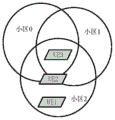
As shown in the schematic diagram of interference occurring between cells shown in fig. 2, when a UE is in an overlapping area of each cell, a value of NRSRP measured by the UE is high, but interference occurring in cells 0, 1, and 2 under a scenario of intra-frequency networking may cause SINR measured by the UE to be low, for example, the probability of interference occurring at positions where UE2 and UE3 are located in fig. 2 is high, and SINR measured by UE2 and UE3 is low. Taking UE3 as an example, the NRSRP measured by UE3 is high, but the ratio of the strength of the useful signal sent by the base station received by UE3 to the strength of the interference plus noise is low, where the strength of the interference refers to the strength of the interference signal received by UE3 and the strength of the noise refers to the strength of the noise signal received by UE 3. If the UE3 determines that the ECL is 0, when the UE3 attempts to access the base station with the configuration of the ECL0, the number of repetitions of the NPRACH message sent by the UE3 is small, the NPRACH message may not be received by the base station, or the base station may not successfully demodulate the NPRACH message received by the base station. In this embodiment, the NPRACH message refers to a message sent through the NPRACH, and the NPRACH message is a random access preamble in a process that the UE accesses the base station. Even if the base station successfully demodulates the NPRACH message, after the base station acquires the ECL information carried in the NPRACH message, the base station schedules to return the RAR to the UE3 by using the radio resource configuration information corresponding to the ECL of 0, after the base station confirms that the ECL is 0, the time window of the RAR allocated to the UE3 by the base station is short, the number of times of repetition of the RAR returned by the base station to the UE3 is small, the UE3 may not receive the RAR, or even if the UE3 receives the RAR, the UE3 may not successfully demodulate the RAR returned by the base station that it receives, if the UE3 cannot successfully demodulate the RAR sent by the base station under the configuration of the ECL of 0, the UE3 may only try to access the base station by using the configuration of the ECL of 0 until the maximum number of attempts corresponding to the ECL of 0 is reached, and then the UE increases the ECL to try.
By way of example with specific data, the NRSRP measured by UE3 is-90 dBm, the SINR measured by UE3 is-8 dB, assuming that the NRSRP measured by UE3 is greater than the larger NRSRP threshold value sent by the base station to the UE, the UE3 sends NPRACH message to the base station under the configuration of ECL being 0, but because the SINR is smaller at this time, the UE3 does not receive RAR returned by the base station or the UE3 cannot successfully demodulate RAR returned by the base station, then, after the UE3 attempts to access the base station for the number of times of the maximum attempts corresponding to the ECL0 under the configuration with the ECL0 but still fails to access the base station, the UE3 sends an NPRACH message to the base station according to the number of repetitions corresponding to the ECL1, if the UE3 attempts to access the base station for the number of times of the maximum attempts corresponding to the ECL1 under the configuration with the ECL1, the UE3 still fails to access the base station, the UE3 attempts to send the NPRACH message to the base station a number of repetitions corresponding to an ECL of 2. When the UE3 sends NPRACH message to the base station according to the configuration with ECL of 1, 2, or 3, the demodulation success rate of the RAR returned by the UE to the base station is different, and the higher the ECL of the UE is, the higher the demodulation success rate of the RAR received by the UE is. In the scenario described in this embodiment, the UE3 can successfully access the base station only when sending NPRACH messages to the base station under the configuration of ECL1 or even ECL 2, which results in that the actions of the UE3 attempting to send NPRACH messages under the configuration of ECL0 are completely wasted, and particularly, the UE3 may attempt to access the base station under the configuration of ECL0 multiple times, so if the ECL is determined only according to NRSRP strictly specified by the protocol, the time consumed for the UE to access the base station may be longer due to the inappropriate ECL configuration, and in addition, the power consumption for connecting the base station with the NB-IOT may also be increased.
In this embodiment, the SINR is a ratio of strength of a useful Signal sent by a base station and interference plus noise received by an NB-IOT, in short, sufficient SINR is required for basic normal communication between a UE and the base station, and the SINR can be understood as a ratio of a Reference Signal power S in a UE detection bandwidth to an interference noise power (I + N), that is, S/(I + N), where the Reference Signal power is a power of a Narrowband Reference Signal (NRS), and I + N can be understood as a sum of a non-serving cell on the Reference Signal, adjacent channel interference, and a power of thermal noise inside the system. The SINR reflects the link quality of the current channel, and is an important index for measuring the UE performance parameters.
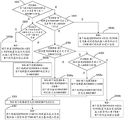
When the NB-IOT end sends NPRACH messages to the base station under different ECL configurations, the NB-IOT may not receive the RAR returned by the base station, when the NB-IOT does not receive the RAR returned by the base station, the NB-IOT end considers that the base station does not receive the NPRACH messages, and when the NB-IOT end receives the RAR returned by the base station, the higher the ECL configured by the UE is, the higher the demodulation success rate of the RAR returned by the base station by the NB-IOT end is. The measured NRSRP is corrected according to the measured SINR to obtain the corrected NRSRP, and then the ECL is determined according to the corrected NRSRP, so that the ECL determined by the NB-IOT end is more suitable for the current communication environment, and the NB-IOT end can successfully demodulate RAR issued by the base station on the premise of less time consumption and less power consumption to realize the successful connection between the NB-IOT end and the base station. In this embodiment, the NB-IOT terminal is exemplified by the UE, and in addition, the NB-IOT terminal may also be an NB-IOT chip. Before the terminal determines to access the base station, the terminal can acquire a target value list of the reference signal received power of the base station through cell broadcasting, then can compare the self reference signal received power with the target value list of the reference signal received power of the base station, and compare the SINR measured by the terminal with an SINR threshold value, when the NRSRP and the SINR measured by the terminal meet preset conditions, the terminal determines a corrected NRSRP according to the measured NRSRP and the SINR, and the terminal determines an ECL according to the corrected NRSRP. In this embodiment, the target value list includes a first NRSRP threshold value and a second NRSRP threshold value. After the NB-IOT terminal determines the ECLs, each ECL is configured with corresponding NPRACH resources for specifying a maximum number of access attempts corresponding to each ECL and a transmission power of a random access preamble, and then the NB-IOT terminal may send an NPRACH message to the base station. Specifically, after the UE determines to access the base station, it may refer to the data transmission method of the NB-IOT end shown in fig. 3 to determine which ECL sends the random access preamble to the base station so as to implement the connection between the UE and the base station, where the data transmission method of the NB-IOT end provided in this embodiment includes the following steps:
s301: judging whether NRSRP measured by the NB-IOT end is larger than or equal to a first NRSRP threshold value; if yes, go to step S302; if not, executing S303;
s302: judging whether SINR measured by the NB-IOT end is greater than or equal to a first SINR threshold value; if yes, go to step S302 a; if not, go to S302 b;
s302 a: the NB-IOT terminal sends a random access preamble to the base station through NPRACH with the configuration that ECL is 0, so that the NB-IOT terminal establishes connection with the base station;
s302 b: the NB-IOT end determines the corrected NRSRP according to the SINR measured by the NB-IOT end and the NRSRP measured by the NB-IOT end;
s303: judging whether NRSRP measured by the NB-IOT end is larger than or equal to a second NRSRP threshold value; if yes, go to step S304; if not, go to S303 b;
s303 b: the NB-IOT terminal sends a random access preamble to the base station through NPRACH with the configuration of ECL as 2 so as to establish connection between the NB-IOT terminal and the base station;
s304: judging whether SINR measured by the NB-IOT end is larger than a first SINR threshold value or not; if yes, go to step S304 a; if not, executing S305;
s304 a: the NB-IOT end determines the corrected NRSRP according to the SINR measured by the NB-IOT end and the NRSRP measured by the NB-IOT end;
s305: judging whether the SINR measured by the NB-IOT end is smaller than a second SINR threshold value or not; if yes, go to step S305 a; if not, go to S305 b;
s305 b: the NB-IOT terminal sends a random access preamble to the base station through NPRACH with the configuration of ECL as 1 for establishing connection between the NB-IOT terminal and the base station;
s305a, the NB-IOT end determines the corrected NRSRP according to the SINR measured by the NB-IOT end and the NRSRP measured by the NB-IOT end; after steps S302b, S304a, S305a, step S306 is performed;
s306: the NB-IOT end determines the ECL according to the corrected NRSRP;
s307: and the NB-IOT terminal sends a random access preamble to the base station through the NPRACH in the configuration of the ECL for establishing connection between the NB-IOT terminal and the base station.
In the embodiment shown in fig. 3, the first NRSRP threshold is greater than the second NRSRP threshold, and the first SINR threshold is greater than the second SINR threshold. When the SINR measured by the NB-IOT end and the NRSRP measured by the NB-IOT end meet preset conditions, the NB-IOT end determines a corrected NRSRP according to the SINR measured by the NB-IOT end and the NRSRP measured by the NB-IOT end, and then the NB-IOT end can determine an ECL according to the corrected NRSRP; after selecting the ECL, the NB-IOT sends a random access preamble to the base station through the NPRACH in the configuration of the ECL for the NB-IOT to establish connection with the base station.
When the first preset condition is satisfied, step S302b may be performed. Specifically, when the NRSRP measured by the NB-IOT is not less than a first NRSRP threshold and the SINR measured by the NB-IOT is less than a first SINR threshold, the NB-IOT determines a modified NRSRP according to the measured NRSRP and SINR, and then determines an ECL according to the modified NRSRP so that the UE attempts to connect with the base station under the configuration of the ECL;
when the second preset condition is satisfied, step S304a may be performed. Specifically, the NRSRP measured by the NB-IOT is smaller than a first NRSRP threshold and not smaller than a second NRSRP threshold, and the measured SINR is larger than a first SINR threshold, the NB-IOT determines a modified NRSRP according to the measured NRSRP and SINR, and then determines an ECL according to the modified NRSRP so that the UE attempts to connect with the base station under the configuration of the ECL;
when the third preset condition is satisfied, step S305a may be performed. Specifically, the NRSRP measured by the NB-IOT is smaller than a first NRSRP threshold and not smaller than a second NRSRP threshold, and the measured SINR is smaller than a second SINR threshold, the NB-IOT determines a modified NRSRP according to the measured NRSRP and SINR, and then determines an ECL according to the modified NRSRP, so that the UE attempts to connect with the base station under the configuration of the ECL.
In this embodiment, before the UE sends the NPRACH message, the UE may measure many parameters, for example, SINR, NRSRP, etc. are measured. Generally, in some application scenarios, for example, after the UE is powered off or fails, the UE and the base station may be disconnected, and after the UE and the base station are disconnected, if the UE determines that the UE needs to reestablish the connection with the base station, the data transmission method provided in the embodiment of the present application may be used, or the present solution is also applicable to other scenarios requiring the selection of the ECL. And after the NB-IOT terminal determines a proper ECL, the random access preamble is sent to the base station according to the ECL, so that the time consumption and the power consumption of the UE accessing the base station are low.
In the embodiment shown in fig. 3, not only the measured NRSRP is used as the criterion for determining ECL, but also the SINR parameter is introduced as one of the parameters for determining ECL. Specifically, the NB-IOT determines a corrected NRSRP based on the measured NRSRP and SINR to determine ECL from the corrected NRSRP. Compared with the prior art that ECL is judged only according to the measured NRSRP, the corrected NRSRP in the present solution can be understood as that the NB-IOT end corrects the measured NRSRP according to the measured SINR, and the ECL is judged to be 1, 2, or 3 according to the corrected NRSRP. For some scenarios with larger NRSRP and smaller SINR, for example, scenarios with co-channel interference, if the scheme of the embodiment of the present application is used, the ECL of the UE may be configured to be 1 or 2, which avoids that time is wasted due to failure of the UE trying to access the base station when the ECL is configured to be 0 in the scenario, so that the time consumed by the access process of the UE and the base station is longer. By adopting the scheme provided by the embodiment, the UE can receive the RAR returned by the base station after sending the random access preamble to the base station under the configuration of the appropriate ECL and successfully demodulate the RAR, which is beneficial to rapidly completing the NB-IOT terminal access to the base station, and the power consumption is low. The scheme provided by the embodiment of the application improves the scheme for determining the ECL in the existing protocol. Similar co-channel interference problems exist in about 30% of sites found by actual measurement, and the typical service of the 30% of sites wastes more than 50% of time and electric energy due to the defect. Although the probability of occurrence of a co-channel interference scene after the NB-IoT network is optimized is properly reduced, the problems of long data transmission time consumption and power consumption waste in the scene still cannot be substantially improved, and the data transmission method of the NB-IoT terminal provided by the present solution can substantially improve the problems.
Based on the disclosure of the above embodiment, in this embodiment, the larger the NRSRP measured by the NB-IOT terminal is, the larger the corrected NRSRP is; the larger the SINR measured by NB-IOT, the larger the NRSRP after correction. In this scenario, the larger the NRSRP is, the lower the ECL determined according to the NRSRP is, the faster the UE can access the base station on the premise of ensuring the access success rate.
Based on the disclosure of the foregoing embodiments, in this embodiment, when the NRSRP measured by the UE is greater than or equal to the first NRSRP threshold and the SINR measured by the UE is greater than or equal to the first SINR threshold, it indicates that the communication quality between the base station and the NB-IOT is better, there is no co-channel interference or weak co-channel interference between the UEs, and the NB-IOT may attempt to access the base station in a configuration in which the ECL is 0, so as to avoid that the UE is configured to have the ECL of 1 or 2 under the condition that the communication quality is better, so that the number of retransmissions of the NPRACH message is increased, which results in waste of communication resources.
Based on the disclosure of the foregoing embodiments, in this embodiment, for a scenario where NRSRP measured by the NB-IOT is smaller than the first NRSRP threshold and not smaller than the second NRSRP threshold, and SINR measured by the NB-IOT is not greater than the first SINR threshold and not smaller than the second SINR threshold, the NB-IOT sends a random access preamble to the base station through NPRACH in a configuration where ECL is 1, so that the NB-IOT establishes a connection with the base station. Assuming that the number of times of repeated transmission of NPRACH message is 8 for the UE under the configuration with ECL of 1, and the number of times of repeated transmission of NPRACH message is 2 for ECL of 0, it can be understood that the UE can successfully demodulate RAR returned by the base station when the number of times of repeated transmission of NPRACH message is 8 in the scene, if the ECL of the UE is configured to 0 in the same scene, after the UE transmits 2 NPRACH messages to the base station, the UE may not receive RAR sent by the base station or, even if the RAR is received, the UE cannot successfully demodulate the RAR, and then the UE transmits NPRACH message to the UE with the configuration with ECL of 0, the UE can attempt to transmit NPRACH message to the UE with the configuration with ECL of 0 for multiple times, and when the maximum number of times of attempted access under the configuration with ECL of 0 is reached, the UE does not receive RAR returned by the base station, or the UE fails to demodulate the RAR, the UE attempts access with the configuration with l of 1, and the UE transmits NPRACH message to the base station, the UE needs to repeat the sending of the NPRACH message 8 times to complete one access attempt under the configuration of the ECL1, at this time, the base station returns the RAR to the UE after receiving the NPRACH message, and the UE can successfully demodulate the RAR returned by the base station, so that the UE sends the NPRACH message to the base station under the configuration of the ECL of 0 by the maximum access attempt number in this scenario, which causes power consumption waste and time waste.
Based on the disclosure of the above embodiment, in this embodiment, when the ECL is 0, the number of repetitions of the NPRACH message is set to 2, when the ECL is 1, the number of repetitions of the NPRACH message is set to 8, when the ECL is 2, the number of repetitions of the NPRACH message is set to 16, and the number of repetitions of the NPRACH message is configured according to the ECL, which can substantially meet the communication requirement of the NB-IOT device. The specific data of the repetition times provided in the embodiment of the application are only exemplary, and the user can adjust the specific repetition times according to the requirement.
Based on the disclosure of the foregoing embodiment, in this embodiment, when the NRSRP measured by the NB-IOT terminal is smaller than the second NRSRP threshold, the NB-IOT terminal sends a random access preamble to the base station through NPRACH in a configuration with ECL being 2, so that the NB-IOT terminal establishes connection with the base station. In a scenario that NRSRP is smaller than the second NRSRP threshold, if the UE sends an NPRACH message to the base station with a configuration that the ECL is 0 or 1, the UE is likely to not receive the RAR returned by the base station or the demodulation of the RAR returned by the UE to the base station fails, and therefore, in this scenario, configuring the ECL of the UE to 2 may avoid that the UE sends an NPRACH message but the UE does not receive the RAR returned by the base station or the demodulation of the RAR of the UE fails, which may result in longer time consumption and larger power consumption.
Based on the disclosure of the above embodiments, in this embodiment, the corrected NRSRP is equal to the NRSRP measured at the NB-IOT terminal plus the NRSRP adjustment value. The NRSRP adjustment value is equal to the SINR difference multiplied by the SINR scaling factor; the SINR difference is the SINR measured by the NB-IOT minus a SINR preset value. The corrected NRSRP provided in the embodiment of the present application is determined based on the NRSRP measured by the UE and the SINR measured by the UE, and what ECL is selected is determined according to the corrected NRSRP, so that the UE can use a configuration corresponding to a more accurate ECL to connect with the base station. The magnitude of the SINR scaling factor determines the degree of influence of the measured SINR on the corrected NRSRP. In the embodiment of the present application, the SINR scaling factor is greater than 0, for example, 1 or 2, or a decimal number from 0 to 1, for example, 0.5, 0.3, 0.2, and the like. The too small SINR scaling factor may make the measured NRSRP correction degree insufficient, the too large SINR scaling factor may make the measured NRSRP correction degree too large, and the SINR scaling factor set to 2 may be applicable to the requirements of most application scenarios.
Based on the disclosure of the above embodiments, the preset SINR value in the embodiment of the present application is determined according to the SINR measured by the NB-IOT terminal and the NRSRP measured by the NB-IOT terminal. If NRSRP is adjusted only according to the measured SINR, the difference between the corrected NRSRP and the measured NRSRP may be too large to reflect the real communication environment due to too large measured SINR, or the difference between the corrected NRSRP and the measured NRSRP may be too small to reflect the real communication environment due to too small measured SINR. The preset value of SINR is determined according to the measured SINR and the measured NRSRP, so that the corrected NRSRP can reflect the current communication environment more accurately. Similar to the SINR scaling factor, the SINR preset value may serve to adjust the modified NRSRP. In this embodiment, the SINR preset value may be a first SINR threshold value, or may be a second SINR threshold value.
Based on the disclosure of the foregoing embodiment, in this embodiment, when the SINR measured by the NB-IOT terminal and the NRSRP measured by the NB-IOT terminal satisfy the first preset condition or the second preset condition, the SINR preset value is equal to the threshold value of the first SINR, and in this scenario, the SINR preset value may also be approximately equal to the threshold value of the first SINR, for example, the difference may be 0.1 dB. When the NRSRP measured by the NB-IOT is not less than the first NRSRP threshold and the SINR measured by the NB-IOT is less than the first SINR threshold, it indicates that the NRSRP measured by the UE is larger but the SINR is smaller, so the actual communication environment is not as good as that reflected by the measured NRSRP, and if the measured NRSRP is corrected to a smaller value for determining the ECL, the obtained ECL is more accurate. In this case, the NRSRP adjustment value may be set to be negative, and since the SINR scaling factor is greater than 0, the SINR difference may be set to be negative, and since the SINR difference is obtained by subtracting the SINR preset value from the SINR measured by NB-IOT, in this scenario, the measured SINR is smaller than the first SINR threshold value, and the SINR preset value may be equal to the first SINR threshold value, in this way, a negative NRSRP adjustment value may be obtained, so that the NRSRP after correction in this scenario is smaller than the measured NRSRP, and thus the ECL determined by the UE according to the NRSRP after correction is more accurate. Moreover, it can be understood that the SINR measured in this scenario should not be too far from the first SINR threshold, and if the difference is too far, it indicates that the interference is large, the corrected NRSRP is smaller, so that the UE may select a configuration corresponding to a smaller ECL to access the base station.
In addition, when the SINR measured by the NB-IOT terminal and the NRSRP measured by the NB-IOT terminal satisfy the second preset condition, the SINR preset value is equal to the threshold value of the first SINR, and in this scenario, the SINR preset value may also be approximately equal to the threshold value of the first SINR, for example, the difference may be 0.1 dB. Specifically, the NRSRP measured by the NB-IOT is smaller than a first NRSRP threshold and not smaller than a second NRSRP threshold, and when the measured SINR is greater than the first SINR threshold, it indicates that the SINR tested by the UE is greater but the NRSRP is smaller. Moreover, the SINR measured in the scenario is greater than the first SINR threshold, in most cases, the measured SINR should not differ too much from the first SINR threshold, and if the difference is too large, it is indicated that the interference in the scenario is small and the performance is hardly affected, and then the SINR difference is also large at this time, so the obtained corrected NRSRP is also larger, and the lower the ECL determined according to the corrected NRSRP, the faster the UE can access the base station.
Based on the disclosure of the foregoing embodiments, in this embodiment, when the SINR measured by the NB-IOT terminal and the NRSRP measured by the NB-IOT terminal satisfy the third preset condition, the SINR preset value is equal to the second SINR threshold value. Specifically, when the NRSRP measured by the NB-IOT terminal is smaller than the first NRSRP threshold and not smaller than the second NRSRP threshold and the measured SINR is smaller than the second SINR threshold, which indicates that the interference is large, the measured RSRP may be reduced to a corrected NRSRP, and the corrected NRSRP may better reflect an actual communication environment. In this scenario, the SINR minus the second SINR threshold is negative, that is, the SINR difference is negative, and since the NRSRP adjustment value is equal to the SINR difference multiplied by the SINR scaling factor, the corrected NRSRP is smaller than the measured NRSRP, and it is determined that the ECL can realize the connection between the UE and the base station faster according to the corrected NRSRP.
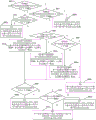
Based on the disclosure of the foregoing embodiments, the embodiments of the present application are described with reference to specific data, in which a first NRSRP threshold, a second NRSRP threshold, a first SINR threshold, and a second SINR threshold may be set according to an application scenario, the first NRSRP threshold and the second NRSRP threshold may be sent to an NB-IOT terminal by a base station, and in addition, the first SINR threshold and the second SINR threshold may be determined according to a scheduling parameter of the base station. Specifically, the first NRSRP threshold may be-110 dBm, and the second NRSRP threshold may be-120 dBm; the first SINR threshold may be 5 dB; the second SINR threshold may be-4 dB. The specific data provided by the embodiment can enable the ECL selected by the UE to be more accurate, and can adapt to most application scenarios, so that the UE can access the base station in a shorter time. Please refer to the data transmission method of the NB-IOT terminal shown in fig. 4.
S401: judging whether NRSRP measured by the NB-IOT end is larger than or equal to-110 dBm or not; if yes, go to step S402; if not, executing S403;
s402: judging whether SINR measured by the NB-IOT terminal is greater than or equal to 5 dB; if yes, go to step S402 a; if not, go to S402 b;
s402 a: the NB-IOT terminal sends a random access preamble to the base station through NPRACH with the configuration that ECL is 0, so that the NB-IOT terminal establishes connection with the base station;
s402 b: the NB-IOT end determines the corrected NRSRP according to the SINR measured by the NB-IOT end and the NRSRP measured by the NB-IOT end, and M _ NRSRP is t _ NRSRP + (t _ SINR-S _ SINR1) Gain; wherein, M _ NRSRP is the corrected NRSRP, (t _ SINR-S _ SINR1) and Gain are NRSRP adjustment values, (t _ SINR-S _ SINR1) are SINR difference values, Gain is an SINR scaling factor, t _ SINR is the SINR measured by NB-IOT, S _ SINR1 is an SINR preset value, and the SINR preset value is equal to the first SINR threshold value;
s403: judging whether NRSRP measured by the NB-IOT end is larger than or equal to-120 dBm or not; if yes, go to step S404; if not, go to S403 b;
s403 b: the NB-IOT terminal sends a random access preamble to the base station through NPRACH with the configuration of ECL as 2 so as to establish connection between the NB-IOT terminal and the base station;
s404: judging whether SINR measured by the NB-IOT terminal is greater than 5 dB; if yes, go to step S404 a; if not, executing S405;
s404 a: the NB-IOT end determines a corrected NRSRP according to the SINR measured by the NB-IOT end and the NRSRP measured by the NB-IOT end, wherein M _ NRSRP is t _ NRSRP + (t _ SINR-S _ SINR1) Gain, wherein M _ NRSRP is the corrected NRSRP, t _ NRSRP is the NRSRP measured by the NB-IOT end, (t _ SINR-S _ 1) Gain is an NRSRP regulating value, (t _ SINR-S _ SINR1) is a difference value, Gain is an SINR scaling factor, the SINR difference value is the SINR measured by the NB-IOT minus an SINR preset value S _ SINR1, and the SINR preset value is equal to a first threshold value;
s405: judging whether SINR measured by the NB-IOT end is smaller than-4 dB or not; if yes, go to step S405 a; if not, go to S405 b;
s405 b: the NB-IOT terminal sends a random access preamble to the base station through NPRACH with the configuration of ECL as 1 for establishing connection between the NB-IOT terminal and the base station;
s405a, the NB-IOT end determines a corrected NRSRP according to the SINR measured by the NB-IOT end and the NRSRP measured by the NB-IOT end, and M _ NRSRP is t _ NRSRP + (t _ SINR-S _ SINR2) Gain, wherein M _ NRSRP is the corrected NRSRP, t _ NRSRP is the measured NRSRP, (t _ SINR-S _ SINR2) Gain is an NRSRP regulating value, (t _ SINR-S _ SINR2) is a difference value, Gain is an SINR scaling factor, the SINR difference value is the SINR measured by the NB-IOT minus an SINR preset value S _ SINR2, and the SINR preset value is equal to a second threshold value; after steps S402b, S404a, S405a, step S406 is performed;
s406: the NB-IOT end determines the ECL according to the corrected NRSRP;
s407: and the NB-IOT terminal sends a random access preamble to the base station through the NPRACH in the configuration of the ECL for establishing connection between the NB-IOT terminal and the base station.
Steps S406 and S407 are the same as or similar to steps S306 and S307 in the foregoing embodiment, and are not repeated herein. In this embodiment, Gain may be set to 2, and when the UE is started for the first time or restarted, the initial value of Gain may be set to 2.
Based on the disclosure of the foregoing embodiments, in the embodiments of the present application, determining, by the NB-IOT terminal according to the modified NRSRP, an enhanced coverage level ECL for establishing a connection between the NB-IOT terminal and a base station includes the following three scenarios:
scene one: when the corrected NRSRP is larger than or equal to a first NRSRP threshold value, the NB-IOT end sends a random access lead code to the base station through NPRACH and with ECL as 0 configuration so as to establish connection between the NB-IOT end and the base station;
scene two: when the corrected NRSRP is smaller than a second NRSRP threshold value, the NB-IOT end sends a random access lead code to the base station through NPRACH with the configuration of ECL as 2 so as to establish connection between the NB-IOT end and the base station;
scene three: and when the corrected NRSRP is not less than the second NRSRP threshold value and is less than the first NRSRP threshold value, the NB-IOT sends a random access preamble to the base station through the NPRACH in the configuration that the ECL is 1, so that the NB-IOT establishes connection with the base station.
Based on the disclosure of the foregoing embodiments, an embodiment of the present application provides a data transmission method of an NB-IOT terminal, please refer to fig. 5, and compared with the embodiment of fig. 4, this embodiment further describes step S406 of the embodiment of fig. 4 to specifically describe, in combination with specific data, in which scenario an ECL is configured as 0, 1, and 2, and specifically, the data transmission method of the NB-IOT terminal provided by this embodiment includes the following steps:
s501: judging whether NRSRP measured by the NB-IOT end is larger than or equal to-110 dBm or not; if yes, go to step S502; if not, executing S503;
s502: judging whether SINR measured by the NB-IOT terminal is greater than or equal to 5 dB; if yes, go to step S502 a; if not, go to S502 b;
s502 a: the NB-IOT terminal sends a random access preamble to the base station through NPRACH with the configuration that ECL is 0, so that the NB-IOT terminal establishes connection with the base station;
s502 b: the NB-IOT end determines a corrected NRSRP according to the SINR measured by the NB-IOT end and the NRSRP measured by the NB-IOT end, wherein M _ NRSRP is t _ NRSRP + (t _ SINR-S _ SINR1) Gain, wherein M _ NRSRP is the corrected NRSRP, (t _ SINR-S _ SINR1) Gain is an NRSRP adjusting value, (t _ SINR-S _ SINR1) is an SINR difference value, Gain is an SINR scaling factor, t _ SINR is the SINR measured by the NB-IOT, S _ SINR1 is a preset value, and the preset value of SINR is equal to a first threshold value;
s503: judging whether NRSRP measured by the NB-IOT end is larger than or equal to-120 dBm or not; if yes, go to step S504; if not, go to S503 b;
s503 b: the NB-IOT terminal sends a random access preamble to the base station through NPRACH with the configuration of ECL as 2 so as to establish connection between the NB-IOT terminal and the base station;
s504: judging whether SINR measured by the NB-IOT terminal is greater than 5 dB; if yes, go to step S504 a; if not, executing S505;
s504, 504 a: the NB-IOT end determines a corrected NRSRP according to the SINR measured by the NB-IOT end and the NRSRP measured by the NB-IOT end, wherein M _ NRSRP is t _ NRSRP + (t _ SINR-S _ SINR1) Gain, wherein M _ NRSRP is the corrected NRSRP, t _ NRSRP is the NRSRP measured by the NB-IOT end, (t _ SINR-S _ 1) Gain is an NRSRP regulating value, (t _ SINR-S _ SINR1) is a difference value, Gain is an SINR scaling factor, the SINR difference value is the SINR measured by the NB-IOT minus an SINR preset value S _ SINR1, and the SINR preset value is equal to a first threshold value;
s505: judging whether SINR measured by the NB-IOT end is smaller than-4 dB or not; if yes, go to step S505 a; if not, go to S505 b;
s505 b: the NB-IOT terminal sends a random access preamble to the base station through NPRACH with the configuration of ECL as 1 for establishing connection between the NB-IOT terminal and the base station;
s505a, the NB-IOT end determines a corrected NRSRP according to the SINR measured by the NB-IOT end and the NRSRP measured by the NB-IOT end, wherein M _ NRSRP is t _ NRSRP + (t _ SINR-S _ SINR2) Gain, wherein M _ NRSRP is the corrected NRSRP, t _ NRSRP is the measured NRSRP, (t _ SINR-S _ SINR2) Gain is an NRSRP regulating value, (t _ SINR-S _ SINR2) is a difference value, Gain is an SINR scaling factor, the SINR difference value is the SINR measured by the NB-IOT minus an SINR preset value S _ SINR2, and the SINR preset value is equal to a second threshold value; after steps S502b, S504a, S505a, step S506 is performed;
s506: judging whether the corrected NRSRP is not less than-110 dBm or not; if yes, go to step S506a, otherwise go to step S507;
s506 a: the NB-IOT terminal sends a random access preamble to the base station through NPRACH with the configuration that ECL is 0 for establishing connection between the NB-IOT terminal and the base station;
s507: judging whether the corrected NRSRP is smaller than-120 dBm or not; if yes, go to step S507a, otherwise go to step S507 b;
s507 a: the NB-IOT terminal sends a random access preamble to the base station through NPRACH with the configuration of ECL as 2 for establishing connection between the NB-IOT terminal and the base station;
s507 b: and the NB-IOT terminal sends a random access preamble to the base station through NPRACH in the configuration with ECL as 1 for establishing connection between the NB-IOT terminal and the base station.
In this embodiment, the UE determines the correction value of NRSRP according to the baseband demodulation performance related parameter of the UE. In this embodiment, the baseband demodulation performance related parameter of the UE is SINR, and the UE performs appropriate correction on the measured NRSRP according to the currently measured SINR value on the basis of the measured NRSRP according to its own baseband demodulation performance to obtain a corrected NRSRP, where the corrected NRSRP is used by the UE for ECL level judgment.
The scheme still takes NRSRP thresholds of-110 dBm and-120 dBm as examples, that is, the first NRSRP threshold is-110 dBm, the second NRSRP threshold is-120 dBm, baseband demodulation performance related parameters are 5dB and-4 dB, that is, the first SINR threshold is 5dB, the second SINR threshold is-4 dB, and the SINR scaling factor is 2 as an example to perform the following description:
if NRSRP currently measured by the UE is-90 dBm, the measured SINR is 0 dB. If the ECL is determined according to the prior art method, the ECL is 0 because the measured NRSRP is greater than the first NRSRP threshold value. If the scheme of the embodiment of the present application is used to determine ECL from the modified NRSRP, then first the NRSRP adjustment value is (0dB-5dB) × 2 is-10 dB. The corrected NRSRP is-90 dBm + (0dB-5dB) × 2 ═ 100dBm, and if the corrected NRSRP is greater than the first NRSRP threshold value, it is determined that the ECL is 0, that is, if the scheme of the embodiment of the present application is adopted, the UE still sends the random access preamble to the base station in the configuration where the ECL is 0 to establish connection with the base station. In this embodiment, both NRSRP and SINR measured by the UE are large, and therefore, the UE establishes a connection with the base station by using a configuration in which ECL is 0.
If the currently measured NRSRP of the UE is-90 dbm, the measured SINR is-6 dB. If the ECL is determined according to the method of the related art, the ECL is determined to be 0 since the measured NRSRP is greater than the first NRSRP threshold value. If the scheme is adopted, the NRSRP is corrected first, and then the ECL is determined according to the corrected NRSRP, first, the NRSRP adjustment value is (-6dB-5dB) × 2-22 dB, the corrected NRSRP is-90 dBm-22 dB-112 dBm, the corrected NRSRP is not less than the second threshold but less than the first threshold, and the ECL can be determined to be 1 according to the corrected NRSRP, which can be understood as that the ECL determined according to the scheme of the embodiment of the present application is higher than the ECL determined according to the prior art. In this scenario, the NRSRP measured by the UE is large, but the SINR is small, and if the UE selects the configuration access base station corresponding to the ECL of 0, the access may fail. According to the scheme, the ECL is judged by using the corrected NRSRP, so that the ECL can be accurately selected, and the UE and the base station can be connected more quickly.
If the NRSRP currently measured by the UE is-100 dBm, the measured SINR is-6 dB. If the ECL is determined according to prior art schemes, the ECL is 0 since the measured NRSRP is greater than the first NRSRP threshold. According to the scheme of the embodiment of the application, the corrected NRSRP is determined firstly, then the ECL is determined according to the corrected NRSRP, firstly, the NRSRP adjusting value is (-6dB-5dB) × 2-22 dB, the corrected NRSRP actually used for judging the ECL is-100 dBm-22 dB-122 dBm, and the ECL is 2 because the corrected NRSRP is smaller than the second NRSRP threshold value. It can be understood that, in the scenario provided by the present solution, the SINR measured by the UE is very low, and if the UE selects the configuration access base station with an ECL of 0 according to the method in the prior art, it will inevitably cause access failure, which wastes time and power consumption.
If the currently measured NRSRP of the UE is-105 dB m, the measured SINR is 0 dB. If the measured NRSRP is greater than the first NRSRP threshold value, as per the prior art method of determining ECL, ECL0 is selected. If the scheme of the embodiment of the present application is adopted, the NRSRP adjustment value is (0dB-5dB) × 2 ═ 10dB, the corrected NRSRP actually used for determining the ECL is-105 dBm-10dB ═ 115dBm, the corrected NRSRP is not less than the second threshold but less than the first threshold, and the ECL is determined to be 1 according to the corrected NRSRP, which can be understood that the ECL determined according to the scheme of the embodiment of the present application in this scenario is higher than the ECL determined according to the prior art, and the connection between the UE and the base station can be realized more quickly without wasting communication resources.
If the currently measured NRSRP is-115 dB m and the measured SINR is 8dB, if the scheme for determining the ECL in the prior art is adopted, the ECL is 1 because the measured NRSRP is greater than the second NRSRP threshold and less than the first NRSRP threshold. If the scheme of the embodiment of the present application is adopted, the NRSRP adjustment value is (8-5) × 2 ═ 6dB, and the NRSRP correction value actually used for determining the ECL is-115 dB m +6dB ═ 109dBm, because the corrected NRSRP is greater than the first NRSRP threshold value, the ECL determined according to the corrected NRSRP is 0. Although NRSRP is low in this scenario, SINR is high, and the UE can still successfully access the base station under the configuration of ECL0, so that waste of communication resources caused by access under the condition of ECL1 is avoided.
If the currently measured NRSRP is-115 dBm and the measured SINR is-7 dB, if the measured NRSRP is not less than the second NRSRP threshold value and is less than the first NRSRP threshold value according to the method for determining ECL in the related art, the ECL is 1. If the scheme of the embodiment of the present application is adopted, the NRSRP adjustment value is (-7dB +4dB) × 2 is-6 dB, then the corrected NRSRP actually used for determining the ECL is-115 dBm-6dB is-121 dBm, and since the corrected NRSRP is smaller than the second NRSRP threshold, the ECL determined according to the corrected NRSRP threshold is 2.
If the currently measured NRSRP is-118 dBm and the measured SINR is-5.5 dB, if the measured NRSRP is greater than the second NRSRP threshold value and less than the first NRSRP threshold value according to the method for determining ECL in the related art, the ECL is 1. If the scheme of the embodiment of the present application is adopted, if the NRSRP adjustment value is (-5.5dB +4dB) × 2 is-3 dB, the NRSRP after correction actually used for determining the ECL is-118 dBm-3dB is-121 dBm, and if the NRSRP after correction is smaller than the second NRSRP threshold value, the ECL determined according to the NRSRP threshold value after correction is 2.
Based on the disclosure of the foregoing embodiment, in this embodiment, the first SINR threshold and the second SINR threshold may be determined according to the scheduling parameter of the base station, and specifically, when the NB-IOT terminal attempts to connect to the base station with a configuration that the ECL is 0, if the demodulation success rate of the RAR by the UE is lower than the preset success rate, it is indicated that the ECL of the UE should be set to 1 or 2, in this scenario, the second SINR threshold may be increased, and/or the first SINR threshold is increased, so that the UE may attempt to establish a connection with the base station with the configuration that the ECL is 1 or 2 when the UE attempts to establish a connection with the base station next time. When the NB-IOT terminal tries to access the base station with the configuration of ECL as 1, if the data demodulation success rate of the UE is lower than the preset success rate, it indicates that the ECL of the UE should be set to 2, in this scenario, the first SINR threshold may be increased, and/or the second SINR threshold may be increased, and when the UE tries to establish a connection with the base station next time, the UE may try to establish a connection with the base station with the configuration of ECL as 2. In this embodiment, the preset success rate may be set to be greater than or equal to 50%, and when the preset success rate is set to be greater than or equal to 50%, the performance of each aspect of the UE is measured to be substantially normal, for example, any value of 50% to 70% may be selected as the preset success rate. For another example, the success rate may be set to 80%, when the preset success rate is set to 80%, the basic communication requirement may be ensured, and the performance of each aspect of the actually measured UE is better, considering that in an actual scene, since interference and noise cannot be completely avoided, if the preset success rate is set to be higher, the SINR threshold may be set to be too high, so that many UEs all select the ECL to be 2, and therefore, in view of the factor of the comprehensive power consumption, the preset success rate may be set to 70%, which may both ensure the access success rate and reduce the power consumption. In this embodiment, adjusting the first SINR threshold and the second SINR threshold may ensure that the ECL configuration is still accurate when the communication environment changes. In addition, the second SINR threshold may be determined according to a data demodulation success rate in a specific ECL configuration, for example, for the UE, if the data demodulation success rate is greater than 70% when the ECL is 1, the measured SINR when the ECL is 1 and the data demodulation success rate is greater than 70% may be set as the second SINR threshold, specifically, the second SINR threshold may be set as-4 dB, and if the data demodulation success rate is greater than 70% when the ECL is 0, the measured SINR when the ECL is 0 and the data demodulation success rate is greater than 70% may be set as the first SINR threshold. Specifically, the first SINR threshold may be set to 5dB, and when the first SINR threshold is applied to the foregoing embodiment, the accuracy of ECL configuration of the UE may be improved. In this embodiment, since the SINR preset value is related to the first threshold and the second threshold, adjusting the first SINR threshold and the second SINR threshold may further enable the modified NRSRP to more accurately reflect the real communication environment, may enable the selected ECL to be more accurate, may reduce the time consumed for the UE to access the base station, and may also save the power consumption. Based on the disclosure of the above embodiments, in this embodiment, NPRACH messages, that is, random access preambles used for implementing connection between the NB-IOT terminal and the base station, are transmitted when data transmission is performed between the UE and the base station. After the UE sends the random access preamble to the base station according to the ECL determined by the UE, the base station may return the RAR to the UE according to the random access preamble, and the base station may perform resource configuration according to the ECL when sending the RAR to the UE.
Based on the disclosure of the foregoing embodiment, in this embodiment, the NB-IOT sends a random access preamble to the base station through the NPRACH, so that the base station performs scheduling according to radio resource configuration information corresponding to the ECL to send the RAR to the NB-IOT, where the radio resource configuration information may include at least one of parameters such as a number of repetitions of sending the random access preamble (numresetpierpreambeattemptempt), time domain resources of the NPRACH (including parameters such as a period and a starting subframe position), frequency domain resources of the NPRACH (including parameters such as a subcarrier offset and a number of subcarriers), and a maximum number of attempts (maxnumpreambeattemptce). The repetition number of the random access preamble corresponding to the ECL indicates the repetition transmission number of the random access preamble when the UE attempts to access the base station under the set ECL, for example, when the ECL is 0, the repetition transmission number of the random access preamble is 2, that is, the UE transmits the random access preamble to the base station 2 times under the configuration that the ECL is 0. For example, referring to a schematic diagram of an ECL configuration shown in fig. 6, maxnumpreamplateattampce-r 13: n10(6) in Item0 indicates that the UE can attempt to access the base station with the configuration of ECL0 10 times, and when the first access to the base station with the configuration of ECL0 fails, the UE can attempt to access the base station with the configuration of ECL0 again until all 10 accesses fail, and then attempt to access the base station with the configuration of ECL 1. Referring to fig. 6, the maxnumpreammbleattampce-r 13: n6(3) in Item1 indicates that the UE can attempt to access the base station with the ECL of 1 for 6 times, and after the first time of failure of accessing the base station with the ECL of 1, can attempt to access with the ECL of 1 again until 6 times of failure of access attempts, then attempt to access the base station with the ECL of 2.
The embodiment of the application provides a data transmission strategy of a random access lead code in the process of connecting an NB-IOT terminal and a base station, and can save power while reducing the time consumption of data transmission.
Based on the disclosure of the foregoing embodiment, in this embodiment, the first NRSRP threshold and the second NRSRP threshold may be issued by the base station to the NB-IOT terminal, and the first NRSRP threshold and the second NRSRP threshold may be adjusted by the base station according to an application scenario, and are not necessarily limited to the specific values provided in the foregoing embodiment, and the SINR threshold may also be referred to as an SINR demodulation threshold. In this embodiment, the first SINR threshold and the second SINR threshold may be determined according to the following three methods:
the method comprises the following steps: if the scheduling parameter of the base station can be obtained, a typical conservative scheduling configuration of the current network can be obtained according to a large amount of scheduling parameters of the base station, for example, the threshold value mentioned in the above embodiment is determined by the scheduling parameter, and the scheduling parameter is the data demodulation success rate mentioned in the above embodiment;
the second method comprises the following steps: if the configuration of the scheduling parameters of the base station cannot be obtained, a first SINR threshold value and a second SINR threshold value can be determined according to the scheduling parameters obtained through simulation through a communication model of the base station and the UE;
the third method comprises the following steps: if the scheduling parameter configuration of the base station cannot be obtained, simulation is not needed, and for the NB-IOT terminal, the demodulation success rate of the NB-IOT terminal itself is easily obtained, so that the first SINR threshold value and the second SINR threshold value can be determined by combining the data statistics of successful or failed demodulation of the NB-IOT terminal under each ECL configuration of the current network. In addition, the SINR threshold determined by simulation in the method two may be corrected by combining with the data statistics of successful or failed demodulation of the NB-IOT terminal under each ECL configuration of the existing network, and the first SINR threshold and the second SINR threshold may also be updated again through actual measurement after correction.
With reference to the disclosure of the foregoing embodiment, in this embodiment, the base station may obtain the specific ECL through the received NPRACH message. After the UE obtains NRSRP and SINR through testing, according to the data transmission method provided in this embodiment, ECL may be determined, and when the UE sends an NPRACH message to the base station through the NPRACH, for different ECLs, NPRACH sequences sent by the UE are different, and thus NPRACH sequences received by the base station are different. Therefore, after receiving the NPRACH message, the base station may acquire the ECL according to the NPRACH sequence, and then the base station may schedule resources according to the acquired ECL to implement communication with the UE, for example, send an RAR to the UE according to the number of repetitions corresponding to the ECL.
Based on the disclosure of the foregoing embodiment, in this embodiment, after the UE reads the system message SIB2 sent by the base station, the UE may obtain the maximum number of access attempts configured by the base station, where the maximum number of access attempts is the number of times that the UE can attempt to access the base station under the current ECL configuration, and may be understood as the maximum number of access attempts that the base station side allows the UE to attempt to access the base station under a certain ECL.
In this embodiment, the UE may measure, through a system message sent by the base station to the UE, to obtain NRSRP and SINR, and after the NRSRP and SINR are measured by the UE, the UE may determine, according to the data transmission method provided in this embodiment, what kind of ECL sends a random access preamble to the base station, for example, the UE may send an NPRACH message to the base station according to the number of repetitions of the random access preamble corresponding to the ECL, and after the base station receives the NPRACH message transmitted through the NPRACH, the base station also obtains the ECL, and then the base station may also send an RAR to the UE according to the resource configured by the ECL, specifically, the ECL is different, and the code rate and the number of repetitions when the RAR is sent by the base station are different, for example, the higher the ECL is, the longer the time window when the RAR is sent by the base station is, that is, the number of repetitions of the RAR sent by the base station is more.
Based on the disclosure of the foregoing embodiments, in this embodiment, the UE may configure the transmission power of the random access preamble before sending the random access preamble to the base station. The transmission power of the random access preamble can be understood as the transmission power of NPRACH message, and assuming that the transmission power of the random access preamble configured by the NB-IOT terminal is y when the ECL is 0, y is min [ Pmax, x-t _ NRSRP ], that is, the minimum value of Pmax and x-t _ NRSRP, where Pmax is the maximum transmission power configured by the base station to the NB-IOT terminal, and x-t _ NRSRP is a value calculated by the UE according to the NRSRP measured by the UE and the protocol specification. x-t _ NRSRP represents the difference between x and the measured NRSRP, and t _ NRSRP represents the measured NRSRP at the NB-IOT end, wherein: x is TargetPower + DELTA _ PREAMBLE + (PREAMBLE _ TC-1) × PR _ Step + NRS _ power _ r 13-Gain; the TargetPower is a target power configured by the base station to the NB-IOT terminal, and may also be understood as an initial target received power of a random access PREAMBLE, the TargetPower may also be denoted as a PREAMBLE interference receivable TargetPower, DELTA _ PREAMBLE is a random access PREAMBLE power offset, PREAMBLE _ TC is an access frequency of the NB-IOT terminal, PR _ Step is a power increment Step, NRS _ power _ r13 is a reference signal power of the base station, and Gain is a Gain caused by a repetition frequency. To illustrate by using specific data, assuming that target power TargetPower configured by the base station for the UE is-96 dBm, power offset of the random access Preamble code is 0, for access frequency Preamble _ TC of the NB-IOT, it is assumed that the UE accesses for the first time, that is, Preamble _ TC is 1, power increment Step PR _ Step is 2dB, reference signal power NRS _ power _ r13 of the base station is 29dBm, srnrp measured by the NB-IOT is-80 dBm, repetition frequency rnumrepetition performance preambeattettempt-r 13 of the message, Gain due to repetition frequency calculated according to the repetition frequency is 10 lg8, according to the specific data of the above example, the following steps can be calculated:
the x-t _ NRSRP is TargetPower + DELTA _ preable + (PREAMBLE _ TC-1) — PR _ Step + NRS _ power _ r13-Gain-t _ NRSRP (-96+0+ (1-1) — 2+29-10 × lg8- (-80)) 4dBm, i.e., the transmit power x-t _ NRSRP of the first transmission of the random access PREAMBLE may be 4dBm, wherein the difference between NRS _ power _ r13 and t _ NRSRP may be understood as the path loss.
Generally speaking, the transmission power Pmax configured by the base station is determined, the measured value of NRSRP can represent the distance between the NB-IOT terminal and the base station, when the NRSRP measured by the NB-IOT terminal is larger, it proves that the required transmission power x-t _ NRSRP is smaller closer to the base station, and when the ECL is configured as 1 or 2, the transmission power of the UE can be configured as Pmax.
With reference to the disclosure of the foregoing embodiment, in this embodiment, the setting of the transmission power of the random access preamble is related to NRSRP measured by the NB-IOT terminal, please refer to the method for determining the transmission power of the random access preamble shown in fig. 7, in this embodiment, the transmission power of the random access preamble may be referred to as the transmission power of NPRACH. In the scheme, the transmission power of the NPRACH can be determined without adopting a traditional scheme, namely according to the ECL level, and when the UE sends the random access preamble to the base station through the NPRACH, the power consumption can be saved by setting the appropriate transmission power of the UE. In the foregoing embodiment, how to select the ECL is determined, for determining the transmission power of the UE, if the conventional scheme is adopted to determine the transmission power of the UE through the ECL, that is, if the transmission power of the NB-IOT is y ═ min [ Pmax, x-t _ NRSRP ] when the ECL is configured as 0, and if the transmission power is Pmax when the ECL is configured as 1 or 2, the ECL level selected may be higher due to the smaller measured SINR, and thus the transmission power of Pmax may cause higher power consumption. In consideration of the power consumption of the UE, the power consumption of the UE can be prevented from being raised by adjusting the transmission power of the UE.
Specifically, the transmit power of the NPRACH message of the UE may be determined according to NRSRP measured by the UE, and if the measured NRSRP is greater than or equal to the first NRSRP threshold, the transmit power of the random access preamble through the NPRACH is y ═ min [ Pmax, x-t _ NRSRP ], and if the measured NRSRP is less than the first NRSRP threshold, the transmit power of the random access preamble through the NPRACH is y ═ Pmax. In this embodiment, the determination of the transmission power of the NPRACH does not need to depend on the size of the measured SINR value, for example, when the measured NRSRP is higher than the first threshold value, according to the determination method of the transmission power of the NPRACH provided in the embodiment of the present application, the transmission power of the NPRACH message is not Pmax, but y ═ min [ Pmax, x-t _ NRSRP ], so as to further reduce power consumption, and avoid that the power consumption is increased because the transmission power of the NPRACH is set to be larger due to the improvement of the ECL by the present solution. Specifically, Pmax can be equal to 23dBm, y is generally less than Pmax, and in some cases, Pmax, which is determined based on the path loss. The method for determining the transmit power of the NPRACH message provided in this embodiment may save power consumption, and is used for determining the transmit power of the random access preamble in the process of establishing a connection between the NB-IOT terminal and the base station, specifically, please refer to fig. 7, which may include the following steps:
s701: measuring NRSRP at NB-IOT end;
s702: judging whether NRSRP measured by the NB-IOT end is larger than or equal to a first NRSRP threshold value; if the NRSRP measured by the NB-IOT terminal is greater than or equal to the first NRSRP threshold, step S703 is executed; otherwise, go to step S702 b;
s703: the UE sends a random access lead code to the base station through the NPRACH according to the transmitting power of y-min [ Pmax, x-t _ NRSRP ];
s702 b: the UE sends a random access preamble to the base station through the NPRACH with a transmit power of y — Pmax.
In this embodiment, at the same time as or before step 702, or after step 702, the step of determining the corrected NRSRP according to the measured NRSRP and SINR in the foregoing embodiment may be performed, and the NRSRP measured in step S701 may also be used in the foregoing embodiment, so that repeated measurement and determination of the measured NRSRP and the first NRSRP threshold value may be avoided. The NPRACH message is transmitted to the base station at the transmission power determined in this embodiment, which can further save power consumption. In this embodiment, the first NRSRP threshold may be-110 dBm.
Based on the disclosure of the foregoing embodiment, in this embodiment, the random access preamble sent by the NB-IOT terminal to the base station through the NPRACH is used for connecting the NB-IOT terminal and the base station, specifically, referring to fig. 8 for the NB-IOT terminal, the data transmission method of the NB-IOT terminal includes the following steps:
s801: the NB-IOT terminal sends a random access preamble to the base station through the NPRACH according to the ECL;
s802: an NB-IOT end receives RAR sent by a base station;
s803: an NB-IOT terminal demodulates RAR;
s804: the NB-IOT terminal sends a Radio Resource Control (RRC) connection request to the base station so that the base station returns an RRC connection establishment message to the NB-IOT terminal after receiving the RRC connection request;
s805: an NB-IOT end receives an RRC connection establishment message sent by a base station;
s806: and the NB-IOT terminal sends an RRC connection establishment completion message to the base station.
The method provided in this embodiment can achieve fast connection between the UE and the base station, and the power consumption is low, for step S801, the UE may determine an ECL according to the content disclosed in the foregoing embodiment, and then the UE sends a random access preamble to the base station according to the ECL to achieve that the UE accesses the base station. The transmit power of the random access preamble and the maximum number of attempts for the ECL may also be determined before the UE transmits the random access preamble. For step S802, after receiving the random access preamble sent by the UE, the base station returns an RAR to the UE, after receiving the RAR, the UE demodulates the RAR, after successfully demodulating the RAR, the UE sends a Radio Resource Control (RRC) connection request (RRConnectionRequest) to the base station, after receiving the RRC connection request, the base station returns an RRC connection setup (rrconnectisetup) message to the UE, after receiving the RRC connection setup message sent by the base station, the UE returns an RRC connection setup complete (rrconnectisetcomplete) message to the base station, and thus, the connection setup between the UE and the base station is completed.
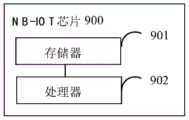
An NB-IOT chip may also be provided in an embodiment of the present application, as shown in fig. 9, the NB-IOT chip 900 includes a memory 901 and a processor 902;
the memory 901 is coupled to the processor 902;
a memory 901 for storing program instructions;
the processor 902 is configured to call the program instructions stored in the memory, so that the chip executes the data transmission method of the NB-IOT terminal according to any of the embodiments described above. The specific implementation process and beneficial effects of the NB-IOT chip provided in the embodiment of the present application are referred to above, and are not described herein again.
An NB-IOT device 1000 according to an embodiment of the present disclosure may further be provided, as shown in fig. 10, where an antenna 1001 and the NB-IOT chip 1002 according to the foregoing embodiments are connected, and an antenna 001 is connected to the NB-IOT chip 1002 to implement data transmission between the NB-IOT device and a base station. In this embodiment, the NB-IOT device may be a mobile phone, an electric meter, a water meter, or other devices, and the specific implementation process and beneficial effects of the NB-IOT device provided in the embodiment of the present application are described above, and are not described herein again.
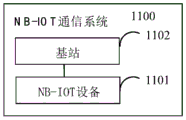
An NB-IOT communication system 1100 may also be provided in an embodiment of the present application, as shown in fig. 11, including an NB-IOT device 1101 and a base station 1102 according to the foregoing embodiments, where the NB-IOT device and the base station are wirelessly connected for data transmission. The specific implementation process and beneficial effects of the NB-IOT communication system provided in the embodiment of the present application are referred to above, and are not described herein again.
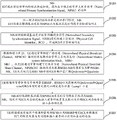
Referring to fig. 12, an embodiment of the present application provides a method for connecting an NB-IOT device to a base station, including the following steps:
s1201: the NB-IOT end rapidly sweeps frequency points in a preset frequency band, and obtains the power of a narrow band Primary Synchronization Signal (NPSS) of each frequency point.
S1202: when the power of any NPSS reaches the power threshold, the NB-IOT terminal tries to demodulate the NPSS sent by the base station to achieve time synchronization and coarse frequency offset correction with the base station.
S1203: an NB-IOT end demodulates a Narrowband auxiliary Synchronization Signal (NSSS) sent by a base station to obtain a Physical Cell Identifier (PCI), and the PCI is used for narrow frequency offset correction;
s1204: according to the Physical cell ID, the UE decodes a narrow-band Master-system information block (MIB 1-NB) from a message received by a narrow-band Physical Broadcast Channel (NPBCH), and decodes an SIB1-NB from a scheduling information of a MIB1-NB from a message received by the UE through the narrow-band Physical Downlink Channel (NPDSCH), and the UE obtains Qrxlevmin and Qqualmin required by an S criterion from a system message SIB 1-NB.
S1205: and the UE judges the satisfaction condition of the S criterion according to the measured values NRSRP and RSRQ of the narrowband reference signal and the obtained Qrxlevmin and Qqualmin so as to determine whether to camp on the (camp) cell.
S1206: an NB-IOT end reads a signal sent by a base station through NPDSCH and solves a system message SIB2-NB to obtain the repetition times of random access lead codes corresponding to different ECLs and the times of trying to access the base station corresponding to different ECLs;
s1207: the UE determines an ECL according to the measured SINR and NRSRP in the foregoing embodiment and transmits a random access preamble to the base station according to the configuration of the ECL to implement connection with the base station.
In step S1206, threshold information rsrp _ threshold prachinfolist _ r13 of NRSRP may also be obtained according to the system message SIB2, and the sending timing of the random access preamble, the sending period of the random access preamble, and the scheduling information of the RAR corresponding to the ECL may also be obtained according to the SIB2, where the sending timing of the random access preamble, the sending period of the random access preamble, and the scheduling information of the RAR corresponding to the ECL are used to implement connection between the UE and the base station.
In step S1207, the SINR measured by the UE may be obtained through steps S1201 and S1202, or through MIB1-NB, or through SIB1-NB and SIB 2-NB.
Embodiments of the present application may further provide a computer-readable storage medium, on which a computer program is stored, and when the computer program is executed by a processor, the method for data transmission at the NB-IOT terminal in any of the above embodiments is implemented. The specific implementation process and beneficial effects of the computer-readable storage medium provided in the embodiment of the present application are referred to above, and are not described herein again.
It should be noted that the above method embodiments of the present application may be applied to or implemented by a processor. The processor may be an integrated circuit chip having signal processing capabilities. In implementation, the steps of the above method embodiments may be performed by integrated logic circuits of hardware in a processor or instructions in the form of software. The processor may be a general purpose processor, a Digital Signal Processor (DSP), an Application Specific Integrated Circuit (ASIC), an off-the-shelf programmable gate array (FPGA) or other programmable logic device, discrete gate or transistor logic device, or discrete hardware components. The various methods, steps, and logic blocks disclosed in the embodiments of the present application may be implemented or performed. A general purpose processor may be a microprocessor or the processor may be any conventional processor or the like. The steps of the method disclosed in connection with the embodiments of the present application may be directly implemented by a hardware decoding processor, or implemented by a combination of hardware and software modules in the decoding processor. The software module may be located in ram, flash memory, rom, prom, or eprom, registers, etc. storage media as is well known in the art. The storage medium is located in a memory, and a processor reads information in the memory and completes the steps of the method in combination with hardware of the processor.
It will be appreciated that the memory in the embodiments of the subject application can be either volatile memory or nonvolatile memory, or can include both volatile and nonvolatile memory. The non-volatile memory may be a read-only memory (ROM), a Programmable ROM (PROM), an Erasable PROM (EPROM), an electrically Erasable EPROM (EEPROM), or a flash memory. Volatile memory can be Random Access Memory (RAM), which acts as external cache memory. By way of example, but not limitation, many forms of RAM are available, such as Static Random Access Memory (SRAM), Dynamic Random Access Memory (DRAM), Synchronous Dynamic Random Access Memory (SDRAM), double data rate SDRAM, enhanced SDRAM, SLDRAM, Synchronous Link DRAM (SLDRAM), and direct rambus RAM (DR RAM). It should be noted that the memory of the systems and methods described herein is intended to comprise, without being limited to, these and any other suitable types of memory.
It should be understood that in the embodiment of the present application, "B corresponding to a" means that B is associated with a, from which B can be determined. It should also be understood that determining B from a does not mean determining B from a alone, but may be determined from a and/or other information.
In addition, the term "and/or" herein is only one kind of association relationship describing an associated object, and means that there may be three kinds of relationships, for example, a and/or B, which may mean: a exists alone, A and B exist simultaneously, and B exists alone. In addition, the character "/" herein generally indicates that the former and latter related objects are in an "or" relationship.
Those of ordinary skill in the art will appreciate that the various illustrative elements and algorithm steps described in connection with the embodiments disclosed herein may be implemented as electronic hardware or combinations of computer software and electronic hardware. Whether such functionality is implemented as hardware or software depends upon the particular application and design constraints imposed on the implementation. Skilled artisans may implement the described functionality in varying ways for each particular application, but such implementation decisions should not be interpreted as causing a departure from the scope of the present application.
It is clear to those skilled in the art that, for convenience and brevity of description, the specific working processes of the above-described systems, apparatuses and units may refer to the corresponding processes in the foregoing method embodiments, and are not described herein again.
In the several embodiments provided in the present application, it should be understood that the disclosed system, apparatus and method may be implemented in other ways. For example, the above-described apparatus embodiments are merely illustrative, and for example, the division of the units is only one logical division, and other divisions may be realized in practice, for example, a plurality of units or components may be combined or integrated into another system, or some features may be omitted, or not executed. In addition, the shown or discussed mutual coupling or direct coupling or communication connection may be an indirect coupling or communication connection through some interfaces, devices or units, and may be in an electrical, mechanical or other form.
The units described as separate parts may or may not be physically separate, and parts displayed as units may or may not be physical units, may be located in one place, or may be distributed on a plurality of network units. Some or all of the units can be selected according to actual needs to achieve the purpose of the solution of the embodiment.
In addition, functional units in the embodiments of the present application may be integrated into one processing unit, or each unit may exist alone physically, or two or more units are integrated into one unit.
The functions, if implemented in the form of software functional units and sold or used as a stand-alone product, may be stored in a computer readable storage medium. Based on such understanding, the technical solution of the present application or portions thereof that substantially contribute to the prior art may be embodied in the form of a software product stored in a storage medium and including instructions for causing a computer device (which may be a personal computer, a server, or a network device) to execute all or part of the steps of the method according to the embodiments of the present application. And the aforementioned storage medium includes: various media capable of storing program codes, such as a usb disk, a removable hard disk, a read-only memory (ROM), a Random Access Memory (RAM), a magnetic disk, or an optical disk.
The above description is only for the specific embodiments of the present application, but the scope of the present application is not limited thereto, and any person skilled in the art can easily conceive of the changes or substitutions within the technical scope of the present application, and shall be covered by the scope of the present application. Therefore, the protection scope of the present application shall be subject to the protection scope of the claims.