CN113772664A - Nickel black-graphene composite photo-thermal conversion film and preparation method thereof - Google Patents

Nickel black-graphene composite photo-thermal conversion film and preparation method thereof Download PDF

Info

Publication number
CN113772664A
CN113772664A CN202111047273.8A CN202111047273A CN113772664A CN 113772664 A CN113772664 A CN 113772664A CN 202111047273 A CN202111047273 A CN 202111047273A CN 113772664 A CN113772664 A CN 113772664A
Authority
CN
China
Prior art keywords
nickel
graphene
black
thermal conversion
conversion film
Prior art date
Legal status (The legal status is an assumption and is not a legal conclusion. Google has not performed a legal analysis and makes no representation as to the accuracy of the status listed.)
Granted
Application number
CN202111047273.8A
Other languages
Chinese (zh)
Other versions
CN113772664B (en
Inventor
孙德
岳东敏
刘美玲
于静彤
Current Assignee (The listed assignees may be inaccurate. Google has not performed a legal analysis and makes no representation or warranty as to the accuracy of the list.)
Jilin Wensheng New Materials Co ltd
Original Assignee
Changchun University of Technology
Priority date (The priority date is an assumption and is not a legal conclusion. Google has not performed a legal analysis and makes no representation as to the accuracy of the date listed.)
Filing date
Publication date
Application filed by Changchun University of Technology filed Critical Changchun University of Technology
Priority to CN202111047273.8A priority Critical patent/CN113772664B/en
Publication of CN113772664A publication Critical patent/CN113772664A/en
Application granted granted Critical
Publication of CN113772664B publication Critical patent/CN113772664B/en
Active legal-status Critical Current
Anticipated expiration legal-status Critical

Links

Images

Classifications

    • C—CHEMISTRY; METALLURGY
    • C01—INORGANIC CHEMISTRY
    • C01B—NON-METALLIC ELEMENTS; COMPOUNDS THEREOF; METALLOIDS OR COMPOUNDS THEREOF NOT COVERED BY SUBCLASS C01C
    • C01B32/00—Carbon; Compounds thereof
    • C01B32/15—Nano-sized carbon materials
    • C01B32/182—Graphene
    • C01B32/184—Preparation
    • C01B32/19—Preparation by exfoliation
    • C—CHEMISTRY; METALLURGY
    • C02—TREATMENT OF WATER, WASTE WATER, SEWAGE, OR SLUDGE
    • C02F—TREATMENT OF WATER, WASTE WATER, SEWAGE, OR SLUDGE
    • C02F1/00—Treatment of water, waste water, or sewage
    • C02F1/44—Treatment of water, waste water, or sewage by dialysis, osmosis or reverse osmosis
    • C02F1/447—Treatment of water, waste water, or sewage by dialysis, osmosis or reverse osmosis by membrane distillation
    • C—CHEMISTRY; METALLURGY
    • C25—ELECTROLYTIC OR ELECTROPHORETIC PROCESSES; APPARATUS THEREFOR
    • C25C—PROCESSES FOR THE ELECTROLYTIC PRODUCTION, RECOVERY OR REFINING OF METALS; APPARATUS THEREFOR
    • C25C1/00—Electrolytic production, recovery or refining of metals by electrolysis of solutions
    • C25C1/06—Electrolytic production, recovery or refining of metals by electrolysis of solutions or iron group metals, refractory metals or manganese
    • C25C1/08—Electrolytic production, recovery or refining of metals by electrolysis of solutions or iron group metals, refractory metals or manganese of nickel or cobalt
    • C—CHEMISTRY; METALLURGY
    • C25—ELECTROLYTIC OR ELECTROPHORETIC PROCESSES; APPARATUS THEREFOR
    • C25C—PROCESSES FOR THE ELECTROLYTIC PRODUCTION, RECOVERY OR REFINING OF METALS; APPARATUS THEREFOR
    • C25C7/00—Constructional parts, or assemblies thereof, of cells; Servicing or operating of cells
    • C25C7/02—Electrodes; Connections thereof
    • C—CHEMISTRY; METALLURGY
    • C25—ELECTROLYTIC OR ELECTROPHORETIC PROCESSES; APPARATUS THEREFOR
    • C25C—PROCESSES FOR THE ELECTROLYTIC PRODUCTION, RECOVERY OR REFINING OF METALS; APPARATUS THEREFOR
    • C25C7/00—Constructional parts, or assemblies thereof, of cells; Servicing or operating of cells
    • C25C7/06—Operating or servicing
    • Y—GENERAL TAGGING OF NEW TECHNOLOGICAL DEVELOPMENTS; GENERAL TAGGING OF CROSS-SECTIONAL TECHNOLOGIES SPANNING OVER SEVERAL SECTIONS OF THE IPC; TECHNICAL SUBJECTS COVERED BY FORMER USPC CROSS-REFERENCE ART COLLECTIONS [XRACs] AND DIGESTS
    • Y02—TECHNOLOGIES OR APPLICATIONS FOR MITIGATION OR ADAPTATION AGAINST CLIMATE CHANGE
    • Y02A—TECHNOLOGIES FOR ADAPTATION TO CLIMATE CHANGE
    • Y02A20/00—Water conservation; Efficient water supply; Efficient water use
    • Y02A20/124—Water desalination
    • Y—GENERAL TAGGING OF NEW TECHNOLOGICAL DEVELOPMENTS; GENERAL TAGGING OF CROSS-SECTIONAL TECHNOLOGIES SPANNING OVER SEVERAL SECTIONS OF THE IPC; TECHNICAL SUBJECTS COVERED BY FORMER USPC CROSS-REFERENCE ART COLLECTIONS [XRACs] AND DIGESTS
    • Y02—TECHNOLOGIES OR APPLICATIONS FOR MITIGATION OR ADAPTATION AGAINST CLIMATE CHANGE
    • Y02A—TECHNOLOGIES FOR ADAPTATION TO CLIMATE CHANGE
    • Y02A20/00—Water conservation; Efficient water supply; Efficient water use
    • Y02A20/124—Water desalination
    • Y02A20/131—Reverse-osmosis
    • Y—GENERAL TAGGING OF NEW TECHNOLOGICAL DEVELOPMENTS; GENERAL TAGGING OF CROSS-SECTIONAL TECHNOLOGIES SPANNING OVER SEVERAL SECTIONS OF THE IPC; TECHNICAL SUBJECTS COVERED BY FORMER USPC CROSS-REFERENCE ART COLLECTIONS [XRACs] AND DIGESTS
    • Y02—TECHNOLOGIES OR APPLICATIONS FOR MITIGATION OR ADAPTATION AGAINST CLIMATE CHANGE
    • Y02A—TECHNOLOGIES FOR ADAPTATION TO CLIMATE CHANGE
    • Y02A20/00—Water conservation; Efficient water supply; Efficient water use
    • Y02A20/124—Water desalination
    • Y02A20/138—Water desalination using renewable energy
    • Y02A20/142—Solar thermal; Photovoltaics
    • Y—GENERAL TAGGING OF NEW TECHNOLOGICAL DEVELOPMENTS; GENERAL TAGGING OF CROSS-SECTIONAL TECHNOLOGIES SPANNING OVER SEVERAL SECTIONS OF THE IPC; TECHNICAL SUBJECTS COVERED BY FORMER USPC CROSS-REFERENCE ART COLLECTIONS [XRACs] AND DIGESTS
    • Y02—TECHNOLOGIES OR APPLICATIONS FOR MITIGATION OR ADAPTATION AGAINST CLIMATE CHANGE
    • Y02A—TECHNOLOGIES FOR ADAPTATION TO CLIMATE CHANGE
    • Y02A20/00—Water conservation; Efficient water supply; Efficient water use
    • Y02A20/20—Controlling water pollution; Waste water treatment
    • Y02A20/208—Off-grid powered water treatment
    • Y02A20/212—Solar-powered wastewater sewage treatment, e.g. spray evaporation
    • Y—GENERAL TAGGING OF NEW TECHNOLOGICAL DEVELOPMENTS; GENERAL TAGGING OF CROSS-SECTIONAL TECHNOLOGIES SPANNING OVER SEVERAL SECTIONS OF THE IPC; TECHNICAL SUBJECTS COVERED BY FORMER USPC CROSS-REFERENCE ART COLLECTIONS [XRACs] AND DIGESTS
    • Y02—TECHNOLOGIES OR APPLICATIONS FOR MITIGATION OR ADAPTATION AGAINST CLIMATE CHANGE
    • Y02P—CLIMATE CHANGE MITIGATION TECHNOLOGIES IN THE PRODUCTION OR PROCESSING OF GOODS
    • Y02P20/00—Technologies relating to chemical industry
    • Y02P20/10—Process efficiency

Landscapes

  • Chemical & Material Sciences (AREA)
  • Organic Chemistry (AREA)
  • Engineering & Computer Science (AREA)
  • Materials Engineering (AREA)
  • Electrochemistry (AREA)
  • Metallurgy (AREA)
  • Chemical Kinetics & Catalysis (AREA)
  • Nanotechnology (AREA)
  • Inorganic Chemistry (AREA)
  • Life Sciences & Earth Sciences (AREA)
  • Hydrology & Water Resources (AREA)
  • Environmental & Geological Engineering (AREA)
  • Water Supply & Treatment (AREA)
  • Carbon And Carbon Compounds (AREA)

Abstract

A nickel black-graphene composite photo-thermal conversion film and a preparation method thereof relate to the structure, preparation and seawater desalination application of the nickel black-graphene composite photo-thermal conversion film. And simultaneously depositing the graphene and the nickel black on the wall surface of the foamed nickel hole by adopting a one-step electrochemical method to obtain the nickel black-graphene composite photo-thermal conversion film. The photo-thermal conversion efficiency is improved by cooperating with the plasma resonance effect of the metal nickel black and the advantage of wide light absorption wavelength range of the graphene carbon material. The nickel black-graphene photo-thermal conversion film is used for seawater desalination under the illumination condition. Light-steam energy conversion efficiency under 1sun illumination intensityThe rate reaches 162.4 percent, and the vapor permeability can reach 2.37kg/m2·h。

Description

Nickel black-graphene composite photo-thermal conversion film and preparation method thereof
Technical Field
The invention belongs to the field of photo-thermal conversion and application thereof in seawater desalination.
Background
Fresh water resources are indispensable resources for human survival. Therefore, more and more countries adopt desalination technology to alleviate the shortage of fresh water. However, higher energy consumption is required in the desalination process. Solar energy is taken as energy required by living of organisms, is ubiquitous and inexhaustible in life, and is generally considered to be introduced into a seawater desalination technology, so that the solar energy has a photothermal conversion effect and effectively reduces energy consumption. By combining two most abundant resources on the earth, the seawater desalination is realized, the problem of water resource shortage is solved, the sustainable development is realized, and the development trend of the seawater desalination technology in the future is provided. At present, the commonly used solar heat conversion materials are mainly classified into the following categories: various carbon materials, plasma metals, inorganic semiconductors, and organic polymers. Plasma metal materials are used as solar energy absorbing materials due to their strong electromagnetic wave absorbing ability. At present, precious metals such as gold and silver are widely researched, but the wide application of the precious metals is severely limited due to the high cost of the precious metals. The economical nickel black can effectively replace expensive solar heat conversion materials to realize solar heat conversion. Meanwhile, graphene is a new two-dimensional material, has the characteristics of wide solar energy absorption wavelength range, good photo-thermal conversion performance and the like, and is widely applied to photo-thermal conversion. Therefore, the invention considers that the nickel black material and the graphene are combined together to form the photo-thermal composite material and are applied to the aspect of seawater desalination technology.
Disclosure of Invention
The invention aims to provide a nickel black-graphene composite photo-thermal conversion film and a preparation method thereof, and aims to improve the photo-thermal conversion efficiency and the seawater desalination effect by cooperatively playing the advantages of a metal material and a carbon material in the aspect of photo-thermal conversion.
The method comprises the following steps:
a nickel black-graphene composite photo-thermal conversion film and a preparation method thereof are characterized by comprising the following specific steps:
(1) adding a certain amount of ammonium sulfate and nickel sulfate into a solvent, and continuously stirring until the ammonium sulfate and the nickel sulfate are fully dissolved to form electrolyte;
(2) the foamed nickel is used as a cathode, the graphite foil is used as an anode, and the electrode distance is adjusted in the electrolyte;
(3) under a certain direct current voltage, gas and hydroxyl radicals generated by the electrolyte generate intercalation on the graphite foil, so that graphene is stripped; the nickel ions play a role of a carrier, and the graphene is transferred to the cathode and reduced into nickel black; thereby generating a uniform nickel black-graphene composite film on the cathode;
(4) adjusting the concentration of the electrolyte, the deposition voltage and the deposition time to control the content of the nickel black-graphene composite material on the cathode;
the concentration of ammonium sulfate in the step (1) is 0-0.2M, and the concentration of nickel sulfate is 0-0.08M;
the electrode distance in the step (2) is 0.5-2 cm;
the voltage range in the step (3) is 5-15V;
the deposition time in the step (4) is 5-40 min;
(5) after electrodeposition is carried out for a certain time, the nickel black-graphene photo-thermal conversion film is fully cleaned in deionized water, and is dried for 12 hours in a 60 ℃ oven after being taken out.
A forming principle of a nickel black-graphene composite photo-thermal conversion film is as follows: after the system is electrified, gas and hydroxyl radicals generated by the electrolyte generate intercalation on the graphite foil, so that graphene is stripped. The nickel ions play a role of charging salt, and the graphene is transferred to the cathode and reduced into nickel black; thereby generating a uniform nickel black-graphene composite film on the cathode.
The invention adopts a one-step electrochemical method, has simple preparation process and one-step film formation; the nickel black on the surface of the carrier can realize the photo-thermal conversion effect under the action of the plasma resonance effect, the graphene has a wide range of light absorption wavelength, and the generation of water vapor in the seawater desalination process is increased through the synergistic effect to obtain more fresh water.
Drawings
FIG. 1 is an SEM image of a nickel black-graphene composite photo-thermal conversion film.
FIG. 2 shows an XRD pattern of the nickel black-graphene composite photo-thermal conversion film.
FIG. 3 is a Raman diagram of the nickel black-graphene composite photo-thermal conversion film.
Detailed Description
In order to better explain the present invention, the present invention is further explained below by taking a nickel black-graphene composite photo-thermal conversion film as an example and combining with the accompanying drawings.
Preparation in the early stage of the experiment:
1. preparing a nickel black-graphene composite photo-thermal conversion film:
(1) adding 1.32g of ammonium sulfate and 0.42g of nickel sulfate into 200ml of deionized water, and continuously stirring at room temperature until the ammonium sulfate and the nickel sulfate are fully dissolved to form an electrolyte solution;
(2) connecting foamed nickel on a cathode, connecting a graphite foil on an anode, adjusting the distance of the connected electrode, and putting the electrode into electrolyte;
(3) turning on a switch of an external direct current power supply, and adjusting the experiment voltage and the experiment time to adjust the content of the nickel black-graphene composite material on the foamed nickel;
(4) and cleaning the plated nickel black-graphene photo-thermal conversion film in deionized water, taking out, and drying in an oven at 60 ℃ for 12 hours.
Fig. 1, fig. 2 and fig. 3 are SEM, XRD and Raman diagrams of a nickel black-graphene composite photo-thermal conversion film, respectively. The existence of graphene and nickel black on the surface of the film can be clearly seen through an SEM image, characteristic peaks of nickel and graphene can be seen through an XRD and Raman images, and the nickel black-graphene composite film can be effectively proved to be effectively prepared.
2. The experimental process comprises the following steps:
the effective membrane area prepared above is 9cm2The nickel black-graphene composite photo-thermal conversion film is placed on an evaporation cup filled with a NaCl solution with the concentration of 30g/L, and simulated sunlight with the light intensity of 1sun is adopted for irradiation. The initial weight and the final weight of the evaporation cup were weighed and the vapor permeability was calculated.
Example 1
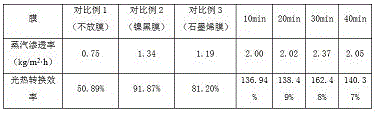
Adding 1.32g of ammonium sulfate and 0.42g of nickel sulfate into 200ml of deionized water, and continuously stirring at room temperature until the ammonium sulfate and the nickel sulfate are fully dissolved to form an electrolyte solution; connecting foamed nickel on a cathode, connecting a graphite foil on an anode, adjusting the distance of the connected electrode, and putting the electrode into electrolyte; turning on a switch of an external direct current power supply, and reacting for 10 minutes under the voltage of 13V; and cleaning the plated nickel black-graphene photo-thermal conversion film in deionized water, taking out, and drying in an oven at 60 ℃ for 12 hours. Subjecting to evaporation under 1sun illuminationOn the cup, the light-steam energy conversion efficiency is 136.94%, and the steam permeability is 2.00 kg/m2·h。
Example 2
Adding 1.32g of ammonium sulfate and 0.42g of nickel sulfate into 200ml of deionized water, and continuously stirring at room temperature until the ammonium sulfate and the nickel sulfate are fully dissolved to form an electrolyte solution; connecting foamed nickel on a cathode, connecting a graphite foil on an anode, adjusting the distance of the connected electrode, and putting the electrode into electrolyte; turning on a switch of an external direct current power supply, and reacting for 20 minutes under the voltage of 13V; and cleaning the plated nickel black-graphene photo-thermal conversion film in deionized water, taking out, and drying in an oven at 60 ℃ for 12 hours. Placing on an evaporation cup under 1sun illumination, the light-steam energy conversion efficiency is 138.49%, and the steam permeability is 2.02 kg/m2·h。
Example 3
Adding 1.32g of ammonium sulfate and 0.42g of nickel sulfate into 200ml of deionized water, and continuously stirring at room temperature until the ammonium sulfate and the nickel sulfate are fully dissolved to form an electrolyte solution; connecting foamed nickel on a cathode, connecting a graphite foil on an anode, adjusting the distance of the connected electrode, and putting the electrode into electrolyte; turning on a switch of an external direct current power supply, and reacting for 30 minutes under the voltage of 13V; and cleaning the plated nickel black-graphene photo-thermal conversion film in deionized water, taking out, and drying in an oven at 60 ℃ for 12 hours. Placing on an evaporation cup under 1sun illumination, the light-steam energy conversion efficiency is 162.48%, and the steam permeability is 2.37kg/m2·h。
Example 4
Adding 1.32g of ammonium sulfate and 0.42g of nickel sulfate into 200ml of deionized water, and continuously stirring at room temperature until the ammonium sulfate and the nickel sulfate are fully dissolved to form an electrolyte solution; connecting foamed nickel on a cathode, connecting a graphite foil on an anode, adjusting the distance of the connected electrode, and putting the electrode into electrolyte; turning on a switch of an external direct current power supply, and reacting for 40 minutes under the voltage of 13V; and cleaning the plated nickel black-graphene photo-thermal conversion film in deionized water, taking out, and drying in an oven at 60 ℃ for 12 hours. Placing on an evaporation cup under 1sun illumination, light-steam energy conversion efficiency is 140.37%, and steam permeability is 2.05 kg/m2·h。
Comparative example 1:
will be adornedThe evaporation cup with no membrane having a concentration of NaCl solution of 30g/L was irradiated with simulated sunlight having a light intensity of 1 sun. The initial weight and the final weight of the evaporation cup were weighed, and the light-vapor energy conversion efficiency was calculated to be 50.89%, and the vapor permeability was calculated to be 0.75k g/m2·h。
Comparative example 2:
adding 1.32g of ammonium sulfate into 200ml of deionized water, and continuously stirring at room temperature until the ammonium sulfate is fully dissolved to form an electrolyte solution; connecting foamed nickel on a cathode, connecting two nickel plates on anodes at the left side and the right side of the foamed nickel respectively, adjusting the distance of the connected electrodes and putting the electrodes into electrolyte; turning on an external direct current power supply, and electrolyzing for 20 minutes under the voltage of 15V; and cleaning the plated nickel black photothermal conversion film in deionized water, taking out, and drying in an oven at 60 ℃ for 12 hours. Under the illumination of 1sun, the light-steam energy conversion efficiency is 91.87 percent, and the steam permeability is 1.07kg/m2·h。
Comparative example 2:
adding 1.32g of ammonium sulfate into 200ml of deionized water, and continuously stirring at room temperature until the ammonium sulfate is fully dissolved to form an electrolyte solution; and respectively placing the cathode and the anode on graphite foils, stripping for 1 hour, and carrying out suction filtration on the obtained graphene to obtain the graphene film. Under the illumination of 1sun, the light-steam energy conversion efficiency is 81.20%, and the steam permeability is 1.19kg/m2·h。
And (4) conclusion:
as can be seen from table 1, compared with the nickel black film and the graphene film, the nickel black-graphene composite photothermal conversion film realizes a synergistic promotion effect, has a good effect in seawater desalination, and maximizes the light-steam energy conversion efficiency and the steam permeability of the film when the electrolysis time is 30 min.
TABLE 1 active membrane area of 9cm2The nickel black-graphene composite photo-thermal conversion film and the steam permeability of the comparative example under 1sun illumination
Figure 786375DEST_PATH_IMAGE004

Claims (3)

1. A nickel black-graphene composite photo-thermal conversion film and a preparation method thereof are characterized by mainly comprising the following steps:
(1) adding a certain amount of ammonium sulfate and nickel sulfate into a solvent, and continuously stirring until the ammonium sulfate and the nickel sulfate are fully dissolved to form electrolyte;
(2) the foamed nickel is used as a cathode, the graphite foil is used as an anode, and the electrode distance is adjusted in the electrolyte;
(3) under a certain direct current voltage, gas and hydroxyl radicals generated by the electrolyte generate intercalation on the graphite foil, so that graphene is stripped; the nickel ions play a role of a carrier, and the graphene is transferred to the cathode and reduced into nickel black; thereby generating a uniform nickel black-graphene composite film on the cathode;
(4) adjusting the concentration of the electrolyte, the deposition voltage and the deposition time to control the content of the nickel black-graphene composite material on the cathode;
(5) after electrodeposition is carried out for a certain time, the nickel black-graphene photo-thermal conversion film is fully cleaned in deionized water, and is dried for 12 hours in a 60 ℃ oven after being taken out.
2. The method for preparing a nickel black-graphene photo-thermal conversion film according to claim 1, wherein graphene and nickel black are simultaneously deposited on a cathode by a one-step electrochemical method;
the concentration of ammonium sulfate in the step (1) is 0-0.2M, and the concentration of nickel sulfate is 0-0.08M;
the electrode distance in the step (2) is 0.5-2 cm;
the voltage range in the step (3) is 5-15V;
and (4) the deposition time in the step (4) is 5-40 min.
3. The nickel black-graphene composite photothermal conversion film obtained by the preparation method according to claim 1 is applied to seawater desalination and other water treatment directions.
CN202111047273.8A 2021-09-08 2021-09-08 Nickel black-graphene composite photo-thermal conversion film and preparation method thereof Active CN113772664B (en)

Priority Applications (1)

Application Number Priority Date Filing Date Title
CN202111047273.8A CN113772664B (en) 2021-09-08 2021-09-08 Nickel black-graphene composite photo-thermal conversion film and preparation method thereof

Applications Claiming Priority (1)

Application Number Priority Date Filing Date Title
CN202111047273.8A CN113772664B (en) 2021-09-08 2021-09-08 Nickel black-graphene composite photo-thermal conversion film and preparation method thereof

Publications (2)

Publication Number Publication Date
CN113772664A true CN113772664A (en) 2021-12-10
CN113772664B CN113772664B (en) 2023-04-28

Family

ID=78841484

Family Applications (1)

Application Number Title Priority Date Filing Date
CN202111047273.8A Active CN113772664B (en) 2021-09-08 2021-09-08 Nickel black-graphene composite photo-thermal conversion film and preparation method thereof

Country Status (1)

Country Link
CN (1) CN113772664B (en)

Citations (7)

* Cited by examiner, † Cited by third party
Publication number Priority date Publication date Assignee Title
CN104505497A (en) * 2014-12-12 2015-04-08 盐城市新能源化学储能与动力电源研究中心 Graphene nickel composite material and graphene nickel carbon electrode prepared by using same
CN104817143A (en) * 2015-04-05 2015-08-05 北京化工大学 Ion exchange membrane composite multi-electrode capacitance adsorption desalting apparatus
CN106276878A (en) * 2016-08-16 2017-01-04 肖丽芳 A kind of electrodeposition process prepares the method for grapheme foam
CN106803461A (en) * 2015-11-26 2017-06-06 常德力元新材料有限责任公司 Directly soak the three-dimensional porous electrode preparation method of nickel foam-Graphene of reaction equation
CN108862254A (en) * 2018-07-12 2018-11-23 西安交通大学 A kind of method that the bipolar electrode removing of electrochemistry yin-yang prepares graphene
US20190119115A1 (en) * 2016-02-17 2019-04-25 Metalysis Limited Methods of making graphene materials
CN113292140A (en) * 2021-06-28 2021-08-24 长春工业大学 Preparation method and application of nitrogen-doped titanium dioxide particle-loaded graphene-nickel foam membrane electrode

Patent Citations (7)

* Cited by examiner, † Cited by third party
Publication number Priority date Publication date Assignee Title
CN104505497A (en) * 2014-12-12 2015-04-08 盐城市新能源化学储能与动力电源研究中心 Graphene nickel composite material and graphene nickel carbon electrode prepared by using same
CN104817143A (en) * 2015-04-05 2015-08-05 北京化工大学 Ion exchange membrane composite multi-electrode capacitance adsorption desalting apparatus
CN106803461A (en) * 2015-11-26 2017-06-06 常德力元新材料有限责任公司 Directly soak the three-dimensional porous electrode preparation method of nickel foam-Graphene of reaction equation
US20190119115A1 (en) * 2016-02-17 2019-04-25 Metalysis Limited Methods of making graphene materials
CN106276878A (en) * 2016-08-16 2017-01-04 肖丽芳 A kind of electrodeposition process prepares the method for grapheme foam
CN108862254A (en) * 2018-07-12 2018-11-23 西安交通大学 A kind of method that the bipolar electrode removing of electrochemistry yin-yang prepares graphene
CN113292140A (en) * 2021-06-28 2021-08-24 长春工业大学 Preparation method and application of nitrogen-doped titanium dioxide particle-loaded graphene-nickel foam membrane electrode

Also Published As

Publication number Publication date
CN113772664B (en) 2023-04-28

Similar Documents

Publication Publication Date Title
Gupta et al. Recent technological advances in designing electrodes and electrolytes for efficient zinc ion hybrid supercapacitors
CN110129825B (en) High-efficiency Ni/Ni (OH)2Hydrogen evolution electrode and preparation method thereof
CN106099075B (en) Preparation method of graphene/zinc oxide core-shell structure composite material
CN107068993A (en) A kind of three-dimensional compound Co3O4The preparation method of Si C negative materials
CN106450241A (en) Titanium nitride/carbon nitride/graphene oxide composite nano-material and preparation method thereof
CN108893763A (en) A kind of clutch gold production method for preventing lithium ion from generating lithium dendrite arm
CN117127207A (en) Preparation method and application of in-situ growth carbon dioxide electro-reduction electrocatalyst
CN114045509B (en) Seawater electrolysis device with sodium ion conduction and application thereof
Zheng et al. N, O co-doped porous carbon derived from pine needles for zinc-ion hybrid supercapacitors
GB2613689A (en) CuO nanowire-loaded copper mesh and preparation method and use thereof
CN106319558A (en) Efficient and porous MoS2-Zn hydrogen evolution electrode and preparation method thereof
CN109457269A (en) A kind of MoS2/ graphene-foam nickel cathode preparation method and its application in microorganism electrolysis cell
CN104577135B (en) Preparation method of three-dimensional silver mesh
CN110148752A (en) A kind of negative electrode current collector surface electropolymerization pyrrole modification method
CN114784293A (en) Spherical nickel oxide cobalt manganese electrode and preparation method and application thereof
CN114164471A (en) Co3O4Nanosheet loaded stainless steel net and preparation method and application thereof
CN113772664B (en) Nickel black-graphene composite photo-thermal conversion film and preparation method thereof
CN113818064B (en) Needle-shaped nickel black film capable of realizing efficient photo-thermal conversion
CN113549950B (en) 3D staggered grid type silver cluster-cobalt hydroxide composite material, preparation and application
CN111960554B (en) Method for recovering elemental copper from copper-containing wastewater by using microbial fuel cell
CN110589818B (en) Preparation method and application of nitrogen-doped mesoporous carbon material
CN109301252A (en) A kind of preparation method of chelating agent surface modified porous carbon material
CN114927638A (en) Polyaniline nanowire-graphene oxide/graphene composite material and preparation method and application thereof
CN113871638B (en) A lanthanum ferrite photoelectrode and its preparation method and application in lithium-oxygen battery
CN105803482A (en) Modification method for collector electrode material of electrolytic cell for water-electrolytic hydrogen making, and application

Legal Events

Date Code Title Description
PB01 Publication
PB01 Publication
SE01 Entry into force of request for substantive examination
GR01 Patent grant
GR01 Patent grant
TR01 Transfer of patent right

Effective date of registration: 20260113

Address after: 130000 Jilin Province, Changchun City, Erdao District, Yandada Street and Hugong Road Intersection, Changchun Northeast Asia International Procurement Center B1-35

Patentee after: Jilin Wensheng New Materials Co.,Ltd.

Country or region after: China

Address before: 130012 Yanan street, Jilin, Chaoyang District, No. 2055, No.

Patentee before: Changchun University of Technology

Country or region before: China

TR01 Transfer of patent right