CN113773473B - Silafluorenyl conjugated porous polymer and preparation method thereof - Google Patents
Silafluorenyl conjugated porous polymer and preparation method thereof Download PDFInfo
- Publication number
- CN113773473B CN113773473B CN202010516666.8A CN202010516666A CN113773473B CN 113773473 B CN113773473 B CN 113773473B CN 202010516666 A CN202010516666 A CN 202010516666A CN 113773473 B CN113773473 B CN 113773473B
- Authority
- CN
- China
- Prior art keywords
- porous polymer
- based conjugated
- conjugated porous
- polymer
- silicon fluorene
- Prior art date
- Legal status (The legal status is an assumption and is not a legal conclusion. Google has not performed a legal analysis and makes no representation as to the accuracy of the status listed.)
- Active
Links
Images


Classifications
-
- C—CHEMISTRY; METALLURGY
- C08—ORGANIC MACROMOLECULAR COMPOUNDS; THEIR PREPARATION OR CHEMICAL WORKING-UP; COMPOSITIONS BASED THEREON
- C08G—MACROMOLECULAR COMPOUNDS OBTAINED OTHERWISE THAN BY REACTIONS ONLY INVOLVING UNSATURATED CARBON-TO-CARBON BONDS
- C08G61/00—Macromolecular compounds obtained by reactions forming a carbon-to-carbon link in the main chain of the macromolecule
- C08G61/12—Macromolecular compounds containing atoms other than carbon in the main chain of the macromolecule
- C08G61/122—Macromolecular compounds containing atoms other than carbon in the main chain of the macromolecule derived from five- or six-membered heterocyclic compounds, other than imides
- C08G61/123—Macromolecular compounds containing atoms other than carbon in the main chain of the macromolecule derived from five- or six-membered heterocyclic compounds, other than imides derived from five-membered heterocyclic compounds
-
- C—CHEMISTRY; METALLURGY
- C08—ORGANIC MACROMOLECULAR COMPOUNDS; THEIR PREPARATION OR CHEMICAL WORKING-UP; COMPOSITIONS BASED THEREON
- C08G—MACROMOLECULAR COMPOUNDS OBTAINED OTHERWISE THAN BY REACTIONS ONLY INVOLVING UNSATURATED CARBON-TO-CARBON BONDS
- C08G61/00—Macromolecular compounds obtained by reactions forming a carbon-to-carbon link in the main chain of the macromolecule
- C08G61/02—Macromolecular compounds containing only carbon atoms in the main chain of the macromolecule, e.g. polyxylylenes
- C08G61/10—Macromolecular compounds containing only carbon atoms in the main chain of the macromolecule, e.g. polyxylylenes only aromatic carbon atoms, e.g. polyphenylenes
-
- C—CHEMISTRY; METALLURGY
- C09—DYES; PAINTS; POLISHES; NATURAL RESINS; ADHESIVES; COMPOSITIONS NOT OTHERWISE PROVIDED FOR; APPLICATIONS OF MATERIALS NOT OTHERWISE PROVIDED FOR
- C09K—MATERIALS FOR MISCELLANEOUS APPLICATIONS, NOT PROVIDED FOR ELSEWHERE
- C09K11/00—Luminescent materials, e.g. electroluminescent or chemiluminescent
- C09K11/06—Luminescent materials, e.g. electroluminescent or chemiluminescent containing organic luminescent materials
-
- G—PHYSICS
- G01—MEASURING; TESTING
- G01N—INVESTIGATING OR ANALYSING MATERIALS BY DETERMINING THEIR CHEMICAL OR PHYSICAL PROPERTIES
- G01N21/00—Investigating or analysing materials by the use of optical means, i.e. using sub-millimetre waves, infrared, visible or ultraviolet light
- G01N21/62—Systems in which the material investigated is excited whereby it emits light or causes a change in wavelength of the incident light
- G01N21/63—Systems in which the material investigated is excited whereby it emits light or causes a change in wavelength of the incident light optically excited
- G01N21/64—Fluorescence; Phosphorescence
- G01N21/6402—Atomic fluorescence; Laser induced fluorescence
-
- G—PHYSICS
- G01—MEASURING; TESTING
- G01N—INVESTIGATING OR ANALYSING MATERIALS BY DETERMINING THEIR CHEMICAL OR PHYSICAL PROPERTIES
- G01N21/00—Investigating or analysing materials by the use of optical means, i.e. using sub-millimetre waves, infrared, visible or ultraviolet light
- G01N21/62—Systems in which the material investigated is excited whereby it emits light or causes a change in wavelength of the incident light
- G01N21/63—Systems in which the material investigated is excited whereby it emits light or causes a change in wavelength of the incident light optically excited
- G01N21/64—Fluorescence; Phosphorescence
- G01N21/6428—Measuring fluorescence of fluorescent products of reactions or of fluorochrome labelled reactive substances, e.g. measuring quenching effects, using measuring "optrodes"
-
- G—PHYSICS
- G01—MEASURING; TESTING
- G01N—INVESTIGATING OR ANALYSING MATERIALS BY DETERMINING THEIR CHEMICAL OR PHYSICAL PROPERTIES
- G01N21/00—Investigating or analysing materials by the use of optical means, i.e. using sub-millimetre waves, infrared, visible or ultraviolet light
- G01N21/62—Systems in which the material investigated is excited whereby it emits light or causes a change in wavelength of the incident light
- G01N21/63—Systems in which the material investigated is excited whereby it emits light or causes a change in wavelength of the incident light optically excited
- G01N21/64—Fluorescence; Phosphorescence
- G01N21/645—Specially adapted constructive features of fluorimeters
- G01N21/6456—Spatial resolved fluorescence measurements; Imaging
-
- C—CHEMISTRY; METALLURGY
- C08—ORGANIC MACROMOLECULAR COMPOUNDS; THEIR PREPARATION OR CHEMICAL WORKING-UP; COMPOSITIONS BASED THEREON
- C08G—MACROMOLECULAR COMPOUNDS OBTAINED OTHERWISE THAN BY REACTIONS ONLY INVOLVING UNSATURATED CARBON-TO-CARBON BONDS
- C08G2261/00—Macromolecular compounds obtained by reactions forming a carbon-to-carbon link in the main chain of the macromolecule
- C08G2261/10—Definition of the polymer structure
- C08G2261/12—Copolymers
- C08G2261/124—Copolymers alternating
-
- C—CHEMISTRY; METALLURGY
- C08—ORGANIC MACROMOLECULAR COMPOUNDS; THEIR PREPARATION OR CHEMICAL WORKING-UP; COMPOSITIONS BASED THEREON
- C08G—MACROMOLECULAR COMPOUNDS OBTAINED OTHERWISE THAN BY REACTIONS ONLY INVOLVING UNSATURATED CARBON-TO-CARBON BONDS
- C08G2261/00—Macromolecular compounds obtained by reactions forming a carbon-to-carbon link in the main chain of the macromolecule
- C08G2261/10—Definition of the polymer structure
- C08G2261/18—Definition of the polymer structure conjugated
-
- C—CHEMISTRY; METALLURGY
- C08—ORGANIC MACROMOLECULAR COMPOUNDS; THEIR PREPARATION OR CHEMICAL WORKING-UP; COMPOSITIONS BASED THEREON
- C08G—MACROMOLECULAR COMPOUNDS OBTAINED OTHERWISE THAN BY REACTIONS ONLY INVOLVING UNSATURATED CARBON-TO-CARBON BONDS
- C08G2261/00—Macromolecular compounds obtained by reactions forming a carbon-to-carbon link in the main chain of the macromolecule
- C08G2261/30—Monomer units or repeat units incorporating structural elements in the main chain
- C08G2261/31—Monomer units or repeat units incorporating structural elements in the main chain incorporating aromatic structural elements in the main chain
- C08G2261/312—Non-condensed aromatic systems, e.g. benzene
-
- C—CHEMISTRY; METALLURGY
- C08—ORGANIC MACROMOLECULAR COMPOUNDS; THEIR PREPARATION OR CHEMICAL WORKING-UP; COMPOSITIONS BASED THEREON
- C08G—MACROMOLECULAR COMPOUNDS OBTAINED OTHERWISE THAN BY REACTIONS ONLY INVOLVING UNSATURATED CARBON-TO-CARBON BONDS
- C08G2261/00—Macromolecular compounds obtained by reactions forming a carbon-to-carbon link in the main chain of the macromolecule
- C08G2261/30—Monomer units or repeat units incorporating structural elements in the main chain
- C08G2261/32—Monomer units or repeat units incorporating structural elements in the main chain incorporating heteroaromatic structural elements in the main chain
- C08G2261/324—Monomer units or repeat units incorporating structural elements in the main chain incorporating heteroaromatic structural elements in the main chain condensed
- C08G2261/3244—Monomer units or repeat units incorporating structural elements in the main chain incorporating heteroaromatic structural elements in the main chain condensed containing only one kind of heteroatoms other than N, O, S
-
- C—CHEMISTRY; METALLURGY
- C08—ORGANIC MACROMOLECULAR COMPOUNDS; THEIR PREPARATION OR CHEMICAL WORKING-UP; COMPOSITIONS BASED THEREON
- C08G—MACROMOLECULAR COMPOUNDS OBTAINED OTHERWISE THAN BY REACTIONS ONLY INVOLVING UNSATURATED CARBON-TO-CARBON BONDS
- C08G2261/00—Macromolecular compounds obtained by reactions forming a carbon-to-carbon link in the main chain of the macromolecule
- C08G2261/40—Polymerisation processes
- C08G2261/41—Organometallic coupling reactions
- C08G2261/415—Sonogashira / Hagihara reactions
-
- C—CHEMISTRY; METALLURGY
- C08—ORGANIC MACROMOLECULAR COMPOUNDS; THEIR PREPARATION OR CHEMICAL WORKING-UP; COMPOSITIONS BASED THEREON
- C08G—MACROMOLECULAR COMPOUNDS OBTAINED OTHERWISE THAN BY REACTIONS ONLY INVOLVING UNSATURATED CARBON-TO-CARBON BONDS
- C08G2261/00—Macromolecular compounds obtained by reactions forming a carbon-to-carbon link in the main chain of the macromolecule
- C08G2261/50—Physical properties
- C08G2261/52—Luminescence
- C08G2261/522—Luminescence fluorescent
-
- C—CHEMISTRY; METALLURGY
- C08—ORGANIC MACROMOLECULAR COMPOUNDS; THEIR PREPARATION OR CHEMICAL WORKING-UP; COMPOSITIONS BASED THEREON
- C08G—MACROMOLECULAR COMPOUNDS OBTAINED OTHERWISE THAN BY REACTIONS ONLY INVOLVING UNSATURATED CARBON-TO-CARBON BONDS
- C08G2261/00—Macromolecular compounds obtained by reactions forming a carbon-to-carbon link in the main chain of the macromolecule
- C08G2261/90—Applications
- C08G2261/94—Applications in sensors, e.g. biosensors
-
- C—CHEMISTRY; METALLURGY
- C09—DYES; PAINTS; POLISHES; NATURAL RESINS; ADHESIVES; COMPOSITIONS NOT OTHERWISE PROVIDED FOR; APPLICATIONS OF MATERIALS NOT OTHERWISE PROVIDED FOR
- C09K—MATERIALS FOR MISCELLANEOUS APPLICATIONS, NOT PROVIDED FOR ELSEWHERE
- C09K2211/00—Chemical nature of organic luminescent or tenebrescent compounds
- C09K2211/14—Macromolecular compounds
- C09K2211/1408—Carbocyclic compounds
- C09K2211/1425—Non-condensed systems
-
- C—CHEMISTRY; METALLURGY
- C09—DYES; PAINTS; POLISHES; NATURAL RESINS; ADHESIVES; COMPOSITIONS NOT OTHERWISE PROVIDED FOR; APPLICATIONS OF MATERIALS NOT OTHERWISE PROVIDED FOR
- C09K—MATERIALS FOR MISCELLANEOUS APPLICATIONS, NOT PROVIDED FOR ELSEWHERE
- C09K2211/00—Chemical nature of organic luminescent or tenebrescent compounds
- C09K2211/14—Macromolecular compounds
- C09K2211/1441—Heterocyclic
Landscapes
- Chemical & Material Sciences (AREA)
- Health & Medical Sciences (AREA)
- Physics & Mathematics (AREA)
- Immunology (AREA)
- Analytical Chemistry (AREA)
- General Physics & Mathematics (AREA)
- Nuclear Medicine, Radiotherapy & Molecular Imaging (AREA)
- Life Sciences & Earth Sciences (AREA)
- Chemical Kinetics & Catalysis (AREA)
- Biochemistry (AREA)
- General Health & Medical Sciences (AREA)
- Organic Chemistry (AREA)
- Pathology (AREA)
- Optics & Photonics (AREA)
- Medicinal Chemistry (AREA)
- Polymers & Plastics (AREA)
- Engineering & Computer Science (AREA)
- Materials Engineering (AREA)
- Addition Polymer Or Copolymer, Post-Treatments, Or Chemical Modifications (AREA)
Abstract
Description
技术领域technical field
本发明属于有机荧光多孔材料领域,具体涉及一种硅芴基共轭多孔聚合物及其制备方法。The invention belongs to the field of organic fluorescent porous materials, in particular to a silicon fluorene-based conjugated porous polymer and a preparation method thereof.
背景技术Background technique
有机多孔聚合物因具有仅由轻元素组成(C、H、O、N等)、可以实现对聚合物的功能性改进、较为稳定可适用于较为严格的条件等特点,在分离、多相催化和气体储存等方面具有广泛应用。有人通过Sonogashira-Hagihara偶联反应合成了共轭聚芳基乙炔聚合物,这些聚合物具有多孔结构,比表面积高达834m2 g-1。与MOFs和COFs不同,这些共轭多孔聚合物(CMPs)是在动力学控制下形成的,因此是非晶态的,其内部原子或分子的排列无周期性。但与许多MOF相比,此聚炔网络仅由碳-碳和碳-氢键组成,因此具有更强的热稳定性和化学稳定性。Organic porous polymers have the characteristics of being composed of only light elements (C, H, O, N, etc.), which can achieve functional improvement of polymers, and are relatively stable and can be applied to more stringent conditions. It has a wide range of applications in gas storage and so on. Conjugated polyarylacetylene polymers have been synthesized by Sonogashira-Hagihara coupling reaction, and these polymers have porous structures with specific surface areas as high as 834 m 2 g -1 . Unlike MOFs and COFs, these conjugated porous polymers (CMPs) are formed under kinetic control and thus are amorphous, and the arrangement of their internal atoms or molecules is aperiodic. But compared to many MOFs, this polyalkyne network consists only of carbon-carbon and carbon-hydrogen bonds, and thus is more thermally and chemically stable.
荧光材料以其独特的光电性质,空前提高了其在生命科学领域的应用规模。目前,荧光材料主要包括:有机小分子染料、荧光蛋白、碳量子点、聚集诱导发光小分子染料和无机纳米粒子等。特别是有机荧光材料因其低毒、量子产率高、发光颜色可控等优点已被广泛用于生物医学荧光成像及检测、各种组织的染色(包括血管、癌细胞以及细胞器官)、细胞示踪及光动力学治疗等。随着光电材料的发展,有机共轭荧光聚合物越来越得到人们的青睐,其可以克服应用过程中浓度猝灭、斯托克斯位移小、光稳定性差和光漂白严重等缺陷。同时还具有具有亮度高、易发生荧光能量传递、稳定性好、生物毒性低和信号放大效应等优异性能。在工业、农业、医学、国防等领域都有广泛应用。Fluorescent materials have unprecedentedly increased their application scale in the field of life sciences due to their unique optoelectronic properties. At present, fluorescent materials mainly include: organic small molecule dyes, fluorescent proteins, carbon quantum dots, aggregation-induced luminescent small molecule dyes, and inorganic nanoparticles. In particular, organic fluorescent materials have been widely used in biomedical fluorescence imaging and detection, staining of various tissues (including blood vessels, cancer cells, and cellular organs), cell Tracer and photodynamic therapy, etc. With the development of optoelectronic materials, organic conjugated fluorescent polymers are increasingly favored, which can overcome the defects of concentration quenching, small Stokes shift, poor photostability, and severe photobleaching during application. At the same time, it also has excellent properties such as high brightness, easy fluorescence energy transfer, good stability, low biological toxicity and signal amplification effect. It is widely used in industry, agriculture, medicine, national defense and other fields.
有机荧光材料都存在一个明显的缺陷—光稳定性差,易发生光漂白,即荧光物质被激发光连续激发,发射出来的荧光强度随着时间推移逐步减弱乃至消失。有些有机荧光材料光漂白是可逆的,多数是不可逆的,比如:多色PALM成像时,双色成像一次的成像时间是单色成像的两倍,成像过程中存在前一蛋白激活成像光对后一蛋白的漂白现象,以至于数据丢失。现有的大多数荧光染料缺乏足够的光强度,少数高荧光强度的染料由于光漂白问题限制了对细胞的长时间观察。因此很多研究小组开始致力于研究如何抑制有机荧光材料光漂白,即使是有机共轭荧光聚合物,其虽然克服了很多荧光染料存在的缺陷,同时大幅提高了其光稳定性,但光漂白问题仍未得到解决,仅仅是得到了一定的抑制。Organic fluorescent materials all have an obvious defect - poor photostability and prone to photobleaching, that is, fluorescent substances are continuously excited by excitation light, and the emitted fluorescence intensity gradually weakens or even disappears over time. The photobleaching of some organic fluorescent materials is reversible, and most of them are irreversible. For example, in multi-color PALM imaging, the imaging time of two-color imaging is twice as long as that of single-color imaging. Bleaching of proteins, resulting in data loss. Most of the existing fluorescent dyes lack sufficient light intensity, and a few dyes with high fluorescence intensity limit the long-term observation of cells due to photobleaching problems. Therefore, many research groups have begun to study how to inhibit the photobleaching of organic fluorescent materials. Even for organic conjugated fluorescent polymers, although they overcome the defects of many fluorescent dyes and greatly improve their photostability, the problem of photobleaching still remains. It has not been resolved, it has only been suppressed to a certain extent.
发明内容SUMMARY OF THE INVENTION
本发明是为了解决有机荧光材料光稳定性差、光漂白的问题,目的在于提供一种具有光诱导荧光增强效应的硅芴基共轭多孔聚合物及其制备方法。The present invention aims to solve the problems of poor light stability and photobleaching of organic fluorescent materials, and aims to provide a silicofluorene-based conjugated porous polymer with light-induced fluorescence enhancement effect and a preparation method thereof.
本发明提供了一种硅芴基共轭多孔聚合物,具有这样的特征,结构式如下:The present invention provides a silicofluorene-based conjugated porous polymer, which has the following characteristics and has the following structural formula:

本发明还提供了一种硅芴基共轭多孔聚合物,具有这样的特征,包括:共聚步骤:在惰性气体氛围下,以3,6-二甲氧基-2,7-二乙炔基-9,9-二甲基硅芴和1,3,5-三碘苯作为单体,以四三苯基膦钯、碘化亚铜为催化剂,以四氢呋喃和三乙胺为溶剂,在75℃~85℃发生共聚反应,得到硅芴基共轭多孔聚合物,其中,3,6-二甲氧基-2,7-二乙炔基-9,9-二甲基硅芴与1,3,5-三碘苯的摩尔比为1.5:1。The present invention also provides a silicofluorene-based conjugated porous polymer, which has the characteristics of comprising: a copolymerization step: in an inert gas atmosphere, 3,6-dimethoxy-2,7-diethynyl- 9,9-dimethylsilylfluorene and 1,3,5-triiodobenzene as monomers, tetrakistriphenylphosphine palladium and cuprous iodide as catalysts, tetrahydrofuran and triethylamine as solvents, at 75 °C A copolymerization reaction occurs at ~85 °C to obtain a silicofluorene-based conjugated porous polymer, wherein 3,6-dimethoxy-2,7-diethynyl-9,9-dimethylsilicofluorene and 1,3, The molar ratio of 5-triiodobenzene was 1.5:1.
在本发明提供的硅芴基共轭多孔聚合物的制备方法中,还可以具有这样的特征:其中,四氢呋喃和三乙胺的体积比为1:7。In the preparation method of the silicofluorene-based conjugated porous polymer provided by the present invention, it may also have the following characteristics: wherein, the volume ratio of tetrahydrofuran and triethylamine is 1:7.
在本发明提供的硅芴基共轭多孔聚合物的制备方法中,还可以具有这样的特征:其中,聚合反应的时间为3天。In the preparation method of the silicon fluorene-based conjugated porous polymer provided by the present invention, it may also have the following characteristics: wherein, the time of the polymerization reaction is 3 days.
在本发明提供的硅芴基共轭多孔聚合物的制备方法中,还可以具有这样的特征,还包括:除杂步骤,其中,除杂步骤在共聚步骤之后进行,具体操作为:将得到的硅芴基共轭多孔聚合物依次用氯仿、水、丙酮、甲醇淋洗,再通过索氏提取器,用甲醇提取24小时,然后将所得固体在50℃下真空干燥12小时,最终得到暗黄色固体,即纯化的硅芴基共轭多孔聚合物。In the preparation method of the silicon fluorene-based conjugated porous polymer provided by the present invention, it may also have the following characteristics, further comprising: an impurity removal step, wherein the impurity removal step is performed after the copolymerization step, and the specific operation is as follows: the obtained The silicofluorene-based conjugated porous polymer was sequentially rinsed with chloroform, water, acetone, and methanol, then passed through a Soxhlet extractor and extracted with methanol for 24 hours, and then the obtained solid was vacuum-dried at 50 °C for 12 hours, and finally a dark yellow color was obtained. The solid, namely the purified silicofluorene-based conjugated porous polymer.
在本发明提供的硅芴基共轭多孔聚合物的制备方法中,还可以具有这样的特征:其中,3,6-二甲氧基-2,7-二乙炔基-9,9-二甲基硅芴的制备方法为:在惰性气体氛围下,以2,7-二溴-3,6-二甲氧基-9,9-二甲基硅芴和三甲基硅炔为原料,发生Sonogashira偶联反应,然后脱去保护基硅甲基,得到3,6-二甲氧基-2,7-二乙炔基-9,9-二甲基硅芴。In the preparation method of the silicofluorene-based conjugated porous polymer provided by the present invention, it may also have the following characteristics: wherein, 3,6-dimethoxy-2,7-diethynyl-9,9-dimethyl The preparation method of silicofluorene is as follows: in an inert gas atmosphere, using 2,7-dibromo-3,6-dimethoxy-9,9-dimethylsilylfluorene and trimethylsilyne as raw materials, generating Sonogashira coupling reaction followed by deprotection of the silylmethyl group affords 3,6-dimethoxy-2,7-diethynyl-9,9-dimethylsilylfluorene.
在本发明提供的硅芴基共轭多孔聚合物的制备方法中,还可以具有这样的特征:其中,3,3'-二溴-4,4'-二甲氧基联苯、碘化亚铜、四三苯基膦钯与三甲基硅炔的摩尔比为10:1:2:30。In the preparation method of the silicofluorene-based conjugated porous polymer provided by the present invention, it may also have the following characteristics: wherein, 3,3'-dibromo-4,4'-dimethoxybiphenyl, iodide The molar ratio of copper, tetrakistriphenylphosphine palladium and trimethylsilyne was 10:1:2:30.
在本发明提供的硅芴基共轭多孔聚合物的制备方法中,还可以具有这样的特征:其中,Sonogashira偶联反应的反应温度为75℃~85℃,脱去保护基硅甲基的反应温度为35℃。In the preparation method of the silicofluorene-based conjugated porous polymer provided by the present invention, it can also have the following characteristics: wherein, the reaction temperature of the Sonogashira coupling reaction is 75°C to 85°C, and the reaction of removing the protecting group silylmethyl group The temperature was 35°C.
本发明还提供了硅芴基共轭多孔聚合物在荧光分析中的应用。The invention also provides the application of the silicon fluorene-based conjugated porous polymer in fluorescence analysis.
本发明还提供了硅芴基共轭多孔聚合物在跟踪检测中的应用。The invention also provides the application of the silicon fluorene-based conjugated porous polymer in tracking detection.
发明的作用与效果The role and effect of the invention
根据本发明所提供的硅芴基共轭多孔聚合物的制备方法,用3,6-二甲氧基-2,7-二乙炔基-9,9-二甲基硅芴作为单体和1,3,5-三碘苯作为单体,通过Sonogashira偶联反应在75℃~85℃下发生共聚,此温度保证溶剂回流,使反应更完全,得到含有硅芴单元的具有光诱导荧光增强效应的硅芴基共轭多孔聚合物。该聚合物具有三维结构,有球状和管状两种形态,具有中空结构。并且聚合物的荧光强度会随着紫外灯(365nm)照射时间的延长而增强,对紫外线辐射表现出一定的灵敏度,我们将之称为“光诱导荧光增强效应”,具有很好的抗光漂白性。该共轭聚合物能够作为化学或生物传感、生物医学荧光成像及检测、各种组织的染色(包括血管、癌细胞以及细胞器官)、细胞示踪及光动力学治疗的优选材料,能够被广泛用于荧光分析、跟踪检测、生物成像等方面。According to the preparation method of the silicofluorene-based conjugated porous polymer provided by the present invention, 3,6-dimethoxy-2,7-diethynyl-9,9-dimethylsilylfluorene is used as the monomer and 1 ,3,5-triiodobenzene is used as a monomer, and copolymerization occurs at 75℃~85℃ through Sonogashira coupling reaction. This temperature ensures the reflux of the solvent, which makes the reaction more complete, and obtains a silicofluorene unit with light-induced fluorescence enhancement effect. of silicofluorene-based conjugated porous polymers. The polymer has a three-dimensional structure, with spherical and tubular forms, and a hollow structure. And the fluorescence intensity of the polymer will increase with the prolongation of UV lamp (365nm) irradiation time, showing a certain sensitivity to UV radiation, we call it "photo-induced fluorescence enhancement effect", which has good resistance to photobleaching. sex. The conjugated polymer can be used as a preferred material for chemical or biological sensing, biomedical fluorescence imaging and detection, staining of various tissues (including blood vessels, cancer cells, and cellular organs), cell tracking, and photodynamic therapy. Widely used in fluorescence analysis, tracking detection, biological imaging and so on.
该制备方法简单,合成路线短,无需高压,只需要除氧,操作十分方便,所需最高温度只有85℃;所采用溶剂都十分便宜,原料制备技术成熟,产率高,对于开发同类荧光染料或有机荧光聚合物具有重要指导及借鉴作用。The preparation method is simple, the synthesis route is short, no high pressure is required, only deoxygenation is required, the operation is very convenient, and the required maximum temperature is only 85 ° C; Or organic fluorescent polymers have important guidance and reference.
附图说明Description of drawings
图1是本发明的实施例1中的化合物A的核磁氢谱;Fig. 1 is the hydrogen nuclear magnetic spectrum of compound A in the
图2是本发明的实施例1中的化合物B的核磁氢谱;Fig. 2 is the hydrogen nuclear magnetic spectrum of compound B in the
图3是本发明的实施例2中的硅芴基共轭多孔聚合物的X射线粉末衍射(PXRD)谱图;3 is an X-ray powder diffraction (PXRD) spectrum of the silicon fluorene-based conjugated porous polymer in Example 2 of the present invention;
图4是本发明的实施例2中的硅芴基共轭多孔聚合物的红外谱图;Fig. 4 is the infrared spectrogram of the silicofluorene-based conjugated porous polymer in Example 2 of the present invention;
图5是本发明的实施例2中的硅芴基共轭多孔聚合物的扫描电镜(SEM)谱图;5 is a scanning electron microscope (SEM) spectrum of the silicon fluorene-based conjugated porous polymer in Example 2 of the present invention;
图6是本发明的实施例2中的硅芴基共轭多孔聚合物在不同溶剂中的溶解图;Fig. 6 is the dissolution diagram of silicon fluorene-based conjugated porous polymer in different solvents in Example 2 of the present invention;
图7是本发明的实施例2中的硅芴基共轭多孔聚合物的溶胀性能实验图片;Fig. 7 is the experimental picture of swelling performance of the silicon fluorene-based conjugated porous polymer in Example 2 of the present invention;
图8是本发明的实施例2中的硅芴基共轭多孔聚合物与对照例所得聚合物在丙酮中进行对照实验的实验图片;Figure 8 is an experimental picture of a control experiment in acetone between the silicofluorene-based conjugated porous polymer in Example 2 of the present invention and the polymer obtained in the control example;
图9是本发明的实施例2中的硅芴基共轭多孔聚合物在不同照射时间下的荧光发射光谱图;以及FIG. 9 is a fluorescence emission spectrum diagram of the silicon fluorene-based conjugated porous polymer in Example 2 of the present invention under different irradiation times; and
图10是本发明的实施例2中的硅芴基共轭多孔聚合物的氮气吸脱附曲线图。10 is a graph of nitrogen adsorption and desorption of the silicon fluorene-based conjugated porous polymer in Example 2 of the present invention.
具体实施方式Detailed ways
为了使本发明实现的技术手段、创作特征、达成目的与功效易于明白了解,以下结合实施例及附图对本发明硅芴基共轭多孔聚合物及其制备方法作具体阐述。In order to make it easier to understand the technical means, creation features, goals and effects achieved by the present invention, the silicofluorene-based conjugated porous polymer and the preparation method thereof of the present invention are described in detail below with reference to the embodiments and the accompanying drawings.
本发明的实施例中所采用的最初的原料及溶剂均为分析纯,通过一般商业途径购买可以得到。The initial raw materials and solvents used in the examples of the present invention are all analytically pure, and can be purchased through general commercial channels.
本发明的实施例中实验室配制的混合溶剂为四氢呋喃与三乙胺比例为1:7配制而成。In the embodiment of the present invention, the mixed solvent prepared in the laboratory is prepared with a ratio of tetrahydrofuran and triethylamine of 1:7.
本发明提供的硅芴单体即3,6-二甲氧基-2,7-二乙炔基-9,9-二甲基硅芴的合成路线如下:The synthesis route of the silicon fluorene monomer provided by the present invention, namely, 3,6-dimethoxy-2,7-diethynyl-9,9-dimethylsilylfluorene is as follows:

本发明提供的一种具有光诱导荧光增强效应的硅芴基共轭多孔聚合物的合成路线如下:The synthetic route of a silicon fluorene-based conjugated porous polymer with light-induced fluorescence enhancement effect provided by the present invention is as follows:

<实施例1><Example 1>
本实施例具体介绍硅化合物B(3,6-二甲氧基-2,7-二乙炔基-9,9-二甲基硅芴)的合成过程。This example specifically introduces the synthesis process of the silicon compound B (3,6-dimethoxy-2,7-diethynyl-9,9-dimethylsilylfluorene).
步骤1:在氩气氛围中,以2,7-二溴-3,6-二甲氧基-9,9-二甲基硅芴和三甲基硅炔为原料,经过Sonogashira偶联反应得到2,7-二三甲基硅炔-3,6-二甲氧基-9,9-二甲基硅芴,其中2,7-二溴-3,6-二甲氧基-9,9-二甲基硅芴和三甲基硅炔的摩尔比为1:3。Step 1: In an argon atmosphere, using 2,7-dibromo-3,6-dimethoxy-9,9-dimethylsilylfluorene and trimethylsilyne as raw materials, through Sonogashira coupling reaction to obtain 2,7-Ditrimethylsilyne-3,6-dimethoxy-9,9-dimethylsilylfluorene, of which 2,7-dibromo-3,6-dimethoxy-9,9 - The molar ratio of dimethylsilylfluorene and trimethylsilyne is 1:3.
具体操作为:称取3,3'-二溴-4,4'-二甲氧基联苯(3.72g,10mmol)、碘化亚铜(0.20g,1mmol)、四三苯基膦钯(2.32g,2mmol)于反应装置中,搅拌下抽真空置换氩气三次。将三甲基硅炔(2.94g,30mmol)滴加到放在天平上的玻璃瓶中,加入50mL蒸馏过的哌啶,除氧15分钟,再转移到充满氩气的反应装置中,加热至80℃,回流。反应7h后,薄层色谱(TLC)监测到原料完全反应,然后停止加热反应停止,待反应恢复到室温,用泵减压除去哌啶。加入饱和氯化铵水溶液洗涤,并用二氯甲烷萃取三次至水溶液中不再有显色物,将萃取的有机层合并在一起,经无水硫酸镁干燥后过滤,旋蒸除去溶剂,利用硅胶柱层析分离纯化,展开剂为石油醚:乙酸乙酯(7:1)。得到白色粉末为2,7-二三甲基硅炔-3,6-二甲氧基-9,9-二甲基硅芴(4.70g,8mmol),即化合物A,产率达80%。对得到的化合物A进行核磁检测,检测结果见图1。The specific operation is: weigh 3,3'-dibromo-4,4'-dimethoxybiphenyl (3.72g, 10mmol), cuprous iodide (0.20g, 1mmol), tetrakistriphenylphosphine palladium ( 2.32 g, 2 mmol) in the reaction device, and under stirring, the argon was replaced by vacuum three times. Trimethylsilyne (2.94 g, 30 mmol) was added dropwise to a glass bottle placed on a balance, 50 mL of distilled piperidine was added, oxygen was removed for 15 minutes, and then transferred to an argon-filled reaction device, heated to 80°C, reflux. After 7 hours of reaction, the complete reaction of the raw materials was monitored by thin layer chromatography (TLC), then the heating was stopped and the reaction was stopped. After the reaction returned to room temperature, the piperidine was removed under reduced pressure with a pump. Add saturated ammonium chloride aqueous solution to wash, and extract three times with dichloromethane until there is no coloring matter in the aqueous solution, combine the extracted organic layers, dry over anhydrous magnesium sulfate, filter, remove the solvent by rotary evaporation, and use a silica gel column Chromatographic separation and purification, the developing solvent is petroleum ether: ethyl acetate (7:1). The obtained white powder was 2,7-ditrimethylsilyne-3,6-dimethoxy-9,9-dimethylsilylfluorene (4.70 g, 8 mmol), namely compound A, with a yield of 80%. The obtained compound A was subjected to nuclear magnetic detection, and the detection results are shown in Figure 1.
图1是本发明的实施例1中的化合物A的核磁氢谱。FIG. 1 is a hydrogen nuclear magnetic spectrum of Compound A in Example 1 of the present invention.
由图1可知,1H NMR(600MHz,CDCl3)δ7.67(s,2H),7.22(s,2H),4.01(s,6H),0.36(s,3H),0.28(s,9H)。H的总数目和化合物A理论上的H的总数目一致,都为22个H,7.67ppm(2H)的单峰、7.22ppm(2H)的单峰分别归属于苯环上两个位置的氢信号,4.01ppm(6H)的单峰、0.36ppm(3H)的单峰、0.28ppm(9H)的单峰分别归属于甲氧基、硅芴的硅甲基、TMSA的硅甲基的氢信号。It can be seen from Figure 1 that 1 H NMR (600MHz, CDCl 3 )δ7.67(s,2H), 7.22(s,2H), 4.01(s,6H), 0.36(s,3H), 0.28(s,9H) . The total number of H is consistent with the theoretical total number of H in compound A, both are 22 H, the singlet of 7.67ppm (2H) and the singlet of 7.22ppm (2H) are respectively assigned to hydrogens at two positions on the benzene ring Signals, singlet at 4.01ppm (6H), singlet at 0.36ppm (3H), and singlet at 0.28ppm (9H) belong to the hydrogen signals of methoxy, silyl methyl group of silicofluorene, and silyl methyl group of TMSA, respectively .
由以上可知,本步骤得到的白色粉末为2,7-二三甲基硅炔-3,6-二甲氧基-9,9-二甲基硅芴,即化合物A。It can be seen from the above that the white powder obtained in this step is 2,7-ditrimethylsilyne-3,6-dimethoxy-9,9-dimethylsilylfluorene, namely compound A.
步骤2:在氩气氛围下,2,7-二三甲基硅炔-3,6-二甲氧基-9,9-二甲基硅芴经脱去保护基得到2,7-二乙炔基-3,6-二甲氧基-9,9-二甲基硅芴。Step 2: Under argon atmosphere, 2,7-ditrimethylsilyne-3,6-dimethoxy-9,9-dimethylsilylfluorene is deprotected to obtain 2,7-diacetylene yl-3,6-dimethoxy-9,9-dimethylsilylfluorene.
具体操作为:称取2,7-二三甲基硅炔-3,6-二甲氧基-9,9-二甲基硅芴(4.70g,8mmol)加入到装有甲醇(100mL)和碳酸钾(3g)反应瓶中,通氩气在35℃加热条件下搅拌过夜,脱去硅甲基,减压除掉甲醇。然后加入饱和食盐水,随后用二氯甲烷萃取三次,用无水硫酸镁干燥有机层,过滤,旋蒸除去溶剂,利用硅胶柱层析分离纯化,展开剂为石油醚,得到白色粉末为2,7-二乙炔基-3,6-二甲氧基-9,9-二甲基硅芴(3.19g,7.2mmol),即产物B,产率90%。对得到的化合物B进行核磁检测,检测结果见图2。The specific operation is as follows: weigh 2,7-ditrimethylsilyne-3,6-dimethoxy-9,9-dimethylsilylfluorene (4.70 g, 8 mmol) and add it to a mixture containing methanol (100 mL) and In a reaction flask of potassium carbonate (3 g), the mixture was stirred overnight under heating at 35° C. under argon, and the silyl methyl group was removed, and the methanol was removed under reduced pressure. Then add saturated brine, then extract three times with dichloromethane, dry the organic layer with anhydrous magnesium sulfate, filter, remove the solvent by rotary evaporation, separate and purify by silica gel column chromatography, the developing solvent is petroleum ether, and the obtained white powder is 2, 7-Diethynyl-3,6-dimethoxy-9,9-dimethylsilylfluorene (3.19 g, 7.2 mmol), product B, 90% yield. The obtained compound B was subjected to nuclear magnetic detection, and the detection results were shown in Figure 2.
图2是本发明的实施例1中的化合物B的核磁氢谱。FIG. 2 is a hydrogen nuclear magnetic spectrum of Compound B in Example 1 of the present invention.
由图2可知,1H NMR(400MHz,CDCl3)δ7.70(s,2H),7.27(s,2H),4.04(s,2H),3.39(s,6H),0.38(s,6H)。H的总数目和化合物B理论上的H的总数目一致,都为18个H,7.70ppm(2H)的单峰、7.27ppm(2H)的单峰分别归属于苯环上两个位置的氢信号,4.04ppm(2H)的单峰、3.39ppm(6H)、0.38ppm(6H)的单峰分别归属于甲氧基、炔基、硅芴的硅甲基的氢信号。As can be seen from Figure 2, 1 H NMR (400MHz, CDCl 3 )δ7.70(s,2H), 7.27(s,2H), 4.04(s,2H), 3.39(s,6H), 0.38(s,6H) . The total number of H is consistent with the theoretical total number of H in compound B, both of which are 18 H. The singlet of 7.70ppm (2H) and the singlet of 7.27ppm (2H) are respectively assigned to the hydrogens at two positions on the benzene ring. The singlet at 4.04 ppm (2H), the singlet at 3.39 ppm (6H), and the singlet at 0.38 ppm (6H) were assigned to the hydrogen signals of the methoxy group, the alkynyl group, and the silyl methyl group of silicofluorene, respectively.
由以上可知,本步骤得到的白色粉末为3,6-二甲氧基-2,7-二乙炔基-9,9-二甲基硅芴,即化合物B。It can be seen from the above that the white powder obtained in this step is 3,6-dimethoxy-2,7-diethynyl-9,9-dimethylsilylfluorene, namely compound B.
实施例1的作用与效果Action and effect of Example 1
本实施例在氩气氛围下,以2,7-二溴-3,6-二甲氧基-9,9-二甲基硅芴和三甲基硅炔为原料,经过Sonogashira偶联反应、脱去保护基硅甲基得到化合物B即3,6-二甲氧基-2,7-二乙炔基-9,9-二甲基硅芴,该化合物作为单体可以进行聚合反应得到聚合物。In this example, 2,7-dibromo-3,6-dimethoxy-9,9-dimethylsilylfluorene and trimethylsilyne are used as raw materials under argon atmosphere, and undergo Sonogashira coupling reaction, Removing the protecting group silyl methyl group gives compound B, namely 3,6-dimethoxy-2,7-diethynyl-9,9-dimethylsilyl fluorene, which can be used as a monomer for polymerization to obtain a polymer .
3,3'-二溴-4,4'-二甲氧基联苯、碘化亚铜、四三苯基膦钯、三甲基硅炔的摩尔比为10:1:2:30,,催化剂与反应物在此比例时,既能够保证达到良好的反应效果(产率达到80%),同时也保证三甲基硅炔不会自聚(碘化亚铜量过多会导致类似三甲基硅炔的端炔自聚)。The molar ratio of 3,3'-dibromo-4,4'-dimethoxybiphenyl, cuprous iodide, tetrakistriphenylphosphine palladium, and trimethylsilyne is 10:1:2:30, When the ratio of catalyst and reactant is in this ratio, it can not only ensure a good reaction effect (the yield reaches 80%), but also ensure that trimethylsilyne will not self-polymerize (excessive amount of cuprous iodide will lead to similar trimethylsilyl self-polymerization of terminal alkynes of silynes).
本实施例所提供的合成方法在常压下进行,所需温度最高仅为80℃,分离提纯只需层析分离纯化即可,反应时间短且不需要无水条件,操作十分方便,简单易行。且所采用的溶剂价格便宜,原料制备技术成熟。The synthesis method provided in this example is carried out under normal pressure, and the required temperature is only 80°C at most. The separation and purification only requires chromatographic separation and purification. The reaction time is short and no anhydrous conditions are required. The operation is very convenient and simple. Row. And the solvent used is cheap, and the raw material preparation technology is mature.
因此,本实施例所提供的合成路线反应简单,反应条件温和,普遍适用,为制备含有硅芴单元的聚合物提供了基础的合成方法。Therefore, the synthetic route provided in this example has simple reactions, mild reaction conditions, and is generally applicable, and provides a basic synthetic method for preparing a polymer containing silicofluorene units.
<实施例2><Example 2>
本实施例具体阐述具有光诱导荧光增强效应的硅芴基共轭多孔聚合物的合成过程。This example specifically describes the synthesis process of the silicofluorene-based conjugated porous polymer with light-induced fluorescence enhancement effect.
步骤S1,共聚过程:先称取B(50mg,0.11mmol)、碘化亚铜(3mg,0.02mmol)、四三苯基膦钯(34mg,0.03mmol)放入反应装置中(两口瓶,装有回流管,回流管上带三通),搅拌下抽真空置换氩气三次;然后加入1,3,5-三碘苯(46mg,0.10mmol)、混合溶剂(四氢呋喃:三乙胺=1:7,10mL),加热至80℃,反应在1小时内已有固体析出附在瓶壁上,继续反应3天。室温下加入饱和氯化铵水溶液以淬灭,抽滤,得到淡黄色固体,即粗品产物。Step S1, copolymerization process: first take by weighing B (50mg, 0.11mmol), cuprous iodide (3mg, 0.02mmol), tetrakistriphenylphosphine palladium (34mg, 0.03mmol) and put it into the reaction device (two-necked bottle, loaded There is a reflux tube, with a tee on the reflux tube), and the argon is replaced by vacuum three times under stirring; then 1,3,5-triiodobenzene (46mg, 0.10mmol), mixed solvent (tetrahydrofuran: triethylamine=1: 7, 10 mL), heated to 80 °C, solids were precipitated and attached to the bottle wall within 1 hour of the reaction, and the reaction was continued for 3 days. Saturated aqueous ammonium chloride solution was added at room temperature to quench, and suction filtered to obtain a pale yellow solid, that is, the crude product.
步骤S2,除杂过程:固体依次用氯仿、水、丙酮、甲醇淋洗,再通过索氏提取器,用甲醇提取24小时。50℃下真空干燥12小时,得到暗黄色固体57mg,用石英研钵研磨至粉末,得到提纯后的产物化合物P,即硅芴基共轭多孔聚合物。Step S2, impurity removal process: the solid is washed with chloroform, water, acetone and methanol in sequence, and then passed through a Soxhlet extractor and extracted with methanol for 24 hours. It was vacuum-dried at 50° C. for 12 hours to obtain 57 mg of a dark yellow solid, which was ground into powder with a quartz mortar to obtain the purified product compound P, that is, a silicofluorene-based conjugated porous polymer.
对本实施例得到的硅芴基共轭多孔聚合物(化合物P)进行下列检测。The following tests were performed on the silicofluorene-based conjugated porous polymer (compound P) obtained in this example.
(1)X射线粉末衍射(PXRD)检测(1) X-ray powder diffraction (PXRD) detection
采用X射线粉末衍射仪(PXRD)(Bruker D8 Advance)对所合成的粉末样品即化合物P的结构进行确认,检测结果见图3。The structure of the synthesized powder sample, namely Compound P, was confirmed by powder X-ray diffractometer (PXRD) (Bruker D8 Advance), and the detection results are shown in FIG. 3 .
图3是本发明的实施例2中的硅芴基共轭多孔聚合物的X射线粉末衍射(PXRD)谱图。其中,横坐标为2θ,单位:°,纵坐标为相对强度。3 is a powder X-ray diffraction (PXRD) spectrum of the silicon fluorene-based conjugated porous polymer in Example 2 of the present invention. Among them, the abscissa is 2θ, unit: °, and the ordinate is the relative intensity.
由图3可知,该聚合物没有X射线衍射峰,这说明合成的具有光诱导荧光增强效应的硅芴基共轭多孔聚合物属于无定形聚合物,是非晶态材料。另外PXRD图仅显示的一个峰还是宽峰,这说明材料P并非小分子类物质。It can be seen from Fig. 3 that the polymer has no X-ray diffraction peak, which indicates that the synthesized silicofluorene-based conjugated porous polymer with light-induced fluorescence enhancement effect is an amorphous polymer and an amorphous material. In addition, only one peak displayed in the PXRD pattern is still a broad peak, which indicates that the material P is not a small molecule substance.
(2)红外光谱仪(IR)检测(2) Infrared spectrometer (IR) detection
用红外光谱仪检测具有光诱导荧光增强效应的硅芴基共轭多孔聚合物,检测结果见图4。The silicofluorene-based conjugated porous polymer with light-induced fluorescence enhancement effect was detected by infrared spectrometer, and the detection results are shown in Figure 4.
图4是本发明的实施例2中的硅芴基共轭多孔聚合物的红外谱图。FIG. 4 is an infrared spectrum of the silicofluorene-based conjugated porous polymer in Example 2 of the present invention.
从图4可知,其中,横坐标为透光率,纵坐标为波数,单位:(cm-1)。在1053cm-1处是苯甲醚中R-O的伸缩震动峰,1239cm-1处是苯甲醚中Ar-O的伸缩震动峰,1573cm-1处是苯乙炔中炔基的特征峰。这些峰的存在,充分证明该聚合物是含有硅芴单体的聚合物。It can be seen from FIG. 4 , where the abscissa is the light transmittance, and the ordinate is the wave number, and the unit is (cm −1 ). At 1053 cm -1 is the stretching vibration peak of RO in anisole, 1239 cm -1 is the stretching vibration peak of Ar-O in anisole, and 1573 cm -1 is the characteristic peak of alkynyl in phenylacetylene. The existence of these peaks fully proves that the polymer is a polymer containing silicofluorene monomer.
(3)扫描电镜(SEM)检测。(3) Scanning electron microscope (SEM) detection.
用扫描电镜(Hitachi S-4800)检测硅芴基共轭多孔聚合物的表面形貌,检测结果见图5。Scanning electron microscopy (Hitachi S-4800) was used to detect the surface morphology of the silicofluorene-based conjugated porous polymer, and the detection results are shown in Figure 5.
图5是本发明的实施例2中的硅芴基共轭多孔聚合物的扫描电镜(SEM)谱图。其中,图5a是硅芴基共轭多孔聚合物的球状形貌图,图5b是硅芴基共轭多孔聚合物的棍状形貌图。5 is a scanning electron microscope (SEM) spectrum of the silicon fluorene-based conjugated porous polymer in Example 2 of the present invention. Among them, Fig. 5a is a spherical morphology diagram of the silicon fluorene-based conjugated porous polymer, and Fig. 5b is a stick-shaped morphology diagram of the silicon fluorene-based conjugated porous polymer.
从图5a可知,硅芴基共轭多孔聚合物存在球状形貌,球状直径都在1.6μm左右,尺寸较均一,且球的表面存在小碎片;从图5b可知,硅芴基共轭多孔聚合物也存在管状形貌,且棍状则粗细不一,长短不一,且表面凹凸不平。From Figure 5a, it can be seen that the silicon-fluorene-based conjugated porous polymer has a spherical shape, the spherical diameter is about 1.6 μm, the size is relatively uniform, and there are small fragments on the surface of the sphere; The material also has a tubular shape, and the stick shape is different in thickness, length and length, and the surface is uneven.
从图5a和图5b可知,该具有光诱导荧光增强效应的硅芴基共轭多孔聚合物为三维结构,且同时存在球状、棍状两种形貌。因其生成过程为动力学控制,所以很难得到单一形貌的聚合物,而这与文献报道结果一致。It can be seen from Figure 5a and Figure 5b that the silicon fluorene-based conjugated porous polymer with light-induced fluorescence enhancement effect has a three-dimensional structure, and has both spherical and stick-shaped morphologies. Because the formation process is kinetically controlled, it is difficult to obtain polymers with a single morphology, which is consistent with the results reported in the literature.
(4)溶解性能实验。(4) Dissolution performance test.
将得到的硅芴基共轭多孔聚合物溶解在常见的有机溶剂(从左向右依次为无溶剂、水、二甲基亚砜、丙酮、四氢呋喃、正己烷)中(保证聚合物在各个有机溶剂中质量比都为2mg/mL),放于阴暗干燥的试剂柜里一个月后,发现并没有明显的溶解,结果见图6。The obtained silicofluorene-based conjugated porous polymer is dissolved in a common organic solvent (from left to right, solvent-free, water, dimethyl sulfoxide, acetone, tetrahydrofuran, n-hexane) (to ensure that the polymer is in each organic solvent) The mass ratio in the solvent is 2mg/mL), and after being placed in a dark and dry reagent cabinet for one month, it is found that there is no obvious dissolution. The results are shown in Figure 6.
图6是本发明的实施例2中的硅芴基共轭多孔聚合物的溶解性实验图片。FIG. 6 is a picture of the solubility test of the silicofluorene-based conjugated porous polymer in Example 2 of the present invention.
从图6可知,在无溶剂的初始状态下,硅芴基共轭多孔聚合物为黄色固体,经过一个月的浸泡后,在水、二甲基亚砜、丙酮、四氢呋喃、正己烷中均无明显溶解,只发生了溶胀,其中丙酮中溶胀较明显。该硅芴基共轭多孔聚合物几乎不溶于常见溶剂,这与聚合物不溶不熔的性质一致。It can be seen from Fig. 6 that in the initial state without solvent, the silifluorene-based conjugated porous polymer is a yellow solid. Dissolved obviously, only swelling occurred, among which swelling was more obvious in acetone. The silicofluorene-based conjugated porous polymer is almost insoluble in common solvents, which is consistent with the insoluble and infusible properties of the polymer.
(5)溶胀性能实验。(5) Swelling performance experiment.
将得到的硅芴基共轭多孔聚合物溶解在丙酮中,发现聚合物很快就膨胀了,结果见图7。The obtained silicofluorene-based conjugated porous polymer was dissolved in acetone, and it was found that the polymer swelled quickly, as shown in Figure 7.
图7是本发明的实施例2中的硅芴基共轭多孔聚合物的溶胀性能实验图片。其中,图7a是初始状态图,图7b是加入丙酮后的变化图,图7c是加入丙酮后一个月的状态图。FIG. 7 is an experimental picture of the swelling property of the silicon fluorene-based conjugated porous polymer in Example 2 of the present invention. Among them, Fig. 7a is an initial state diagram, Fig. 7b is a change diagram after adding acetone, and Fig. 7c is a state diagram one month after adding acetone.
从图7可知,在该聚合物中加入丙酮,快速溶胀,但是将其放于阴暗干燥的试剂柜里一个月也未再发生更大程度的膨胀,这说明该聚合物具有多孔性,能够迅速吸附丙酮溶胀。It can be seen from Figure 7 that the polymer swelled rapidly by adding acetone, but it did not swell to a greater extent after being placed in a dark and dry reagent cabinet for a month, which indicates that the polymer is porous and can rapidly swell Adsorbed acetone swelling.
(6)与对照例所得聚合物在丙酮中进行对照实验(6) Carry out a control experiment in acetone with the polymer obtained from the control example
将得到的硅芴基共轭多孔聚合物(2mg)和对照例(用三(4-碘苯)胺来代替实施例2中的三碘苯)得到的聚合物(2mg)溶解在丙酮中,两种混合液在紫外灯照射初期呈现出不同的现象,见图8。The obtained silicofluorene-based conjugated porous polymer (2 mg) and the polymer (2 mg) obtained in the control example (tris(4-iodophenyl)amine was used instead of triiodobenzene in Example 2) were dissolved in acetone, The two mixtures showed different phenomena at the initial stage of UV lamp irradiation, as shown in Figure 8.
图8是本发明的实施例2中的硅芴基共轭多孔聚合物与对照例所得聚合物在丙酮中进行对照实验的实验图片。其中,图8a是将对照例得到的聚合物溶解到丙酮中,发出明亮的蓝色荧光。图8b是将实施例2中的硅芴基共轭多孔聚合物溶解到丙酮中,几乎没有发出荧光。FIG. 8 is an experimental picture of a control experiment in acetone between the silicofluorene-based conjugated porous polymer in Example 2 of the present invention and the polymer obtained in the control example. Among them, Fig. 8a shows that the polymer obtained in the control example is dissolved in acetone, and it emits bright blue fluorescence. Figure 8b shows that the silicon fluorene-based conjugated porous polymer in Example 2 was dissolved in acetone, and almost no fluorescence was emitted.
从图8可知,实施例2中的硅芴基共轭多孔聚合物溶解在丙酮中,用紫外灯照射,初期几乎没有发出荧光,而对照例却有明亮的蓝色荧光发出。这也反向说明对照例无法制备出具有光诱导荧光增强效应的共轭聚合物。As can be seen from FIG. 8 , the silicon fluorene-based conjugated porous polymer in Example 2 was dissolved in acetone and irradiated with an ultraviolet lamp, and almost no fluorescence was emitted in the initial stage, while the control example had bright blue fluorescence emission. This also shows that the control example cannot prepare the conjugated polymer with light-induced fluorescence enhancement effect.
(7)荧光发射光谱仪检测(7) Detection by fluorescence emission spectrometer
将硅芴基共轭多孔聚合物泡在丙酮中进行溶胀,过滤后取滤液用荧光发射光谱仪进行检测,检测结果见图9。The silicofluorene-based conjugated porous polymer foam was swollen in acetone, and after filtration, the filtrate was taken for detection with a fluorescence emission spectrometer. The detection results are shown in Figure 9.
图9是本发明的实施例2中的硅芴基共轭多孔聚合物在不同照射时间下的荧光发射光谱图。其中,横坐标为荧光强度度,单位:(au),纵坐标为波长,单位:(nm)。FIG. 9 is a fluorescence emission spectrum diagram of the silicon fluorene-based conjugated porous polymer in Example 2 of the present invention under different irradiation times. Wherein, the abscissa is the fluorescence intensity, unit: (au), and the ordinate is the wavelength, unit: (nm).
从图9可知,沿纵坐标的延伸方向,谱图从下到上是硅芴基共轭多孔聚合物在0s至2100s不同照射时间下的荧光谱图。由图中可以发现,不同照射时间下的最大荧光发射峰都在431nm处左右,在最大荧光发射峰右边409nm附近都有一个小峰。随着照射时间延长,两峰位置基本无变化,但峰的强度呈现显著增强趋势,说明照射时间在0s到2100s内,随着照射时间延长峰强会变大,即照射时间越长荧光强度便越大。而这便证明我们所说的“光诱导荧光增强效应”是明显存在的。It can be seen from Fig. 9 that along the extending direction of the ordinate, the spectrum from bottom to top is the fluorescence spectrum of the silicon fluorene-based conjugated porous polymer under different irradiation times from 0s to 2100s. It can be found from the figure that the maximum fluorescence emission peaks under different irradiation times are all around 431 nm, and there is a small peak near 409 nm to the right of the maximum fluorescence emission peak. With the prolongation of the irradiation time, the positions of the two peaks basically did not change, but the intensity of the peaks showed a significant trend of increasing, indicating that the irradiation time was within 0s to 2100s, and the peak intensity would increase with the prolongation of the irradiation time, that is, the longer the irradiation time, the higher the fluorescence intensity. bigger. This proves that what we call the "light-induced fluorescence enhancement effect" is clearly present.
(6)氮气吸脱实验(6) Nitrogen adsorption and desorption experiment
活化过程:将暗黄色粉末于80℃下真空活化12小时,得到完全活化的具有光诱导荧光增强效应的硅芴基共轭多孔聚合物。Activation process: The dark yellow powder was vacuum activated at 80° C. for 12 hours to obtain a fully activated silicon fluorene-based conjugated porous polymer with light-induced fluorescence enhancement effect.
为了研究具有光诱导荧光增强效应的硅芴基共轭多孔聚合物的比表面积与孔体积,在77K温度下,通过氮气等温吸附来测定活化后的具有光诱导荧光增强效应的硅芴基共轭多孔聚合物的比表面积与孔体积,检测结果见图10。图10是本发明的实施例2中的硅芴基共轭多孔聚合物的氮气吸脱附曲线图。其中,横坐标为相对压力,单位:无单位,纵坐标为吸附量,单位:cm3/(STP)g-1。其中,77KAds为气体吸附曲线,77K Des为气体解吸曲线。In order to study the specific surface area and pore volume of the silifluorene-based conjugated porous polymer with light-induced fluorescence enhancement effect, the activated silifluorene-based conjugated porous polymer with light-induced fluorescence enhancement effect was determined by nitrogen isotherm adsorption at 77K temperature. The specific surface area and pore volume of the porous polymer are shown in Figure 10. 10 is a graph of nitrogen adsorption and desorption of the silicon fluorene-based conjugated porous polymer in Example 2 of the present invention. Wherein, the abscissa is the relative pressure, unit: no unit, and the ordinate is the adsorption amount, the unit: cm 3 /(STP)g -1 . Among them, 77KAds is the gas adsorption curve, and 77K Des is the gas desorption curve.
如图10所示,具有光诱导荧光增强效应的硅芴基共轭多孔聚合物的氮气吸附脱附等温线属于弱相互作用Ⅲ型吸附曲线。测得具有光诱导荧光增强效应的硅芴基共轭多孔聚合物的BJH模型下的比表面积为19.7655m2 g-1,孔体积为0.029426cm3 g-1。As shown in Fig. 10, the nitrogen adsorption and desorption isotherms of the silicon fluorene-based conjugated porous polymer with light-induced fluorescence enhancement effect belong to the weak interaction type III adsorption curve. The specific surface area under the BJH model of the silicon-fluorene-based conjugated porous polymer with light-induced fluorescence enhancement effect was measured to be 19.7655 m 2 g -1 , and the pore volume was 0.029426 cm 3 g -1 .
实施例2的作用与效果Action and effect of embodiment 2
根据本实施例提供的硅芴基共轭多孔聚合物的制备方法,应用实施例1合成的3,6-二甲氧基-2,7-二乙炔基-9,9-二甲基硅芴作为单体,与1,3,5-三碘苯通过Sonogashira偶联反应在80℃下发生共聚得到含有硅芴单元的具有光诱导荧光增强效应的硅芴基共轭多孔聚合物。According to the preparation method of the silicofluorene-based conjugated porous polymer provided in this example, the 3,6-dimethoxy-2,7-diethynyl-9,9-dimethylsilicone fluorene synthesized in Example 1 was applied. As a monomer, it was copolymerized with 1,3,5-triiodobenzene through Sonogashira coupling reaction at 80 °C to obtain a silicofluorene-based conjugated porous polymer containing silicofluorene units with light-induced fluorescence enhancement effect.
选择80℃的反应温度,能够保证溶剂回流,使反应更完全;反应一小时即有固体析出,说明聚合很快发生,为了反应完全,继续反应3天。而化合物B在混合溶剂中的质量浓度为5g/L,既使得化合物B完全溶解,又能够保证反应中分子的碰撞率,有利于形成大聚合度的聚合物。浓度大于5g/L,化合物B不再溶解。Selecting the reaction temperature of 80°C can ensure the reflux of the solvent and make the reaction more complete; solids are precipitated within one hour of the reaction, indicating that the polymerization occurs quickly. In order to complete the reaction, the reaction is continued for 3 days. The mass concentration of compound B in the mixed solvent is 5 g/L, which not only makes compound B completely dissolved, but also ensures the collision rate of molecules in the reaction, which is conducive to the formation of a polymer with a large degree of polymerization. When the concentration is greater than 5g/L, Compound B is no longer dissolved.
氮气吸附曲线说明得到的化合物P具有多孔性;PXRD图显示有一个宽峰,这说明化合物P是无序的,并非小分子类物质;SEM图显示产物P有球状和管状两种形态,因此该化合物P为共轭聚合物。该聚合物为三维,且具有中空结构。The nitrogen adsorption curve shows that the obtained compound P is porous; the PXRD pattern shows a broad peak, which indicates that the compound P is disordered and not a small molecule; Compound P is a conjugated polymer. The polymer is three-dimensional and has a hollow structure.
该聚合物对不同的有机溶剂存在明显的溶剂效应,即在不同溶剂中不同照射时间下的紫外最大吸收波长不同、强度亦有所区别。更重要的是,在不同的溶剂中,该聚合物的荧光强度均会随着紫外灯(365nm)照射时间的延长而增强,对紫外线辐射表现出一定的灵敏度,我们将之称为“光诱导荧光增强效应”。该聚合物为首个具有光诱导荧光增强效应的共轭多孔聚合物,其特性能有效解决之前报道的有机荧光材料存在光漂白的问题,其具有很好的抗光漂白性。该共轭聚合物将成为化学或生物传感、生物医学荧光成像及检测、各种组织的染色(包括血管、癌细胞以及细胞器官)、细胞示踪及光动力学治疗的优选材料,将会被广泛用于荧光分析、跟踪检测、生物成像等方面。The polymer has obvious solvent effect on different organic solvents, that is, the maximum ultraviolet absorption wavelength and intensity are different under different irradiation times in different solvents. More importantly, in different solvents, the fluorescence intensity of the polymer will increase with the prolongation of UV lamp (365nm) irradiation time, and it shows a certain sensitivity to UV radiation, which we call "photoinduced". Fluorescence Enhancement Effect". This polymer is the first conjugated porous polymer with light-induced fluorescence enhancement effect. The conjugated polymer will be the preferred material for chemical or biosensing, biomedical fluorescence imaging and detection, staining of various tissues (including blood vessels, cancer cells, and cellular organs), cell tracking, and photodynamic therapy. It is widely used in fluorescence analysis, tracking detection, biological imaging and so on.
与此同时,该制备方法简单,合成路线短,无需高压,只需要除氧,操作十分方便,所需最高温度只有85℃;所采用溶剂都十分便宜,原料制备技术成熟,产率高,对于开发同类荧光染料或有机荧光聚合物具有重要指导及借鉴作用。At the same time, the preparation method is simple, the synthesis route is short, no high pressure is required, only deoxygenation is required, the operation is very convenient, and the required maximum temperature is only 85 ° C; the solvents used are very cheap, the raw material preparation technology is mature, and the yield is high. The development of similar fluorescent dyes or organic fluorescent polymers has important guidance and reference.
<对照例><Comparative example>
用三(4-碘苯)胺来代替实施例2中的三碘苯与化合物B聚合来制备聚合物,其合成路线如下:Use three (4-iodoaniline) amine to replace the triiodobenzene in embodiment 2 and compound B polymerization to prepare polymer, and its synthetic route is as follows:
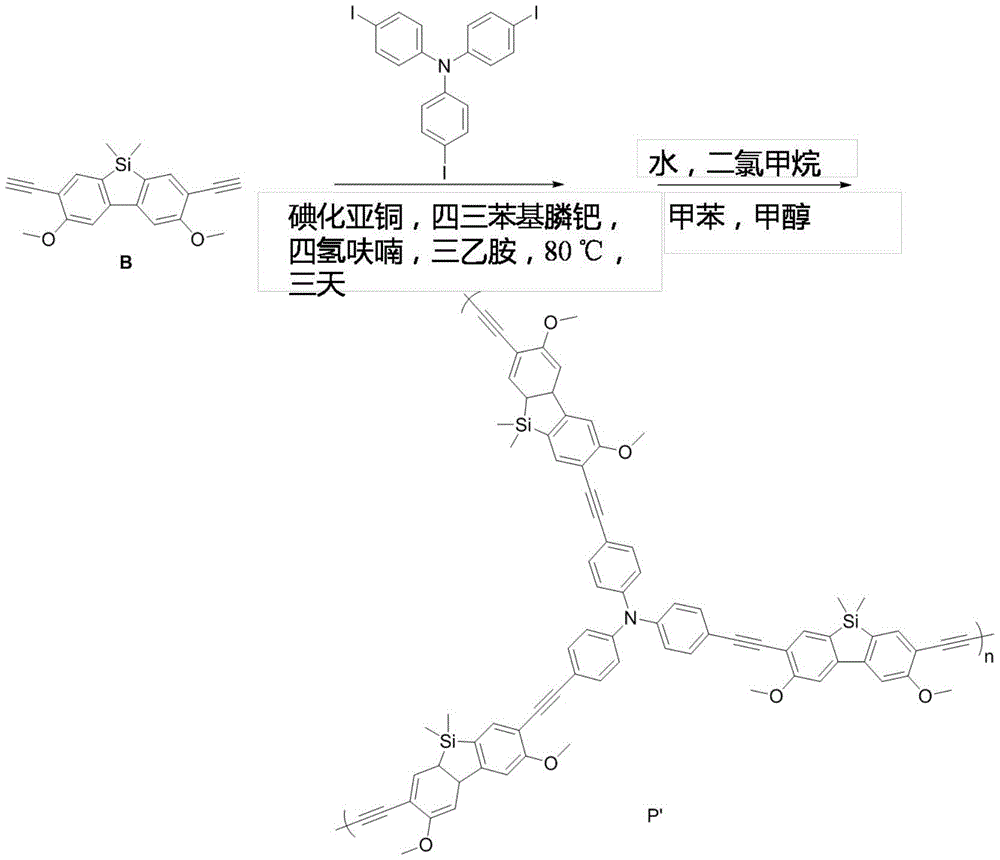
共聚过程:先称取B(50mg,0.11mmol)、碘化亚铜(3mg,0.02mmol)、四三苯基膦钯(34mg,0.03mmol)放入反应装置中(两口瓶,装有回流管,回流管上带三通),搅拌下抽真空置换氩气三次;然后加入三碘苯胺(124mg,0.10mmol)、混合溶剂(四氢呋喃:三乙胺=1:7,10mL)。加热至80℃,反应3天。室温下加入饱和氯化铵水溶液以淬灭,减压旋去反应液,二氯甲烷萃取3次,无水硫酸钠干燥半小时,过滤,减压旋去溶剂,得到淡黄色固体,即粗品产物。Copolymerization process: first take by weighing B (50mg, 0.11mmol), cuprous iodide (3mg, 0.02mmol), tetrakistriphenylphosphine palladium (34mg, 0.03mmol) and put it into the reaction device (two-necked bottle, with a reflux tube) , with a tee on the reflux tube), evacuated argon three times under stirring; then added triiodoaniline (124 mg, 0.10 mmol) and mixed solvent (tetrahydrofuran:triethylamine=1:7, 10 mL). Heated to 80°C and reacted for 3 days. Add saturated aqueous ammonium chloride solution at room temperature to quench, spin off the reaction solution under reduced pressure, extract three times with dichloromethane, dry over anhydrous sodium sulfate for half an hour, filter, spin off the solvent under reduced pressure, and obtain a pale yellow solid, the crude product .
除杂过程:固体依次用水、甲醇淋洗,再通过索氏提取器,用甲醇提取24小时。50℃下真空干燥12小时,得到暗黄色固体50mg,用石英研钵研磨至粉末,得到提纯后的产物化合物P',即硅芴基聚合物。Impurity removal process: the solid was washed with water and methanol in turn, then passed through a Soxhlet extractor and extracted with methanol for 24 hours. It was vacuum-dried at 50° C. for 12 hours to obtain 50 mg of a dark yellow solid, which was ground into powder with a quartz mortar to obtain the purified product compound P′, that is, a silicofluorene-based polymer.
用和实施例2中相同的检测方法,对得到的化合物P'进行荧光检测,发现该聚合物不具有光诱导荧光增强效应的。Using the same detection method as in Example 2, the obtained compound P' was subjected to fluorescence detection, and it was found that the polymer had no light-induced fluorescence enhancement effect.
上述实施方式为本发明的优选案例,并不用来限制本发明的保护范围。The above embodiments are preferred cases of the present invention, and are not intended to limit the protection scope of the present invention.
本发明将硅芴引入共轭多孔的聚合物中,试验过程中曾尝试用不同的硅芴单元来做为单体、尝试用三碘苯胺来代替三碘苯来制备不同基团的共轭聚合物,但发现只有本发明中的3,6-二甲氧基-2,7-二乙炔基-9,9-二甲基硅芴和1,3,5-三碘苯反应才可以得到具有光诱导荧光增强效应的硅芴基共轭多孔聚合物。实验过程中尝试用其他有机溶剂来代替混合溶剂、尝试提高硅芴单元与三碘苯的当量比、尝试不同类型的催化剂及用量来提高共轭聚合物的聚合度,但最终发现只有本发明中所说的实验条件才可以得到本发明的具有光诱导荧光增强效应的硅芴基共轭多孔聚合物。The present invention introduces silicofluorene into the conjugated porous polymer. During the experiment, different silicofluorene units were used as monomers, and triiodoaniline was used to replace triiodobenzene to prepare conjugated polymerization of different groups. However, it is found that only the reaction of 3,6-dimethoxy-2,7-diethynyl-9,9-dimethylsilylfluorene and 1,3,5-triiodobenzene in the present invention can obtain Photo-induced fluorescence enhancement of silicon-fluorene-based conjugated porous polymers. During the experiment, I tried to replace the mixed solvent with other organic solvents, tried to increase the equivalent ratio of silicofluorene units to triiodobenzene, tried different types of catalysts and dosages to improve the degree of polymerization of the conjugated polymer, but finally found that only in the present invention. According to the experimental conditions, the silicon fluorene-based conjugated porous polymer with light-induced fluorescence enhancement effect of the present invention can be obtained.
Claims (8)

Priority Applications (1)
| Application Number | Priority Date | Filing Date | Title |
|---|---|---|---|
| CN202010516666.8A CN113773473B (en) | 2020-06-09 | 2020-06-09 | Silafluorenyl conjugated porous polymer and preparation method thereof |
Applications Claiming Priority (1)
| Application Number | Priority Date | Filing Date | Title |
|---|---|---|---|
| CN202010516666.8A CN113773473B (en) | 2020-06-09 | 2020-06-09 | Silafluorenyl conjugated porous polymer and preparation method thereof |
Publications (2)
| Publication Number | Publication Date |
|---|---|
| CN113773473A CN113773473A (en) | 2021-12-10 |
| CN113773473B true CN113773473B (en) | 2022-06-21 |
Family
ID=78834212
Family Applications (1)
| Application Number | Title | Priority Date | Filing Date |
|---|---|---|---|
| CN202010516666.8A Active CN113773473B (en) | 2020-06-09 | 2020-06-09 | Silafluorenyl conjugated porous polymer and preparation method thereof |
Country Status (1)
| Country | Link |
|---|---|
| CN (1) | CN113773473B (en) |
Citations (13)
| Publication number | Priority date | Publication date | Assignee | Title |
|---|---|---|---|---|
| CN1594314A (en) * | 2004-06-24 | 2005-03-16 | 复旦大学 | Fluorene based water soluble conjugated polymer and process for preparing same |
| CN1654496A (en) * | 2005-01-06 | 2005-08-17 | 复旦大学 | A Novel Polyfluorene Derivative-Polysilfluorene and Its Preparation Method |
| CN101148495A (en) * | 2007-07-02 | 2008-03-26 | 华南理工大学 | Silicon-containing fluorene conjugated polymer and its preparation method and application |
| CN102850528A (en) * | 2012-05-29 | 2013-01-02 | 华南理工大学 | Luminescent polymer containing S,S-dioxo-dibenzothiophene unit, and application thereof |
| CN103459456A (en) * | 2011-03-11 | 2013-12-18 | 可乐丽股份有限公司 | [pi]-electron conjugated block copolymer and photoelectric conversion element |
| JP2013256655A (en) * | 2012-05-16 | 2013-12-26 | Sumitomo Chemical Co Ltd | Polymer compound and light emitting element using the same |
| CN105111414A (en) * | 2015-09-30 | 2015-12-02 | 山西大学 | Conjugated polymer containing fluorene as well as preparation method and application thereof |
| CN105254853A (en) * | 2015-10-16 | 2016-01-20 | 中国科学院长春应用化学研究所 | Water-dispersible hyperbranched conjugated polymer fluorescent nanoparticles as well as preparation method and application thereof |
| CN106432178A (en) * | 2016-08-31 | 2017-02-22 | 南京工业大学 | Nitric oxide probe based on fluorescence 'double response' mechanism and synthesis and application thereof |
| CN106986982A (en) * | 2017-04-12 | 2017-07-28 | 华南理工大学 | The molten conjugated polymer of water alcohol of three keys connection and its application in organic electro-optic device |
| CN107540823A (en) * | 2017-08-30 | 2018-01-05 | 华南理工大学 | One kind is based on S, the strong two-photon absorption conjugated polymer of S dioxydibenze bithiophene units and preparation method and application |
| CN110437425A (en) * | 2019-07-30 | 2019-11-12 | 辽宁大学 | Super-hydrophobic porous organic polymer containing alkyl chain of one kind and its preparation method and application |
| CN111286010A (en) * | 2020-02-06 | 2020-06-16 | 辽宁大学 | Lipophilic super-hydrophobic porous aromatic skeleton material and preparation method and application thereof |
Family Cites Families (5)
| Publication number | Priority date | Publication date | Assignee | Title |
|---|---|---|---|---|
| CN1791656A (en) * | 2003-05-21 | 2006-06-21 | 陶氏环球技术公司 | Blend of viscosity modifier and luminescent compound |
| TWI415920B (en) * | 2005-08-12 | 2013-11-21 | Sumitomo Chemical Co | High molecular weight material and element using such material |
| JP5661982B2 (en) * | 2005-09-14 | 2015-01-28 | 住友化学株式会社 | Polymer compound, light emitting material, and light emitting device |
| WO2007133705A2 (en) * | 2006-05-11 | 2007-11-22 | Northwestern University | Silole-based polymers and semiconductor materials prepared from the same |
| EP3215515A1 (en) * | 2014-11-03 | 2017-09-13 | Life Technologies Corporation | Dibenzosilole monomers and polymers and methods for their preparation and use |
-
2020
- 2020-06-09 CN CN202010516666.8A patent/CN113773473B/en active Active
Patent Citations (13)
| Publication number | Priority date | Publication date | Assignee | Title |
|---|---|---|---|---|
| CN1594314A (en) * | 2004-06-24 | 2005-03-16 | 复旦大学 | Fluorene based water soluble conjugated polymer and process for preparing same |
| CN1654496A (en) * | 2005-01-06 | 2005-08-17 | 复旦大学 | A Novel Polyfluorene Derivative-Polysilfluorene and Its Preparation Method |
| CN101148495A (en) * | 2007-07-02 | 2008-03-26 | 华南理工大学 | Silicon-containing fluorene conjugated polymer and its preparation method and application |
| CN103459456A (en) * | 2011-03-11 | 2013-12-18 | 可乐丽股份有限公司 | [pi]-electron conjugated block copolymer and photoelectric conversion element |
| JP2013256655A (en) * | 2012-05-16 | 2013-12-26 | Sumitomo Chemical Co Ltd | Polymer compound and light emitting element using the same |
| CN102850528A (en) * | 2012-05-29 | 2013-01-02 | 华南理工大学 | Luminescent polymer containing S,S-dioxo-dibenzothiophene unit, and application thereof |
| CN105111414A (en) * | 2015-09-30 | 2015-12-02 | 山西大学 | Conjugated polymer containing fluorene as well as preparation method and application thereof |
| CN105254853A (en) * | 2015-10-16 | 2016-01-20 | 中国科学院长春应用化学研究所 | Water-dispersible hyperbranched conjugated polymer fluorescent nanoparticles as well as preparation method and application thereof |
| CN106432178A (en) * | 2016-08-31 | 2017-02-22 | 南京工业大学 | Nitric oxide probe based on fluorescence 'double response' mechanism and synthesis and application thereof |
| CN106986982A (en) * | 2017-04-12 | 2017-07-28 | 华南理工大学 | The molten conjugated polymer of water alcohol of three keys connection and its application in organic electro-optic device |
| CN107540823A (en) * | 2017-08-30 | 2018-01-05 | 华南理工大学 | One kind is based on S, the strong two-photon absorption conjugated polymer of S dioxydibenze bithiophene units and preparation method and application |
| CN110437425A (en) * | 2019-07-30 | 2019-11-12 | 辽宁大学 | Super-hydrophobic porous organic polymer containing alkyl chain of one kind and its preparation method and application |
| CN111286010A (en) * | 2020-02-06 | 2020-06-16 | 辽宁大学 | Lipophilic super-hydrophobic porous aromatic skeleton material and preparation method and application thereof |
Non-Patent Citations (3)
| Title |
|---|
| Synthesis and photophysical properties of poly(aryleneethynylene)s containing dibenzosilole unit;Qiang Yang;《Chinese Chemical Letters》;20121023;全文 * |
| Zirconium‑Mediated Synthesis of Multi‑substituted Dibenzosilole and Benzonaphthosilole Derivatives;Hongmei Qu;《Transactions of Tianjin University》;20180516;全文 * |
| 硅芴类化合物的合成及应用研究进展;李彦敏;《化学通报》;20160618;第79卷(第6期);全文 * |
Also Published As
| Publication number | Publication date |
|---|---|
| CN113773473A (en) | 2021-12-10 |
Similar Documents
| Publication | Publication Date | Title |
|---|---|---|
| CN113105349B (en) | Luminescent compound with aggregation induction and supermolecule polymerization fluorescent nano material and preparation method thereof | |
| Gao et al. | Stoichiometric imbalance-promoted synthesis of polymers containing highly substituted naphthalenes: rhodium-catalyzed oxidative polycoupling of arylboronic acids and internal diynes | |
| CN112341652B (en) | Chiral azobenzene polymer film and its preparation method and application | |
| CN107254027B (en) | Amphiphilic block polymer and preparation method thereof, block polymer vesicle, preparation method and application thereof | |
| JP7240187B2 (en) | Xanthene compound, coloring composition containing said compound, colorant for color filter and color filter | |
| CN113105487A (en) | Seven-element boron fluoride fluorescent dye and application thereof in fluorescent anti-counterfeiting film | |
| CN110204693B (en) | Macromolecule covalent organic framework polymer based on triphenylamine derivative and preparation method and application | |
| CN105713184A (en) | Fluorescent sensing polymer material for detecting nitryl explosives and preparation method | |
| WO2022109959A1 (en) | Chiral azobenzene polymer crosslinked thin film and preparation method therefor and application thereof | |
| CN111875811A (en) | Supermolecule polymer and preparation method and application thereof | |
| CN109627464B (en) | A kind of fluorescent probe polymer hydrogel and preparation method thereof | |
| CN112409616B (en) | Chiral azobenzene polymer cross-linked film and its preparation method and application | |
| CN102295743A (en) | Fluorescent conjugated polymer containing polyhedral oligomeric silsesquioxane (POSS), its preparation method and application | |
| CN103881073B (en) | Preparation method of fluorescent polymer capable of realizing fluorescence enhancement by using self-assembly | |
| CN113278155A (en) | Near-infrared organic supramolecular assembly and preparation method and application thereof | |
| CN113773473B (en) | Silafluorenyl conjugated porous polymer and preparation method thereof | |
| CN115010833B (en) | A Fluorescent Polymer Responsive to Acid-base Stimuli and Its Application in Optical Encryption | |
| CN108558701A (en) | A kind of small molecule AIEE luminescent materials and preparation method thereof with triple stimulating responsives | |
| CN109485868B (en) | 1,3,6,8-Tetrakis(ethynyl)pyrene-based polymers and methods for their preparation | |
| CN110818614B (en) | A nitrogen-oxygen stable free radical with aggregation-induced luminescent function and preparation method thereof | |
| CN109678993B (en) | Internal standard ratio type nano fluorescent probe for reversible hypoxic-normoxic cycle detection, preparation method and application thereof | |
| CN107987085A (en) | Water-soluble copper porphyrin containing nitro and its water-soluble Schiff copper porphyrin complex, its synthetic method and application | |
| CN103936982B (en) | A kind of backbone chain type azobenzene polymer and preparation method thereof | |
| Akram et al. | Morphological effect of fabricated surfaces obtained from fluorinated porphyrin based copolymer for oxygen and pressure sensing applications | |
| CN115677864B (en) | Cellulose coumarin fluorescent probe for detecting cyanide ions and preparation method and application thereof |
Legal Events
| Date | Code | Title | Description |
|---|---|---|---|
| PB01 | Publication | ||
| PB01 | Publication | ||
| SE01 | Entry into force of request for substantive examination | ||
| SE01 | Entry into force of request for substantive examination | ||
| GR01 | Patent grant | ||
| GR01 | Patent grant |