Detailed Description
To make the objects, technical solutions and advantages of the embodiments of the present application clearer, the embodiments of the present application will be described in detail below with reference to the accompanying drawings. However, it will be appreciated by those of ordinary skill in the art that in the examples of the present application, numerous technical details are set forth in order to provide a better understanding of the present application. However, the technical solution claimed in the present application can be implemented without these technical details and various changes and modifications based on the following embodiments. The following embodiments are divided for convenience of description, and should not constitute any limitation to the specific implementation manner of the present application, and the embodiments may be mutually incorporated and referred to without contradiction.
A first embodiment of the present application relates to a method for allocating network slices, which is applied to a terminal, for example: cell phones, etc.
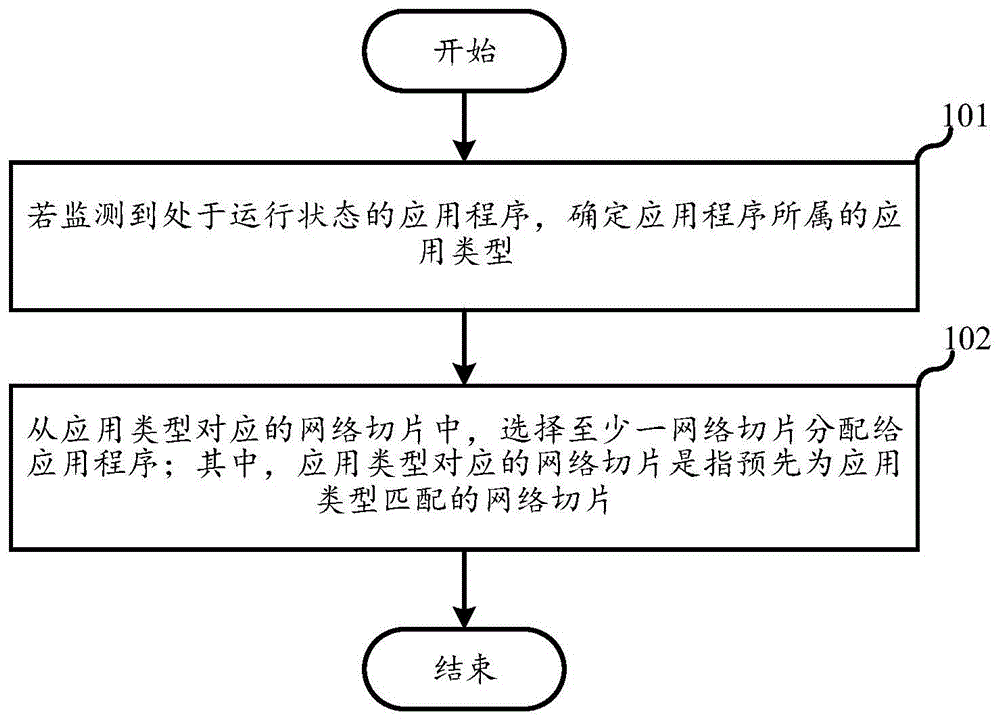
The specific flow of the network slice allocation method of this embodiment is shown in fig. 1, and includes:
step 101, if the application program in the running state is monitored, determining the application type of the application program.
102, selecting at least one network slice from the network slices corresponding to the application types to distribute to the application programs; the network slice corresponding to the application type refers to a network slice matched with the application type in advance.
Specifically, the terminal classifies each application program according to the main service type of the application program to obtain each application type, and the application types include, but are not limited to, the following types: in the video type, the communication type, the payment type, and the like, since the application types of the application programs are different and the requirements for the network performance of the network slice are different, the terminal may match the network slice for each application type in advance according to the requirements of the application programs in the application types, and store the corresponding relationship between the application types and the network slices, so that the network slice matched for the application types in advance can be known by querying the corresponding relationship, and the corresponding relationship between the application types and the network slices may be stored in the form of a table and the like, which is not specifically limited in this embodiment.
The terminal may monitor each application program in real time, or may monitor each application program according to a preset period, where the preset period may be set according to actual needs, and this embodiment is not particularly limited. If the terminal monitors that the application program is in the running state, the application type of the application program in the running state is determined, then the network slice corresponding to the application program can be determined by inquiring the corresponding relation between the application type and the network slice, and at least one network slice is selected from the network slices and allocated to the application program. For example: if the terminal monitors an application program A and an application program B which are in a running state, the application type of the application program A is a video service, the application type of the application program B is a communication service, network slices corresponding to the video service are a network slice 1, a network slice 2 and a network slice 3, and network slices corresponding to the communication service are a network slice 4 and a network slice 5, at least one network slice is selected from the network slice 1, the network slice 2 and the network slice 3 and allocated to the application program A, and at least one network slice is selected from the network slice 4 and the network slice 5 and allocated to the application program B.
In one example, a specific flowchart of allocating network slices to application types in advance is shown in fig. 2, and includes:
step 1021, a plurality of network slices are obtained through the built-in first non-data card, and the network slices are activated.
Specifically, a terminal manufacturer subscribes a network sliced service to a network operator in advance, and when the terminal wants to use the network sliced service provided by the network, the terminal needs to register in the network through a non-data card, which is specifically as follows: the terminal sends a Registration Request message to the Network side through the non-data card, and the Registration Request message carries Request-NSSAI (Request Network Slice Selection Assistance Information), after receiving the Registration Request message, the Network side queries subscription Information of a terminal manufacturer, verifies which NSSAI (Network Slice Selection Assistance Information) in the Request-NSSAI are Allowed according to the Subscript S-NSSAIs (Subscribe Single Network Slice Selection Assistance Information, subscription S-NSSAI) contained in the subscription message, and determines the Allowed NSSAI (Network Slice Selection Assistance Information ) used by the terminal according to the Allowed NSSAI in the Registration receiving message, and the terminal determines the Allowed NSSAI used by the non-data card according to the Allowed NSSAI; wherein NSSAI is a set of S-NSSAIs (Single Network Slice Selection Assistance Information), and one S-NSSAI identifies one Network Slice. In this embodiment, a first non-data card built in a terminal is registered in a network, so that a network slice that the network allows the first non-data card of the terminal to use can be determined according to Allowed NSSAI, that is, a plurality of network slices are obtained through the first non-data card, and network slices carry DNN parameters, and a network slice establishes data connection in advance according to the DNN parameters, so that the network slice is in an activated state, and when an application needs to use the network slice, the data connection can be established without initiating data connection.
And step 1022, classifying the applications according to the main service types of the applications.
And 1023, matching the plurality of network slices with each application type according to the requirement of each application type on the network performance of the network slices.
In one example, the terminal classifies the applications according to the main service types of the applications to obtain the application types, where the application types include, but are not limited to, the following: video class, communication class, payment class, etc., such as: the application program A can execute the service a and also can execute the service b, wherein the service a is a video service, the service b is a communication service, but the service a is the main service of the application program A, so the application type of the application program A is a video type. Because the application types of the application programs are different and the requirements for the network performance of the network slices are different, the terminal can match a plurality of network slices with each application type according to the requirements of the application programs in the application types and store the corresponding relation between the application types and the plurality of network slices. For example: and if the requirement of the video application program is high bandwidth, matching the video application program with the network slice 1, the network slice 2 and the network slice 3 with high-rate service quality, and if the requirement of the communication application program is low bandwidth, matching the communication application program with the network slice 4 and the network slice 5 with low-rate service quality, and storing the corresponding relation between the video application program and the network slices 1, 2 and 3 and the corresponding relation between the communication application program and the network slices 4 and 5. In another example, the terminal may classify the application programs according to the application types preset by the user and the requirements of the application types on the application programs, match a plurality of network slices with each application type in advance according to the requirements of the application programs in the application types on the network performance of the network slices, and store the corresponding relationship between the application types and the network slices.
The terminal activates the network slice in advance to enable the network slices matched with the application types to be in an activated state, and when the application program needs to use the network slice, data connection can be established without initiating data connection.
In one example, selecting at least one network slice from the network slices corresponding to the application types to be allocated to the application program includes: if the application program is in a foreground running state, selecting L network slices with higher network performance from K network slices corresponding to the application type, and distributing the L network slices to the application program; or if the application program is in a background running state and other application programs in running states which belong to the same application type as the application program are not monitored, selecting L network slices with higher network performance from K network slices corresponding to the application type, and allocating the L network slices to the application program; l, K are integers greater than zero, and L is less than or equal to K.
Specifically, the network performance refers to the service quality of the network slice, such as: high-rate service quality, medium-rate service quality, low-latency high-reliability service quality, and the like, wherein a network slice of high-rate service quality, a network slice of low-latency high-reliability service quality, and the like can be considered to belong to a network slice with higher network performance. For example: the number of the network slices corresponding to the application types is 3, and the network slices are respectively the network slices with high-rate service quality, medium-rate service quality, low time delay and high reliable service quality; if the application program A is in a foreground running state, 2 network slices with higher network performance can be selected from the 3 network slices, namely, the network slices with high-speed service quality, low time delay and high reliable service quality are distributed to the application program A. If the application program A is in a background running state and other application programs in running states which belong to the same application type as the application program are not monitored, 2 network slices with higher network performance can be selected from the 3 network slices, namely, the network slices with high-speed service quality, low-delay and high-reliability service quality are distributed to the application program A. When the application program is in a foreground running state, and the application program is in a background running state and other application programs in running states which belong to the same application type as the application program are not monitored, the application program can be randomly selected from the network slices corresponding to the application type, and the network slices with higher network performance are selected to be distributed to the application program, so that the application program can be better run.
If the application program is switched from a foreground running state to a background running state and other application programs which belong to the same application type and are in the running state with the application program are not monitored, selecting L network slices with higher network performance from K network slices corresponding to the application type, and distributing the L network slices to the application program; and if the application program is switched from the background running state to the foreground running state, selecting L network slices with higher network performance from the K network slices corresponding to the application type, and distributing the L network slices to the application program.
In one example, if the application is in a foreground running state, any L network slices are selected from K network slices corresponding to the application type and allocated to the application, where L is less than or equal to K. If the application program is in a background running state and other application programs which belong to the same application type and are in a running state with the application program are not monitored, any L network slices are selected from K network slices corresponding to the application type and are distributed to the application program, and L is smaller than or equal to K.
In one example, if the application program is in a foreground running state and other application programs in the background running state are monitored, which belong to the same application type as the application program, L network slices with higher network performance are selected from K network slices corresponding to the application type, and the L network slices are allocated to the application program, wherein L is smaller than K. Specifically, the application program in the foreground running state selects a part of network slices with increased network performance from the network slices corresponding to the application types, and other application programs in the background running state can use the rest network slices. By the method, the network slices can be more reasonably distributed, so that other application programs which belong to the same application type and are in a background running state can also have the available network slices.
In one example, if the application program is in a foreground running state and other application programs in the background running state are monitored, wherein the other application programs belong to the same application type as the application program, L network slices are selected from K network slices corresponding to the application type and are allocated to the application program, wherein L is smaller than K. Specifically, the application program in the foreground running state selects a part of the network slices from the network slices corresponding to the application types, and other application programs in the background running state can use the rest of the network slices. By the method, the network slices can be more reasonably distributed, so that other application programs which belong to the same application type and are in a background running state can also have the available network slices.
In one example, after the application program is in a foreground running state and other application programs in a background running state are monitored, which belong to the same application type as the application program, and L network slices with higher network performance are selected from K network slices corresponding to the application type and are allocated to the application program, the method further includes: at least one network slice is selected from the remaining (K-L) network slices to be allocated to other applications. By the method, at least one network slice is selected from the rest network slices and distributed to other application programs in the background running state, so that the other application programs in the background running state have available network slices.
In one example, selecting at least one network slice from the remaining (K-L) network slices to allocate to other applications includes: if a plurality of other applications exist, selecting at least one network slice from the remaining (K-L) network slices to be distributed to the other applications according to the priorities of the other applications and the network performances of the remaining (K-L) network slices; wherein the higher the priority of other applications, the higher the network performance of the assigned network slice.
Specifically, the terminal stores the correspondence between the application program and the priority in each application type in advance, the priority of the application program can be known by querying the correspondence, and the higher the priority of the application program is, the higher the requirement of the application program on the network performance of the network slice is. The terminal can select at least one network slice from the remaining (K-L) network slices to be allocated to other applications according to the priorities of the applications in the background running state, and the higher the priorities of the other applications are, the higher the network performance of the allocated network slice is. When the number of the network slices of other applications in the background running state is greater than (K-L), the same network slice can be allocated to the application with lower priority. For example: if the number of other applications in the background running state is 3, B, C, D respectively, and the priority is B > C > D, if the number of remaining network slices is 3, and network slices 1 and 2 are network slices of medium rate quality of service, and network slice 3 is a network slice of low rate quality of service, then network slice 1 and network slice 2 are allocated to applications B and C, and network slice 3 is allocated to application D, and if the number of remaining network slices is 2, and network slices 1 and 2 are network slices of medium rate quality of service and network slices of low rate quality of service, respectively, then network slice 1 is allocated to application B, and network slice 2 is allocated to applications C and D. Because the priorities of the application programs are different and the requirements for the network performance of the network slices are also different, the distribution of the rest network slices can be carried out more reasonably according to the priorities of the application programs.
In one example, if the application program is in a background running state and other application programs in a running state are not monitored, wherein the other application programs belong to the same application type as the application program, any L network slices are selected from K network slices corresponding to the application type and allocated to the application program, and L is less than or equal to K.
In one example, if the application program is in a background running state and other application programs in the background running state are monitored, which belong to the same application type as the application program, at least one network slice is selected from K network slices corresponding to the application type and is allocated to each application program in the background running state.
In one example, if the application program is in a background running state and other application programs in a running background state are monitored, which belong to the same application type as the application program, at least one network slice is selected from the K network slices corresponding to the application type and is allocated to each application program in the background running state according to the priority of each application program in the background running state and the network performance of the network slice corresponding to the application type.
In this embodiment, if an application program in a running state is monitored, determining an application type to which the application program belongs; selecting at least one network slice from the network slices corresponding to the application types to be distributed to the application programs; the network slice corresponding to the application type refers to a network slice allocated to the application type in advance. The application types of the application programs are different, and the network performance requirements on the network slices are different, so the network slices allocated to the application types in advance are the network slices meeting the requirements of the application programs, if the application programs in the running state are monitored, the application types of the application programs are determined, and then at least one network slice is selected from the network slices corresponding to the application types and allocated to the application programs, so that the network slices allocated to the application programs are the network slices meeting the requirements of the application programs, namely the network slices are allocated according to the requirements of the application programs.
A second embodiment of the present application relates to a method for allocating network slices, and is substantially the same as the first embodiment, and mainly differs in that: after selecting at least one network slice to allocate to the application, the method further comprises: if the network performance requirement of the application program on the network slice is monitored to be changed, the reason for changing the network performance requirement is determined, and the network slice distributed to the application program is adjusted according to the reason.
A specific flowchart of the network slice allocation method of this embodiment is shown in fig. 3, and includes:
step 201, if the application program in the running state is monitored, determining the application type of the application program.
Step 202, selecting at least one network slice from the network slices corresponding to the application types to be allocated to the application program; the network slice corresponding to the application type refers to a network slice matched with the application type in advance.
Wherein, the steps 201-202 are similar to the steps 101-102 in the first embodiment, and are not described herein again.
Step 203, if it is monitored that the requirement of the application program on the network performance of the network slice changes, determining the reason for changing the requirement of the network performance, and adjusting the network slice allocated to the application program according to the reason.
Specifically, the application program may change during the running process, such as: the method comprises the steps of determining the reason for changing the network performance requirement of an application program when the change of the network performance requirement of the application program on a network slice is detected, and adjusting the network slice distributed to the network program according to the reason. By the method, the network slice distributed to the application program can be adjusted according to the reason of the change of the network performance requirement of the application program on the network slice, so that the distribution is more reasonable.
In one example, adjusting the network slices allocated to an application based on a cause includes: if the reason is that the application type of the current service of the application program is changed, selecting at least one network slice from the network slices corresponding to the changed application type to distribute to the application program; if the reason is that the number of socket requests and/or the number of downloading threads of the application program are reduced, reducing the network slices allocated to the application program; if the reason is that the application is frozen, the network slice assigned to the application is cancelled.
In particular, the application may be capable of performing a plurality of services, and the terminal may determine the current service of the application by monitoring the data protocol used by the application, for example: if the data protocol used by the application program is UDP/RTP/RTSP, determining that the current service of the application program is video service, if the data protocol used by the application program is SSL, determining that the current service of the application program is payment service, and if the data protocol used by the application program is Http, determining that the current service of the application program is communication service. If the application type to which the current service of the application program belongs changes, it is described that the requirement of the application program for the network slice changes, at least one network slice is selected from the network slices corresponding to the changed application type to be allocated to the application program, and the specific process of allocating the selected at least one network slice to the application program is similar to step 102 in the first embodiment, and is not described herein again. If the number of socket requests and/or the number of download threads of the application decreases, which indicates that the requirement of the application for the network slice decreases at this time, the network slice allocated to the application is decreased. For example: if the number of socket requests and/or the number of download threads are kept single all the time, and the number of network slices already allocated to the application a is network slice 1 and network slice 2, network slice 1 is a network slice with high-rate quality of service, and network slice 2 is a network slice with medium-rate quality of service, the number of network slices allocated to the application is reduced, and only one network slice 1 with higher network performance is left to the application a. If the application is frozen, meaning that the application does not need to perform data transfers, the network slice that has been assigned to the application is cancelled.
In this embodiment, the terminal may adjust the network slice allocated to the application program according to the reason for the change in the demand of the application program, so that the allocation is more reasonable.
A third embodiment of the present application relates to a method for allocating network slices, and is substantially the same as the first embodiment, and the main differences are that: after selecting at least one network slice to allocate to the application, the method further comprises: if the monitored electric quantity of the battery is smaller than a preset value, the network slice distributed to the application program can be adjusted.
A specific flowchart of the network slice allocation method of this embodiment is shown in fig. 4, and includes:
step 301, if the application program in the running state is monitored, determining the application type of the application program.
Step 302, selecting at least one network slice from the network slices corresponding to the application types to be distributed to the application programs; the network slice corresponding to the application type refers to a network slice matched with the application type in advance.
Wherein, the steps 301-302 are similar to the steps 101-102 in the first embodiment, and are not described herein again.
And 303, if the monitored electric quantity of the battery is less than a preset value, reducing the network slices allocated to the application program in the foreground running state, and/or enabling all the application programs in the background running state to use one network slice when the number of the network slices allocated to the application programs in the background running state is more than 1, and cancelling the network slices allocated to the application programs in the background running state when the number of the network slices allocated to the application programs in the background running state is equal to 1.
Specifically, the preset value may be set according to actual needs, and this embodiment is not particularly limited. When the power of the battery is detected to be less than the preset value, which indicates that the power of the battery is too low at this time, the terminal can reduce the network slices allocated to the application program in the foreground running state, but at least one network slice needs to be reserved for the application program in the foreground running state to use, and/or when the number of the network slices allocated to the application program in the background running state is more than 1, all the application programs in the background running state use one network slice.
When the power of the battery is detected to be smaller than a preset value, the terminal can reduce the network slices allocated to the application program in the foreground running state, but at least one network slice needs to be reserved for the application program in the foreground running state to use, and/or cancel the network slices allocated to the application program in the background running state when the number of the network slices allocated to the application program in the background running state is equal to 1.
In one example, if the monitored power of the battery is less than the preset value, the network slices allocated to the application program in the foreground running state are reduced, and/or when the number of the network slices allocated to the application program in the background running state is more than 1, the network slices allocated to the application program in the background running state are cancelled.
In one example, after selecting at least one network slice to allocate to the application, the method further comprises: if the change of the network performance requirement of the application program on the network slice is monitored, the reason for changing the network performance requirement is determined, and the network slice distributed to the application program is adjusted according to the reason.
In this embodiment, the terminal may adjust the distribution of the network slices according to the electric quantity of the battery, thereby saving the electric quantity consumption of the battery.
A fourth embodiment of the present application relates to a method for allocating network slices, and is substantially the same as the first embodiment, and mainly differs in that: the network slice matched with each application type is a network slice acquired by a built-in first non-data card, and after at least one network slice is selected and allocated to the application program, the method further comprises the following steps: if the quality index value of the network slice which the network allows the first non-data card to use is monitored to be smaller than the preset index value, determining the network slice which the network allows the second non-data card to use; and if the network slice allowed to be used by the second non-data card meets the requirements of each application type on the network slice, resetting the network slice corresponding to each application type.
A specific flowchart of the network slice allocation method of this embodiment is shown in fig. 5, and includes:
step 401, if the application program in the running state is monitored, determining the application type of the application program.
Step 402, selecting at least one network slice from the network slices corresponding to the application types to be distributed to the application programs; the network slice corresponding to the application type refers to a network slice matched with the application type in advance.
Wherein, steps 401-502 are similar to steps 101-102 in the first embodiment, and are not described herein again.
And step 403, if it is monitored that the network performance index value of the network slice acquired through the first non-data card is smaller than a preset index value, acquiring the network slice through a built-in second non-data card.
Specifically, the preset index value may be set according to actual needs, and the embodiment is not particularly limited. The method includes that at least two non-data cards exist in a terminal, network slices matched to various application types are network slices acquired through a built-in first non-data card, if the terminal monitors that a network performance index value of the network slice acquired by the first non-data card is smaller than a preset index value, it is indicated that the network slice at the moment cannot meet the network performance requirement of an application program on the network slice, the terminal registers in a network through a second non-data card, so that the network slice which is allowed to be used by the second non-data card through the network is determined, namely the network slice is acquired through the second non-data card, and the specific method for determining the network slice which is allowed to be used by the second non-data card through the network is similar to the step 1021 in the first embodiment, and is not repeated here.
And step 404, if the network slice acquired by the second non-data card can meet the service requirement of each application type, re-matching the network slice for each application type according to the network slice acquired by the second non-data card.
Specifically, after the network slice is obtained by the second non-data card, if the network slice obtained by the second non-data card can meet the service requirement of each application type, the network slice is matched for each application type again according to the network slice obtained by the second non-data card, that is, the network slice obtained by the second non-data card is matched for each application type in advance, and the specific method for matching the network slice obtained by the second non-data card for each application type in advance is similar to steps 1022 and 1023 in the first embodiment, and is not described herein again.
In one example, after selecting at least one network slice to allocate to the application, the method further comprises: if the network performance requirement of the application program on the network slice is monitored to be changed, the reason for changing the network performance requirement is determined, and the network slice distributed to the application program is adjusted according to the reason.
In one example, after selecting at least one network slice to allocate to the application, the method further comprises: if the monitored electric quantity of the battery is smaller than a preset value, reducing the network slices allocated to the application programs in the foreground running state, and/or enabling all the application programs in the background running state to use one network slice when the number of the network slices allocated to the application programs in the background running state is larger than 1, and canceling the network slices allocated to the application programs in the background running state when the number of the network slices allocated to the application programs in the background running state is equal to 1.
In one example, after selecting at least one network slice to allocate to the application, the method further comprises: if the network performance requirement of the application program on the network slice is monitored to be changed, determining the reason for changing the network performance requirement, and adjusting the network slice distributed to the application program according to the reason; and if the monitored electric quantity of the battery is smaller than a preset value, reducing the network slices allocated to the application programs in the foreground running state, and/or enabling all the application programs in the background running state to use one network slice when the number of the network slices allocated to the application programs in the background running state is larger than 1, and canceling the network slices allocated to the application programs in the background running state when the number of the network slices allocated to the application programs in the background running state is equal to 1.
In this embodiment, the terminal may satisfy the requirement of the application program for the network slice by switching the non-data card.
A fifth embodiment of the present application relates to a terminal, as shown in fig. 6, including: at least one processor 501; and a memory 502 communicatively coupled to the at least one processor 501; the memory 502 stores instructions executable by the at least one processor 501, and the instructions are executed by the at least one processor 501 to enable the at least one processor 501 to perform the network slice allocation method described above.
Where the memory and processor are connected by a bus, the bus may comprise any number of interconnected buses and bridges, the buses connecting together one or more of the various circuits of the processor and the memory. The bus may also connect various other circuits such as peripherals, voltage regulators, power management circuits, and the like, which are well known in the art, and therefore, will not be described any further herein. A bus interface provides an interface between the bus and the transceiver. The transceiver may be one element or a plurality of elements, such as a plurality of receivers and transmitters, providing a means for communicating with various other apparatus over a transmission medium. The data processed by the processor is transmitted over a wireless medium via an antenna, which further receives the data and transmits the data to the processor.
The processor is responsible for managing the bus and general processing and may also provide various functions including timing, peripheral interfaces, voltage regulation, power management, and other control functions. And the memory may be used to store data used by the processor in performing operations.
A sixth embodiment of the present application relates to a computer-readable storage medium storing a computer program. The computer program realizes the above-described method embodiments when executed by a processor.
That is, as can be understood by those skilled in the art, all or part of the steps in the method for implementing the embodiments described above may be implemented by a program instructing related hardware, where the program is stored in a storage medium and includes several instructions to enable a device (which may be a single chip, a chip, or the like) or a processor (processor) to execute all or part of the steps of the method described in the embodiments of the present application. And the aforementioned storage medium includes: a U-disk, a removable hard disk, a Read-only Memory (ROM), a Random Access Memory (RAM), a magnetic disk or an optical disk, and other various media capable of storing program codes.
It will be understood by those of ordinary skill in the art that the foregoing embodiments are specific examples for carrying out the present application, and that various changes in form and details may be made therein without departing from the spirit and scope of the present application in practice.