Disclosure of Invention
In order to solve the problems, the invention provides a mild, simple and effective natural collagen N-terminal precise grafting modification method, which adopts a strategy of 'full amino protection → enzyme digestion terminal peptide → N-terminal precise grafting → deprotection', adopts natural collagen with a terminal peptide structure as a raw material, firstly protects all active amino groups on the surface of the collagen by an amino protection reagent, then removes the terminal peptide structure of the collagen by an enzymatic hydrolysis method, re-forms active alpha-amino at the N-terminal of the collagen, can realize precise grafting modification of the collagen N-terminal amino group (the side chain amino group is protected by a protecting group) through an amidation reaction, and finally removes the protecting group of the collagen side chain amino group to obtain the N-terminal precise grafting modified collagen. The modified collagen obtained by the method not only has the performance of grafting molecules, but also does not influence the inherent performance of the collagen because the side chain functional group is not influenced.
The invention adopts the following technical scheme:
an N-terminal precise grafting modification method of natural collagen comprises the following steps:
1) dissolving natural collagen by using an acetic acid water solution at a low temperature to obtain a collagen solution with the collagen concentration of 1-10 mg/mL;
2) dialyzing the collagen solution obtained in the step 1 in Phosphate Buffer Solution (PBS) with the pH value of 8.0-10.0 for 12-48 h, and removing acetic acid molecules;
3) dropwise adding an amino protective reagent into the solution obtained in the step 2, shaking up, and reacting at a low temperature for 12-48 h;
4) dialyzing the solution obtained in the step 3 to remove the unreacted amino protection reagent to obtain modified collagen with side chain protection;
5) adding protease into the side chain protection modified collagen solution obtained in the step 4, and removing a collagen terminal peptide structure under a low-temperature condition to form modified collagen with terminal amino/side chain protection;
6) dialyzing and purifying the solution obtained in the step 5 to obtain modified collagen with terminal amino/side chain protection;
7) adding a grafting modification reagent into the solution obtained in the step 6 through an amidation reaction, shaking up, and reacting at a low temperature for 12-48 h;
8) and (4) dialyzing the solution obtained in the step (7) by using an acid solution and pure water in sequence, and freeze-drying for later use.
Further, in the step 1), the natural collagen is natural type I collagen with an intact triple-helix molecular structure and a telopeptide structure, which is extracted, separated and purified from skin and achilles tendon tissues of mammals, fishes and amphibians. The low temperature condition is that the dissolution temperature is less than 20 ℃ (the high temperature can cause collagen denaturation).
Further, in the step 2), the collagen solution obtained in the step 1 is placed in a dialysis bag with the cut-off molecular weight of 12000-15000 daltons, a phosphate buffer solution with the pH of 8.0-10.0 is used as a dialysate, and the dialysis is carried out for 12-48 h at the temperature lower than 20 ℃ until the pH of the dialysate is not reduced any more, and the dialysate is replaced every 3-4 h;
further, in the step 3), the amino protecting reagent is a commonly used protecting reagent capable of reacting with an amino group, including but not limited to: 2, 3-dimethylmaleic anhydride, succinic anhydride, tert-butyloxycarbonyl (Boc). (if the water solubility of the reagent is not enough, a proper amount of organic solvent such as ethanol, acetone, dimethyl sulfoxide, 1, 4-dioxane, N-dimethylformamide and the like can be added as a cosolvent), the mass ratio of the amino protective reagent to the collagen is (0.5-2): 1, and the low-temperature condition is that the dissolving temperature is less than 20 ℃.
Further, in the step 4), a dialysis bag with the cut-off molecular weight of 12000-15000 daltons is adopted in the dialysis operation, PBS with the pH value of 7.0-10.0 is used as dialysate, the dialysis is carried out for 12-48 h at the temperature lower than 20 ℃, and the dialysate is replaced every 3-4 h.
Further, in the step 5), the protease is an enzyme that can be used for removing collagen telopeptide without affecting the triple helix structure of collagen, and includes but is not limited to: pepsin, trypsin, cathepsin, papain, subtilisin and a complex enzyme, wherein the concentration of the enzyme is 10-50 Unit/g, the low-temperature condition is that the temperature is less than 20 ℃, and a proper pH condition is selected according to the used enzyme;
further, in the step 6), a dialysis bag with the cut-off molecular weight of 12000-15000 daltons is adopted in the dialysis operation, PBS with the pH value of 7.0-10.0 is used as dialysate, the dialysis is carried out for 12-48 h at the temperature lower than 20 ℃, and the dialysate is replaced every 3-4 h.
Further, in the step 7), the graft modification reagent is a chemical reagent capable of undergoing amidation reaction with an amino group, and includes but is not limited to: a compound having a carboxyl group or an activated carboxyl group at a terminal (fatty acid, N-hydroxysuccinimide acrylate);
further, in the step 8), a dialysis bag with the cut-off molecular weight of 12000-15000 daltons is adopted in the dialysis operation, 0.5mol/L acetic acid solution is used for dialysis for 12-48 h at the temperature lower than 20 ℃, the dialysate is replaced every 3-4 h, and then pure water is used as the dialysate for dialysis for 12-48 h, and the dialysate is replaced every 3-4 h.
The invention has the beneficial effects that:
the invention adopts a novel strategy of 'full amino protection → enzyme digestion terminal peptide → N-terminal accurate grafting → deprotection', takes natural collagen with a terminal peptide structure as a raw material, firstly adopts a protection group to protect all active amino groups on the surface of the collagen, and then adopts an enzyme hydrolysis method to remove the terminal peptide structure of the collagen, and obtains active alpha-amino groups again at the N-terminal of the collagen, and can realize accurate grafting modification of the N-terminal amino groups of the collagen (the side chain amino groups are protected by the protection groups) through amidation reaction, and finally, the protection groups of the side chain amino groups of the collagen are removed, so that the N-terminal accurate grafting modified collagen can be obtained. The method realizes the precise grafting modification of the N-terminal amino group of the natural collagen, provides technical support for further functionalization of the collagen, and expands the application field of the modified collagen.
The modified collagen obtained by the method not only has the performance of N-end grafted molecules, but also cannot influence the inherent performance of the collagen because the side chain functional group is not occupied. The method can realize the diversification of the molecular structure of the collagen N-terminal amino grafting, and the obtained product has wide application in the field of biomedical materials.
Detailed Description
The present invention is further illustrated by the following specific examples, comparative examples, but it should be understood that these examples are for illustrative purposes only and are not to be construed as limiting the invention in any way.
Example 1
The method for precisely grafting and modifying the N end of the grass carp skin collagen comprises the following steps:
(1) weighing 200mg of grass carp skin collagen sponge sample, and dissolving with 0.5mol/L acetic acid to prepare 100mL of sample with concentration of 2 mg/mL;
(2) placing the prepared collagen in a dialysis bag with the molecular weight of 14000 daltons, dialyzing for 24 hours at 4 ℃ by using a phosphoric acid buffer solution with the pH value of 9.0, and replacing the dialysate every 4 hours to obtain a dialyzed natural grass carp skin collagen solution;
(3) weighing 330mg of 2, 3-dimethylmaleic anhydride, dissolving in 1.2mL of dimethyl sulfoxide, adding into a natural grass carp skin collagen solution for 4 times, and stirring at 4 ℃ for reaction for 24 hours;
(4) after the reaction is finished, transferring the system into a dialysis bag with the molecular weight of 14000 daltons, dialyzing for 24 hours at 4 ℃ by using a phosphoric acid buffer solution with the pH of 8.5, replacing the dialysate every 4 hours, and obtaining a collagen solution protected by 2, 3-dimethylmaleic anhydride after the dialysis is finished;
(5) adding pig pepsin (20 Unit/g) into the system, reacting at 10 deg.C for 12h, hydrolyzing to remove terminal peptide structure to obtain terminal amino group, dialyzing with phosphate buffer solution of pH8.5 at 4 deg.C for 24h, and replacing dialysate every 4 h.
(6) Adding an autonomously synthesized free radical initiator after dialysis, stirring and reacting at 4 ℃ for 24h, dialyzing at 4 ℃ for 24h by using a phosphoric acid buffer solution with pH of 8.5, and replacing dialysate every 4 h;
(7) after the dialysis, 100mg of N-isopropylacrylamide, 189.42mg of cuprous bromide and 0.37mL of 1,1,4,7,10, 10-hexamethyltriethylenetetramine are added and reacted for 24h at 20 ℃ under the protection of nitrogen, so as to obtain the modified collagen of the N-terminal grafted poly (isopropylacrylamide). After the reaction is finished, transferring the system into a dialysis bag with the molecular weight of 14000 daltons, dialyzing with 0.5mol/L acetic acid solution at 4 ℃ until the blue color of the system fades, replacing the dialyzate once every 4 hours, dialyzing with pure water at 4 ℃ until the pH value of the system becomes neutral, and replacing the dialyzate once every 4 hours;
(8) and putting the dialyzed solution into a freeze dryer, vacuumizing, reducing the absolute pressure of the system to 20Pa within 5 minutes, and continuously freeze-drying for 48 hours to obtain the freeze-dried modified collagen of the N-end grafted poly (isopropyl acrylamide) for later use.
Example 2
An N-terminal precise grafting modification method of grass carp skin collagen (amino is protected by succinic anhydride) comprises the following steps:
(1) weighing 200mg of grass carp skin collagen sponge sample, and dissolving with 0.5mol/L acetic acid to prepare 100mL of sample with concentration of 2 mg/mL;
(2) placing the prepared collagen in a dialysis bag with the molecular weight of 14000 daltons, dialyzing for 24 hours at 4 ℃ by using a phosphoric acid buffer solution with the pH value of 9.0, and replacing the dialysate every 4 hours to obtain a dialyzed natural grass carp skin collagen solution;
(3) weighing succinic anhydride 330mg, dissolving in 1.2mL of dimethyl sulfoxide, adding into natural grass carp skin collagen solution for 4 times, stirring at 4 ℃ for reaction for 24 hours, transferring the system into a dialysis bag with molecular weight of 14000 daltons after the reaction is finished, dialyzing at 4 ℃ for 24 hours by using phosphoric acid buffer solution with pH of 8.5, replacing dialysate every 4 hours, and obtaining collagen solution protected by succinic anhydride after the dialysis is finished;
(4) adding pig pepsin (20 Unit/g) into the system, reacting at 10 deg.C for 12h, hydrolyzing to remove terminal peptide structure to obtain terminal amino group, dialyzing with phosphate buffer solution of pH8.5 at 4 deg.C for 24h, and replacing dialysate every 4 h;
(5) adding an autonomously synthesized free radical initiator after dialysis, stirring and reacting at 4 ℃ for 24h, dialyzing at 4 ℃ for 24h by using a phosphoric acid buffer solution with pH of 8.5, and replacing dialysate every 4 h;
(6) after the dialysis, 100mg of N-isopropylacrylamide, 189.42mg of cuprous bromide and 0.37mL of 1,1,4,7,10, 10-hexamethyltriethylenetetramine are added and reacted for 24h at 20 ℃ under the protection of nitrogen to obtain the modified collagen of the N-terminal grafted poly (isopropylacrylamide). After the reaction is finished, transferring the system into a dialysis bag with the molecular weight of 14000 daltons, dialyzing with 0.5mol/L acetic acid solution at 4 ℃ until the blue color of the system fades, replacing the dialyzate once every 4 hours, dialyzing with pure water at 4 ℃ until the pH value of the system becomes neutral, and replacing the dialyzate once every 4 hours;
(7) and putting the dialyzed solution into a freeze dryer, vacuumizing, reducing the absolute pressure of the system to 20Pa within 5 minutes, and continuously freeze-drying for 48 hours to obtain the freeze-dried modified collagen of the N-end grafted poly (isopropyl acrylamide) for later use.
Example 3
The method for precisely grafting the N-hydroxysuccinimide acrylate on the N end of the grass carp skin collagen comprises the following steps:
(1) weighing 200mg of grass carp skin collagen sponge sample, and dissolving with 0.5mol/L acetic acid to prepare 100mL of sample with concentration of 2 mg/mL;
(2) placing the prepared collagen in a dialysis bag with the molecular weight of 14000 daltons, dialyzing for 24 hours at 4 ℃ by using a phosphoric acid buffer solution with the pH value of 9.0, and replacing the dialysate every 4 hours to obtain a dialyzed natural grass carp skin collagen solution;
(3) weighing succinic anhydride 330mg, dissolving in 1.2mL of dimethyl sulfoxide, adding into natural grass carp skin collagen solution for 4 times, stirring at 4 ℃ for reaction for 24 hours, transferring the system into a dialysis bag with molecular weight of 14000 daltons after the reaction is finished, dialyzing at 4 ℃ for 24 hours by using phosphoric acid buffer solution with pH of 8.5, replacing dialysate every 4 hours, and obtaining collagen solution protected by succinic anhydride after the dialysis is finished;
(4) adding pig pepsin (20 Unit/g) into the system, reacting at 10 deg.C for 12h, hydrolyzing to remove terminal peptide structure to obtain terminal amino group, dialyzing with phosphate buffer solution of pH8.5 at 4 deg.C for 24h, and replacing dialysate every 4 h;
(5) adding N-hydroxysuccinimide acrylate (the final concentration is 50 mg/mL) after dialysis is finished, stirring and reacting for 24h at 4 ℃, dialyzing for 24h by using 0.5mol/L acetic acid solution, replacing dialysate every 4h, dialyzing by using pure water at 4 ℃ until the pH of the system becomes neutral, and replacing the dialysate every 4 h;
(6) and putting the dialyzed solution into a freeze dryer, vacuumizing, reducing the absolute pressure of the system to 20Pa within 5 minutes, and continuously freeze-drying for 48 hours to obtain the freeze-dried N-terminal acryloyl group grafted modified collagen for later use.
Example 4
The method for accurately grafting and modifying the N end of snakehead fish skin collagen comprises the following steps:
(1) weighing 200mg of snakehead fish skin collagen sponge sample, and dissolving with 0.5mol/L acetic acid to prepare 100mL of sample with concentration of 2 mg/mL;
(2) placing the prepared collagen in a dialysis bag with the molecular weight of 14000 daltons, dialyzing for 24 hours at 4 ℃ by using a phosphoric acid buffer solution with the pH value of 9, and replacing the dialysate every 4 hours to obtain a dialyzed natural snakehead fish skin collagen solution;
(3) weighing succinic anhydride 330mg, dissolving in 1.2mL of dimethyl sulfoxide, adding into natural grass carp skin collagen solution for 4 times, stirring at 4 ℃ for reaction for 24 hours, transferring the system into a dialysis bag with molecular weight of 14000 daltons after the reaction is finished, dialyzing at 4 ℃ for 24 hours by using phosphoric acid buffer solution with pH of 8.5, replacing dialysate every 4 hours, and obtaining collagen solution protected by succinic anhydride after the dialysis is finished;
(4) adding pig pepsin (20 Unit/g) into the system, reacting at 10 deg.C for 12h, hydrolyzing to remove terminal peptide structure to obtain terminal amino group, dialyzing with phosphate buffer solution of pH8.5 at 4 deg.C for 24h, and replacing dialysate every 4 h;
(5) adding N-hydroxysuccinimide acrylate (the final concentration is 50 mg/mL) after dialysis is finished, stirring and reacting for 24h at 4 ℃, dialyzing for 24h by using 0.5mol/L acetic acid solution, replacing dialysate every 4h, dialyzing by using pure water at 4 ℃ until the pH of the system becomes neutral, and replacing the dialysate every 4 h;
(6) and putting the dialyzed solution into a freeze dryer, vacuumizing, reducing the absolute pressure of the system to 20Pa within 5 minutes, and continuously freeze-drying for 48 hours to obtain the freeze-dried N-terminal acryloyl group grafted modified collagen for later use.
Example 5
The grafting rate experiment of the free amino groups is as follows:
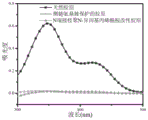
the number of free amino groups in natural collagen, 2, 3-dimethylmaleic anhydride side chain amino protected collagen and N-terminal grafted polyisopropylacrylamide/side chain protected collagen is measured by a 2,4, 6-trinitrobenzenesulfonic acid colorimetric method, the more the amount of free amino acids in a collagen sample is, the stronger the absorption peak at 346nm is, and the grafting rate of amino groups in graft modified collagen can be calculated by taking the number of free amino groups in natural collagen as 100%, as shown in FIG. 2, the amino grafting rates of the side chain amino protected collagen and the N-terminal grafted polyisopropylacrylamide/side chain protected collagen are both 97.1%.
Example 6
The enzymolysis effect experiment specifically comprises the following steps:
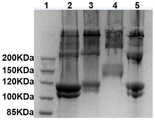
in order to confirm that the whole amino group protected collagen terminal peptide is cut by enzyme, gel electrophoresis is adopted to characterize the molecular weight change of the collagen before and after cutting the terminal peptide by enzyme. As shown in fig. 3, bands 2 and 3 are atelocollagen and atelocollagen, respectively, both of which have alpha 1 chain and alpha 2 chain unique to type I collagen at-110 kDa, and the molecular weight of the atelocollagen is slightly greater than that of the atelocollagen due to the influence of the telopeptide; the band 4 is a terminated peptide collagen with amino group protected by 2, 3-dimethylmaleic anhydride, and the molecular weight of the peptide chain is higher than that of the natural terminated peptide collagen because the amino group is protected by 2, 3-dimethylmaleic anhydride; treatment of the telopeptide collagen with amino groups protected by 2, 3-dimethylmaleic anhydride with pepsin cleaves the telopeptide and results in a smaller molecular weight (lane 5). The above results preliminarily indicate that pepsin treatment successfully cleaves telopeptides of the fully amino-protected collagen.
Example 7
In order to verify that the enzyme-cleaved terminal peptide generates a brand new active amino group, a Pico ampere-grade amperemeter is adopted to determine the transmembrane ion current change of the nanopores before and after the modification of the modified collagen sample. The transmembrane ionic current of the nanopore is closely related to the effective sectional area of the nanopore, and if a specific functional group contained in the collagen can be grafted into the nanopore through a covalent bond, the effective sectional area of the nanopore is reduced, and the transmembrane ionic current is correspondingly reduced. Based on the principle, the method for measuring the change of the transmembrane ionic current of the nanopore before and after the modification of the modified collagen sample by using the picoampere-grade amperemeter can represent the condition of the functional group on the surface of the modified collagen. Firstly, using a PET membrane (with carboxyl functional groups on the surface of a pore channel) as a substrate, respectively reacting collagen (prot-Col) with N-terminal amino group/side chain protection and collagen (prot-telo-Col) with side chain protection with a nanopore membrane (control group) in the presence of EDC/NHS, fully washing to avoid physical adsorption, and then measuring transmembrane ionic current of the PET membrane by using a picoammeter, wherein the result is shown in FIG. 4. Compared with a blank PET film, transmembrane ionic current of the prot-Col modified PET film is obviously reduced, transmembrane ionic current of the prot-telo-Col modified PET is almost unchanged (in figure 4), and the fact that N-terminal amino newly formed by prot-Col due to terminal peptide excision can react with the surface carboxyl of the pore channel (on the left side of figure 4), and prot-telo-Col cannot react with the surface carboxyl of the pore channel because all active amino groups are protected (on the right side of figure 4) is shown, so that feasibility of selectively obtaining free amino at the N end of collagen is proved.
Example 8
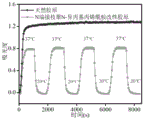
In order to verify the effect of pepsin in cutting off collagen terminal peptides, terminal peptide collagen with side chain amino protected by 2, 3-dimethylmaleic anhydride before and after pepsin treatment is respectively used as a raw material, and an N-terminal graft temperature-sensitive polymer (poly (isopropylacrylamide)) modified collagen is prepared by grafting a free radical initiator and subsequent free radical polymerization. And (3) representing the response performance of the material under different temperature conditions by using a turbidity method. The results show (fig. 5) that pepsin treated 2, 3-dimethylmaleic anhydride protected side chain amino group terminated peptide collagen can be temperature responsive by grafting reaction, while samples not treated with pepsin do not have temperature responsiveness, thus indicating that (1) pepsin cleavage of collagen terminal peptide can specifically obtain N-terminal active amino group; (2) the N-terminal precision graft modified collagen may have the unique properties of a grafted molecule.