CN114242560A - Laser photolysis device and method for removing isobaric elements - Google Patents

Laser photolysis device and method for removing isobaric elements Download PDF

Info

Publication number
CN114242560A
CN114242560A CN202111287424.7A CN202111287424A CN114242560A CN 114242560 A CN114242560 A CN 114242560A CN 202111287424 A CN202111287424 A CN 202111287424A CN 114242560 A CN114242560 A CN 114242560A
Authority
CN
China
Prior art keywords
laser
radio frequency
helium gas
isobaric
helium
Prior art date
Legal status (The legal status is an assumption and is not a legal conclusion. Google has not performed a legal analysis and makes no representation as to the accuracy of the status listed.)
Pending
Application number
CN202111287424.7A
Other languages
Chinese (zh)
Inventor
何明
赵庆章
何洪钰
张文慧
胡畔
董鹏伟
Current Assignee (The listed assignees may be inaccurate. Google has not performed a legal analysis and makes no representation or warranty as to the accuracy of the list.)
China Institute of Atomic of Energy
Original Assignee
China Institute of Atomic of Energy
Priority date (The priority date is an assumption and is not a legal conclusion. Google has not performed a legal analysis and makes no representation as to the accuracy of the date listed.)
Filing date
Publication date
Application filed by China Institute of Atomic of Energy filed Critical China Institute of Atomic of Energy
Priority to CN202111287424.7A priority Critical patent/CN114242560A/en
Publication of CN114242560A publication Critical patent/CN114242560A/en
Pending legal-status Critical Current

Links

Images

Classifications

    • HELECTRICITY
    • H01ELECTRIC ELEMENTS
    • H01JELECTRIC DISCHARGE TUBES OR DISCHARGE LAMPS
    • H01J49/00Particle spectrometers or separator tubes
    • H01J49/004Combinations of spectrometers, tandem spectrometers, e.g. MS/MS, MSn
    • H01J49/0086Accelerator mass spectrometers
    • GPHYSICS
    • G01MEASURING; TESTING
    • G01NINVESTIGATING OR ANALYSING MATERIALS BY DETERMINING THEIR CHEMICAL OR PHYSICAL PROPERTIES
    • G01N27/00Investigating or analysing materials by the use of electric, electrochemical, or magnetic means
    • G01N27/62Investigating or analysing materials by the use of electric, electrochemical, or magnetic means by investigating the ionisation of gases, e.g. aerosols; by investigating electric discharges, e.g. emission of cathode
    • G01N27/622Ion mobility spectrometry
    • G01N27/623Ion mobility spectrometry combined with mass spectrometry
    • HELECTRICITY
    • H01ELECTRIC ELEMENTS
    • H01JELECTRIC DISCHARGE TUBES OR DISCHARGE LAMPS
    • H01J49/00Particle spectrometers or separator tubes
    • H01J49/0027Methods for using particle spectrometers
    • H01J49/0031Step by step routines describing the use of the apparatus
    • HELECTRICITY
    • H01ELECTRIC ELEMENTS
    • H01JELECTRIC DISCHARGE TUBES OR DISCHARGE LAMPS
    • H01J49/00Particle spectrometers or separator tubes
    • H01J49/02Details
    • H01J49/10Ion sources; Ion guns
    • H01J49/16Ion sources; Ion guns using surface ionisation, e.g. field-, thermionic- or photo-emission
    • H01J49/161Ion sources; Ion guns using surface ionisation, e.g. field-, thermionic- or photo-emission using photoionisation, e.g. by laser
    • H01J49/164Laser desorption/ionisation, e.g. matrix-assisted laser desorption/ionisation [MALDI]

Landscapes

  • Physics & Mathematics (AREA)
  • Chemical & Material Sciences (AREA)
  • Analytical Chemistry (AREA)
  • Life Sciences & Earth Sciences (AREA)
  • Optics & Photonics (AREA)
  • Spectroscopy & Molecular Physics (AREA)
  • Health & Medical Sciences (AREA)
  • Molecular Biology (AREA)
  • Plasma & Fusion (AREA)
  • Engineering & Computer Science (AREA)
  • Chemical Kinetics & Catalysis (AREA)
  • Electrochemistry (AREA)
  • Biochemistry (AREA)
  • General Health & Medical Sciences (AREA)
  • General Physics & Mathematics (AREA)
  • Immunology (AREA)
  • Pathology (AREA)
  • Electron Tubes For Measurement (AREA)

Abstract

本发明涉及一种排除同量异位素的激光光解装置及方法,属于放射性核素灵敏度测量技术领域,所述装置包括用于引出阴离子束的离子源、用于产生激光束的激光发生器和射频四极杆,氦气冷却反应池置于射频四极杆中间区域中;在射频四极杆前端设置有减速电极,后端设置有加速电极;射频四极杆、减速电极和加速电极均置于管道中,在管道上设置有氦气进气口,微量氦气通过氦气进气口进入氦气冷却反应池;在氦气冷却反应池中,激光与阴离子发生光解作用,将同量异位素负离子变成中性粒子而得以排除,同时被测量的核素不受激光的影响。本发明所述装置和方法不受离子质量数大小的限制,能够实现多核素的加速器质谱高灵敏度测定。

Figure 202111287424

The invention relates to a laser photolysis device and method for excluding isobaric elements, belonging to the technical field of radionuclide sensitivity measurement. The device comprises an ion source for extracting anion beam and a laser generator for generating laser beam The helium-cooled reaction cell is placed in the middle area of the radio frequency quadrupole; the front end of the radio frequency quadrupole is provided with a deceleration electrode, and the rear end is provided with an acceleration electrode; the radio frequency quadrupole, the deceleration electrode and the acceleration electrode are all It is placed in the pipeline, and a helium gas inlet is set on the pipeline, and a trace amount of helium gas enters the helium gas cooling reaction cell through the helium gas inlet; The anions of the calibrator become neutral particles and are excluded, and the nuclides to be measured are not affected by the laser. The device and method of the invention are not limited by the size of the ion mass, and can realize the high-sensitivity determination of multinuclide by accelerator mass spectrometry.

Figure 202111287424

Description

Laser photolysis device and method for removing isobaric elements
Technical Field
The invention belongs to the technical field of radionuclide sensitivity measurement, and particularly relates to a laser photolysis device and method for removing isobaric elements.
Background
Accelerator Mass Spectrometry (AMS) is the most sensitive analytical technique for measuring long-lived radionuclides, and the most important factor limiting their sensitivity is isobaric interference of the nuclides being measured. In order to eliminate isobaric interferences, the conventional method is to increase the ion energy and realize the elimination of isobaric by adopting an isobaric identification technology of a detector. However, this method not only requires a high accelerator voltage, but also is effective only for light species with a mass number less than 40, but also has a very limited effectiveness for larger species, and cannot achieve highly sensitive analysis of the species, and thus the application of accelerator mass spectrometry is very limited.
Disclosure of Invention
In order to overcome the defects in the prior art, the invention aims to provide a laser photolysis device and a laser photolysis method for removing isobaric elements, which are not limited by the mass number of ions and can realize the high-sensitivity measurement of the mass spectrum of an accelerator of multi-nuclides.
In order to achieve the above purposes, the invention adopts a technical scheme that:
a laser photolysis device for removing isobaric elements comprises an ion source for leading out anion beams, a laser generator for generating laser beams, a radio frequency quadrupole rod and a helium cooling reaction tank, wherein the helium cooling reaction tank is positioned in the middle area of the radio frequency quadrupole rod;
the energy of the laser beam generated by the laser generator is higher than the electron affinity of the interfering isobaric element and is lower than the electron affinity of the detected nuclide;
an incident slit and an exit slit are respectively arranged at two ends of the radio frequency quadrupole rod, and a cathode ion beam and a laser beam are emitted into the radio frequency quadrupole rod from the incident slit and are emitted from the exit slit;
a deceleration electrode is arranged at the front end of the entrance slit, an acceleration electrode is arranged at the rear end of the exit slit, and the cathode ion beam is decelerated through the deceleration electrode and accelerated through the acceleration electrode;
the radio frequency quadrupole rod, the deceleration electrode and the acceleration electrode are all arranged in a pipeline, a helium gas inlet is formed in the position, corresponding to the middle of the radio frequency quadrupole rod, of the pipeline, and trace helium gas enters the helium cooling reaction tank through the helium gas inlet.
Further, the laser photolysis apparatus for eliminating isobaric elements as described above, said apparatus being placed in a vacuum chamber.
Further, in the laser photolysis apparatus for removing isobaric elements as described above, the wavelength of the laser beam is 532nm, and the corresponding energy is 2.33 eV.
Further, according to the laser photolysis device for removing isobaric elements, the pipeline is further provided with a plurality of molecular pumps, and helium in the pipeline is pumped out through the molecular pumps, so that the helium reaches dynamic balance in the radio frequency quadrupole rod area.
Still further, in the laser photolysis apparatus for removing isobaric elements as described above, the plurality of molecular pumps are respectively located at the position on the pipe corresponding to the middle of the rf quadrupole, near the deceleration electrode, and near the acceleration electrode.
Based on the laser photolysis device for removing isobaric elements, the invention provides a laser photolysis method for removing isobaric elements, which comprises the following steps:
s1, placing the laser photolysis device in a vacuum chamber;
s2, feeding trace helium into a helium cooling reaction tank from a helium inlet in the middle of the pipeline, and pumping out the helium by using three molecular pumps to enable the helium to reach dynamic balance in a radio frequency quadrupole rod area;
s3, applying radio frequency voltage to the radio frequency quadrupole rods;
s4, feeding the cathode ion beam led out by the ion source into the radio frequency quadrupole rod;
s5, reducing the energy of the ion beam to be below 50eV by utilizing a deceleration electrode;
s6, irradiating laser beams with the wavelength of 532nm into the helium cooling reaction tank from an incident slit;
s7, in the helium cooling reaction tank, laser and anions are subjected to photolysis, so that the same quantity of heterotopic anions are changed into neutral particles to be eliminated, and meanwhile, the measured nuclide is not influenced by the laser;
and S8, re-accelerating the energy of the negative ion beam coming out of the helium cooling reaction tank to the original energy level of the ion beam after passing through an accelerating electrode.
The laser photolysis device and the method for removing isobaric elements provided by the invention have the following remarkable technical effects:
1. the same amount of heterotopic element interference can be eliminated by only adopting a laser technology without a large accelerator;
2. the method has universality, can be used for both heavy nuclides and light nuclides, and avoids the problem that a gas detector only has effect on the light nuclides but has no effect on the heavy nuclides when identifying the same amount of allotropic elements;
3. the method is combined with a small accelerator mass spectrometer device, can realize the total nuclide determination of the mass spectrum of the small accelerator, provides a feasible technical route for the miniaturization of the accelerator mass spectrometer, and lays a foundation for the multi-field application based on the accelerator mass spectrometer.
Drawings
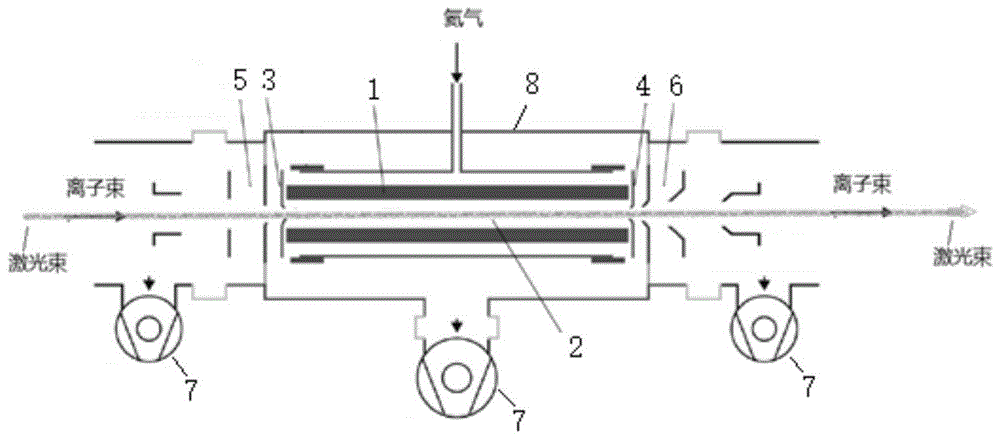
FIG. 1 is a schematic diagram of a laser photolysis apparatus for removing isobaric elements according to an embodiment of the present invention;
FIG. 2 is a flow chart of a laser photolysis process for the elimination of isobaric elements provided in an embodiment of the present invention;
in FIG. 1, 1-radio frequency quadrupole; 2-helium cooling the reaction tank; 3-an entrance slit; 4-an exit slit; 5-a retardation electrode; 6-an accelerating electrode; 7-a molecular pump; 8-pipeline.
Detailed Description
The invention is further described with reference to specific embodiments and drawings attached to the description.
The core idea of the laser photolysis method for eliminating isobaric elements provided by the invention is as follows:
in accelerator mass spectrometry, anions are generally extracted from an ion source, and how much of the anion is formed is related to the electron affinity of an atomic or molecular ion. The invention adopts a laser beam with certain energy to act on the anion beams, and the energy of the laser beam (the wavelength is 532nm corresponding to 2.33eV) is just higher than the electron affinity (such as the electron affinity of the interfering isobaric element with the same quantity (such as36S-Has an electron affinity of 2.08eV) and is less than the electron affinity of the species being detected (e.g., electron affinity of 2.08eV)36Cl-The electron affinity of 3.61eV), in which case the laser can photolyze the electrons of the isobaric element to make them become neutral ions, while the species to be detected is not affected, thus realizing the elimination of the background of the isobaric element.
The formula of anion photolysis is
Figure BDA0003333412220000041
Wherein N is0The number of initial anions, phi the photon intensity of the laser, sigma the photolytic section of the anion, and t the action time of the photon and the anion. The photon flux of the laser is typically about 1021cm-2S-1And the photolytic cross-section of the anion is about 10-17cm2Therefore, the background voltage of the isobaric element can be reduced by 8-10 orders of magnitude after the reaction time t is hundreds of microseconds. However, in accelerator mass spectrometry, the energy of the anion is typically about 30keV, at which the anion flight velocity is too fast, so that the laser and anion interaction time is short (nanoseconds). Therefore, to increase the reaction time, the present invention reduces the particle energy to below 50eV by decelerating the particles and further decelerating the particles using a helium cooling cell, and simultaneously to increase the reaction timeAnd (4) restraining to improve the transmission efficiency of the particles, and placing a helium cooling pool in the radio frequency quadrupole.
Based on the thought, the invention provides a laser photolysis device for removing isobaric elements, which has a specific structure shown in figure 1, and comprises an ion source for leading out anion beams, a laser generator for generating laser beams and a radio frequency quadrupole rod 1, wherein a helium cooling reaction tank 2 is arranged in the middle area of the radio frequency quadrupole rod 1; an incident slit 3 and an exit slit 4 are respectively arranged at two ends of the radio frequency quadrupole rod 1, and a cathode ion beam and a laser beam are emitted into the radio frequency quadrupole rod 1 from the incident slit 3 and are emitted from the exit slit 4; a deceleration electrode 5 is arranged at the front end of the entrance slit 2, and an acceleration electrode 6 is arranged at the rear end of the exit slit 4; the radio frequency quadrupole rod 1, the deceleration electrode 5 and the acceleration electrode 6 are all arranged in the pipeline 8, a helium gas inlet is arranged on the pipeline 8 corresponding to the middle of the radio frequency quadrupole rod 1, and trace helium gas enters the helium gas cooling reaction tank 2 through the helium gas inlet.
The entire apparatus was placed in a vacuum chamber. When radio frequency voltage is applied to the radio frequency quadrupole rod 1, cathode ion beams led out from an ion source are decelerated along the central axis direction of the radio frequency quadrupole rod 1 through a deceleration electrode 5 and then are emitted into the radio frequency quadrupole rod 1 from the middle of an incidence slit 3, and are further decelerated in a helium cooling reaction tank 2, so that the energy of particles is reduced to be below 50 eV; meanwhile, laser beams generated by a laser generator are emitted into the helium cooling reaction cell 2 from the middle of the incidence slit 3; in the helium cooling reaction tank 2, a laser beam and anions undergo photolysis reaction, and because the laser energy is higher than the electron binding energy of the isobaric element, electrons of the isobaric element anions are stripped from the anions and become neutral particles to be removed, and the nuclide to be detected is still the anions because the electron binding energy is higher than the laser energy and is not influenced by the laser, so that the removal of the background of the isobaric element is realized; the cathode ion beam emitted from the exit slit 4 is further accelerated to an energy of about several tens keV by the accelerating electrode 6.
Preferably, in the present embodiment, the wavelength of the laser beam is 532 nm.
Preferably, in the present embodiment, a plurality of molecular pumps 7 are further disposed on the pipeline 8, and the helium gas in the pipeline 8 is pumped out by the molecular pumps 7, so that the helium gas reaches a dynamic equilibrium in the area of the radio frequency quadrupole rod 1. In the embodiment, helium gas outlets are respectively arranged on the pipeline 8 corresponding to the middle of the radio frequency quadrupole rod 1, near the deceleration electrode 5 and near the acceleration electrode 6, and correspondingly, three molecular pumps 7 are arranged.
Based on the above device, the present invention provides a laser photolysis method for removing isobaric elements, the flow chart of the method is shown in fig. 2, and the method comprises the following steps:
s1, placing the laser photolysis device in a vacuum chamber;
s2, feeding trace helium into a helium cooling reaction tank from a helium inlet in the middle of the pipeline, and pumping out the helium by using three molecular pumps to enable the helium to reach dynamic balance in a radio frequency quadrupole rod area;
s3, applying radio frequency voltage to the radio frequency quadrupole rods;
s4, sending the cathode ion beam led out by the ion source into a radio frequency quadrupole rod;
s5, reducing the energy of the cathode ion beam to be below 50eV by utilizing the deceleration electrode;
s6, irradiating laser beams with the wavelength of 532nm into the helium cooling reaction tank from an incident slit;
s7, enabling laser to act on anions in a helium cooling reaction tank to change the isomorphic allotropic element anions into neutral particles to be eliminated;
s8, the energy of the negative ion beam coming out from the helium cooling reaction tank is accelerated to the original energy level of about dozens of keV after passing through the accelerating electrode.
Thus, the isobaric ions are effectively eliminated through the processes.
The laser photolysis device and the method for eliminating the isobaric elements can eliminate the interference of the isobaric elements only by adopting a laser technology; the method has universality, can be used for both heavy nuclides and light nuclides, and avoids the problem that a gas detector only has effect on the light nuclides but has no effect on the heavy nuclides when identifying the same amount of allotropic elements; the method is combined with a small accelerator mass spectrometer device, can realize the total nuclide determination of the mass spectrum of the small accelerator, provides a feasible technical route for the miniaturization of the accelerator mass spectrometer, and lays a foundation for the multi-field application based on the accelerator mass spectrometer.
The above-described embodiments are merely illustrative of the present invention, which may be embodied in other specific forms or in other specific forms without departing from the spirit or essential characteristics thereof. The described embodiments are, therefore, to be considered in all respects as illustrative and not restrictive. The scope of the invention should be indicated by the appended claims, and any changes that are equivalent to the intent and scope of the claims should be construed to be included therein.

Claims (6)

1.一种排除同量异位素的激光光解装置,其特征在于,所述装置包括用于引出阴离子束的离子源、用于产生激光束的激光发生器、射频四极杆(1)以及氦气冷却反应池(2),所述氦气冷却反应池(2)置于所述射频四极杆(1)中间区域中;1. a laser photolysis device for excluding isobaric elements, it is characterized in that, described device comprises the ion source that is used to draw out anion beam, the laser generator that is used to generate laser beam, radio frequency quadrupole (1) And helium cooling reaction pond (2), described helium cooling reaction pond (2) is placed in the middle area of described radio frequency quadrupole (1); 所述激光发生器产生的激光束能量高于干扰的同量异位素的电子亲合势,同时又小于被测核素的电子亲合势;The laser beam energy generated by the laser generator is higher than the electron affinity of the interfering isobaric element, and is smaller than the electron affinity of the tested nuclide at the same time; 在所述射频四极杆(1)的两端分别设置有入射狭缝(3)和出射狭缝(4),阴离子束和激光束从所述入射狭缝(3)射入所述射频四极杆(1)中,从所述出射狭缝(4)射出;An entrance slit (3) and an exit slit (4) are respectively provided at both ends of the radio frequency quadrupole (1), and the anion beam and the laser beam are injected into the radio frequency quadrupole from the entrance slit (3). In the pole (1), it is emitted from the exit slit (4); 在所述入射狭缝(3)前端设置有减速电极(5),在所述出射狭缝(4)后端设置有加速电极(6),所述阴离子束经过所述减速电极(5)被减速,经过所述加速电极(6)被加速;A deceleration electrode (5) is arranged at the front end of the incident slit (3), an acceleration electrode (6) is arranged at the rear end of the exit slit (4), and the anion beam is passed through the deceleration electrode (5). decelerate, and be accelerated through the acceleration electrode (6); 所述射频四极杆(1)、减速电极(5)和加速电极(6)均置于管道(8)中,在所述管道(8)上对应所述射频四极杆(1)中部的位置设置有氦气进气口,微量氦气通过所述氦气进气口进入所述氦气冷却反应池(2)中。The radio frequency quadrupole (1), the deceleration electrode (5) and the acceleration electrode (6) are all placed in the pipeline (8), and the pipeline (8) corresponds to the central part of the radio frequency quadrupole (1). A helium gas inlet is provided at the position, and a trace amount of helium gas enters the helium cooling reaction pool (2) through the helium gas inlet. 2.根据权利要求1所述的排除同量异位素的激光光解装置,其特征在于,所述装置放置在真空室中。2 . The isobaric-excluded laser photolysis device according to claim 1 , wherein the device is placed in a vacuum chamber. 3 . 3.根据权利要求2所述的排除同量异位素的激光光解装置,其特征在于,所述激光束的波长为532nm,对应能量为2.33eV。3 . The laser photolysis device for isobaric exclusion according to claim 2 , wherein the wavelength of the laser beam is 532 nm, and the corresponding energy is 2.33 eV. 4 . 4.根据权利要求3所述的排除同量异位素的激光光解装置,其特征在于,所述管道(8)上还设置有多个分子泵(7),通过所述分子泵(7)将所述管道(8)中的氦气抽出,使氦气在所述射频四极杆(1)区域达到动态平衡。4. The laser photolysis device for excluding isobaric elements according to claim 3, characterized in that, a plurality of molecular pumps (7) are also provided on the pipeline (8), and through the molecular pump (7) ) to extract the helium gas in the pipeline (8), so that the helium gas reaches dynamic equilibrium in the area of the radio frequency quadrupole (1). 5.根据权利要求4所述的排除同量异位素的激光光解装置,其特征在于,多个所述分子泵(7)分别位于所述管道(8)上对应所述射频四极杆(1)中部的位置、所述减速电极(5)附近和所述加速电极(6)附近。5 . The laser photolysis device for excluding isobaric elements according to claim 4 , wherein a plurality of the molecular pumps ( 7 ) are respectively located on the pipeline ( 8 ) corresponding to the radio frequency quadrupole. 6 . (1) The position of the middle, the vicinity of the deceleration electrode (5) and the vicinity of the acceleration electrode (6). 6.使用权利要求1-5任一项所述装置的排除同量异位素的激光光解方法,包括以下步骤:6. the laser photolysis method that uses the device described in any one of claims 1-5 to exclude isobaric elements, comprising the following steps: S1、将所述装置置于真空室中;S1, placing the device in a vacuum chamber; S2、将微量氦气从管道中部的氦气进气口送入氦气冷却反应池,用三台分子泵将氦气抽出,使氦气在射频四极杆区域达到动态平衡;S2. Send a trace amount of helium gas from the helium gas inlet in the middle of the pipeline into the helium gas cooling reaction cell, and use three molecular pumps to extract the helium gas, so that the helium gas can reach dynamic equilibrium in the RF quadrupole region; S3、给所述射频四极杆加上射频电压;S3, adding a radio frequency voltage to the radio frequency quadrupole; S4、将离子源引出的阴离子束送入所述射频四极杆中;S4, sending the anion beam drawn from the ion source into the radio frequency quadrupole; S5、利用减速电极将所述阴离子束的能量降低到50eV以下;S5, using the deceleration electrode to reduce the energy of the anion beam to below 50 eV; S6、将波长为532nm的激光束从入射狭缝照进所述氦气冷却反应池;S6, irradiate a laser beam with a wavelength of 532 nm into the helium cooling reaction cell from the incident slit; S7、在所述氦气冷却反应池中,激光与阴离子发生光解作用,将同量异位素负离子变成中性粒子而得以排除,同时被测量的核素不受激光的影响;S7. In the helium cooling reaction cell, the laser and the anions undergo photolysis, and the isobaric anions are turned into neutral particles and eliminated, and the measured nuclide is not affected by the laser; S8、从所述氦气冷却反应池出来的阴离子束经加速电极后将能量再加速到离子束的原能量级。S8, the energy of the anion beam coming out of the helium cooling reaction cell is accelerated to the original energy level of the ion beam after passing through the accelerating electrode.
CN202111287424.7A 2021-11-02 2021-11-02 Laser photolysis device and method for removing isobaric elements Pending CN114242560A (en)

Priority Applications (1)

Application Number Priority Date Filing Date Title
CN202111287424.7A CN114242560A (en) 2021-11-02 2021-11-02 Laser photolysis device and method for removing isobaric elements

Applications Claiming Priority (1)

Application Number Priority Date Filing Date Title
CN202111287424.7A CN114242560A (en) 2021-11-02 2021-11-02 Laser photolysis device and method for removing isobaric elements

Publications (1)

Publication Number Publication Date
CN114242560A true CN114242560A (en) 2022-03-25

Family

ID=80743504

Family Applications (1)

Application Number Title Priority Date Filing Date
CN202111287424.7A Pending CN114242560A (en) 2021-11-02 2021-11-02 Laser photolysis device and method for removing isobaric elements

Country Status (1)

Country Link
CN (1) CN114242560A (en)

Citations (5)

* Cited by examiner, † Cited by third party
Publication number Priority date Publication date Assignee Title
US5672868A (en) * 1996-02-16 1997-09-30 Varian Associates, Inc. Mass spectrometer system and method for transporting and analyzing ions
US6222185B1 (en) * 1996-06-10 2001-04-24 Micromass Limited Plasma mass spectrometer
CN1779457A (en) * 2005-10-19 2006-05-31 广州禾信自动化系统有限公司 Gas-phase molecular ion reactor based on radio-frequency quard-polar rod, its realization and use
US20070085001A1 (en) * 2005-10-17 2007-04-19 Beene James R Method and apparatus for efficient photodetachment and purification of negative ion beams
CN112382554A (en) * 2020-11-12 2021-02-19 上海裕达实业有限公司 Device and method for adjusting high-order field in linear ion trap in real time

Patent Citations (5)

* Cited by examiner, † Cited by third party
Publication number Priority date Publication date Assignee Title
US5672868A (en) * 1996-02-16 1997-09-30 Varian Associates, Inc. Mass spectrometer system and method for transporting and analyzing ions
US6222185B1 (en) * 1996-06-10 2001-04-24 Micromass Limited Plasma mass spectrometer
US20070085001A1 (en) * 2005-10-17 2007-04-19 Beene James R Method and apparatus for efficient photodetachment and purification of negative ion beams
CN1779457A (en) * 2005-10-19 2006-05-31 广州禾信自动化系统有限公司 Gas-phase molecular ion reactor based on radio-frequency quard-polar rod, its realization and use
CN112382554A (en) * 2020-11-12 2021-02-19 上海裕达实业有限公司 Device and method for adjusting high-order field in linear ion trap in real time

Similar Documents

Publication Publication Date Title
Shevelko et al. Atomic multielectron processes
Karvonen et al. A sextupole ion beam guide to improve the efficiency and beam quality at IGISOL
Dou et al. Measurement of the half-life of 79Se with accelerator mass spectrometry
CN113156032A (en) Mass spectrum system and method for simultaneously measuring isotope abundance and impurity content
Forstner et al. The ILIAS project for selective isobar suppression by laser photodetachment
HE et al. Developing AMS measurement of 59Ni at CIAE
Van Duppen et al. A laser ion source for on-line mass separation
Ludwig et al. Search for superheavy elements with 292⩽ A⩽ 310 in nature with accelerator mass spectrometry
CN114242560A (en) Laser photolysis device and method for removing isobaric elements
CN119153311A (en) Plutonium isotope accelerator mass spectrum measuring device and method based on positive ion ionization
Magyar et al. Photoelectric Franck-Hertz experiment and its kinetic analysis by Monte Carlo simulation
Geissel et al. Precision experiments with exotic nuclei
Oura et al. Experimental setups for photoionization of multiply charged ions by synchrotron radiation
Annaluru Beam optics transport and fundamental processes involving a charge breeder in the upgraded SPIRAL1 facility
Nusair et al. Accelerator mass spectrometry in laboratory nuclear astrophysics
Wang et al. 236U measurement with accelerator mass spectrometry at CIAE
Spanier A 135° Gas-Filled Magnet at the Cologne 10 MV AMS FN-Tandem Accelerator Setup and the use of 41Ca as a Reference Nuclide for Nuclear Waste Management
Skulski Jr Development of 129I AMS at the Nuclear Science Laboratory for Measurements of the Great Lakes Region
JP6309381B2 (en) Mass spectrometer and mass spectrometry method
Novikov et al. Exotic nuclides at the reactor pik: pitrap project
Chester et al. Trific: the triumf fast ion counter
Aravind et al. Spectral dependence of the asymmetry parameter in the photodetachment from As−
Bordas-Nagy et al. Kinetic-energy spectroscopy of high-Rydberg fragments from keV collisions of H2+, D2+, N2+ and C2+ ions with rare-gas atoms
CN116053111A (en) Mass Spectrometry Detection Device and Method Based on ECR Ion Source
Gusev et al. Penning ion traps for high-precision measurements of the mass of neutron-excess nuclei in the PIK reactor

Legal Events

Date Code Title Description
PB01 Publication
PB01 Publication
SE01 Entry into force of request for substantive examination
RJ01 Rejection of invention patent application after publication

Application publication date: 20220325

RJ01 Rejection of invention patent application after publication