High-throughput Raman single cell sorting device and method
Technical Field
The invention relates to the field of microscopic Raman single cell sorting, in particular to a high-throughput Raman single cell sorting device and method.
Background
Raman spectrum is a high-efficiency information identification technology, through inelastic scattering spectral line analysis of a compound by specific incident light, micro Raman spectrum can directly detect the molecular vibration or rotation energy level of the compound, and through Raman characteristic spectral line analysis, compound molecular composition and structure information can be obtained.
However, the existing raman microscopy technology has defects when used for sample analysis, and takes the measurement of single cells of microorganisms as an example: single cell Raman spectra have weak signal intensity, especially when the cells are suspended in liquid, usually only 106-8One-half of the photons are scattered by Raman scattering, so that the spectrum scanning time for obtaining a complete and reliable Raman spectrum signal is longer, and when a large number of samples are analyzed, the analysis time of the samples can be greatly increased by performing full spectrum identification on each cell, so that the acquisition flux is lower.
At present, linear array Raman detection products on the market generally analyze solid samples or dry cell samples, can realize rapid analysis of single cell samples, but cannot separate and sort single cells.
Chinese patent No. CN107462566A discloses a raman spectrometer for detecting a specific narrow band wave number range, which can realize fast and highly sensitive detection of a raman spectrum in a specific narrow wave number range, but can determine the specificity of a single cell in field or clinical sample detection, but this patent cannot obtain complete raman spectrum information, cannot realize high-throughput and fast single cell type identification, and further separates and sorts the single cell for subsequent processing (such as single cell culture, amplification, etc.).
Disclosure of Invention
Aiming at the defects, the invention provides a high-throughput Raman single-cell sorting device and a method.
One aspect of the present invention provides a high throughput raman single cell sorting device, comprising:
a PMT (photomultiplier tube) narrow-band raman single-cell prescreening module for prescreening detection of the single-cell sample to obtain a narrow-band raman signal and a narrow-band background signal corresponding to the single-cell sample;
-a linear array raman single cell identification module for acquiring full spectral information of the single cell sample;
-a microfluidic chip for placing a single cell sample.
In another preferred example, the narrow-band raman single-cell pre-screening module comprises a laser light source and a photomultiplier.
In another preferred embodiment, the linear array raman single cell identification module comprises a laser light source, a linear array light generator and a spectrometer.
In another preferred example, the PMT (photomultiplier tube) narrow-band raman single cell prescreening module and the linear array raman single cell identification module have the same laser light source.
In another preferred example, the microfluidic chip is placed on a three-dimensional moving platform.
In another preferred embodiment, the microfluidic chip comprises a narrow-band raman detection pre-screening part, a linear array raman detection part, a droplet package forming part and a single cell sorting part which are connected in sequence; the narrow-band Raman detection pre-screening part comprises a sample inlet, a first liquid storage tank, a first channel and a waste liquid tank, wherein the sample inlet, the first liquid storage tank and the first channel are sequentially connected, a first sorting electrode is arranged on the outer side of the first channel; the linear array Raman detection part sequentially comprises a second liquid storage tank and a second channel, the second channel is provided with a buffer liquid inlet, and the outer side of the second channel is provided with a capture electrode; the liquid drop package forming part sequentially comprises an oil storage pool and a liquid drop package forming opening; the single-cell sorting part sequentially comprises a third channel and at least two separation ports, and a second sorting electrode is arranged outside the third channel.
In another preferred example, the narrow-band raman detection pre-screening part rapidly and highly sensitively screens out specific single cells, and separates the non-specific single cells into a waste liquid port by adding an electrode for removing.
In another preferred embodiment, the linear array raman detection and identification part can realize high-flux single cell raman signal acquisition to obtain full spectrum information of single cells, and single cell types are identified through database comparison.
In another preferred embodiment, the droplet-packing formation section forms a droplet to pack a single cell.
In another preferred example, the single-cell sorting part leads out the droplet-wrapped single cells from different separation channels by loading a sorting electrode.
In another preferred example, the electrode is externally connected with a power supply.
In another preferred embodiment, the width of the first channel is 10-50um, the narrowest dimension.
In another preferred example, the width of the first liquid storage tank is 80-100um, which is the widest dimension.
The single cell sample includes bacteria, fungi, microorganisms, and the like.
The invention provides a high-throughput Raman single cell sorting method on the other hand, which comprises the following steps:
s1: injecting the single cell sample into the micro-fluidic chip;
s2: when the single cell sample is positioned in the first channel, a PMT (scanning electron microscope) narrow-band micro-Raman single cell pre-screening module is used for pre-screening and detecting the single cell sample, so that a narrow-band Raman signal and a narrow-band background signal corresponding to the single cell sample are obtained, and the single cell sample with specificity is identified;
s3: applying voltage on the first sorting electrode to enable the single cell sample with specificity to enter a second liquid storage tank and enter a second channel;
s4: applying voltage on the capture electrode, detecting the single cell sample by the linear array Raman single cell identification module, obtaining Raman spectra of one or more single cell samples, and identifying the single cell samples;
s5: injecting an oil phase into the oil storage tank to enable the single-cell sample to wrap the liquid drop to form a liquid drop, and enabling the generated liquid drop to enter a third channel;
s6: and applying voltage to the second sorting electrode to enable the liquid drops to enter different separating ports for separation.
In another preferred example, the step S2 of identifying the specific single-cell sample includes performing data processing on the obtained narrowband raman signal and narrowband background signal to obtain a signal-to-noise ratio, and comparing according to a preset value, thereby distinguishing whether the single-cell sample is specific.
In another preferred example, the identifying the desired single cell in step S4 includes comparing the raman spectrum of the obtained one or more single cell samples with a standard raman spectrum signal or a reference raman spectrum signal in a constructed single cell phenotype database to obtain the determined cell type.
In another preferred example, the step S6 of applying a voltage to the second sorting electrode to sort the droplets into different separation ports includes sequentially numbering the droplets entering the third channel, identifying the single-cell sample according to the step S4, and applying different voltages in different numbering sequences to allow the droplets to enter different separation ports.
In another preferred embodiment, the single-cell high-throughput detection method comprises culturing or amplifying the sorted single-cell sample.
The invention has the beneficial effects that:
the invention discloses a high-flux parallel Raman single-cell sorting device based on the combination of a PMT (scanning electron microscope) and a linear array detection technology, which is characterized in that firstly, a PMT detector is adopted to primarily screen cells with specific requirements, so that the screening flux is greatly improved; and then, the screened specific cells are controlled by a microfluidic device to carry out Raman full-spectrum parallel collection, the strategy can avoid carrying out full-spectrum analysis on all samples, greatly reduce the collection time of the samples, simultaneously adopt linear array Raman to collect the spectrum of the specific cells to carry out cell type identification, finally, the tested specific cells can be sorted out by a microfluidic chip, the possibility (such as single cell culture, single cell sequencing and the like) is provided for further analysis of subsequent cells, and the high-throughput detection, analysis and sorting of the cell samples are realized.
Drawings
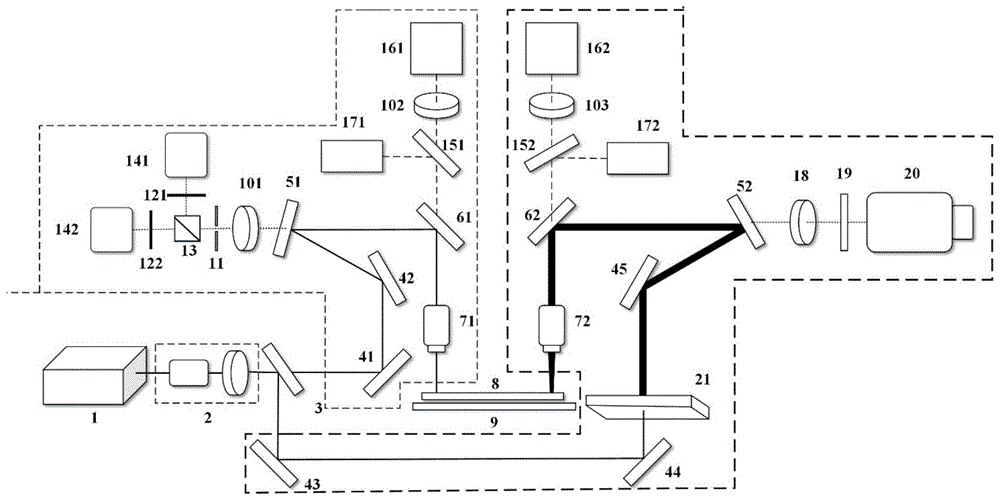
FIG. 1 is a schematic diagram of the light path of the high-throughput Raman single-cell sorting device and method combining PMT and linear array Raman.
Fig. 2 is a schematic diagram of a microfluidic chip.
The reference numbers are as follows:
1. laser 2, beam expanding collimator 3, laser beam splitter 41, first reflector 42, second reflector 43, third reflector 44, fourth reflector 45, fifth reflector 51, first high-pass filter 52, second high-pass filter 61, first dichroic mirror 62, second dichroic mirror 71, first microscope group 72, second microscope group 8, microfluidic chip 9, three-dimensional moving platform 101, first lens 102, second lens 103, third lens 11, pinhole 121, first narrow-band filter 122, second narrow-band filter 13, beam splitter 141, first PMT142, second PMT 151, first visible light beam splitter 152, second visible light beam splitter 161, first image collector 162, second image collector 171, first LED light source 172, second LED light source 18, cylindrical mirror 19, slit 20, linear array spectrometer 21, sample light generator 22 and sample light generator 22 23. First liquid storage pool 24, narrow band Raman detection light 25, first sorting electrode 26, first channel 27, waste liquid pool 28, second liquid storage pool 29, buffer liquid inlet 30, capture electrode 31, linear array Raman detection light 32, second channel 33, oil storage pool 34, liquid drop package forming port 35, second sorting electrode 36, third channel 37, first separation port 38, second separation port 39 and third separation port
Detailed Description
For the purpose of facilitating understanding of the embodiments of the present invention, the following description will be made in terms of specific embodiments with reference to the accompanying drawings, and the embodiments are not to be construed as limiting the embodiments of the present invention. Furthermore, the drawings are schematic and, thus, the apparatus and devices of the present invention are not limited by the size or scale of the schematic.
It is to be noted that in the claims and the description of the present patent, relational terms such as first and second, and the like are used solely to distinguish one entity or action from another entity or action without necessarily requiring or implying any actual such relationship or order between such entities or actions. Also, the terms "comprises," "comprising," or any other variation thereof, are intended to cover a non-exclusive inclusion, such that a process, method, article, or apparatus that comprises a list of elements does not include only those elements but may include other elements not expressly listed or inherent to such process, method, article, or apparatus. Without further limitation, the use of the verb "comprise a" to define an element does not exclude the presence of another, same element in a process, method, article, or apparatus that comprises the element.
Example one
As shown in fig. 1, the micro-fluidic chip comprises a PMT narrow-band Raman single cell pre-screening optical path and a linear array Raman single cell identification optical path, wherein the PMT narrow-band Raman single cell pre-screening optical path and the linear array Raman single cell identification optical path are focused on the micro-fluidic chip in parallel, and a single cell sample is contained in the micro-fluidic chip.
The single-cell Raman spectrometer comprises a laser 1, a beam expansion collimator 2, a laser beam splitter 3, reflectors 41, 42, 43, 44 and 45, high- pass filters 51 and 52, dichroic mirrors 61 and 62, a microscope objective group 71 and 72, a microfluidic chip 8, a three-dimensional displacement platform 9, lenses 101, 102 and 103, a pinhole 11, narrow- band filters 121 and 122, a beam splitter prism 13, a PMT141 and 142, visible light beam splitters 151 and 152, image collectors 161 and 162, LED light sources 171 and 172, a cylindrical lens 18, a slit 19, a spectrometer 20, a linear array light generator 21 and the like. Wherein:
the laser beam emitted by the laser 1 passes through the beam expanding collimator 2 to generate parallel light, the parallel light sequentially passes through the laser beam splitter 3, the first reflecting mirror 41, the second reflecting mirror 42, the first high-pass filter 51, the first dichroic mirror 61 and the first microscope objective group 71 to be focused on the single-cell sample in the microfluidic chip 8 to generate a Raman signal, and the Raman signal sequentially reversely passes through the first microscope objective group 71, the first dichroic mirror 61, the first high-pass filter 51, the first lens 101, the pinhole 11 and the beam splitter prism 13, and uniformly enters the first narrow-band filter 121 and the second narrow-band filter 122 to respectively enter the first PMT141 and the second PMT 142.
The first LED light source 171 sequentially passes through the first visible light beam splitter 151, the first dichroic mirror 61, and the first microscope objective group 71 and is focused on the microfluidic chip 8 to obtain image information of the single-cell sample, and the image information sequentially and reversely passes through the first microscope objective 71, the first dichroic mirror 61, the first visible light beam splitter 151, and the second lens 102 and enters the first image collector 161.
The laser beam emitted by the laser 1 passes through the beam expanding collimator 2 to generate parallel light, the parallel light sequentially passes through the laser beam splitter 3, the third reflector 43, the fourth reflector 44, the linear array light generator 21, the fifth reflector 45, the second high-pass optical filter 52, the second dichroic mirror 62 and the second microscopic objective group 72 to be focused on the single cell sample in the microfluidic chip 8 to generate a raman signal, and the raman signal sequentially reversely passes through the second microscopic objective group 72, the second dichroic mirror 62, the second high-pass optical filter 52, the cylindrical mirror 18 and the slit to enter the spectrometer 19.
The second LED light source 172 sequentially passes through the second visible light beam splitter 152, the second dichroic mirror 62, and the second microscope objective group 72 to be focused on the microfluidic chip 8, so as to obtain image information of the single-cell sample, and the image information sequentially reversely passes through the second microscope objective 72, the second dichroic mirror 62, the second visible light beam splitter 152, and the third lens 103 and enters the second image collector 162.
The PMT narrow-band micro-Raman single-cell pre-screening optical path and the linear array micro-Raman single-cell identification optical path are focused on the micro-fluidic chip in parallel to detect the single-cell samples in sequence.
The three-dimensional displacement platform 9 is provided with the micro-fluidic chip 8, and the movement of the three-dimensional displacement platform 9 drives the micro-fluidic chip 8 to move.
Example two
Fig. 2 is a schematic diagram of a microfluidic chip, which specifically includes:
a sample inlet 22, a first liquid storage tank 23, a first sorting electrode 25, a first channel 26 and a waste liquid tank 27; the sample enters the first liquid storage tank 23 through the sample inlet 22 to wait for detection, the single cell continuously flows into the first channel 26 from the first liquid storage tank 23, and reaches the focusing position of the narrow-band Raman detection light 24, the narrow-band Raman detection can quickly and highly sensitively detect the narrow-band spectral signal of the single cell, and the single cell is judged whether to have specificity according to the detected narrow-band spectral signal.
The linear array Raman detection part sequentially comprises a second liquid storage tank 28, a buffer liquid inlet 29, a capture electrode 20, a linear array Raman detection light 31 and a second channel 32; the single cells with specificity enter the second channel 32 from the second liquid storage tank 28, buffer solution is injected into the buffer solution inlet 29, the single cells are arranged in a linear shape under the action of the buffer solution, the single cells arranged in the linear shape are stabilized at the focusing position of the linear array Raman detection light beam 31 by the capture electrode 30, the focused light beam irradiates the single cells, the single cells generate full spectrum Raman signals, Raman spectra are collected by a spectrometer, the types of the single cells are identified by comparing the Raman spectra with a database by a computer, the collection is completed, the capture electrode 30 discharges, and the single cells enter a liquid drop package forming part.
The liquid drop package forming part sequentially comprises an oil storage pool 33 and a liquid drop package forming opening; and injecting 33 an oil phase into the oil storage tank, wherein the oil phase can realize that single cells generate liquid drops at the liquid drop package forming port 34, and the generated liquid drops sequentially reach the third channel 36.
The single-cell sorting section includes a second sorting electrode 35, a third channel 36, a first separation port 37, a second separation port 38, a third separation port 39; and (3) counting the liquid drops entering the third channel in sequence according to the identified types, and applying different electrodes according to different numbering sequences so as to enable the liquid drops to enter different separation ports: a first separation port 37, a second separation port 38, and a third separation port 39.
EXAMPLE III
The invention provides a high-throughput Raman single cell sorting device based on PMT and linear array Raman combination, and provides a single cell high-throughput detection method, which comprises the following steps:
1. preparing a single cell sample;
2. the single cell sample is injected into a micro-fluidic chip 8, and the micro-fluidic chip is placed on a three-dimensional displacement platform 9;
3. detecting a single-cell narrow-band Raman signal: the PMT narrow-band micro-Raman single cell pre-screening optical path is used for carrying out pre-screening detection on the single cell sample to obtain a narrow-band Raman signal and a narrow-band background signal corresponding to the single cell sample;
further, the method also comprises the following steps in the step 3: and performing data processing on the obtained narrow-band Raman signal and the narrow-band background signal to obtain a signal-to-noise ratio, and comparing according to a preset value to determine whether the single-cell sample has specificity.
4. Linear array Raman signal detection: a single cell sample with specificity enters a linear array micro-Raman single cell identification light path through a microfluidic chip channel, and the single cell sample positioned in a linear array detection laser beam is detected to obtain one or more single cell Raman spectra;
further, step 4 includes the steps of: and (3) carrying out standardization processing (baseline reduction, normalization, stray peak filtering and the like) on the Raman spectrum signal, then comparing the Raman spectrum signal with a standard Raman spectrum signal or a reference Raman spectrum signal in the constructed single-cell phenotype database, and simultaneously rapidly determining the type (variety) of the cell by adopting algorithms such as deep learning, database mining and the like.
5. And injecting an oil phase into the oil storage pool, so that the single cell sample is wrapped in the liquid drop to form a liquid drop, and the generated liquid drop enters the third channel.
6. Applying different electrodes to the identified single-cell droplets, introducing the single-cell samples into different separation ports, and performing subsequent processing (such as culture, amplification and the like) on the sorted single cells.
The above description is only a preferred embodiment of the present invention, and it should be noted that, for those skilled in the art, several modifications and additions can be made without departing from the method of the present invention, and these modifications and additions should also be regarded as the protection scope of the present invention.