CN114317618A - Cascade Utilization Process of Lignocellulosic Raw Materials Based on Alkali Pretreatment - Google Patents
Cascade Utilization Process of Lignocellulosic Raw Materials Based on Alkali Pretreatment Download PDFInfo
- Publication number
- CN114317618A CN114317618A CN202210005348.4A CN202210005348A CN114317618A CN 114317618 A CN114317618 A CN 114317618A CN 202210005348 A CN202210005348 A CN 202210005348A CN 114317618 A CN114317618 A CN 114317618A
- Authority
- CN
- China
- Prior art keywords
- liquid
- pretreatment
- solid
- alkali
- anaerobic fermentation
- Prior art date
- Legal status (The legal status is an assumption and is not a legal conclusion. Google has not performed a legal analysis and makes no representation as to the accuracy of the status listed.)
- Granted
Links
- 239000002994 raw material Substances 0.000 title claims abstract description 43
- 239000003513 alkali Substances 0.000 title claims abstract description 34
- 238000000034 method Methods 0.000 title claims abstract description 33
- 239000007788 liquid Substances 0.000 claims abstract description 51
- 238000000855 fermentation Methods 0.000 claims abstract description 43
- 229920005610 lignin Polymers 0.000 claims abstract description 43
- 239000002245 particle Substances 0.000 claims abstract description 27
- LFQSCWFLJHTTHZ-UHFFFAOYSA-N Ethanol Chemical compound CCO LFQSCWFLJHTTHZ-UHFFFAOYSA-N 0.000 claims abstract description 22
- 239000007787 solid Substances 0.000 claims abstract description 22
- 229910000403 monosodium phosphate Inorganic materials 0.000 claims abstract description 19
- 235000019799 monosodium phosphate Nutrition 0.000 claims abstract description 19
- AJPJDKMHJJGVTQ-UHFFFAOYSA-M sodium dihydrogen phosphate Chemical compound [Na+].OP(O)([O-])=O AJPJDKMHJJGVTQ-UHFFFAOYSA-M 0.000 claims abstract description 19
- 229920002488 Hemicellulose Polymers 0.000 claims abstract description 18
- 238000000926 separation method Methods 0.000 claims abstract description 12
- 238000001035 drying Methods 0.000 claims abstract description 6
- 239000000706 filtrate Substances 0.000 claims abstract description 6
- 150000007522 mineralic acids Chemical class 0.000 claims abstract description 6
- 238000004062 sedimentation Methods 0.000 claims abstract description 6
- 238000003756 stirring Methods 0.000 claims abstract description 6
- 239000000463 material Substances 0.000 claims abstract description 5
- 238000003828 vacuum filtration Methods 0.000 claims abstract description 5
- 238000007710 freezing Methods 0.000 claims abstract description 4
- 230000008014 freezing Effects 0.000 claims abstract description 4
- HEMHJVSKTPXQMS-UHFFFAOYSA-M Sodium hydroxide Chemical compound [OH-].[Na+] HEMHJVSKTPXQMS-UHFFFAOYSA-M 0.000 claims description 40
- VNWKTOKETHGBQD-UHFFFAOYSA-N methane Chemical compound C VNWKTOKETHGBQD-UHFFFAOYSA-N 0.000 claims description 14
- NBIIXXVUZAFLBC-UHFFFAOYSA-N Phosphoric acid Chemical compound OP(O)(O)=O NBIIXXVUZAFLBC-UHFFFAOYSA-N 0.000 claims description 12
- 238000005119 centrifugation Methods 0.000 claims description 8
- 229910000147 aluminium phosphate Inorganic materials 0.000 claims description 6
- 230000004151 fermentation Effects 0.000 claims description 6
- 230000014759 maintenance of location Effects 0.000 claims description 4
- 238000000703 high-speed centrifugation Methods 0.000 claims description 2
- 238000010992 reflux Methods 0.000 claims description 2
- 239000002585 base Substances 0.000 claims 1
- 238000004140 cleaning Methods 0.000 claims 1
- 238000011068 loading method Methods 0.000 claims 1
- 238000001291 vacuum drying Methods 0.000 claims 1
- 238000006243 chemical reaction Methods 0.000 abstract description 5
- 238000005406 washing Methods 0.000 abstract description 3
- 238000010298 pulverizing process Methods 0.000 abstract description 2
- 241000209046 Pennisetum Species 0.000 description 22
- 238000011084 recovery Methods 0.000 description 19
- 239000007789 gas Substances 0.000 description 12
- 238000004519 manufacturing process Methods 0.000 description 11
- 238000012360 testing method Methods 0.000 description 11
- 239000012798 spherical particle Substances 0.000 description 9
- 230000000052 comparative effect Effects 0.000 description 8
- 238000005516 engineering process Methods 0.000 description 6
- 239000010902 straw Substances 0.000 description 5
- 230000008901 benefit Effects 0.000 description 3
- 239000000126 substance Substances 0.000 description 3
- ODINCKMPIJJUCX-UHFFFAOYSA-N Calcium oxide Chemical compound [Ca]=O ODINCKMPIJJUCX-UHFFFAOYSA-N 0.000 description 2
- MHAJPDPJQMAIIY-UHFFFAOYSA-N Hydrogen peroxide Chemical compound OO MHAJPDPJQMAIIY-UHFFFAOYSA-N 0.000 description 2
- 239000002253 acid Substances 0.000 description 2
- 239000002551 biofuel Substances 0.000 description 2
- 239000003153 chemical reaction reagent Substances 0.000 description 2
- 238000000576 coating method Methods 0.000 description 2
- 239000002131 composite material Substances 0.000 description 2
- 230000000694 effects Effects 0.000 description 2
- 230000007613 environmental effect Effects 0.000 description 2
- 239000000446 fuel Substances 0.000 description 2
- 239000003292 glue Substances 0.000 description 2
- 229910052500 inorganic mineral Inorganic materials 0.000 description 2
- 235000010755 mineral Nutrition 0.000 description 2
- 239000011707 mineral Substances 0.000 description 2
- 238000012986 modification Methods 0.000 description 2
- 230000004048 modification Effects 0.000 description 2
- 239000002105 nanoparticle Substances 0.000 description 2
- 239000003895 organic fertilizer Substances 0.000 description 2
- 238000002203 pretreatment Methods 0.000 description 2
- 239000000047 product Substances 0.000 description 2
- 238000000746 purification Methods 0.000 description 2
- 238000003860 storage Methods 0.000 description 2
- VHUUQVKOLVNVRT-UHFFFAOYSA-N Ammonium hydroxide Chemical compound [NH4+].[OH-] VHUUQVKOLVNVRT-UHFFFAOYSA-N 0.000 description 1
- DGAQECJNVWCQMB-PUAWFVPOSA-M Ilexoside XXIX Chemical compound C[C@@H]1CC[C@@]2(CC[C@@]3(C(=CC[C@H]4[C@]3(CC[C@@H]5[C@@]4(CC[C@@H](C5(C)C)OS(=O)(=O)[O-])C)C)[C@@H]2[C@]1(C)O)C)C(=O)O[C@H]6[C@@H]([C@H]([C@@H]([C@H](O6)CO)O)O)O.[Na+] DGAQECJNVWCQMB-PUAWFVPOSA-M 0.000 description 1
- 238000003916 acid precipitation Methods 0.000 description 1
- 239000000908 ammonium hydroxide Substances 0.000 description 1
- 239000000292 calcium oxide Substances 0.000 description 1
- 235000012255 calcium oxide Nutrition 0.000 description 1
- 150000001720 carbohydrates Chemical class 0.000 description 1
- 235000014633 carbohydrates Nutrition 0.000 description 1
- 238000011161 development Methods 0.000 description 1
- 238000010586 diagram Methods 0.000 description 1
- 239000002029 lignocellulosic biomass Substances 0.000 description 1
- 229910000402 monopotassium phosphate Inorganic materials 0.000 description 1
- 235000019796 monopotassium phosphate Nutrition 0.000 description 1
- PJNZPQUBCPKICU-UHFFFAOYSA-N phosphoric acid;potassium Chemical compound [K].OP(O)(O)=O PJNZPQUBCPKICU-UHFFFAOYSA-N 0.000 description 1
- 239000004033 plastic Substances 0.000 description 1
- 229920003023 plastic Polymers 0.000 description 1
- 238000002360 preparation method Methods 0.000 description 1
- 238000012545 processing Methods 0.000 description 1
- 150000003839 salts Chemical class 0.000 description 1
- 239000002002 slurry Substances 0.000 description 1
- 239000011734 sodium Substances 0.000 description 1
- 229910052708 sodium Inorganic materials 0.000 description 1
- 159000000000 sodium salts Chemical class 0.000 description 1
Images

Classifications
-
- Y—GENERAL TAGGING OF NEW TECHNOLOGICAL DEVELOPMENTS; GENERAL TAGGING OF CROSS-SECTIONAL TECHNOLOGIES SPANNING OVER SEVERAL SECTIONS OF THE IPC; TECHNICAL SUBJECTS COVERED BY FORMER USPC CROSS-REFERENCE ART COLLECTIONS [XRACs] AND DIGESTS
- Y02—TECHNOLOGIES OR APPLICATIONS FOR MITIGATION OR ADAPTATION AGAINST CLIMATE CHANGE
- Y02E—REDUCTION OF GREENHOUSE GAS [GHG] EMISSIONS, RELATED TO ENERGY GENERATION, TRANSMISSION OR DISTRIBUTION
- Y02E50/00—Technologies for the production of fuel of non-fossil origin
- Y02E50/30—Fuel from waste, e.g. synthetic alcohol or diesel
Landscapes
- Processing Of Solid Wastes (AREA)
Abstract
本发明公开了基于碱预处理的木质纤维素类原料梯级利用工艺,该工艺包括:(1)将木质纤维素原料粉碎后加入碱液进行碱预处理;(2)预处理后物料进行固液分离;(3)对固体A进行厌氧发酵处理,获得生物燃气;(4)液体B搅拌后迅速倒入无机酸溶液中,调节pH值为4.1~4.5,充分搅拌后进行固液分离;(5)将固体C经清洗、冷冻、干燥后获得木质素颗粒;(6)在液体D中加入乙醇进行沉降处理,调节pH值为4.1~4.5,静置后真空过滤,滤渣为半纤维素,滤液经干燥后获得磷酸二氢钠。本发明对预处理液进行处理,制备木质素颗粒、半纤维素和磷酸二氢钠盐,最终实现木质纤维素原料的高效转化利用。
The invention discloses a cascade utilization process of lignocellulosic raw materials based on alkali pretreatment. The process includes: (1) pulverizing the lignocellulose raw materials and then adding alkali liquid to perform alkali pretreatment; (2) performing solid-liquid pretreatment on the pretreated materials (3) Perform anaerobic fermentation treatment on solid A to obtain biogas; (4) After stirring liquid B, pour it into an inorganic acid solution quickly, adjust the pH value to 4.1-4.5, and carry out solid-liquid separation after fully stirring; ( 5) After washing, freezing and drying the solid C to obtain lignin particles; (6) adding ethanol to the liquid D for sedimentation treatment, adjusting the pH value to 4.1 to 4.5, and then vacuum filtration after standing, and the filter residue is hemicellulose, The filtrate was dried to obtain sodium dihydrogen phosphate. The present invention processes the pretreatment liquid to prepare lignin particles, hemicellulose and sodium dihydrogen phosphate, and finally realizes the efficient conversion and utilization of lignocellulose raw materials.
Description
技术领域technical field
本发明涉及木质纤维素原料能源化利用技术领域,具体是涉及基于碱预处理的木质纤维素类原料梯级利用工艺。The invention relates to the technical field of energy utilization of lignocellulosic raw materials, in particular to a cascade utilization process of lignocellulosic raw materials based on alkali pretreatment.
背景技术Background technique
由于化石能源的短缺和环境保护的需要,人们对生物燃料的需求越来越大,而厌氧发酵是所有生物燃料生产技术中最节约能耗的生产过程。木质纤维素生物质被广泛应用于厌氧发酵生产甲烷,其甲烷产量与原料的生物降解性息息相关。虽然木质纤维素原料具有良好的厌氧发酵潜力,但是难降解的结构特性导致其无法直接转化为高甲烷产量。因此,通过预处理破坏木质纤维素结构,提高原料的厌氧发酵性能是极为重要的。Due to the shortage of fossil energy and the need for environmental protection, people's demand for biofuels is increasing, and anaerobic fermentation is the most energy-saving production process among all biofuel production technologies. Lignocellulosic biomass is widely used in anaerobic fermentation to produce methane, and its methane production is closely related to the biodegradability of the feedstock. Although lignocellulosic feedstocks have good anaerobic fermentation potential, their refractory structural properties prevent them from being directly converted into high methane yields. Therefore, it is extremely important to destroy the lignocellulose structure through pretreatment and improve the anaerobic fermentation performance of the raw material.
传统的预处理技术可以分为物理、化学、生物预处理。其中,碱预处理是最常用的且去除木质素效果最好的预处理技术之一,相比于其他化学预处理,碱处理的反应条件较为温和,不需要高温高压等条件。而氢氧化钠预处理相比于其他碱预处理,如碳酸钠脱木素较低、氢氧化铵需要在高温高压下才能达到氢氧化钠预处理效果和生石灰周期过长等。氢氧化钠作为处理木质纤维素常用的碱试剂脱颖而出。但氢氧化钠预处理也存在一些弊端,即会产生大量的预处理液对环境造成危害。对预处理液进行处理,并生产具有附加值的产品,可在提升木质纤维素原料厌氧发酵性能的同时,提高经济性和实现环境保护。Traditional pretreatment techniques can be divided into physical, chemical and biological pretreatment. Among them, alkali pretreatment is one of the most commonly used pretreatment technologies with the best lignin removal effect. Compared with other chemical pretreatments, the reaction conditions of alkali treatment are milder and do not require conditions such as high temperature and high pressure. Compared with other alkali pretreatments, sodium hydroxide pretreatment has lower delignification levels, ammonium hydroxide requires high temperature and high pressure to achieve the effect of sodium hydroxide pretreatment, and the cycle of quicklime is too long. Sodium hydroxide stands out as a commonly used alkali reagent for the treatment of lignocellulose. However, sodium hydroxide pretreatment also has some disadvantages, that is, a large amount of pretreatment liquid will be produced, which will cause harm to the environment. Treating the pretreatment liquid and producing products with added value can improve the anaerobic fermentation performance of lignocellulosic raw materials while improving economic efficiency and realizing environmental protection.
通常,木质纤维素原料经过预处理后,仅利用内部结构被破坏的固体部分进行厌氧发酵,而含有被去除的木质素和碳水化合物的液体部分常被弃去。预处理液中含有的大量的木质素可以用制备木质素纳米颗粒。木质素纳米颗粒具有较高的利用价值,可以用于混凝土、塑料和纳米医药的制备。预处理液中的半纤维可以分离沉淀,用于工业开发和生物技术。当前通用的酸沉淀黑液制木质素会引入盐无法利用,造成资源流失,故需要提供一种综合碱预处理和酸沉淀工艺进一步提高整个过程的能量转化效率和经济性。Usually, after pretreatment of lignocellulosic feedstock, only the solid fraction whose internal structure has been destroyed is used for anaerobic fermentation, while the liquid fraction containing the removed lignin and carbohydrates is often discarded. The large amount of lignin contained in the pretreatment solution can be used to prepare lignin nanoparticles. Lignin nanoparticles have high utilization value and can be used in the preparation of concrete, plastics and nanomedicine. The hemifibers in the pretreatment solution can be separated and precipitated for industrial development and biotechnology. The current general-purpose acid-precipitated black liquor to make lignin will introduce salts that cannot be used, resulting in resource loss. Therefore, it is necessary to provide a comprehensive alkali pretreatment and acid precipitation process to further improve the energy conversion efficiency and economy of the entire process.
发明内容SUMMARY OF THE INVENTION
为了解决现有技术的问题,针对木质纤维素原料的内部结构复杂的特点,本发明提出一种基于碱预处理的木质纤维素类原料梯级利用工艺,在提高木质纤维素原料厌氧发酵性能的同时,对预处理液进行处理,制备木质素颗粒、半纤维素和磷酸二氢钠盐,使木质纤维素类原料的全组分得到综合高效利用,解决了木质纤维素原料预处理过程中成本高,预处理液无法有效利用的问题,最终实现木质纤维素原料的高效转化利用。In order to solve the problems in the prior art, in view of the complex internal structure of lignocellulosic raw materials, the present invention proposes a cascade utilization process of lignocellulosic raw materials based on alkali pretreatment, which can improve the anaerobic fermentation performance of lignocellulose raw materials. At the same time, the pretreatment liquid is treated to prepare lignin particles, hemicellulose and sodium dihydrogen phosphate, so that the full components of lignocellulosic raw materials can be comprehensively and efficiently utilized, and the cost in the pretreatment process of lignocellulosic raw materials is solved. The problem is that the pretreatment liquid cannot be effectively used, and finally the efficient conversion and utilization of lignocellulose raw materials is realized.
本发明的目的是提供一种基于碱预处理的木质纤维素类原料梯级利用工艺,该工艺包括如下步骤:The purpose of this invention is to provide a kind of lignocellulosic raw material cascade utilization technology based on alkali pretreatment, and this technology comprises the steps:
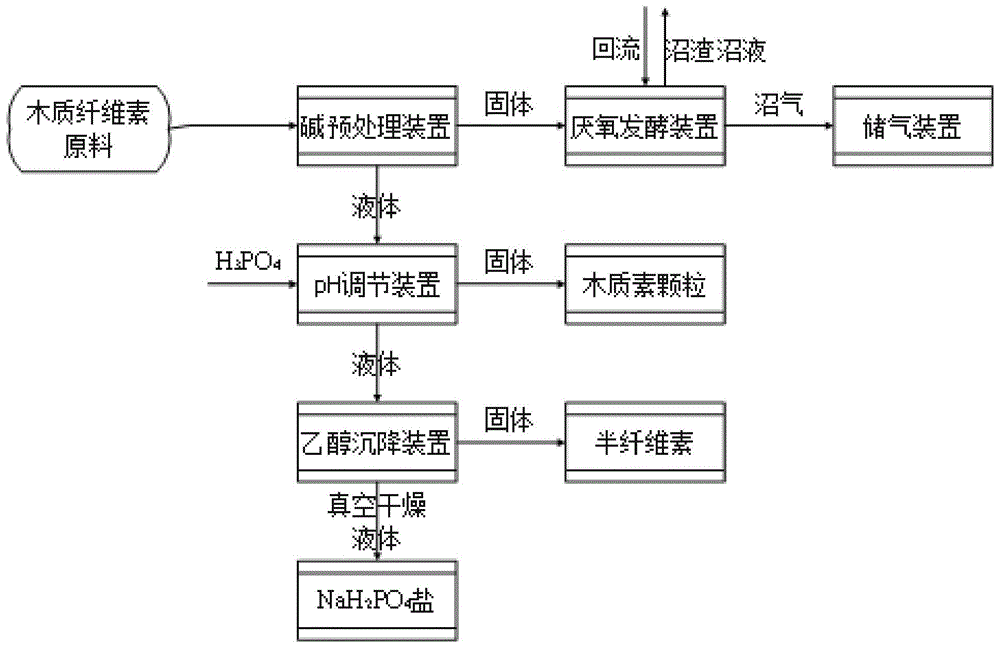
(1)将木质纤维素原料粉碎后加入碱液进行碱预处理;(1) adding lye to carry out alkali pretreatment after pulverizing the lignocellulose raw material;
(2)将步骤(1)中预处理后物料进行固液分离,得到固体A和液体B;(2) solid-liquid separation is carried out to the pretreated material in step (1) to obtain solid A and liquid B;
(3)将步骤(2)中得到的固体A进行厌氧发酵处理,获得富含甲烷的生物燃气;厌氧发酵处理完成后,将厌氧发酵剩余物进行回流参与下一次的厌氧发酵处理;(3) subjecting the solid A obtained in step (2) to anaerobic fermentation treatment to obtain biogas rich in methane; after the anaerobic fermentation treatment is completed, the anaerobic fermentation residue is refluxed to participate in the next anaerobic fermentation treatment ;
(4)将步骤(2)中得到的液体B进行充分搅拌后迅速转移至无机酸溶液中,调节pH值为4.1~4.5,充分搅拌后进行固液分离,得到固体C和液体D;(4) fully stirring the liquid B obtained in the step (2) and rapidly transferring it to the mineral acid solution, adjusting the pH value to be 4.1 to 4.5, and performing solid-liquid separation after fully stirring to obtain solid C and liquid D;
(5)将步骤(4)中得到的固体C经清洗、冷冻、干燥后获得木质素颗粒;(5) the solid C obtained in the step (4) is washed, frozen and dried to obtain lignin particles;
(6)在步骤(4)中得到的液体D中加入乙醇进行沉降处理,调节pH值为4.1~4.5,静置后真空过滤,所得的滤渣即为半纤维素,所得的滤液经真空干燥后获得磷酸二氢钠。(6) adding ethanol to the liquid D obtained in step (4) to carry out sedimentation treatment, adjusting the pH value to be 4.1 to 4.5, vacuum filtration after standing, the obtained filter residue is hemicellulose, and the obtained filtrate is vacuum-dried Obtain sodium dihydrogen phosphate.
优选地,步骤(1)中的碱液为氢氧化钠溶液。Preferably, the alkali solution in step (1) is sodium hydroxide solution.
优选地,步骤(1)中,所述木质纤维素原料和碱液的固液比1kg:(10~20)L。Preferably, in step (1), the solid-to-liquid ratio of the lignocellulosic raw material and the lye is 1kg: (10-20)L.
优选地,步骤(1)中,所述碱液的质量浓度为2.5%~5%(w/v)。Preferably, in step (1), the mass concentration of the alkali solution is 2.5% to 5% (w/v).
优选地,步骤(1)中碱预处理条件为:预处理温度为30~37℃,预处理时间为12~24h。Preferably, the alkali pretreatment conditions in step (1) are: the pretreatment temperature is 30-37°C, and the pretreatment time is 12-24h.
优选地,步骤(3)中厌氧发酵处理条件为:发酵温度为30~37℃或50~55℃,进料有机负荷为1.0~4.0kg VS/(m3·d),水力停留时间为30~45d。Preferably, the anaerobic fermentation treatment conditions in step (3) are: the fermentation temperature is 30-37°C or 50-55°C, the organic load of the feed is 1.0-4.0 kg VS/(m 3 ·d), and the hydraulic retention time is 30~45d.
优选地,所述步骤(4)中的无机酸溶液为磷酸溶液,所述无机酸溶液的质量浓度为10%~15%(w/v)。Preferably, the inorganic acid solution in the step (4) is a phosphoric acid solution, and the mass concentration of the inorganic acid solution is 10%-15% (w/v).
优选地,所述步骤(4)中采用高速离心进行固液分离,离心条件为:离心速度8000~10000rpm、离心时间5~10min。Preferably, in the step (4), high-speed centrifugation is used for solid-liquid separation, and the centrifugation conditions are: centrifugation speed of 8000-10000 rpm and centrifugation time of 5-10 minutes.
优选地,所述步骤(6)中,所述液体D与乙醇的体积比为1:2~3。Preferably, in the step (6), the volume ratio of the liquid D to ethanol is 1:2-3.
本发明与现有技术相比具有如下优点:Compared with the prior art, the present invention has the following advantages:
1、本发明的优点是利用氢氧化钠预处理,降低了原料中的木质素含量,破坏了木质纤维素原料的内部结构,提高了厌氧发酵性能;1. The advantage of the present invention is that the use of sodium hydroxide pretreatment reduces the lignin content in the raw material, destroys the internal structure of the lignocellulose raw material, and improves the anaerobic fermentation performance;
2、厌氧发酵处理的发酵温度为中温(30~37℃)或者高温(50~55℃),这是因为产甲烷菌在这两个温度范围内处于相对活跃状态,可以提高原料产气率。2. The fermentation temperature of anaerobic fermentation treatment is medium temperature (30~37℃) or high temperature (50~55℃), because methanogens are relatively active in these two temperature ranges, which can improve the gas production rate of raw materials .
3、通过将厌氧发酵剩余物进行回流参与下一次的厌氧发酵处理,避免了沼渣沼液的处理问题,同时也确保了厌氧反应器的稳定运行。3. By refluxing the anaerobic fermentation residue to participate in the next anaerobic fermentation treatment, the processing problem of biogas residue and biogas slurry is avoided, and the stable operation of the anaerobic reactor is also ensured.
4、木质纤维素原料预处理后分离得到的预处理液,先倒入无机酸溶液后进行固液分离,得到的固体经清洗、冷冻、干燥后获得木质素颗粒,得到的液体则加入乙醇进行沉降处理后过滤,所得的滤渣即为半纤维素,所得的滤液经真空干燥后获得磷酸二氢钠,使得到的各物质的产率得到提高,提高了能量转化效率、原料综合利用率、工艺的多样性、资源回收率以及经济效益。4. The pretreatment liquid obtained after the pretreatment of lignocellulose raw materials is first poured into the mineral acid solution and then solid-liquid separation is carried out. The obtained solid is washed, frozen and dried to obtain lignin particles, and the obtained liquid is added with ethanol for After the sedimentation treatment is filtered, the obtained filter residue is hemicellulose, and the obtained filtrate is vacuum-dried to obtain sodium dihydrogen phosphate, so that the yield of the obtained substances is improved, and the energy conversion efficiency, the comprehensive utilization rate of raw materials, and the process are improved. diversity, resource recovery and economic benefits.
5、得到的木质素颗粒形貌为球形粒径为60-360nm,该木质素颗粒有别于作为燃料的传统木质素颗粒,该木质素颗粒可用于涂料、胶水和复合材料。5. The morphology of the obtained lignin particles is a spherical particle size of 60-360 nm, the lignin particles are different from the traditional lignin particles used as fuel, and the lignin particles can be used for coatings, glues and composite materials.
6、步骤(4)中将pH值控制在4.1~4.5,这是由于当pH过高,将很难得到形貌为球形的木质素颗粒;步骤(6)中pH控制在4.1~4.5的环境下,这是由于当pH过高或过低时,就会形成别的形态的钠盐,将很难得到磷酸二氢钾。6. In step (4), the pH value is controlled at 4.1-4.5, because when the pH is too high, it is difficult to obtain spherical lignin particles; in step (6), the pH is controlled at 4.1-4.5 in an environment This is because when the pH is too high or too low, other forms of sodium salt will be formed, and it will be difficult to obtain potassium dihydrogen phosphate.
附图说明Description of drawings
图1为本发明的工艺流程示意图。Fig. 1 is the process flow schematic diagram of the present invention.
具体实施方式Detailed ways
下面将结合本发明实施例,对本发明的技术方案进行清楚、完整地描述,显然,所描述的实施例仅仅是本发明一部分实施例,而不是全部的实施例。基于本发明中的实施例,本领域普通技术人员在没有做出创造性劳动前提下所获得的所有其他实施例,都属于本发明保护的范围。除特别说明,本发明使用的设备和试剂为本技术领域常规市购产品。The technical solutions of the present invention will be clearly and completely described below with reference to the embodiments of the present invention. Obviously, the described embodiments are only a part of the embodiments of the present invention, rather than all the embodiments. Based on the embodiments of the present invention, all other embodiments obtained by those of ordinary skill in the art without creative efforts shall fall within the protection scope of the present invention. Unless otherwise specified, the equipment and reagents used in the present invention are conventional commercially available products in the technical field.
实施例1Example 1
(1)选用杂交狼尾草作为木质纤维素原料,将杂交狼尾草原料粉碎后送入碱预处理装置,然后加入质量浓度为5%(w/v)的氢氧化钠溶液进行碱预处理,杂交狼尾草原料和氢氧化钠溶液的固液比为1:10,预处理温度为37℃,预处理时间为24h。(1) Select hybrid Pennisetum as lignocellulose raw material, pulverize the hybrid Pennisetum raw material and send it to an alkali pretreatment device, then add a sodium hydroxide solution with a mass concentration of 5% (w/v) for alkali pretreatment , the solid-liquid ratio of hybrid Pennisetum raw material and sodium hydroxide solution was 1:10, the pretreatment temperature was 37℃, and the pretreatment time was 24h.
(2)将步骤(1)中预处理后物料通过高速离心机进行固液分离,得到固体A和液体B。(2) The pretreated material in step (1) is subjected to solid-liquid separation through a high-speed centrifuge to obtain solid A and liquid B.
(3)将步骤(2)中得到的固体A进入厌氧发酵系统进行厌氧发酵处理,厌氧发酵处理条件为:发酵温度为37℃,进料有机负荷为2.0kg VS/(m3·d),水力停留时间为40d,获得富含甲烷的生物燃气。将生物燃气送入储气装置,该生物燃气可用于热电联产、净化提质再利用;将85%厌氧发酵剩余物回流至厌氧反应器参与下一次的厌氧发酵处理,将15%厌氧发酵剩余物采用现有工艺制备成固体或液体有机肥。(3) the solid A obtained in the step (2) is entered into the anaerobic fermentation system to carry out anaerobic fermentation treatment, and the anaerobic fermentation treatment conditions are: the fermentation temperature is 37 ° C, and the feed organic load is 2.0kg VS/(m 3 · d), the hydraulic retention time is 40d, and the biogas rich in methane is obtained. The biogas is sent to the gas storage device, and the biogas can be used for co-generation, purification and quality reuse; 85% of the anaerobic fermentation residue is returned to the anaerobic reactor for the next anaerobic fermentation treatment, and 15% of the anaerobic fermentation residue is returned to the anaerobic reactor. The anaerobic fermentation residue is prepared into solid or liquid organic fertilizer by the existing technology.
(4)将步骤(2)中得到的液体B在室温下充分搅拌后迅速倒入质量浓度为10%的磷酸溶液中,调节pH值为4.3,充分搅拌20min后,经高速离心机进行固液分离,离心速度8000rpm、离心时间8min;得到固体C和液体D。(4) The liquid B obtained in the step (2) was fully stirred at room temperature and then poured into a phosphoric acid solution with a mass concentration of 10%, and the pH value was adjusted to 4.3. Separation, centrifugation speed 8000rpm, centrifugation time 8min; solid C and liquid D are obtained.
(5)将步骤(4)中得到的固体C经清洗、冷冻、干燥后获得木质素颗粒。(5) After washing, freezing and drying the solid C obtained in step (4), lignin particles are obtained.
(6)在步骤(4)中得到的液体D中加入乙醇进行沉降处理,液体D和乙醇的体积比为1:2,调节pH值为4.3,静置5min后真空过滤,将所得的滤渣进行烘干得到半纤维素,将所得的滤液经真空干燥后获得磷酸二氢钠。(6) in the liquid D that obtains in step (4), add ethanol and carry out sedimentation treatment, the volume ratio of liquid D and ethanol is 1: 2, and adjusting pH value is 4.3, vacuum filtration after standing for 5min, the filter residue of gained is carried out The hemicellulose is obtained by drying, and the obtained filtrate is vacuum-dried to obtain sodium dihydrogen phosphate.
经检测,采用本实施例1工艺处理杂交狼尾草,步骤(3)中出料pH可维持在7.2-7.5,说明该厌氧发酵系统运行是比较稳定的;杂交狼尾草的木质素去除率达到75%,原料产气率大于280mL/gVS;可以得到形貌为球形的木质素颗粒,该木质素颗粒形貌为球形,粒径为60-360nm,该木质素颗粒有别于作为燃料的传统木质素颗粒,该木质素颗粒可用于涂料、胶水和复合材料;半纤维素回收率82%,磷酸二氢钠回收27%。After testing, using the process of the present Example 1 to treat the hybrid Pennisetum, the pH of the discharge in step (3) can be maintained at 7.2-7.5, indicating that the operation of the anaerobic fermentation system is relatively stable; the lignin removal of the Hybrid Pennisetum The lignin particle has a spherical shape and a particle size of 60-360 nm. The lignin particle is different from being used as a fuel. The traditional lignin particles can be used in coatings, glues and composite materials; the recovery rate of hemicellulose is 82%, and the recovery rate of sodium dihydrogen phosphate is 27%.
实施例2Example 2
(1)选用秸秆作为木质纤维素原料,将秸秆原料粉碎后送入碱预处理装置,然后加入质量浓度为2.5%(w/v)的氢氧化钠溶液进行碱预处理,秸秆原料和氢氧化钠溶液的固液比为1:10,预处理温度为30℃,预处理时间为12h。(1) Select straw as lignocellulose raw material, crush the straw raw material and send it to the alkali pretreatment device, and then add sodium hydroxide solution with a mass concentration of 2.5% (w/v) for alkali pretreatment, the straw raw material and hydrogen peroxide The solid-liquid ratio of the sodium solution was 1:10, the pretreatment temperature was 30°C, and the pretreatment time was 12h.
(2)将步骤(1)中预处理后物料通过高速离心机进行固液分离,得到固体A和液体B。(2) The pretreated material in step (1) is subjected to solid-liquid separation through a high-speed centrifuge to obtain solid A and liquid B.
(3)将步骤(2)中得到的固体A进入厌氧发酵系统进行厌氧发酵处理,厌氧发酵处理条件为:发酵温度为37℃,进料有机负荷为2.0kg VS/(m3·d),水力停留时间为40d,获得富含甲烷的生物燃气。将生物燃气送入储气装置,该生物燃气可用于热电联产、净化提质再利用;将85%厌氧发酵剩余物回流至厌氧反应器参与下一次的厌氧发酵处理,将15%厌氧发酵剩余物采用现有工艺制备成固体或液体有机肥。(3) the solid A obtained in the step (2) is entered into the anaerobic fermentation system to carry out anaerobic fermentation treatment, and the anaerobic fermentation treatment conditions are: the fermentation temperature is 37 ° C, and the feed organic load is 2.0kg VS/(m 3 · d), the hydraulic retention time is 40d, and the biogas rich in methane is obtained. The biogas is sent to the gas storage device, and the biogas can be used for co-generation, purification and quality reuse; 85% of the anaerobic fermentation residue is returned to the anaerobic reactor for the next anaerobic fermentation treatment, and 15% of the anaerobic fermentation residue is returned to the anaerobic reactor. The anaerobic fermentation residue is prepared into solid or liquid organic fertilizer by the existing technology.
(4)将步骤(2)中得到的液体B在室温下充分搅拌后迅速倒入质量浓度为10%的磷酸溶液中,调节pH值为4.1,充分搅拌30min后,经高速离心机进行固液分离,离心速度10000rpm、离心时间10min;得到固体C和液体D。(4) The liquid B obtained in the step (2) was fully stirred at room temperature and then poured into a phosphoric acid solution with a mass concentration of 10%, and the pH value was adjusted to 4.1. Separation, centrifugation speed 10000rpm, centrifugation time 10min; solid C and liquid D are obtained.
(5)将步骤(4)中得到的固体C经清洗、冷冻、干燥后获得木质素颗粒。(5) After washing, freezing and drying the solid C obtained in step (4), lignin particles are obtained.
(6)在步骤(4)中得到的液体D中加入乙醇进行沉降处理,液体D和乙醇的体积比为1:2,调节pH值为4.1,静置10min后真空过滤,将所得的滤渣进行烘干得到半纤维素,将所得的滤液经真空干燥后获得磷酸二氢钠。(6) in the liquid D that obtains in step (4), add ethanol and carry out sedimentation treatment, the volume ratio of liquid D and ethanol is 1: 2, the pH value of adjustment is 4.1, and vacuum filtration after standing for 10min, the filter residue of gained is carried out The hemicellulose is obtained by drying, and the obtained filtrate is vacuum-dried to obtain sodium dihydrogen phosphate.
经检测,采用本实施例2工艺处理秸秆,步骤(3)中出料pH可维持在7.2-7.5,秸秆的木质素去除率达到70%,原料产气率大于300mL/gVS,得到球形粒径为90-480nm的木质素颗粒,半纤维素回收率75%,磷酸二氢钠回收23%。After testing, using the process of Example 2 to treat the straw, the pH of the discharge in step (3) can be maintained at 7.2-7.5, the lignin removal rate of the straw can reach 70%, the gas production rate of the raw material is greater than 300mL/gVS, and the spherical particle size is obtained. For lignin particles of 90-480nm, the recovery rate of hemicellulose is 75%, and the recovery rate of sodium dihydrogen phosphate is 23%.
实施例3Example 3
本实施例3与实施例1的区别仅在于:步骤(4)中调节pH值为4.5以及步骤(6)中调节pH值为4.5。The difference between Example 3 and Example 1 is only that the pH value is adjusted to 4.5 in step (4) and the pH value is adjusted to 4.5 in step (6).
经检测,采用本实施例3工艺处理杂交狼尾草,步骤(3)中出料pH可维持在7.2-7.5,杂交狼尾草的木质素去除率达到75%,原料产气率大于280mL/gVS,得到球形粒径为60-240nm的木质素颗粒;半纤维素回收率85%,磷酸二氢钠回收21%。After testing, using the process of this Example 3 to treat the hybrid Pennisetum, the pH of the discharge in step (3) can be maintained at 7.2-7.5, the lignin removal rate of the hybrid Pennisetum reaches 75%, and the gas yield of the raw material is greater than 280mL/ gVS, lignin particles with spherical particle size of 60-240 nm were obtained; the recovery rate of hemicellulose was 85%, and the recovery rate of sodium dihydrogen phosphate was 21%.
实施例4Example 4
本实施例4与实施例1的区别仅在于:步骤(1)中氢氧化钠溶液的质量浓度为3.75%(w/v)以及杂交狼尾草原料和氢氧化钠溶液的固液比为1:20。The difference between the present embodiment 4 and the embodiment 1 is only: the mass concentration of the sodium hydroxide solution in the step (1) is 3.75% (w/v) and the solid-liquid ratio of the hybrid pennisetum raw material and the sodium hydroxide solution is 1 : 20.
经检测,采用本实施例4工艺处理杂交狼尾草,步骤(3)中出料pH可维持在7.2-7.5,杂交狼尾草的木质素去除率达到64%,原料产气率大于265mL/gVS,得到球形粒径为120-240nm的木质素颗粒,半纤维素回收率76%,磷酸二氢钠回收32%。After testing, using the process of this example 4 to treat the hybrid pennisetum, the pH of the discharge in step (3) can be maintained at 7.2-7.5, the lignin removal rate of the hybrid pennisetum reaches 64%, and the gas production rate of the raw material is greater than 265mL/ gVS, the lignin particles with spherical particle size of 120-240 nm were obtained, the recovery rate of hemicellulose was 76%, and the recovery rate of sodium dihydrogen phosphate was 32%.
实施例5Example 5
本实施例5与实施例1的区别仅在于:步骤(4)中磷酸溶液的质量浓度为15%(w/v)。The difference between Example 5 and Example 1 is only that the mass concentration of the phosphoric acid solution in step (4) is 15% (w/v).
经检测,采用本实施例5工艺处理杂交狼尾草,步骤(3)中出料pH可维持在7.2-7.5,杂交狼尾草的木质素去除率达到75%,原料产气率大于280mL/gVS,得到球形粒径为210-420nm的木质素颗粒,半纤维素回收率73%,磷酸二氢钠回收36%。After testing, using the process of the present Example 5 to treat the hybrid Pennisetum, the pH of the discharge in step (3) can be maintained at 7.2-7.5, the lignin removal rate of the hybrid Pennisetum reaches 75%, and the gas yield of the raw material is greater than 280mL/ gVS, the lignin particles with spherical particle size of 210-420 nm were obtained, the recovery rate of hemicellulose was 73%, and the recovery rate of sodium dihydrogen phosphate was 36%.
实施例6Example 6
本实施例6与实施例1的区别仅在于:步骤(4)中磷酸溶液的质量浓度为12.5%(w/v)。The difference between Example 6 and Example 1 is only that the mass concentration of the phosphoric acid solution in step (4) is 12.5% (w/v).
经检测,采用本实施例6工艺处理杂交狼尾草,步骤(3)中出料pH可维持在7.2-7.5,杂交狼尾草的木质素去除率达到75%,原料产气率大于280mL/gVS,得到球形粒径为190-390nm的木质素颗粒,半纤维素回收率76%,磷酸二氢钠回收30%。After testing, using the process of the present Example 6 to treat the hybrid Pennisetum, the pH of the discharge in step (3) can be maintained at 7.2-7.5, the lignin removal rate of the hybrid Pennisetum reaches 75%, and the gas production rate of the raw material is greater than 280mL/ gVS, the lignin particles with spherical particle size of 190-390 nm were obtained, the recovery rate of hemicellulose was 76%, and the recovery rate of sodium dihydrogen phosphate was 30%.
实施例7Example 7
本实施例7与实施例1的区别仅在于:步骤(6)中液体D与乙醇的体积比为1:3。The difference between Example 7 and Example 1 is only that the volume ratio of liquid D to ethanol in step (6) is 1:3.
经检测,采用本实施例7工艺处理杂交狼尾草,步骤(3)中出料pH可维持在7.2-7.5,杂交狼尾草的木质素去除率达到75%,原料产气率大于280mL/gVS,得到球形粒径为60-360nm的木质素颗粒,半纤维素回收率86%,磷酸二氢钠回收27%。After testing, using the process of this example 7 to treat the hybrid pennisetum, the pH of the discharge in step (3) can be maintained at 7.2-7.5, the lignin removal rate of the hybrid pennisetum reaches 75%, and the gas production rate of the raw material is greater than 280mL/ gVS, the lignin particles with spherical particle size of 60-360 nm were obtained, the recovery rate of hemicellulose was 86%, and the recovery rate of sodium dihydrogen phosphate was 27%.
实施例8Example 8
本实施例8与实施例1的区别仅在于:步骤(3)中发酵温度为53℃。The only difference between Example 8 and Example 1 is that the fermentation temperature in step (3) is 53°C.
经检测,采用本实施例8工艺处理杂交狼尾草,步骤(3)中出料pH可维持在7.2-7.5,杂交狼尾草的木质素去除率达到75%,原料产气率大于320mL/gVS,得到球形粒径为60-360nm的木质素颗粒,半纤维素回收率82%,磷酸二氢钠回收27%。After testing, using the process of this example 8 to treat the hybrid pennisetum, the pH of the discharge in step (3) can be maintained at 7.2-7.5, the lignin removal rate of the hybrid pennisetum reaches 75%, and the raw material gas production rate is greater than 320mL/ gVS, the lignin particles with spherical particle size of 60-360 nm were obtained, the recovery rate of hemicellulose was 82%, and the recovery rate of sodium dihydrogen phosphate was 27%.
对比例1Comparative Example 1
本对比例1与实施例1的区别仅在于:步骤(4)中调节pH为2.0以及步骤(6)中调节pH值为2.0。The difference between this comparative example 1 and Example 1 is only that the pH value is adjusted to 2.0 in step (4) and the pH value is adjusted to 2.0 in step (6).
经检测,采用对比例1工艺处理杂交狼尾草,步骤(3)中出料pH可维持在7.2-7.5,杂交狼尾草的木质素去除率达到75%,原料产气率大于320mL/gVS,得到球形粒径为120-240nm的木质素颗粒,半纤维素回收率89%,未回收到磷酸二氢钠。After testing, using the process of Comparative Example 1 to treat the hybrid Pennisetum, the pH of the discharge in step (3) can be maintained at 7.2-7.5, the lignin removal rate of the hybrid Pennisetum reaches 75%, and the gas production rate of the raw material is greater than 320mL/gVS , the lignin particles with spherical particle size of 120-240 nm were obtained, the recovery rate of hemicellulose was 89%, and no sodium dihydrogen phosphate was recovered.
对比例2Comparative Example 2
本对比例2与实施例1的区别仅在于:步骤(4)中调节pH为7.0以及步骤(6)中调节pH值为7.0。The difference between this comparative example 2 and Example 1 is only that the pH value is adjusted to 7.0 in step (4) and the pH value is adjusted to 7.0 in step (6).
经检测,采用对比例2工艺处理杂交狼尾草,步骤(3)中出料pH可维持在7.2-7.5,杂交狼尾草的木质素去除率达到75%,原料产气率大于320mL/gVS,未得到形貌为球形的木质素颗粒,半纤维素回收率76%,未回收到磷酸二氢钠。After testing, using the process of Comparative Example 2 to treat the hybrid Pennisetum, the pH of the discharge in step (3) can be maintained at 7.2-7.5, the lignin removal rate of the hybrid Pennisetum reaches 75%, and the gas production rate of the raw material is greater than 320mL/gVS , no spherical lignin particles were obtained, the recovery rate of hemicellulose was 76%, and no sodium dihydrogen phosphate was recovered.
对比例1、对比例2与实施例1的区别仅在于步骤(4)中以及步骤(6)中的调节PH值不同,其测试数据表明,当步骤(4)中调节pH过高时,未得到形貌为球形的木质素颗粒,当步骤(6)中调节pH过高或过低时,未回收到磷酸二氢钠。The difference between Comparative Example 1, Comparative Example 2 and Example 1 is only in that the adjustment pH value in step (4) and step (6) is different, and its test data shows that when adjusting pH in step (4) is too high, no Spherical lignin particles are obtained, and when the pH is adjusted too high or too low in step (6), sodium dihydrogen phosphate is not recovered.
以上实施例的说明只是用于帮助理解本发明的技术方案及其核心思想,应当指出,对于本技术领域的技术人员来说,在不脱离本发明原理的前提下,还可以对本发明进行若干改进和修饰,这些改进和修饰也落入本发明权利要求的保护范围内。The descriptions of the above embodiments are only used to help understand the technical solutions of the present invention and the core idea thereof. It should be pointed out that for those skilled in the art, the present invention can be further improved without departing from the principles of the present invention. and modifications, these improvements and modifications also fall within the protection scope of the claims of the present invention.
Claims (9)
Priority Applications (1)
| Application Number | Priority Date | Filing Date | Title |
|---|---|---|---|
| CN202210005348.4A CN114317618B (en) | 2022-01-05 | 2022-01-05 | Lignocellulose raw material cascade utilization process based on alkali pretreatment |
Applications Claiming Priority (1)
| Application Number | Priority Date | Filing Date | Title |
|---|---|---|---|
| CN202210005348.4A CN114317618B (en) | 2022-01-05 | 2022-01-05 | Lignocellulose raw material cascade utilization process based on alkali pretreatment |
Publications (2)
| Publication Number | Publication Date |
|---|---|
| CN114317618A true CN114317618A (en) | 2022-04-12 |
| CN114317618B CN114317618B (en) | 2024-08-02 |
Family
ID=81024453
Family Applications (1)
| Application Number | Title | Priority Date | Filing Date |
|---|---|---|---|
| CN202210005348.4A Active CN114317618B (en) | 2022-01-05 | 2022-01-05 | Lignocellulose raw material cascade utilization process based on alkali pretreatment |
Country Status (1)
| Country | Link |
|---|---|
| CN (1) | CN114317618B (en) |
Cited By (3)
| Publication number | Priority date | Publication date | Assignee | Title |
|---|---|---|---|---|
| CN114790319A (en) * | 2022-05-10 | 2022-07-26 | 中国科学院广州能源研究所 | One-pot preparation of degradable gel film materials with alkaline pretreatment solution |
| CN115418003A (en) * | 2022-10-14 | 2022-12-02 | 安徽工业大学 | Method for recovering lignin precipitate in strengthening alkali pretreatment liquid |
| CN115433742A (en) * | 2022-08-12 | 2022-12-06 | 中国林业科学研究院林产化学工业研究所 | A method for solid-state anaerobic fermentation of agricultural and forestry residues to co-produce biogas and organic fertilizer |
Citations (6)
| Publication number | Priority date | Publication date | Assignee | Title |
|---|---|---|---|---|
| US20050244934A1 (en) * | 2004-04-13 | 2005-11-03 | Brian Foody | Recovery of inorganic salt during processing of lignocellulosic feedstocks |
| CN101255479A (en) * | 2008-04-22 | 2008-09-03 | 南京工业大学 | A pretreatment method for efficient saccharification of lignocellulose |
| US20110250645A1 (en) * | 2009-10-12 | 2011-10-13 | E.I. Du Pont De Nemours And Company | Methods to improve monomeric sugar release from lignocellulosic biomass following alkaline pretreatment |
| CN105296568A (en) * | 2015-11-05 | 2016-02-03 | 中国科学院广州能源研究所 | Method for recycling alkali treatment lignocellulose waste fluid |
| CN111172201A (en) * | 2020-01-16 | 2020-05-19 | 吉林大学 | A kind of method for preparing cellulosic ethanol by alkali pretreatment |
| CN111394402A (en) * | 2020-03-09 | 2020-07-10 | 中国科学院广州能源研究所 | Method for co-producing medium-chain fatty acid and biogas by using wood fiber raw material |
-
2022
- 2022-01-05 CN CN202210005348.4A patent/CN114317618B/en active Active
Patent Citations (6)
| Publication number | Priority date | Publication date | Assignee | Title |
|---|---|---|---|---|
| US20050244934A1 (en) * | 2004-04-13 | 2005-11-03 | Brian Foody | Recovery of inorganic salt during processing of lignocellulosic feedstocks |
| CN101255479A (en) * | 2008-04-22 | 2008-09-03 | 南京工业大学 | A pretreatment method for efficient saccharification of lignocellulose |
| US20110250645A1 (en) * | 2009-10-12 | 2011-10-13 | E.I. Du Pont De Nemours And Company | Methods to improve monomeric sugar release from lignocellulosic biomass following alkaline pretreatment |
| CN105296568A (en) * | 2015-11-05 | 2016-02-03 | 中国科学院广州能源研究所 | Method for recycling alkali treatment lignocellulose waste fluid |
| CN111172201A (en) * | 2020-01-16 | 2020-05-19 | 吉林大学 | A kind of method for preparing cellulosic ethanol by alkali pretreatment |
| CN111394402A (en) * | 2020-03-09 | 2020-07-10 | 中国科学院广州能源研究所 | Method for co-producing medium-chain fatty acid and biogas by using wood fiber raw material |
Cited By (5)
| Publication number | Priority date | Publication date | Assignee | Title |
|---|---|---|---|---|
| CN114790319A (en) * | 2022-05-10 | 2022-07-26 | 中国科学院广州能源研究所 | One-pot preparation of degradable gel film materials with alkaline pretreatment solution |
| CN114790319B (en) * | 2022-05-10 | 2023-12-05 | 中国科学院广州能源研究所 | Process for preparing degradable gel film material by alkali pretreatment liquid one-pot method |
| CN115433742A (en) * | 2022-08-12 | 2022-12-06 | 中国林业科学研究院林产化学工业研究所 | A method for solid-state anaerobic fermentation of agricultural and forestry residues to co-produce biogas and organic fertilizer |
| CN115433742B (en) * | 2022-08-12 | 2024-03-19 | 中国林业科学研究院林产化学工业研究所 | Method for co-producing biogas and organic fertilizer from agricultural and forestry residues through solid anaerobic fermentation |
| CN115418003A (en) * | 2022-10-14 | 2022-12-02 | 安徽工业大学 | Method for recovering lignin precipitate in strengthening alkali pretreatment liquid |
Also Published As
| Publication number | Publication date |
|---|---|
| CN114317618B (en) | 2024-08-02 |
Similar Documents
| Publication | Publication Date | Title |
|---|---|---|
| CN100365099C (en) | A new technology for producing liquid fuel from biomass | |
| CN102272318B (en) | Saccharide production process and ethanol production process | |
| CN114317618A (en) | Cascade Utilization Process of Lignocellulosic Raw Materials Based on Alkali Pretreatment | |
| Wei et al. | Comparison of microwave-assisted zinc chloride hydrate and alkali pretreatments for enhancing eucalyptus enzymatic saccharification | |
| CN101787381A (en) | Method for preparing fermentable reducing sugar by adopting ionic liquids to treat cellulose biomass | |
| CN102010882A (en) | Method for performing lignocelluloses raw material high-temperature diluted acid pretreatment by using extremely small amount of water | |
| CN102604121A (en) | Method for preparing high-quality lignin by coupling hydrothermal pretreatment and high-boiling-point alcohol | |
| CN115845799A (en) | Preparation method of low-temperature-alkali-hydrothermal biochar | |
| Zhan et al. | Enhancing the potential production of bioethanol with bamboo by γ-valerolactone/water pretreatment | |
| CN104878055A (en) | Method for pretreating ethyl alcohol produced from corn straws | |
| CN104232705A (en) | Method for pretreating lignocellulose at low temperature through coupling of sodium hydroxide and ethanol | |
| CN104894188A (en) | Pretreatment method for enzymolysis and saccharification of bagasse | |
| CN110066840A (en) | A kind of method that hydro-thermal-microwave coupled ion liquid two-step method lignocellulosic material improves enzymolysis efficiency | |
| CN106591395A (en) | Method for improving lignocellulose enzymolysis efficiency by lignocellulose pretreatment through ultrasonic-microwave synchronously-assisted ionic liquid system | |
| CN102382310B (en) | Lignin co-production method by comprehensively utilizing lignocellulose resources | |
| JP2025538267A (en) | Methods for improving the efficiency of enzymatic hydrolysis of lignocellulose | |
| Wang et al. | Thermostatic microwave-assisted pretreatment of corn stover at atmospheric pressure to enhance saccharification | |
| CN110669804A (en) | A kind of method for improving lignocellulose saccharification efficiency | |
| CN103194504B (en) | Application of sulfonated lignin in wood fibre material enzyme hydrolysis saccharification | |
| CN114941254A (en) | Pretreatment method and application of lignocellulose biomass and method for improving enzymolysis efficiency of lignocellulose biomass | |
| CN118910189A (en) | High-solid-content enzymolysis method for improving agricultural waste degradation efficiency | |
| Zhao et al. | Efficient fractionation of corn stover via 4-CSA-based ternary deep eutectic solvent for cellulose valorization and recyclable enzyme immobilization in isoquercitrin bio-production | |
| CN112852900A (en) | Pretreatment method and enzymolysis method of lignocellulose raw material | |
| CN105420309B (en) | A kind of pretreating process improving grass family raw cellulose enzymatic saccharification rate | |
| Zhang et al. | Advances in cellulose solvent-and organic solvent-based lignocellulose fractionation (COSLIF) |
Legal Events
| Date | Code | Title | Description |
|---|---|---|---|
| PB01 | Publication | ||
| PB01 | Publication | ||
| SE01 | Entry into force of request for substantive examination | ||
| SE01 | Entry into force of request for substantive examination | ||
| GR01 | Patent grant | ||
| GR01 | Patent grant |