Detailed Description
The technical solutions in the embodiments of the present disclosure will be clearly and completely described below with reference to the drawings in the embodiments of the present disclosure, and it is obvious that the described embodiments are only a part of the embodiments of the present disclosure, and not all of the embodiments.
The blockchain is a distributed chain storage accounting technology based on cryptography. The block chain technology can organize and maintain a large amount of data in a decentralized or multi-centric mode, has the characteristics of distribution, non-tamper property, traceability, safety, credibility and the like, and is widely applied to multiple fields.
Fig. 1 is an exemplary diagram of a block chain system provided in an embodiment of the present disclosure. As shown in fig. 1, the block chain system 100 may include a block chain user terminal (ue) 110 and a block chain network 120. Blockchain network 120 may include a plurality of blockchain nodes (simply nodes), such as node 120-a, node 120-B, node 120-C, and node 120-N of fig. 1.
The user end 110 and/or nodes in the blockchain network 120 may include various types of computing devices, such as smart phones, desktop computers, or servers. In some embodiments, the servers may be independent servers or groups of servers, which may be centralized or distributed. In some embodiments, the server may execute on a cloud platform.
The user terminal 110 is a terminal that can use the blockchain service. The user terminal 110 can link to a node in the blockchain network 120 to obtain blockchain services. In some embodiments, the ue 110 may obtain the blockchain service by initiating a blockchain transaction (abbreviated as transaction, which may also be referred to as a request), that is, the ue 110 may generate a transaction and send the generated transaction to the blockchain network 120.
The users of the blockchain can use the blockchain service through the user terminal 110. As an implementation manner, the blockchain user may log in its own blockchain account through the user terminal 110, and initiate a transaction request to the blockchain network through the corresponding blockchain account.
In some embodiments, a blockchain account may refer to an account private key, such as a string that is known only to the blockchain user himself. This private key is required for all operations of the blockchain user on the blockchain to sign. In other words, a user holding a private key can have absolute control over the blockchain account corresponding to the private key, and if the blockchain user loses its private key, the blockchain account corresponding to the private key is lost. In some embodiments, the user may maintain their own blockchain account.
The block chain user can digitally sign the information based on the private key of the account of the user so as to ensure the non-repudiation of the information. The digital signature is a cryptographic algorithm, information of the digital signature is carried out by using an account private key, and the information can be verified only by using a public key, so that a third party cannot impersonate the private key to carry out signature. In some embodiments, the digital signature may use a specific hash function, and the hash value of different text is different.
A node in blockchain network 120 may receive a transaction broadcast in blockchain network 120. After receiving the transaction, the block link point may execute the transaction according to the transaction content.
An intelligent contract is a set of commitments defined in digital form, including agreements on which contract participants can execute the commitments. An intelligent contract is essentially a piece of code running on a block link point for completing the business logic assigned by the user. The code can be exposed to the outside in the form of a plurality of functions, so that the block chain account can call different functions according to needs.
In a brand authorization (or brand license) transaction, a brand party (authorizer) may authorize a brand user (authorized party) with its own brand. After the brand user obtains the authorization, the authorized brand can be utilized or used for design, production, manufacture, sale and other business activities.
As one example, the brand authorization may refer to character authorization, such as cartoon character authorization. In this scenario, a brand party owning a certain cartoon character may authorize a certain toy manufacturer so that the toy manufacturer may print the cartoon character on the toy it makes. In this example, the toy manufacturer, who is the brand user, may gain access to the cartoon character.
As another example, brand authorization may refer to artwork authorization. Under the scene, a brand party with a certain artwork can authorize a certain exhibition hall, so that the exhibition hall can exhibit the artwork. In this example, the exhibition hall is a brand user, and the exhibition hall can obtain the exhibition right of the artwork.
As yet another example, the brand authorization may refer to a patent authorization. In this scenario, taking a drug patent as an example, a brand party owning a certain drug patent may authorize a certain pharmaceutical factory, so that the pharmaceutical factory may produce a drug corresponding to the drug patent. In this example, the pharmaceutical factory is a brand user, and the pharmaceutical factory may obtain manufacturing rights for the pharmaceutical patents.
In some embodiments, brands and brand users may implement brand authorization based on blockchains. As described above, the blockchain has the characteristics of non-tamper-ability, safety, reliability and the like, so that the problem of mutual trust between a brand party and a brand user can be solved by performing brand authorization on the blockchain.
As one implementation, a brand party or brand user may upload a brand authorization contract signed by both parties, which may be an electronic version of the authorization contract, to the blockchain. After the block link receives the brand authorization contract uploaded to the block link, an intelligent contract can be called to carry out uplink storage on transaction content in the brand authorization contract; alternatively, the brand authorization data in the brand authorization contract may be processed according to specific processing rules, for example, related information of brand users may be processed into on-chain assets with value attributes, such as digital assets.
A digital asset is an on-chain asset with value attributes that is distributed based on a blockchain, and in some embodiments, an on-chain digital asset may be a mapping of an object under the chain onto the chain. Digital assets are unique and can have an anchored relationship to objects under the chain. The digital assets may be defined based on some digital asset protocol. As one implementation, the digital asset may be defined using a digital asset protocol (ERC721), such digital asset is commonly referred to as a non-homogeneous token (NFT), but the disclosure is not so limited and the digital asset may be defined using other digital asset protocols.
When a brand authorization transaction is implemented on the blockchain, corresponding brand authorization order data may be generated. When a certain brand and a brand user realize one brand authorization transaction based on the blockchain, corresponding brand authorization order data can be generated on the blockchain, and correspondingly, the brand authorization order number in a certain period of time can be obtained according to the generated brand authorization order data.
Currently, in brand-authorized transactions, the evaluation and determination of brand value is the basis on which brand-authorized transactions can be conducted. However, in the prior art, the brand value is generally evaluated in a manual and subjective judgment manner, so that the brand value obtained by evaluation has high uncertainty, and thus, the brand authorization transaction is hindered.
In order to solve the above problems, embodiments of the present disclosure provide a method and an apparatus for evaluating brand value based on a blockchain, in which a weight corresponding to a brand is determined by using a value evaluation factor of the brand, and then the weight corresponding to the brand is processed into an asset on the chain to evaluate the brand value, so that the brand value can be scientifically and quantitatively evaluated, and the method and the apparatus can play a role in optimizing brand marketing activities and performing a positive cycle evaluation of the brand value, thereby promoting the normative and scale development of brand authorization transactions.
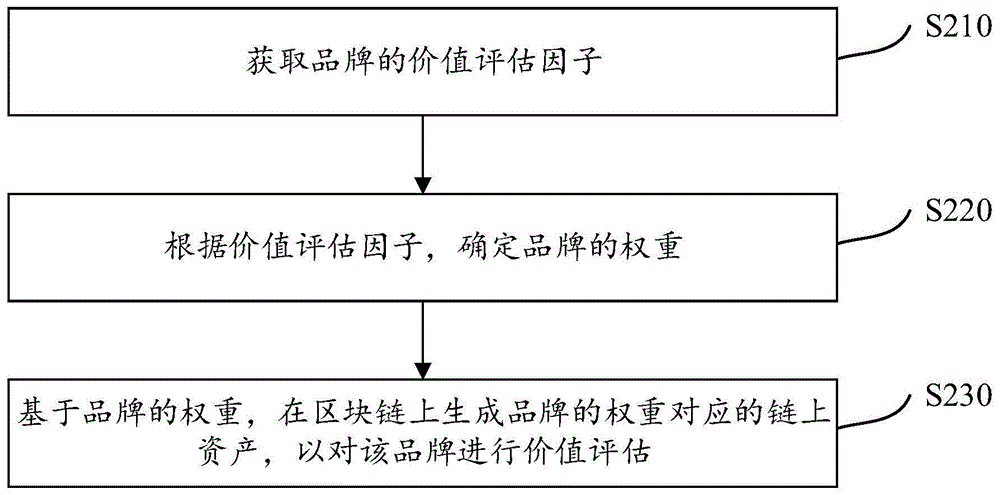
The method for evaluating brand value based on blockchains provided by the embodiment of the present disclosure is described in detail below with reference to fig. 2. The method shown in fig. 2 may be performed by block link points.
As shown in FIG. 2, at step 210, a value assessment factor for a brand is obtained.
The value assessment factor of the brand is not particularly limited in the embodiments of the present disclosure. In some embodiments, the value evaluation factors for a brand may include a weight of a brand user to which the brand corresponds, a gross trading volume (GMV) of the brand, and an authorized amount of orders of the brand. Wherein the weight of a brand user may indicate the quality of the brand user owned by the brand. The GMV of a brand may represent a transaction total for the brand over a time dimension (e.g., days/weeks/months). The authorized order number for a brand may represent a total number of brand authorized orders for the brand.
As described above, the brand authorization order data corresponding to the brand may record transaction information corresponding to the brand, for example, the brand authorization order data may include data of a transaction brand, a brand party, a brand user, a transaction amount, a transaction time, and the like in the current brand authorization transaction. In some embodiments, a brand party of a brand may brand-authorize a brand user on the blockchain, and brand-authorization order data corresponding to the brand may be stored on the blockchain.
In some embodiments, data related to the value assessment factor of a brand may be stored directly on the blockchain, and the blockchain link point may obtain data corresponding to the value assessment factor of a certain brand directly from the blockchain, such as obtaining a weight of a brand user corresponding to the brand, a GMV of the brand, or an authorized amount of orders of the brand from the blockchain.
In some embodiments, a block link point may obtain data corresponding to a value assessment factor for a certain brand by invoking a form of intelligent contract. For example, when the block chain node needs to obtain the weight of the brand user corresponding to the brand, the block chain node may call the corresponding intelligent contract to request the intelligent contract to calculate the weight of the brand user corresponding to the brand, and return the calculation result to the block chain node.
At step 220, the weight of the brand is determined based on the value assessment factor.
The weight of a brand may be used to characterize the value to which the brand corresponds. As one implementation, the weight of each value evaluation factor can be calculated according to the value evaluation factors of the brand, and the weights of the value evaluation factors are summed to obtain the weight of the brand.
A specific example of determining the weight of a brand is given below in conjunction with FIG. 3. As shown in FIG. 3, the calculation of weights for brand A and brand B is presented in this example.
Specifically, brand a has 2 brand users, the weights of the 2 brand users are 13 and 14 respectively, the GMV of brand a is 200 ten thousand, the authorized order number of brand a is 100 ten thousand, and the weight of brand a can be calculated to be 14. When calculating the brand weight corresponding to each value evaluation factor of the brand user A, the weight proportion of the value evaluation factor in different brands and the weight in different value evaluation factors can be considered at the same time. For example, in the example of fig. 3, when calculating the brand weight corresponding to the brand user of brand a, the weight ratio of the brand user corresponding to brand a in brand a and brand B is 27/(27+47) ≈ 0.4, and the weight in the weight of the brand user, the GMV of the brand, and the authorized amount of orders of the brand is 10, so the brand weight corresponding to the brand user of brand a is 0.4 ≈ 10 ═ 4.
Brand B has 3 brand users with weights of 17, 18 and 12, respectively, and has a GMV of 500 ten thousand for Brand B and an authorized order number of 1 ten thousand for Brand B, which can be calculated to have a weight of 16 for Brand B.
At step 230, based on the weight of the brand, an on-chain asset corresponding to the weight of the brand is generated on the blockchain to evaluate the value of the brand.
Continuing with the example of FIG. 3, in this example, brand A has a final weight of 14 and brand B has a final weight of 16, and brand B is more valuable than brand A.
The embodiment of the present disclosure does not specifically limit the type of the on-chain asset corresponding to the weight of the brand, as long as the on-chain asset is an asset with a value attribute issued on the blockchain. In some embodiments, the on-chain asset may be a digital asset, preferably the on-chain asset may be an NFT asset.
The embodiment of the present disclosure does not specifically limit the on-chain data structure of the NFT asset corresponding to the weight of the brand. As an example, an on-chain data structure of an NFT asset provided by an embodiment of the present disclosure may be as shown in fig. 4. The data structure may include both the underlying information and metadata for the NFT asset. For example, the base information may include brand ID, brand party account, brand user account, and the like; the metadata may include a base description of the NFT asset, a weight of the brand, an update time of the weight of the brand, and the like. Where metadata may be automatically updated in a time dimension (e.g., hours/days/weeks/months).
The weights of the brands are processed into digital assets which can be accurately weighted and circulated through a block chain NFT technology, and the assets of the weights of the brands on a block chain are realized. Metadata attributes of digital assets can be updated in real-time in a time dimension to guarantee the quality of the digital assets, for example, at hourly/daily/weekly/monthly intervals. Based on this, according to the technical scheme provided by the embodiment of the disclosure, the weight corresponding to the brand is determined by using the value evaluation factor of the brand, and then the weight corresponding to the brand is processed into the assets on the chain to evaluate the brand value, so that on one hand, the brand value can be scientifically and quantitatively evaluated, and technical support and evaluation basis are provided for brand authorization pricing; on the other hand, the brand can be guided to perform daily marketing activities of the brand, and the normative and scale development of brand authorization transactions is promoted.
In some embodiments, the weight of the brand user is calculated based on the weight influence factor of the brand user, and the weight of the brand user may be calculated before obtaining the value evaluation factor of the brand. The manner in which the weights of brand users are calculated is illustrated in more detail below in conjunction with FIG. 5.
As shown in FIG. 5, at step 510, a weighted impact factor for a brand user is obtained.
The weight influence factor of the brand user is not specifically limited in the embodiments of the present disclosure, for example, the weight influence factor of the brand user may include at least one of the following influence factors: transaction extent, transaction amount, and transaction frequency.
The transaction breadth can represent the brand quantity of brand user transaction, and the user weight is higher when the quantity is larger. The transaction amount may represent the cost of the brand user on the brand, with higher costs corresponding to higher user weights. The transaction frequency may represent the frequency of brand authorization transactions corresponding to brand users, with higher frequencies corresponding to higher user weights.
At step 520, the weight of the brand user is calculated based on the weight impact factor of the brand user.
An example of calculating weights for brand users is given below in conjunction with FIG. 6. As shown in FIG. 6, this example illustrates a calculation of user weights for brand user A and brand user B.
Specifically, the brand user a has traded 3 brands (that is, the trading breadth corresponding to the brand user a is 3), the trading amount is 1 ten thousand yuan, the trading frequency is 200 units/day, and the user weight corresponding to the brand user a can be calculated to be 13. When calculating the user weight corresponding to each weight influence factor of brand user a, the weight proportion of the weight influence factor in different brand users and the weight in different weight influence factors can be considered at the same time. For example, in the example of fig. 6, when calculating the user weight corresponding to the transaction extent of brand user a, the weight ratio of the transaction extent of brand user a in brand user a and brand user B is 3/(3+1) ≈ 0.8, and the weight in the transaction extent, the transaction amount, and the transaction frequency is 10, so the user weight corresponding to the transaction extent of brand user a is 0.8 × 10 ═ 8.
The brand user B trades 1 brand (i.e., the trading extent corresponding to the brand user B is 1), the trading amount is 5 ten thousand yuan, the trading frequency is 300 units/day, and the user weight corresponding to the brand user B can be calculated to be 17.
Based on steps 510 and 520 described above, weights for brand users may be calculated. FIG. 7 is an exemplary diagram of a link flow for assessing brand value provided by an embodiment of the present disclosure. As shown in FIG. 7, after the weights of the brand users are calculated, the weights of the brand may be determined based on the weights of the brand users and other value assessment factors. Based on the obtained weight of the brand, on one hand, the value of the brand can be evaluated; on the other hand, the brand party may be directed to a daily marketing campaign for the brand.
In some embodiments, the weight of the brand is dynamically updated, for example, a value assessment factor for the brand (e.g., the weight of the brand user, the GMV of the brand, the authorized amount of orders for the brand, etc.) may be dynamically updated in the time dimension, such that the weight of the determined brand may also be dynamically updated. As one implementation, the weights of the brand users may be updated at preset time intervals. Specifically, the weight influence factor of the brand user may be updated at preset time intervals, and then the weight of the brand user may be calculated according to the updated weight influence factor. Or, the embodiment of the disclosure may update the weight of the brand according to a preset time interval based on dynamically updated brand authorization order data, basic data of a brand user, and transaction behavior data corresponding to the brand, and ensure that the weight of the brand is the latest data, and the reference value is higher.
The specific value of the preset time interval is not limited in the embodiment of the disclosure. For example, the weight impact factors for brand users may be updated at an hourly update rate; or, the weight influence factor of the brand user may be updated according to a daily update rate, and of course, other preset time intervals may also be adopted as long as the weight influence factor of the brand user is dynamically updated.
In some embodiments, the intelligent contracts deployed on the blockchain may be used to manage transactions associated with weights of brand users, and prior to obtaining a value assessment factor for the brand, the blockchain may receive an invocation request for the intelligent contracts, which may be used to determine the weights of the brand users. Based on the invocation request, a weight of the brand user may be obtained. After the weight of the brand user is obtained, the weight of the brand can be determined by combining the obtained value evaluation factors of other brands.
A specific example of a block chain-based brand value evaluation method is given below in conjunction with fig. 8. As shown in FIG. 8, brand parties and brand users may perform brand authorization on the blockchain, for example, brand A and brand B authorization processes are performed on the blockchain. Thus, brand authorization order data associated with brand A and brand B is generated and stored on the blockchain. In addition, the brand user can synchronize to the blockchain as an aid through the basic data and the transaction behavior data of the APP, so that the weight influence factor of the brand user can be obtained and the weight of the brand user can be calculated based on the brand authorization order data, the basic data and the transaction behavior data corresponding to the brand, the weight of the brand can be determined by integrating other value evaluation factors (GMV of the brand, authorization order number of the brand, and the like) based on the calculated weight of the brand user, and the weight of the brand can be dynamically updated, for example, dynamically updated according to the daily dimension.
Method embodiments of the present disclosure are described in detail above in conjunction with fig. 1-8, and apparatus embodiments of the present disclosure are described in detail below in conjunction with fig. 9 and 10. It is to be understood that the description of the method embodiments corresponds to the description of the apparatus embodiments, and therefore reference may be made to the preceding method embodiments for parts not described in detail.
Fig. 9 is a schematic structural diagram of an evaluation apparatus for brand value based on a blockchain according to an embodiment of the present disclosure. The apparatus 900 for brand value evaluation based on a blockchain shown in fig. 9 may include a first obtaining unit 910, a determining unit 920, and a generating unit 930.
The first obtaining unit 910 may be configured to obtain a value evaluation factor of a brand, the value evaluation factor including at least one of: the weight of brand users corresponding to the brand, the total volume GMV of the brand and the authorized amount of orders of the brand.
The determining unit 920 may be configured to determine a weight of the brand according to the value evaluation factor.
The generating unit 930 may be configured to generate, on the blockchain, an on-chain asset corresponding to a weight of the brand based on the weight of the brand to evaluate the value of the brand.
Optionally, the weight of the brand user is calculated based on the weight influence factor of the brand user, and the apparatus 900 further includes: a second obtaining unit, which may be configured to obtain a weight influence factor of the brand user, the weight influence factor including at least one of: transaction extent, transaction amount, and transaction frequency; and the calculating unit can be configured to calculate the weight of the brand user according to the weight influence factor of the brand user.
Optionally, the computing unit may be further configured to: updating the weight influence factor of the brand user according to a preset time interval; and calculating the weight of the brand user according to the updated weight influence factor.
Optionally, the on-chain asset is a non-homogeneous voucher NFT asset.
Optionally, the brand side of the brand makes a brand authorization to the brand user on the blockchain, and the brand authorization amount is stored on the blockchain.
Fig. 10 is a schematic structural diagram of an evaluation apparatus based on brand value of a blockchain according to another embodiment of the present disclosure. The apparatus 1000 shown in fig. 10 may be a server, a user terminal, or a portable device. The apparatus 1000 may include a memory 1010 and a processor 1020. The memory 1010 may be used to store executable code. The processor 1020 may be configured to execute executable code stored in the memory 1010 to implement the steps of the various methods described above. In some embodiments, the apparatus 1000 may further include a network interface 1030, and the data exchange between the processor 1020 and the external device may be implemented through the network interface 1030.
In the above embodiments, all or part of the implementation may be realized by software, hardware, firmware or any other combination. When implemented in software, may be implemented in whole or in part in the form of a computer program product. The computer program product includes one or more computer instructions. The procedures or functions described in accordance with the embodiments of the disclosure are, in whole or in part, generated when the computer program instructions are loaded and executed on a computer. The computer may be a general purpose computer, a special purpose computer, a network of computers, or other programmable device. The computer instructions may be stored on a computer readable storage medium or transmitted from one computer readable storage medium to another, for example, from one website, computer, server, or data center to another website, computer, server, or data center via wire (e.g., coaxial cable, fiber optic, Digital Subscriber Line (DSL)) or wireless (e.g., infrared, wireless, microwave, etc.). The computer-readable storage medium can be any available medium that can be accessed by a computer or a data storage device, such as a server, a data center, etc., that incorporates one or more of the available media. The usable medium may be a magnetic medium (e.g., floppy Disk, hard Disk, magnetic tape), an optical medium (e.g., Digital Video Disk (DVD)), or a semiconductor medium (e.g., Solid State Disk (SSD)), among others.
Those of ordinary skill in the art will appreciate that the various illustrative elements and algorithm steps described in connection with the embodiments disclosed herein may be implemented as electronic hardware or combinations of computer software and electronic hardware. Whether such functionality is implemented as hardware or software depends upon the particular application and design constraints imposed on the implementation. Skilled artisans may implement the described functionality in varying ways for each particular application, but such implementation decisions should not be interpreted as causing a departure from the scope of the present disclosure.
In the several embodiments provided in the present disclosure, it should be understood that the disclosed system, apparatus, and method may be implemented in other ways. For example, the above-described apparatus embodiments are merely illustrative, and for example, the division of the units is only one logical division, and other divisions may be realized in practice, for example, a plurality of units or components may be combined or integrated into another system, or some features may be omitted, or not executed. In addition, the shown or discussed mutual coupling or direct coupling or communication connection may be an indirect coupling or communication connection through some interfaces, devices or units, and may be in an electrical, mechanical or other form.
The units described as separate parts may or may not be physically separate, and parts displayed as units may or may not be physical units, may be located in one place, or may be distributed on a plurality of network units. Some or all of the units can be selected according to actual needs to achieve the purpose of the solution of the embodiment.
In addition, functional units in the embodiments of the present disclosure may be integrated into one processing unit, or each unit may exist alone physically, or two or more units are integrated into one unit.
The above description is only for the specific embodiments of the present disclosure, but the scope of the present disclosure is not limited thereto, and any person skilled in the art can easily conceive of the changes or substitutions within the technical scope of the present disclosure, and all the changes or substitutions should be covered within the scope of the present disclosure. Therefore, the protection scope of the present disclosure shall be subject to the protection scope of the claims.