Technical Field
The water lubrication has the characteristics of no pollution, good cooling performance, high safety and the like, and is widely applied to the fields of mechanical lubrication, cutting and the like. But the application range is limited due to the defects of low viscosity of water, easy loss in the lubricating process, poor actual lubricating effect compared with oil lubricating and the like. In order to improve the water lubrication performance, a plurality of water-soluble nano particles are introduced into the water lubrication to reduce the friction and the abrasion of a friction pair. In recent years, soft substances (polymer brushes and hydrogels) are widely researched, particularly, a hydrophilic three-dimensional network structure material such as a hydrogel has good biocompatibility, and a chemical network structure of the hydrogel has high designability, so that various responsive molecules can be introduced into a hydrogel network, and the hydrogel can respond to different environmental stimuli by changing the external environment to achieve the conversion of molecular conformation in a gel system. At present, the research is widely carried out on temperature, pH, light, electricity and other responsive hydrogels, and the hydrogel is widely applied to the fields of drug release, artificial muscle and the like.
With the proposal of the concept of lubrication adaptation in the field of tribology, researches on the application of responsive gel in the field of tribology are gradually paid attention, but the mechanical strength of hydrogel is generally weak, and the hydrogel is difficult to adapt to continuous shearing in the friction process. Chinese patent CN109825269A discloses application of a shear-responsive gel plugging agent in the field of drilling fluid plugging, but the shear-responsive gel with shear thinning and standing thickening characteristics is finally obtained by the scheme; chinese patent CN114058029A discloses a vibration gelling technology, the prepared hydrogel stock solution can be gelled after slight vibration, which is not suitable for the self-adaptive scene of the working condition that the required friction initial lubricant is easy to inject and the shearing gelling is existed in the friction process. Therefore, at present, no water lubrication technical scheme with shear-forming glue and shear-thickening regulation and control performance exists for the water lubrication friction pair.
Disclosure of Invention
The invention aims to provide a preparation method of a high-molecular water-based gel lubricant with shear response, aiming at the problems that the water lubricating film forming capability of a friction interface is insufficient and adhesive wear is easy to occur in the existing water lubricating technology.
The invention discloses a preparation method of a shear-responsive water-based gel lubricant, which comprises the steps of dissolving Acrylamide (AM) and Acrylic Acid (AA) in water, heating to 50 to 55 ℃, and stirring until a solution is clear and transparent; introducing high-purity nitrogen into the system to remove oxygen dissolved in water, heating the reaction system to 70-75 ℃, adding a crosslinking agent N, N-Methylenebisacrylamide (MBA) into the reaction system, stirring for 8-15min, adding an initiator Ammonium Persulfate (APS) into the reaction system, stirring and polymerizing for 6-8h, and cooling to room temperature to obtain the shear-responsive water-based gel lubricant solution.
The molar ratio of Acrylamide (AM) to Acrylic Acid (AA) is 3.5 to 1 to 4.5; acrylamide (AM) and Acrylic Acid (AA) are dissolved in water according to the mass percent of 1 to 1.5 percent.
The molar ratio of Acrylamide (AM) to N, N-Methylenebisacrylamide (MBA) is 40.
2. Structure and performance of water-based lubricants
1. Morphology of Water-based Lubricants
Fig. 1 is a picture of the appearance of a water-based gel lubricant prepared according to the present invention. Therefore, the water-based lubricant prepared by the invention is colorless liquid, and is dispersed uniformly and stably for a long time. The initial liquid state enables the lubricant to be more easily injected into the friction interface.
FIG. 2 is a scanning electron micrograph of a water-based gel lubricant prepared according to the present invention after lyophilization. It can be seen that the freeze-dried sample appears fibrous, and this structure enables the molecular chains to be oriented in the shear direction during shearing, giving them shear-responsiveness.
FIG. 3 is an infrared spectrum of a water-based gel lubricant prepared in accordance with the present invention. It can be seen that AA and AM participate in the polymerization reaction to give a copolymer.
2. Shear response characteristic
The shear response of the water-based gel lubricant was studied using an antopa MCR 302 rheometer with the test conditions: PP25 plate measurement system, slit width 1mm, rotation mode, fixed shear frequency, measurement temperature 25 ℃.
FIG. 4 shows that the water-based gel lubricant prepared by the present invention is at 0.5s -1 Response characteristics at low shear rate. As can be seen from FIG. 4, the water-based gel lubricant was used at 0.5s -1 At a constant shear rate, the viscosity increased with increasing shear time and became gel-like after shearing for 60 s. The macroscopic state of the water-based gel lubricant after shearing is shown in fig. 5 and is gel-like.
FIG. 6 shows the water-based gel lubricant at 100s -1 Response at shear rate. The viscosity graph 6 shows that the water-based gel lubricant prepared by the invention still has the special property of shear thickening and gelling under high-speed shearing.
3. Tribological properties
The HT-1000 high-temperature reciprocating friction and wear testing machine is adopted, and the specific experimental conditions are as follows: load 10N, different frequency, upper sample is 304 stainless steel ball or Si with diameter 6mm 3 N 4 And (3) ceramic balls. The lower samples were 304 stainless steel blocks and Si, respectively 3 N 4 A ceramic block. The duration of the test was 30min.
FIG. 7 is a graph of the coefficient of friction under water lubrication conditions, and FIG. 7 (a) shows a stainless steel-stainless steel friction pair with an average coefficient of friction of about 0.32; wherein FIG. 7 (b) is represented by Si 3 N 4 -Si 3 N 4 The average coefficient of friction is about 0.45 for a friction pair.
FIG. 8 is a plot of coefficient of friction curves under lubricated conditions for a sample of water-based lubricant prepared in accordance with the present invention (example 1), expressed as Si 3 N 4 -Si 3 N 4 Is a friction pair, has an average friction coefficient of about 0.188 at a frequency of 4Hz, and is lubricated with pure water 3 N 4 The friction coefficient is reduced by about 60% compared to the friction pair. And the rubbed sample is adsorbed on the surface of the friction pair in a gel state, and the reciprocating shearing can also thicken and gel the material.
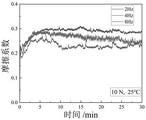
FIG. 9 is a plot of coefficient of friction at different frequencies for water-based lubricant lubricated samples prepared according to the present invention (example 2). 304-304 stainless steel is used as a friction pair. Has a fast frequency response characteristic. Fig. 9 shows that stainless steel-stainless steel is used as the friction pair, the average friction coefficient at 4Hz frequency is as low as 0.262, and the friction coefficient is reduced by about 20% compared with the friction pair of 304 stainless steel lubricated by pure water. The rubbed sample also exhibited gel-like adsorption on the surface of the rubbing pair.
The results of fig. 8 and 9 show that the water-based gel lubricant has response characteristics to different friction pairs, and the friction coefficient gradually decreases with increasing reciprocating frequency, indicating that the higher the shear frequency, the faster the molecules of the water-based gel lubricant cross-link and the easier the water-based gel lubricant becomes to gel.
In conclusion, the shear response water-based gel lubricant disclosed by the invention is constructed based on self-assembly of a polymer chain, and effectively solves the problems of insufficient film forming capability and easiness in adhesive wear in the water lubricating process; the water-based gel lubricant has low initial viscosity and is easy to inject into a friction interface; the high-viscosity polyurethane rubber has a quick shear response characteristic, can be thickened quickly in a friction process, forms a lubricating film on a friction interface, and has excellent adhesion capability. When the gel material is used for a friction matching pair, the friction coefficient can be reduced, the adhesive wear of a friction interface can be greatly relieved, the film formation of the shear response gel material on the friction interface is mainly benefited, the direct contact of a friction couple is avoided, and the better tribological performance is realized. In addition, the shear response water-based gel lubricant has different friction coefficients under different frequencies, so that the shear response water-based gel lubricant has certain working condition adaptability. And is responsive to different frictional speeds.
Drawings
Fig. 1 is a macroscopic picture of a water-based gel lubricant prepared according to the present invention.
FIG. 2 is a scanning electron micrograph of a water-based gel lubricant prepared according to the present invention after freeze-drying.
FIG. 3 is an infrared spectrum of a water-based gel lubricant gel prepared according to the present invention.
FIG. 4 shows that the water-based gel lubricant prepared by the present invention is at 0.5s -1 Response characteristics at shear rate.
Fig. 5 is a macroscopic view of a water-based gel lubricant prepared according to the present invention after shearing.
FIG. 6 shows the water-based gel lubricant prepared by the present invention in 100s -1 Response characteristics at shear rate.
FIG. 7 is a plot of coefficient of friction for a friction pair under water lubrication conditions.
FIG. 8 is a plot of coefficient of friction (Si) for water-based lubricant lubricants prepared in accordance with the present invention at various frequencies 3 N 4 -Si 3 N 4 As a friction pair).
FIG. 9 is a graph of coefficient of friction curves for water-based lubricants prepared in accordance with the present invention lubricated at different frequencies (304-304 stainless steel is the friction pair).
Detailed Description
The preparation and application properties of the shear-responsive water-based gel lubricant of the present invention are further illustrated by the following specific examples.
Example 1
Putting 23.10mmol AM and 5.83mmol AA into a three-neck flask, adding 130mL distilled water, and magnetically stirring at 50 ℃ until the solution is clear and transparent; introducing high-purity nitrogen into the system for 20min to remove oxygen dissolved in water, then heating the reaction system to 70 ℃, adding 0.52mmol of MBA into the system, heating and stirring for 10min, adding 0.26mmol of APS, continuing stirring for 6h, and cooling to room temperature to obtain the shear-responsive water-based gel lubricant.
With Si 3 N 4 -Si 3 N 4 As a friction pair, the average friction coefficients of the water-based gel lubricant measured at frequencies of 2Hz,4Hz and 8Hz were 0.271, 0.188 and 0.146, respectively.
Example 2
Placing 21.83mmol AM and 5.28mmol AA into a three-neck flask, adding 110ml distilled water, and magnetically stirring at 50 deg.C until the solution is clear and transparent; and introducing high-purity nitrogen into the system for 20min to remove oxygen dissolved in water, heating the reaction system to 75 ℃, adding 0.38mmol of MBA into the system, heating and stirring for 10min, adding 0.17mmol of APS, heating and stirring for 7h, and cooling to room temperature to obtain the shear-responsive water-based gel lubricant.
The average friction coefficients of the water-based gel lubricant measured by using 304-304 stainless steel as a friction pair at frequencies of 2Hz,48Hz and 8Hz are 0.287,0.262 and 0.231 respectively.