CN1146373C - Absorbent article comprising extensible and steerable segments - Google Patents
Absorbent article comprising extensible and steerable segments Download PDFInfo
- Publication number
- CN1146373C CN1146373C CNB961967064A CN96196706A CN1146373C CN 1146373 C CN1146373 C CN 1146373C CN B961967064 A CNB961967064 A CN B961967064A CN 96196706 A CN96196706 A CN 96196706A CN 1146373 C CN1146373 C CN 1146373C
- Authority
- CN
- China
- Prior art keywords
- extensible
- sanitary napkin
- absorbent article
- section
- region
- Prior art date
- Legal status (The legal status is an assumption and is not a legal conclusion. Google has not performed a legal analysis and makes no representation as to the accuracy of the status listed.)
- Expired - Fee Related
Links
Images


Classifications
-
- A—HUMAN NECESSITIES
- A61—MEDICAL OR VETERINARY SCIENCE; HYGIENE
- A61F—FILTERS IMPLANTABLE INTO BLOOD VESSELS; PROSTHESES; DEVICES PROVIDING PATENCY TO, OR PREVENTING COLLAPSING OF, TUBULAR STRUCTURES OF THE BODY, e.g. STENTS; ORTHOPAEDIC, NURSING OR CONTRACEPTIVE DEVICES; FOMENTATION; TREATMENT OR PROTECTION OF EYES OR EARS; BANDAGES, DRESSINGS OR ABSORBENT PADS; FIRST-AID KITS
- A61F13/00—Bandages or dressings; Absorbent pads
- A61F13/15—Absorbent pads, e.g. sanitary towels, swabs or tampons for external or internal application to the body; Supporting or fastening means therefor; Tampon applicators
- A61F13/51—Absorbent pads, e.g. sanitary towels, swabs or tampons for external or internal application to the body; Supporting or fastening means therefor; Tampon applicators characterised by the outer layers of the pads
- A61F13/514—Backsheet, i.e. the impermeable cover or layer furthest from the skin
- A61F13/51456—Backsheet, i.e. the impermeable cover or layer furthest from the skin characterised by its properties
- A61F13/51464—Backsheet, i.e. the impermeable cover or layer furthest from the skin characterised by its properties being stretchable or elastomeric
-
- A—HUMAN NECESSITIES
- A61—MEDICAL OR VETERINARY SCIENCE; HYGIENE
- A61F—FILTERS IMPLANTABLE INTO BLOOD VESSELS; PROSTHESES; DEVICES PROVIDING PATENCY TO, OR PREVENTING COLLAPSING OF, TUBULAR STRUCTURES OF THE BODY, e.g. STENTS; ORTHOPAEDIC, NURSING OR CONTRACEPTIVE DEVICES; FOMENTATION; TREATMENT OR PROTECTION OF EYES OR EARS; BANDAGES, DRESSINGS OR ABSORBENT PADS; FIRST-AID KITS
- A61F13/00—Bandages or dressings; Absorbent pads
- A61F13/15—Absorbent pads, e.g. sanitary towels, swabs or tampons for external or internal application to the body; Supporting or fastening means therefor; Tampon applicators
-
- A—HUMAN NECESSITIES
- A61—MEDICAL OR VETERINARY SCIENCE; HYGIENE
- A61F—FILTERS IMPLANTABLE INTO BLOOD VESSELS; PROSTHESES; DEVICES PROVIDING PATENCY TO, OR PREVENTING COLLAPSING OF, TUBULAR STRUCTURES OF THE BODY, e.g. STENTS; ORTHOPAEDIC, NURSING OR CONTRACEPTIVE DEVICES; FOMENTATION; TREATMENT OR PROTECTION OF EYES OR EARS; BANDAGES, DRESSINGS OR ABSORBENT PADS; FIRST-AID KITS
- A61F13/00—Bandages or dressings; Absorbent pads
- A61F13/15—Absorbent pads, e.g. sanitary towels, swabs or tampons for external or internal application to the body; Supporting or fastening means therefor; Tampon applicators
- A61F13/45—Absorbent pads, e.g. sanitary towels, swabs or tampons for external or internal application to the body; Supporting or fastening means therefor; Tampon applicators characterised by the shape
- A61F13/47—Sanitary towels, incontinence pads or napkins
- A61F13/474—Sanitary towels, incontinence pads or napkins adjustable
-
- A—HUMAN NECESSITIES
- A61—MEDICAL OR VETERINARY SCIENCE; HYGIENE
- A61F—FILTERS IMPLANTABLE INTO BLOOD VESSELS; PROSTHESES; DEVICES PROVIDING PATENCY TO, OR PREVENTING COLLAPSING OF, TUBULAR STRUCTURES OF THE BODY, e.g. STENTS; ORTHOPAEDIC, NURSING OR CONTRACEPTIVE DEVICES; FOMENTATION; TREATMENT OR PROTECTION OF EYES OR EARS; BANDAGES, DRESSINGS OR ABSORBENT PADS; FIRST-AID KITS
- A61F13/00—Bandages or dressings; Absorbent pads
- A61F13/15—Absorbent pads, e.g. sanitary towels, swabs or tampons for external or internal application to the body; Supporting or fastening means therefor; Tampon applicators
- A61F13/51—Absorbent pads, e.g. sanitary towels, swabs or tampons for external or internal application to the body; Supporting or fastening means therefor; Tampon applicators characterised by the outer layers of the pads
- A61F13/511—Topsheet, i.e. the permeable cover or layer facing the skin
- A61F13/51104—Topsheet, i.e. the permeable cover or layer facing the skin the top sheet having a three-dimensional cross-section, e.g. corrugations, embossments, recesses or projections
- A61F13/51108—Topsheet, i.e. the permeable cover or layer facing the skin the top sheet having a three-dimensional cross-section, e.g. corrugations, embossments, recesses or projections the top sheet having corrugations or embossments having one axis relatively longer than the other axis, e.g. forming channels or grooves in a longitudinal direction
-
- A—HUMAN NECESSITIES
- A61—MEDICAL OR VETERINARY SCIENCE; HYGIENE
- A61F—FILTERS IMPLANTABLE INTO BLOOD VESSELS; PROSTHESES; DEVICES PROVIDING PATENCY TO, OR PREVENTING COLLAPSING OF, TUBULAR STRUCTURES OF THE BODY, e.g. STENTS; ORTHOPAEDIC, NURSING OR CONTRACEPTIVE DEVICES; FOMENTATION; TREATMENT OR PROTECTION OF EYES OR EARS; BANDAGES, DRESSINGS OR ABSORBENT PADS; FIRST-AID KITS
- A61F13/00—Bandages or dressings; Absorbent pads
- A61F13/15—Absorbent pads, e.g. sanitary towels, swabs or tampons for external or internal application to the body; Supporting or fastening means therefor; Tampon applicators
- A61F13/51—Absorbent pads, e.g. sanitary towels, swabs or tampons for external or internal application to the body; Supporting or fastening means therefor; Tampon applicators characterised by the outer layers of the pads
- A61F13/511—Topsheet, i.e. the permeable cover or layer facing the skin
- A61F13/513—Topsheet, i.e. the permeable cover or layer facing the skin characterised by its function or properties, e.g. stretchability, breathability, rewet, visual effect; having areas of different permeability
Landscapes
- Health & Medical Sciences (AREA)
- Epidemiology (AREA)
- Engineering & Computer Science (AREA)
- Biomedical Technology (AREA)
- Heart & Thoracic Surgery (AREA)
- Vascular Medicine (AREA)
- Life Sciences & Earth Sciences (AREA)
- Animal Behavior & Ethology (AREA)
- General Health & Medical Sciences (AREA)
- Public Health (AREA)
- Veterinary Medicine (AREA)
- Dermatology (AREA)
- Absorbent Articles And Supports Therefor (AREA)
- Orthopedics, Nursing, And Contraception (AREA)
Abstract
本发明公开了诸如卫生巾、短内裤衬层、失禁者衬垫一类的吸湿用品,该吸湿用品具有一个其中带有几个可伸长区的主体段。在一个实施方案中,此吸湿用品为一分成几段的卫生巾,各段之间可相对运动并相对于柔性的可伸长段转向,因而此产品具有总体可伸长性。
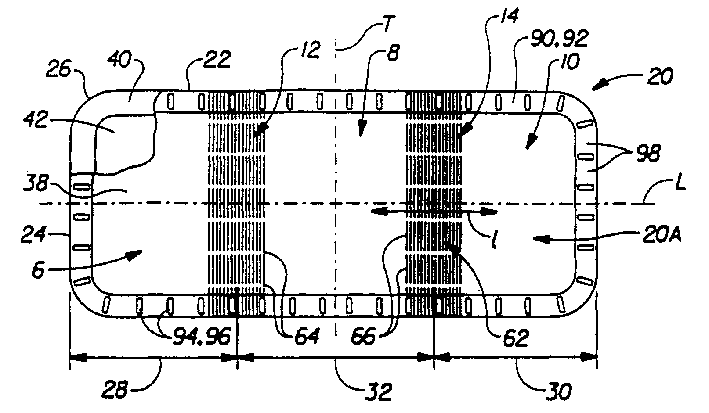
The present invention discloses an absorbent article such as a sanitary napkin, a panty liner, or an incontinence pad having a main body section with several extensible regions therein. In one embodiment, the absorbent article is a sanitary napkin having segments that are movable relative to each other and rotatable relative to the flexible, extensible section, thereby providing the product with overall extensibility.
Description
技术领域technical field
本发明涉及诸如卫生巾、短内裤衬层、失禁者衬垫一类的吸湿用品。本发明更具体地涉及其某些区段可相对于柔性及可伸长的段运动和转向(articulate)的吸湿用品。The present invention relates to absorbent articles such as sanitary napkins, panty liners, incontinence pads and the like. The present invention more particularly relates to absorbent articles in which certain sections are movable and articulate relative to flexible and extensible sections.
背景技术Background technique
诸如卫生巾、短内裤衬层、失禁者衬垫一类的吸湿用品是一种通常穿着在内裤裆区内的用品。这种用品设计成用来吸收并储存人体产生的液体和其它排出物以防止人体和衣物被弄脏。卫生巾是一种被妇女们穿着在内裤之内,一般地位于穿着者两腿之间邻近人体会阴区域的这种类型的吸湿用品。Absorbent articles such as sanitary napkins, panty liners, incontinence pads, and the like are articles that are commonly worn in the crotch region of panties. Such articles are designed to absorb and store fluids and other exudates produced by the body to prevent soiling of the body and clothing. A sanitary napkin is an absorbent article of the type worn by women under panties, generally between the wearer's legs adjacent to the perineal area of the body.
已有许多不同类型的这种吸湿用品为本技术领域所公知并作描述。在分别于1990年8月21日和1991年4月23日授于Osborn的美国专利4,950,264和5,009,653中描述了几个取得商业成功的卫生巾的例子。然而,为改进吸湿用品所作的探索还在继续。例如,最近已经在努力尝试使卫生巾与穿着者的身体更贴合一致。另外还在为此目的以及为改善舒适性而努力使卫生巾具有可伸长性。Many different types of such absorbent articles are known and described in the art. Several examples of commercially successful sanitary napkins are described in US Patents 4,950,264 and 5,009,653, issued to Osborn on August 21, 1990 and April 23, 1991, respectively. However, the search for improved absorbent articles continues. For example, recent efforts have been made to try to make sanitary napkins more conform to the wearer's body. Additional efforts have been made to provide extensibility to sanitary napkins for this purpose as well as for improved comfort.
在1992年7月9日以Osborn等人的名义公开的名称为“Sanitary NapkinHaving Transversely Segmented Core”(具有横向分段的芯的卫生巾)的PCT申请号WO 92/10984里叙述了一种使卫生巾与穿着者的身体贴合一致的成果。在1994年7月6日以Tong-ho J.Hsieh的名义公开的EPO专利申请号0605 017 A2里叙述了另一个含有相似内容的例子。在1993年2月4日以Osborn等人的名义公开的名称为“Stretchable Absorbent Articles”(可拉伸的吸湿用品)的PCT专利申请号WO 93/01785里叙述了一些可伸长和可拉伸的卫生巾的例子。A method for making hygienic The result is that the towel fits the wearer's body consistently. Another example containing similar content is described in EPO Patent Application No. 0605 017 A2 published on July 6, 1994 in the name of Tong-ho J. Hsieh. Some extensible and stretchable materials are described in PCT Patent Application No. WO 93/01785, published in the name of Osborn et al. on February 4, 1993, entitled "Stretchable Absorbent Articles". Examples of sanitary napkins.
但是可以相信,完全可伸长或可拉伸的如月经产品那样的吸湿用品的大规模、高速度生产可能是相当困难和昂贵的。困难和昂贵的原因是制造一个整体可伸长的吸湿用品要采用更昂贵的可伸长材料来制作吸湿用品的部件;另外因为材料是可拉伸的,因此当在高速生产线上进行组装时材料常常会相互不一样大小。It is believed, however, that mass, high-speed production of fully extensible or stretchable absorbent articles such as catamenial products can be quite difficult and expensive. Difficult and expensive because making an integrally extensible absorbent article requires more expensive extensible materials for the components of the absorbent article; in addition, because the material is stretchable, the material will Often differ in size from each other.
因此,对卫生巾这样的吸湿用品有必要提供一种改良的结构以使其与穿着者的身体紧密贴合并且比完全可伸长的卫生巾更便宜、更易于制造。对于一个卫生巾来说,尤其有必要能够容易地、廉价地在高速生产线上进行组装,并且卫生巾的可伸长量应足以使其更加舒适。Accordingly, there is a need for an improved construction of absorbent articles such as sanitary napkins that conform closely to the body of the wearer and that are less expensive and easier to manufacture than fully extensible sanitary napkins. It is especially necessary for a sanitary napkin to be easily and inexpensively assembled on a high speed production line and be extensible enough to make it more comfortable.
因此,本发明的一个目的为提供一种卫生巾那样的吸湿用品,该吸湿用品具有改良的结构并与穿着者的身体贴合紧密。SUMMARY OF THE INVENTION It is therefore an object of the present invention to provide an absorbent article such as a sanitary napkin which has an improved construction and conforms closely to the body of the wearer.
本发明的另一个目的为提供一种卫生巾那样的吸湿用品,该吸湿用品的可伸长量足以改善卫生巾的性能和舒适性。Another object of the present invention is to provide an absorbent article such as a sanitary napkin which is extensible in an amount sufficient to improve the performance and comfort of the sanitary napkin.
本发明的又一个目的为提供一种卫生巾那样的吸湿用品,该吸湿用品既达到上述目的又比完全可伸长的卫生巾能够容易地、廉价地在高速生产线上进行生产。It is a further object of the present invention to provide an absorbent article such as a sanitary napkin which achieves the above objects and which can be produced more easily and less expensively on high speed production lines than fully extensible sanitary napkins.
通过下面的叙述并结合附图,本发明的这些目的和其它的目的将是明显的。These and other objects of the present invention will become apparent from the following description taken in conjunction with the accompanying drawings.
发明内容Contents of the invention
本发明提供一种诸如卫生巾、短内裤衬层、失禁者衬垫(吸湿衬垫)一类的吸湿用品,该吸湿用品的某些段可绕其它柔性的、可伸长段运动和转向。The present invention provides an absorbent article, such as a sanitary napkin, panty liner, incontinent pad (absorbent pad), having sections that are movable and deflectable about other flexible, extensible sections.
吸湿用品优选地包括一个可透液的顶片,一个与顶片相连的不透液的底片以及一个位于底片和顶片之间的吸湿芯。吸湿用品包括至少一个段或区(可扩展段),该段较吸湿用品的其它区域更容易扩展。吸湿用品的可扩展段可以包括顶片、底片或二者的一段或区。优选的是,吸湿用品的顶片、底片、吸湿芯和任何其它部件在吸湿用品的可扩展段部分是可伸长的,因此吸湿用品的可扩展段在其整个厚度上是可以伸长的。吸湿用品的可扩展段可设置在吸湿用品上任何合适的地方,比如沿着吸湿用品周边的一段。可扩展段的可伸长方向可以是纵向的、横向的,纵向和横向之间的某个方向的,或多于一个的方向。如果吸湿用品包括有多于一个的可扩展段,各个可扩展段可以都在同一个方向上或在不同的方向上可扩展。The absorbent article preferably comprises a liquid permeable topsheet, a liquid impermeable backsheet connected to the topsheet and an absorbent core positioned between the backsheet and the topsheet. The absorbent article comprises at least one segment or region (expandable segment) which is more easily expandable than other regions of the absorbent article. The extensible section of the absorbent article may comprise a section or region of the topsheet, the backsheet, or both. Preferably, the topsheet, backsheet, absorbent core and any other components of the absorbent article are extensible in the extensible section portion of the absorbent article so that the extensible section of the absorbent article is extensible throughout its thickness. The expandable section of the absorbent article may be located at any suitable location on the absorbent article, such as a section along the periphery of the absorbent article. The direction of extensibility of the expandable section may be longitudinal, transverse, somewhere in between, or more than one. If the absorbent article comprises more than one expandable segment, the individual expandable segments may all be expandable in the same direction or in different directions.
在一个实施例中,吸湿用品包括有至少一个第一段和一个第二段,两段被一个柔性可伸长的中间段分隔开,中间段作为一个连接点将第一段和第二段联接起来并可互相相对运动,这就允许吸湿用品的各段进行调整而与穿着者的身体形状更贴合。在这个实施例的一个优选改型中,吸湿用品为一个卫生巾,该卫生巾有一个第一段、一个第二段和一个第三段,在第一段和第二段之间有一个第一柔性可伸长中间段,在第二段和第三段之间有一个第二柔性可伸长中间段。所述中间段包括一个位于所述第一段和第二段之间的柔性的可伸长的可扩展接合处,其中所述可扩展接合处限定一个横向地从一个纵边延伸到另一个纵边而跨越所述吸湿用品的区域,其中所述可扩展接合处比所述吸湿用品其余部分中的至少某些部分更易伸长。在一个优选实施方案中,所述吸湿用品限定一个平面,而所述可伸长的扩展接合处在所述吸湿用品平面内的纵向上一般是可伸长的。在另一个优选实施方案中,在至少所述可扩展接合处上的所述顶片和所述底片中的至少一个的一部分上成形有一个至少有两个明显不同区域的网格,以致于所述顶片和底片中的所述至少一个的所述部分在所述可扩展接合处的区域内沿着至少一个预定轴线呈现出类弹性行为。In one embodiment, the absorbent article comprises at least a first section and a second section, the two sections are separated by a flexible and extensible middle section, and the middle section serves as a connecting point between the first section and the second section. Being coupled and movable relative to each other, this allows the sections of the absorbent article to be adjusted to better fit the shape of the wearer's body. In a preferred variation of this embodiment, the absorbent article is a sanitary napkin having a first section, a second section and a third section with a first section between the first section and the second section. A flexible, elongatable intermediate section, with a second flexible, extensible intermediate section between the second and third sections. The intermediate section includes a flexible, elongate expandable joint between the first and second sections, wherein the expandable joint defines a transversely extending longitudinal edge to the other longitudinal edge. An edge spans a region of said absorbent article wherein said expandable junction is more extensible than at least some of the remainder of said absorbent article. In a preferred embodiment, said absorbent article defines a plane, and said extensible expansion joint is generally extensible in the longitudinal direction within the plane of said absorbent article. In another preferred embodiment, at least a portion of at least one of said topsheet and said backsheet at said expandable joint is formed with a grid of at least two distinct regions such that the Said portion of said at least one of said topsheet and backsheet exhibits elastic-like behavior along at least one predetermined axis in the region of said expandable joint.
该卫生巾优选地具有可伸长和可拉伸的吸湿部件结构(即可缩回的)。该卫生巾还优选地具有总体可伸长性和可拉伸性。The sanitary napkin preferably has an extensible and stretchable absorbent member structure (ie retractable). The sanitary napkin also preferably has overall extensibility and stretchability.
本申请文件还描述了许多具有本发明特性的备选实施例。例如可扩展区的所有各段的可伸长量不必一样大小。另外,这里所述的不同实施例所具有的总体可伸长性范围可以包括现在可从市场上买到的卫生巾(对那些实施例来说,它虽具有可扩展区但不是有总体可伸长性)到完全可伸长的卫生巾。This document also describes a number of alternative embodiments having the features of the present invention. For example, the extensible amounts of all segments of the extensible area do not have to be the same size. Additionally, the range of overall extensibility of the various embodiments described herein may include sanitary napkins that are currently commercially available (for those embodiments that have regions of extensibility but not overall extensibility). length) to fully extensible sanitary napkins.
附图说明Description of drawings
尽管权利要求书中具体指出并清晰提出关于构成本发明主题的要求,但相信从下面的叙述中结合附图将对本发明有更好的理解,在附图中:Although the claims specifically point out and clearly state the requirements constituting the subject matter of the present invention, it is believed that the present invention will be better understood from the following description in conjunction with the accompanying drawings, in which:
图1为本发明卫生巾的局部剖示顶视平面简图,卫生巾的三个相对不可伸长段用一对柔性可伸长的中间段相连接。BRIEF DESCRIPTION OF THE DRAWINGS Figure 1 is a schematic top plan view, partially cut away, of a sanitary napkin of the present invention having three relatively inextensible sections connected by a pair of flexible, extensible intermediate sections.
图2为图1所示卫生巾的侧视图。Figure 2 is a side view of the sanitary napkin shown in Figure 1 .
图3为图1所示卫生巾的顶视平面图,图中所示为伸展状态。Figure 3 is a top plan view of the sanitary napkin shown in Figure 1, shown in the extended state.
图4为图1所示卫生巾的侧视图,图中所示为一可能的转向构形。Figure 4 is a side view of the sanitary napkin shown in Figure 1, showing a possible turned configuration.
图5为图1所示卫生巾的一个备选实施例的顶视平面图,该实施例在卫生巾的每一端附加地设有柔性的横向可伸长的段。Figure 5 is a top plan view of an alternative embodiment of the sanitary napkin shown in Figure 1 additionally provided with flexible transversely extensible segments at each end of the sanitary napkin.
图6为图5所示卫生巾在伸展状态时的顶视平面图。Figure 6 is a top plan view of the sanitary napkin shown in Figure 5 in an extended configuration.
图7为一具有可变形网格的网片材料的顶视平面图,该材料用于制作图1~6所示卫生巾的柔性可伸长中间段。Figure 7 is a top plan view of a mesh material having deformable cells used to make the flexible, extensible middle section of the sanitary napkin shown in Figures 1-6.
图7A~C为图7所示网片材料的部分放大透视图,其中网片材料从未拉伸状态渐渐地运动到较大拉伸状态。7A-C are enlarged perspective views of portions of the mesh material shown in FIG. 7, wherein the mesh material is gradually moved from an unstretched state to a more stretched state.
图8为一根据本发明的卫生巾的示意性的侧视剖面图,该卫生巾具有一个分段的吸湿芯。Figure 8 is a schematic side cross-sectional view of a sanitary napkin according to the present invention having a segmented absorbent core.
图9为图8所示卫生巾在伸展状态时的示意性的侧视剖面图。Fig. 9 is a schematic side cross-sectional view of the sanitary napkin shown in Fig. 8 in an extended state.
图10为一具有备选结构的卫生巾的示意性侧视剖面图,其中在吸收层和芯段之间设有一隔层以减少这些部件在作相对运动时的相互干扰。Figure 10 is a schematic side cross-sectional view of a sanitary napkin having an alternative construction in which a spacer is provided between the absorbent layer and the core segment to reduce mutual interference of these components during relative movement.
图11为图10所示卫生巾在伸展状态时的示意性的侧视剖面图。Figure 11 is a schematic side cross-sectional view of the sanitary napkin shown in Figure 10 in an extended state.
图12为一具有备选的吸湿部件布局的卫生巾的吸湿部件和底片的顶视平面图,吸湿部件中的一个被部分切去以显示下面的吸湿芯。Figure 12 is a top plan view of the absorbent components and backsheet of a sanitary napkin having an alternative absorbent component layout, one of the absorbent components being partially cut away to show the underlying absorbent core.
图13为具有另一备选的吸湿部件布局的卫生巾的吸湿部件和底片的顶视平面图,吸湿部件中的一个也被部分切去以显示下面的吸湿芯。Figure 13 is a top plan view of the absorbent components and backsheet of a sanitary napkin having another alternative absorbent component arrangement, one of the absorbent components also being partially cut away to show the underlying absorbent core.
图14为一可以采用图13所示的吸湿部件布局的卫生巾的底视平面图,图中显示了一个优选的粘合剂贴合固定件图形。Figure 14 is a bottom plan view of a sanitary napkin which may employ the absorbent member arrangement shown in Figure 13, showing a preferred adhesively affixed fastener pattern.
图15为一具有多个可扩展段的卫生巾的简单的局部剖视顶视图。Figure 15 is a schematic partial cutaway top view of a sanitary napkin having expandable segments.
图16为一卫生巾的顶视平面简图,该卫生巾的顶片具有可扩展区,它的图案与底片可扩展区图案不同。Figure 16 is a schematic top plan view of a sanitary napkin having a topsheet having expandable regions in a pattern different from that of the backsheet.
图17为图16所示卫生巾的底视平面简图。Figure 17 is a schematic bottom plan view of the sanitary napkin shown in Figure 16 .
具体实施方式Detailed ways
本发明涉及诸如卫生巾、短内裤衬层、失禁者衬垫一类的吸湿用品。图1~4为本发明的一次性吸湿用品的一个优选实施例的简图,即卫生巾20的简图。卫生巾有一个第一段6、一个第二段8和一个第三段10。第一段6与第二段8被一个诸如柔性可伸长中间段的可扩展段隔开,该可扩展段称作第一中间段12。第二段8与第三段10类似地被一个可扩展段,即柔性可伸长的第二中间段14隔开。The present invention relates to absorbent articles such as sanitary napkins, panty liners, incontinence pads and the like. Figures 1-4 are schematic diagrams of a preferred embodiment of the disposable absorbent article of the present invention, namely a
卫生巾20有两个面,一个可透液体的身体接触面或简称“身体面”20A和一个不透液体的衣物面20B。图1所示的卫生巾20为从其身体面所观看的视图。身体面20A是打算穿在邻近穿着者的身体的。卫生巾20的衣物面20B(示于图2中)是打算在卫生巾被穿着时邻近穿着者的衣物放置的。The
卫生巾20有两条中心线,一条纵向中心线L和一条横向中心线T。这里所说的“纵向”一词是指卫生巾20平面内的一条线、一根轴或一个方向,当卫生巾20被穿着时该“纵向”大体上与将站立的穿着者均分为左、右两半身的垂直平面相一致(如,几乎平行)。这里所说“横向”或“侧向”二词是可以互换的,该词是指卫生巾20平面内的一条线、一根轴或一个方向,该“横向”大体上与纵向垂直。The
由图1可见卫生巾20具有两个隔开的纵向侧边22,两个隔开的横边或端边(或称“末端”)24,纵向侧边22与横边24一起构成了卫生巾的周边26。卫生巾还有两个端区,第一端区28和第二端区30。在端区28和30之间设有一个中央区32。端区28和30各从中央区32的两个边缘向外延伸卫生巾20总长的约1/8~约1/3的长度。在1987年9月1日授予Higgins的美国专利4,690,680中有关于卫生巾的中央区和两个端区的特性的更详细的叙述。It can be seen from Figure 1 that the
卫生巾20可以是任意厚度的,包括比较厚的、比较薄的甚至很薄的。附图中的图1~4所示的卫生巾20的实施例是打算作为较薄的卫生巾的例子的。优选的“超薄”卫生巾在授予Osborn的美国专利4,950,264和5,009,653中有所叙述。所示的卫生巾20还应是比较柔软的以使穿着舒适。这里应该理解,图1~4所示的卫生巾仅是本发明的一个优选实施例,本发明并不限于这种类型的或具有附图中所示的具体构形的吸湿用品。The
图1示出了本发明卫生巾20的各个部件。图1所示的卫生巾20一般至少由三个主要部件构成,它们包括一个透液体的顶片38、一个不可透液体的底片40和一个位于顶片38和底片40之间的吸湿芯。顶片、底片和吸湿芯可由许多种通常用于这种目的的基本材料构成。这些材料在穿着卫生巾时所产生的力的作用下可以或是相对地不可伸长的或是相对地可伸长的。然而,假如这些材料是相对地不可伸长的,优选的做法是至少要对这些材料的一部分进行机械变性,或如下面将详细叙述的那样在卫生巾上设置柔性可伸长中间段12和14。Figure 1 shows the various components of the
在图1~4所示的优选实施例中,顶片38用一种按照授予Radel等人的美国专利4,342,314和授予Ahr等人的美国专利4,463,045制造的多孔成形薄膜构成。吸湿芯42由一块夹在两层气流成网薄纸之间的凝胶吸收材料(或“超吸湿水凝胶型材料”)的叠层构成。底片40由聚乙烯薄膜构成。图1~4所示的卫生巾20组装成一夹心结构,其中顶片38和底片40的长度和宽度尺寸一般比吸湿芯42更大。顶片38和底片40延伸到吸湿芯42的边缘之外,两者连接在一起成为卫生巾20的周边26各段。In the preferred embodiment shown in Figures 1-4, the
第一段6、第二段8和第三段10构成卫生巾的各相对不可伸长段。由于它们在卫生巾中所处的位置,第一段6、第二段8和第三段10还可相应称作前段、中段和后段。这些段可以由卫生巾中以常规材料制成的部件构成,以常规的方法组装并在机械改型后未作变化。这样卫生巾的这些相对不可伸长段具有任何现在市售卫生巾的柔性和很低的可伸长性。授予Osborn的美国专利4,950,264和5,009,653中叙述了某些更柔软的目前市售卫生巾适用的柔软性。目前市售的卫生巾在穿着期间作用于卫生巾的力的作用下一般都是相对地不可伸长的。这种卫生巾在不破坏卫生巾的结构完整性的约50克(力)~约1500克(力)的拉伸力作用下可伸长性约小于5%。The
然而在备选实施例中,第一段6、第二段8和第三段10比常规的卫生巾具有更大的可伸长性而不是相对不可伸长的(例如在上述力的作用下可伸长性大于或等于5%)。如果第一段6、第二段8和第三段10具有一定的可伸长性,那么卫生巾20的这些段最好仍应比柔性可伸长中间段12和14具有较低的柔性和可伸长性。因此,卫生巾20的第一段6、第二段8和第三段10可以称作卫生巾的“低伸长性段”。所以“低伸长性段”这个词覆盖了第一、第二、第三段为相对不可伸长的以及虽为可伸长的但伸长性比中间段低两种情况。However, in alternative embodiments, the
柔性可伸长中间段12和14可以取卫生巾的任何适用的、比卫生巾中邻近的低伸长性段更柔软更易伸长的结构形式。中间段12和14使卫生巾具有可伸长(最好为可拉伸)区,因此卫生巾可以随着穿着者的内裤一起拉伸并当贴近穿着者的身体时更感舒适。中间段12和14还有一个优点,即它们作为柔性的可伸长扩展接合处(expansion joint),邻近的低伸长性段可以转动以适应穿着者身体各部位。The flexible and extensible
卫生巾20的中间段12和14的可伸长性示于图3中。这里所称“可伸长”或“可扩展”一词的意思是指吸湿用品或整个吸湿用品的至少一部分在X-Y平面内的至少一个方向是可以增加的。这里所定义的X-Y平面是一个取向为与卫生巾20的20A、20B表面平行的平面。如图3所示,X轴是纵向取向的(平行于纵向中心线L),Y轴是横向取向的(平行于横向中心线T)。由于这里所说的可伸长性是指在X-Y平面上而言的,因此该伸长性区别于将一个弯曲的吸湿用品弄直成一个平坦的形状的长度的增加。由于这里所说的可伸长性大体上是指平面的,该伸长性区别于将一个折迭起来的吸湿用品或它的部件展开的任何长度的增加。The extensibility of the
如中间段12和14那样的可扩展段可能会包含(但最好不要包含)Z方向上一片叠在另一片上的折迭搭接部。在扩展段12和14里形成的任何屋脊状凸起最好要大体上排列成并排的关系,并且其高度最好要小到不显著改变卫生巾的表面特性或不偏离顶片平面。任何这一类的脊状凸起的高度最好小于或等于1.5毫米,凸起高度小于或等于1毫米则更好。这样,可扩展段在使用中伸缩时不会有折迭处被打开这种较大的运动,这种较大运动会引起穿着者的注意并对穿着者不利。Expandable sections such as
中间段12和14的柔顺性还使得低伸长性的第一段6、第二段8和第三段10可如图4所示那样在Z方向上转向。在上述的PCT专利公开号WO92/10984(美国专利申请流水号08/129,000),现在的名称为“Sanitary NapkinHaving Transversely Segmented Core”(具有横向分段的芯的卫生巾)的美国专利5,484,430中有由于中间段12和14的存在使低伸长性段可以任何方式转向的描述。低伸长性段也可以呈现为前述的以Tong-ho J.Hsieh的名义公开的EPO专利申请号0 605 017 A2中所述的任何构形。The compliance of the
此外,中间段12和14能使卫生巾20具有上述以Tong-ho J.Hsieh的名义公开的EPO参考文献中的卫生巾所没有的总体可伸长性。更具体地说,EPO公开号0 605 017 A2描述其卫生巾是一种允许吸湿用品的前、后段自由地向上方弯曲并与使用者的身体相接触的结构;所述卫生巾的结构能阻止卫生巾中间段的横向压缩向卫生巾前、后段传递。据说常规卫生巾的前、后段使吸湿用品的纵向刚度增加(这一点是不希望存在的),这使得这种卫生巾更难于呈现出希望的弯曲构形。In addition, the
该EPO公开将其吸湿用品描述为在卫生巾的第一和第二段之间形成一个“扩展接合处”(“expansion joint”)。但仔细的重新阅读该EPO公开后就可看出,在这些接合处并没有真正地使卫生巾产生伸长形式的“扩展”。该EPO公开所说的“扩展接合处”为卫生巾的一些区段,在这些区段的吸湿芯中设有一些凹槽以形成一些易于发生弯曲的轴线,因此卫生巾可呈现弯曲的构形。在可透液体的覆盖层的位于每个凹槽的部位上设有一个槽缝。在不透液的阻挡层的位于该凹槽边缘之间的部位上有一个可伸展的褶。于是在上述EPO公开所示的卫生巾中,仅有的可看作“扩展”的部分是位于产品边上与该凹槽在一起的不透液阻挡层的带褶部分。只有当卫生巾的前、后段向上折起成弯曲的构形时,或当卫生巾的中段受到压缩且阻挡层的该带褶部分旋转而将所述压缩与卫生巾的前、后段相隔离时,阻挡层的这一部分才是“扩展”的。因为吸湿芯沿着产品的纵向中心线大体上是不可压缩的,所以产品并没有因该“扩展接合处”而在产品的纵向沿纵向中心线具有总体可伸长性。The EPO publication describes its absorbent article as forming an "expansion joint" ("expansion joint") between the first and second sections of the sanitary napkin. However, a careful re-reading of the EPO publication reveals that there is no actual "expansion" of the sanitary napkin in an elongated form at these junctions. The EPO publication refers to "expanded joints" as sections of sanitary napkins in which grooves are provided in the absorbent core to form axes prone to bending so that the sanitary napkin can assume a curved configuration . A slot is provided at the location of each groove in the liquid-permeable cover. An extensible pleat is formed on the portion of the liquid-impermeable barrier between the edges of the groove. Thus in the sanitary napkin shown in the aforementioned EPO publication, the only portion that can be considered "extended" is the pleated portion of the liquid-impermeable barrier at the edge of the product along with the groove. Only when the front and back sections of the sanitary napkin are folded upwards into a curved configuration, or when the middle section of the sanitary napkin is compressed and the pleated portion of the barrier rotates, will the compression match the front and back sections of the sanitary napkin. It is this portion of the barrier that is "extended" when isolated. Because the absorbent core is substantially incompressible along the longitudinal centerline of the product, the product does not have overall extensibility in the longitudinal direction of the product along the longitudinal centerline due to this "expanding seam".
然而,示于图1~4中的本发明卫生巾20的可伸长中间段12和14与上述EPO公开所述的产品不同,它们使卫生巾具有在整个宽度上皆可伸长的区域。卫生巾20的可伸长中间段12和14在将卫生巾穿在一条内裤内的有关力的作用下,每个中间段的伸长量可为大于约5%到约50%,在约10%~40%之间则更好些,最好在约25%~40%之间。所以,卫生巾优选为在从约50~100克(力)到约1000~1500克(力)之间的力的作用下,最好为在约250克(力)到800克(力)的力的作用下具有如上所述的伸长。关于这一点,应当理解的是,所有这里所列举的极限和范围,包括所有比较窄的范围、极限和数值都是在规定的极限和范围之内的。可伸长中间段12和14还使卫生巾具有总体可伸长性。However, the extensible
如图3所示,卫生巾20最好至少在纵向上是可拉伸的。图3还表示,可拉伸区12和14的不同部位伸长量可以是大小不同的,因此卫生巾的几个低伸长性段可以产生互相相对的侧向位移。例如,第一段6可以相对于第二段8侧向偏移,从而第一段6的一侧的纵边便横向偏离到第二段8同侧的纵边之外。这非常有利于使卫生巾在穿着者作大范围的身体运动时能更紧密地与穿着者的身体和内裤贴合一致。As shown in Figure 3, the
在其它实施方案中,卫生巾20可具有几个可在横向(或Y向)或多于一个的方向上伸长的可伸长段。例如,如图5和6所示的卫生巾20有两个纵向可伸长区(可伸长段12和14)和横向可伸长区(横向可伸长的中间段16和18)。(关于这一点,应当理解,虽然为了简单起见这里主要对如图1~4所示的实施方案的可伸长中间段12和14进行叙述,但这里所叙述的可伸长中间段的特性也可应用到这里所示出并叙述的任何其它可伸长段。)In other embodiments, the
在某些优选实施方案中,卫生巾20的可伸长段12和14除了可伸长以外也是可拉伸的。这里所用“可拉伸”一词指的是一个用品或它的各段在受到拉伸力的作用时是可伸长的并且对拉伸呈现某个阻力。更好的是,卫生巾20的可伸长段12和14是弹性地可拉伸的。这里所用“弹性地可拉伸”和“弹性地可伸长”二词是同义的。这二词的意思是当拉伸力除去以后,卫生巾的这些段将趋于回复到它们的非拉伸或非伸长(或“原始”)尺寸。然而,卫生巾20的可伸长段12和14不必全部回复到非拉伸尺寸。这些可伸长段可能回到非拉伸尺寸与拉伸尺寸(或伸长尺寸)之间的随意尺寸上。可伸长段12和14优选地不使用常规的将松紧带拉伸并连在大体上不可伸长的部件上的方法来使其成为弹性地可拉伸的。使卫生巾的可伸长段12和14成为弹性地可拉伸将减少卫生巾的拉长了的可伸长段12和14在拉伸卫生巾的力除去时呈现过度松弛的不理想的倾向。在穿着者的内裤伸长后又收缩时,这一点是特别有意义的。In certain preferred embodiments, the
图1~4所示的实施方案的可伸长段12和14优选地设置在靠近并包含两个端区28和30与中央区32之间的边界在内的区域里。这就允许低伸长性的第一、第二和第三区6、8和10可以相互相对地运动并转向来与穿着者身体的各个区域相贴合,这一点在前述的名称为“Sanitary Napkin HavingTransversely Segmented Core”的专利申请中有大量的叙述。如所示的其它实施例中,可扩展区可沿着卫生巾的周边部分沿其纵边22、端边24或二者)设置。The
这里所述的各种实施例所用的可扩展段的尺寸范围很广。例如,在图1~4所示的实施方案中,沿横向测定的可扩展段的横向尺寸可以大到等于卫生巾的总宽度。在图15所示的其它实施方案中,可扩展段的横向尺寸可以只占卫生巾宽度的一部分。可沿纵向测定的扩展段的纵向尺寸同样地可以只占卫生巾长度的一部分,也可以大到等于卫生巾的总长度。在图1~4所示的实施方案中沿纵向测定的可伸长中间段的纵向尺寸应小于卫生巾的总长度,最好应大体上小于卫生巾的总长度,这样卫生巾将易于制造。可伸长中间段的适宜的纵向尺寸,举例来说,可以是小于或等于约1英寸(约2.5厘米)。The expandable segments used in the various embodiments described herein come in a wide range of sizes. For example, in the embodiment shown in Figures 1-4, the transverse dimension of the expandable section, measured in the transverse direction, may be as large as the overall width of the sanitary napkin. In other embodiments shown in Figure 15, the transverse dimension of the expandable section may occupy only a fraction of the width of the sanitary napkin. The longitudinal dimension of the extension, which can be measured in the longitudinal direction, can likewise be only a fraction of the length of the sanitary napkin, or it can be as large as the total length of the sanitary napkin. In the embodiment shown in Figures 1-4 the longitudinal dimension of the extensible middle section measured longitudinally should be less than the overall length of the sanitary napkin, preferably substantially less than the overall length of the sanitary napkin so that the sanitary napkin will be easier to manufacture. A suitable longitudinal dimension of the extensible intermediate section may be, for example, less than or equal to about 1 inch (about 2.5 centimeters).
如上面指出的那样,在图1~4所示的实施方案中可伸长段12和14可以(最好是确实)赋予卫生巾20总体可伸长性。卫生巾20最好能有如P&G的PCT公开号WO 93/01785所述的可伸长量,概括来说就是卫生巾最好能伸长约5%到小于50%。还可以给本发明卫生巾以PCT公开号WO 93/01785中所述卫生巾的任何其它性能,包括一种具有“力壁垒”的结构,在作用在卫生巾上的力没有实质性的增加下,该力壁垒阻止卫生巾的伸长率不超过某个定值。As noted above, the
柔性可伸长段12和14可包括任何能使卫生巾具有这里所述的各种性能的适用结构。柔性可伸长段12和14可与卫生巾的一个或几个部件或与之相连的独立部件组为一体。例如,柔性可伸长中间段12和14的适用结构可包括一片或几片较邻近段的材料更柔软更易伸长的独立的材料,这些独立的材料或片可连接并跨接在卫生巾的邻接的第一、第二和第三段上。这类材料可以或是其材料的固有性质比邻接段的材料(如弹性材料)更柔软更易伸长,或是某种适用的折迭起来的、打了褶的或经机械变化的从而具有更大的柔顺性和伸长性的材料。The flexible,
可伸长段12和14也可选用与卫生巾邻接段的不同的层或部件制为一体的结构,不过在这些段上材料要经过变化(例如机械的、化学的或其它的),使其比这些材料组成低伸长性邻接段的部分具有更大的柔顺性和伸长性。为了便于制造,最好以这种方式形成可伸长段12和14。可伸长段12和14可在生产过程中的任何阶段进行机械变化。可伸长段12和14可以用对卫生巾的一个或几个部件在它们被组装成卫生巾之前单独进行机械变化的方法,也可用在卫生巾组装完毕以后在卫生巾的各段上进行机械变化的方法使其具有柔顺性和伸长性。顶片38和底片40最好是在卫生巾20进行组装之前分别进行机械变化。The
可用在底片38和顶片40构成可伸长段12和14部分的所需部位上制作皱纹或滚压(或预轧波纹)的方法来增加顶片38和顶片40含有可伸长段12和14的部分的柔顺性和伸长性。适用的滚压方法在下列美国专利中叙述:1978年8月15日授予Sisson的美国专利4,107,364;1989年5月30日授予Sabee的美国专利4,834,741;1992年9月1日授予Gerald M.Weber等人的美国专利5,143,679;1992年10月20日授予Kenneth B.Buell等人的美国专利5,156,793;1992年12月1日授予Gerald M.Weber等人的美国专利5,167,897。Can increase
更可取的方法是,在顶片38和底片40构成可伸长段12和14部分的所需部位上形成可变形网格以增加顶片38和底片40的柔顺性和伸长性。图1~4显示了在顶片38和底片40位于卫生巾20可伸长段12和14的部位上形成的可变形网格62。在原材料上形成可变形网格的工艺在这里特别有用,因为象滚压这样的工艺是可以容易地用到高速生产作业去的,这就没有必要将整个或其部分吸湿用品打褶或折迭起来。而且,在原材料上形成可变形网格的工艺还有一个很大的优点是它可以用来生成实际上是数目无限的网格式样来调整可变形网格的伸长性。这个工艺还可使卫生巾的可伸长区不使用附加的弹性材料而具有类弹性伸长性。由于用来成形可变形网格的基体材料通常是一种薄膜(或至少一个部件是薄膜),因此这种已成形的材料在这里习惯地称为结构类弹性薄膜或“SELF”材料。Preferably, the flexibility and extensibility of the
这里将参照图7~7C来讨论这种SELF材料的可变形网格62的特性。图7~7C所示为一成形有可变形网格62的网片材料60的放大图。图7~7C所示的网片材料60可构成顶片38或底片40位于卫生巾中间段12和14的部分。(也可选择为整个卫生巾的顶片和/或底片都由成形有可变形网格的SELF网片材料60构成。)在图7~7C的情况下,网片材料60为一个顶片材料,为了简单起见,网片材料上没有显示出任何小孔。图7和7A表示网片材料60处于非伸长状态。其中形成可变形网格62的网片材料60具有一条纵向中心线(或轴线)l和一条横向中心线(或轴线)t。图7所示的纵向中心线l为一直线。然而纵向中心线l并不限于这种形状,纵向中心线l可以为直线、曲线或部分为直线,部分为曲线。The properties of such a deformable mesh 62 of SELF material will be discussed herein with reference to FIGS. 7-7C. 7-7C show enlarged views of a mesh material 60 formed with a deformable grid 62 . The web material 60 shown in Figures 7-7C may form the portion of the
图7和7A表明包括有可变形网格62的网片材料60包括至少两个明显不同且不相似的区域。这里所用“可变形网格”一词是指一个互相连接并互相关联的区域群,该区域群在某个有效程度内可沿一个预定的方向伸长。图7和7A表示可变形网格62的两个明显不同区域包括至少一个第一区域64和一个第二区域66。该两个明显不同区域使网片材料60具有一个类弹性的对拉伸力呈现相对低抗力的第一阶段和呈现相对高抗力的第二阶段。可变形网格62成形在网片材料60上。这里所用“成形”这个词是指在网片材料60上制作一个所需的结构或几何形状,当不加任何外力或外加伸长时该网片材料将基本保持所要求的结构或几何形状。在网片材料上成形可变形网格的适用方法包括(但不限于)用相互啮合的一对平板或滚轮压花纹、热成形、高压液压成形或铸造方法(casting)。7 and 7A show that a mesh material 60 including a deformable mesh 62 includes at least two distinct and dissimilar regions. As used herein, the term "deformable mesh" refers to a group of interconnected and interrelated regions that can be stretched in a predetermined direction to an effective extent. 7 and 7A show that two distinct regions of the deformable mesh 62 include at least a first region 64 and a
可变形网格62被设计成这样的形状,在它的第二区域66的基本部分对平行于预定轴(在这里为纵轴1)方向的外加伸长率产生显著的抗力之前,其第一区域64将对该外加轴向伸长率呈现出抗力。可变形网格62的第一和第二区域64和66各有一个第一表面和相对表面。在叙述具有可变形网格62的网片材料60的构形时使用不同区域的“表面路径长度”(即沿着外形表面测量的距离)这个词。如图7A所示,第一区域64的表面路径长度比第二区域66小。表面路径长度是在网片材料处于非伸长状态时按照大体上平行于预定轴的方向,沿着某个区域的形状表面测量的。如图7A所示,第二区域66包括一个或更多个延伸并超出第一区域64平面之外的变形单元74。The deformable mesh 62 is shaped such that its
在图7和7A所示的优选实施例中,可变形网格62包括许多第一区域64和第二区域66。在图7和7A所示的优选实施方案中,第一区域64大体上是平面区域。也就是说,第一区域64内的材料在网片材料60经受成形工序的前后处于大体上相同的状态。第二区域66包括有许多连续的互联的变形单元74,该变形单元74交替地延伸并超出到第一区域64的第一和第二表面64A和64B平面之外。在另一个实施方案中,变形单元74仅延伸超出第一区域64的两个表面64A或64B中的一个平面之外。In the preferred embodiment shown in FIGS. 7 and 7A , the deformable mesh 62 includes a plurality of first regions 64 and
由图7可见,可变形网格62的第一区域64有一个第一轴线68和第二轴线69,其中第一轴线68最好比第二轴线69更长。在所示的简化实施方案中,第一区域64的第一轴线68大体上平行于可变形网片材料60的纵轴l,而其第二轴线69大体上平行于可变形网片材料60的横轴t。可变形网格62的第二区域66也有一条第一轴线70和一条第二轴线71。第二区域66的第一轴线70大体上平行于网片材料60的纵轴l,而其第二轴线71大体上平行于网片材料60的横轴t。在图7和7A所示类型的网片材料中,第一区域64和第二区域66都是沿着大体上平行于可变形网片材料的纵轴l的方向,大体上为直线地连续地伸展排列。在图1~4所示的卫生巾的实施方案中,网片材料中的可变形网格62、顶片38和底片40三者的纵向中心线l都是大体上纵向取向的。然而在其它实施方案中网片材料的纵向中心线l可以按照要求的可伸长方向而取在其它方向上。As can be seen from FIG. 7 , the first region 64 of the deformable mesh 62 has a
图7A、B和C表示具有可变形网格62的网片材料60在受到平行于预定轴的方向的外加伸长作用时对该外加伸长呈现至少两种明显不同的可控的抗力的情况。当处于图7A与图7B之间的阶段时,可变形网格62对外加伸长率呈现出第一抗力。呈现第一抗力的情况一直要持续到网片材料的伸长大到足以如图7B所示使第二区域66的绝大部分进入外加伸长的作用平面时为止。在网片材料60到达图7B所示阶段以后,网片材料对进一步的伸长呈现出第二抗力(如图7C所示)。当网片材料用于本发明卫生巾的顶片38和底片40时,典型的情况是网片材料被控制处于对伸长呈现第一抗力的阶段,所以可变形网格62的各部分将仅伸长到图7B所示的程度并可松弛回到图7A所示的阶段。7A, B and C show that a mesh material 60 having a deformable mesh 62 exhibits at least two distinct and controllable resistances to an applied elongation in a direction parallel to a predetermined axis. . At a stage between FIGS. 7A and 7B , the deformable mesh 62 exhibits a first resistance to applied elongation. The condition of exhibiting the first resistance continues until the elongation of the mesh material is sufficient to bring a substantial portion of the
由可变形网格62成形的顶片和底片材料可由这样的基体材料组成,该基体材料在卫生巾正常穿着所受到的力的作用下呈现相对的低伸长性,而当基体材料上成形了可变形网格62以后,在卫生巾正常穿着所受到的力的作用下它将是可伸长的。顶片38和底片40所使用的基体材料可以各自由上面已叙述过的多孔成形薄膜和聚乙烯薄膜组成。然而,这些基体材料最好基本上由线型低密度聚乙烯(LLDPE)组成。基体材料也可由其它聚烯烃如聚乙烯,包括低密度聚乙烯(LDPE)、超低密度聚乙烯(ULDPE)、高密度聚乙烯(HDPE)或聚丙烯以及上述材料和其它材料的掺混物组成。其它可用作基体材料的适用的高分子材料的例子包括,但不限于,聚酯、聚氨酯、可堆肥处理或生物降解聚合物、热收缩聚合物、热塑性高弹体和可透气的聚合物结构。The topsheet and backsheet materials formed by the deformable grid 62 may consist of a base material that exhibits relatively low extensibility under the forces experienced during normal wear of the sanitary napkin, and when formed on the base material After deforming the grid 62, it will be stretchable under the forces experienced by the sanitary napkin during normal wear. The base material used for the
可变形网格62中的变性单元74的深度和数量可以是多种多样的,以便控制拉伸顶片38和底片40的可伸长段所需的作用力或伸长率的大小。在一个优选实施方案中,变形单元74是用两块外尺寸为5.0英寸×12英寸×0.75英寸(12.7厘米×30.5厘米×2厘米)的刚性模板成形的。在每块模板的一个表面上制有一系列紧密啮合的齿,齿的断面基本上为三角形,三角形的底边为0.030英寸(0.76毫米)并逐渐变窄到顶部成为一个半径为0.008英寸(0.2毫米)的圆。齿的中心线以0.030英寸(0.76毫米)的间隔均匀排列。在其中一块模板的刻有齿的一面上制有一系列互相平行并垂直于均匀间隔的齿的槽,这些槽宽0.031英寸(0.8毫米)并在模板的全长上连续延伸,这些槽的中心间距为0.25英寸(6.4毫米),这些槽对应于基体材料的未变形区。优选的基体材料放在两块模板之间,模板装在其工作台比模板更大些的液压机上以使压力均匀分布。模板以至少4000磅(1800千克力)的载荷加压,然后从两块模板之间取出已成形的网片材料。如果变形单元的数目给定,那么随着网片材料变形高度或变形程度的增加,其有效拉伸或伸长也增加。与此相似,如果变形高度或程度给定,那么随着变形单元的数目或频率增加其有效拉伸或伸长也增加。本发明卫生巾20上的诸如顶片或底片的一部分材料上成形可变形网格的适用方法在以Chappell等人的名义申请的名称为“Web Materials Exhibiting Elastic-Like Behavior”(表现出类弹性行为的网片材料)的美国专利申请序列号08/203,087(1995年2月9日公开的PCT公开号WO95/03765)中作了详细叙述,这里引用这些专利的公开内容以作参考。The depth and number of denatured cells 74 in the deformable grid 62 can be varied in order to control the amount of force or elongation required to stretch the extensible segments of the
上述在顶片38和底片40上成形可变形网格的方法特别适于用来使卫生巾20的不同区域具有伸长性。啮合模板可设计成使如图所示的卫生巾20的顶片38和底片40内具有任何伸长性方式的各种图形。如有需要,也可将顶片和底片上的可变形网格的第一区域64取消(在此情况下,第二区域66成为连续的)。取消第一区域64将显著减少或消除顶片和底片各个区域的类弹性回缩倾向(并因此也减少或消除对外加伸长的可控抗力的两个不同阶段)。在叙述完关于使卫生巾20的顶片和底片位于中间区域12和14部位成为可伸长的特性以后,下面将分析关于卫生巾的吸湿芯和吸湿芯组件的特性。The above-described method of forming the deformable grid on the
图8和9表明了在图1~4所示的实施方案上设置吸湿芯42的优选途径,即该卫生巾20的中间段12和14是可伸长的。在图8和9所示的实施方案中,吸湿芯42在横的方向上分成许多分离的芯段42A、42B和42C。卫生巾还优选地设有一片或几片重叠吸湿层(overlying absorbent layers)44,该重叠吸湿层44跨越邻近的芯段42A、42B和42C的间隙。一片或几片重叠吸湿层44可考虑用作吸湿芯42的一部分,或成为卫生巾的一个独立部件。Figures 8 and 9 illustrate the preferred way of disposing the
图8和9表明重叠吸湿层44优选地与顶片38在两个SELF区12和14之间的部位相连接,所以不可伸长或低伸长性的重叠吸湿层44与可伸长的经SELF处理过的中间区12和14不会相互干扰。所述连接可采用任何适用的方法,如使用粘接剂粘接件46。铺在下面的独立的芯段42A、42B和42C同样地与底片在两个SELF区12和14之间的部位连接在一起。然而,重叠吸湿层44优选地不与独立的芯段42A、42B和42C或卫生巾20周边以内的任何其它部件相连接,因而当卫生巾如图9所示被拉伸时,重叠吸湿层44可相对于独立的芯段42A、42B和42C自由地滑动。这里所用“连接”一词包括下列几种结构:一为其中一个部件直接以贴附的方法固接在另一个部件上;二为其中一个部件不直接地另一个部件上而是先贴附在一个或几个中间件上,再依次贴附在另一个部件上;三为其中一个部件与另一个部件制成一体,即一个部件实质上为另一个部件的一部分。Figures 8 and 9 show that the overlapping
卫生巾20的吸湿部件,如分离的芯段和重叠吸湿层等,可用任何适用的方式与所希望的卫生巾部件如顶片和底片等相连接。连接这些部件的适用手段包括使用粘接剂、缝合、热和/或压力结合、动态机械结合、超声焊接以及纤维或组成卫生巾部件的其它结构件的相互混合或缠结(诸如将组成一个部件的纤维熔喷在另一个部件上和将一个部件挤压在另一个部件上等)或任何本领域公知的其它手段。其中有几种连接卫生巾部件的手段在1991年12月17日以Cree等人的名义申请的美国专利申请流水号07/810,744(PCT专利公开号WO 93/11725,1993年6月24日公开)中有叙述。The absorbent components of the
顶片38和底片40可用允许卫生巾中间段12和14伸长的任何方法连接在一起。如图1所示,顶片38优选为沿着密封面(seal)90那样的周边密封装置与底片40相固接。密封面90优选为不透液的。密封面90可采用本领域用于此目的的任何手段来构成,如胶合、皱化(crimping)或热封合。有许多手段可以用来在顶片38与底片40之间制造不透液的可拉伸的周边密封面。The
在图1~4所示的一个特别优选的卫生巾实施方案中,顶片38和底片40的边缘部分以一种可伸长粘接剂92绕着卫生巾的周边连接在一起。另外在周边区还有优选分布的机械结合点94。可伸长粘接剂92绕着卫生巾的周边26提供可伸长的不透液的密封面,机械结合点94提供附加的强度。机械结合点94分布在结合带(或区)96和非结合带(或区)98之间的间断区内。在图1所示的实施方案中,结合区96为许多与卫生巾20的周边26大致垂直的中间相隔的线段。结合区96应当在完全装配好的吸湿用品的所需伸长性方向用非结合区98隔开。结合区96是不可伸长的,而非结合区98是可伸长的。结合区优先选用热压工艺形成,其中所使用的温度与压强是受控的,因而无论是组成顶片的材料还是组成底片的材料都不会在工艺过程中熔融。具有SELF区域的聚乙烯成形薄膜顶片与具有SELF区域的聚乙烯薄膜底片的适用密封装置可用加热板来成形,该加热板具有如图1所示结合区的形状的凸起区域,凸起区域的大致尺寸为6毫米×2毫米,间隔5毫米。加热板加热到170华氏度(76.7℃)5秒钟,用手压使密封装置成形。在1994.2.4以Osborn等人的名义中请的美国专利申请流水号08/192,240(P&G案号5151)中有连接可伸长吸湿用品的部件的其它适用方法的详细叙述。In a particularly preferred embodiment of the sanitary napkin shown in Figures 1-4, the edge portions of the
上述卫生巾20的部件连接方法是为了设计方便而优选的,连接各种部件的其它手段也可采用。例如,本发明也包括一种所谓“管式”的产品。在这些产品中,一个可透液的覆盖材料(诸如顶片材料)可将吸湿芯和底片完全裹在里面然后固接在一起。在备选的布置中,顶片先将吸湿芯包在里面,包好的吸湿芯再置放并固接在底片上。The above method of joining the components of the
图10和11表示前面各图所示卫生巾20的一个高度优选的附件。如图10和11所示,卫生巾20可附有一个隔离件(或称“稳定层”)48那样的部件,该稳定层48位于重叠吸湿层44和独立的吸湿芯段42A、42B和42C之间。稳定层48的作用为阻止各独立芯段的端边和重叠吸湿部件44之间在相对滑动时发生任何不需要的干扰的倾向。这就是说,稳定层48阻挡了独立芯段42A、42B和42C的端边与重叠吸湿部件44的相互接触,从而阻止了这样的滑动。Figures 10 and 11 show a highly preferred attachment to the
如图10和11所示,稳定层48优选采用了一种能使独立芯段42A、42B和42C与重叠吸湿部件44之间的相对滑动更加容易的形式。稳定层48最好是可透液的,这样,身体排出物可以透过稳定层48到达下面的吸湿芯段42A、42B和42C。稳定层48可以由符合这一原则的任何材料制造。适用于制作稳定层48的材料包括(但不限于)至少部分地带皱纹的无纺织物、可伸长的稀松布(scrims)或可伸长的多孔薄膜。两种特别优选的无纺织物网面,一种为以双组份纤维为原料的透气结合的无纺材料(air-through bondednonwoven material),这种材料是由日本的Gifu City(从前为Fukumura)的Havix公司制造,商品名称为HAVIX S2156,这种材料是作了micrex皱纹处理的,这种处理可由Micrex Corporation of Walpole,MA来完成;另一种为称作COROLIND PE的无纺织物网,这种材料可由德国的Corovin GMBH获得,然后经SELF处理。As shown in Figures 10 and 11, the stabilizing layer 48 is preferably in a form which facilitates relative sliding movement between the
稳定层48优选为其端部与卫生巾上的一个或多个邻近部件相连接,并且不与卫生巾中央区32内的任何其它部件相固接。如图10和11所示,稳定层48可用诸如在其上面制作皱纹或SELF的方法来使它具有伸长性。稳定层48的可伸长区50可设置在稳定层的任何适宜部位上,但最好是将可伸长区50放在稳定层48的中央区。这样,当卫生巾如图10所示那样拉伸时,可伸长区便跨接在邻近的独立芯段42A、42B和42C之间的间隙上。在叙述了优选卫生巾实施方案几个部件的组件之后,下面来分析设置在卫生巾20上的一些优选附件。The stabilizing layer 48 preferably has its ends attached to one or more adjacent components of the sanitary napkin and is not affixed to any other components within the
卫生巾20的衣物面20B可以包括(并且最好确实包括)将卫生巾固定在穿着者内衣上的固定装置。图2表示了所选用的将卫生巾固定在内裤裆区的固定装置52。已经发现,带有粘接剂且最好是压敏粘接剂的固定装置能很好的达到这一目的。粘接剂的固定装置上面通常都覆盖一层可揭掉的覆盖带或防粘衬,以避免固定装置上的粘接剂在使用前粘着到内裤裆区以外的表面上。在美国专利4,917,697中有适用的粘接剂和防粘衬的详细叙述。在授予Swanson的美国专利4,556,146中叙述了一个也作为独立包装的卫生巾的外包装的优选的防粘衬。本发明卫生巾20在使用时要揭去任何防粘衬并将卫生巾20放到内裤里,从而粘接剂或其它固定装置52与内裤相接触并将卫生巾保持在内裤的应有位置上。The
本发明卫生巾还可有许多不同的实施方案,例如图12表示用于本发明卫生巾的具有特别优选形状的底片40和吸湿芯42。在上面提及的美国专利申请流水号08/192,240(P&G案号5151)中有关于这种优选形状和其优点的详细叙述。图12还表示了一个备选的吸湿芯42实施例,在这个实施例中,吸湿芯具有许多槽缝100。这些槽缝优选为横向取向而且排成许多列,邻近列上的槽缝100相互错开,因此吸湿芯42的槽缝区域可以在纵向伸长。然而,在其它如图5和6所示的实施例中其端区可横向伸长,吸湿芯可至少有几组槽缝是纵向取向的,因此卫生巾20的吸湿芯42至少部分地是可横向伸长的。另外,在这个实施例的如图12所示的优选改型中,在带槽缝的吸湿芯42上面可以设置一层没有槽缝的、可透液的、最好是吸湿的材料,这样在卫生巾伸长的时候液体将不能通过槽缝转移,并且槽缝将从穿着者的视觉中隐去。但在有的实施例中,从视觉中隐去槽缝这一要求是不重要的,这时该透液的吸湿材料可以放在吸湿芯42的下面。The sanitary napkin of the present invention can also have many different embodiments. For example, FIG. 12 shows the
图13是本发明卫生巾的另一个备选实施方案,其中吸湿芯除在两端以外的几乎全部表面上都具有槽缝。在该实施方案中,顶片38最好在整个表面上都成形有SELF(虽然也可仅在顶片38的选定的区域或地带上成形有SELF)。底片40最好在对应于卫生巾20的可伸长中间段12和14的区域内成形有SELF。在该实施例中,也可在吸湿芯42的上面放上一个低伸长性的吸湿衬垫44。吸湿芯的无槽缝区102优选为从吸湿芯的两端起朝里延伸约一英寸(约25毫米)。在吸湿芯是非常柔软的情况下,两端具有无槽缝区的吸湿芯特别有助于卫生巾的操作。不在吸湿芯42的两端设置槽缝可使卫生巾的两端硬化,这有助于消除卫生巾使用时两端出现折迭的倾向。图13还表示该实施例有可能将吸湿用品的某些部件,如顶片38,制成其整个面积都具有伸长性,而如底片40和吸湿芯42等其它部件则仅在它们全部面积的选定部位上具有伸长性。各个部件上的可伸长区最好要对齐,以使卫生巾的整个区域是可伸长的。但也可能需要提供一种卫生巾实施方案,其中卫生巾的各个部件上的可伸长部分是不对齐的,以获得不同的效果或不同的产品性能。Figure 13 is another alternative embodiment of the sanitary napkin of the present invention wherein the absorbent core has slots on substantially all of its surface except at the ends. In this embodiment, the
图14表示了具有所示优选形状的卫生巾固定装置52的一种特别优选的式样,该固定装置52是用来将卫生巾20附着在穿着者的内裤上的。固定装置52包括卫生巾20的衣物面20B上许多独立的隔开的固定材料的区域。在所示的优选实施例中,固定装置52是一种压敏粘接剂。粘接剂固定装置最好位于底片40没有经SELF处理的区域上,因为在这样的平滑表面上设置粘接剂固定装置比在成形有SELF区域的表面上容易。更具体地说,固定装置52设置在52A、52B和52C等三个区域里,52A和52B包括卫生巾两端的U形或马蹄形区域,52C为卫生巾中央区32两个纵边22附近的一对隔开的纵向取向的区域。Figure 14 shows a particularly preferred form of a sanitary
图15所示为一个虽不是最好,但具有本发明某些特性的另一个卫生巾20。图15所示卫生巾20具有几个横着分隔开的独立芯段42A、42B和42C,这些芯段可任选为如P&G的PCT专利公开号WO 92/10984所示那样以一个颈状的连接段104相连。图15所示的颈状连接段104为几个沿卫生巾20的侧边分布的吸湿芯42凹入区106。凹入区106可以为任意的形状,包括各种形状的删割、缺口、槽缝。卫生巾20的顶片38和底片40上均有沿着吸湿芯42的侧边跨越的凹入区106的可伸长段12和14。与Tong-hoJ.Hsieh专利公开所述卫生巾中的开了缺口的顶片不同,图15所示卫生巾的顶片38是由沿着吸湿芯42的侧边跨越凹入区的连续的可伸长材料制造的。顶片与底片的可伸长段最好不要与吸湿芯相连接。Fig. 15 shows another
顶片38的可扩展段和底片40的可扩展段最好还要纵向延伸超出含有凹入区106的吸湿芯部分,从而它们位于至少一部分吸湿芯42的上方和下方。与把可扩展段的边界限于凹入区106的边界相比,这样做可使这些区域的顶片和底片具有更大的伸长性。卫生巾部件的这种配置使得顶片和底片在吸湿用品的两侧形成一个可扩展的覆盖物,该覆盖物可以围绕着卫生巾可扩展段内的吸湿芯拉伸。在其它的实施例中,顶片38、底片40或两者都可能在它们的附加段的整个宽度上都具有伸长性。The extensible section of the
沿卫生巾的两个纵向侧边22上的三角形区域12和14如图示那样在纵向是可伸长的。沿卫生巾后端边24上的三角形区域如图示那样在横向上是可伸长的。卫生巾20还可在其前端边上具有一个类似的三角形区域。图15所示卫生巾的顶片38和底片40的可伸长段是用在该区域内成形SELF的方法来获得其伸长性的。在其它实施例中,这些区域可以通过滚压或这里所述的任何其它方法来设置伸长性。还有一些实施例中,可伸长段中的脊状或肋状凸起单元可按其它任何要求的方向来取向以改变伸长性的方向。举例来说,沿卫生巾的两个纵向侧边上的三角形区域内,脊(ridges)的方向可以是纵向的,因而该区域是横向可伸长的。在卫生巾的端边上的三角形区域内,脊的方向可以是横向的,因而该区域是纵向可伸长的。任何不同区域中的脊可以具有任何其它适宜的图形,诸如辐射形。The
图15所示实施例的吸湿芯除了开缺口以外还可以是有槽缝的或分段的。在其它的实施例中,在凹入区106中可填入一片分离的吸湿材料。如果这片分离的吸湿材料是不可伸长的,那么它最好不要与凹入区106内的吸湿芯的剩余部分相连接。相反,这样的非伸长性分离的吸湿材料片可与底片38相连,或更好一些与底片40相连。如果这片分离的吸湿材料是可伸长的,那么它可以与凹入区106中的吸湿芯42的剩余部分相连。这种结构使吸湿芯42在选定的部位上成为可伸长的,而不用将整个吸湿芯都采用可能更昂贵的可伸长吸湿材料制成。分离的吸湿材料片可放在卫生巾任何需要的地方并具有任何合适的形状。这里所述的各个实施例还可以具有附图所示或这里所叙述的各种区域的任何组合。例如卫生巾可以具有几个如图1~4实施例中那样的可伸长区以及几个如图15那样的三角形可伸长区,但这里所述的可伸长段的形状和位置并不限于附图所示的那些形状和位置。吸湿用品或它的部件的可伸长段可以位于吸湿用品主体部分的任何需要伸长性的合适地方。The absorbent core of the embodiment shown in Figure 15 may be slotted or segmented in addition to being notched. In other embodiments, a separate piece of absorbent material may be filled in the recessed
图15所示的卫生巾20的一个优点是该卫生巾位于吸湿芯42边缘上的凹入区106内的那个区域可以象扇子那样张开并转向,而不象Tong-hoJ.Hsieh的EPO专利公开号0605017A2所述那样在顶片38上开缺口。这就使这些区域可如所要求那样运动而不改变卫生巾的表面结构。正因为如此,图15所示的实施例相当于一种对Tong-ho J.Hsieh的EPO专利公开所述的用品的改进。在EPO专利申请所述的用品中,卫生巾覆盖面上的槽缝形成了一个使液体不经过所插入的吸湿层而直接通向阻挡层的通道。An advantage of the
图15还可以用来表示卫生巾的另一个可能的实施例,该实施例的顶片和底片的一些区段内设有可伸长部分。图15所示卫生巾的顶片38和底片40在一个标号为108的结合区内与吸湿芯42结合在一起。卫生巾的结构可以是顶片38和底片40在卫生巾的周边处相互结合在一起,但在结合区108以外的区域与吸湿芯不相连。在这种情况下,顶片38优选地或是具有一个液体输送部件,或是液体可在顶片和吸湿芯之间传递。这样的实施例与图15所示的情况不同,在图15中顶片38和底片40仅在所示的区域是可伸长的,而该实施例的顶片38和底片40可以在位于结合区108以外的任何或所有部位上具有伸长性。这样就产生一种卫生巾,这种卫生巾的顶片、底片和吸湿芯在液体沉积的典型区域处是结合在一起成为一整体单元。位于结合区108以外的那部分顶片和底片可在吸湿芯的其余部分外面形成一种可伸长的“口袋”。当穿着者的身体相对于其内裤的邻近部分移动时,形成可伸长口袋的那些顶片的可伸长部分可调整而适应于穿着者的身体,而底片的可伸长部分可调整而适应于穿着者的内裤。Figure 15 can also be used to illustrate another possible embodiment of a sanitary napkin having extensible portions in sections of the topsheet and backsheet. The
图16和17表示一个卫生巾实施例的身体面20A一侧和衣物面20B一侧,这两个侧面20A、20B具有上面带有不同的可扩展区域的部件。图16和17所示实施例显示顶片38上的可扩展区和底片40上的可扩展区它们的取向和位置并不一定重合,或只有部分可伸长区的取向和位置是重合的。顶片38的可扩展区与底片40的可扩展区的形状和伸长性方向也并不一定重合。如图16所示,该实施例的顶片38带有一对V形的可扩展区12A和14A,其中V形可扩展区中的两个底点(bases)指向相反的方向并指向卫生巾20的端边24。如图17所示,底片40带有一对V形区12B和14B,其中V形区中的两个底点互相相对。比较图16与图17即可看到,顶片38上的可扩展区12A和14A中的一部分(沿着卫生巾的两个纵向侧边22的部分)与底片40上的可扩展区12B和14B中的一部分相重叠。图16和图17还表示,顶片38的可扩展区12A和14A的其余部分与底片40的可扩展区12B和14B不重叠。然而在其它实施例中,顶片38上的可扩展区可能不与底片40上的可扩展区的任何部分相重叠。另外,尽管在图16和17中顶片上的可扩展区和底片上的可扩展区三者都是纵向可伸长的,但在其它实施例中卫生巾的这两个部件上的可伸长区的可伸长方向可能是不同的。Figures 16 and 17 show the
本发明的卫生巾可能有许多其它实施方案。在其它的备选实施例中,举例来说,卫生巾20的可伸长段12和14可以是位于卫生巾20的低伸长性段之外,如位于卫生巾的两端处,而不是位于卫生巾的低伸长性段之间。另外,在这里所述的任何一个实施方案中,可以具有任何数目的可伸长段和低伸长性段(亦即两者都可以有许多个)。不同的卫生巾实施方案的可伸长段和低伸长性段还可布置成无限多个不同的图形。Many other embodiments of the sanitary napkin of the present invention are possible. In other alternative embodiments, for example, the
吸湿用品还可结构设计得与Tong-ho J.Hsieh的EPO专利公开所述的产品精确相象。另外,吸湿用品可制成其中主体部分的几个低伸长性段用几个弹性部件连接在一起。弹性部件最好不是那种与顶片或底片相连接的连续弹性部件(这种部件仅仅使顶片或底片整个地或局部地收缩以使它们具有曲率),而是优选为与吸湿用品的低伸长性段或它的一个部件相连接,所以吸湿用品的两个侧边的张力是相等的,而弹性部件将用来跨接吸湿用品的两个邻近的低伸长性段,允许它们互相相对移动和转向。The absorbent article can also be constructed to exactly resemble the product described in the EPO patent publication of Tong-ho J. Hsieh. Alternatively, absorbent articles may be constructed in which several low extensibility segments of the main body portion are joined together by elastic members. The elastic member is preferably not the kind of continuous elastic member that is connected with the topsheet or the backsheet (this member only makes the topsheet or the backsheet shrink in whole or in part so that they have curvature), but is preferably low in contact with the absorbent article. The section of extensibility or a part thereof is connected so that the tension on the two side edges of the absorbent article is equal, and the elastic member will be used to bridge two adjacent sections of low extensibility of the absorbent article, allowing them to interact with each other. relative movement and turning.
本发明的吸湿用品还可以具有一些连接在如附图所示的吸湿用品的主体部分上的诸如护翼(或侧翼)或其它形式的侧边包覆件(side wrappingelements)的备选部件以保护穿着者的内衣不被弄脏并使吸湿用品在穿着者内衣中保持其应有的位置。在下列专利中有不同类型的带护翼和/或侧边包覆件的吸湿用品的叙述,这些专利是:1986年5月20日授予Van Tilburg的美国专利4,589,876;1987年8月18日授予Van Tilburg的美国专利4,687,478;1993年12月7日授予Van Tilburg的美国专利5,267,992;1994年9月6日授予Niihara的美国专利5,344,416;1994年9月13日授予Osborn等人的美国专利5,346,486;1995年2月14日授予Lavash等人的、名称为“Absorbent Article Having Flaps and Zones of Differential Extensibility”(具有护翼和差别伸长性区的吸湿用品)的美国专利5,389,094;1992年7月23日申请的美国专利申请流水号07/915,133(Lavash等人的1994年2月3日公开的PCT专利公开WO94/02096);1993年9月20日申请的美国专利申请流水号08/124,180(Mansfield等人的PCT专利公开,公开号为WO94/10200)、1994年7月20日申请的美国专利申请流水号08/277,733(Weinberger等人的1995年2月2日公开的PCT专利公开WO95/03025)。The absorbent article of the present invention may also have optional components such as wings (or wings) or other forms of side wrapping elements attached to the main body portion of the absorbent article as shown in the drawings to protect the The wearer's undergarment is not soiled and the absorbent article remains in place within the wearer's undergarment. Various types of absorbent articles with flaps and/or side coverings are described in the following patents: U.S. Patent 4,589,876, issued May 20, 1986 to Van Tilburg; U.S. Patent 4,687,478 to Van Tilburg; U.S. Patent 5,267,992 to Van Tilburg on December 7, 1993; U.S. Patent 5,344,416 to Niihara on September 6, 1994; U.S. Patent 5,346,486 to Osborn et al. on September 13, 1994; U.S. Patent 5,389,094, "Absorbent Article Having Flaps and Zones of Differential Extensibility" issued to Lavash et al. on February 14, 1992; filed July 23, 1992 U.S. Patent Application Serial No. 07/915,133 (PCT Patent Publication WO 94/02096 published February 3, 1994 by Lavash et al.); U.S. Patent Application Serial No. 08/124,180 filed September 20, 1993 (Mansfield et al. PCT Patent Publication, Publication No. WO94/10200), U.S. Patent Application Serial No. 08/277,733 filed July 20, 1994 (PCT Patent Publication WO95/03025, published February 2, 1995 by Weinberger et al.).
本发明还可用于穿着在内衣裆区里的其它类型的吸湿用品,诸如短裤衬和失禁者用品。“短内裤衬层”或“裤衬”是指通常为妇女在月经间隔期间穿着的比卫生巾更小巧的吸湿用品。在1988年4月19日授予Osborn的名称为“Pantiliner”(“短裤衬”)的美国专利4,738,676中叙述了具有这里所述的可伸长可转向段的适用的裤衬形式的吸湿用品的例子。The present invention is also applicable to other types of absorbent articles worn in the crotch region of underwear, such as pantiliners and incontinent articles. "Panty liner" or "panty liner" means an absorbent article that is smaller than a sanitary napkin and is typically worn by women between menstrual periods. Examples of absorbent articles in the form of suitable pantiliners having the extensible divertable sections described herein are described in U.S. Patent 4,738,676, issued April 19, 1988 to Osborn, entitled "Pantiliner" ("pantiliner") .
“失禁者用品”一词是指衬垫、内衣(衬垫用某种悬挂装置如带子或类似的装置保持在应有的位置上)、吸湿用品衬垫、吸湿用品增容装置、三角裤、床垫等用品而不管这种用品是被成人还是其它失禁者穿着。在1994年4月5日授予Feist等人的美国专利5,300,054和1994年4月19日授予Noel等人的美国专利5,304,161中叙述有可以设置这里所述的可伸长可转向段的适用的失禁者用品的例子。The term "incontinence article" means pads, undergarments (pads held in place by some suspending means such as straps or similar), absorbent article liners, absorbent article expanders, briefs, Articles such as mattresses regardless of whether such articles are worn by adults or other incontinent persons. Suitable incontinent individuals who may be provided with the extensible steerable section described herein are described in U.S. Patent 5,300,054 issued April 5, 1994 to Feist et al. and Noel et al. Examples of supplies.
本专利申请通篇所提到的所有专利、专利申请(包括任何由该申请而产生的专利和相应的已公开的外国专利申请)以及公开文本,这里都特此引入作为参考。然而这里明确地表示不承认这里引作参考的任何文献说明或揭示了本发明。这里还明确地表示不承认任何这里所叙述过的可从市场上买到的材料或产品说明或揭示了本发明。All patents, patent applications (including any resulting patents and corresponding published foreign patent applications) and publications mentioned throughout this patent application are hereby incorporated by reference. However, no admission is expressly made that any document incorporated by reference herein illustrates or discloses the present invention. It is also expressly disclaimed that any commercially available material or product described herein illustrates or discloses the present invention.
尽管已对本发明的多个具体实施例作了图示和叙述,但对本领域的专利人员来说显然还能够在不离开本发明的实质和范围的情况下作出很多其它的变型和修改。While a number of particular embodiments of the present invention have been shown and described, it will be obvious to those skilled in the art that many other variations and modifications can be made without departing from the spirit and scope of the invention.
Claims (10)
Applications Claiming Priority (2)
| Application Number | Priority Date | Filing Date | Title |
|---|---|---|---|
| US49795795A | 1995-07-03 | 1995-07-03 | |
| US08/497,957 | 1995-07-03 |
Publications (2)
| Publication Number | Publication Date |
|---|---|
| CN1195280A CN1195280A (en) | 1998-10-07 |
| CN1146373C true CN1146373C (en) | 2004-04-21 |
Family
ID=23979036
Family Applications (1)
| Application Number | Title | Priority Date | Filing Date |
|---|---|---|---|
| CNB961967064A Expired - Fee Related CN1146373C (en) | 1995-07-03 | 1996-06-12 | Absorbent article comprising extensible and steerable segments |
Country Status (23)
| Country | Link |
|---|---|
| EP (1) | EP0836462B2 (en) |
| JP (1) | JP3998712B2 (en) |
| KR (1) | KR100263234B1 (en) |
| CN (1) | CN1146373C (en) |
| AR (1) | AR002676A1 (en) |
| AT (1) | ATE197120T1 (en) |
| AU (1) | AU700558B2 (en) |
| BR (1) | BR9609625A (en) |
| CA (1) | CA2225944C (en) |
| CO (1) | CO4750619A1 (en) |
| CZ (1) | CZ417597A3 (en) |
| DE (1) | DE69610772T3 (en) |
| EG (1) | EG21064A (en) |
| ES (1) | ES2151668T5 (en) |
| GR (1) | GR3035267T3 (en) |
| HU (1) | HUP9901083A3 (en) |
| MX (1) | MX9800109A (en) |
| NO (1) | NO976141L (en) |
| PE (1) | PE19898A1 (en) |
| TR (1) | TR199701731T1 (en) |
| TW (1) | TW312621B (en) |
| WO (1) | WO1997001996A1 (en) |
| ZA (1) | ZA965432B (en) |
Families Citing this family (31)
| Publication number | Priority date | Publication date | Assignee | Title |
|---|---|---|---|---|
| AU3480797A (en) * | 1996-06-11 | 1998-01-07 | Procter & Gamble Company, The | Biaxially corrugated flexible sheet material for absorbent articles |
| EP0850626A1 (en) * | 1996-12-23 | 1998-07-01 | The Procter & Gamble Company | Extensible and/or flexible disposable absorbent article for secure topical adhesive attachment to the skin of a wearer |
| CA2275575A1 (en) * | 1996-12-23 | 1998-07-02 | The Procter & Gamble Company | Extensible and/or flexible disposable absorbent article for topical adhesive attachment to the skin of a wearer |
| WO1998055065A1 (en) * | 1997-06-05 | 1998-12-10 | The Procter & Gamble Company | Extensible body-adhering absorbent article |
| DE69923220T3 (en) * | 1998-11-20 | 2015-08-06 | Kimberly-Clark Worldwide, Inc. | ABSORBENT ARTICLE WITH AN ELASTIC ABSORBENT COMPONENT |
| US6231557B1 (en) | 1999-09-01 | 2001-05-15 | Kimberly-Clark Worldwide, Inc. | Absorbent product containing an elastic absorbent component |
| US6570056B1 (en) | 1999-08-27 | 2003-05-27 | Kimberly-Clark Worldwide, Inc. | Absorbent article having zoned directional stretching |
| US20030191442A1 (en) | 2000-08-11 | 2003-10-09 | The Procter & Gamble Company | Topsheet for contacting hydrous body tissues and absorbent device with such a topsheet |
| CA2361983A1 (en) * | 2000-11-16 | 2002-05-16 | Mcneil-Ppc, Inc. | A sanitary napkin having regions of improved flexibility |
| US8246593B2 (en) | 2003-07-03 | 2012-08-21 | The Procter & Gamble Company | Sanitary napkin for dynamic body fit |
| US20050148981A1 (en) * | 2003-12-30 | 2005-07-07 | Price Cindy L. | Customizable absorbent article with extensible layers |
| US8247639B2 (en) | 2004-01-27 | 2012-08-21 | Kao Corporation | Absorbent article |
| TWI391129B (en) * | 2005-12-27 | 2013-04-01 | Kao Corp | Absorbent items |
| JP5165426B2 (en) * | 2008-03-17 | 2013-03-21 | 花王株式会社 | Absorbent articles |
| US8652115B2 (en) | 2010-05-21 | 2014-02-18 | The Procter & Gamble Company | Insert with advantageous fastener configurations and end stiffness characteristics for two-piece wearable absorbent article |
| JP5411344B2 (en) * | 2012-12-19 | 2014-02-12 | 花王株式会社 | Absorbent articles |
| JP6317143B2 (en) * | 2014-03-14 | 2018-04-25 | 花王株式会社 | Absorbent articles |
| JP6207475B2 (en) * | 2014-06-30 | 2017-10-04 | ユニ・チャーム株式会社 | Absorbent articles |
| JP6399826B2 (en) * | 2014-06-30 | 2018-10-03 | ユニ・チャーム株式会社 | Absorbent articles |
| JP6238847B2 (en) * | 2014-06-30 | 2017-11-29 | ユニ・チャーム株式会社 | Absorbent articles |
| JP6226829B2 (en) * | 2014-06-30 | 2017-11-08 | ユニ・チャーム株式会社 | Absorbent articles |
| JP2016013197A (en) * | 2014-06-30 | 2016-01-28 | ユニ・チャーム株式会社 | Body fluid absorbent wearable article |
| BR112017002354A2 (en) * | 2014-08-28 | 2018-01-16 | Kimberly Clark Co | extensible absorbent article |
| JP6429596B2 (en) * | 2014-11-05 | 2018-11-28 | ユニ・チャーム株式会社 | Absorbent articles |
| JP6190861B2 (en) * | 2015-11-09 | 2017-08-30 | ユニ・チャーム株式会社 | Absorbent articles |
| CN106456400B (en) * | 2015-12-29 | 2018-10-19 | 尤妮佳股份有限公司 | Absorbent commodity |
| JP6223413B2 (en) * | 2015-12-29 | 2017-11-01 | ユニ・チャーム株式会社 | Absorbent articles |
| JP6226947B2 (en) * | 2015-12-29 | 2017-11-08 | ユニ・チャーム株式会社 | Absorbent articles |
| JP6138903B1 (en) * | 2015-12-29 | 2017-05-31 | ユニ・チャーム株式会社 | Method for manufacturing absorbent article |
| JP6395763B2 (en) * | 2016-06-17 | 2018-09-26 | ユニ・チャーム株式会社 | Absorbent articles |
| JP6479129B2 (en) * | 2017-10-10 | 2019-03-06 | ユニ・チャーム株式会社 | Absorbent articles |
Family Cites Families (7)
| Publication number | Priority date | Publication date | Assignee | Title |
|---|---|---|---|---|
| US3776233A (en) * | 1971-05-17 | 1973-12-04 | Colgate Palmolive Co | Edge contourable diaper |
| US4950262A (en) † | 1987-09-29 | 1990-08-21 | Koyo Disposable Goods Co., Ltd. | Excretion absorbing-and-holding device |
| US5824004A (en) * | 1990-06-18 | 1998-10-20 | The Procter & Gamble Company | Stretchable absorbent articles |
| AU670467B2 (en) * | 1992-12-31 | 1996-07-18 | Mcneil-Ppc, Inc. | Absorbent article having flexible bending axes |
| US5518801A (en) * | 1993-08-03 | 1996-05-21 | The Procter & Gamble Company | Web materials exhibiting elastic-like behavior |
| US5607415A (en) * | 1994-08-18 | 1997-03-04 | Kimberly-Clark Corporation | Flexible absorbent article |
| WO1996013237A1 (en) * | 1994-10-31 | 1996-05-09 | Mcneil-Ppc, Inc. | Arcing and expanding absorbent article |
-
1996
- 1996-06-12 TR TR97/01731T patent/TR199701731T1/en unknown
- 1996-06-12 AU AU62770/96A patent/AU700558B2/en not_active Ceased
- 1996-06-12 CN CNB961967064A patent/CN1146373C/en not_active Expired - Fee Related
- 1996-06-12 BR BR9609625A patent/BR9609625A/en not_active Application Discontinuation
- 1996-06-12 JP JP50514697A patent/JP3998712B2/en not_active Expired - Fee Related
- 1996-06-12 EP EP96921573A patent/EP0836462B2/en not_active Expired - Lifetime
- 1996-06-12 WO PCT/US1996/010195 patent/WO1997001996A1/en not_active Ceased
- 1996-06-12 DE DE69610772T patent/DE69610772T3/en not_active Expired - Lifetime
- 1996-06-12 CA CA002225944A patent/CA2225944C/en not_active Expired - Fee Related
- 1996-06-12 AT AT96921573T patent/ATE197120T1/en not_active IP Right Cessation
- 1996-06-12 HU HU9901083A patent/HUP9901083A3/en unknown
- 1996-06-12 CZ CZ974175A patent/CZ417597A3/en unknown
- 1996-06-12 KR KR1019980700004A patent/KR100263234B1/en not_active Expired - Fee Related
- 1996-06-12 ES ES96921573T patent/ES2151668T5/en not_active Expired - Lifetime
- 1996-06-26 ZA ZA965432A patent/ZA965432B/en unknown
- 1996-07-01 PE PE1996000500A patent/PE19898A1/en not_active Application Discontinuation
- 1996-07-01 EG EG61396A patent/EG21064A/en active
- 1996-07-03 AR ARP960103434A patent/AR002676A1/en unknown
- 1996-07-03 CO CO96034755A patent/CO4750619A1/en unknown
- 1996-12-30 TW TW085116251A patent/TW312621B/zh active
-
1997
- 1997-12-30 NO NO976141A patent/NO976141L/en not_active Application Discontinuation
-
1998
- 1998-01-07 MX MX9800109A patent/MX9800109A/en not_active IP Right Cessation
-
2001
- 2001-01-17 GR GR20010400087T patent/GR3035267T3/en not_active IP Right Cessation
Also Published As
Similar Documents
| Publication | Publication Date | Title |
|---|---|---|
| JP3998712B2 (en) | Absorbent product with extensible joint connection | |
| JP3987110B2 (en) | Absorber with deformed hinge and extensible banded flap | |
| JP3908276B2 (en) | Absorbent product with undergarment covering elements suitable for folding around the edge of the undergarment | |
| US5366452A (en) | Method for the flat manufacture of three-dimensional articles, particularly absorbent, disposable articles, and an article produced in accordance with the method | |
| CN1219498C (en) | Dynamic allocated composite hygienic cotton | |
| KR100322045B1 (en) | Absorbent article having flexure resistant elasticized cuffs | |
| KR100352516B1 (en) | Absorbent with undergarment wrap components with patterned stretchable area | |
| JP2001104375A (en) | Folded absorber of elastic film with angled band structure | |
| KR20010024679A (en) | Compound sanitary napkin having flaps and zone of extensibility | |
| CN1230102A (en) | Biaxially corrugated flexible sheet material for absorbent articles | |
| JP7749556B2 (en) | Shorts-type napkins | |
| CA2182571C (en) | Sanitary napkin with expandable flaps | |
| JP2974970B2 (en) | Absorbent articles | |
| CN110709041B (en) | Wearing article | |
| CN116350429A (en) | Underpants type absorbent article and absorbent article package | |
| CN116350431A (en) | Underpants type absorbent article and absorbent article package | |
| HK1010479B (en) | Absorbent article with extensible and articulating portions | |
| MXPA97010464A (en) | Absorbent articles which have interior clothing components especially suitable to bend around the edges of an interior clothing |
Legal Events
| Date | Code | Title | Description |
|---|---|---|---|
| C06 | Publication | ||
| PB01 | Publication | ||
| C10 | Entry into substantive examination | ||
| SE01 | Entry into force of request for substantive examination | ||
| C14 | Grant of patent or utility model | ||
| GR01 | Patent grant | ||
| C17 | Cessation of patent right | ||
| CF01 | Termination of patent right due to non-payment of annual fee |
Granted publication date: 20040421 Termination date: 20130612 |