CN114717543A - Preparation method of composition for improving salt spray resistance of coating after iron and steel non-phosphorus conversion treatment - Google Patents
Preparation method of composition for improving salt spray resistance of coating after iron and steel non-phosphorus conversion treatment Download PDFInfo
- Publication number
- CN114717543A CN114717543A CN202210239853.5A CN202210239853A CN114717543A CN 114717543 A CN114717543 A CN 114717543A CN 202210239853 A CN202210239853 A CN 202210239853A CN 114717543 A CN114717543 A CN 114717543A
- Authority
- CN
- China
- Prior art keywords
- parts
- coating
- composition
- phosphorus
- salt spray
- Prior art date
- Legal status (The legal status is an assumption and is not a legal conclusion. Google has not performed a legal analysis and makes no representation as to the accuracy of the status listed.)
- Granted
Links
- 238000000576 coating method Methods 0.000 title claims abstract description 73
- 239000011248 coating agent Substances 0.000 title claims abstract description 68
- 238000006243 chemical reaction Methods 0.000 title claims abstract description 48
- 239000000203 mixture Substances 0.000 title claims abstract description 45
- 150000003839 salts Chemical class 0.000 title claims abstract description 45
- 229910000831 Steel Inorganic materials 0.000 title claims abstract description 38
- 239000010959 steel Substances 0.000 title claims abstract description 38
- 239000007921 spray Substances 0.000 title claims abstract description 35
- 238000002360 preparation method Methods 0.000 title claims abstract description 17
- OAICVXFJPJFONN-UHFFFAOYSA-N Phosphorus Chemical compound [P] OAICVXFJPJFONN-UHFFFAOYSA-N 0.000 title claims abstract description 10
- 229910052698 phosphorus Inorganic materials 0.000 title claims abstract description 10
- 239000011574 phosphorus Substances 0.000 title claims abstract description 10
- XEEYBQQBJWHFJM-UHFFFAOYSA-N Iron Chemical compound [Fe] XEEYBQQBJWHFJM-UHFFFAOYSA-N 0.000 title claims description 18
- 229910052742 iron Inorganic materials 0.000 title claims description 10
- 229910052751 metal Inorganic materials 0.000 claims abstract description 34
- 239000002184 metal Substances 0.000 claims abstract description 34
- XLYOFNOQVPJJNP-UHFFFAOYSA-N water Chemical group O XLYOFNOQVPJJNP-UHFFFAOYSA-N 0.000 claims abstract description 27
- RTZKZFJDLAIYFH-UHFFFAOYSA-N Diethyl ether Chemical compound CCOCC RTZKZFJDLAIYFH-UHFFFAOYSA-N 0.000 claims abstract description 20
- 229920001864 tannin Polymers 0.000 claims abstract description 20
- 235000018553 tannin Nutrition 0.000 claims abstract description 20
- 239000001648 tannin Substances 0.000 claims abstract description 20
- 239000006087 Silane Coupling Agent Substances 0.000 claims abstract description 12
- 239000007788 liquid Substances 0.000 claims abstract description 12
- 239000006185 dispersion Substances 0.000 claims abstract description 11
- LFQSCWFLJHTTHZ-UHFFFAOYSA-N Ethanol Chemical compound CCO LFQSCWFLJHTTHZ-UHFFFAOYSA-N 0.000 claims abstract description 10
- 150000001343 alkyl silanes Chemical class 0.000 claims abstract description 9
- 239000007822 coupling agent Substances 0.000 claims abstract description 9
- 239000000126 substance Substances 0.000 claims abstract description 9
- 150000002148 esters Chemical class 0.000 claims abstract description 8
- 239000006184 cosolvent Substances 0.000 claims abstract description 7
- 239000008367 deionised water Substances 0.000 claims abstract description 7
- 229910021641 deionized water Inorganic materials 0.000 claims abstract description 7
- 238000000034 method Methods 0.000 claims description 20
- 229920002770 condensed tannin Polymers 0.000 claims description 18
- LYCAIKOWRPUZTN-UHFFFAOYSA-N Ethylene glycol Chemical compound OCCO LYCAIKOWRPUZTN-UHFFFAOYSA-N 0.000 claims description 9
- DNIAPMSPPWPWGF-UHFFFAOYSA-N Propylene glycol Chemical compound CC(O)CO DNIAPMSPPWPWGF-UHFFFAOYSA-N 0.000 claims description 9
- -1 alkyl alkoxy silane Chemical compound 0.000 claims description 7
- 125000000217 alkyl group Chemical group 0.000 claims description 7
- ROSDSFDQCJNGOL-UHFFFAOYSA-N Dimethylamine Chemical compound CNC ROSDSFDQCJNGOL-UHFFFAOYSA-N 0.000 claims description 6
- GSEJCLTVZPLZKY-UHFFFAOYSA-N Triethanolamine Chemical compound OCCN(CCO)CCO GSEJCLTVZPLZKY-UHFFFAOYSA-N 0.000 claims description 6
- 150000001412 amines Chemical class 0.000 claims description 6
- YYLGKUPAFFKGRQ-UHFFFAOYSA-N dimethyldiethoxysilane Chemical compound CCO[Si](C)(C)OCC YYLGKUPAFFKGRQ-UHFFFAOYSA-N 0.000 claims description 6
- 229910052799 carbon Inorganic materials 0.000 claims description 5
- 229910000077 silane Inorganic materials 0.000 claims description 5
- VYPSYNLAJGMNEJ-UHFFFAOYSA-N silicon dioxide Inorganic materials O=[Si]=O VYPSYNLAJGMNEJ-UHFFFAOYSA-N 0.000 claims description 5
- LRBQNJMCXXYXIU-QWKBTXIPSA-N gallotannic acid Chemical compound OC1=C(O)C(O)=CC(C(=O)OC=2C(=C(O)C=C(C=2)C(=O)OC[C@H]2[C@@H]([C@@H](OC(=O)C=3C=C(OC(=O)C=4C=C(O)C(O)=C(O)C=4)C(O)=C(O)C=3)[C@H](OC(=O)C=3C=C(OC(=O)C=4C=C(O)C(O)=C(O)C=4)C(O)=C(O)C=3)[C@@H](OC(=O)C=3C=C(OC(=O)C=4C=C(O)C(O)=C(O)C=4)C(O)=C(O)C=3)O2)OC(=O)C=2C=C(OC(=O)C=3C=C(O)C(O)=C(O)C=3)C(O)=C(O)C=2)O)=C1 LRBQNJMCXXYXIU-QWKBTXIPSA-N 0.000 claims description 4
- CUVLMZNMSPJDON-UHFFFAOYSA-N 1-(1-butoxypropan-2-yloxy)propan-2-ol Chemical compound CCCCOCC(C)OCC(C)O CUVLMZNMSPJDON-UHFFFAOYSA-N 0.000 claims description 3
- SBASXUCJHJRPEV-UHFFFAOYSA-N 2-(2-methoxyethoxy)ethanol Chemical compound COCCOCCO SBASXUCJHJRPEV-UHFFFAOYSA-N 0.000 claims description 3
- CUDYYMUUJHLCGZ-UHFFFAOYSA-N 2-(2-methoxypropoxy)propan-1-ol Chemical compound COC(C)COC(C)CO CUDYYMUUJHLCGZ-UHFFFAOYSA-N 0.000 claims description 3
- POAOYUHQDCAZBD-UHFFFAOYSA-N 2-butoxyethanol Chemical compound CCCCOCCO POAOYUHQDCAZBD-UHFFFAOYSA-N 0.000 claims description 3
- HRPVXLWXLXDGHG-UHFFFAOYSA-N Acrylamide Chemical compound NC(=O)C=C HRPVXLWXLXDGHG-UHFFFAOYSA-N 0.000 claims description 3
- OKTJSMMVPCPJKN-UHFFFAOYSA-N Carbon Chemical compound [C] OKTJSMMVPCPJKN-UHFFFAOYSA-N 0.000 claims description 3
- 244000119298 Emblica officinalis Species 0.000 claims description 3
- 235000015489 Emblica officinalis Nutrition 0.000 claims description 3
- WSFSSNUMVMOOMR-UHFFFAOYSA-N Formaldehyde Chemical compound O=C WSFSSNUMVMOOMR-UHFFFAOYSA-N 0.000 claims description 3
- 240000007472 Leucaena leucocephala Species 0.000 claims description 3
- 235000010643 Leucaena leucocephala Nutrition 0.000 claims description 3
- MBBZMMPHUWSWHV-BDVNFPICSA-N N-methylglucamine Chemical compound CNC[C@H](O)[C@@H](O)[C@H](O)[C@H](O)CO MBBZMMPHUWSWHV-BDVNFPICSA-N 0.000 claims description 3
- RTAQQCXQSZGOHL-UHFFFAOYSA-N Titanium Chemical compound [Ti] RTAQQCXQSZGOHL-UHFFFAOYSA-N 0.000 claims description 3
- LHIJANUOQQMGNT-UHFFFAOYSA-N aminoethylethanolamine Chemical compound NCCNCCO LHIJANUOQQMGNT-UHFFFAOYSA-N 0.000 claims description 3
- 125000001301 ethoxy group Chemical group [H]C([H])([H])C([H])([H])O* 0.000 claims description 3
- 238000001914 filtration Methods 0.000 claims description 3
- 239000008098 formaldehyde solution Substances 0.000 claims description 3
- 238000010438 heat treatment Methods 0.000 claims description 3
- 229960003194 meglumine Drugs 0.000 claims description 3
- 125000000956 methoxy group Chemical group [H]C([H])([H])O* 0.000 claims description 3
- 230000001502 supplementing effect Effects 0.000 claims description 3
- HQYALQRYBUJWDH-UHFFFAOYSA-N trimethoxy(propyl)silane Chemical compound CCC[Si](OC)(OC)OC HQYALQRYBUJWDH-UHFFFAOYSA-N 0.000 claims description 3
- 239000003607 modifier Substances 0.000 claims description 2
- ZFFMLCVRJBZUDZ-UHFFFAOYSA-N 2,3-dimethylbutane Chemical group CC(C)C(C)C ZFFMLCVRJBZUDZ-UHFFFAOYSA-N 0.000 claims 1
- 241000219433 Myrica Species 0.000 claims 1
- 239000000377 silicon dioxide Substances 0.000 claims 1
- 230000009286 beneficial effect Effects 0.000 abstract description 4
- VYZAMTAEIAYCRO-UHFFFAOYSA-N Chromium Chemical compound [Cr] VYZAMTAEIAYCRO-UHFFFAOYSA-N 0.000 abstract description 2
- 229910052804 chromium Inorganic materials 0.000 abstract description 2
- 239000011651 chromium Substances 0.000 abstract description 2
- JEIPFZHSYJVQDO-UHFFFAOYSA-N iron(III) oxide Inorganic materials O=[Fe]O[Fe]=O JEIPFZHSYJVQDO-UHFFFAOYSA-N 0.000 abstract description 2
- 239000012530 fluid Substances 0.000 abstract 2
- 239000010408 film Substances 0.000 description 40
- 230000007797 corrosion Effects 0.000 description 14
- 238000005260 corrosion Methods 0.000 description 14
- 230000008569 process Effects 0.000 description 13
- 230000006872 improvement Effects 0.000 description 12
- 125000002887 hydroxy group Chemical group [H]O* 0.000 description 9
- FAPWRFPIFSIZLT-UHFFFAOYSA-M Sodium chloride Chemical compound [Na+].[Cl-] FAPWRFPIFSIZLT-UHFFFAOYSA-M 0.000 description 8
- 239000002131 composite material Substances 0.000 description 8
- 230000007547 defect Effects 0.000 description 8
- 230000002195 synergetic effect Effects 0.000 description 7
- GWEVSGVZZGPLCZ-UHFFFAOYSA-N Titan oxide Chemical compound O=[Ti]=O GWEVSGVZZGPLCZ-UHFFFAOYSA-N 0.000 description 6
- 238000004140 cleaning Methods 0.000 description 6
- 230000000052 comparative effect Effects 0.000 description 6
- 238000007739 conversion coating Methods 0.000 description 6
- 239000000243 solution Substances 0.000 description 6
- 239000000853 adhesive Substances 0.000 description 5
- 230000001070 adhesive effect Effects 0.000 description 5
- 239000012459 cleaning agent Substances 0.000 description 4
- 238000001035 drying Methods 0.000 description 4
- 230000004048 modification Effects 0.000 description 4
- 238000012986 modification Methods 0.000 description 4
- 230000007935 neutral effect Effects 0.000 description 4
- 239000000843 powder Substances 0.000 description 4
- 239000007864 aqueous solution Substances 0.000 description 3
- 125000003178 carboxy group Chemical group [H]OC(*)=O 0.000 description 3
- 238000009792 diffusion process Methods 0.000 description 3
- 230000007062 hydrolysis Effects 0.000 description 3
- 238000006460 hydrolysis reaction Methods 0.000 description 3
- 150000002739 metals Chemical class 0.000 description 3
- 239000003973 paint Substances 0.000 description 3
- 230000000149 penetrating effect Effects 0.000 description 3
- ISWSIDIOOBJBQZ-UHFFFAOYSA-N phenol group Chemical group C1(=CC=CC=C1)O ISWSIDIOOBJBQZ-UHFFFAOYSA-N 0.000 description 3
- 235000013824 polyphenols Nutrition 0.000 description 3
- 239000011780 sodium chloride Substances 0.000 description 3
- 239000004408 titanium dioxide Substances 0.000 description 3
- OEIJRRGCTVHYTH-UHFFFAOYSA-N Favan-3-ol Chemical compound OC1CC2=CC=CC=C2OC1C1=CC=CC=C1 OEIJRRGCTVHYTH-UHFFFAOYSA-N 0.000 description 2
- CITFYDYEWQIEPX-UHFFFAOYSA-N Flavanol Natural products O1C2=CC(OCC=C(C)C)=CC(O)=C2C(=O)C(O)C1C1=CC=C(O)C=C1 CITFYDYEWQIEPX-UHFFFAOYSA-N 0.000 description 2
- 235000009134 Myrica cerifera Nutrition 0.000 description 2
- BLRPTPMANUNPDV-UHFFFAOYSA-N Silane Chemical compound [SiH4] BLRPTPMANUNPDV-UHFFFAOYSA-N 0.000 description 2
- 244000061457 Solanum nigrum Species 0.000 description 2
- QCWXUUIWCKQGHC-UHFFFAOYSA-N Zirconium Chemical compound [Zr] QCWXUUIWCKQGHC-UHFFFAOYSA-N 0.000 description 2
- 238000005576 amination reaction Methods 0.000 description 2
- QVGXLLKOCUKJST-UHFFFAOYSA-N atomic oxygen Chemical compound [O] QVGXLLKOCUKJST-UHFFFAOYSA-N 0.000 description 2
- 230000005587 bubbling Effects 0.000 description 2
- 150000001875 compounds Chemical class 0.000 description 2
- 230000001808 coupling effect Effects 0.000 description 2
- 238000005238 degreasing Methods 0.000 description 2
- 238000005516 engineering process Methods 0.000 description 2
- 235000011987 flavanols Nutrition 0.000 description 2
- 229920006158 high molecular weight polymer Polymers 0.000 description 2
- 230000003301 hydrolyzing effect Effects 0.000 description 2
- 239000011159 matrix material Substances 0.000 description 2
- 229910021645 metal ion Inorganic materials 0.000 description 2
- 229910044991 metal oxide Inorganic materials 0.000 description 2
- 150000004706 metal oxides Chemical group 0.000 description 2
- 239000005543 nano-size silicon particle Substances 0.000 description 2
- 229930014626 natural product Natural products 0.000 description 2
- 230000003647 oxidation Effects 0.000 description 2
- 238000007254 oxidation reaction Methods 0.000 description 2
- 229910052760 oxygen Inorganic materials 0.000 description 2
- 239000001301 oxygen Substances 0.000 description 2
- 150000008442 polyphenolic compounds Chemical group 0.000 description 2
- 235000012239 silicon dioxide Nutrition 0.000 description 2
- 229910052726 zirconium Inorganic materials 0.000 description 2
- TUSDEZXZIZRFGC-UHFFFAOYSA-N 1-O-galloyl-3,6-(R)-HHDP-beta-D-glucose Natural products OC1C(O2)COC(=O)C3=CC(O)=C(O)C(O)=C3C3=C(O)C(O)=C(O)C=C3C(=O)OC1C(O)C2OC(=O)C1=CC(O)=C(O)C(O)=C1 TUSDEZXZIZRFGC-UHFFFAOYSA-N 0.000 description 1
- 239000001263 FEMA 3042 Substances 0.000 description 1
- LRBQNJMCXXYXIU-PPKXGCFTSA-N Penta-digallate-beta-D-glucose Natural products OC1=C(O)C(O)=CC(C(=O)OC=2C(=C(O)C=C(C=2)C(=O)OC[C@@H]2[C@H]([C@H](OC(=O)C=3C=C(OC(=O)C=4C=C(O)C(O)=C(O)C=4)C(O)=C(O)C=3)[C@@H](OC(=O)C=3C=C(OC(=O)C=4C=C(O)C(O)=C(O)C=4)C(O)=C(O)C=3)[C@H](OC(=O)C=3C=C(OC(=O)C=4C=C(O)C(O)=C(O)C=4)C(O)=C(O)C=3)O2)OC(=O)C=2C=C(OC(=O)C=3C=C(O)C(O)=C(O)C=3)C(O)=C(O)C=2)O)=C1 LRBQNJMCXXYXIU-PPKXGCFTSA-N 0.000 description 1
- 229920006037 cross link polymer Polymers 0.000 description 1
- 238000004132 cross linking Methods 0.000 description 1
- 230000000694 effects Effects 0.000 description 1
- 230000036541 health Effects 0.000 description 1
- 229910001385 heavy metal Inorganic materials 0.000 description 1
- 239000000413 hydrolysate Substances 0.000 description 1
- 230000008595 infiltration Effects 0.000 description 1
- 238000001764 infiltration Methods 0.000 description 1
- 229920002521 macromolecule Polymers 0.000 description 1
- 229920000728 polyester Polymers 0.000 description 1
- 229920006254 polymer film Polymers 0.000 description 1
- 239000000047 product Substances 0.000 description 1
- 230000000979 retarding effect Effects 0.000 description 1
- 238000006748 scratching Methods 0.000 description 1
- 230000002393 scratching effect Effects 0.000 description 1
- SCPYDCQAZCOKTP-UHFFFAOYSA-N silanol Chemical compound [SiH3]O SCPYDCQAZCOKTP-UHFFFAOYSA-N 0.000 description 1
- 238000002791 soaking Methods 0.000 description 1
- 238000005507 spraying Methods 0.000 description 1
- 238000004381 surface treatment Methods 0.000 description 1
- 229940033123 tannic acid Drugs 0.000 description 1
- 235000015523 tannic acid Nutrition 0.000 description 1
- 229920002258 tannic acid Polymers 0.000 description 1
- 239000010409 thin film Substances 0.000 description 1
- 239000010936 titanium Substances 0.000 description 1
- 229910052719 titanium Inorganic materials 0.000 description 1
- 239000002351 wastewater Substances 0.000 description 1
Classifications
-
- C—CHEMISTRY; METALLURGY
- C23—COATING METALLIC MATERIAL; COATING MATERIAL WITH METALLIC MATERIAL; CHEMICAL SURFACE TREATMENT; DIFFUSION TREATMENT OF METALLIC MATERIAL; COATING BY VACUUM EVAPORATION, BY SPUTTERING, BY ION IMPLANTATION OR BY CHEMICAL VAPOUR DEPOSITION, IN GENERAL; INHIBITING CORROSION OF METALLIC MATERIAL OR INCRUSTATION IN GENERAL
- C23C—COATING METALLIC MATERIAL; COATING MATERIAL WITH METALLIC MATERIAL; SURFACE TREATMENT OF METALLIC MATERIAL BY DIFFUSION INTO THE SURFACE, BY CHEMICAL CONVERSION OR SUBSTITUTION; COATING BY VACUUM EVAPORATION, BY SPUTTERING, BY ION IMPLANTATION OR BY CHEMICAL VAPOUR DEPOSITION, IN GENERAL
- C23C22/00—Chemical surface treatment of metallic material by reaction of the surface with a reactive liquid, leaving reaction products of surface material in the coating, e.g. conversion coatings, passivation of metals
- C23C22/05—Chemical surface treatment of metallic material by reaction of the surface with a reactive liquid, leaving reaction products of surface material in the coating, e.g. conversion coatings, passivation of metals using aqueous solutions
-
- C—CHEMISTRY; METALLURGY
- C23—COATING METALLIC MATERIAL; COATING MATERIAL WITH METALLIC MATERIAL; CHEMICAL SURFACE TREATMENT; DIFFUSION TREATMENT OF METALLIC MATERIAL; COATING BY VACUUM EVAPORATION, BY SPUTTERING, BY ION IMPLANTATION OR BY CHEMICAL VAPOUR DEPOSITION, IN GENERAL; INHIBITING CORROSION OF METALLIC MATERIAL OR INCRUSTATION IN GENERAL
- C23C—COATING METALLIC MATERIAL; COATING MATERIAL WITH METALLIC MATERIAL; SURFACE TREATMENT OF METALLIC MATERIAL BY DIFFUSION INTO THE SURFACE, BY CHEMICAL CONVERSION OR SUBSTITUTION; COATING BY VACUUM EVAPORATION, BY SPUTTERING, BY ION IMPLANTATION OR BY CHEMICAL VAPOUR DEPOSITION, IN GENERAL
- C23C22/00—Chemical surface treatment of metallic material by reaction of the surface with a reactive liquid, leaving reaction products of surface material in the coating, e.g. conversion coatings, passivation of metals
- C23C22/82—After-treatment
- C23C22/83—Chemical after-treatment
-
- C—CHEMISTRY; METALLURGY
- C23—COATING METALLIC MATERIAL; COATING MATERIAL WITH METALLIC MATERIAL; CHEMICAL SURFACE TREATMENT; DIFFUSION TREATMENT OF METALLIC MATERIAL; COATING BY VACUUM EVAPORATION, BY SPUTTERING, BY ION IMPLANTATION OR BY CHEMICAL VAPOUR DEPOSITION, IN GENERAL; INHIBITING CORROSION OF METALLIC MATERIAL OR INCRUSTATION IN GENERAL
- C23C—COATING METALLIC MATERIAL; COATING MATERIAL WITH METALLIC MATERIAL; SURFACE TREATMENT OF METALLIC MATERIAL BY DIFFUSION INTO THE SURFACE, BY CHEMICAL CONVERSION OR SUBSTITUTION; COATING BY VACUUM EVAPORATION, BY SPUTTERING, BY ION IMPLANTATION OR BY CHEMICAL VAPOUR DEPOSITION, IN GENERAL
- C23C2222/00—Aspects relating to chemical surface treatment of metallic material by reaction of the surface with a reactive medium
- C23C2222/20—Use of solutions containing silanes
-
- Y—GENERAL TAGGING OF NEW TECHNOLOGICAL DEVELOPMENTS; GENERAL TAGGING OF CROSS-SECTIONAL TECHNOLOGIES SPANNING OVER SEVERAL SECTIONS OF THE IPC; TECHNICAL SUBJECTS COVERED BY FORMER USPC CROSS-REFERENCE ART COLLECTIONS [XRACs] AND DIGESTS
- Y02—TECHNOLOGIES OR APPLICATIONS FOR MITIGATION OR ADAPTATION AGAINST CLIMATE CHANGE
- Y02A—TECHNOLOGIES FOR ADAPTATION TO CLIMATE CHANGE
- Y02A50/00—TECHNOLOGIES FOR ADAPTATION TO CLIMATE CHANGE in human health protection, e.g. against extreme weather
- Y02A50/30—Against vector-borne diseases, e.g. mosquito-borne, fly-borne, tick-borne or waterborne diseases whose impact is exacerbated by climate change
Landscapes
- Chemical & Material Sciences (AREA)
- General Chemical & Material Sciences (AREA)
- Chemical Kinetics & Catalysis (AREA)
- Engineering & Computer Science (AREA)
- Materials Engineering (AREA)
- Mechanical Engineering (AREA)
- Metallurgy (AREA)
- Organic Chemistry (AREA)
- Chemical Treatment Of Metals (AREA)
Abstract
The invention discloses a preparation method of a composition for improving salt spray resistance of a coating after steel phosphorus-free conversion treatment, which comprises the following steps: preparing the following components of S1 modified tannin extract according to the mass portion; s2 preparation of the composition for improving the salt spray resistance of the coating after the non-phosphorus conversion treatment of steel, the composition comprises the following components in parts by mass: 20-40 parts of tannin extract modified substances, 2-5 parts of polyhydroxy dispersion liquid, 3-8 parts of alkyl silane coupling agents, 3-8 parts of organic metal ester coupling agents and 5-15 parts of alcohol ether cosolvent in S1, wherein the total mass part of the composition is 100 parts, and the balance is deionized water. Compared with the prior art, the preparation method of the composition for improving the salt spray resistance of the coating after the phosphorus-free conversion treatment of steel has the following beneficial effects: the salt spray performance of the coating after the steel phosphorus-free conversion treatment is obviously improved, the treatment fluid can remove rust and form a film at the same time, and does not contain harmful substances such as phosphorus, chromium and the like, the chemical composition of the treatment fluid is stable, and the treatment quality is reliable.
Description
Technical Field
The invention relates to the technical field of surface treatment, in particular to a preparation method of a composition for improving salt spray resistance of a coating after steel phosphorus-free conversion treatment.
Background
For a long time, the phosphating process is the first choice pretreatment process in the field of steel coating and has wide application in the aspects of automobiles, household appliances, buildings, office appliances and the like.
After the phosphating film is matched with paints, powder coatings, electrophoretic coatings and the like to form coatings, the corrosion resistance requirement can be effectively met, and the corrosion resistance of the composite coating is generally evaluated according to the result of a neutral salt spray test. For example, the single-sided corrosion expansion of the scratched part of a composite coating formed by a phosphating film and an epoxy-polyester powder coating is less than 2mm after 500-hour neutral salt spray test after scratching. However, the phosphating process contains phosphorus and heavy metals, which are harmful to the environment and human health. Therefore, in recent years, the conventional highly contaminated pretreatment process has been increasingly restricted. At present, the most mature phosphorus-free pretreatment technology for replacing the phosphating process is a zirconium/silane process, and the coating performance of the zirconium/silane pretreatment technology is basically equivalent to that of phosphating. However, compared with the phosphorization, the phosphorus-free conversion coating has obvious defects, because the film thickness of the phosphorus-free conversion coating is very thin (20 mg/square meter to 200 mg/square meter), the corrosion resistance of the film layer is relatively poor, and the neutral salt fog resistance of the coating formed by matching with paint, powder coating, electrophoretic coating and the like is difficult to meet the requirement, the phosphorus-free conversion process is limited in the application and popularization process.
In the prior art, the following technical problems exist: 1. the film thickness of the phosphorus-free conversion film is very thin (20 mg/square meter to 200 mg/square meter), and the corrosion resistance of the film layer is relatively poor; 2. the relatively thin film layer makes the neutral salt fog resistance of the coating formed by matching with paint, powder coating, electrophoretic coating and the like difficult to meet the requirement.
Disclosure of Invention
The invention aims to provide a preparation method of a composition for improving the salt spray resistance of a coating after steel phosphorus-free conversion treatment, which not only has good corrosion resistance of a conversion film, but also further reduces the treatment of waste water, and is phosphorus-free and chromium-free and environment-friendly.
In order to achieve the purpose, the invention is realized by the following technical scheme:
the preparation method of the composition for improving the salt spray resistance of the coating after the phosphorus-free conversion treatment of the steel comprises the following steps: the following components are all in parts by mass
Preparation of S1 modified tannin extract
Dissolving 30 parts by mass of condensed tannin extract in 50-65 parts by mass of deionized water, filtering to remove insoluble substances, heating to about 50-90 ℃, adding 2.4-5.0 parts by mass of organic amine, slowly adding 3.0-6.0 parts by mass of formaldehyde solution, keeping the temperature for reaction for 1.5-3 hours, and supplementing water to 100 parts by mass;
s2 preparation of composition for improving salt spray resistance of coating after steel phosphorus-free conversion treatment
The composition comprises the following components in parts by mass: 20-40 parts of S1 tannin extract modified substance, 2-5 parts of polyhydroxy dispersion liquid, 3-8 parts of alkyl silane coupling agent, 3-8 parts of organic metal ester coupling agent and 5-15 parts of alcohol ether cosolvent, wherein the total mass part of the composition is 100 parts, and the balance is deionized water.
As a further improvement of the scheme, the organic amine in S1 is any one or more of triethanolamine, dimethylamine, hydroxyethyl ethylenediamine, acrylamide and meglumine.
As a further improvement of the scheme, the condensed tannin extract is any one or more of quebracho tannin extract, bayberry tannin extract, emblic leafflower tannin extract and acacia tannin extract.
As a further improvement of the scheme, the polyhydroxy dispersion liquid is nano silicon dioxide aqueous dispersion liquid.
As a further improvement of the scheme, the alkyl silane coupling agent is alkyl alkoxy silane Rm-Si-(OR’)nWherein R is a linear saturated alkyl group having a carbon number of not more than 4, OR' is an ethoxy group OR a methoxy group, for example: dimethyldiethoxysilane, diethoxydimethylsilane, propyltrimethoxysilane and the like
As a further improvement of the scheme, the organic metal ester coupling agent is di (triethanolamine) diisopropyl titanate.
As a further improvement of the scheme, the alcohol ether cosolvent is a low-carbon alcohol ether of ethylene glycol and propylene glycol, such as dipropylene glycol butyl ether, dipropylene glycol methyl ether, ethylene glycol butyl ether and diethylene glycol methyl ether.
The preparation method of the composition for improving the salt spray resistance of the coating after the phosphorus-free conversion treatment of the steel has the following beneficial effects:
1) the salt spray resistance of the coating after the phosphorus-free conversion of the steel can be obviously enhanced by combining the composition with a treatment process, and the specific treatment mode can be that the composition is added into phosphorus-free conversion treatment liquid according to a certain proportion to assist in treating and forming a film, or the steel is treated by the water solution of the composition after the phosphorus-free conversion treatment;
2) the quality of the adhesive force has great relevance to the corrosion resistance of the coated metal, the adhesive force of a coating film in a salt spray environment is improved, or the attenuation speed of the adhesive force in the salt spray environment is reduced, and the salt spray resistance of the composite coating after the non-phosphorus conversion treatment is improved. After the composition is used for treating the synergistic phosphorus-free conversion coating, the adhesion between the iron and steel phosphorus-free conversion coating and the coating can be improved, and the salt spray resistance of the coating can also be improved;
3) during the salt spray test, salt spray can form a salt water permeable coating on the surface of a workpiece to reach a metal/coating interface, a de-bonding effect can be generated, the salt water can diffuse at the metal/coating interface, and the salt water reacts with steel to generate corrosion. After the composition acts, lipophilic alkyl in the short-chain alkyl silane is doped in the composite film layer, so that the lipophilic hydrophobicity of the metal interface phosphorus-free conversion film can be increased; moreover, the salt spray test can reduce the amount of salt water entering the metal/coating interface, and the salt water solution can reduce the speed of penetrating through the film to reach the metal surface after entering the metal/coating interface;
4) because the steel surface has metallographic structure defects, a complete phosphorus-free conversion film layer cannot be formed, a non-adhesion area exists between metal and a coating, the phosphorus-free conversion film layer is an amorphous film layer and always has defects such as cracks, and the composition can form a non-hydrolytic high molecular weight polymer film layer after being added or used, so that the defects of the phosphorus-free conversion film layer and the non-adhesion area between the metal and the coating are reduced, the further diffusion of a saline solution to a metal interface is prevented, the metal is corroded, the difficult-hydrolytic characteristic of the composition can also prevent the film layer from being hydrolyzed and damaged by the saline solution, and the saline solution resistance is improved;
5) unlike the hydrolyzed tannic acid prepared with gallnut and other extractive, the condensed tannin extract consists of mainly condensed tannin, and the complex condensate of flavanol and other compound with C-C bond is hard to decompose in water solution;
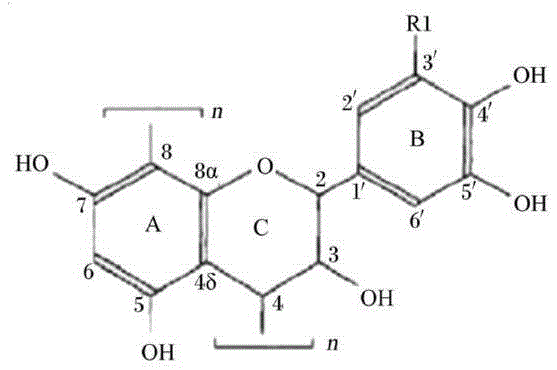
the condensed tannin and polyphenol structure can be combined with hydroxyl, carboxyl and other groups in the coating, can also be combined with metal ions, has amphiphilic coupling effect, and provides good adhesive force for a coating and a metal matrix. However, the tannin extract belongs to natural products, has relatively large molecular weight and has a small amount of water-insoluble components. It is necessary to perform amination modification to improve water solubility and also to improve the ability to bind to metals. The modified condensed tannin is firmly combined with iron, and simultaneously plays a role in preventing corrosive media from corroding steel and can also slow down the diffusion of iron ions. The active phenolic hydroxyl groups, particularly the ortho phenolic hydroxyl groups, which are not bonded to groups such as metal oxides, hydroxyl groups in the coating, and the like, can preferentially react with oxygen penetrating into the coating, and have good oxidation resistance until corrosion is retarded.
The modification of the condensed tannin extract is as follows:

6) the titanium dioxide doped film formed after the organic titanium coupling agent is hydrolyzed has excellent corrosion resistance, can fill the defect of a phosphorus-free conversion film, and simultaneously participates in forming a macromolecular polymer film together with a silane coupling agent hydrolysate to optimize the corrosion resistance of the composite film; the silane coupling agent and the organic metal ester coupling agent can form cross-linking with-OH or-COOH groups in the coating and form covalent bonds with metals, and the synergistic tannin extract provides excellent binding force for the metal-coating. For example, the following is shown:

7) the polyhydroxy inorganic dispersion can not only fill the gaps of the condensed tannin, but also provide a large amount of hydroxyl groups to combine with the modified condensed tannin to form a cross-linked polymer film. The silane coupling agent provided by the invention has C1-C4 short-chain alkyl, silanol with the short-chain alkyl is formed after hydrolysis, certain hydrophobicity is realized, and after the silane coupling agent is combined with condensed tannin, the silane coupling agent has the performance of preventing saline contact or infiltration. Partial titanate forms titanium dioxide gel after hydrolysis, so that the film contains a certain amount of titanium dioxide, and the salt spray resistance of the composite film is improved.
Detailed Description
In order to make the objects, technical solutions and advantages of the present invention more clear, the present invention is further described below with reference to examples a to f:
the preparation method of the composition for improving the salt spray resistance of the coating after the phosphorus-free conversion treatment of the steel comprises the following steps: the following components are all in parts by mass
Preparation of S1 modified tannin extract
Dissolving 30 parts by mass of condensed tannin extract in 50-65 parts by mass of deionized water, filtering to remove insoluble substances, heating to about 50-90 ℃, adding 2.4-5.0 parts by mass of organic amine, slowly adding 3.0-6.0 parts by mass of formaldehyde solution, keeping the temperature for reaction for 1.5-3 hours, and supplementing water to 100 parts by mass;
s2 preparation of composition for improving salt spray resistance of coating after steel phosphorus-free conversion treatment
The composition comprises the following components in parts by mass: 20-40 parts of S1 tannin extract modifier, 2-5 parts of polyhydroxy dispersion liquid, 3-8 parts of alkyl silane coupling agent, 3-8 parts of organic metal ester coupling agent and 5-15 parts of alcohol ether cosolvent, wherein the total mass part of the composition is 100 parts, and the balance is deionized water.
As a further improvement of the scheme, the organic amine in S1 is any one or more of triethanolamine, dimethylamine, hydroxyethyl ethylenediamine, acrylamide and meglumine.
As a further improvement of the scheme, the condensed tannin extract is any one or more of quebracho tannin extract, bayberry tannin extract, emblic leafflower tannin extract and acacia tannin extract.
As a further improvement of the scheme, the polyhydroxy dispersion liquid is nano silicon dioxide aqueous dispersion liquid.
As a further improvement of the scheme, the alkyl silane coupling agent is alkyl alkoxy silane Rm-Si-(OR’)nWherein R is a linear saturated alkyl group having a carbon number of not more than 4, OR' is an ethoxy group OR a methoxy group, for example: dimethyldiethoxysilane, diethoxydimethylsilane, propyltrimethoxysilane and the like
As a further improvement of the scheme, the organic metal ester coupling agent is di (triethanolamine) diisopropyl titanate.
As a further improvement of the scheme, the alcohol ether cosolvent is a low-carbon alcohol ether of ethylene glycol and propylene glycol, such as dipropylene glycol butyl ether, dipropylene glycol methyl ether, ethylene glycol butyl ether and diethylene glycol methyl ether.
Example 1
Modified product of S1

S2 composition


Example 2
S1

S2 composition
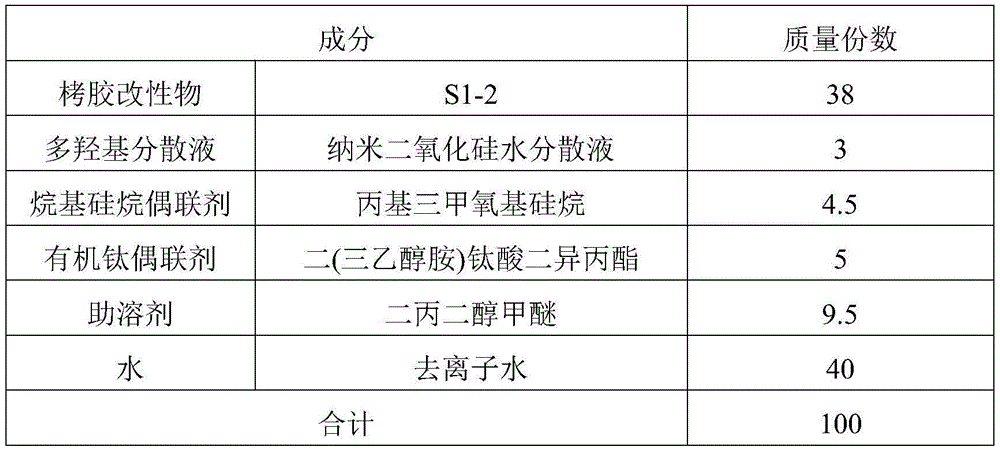
Example 3
S1

S2 composition

Comparative example 1
In the prior art, the non-phosphorus conversion film treatment process comprises the following steps:
1) degreasing and deoiling: thoroughly cleaning the steel with an alkaline cleaning agent;
2) rinsing with water: cleaning the residual cleaning agent on the surface of the steel, wherein the surface is completely soaked by water;
3) treating a phosphorus-free conversion film: preparing a phosphorus-free conversion aqueous solution according to the process formula in the blank treatment 1 in the table 3, wherein the pH value is 3.8-4.2, the temperature is normal temperature, and the treatment time is as follows: 1.5min, the treatment mode is spraying.
4) Rinsing with water: cleaning the treatment liquid residue on the surface of the steel or in the gaps of the structural member;
5) drying: drying with hot air at 80-120 deg.C.
Comparative example 2
In the prior art, the non-phosphorus conversion film treatment process comprises the following steps:
1) degreasing and deoiling: thoroughly cleaning the steel with an alkaline cleaning agent;
2) rinsing with water: cleaning the residual cleaning agent on the surface of the steel, wherein the surface is completely soaked by water;
3) treating a phosphorus-free conversion film: preparing a phosphorus-free conversion aqueous solution according to the process formula in the blank treatment 2 in the table 4, wherein the pH value is 3.8-4.5, the temperature is normal temperature, and the treatment time is as follows: for 2min, the treatment method is soaking.
4) Rinsing with water: cleaning the treatment liquid residue on the surface of the steel or in the gaps of the structural member;
5) drying: drying with hot air at 80-120 deg.C.
Table 3: the performance of the coating after synergistic treatment in example 1 was compared with the performance of the coating after treatment in the manner of treatment in comparative example 1


Table 4: the performance of the coatings of examples 2 and 3 after synergistic treatment is compared with that of comparative example 2 after treatment in the treatment mode


From table 3 the NASS test results of example 1 and comparative example blank treatment 1, and the NASS test results of example 2, example 3 and comparative example blank treatment 2 of table 4, it can be seen that: after the treatment of the composition, the salt spray performance of the coating after the steel phosphorus-free conversion treatment is obviously improved, and more customer requirements can be met; moreover, the treatment liquid can remove rust and form a film at the same time, has multiple functions and wide application range, and does not contain harmful substances such as phosphorus, chromium and the like; the operation and use are simple and convenient, the application range of parameter indexes is wide, the chemical composition of the treatment solution is stable, and the treatment quality is reliable;
after the composition is used for treating the synergistic phosphorus-free conversion coating, the adhesion between the iron and steel phosphorus-free conversion coating and the coating can be improved, and the salt spray resistance of the coating can also be improved; after the composition acts, lipophilic alkyl in the short-chain alkyl silane is doped in the composite film layer, so that the lipophilic hydrophobicity of the metal interface phosphorus-free conversion film can be increased; moreover, the salt spray test can reduce the amount of salt water entering the metal/coating interface, and the salt water solution can reduce the speed of penetrating through the film to reach the metal surface after entering the metal/coating interface;
because the steel surface has metallographic structure defect, a complete phosphorus-free conversion film layer can not be formed, a non-adhesion area exists between metal and a coating, the phosphorus-free conversion film layer is an amorphous film layer and often has defects such as cracks, and the composition can form a non-hydrolytic high molecular weight polymer film layer after being added or used, thereby being beneficial to reducing the defects of the phosphorus-free conversion film layer and the non-adhesion area between the metal and the coating, being beneficial to preventing a saline solution from further diffusing to a metal interface to corrode the metal, and preventing the film layer from being hydrolyzed and damaged by the saline solution due to the characteristic of difficult hydrolysis of the composition, so that the saline resistance is improved;
the condensed tannin extract is mainly composed of condensed tannin, complex polycondensates formed by combining compounds such as flavanol and the like with C-C bonds as main bonds are difficult to decompose in aqueous solution, and an intermediate film layer between metal and a coating is generated by utilizing the natural macromolecules which are difficult to hydrolyze, so that the interface between the metal and the coating can be effectively prevented or hindered from being damaged by a saline medium;

the condensed tannin and polyphenol structure can be combined with hydroxyl, carboxyl and other groups in the coating, can also be combined with metal ions, has amphiphilic coupling effect, and provides good adhesive force for the coating and a metal matrix. However, the tannin extract belongs to natural products, has relatively large molecular weight and has a small amount of water-insoluble components. It is necessary to perform amination modification to improve water solubility and also to improve the ability to bind to metals. The modified condensed tannin is firmly combined with iron, and simultaneously plays a role in preventing corrosive media from corroding steel and can also slow down the diffusion of iron ions. The active phenolic hydroxyl group, especially the ortho-phenolic hydroxyl group, which is not combined with the groups such as metal oxide, hydroxyl group in the coating and the like, can react with oxygen intruding into the coating preferentially, and has good oxidation resistance and corrosion retarding effect. The composite coating after synergistic phosphorus-free conversion treatment has no undesirable phenomena of peeling, bubbling and the like in an NASS test (the time is at least 500 hours or at least 1000 hours according to different coatings), and the unilateral corrosion expanding amount at a scratch part is 1.2-1.6 mm on average; the coating of the control group has no bad phenomena of peeling, bubbling and the like, the average unilateral corrosion expanding amount at the scratch part is 2.0-2.2 mm, and the salt spray resistance of the coating is effectively improved after the surface synergistic treatment.
The above description is only for the preferred embodiment of the present invention, and not intended to limit the scope of the present invention, and all equivalent modifications made by the present invention are within the scope of the present invention.
Claims (7)
1. The preparation method of the composition for improving the salt spray resistance of the coating after the phosphorus-free conversion treatment of steel is characterized by comprising the following steps: the following components are all in parts by mass
Preparation of S1 modified tannin extract
Dissolving 30 parts by mass of condensed tannin extract in 50-65 parts by mass of deionized water, filtering to remove insoluble substances, heating to about 50-90 ℃, adding 2.4-5.0 parts by mass of organic amine, slowly adding 3.0-6.0 parts by mass of formaldehyde solution, keeping the temperature for reaction for 1.5-3 hours, and supplementing water to 100 parts by mass;
s2 preparation of composition for improving salt spray resistance of coating after steel phosphorus-free conversion treatment
The composition comprises the following components in parts by mass: 20-40 parts of S1 tannin extract modifier, 2-5 parts of polyhydroxy dispersion liquid, 3-8 parts of alkyl silane coupling agent, 3-8 parts of organic metal ester coupling agent and 5-15 parts of alcohol ether cosolvent, wherein the total mass part of the composition is 100 parts, and the balance is deionized water.
2. The method for preparing the composition for improving the salt spray resistance of the coating after the phosphorus-free steel conversion treatment according to claim 1, wherein the organic amine in S1 is one or more of triethanolamine, dimethylamine, hydroxyethylethylenediamine, acrylamide and meglumine.
3. The method for preparing a composition for increasing the salt spray resistance of a coating after a non-phosphorus steel conversion treatment according to claim 1, wherein the condensed tannin extract is any one or more of quebracho tannin extract, myrica tannin extract, emblic leafflower tannin extract and acacia tannin extract.
4. The method for preparing the composition for improving the salt spray resistance of the coating after the phosphorus-free steel conversion treatment according to claim 1, wherein the polyhydroxy dispersion is nano-silica aqueous dispersion.
5. The method for preparing the composition for improving the salt fog resistance of the coating after the phosphorus-free conversion treatment of steel and iron as claimed in claim 1, wherein the alkyl silane coupling agent is alkyl alkoxy silane Rm-Si-(OR’)nWherein R is a linear saturated alkyl group having a carbon number of not more than 4, OR' is an ethoxy group OR a methoxy group, for example: dimethyldiethoxysilane, diethoxydimethylsilane, propyltrimethoxysilane, etc.
6. The method for preparing the composition for improving the salt spray resistance of the coating after the phosphorus-free conversion treatment of steel and iron as claimed in claim 1, wherein the organic metal ester coupling agent is diisopropyl di (triethanolamine) titanate.
7. The method for preparing the composition for improving the salt spray resistance of the coating after the phosphorus-free steel conversion treatment according to claim 1, wherein the alcohol ether cosolvent is a lower alcohol ether of ethylene glycol and propylene glycol, such as dipropylene glycol butyl ether, dipropylene glycol methyl ether, ethylene glycol butyl ether and diethylene glycol methyl ether.
Priority Applications (1)
| Application Number | Priority Date | Filing Date | Title |
|---|---|---|---|
| CN202210239853.5A CN114717543B (en) | 2022-03-12 | 2022-03-12 | Preparation method of composition for improving salt spray resistance of coating after non-phosphorus conversion treatment of steel |
Applications Claiming Priority (1)
| Application Number | Priority Date | Filing Date | Title |
|---|---|---|---|
| CN202210239853.5A CN114717543B (en) | 2022-03-12 | 2022-03-12 | Preparation method of composition for improving salt spray resistance of coating after non-phosphorus conversion treatment of steel |
Publications (2)
| Publication Number | Publication Date |
|---|---|
| CN114717543A true CN114717543A (en) | 2022-07-08 |
| CN114717543B CN114717543B (en) | 2023-06-09 |
Family
ID=82238715
Family Applications (1)
| Application Number | Title | Priority Date | Filing Date |
|---|---|---|---|
| CN202210239853.5A Active CN114717543B (en) | 2022-03-12 | 2022-03-12 | Preparation method of composition for improving salt spray resistance of coating after non-phosphorus conversion treatment of steel |
Country Status (1)
| Country | Link |
|---|---|
| CN (1) | CN114717543B (en) |
Citations (11)
| Publication number | Priority date | Publication date | Assignee | Title |
|---|---|---|---|---|
| US4944812A (en) * | 1988-11-16 | 1990-07-31 | Henkel Corporation | Tannin mannich adducts for improving corrosion resistance of metals |
| WO2001007679A1 (en) * | 1999-07-26 | 2001-02-01 | Chemetall Plc | Metal surface treatment |
| CN102965653A (en) * | 2012-11-01 | 2013-03-13 | 安徽未来表面技术有限公司 | Self-repairing non-phosphorus ceramic processing liquid for galvanized plate and ceramic process thereof |
| JP2016020522A (en) * | 2014-07-14 | 2016-02-04 | 関西ペイント株式会社 | Aqueous metal surface treatment composition |
| CN106046872A (en) * | 2016-06-12 | 2016-10-26 | 合肥和安机械制造有限公司 | A kind of microcrystalline graphite-tannin extract composite water-based dacromet coating solution and preparation method thereof |
| CN106544662A (en) * | 2016-12-30 | 2017-03-29 | 宁波际超新材料科技有限公司 | A kind of without phosphorus transforming agent and its using method |
| CN106702363A (en) * | 2016-12-29 | 2017-05-24 | 芜湖市瑞杰环保材料科技有限公司 | Ceramization agent for electrophoretic coating pretreatment, preparation method and usage method for ceramization agent |
| CN107163758A (en) * | 2017-06-30 | 2017-09-15 | 湖南康瑞涂料科技有限公司 | A kind of anti-corrosion anti-mildew becomes coating |
| CN107201513A (en) * | 2017-06-02 | 2017-09-26 | 山东大学 | A kind of pretreatment of metal surface liquid and its application based on tannic acid for the Phosphateless environmentally friendly of main film forming substance |
| CN109321908A (en) * | 2018-10-26 | 2019-02-12 | 四川理工学院 | A kind of multifunctional environment-friendly nano-ceramic liquid on metal surface and preparation method and use method thereof |
| CN109536036A (en) * | 2018-10-16 | 2019-03-29 | 兴业皮革科技股份有限公司 | A kind of preparation method of the siliceous condensed tannin extract of polyethylene polyamine cross-linked structure |
-
2022
- 2022-03-12 CN CN202210239853.5A patent/CN114717543B/en active Active
Patent Citations (11)
| Publication number | Priority date | Publication date | Assignee | Title |
|---|---|---|---|---|
| US4944812A (en) * | 1988-11-16 | 1990-07-31 | Henkel Corporation | Tannin mannich adducts for improving corrosion resistance of metals |
| WO2001007679A1 (en) * | 1999-07-26 | 2001-02-01 | Chemetall Plc | Metal surface treatment |
| CN102965653A (en) * | 2012-11-01 | 2013-03-13 | 安徽未来表面技术有限公司 | Self-repairing non-phosphorus ceramic processing liquid for galvanized plate and ceramic process thereof |
| JP2016020522A (en) * | 2014-07-14 | 2016-02-04 | 関西ペイント株式会社 | Aqueous metal surface treatment composition |
| CN106046872A (en) * | 2016-06-12 | 2016-10-26 | 合肥和安机械制造有限公司 | A kind of microcrystalline graphite-tannin extract composite water-based dacromet coating solution and preparation method thereof |
| CN106702363A (en) * | 2016-12-29 | 2017-05-24 | 芜湖市瑞杰环保材料科技有限公司 | Ceramization agent for electrophoretic coating pretreatment, preparation method and usage method for ceramization agent |
| CN106544662A (en) * | 2016-12-30 | 2017-03-29 | 宁波际超新材料科技有限公司 | A kind of without phosphorus transforming agent and its using method |
| CN107201513A (en) * | 2017-06-02 | 2017-09-26 | 山东大学 | A kind of pretreatment of metal surface liquid and its application based on tannic acid for the Phosphateless environmentally friendly of main film forming substance |
| CN107163758A (en) * | 2017-06-30 | 2017-09-15 | 湖南康瑞涂料科技有限公司 | A kind of anti-corrosion anti-mildew becomes coating |
| CN109536036A (en) * | 2018-10-16 | 2019-03-29 | 兴业皮革科技股份有限公司 | A kind of preparation method of the siliceous condensed tannin extract of polyethylene polyamine cross-linked structure |
| CN109321908A (en) * | 2018-10-26 | 2019-02-12 | 四川理工学院 | A kind of multifunctional environment-friendly nano-ceramic liquid on metal surface and preparation method and use method thereof |
Also Published As
| Publication number | Publication date |
|---|---|
| CN114717543B (en) | 2023-06-09 |
Similar Documents
| Publication | Publication Date | Title |
|---|---|---|
| CN100584908C (en) | Environmentally friendly galvanized metal surface treatment agent | |
| CN103119200B (en) | Surface treatment fluid for zinc-plated steel sheet, zinc-plated steel sheet, and manufacturing method for the same | |
| AU2006260006B2 (en) | Chrome-free composition of low temperature curing for treating a metal surface and a metal sheet using the same | |
| US5053081A (en) | Composition and method for treatment of conversion coated metal surfaces with an aqueous solution of 3-aminopropyltriethoxy silane and titanium chelate | |
| US20030049486A1 (en) | Silane coatings for metal | |
| TWI395835B (en) | No-rinse pretreatment methods and compositions | |
| CN102378827A (en) | Surface-treating agent, process for manufacturing plated steel sheet using the surface-treating agent, and plated steel sheet | |
| CN102061465A (en) | Chrome-free sealing agent | |
| JPH11256096A (en) | Surface treatment agent composition for metal material and treatment method | |
| CN110565084A (en) | A kind of organic and inorganic composite passivation solution and passivation method | |
| US7811391B2 (en) | Composition and process for preparing protective coatings on metal substrates | |
| TWI406969B (en) | Process for coating metallic surfaces with a multicomponent aqueous composition | |
| CN112251744B (en) | Metal plate coating pretreatment process | |
| CN108193199B (en) | Corrosion-resistant and rust-resistant conversion film-forming liquid for iron parts | |
| CN104988485A (en) | Environment-friendly universal metal surface pretreatment liquid and use method | |
| US20020172776A1 (en) | Composition and method for inhibiting corrosion of aluminum and aluminum alloys using mercapto substituted silanes | |
| CN109722661A (en) | Rear-earth-doped inorganic agent of a kind of basic silane for Treatment of Metal Surface and its preparation method and application | |
| CN101289741B (en) | Chromium-free passivation solution for surface treatment of electro-galvanized steel sheet and application method thereof | |
| CA2597630C (en) | Composition and process for preparing protective coatings on metal substrates | |
| AU2006286364B2 (en) | Compositions and method for coating metal surfaces with an alkoxysilane coating | |
| US20040139887A1 (en) | Metal coating coupling composition | |
| CN102268707B (en) | Preparation method and application of metal zinc-containing composite silane film | |
| CN115029037B (en) | Water-based anticorrosive paint and preparation method and application thereof | |
| CN114717543B (en) | Preparation method of composition for improving salt spray resistance of coating after non-phosphorus conversion treatment of steel | |
| CN114686866B (en) | Non-phosphorus conversion film treatment process |
Legal Events
| Date | Code | Title | Description |
|---|---|---|---|
| PB01 | Publication | ||
| PB01 | Publication | ||
| SE01 | Entry into force of request for substantive examination | ||
| SE01 | Entry into force of request for substantive examination | ||
| GR01 | Patent grant | ||
| GR01 | Patent grant |