CN114807603A - Method for extracting zinc from high-hydrochloric-acid washing liquor - Google Patents
Method for extracting zinc from high-hydrochloric-acid washing liquor Download PDFInfo
- Publication number
- CN114807603A CN114807603A CN202210588578.8A CN202210588578A CN114807603A CN 114807603 A CN114807603 A CN 114807603A CN 202210588578 A CN202210588578 A CN 202210588578A CN 114807603 A CN114807603 A CN 114807603A
- Authority
- CN
- China
- Prior art keywords
- organic phase
- zinc
- extraction
- solution
- iron
- Prior art date
- Legal status (The legal status is an assumption and is not a legal conclusion. Google has not performed a legal analysis and makes no representation as to the accuracy of the status listed.)
- Granted
Links
Images

Classifications
-
- C—CHEMISTRY; METALLURGY
- C22—METALLURGY; FERROUS OR NON-FERROUS ALLOYS; TREATMENT OF ALLOYS OR NON-FERROUS METALS
- C22B—PRODUCTION AND REFINING OF METALS; PRETREATMENT OF RAW MATERIALS
- C22B19/00—Obtaining zinc or zinc oxide
- C22B19/30—Obtaining zinc or zinc oxide from metallic residues or scraps
-
- C—CHEMISTRY; METALLURGY
- C22—METALLURGY; FERROUS OR NON-FERROUS ALLOYS; TREATMENT OF ALLOYS OR NON-FERROUS METALS
- C22B—PRODUCTION AND REFINING OF METALS; PRETREATMENT OF RAW MATERIALS
- C22B3/00—Extraction of metal compounds from ores or concentrates by wet processes
- C22B3/20—Treatment or purification of solutions, e.g. obtained by leaching
- C22B3/26—Treatment or purification of solutions, e.g. obtained by leaching by liquid-liquid extraction using organic compounds
- C22B3/36—Heterocyclic compounds
-
- Y—GENERAL TAGGING OF NEW TECHNOLOGICAL DEVELOPMENTS; GENERAL TAGGING OF CROSS-SECTIONAL TECHNOLOGIES SPANNING OVER SEVERAL SECTIONS OF THE IPC; TECHNICAL SUBJECTS COVERED BY FORMER USPC CROSS-REFERENCE ART COLLECTIONS [XRACs] AND DIGESTS
- Y02—TECHNOLOGIES OR APPLICATIONS FOR MITIGATION OR ADAPTATION AGAINST CLIMATE CHANGE
- Y02P—CLIMATE CHANGE MITIGATION TECHNOLOGIES IN THE PRODUCTION OR PROCESSING OF GOODS
- Y02P10/00—Technologies related to metal processing
- Y02P10/20—Recycling
Landscapes
- Chemical & Material Sciences (AREA)
- Engineering & Computer Science (AREA)
- Organic Chemistry (AREA)
- Materials Engineering (AREA)
- Mechanical Engineering (AREA)
- Metallurgy (AREA)
- Manufacturing & Machinery (AREA)
- Life Sciences & Earth Sciences (AREA)
- Environmental & Geological Engineering (AREA)
- General Life Sciences & Earth Sciences (AREA)
- Geochemistry & Mineralogy (AREA)
- Geology (AREA)
- Extraction Or Liquid Replacement (AREA)
Abstract
The invention relates to the technical field of chemical extraction, in particular to a method for extracting zinc from high-hydrochloric-acid washing liquor. The method uses pyridine carboxylic acid ester extractant to extract zinc and a small amount of iron in hydrochloric acid washing liquor together, so as to realize preliminary separation of zinc and iron; and then oxidizing low-valence iron in the zinc-rich strip liquor obtained in the former stage process by using an oxidant, and selecting a phosphoric acid extracting agent for removing iron to realize the thorough separation of zinc and iron so as to obtain a zinc chloride solution with higher purity. The technical scheme solves the technical problem that the prior art is difficult to simply and efficiently extract and recover zinc from high-hydrochloric acid washing liquor. The scheme has the characteristics of simple process and rich process production resources, the iron content in the obtained finished product is not more than 10ppm, the comprehensive recycling of resources can be effectively realized, and the method has a wide application prospect.
Description
Technical Field
The invention relates to the technical field of chemical extraction, in particular to a method for extracting zinc from high-hydrochloric-acid washing liquor.
Background
The steel industry is a representative of the heavy industrial industry in China and is an important component of national economy in China, and the leading steel yield in the world promotes the vigorous development of the capital construction industry, the automobile industry and the like in China. In the process of preparing steel materials, a surface cleaning agent is required to clean a metal oxide layer and other impurities on the surface of steel materials, and the current acid cleaning process using high-concentration hydrochloric acid as the cleaning agent is a main process for acid cleaning of the steel materials. The hydrochloric acid pickling waste liquid generally contains 100-200g/L Fe 2+ And Fe 3 + 30-50g/L of H + A certain amount of Zn 2+ And other metal ions. The pickling waste liquor has great harm to water and soil environment, so that normal physiological activities of aquatic plants and animals can be harmed, enrichment of metal ions can secondarily pollute water, soil structure is changed, crop growth is influenced, and metal poisoning occurs after enrichment in human bodies. Meanwhile, the hydrochloric acid pickling waste liquid is listed in the name list of hazardous waste in China because of large annual output, strong liquidity, high hazard, difficult treatment, harm to ecological environment and the like. Therefore, the environment-friendly treatment of the pickling solution is a hotspot of current development, and scientific researchers research and develop various methods for treating the pickling solution, so as to reduce the pollution of the pickling waste liquid to the environment and improve the utilization rate of resources. The method mainly comprises the steps of precipitation of metal ions, acid neutralization, extraction method and the like. Due to the specificity of the various separation methods, there are always respective disadvantages. Such as a precipitation method and an acid neutralization method, a large amount of alkaline substances are required to be added, the cost is high, a large amount of acid in the pickling solution is lost, a large amount of waste salt solid residues are generated, and the subsequent treatment is difficult. The extraction method has large separation difference according to different types of extracting agents. When the zinc-iron extractant circulating in the current market is used for treating the washing liquid containing high iron, high zinc and high hydrochloric acid, the zinc-iron separation effect is poor or the zinc-iron is separated intoThe main reason for the higher cost is that part of the extractant can realize the preliminary separation of metal ions in a high-acid condition, but cannot realize the complete separation of metals; another part of the extractant can achieve complete separation of metal ions in the whole system, but a large amount of alkaline substances needs to be added. Therefore, how to improve the comprehensive recycling value of the high-hydrochloric acid washing solution and realize the efficient and simple separation and extraction of zinc is a problem to be solved in the technical field.
Disclosure of Invention
The invention aims to provide a method for extracting zinc from high-hydrochloric acid washing liquor, which solves the technical problem that the prior art is difficult to simply and efficiently extract and recover the zinc from the high-hydrochloric acid washing liquor.
In order to achieve the purpose, the invention adopts the following technical scheme:
a process for the extraction of zinc from a high hydrochloric acid wash comprising a first separation step:
s1 extraction: mixing the organic phase A with a high-hydrochloric-acid washing solution containing iron and zinc, and extracting to obtain a first loaded organic phase I and a first raffinate I;
s2 back extraction: mixing a stripping agent I with a first loaded organic phase I, and performing stripping to obtain a first lean organic phase I and a first stripping solution I;
and S3 circulation: extracting the first raffinate I by using the first lean organic phase I, and adding an acidity constant agent to obtain a second loaded organic phase I and a second raffinate I; carrying out back extraction on the second loaded organic phase I by using the first back extraction solution I to obtain a second poor organic phase I and a second back extraction solution I;
extracting the N-1 th raffinate I by using the N-1 th poor organic phase I, and adding an acidity constant agent to obtain an N-th loaded organic phase I and an N-th raffinate I; carrying out back extraction on the Nth loaded organic phase I by using the N-1 th back extraction solution I to obtain an Nth poor organic phase I and an Nth back extraction solution I; wherein N is 5-7.
The principle and the beneficial effects of the technical scheme are that:
in the present embodiment, the high hydrochloric acid washing solution contains a large amount of iron ions (including divalent and trivalent iron, which are collectively referred to as iron ions in the present embodiment) and a small amount of zinc ions, as well as other small amounts of metal ions. The acidity of the washing liquid and the presence of a large amount of iron ions have a great influence on the enrichment and separation of zinc ions. According to the technical scheme, the organic phase A containing pyridine carboxylic ester extractant is used for directly extracting the high-hydrochloric acid washing liquid, so that a large amount of zinc and a small amount of iron can be enriched in the Nth back extraction liquid I, and the enrichment of zinc and the separation of zinc and iron are preliminarily realized. The technical scheme can directly treat the high-hydrochloric acid washing liquid without adjusting the pH value before extraction, thereby simplifying the process flow and reducing the cost.
Further, the method also comprises a second separation step:
and (4) SS1 extraction: extracting the oxidized Nth strip liquor I by using an organic phase B to obtain a loaded organic phase II and a raffinate II;
and (3) SS2 back extraction: and (3) back-extracting the loaded organic phase II by using a back-extracting agent II to obtain an organic phase II poor in quality and a back-extraction solution II.
Further, in the first separation step, the organic phase A comprises a diluent and a pyridine carboxylic ester extractant with a structural formula shown as a formula I;

wherein R is 1 And R 2 Are respectively selected from alkyl with 10-15 carbon atoms.
According to the method and the process for extracting the zinc in the high-hydrochloric-acid washing liquor, two extracting agents are adopted to separate and extract the zinc in a high-hydrochloric-acid system step by step, the zinc and a certain amount of impurities are extracted in the first step, the zinc chloride solution with higher purity is obtained by extraction and impurity removal in the second step, and the raffinate in the first step and the strip liquor in the second step flow back to the pickling section, so that waste of high-hydrochloric-acid waste liquor after zinc extraction is avoided, acid circulation is realized, and good ecological environment and economic benefits are achieved.
Further, in the first separation step, the volume fraction of the pyridine carboxylic ester extractant in the organic phase A is 20-40%. The organic phase with the content can realize the full extraction of zinc ions and is eluted in the back extraction process of pure water.
Further, in the first separation step, the volume ratio of the organic phase A to the high-hydrochloric-acid washing liquid containing iron and zinc is 4-1: 1; the extraction mixing time is at least 5 min. The above-mentioned O/A ratio and extraction time can ensure the full extraction of zinc ions.
Further, in the first separation step, the volume ratio of the stripping agent I to the first loaded organic phase I is 1: 1-4; back extraction mixing time is at least 5 min; the stripping agent I is water. The O/A ratio and the back extraction time can ensure that the zinc ions are fully back extracted.
Further, the content of zinc ions in the Nth raffinate I is 0.2-0.8 g/L; the pH value of the N back extraction solution I is 0.1-0.3.
Further, in the second back extraction step, the phosphoric acid extractant is Mextral 204P; the stripping agent II is 3-5mol/L HCl solution; and (3) oxidizing the Nth stripping solution I by using hydrogen peroxide, wherein the using amount of the hydrogen peroxide is 0.1-0.5% of the mass of the Nth stripping solution I, and obtaining the oxidized Nth stripping solution I. The ferrous iron is converted into the ferric iron through oxidation, and the Mextral 204P has a good extraction effect on the ferric iron, can remove iron in zinc ions and promotes the separation of zinc and iron.
Further, in the second back extraction step, the back extraction solution II flows back to the high hydrochloric acid washing liquid containing iron and zinc in S1; the iron content of raffinate II is 0.005-0.01 g/L.
Furthermore, both SS1 extraction and SS2 back extraction adopt a counter-current extraction process, the stage number of the extraction and the back extraction is at least 2, and the single-stage mixing time is at least 3 min; the volume ratio of the oxidized Nth stripping solution I to the organic phase B is 1: 1-4; the volume ratio of the stripping agent II to the loaded organic phase II is 1: 1-4. The two extraction and the two reactions can realize the full separation of zinc and iron.
Detailed Description
The present invention will be described in further detail with reference to embodiments, but the embodiments of the present invention are not limited thereto. Unless otherwise indicated, the following techniques are conventional and well known to those skilled in the art: the materials, reagents and the like used are all commercially available.
Example 1
A first separation step:
s1 extraction: the organic phase A was brought into contact with a high hydrochloric acid wash containing iron and zinc (all the examples and comparative examples of this scheme used a same batch of high hydrochloric acid wash which was measured to contain about 150g/L Fe 2+ And Fe 3+ 50g/L of H + 46g/L of Zn 2+ ) Mixing according to the volume ratio of 4:1, oscillating for 5min, and then carrying out phase separation to obtain a first loaded organic phase I and a first raffinate I. The organic phase A consists of pyridine carboxylic ester extractant and sulfonated kerosene diluent shown as formula I, wherein R is 1 And R 2 Are all C 13 H 27 (the synthesis method of the compound is shown in the literature: the synthesis of a metal extractant Mextral CLX-50 and the performance research of copper extraction, hydrometallurgy, 2013). The volume fraction of the pyridine carboxylic ester extractant is 20 percent.

S2 back extraction: and mixing the stripping agent I and the first loaded organic phase I according to the volume ratio of 1:4, mixing and oscillating the two for 3min, and performing stripping to obtain a first lean organic phase I and a first stripping solution I. The stripping agent I is water, and in the present embodiment, purified water is particularly preferable.
And S3 circulation: and returning the first organic poor phase I to the first raffinate I, adding an acidity constancy agent HCl solution (the added amount is 0.04% of the volume of the first raffinate I, the mass fraction of the HCl solution is 36%), oscillating for 5min, and performing phase separation to obtain a second loaded phase I and a second raffinate I. And mixing the first stripping solution I and the second loaded organic phase I, oscillating for 5min, and performing phase separation to obtain a second poor organic phase I and a second stripping solution I. Extracting the N-1 th raffinate I by using the N-1 th poor organic phase I, and simultaneously adding an acidity constant agent HCl solution (the addition amount is the same as that of the previous solution) to obtain an Nth loaded organic phase I and an Nth raffinate I (the Nth raffinate I returns a high-hydrochloric-acid washing solution containing iron and zinc); and (3) carrying out back extraction on the Nth loaded organic phase I by using the N-1 th back extraction solution I to obtain an Nth poor organic phase I and an Nth back extraction solution I. This step was repeated 5 times (N ═ 5) to obtain a fifth organic phase depleted i and a fifth raffinate i, and a fifth raffinate i. The zinc ion content of the fifth raffinate I was 0.8g/L (this portion was returned to the high hydrochloric acid wash), and the fifth strip liquor I contained mainly zinc ions (used in the second separation step) and a small amount of impurities including iron ions. The primary separation of zinc and iron is realized through the first separation step.
A second separation step:
SS1 extraction and SS2 back extraction: and (3) the pH value of the fifth stripping solution I is 0.1, hydrogen peroxide is added to oxidize low-valence iron ions in the fifth stripping solution I, and the dosage of the hydrogen peroxide is 0.4% of the mass of the fifth stripping solution I, so that the fifth stripping solution I after oxidation treatment is obtained.
In the embodiment, a two-extraction and two-reverse-flow extraction process is adopted, in the extraction process, the ratio (volume ratio) of the organic phase B to the fifth strip liquor I after oxidation treatment is 4:1, the single-stage mixing time is 3min, and a loaded organic phase II and a raffinate II are obtained after two-stage extraction. The organic phase B consists of phosphoric acid extractant and diluent, the phosphoric acid extractant is specifically Mextral 204P (P204), the diluent is sulfonated kerosene, and the volume percentage of the Mextral 204P is 10%. In the back extraction process, the ratio (volume ratio) of the back extractant II to the loaded organic phase II is 1:4, the single-stage mixing time is 3min, and after two-stage back extraction, a lean organic phase II and a back extraction solution II are obtained. Wherein the stripping agent II is a 5mol/L HCl solution. The main component of the raffinate II is zinc chloride, and the impurity iron ion content is 0.01g/L, so that the raffinate II is used for further producing the zinc chloride. The proportion of zinc and iron in the stripping solution II is smaller, and the initial high-hydrochloric-acid washing liquid is refluxed. And the complete separation of zinc and iron is realized through the second separation step.
Examples 2-5 are substantially the same as example 1, except that some parameters are selected, as detailed in table 1, and the process is as shown in fig. 1. FIG. 1 is an overall process.
Table 1: example 1-example 5 parameter settings
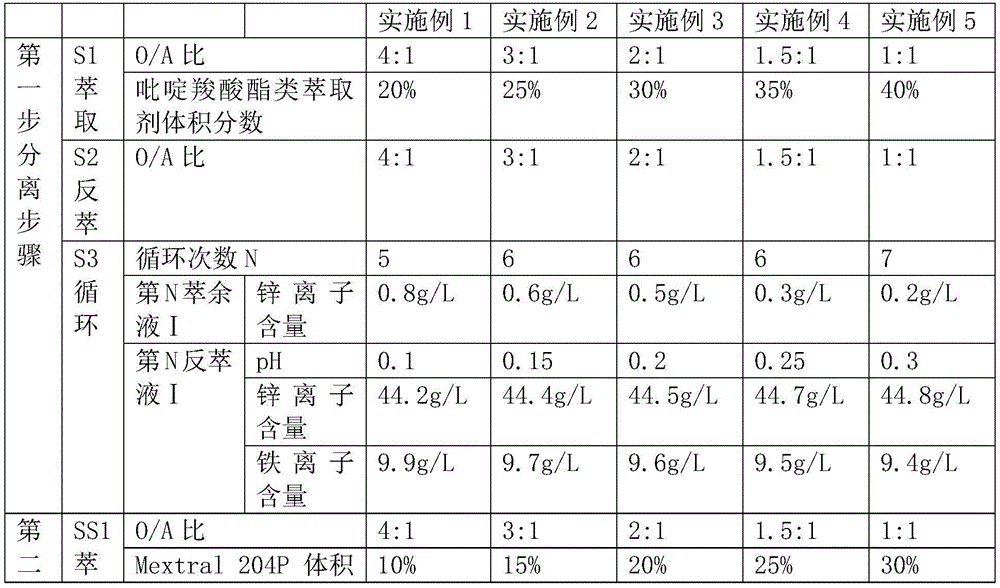

In table 1, the zinc and iron are completely separated according to the iron impurity content in the raffinate ii, and the strip liquor ii is recycled to the pickling solution, so the zinc and iron ratio does not show the separation effect. The main investigation indexes of the process effect are Nth stripping solution I and raffinate II, wherein the Nth stripping solution I shows the extraction effect of zinc in the pickling solution, and the raffinate II shows the thorough separation effect of zinc and iron. According to the experimental data in the table 1, the process method can realize the high-efficiency separation and recovery of the zinc in the pickling solution, and realize the extraction of the zinc in a high-hydrochloric-acid system.
Comparative example 1
This comparative example is substantially the same as example 1 except that in the second separation step, the stripping solution I was not subjected to oxidation treatment with hydrogen peroxide. The iron ion content of the raffinate II is more than 2g/L, so that the complete separation of zinc and iron can not be realized.
Comparative example 2
This comparative example is essentially the same as example 1, except that in the second separation step, the stripping agent II was a 2mol/L HCl solution and a 5.5mol/L HCl solution, in both cases. The separation result cannot be influenced by the over-high acidity of the stripping agent II, but the acidity of the pickling solution is gradually increased after the stripping solution II returns to the pickling solution, so that the first separation step is influenced, and the acid consumption is increased. The over-low acidity of the stripping agent II influences the stripping effect of the organic phase B, so that the stripping is incomplete, the extraction capacity of the organic phase B in the subsequent circulating process is reduced, and the zinc-iron separation effect in the second separation step is gradually influenced.
In the present embodiment, the high hydrochloric acid washing solution contains a large amount of iron ions (including divalent and trivalent iron, which are collectively referred to as iron ions in the present embodiment) and a small amount of zinc ions, as well as other small amounts of metal ions. The acidity of the washing liquid and the presence of a large amount of iron ions have a great influence on the enrichment and separation of zinc ions. In the technical scheme, the organic phase A containing pyridine carboxylic ester extractant is used for directly extracting the high-hydrochloric acid washing liquid, so that a large amount of zinc and a small amount of iron can be enriched in the Nth back extraction liquid I. Pyridine carboxylate extractants are suitable for the extraction of copper ions, but it is not known whether they are suitable for the extraction of zinc ions. Some attempts have been made to find that pyridine carboxylic acid ester extractants can also be used for extraction of zinc ions. However, due to the particularity of the pickling solution, even if a pyridine carboxylic ester extractant is used, the zinc extraction effect is good, and the effective separation of zinc and iron cannot be completely realized under the working condition. At this time, the inventors faced two options, namely removing iron ions before using the pyridine carboxylic acid ester extractant, and separating zinc and iron in the Nth strip liquor I after using the pyridine carboxylic acid ester extractant.
The inventors first tried to separate and remove iron ions by using various extractants, taking P204 as an example, and see comparative example 3 in detail.
Comparative example 3:
this comparative example is essentially the same as the first separation step of example 1 (no second separation step is performed), except that in the first separation step, the extractant used in organic phase A was P204 and the stripping agent I was 4mol/L HCl, which was recycled five times.
The Nth stripping solution I (fifth stripping solution I) contains 1g/L of zinc ions and 110g/L of iron ions, and the Nth raffinate I contains 45g/L of zinc ions and 40g/L of iron ions. Therefore, zinc and iron cannot be effectively separated by using an extracting agent such as P204 and the like, the N raffinate I also contains a small amount of metal ions such as cadmium, manganese and the like besides the metal ions, the impurity content is high, and even if the zinc ions in the N raffinate I are subsequently extracted and separated, the technical difficulty is high, and the separation effect is poor. In addition, in many cases, the acidity of the high hydrochloric acid wash is very high (higher than the batch of high hydrochloric acid wash used in this comparative example), which leads to the acidity reaching the limit of P204 itself, and the metal ions in the nth raffinate i are mixed and cannot be separated.
After numerous attempts, the inventors have not found suitable extractants and procedures and have therefore abandoned the step of separating the iron ions prior to the use of pyridine carboxylate type extractants. In addition, comparing the comparison between the first separation step of comparative example 3 and example 1, it can also be demonstrated that it is difficult to achieve zinc enrichment and zinc-iron separation with both P204 and picolinate extractants alone. However, the zinc and the iron can be sufficiently separated by combining the two components and using the components in a certain order.
The inventors further tried to directly extract the high hydrochloric acid washing liquid with the organic phase a containing the pyridine carboxylic ester-based extractant and then to perform a separation treatment of zinc and iron. In this process, a number of candidate extractants were also tried, as illustrated by comparative example 4.
Comparative example 4
This comparative example is substantially the same as example 1 except that in the first separation step, the extraction agent used was the pyridine carboxylic acid ester-based extraction agent of example 1, and in the second separation step, the extraction agent used was P507. The raffinate II contained 44.1g/L zinc ions and 8.4g/L iron ions. This indicates that the best effect of extracting zinc from a high hydrochloric acid environment can be obtained by using a picolinate extractant in combination with P204.
In addition, in the second separation step, the inventors also tried extractants such as P272, 292P and 471P, and found that the raffinate II contains more than 5g/L of iron ions, so that zinc and iron cannot be effectively separated. In this case, P204 is the most suitable extractant for use with pyridine carboxylic acid ester type extractants.
The foregoing is merely an example of the present invention and common general knowledge in the art of designing and/or characterizing particular aspects and/or features is not described in any greater detail herein. It should be noted that, for those skilled in the art, without departing from the technical solution of the present invention, several variations and modifications can be made, which should also be regarded as the protection scope of the present invention, and these will not affect the effect of the implementation of the present invention and the practicability of the patent. The scope of the claims of the present application shall be determined by the contents of the claims, and the description of the embodiments and the like in the specification shall be used to explain the contents of the claims.
Claims (10)
1. A method for extracting zinc from high hydrochloric acid washing liquor is characterized by comprising a first separation step:
s1 extraction: mixing the organic phase A with a high-hydrochloric-acid washing liquid containing iron and zinc, and extracting to obtain a first loaded organic phase I and a first raffinate I;
s2 back extraction: mixing a stripping agent I with a first loaded organic phase I, and performing stripping to obtain a first lean organic phase I and a first stripping solution I;
and S3 circulation: extracting the first raffinate I by using the first lean organic phase I, and adding an acidity constant agent to obtain a second loaded organic phase I and a second raffinate I; carrying out back extraction on the second loaded organic phase I by using the first back extraction solution I to obtain a second poor organic phase I and a second back extraction solution I;
extracting the N-1 th raffinate I by using the N-1 th poor organic phase I, and adding an acidity constant agent to obtain an N-th loaded organic phase I and an N-th raffinate I; carrying out back extraction on the Nth loaded organic phase I by using the N-1 th back extraction solution I to obtain an Nth poor organic phase I and an Nth back extraction solution I; wherein N is 5-7.
2. The method of claim 1, further comprising a second separation step of:
and (4) SS1 extraction: extracting the oxidized Nth strip liquor I by using an organic phase B to obtain a loaded organic phase II and a raffinate II;
and (3) SS2 back extraction: and (3) back-extracting the loaded organic phase II by using a back-extracting agent II to obtain an organic phase II poor in quality and a back-extraction solution II.
3. The method of claim 2, wherein in the first separation step, the organic phase a comprises a diluent and a picolinate ester extractant of formula i;

wherein R is 1 And R 2 Are respectively selected from alkyl with 10-15 carbon atoms.
4. A process according to claim 3, wherein the pyridine carboxylic acid ester extractant in the first separation step has a volume fraction of 20-40% in the organic phase a.
5. The method for extracting zinc from high hydrochloric acid washing liquid according to claim 4, characterized in that, in the first separation step, the volume ratio of the organic phase A to the high hydrochloric acid washing liquid containing iron and zinc is 4-1: 1; the extraction mixing time is at least 5 min.
6. The method for extracting zinc from a high hydrochloric acid washing solution according to claim 5, characterized in that, in the first separation step, the volume ratio of the stripping agent I to the first loaded organic phase I is 1: 1-4; back extraction mixing time is at least 5 min; the stripping agent I is water.
7. The method of claim 6, wherein the content of zinc ions in the Nth raffinate I is 0.2-0.8 g/L; the pH value of the N back extraction solution I is 0.1-0.3.
8. The method of claim 2, wherein in the second stripping step, the phosphoric acid extractant is Mextral 204P; the stripping agent II is 3-5mol/L HCl solution; and (3) oxidizing the Nth stripping solution I by using hydrogen peroxide, wherein the using amount of the hydrogen peroxide is 0.1-0.5% of the mass of the Nth stripping solution I, and obtaining the oxidized Nth stripping solution I.
9. The method of claim 8, wherein in the second stripping step, the strip liquor II is refluxed to the high hydrochloric acid washing liquor containing iron and zinc in S1; the iron content of raffinate II is 0.005-0.01 g/L.
10. The method for extracting zinc from high hydrochloric acid washing liquid as claimed in claim 9, wherein the SS1 extraction and the SS2 back extraction both adopt a countercurrent extraction process, the number of the extraction and the back extraction is at least 2, and the single-stage mixing time is at least 3 min; the volume ratio of the oxidized Nth stripping solution I to the organic phase B is 1: 1-4; the volume ratio of the stripping agent II to the loaded organic phase II is 1: 1-4.
Priority Applications (1)
| Application Number | Priority Date | Filing Date | Title |
|---|---|---|---|
| CN202210588578.8A CN114807603B (en) | 2022-05-26 | 2022-05-26 | Method for extracting zinc from high hydrochloric acid washing liquid |
Applications Claiming Priority (1)
| Application Number | Priority Date | Filing Date | Title |
|---|---|---|---|
| CN202210588578.8A CN114807603B (en) | 2022-05-26 | 2022-05-26 | Method for extracting zinc from high hydrochloric acid washing liquid |
Publications (2)
| Publication Number | Publication Date |
|---|---|
| CN114807603A true CN114807603A (en) | 2022-07-29 |
| CN114807603B CN114807603B (en) | 2023-08-22 |
Family
ID=82519162
Family Applications (1)
| Application Number | Title | Priority Date | Filing Date |
|---|---|---|---|
| CN202210588578.8A Active CN114807603B (en) | 2022-05-26 | 2022-05-26 | Method for extracting zinc from high hydrochloric acid washing liquid |
Country Status (1)
| Country | Link |
|---|---|
| CN (1) | CN114807603B (en) |
Citations (5)
| Publication number | Priority date | Publication date | Assignee | Title |
|---|---|---|---|---|
| US5135652A (en) * | 1990-10-25 | 1992-08-04 | Cominco Ltd. | Method for the solvent extraction of zinc |
| CN105696010A (en) * | 2016-01-12 | 2016-06-22 | 惠州市斯瑞尔环境化工有限公司 | Method for recycling iron and zinc containing waste hydrochloric acid solution |
| CN106630313A (en) * | 2016-12-16 | 2017-05-10 | 江苏永葆环保科技股份有限公司 | Reduction circulation process method for recycling zinc elements in iron-containing waste acid |
| CN107245582A (en) * | 2017-05-26 | 2017-10-13 | 金川集团股份有限公司 | It is a kind of that iron, the method for zinc are reclaimed from waste hydrochloric acid |
| CN113046557A (en) * | 2020-12-29 | 2021-06-29 | 斯瑞尔环境科技股份有限公司 | Comprehensive recycling method for zinc-containing and iron-containing waste hydrochloric acid |
-
2022
- 2022-05-26 CN CN202210588578.8A patent/CN114807603B/en active Active
Patent Citations (5)
| Publication number | Priority date | Publication date | Assignee | Title |
|---|---|---|---|---|
| US5135652A (en) * | 1990-10-25 | 1992-08-04 | Cominco Ltd. | Method for the solvent extraction of zinc |
| CN105696010A (en) * | 2016-01-12 | 2016-06-22 | 惠州市斯瑞尔环境化工有限公司 | Method for recycling iron and zinc containing waste hydrochloric acid solution |
| CN106630313A (en) * | 2016-12-16 | 2017-05-10 | 江苏永葆环保科技股份有限公司 | Reduction circulation process method for recycling zinc elements in iron-containing waste acid |
| CN107245582A (en) * | 2017-05-26 | 2017-10-13 | 金川集团股份有限公司 | It is a kind of that iron, the method for zinc are reclaimed from waste hydrochloric acid |
| CN113046557A (en) * | 2020-12-29 | 2021-06-29 | 斯瑞尔环境科技股份有限公司 | Comprehensive recycling method for zinc-containing and iron-containing waste hydrochloric acid |
Non-Patent Citations (1)
| Title |
|---|
| 陈灵丽等: ""用N235从热镀锌酸洗废液中萃取分离锌铁"" * |
Also Published As
| Publication number | Publication date |
|---|---|
| CN114807603B (en) | 2023-08-22 |
Similar Documents
| Publication | Publication Date | Title |
|---|---|---|
| CN109097599B (en) | A kind of method for synergistic extraction and separation of manganese, calcium and magnesium | |
| US5135652A (en) | Method for the solvent extraction of zinc | |
| CN103643044B (en) | The direct extracting copper of a kind of Bellamya aeruginosa wet method, zinc technology | |
| CN114134341B (en) | Method for recovering nickel, cobalt and manganese in feed liquid containing nickel, cobalt and manganese | |
| CN112538569B (en) | Method for separating nickel, cobalt and manganese from feed liquid containing nickel, cobalt and manganese | |
| CN104229898B (en) | Method for preparing high-purity manganese sulfate and zinc sulfate by using waste zinc-manganese batteries as raw materials | |
| CN102181666A (en) | Method for treating red soil nickel ore leaching liquid | |
| CN112281001B (en) | Method for preparing manganese salt by using manganese-containing waste liquid | |
| CN114085994A (en) | Method for recovering valuable metal from waste nickel-hydrogen battery | |
| CN110844963A (en) | Method for separating and recovering aluminum-containing high-iron-salt-acid wastewater | |
| CN112501445B (en) | Method for preparing battery-grade nickel-cobalt-manganese | |
| CN114807603A (en) | Method for extracting zinc from high-hydrochloric-acid washing liquor | |
| CN102534212A (en) | Method for separating low-concentration multiple metal ions through extraction and stepwise back-extraction | |
| CN119753375A (en) | A method for directly selectively extracting indium from high-iron indium-containing solution without reduction | |
| AU2013315355B2 (en) | Solvent extraction process | |
| CN1827803A (en) | A method for extracting indium from iron-slag wet smelting zinc and producing zinc ferrite | |
| CN114540621B (en) | Process for extracting valuable metal from electroplating sludge | |
| Gotfryd et al. | The selective recovery of cadmium (II) from sulfate solutions by a counter-current extraction–stripping process using a mixture of diisopropylsalicylic acid and Cyanex® 471X | |
| CN1211504C (en) | Nickel-containing iron trichloride etching effluent extraction and separation method | |
| CN112725626B (en) | Method for preparing battery-grade nickel-cobalt-manganese by extracting organic feed | |
| CN115287466B (en) | Method for recovering cadmium by solvent extraction | |
| CN119464712B (en) | Preparation method of cobalt extraction pre-solution | |
| CN113122736A (en) | Method for efficiently separating and extracting metal indium from acidic solution | |
| JPH0448038A (en) | Method for separating indium and method for separating indium and gallium | |
| CA2028324C (en) | Method for the solvent extraction of zinc |
Legal Events
| Date | Code | Title | Description |
|---|---|---|---|
| PB01 | Publication | ||
| PB01 | Publication | ||
| SE01 | Entry into force of request for substantive examination | ||
| SE01 | Entry into force of request for substantive examination | ||
| GR01 | Patent grant | ||
| GR01 | Patent grant |